Cambridge IGCSE Physical Science 0652 — 2023 Oct/Nov Paper 1 · Variant 1
0652/11/O/N/23 · 40 questions · 40 marks · ≈45 min
The question paper and its mark scheme, free to read here and free to download. This is Cambridge’s own paper, exactly as it was sat.
Question paper16 pages

Mark scheme3 pages
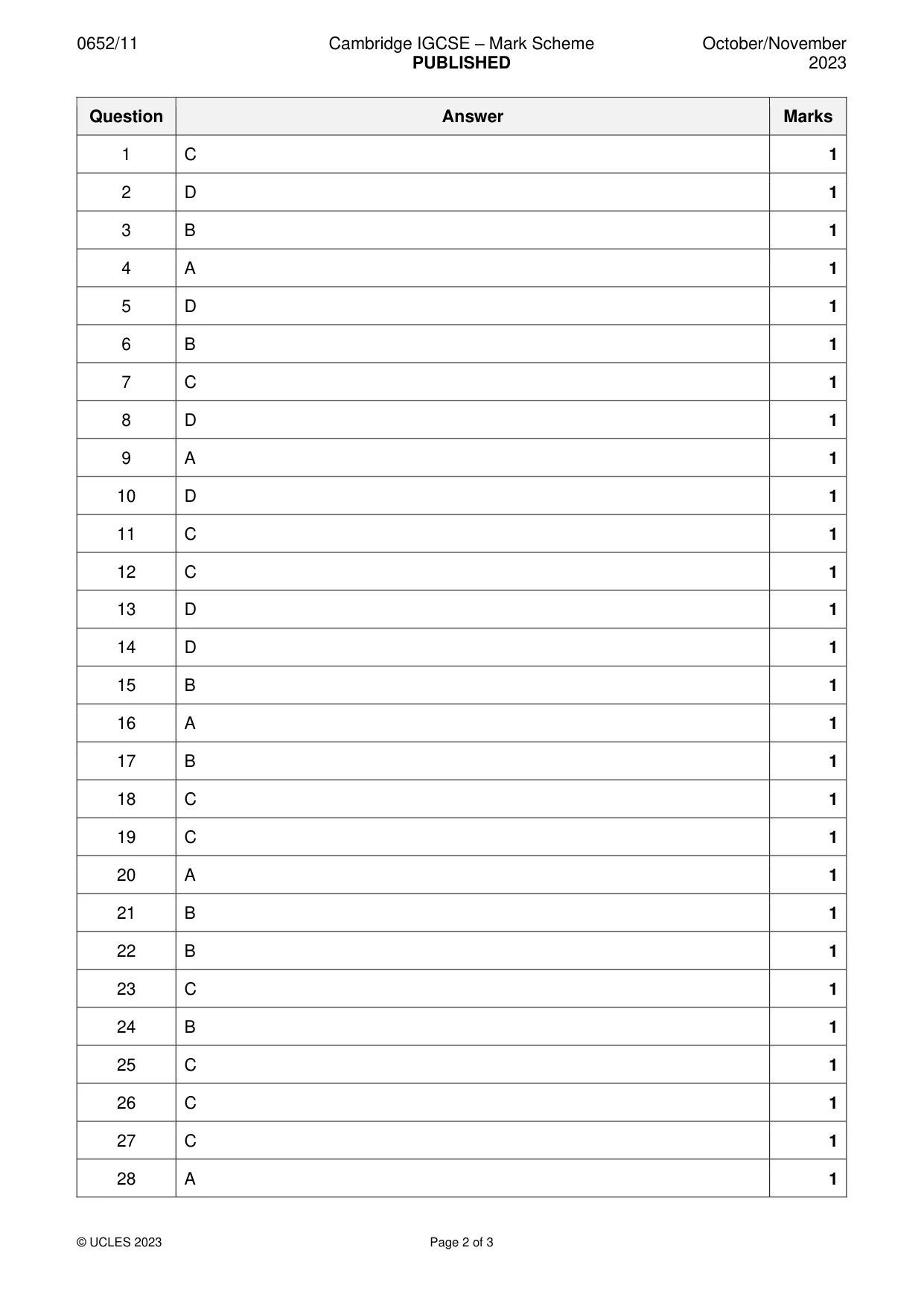
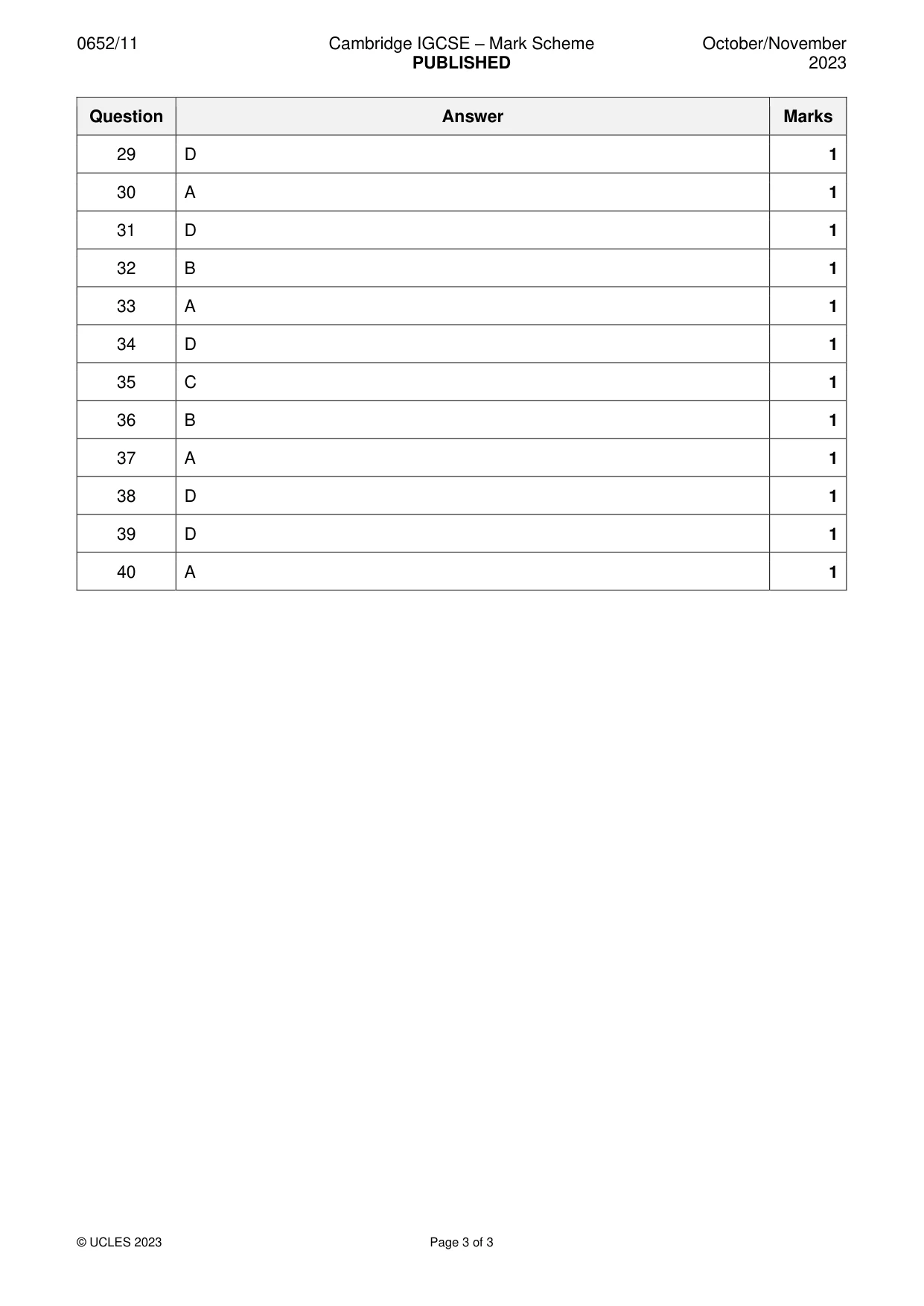
Answers below. Sit the paper first if you are practising.
Questions as text
Q1 · Some statements about particles in solids, liquids and gases are listed
1 Some statements about particles in solids, liquids and gases are listed. 1 Particles in gases are closer together than particles in solids. 2 Particles in solids are more ordered than particles in liquids. 3 Particles in solids diffuse because they are in fixed positions. 4 Particles in liquids move slower than particles in gases. Which statements are correct? A 1 and 2 B 1 and 3 C 2 and 4 D 3 and 4
Mark scheme: C
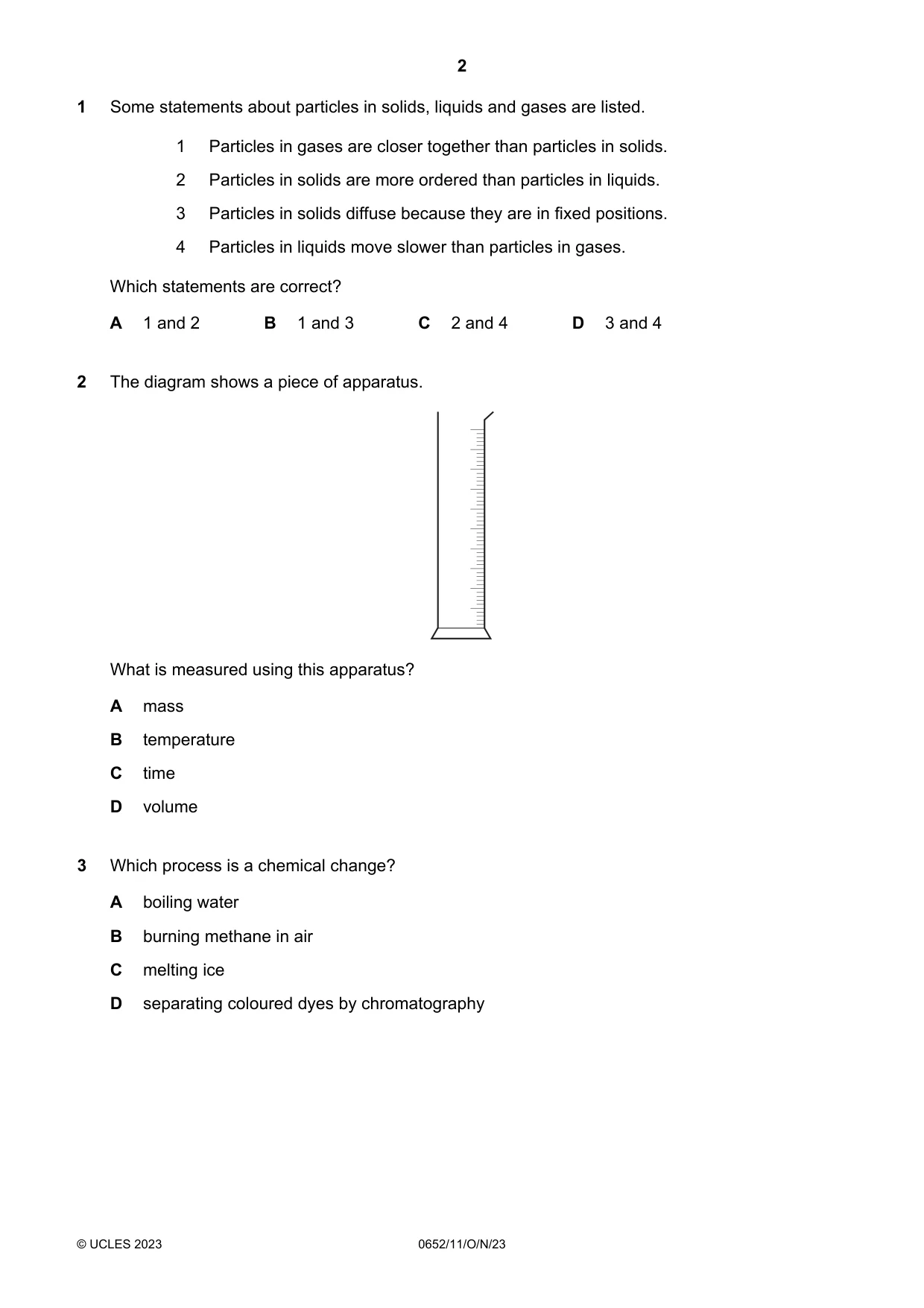
Q2 · The diagram shows a piece of apparatus
2 The diagram shows a piece of apparatus. What is measured using this apparatus? A mass B temperature C time D volume
Mark scheme: D
Q3 · Which process is a chemical change?
3 Which process is a chemical change? A boiling water B burning methane in air C melting ice D separating coloured dyes by chromatography
Mark scheme: B
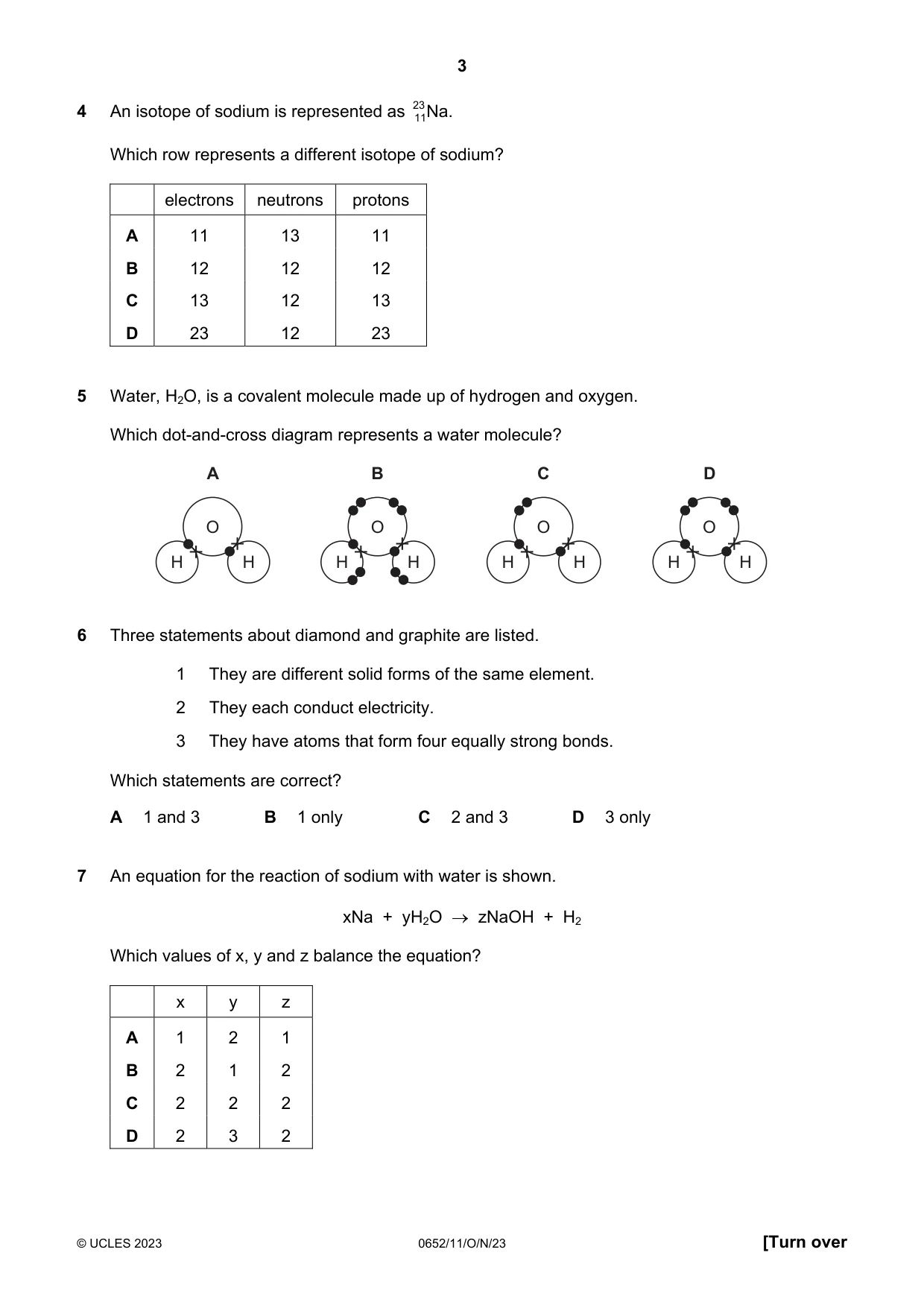
Q4 · An isotope of sodium is represented as 23 Na
4 An isotope of sodium is represented as 23 Na. 11 Which row represents a different isotope of sodium? electrons neutrons protons A 11 13 11 B 12 12 12 C 13 12 13 D 23 12 23
Mark scheme: A
Q5 · Water, H2O, is a covalent molecule made up of hydrogen and oxygen
5 Water, H2O, is a covalent molecule made up of hydrogen and oxygen. Which dot-and-cross diagram represents a water molecule? A B C D O O O O H H H H H H H H
Mark scheme: D
Q6 · Three statements about diamond and graphite are listed
6 Three statements about diamond and graphite are listed. 1 They are different solid forms of the same element. 2 They each conduct electricity. 3 They have atoms that form four equally strong bonds. Which statements are correct? A 1 and 3 B 1 only C 2 and 3 D 3 only
Mark scheme: B
Q7 · An equation for the reaction of sodium with water is shown
7 An equation for the reaction of sodium with water is shown. xNa + yH2O → zNaOH + H2 Which values of x, y and z balance the equation? x y z A 1 2 1 B 2 1 2 C 2 2 2 D 2 3 2
Mark scheme: C
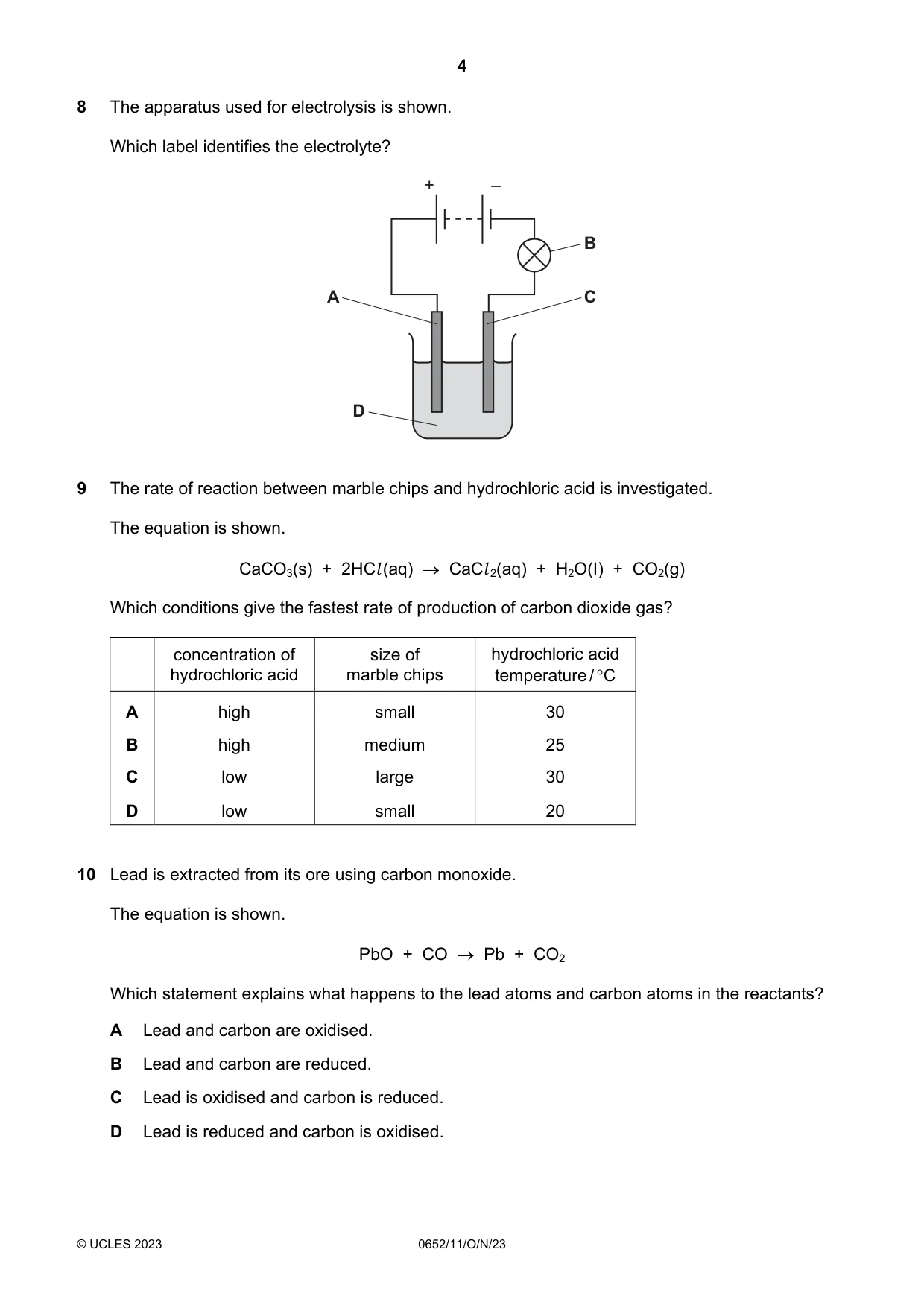
Q8 · The apparatus used for electrolysis is shown
8 The apparatus used for electrolysis is shown. Which label identifies the electrolyte? + – B A C D
Mark scheme: D
Q9 · The rate of reaction between marble chips and hydrochloric acid is investigated
9 The rate of reaction between marble chips and hydrochloric acid is investigated. The equation is shown. CaCO3(s) + 2HCl (aq) → CaCl 2(aq) + H2O(I) + CO2(g) Which conditions give the fastest rate of production of carbon dioxide gas? concentration of size of hydrochloric acid hydrochloric acid marble chips temperature / °C A high small 30 B high medium 25 C low large 30 D low small 20
Mark scheme: A
Q10 · Lead is extracted from its ore using carbon monoxide
10 Lead is extracted from its ore using carbon monoxide. The equation is shown. PbO + CO → Pb + CO2 Which statement explains what happens to the lead atoms and carbon atoms in the reactants? A Lead and carbon are oxidised. B Lead and carbon are reduced. C Lead is oxidised and carbon is reduced. D Lead is reduced and carbon is oxidised.
Mark scheme: D
Q11 · Sulfuric acid is reacted with magnesium
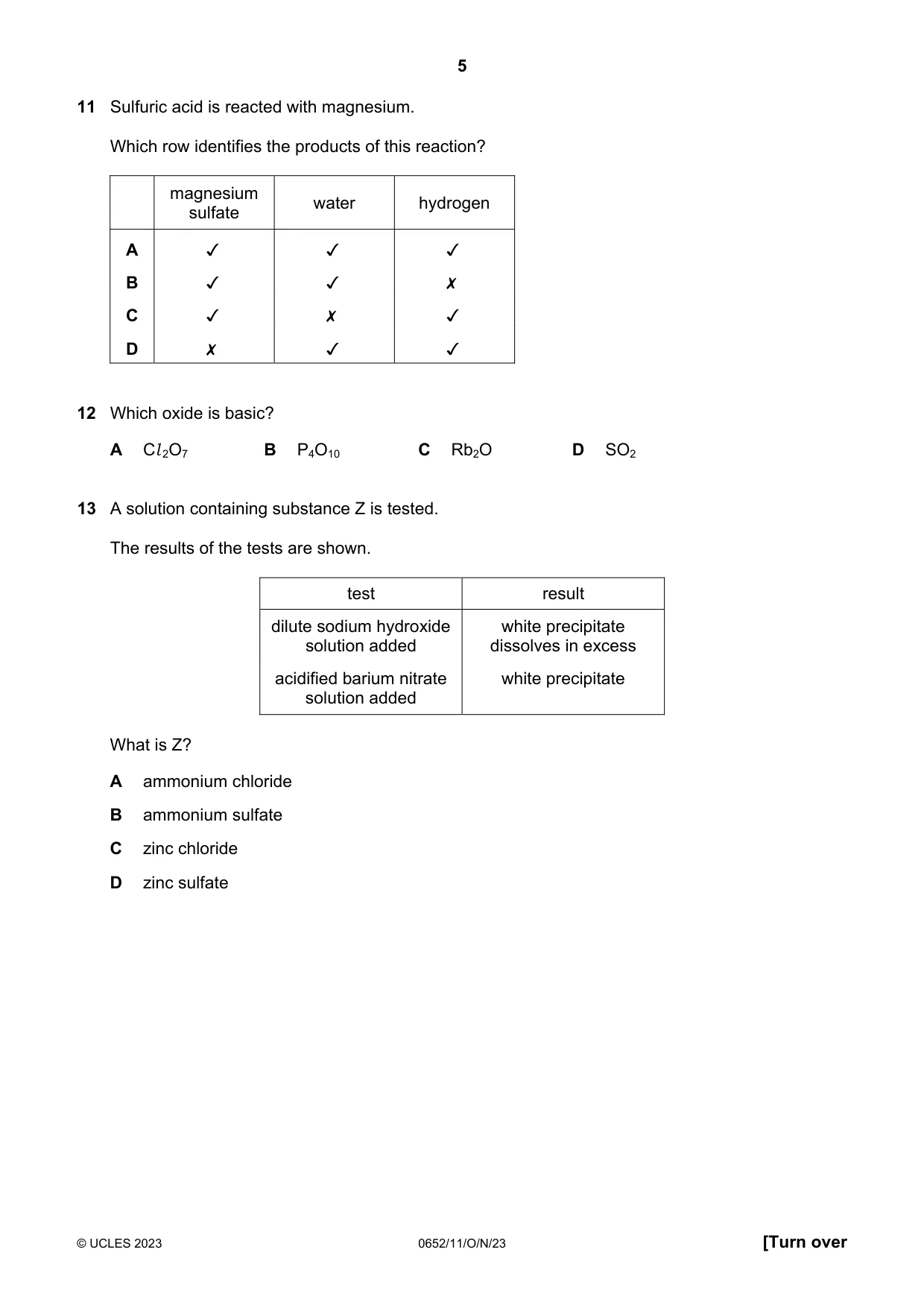
11. Sulfuric acid is reacted with magnesium. Which row identifies the products of this reaction? magnesium water hydrogen A Jv Jv J B Jv Jv x Cc Jv x v D x Jv Jv
Mark scheme: C
Q12 · Which oxide is basic?
12 Which oxide is basic? A Cl 2O7 B P4O10 C Rb2O D SO2
Mark scheme: C
Q13 · A solution containing substance Z is tested
13 A solution containing substance Z is tested. The results of the tests are shown. test result dilute sodium hydroxide white precipitate solution added dissolves in excess acidified barium nitrate white precipitate solution added What is Z? A ammonium chloride B ammonium sulfate C zinc chloride D zinc sulfate
Mark scheme: D
Q14 · Part of the Periodic Table is shown
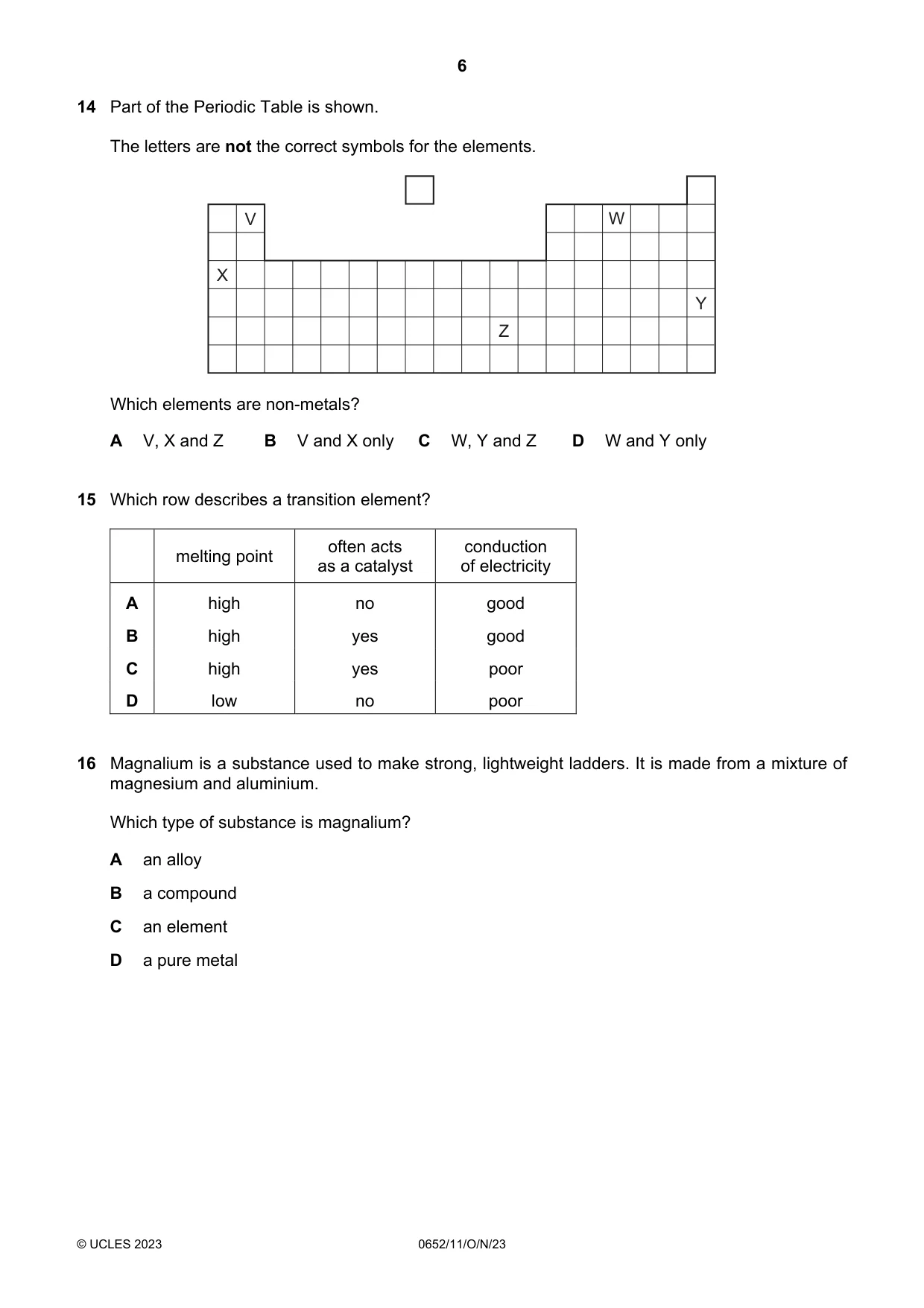
14 Part of the Periodic Table is shown. The letters are not the correct symbols for the elements. V W X Y Z Which elements are non-metals? A V, X and Z B V and X only C W, Y and Z D W and Y only
Mark scheme: D
Q15 · Which row describes a transition element?
15 Which row describes a transition element? often acts conduction melting point as a catalyst of electricity A high no good B high yes good C high yes poor D low no poor
Mark scheme: B
Q16 · Magnalium is a substance used to make strong, lightweight ladders
16 Magnalium is a substance used to make strong, lightweight ladders. It is made from a mixture of magnesium and aluminium. Which type of substance is magnalium? A an alloy B a compound C an element D a pure metal
Mark scheme: A
Q17 · Which row shows a correct order of reactivity of metals?
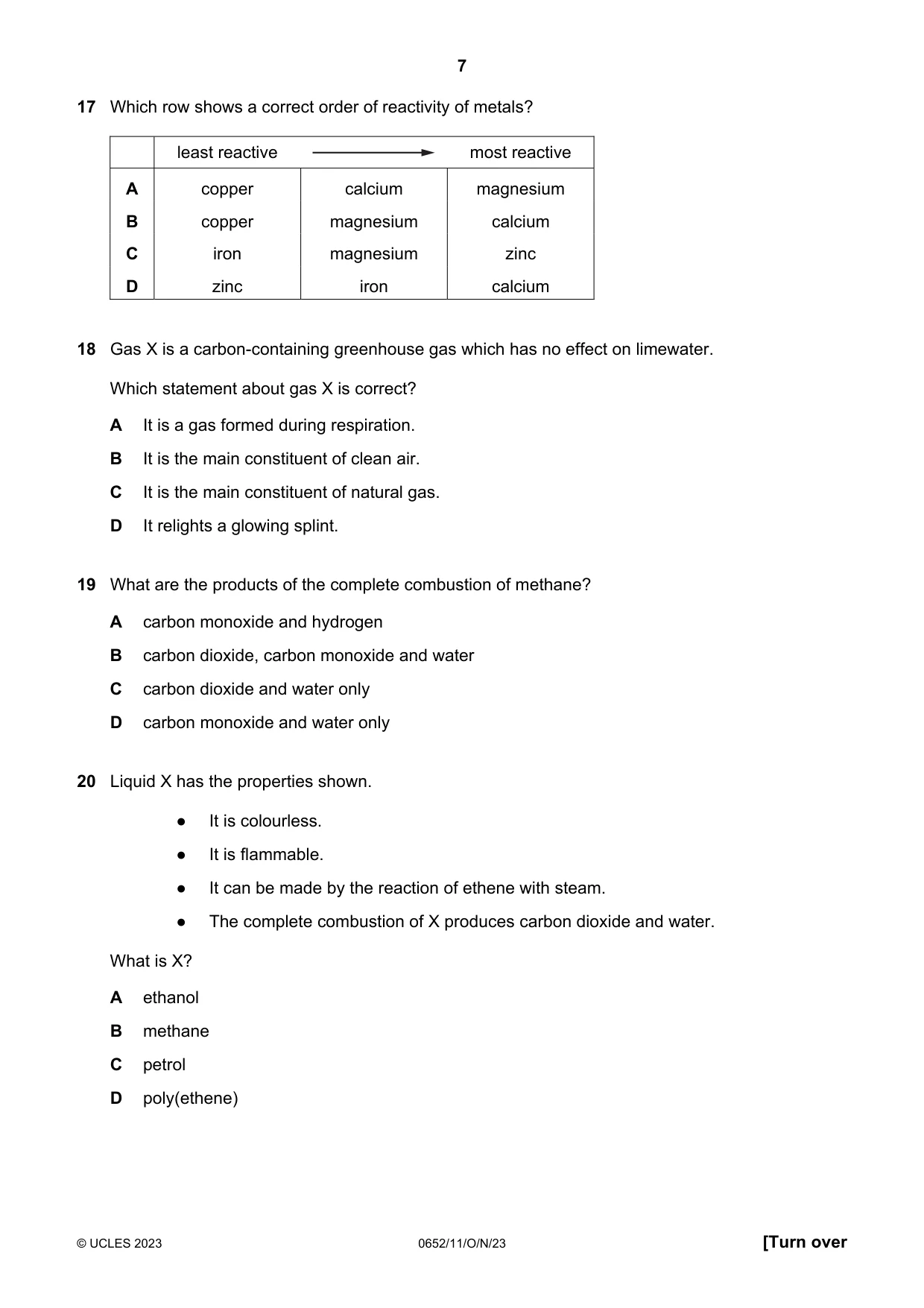
17 Which row shows a correct order of reactivity of metals? least reactive most reactive A copper calcium magnesium B copper magnesium calcium C iron magnesium zinc D zinc iron calcium
Mark scheme: B
Q18 · Gas X is a carbon-containing greenhouse gas which has no effect on limewater
18 Gas X is a carbon-containing greenhouse gas which has no effect on limewater. Which statement about gas X is correct? A It is a gas formed during respiration. B It is the main constituent of clean air. C It is the main constituent of natural gas. D It relights a glowing splint.
Mark scheme: C
Q19 · What are the products of the complete combustion of methane?
19 What are the products of the complete combustion of methane? A carbon monoxide and hydrogen B carbon dioxide, carbon monoxide and water C carbon dioxide and water only D carbon monoxide and water only
Mark scheme: C
Q20 · Liquid X has the properties shown
20 Liquid X has the properties shown. ● It is colourless. ● It is flammable. ● It can be made by the reaction of ethene with steam. ● The complete combustion of X produces carbon dioxide and water. What is X? A ethanol B methane C petrol D poly(ethene)
Mark scheme: A
Q21 · The diagram shows a ruler used to measure the length of one side of a square
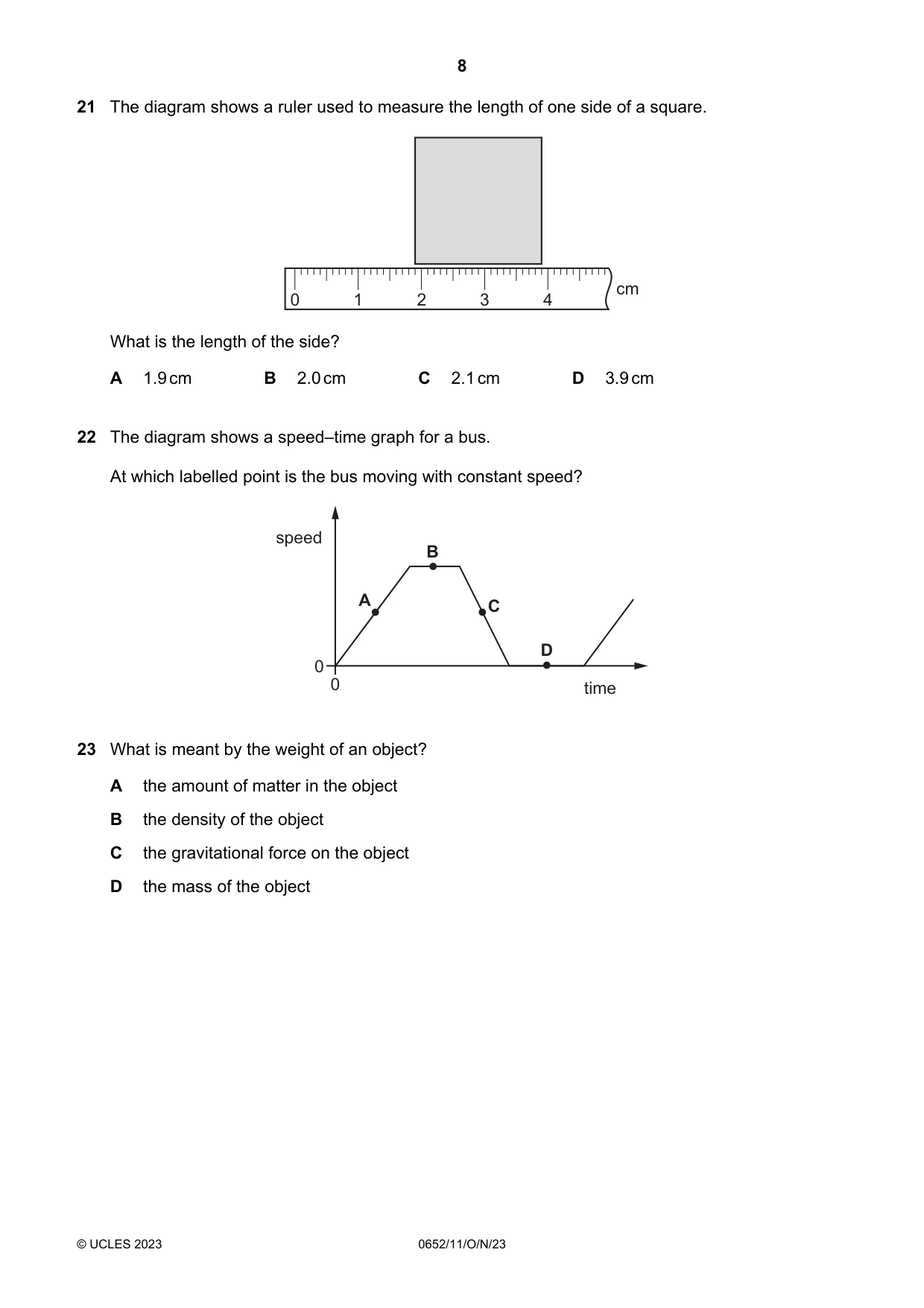
21 The diagram shows a ruler used to measure the length of one side of a square. cm 0 1 2 3 4 What is the length of the side? A 1.9 cm B 2.0 cm C 2.1 cm D 3.9 cm
Mark scheme: B
Q22 · The diagram shows a speed–time graph for a bus
22 The diagram shows a speed–time graph for a bus. At which labelled point is the bus moving with constant speed? speed B A C D 0 0 time
Mark scheme: B
Q23 · What is meant by the weight of an object?
23 What is meant by the weight of an object? A the amount of matter in the object B the density of the object C the gravitational force on the object D the mass of the object
Mark scheme: C
Q24 · A cyclist travels along a horizontal road at constant speed in a straight line
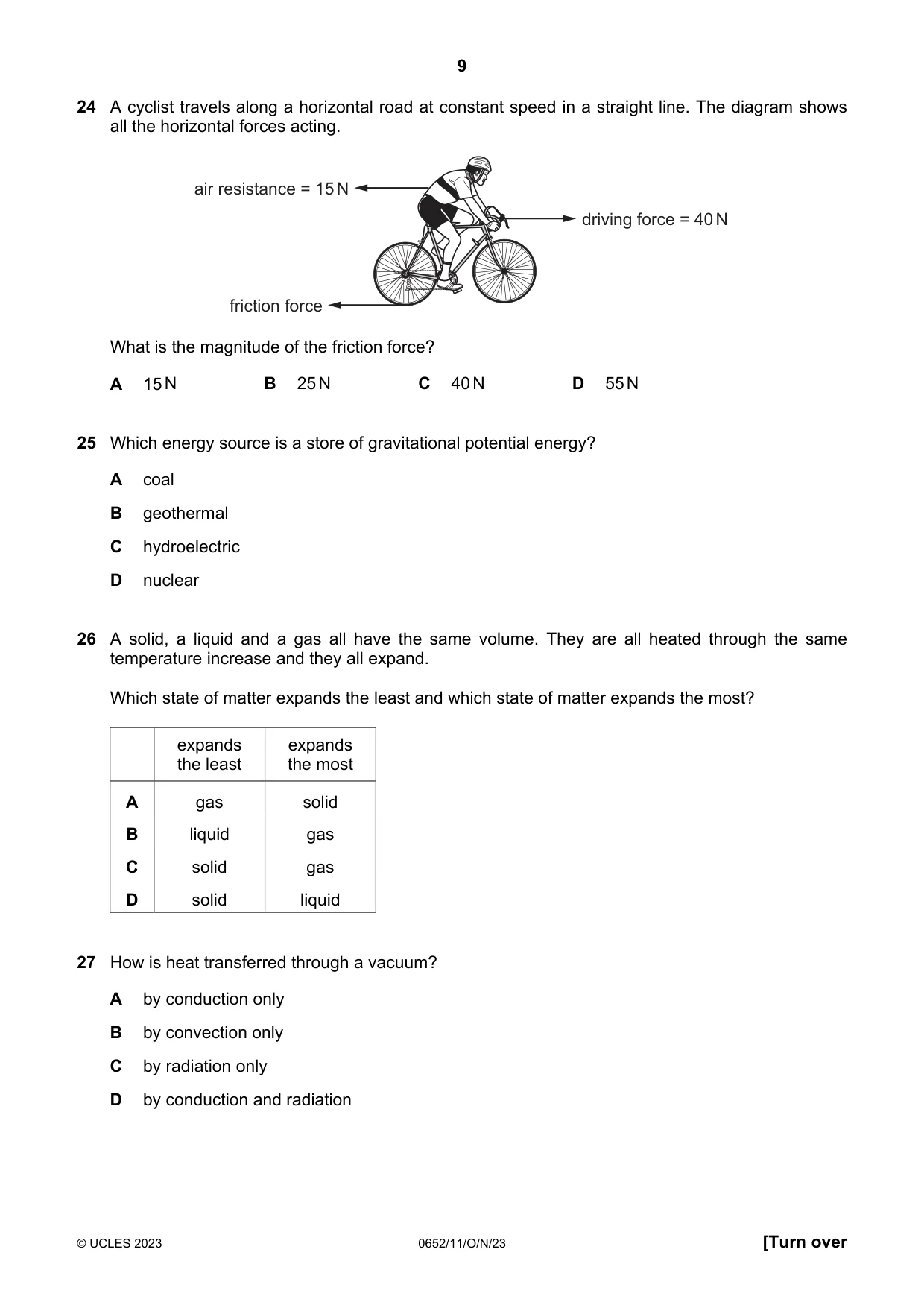
24 A cyclist travels along a horizontal road at constant speed in a straight line. The diagram shows all the horizontal forces acting. air resistance = 15 N driving force = 40 N friction force What is the magnitude of the friction force? A 15 N B 25 N C 40 N D 55 N
Mark scheme: B
Q25 · Which energy source is a store of gravitational potential energy?
25 Which energy source is a store of gravitational potential energy? A coal B geothermal C hydroelectric D nuclear
Mark scheme: C
Q26 · A solid, a liquid and a gas all have the same volume
26 A solid, a liquid and a gas all have the same volume. They are all heated through the same temperature increase and they all expand. Which state of matter expands the least and which state of matter expands the most? expands expands the least the most A gas solid B liquid gas C solid gas D solid liquid
Mark scheme: C
Q27 · How is heat transferred through a vacuum?
27 How is heat transferred through a vacuum? A by conduction only B by convection only C by radiation only D by conduction and radiation
Mark scheme: C
Q28 · The diagram represents a wave
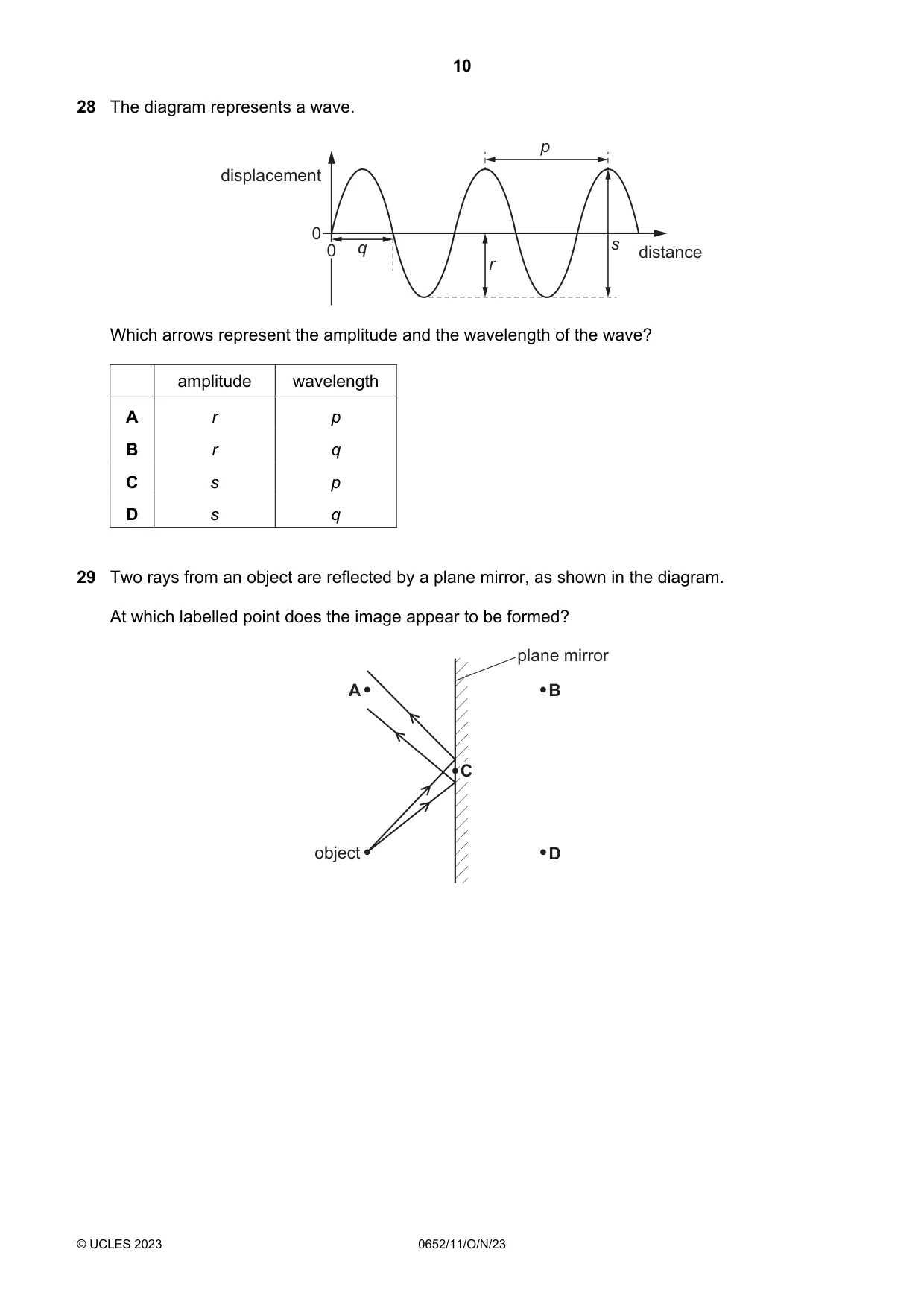
28 The diagram represents a wave. p displacement 0 0 q s distance r Which arrows represent the amplitude and the wavelength of the wave? amplitude wavelength A r p B r q C s p D s q
Mark scheme: A
Q29 · Two rays from an object are reflected by a plane mirror, as shown in the diagram
29 Two rays from an object are reflected by a plane mirror, as shown in the diagram. At which labelled point does the image appear to be formed? plane mirror A B C object D
Mark scheme: D
Q30 · The diagram shows light from an object O passing through a converging lens to form an…
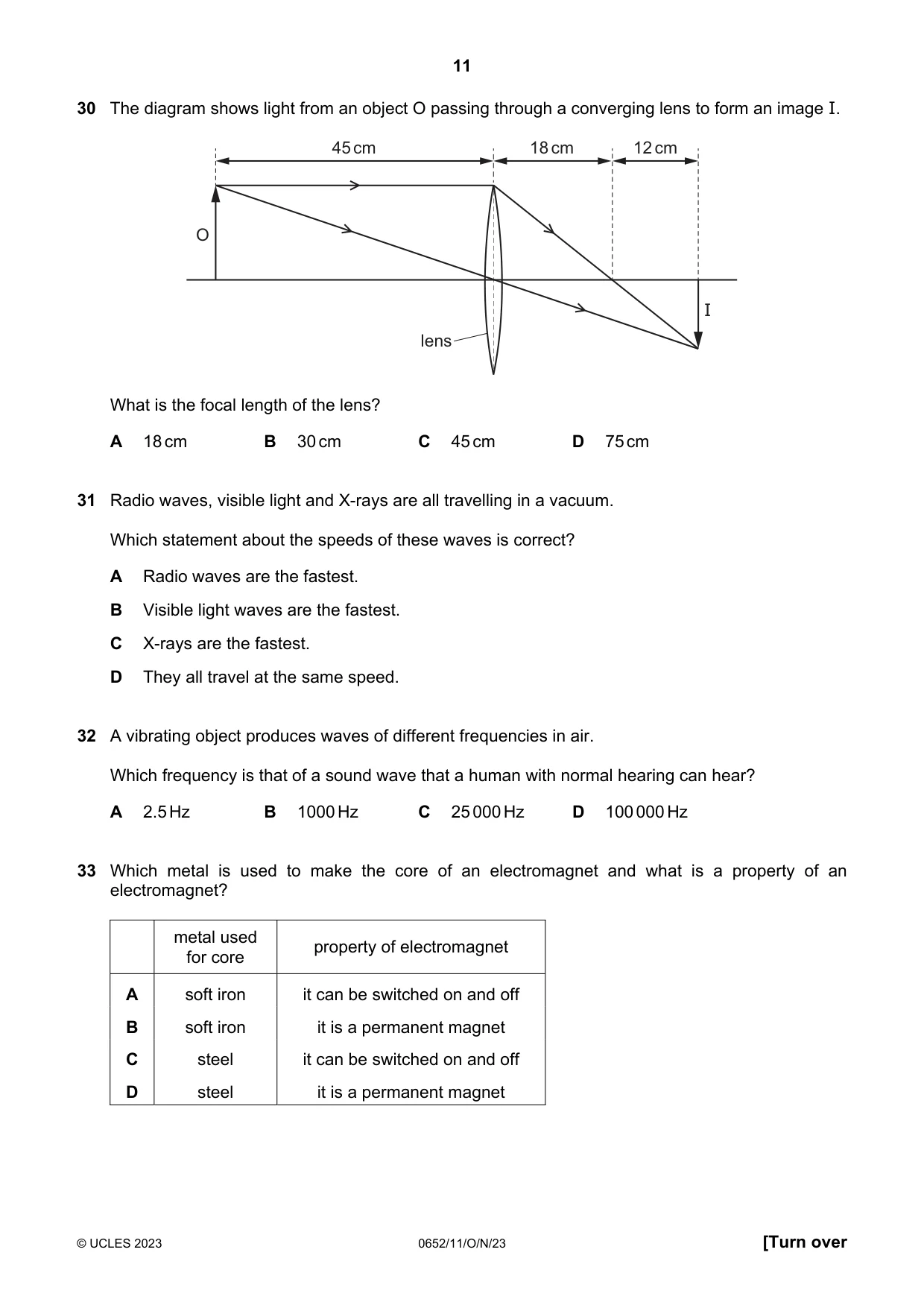
30 The diagram shows light from an object O passing through a converging lens to form an image I. 45 cm 18 cm 12 cm O I lens What is the focal length of the lens? A 18 cm B 30 cm C 45 cm D 75 cm
Mark scheme: A
Q31 · Radio waves, visible light and X-rays are all travelling in a vacuum
31 Radio waves, visible light and X-rays are all travelling in a vacuum. Which statement about the speeds of these waves is correct? A Radio waves are the fastest. B Visible light waves are the fastest. C X-rays are the fastest. D They all travel at the same speed.
Mark scheme: D
Q32 · A vibrating object produces waves of different frequencies in air
32 A vibrating object produces waves of different frequencies in air. Which frequency is that of a sound wave that a human with normal hearing can hear? A 2.5 Hz B 1000 Hz C 25 000 Hz D 100 000 Hz
Mark scheme: B
Q33 · Which metal is used to make the core of an electromagnet and what is a property of an…
33 Which metal is used to make the core of an electromagnet and what is a property of an electromagnet? metal used property of electromagnet for core A soft iron it can be switched on and off B soft iron it is a permanent magnet C steel it can be switched on and off D steel it is a permanent magnet
Mark scheme: A
Q34 · An uncharged plastic rod is rubbed with an uncharged cotton cloth
34 An uncharged plastic rod is rubbed with an uncharged cotton cloth. What happens to the rod and what happens to the cloth? A The cloth becomes charged but the rod does not. B The rod becomes charged but the cloth does not. C The rod and the cloth become charged with like charges. D The rod and the cloth become charged with opposite charges.
Mark scheme: D
Q35 · Which quantities can be measured using only a voltmeter?
35 Which quantities can be measured using only a voltmeter? A current and electromotive force (e.m.f.) B current and resistance C electromotive force (e.m.f.) and potential difference (p.d.) D potential difference (p.d.) and resistance
Mark scheme: C
Q36 · The diagram shows an arrangement of three resistors
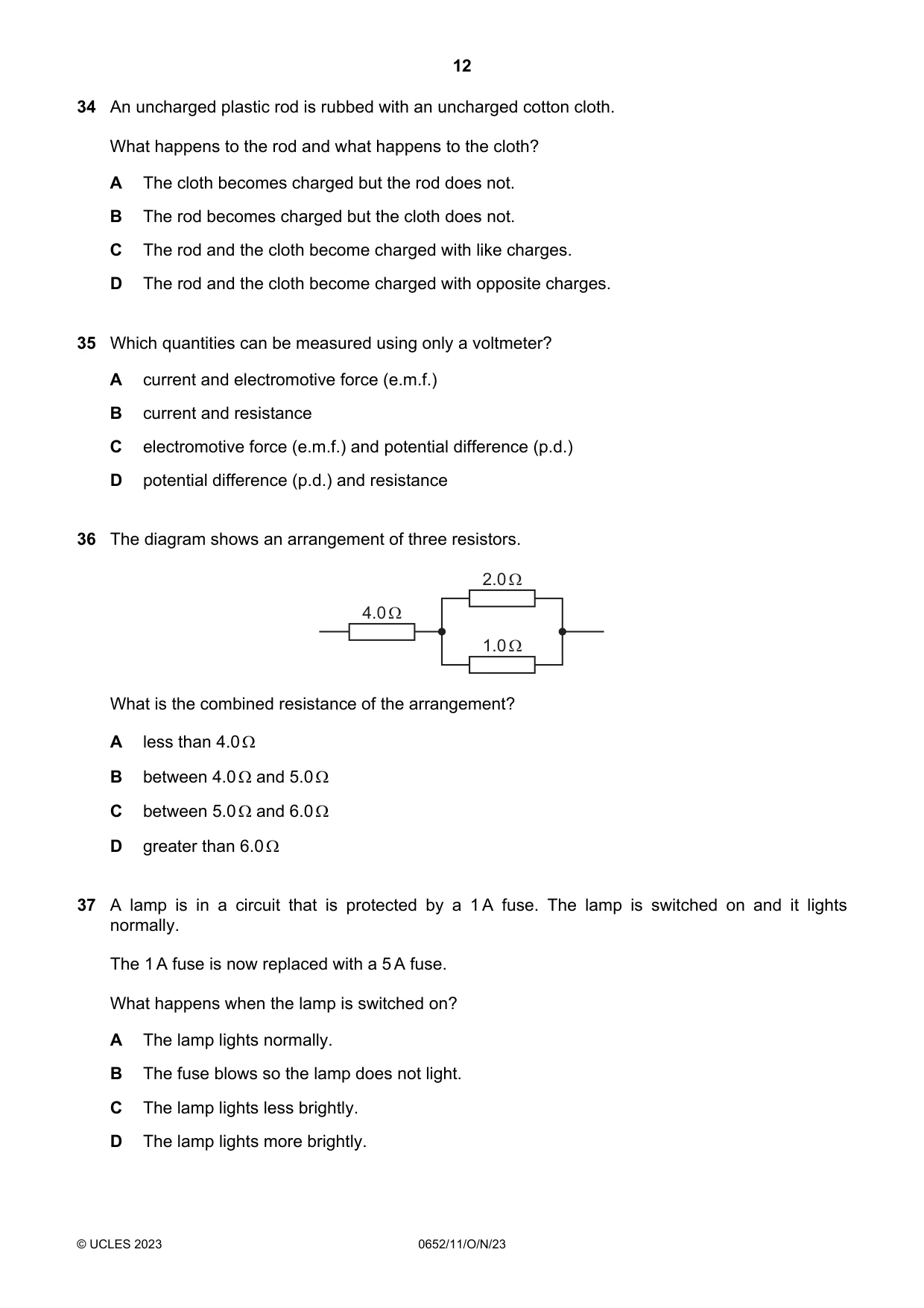
36 The diagram shows an arrangement of three resistors. 2.0Q | 4.00 | P| What is the combined resistance of the arrangement? A less than 4.00 B~ between 4.09 and 5.00 C between 5.0Q and 6.0Q D greater than 6.00
Mark scheme: B
Q37 · A lamp is in a circuit that is protected by a 1 A fuse
37 A lamp is in a circuit that is protected by a 1 A fuse. The lamp is switched on and it lights normally. The 1 A fuse is now replaced with a 5 A fuse. What happens when the lamp is switched on? A The lamp lights normally. B The fuse blows so the lamp does not light. C The lamp lights less brightly. D The lamp lights more brightly.
Mark scheme: A
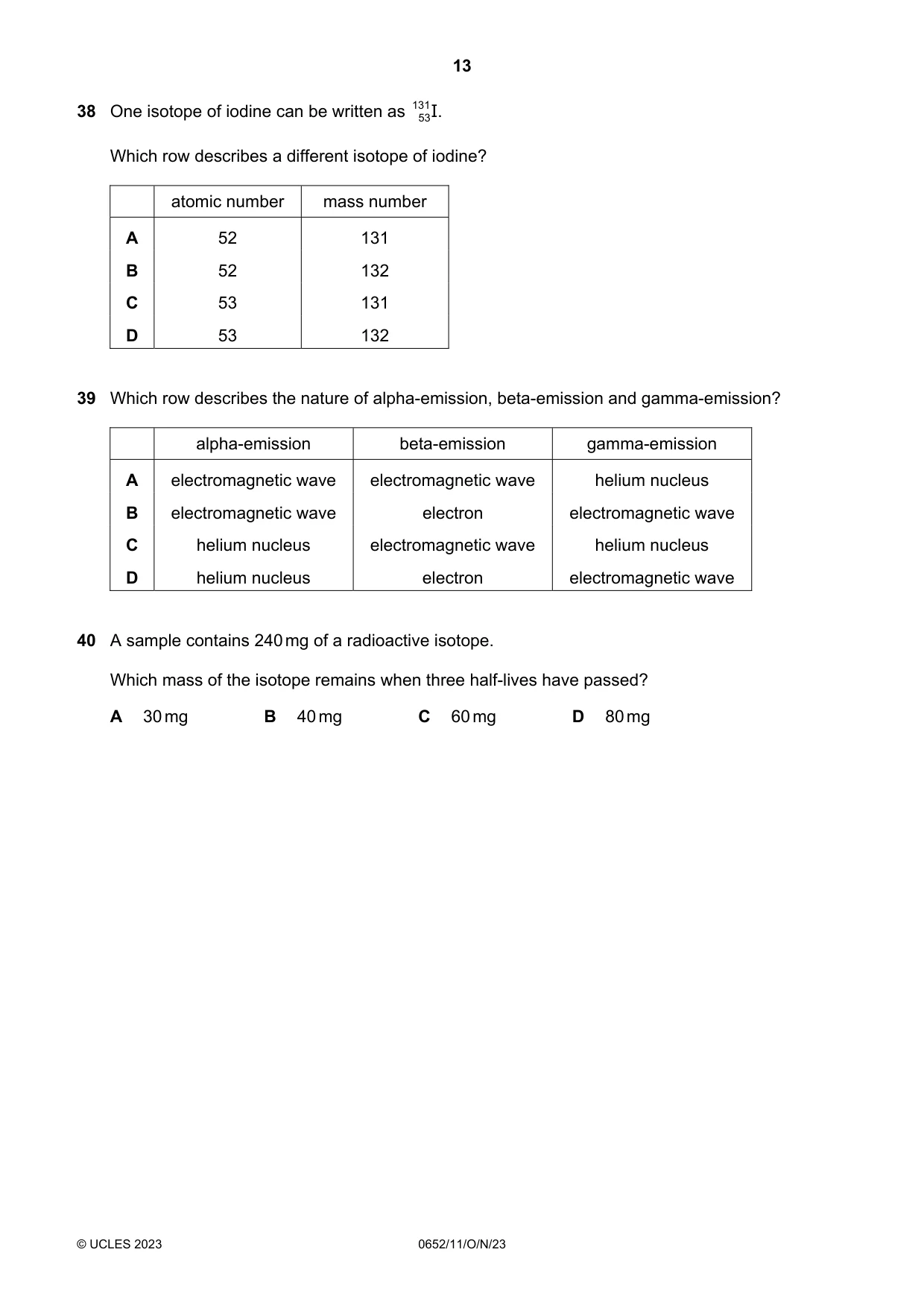
Q38 · One isotope of iodine can be written as 131 53I
38 One isotope of iodine can be written as 131 53I . Which row describes a different isotope of iodine? atomic number mass number A 52 131 B 52 132 C 53 131 D 53 132
Mark scheme: D
Q39 · Which row describes the nature of alpha-emission, beta-emission and gamma-emission?
39 Which row describes the nature of alpha-emission, beta-emission and gamma-emission? alpha-emission beta-emission gamma-emission A electromagnetic wave electromagnetic wave helium nucleus B electromagnetic wave electron electromagnetic wave C helium nucleus electromagnetic wave helium nucleus D helium nucleus electron electromagnetic wave
Mark scheme: D
Q40 · A sample contains 240 mg of a radioactive isotope
40 A sample contains 240 mg of a radioactive isotope. Which mass of the isotope remains when three half-lives have passed? A 30 mg B 40 mg C 60 mg D 80 mg
Mark scheme: A
What was in this paper
The subtopics covered by these 40 questions, and how many questions each got. Open one in a new tab to see every Cambridge question on it.
2General wave properties2Light2Radioactivity2Alcohols1Atomic structure and the Periodic Table1Carbon dioxide and methane1Dangers of electricity1Electric circuits1Electricity and chemistry1Forces1Fuels1Identification of ions and gases1Length and time1Macromolecules1Mass and weight1Measurement1Molecules and covalent bonds1Motion1Physical and chemical changes1Preparation of salts1Properties of metals1Rate (speed) of reaction1Reactivity series1Redox1Simple phenomena of magnetism1Sound1Stoichiometry1The nuclear atom1The particulate nature of matter1The Periodic Table1Thermal processes1Thermal properties and temperature1Transition elements1Types of oxides1Work, energy and power1What you needed in this session
Cambridge’s own grade thresholds for 2023 Oct/Nov, Paper 1 · Variant 1. A higher threshold means an easier paper — the bar moves with how the cohort did.