Cambridge IGCSE Physical Science 0652 — 2013 Oct/Nov Paper 1 · Variant 2
0652/12/O/N/13 · 40 questions · 40 marks · ≈45 min
The question paper and its mark scheme, free to read here and free to download. This is Cambridge’s own paper, exactly as it was sat.
Question paper20 pages



Mark scheme2 pages
Answers below. Sit the paper first if you are practising.
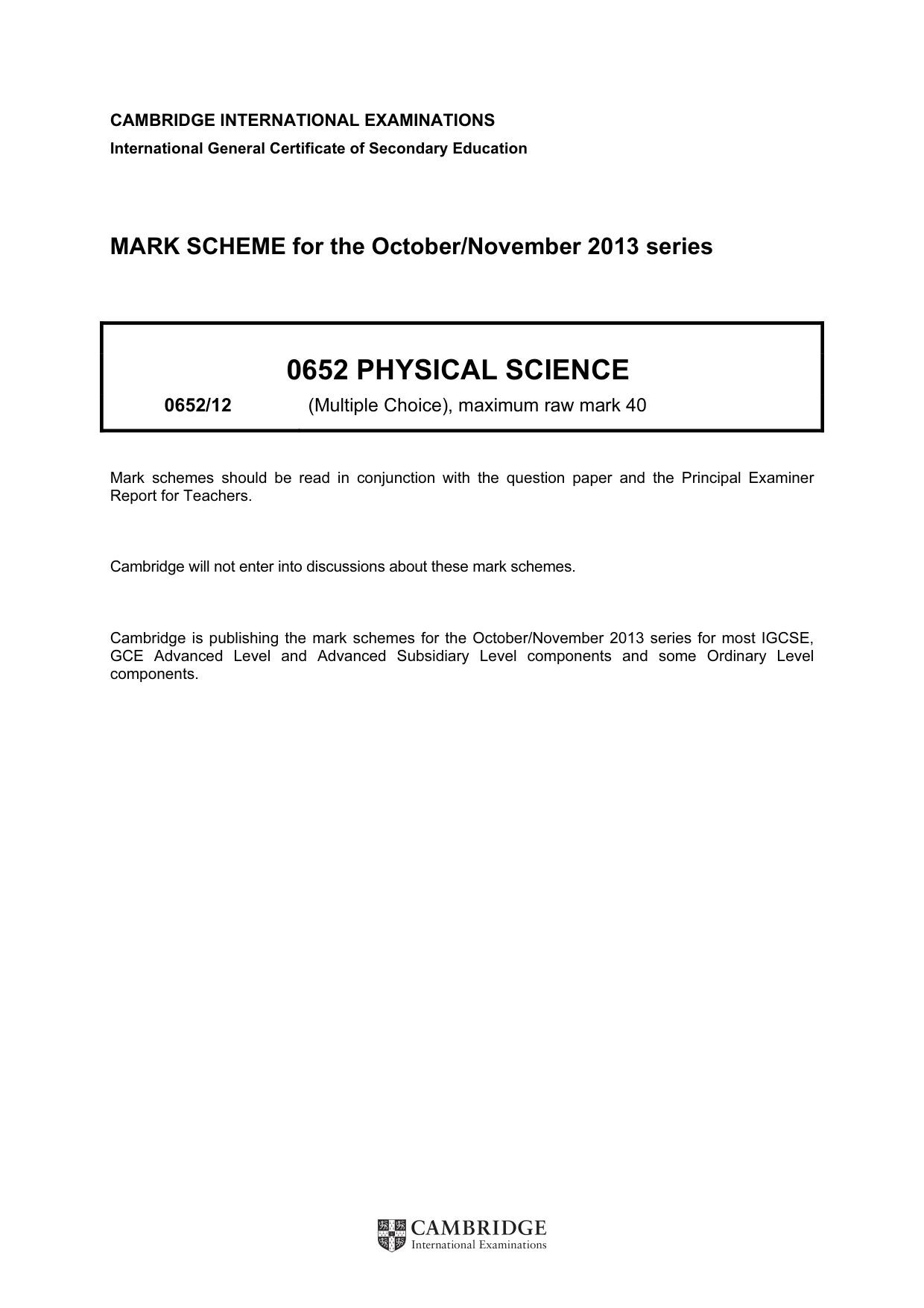
Questions as text
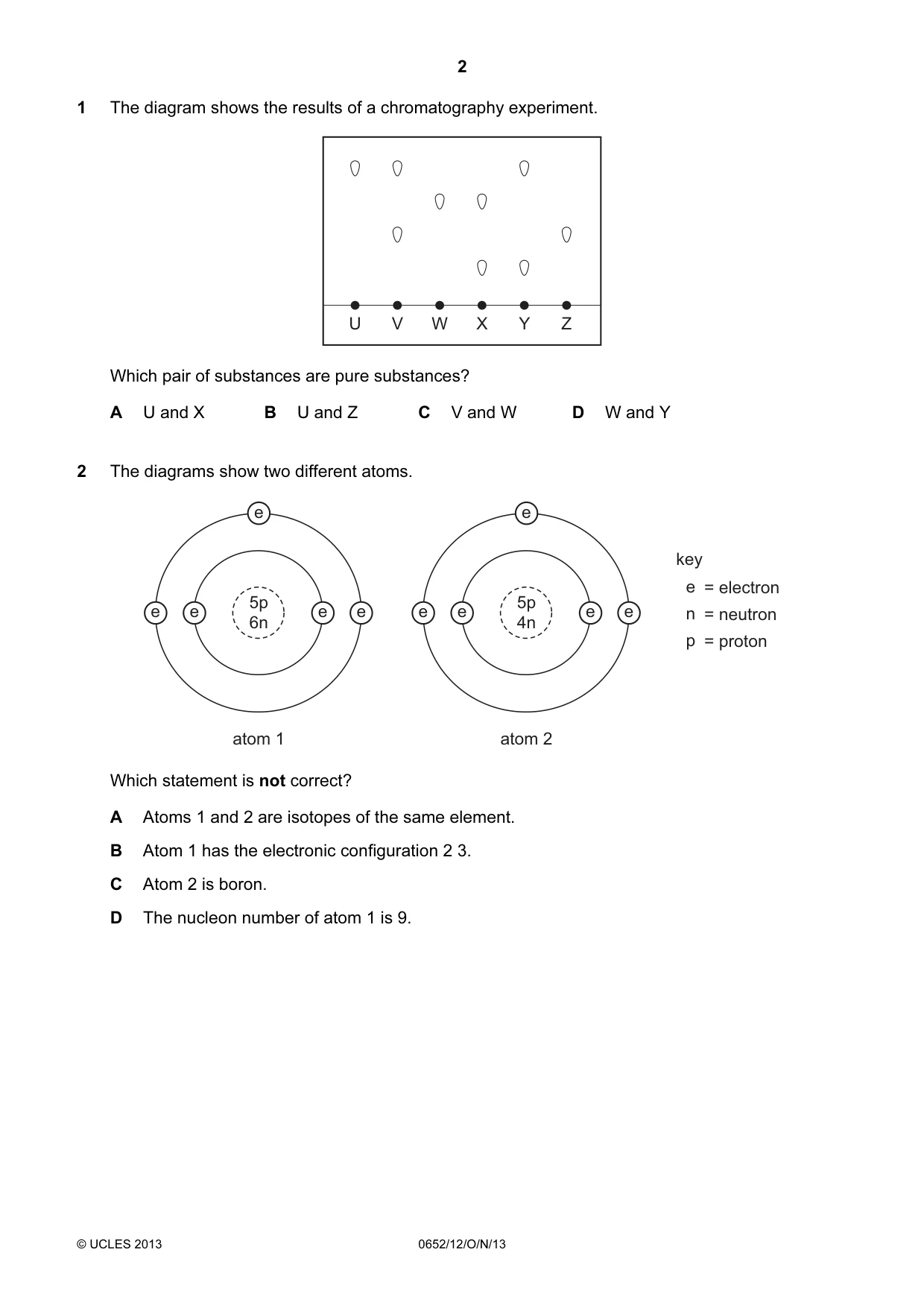
Q1 · The diagram shows the results of a chromatography experiment
1 The diagram shows the results of a chromatography experiment. U V W X Y Z Which pair of substances are pure substances? A U and X B U and Z C V and W D W and Y
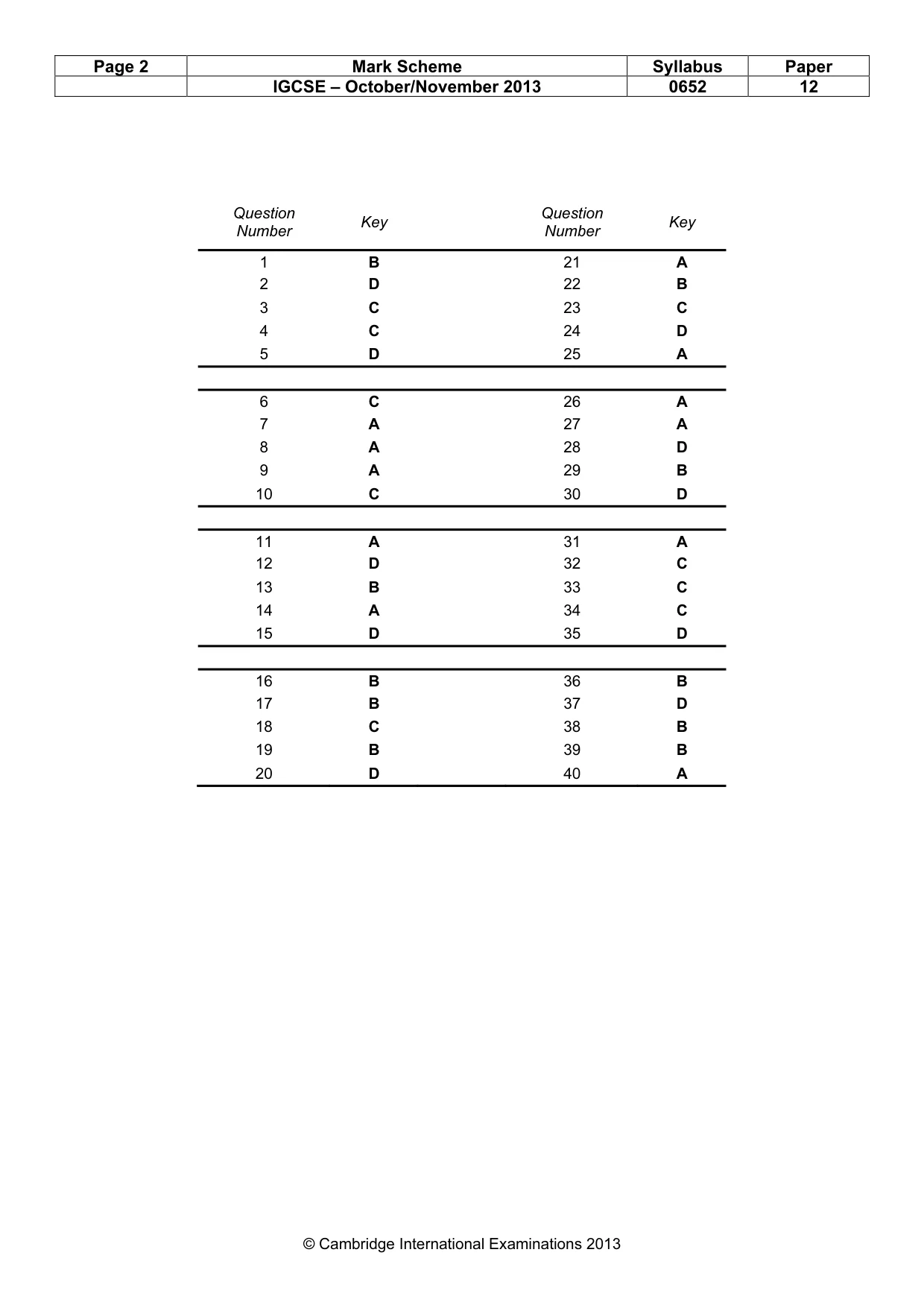
Mark scheme: B
Q2 · The diagrams show two different atoms
2 The diagrams show two different atoms. e e key e = electron 5p 5p e e e e e e e e n = neutron 6n 4n p = proton atom 1 atom 2 Which statement is not correct? A Atoms 1 and 2 are isotopes of the same element. B Atom 1 has the electronic configuration 2 3. C Atom 2 is boron. D The nucleon number of atom 1 is 9.
Mark scheme: D
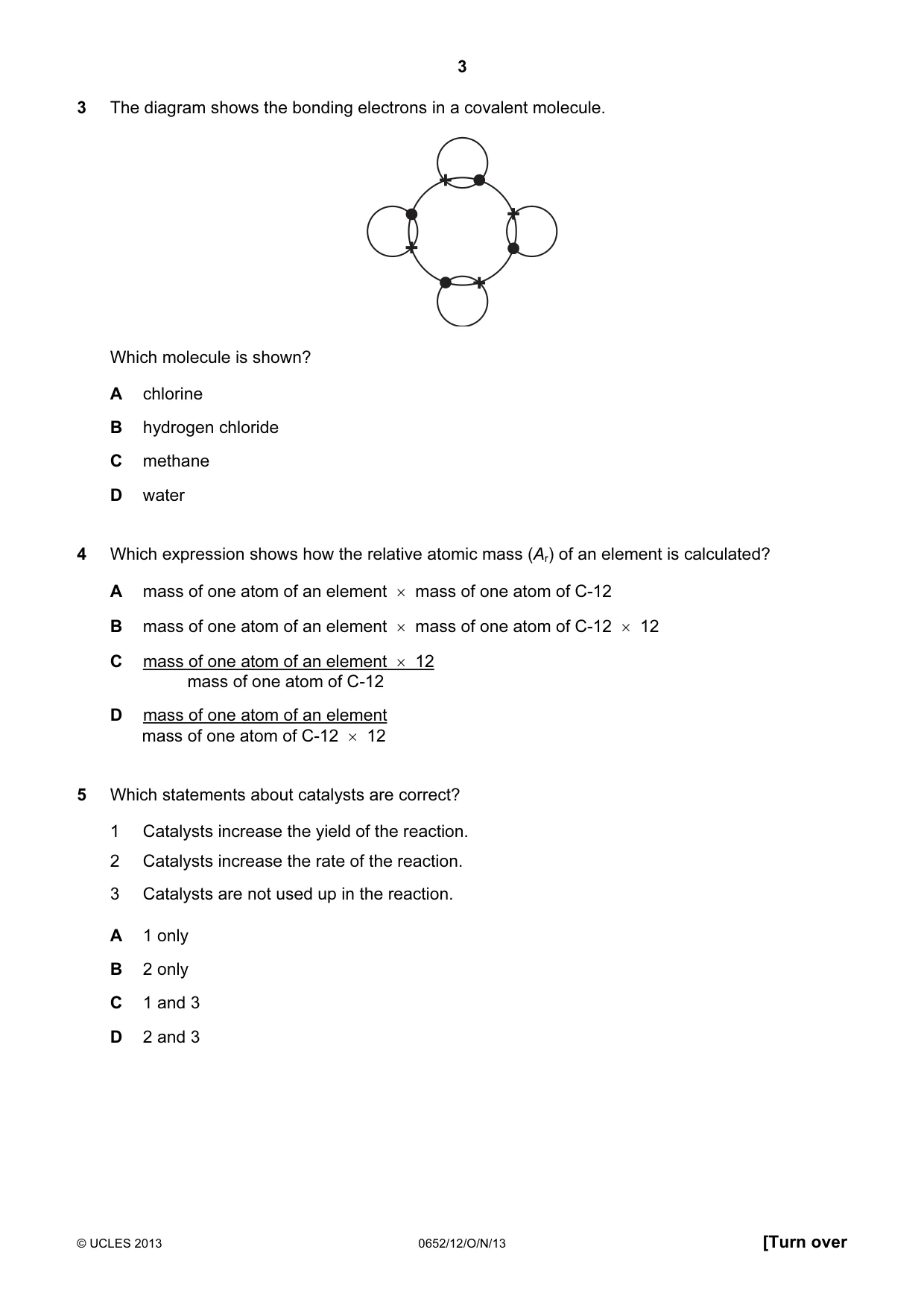
Q3 · The diagram shows the bonding electrons in a covalent molecule
3 The diagram shows the bonding electrons in a covalent molecule. Which molecule is shown? A chlorine B hydrogen chloride C methane D water
Mark scheme: C
Q4 · Which expression shows how the relative atomic mass (Ar) of an element is calculated?
4 Which expression shows how the relative atomic mass (Ar) of an element is calculated? A mass of one atom of an element × mass of one atom of C-12 B mass of one atom of an element × mass of one atom of C-12 × 12 C mass of one atom of an element × 12 mass of one atom of C-12 D mass of one atom of an element mass of one atom of C-12 × 12
Mark scheme: C
Q5 · Which statements about catalysts are correct?
5 Which statements about catalysts are correct? 1 Catalysts increase the yield of the reaction. 2 Catalysts increase the rate of the reaction. 3 Catalysts are not used up in the reaction. A 1 only B 2 only C 1 and 3 D 2 and 3
Mark scheme: D
Q6 · Zinc reacts with steam to form zinc oxide and hydrogen
6 Zinc reacts with steam to form zinc oxide and hydrogen. Zn + H2O → ZnO + H2 During the reaction, which substance is oxidised? A hydrogen B water C zinc D zinc oxide
Mark scheme: C
Q7 · Which two substances react to form carbon dioxide?
7 Which two substances react to form carbon dioxide? A dilute hydrochloric acid and calcium carbonate B dilute hydrochloric acid and magnesium C dilute hydrochloric acid and sodium oxide D hydrogen peroxide and manganese(IV) oxide
Mark scheme: A
Q8 · The statements are about non-metals and their oxides
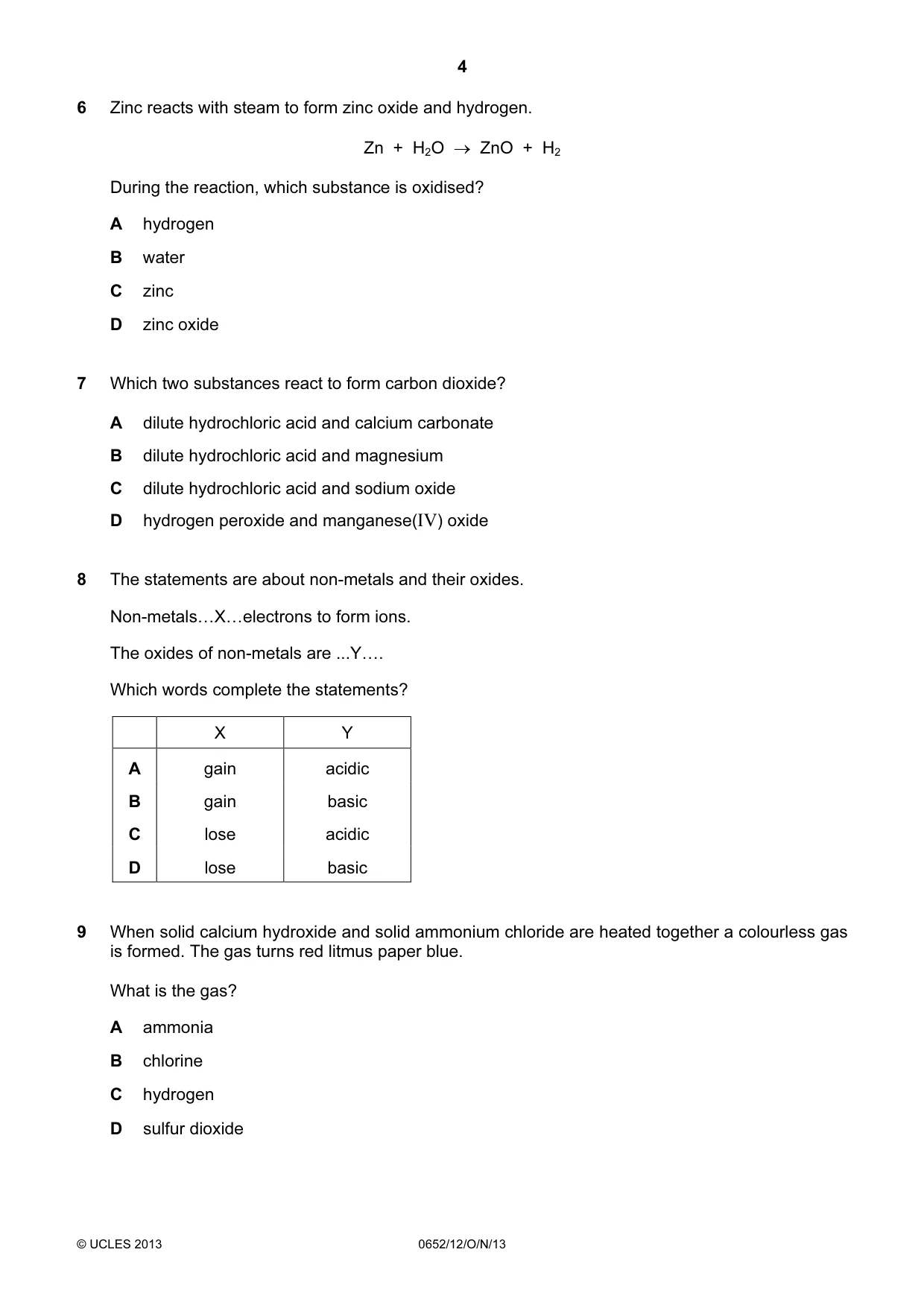
8 The statements are about non-metals and their oxides. Non-metals…X…electrons to form ions. The oxides of non-metals are ...Y…. Which words complete the statements? X Y A gain acidic B gain basic C lose acidic D lose basic
Mark scheme: A
Q9 · When solid calcium hydroxide and solid ammonium chloride are heated together a colourless…
9 When solid calcium hydroxide and solid ammonium chloride are heated together a colourless gas is formed. The gas turns red litmus paper blue. What is the gas? A ammonia B chlorine C hydrogen D sulfur dioxide
Mark scheme: A
Q10 · Which pair of elements combine together to form an ionic compound?
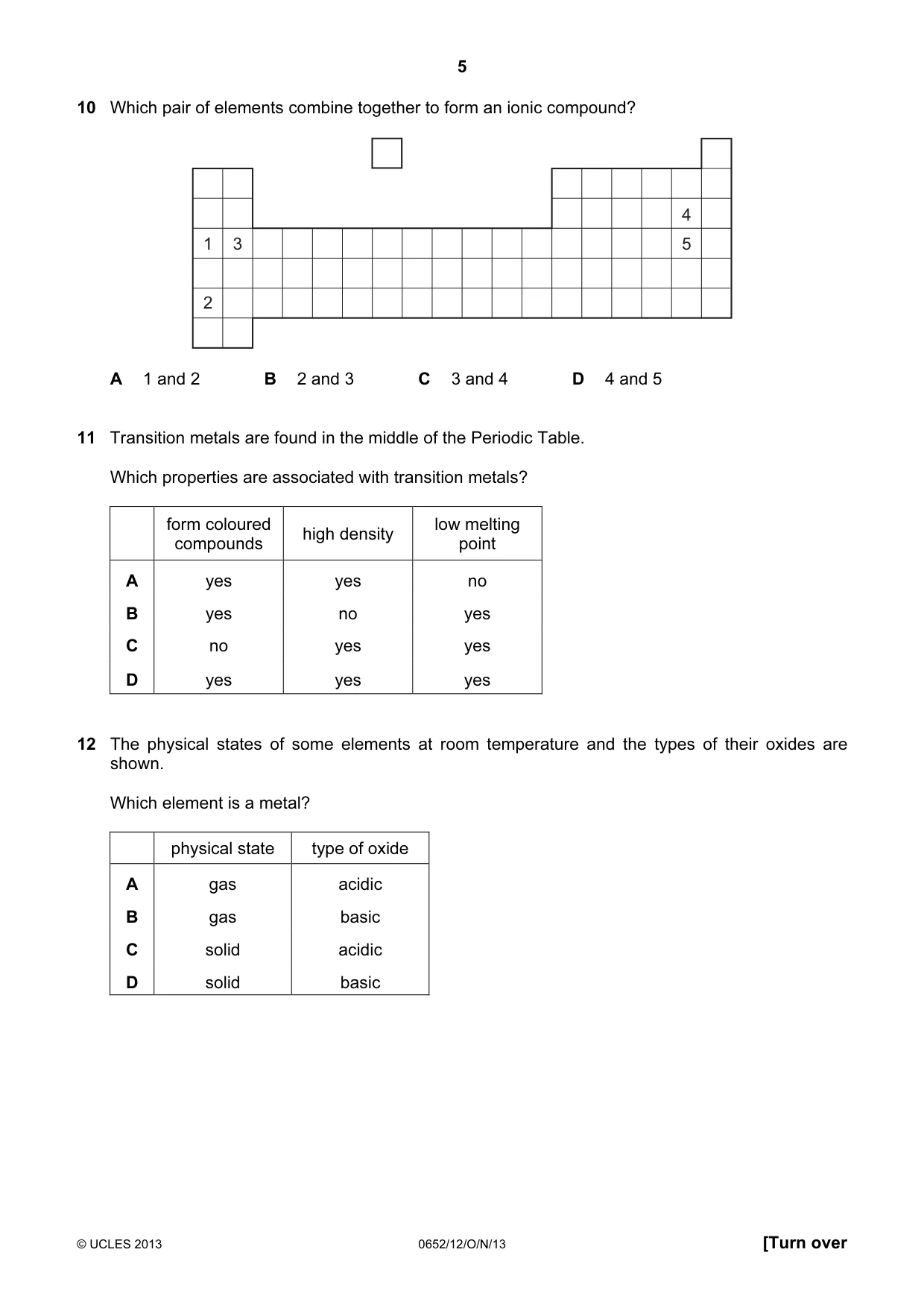
10 Which pair of elements combine together to form an ionic compound? 4 1 3 5 2 A 1 and 2 B 2 and 3 C 3 and 4 D 4 and 5
Mark scheme: C
Q11 · Transition metals are found in the middle of the Periodic Table
11 Transition metals are found in the middle of the Periodic Table. Which properties are associated with transition metals? form coloured low melting high density compounds point A yes yes no B yes no yes C no yes yes D yes yes yes
Mark scheme: A
Q12 · The physical states of some elements at room temperature and the types of their oxides…
12 The physical states of some elements at room temperature and the types of their oxides are shown. Which element is a metal? physical state type of oxide A gas acidic B gas basic C solid acidic D solid basic
Mark scheme: D
Q13 · Bauxite and haematite are important ores
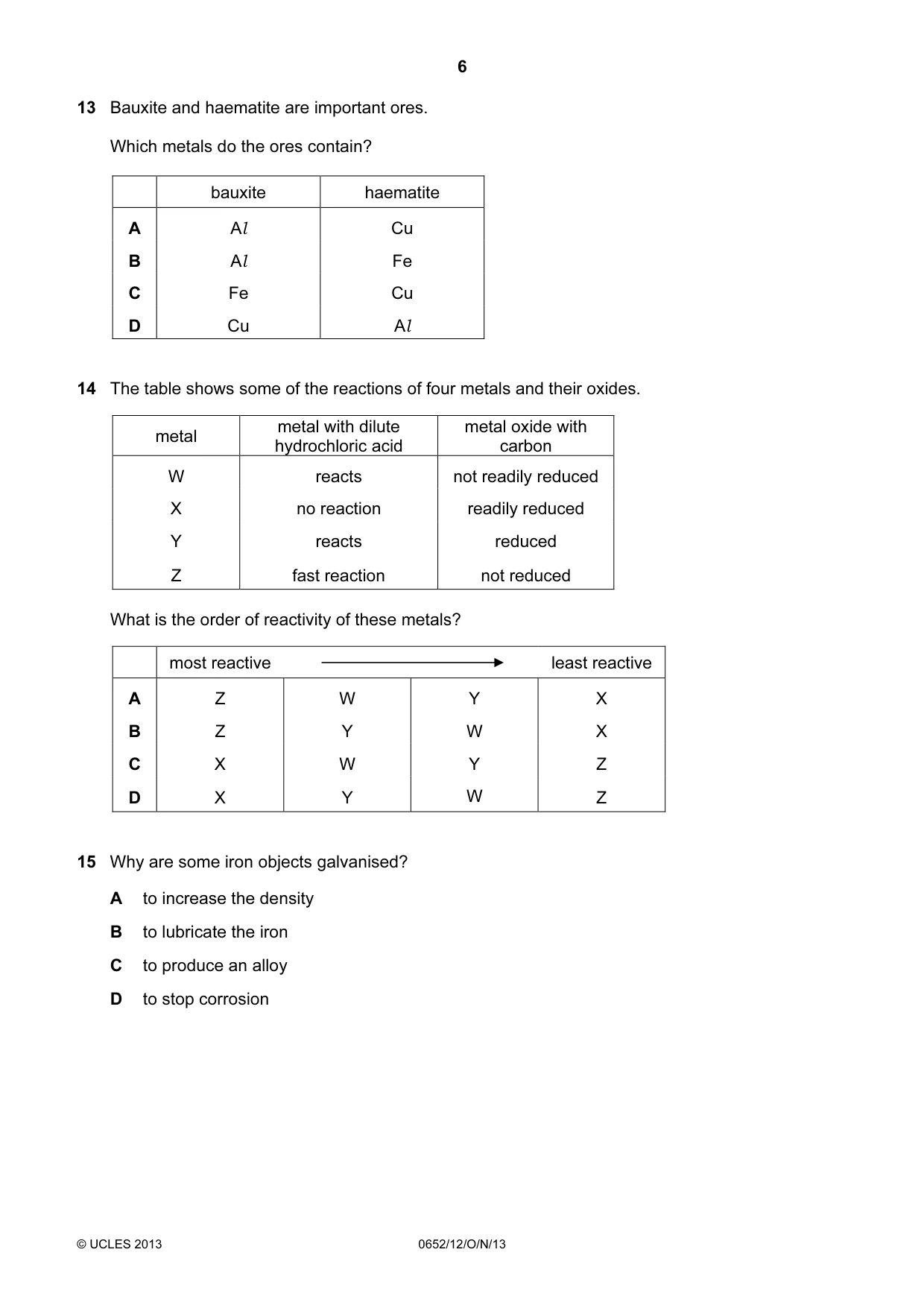
13 Bauxite and haematite are important ores. Which metals do the ores contain? bauxite haematite A Al Cu B Al Fe C Fe Cu D Cu Al
Mark scheme: B
Q14 · The table shows some of the reactions of four metals and their oxides
14 The table shows some of the reactions of four metals and their oxides. metal with dilute metal oxide with metal hydrochloric acid carbon W reacts not readily reduced X no reaction readily reduced Y reacts reduced Z fast reaction not reduced What is the order of reactivity of these metals? most reactive least reactive A Z W Y X B Z Y W X C X W Y Z D X Y W Z
Mark scheme: A
Q15 · Why are some iron objects galvanised?
15 Why are some iron objects galvanised? A to increase the density B to lubricate the iron C to produce an alloy D to stop corrosion
Mark scheme: D
Q16 · Which type of reaction occurs when calcium oxide (lime) is manufactured from calcium…
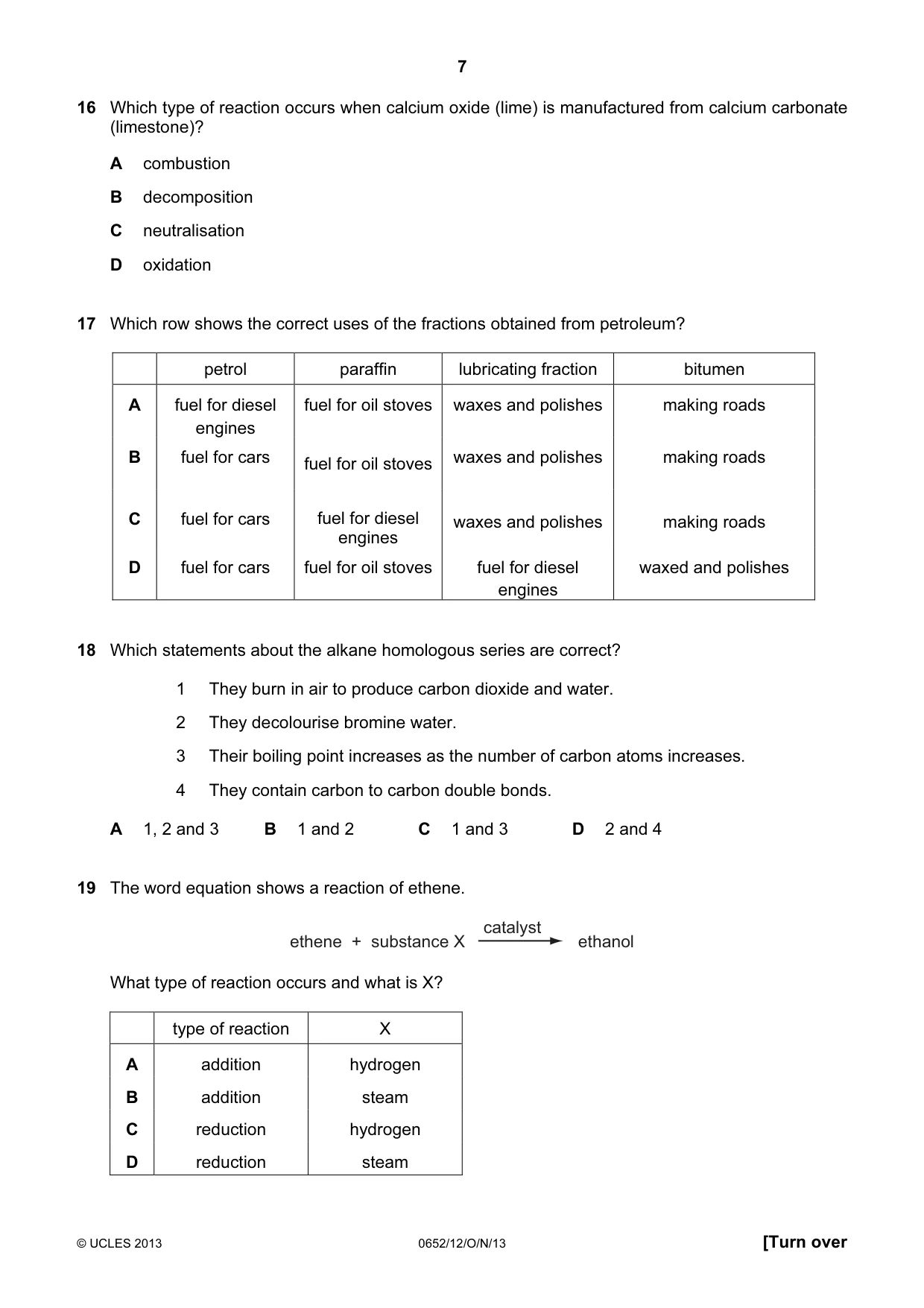
16 Which type of reaction occurs when calcium oxide (lime) is manufactured from calcium carbonate (limestone)? A combustion B decomposition C neutralisation D oxidation
Mark scheme: B
Q17 · Which row shows the correct uses of the fractions obtained from petroleum?
17 Which row shows the correct uses of the fractions obtained from petroleum? petrol paraffin lubricating fraction bitumen A fuel for diesel fuel for oil stoves waxes and polishes making roads engines B fuel for cars fuel for oil stoves waxes and polishes making roads C fuel for cars fuel for diesel waxes and polishes making roads engines D fuel for cars fuel for oil stoves fuel for diesel waxed and polishes engines
Mark scheme: B
Q18 · Which statements about the alkane homologous series are correct?
18 Which statements about the alkane homologous series are correct? 1 They burn in air to produce carbon dioxide and water. 2 They decolourise bromine water. 3 Their boiling point increases as the number of carbon atoms increases. 4 They contain carbon to carbon double bonds. A 1, 2 and 3 B 1 and 2 C 1 and 3 D 2 and 4
Mark scheme: C
Q19 · The word equation shows a reaction of ethene
19 The word equation shows a reaction of ethene. catalyst ethene + substance X ethanol What type of reaction occurs and what is X? type of reaction X A addition hydrogen B addition steam C reduction hydrogen D reduction steam
Mark scheme: B
Q20 · The combustion of ethanol can be investigated by using a spirit burner
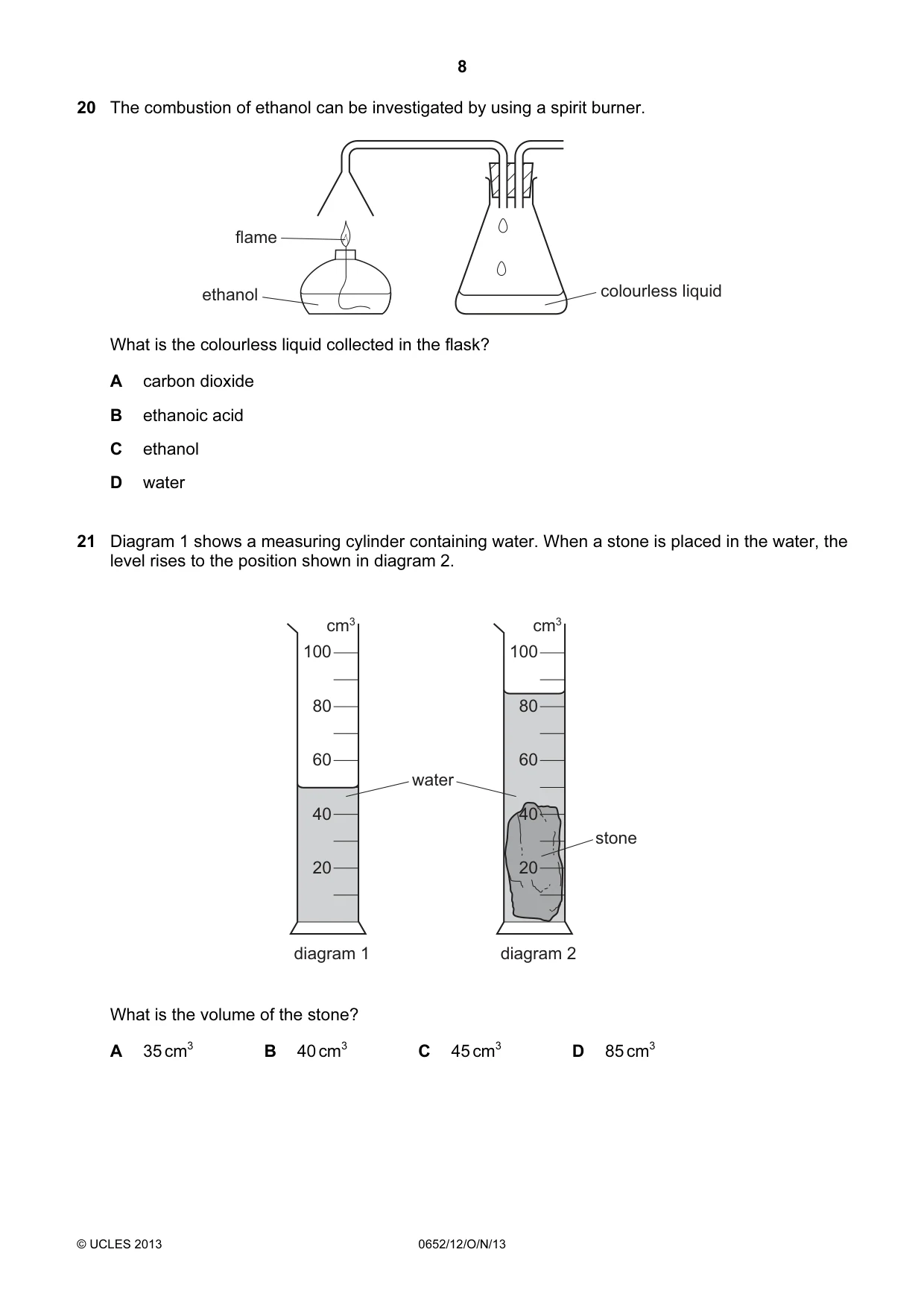
20 The combustion of ethanol can be investigated by using a spirit burner. flame ethanol colourless liquid What is the colourless liquid collected in the flask? A carbon dioxide B ethanoic acid C ethanol D water
Mark scheme: D
Q21 · A measuring cylinder containing water
21 Diagram 1 shows a measuring cylinder containing water. When a stone is placed in the water, the level rises to the position shown in diagram 2. cm3 cm3 100 100 80 80 60 60 water 40 40 stone 20 20 diagram 1 diagram 2 What is the volume of the stone? A 35 cm3 B 40 cm3 C 45 cm3 D 85 cm3
Mark scheme: A
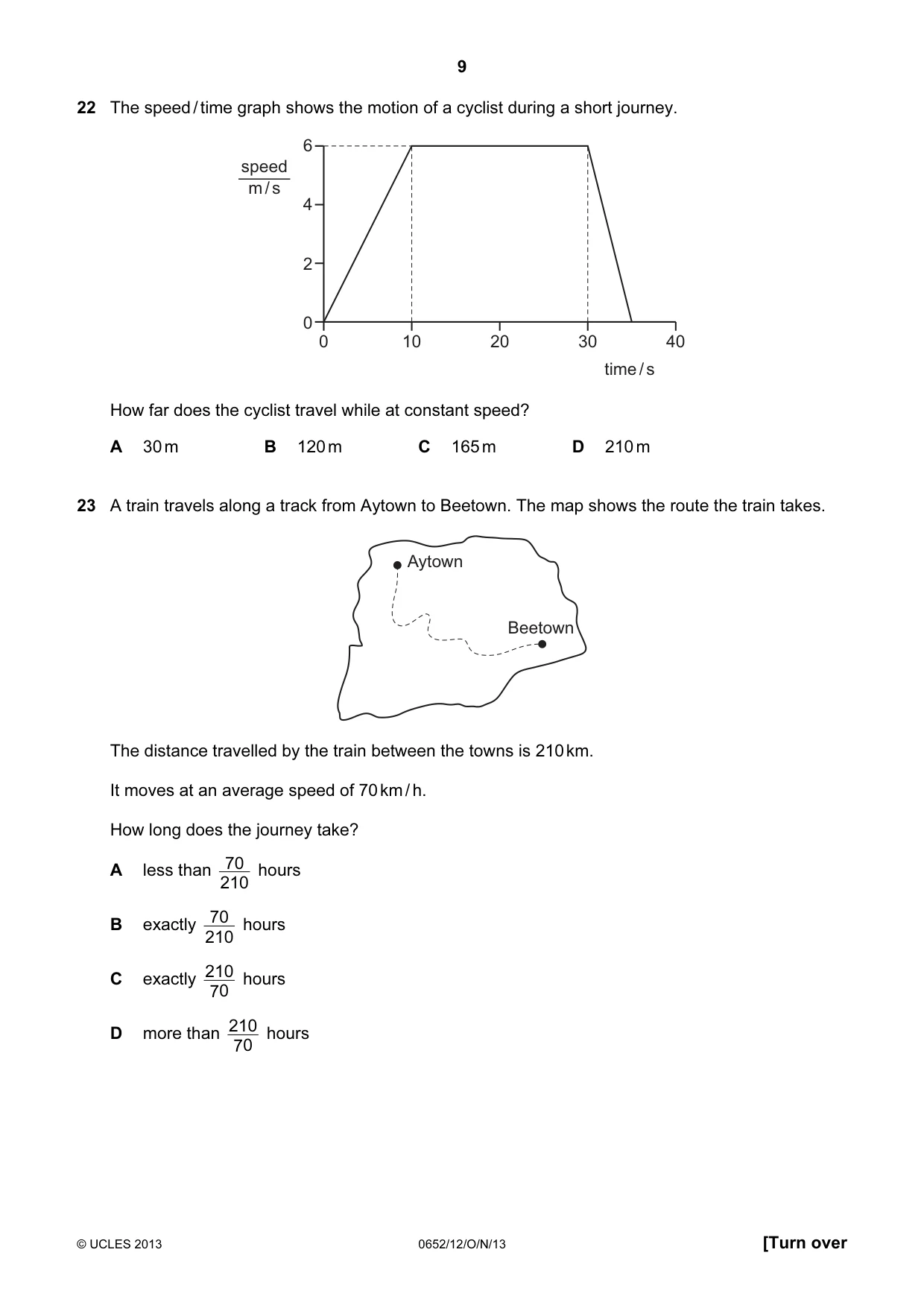
Q22 · The speed / time graph shows the motion of a cyclist during a short journey
22 The speed / time graph shows the motion of a cyclist during a short journey. 6 speed m / s 4 2 0 0 10 20 30 40 time / s How far does the cyclist travel while at constant speed? A 30 m B 120 m C 165 m D 210 m
Mark scheme: B
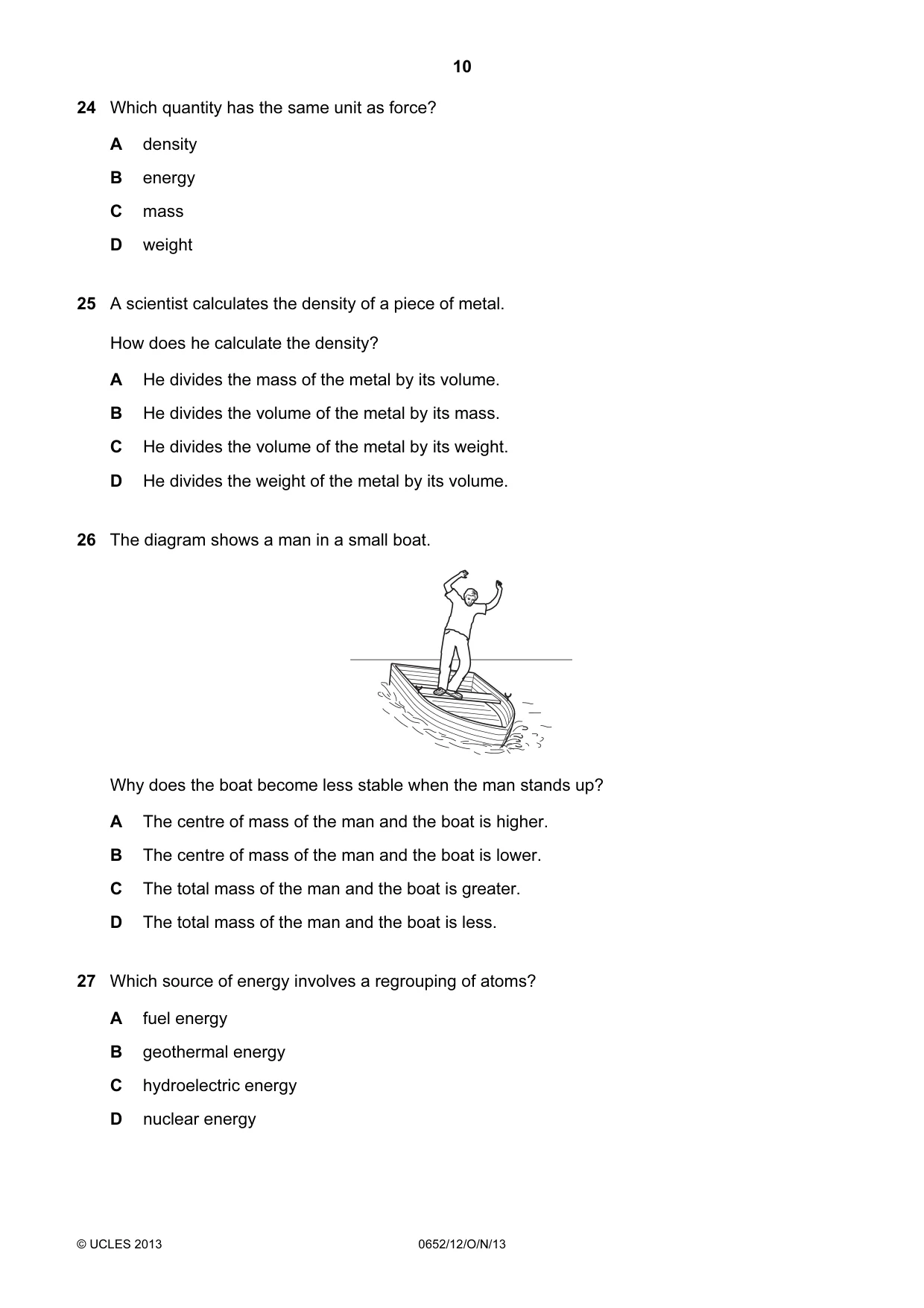
Q23 · A train travels along a track from Aytown to Beetown
23 A train travels along a track from Aytown to Beetown. The map shows the route the train takes. Aytown Beetown The distance travelled by the train between the towns is 210 km. It moves at an average speed of 70 km / h. How long does the journey take? A less than 210 70 hours B 70 hours exactly 210 C 210 hours exactly 7 0 D 210 hours more than 7 0
Mark scheme: C
Q24 · Which quantity has the same unit as force?
24 Which quantity has the same unit as force? A density B energy C mass D weight
Mark scheme: D
Q25 · A scientist calculates the density of a piece of metal
25 A scientist calculates the density of a piece of metal. How does he calculate the density? A He divides the mass of the metal by its volume. B He divides the volume of the metal by its mass. C He divides the volume of the metal by its weight. D He divides the weight of the metal by its volume.
Mark scheme: A
Q26 · The diagram shows a man in a small boat
26 The diagram shows a man in a small boat. Why does the boat become less stable when the man stands up? A The centre of mass of the man and the boat is higher. B The centre of mass of the man and the boat is lower. C The total mass of the man and the boat is greater. D The total mass of the man and the boat is less.
Mark scheme: A
Q27 · Which source of energy involves a regrouping of atoms?
27 Which source of energy involves a regrouping of atoms? A fuel energy B geothermal energy C hydroelectric energy D nuclear energy
Mark scheme: A
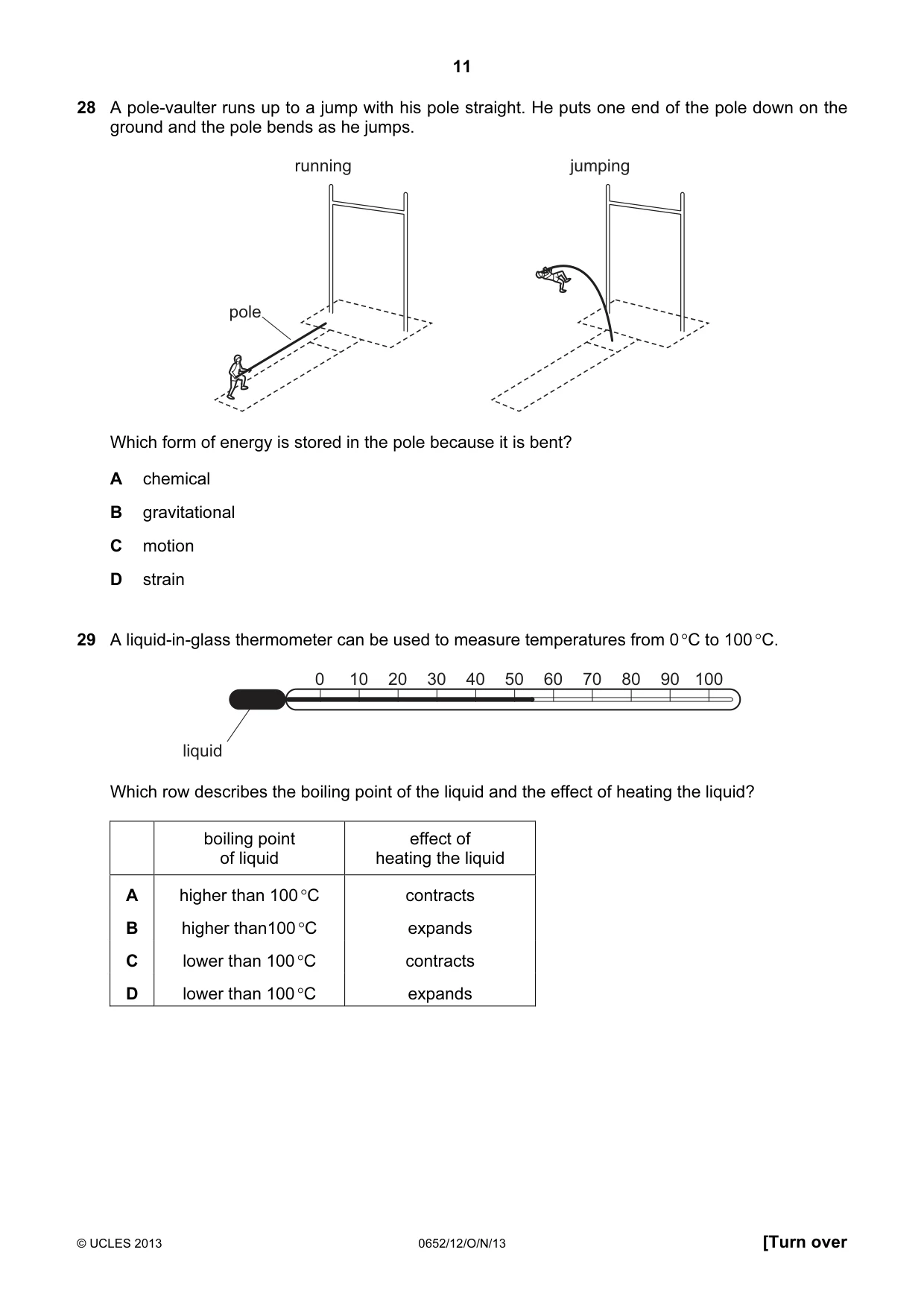
Q28 · A pole-vaulter runs up to a jump with his pole straight
28 A pole-vaulter runs up to a jump with his pole straight. He puts one end of the pole down on the ground and the pole bends as he jumps. running jumping pole Which form of energy is stored in the pole because it is bent? A chemical B gravitational C motion D strain
Mark scheme: D
Q29 · A liquid-in-glass thermometer can be used to measure temperatures from 0 °C to 100 °C
29 A liquid-in-glass thermometer can be used to measure temperatures from 0 °C to 100 °C. 0 10 20 30 40 50 60 70 80 90 100 liquid Which row describes the boiling point of the liquid and the effect of heating the liquid? boiling point effect of of liquid heating the liquid A higher than 100 °C contracts B higher than100 °C expands C lower than 100 °C contracts D lower than 100 °C expands
Mark scheme: B
Q30 · A girl sits by a camp fire
30 A girl sits by a camp fire. She holds a piece of wood with one end in the fire. piece of wood Heat from the fire reaches her hand. How does heat from the fire reach her hand? A conduction, convection and radiation B conduction only C convection only D radiation only
Mark scheme: D
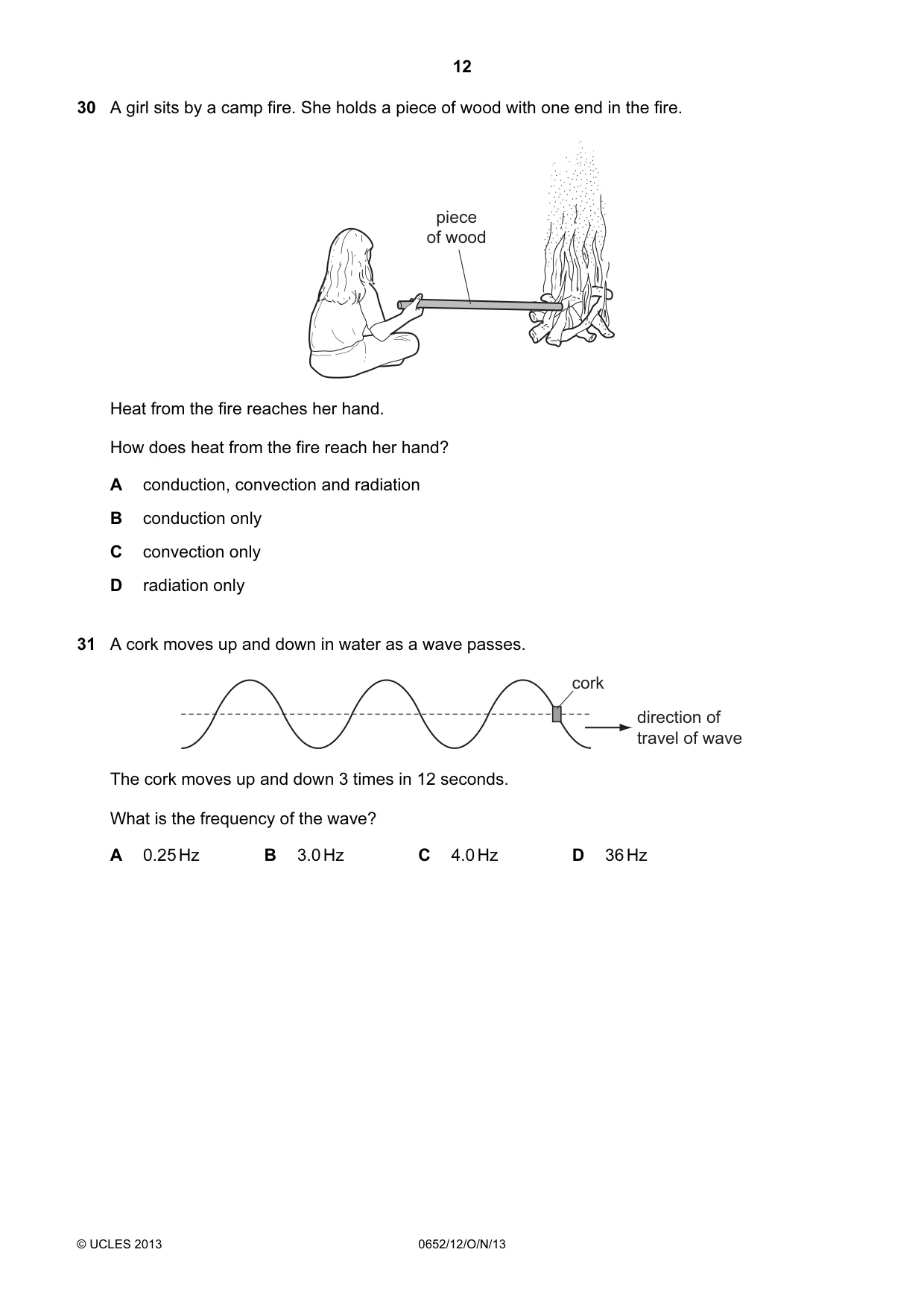
Q31 · A cork moves up and down in water as a wave passes
31 A cork moves up and down in water as a wave passes. cork direction of travel of wave The cork moves up and down 3 times in 12 seconds. What is the frequency of the wave? A 0.25 Hz B 3.0 Hz C 4.0 Hz D 36 Hz
Mark scheme: A
Q32 · An object is placed 0.16 m from a plane mirror
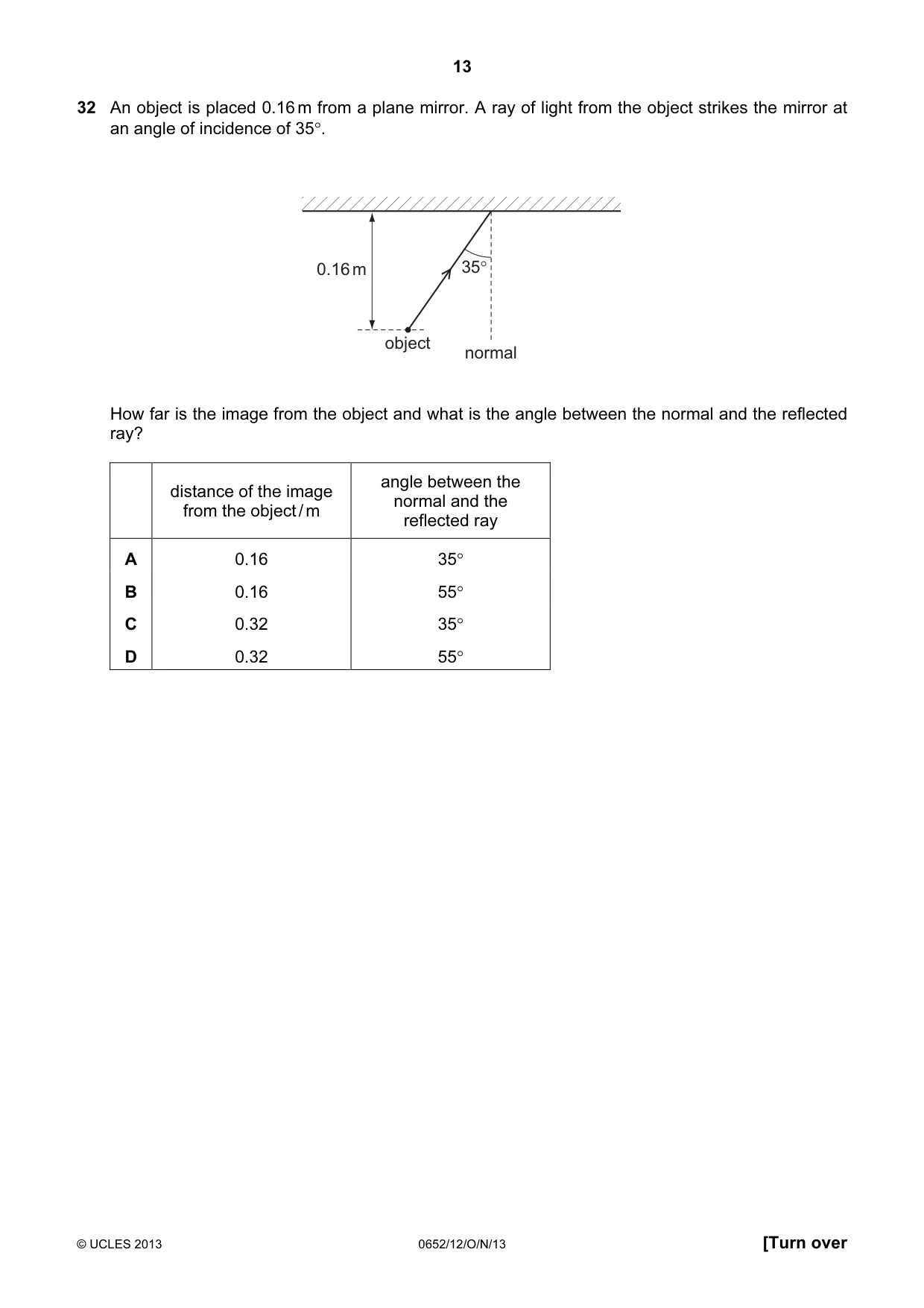
32 An object is placed 0.16 m from a plane mirror. A ray of light from the object strikes the mirror at an angle of incidence of 35°. 0.16 m 35° object normal How far is the image from the object and what is the angle between the normal and the reflected ray? angle between the distance of the image normal and the from the object / m reflected ray A 0.16 35° B 0.16 55° C 0.32 35° D 0.32 55°
Mark scheme: C
Q33 · One end of a soft iron bar is held over a dish of iron filings and the other end is…
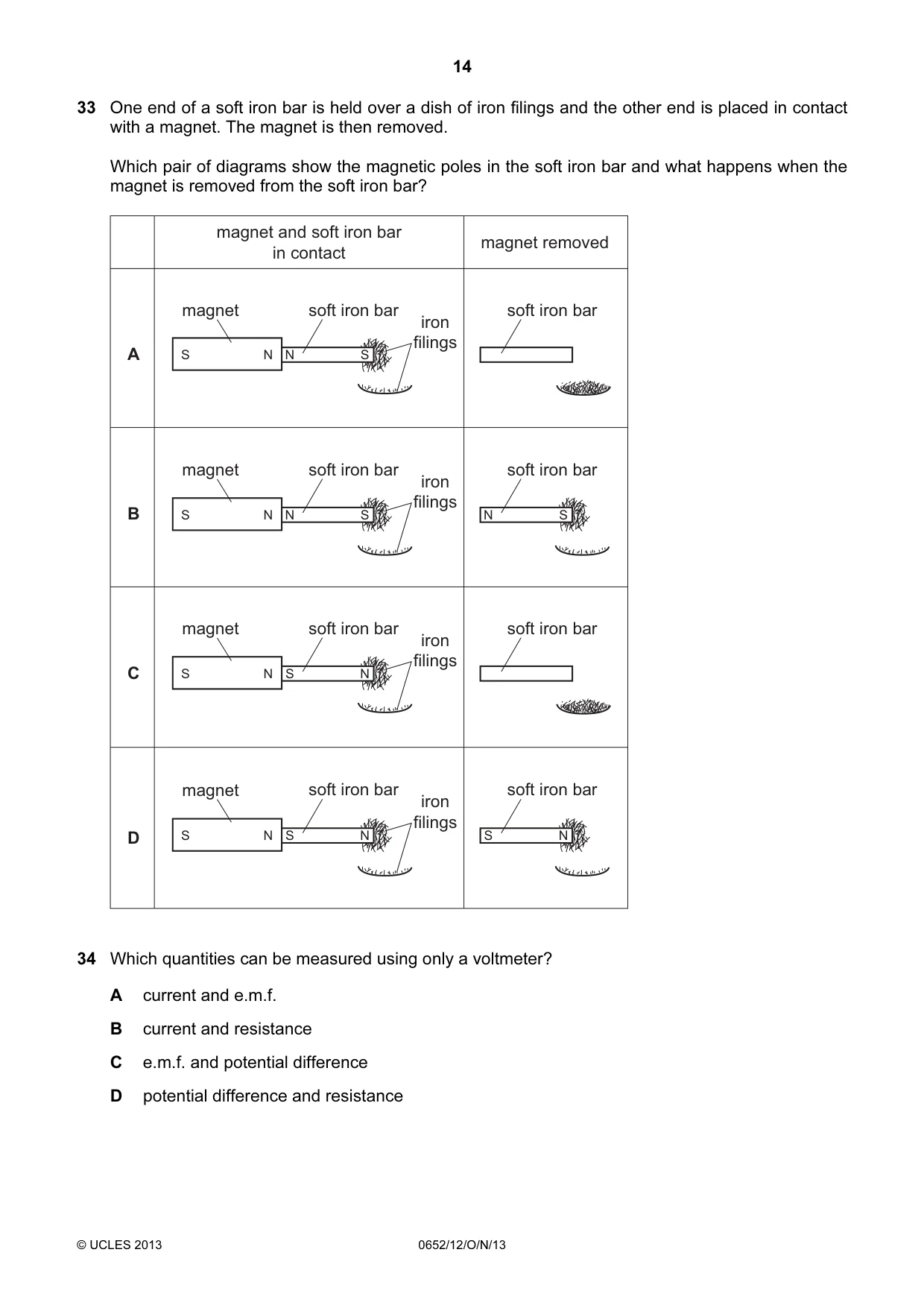
33 One end of a soft iron bar is held over a dish of iron filings and the other end is placed in contact with a magnet. The magnet is then removed. Which pair of diagrams show the magnetic poles in the soft iron bar and what happens when the magnet is removed from the soft iron bar? magnet and soft iron bar magnet removed in contact magnet soft iron bar soft iron bar iron filings A S N N S magnet soft iron bar soft iron bar iron filings B S N N S N S magnet soft iron bar soft iron bar iron filings C S N S N magnet soft iron bar soft iron bar iron filings D S N S N S N
Mark scheme: C
Q34 · Which quantities can be measured using only a voltmeter?
34 Which quantities can be measured using only a voltmeter? A current and e.m.f. B current and resistance C e.m.f. and potential difference D potential difference and resistance
Mark scheme: C
Q35 · In the circuit below, one of the lamps breaks, causing all the other lamps to go out
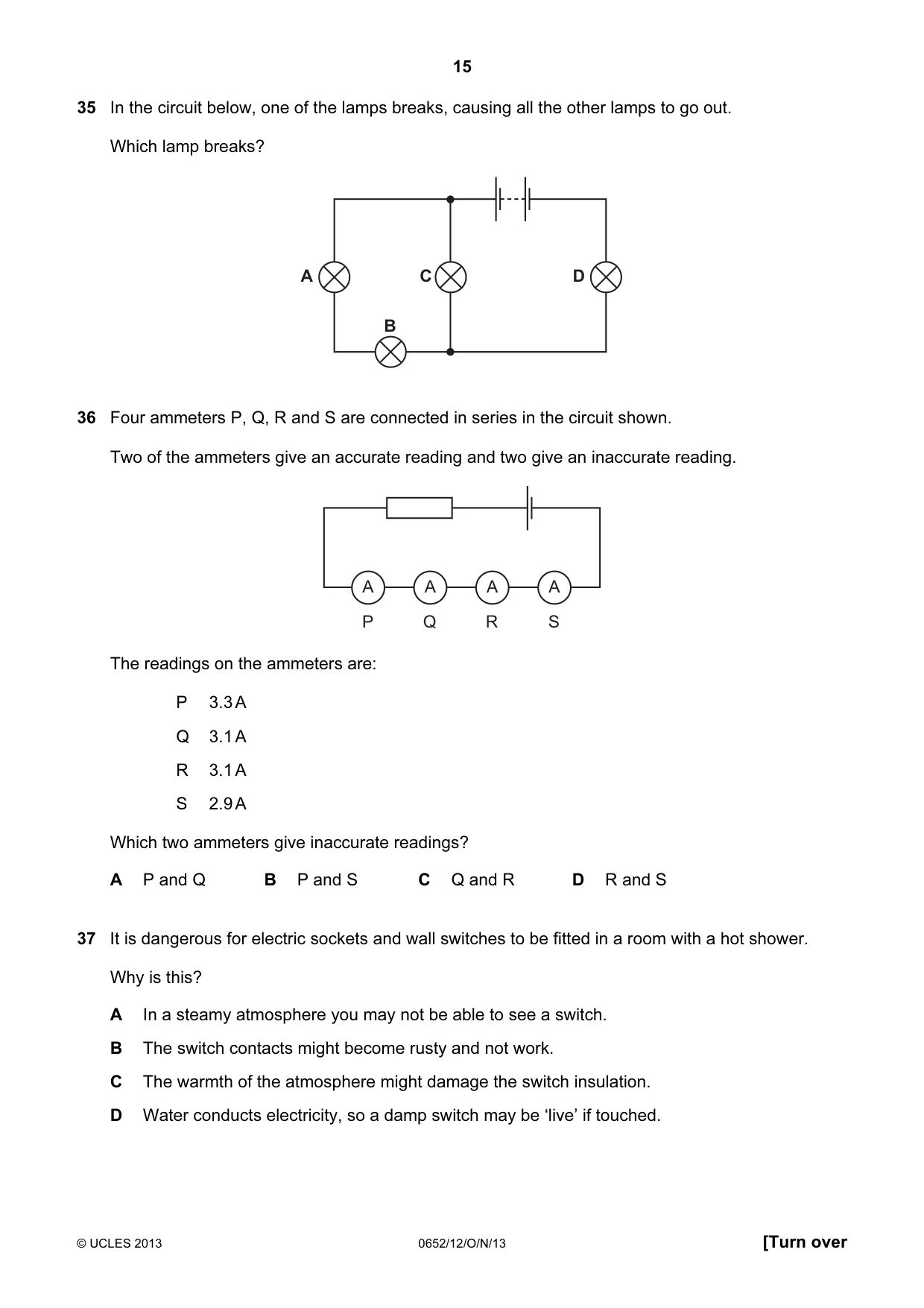
35 In the circuit below, one of the lamps breaks, causing all the other lamps to go out. Which lamp breaks? A C D B
Mark scheme: D
Q36 · Four ammeters P, Q, R and S are connected in series in the circuit shown
36 Four ammeters P, Q, R and S are connected in series in the circuit shown. Two of the ammeters give an accurate reading and two give an inaccurate reading. A A A A P Q R S The readings on the ammeters are: P 3.3 A Q 3.1 A R 3.1 A S 2.9 A Which two ammeters give inaccurate readings? A P and Q B P and S C Q and R D R and S
Mark scheme: B
Q37 · It is dangerous for electric sockets and wall switches to be fitted in a room with a hot…
37 It is dangerous for electric sockets and wall switches to be fitted in a room with a hot shower. Why is this? A In a steamy atmosphere you may not be able to see a switch. B The switch contacts might become rusty and not work. C The warmth of the atmosphere might damage the switch insulation. D Water conducts electricity, so a damp switch may be ‘live’ if touched.
Mark scheme: D
Q38 · An evacuated glass bulb contains a small tungsten filament T and a metal plate P
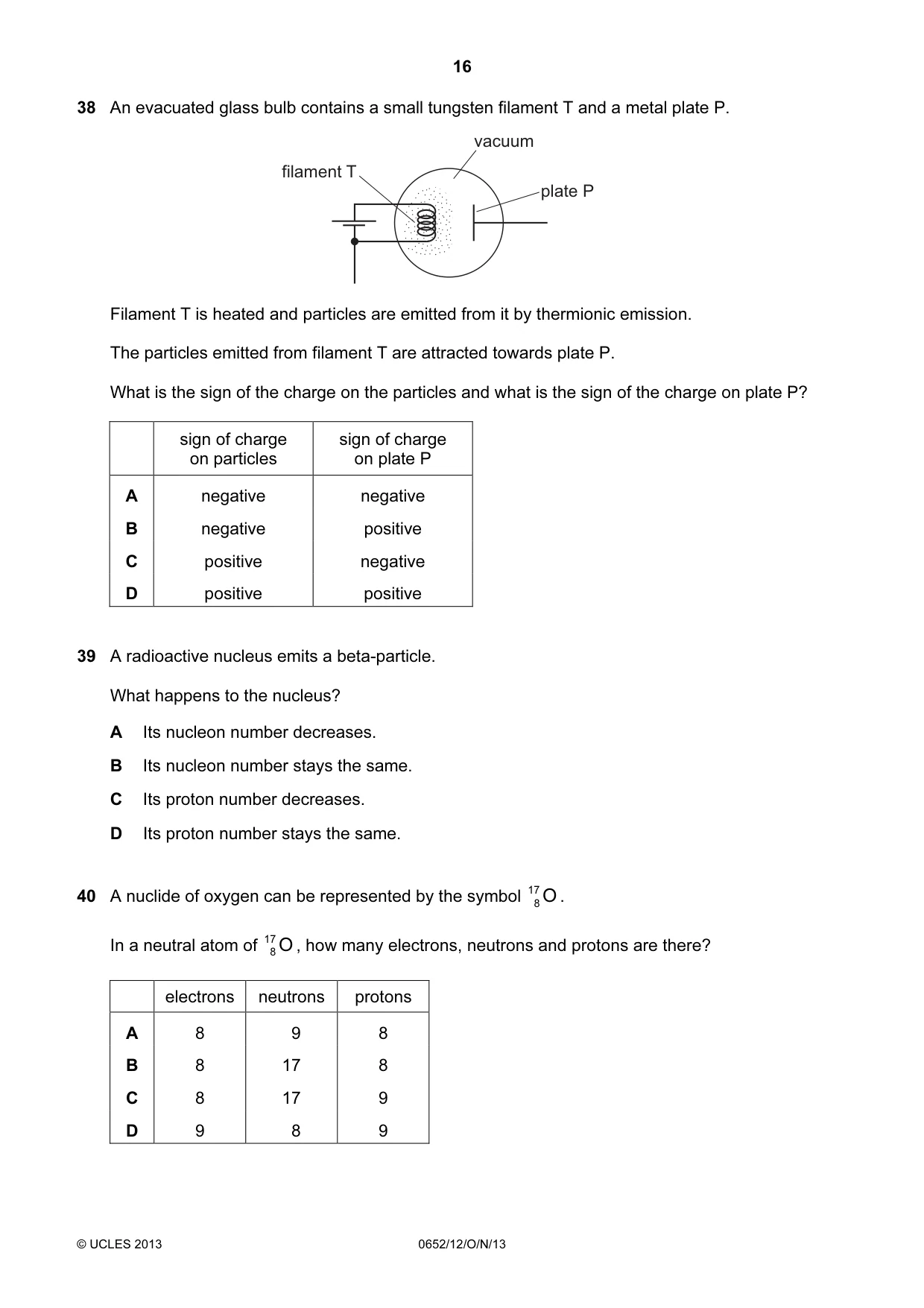
38 An evacuated glass bulb contains a small tungsten filament T and a metal plate P. vacuum filament T plate P Filament T is heated and particles are emitted from it by thermionic emission. The particles emitted from filament T are attracted towards plate P. What is the sign of the charge on the particles and what is the sign of the charge on plate P? sign of charge sign of charge on particles on plate P A negative negative B negative positive C positive negative D positive positive
Mark scheme: B
Q39 · A radioactive nucleus emits a beta-particle
39 A radioactive nucleus emits a beta-particle. What happens to the nucleus? A Its nucleon number decreases. B Its nucleon number stays the same. C Its proton number decreases. D Its proton number stays the same.
Mark scheme: B
Q40 · A nuclide of oxygen can be represented by the symbol 17 O
40 A nuclide of oxygen can be represented by the symbol 17 O . 8 In a neutral atom of 17 O , how many electrons, neutrons and protons are there? 8 electrons neutrons protons A 8 9 8 B 8 17 8 C 8 17 9 D 9 8 9
Mark scheme: A
What was in this paper
The subtopics covered by these 40 questions, and how many questions each got. Open one in a new tab to see every Cambridge question on it.
2Forces2Motion2Types of oxides2Work, energy and power2Alcohols1Alkanes1Alkenes1Atomic structure and the Periodic Table1Carbonates1Criteria of purity1Dangers of electricity1Density1Electrical quantities1Electromagnetic effects1Extraction of metals1Fuels1General wave properties1Identification of ions and gases1Ions and ionic bonds1Length and time1Light1Molecules and covalent bonds1Preparation of salts1Radioactivity1Rate (speed) of reaction1Reactivity series1Redox1Simple phenomena of magnetism1Stoichiometry1The nuclear atom1Thermal processes1Thermal properties and temperature1Transition elements1Uses of metals1What you needed in this session
Cambridge’s own grade thresholds for 2013 Oct/Nov, Paper 1 · Variant 2. A higher threshold means an easier paper — the bar moves with how the cohort did.