Questions as text
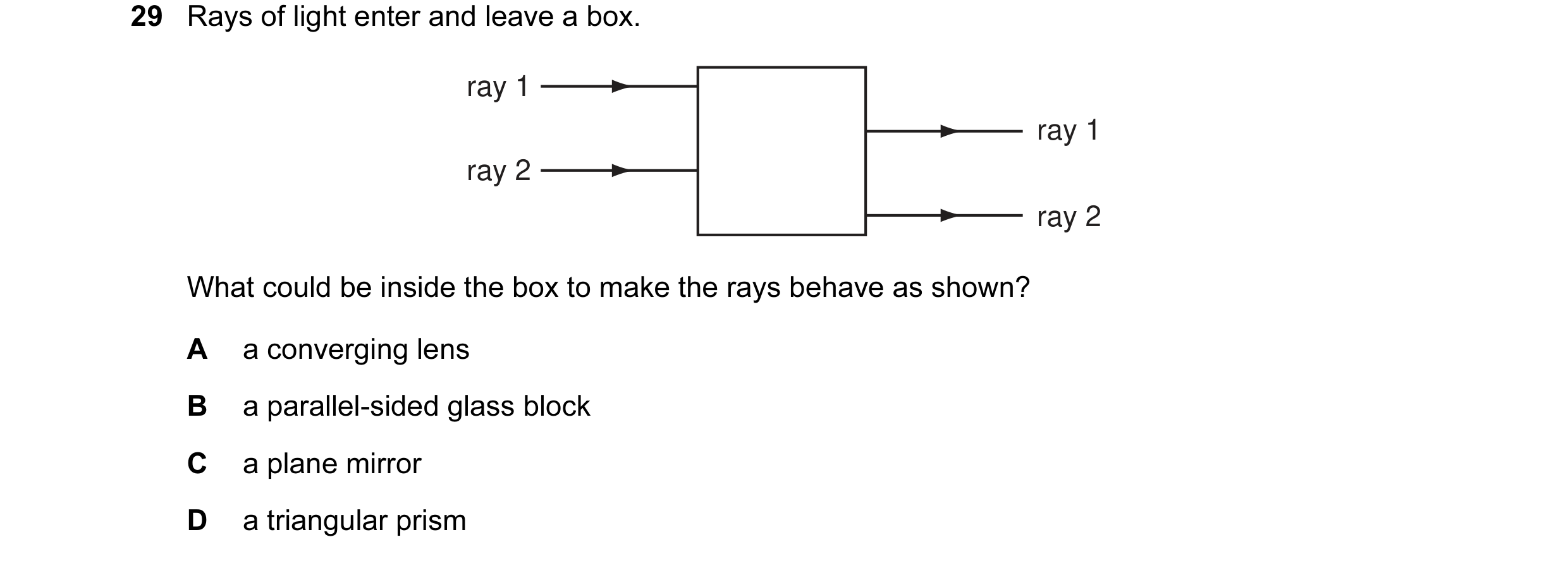
Q1 · Rays of light enter and leave a box 0652/11 Oct/Nov 2005
29 Rays of light enter and leave a box. ray 1 ray 1 ray 2 ray 2 What could be inside the box to make the rays behave as shown? A a converging lens B a parallel-sided glass block C a plane mirror D a triangular prism
1 marks
Answer: B
This question in 0652/11 Oct/Nov 2005
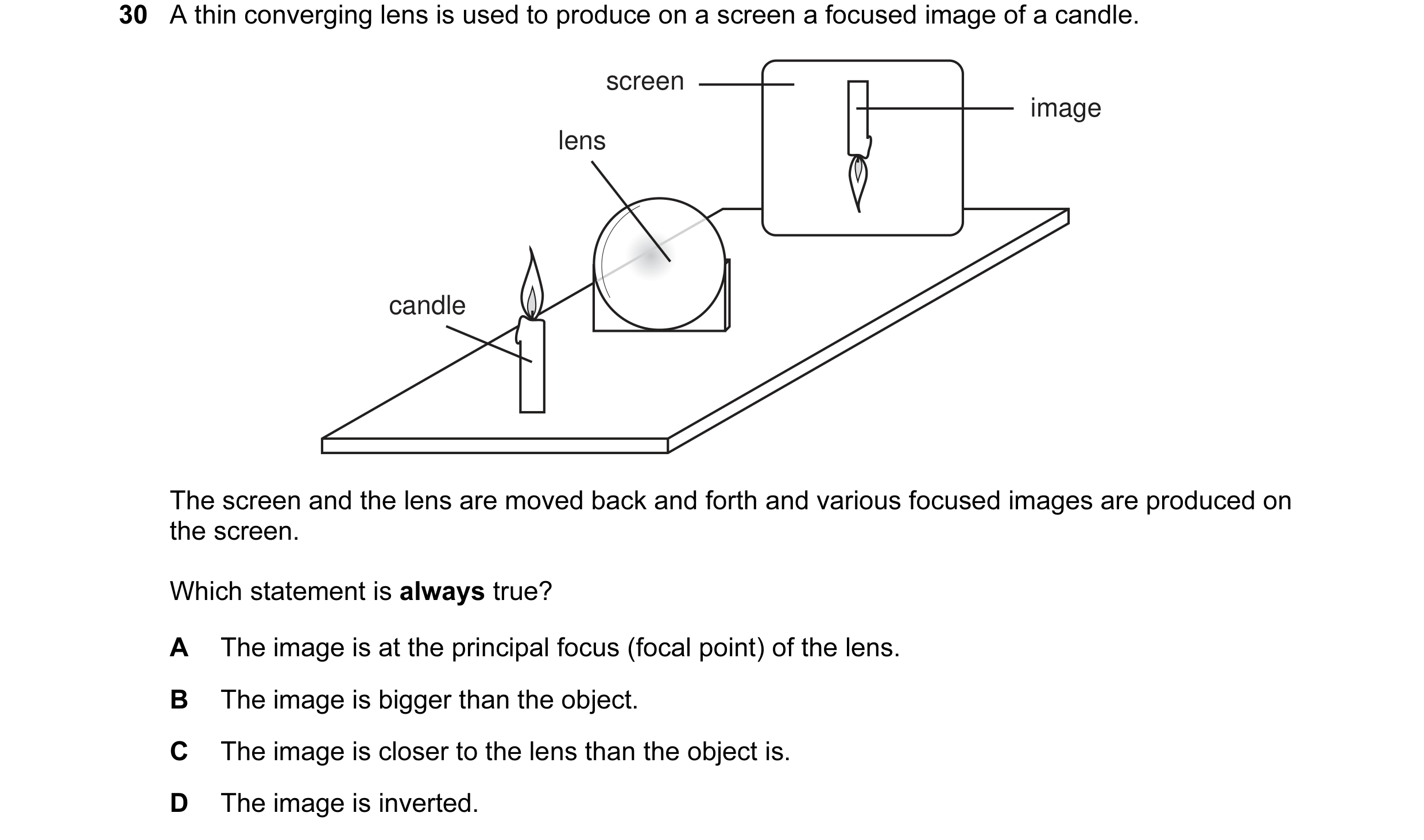
Q2 · A thin converging lens is used to produce on a screen a focused image of a candle 0652/11 Oct/Nov 2005
30 A thin converging lens is used to produce on a screen a focused image of a candle. screen image lens candle The screen and the lens are moved back and forth and various focused images are produced on the screen. Which statement is always true? A The image is at the principal focus (focal point) of the lens. B The image is bigger than the object. C The image is closer to the lens than the object is. D The image is inverted.
1 marks
Answer: D
This question in 0652/11 Oct/Nov 2005
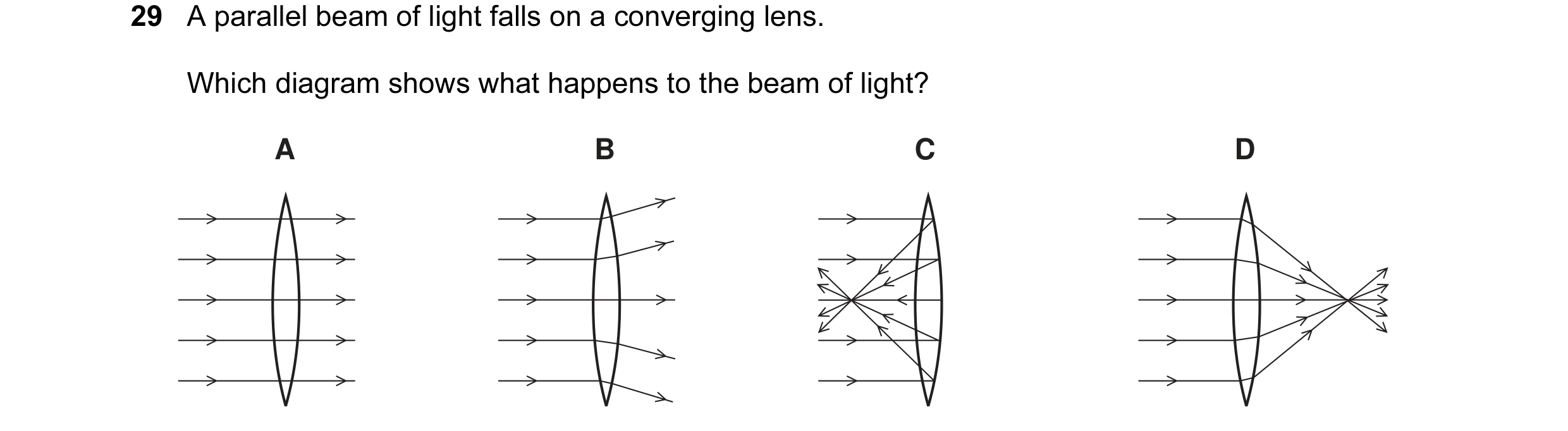
Q3 · A parallel beam of light falls on a converging lens 0652/11 Oct/Nov 2006
29 A parallel beam of light falls on a converging lens. Which diagram shows what happens to the beam of light? A B C D
1 marks
Answer: D
This question in 0652/11 Oct/Nov 2006
Q4 · The image of a clock face as seen in a plane mirror is shown 0652/11 Oct/Nov 2006
30 The image of a clock face as seen in a plane mirror is shown. 12 3 9 6 What is the time on the clock? A 1.25 B 1.35 C 10.25 D 10.35
1 marks
Answer: B
This question in 0652/11 Oct/Nov 2006
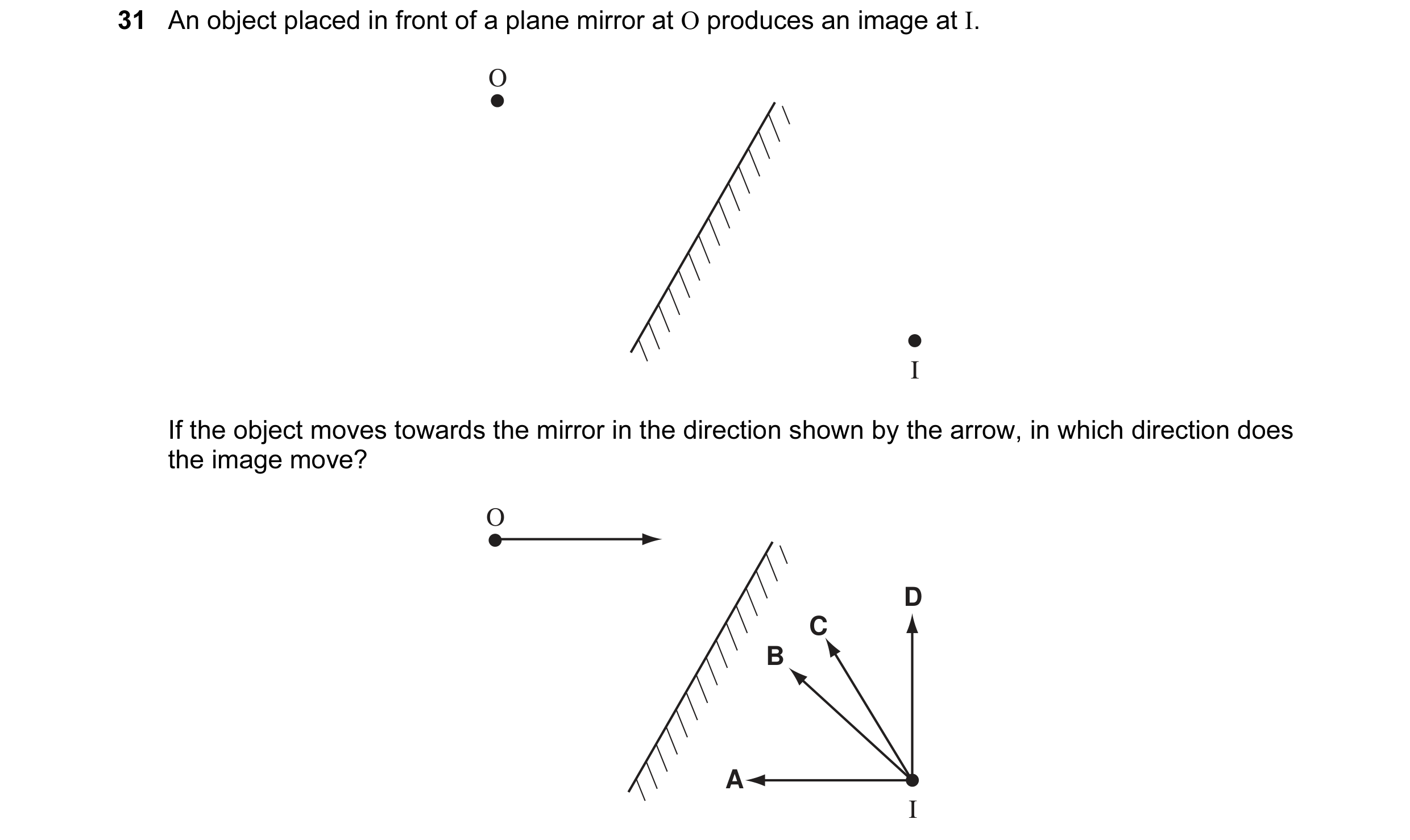
Q5 · An object placed in front of a plane mirror at O produces an image at I 0652/11 Oct/Nov 2007
31 An object placed in front of a plane mirror at O produces an image at I. O I If the object moves towards the mirror in the direction shown by the arrow, in which direction does the image move? O D C B A I
1 marks
Answer: C
This question in 0652/11 Oct/Nov 2007
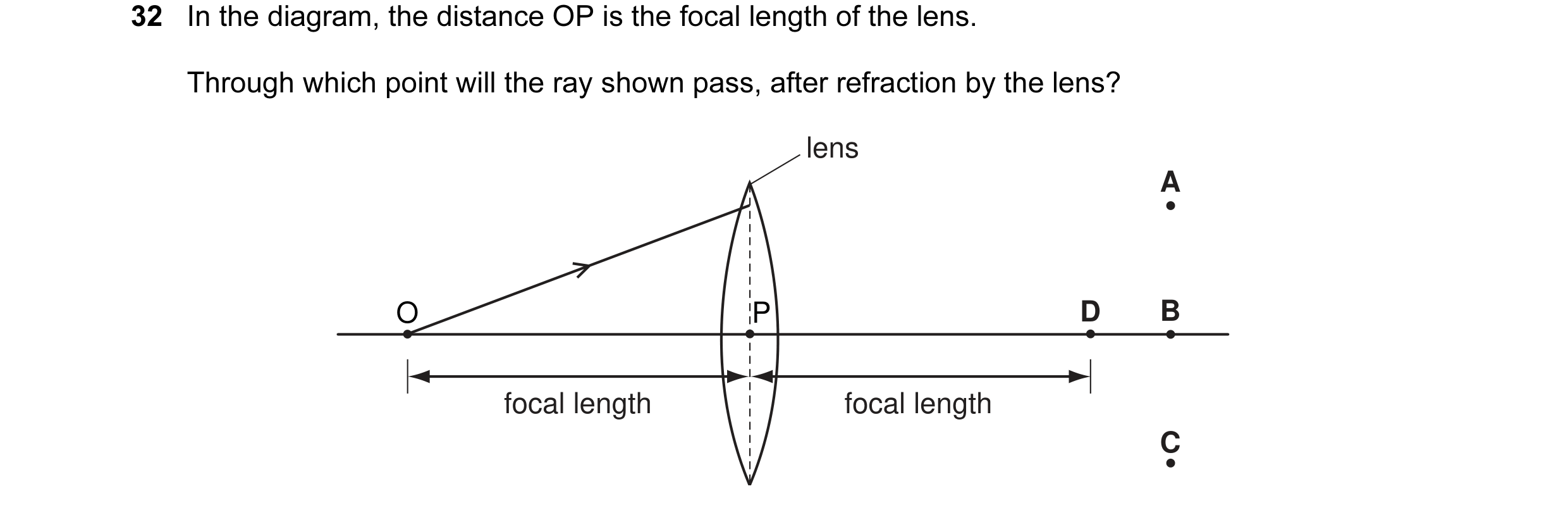
Q6 · In the diagram, the distance OP is the focal length of the lens 0652/11 Oct/Nov 2008
32 In the diagram, the distance OP is the focal length of the lens. Through which point will the ray shown pass, after refraction by the lens? lens A O P D B focal length focal length C
1 marks
Answer: A
This question in 0652/11 Oct/Nov 2008
Q7 · Which diagram shows the effect of a thin converging lens on a beam of light? 0652/11 Oct/Nov 2009
29 Which diagram shows the effect of a thin converging lens on a beam of light? A B C D
1 marks
Answer: D
This question in 0652/11 Oct/Nov 2009
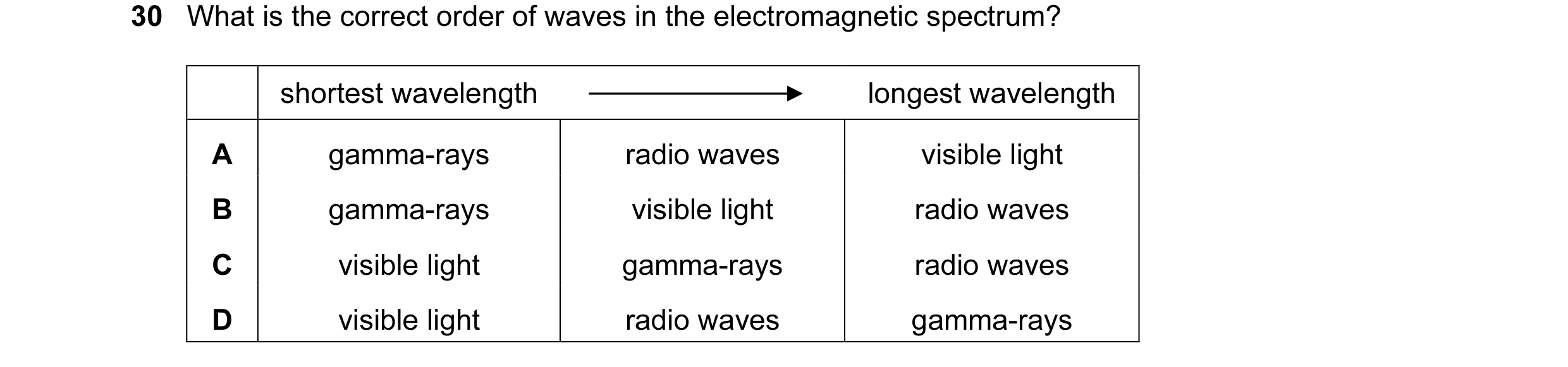
Q8 · What is the correct order of waves in the electromagnetic spectrum? 0652/11 Oct/Nov 2010
30 What is the correct order of waves in the electromagnetic spectrum? shortest wavelength longest wavelength A gamma-rays radio waves visible light B gamma-rays visible light radio waves C visible light gamma-rays radio waves D visible light radio waves gamma-rays
1 marks
Answer: B
This question in 0652/11 Oct/Nov 2010
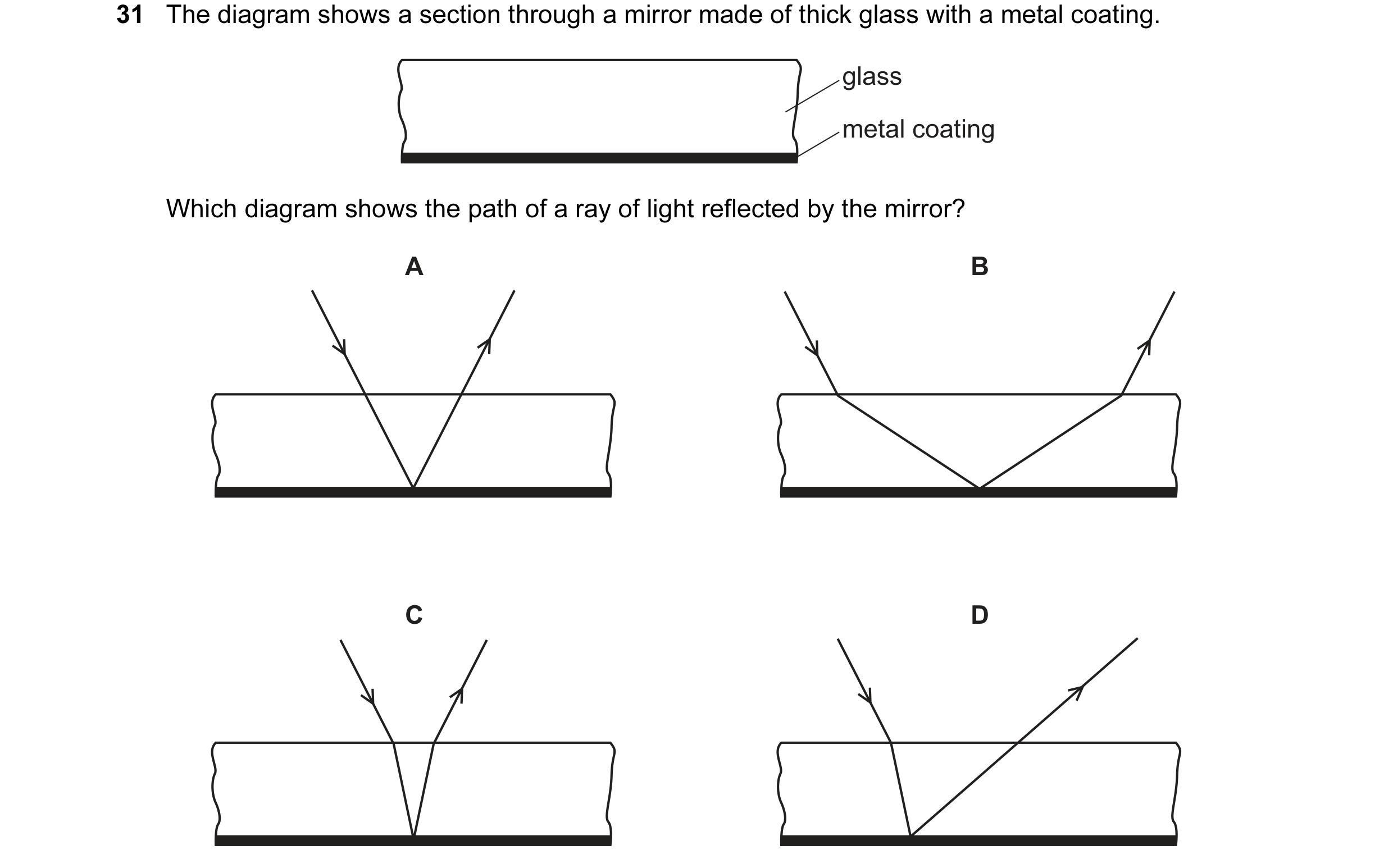
Q9 · The diagram shows a section through a mirror made of thick glass with a metal coating 0652/11 Oct/Nov 2010
31 The diagram shows a section through a mirror made of thick glass with a metal coating. glass metal coating Which diagram shows the path of a ray of light reflected by the mirror? A B C D
1 marks
Answer: C
This question in 0652/11 Oct/Nov 2010
Q10 · A light ray passes from air into glass 0652/11 Oct/Nov 2011
29 A light ray passes from air into glass. Which labelled angle is the angle of refraction? normal light ray B air A glass C D
1 marks
Answer: D
This question in 0652/11 Oct/Nov 2011
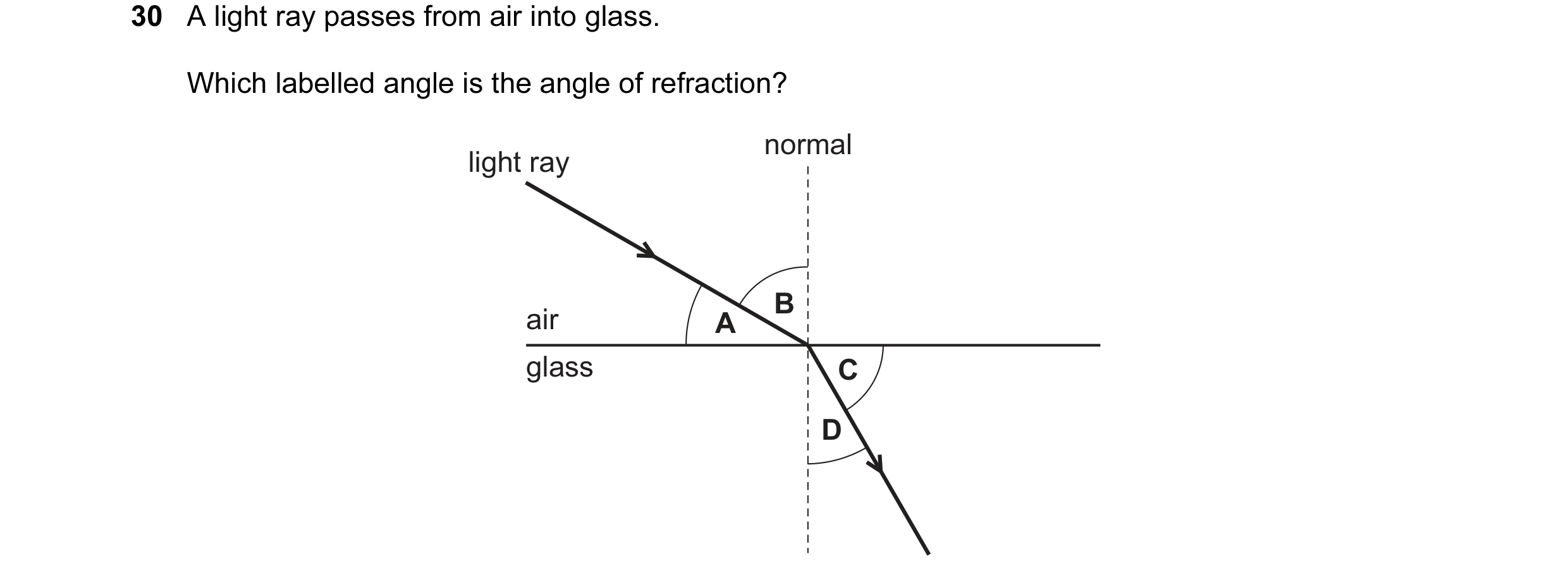
Q11 · A light ray passes from air into glass 0652/12 Oct/Nov 2011
30 A light ray passes from air into glass. Which labelled angle is the angle of refraction? normal light ray B air A glass C D
1 marks
Answer: D
This question in 0652/12 Oct/Nov 2011
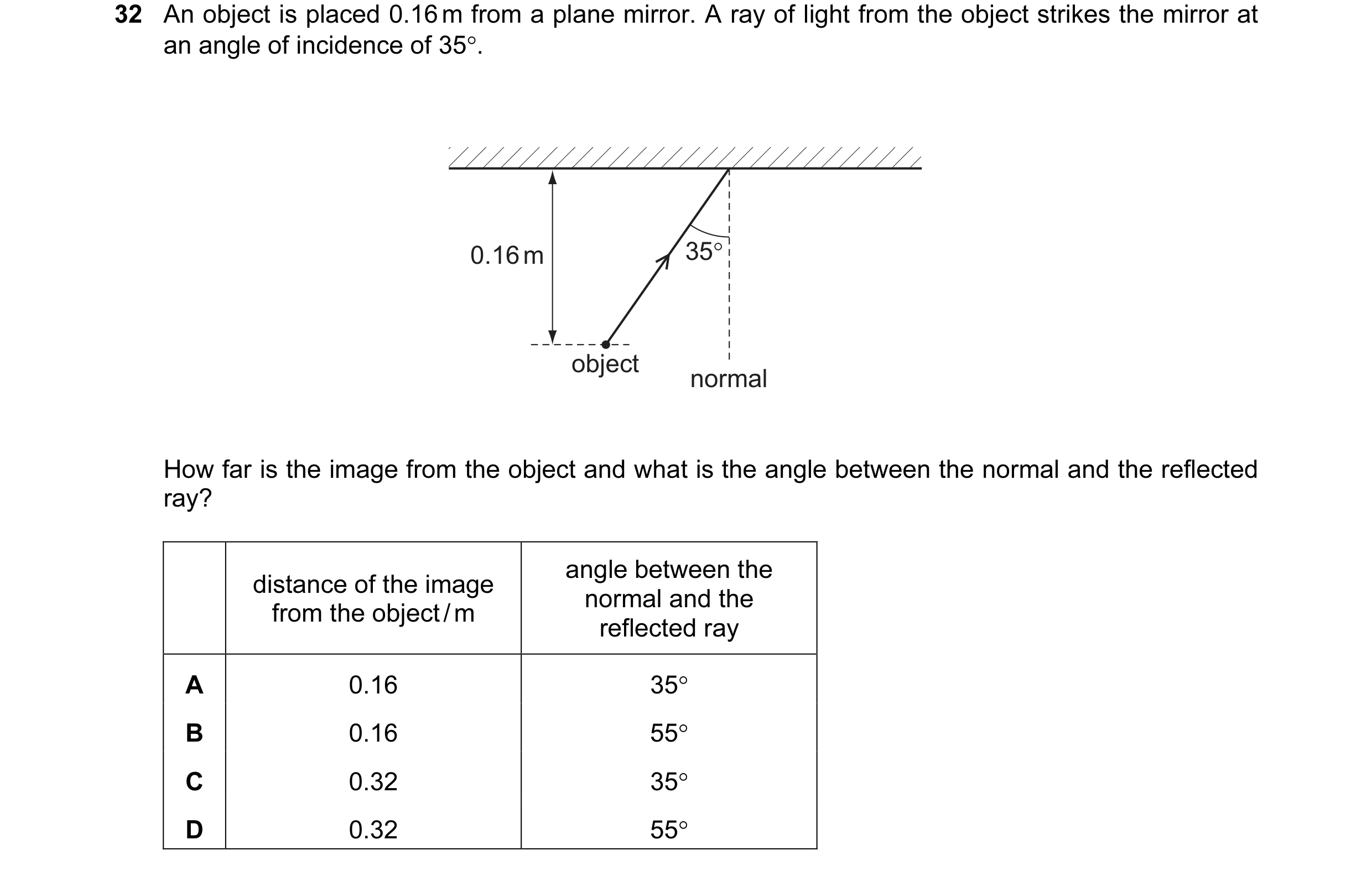
Q12 · An object is placed 0.16 m from a plane mirror 0652/11 Oct/Nov 2013
32 An object is placed 0.16 m from a plane mirror. A ray of light from the object strikes the mirror at an angle of incidence of 35°. 0.16 m 35° object normal How far is the image from the object and what is the angle between the normal and the reflected ray? angle between the distance of the image normal and the from the object / m reflected ray A 0.16 35° B 0.16 55° C 0.32 35° D 0.32 55°
1 marks
Answer: C
This question in 0652/11 Oct/Nov 2013
Q13 · An object is placed 0.16 m from a plane mirror 0652/12 Oct/Nov 2013
32 An object is placed 0.16 m from a plane mirror. A ray of light from the object strikes the mirror at an angle of incidence of 35°. 0.16 m 35° object normal How far is the image from the object and what is the angle between the normal and the reflected ray? angle between the distance of the image normal and the from the object / m reflected ray A 0.16 35° B 0.16 55° C 0.32 35° D 0.32 55°
1 marks
Answer: C
This question in 0652/12 Oct/Nov 2013
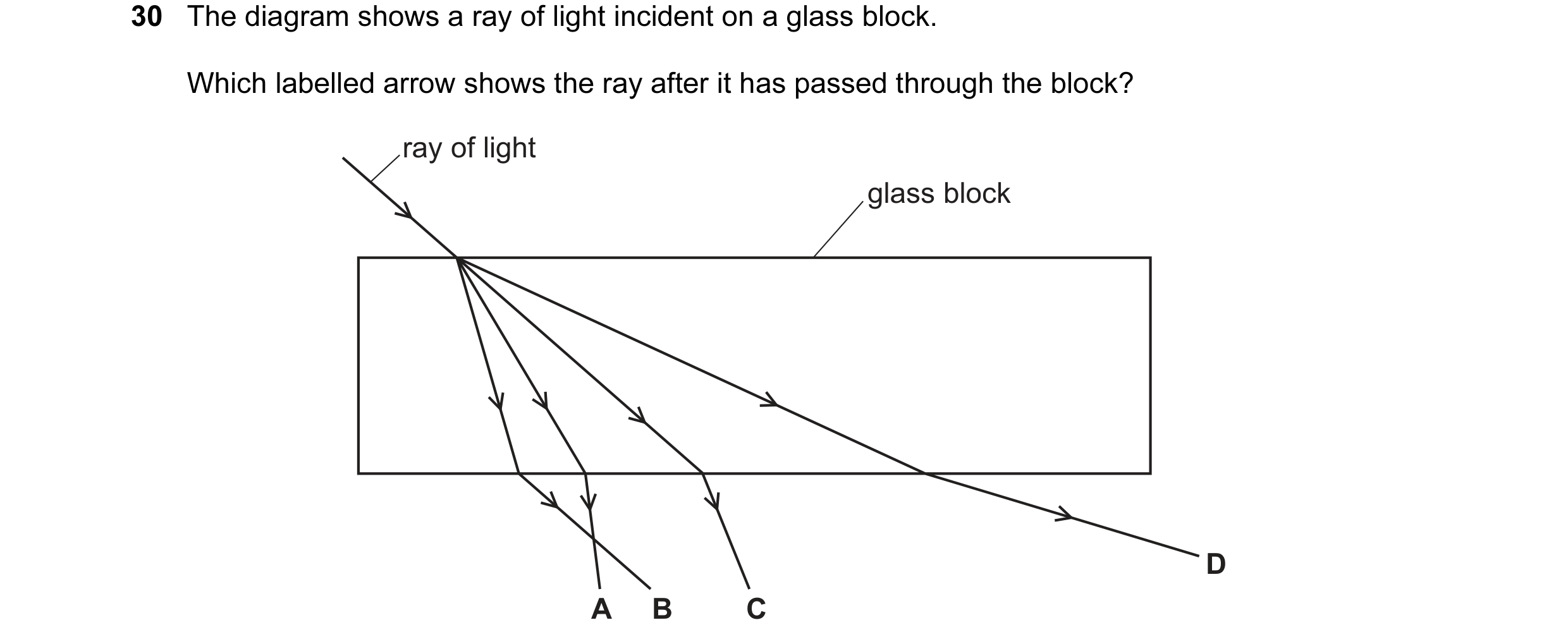
Q14 · The diagram shows a ray of light incident on a glass block 0652/11 Oct/Nov 2014
30 The diagram shows a ray of light incident on a glass block. Which labelled arrow shows the ray after it has passed through the block? ray of light glass block D A B C
1 marks
Answer: B
This question in 0652/11 Oct/Nov 2014
Q15 · The diagram shows a ray of light incident on a glass block 0652/12 Oct/Nov 2014
30 The diagram shows a ray of light incident on a glass block. Which labelled arrow shows the ray after it has passed through the block? ray of light glass block D A B C
1 marks
Answer: B
This question in 0652/12 Oct/Nov 2014
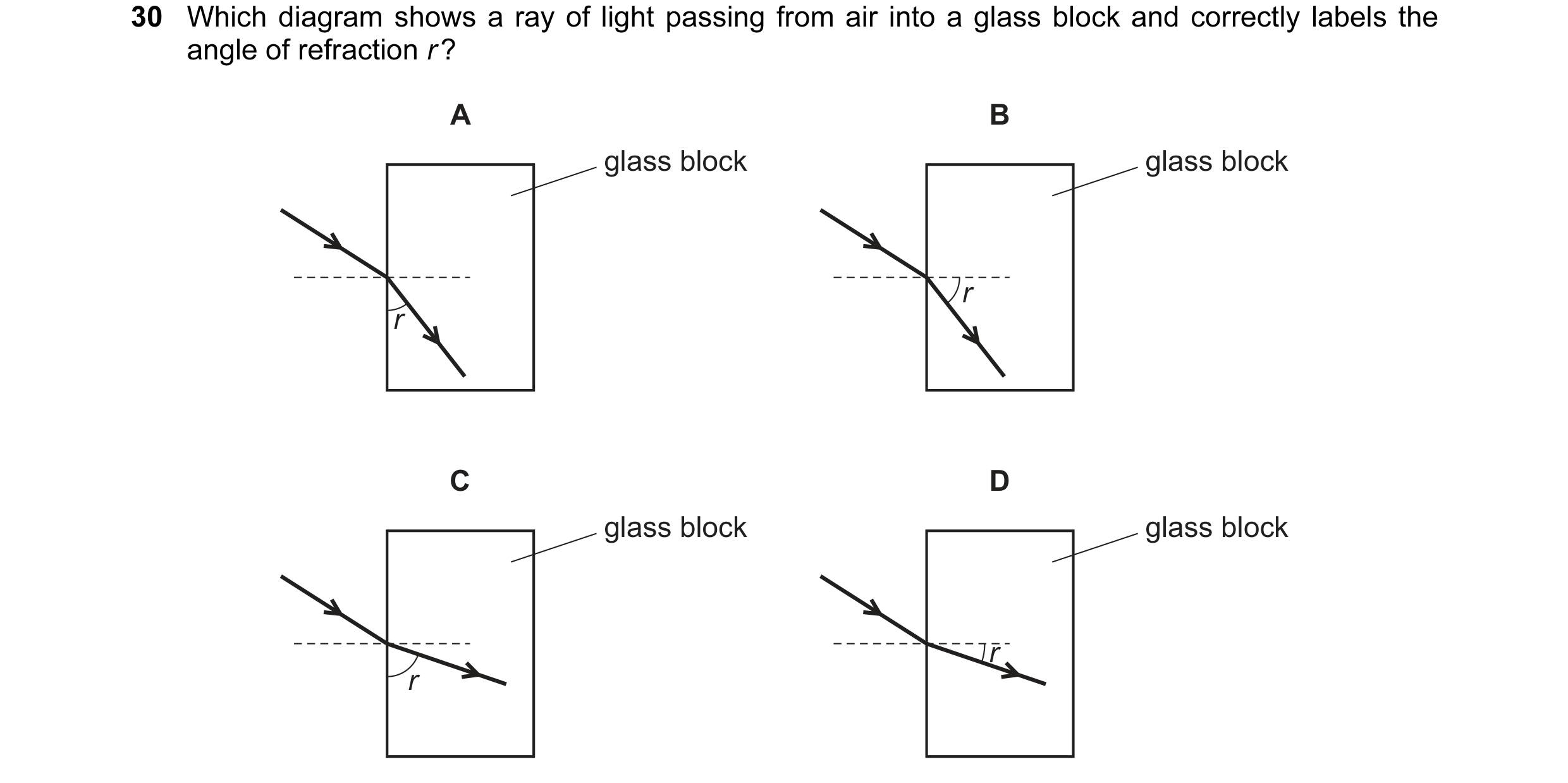
Q16 · Which diagram shows a ray of light passing from air into a glass block and correctly… 0652/11 Oct/Nov 2015
30 Which diagram shows a ray of light passing from air into a glass block and correctly labels the angle of refraction r ? A B glass block glass block r r C D glass block glass block r r
1 marks
Answer: D
This question in 0652/11 Oct/Nov 2015
Q17 · Which diagram shows a ray of light passing from air into a glass block and correctly… 0652/12 Oct/Nov 2015
30 Which diagram shows a ray of light passing from air into a glass block and correctly labels the angle of refraction r ? A B glass block glass block r r C D glass block glass block r r
1 marks
Answer: D
This question in 0652/12 Oct/Nov 2015
Q18 · The diagram shows an object in front of a plane mirror 0652/11 Oct/Nov 2016
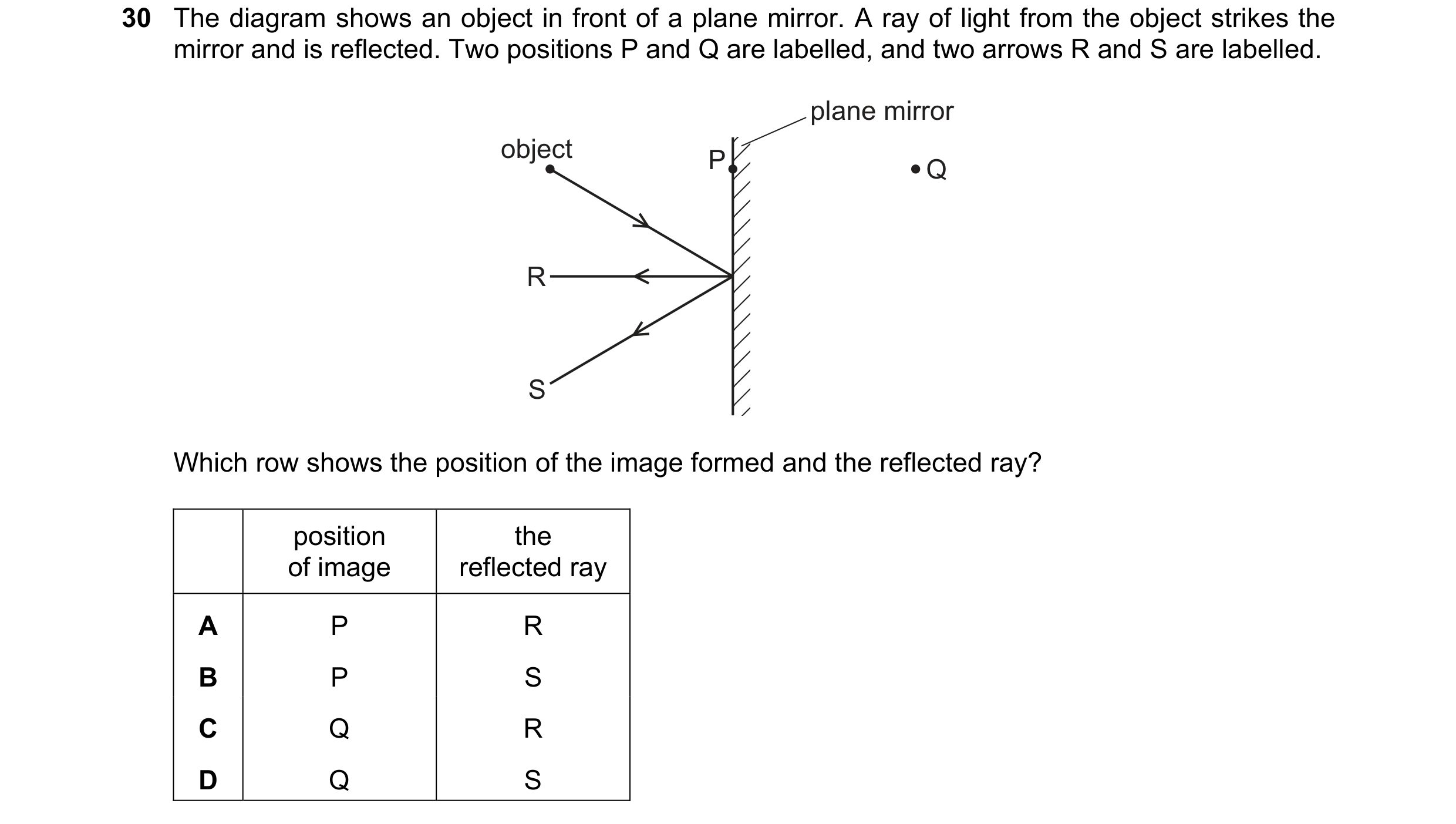
30 The diagram shows an object in front of a plane mirror. A ray of light from the object strikes the mirror and is reflected. Two positions P and Q are labelled, and two arrows R and S are labelled. plane mirror object P Q R S Which row shows the position of the image formed and the reflected ray? position the of image reflected ray A P R B P S C Q R D Q S
1 marks
Answer: D
This question in 0652/11 Oct/Nov 2016
Q19 · The diagram shows an object in front of a plane mirror 0652/12 Oct/Nov 2016
30 The diagram shows an object in front of a plane mirror. A ray of light from the object strikes the mirror and is reflected. Two positions P and Q are labelled, and two arrows R and S are labelled. plane mirror object P Q R S Which row shows the position of the image formed and the reflected ray? position the of image reflected ray A P R B P S C Q R D Q S
1 marks
Answer: D
This question in 0652/12 Oct/Nov 2016
Q20 · Radio waves and light waves travel in vacuo (in a vacuum) 0652/12 Oct/Nov 2016
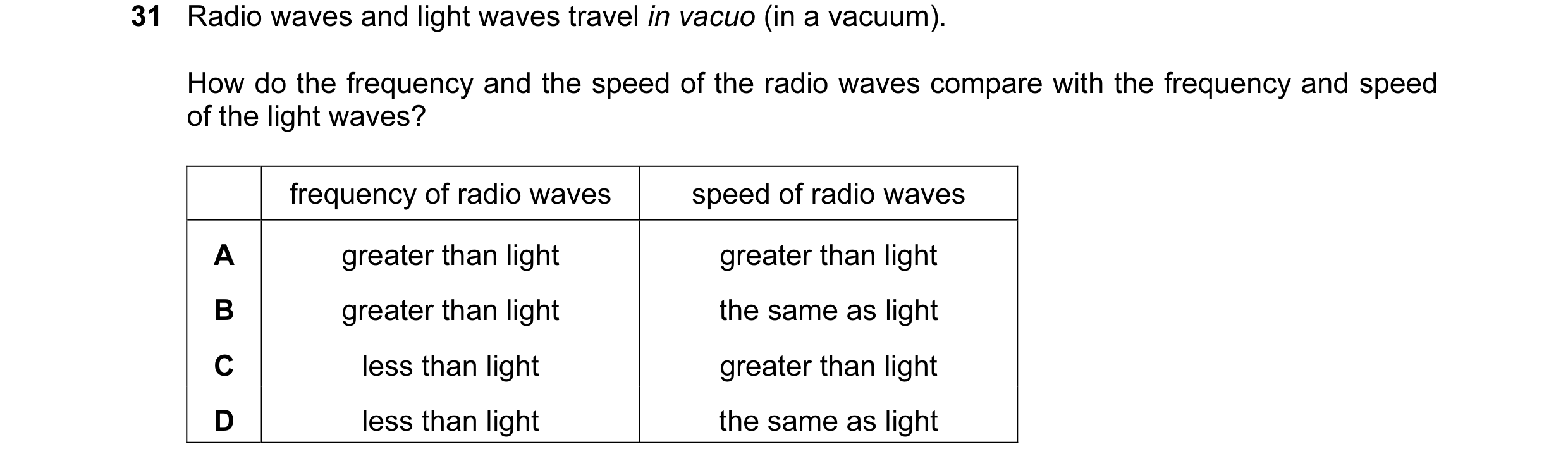
31 Radio waves and light waves travel in vacuo (in a vacuum). How do the frequency and the speed of the radio waves compare with the frequency and speed of the light waves? frequency of radio waves speed of radio waves A greater than light greater than light B greater than light the same as light C less than light greater than light D less than light the same as light
1 marks
Answer: D
This question in 0652/12 Oct/Nov 2016
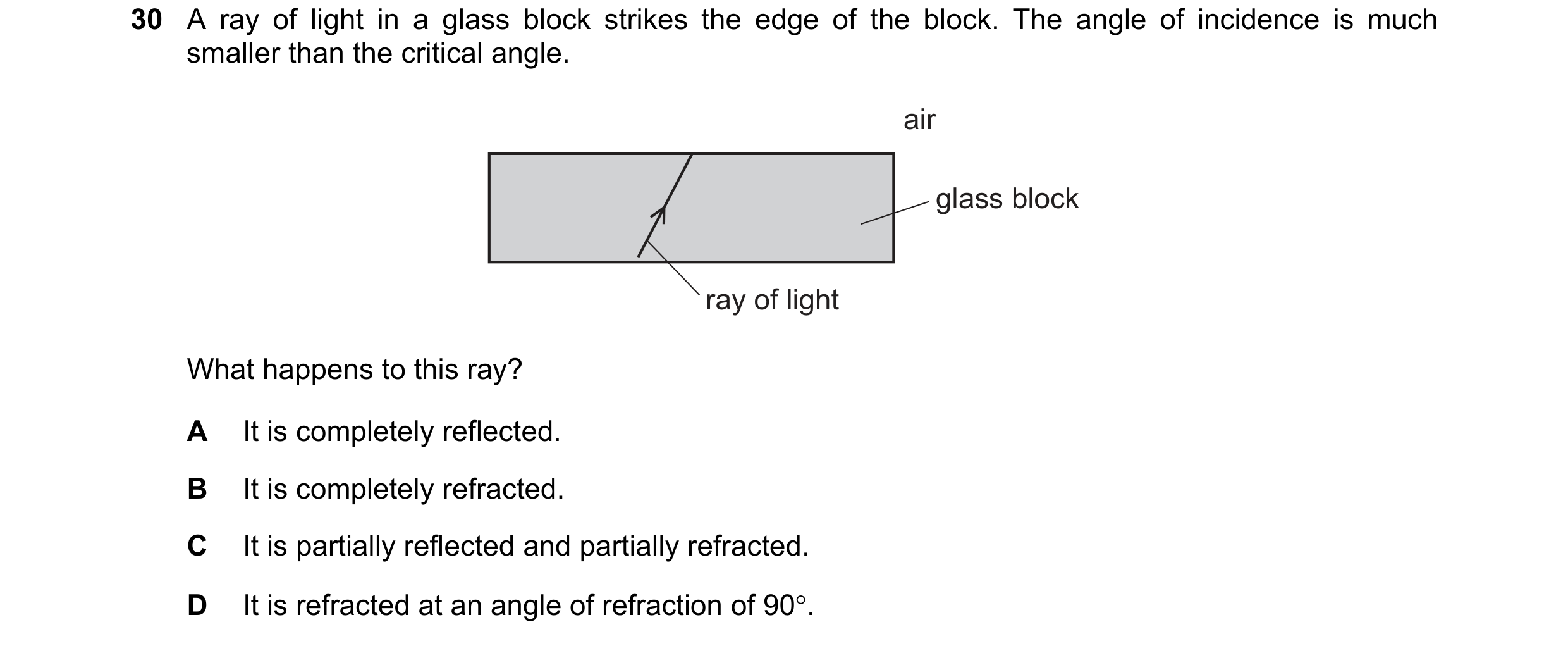
Q21 · A ray of light in a glass block strikes the edge of the block 0652/11 Oct/Nov 2017
30 A ray of light in a glass block strikes the edge of the block. The angle of incidence is much smaller than the critical angle. air glass block ray of light What happens to this ray? A It is completely reflected. B It is completely refracted. C It is partially reflected and partially refracted. D It is refracted at an angle of refraction of 90°.
1 marks
Answer: C
This question in 0652/11 Oct/Nov 2017
Q22 · The diagram represents the electromagnetic spectrum 0652/11 Oct/Nov 2017
31 The diagram represents the electromagnetic spectrum. Some sections have been labelled. Which section is infra-red radiation? gamma- visible radio A B C D rays light waves
1 marks
Answer: C
This question in 0652/11 Oct/Nov 2017
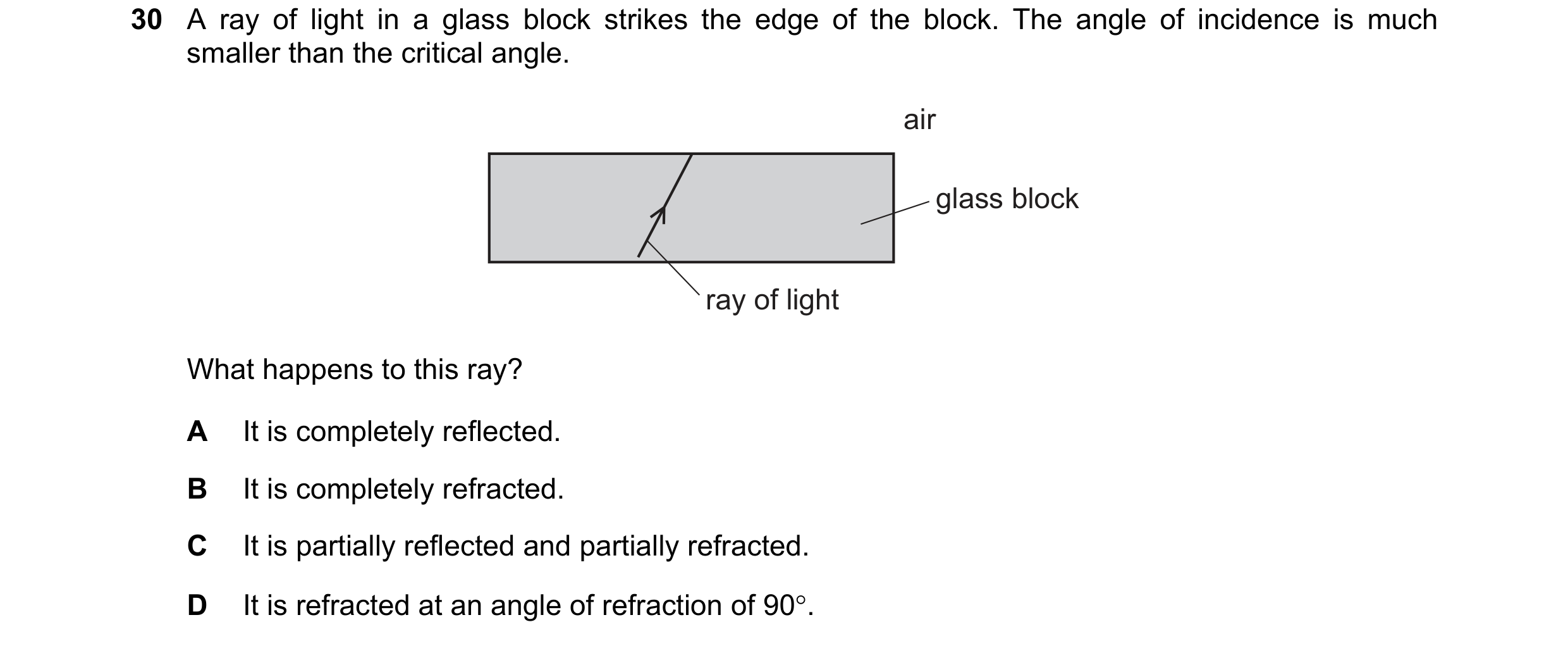
Q23 · A ray of light in a glass block strikes the edge of the block 0652/12 Oct/Nov 2017
30 A ray of light in a glass block strikes the edge of the block. The angle of incidence is much smaller than the critical angle. air glass block ray of light What happens to this ray? A It is completely reflected. B It is completely refracted. C It is partially reflected and partially refracted. D It is refracted at an angle of refraction of 90°.
1 marks
Answer: C
This question in 0652/12 Oct/Nov 2017
Q24 · The diagram represents the electromagnetic spectrum 0652/12 Oct/Nov 2017
31 The diagram represents the electromagnetic spectrum. Some sections have been labelled. Which section is infra-red radiation? gamma- visible radio A B C D rays light waves
1 marks
Answer: C
This question in 0652/12 Oct/Nov 2017
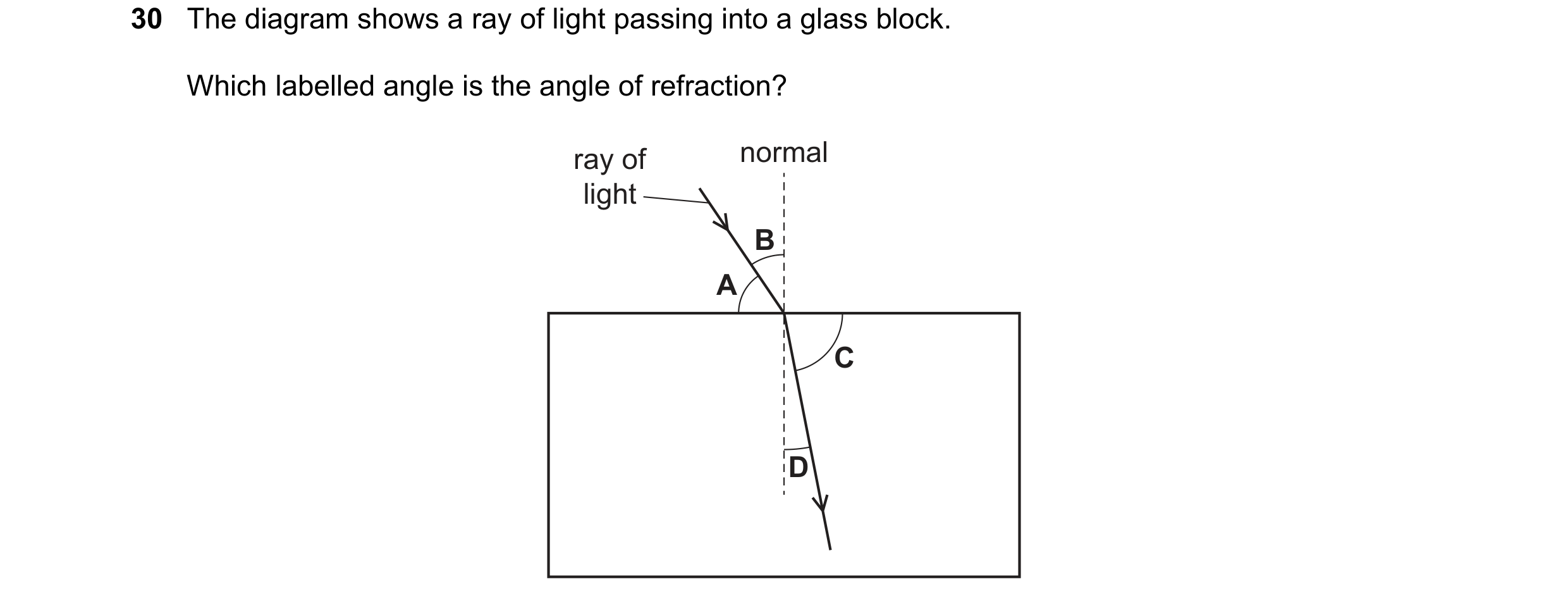
Q25 · The diagram shows a ray of light passing into a glass block 0652/11 Oct/Nov 2018
30 The diagram shows a ray of light passing into a glass block. Which labelled angle is the angle of refraction? ray of normal light B A C D
1 marks
Answer: D
This question in 0652/11 Oct/Nov 2018
Q26 · The diagram shows a ray of light passing into a glass block 0652/12 Oct/Nov 2018
30 The diagram shows a ray of light passing into a glass block. Which labelled angle is the angle of refraction? ray of normal light B A C D
1 marks
Answer: D
This question in 0652/12 Oct/Nov 2018
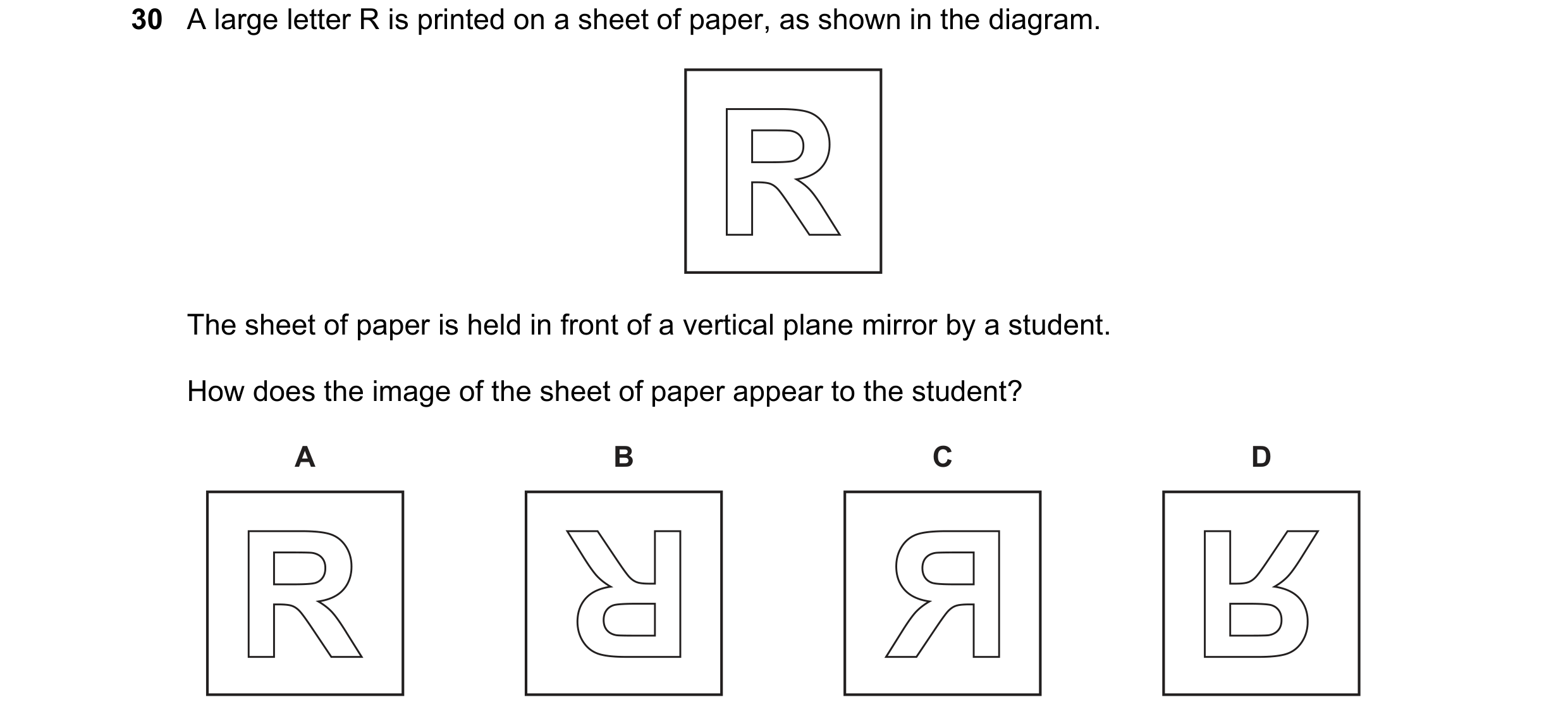
Q27 · A large letter R is printed on a sheet of paper, as shown in the diagram 0652/11 Oct/Nov 2019
30 A large letter R is printed on a sheet of paper, as shown in the diagram. The sheet of paper is held in front of a vertical plane mirror by a student. How does the image of the sheet of paper appear to the student? A B C D
1 marks
Answer: C
This question in 0652/11 Oct/Nov 2019
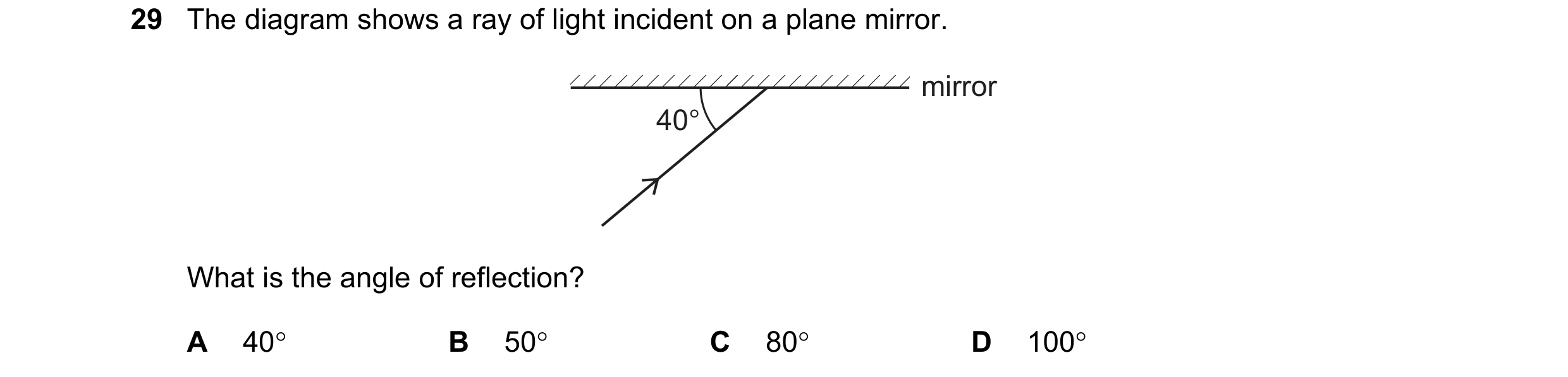
Q28 · The diagram shows a ray of light incident on a plane mirror 0652/12 Oct/Nov 2019
29 The diagram shows a ray of light incident on a plane mirror. mirror 40° What is the angle of reflection? A 40° B 50° C 80° D 100°
1 marks
Answer: B
This question in 0652/12 Oct/Nov 2019
Q29 · The diagram shows light from an object O passing through a converging lens to form an… 0652/12 Oct/Nov 2019
30 The diagram shows light from an object O passing through a converging lens to form an image I. 45 cm 18 cm 12 cm O I lens What is the focal length of the lens? A 18 cm B 30 cm C 45 cm D 75 cm
1 marks
Answer: A
This question in 0652/12 Oct/Nov 2019
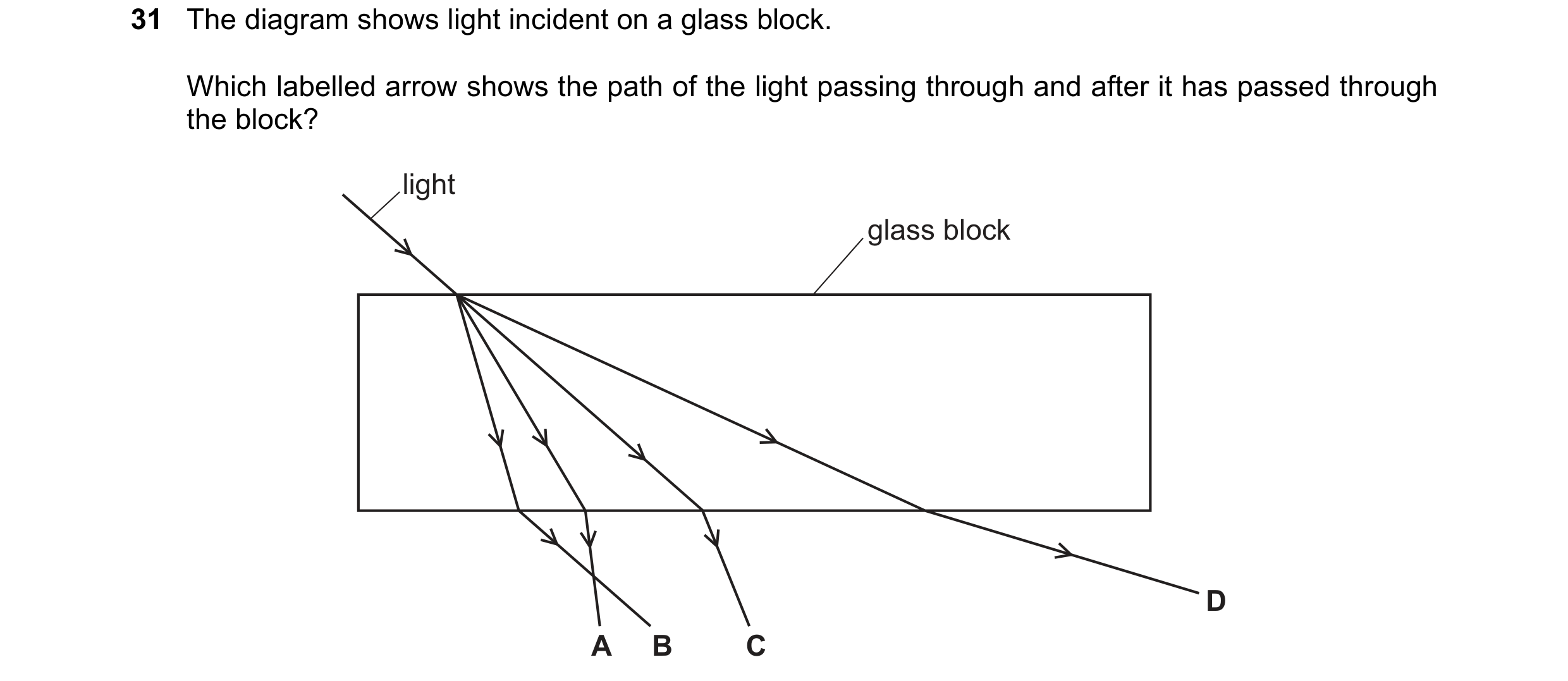
Q30 · The diagram shows light incident on a glass block 0652/11 Oct/Nov 2020
31 The diagram shows light incident on a glass block. Which labelled arrow shows the path of the light passing through and after it has passed through the block? light glass block D A B C
1 marks
Answer: B
This question in 0652/11 Oct/Nov 2020
Q31 · A plane mirror is fixed to a vertical wall 0652/11 Oct/Nov 2021
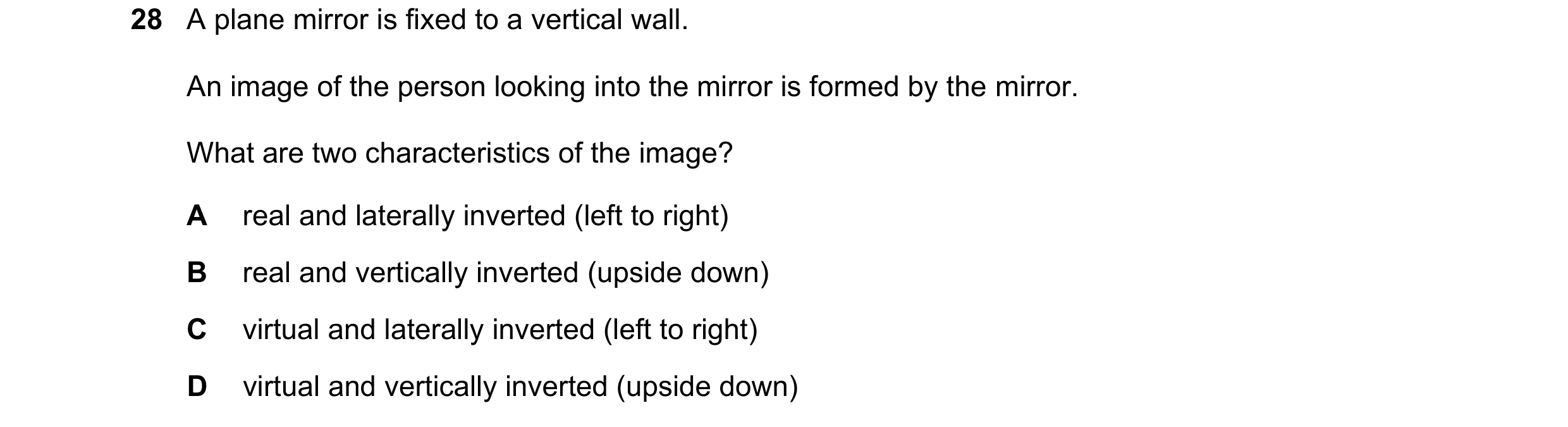
28 A plane mirror is fixed to a vertical wall. An image of the person looking into the mirror is formed by the mirror. What are two characteristics of the image? A real and laterally inverted (left to right) B real and vertically inverted (upside down) C virtual and laterally inverted (left to right) D virtual and vertically inverted (upside down)
1 marks
Answer: C
This question in 0652/11 Oct/Nov 2021
Q32 · The diagram shows two rays of light P and Q passing from air into glass 0652/11 Oct/Nov 2021
29 The diagram shows two rays of light P and Q passing from air into glass. Q P air glass The angles of incidence of P and Q are i P and i Q. The angles of refraction of P and Q are r P and r Q. Which row compares the angles of incidence and compares the angles of refraction of rays P and Q? angles of incidence angles of refraction A i P bigger than i Q r P bigger than r Q B i P bigger than i Q r P smaller than r Q C i P smaller than i Q r P bigger than r Q D i P smaller than i Q r P smaller than r Q
1 marks
Answer: A
This question in 0652/11 Oct/Nov 2021
Q33 · Which row shows how, in a vacuum, the speed of radio waves and the speed of X-rays… 0652/11 Oct/Nov 2021
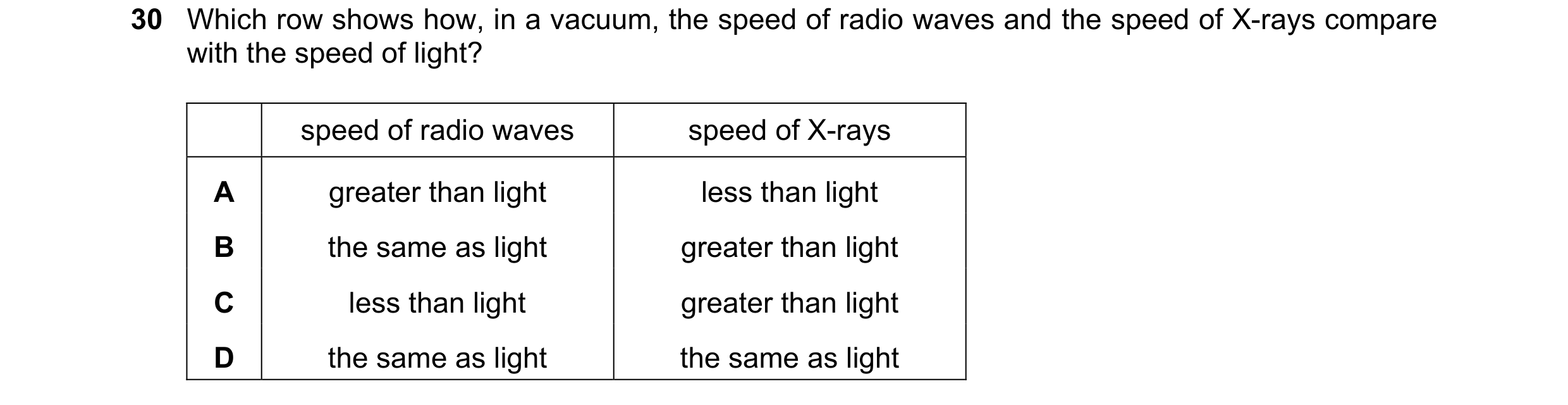
30 Which row shows how, in a vacuum, the speed of radio waves and the speed of X-rays compare with the speed of light? speed of radio waves speed of X-rays A greater than light less than light B the same as light greater than light C less than light greater than light D the same as light the same as light
1 marks
Answer: D
This question in 0652/11 Oct/Nov 2021
Q34 · Light is incident on a plane mirror at an angle of 40° to the surface 0652/11 Oct/Nov 2022
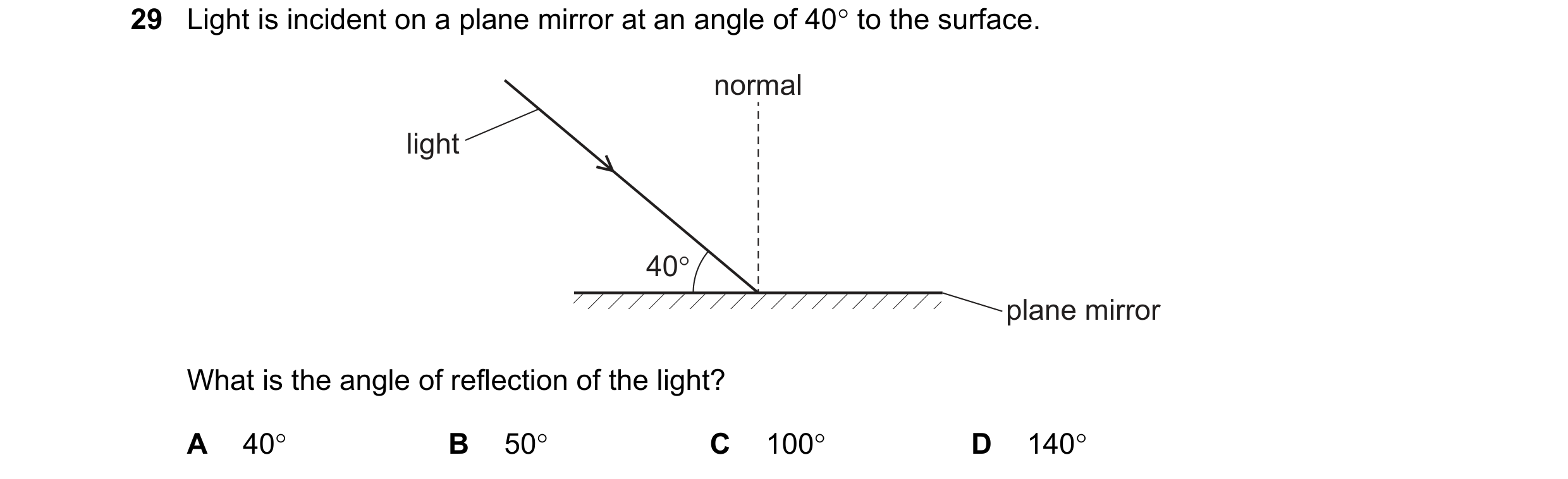
29 Light is incident on a plane mirror at an angle of 40° to the surface.
normal
light
plane mirror
What is the angle of reflection of the light?
A 40° B 50° C 100° D 140°
1 marks
Answer: B
This question in 0652/11 Oct/Nov 2022
Q35 · An object is placed at P, close to a converging lens 0652/11 Oct/Nov 2022
30 An object is placed at P, close to a converging lens. The ray diagram shows the formation of the real image. A principal focus of the lens is marked F. object P Q F real image The object is moved from P to Q. Which row describes what happens to the distance between the image and the lens, and what happens to the size of the image? distance between size of image image and lens A decreases decreases B decreases increases C increases decreases D increases increases
1 marks
Answer: D
This question in 0652/11 Oct/Nov 2022
Q36 · Two rays from an object are reflected by a plane mirror, as shown in the diagram 0652/11 Oct/Nov 2023
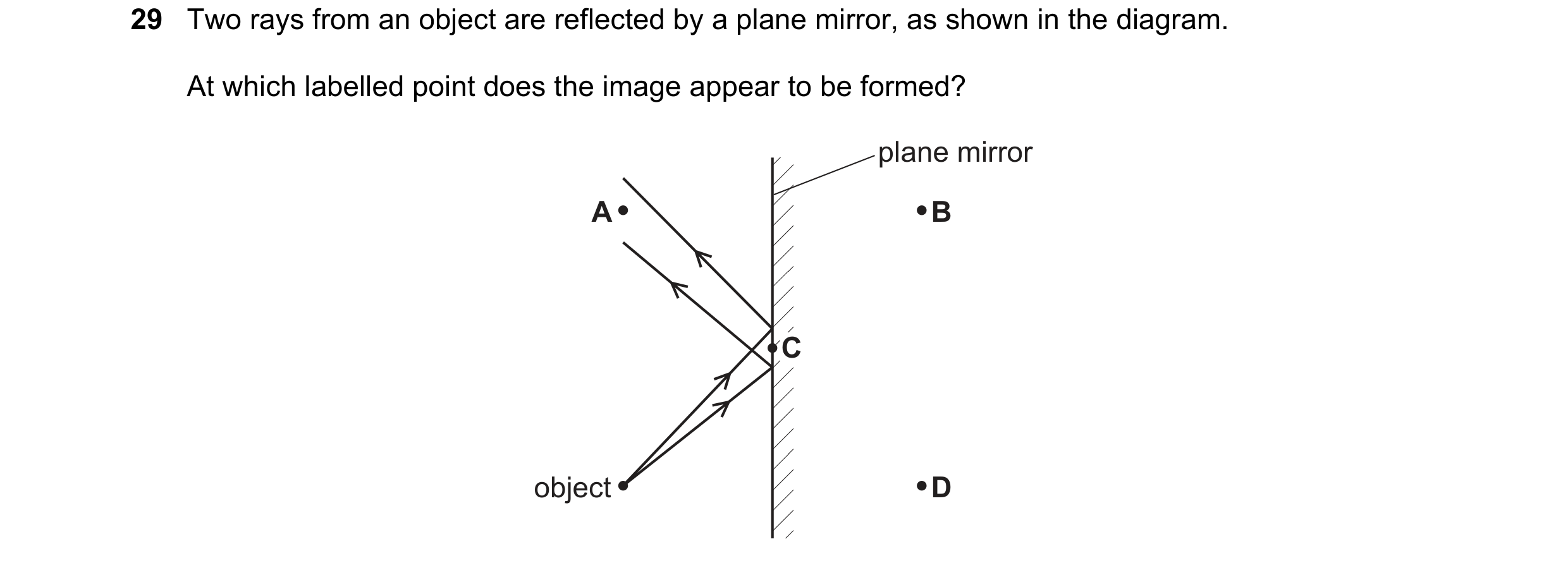
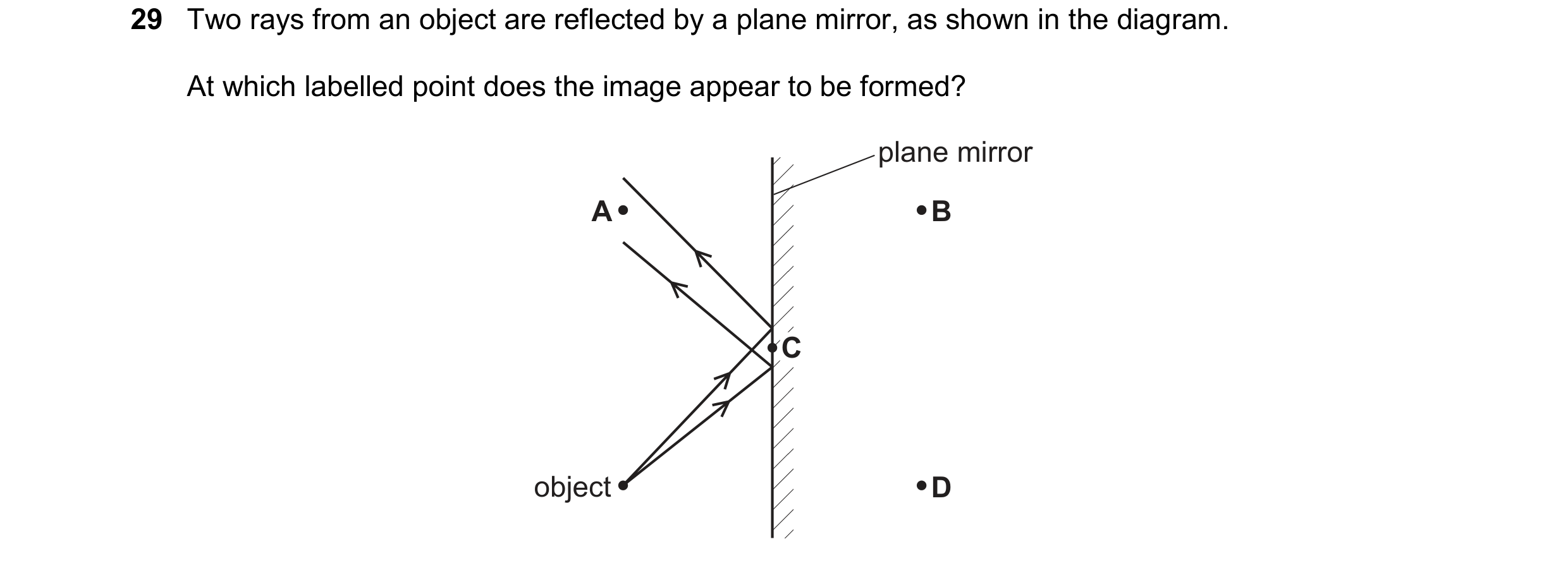
29 Two rays from an object are reflected by a plane mirror, as shown in the diagram. At which labelled point does the image appear to be formed? plane mirror A B C object D
1 marks
Answer: D
This question in 0652/11 Oct/Nov 2023
Q37 · The diagram shows light from an object O passing through a converging lens to form an… 0652/11 Oct/Nov 2023
30 The diagram shows light from an object O passing through a converging lens to form an image I. 45 cm 18 cm 12 cm O I lens What is the focal length of the lens? A 18 cm B 30 cm C 45 cm D 75 cm
1 marks
Answer: A
This question in 0652/11 Oct/Nov 2023
Q38 · Radio waves, visible light and X-rays are all travelling in a vacuum 0652/11 Oct/Nov 2023
31 Radio waves, visible light and X-rays are all travelling in a vacuum. Which statement about the speeds of these waves is correct? A Radio waves are the fastest. B Visible light waves are the fastest. C X-rays are the fastest. D They all travel at the same speed.
1 marks
Answer: D
This question in 0652/11 Oct/Nov 2023
Q39 · Two rays from an object are reflected by a plane mirror, as shown in the diagram 0652/12 Oct/Nov 2023
29 Two rays from an object are reflected by a plane mirror, as shown in the diagram. At which labelled point does the image appear to be formed? plane mirror A B C object D
1 marks
Answer: D
This question in 0652/12 Oct/Nov 2023
Q40 · The diagram shows light from an object O passing through a converging lens to form an… 0652/12 Oct/Nov 2023
30 The diagram shows light from an object O passing through a converging lens to form an image I. 45 cm 18 cm 12 cm O I lens What is the focal length of the lens? A 18 cm B 30 cm C 45 cm D 75 cm
1 marks
Answer: A
This question in 0652/12 Oct/Nov 2023
Q41 · Radio waves, visible light and X-rays are all travelling in a vacuum 0652/12 Oct/Nov 2023
31 Radio waves, visible light and X-rays are all travelling in a vacuum. Which statement about the speeds of these waves is correct? A Radio waves are the fastest. B Visible light waves are the fastest. C X-rays are the fastest. D They all travel at the same speed.
1 marks
Answer: D
This question in 0652/12 Oct/Nov 2023
Q42 · The diagram shows what happens when light travelling in a glass block is incident on a… 0652/11 Oct/Nov 2024
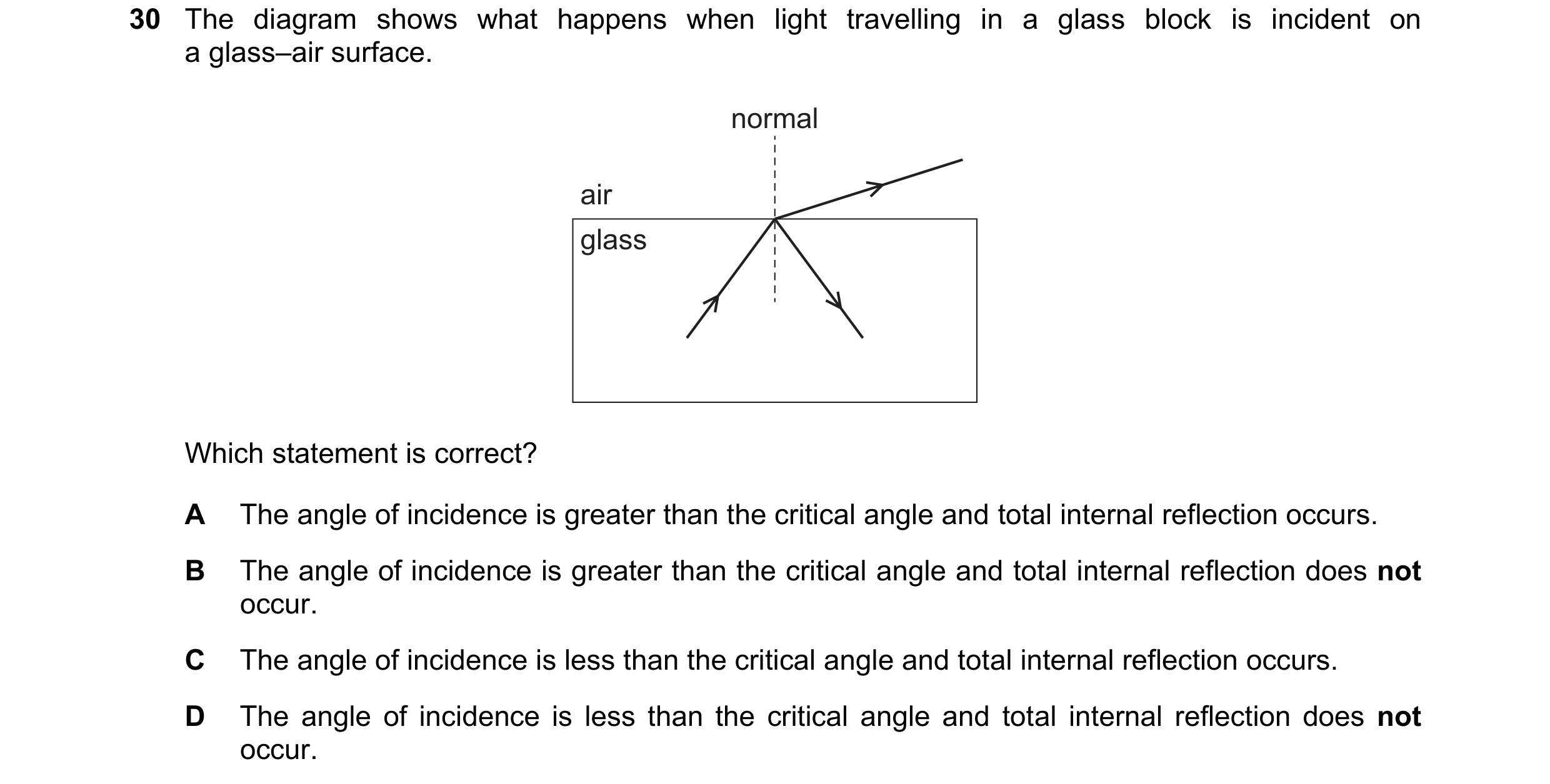
30 The diagram shows what happens when light travelling in a glass block is incident on a glass–air surface. normal air glass Which statement is correct? A The angle of incidence is greater than the critical angle and total internal reflection occurs. B The angle of incidence is greater than the critical angle and total internal reflection does not occur. C The angle of incidence is less than the critical angle and total internal reflection occurs. D The angle of incidence is less than the critical angle and total internal reflection does not occur.
1 marks
Answer: D
This question in 0652/11 Oct/Nov 2024
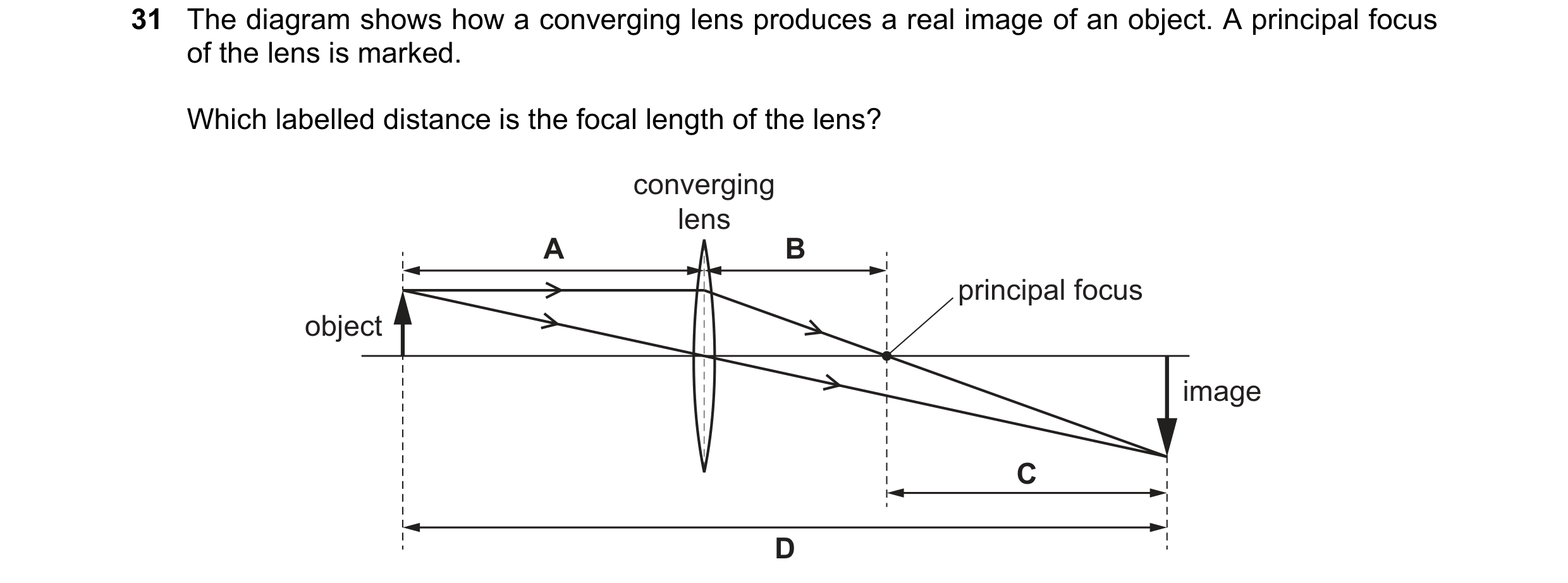
Q43 · The diagram shows how a converging lens produces a real image of an object 0652/11 Oct/Nov 2024
31 The diagram shows how a converging lens produces a real image of an object. A principal focus of the lens is marked. Which labelled distance is the focal length of the lens? converging lens A B principal focus object image C D
1 marks
Answer: B
This question in 0652/11 Oct/Nov 2024
 1 / 16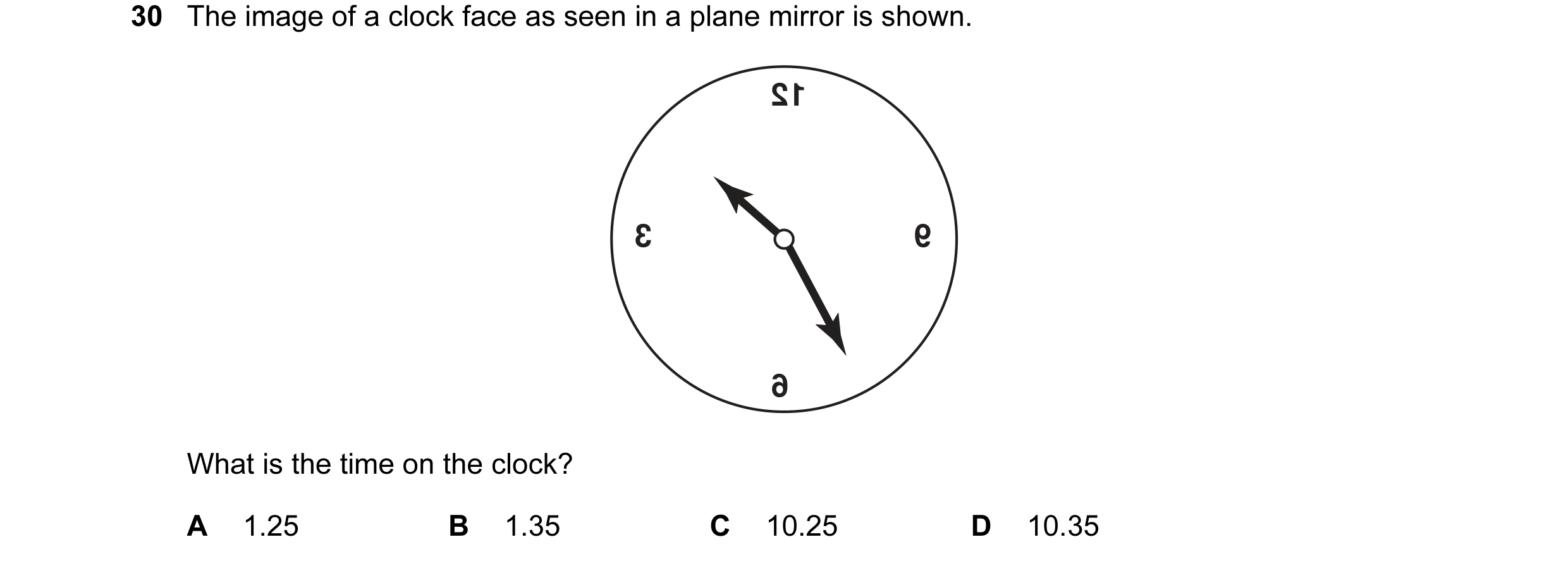
 2 / 16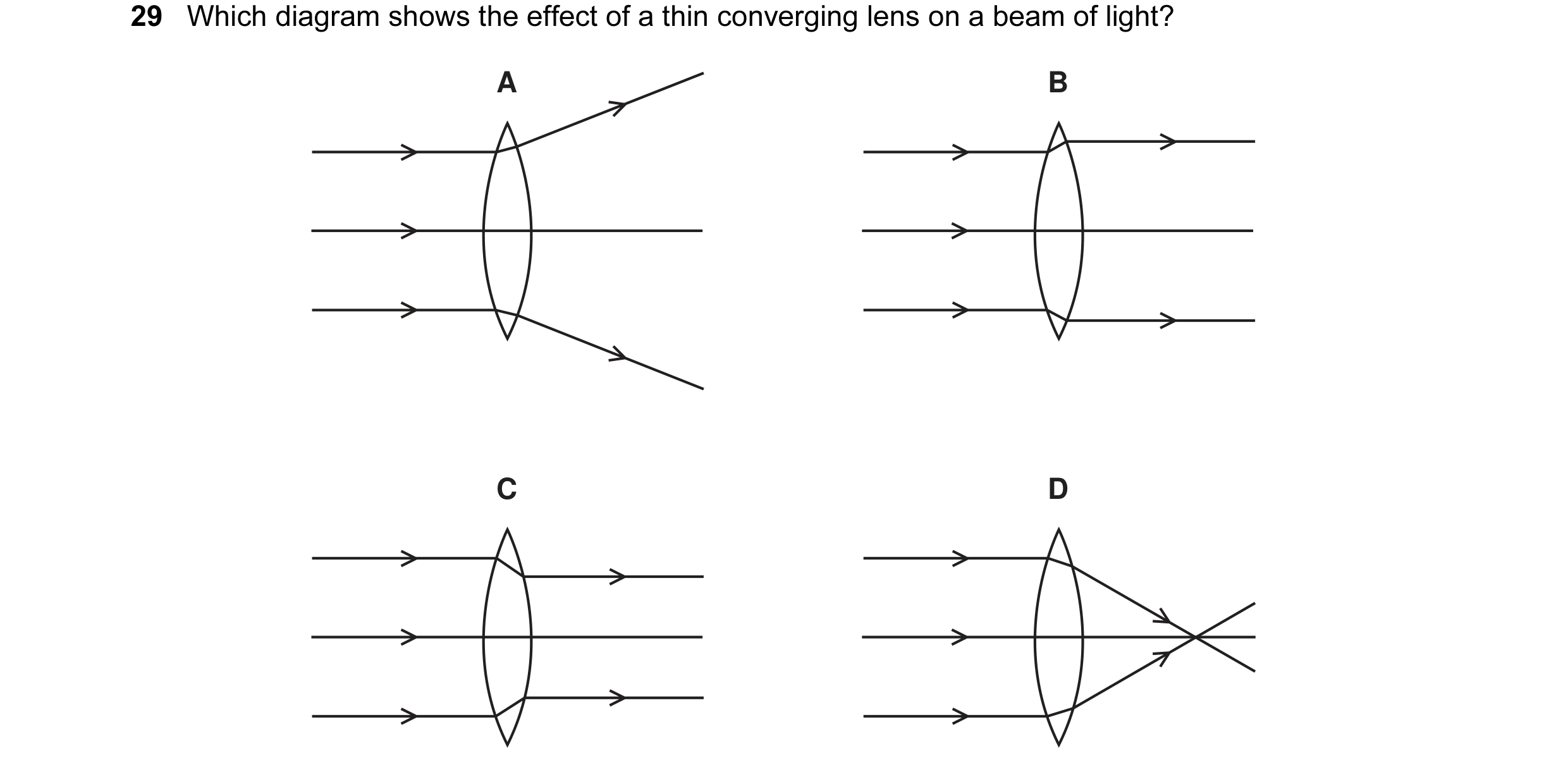
 3 / 16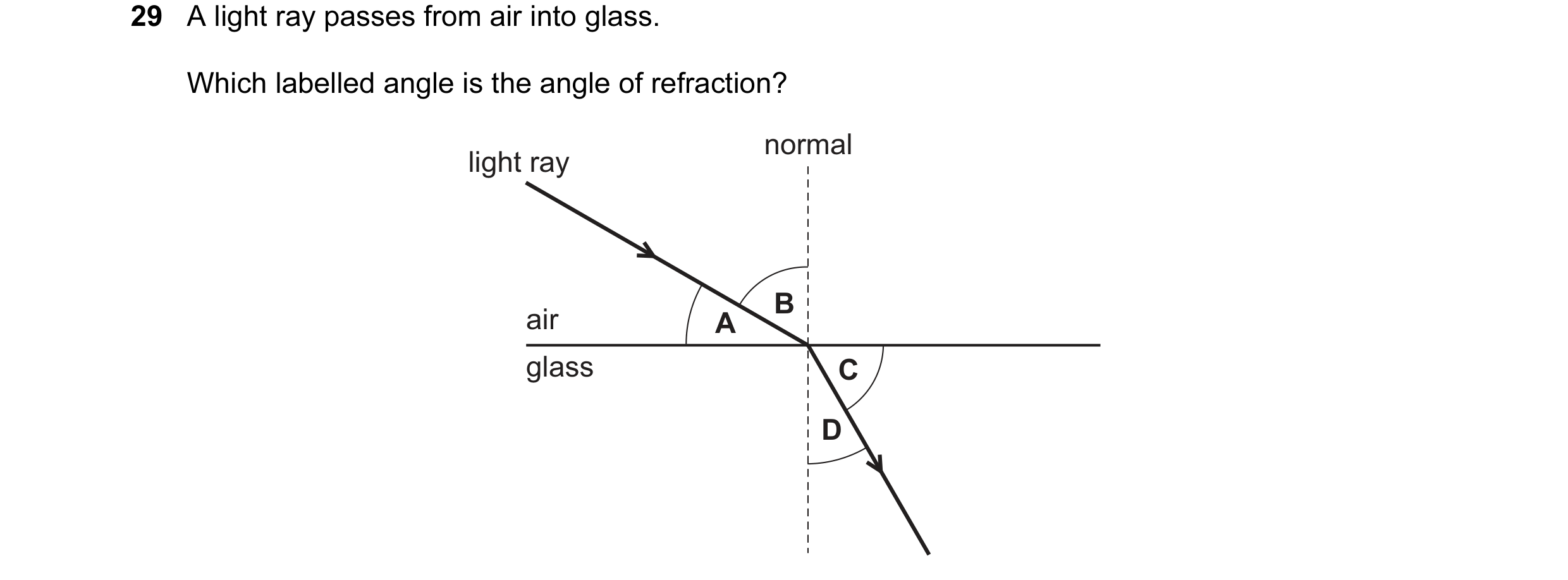
 4 / 16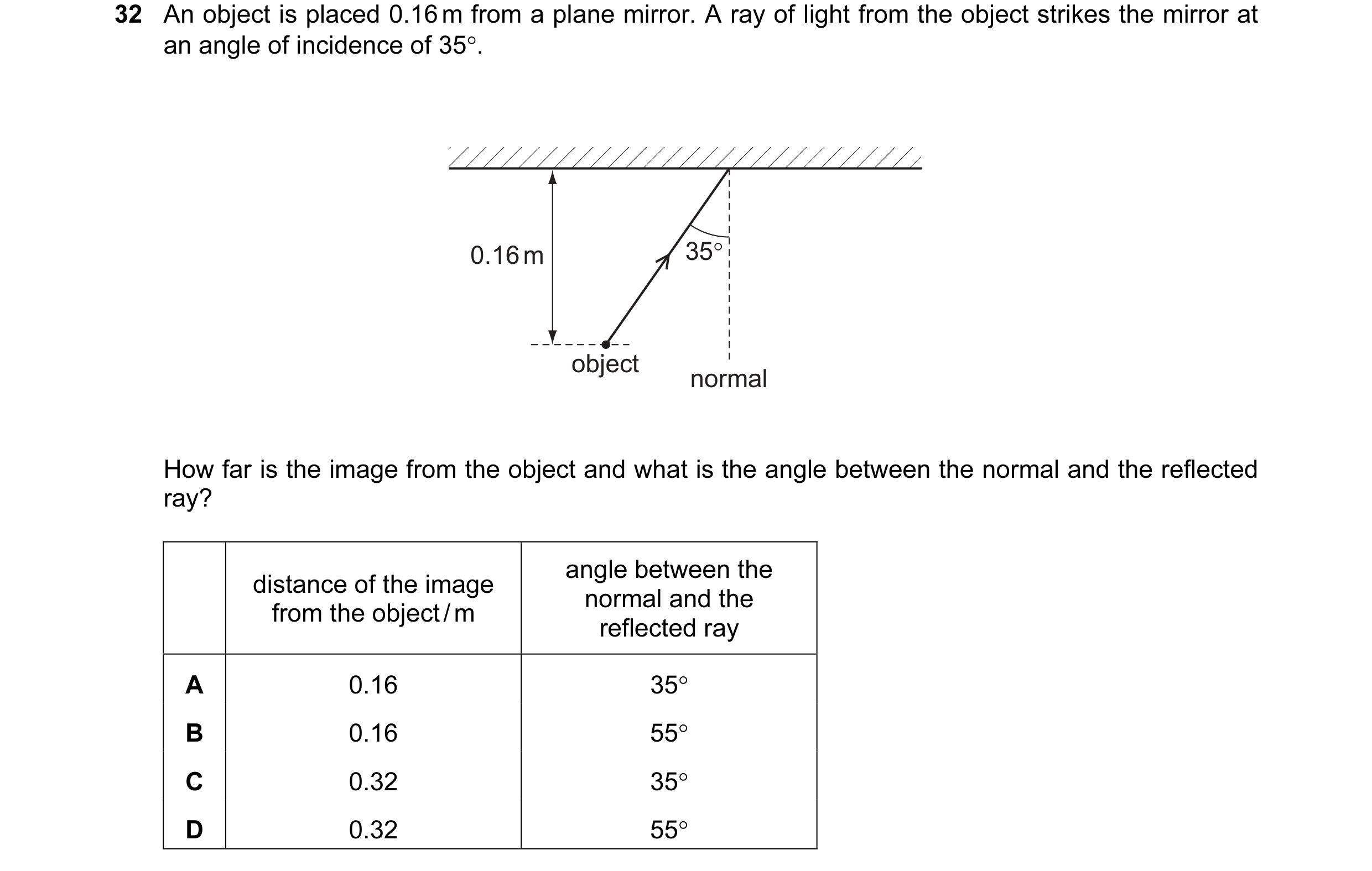
 5 / 16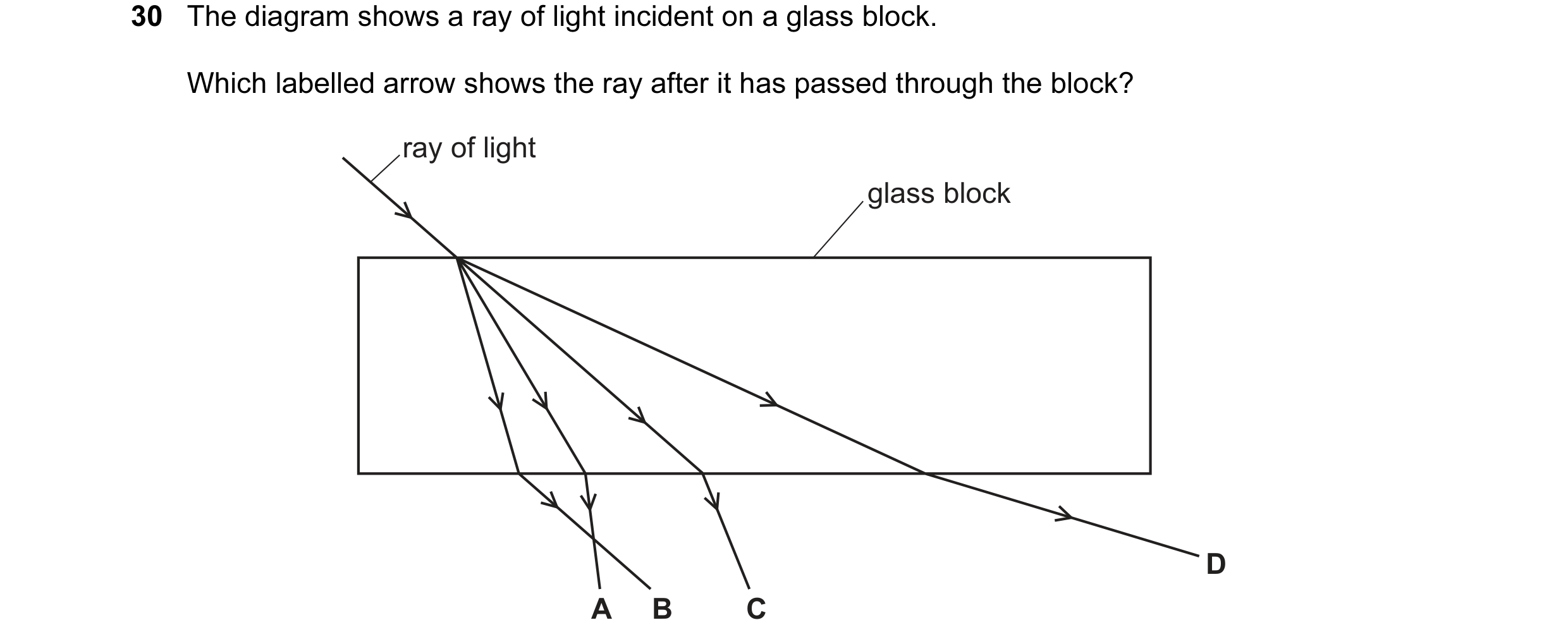
 6 / 16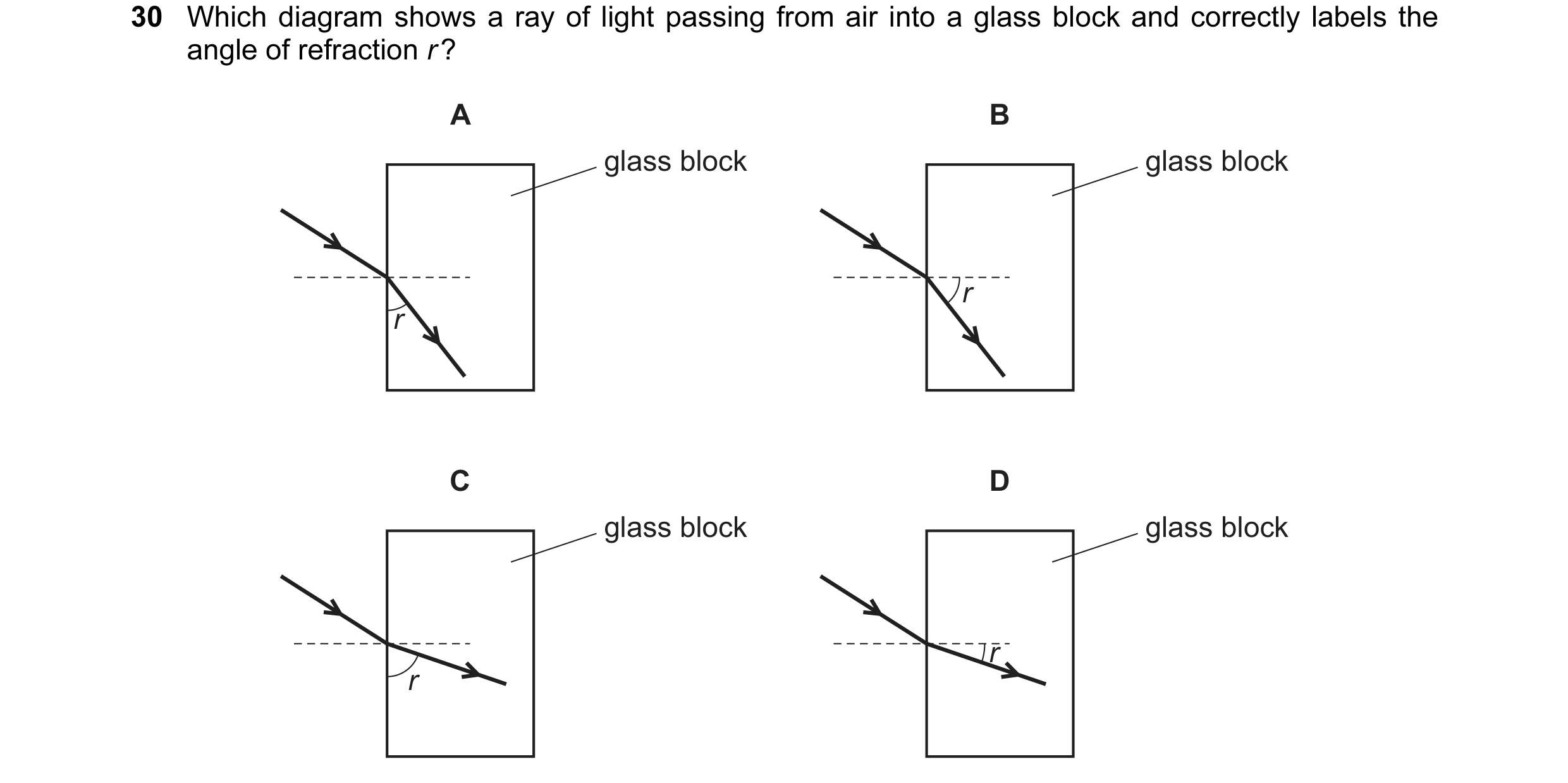
 7 / 16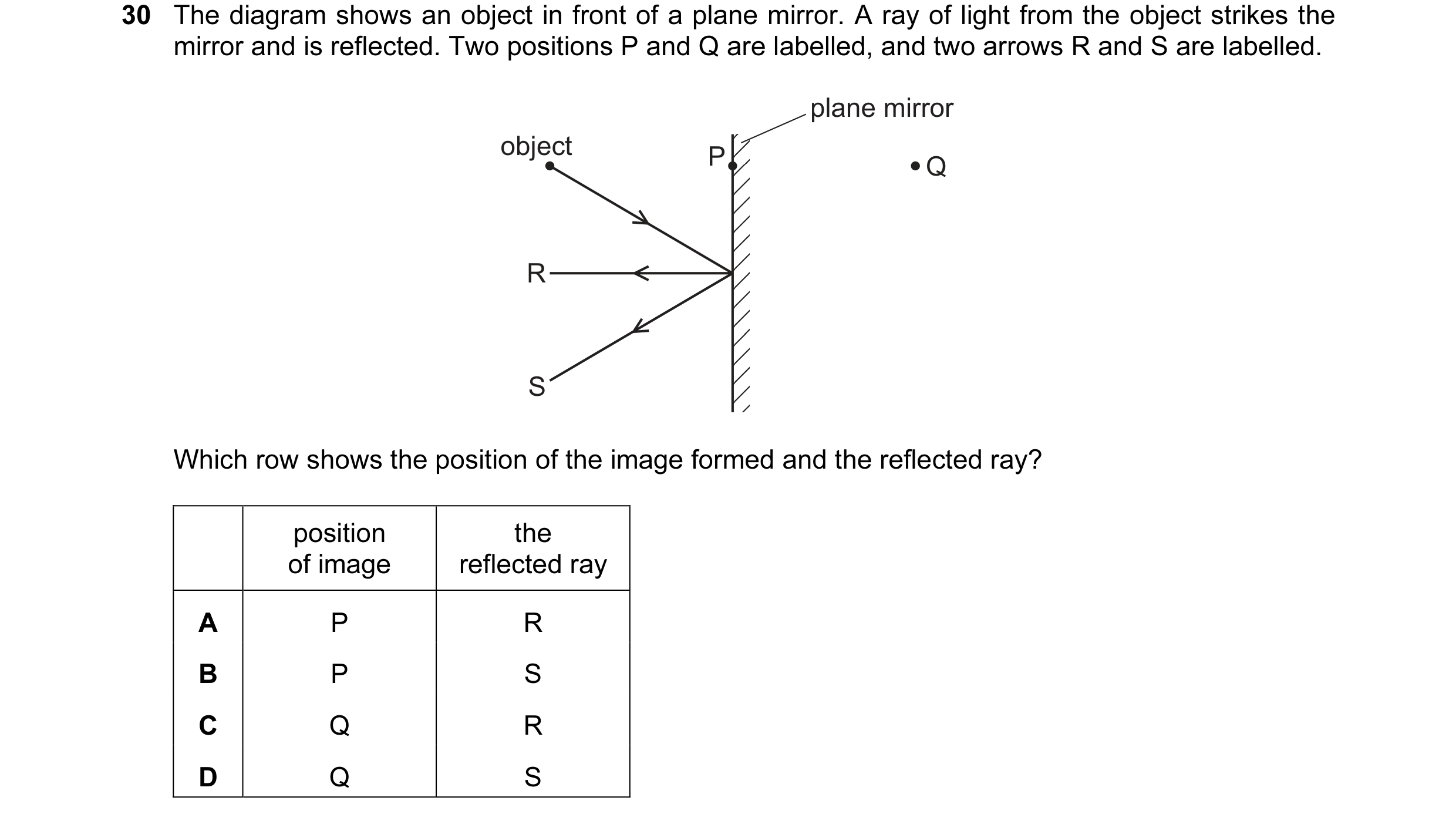
 8 / 16

 9 / 16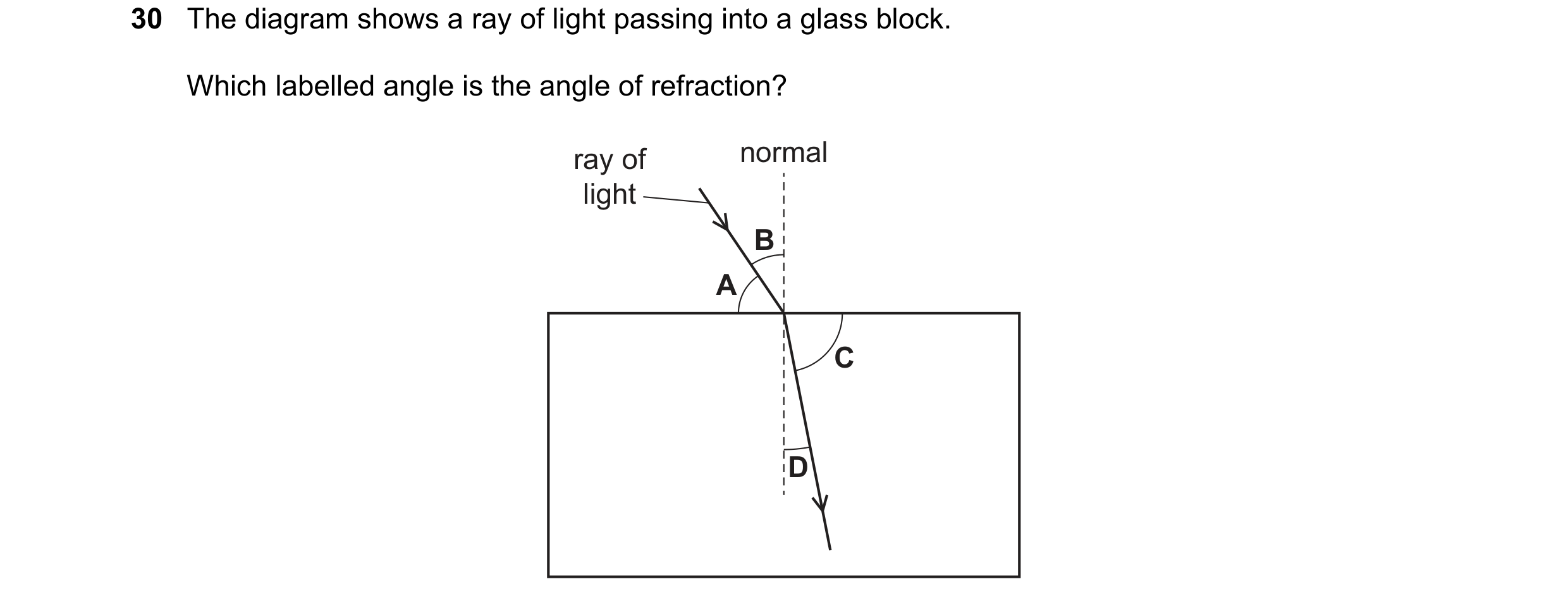
 10 / 16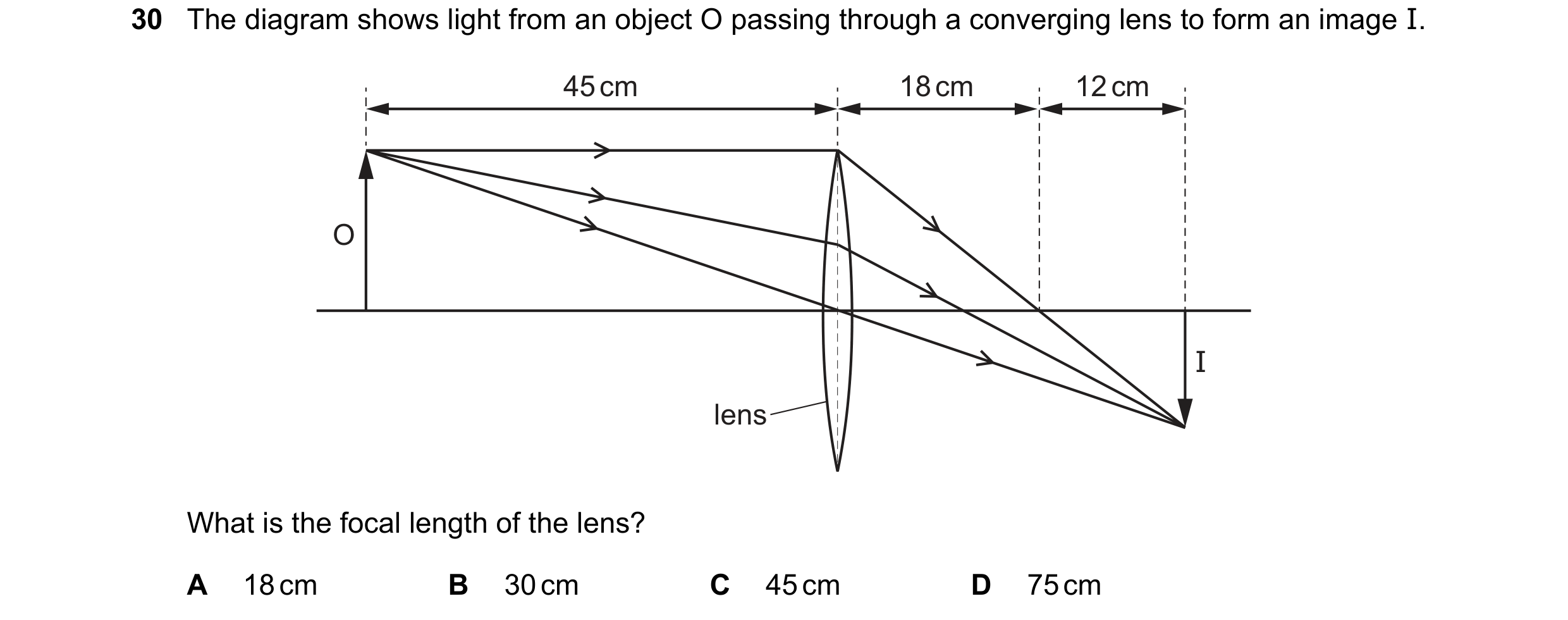
 11 / 16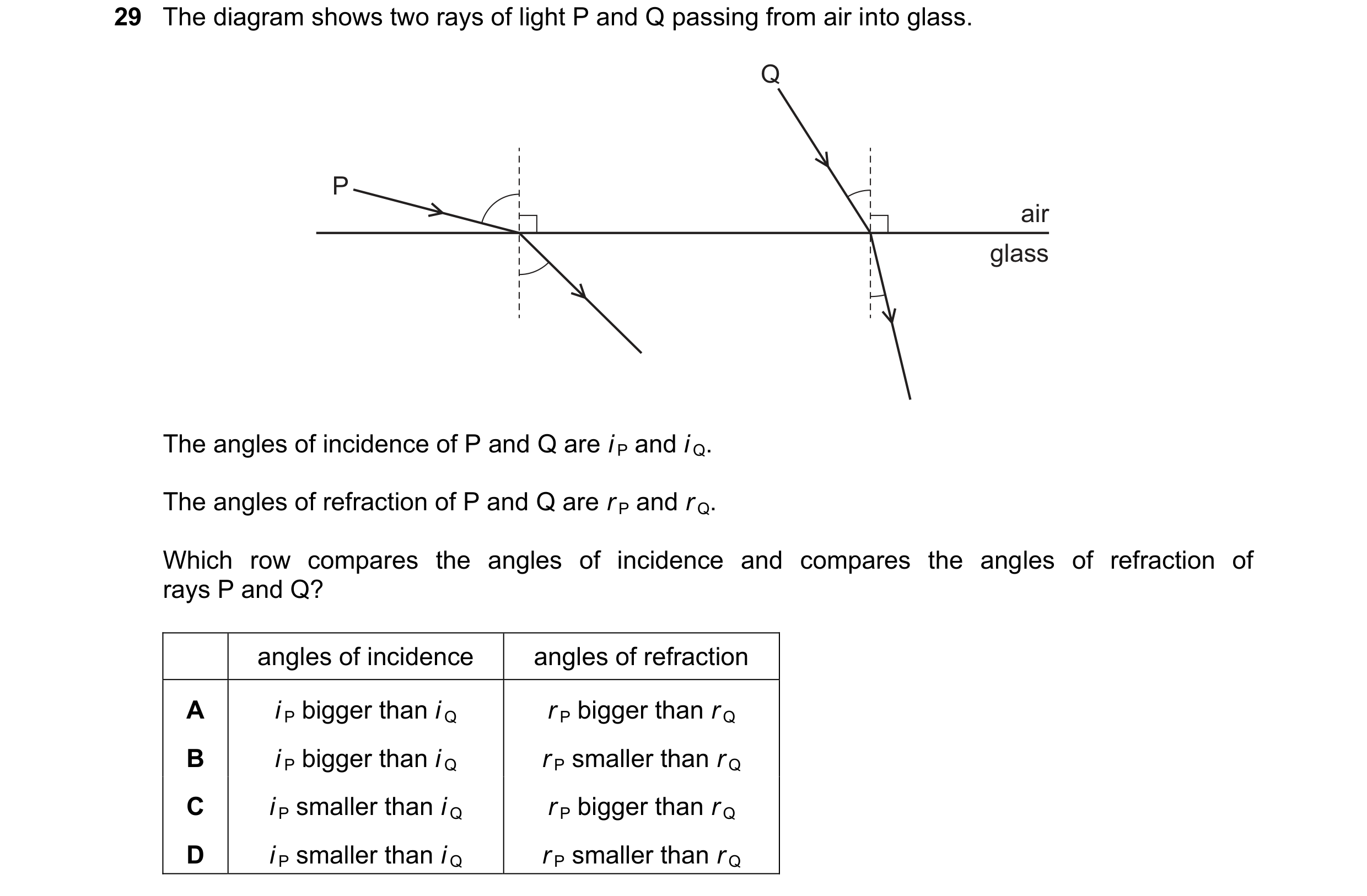
 12 / 16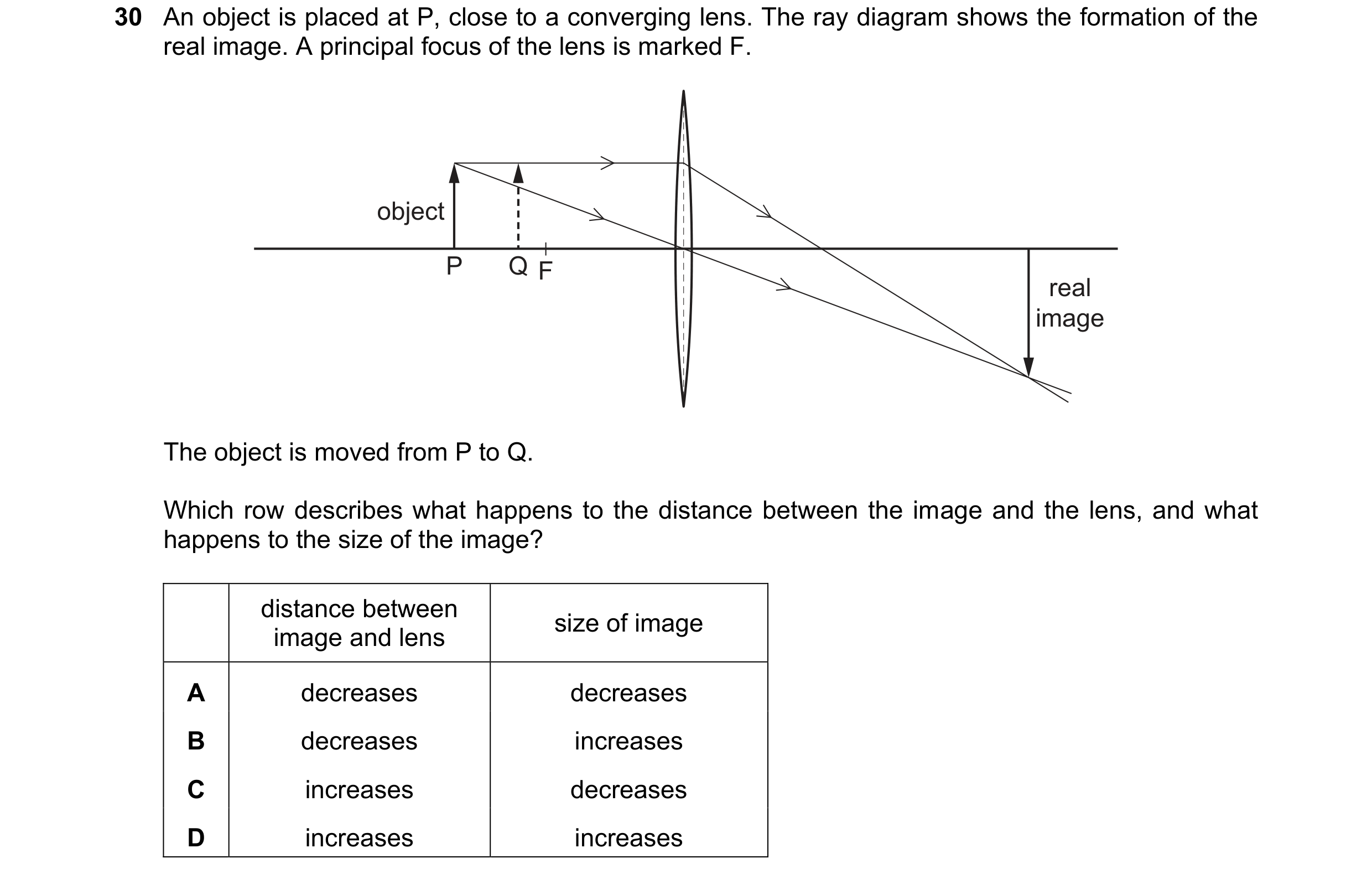
 13 / 16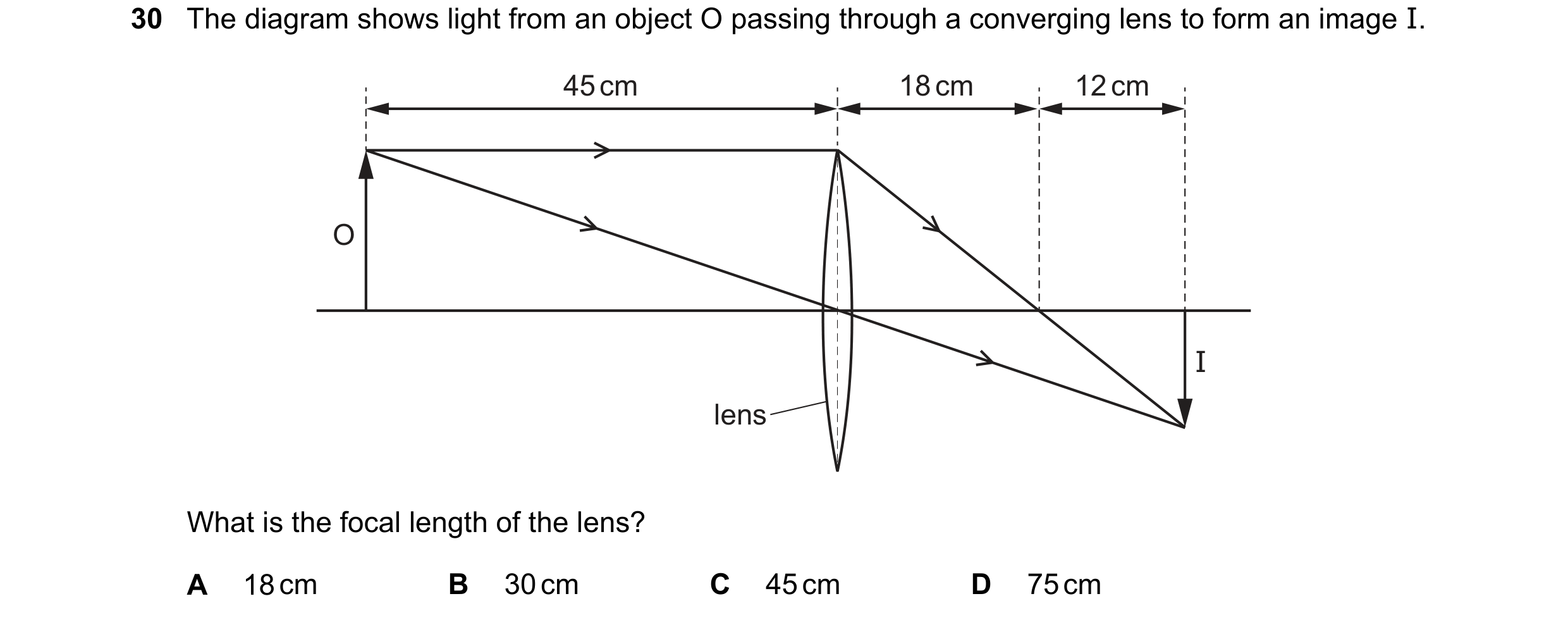
 14 / 16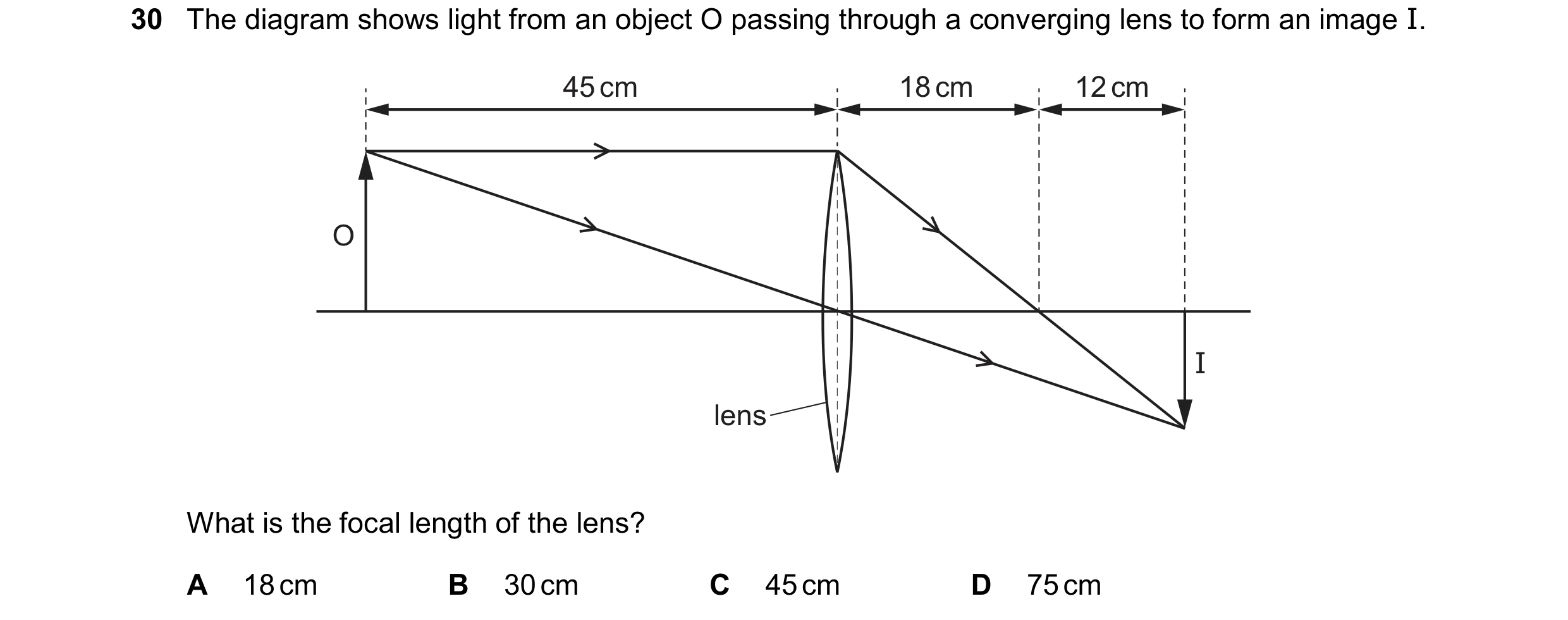
 15 / 16
 16 / 16