Questions as text
Q1 · A ray of light in a glass block strikes the edge of the block 0652/21 Oct/Nov 2017
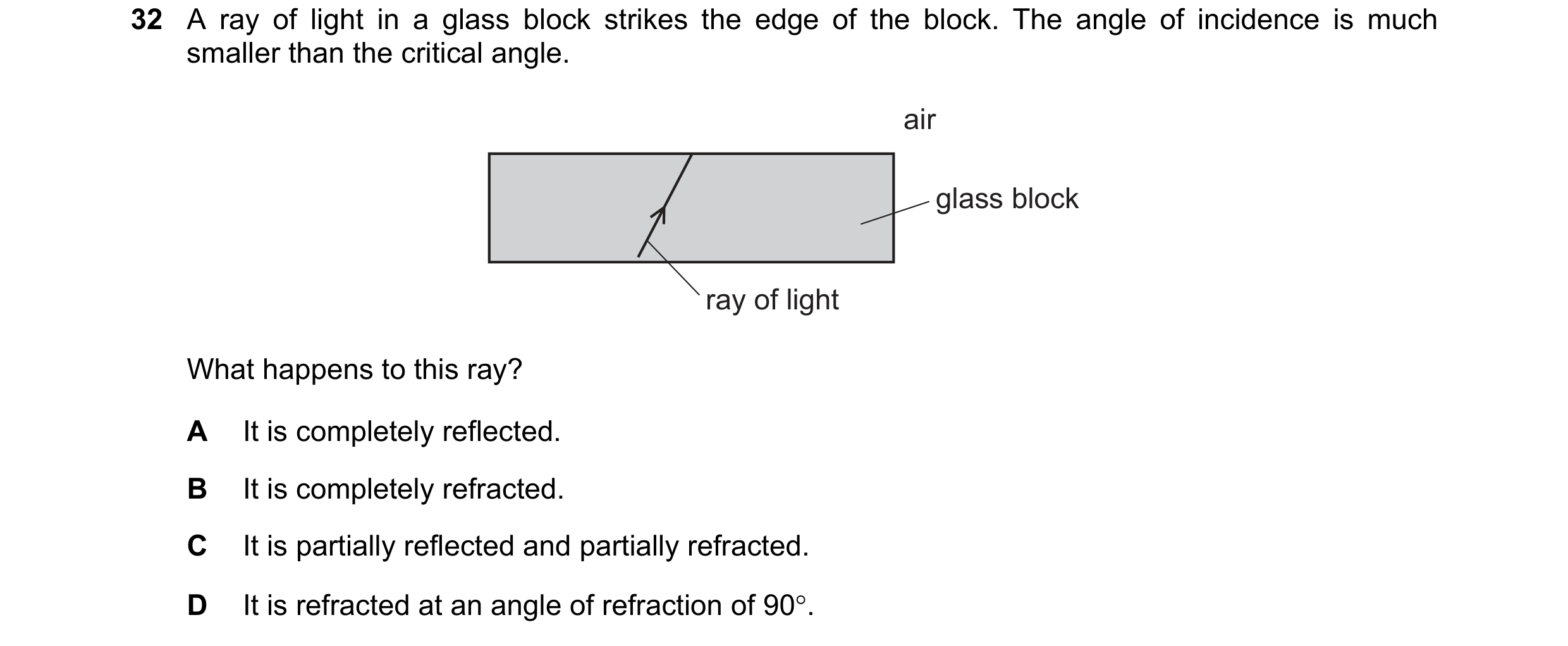
32 A ray of light in a glass block strikes the edge of the block. The angle of incidence is much smaller than the critical angle. air glass block ray of light What happens to this ray? A It is completely reflected. B It is completely refracted. C It is partially reflected and partially refracted. D It is refracted at an angle of refraction of 90°.
1 marks
Answer: C
This question in 0652/21 Oct/Nov 2017
Q2 · The diagram shows the paths of two rays from the top of an object 0652/21 Oct/Nov 2017
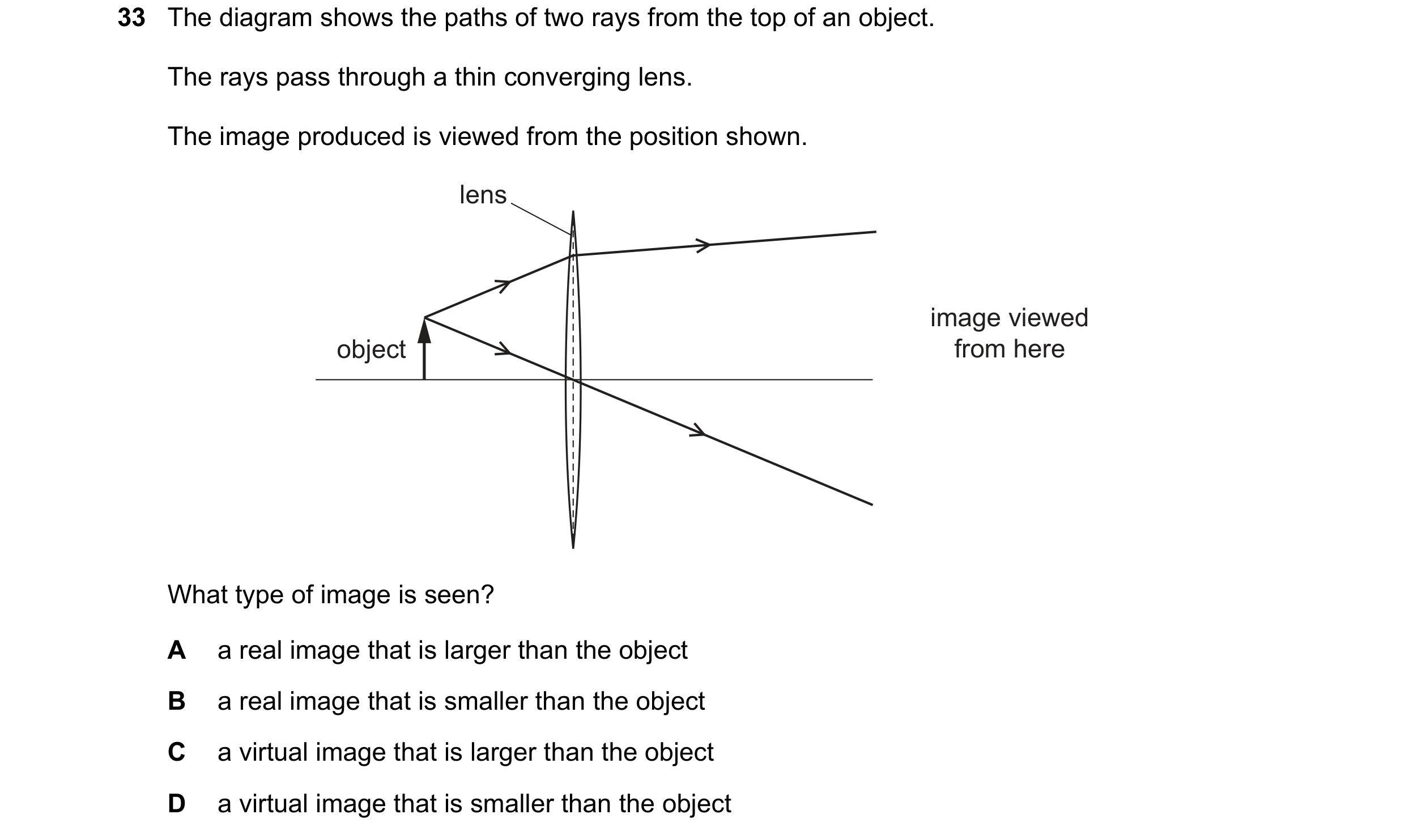
33 The diagram shows the paths of two rays from the top of an object. The rays pass through a thin converging lens. The image produced is viewed from the position shown. lens image viewed object from here What type of image is seen? A a real image that is larger than the object B a real image that is smaller than the object C a virtual image that is larger than the object D a virtual image that is smaller than the object
1 marks
Answer: C
This question in 0652/21 Oct/Nov 2017
Q3 · A ray of light in a glass block strikes the edge of the block 0652/22 Oct/Nov 2017
32 A ray of light in a glass block strikes the edge of the block. The angle of incidence is much smaller than the critical angle. air glass block ray of light What happens to this ray? A It is completely reflected. B It is completely refracted. C It is partially reflected and partially refracted. D It is refracted at an angle of refraction of 90°.
1 marks
Answer: C
This question in 0652/22 Oct/Nov 2017
Q4 · The diagram shows the paths of two rays from the top of an object 0652/22 Oct/Nov 2017
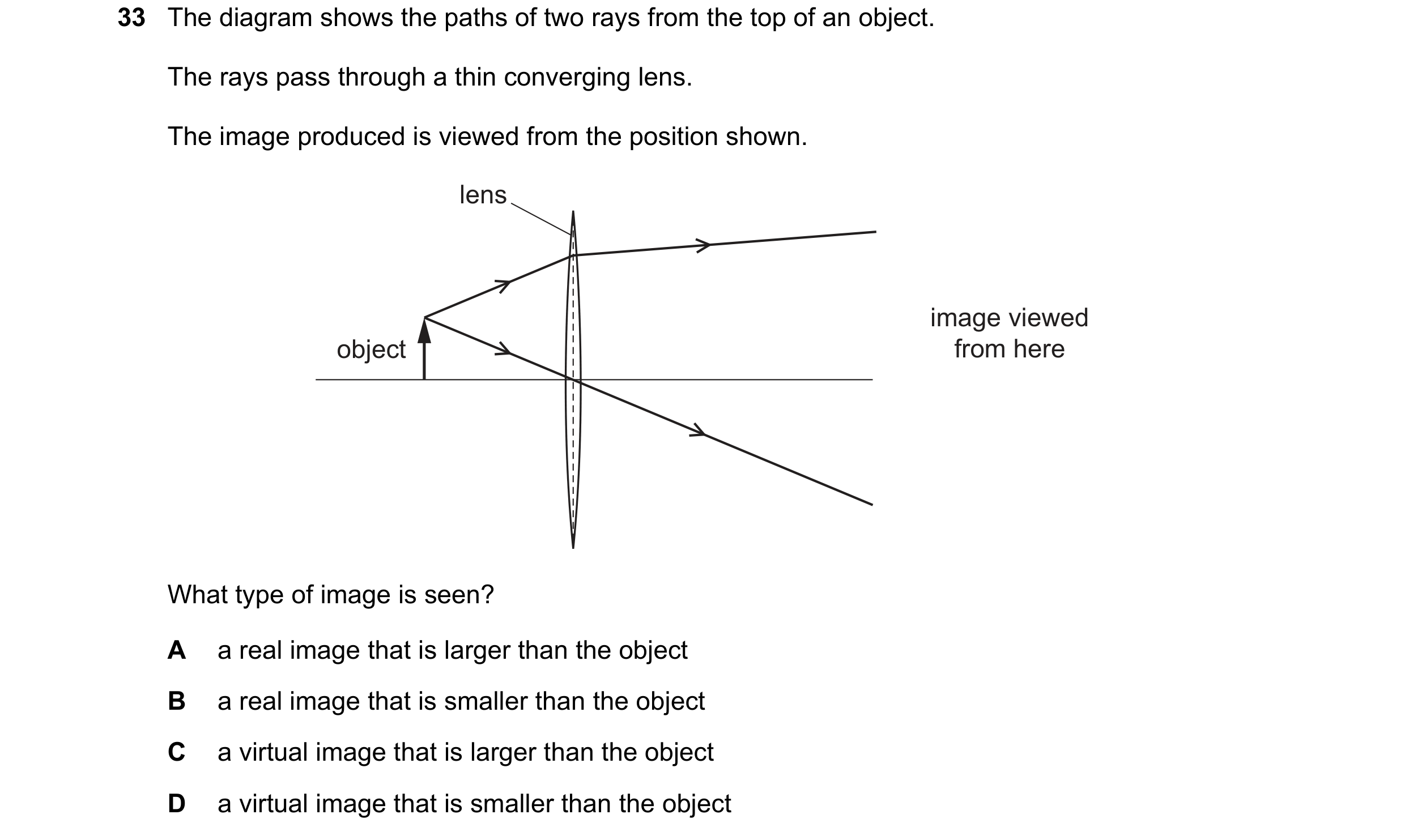
33 The diagram shows the paths of two rays from the top of an object. The rays pass through a thin converging lens. The image produced is viewed from the position shown. lens image viewed object from here What type of image is seen? A a real image that is larger than the object B a real image that is smaller than the object C a virtual image that is larger than the object D a virtual image that is smaller than the object
1 marks
Answer: C
This question in 0652/22 Oct/Nov 2017
Q5 · A convex lens of focal length 15 cm is used as a magnifying glass 0652/21 Oct/Nov 2018
30 A convex lens of focal length 15 cm is used as a magnifying glass. Which position of the object gives a virtual, magnified image? A object 8.0 cm from the lens B object 16 cm from the lens C object 32 cm from the lens D object 64 cm from the lens
1 marks
Answer: A
This question in 0652/21 Oct/Nov 2018
Q6 · Water waves are refracted as they pass from deep water into shallow water 0652/22 Oct/Nov 2018
29 Water waves are refracted as they pass from deep water into shallow water. Which property of the waves must stay the same when this happens? A direction B frequency C wavelength D velocity
1 marks
Answer: B
This question in 0652/22 Oct/Nov 2018
Q7 · A convex lens of focal length 15 cm is used as a magnifying glass 0652/22 Oct/Nov 2018
30 A convex lens of focal length 15 cm is used as a magnifying glass. Which position of the object gives a virtual, magnified image? A object 8.0 cm from the lens B object 16 cm from the lens C object 32 cm from the lens D object 64 cm from the lens
1 marks
Answer: A
This question in 0652/22 Oct/Nov 2018
Q8 · The speed of light in a vacuum is vv 0652/21 Oct/Nov 2019
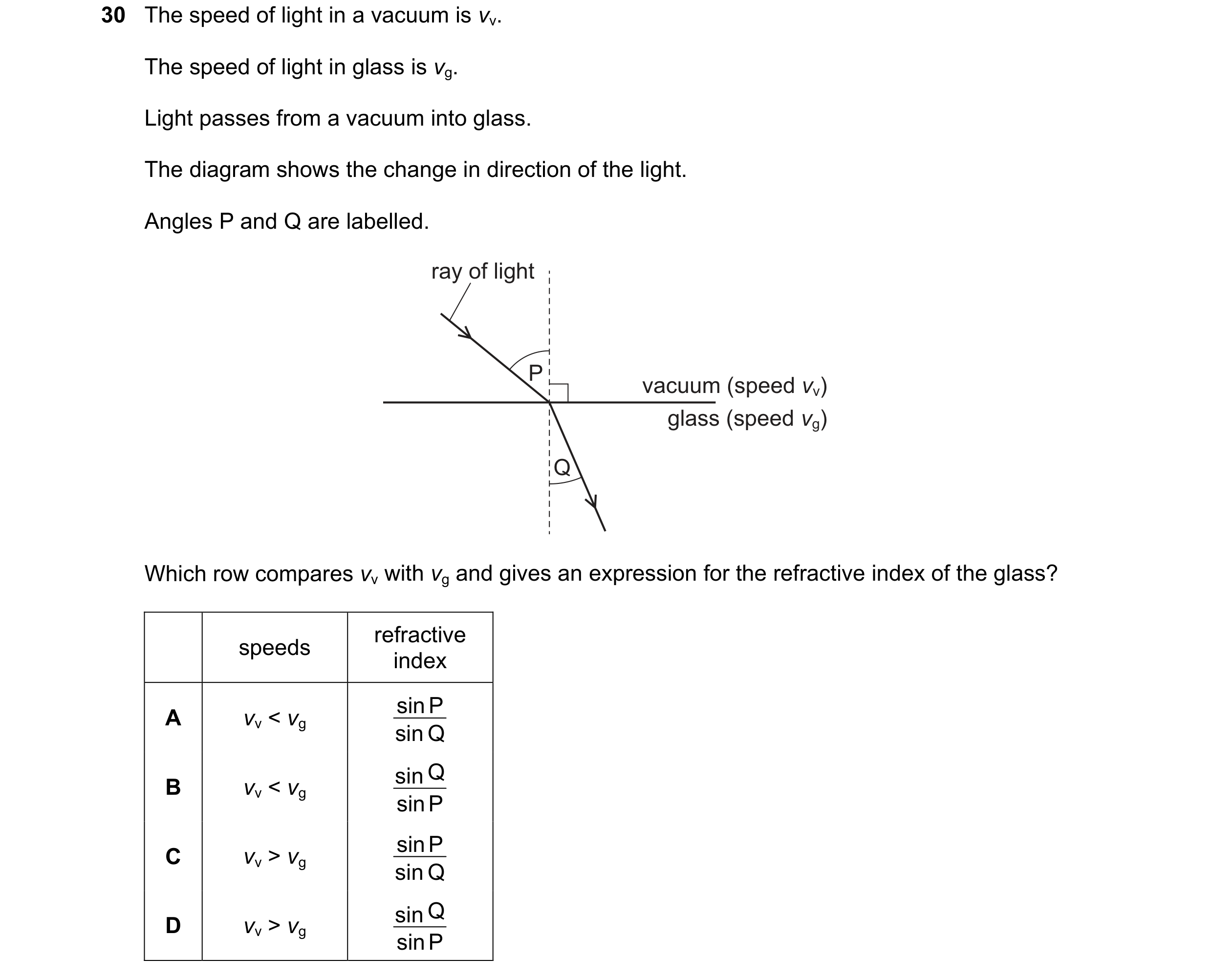
30 The speed of light in a vacuum is vv. The speed of light in glass is vg. Light passes from a vacuum into glass. The diagram shows the change in direction of the light. Angles P and Q are labelled. ray of light P vacuum (speed vv) glass (speed vg) Q Which row compares vv with vg and gives an expression for the refractive index of the glass? refractive speeds index sin P A vv < vg sin Q sin Q B vv < vg sin P sin P C vv > vg sin Q sin Q D vv > vg sin P
1 marks
Answer: C
This question in 0652/21 Oct/Nov 2019
Q9 · The speed of light in a vacuum is vv 0652/22 Oct/Nov 2019
30 The speed of light in a vacuum is vv. The speed of light in glass is vg. Light passes from a vacuum into glass. The diagram shows the change in direction of the light. Angles P and Q are labelled. ray of light P vacuum (speed vv) glass (speed vg) Q Which row compares vv with vg and gives an expression for the refractive index of the glass? refractive speeds index sin P A vv < vg sin Q sin Q B vv < vg sin P sin P C vv > vg sin Q sin Q D vv > vg sin P
1 marks
Answer: C
This question in 0652/22 Oct/Nov 2019
Q10 · The diagram shows light incident on a glass block 0652/21 Oct/Nov 2020
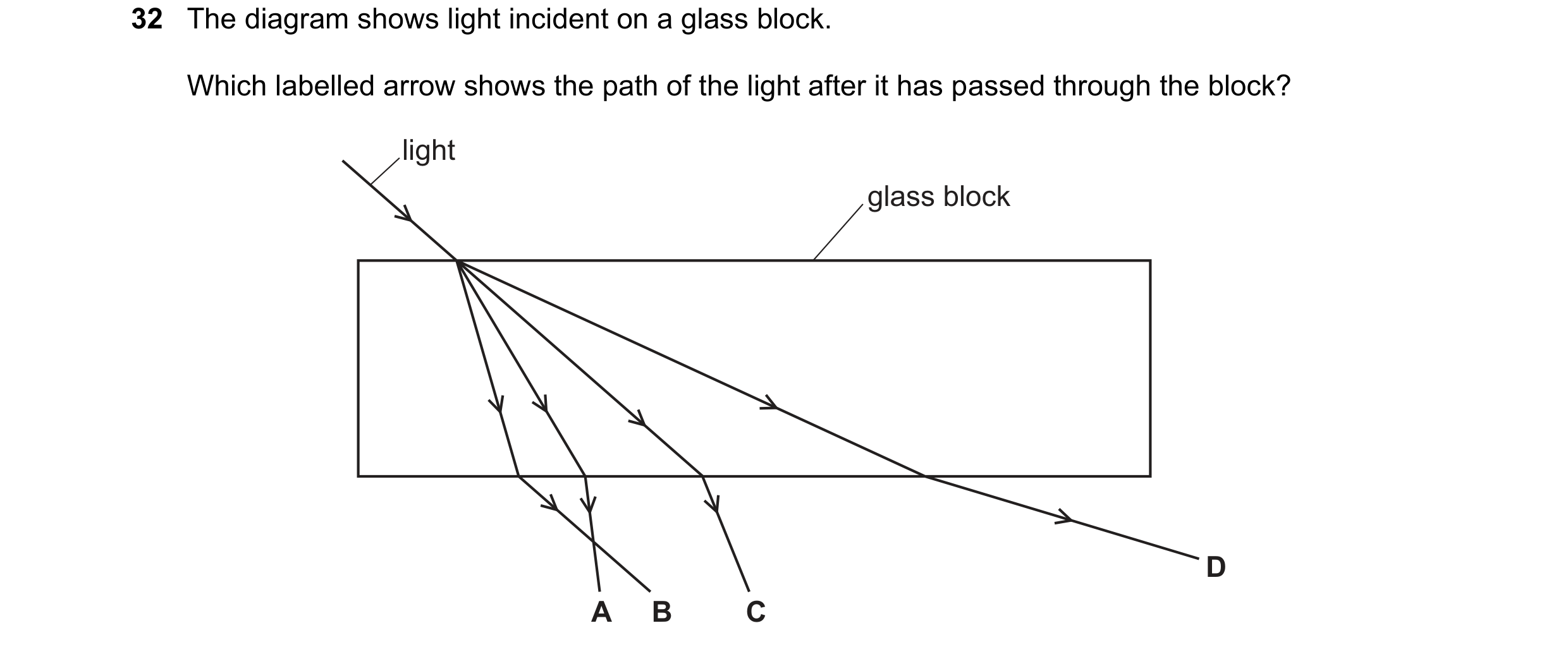
32 The diagram shows light incident on a glass block. Which labelled arrow shows the path of the light after it has passed through the block? light glass block D A B C
1 marks
Answer: B
This question in 0652/21 Oct/Nov 2020
Q11 · The diagram shows light incident on a glass block 0652/22 Oct/Nov 2020
31 The diagram shows light incident on a glass block. Which labelled arrow shows the path of the light after it has passed through the block? light glass block D A B C
1 marks
Answer: B
This question in 0652/22 Oct/Nov 2020
Q12 · Light from the Sun takes 8.3 minutes to reach the Earth 0652/22 Oct/Nov 2020
32 Light from the Sun takes 8.3 minutes to reach the Earth. How far apart are the Sun and the Earth? A 6.0 105 m B 3.6 107 m C 2.5 109 m D 1.5 1011 m
1 marks
Answer: D
This question in 0652/22 Oct/Nov 2020
Q13 · The diagram shows two rays of light P and Q passing from air into glass 0652/21 Oct/Nov 2021
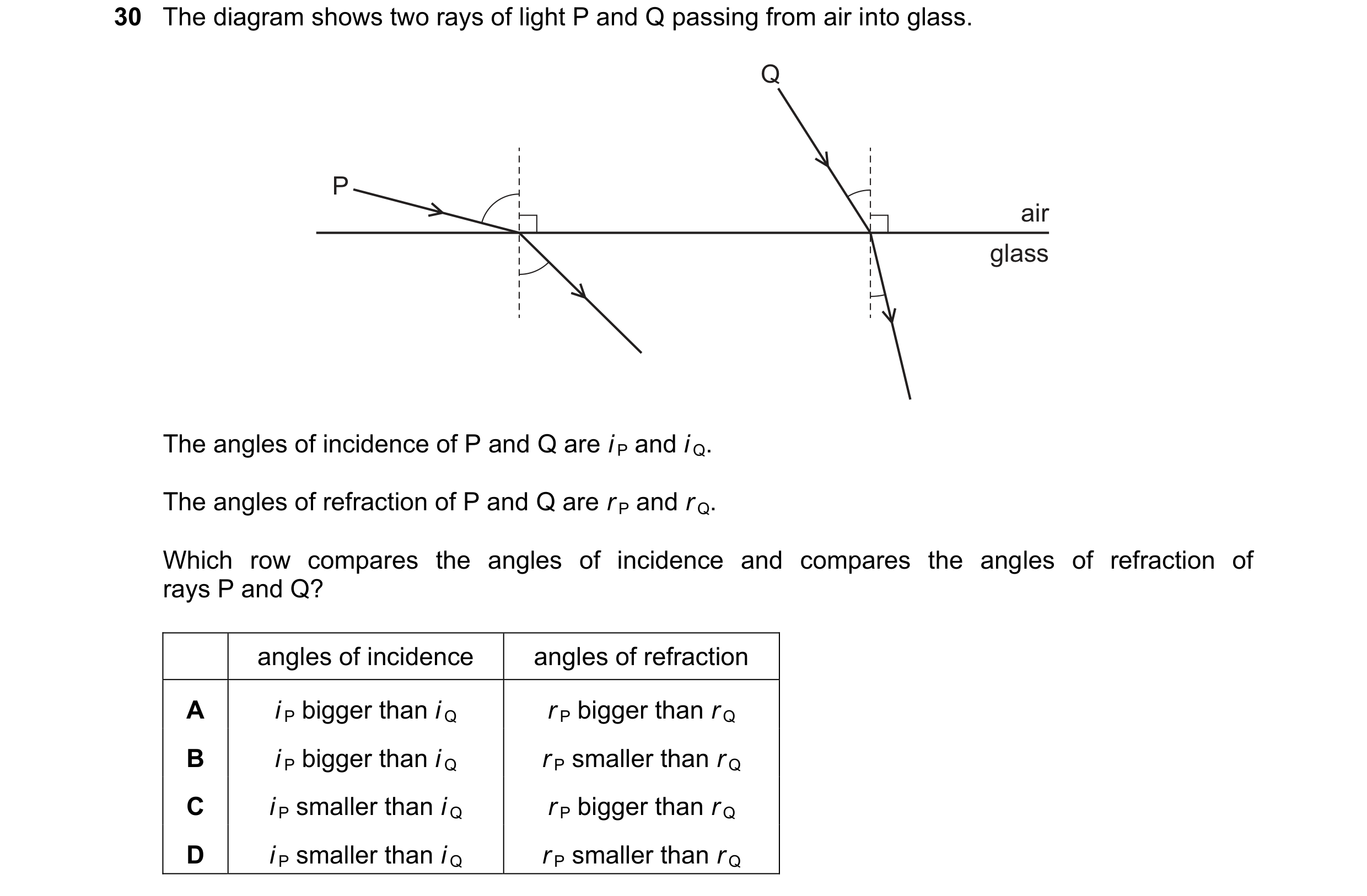
30 The diagram shows two rays of light P and Q passing from air into glass. Q P air glass The angles of incidence of P and Q are i P and i Q. The angles of refraction of P and Q are r P and r Q. Which row compares the angles of incidence and compares the angles of refraction of rays P and Q? angles of incidence angles of refraction A i P bigger than i Q r P bigger than r Q B i P bigger than i Q r P smaller than r Q C i P smaller than i Q r P bigger than r Q D i P smaller than i Q r P smaller than r Q
1 marks
Answer: A
This question in 0652/21 Oct/Nov 2021
Q14 · A converging lens of focal length 15 cm is used as a magnifying glass to produce a… 0652/21 Oct/Nov 2021
31 A converging lens of focal length 15 cm is used as a magnifying glass to produce a virtual, magnified image. What is a possible position of the object? A 8.0 cm from the lens B 16 cm from the lens C 32 cm from the lens D 64 cm from the lens
1 marks
Answer: A
This question in 0652/21 Oct/Nov 2021
Q15 · Which row shows how, in a vacuum, the speed of radio waves and the speed of X-rays… 0652/21 Oct/Nov 2021
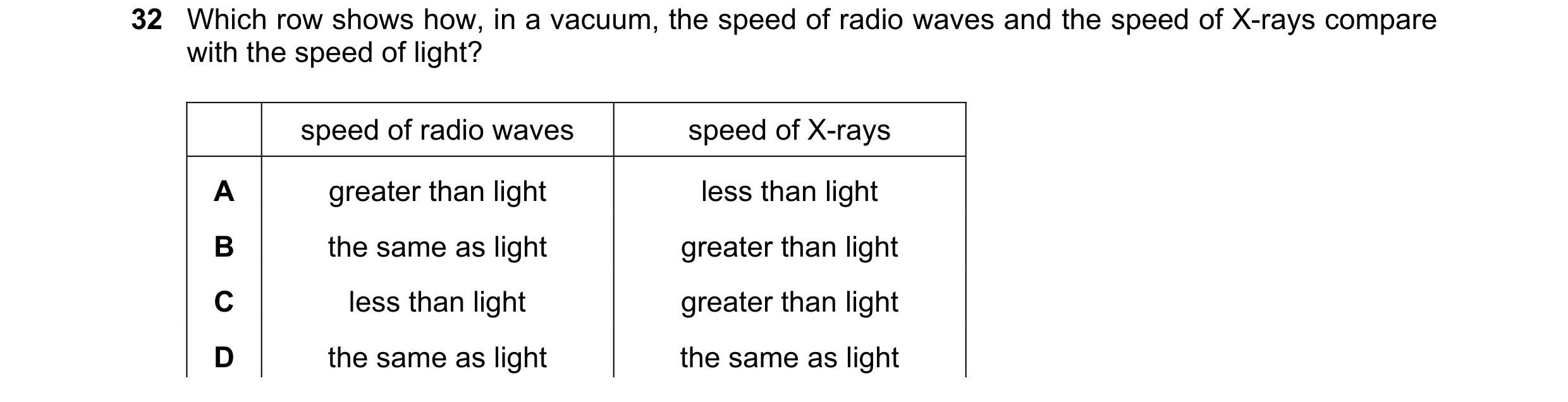
32 Which row shows how, in a vacuum, the speed of radio waves and the speed of X-rays compare with the speed of light? speed of radio waves speed of X-rays A greater than light less than light B the same as light greater than light C less than light greater than light D the same as light the same as light
1 marks
Answer: D
This question in 0652/21 Oct/Nov 2021
Q16 · Light travelling in medium 1 strikes a boundary with medium 2 and undergoes total… 0652/21 Oct/Nov 2022
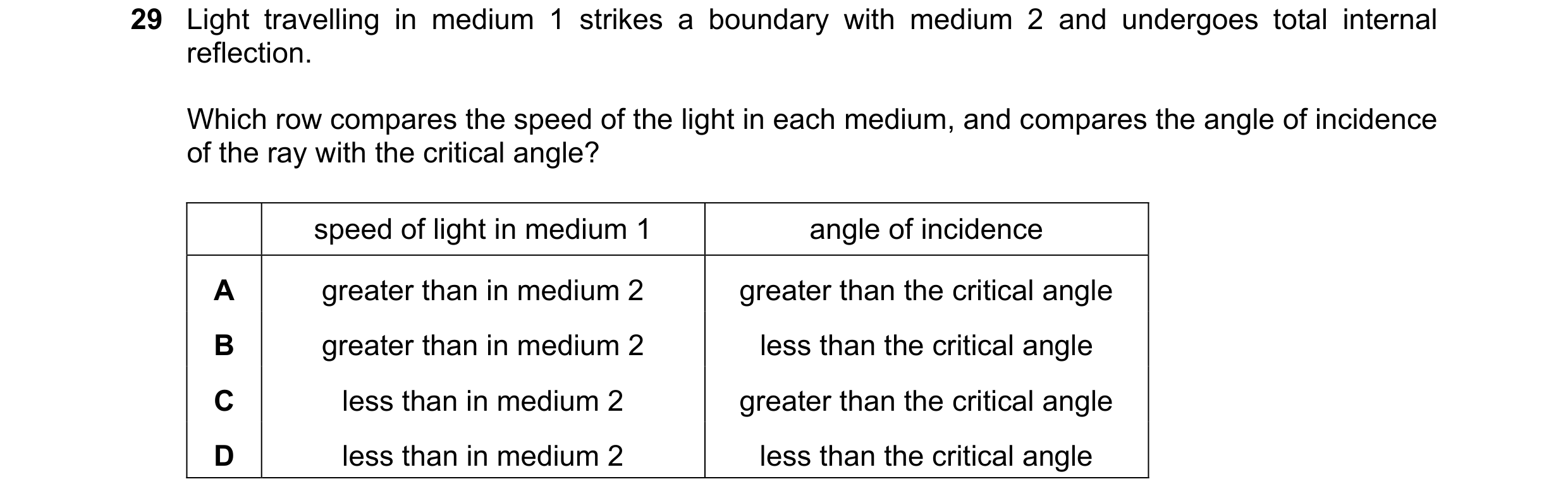
29 Light travelling in medium 1 strikes a boundary with medium 2 and undergoes total internal reflection. Which row compares the speed of the light in each medium, and compares the angle of incidence of the ray with the critical angle? speed of light in medium 1 angle of incidence A greater than in medium 2 greater than the critical angle B greater than in medium 2 less than the critical angle C less than in medium 2 greater than the critical angle D less than in medium 2 less than the critical angle
1 marks
Answer: C
This question in 0652/21 Oct/Nov 2022
Q17 · The diagram shows an object in front of a converging lens 0652/21 Oct/Nov 2022
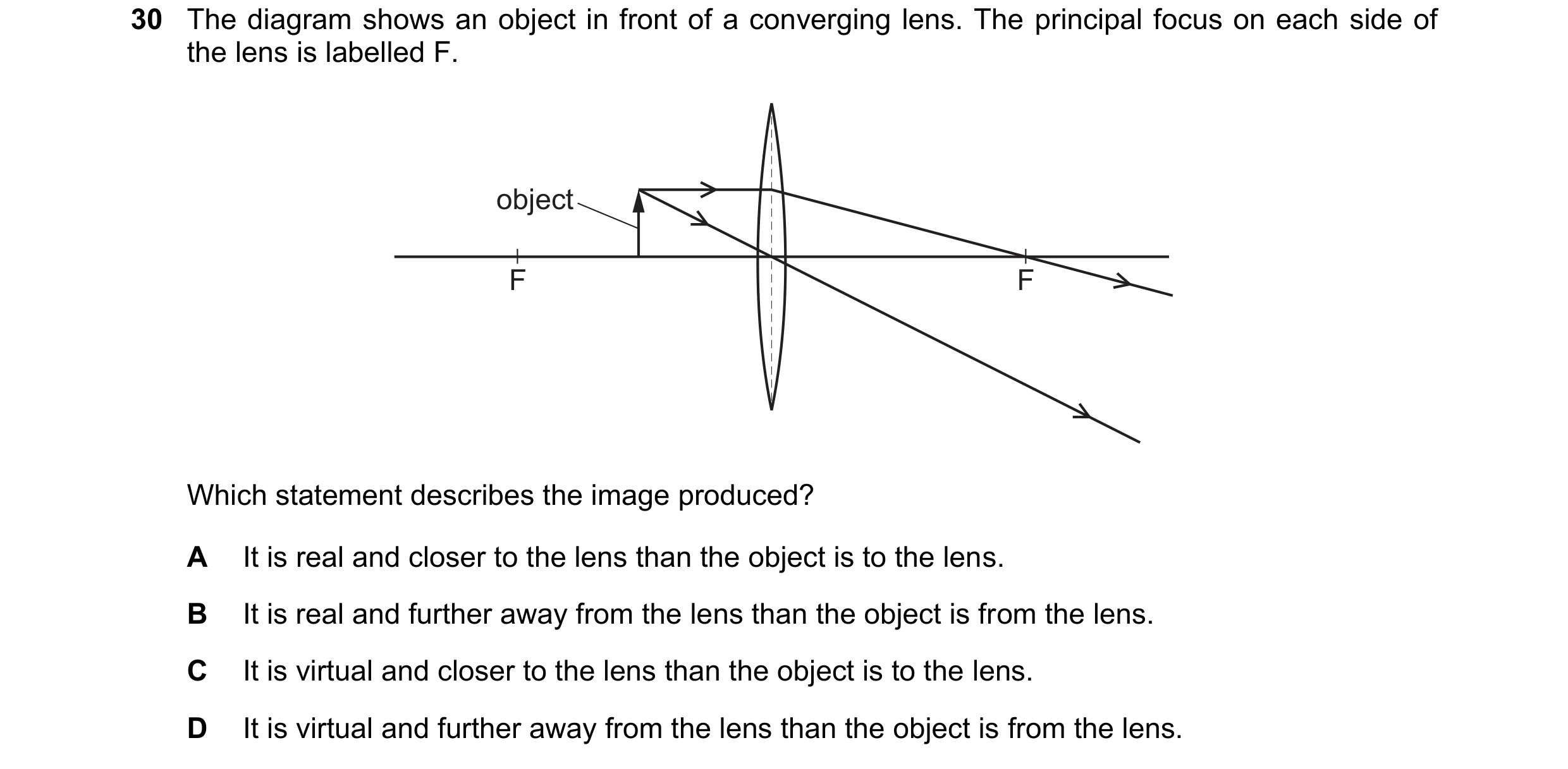
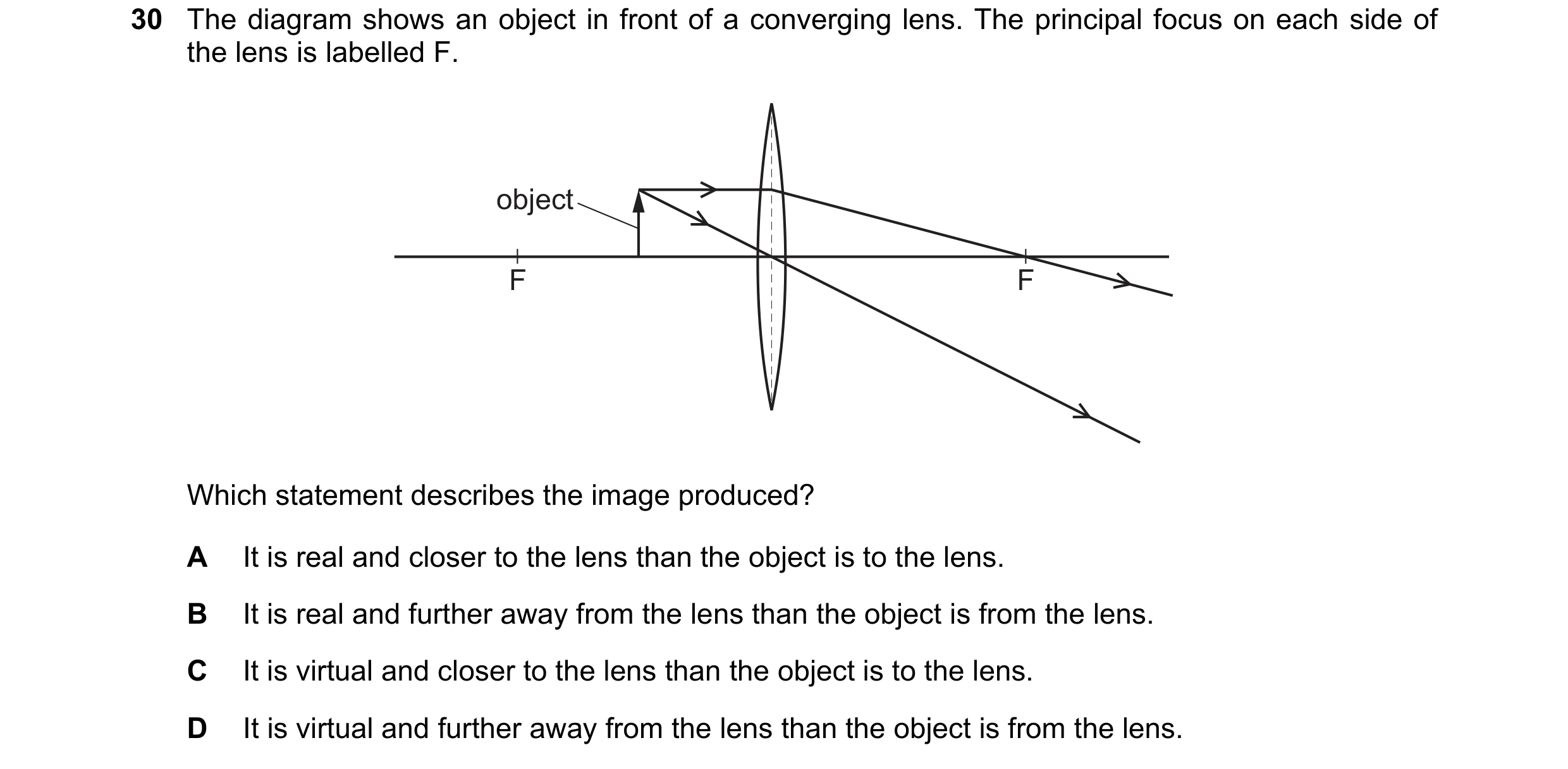
30 The diagram shows an object in front of a converging lens. The principal focus on each side of the lens is labelled F. object F F Which statement describes the image produced? A It is real and closer to the lens than the object is to the lens. B It is real and further away from the lens than the object is from the lens. C It is virtual and closer to the lens than the object is to the lens. D It is virtual and further away from the lens than the object is from the lens.
1 marks
Answer: D
This question in 0652/21 Oct/Nov 2022
Q18 · Light travelling in medium 1 strikes a boundary with medium 2 and undergoes total… 0652/22 Oct/Nov 2022
29 Light travelling in medium 1 strikes a boundary with medium 2 and undergoes total internal reflection. Which row compares the speed of the light in each medium, and compares the angle of incidence of the ray with the critical angle? speed of light in medium 1 angle of incidence A greater than in medium 2 greater than the critical angle B greater than in medium 2 less than the critical angle C less than in medium 2 greater than the critical angle D less than in medium 2 less than the critical angle
1 marks
Answer: C
This question in 0652/22 Oct/Nov 2022
Q19 · The diagram shows an object in front of a converging lens 0652/22 Oct/Nov 2022
30 The diagram shows an object in front of a converging lens. The principal focus on each side of the lens is labelled F. object F F Which statement describes the image produced? A It is real and closer to the lens than the object is to the lens. B It is real and further away from the lens than the object is from the lens. C It is virtual and closer to the lens than the object is to the lens. D It is virtual and further away from the lens than the object is from the lens.
1 marks
Answer: D
This question in 0652/22 Oct/Nov 2022
Q20 · The diagram shows an object in front of a converging lens 0652/21 Oct/Nov 2023
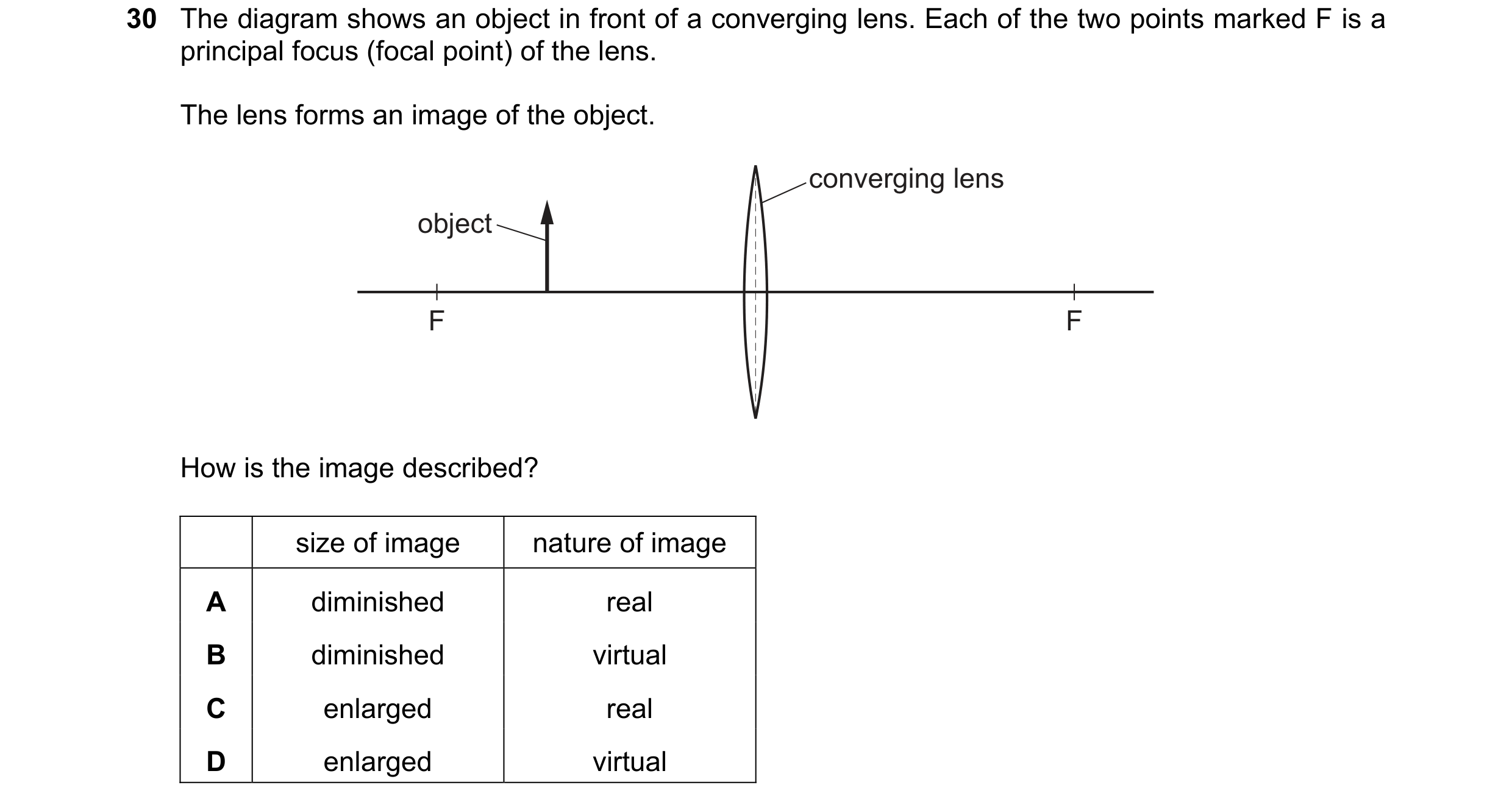
30 The diagram shows an object in front of a converging lens. Each of the two points marked F is a principal focus (focal point) of the lens. The lens forms an image of the object. converging lens object F F How is the image described? size of image nature of image A diminished real B diminished virtual C enlarged real D enlarged virtual
1 marks
Answer: D
This question in 0652/21 Oct/Nov 2023
Q21 · The diagram shows an object in front of a converging lens 0652/22 Oct/Nov 2023
30 The diagram shows an object in front of a converging lens. Each of the two points marked F is a principal focus (focal point) of the lens. The lens forms an image of the object. converging lens object F F How is the image described? size of image nature of image A diminished real B diminished virtual C enlarged real D enlarged virtual
1 marks
Answer: D
This question in 0652/22 Oct/Nov 2023
Q22 · Light from the Sun takes 8.3 minutes to reach the Earth through the vacuum of space 0652/22 Oct/Nov 2023
31 Light from the Sun takes 8.3 minutes to reach the Earth through the vacuum of space. What is the distance between the Sun and the Earth? A 6.0 105 m B 3.6 107 m C 2.5 109 m D 1.5 1011 m
1 marks
Answer: D
This question in 0652/22 Oct/Nov 2023
Q23 · A converging lens of focal length 15 cm is used as a magnifying glass to produce a… 0652/21 Oct/Nov 2024
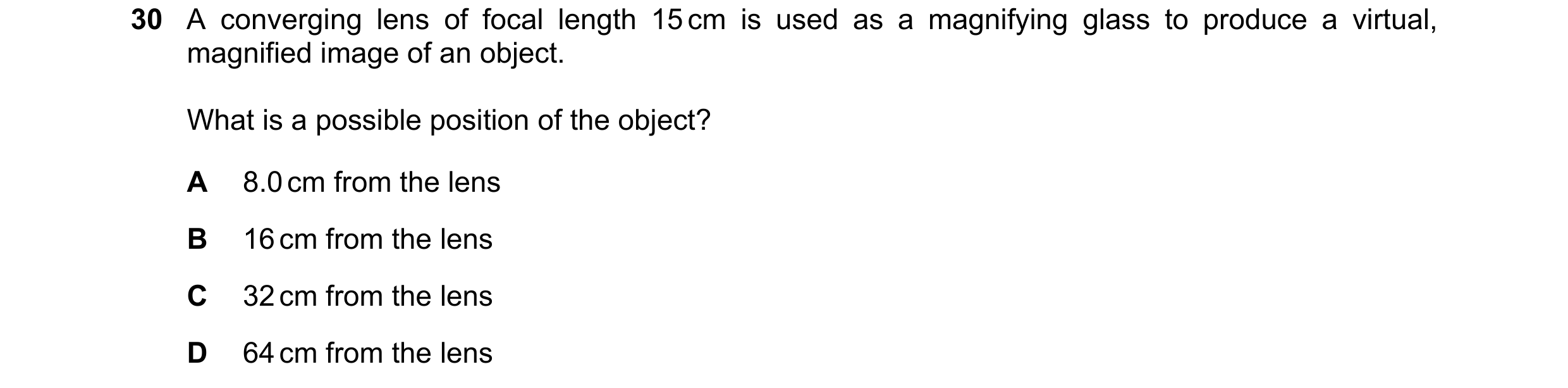
30 A converging lens of focal length 15 cm is used as a magnifying glass to produce a virtual, magnified image of an object. What is a possible position of the object? A 8.0 cm from the lens B 16 cm from the lens C 32 cm from the lens D 64 cm from the lens
1 marks
Answer: A
This question in 0652/21 Oct/Nov 2024
 1 / 8
1 / 8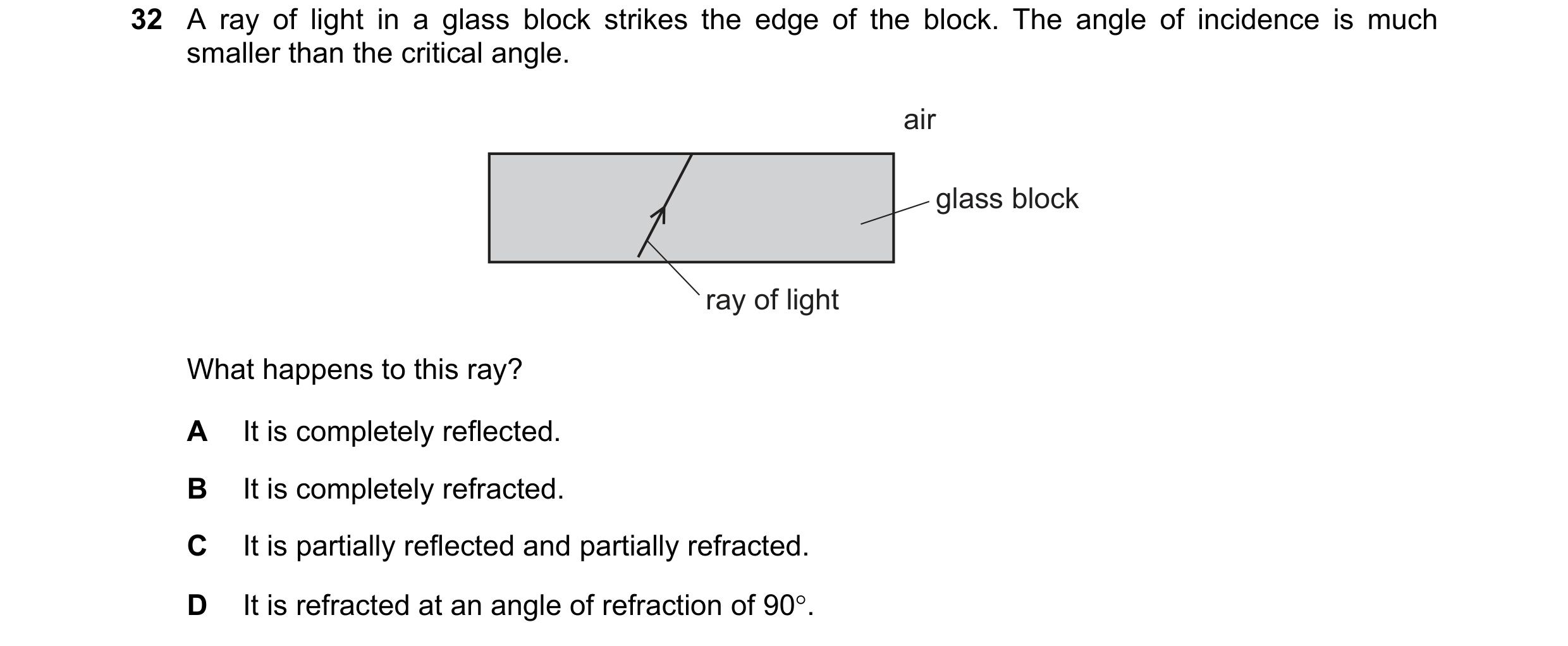
 2 / 8
2 / 8
 3 / 8
3 / 8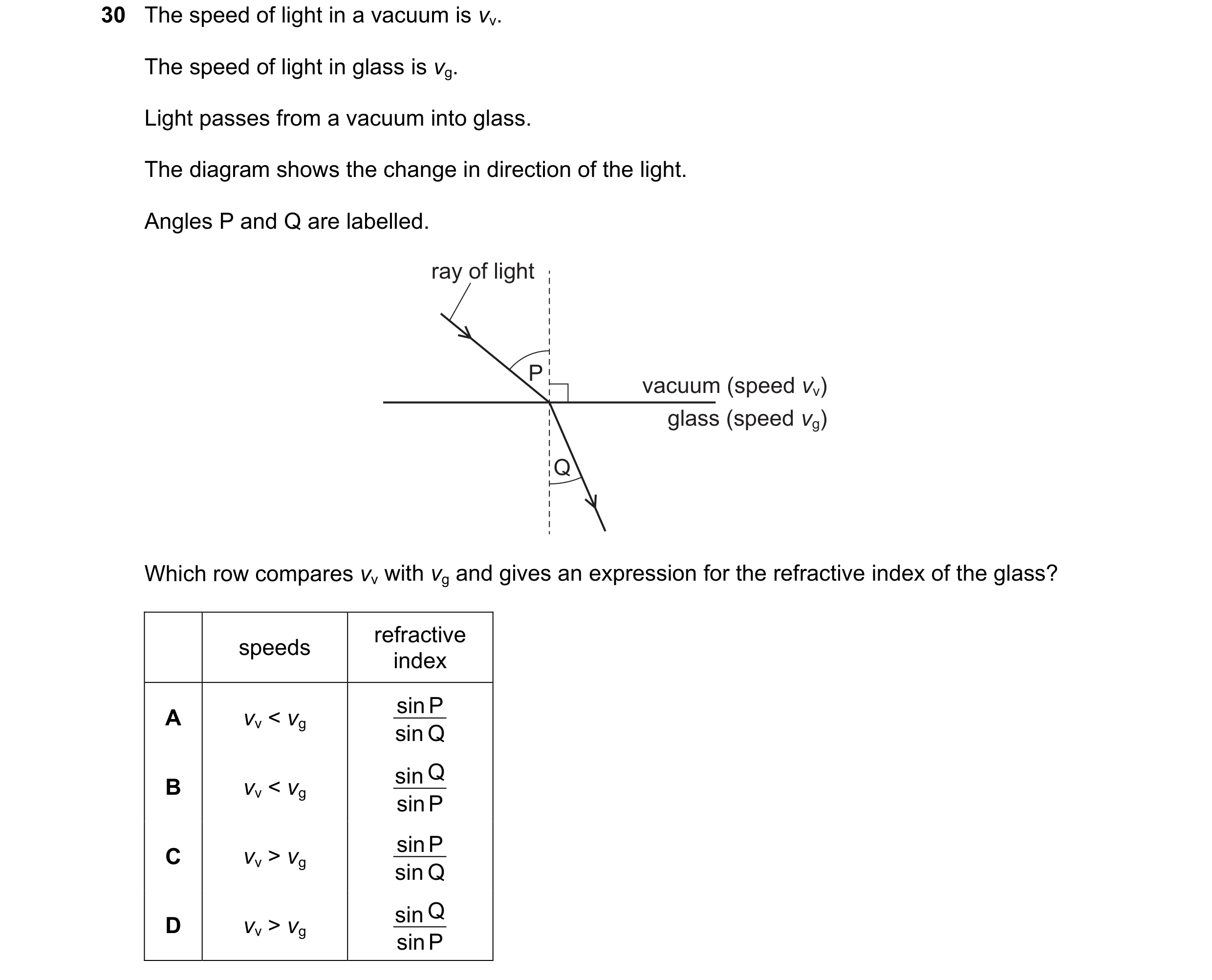
 4 / 8
4 / 8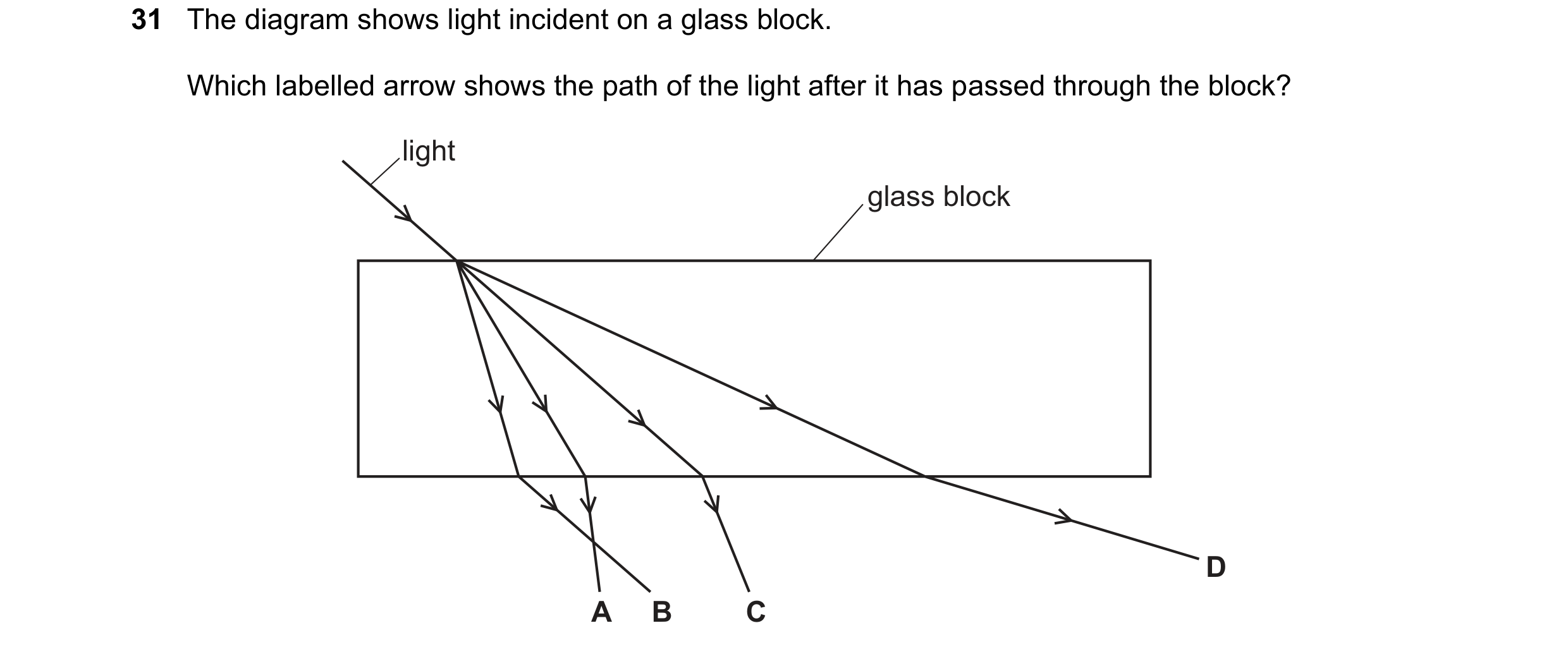

 5 / 8
5 / 8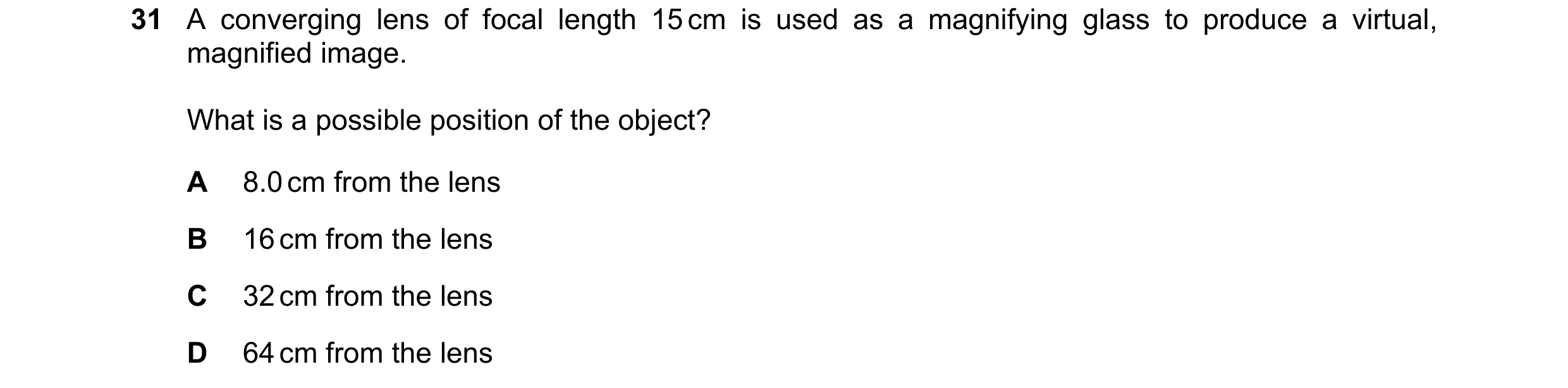
 6 / 8
6 / 8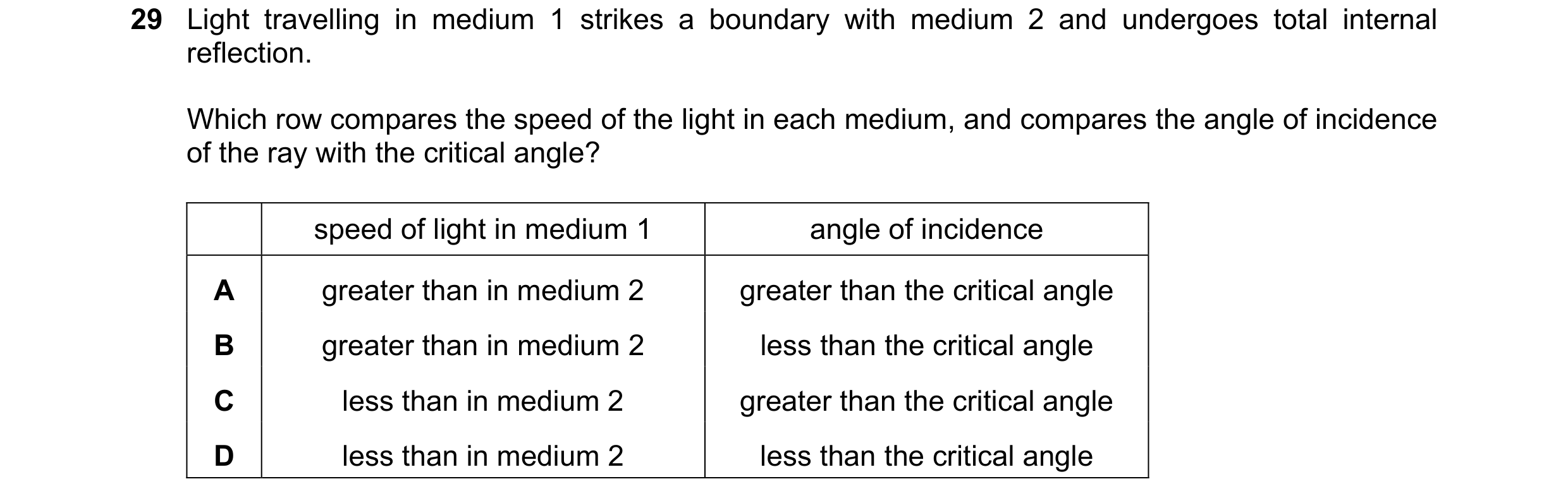
 7 / 8
7 / 8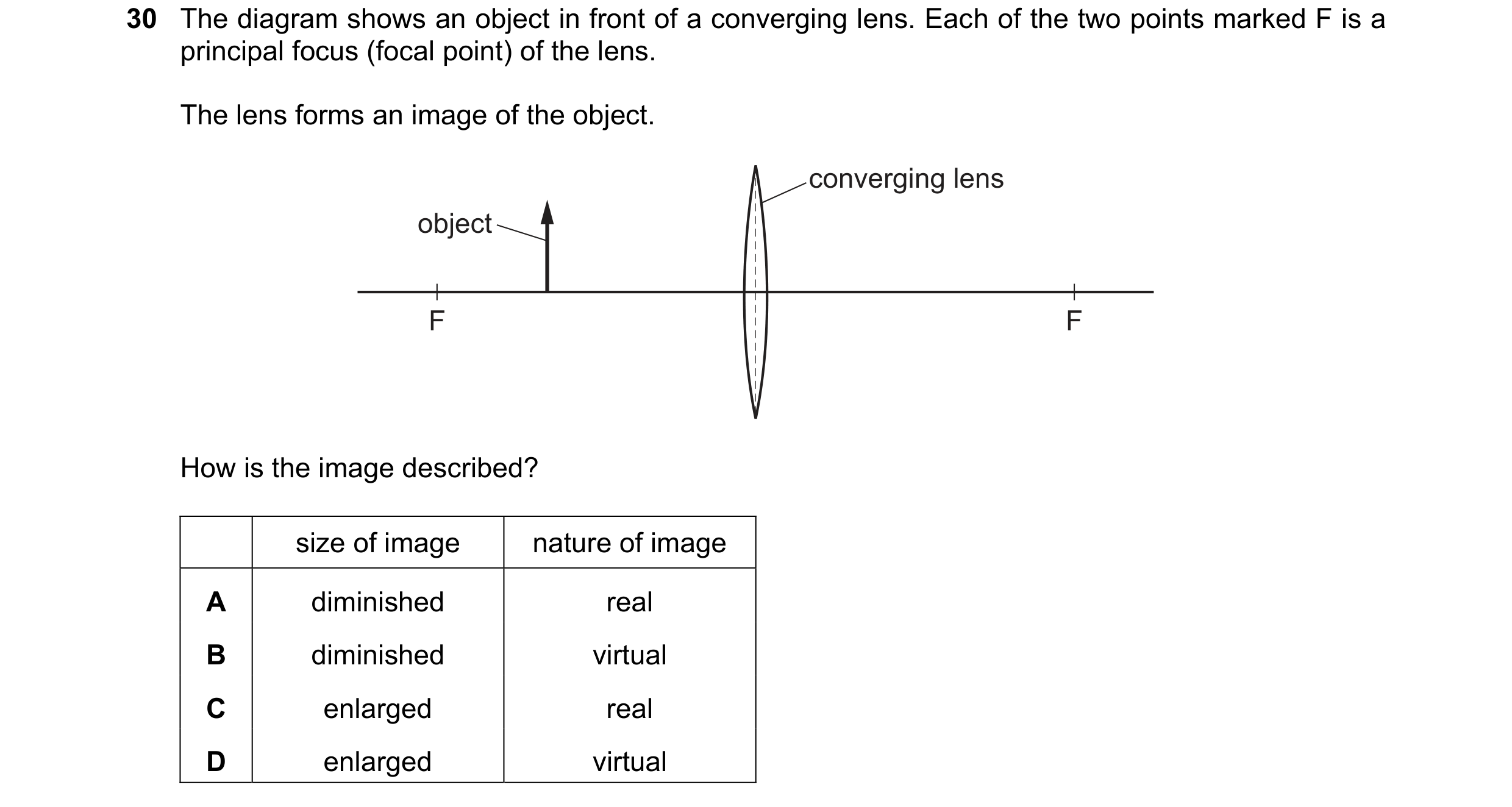

 8 / 8
8 / 8