Questions as text
Q1 · In September 2002 a government minister warned that tax changes were necessary to… 0455/11 Oct/Nov 2004
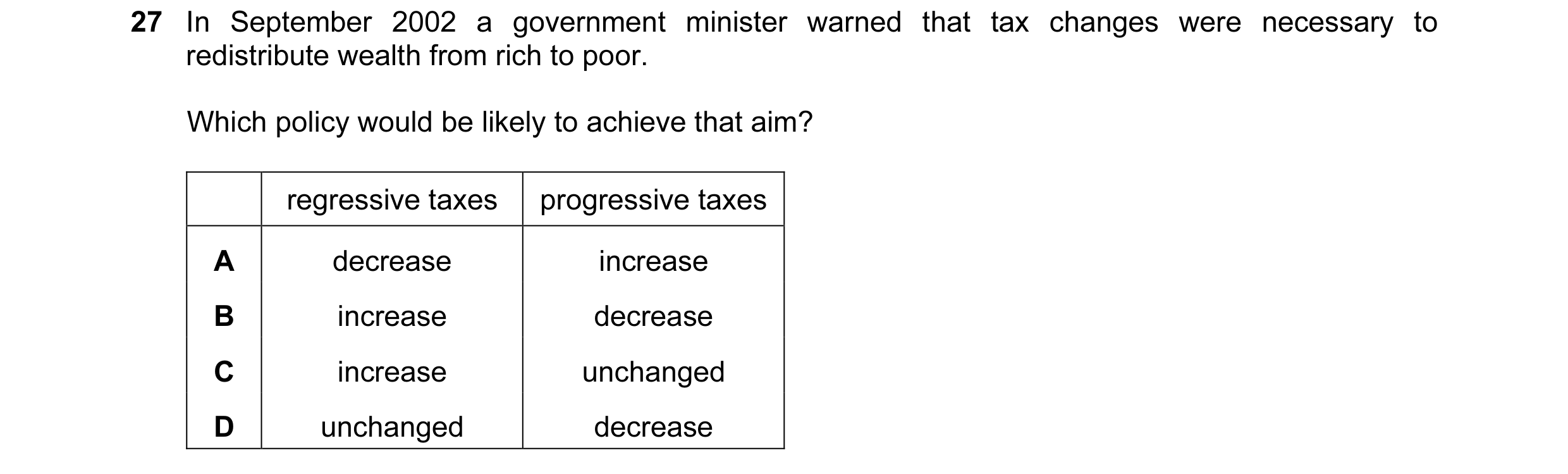
27 In September 2002 a government minister warned that tax changes were necessary to redistribute wealth from rich to poor. Which policy would be likely to achieve that aim? regressive taxes progressive taxes A decrease increase B increase decrease C increase unchanged D unchanged decrease
1 marks
Answer: A
This question in 0455/11 Oct/Nov 2004
Q2 · A high proportion of people in a developing country have very low incomes 0455/11 Oct/Nov 2008
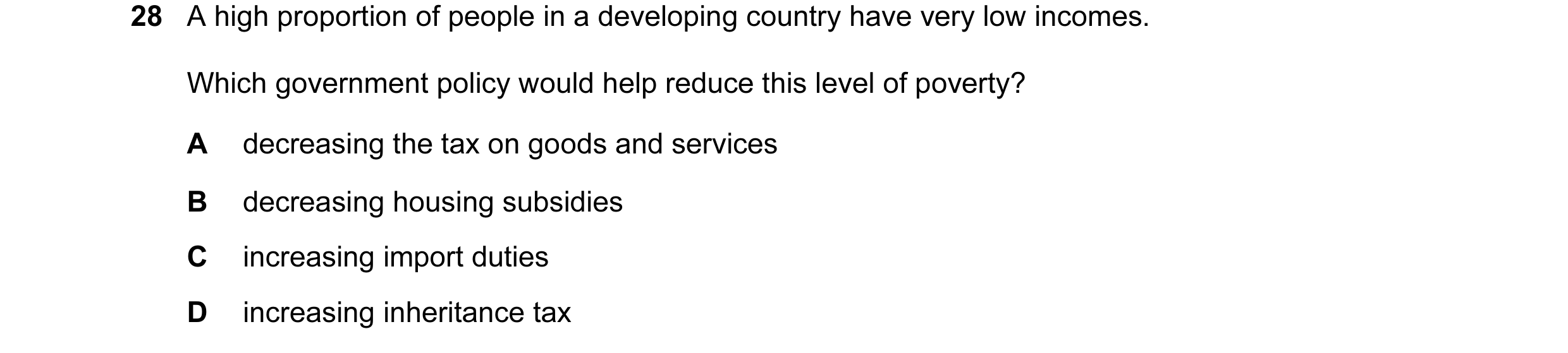
28 A high proportion of people in a developing country have very low incomes. Which government policy would help reduce this level of poverty? A decreasing the tax on goods and services B decreasing housing subsidies C increasing import duties D increasing inheritance tax
1 marks
Answer: A
This question in 0455/11 Oct/Nov 2008
Q3 · Between 2002 and 2007, approximately 18 million Latin American households moved out of… 0455/11 May/June 2010
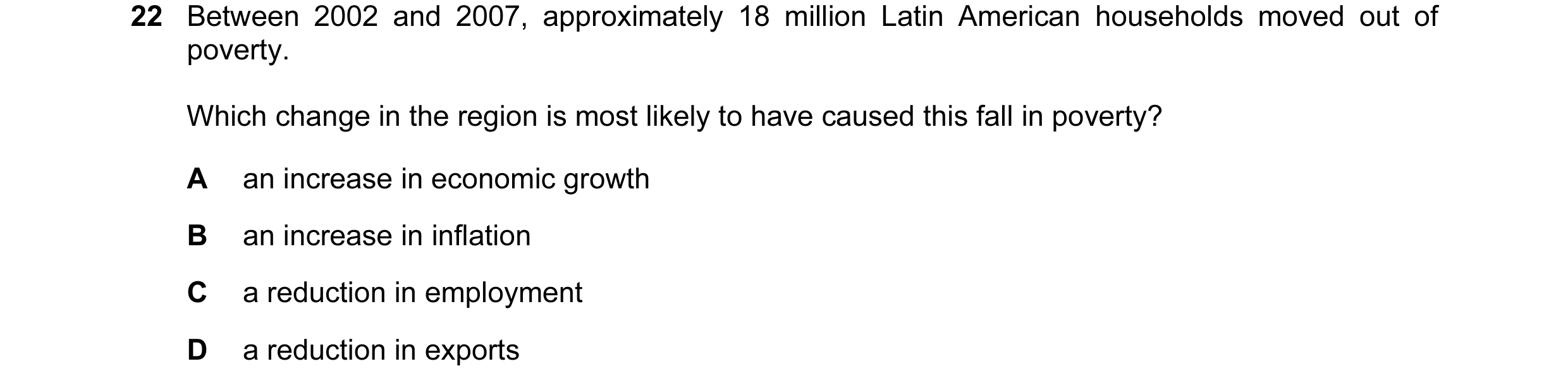
22 Between 2002 and 2007, approximately 18 million Latin American households moved out of poverty. Which change in the region is most likely to have caused this fall in poverty? A an increase in economic growth B an increase in inflation C a reduction in employment D a reduction in exports
1 marks
Answer: A
This question in 0455/11 May/June 2010
Q4 · India has a more evenly distributed income than China but a greater proportion of its… 0455/11 May/June 2010
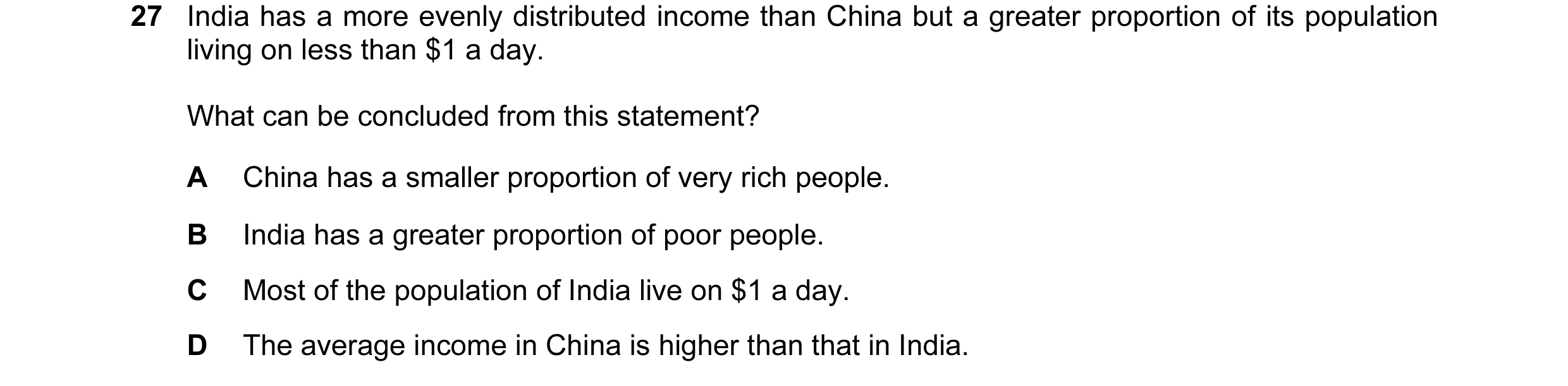
27 India has a more evenly distributed income than China but a greater proportion of its population living on less than $1 a day. What can be concluded from this statement? A China has a smaller proportion of very rich people. B India has a greater proportion of poor people. C Most of the population of India live on $1 a day. D The average income in China is higher than that in India.
1 marks
Answer: B
This question in 0455/11 May/June 2010
Q5 · Between 2002 and 2007, approximately 18 million Latin American households moved out of… 0455/12 May/June 2010
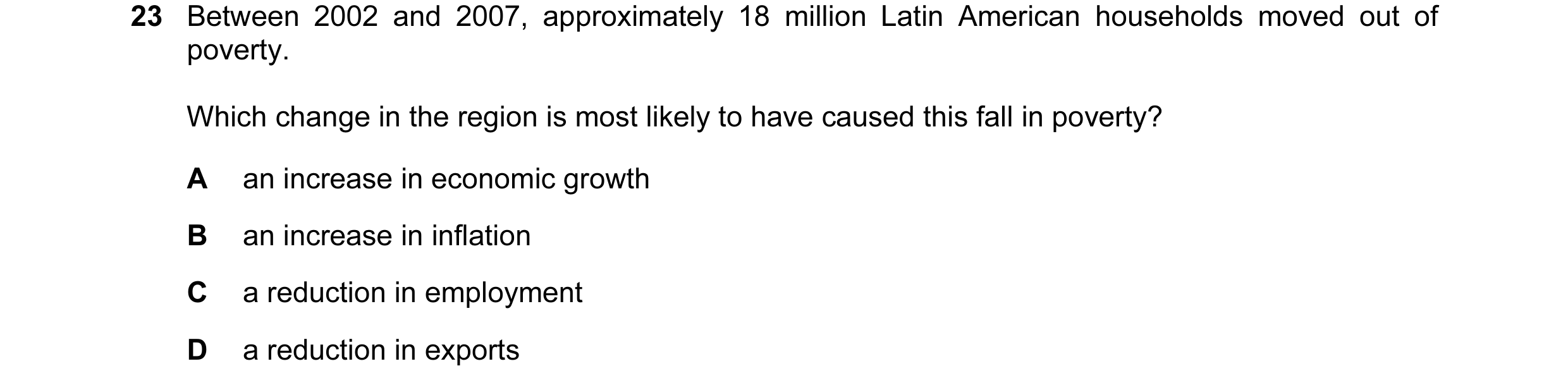
23 Between 2002 and 2007, approximately 18 million Latin American households moved out of poverty. Which change in the region is most likely to have caused this fall in poverty? A an increase in economic growth B an increase in inflation C a reduction in employment D a reduction in exports
1 marks
Answer: A
This question in 0455/12 May/June 2010
Q6 · India has a more evenly distributed income than China but a greater proportion of its… 0455/12 May/June 2010
25 India has a more evenly distributed income than China but a greater proportion of its population living on less than $1 a day. What can be concluded from this statement? A China has a smaller proportion of very rich people. B India has a greater proportion of poor people. C Most of the population of India live on $1 a day. D The average income in China is higher than that in India.
1 marks
Answer: B
This question in 0455/12 May/June 2010
Q7 · In China the government is concerned about the level of poverty and the need for more… 0455/11 Oct/Nov 2012
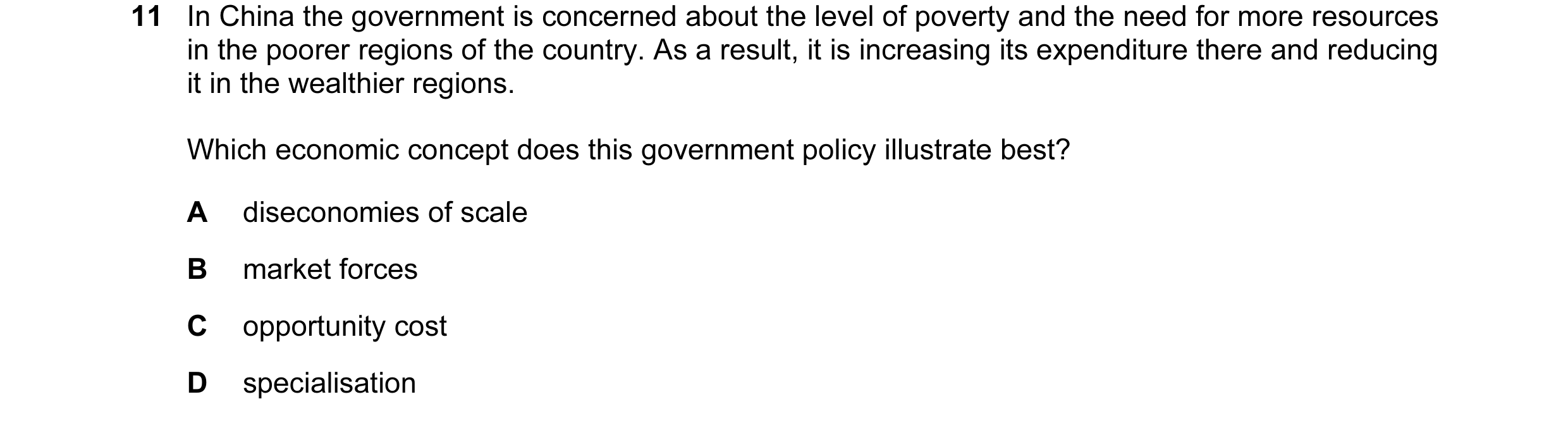
11 In China the government is concerned about the level of poverty and the need for more resources in the poorer regions of the country. As a result, it is increasing its expenditure there and reducing it in the wealthier regions. Which economic concept does this government policy illustrate best? A diseconomies of scale B market forces C opportunity cost D specialisation
1 marks
Answer: C
This question in 0455/11 Oct/Nov 2012
Q8 · In China the government is concerned about the level of poverty and the need for more… 0455/12 Oct/Nov 2012
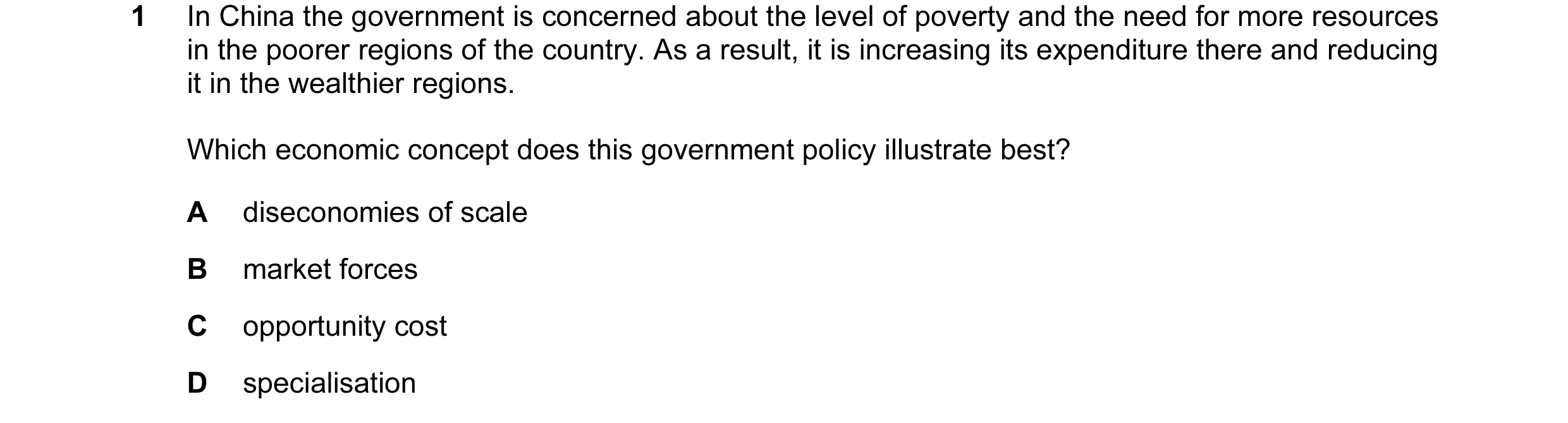
1 In China the government is concerned about the level of poverty and the need for more resources in the poorer regions of the country. As a result, it is increasing its expenditure there and reducing it in the wealthier regions. Which economic concept does this government policy illustrate best? A diseconomies of scale B market forces C opportunity cost D specialisation
1 marks
Answer: C
This question in 0455/12 Oct/Nov 2012
Q9 · The table shows the percentage share of GDP held by the richest 20% and poorest 20% of… 0455/11 May/June 2013
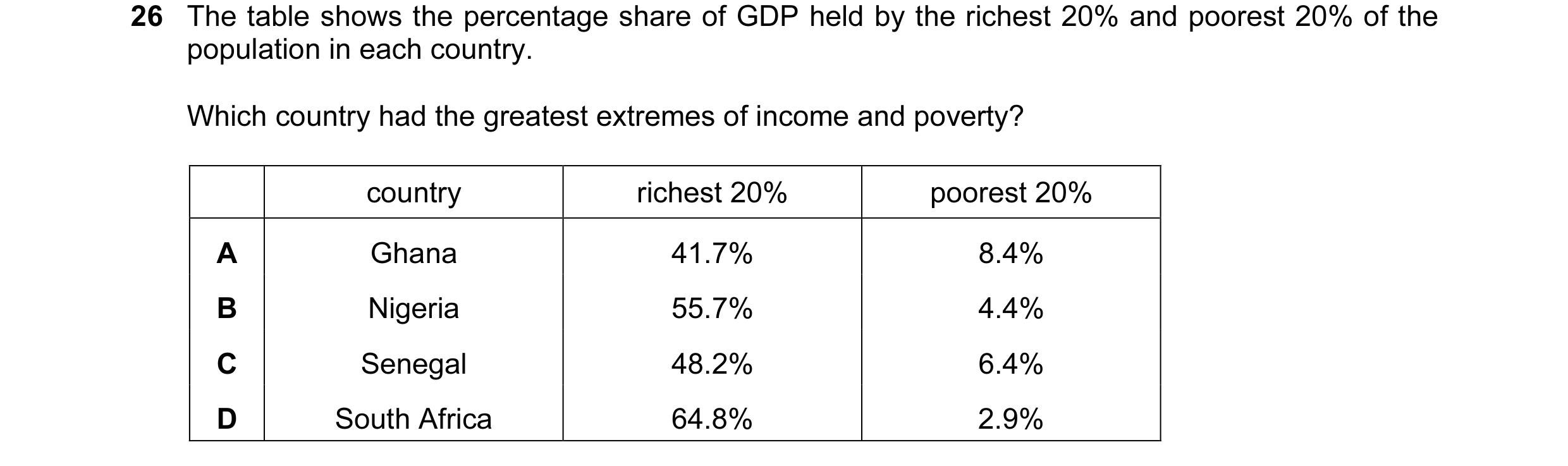
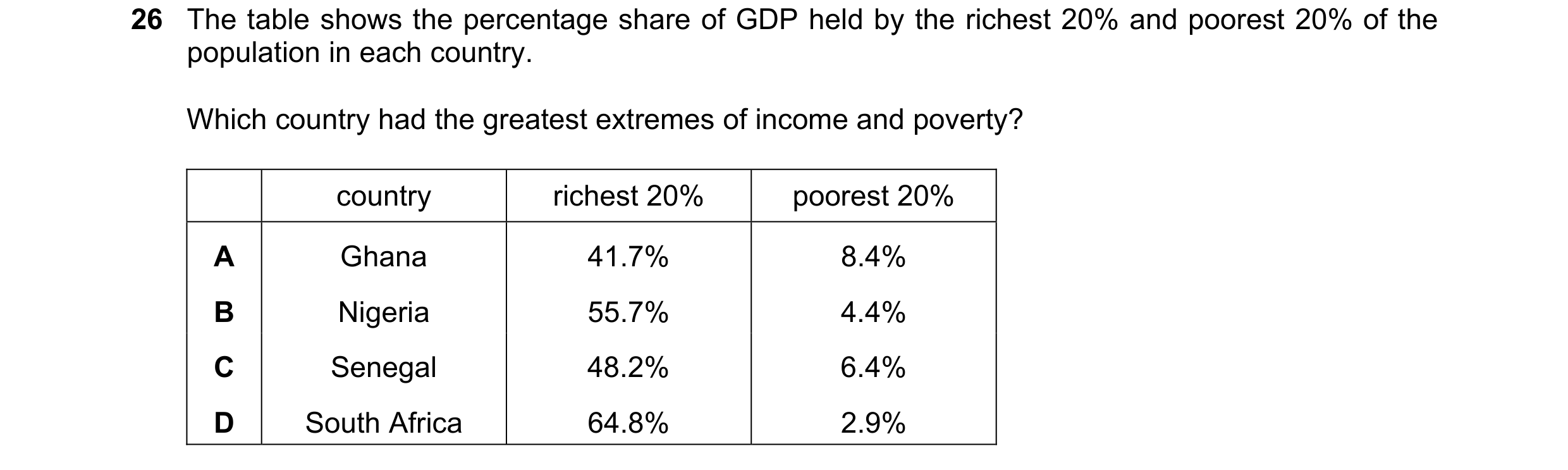
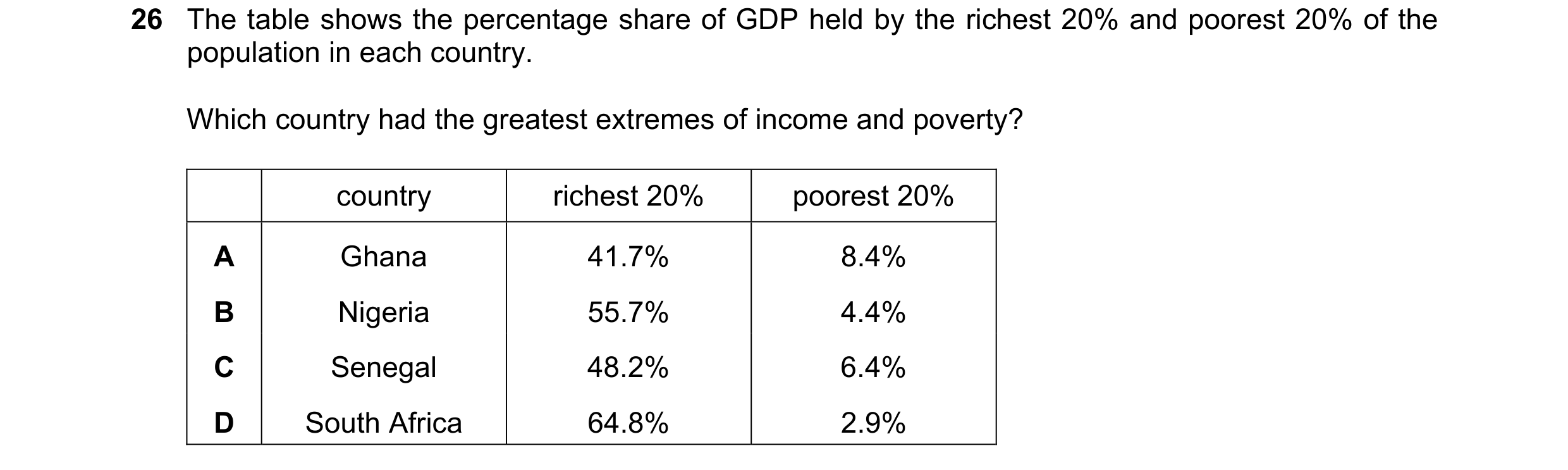
26 The table shows the percentage share of GDP held by the richest 20% and poorest 20% of the population in each country. Which country had the greatest extremes of income and poverty? country richest 20% poorest 20% A Ghana 41.7% 8.4% B Nigeria 55.7% 4.4% C Senegal 48.2% 6.4% D South Africa 64.8% 2.9%
1 marks
Answer: D
This question in 0455/11 May/June 2013
Q10 · The table shows the percentage share of GDP held by the richest 20% and poorest 20% of… 0455/13 May/June 2013
26 The table shows the percentage share of GDP held by the richest 20% and poorest 20% of the population in each country. Which country had the greatest extremes of income and poverty? country richest 20% poorest 20% A Ghana 41.7% 8.4% B Nigeria 55.7% 4.4% C Senegal 48.2% 6.4% D South Africa 64.8% 2.9%
1 marks
Answer: D
This question in 0455/13 May/June 2013
Q11 · Which statement about poverty is correct? 0455/11 May/June 2014
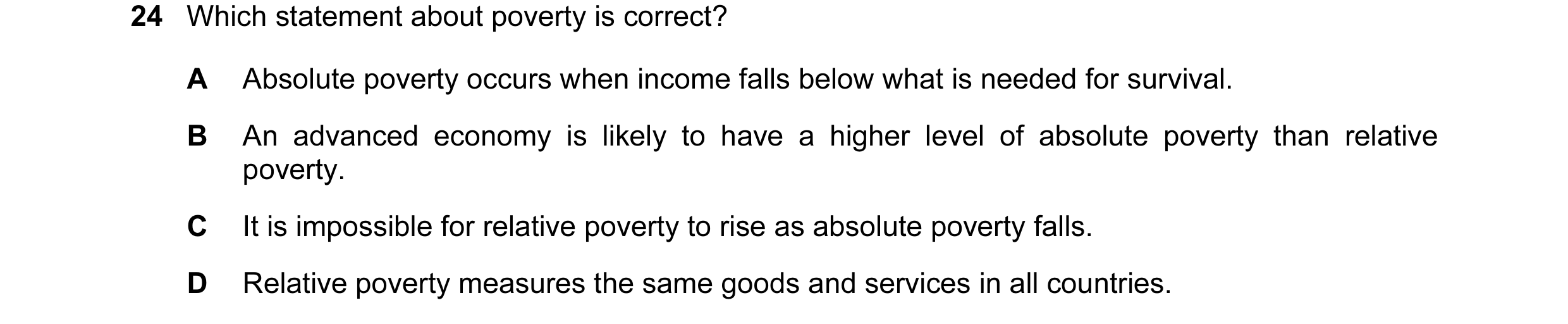
24 Which statement about poverty is correct? A Absolute poverty occurs when income falls below what is needed for survival. B An advanced economy is likely to have a higher level of absolute poverty than relative poverty. C It is impossible for relative poverty to rise as absolute poverty falls. D Relative poverty measures the same goods and services in all countries.
1 marks
Answer: A
This question in 0455/11 May/June 2014
Q12 · Which statement about poverty is correct? 0455/13 May/June 2014
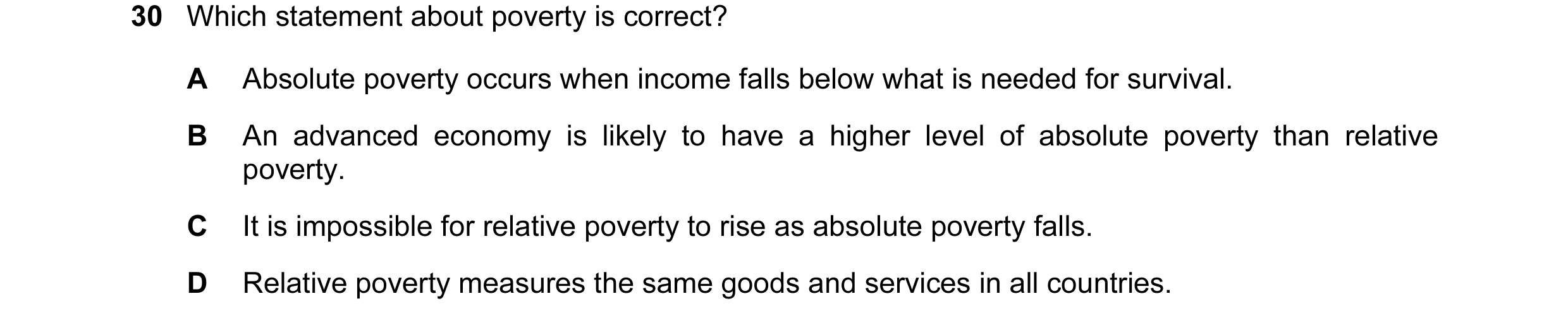
30 Which statement about poverty is correct? A Absolute poverty occurs when income falls below what is needed for survival. B An advanced economy is likely to have a higher level of absolute poverty than relative poverty. C It is impossible for relative poverty to rise as absolute poverty falls. D Relative poverty measures the same goods and services in all countries.
1 marks
Answer: A
This question in 0455/13 May/June 2014
Q13 · Developing countries have, relatively, far more poor people than developed countries 0455/11 Oct/Nov 2014
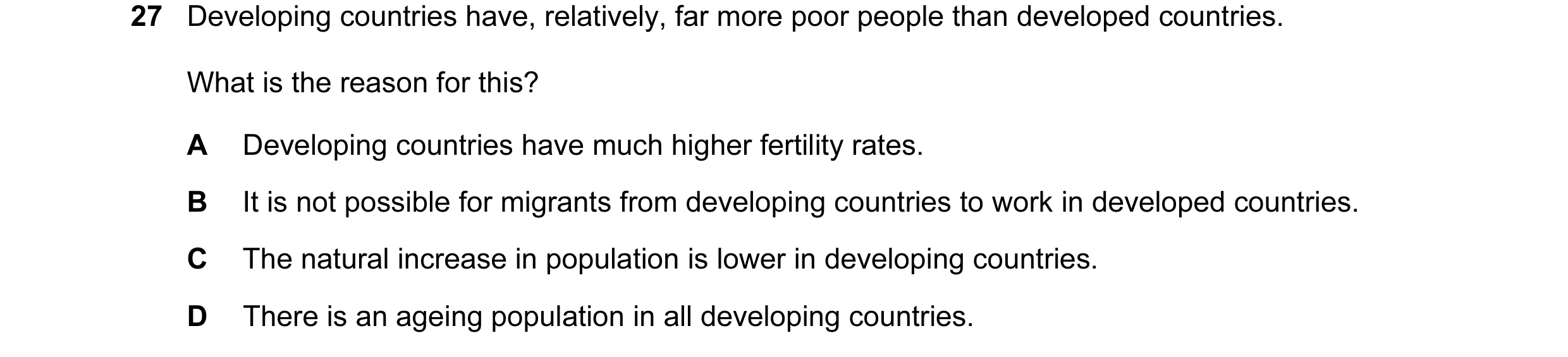
27 Developing countries have, relatively, far more poor people than developed countries. What is the reason for this? A Developing countries have much higher fertility rates. B It is not possible for migrants from developing countries to work in developed countries. C The natural increase in population is lower in developing countries. D There is an ageing population in all developing countries.
1 marks
Answer: A
This question in 0455/11 Oct/Nov 2014
Q14 · Developing countries have, relatively, far more poor people than developed countries 0455/12 Oct/Nov 2014
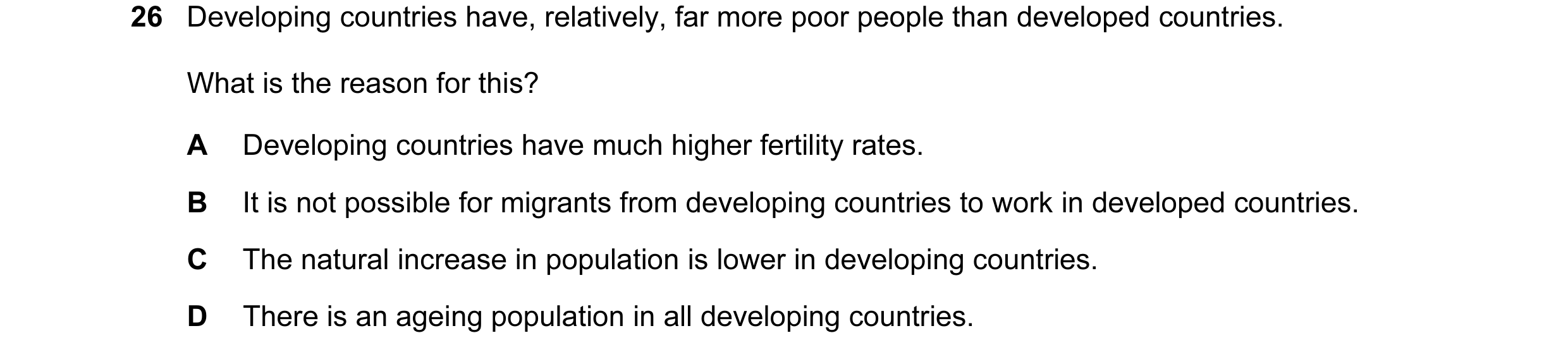
26 Developing countries have, relatively, far more poor people than developed countries. What is the reason for this? A Developing countries have much higher fertility rates. B It is not possible for migrants from developing countries to work in developed countries. C The natural increase in population is lower in developing countries. D There is an ageing population in all developing countries.
1 marks
Answer: A
This question in 0455/12 Oct/Nov 2014
Q15 · A government wishes to close the gap between the earnings of the rich and the poor 0455/12 Oct/Nov 2015
18 A government wishes to close the gap between the earnings of the rich and the poor. What should it do to achieve this aim? A increase progressive taxation B increase the rate of interest C increase the rate of sales tax D increase the supply of money
1 marks
Answer: A
This question in 0455/12 Oct/Nov 2015
Q16 · The richest 60% of the population in a developed economy received an increase in income 0455/12 Oct/Nov 2015
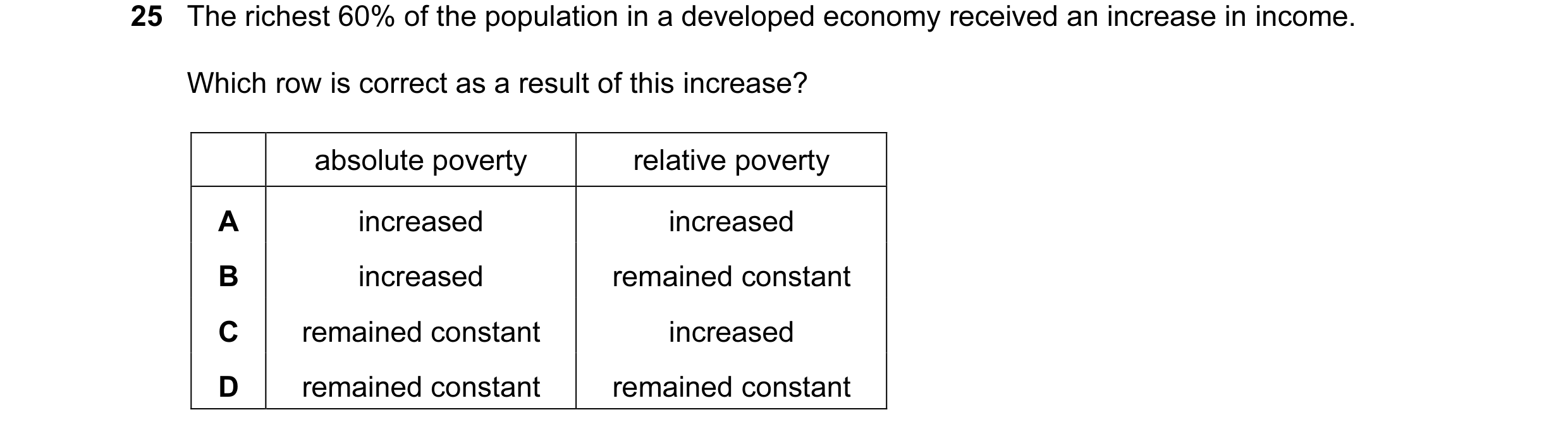
25 The richest 60% of the population in a developed economy received an increase in income. Which row is correct as a result of this increase? absolute poverty relative poverty A increased increased B increased remained constant C remained constant increased D remained constant remained constant
1 marks
Answer: C
This question in 0455/12 Oct/Nov 2015
Q17 · The Government of India wishes to help the very poorest people 0455/12 Feb/March 2016
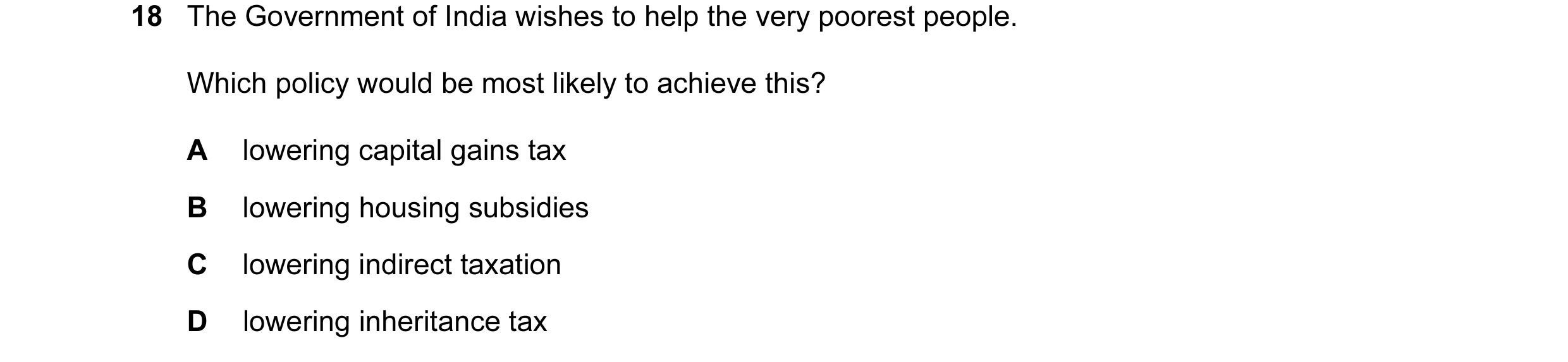
18 The Government of India wishes to help the very poorest people. Which policy would be most likely to achieve this? A lowering capital gains tax B lowering housing subsidies C lowering indirect taxation D lowering inheritance tax
1 marks
Answer: C
This question in 0455/12 Feb/March 2016
Q18 · A country has a very high Gross Domestic Product and a small population but has a low… 0455/12 May/June 2016
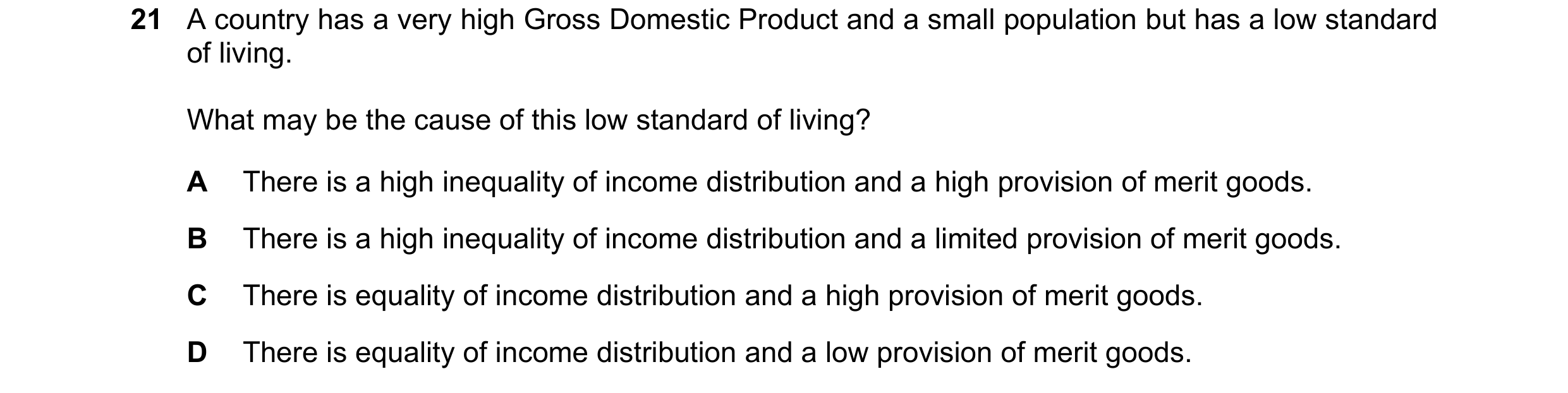
21 A country has a very high Gross Domestic Product and a small population but has a low standard of living. What may be the cause of this low standard of living? A There is a high inequality of income distribution and a high provision of merit goods. B There is a high inequality of income distribution and a limited provision of merit goods. C There is equality of income distribution and a high provision of merit goods. D There is equality of income distribution and a low provision of merit goods.
1 marks
Answer: B
This question in 0455/12 May/June 2016
Q19 · A government introduces state benefits for the unemployed and increases the top rate of… 0455/12 Oct/Nov 2016
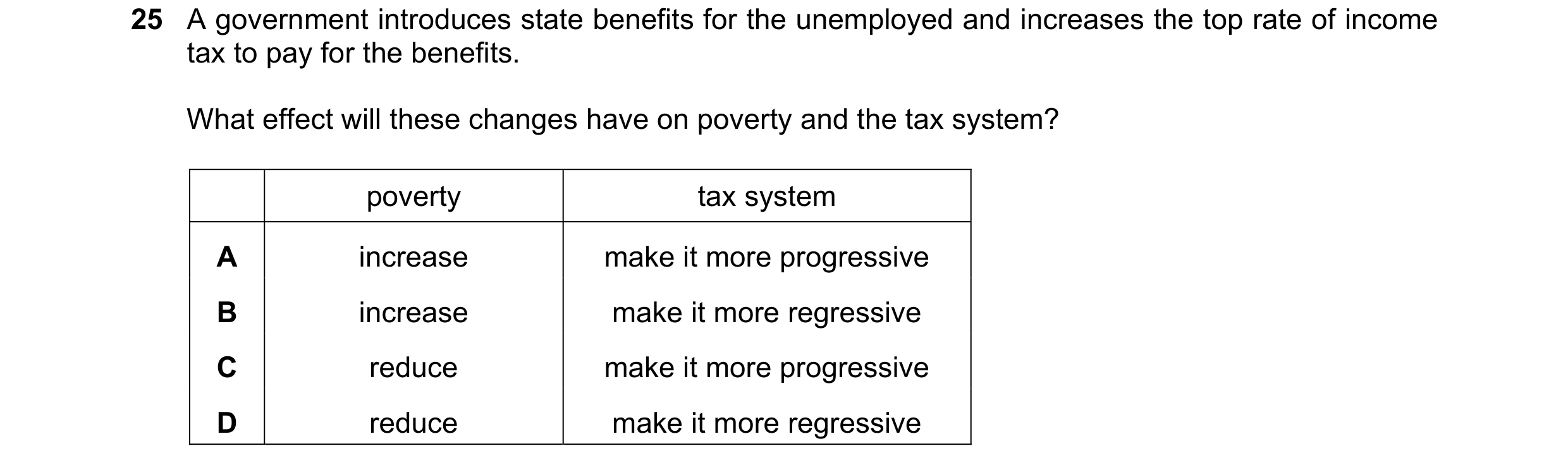
25 A government introduces state benefits for the unemployed and increases the top rate of income tax to pay for the benefits. What effect will these changes have on poverty and the tax system? poverty tax system A increase make it more progressive B increase make it more regressive C reduce make it more progressive D reduce make it more regressive
1 marks
This question in 0455/12 Oct/Nov 2016
Q20 · Which statement about the poorest families in developing economies is not likely to be… 0455/12 May/June 2017
24 Which statement about the poorest families in developing economies is not likely to be correct? A The children will be expected to work to help provide income. B The family will find it easy to obtain loans to develop their farms. C The family will have a low earning capacity. D The family will suffer from malnutrition and lack of medical care.
1 marks
Answer: B
This question in 0455/12 May/June 2017
Q21 · Which characteristic will show that a country has significant absolute poverty? 0455/11 May/June 2018
25 Which characteristic will show that a country has significant absolute poverty? A A majority of the population will have less than average income. B Basic living needs are not being met. C Most people do not have mobile phones. D There is a high number of people living in rural areas.
1 marks
Answer: B
This question in 0455/11 May/June 2018
Q22 · Over two-thirds of the world’s poorest people live in rural areas 0455/12 May/June 2018
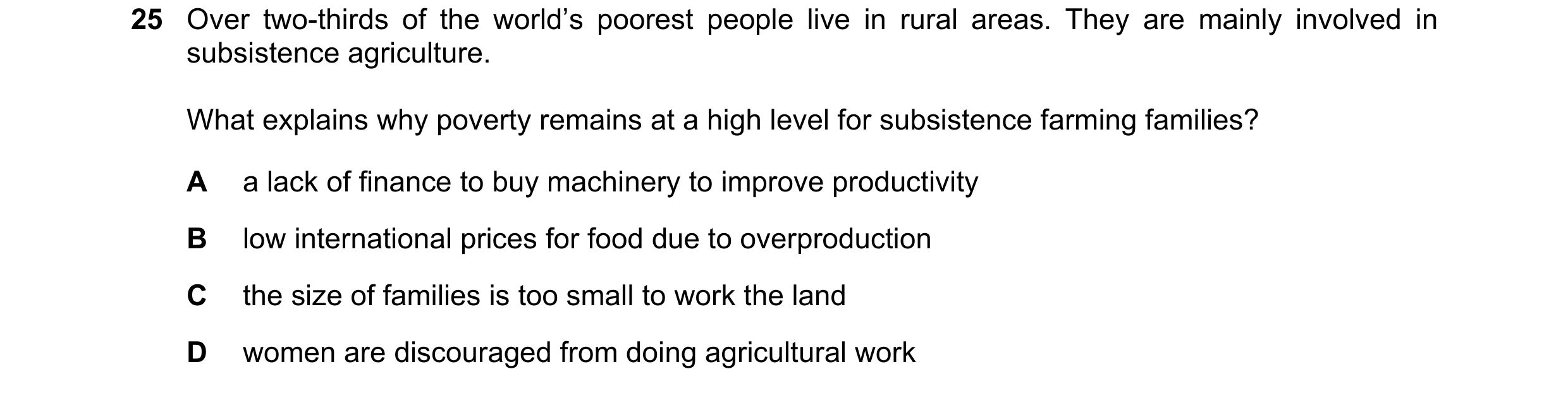
25 Over two-thirds of the world’s poorest people live in rural areas. They are mainly involved in subsistence agriculture. What explains why poverty remains at a high level for subsistence farming families? A a lack of finance to buy machinery to improve productivity B low international prices for food due to overproduction C the size of families is too small to work the land D women are discouraged from doing agricultural work
1 marks
Answer: A
This question in 0455/12 May/June 2018
Q23 · What describes absolute and relative poverty? 0455/13 Oct/Nov 2018
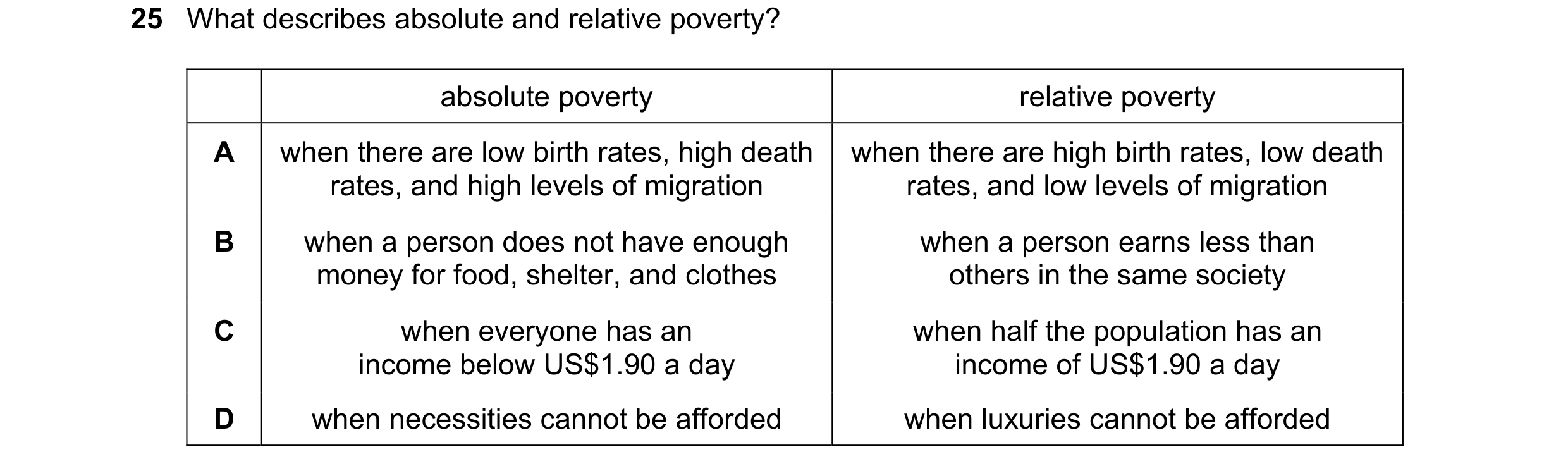
25 What describes absolute and relative poverty? absolute poverty relative poverty A when there are low birth rates, high death when there are high birth rates, low death rates, and high levels of migration rates, and low levels of migration B when a person does not have enough when a person earns less than money for food, shelter, and clothes others in the same society C when everyone has an when half the population has an income below US$1.90 a day income of US$1.90 a day D when necessities cannot be afforded when luxuries cannot be afforded
1 marks
Answer: B
This question in 0455/13 Oct/Nov 2018
Q24 · A government increases the rate of income tax in order to pay for extra transfer… 0455/11 May/June 2019
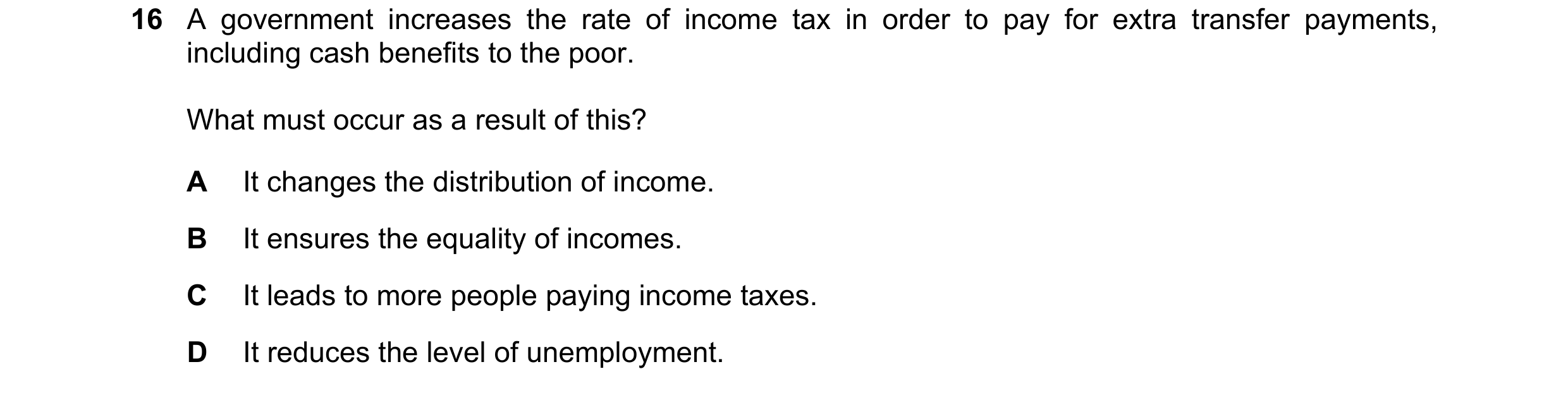
16 A government increases the rate of income tax in order to pay for extra transfer payments, including cash benefits to the poor. What must occur as a result of this? A It changes the distribution of income. B It ensures the equality of incomes. C It leads to more people paying income taxes. D It reduces the level of unemployment.
1 marks
Answer: A
This question in 0455/11 May/June 2019
Q25 · Which policy is most likely to reduce relative poverty? 0455/11 May/June 2019
24 Which policy is most likely to reduce relative poverty? A make income tax rates less progressive B reduce benefit payments C reduce the minimum wage D reduce the rate of sales tax
1 marks
Answer: D
This question in 0455/11 May/June 2019
Q26 · The table shows the percentage share of GDP held by the richest 20% and poorest 20% of… 0455/11 Oct/Nov 2019
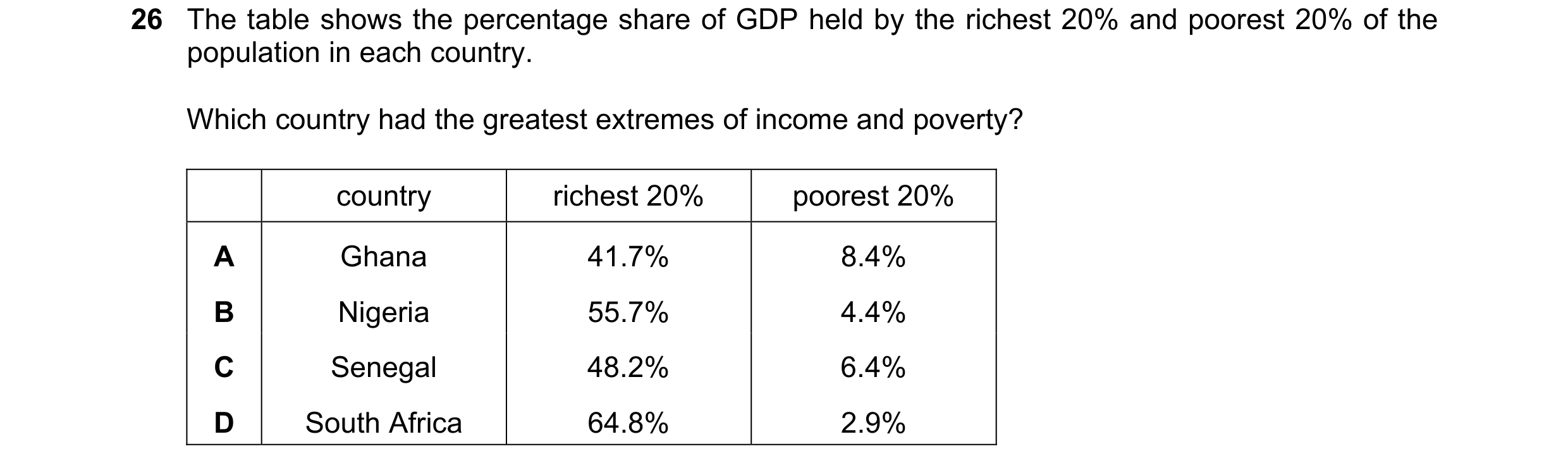
26 The table shows the percentage share of GDP held by the richest 20% and poorest 20% of the population in each country. Which country had the greatest extremes of income and poverty? country richest 20% poorest 20% A Ghana 41.7% 8.4% B Nigeria 55.7% 4.4% C Senegal 48.2% 6.4% D South Africa 64.8% 2.9%
1 marks
Answer: D
This question in 0455/11 Oct/Nov 2019
Q27 · The table shows the percentage share of GDP held by the richest 20% and poorest 20% of… 0455/12 Oct/Nov 2019
26 The table shows the percentage share of GDP held by the richest 20% and poorest 20% of the population in each country. Which country had the greatest extremes of income and poverty? country richest 20% poorest 20% A Ghana 41.7% 8.4% B Nigeria 55.7% 4.4% C Senegal 48.2% 6.4% D South Africa 64.8% 2.9%
1 marks
Answer: D
This question in 0455/12 Oct/Nov 2019
Q28 · The table shows the percentage share of GDP held by the richest 20% and poorest 20% of… 0455/13 Oct/Nov 2019
26 The table shows the percentage share of GDP held by the richest 20% and poorest 20% of the population in each country. Which country had the greatest extremes of income and poverty? country richest 20% poorest 20% A Ghana 41.7% 8.4% B Nigeria 55.7% 4.4% C Senegal 48.2% 6.4% D South Africa 64.8% 2.9%
1 marks
Answer: D
This question in 0455/13 Oct/Nov 2019
Q29 · An additional 700 000 UK children and pensioners fell into relative poverty between 2013… 0455/11 May/June 2020
25 An additional 700 000 UK children and pensioners fell into relative poverty between 2013 and 2017. What might be the reason for this? A Direct taxes had increased, and indirect taxes had fallen. B Real gross domestic product was rising faster than the population. C The death rate was exceeding the birth rate. D The real value of government welfare benefits had fallen.
1 marks
Answer: D
This question in 0455/11 May/June 2020
Q30 · Due to war, some people are living in absolute poverty 0455/12 May/June 2020
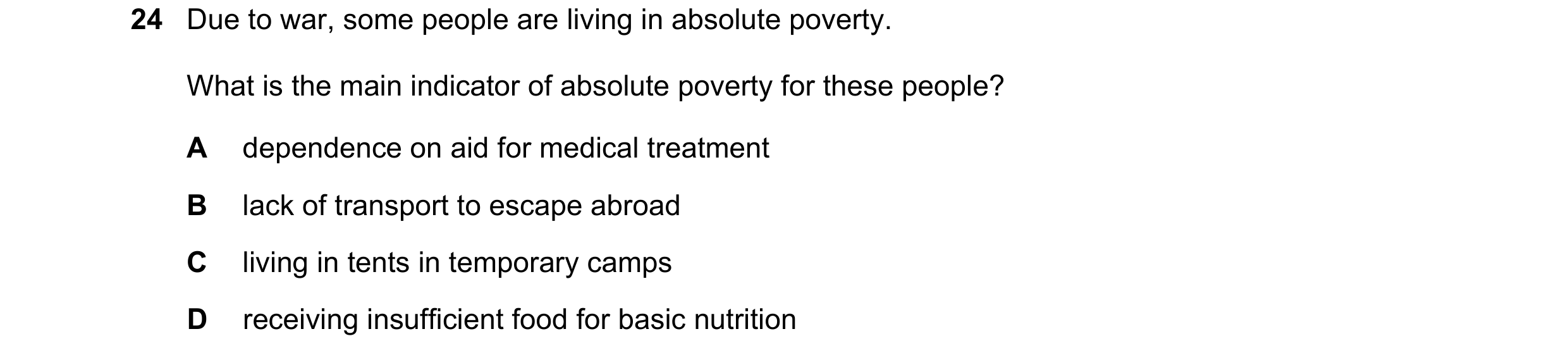
24 Due to war, some people are living in absolute poverty. What is the main indicator of absolute poverty for these people? A dependence on aid for medical treatment B lack of transport to escape abroad C living in tents in temporary camps D receiving insufficient food for basic nutrition
1 marks
Answer: D
This question in 0455/12 May/June 2020
Q31 · A low-income country experiences extreme poverty in its rural areas 0455/11 Oct/Nov 2020
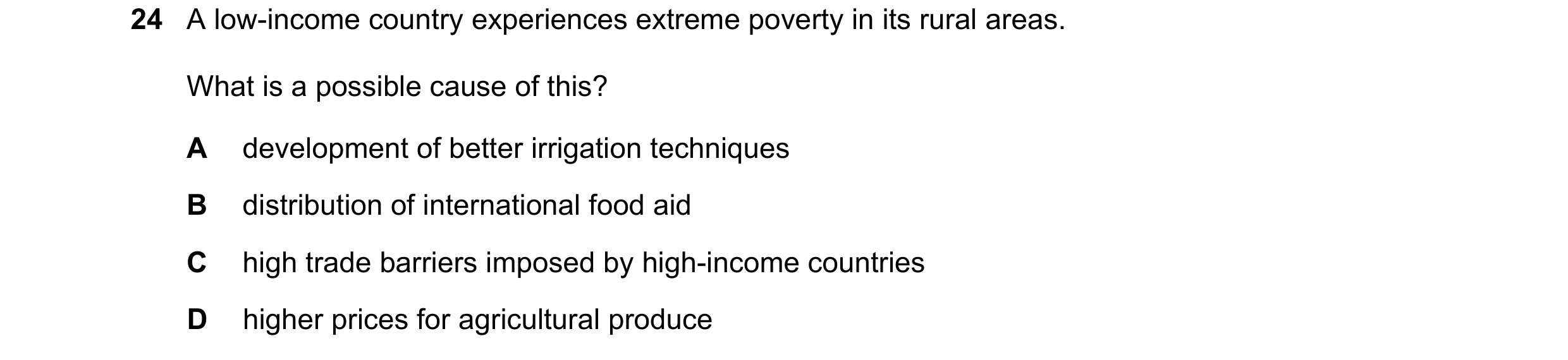
24 A low-income country experiences extreme poverty in its rural areas. What is a possible cause of this? A development of better irrigation techniques B distribution of international food aid C high trade barriers imposed by high-income countries D higher prices for agricultural produce
1 marks
Answer: C
This question in 0455/11 Oct/Nov 2020
Q32 · In countries with absolute poverty, low incomes can start a process that keeps incomes low 0455/12 Oct/Nov 2020
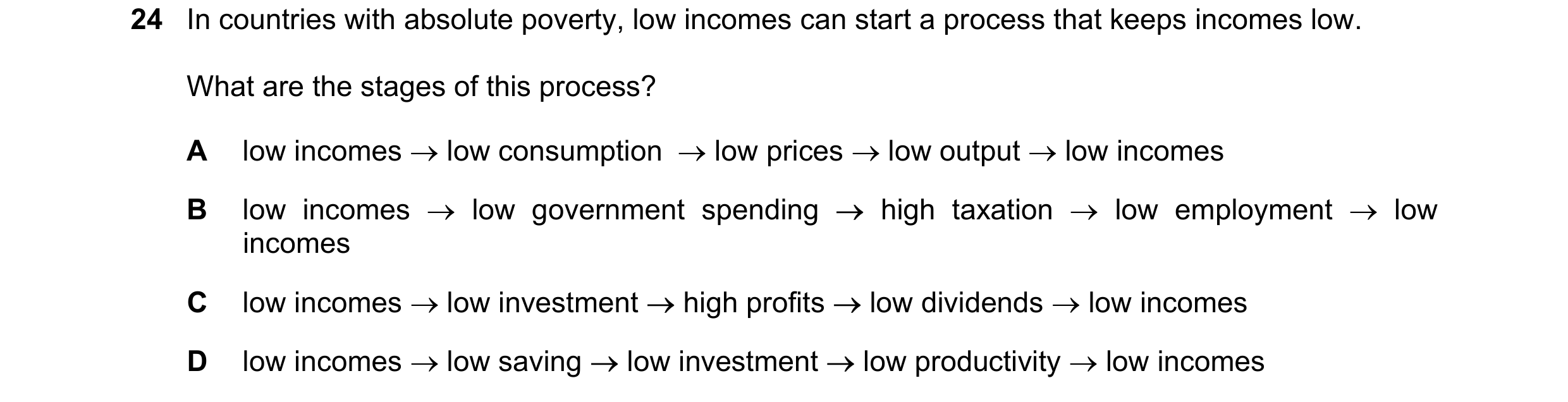
24 In countries with absolute poverty, low incomes can start a process that keeps incomes low. What are the stages of this process? A low incomes low consumption low prices low output low incomes B low incomes low government spending high taxation low employment low incomes C low incomes low investment high profits low dividends low incomes D low incomes low saving low investment low productivity low incomes
1 marks
Answer: D
This question in 0455/12 Oct/Nov 2020
Q33 · Which statement about poverty is correct? 0455/12 Feb/March 2021
25 Which statement about poverty is correct? A Absolute poverty occurs when income falls below what is needed for survival. B An advanced economy is likely to have a higher level of absolute poverty than relative poverty. C It is impossible for relative poverty to rise as absolute poverty falls. D Relative poverty is measured by the same goods and services in all countries.
1 marks
Answer: A
This question in 0455/12 Feb/March 2021
Q34 · The richest 60% of the population of a high-income economy received an increase in income 0455/11 May/June 2021
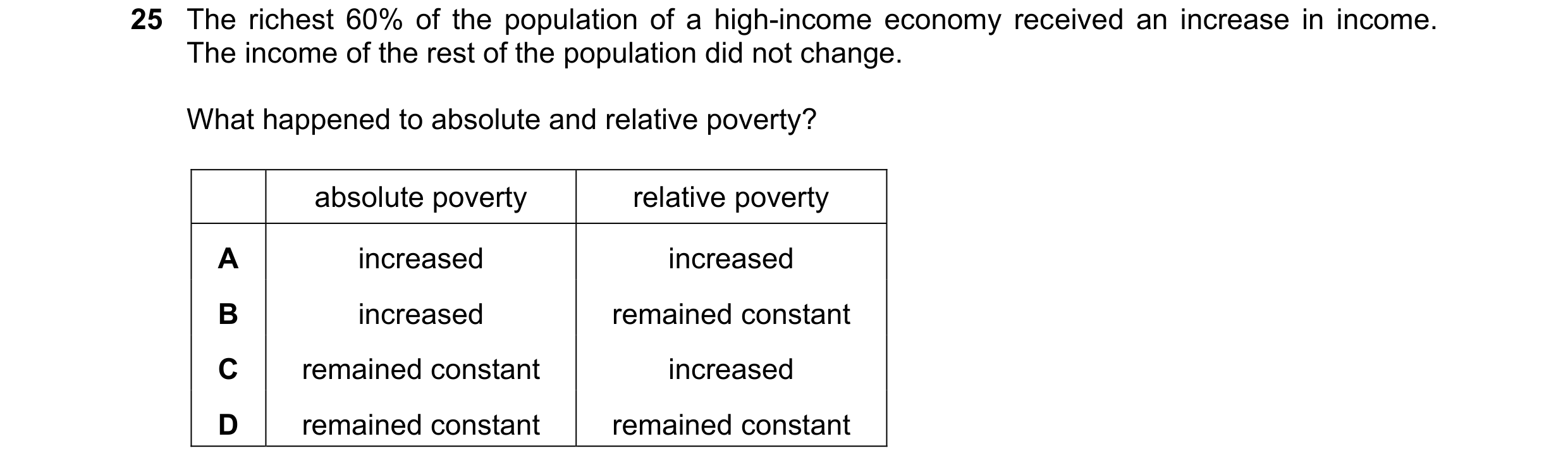
25 The richest 60% of the population of a high-income economy received an increase in income. The income of the rest of the population did not change. What happened to absolute and relative poverty? absolute poverty relative poverty A increased increased B increased remained constant C remained constant increased D remained constant remained constant
1 marks
Answer: C
This question in 0455/11 May/June 2021
Q35 · A country is experiencing unemployment 0455/12 May/June 2021
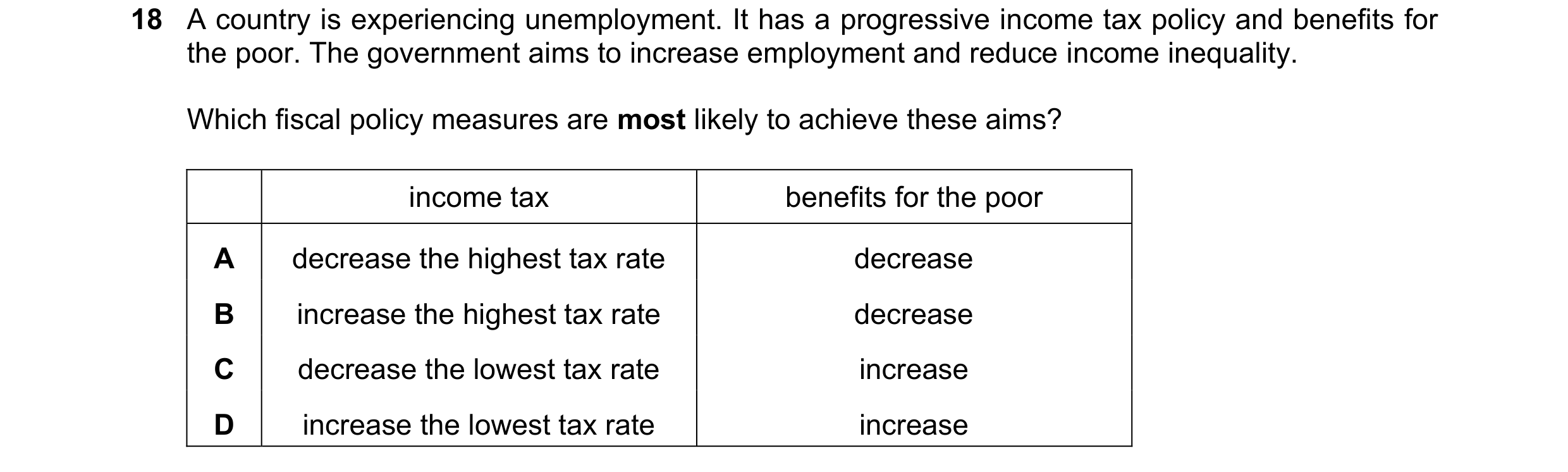
18 A country is experiencing unemployment. It has a progressive income tax policy and benefits for the poor. The government aims to increase employment and reduce income inequality. Which fiscal policy measures are most likely to achieve these aims? income tax benefits for the poor A decrease the highest tax rate decrease B increase the highest tax rate decrease C decrease the lowest tax rate increase D increase the lowest tax rate increase
1 marks
Answer: C
This question in 0455/12 May/June 2021
Q36 · The richest 60% of the population of a high-income economy received an increase in income 0455/12 May/June 2021
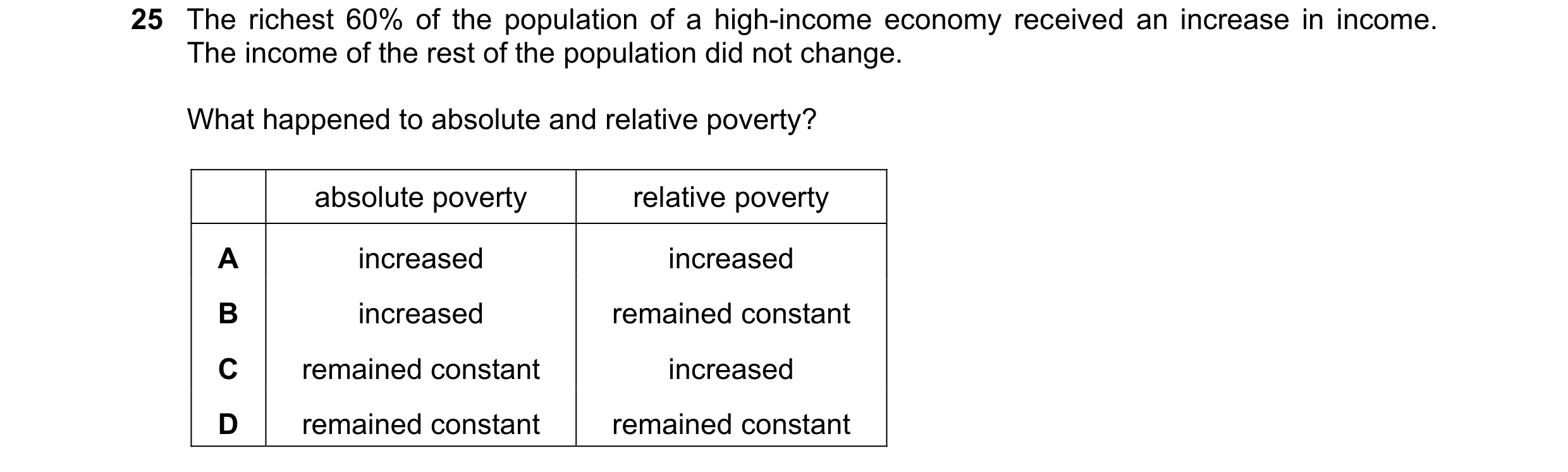
25 The richest 60% of the population of a high-income economy received an increase in income. The income of the rest of the population did not change. What happened to absolute and relative poverty? absolute poverty relative poverty A increased increased B increased remained constant C remained constant increased D remained constant remained constant
1 marks
Answer: C
This question in 0455/12 May/June 2021
Q37 · The richest 60% of the population of a high-income economy received an increase in income 0455/13 May/June 2021
25 The richest 60% of the population of a high-income economy received an increase in income. The income of the rest of the population did not change. What happened to absolute and relative poverty? absolute poverty relative poverty A increased increased B increased remained constant C remained constant increased D remained constant remained constant
1 marks
Answer: C
This question in 0455/13 May/June 2021
Q38 · What is a certain cause of absolute poverty? 0455/11 Oct/Nov 2021
24 What is a certain cause of absolute poverty? A growing old B insufficient income for basic needs C lack of good healthcare D many dependants in the family
1 marks
Answer: B
This question in 0455/11 Oct/Nov 2021
Q39 · Poverty in households may be defined in relative terms 0455/12 Oct/Nov 2021
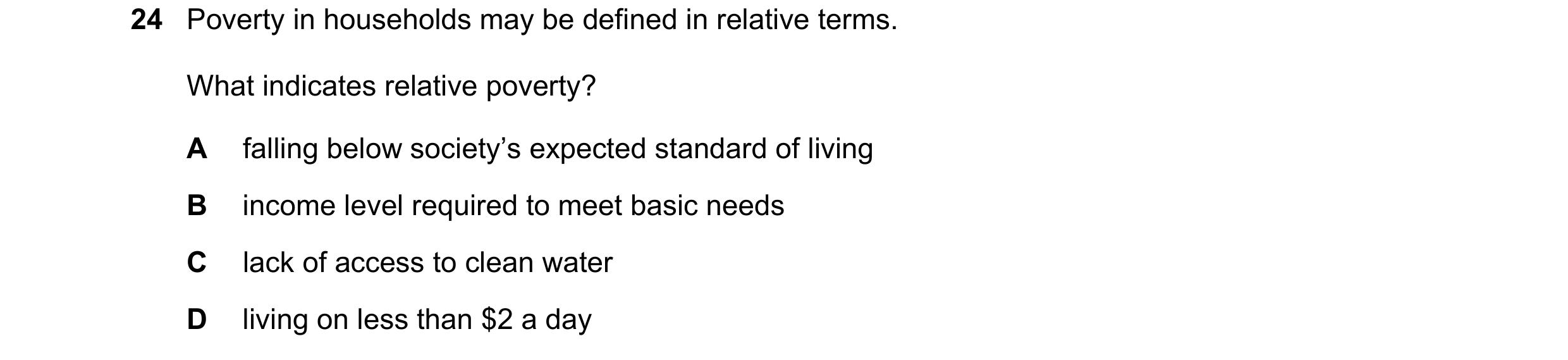
24 Poverty in households may be defined in relative terms. What indicates relative poverty? A falling below society’s expected standard of living B income level required to meet basic needs C lack of access to clean water D living on less than $2 a day
1 marks
Answer: A
This question in 0455/12 Oct/Nov 2021
Q40 · What could reduce poverty? 0455/13 Oct/Nov 2021
24 What could reduce poverty? A greater economic growth B less spending on education C more regressive taxation D privatisation of hospitals
1 marks
Answer: A
This question in 0455/13 Oct/Nov 2021
Q41 · A government wants to reduce both its budget deficit and the amount of poverty in its… 0455/12 May/June 2022
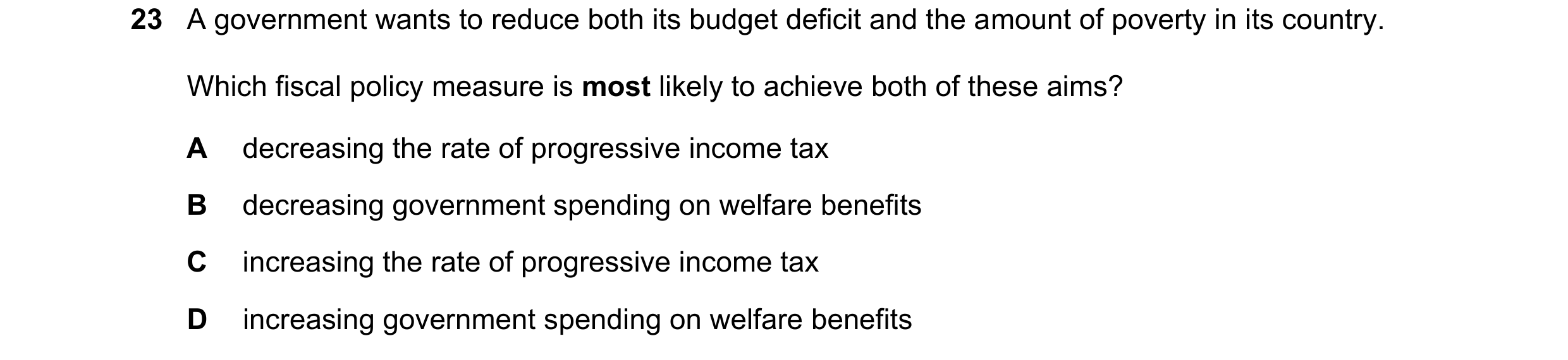
23 A government wants to reduce both its budget deficit and the amount of poverty in its country. Which fiscal policy measure is most likely to achieve both of these aims? A decreasing the rate of progressive income tax B decreasing government spending on welfare benefits C increasing the rate of progressive income tax D increasing government spending on welfare benefits
1 marks
Answer: C
This question in 0455/12 May/June 2022
Q42 · The table shows how three people, X, Y and Z, spend their income 0455/13 May/June 2022
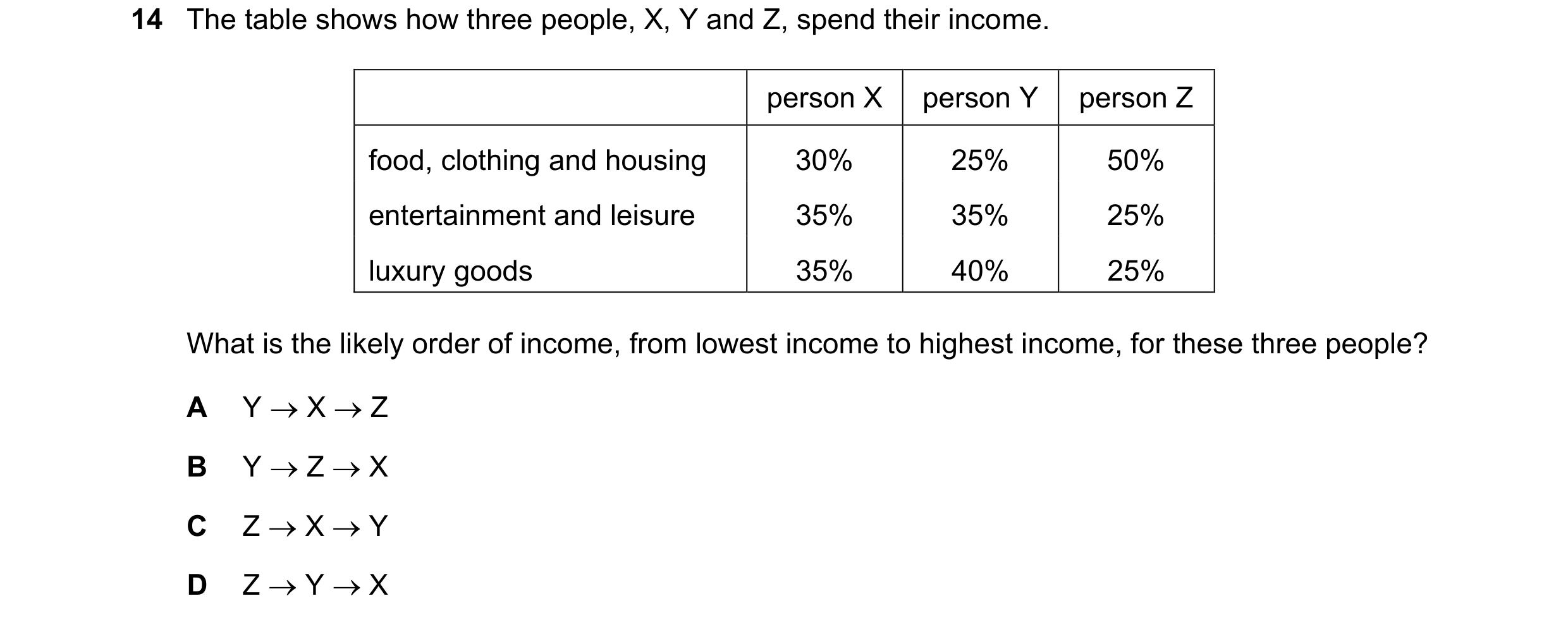
14 The table shows how three people, X, Y and Z, spend their income. person X person Y person Z food, clothing and housing 30% 25% 50% entertainment and leisure 35% 35% 25% luxury goods 35% 40% 25% What is the likely order of income, from lowest income to highest income, for these three people? A Y X Z B Y Z X C Z X Y D Z Y X
1 marks
Answer: C
This question in 0455/13 May/June 2022
Q43 · The Chinese government is concerned about the level of poverty and the need for more… 0455/11 Oct/Nov 2022
1 The Chinese government is concerned about the level of poverty and the need for more resources in low-income regions of the country. As a result, it is increasing its expenditure in those regions and reducing it in high-income regions. Which economic concept does this government policy illustrate? A diseconomies of scale B market forces C opportunity cost D specialisation
1 marks
Answer: C
This question in 0455/11 Oct/Nov 2022
Q44 · A fall in the level of absolute poverty can be best achieved by reducing A government… 0455/12 Oct/Nov 2022
26 A fall in the level of absolute poverty can be best achieved by reducing A government unemployment benefits. B income tax. C the number of homeless people. D the rate of inflation.
1 marks
Answer: C
This question in 0455/12 Oct/Nov 2022
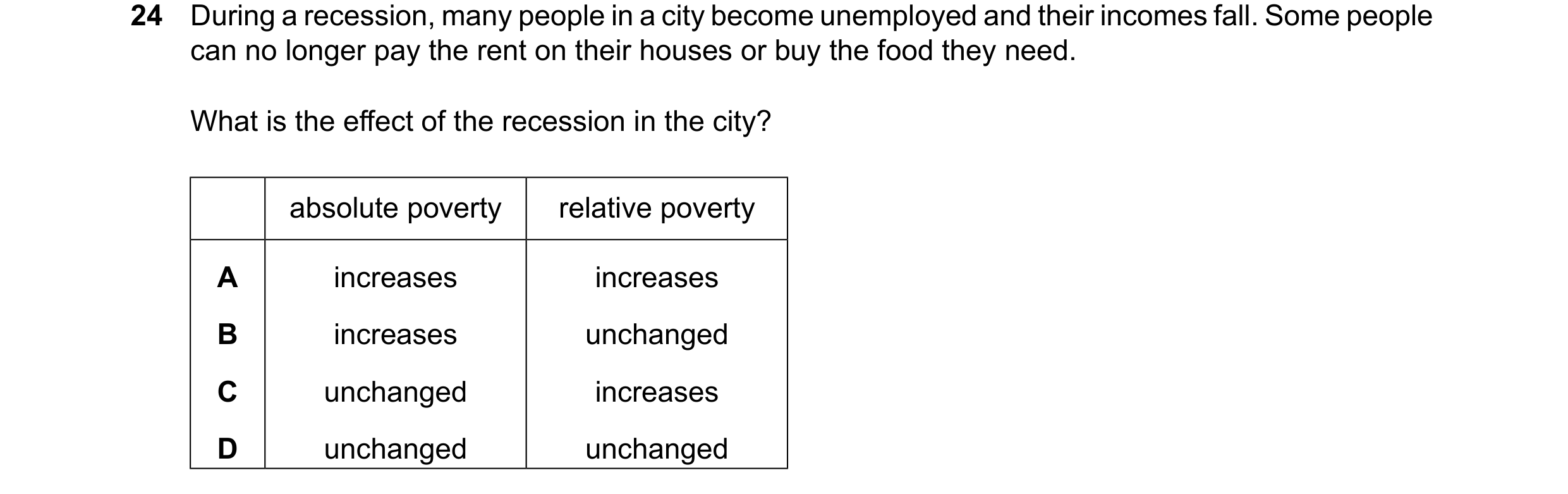
Q45 · During a recession, many people in a city become unemployed and their incomes fall 0455/12 May/June 2023
24 During a recession, many people in a city become unemployed and their incomes fall. Some people can no longer pay the rent on their houses or buy the food they need. What is the effect of the recession in the city? absolute poverty relative poverty A increases increases B increases unchanged C unchanged increases D unchanged unchanged
1 marks
Answer: A
This question in 0455/12 May/June 2023
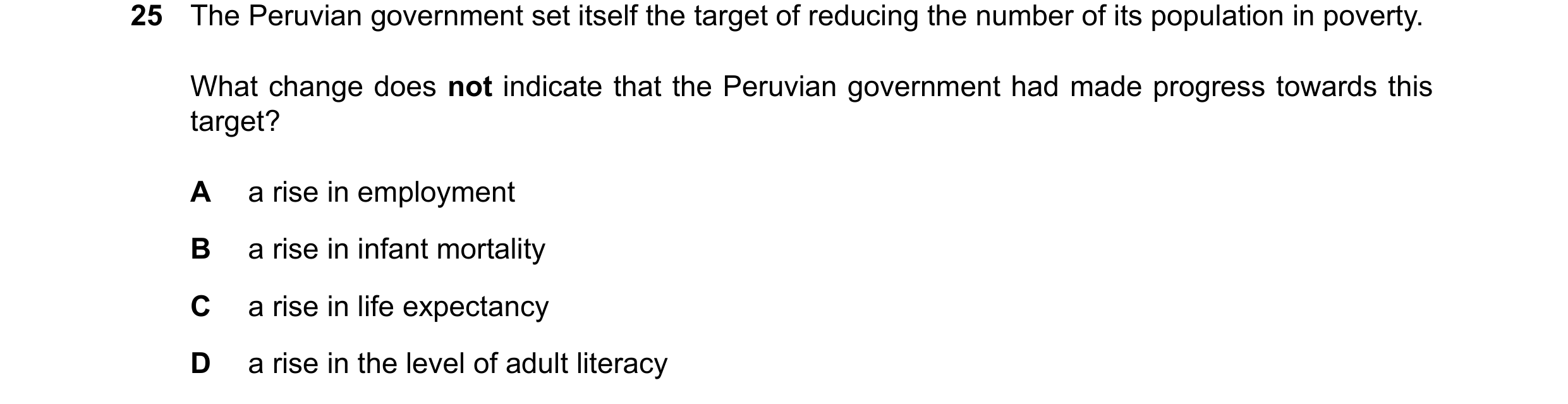
Q46 · The Peruvian government set itself the target of reducing the number of its population in… 0455/12 May/June 2023
25 The Peruvian government set itself the target of reducing the number of its population in poverty. What change does not indicate that the Peruvian government had made progress towards this target? A a rise in employment B a rise in infant mortality C a rise in life expectancy D a rise in the level of adult literacy
1 marks
Answer: B
This question in 0455/12 May/June 2023
Q47 · What is most likely to cause an increase in relative poverty? 0455/13 May/June 2023
24 What is most likely to cause an increase in relative poverty? A an increase in state benefits B an increase in the national minimum wage C pension increases below the rate of inflation D people working beyond retirement age
1 marks
Answer: C
This question in 0455/13 May/June 2023
Q48 · Three statements about policy measures are listed 0455/12 Feb/March 2024
20 Three statements about policy measures are listed. 1 improved education and training 2 deregulation 3 reduction in the basic rate of income tax What are the supply-side policy measures that would enable the government to make the income distribution more equal? A 1, 2 and 3 B 1 and 2 only C 1 and 3 only D 2 only
1 marks
Answer: C
This question in 0455/12 Feb/March 2024
Q49 · The table shows the percentage (%) shares of income going to different household income… 0455/12 Feb/March 2024
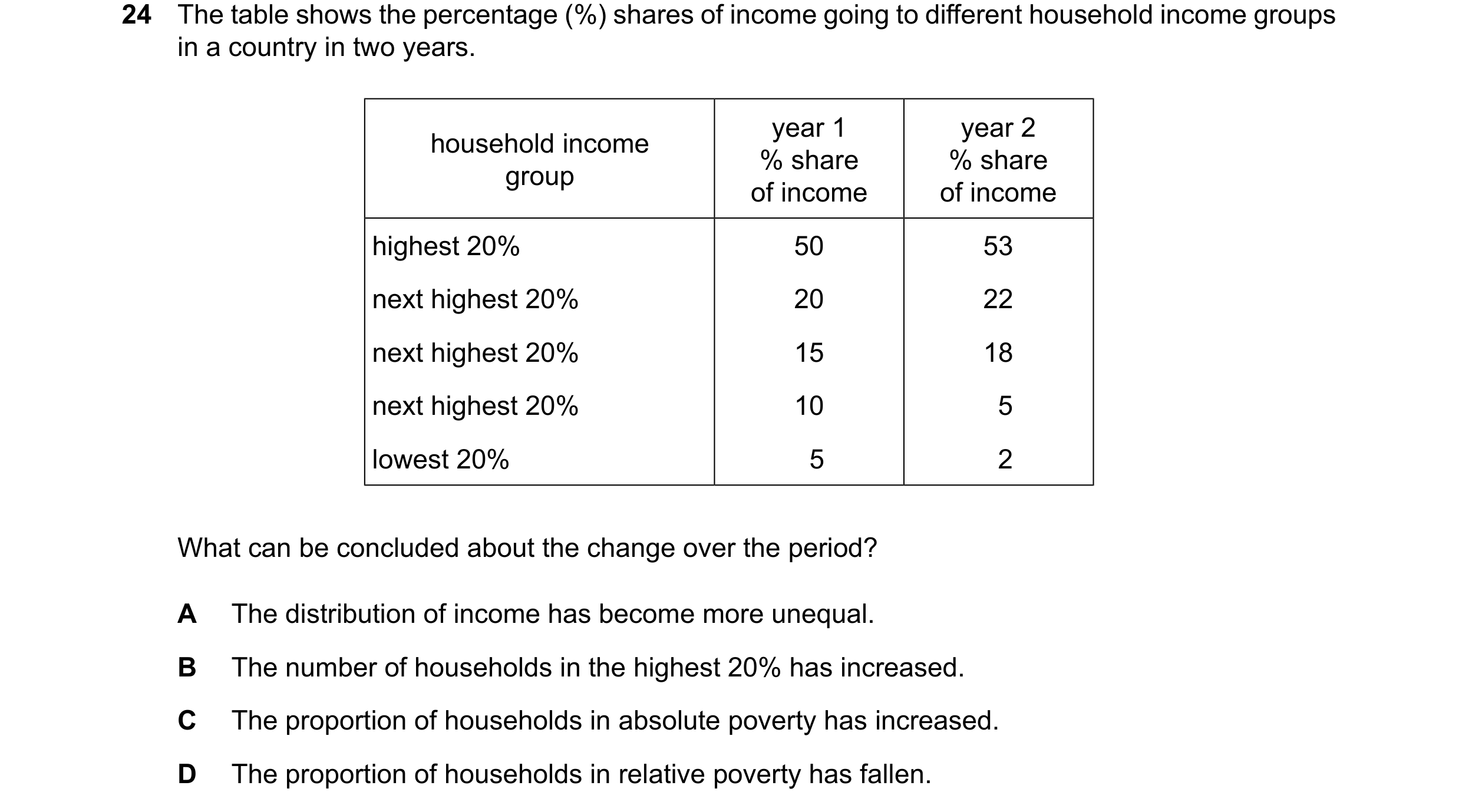
24 The table shows the percentage (%) shares of income going to different household income groups in a country in two years. year 1 year 2 household income % share % share group of income of income highest 20% 50 53 next highest 20% 20 22 next highest 20% 15 18 next highest 20% 10 5 lowest 20% 5 2 What can be concluded about the change over the period? A The distribution of income has become more unequal. B The number of households in the highest 20% has increased. C The proportion of households in absolute poverty has increased. D The proportion of households in relative poverty has fallen.
1 marks
Answer: A
This question in 0455/12 Feb/March 2024
Q50 · What is the most likely cause of an increase in poverty in developing economies? 0455/12 Feb/March 2024
26 What is the most likely cause of an increase in poverty in developing economies? A an increase in poor nutrition and ill-health B an increase in education provision C an increase in international tourism D an increase in trade union bargaining power
1 marks
Answer: A
This question in 0455/12 Feb/March 2024
Q51 · What best describes relative poverty? 0455/13 May/June 2024
25 What best describes relative poverty? A A 12-year-old boy has never been able to access a doctor or school. B A person earns less than the minimum defined level of income. C A person has a lower living standard than the minimum level acceptable in a society. D A person is unable to afford the basic necessities of life.
1 marks
Answer: C
This question in 0455/13 May/June 2024
Q52 · The number of people in relative poverty in a country is decreasing 0455/11 Oct/Nov 2024
25 The number of people in relative poverty in a country is decreasing. What is the most likely cause of this? A a contractionary fiscal policy B a decrease in the national minimum wage C an expansion of investment in education D an increase in barriers to entry for multinational companies
1 marks
Answer: C
This question in 0455/11 Oct/Nov 2024
Q53 · A government increases the rate of progressive income tax and its spending on hospitals 0455/13 Oct/Nov 2024
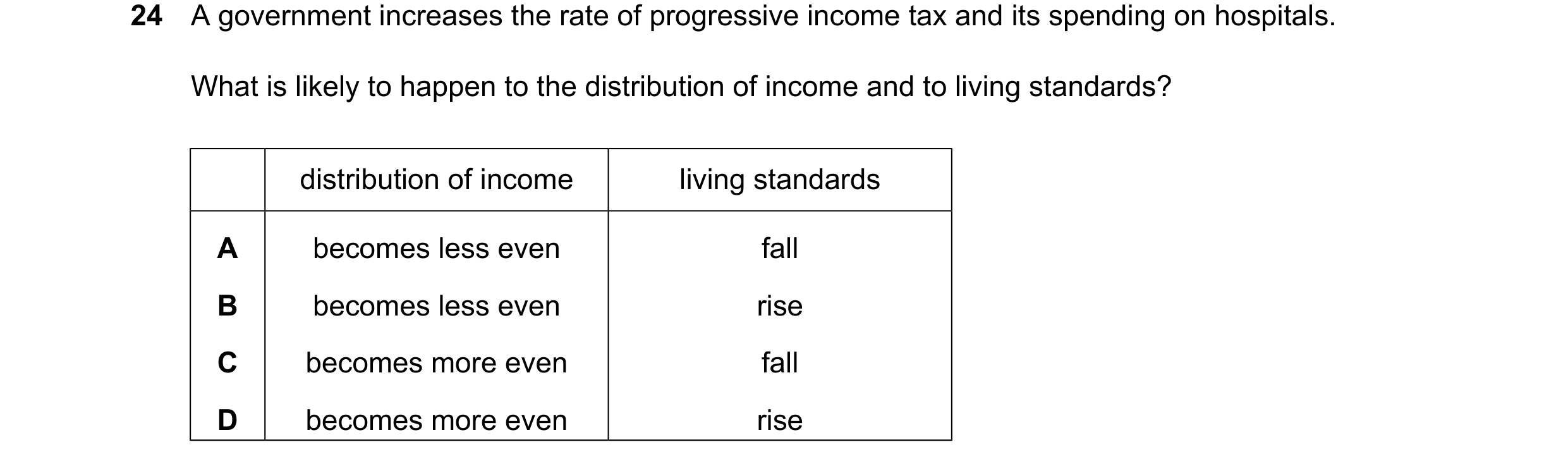
24 A government increases the rate of progressive income tax and its spending on hospitals. What is likely to happen to the distribution of income and to living standards? distribution of income living standards A becomes less even fall B becomes less even rise C becomes more even fall D becomes more even rise
1 marks
Answer: D
This question in 0455/13 Oct/Nov 2024
Q54 · Wealthy countries have people who live in relative poverty 0455/12 Feb/March 2025
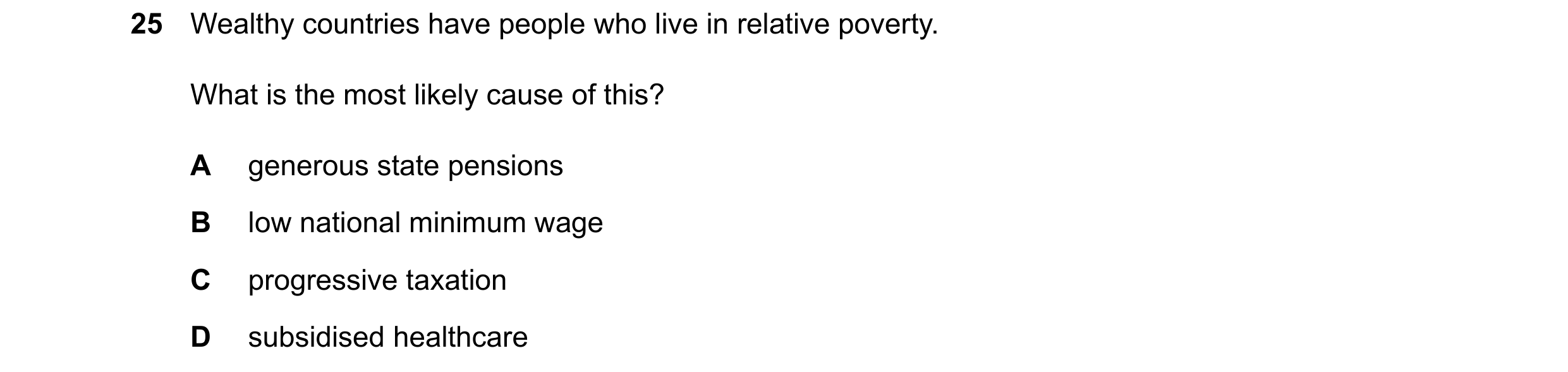
25 Wealthy countries have people who live in relative poverty. What is the most likely cause of this? A generous state pensions B low national minimum wage C progressive taxation D subsidised healthcare
1 marks
Answer: B
This question in 0455/12 Feb/March 2025
Q55 · What is the most likely reason that an improved standard of education will alleviate… 0455/13 May/June 2025
25 What is the most likely reason that an improved standard of education will alleviate poverty? A It will decrease the productivity of workers. B It will decrease the rate of unemployment. C It will increase the government budget deficit. D It will increase the rate of inflation of an economy.
1 marks
Answer: B
This question in 0455/13 May/June 2025
Q56 · What is most likely to cause more poverty in a country? 0455/11 Oct/Nov 2025
25 What is most likely to cause more poverty in a country? A a decrease in the general price level B a decrease in the rate of income tax C a decrease in the level of unemployment D a decrease in the level of wages
1 marks
Answer: D
This question in 0455/11 Oct/Nov 2025
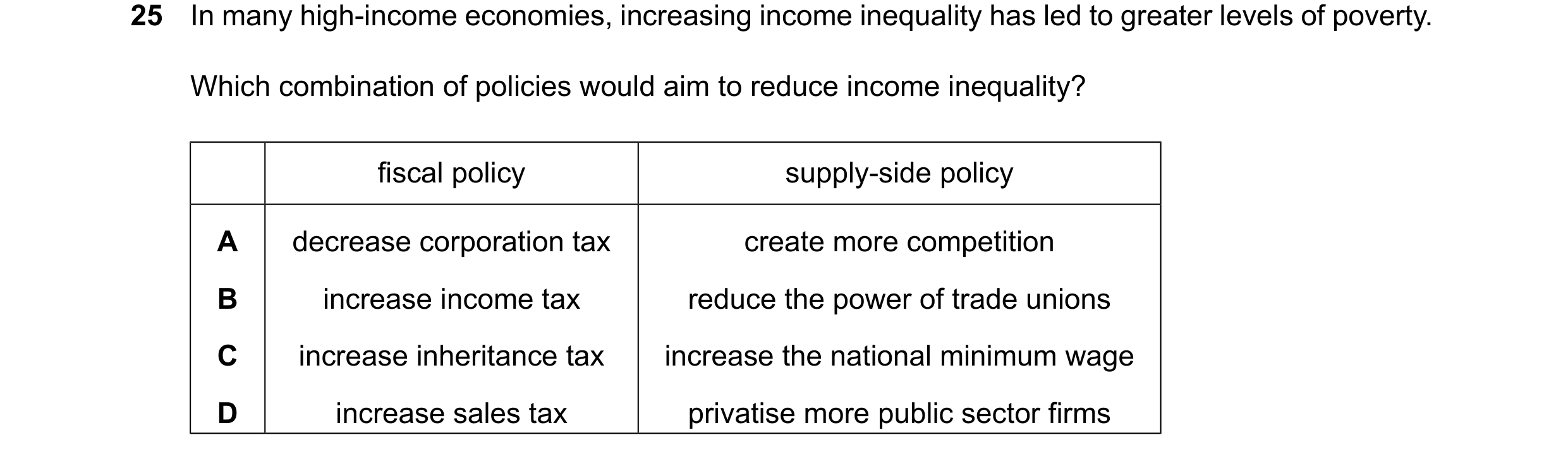
Q57 · In many high-income economies, increasing income inequality has led to greater levels of… 0455/12 Oct/Nov 2025
25 In many high-income economies, increasing income inequality has led to greater levels of poverty. Which combination of policies would aim to reduce income inequality? fiscal policy supply-side policy A decrease corporation tax create more competition B increase income tax reduce the power of trade unions C increase inheritance tax increase the national minimum wage D increase sales tax privatise more public sector firms
1 marks
Answer: C
This question in 0455/12 Oct/Nov 2025
 1 / 13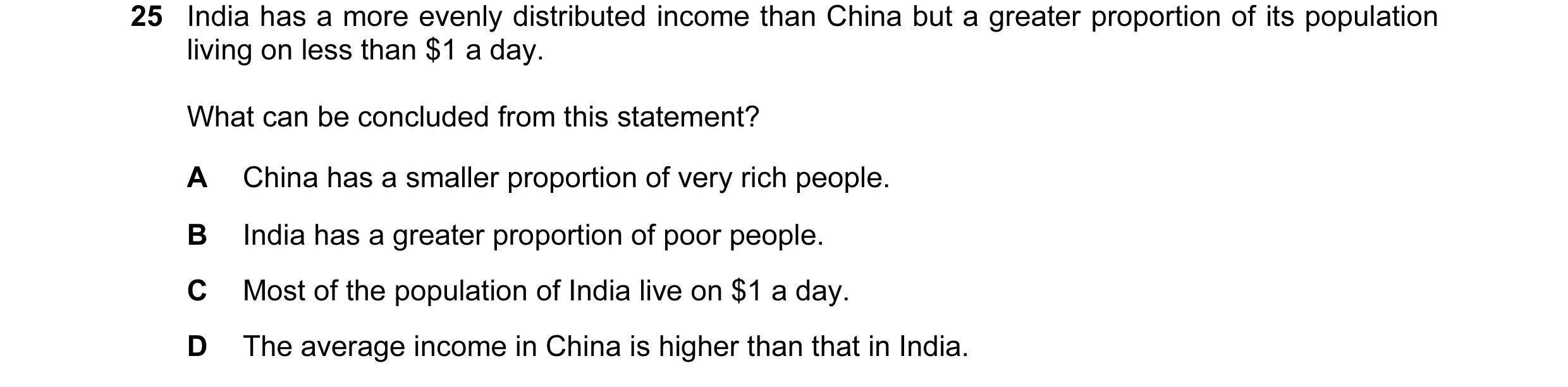
 2 / 13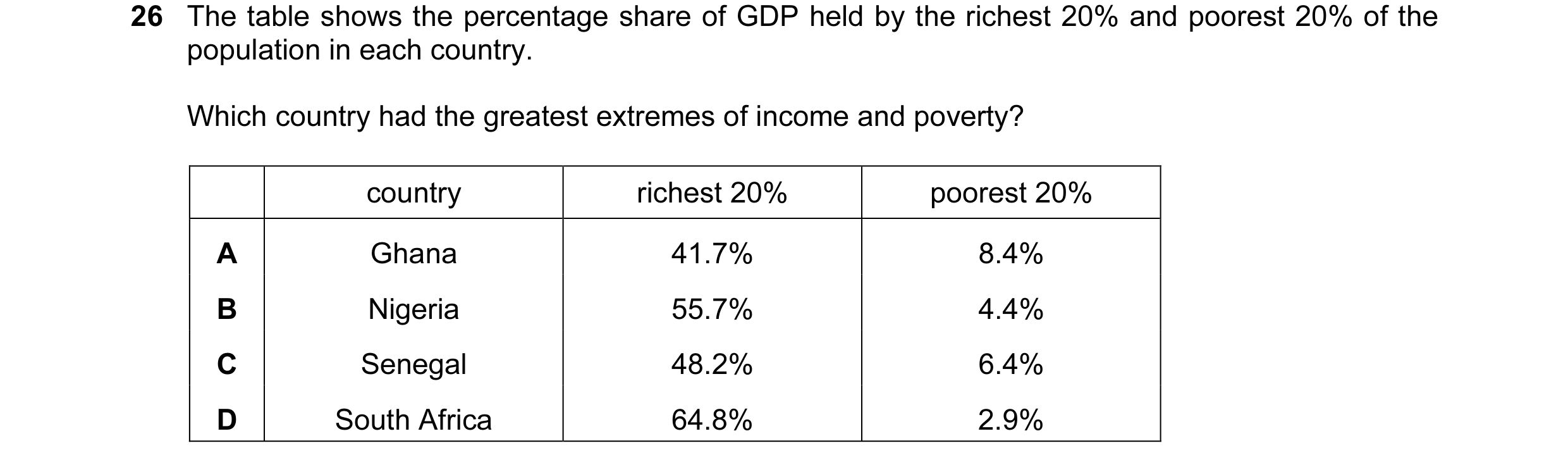
 3 / 13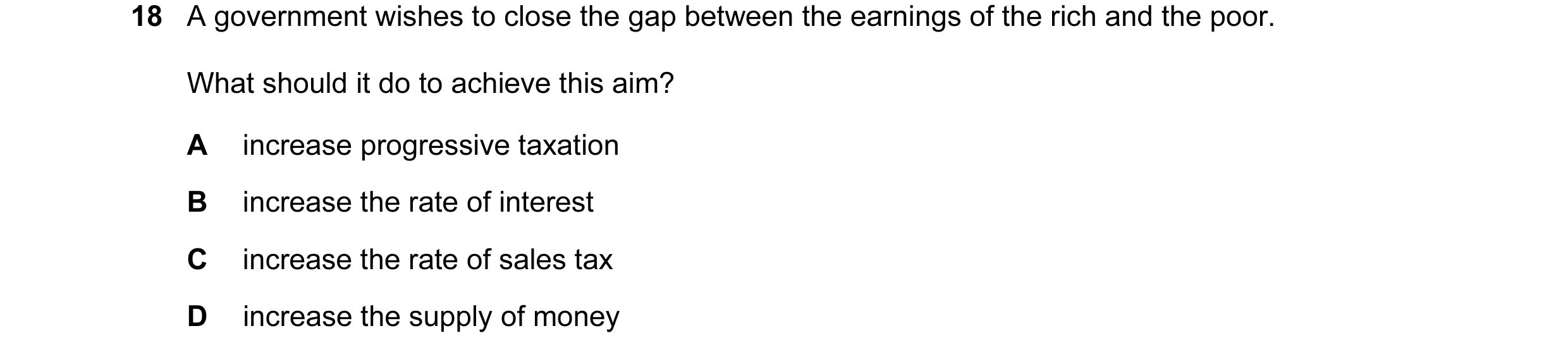
 4 / 13

 5 / 13
 6 / 13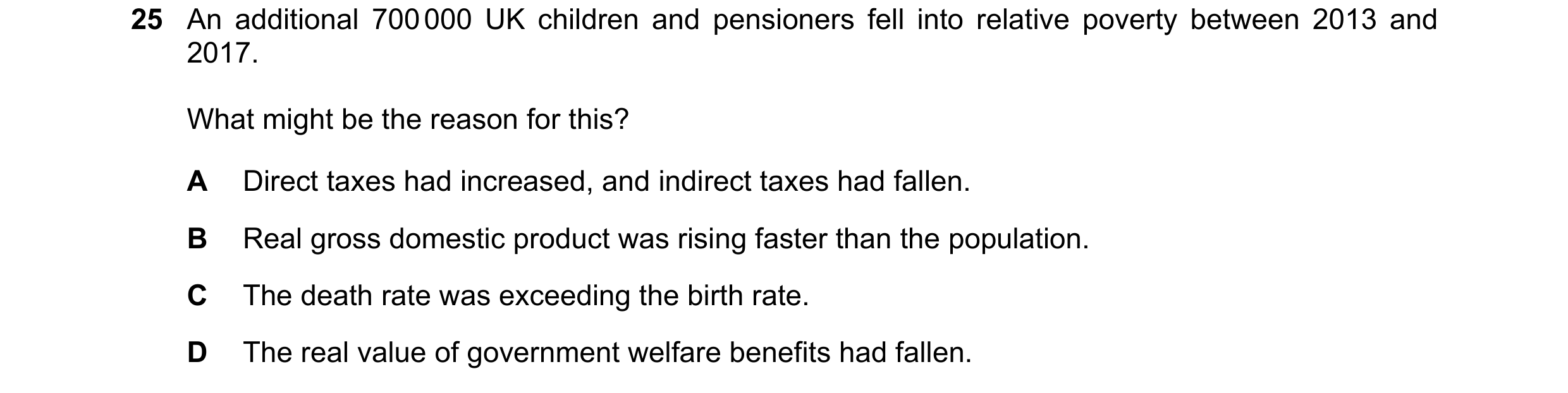
 7 / 13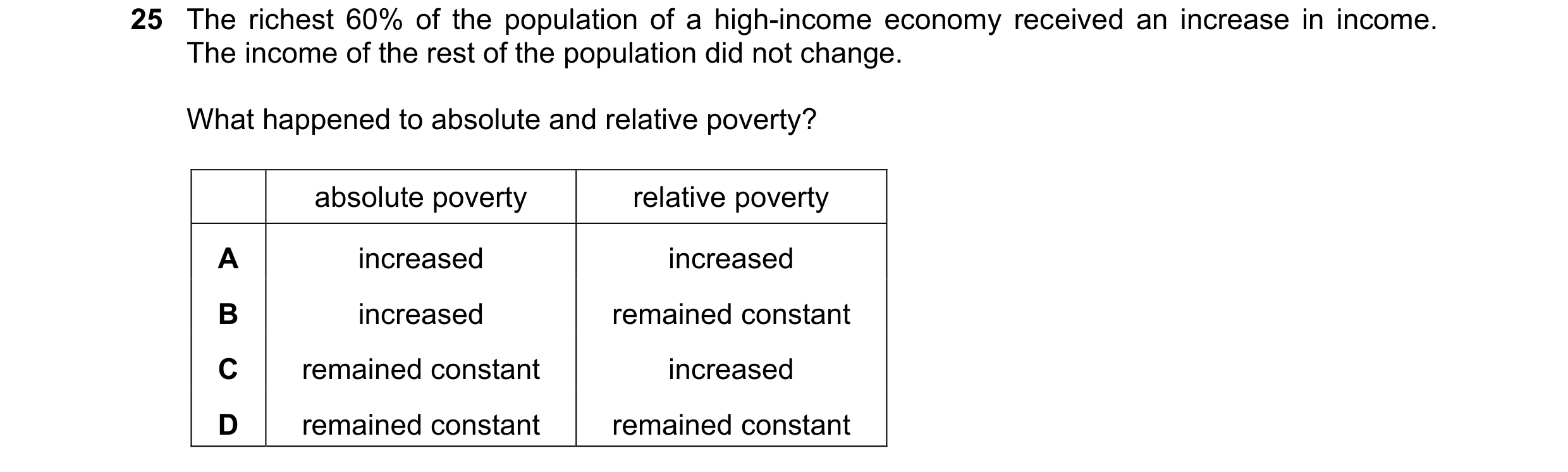
 8 / 13

 9 / 13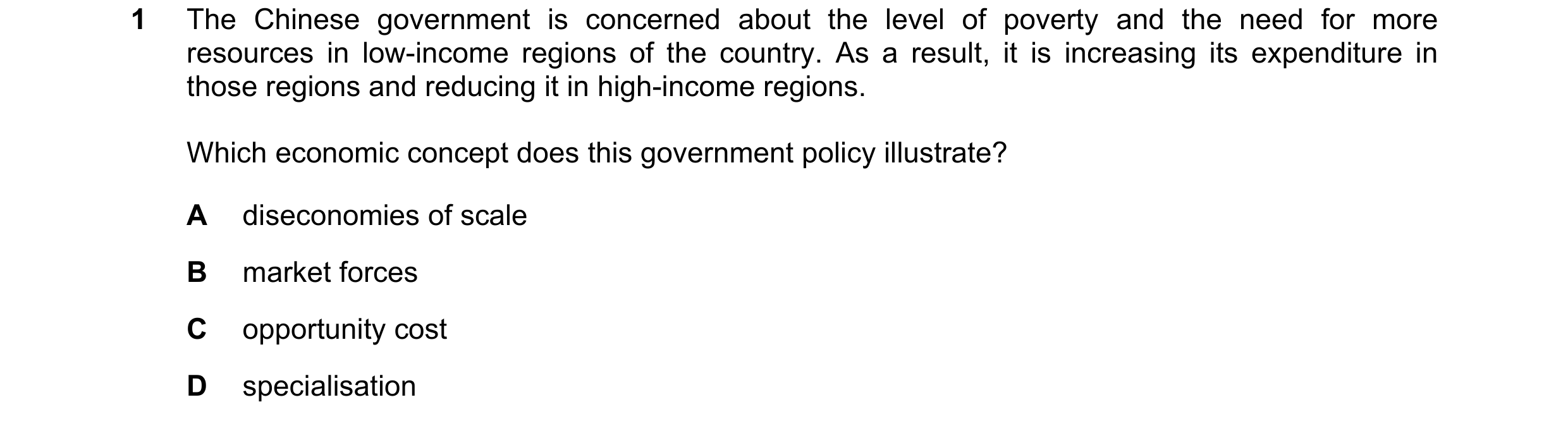

 10 / 13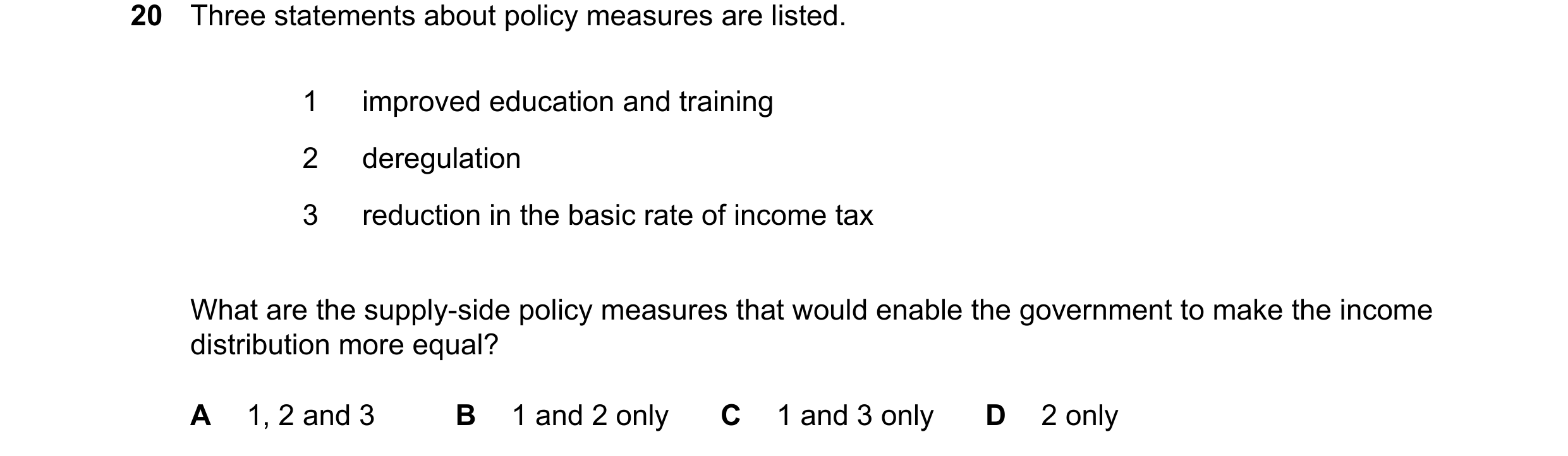

 11 / 13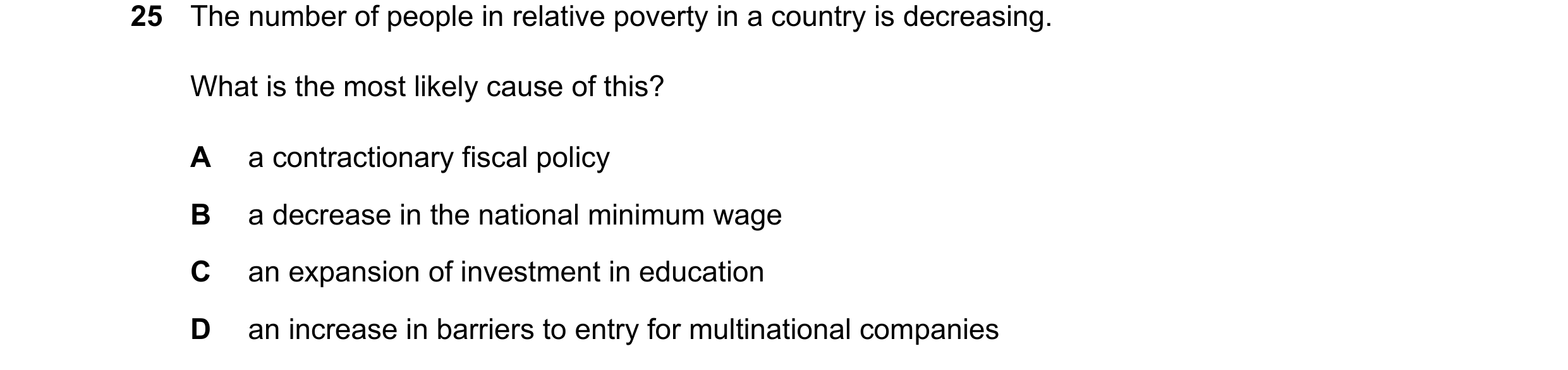

 12 / 13
 13 / 13