Questions as text
Q1 · Section C: International history, 1945–92 9489/42 Feb/March 2021
Section C: International history, 1945–92
30 marks
Mark scheme: 8 Assess the importance of the Bretton Woods agreement of 1944 for 30 the United States. The Bretton Woods agreement arose from a conference in 1944 organised by the US Treasury. The agreement came to be signed by 44 countries and was aimed at avoiding the inter-war problems of protectionism, competitive devaluations, outflows of currency and unstable exchange rates. The idea was that financial stability would promote international trade and this in turn would promote peace. To avoid inflexible gold standard rates, there was a basic fixed rate by which the US dollar was tied to gold to give stability and to establish a sound reserve currency. But there was the ability of countries to use a new International Monetary Fund to go beyond their quota to provide stimulus to prevent mass unemployment and depression. It took fifteen years for the new system to establish itself and did lead to some problems. There was a tendency of governments to pursue ‘stop –go’ policies, alternating between using the opportunity for expansionism not available in a more rigid gold standard system and then having to pursue austerity policies to protect the value of their currency. As the US was the reserve currency it was not subject to this and there was a gap between the US position and the rest of the world. The holding of dollars was also a problem for the US and by 1964 US gold stock was less than its dollar liabilities through the world. The US had to put pressure on other nations not to convert their dollars into gold and had to make great efforts to keep the price of gold down to the 1944 level of $35 an ounce, the system had depended on the value of the $ being reasonably stable but a big rise in inflation in the US after 1965 undermined this and in 1971 Nixon took the US off the gold standard and the Bretton Woods system came to an end. The agreement created two major international financial institutions the IMF and the World Bank. It was remarkable for the fact that 44 nations agreed to maintain stability and that the system lasted so long. It put the US at the centre of the western world in terms of economic stability and the key element was the US gold standard. However, the hopes were not entirely realized. It took a long time to become operative and far from being a period of international cooperation and global order, the years of the agreement showed the difficulties of creating an international order that encouraged free trade while also allowing nations to pursue policy goals involving domestic spending. Economies at varying levels of competitiveness and with trade surpluses that involved heavy dollar holdings led to imbalance. There was also resentment at the central position of the US and fears that US devaluation would erode the value of dollar holdings – but conversion into gold would go against US interests, so there was increasing tension. Thus while the agreement increased US influence and put it at the centre of plans for a more stable world economy from which it could benefit it also increased its responsibilities in promoting trade and prosperity and led it to problems in tis economic relations with other countries.
This question in 9489/42 Feb/March 2021
Q2 · ‘Rejection of communist ideology in Eastern Europe brought about the end of the Cold… 9489/41 May/June 2021
9 ‘Rejection of communist ideology in Eastern Europe brought about the end of the Cold War.’ Assess this view. [30]
30 marks
Mark scheme: 9 ‘Rejection of communist ideology in Eastern Europe brought about the 30 end of the Cold War.’ Assess this view. Rejection of communist ideology in Eastern Europe certainly contributed to ending the Cold War, but Gorbachev proved to be the enabling factor. He wanted to reform communism, but his reforms caused a revolution driven from below which destroyed the communist system and ended the Soviet Empire and the Cold War due to his refusal to use force. Gorbachev’s policies of Glasnost and Perestroika played a major role in ending the Cold War. In 1985, Mikhail Gorbachev came to power in the Soviet Union during a period of economic stagnation where he recognised the inefficiency of the communist system. He wanted moderate change, such as with perestroika (economic restructuring) and glasnost (political openness), which he believed would help to restore the legitimacy of the communist party; instead, the public became aware of its shortcomings. Russia was also losing its grip on its satellite states and ethnic groups took the opportunity to free themselves from Soviet control. Gorbachev had failed to realise that communism would be destroyed once factors like nationalism took hold and once people became more aware of economic issues. By the summer of 1989, East Europeans were given more freedom and seized the chance to reject communism. By November, the Berlin Wall had fallen. Eastern Europe’s rejection of communist ideology removed a major obstacle to the ending of the Cold War. Unlike his predecessors, Gorbachev understood that the Soviet Union could never advance economically if it continued to devote 20% of gross national product and 40% of its budget to military spending. He wanted to demilitarise Soviet foreign policy so that he could divert resources to fixing a broken economy. He needed assurances of external security and Ronald Reagan gave him those reassurances. Reagan saw that there was the prospect of changing relations with the Soviet Union. In November 1985, he first met Gorbachev in Geneva to discuss a reduction in nuclear weapons. In 1986, the Chernobyl disaster made Gorbachev realise that nuclear weapons themselves might be the ultimate enemy. Reagan, unknown to Gorbachev, shared the same view of nuclear weapons as immoral. During the 1980s, Reagan initiated the Strategic Defence Initiative (SDI), an anti-ballistic missile programme that was designed to shoot down nuclear missiles in space. It sought to create a space-based shield that would render nuclear missiles obsolete. At their face-to-face summit of October 1986 in Reykjavik, Reagan suggested that the two sides get rid of nuclear weapons altogether and jointly build an SDI system to guard against a nuclear revival. However, no agreement was reached, but Gorbachev was convinced that Reagan did not intend to make a first strike against the Soviet Union. Further summits took place and finally, in December 1987, they agreed the INF Treaty (Intermediate-range Nuclear Forces), the first agreement to reduce nuclear weapons. 9 In 1987, when Reagan visited Berlin, he urged Gorbachev to tear down the 30 Berlin Wall with the words “Mr Gorbachev, tear down this wall”. The wall came down 29 months later. When Reagan visited Moscow in 1988, a Russian journalist asked whether he still viewed the Soviet Union as an ‘evil empire’, a remark he had made when assuming office. Regan replied, “No. I was talking about another time, another era”.
This question in 9489/41 May/June 2021
Q3 · Section C: International history, 1945–92 9489/42 May/June 2021
Section C: International history, 1945–92
30 marks
Mark scheme: 8 Evaluate the reasons for the US involvement in Korea 1950–1953. 30 Factors could include long-term strategic interests and concerns about loss of China; danger to Japan; short term crisis and fear of weakening the US position vis a vis Stalin in Europe. After the defeat of Japan, Korea was split between Kim il Sung’s Communist North, supported by the USSR and a pro- western South under Synghman Rhee. The focus of US policy was on Europe and the policy of Containment announced in the Truman Doctrine of 1947 had Europe in mind. The situation was changed by the victory of the CCP in 1949, when the attention of the US was on the Berlin crisis. The US was unprepared for the invasion of South Korea when North Korean forces with the blessing of Stalin crossed the 38th parallel. The immediate issue was the defence of South Korea and getting US forces from Japan to hold the limited amount of territory that the sudden invasion had left in South Korean hands. It was important for the US to respond for a number of reasons. A victory by communist forces could threaten the entire US strategic position in the region and its position in Japan. This would be a victory for Stalin and might indicate that the position in Europe could be changed by armed action. Truman’s administration was under political pressure because of the victory of the CCP in China. Even if the US were not heavily committed to the region, which it regarded as having limited intrinsic economic value, it would be politically impossible to accept another defeat and the loss of south Korea. The decision to fight was in accordance with the US containment policy under Truman and with the National Security Council report NSC-68. There was a widespread belief that the conflict in Korea, which was essentially a civil war, was symbolic of the struggle between the Free World and Communism, and that it was part of a wider conflict involving the USSR’s attempts to force the allies out of Berlin and the Communists’ progress in China. If Korea fell, the French could be under greater pressure in Indochina and the position of the US as a superpower would be undermined. The US might have seen a parallel with the Japanese aggression of 1941–1942 and have been encouraged by the ownership of atomic weapons and its relationship with Britain to think that a victory was possible. The chance of making the intervention a United Nations military operation was an added motivation to sustain the effort to push the North Koreans back. Because of the success in doing so and forcing enemy forces back to the 38th Parallel, as well as the desire to demonstrate US power and its role in containing and then rolling back Communism, the decision was made not just to return to the status quo, but to maintain military pressure on North Korea and push into the country. The two decisions to defend the South and then to maintain the war might be considered separately. The second was bolstered by domestic support and by the clear military superiority of US forces within and dominating the UN coalition. It resulted in a dangerous escalation as Chinese ‘volunteer’ forces poured in to defend the North Korean regime. The US was willing to risk this threat, which can be explained by the confidence in its military strength of MacArthur and the availability of atomic weapons even if their use would have been highly problematic and dangerous.
This question in 9489/42 May/June 2021
Q4 · ‘Stalin was responsible for the outbreak of the Korean War.’ Evaluate this view 9489/42 May/June 2021
10 ‘Stalin was responsible for the outbreak of the Korean War.’ Evaluate this view. [30]
30 marks
Mark scheme: 10 ‘Stalin was responsible for the outbreak of the Korean War.’ Evaluate 30 this view. At the end of World War Ⅱ, Korea was freed from Japanese occupation. In 1945, the Potsdam Conference decided on the division of Korea along the 38th parallel, with Soviet troops occupying the North and American troops in the South. Once the troops had departed, Syngman Rhee, supported by the US, became the president of South Korea in 1948, while Kim Il Sung became leader of the communist North Korea. Kim was keen to unite Korea under communist rule and he sought Stalin’s support which was initially denied. Stalin was concerned about the military weakness of the North and the possibility of American intervention. The North Koreans continued to pressurise Stalin, and by January 1950, Stalin had changed his mind. A war in Asia would draw attention away from Eastern Europe, especially after the failure of the Berlin Blockade in 1948. Syngman Rhee also lacked domestic support in South Korea and Kim was convinced that he could win. Stalin also wanted to preserve Soviet strategic interests in the Far East and to prevent US influence in the region. The Sino-Soviet Treaty of Friendship, Alliance, and Mutual Assistance, signed in February 1950, meant that the balance of power in Asia had changed from the US to the Soviet Union. However, Stalin also feared that China could challenge the Soviet Union’s dominant position in the international Communist movement. Stalin wanted to unify the Korean peninsula and to keep China under Soviet influence; the Korean operation seemed a perfect means of achieving both ends. He believed that the outbreak of the Korean War would prevent China from attacking Taiwan and would place China’s military at the service of Soviet strategy. Stalin had to ensure that China would actively support North Korea before he approved Kim’s invasion plans. The war was triggered when Syngman Rhee boasted that he was going to attack North Korea in 1950. This provided the excuse for the North Koreans to invade South Korea. The Soviets themselves only provided medical and military supplies. In January 1950, the US Secretary of State, Dean Acheson, in his Defence Perimeter Speech defined the American ‘defensive perimeter’ in the Pacific as a line running through Japan, the Ryukyus, and the Philippines. This excluded US military protection to the Republic of Korea and the Republic of China on Taiwan. Acheson was criticised for giving Pyongyang the impression that it could pursue forcible reunification if the US had ruled out military intervention to defend South Korea. The North invaded South Korea on 25th June 1950. The Security Council of the UN met the same day and agreed to take action against North Korea. In protest of the UN’s refusal to allow Communist China into the UN, Stalin and the Soviet Union were absent from the UN Security. If it had not been for this, the Soviet Union could have prevented UN backing for the Korean War. One argument put forward is that the Soviet Union wanted the US to enter the war to divert their attention away from Europe. Truman had been under fierce criticism at home, with critics claiming that he was responsible for losing China to the communists, and that he needed to take a tougher stance. Truman, therefore seized the opportunity to defend South Korea from the communists. The US took the lead in the UN action, but Truman was careful to blame communism rather than the Soviet Union although neither of the superpowers wanted a full-scale war.
This question in 9489/42 May/June 2021
Q5 · Section C: International history, 1945–92 9489/43 May/June 2021
Section C: International history, 1945–92
30 marks
Mark scheme: 8 ‘His handling of the Cuban Missile Crisis was a triumph for Kennedy.’ 30 Discuss this view. Arguments supporting his high reputation might be that he took a strong line against soviet ships carrying missiles while restraining military excess. Criticisms might be that he had helped to provoke crisis and that the settlement not favourable to US. The deployment of Soviet missiles in Cuba in 1962 followed an unsuccessful attempt to overthrow Castro after years of US hostility. As the US seemed to be threatened by missiles just 90 Miles away, Kennedy was placed in a difficult situation. To accept the situation would be politically impossible, but the aggression shown in the Bay of Pigs raid made the US lose the moral high ground. Khrushchev was defending his ally, Castro and trying to close a nuclear gap heavily in the US’s favour because of an arms build-up. To make a pre-emptive strike, as some of Kennedy’s military advisers suggested, was a highly dangerous move because there was no guarantee that an attack would remove all the bases and no knowing what the reaction of the USSR would be. The pressure for decisive action was huge and included, initially, Robert Kennedy who urged an attack. John Kennedy’s handling of the crisis was seen initially as being high-skilled and successful, and the influential Thirteen Days of Theodore Sorenson portrayed a measured response which showed the determination of the US while successfully negotiating a way out of the crisis which removed the imminent threat of nuclear war. There were voices in the committee that was advising Kennedy that argued that a full scale invasion of Cuba would be tantamount to Pearl Harbor. Robert McNamara urged the point that the US would bear the responsibility of starting a third world war if it assaulted Cuba. Kennedy heeded the advice of the more moderate member of the committee. The policy of blockade, rather than attack on either the missile bases or invasion of Cuba, derived from Kennedy accepting the key arguments made. At a crucial stage, when Khrushchev wrote letters stating that the USSR promised to withdraw the missiles if the US promised not to invade, and offered a deal involving the US withdrawal of Jupiter Missiles from Turkey, Kennedy sided with the realists and accepted the first letter, ignored the second letter but later withdrew the missiles. The key argument in favour of John Kennedy’s wisdom was his change from favouring military action to the decision to adopt a blockade and to stand up to opposing views. The broadcast on 22nd October, where he swayed the nation into support for his policy is seen as an example of highly effective communication. The way in which the Khrushchev offers were handled is again seen as highly effective. Accepting the offer, involving a US pledge not to invade in public while secretly assuring the USSR ambassador that the Turkish missiles would be withdrawn, meant that Kennedy was seen not to have made too great of a concession, listened to Khrushchev and maintained a firm stance with the blockade, which led to a Soviet climb-down while rejected the much more dangerous course of armed attack. Kennedy learnt from the crisis and adopted a more conciliatory policy towards the USSR might be seen as relevant. The counter arguments might stress that Kennedy initially did not favour a moderate policy but changed his mind; his policy was also that of key advisers, his unwise policy towards Cuba provoked the crisis and that the concession of the withdrawal of the Jupiter missiles amounted to a de facto defeat.
This question in 9489/43 May/June 2021
Q6 · ‘The United States was unsuccessful in Vietnam primarily because it lacked the support of… 9489/43 May/June 2021
10 ‘The United States was unsuccessful in Vietnam primarily because it lacked the support of the South Vietnamese people.’ Evaluate this view. [30]
30 marks
Mark scheme: 10 The US was unsuccessful in Vietnam primarily because it lacked the 30 support of the South Vietnamese people.’ Evaluate this view. The US became involved in Vietnam to contain communism, prevent the takeover of South Vietnam by North Vietnam, and contain China. However, it underestimated the strength of the North Vietnamese will and turned a local civil war between two conflicting ideologies into a major conflict; it overlooked the fact that Vietnam was seeking independence. Following the defeat of the Japanese at the end of World War Ⅱ, the US decided to assist the French in regaining control of Vietnam and refused Ho Chi Minh’s request for help in evicting the French. Following the defeat of the French at Dien Bien Phu in 1954, it subsequently supported the division of Vietnam as Eisenhower himself admitted that in national elections the Viet Minh would have received 80% of the votes. It seemed that one colonial power had been replaced with another. Eisenhower imposed Ngo Dinh Diem, a Catholic, as ruler of the South when most of the Vietnamese were poor Buddhist peasants. He gave land to his wealthy friends whereas Ho Chi Minh took land from the French and gave it to the people. The US therefore failed to achieve political legitimacy. The US government argued that it wanted the people of South Vietnam to control its own destiny, yet it supported undemocratic regimes in the country. Nationalism increased in South Vietnam. The ‘Struggle Movement’ campaigning for democracy and reform, led by Buddhist monks, developed into a mass movement believing that a democratic Vietnam free from foreign interference would achieve reform; the US administration viewed the movement as a threat to the stability of the Republic of Vietnam (RVN) and repressed it. To the Vietnamese the National Liberation Front known as the Viet Cong (VC) seemed the only alternative. The RVN’s pacification programme was unpopular; it ordered peasants to relocate to areas within the RVN sphere of influence. Many men of military age left to join the Viet Cong. The peasants were also antagonistic to the RVN because of its failure to offer compensation for land destroyed by the US. Furthermore, communes were created in villages under VC control which benefited the peasants. ‘The VC was a political movement of the people’. Vietnamese joined irrespective of its communist ideology due to the wide appeal it generated by representing national liberation as well as land reform. VC guerrillas were predominantly drawn from the villages and members not only lived among the peasants but helped them grow food, provided medical services and schooling. The VC overcame their technological disadvantage with night attacks, tunnel networks and jungle ambushes. The US solution of deforestation and aerial bombing only attracted more recruits to the VC. Due to its high level of morale and the growing discontent among the population, the VC could afford to have a drawn-out conflict. The army of the RVN was not made up of volunteers like the VC but of draftees; their morale was low and desertion rates was high. The war became unpopular in the US. Incidents like the Tet Offensive led many to become active in the anti-war movement. By 1971, 71% of Americans felt that the war in Vietnam was wrong. 10 The US military was unable to pursue total war; the methods left at its disposal proved ineffective and low morale was a major factor in defeat. US tactics were totally unsuited to the type of war fought in Vietnam and they should have realised that they needed the support of the people and ensured that reforms were carried out.
This question in 9489/43 May/June 2021
Q7 · Section C: International history, 1945–92 9489/42 Oct/Nov 2021
Section C: International history, 1945–92
30 marks
Mark scheme: 8 Evaluate the role of Reagan in ending the Cold War. 30 Reagan’s pressure on arms build-up, the Star Wars initiative, help to Afghanistan might be set against longer term problems in maintaining defence within the Soviet Union and internal changes brought about by Gorbachev. Arguments that Reagan played a key role in ending the Cold War might focus on the pressure that he put on the Soviet Union from 1981. Reacting against the loss of confidence and relative isolationism of the post- Vietnam era his strategy of ‘peace through strength’ was more interventionist and aggressive. He increased the armed strength of the US and aided anti-communist opposition groups. He reversed detente and built- up US forces after the Soviet Union’s invasion of Afghanistan. The deployment of Pershing missiles in Germany and the development of the B1 Lancer programme and MX missiles forced the Soviet Union into more arms spending. There was a direct challenge to Communism and ideological opposition which put an onus on the Soviet Union to put more resources into defence. Reagan was explicit in his hostility to the ‘evil empire’ and made it more difficult for the Soviet Union to control Afghanistan by the use of CIA support to the Mujahedeen and by support for Pakistan. The supposed shooting down of a Korean airliner by the Soviet Union in 1983 was the cause of ending economic agreements which put the Soviets under pressure. In 1983 Reagan’s backing for the SDI initiative put the Soviet Union on the back foot and it has been argued that by forcing the Russians into maintaining a very heavy arms programme at the expense of consumer spending and by forcing them into a defensive mentality Reagan hastened the need for change and a renewal of détente which saw the end of the Cold War. The counter view is that the commitment to high levels of defence spending and pursuing a costly and unsuccessful war in Afghanistan were rooted in the background and previous thinking of the Russian leaders rather than being a reaction to Reagan’s policies and assertive attitudes. It was more, in this view, the fall in oil prices that reduced the Soviet capacity to maintain its existing defence policies. In addition, the arrival of Gorbachev marked a distinct change in internal and foreign policy. However, the reaction to Gorbachev meant that Reagan facilitated the changes that led to the Cold War. Reagan’s belief in free market capitalism encouraged him to think that once Gorbachev’s internal reforms had become established then a new relationship would develop so the policy of confrontation was replaced by greater diplomatic contact. Gorbachev and Reagan held four summit conferences between 1985 and 1988: the first in Geneva, Switzerland; the second in Reykjavík, Iceland; the third in Washington; and the fourth in Moscow. In Washington, Gorbachev and Reagan signed the Intermediate-Range Nuclear Forces (INF) Treaty which eliminated an entire class of nuclear weapons. The Strategic Arms Reduction Treaty, or START I was a major step in deescalating the arms build-up and conflict. The major steps taken in 1988–89 heralded the demise of the Cold War when Gorbachev indicated that the Soviet Union would not intervene in the affairs of the satellite states and withdrew from Afghanistan. The Malta Summit of 1989 was seen as the official end of the Cold War. 8 Reagan’s encouragement of change and the personal meetings with Gorbachev were of key importance but without the context of change within the Soviet Union – the need to escape from the ossification of the Brezhnev years and the changes within the Soviet satellites this would not have been possible. However, Reagan had established his credibility as a defender of the free world and his arms build-up gave him the basis for negotiation. He could not be seen as appeasing the Soviet Union and the pressure established by the US arms development was of crucial importance in persuading Gorbachev that the heavy arms spending could not continue and the whole structure and outlook which was making it necessary, had to change.
This question in 9489/42 Oct/Nov 2021
Q8 · ‘Child evacuation was the most important civilian preparation for war made by the British… 9489/42 Feb/March 2022
4 ‘Child evacuation was the most important civilian preparation for war made by the British government by September 1939.’ Evaluate this view. [30]
30 marks
Mark scheme: 4 ‘Child evacuation was the most important civilian preparation for war 30 made by the British government by September 1939.’ Evaluate this view. Much may depend on how ‘important’ is defined. Reports of civilian bombing had alarmed British governments, especially those reported in the Spanish Civil War. It was feared that bombing would create literally millions of casualties, would destroy morale, would destroy the basic infrastructure of cities and disrupt vital war production. So quite a lot of planning went into meeting the problem. If families were concerned about their children, then this would have a major effect on both morale and production. No arrangements had been made during the First World War, but unprecedented plans for evacuation from vulnerable industrial city areas to rural areas, or even abroad, were made. As this, unlike many of the preparations, was not based on a 1914–18 model, and involved direct intervention in family life, and assumed massive disruption to cities, then it could be seen as the most important preparation. This is because it involved large numbers of people, required an extensive national effort, a degree of social control, and engineering, to link town and country while also putting the needs of the state above normal family life. It was also the clearest indication that modern war involved the whole population in a way that even the Great War had not. However, given that not all areas were involved and that it was not compulsory, it might be argued that measures which extended state control over the normal rights of the civilian population, were of greater or equal importance. The war was clearly imminent from the Spring of 1939, and as British administrators and planners had the experience of the First World War to draw on. Therefore, conscription from April 1939, planning for national security measures, plans for rationing, and the provision of air raid precautions, such as black outs, might be seen as equally or more important. There was the assumption that the state would need to wage total war, and command the resources it needed, at the expense of the normal rights of the citizens. The overarching preparation for emergency powers might be seen as more significant than the evacuation, which was a reflection of the increased role of the state. However, the opposite case can be made. The emotional impact of child evacuation and the way that it brought home the tragic reality of modern war underlined the importance of child evacuation. As does how it involved rural areas in war, and how that brought home the gap between the poorer urban areas and many rural districts.
This question in 9489/42 Feb/March 2022
Q9 · Assess the reasons for the changing relations between the United States and the USSR in… 9489/42 Feb/March 2022
8 Assess the reasons for the changing relations between the United States and the USSR in the period 1980–91. [30] Section C: International history, 1945–92
30 marks
Mark scheme: 8 Assess the reasons for the changing relations between the US and the 30 USSR in the period 1980–91. A major factor must be the election of Reagan with two conflicting policies; the first being alleviating tensions with the USSR and trying to reduce arms; and the second being restoring US influence, building up defences and supporting roll back globally. Progress to détente was stalled by the policy of the USSR in Poland in late 1982. Relations chilled over Reagan’s ideological hostility to ‘the evil Empire’, and also from the SDI, and the shooting down of a Korean airliner in 1983. The rise of Gorbachev in 1985 gave more credibility to the arguments within Reagan’s administration about pushing for arms control and agreement. Economic pressures in the USSR were important in pushing Gorbachev to discussion and finally agreement in 1987. Meanwhile Reagan’s flexibility in visiting the USSR and reversing earlier rhetoric was also important. Personalities remained relevant too. Bush was more sceptical about Gorbachev, but events were more important with the fall of the Berlin Wall and collapse of the USSR’s control over its satellites. Cold War hostility seemed outdated with the hopes for a democratic eastern Europe. The end of the Soviet Union in 1991 was a key element in changing relations. Discussion could be about the relative importance of changes in leadership, against the problems which the increase in arms gave to the USSR which was suffering economic problems. The importance of concerns about satellite states could be assessed along with the internal developments within the USSR leading to its collapse in 1991. Ideology could be seen as a factor as well, with a reduction in ideological concerns and hostility allowing for greater cooperation.
This question in 9489/42 Feb/March 2022
Q10 · Evaluate the role played by Gorbachev in ending the Cold War 9489/42 Feb/March 2022
9 Evaluate the role played by Gorbachev in ending the Cold War. [30]
30 marks
Mark scheme: 9 Evaluate the role played by Gorbachev in ending the Cold War. 30 Gorbachev wanted to reform communism. However, his reforms caused a revolution driven from below which because of his refusal to use force, destroyed the communist system, ended the Soviet Empire and the Cold War. Gorbachev believed in co-operation and in holding only a minimal number of nuclear weapons for protection. He also believed that Soviet control over an empire in Eastern Europe was costing too much and that the invasion of Afghanistan had been a costly disaster. He was responsible for the loosening of governmental power too. This created a domino effect though, and the Eastern European alliances began to crumble. This spurred countries such as Estonia, Lithuania and Latvia to declare their independence. Unlike his predecessors, Gorbachev understood that the Soviet Union could never advance economically if it continued to devote 20% of gross national product and 40% of its budget to military spending. He wanted to demilitarise Soviet foreign policy so that he could divert resources to fixing a broken economy. Gorbachev’s policies of Glasnost and Perestroika played a major role in ending the Cold War. He recognised the inefficiency of the communist system. He wanted moderate change with perestroika (economic restructuring) and glasnost (political openness) which he believed would help to restore the legitimacy of the Communist Party. Instead, the public became aware of the Party’s shortcomings. The Soviet Union was also losing its grip on its satellite states and ethnic groups took the opportunity to free themselves from its control. Gorbachev had failed to realise that communism would be destroyed once factors like nationalism took hold and once people became more aware of economic issues. By the summer of 1989, East Europeans were given more freedom and seized the chance to reject communism. By November, the Berlin Wall had fallen. Eastern Europe’s rejection of communist ideology removed a major obstacle to the ending of the Cold War. Gorbachev has been regarded as the enabling factor in ending the Cold War, with Reagan playing the minor role. However, historians are divided about Reagan’s role; he has been accredited with both winning it and ending it. Many of the events that defined the end of the Cold War occurred after Reagan left office, these included the destruction of the Berlin wall, the unification of Germany, the Strategic Arms Treaty, and the dissolution of the Soviet Union. At a press conference in Moscow in 1988, Reagan described himself essentially as a supporting actor maintaining that ‘Mr Gorbachev deserves most of the credit, as the leader of this country’. However, Reagan also wanted to abolish nuclear weapons, stop the strategic arms race, and avoid Armageddon. Reagan saw that there was the prospect of changing relations with the Soviet Union. He first met Gorbachev in Geneva in November 1985 to discuss a reduction in nuclear weapons. By seeking to talk to Gorbachev about ending the Cold War, Reagan helped to win it. He was able to reassure Gorbachev that the United States was not seeking the destruction of the Soviet Union and this enabled Gorbachev to pursue his new policies. He helped to set the framework for the changes. At their face-to-face summit of October 1986 in Reykjavik, Reagan suggested that the two sides get rid of nuclear weapons altogether and jointly build an SDI system to guard against a nuclear revival. No agreement on that was reached, but 9 Gorbachev was convinced that Reagan did not intend to make a first strike against the Soviet Union. This provided Gorbachev with the confidence to pursue the policies that resulted in the end of the Cold War and the dissolution of the Soviet Union.
This question in 9489/42 Feb/March 2022
Q11 · ‘China’s support for North Vietnam in its conflict with the United States was more… 9489/41 May/June 2022
10 ‘China’s support for North Vietnam in its conflict with the United States was more significant than that of the Soviet Union.’ Assess this view. [30]
30 marks
Mark scheme: 10 ‘China’s support for North Vietnam in its conflict with the United States 30 was more significant than that of the Soviet Union.’ Assess this view. In 1954 Vietnam was divided into North and South at the 17th Parallel, with the Viet Minh in control of North Vietnam, and a non-communist government in control of South Vietnam. Ho Chi Minh’s government allied with Communist China and the United States pursued its policy of containment fearing the domino theory would become a reality and supported the anti- communist South Vietnamese dictator, Ngo Dinh Diem, who refused to hold elections to unify the country. In August 1964 the destroyer USS Maddox, an American naval vessel, was attacked in the Gulf of Tonkin, just off the coast of North Vietnam by North Vietnamese torpedo boats. This gave President Johnson an excuse to order attacks on North Vietnam. At first, the Chinese were not keen to become involved but China’s policy towards Vietnam became more radical in late 1962 when the North emphasised that the United States might attack it. China took immediate steps to move forces south towards the border with Vietnam and sent MIG jet aircraft to Hanoi to bolster the North’s defensives. The military support was an important factor in the North’s victory. The Gulf of Tonkin incident in August 1964 and the arrival of US combat troops in 1965 led to an escalation in Chinese support with 320 000 Chinese troops deployed in North Vietnam. However, perhaps the most significant factor was that Chinese support affected the way that the United States waged war. Critics of President Johnson have argued that he allowed his fear of China to impede his handling of the war and that his gradual escalation of the war when he expanded the bombing from south to north was due to his fear of angering China. His critics maintained that China was bluffing, but recent evidence suggests that Mao was prepared to intervene. There was a secret agreement between Hanoi and Beijing that if the Americans launched a ground invasion of North Vietnam, China would send ground troops into the country. Mao took the American escalation seriously; he criticised the Soviet Union for not giving enough support to national liberation movements and for pursuing détente with the United States. Soviet support for North Vietnam remained lukewarm through the 1950s and early 1960s. The Soviet Union supplied Hanoi with information, technical advisers and moral support but Khrushchev preferred to limit his backing. However, in 1965 the new Soviet Premier, Kosygin, signed a defence treaty that would provide North Vietnam with both financial aid and military equipment and advisers. The Soviet Union was now the North’s main supporter and increased its aid after the US military escalation in 1965. It was later disclosed that around 3,000 Soviet personnel served in North Vietnam in 1964–65 and that some were responsible for shooting down US planes and by the late 1960s, more than three quarters of the military and technical equipment received by North Vietnam was coming from the Soviet Union. This was supplied as aid rather than loans in the case of China. As the Sino-Soviet split became more serious Hanoi was forced to choose between China and the Soviet Union. In November 1968, the Soviet Union and North Vietnam signed a new set of military and economic agreements. Mao Zedong responded by winding back Chinese aid and ordering the withdrawal of all Chinese personnel from North Vietnam. Mao had come to consider the role that the United States could play in China’s security needs.
This question in 9489/41 May/June 2022
Q12 · Section C: International history, 1945–92 9489/42 May/June 2022
Section C: International history, 1945–92
30 marks
Mark scheme: 8 Evaluate the significance of the Nixon Doctrine for US foreign policy. 30 The Nixon Doctrine contained three key elements: the United States would honour existing treaty commitments. It would provide a nuclear shield to any ally or nation vital to U.S. security; It would furnish military and economic assistance but not manpower to a nation considered important but not vital to the national interest, In a speech of 1974 he advocated a mixture of idealistic protection of freedom with a defence of US interests in contrast to the existing Containment doctrine of Truman-Eisenhower and Kennedy in the aftermath of the experience of an unpopular and inconclusive war in Vietnam. The impact of Nixon and Kissinger’s move towards Realpolitik was seen in Vietnam with a reduction in troop numbers, an end to the draft and a policy of bombing used to force a settlement in which Nixon did not insist on North Vietnamese withdrawal and which led in 1975 to withdrawal after Nixon’s resignation. It also led to abandoning ideological hostility dominating relations with China and Nixon’s visit in 1972 in pursuit of Chinese support for a settlement in Vietnam. Though the US did not interfere in Cambodia, it did where US interests were more directly involved prevent Soviet intervention in the Middle East in the Yom Kippur War. The avoidance of involvement in conflicts for ideological reasons to avoid the Vietnam syndrome was a long-term consequence, but there was also commitment to protecting US interests and ensuring that support would be there for key alliances. Its significance might be seen to be more in a long-term shift away from the policies followed since 1947 or allowing US power to be more focused on areas where there was a more palpable strategic or economic interest such as pressuring the USSR in the Reagan era while being open to negotiation over arms control.
This question in 9489/42 May/June 2022
Q13 · Section C: International history, 1945–92 9489/43 May/June 2022
Section C: International history, 1945–92
30 marks
Mark scheme: 8 Evaluate the motives behind US attempts to limit nuclear arms in the years 1963 to 1979. In 1963 there was an agreement to restrict nuclear testing to underground explosions. SALT talks originated in 1969 and the first treaty was signed in 1972. The costs and dangers of nuclear build up became more of a concern after 1963 and the chances of successful reductions became greater. The Cuban crisis had brought the USSR and the West to the brink and strengthened anti-nuclear opinion which threatened the western alliance. With the USSR concerned about relations with China and with the US concerned that Containment was involving it in costly and increasingly unpopular involvement in Vietnam there was more of a chance of agreement being reached about arms within the general context of détente. The spiralling costs of arms build-up and the power of the so called military industrial complex worried US leaders. The development of the Nixon Doctrine made US policy makers less concerned with unlimited containment and more open to mutually beneficial arms reductions. With the leaders of the USSR concerned with defence costs and internal living standards falling behind the west, the chances for successful negotiations grew. There was also more concern in the west as more knowledge of the impact of nuclear explosions grew. Explanations of motives could weigh concerns about dangers after Cuba; pressure of spiralling costs; the impact of public opinion; changes in the direction of US policy and the context of more chance of an agreement with the USSR, given its internal concerns and Russo-Chinese relations. There could be a discussion over whether concerns about the potential destruction of a nuclear war after the Cuban Crisis were more powerful in terms of motives than the internal pressures of mounting costs and the opportunities offered by a greater willingness of the USSR to consider negotiation.
This question in 9489/43 May/June 2022
Q14 · Assess the extent to which Jewish resistance to the British mandate contributed to the… 9489/41 Oct/Nov 2022
12 Assess the extent to which Jewish resistance to the British mandate contributed to the creation of the state of Israel in 1948. [30]
30 marks
Mark scheme: 12 Assess the extent to which Jewish resistance to the British mandate 30 contributed to the creation of the state of Israel in 1948. Indicative content Palestine had been under the control of the British since 1917 and became a mandate of the League of Nations in 1923. The Balfour Declaration of 1917 had stated that the British government viewed with favour the establishment of a national home for the Jewish people but did not want to prejudice the rights of existing non-Jewish communities. During the Second World War, the British restricted the entry into Palestine of European Jews escaping Nazi persecution. This provoked armed Jewish resistance against the British. The main terrorist groups were Irgun Zvai Leumi and a more militant organisation, Lohamey Heruth Israel (LHI). At the end of the war 250 000 Jewish refugees were stranded in displaced persons camps in Europe but the British refused to lift the ban on immigration and admit 100 000 Jews to Palestine despite pressure from President Truman. The Haganah now united with the Irgun and carried out raids against the British. In late 1945, in response to full-scale riots in Jerusalem and Tel Aviv, and bomb attacks on the railway system, British troops had to be deployed in support of the civil police. On 28 June 1946, 17 000 British troops carried out Operation Agatha in Jerusalem. The Jewish Agency offices and other buildings were raided and arms caches discovered. The bombing of the British Officers club in Haifa resulted in 30 people killed and injured. On 22 July 1946, Irgun fighters also blew up a wing of the King David Hotel in Jerusalem, killing over 90 people, including many civilians. This attack broke the fragile Haganah-Irgun partnership. In September 1946, the British called a conference of Jewish and Arab leaders in London; it ended in deadlock. In February 1947, the Government announced it had decided to refer the problem to the UN. Jewish resistance had resulted in Britain abandoning the mandate but there was still no Jewish state. The British government announced it would withdraw from Palestine on 18 May 1948. An 11-member Special Committee on Palestine (UNSCOP) recommended that Palestine be partitioned into an Arab State and a Jewish State, with a special international status for the city of Jerusalem under the administrative authority of the UN. It seemed as if the Jews would now have their own state. The Arab State was to be granted 43% of Palestine’s territory and the Jewish State was to be created in the remaining 56%. Although, the Arabs rejected the plan arguing that it violated the principles of self-determination in the UN Charter, the resolution was passed by a two- thirds majority by the UN Assembly. Britain not only objected to the UN partition resolution, it also refused to help implement it or even to permit UN observers to prepare the ground for the partition. This British refusal was largely motivated by self-interest; the British wanted to avoid damaging their relations with the Arab states that had rejected the partition. The Arab states and the Arab League had, in early 1947, already started military preparations to prevent the creation of a Jewish state in Palestine. In late 1947, a pan-Arab ‘Liberation Army’, comprising volunteers from several Arab nations, invaded Palestine in order to reverse the partition resolution. A civil war broke out in Palestine, which turned into an Arab-Israeli war on 14 May 1948, when the creation of the state of Israel was proclaimed and several Arab armies invaded Palestine. Eventually, Israel defeated the Arab 12 armies and the Palestinian militias and occupied more land than had been allocated to it by the 1947 UN resolution. Accordingly, a balanced response might consider factors such as the role of the British, Americans and the UN as alternatives to the stated factor.
This question in 9489/41 Oct/Nov 2022
Q15 · Section C: International history, 1945–92 9489/42 Oct/Nov 2022
Section C: International history, 1945–92
30 marks
Mark scheme: 8 Evaluate the significance of the Cuban Missile crisis for US foreign 30 policy. Indicative content In one view the significance was that the United States has shown its determination to defend itself and forced a retreat by the Soviet Union, defending traditional foreign policy interests as well as winning a Cold War victory, confirming the wisdom of committing resources to defence which gave power to foreign policy. The United States was able to present the outcome the crisis as a victory, so saved face and helped to defuse tensions, ushering in a period of détente. On the other hand, the danger of a nuclear war, the concerns among US allies and the de facto compromise of withdrawing the missiles from Turkey showed that uncompromising foreign policy had risks and impelled the towards safer policies. Kennedy had been alarmed at the escalation of tension in October 1962 and agreed the ‘hotline’ between Washington and Moscow to encourage better communication Kennedy and Johnson agreed to re-open talks about nuclear disarmament, culminating the Nuclear Test Ban Treaty in 1963 and to further progress in 1969 with the Nuclear Non-Proliferation Treaty. It also showed that ‘rollback’ as opposed to defence had its limitations – the crisis not only cemented Castro in power but increased links with the Soviet Union and though the United States had remained hostile, the attempts to overthrow Castro were abandoned. However, the crisis also prompted the United States to continue building up its military hardware and resources in the years to come because of the Soviet Union’s focus on ICBMs
This question in 9489/42 Oct/Nov 2022
Q16 · Section C: International history, 1945–92 9489/43 Oct/Nov 2022
Section C: International history, 1945–92
30 marks
Mark scheme: 8 Evaluate the factors which influenced US relations with China in the 30 period 1950–63. Indicative content The shock of the Communist victory in 1949 saw ideological concerns that Communism worldwide was spreading and the danger that it would spread to Asia, hitherto not a major US concern. The Korean War reinforced these ideological concerns and took Containment as a policy to Asia. Chinese involvement transformed the war and led to a determination to prevent further expansion even at the expense of supporting a repressive and authoritarian regime. This in turn convinced China that the United States was putting its strategic and economic interests before any real commitment to democracy. The United States’ support for an independent Taiwan was a major factor which prevented any improvement in US-China relations, made worse by the United States recognising the government in Taiwan as the official government of China. There was less attempt to improve relations with China than the Soviet Union – Mao remained in power unlike Stalin and there was limited opportunity for a thaw in relations. Chinese internal repression and what it saw as a bizarre and costly economic experiment in 1958, together with the false dawn of the 100 Flowers Movement, made the United States unsympathetic to China. The United States’ military superiority and alliances in Asia made it less imperative to try to achieve better relations than the arms race with the Soviet Union and the danger of nuclear war. The situation in Vietnam made it seem imperative to go on providing support for regimes opposed to Communist expansion. Discussion could focus on the relative importance of ideological and political differences and strategic factors with the need for the United States to protect key allies and its influence in the region and its trade and investment interests.
This question in 9489/43 Oct/Nov 2022
Q17 · ‘Gorbachev ended the Cold War by causing the collapse of the Soviet system.’ Assess this… 9489/43 Oct/Nov 2022
9 ‘Gorbachev ended the Cold War by causing the collapse of the Soviet system.’ Assess this view. [30]
30 marks
Mark scheme: 9 ‘Gorbachev ended the Cold War by causing the collapse of the Soviet 30 system.’ Assess this view. Indicative content Mikhail Gorbachev’s announcement of the dissolution of the Soviet Union and his resignation on Christmas day 1991 effectively confirmed the end of the Cold War. Gorbachev had wished to retain the integrity of the Soviet Union but in December 1991, Ukraine, Byelorussia, and Russia declared independence and the Soviet Union was dissolved. It broke into 15 independent republics, making the United States the sole global superpower. It was Gorbachev who created the circumstances that enabled the collapse to happen so rapidly. Gorbachev came to power in 1985 during a period of economic stagnation; he saw the inefficiency of the communist system. He wanted moderate change with perestroika and glasnost to restore the legitimacy of the communist party; instead the public became aware of its shortcomings. The Soviet Union was also losing its grip on its satellite states and ethnic groups sought to free themselves from Soviet control. Gorbachev did not realise that communism would be destroyed once factors like nationalism took hold and people became more aware of economic issues. By the summer of 1989, East Europeans had more freedom and they rejected communism. By November, the Berlin Wall had fallen. Eastern Europe’s rejection of communist ideology removed a major obstacle to the ending of the Cold War. Gorbachev was responsible for the loosening of governmental power which created a domino effect in which Eastern European alliances began to crumble, inspiring countries such as Estonia, Lithuania and Latvia to declare their independence. He wanted to reform communism but his reforms caused a revolution driven from below which, because of his refusal to use force, destroyed the communist system, ended the Soviet Empire and the Cold War. When Gorbachev came to power in 1985, he inherited economic stagnation. His predecessor, Brezhnev, had used profits from the boom in the oil industry on the arms race with the United States rather than taken the opportunity to raise living standards. The Soviet defence budget had begun to undermine other aspects of Soviet society such as healthcare. Liberal ideas had been spreading and Western economic success was clearly visible. Belief in communist ideology was declining and Soviet actions in Hungary in 1956, Czechoslovakia in 1968 and Poland in 1981 led to a loss of faith in the system. Gorbachev may have hastened the events that ended the Cold War but it could be argued that they would have happened eventually. He wanted to demilitarise Soviet foreign policy so that he could divert resources to fixing a broken economy. He needed assurances of external security and Ronald Reagan gave them to him. Reagan saw that there was the prospect of changing relations with the Soviet Union. He first met Gorbachev in Geneva in November 1985 to discuss a reduction in nuclear weapons. Reagan, unknown to Gorbachev, shared his view of nuclear weapons and believed them to be immoral. Gorbachev was convinced that Reagan did not intend to make a first strike against the Soviet Union. 9 Finally, in December 1987, they agreed the INF Treaty, the first agreement on actually reducing nuclear weapons. He believed in co-operation and in holding only a minimal number of nuclear weapons for protection. He also believed that Soviet control over an empire in Eastern Europe was costing too much and that the invasion of Afghanistan had been a costly disaster. He was responsible for the loosening of governmental power which created a domino effect in which Eastern European alliances began to crumble, inspiring countries such as Estonia, Lithuania and Latvia to declare their independence.
This question in 9489/43 Oct/Nov 2022
Q18 · Analyse the reasons why the division of Korea led to war in 1950 9489/43 Oct/Nov 2022
10 Analyse the reasons why the division of Korea led to war in 1950. [30]
30 marks
Mark scheme: 10 Analyse the reasons why the division of Korea led to war in 1950. 30 Indicative content At the end of the Second World War, when Korea was freed from Japanese occupation, the Potsdam Conference decided it should be divided along the 38th parallel. US forces took over control of South Korea which would last for the following 3 years. They celebrated this occasion with Soviet forces at the 38th parallel but they were no longer allies as the two ideologies of communism and capitalism clashed. The Moscow Conference of 1945 agreed that the rival US and Soviet military commands would set up a Joint Commission to make recommendations for a single free government in Korea but they could not reach an agreement. In September 1947, the United States handed over the governing of the Korean peninsula to the United Nations. After the North’s objections, the UN decided that only South Korea should hold elections. On 15 August 1948, the Republic of Korea was established. Syngman Rhee, the President, was determined to reunite Korea; he pursued strong anti-Communist policies. Soviet occupying forces formed a provisional government for northern Korea and Kim Il Sung became premier of the Democratic People’s Republic of Korea. Kim wanted to unite Korea under communist rule. By June 1949, both Soviet and American troops had withdrawn from Korea. US interest in South Korea appeared to be faltering. In a speech in January 1950, Secretary of State, Dean Acheson, omitted the country from a list of Pacific Rim states vital to US defence interests. His Perimeter Speech defined the American ‘defensive perimeter’ in the Pacific as a line running through Japan, the Ryukyus, and the Philippines. This excluded US military protection to the Republic of Korea and the Republic of China on Taiwan. Acheson was criticised for giving Pyongyang the belief that it could pursue forcible reunification, believing that the United States had ruled out military intervention to defend South Korea. Meanwhile, in South Korea, President Syngman Rhee had unleashed a brutal campaign against suspected communists. This encouraged the North to use force against the South. Stalin cautiously supported Kim’s invasion plan, dependent on endorsement by Mao Zedong which Kim received. Stalin was concerned about the military weakness of the North and the possibility of American intervention but by January 1950 he had changed his mind. A war in Asia would draw attention away from Eastern Europe especially after the failure of the Berlin Blockade in 1948. Syngman Rhee also lacked domestic support in South Korea and Kim was convinced that he could win. Stalin also wanted to preserve Soviet strategic interests in the Far East and to prevent US influence in the region. The Sino-Soviet Treaty of Friendship, Alliance, and Mutual Assistance, signed in February 1950, meant that the balance of power in Asia had changed from the United States to the Soviet Union. However, Stalin also feared that China could challenge the Soviet Union’s dominant position in the international Communist movement. Stalin wanted both to unify the Korean peninsula and to keep China under Soviet influence; the Korean operation seemed a perfect means of achieving both ends. He believed that the outbreak of the Korean War would prevent China from attacking Taiwan and would place 10 China’s military at the service of Soviet strategy. Stalin had to ensure that China would actively support North Korea before he approved Kim’s invasion plans. The war was triggered when, in 1950, Syngman Rhee boasted that he was going to attack North Korea. This provided the excuse for the North Koreans to invade South Korea.
This question in 9489/43 Oct/Nov 2022
Q19 · ‘Saddam Hussain’s hostility towards the Iranian Revolution was the main cause of the… 9489/43 Oct/Nov 2022
12 ‘Saddam Hussain’s hostility towards the Iranian Revolution was the main cause of the Iran–Iraq War.’ Assess this view. [30]
30 marks
Mark scheme: 12 ‘Saddam Hussein’s hostility towards the Iranian Revolution was the 30 main cause of the Iran–Iraq War.’ Assess this view. Indicative content Saddam Hussein became President of Iraq in 1979, the year of Iran’s Islamic revolution which fuelled tensions between the two countries. At first it appeared that Iraq welcomed Iran’s Revolution as it overthrew the Shah, a common enemy. However Ayatollah Khomeini called on Iraqis to overthrow the Ba’ath government which angered Saddam but on 17 July 1979, he, nevertheless, gave a speech praising the Iranian Revolution and requested an Iraqi-Iranian friendship based on non-interference in each other’s internal affairs. Khomeini’s response was a rejection of Saddam’s request and for Islamic revolution in Iraq, Saddam regarded this as a threat to the Ba’ath government, especially because the secular Ba’ath party discriminated against and posed a threat to the Shia movement in Iraq, whose clerics were Iran’s allies within Iraq and whom Khomeini saw as oppressed. Iraq had a secular Sunni-led government and Khomeini hoped that Iraq’s large Shiite population would topple it. Saddam decided to strike Iran first but he misjudged the situation believing that the fall of the Shah had left the country in chaos and that the western boycott of trade with Iran would further weaken its economy. He envisaged an easy victory over demoralised Iranian troops. Saddam began the war in September 1980 hoping that his pre-emptive strike would result in the Khomeini regime being overthrown before it could overthrow him. Saddam’s prime reason for waging war was to secure his own position and ultimately ensure that Iraq could be recognised as the leading power in the Gulf. He wished to annex Khuzestan and becoming the regional superpower. Khuzestan’s large ethnic Arab population would allow Saddam to pose as a liberator of Arabs from Persian rule. Saddam’s goal was to replace Egypt as the leader of the Arab world and achieve domination over the Persian Gulf. He saw Iran’s increased weakness due to revolution, sanctions, and international isolation. Other Gulf states such as Saudi Arabia and Kuwait urged Iraq to attack, as they feared that an Islamic revolution would take place within their own borders. A successful invasion of Iran would enlarge Iraq’s petroleum reserves and make it the region’s most dominant power. His plan was to strike quickly with the ‘whirlwind war’ resulting in a swift victory for Iraq. He underestimated the power of Iranian revolutionary fervour; this made it easy for Iran to recruit soldiers who were prepared for martyrdom. The Shatt al-Arab was considered an important waterway for both states’ oil exports and in 1937 Iran and the newly independent Iraq signed a treaty to settle their dispute over it. However, in April 1969, Iran abrogated the treaty and stopped paying tolls to Iraq when its ships used the waterway claiming that most ships that used the waterway were Iranian and that the river’s borders showed that Iran had a better claim. Tension persisted between the two countries after Iran used a warship to escort a tanker down the river. 12 However, in April 1975 the Algiers Agreement was made by which Iraq made territorial concessions, including the Shatt al-Arab waterway, in exchange for normalised relations. In return for Iraq recognising that the frontier on the waterway ran along the entire thalweg, Iran ended its support of Iraq’s Kurdish guerrillas. Iraqis viewed the Algiers Agreement as humiliating. Thus, Saddam’s primary interest in the war may have stemmed from his desire to overturn the Algiers Agreement and to reassert his country’s sovereignty over both banks of the Shaṭṭ al-Arab.
This question in 9489/43 Oct/Nov 2022
Q20 · Section C: International history, 1945–92 9489/42 Feb/March 2023
Section C: International history, 1945–92
30 marks
Mark scheme: 8 Assess the significance of the policies of George Bush Snr towards 30 the communist world. Bush has been seen as a crucial figure in ending the Cold War. Though Reagan put the USSR under pressure, the major developments in the transition from Communism occurred under Bush. The developments in his presidency were very significant as the Berlin Wall fell; the Warsaw Pact was dissolved, and Germany reunited and came into the western orbit in NATO. This was achieved without a nationalist reaction in the USSR and peacefully and Bush has been praised for moderation and avoiding any triumphalism as a major US foreign policy object was met. There has been some criticism that the US did not do more to support the new regime in the former USSR or to meet the consequences of the breakup of European communism. Bush had to deal with the USSR which was changing and China which used violence to suppress change. He was faced with a dilemma when Tiananmen Square led to demands in the US for sanctions, but he put maintenance of improved relations with China first. He imposed limited sanctions and sent a mission later to Beijing which resulted in improved economic relations. Similarly, he wanted improved relations with the USSR and after a period of caution – the so called pauza – this was achieved. Bush did not exult over the destruction of the Berlin Wall, fearing a reaction by hardliners. As with China he faced criticism from Reaganites and Cold Warriors in his own party. Discussions with Gorbachev in 1989 produced an arms reduction treaty and START in 1991. Careful reactions to the problems when republics broke away from the USSR produced good relations. Bush did not put his weight behind faster change and Yeltsin and cemented the change of direction away from confrontation.
This question in 9489/42 Feb/March 2023
Q21 · ‘The Cold War ended in 1989 because of the consequences of Gorbachev’s policies of… 9489/41 May/June 2023
9 ‘The Cold War ended in 1989 because of the consequences of Gorbachev’s policies of Glasnost and Perestroika.’ Discuss this view. [30]
30 marks
Mark scheme: 9 ‘The Cold War ended in 1989 because of the consequences of 30 Gorbachev’s policies of Glasnost and Perestroika.’ Discuss this view. When Gorbachev came to power in 1985, he inherited both political and economic stagnation. Brezhnev had used profits from the boom in the oil industry on the arms race with the United States rather than raise living standards. The Soviet defence budget had begun to undermine other aspects of Soviet society such as healthcare and the mortality rate had increased. Gorbachev recognised the inefficiency of the communist system. Unlike his predecessors, he knew that the USSR could never advance economically if it continued to devote 20% of gross national product and 40% of its budget to military spending. He wanted to demilitarise Soviet foreign policy to divert resources to fixing a broken economy. Change was needed in the USSR, and he wanted moderate change with perestroika (economic restructuring) and glasnost (political openness); he believed this would help to restore the legitimacy of the Communist Party but, instead, the public became aware of its shortcomings. Gorbachev had only wanted to reform communism, not replace it, but he miscalculated how a revolution from below would seize the opportunity to overthrow it. It can be argued that his policies speeded up the dissolution of the Soviet system and once glasnost let people say what they thought, many people were encouraged to turn against communism and because of his refusal to use force, destroyed the communist system, ended the Soviet Empire and the Cold War. However, there was a great desire for change in Eastern Europe. Gorbachev loosened governmental power which created a domino effect in which Eastern European alliances began to crumble, inspiring countries such as Estonia, Lithuania and Latvia to declare their independence. Soviet actions in Hungary in 1956, Czechoslovakia in 1968 and Poland in 1981 led to a general loss of faith in the system. By the summer of 1989, East Europeans were given more freedom and seized the chance to reject communism. By November, the Berlin Wall had fallen. Eastern Europe’s rejection of communist ideology removed a major obstacle to the ending of the Cold War. Gorbachev's foreign policy which he referred to as ‘new thinking’ also contributed to the Cold War's demise. He believed that Soviet control over an empire in Eastern Europe was costing too much and providing too little benefit and that the invasion of Afghanistan had been a costly disaster. Rather than try to build as many nuclear weapons as possible, he wanted to hold only a minimal number for protection, but he needed assurance of external security and Ronald Reagan gave him this. Reagan met Gorbachev in Geneva in November 1985 to discuss a reduction in nuclear weapons. Reagan, unknown to Gorbachev, believed the weapons to be immoral. During the 1980s, Reagan initiated the Strategic Defence Initiative (SDI), an anti-ballistic missile programme that was designed to shoot down nuclear missiles in space. At a face-to-face summit in October 1986 in Reykjavik, Reagan suggested that the two sides get rid of nuclear weapons altogether and jointly build an SDI system. 9 However, no agreement was reached but Gorbachev was convinced that Reagan did not intend to make a first strike against the USSR. Further summits took place and finally, in December 1987, they agreed the INF Treaty (Intermediate-range Nuclear Forces), the first agreement on actually reducing nuclear weapons. When Reagan visited Berlin in1987 he urged Gorbachev to tear down the Berlin Wall with the words ‘Mr Gorbachev, tear down this wall’.
This question in 9489/41 May/June 2023
Q22 · ‘Hitler’s foreign policy between 1933 and 1941 followed a clear plan.’ Discuss 9489/42 May/June 2023
3 ‘Hitler’s foreign policy between 1933 and 1941 followed a clear plan.’ Discuss. [30]
30 marks
Mark scheme: 3 ‘Hitler’s foreign policy between 1933 and 1941 followed a clear plan’. 30 Discuss. Indicative content Examples of Hitler’s foreign policy aims could include: Revising and overturning the Treaty of Versailles Re-uniting all German speakers in a Greater Germany Lebensraum (living space) in Eastern Europe Subjugation of ‘inferior’ races Avoiding a war on two fronts The debate around Hitler’s foreign policy is based on the argument that he had either a master plan which was designed for war or that he was essentially a pragmatist who reacted to events, rather than shaped them. A compromise position, that Hitler did have a clear vision, but was prepared to be flexible within it, is also possible. The key events which might be used to support these arguments: From 1933 he wanted German equality and revoked the Treaty of Versailles, left the World Disarmament Conference and then the League of Nations. 1935 saw the Saar Plebiscite and the Anglo-German Naval Treaty, 1936 the reoccupation of the Rhineland, a decisive step, which showed neither France nor Britain would stand up to him at this stage. The Spanish Civil War was simply a chance to test his air force. The Rome-Berlin-Tokyo Axis was an anti-Soviet alliance and the Hossbach Memorandum of 1937 set out his future plans. 1938 saw the Anschluss and then the Munich Agreement handing Germany the Sudetenland. Hitler in his foreign policy was playing on the Pro-Appeasement policies of Britain and France whilst regaining territory taken at the Treaty of Versailles. 1939 was a decisive year in his occupation of Rump Czechoslovakia and the Nazi-Soviet Pact of August 1939. This latter was a Faustian pact between two dictators who distrusted each other. The Pact of Steel with Italy might be mentioned here too. September 1st and the invasion brought war and then Hitler’s aims were to quickly conquer Western Europe which he did apart from Britain. In 1941 Germany launched Operation Barbarossa which had racial and economic and political motives. Examples of pragmatism might be seen in his actions in the Rhineland and his responses to the policy of Appeasement carried out by Britain and France. The Nazi-Soviet Pact might also be considered to be an example of inconsistency, given his earlier actions.
This question in 9489/42 May/June 2023
Q23 · ‘Changing policies towards Vietnam between 1963 and 1979 are best explained by shifts in… 9489/41 Oct/Nov 2023
8 ‘Changing policies towards Vietnam between 1963 and 1979 are best explained by shifts in US public opinion.’ Discuss this view. [30] Section C: International history, 1945–92
30 marks
Mark scheme: 8 ‘Changing policies towards Vietnam between 1963 and 1979 are best 30 explained by shifts in US public opinion.’ Discuss this view. The shift in public opinion from general approval of fighting against Communism and reacting strongly to the supposed attacks in the Gulf of Tonkin to a growing opposition to conscription and concerns about losses, the way the war was being conducted and the chance of victory were clearly an important element in shift of policy from tentative commitment to much more extensive military intervention, from defending South Vietnam to attacking the North and then to Vietnamization and finally withdrawal. However, foreign opinion, the actions of the USSR, purely military developments and political concerns also played a part. Possible changes might include the escalation under Kennedy from sending 400 troops and authorising covert operations against the Viet Cong in May 1961 to greater military action such as spraying agent orange, more troops and political involvement in the support of a coup in November 1963. The motivation here was concern about the spread of communism, the inability of South Vietnamese forces to cope and the unpopularity of Diem. The political imperative for Kennedy and for Johnson was to avoid losing Vietnam to communism and being seen as weak Democratic presidents in the tradition of Truman who lost China by their Republican opponents. Given residual popular anti-communism in the US it was hard to withdraw. A change of policy towards greater commitment resulted from the Gulf of Tonkin incident in August 1964 leading to a congressional resolution. The support of the USSR seemed to confirm that the US was constraining the spread of international communism. The problems facing South Vietnamese on the ground led to a greater reliance on the use of air power from February 1965 including targets in North Vietnam. The landing of combat troops in March 1965 was a major development and in July 1965 Johnson called for 50 000 more ground troops and increases the draft. This change of policy indicated a confidence in military victory and hopes for a stable political regime. The limited successes and the startling increase in troop numbers to 400 000 by mid-1966 begin to cause unrest. The large-scale protests in the US in 1967 and increasing concern about bombing and damage to civilians in world opinion became a factor to consider. The 1968 Tet offensive shook US confidence in victory and was influential on public opinion but the Mai Lai Massacre in March 1968 led to a wave of anti-war feeling in the US resulting in a scaling down of bombing and Johnson’s decision not to stand for re- election. The heavy losses at Hamburger Hill in 1969 is a factor in a change of policy by Nixon towards Vietnamization. The unpopularity of the war, the heavy losses, world opinion and hostility to the draft leads to a reduction of US forces from a peak of 549 000 to 69 000 by 1972. The bombing of Cambodia is a development linked to the reduction of reliance on ground forces; further intensive bombing tried force a negotiated peace. The Kent State shootings and ongoing protests and more military failures showed the difficulties of sustaining even a Vietnamization policy. In January 1973 the policy shifts to a negotiated peace in Paris and then to withdraw.
This question in 9489/41 Oct/Nov 2023
Q24 · ‘The US was more responsible than the USSR for the Cuban Missile Crisis.’ Assess this view 9489/42 Oct/Nov 2023
8 ‘The US was more responsible than the USSR for the Cuban Missile Crisis.’ Assess this view. [30] Section C: International history, 1945–92
30 marks
Mark scheme: 8 ‘The US was more responsible than the USSR for the Cuban Missile 30 Crisis.’ Assess this view. The case for US responsibility rests on the ongoing hostility to Castro and the way that this drove the Cuban regime into the arms of the USSR and created a situation where because of CIA plots and the Bay of Pigs, the security of Cuba was genuinely threatened. The US saw Castro’s acceptance of Russian missiles as part of an aggressive move, but the regime was being threatened. It has been argued that the Bay of Pigs gave Khrushchev the opportunity for intervention when previous policy making in the USSR had discounted possible intervention in Latin America. The offensive purpose of the missiles could be challenged – and in any case the US had its own missiles in Turkey which were an obvious threat to the USSR. In practical terms the threat of nuclear destruction was not much increased by having missiles on Cuba and the most important effect was to create agitation and fear in the US and a political threat to Kennedy – something that US actions against Cuba had caused. Kennedy had exaggerated the threat and stoked fears. It has been argued that Kennedy thought he could wage a war out of sight of the American people, for the people’s good; but when the Cubans responded in open ways, he could not explain their effrontery, and had to ride the wave of public fear. However, some may find this analysis less convincing. The failures of US plots to remove Castro did open up opportunities, but given the situation in the US, to install missiles in Cuba, so close to the US homeland was a very high-risk strategy. Certainly, US hostility gave the USSR traction over a Cuban regime that was not in 1959 overtly communist but this particular action, given the Monroe Doctrine, previous US policies and residual ears of Soviet expansion and issues over Berlin could be seen as adventurism, particularly given Castro’s volatile personality. Answers should not rely on a description of the crisis, but key elements might feature in a discussion. For example, July 1962 the meeting between Castro and Khrushchev in which it was agreed that missiles would be placed in Cuba and missile launch sites built. The decision by Kennedy to reject advice that a preemptive strike and an invasion be launched. The decision to impose a quarantine on 22 October rather than a more aggressive blockade – a possible act of war. The willingness to compromise and remove Jupiter missiles from Turkey, Kennedy chose the less abrasive reactions – something that Khrushchev could not know would be the case.
This question in 9489/42 Oct/Nov 2023
Q25 · ‘The People’s Republic of China entered the Korean War primarily to save communism in… 9489/42 Oct/Nov 2023
10 ‘The People’s Republic of China entered the Korean War primarily to save communism in North Korea.’ Discuss this view. [30]
30 marks
Mark scheme: 10 ‘The People’s Republic of China entered the Korean War primarily to 30 save communism in North Korea.’ Discuss this view. On 25 June 1950 the North Korean army led by Kim Il Sung, launched an offensive against South Korea. By entering and fighting in the Korean War, The PRC achieved its original goal to keep North Korea from falling to the UN forces. The fact that PRC forces held their own against United Nations’ forces boosted the PRC’s standing as a world power. The PRC wanted to preserve a North Korean Communist State, but not to dominate it. Instead, it wanted North Korea to serve as a buffer between Manchuria and the US-dominated South Korea. Ideological reasons helped to account for the PRC’s intervention. The PRC stressed the inevitability of the communist-capitalist confrontation and the need to support the communist revolution to justify its intervention and prove that its decision was made from a moral standpoint. It also explains why the PRC decided to intervene and not to choose to rely on the alliance treaty with the USSR. It would promote the PRC’s international status as a supporter of world communist revolution. The PRC was also interested in its own security fearing a possible US invasion. On 27 June, the US Seventh Fleet was sent to the Taiwan Strait to ‘neutralise’ the situation. On the same day, President Truman announced air and naval support for South Korea. These movements led to a reassessment of US intentions towards the PRC who redeployed some troops to the Northern border. The Inchon landings on 15 September and the US troops’ crossing of the 38th parallel on 25 September led to the first troops entering North Korea on 14 October. The PRC was concerned that if US troops were stationed in the border region, it would be forced to focus most of its troops on the North-eastern border region; this would be expensive and politically dangerous. The region contained the main economic resources for its economic reconstruction and recovery. The PRC leaders hoped that the troops could defeat the United States and the reactionary forces at home. As the tension in Korea escalated, Stalin became more cautious in avoiding direct confrontation with the United States and refused to send troops to Korea. Instead, he encouraged the PRC to send their armies to assist the North and promised to support it with military equipment and air force cover and to defend its borders. Mao Zedong wanted to enhance the Sino-Soviet alliance, so as to consolidate the PRC’s new regime. The economy of the PRC was shattered, with high inflation, tight budget and lack of material resources and the authority of the regime was under threat by remaining Kuomintang agents. The PRC was also preparing for battles in Taiwan to unify the whole of China. However, while the alliance treaty could provide Soviet support to protect the PRC when its territory was invaded, it could not remove pressure on economic reconstruction, on troop deployments for ‘freeing’ Taiwan and on stopping internal opposition forces posed by the US presence near the border. Beijing had to opt for an armed intervention to eliminate US presence near its border if the North Koreans were defeated. PRC leaders decided that if they were going to fight the USA, the initial attack would have to be as efficient as possible. For this reason, they planned a surprise attack, secretly moving troops across the Yalu River. The PRC, using the element of surprise, did not declare war. Furthermore, so that it could officially disavow responsibility, the PRC troops claimed to be ‘volunteers’.
This question in 9489/42 Oct/Nov 2023
Q26 · Section C: International history, 1945–92 9489/43 Oct/Nov 2023
Section C: International history, 1945–92
30 marks
Mark scheme: 8 ‘The US was responsible for the onset of the Second Cold War.’ 30 Discuss. During the 1970s here were special circumstances which led to an easing of tensions. The US faced a reaction to the failure in Vietnam and a preoccupation with domestic issues. The USSR faced economic problems and it suited both sides to pursue détente – Helsinki in 1975 and the SALT talks to affirm the territorial status quo and to limited weapons to ease economic pressures. However, there remained issues beneath the surface. Both sides supported covert operations, spying and supported paramilitary groups in Africa and South America. So, a proxy Cold War continued. So did Cold War fears. Concerns about Soviet military strength led to Carter increasing military expenditure and within both the US and USSRs government there were hardliners. A key event which prompted these tensions to become more open and to undermine détente and bring about a so called Second Cold War was the Soviet invasion of Afghanistan in December 1979. This seemed redolent of interventions in eastern Europe which had stoked the first Cold War and gave rise to strategic anxieties about Soviet ambitions in Asia. It led to a US blockade and a boycott of the 1980 Olympics. The rise of the right and the election of Reagan who took a more distinct ideological stance than his predecessors, bolstered by Thatcher and determined to overcome the isolationism of the post-Vietnam period. Anti- Soviet rhetoric, support for Afghan resistance and increases in military spending fuelled the breakdown in relations. The Soviet leaders were veterans of the Cold War era with an inherited distrust of the US. Reagan’s rhetoric was redolent of the Truman era with predictions that Marxism would collapse and accusations that the ‘evil empire’ was stifling freedom. Soviet leaders accused him of ‘lunatic anti-Communism’ As with the First Cold War, ideological rhetoric boosted by British support and fears of expansion led to arms increases. Arms spending increased in the US by $130b. Pershing II missiles were placed in Germany and the Strategic Defence Initiative brought about a new era in technological defence weaponry. The massive spending – some $100 billion was a major factor in stoking Soviet fears and intensifying the Second Cold War. It was a war launched by the US arguably with the explicit intention of winning a victory over a declining USSR tied up in Afghanistan and with a declining economy unable to sustain a competition with high tech weapons – not merely containing. The shooting down of a South Korean airliner in 1983 seemed to suggest that the USSR was a ruthless regime careless of human life but its avoidance of war in the 1980s when faced with seeming missile strikes from the US seems to confirm that they did not want to push the Second Cold War to the limit. For Reagan and Thatcher, repression in the USSR and the satellites, the maintenance of the Berlin Wall and the invasion of Afghanistan, together with the arsenal of weapons and the spying and covert activities were justification; however, the moves towards greater armaments and the distinct aim of pressuring the USSR to a point to which it could collapse might indicate US responsibility for a dangerous move away from the 1970s policies driven by a distinct political agenda and recovery from post-Vietnam weakness.
This question in 9489/43 Oct/Nov 2023
Q27 · Section C: International history, 1945–92 9489/42 May/June 2024
Section C: International history, 1945–92
30 marks
Mark scheme: 8 ‘Kennedy’s policies towards Cuba were irresponsible.’ Discuss this 30 view. Supporters of the proposition will consider the hostility of the administration to Castro, the assassination attempts and the Bay of Pigs which drove Cuba into a closer relationship with the USSR. The administration’s attitude to the missiles could be seen as irresponsible in that the naval action could have provoked a major war. Defenders of Kennedy’s policies could point to his decision not to order a military strike on Cuba, despite strong advice to the contrary. Kennedy’s decision to ‘quarantine’ Cuba rather than bomb the missile sites may have helped to prevent a full-scale war breaking out. The USSR had already been sending missiles to Cuba when photographs were shown to Kennedy of Soviet troops setting up nuclear armed missiles but Kennedy had wanted to avoid a clash during the election campaigns for the November congressional elections and had said that he would not object to defensive weapons but if offensive weapons were introduced it would a matter of ‘the gravest issues ‘The attempts on Castro’s life and the Bay of Pigs invasion justified for Castro asking for Soviet help to defend his island. Kennedy set up a special group of advisers – ExComm. Initially Kennedy agreed on a ‘surgical strike’ and not until a few days later did the argument that this might be seen as parallel to Pearl Harbor start to carry more weight. Instead, Kennedy opted for a ‘Quarantine’, demands for no further missiles and the removal of existing ones. Kennedy had been forced by his own warnings to take action but admitted that it was not significant whether a soviet missile was fired on the US from the USSR or Cuba. But he had made a challenge and Khruschev had called his bluff. Kennedy feared that if the USSR went unchallenged then they would move on Berlin. That would leave him with the inevitability of starting a nuclear war. Khrushchev backed down but Kennedy had authorised action against a Soviet submarine which had crossed the quarantine line – something that would have been highly hazardous. Kennedy also authorised US spy planes and low-level surveillance flights to monitor activity in Cuba – something that could easily have led to war had one been shot down. However, Kennedy did not agree with his advisers to reject a demand from Khrushchev to withdraw the Cuban missiles if the US withdrew missiles from Turkey. He did however ensure that this deal was secret. Officially the deal was that the US promised not to invade, and the Soviet Union withdrew the missiles. Kennedy did not take the shooting down of a US spy plane as a cause of war, delayed acting as far as possible and made a deal over Turkey which defused the situation and prevented further action over Berlin.
This question in 9489/42 May/June 2024
Q28 · Section C: International history, 1945–92 9489/43 May/June 2024
Section C: International history, 1945–92
30 marks
Mark scheme: 8 ‘Opposition to communist ideology was the main reason for the US 30 involvement in the Korean War.’ Discuss this view. The discussion could be about the motivation of the US to put forces into defend South Korea initially, to muster UN support for intervention and then to push into North Korea once the boundary line had been restored and to escalate the conflict. Economic and strategic motives could be set against ideology in the light of ‘the loss of China’ and concerns about the actions of the USSR in Europe. The context of US involvement might suggest the importance of ideology. The Truman Doctrine, the Marshall Plan, NATO and the Berlin Airlift seemed to be a programme of Containment of communism. However, there is less evidence of US concerns about communism in Asia. There had not been a major effort to prevent the Communist victory in China and the division of Korea had been accepted along the lines of the 38 parallel. There was not a strong US military presence in South Korea and in 1948 the US had proposed a national referendum on reunification. When the North invaded, the US backed a United Nations Resolution and Truman did not support an official declaration of war by Congress. The decision to commit forces was seen as a ‘police action’. The invasion saw a reversal of US policy from the withdrawal of forces in 1948 and the implied view of the State Department under Acheson that Korea lay outside the ‘defence perimeter’. It may be that North Korea and its backers did not expect US resistance on either ideological or strategic grounds. Answers could draw a distinction between attitudes before 1950 and the reaction to the invasion. The National Security Council NSC68 analysis recommended a heavy increase in military funding and politically Truman was concerned about criticisms that he had ‘lost China’ to Communism. Domestic fears of communism were stoked by the Republicans and McCarthy. Meanwhile, the development of atomic weapons by the USSR and the events of the Berlin Blockade led to an increase in anti-communist rhetoric and a re- evaluation of policy in Asia. Truman stated that communism had passed beyond subversion and was entering a new phase of war and conquest, linking what might have been seen more as a civil war with international ideological developments. The decision to intervene was a result of political pressure, concern about communism in an international context, concern about the US strategic perimeter, economic concerns about US markets and the possible safety of SE Asia and Japan. Acheson suggested that blaming ‘communism’ might be a way of avoiding direct conflict with the USSR. Answers could consider the decision to continue the war once UN forces had driven back the North Koreans to the original 38 parallel and link that to raised military expectations and a desire for a longer-term solution and more decisive victory.
This question in 9489/43 May/June 2024
Q29 · ‘Gorbachev’s commitment to peaceful change was the main reason for the end of the Cold… 9489/43 May/June 2024
9 ‘Gorbachev’s commitment to peaceful change was the main reason for the end of the Cold War.’ Discuss. [30]
30 marks
Mark scheme: 9 ‘Gorbachev’s commitment to peaceful change was the main reason for 30 the end of the Cold War.’ Discuss. Candidates might argue that Gorbachev’s commitment to peaceful change was the main reason or discuss whether Reagan’s role was more important. The answer may also be developed in other ways, e.g. by considering that it was never Gorbachev’s intention to replace communism; it was his miscalculation that was the main reason and he was not prepared to use force to defend it. Gorbachev broke with Soviet Marxism-Leninism and he supported fundamental change of the Soviet political system and society by peaceful means. In 1985, the USSR’s domestic economy was failing; heavy military expenditure on the war in Afghanistan and the prioritisation of military and industrial goods over consumer goods had resulted in grave shortages. Gorbachev realised that the economic problems needed to be addressed and that the USSR could not maintain its high expenditure on defence. He was prepared to negotiate on arms limitation. His policies of perestroika and glasnost acted as a catalyst for the non-violent revolutions that took place in Eastern Europe. However, Gorbachev miscalculated. Glasnost gave people the opportunity to say what they were thinking. Gorbachev had intended to reform communism, not replace it, but his reforms led to a revolution that was driven by the people and he was not prepared to use force to repress it. Gorbachev had failed to realise that communism would be destroyed once factors like nationalism took hold and once people became more aware of economic issues. By the summer of 1989, East Europeans were given more freedom and seized the chance to reject communism. By November, the Berlin Wall had fallen. Nevertheless, Reagan, not Gorbachev, has often been accredited with ending the Cold War. When Reagan was elected in 1980, he rejected détente. In 1983 he referred to the USSR as the ‘evil empire’ and he appeared uncompromising and tough; his first term was vital in contributing to the erosion of Soviet power. However, in November 1985, Reagan and Gorbachev met at Geneva, starting the process that led to a thawing of the Cold War. Reagan wanted to abolish nuclear weapons and stop the strategic arms race. He reassured Gorbachev that he was not seeking to destroy the USSR. In West Berlin on 12 June 1987 Reagan made his famous speech saying, ‘Mr. Gorbachev, tear down this wall’. The INF treaty was agreed to in December 1987 limiting their intermediate range nuclear weapons, but Reagan insisted that SDI could not be part of any arms control negotiations. He realised that he could negotiate with Gorbachev and was able to do so from a position of strength. Nevertheless, without a reformer taking over in the Kremlin, there would have been nobody with whom Reagan could engage and no end to the Cold War. Gorbachev referred to his foreign policy as ‘new thinking’ and he believed in co-operation.
This question in 9489/43 May/June 2024
Q30 · Discuss the extent to which North Korea was responsible for the outbreak of war in 1950 9489/43 May/June 2024
10 Discuss the extent to which North Korea was responsible for the outbreak of war in 1950. [30]
30 marks
Mark scheme: 10 Discuss the extent to which North Korea was responsible for the 30 outbreak of war in 1950. Candidates might begin by arguing that the division of Korea along the 38th parallel provided the underlying reason for the war, with the involvement of the USSR in the North and the USA in the South. However, it could be argued that the responsibility lay with North Korea for starting the war and this could be developed by considering the involvement of the USSR. On the other hand, the role of the USA in implying that Korea lay outside the ‘defence perimeter’ of the USA as well as provocation from South Korea might also be considered. North Korea invaded South Korea on 25 June 1950 with the intention of uniting Korea under communist rule. Syngman Rhee, the President of the Republic of Korea, was also determined to reunite Korea; he pursued strong anti-communist policies. He had unleashed a brutal campaign against suspected communists in the South. War was triggered when, in 1950, Syngman Rhee boasted that he was going to attack North Korea providing the excuse for the North Koreans to invade South Korea. However, Stalin encouraged the invasion; he wanted to preserve Soviet strategic interests in the Far East and to prevent US influence in the region. The Sino-Soviet Treaty of Friendship, Alliance, and Mutual Assistance, signed in February 1950, had changed the balance of power in Asia. Stalin wanted to unify the Korean peninsula and keep China under Soviet influence. He believed that the outbreak of the Korean War would prevent China from attacking Taiwan and would place China’s military at the service of Soviet strategy. Stalin had to ensure that China would actively support North Korea and then approved Kim’s invasion plans. In a speech in January 1950, US Secretary of State, Dean Acheson, had implied that the Korean Peninsula lay outside the all-important ‘defence perimeter’ of the USA. Acheson was criticised for giving Pyongyang the belief that it could pursue forcible reunification, believing that the USA had ruled out military intervention to defend South Korea. However, the USA believed they had a responsibility to show their commitment to the Truman Doctrine as they had promised to help countries threatened by communism. They were concerned about the domino effect and that Japan would be the next to fall to communism which would affect US trade. On the day of the invasion, the USA requested that the UN use force to restore peace and stop the communist threat. The USSR could not use its veto as it was boycotting the UN. It was agreed that sixteen member states would provide troops under a UN Joint Command which would fight with the South Korean Army with the USA effectively in charge. The USA was concerned about the fact that the USSR had exploded an atomic bomb in 1949 and, in early 1950, the National Security Council report ‘NSC68’ analysed Soviet and American military capabilities recommending heavy increases in military funding to help contain the Soviets. Truman and his advisers found themselves under increased domestic pressure not to appear ‘soft’ on communism to achieve a Cold War victory which would shore up his anti-communist credentials.
This question in 9489/43 May/June 2024
Q31 · Section C: International history, 1945–92 9489/41 Oct/Nov 2024
Section C: International history, 1945–92
30 marks
Mark scheme: 8 ‘The importance of the Nixon Doctrine in changing US foreign policy has 30 been exaggerated.’ Evaluate this claim. The announcement that the US would expect its Asian allies to be responsible for their own military defence was made by Nixon in Guam in 1969 and became known as the Nixon Doctrine, in contrast to the wider responsibilities of the Truman Doctrine. It marked a shift from direct US military involvement to the US providing allies with the means for their own defence. In Vietnam it reflected realities of faltering domestic support, problems in ensuring stable governments and 25 000 US lives lost. The type of war being fought was not the same as World War Two or even Korea and US economic and military resources together with the political support needed was not the same as in earlier conflicts, so the doctrine was of considerable importance in reshaping US policy. In the short term Vietnamisation could not replace direct US military intervention and the Doctrine was an indication that US withdrawal – Nixon’s ‘peace with honor’ was a major change. But the overall nature of US policy in Asia had also changed. The Doctrine could be seen as a factor in the changing relations with China. Discussion could focus on the relative importance of long- and short-term consequences. There could also be a discussion of whether the so called ‘doctrine’ was simply a recognition of changes beyond the control of the US. In the short term it affected US bolstering of Taiwan, South Korea and Cambodia. It also led to a request from the Shah of Iran for arms supplies. The US built up Saudi Arabia and Iran as a result with important long-term consequences for the region and subsequent problems.
This question in 9489/41 Oct/Nov 2024
Q32 · Section C: International history, 1945–92 9489/42 Oct/Nov 2024
Section C: International history, 1945–92
30 marks
Mark scheme: 8 Assess the reasons for changing relations between the US and China in 30 the period 1950–1979. Responses might consider the impact of the Chinese Revolution and fears that the Korean War promoted about expansion and links between China and the USSR. The alliance with the Nationalists gave way to hostility with the Peoples Republic and a recognition of Taiwan as ‘China’ and commitments to defend it. The Cold War context sustained poor relations and the developments within China such as the Cultural Revolution widened the ideological gulf. The changes made in the Nixon era could be analysed and the desire to exploit a gulf between the USSR and China. Discussion could be of what caused the changes – strategic concerns, links with the Cold War in Europe, ideology, internal developments in both countries and leaders’ personalities. Answers could consider the impact of the Korean War on changing US attitudes. Neutrality on Taiwan changed to de facto protection of Nationalist China. The fears of joint China-USSR aggression hardened attitudes in US. In 1953 the US signed a Mutual Defence treaty with Taiwan and the US military leaders advocated nuclear action over Chinese shelling of Kinmen and Matsu in 1958. The US continued to have hostile relations, encouraged by fears of China developing atomic weapons and in line with US policies of Containment and concern for the Far East and Vietnam. The rift between the USSR and China played a part in changing relations as did the changing fortunes of the US in Vietnam. The war on the border of Xinjiang between the US and China might be seen as a significant factor. Kissinger’s ‘realpolitik’ outlook of dividing the Communist bloc was influential in a thaw in hostility with the so-called ping pong diplomacy of 1971 and Nixon’s historic visit to China in 1972. A change in leadership in both China and the US allowed diplomatic relations to be established in 1979 in the context of US withdrawal from Vietnam and China’s domestic changes under Deng.
This question in 9489/42 Oct/Nov 2024
Q33 · Section C: International history, 1945–92 9489/42 Feb/March 2025
Section C: International history, 1945–92
30 marks
Mark scheme: 8 Analyse the reasons why US governments supported the Bretton Woods 30 system from 1944. When the Bretton Wood system was created in 1944 as a new monetary system, the US accounted for half of global manufacturing capacity and held most of the world’s gold. The leaders who instituted the system tied world currencies to the dollar which would be convertible into gold at $35 an ounce. For the US this system acknowledged the economic power of their country and provided the potential stability which the US needed. The US wanted a more flexible system than the Gold Standard but as a major trader it did need some way of keeping exchange rates stable while allowing for free trade and not the closed economic systems of the 1930s which had been restrictive and encouraged wars of expansion. Under the Bretton Woods system, central banks of countries other than the United States had to maintain fixed exchange rates between their currencies and the dollar. They did this by intervening in foreign exchange markets. If a country's currency was too high relative to the dollar, its central bank would sell its currency in exchange for dollars, driving down the value of its currency. Conversely, if the value of a country's money was too low, the country would buy its own currency, thereby driving up the price. Discussion of why the US supported this could consider the high prestige that it conferred on the US. There was also a sense of responsibility for being instrumental in being the keystone of a new world economy. In political terms stability based on the US currency would help to prevent the extremism and autarky brought about by inter war economic problems. In economic terms, the US needed stable international trade for its products. Ideologically the Bretton Woods agreement seemed to show the strength of a powerful liberal capitalist economy. Responses should discuss the relative importance of the US motives to meet the requirements of ‘evaluate’ in the question, but no set answer is expected. The development of the US economy and its position in the world after 1944 continued to persuade US governments to continue to support the system because the dollar was not overvalued. There was no major war after Korea and conservative administrations kept domestic spending under control.
This question in 9489/42 Feb/March 2025
Q34 · Assess how far the growth of nationalist movements helped Indochina to gain independence… 9489/42 Feb/March 2025
10 Assess how far the growth of nationalist movements helped Indochina to gain independence from France by 1954. [30]
30 marks
Mark scheme: 10 Assess how far the growth of nationalist movements helped Indochina 30 to gain independence from France by 1954. Responses are likely to refer to the determination of the nationalist groups to achieve success. However, they might also weigh up other factors including the Second World War, the role of the Japanese, support from foreign powers and the weakness of the French in order to make a clear judgement. In the late 1940s, France struggled to control its colonies in Indochina, Vietnam, Cambodia, and Laos. It faced nationalist uprisings against French colonial rule. The Second World War reinforced nationalist feeling in Indochina. In Vietnam, Ho Chi Minh saw the Japanese invasion as a chance to build up a new nationalist force, one that appealed to all aspects of Vietnamese society and, in 1941, he founded the Viet Minh, a coalition of nationalist groups aiming to achieve independence. Ho Chi Minh offered the Vietnamese their independence from all foreign control. In 1945, the Viet Minh launched an insurrection, the August Revolution. The threat of famine in Vietnam united the country behind the Viet Minh with the slogan ‘Vietnam for the Vietnamese’. Ho proclaimed the communist independent Democratic Republic of Vietnam in Hanoi on 2 September 1945 but in 1946, fighting broke out when the French tried to re- establish colonial rule. Ho was a brilliant tactician. Beginning in 1949, the Viet Minh fought an increasingly effective guerrilla war against France with military and economic assistance from the People’s Republic of China and the USSR. On 7 May 1954, the French-held garrison at Dien Bien Phu in Vietnam fell after a four-month siege led by Ho. The Second World War also helped stimulate nationalism in Laos. The French reasserted control of Laos in 1946, implementing a constitutional monarchy; nationalist groups, the Lao Freedom Front and the Pathet Lao, were formed. In 1953, the Pathet Lao began a civil war in Laos. Independence was granted on 9 November 1953 and it became a constitutional monarchy. In 1946 France reimposed its protectorate in Cambodia. In 1950 Cambodian communists joined forces with the Vietnamese against French colonialism and Cambodia gained its independence from France becoming the Kingdom of Cambodia. However, other factors also helped the drive for independence. In 1945, the Japanese took direct control of Indochina and persuaded the Vietnamese emperor, Bao Dai, to cooperate with Japan and declare Vietnam independent of France but it was independence in name only. The Viet Minh’s fight against Japan helped them to become popular among the Vietnamese people. The defeat of Japan left the French and the Vietnamese competing for control but the French had been weakened by their war efforts. The French argued that they were fighting an anti-communist war; the USA provided but did not commit forces. Failure of negotiations led to the First Indochinese War in 1946. French defeat in 1954 humiliated the French and turned French public opinion against the war. France, the USA and the USSR produced the Geneva Accords, a series of agreements about the future of Vietnam. Under the terms, France's colonial presence in Vietnam ended and the country was partitioned into two states at the 17th parallel pending unification on the basis of internationally supervised free elections.
This question in 9489/42 Feb/March 2025
Q35 · Section C: International history, 1945–92 9489/41 May/June 2025
Section C: International history, 1945–92
30 marks
Mark scheme: 8 Assess how far relations between China and the US improved in the 30 years 1963 to 1979. One view might be that in the context of years of mistrust after 1949 with the Korean War and the failure of the US to recognise the Communist regime together with concerns about Vietnam and the revulsion about the great Leap Forward and to a much greater extent the Cultural revolution, the extent of change was considerable. After concerns about the Chinese test of atomic weapons in 1964, relations were poor but there were elements that changed after 1969. First, the obvious break down of China’s relations with the USSR opened up an opportunity for both US and China to improve relations. The famous Ping Pong diplomacy established contacts between the US and China for the first time since 1949 and Nixon’s visit in 1972 and the Shanghai Declaration seemed to be quite a dramatic change with more economic, diplomatic and cultural contacts. Issues such as Taiwan could at least be discussed. The end of the Vietnam war, the death of Mao and the changes brought about by Deng together with US ongoing concerns about the USSR helped pave the way for the 1979 recognition by the US of the Communist regime as the legitimate government and the inclusion of China in the UN Security Council. The extent of change might be modified by the ongoing commercial, cultural and military links between the US and Taiwan and ongoing concerns in the US about Chinese ambitions in the South China Sea as well as lingering ideological differences.
This question in 9489/41 May/June 2025
Q36 · Assess the consequences of the Cuban Missile Crisis for relations between the US and USSR 9489/42 May/June 2025
8 Assess the consequences of the Cuban Missile Crisis for relations between the US and USSR. [30] Section C: International history, 1945–92
30 marks
Mark scheme: 8 Assess the consequences of the Cuban Missile Crisis for relations 30 between the US and USSR. In the short-term war was averted and the USSR withdrew its missiles from Cuba and the US withdrew its missiles from Turkey. In itself that reflected some mutual understanding of perceived threats. The closeness of nuclear war did lead to an awareness for better communication and a desire to reduce the risks. The allies or dependents of both superpowers had become alarmed and there was a desire for greater stability. A hotline was established allowing a direct phone link between the leaders. Realising that nuclear war had been a real possibility, both powers supported talks which led to the 1963 Test Ban Treaty and in the longer term the Non- Proliferation of Nuclear Weapons Treaty of 1969. The USA was conscious of the unease about the lack of consultation during the crisis with its western allies and this impelled more obvious attempts to create better relations with the USSR to assure them. The crisis was one factor in the movement towards détente and closer cooperation on trade, human rights and disarmament. The momentum of arms reduction continued into the SALT talks of 1969 and agreement on ICBM. However, the impact can be overstated. There were other factors driving better relations. The Cuban Crisis did not begin summits which had been held since 1955 but there were summits 1972-4 which showed a new impetus to reach agreement. The scope of cooperation increased to commercial and health issues, energy and space and environmental aspects. The 1972 Moscow Summit was particularly important in thawing relations. Progress was not always smooth but arms education, driven by other factors such as cost and public opinion did make progress. The discussion could be about which elements of greater understanding were most significant or whether other factors than the fears engendered by Cuba were important in bringing about better relations. Tensions were not totally eradicated. An example which might be used is the 1968 Prague Spring.
This question in 9489/42 May/June 2025
Q37 · Section C: International history, 1945–92 9489/41 Oct/Nov 2025
Section C: International history, 1945–92
30 marks
Mark scheme: 8 Assess how successfully the US managed its relations with the USSR 30 1950–63. The US was locked into a view that the USSR was expansionist and needed to be contained. In 1950 the Korean War confirmed the threat of Communism, and the Eisenhower administrations continued the post war policy of moral conflict. They rejected any view that the US should withdraw from European affairs, pursued an arms race and held to the policy of Containment. This resulted in a continuation of a costly hostility with the USSR on one hand which could be seen as mismanagement. However, the Eisenhower policy could also be seen as flexible after the death of Stalin. While the US grew its nuclear arsenal it was prepared to negotiate. As early as 1953 Eisenhower offered goodwill and cooperation and there was a face-to-face meeting at Geneva in 1955 where an Open Skies proposal was made. Though rejected by the USSR it was an indication of the desire to establish better relations. The Soviet invasion of Hungary in 1956 was not met by armed conflict and a breaking off of relations and the US attitude to Suez reduced the chance of conflict over the Middle East. Eisenhower did not rush into a new arms race when there was US panic over the USSR’s launch of Sputnik. Negotiations continued about a nuclear test ban and arms reductions and Eisenhower broke new ground by inviting Khrushchev to the USA. The U2 incident has been seen as a major failure in US-USSR soviet relations and indicative of conflicting objectives. Eisenhower had been personally unhappy about the U2 missions but nevertheless they had been conducted and the shooting down of the reconnaissance plane strained relations and Khrushchev was able to claim that the launching of Powers’ aircraft had sabotaged the proposed Paris summit and stormed out. Kennedy inherited uneven relations but the policy towards Cuba can be criticised as making matters worse. The management of the crisis can be defended as leading to better communications and a resumption of negotiations about Test Ban but the US was forced to make concessions about missiles in Turkey. Overall, the avoidance of war and a willingness to maintain contact with the USSR might be seen as successful, but the heavy defence costs, the recurrent crises, the failure to prevent growing Soviet influence outside Europe and an enforcement of control in Eastern Europe might seem to be less successful. A balanced response might incorporate these or any other valid arguments.
This question in 9489/41 Oct/Nov 2025
Q38 · ‘The Korean War was caused by Stalin’s ambition to strengthen Soviet influence in Asia.’… 9489/41 Oct/Nov 2025
10 ‘The Korean War was caused by Stalin’s ambition to strengthen Soviet influence in Asia.’ Assess this view. [30]
30 marks
Mark scheme: 10 ‘The Korean War was caused by Stalin’s ambition to strengthen Soviet 30 influence in Asia.’ Assess this view. Responses are likely to consider Stalin’s motives for agreeing to the North’s invasion of South Korea including those regarding the People’s Republic of China (PRC). They may also weigh up the USA’s reaction to the invasion which turned a civil war into a Cold War proxy war to make a clear judgement. By January 1950, Stalin had decided that a war in Asia would draw attention away from Eastern Europe, especially after the failure of the Berlin Blockade in 1948. He also wanted to preserve Soviet strategic interests in the Far East and to prevent US influence in the region. He was motivated by achieving a Cold war success and he wanted to use the Korean War as a useful card in his struggle against the USA. Uniting Korea under communist rule would be a victory. Stalin wanted to lower the risk of war in Europe because Europe was more strategically significant than Northeast Asia. Stalin’s main priority was the national interests of the Soviet Union. He took steps to ensure that any conflict in Asia would involve Chinese or North Korean military forces, not Soviet and he planned to use the Korean War as a means of obtaining the continued isolation of the PRC from the United States. He also feared that the PRC could challenge the USSR’s dominant position in the international Communist movement. He wanted to unify the Korean peninsula and to keep the PRC under Soviet influence; the Korean War seemed to be a means of achieving both. He believed the outbreak of the war placed the PRC’s military at the service of Soviet strategy. Stalin had to ensure that the PRC would actively support North Korea before he approved Kim’s invasion plans. However, the Potsdam Conference in 1945 had decided on the division of Korea along the 38th parallel with Soviet troops occupying the North and US troops in the South. It was Kim Il Sung who wanted to unite Korea under communist rule and he sought the support of Stalin. The trigger for the war was when Syngman Rhee boasted that he was going to attack the North This provided the excuse for the North Koreans to invade the Republic of Korea (ROK) on 25 June 1950. There was a belief that the USA would not become involved. In January 1950, the US Secretary of State, Dean Acheson, in his Defense Perimeter Speech, defined the American ‘defensive perimeter’ in the Pacific as a line running through Japan, the Ryukyus, and the Philippines. He was criticised for giving Pyongyang the belief that it could pursue forcible reunification, based on the belief that the USA had ruled out military intervention to defend South Korea. Only two weeks after Acheson’s speech, on 30 January1950, Stalin issued a general approval for Kim Il-sung to launch the attack on the South. However, Truman saw the Korean War as an opportunity to persuade the USA to accept the ‘NSC 68’ report’s recommendations of heavy increases in military funding to help contain the Soviets. The war was a chance to defend a non-communist government from invasion and to contain communism. The USA also requested that the UN use force against the North Koreans to stop the communist threat. It was concerned about the domino effect and that Japan would be the next to fall to communism affecting US trade; it wanted to pursue its containment policy.
This question in 9489/41 Oct/Nov 2025
Q39 · Section C: International history, 1945–92 9489/42 Oct/Nov 2025
Section C: International history, 1945–92
30 marks
Mark scheme: 8 ‘A generous and idealistic response to the needs of Europe.’ Evaluate 30 this view of the Marshall Plan. The Marshall Plan was presented at the time as a generous policy, helping neighbours, and the US taking responsibility for rebuilding wartime Europe or saving Europe from Communism. However, it was seen as well as part of US policy to serve its economic needs and strategic concerns by 1947 Europe was still in a bad economic way with infrastructure destroyed, thousands homeless, food shortages, transport weakened and production still far less than in pre-war years. There was a great need for aid but there was also the danger that hardship would lead to communism in Western Europe. The war had left a power vacuum which might be filled by a free-market US style ideology or a USSR led communist ideology. Marshall Aid could be seen in this context as the way the US aimed to promote its national values as a counter to the danger from a strong communist appeal. Both the USA and USSR had spheres of influence, and the US could not simply withdraw when it was clear that Britain was not strong enough to be the major opponent of the spread of Communism. The large amount of aid ($13bn) obviously had humanitarian consequences, but one view is that it was part of a plan to establish hegemony The US aimed to contain Soviet influence while extending its own sphere of influence in order to seize leadership of the West. This view would see that offering aid to the East knowing that Stalin would not accept was part of a plan to put economic power behind Containment. This view sees aid as a response to Soviet political domination of the East and the perceived threat to western Europe. Truman may have hoped to display the superiority of capitalism to the world by using it to rebuild Europe. There is also the view that the US used Marshall Aid to boost European markets for its good and to avoid Europe falling back into the pre-war protectionist systems which had restricted trade and ran counter to liberal economic theory. However, US propaganda at the time projected a different rationale – of being a good neighbour, recognising the catastrophic damage of war and ensuring that the great effort that the US had out into the war effort did not merely lead to a world of hardship and poverty which would lead to people turning to a system which had been seen to be dictatorial and harmful. This ran counter to contemporary Soviet propaganda which showed the US using ‘dollar diplomacy’ to boost its own influenced and a system which was inherently unjust and divisive and had seen the world plunged into depression in the pre-war years.
This question in 9489/42 Oct/Nov 2025
Q40 · ‘Hitler’s foreign policy was largely successful in achieving its aims by 1939.’ Assess… 9489/43 Oct/Nov 2025
3 ‘Hitler’s foreign policy was largely successful in achieving its aims by 1939.’ Assess this view. [30]
30 marks
Mark scheme: 3 ‘Hitler’s foreign policy was largely successful in achieving its aims by 30 1939.’ Assess this view. Discussion of aims might include examples such as reversing the Treaty of Versailles, re-uniting ethnic Germans in a Greater Germany, creating Lebensraum in central and eastern Europe, and might also consider racial matters. It can also be argued that Hitler aimed at European, and possibly global, domination for Germany. There could also be discussion of how foreign policy success could be used for propaganda purposes to bolster the popularity of Hitler and his regime. Candidates might consider how far Hitler aimed towards and planned for war and particularly wished to avoid war on two fronts. Relevant examples of foreign policy could include his actions in leaving the World Disarmament Conference and the League of Nations, the Anglo- German Naval Treaty, Saar Plebiscite, militarisation of the Rhineland, involvement in the Spanish Civil War, Rome-Berlin-Tokyo Axis, Anschluss with Austria, occupation of the Sudetenland following the Munich Conference, invasion of the rump of Czechoslovakia and Nazi-Soviet Pact, leading to invasion of Poland. Analysis of success might consider the extent to which Hitler had reversed the 1919 treaty through his actions, for example in the Rhineland and Austria. He had re-united German speakers through Anschluss and in the occupation of the Sudetenland. Lebensraum was gained in Czechoslovakia and through the invasion of Poland. There could also be discussion of the popularity of Hitler’s successes in Germany. However, it could be argued these successes were tempered by the fact that he misjudged Britain and France’s resolve following the appeasement and Munich and did not expect them to be drawn into war following his invasion of Poland.
This question in 9489/43 Oct/Nov 2025
Q41 · ‘It was Reagan who ended the Cold War.’ Assess this view 9489/43 Oct/Nov 2025
9 ‘It was Reagan who ended the Cold War.’ Assess this view. [30]
30 marks
Mark scheme: 9 ‘It was Reagan that ended the Cold War.’ Assess this view. 30 Responses might consider Reagan’s success in reversing Soviet expansionism and ensuring that the USA was in a position of strength. However, to reach a clear judgement, they should also consider Gorbachev’s miscalculations and how far he contributed to Reagan ending the Cold War. When Reagan replaced Carter in 1980, his new approach was ‘we win and they lose’. In 1983 he outlined in NSDD-75 his plan to win the Cold War by reversing Soviet expansionism. The Soviet economy was stagnant and needed reform. Reviving the arms race would place additional economic strain on Moscow. He pledged to retain the US nuclear arsenal because the USSR was an ‘evil empire’ that deserved ‘total elimination’. He initiated the Strategic Defense Initiative (SDI) to defend the US from a ballistic missile attack which would be accomplished using space technology. He believed that the USA could end the Cold War not by appeasement, but by intimidation. Reagan concluded that Soviet communism was cracking and ready to crumble. A key element of Reagan’s victory strategy was the support of anti-communist forces in Afghanistan, Nicaragua, Angola and Cambodia. He forced the USSR to abandon its goal of world communism by challenging its legitimacy, regaining superiority in the arms race and using human rights as a powerful psychological weapon. By 1989, the Reagan Doctrine had achieved its goal. Gorbachev acknowledged the failures of Marxism-Leninism. Reagan ensured that he was in a position of strength and when Gorbachev came to power in 1985 Reagan found a leader he could negotiate with. In November 1985, they met at Geneva. He was able to reassure Gorbachev that the USA was not seeking the destruction of the USSR which enabled him to pursue his new policies. He helped to set the framework for the changes. In West Berlin on 12 June 1987 Reagan made his famous speech saying, ‘Mr. Gorbachev, tear down this wall’. However, Gorbachev inherited both political and economic stagnation and he recognised the inefficiency of the communist system. He wanted to demilitarise Soviet foreign policy to divert resources to fix the economy. Change was needed in the USSR, and he wanted moderate change with perestroika and glasnost. He wanted to reform communism, not replace it, but he miscalculated how a revolution from below would seize the opportunity to overthrow it. His refusal to use force destroyed the communist system, ended the Soviet Empire and the Cold War. Gorbachev loosened governmental power which created a domino effect in which Eastern European alliances began to crumble. By the summer of 1989, East Europeans were given more freedom and seized the chance to reject communism. By November, the Berlin Wall had fallen. He believed that Soviet control over an empire in Eastern Europe was costing too much and providing too little benefit and that the invasion of Afghanistan had been a costly disaster.
This question in 9489/43 Oct/Nov 2025

![Question 2: ‘Rejection of communist ideology in Eastern Europe brought about the end of the Cold War.’ Assess this view. [30]](https://img.pastlit.com/crops/203deb20-462a-4127-9091-d9dc60db5f9d/q9.webp)

![Question 4: ‘Stalin was responsible for the outbreak of the Korean War.’ Evaluate this view. [30]](https://img.pastlit.com/crops/27cc7add-1fda-4183-8878-9d8ed6399411/q10.webp)




![Question 9: Assess the reasons for the changing relations between the United States and the USSR in the period 1980–91. [30] Section C: International h…](https://img.pastlit.com/crops/be090d48-a06b-44e5-98ea-9f1307ae03ef/q8.webp) 1 / 5
1 / 5![Question 10: Evaluate the role played by Gorbachev in ending the Cold War. [30]](https://img.pastlit.com/crops/be090d48-a06b-44e5-98ea-9f1307ae03ef/q9.webp)



![Question 14: Assess the extent to which Jewish resistance to the British mandate contributed to the creation of the state of Israel in 1948. [30]](https://img.pastlit.com/crops/6896396d-c9b6-433c-9be9-14eb5c1f5d67/q12.webp)


![Question 17: ‘Gorbachev ended the Cold War by causing the collapse of the Soviet system.’ Assess this view. [30]](https://img.pastlit.com/crops/a500d44d-e3ce-4f25-93a1-742c1f8fd87e/q9.webp)
![Question 18: Analyse the reasons why the division of Korea led to war in 1950. [30]](https://img.pastlit.com/crops/a500d44d-e3ce-4f25-93a1-742c1f8fd87e/q10.webp)
![Question 19: ‘Saddam Hussain’s hostility towards the Iranian Revolution was the main cause of the Iran–Iraq War.’ Assess this view. [30]](https://img.pastlit.com/crops/a500d44d-e3ce-4f25-93a1-742c1f8fd87e/q12.webp) 2 / 5
2 / 5
![Question 21: ‘The Cold War ended in 1989 because of the consequences of Gorbachev’s policies of Glasnost and Perestroika.’ Discuss this view. [30]](https://img.pastlit.com/crops/9a41763f-5b61-48aa-a1cb-0d4e0ed785e3/q9.webp)
![Question 22: ‘Hitler’s foreign policy between 1933 and 1941 followed a clear plan.’ Discuss. [30]](https://img.pastlit.com/crops/66176dc8-16e1-4d06-bfa4-2ebf96d480df/q3.webp)
![Question 23: ‘Changing policies towards Vietnam between 1963 and 1979 are best explained by shifts in US public opinion.’ Discuss this view. [30] Sectio…](https://img.pastlit.com/crops/6da671e8-2410-43a3-8f1f-6836c69bfcb4/q8.webp)
![Question 24: ‘The US was more responsible than the USSR for the Cuban Missile Crisis.’ Assess this view. [30] Section C: International history, 1945–92](https://img.pastlit.com/crops/67914094-ddff-4842-9dee-6c65146669e9/q8.webp)
![Question 25: ‘The People’s Republic of China entered the Korean War primarily to save communism in North Korea.’ Discuss this view. [30]](https://img.pastlit.com/crops/67914094-ddff-4842-9dee-6c65146669e9/q10.webp)

 3 / 5
3 / 5
![Question 29: ‘Gorbachev’s commitment to peaceful change was the main reason for the end of the Cold War.’ Discuss. [30]](https://img.pastlit.com/crops/a8c236e1-df78-4ef5-bbbf-2cd9a3f1ada5/q9.webp)
![Question 30: Discuss the extent to which North Korea was responsible for the outbreak of war in 1950. [30]](https://img.pastlit.com/crops/a8c236e1-df78-4ef5-bbbf-2cd9a3f1ada5/q10.webp)



![Question 34: Assess how far the growth of nationalist movements helped Indochina to gain independence from France by 1954. [30]](https://img.pastlit.com/crops/2d10de0b-5538-4ca9-b600-156e50272442/q10.webp)

![Question 36: Assess the consequences of the Cuban Missile Crisis for relations between the US and USSR. [30] Section C: International history, 1945–92](https://img.pastlit.com/crops/78846cd6-e6fa-4e18-8e27-47abbb61a53f/q8.webp) 4 / 5
4 / 5
![Question 38: ‘The Korean War was caused by Stalin’s ambition to strengthen Soviet influence in Asia.’ Assess this view. [30]](https://img.pastlit.com/crops/15404279-e3b0-4f18-a0a4-8170be89fbb9/q10.webp)

![Question 40: ‘Hitler’s foreign policy was largely successful in achieving its aims by 1939.’ Assess this view. [30]](https://img.pastlit.com/crops/0fdfaa7f-8a26-469f-a282-4971fee6da14/q3.webp)
![Question 41: ‘It was Reagan who ended the Cold War.’ Assess this view. [30]](https://img.pastlit.com/crops/0fdfaa7f-8a26-469f-a282-4971fee6da14/q9.webp) 5 / 5
5 / 5 30
30 30
30 30
30 30
30 30
30 30
30 30
30 30
30 30
30 30
30 30
30 30
30 30
30 30
30 30
30 30
30 30
30 30
30 30
30 30
30 30
30 30
30 30
30 30
30 30
30 30
30 30
30 30
30 30
30 30
30 30
30 30
30 30
30 30
30 30
30 30
30 30
30 30
30 30
30 30
30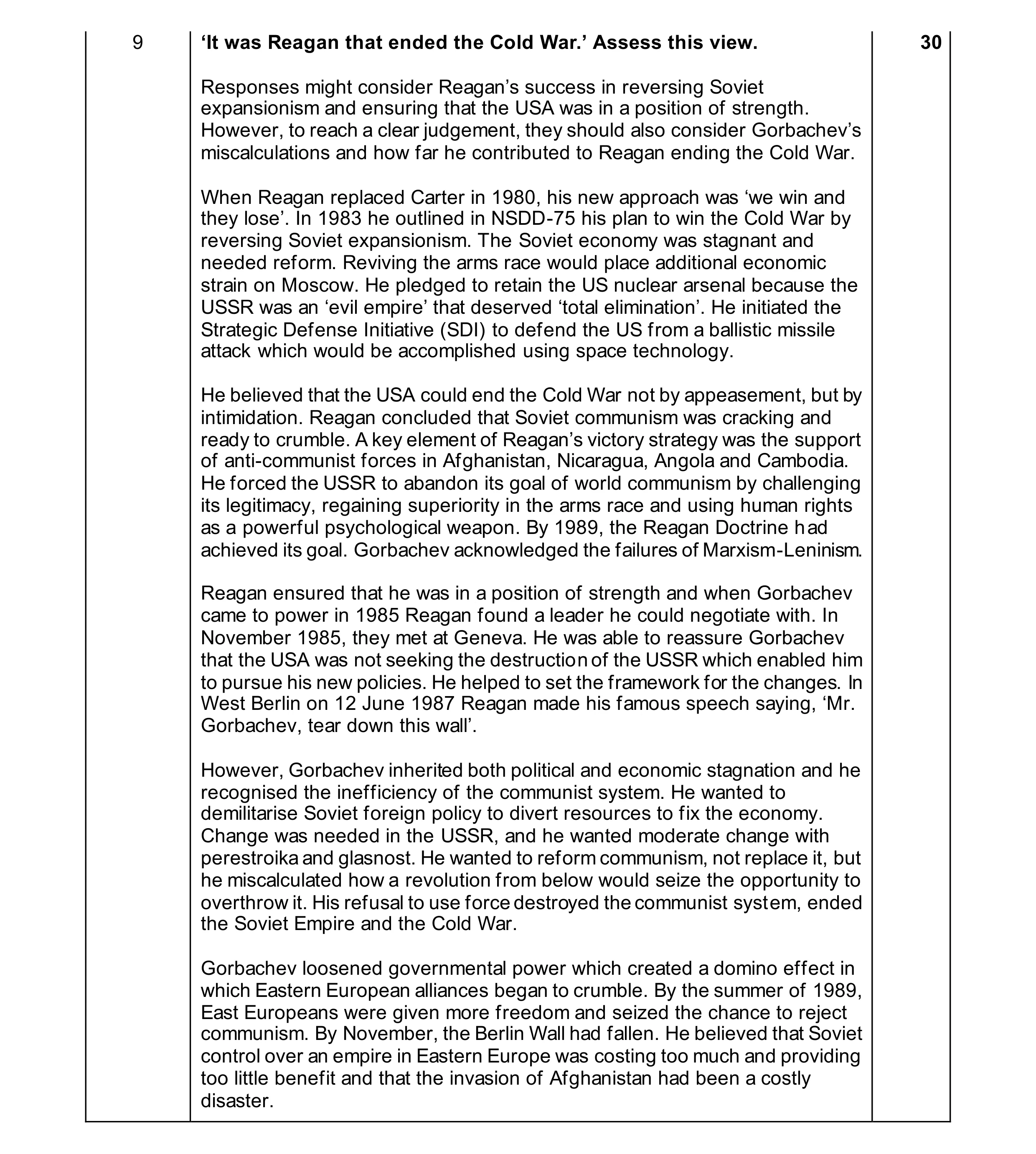 30
30