Cambridge A Level History 9489 — 2023 Oct/Nov Paper 4 · Variant 2
9489/42/O/N/23 · 12 questions · 60 marks · ≈68 min
The question paper and its mark scheme, free to read here and free to download. This is Cambridge’s own paper, exactly as it was sat.
Question paper4 pages
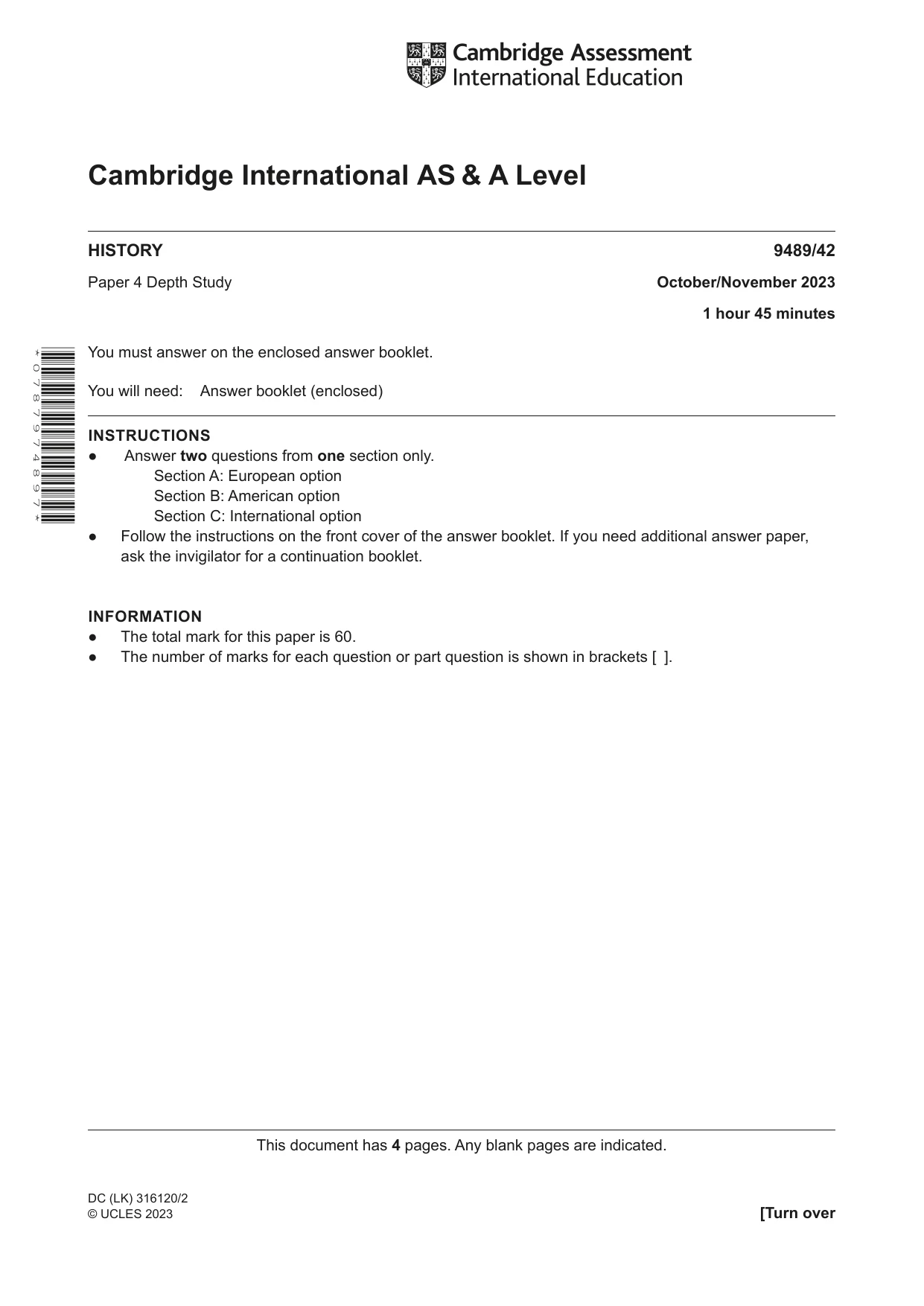
Mark scheme17 pages
Answers below. Sit the paper first if you are practising.

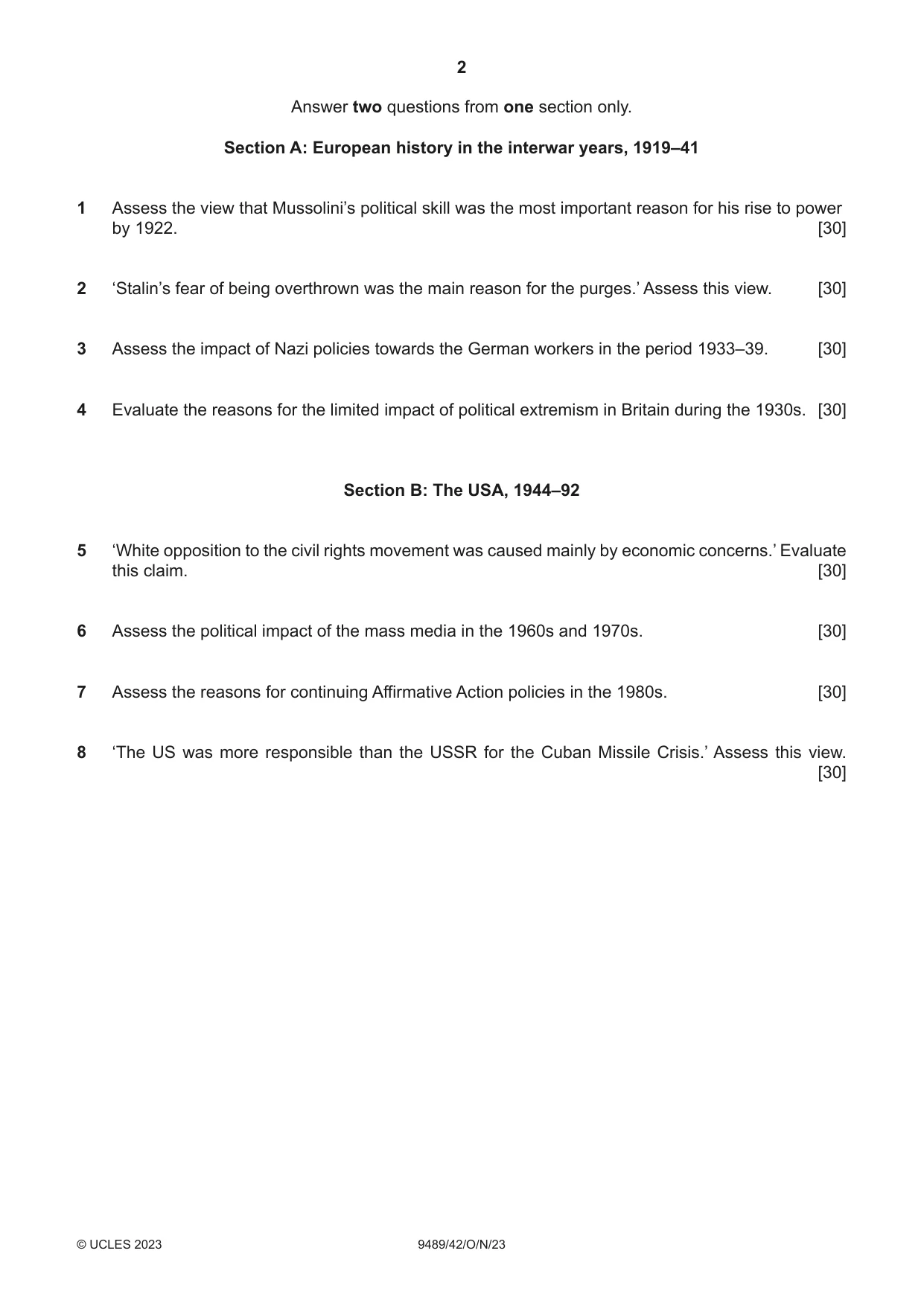
Questions as text
Q1 · Assess the view that Mussolini’s political skill was the most important reason for his…
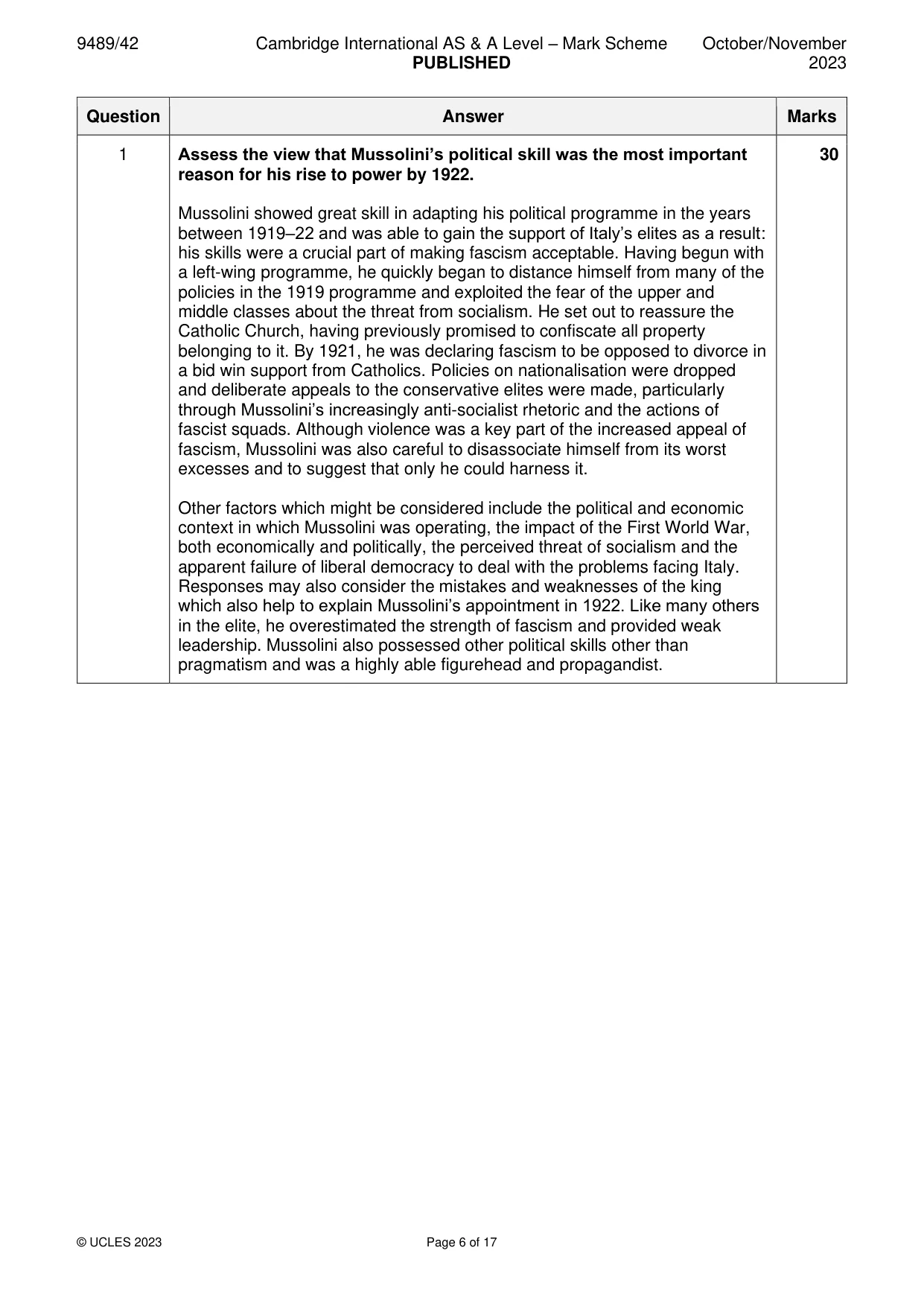
1 Assess the view that Mussolini’s political skill was the most important reason for his rise to power by 1922. [30]
Mark scheme: Question Answer Marks 1 Assess the view that Mussolini’s political skill was the most important 30 reason for his rise to power by 1922. Mussolini showed great skill in adapting his political programme in the years between 1919–22 and was able to gain the support of Italy’s elites as a result: his skills were a crucial part of making fascism acceptable. Having begun with a left-wing programme, he quickly began to distance himself from many of the policies in the 1919 programme and exploited the fear of the upper and middle classes about the threat from socialism. He set out to reassure the Catholic Church, having previously promised to confiscate all property belonging to it. By 1921, he was declaring fascism to be opposed to divorce in a bid win support from Catholics. Policies on nationalisation were dropped and deliberate appeals to the conservative elites were made, particularly through Mussolini’s increasingly anti-socialist rhetoric and the actions of fascist squads. Although violence was a key part of the increased appeal of fascism, Mussolini was also careful to disassociate himself from its worst excesses and to suggest that only he could harness it. Other factors which might be considered include the political and economic context in which Mussolini was operating, the impact of the First World War, both economically and politically, the perceived threat of socialism and the apparent failure of liberal democracy to deal with the problems facing Italy. Responses may also consider the mistakes and weaknesses of the king which also help to explain Mussolini’s appointment in 1922. Like many others in the elite, he overestimated the strength of fascism and provided weak leadership. Mussolini also possessed other political skills other than pragmatism and was a highly able figurehead and propagandist.
More questions on How did the rise of extremism affect international relations?
Q2 · ‘Stalin’s fear of being overthrown was the main reason for the purges.’ Assess this view
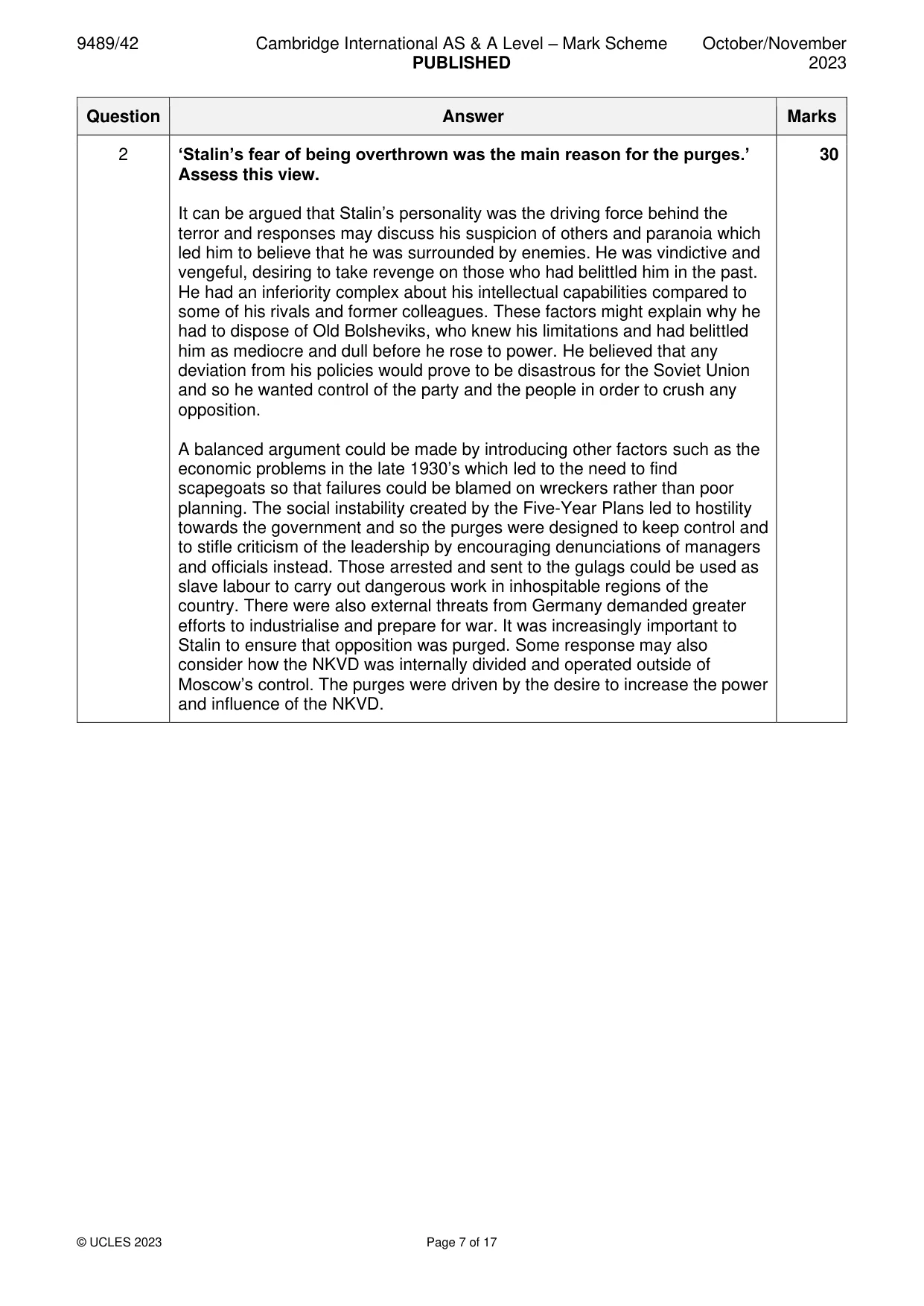
2 ‘Stalin’s fear of being overthrown was the main reason for the purges.’ Assess this view. [30]
Mark scheme: 2 ‘Stalin’s fear of being overthrown was the main reason for the purges.’ 30 Assess this view. It can be argued that Stalin’s personality was the driving force behind the terror and responses may discuss his suspicion of others and paranoia which led him to believe that he was surrounded by enemies. He was vindictive and vengeful, desiring to take revenge on those who had belittled him in the past. He had an inferiority complex about his intellectual capabilities compared to some of his rivals and former colleagues. These factors might explain why he had to dispose of Old Bolsheviks, who knew his limitations and had belittled him as mediocre and dull before he rose to power. He believed that any deviation from his policies would prove to be disastrous for the Soviet Union and so he wanted control of the party and the people in order to crush any opposition. A balanced argument could be made by introducing other factors such as the economic problems in the late 1930’s which led to the need to find scapegoats so that failures could be blamed on wreckers rather than poor planning. The social instability created by the Five-Year Plans led to hostility towards the government and so the purges were designed to keep control and to stifle criticism of the leadership by encouraging denunciations of managers and officials instead. Those arrested and sent to the gulags could be used as slave labour to carry out dangerous work in inhospitable regions of the country. There were also external threats from Germany demanded greater efforts to industrialise and prepare for war. It was increasingly important to Stalin to ensure that opposition was purged. Some response may also consider how the NKVD was internally divided and operated outside of Moscow’s control. The purges were driven by the desire to increase the power and influence of the NKVD.
More questions on How were the Bolsheviks able to consolidate their power up to 1924?
Q3 · Assess the impact of Nazi policies towards the German workers in the period 1933–39
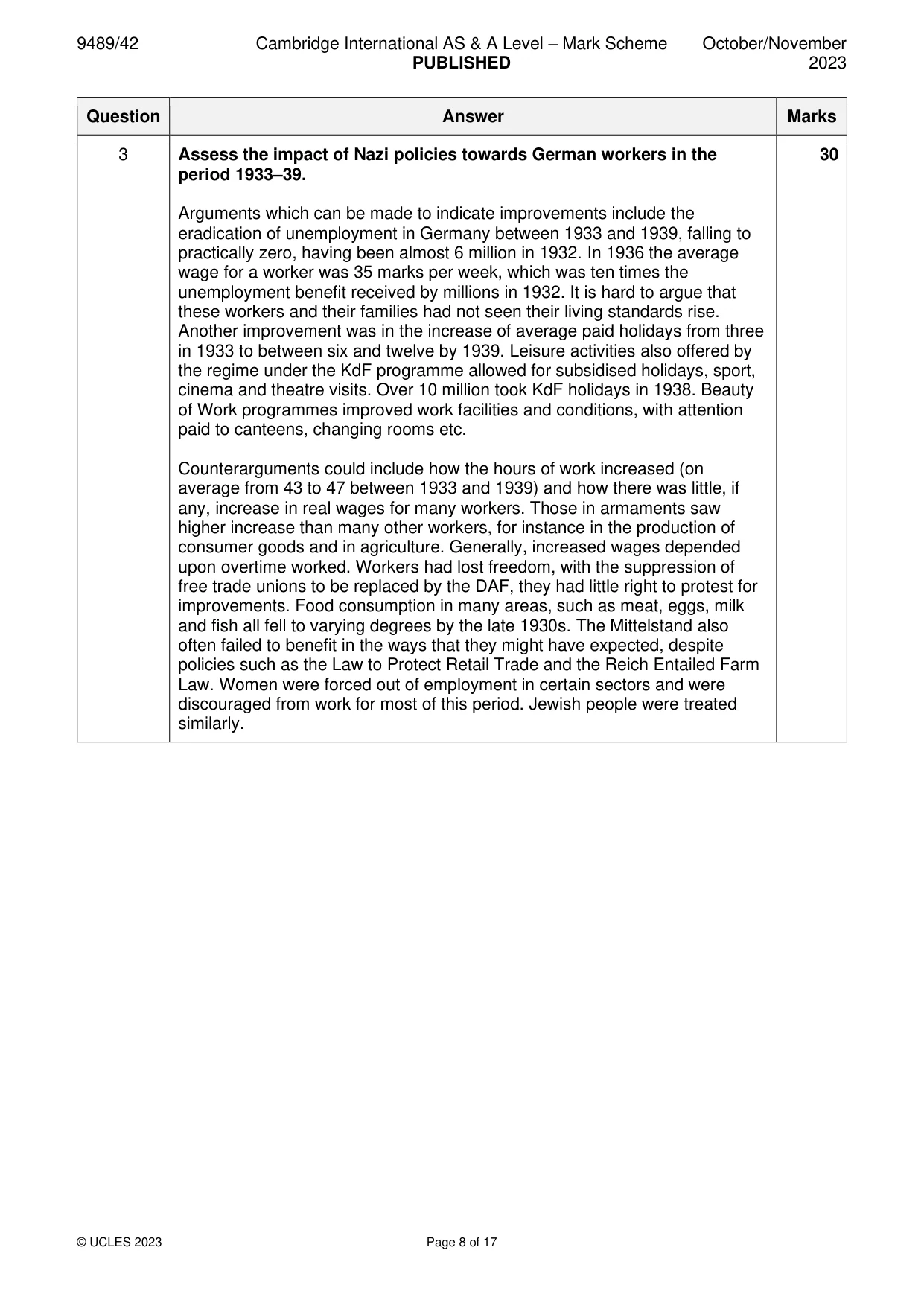
3 Assess the impact of Nazi policies towards the German workers in the period 1933–39. [30]
Mark scheme: 3 Assess the impact of Nazi policies towards German workers in the 30 period 1933–39. Arguments which can be made to indicate improvements include the eradication of unemployment in Germany between 1933 and 1939, falling to practically zero, having been almost 6 million in 1932. In 1936 the average wage for a worker was 35 marks per week, which was ten times the unemployment benefit received by millions in 1932. It is hard to argue that these workers and their families had not seen their living standards rise. Another improvement was in the increase of average paid holidays from three in 1933 to between six and twelve by 1939. Leisure activities also offered by the regime under the KdF programme allowed for subsidised holidays, sport, cinema and theatre visits. Over 10 million took KdF holidays in 1938. Beauty of Work programmes improved work facilities and conditions, with attention paid to canteens, changing rooms etc. Counterarguments could include how the hours of work increased (on average from 43 to 47 between 1933 and 1939) and how there was little, if any, increase in real wages for many workers. Those in armaments saw higher increase than many other workers, for instance in the production of consumer goods and in agriculture. Generally, increased wages depended upon overtime worked. Workers had lost freedom, with the suppression of free trade unions to be replaced by the DAF, they had little right to protest for improvements. Food consumption in many areas, such as meat, eggs, milk and fish all fell to varying degrees by the late 1930s. The Mittelstand also often failed to benefit in the ways that they might have expected, despite policies such as the Law to Protect Retail Trade and the Reich Entailed Farm Law. Women were forced out of employment in certain sectors and were discouraged from work for most of this period. Jewish people were treated similarly.
More questions on How did the rise of extremism affect international relations?
Q4 · Evaluate the reasons for the limited impact of political extremism in Britain during the…
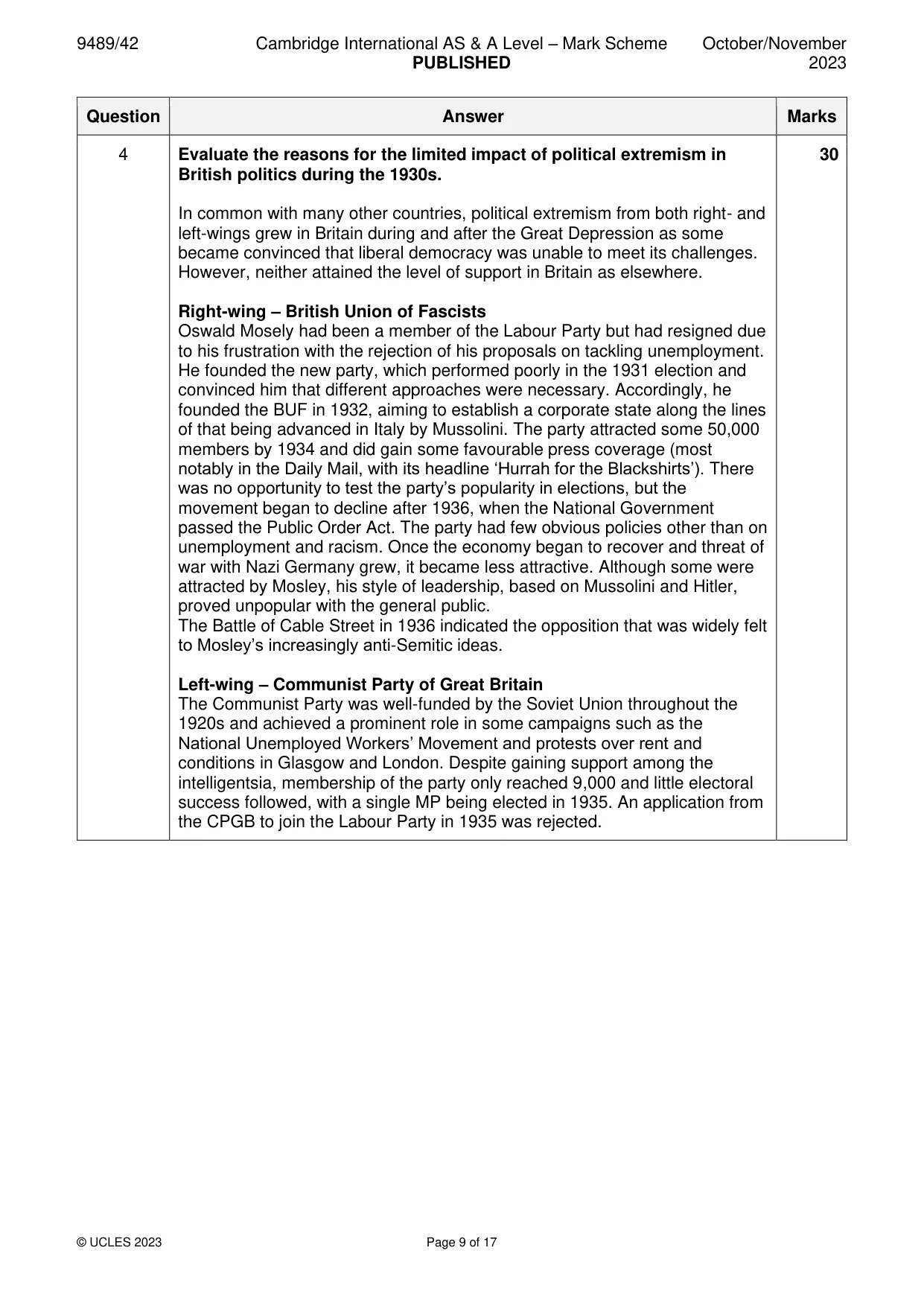
4 Evaluate the reasons for the limited impact of political extremism in Britain during the 1930s. [30]
Mark scheme: 4 Evaluate the reasons for the limited impact of political extremism in 30 British politics during the 1930s. In common with many other countries, political extremism from both right- and left-wings grew in Britain during and after the Great Depression as some became convinced that liberal democracy was unable to meet its challenges. However, neither attained the level of support in Britain as elsewhere. Right-wing – British Union of Fascists Oswald Mosely had been a member of the Labour Party but had resigned due to his frustration with the rejection of his proposals on tackling unemployment. He founded the new party, which performed poorly in the 1931 election and convinced him that different approaches were necessary. Accordingly, he founded the BUF in 1932, aiming to establish a corporate state along the lines of that being advanced in Italy by Mussolini. The party attracted some 50,000 members by 1934 and did gain some favourable press coverage (most notably in the Daily Mail, with its headline ‘Hurrah for the Blackshirts’). There was no opportunity to test the party’s popularity in elections, but the movement began to decline after 1936, when the National Government passed the Public Order Act. The party had few obvious policies other than on unemployment and racism. Once the economy began to recover and threat of war with Nazi Germany grew, it became less attractive. Although some were attracted by Mosley, his style of leadership, based on Mussolini and Hitler, proved unpopular with the general public. The Battle of Cable Street in 1936 indicated the opposition that was widely felt to Mosley’s increasingly anti-Semitic ideas. Left-wing – Communist Party of Great Britain The Communist Party was well-funded by the Soviet Union throughout the 1920s and achieved a prominent role in some campaigns such as the National Unemployed Workers’ Movement and protests over rent and conditions in Glasgow and London. Despite gaining support among the intelligentsia, membership of the party only reached 9,000 and little electoral success followed, with a single MP being elected in 1935. An application from the CPGB to join the Labour Party in 1935 was rejected.
More questions on How did the rise of extremism affect international relations?
Q5 · ‘White opposition to the civil rights movement was caused mainly by economic concerns.’…
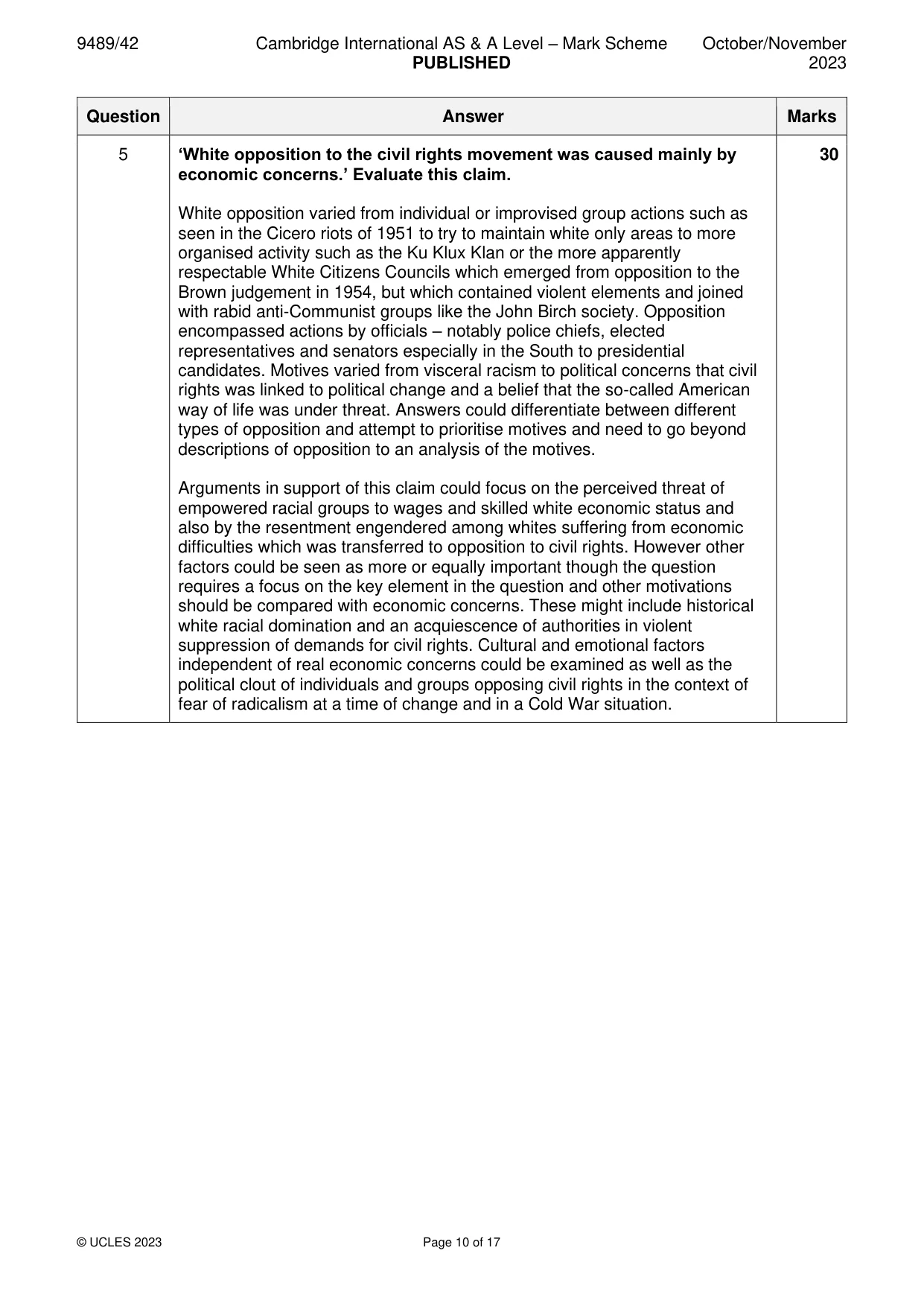
5 ‘White opposition to the civil rights movement was caused mainly by economic concerns.’ Evaluate this claim. [30]
Mark scheme: 5 ‘White opposition to the civil rights movement was caused mainly by 30 economic concerns.’ Evaluate this claim. White opposition varied from individual or improvised group actions such as seen in the Cicero riots of 1951 to try to maintain white only areas to more organised activity such as the Ku Klux Klan or the more apparently respectable White Citizens Councils which emerged from opposition to the Brown judgement in 1954, but which contained violent elements and joined with rabid anti-Communist groups like the John Birch society. Opposition encompassed actions by officials – notably police chiefs, elected representatives and senators especially in the South to presidential candidates. Motives varied from visceral racism to political concerns that civil rights was linked to political change and a belief that the so-called American way of life was under threat. Answers could differentiate between different types of opposition and attempt to prioritise motives and need to go beyond descriptions of opposition to an analysis of the motives. Arguments in support of this claim could focus on the perceived threat of empowered racial groups to wages and skilled white economic status and also by the resentment engendered among whites suffering from economic difficulties which was transferred to opposition to civil rights. However other factors could be seen as more or equally important though the question requires a focus on the key element in the question and other motivations should be compared with economic concerns. These might include historical white racial domination and an acquiescence of authorities in violent suppression of demands for civil rights. Cultural and emotional factors independent of real economic concerns could be examined as well as the political clout of individuals and groups opposing civil rights in the context of fear of radicalism at a time of change and in a Cold War situation.
More questions on How successful was the Progressive Movement from 1890 to 1920?
Q6 · Assess the political impact of the mass media in the 1960s and 1970s
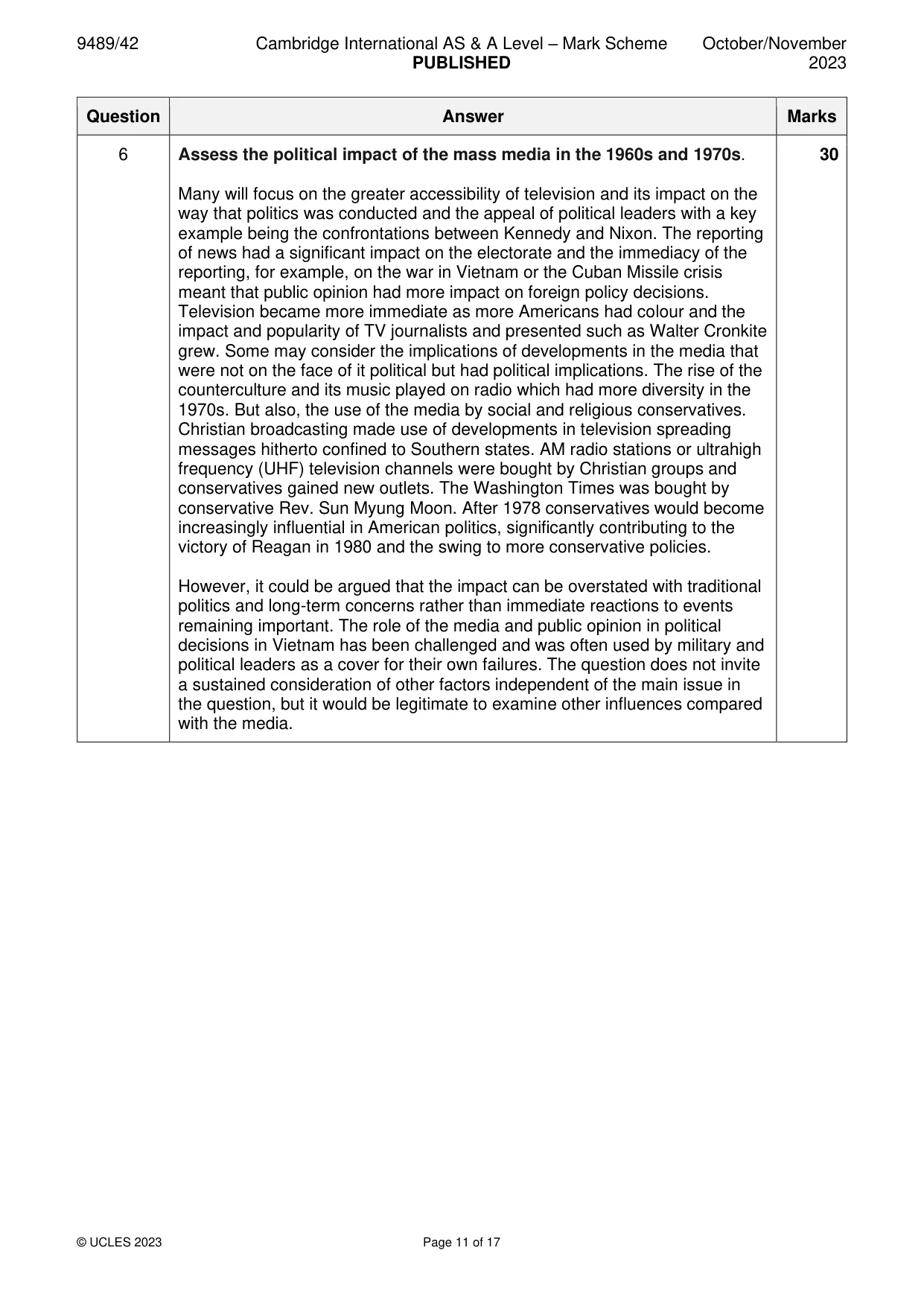
6 Assess the political impact of the mass media in the 1960s and 1970s. [30]
Mark scheme: 6 Assess the political impact of the mass media in the 1960s and 1970s. 30 Many will focus on the greater accessibility of television and its impact on the way that politics was conducted and the appeal of political leaders with a key example being the confrontations between Kennedy and Nixon. The reporting of news had a significant impact on the electorate and the immediacy of the reporting, for example, on the war in Vietnam or the Cuban Missile crisis meant that public opinion had more impact on foreign policy decisions. Television became more immediate as more Americans had colour and the impact and popularity of TV journalists and presented such as Walter Cronkite grew. Some may consider the implications of developments in the media that were not on the face of it political but had political implications. The rise of the counterculture and its music played on radio which had more diversity in the 1970s. But also, the use of the media by social and religious conservatives. Christian broadcasting made use of developments in television spreading messages hitherto confined to Southern states. AM radio stations or ultrahigh frequency (UHF) television channels were bought by Christian groups and conservatives gained new outlets. The Washington Times was bought by conservative Rev. Sun Myung Moon. After 1978 conservatives would become increasingly influential in American politics, significantly contributing to the victory of Reagan in 1980 and the swing to more conservative policies. However, it could be argued that the impact can be overstated with traditional politics and long-term concerns rather than immediate reactions to events remaining important. The role of the media and public opinion in political decisions in Vietnam has been challenged and was often used by military and political leaders as a cover for their own failures. The question does not invite a sustained consideration of other factors independent of the main issue in the question, but it would be legitimate to examine other influences compared with the media.
More questions on How successful was the Progressive Movement from 1890 to 1920?
Q7 · Assess the reasons for continuing Affirmative Action policies in the 1980s
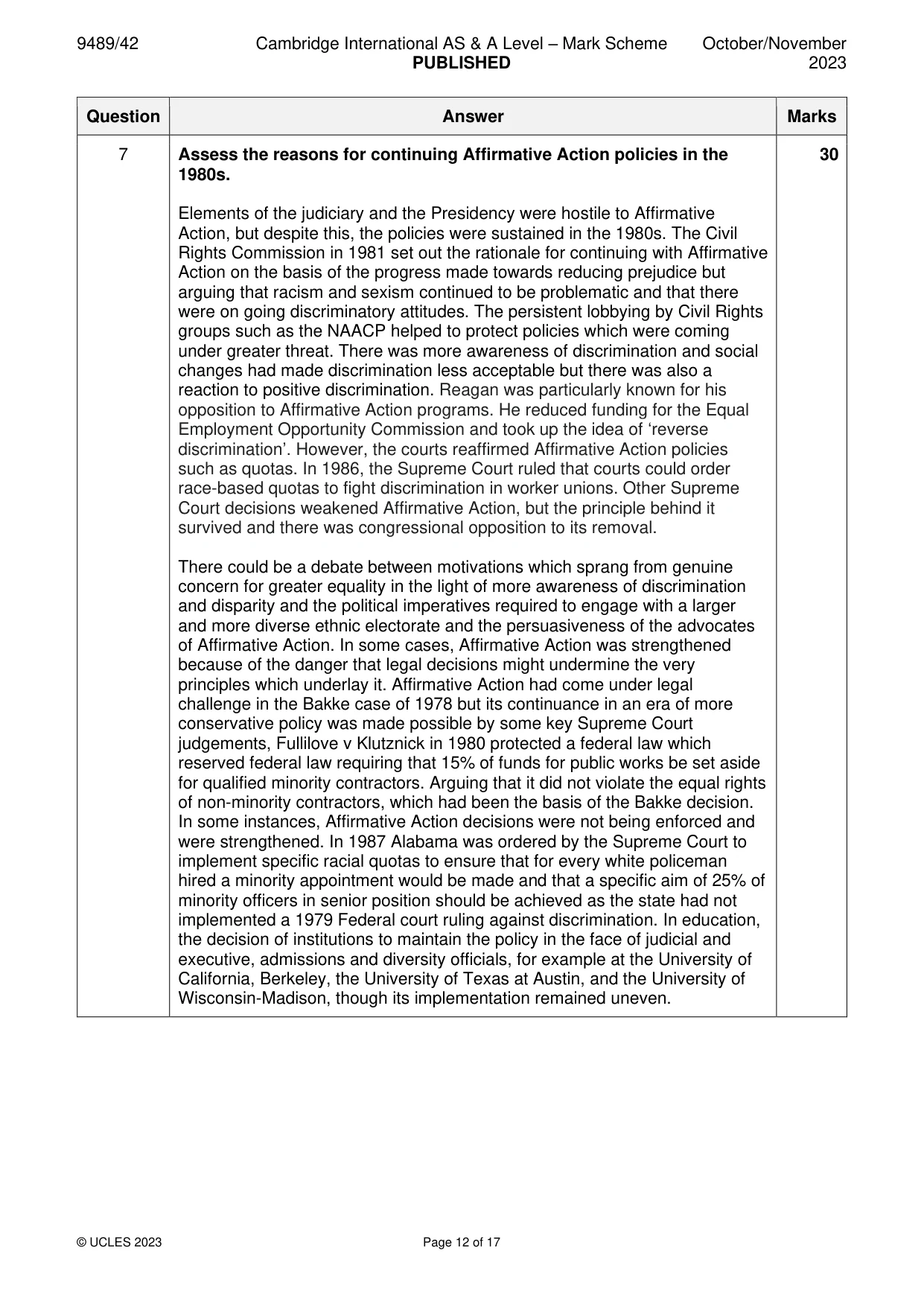
7 Assess the reasons for continuing Affirmative Action policies in the 1980s. [30]
Mark scheme: 7 Assess the reasons for continuing Affirmative Action policies in the 30 1980s. Elements of the judiciary and the Presidency were hostile to Affirmative Action, but despite this, the policies were sustained in the 1980s. The Civil Rights Commission in 1981 set out the rationale for continuing with Affirmative Action on the basis of the progress made towards reducing prejudice but arguing that racism and sexism continued to be problematic and that there were on going discriminatory attitudes. The persistent lobbying by Civil Rights groups such as the NAACP helped to protect policies which were coming under greater threat. There was more awareness of discrimination and social changes had made discrimination less acceptable but there was also a reaction to positive discrimination. Reagan was particularly known for his opposition to Affirmative Action programs. He reduced funding for the Equal Employment Opportunity Commission and took up the idea of ‘reverse discrimination’. However, the courts reaffirmed Affirmative Action policies such as quotas. In 1986, the Supreme Court ruled that courts could order race-based quotas to fight discrimination in worker unions. Other Supreme Court decisions weakened Affirmative Action, but the principle behind it survived and there was congressional opposition to its removal. There could be a debate between motivations which sprang from genuine concern for greater equality in the light of more awareness of discrimination and disparity and the political imperatives required to engage with a larger and more diverse ethnic electorate and the persuasiveness of the advocates of Affirmative Action. In some cases, Affirmative Action was strengthened because of the danger that legal decisions might undermine the very principles which underlay it. Affirmative Action had come under legal challenge in the Bakke case of 1978 but its continuance in an era of more conservative policy was made possible by some key Supreme Court judgements, Fullilove v Klutznick in 1980 protected a federal law which reserved federal law requiring that 15% of funds for public works be set aside for qualified minority contractors. Arguing that it did not violate the equal rights of non-minority contractors, which had been the basis of the Bakke decision. In some instances, Affirmative Action decisions were not being enforced and were strengthened. In 1987 Alabama was ordered by the Supreme Court to implement specific racial quotas to ensure that for every white policeman hired a minority appointment would be made and that a specific aim of 25% of minority officers in senior position should be achieved as the state had not implemented a 1979 Federal court ruling against discrimination. In education, the decision of institutions to maintain the policy in the face of judicial and executive, admissions and diversity officials, for example at the University of California, Berkeley, the University of Texas at Austin, and the University of Wisconsin-Madison, though its implementation remained uneven.
More questions on How successful was the Progressive Movement from 1890 to 1920?
Q8 · ‘The US was more responsible than the USSR for the Cuban Missile Crisis.’ Assess this view
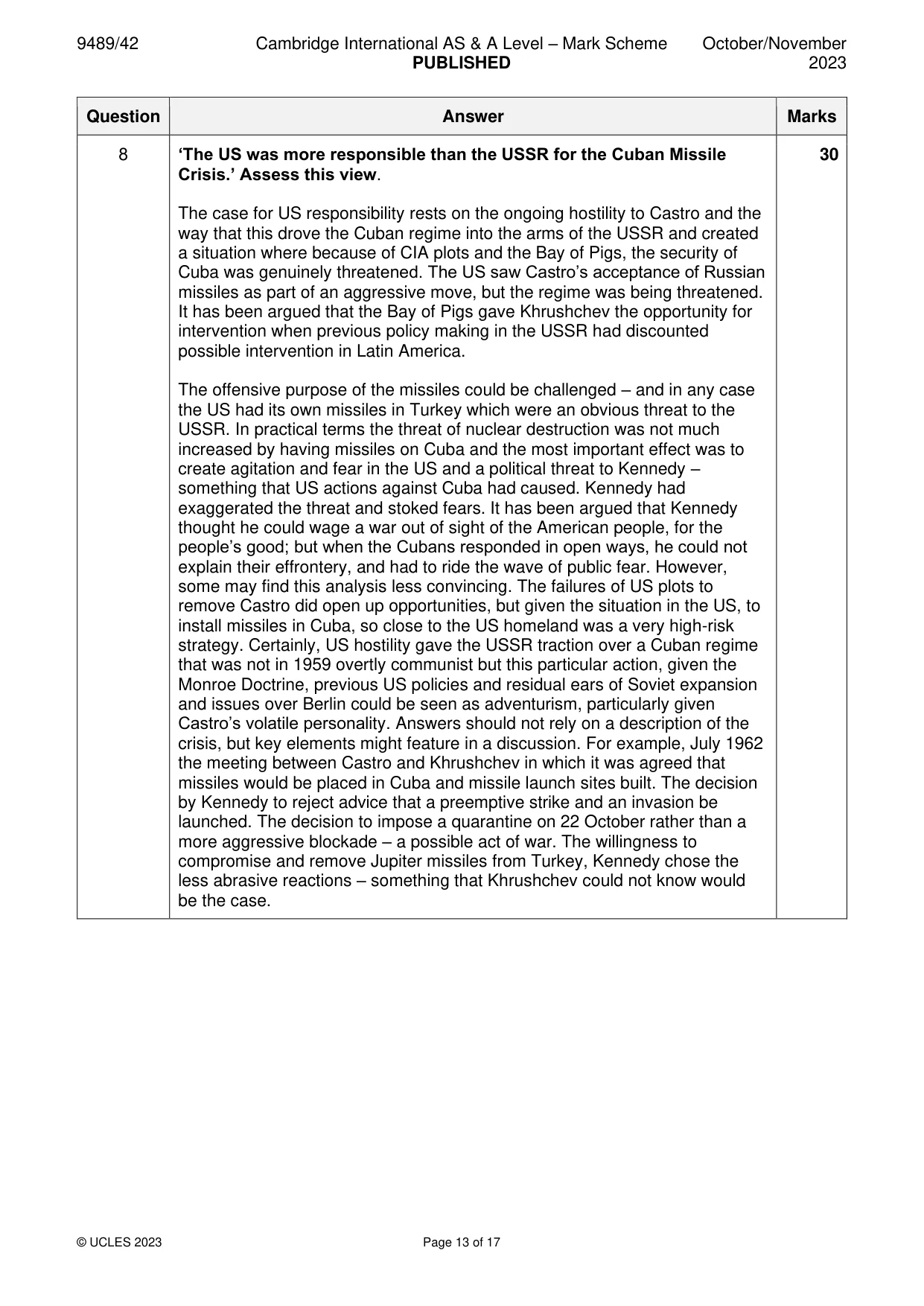
8 ‘The US was more responsible than the USSR for the Cuban Missile Crisis.’ Assess this view. [30] Section C: International history, 1945–92
Mark scheme: 8 ‘The US was more responsible than the USSR for the Cuban Missile 30 Crisis.’ Assess this view. The case for US responsibility rests on the ongoing hostility to Castro and the way that this drove the Cuban regime into the arms of the USSR and created a situation where because of CIA plots and the Bay of Pigs, the security of Cuba was genuinely threatened. The US saw Castro’s acceptance of Russian missiles as part of an aggressive move, but the regime was being threatened. It has been argued that the Bay of Pigs gave Khrushchev the opportunity for intervention when previous policy making in the USSR had discounted possible intervention in Latin America. The offensive purpose of the missiles could be challenged – and in any case the US had its own missiles in Turkey which were an obvious threat to the USSR. In practical terms the threat of nuclear destruction was not much increased by having missiles on Cuba and the most important effect was to create agitation and fear in the US and a political threat to Kennedy – something that US actions against Cuba had caused. Kennedy had exaggerated the threat and stoked fears. It has been argued that Kennedy thought he could wage a war out of sight of the American people, for the people’s good; but when the Cubans responded in open ways, he could not explain their effrontery, and had to ride the wave of public fear. However, some may find this analysis less convincing. The failures of US plots to remove Castro did open up opportunities, but given the situation in the US, to install missiles in Cuba, so close to the US homeland was a very high-risk strategy. Certainly, US hostility gave the USSR traction over a Cuban regime that was not in 1959 overtly communist but this particular action, given the Monroe Doctrine, previous US policies and residual ears of Soviet expansion and issues over Berlin could be seen as adventurism, particularly given Castro’s volatile personality. Answers should not rely on a description of the crisis, but key elements might feature in a discussion. For example, July 1962 the meeting between Castro and Khrushchev in which it was agreed that missiles would be placed in Cuba and missile launch sites built. The decision by Kennedy to reject advice that a preemptive strike and an invasion be launched. The decision to impose a quarantine on 22 October rather than a more aggressive blockade – a possible act of war. The willingness to compromise and remove Jupiter missiles from Turkey, Kennedy chose the less abrasive reactions – something that Khrushchev could not know would be the case.
Q9 · ‘The USSR’s involvement in Afghanistan was the main reason for the collapse of the Soviet…
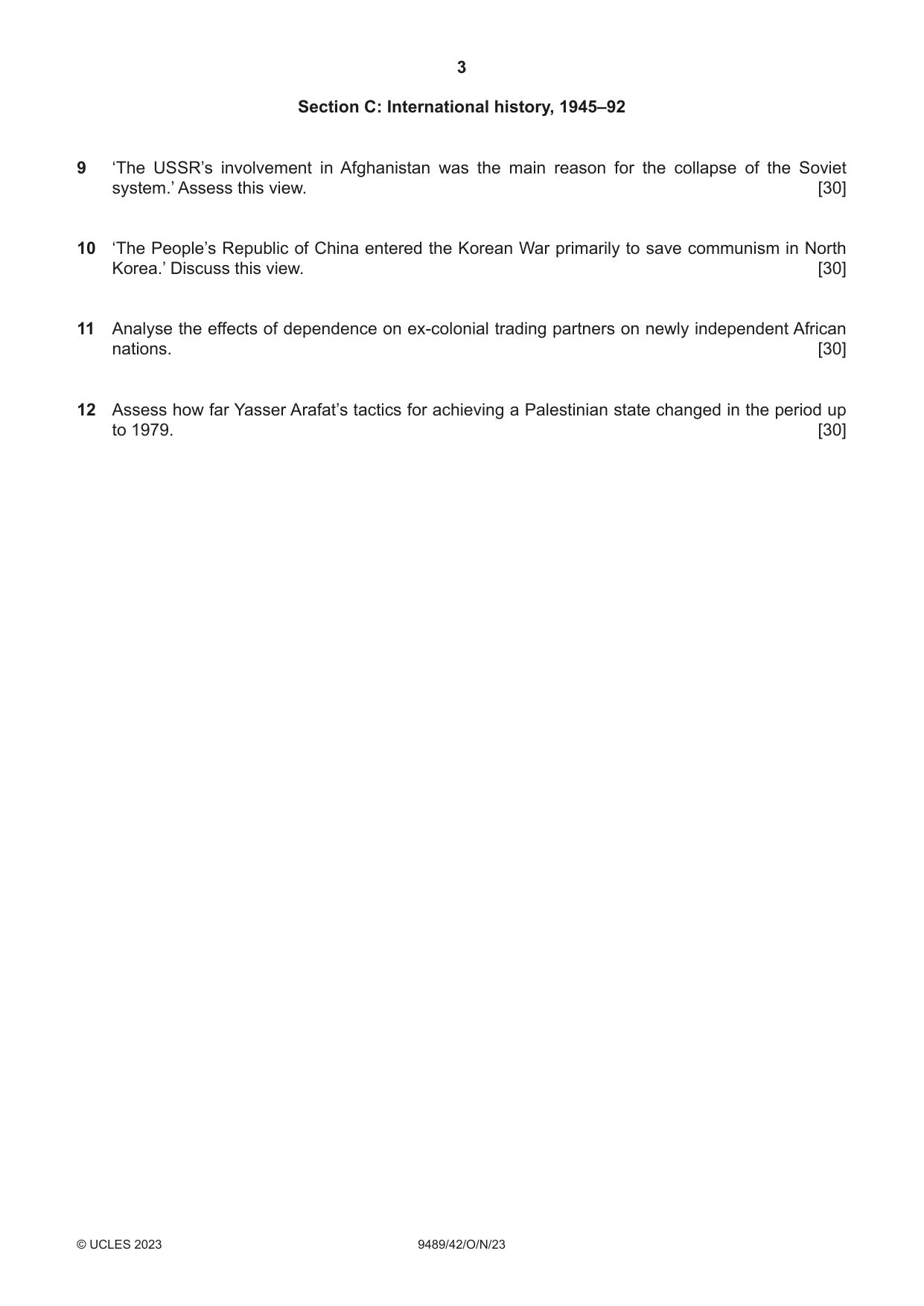
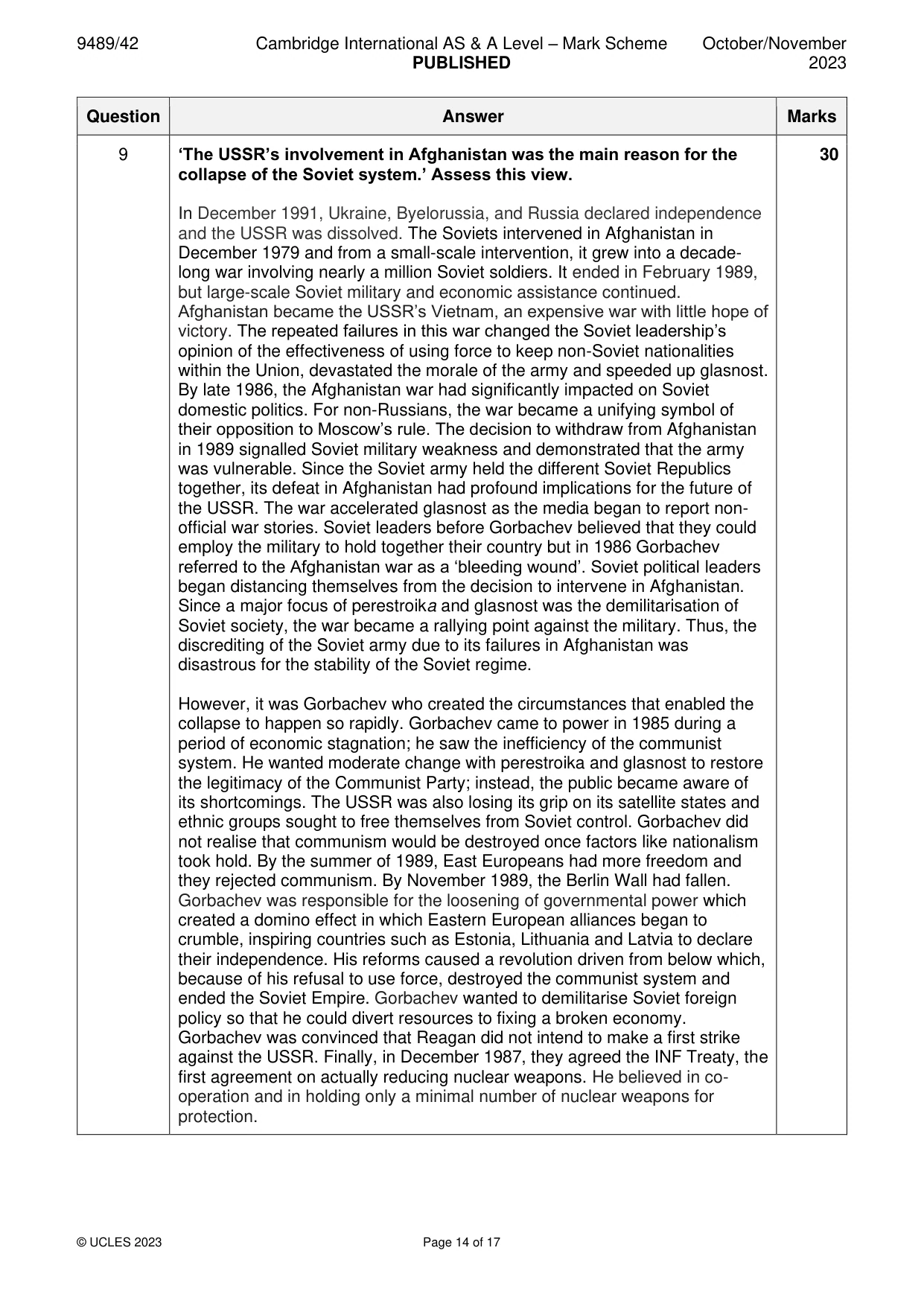
9 ‘The USSR’s involvement in Afghanistan was the main reason for the collapse of the Soviet system.’ Assess this view. [30]
Mark scheme: 9 ‘The USSR’s involvement in Afghanistan was the main reason for the 30 collapse of the Soviet system.’ Assess this view. In December 1991, Ukraine, Byelorussia, and Russia declared independence and the USSR was dissolved. The Soviets intervened in Afghanistan in December 1979 and from a small-scale intervention, it grew into a decade- long war involving nearly a million Soviet soldiers. It ended in February 1989, but large-scale Soviet military and economic assistance continued. Afghanistan became the USSR’s Vietnam, an expensive war with little hope of victory. The repeated failures in this war changed the Soviet leadership’s opinion of the effectiveness of using force to keep non-Soviet nationalities within the Union, devastated the morale of the army and speeded up glasnost. By late 1986, the Afghanistan war had significantly impacted on Soviet domestic politics. For non-Russians, the war became a unifying symbol of their opposition to Moscow’s rule. The decision to withdraw from Afghanistan in 1989 signalled Soviet military weakness and demonstrated that the army was vulnerable. Since the Soviet army held the different Soviet Republics together, its defeat in Afghanistan had profound implications for the future of the USSR. The war accelerated glasnost as the media began to report non- official war stories. Soviet leaders before Gorbachev believed that they could employ the military to hold together their country but in 1986 Gorbachev referred to the Afghanistan war as a ‘bleeding wound’. Soviet political leaders began distancing themselves from the decision to intervene in Afghanistan. Since a major focus of perestroika and glasnost was the demilitarisation of Soviet society, the war became a rallying point against the military. Thus, the discrediting of the Soviet army due to its failures in Afghanistan was disastrous for the stability of the Soviet regime. However, it was Gorbachev who created the circumstances that enabled the collapse to happen so rapidly. Gorbachev came to power in 1985 during a period of economic stagnation; he saw the inefficiency of the communist system. He wanted moderate change with perestroika and glasnost to restore the legitimacy of the Communist Party; instead, the public became aware of its shortcomings. The USSR was also losing its grip on its satellite states and ethnic groups sought to free themselves from Soviet control. Gorbachev did not realise that communism would be destroyed once factors like nationalism took hold. By the summer of 1989, East Europeans had more freedom and they rejected communism. By November 1989, the Berlin Wall had fallen. Gorbachev was responsible for the loosening of governmental power which created a domino effect in which Eastern European alliances began to crumble, inspiring countries such as Estonia, Lithuania and Latvia to declare their independence. His reforms caused a revolution driven from below which, because of his refusal to use force, destroyed the communist system and ended the Soviet Empire. Gorbachev wanted to demilitarise Soviet foreign policy so that he could divert resources to fixing a broken economy. Gorbachev was convinced that Reagan did not intend to make a first strike against the USSR. Finally, in December 1987, they agreed the INF Treaty, the first agreement on actually reducing nuclear weapons. He believed in co- operation and in holding only a minimal number of nuclear weapons for protection.
More questions on How were the Bolsheviks able to consolidate their power up to 1924?
Q10 · ‘The People’s Republic of China entered the Korean War primarily to save communism in…
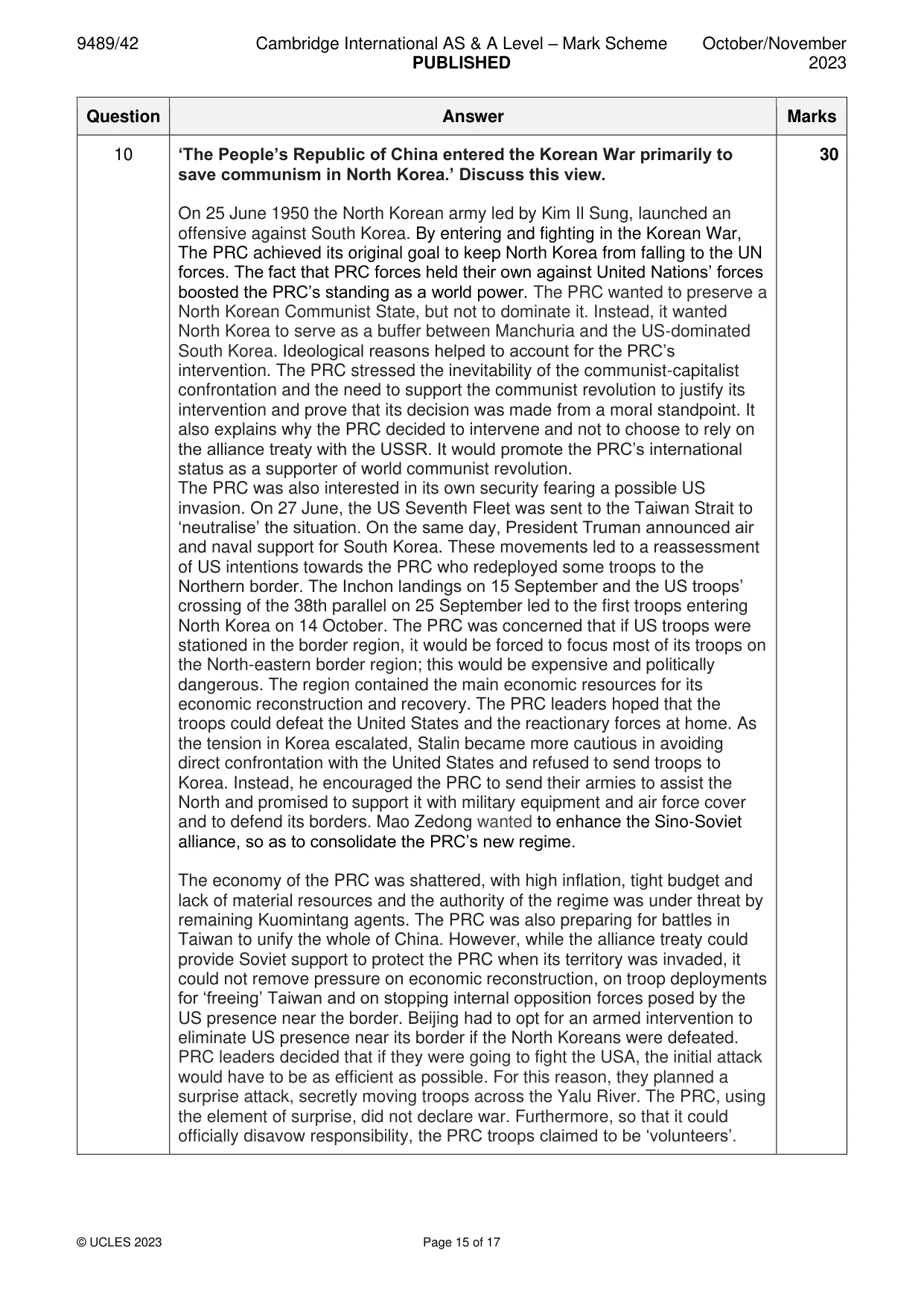
10 ‘The People’s Republic of China entered the Korean War primarily to save communism in North Korea.’ Discuss this view. [30]
Mark scheme: 10 ‘The People’s Republic of China entered the Korean War primarily to 30 save communism in North Korea.’ Discuss this view. On 25 June 1950 the North Korean army led by Kim Il Sung, launched an offensive against South Korea. By entering and fighting in the Korean War, The PRC achieved its original goal to keep North Korea from falling to the UN forces. The fact that PRC forces held their own against United Nations’ forces boosted the PRC’s standing as a world power. The PRC wanted to preserve a North Korean Communist State, but not to dominate it. Instead, it wanted North Korea to serve as a buffer between Manchuria and the US-dominated South Korea. Ideological reasons helped to account for the PRC’s intervention. The PRC stressed the inevitability of the communist-capitalist confrontation and the need to support the communist revolution to justify its intervention and prove that its decision was made from a moral standpoint. It also explains why the PRC decided to intervene and not to choose to rely on the alliance treaty with the USSR. It would promote the PRC’s international status as a supporter of world communist revolution. The PRC was also interested in its own security fearing a possible US invasion. On 27 June, the US Seventh Fleet was sent to the Taiwan Strait to ‘neutralise’ the situation. On the same day, President Truman announced air and naval support for South Korea. These movements led to a reassessment of US intentions towards the PRC who redeployed some troops to the Northern border. The Inchon landings on 15 September and the US troops’ crossing of the 38th parallel on 25 September led to the first troops entering North Korea on 14 October. The PRC was concerned that if US troops were stationed in the border region, it would be forced to focus most of its troops on the North-eastern border region; this would be expensive and politically dangerous. The region contained the main economic resources for its economic reconstruction and recovery. The PRC leaders hoped that the troops could defeat the United States and the reactionary forces at home. As the tension in Korea escalated, Stalin became more cautious in avoiding direct confrontation with the United States and refused to send troops to Korea. Instead, he encouraged the PRC to send their armies to assist the North and promised to support it with military equipment and air force cover and to defend its borders. Mao Zedong wanted to enhance the Sino-Soviet alliance, so as to consolidate the PRC’s new regime. The economy of the PRC was shattered, with high inflation, tight budget and lack of material resources and the authority of the regime was under threat by remaining Kuomintang agents. The PRC was also preparing for battles in Taiwan to unify the whole of China. However, while the alliance treaty could provide Soviet support to protect the PRC when its territory was invaded, it could not remove pressure on economic reconstruction, on troop deployments for ‘freeing’ Taiwan and on stopping internal opposition forces posed by the US presence near the border. Beijing had to opt for an armed intervention to eliminate US presence near its border if the North Koreans were defeated. PRC leaders decided that if they were going to fight the USA, the initial attack would have to be as efficient as possible. For this reason, they planned a surprise attack, secretly moving troops across the Yalu River. The PRC, using the element of surprise, did not declare war. Furthermore, so that it could officially disavow responsibility, the PRC troops claimed to be ‘volunteers’.
Q11 · Analyse the effects of dependence on ex-colonial trading partners on newly independent…
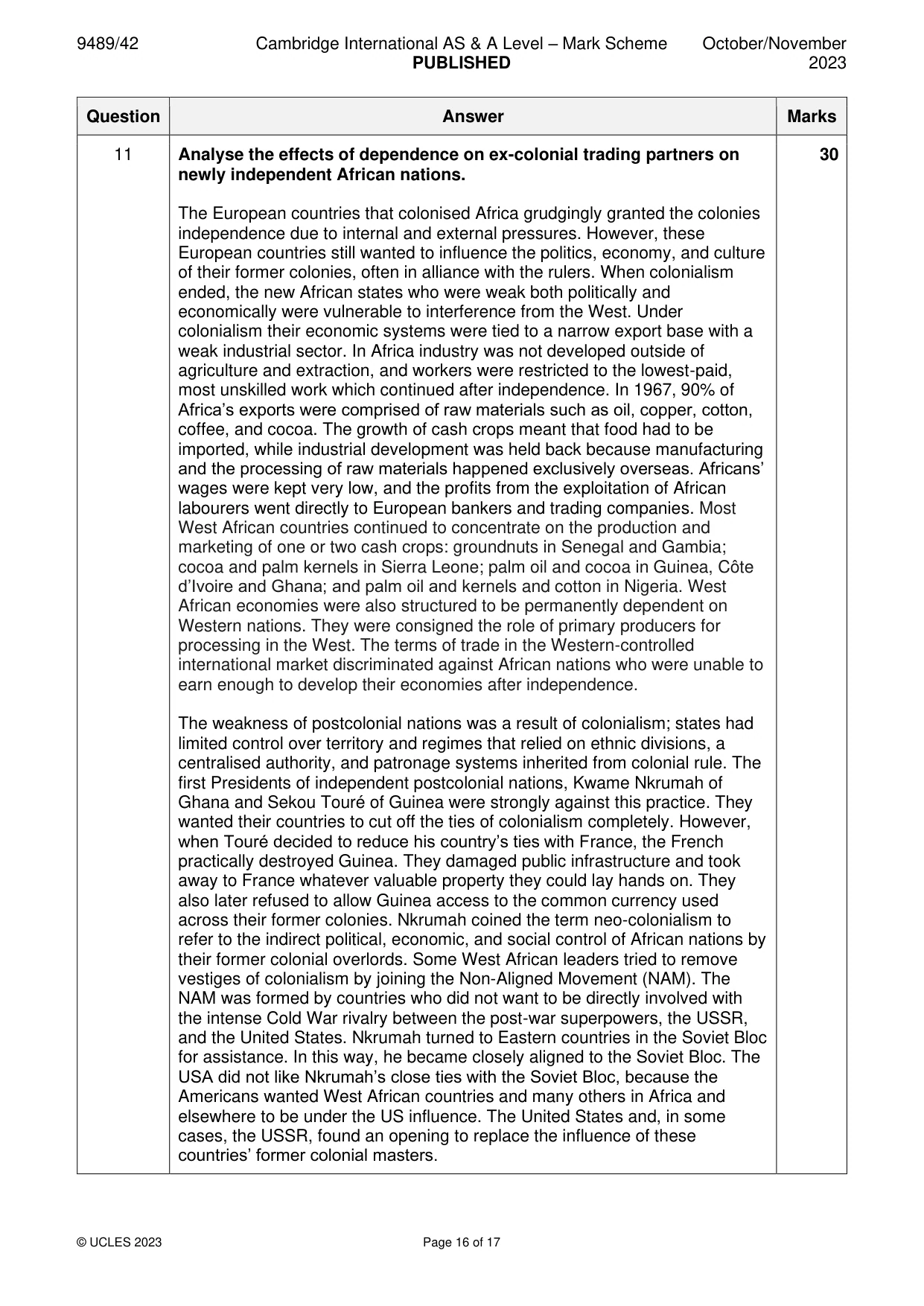
11 Analyse the effects of dependence on ex-colonial trading partners on newly independent African nations. [30]
Mark scheme: 11 Analyse the effects of dependence on ex-colonial trading partners on 30 newly independent African nations. The European countries that colonised Africa grudgingly granted the colonies independence due to internal and external pressures. However, these European countries still wanted to influence the politics, economy, and culture of their former colonies, often in alliance with the rulers. When colonialism ended, the new African states who were weak both politically and economically were vulnerable to interference from the West. Under colonialism their economic systems were tied to a narrow export base with a weak industrial sector. In Africa industry was not developed outside of agriculture and extraction, and workers were restricted to the lowest-paid, most unskilled work which continued after independence. In 1967, 90% of Africa’s exports were comprised of raw materials such as oil, copper, cotton, coffee, and cocoa. The growth of cash crops meant that food had to be imported, while industrial development was held back because manufacturing and the processing of raw materials happened exclusively overseas. Africans’ wages were kept very low, and the profits from the exploitation of African labourers went directly to European bankers and trading companies. Most West African countries continued to concentrate on the production and marketing of one or two cash crops: groundnuts in Senegal and Gambia; cocoa and palm kernels in Sierra Leone; palm oil and cocoa in Guinea, Côte d’Ivoire and Ghana; and palm oil and kernels and cotton in Nigeria. West African economies were also structured to be permanently dependent on Western nations. They were consigned the role of primary producers for processing in the West. The terms of trade in the Western-controlled international market discriminated against African nations who were unable to earn enough to develop their economies after independence. The weakness of postcolonial nations was a result of colonialism; states had limited control over territory and regimes that relied on ethnic divisions, a centralised authority, and patronage systems inherited from colonial rule. The first Presidents of independent postcolonial nations, Kwame Nkrumah of Ghana and Sekou Touré of Guinea were strongly against this practice. They wanted their countries to cut off the ties of colonialism completely. However, when Touré decided to reduce his country’s ties with France, the French practically destroyed Guinea. They damaged public infrastructure and took away to France whatever valuable property they could lay hands on. They also later refused to allow Guinea access to the common currency used across their former colonies. Nkrumah coined the term neo-colonialism to refer to the indirect political, economic, and social control of African nations by their former colonial overlords. Some West African leaders tried to remove vestiges of colonialism by joining the Non-Aligned Movement (NAM). The NAM was formed by countries who did not want to be directly involved with the intense Cold War rivalry between the post-war superpowers, the USSR, and the United States. Nkrumah turned to Eastern countries in the Soviet Bloc for assistance. In this way, he became closely aligned to the Soviet Bloc. The USA did not like Nkrumah’s close ties with the Soviet Bloc, because the Americans wanted West African countries and many others in Africa and elsewhere to be under the US influence. The United States and, in some cases, the USSR, found an opening to replace the influence of these countries’ former colonial masters.
More questions on Why was imperialism a significant force in Africa from 1870?
Q12 · Assess how far Yasser Arafat’s tactics for achieving a Palestinian state changed in the…
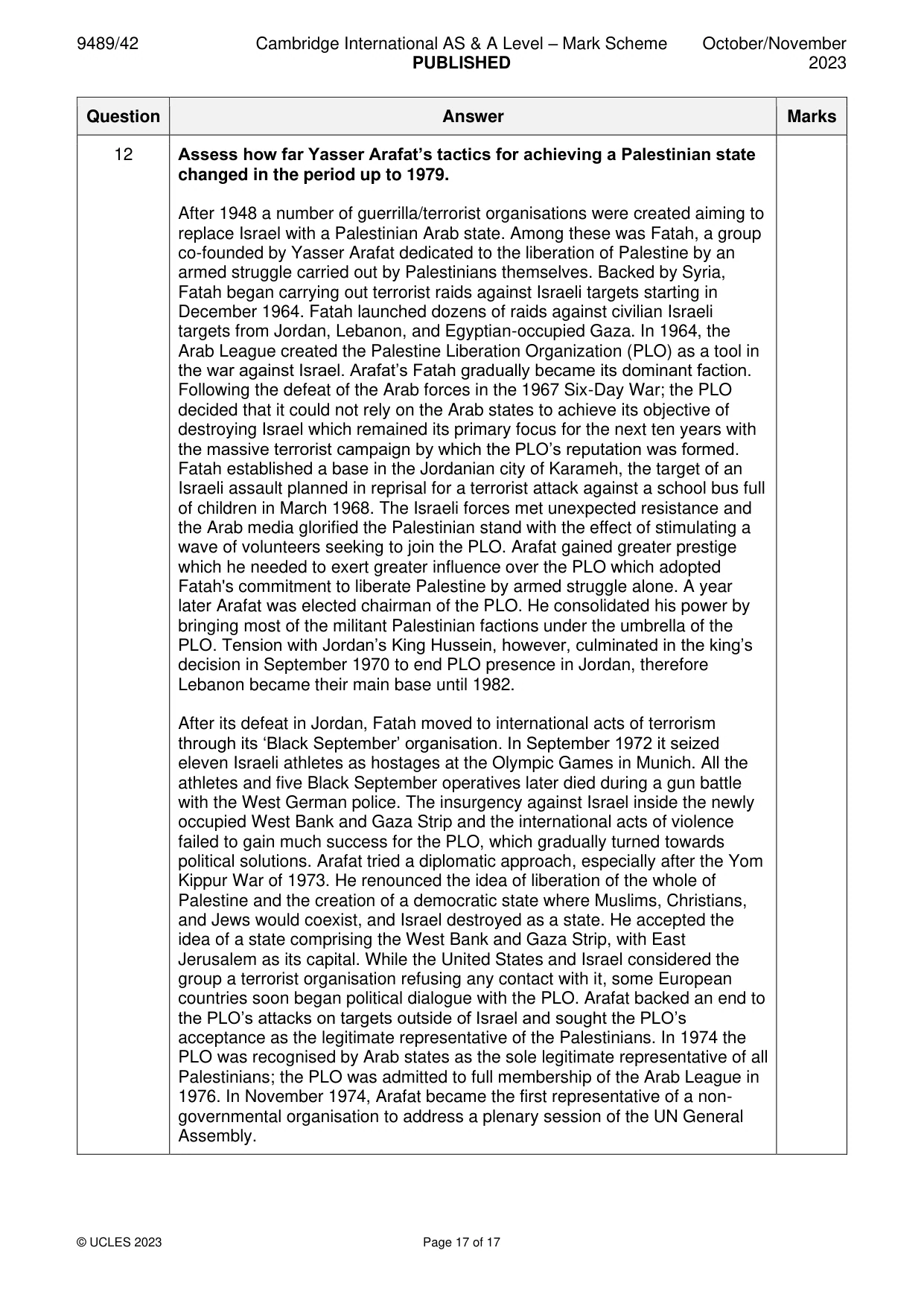
12 Assess how far Yasser Arafat’s tactics for achieving a Palestinian state changed in the period up to 1979. [30]
Mark scheme: 12 Assess how far Yasser Arafat’s tactics for achieving a Palestinian state changed in the period up to 1979. After 1948 a number of guerrilla/terrorist organisations were created aiming to replace Israel with a Palestinian Arab state. Among these was Fatah, a group co-founded by Yasser Arafat dedicated to the liberation of Palestine by an armed struggle carried out by Palestinians themselves. Backed by Syria, Fatah began carrying out terrorist raids against Israeli targets starting in December 1964. Fatah launched dozens of raids against civilian Israeli targets from Jordan, Lebanon, and Egyptian-occupied Gaza. In 1964, the Arab League created the Palestine Liberation Organization (PLO) as a tool in the war against Israel. Arafat’s Fatah gradually became its dominant faction. Following the defeat of the Arab forces in the 1967 Six-Day War; the PLO decided that it could not rely on the Arab states to achieve its objective of destroying Israel which remained its primary focus for the next ten years with the massive terrorist campaign by which the PLO’s reputation was formed. Fatah established a base in the Jordanian city of Karameh, the target of an Israeli assault planned in reprisal for a terrorist attack against a school bus full of children in March 1968. The Israeli forces met unexpected resistance and the Arab media glorified the Palestinian stand with the effect of stimulating a wave of volunteers seeking to join the PLO. Arafat gained greater prestige which he needed to exert greater influence over the PLO which adopted Fatah's commitment to liberate Palestine by armed struggle alone. A year later Arafat was elected chairman of the PLO. He consolidated his power by bringing most of the militant Palestinian factions under the umbrella of the PLO. Tension with Jordan’s King Hussein, however, culminated in the king’s decision in September 1970 to end PLO presence in Jordan, therefore Lebanon became their main base until 1982. After its defeat in Jordan, Fatah moved to international acts of terrorism through its ‘Black September’ organisation. In September 1972 it seized eleven Israeli athletes as hostages at the Olympic Games in Munich. All the athletes and five Black September operatives later died during a gun battle with the West German police. The insurgency against Israel inside the newly occupied West Bank and Gaza Strip and the international acts of violence failed to gain much success for the PLO, which gradually turned towards political solutions. Arafat tried a diplomatic approach, especially after the Yom Kippur War of 1973. He renounced the idea of liberation of the whole of Palestine and the creation of a democratic state where Muslims, Christians, and Jews would coexist, and Israel destroyed as a state. He accepted the idea of a state comprising the West Bank and Gaza Strip, with East Jerusalem as its capital. While the United States and Israel considered the group a terrorist organisation refusing any contact with it, some European countries soon began political dialogue with the PLO. Arafat backed an end to the PLO’s attacks on targets outside of Israel and sought the PLO’s acceptance as the legitimate representative of the Palestinians. In 1974 the PLO was recognised by Arab states as the sole legitimate representative of all Palestinians; the PLO was admitted to full membership of the Arab League in 1976. In November 1974, Arafat became the first representative of a non- governmental organisation to address a plenary session of the UN General Assembly.
More questions on How did the rise of extremism affect international relations?
What was in this paper
The subtopics covered by these 12 questions, and how many questions each got. Open one in a new tab to see every Cambridge question on it.
What you needed in this session
Cambridge’s own grade thresholds for 2023 Oct/Nov, Paper 4 · Variant 2. A higher threshold means an easier paper — the bar moves with how the cohort did.