Cambridge A Level History 9489 — 2024 Oct/Nov Paper 4 · Variant 2
9489/42/O/N/24 · 12 questions · 60 marks · ≈68 min
The question paper and its mark scheme, free to read here and free to download. This is Cambridge’s own paper, exactly as it was sat.
Question paper4 pages
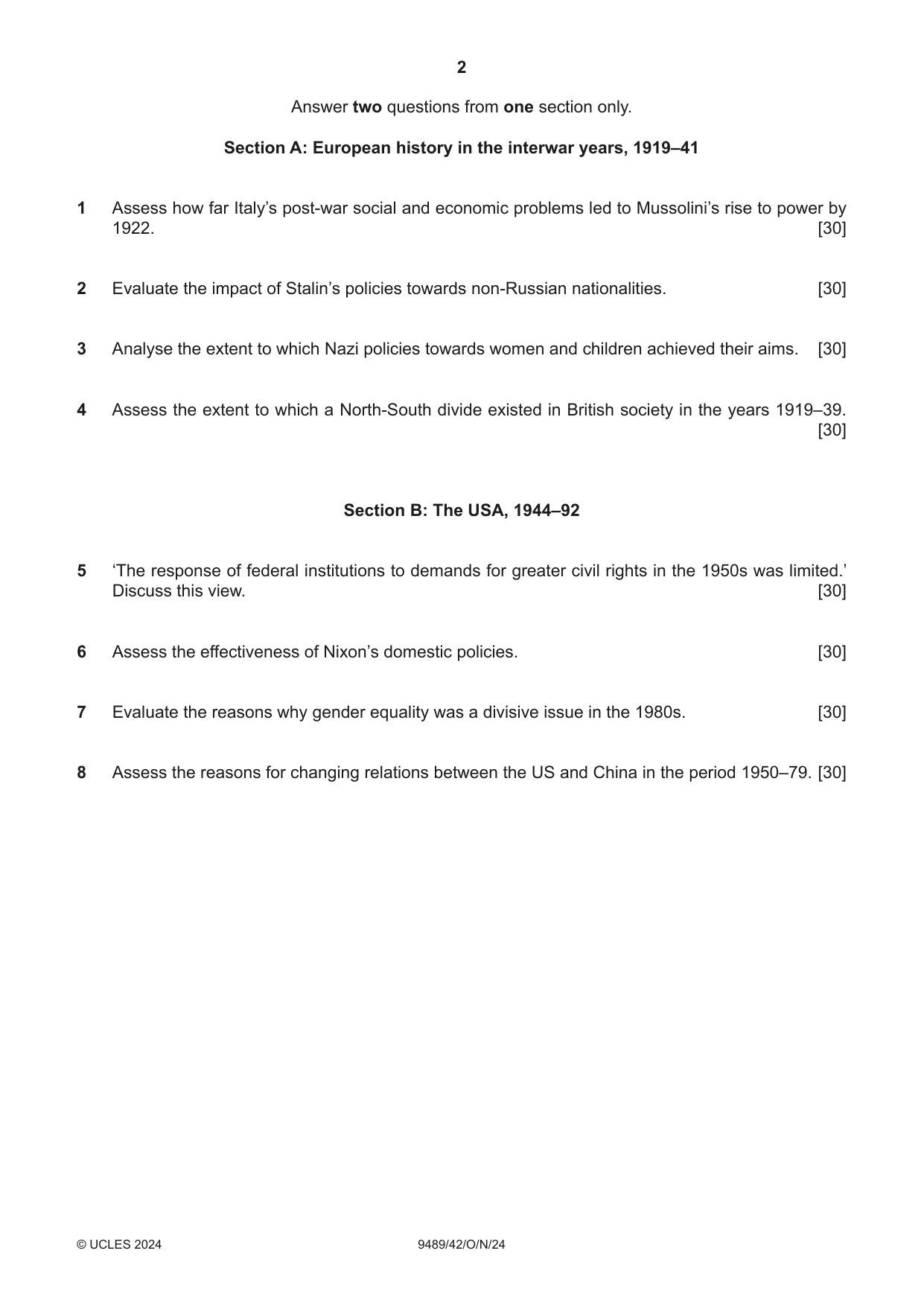
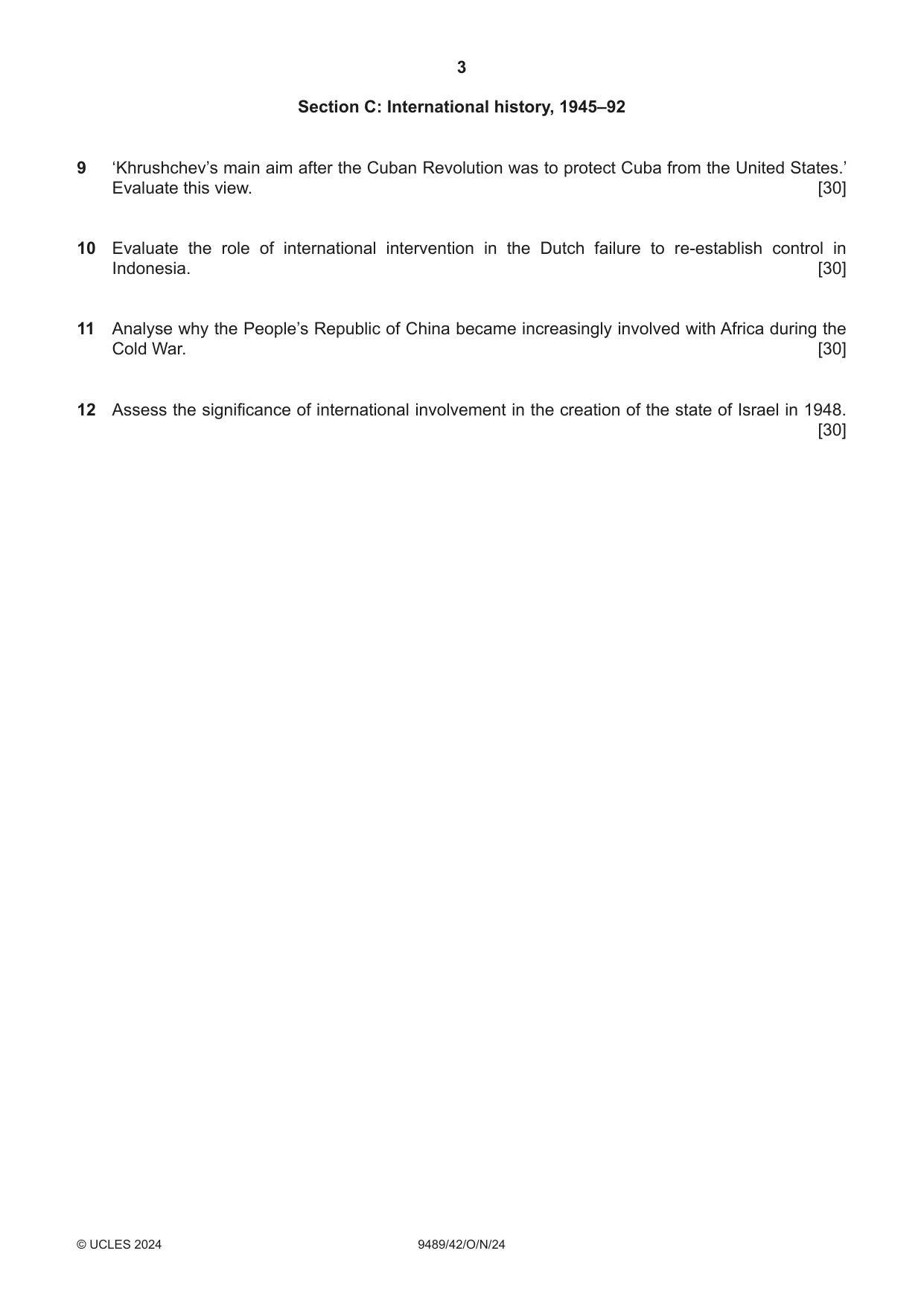
Mark scheme18 pages
Answers below. Sit the paper first if you are practising.

Questions as text
Q1 · Assess how far Italy’s post-war social and economic problems led to Mussolini’s rise to…
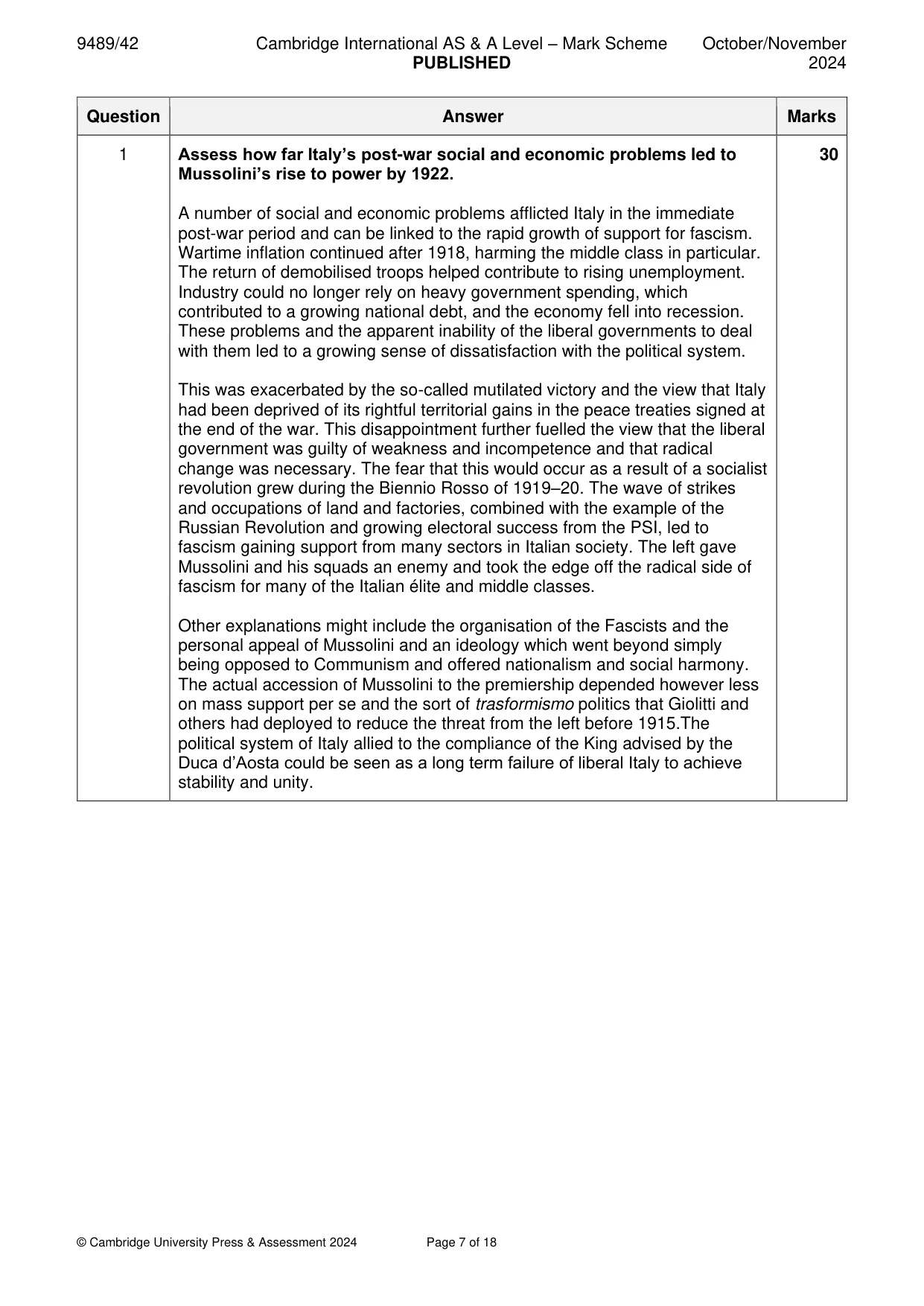
1 Assess how far Italy’s post-war social and economic problems led to Mussolini’s rise to power by 1922. [30]
Mark scheme: Question Answer Marks 1 Assess how far Italy’s post-war social and economic problems led to 30 Mussolini’s rise to power by 1922. A number of social and economic problems afflicted Italy in the immediate post-war period and can be linked to the rapid growth of support for fascism. Wartime inflation continued after 1918, harming the middle class in particular. The return of demobilised troops helped contribute to rising unemployment. Industry could no longer rely on heavy government spending, which contributed to a growing national debt, and the economy fell into recession. These problems and the apparent inability of the liberal governments to deal with them led to a growing sense of dissatisfaction with the political system. This was exacerbated by the so-called mutilated victory and the view that Italy had been deprived of its rightful territorial gains in the peace treaties signed at the end of the war. This disappointment further fuelled the view that the liberal government was guilty of weakness and incompetence and that radical change was necessary. The fear that this would occur as a result of a socialist revolution grew during the Biennio Rosso of 1919–20. The wave of strikes and occupations of land and factories, combined with the example of the Russian Revolution and growing electoral success from the PSI, led to fascism gaining support from many sectors in Italian society. The left gave Mussolini and his squads an enemy and took the edge off the radical side of fascism for many of the Italian élite and middle classes. Other explanations might include the organisation of the Fascists and the personal appeal of Mussolini and an ideology which went beyond simply being opposed to Communism and offered nationalism and social harmony. The actual accession of Mussolini to the premiership depended however less on mass support per se and the sort of trasformismo politics that Giolitti and others had deployed to reduce the threat from the left before 1915.The political system of Italy allied to the compliance of the King advised by the Duca d’Aosta could be seen as a long term failure of liberal Italy to achieve stability and unity.
More questions on How did the rise of extremism affect international relations?
Q2 · Evaluate the impact of Stalin’s policies towards non-Russian nationalities
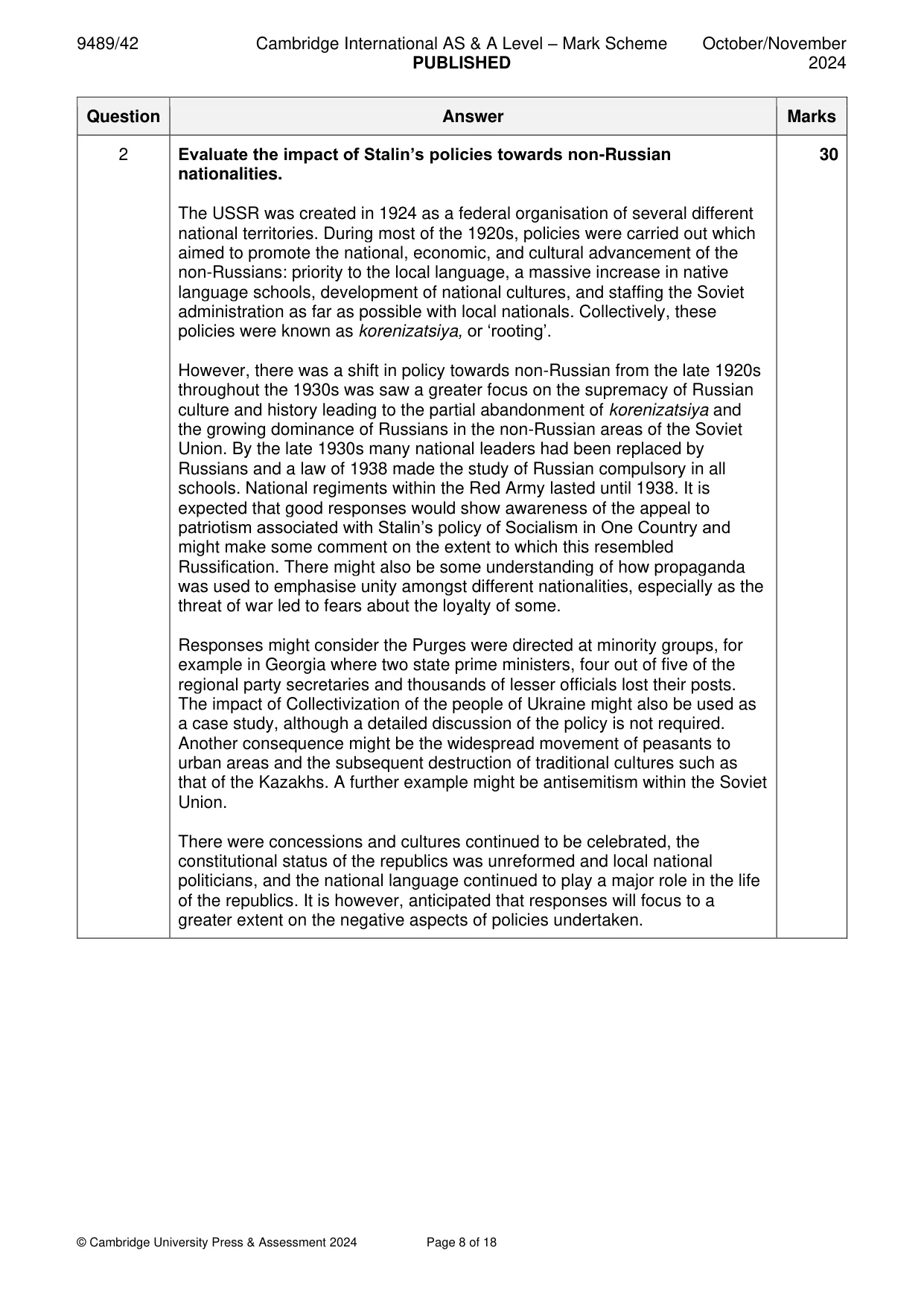
2 Evaluate the impact of Stalin’s policies towards non-Russian nationalities. [30]
Mark scheme: 2 Evaluate the impact of Stalin’s policies towards non-Russian 30 nationalities. The USSR was created in 1924 as a federal organisation of several different national territories. During most of the 1920s, policies were carried out which aimed to promote the national, economic, and cultural advancement of the non-Russians: priority to the local language, a massive increase in native language schools, development of national cultures, and staffing the Soviet administration as far as possible with local nationals. Collectively, these policies were known as korenizatsiya, or ‘rooting’. However, there was a shift in policy towards non-Russian from the late 1920s throughout the 1930s was saw a greater focus on the supremacy of Russian culture and history leading to the partial abandonment of korenizatsiya and the growing dominance of Russians in the non-Russian areas of the Soviet Union. By the late 1930s many national leaders had been replaced by Russians and a law of 1938 made the study of Russian compulsory in all schools. National regiments within the Red Army lasted until 1938. It is expected that good responses would show awareness of the appeal to patriotism associated with Stalin’s policy of Socialism in One Country and might make some comment on the extent to which this resembled Russification. There might also be some understanding of how propaganda was used to emphasise unity amongst different nationalities, especially as the threat of war led to fears about the loyalty of some. Responses might consider the Purges were directed at minority groups, for example in Georgia where two state prime ministers, four out of five of the regional party secretaries and thousands of lesser officials lost their posts. The impact of Collectivization of the people of Ukraine might also be used as a case study, although a detailed discussion of the policy is not required. Another consequence might be the widespread movement of peasants to urban areas and the subsequent destruction of traditional cultures such as that of the Kazakhs. A further example might be antisemitism within the Soviet Union. There were concessions and cultures continued to be celebrated, the constitutional status of the republics was unreformed and local national politicians, and the national language continued to play a major role in the life of the republics. It is however, anticipated that responses will focus to a greater extent on the negative aspects of policies undertaken.
More questions on How were the Bolsheviks able to consolidate their power up to 1924?
Q3 · Analyse the extent to which Nazi policies towards women and children achieved their aims
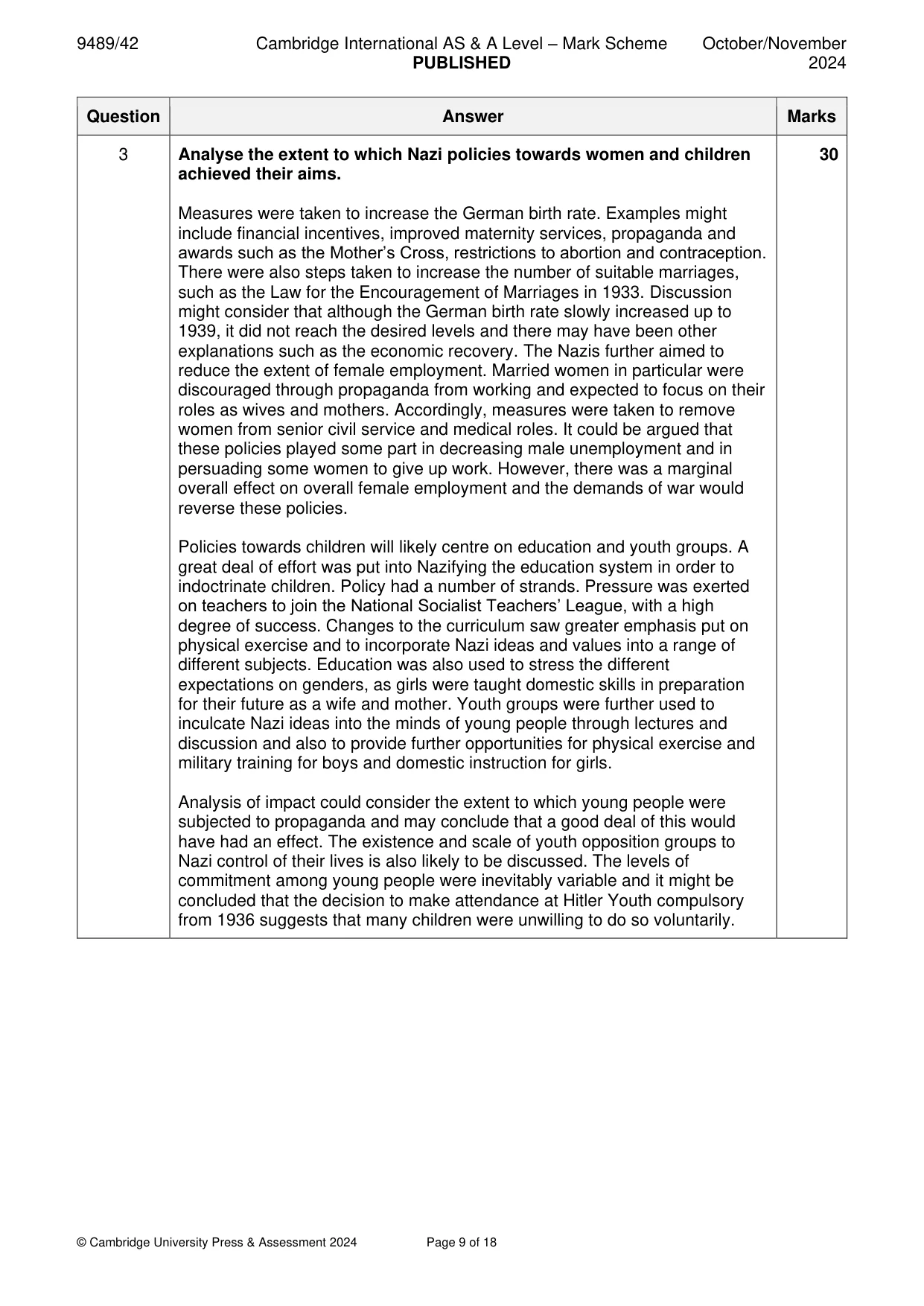
3 Analyse the extent to which Nazi policies towards women and children achieved their aims. [30]
Mark scheme: 3 Analyse the extent to which Nazi policies towards women and children 30 achieved their aims. Measures were taken to increase the German birth rate. Examples might include financial incentives, improved maternity services, propaganda and awards such as the Mother’s Cross, restrictions to abortion and contraception. There were also steps taken to increase the number of suitable marriages, such as the Law for the Encouragement of Marriages in 1933. Discussion might consider that although the German birth rate slowly increased up to 1939, it did not reach the desired levels and there may have been other explanations such as the economic recovery. The Nazis further aimed to reduce the extent of female employment. Married women in particular were discouraged through propaganda from working and expected to focus on their roles as wives and mothers. Accordingly, measures were taken to remove women from senior civil service and medical roles. It could be argued that these policies played some part in decreasing male unemployment and in persuading some women to give up work. However, there was a marginal overall effect on overall female employment and the demands of war would reverse these policies. Policies towards children will likely centre on education and youth groups. A great deal of effort was put into Nazifying the education system in order to indoctrinate children. Policy had a number of strands. Pressure was exerted on teachers to join the National Socialist Teachers’ League, with a high degree of success. Changes to the curriculum saw greater emphasis put on physical exercise and to incorporate Nazi ideas and values into a range of different subjects. Education was also used to stress the different expectations on genders, as girls were taught domestic skills in preparation for their future as a wife and mother. Youth groups were further used to inculcate Nazi ideas into the minds of young people through lectures and discussion and also to provide further opportunities for physical exercise and military training for boys and domestic instruction for girls. Analysis of impact could consider the extent to which young people were subjected to propaganda and may conclude that a good deal of this would have had an effect. The existence and scale of youth opposition groups to Nazi control of their lives is also likely to be discussed. The levels of commitment among young people were inevitably variable and it might be concluded that the decision to make attendance at Hitler Youth compulsory from 1936 suggests that many children were unwilling to do so voluntarily.
More questions on How did the rise of extremism affect international relations?
Q4 · Assess the extent to which a North-South divide existed in British society in the years…
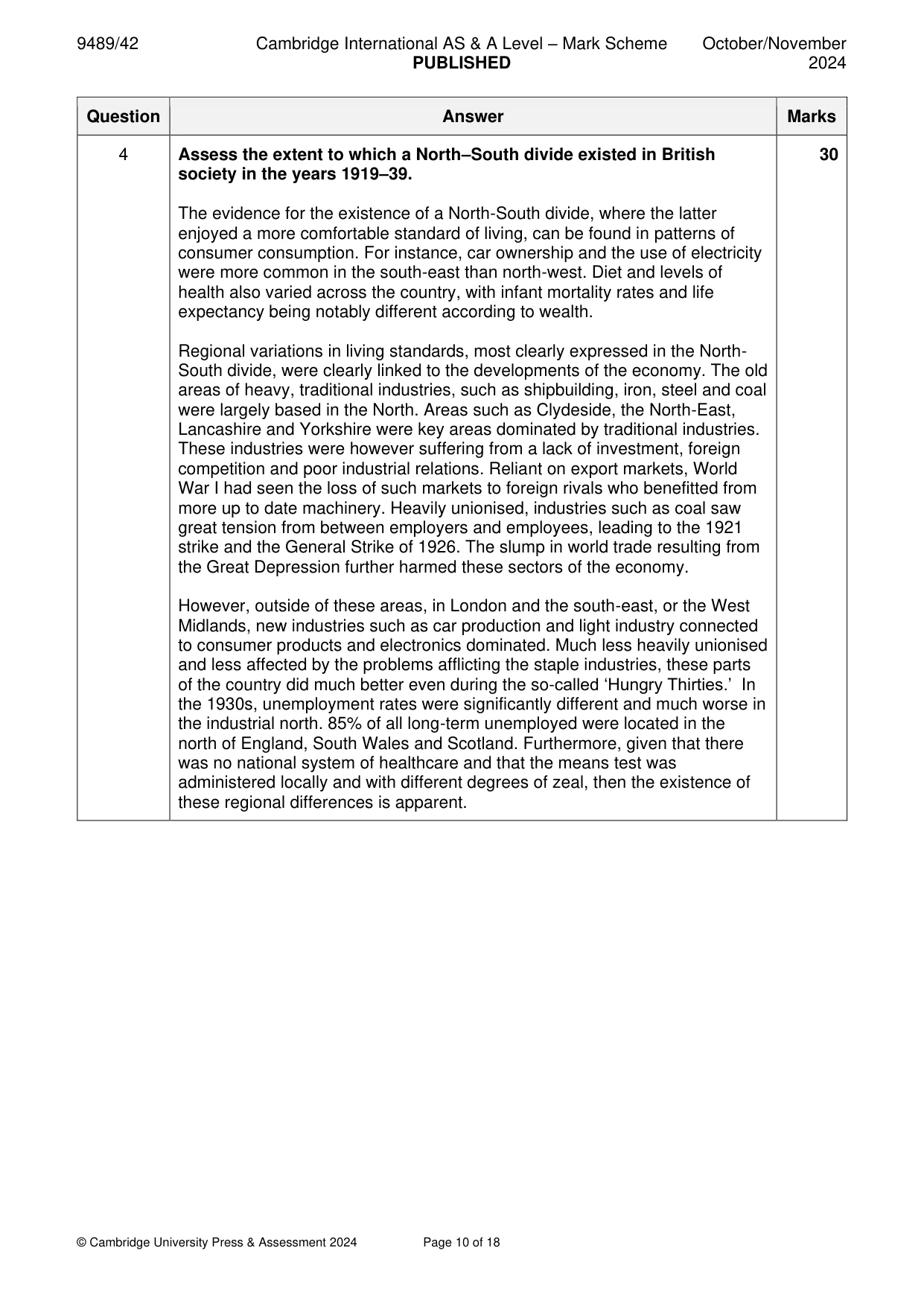
4 Assess the extent to which a North-South divide existed in British society in the years 1919–39. [30]
Mark scheme: 4 Assess the extent to which a North–South divide existed in British 30 society in the years 1919–39. The evidence for the existence of a North-South divide, where the latter enjoyed a more comfortable standard of living, can be found in patterns of consumer consumption. For instance, car ownership and the use of electricity were more common in the south-east than north-west. Diet and levels of health also varied across the country, with infant mortality rates and life expectancy being notably different according to wealth. Regional variations in living standards, most clearly expressed in the North- South divide, were clearly linked to the developments of the economy. The old areas of heavy, traditional industries, such as shipbuilding, iron, steel and coal were largely based in the North. Areas such as Clydeside, the North-East, Lancashire and Yorkshire were key areas dominated by traditional industries. These industries were however suffering from a lack of investment, foreign competition and poor industrial relations. Reliant on export markets, World War I had seen the loss of such markets to foreign rivals who benefitted from more up to date machinery. Heavily unionised, industries such as coal saw great tension from between employers and employees, leading to the 1921 strike and the General Strike of 1926. The slump in world trade resulting from the Great Depression further harmed these sectors of the economy. However, outside of these areas, in London and the south-east, or the West Midlands, new industries such as car production and light industry connected to consumer products and electronics dominated. Much less heavily unionised and less affected by the problems afflicting the staple industries, these parts of the country did much better even during the so-called ‘Hungry Thirties.’ In the 1930s, unemployment rates were significantly different and much worse in the industrial north. 85% of all long-term unemployed were located in the north of England, South Wales and Scotland. Furthermore, given that there was no national system of healthcare and that the means test was administered locally and with different degrees of zeal, then the existence of these regional differences is apparent.
More questions on What were the consequences of the rapid economic growth after 1870?
Q5 · ‘The response of federal institutions to demands for greater civil rights in the 1950s…
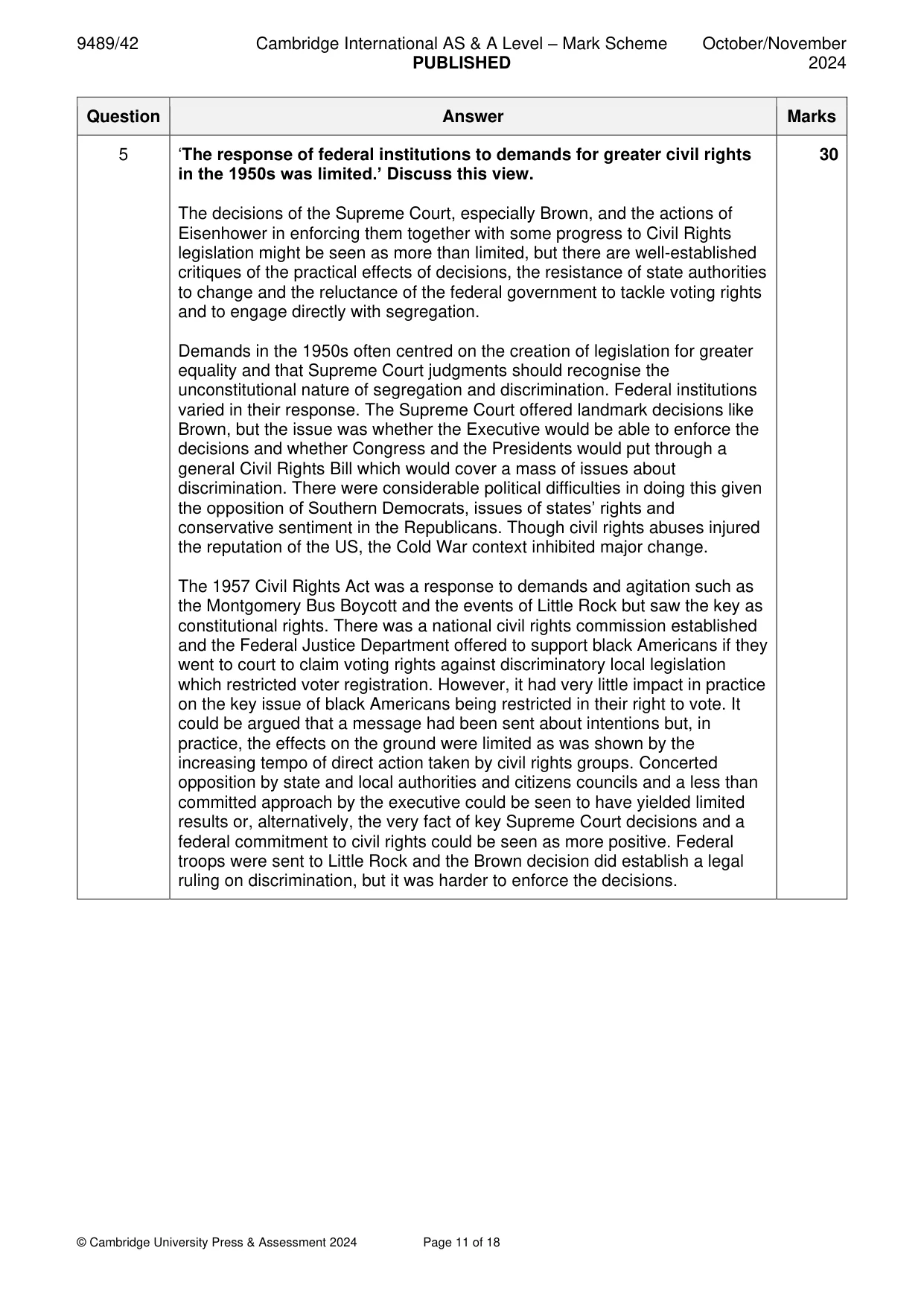
5 ‘The response of federal institutions to demands for greater civil rights in the 1950s was limited.’ Discuss this view. [30]
Mark scheme: 5 ‘The response of federal institutions to demands for greater civil rights 30 in the 1950s was limited.’ Discuss this view. The decisions of the Supreme Court, especially Brown, and the actions of Eisenhower in enforcing them together with some progress to Civil Rights legislation might be seen as more than limited, but there are well-established critiques of the practical effects of decisions, the resistance of state authorities to change and the reluctance of the federal government to tackle voting rights and to engage directly with segregation. Demands in the 1950s often centred on the creation of legislation for greater equality and that Supreme Court judgments should recognise the unconstitutional nature of segregation and discrimination. Federal institutions varied in their response. The Supreme Court offered landmark decisions like Brown, but the issue was whether the Executive would be able to enforce the decisions and whether Congress and the Presidents would put through a general Civil Rights Bill which would cover a mass of issues about discrimination. There were considerable political difficulties in doing this given the opposition of Southern Democrats, issues of states’ rights and conservative sentiment in the Republicans. Though civil rights abuses injured the reputation of the US, the Cold War context inhibited major change. The 1957 Civil Rights Act was a response to demands and agitation such as the Montgomery Bus Boycott and the events of Little Rock but saw the key as constitutional rights. There was a national civil rights commission established and the Federal Justice Department offered to support black Americans if they went to court to claim voting rights against discriminatory local legislation which restricted voter registration. However, it had very little impact in practice on the key issue of black Americans being restricted in their right to vote. It could be argued that a message had been sent about intentions but, in practice, the effects on the ground were limited as was shown by the increasing tempo of direct action taken by civil rights groups. Concerted opposition by state and local authorities and citizens councils and a less than committed approach by the executive could be seen to have yielded limited results or, alternatively, the very fact of key Supreme Court decisions and a federal commitment to civil rights could be seen as more positive. Federal troops were sent to Little Rock and the Brown decision did establish a legal ruling on discrimination, but it was harder to enforce the decisions.
More questions on How successful was the Progressive Movement from 1890 to 1920?
Q6 · Assess the effectiveness of Nixon’s domestic policies
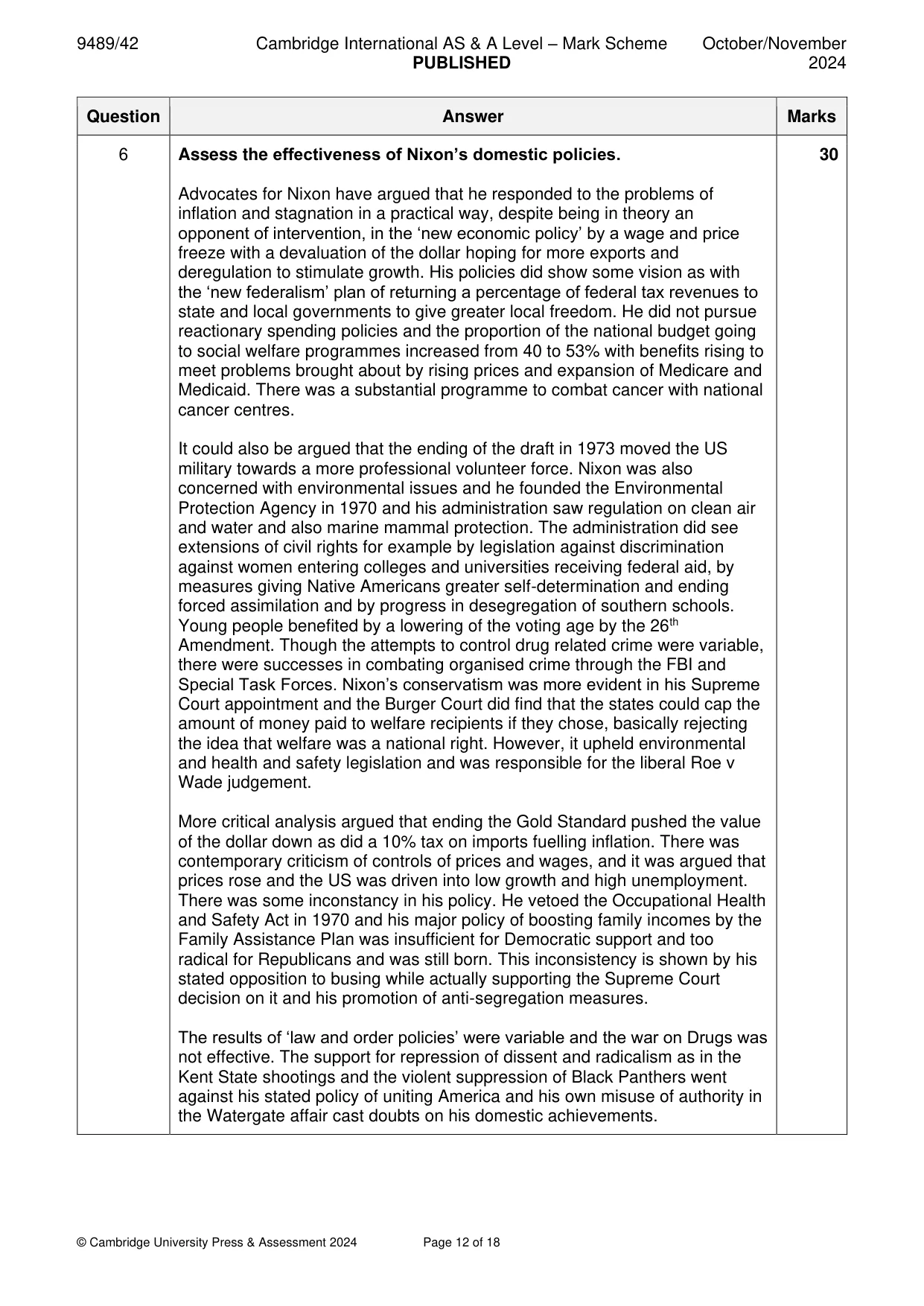
6 Assess the effectiveness of Nixon’s domestic policies. [30]
Mark scheme: 6 Assess the effectiveness of Nixon’s domestic policies. 30 Advocates for Nixon have argued that he responded to the problems of inflation and stagnation in a practical way, despite being in theory an opponent of intervention, in the ‘new economic policy’ by a wage and price freeze with a devaluation of the dollar hoping for more exports and deregulation to stimulate growth. His policies did show some vision as with the ‘new federalism’ plan of returning a percentage of federal tax revenues to state and local governments to give greater local freedom. He did not pursue reactionary spending policies and the proportion of the national budget going to social welfare programmes increased from 40 to 53% with benefits rising to meet problems brought about by rising prices and expansion of Medicare and Medicaid. There was a substantial programme to combat cancer with national cancer centres. It could also be argued that the ending of the draft in 1973 moved the US military towards a more professional volunteer force. Nixon was also concerned with environmental issues and he founded the Environmental Protection Agency in 1970 and his administration saw regulation on clean air and water and also marine mammal protection. The administration did see extensions of civil rights for example by legislation against discrimination against women entering colleges and universities receiving federal aid, by measures giving Native Americans greater self-determination and ending forced assimilation and by progress in desegregation of southern schools. Young people benefited by a lowering of the voting age by the 26th Amendment. Though the attempts to control drug related crime were variable, there were successes in combating organised crime through the FBI and Special Task Forces. Nixon’s conservatism was more evident in his Supreme Court appointment and the Burger Court did find that the states could cap the amount of money paid to welfare recipients if they chose, basically rejecting the idea that welfare was a national right. However, it upheld environmental and health and safety legislation and was responsible for the liberal Roe v Wade judgement. More critical analysis argued that ending the Gold Standard pushed the value of the dollar down as did a 10% tax on imports fuelling inflation. There was contemporary criticism of controls of prices and wages, and it was argued that prices rose and the US was driven into low growth and high unemployment. There was some inconstancy in his policy. He vetoed the Occupational Health and Safety Act in 1970 and his major policy of boosting family incomes by the Family Assistance Plan was insufficient for Democratic support and too radical for Republicans and was still born. This inconsistency is shown by his stated opposition to busing while actually supporting the Supreme Court decision on it and his promotion of anti-segregation measures. The results of ‘law and order policies’ were variable and the war on Drugs was not effective. The support for repression of dissent and radicalism as in the Kent State shootings and the violent suppression of Black Panthers went against his stated policy of uniting America and his own misuse of authority in the Watergate affair cast doubts on his domestic achievements.
More questions on Why was there a second New Deal and how successful was it?
Q7 · Evaluate the reasons why gender equality was a divisive issue in the 1980s
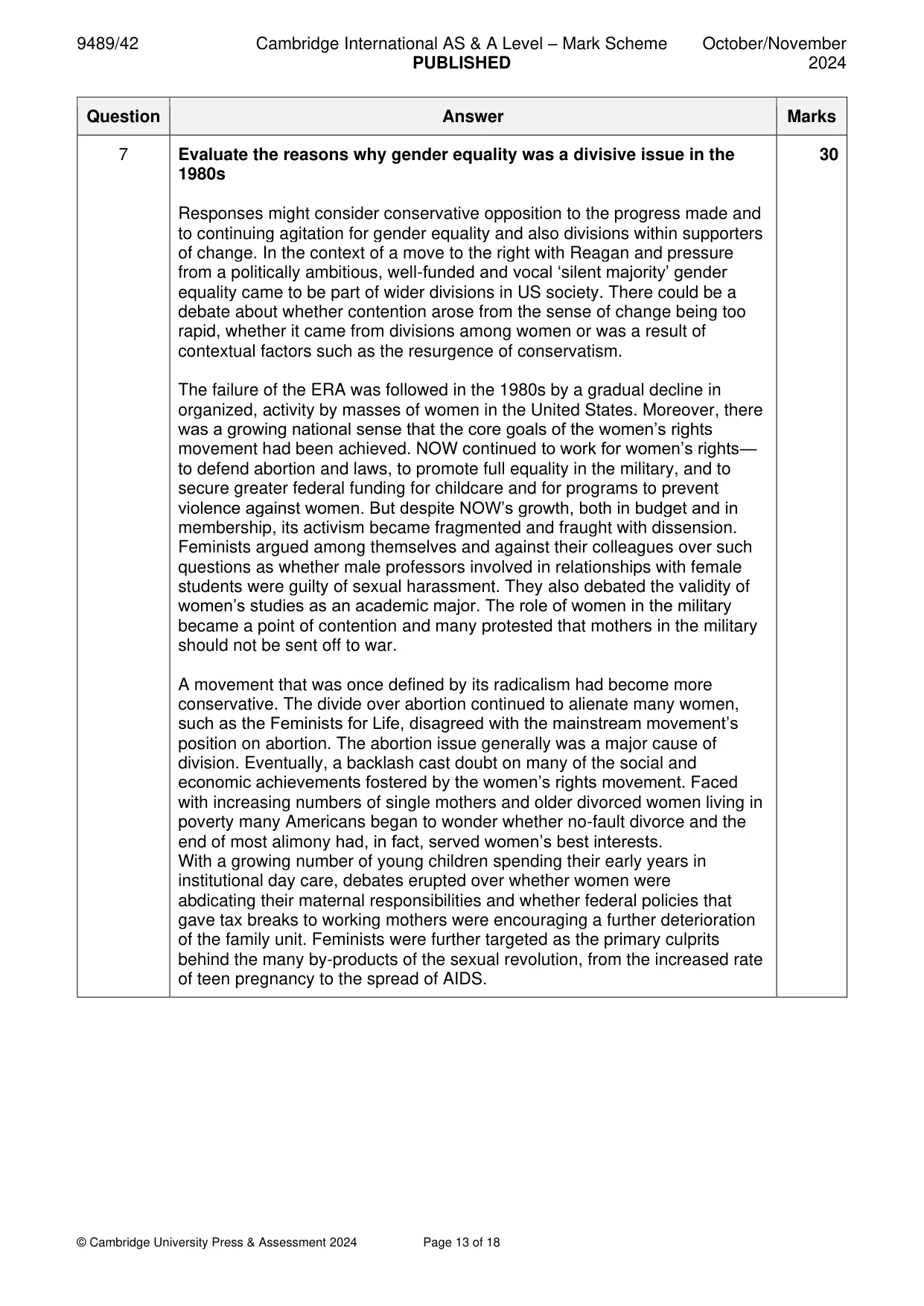
7 Evaluate the reasons why gender equality was a divisive issue in the 1980s. [30]
Mark scheme: 7 Evaluate the reasons why gender equality was a divisive issue in the 30 1980s Responses might consider conservative opposition to the progress made and to continuing agitation for gender equality and also divisions within supporters of change. In the context of a move to the right with Reagan and pressure from a politically ambitious, well-funded and vocal ‘silent majority’ gender equality came to be part of wider divisions in US society. There could be a debate about whether contention arose from the sense of change being too rapid, whether it came from divisions among women or was a result of contextual factors such as the resurgence of conservatism. The failure of the ERA was followed in the 1980s by a gradual decline in organized, activity by masses of women in the United States. Moreover, there was a growing national sense that the core goals of the women’s rights movement had been achieved. NOW continued to work for women’s rights— to defend abortion and laws, to promote full equality in the military, and to secure greater federal funding for childcare and for programs to prevent violence against women. But despite NOW’s growth, both in budget and in membership, its activism became fragmented and fraught with dissension. Feminists argued among themselves and against their colleagues over such questions as whether male professors involved in relationships with female students were guilty of sexual harassment. They also debated the validity of women’s studies as an academic major. The role of women in the military became a point of contention and many protested that mothers in the military should not be sent off to war. A movement that was once defined by its radicalism had become more conservative. The divide over abortion continued to alienate many women, such as the Feminists for Life, disagreed with the mainstream movement’s position on abortion. The abortion issue generally was a major cause of division. Eventually, a backlash cast doubt on many of the social and economic achievements fostered by the women’s rights movement. Faced with increasing numbers of single mothers and older divorced women living in poverty many Americans began to wonder whether no-fault divorce and the end of most alimony had, in fact, served women’s best interests. With a growing number of young children spending their early years in institutional day care, debates erupted over whether women were abdicating their maternal responsibilities and whether federal policies that gave tax breaks to working mothers were encouraging a further deterioration of the family unit. Feminists were further targeted as the primary culprits behind the many by-products of the sexual revolution, from the increased rate of teen pregnancy to the spread of AIDS.
More questions on How successful was the Progressive Movement from 1890 to 1920?
Q8 · Section C: International history, 1945–92
Section C: International history, 1945–92
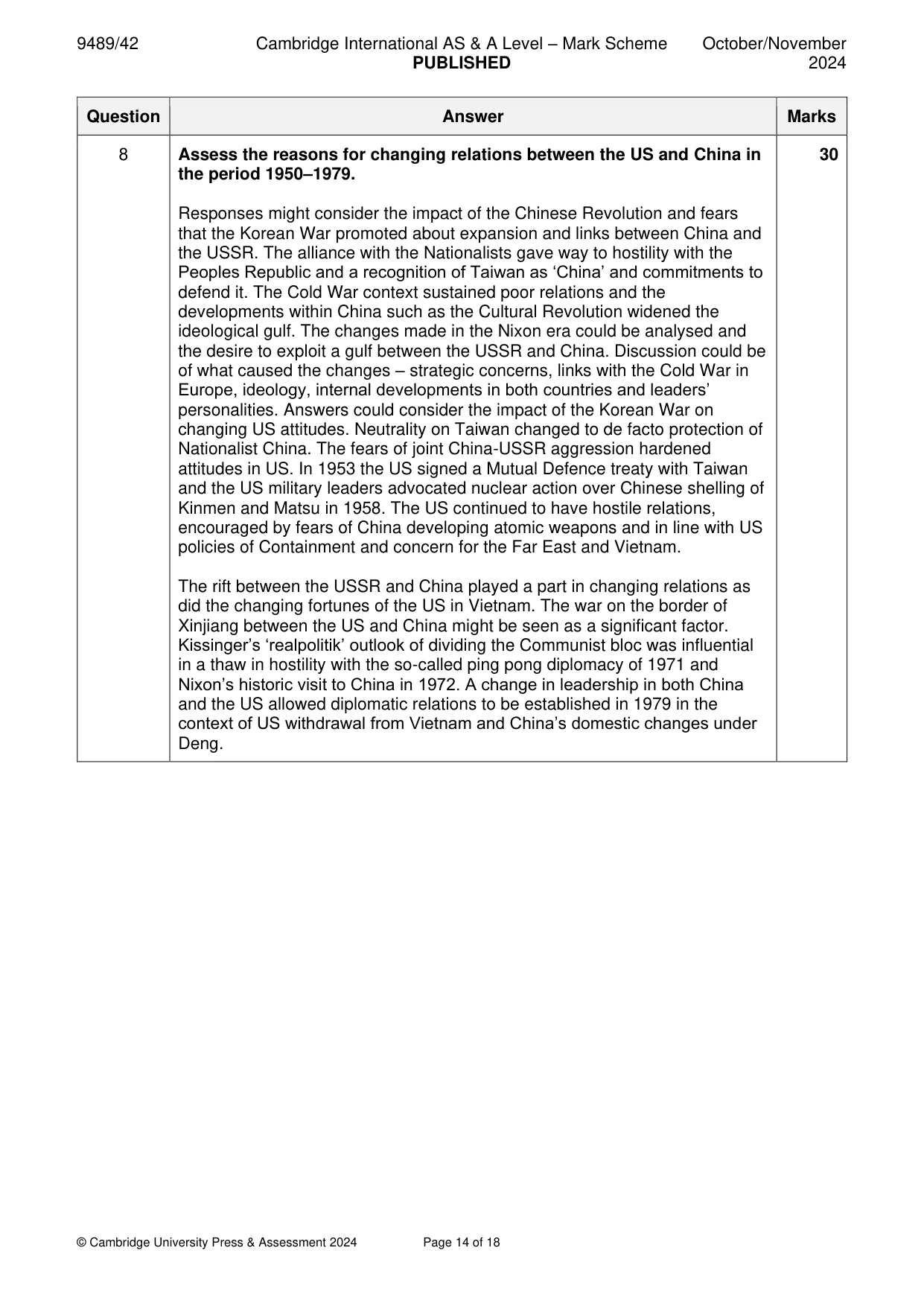
Mark scheme: 8 Assess the reasons for changing relations between the US and China in 30 the period 1950–1979. Responses might consider the impact of the Chinese Revolution and fears that the Korean War promoted about expansion and links between China and the USSR. The alliance with the Nationalists gave way to hostility with the Peoples Republic and a recognition of Taiwan as ‘China’ and commitments to defend it. The Cold War context sustained poor relations and the developments within China such as the Cultural Revolution widened the ideological gulf. The changes made in the Nixon era could be analysed and the desire to exploit a gulf between the USSR and China. Discussion could be of what caused the changes – strategic concerns, links with the Cold War in Europe, ideology, internal developments in both countries and leaders’ personalities. Answers could consider the impact of the Korean War on changing US attitudes. Neutrality on Taiwan changed to de facto protection of Nationalist China. The fears of joint China-USSR aggression hardened attitudes in US. In 1953 the US signed a Mutual Defence treaty with Taiwan and the US military leaders advocated nuclear action over Chinese shelling of Kinmen and Matsu in 1958. The US continued to have hostile relations, encouraged by fears of China developing atomic weapons and in line with US policies of Containment and concern for the Far East and Vietnam. The rift between the USSR and China played a part in changing relations as did the changing fortunes of the US in Vietnam. The war on the border of Xinjiang between the US and China might be seen as a significant factor. Kissinger’s ‘realpolitik’ outlook of dividing the Communist bloc was influential in a thaw in hostility with the so-called ping pong diplomacy of 1971 and Nixon’s historic visit to China in 1972. A change in leadership in both China and the US allowed diplomatic relations to be established in 1979 in the context of US withdrawal from Vietnam and China’s domestic changes under Deng.
Q9 · ‘Khrushchev’s main aim after the Cuban Revolution was to protect Cuba from the United…
9 ‘Khrushchev’s main aim after the Cuban Revolution was to protect Cuba from the United States.’ Evaluate this view. [30]
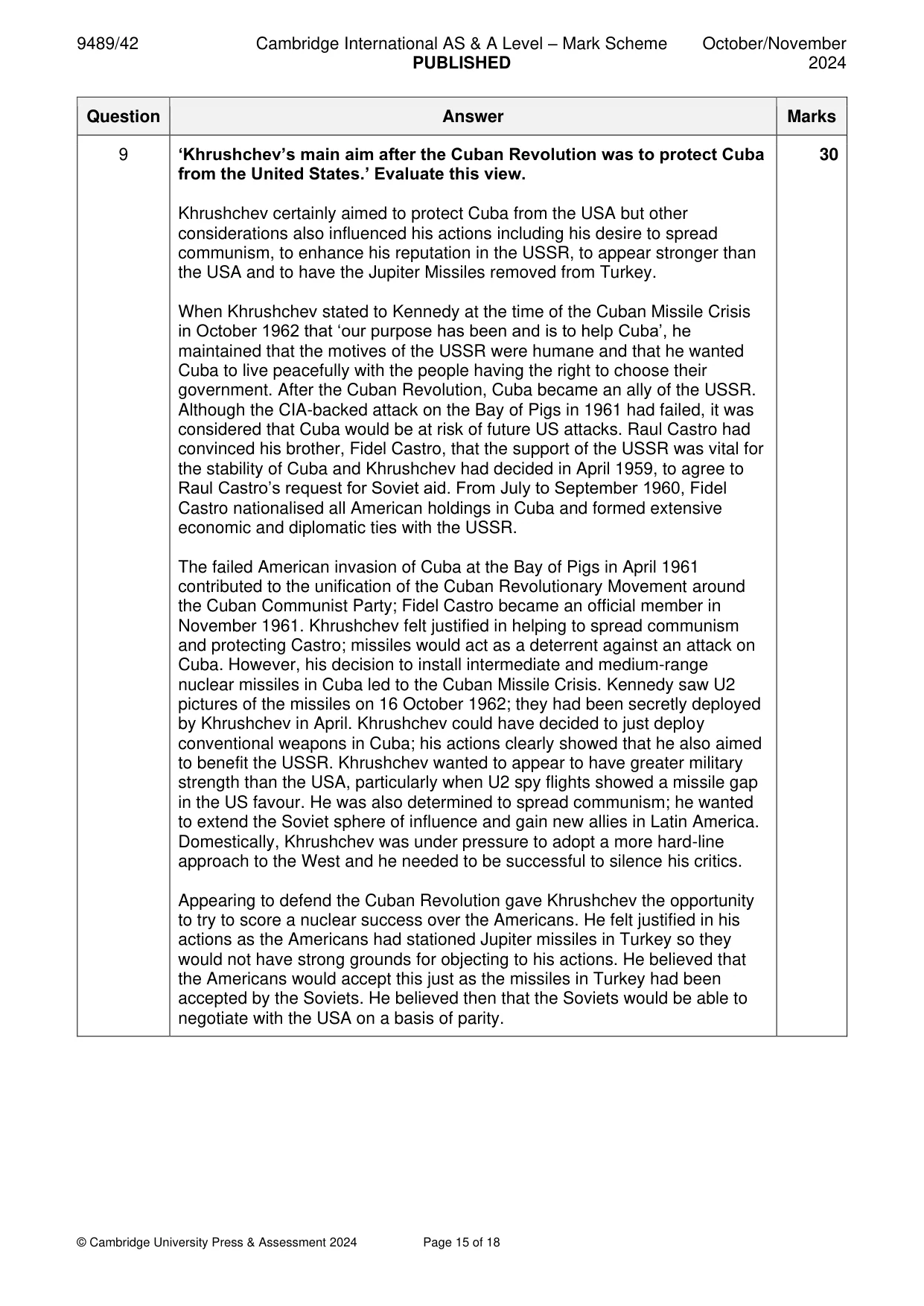
Mark scheme: 9 ‘Khrushchev’s main aim after the Cuban Revolution was to protect Cuba 30 from the United States.’ Evaluate this view. Khrushchev certainly aimed to protect Cuba from the USA but other considerations also influenced his actions including his desire to spread communism, to enhance his reputation in the USSR, to appear stronger than the USA and to have the Jupiter Missiles removed from Turkey. When Khrushchev stated to Kennedy at the time of the Cuban Missile Crisis in October 1962 that ‘our purpose has been and is to help Cuba’, he maintained that the motives of the USSR were humane and that he wanted Cuba to live peacefully with the people having the right to choose their government. After the Cuban Revolution, Cuba became an ally of the USSR. Although the CIA-backed attack on the Bay of Pigs in 1961 had failed, it was considered that Cuba would be at risk of future US attacks. Raul Castro had convinced his brother, Fidel Castro, that the support of the USSR was vital for the stability of Cuba and Khrushchev had decided in April 1959, to agree to Raul Castro’s request for Soviet aid. From July to September 1960, Fidel Castro nationalised all American holdings in Cuba and formed extensive economic and diplomatic ties with the USSR. The failed American invasion of Cuba at the Bay of Pigs in April 1961 contributed to the unification of the Cuban Revolutionary Movement around the Cuban Communist Party; Fidel Castro became an official member in November 1961. Khrushchev felt justified in helping to spread communism and protecting Castro; missiles would act as a deterrent against an attack on Cuba. However, his decision to install intermediate and medium-range nuclear missiles in Cuba led to the Cuban Missile Crisis. Kennedy saw U2 pictures of the missiles on 16 October 1962; they had been secretly deployed by Khrushchev in April. Khrushchev could have decided to just deploy conventional weapons in Cuba; his actions clearly showed that he also aimed to benefit the USSR. Khrushchev wanted to appear to have greater military strength than the USA, particularly when U2 spy flights showed a missile gap in the US favour. He was also determined to spread communism; he wanted to extend the Soviet sphere of influence and gain new allies in Latin America. Domestically, Khrushchev was under pressure to adopt a more hard-line approach to the West and he needed to be successful to silence his critics. Appearing to defend the Cuban Revolution gave Khrushchev the opportunity to try to score a nuclear success over the Americans. He felt justified in his actions as the Americans had stationed Jupiter missiles in Turkey so they would not have strong grounds for objecting to his actions. He believed that the Americans would accept this just as the missiles in Turkey had been accepted by the Soviets. He believed then that the Soviets would be able to negotiate with the USA on a basis of parity.
More questions on Why did the League of Nations fail to keep the peace in the 1930s?
Q10 · Evaluate the role of international intervention in the Dutch failure to re-establish…
10 Evaluate the role of international intervention in the Dutch failure to re-establish control in Indonesia. [30]
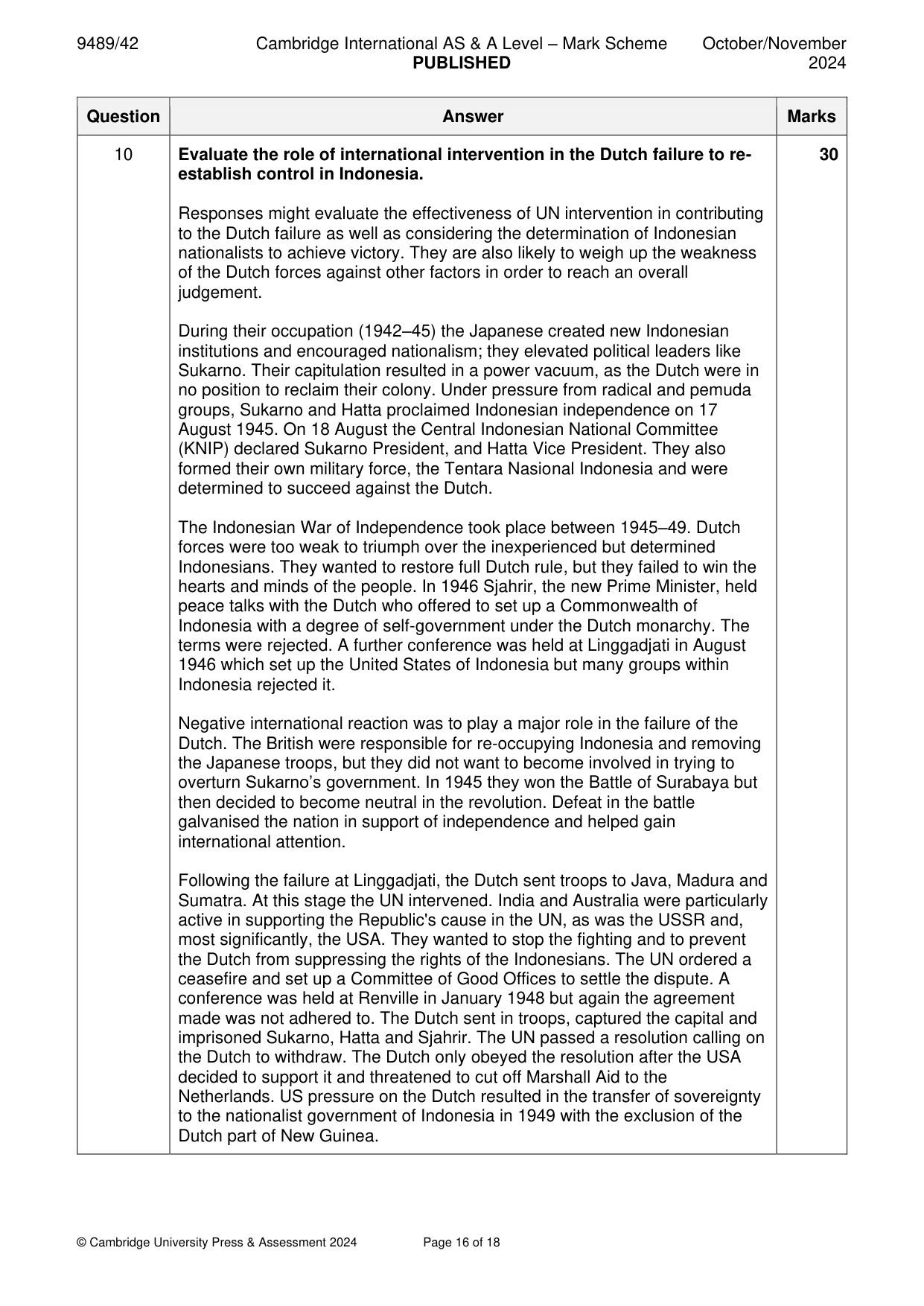
Mark scheme: 10 Evaluate the role of international intervention in the Dutch failure to re- 30 establish control in Indonesia. Responses might evaluate the effectiveness of UN intervention in contributing to the Dutch failure as well as considering the determination of Indonesian nationalists to achieve victory. They are also likely to weigh up the weakness of the Dutch forces against other factors in order to reach an overall judgement. During their occupation (1942–45) the Japanese created new Indonesian institutions and encouraged nationalism; they elevated political leaders like Sukarno. Their capitulation resulted in a power vacuum, as the Dutch were in no position to reclaim their colony. Under pressure from radical and pemuda groups, Sukarno and Hatta proclaimed Indonesian independence on 17 August 1945. On 18 August the Central Indonesian National Committee (KNIP) declared Sukarno President, and Hatta Vice President. They also formed their own military force, the Tentara Nasional Indonesia and were determined to succeed against the Dutch. The Indonesian War of Independence took place between 1945–49. Dutch forces were too weak to triumph over the inexperienced but determined Indonesians. They wanted to restore full Dutch rule, but they failed to win the hearts and minds of the people. In 1946 Sjahrir, the new Prime Minister, held peace talks with the Dutch who offered to set up a Commonwealth of Indonesia with a degree of self-government under the Dutch monarchy. The terms were rejected. A further conference was held at Linggadjati in August 1946 which set up the United States of Indonesia but many groups within Indonesia rejected it. Negative international reaction was to play a major role in the failure of the Dutch. The British were responsible for re-occupying Indonesia and removing the Japanese troops, but they did not want to become involved in trying to overturn Sukarno’s government. In 1945 they won the Battle of Surabaya but then decided to become neutral in the revolution. Defeat in the battle galvanised the nation in support of independence and helped gain international attention. Following the failure at Linggadjati, the Dutch sent troops to Java, Madura and Sumatra. At this stage the UN intervened. India and Australia were particularly active in supporting the Republic's cause in the UN, as was the USSR and, most significantly, the USA. They wanted to stop the fighting and to prevent the Dutch from suppressing the rights of the Indonesians. The UN ordered a ceasefire and set up a Committee of Good Offices to settle the dispute. A conference was held at Renville in January 1948 but again the agreement made was not adhered to. The Dutch sent in troops, captured the capital and imprisoned Sukarno, Hatta and Sjahrir. The UN passed a resolution calling on the Dutch to withdraw. The Dutch only obeyed the resolution after the USA decided to support it and threatened to cut off Marshall Aid to the Netherlands. US pressure on the Dutch resulted in the transfer of sovereignty to the nationalist government of Indonesia in 1949 with the exclusion of the Dutch part of New Guinea.
More questions on What was the impact of imperial expansion on international relations?
Q11 · Analyse why the People’s Republic of China became increasingly involved with Africa…
11 Analyse why the People’s Republic of China became increasingly involved with Africa during the Cold War. [30]
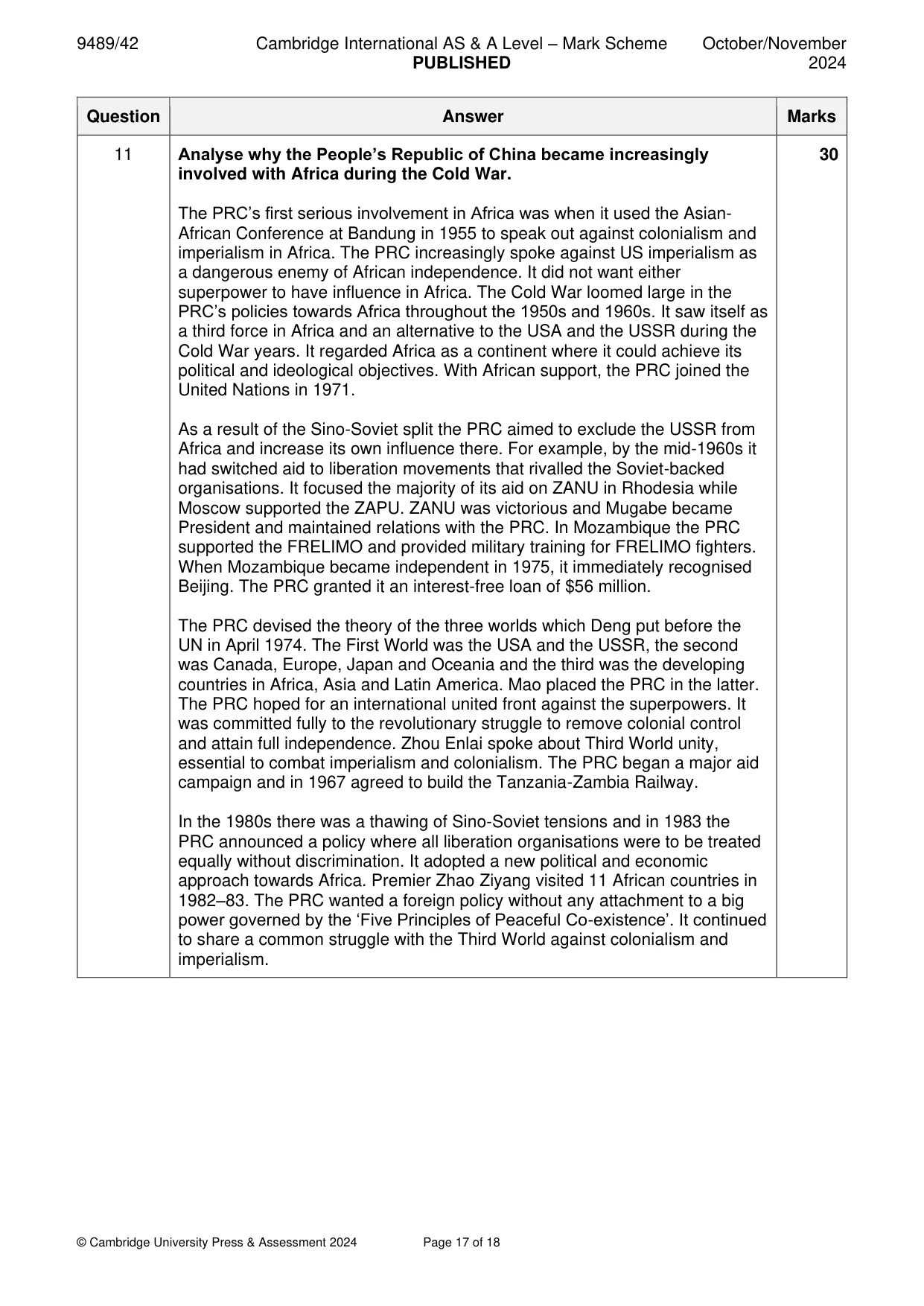
Mark scheme: 11 Analyse why the People’s Republic of China became increasingly 30 involved with Africa during the Cold War. The PRC’s first serious involvement in Africa was when it used the Asian- African Conference at Bandung in 1955 to speak out against colonialism and imperialism in Africa. The PRC increasingly spoke against US imperialism as a dangerous enemy of African independence. It did not want either superpower to have influence in Africa. The Cold War loomed large in the PRC’s policies towards Africa throughout the 1950s and 1960s. It saw itself as a third force in Africa and an alternative to the USA and the USSR during the Cold War years. It regarded Africa as a continent where it could achieve its political and ideological objectives. With African support, the PRC joined the United Nations in 1971. As a result of the Sino-Soviet split the PRC aimed to exclude the USSR from Africa and increase its own influence there. For example, by the mid-1960s it had switched aid to liberation movements that rivalled the Soviet-backed organisations. It focused the majority of its aid on ZANU in Rhodesia while Moscow supported the ZAPU. ZANU was victorious and Mugabe became President and maintained relations with the PRC. In Mozambique the PRC supported the FRELIMO and provided military training for FRELIMO fighters. When Mozambique became independent in 1975, it immediately recognised Beijing. The PRC granted it an interest-free loan of $56 million. The PRC devised the theory of the three worlds which Deng put before the UN in April 1974. The First World was the USA and the USSR, the second was Canada, Europe, Japan and Oceania and the third was the developing countries in Africa, Asia and Latin America. Mao placed the PRC in the latter. The PRC hoped for an international united front against the superpowers. It was committed fully to the revolutionary struggle to remove colonial control and attain full independence. Zhou Enlai spoke about Third World unity, essential to combat imperialism and colonialism. The PRC began a major aid campaign and in 1967 agreed to build the Tanzania-Zambia Railway. In the 1980s there was a thawing of Sino-Soviet tensions and in 1983 the PRC announced a policy where all liberation organisations were to be treated equally without discrimination. It adopted a new political and economic approach towards Africa. Premier Zhao Ziyang visited 11 African countries in 1982–83. The PRC wanted a foreign policy without any attachment to a big power governed by the ‘Five Principles of Peaceful Co-existence’. It continued to share a common struggle with the Third World against colonialism and imperialism.
More questions on Why was imperialism a significant force in Africa from 1870?
Q12 · Assess the significance of international involvement in the creation of the state of…
12 Assess the significance of international involvement in the creation of the state of Israel in 1948. [30]
Mark scheme: 12 Assess the significance of international involvement in the creation of 30 the state of Israel in 1948. From 1917 the British controlled Palestine and it became a mandate of the League of Nations in 1923. The Balfour Declaration of 1917 stated that Britain favoured the creation of a national home for the Jewish people but without prejudicing the rights of existing non-Jewish communities. At the end of the Second World War in 1945, the British confirmed that there would be no increase in immigration and no separate Jewish state. The Zionists opposed British rule in Palestine and in 1947 Britain referred the problem to the UN and abandoned the mandate. In November 1947 the UN voted to partition Palestine but the British refused to support the resolution and withdrew from Palestine on 14 May 1948. The UN’s plan for partition was also rejected by Arabs and in late 1947, a pan-Arab ‘Liberation Army’ invaded Palestine to reverse the partition resolution. A civil war erupted in Palestine, becoming an Arab-Israeli war in May 1948, when the state of Israel was proclaimed. Between 1904 and 1914, around 40,000 Jews had settled in Palestine, many as a result of persecution. The Zionist movement spent many years building the political and economic infrastructure for an eventual Jewish state. By 1945 many Jews in the diaspora, previously opposed to Zionism, were convinced of the need for a Jewish state as a result of persecution during the Holocaust. American Jews provided money and arms to Jews in Palestine and played a vital role in persuading the US government to support the partition of Palestine in the UN vote in November 1947, and then to recognise the state of Israel as soon as it was declared. Truman sought the Jewish vote in the 1948 presidential election, and he was subjected to intense lobbying by American Jewish Zionists; US public opinion was deeply affected by the Holocaust. A telegram signed by 26 US senators with influence on foreign aid bills was sent to wavering countries, seeking their support for the partition plan. The USSR hoped that a socialist Israel would be a strong ally of Moscow and supported the resolution; it also intervened by selling heavier weapons to Israel. David Ben-Gurion asserted that without Soviet military aid the Israelis would not have won the 1948 war.
More questions on Why did the League of Nations fail to keep the peace in the 1930s?
What was in this paper
The subtopics covered by these 12 questions, and how many questions each got. Open one in a new tab to see every Cambridge question on it.
2How successful was the Progressive Movement from 1890 to 1920?2Why did the League of Nations fail to keep the peace in the 1930s?2How were the Bolsheviks able to consolidate their power up to 1924?1What was the impact of imperial expansion on international relations?1What were the consequences of the rapid economic growth after 1870?1Why did war break out in 1939?1Why was imperialism a significant force in Africa from 1870?1Why was there a second New Deal and how successful was it?1What you needed in this session
Cambridge’s own grade thresholds for 2024 Oct/Nov, Paper 4 · Variant 2. A higher threshold means an easier paper — the bar moves with how the cohort did.