Cambridge A Level History 9489 — 2025 Oct/Nov Paper 4 · Variant 3
9489/43/O/N/25 · 12 questions · 60 marks · ≈68 min
The question paper and its mark scheme, free to read here and free to download. This is Cambridge’s own paper, exactly as it was sat.
Question paper4 pages
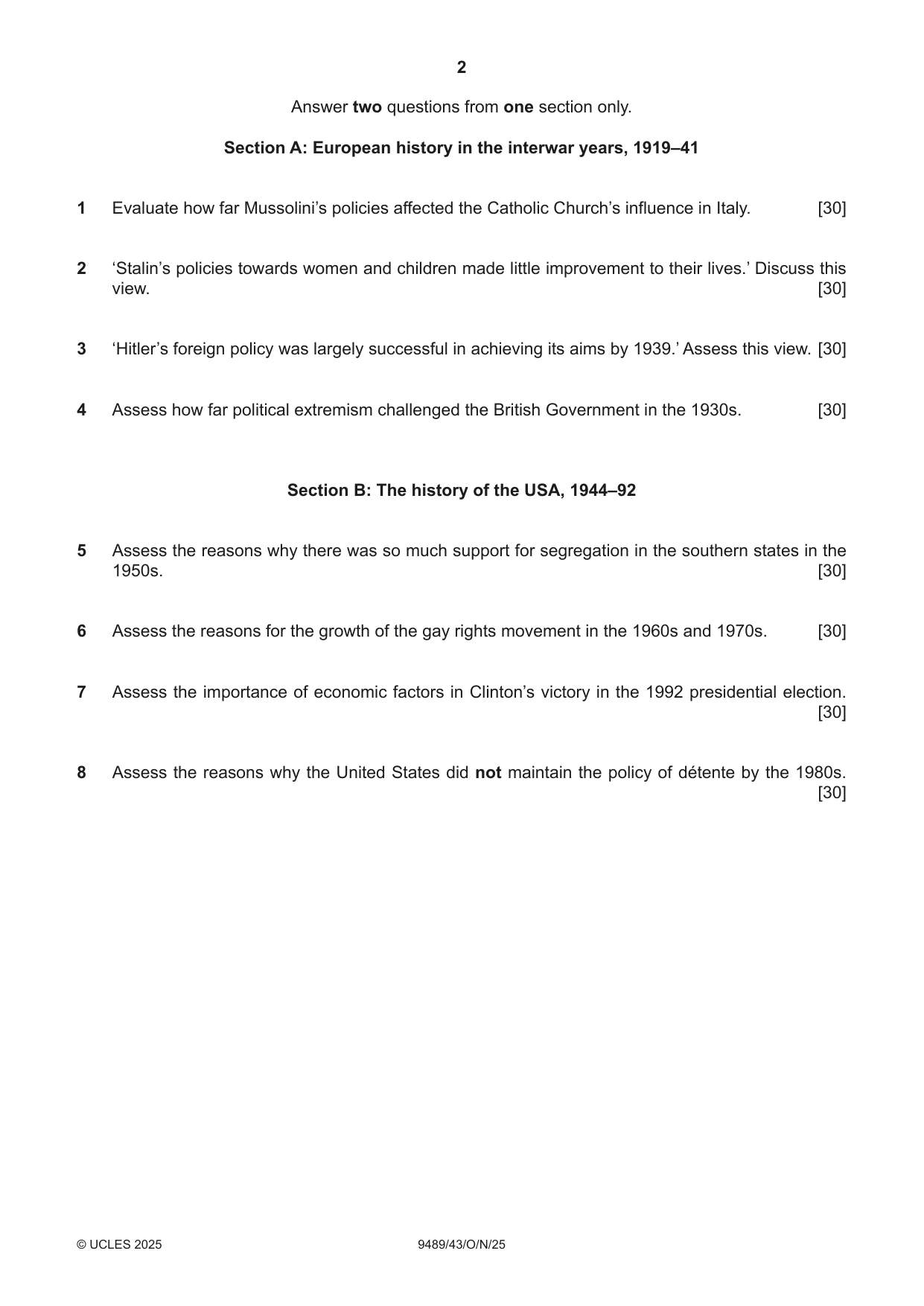
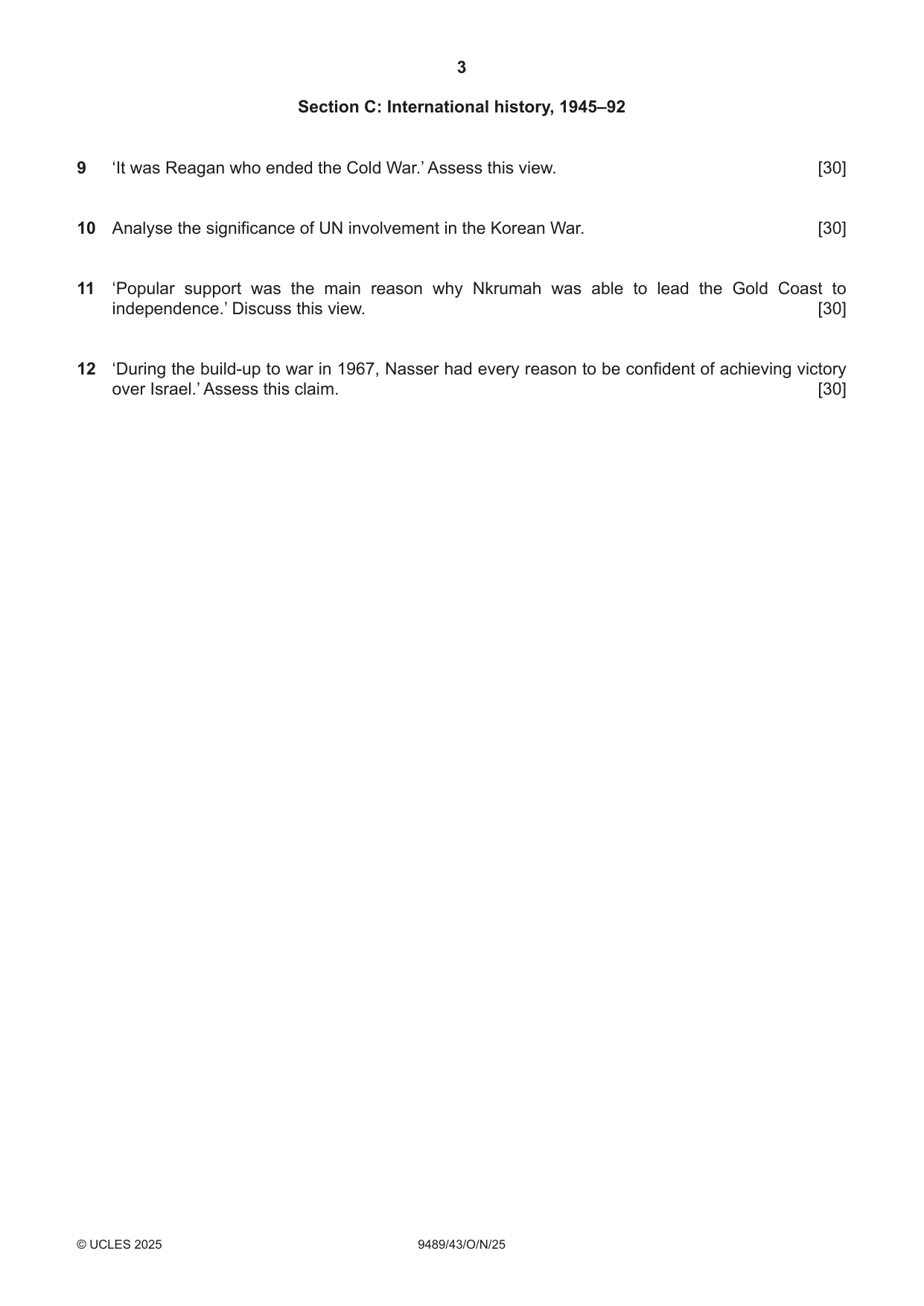
Mark scheme19 pages
Answers below. Sit the paper first if you are practising.
Questions as text
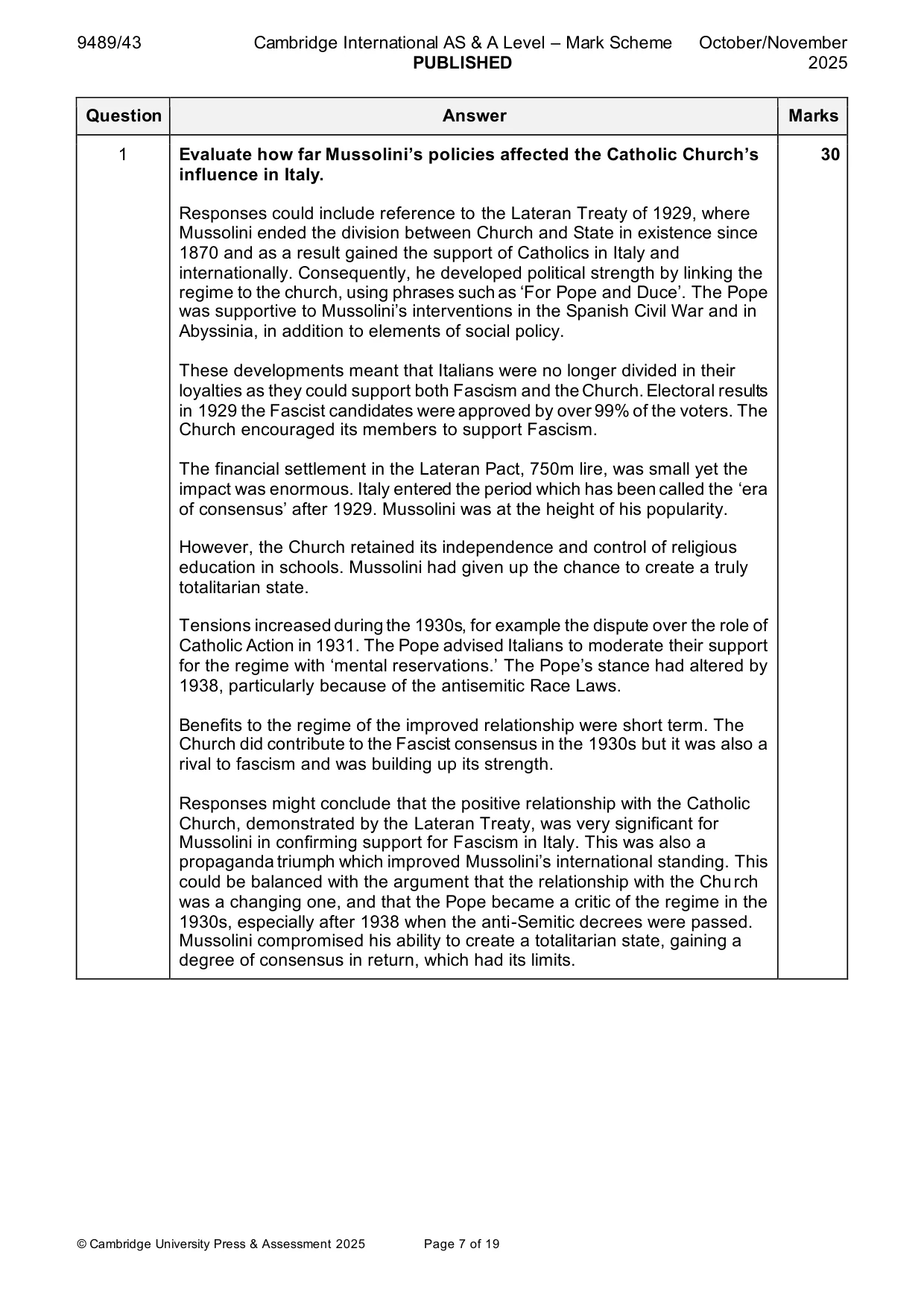
Q1 · Evaluate how far Mussolini’s policies affected the Catholic Church’s influence in Italy
1 Evaluate how far Mussolini’s policies affected the Catholic Church’s influence in Italy. [30]
Mark scheme: Question Answer Marks 1 Evaluate how far Mussolini’s policies affected the Catholic Church’s 30 influence in Italy. Responses could include reference to the Lateran Treaty of 1929, where Mussolini ended the division between Church and State in existence since 1870 and as a result gained the support of Catholics in Italy and internationally. Consequently, he developed political strength by linking the regime to the church, using phrases such as ‘For Pope and Duce’. The Pope was supportive to Mussolini’s interventions in the Spanish Civil War and in Abyssinia, in addition to elements of social policy. These developments meant that Italians were no longer divided in their loyalties as they could support both Fascism and the Church. Electoral results in 1929 the Fascist candidates were approved by over 99% of the voters. The Church encouraged its members to support Fascism. The financial settlement in the Lateran Pact, 750m lire, was small yet the impact was enormous. Italy entered the period which has been called the ‘era of consensus’ after 1929. Mussolini was at the height of his popularity. However, the Church retained its independence and control of religious education in schools. Mussolini had given up the chance to create a truly totalitarian state. Tensions increased during the 1930s, for example the dispute over the role of Catholic Action in 1931. The Pope advised Italians to moderate their support for the regime with ‘mental reservations.’ The Pope’s stance had altered by 1938, particularly because of the antisemitic Race Laws. Benefits to the regime of the improved relationship were short term. The Church did contribute to the Fascist consensus in the 1930s but it was also a rival to fascism and was building up its strength. Responses might conclude that the positive relationship with the Catholic Church, demonstrated by the Lateran Treaty, was very significant for Mussolini in confirming support for Fascism in Italy. This was also a propaganda triumph which improved Mussolini’s international standing. This could be balanced with the argument that the relationship with the Church was a changing one, and that the Pope became a critic of the regime in the 1930s, especially after 1938 when the anti-Semitic decrees were passed. Mussolini compromised his ability to create a totalitarian state, gaining a degree of consensus in return, which had its limits.
More questions on How did the rise of extremism affect international relations?
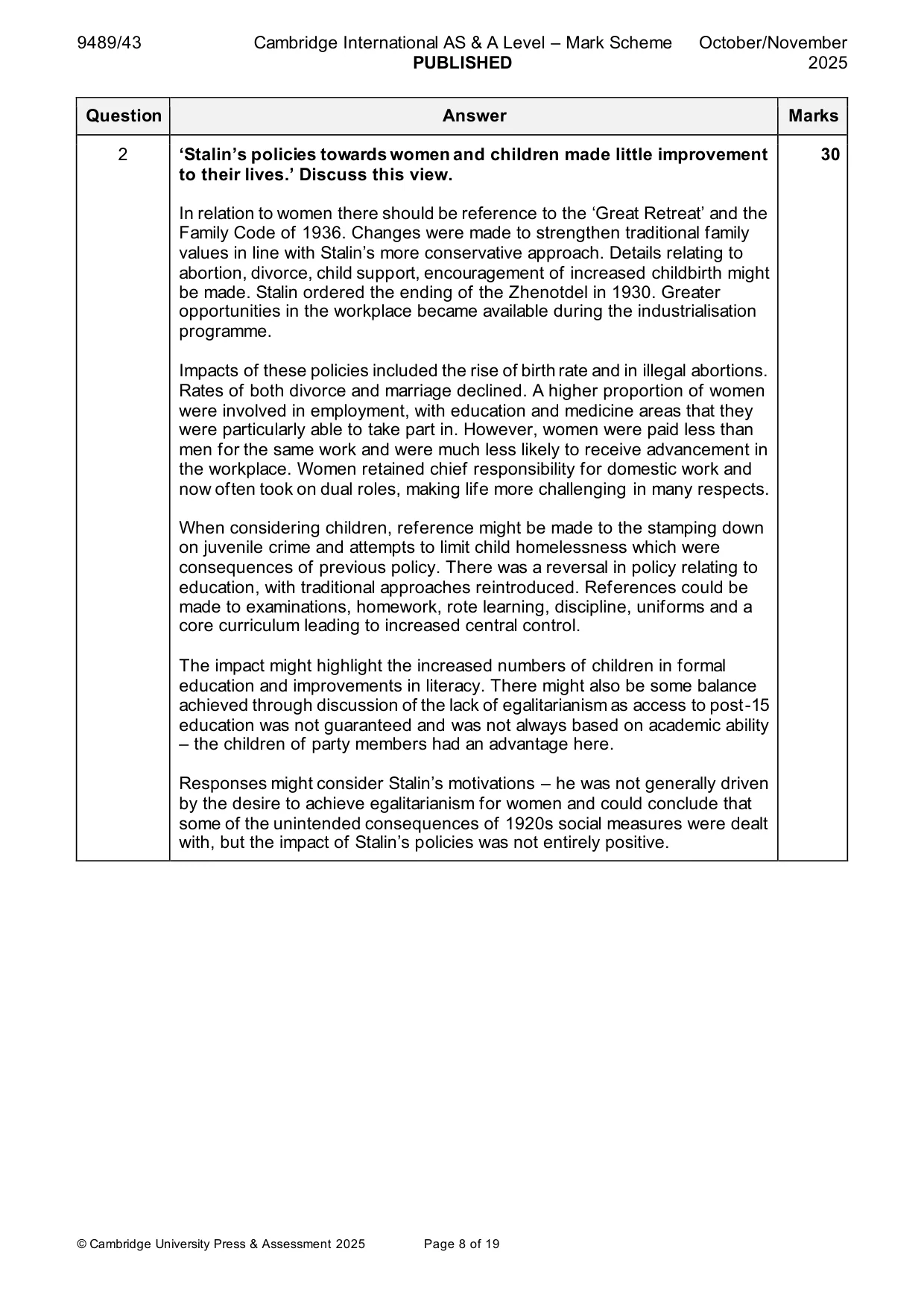
Q2 · ‘Stalin’s policies towards women and children made little improvement to their lives.’…
2 ‘Stalin’s policies towards women and children made little improvement to their lives.’ Discuss this view. [30]
Mark scheme: 2 ‘Stalin’s policies towards women and children made little improvement 30 to their lives.’ Discuss this view. In relation to women there should be reference to the ‘Great Retreat’ and the Family Code of 1936. Changes were made to strengthen traditional family values in line with Stalin’s more conservative approach. Details relating to abortion, divorce, child support, encouragement of increased childbirth might be made. Stalin ordered the ending of the Zhenotdel in 1930. Greater opportunities in the workplace became available during the industrialisation programme. Impacts of these policies included the rise of birth rate and in illegal abortions. Rates of both divorce and marriage declined. A higher proportion of women were involved in employment, with education and medicine areas that they were particularly able to take part in. However, women were paid less than men for the same work and were much less likely to receive advancement in the workplace. Women retained chief responsibility for domestic work and now often took on dual roles, making life more challenging in many respects. When considering children, reference might be made to the stamping down on juvenile crime and attempts to limit child homelessness which were consequences of previous policy. There was a reversal in policy relating to education, with traditional approaches reintroduced. References could be made to examinations, homework, rote learning, discipline, uniforms and a core curriculum leading to increased central control. The impact might highlight the increased numbers of children in formal education and improvements in literacy. There might also be some balance achieved through discussion of the lack of egalitarianism as access to post-15 education was not guaranteed and was not always based on academic ability – the children of party members had an advantage here. Responses might consider Stalin’s motivations – he was not generally driven by the desire to achieve egalitarianism for women and could conclude that some of the unintended consequences of 1920s social measures were dealt with, but the impact of Stalin’s policies was not entirely positive.
More questions on How were the Bolsheviks able to consolidate their power up to 1924?
Q3 · ‘Hitler’s foreign policy was largely successful in achieving its aims by 1939.’ Assess…
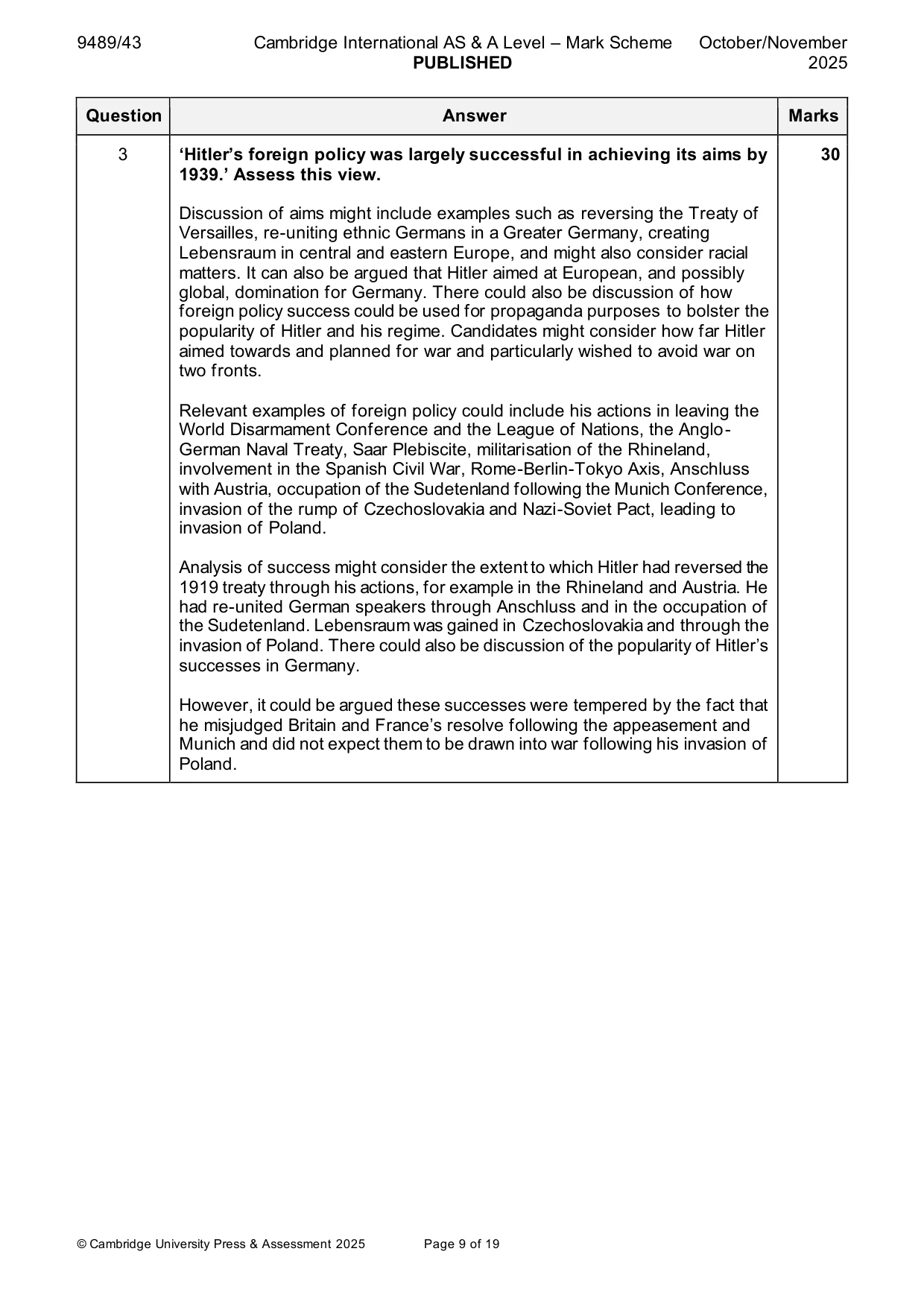
3 ‘Hitler’s foreign policy was largely successful in achieving its aims by 1939.’ Assess this view. [30]
Mark scheme: 3 ‘Hitler’s foreign policy was largely successful in achieving its aims by 30 1939.’ Assess this view. Discussion of aims might include examples such as reversing the Treaty of Versailles, re-uniting ethnic Germans in a Greater Germany, creating Lebensraum in central and eastern Europe, and might also consider racial matters. It can also be argued that Hitler aimed at European, and possibly global, domination for Germany. There could also be discussion of how foreign policy success could be used for propaganda purposes to bolster the popularity of Hitler and his regime. Candidates might consider how far Hitler aimed towards and planned for war and particularly wished to avoid war on two fronts. Relevant examples of foreign policy could include his actions in leaving the World Disarmament Conference and the League of Nations, the Anglo- German Naval Treaty, Saar Plebiscite, militarisation of the Rhineland, involvement in the Spanish Civil War, Rome-Berlin-Tokyo Axis, Anschluss with Austria, occupation of the Sudetenland following the Munich Conference, invasion of the rump of Czechoslovakia and Nazi-Soviet Pact, leading to invasion of Poland. Analysis of success might consider the extent to which Hitler had reversed the 1919 treaty through his actions, for example in the Rhineland and Austria. He had re-united German speakers through Anschluss and in the occupation of the Sudetenland. Lebensraum was gained in Czechoslovakia and through the invasion of Poland. There could also be discussion of the popularity of Hitler’s successes in Germany. However, it could be argued these successes were tempered by the fact that he misjudged Britain and France’s resolve following the appeasement and Munich and did not expect them to be drawn into war following his invasion of Poland.
Q4 · Assess how far political extremism challenged the British Government in the 1930s
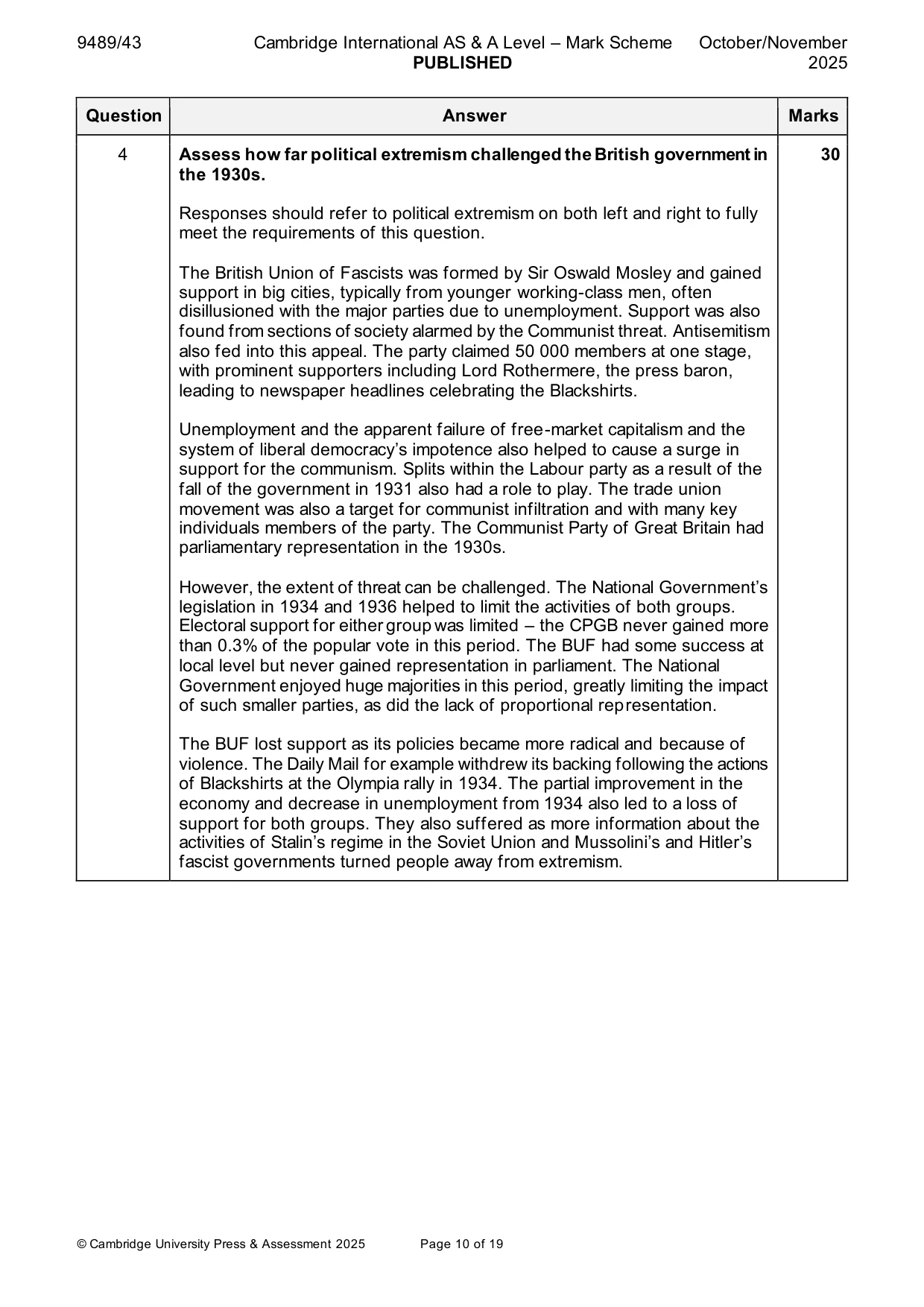
4 Assess how far political extremism challenged the British Government in the 1930s. [30]
Mark scheme: 4 Assess how far political extremism challenged the British government in 30 the 1930s. Responses should refer to political extremism on both left and right to fully meet the requirements of this question. The British Union of Fascists was formed by Sir Oswald Mosley and gained support in big cities, typically from younger working-class men, often disillusioned with the major parties due to unemployment. Support was also found from sections of society alarmed by the Communist threat. Antisemitism also fed into this appeal. The party claimed 50 000 members at one stage, with prominent supporters including Lord Rothermere, the press baron, leading to newspaper headlines celebrating the Blackshirts. Unemployment and the apparent failure of free-market capitalism and the system of liberal democracy’s impotence also helped to cause a surge in support for the communism. Splits within the Labour party as a result of the fall of the government in 1931 also had a role to play. The trade union movement was also a target for communist infiltration and with many key individuals members of the party. The Communist Party of Great Britain had parliamentary representation in the 1930s. However, the extent of threat can be challenged. The National Government’s legislation in 1934 and 1936 helped to limit the activities of both groups. Electoral support for either group was limited – the CPGB never gained more than 0.3% of the popular vote in this period. The BUF had some success at local level but never gained representation in parliament. The National Government enjoyed huge majorities in this period, greatly limiting the impact of such smaller parties, as did the lack of proportional representation. The BUF lost support as its policies became more radical and because of violence. The Daily Mail for example withdrew its backing following the actions of Blackshirts at the Olympia rally in 1934. The partial improvement in the economy and decrease in unemployment from 1934 also led to a loss of support for both groups. They also suffered as more information about the activities of Stalin’s regime in the Soviet Union and Mussolini’s and Hitler’s fascist governments turned people away from extremism.
More questions on How did the rise of extremism affect international relations?
Q5 · Assess the reasons why there was so much support for segregation in the southern states…
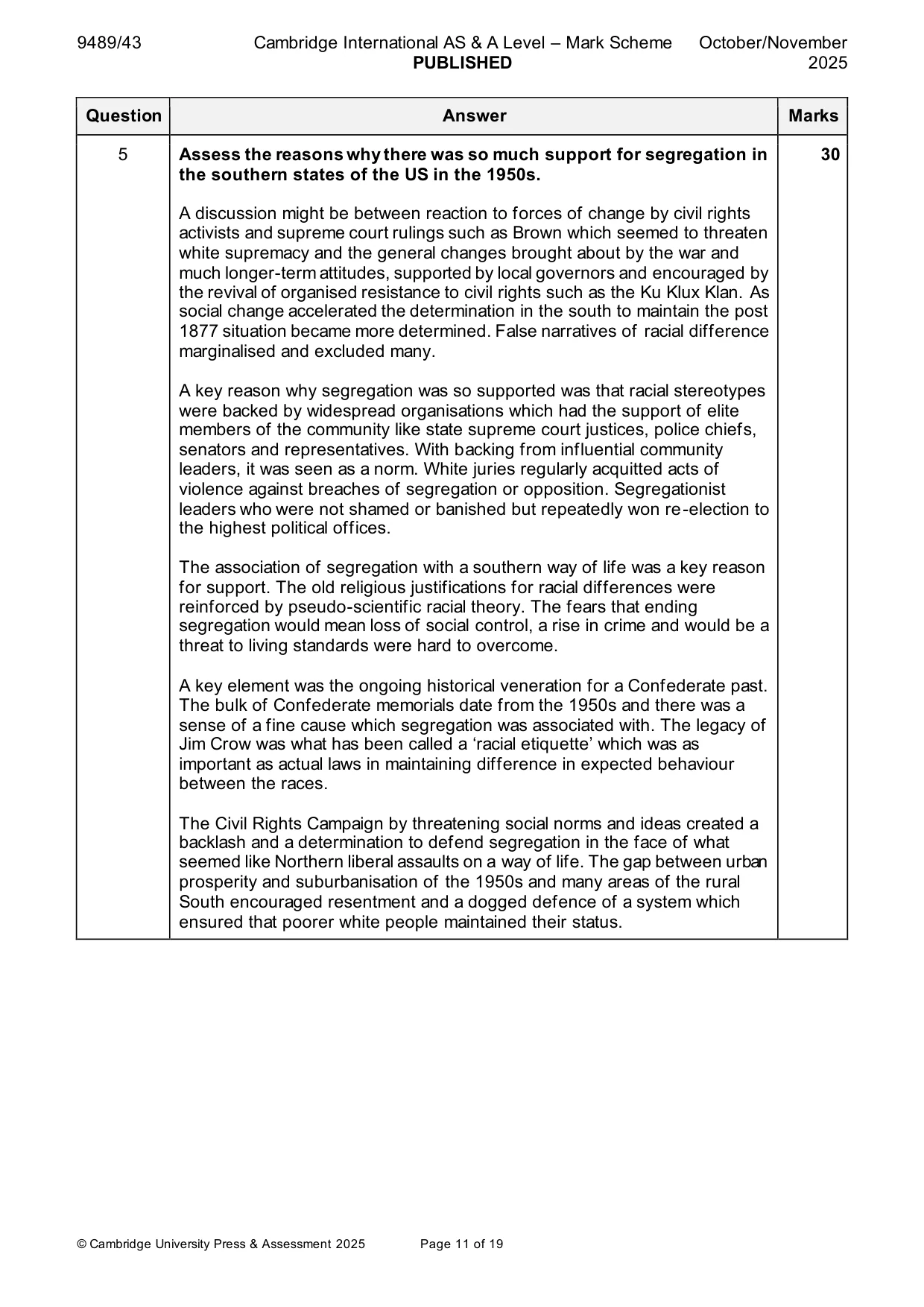
5 Assess the reasons why there was so much support for segregation in the southern states in the 1950s. [30]
Mark scheme: 5 Assess the reasons why there was so much support for segregation in 30 the southern states of the US in the 1950s. A discussion might be between reaction to forces of change by civil rights activists and supreme court rulings such as Brown which seemed to threaten white supremacy and the general changes brought about by the war and much longer-term attitudes, supported by local governors and encouraged by the revival of organised resistance to civil rights such as the Ku Klux Klan. As social change accelerated the determination in the south to maintain the post 1877 situation became more determined. False narratives of racial difference marginalised and excluded many. A key reason why segregation was so supported was that racial stereotypes were backed by widespread organisations which had the support of elite members of the community like state supreme court justices, police chiefs, senators and representatives. With backing from influential community leaders, it was seen as a norm. White juries regularly acquitted acts of violence against breaches of segregation or opposition. Segregationist leaders who were not shamed or banished but repeatedly won re-election to the highest political offices. The association of segregation with a southern way of life was a key reason for support. The old religious justifications for racial differences were reinforced by pseudo-scientific racial theory. The fears that ending segregation would mean loss of social control, a rise in crime and would be a threat to living standards were hard to overcome. A key element was the ongoing historical veneration for a Confederate past. The bulk of Confederate memorials date from the 1950s and there was a sense of a fine cause which segregation was associated with. The legacy of Jim Crow was what has been called a ‘racial etiquette’ which was as important as actual laws in maintaining difference in expected behaviour between the races. The Civil Rights Campaign by threatening social norms and ideas created a backlash and a determination to defend segregation in the face of what seemed like Northern liberal assaults on a way of life. The gap between urban prosperity and suburbanisation of the 1950s and many areas of the rural South encouraged resentment and a dogged defence of a system which ensured that poorer white people maintained their status.
More questions on What were the aims of Reconstruction and how successful was it?
Q6 · Assess the reasons for the growth of the gay rights movement in the 1960s and 1970s
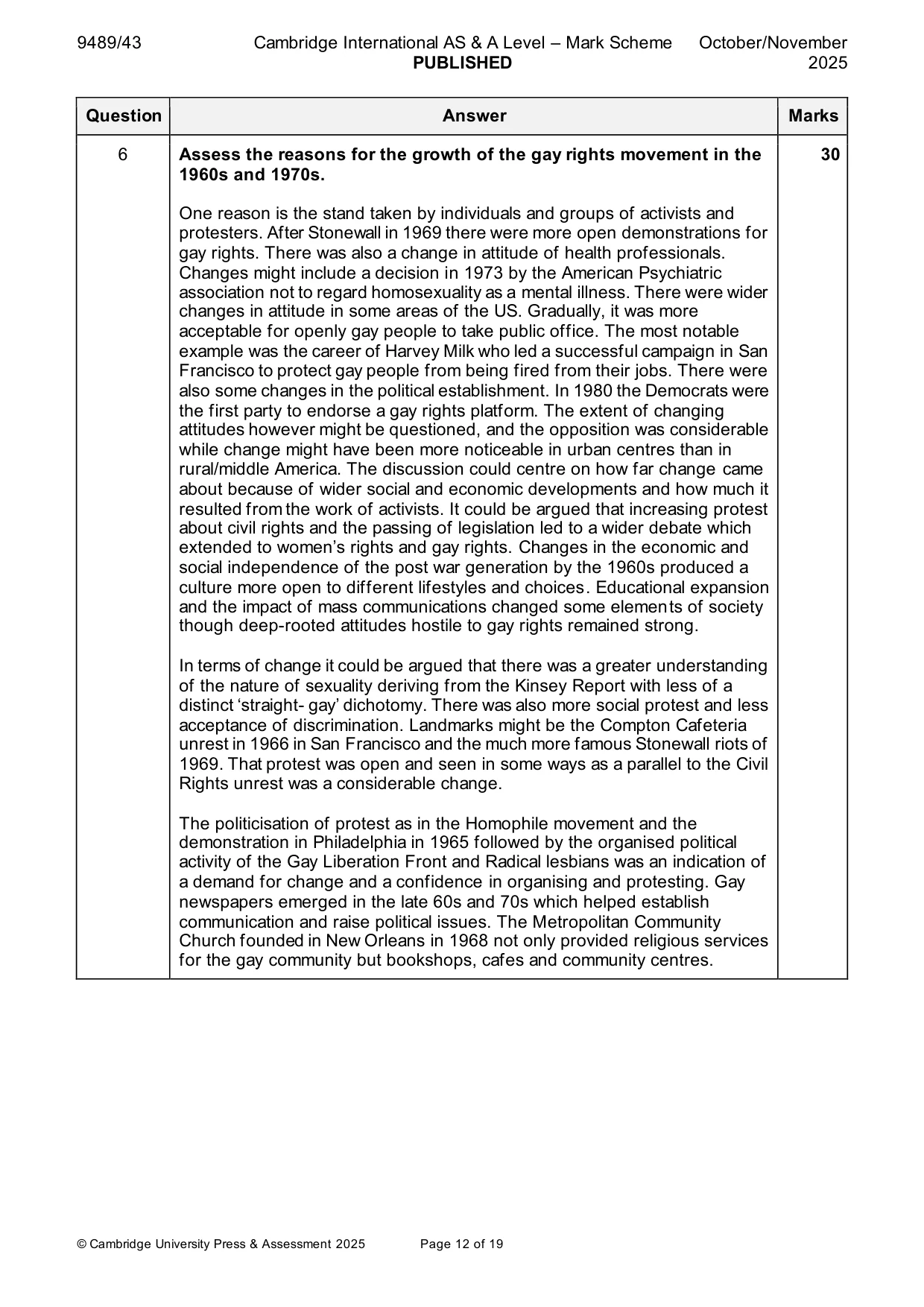
6 Assess the reasons for the growth of the gay rights movement in the 1960s and 1970s. [30]
Mark scheme: 6 Assess the reasons for the growth of the gay rights movement in the 30 1960s and 1970s. One reason is the stand taken by individuals and groups of activists and protesters. After Stonewall in 1969 there were more open demonstrations for gay rights. There was also a change in attitude of health professionals. Changes might include a decision in 1973 by the American Psychiatric association not to regard homosexuality as a mental illness. There were wider changes in attitude in some areas of the US. Gradually, it was more acceptable for openly gay people to take public office. The most notable example was the career of Harvey Milk who led a successful campaign in San Francisco to protect gay people from being fired from their jobs. There were also some changes in the political establishment. In 1980 the Democrats were the first party to endorse a gay rights platform. The extent of changing attitudes however might be questioned, and the opposition was considerable while change might have been more noticeable in urban centres than in rural/middle America. The discussion could centre on how far change came about because of wider social and economic developments and how much it resulted from the work of activists. It could be argued that increasing protest about civil rights and the passing of legislation led to a wider debate which extended to women’s rights and gay rights. Changes in the economic and social independence of the post war generation by the 1960s produced a culture more open to different lifestyles and choices. Educational expansion and the impact of mass communications changed some elements of society though deep-rooted attitudes hostile to gay rights remained strong. In terms of change it could be argued that there was a greater understanding of the nature of sexuality deriving from the Kinsey Report with less of a distinct ‘straight- gay’ dichotomy. There was also more social protest and less acceptance of discrimination. Landmarks might be the Compton Cafeteria unrest in 1966 in San Francisco and the much more famous Stonewall riots of 1969. That protest was open and seen in some ways as a parallel to the Civil Rights unrest was a considerable change. The politicisation of protest as in the Homophile movement and the demonstration in Philadelphia in 1965 followed by the organised political activity of the Gay Liberation Front and Radical lesbians was an indication of a demand for change and a confidence in organising and protesting. Gay newspapers emerged in the late 60s and 70s which helped establish communication and raise political issues. The Metropolitan Community Church founded in New Orleans in 1968 not only provided religious services for the gay community but bookshops, cafes and community centres.
More questions on Why did the Progressive Movement develop and what were its aims and policies?
Q7 · Assess the importance of economic factors in Clinton’s victory in the 1992 presidential…
7 Assess the importance of economic factors in Clinton’s victory in the 1992 presidential election. [30]
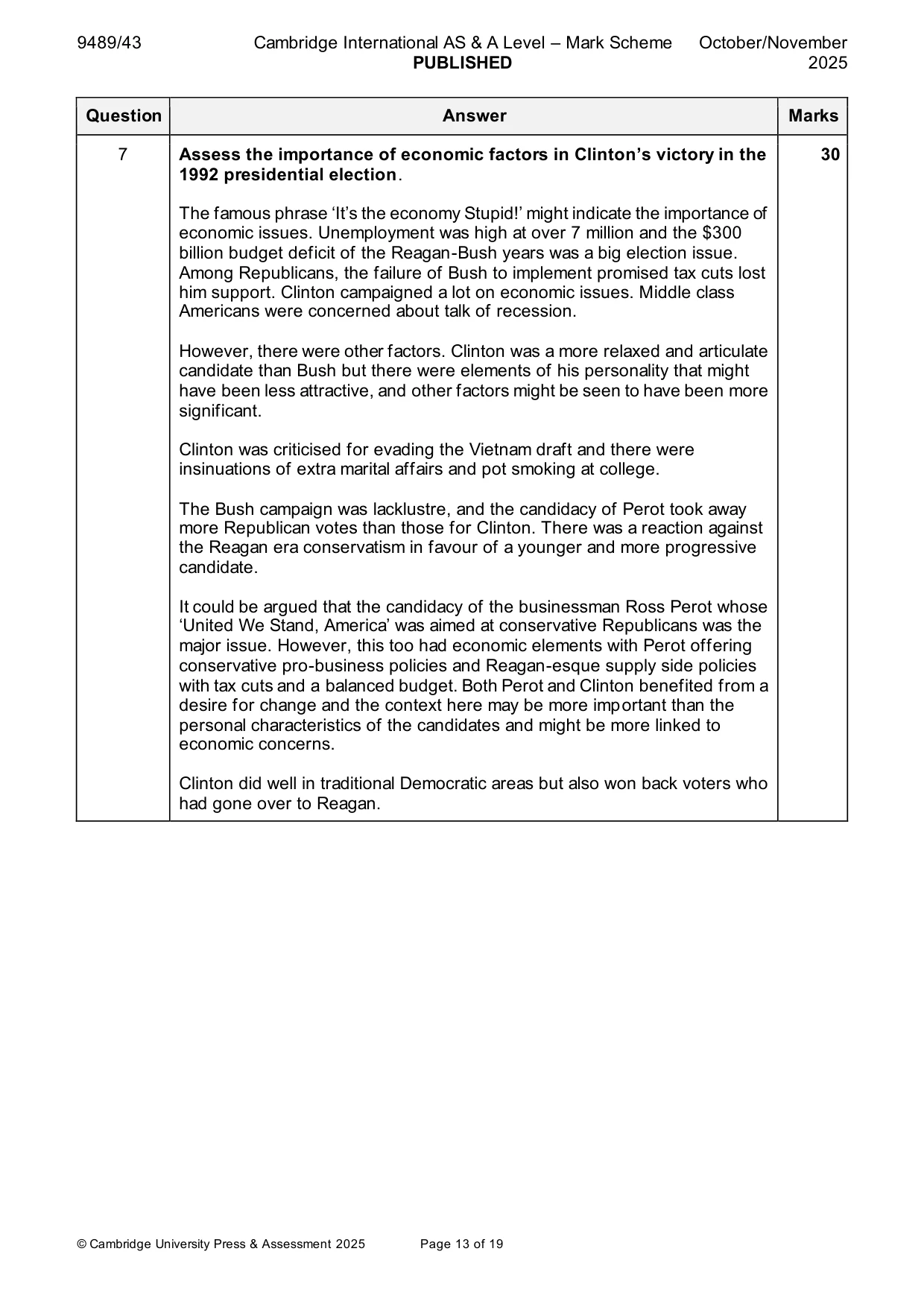
Mark scheme: 7 Assess the importance of economic factors in Clinton’s victory in the 30 1992 presidential election. The famous phrase ‘It’s the economy Stupid!’ might indicate the importance of economic issues. Unemployment was high at over 7 million and the $300 billion budget deficit of the Reagan-Bush years was a big election issue. Among Republicans, the failure of Bush to implement promised tax cuts lost him support. Clinton campaigned a lot on economic issues. Middle class Americans were concerned about talk of recession. However, there were other factors. Clinton was a more relaxed and articulate candidate than Bush but there were elements of his personality that might have been less attractive, and other factors might be seen to have been more significant. Clinton was criticised for evading the Vietnam draft and there were insinuations of extra marital affairs and pot smoking at college. The Bush campaign was lacklustre, and the candidacy of Perot took away more Republican votes than those for Clinton. There was a reaction against the Reagan era conservatism in favour of a younger and more progressive candidate. It could be argued that the candidacy of the businessman Ross Perot whose ‘United We Stand, America’ was aimed at conservative Republicans was the major issue. However, this too had economic elements with Perot offering conservative pro-business policies and Reagan-esque supply side policies with tax cuts and a balanced budget. Both Perot and Clinton benefited from a desire for change and the context here may be more important than the personal characteristics of the candidates and might be more linked to economic concerns. Clinton did well in traditional Democratic areas but also won back voters who had gone over to Reagan.
Q8 · Assess the reasons why the United States did not maintain the policy of détente by the…
8 Assess the reasons why the United States did not maintain the policy of détente by the 1980s. [30] Section C: International history, 1945–92
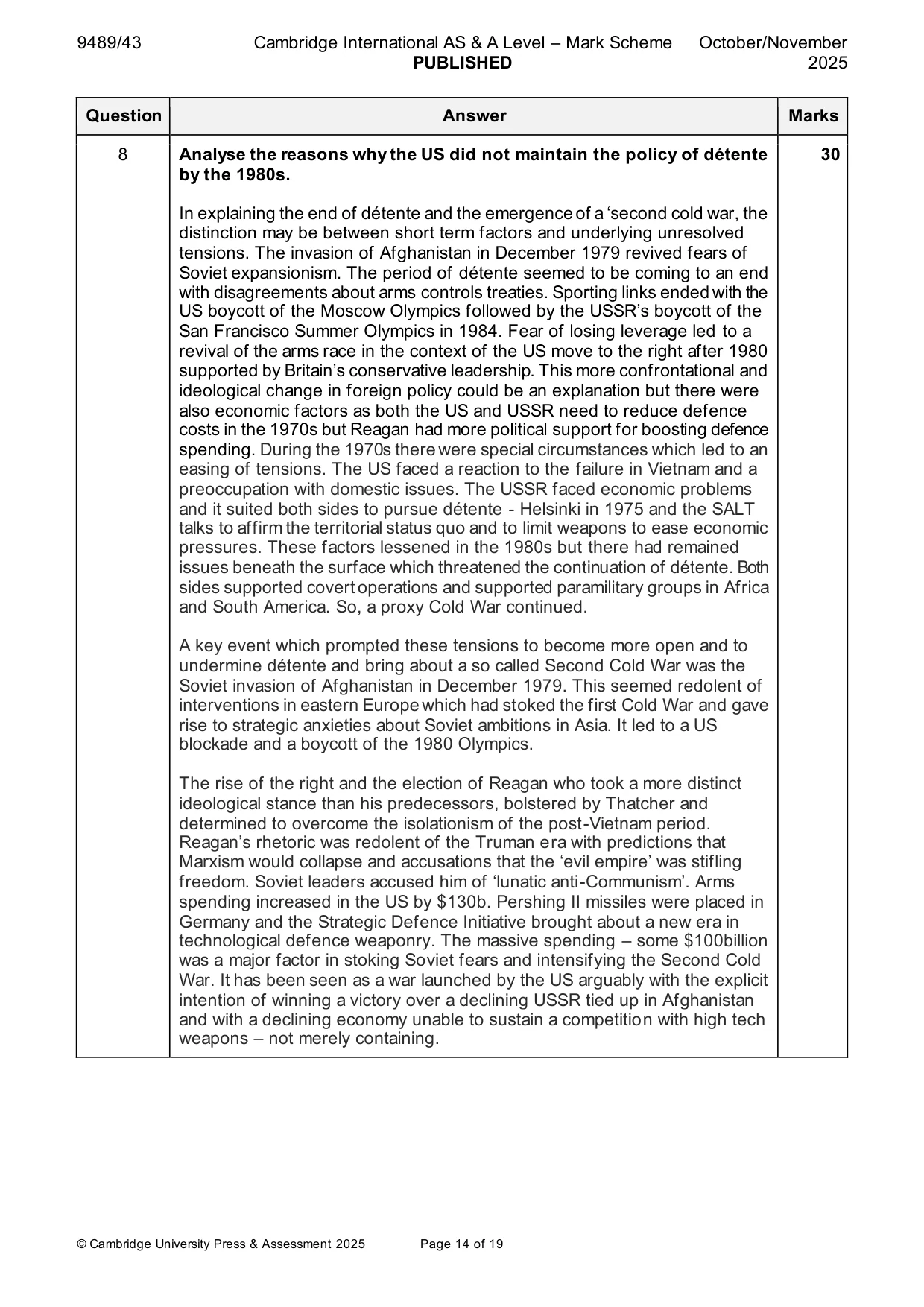
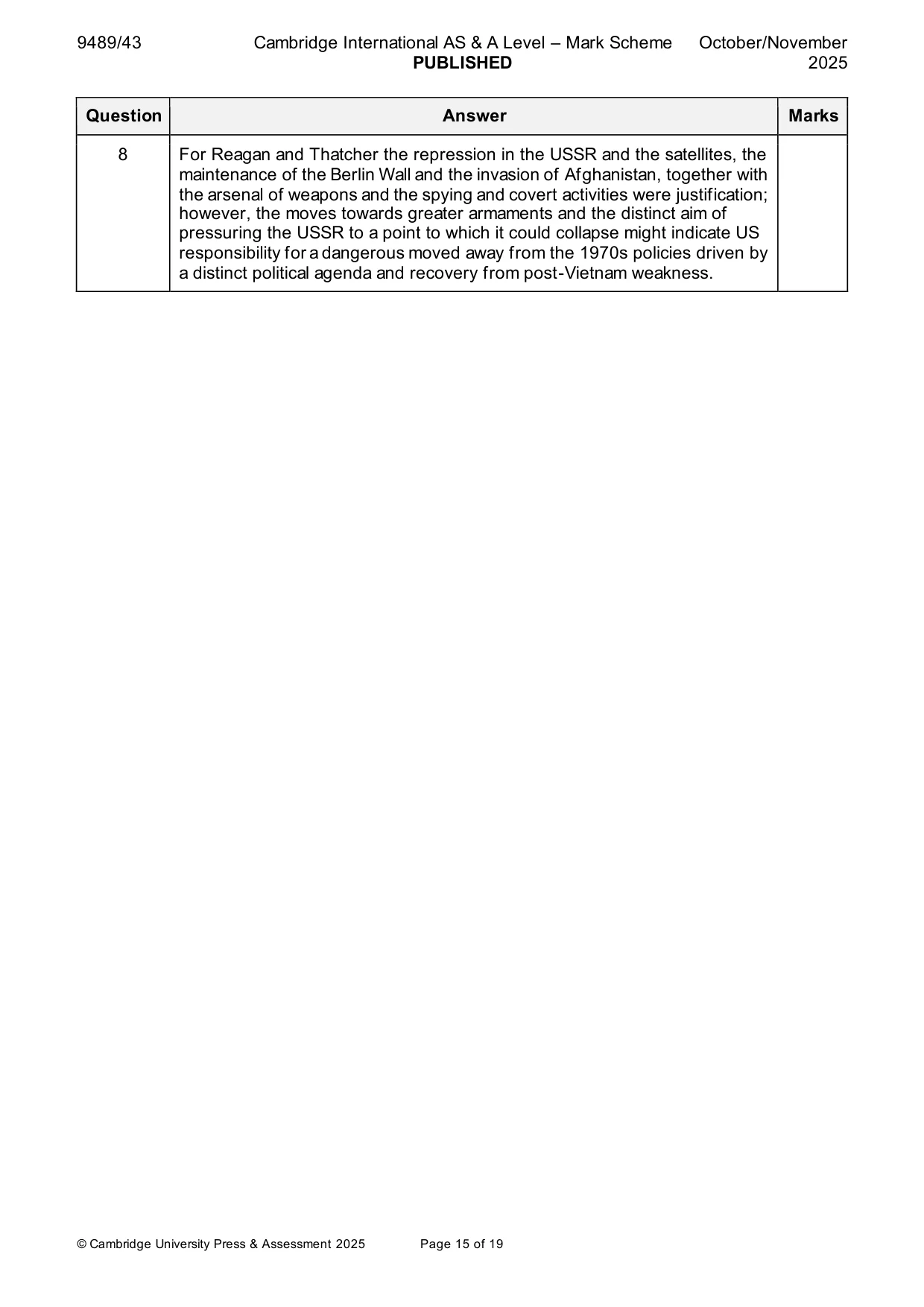
Mark scheme: 8 Analyse the reasons why the US did not maintain the policy of détente 30 by the 1980s. In explaining the end of détente and the emergence of a ‘second cold war, the distinction may be between short term factors and underlying unresolved tensions. The invasion of Afghanistan in December 1979 revived fears of Soviet expansionism. The period of détente seemed to be coming to an end with disagreements about arms controls treaties. Sporting links ended with the US boycott of the Moscow Olympics followed by the USSR’s boycott of the San Francisco Summer Olympics in 1984. Fear of losing leverage led to a revival of the arms race in the context of the US move to the right after 1980 supported by Britain’s conservative leadership. This more confrontational and ideological change in foreign policy could be an explanation but there were also economic factors as both the US and USSR need to reduce defence costs in the 1970s but Reagan had more political support for boosting defence spending. During the 1970s there were special circumstances which led to an easing of tensions. The US faced a reaction to the failure in Vietnam and a preoccupation with domestic issues. The USSR faced economic problems and it suited both sides to pursue détente - Helsinki in 1975 and the SALT talks to affirm the territorial status quo and to limit weapons to ease economic pressures. These factors lessened in the 1980s but there had remained issues beneath the surface which threatened the continuation of détente. Both sides supported covert operations and supported paramilitary groups in Africa and South America. So, a proxy Cold War continued. A key event which prompted these tensions to become more open and to undermine détente and bring about a so called Second Cold War was the Soviet invasion of Afghanistan in December 1979. This seemed redolent of interventions in eastern Europe which had stoked the first Cold War and gave rise to strategic anxieties about Soviet ambitions in Asia. It led to a US blockade and a boycott of the 1980 Olympics. The rise of the right and the election of Reagan who took a more distinct ideological stance than his predecessors, bolstered by Thatcher and determined to overcome the isolationism of the post-Vietnam period. Reagan’s rhetoric was redolent of the Truman era with predictions that Marxism would collapse and accusations that the ‘evil empire’ was stifling freedom. Soviet leaders accused him of ‘lunatic anti-Communism’. Arms spending increased in the US by $130b. Pershing II missiles were placed in Germany and the Strategic Defence Initiative brought about a new era in technological defence weaponry. The massive spending – some $100billion was a major factor in stoking Soviet fears and intensifying the Second Cold War. It has been seen as a war launched by the US arguably with the explicit intention of winning a victory over a declining USSR tied up in Afghanistan and with a declining economy unable to sustain a competition with high tech weapons – not merely containing. 8 For Reagan and Thatcher the repression in the USSR and the satellites, the maintenance of the Berlin Wall and the invasion of Afghanistan, together with the arsenal of weapons and the spying and covert activities were justification; however, the moves towards greater armaments and the distinct aim of pressuring the USSR to a point to which it could collapse might indicate US responsibility for a dangerous moved away from the 1970s policies driven by a distinct political agenda and recovery from post-Vietnam weakness.
More questions on How did the rise of extremism affect international relations?
Q9 · ‘It was Reagan who ended the Cold War.’ Assess this view
9 ‘It was Reagan who ended the Cold War.’ Assess this view. [30]
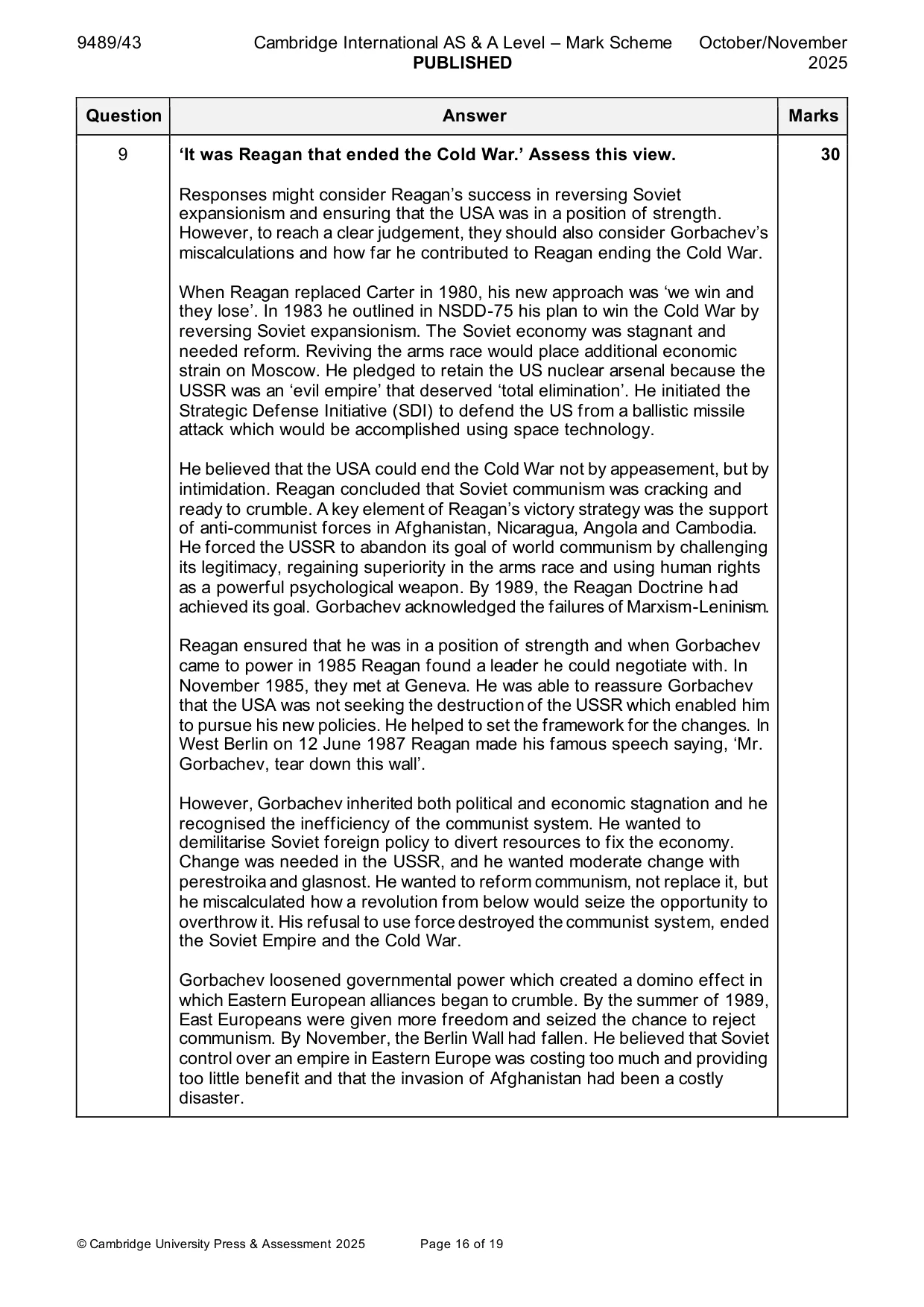
Mark scheme: 9 ‘It was Reagan that ended the Cold War.’ Assess this view. 30 Responses might consider Reagan’s success in reversing Soviet expansionism and ensuring that the USA was in a position of strength. However, to reach a clear judgement, they should also consider Gorbachev’s miscalculations and how far he contributed to Reagan ending the Cold War. When Reagan replaced Carter in 1980, his new approach was ‘we win and they lose’. In 1983 he outlined in NSDD-75 his plan to win the Cold War by reversing Soviet expansionism. The Soviet economy was stagnant and needed reform. Reviving the arms race would place additional economic strain on Moscow. He pledged to retain the US nuclear arsenal because the USSR was an ‘evil empire’ that deserved ‘total elimination’. He initiated the Strategic Defense Initiative (SDI) to defend the US from a ballistic missile attack which would be accomplished using space technology. He believed that the USA could end the Cold War not by appeasement, but by intimidation. Reagan concluded that Soviet communism was cracking and ready to crumble. A key element of Reagan’s victory strategy was the support of anti-communist forces in Afghanistan, Nicaragua, Angola and Cambodia. He forced the USSR to abandon its goal of world communism by challenging its legitimacy, regaining superiority in the arms race and using human rights as a powerful psychological weapon. By 1989, the Reagan Doctrine had achieved its goal. Gorbachev acknowledged the failures of Marxism-Leninism. Reagan ensured that he was in a position of strength and when Gorbachev came to power in 1985 Reagan found a leader he could negotiate with. In November 1985, they met at Geneva. He was able to reassure Gorbachev that the USA was not seeking the destruction of the USSR which enabled him to pursue his new policies. He helped to set the framework for the changes. In West Berlin on 12 June 1987 Reagan made his famous speech saying, ‘Mr. Gorbachev, tear down this wall’. However, Gorbachev inherited both political and economic stagnation and he recognised the inefficiency of the communist system. He wanted to demilitarise Soviet foreign policy to divert resources to fix the economy. Change was needed in the USSR, and he wanted moderate change with perestroika and glasnost. He wanted to reform communism, not replace it, but he miscalculated how a revolution from below would seize the opportunity to overthrow it. His refusal to use force destroyed the communist system, ended the Soviet Empire and the Cold War. Gorbachev loosened governmental power which created a domino effect in which Eastern European alliances began to crumble. By the summer of 1989, East Europeans were given more freedom and seized the chance to reject communism. By November, the Berlin Wall had fallen. He believed that Soviet control over an empire in Eastern Europe was costing too much and providing too little benefit and that the invasion of Afghanistan had been a costly disaster.
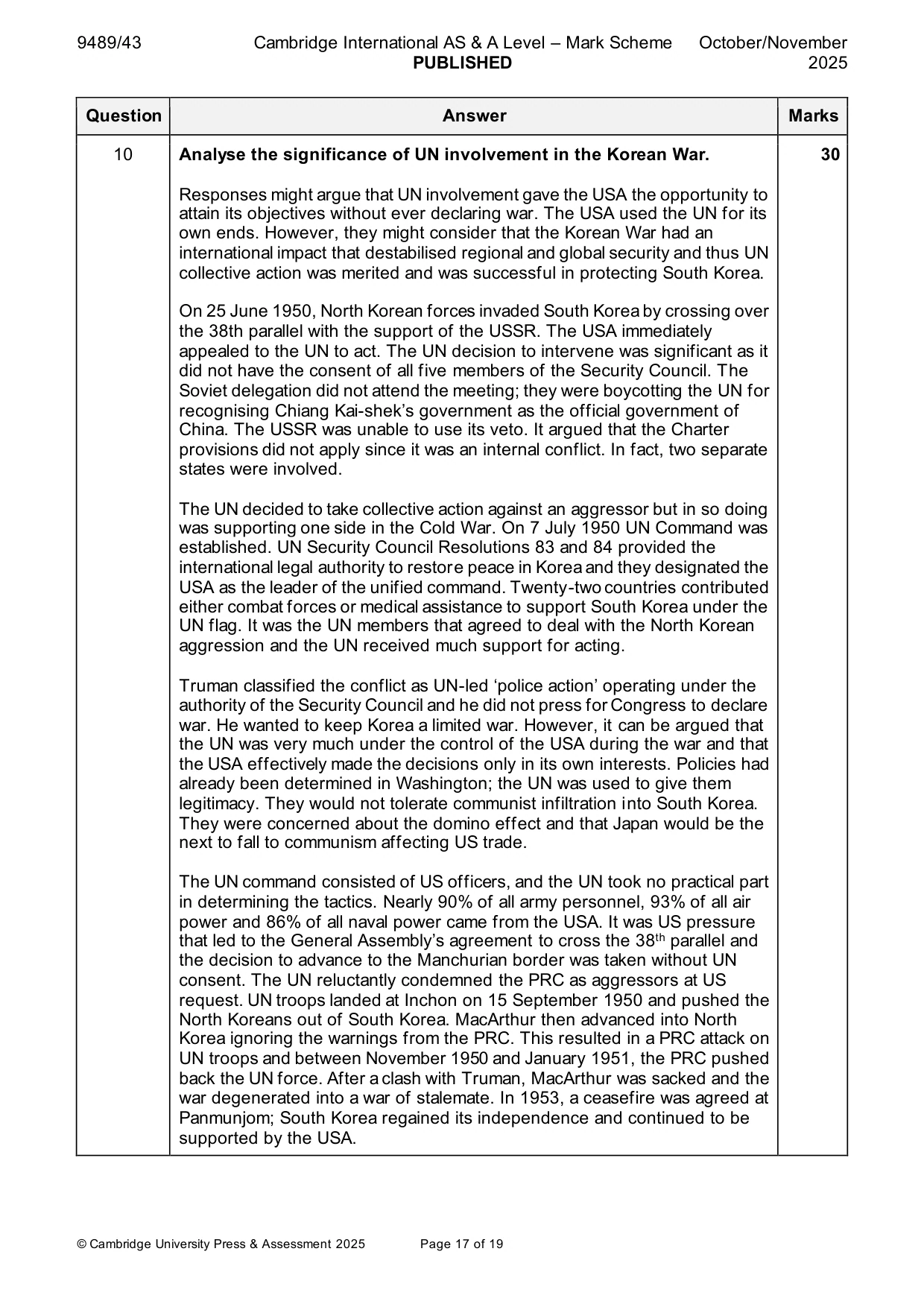
Q10 · Analyse the significance of UN involvement in the Korean War
10 Analyse the significance of UN involvement in the Korean War. [30]
Mark scheme: 10 Analyse the significance of UN involvement in the Korean War. 30 Responses might argue that UN involvement gave the USA the opportunity to attain its objectives without ever declaring war. The USA used the UN for its own ends. However, they might consider that the Korean War had an international impact that destabilised regional and global security and thus UN collective action was merited and was successful in protecting South Korea. On 25 June 1950, North Korean forces invaded South Korea by crossing over the 38th parallel with the support of the USSR. The USA immediately appealed to the UN to act. The UN decision to intervene was significant as it did not have the consent of all five members of the Security Council. The Soviet delegation did not attend the meeting; they were boycotting the UN for recognising Chiang Kai-shek’s government as the official government of China. The USSR was unable to use its veto. It argued that the Charter provisions did not apply since it was an internal conflict. In fact, two separate states were involved. The UN decided to take collective action against an aggressor but in so doing was supporting one side in the Cold War. On 7 July 1950 UN Command was established. UN Security Council Resolutions 83 and 84 provided the international legal authority to restore peace in Korea and they designated the USA as the leader of the unified command. Twenty-two countries contributed either combat forces or medical assistance to support South Korea under the UN flag. It was the UN members that agreed to deal with the North Korean aggression and the UN received much support for acting. Truman classified the conflict as UN-led ‘police action’ operating under the authority of the Security Council and he did not press for Congress to declare war. He wanted to keep Korea a limited war. However, it can be argued that the UN was very much under the control of the USA during the war and that the USA effectively made the decisions only in its own interests. Policies had already been determined in Washington; the UN was used to give them legitimacy. They would not tolerate communist infiltration into South Korea. They were concerned about the domino effect and that Japan would be the next to fall to communism affecting US trade. The UN command consisted of US officers, and the UN took no practical part in determining the tactics. Nearly 90% of all army personnel, 93% of all air power and 86% of all naval power came from the USA. It was US pressure that led to the General Assembly’s agreement to cross the 38th parallel and the decision to advance to the Manchurian border was taken without UN consent. The UN reluctantly condemned the PRC as aggressors at US request. UN troops landed at Inchon on 15 September 1950 and pushed the North Koreans out of South Korea. MacArthur then advanced into North Korea ignoring the warnings from the PRC. This resulted in a PRC attack on UN troops and between November 1950 and January 1951, the PRC pushed back the UN force. After a clash with Truman, MacArthur was sacked and the war degenerated into a war of stalemate. In 1953, a ceasefire was agreed at Panmunjom; South Korea regained its independence and continued to be supported by the USA.
More questions on Why did the League of Nations fail to keep the peace in the 1930s?
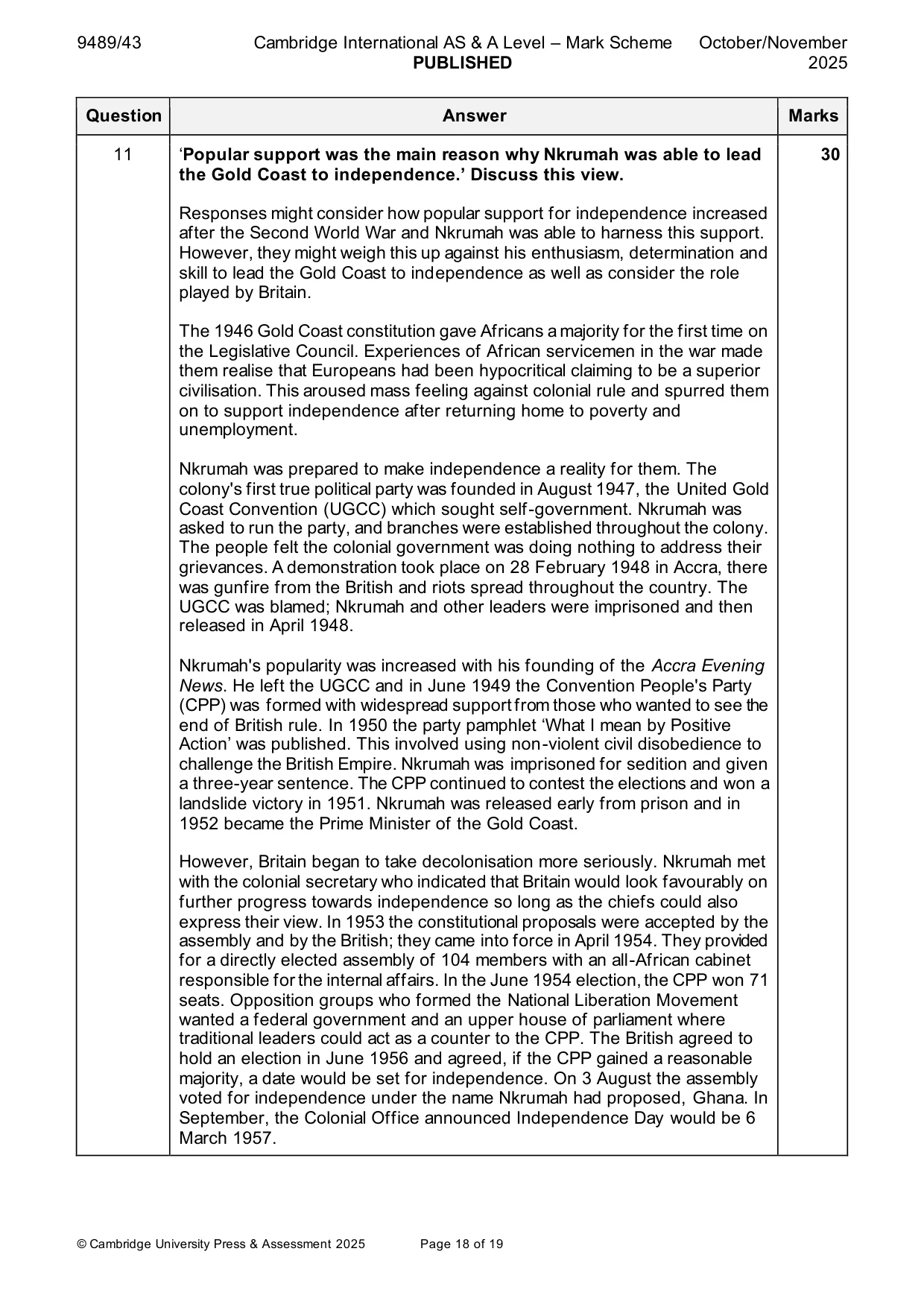
Q11 · ‘Popular support was the main reason why Nkrumah was able to lead the Gold Coast to…
11 ‘Popular support was the main reason why Nkrumah was able to lead the Gold Coast to independence.’ Discuss this view. [30]
Mark scheme: 11 ‘Popular support was the main reason why Nkrumah was able to lead 30 the Gold Coast to independence.’ Discuss this view. Responses might consider how popular support for independence increased after the Second World War and Nkrumah was able to harness this support. However, they might weigh this up against his enthusiasm, determination and skill to lead the Gold Coast to independence as well as consider the role played by Britain. The 1946 Gold Coast constitution gave Africans a majority for the first time on the Legislative Council. Experiences of African servicemen in the war made them realise that Europeans had been hypocritical claiming to be a superior civilisation. This aroused mass feeling against colonial rule and spurred them on to support independence after returning home to poverty and unemployment. Nkrumah was prepared to make independence a reality for them. The colony's first true political party was founded in August 1947, the United Gold Coast Convention (UGCC) which sought self-government. Nkrumah was asked to run the party, and branches were established throughout the colony. The people felt the colonial government was doing nothing to address their grievances. A demonstration took place on 28 February 1948 in Accra, there was gunfire from the British and riots spread throughout the country. The UGCC was blamed; Nkrumah and other leaders were imprisoned and then released in April 1948. Nkrumah's popularity was increased with his founding of the Accra Evening News. He left the UGCC and in June 1949 the Convention People's Party (CPP) was formed with widespread support from those who wanted to see the end of British rule. In 1950 the party pamphlet ‘What I mean by Positive Action’ was published. This involved using non-violent civil disobedience to challenge the British Empire. Nkrumah was imprisoned for sedition and given a three-year sentence. The CPP continued to contest the elections and won a landslide victory in 1951. Nkrumah was released early from prison and in 1952 became the Prime Minister of the Gold Coast. However, Britain began to take decolonisation more seriously. Nkrumah met with the colonial secretary who indicated that Britain would look favourably on further progress towards independence so long as the chiefs could also express their view. In 1953 the constitutional proposals were accepted by the assembly and by the British; they came into force in April 1954. They provided for a directly elected assembly of 104 members with an all-African cabinet responsible for the internal affairs. In the June 1954 election, the CPP won 71 seats. Opposition groups who formed the National Liberation Movement wanted a federal government and an upper house of parliament where traditional leaders could act as a counter to the CPP. The British agreed to hold an election in June 1956 and agreed, if the CPP gained a reasonable majority, a date would be set for independence. On 3 August the assembly voted for independence under the name Nkrumah had proposed, Ghana. In September, the Colonial Office announced Independence Day would be 6 March 1957.
More questions on Why was imperialism a significant force in Africa from 1870?
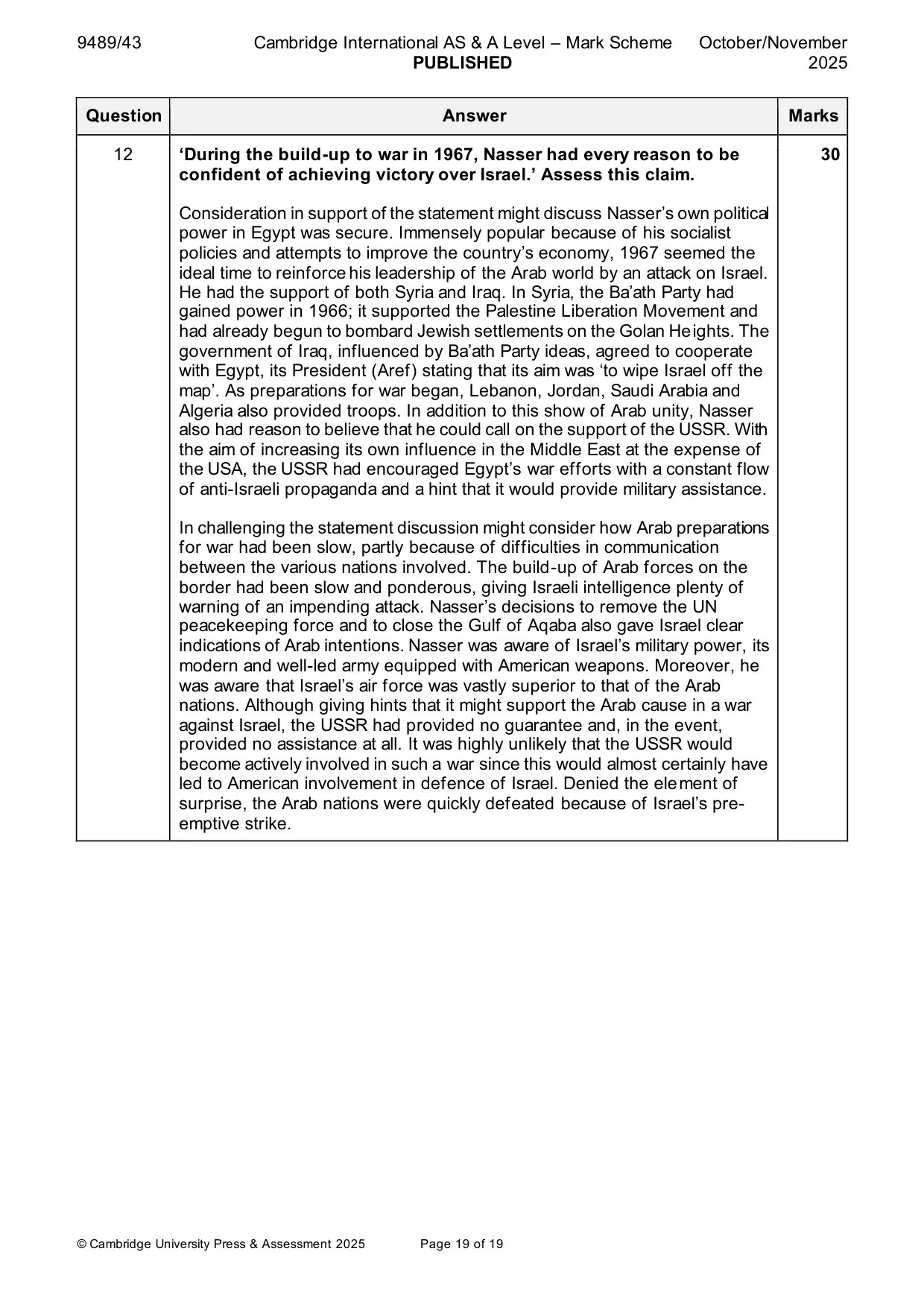
Q12 · ‘During the build-up to war in 1967, Nasser had every reason to be confident of achieving…
12 ‘During the build-up to war in 1967, Nasser had every reason to be confident of achieving victory over Israel.’ Assess this claim. [30]
Mark scheme: 12 ‘During the build-up to war in 1967, Nasser had every reason to be 30 confident of achieving victory over Israel.’ Assess this claim. Consideration in support of the statement might discuss Nasser’s own political power in Egypt was secure. Immensely popular because of his socialist policies and attempts to improve the country’s economy, 1967 seemed the ideal time to reinforce his leadership of the Arab world by an attack on Israel. He had the support of both Syria and Iraq. In Syria, the Ba’ath Party had gained power in 1966; it supported the Palestine Liberation Movement and had already begun to bombard Jewish settlements on the Golan Heights. The government of Iraq, influenced by Ba’ath Party ideas, agreed to cooperate with Egypt, its President (Aref) stating that its aim was ‘to wipe Israel off the map’. As preparations for war began, Lebanon, Jordan, Saudi Arabia and Algeria also provided troops. In addition to this show of Arab unity, Nasser also had reason to believe that he could call on the support of the USSR. With the aim of increasing its own influence in the Middle East at the expense of the USA, the USSR had encouraged Egypt’s war efforts with a constant flow of anti-Israeli propaganda and a hint that it would provide military assistance. In challenging the statement discussion might consider how Arab preparations for war had been slow, partly because of difficulties in communication between the various nations involved. The build-up of Arab forces on the border had been slow and ponderous, giving Israeli intelligence plenty of warning of an impending attack. Nasser’s decisions to remove the UN peacekeeping force and to close the Gulf of Aqaba also gave Israel clear indications of Arab intentions. Nasser was aware of Israel’s military power, its modern and well-led army equipped with American weapons. Moreover, he was aware that Israel’s air force was vastly superior to that of the Arab nations. Although giving hints that it might support the Arab cause in a war against Israel, the USSR had provided no guarantee and, in the event, provided no assistance at all. It was highly unlikely that the USSR would become actively involved in such a war since this would almost certainly have led to American involvement in defence of Israel. Denied the element of surprise, the Arab nations were quickly defeated because of Israel’s pre- emptive strike.
More questions on Why did the League of Nations fail to keep the peace in the 1930s?
What was in this paper
The subtopics covered by these 12 questions, and how many questions each got. Open one in a new tab to see every Cambridge question on it.
3Why did the League of Nations fail to keep the peace in the 1930s?2Why did war break out in 1939?2How were the Bolsheviks able to consolidate their power up to 1924?1What was the impact of the Great Crash and the Great Depression in the United States?1What were the aims of Reconstruction and how successful was it?1Why did the Progressive Movement develop and what were its aims and policies?1Why was imperialism a significant force in Africa from 1870?1What you needed in this session
Cambridge’s own grade thresholds for 2025 Oct/Nov, Paper 4 · Variant 3. A higher threshold means an easier paper — the bar moves with how the cohort did.