Cambridge A Level History 9489 — 2022 May/June Paper 4 · Variant 3
9489/43/M/J/22 · 12 questions · 60 marks · ≈68 min
The question paper and its mark scheme, free to read here and free to download. This is Cambridge’s own paper, exactly as it was sat.
Question paper4 pages
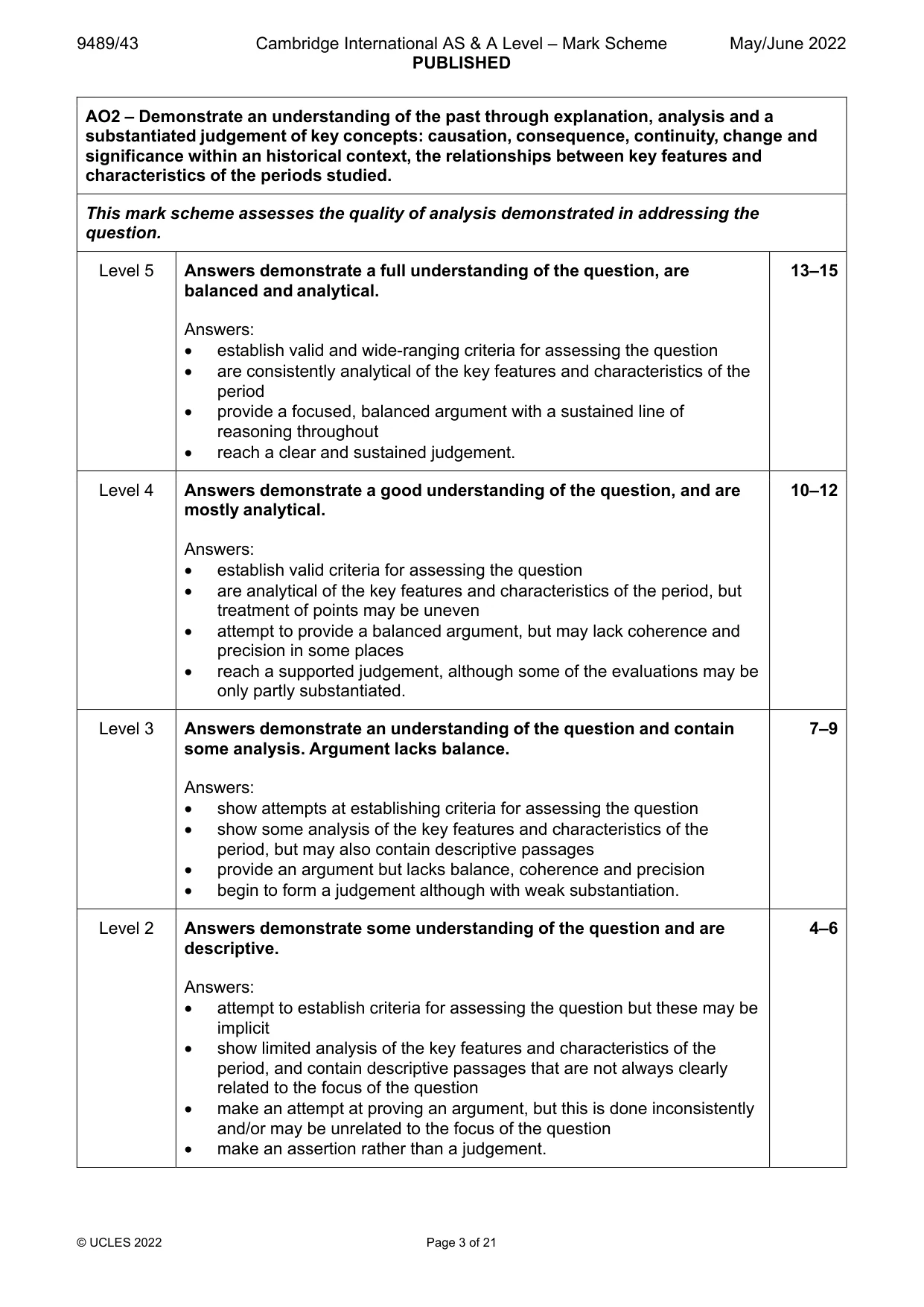
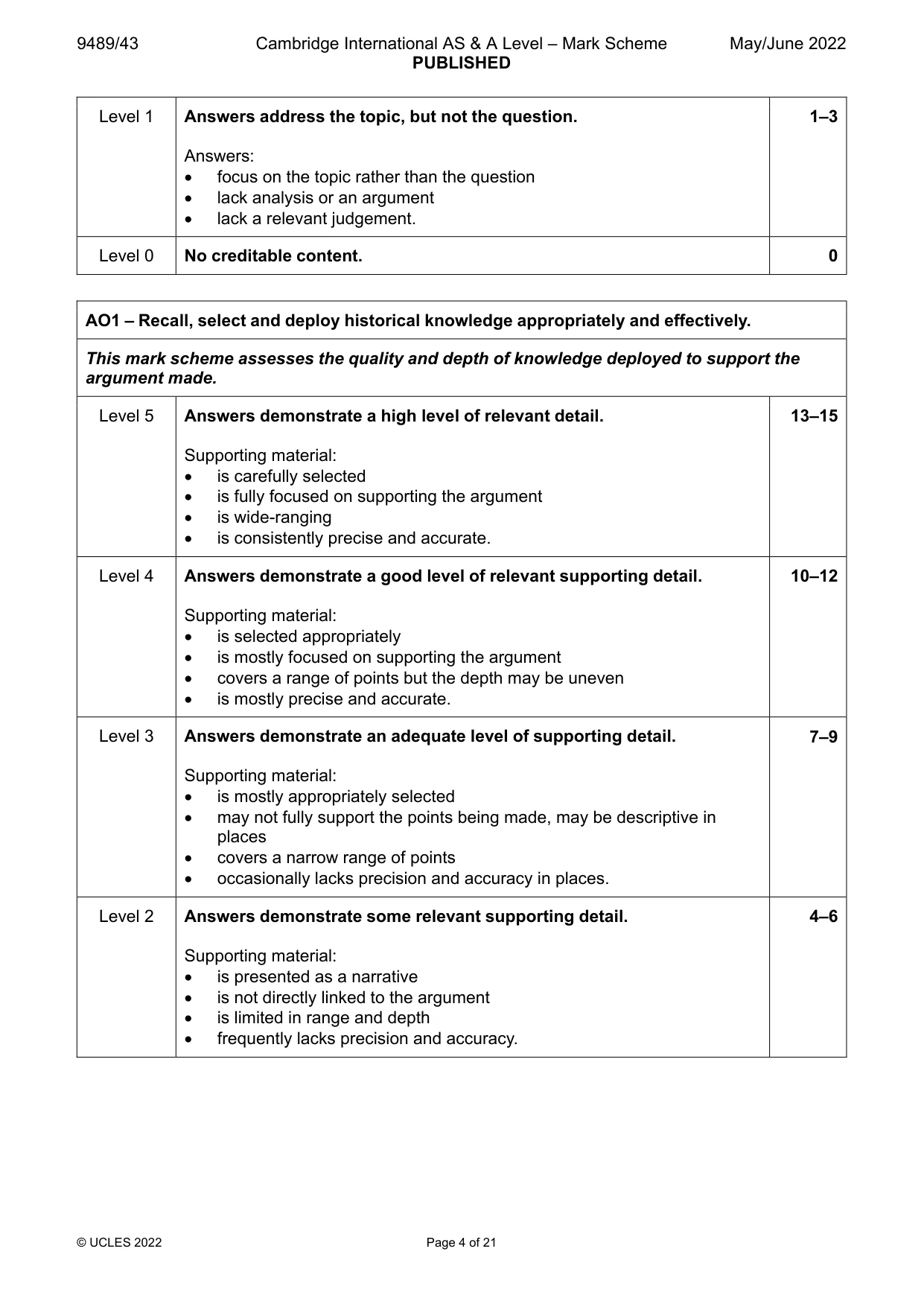
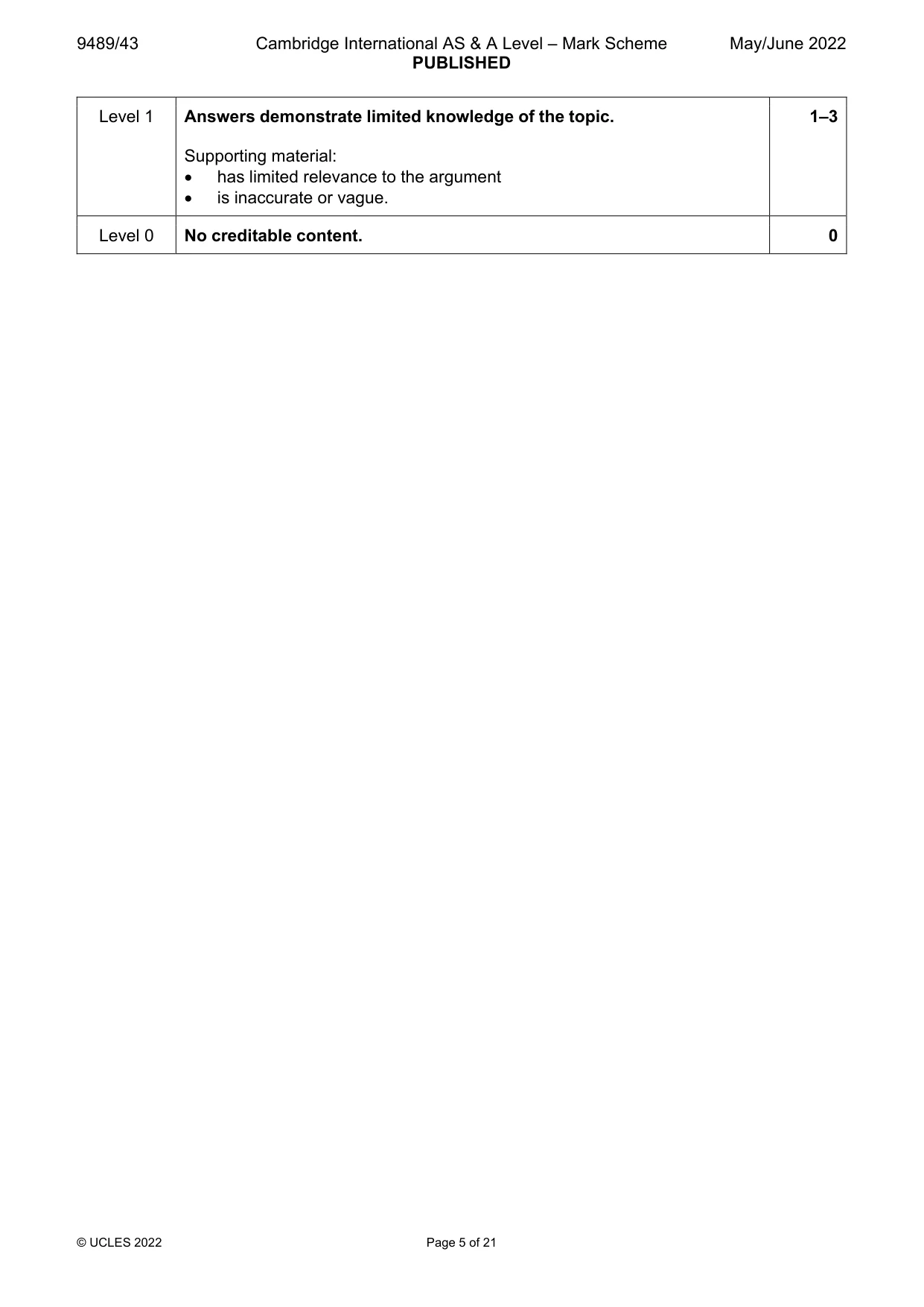
Mark scheme21 pages
Answers below. Sit the paper first if you are practising.

Questions as text
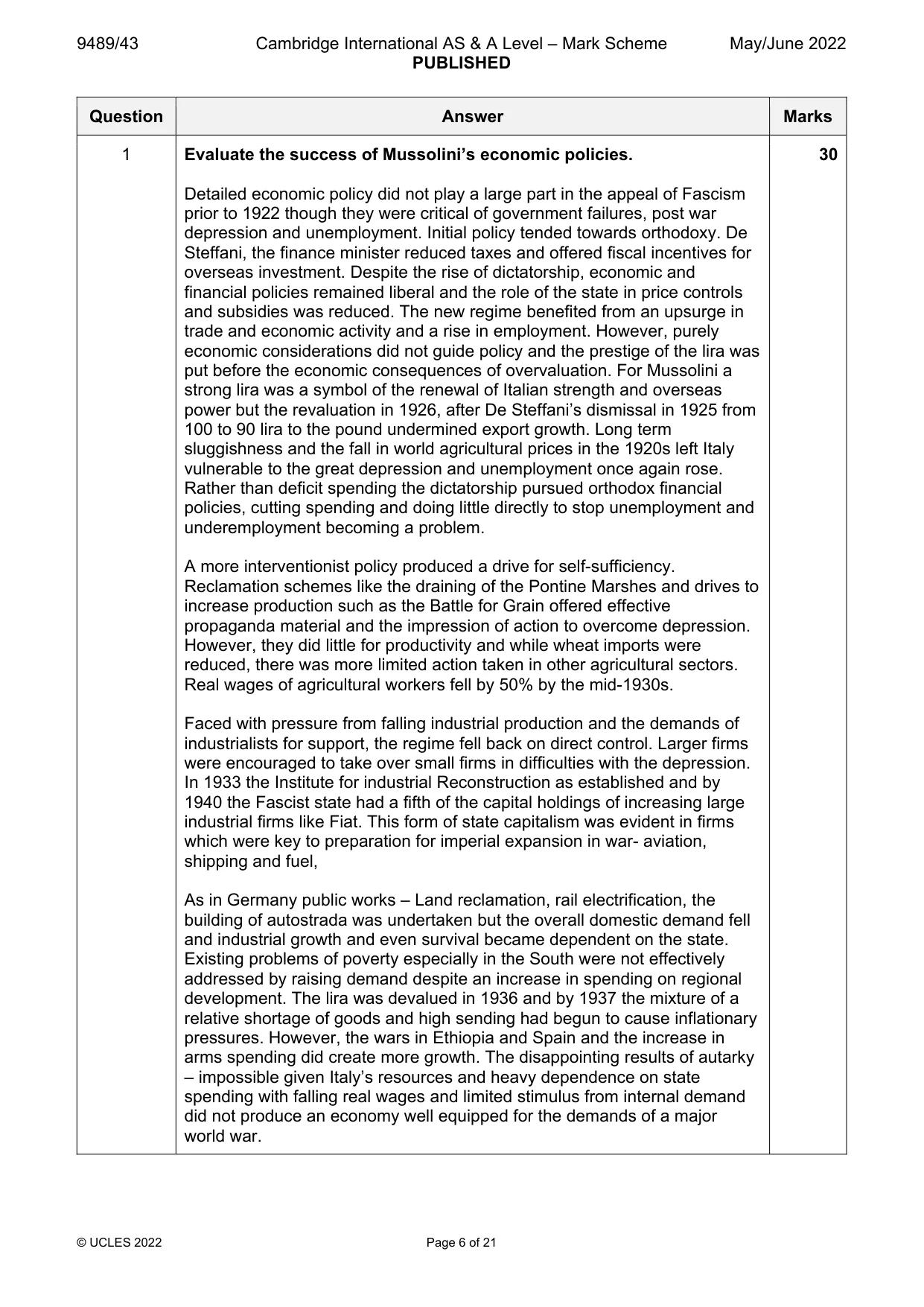
Q1 · Evaluate the success of Mussolini’s economic policies
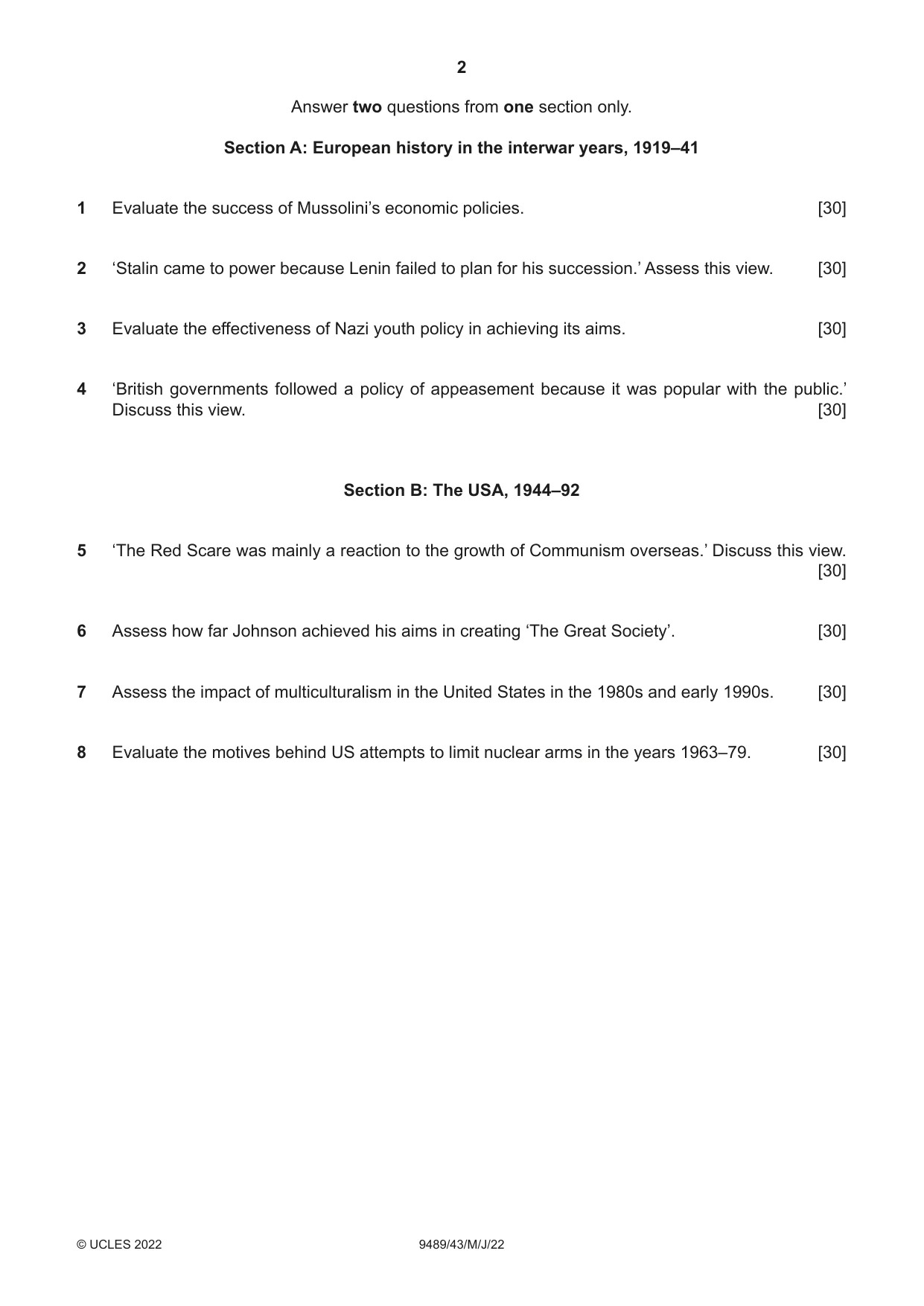
1 Evaluate the success of Mussolini’s economic policies. [30]
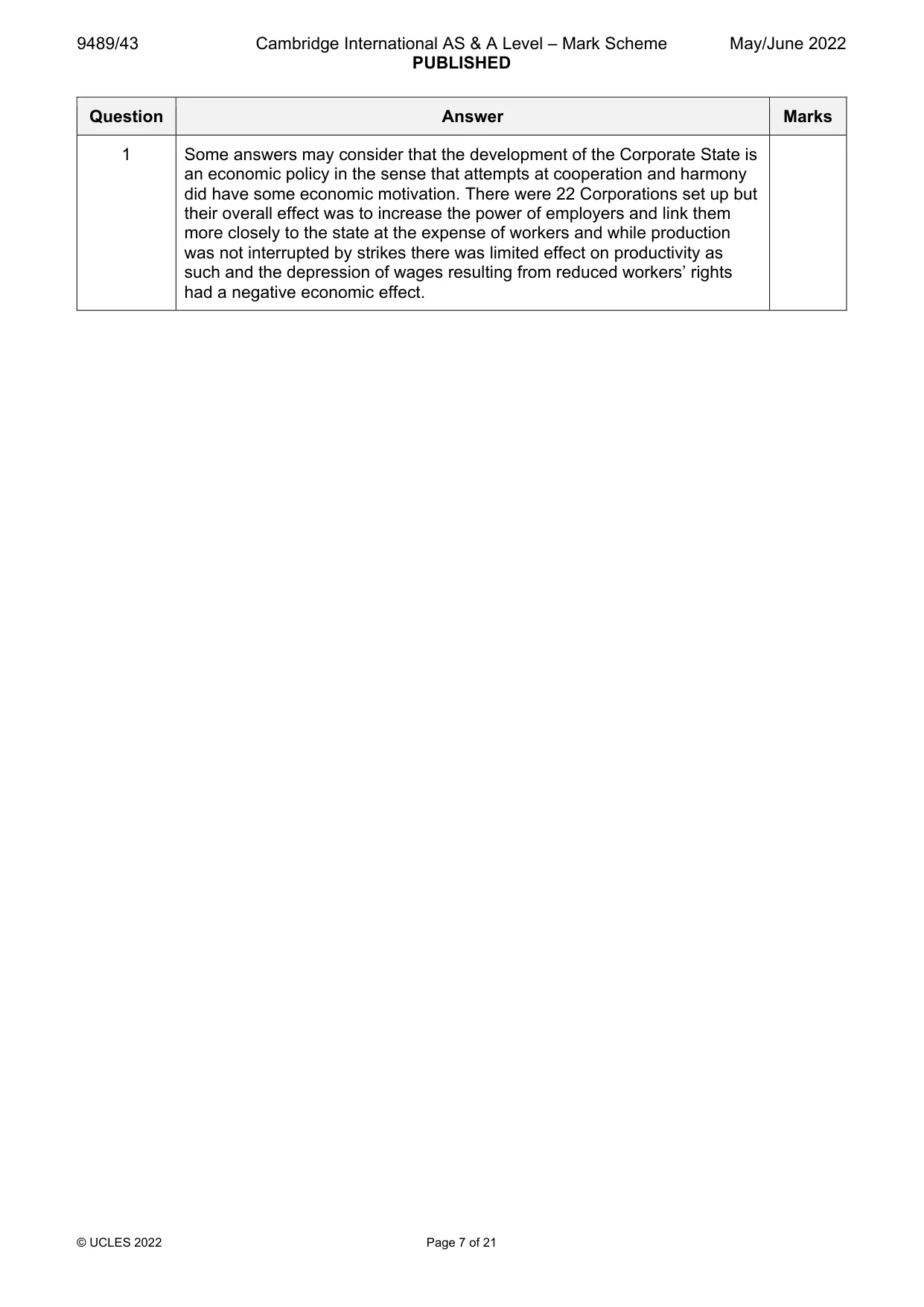
Mark scheme: Question Answer Marks 1 Evaluate the success of Mussolini’s economic policies. 30 Detailed economic policy did not play a large part in the appeal of Fascism prior to 1922 though they were critical of government failures, post war depression and unemployment. Initial policy tended towards orthodoxy. De Steffani, the finance minister reduced taxes and offered fiscal incentives for overseas investment. Despite the rise of dictatorship, economic and financial policies remained liberal and the role of the state in price controls and subsidies was reduced. The new regime benefited from an upsurge in trade and economic activity and a rise in employment. However, purely economic considerations did not guide policy and the prestige of the lira was put before the economic consequences of overvaluation. For Mussolini a strong lira was a symbol of the renewal of Italian strength and overseas power but the revaluation in 1926, after De Steffani’s dismissal in 1925 from 100 to 90 lira to the pound undermined export growth. Long term sluggishness and the fall in world agricultural prices in the 1920s left Italy vulnerable to the great depression and unemployment once again rose. Rather than deficit spending the dictatorship pursued orthodox financial policies, cutting spending and doing little directly to stop unemployment and underemployment becoming a problem. A more interventionist policy produced a drive for self-sufficiency. Reclamation schemes like the draining of the Pontine Marshes and drives to increase production such as the Battle for Grain offered effective propaganda material and the impression of action to overcome depression. However, they did little for productivity and while wheat imports were reduced, there was more limited action taken in other agricultural sectors. Real wages of agricultural workers fell by 50% by the mid-1930s. Faced with pressure from falling industrial production and the demands of industrialists for support, the regime fell back on direct control. Larger firms were encouraged to take over small firms in difficulties with the depression. In 1933 the Institute for industrial Reconstruction as established and by 1940 the Fascist state had a fifth of the capital holdings of increasing large industrial firms like Fiat. This form of state capitalism was evident in firms which were key to preparation for imperial expansion in war- aviation, shipping and fuel, As in Germany public works – Land reclamation, rail electrification, the building of autostrada was undertaken but the overall domestic demand fell and industrial growth and even survival became dependent on the state. Existing problems of poverty especially in the South were not effectively addressed by raising demand despite an increase in spending on regional development. The lira was devalued in 1936 and by 1937 the mixture of a relative shortage of goods and high sending had begun to cause inflationary pressures. However, the wars in Ethiopia and Spain and the increase in arms spending did create more growth. The disappointing results of autarky – impossible given Italy’s resources and heavy dependence on state spending with falling real wages and limited stimulus from internal demand did not produce an economy well equipped for the demands of a major world war. 1 Some answers may consider that the development of the Corporate State is an economic policy in the sense that attempts at cooperation and harmony did have some economic motivation. There were 22 Corporations set up but their overall effect was to increase the power of employers and link them more closely to the state at the expense of workers and while production was not interrupted by strikes there was limited effect on productivity as such and the depression of wages resulting from reduced workers’ rights had a negative economic effect.
More questions on How did the rise of extremism affect international relations?
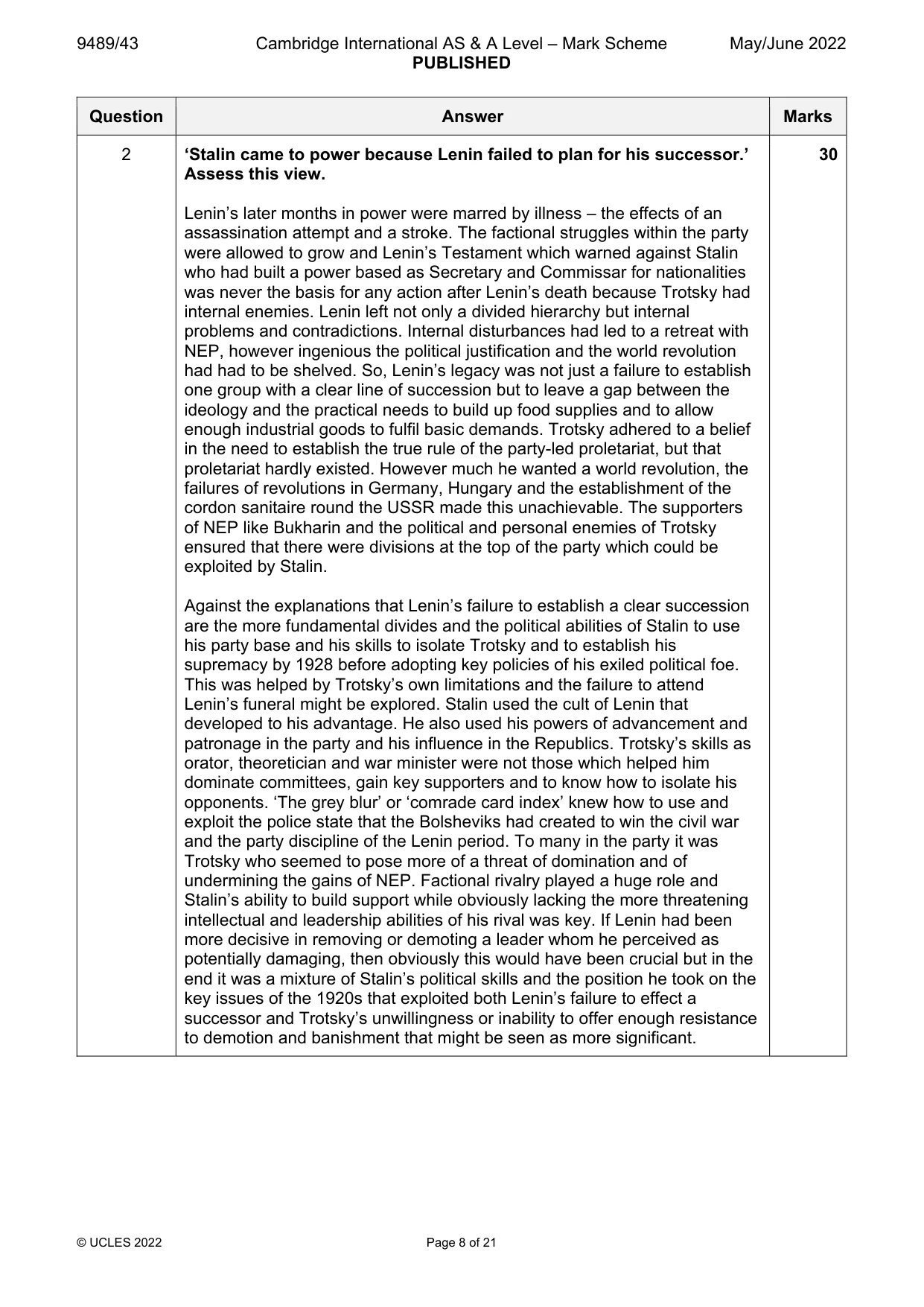
Q2 · ‘Stalin came to power because Lenin failed to plan for his succession.’ Assess this view
2 ‘Stalin came to power because Lenin failed to plan for his succession.’ Assess this view. [30]
Mark scheme: 2 ‘Stalin came to power because Lenin failed to plan for his successor.’ 30 Assess this view. Lenin’s later months in power were marred by illness – the effects of an assassination attempt and a stroke. The factional struggles within the party were allowed to grow and Lenin’s Testament which warned against Stalin who had built a power based as Secretary and Commissar for nationalities was never the basis for any action after Lenin’s death because Trotsky had internal enemies. Lenin left not only a divided hierarchy but internal problems and contradictions. Internal disturbances had led to a retreat with NEP, however ingenious the political justification and the world revolution had had to be shelved. So, Lenin’s legacy was not just a failure to establish one group with a clear line of succession but to leave a gap between the ideology and the practical needs to build up food supplies and to allow enough industrial goods to fulfil basic demands. Trotsky adhered to a belief in the need to establish the true rule of the party-led proletariat, but that proletariat hardly existed. However much he wanted a world revolution, the failures of revolutions in Germany, Hungary and the establishment of the cordon sanitaire round the USSR made this unachievable. The supporters of NEP like Bukharin and the political and personal enemies of Trotsky ensured that there were divisions at the top of the party which could be exploited by Stalin. Against the explanations that Lenin’s failure to establish a clear succession are the more fundamental divides and the political abilities of Stalin to use his party base and his skills to isolate Trotsky and to establish his supremacy by 1928 before adopting key policies of his exiled political foe. This was helped by Trotsky’s own limitations and the failure to attend Lenin’s funeral might be explored. Stalin used the cult of Lenin that developed to his advantage. He also used his powers of advancement and patronage in the party and his influence in the Republics. Trotsky’s skills as orator, theoretician and war minister were not those which helped him dominate committees, gain key supporters and to know how to isolate his opponents. ‘The grey blur’ or ‘comrade card index’ knew how to use and exploit the police state that the Bolsheviks had created to win the civil war and the party discipline of the Lenin period. To many in the party it was Trotsky who seemed to pose more of a threat of domination and of undermining the gains of NEP. Factional rivalry played a huge role and Stalin’s ability to build support while obviously lacking the more threatening intellectual and leadership abilities of his rival was key. If Lenin had been more decisive in removing or demoting a leader whom he perceived as potentially damaging, then obviously this would have been crucial but in the end it was a mixture of Stalin’s political skills and the position he took on the key issues of the 1920s that exploited both Lenin’s failure to effect a successor and Trotsky’s unwillingness or inability to offer enough resistance to demotion and banishment that might be seen as more significant.
More questions on How were the Bolsheviks able to consolidate their power up to 1924?
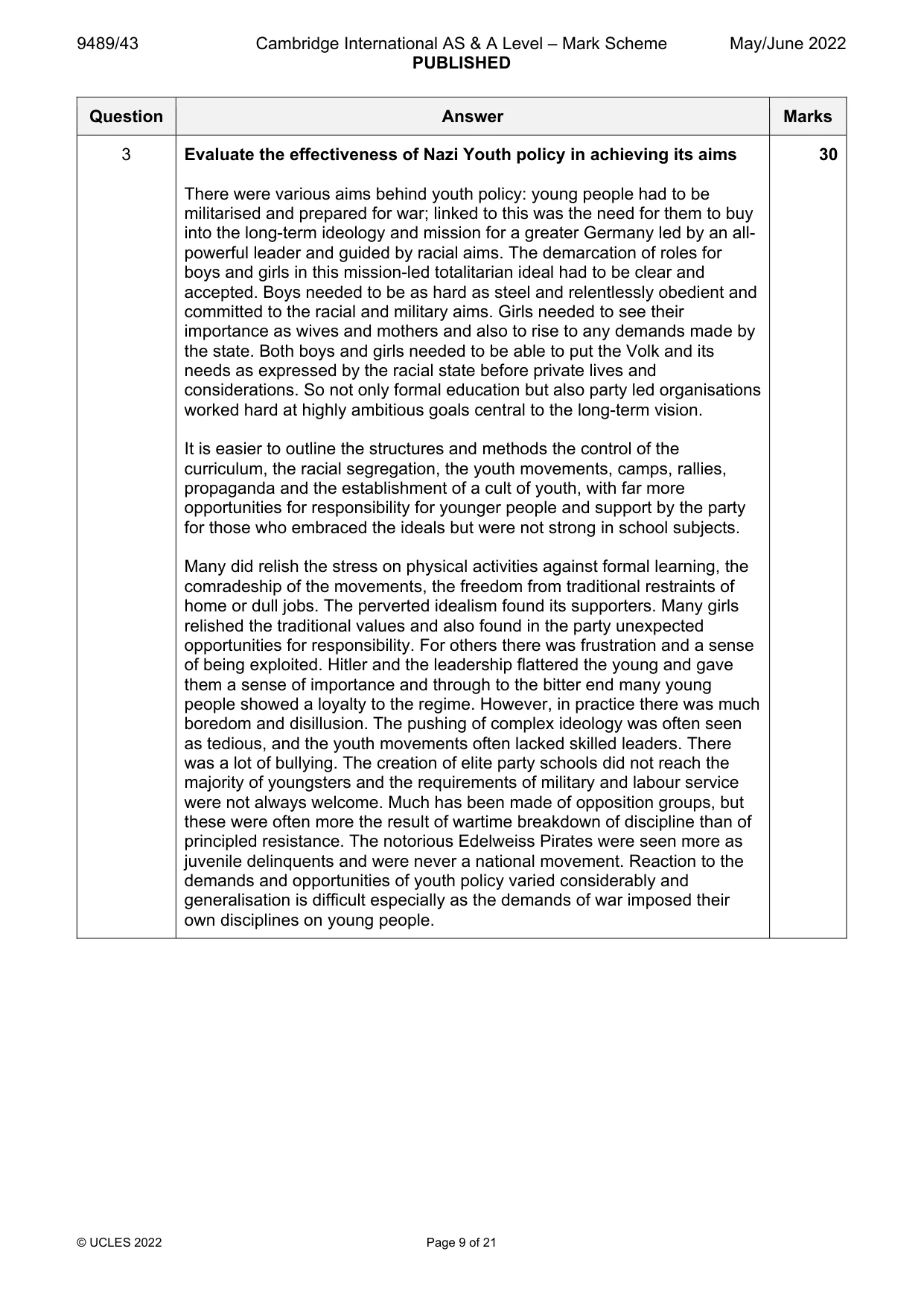
Q3 · Evaluate the effectiveness of Nazi youth policy in achieving its aims
3 Evaluate the effectiveness of Nazi youth policy in achieving its aims. [30]
Mark scheme: 3 Evaluate the effectiveness of Nazi Youth policy in achieving its aims 30 There were various aims behind youth policy: young people had to be militarised and prepared for war; linked to this was the need for them to buy into the long-term ideology and mission for a greater Germany led by an all- powerful leader and guided by racial aims. The demarcation of roles for boys and girls in this mission-led totalitarian ideal had to be clear and accepted. Boys needed to be as hard as steel and relentlessly obedient and committed to the racial and military aims. Girls needed to see their importance as wives and mothers and also to rise to any demands made by the state. Both boys and girls needed to be able to put the Volk and its needs as expressed by the racial state before private lives and considerations. So not only formal education but also party led organisations worked hard at highly ambitious goals central to the long-term vision. It is easier to outline the structures and methods the control of the curriculum, the racial segregation, the youth movements, camps, rallies, propaganda and the establishment of a cult of youth, with far more opportunities for responsibility for younger people and support by the party for those who embraced the ideals but were not strong in school subjects. Many did relish the stress on physical activities against formal learning, the comradeship of the movements, the freedom from traditional restraints of home or dull jobs. The perverted idealism found its supporters. Many girls relished the traditional values and also found in the party unexpected opportunities for responsibility. For others there was frustration and a sense of being exploited. Hitler and the leadership flattered the young and gave them a sense of importance and through to the bitter end many young people showed a loyalty to the regime. However, in practice there was much boredom and disillusion. The pushing of complex ideology was often seen as tedious, and the youth movements often lacked skilled leaders. There was a lot of bullying. The creation of elite party schools did not reach the majority of youngsters and the requirements of military and labour service were not always welcome. Much has been made of opposition groups, but these were often more the result of wartime breakdown of discipline than of principled resistance. The notorious Edelweiss Pirates were seen more as juvenile delinquents and were never a national movement. Reaction to the demands and opportunities of youth policy varied considerably and generalisation is difficult especially as the demands of war imposed their own disciplines on young people.
More questions on How did the rise of extremism affect international relations?
Q4 · ‘British governments followed a policy of appeasement because it was popular with the…
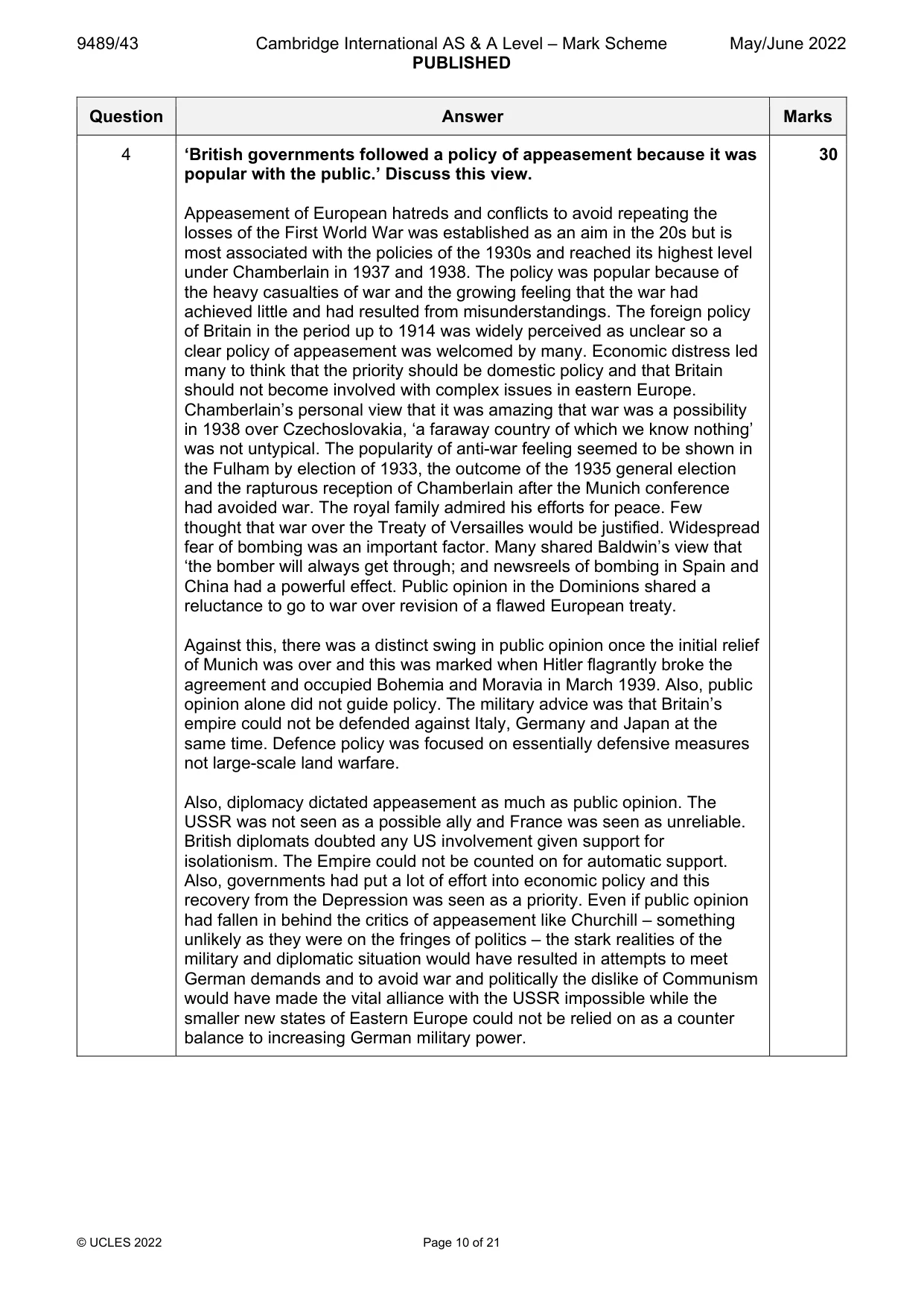
4 ‘British governments followed a policy of appeasement because it was popular with the public.’ Discuss this view. [30]
Mark scheme: 4 ‘British governments followed a policy of appeasement because it was 30 popular with the public.’ Discuss this view. Appeasement of European hatreds and conflicts to avoid repeating the losses of the First World War was established as an aim in the 20s but is most associated with the policies of the 1930s and reached its highest level under Chamberlain in 1937 and 1938. The policy was popular because of the heavy casualties of war and the growing feeling that the war had achieved little and had resulted from misunderstandings. The foreign policy of Britain in the period up to 1914 was widely perceived as unclear so a clear policy of appeasement was welcomed by many. Economic distress led many to think that the priority should be domestic policy and that Britain should not become involved with complex issues in eastern Europe. Chamberlain’s personal view that it was amazing that war was a possibility in 1938 over Czechoslovakia, ‘a faraway country of which we know nothing’ was not untypical. The popularity of anti-war feeling seemed to be shown in the Fulham by election of 1933, the outcome of the 1935 general election and the rapturous reception of Chamberlain after the Munich conference had avoided war. The royal family admired his efforts for peace. Few thought that war over the Treaty of Versailles would be justified. Widespread fear of bombing was an important factor. Many shared Baldwin’s view that ‘the bomber will always get through; and newsreels of bombing in Spain and China had a powerful effect. Public opinion in the Dominions shared a reluctance to go to war over revision of a flawed European treaty. Against this, there was a distinct swing in public opinion once the initial relief of Munich was over and this was marked when Hitler flagrantly broke the agreement and occupied Bohemia and Moravia in March 1939. Also, public opinion alone did not guide policy. The military advice was that Britain’s empire could not be defended against Italy, Germany and Japan at the same time. Defence policy was focused on essentially defensive measures not large-scale land warfare. Also, diplomacy dictated appeasement as much as public opinion. The USSR was not seen as a possible ally and France was seen as unreliable. British diplomats doubted any US involvement given support for isolationism. The Empire could not be counted on for automatic support. Also, governments had put a lot of effort into economic policy and this recovery from the Depression was seen as a priority. Even if public opinion had fallen in behind the critics of appeasement like Churchill – something unlikely as they were on the fringes of politics – the stark realities of the military and diplomatic situation would have resulted in attempts to meet German demands and to avoid war and politically the dislike of Communism would have made the vital alliance with the USSR impossible while the smaller new states of Eastern Europe could not be relied on as a counter balance to increasing German military power.
More questions on Why, and with what effects, did Britain and France pursue a policy of appeasement?
Q5 · ‘The Red Scare was mainly a reaction to the growth of Communism overseas.’ Discuss this…
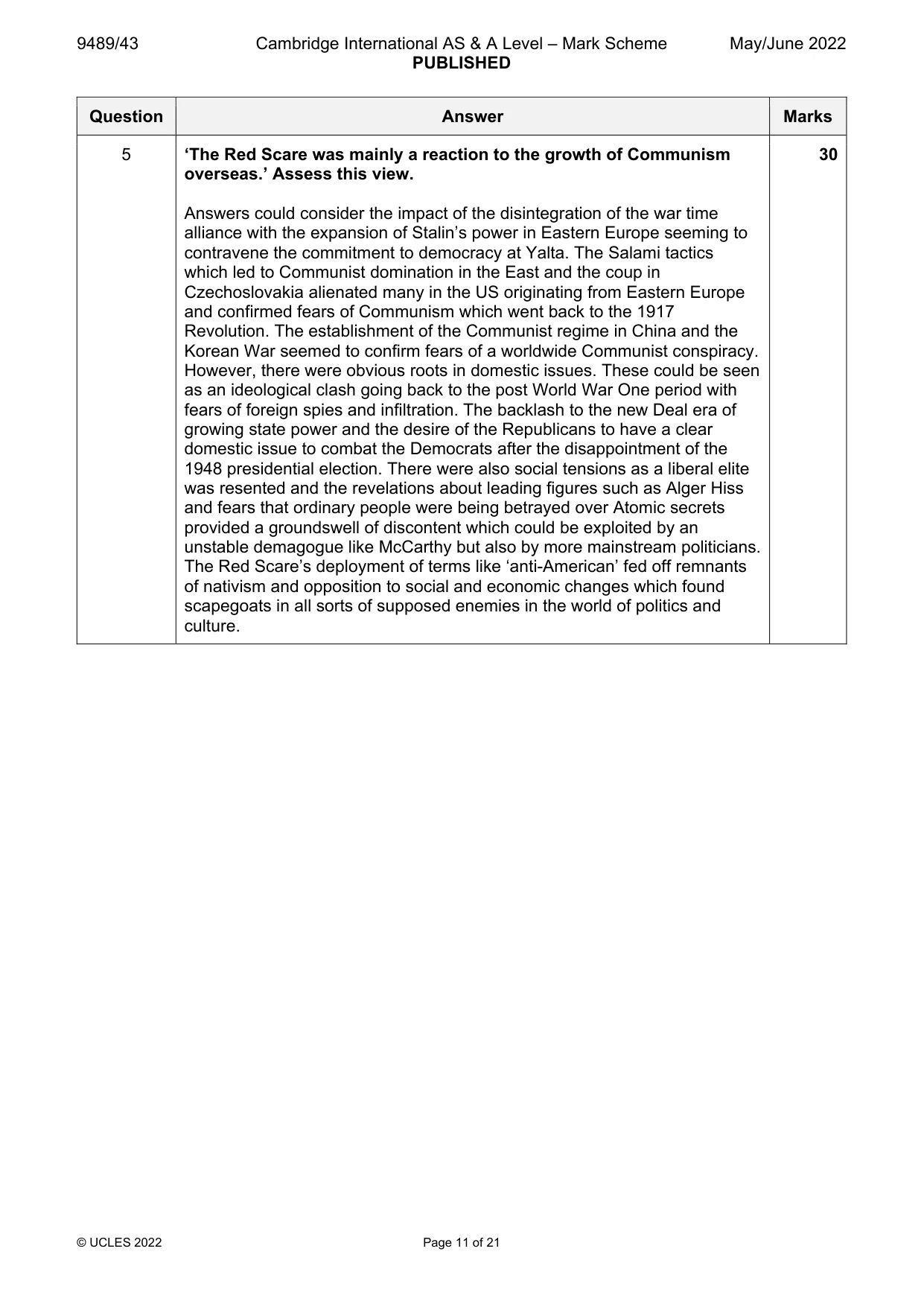
5 ‘The Red Scare was mainly a reaction to the growth of Communism overseas.’ Discuss this view. [30]
Mark scheme: 5 ‘The Red Scare was mainly a reaction to the growth of Communism 30 overseas.’ Assess this view. Answers could consider the impact of the disintegration of the war time alliance with the expansion of Stalin’s power in Eastern Europe seeming to contravene the commitment to democracy at Yalta. The Salami tactics which led to Communist domination in the East and the coup in Czechoslovakia alienated many in the US originating from Eastern Europe and confirmed fears of Communism which went back to the 1917 Revolution. The establishment of the Communist regime in China and the Korean War seemed to confirm fears of a worldwide Communist conspiracy. However, there were obvious roots in domestic issues. These could be seen as an ideological clash going back to the post World War One period with fears of foreign spies and infiltration. The backlash to the new Deal era of growing state power and the desire of the Republicans to have a clear domestic issue to combat the Democrats after the disappointment of the 1948 presidential election. There were also social tensions as a liberal elite was resented and the revelations about leading figures such as Alger Hiss and fears that ordinary people were being betrayed over Atomic secrets provided a groundswell of discontent which could be exploited by an unstable demagogue like McCarthy but also by more mainstream politicians. The Red Scare’s deployment of terms like ‘anti-American’ fed off remnants of nativism and opposition to social and economic changes which found scapegoats in all sorts of supposed enemies in the world of politics and culture.
Q6 · Assess how far Johnson achieved his aims in creating ‘The Great Society’
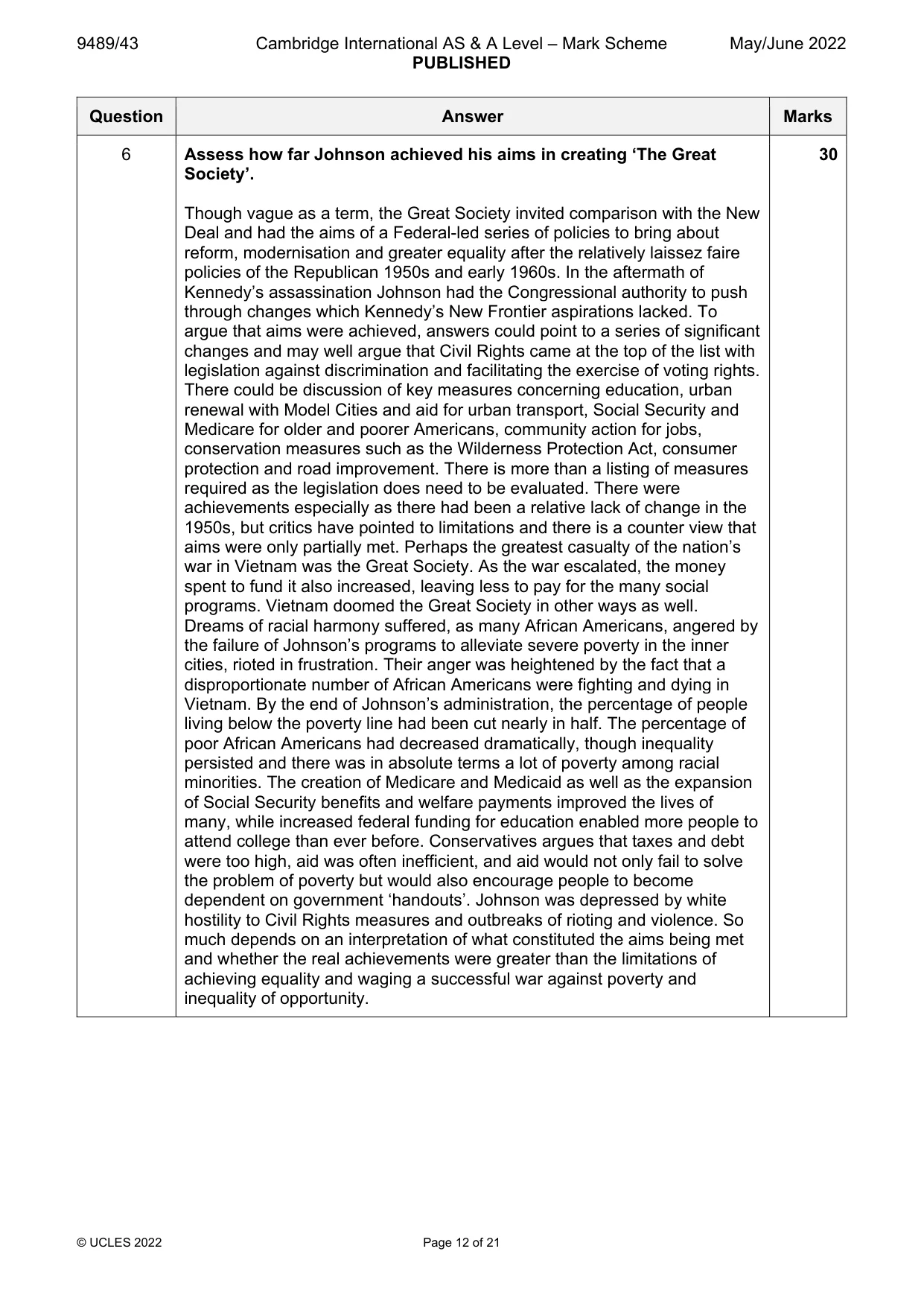
6 Assess how far Johnson achieved his aims in creating ‘The Great Society’. [30]
Mark scheme: 6 Assess how far Johnson achieved his aims in creating ‘The Great 30 Society’. Though vague as a term, the Great Society invited comparison with the New Deal and had the aims of a Federal-led series of policies to bring about reform, modernisation and greater equality after the relatively laissez faire policies of the Republican 1950s and early 1960s. In the aftermath of Kennedy’s assassination Johnson had the Congressional authority to push through changes which Kennedy’s New Frontier aspirations lacked. To argue that aims were achieved, answers could point to a series of significant changes and may well argue that Civil Rights came at the top of the list with legislation against discrimination and facilitating the exercise of voting rights. There could be discussion of key measures concerning education, urban renewal with Model Cities and aid for urban transport, Social Security and Medicare for older and poorer Americans, community action for jobs, conservation measures such as the Wilderness Protection Act, consumer protection and road improvement. There is more than a listing of measures required as the legislation does need to be evaluated. There were achievements especially as there had been a relative lack of change in the 1950s, but critics have pointed to limitations and there is a counter view that aims were only partially met. Perhaps the greatest casualty of the nation’s war in Vietnam was the Great Society. As the war escalated, the money spent to fund it also increased, leaving less to pay for the many social programs. Vietnam doomed the Great Society in other ways as well. Dreams of racial harmony suffered, as many African Americans, angered by the failure of Johnson’s programs to alleviate severe poverty in the inner cities, rioted in frustration. Their anger was heightened by the fact that a disproportionate number of African Americans were fighting and dying in Vietnam. By the end of Johnson’s administration, the percentage of people living below the poverty line had been cut nearly in half. The percentage of poor African Americans had decreased dramatically, though inequality persisted and there was in absolute terms a lot of poverty among racial minorities. The creation of Medicare and Medicaid as well as the expansion of Social Security benefits and welfare payments improved the lives of many, while increased federal funding for education enabled more people to attend college than ever before. Conservatives argues that taxes and debt were too high, aid was often inefficient, and aid would not only fail to solve the problem of poverty but would also encourage people to become dependent on government ‘handouts’. Johnson was depressed by white hostility to Civil Rights measures and outbreaks of rioting and violence. So much depends on an interpretation of what constituted the aims being met and whether the real achievements were greater than the limitations of achieving equality and waging a successful war against poverty and inequality of opportunity.
More questions on Why was there a second New Deal and how successful was it?
Q7 · Assess the impact of multiculturalism in the United States in the 1980s and early 1990s
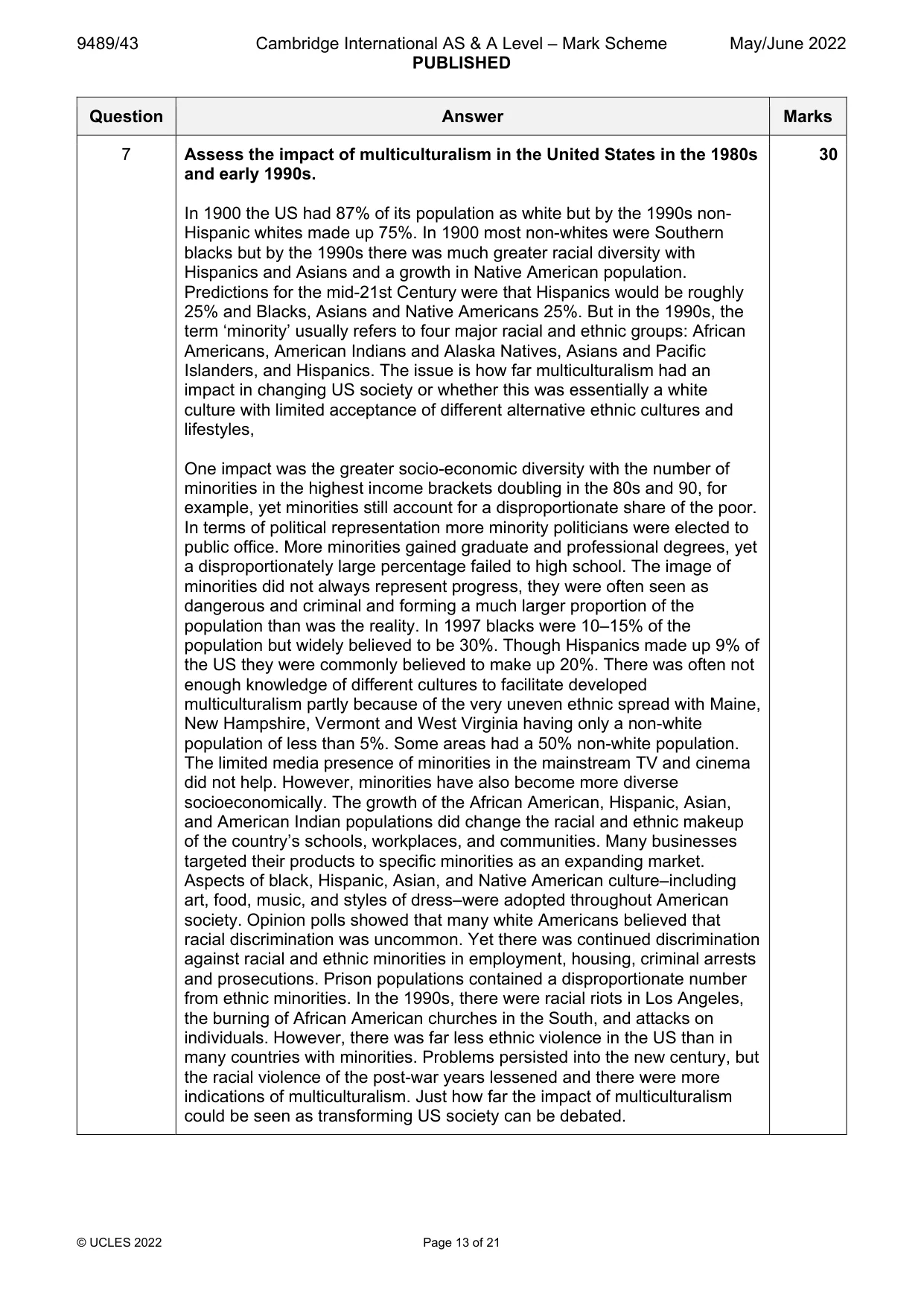
7 Assess the impact of multiculturalism in the United States in the 1980s and early 1990s. [30]
Mark scheme: 7 Assess the impact of multiculturalism in the United States in the 1980s 30 and early 1990s. In 1900 the US had 87% of its population as white but by the 1990s non- Hispanic whites made up 75%. In 1900 most non-whites were Southern blacks but by the 1990s there was much greater racial diversity with Hispanics and Asians and a growth in Native American population. Predictions for the mid-21st Century were that Hispanics would be roughly 25% and Blacks, Asians and Native Americans 25%. But in the 1990s, the term ‘minority’ usually refers to four major racial and ethnic groups: African Americans, American Indians and Alaska Natives, Asians and Pacific Islanders, and Hispanics. The issue is how far multiculturalism had an impact in changing US society or whether this was essentially a white culture with limited acceptance of different alternative ethnic cultures and lifestyles, One impact was the greater socio-economic diversity with the number of minorities in the highest income brackets doubling in the 80s and 90, for example, yet minorities still account for a disproportionate share of the poor. In terms of political representation more minority politicians were elected to public office. More minorities gained graduate and professional degrees, yet a disproportionately large percentage failed to high school. The image of minorities did not always represent progress, they were often seen as dangerous and criminal and forming a much larger proportion of the population than was the reality. In 1997 blacks were 10–15% of the population but widely believed to be 30%. Though Hispanics made up 9% of the US they were commonly believed to make up 20%. There was often not enough knowledge of different cultures to facilitate developed multiculturalism partly because of the very uneven ethnic spread with Maine, New Hampshire, Vermont and West Virginia having only a non-white population of less than 5%. Some areas had a 50% non-white population. The limited media presence of minorities in the mainstream TV and cinema did not help. However, minorities have also become more diverse socioeconomically. The growth of the African American, Hispanic, Asian, and American Indian populations did change the racial and ethnic makeup of the country’s schools, workplaces, and communities. Many businesses targeted their products to specific minorities as an expanding market. Aspects of black, Hispanic, Asian, and Native American culture–including art, food, music, and styles of dress–were adopted throughout American society. Opinion polls showed that many white Americans believed that racial discrimination was uncommon. Yet there was continued discrimination against racial and ethnic minorities in employment, housing, criminal arrests and prosecutions. Prison populations contained a disproportionate number from ethnic minorities. In the 1990s, there were racial riots in Los Angeles, the burning of African American churches in the South, and attacks on individuals. However, there was far less ethnic violence in the US than in many countries with minorities. Problems persisted into the new century, but the racial violence of the post-war years lessened and there were more indications of multiculturalism. Just how far the impact of multiculturalism could be seen as transforming US society can be debated.
More questions on How successful was the Progressive Movement from 1890 to 1920?
Q8 · Section C: International history, 1945–92
Section C: International history, 1945–92
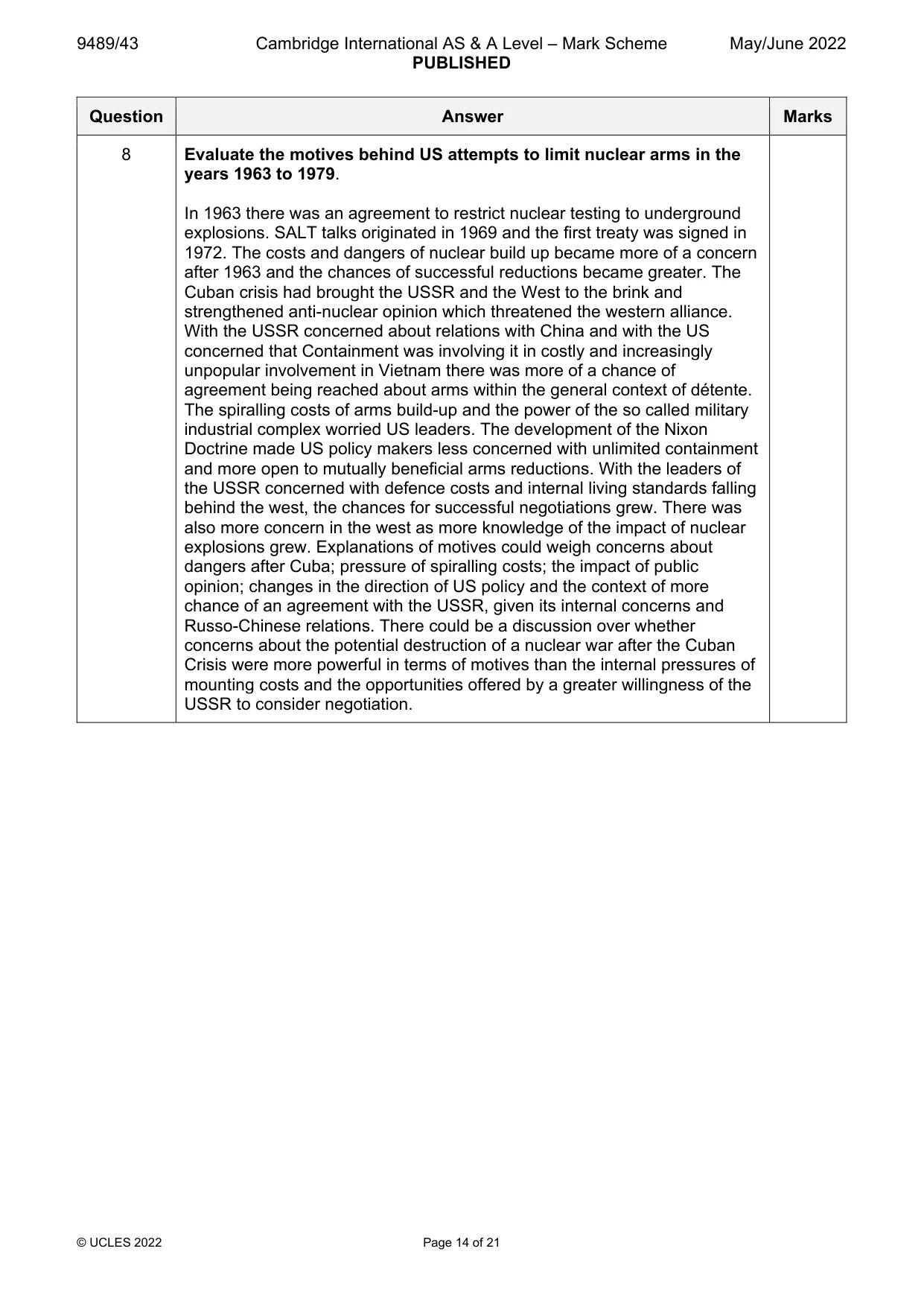
Mark scheme: 8 Evaluate the motives behind US attempts to limit nuclear arms in the years 1963 to 1979. In 1963 there was an agreement to restrict nuclear testing to underground explosions. SALT talks originated in 1969 and the first treaty was signed in 1972. The costs and dangers of nuclear build up became more of a concern after 1963 and the chances of successful reductions became greater. The Cuban crisis had brought the USSR and the West to the brink and strengthened anti-nuclear opinion which threatened the western alliance. With the USSR concerned about relations with China and with the US concerned that Containment was involving it in costly and increasingly unpopular involvement in Vietnam there was more of a chance of agreement being reached about arms within the general context of détente. The spiralling costs of arms build-up and the power of the so called military industrial complex worried US leaders. The development of the Nixon Doctrine made US policy makers less concerned with unlimited containment and more open to mutually beneficial arms reductions. With the leaders of the USSR concerned with defence costs and internal living standards falling behind the west, the chances for successful negotiations grew. There was also more concern in the west as more knowledge of the impact of nuclear explosions grew. Explanations of motives could weigh concerns about dangers after Cuba; pressure of spiralling costs; the impact of public opinion; changes in the direction of US policy and the context of more chance of an agreement with the USSR, given its internal concerns and Russo-Chinese relations. There could be a discussion over whether concerns about the potential destruction of a nuclear war after the Cuban Crisis were more powerful in terms of motives than the internal pressures of mounting costs and the opportunities offered by a greater willingness of the USSR to consider negotiation.
Q9 · Assess the extent to which President Reagan was responsible for the outbreak of the…
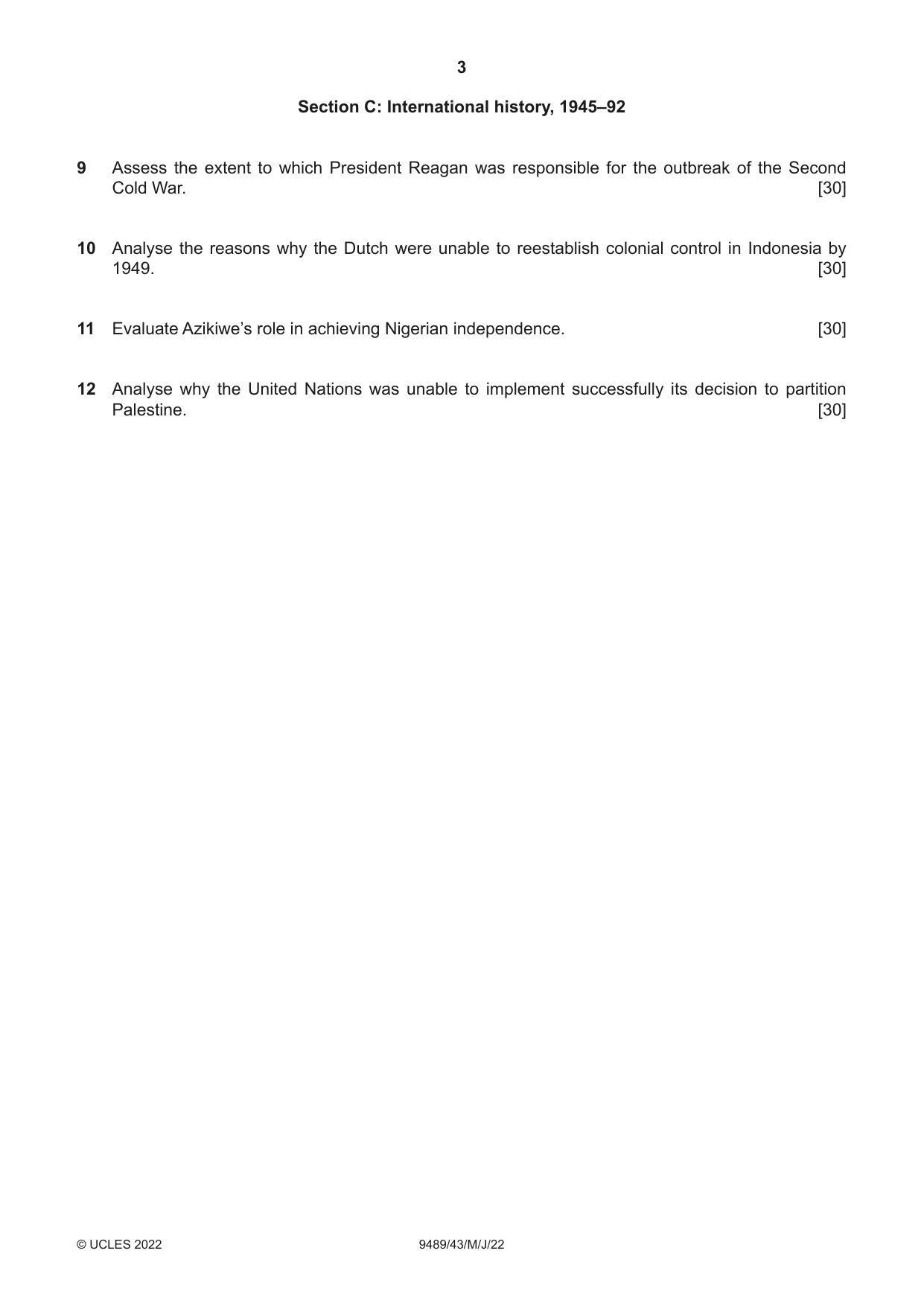
9 Assess the extent to which President Reagan was responsible for the outbreak of the Second Cold War. [30]
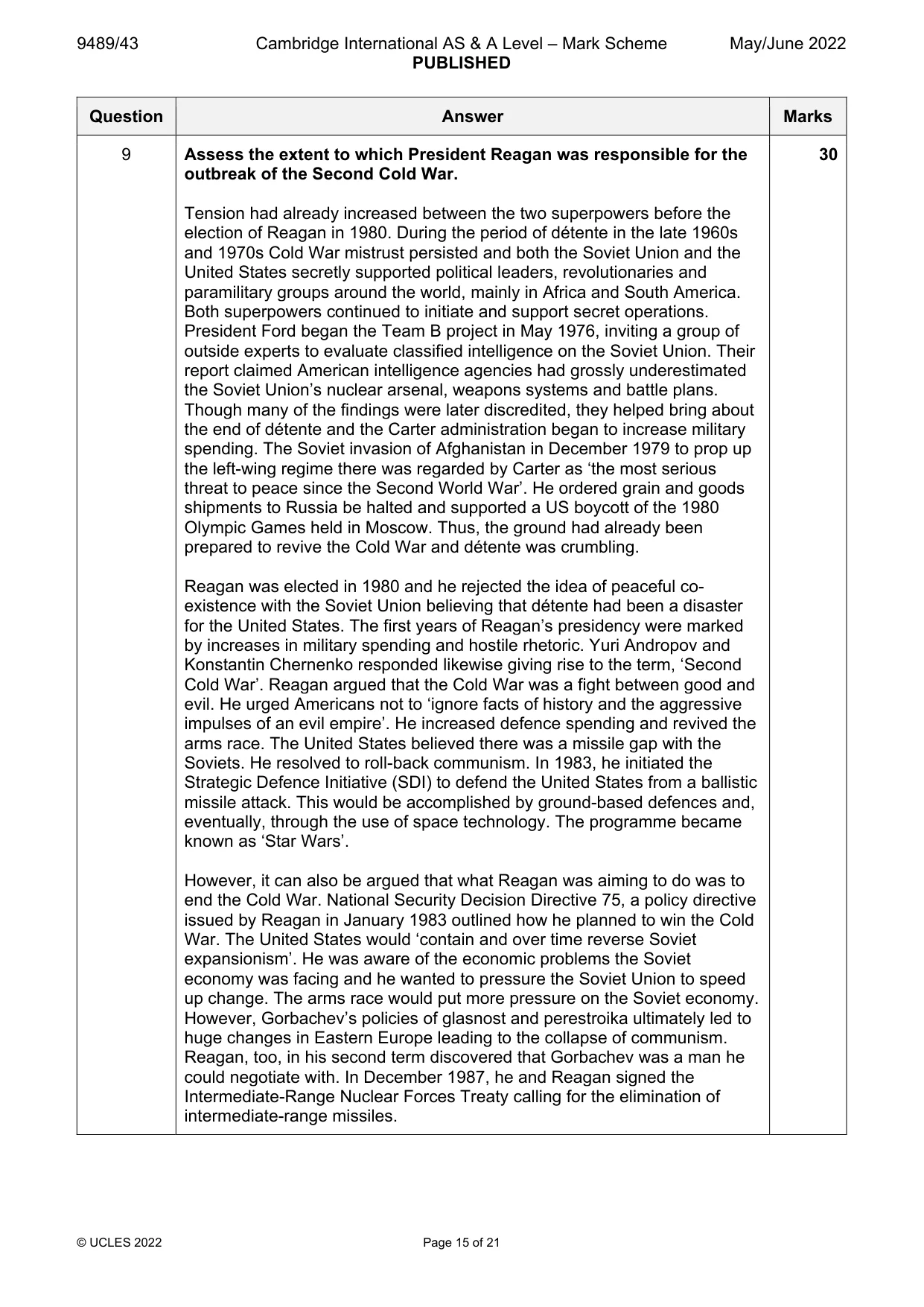
Mark scheme: 9 Assess the extent to which President Reagan was responsible for the 30 outbreak of the Second Cold War. Tension had already increased between the two superpowers before the election of Reagan in 1980. During the period of détente in the late 1960s and 1970s Cold War mistrust persisted and both the Soviet Union and the United States secretly supported political leaders, revolutionaries and paramilitary groups around the world, mainly in Africa and South America. Both superpowers continued to initiate and support secret operations. President Ford began the Team B project in May 1976, inviting a group of outside experts to evaluate classified intelligence on the Soviet Union. Their report claimed American intelligence agencies had grossly underestimated the Soviet Union’s nuclear arsenal, weapons systems and battle plans. Though many of the findings were later discredited, they helped bring about the end of détente and the Carter administration began to increase military spending. The Soviet invasion of Afghanistan in December 1979 to prop up the left-wing regime there was regarded by Carter as ‘the most serious threat to peace since the Second World War’. He ordered grain and goods shipments to Russia be halted and supported a US boycott of the 1980 Olympic Games held in Moscow. Thus, the ground had already been prepared to revive the Cold War and détente was crumbling. Reagan was elected in 1980 and he rejected the idea of peaceful co- existence with the Soviet Union believing that détente had been a disaster for the United States. The first years of Reagan’s presidency were marked by increases in military spending and hostile rhetoric. Yuri Andropov and Konstantin Chernenko responded likewise giving rise to the term, ‘Second Cold War’. Reagan argued that the Cold War was a fight between good and evil. He urged Americans not to ‘ignore facts of history and the aggressive impulses of an evil empire’. He increased defence spending and revived the arms race. The United States believed there was a missile gap with the Soviets. He resolved to roll-back communism. In 1983, he initiated the Strategic Defence Initiative (SDI) to defend the United States from a ballistic missile attack. This would be accomplished by ground-based defences and, eventually, through the use of space technology. The programme became known as ‘Star Wars’. However, it can also be argued that what Reagan was aiming to do was to end the Cold War. National Security Decision Directive 75, a policy directive issued by Reagan in January 1983 outlined how he planned to win the Cold War. The United States would ‘contain and over time reverse Soviet expansionism’. He was aware of the economic problems the Soviet economy was facing and he wanted to pressure the Soviet Union to speed up change. The arms race would put more pressure on the Soviet economy. However, Gorbachev’s policies of glasnost and perestroika ultimately led to huge changes in Eastern Europe leading to the collapse of communism. Reagan, too, in his second term discovered that Gorbachev was a man he could negotiate with. In December 1987, he and Reagan signed the Intermediate-Range Nuclear Forces Treaty calling for the elimination of intermediate-range missiles.
More questions on Why did the USA emerge as a world power and what was the impact on international
Q10 · Analyse the reasons why the Dutch were unable to reestablish colonial control in…
10 Analyse the reasons why the Dutch were unable to reestablish colonial control in Indonesia by 1949. [30]
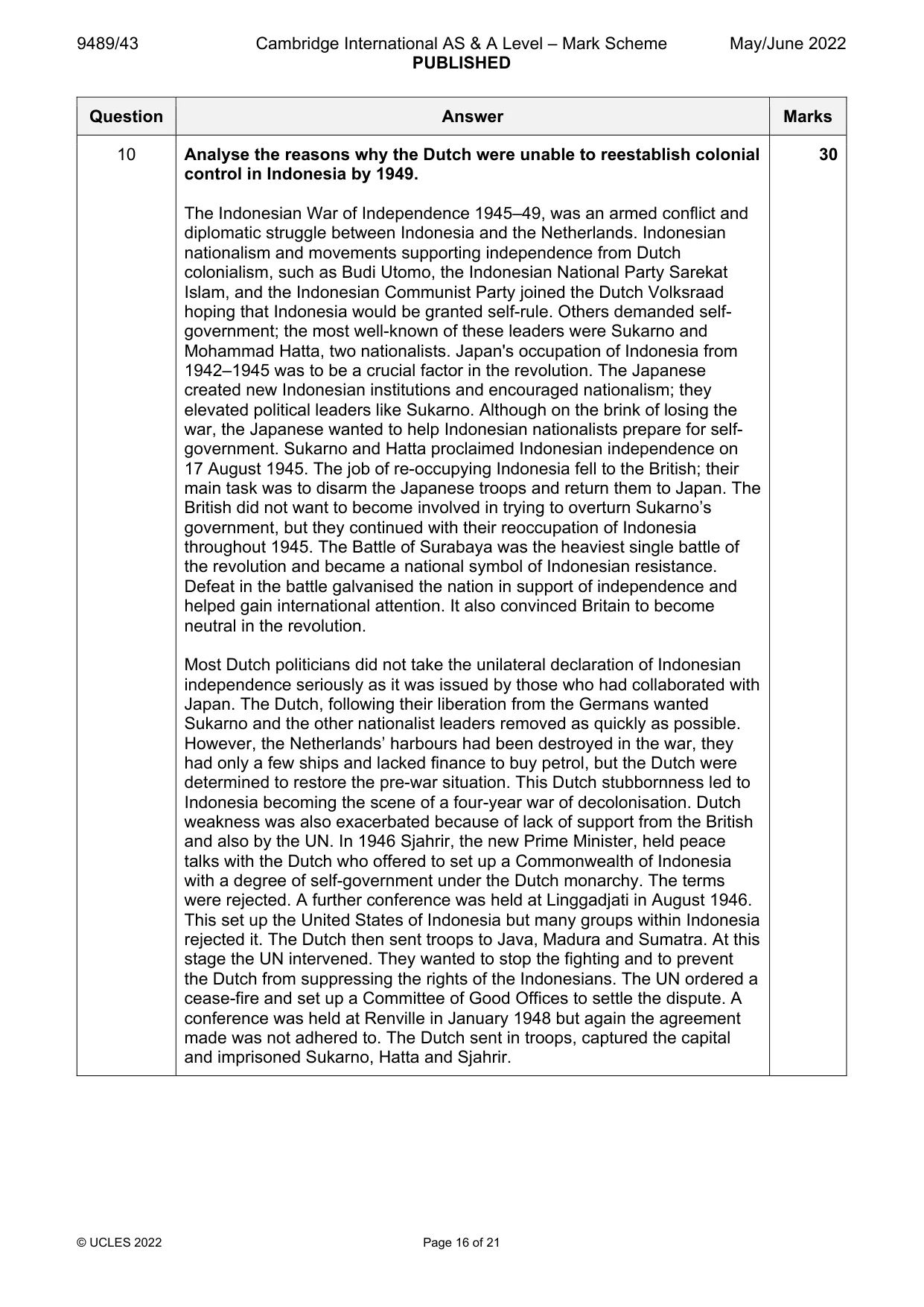
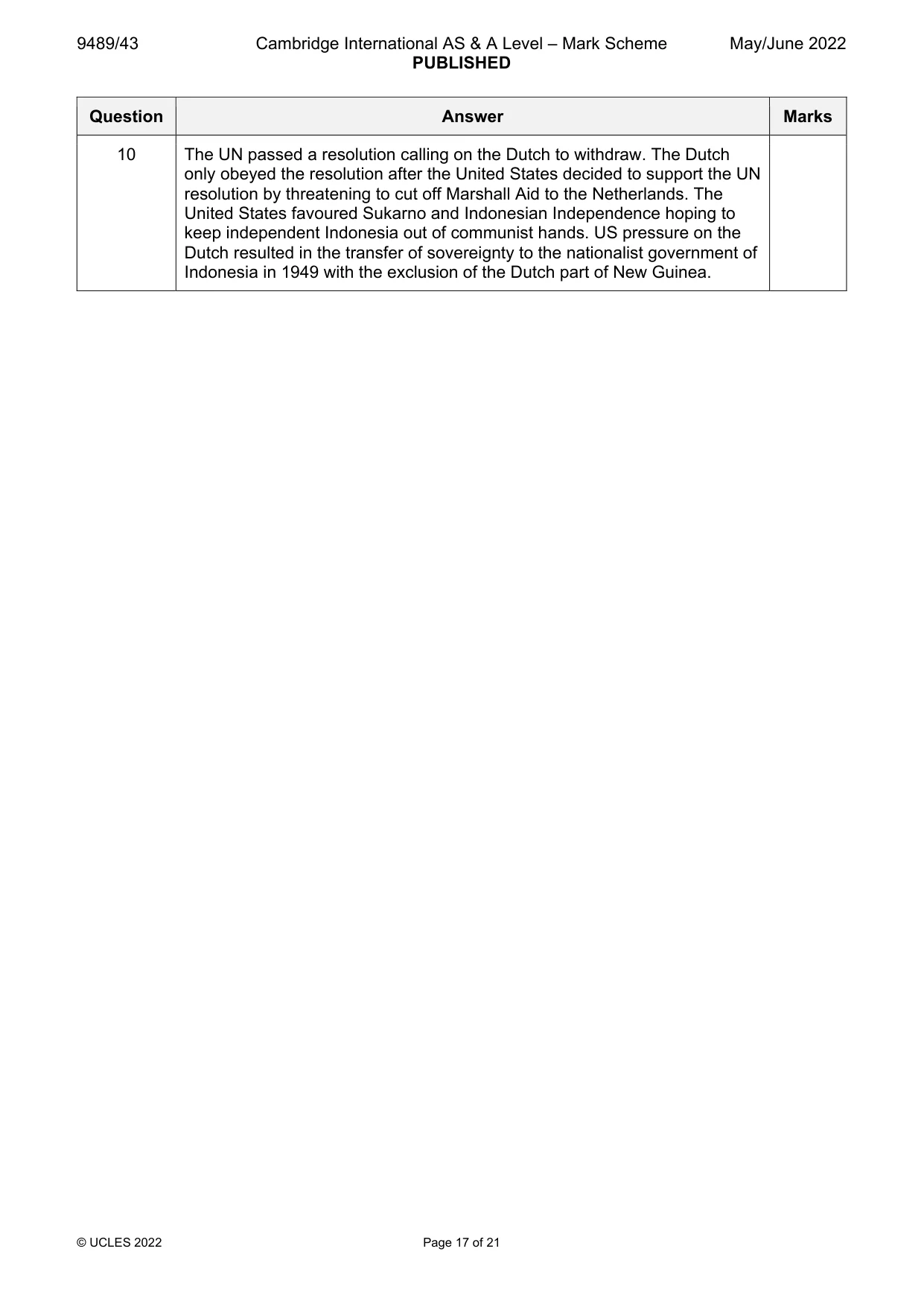
Mark scheme: 10 Analyse the reasons why the Dutch were unable to reestablish colonial 30 control in Indonesia by 1949. The Indonesian War of Independence 1945–49, was an armed conflict and diplomatic struggle between Indonesia and the Netherlands. Indonesian nationalism and movements supporting independence from Dutch colonialism, such as Budi Utomo, the Indonesian National Party Sarekat Islam, and the Indonesian Communist Party joined the Dutch Volksraad hoping that Indonesia would be granted self-rule. Others demanded self- government; the most well-known of these leaders were Sukarno and Mohammad Hatta, two nationalists. Japan's occupation of Indonesia from 1942–1945 was to be a crucial factor in the revolution. The Japanese created new Indonesian institutions and encouraged nationalism; they elevated political leaders like Sukarno. Although on the brink of losing the war, the Japanese wanted to help Indonesian nationalists prepare for self- government. Sukarno and Hatta proclaimed Indonesian independence on 17 August 1945. The job of re-occupying Indonesia fell to the British; their main task was to disarm the Japanese troops and return them to Japan. The British did not want to become involved in trying to overturn Sukarno’s government, but they continued with their reoccupation of Indonesia throughout 1945. The Battle of Surabaya was the heaviest single battle of the revolution and became a national symbol of Indonesian resistance. Defeat in the battle galvanised the nation in support of independence and helped gain international attention. It also convinced Britain to become neutral in the revolution. Most Dutch politicians did not take the unilateral declaration of Indonesian independence seriously as it was issued by those who had collaborated with Japan. The Dutch, following their liberation from the Germans wanted Sukarno and the other nationalist leaders removed as quickly as possible. However, the Netherlands’ harbours had been destroyed in the war, they had only a few ships and lacked finance to buy petrol, but the Dutch were determined to restore the pre-war situation. This Dutch stubbornness led to Indonesia becoming the scene of a four-year war of decolonisation. Dutch weakness was also exacerbated because of lack of support from the British and also by the UN. In 1946 Sjahrir, the new Prime Minister, held peace talks with the Dutch who offered to set up a Commonwealth of Indonesia with a degree of self-government under the Dutch monarchy. The terms were rejected. A further conference was held at Linggadjati in August 1946. This set up the United States of Indonesia but many groups within Indonesia rejected it. The Dutch then sent troops to Java, Madura and Sumatra. At this stage the UN intervened. They wanted to stop the fighting and to prevent the Dutch from suppressing the rights of the Indonesians. The UN ordered a cease-fire and set up a Committee of Good Offices to settle the dispute. A conference was held at Renville in January 1948 but again the agreement made was not adhered to. The Dutch sent in troops, captured the capital and imprisoned Sukarno, Hatta and Sjahrir. 10 The UN passed a resolution calling on the Dutch to withdraw. The Dutch only obeyed the resolution after the United States decided to support the UN resolution by threatening to cut off Marshall Aid to the Netherlands. The United States favoured Sukarno and Indonesian Independence hoping to keep independent Indonesia out of communist hands. US pressure on the Dutch resulted in the transfer of sovereignty to the nationalist government of Indonesia in 1949 with the exclusion of the Dutch part of New Guinea.
More questions on Why was imperialism a significant force in Africa from 1870?
Q11 · Evaluate Azikiwe’s role in achieving Nigerian independence
11 Evaluate Azikiwe’s role in achieving Nigerian independence. [30]
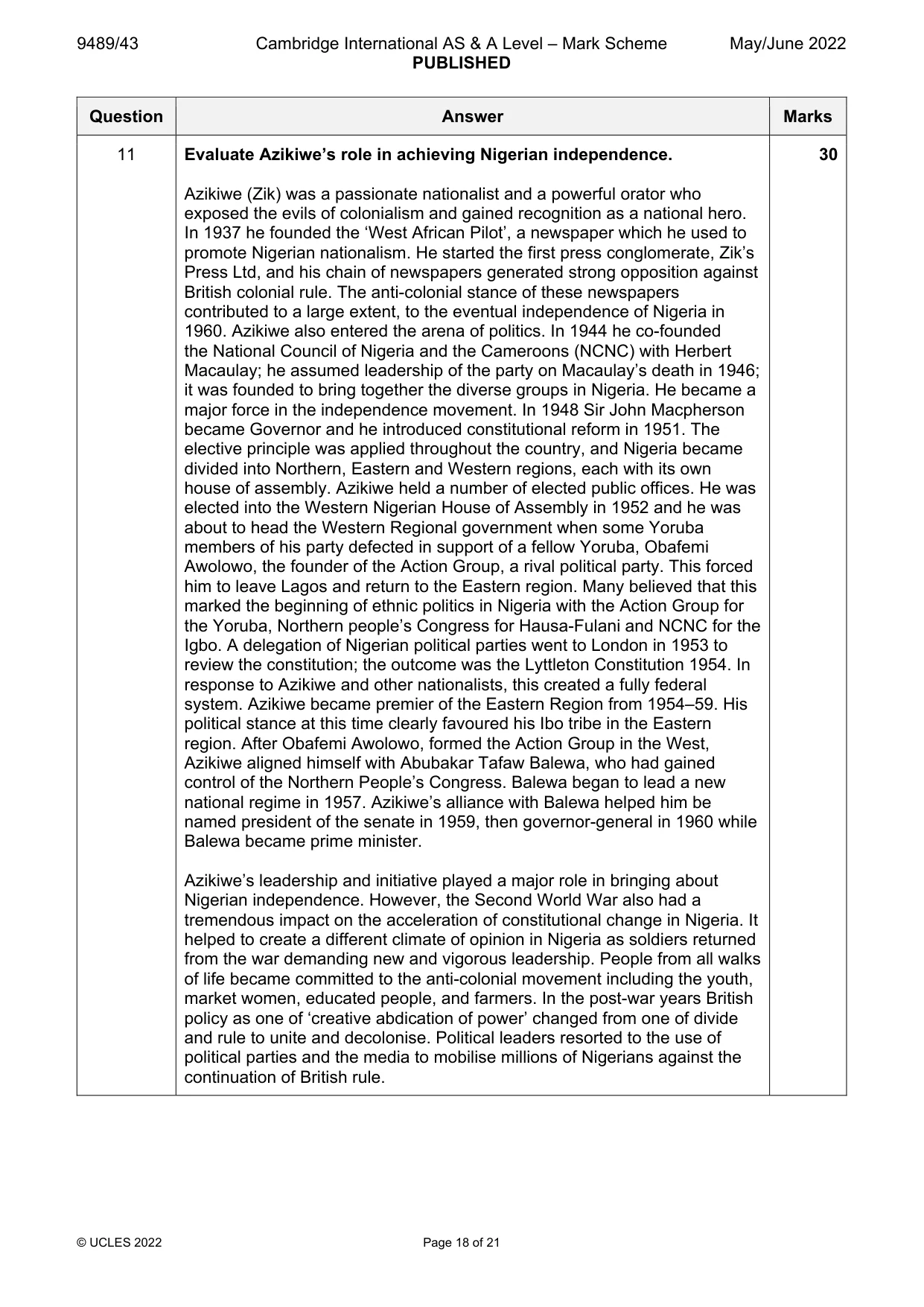
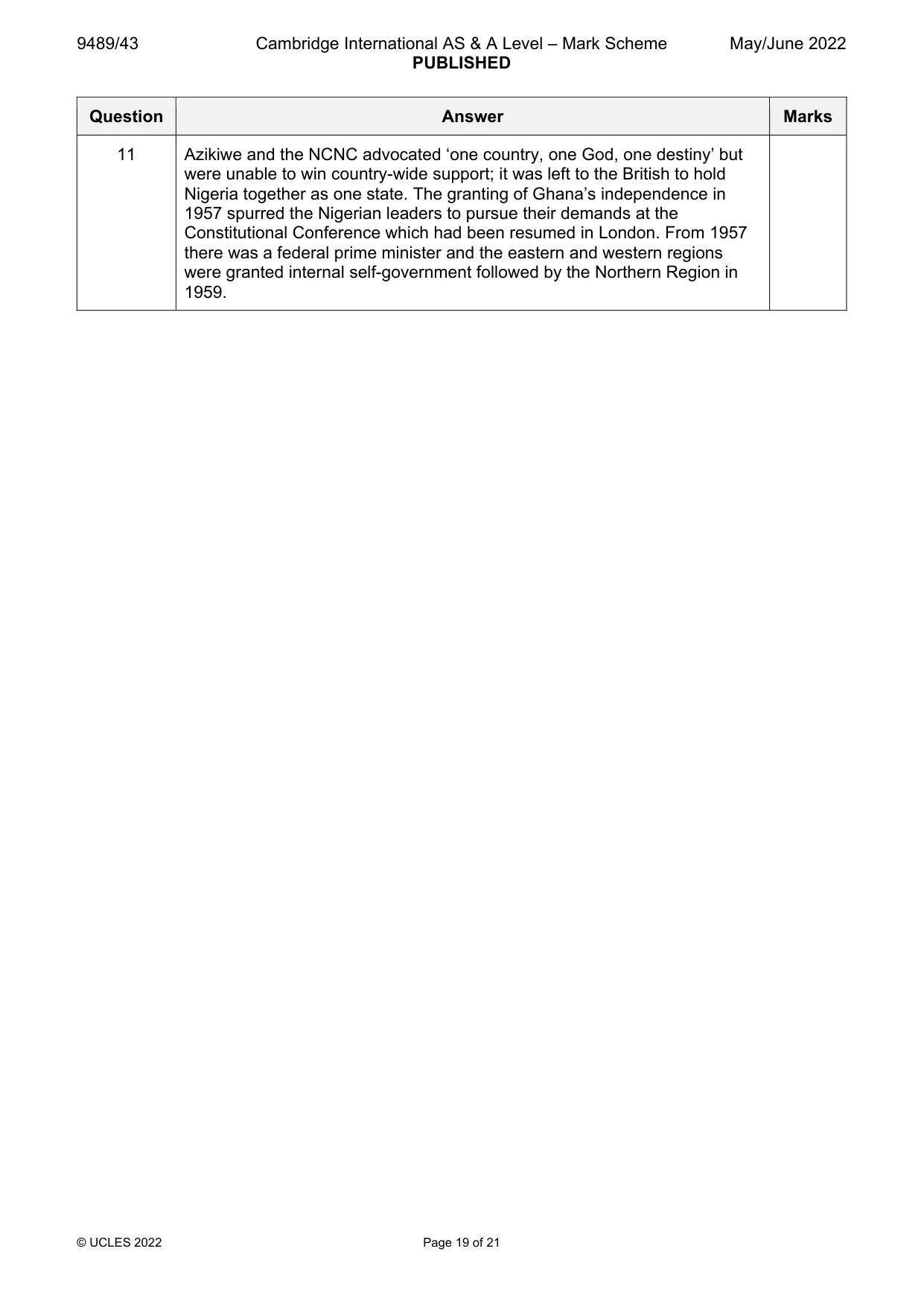
Mark scheme: 11 Evaluate Azikiwe’s role in achieving Nigerian independence. 30 Azikiwe (Zik) was a passionate nationalist and a powerful orator who exposed the evils of colonialism and gained recognition as a national hero. In 1937 he founded the ‘West African Pilot’, a newspaper which he used to promote Nigerian nationalism. He started the first press conglomerate, Zik’s Press Ltd, and his chain of newspapers generated strong opposition against British colonial rule. The anti-colonial stance of these newspapers contributed to a large extent, to the eventual independence of Nigeria in 1960. Azikiwe also entered the arena of politics. In 1944 he co-founded the National Council of Nigeria and the Cameroons (NCNC) with Herbert Macaulay; he assumed leadership of the party on Macaulay’s death in 1946; it was founded to bring together the diverse groups in Nigeria. He became a major force in the independence movement. In 1948 Sir John Macpherson became Governor and he introduced constitutional reform in 1951. The elective principle was applied throughout the country, and Nigeria became divided into Northern, Eastern and Western regions, each with its own house of assembly. Azikiwe held a number of elected public offices. He was elected into the Western Nigerian House of Assembly in 1952 and he was about to head the Western Regional government when some Yoruba members of his party defected in support of a fellow Yoruba, Obafemi Awolowo, the founder of the Action Group, a rival political party. This forced him to leave Lagos and return to the Eastern region. Many believed that this marked the beginning of ethnic politics in Nigeria with the Action Group for the Yoruba, Northern people’s Congress for Hausa-Fulani and NCNC for the Igbo. A delegation of Nigerian political parties went to London in 1953 to review the constitution; the outcome was the Lyttleton Constitution 1954. In response to Azikiwe and other nationalists, this created a fully federal system. Azikiwe became premier of the Eastern Region from 1954–59. His political stance at this time clearly favoured his Ibo tribe in the Eastern region. After Obafemi Awolowo, formed the Action Group in the West, Azikiwe aligned himself with Abubakar Tafaw Balewa, who had gained control of the Northern People’s Congress. Balewa began to lead a new national regime in 1957. Azikiwe’s alliance with Balewa helped him be named president of the senate in 1959, then governor-general in 1960 while Balewa became prime minister. Azikiwe’s leadership and initiative played a major role in bringing about Nigerian independence. However, the Second World War also had a tremendous impact on the acceleration of constitutional change in Nigeria. It helped to create a different climate of opinion in Nigeria as soldiers returned from the war demanding new and vigorous leadership. People from all walks of life became committed to the anti-colonial movement including the youth, market women, educated people, and farmers. In the post-war years British policy as one of ‘creative abdication of power’ changed from one of divide and rule to unite and decolonise. Political leaders resorted to the use of political parties and the media to mobilise millions of Nigerians against the continuation of British rule. 11 Azikiwe and the NCNC advocated ‘one country, one God, one destiny’ but were unable to win country-wide support; it was left to the British to hold Nigeria together as one state. The granting of Ghana’s independence in 1957 spurred the Nigerian leaders to pursue their demands at the Constitutional Conference which had been resumed in London. From 1957 there was a federal prime minister and the eastern and western regions were granted internal self-government followed by the Northern Region in 1959.
More questions on Why was imperialism a significant force in Africa from 1870?
Q12 · Analyse why the United Nations was unable to implement successfully its decision to…
12 Analyse why the United Nations was unable to implement successfully its decision to partition Palestine. [30]
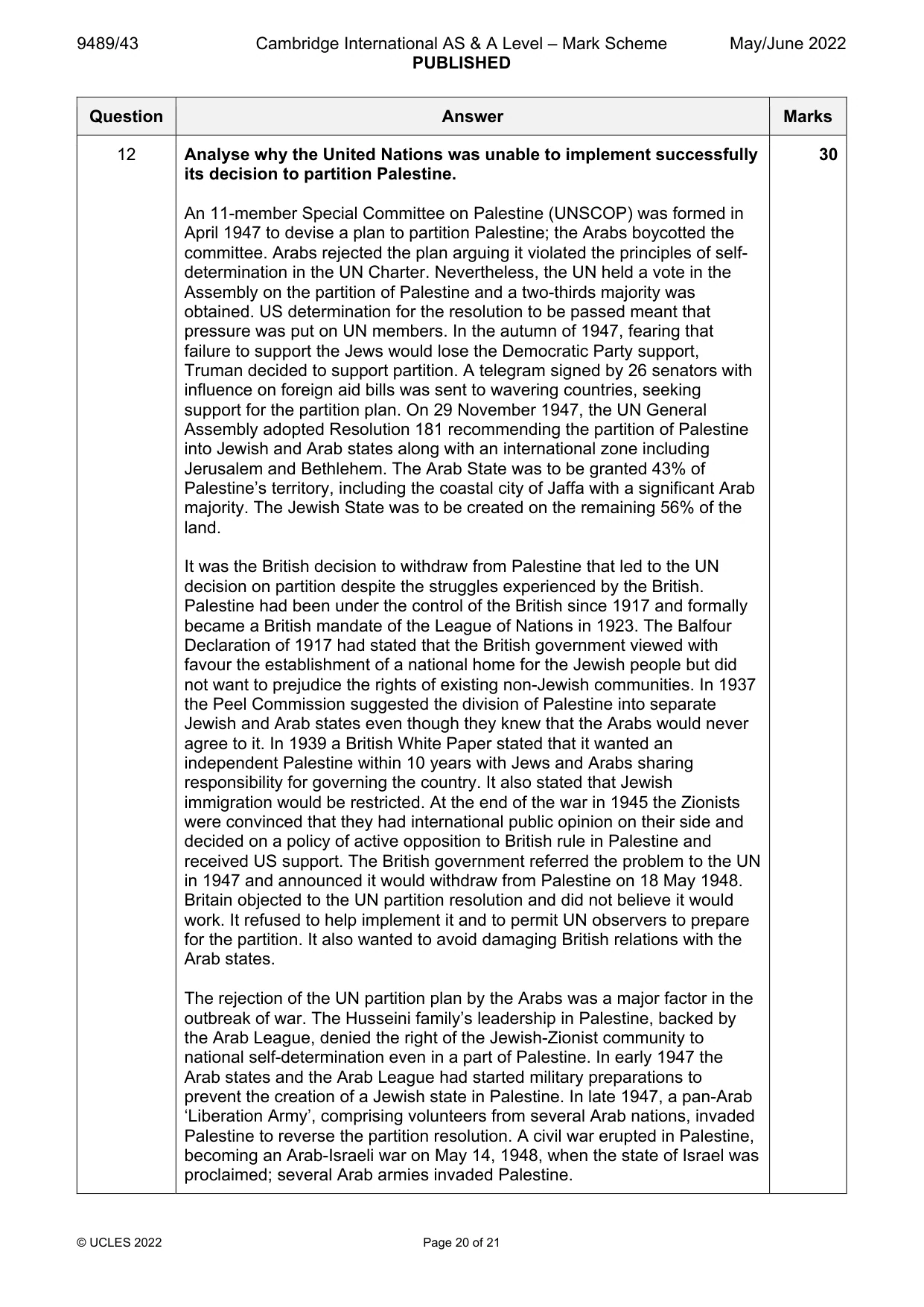
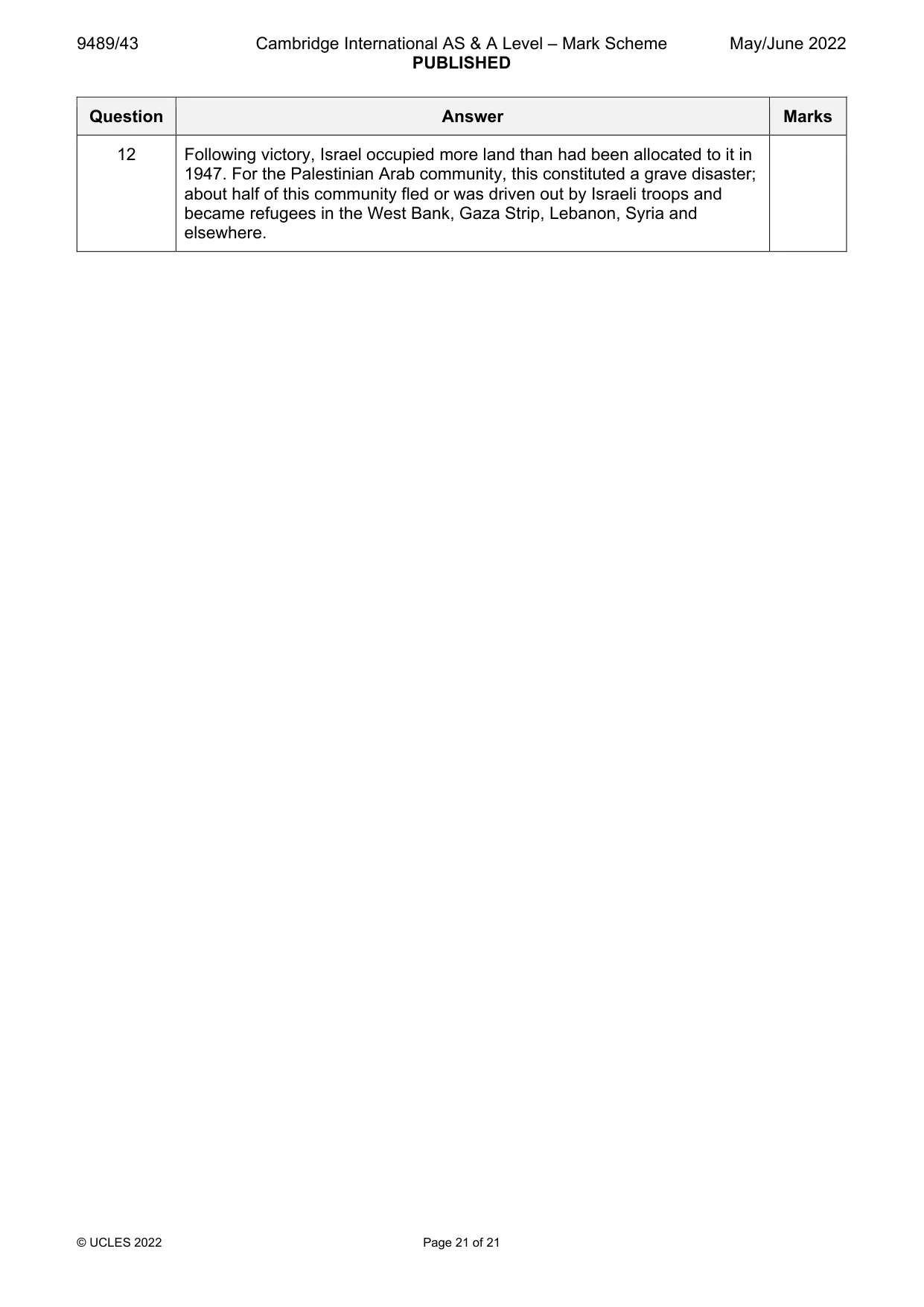
Mark scheme: 12 Analyse why the United Nations was unable to implement successfully 30 its decision to partition Palestine. An 11-member Special Committee on Palestine (UNSCOP) was formed in April 1947 to devise a plan to partition Palestine; the Arabs boycotted the committee. Arabs rejected the plan arguing it violated the principles of self- determination in the UN Charter. Nevertheless, the UN held a vote in the Assembly on the partition of Palestine and a two-thirds majority was obtained. US determination for the resolution to be passed meant that pressure was put on UN members. In the autumn of 1947, fearing that failure to support the Jews would lose the Democratic Party support, Truman decided to support partition. A telegram signed by 26 senators with influence on foreign aid bills was sent to wavering countries, seeking support for the partition plan. On 29 November 1947, the UN General Assembly adopted Resolution 181 recommending the partition of Palestine into Jewish and Arab states along with an international zone including Jerusalem and Bethlehem. The Arab State was to be granted 43% of Palestine’s territory, including the coastal city of Jaffa with a significant Arab majority. The Jewish State was to be created on the remaining 56% of the land. It was the British decision to withdraw from Palestine that led to the UN decision on partition despite the struggles experienced by the British. Palestine had been under the control of the British since 1917 and formally became a British mandate of the League of Nations in 1923. The Balfour Declaration of 1917 had stated that the British government viewed with favour the establishment of a national home for the Jewish people but did not want to prejudice the rights of existing non-Jewish communities. In 1937 the Peel Commission suggested the division of Palestine into separate Jewish and Arab states even though they knew that the Arabs would never agree to it. In 1939 a British White Paper stated that it wanted an independent Palestine within 10 years with Jews and Arabs sharing responsibility for governing the country. It also stated that Jewish immigration would be restricted. At the end of the war in 1945 the Zionists were convinced that they had international public opinion on their side and decided on a policy of active opposition to British rule in Palestine and received US support. The British government referred the problem to the UN in 1947 and announced it would withdraw from Palestine on 18 May 1948. Britain objected to the UN partition resolution and did not believe it would work. It refused to help implement it and to permit UN observers to prepare for the partition. It also wanted to avoid damaging British relations with the Arab states. The rejection of the UN partition plan by the Arabs was a major factor in the outbreak of war. The Husseini family’s leadership in Palestine, backed by the Arab League, denied the right of the Jewish-Zionist community to national self-determination even in a part of Palestine. In early 1947 the Arab states and the Arab League had started military preparations to prevent the creation of a Jewish state in Palestine. In late 1947, a pan-Arab ‘Liberation Army’, comprising volunteers from several Arab nations, invaded Palestine to reverse the partition resolution. A civil war erupted in Palestine, becoming an Arab-Israeli war on May 14, 1948, when the state of Israel was proclaimed; several Arab armies invaded Palestine. 12 Following victory, Israel occupied more land than had been allocated to it in 1947. For the Palestinian Arab community, this constituted a grave disaster; about half of this community fled or was driven out by Israeli troops and became refugees in the West Bank, Gaza Strip, Lebanon, Syria and elsewhere.
More questions on Why did the League of Nations fail to keep the peace in the 1930s?
What was in this paper
The subtopics covered by these 12 questions, and how many questions each got. Open one in a new tab to see every Cambridge question on it.
2Why was imperialism a significant force in Africa from 1870?2How successful was the Progressive Movement from 1890 to 1920?1How were the Bolsheviks able to consolidate their power up to 1924?1What was the impact of the Great Crash and the Great Depression in the United States?1Why did the League of Nations fail to keep the peace in the 1930s?1Why did the USA emerge as a world power and what was the impact on international1Why did war break out in 1939?1Why was there a second New Deal and how successful was it?1Why, and with what effects, did Britain and France pursue a policy of appeasement?1What you needed in this session
Cambridge’s own grade thresholds for 2022 May/June, Paper 4 · Variant 3. A higher threshold means an easier paper — the bar moves with how the cohort did.