Cambridge A Level History 9489 — 2025 May/June Paper 4 · Variant 1
9489/41/M/J/25 · 12 questions · 60 marks · ≈68 min
The question paper and its mark scheme, free to read here and free to download. This is Cambridge’s own paper, exactly as it was sat.
Question paper4 pages
Mark scheme17 pages
Answers below. Sit the paper first if you are practising.
Questions as text
Q1 · ‘Mussolini only became prime minister because of the impact of the First World War on…
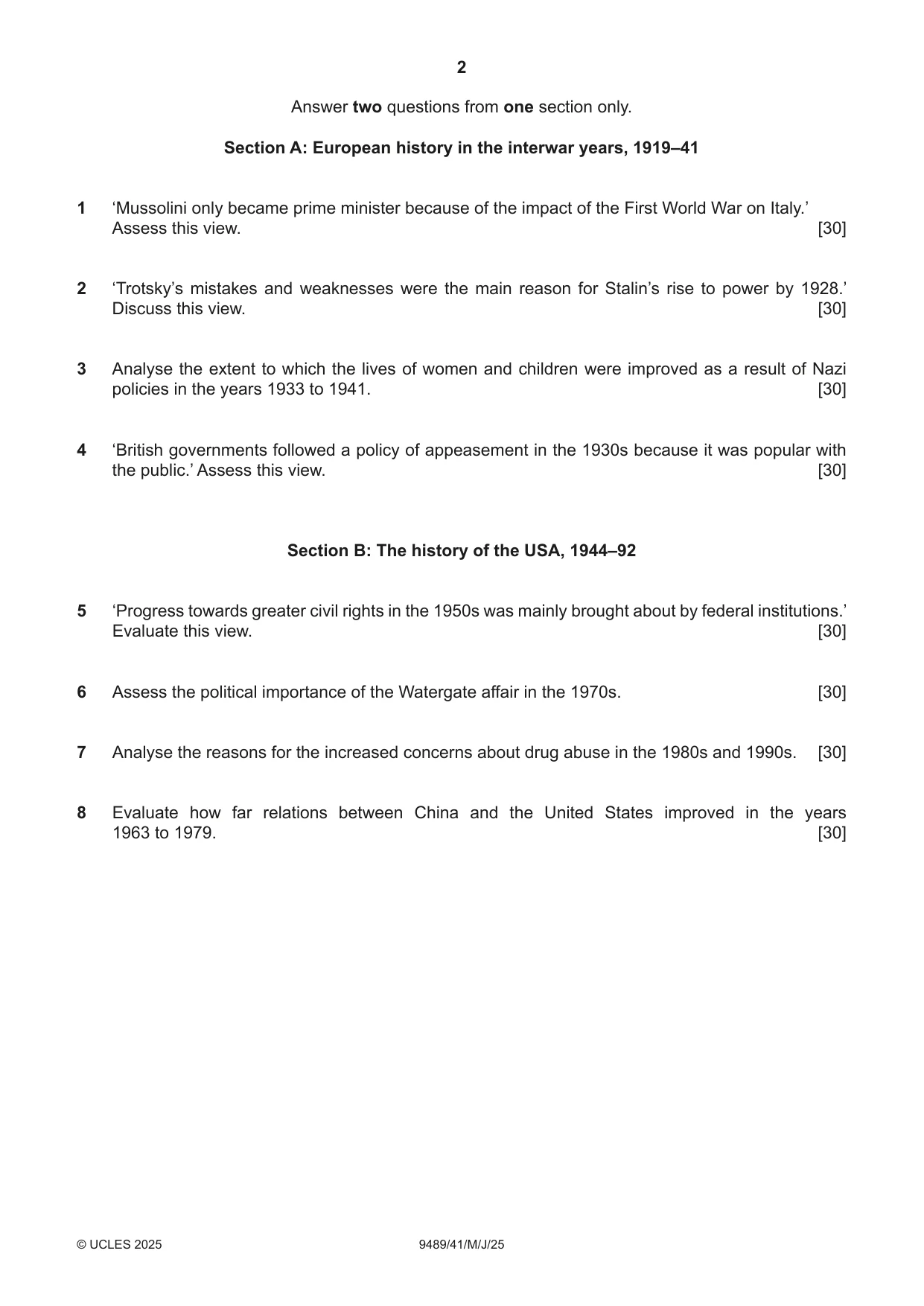
1 ‘Mussolini only became prime minister because of the impact of the First World War on Italy.’ Assess this view. [30]
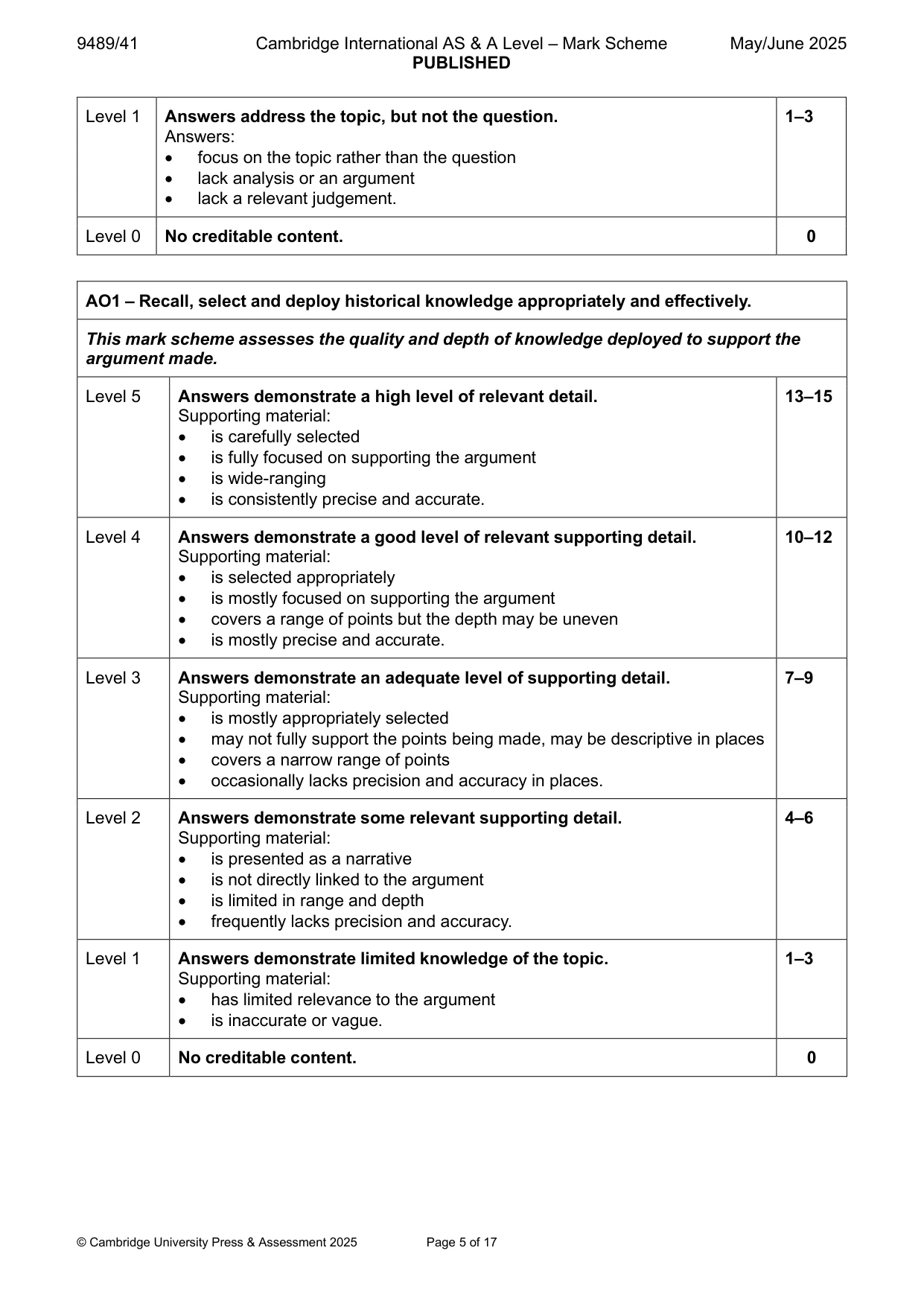
Mark scheme: Question Answer Marks 1 ‘Mussolini only became Prime Minister because of the impact of the 30 First World War on Italy.’ Assess this view. This question relates to Mussolini’s rise to power and appointment as Prime Minister in 1922. The impact of the war should be measured against other explanations and the best analysis might seek to demonstrate their connections. The First World War negatively affected Italy in a number of ways. Responses might point to the levels of casualties suffered, the political divisions brought about by Italian involvement and the economic costs and consequences. It is likely discussion will involve the so-called ‘Mutilated Victory’ and that despite gaining territory such as Trentino and South Tyrol, many felt bitter that some promises made in the Treaty of London were not kept in the Treaty of St Germain in 1919. The failure to gain Fiume was also controversial and led to D’Annunzio’s occupation. Alternatively, there could be discussion about how far fear of socialism and revolution aided Mussolini. Consideration of the growth of support for left-wing groups might include factory and land occupations, the growth of trade unions and strikes following the war and the success in elections of the PSI. Reference might be made to the Biennio Rosso of 1919–20. These developments could be linked to dissatisfaction among workers and peasants following the war, and analysis could demonstrate how this led to support for Mussolini, possibly through the use of anti-socialist violence and the growth of support from élite groups, viewing fascism as the primary bulwark against the left. Both developments can be seen in the light of widespread opposition to liberal democracy in Italy, which had failed to unify the country and the use of trasformismo tactics led to unrepresentative and unpopular governments after the war. It might be concluded that a series of weak, liberal coalition governments failed to satisfy the demands of Italians and to solve Italy’s social, economic and political challenges. Discussion may also consider the appeal of Mussolini and fascism, both in the light of these different issues and on their own terms. His political flexibility which led to the abandonment of republican and anti-clerical policies helped to secure support from élite groups, as did his obvious anti-socialism. A focus on nationalism, promises to restore Italian greatness and an emphasis on a strong state and law and order proved popular.
More questions on How did the rise of extremism affect international relations?
Q2 · ‘Trotsky’s mistakes and weaknesses were the main reason for Stalin’s rise to power by…
2 ‘Trotsky’s mistakes and weaknesses were the main reason for Stalin’s rise to power by 1928.’ Discuss this view. [30]
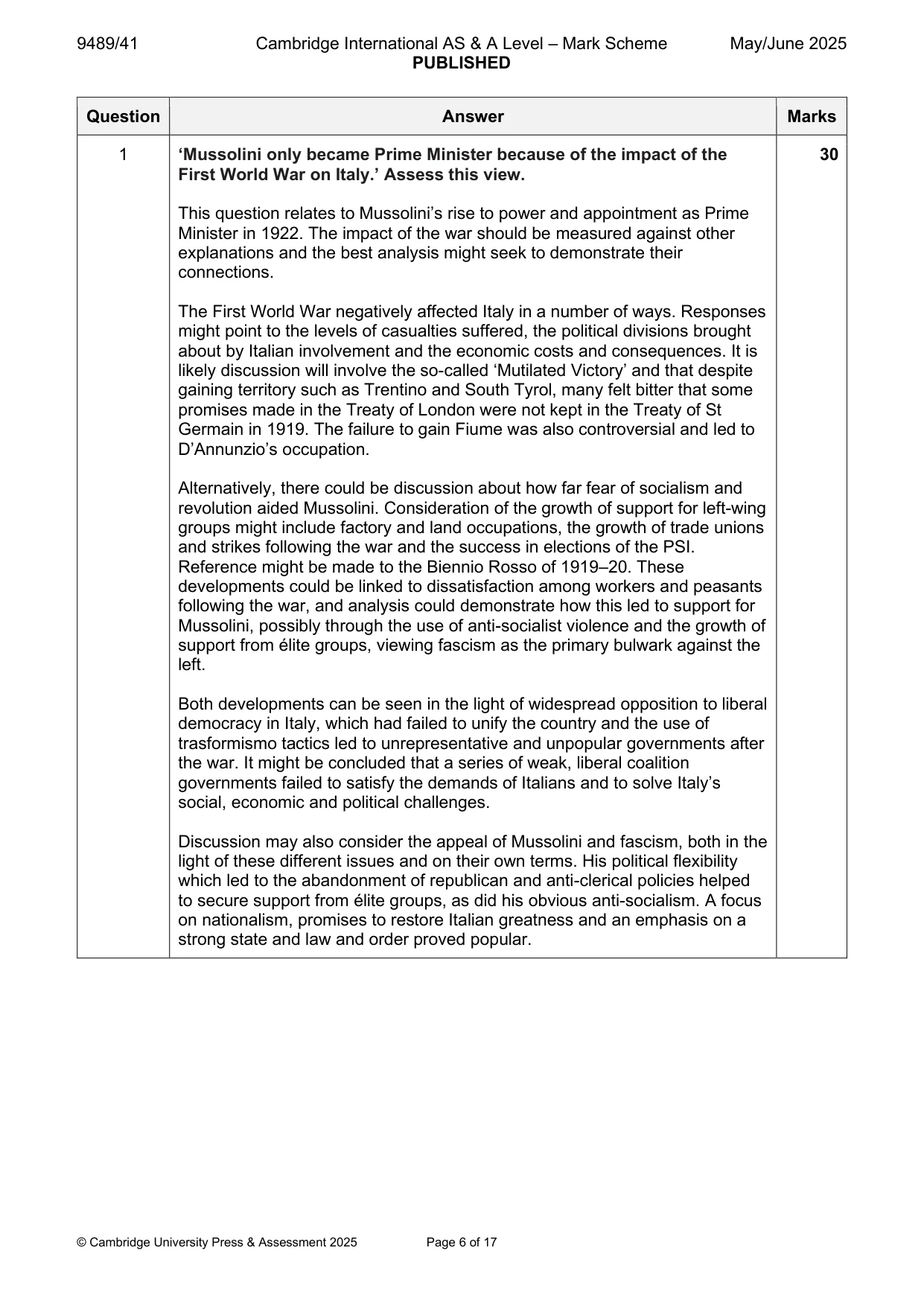
Mark scheme: 2 ‘Trotsky’s mistakes and weaknesses were the main reason for Stalin’s 30 rise to power by 1928.’ Discuss this view. The main focus might be on considering the failures and weaknesses of Stalin’s rivals, principally Trotsky. Exploration of his inability to match Stalin’s political manoeuvring and reasons why other senior Bolsheviks were suspicious of him might be expected. This might incorporate his personality, anti-semitism, his background as a Menshevik and the possibility of him emerging as Russian Napoleon with the support of the Red Army. There could also be discussion of the failure to publish Lenin’s Testament, and the power vacuum left behind by Lenin’s death. Responses may expand this argument to explain how other leading Bolsheviks, for instance Zinoviev and Kamenev, were also culpable, and to what extent. Responses might challenge the statement by referring to Stalin’s lowly status within the party during the events of 1917. They could also explore the nature of Stalin’s power base within the party bureaucracy and how other senior party members failed to appreciate its significance, linking different reasons together as a result. The perception among other more apparently intellectual figures in the hierarchy was that he was a mediocrity – expect to see references to the ‘grey blur’ or ‘Comrade Card Index.’ His stance as a moderate and conciliatory figure also led to him being underestimated during the power struggle. Alternatives are likely to relate to Stalin’s political skill and cunning. This should relate to how he made the most of his positions in the party organisation in order to create support, referring to his role as General Secretary and Commissar for Nationalities, for instance. There could be discussion of his management of party membership and the Lenin Enrolment which led to the influx of young, proletarian members who were more likely to be attracted by Stalin’s background and policies. This then could encompass discussion of policy stances such as Socialism in One Country which were used to defeat rivals in the years following 1924. It is highly likely that candidates might relate to Stalin’s actions in the aftermath of Lenin’s death, for example his management of the funeral and mourning.
More questions on How were the Bolsheviks able to consolidate their power up to 1924?
Q3 · Analyse the extent to which the lives of women and children were improved as a result of…
3 Analyse the extent to which the lives of women and children were improved as a result of Nazi policies in the years 1933 to 1941. [30]
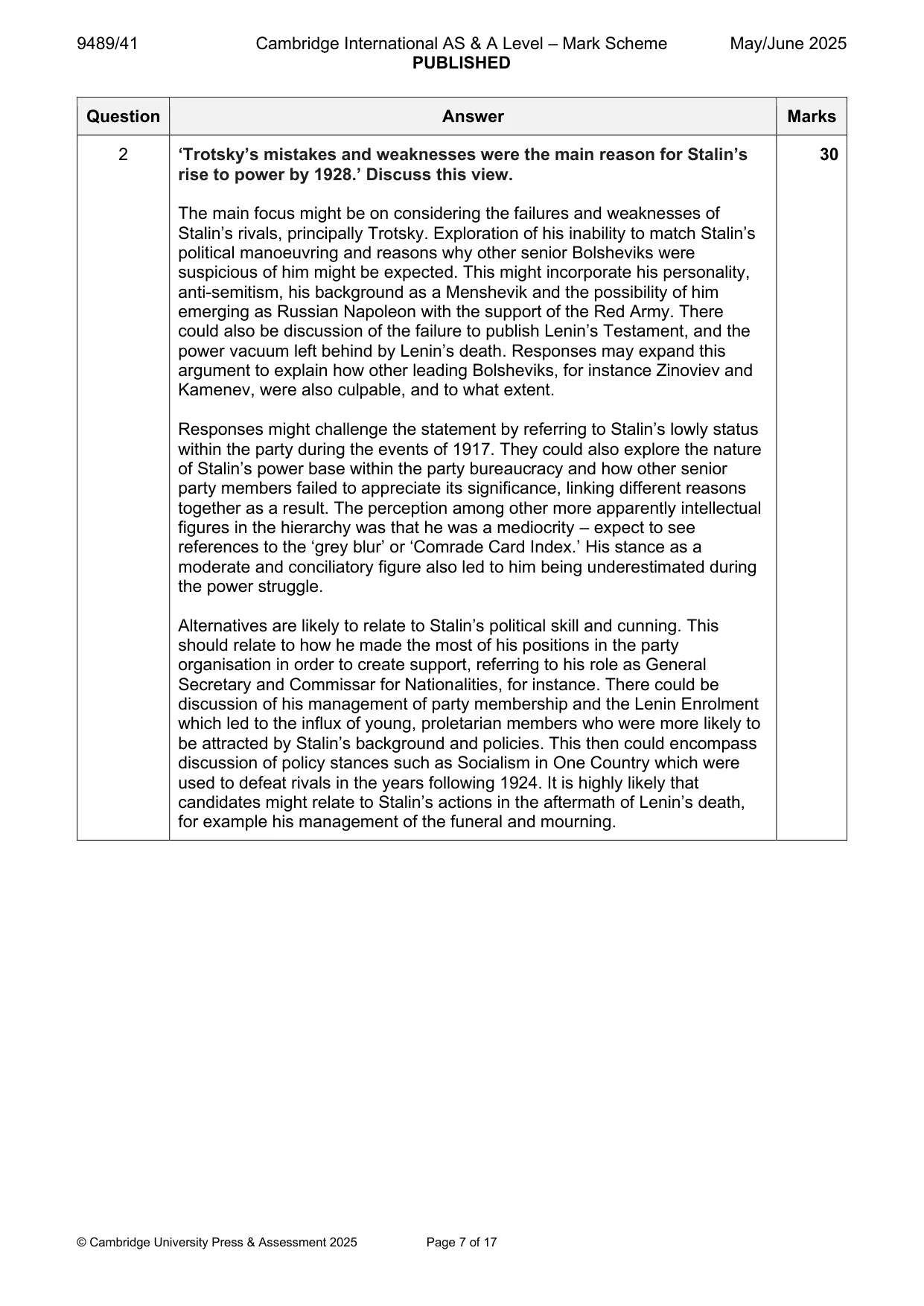
Mark scheme: 3 Analyse the extent to which women and children’s lives were improved 30 as a result of Nazi policies in the years 1933 to 1941. In relation to women, discussions are likely to include consideration of their domestic roles and Hitler’s ambitions to increase the birth-rate and, as a result, the German population. There could be some consideration paid to the attempts to remove women from the workplace, and this might be linked to the drive to lower unemployment figures. Therefore, responses might explore the various policies which were enacted to encourage marriage and child- rearing, such as marriage loans, awards and propaganda. Discussions might also offer analysis of the extent to which these goals were achieved. There was an increase in the birth rate, when compared with the period of the Great Depression, although it could be argued that this was due to economic recovery and rates remained lower than under Weimar Germany. The same argument might be made in relation to the increased number of marriages. Finally, Nazi policies had limited effects on the level of female employment, largely impacting professions. There could also be some discussion of the need to recruit women back to the workforce in the years immediately before, and after, the outbreak of World War Two. Nazi aims towards children could include loyalty to Hitler, obedience to the regime, physical fitness to fight in future conflicts or to bear children and an understanding of their gender roles within society. There could be exploration of Nazi education policies and of the use of youth groups to meet these goals. Outcomes might focus on the extent to which education was controlled by the regime and how much indoctrination children received. Levels of attendance at Hitler Youth could be considered, in particular the stipulation in 1936 that it was compulsory – indicating that not all young people willingly conformed and that the message was being widely. This argument could be developed in relation to youth opposition groups, such as the Swing Movement and Edelweiss Pirates. Discussions might show knowledge of their small size in relation to the overall numbers of young people in Germany. It is valid to argue that it is difficult to measure the scale of compliance, and that lack of outright opposition does not necessarily mean total loyalty.
More questions on How did the rise of extremism affect international relations?
Q4 · ‘British governments followed a policy of appeasement in the 1930s because it was popular…
4 ‘British governments followed a policy of appeasement in the 1930s because it was popular with the public.’ Assess this view. [30]
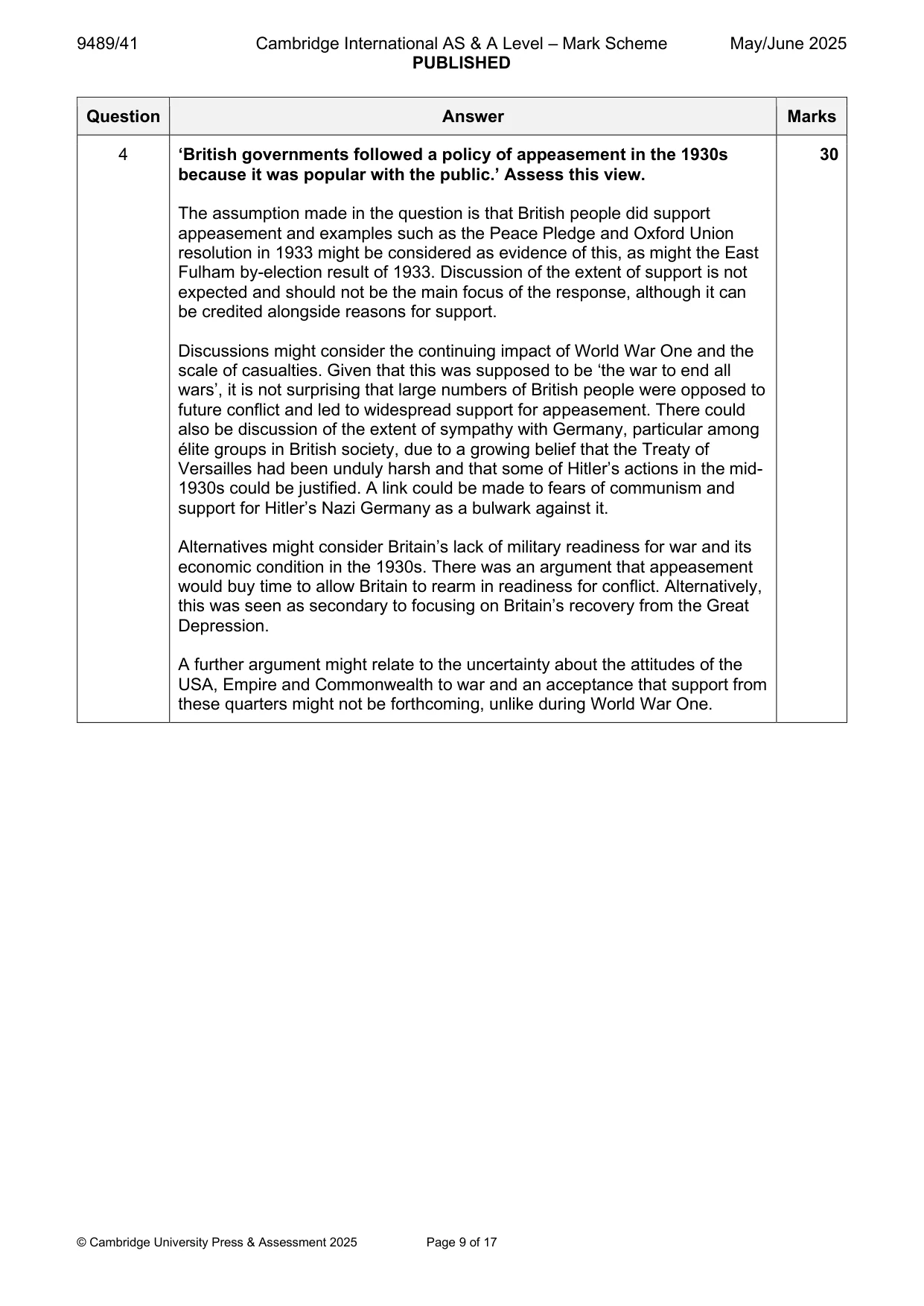
Mark scheme: 4 ‘British governments followed a policy of appeasement in the 1930s 30 because it was popular with the public.’ Assess this view. The assumption made in the question is that British people did support appeasement and examples such as the Peace Pledge and Oxford Union resolution in 1933 might be considered as evidence of this, as might the East Fulham by-election result of 1933. Discussion of the extent of support is not expected and should not be the main focus of the response, although it can be credited alongside reasons for support. Discussions might consider the continuing impact of World War One and the scale of casualties. Given that this was supposed to be ‘the war to end all wars’, it is not surprising that large numbers of British people were opposed to future conflict and led to widespread support for appeasement. There could also be discussion of the extent of sympathy with Germany, particular among élite groups in British society, due to a growing belief that the Treaty of Versailles had been unduly harsh and that some of Hitler’s actions in the mid- 1930s could be justified. A link could be made to fears of communism and support for Hitler’s Nazi Germany as a bulwark against it. Alternatives might consider Britain’s lack of military readiness for war and its economic condition in the 1930s. There was an argument that appeasement would buy time to allow Britain to rearm in readiness for conflict. Alternatively, this was seen as secondary to focusing on Britain’s recovery from the Great Depression. A further argument might relate to the uncertainty about the attitudes of the USA, Empire and Commonwealth to war and an acceptance that support from these quarters might not be forthcoming, unlike during World War One.
More questions on Why, and with what effects, did Britain and France pursue a policy of appeasement?
Q5 · ‘Progress towards greater civil rights in the 1950s was mainly brought about by federal…
5 ‘Progress towards greater civil rights in the 1950s was mainly brought about by federal institutions.’ Evaluate this view. [30]
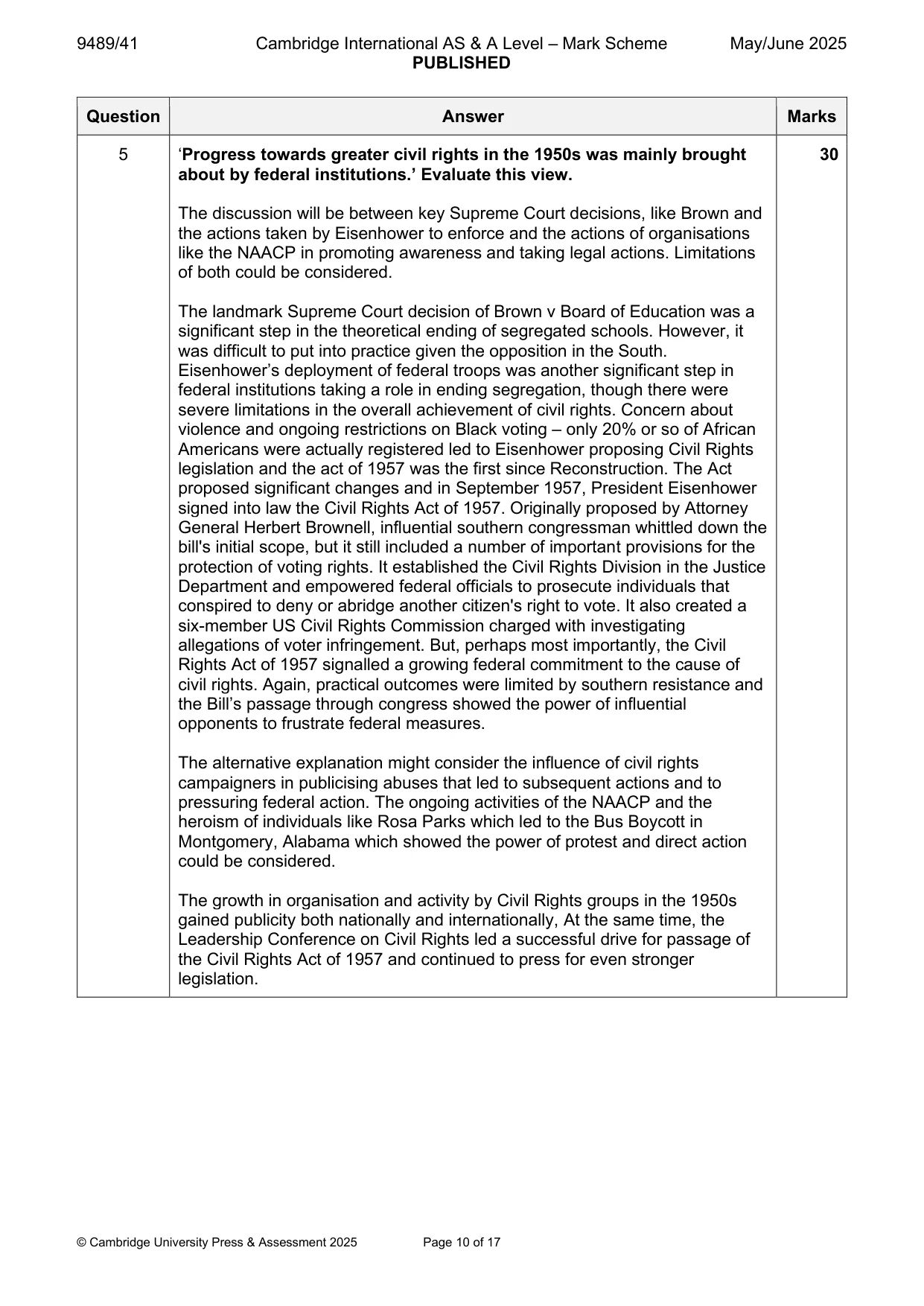
Mark scheme: 5 ‘Progress towards greater civil rights in the 1950s was mainly brought 30 about by federal institutions.’ Evaluate this view. The discussion will be between key Supreme Court decisions, like Brown and the actions taken by Eisenhower to enforce and the actions of organisations like the NAACP in promoting awareness and taking legal actions. Limitations of both could be considered. The landmark Supreme Court decision of Brown v Board of Education was a significant step in the theoretical ending of segregated schools. However, it was difficult to put into practice given the opposition in the South. Eisenhower’s deployment of federal troops was another significant step in federal institutions taking a role in ending segregation, though there were severe limitations in the overall achievement of civil rights. Concern about violence and ongoing restrictions on Black voting – only 20% or so of African Americans were actually registered led to Eisenhower proposing Civil Rights legislation and the act of 1957 was the first since Reconstruction. The Act proposed significant changes and in September 1957, President Eisenhower signed into law the Civil Rights Act of 1957. Originally proposed by Attorney General Herbert Brownell, influential southern congressman whittled down the bill's initial scope, but it still included a number of important provisions for the protection of voting rights. It established the Civil Rights Division in the Justice Department and empowered federal officials to prosecute individuals that conspired to deny or abridge another citizen's right to vote. It also created a six-member US Civil Rights Commission charged with investigating allegations of voter infringement. But, perhaps most importantly, the Civil Rights Act of 1957 signalled a growing federal commitment to the cause of civil rights. Again, practical outcomes were limited by southern resistance and the Bill’s passage through congress showed the power of influential opponents to frustrate federal measures. The alternative explanation might consider the influence of civil rights campaigners in publicising abuses that led to subsequent actions and to pressuring federal action. The ongoing activities of the NAACP and the heroism of individuals like Rosa Parks which led to the Bus Boycott in Montgomery, Alabama which showed the power of protest and direct action could be considered. The growth in organisation and activity by Civil Rights groups in the 1950s gained publicity both nationally and internationally, At the same time, the Leadership Conference on Civil Rights led a successful drive for passage of the Civil Rights Act of 1957 and continued to press for even stronger legislation.
More questions on How successful was the Progressive Movement from 1890 to 1920?
Q6 · Assess the political importance of the Watergate affair in the 1970s
6 Assess the political importance of the Watergate affair in the 1970s. [30]
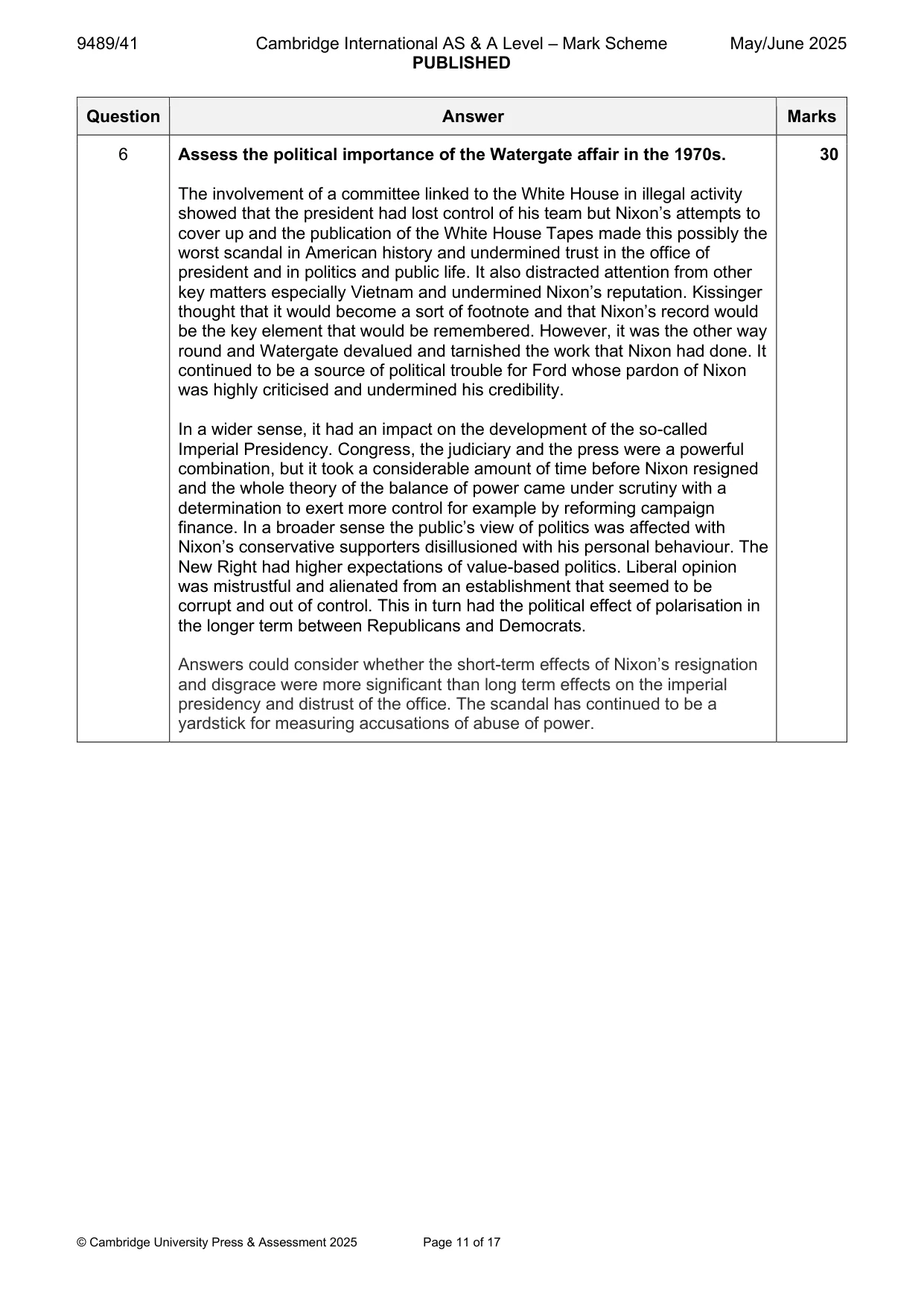
Mark scheme: 6 Assess the political importance of the Watergate affair in the 1970s. 30 The involvement of a committee linked to the White House in illegal activity showed that the president had lost control of his team but Nixon’s attempts to cover up and the publication of the White House Tapes made this possibly the worst scandal in American history and undermined trust in the office of president and in politics and public life. It also distracted attention from other key matters especially Vietnam and undermined Nixon’s reputation. Kissinger thought that it would become a sort of footnote and that Nixon’s record would be the key element that would be remembered. However, it was the other way round and Watergate devalued and tarnished the work that Nixon had done. It continued to be a source of political trouble for Ford whose pardon of Nixon was highly criticised and undermined his credibility. In a wider sense, it had an impact on the development of the so-called Imperial Presidency. Congress, the judiciary and the press were a powerful combination, but it took a considerable amount of time before Nixon resigned and the whole theory of the balance of power came under scrutiny with a determination to exert more control for example by reforming campaign finance. In a broader sense the public’s view of politics was affected with Nixon’s conservative supporters disillusioned with his personal behaviour. The New Right had higher expectations of value-based politics. Liberal opinion was mistrustful and alienated from an establishment that seemed to be corrupt and out of control. This in turn had the political effect of polarisation in the longer term between Republicans and Democrats. Answers could consider whether the short-term effects of Nixon’s resignation and disgrace were more significant than long term effects on the imperial presidency and distrust of the office. The scandal has continued to be a yardstick for measuring accusations of abuse of power.
More questions on Why was there a second New Deal and how successful was it?
Q7 · Analyse the reasons for the increased concerns about drug abuse in the 1980s and 1990s
7 Analyse the reasons for the increased concerns about drug abuse in the 1980s and 1990s. [30]
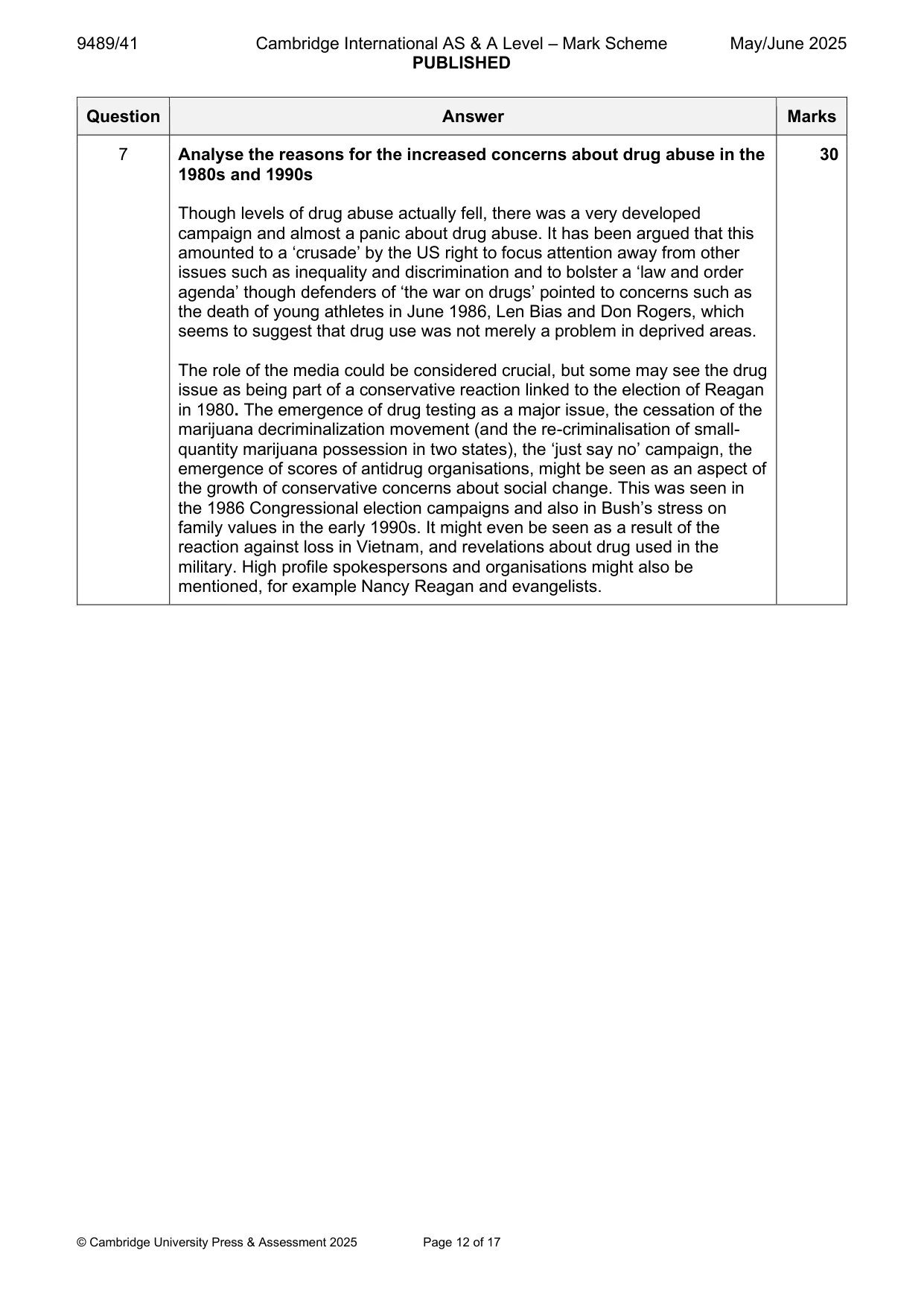
Mark scheme: 7 Analyse the reasons for the increased concerns about drug abuse in the 30 1980s and 1990s Though levels of drug abuse actually fell, there was a very developed campaign and almost a panic about drug abuse. It has been argued that this amounted to a ‘crusade’ by the US right to focus attention away from other issues such as inequality and discrimination and to bolster a ‘law and order agenda’ though defenders of ‘the war on drugs’ pointed to concerns such as the death of young athletes in June 1986, Len Bias and Don Rogers, which seems to suggest that drug use was not merely a problem in deprived areas. The role of the media could be considered crucial, but some may see the drug issue as being part of a conservative reaction linked to the election of Reagan in 1980. The emergence of drug testing as a major issue, the cessation of the marijuana decriminalization movement (and the re-criminalisation of small- quantity marijuana possession in two states), the ‘just say no’ campaign, the emergence of scores of antidrug organisations, might be seen as an aspect of the growth of conservative concerns about social change. This was seen in the 1986 Congressional election campaigns and also in Bush’s stress on family values in the early 1990s. It might even be seen as a result of the reaction against loss in Vietnam, and revelations about drug used in the military. High profile spokespersons and organisations might also be mentioned, for example Nancy Reagan and evangelists.
More questions on How successful was the Progressive Movement from 1890 to 1920?
Q8 · Section C: International history, 1945–92
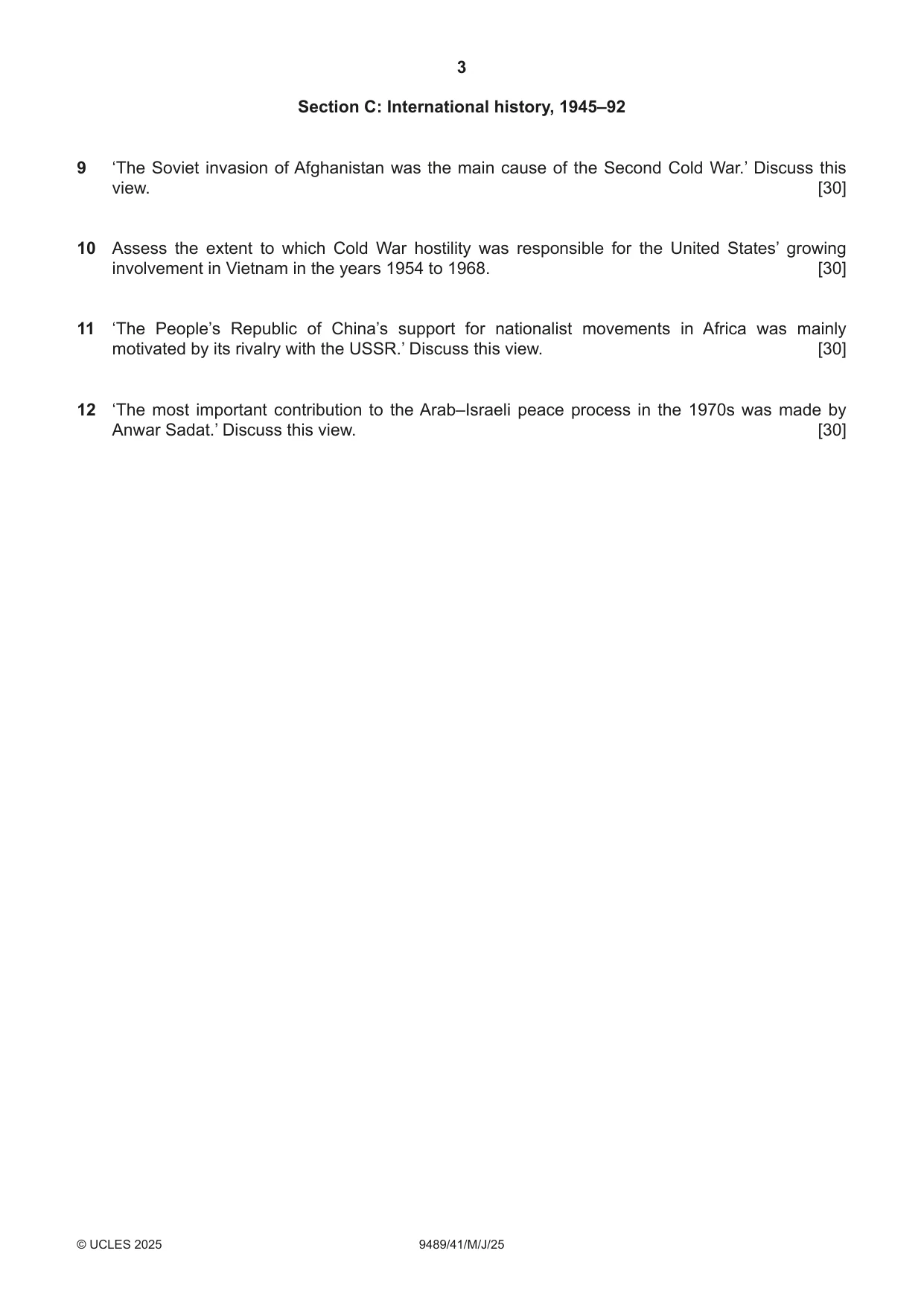
Section C: International history, 1945–92
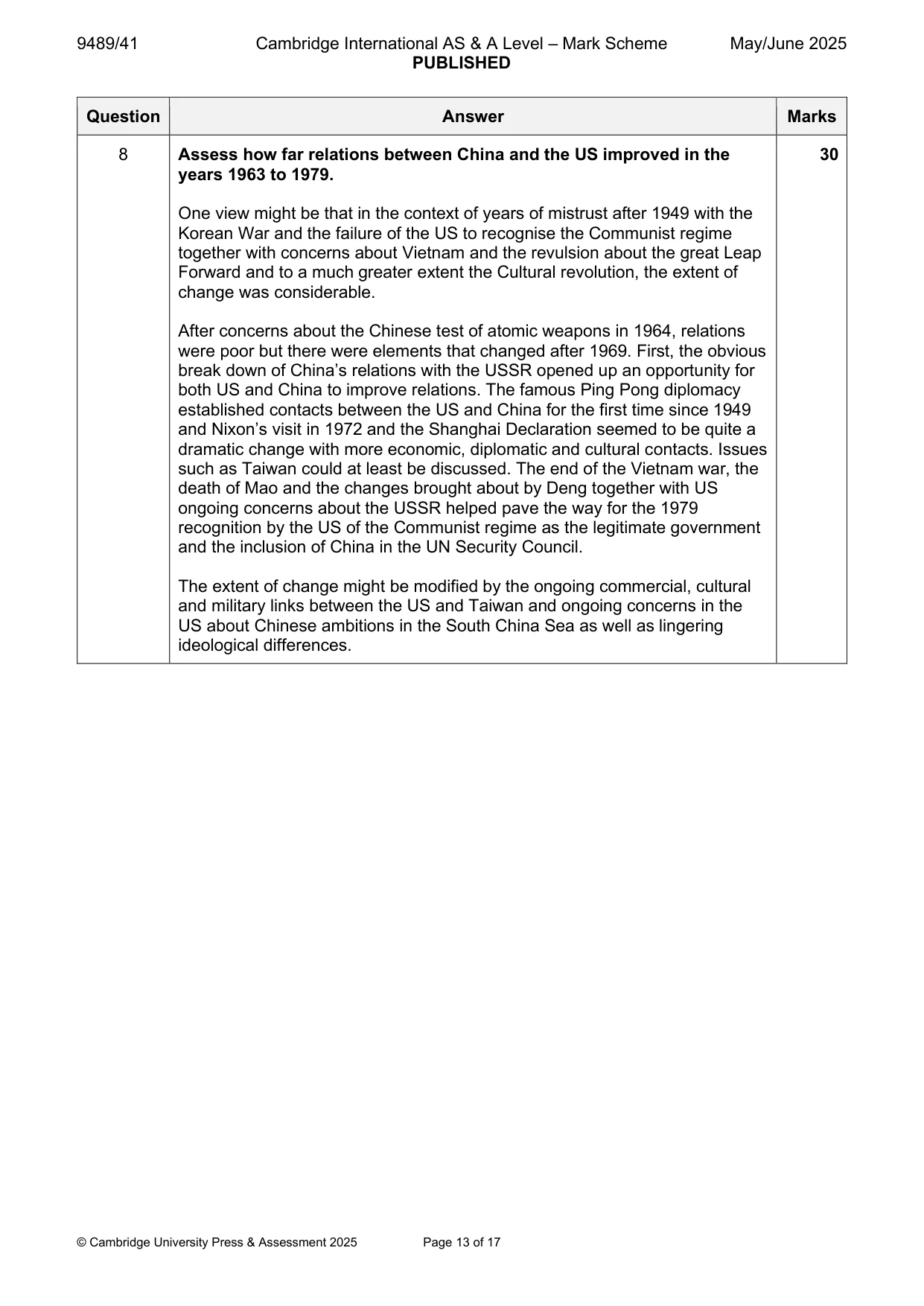
Mark scheme: 8 Assess how far relations between China and the US improved in the 30 years 1963 to 1979. One view might be that in the context of years of mistrust after 1949 with the Korean War and the failure of the US to recognise the Communist regime together with concerns about Vietnam and the revulsion about the great Leap Forward and to a much greater extent the Cultural revolution, the extent of change was considerable. After concerns about the Chinese test of atomic weapons in 1964, relations were poor but there were elements that changed after 1969. First, the obvious break down of China’s relations with the USSR opened up an opportunity for both US and China to improve relations. The famous Ping Pong diplomacy established contacts between the US and China for the first time since 1949 and Nixon’s visit in 1972 and the Shanghai Declaration seemed to be quite a dramatic change with more economic, diplomatic and cultural contacts. Issues such as Taiwan could at least be discussed. The end of the Vietnam war, the death of Mao and the changes brought about by Deng together with US ongoing concerns about the USSR helped pave the way for the 1979 recognition by the US of the Communist regime as the legitimate government and the inclusion of China in the UN Security Council. The extent of change might be modified by the ongoing commercial, cultural and military links between the US and Taiwan and ongoing concerns in the US about Chinese ambitions in the South China Sea as well as lingering ideological differences.
Q9 · ‘The Soviet invasion of Afghanistan was the main cause of the Second Cold War.’ Discuss…
9 ‘The Soviet invasion of Afghanistan was the main cause of the Second Cold War.’ Discuss this view. [30]
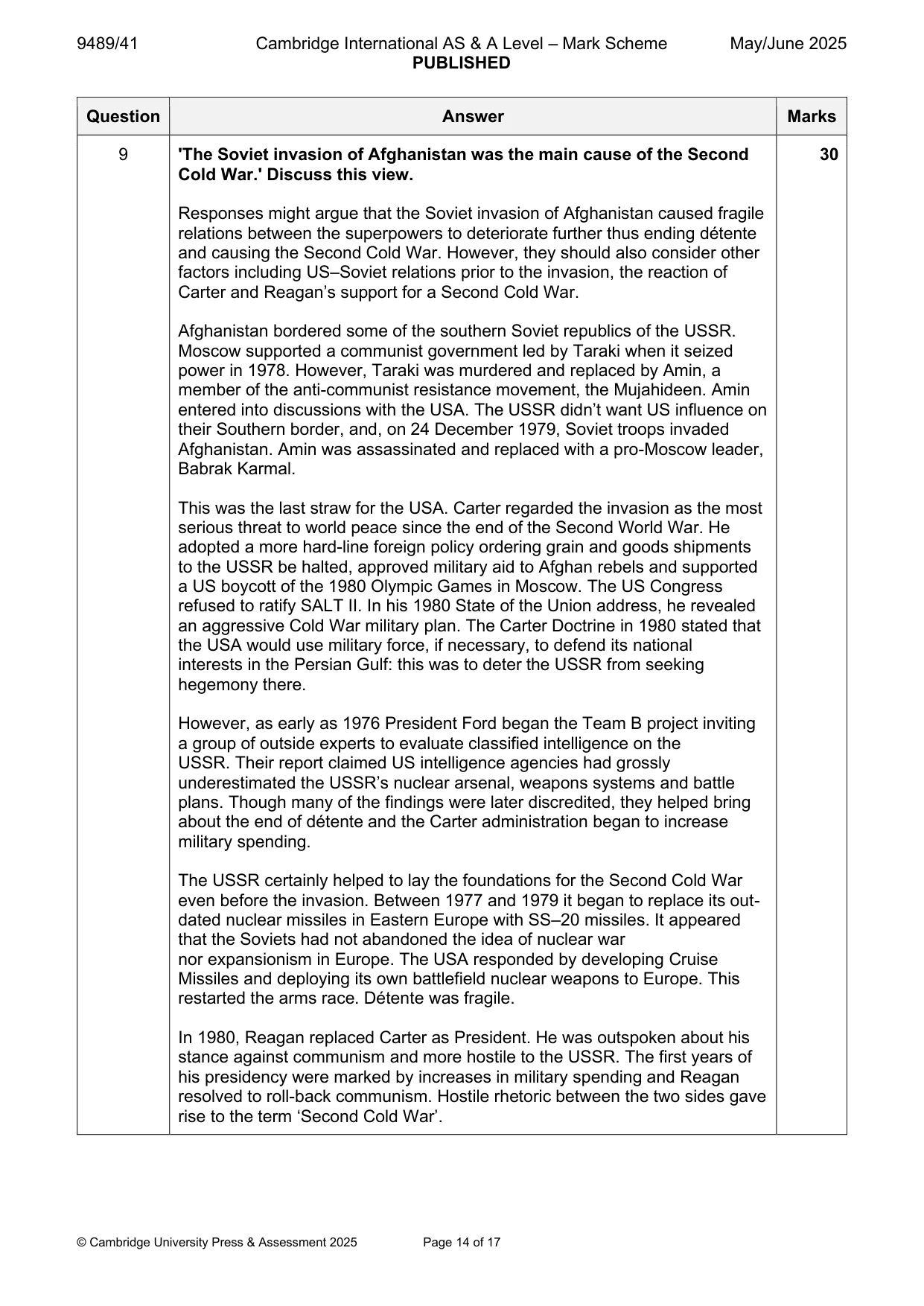
Mark scheme: 9 'The Soviet invasion of Afghanistan was the main cause of the Second 30 Cold War.' Discuss this view. Responses might argue that the Soviet invasion of Afghanistan caused fragile relations between the superpowers to deteriorate further thus ending détente and causing the Second Cold War. However, they should also consider other factors including US–Soviet relations prior to the invasion, the reaction of Carter and Reagan’s support for a Second Cold War. Afghanistan bordered some of the southern Soviet republics of the USSR. Moscow supported a communist government led by Taraki when it seized power in 1978. However, Taraki was murdered and replaced by Amin, a member of the anti-communist resistance movement, the Mujahideen. Amin entered into discussions with the USA. The USSR didn’t want US influence on their Southern border, and, on 24 December 1979, Soviet troops invaded Afghanistan. Amin was assassinated and replaced with a pro-Moscow leader, Babrak Karmal. This was the last straw for the USA. Carter regarded the invasion as the most serious threat to world peace since the end of the Second World War. He adopted a more hard-line foreign policy ordering grain and goods shipments to the USSR be halted, approved military aid to Afghan rebels and supported a US boycott of the 1980 Olympic Games in Moscow. The US Congress refused to ratify SALT II. In his 1980 State of the Union address, he revealed an aggressive Cold War military plan. The Carter Doctrine in 1980 stated that the USA would use military force, if necessary, to defend its national interests in the Persian Gulf: this was to deter the USSR from seeking hegemony there. However, as early as 1976 President Ford began the Team B project inviting a group of outside experts to evaluate classified intelligence on the USSR. Their report claimed US intelligence agencies had grossly underestimated the USSR’s nuclear arsenal, weapons systems and battle plans. Though many of the findings were later discredited, they helped bring about the end of détente and the Carter administration began to increase military spending. The USSR certainly helped to lay the foundations for the Second Cold War even before the invasion. Between 1977 and 1979 it began to replace its out- dated nuclear missiles in Eastern Europe with SS–20 missiles. It appeared that the Soviets had not abandoned the idea of nuclear war nor expansionism in Europe. The USA responded by developing Cruise Missiles and deploying its own battlefield nuclear weapons to Europe. This restarted the arms race. Détente was fragile. In 1980, Reagan replaced Carter as President. He was outspoken about his stance against communism and more hostile to the USSR. The first years of his presidency were marked by increases in military spending and Reagan resolved to roll-back communism. Hostile rhetoric between the two sides gave rise to the term ‘Second Cold War’.
More questions on How did the rise of extremism affect international relations?
Q10 · Assess the extent to which Cold War hostility was responsible for the United States’…
10 Assess the extent to which Cold War hostility was responsible for the United States’ growing involvement in Vietnam in the years 1954 to 1968. [30]
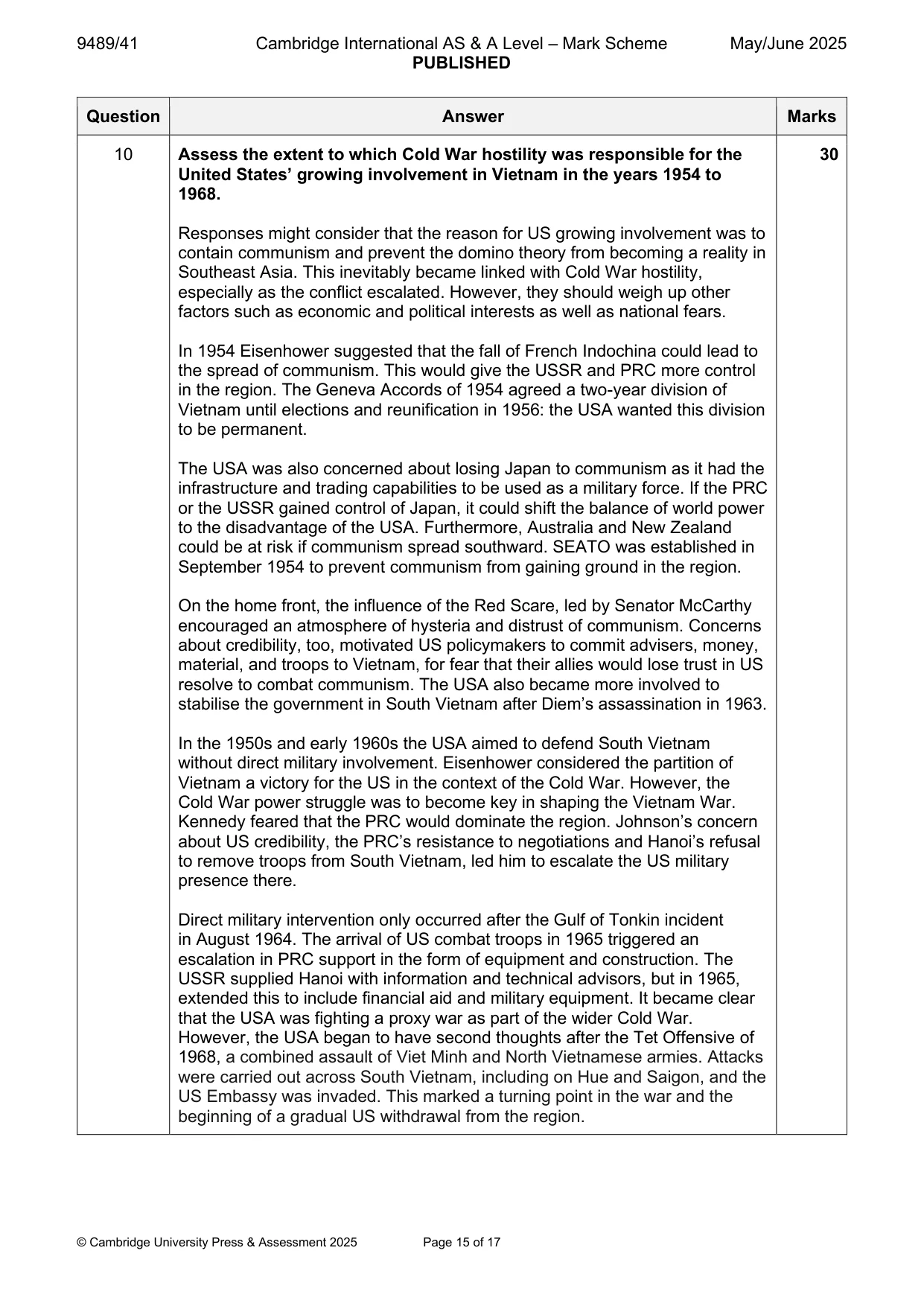
Mark scheme: 10 Assess the extent to which Cold War hostility was responsible for the 30 United States’ growing involvement in Vietnam in the years 1954 to 1968. Responses might consider that the reason for US growing involvement was to contain communism and prevent the domino theory from becoming a reality in Southeast Asia. This inevitably became linked with Cold War hostility, especially as the conflict escalated. However, they should weigh up other factors such as economic and political interests as well as national fears. In 1954 Eisenhower suggested that the fall of French Indochina could lead to the spread of communism. This would give the USSR and PRC more control in the region. The Geneva Accords of 1954 agreed a two-year division of Vietnam until elections and reunification in 1956: the USA wanted this division to be permanent. The USA was also concerned about losing Japan to communism as it had the infrastructure and trading capabilities to be used as a military force. If the PRC or the USSR gained control of Japan, it could shift the balance of world power to the disadvantage of the USA. Furthermore, Australia and New Zealand could be at risk if communism spread southward. SEATO was established in September 1954 to prevent communism from gaining ground in the region. On the home front, the influence of the Red Scare, led by Senator McCarthy encouraged an atmosphere of hysteria and distrust of communism. Concerns about credibility, too, motivated US policymakers to commit advisers, money, material, and troops to Vietnam, for fear that their allies would lose trust in US resolve to combat communism. The USA also became more involved to stabilise the government in South Vietnam after Diem’s assassination in 1963. In the 1950s and early 1960s the USA aimed to defend South Vietnam without direct military involvement. Eisenhower considered the partition of Vietnam a victory for the US in the context of the Cold War. However, the Cold War power struggle was to become key in shaping the Vietnam War. Kennedy feared that the PRC would dominate the region. Johnson’s concern about US credibility, the PRC’s resistance to negotiations and Hanoi’s refusal to remove troops from South Vietnam, led him to escalate the US military presence there. Direct military intervention only occurred after the Gulf of Tonkin incident in August 1964. The arrival of US combat troops in 1965 triggered an escalation in PRC support in the form of equipment and construction. The USSR supplied Hanoi with information and technical advisors, but in 1965, extended this to include financial aid and military equipment. It became clear that the USA was fighting a proxy war as part of the wider Cold War. However, the USA began to have second thoughts after the Tet Offensive of 1968, a combined assault of Viet Minh and North Vietnamese armies. Attacks were carried out across South Vietnam, including on Hue and Saigon, and the US Embassy was invaded. This marked a turning point in the war and the beginning of a gradual US withdrawal from the region.
More questions on How did the rise of extremism affect international relations?
Q11 · ‘The People’s Republic of China’s support for nationalist movements in Africa was mainly…
11 ‘The People’s Republic of China’s support for nationalist movements in Africa was mainly motivated by its rivalry with the USSR.’ Discuss this view. [30]
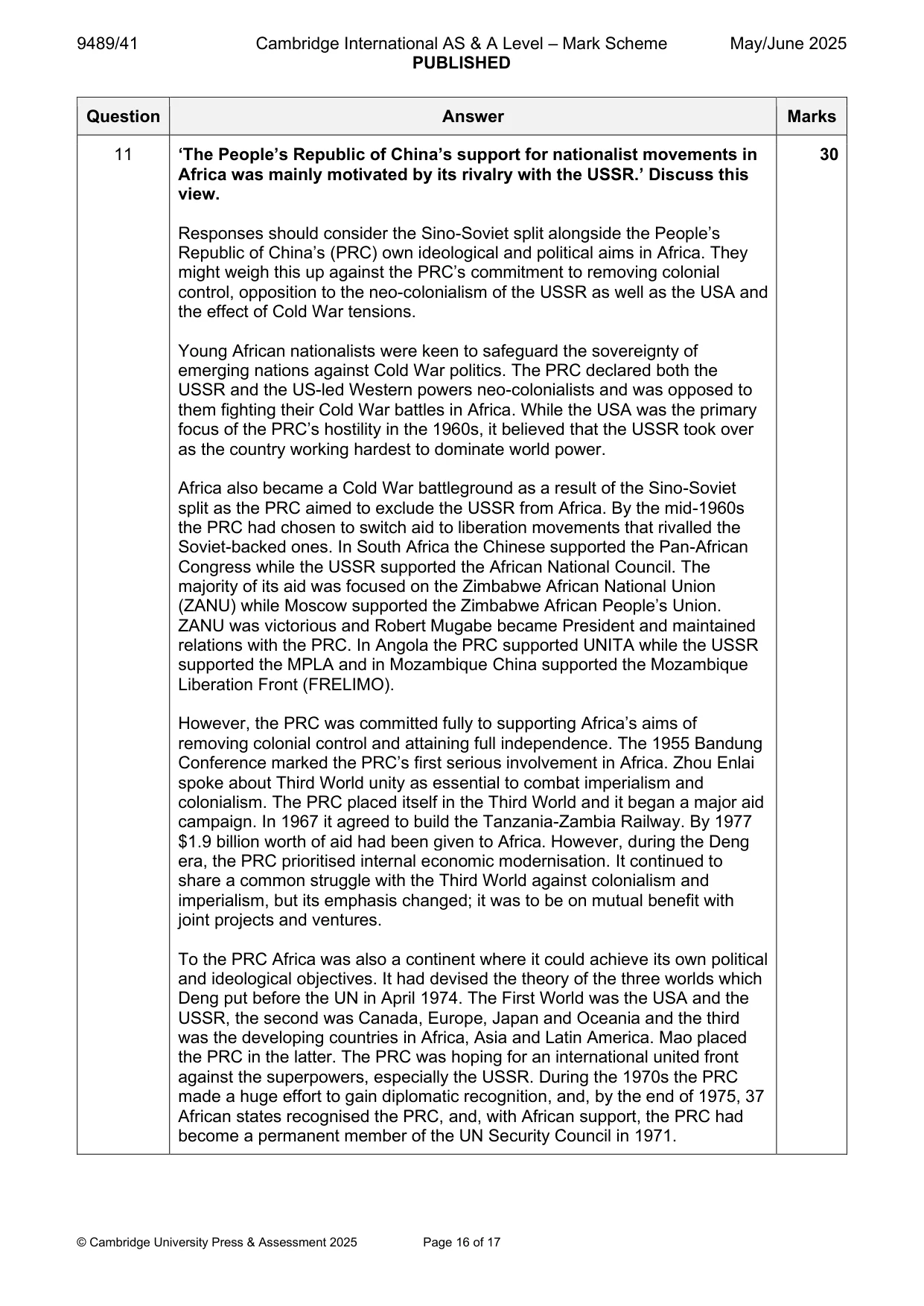
Mark scheme: 11 ‘The People’s Republic of China’s support for nationalist movements in 30 Africa was mainly motivated by its rivalry with the USSR.’ Discuss this view. Responses should consider the Sino-Soviet split alongside the People’s Republic of China’s (PRC) own ideological and political aims in Africa. They might weigh this up against the PRC’s commitment to removing colonial control, opposition to the neo-colonialism of the USSR as well as the USA and the effect of Cold War tensions. Young African nationalists were keen to safeguard the sovereignty of emerging nations against Cold War politics. The PRC declared both the USSR and the US-led Western powers neo-colonialists and was opposed to them fighting their Cold War battles in Africa. While the USA was the primary focus of the PRC’s hostility in the 1960s, it believed that the USSR took over as the country working hardest to dominate world power. Africa also became a Cold War battleground as a result of the Sino-Soviet split as the PRC aimed to exclude the USSR from Africa. By the mid-1960s the PRC had chosen to switch aid to liberation movements that rivalled the Soviet-backed ones. In South Africa the Chinese supported the Pan-African Congress while the USSR supported the African National Council. The majority of its aid was focused on the Zimbabwe African National Union (ZANU) while Moscow supported the Zimbabwe African People’s Union. ZANU was victorious and Robert Mugabe became President and maintained relations with the PRC. In Angola the PRC supported UNITA while the USSR supported the MPLA and in Mozambique China supported the Mozambique Liberation Front (FRELIMO). However, the PRC was committed fully to supporting Africa’s aims of removing colonial control and attaining full independence. The 1955 Bandung Conference marked the PRC’s first serious involvement in Africa. Zhou Enlai spoke about Third World unity as essential to combat imperialism and colonialism. The PRC placed itself in the Third World and it began a major aid campaign. In 1967 it agreed to build the Tanzania-Zambia Railway. By 1977 $1.9 billion worth of aid had been given to Africa. However, during the Deng era, the PRC prioritised internal economic modernisation. It continued to share a common struggle with the Third World against colonialism and imperialism, but its emphasis changed; it was to be on mutual benefit with joint projects and ventures. To the PRC Africa was also a continent where it could achieve its own political and ideological objectives. It had devised the theory of the three worlds which Deng put before the UN in April 1974. The First World was the USA and the USSR, the second was Canada, Europe, Japan and Oceania and the third was the developing countries in Africa, Asia and Latin America. Mao placed the PRC in the latter. The PRC was hoping for an international united front against the superpowers, especially the USSR. During the 1970s the PRC made a huge effort to gain diplomatic recognition, and, by the end of 1975, 37 African states recognised the PRC, and, with African support, the PRC had become a permanent member of the UN Security Council in 1971.
More questions on Why was imperialism a significant force in Africa from 1870?
Q12 · ‘The most important contribution to the Arab–Israeli peace process in the 1970s was made…
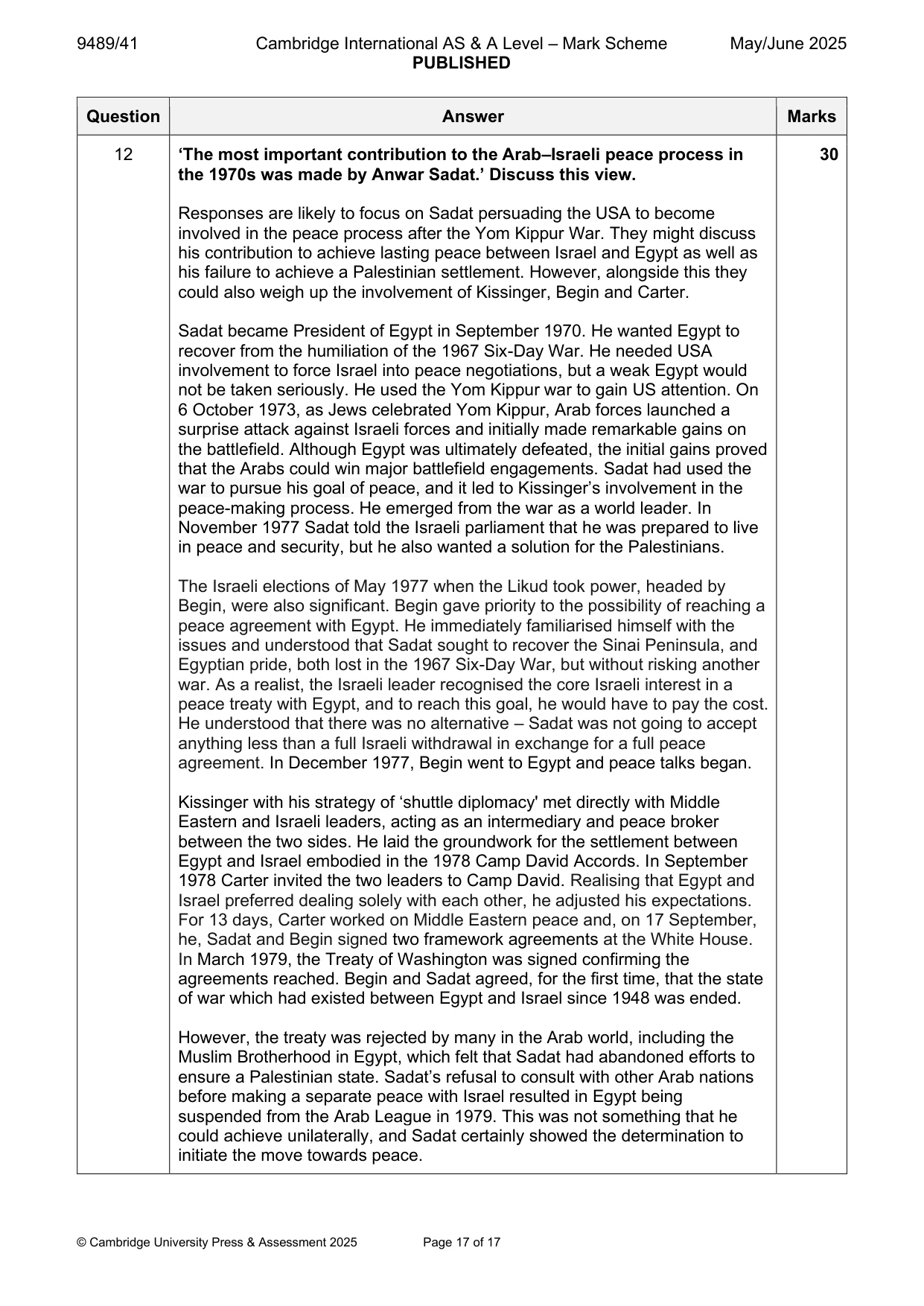
12 ‘The most important contribution to the Arab–Israeli peace process in the 1970s was made by Anwar Sadat.’ Discuss this view. [30]
Mark scheme: 12 ‘The most important contribution to the Arab–Israeli peace process in 30 the 1970s was made by Anwar Sadat.’ Discuss this view. Responses are likely to focus on Sadat persuading the USA to become involved in the peace process after the Yom Kippur War. They might discuss his contribution to achieve lasting peace between Israel and Egypt as well as his failure to achieve a Palestinian settlement. However, alongside this they could also weigh up the involvement of Kissinger, Begin and Carter. Sadat became President of Egypt in September 1970. He wanted Egypt to recover from the humiliation of the 1967 Six-Day War. He needed USA involvement to force Israel into peace negotiations, but a weak Egypt would not be taken seriously. He used the Yom Kippur war to gain US attention. On 6 October 1973, as Jews celebrated Yom Kippur, Arab forces launched a surprise attack against Israeli forces and initially made remarkable gains on the battlefield. Although Egypt was ultimately defeated, the initial gains proved that the Arabs could win major battlefield engagements. Sadat had used the war to pursue his goal of peace, and it led to Kissinger’s involvement in the peace-making process. He emerged from the war as a world leader. In November 1977 Sadat told the Israeli parliament that he was prepared to live in peace and security, but he also wanted a solution for the Palestinians. The Israeli elections of May 1977 when the Likud took power, headed by Begin, were also significant. Begin gave priority to the possibility of reaching a peace agreement with Egypt. He immediately familiarised himself with the issues and understood that Sadat sought to recover the Sinai Peninsula, and Egyptian pride, both lost in the 1967 Six-Day War, but without risking another war. As a realist, the Israeli leader recognised the core Israeli interest in a peace treaty with Egypt, and to reach this goal, he would have to pay the cost. He understood that there was no alternative – Sadat was not going to accept anything less than a full Israeli withdrawal in exchange for a full peace agreement. In December 1977, Begin went to Egypt and peace talks began. Kissinger with his strategy of ‘shuttle diplomacy' met directly with Middle Eastern and Israeli leaders, acting as an intermediary and peace broker between the two sides. He laid the groundwork for the settlement between Egypt and Israel embodied in the 1978 Camp David Accords. In September 1978 Carter invited the two leaders to Camp David. Realising that Egypt and Israel preferred dealing solely with each other, he adjusted his expectations. For 13 days, Carter worked on Middle Eastern peace and, on 17 September, he, Sadat and Begin signed two framework agreements at the White House. In March 1979, the Treaty of Washington was signed confirming the agreements reached. Begin and Sadat agreed, for the first time, that the state of war which had existed between Egypt and Israel since 1948 was ended. However, the treaty was rejected by many in the Arab world, including the Muslim Brotherhood in Egypt, which felt that Sadat had abandoned efforts to ensure a Palestinian state. Sadat’s refusal to consult with other Arab nations before making a separate peace with Israel resulted in Egypt being suspended from the Arab League in 1979. This was not something that he could achieve unilaterally, and Sadat certainly showed the determination to initiate the move towards peace.
More questions on How did the rise of extremism affect international relations?
What was in this paper
The subtopics covered by these 12 questions, and how many questions each got. Open one in a new tab to see every Cambridge question on it.
5How successful was the Progressive Movement from 1890 to 1920?2How were the Bolsheviks able to consolidate their power up to 1924?1Why did war break out in 1939?1Why was imperialism a significant force in Africa from 1870?1Why was there a second New Deal and how successful was it?1Why, and with what effects, did Britain and France pursue a policy of appeasement?1What you needed in this session
Cambridge’s own grade thresholds for 2025 May/June, Paper 4 · Variant 1. A higher threshold means an easier paper — the bar moves with how the cohort did.