Cambridge A Level History 9489 — 2022 May/June Paper 4 · Variant 2
9489/42/M/J/22 · 12 questions · 60 marks · ≈68 min
The question paper and its mark scheme, free to read here and free to download. This is Cambridge’s own paper, exactly as it was sat.
Question paper4 pages
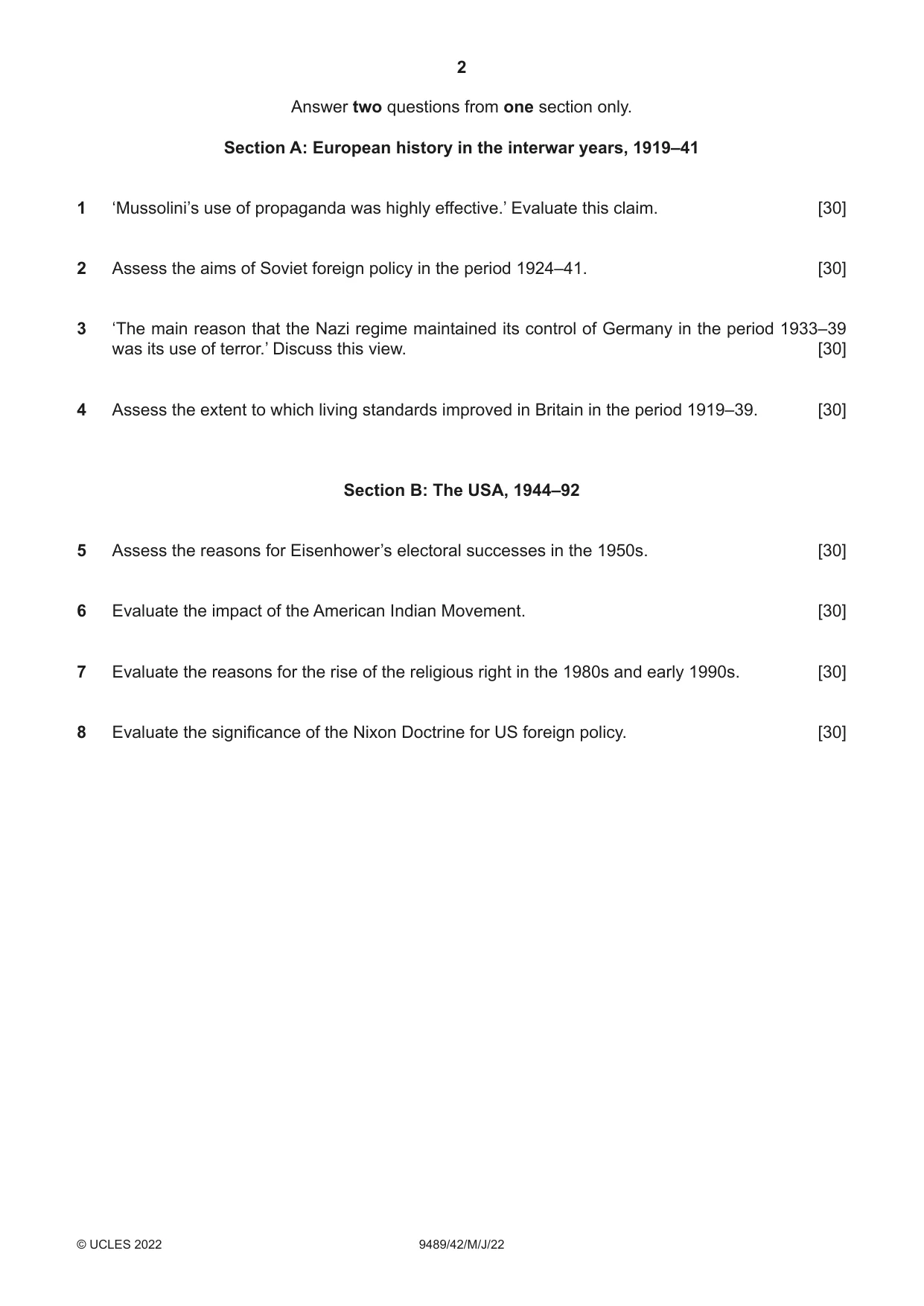
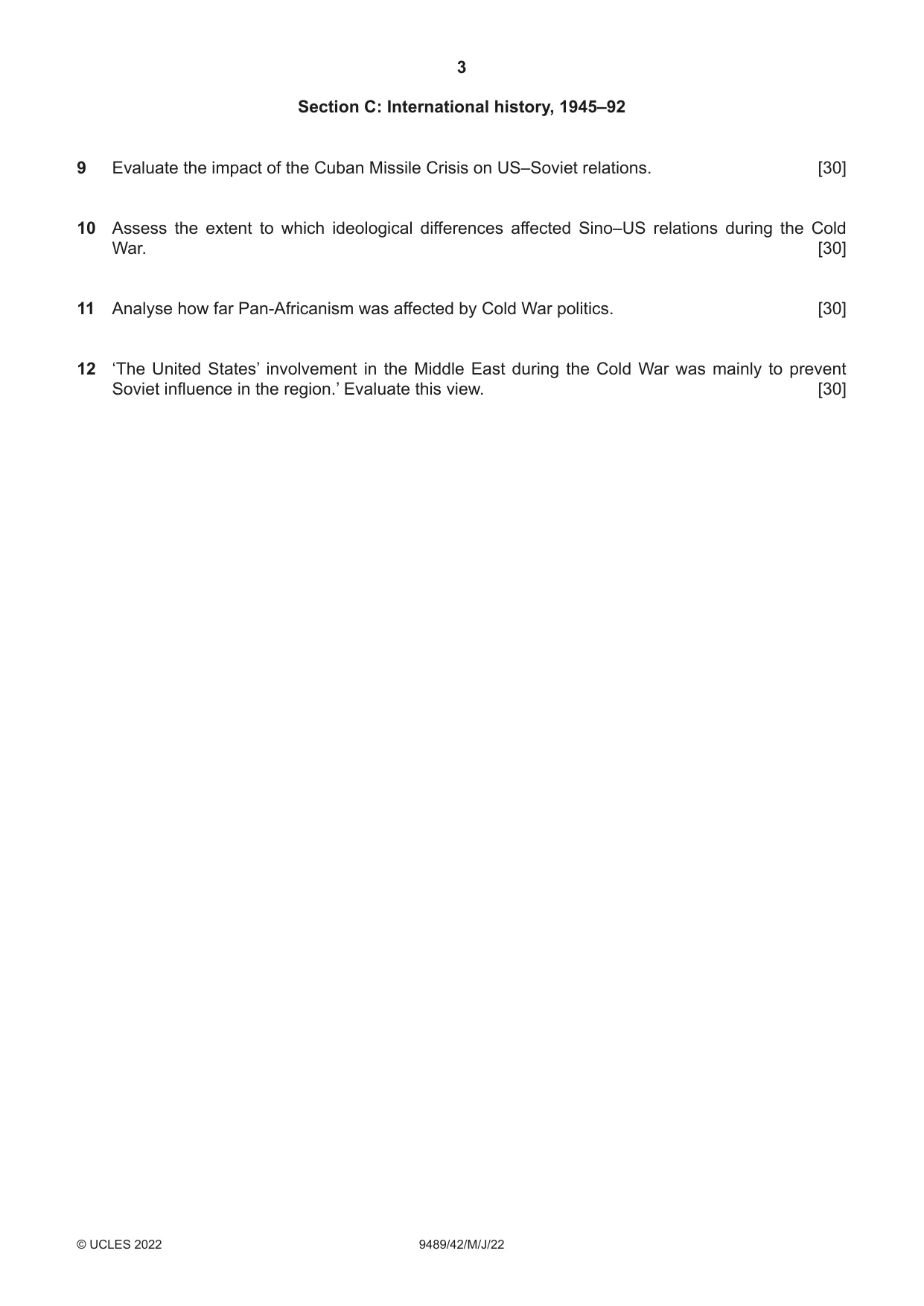
Mark scheme19 pages
Answers below. Sit the paper first if you are practising.

Questions as text
Q1 · ‘Mussolini’s use of propaganda was highly effective.’ Evaluate this claim
1 ‘Mussolini’s use of propaganda was highly effective.’ Evaluate this claim. [30]
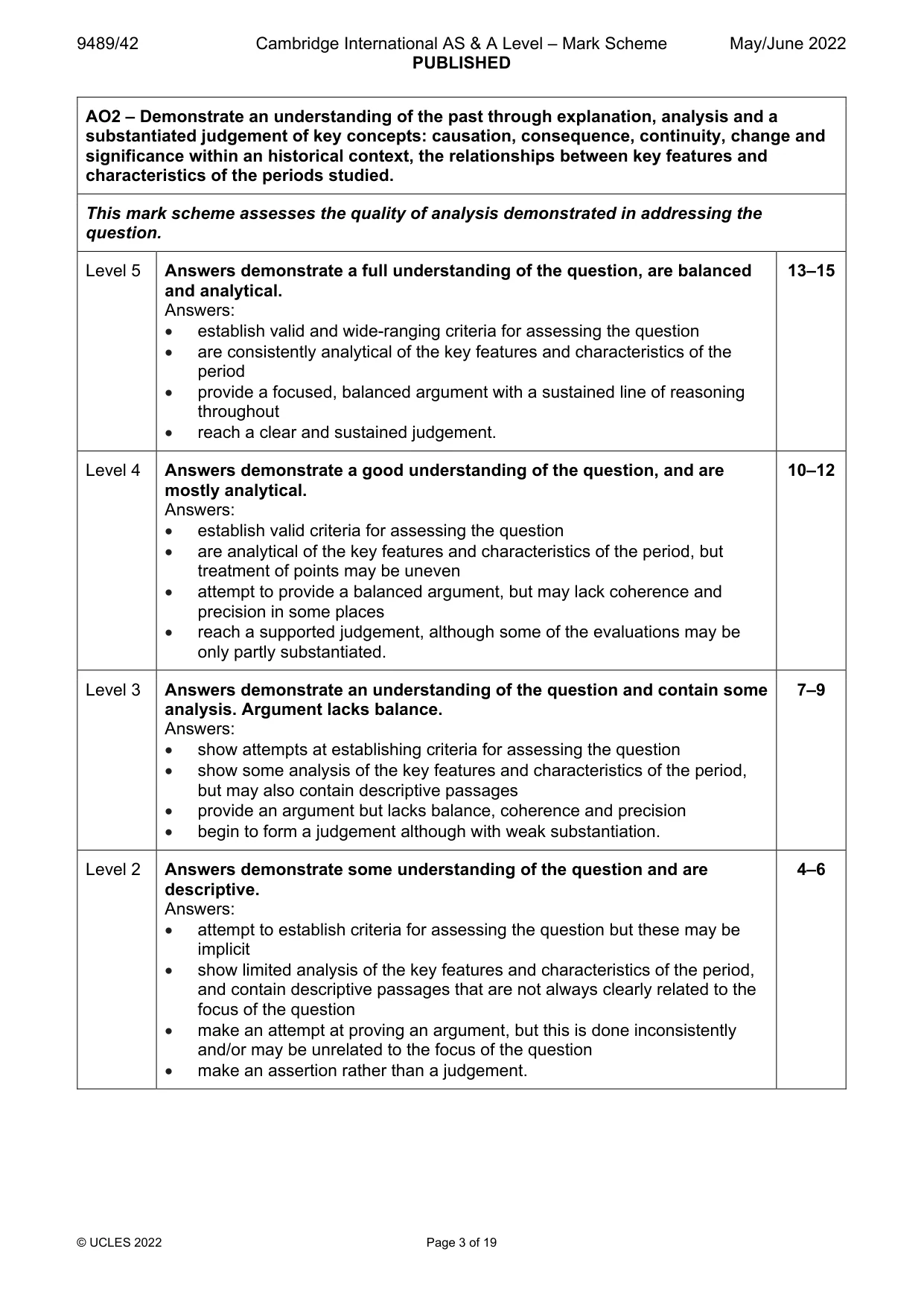
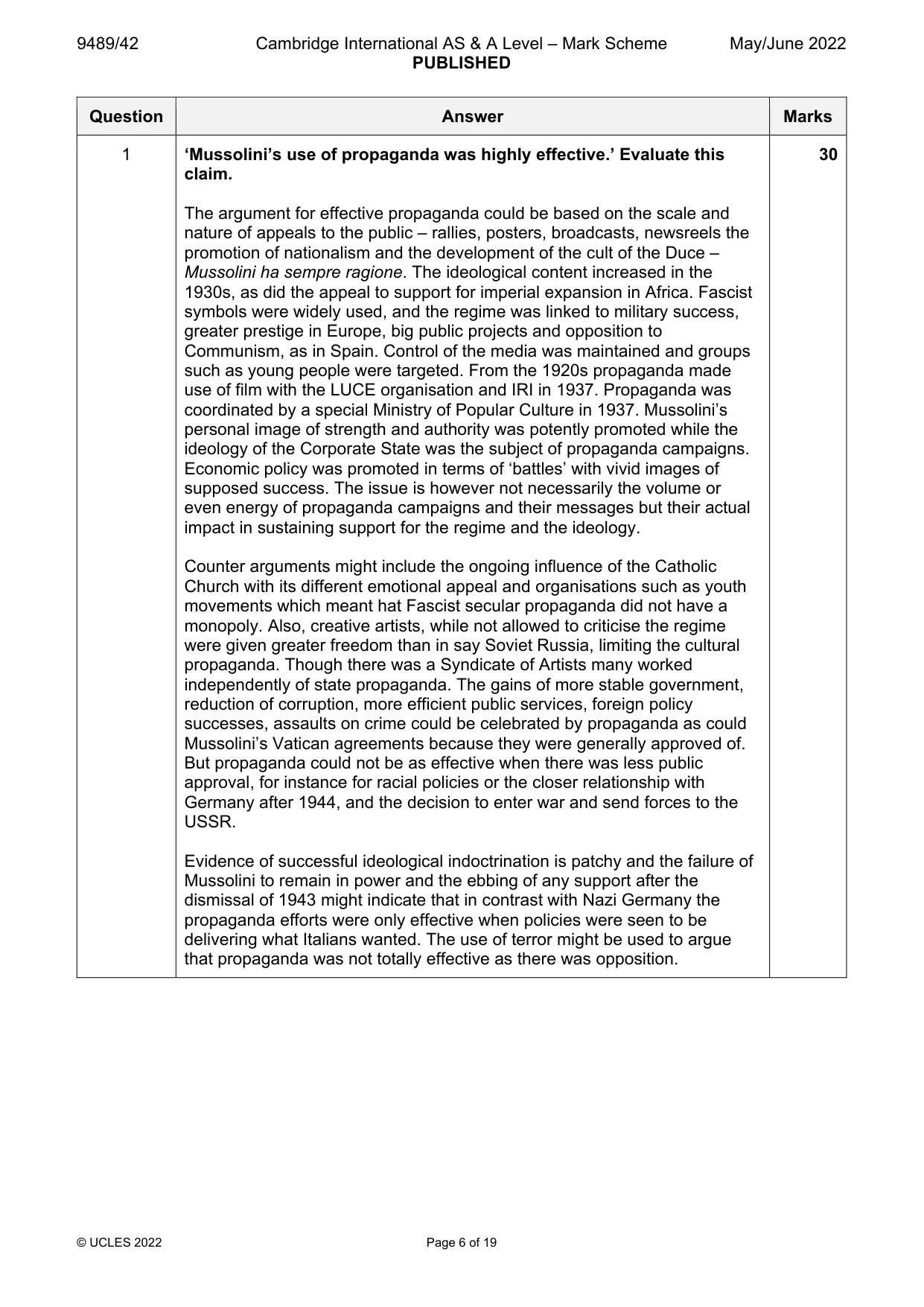
Mark scheme: Question Answer Marks 1 ‘Mussolini’s use of propaganda was highly effective.’ Evaluate this 30 claim. The argument for effective propaganda could be based on the scale and nature of appeals to the public – rallies, posters, broadcasts, newsreels the promotion of nationalism and the development of the cult of the Duce – Mussolini ha sempre ragione. The ideological content increased in the 1930s, as did the appeal to support for imperial expansion in Africa. Fascist symbols were widely used, and the regime was linked to military success, greater prestige in Europe, big public projects and opposition to Communism, as in Spain. Control of the media was maintained and groups such as young people were targeted. From the 1920s propaganda made use of film with the LUCE organisation and IRI in 1937. Propaganda was coordinated by a special Ministry of Popular Culture in 1937. Mussolini’s personal image of strength and authority was potently promoted while the ideology of the Corporate State was the subject of propaganda campaigns. Economic policy was promoted in terms of ‘battles’ with vivid images of supposed success. The issue is however not necessarily the volume or even energy of propaganda campaigns and their messages but their actual impact in sustaining support for the regime and the ideology. Counter arguments might include the ongoing influence of the Catholic Church with its different emotional appeal and organisations such as youth movements which meant hat Fascist secular propaganda did not have a monopoly. Also, creative artists, while not allowed to criticise the regime were given greater freedom than in say Soviet Russia, limiting the cultural propaganda. Though there was a Syndicate of Artists many worked independently of state propaganda. The gains of more stable government, reduction of corruption, more efficient public services, foreign policy successes, assaults on crime could be celebrated by propaganda as could Mussolini’s Vatican agreements because they were generally approved of. But propaganda could not be as effective when there was less public approval, for instance for racial policies or the closer relationship with Germany after 1944, and the decision to enter war and send forces to the USSR. Evidence of successful ideological indoctrination is patchy and the failure of Mussolini to remain in power and the ebbing of any support after the dismissal of 1943 might indicate that in contrast with Nazi Germany the propaganda efforts were only effective when policies were seen to be delivering what Italians wanted. The use of terror might be used to argue that propaganda was not totally effective as there was opposition.
More questions on How did the rise of extremism affect international relations?
Q2 · Assess the aims of Soviet foreign policy in the period 1924–41
2 Assess the aims of Soviet foreign policy in the period 1924–41. [30]
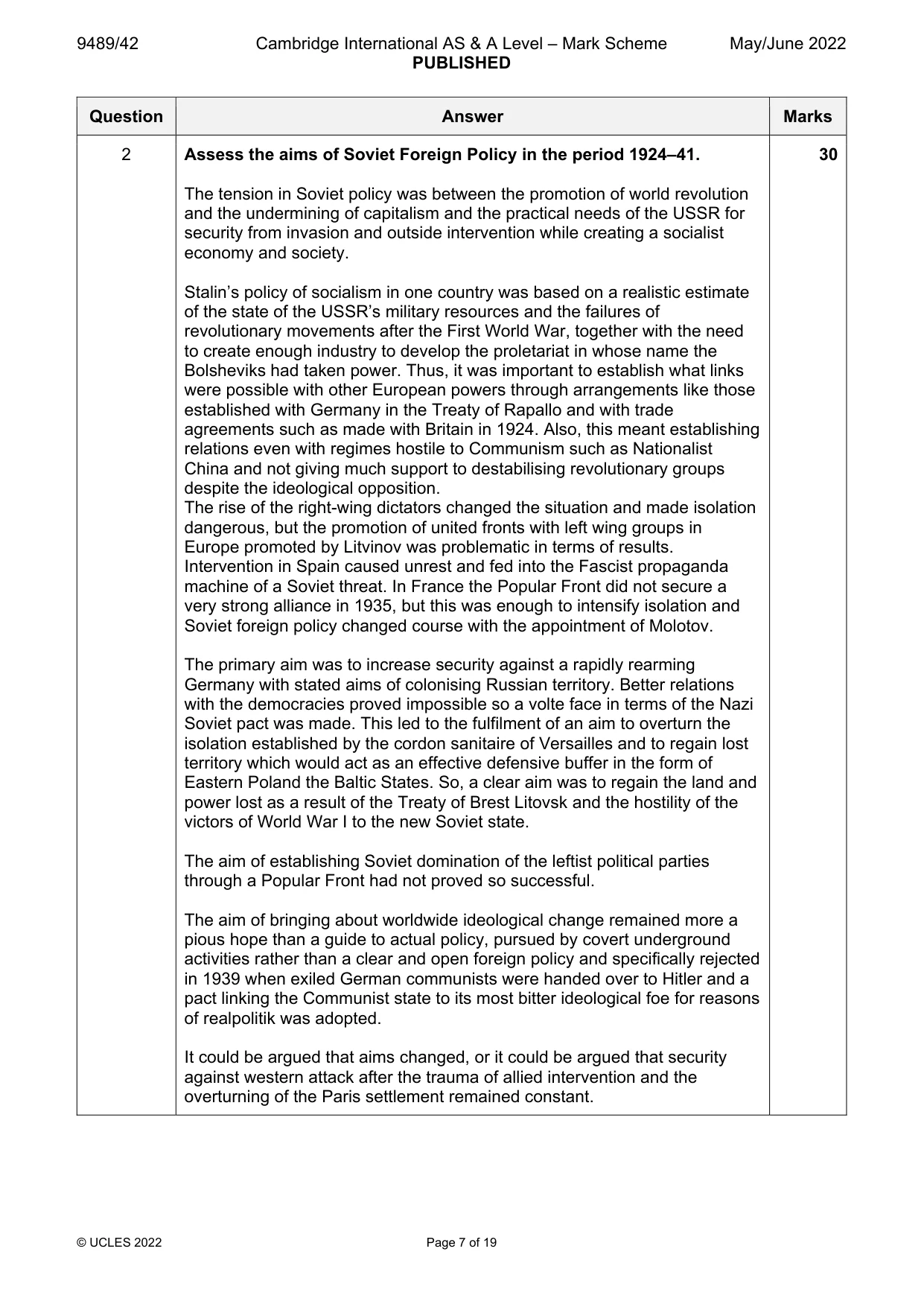
Mark scheme: 2 Assess the aims of Soviet Foreign Policy in the period 1924–41. 30 The tension in Soviet policy was between the promotion of world revolution and the undermining of capitalism and the practical needs of the USSR for security from invasion and outside intervention while creating a socialist economy and society. Stalin’s policy of socialism in one country was based on a realistic estimate of the state of the USSR’s military resources and the failures of revolutionary movements after the First World War, together with the need to create enough industry to develop the proletariat in whose name the Bolsheviks had taken power. Thus, it was important to establish what links were possible with other European powers through arrangements like those established with Germany in the Treaty of Rapallo and with trade agreements such as made with Britain in 1924. Also, this meant establishing relations even with regimes hostile to Communism such as Nationalist China and not giving much support to destabilising revolutionary groups despite the ideological opposition. The rise of the right-wing dictators changed the situation and made isolation dangerous, but the promotion of united fronts with left wing groups in Europe promoted by Litvinov was problematic in terms of results. Intervention in Spain caused unrest and fed into the Fascist propaganda machine of a Soviet threat. In France the Popular Front did not secure a very strong alliance in 1935, but this was enough to intensify isolation and Soviet foreign policy changed course with the appointment of Molotov. The primary aim was to increase security against a rapidly rearming Germany with stated aims of colonising Russian territory. Better relations with the democracies proved impossible so a volte face in terms of the Nazi Soviet pact was made. This led to the fulfilment of an aim to overturn the isolation established by the cordon sanitaire of Versailles and to regain lost territory which would act as an effective defensive buffer in the form of Eastern Poland the Baltic States. So, a clear aim was to regain the land and power lost as a result of the Treaty of Brest Litovsk and the hostility of the victors of World War I to the new Soviet state. The aim of establishing Soviet domination of the leftist political parties through a Popular Front had not proved so successful. The aim of bringing about worldwide ideological change remained more a pious hope than a guide to actual policy, pursued by covert underground activities rather than a clear and open foreign policy and specifically rejected in 1939 when exiled German communists were handed over to Hitler and a pact linking the Communist state to its most bitter ideological foe for reasons of realpolitik was adopted. It could be argued that aims changed, or it could be argued that security against western attack after the trauma of allied intervention and the overturning of the Paris settlement remained constant.
More questions on How did the rise of extremism affect international relations?
Q3 · ‘The main reason that the Nazi regime maintained its control of Germany in the period…
3 ‘The main reason that the Nazi regime maintained its control of Germany in the period 1933–39 was its use of terror.’ Discuss this view. [30]
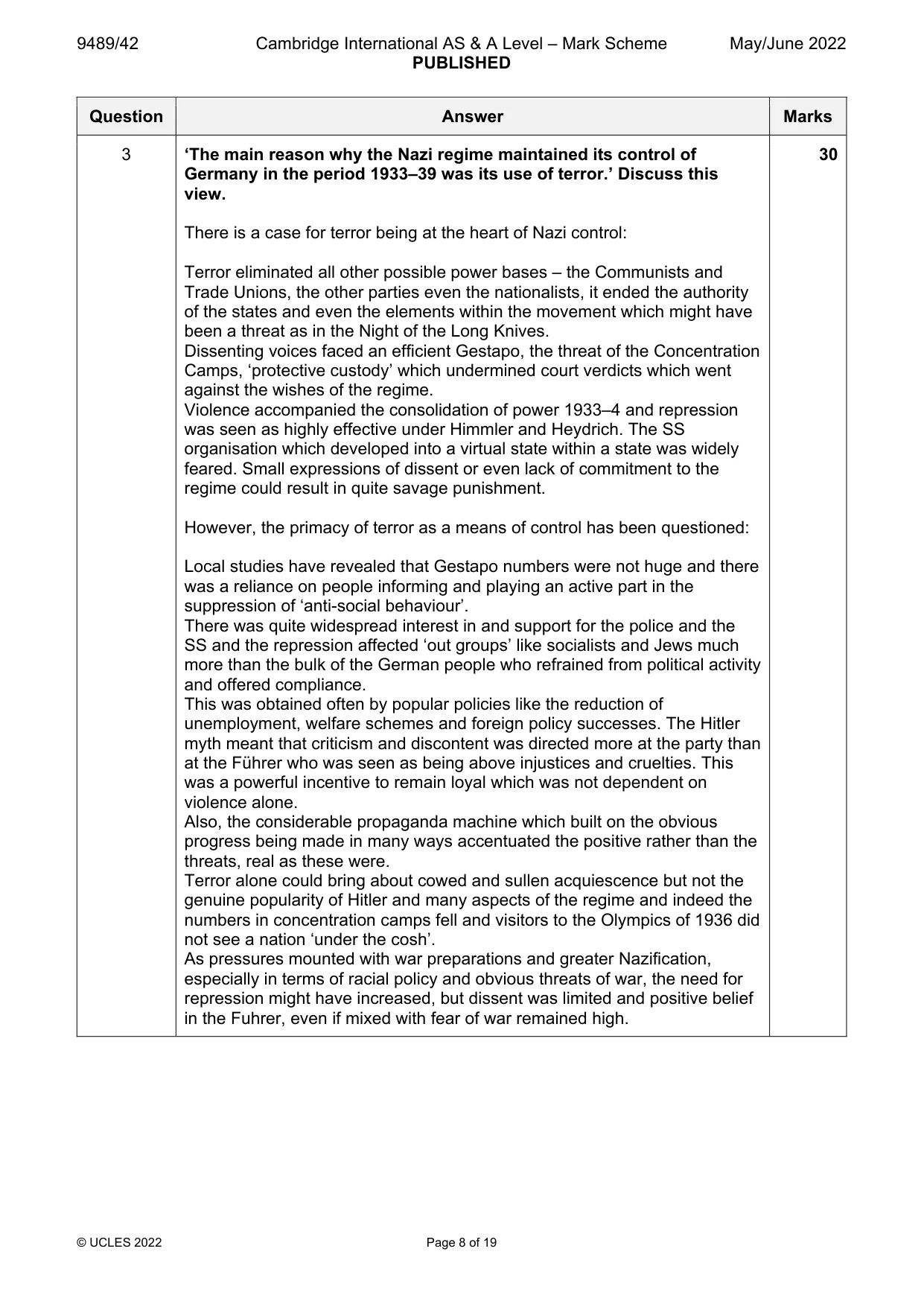
Mark scheme: 3 ‘The main reason why the Nazi regime maintained its control of 30 Germany in the period 1933–39 was its use of terror.’ Discuss this view. There is a case for terror being at the heart of Nazi control: Terror eliminated all other possible power bases – the Communists and Trade Unions, the other parties even the nationalists, it ended the authority of the states and even the elements within the movement which might have been a threat as in the Night of the Long Knives. Dissenting voices faced an efficient Gestapo, the threat of the Concentration Camps, ‘protective custody’ which undermined court verdicts which went against the wishes of the regime. Violence accompanied the consolidation of power 1933–4 and repression was seen as highly effective under Himmler and Heydrich. The SS organisation which developed into a virtual state within a state was widely feared. Small expressions of dissent or even lack of commitment to the regime could result in quite savage punishment. However, the primacy of terror as a means of control has been questioned: Local studies have revealed that Gestapo numbers were not huge and there was a reliance on people informing and playing an active part in the suppression of ‘anti-social behaviour’. There was quite widespread interest in and support for the police and the SS and the repression affected ‘out groups’ like socialists and Jews much more than the bulk of the German people who refrained from political activity and offered compliance. This was obtained often by popular policies like the reduction of unemployment, welfare schemes and foreign policy successes. The Hitler myth meant that criticism and discontent was directed more at the party than at the Führer who was seen as being above injustices and cruelties. This was a powerful incentive to remain loyal which was not dependent on violence alone. Also, the considerable propaganda machine which built on the obvious progress being made in many ways accentuated the positive rather than the threats, real as these were. Terror alone could bring about cowed and sullen acquiescence but not the genuine popularity of Hitler and many aspects of the regime and indeed the numbers in concentration camps fell and visitors to the Olympics of 1936 did not see a nation ‘under the cosh’. As pressures mounted with war preparations and greater Nazification, especially in terms of racial policy and obvious threats of war, the need for repression might have increased, but dissent was limited and positive belief in the Fuhrer, even if mixed with fear of war remained high.
More questions on How did the rise of extremism affect international relations?
Q4 · Assess the extent to which living standards improved in Britain in the period 1919–39
4 Assess the extent to which living standards improved in Britain in the period 1919–39. [30]
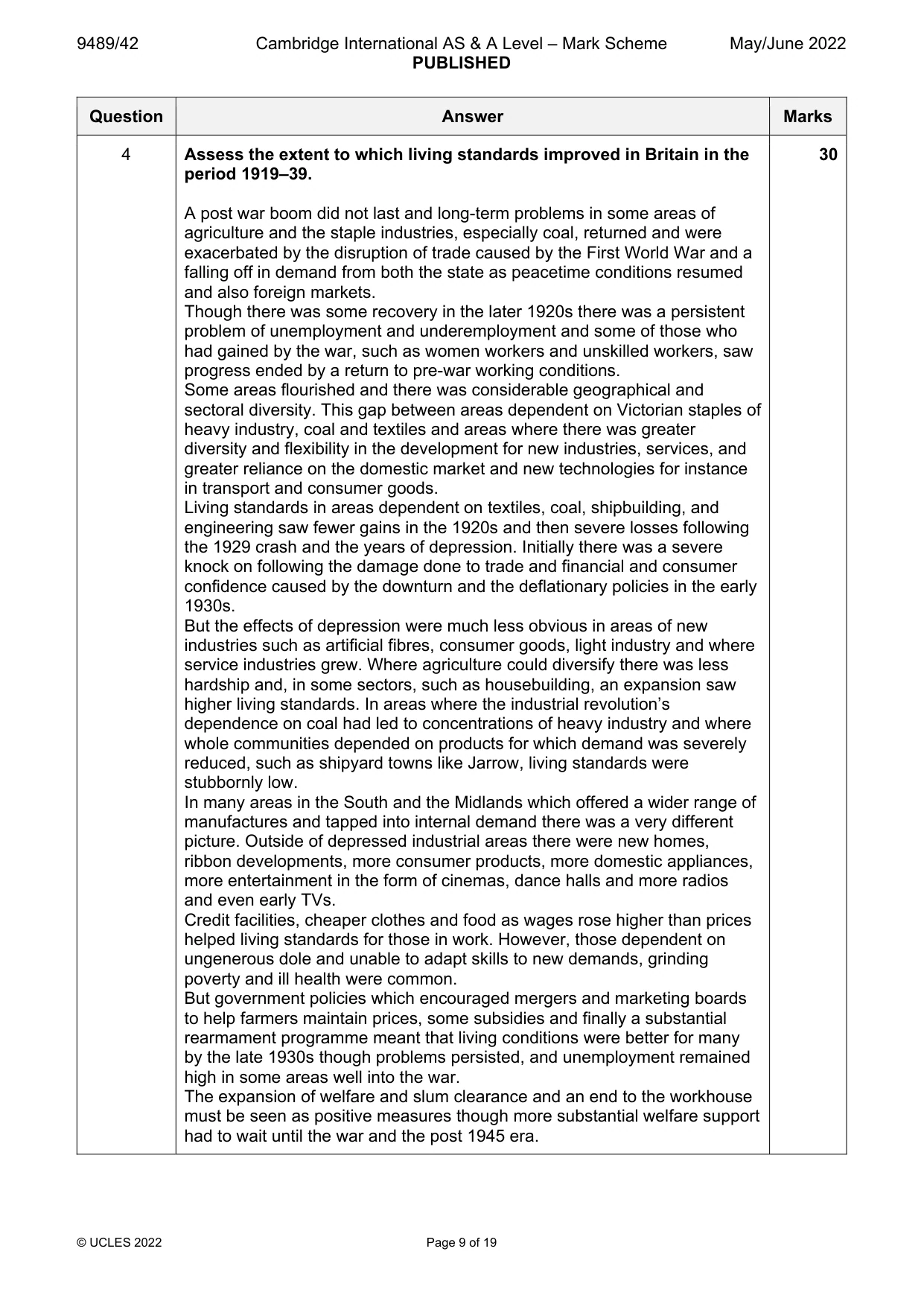
Mark scheme: 4 Assess the extent to which living standards improved in Britain in the 30 period 1919–39. A post war boom did not last and long-term problems in some areas of agriculture and the staple industries, especially coal, returned and were exacerbated by the disruption of trade caused by the First World War and a falling off in demand from both the state as peacetime conditions resumed and also foreign markets. Though there was some recovery in the later 1920s there was a persistent problem of unemployment and underemployment and some of those who had gained by the war, such as women workers and unskilled workers, saw progress ended by a return to pre-war working conditions. Some areas flourished and there was considerable geographical and sectoral diversity. This gap between areas dependent on Victorian staples of heavy industry, coal and textiles and areas where there was greater diversity and flexibility in the development for new industries, services, and greater reliance on the domestic market and new technologies for instance in transport and consumer goods. Living standards in areas dependent on textiles, coal, shipbuilding, and engineering saw fewer gains in the 1920s and then severe losses following the 1929 crash and the years of depression. Initially there was a severe knock on following the damage done to trade and financial and consumer confidence caused by the downturn and the deflationary policies in the early 1930s. But the effects of depression were much less obvious in areas of new industries such as artificial fibres, consumer goods, light industry and where service industries grew. Where agriculture could diversify there was less hardship and, in some sectors, such as housebuilding, an expansion saw higher living standards. In areas where the industrial revolution’s dependence on coal had led to concentrations of heavy industry and where whole communities depended on products for which demand was severely reduced, such as shipyard towns like Jarrow, living standards were stubbornly low. In many areas in the South and the Midlands which offered a wider range of manufactures and tapped into internal demand there was a very different picture. Outside of depressed industrial areas there were new homes, ribbon developments, more consumer products, more domestic appliances, more entertainment in the form of cinemas, dance halls and more radios and even early TVs. Credit facilities, cheaper clothes and food as wages rose higher than prices helped living standards for those in work. However, those dependent on ungenerous dole and unable to adapt skills to new demands, grinding poverty and ill health were common. But government policies which encouraged mergers and marketing boards to help farmers maintain prices, some subsidies and finally a substantial rearmament programme meant that living conditions were better for many by the late 1930s though problems persisted, and unemployment remained high in some areas well into the war. The expansion of welfare and slum clearance and an end to the workhouse must be seen as positive measures though more substantial welfare support had to wait until the war and the post 1945 era.
Q5 · Assess the reasons for Eisenhower’s electoral successes in the 1950s
5 Assess the reasons for Eisenhower’s electoral successes in the 1950s. [30]
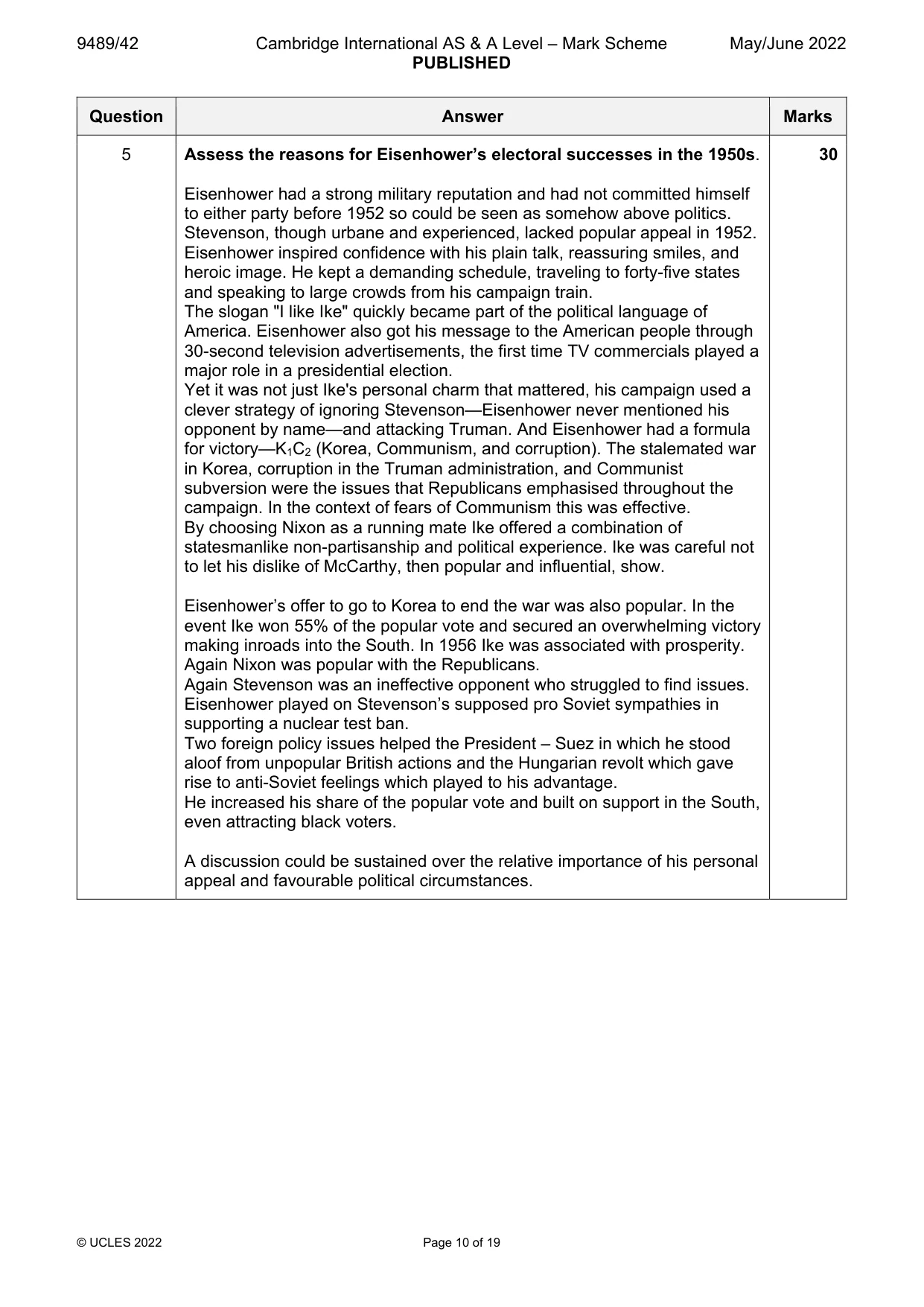
Mark scheme: 5 Assess the reasons for Eisenhower’s electoral successes in the 1950s. 30 Eisenhower had a strong military reputation and had not committed himself to either party before 1952 so could be seen as somehow above politics. Stevenson, though urbane and experienced, lacked popular appeal in 1952. Eisenhower inspired confidence with his plain talk, reassuring smiles, and heroic image. He kept a demanding schedule, traveling to forty-five states and speaking to large crowds from his campaign train. The slogan "I like Ike" quickly became part of the political language of America. Eisenhower also got his message to the American people through 30-second television advertisements, the first time TV commercials played a major role in a presidential election. Yet it was not just Ike's personal charm that mattered, his campaign used a clever strategy of ignoring Stevenson—Eisenhower never mentioned his opponent by name—and attacking Truman. And Eisenhower had a formula for victory—K1C2 (Korea, Communism, and corruption). The stalemated war in Korea, corruption in the Truman administration, and Communist subversion were the issues that Republicans emphasised throughout the campaign. In the context of fears of Communism this was effective. By choosing Nixon as a running mate Ike offered a combination of statesmanlike non-partisanship and political experience. Ike was careful not to let his dislike of McCarthy, then popular and influential, show. Eisenhower’s offer to go to Korea to end the war was also popular. In the event Ike won 55% of the popular vote and secured an overwhelming victory making inroads into the South. In 1956 Ike was associated with prosperity. Again Nixon was popular with the Republicans. Again Stevenson was an ineffective opponent who struggled to find issues. Eisenhower played on Stevenson’s supposed pro Soviet sympathies in supporting a nuclear test ban. Two foreign policy issues helped the President – Suez in which he stood aloof from unpopular British actions and the Hungarian revolt which gave rise to anti-Soviet feelings which played to his advantage. He increased his share of the popular vote and built on support in the South, even attracting black voters. A discussion could be sustained over the relative importance of his personal appeal and favourable political circumstances.
More questions on How successful was the Progressive Movement from 1890 to 1920?
Q6 · Evaluate the impact of the American Indian Movement
6 Evaluate the impact of the American Indian Movement. [30]
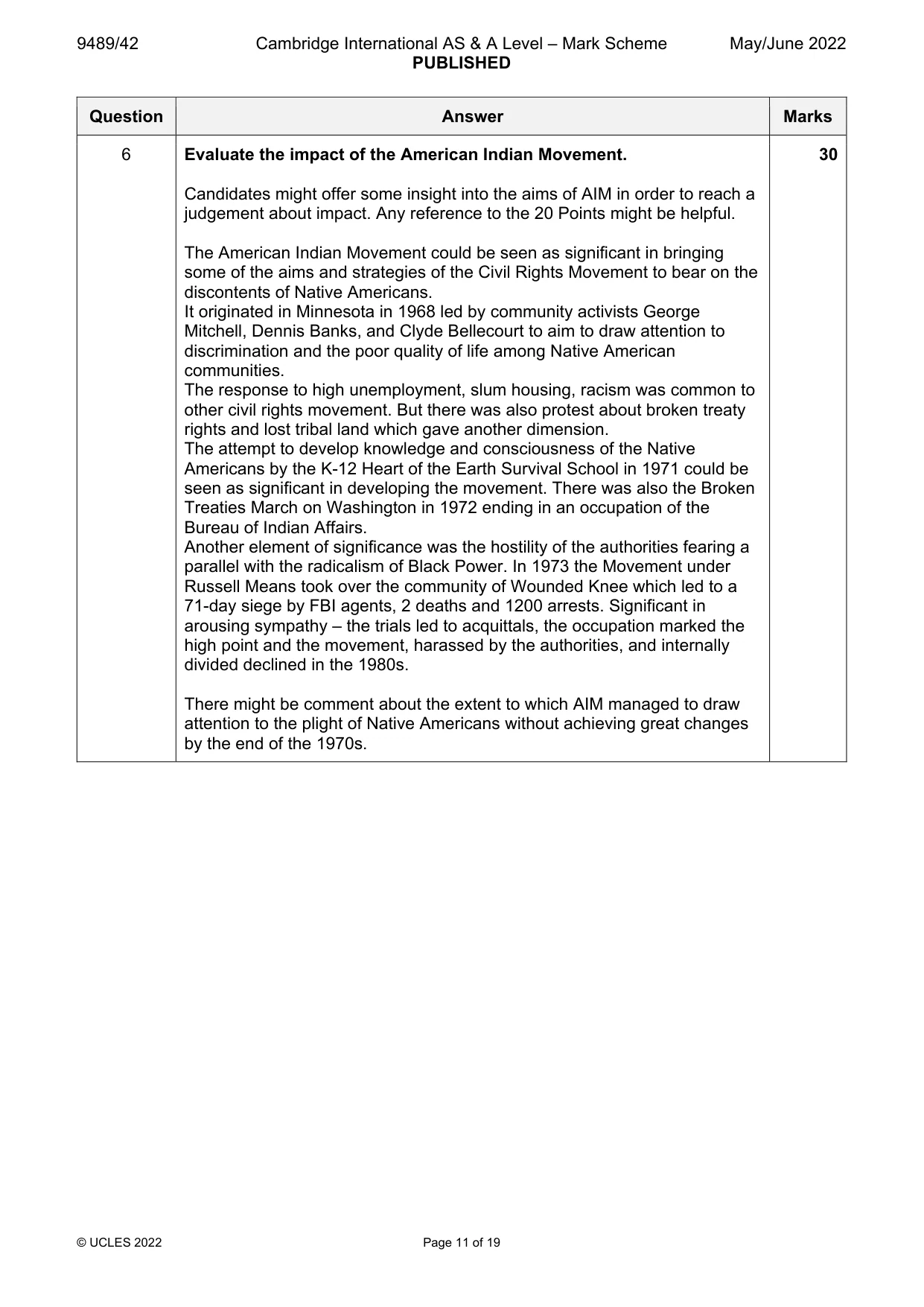
Mark scheme: 6 Evaluate the impact of the American Indian Movement. 30 Candidates might offer some insight into the aims of AIM in order to reach a judgement about impact. Any reference to the 20 Points might be helpful. The American Indian Movement could be seen as significant in bringing some of the aims and strategies of the Civil Rights Movement to bear on the discontents of Native Americans. It originated in Minnesota in 1968 led by community activists George Mitchell, Dennis Banks, and Clyde Bellecourt to aim to draw attention to discrimination and the poor quality of life among Native American communities. The response to high unemployment, slum housing, racism was common to other civil rights movement. But there was also protest about broken treaty rights and lost tribal land which gave another dimension. The attempt to develop knowledge and consciousness of the Native Americans by the K-12 Heart of the Earth Survival School in 1971 could be seen as significant in developing the movement. There was also the Broken Treaties March on Washington in 1972 ending in an occupation of the Bureau of Indian Affairs. Another element of significance was the hostility of the authorities fearing a parallel with the radicalism of Black Power. In 1973 the Movement under Russell Means took over the community of Wounded Knee which led to a 71-day siege by FBI agents, 2 deaths and 1200 arrests. Significant in arousing sympathy – the trials led to acquittals, the occupation marked the high point and the movement, harassed by the authorities, and internally divided declined in the 1980s. There might be comment about the extent to which AIM managed to draw attention to the plight of Native Americans without achieving great changes by the end of the 1970s.
More questions on How successful was the Progressive Movement from 1890 to 1920?
Q7 · Evaluate the reasons for the rise of the religious right in the 1980s and early 1990s
7 Evaluate the reasons for the rise of the religious right in the 1980s and early 1990s. [30]
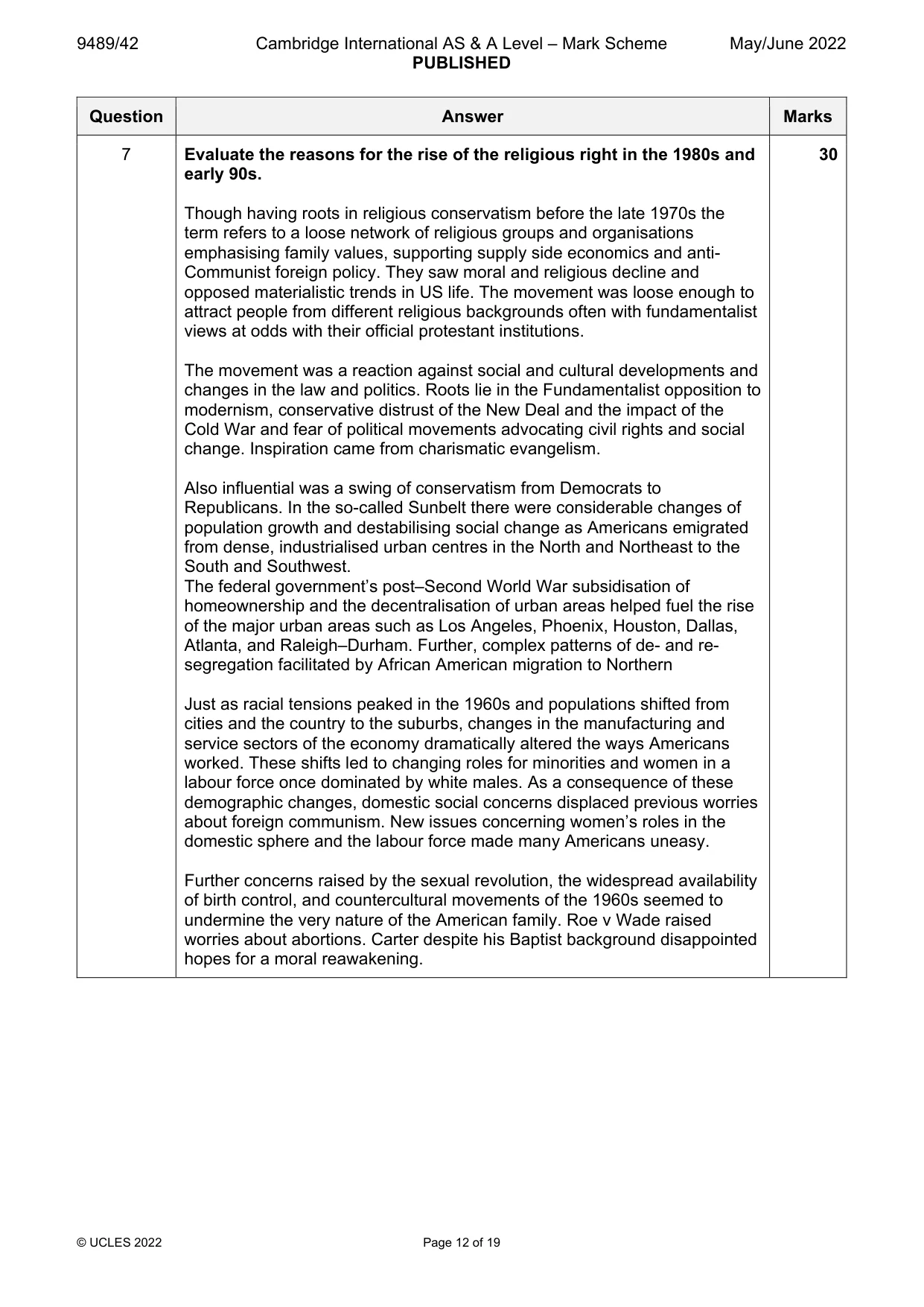
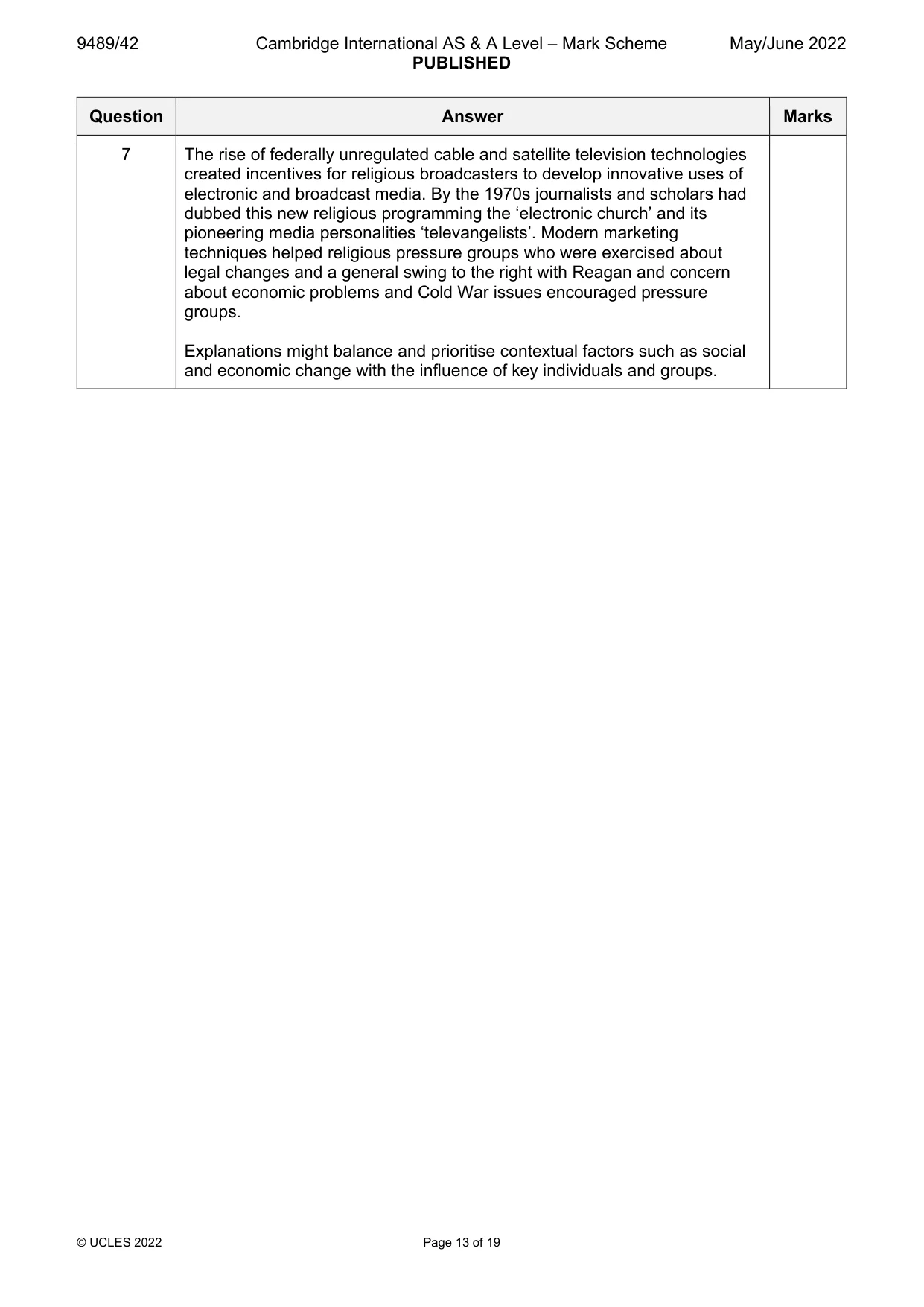
Mark scheme: 7 Evaluate the reasons for the rise of the religious right in the 1980s and 30 early 90s. Though having roots in religious conservatism before the late 1970s the term refers to a loose network of religious groups and organisations emphasising family values, supporting supply side economics and anti- Communist foreign policy. They saw moral and religious decline and opposed materialistic trends in US life. The movement was loose enough to attract people from different religious backgrounds often with fundamentalist views at odds with their official protestant institutions. The movement was a reaction against social and cultural developments and changes in the law and politics. Roots lie in the Fundamentalist opposition to modernism, conservative distrust of the New Deal and the impact of the Cold War and fear of political movements advocating civil rights and social change. Inspiration came from charismatic evangelism. Also influential was a swing of conservatism from Democrats to Republicans. In the so-called Sunbelt there were considerable changes of population growth and destabilising social change as Americans emigrated from dense, industrialised urban centres in the North and Northeast to the South and Southwest. The federal government’s post–Second World War subsidisation of homeownership and the decentralisation of urban areas helped fuel the rise of the major urban areas such as Los Angeles, Phoenix, Houston, Dallas, Atlanta, and Raleigh–Durham. Further, complex patterns of de- and re- segregation facilitated by African American migration to Northern Just as racial tensions peaked in the 1960s and populations shifted from cities and the country to the suburbs, changes in the manufacturing and service sectors of the economy dramatically altered the ways Americans worked. These shifts led to changing roles for minorities and women in a labour force once dominated by white males. As a consequence of these demographic changes, domestic social concerns displaced previous worries about foreign communism. New issues concerning women’s roles in the domestic sphere and the labour force made many Americans uneasy. Further concerns raised by the sexual revolution, the widespread availability of birth control, and countercultural movements of the 1960s seemed to undermine the very nature of the American family. Roe v Wade raised worries about abortions. Carter despite his Baptist background disappointed hopes for a moral reawakening. 7 The rise of federally unregulated cable and satellite television technologies created incentives for religious broadcasters to develop innovative uses of electronic and broadcast media. By the 1970s journalists and scholars had dubbed this new religious programming the ‘electronic church’ and its pioneering media personalities ‘televangelists’. Modern marketing techniques helped religious pressure groups who were exercised about legal changes and a general swing to the right with Reagan and concern about economic problems and Cold War issues encouraged pressure groups. Explanations might balance and prioritise contextual factors such as social and economic change with the influence of key individuals and groups.
More questions on How successful was the Progressive Movement from 1890 to 1920?
Q8 · Section C: International history, 1945–92
Section C: International history, 1945–92
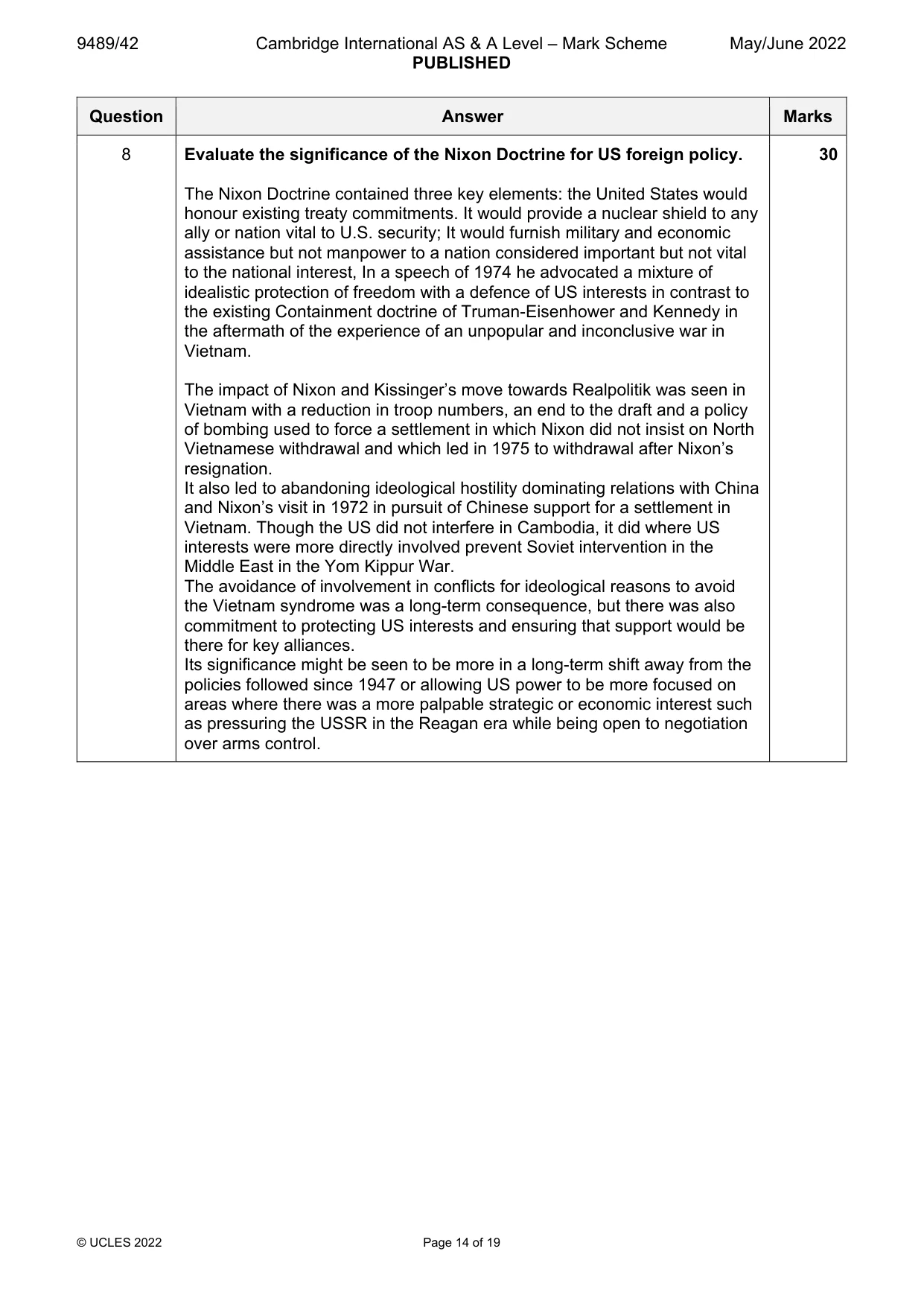
Mark scheme: 8 Evaluate the significance of the Nixon Doctrine for US foreign policy. 30 The Nixon Doctrine contained three key elements: the United States would honour existing treaty commitments. It would provide a nuclear shield to any ally or nation vital to U.S. security; It would furnish military and economic assistance but not manpower to a nation considered important but not vital to the national interest, In a speech of 1974 he advocated a mixture of idealistic protection of freedom with a defence of US interests in contrast to the existing Containment doctrine of Truman-Eisenhower and Kennedy in the aftermath of the experience of an unpopular and inconclusive war in Vietnam. The impact of Nixon and Kissinger’s move towards Realpolitik was seen in Vietnam with a reduction in troop numbers, an end to the draft and a policy of bombing used to force a settlement in which Nixon did not insist on North Vietnamese withdrawal and which led in 1975 to withdrawal after Nixon’s resignation. It also led to abandoning ideological hostility dominating relations with China and Nixon’s visit in 1972 in pursuit of Chinese support for a settlement in Vietnam. Though the US did not interfere in Cambodia, it did where US interests were more directly involved prevent Soviet intervention in the Middle East in the Yom Kippur War. The avoidance of involvement in conflicts for ideological reasons to avoid the Vietnam syndrome was a long-term consequence, but there was also commitment to protecting US interests and ensuring that support would be there for key alliances. Its significance might be seen to be more in a long-term shift away from the policies followed since 1947 or allowing US power to be more focused on areas where there was a more palpable strategic or economic interest such as pressuring the USSR in the Reagan era while being open to negotiation over arms control.
Q9 · Evaluate the impact of the Cuban Missile Crisis on US–Soviet relations
9 Evaluate the impact of the Cuban Missile Crisis on US–Soviet relations. [30]
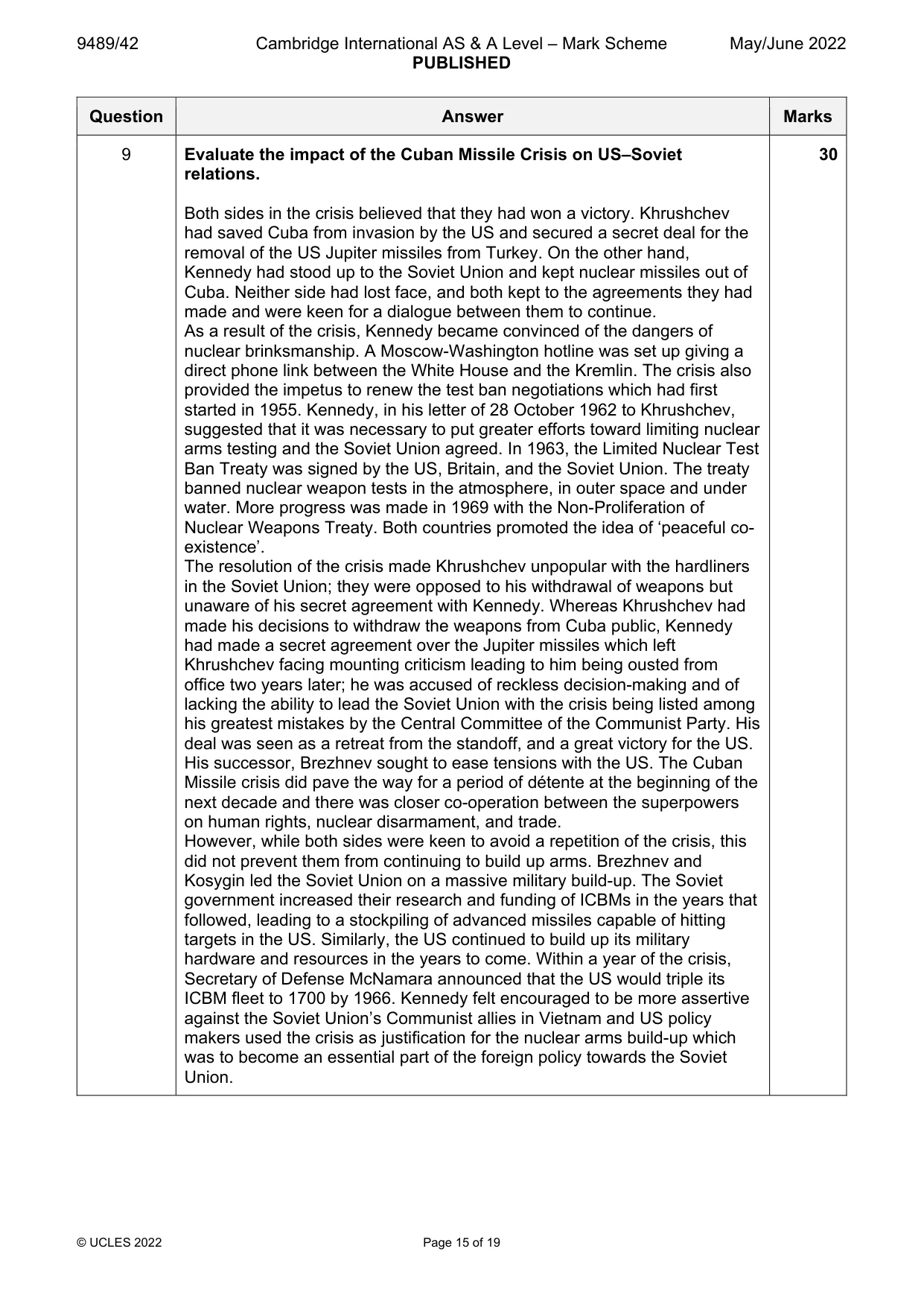
Mark scheme: 9 Evaluate the impact of the Cuban Missile Crisis on US–Soviet 30 relations. Both sides in the crisis believed that they had won a victory. Khrushchev had saved Cuba from invasion by the US and secured a secret deal for the removal of the US Jupiter missiles from Turkey. On the other hand, Kennedy had stood up to the Soviet Union and kept nuclear missiles out of Cuba. Neither side had lost face, and both kept to the agreements they had made and were keen for a dialogue between them to continue. As a result of the crisis, Kennedy became convinced of the dangers of nuclear brinksmanship. A Moscow-Washington hotline was set up giving a direct phone link between the White House and the Kremlin. The crisis also provided the impetus to renew the test ban negotiations which had first started in 1955. Kennedy, in his letter of 28 October 1962 to Khrushchev, suggested that it was necessary to put greater efforts toward limiting nuclear arms testing and the Soviet Union agreed. In 1963, the Limited Nuclear Test Ban Treaty was signed by the US, Britain, and the Soviet Union. The treaty banned nuclear weapon tests in the atmosphere, in outer space and under water. More progress was made in 1969 with the Non-Proliferation of Nuclear Weapons Treaty. Both countries promoted the idea of ‘peaceful co- existence’. The resolution of the crisis made Khrushchev unpopular with the hardliners in the Soviet Union; they were opposed to his withdrawal of weapons but unaware of his secret agreement with Kennedy. Whereas Khrushchev had made his decisions to withdraw the weapons from Cuba public, Kennedy had made a secret agreement over the Jupiter missiles which left Khrushchev facing mounting criticism leading to him being ousted from office two years later; he was accused of reckless decision-making and of lacking the ability to lead the Soviet Union with the crisis being listed among his greatest mistakes by the Central Committee of the Communist Party. His deal was seen as a retreat from the standoff, and a great victory for the US. His successor, Brezhnev sought to ease tensions with the US. The Cuban Missile crisis did pave the way for a period of détente at the beginning of the next decade and there was closer co-operation between the superpowers on human rights, nuclear disarmament, and trade. However, while both sides were keen to avoid a repetition of the crisis, this did not prevent them from continuing to build up arms. Brezhnev and Kosygin led the Soviet Union on a massive military build-up. The Soviet government increased their research and funding of ICBMs in the years that followed, leading to a stockpiling of advanced missiles capable of hitting targets in the US. Similarly, the US continued to build up its military hardware and resources in the years to come. Within a year of the crisis, Secretary of Defense McNamara announced that the US would triple its ICBM fleet to 1700 by 1966. Kennedy felt encouraged to be more assertive against the Soviet Union’s Communist allies in Vietnam and US policy makers used the crisis as justification for the nuclear arms build-up which was to become an essential part of the foreign policy towards the Soviet Union.
More questions on How did the rise of extremism affect international relations?
Q10 · Assess the extent to which ideological differences affected Sino–US relations during the…
10 Assess the extent to which ideological differences affected Sino–US relations during the Cold War. [30]
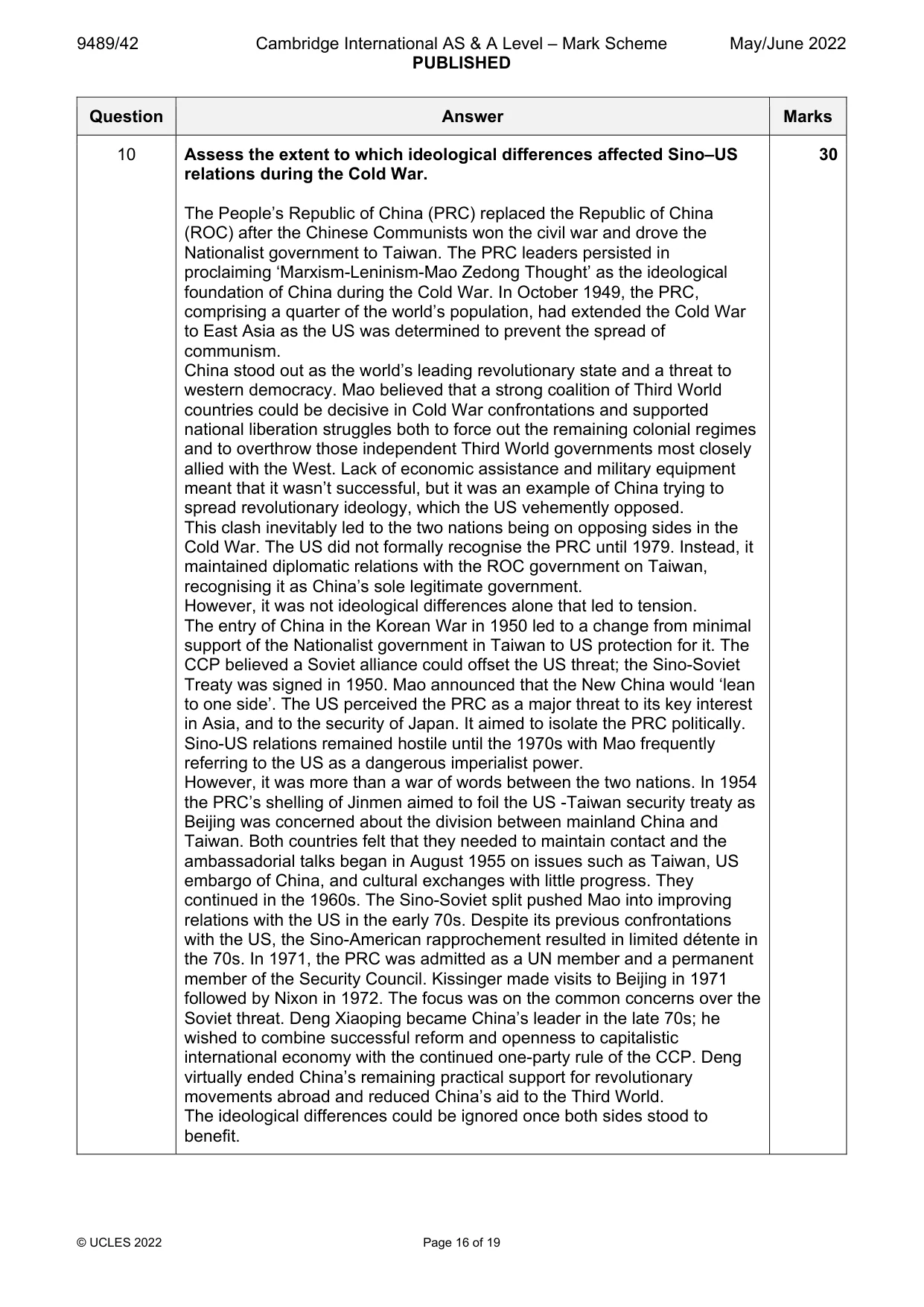
Mark scheme: 10 Assess the extent to which ideological differences affected Sino–US 30 relations during the Cold War. The People’s Republic of China (PRC) replaced the Republic of China (ROC) after the Chinese Communists won the civil war and drove the Nationalist government to Taiwan. The PRC leaders persisted in proclaiming ‘Marxism-Leninism-Mao Zedong Thought’ as the ideological foundation of China during the Cold War. In October 1949, the PRC, comprising a quarter of the world’s population, had extended the Cold War to East Asia as the US was determined to prevent the spread of communism. China stood out as the world’s leading revolutionary state and a threat to western democracy. Mao believed that a strong coalition of Third World countries could be decisive in Cold War confrontations and supported national liberation struggles both to force out the remaining colonial regimes and to overthrow those independent Third World governments most closely allied with the West. Lack of economic assistance and military equipment meant that it wasn’t successful, but it was an example of China trying to spread revolutionary ideology, which the US vehemently opposed. This clash inevitably led to the two nations being on opposing sides in the Cold War. The US did not formally recognise the PRC until 1979. Instead, it maintained diplomatic relations with the ROC government on Taiwan, recognising it as China’s sole legitimate government. However, it was not ideological differences alone that led to tension. The entry of China in the Korean War in 1950 led to a change from minimal support of the Nationalist government in Taiwan to US protection for it. The CCP believed a Soviet alliance could offset the US threat; the Sino-Soviet Treaty was signed in 1950. Mao announced that the New China would ‘lean to one side’. The US perceived the PRC as a major threat to its key interest in Asia, and to the security of Japan. It aimed to isolate the PRC politically. Sino-US relations remained hostile until the 1970s with Mao frequently referring to the US as a dangerous imperialist power. However, it was more than a war of words between the two nations. In 1954 the PRC’s shelling of Jinmen aimed to foil the US -Taiwan security treaty as Beijing was concerned about the division between mainland China and Taiwan. Both countries felt that they needed to maintain contact and the ambassadorial talks began in August 1955 on issues such as Taiwan, US embargo of China, and cultural exchanges with little progress. They continued in the 1960s. The Sino-Soviet split pushed Mao into improving relations with the US in the early 70s. Despite its previous confrontations with the US, the Sino-American rapprochement resulted in limited détente in the 70s. In 1971, the PRC was admitted as a UN member and a permanent member of the Security Council. Kissinger made visits to Beijing in 1971 followed by Nixon in 1972. The focus was on the common concerns over the Soviet threat. Deng Xiaoping became China’s leader in the late 70s; he wished to combine successful reform and openness to capitalistic international economy with the continued one-party rule of the CCP. Deng virtually ended China’s remaining practical support for revolutionary movements abroad and reduced China’s aid to the Third World. The ideological differences could be ignored once both sides stood to benefit.
More questions on How did the rise of extremism affect international relations?
Q11 · Analyse how far Pan-Africanism was affected by Cold War politics
11 Analyse how far Pan-Africanism was affected by Cold War politics. [30]
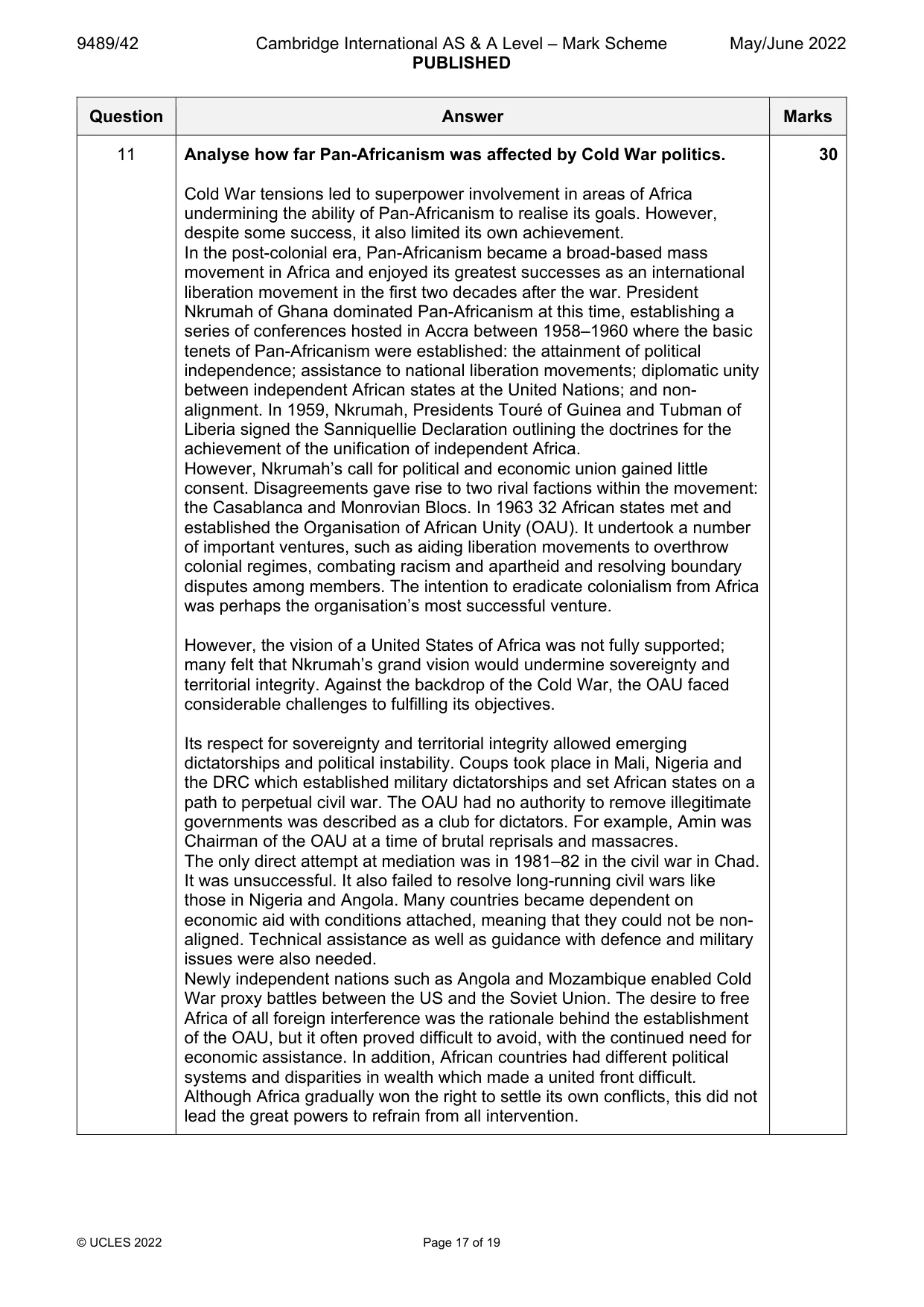
Mark scheme: 11 Analyse how far Pan-Africanism was affected by Cold War politics. 30 Cold War tensions led to superpower involvement in areas of Africa undermining the ability of Pan-Africanism to realise its goals. However, despite some success, it also limited its own achievement. In the post-colonial era, Pan-Africanism became a broad-based mass movement in Africa and enjoyed its greatest successes as an international liberation movement in the first two decades after the war. President Nkrumah of Ghana dominated Pan-Africanism at this time, establishing a series of conferences hosted in Accra between 1958–1960 where the basic tenets of Pan-Africanism were established: the attainment of political independence; assistance to national liberation movements; diplomatic unity between independent African states at the United Nations; and non- alignment. In 1959, Nkrumah, Presidents Touré of Guinea and Tubman of Liberia signed the Sanniquellie Declaration outlining the doctrines for the achievement of the unification of independent Africa. However, Nkrumah’s call for political and economic union gained little consent. Disagreements gave rise to two rival factions within the movement: the Casablanca and Monrovian Blocs. In 1963 32 African states met and established the Organisation of African Unity (OAU). It undertook a number of important ventures, such as aiding liberation movements to overthrow colonial regimes, combating racism and apartheid and resolving boundary disputes among members. The intention to eradicate colonialism from Africa was perhaps the organisation’s most successful venture. However, the vision of a United States of Africa was not fully supported; many felt that Nkrumah’s grand vision would undermine sovereignty and territorial integrity. Against the backdrop of the Cold War, the OAU faced considerable challenges to fulfilling its objectives. Its respect for sovereignty and territorial integrity allowed emerging dictatorships and political instability. Coups took place in Mali, Nigeria and the DRC which established military dictatorships and set African states on a path to perpetual civil war. The OAU had no authority to remove illegitimate governments was described as a club for dictators. For example, Amin was Chairman of the OAU at a time of brutal reprisals and massacres. The only direct attempt at mediation was in 1981–82 in the civil war in Chad. It was unsuccessful. It also failed to resolve long-running civil wars like those in Nigeria and Angola. Many countries became dependent on economic aid with conditions attached, meaning that they could not be non- aligned. Technical assistance as well as guidance with defence and military issues were also needed. Newly independent nations such as Angola and Mozambique enabled Cold War proxy battles between the US and the Soviet Union. The desire to free Africa of all foreign interference was the rationale behind the establishment of the OAU, but it often proved difficult to avoid, with the continued need for economic assistance. In addition, African countries had different political systems and disparities in wealth which made a united front difficult. Although Africa gradually won the right to settle its own conflicts, this did not lead the great powers to refrain from all intervention.
More questions on Why was imperialism a significant force in Africa from 1870?
Q12 · ‘The United States’ involvement in the Middle East during the Cold War was mainly to…
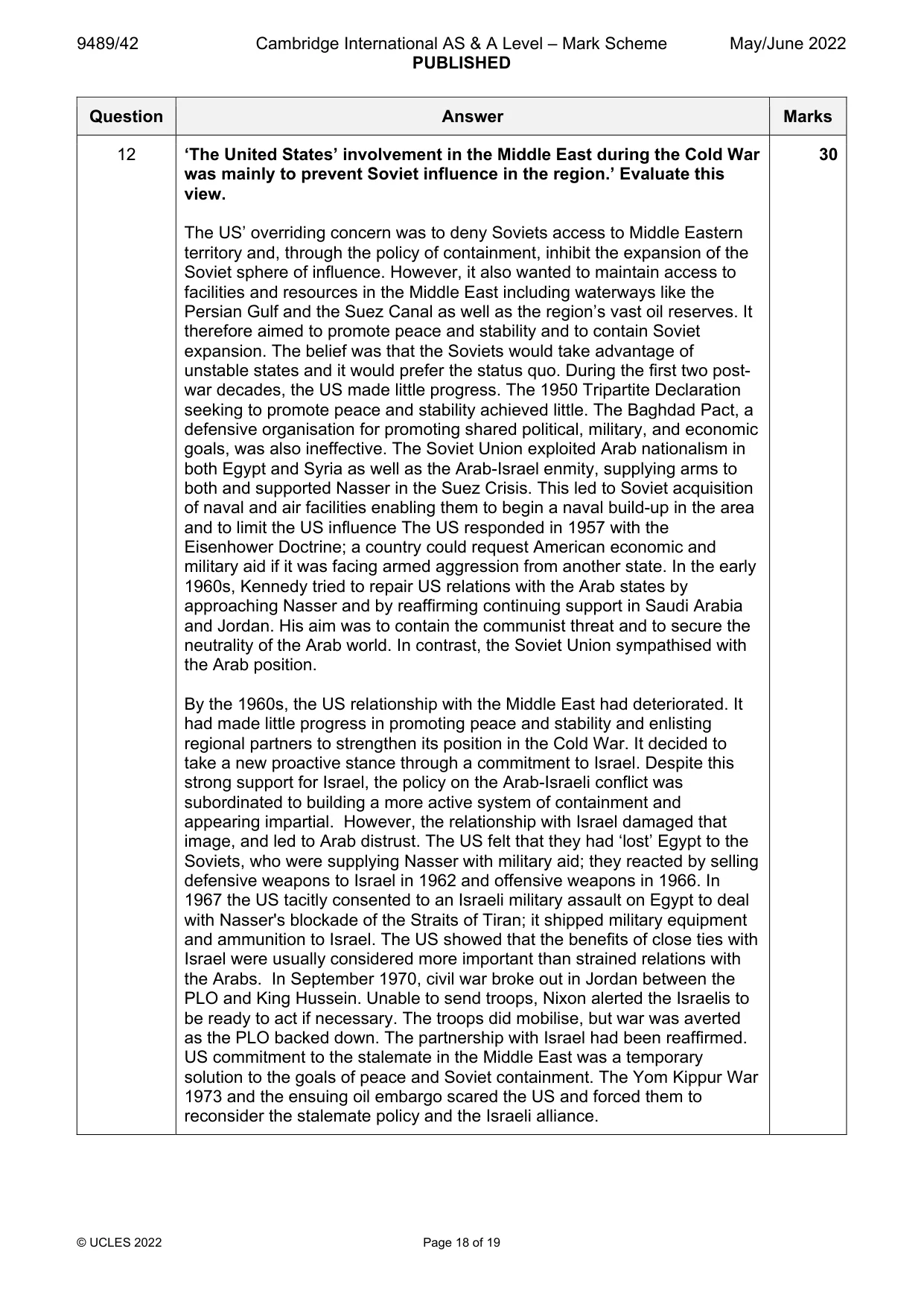
12 ‘The United States’ involvement in the Middle East during the Cold War was mainly to prevent Soviet influence in the region.’ Evaluate this view. [30]
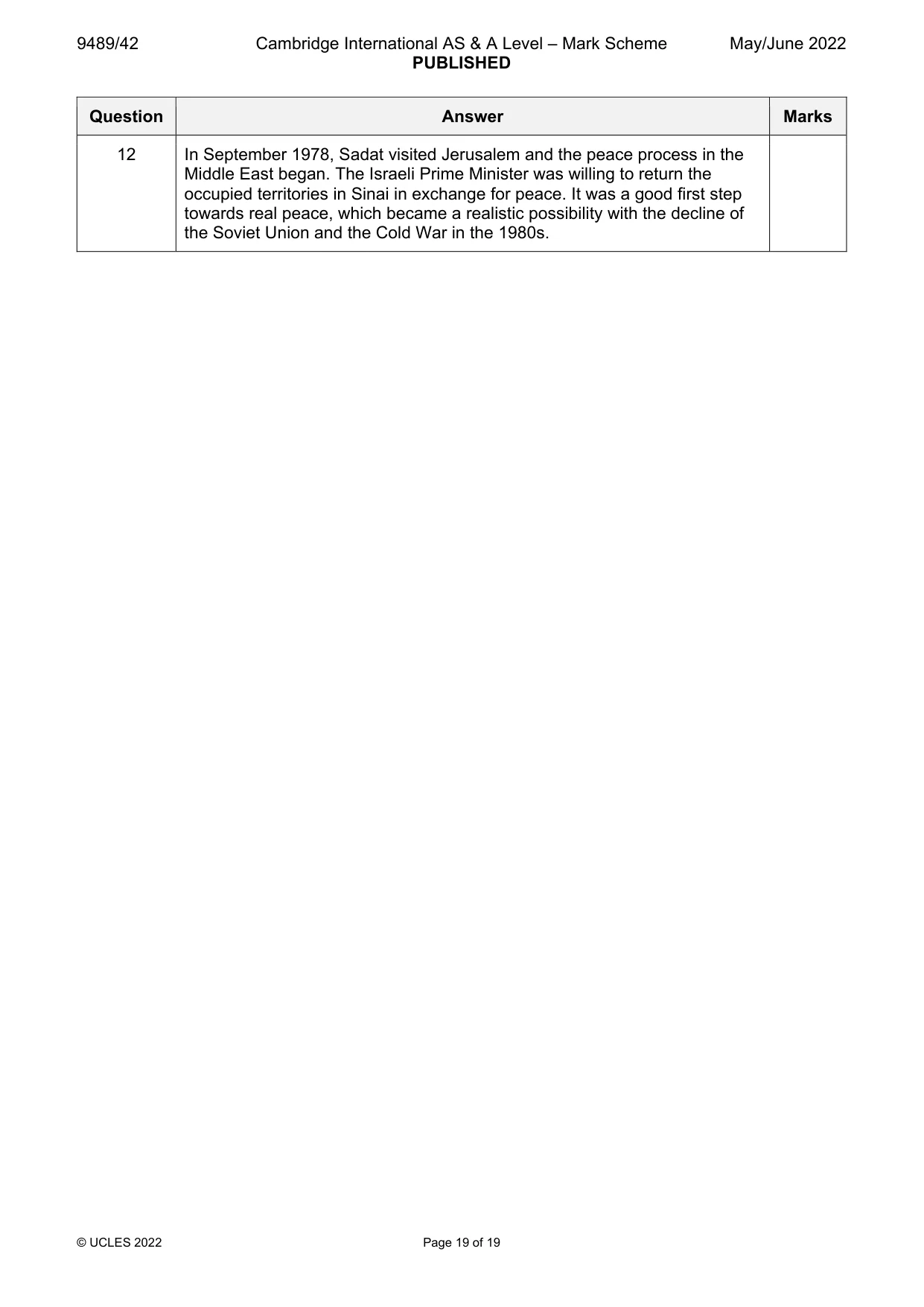
Mark scheme: 12 ‘The United States’ involvement in the Middle East during the Cold War 30 was mainly to prevent Soviet influence in the region.’ Evaluate this view. The US’ overriding concern was to deny Soviets access to Middle Eastern territory and, through the policy of containment, inhibit the expansion of the Soviet sphere of influence. However, it also wanted to maintain access to facilities and resources in the Middle East including waterways like the Persian Gulf and the Suez Canal as well as the region’s vast oil reserves. It therefore aimed to promote peace and stability and to contain Soviet expansion. The belief was that the Soviets would take advantage of unstable states and it would prefer the status quo. During the first two post- war decades, the US made little progress. The 1950 Tripartite Declaration seeking to promote peace and stability achieved little. The Baghdad Pact, a defensive organisation for promoting shared political, military, and economic goals, was also ineffective. The Soviet Union exploited Arab nationalism in both Egypt and Syria as well as the Arab-Israel enmity, supplying arms to both and supported Nasser in the Suez Crisis. This led to Soviet acquisition of naval and air facilities enabling them to begin a naval build-up in the area and to limit the US influence The US responded in 1957 with the Eisenhower Doctrine; a country could request American economic and military aid if it was facing armed aggression from another state. In the early 1960s, Kennedy tried to repair US relations with the Arab states by approaching Nasser and by reaffirming continuing support in Saudi Arabia and Jordan. His aim was to contain the communist threat and to secure the neutrality of the Arab world. In contrast, the Soviet Union sympathised with the Arab position. By the 1960s, the US relationship with the Middle East had deteriorated. It had made little progress in promoting peace and stability and enlisting regional partners to strengthen its position in the Cold War. It decided to take a new proactive stance through a commitment to Israel. Despite this strong support for Israel, the policy on the Arab-Israeli conflict was subordinated to building a more active system of containment and appearing impartial. However, the relationship with Israel damaged that image, and led to Arab distrust. The US felt that they had ‘lost’ Egypt to the Soviets, who were supplying Nasser with military aid; they reacted by selling defensive weapons to Israel in 1962 and offensive weapons in 1966. In 1967 the US tacitly consented to an Israeli military assault on Egypt to deal with Nasser's blockade of the Straits of Tiran; it shipped military equipment and ammunition to Israel. The US showed that the benefits of close ties with Israel were usually considered more important than strained relations with the Arabs. In September 1970, civil war broke out in Jordan between the PLO and King Hussein. Unable to send troops, Nixon alerted the Israelis to be ready to act if necessary. The troops did mobilise, but war was averted as the PLO backed down. The partnership with Israel had been reaffirmed. US commitment to the stalemate in the Middle East was a temporary solution to the goals of peace and Soviet containment. The Yom Kippur War 1973 and the ensuing oil embargo scared the US and forced them to reconsider the stalemate policy and the Israeli alliance. 12 In September 1978, Sadat visited Jerusalem and the peace process in the Middle East began. The Israeli Prime Minister was willing to return the occupied territories in Sinai in exchange for peace. It was a good first step towards real peace, which became a realistic possibility with the decline of the Soviet Union and the Cold War in the 1980s.
More questions on Why did the USA emerge as a world power and what was the impact on international
What was in this paper
The subtopics covered by these 12 questions, and how many questions each got. Open one in a new tab to see every Cambridge question on it.
5How successful was the Progressive Movement from 1890 to 1920?3Why did the USA emerge as a world power and what was the impact on international1Why did war break out in 1939?1Why was imperialism a significant force in Africa from 1870?1Why was there such extensive dissatisfaction with the peace settlements of 1919–20?1What you needed in this session
Cambridge’s own grade thresholds for 2022 May/June, Paper 4 · Variant 2. A higher threshold means an easier paper — the bar moves with how the cohort did.