Cambridge A Level History 9489 — 2022 Oct/Nov Paper 4 · Variant 1
9489/41/O/N/22 · 12 questions · 60 marks · ≈68 min
The question paper and its mark scheme, free to read here and free to download. This is Cambridge’s own paper, exactly as it was sat.
Question paper4 pages
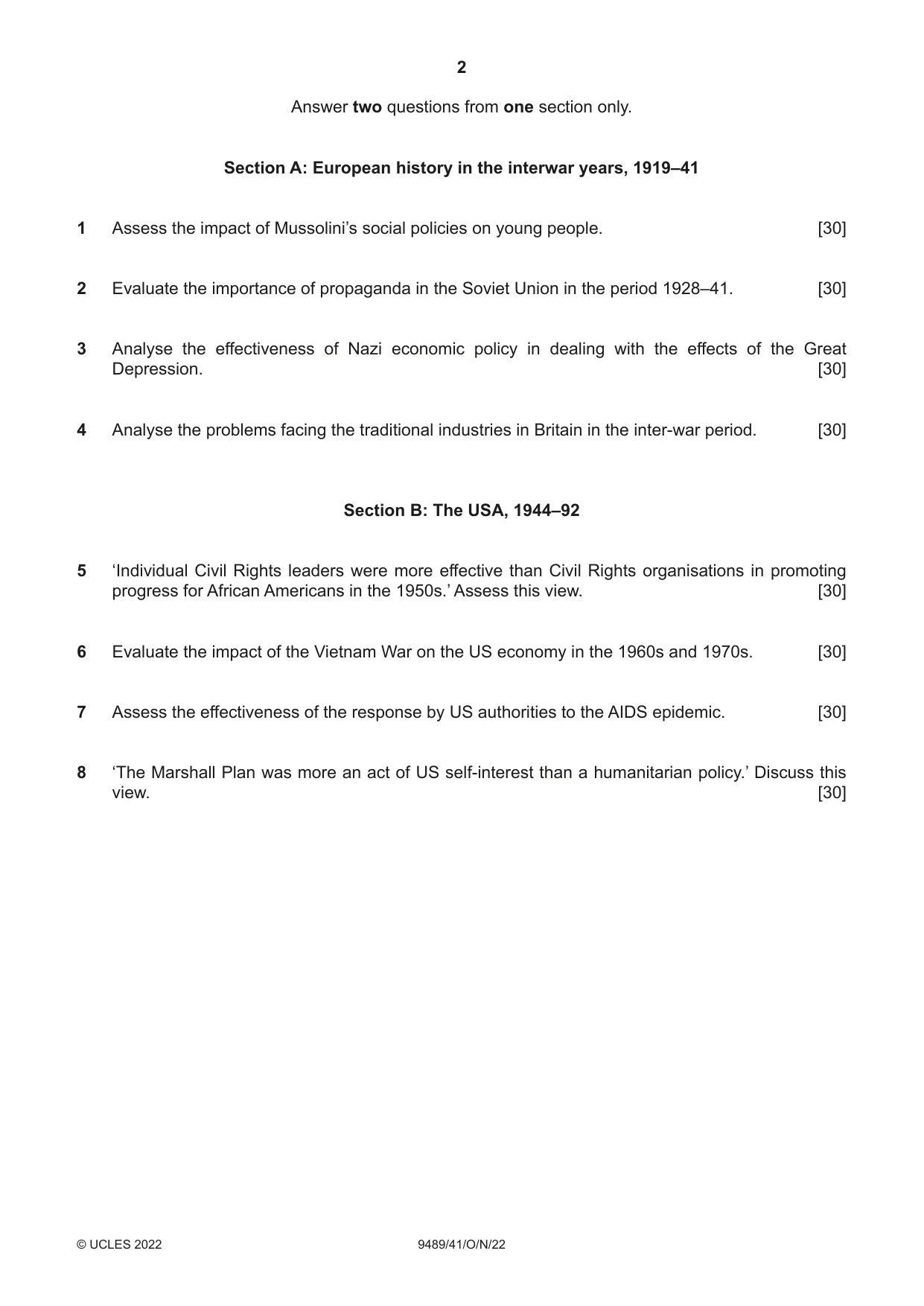
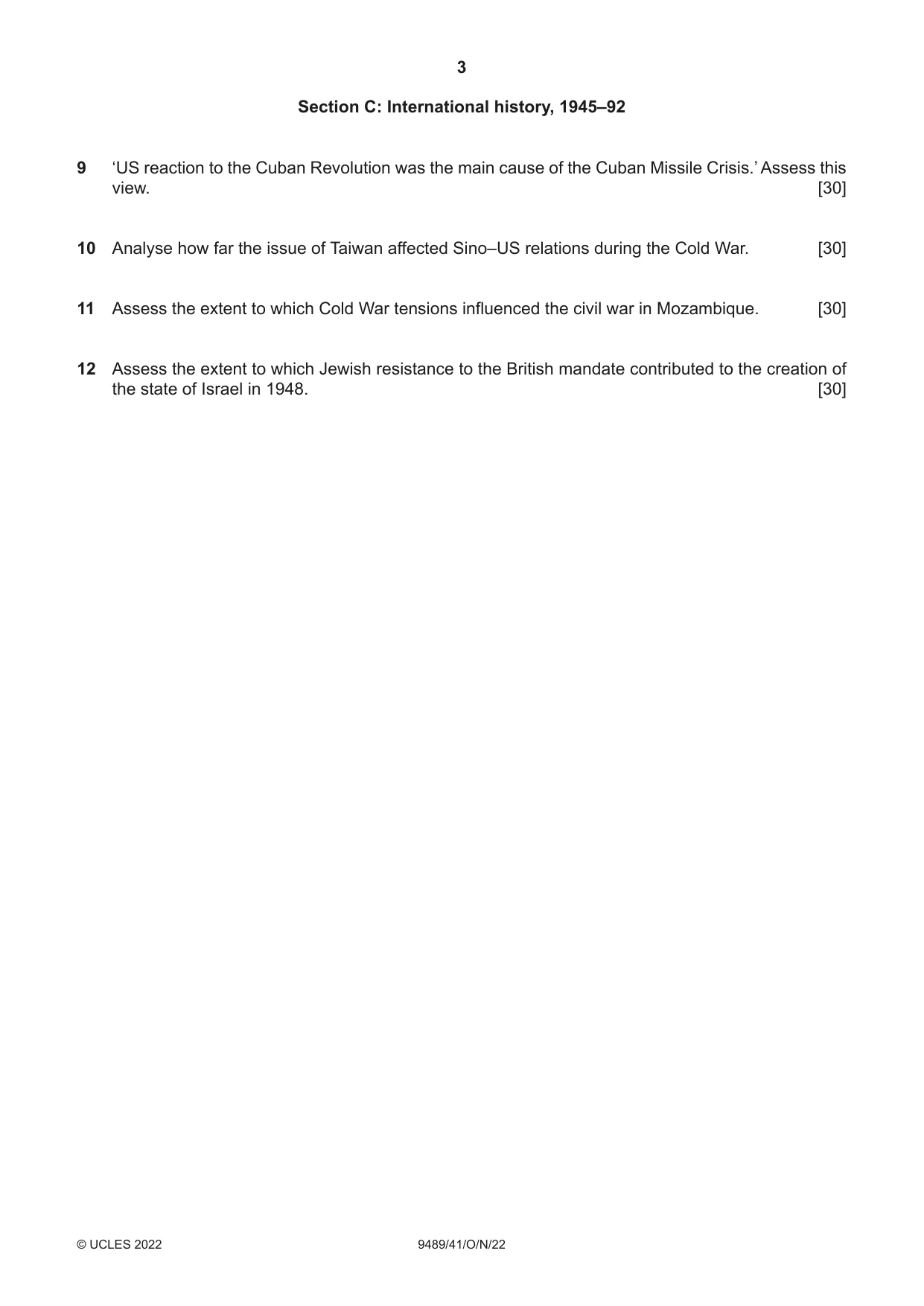
Mark scheme21 pages
Answers below. Sit the paper first if you are practising.
Questions as text
Q1 · Assess the impact of Mussolini’s social policies on young people
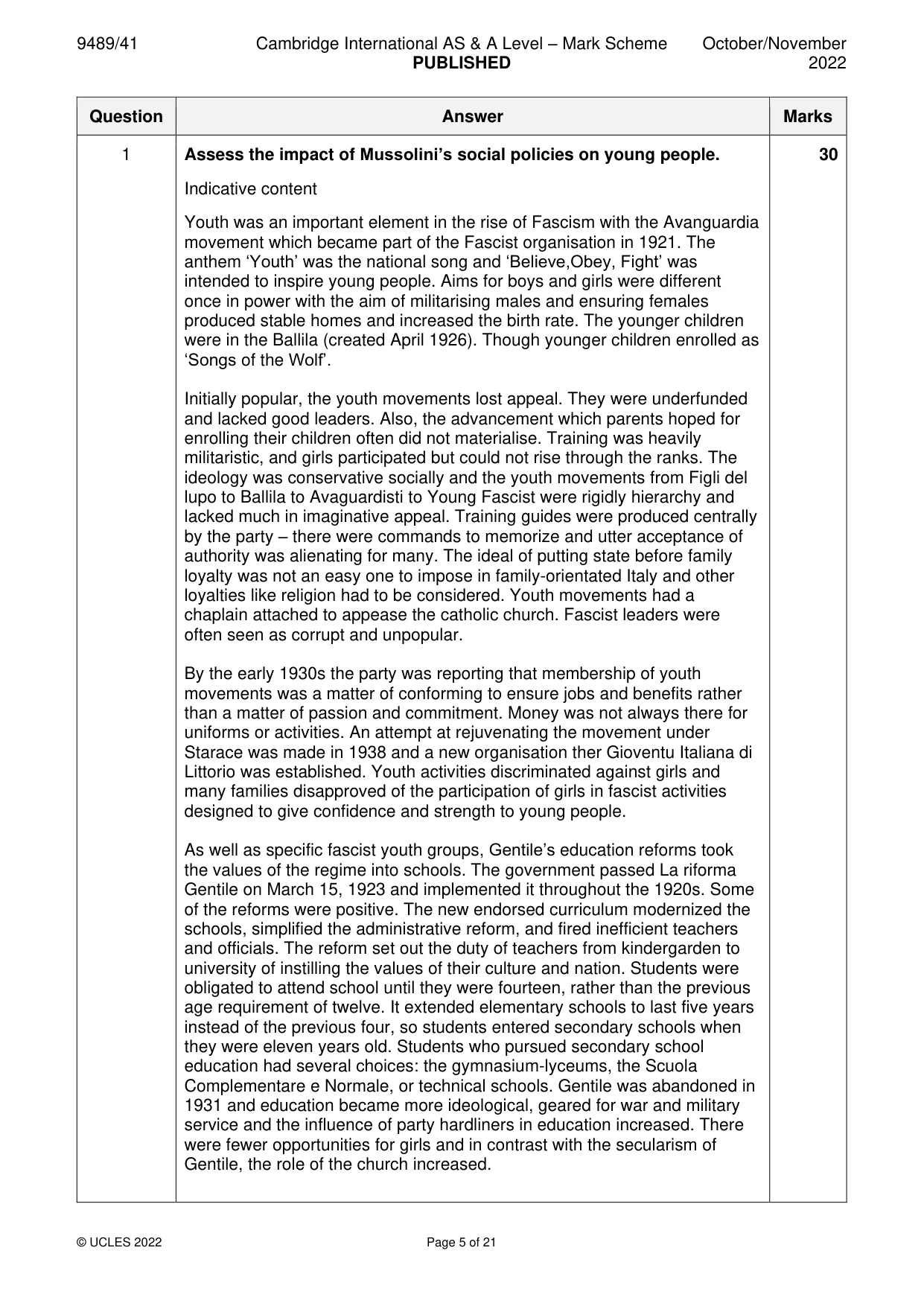
1 Assess the impact of Mussolini’s social policies on young people. [30]
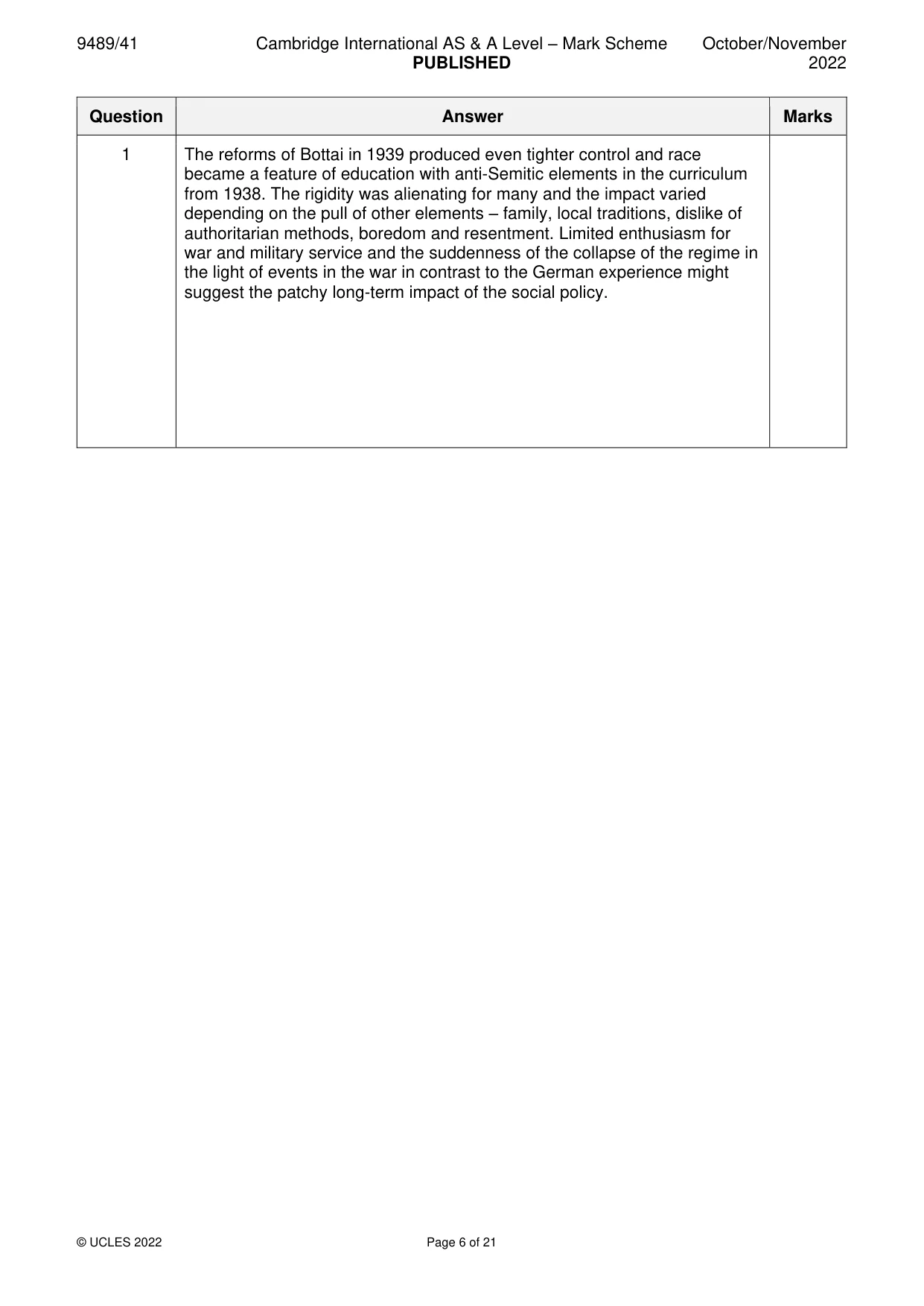
Mark scheme: Question Answer Marks 1 Assess the impact of Mussolini’s social policies on young people. 30 Indicative content Youth was an important element in the rise of Fascism with the Avanguardia movement which became part of the Fascist organisation in 1921. The anthem ‘Youth’ was the national song and ‘Believe,Obey, Fight’ was intended to inspire young people. Aims for boys and girls were different once in power with the aim of militarising males and ensuring females produced stable homes and increased the birth rate. The younger children were in the Ballila (created April 1926). Though younger children enrolled as ‘Songs of the Wolf’. Initially popular, the youth movements lost appeal. They were underfunded and lacked good leaders. Also, the advancement which parents hoped for enrolling their children often did not materialise. Training was heavily militaristic, and girls participated but could not rise through the ranks. The ideology was conservative socially and the youth movements from Figli del lupo to Ballila to Avaguardisti to Young Fascist were rigidly hierarchy and lacked much in imaginative appeal. Training guides were produced centrally by the party – there were commands to memorize and utter acceptance of authority was alienating for many. The ideal of putting state before family loyalty was not an easy one to impose in family-orientated Italy and other loyalties like religion had to be considered. Youth movements had a chaplain attached to appease the catholic church. Fascist leaders were often seen as corrupt and unpopular. By the early 1930s the party was reporting that membership of youth movements was a matter of conforming to ensure jobs and benefits rather than a matter of passion and commitment. Money was not always there for uniforms or activities. An attempt at rejuvenating the movement under Starace was made in 1938 and a new organisation ther Gioventu Italiana di Littorio was established. Youth activities discriminated against girls and many families disapproved of the participation of girls in fascist activities designed to give confidence and strength to young people. As well as specific fascist youth groups, Gentile’s education reforms took the values of the regime into schools. The government passed La riforma Gentile on March 15, 1923 and implemented it throughout the 1920s. Some of the reforms were positive. The new endorsed curriculum modernized the schools, simplified the administrative reform, and fired inefficient teachers and officials. The reform set out the duty of teachers from kindergarden to university of instilling the values of their culture and nation. Students were obligated to attend school until they were fourteen, rather than the previous age requirement of twelve. It extended elementary schools to last five years instead of the previous four, so students entered secondary schools when they were eleven years old. Students who pursued secondary school education had several choices: the gymnasium-lyceums, the Scuola Complementare e Normale, or technical schools. Gentile was abandoned in 1931 and education became more ideological, geared for war and military service and the influence of party hardliners in education increased. There were fewer opportunities for girls and in contrast with the secularism of Gentile, the role of the church increased. 1 The reforms of Bottai in 1939 produced even tighter control and race became a feature of education with anti-Semitic elements in the curriculum from 1938. The rigidity was alienating for many and the impact varied depending on the pull of other elements – family, local traditions, dislike of authoritarian methods, boredom and resentment. Limited enthusiasm for war and military service and the suddenness of the collapse of the regime in the light of events in the war in contrast to the German experience might suggest the patchy long-term impact of the social policy.
More questions on How did the rise of extremism affect international relations?
Q2 · Evaluate the importance of propaganda in the Soviet Union in the period 1928–41
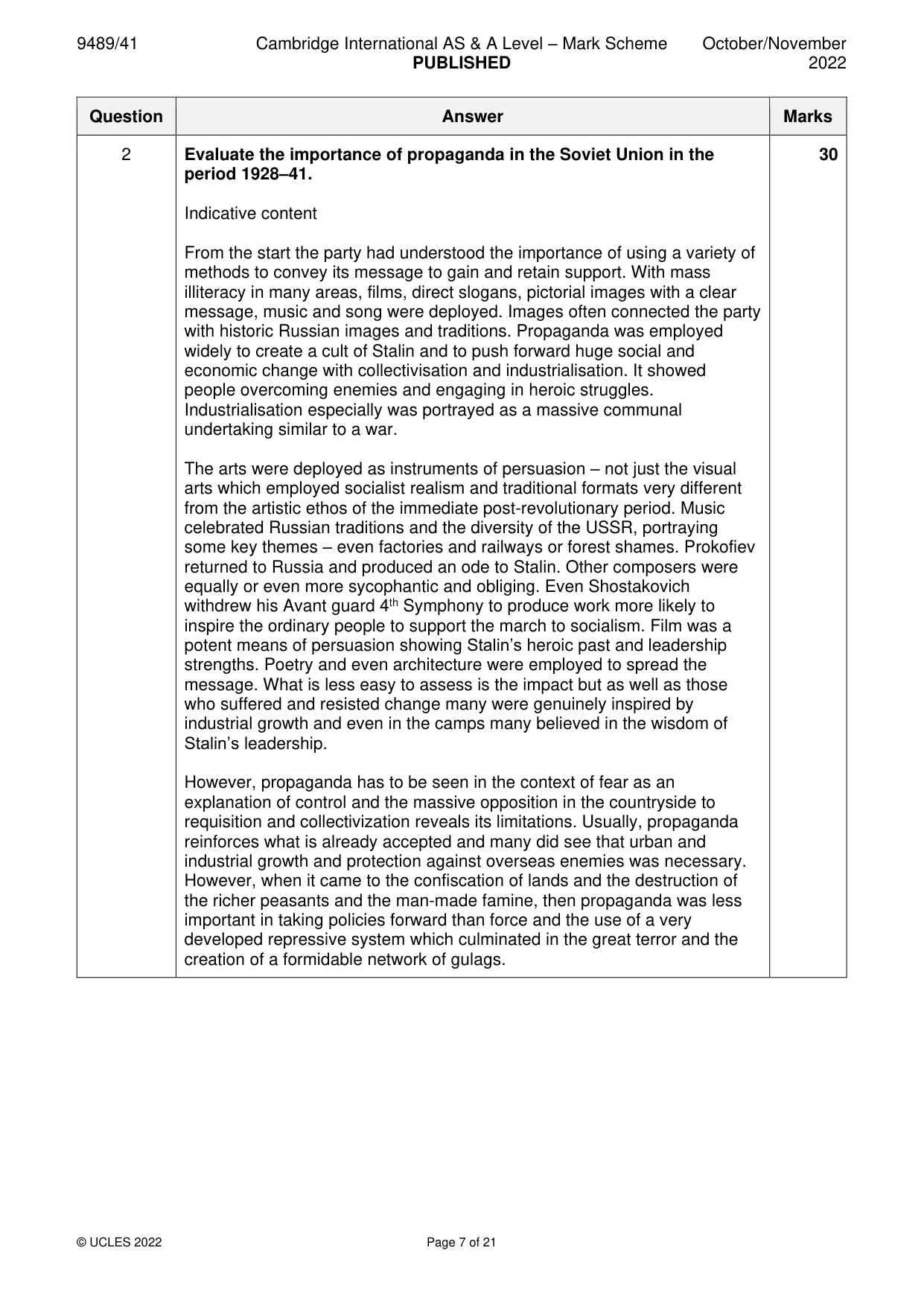
2 Evaluate the importance of propaganda in the Soviet Union in the period 1928–41. [30]
Mark scheme: 2 Evaluate the importance of propaganda in the Soviet Union in the 30 period 1928–41. Indicative content From the start the party had understood the importance of using a variety of methods to convey its message to gain and retain support. With mass illiteracy in many areas, films, direct slogans, pictorial images with a clear message, music and song were deployed. Images often connected the party with historic Russian images and traditions. Propaganda was employed widely to create a cult of Stalin and to push forward huge social and economic change with collectivisation and industrialisation. It showed people overcoming enemies and engaging in heroic struggles. Industrialisation especially was portrayed as a massive communal undertaking similar to a war. The arts were deployed as instruments of persuasion – not just the visual arts which employed socialist realism and traditional formats very different from the artistic ethos of the immediate post-revolutionary period. Music celebrated Russian traditions and the diversity of the USSR, portraying some key themes – even factories and railways or forest shames. Prokofiev returned to Russia and produced an ode to Stalin. Other composers were equally or even more sycophantic and obliging. Even Shostakovich withdrew his Avant guard 4th Symphony to produce work more likely to inspire the ordinary people to support the march to socialism. Film was a potent means of persuasion showing Stalin’s heroic past and leadership strengths. Poetry and even architecture were employed to spread the message. What is less easy to assess is the impact but as well as those who suffered and resisted change many were genuinely inspired by industrial growth and even in the camps many believed in the wisdom of Stalin’s leadership. However, propaganda has to be seen in the context of fear as an explanation of control and the massive opposition in the countryside to requisition and collectivization reveals its limitations. Usually, propaganda reinforces what is already accepted and many did see that urban and industrial growth and protection against overseas enemies was necessary. However, when it came to the confiscation of lands and the destruction of the richer peasants and the man-made famine, then propaganda was less important in taking policies forward than force and the use of a very developed repressive system which culminated in the great terror and the creation of a formidable network of gulags.
More questions on How were the Bolsheviks able to consolidate their power up to 1924?
Q3 · Analyse the effectiveness of Nazi economic policy in dealing with the effects of the…
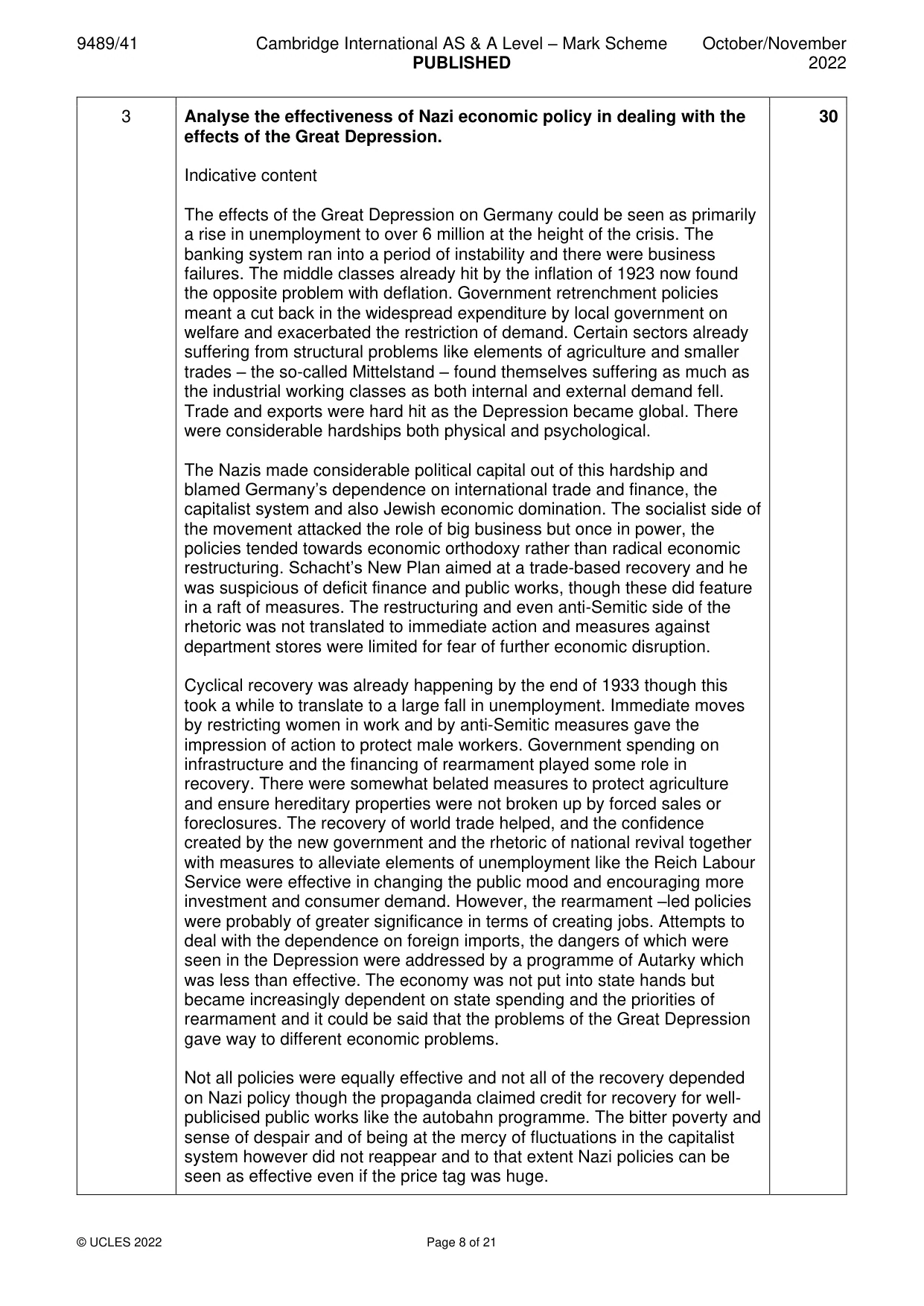
3 Analyse the effectiveness of Nazi economic policy in dealing with the effects of the Great Depression. [30]
Mark scheme: 3 Analyse the effectiveness of Nazi economic policy in dealing with the 30 effects of the Great Depression. Indicative content The effects of the Great Depression on Germany could be seen as primarily a rise in unemployment to over 6 million at the height of the crisis. The banking system ran into a period of instability and there were business failures. The middle classes already hit by the inflation of 1923 now found the opposite problem with deflation. Government retrenchment policies meant a cut back in the widespread expenditure by local government on welfare and exacerbated the restriction of demand. Certain sectors already suffering from structural problems like elements of agriculture and smaller trades – the so-called Mittelstand – found themselves suffering as much as the industrial working classes as both internal and external demand fell. Trade and exports were hard hit as the Depression became global. There were considerable hardships both physical and psychological. The Nazis made considerable political capital out of this hardship and blamed Germany’s dependence on international trade and finance, the capitalist system and also Jewish economic domination. The socialist side of the movement attacked the role of big business but once in power, the policies tended towards economic orthodoxy rather than radical economic restructuring. Schacht’s New Plan aimed at a trade-based recovery and he was suspicious of deficit finance and public works, though these did feature in a raft of measures. The restructuring and even anti-Semitic side of the rhetoric was not translated to immediate action and measures against department stores were limited for fear of further economic disruption. Cyclical recovery was already happening by the end of 1933 though this took a while to translate to a large fall in unemployment. Immediate moves by restricting women in work and by anti-Semitic measures gave the impression of action to protect male workers. Government spending on infrastructure and the financing of rearmament played some role in recovery. There were somewhat belated measures to protect agriculture and ensure hereditary properties were not broken up by forced sales or foreclosures. The recovery of world trade helped, and the confidence created by the new government and the rhetoric of national revival together with measures to alleviate elements of unemployment like the Reich Labour Service were effective in changing the public mood and encouraging more investment and consumer demand. However, the rearmament –led policies were probably of greater significance in terms of creating jobs. Attempts to deal with the dependence on foreign imports, the dangers of which were seen in the Depression were addressed by a programme of Autarky which was less than effective. The economy was not put into state hands but became increasingly dependent on state spending and the priorities of rearmament and it could be said that the problems of the Great Depression gave way to different economic problems. Not all policies were equally effective and not all of the recovery depended on Nazi policy though the propaganda claimed credit for recovery for well- publicised public works like the autobahn programme. The bitter poverty and sense of despair and of being at the mercy of fluctuations in the capitalist system however did not reappear and to that extent Nazi policies can be seen as effective even if the price tag was huge.
More questions on How did the rise of extremism affect international relations?
Q4 · Analyse the problems facing the traditional industries in Britain in the inter-war period
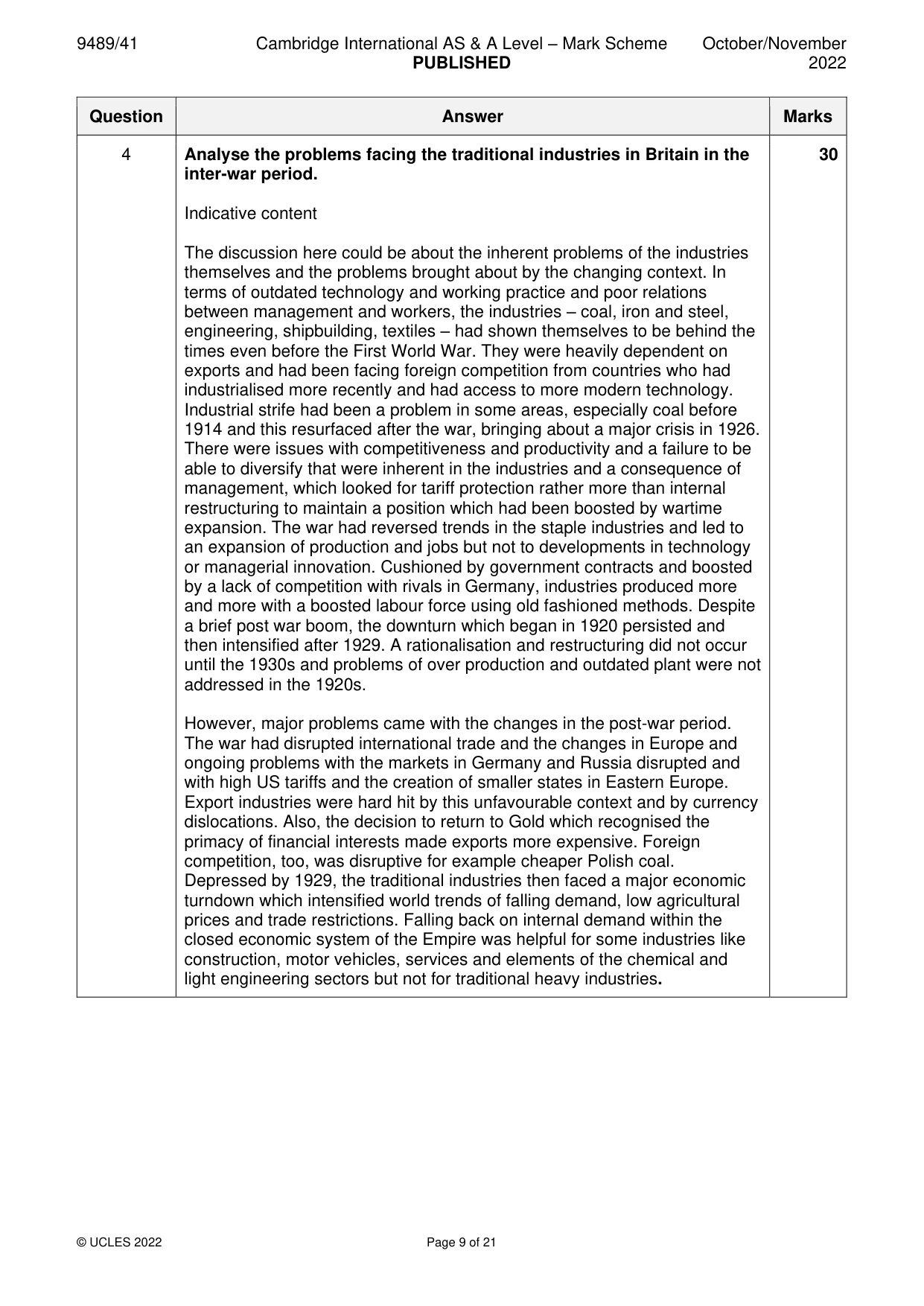
4 Analyse the problems facing the traditional industries in Britain in the inter-war period. [30]
Mark scheme: 4 Analyse the problems facing the traditional industries in Britain in the 30 inter-war period. Indicative content The discussion here could be about the inherent problems of the industries themselves and the problems brought about by the changing context. In terms of outdated technology and working practice and poor relations between management and workers, the industries – coal, iron and steel, engineering, shipbuilding, textiles – had shown themselves to be behind the times even before the First World War. They were heavily dependent on exports and had been facing foreign competition from countries who had industrialised more recently and had access to more modern technology. Industrial strife had been a problem in some areas, especially coal before 1914 and this resurfaced after the war, bringing about a major crisis in 1926. There were issues with competitiveness and productivity and a failure to be able to diversify that were inherent in the industries and a consequence of management, which looked for tariff protection rather more than internal restructuring to maintain a position which had been boosted by wartime expansion. The war had reversed trends in the staple industries and led to an expansion of production and jobs but not to developments in technology or managerial innovation. Cushioned by government contracts and boosted by a lack of competition with rivals in Germany, industries produced more and more with a boosted labour force using old fashioned methods. Despite a brief post war boom, the downturn which began in 1920 persisted and then intensified after 1929. A rationalisation and restructuring did not occur until the 1930s and problems of over production and outdated plant were not addressed in the 1920s. However, major problems came with the changes in the post-war period. The war had disrupted international trade and the changes in Europe and ongoing problems with the markets in Germany and Russia disrupted and with high US tariffs and the creation of smaller states in Eastern Europe. Export industries were hard hit by this unfavourable context and by currency dislocations. Also, the decision to return to Gold which recognised the primacy of financial interests made exports more expensive. Foreign competition, too, was disruptive for example cheaper Polish coal. Depressed by 1929, the traditional industries then faced a major economic turndown which intensified world trends of falling demand, low agricultural prices and trade restrictions. Falling back on internal demand within the closed economic system of the Empire was helpful for some industries like construction, motor vehicles, services and elements of the chemical and light engineering sectors but not for traditional heavy industries.
More questions on What were the consequences of the rapid economic growth after 1870?
Q5 · ‘Individual Civil Rights leaders were more effective than Civil Rights organisations in…
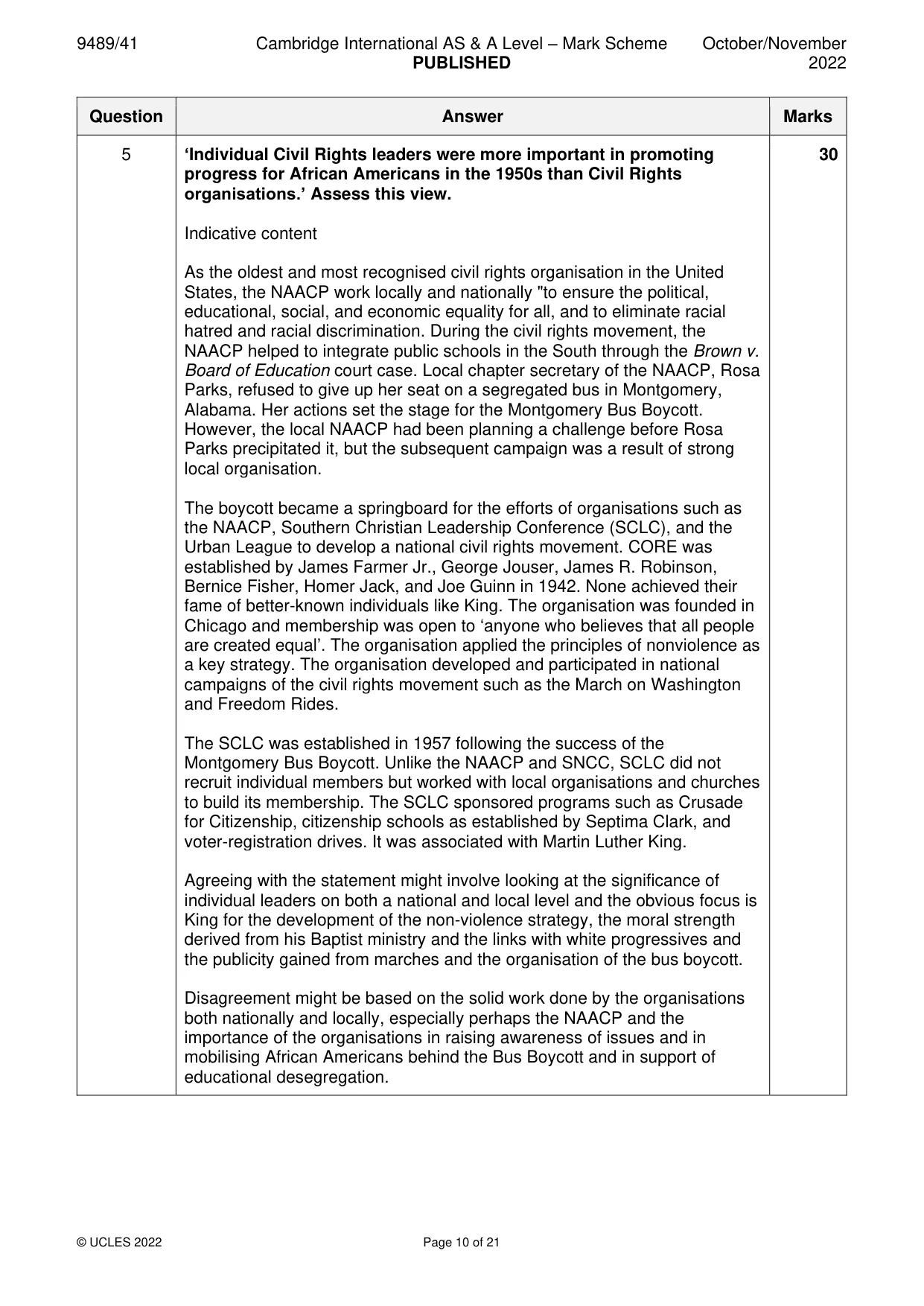
5 ‘Individual Civil Rights leaders were more effective than Civil Rights organisations in promoting progress for African Americans in the 1950s.’ Assess this view. [30]
Mark scheme: 5 ‘Individual Civil Rights leaders were more important in promoting 30 progress for African Americans in the 1950s than Civil Rights organisations.’ Assess this view. Indicative content As the oldest and most recognised civil rights organisation in the United States, the NAACP work locally and nationally "to ensure the political, educational, social, and economic equality for all, and to eliminate racial hatred and racial discrimination. During the civil rights movement, the NAACP helped to integrate public schools in the South through the Brown v. Board of Education court case. Local chapter secretary of the NAACP, Rosa Parks, refused to give up her seat on a segregated bus in Montgomery, Alabama. Her actions set the stage for the Montgomery Bus Boycott. However, the local NAACP had been planning a challenge before Rosa Parks precipitated it, but the subsequent campaign was a result of strong local organisation. The boycott became a springboard for the efforts of organisations such as the NAACP, Southern Christian Leadership Conference (SCLC), and the Urban League to develop a national civil rights movement. CORE was established by James Farmer Jr., George Jouser, James R. Robinson, Bernice Fisher, Homer Jack, and Joe Guinn in 1942. None achieved their fame of better-known individuals like King. The organisation was founded in Chicago and membership was open to ‘anyone who believes that all people are created equal’. The organisation applied the principles of nonviolence as a key strategy. The organisation developed and participated in national campaigns of the civil rights movement such as the March on Washington and Freedom Rides. The SCLC was established in 1957 following the success of the Montgomery Bus Boycott. Unlike the NAACP and SNCC, SCLC did not recruit individual members but worked with local organisations and churches to build its membership. The SCLC sponsored programs such as Crusade for Citizenship, citizenship schools as established by Septima Clark, and voter-registration drives. It was associated with Martin Luther King. Agreeing with the statement might involve looking at the significance of individual leaders on both a national and local level and the obvious focus is King for the development of the non-violence strategy, the moral strength derived from his Baptist ministry and the links with white progressives and the publicity gained from marches and the organisation of the bus boycott. Disagreement might be based on the solid work done by the organisations both nationally and locally, especially perhaps the NAACP and the importance of the organisations in raising awareness of issues and in mobilising African Americans behind the Bus Boycott and in support of educational desegregation.
More questions on How successful was the Progressive Movement from 1890 to 1920?
Q6 · Evaluate the impact of the Vietnam War on the US economy in the 1960s and 1970s
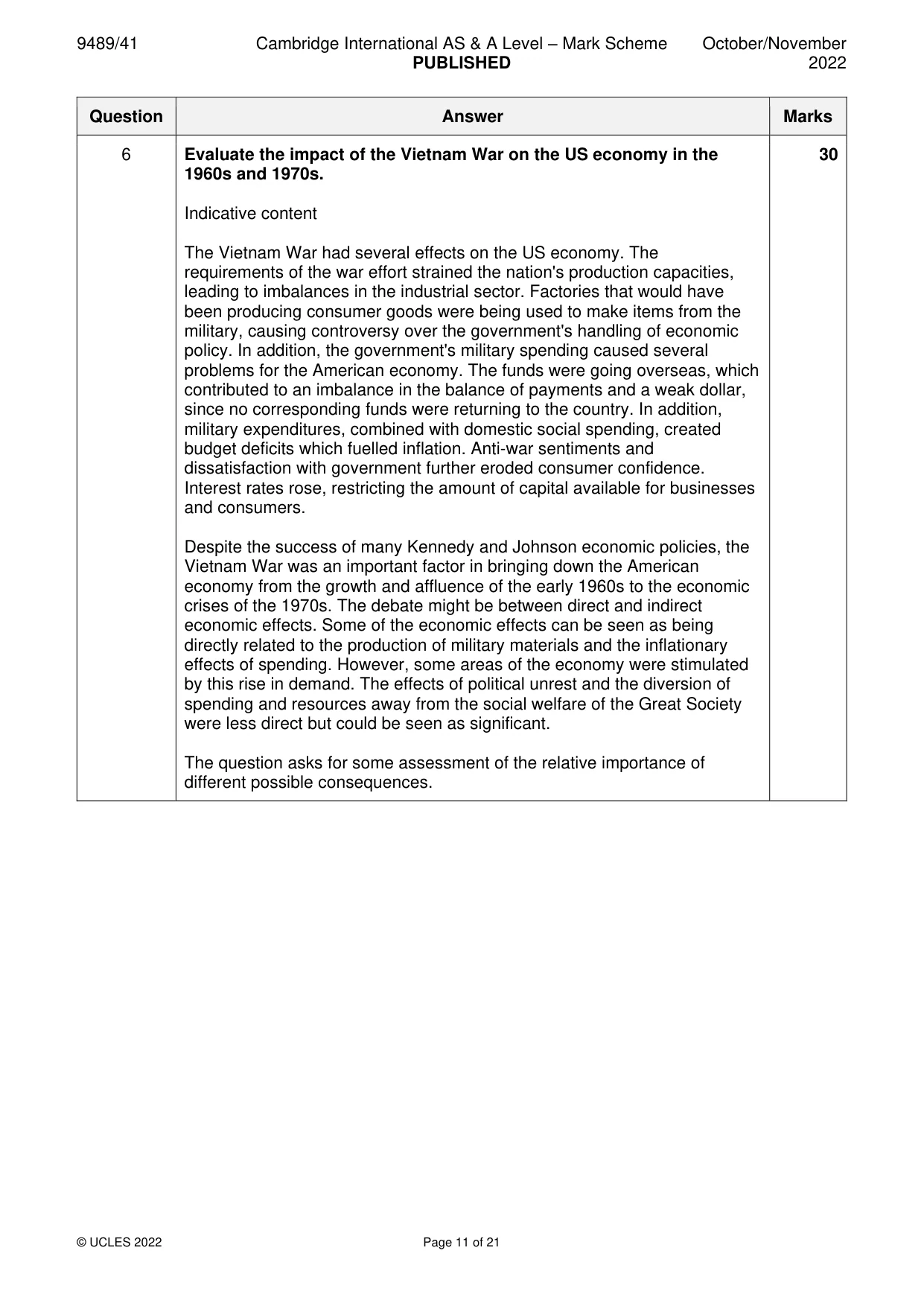
6 Evaluate the impact of the Vietnam War on the US economy in the 1960s and 1970s. [30]
Mark scheme: 6 Evaluate the impact of the Vietnam War on the US economy in the 30 1960s and 1970s. Indicative content The Vietnam War had several effects on the US economy. The requirements of the war effort strained the nation's production capacities, leading to imbalances in the industrial sector. Factories that would have been producing consumer goods were being used to make items from the military, causing controversy over the government's handling of economic policy. In addition, the government's military spending caused several problems for the American economy. The funds were going overseas, which contributed to an imbalance in the balance of payments and a weak dollar, since no corresponding funds were returning to the country. In addition, military expenditures, combined with domestic social spending, created budget deficits which fuelled inflation. Anti-war sentiments and dissatisfaction with government further eroded consumer confidence. Interest rates rose, restricting the amount of capital available for businesses and consumers. Despite the success of many Kennedy and Johnson economic policies, the Vietnam War was an important factor in bringing down the American economy from the growth and affluence of the early 1960s to the economic crises of the 1970s. The debate might be between direct and indirect economic effects. Some of the economic effects can be seen as being directly related to the production of military materials and the inflationary effects of spending. However, some areas of the economy were stimulated by this rise in demand. The effects of political unrest and the diversion of spending and resources away from the social welfare of the Great Society were less direct but could be seen as significant. The question asks for some assessment of the relative importance of different possible consequences.
Q7 · Assess the effectiveness of the response by US authorities to the AIDS epidemic
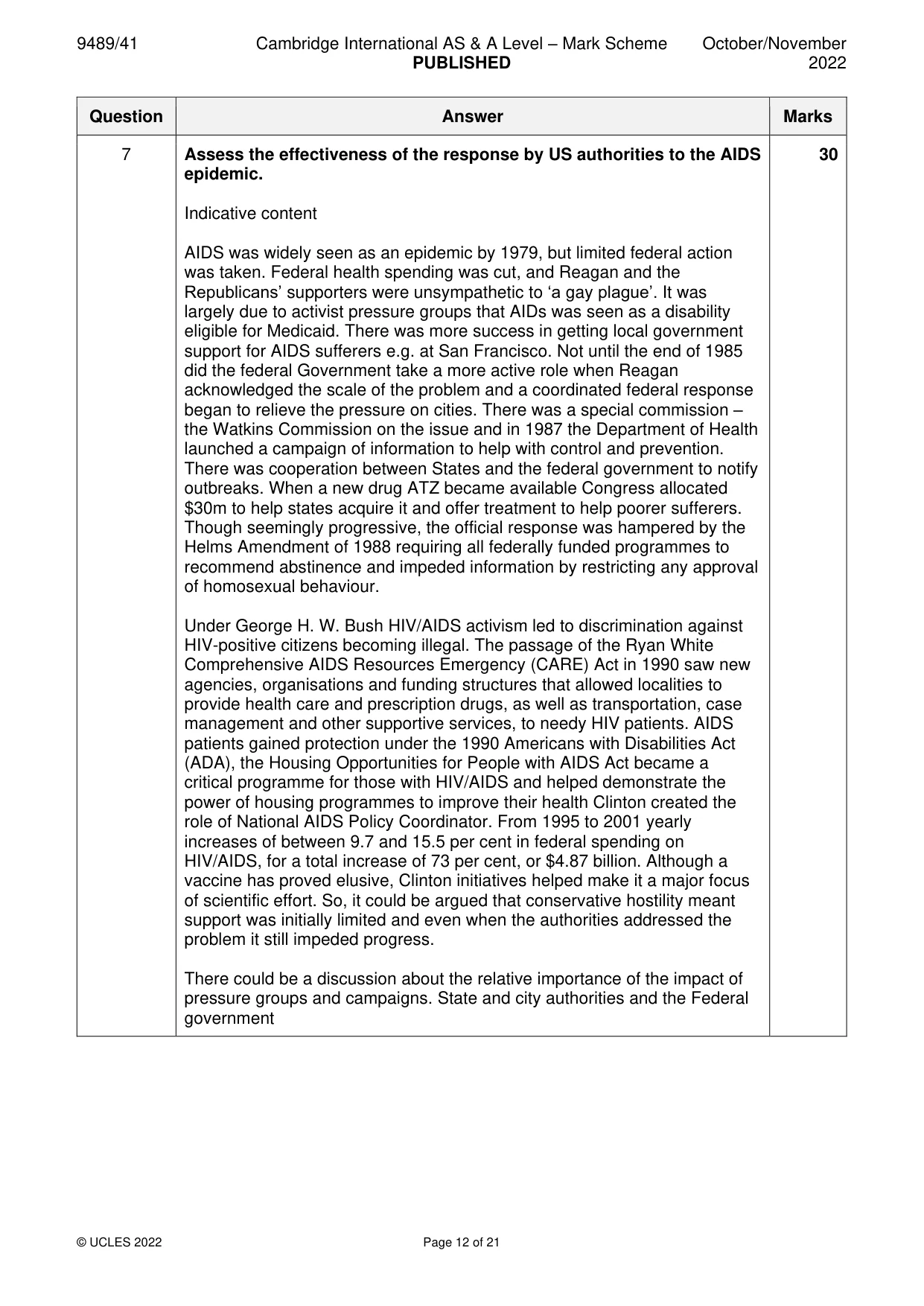
7 Assess the effectiveness of the response by US authorities to the AIDS epidemic. [30]
Mark scheme: 7 Assess the effectiveness of the response by US authorities to the AIDS 30 epidemic. Indicative content AIDS was widely seen as an epidemic by 1979, but limited federal action was taken. Federal health spending was cut, and Reagan and the Republicans’ supporters were unsympathetic to ‘a gay plague’. It was largely due to activist pressure groups that AIDs was seen as a disability eligible for Medicaid. There was more success in getting local government support for AIDS sufferers e.g. at San Francisco. Not until the end of 1985 did the federal Government take a more active role when Reagan acknowledged the scale of the problem and a coordinated federal response began to relieve the pressure on cities. There was a special commission – the Watkins Commission on the issue and in 1987 the Department of Health launched a campaign of information to help with control and prevention. There was cooperation between States and the federal government to notify outbreaks. When a new drug ATZ became available Congress allocated $30m to help states acquire it and offer treatment to help poorer sufferers. Though seemingly progressive, the official response was hampered by the Helms Amendment of 1988 requiring all federally funded programmes to recommend abstinence and impeded information by restricting any approval of homosexual behaviour. Under George H. W. Bush HIV/AIDS activism led to discrimination against HIV-positive citizens becoming illegal. The passage of the Ryan White Comprehensive AIDS Resources Emergency (CARE) Act in 1990 saw new agencies, organisations and funding structures that allowed localities to provide health care and prescription drugs, as well as transportation, case management and other supportive services, to needy HIV patients. AIDS patients gained protection under the 1990 Americans with Disabilities Act (ADA), the Housing Opportunities for People with AIDS Act became a critical programme for those with HIV/AIDS and helped demonstrate the power of housing programmes to improve their health Clinton created the role of National AIDS Policy Coordinator. From 1995 to 2001 yearly increases of between 9.7 and 15.5 per cent in federal spending on HIV/AIDS, for a total increase of 73 per cent, or $4.87 billion. Although a vaccine has proved elusive, Clinton initiatives helped make it a major focus of scientific effort. So, it could be argued that conservative hostility meant support was initially limited and even when the authorities addressed the problem it still impeded progress. There could be a discussion about the relative importance of the impact of pressure groups and campaigns. State and city authorities and the Federal government
More questions on How successful was the Progressive Movement from 1890 to 1920?
Q8 · ‘The Marshall Plan was more an act of US self-interest than a humanitarian policy.’…
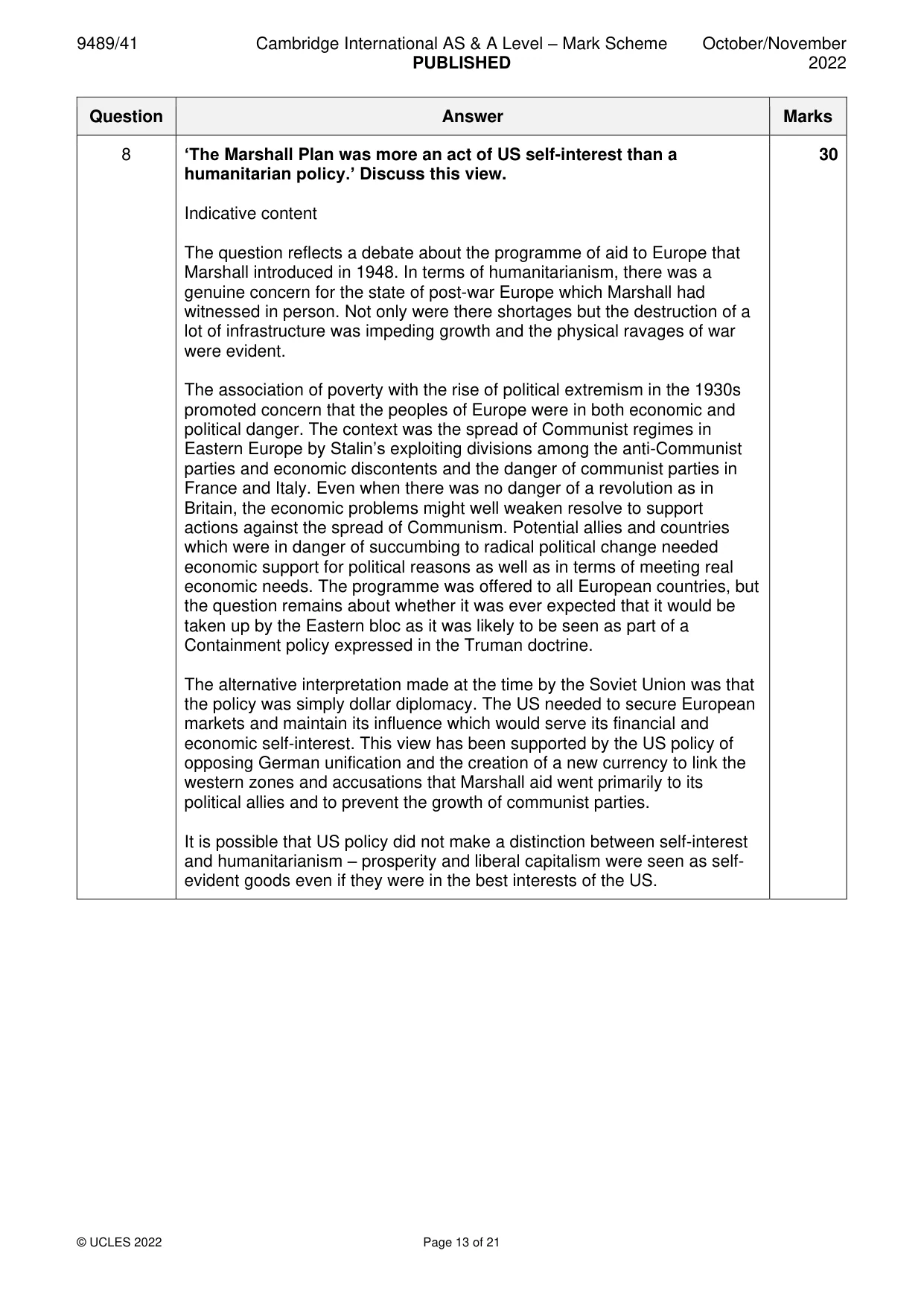
8 ‘The Marshall Plan was more an act of US self-interest than a humanitarian policy.’ Discuss this view. [30] Section C: International history, 1945–92
Mark scheme: 8 ‘The Marshall Plan was more an act of US self-interest than a 30 humanitarian policy.’ Discuss this view. Indicative content The question reflects a debate about the programme of aid to Europe that Marshall introduced in 1948. In terms of humanitarianism, there was a genuine concern for the state of post-war Europe which Marshall had witnessed in person. Not only were there shortages but the destruction of a lot of infrastructure was impeding growth and the physical ravages of war were evident. The association of poverty with the rise of political extremism in the 1930s promoted concern that the peoples of Europe were in both economic and political danger. The context was the spread of Communist regimes in Eastern Europe by Stalin’s exploiting divisions among the anti-Communist parties and economic discontents and the danger of communist parties in France and Italy. Even when there was no danger of a revolution as in Britain, the economic problems might well weaken resolve to support actions against the spread of Communism. Potential allies and countries which were in danger of succumbing to radical political change needed economic support for political reasons as well as in terms of meeting real economic needs. The programme was offered to all European countries, but the question remains about whether it was ever expected that it would be taken up by the Eastern bloc as it was likely to be seen as part of a Containment policy expressed in the Truman doctrine. The alternative interpretation made at the time by the Soviet Union was that the policy was simply dollar diplomacy. The US needed to secure European markets and maintain its influence which would serve its financial and economic self-interest. This view has been supported by the US policy of opposing German unification and the creation of a new currency to link the western zones and accusations that Marshall aid went primarily to its political allies and to prevent the growth of communist parties. It is possible that US policy did not make a distinction between self-interest and humanitarianism – prosperity and liberal capitalism were seen as self- evident goods even if they were in the best interests of the US.
More questions on Why did the USA emerge as a world power and what was the impact on international
Q9 · ‘US reaction to the Cuban Revolution was the main cause of the Cuban Missile Crisis.’…
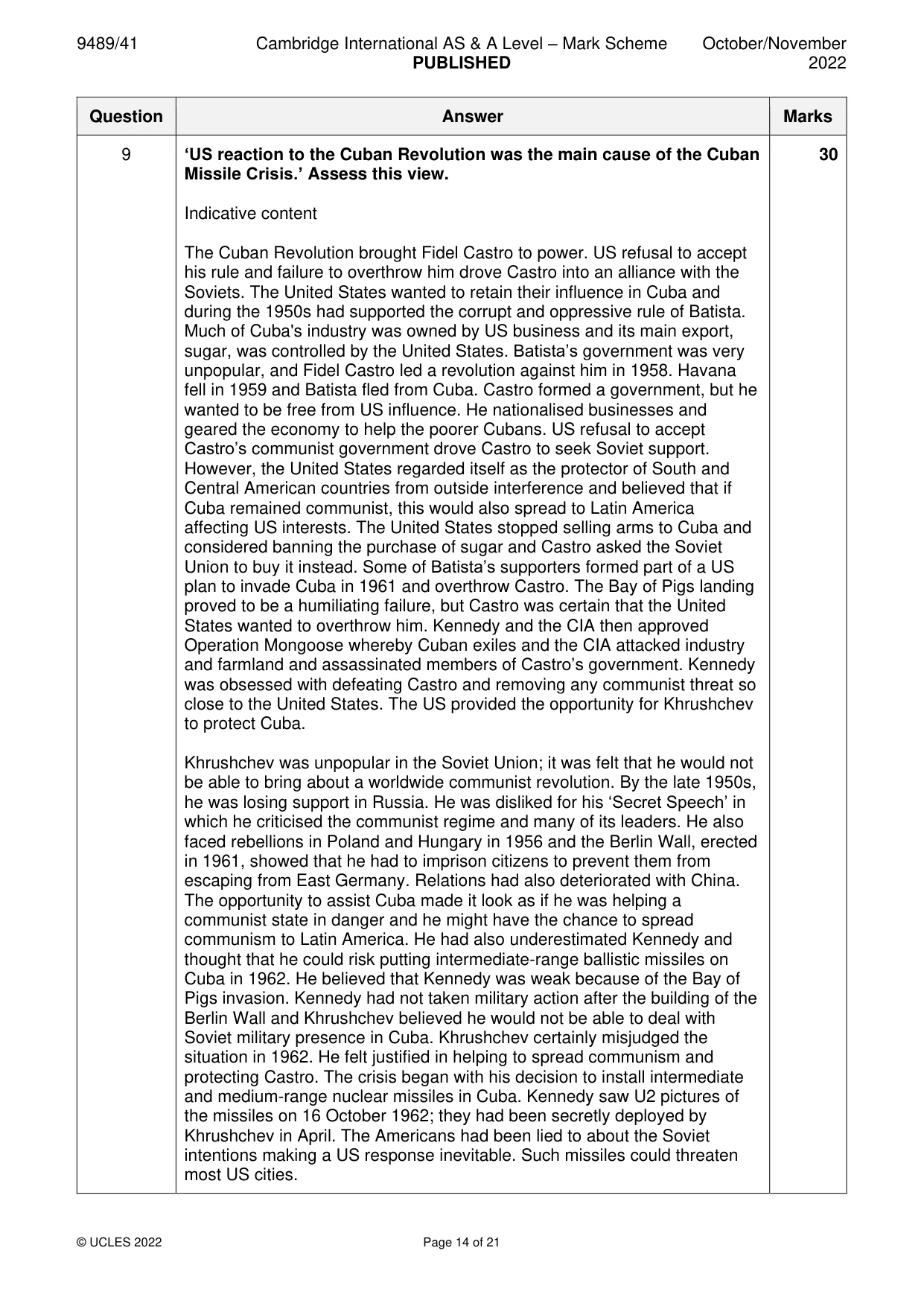
9 ‘US reaction to the Cuban Revolution was the main cause of the Cuban Missile Crisis.’ Assess this view. [30]
Mark scheme: 9 ‘US reaction to the Cuban Revolution was the main cause of the Cuban 30 Missile Crisis.’ Assess this view. Indicative content The Cuban Revolution brought Fidel Castro to power. US refusal to accept his rule and failure to overthrow him drove Castro into an alliance with the Soviets. The United States wanted to retain their influence in Cuba and during the 1950s had supported the corrupt and oppressive rule of Batista. Much of Cuba's industry was owned by US business and its main export, sugar, was controlled by the United States. Batista’s government was very unpopular, and Fidel Castro led a revolution against him in 1958. Havana fell in 1959 and Batista fled from Cuba. Castro formed a government, but he wanted to be free from US influence. He nationalised businesses and geared the economy to help the poorer Cubans. US refusal to accept Castro’s communist government drove Castro to seek Soviet support. However, the United States regarded itself as the protector of South and Central American countries from outside interference and believed that if Cuba remained communist, this would also spread to Latin America affecting US interests. The United States stopped selling arms to Cuba and considered banning the purchase of sugar and Castro asked the Soviet Union to buy it instead. Some of Batista’s supporters formed part of a US plan to invade Cuba in 1961 and overthrow Castro. The Bay of Pigs landing proved to be a humiliating failure, but Castro was certain that the United States wanted to overthrow him. Kennedy and the CIA then approved Operation Mongoose whereby Cuban exiles and the CIA attacked industry and farmland and assassinated members of Castro’s government. Kennedy was obsessed with defeating Castro and removing any communist threat so close to the United States. The US provided the opportunity for Khrushchev to protect Cuba. Khrushchev was unpopular in the Soviet Union; it was felt that he would not be able to bring about a worldwide communist revolution. By the late 1950s, he was losing support in Russia. He was disliked for his ‘Secret Speech’ in which he criticised the communist regime and many of its leaders. He also faced rebellions in Poland and Hungary in 1956 and the Berlin Wall, erected in 1961, showed that he had to imprison citizens to prevent them from escaping from East Germany. Relations had also deteriorated with China. The opportunity to assist Cuba made it look as if he was helping a communist state in danger and he might have the chance to spread communism to Latin America. He had also underestimated Kennedy and thought that he could risk putting intermediate-range ballistic missiles on Cuba in 1962. He believed that Kennedy was weak because of the Bay of Pigs invasion. Kennedy had not taken military action after the building of the Berlin Wall and Khrushchev believed he would not be able to deal with Soviet military presence in Cuba. Khrushchev certainly misjudged the situation in 1962. He felt justified in helping to spread communism and protecting Castro. The crisis began with his decision to install intermediate and medium-range nuclear missiles in Cuba. Kennedy saw U2 pictures of the missiles on 16 October 1962; they had been secretly deployed by Khrushchev in April. The Americans had been lied to about the Soviet intentions making a US response inevitable. Such missiles could threaten most US cities. 9 However, he could have defended Cuba with conventional weapons. It seems likely that Khrushchev wanted to appear to have greater military strength than the United States. Appearing to defend the Cuban Revolution gave Khrushchev the opportunity to try to score a nuclear success over the Americans.
More questions on How did the rise of extremism affect international relations?
Q10 · Analyse how far the issue of Taiwan affected Sino–US relations during the Cold War
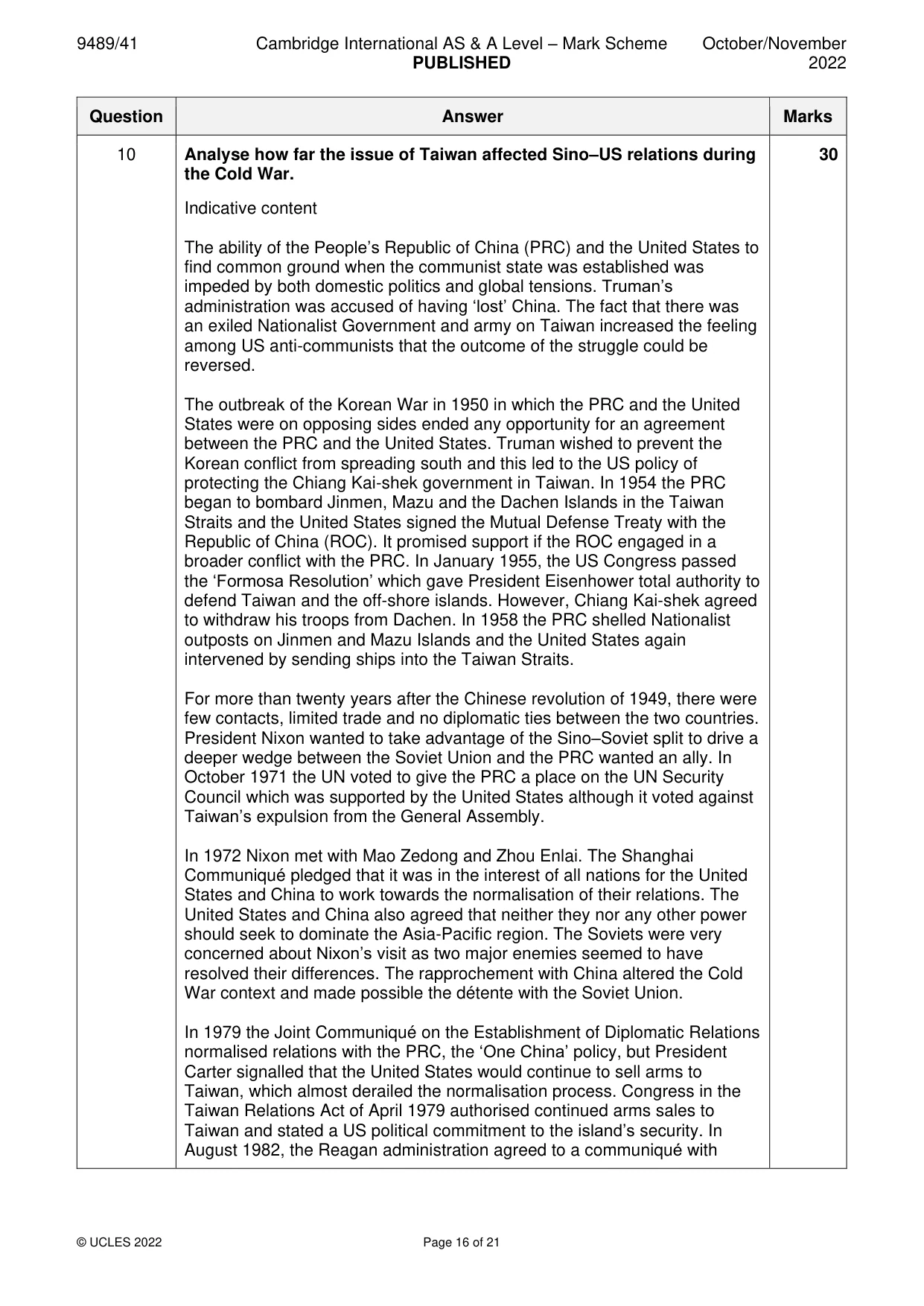
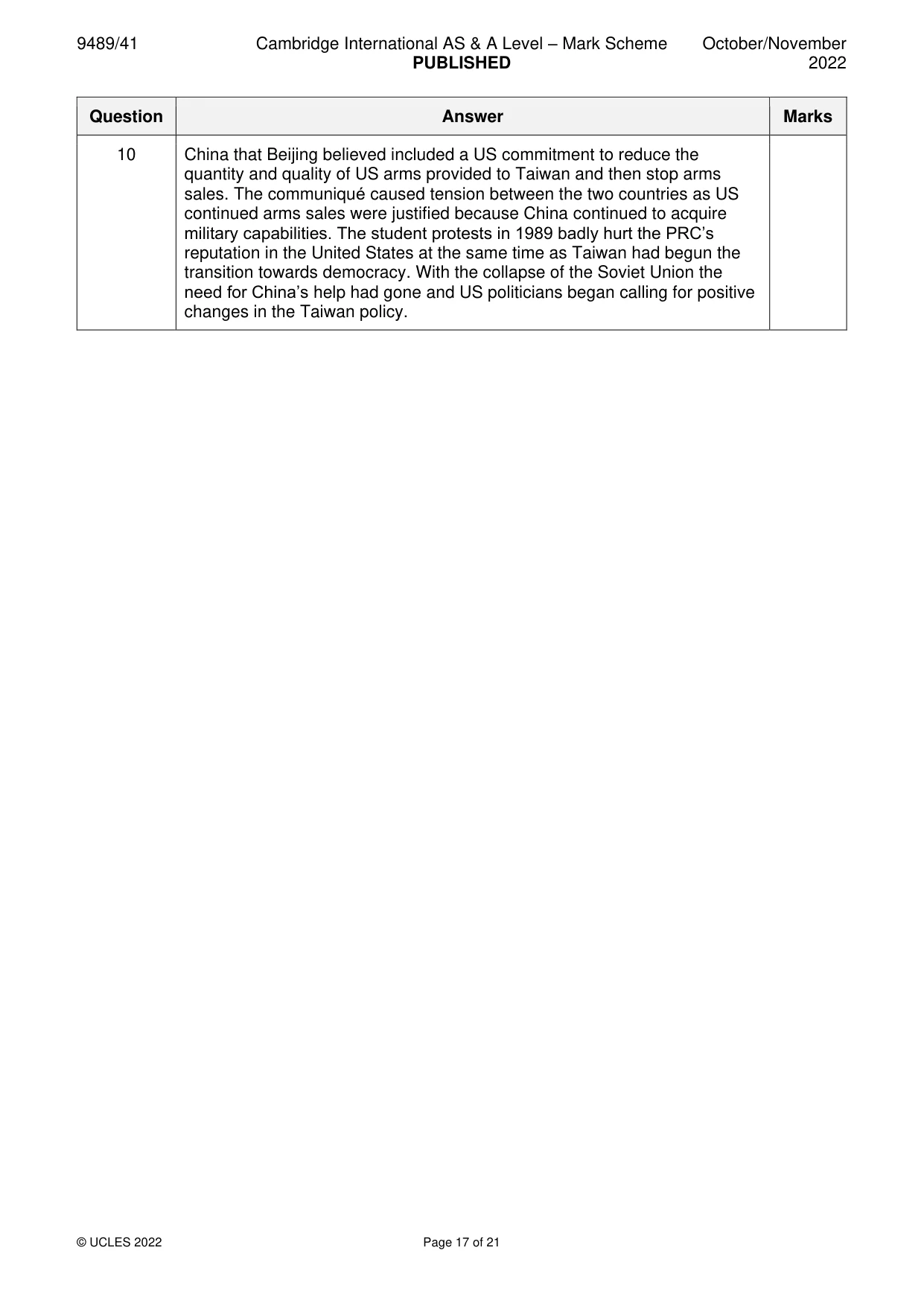
10 Analyse how far the issue of Taiwan affected Sino–US relations during the Cold War. [30]
Mark scheme: 10 Analyse how far the issue of Taiwan affected Sino–US relations during 30 the Cold War. Indicative content The ability of the People’s Republic of China (PRC) and the United States to find common ground when the communist state was established was impeded by both domestic politics and global tensions. Truman’s administration was accused of having ‘lost’ China. The fact that there was an exiled Nationalist Government and army on Taiwan increased the feeling among US anti-communists that the outcome of the struggle could be reversed. The outbreak of the Korean War in 1950 in which the PRC and the United States were on opposing sides ended any opportunity for an agreement between the PRC and the United States. Truman wished to prevent the Korean conflict from spreading south and this led to the US policy of protecting the Chiang Kai-shek government in Taiwan. In 1954 the PRC began to bombard Jinmen, Mazu and the Dachen Islands in the Taiwan Straits and the United States signed the Mutual Defense Treaty with the Republic of China (ROC). It promised support if the ROC engaged in a broader conflict with the PRC. In January 1955, the US Congress passed the ‘Formosa Resolution’ which gave President Eisenhower total authority to defend Taiwan and the off-shore islands. However, Chiang Kai-shek agreed to withdraw his troops from Dachen. In 1958 the PRC shelled Nationalist outposts on Jinmen and Mazu Islands and the United States again intervened by sending ships into the Taiwan Straits. For more than twenty years after the Chinese revolution of 1949, there were few contacts, limited trade and no diplomatic ties between the two countries. President Nixon wanted to take advantage of the Sino–Soviet split to drive a deeper wedge between the Soviet Union and the PRC wanted an ally. In October 1971 the UN voted to give the PRC a place on the UN Security Council which was supported by the United States although it voted against Taiwan’s expulsion from the General Assembly. In 1972 Nixon met with Mao Zedong and Zhou Enlai. The Shanghai Communiqué pledged that it was in the interest of all nations for the United States and China to work towards the normalisation of their relations. The United States and China also agreed that neither they nor any other power should seek to dominate the Asia-Pacific region. The Soviets were very concerned about Nixon’s visit as two major enemies seemed to have resolved their differences. The rapprochement with China altered the Cold War context and made possible the détente with the Soviet Union. In 1979 the Joint Communiqué on the Establishment of Diplomatic Relations normalised relations with the PRC, the ‘One China’ policy, but President Carter signalled that the United States would continue to sell arms to Taiwan, which almost derailed the normalisation process. Congress in the Taiwan Relations Act of April 1979 authorised continued arms sales to Taiwan and stated a US political commitment to the island’s security. In August 1982, the Reagan administration agreed to a communiqué with 10 China that Beijing believed included a US commitment to reduce the quantity and quality of US arms provided to Taiwan and then stop arms sales. The communiqué caused tension between the two countries as US continued arms sales were justified because China continued to acquire military capabilities. The student protests in 1989 badly hurt the PRC’s reputation in the United States at the same time as Taiwan had begun the transition towards democracy. With the collapse of the Soviet Union the need for China’s help had gone and US politicians began calling for positive changes in the Taiwan policy.
More questions on Why did the USA emerge as a world power and what was the impact on international
Q11 · Assess the extent to which Cold War tensions influenced the civil war in Mozambique
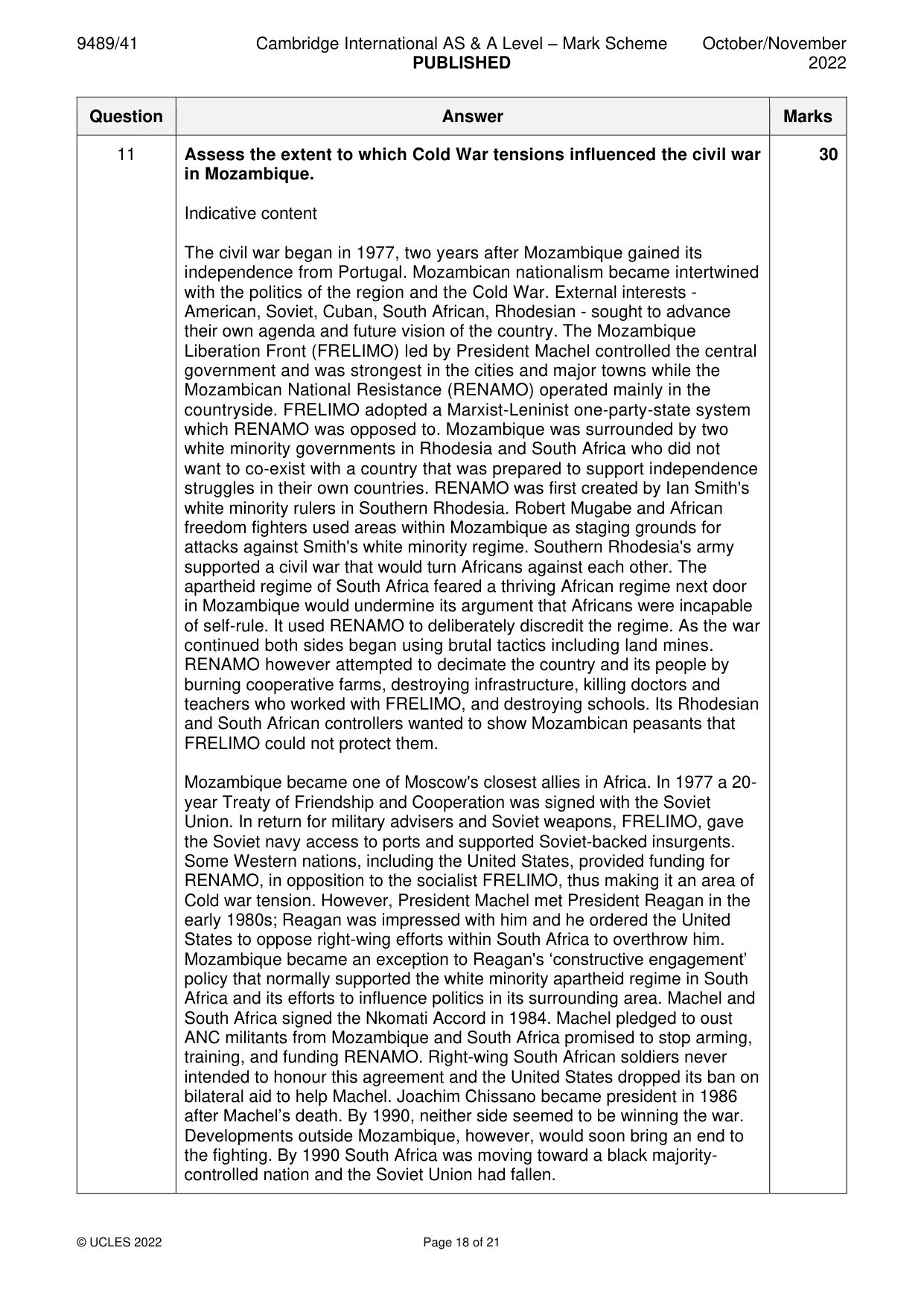
11 Assess the extent to which Cold War tensions influenced the civil war in Mozambique. [30]
Mark scheme: 11 Assess the extent to which Cold War tensions influenced the civil war 30 in Mozambique. Indicative content The civil war began in 1977, two years after Mozambique gained its independence from Portugal. Mozambican nationalism became intertwined with the politics of the region and the Cold War. External interests - American, Soviet, Cuban, South African, Rhodesian - sought to advance their own agenda and future vision of the country. The Mozambique Liberation Front (FRELIMO) led by President Machel controlled the central government and was strongest in the cities and major towns while the Mozambican National Resistance (RENAMO) operated mainly in the countryside. FRELIMO adopted a Marxist-Leninist one-party-state system which RENAMO was opposed to. Mozambique was surrounded by two white minority governments in Rhodesia and South Africa who did not want to co-exist with a country that was prepared to support independence struggles in their own countries. RENAMO was first created by Ian Smith's white minority rulers in Southern Rhodesia. Robert Mugabe and African freedom fighters used areas within Mozambique as staging grounds for attacks against Smith's white minority regime. Southern Rhodesia's army supported a civil war that would turn Africans against each other. The apartheid regime of South Africa feared a thriving African regime next door in Mozambique would undermine its argument that Africans were incapable of self-rule. It used RENAMO to deliberately discredit the regime. As the war continued both sides began using brutal tactics including land mines. RENAMO however attempted to decimate the country and its people by burning cooperative farms, destroying infrastructure, killing doctors and teachers who worked with FRELIMO, and destroying schools. Its Rhodesian and South African controllers wanted to show Mozambican peasants that FRELIMO could not protect them. Mozambique became one of Moscow's closest allies in Africa. In 1977 a 20- year Treaty of Friendship and Cooperation was signed with the Soviet Union. In return for military advisers and Soviet weapons, FRELIMO, gave the Soviet navy access to ports and supported Soviet-backed insurgents. Some Western nations, including the United States, provided funding for RENAMO, in opposition to the socialist FRELIMO, thus making it an area of Cold war tension. However, President Machel met President Reagan in the early 1980s; Reagan was impressed with him and he ordered the United States to oppose right-wing efforts within South Africa to overthrow him. Mozambique became an exception to Reagan's ‘constructive engagement’ policy that normally supported the white minority apartheid regime in South Africa and its efforts to influence politics in its surrounding area. Machel and South Africa signed the Nkomati Accord in 1984. Machel pledged to oust ANC militants from Mozambique and South Africa promised to stop arming, training, and funding RENAMO. Right-wing South African soldiers never intended to honour this agreement and the United States dropped its ban on bilateral aid to help Machel. Joachim Chissano became president in 1986 after Machel’s death. By 1990, neither side seemed to be winning the war. Developments outside Mozambique, however, would soon bring an end to the fighting. By 1990 South Africa was moving toward a black majority- controlled nation and the Soviet Union had fallen. 11 FRELIMO and RENAMO were losing their major supporters and arms suppliers. In 1990, Mozambique adopted a new constitution that included multiparty elections. In 1992, a peace accord was signed in Rome which allowed UN peacekeepers to enter the country.
More questions on How did the rise of extremism affect international relations?
Q12 · Assess the extent to which Jewish resistance to the British mandate contributed to the…
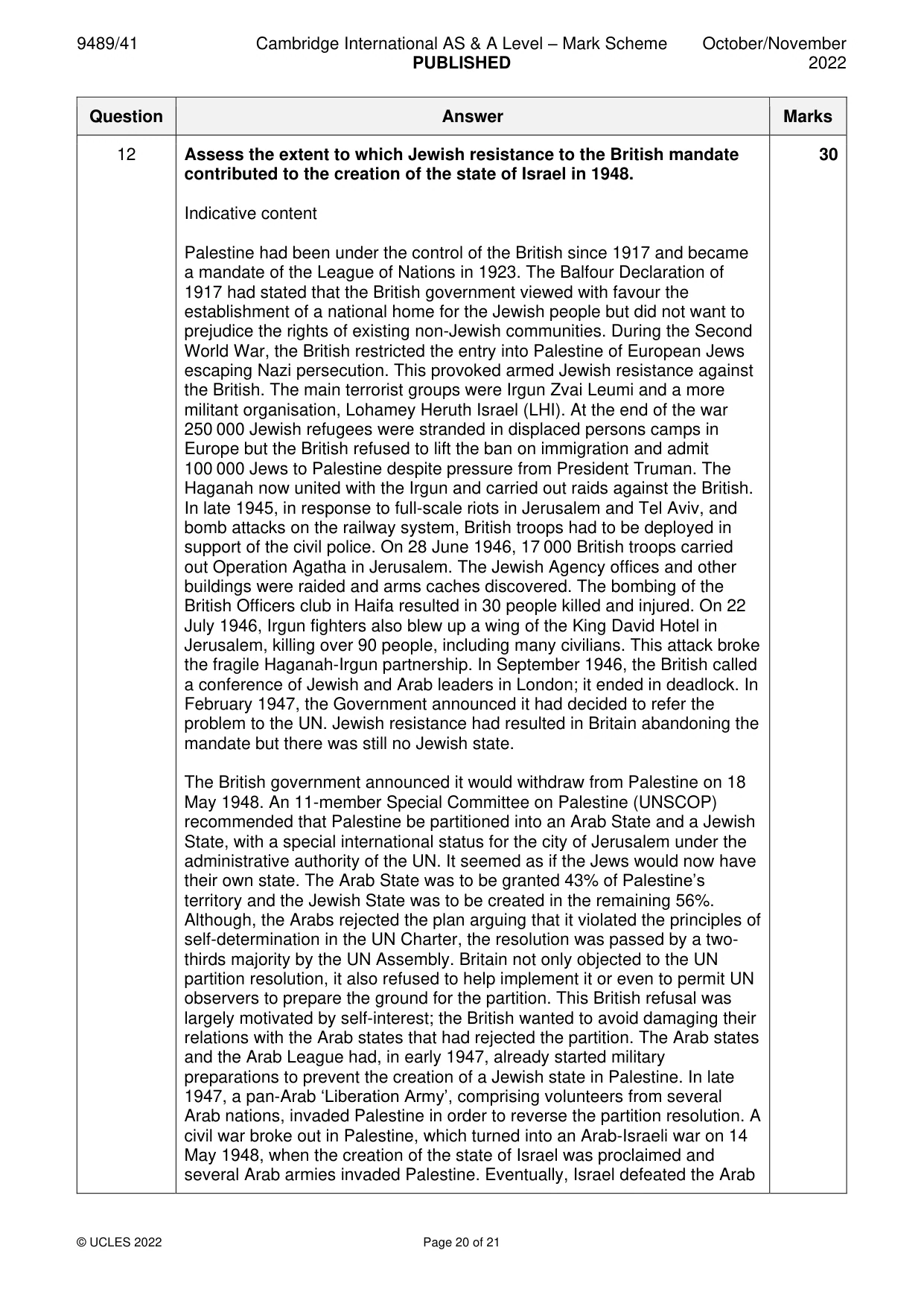
12 Assess the extent to which Jewish resistance to the British mandate contributed to the creation of the state of Israel in 1948. [30]
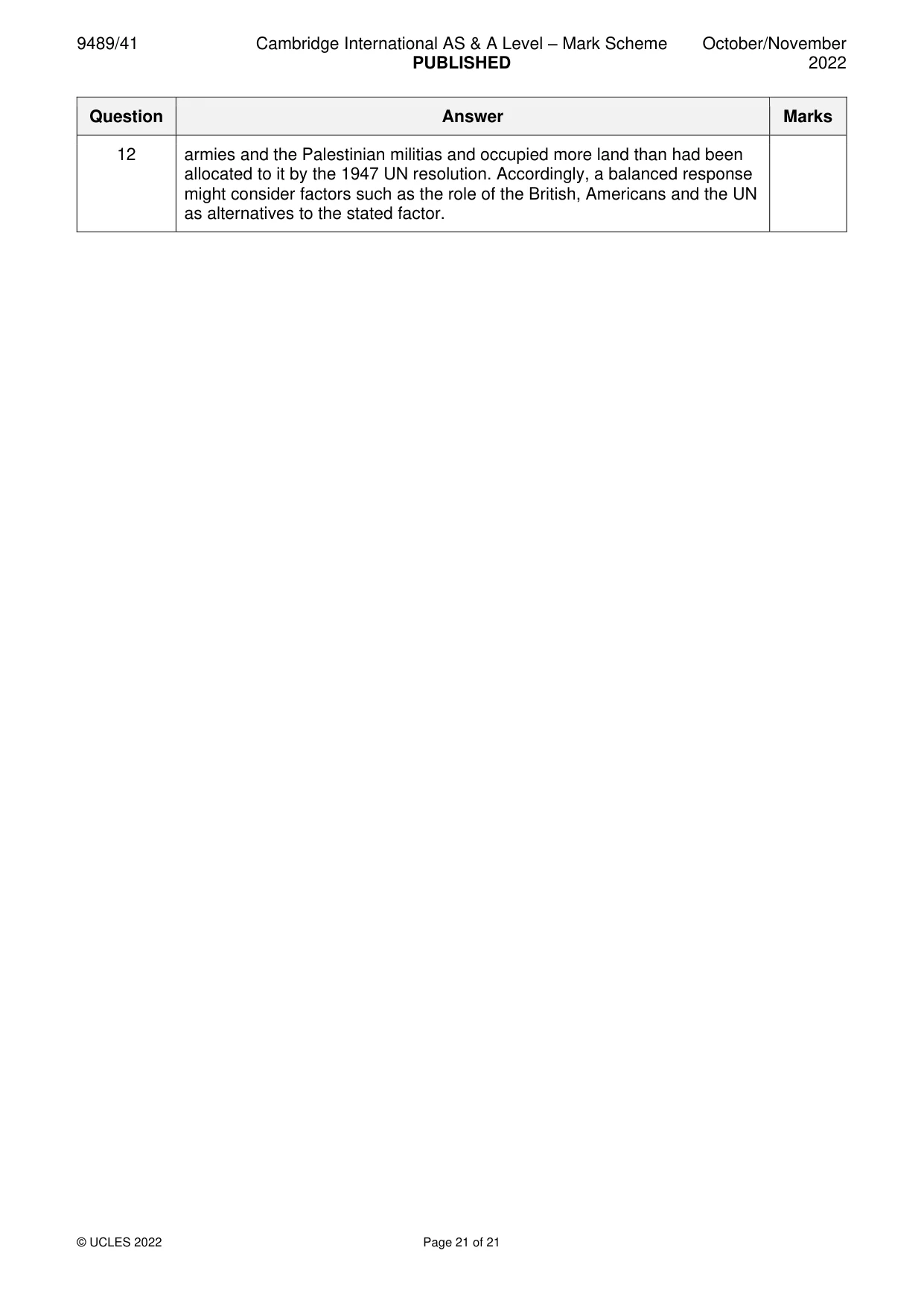
Mark scheme: 12 Assess the extent to which Jewish resistance to the British mandate 30 contributed to the creation of the state of Israel in 1948. Indicative content Palestine had been under the control of the British since 1917 and became a mandate of the League of Nations in 1923. The Balfour Declaration of 1917 had stated that the British government viewed with favour the establishment of a national home for the Jewish people but did not want to prejudice the rights of existing non-Jewish communities. During the Second World War, the British restricted the entry into Palestine of European Jews escaping Nazi persecution. This provoked armed Jewish resistance against the British. The main terrorist groups were Irgun Zvai Leumi and a more militant organisation, Lohamey Heruth Israel (LHI). At the end of the war 250 000 Jewish refugees were stranded in displaced persons camps in Europe but the British refused to lift the ban on immigration and admit 100 000 Jews to Palestine despite pressure from President Truman. The Haganah now united with the Irgun and carried out raids against the British. In late 1945, in response to full-scale riots in Jerusalem and Tel Aviv, and bomb attacks on the railway system, British troops had to be deployed in support of the civil police. On 28 June 1946, 17 000 British troops carried out Operation Agatha in Jerusalem. The Jewish Agency offices and other buildings were raided and arms caches discovered. The bombing of the British Officers club in Haifa resulted in 30 people killed and injured. On 22 July 1946, Irgun fighters also blew up a wing of the King David Hotel in Jerusalem, killing over 90 people, including many civilians. This attack broke the fragile Haganah-Irgun partnership. In September 1946, the British called a conference of Jewish and Arab leaders in London; it ended in deadlock. In February 1947, the Government announced it had decided to refer the problem to the UN. Jewish resistance had resulted in Britain abandoning the mandate but there was still no Jewish state. The British government announced it would withdraw from Palestine on 18 May 1948. An 11-member Special Committee on Palestine (UNSCOP) recommended that Palestine be partitioned into an Arab State and a Jewish State, with a special international status for the city of Jerusalem under the administrative authority of the UN. It seemed as if the Jews would now have their own state. The Arab State was to be granted 43% of Palestine’s territory and the Jewish State was to be created in the remaining 56%. Although, the Arabs rejected the plan arguing that it violated the principles of self-determination in the UN Charter, the resolution was passed by a two- thirds majority by the UN Assembly. Britain not only objected to the UN partition resolution, it also refused to help implement it or even to permit UN observers to prepare the ground for the partition. This British refusal was largely motivated by self-interest; the British wanted to avoid damaging their relations with the Arab states that had rejected the partition. The Arab states and the Arab League had, in early 1947, already started military preparations to prevent the creation of a Jewish state in Palestine. In late 1947, a pan-Arab ‘Liberation Army’, comprising volunteers from several Arab nations, invaded Palestine in order to reverse the partition resolution. A civil war broke out in Palestine, which turned into an Arab-Israeli war on 14 May 1948, when the creation of the state of Israel was proclaimed and several Arab armies invaded Palestine. Eventually, Israel defeated the Arab 12 armies and the Palestinian militias and occupied more land than had been allocated to it by the 1947 UN resolution. Accordingly, a balanced response might consider factors such as the role of the British, Americans and the UN as alternatives to the stated factor.
What was in this paper
The subtopics covered by these 12 questions, and how many questions each got. Open one in a new tab to see every Cambridge question on it.
4How successful was the Progressive Movement from 1890 to 1920?2Why did the USA emerge as a world power and what was the impact on international2How were the Bolsheviks able to consolidate their power up to 1924?1What was the impact of the Great Crash and the Great Depression in the United States?1What were the consequences of the rapid economic growth after 1870?1Why did war break out in 1939?1What you needed in this session
Cambridge’s own grade thresholds for 2022 Oct/Nov, Paper 4 · Variant 1. A higher threshold means an easier paper — the bar moves with how the cohort did.