Cambridge A Level History 9489 — 2022 Feb/March Paper 4 · Variant 2
9489/42/F/M/22 · 11 questions · 60 marks · ≈68 min
The question paper and its mark scheme, free to read here and free to download. This is Cambridge’s own paper, exactly as it was sat.
Question paper4 pages
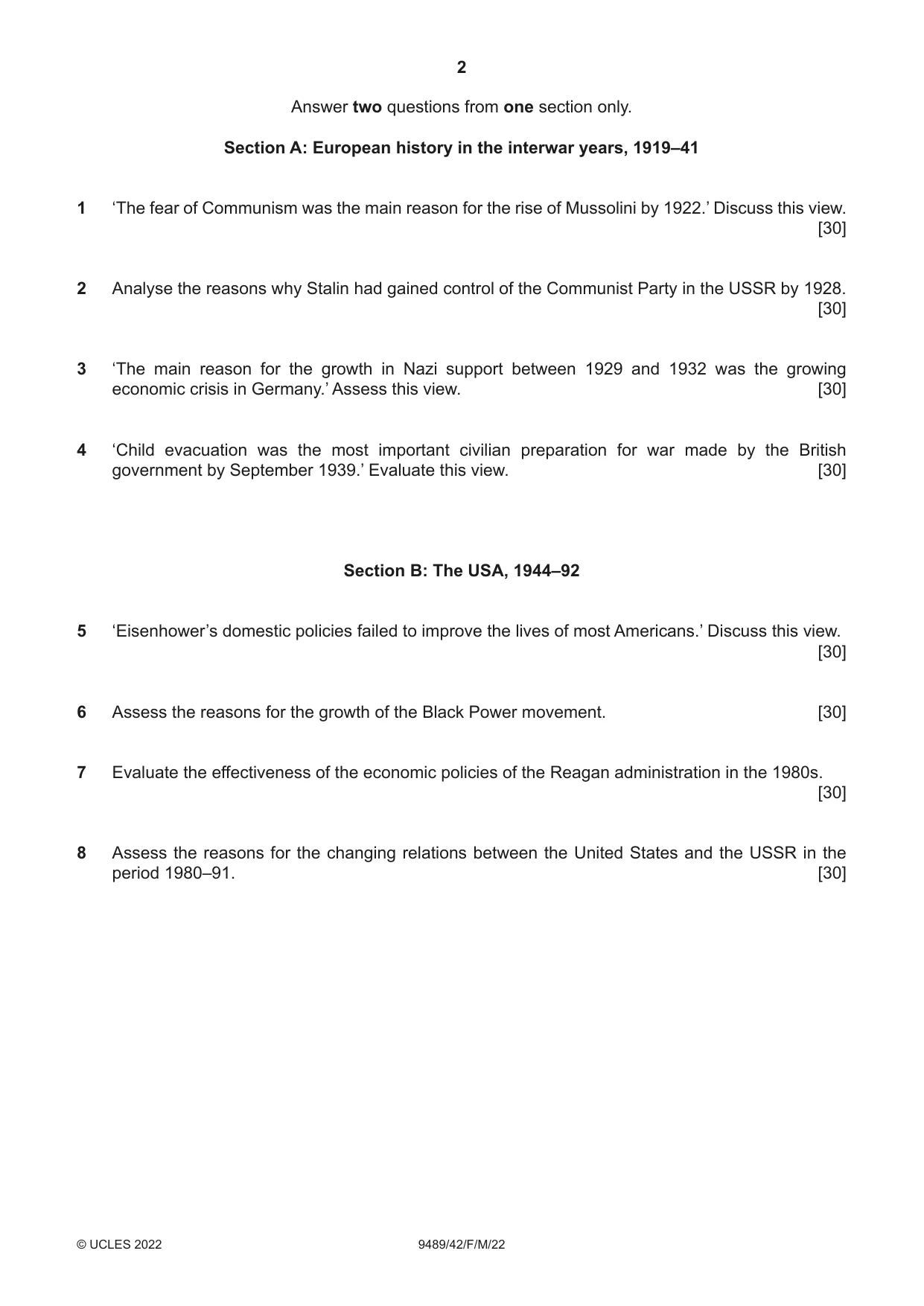
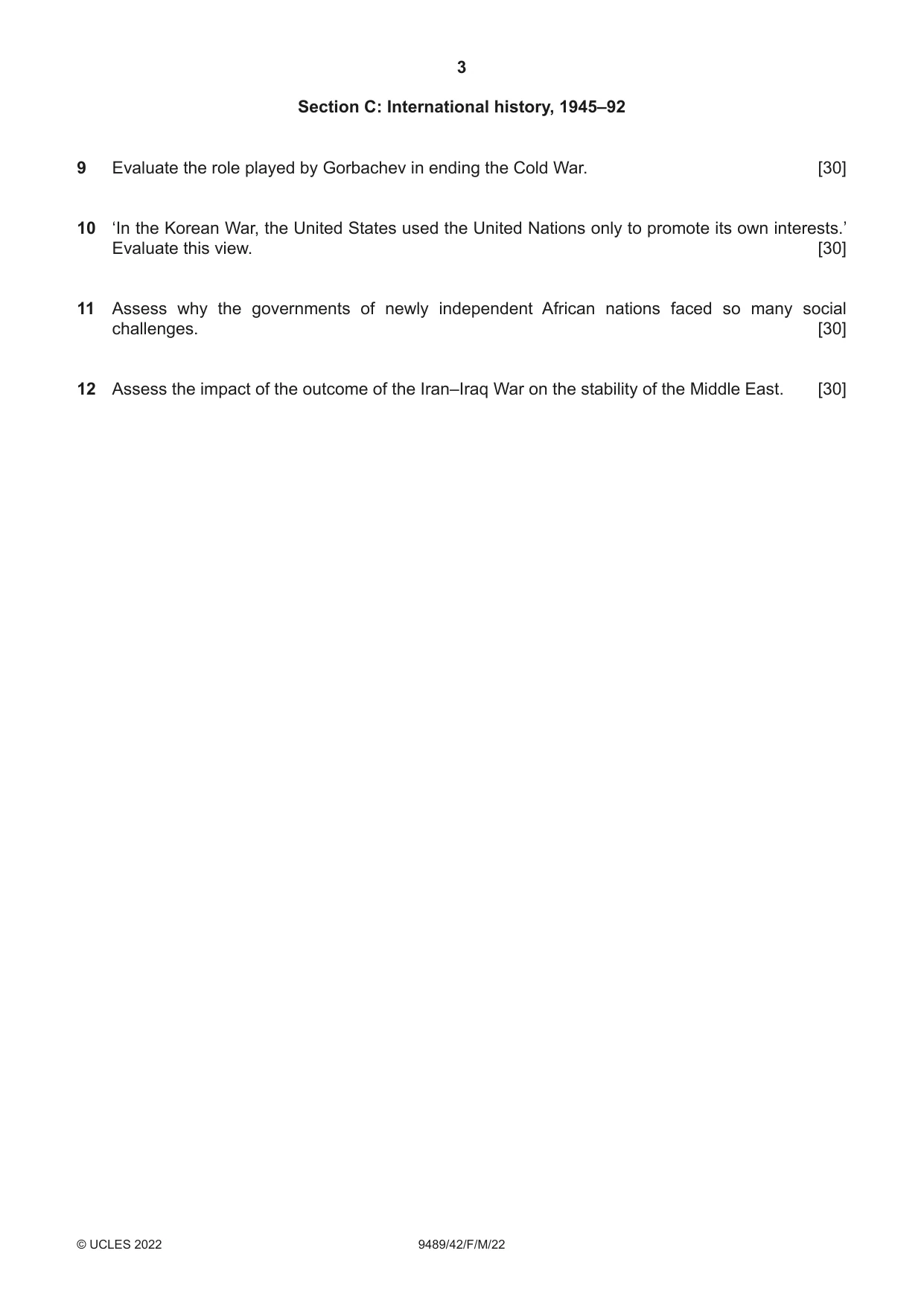
Mark scheme18 pages
Answers below. Sit the paper first if you are practising.

Questions as text
Q1 · ‘The fear of Communism was the main reason for the rise of Mussolini by 1922.’ Discuss…
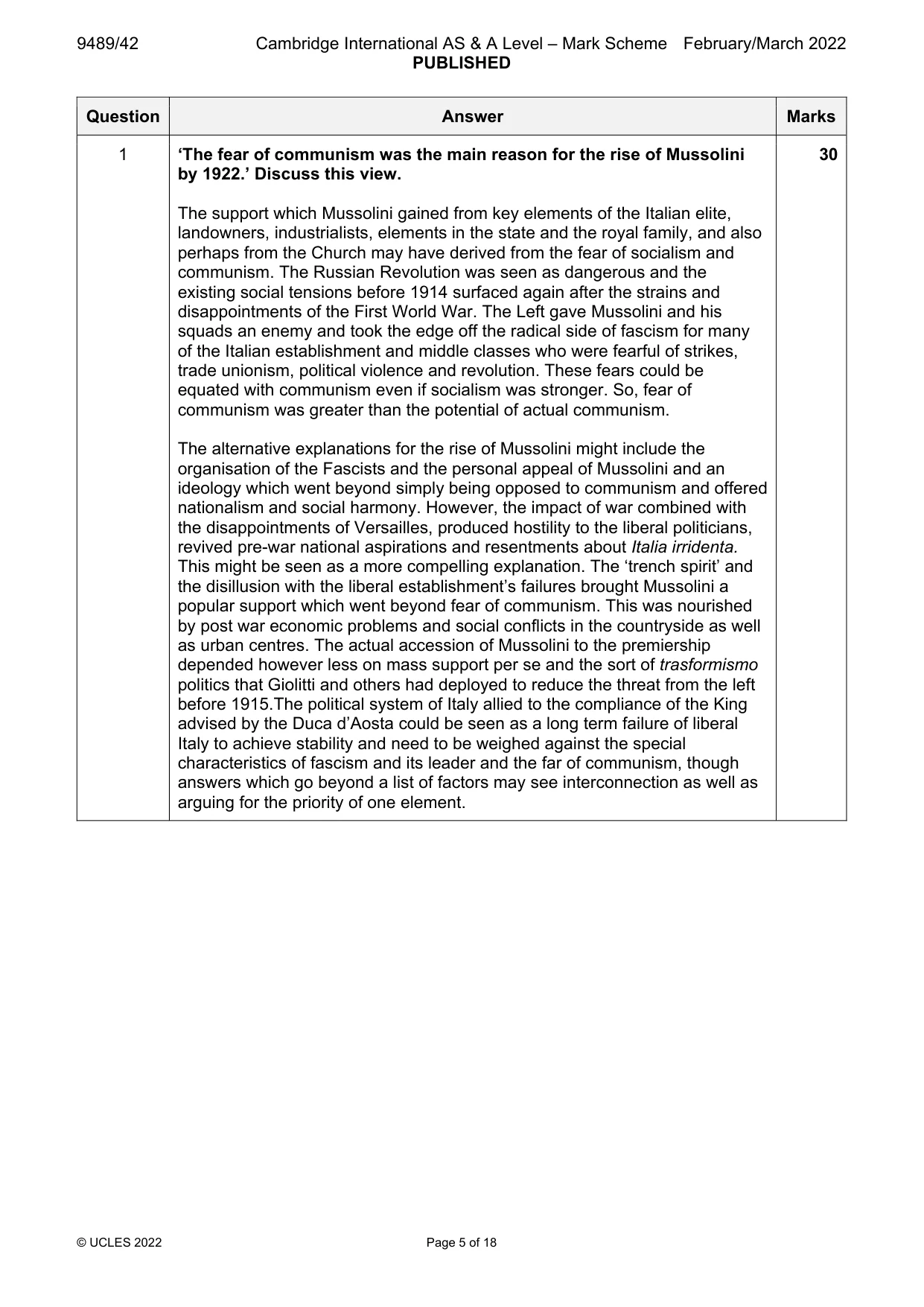
1 ‘The fear of Communism was the main reason for the rise of Mussolini by 1922.’ Discuss this view. [30]
Mark scheme: Question Answer Marks 1 ‘The fear of communism was the main reason for the rise of Mussolini 30 by 1922.’ Discuss this view. The support which Mussolini gained from key elements of the Italian elite, landowners, industrialists, elements in the state and the royal family, and also perhaps from the Church may have derived from the fear of socialism and communism. The Russian Revolution was seen as dangerous and the existing social tensions before 1914 surfaced again after the strains and disappointments of the First World War. The Left gave Mussolini and his squads an enemy and took the edge off the radical side of fascism for many of the Italian establishment and middle classes who were fearful of strikes, trade unionism, political violence and revolution. These fears could be equated with communism even if socialism was stronger. So, fear of communism was greater than the potential of actual communism. The alternative explanations for the rise of Mussolini might include the organisation of the Fascists and the personal appeal of Mussolini and an ideology which went beyond simply being opposed to communism and offered nationalism and social harmony. However, the impact of war combined with the disappointments of Versailles, produced hostility to the liberal politicians, revived pre-war national aspirations and resentments about Italia irridenta. This might be seen as a more compelling explanation. The ‘trench spirit’ and the disillusion with the liberal establishment’s failures brought Mussolini a popular support which went beyond fear of communism. This was nourished by post war economic problems and social conflicts in the countryside as well as urban centres. The actual accession of Mussolini to the premiership depended however less on mass support per se and the sort of trasformismo politics that Giolitti and others had deployed to reduce the threat from the left before 1915.The political system of Italy allied to the compliance of the King advised by the Duca d’Aosta could be seen as a long term failure of liberal Italy to achieve stability and need to be weighed against the special characteristics of fascism and its leader and the far of communism, though answers which go beyond a list of factors may see interconnection as well as arguing for the priority of one element.
More questions on How did the rise of extremism affect international relations?
Q2 · Analyse the reasons why Stalin had gained control of the Communist Party in the USSR by…
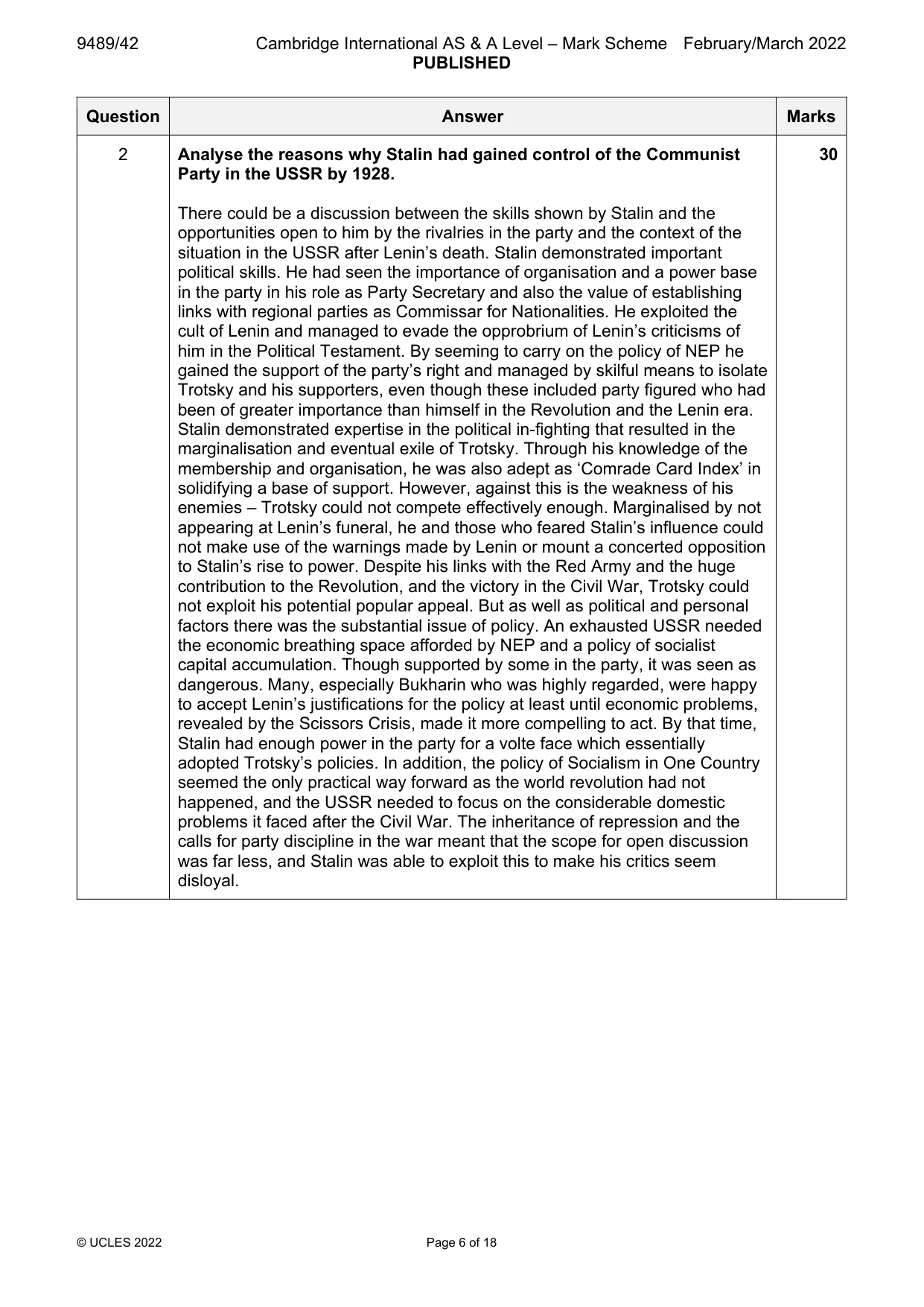
2 Analyse the reasons why Stalin had gained control of the Communist Party in the USSR by 1928. [30]
Mark scheme: 2 Analyse the reasons why Stalin had gained control of the Communist 30 Party in the USSR by 1928. There could be a discussion between the skills shown by Stalin and the opportunities open to him by the rivalries in the party and the context of the situation in the USSR after Lenin’s death. Stalin demonstrated important political skills. He had seen the importance of organisation and a power base in the party in his role as Party Secretary and also the value of establishing links with regional parties as Commissar for Nationalities. He exploited the cult of Lenin and managed to evade the opprobrium of Lenin’s criticisms of him in the Political Testament. By seeming to carry on the policy of NEP he gained the support of the party’s right and managed by skilful means to isolate Trotsky and his supporters, even though these included party figured who had been of greater importance than himself in the Revolution and the Lenin era. Stalin demonstrated expertise in the political in-fighting that resulted in the marginalisation and eventual exile of Trotsky. Through his knowledge of the membership and organisation, he was also adept as ‘Comrade Card Index’ in solidifying a base of support. However, against this is the weakness of his enemies – Trotsky could not compete effectively enough. Marginalised by not appearing at Lenin’s funeral, he and those who feared Stalin’s influence could not make use of the warnings made by Lenin or mount a concerted opposition to Stalin’s rise to power. Despite his links with the Red Army and the huge contribution to the Revolution, and the victory in the Civil War, Trotsky could not exploit his potential popular appeal. But as well as political and personal factors there was the substantial issue of policy. An exhausted USSR needed the economic breathing space afforded by NEP and a policy of socialist capital accumulation. Though supported by some in the party, it was seen as dangerous. Many, especially Bukharin who was highly regarded, were happy to accept Lenin’s justifications for the policy at least until economic problems, revealed by the Scissors Crisis, made it more compelling to act. By that time, Stalin had enough power in the party for a volte face which essentially adopted Trotsky’s policies. In addition, the policy of Socialism in One Country seemed the only practical way forward as the world revolution had not happened, and the USSR needed to focus on the considerable domestic problems it faced after the Civil War. The inheritance of repression and the calls for party discipline in the war meant that the scope for open discussion was far less, and Stalin was able to exploit this to make his critics seem disloyal.
More questions on How were the Bolsheviks able to consolidate their power up to 1924?
Q3 · ‘The main reason for the growth in Nazi support between 1929 and 1932 was the growing…
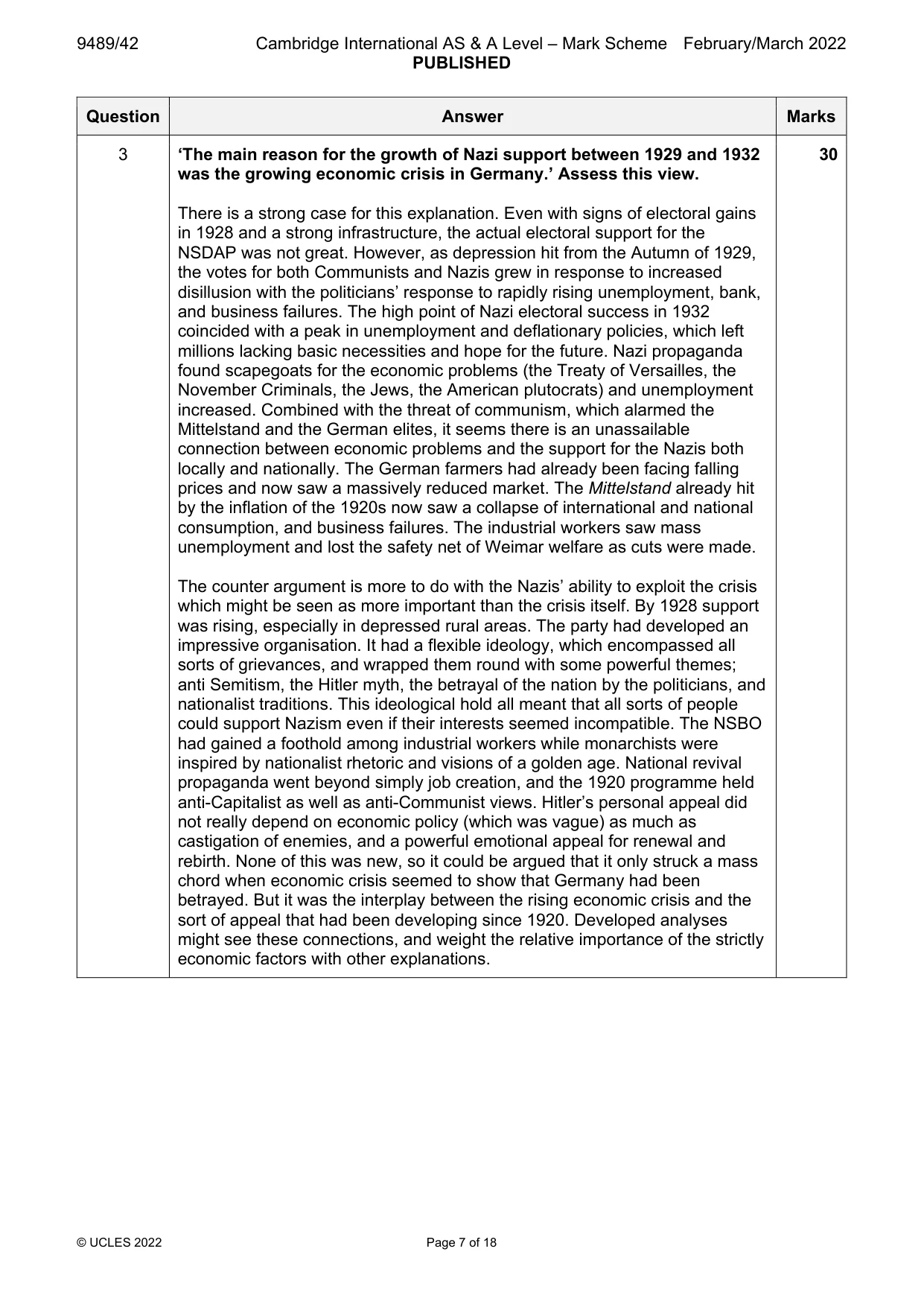
3 ‘The main reason for the growth in Nazi support between 1929 and 1932 was the growing economic crisis in Germany.’ Assess this view. [30]
Mark scheme: 3 ‘The main reason for the growth of Nazi support between 1929 and 1932 30 was the growing economic crisis in Germany.’ Assess this view. There is a strong case for this explanation. Even with signs of electoral gains in 1928 and a strong infrastructure, the actual electoral support for the NSDAP was not great. However, as depression hit from the Autumn of 1929, the votes for both Communists and Nazis grew in response to increased disillusion with the politicians’ response to rapidly rising unemployment, bank, and business failures. The high point of Nazi electoral success in 1932 coincided with a peak in unemployment and deflationary policies, which left millions lacking basic necessities and hope for the future. Nazi propaganda found scapegoats for the economic problems (the Treaty of Versailles, the November Criminals, the Jews, the American plutocrats) and unemployment increased. Combined with the threat of communism, which alarmed the Mittelstand and the German elites, it seems there is an unassailable connection between economic problems and the support for the Nazis both locally and nationally. The German farmers had already been facing falling prices and now saw a massively reduced market. The Mittelstand already hit by the inflation of the 1920s now saw a collapse of international and national consumption, and business failures. The industrial workers saw mass unemployment and lost the safety net of Weimar welfare as cuts were made. The counter argument is more to do with the Nazis’ ability to exploit the crisis which might be seen as more important than the crisis itself. By 1928 support was rising, especially in depressed rural areas. The party had developed an impressive organisation. It had a flexible ideology, which encompassed all sorts of grievances, and wrapped them round with some powerful themes; anti Semitism, the Hitler myth, the betrayal of the nation by the politicians, and nationalist traditions. This ideological hold all meant that all sorts of people could support Nazism even if their interests seemed incompatible. The NSBO had gained a foothold among industrial workers while monarchists were inspired by nationalist rhetoric and visions of a golden age. National revival propaganda went beyond simply job creation, and the 1920 programme held anti-Capitalist as well as anti-Communist views. Hitler’s personal appeal did not really depend on economic policy (which was vague) as much as castigation of enemies, and a powerful emotional appeal for renewal and rebirth. None of this was new, so it could be argued that it only struck a mass chord when economic crisis seemed to show that Germany had been betrayed. But it was the interplay between the rising economic crisis and the sort of appeal that had been developing since 1920. Developed analyses might see these connections, and weight the relative importance of the strictly economic factors with other explanations.
More questions on How did the rise of extremism affect international relations?
Q4 · ‘Child evacuation was the most important civilian preparation for war made by the British…
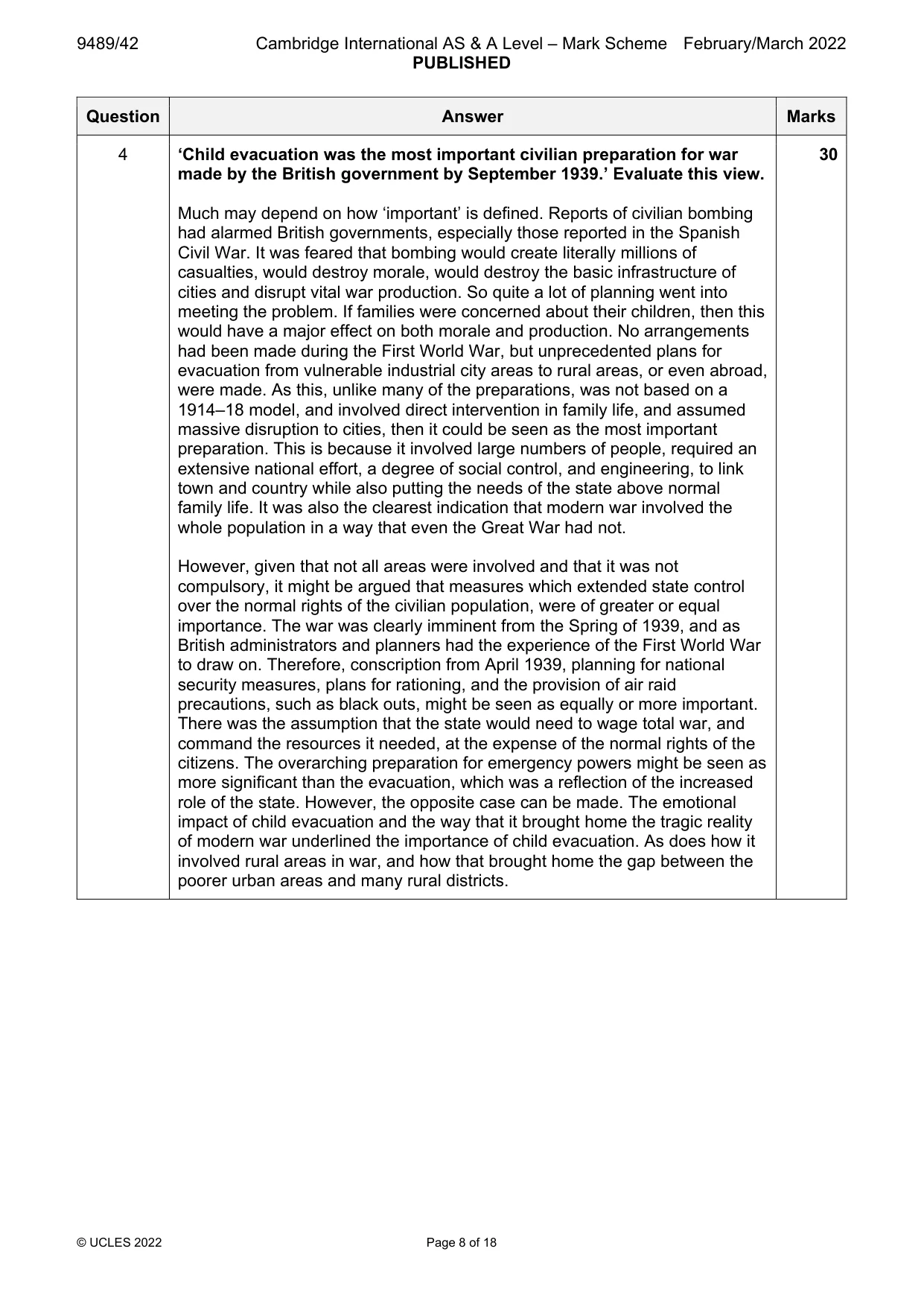
4 ‘Child evacuation was the most important civilian preparation for war made by the British government by September 1939.’ Evaluate this view. [30]
Mark scheme: 4 ‘Child evacuation was the most important civilian preparation for war 30 made by the British government by September 1939.’ Evaluate this view. Much may depend on how ‘important’ is defined. Reports of civilian bombing had alarmed British governments, especially those reported in the Spanish Civil War. It was feared that bombing would create literally millions of casualties, would destroy morale, would destroy the basic infrastructure of cities and disrupt vital war production. So quite a lot of planning went into meeting the problem. If families were concerned about their children, then this would have a major effect on both morale and production. No arrangements had been made during the First World War, but unprecedented plans for evacuation from vulnerable industrial city areas to rural areas, or even abroad, were made. As this, unlike many of the preparations, was not based on a 1914–18 model, and involved direct intervention in family life, and assumed massive disruption to cities, then it could be seen as the most important preparation. This is because it involved large numbers of people, required an extensive national effort, a degree of social control, and engineering, to link town and country while also putting the needs of the state above normal family life. It was also the clearest indication that modern war involved the whole population in a way that even the Great War had not. However, given that not all areas were involved and that it was not compulsory, it might be argued that measures which extended state control over the normal rights of the civilian population, were of greater or equal importance. The war was clearly imminent from the Spring of 1939, and as British administrators and planners had the experience of the First World War to draw on. Therefore, conscription from April 1939, planning for national security measures, plans for rationing, and the provision of air raid precautions, such as black outs, might be seen as equally or more important. There was the assumption that the state would need to wage total war, and command the resources it needed, at the expense of the normal rights of the citizens. The overarching preparation for emergency powers might be seen as more significant than the evacuation, which was a reflection of the increased role of the state. However, the opposite case can be made. The emotional impact of child evacuation and the way that it brought home the tragic reality of modern war underlined the importance of child evacuation. As does how it involved rural areas in war, and how that brought home the gap between the poorer urban areas and many rural districts.
Q5 · ‘Eisenhower’s domestic policies failed to improve the lives of most Americans.’ Discuss…
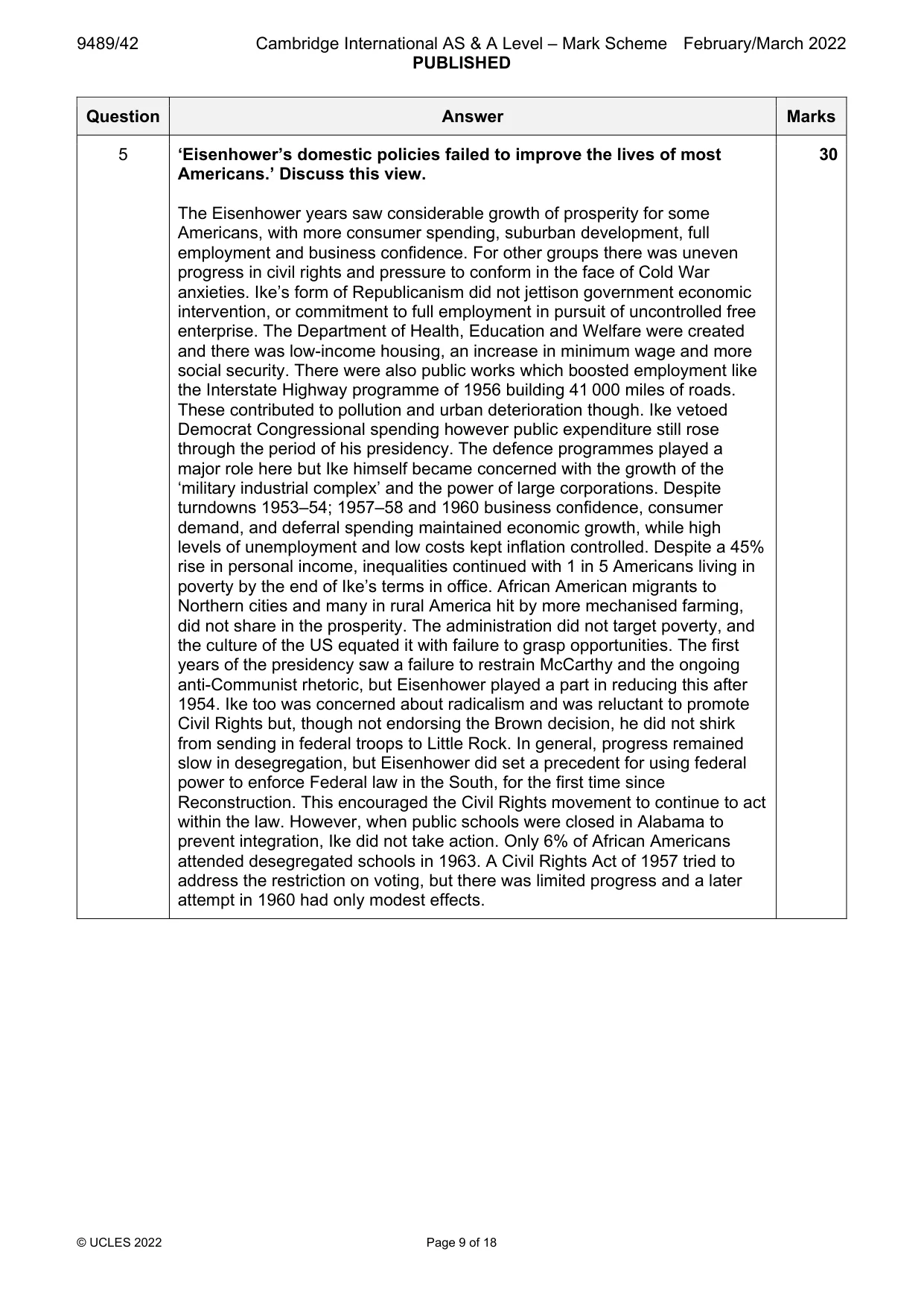
5 ‘Eisenhower’s domestic policies failed to improve the lives of most Americans.’ Discuss this view. [30]
Mark scheme: 5 ‘Eisenhower’s domestic policies failed to improve the lives of most 30 Americans.’ Discuss this view. The Eisenhower years saw considerable growth of prosperity for some Americans, with more consumer spending, suburban development, full employment and business confidence. For other groups there was uneven progress in civil rights and pressure to conform in the face of Cold War anxieties. Ike’s form of Republicanism did not jettison government economic intervention, or commitment to full employment in pursuit of uncontrolled free enterprise. The Department of Health, Education and Welfare were created and there was low-income housing, an increase in minimum wage and more social security. There were also public works which boosted employment like the Interstate Highway programme of 1956 building 41 000 miles of roads. These contributed to pollution and urban deterioration though. Ike vetoed Democrat Congressional spending however public expenditure still rose through the period of his presidency. The defence programmes played a major role here but Ike himself became concerned with the growth of the ‘military industrial complex’ and the power of large corporations. Despite turndowns 1953–54; 1957–58 and 1960 business confidence, consumer demand, and deferral spending maintained economic growth, while high levels of unemployment and low costs kept inflation controlled. Despite a 45% rise in personal income, inequalities continued with 1 in 5 Americans living in poverty by the end of Ike’s terms in office. African American migrants to Northern cities and many in rural America hit by more mechanised farming, did not share in the prosperity. The administration did not target poverty, and the culture of the US equated it with failure to grasp opportunities. The first years of the presidency saw a failure to restrain McCarthy and the ongoing anti-Communist rhetoric, but Eisenhower played a part in reducing this after 1954. Ike too was concerned about radicalism and was reluctant to promote Civil Rights but, though not endorsing the Brown decision, he did not shirk from sending in federal troops to Little Rock. In general, progress remained slow in desegregation, but Eisenhower did set a precedent for using federal power to enforce Federal law in the South, for the first time since Reconstruction. This encouraged the Civil Rights movement to continue to act within the law. However, when public schools were closed in Alabama to prevent integration, Ike did not take action. Only 6% of African Americans attended desegregated schools in 1963. A Civil Rights Act of 1957 tried to address the restriction on voting, but there was limited progress and a later attempt in 1960 had only modest effects.
More questions on How successful was the Progressive Movement from 1890 to 1920?
Q6 · Assess the reasons for the growth of the Black Power movement
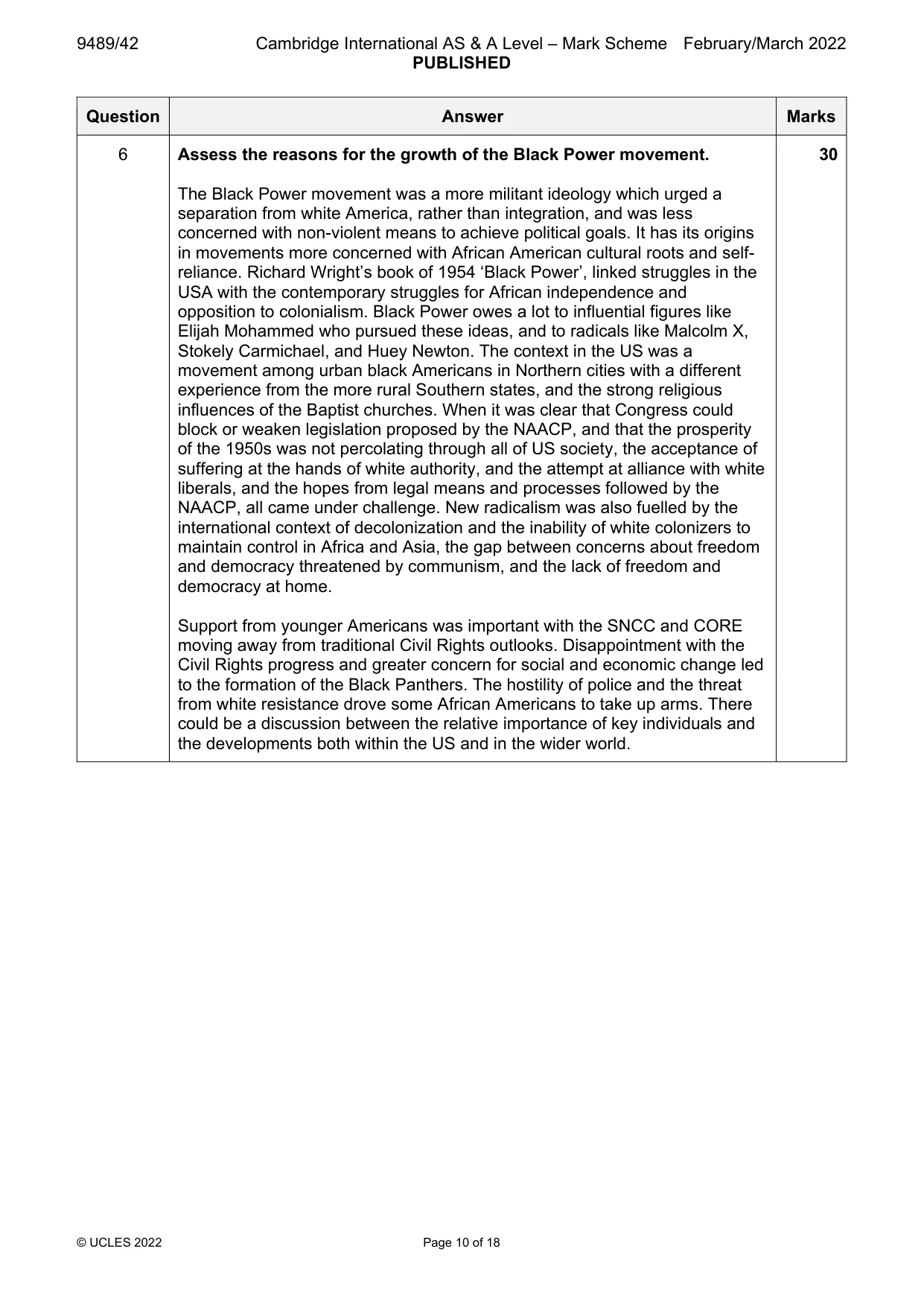
6 Assess the reasons for the growth of the Black Power movement. [30]
Mark scheme: 6 Assess the reasons for the growth of the Black Power movement. 30 The Black Power movement was a more militant ideology which urged a separation from white America, rather than integration, and was less concerned with non-violent means to achieve political goals. It has its origins in movements more concerned with African American cultural roots and self- reliance. Richard Wright’s book of 1954 ‘Black Power’, linked struggles in the USA with the contemporary struggles for African independence and opposition to colonialism. Black Power owes a lot to influential figures like Elijah Mohammed who pursued these ideas, and to radicals like Malcolm X, Stokely Carmichael, and Huey Newton. The context in the US was a movement among urban black Americans in Northern cities with a different experience from the more rural Southern states, and the strong religious influences of the Baptist churches. When it was clear that Congress could block or weaken legislation proposed by the NAACP, and that the prosperity of the 1950s was not percolating through all of US society, the acceptance of suffering at the hands of white authority, and the attempt at alliance with white liberals, and the hopes from legal means and processes followed by the NAACP, all came under challenge. New radicalism was also fuelled by the international context of decolonization and the inability of white colonizers to maintain control in Africa and Asia, the gap between concerns about freedom and democracy threatened by communism, and the lack of freedom and democracy at home. Support from younger Americans was important with the SNCC and CORE moving away from traditional Civil Rights outlooks. Disappointment with the Civil Rights progress and greater concern for social and economic change led to the formation of the Black Panthers. The hostility of police and the threat from white resistance drove some African Americans to take up arms. There could be a discussion between the relative importance of key individuals and the developments both within the US and in the wider world.
More questions on How successful was the Progressive Movement from 1890 to 1920?
Q7 · Evaluate the effectiveness of the economic policies of the Reagan administration in the…
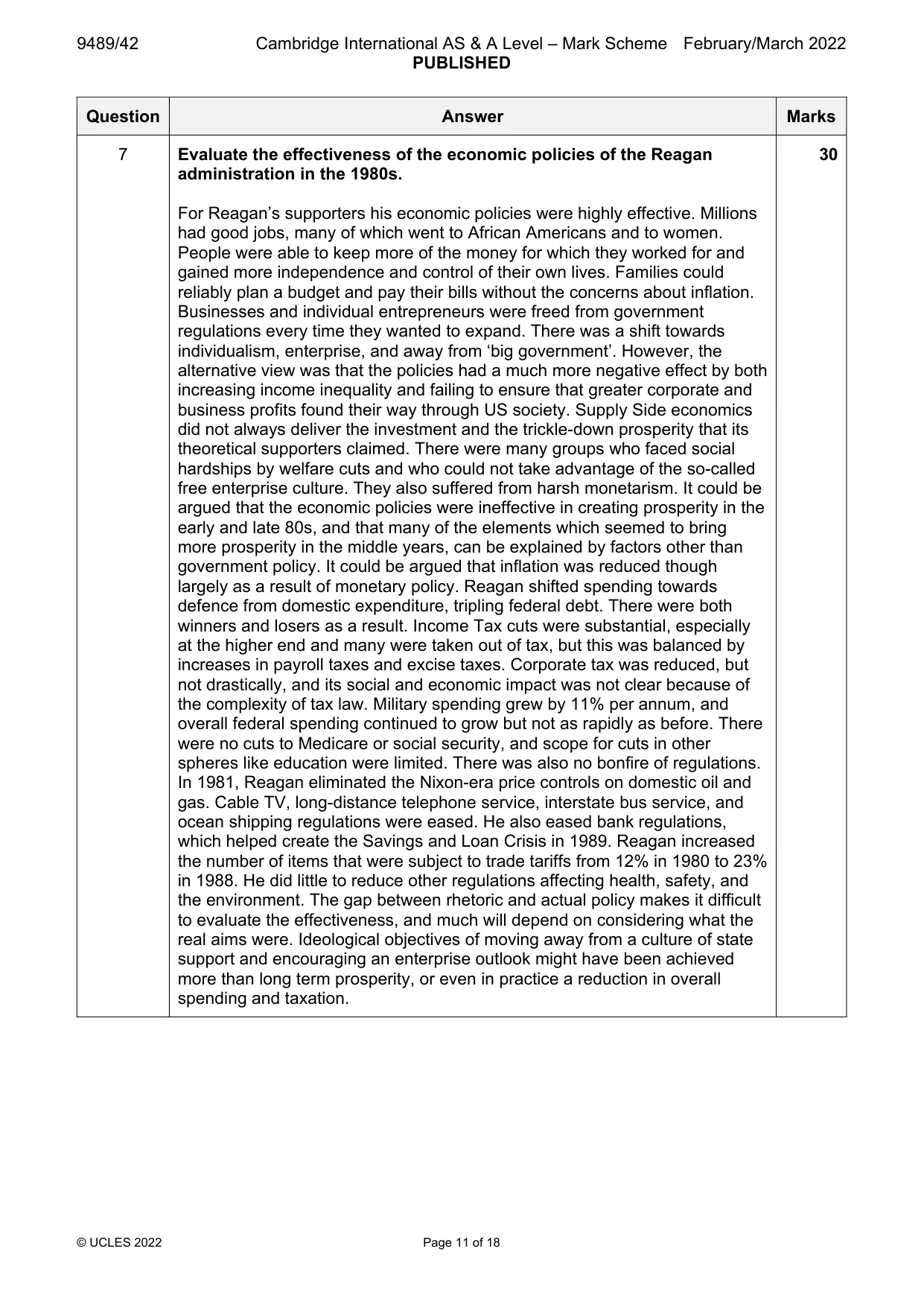
7 Evaluate the effectiveness of the economic policies of the Reagan administration in the 1980s. [30]
Mark scheme: 7 Evaluate the effectiveness of the economic policies of the Reagan 30 administration in the 1980s. For Reagan’s supporters his economic policies were highly effective. Millions had good jobs, many of which went to African Americans and to women. People were able to keep more of the money for which they worked for and gained more independence and control of their own lives. Families could reliably plan a budget and pay their bills without the concerns about inflation. Businesses and individual entrepreneurs were freed from government regulations every time they wanted to expand. There was a shift towards individualism, enterprise, and away from ‘big government’. However, the alternative view was that the policies had a much more negative effect by both increasing income inequality and failing to ensure that greater corporate and business profits found their way through US society. Supply Side economics did not always deliver the investment and the trickle-down prosperity that its theoretical supporters claimed. There were many groups who faced social hardships by welfare cuts and who could not take advantage of the so-called free enterprise culture. They also suffered from harsh monetarism. It could be argued that the economic policies were ineffective in creating prosperity in the early and late 80s, and that many of the elements which seemed to bring more prosperity in the middle years, can be explained by factors other than government policy. It could be argued that inflation was reduced though largely as a result of monetary policy. Reagan shifted spending towards defence from domestic expenditure, tripling federal debt. There were both winners and losers as a result. Income Tax cuts were substantial, especially at the higher end and many were taken out of tax, but this was balanced by increases in payroll taxes and excise taxes. Corporate tax was reduced, but not drastically, and its social and economic impact was not clear because of the complexity of tax law. Military spending grew by 11% per annum, and overall federal spending continued to grow but not as rapidly as before. There were no cuts to Medicare or social security, and scope for cuts in other spheres like education were limited. There was also no bonfire of regulations. In 1981, Reagan eliminated the Nixon-era price controls on domestic oil and gas. Cable TV, long-distance telephone service, interstate bus service, and ocean shipping regulations were eased. He also eased bank regulations, which helped create the Savings and Loan Crisis in 1989. Reagan increased the number of items that were subject to trade tariffs from 12% in 1980 to 23% in 1988. He did little to reduce other regulations affecting health, safety, and the environment. The gap between rhetoric and actual policy makes it difficult to evaluate the effectiveness, and much will depend on considering what the real aims were. Ideological objectives of moving away from a culture of state support and encouraging an enterprise outlook might have been achieved more than long term prosperity, or even in practice a reduction in overall spending and taxation.
More questions on What were the consequences of the rapid economic growth after 1870?
Q8 · Assess the reasons for the changing relations between the United States and the USSR in…
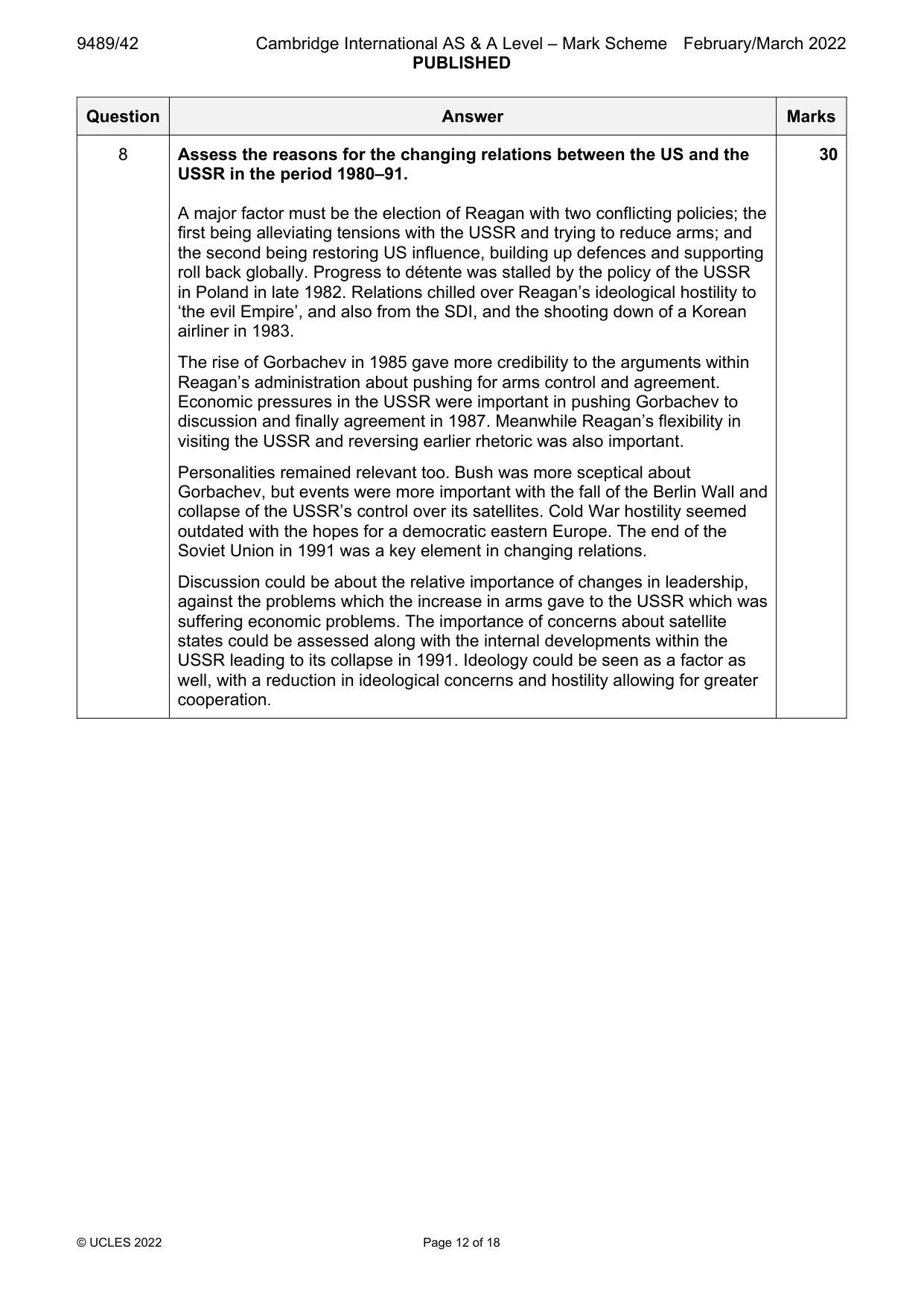
8 Assess the reasons for the changing relations between the United States and the USSR in the period 1980–91. [30] Section C: International history, 1945–92
Mark scheme: 8 Assess the reasons for the changing relations between the US and the 30 USSR in the period 1980–91. A major factor must be the election of Reagan with two conflicting policies; the first being alleviating tensions with the USSR and trying to reduce arms; and the second being restoring US influence, building up defences and supporting roll back globally. Progress to détente was stalled by the policy of the USSR in Poland in late 1982. Relations chilled over Reagan’s ideological hostility to ‘the evil Empire’, and also from the SDI, and the shooting down of a Korean airliner in 1983. The rise of Gorbachev in 1985 gave more credibility to the arguments within Reagan’s administration about pushing for arms control and agreement. Economic pressures in the USSR were important in pushing Gorbachev to discussion and finally agreement in 1987. Meanwhile Reagan’s flexibility in visiting the USSR and reversing earlier rhetoric was also important. Personalities remained relevant too. Bush was more sceptical about Gorbachev, but events were more important with the fall of the Berlin Wall and collapse of the USSR’s control over its satellites. Cold War hostility seemed outdated with the hopes for a democratic eastern Europe. The end of the Soviet Union in 1991 was a key element in changing relations. Discussion could be about the relative importance of changes in leadership, against the problems which the increase in arms gave to the USSR which was suffering economic problems. The importance of concerns about satellite states could be assessed along with the internal developments within the USSR leading to its collapse in 1991. Ideology could be seen as a factor as well, with a reduction in ideological concerns and hostility allowing for greater cooperation.
Q9 · Evaluate the role played by Gorbachev in ending the Cold War
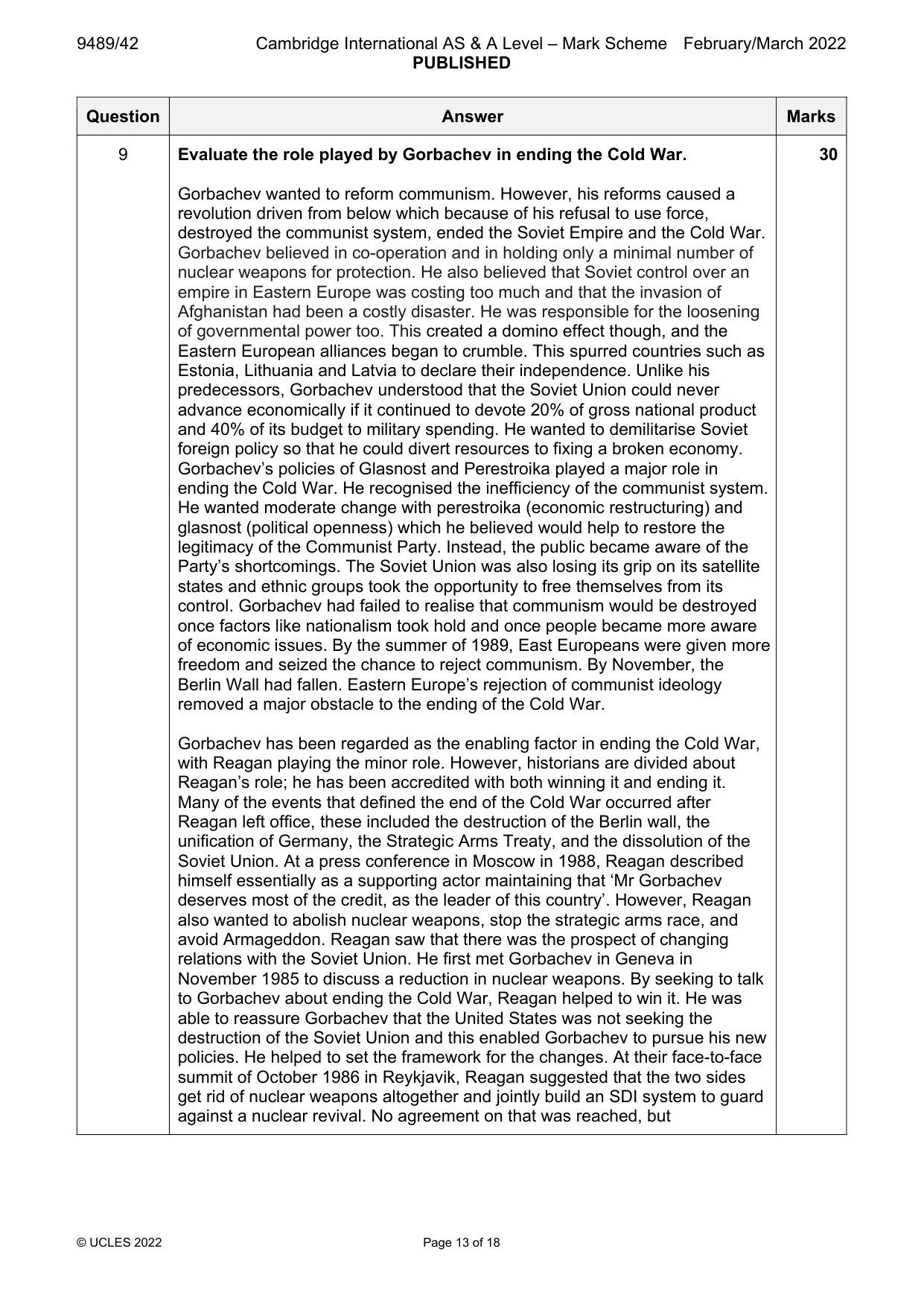
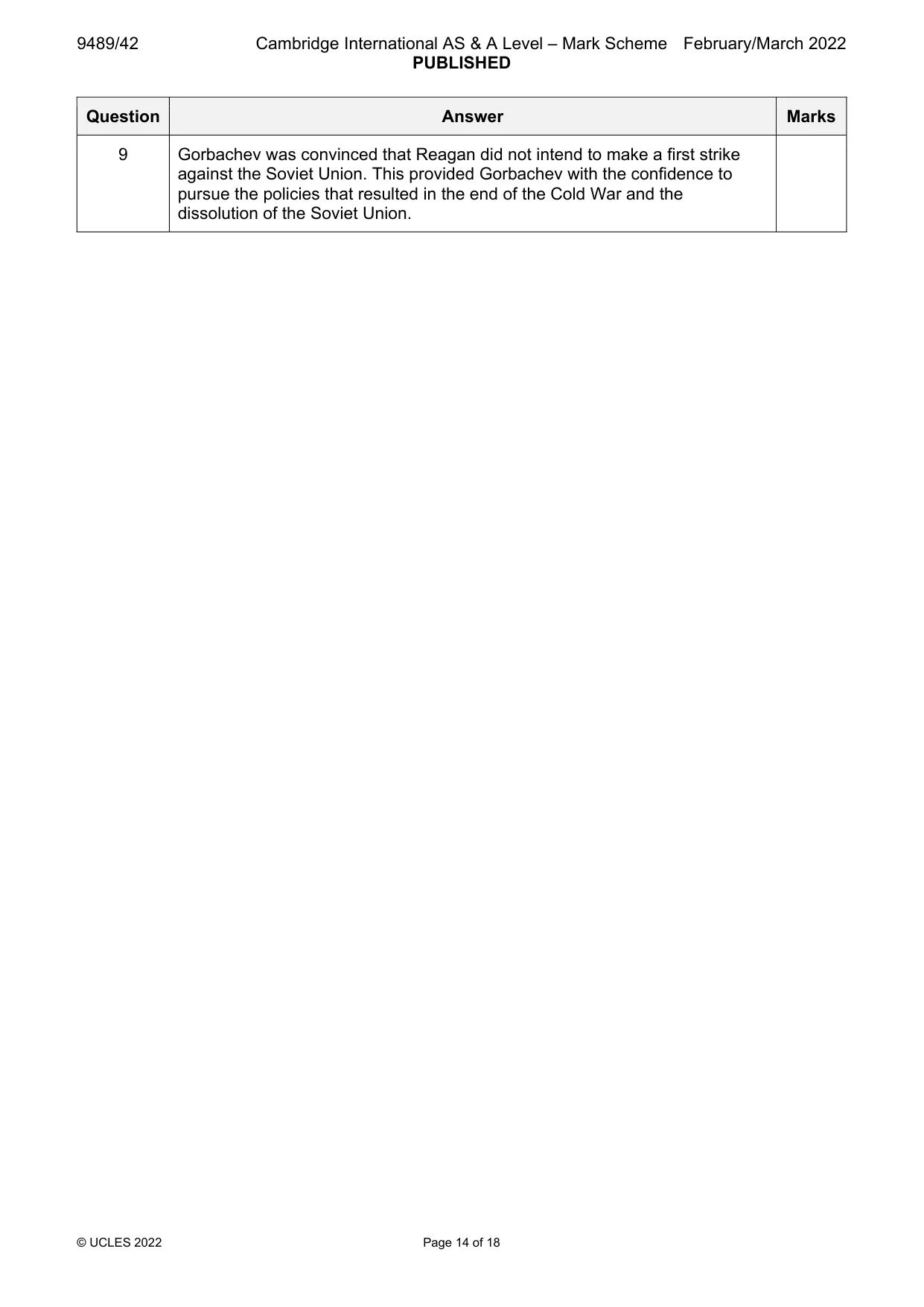
9 Evaluate the role played by Gorbachev in ending the Cold War. [30]
Mark scheme: 9 Evaluate the role played by Gorbachev in ending the Cold War. 30 Gorbachev wanted to reform communism. However, his reforms caused a revolution driven from below which because of his refusal to use force, destroyed the communist system, ended the Soviet Empire and the Cold War. Gorbachev believed in co-operation and in holding only a minimal number of nuclear weapons for protection. He also believed that Soviet control over an empire in Eastern Europe was costing too much and that the invasion of Afghanistan had been a costly disaster. He was responsible for the loosening of governmental power too. This created a domino effect though, and the Eastern European alliances began to crumble. This spurred countries such as Estonia, Lithuania and Latvia to declare their independence. Unlike his predecessors, Gorbachev understood that the Soviet Union could never advance economically if it continued to devote 20% of gross national product and 40% of its budget to military spending. He wanted to demilitarise Soviet foreign policy so that he could divert resources to fixing a broken economy. Gorbachev’s policies of Glasnost and Perestroika played a major role in ending the Cold War. He recognised the inefficiency of the communist system. He wanted moderate change with perestroika (economic restructuring) and glasnost (political openness) which he believed would help to restore the legitimacy of the Communist Party. Instead, the public became aware of the Party’s shortcomings. The Soviet Union was also losing its grip on its satellite states and ethnic groups took the opportunity to free themselves from its control. Gorbachev had failed to realise that communism would be destroyed once factors like nationalism took hold and once people became more aware of economic issues. By the summer of 1989, East Europeans were given more freedom and seized the chance to reject communism. By November, the Berlin Wall had fallen. Eastern Europe’s rejection of communist ideology removed a major obstacle to the ending of the Cold War. Gorbachev has been regarded as the enabling factor in ending the Cold War, with Reagan playing the minor role. However, historians are divided about Reagan’s role; he has been accredited with both winning it and ending it. Many of the events that defined the end of the Cold War occurred after Reagan left office, these included the destruction of the Berlin wall, the unification of Germany, the Strategic Arms Treaty, and the dissolution of the Soviet Union. At a press conference in Moscow in 1988, Reagan described himself essentially as a supporting actor maintaining that ‘Mr Gorbachev deserves most of the credit, as the leader of this country’. However, Reagan also wanted to abolish nuclear weapons, stop the strategic arms race, and avoid Armageddon. Reagan saw that there was the prospect of changing relations with the Soviet Union. He first met Gorbachev in Geneva in November 1985 to discuss a reduction in nuclear weapons. By seeking to talk to Gorbachev about ending the Cold War, Reagan helped to win it. He was able to reassure Gorbachev that the United States was not seeking the destruction of the Soviet Union and this enabled Gorbachev to pursue his new policies. He helped to set the framework for the changes. At their face-to-face summit of October 1986 in Reykjavik, Reagan suggested that the two sides get rid of nuclear weapons altogether and jointly build an SDI system to guard against a nuclear revival. No agreement on that was reached, but 9 Gorbachev was convinced that Reagan did not intend to make a first strike against the Soviet Union. This provided Gorbachev with the confidence to pursue the policies that resulted in the end of the Cold War and the dissolution of the Soviet Union.
Q10 · ‘In the Korean War, the United States used the United Nations only to promote its own…
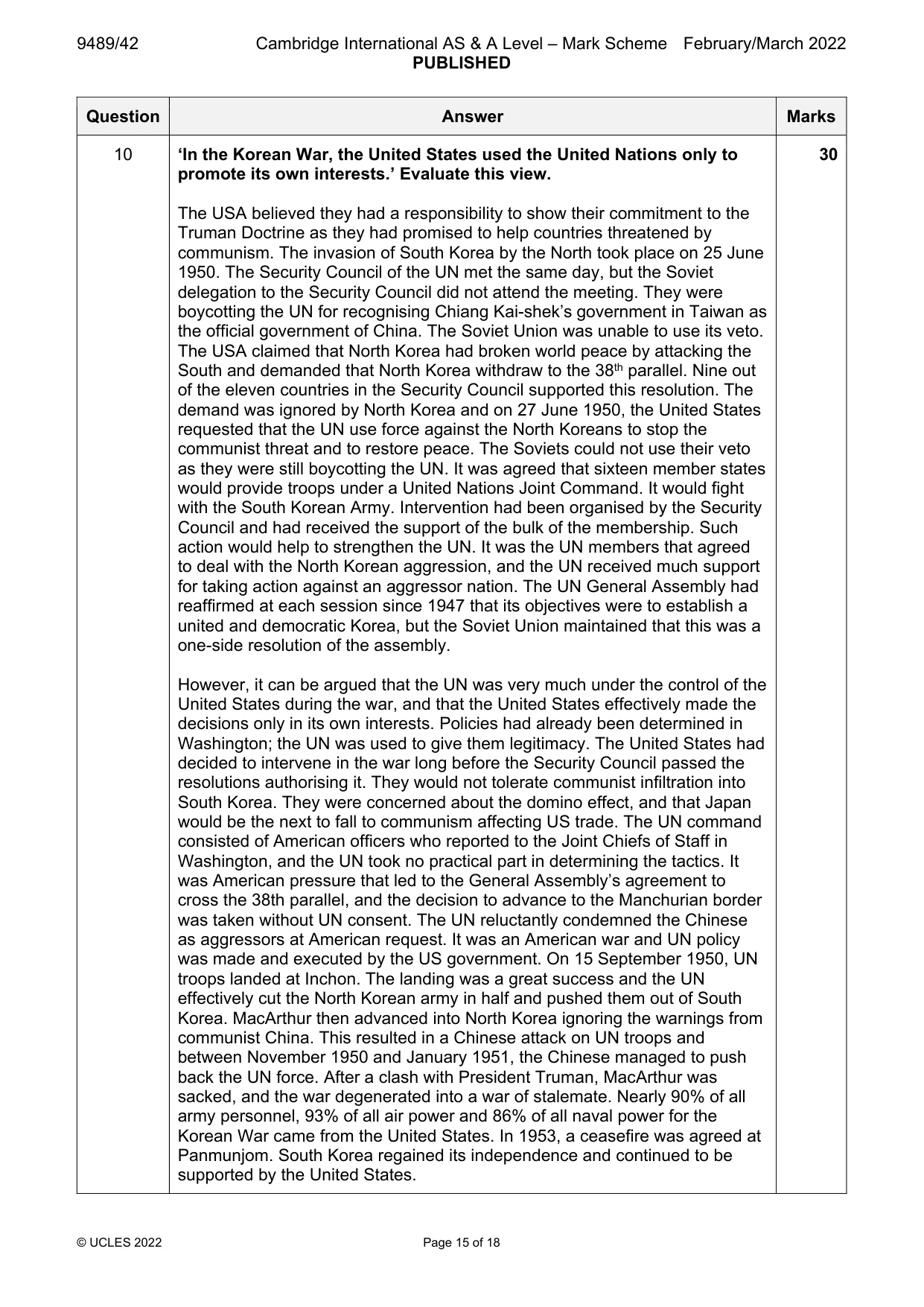
10 ‘In the Korean War, the United States used the United Nations only to promote its own interests.’ Evaluate this view. [30]
Mark scheme: 10 ‘In the Korean War, the United States used the United Nations only to 30 promote its own interests.’ Evaluate this view. The USA believed they had a responsibility to show their commitment to the Truman Doctrine as they had promised to help countries threatened by communism. The invasion of South Korea by the North took place on 25 June 1950. The Security Council of the UN met the same day, but the Soviet delegation to the Security Council did not attend the meeting. They were boycotting the UN for recognising Chiang Kai-shek’s government in Taiwan as the official government of China. The Soviet Union was unable to use its veto. The USA claimed that North Korea had broken world peace by attacking the South and demanded that North Korea withdraw to the 38th parallel. Nine out of the eleven countries in the Security Council supported this resolution. The demand was ignored by North Korea and on 27 June 1950, the United States requested that the UN use force against the North Koreans to stop the communist threat and to restore peace. The Soviets could not use their veto as they were still boycotting the UN. It was agreed that sixteen member states would provide troops under a United Nations Joint Command. It would fight with the South Korean Army. Intervention had been organised by the Security Council and had received the support of the bulk of the membership. Such action would help to strengthen the UN. It was the UN members that agreed to deal with the North Korean aggression, and the UN received much support for taking action against an aggressor nation. The UN General Assembly had reaffirmed at each session since 1947 that its objectives were to establish a united and democratic Korea, but the Soviet Union maintained that this was a one-side resolution of the assembly. However, it can be argued that the UN was very much under the control of the United States during the war, and that the United States effectively made the decisions only in its own interests. Policies had already been determined in Washington; the UN was used to give them legitimacy. The United States had decided to intervene in the war long before the Security Council passed the resolutions authorising it. They would not tolerate communist infiltration into South Korea. They were concerned about the domino effect, and that Japan would be the next to fall to communism affecting US trade. The UN command consisted of American officers who reported to the Joint Chiefs of Staff in Washington, and the UN took no practical part in determining the tactics. It was American pressure that led to the General Assembly’s agreement to cross the 38th parallel, and the decision to advance to the Manchurian border was taken without UN consent. The UN reluctantly condemned the Chinese as aggressors at American request. It was an American war and UN policy was made and executed by the US government. On 15 September 1950, UN troops landed at Inchon. The landing was a great success and the UN effectively cut the North Korean army in half and pushed them out of South Korea. MacArthur then advanced into North Korea ignoring the warnings from communist China. This resulted in a Chinese attack on UN troops and between November 1950 and January 1951, the Chinese managed to push back the UN force. After a clash with President Truman, MacArthur was sacked, and the war degenerated into a war of stalemate. Nearly 90% of all army personnel, 93% of all air power and 86% of all naval power for the Korean War came from the United States. In 1953, a ceasefire was agreed at Panmunjom. South Korea regained its independence and continued to be supported by the United States.
More questions on Why did the League of Nations fail to keep the peace in the 1930s?
Q11 · Assess why the governments of newly independent African nations faced so many social…
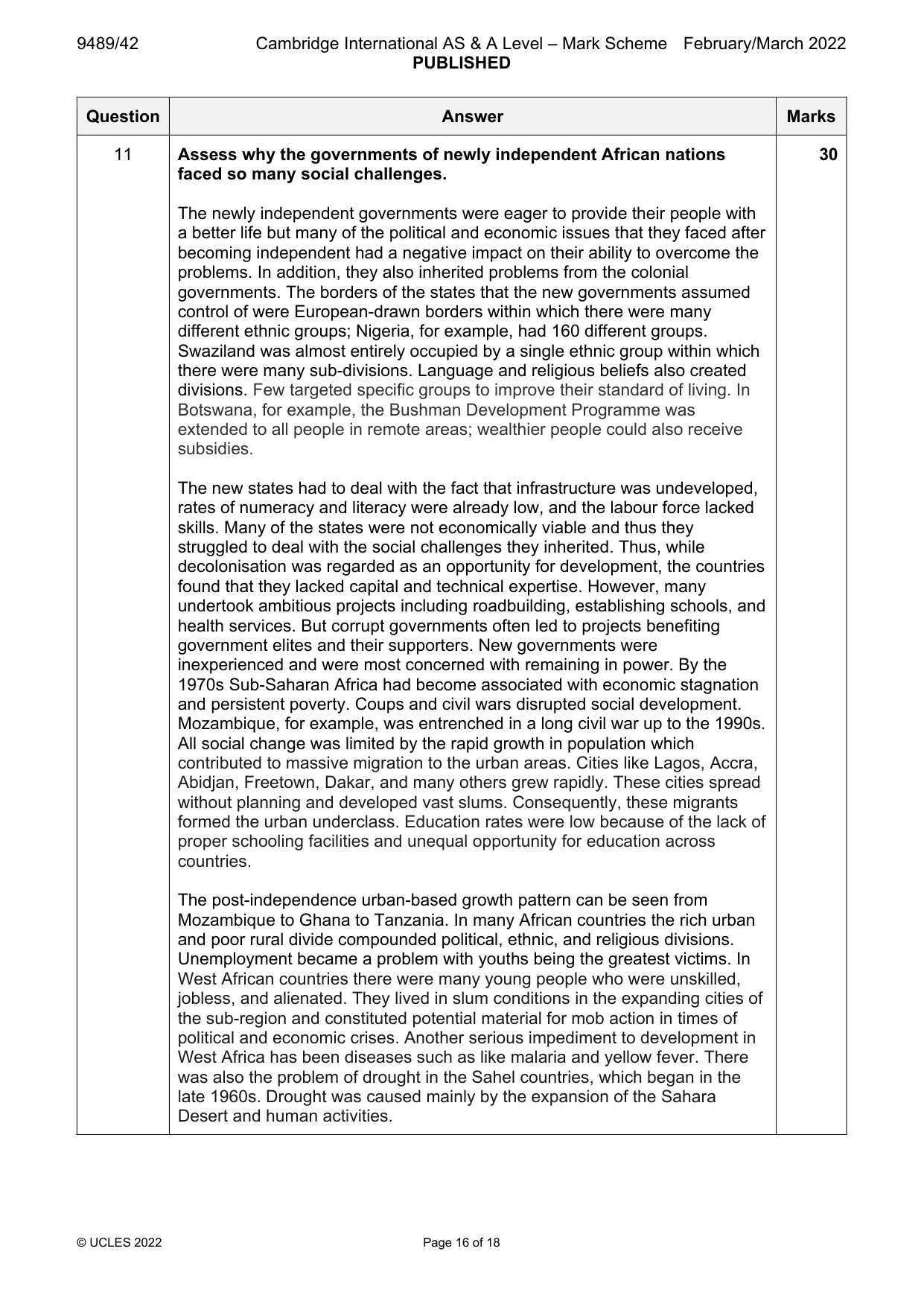
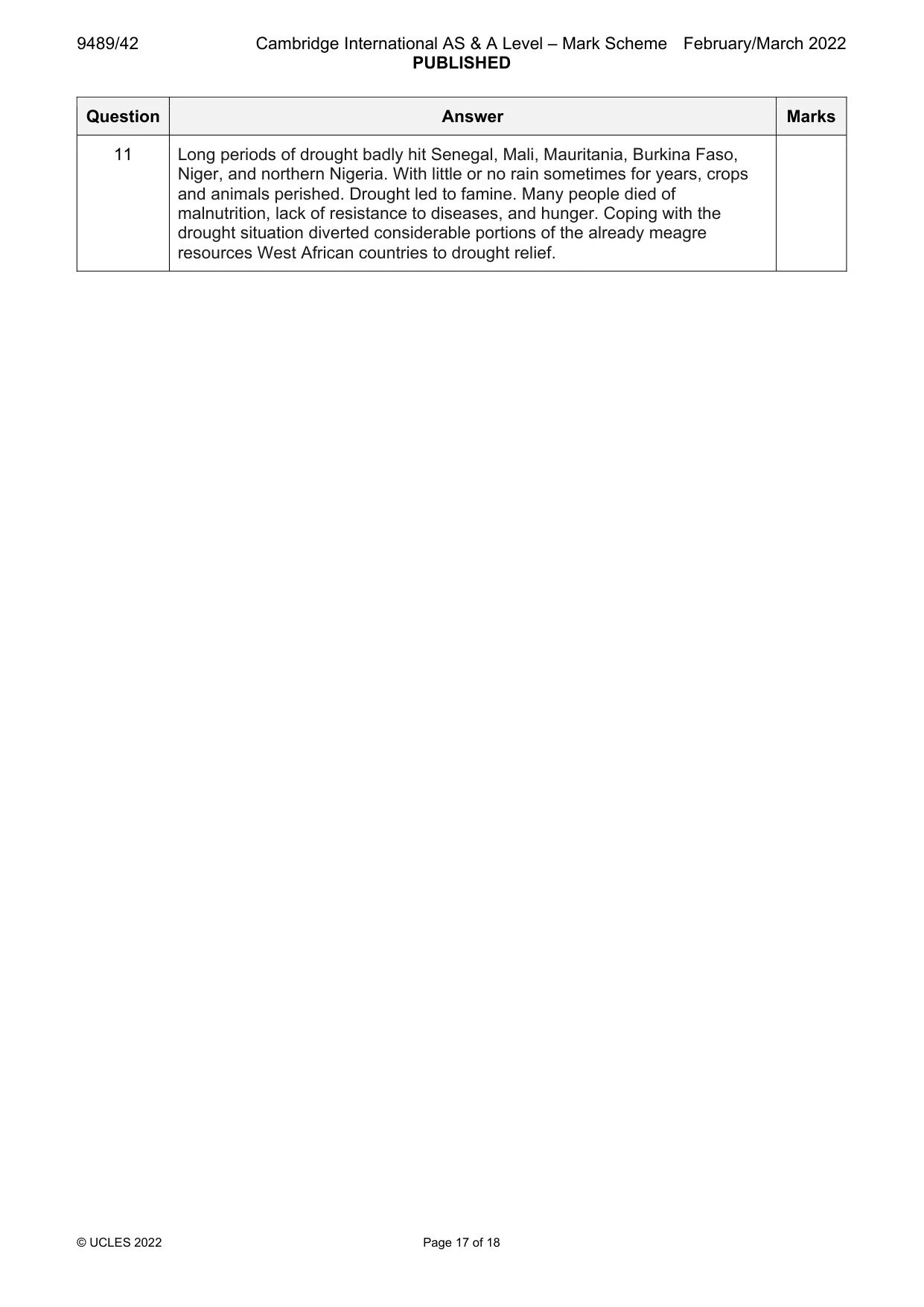
11 Assess why the governments of newly independent African nations faced so many social challenges. [30]
Mark scheme: 11 Assess why the governments of newly independent African nations 30 faced so many social challenges. The newly independent governments were eager to provide their people with a better life but many of the political and economic issues that they faced after becoming independent had a negative impact on their ability to overcome the problems. In addition, they also inherited problems from the colonial governments. The borders of the states that the new governments assumed control of were European-drawn borders within which there were many different ethnic groups; Nigeria, for example, had 160 different groups. Swaziland was almost entirely occupied by a single ethnic group within which there were many sub-divisions. Language and religious beliefs also created divisions. Few targeted specific groups to improve their standard of living. In Botswana, for example, the Bushman Development Programme was extended to all people in remote areas; wealthier people could also receive subsidies. The new states had to deal with the fact that infrastructure was undeveloped, rates of numeracy and literacy were already low, and the labour force lacked skills. Many of the states were not economically viable and thus they struggled to deal with the social challenges they inherited. Thus, while decolonisation was regarded as an opportunity for development, the countries found that they lacked capital and technical expertise. However, many undertook ambitious projects including roadbuilding, establishing schools, and health services. But corrupt governments often led to projects benefiting government elites and their supporters. New governments were inexperienced and were most concerned with remaining in power. By the 1970s Sub-Saharan Africa had become associated with economic stagnation and persistent poverty. Coups and civil wars disrupted social development. Mozambique, for example, was entrenched in a long civil war up to the 1990s. All social change was limited by the rapid growth in population which contributed to massive migration to the urban areas. Cities like Lagos, Accra, Abidjan, Freetown, Dakar, and many others grew rapidly. These cities spread without planning and developed vast slums. Consequently, these migrants formed the urban underclass. Education rates were low because of the lack of proper schooling facilities and unequal opportunity for education across countries. The post-independence urban-based growth pattern can be seen from Mozambique to Ghana to Tanzania. In many African countries the rich urban and poor rural divide compounded political, ethnic, and religious divisions. Unemployment became a problem with youths being the greatest victims. In West African countries there were many young people who were unskilled, jobless, and alienated. They lived in slum conditions in the expanding cities of the sub-region and constituted potential material for mob action in times of political and economic crises. Another serious impediment to development in West Africa has been diseases such as like malaria and yellow fever. There was also the problem of drought in the Sahel countries, which began in the late 1960s. Drought was caused mainly by the expansion of the Sahara Desert and human activities. 11 Long periods of drought badly hit Senegal, Mali, Mauritania, Burkina Faso, Niger, and northern Nigeria. With little or no rain sometimes for years, crops and animals perished. Drought led to famine. Many people died of malnutrition, lack of resistance to diseases, and hunger. Coping with the drought situation diverted considerable portions of the already meagre resources West African countries to drought relief.
More questions on Why was imperialism a significant force in Africa from 1870?
What was in this paper
The subtopics covered by these 11 questions, and how many questions each got. Open one in a new tab to see every Cambridge question on it.
3How did the rise of extremism affect international relations?2How successful was the Progressive Movement from 1890 to 1920?2How were the Bolsheviks able to consolidate their power up to 1924?1What were the consequences of the rapid economic growth after 1870?1Why did the League of Nations fail to keep the peace in the 1930s?1Why was imperialism a significant force in Africa from 1870?1What you needed in this session
Cambridge’s own grade thresholds for 2022 Feb/March, Paper 4 · Variant 2. A higher threshold means an easier paper — the bar moves with how the cohort did.