Cambridge A Level History 9489 — 2025 Feb/March Paper 4 · Variant 2
9489/42/F/M/25 · 12 questions · 60 marks · ≈68 min
The question paper and its mark scheme, free to read here and free to download. This is Cambridge’s own paper, exactly as it was sat.
Question paper4 pages
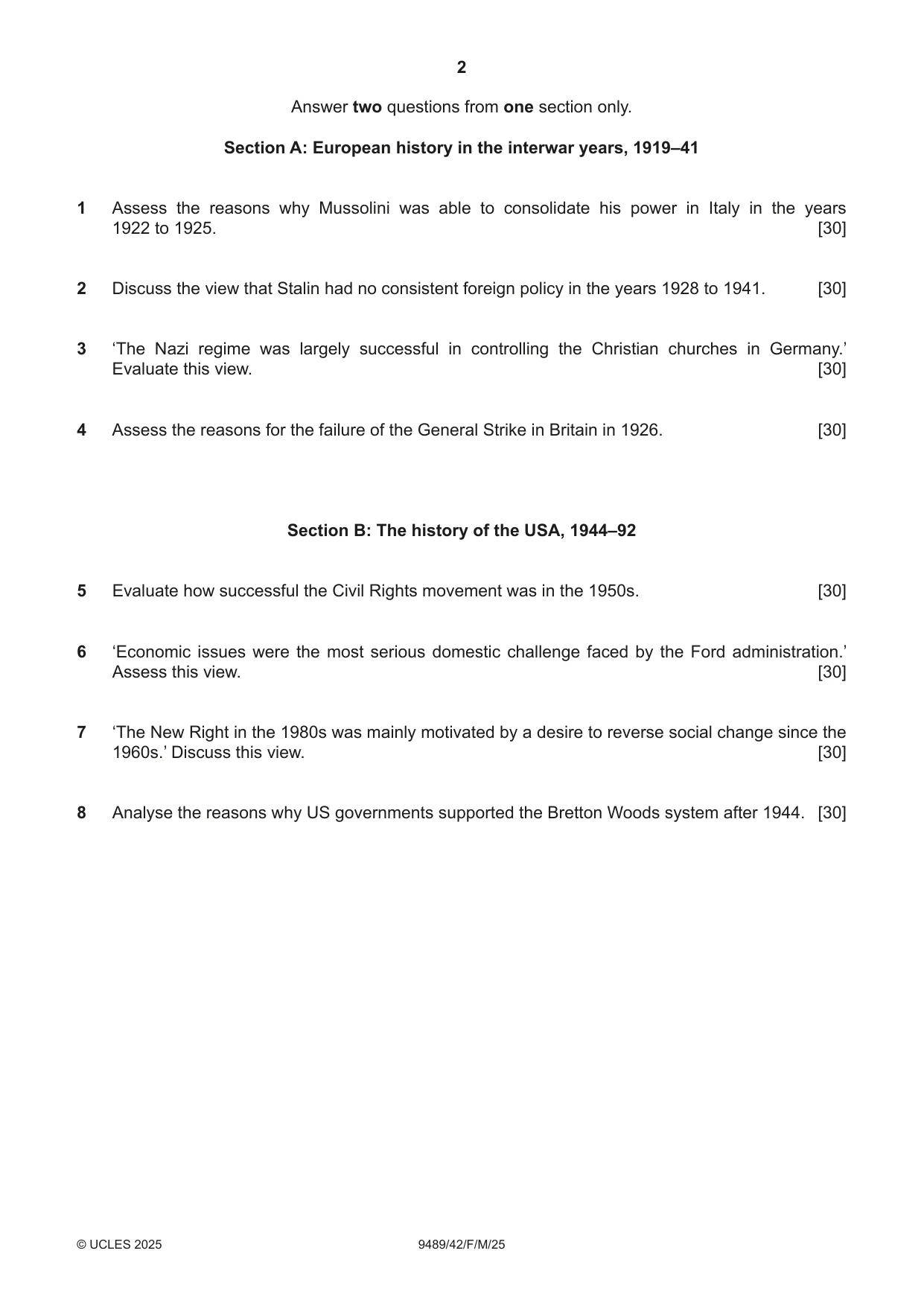
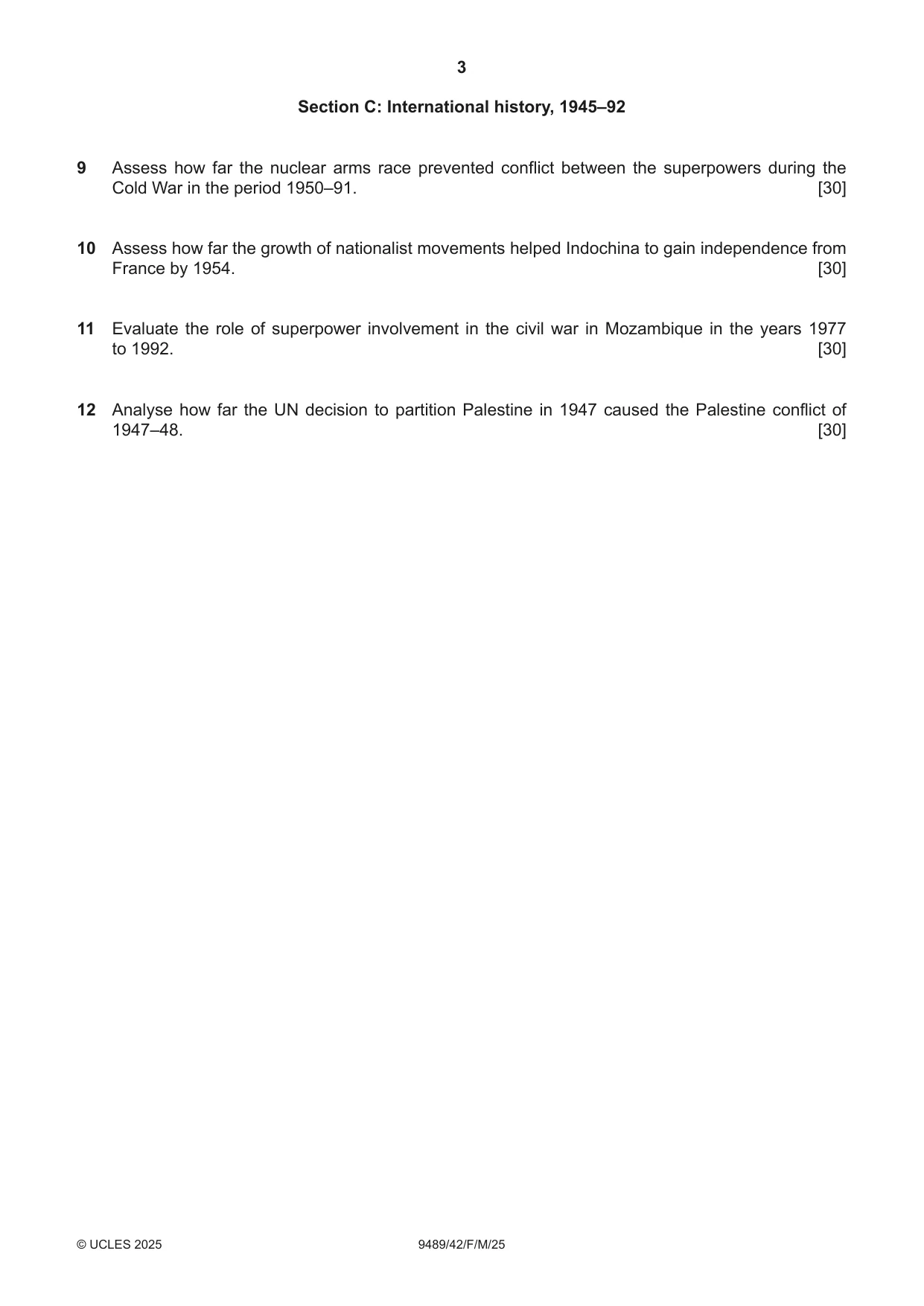
Mark scheme19 pages
Answers below. Sit the paper first if you are practising.
Questions as text
Q1 · Assess the reasons why Mussolini was able to consolidate his power in Italy in the years…
1 Assess the reasons why Mussolini was able to consolidate his power in Italy in the years 1922 to 1925. [30]
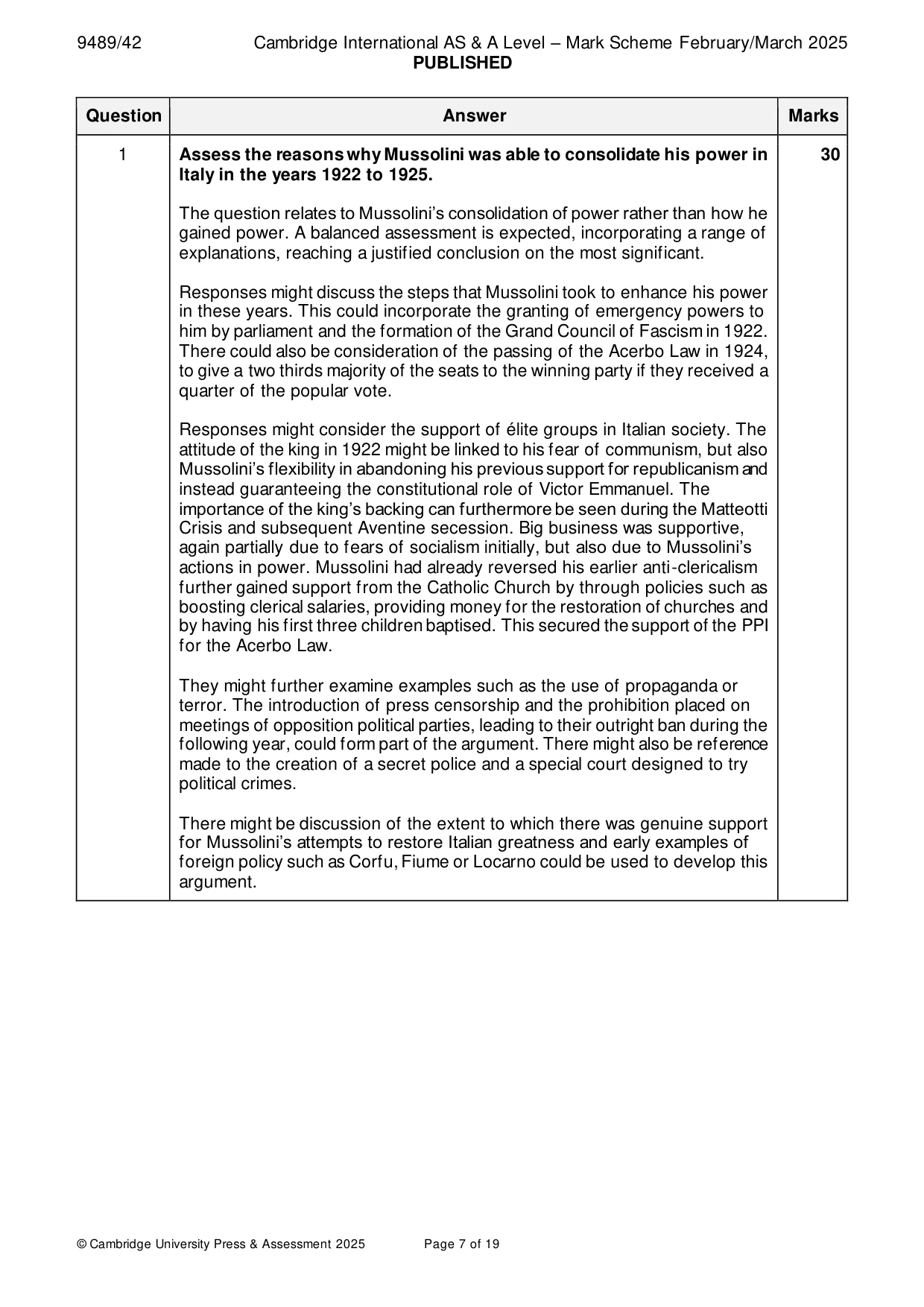
Mark scheme: Question Answer Marks 1 Assess the reasons why Mussolini was able to consolidate his power in 30 Italy in the years 1922 to 1925. The question relates to Mussolini’s consolidation of power rather than how he gained power. A balanced assessment is expected, incorporating a range of explanations, reaching a justified conclusion on the most significant. Responses might discuss the steps that Mussolini took to enhance his power in these years. This could incorporate the granting of emergency powers to him by parliament and the formation of the Grand Council of Fascism in 1922. There could also be consideration of the passing of the Acerbo Law in 1924, to give a two thirds majority of the seats to the winning party if they received a quarter of the popular vote. Responses might consider the support of élite groups in Italian society. The attitude of the king in 1922 might be linked to his fear of communism, but also Mussolini’s flexibility in abandoning his previous support for republicanism and instead guaranteeing the constitutional role of Victor Emmanuel. The importance of the king’s backing can furthermore be seen during the Matteotti Crisis and subsequent Aventine secession. Big business was supportive, again partially due to fears of socialism initially, but also due to Mussolini’s actions in power. Mussolini had already reversed his earlier anti-clericalism further gained support from the Catholic Church by through policies such as boosting clerical salaries, providing money for the restoration of churches and by having his first three children baptised. This secured the support of the PPI for the Acerbo Law. They might further examine examples such as the use of propaganda or terror. The introduction of press censorship and the prohibition placed on meetings of opposition political parties, leading to their outright ban during the following year, could form part of the argument. There might also be reference made to the creation of a secret police and a special court designed to try political crimes. There might be discussion of the extent to which there was genuine support for Mussolini’s attempts to restore Italian greatness and early examples of foreign policy such as Corfu, Fiume or Locarno could be used to develop this argument.
More questions on How did the rise of extremism affect international relations?
Q2 · Discuss the view that Stalin had no consistent foreign policy in the years 1928 to 1941
2 Discuss the view that Stalin had no consistent foreign policy in the years 1928 to 1941. [30]
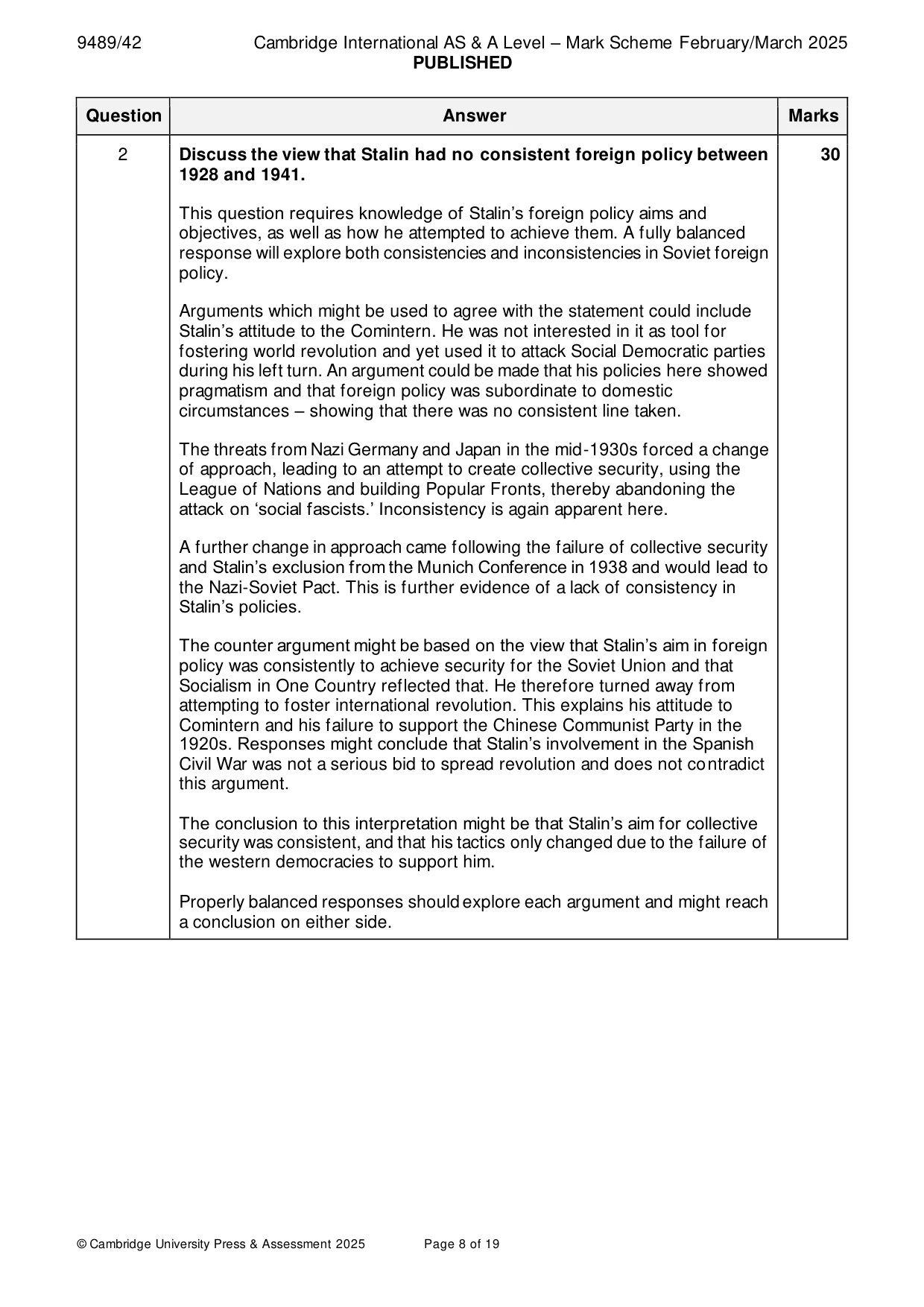
Mark scheme: 2 Discuss the view that Stalin had no consistent foreign policy between 30 1928 and 1941. This question requires knowledge of Stalin’s foreign policy aims and objectives, as well as how he attempted to achieve them. A fully balanced response will explore both consistencies and inconsistencies in Soviet foreign policy. Arguments which might be used to agree with the statement could include Stalin’s attitude to the Comintern. He was not interested in it as tool for fostering world revolution and yet used it to attack Social Democratic parties during his left turn. An argument could be made that his policies here showed pragmatism and that foreign policy was subordinate to domestic circumstances – showing that there was no consistent line taken. The threats from Nazi Germany and Japan in the mid-1930s forced a change of approach, leading to an attempt to create collective security, using the League of Nations and building Popular Fronts, thereby abandoning the attack on ‘social fascists.’ Inconsistency is again apparent here. A further change in approach came following the failure of collective security and Stalin’s exclusion from the Munich Conference in 1938 and would lead to the Nazi-Soviet Pact. This is further evidence of a lack of consistency in Stalin’s policies. The counter argument might be based on the view that Stalin’s aim in foreign policy was consistently to achieve security for the Soviet Union and that Socialism in One Country reflected that. He therefore turned away from attempting to foster international revolution. This explains his attitude to Comintern and his failure to support the Chinese Communist Party in the 1920s. Responses might conclude that Stalin’s involvement in the Spanish Civil War was not a serious bid to spread revolution and does not contradict this argument. The conclusion to this interpretation might be that Stalin’s aim for collective security was consistent, and that his tactics only changed due to the failure of the western democracies to support him. Properly balanced responses should explore each argument and might reach a conclusion on either side.
More questions on How did the rise of extremism affect international relations?
Q3 · ‘The Nazi regime was largely successful in controlling the Christian churches in…
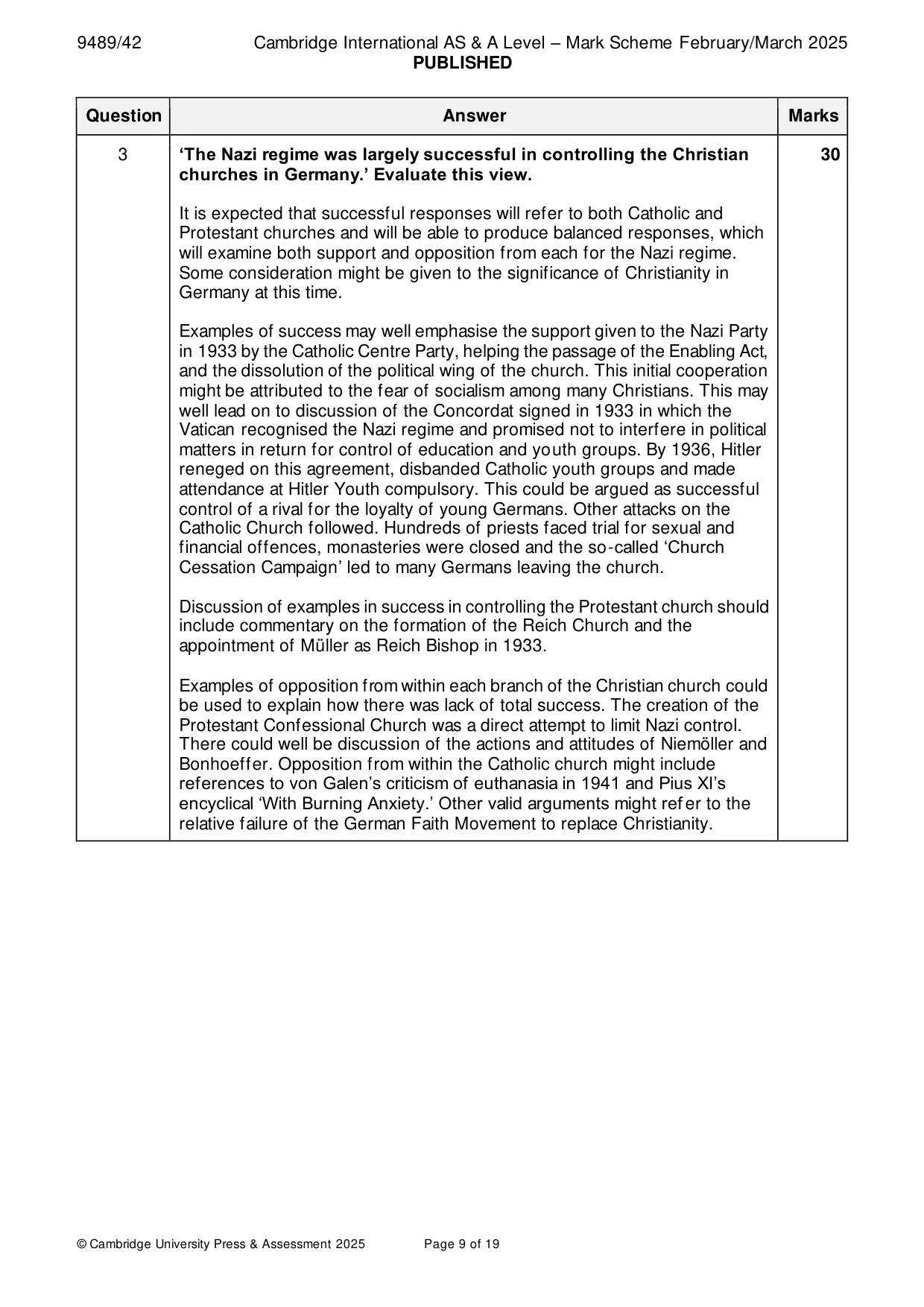
3 ‘The Nazi regime was largely successful in controlling the Christian churches in Germany.’ Evaluate this view. [30]
Mark scheme: 3 ‘The Nazi regime was largely successful in controlling the Christian 30 churches in Germany.’ Evaluate this view. It is expected that successful responses will refer to both Catholic and Protestant churches and will be able to produce balanced responses, which will examine both support and opposition from each for the Nazi regime. Some consideration might be given to the significance of Christianity in Germany at this time. Examples of success may well emphasise the support given to the Nazi Party in 1933 by the Catholic Centre Party, helping the passage of the Enabling Act, and the dissolution of the political wing of the church. This initial cooperation might be attributed to the fear of socialism among many Christians. This may well lead on to discussion of the Concordat signed in 1933 in which the Vatican recognised the Nazi regime and promised not to interfere in political matters in return for control of education and youth groups. By 1936, Hitler reneged on this agreement, disbanded Catholic youth groups and made attendance at Hitler Youth compulsory. This could be argued as successful control of a rival for the loyalty of young Germans. Other attacks on the Catholic Church followed. Hundreds of priests faced trial for sexual and financial offences, monasteries were closed and the so-called ‘Church Cessation Campaign’ led to many Germans leaving the church. Discussion of examples in success in controlling the Protestant church should include commentary on the formation of the Reich Church and the appointment of Müller as Reich Bishop in 1933. Examples of opposition from within each branch of the Christian church could be used to explain how there was lack of total success. The creation of the Protestant Confessional Church was a direct attempt to limit Nazi control. There could well be discussion of the actions and attitudes of Niemöller and Bonhoeffer. Opposition from within the Catholic church might include references to von Galen’s criticism of euthanasia in 1941 and Pius XI’s encyclical ‘With Burning Anxiety.’ Other valid arguments might ref er to the relative failure of the German Faith Movement to replace Christianity.
More questions on How did the rise of extremism affect international relations?
Q4 · Assess the reasons for the failure of the General Strike in Britain in 1926
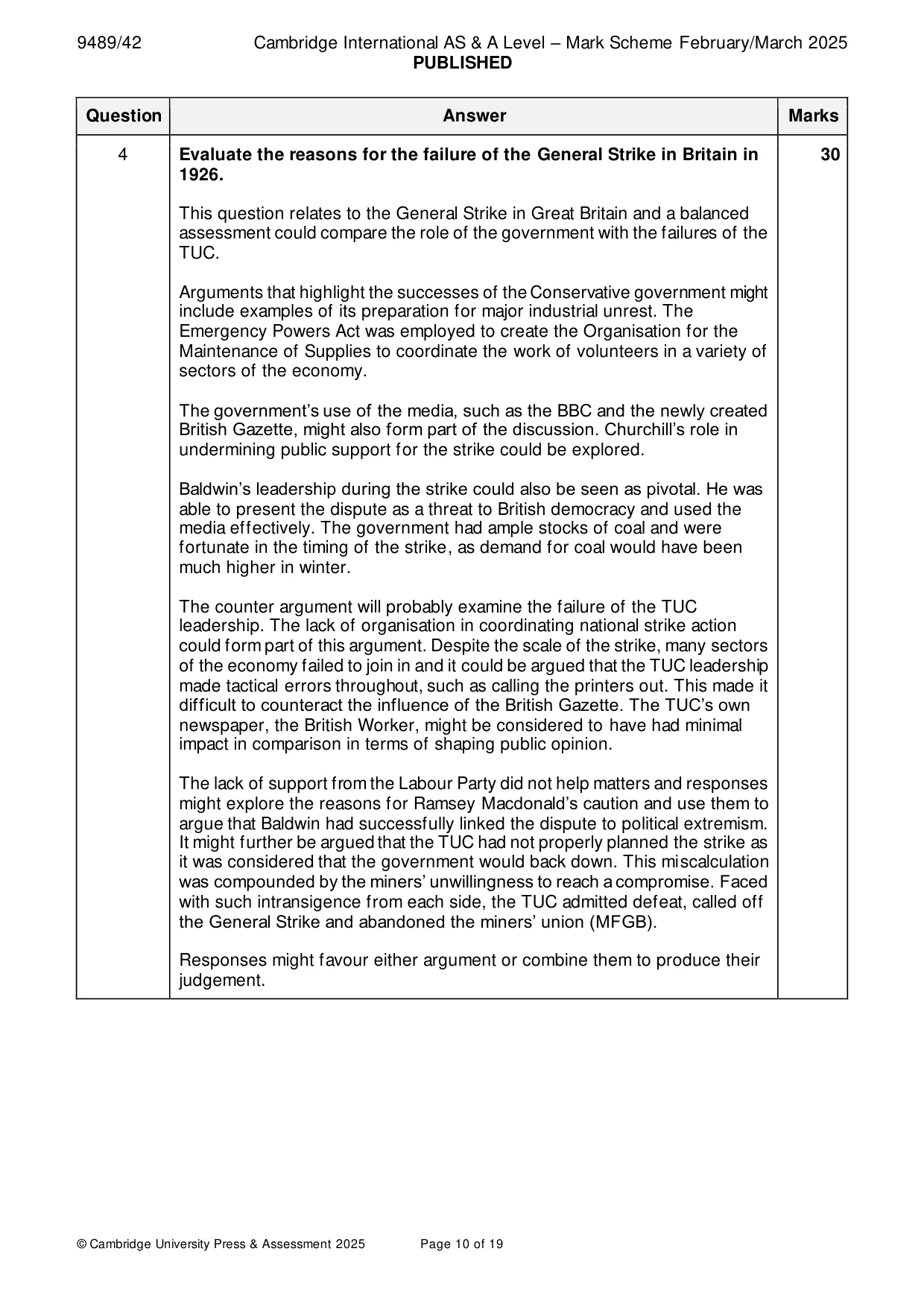
4 Assess the reasons for the failure of the General Strike in Britain in 1926. [30]
Mark scheme: 4 Evaluate the reasons for the failure of the General Strike in Britain in 30 1926. This question relates to the General Strike in Great Britain and a balanced assessment could compare the role of the government with the failures of the TUC. Arguments that highlight the successes of the Conservative government might include examples of its preparation for major industrial unrest. The Emergency Powers Act was employed to create the Organisation for the Maintenance of Supplies to coordinate the work of volunteers in a variety of sectors of the economy. The government’s use of the media, such as the BBC and the newly created British Gazette, might also form part of the discussion. Churchill’s role in undermining public support for the strike could be explored. Baldwin’s leadership during the strike could also be seen as pivotal. He was able to present the dispute as a threat to British democracy and used the media effectively. The government had ample stocks of coal and were fortunate in the timing of the strike, as demand for coal would have been much higher in winter. The counter argument will probably examine the failure of the TUC leadership. The lack of organisation in coordinating national strike action could form part of this argument. Despite the scale of the strike, many sectors of the economy failed to join in and it could be argued that the TUC leadership made tactical errors throughout, such as calling the printers out. This made it difficult to counteract the influence of the British Gazette. The TUC’s own newspaper, the British Worker, might be considered to have had minimal impact in comparison in terms of shaping public opinion. The lack of support from the Labour Party did not help matters and responses might explore the reasons for Ramsey Macdonald’s caution and use them to argue that Baldwin had successfully linked the dispute to political extremism. It might further be argued that the TUC had not properly planned the strike as it was considered that the government would back down. This miscalculation was compounded by the miners’ unwillingness to reach a compromise. Faced with such intransigence from each side, the TUC admitted defeat, called off the General Strike and abandoned the miners’ union (MFGB). Responses might favour either argument or combine them to produce their judgement.
More questions on How and why did international relations improve, 1924–29?
Q5 · Evaluate how successful the Civil Rights movement was in the 1950s
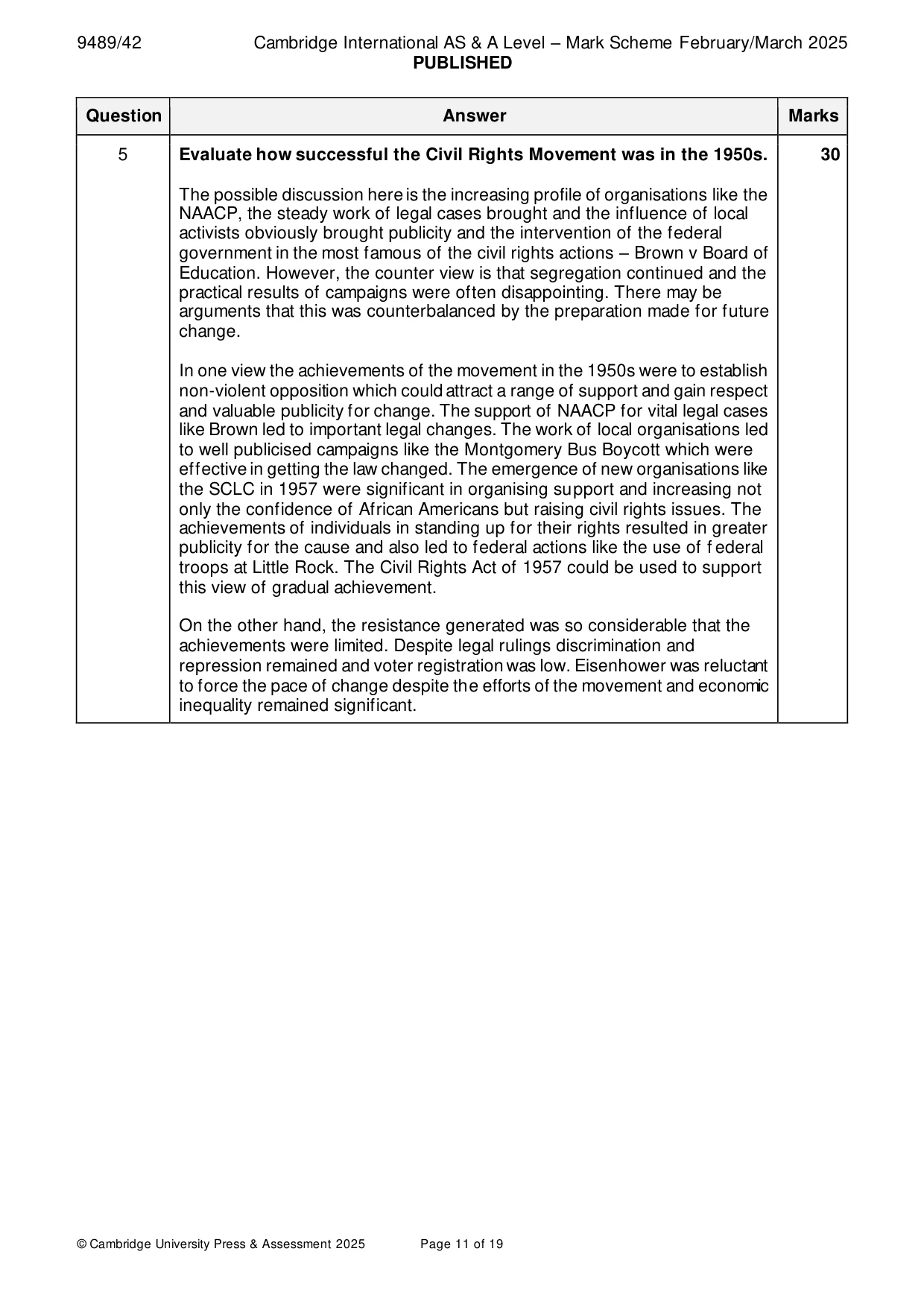
5 Evaluate how successful the Civil Rights movement was in the 1950s. [30]
Mark scheme: 5 Evaluate how successful the Civil Rights Movement was in the 1950s. 30 The possible discussion here is the increasing profile of organisations like the NAACP, the steady work of legal cases brought and the influence of local activists obviously brought publicity and the intervention of the federal government in the most famous of the civil rights actions – Brown v Board of Education. However, the counter view is that segregation continued and the practical results of campaigns were often disappointing. There may be arguments that this was counterbalanced by the preparation made for future change. In one view the achievements of the movement in the 1950s were to establish non-violent opposition which could attract a range of support and gain respect and valuable publicity for change. The support of NAACP for vital legal cases like Brown led to important legal changes. The work of local organisations led to well publicised campaigns like the Montgomery Bus Boycott which were effective in getting the law changed. The emergence of new organisations like the SCLC in 1957 were significant in organising support and increasing not only the confidence of African Americans but raising civil rights issues. The achievements of individuals in standing up for their rights resulted in greater publicity for the cause and also led to federal actions like the use of f ederal troops at Little Rock. The Civil Rights Act of 1957 could be used to support this view of gradual achievement. On the other hand, the resistance generated was so considerable that the achievements were limited. Despite legal rulings discrimination and repression remained and voter registration was low. Eisenhower was reluctant to force the pace of change despite the efforts of the movement and economic inequality remained significant.
More questions on How successful was the Progressive Movement from 1890 to 1920?
Q6 · ‘Economic issues were the most serious domestic challenge faced by the Ford…
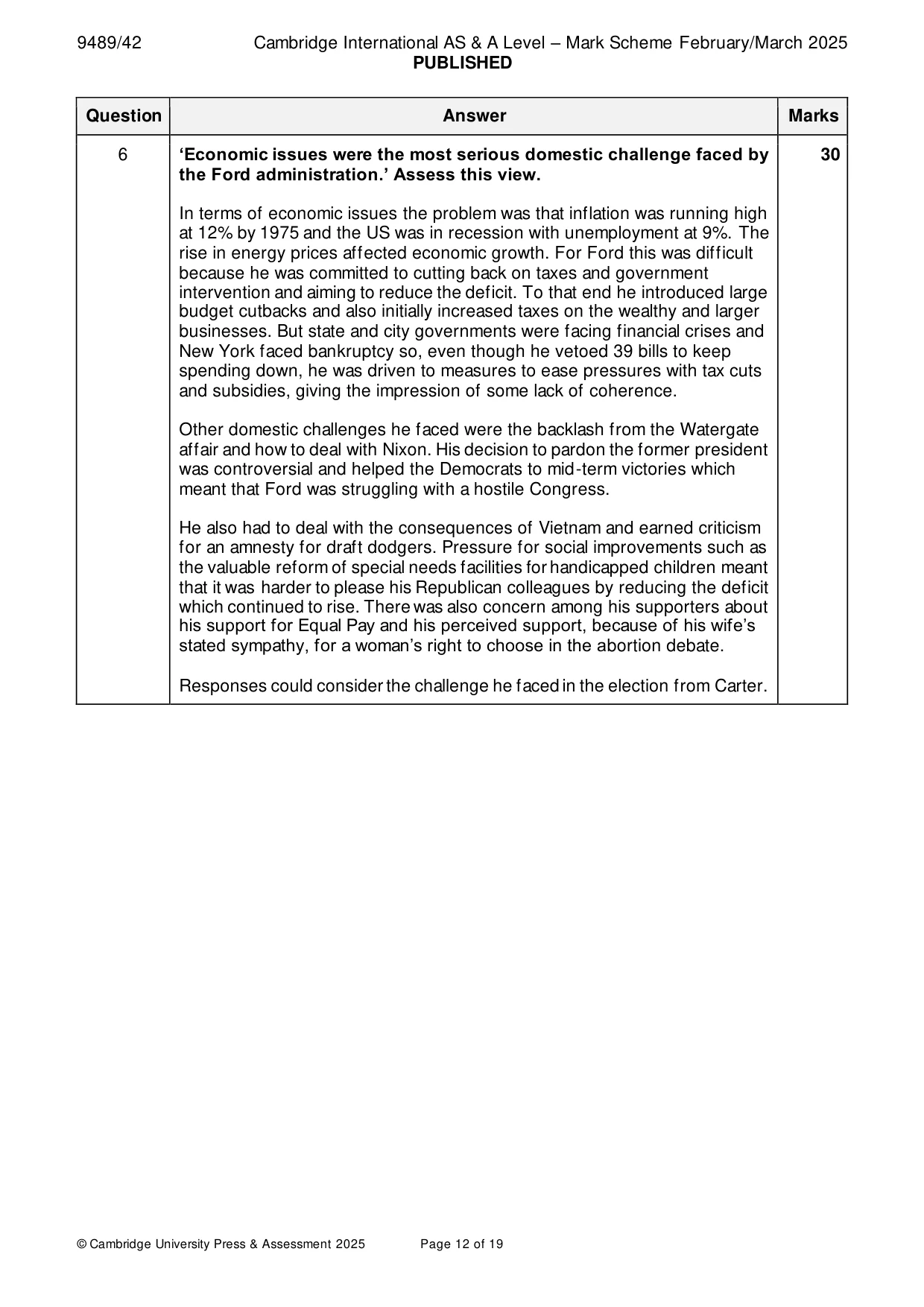
6 ‘Economic issues were the most serious domestic challenge faced by the Ford administration.’ Assess this view. [30]
Mark scheme: 6 ‘Economic issues were the most serious domestic challenge faced by 30 the Ford administration.’ Assess this view. In terms of economic issues the problem was that inflation was running high at 12% by 1975 and the US was in recession with unemployment at 9%. The rise in energy prices affected economic growth. For Ford this was difficult because he was committed to cutting back on taxes and government intervention and aiming to reduce the deficit. To that end he introduced large budget cutbacks and also initially increased taxes on the wealthy and larger businesses. But state and city governments were facing financial crises and New York faced bankruptcy so, even though he vetoed 39 bills to keep spending down, he was driven to measures to ease pressures with tax cuts and subsidies, giving the impression of some lack of coherence. Other domestic challenges he faced were the backlash from the Watergate affair and how to deal with Nixon. His decision to pardon the former president was controversial and helped the Democrats to mid-term victories which meant that Ford was struggling with a hostile Congress. He also had to deal with the consequences of Vietnam and earned criticism for an amnesty for draft dodgers. Pressure for social improvements such as the valuable reform of special needs facilities for handicapped children meant that it was harder to please his Republican colleagues by reducing the deficit which continued to rise. There was also concern among his supporters about his support for Equal Pay and his perceived support, because of his wife’s stated sympathy, for a woman’s right to choose in the abortion debate. Responses could consider the challenge he faced in the election from Carter.
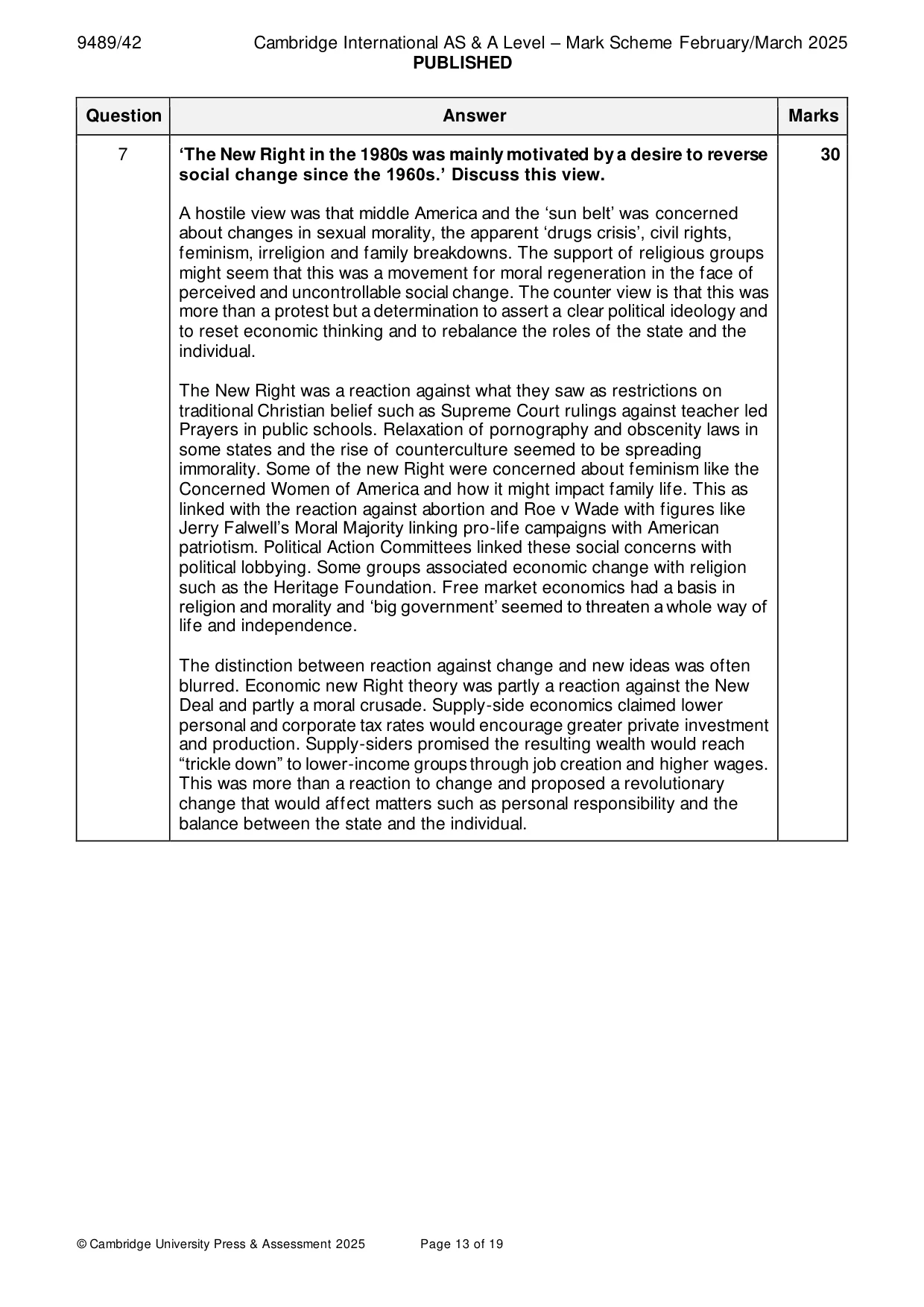
Q7 · ‘The New Right in the 1980s was mainly motivated by a desire to reverse social change…
7 ‘The New Right in the 1980s was mainly motivated by a desire to reverse social change since the 1960s.’ Discuss this view. [30]
Mark scheme: 7 ‘The New Right in the 1980s was mainly motivated by a desire to reverse 30 social change since the 1960s.’ Discuss this view. A hostile view was that middle America and the ‘sun belt’ was concerned about changes in sexual morality, the apparent ‘drugs crisis’, civil rights, feminism, irreligion and family breakdowns. The support of religious groups might seem that this was a movement for moral regeneration in the face of perceived and uncontrollable social change. The counter view is that this was more than a protest but a determination to assert a clear political ideology and to reset economic thinking and to rebalance the roles of the state and the individual. The New Right was a reaction against what they saw as restrictions on traditional Christian belief such as Supreme Court rulings against teacher led Prayers in public schools. Relaxation of pornography and obscenity laws in some states and the rise of counterculture seemed to be spreading immorality. Some of the new Right were concerned about feminism like the Concerned Women of America and how it might impact family life. This as linked with the reaction against abortion and Roe v Wade with figures like Jerry Falwell’s Moral Majority linking pro-life campaigns with American patriotism. Political Action Committees linked these social concerns with political lobbying. Some groups associated economic change with religion such as the Heritage Foundation. Free market economics had a basis in religion and morality and ‘big government’ seemed to threaten a whole way of life and independence. The distinction between reaction against change and new ideas was often blurred. Economic new Right theory was partly a reaction against the New Deal and partly a moral crusade. Supply-side economics claimed lower personal and corporate tax rates would encourage greater private investment and production. Supply-siders promised the resulting wealth would reach “trickle down” to lower-income groups through job creation and higher wages. This was more than a reaction to change and proposed a revolutionary change that would affect matters such as personal responsibility and the balance between the state and the individual.
More questions on How successful was the Progressive Movement from 1890 to 1920?
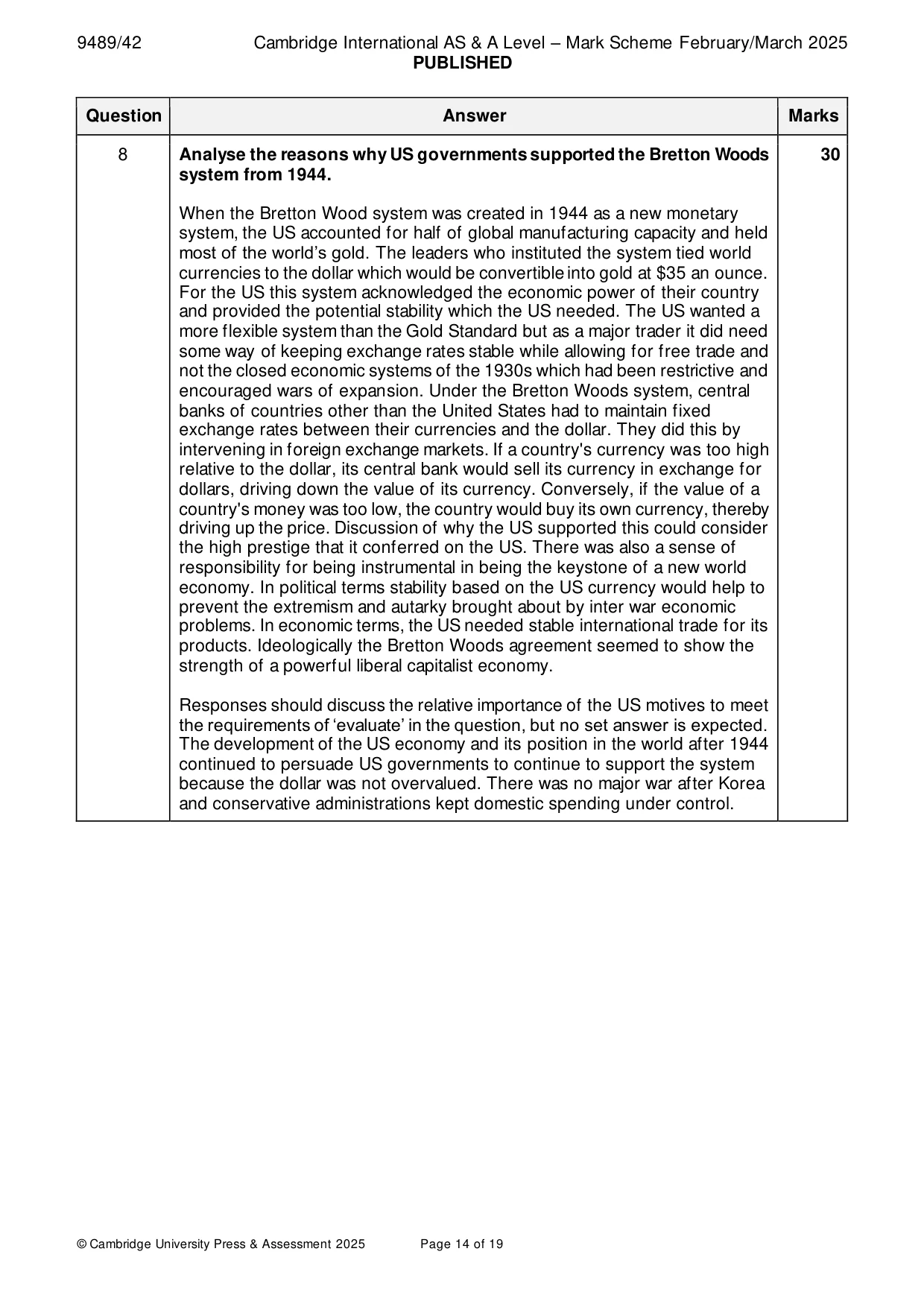
Q8 · Section C: International history, 1945–92
Section C: International history, 1945–92
Mark scheme: 8 Analyse the reasons why US governments supported the Bretton Woods 30 system from 1944. When the Bretton Wood system was created in 1944 as a new monetary system, the US accounted for half of global manufacturing capacity and held most of the world’s gold. The leaders who instituted the system tied world currencies to the dollar which would be convertible into gold at $35 an ounce. For the US this system acknowledged the economic power of their country and provided the potential stability which the US needed. The US wanted a more flexible system than the Gold Standard but as a major trader it did need some way of keeping exchange rates stable while allowing for free trade and not the closed economic systems of the 1930s which had been restrictive and encouraged wars of expansion. Under the Bretton Woods system, central banks of countries other than the United States had to maintain fixed exchange rates between their currencies and the dollar. They did this by intervening in foreign exchange markets. If a country's currency was too high relative to the dollar, its central bank would sell its currency in exchange for dollars, driving down the value of its currency. Conversely, if the value of a country's money was too low, the country would buy its own currency, thereby driving up the price. Discussion of why the US supported this could consider the high prestige that it conferred on the US. There was also a sense of responsibility for being instrumental in being the keystone of a new world economy. In political terms stability based on the US currency would help to prevent the extremism and autarky brought about by inter war economic problems. In economic terms, the US needed stable international trade for its products. Ideologically the Bretton Woods agreement seemed to show the strength of a powerful liberal capitalist economy. Responses should discuss the relative importance of the US motives to meet the requirements of ‘evaluate’ in the question, but no set answer is expected. The development of the US economy and its position in the world after 1944 continued to persuade US governments to continue to support the system because the dollar was not overvalued. There was no major war after Korea and conservative administrations kept domestic spending under control.
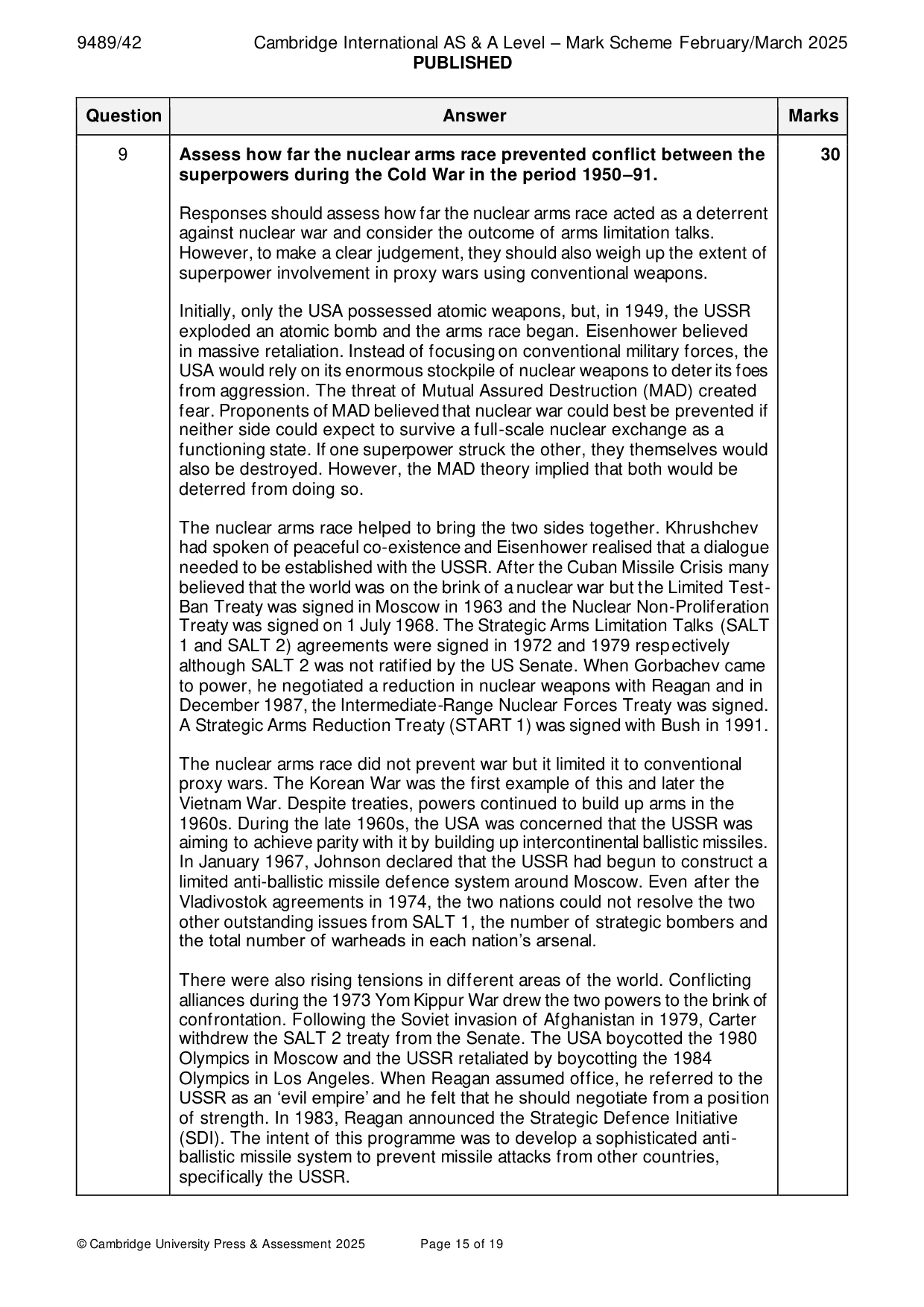
Q9 · Assess how far the nuclear arms race prevented conflict between the superpowers during…
9 Assess how far the nuclear arms race prevented conflict between the superpowers during the Cold War in the period 1950–91. [30]
Mark scheme: 9 Assess how far the nuclear arms race prevented conflict between the 30 superpowers during the Cold War in the period 1950–91. Responses should assess how far the nuclear arms race acted as a deterrent against nuclear war and consider the outcome of arms limitation talks. However, to make a clear judgement, they should also weigh up the extent of superpower involvement in proxy wars using conventional weapons. Initially, only the USA possessed atomic weapons, but, in 1949, the USSR exploded an atomic bomb and the arms race began. Eisenhower believed in massive retaliation. Instead of focusing on conventional military forces, the USA would rely on its enormous stockpile of nuclear weapons to deter its foes from aggression. The threat of Mutual Assured Destruction (MAD) created fear. Proponents of MAD believed that nuclear war could best be prevented if neither side could expect to survive a full-scale nuclear exchange as a functioning state. If one superpower struck the other, they themselves would also be destroyed. However, the MAD theory implied that both would be deterred from doing so. The nuclear arms race helped to bring the two sides together. Khrushchev had spoken of peaceful co-existence and Eisenhower realised that a dialogue needed to be established with the USSR. After the Cuban Missile Crisis many believed that the world was on the brink of a nuclear war but the Limited Test- Ban Treaty was signed in Moscow in 1963 and the Nuclear Non-Proliferation Treaty was signed on 1 July 1968. The Strategic Arms Limitation Talks (SALT 1 and SALT 2) agreements were signed in 1972 and 1979 respectively although SALT 2 was not ratified by the US Senate. When Gorbachev came to power, he negotiated a reduction in nuclear weapons with Reagan and in December 1987, the Intermediate-Range Nuclear Forces Treaty was signed. A Strategic Arms Reduction Treaty (START 1) was signed with Bush in 1991. The nuclear arms race did not prevent war but it limited it to conventional proxy wars. The Korean War was the first example of this and later the Vietnam War. Despite treaties, powers continued to build up arms in the 1960s. During the late 1960s, the USA was concerned that the USSR was aiming to achieve parity with it by building up intercontinental ballistic missiles. In January 1967, Johnson declared that the USSR had begun to construct a limited anti-ballistic missile defence system around Moscow. Even after the Vladivostok agreements in 1974, the two nations could not resolve the two other outstanding issues from SALT 1, the number of strategic bombers and the total number of warheads in each nation’s arsenal. There were also rising tensions in different areas of the world. Conflicting alliances during the 1973 Yom Kippur War drew the two powers to the brink of confrontation. Following the Soviet invasion of Afghanistan in 1979, Carter withdrew the SALT 2 treaty from the Senate. The USA boycotted the 1980 Olympics in Moscow and the USSR retaliated by boycotting the 1984 Olympics in Los Angeles. When Reagan assumed office, he referred to the USSR as an ‘evil empire’ and he felt that he should negotiate from a position of strength. In 1983, Reagan announced the Strategic Defence Initiative (SDI). The intent of this programme was to develop a sophisticated anti- ballistic missile system to prevent missile attacks from other countries, specifically the USSR.
More questions on How did the rise of extremism affect international relations?
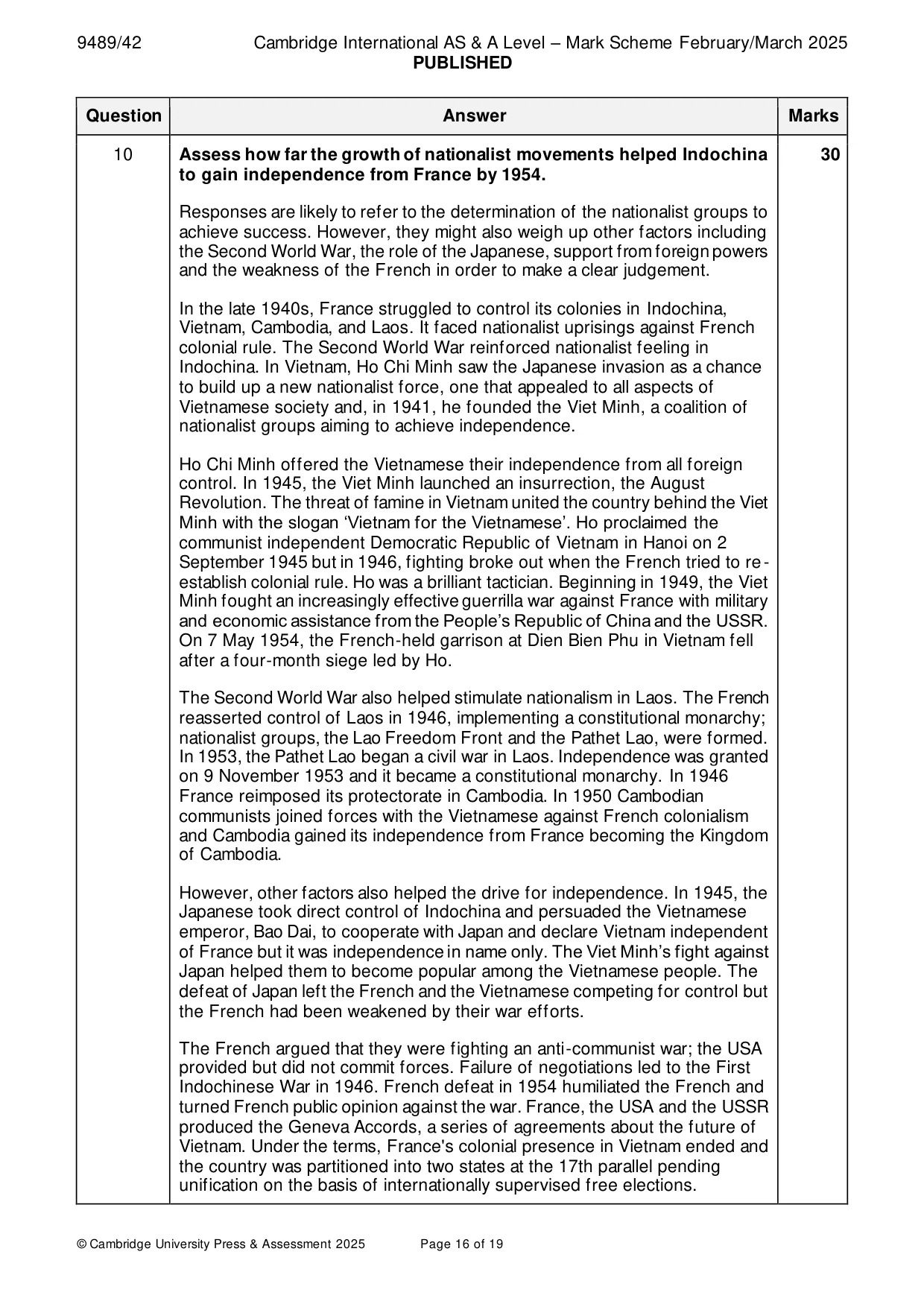
Q10 · Assess how far the growth of nationalist movements helped Indochina to gain independence…
10 Assess how far the growth of nationalist movements helped Indochina to gain independence from France by 1954. [30]
Mark scheme: 10 Assess how far the growth of nationalist movements helped Indochina 30 to gain independence from France by 1954. Responses are likely to refer to the determination of the nationalist groups to achieve success. However, they might also weigh up other factors including the Second World War, the role of the Japanese, support from foreign powers and the weakness of the French in order to make a clear judgement. In the late 1940s, France struggled to control its colonies in Indochina, Vietnam, Cambodia, and Laos. It faced nationalist uprisings against French colonial rule. The Second World War reinforced nationalist feeling in Indochina. In Vietnam, Ho Chi Minh saw the Japanese invasion as a chance to build up a new nationalist force, one that appealed to all aspects of Vietnamese society and, in 1941, he founded the Viet Minh, a coalition of nationalist groups aiming to achieve independence. Ho Chi Minh offered the Vietnamese their independence from all foreign control. In 1945, the Viet Minh launched an insurrection, the August Revolution. The threat of famine in Vietnam united the country behind the Viet Minh with the slogan ‘Vietnam for the Vietnamese’. Ho proclaimed the communist independent Democratic Republic of Vietnam in Hanoi on 2 September 1945 but in 1946, fighting broke out when the French tried to re- establish colonial rule. Ho was a brilliant tactician. Beginning in 1949, the Viet Minh fought an increasingly effective guerrilla war against France with military and economic assistance from the People’s Republic of China and the USSR. On 7 May 1954, the French-held garrison at Dien Bien Phu in Vietnam fell after a four-month siege led by Ho. The Second World War also helped stimulate nationalism in Laos. The French reasserted control of Laos in 1946, implementing a constitutional monarchy; nationalist groups, the Lao Freedom Front and the Pathet Lao, were formed. In 1953, the Pathet Lao began a civil war in Laos. Independence was granted on 9 November 1953 and it became a constitutional monarchy. In 1946 France reimposed its protectorate in Cambodia. In 1950 Cambodian communists joined forces with the Vietnamese against French colonialism and Cambodia gained its independence from France becoming the Kingdom of Cambodia. However, other factors also helped the drive for independence. In 1945, the Japanese took direct control of Indochina and persuaded the Vietnamese emperor, Bao Dai, to cooperate with Japan and declare Vietnam independent of France but it was independence in name only. The Viet Minh’s fight against Japan helped them to become popular among the Vietnamese people. The defeat of Japan left the French and the Vietnamese competing for control but the French had been weakened by their war efforts. The French argued that they were fighting an anti-communist war; the USA provided but did not commit forces. Failure of negotiations led to the First Indochinese War in 1946. French defeat in 1954 humiliated the French and turned French public opinion against the war. France, the USA and the USSR produced the Geneva Accords, a series of agreements about the future of Vietnam. Under the terms, France's colonial presence in Vietnam ended and the country was partitioned into two states at the 17th parallel pending unification on the basis of internationally supervised free elections.
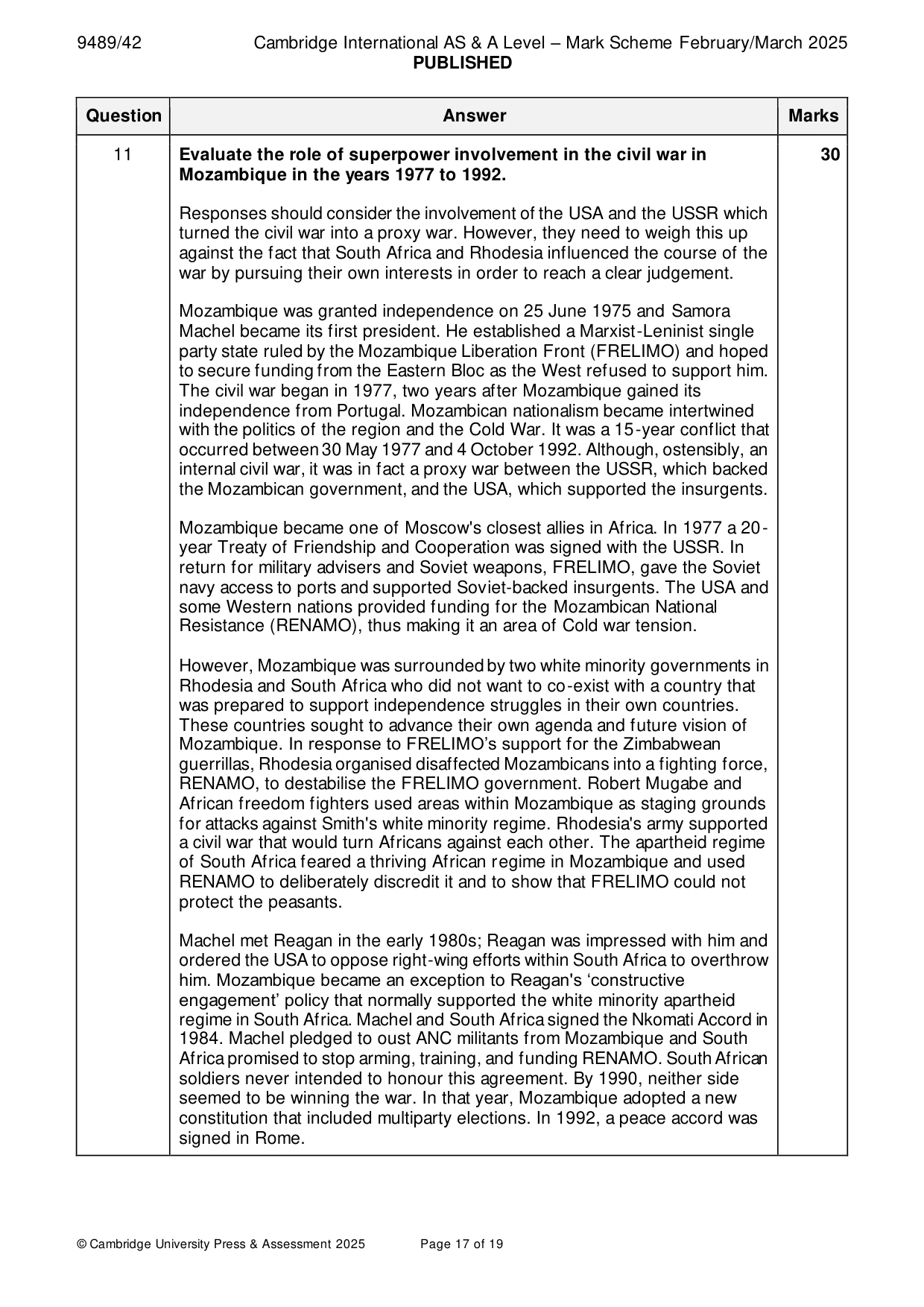
Q11 · Evaluate the role of superpower involvement in the civil war in Mozambique in the years…
11 Evaluate the role of superpower involvement in the civil war in Mozambique in the years 1977 to 1992. [30]
Mark scheme: 11 Evaluate the role of superpower involvement in the civil war in 30 Mozambique in the years 1977 to 1992. Responses should consider the involvement of the USA and the USSR which turned the civil war into a proxy war. However, they need to weigh this up against the fact that South Africa and Rhodesia influenced the course of the war by pursuing their own interests in order to reach a clear judgement. Mozambique was granted independence on 25 June 1975 and Samora Machel became its first president. He established a Marxist-Leninist single party state ruled by the Mozambique Liberation Front (FRELIMO) and hoped to secure funding from the Eastern Bloc as the West refused to support him. The civil war began in 1977, two years after Mozambique gained its independence from Portugal. Mozambican nationalism became intertwined with the politics of the region and the Cold War. It was a 15-year conflict that occurred between 30 May 1977 and 4 October 1992. Although, ostensibly, an internal civil war, it was in fact a proxy war between the USSR, which backed the Mozambican government, and the USA, which supported the insurgents. Mozambique became one of Moscow's closest allies in Africa. In 1977 a 20- year Treaty of Friendship and Cooperation was signed with the USSR. In return for military advisers and Soviet weapons, FRELIMO, gave the Soviet navy access to ports and supported Soviet-backed insurgents. The USA and some Western nations provided funding for the Mozambican National Resistance (RENAMO), thus making it an area of Cold war tension. However, Mozambique was surrounded by two white minority governments in Rhodesia and South Africa who did not want to co-exist with a country that was prepared to support independence struggles in their own countries. These countries sought to advance their own agenda and future vision of Mozambique. In response to FRELIMO’s support for the Zimbabwean guerrillas, Rhodesia organised disaffected Mozambicans into a fighting force, RENAMO, to destabilise the FRELIMO government. Robert Mugabe and African freedom fighters used areas within Mozambique as staging grounds for attacks against Smith's white minority regime. Rhodesia's army supported a civil war that would turn Africans against each other. The apartheid regime of South Africa feared a thriving African regime in Mozambique and used RENAMO to deliberately discredit it and to show that FRELIMO could not protect the peasants. Machel met Reagan in the early 1980s; Reagan was impressed with him and ordered the USA to oppose right-wing efforts within South Africa to overthrow him. Mozambique became an exception to Reagan's ‘constructive engagement’ policy that normally supported the white minority apartheid regime in South Africa. Machel and South Africa signed the Nkomati Accord in 1984. Machel pledged to oust ANC militants from Mozambique and South Africa promised to stop arming, training, and funding RENAMO. South African soldiers never intended to honour this agreement. By 1990, neither side seemed to be winning the war. In that year, Mozambique adopted a new constitution that included multiparty elections. In 1992, a peace accord was signed in Rome.
More questions on What was the impact of imperial expansion on international relations?
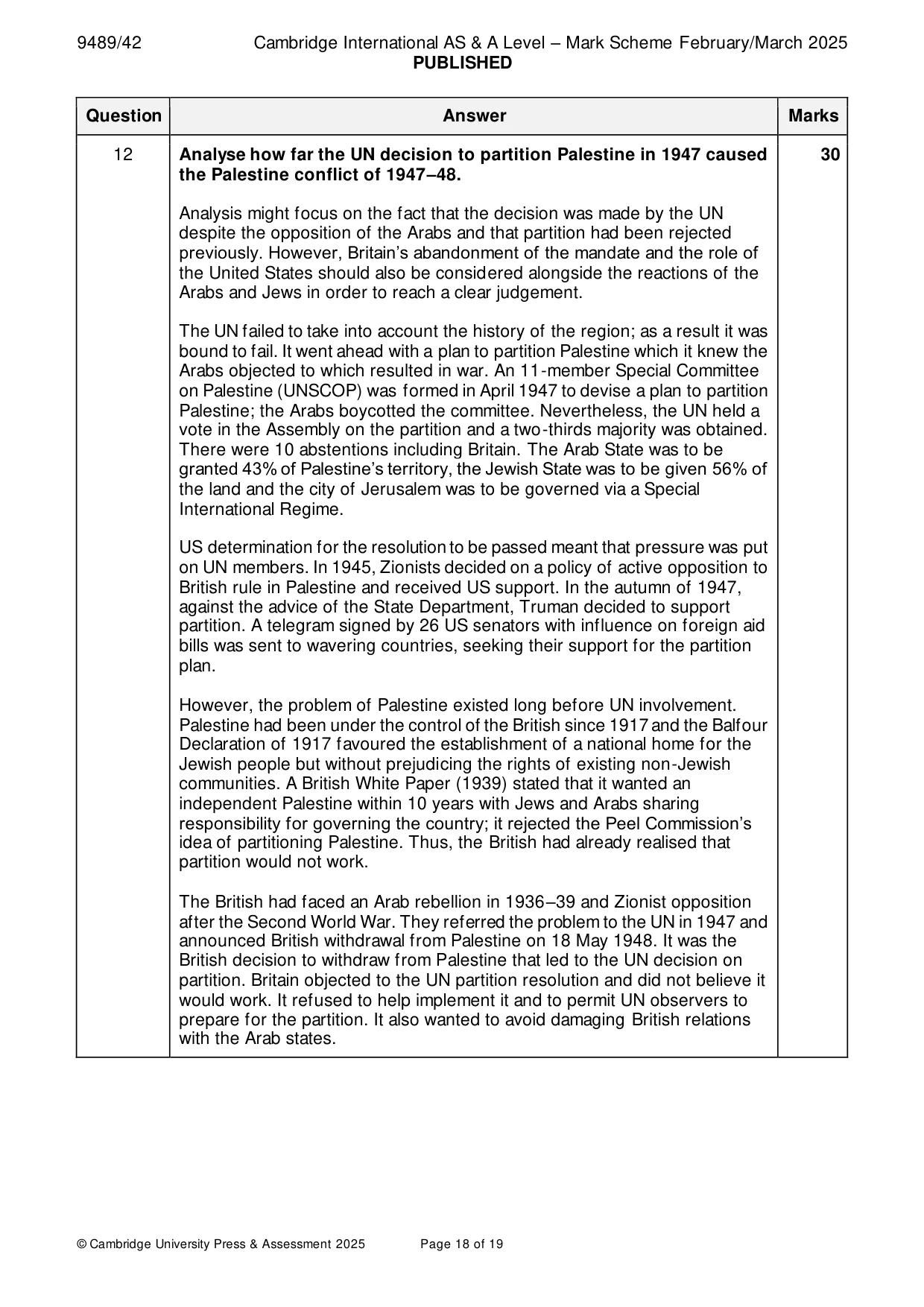
Q12 · Analyse how far the UN decision to partition Palestine in 1947 caused the Palestine…
12 Analyse how far the UN decision to partition Palestine in 1947 caused the Palestine conflict of 1947–48. [30]
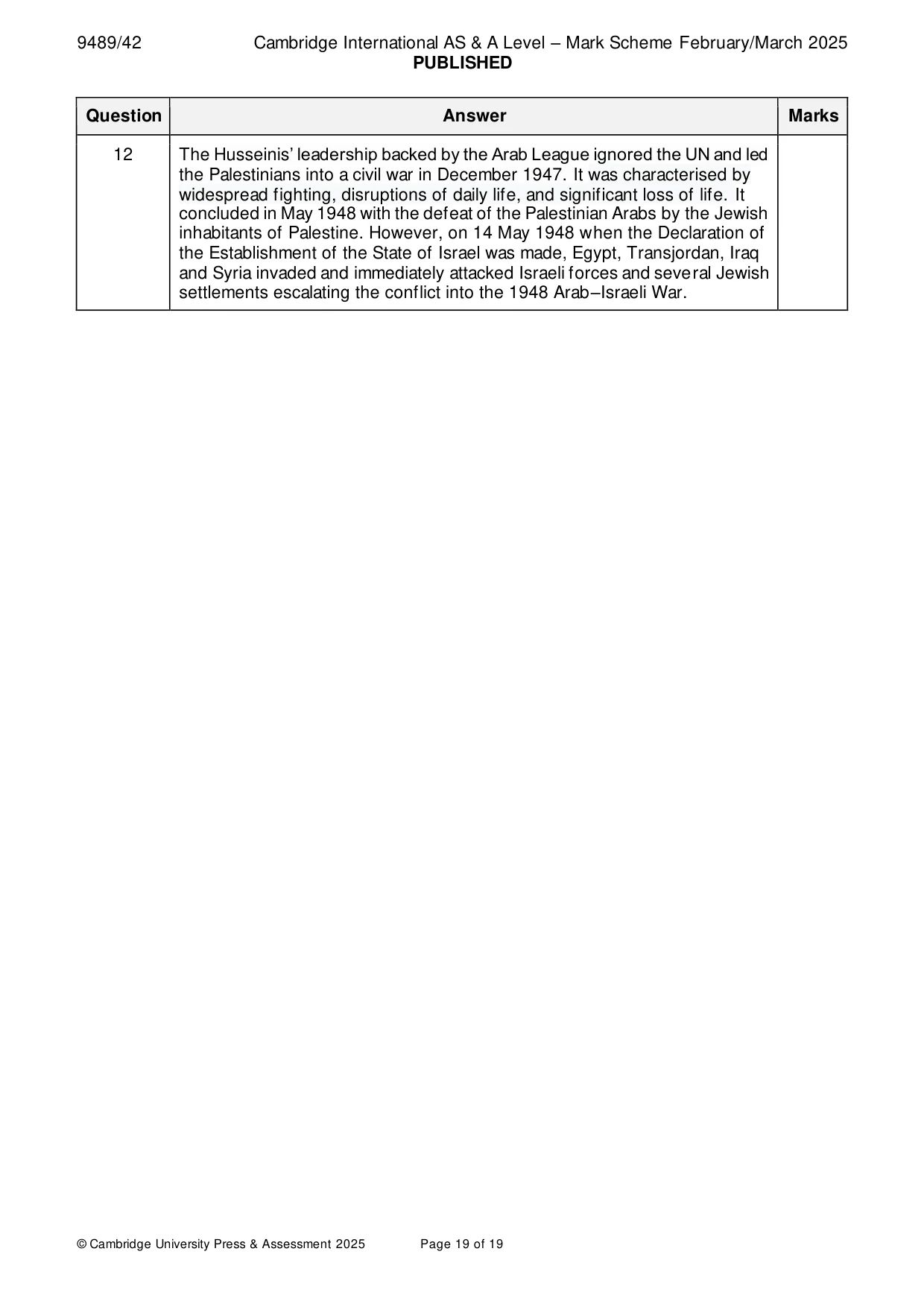
Mark scheme: 12 Analyse how far the UN decision to partition Palestine in 1947 caused 30 the Palestine conflict of 1947–48. Analysis might focus on the fact that the decision was made by the UN despite the opposition of the Arabs and that partition had been rejected previously. However, Britain’s abandonment of the mandate and the role of the United States should also be considered alongside the reactions of the Arabs and Jews in order to reach a clear judgement. The UN failed to take into account the history of the region; as a result it was bound to fail. It went ahead with a plan to partition Palestine which it knew the Arabs objected to which resulted in war. An 11-member Special Committee on Palestine (UNSCOP) was formed in April 1947 to devise a plan to partition Palestine; the Arabs boycotted the committee. Nevertheless, the UN held a vote in the Assembly on the partition and a two-thirds majority was obtained. There were 10 abstentions including Britain. The Arab State was to be granted 43% of Palestine’s territory, the Jewish State was to be given 56% of the land and the city of Jerusalem was to be governed via a Special International Regime. US determination for the resolution to be passed meant that pressure was put on UN members. In 1945, Zionists decided on a policy of active opposition to British rule in Palestine and received US support. In the autumn of 1947, against the advice of the State Department, Truman decided to support partition. A telegram signed by 26 US senators with influence on foreign aid bills was sent to wavering countries, seeking their support for the partition plan. However, the problem of Palestine existed long before UN involvement. Palestine had been under the control of the British since 1917 and the Balfour Declaration of 1917 favoured the establishment of a national home for the Jewish people but without prejudicing the rights of existing non-Jewish communities. A British White Paper (1939) stated that it wanted an independent Palestine within 10 years with Jews and Arabs sharing responsibility for governing the country; it rejected the Peel Commission’s idea of partitioning Palestine. Thus, the British had already realised that partition would not work. The British had faced an Arab rebellion in 1936–39 and Zionist opposition after the Second World War. They referred the problem to the UN in 1947 and announced British withdrawal from Palestine on 18 May 1948. It was the British decision to withdraw from Palestine that led to the UN decision on partition. Britain objected to the UN partition resolution and did not believe it would work. It refused to help implement it and to permit UN observers to prepare for the partition. It also wanted to avoid damaging British relations with the Arab states. 12 The Husseinis’ leadership backed by the Arab League ignored the UN and led the Palestinians into a civil war in December 1947. It was characterised by widespread fighting, disruptions of daily life, and significant loss of life. It concluded in May 1948 with the defeat of the Palestinian Arabs by the Jewish inhabitants of Palestine. However, on 14 May 1948 when the Declaration of the Establishment of the State of Israel was made, Egypt, Transjordan, Iraq and Syria invaded and immediately attacked Israeli forces and several Jewish settlements escalating the conflict into the 1948 Arab–Israeli War.
More questions on Why did the League of Nations fail to keep the peace in the 1930s?
What was in this paper
The subtopics covered by these 12 questions, and how many questions each got. Open one in a new tab to see every Cambridge question on it.
4How successful was the Progressive Movement from 1890 to 1920?2Why did war break out in 1939?2How and why did international relations improve, 1924–29?1What was the impact of imperial expansion on international relations?1What was the impact of the Great Crash and the Great Depression in the United States?1Why did the League of Nations fail to keep the peace in the 1930s?1What you needed in this session
Cambridge’s own grade thresholds for 2025 Feb/March, Paper 4 · Variant 2. A higher threshold means an easier paper — the bar moves with how the cohort did.