Cambridge A Level History 9489 — 2023 May/June Paper 4 · Variant 1
9489/41/M/J/23 · 11 questions · 60 marks · ≈68 min
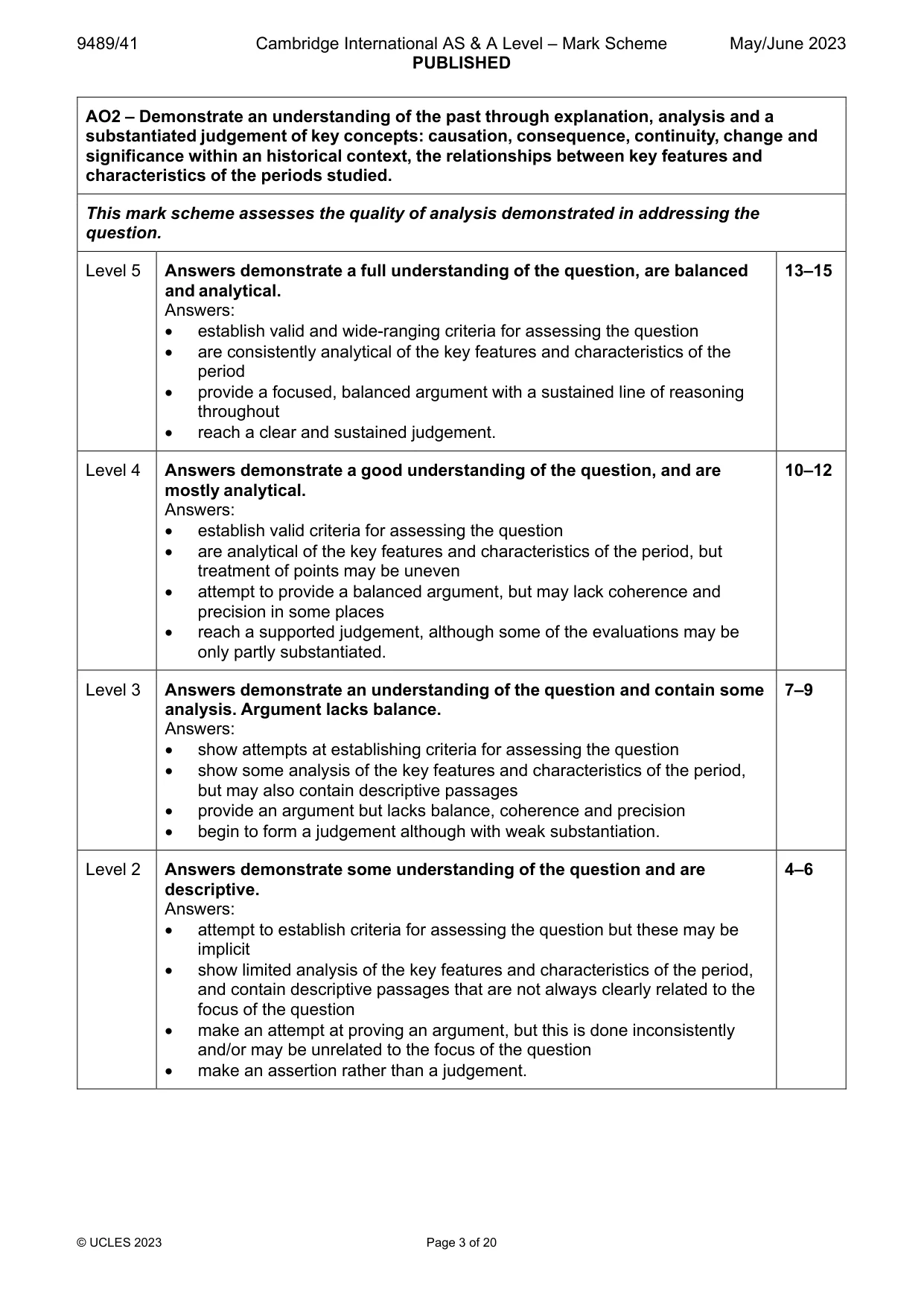
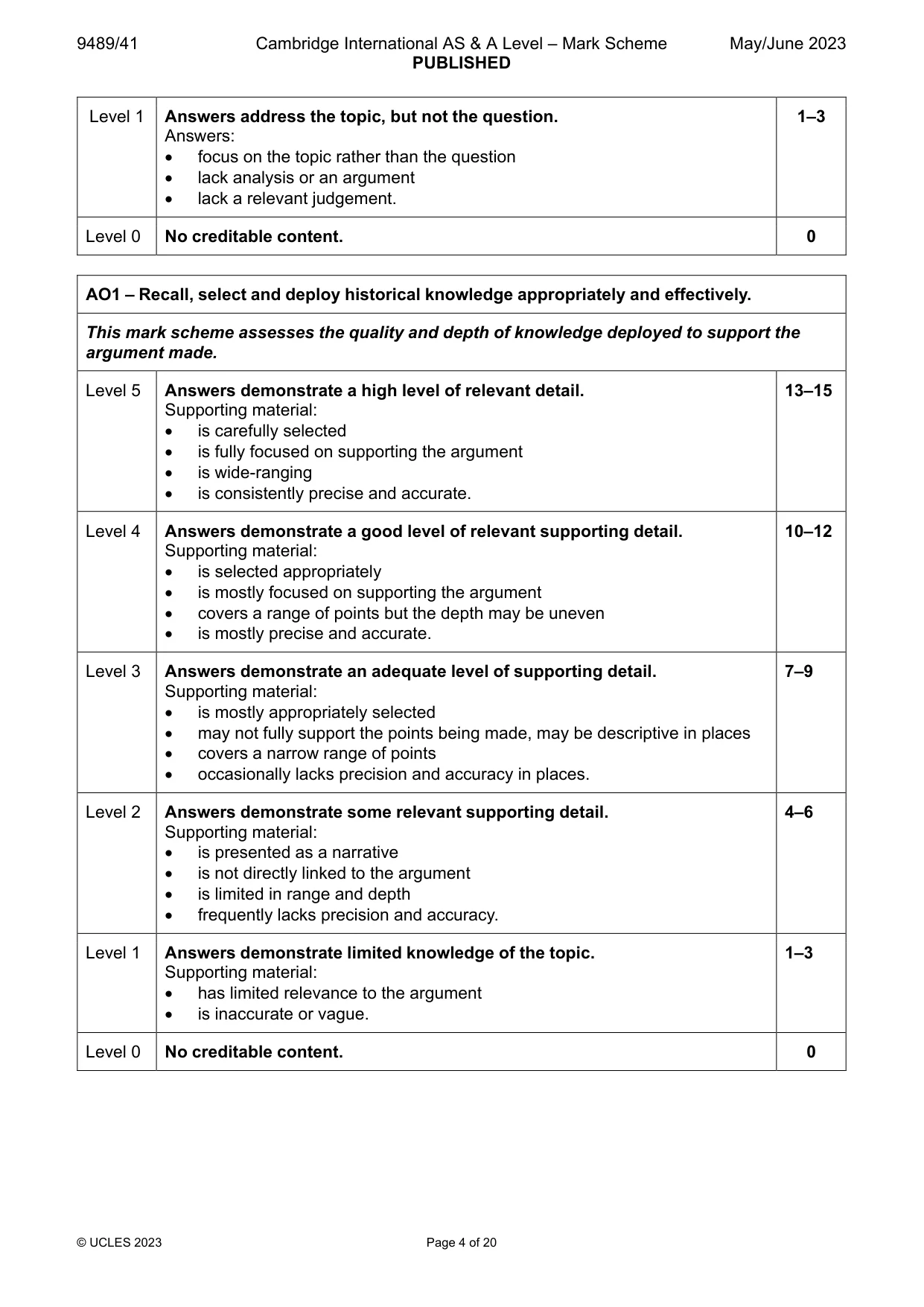
The question paper and its mark scheme, free to read here and free to download. This is Cambridge’s own paper, exactly as it was sat.
Question paper4 pages

Mark scheme20 pages
Answers below. Sit the paper first if you are practising.

Questions as text
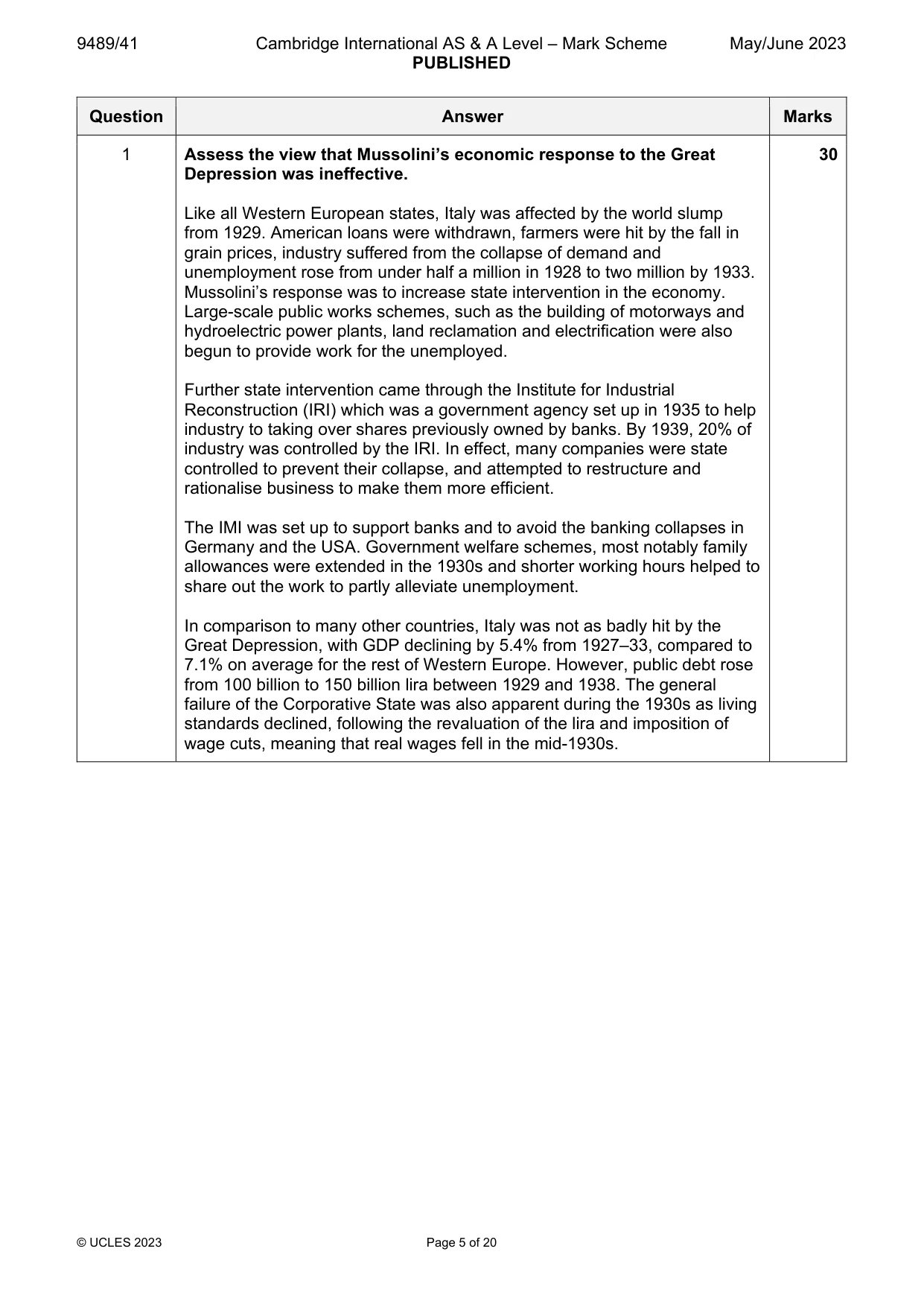
Q1 · Assess the view that Mussolini’s economic response to the Great Depression was ineffective
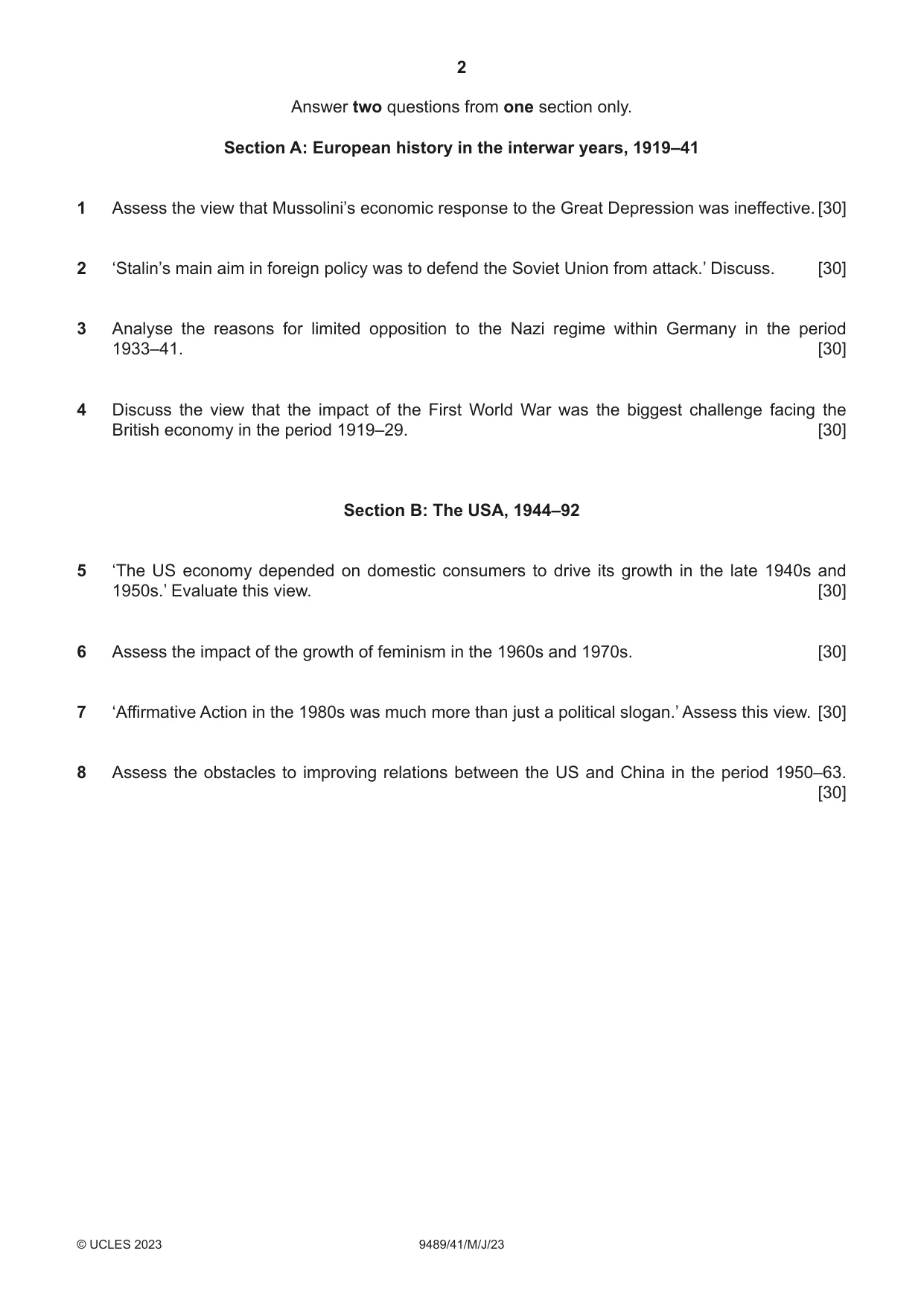
1 Assess the view that Mussolini’s economic response to the Great Depression was ineffective. [30]
Mark scheme: Question Answer Marks 1 Assess the view that Mussolini’s economic response to the Great 30 Depression was ineffective. Like all Western European states, Italy was affected by the world slump from 1929. American loans were withdrawn, farmers were hit by the fall in grain prices, industry suffered from the collapse of demand and unemployment rose from under half a million in 1928 to two million by 1933. Mussolini’s response was to increase state intervention in the economy. Large-scale public works schemes, such as the building of motorways and hydroelectric power plants, land reclamation and electrification were also begun to provide work for the unemployed. Further state intervention came through the Institute for Industrial Reconstruction (IRI) which was a government agency set up in 1935 to help industry to taking over shares previously owned by banks. By 1939, 20% of industry was controlled by the IRI. In effect, many companies were state controlled to prevent their collapse, and attempted to restructure and rationalise business to make them more efficient. The IMI was set up to support banks and to avoid the banking collapses in Germany and the USA. Government welfare schemes, most notably family allowances were extended in the 1930s and shorter working hours helped to share out the work to partly alleviate unemployment. In comparison to many other countries, Italy was not as badly hit by the Great Depression, with GDP declining by 5.4% from 1927–33, compared to 7.1% on average for the rest of Western Europe. However, public debt rose from 100 billion to 150 billion lira between 1929 and 1938. The general failure of the Corporative State was also apparent during the 1930s as living standards declined, following the revaluation of the lira and imposition of wage cuts, meaning that real wages fell in the mid-1930s.
More questions on How did the rise of extremism affect international relations?
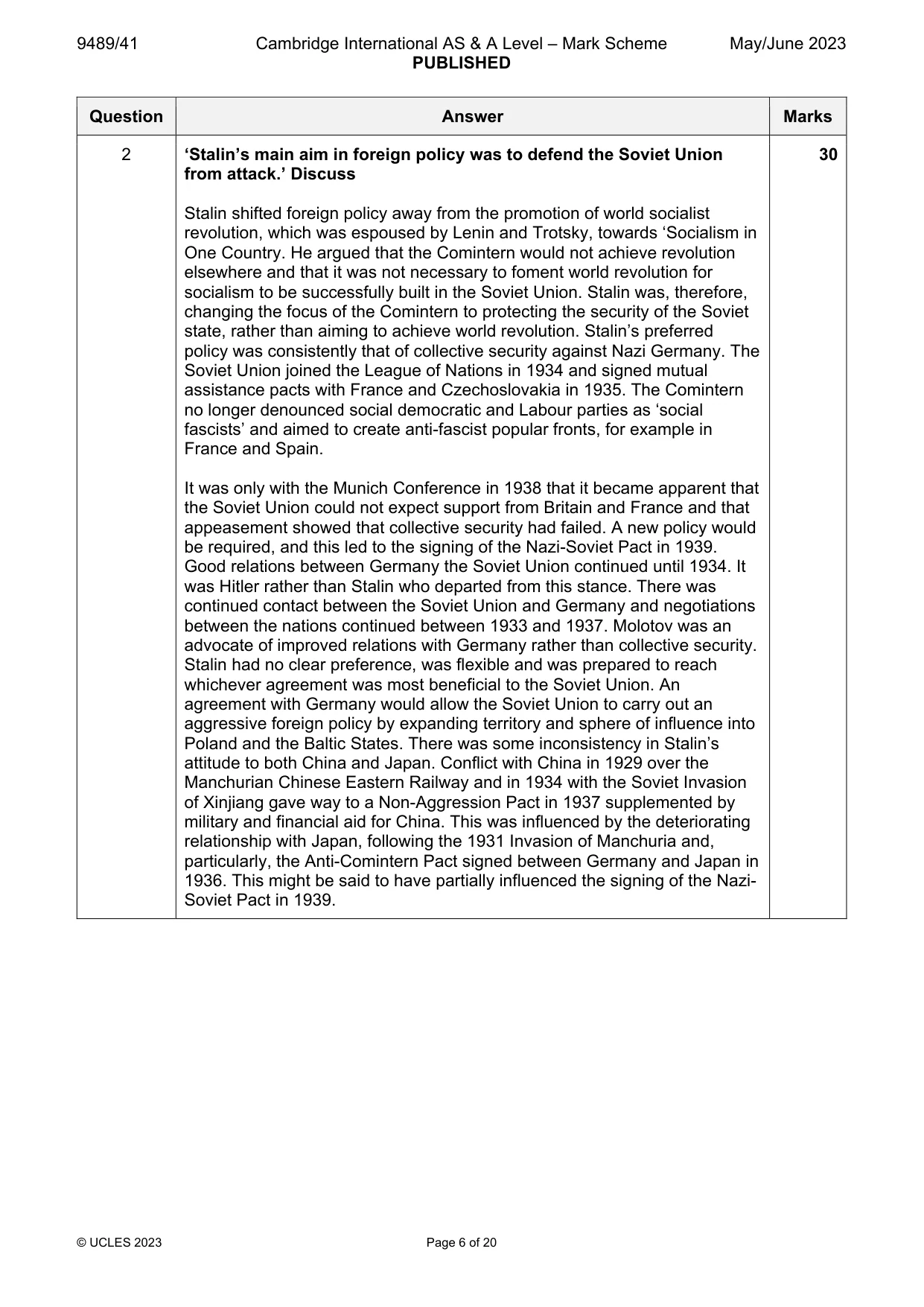
Q2 · ‘Stalin’s main aim in foreign policy was to defend the Soviet Union from attack.’ Discuss
2 ‘Stalin’s main aim in foreign policy was to defend the Soviet Union from attack.’ Discuss. [30]
Mark scheme: 2 ‘Stalin’s main aim in foreign policy was to defend the Soviet Union 30 from attack.’ Discuss Stalin shifted foreign policy away from the promotion of world socialist revolution, which was espoused by Lenin and Trotsky, towards ‘Socialism in One Country. He argued that the Comintern would not achieve revolution elsewhere and that it was not necessary to foment world revolution for socialism to be successfully built in the Soviet Union. Stalin was, therefore, changing the focus of the Comintern to protecting the security of the Soviet state, rather than aiming to achieve world revolution. Stalin’s preferred policy was consistently that of collective security against Nazi Germany. The Soviet Union joined the League of Nations in 1934 and signed mutual assistance pacts with France and Czechoslovakia in 1935. The Comintern no longer denounced social democratic and Labour parties as ‘social fascists’ and aimed to create anti-fascist popular fronts, for example in France and Spain. It was only with the Munich Conference in 1938 that it became apparent that the Soviet Union could not expect support from Britain and France and that appeasement showed that collective security had failed. A new policy would be required, and this led to the signing of the Nazi-Soviet Pact in 1939. Good relations between Germany the Soviet Union continued until 1934. It was Hitler rather than Stalin who departed from this stance. There was continued contact between the Soviet Union and Germany and negotiations between the nations continued between 1933 and 1937. Molotov was an advocate of improved relations with Germany rather than collective security. Stalin had no clear preference, was flexible and was prepared to reach whichever agreement was most beneficial to the Soviet Union. An agreement with Germany would allow the Soviet Union to carry out an aggressive foreign policy by expanding territory and sphere of influence into Poland and the Baltic States. There was some inconsistency in Stalin’s attitude to both China and Japan. Conflict with China in 1929 over the Manchurian Chinese Eastern Railway and in 1934 with the Soviet Invasion of Xinjiang gave way to a Non-Aggression Pact in 1937 supplemented by military and financial aid for China. This was influenced by the deteriorating relationship with Japan, following the 1931 Invasion of Manchuria and, particularly, the Anti-Comintern Pact signed between Germany and Japan in 1936. This might be said to have partially influenced the signing of the Nazi- Soviet Pact in 1939.
More questions on How did the rise of extremism affect international relations?
Q3 · Analyse the reasons for limited opposition to the Nazi regime within Germany in the…
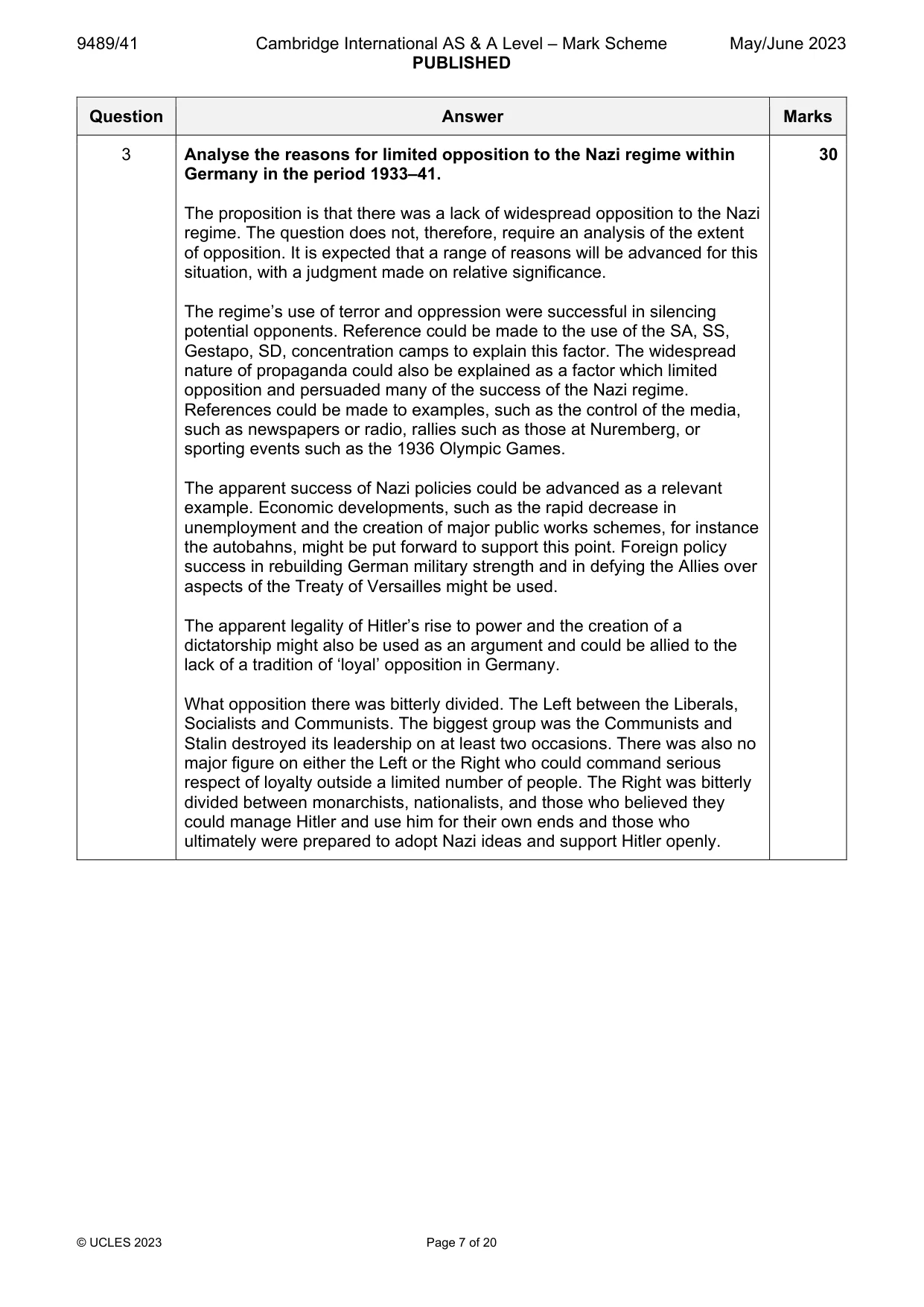
3 Analyse the reasons for limited opposition to the Nazi regime within Germany in the period 1933–41. [30]
Mark scheme: 3 Analyse the reasons for limited opposition to the Nazi regime within 30 Germany in the period 1933–41. The proposition is that there was a lack of widespread opposition to the Nazi regime. The question does not, therefore, require an analysis of the extent of opposition. It is expected that a range of reasons will be advanced for this situation, with a judgment made on relative significance. The regime’s use of terror and oppression were successful in silencing potential opponents. Reference could be made to the use of the SA, SS, Gestapo, SD, concentration camps to explain this factor. The widespread nature of propaganda could also be explained as a factor which limited opposition and persuaded many of the success of the Nazi regime. References could be made to examples, such as the control of the media, such as newspapers or radio, rallies such as those at Nuremberg, or sporting events such as the 1936 Olympic Games. The apparent success of Nazi policies could be advanced as a relevant example. Economic developments, such as the rapid decrease in unemployment and the creation of major public works schemes, for instance the autobahns, might be put forward to support this point. Foreign policy success in rebuilding German military strength and in defying the Allies over aspects of the Treaty of Versailles might be used. The apparent legality of Hitler’s rise to power and the creation of a dictatorship might also be used as an argument and could be allied to the lack of a tradition of ‘loyal’ opposition in Germany. What opposition there was bitterly divided. The Left between the Liberals, Socialists and Communists. The biggest group was the Communists and Stalin destroyed its leadership on at least two occasions. There was also no major figure on either the Left or the Right who could command serious respect of loyalty outside a limited number of people. The Right was bitterly divided between monarchists, nationalists, and those who believed they could manage Hitler and use him for their own ends and those who ultimately were prepared to adopt Nazi ideas and support Hitler openly.
More questions on How did the rise of extremism affect international relations?
Q4 · Discuss the view that the impact of the First World War was the biggest challenge facing…
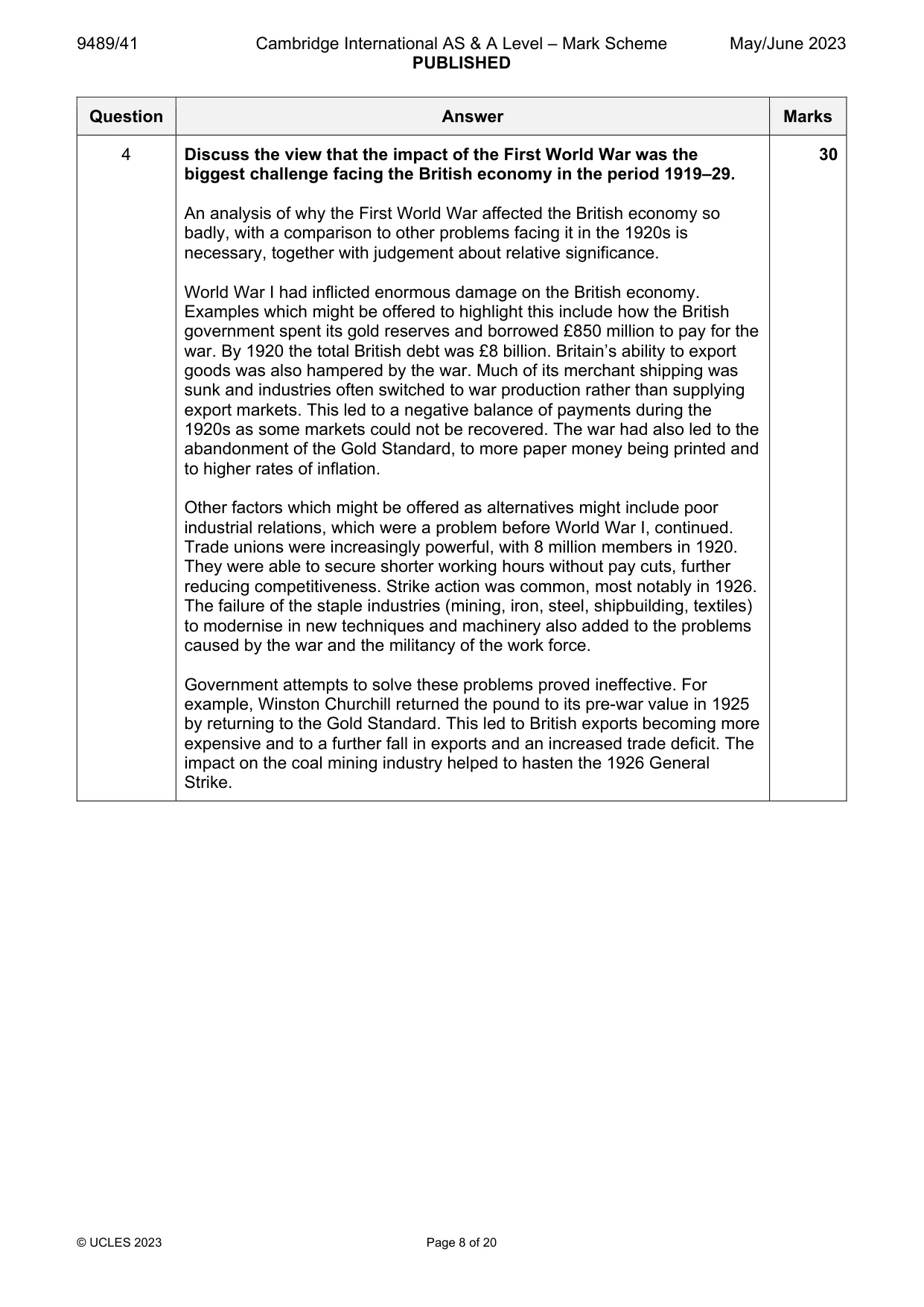
4 Discuss the view that the impact of the First World War was the biggest challenge facing the British economy in the period 1919–29. [30]
Mark scheme: 4 Discuss the view that the impact of the First World War was the 30 biggest challenge facing the British economy in the period 1919–29. An analysis of why the First World War affected the British economy so badly, with a comparison to other problems facing it in the 1920s is necessary, together with judgement about relative significance. World War I had inflicted enormous damage on the British economy. Examples which might be offered to highlight this include how the British government spent its gold reserves and borrowed £850 million to pay for the war. By 1920 the total British debt was £8 billion. Britain’s ability to export goods was also hampered by the war. Much of its merchant shipping was sunk and industries often switched to war production rather than supplying export markets. This led to a negative balance of payments during the 1920s as some markets could not be recovered. The war had also led to the abandonment of the Gold Standard, to more paper money being printed and to higher rates of inflation. Other factors which might be offered as alternatives might include poor industrial relations, which were a problem before World War I, continued. Trade unions were increasingly powerful, with 8 million members in 1920. They were able to secure shorter working hours without pay cuts, further reducing competitiveness. Strike action was common, most notably in 1926. The failure of the staple industries (mining, iron, steel, shipbuilding, textiles) to modernise in new techniques and machinery also added to the problems caused by the war and the militancy of the work force. Government attempts to solve these problems proved ineffective. For example, Winston Churchill returned the pound to its pre-war value in 1925 by returning to the Gold Standard. This led to British exports becoming more expensive and to a further fall in exports and an increased trade deficit. The impact on the coal mining industry helped to hasten the 1926 General Strike.
Q5 · ‘The US economy depended on domestic consumers to drive its growth in the late 1940s and…
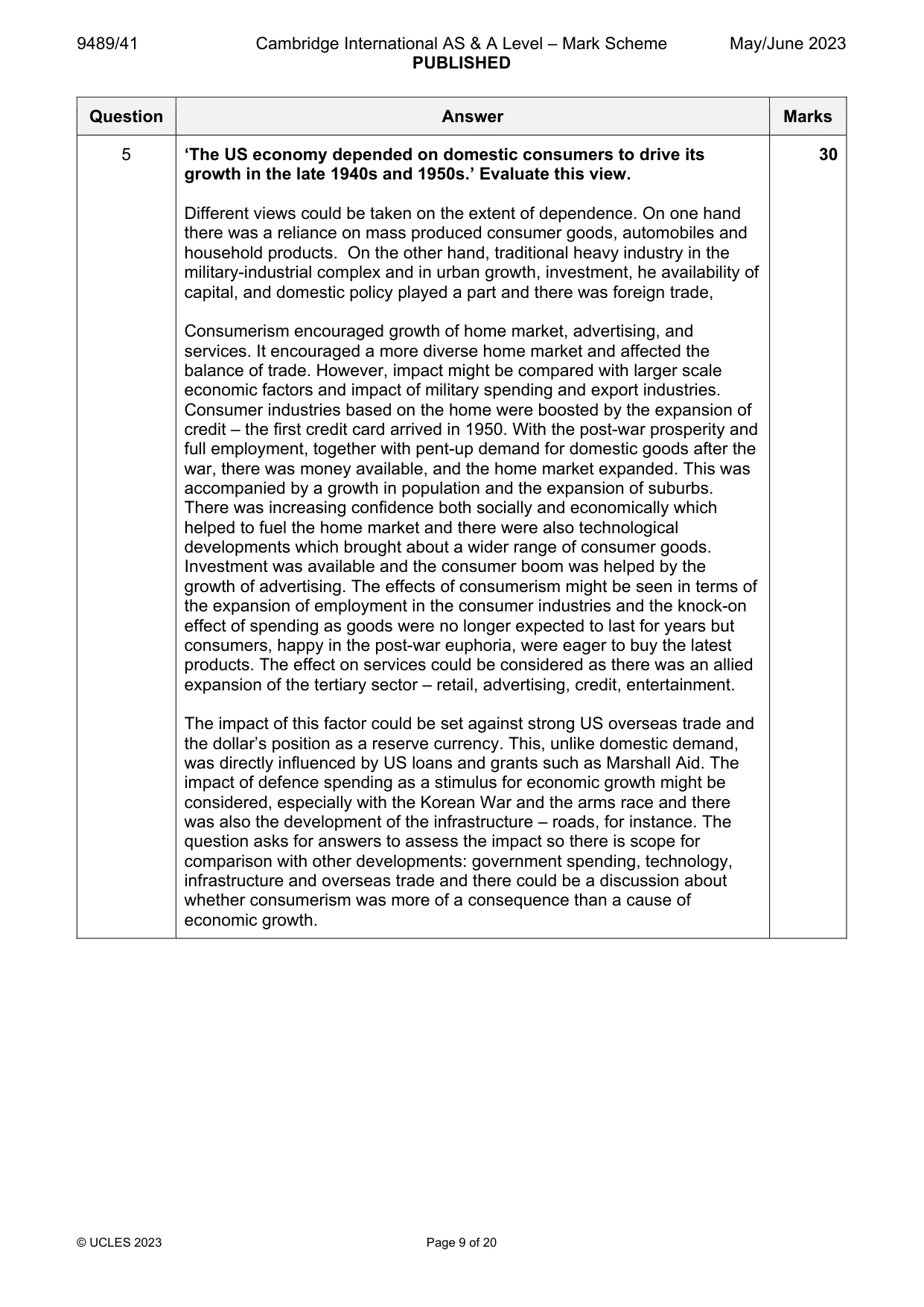
5 ‘The US economy depended on domestic consumers to drive its growth in the late 1940s and 1950s.’ Evaluate this view. [30]
Mark scheme: 5 ‘The US economy depended on domestic consumers to drive its 30 growth in the late 1940s and 1950s.’ Evaluate this view. Different views could be taken on the extent of dependence. On one hand there was a reliance on mass produced consumer goods, automobiles and household products. On the other hand, traditional heavy industry in the military-industrial complex and in urban growth, investment, he availability of capital, and domestic policy played a part and there was foreign trade, Consumerism encouraged growth of home market, advertising, and services. It encouraged a more diverse home market and affected the balance of trade. However, impact might be compared with larger scale economic factors and impact of military spending and export industries. Consumer industries based on the home were boosted by the expansion of credit – the first credit card arrived in 1950. With the post-war prosperity and full employment, together with pent-up demand for domestic goods after the war, there was money available, and the home market expanded. This was accompanied by a growth in population and the expansion of suburbs. There was increasing confidence both socially and economically which helped to fuel the home market and there were also technological developments which brought about a wider range of consumer goods. Investment was available and the consumer boom was helped by the growth of advertising. The effects of consumerism might be seen in terms of the expansion of employment in the consumer industries and the knock-on effect of spending as goods were no longer expected to last for years but consumers, happy in the post-war euphoria, were eager to buy the latest products. The effect on services could be considered as there was an allied expansion of the tertiary sector – retail, advertising, credit, entertainment. The impact of this factor could be set against strong US overseas trade and the dollar’s position as a reserve currency. This, unlike domestic demand, was directly influenced by US loans and grants such as Marshall Aid. The impact of defence spending as a stimulus for economic growth might be considered, especially with the Korean War and the arms race and there was also the development of the infrastructure – roads, for instance. The question asks for answers to assess the impact so there is scope for comparison with other developments: government spending, technology, infrastructure and overseas trade and there could be a discussion about whether consumerism was more of a consequence than a cause of economic growth.
More questions on What were the consequences of the rapid economic growth after 1870?
Q6 · Assess the impact of the growth of feminism in the 1960s and 1970s
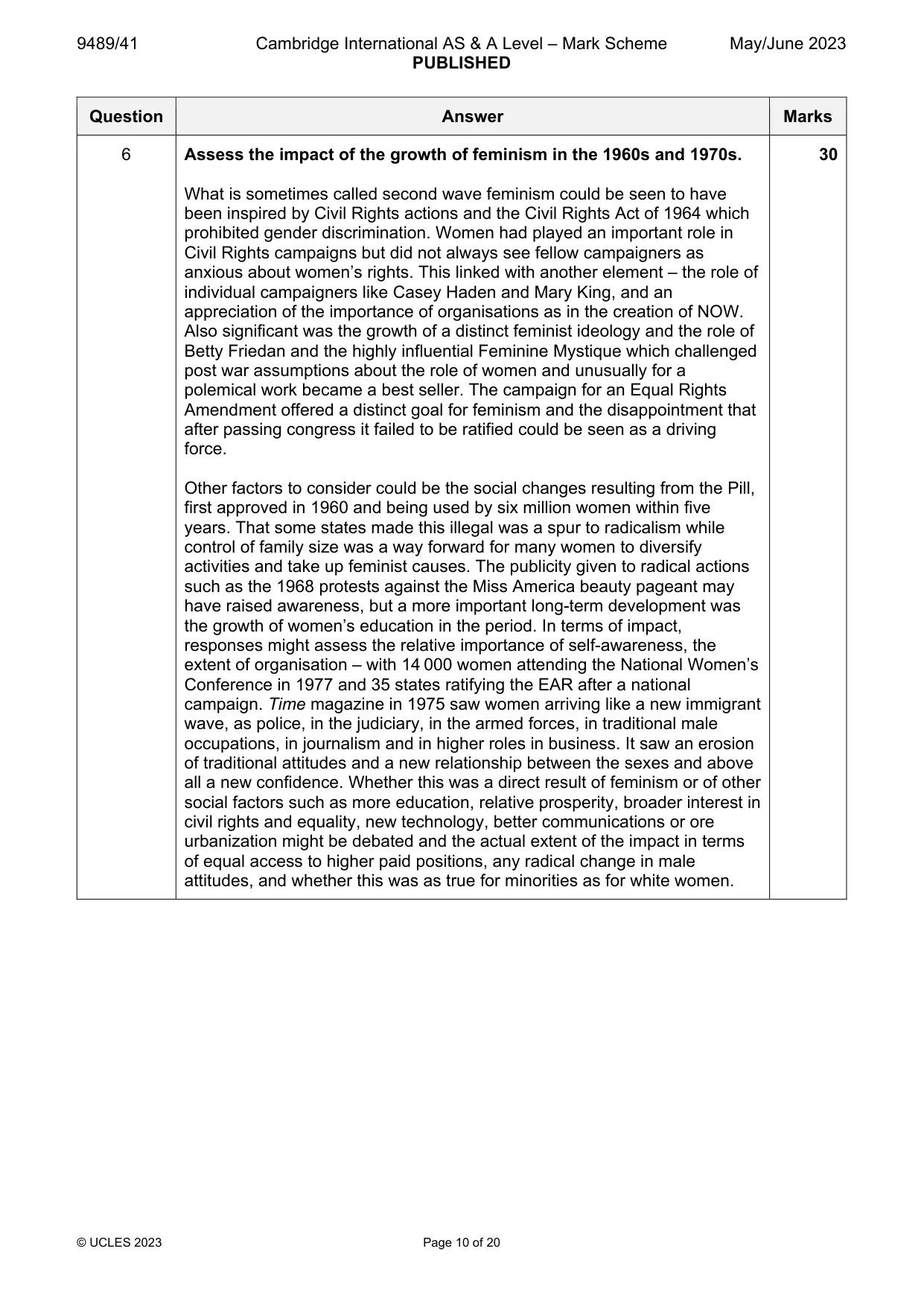
6 Assess the impact of the growth of feminism in the 1960s and 1970s. [30]
Mark scheme: 6 Assess the impact of the growth of feminism in the 1960s and 1970s. 30 What is sometimes called second wave feminism could be seen to have been inspired by Civil Rights actions and the Civil Rights Act of 1964 which prohibited gender discrimination. Women had played an important role in Civil Rights campaigns but did not always see fellow campaigners as anxious about women’s rights. This linked with another element – the role of individual campaigners like Casey Haden and Mary King, and an appreciation of the importance of organisations as in the creation of NOW. Also significant was the growth of a distinct feminist ideology and the role of Betty Friedan and the highly influential Feminine Mystique which challenged post war assumptions about the role of women and unusually for a polemical work became a best seller. The campaign for an Equal Rights Amendment offered a distinct goal for feminism and the disappointment that after passing congress it failed to be ratified could be seen as a driving force. Other factors to consider could be the social changes resulting from the Pill, first approved in 1960 and being used by six million women within five years. That some states made this illegal was a spur to radicalism while control of family size was a way forward for many women to diversify activities and take up feminist causes. The publicity given to radical actions such as the 1968 protests against the Miss America beauty pageant may have raised awareness, but a more important long-term development was the growth of women’s education in the period. In terms of impact, responses might assess the relative importance of self-awareness, the extent of organisation – with 14 000 women attending the National Women’s Conference in 1977 and 35 states ratifying the EAR after a national campaign. Time magazine in 1975 saw women arriving like a new immigrant wave, as police, in the judiciary, in the armed forces, in traditional male occupations, in journalism and in higher roles in business. It saw an erosion of traditional attitudes and a new relationship between the sexes and above all a new confidence. Whether this was a direct result of feminism or of other social factors such as more education, relative prosperity, broader interest in civil rights and equality, new technology, better communications or ore urbanization might be debated and the actual extent of the impact in terms of equal access to higher paid positions, any radical change in male attitudes, and whether this was as true for minorities as for white women.
More questions on How successful was the Progressive Movement from 1890 to 1920?
Q7 · ‘Affirmative Action in the 1980s was much more than just a political slogan.’ Assess this…
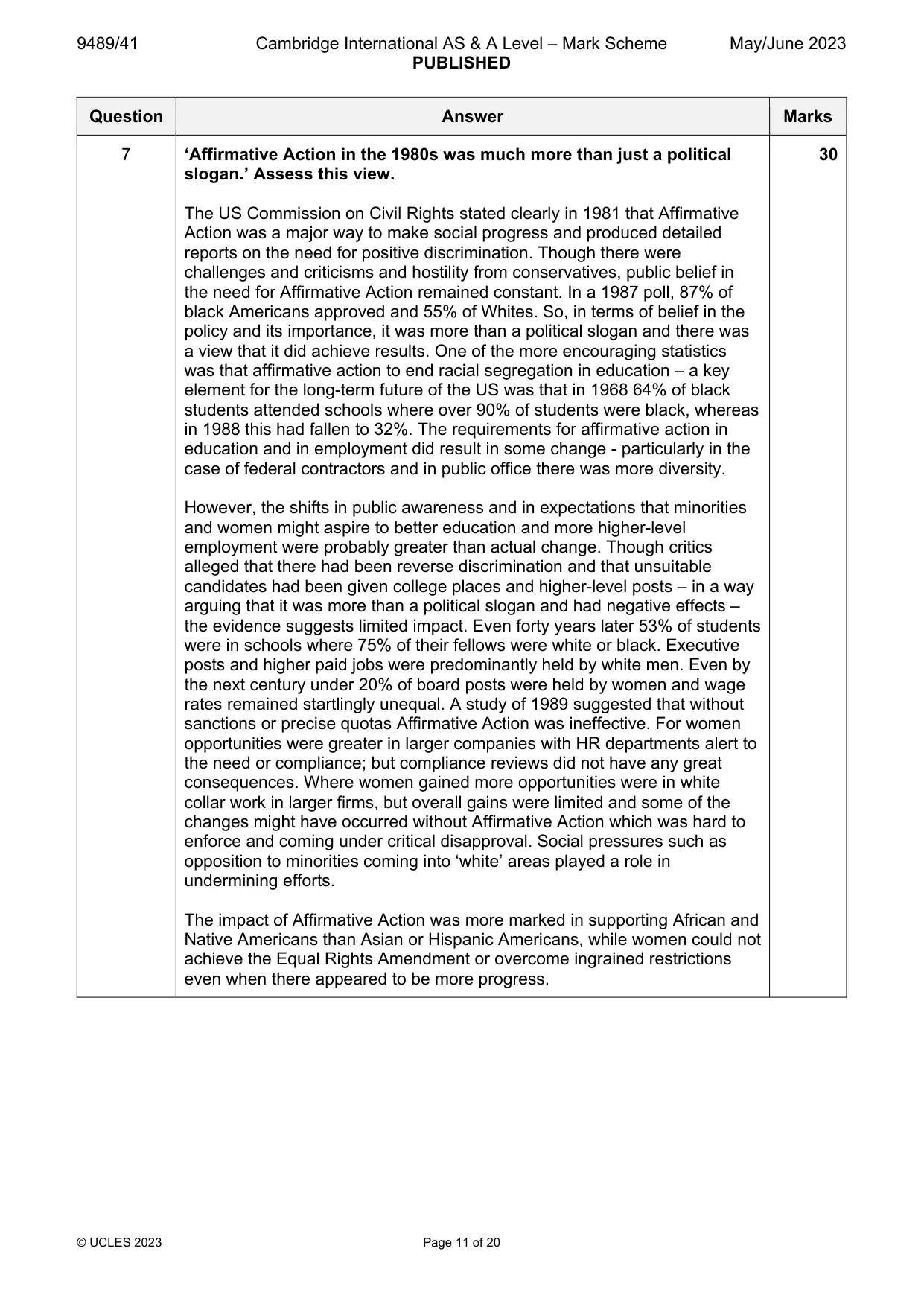
7 ‘Affirmative Action in the 1980s was much more than just a political slogan.’ Assess this view. [30]
Mark scheme: 7 ‘Affirmative Action in the 1980s was much more than just a political 30 slogan.’ Assess this view. The US Commission on Civil Rights stated clearly in 1981 that Affirmative Action was a major way to make social progress and produced detailed reports on the need for positive discrimination. Though there were challenges and criticisms and hostility from conservatives, public belief in the need for Affirmative Action remained constant. In a 1987 poll, 87% of black Americans approved and 55% of Whites. So, in terms of belief in the policy and its importance, it was more than a political slogan and there was a view that it did achieve results. One of the more encouraging statistics was that affirmative action to end racial segregation in education – a key element for the long-term future of the US was that in 1968 64% of black students attended schools where over 90% of students were black, whereas in 1988 this had fallen to 32%. The requirements for affirmative action in education and in employment did result in some change - particularly in the case of federal contractors and in public office there was more diversity. However, the shifts in public awareness and in expectations that minorities and women might aspire to better education and more higher-level employment were probably greater than actual change. Though critics alleged that there had been reverse discrimination and that unsuitable candidates had been given college places and higher-level posts – in a way arguing that it was more than a political slogan and had negative effects – the evidence suggests limited impact. Even forty years later 53% of students were in schools where 75% of their fellows were white or black. Executive posts and higher paid jobs were predominantly held by white men. Even by the next century under 20% of board posts were held by women and wage rates remained startlingly unequal. A study of 1989 suggested that without sanctions or precise quotas Affirmative Action was ineffective. For women opportunities were greater in larger companies with HR departments alert to the need or compliance; but compliance reviews did not have any great consequences. Where women gained more opportunities were in white collar work in larger firms, but overall gains were limited and some of the changes might have occurred without Affirmative Action which was hard to enforce and coming under critical disapproval. Social pressures such as opposition to minorities coming into ‘white’ areas played a role in undermining efforts. The impact of Affirmative Action was more marked in supporting African and Native Americans than Asian or Hispanic Americans, while women could not achieve the Equal Rights Amendment or overcome ingrained restrictions even when there appeared to be more progress.
More questions on How successful was the Progressive Movement from 1890 to 1920?
Q8 · Assess the obstacles to improving relations between the US and China in the period 1950–63
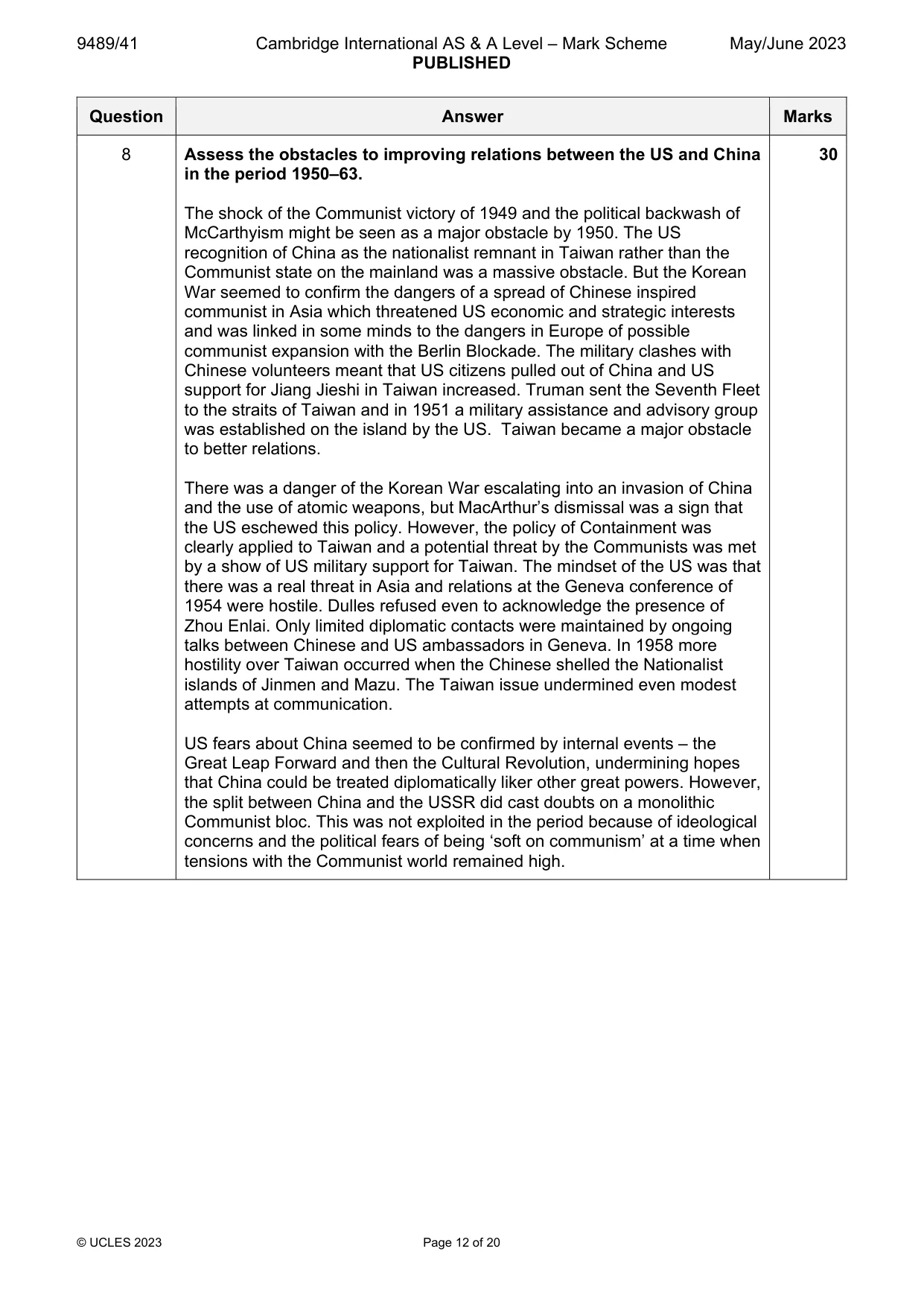
8 Assess the obstacles to improving relations between the US and China in the period 1950–63. [30] Section C: International history, 1945–92
Mark scheme: 8 Assess the obstacles to improving relations between the US and China 30 in the period 1950–63. The shock of the Communist victory of 1949 and the political backwash of McCarthyism might be seen as a major obstacle by 1950. The US recognition of China as the nationalist remnant in Taiwan rather than the Communist state on the mainland was a massive obstacle. But the Korean War seemed to confirm the dangers of a spread of Chinese inspired communist in Asia which threatened US economic and strategic interests and was linked in some minds to the dangers in Europe of possible communist expansion with the Berlin Blockade. The military clashes with Chinese volunteers meant that US citizens pulled out of China and US support for Jiang Jieshi in Taiwan increased. Truman sent the Seventh Fleet to the straits of Taiwan and in 1951 a military assistance and advisory group was established on the island by the US. Taiwan became a major obstacle to better relations. There was a danger of the Korean War escalating into an invasion of China and the use of atomic weapons, but MacArthur’s dismissal was a sign that the US eschewed this policy. However, the policy of Containment was clearly applied to Taiwan and a potential threat by the Communists was met by a show of US military support for Taiwan. The mindset of the US was that there was a real threat in Asia and relations at the Geneva conference of 1954 were hostile. Dulles refused even to acknowledge the presence of Zhou Enlai. Only limited diplomatic contacts were maintained by ongoing talks between Chinese and US ambassadors in Geneva. In 1958 more hostility over Taiwan occurred when the Chinese shelled the Nationalist islands of Jinmen and Mazu. The Taiwan issue undermined even modest attempts at communication. US fears about China seemed to be confirmed by internal events – the Great Leap Forward and then the Cultural Revolution, undermining hopes that China could be treated diplomatically liker other great powers. However, the split between China and the USSR did cast doubts on a monolithic Communist bloc. This was not exploited in the period because of ideological concerns and the political fears of being ‘soft on communism’ at a time when tensions with the Communist world remained high.
More questions on Why did the USA emerge as a world power and what was the impact on international
Q9 · ‘The Cold War ended in 1989 because of the consequences of Gorbachev’s policies of…
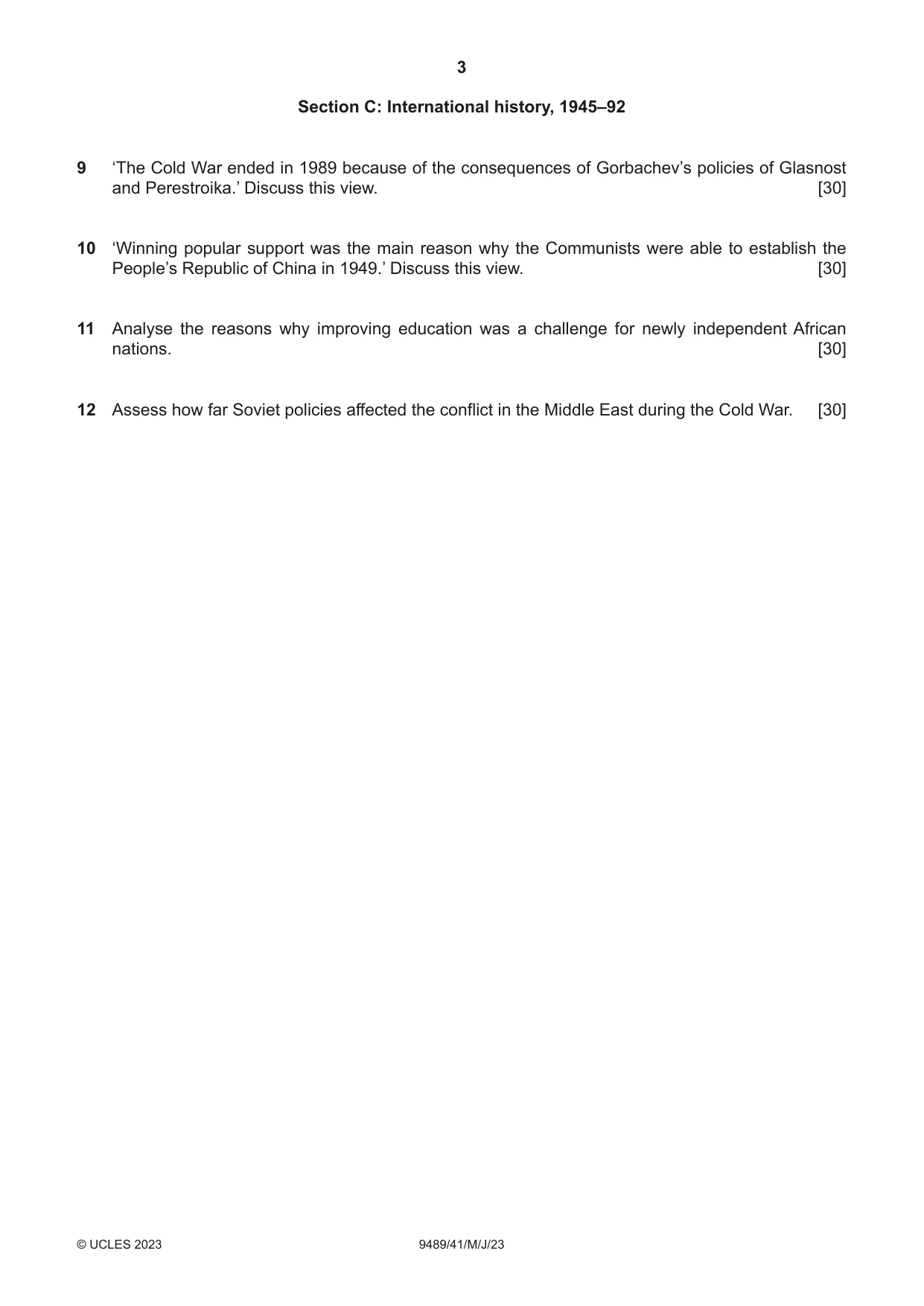
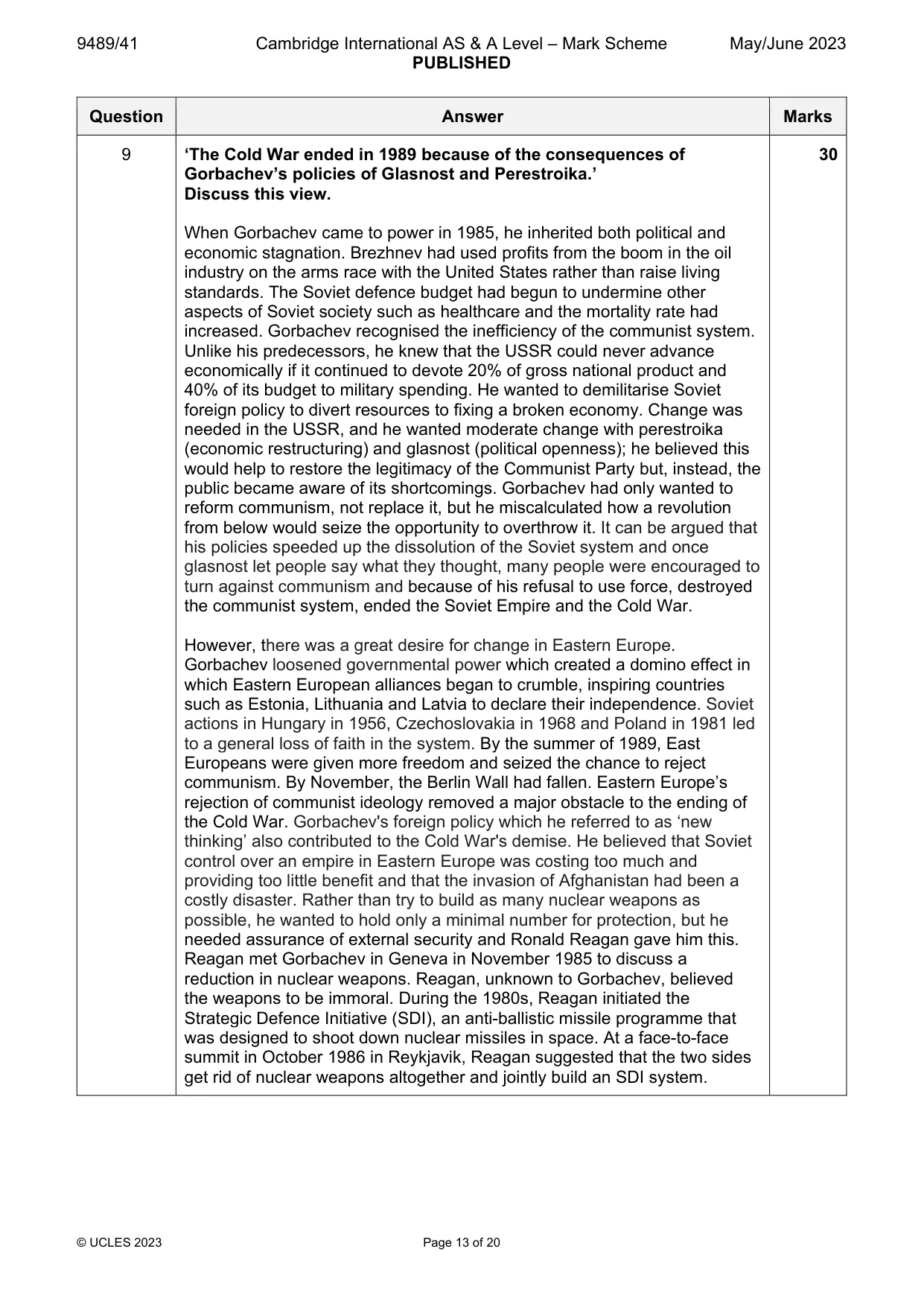
9 ‘The Cold War ended in 1989 because of the consequences of Gorbachev’s policies of Glasnost and Perestroika.’ Discuss this view. [30]
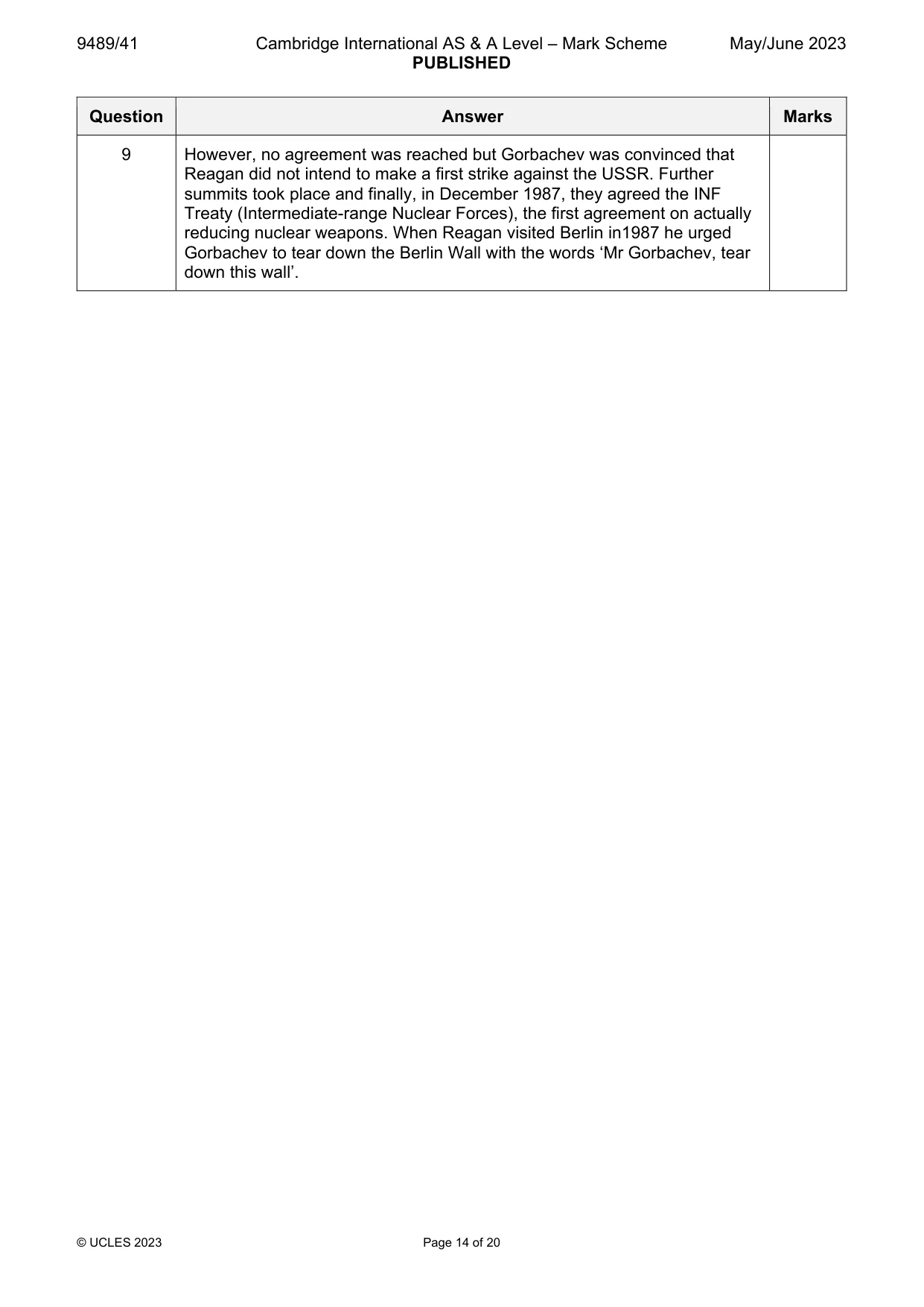
Mark scheme: 9 ‘The Cold War ended in 1989 because of the consequences of 30 Gorbachev’s policies of Glasnost and Perestroika.’ Discuss this view. When Gorbachev came to power in 1985, he inherited both political and economic stagnation. Brezhnev had used profits from the boom in the oil industry on the arms race with the United States rather than raise living standards. The Soviet defence budget had begun to undermine other aspects of Soviet society such as healthcare and the mortality rate had increased. Gorbachev recognised the inefficiency of the communist system. Unlike his predecessors, he knew that the USSR could never advance economically if it continued to devote 20% of gross national product and 40% of its budget to military spending. He wanted to demilitarise Soviet foreign policy to divert resources to fixing a broken economy. Change was needed in the USSR, and he wanted moderate change with perestroika (economic restructuring) and glasnost (political openness); he believed this would help to restore the legitimacy of the Communist Party but, instead, the public became aware of its shortcomings. Gorbachev had only wanted to reform communism, not replace it, but he miscalculated how a revolution from below would seize the opportunity to overthrow it. It can be argued that his policies speeded up the dissolution of the Soviet system and once glasnost let people say what they thought, many people were encouraged to turn against communism and because of his refusal to use force, destroyed the communist system, ended the Soviet Empire and the Cold War. However, there was a great desire for change in Eastern Europe. Gorbachev loosened governmental power which created a domino effect in which Eastern European alliances began to crumble, inspiring countries such as Estonia, Lithuania and Latvia to declare their independence. Soviet actions in Hungary in 1956, Czechoslovakia in 1968 and Poland in 1981 led to a general loss of faith in the system. By the summer of 1989, East Europeans were given more freedom and seized the chance to reject communism. By November, the Berlin Wall had fallen. Eastern Europe’s rejection of communist ideology removed a major obstacle to the ending of the Cold War. Gorbachev's foreign policy which he referred to as ‘new thinking’ also contributed to the Cold War's demise. He believed that Soviet control over an empire in Eastern Europe was costing too much and providing too little benefit and that the invasion of Afghanistan had been a costly disaster. Rather than try to build as many nuclear weapons as possible, he wanted to hold only a minimal number for protection, but he needed assurance of external security and Ronald Reagan gave him this. Reagan met Gorbachev in Geneva in November 1985 to discuss a reduction in nuclear weapons. Reagan, unknown to Gorbachev, believed the weapons to be immoral. During the 1980s, Reagan initiated the Strategic Defence Initiative (SDI), an anti-ballistic missile programme that was designed to shoot down nuclear missiles in space. At a face-to-face summit in October 1986 in Reykjavik, Reagan suggested that the two sides get rid of nuclear weapons altogether and jointly build an SDI system. 9 However, no agreement was reached but Gorbachev was convinced that Reagan did not intend to make a first strike against the USSR. Further summits took place and finally, in December 1987, they agreed the INF Treaty (Intermediate-range Nuclear Forces), the first agreement on actually reducing nuclear weapons. When Reagan visited Berlin in1987 he urged Gorbachev to tear down the Berlin Wall with the words ‘Mr Gorbachev, tear down this wall’.
Q10 · ‘Winning popular support was the main reason why the Communists were able to establish…
10 ‘Winning popular support was the main reason why the Communists were able to establish the People’s Republic of China in 1949.’ Discuss this view. [30]
Mark scheme: 10 ‘Winning popular support was the main reason why the Communists 30 were able to establish the People’s Republic of China in 1949.’ Discuss this view. The CCP was a powerful force among the peasants seemingly standing for democracy, freedom and individual liberty. Whenever the Communists secured an area during the civil war, Mao’s cadres organised village ‘struggle meetings’. Peasants and labourers, who owned little or no land, met to force wealthy landlords to confess their bad treatment of the poor. The cadres then cancelled all debts owed to the landlords and distributed their land and other property to the poor peasants and labourers. What they received became their own private property and they knew if the Nationalists won, they would lose everything. Therefore, they increasingly supported Mao Zedong who destroyed the traditional landlord power structure in the villages and replaced it with new peasant leadership under the control of the CCP. Their support for the People’s Liberation Army played a crucial role in the victory. It was unified under a tightly controlled central command. In 1945 the USSR turned over all of its captured Japanese weapons to the CCP who also received Manchuria from the Soviets. Mao appointed loyal generals including Lin Biao and Zhu De whose tactics contributed greatly to the Communist success. The ordinary soldiers in the army were treated with respect. Large numbers of well-trained KMT deserted and joined the Communists who took full advantage of their skills. In June 1947, the Communists successfully defeated the KMT New First Army; they now had tanks and heavy artillery at their disposal. In 1948 they launched an attack south of the Great Wall that cut off Nationalist troops from their supply bases in Xi’an. They then secured the Southeast Central section of China and by the end of January 1949 most of China was in the hands of the Communists. The shortcomings of the Nationalists also helped to secure a Communist victory. Chiang Kai-shek experienced difficulties leading China through the Second World War; the government and party he presided over consisted of different factions which he struggled to reunite. His government was weak and failed to save millions from being murdered by the Japanese. Civil war between the Nationalists and Communists erupted again in 1946 following the end of the war with Japan and the failure of a truce between the two sides. Chiang’s troops often turned and fled rather than face the enemy. His army also had a reputation for arrogance and cowardice and was accused of looting and stealing. He lost support in the cities because of heavy taxes, inflation, unemployment and food shortages. Economic discontent led to strikes and there were protests demanding an end to the civil war and the creation of a government that included the Communists. The Nationalists responded with repression including censorship, mass arrests and assassinations. The Nationalists supported business and the landlords; they ignored the suffering of the peasants. 10 However, the United States still hoped to maintain Nationalist China as an ally to stop the advance of communism even though they were aware of the corruption of Chiang’s administration. They increased their aid to the Nationalists, supplying aircraft and sending teams to Taiwan to train their troops but US public opinion was firmly against fighting a war in China. The United States limited their commitment in the area. Thus, the weakness of the Nationalists and the limited commitment of the United States to their cause placed the Communists in a strong position. The People’s Republic of China was proclaimed on 1 October 1949.
More questions on How were the Bolsheviks able to consolidate their power up to 1924?
Q11 · Analyse the reasons why improving education was a challenge for newly independent African…
11 Analyse the reasons why improving education was a challenge for newly independent African nations. [30]
Mark scheme: 11 Analyse the reasons why improving education was a challenge for 30 newly independent African nations. Colonial powers imposed their own education system on the local population and no colonial government up to the end of World War II adopted an educational policy aimed to develop full social, economic and political responsibility in its African communities. After World War II, the British implemented an educational programme in Africa to prepare their colonies for self-government and eventual independence. From 1945 to 1959 the number of primary, intermediate and secondary schools for natives in Kenya, for example, rose from around 2,250 to over 4,700, and the number of children in school rose from 200 000 to over 600 000 In the same period, school attendance in Nigeria, Tanganyika and Uganda more than trebled. In French territories the number of children enrolled in school in Cameroon, French West Africa, French Equatorial Africa, Madagascar and Togoland rose from 450 000 in 1945 to 1.3 million in 1958. However, despite increased enrolment in schools there were very low literacy levels in most of the newly independent countries. The new nations were prepared to invest heavily in schools. This desire to fund education attracted the attention of donors, such as UNESCO, as most African governments could not afford the enormous funding needed to make education accessible for the majority of their population. Appointing staff to institutes for health education, for vocational training and for public administration was suggested and helping African students to study abroad. Educational facilities were also needed. Angola, Cameroon, Ethiopia, Mozambique, Nyasaland, Sierra Leone, Somalia and Tanganyika all had illiteracy rates of more than 90%. A shortage of trained teachers faced all the countries. More than 70% of the 90 000 teachers in Nigeria had no teacher training. More than half of the 15 000 primary school teachers in Ghana did not meet minimum qualifications. The new African nations clearly realised that industrialisation, natural resource development, general economic advancement, universal suffrage and other goals could not be attained without a well-planned educational programme to produce skilled workers, technicians, administrators and government leaders. For many Africans, higher education was a prime goal of national development, and they increasingly stressed their need for vocational schools and science education. The education expansion of the 1960s slowed down in the 1970s and 80s because of economic decline; governments cut spending, which led to a halt to further expansion and reduced supply of teaching materials. There were also issues over what should be taught to ensure the curriculum was relevant for the new nations. The African countries followed the education systems and practices of the former colonial powers. Frequently, the language of instruction even at primary level was that of the former colonial power. This resulted in a mismatch between the world of work and the world of education. Most children failed to complete the courses in which they were enrolled especially in countries like Ghana, Nigeria and Sierra Leone. Reasons for the large number of dropouts included overcrowding, removal of children by parents who needed their labour and inability to pay the small fees that mission schools charged. 11 The real test of progress was in the proportion of the pupils who progressed into the upper-primary classes. Most African children and their parents expected their primary schooling to qualify them for something better than manual work. In most African cities, unemployed youths were attempting to find white-collar jobs for which they were not qualified.
More questions on Why was imperialism a significant force in Africa from 1870?
What was in this paper
The subtopics covered by these 11 questions, and how many questions each got. Open one in a new tab to see every Cambridge question on it.
3How successful was the Progressive Movement from 1890 to 1920?2How and why did international tensions remain high after the Versailles settlement?1How were the Bolsheviks able to consolidate their power up to 1924?1What were the consequences of the rapid economic growth after 1870?1Why did the USA emerge as a world power and what was the impact on international1Why did war break out in 1939?1Why was imperialism a significant force in Africa from 1870?1What you needed in this session
Cambridge’s own grade thresholds for 2023 May/June, Paper 4 · Variant 1. A higher threshold means an easier paper — the bar moves with how the cohort did.