Cambridge A Level History 9489 — 2021 Oct/Nov Paper 4 · Variant 2
9489/42/O/N/21 · 11 questions · 60 marks · ≈68 min
The question paper and its mark scheme, free to read here and free to download. This is Cambridge’s own paper, exactly as it was sat.
Question paper4 pages
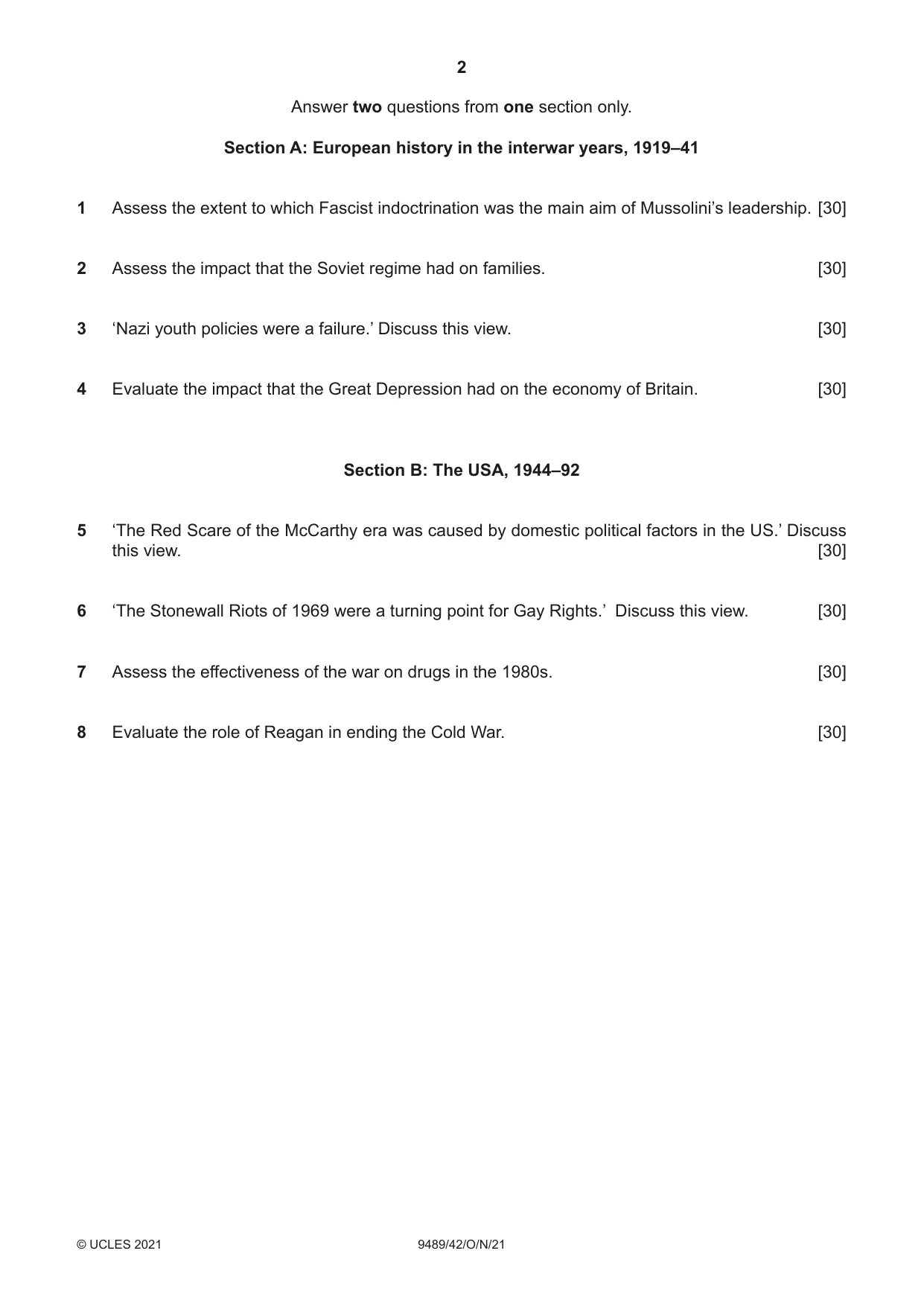
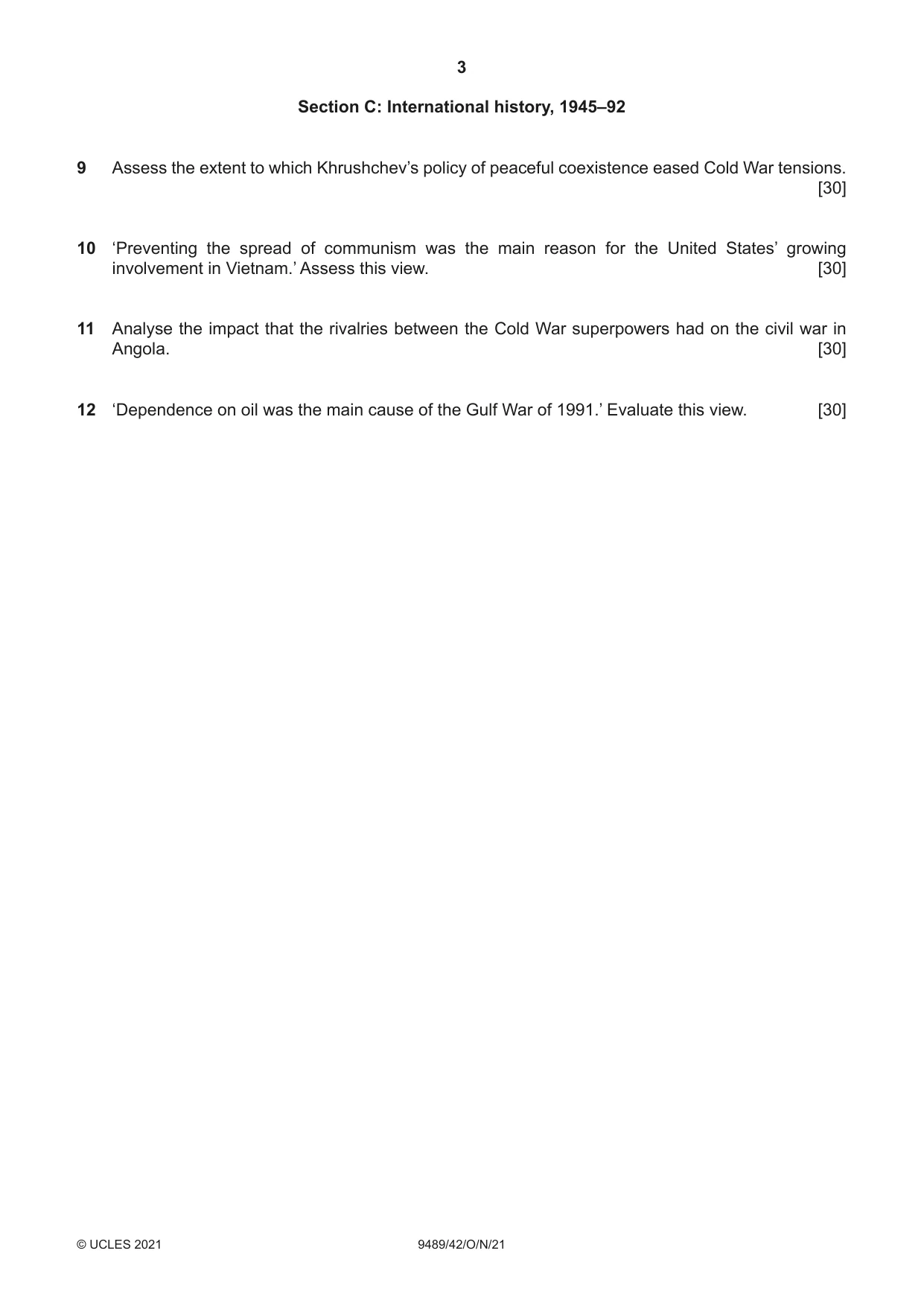
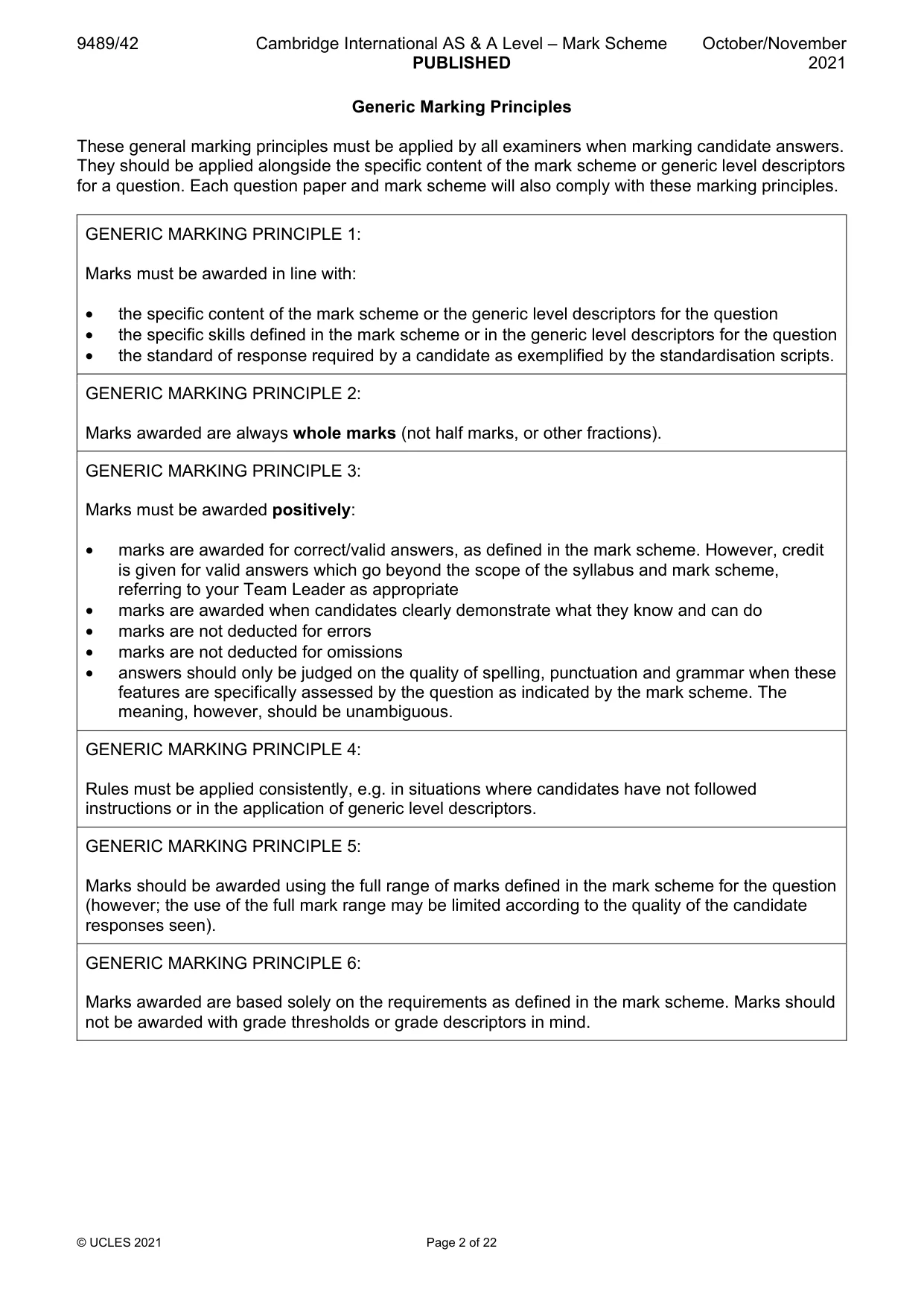
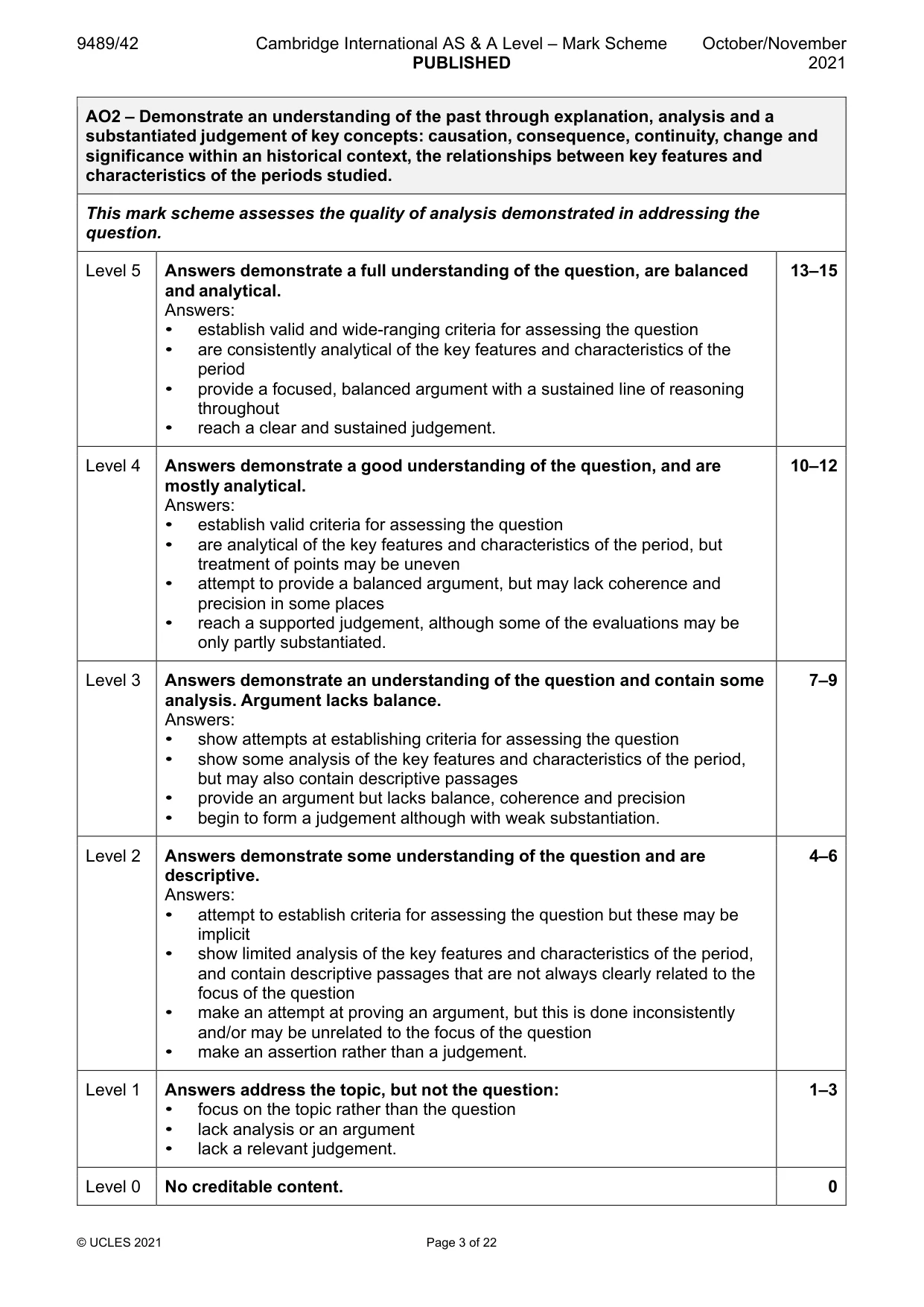
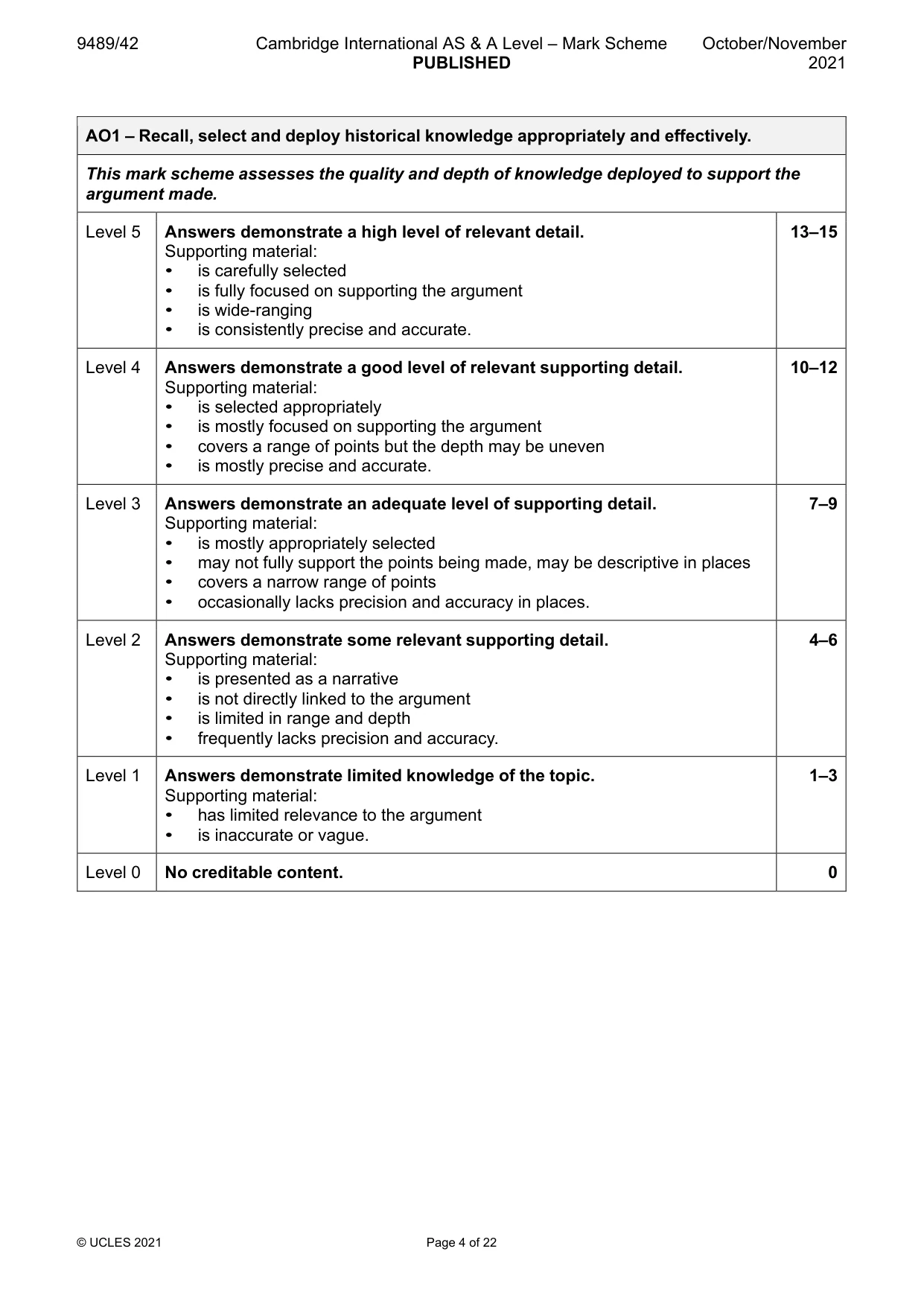
Mark scheme22 pages
Answers below. Sit the paper first if you are practising.
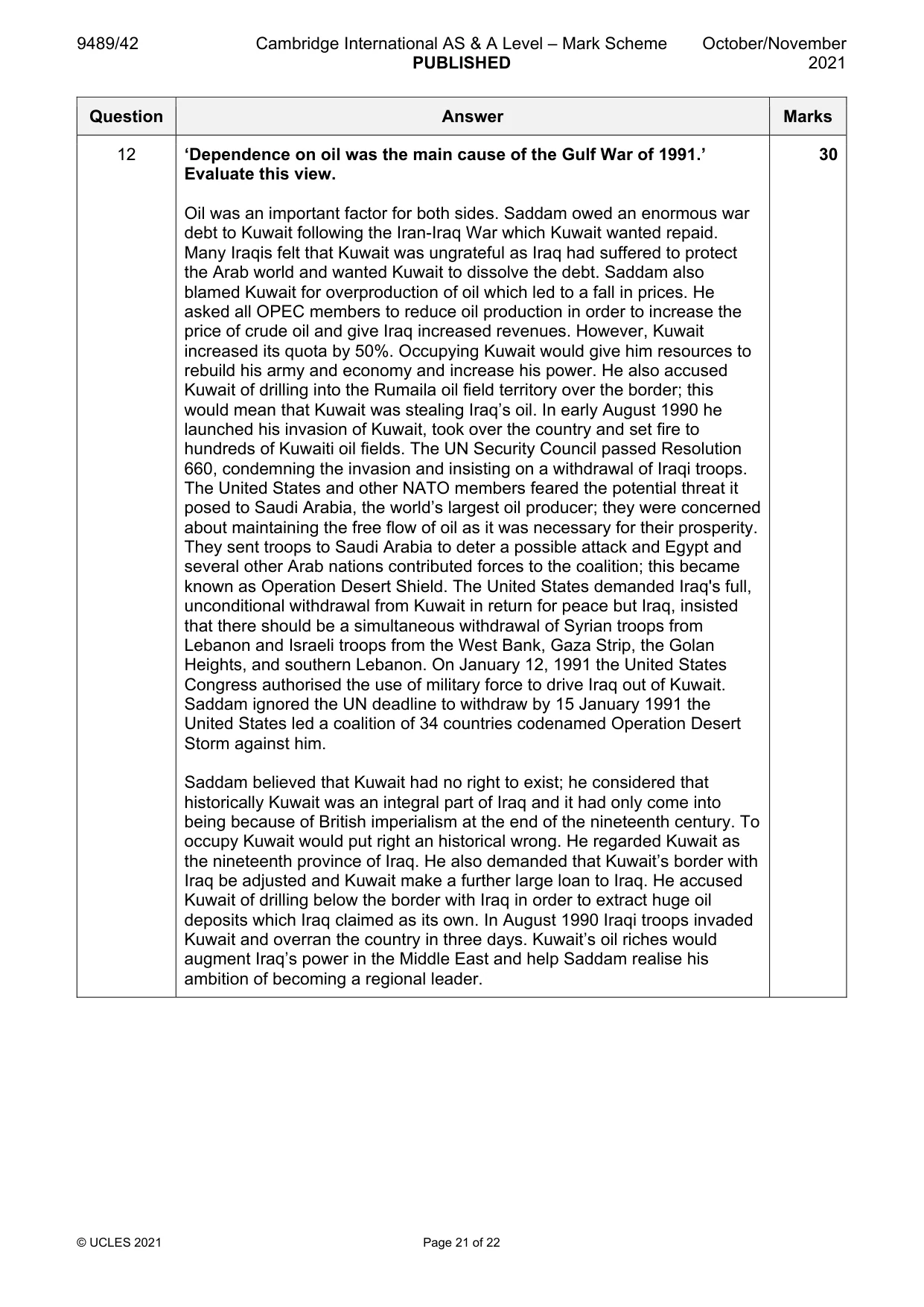
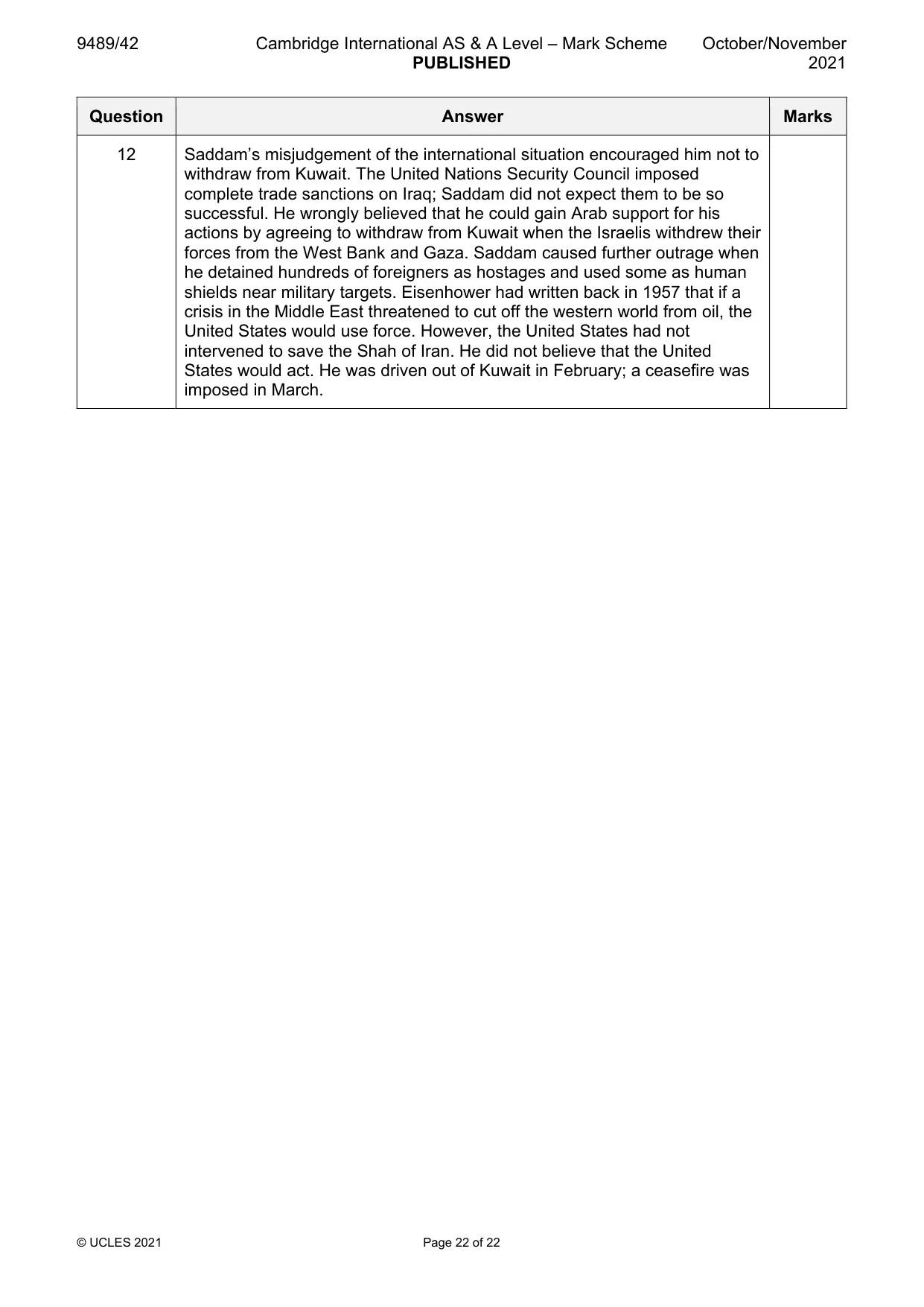
Questions as text
Q1 · Assess the extent to which Fascist indoctrination was the main aim of Mussolini’s…
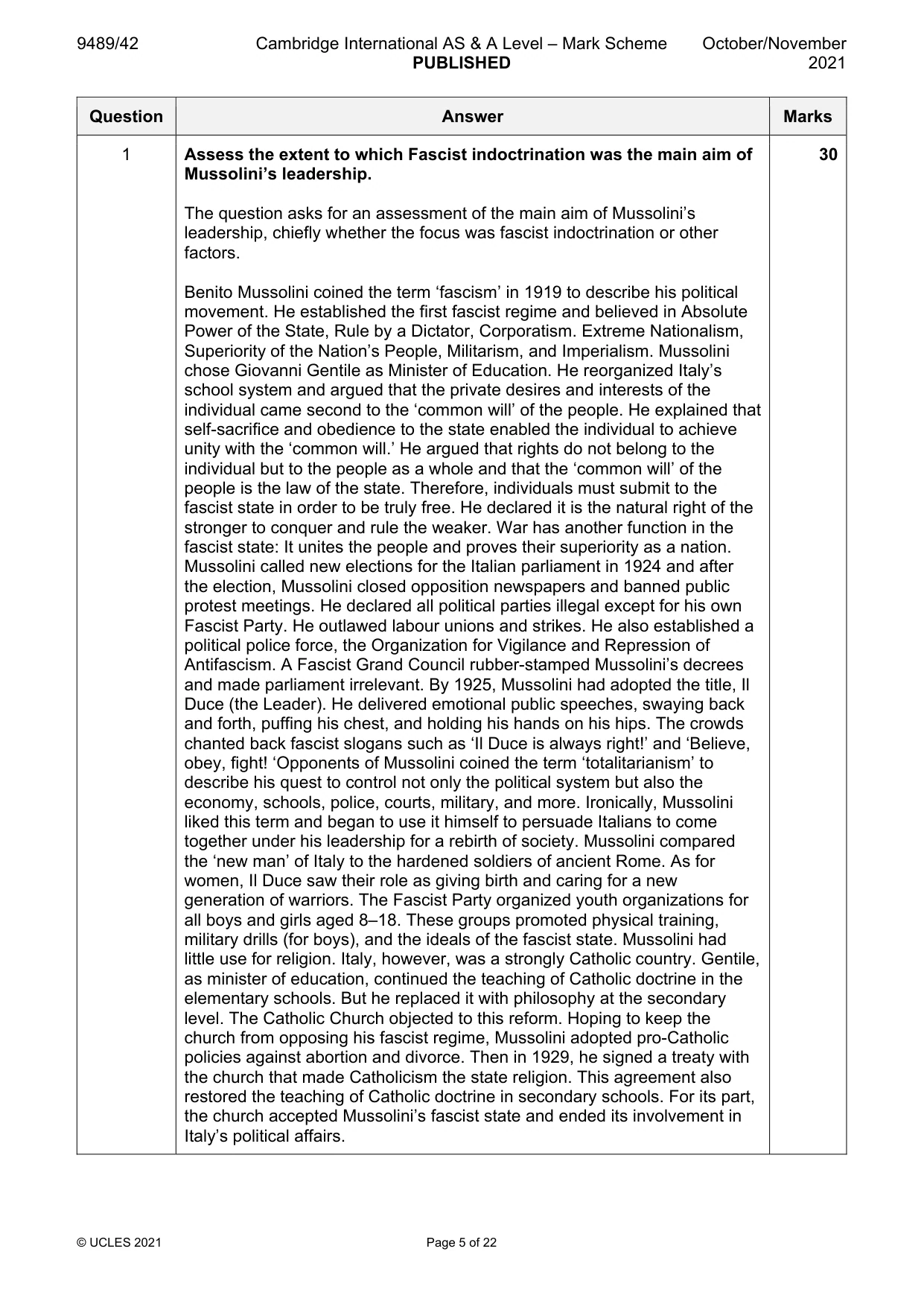
1 Assess the extent to which Fascist indoctrination was the main aim of Mussolini’s leadership. [30]
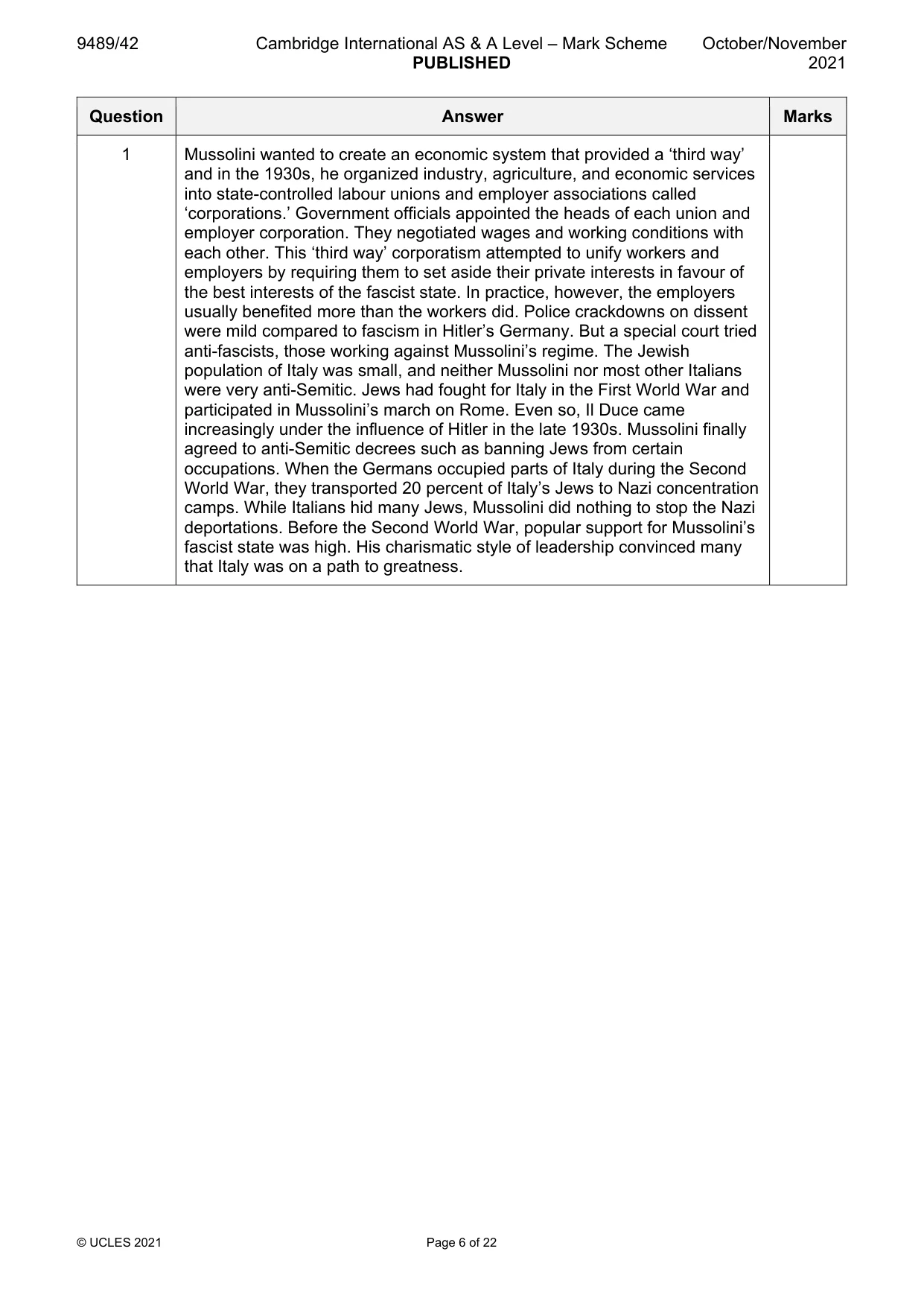
Mark scheme: Question Answer Marks 1 Assess the extent to which Fascist indoctrination was the main aim of 30 Mussolini’s leadership. The question asks for an assessment of the main aim of Mussolini’s leadership, chiefly whether the focus was fascist indoctrination or other factors. Benito Mussolini coined the term ‘fascism’ in 1919 to describe his political movement. He established the first fascist regime and believed in Absolute Power of the State, Rule by a Dictator, Corporatism. Extreme Nationalism, Superiority of the Nation’s People, Militarism, and Imperialism. Mussolini chose Giovanni Gentile as Minister of Education. He reorganized Italy’s school system and argued that the private desires and interests of the individual came second to the ‘common will’ of the people. He explained that self-sacrifice and obedience to the state enabled the individual to achieve unity with the ‘common will.’ He argued that rights do not belong to the individual but to the people as a whole and that the ‘common will’ of the people is the law of the state. Therefore, individuals must submit to the fascist state in order to be truly free. He declared it is the natural right of the stronger to conquer and rule the weaker. War has another function in the fascist state: It unites the people and proves their superiority as a nation. Mussolini called new elections for the Italian parliament in 1924 and after the election, Mussolini closed opposition newspapers and banned public protest meetings. He declared all political parties illegal except for his own Fascist Party. He outlawed labour unions and strikes. He also established a political police force, the Organization for Vigilance and Repression of Antifascism. A Fascist Grand Council rubber-stamped Mussolini’s decrees and made parliament irrelevant. By 1925, Mussolini had adopted the title, Il Duce (the Leader). He delivered emotional public speeches, swaying back and forth, puffing his chest, and holding his hands on his hips. The crowds chanted back fascist slogans such as ‘Il Duce is always right!’ and ‘Believe, obey, fight! ‘Opponents of Mussolini coined the term ‘totalitarianism’ to describe his quest to control not only the political system but also the economy, schools, police, courts, military, and more. Ironically, Mussolini liked this term and began to use it himself to persuade Italians to come together under his leadership for a rebirth of society. Mussolini compared the ‘new man’ of Italy to the hardened soldiers of ancient Rome. As for women, Il Duce saw their role as giving birth and caring for a new generation of warriors. The Fascist Party organized youth organizations for all boys and girls aged 8–18. These groups promoted physical training, military drills (for boys), and the ideals of the fascist state. Mussolini had little use for religion. Italy, however, was a strongly Catholic country. Gentile, as minister of education, continued the teaching of Catholic doctrine in the elementary schools. But he replaced it with philosophy at the secondary level. The Catholic Church objected to this reform. Hoping to keep the church from opposing his fascist regime, Mussolini adopted pro-Catholic policies against abortion and divorce. Then in 1929, he signed a treaty with the church that made Catholicism the state religion. This agreement also restored the teaching of Catholic doctrine in secondary schools. For its part, the church accepted Mussolini’s fascist state and ended its involvement in Italy’s political affairs. 1 Mussolini wanted to create an economic system that provided a ‘third way’ and in the 1930s, he organized industry, agriculture, and economic services into state-controlled labour unions and employer associations called ‘corporations.’ Government officials appointed the heads of each union and employer corporation. They negotiated wages and working conditions with each other. This ‘third way’ corporatism attempted to unify workers and employers by requiring them to set aside their private interests in favour of the best interests of the fascist state. In practice, however, the employers usually benefited more than the workers did. Police crackdowns on dissent were mild compared to fascism in Hitler’s Germany. But a special court tried anti-fascists, those working against Mussolini’s regime. The Jewish population of Italy was small, and neither Mussolini nor most other Italians were very anti-Semitic. Jews had fought for Italy in the First World War and participated in Mussolini’s march on Rome. Even so, Il Duce came increasingly under the influence of Hitler in the late 1930s. Mussolini finally agreed to anti-Semitic decrees such as banning Jews from certain occupations. When the Germans occupied parts of Italy during the Second World War, they transported 20 percent of Italy’s Jews to Nazi concentration camps. While Italians hid many Jews, Mussolini did nothing to stop the Nazi deportations. Before the Second World War, popular support for Mussolini’s fascist state was high. His charismatic style of leadership convinced many that Italy was on a path to greatness.
More questions on How did the rise of extremism affect international relations?
Q2 · Assess the impact that the Soviet regime had on families
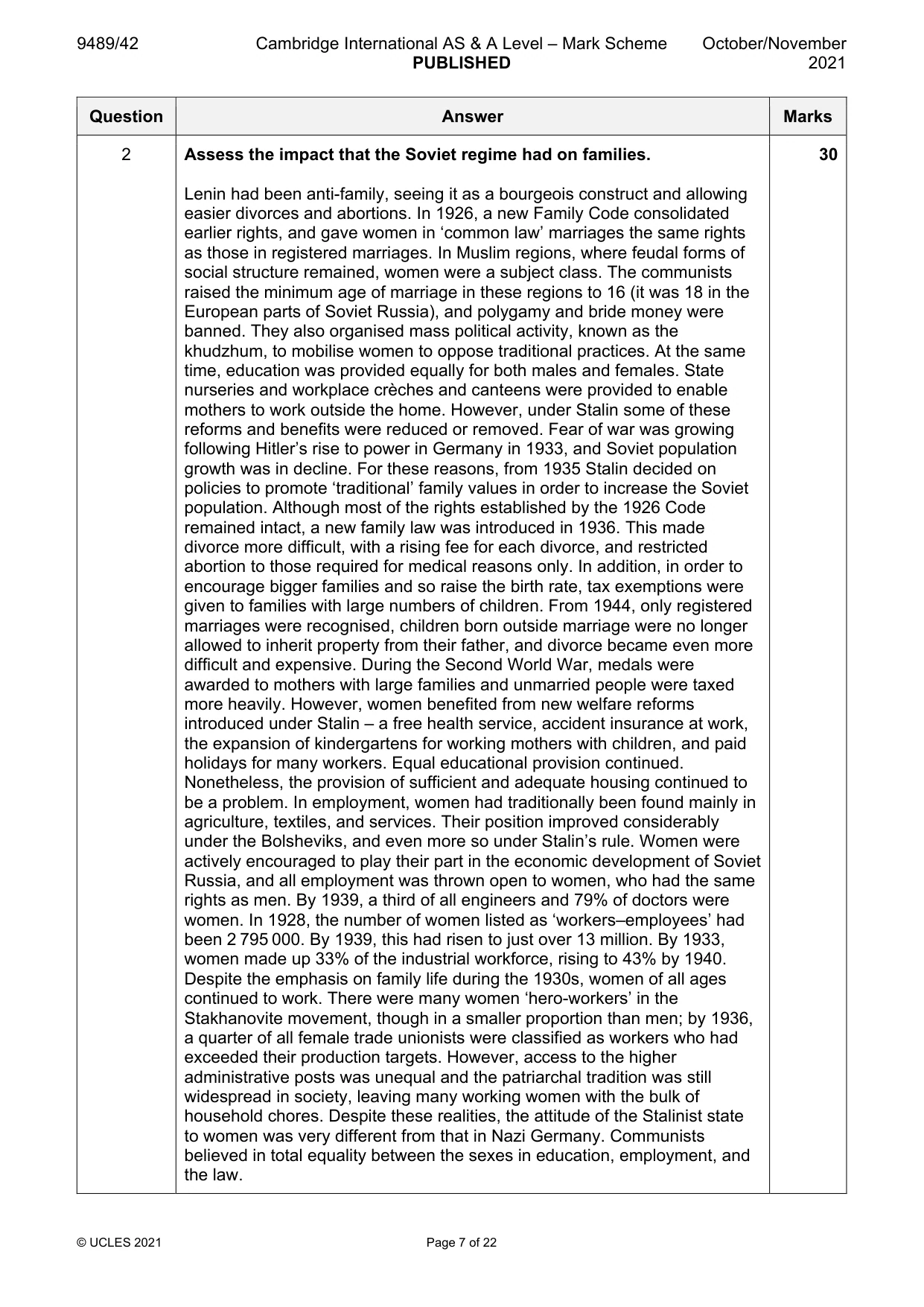
2 Assess the impact that the Soviet regime had on families. [30]
Mark scheme: 2 Assess the impact that the Soviet regime had on families. 30 Lenin had been anti-family, seeing it as a bourgeois construct and allowing easier divorces and abortions. In 1926, a new Family Code consolidated earlier rights, and gave women in ‘common law’ marriages the same rights as those in registered marriages. In Muslim regions, where feudal forms of social structure remained, women were a subject class. The communists raised the minimum age of marriage in these regions to 16 (it was 18 in the European parts of Soviet Russia), and polygamy and bride money were banned. They also organised mass political activity, known as the khudzhum, to mobilise women to oppose traditional practices. At the same time, education was provided equally for both males and females. State nurseries and workplace crèches and canteens were provided to enable mothers to work outside the home. However, under Stalin some of these reforms and benefits were reduced or removed. Fear of war was growing following Hitler’s rise to power in Germany in 1933, and Soviet population growth was in decline. For these reasons, from 1935 Stalin decided on policies to promote ‘traditional’ family values in order to increase the Soviet population. Although most of the rights established by the 1926 Code remained intact, a new family law was introduced in 1936. This made divorce more difficult, with a rising fee for each divorce, and restricted abortion to those required for medical reasons only. In addition, in order to encourage bigger families and so raise the birth rate, tax exemptions were given to families with large numbers of children. From 1944, only registered marriages were recognised, children born outside marriage were no longer allowed to inherit property from their father, and divorce became even more difficult and expensive. During the Second World War, medals were awarded to mothers with large families and unmarried people were taxed more heavily. However, women benefited from new welfare reforms introduced under Stalin – a free health service, accident insurance at work, the expansion of kindergartens for working mothers with children, and paid holidays for many workers. Equal educational provision continued. Nonetheless, the provision of sufficient and adequate housing continued to be a problem. In employment, women had traditionally been found mainly in agriculture, textiles, and services. Their position improved considerably under the Bolsheviks, and even more so under Stalin’s rule. Women were actively encouraged to play their part in the economic development of Soviet Russia, and all employment was thrown open to women, who had the same rights as men. By 1939, a third of all engineers and 79% of doctors were women. In 1928, the number of women listed as ‘workers–employees’ had been 2 795 000. By 1939, this had risen to just over 13 million. By 1933, women made up 33% of the industrial workforce, rising to 43% by 1940. Despite the emphasis on family life during the 1930s, women of all ages continued to work. There were many women ‘hero-workers’ in the Stakhanovite movement, though in a smaller proportion than men; by 1936, a quarter of all female trade unionists were classified as workers who had exceeded their production targets. However, access to the higher administrative posts was unequal and the patriarchal tradition was still widespread in society, leaving many working women with the bulk of household chores. Despite these realities, the attitude of the Stalinist state to women was very different from that in Nazi Germany. Communists believed in total equality between the sexes in education, employment, and the law.
More questions on How were the Bolsheviks able to consolidate their power up to 1924?
Q3 · ‘Nazi youth policies were a failure.’ Discuss this view
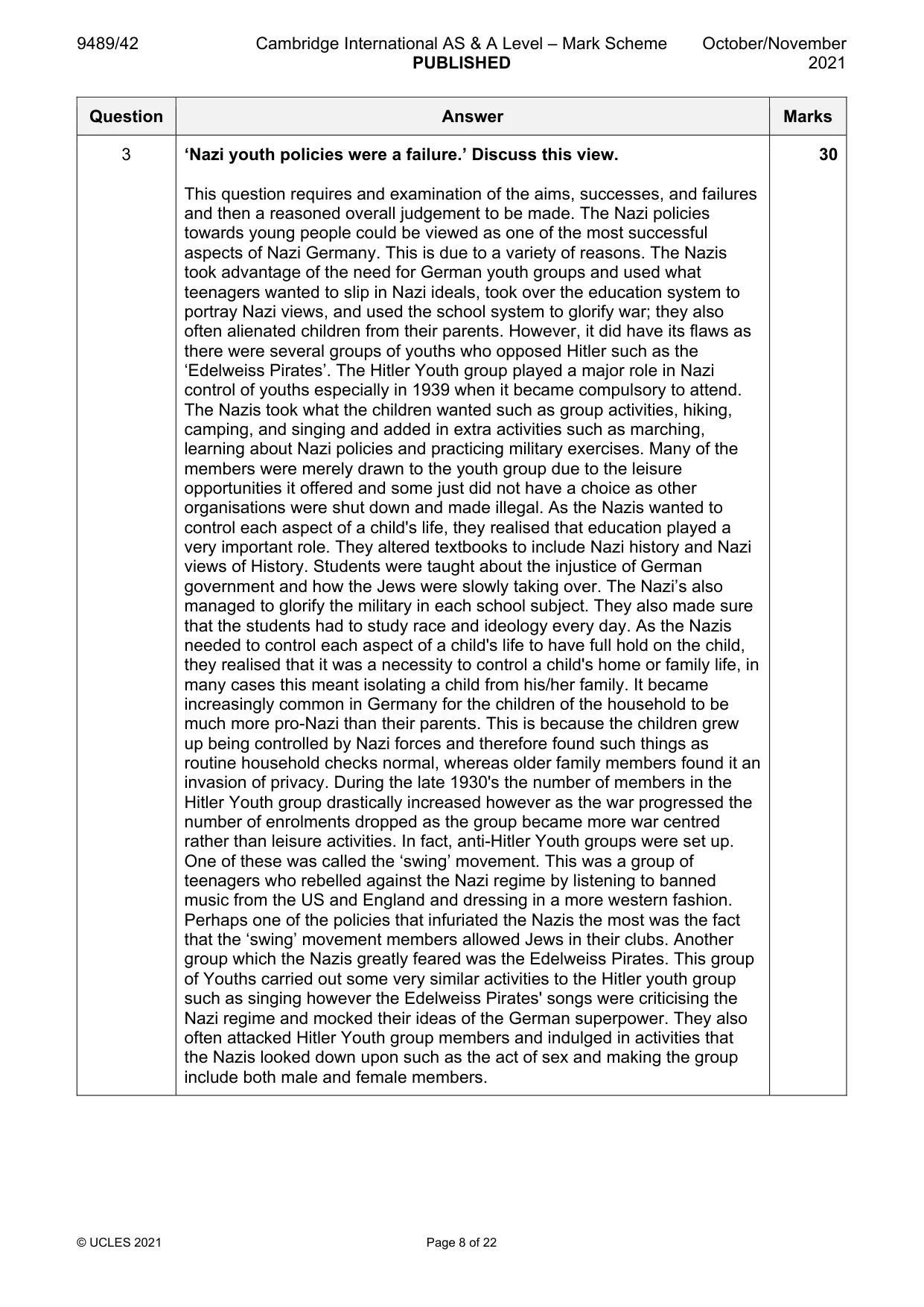
3 ‘Nazi youth policies were a failure.’ Discuss this view. [30]
Mark scheme: 3 ‘Nazi youth policies were a failure.’ Discuss this view. 30 This question requires and examination of the aims, successes, and failures and then a reasoned overall judgement to be made. The Nazi policies towards young people could be viewed as one of the most successful aspects of Nazi Germany. This is due to a variety of reasons. The Nazis took advantage of the need for German youth groups and used what teenagers wanted to slip in Nazi ideals, took over the education system to portray Nazi views, and used the school system to glorify war; they also often alienated children from their parents. However, it did have its flaws as there were several groups of youths who opposed Hitler such as the ‘Edelweiss Pirates’. The Hitler Youth group played a major role in Nazi control of youths especially in 1939 when it became compulsory to attend. The Nazis took what the children wanted such as group activities, hiking, camping, and singing and added in extra activities such as marching, learning about Nazi policies and practicing military exercises. Many of the members were merely drawn to the youth group due to the leisure opportunities it offered and some just did not have a choice as other organisations were shut down and made illegal. As the Nazis wanted to control each aspect of a child's life, they realised that education played a very important role. They altered textbooks to include Nazi history and Nazi views of History. Students were taught about the injustice of German government and how the Jews were slowly taking over. The Nazi’s also managed to glorify the military in each school subject. They also made sure that the students had to study race and ideology every day. As the Nazis needed to control each aspect of a child's life to have full hold on the child, they realised that it was a necessity to control a child's home or family life, in many cases this meant isolating a child from his/her family. It became increasingly common in Germany for the children of the household to be much more pro-Nazi than their parents. This is because the children grew up being controlled by Nazi forces and therefore found such things as routine household checks normal, whereas older family members found it an invasion of privacy. During the late 1930's the number of members in the Hitler Youth group drastically increased however as the war progressed the number of enrolments dropped as the group became more war centred rather than leisure activities. In fact, anti-Hitler Youth groups were set up. One of these was called the ‘swing’ movement. This was a group of teenagers who rebelled against the Nazi regime by listening to banned music from the US and England and dressing in a more western fashion. Perhaps one of the policies that infuriated the Nazis the most was the fact that the ‘swing’ movement members allowed Jews in their clubs. Another group which the Nazis greatly feared was the Edelweiss Pirates. This group of Youths carried out some very similar activities to the Hitler youth group such as singing however the Edelweiss Pirates' songs were criticising the Nazi regime and mocked their ideas of the German superpower. They also often attacked Hitler Youth group members and indulged in activities that the Nazis looked down upon such as the act of sex and making the group include both male and female members.
More questions on How did the rise of extremism affect international relations?
Q4 · Evaluate the impact that the Great Depression had on the economy of Britain
4 Evaluate the impact that the Great Depression had on the economy of Britain. [30]
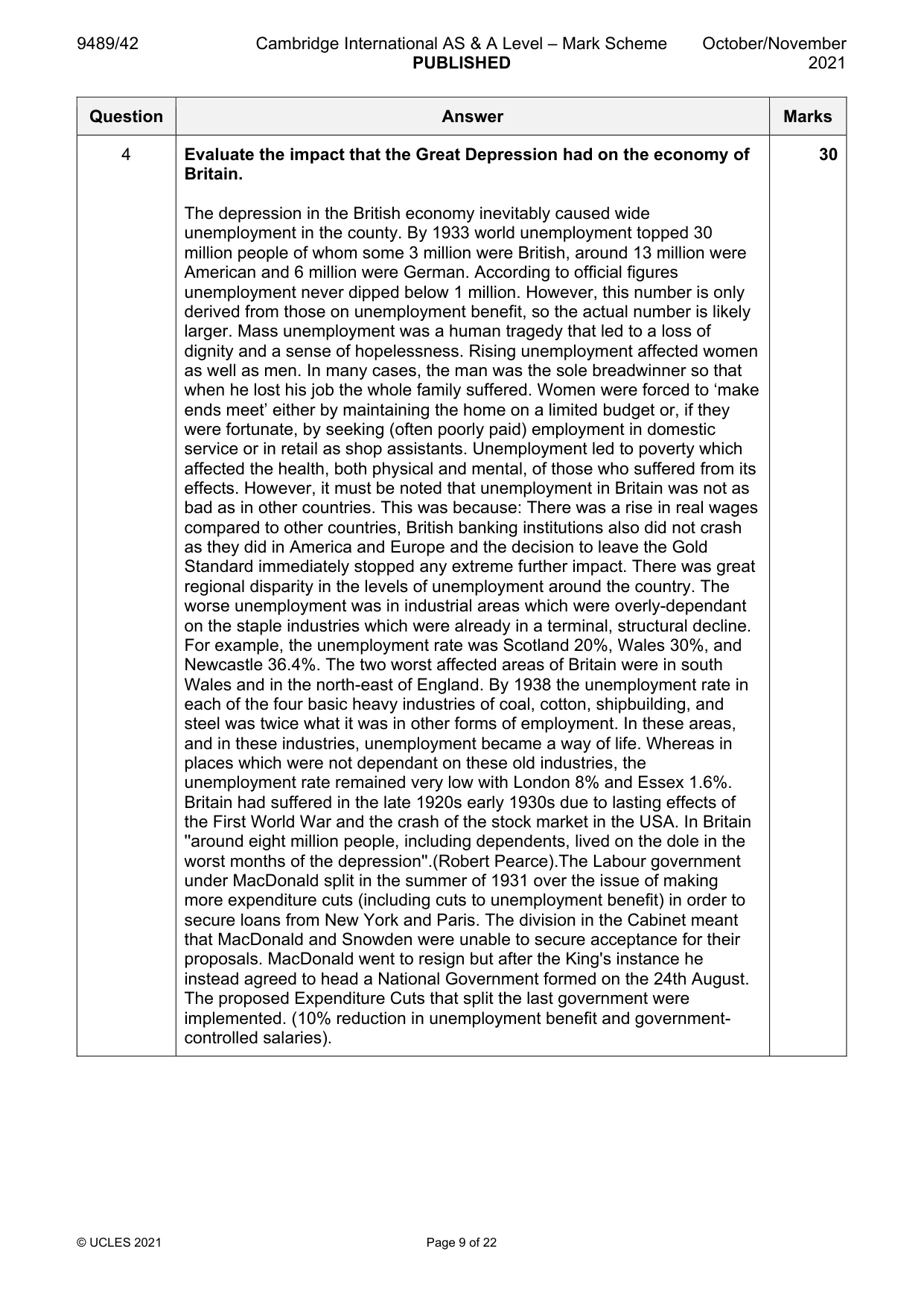
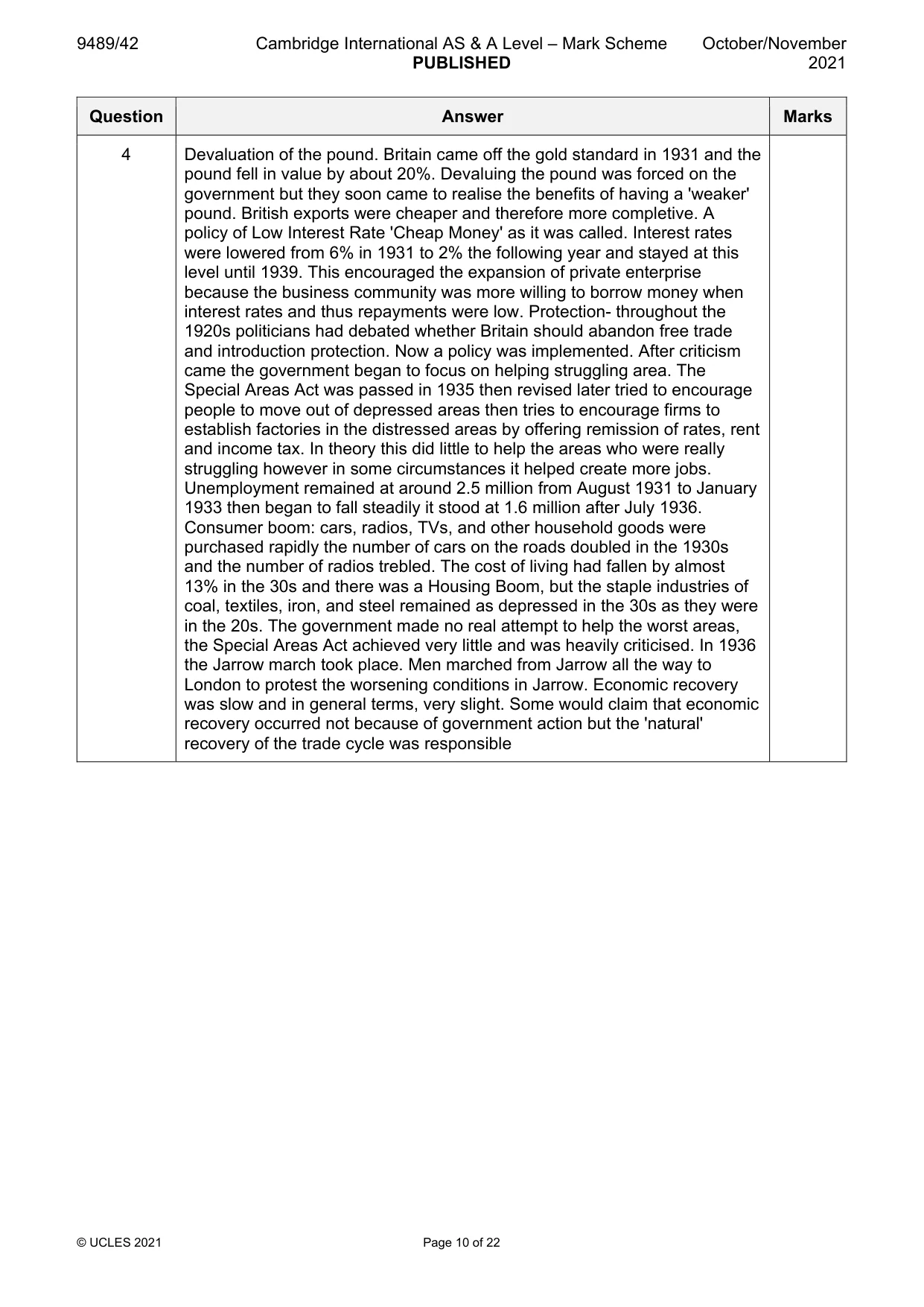
Mark scheme: 4 Evaluate the impact that the Great Depression had on the economy of 30 Britain. The depression in the British economy inevitably caused wide unemployment in the county. By 1933 world unemployment topped 30 million people of whom some 3 million were British, around 13 million were American and 6 million were German. According to official figures unemployment never dipped below 1 million. However, this number is only derived from those on unemployment benefit, so the actual number is likely larger. Mass unemployment was a human tragedy that led to a loss of dignity and a sense of hopelessness. Rising unemployment affected women as well as men. In many cases, the man was the sole breadwinner so that when he lost his job the whole family suffered. Women were forced to ‘make ends meet’ either by maintaining the home on a limited budget or, if they were fortunate, by seeking (often poorly paid) employment in domestic service or in retail as shop assistants. Unemployment led to poverty which affected the health, both physical and mental, of those who suffered from its effects. However, it must be noted that unemployment in Britain was not as bad as in other countries. This was because: There was a rise in real wages compared to other countries, British banking institutions also did not crash as they did in America and Europe and the decision to leave the Gold Standard immediately stopped any extreme further impact. There was great regional disparity in the levels of unemployment around the country. The worse unemployment was in industrial areas which were overly-dependant on the staple industries which were already in a terminal, structural decline. For example, the unemployment rate was Scotland 20%, Wales 30%, and Newcastle 36.4%. The two worst affected areas of Britain were in south Wales and in the north-east of England. By 1938 the unemployment rate in each of the four basic heavy industries of coal, cotton, shipbuilding, and steel was twice what it was in other forms of employment. In these areas, and in these industries, unemployment became a way of life. Whereas in places which were not dependant on these old industries, the unemployment rate remained very low with London 8% and Essex 1.6%. Britain had suffered in the late 1920s early 1930s due to lasting effects of the First World War and the crash of the stock market in the USA. In Britain ''around eight million people, including dependents, lived on the dole in the worst months of the depression''.(Robert Pearce).The Labour government under MacDonald split in the summer of 1931 over the issue of making more expenditure cuts (including cuts to unemployment benefit) in order to secure loans from New York and Paris. The division in the Cabinet meant that MacDonald and Snowden were unable to secure acceptance for their proposals. MacDonald went to resign but after the King's instance he instead agreed to head a National Government formed on the 24th August. The proposed Expenditure Cuts that split the last government were implemented. (10% reduction in unemployment benefit and government- controlled salaries). 4 Devaluation of the pound. Britain came off the gold standard in 1931 and the pound fell in value by about 20%. Devaluing the pound was forced on the government but they soon came to realise the benefits of having a 'weaker' pound. British exports were cheaper and therefore more completive. A policy of Low Interest Rate 'Cheap Money' as it was called. Interest rates were lowered from 6% in 1931 to 2% the following year and stayed at this level until 1939. This encouraged the expansion of private enterprise because the business community was more willing to borrow money when interest rates and thus repayments were low. Protection- throughout the 1920s politicians had debated whether Britain should abandon free trade and introduction protection. Now a policy was implemented. After criticism came the government began to focus on helping struggling area. The Special Areas Act was passed in 1935 then revised later tried to encourage people to move out of depressed areas then tries to encourage firms to establish factories in the distressed areas by offering remission of rates, rent and income tax. In theory this did little to help the areas who were really struggling however in some circumstances it helped create more jobs. Unemployment remained at around 2.5 million from August 1931 to January 1933 then began to fall steadily it stood at 1.6 million after July 1936. Consumer boom: cars, radios, TVs, and other household goods were purchased rapidly the number of cars on the roads doubled in the 1930s and the number of radios trebled. The cost of living had fallen by almost 13% in the 30s and there was a Housing Boom, but the staple industries of coal, textiles, iron, and steel remained as depressed in the 30s as they were in the 20s. The government made no real attempt to help the worst areas, the Special Areas Act achieved very little and was heavily criticised. In 1936 the Jarrow march took place. Men marched from Jarrow all the way to London to protest the worsening conditions in Jarrow. Economic recovery was slow and in general terms, very slight. Some would claim that economic recovery occurred not because of government action but the 'natural' recovery of the trade cycle was responsible
More questions on What were the causes of the Great Crash and the Great Depression?
Q5 · ‘The Red Scare of the McCarthy era was caused by domestic political factors in the US.’…
5 ‘The Red Scare of the McCarthy era was caused by domestic political factors in the US.’ Discuss this view. [30]
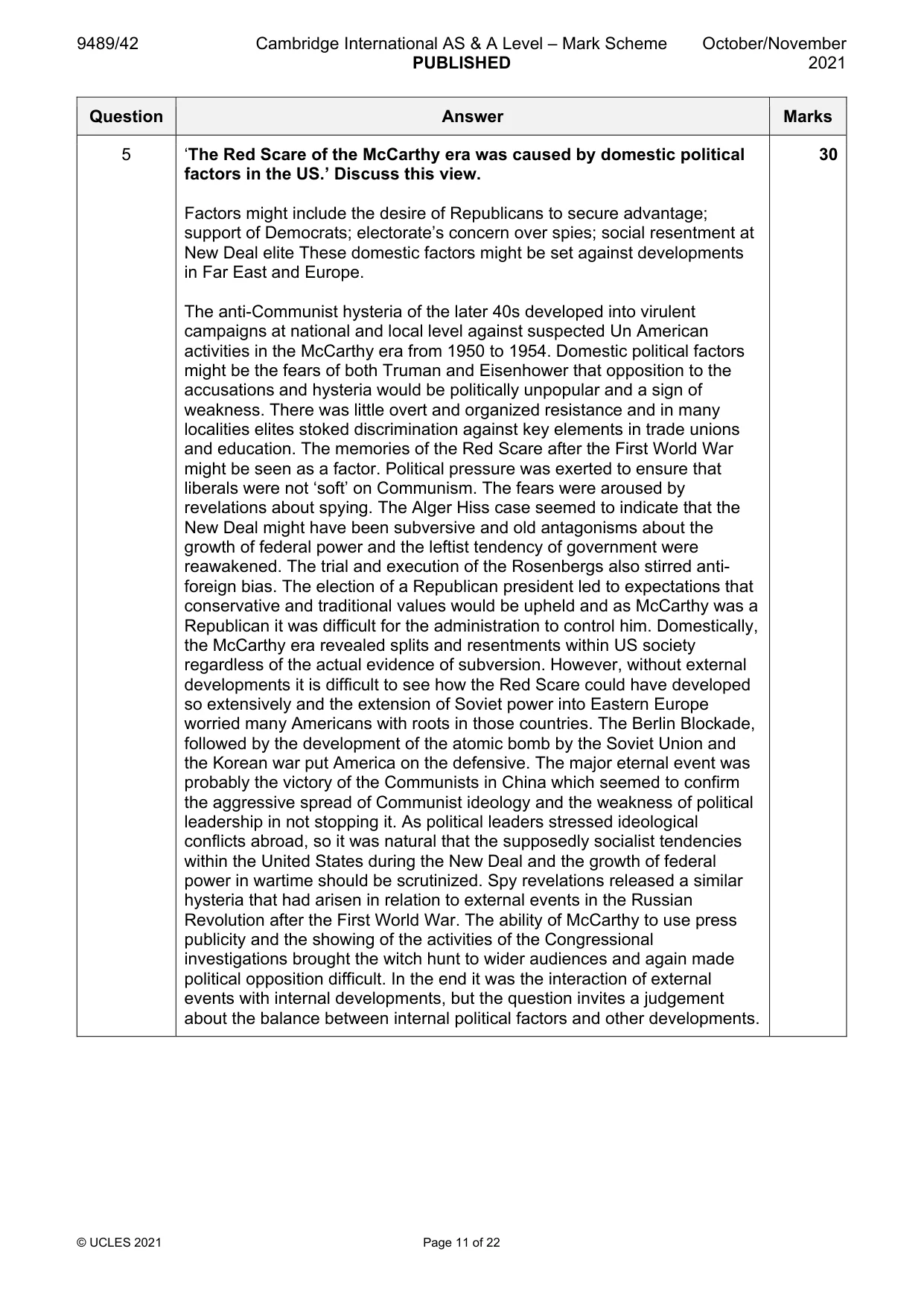
Mark scheme: 5 ‘The Red Scare of the McCarthy era was caused by domestic political 30 factors in the US.’ Discuss this view. Factors might include the desire of Republicans to secure advantage; support of Democrats; electorate’s concern over spies; social resentment at New Deal elite These domestic factors might be set against developments in Far East and Europe. The anti-Communist hysteria of the later 40s developed into virulent campaigns at national and local level against suspected Un American activities in the McCarthy era from 1950 to 1954. Domestic political factors might be the fears of both Truman and Eisenhower that opposition to the accusations and hysteria would be politically unpopular and a sign of weakness. There was little overt and organized resistance and in many localities elites stoked discrimination against key elements in trade unions and education. The memories of the Red Scare after the First World War might be seen as a factor. Political pressure was exerted to ensure that liberals were not ‘soft’ on Communism. The fears were aroused by revelations about spying. The Alger Hiss case seemed to indicate that the New Deal might have been subversive and old antagonisms about the growth of federal power and the leftist tendency of government were reawakened. The trial and execution of the Rosenbergs also stirred anti- foreign bias. The election of a Republican president led to expectations that conservative and traditional values would be upheld and as McCarthy was a Republican it was difficult for the administration to control him. Domestically, the McCarthy era revealed splits and resentments within US society regardless of the actual evidence of subversion. However, without external developments it is difficult to see how the Red Scare could have developed so extensively and the extension of Soviet power into Eastern Europe worried many Americans with roots in those countries. The Berlin Blockade, followed by the development of the atomic bomb by the Soviet Union and the Korean war put America on the defensive. The major eternal event was probably the victory of the Communists in China which seemed to confirm the aggressive spread of Communist ideology and the weakness of political leadership in not stopping it. As political leaders stressed ideological conflicts abroad, so it was natural that the supposedly socialist tendencies within the United States during the New Deal and the growth of federal power in wartime should be scrutinized. Spy revelations released a similar hysteria that had arisen in relation to external events in the Russian Revolution after the First World War. The ability of McCarthy to use press publicity and the showing of the activities of the Congressional investigations brought the witch hunt to wider audiences and again made political opposition difficult. In the end it was the interaction of external events with internal developments, but the question invites a judgement about the balance between internal political factors and other developments.
Q6 · ‘The Stonewall Riots of 1969 were a turning point for Gay Rights.’ Discuss this view
6 ‘The Stonewall Riots of 1969 were a turning point for Gay Rights.’ Discuss this view. [30]
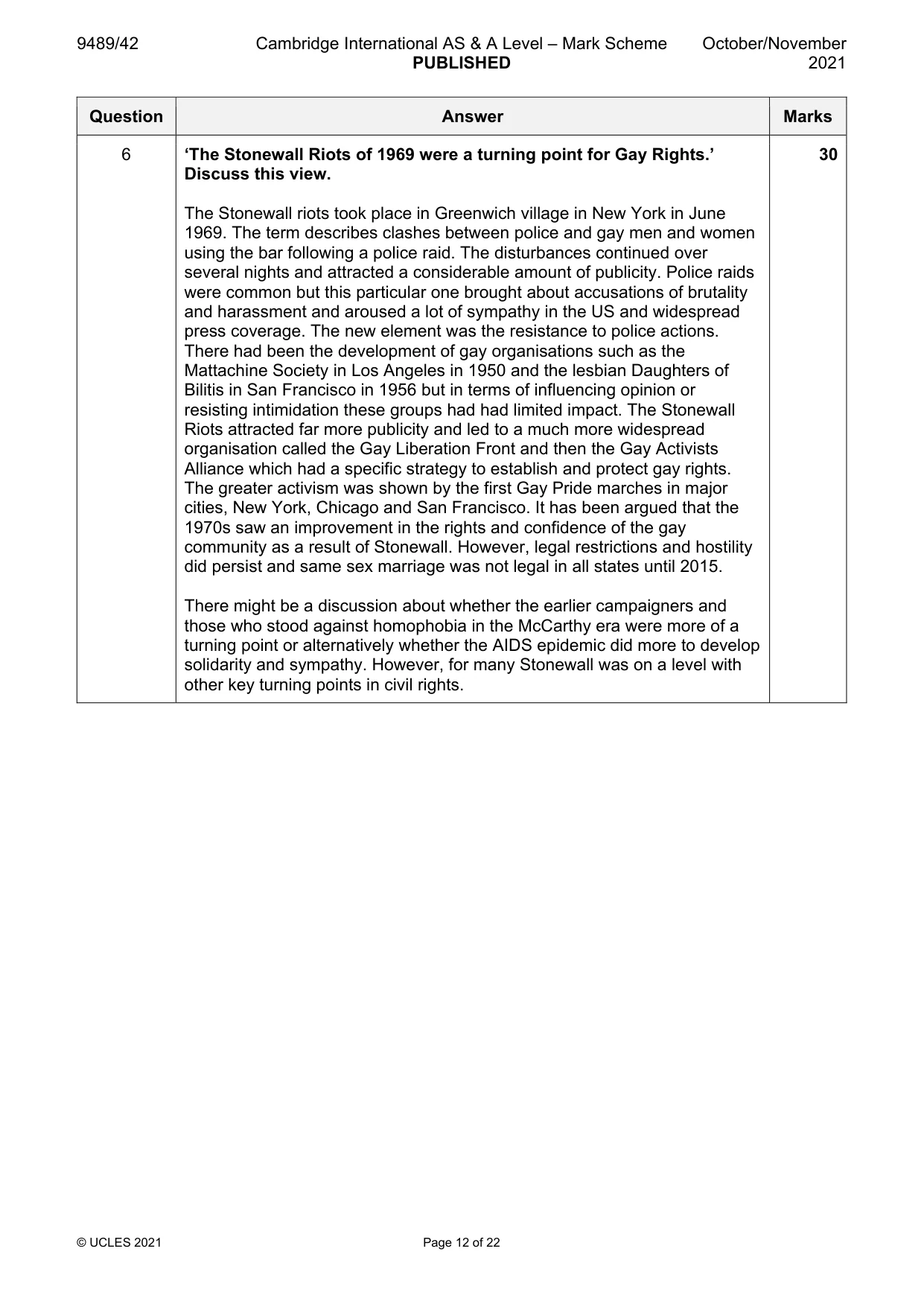
Mark scheme: 6 ‘The Stonewall Riots of 1969 were a turning point for Gay Rights.’ 30 Discuss this view. The Stonewall riots took place in Greenwich village in New York in June 1969. The term describes clashes between police and gay men and women using the bar following a police raid. The disturbances continued over several nights and attracted a considerable amount of publicity. Police raids were common but this particular one brought about accusations of brutality and harassment and aroused a lot of sympathy in the US and widespread press coverage. The new element was the resistance to police actions. There had been the development of gay organisations such as the Mattachine Society in Los Angeles in 1950 and the lesbian Daughters of Bilitis in San Francisco in 1956 but in terms of influencing opinion or resisting intimidation these groups had had limited impact. The Stonewall Riots attracted far more publicity and led to a much more widespread organisation called the Gay Liberation Front and then the Gay Activists Alliance which had a specific strategy to establish and protect gay rights. The greater activism was shown by the first Gay Pride marches in major cities, New York, Chicago and San Francisco. It has been argued that the 1970s saw an improvement in the rights and confidence of the gay community as a result of Stonewall. However, legal restrictions and hostility did persist and same sex marriage was not legal in all states until 2015. There might be a discussion about whether the earlier campaigners and those who stood against homophobia in the McCarthy era were more of a turning point or alternatively whether the AIDS epidemic did more to develop solidarity and sympathy. However, for many Stonewall was on a level with other key turning points in civil rights.
More questions on How successful was the Progressive Movement from 1890 to 1920?
Q7 · Assess the effectiveness of the war on drugs in the 1980s
7 Assess the effectiveness of the war on drugs in the 1980s. [30]
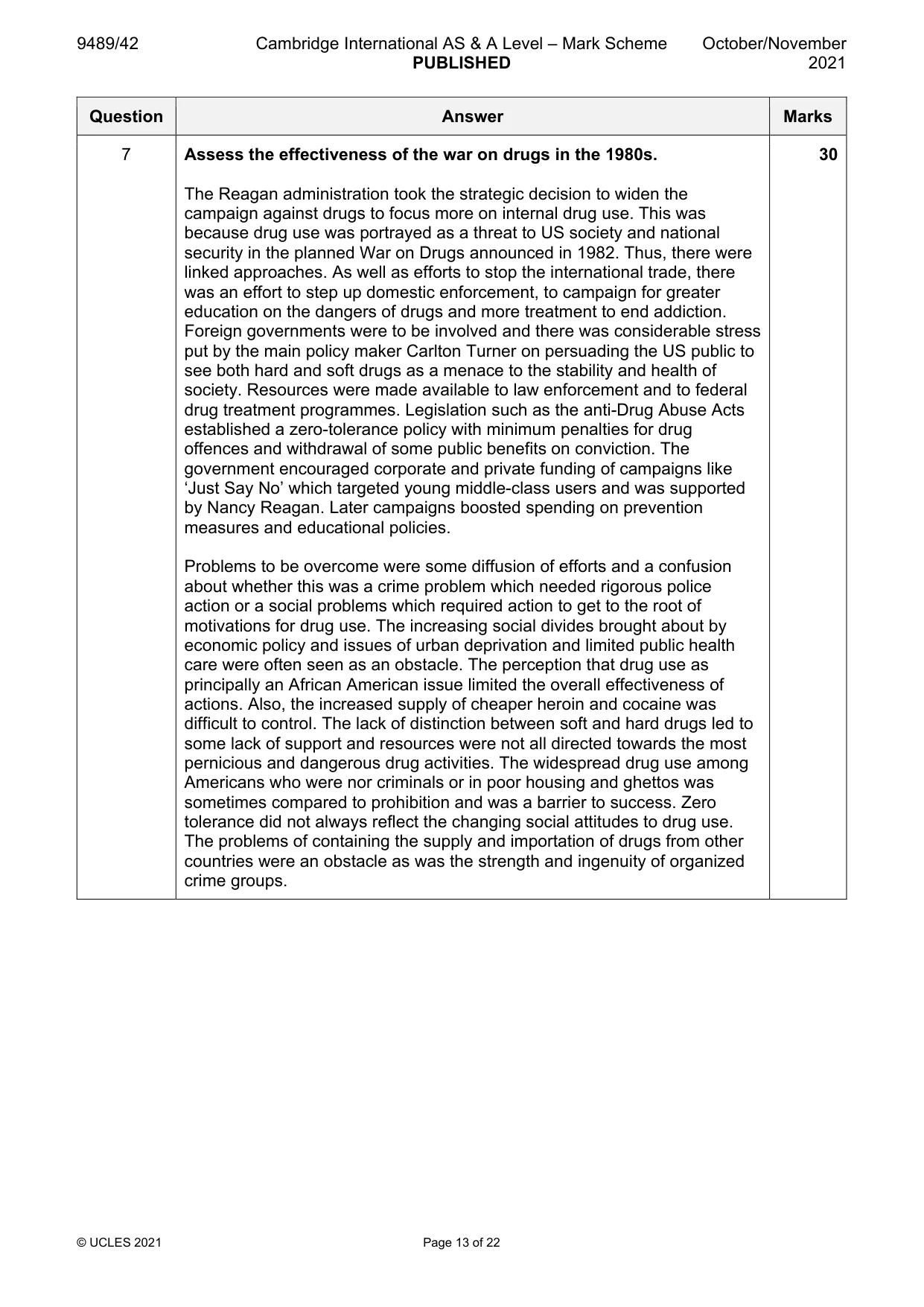
Mark scheme: 7 Assess the effectiveness of the war on drugs in the 1980s. 30 The Reagan administration took the strategic decision to widen the campaign against drugs to focus more on internal drug use. This was because drug use was portrayed as a threat to US society and national security in the planned War on Drugs announced in 1982. Thus, there were linked approaches. As well as efforts to stop the international trade, there was an effort to step up domestic enforcement, to campaign for greater education on the dangers of drugs and more treatment to end addiction. Foreign governments were to be involved and there was considerable stress put by the main policy maker Carlton Turner on persuading the US public to see both hard and soft drugs as a menace to the stability and health of society. Resources were made available to law enforcement and to federal drug treatment programmes. Legislation such as the anti-Drug Abuse Acts established a zero-tolerance policy with minimum penalties for drug offences and withdrawal of some public benefits on conviction. The government encouraged corporate and private funding of campaigns like ‘Just Say No’ which targeted young middle-class users and was supported by Nancy Reagan. Later campaigns boosted spending on prevention measures and educational policies. Problems to be overcome were some diffusion of efforts and a confusion about whether this was a crime problem which needed rigorous police action or a social problems which required action to get to the root of motivations for drug use. The increasing social divides brought about by economic policy and issues of urban deprivation and limited public health care were often seen as an obstacle. The perception that drug use as principally an African American issue limited the overall effectiveness of actions. Also, the increased supply of cheaper heroin and cocaine was difficult to control. The lack of distinction between soft and hard drugs led to some lack of support and resources were not all directed towards the most pernicious and dangerous drug activities. The widespread drug use among Americans who were nor criminals or in poor housing and ghettos was sometimes compared to prohibition and was a barrier to success. Zero tolerance did not always reflect the changing social attitudes to drug use. The problems of containing the supply and importation of drugs from other countries were an obstacle as was the strength and ingenuity of organized crime groups.
Q8 · Section C: International history, 1945–92
Section C: International history, 1945–92
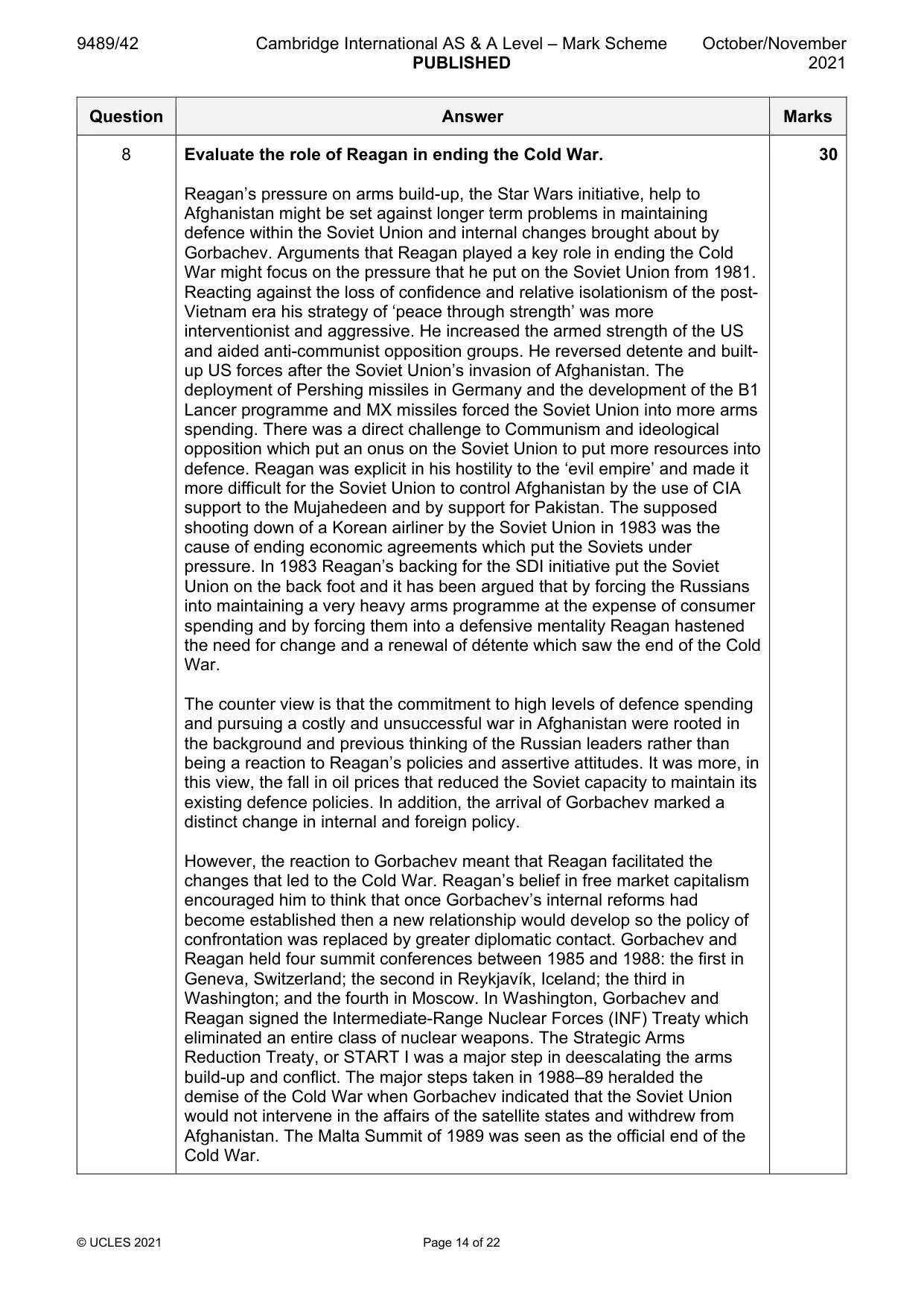
Mark scheme: 8 Evaluate the role of Reagan in ending the Cold War. 30 Reagan’s pressure on arms build-up, the Star Wars initiative, help to Afghanistan might be set against longer term problems in maintaining defence within the Soviet Union and internal changes brought about by Gorbachev. Arguments that Reagan played a key role in ending the Cold War might focus on the pressure that he put on the Soviet Union from 1981. Reacting against the loss of confidence and relative isolationism of the post- Vietnam era his strategy of ‘peace through strength’ was more interventionist and aggressive. He increased the armed strength of the US and aided anti-communist opposition groups. He reversed detente and built- up US forces after the Soviet Union’s invasion of Afghanistan. The deployment of Pershing missiles in Germany and the development of the B1 Lancer programme and MX missiles forced the Soviet Union into more arms spending. There was a direct challenge to Communism and ideological opposition which put an onus on the Soviet Union to put more resources into defence. Reagan was explicit in his hostility to the ‘evil empire’ and made it more difficult for the Soviet Union to control Afghanistan by the use of CIA support to the Mujahedeen and by support for Pakistan. The supposed shooting down of a Korean airliner by the Soviet Union in 1983 was the cause of ending economic agreements which put the Soviets under pressure. In 1983 Reagan’s backing for the SDI initiative put the Soviet Union on the back foot and it has been argued that by forcing the Russians into maintaining a very heavy arms programme at the expense of consumer spending and by forcing them into a defensive mentality Reagan hastened the need for change and a renewal of détente which saw the end of the Cold War. The counter view is that the commitment to high levels of defence spending and pursuing a costly and unsuccessful war in Afghanistan were rooted in the background and previous thinking of the Russian leaders rather than being a reaction to Reagan’s policies and assertive attitudes. It was more, in this view, the fall in oil prices that reduced the Soviet capacity to maintain its existing defence policies. In addition, the arrival of Gorbachev marked a distinct change in internal and foreign policy. However, the reaction to Gorbachev meant that Reagan facilitated the changes that led to the Cold War. Reagan’s belief in free market capitalism encouraged him to think that once Gorbachev’s internal reforms had become established then a new relationship would develop so the policy of confrontation was replaced by greater diplomatic contact. Gorbachev and Reagan held four summit conferences between 1985 and 1988: the first in Geneva, Switzerland; the second in Reykjavík, Iceland; the third in Washington; and the fourth in Moscow. In Washington, Gorbachev and Reagan signed the Intermediate-Range Nuclear Forces (INF) Treaty which eliminated an entire class of nuclear weapons. The Strategic Arms Reduction Treaty, or START I was a major step in deescalating the arms build-up and conflict. The major steps taken in 1988–89 heralded the demise of the Cold War when Gorbachev indicated that the Soviet Union would not intervene in the affairs of the satellite states and withdrew from Afghanistan. The Malta Summit of 1989 was seen as the official end of the Cold War. 8 Reagan’s encouragement of change and the personal meetings with Gorbachev were of key importance but without the context of change within the Soviet Union – the need to escape from the ossification of the Brezhnev years and the changes within the Soviet satellites this would not have been possible. However, Reagan had established his credibility as a defender of the free world and his arms build-up gave him the basis for negotiation. He could not be seen as appeasing the Soviet Union and the pressure established by the US arms development was of crucial importance in persuading Gorbachev that the heavy arms spending could not continue and the whole structure and outlook which was making it necessary, had to change.
Q9 · Assess the extent to which Khrushchev’s policy of peaceful coexistence eased Cold War…
9 Assess the extent to which Khrushchev’s policy of peaceful coexistence eased Cold War tensions. [30]
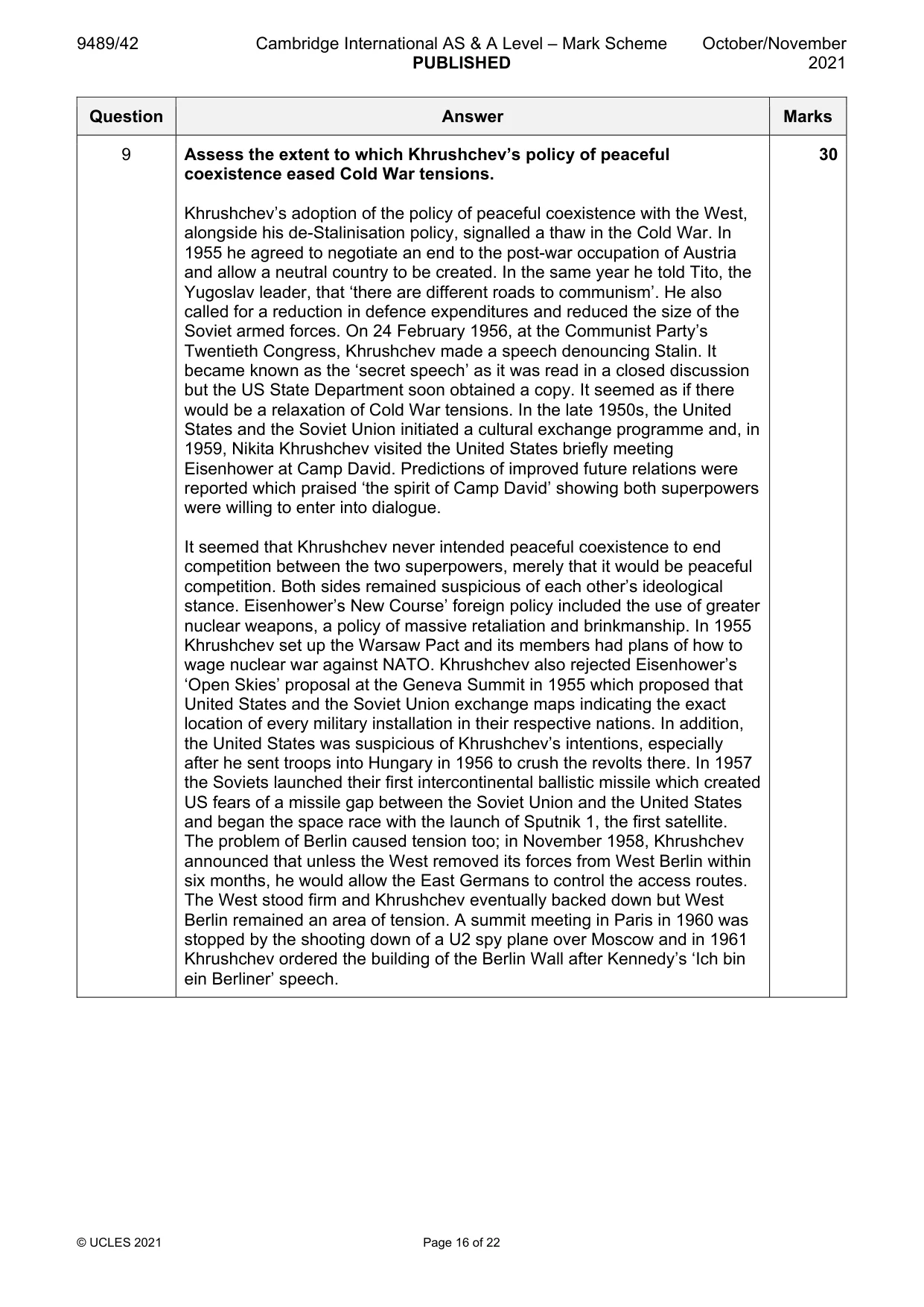
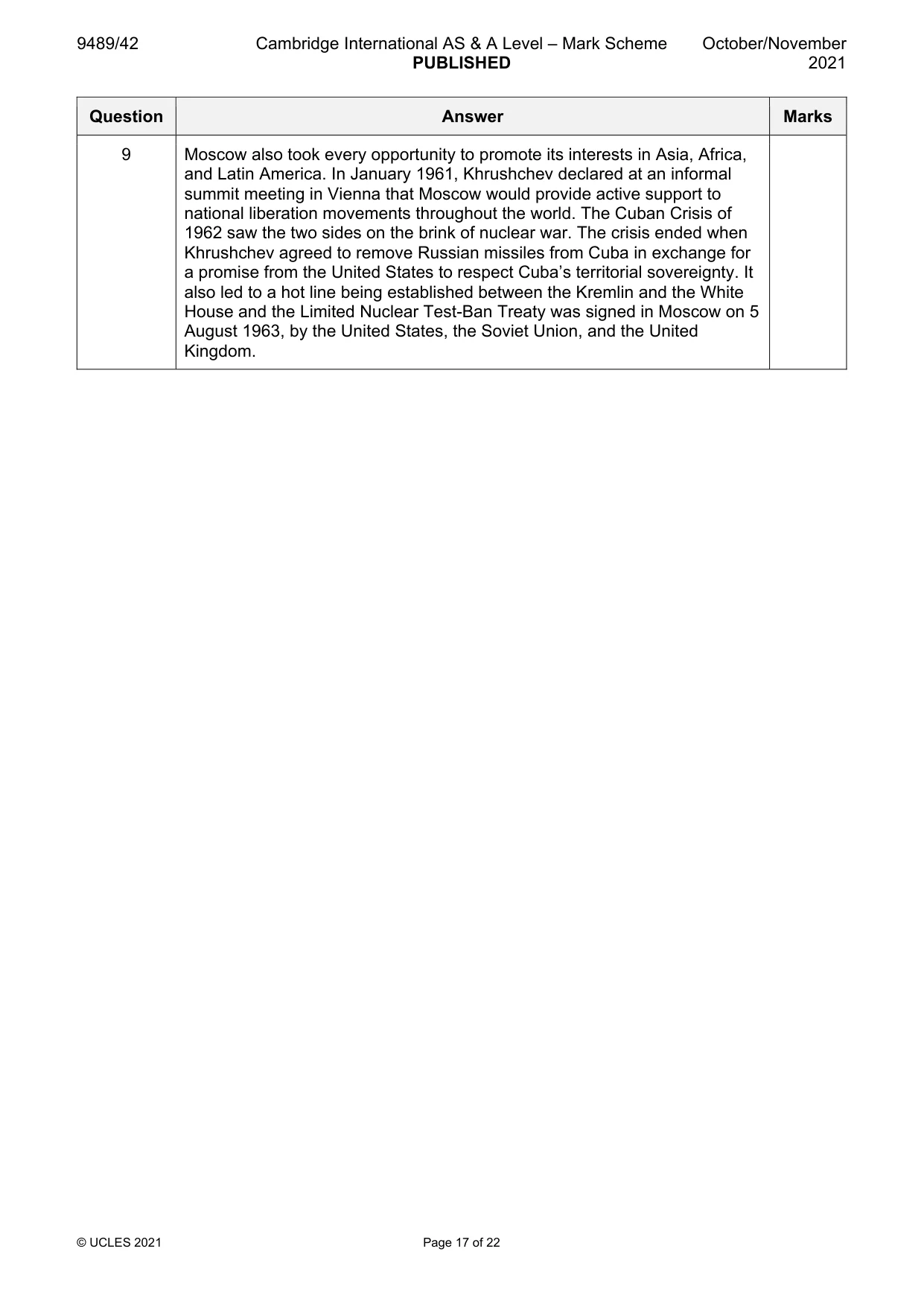
Mark scheme: 9 Assess the extent to which Khrushchev’s policy of peaceful 30 coexistence eased Cold War tensions. Khrushchev’s adoption of the policy of peaceful coexistence with the West, alongside his de-Stalinisation policy, signalled a thaw in the Cold War. In 1955 he agreed to negotiate an end to the post-war occupation of Austria and allow a neutral country to be created. In the same year he told Tito, the Yugoslav leader, that ‘there are different roads to communism’. He also called for a reduction in defence expenditures and reduced the size of the Soviet armed forces. On 24 February 1956, at the Communist Party’s Twentieth Congress, Khrushchev made a speech denouncing Stalin. It became known as the ‘secret speech’ as it was read in a closed discussion but the US State Department soon obtained a copy. It seemed as if there would be a relaxation of Cold War tensions. In the late 1950s, the United States and the Soviet Union initiated a cultural exchange programme and, in 1959, Nikita Khrushchev visited the United States briefly meeting Eisenhower at Camp David. Predictions of improved future relations were reported which praised ‘the spirit of Camp David’ showing both superpowers were willing to enter into dialogue. It seemed that Khrushchev never intended peaceful coexistence to end competition between the two superpowers, merely that it would be peaceful competition. Both sides remained suspicious of each other’s ideological stance. Eisenhower’s New Course’ foreign policy included the use of greater nuclear weapons, a policy of massive retaliation and brinkmanship. In 1955 Khrushchev set up the Warsaw Pact and its members had plans of how to wage nuclear war against NATO. Khrushchev also rejected Eisenhower’s ‘Open Skies’ proposal at the Geneva Summit in 1955 which proposed that United States and the Soviet Union exchange maps indicating the exact location of every military installation in their respective nations. In addition, the United States was suspicious of Khrushchev’s intentions, especially after he sent troops into Hungary in 1956 to crush the revolts there. In 1957 the Soviets launched their first intercontinental ballistic missile which created US fears of a missile gap between the Soviet Union and the United States and began the space race with the launch of Sputnik 1, the first satellite. The problem of Berlin caused tension too; in November 1958, Khrushchev announced that unless the West removed its forces from West Berlin within six months, he would allow the East Germans to control the access routes. The West stood firm and Khrushchev eventually backed down but West Berlin remained an area of tension. A summit meeting in Paris in 1960 was stopped by the shooting down of a U2 spy plane over Moscow and in 1961 Khrushchev ordered the building of the Berlin Wall after Kennedy’s ‘Ich bin ein Berliner’ speech. 9 Moscow also took every opportunity to promote its interests in Asia, Africa, and Latin America. In January 1961, Khrushchev declared at an informal summit meeting in Vienna that Moscow would provide active support to national liberation movements throughout the world. The Cuban Crisis of 1962 saw the two sides on the brink of nuclear war. The crisis ended when Khrushchev agreed to remove Russian missiles from Cuba in exchange for a promise from the United States to respect Cuba’s territorial sovereignty. It also led to a hot line being established between the Kremlin and the White House and the Limited Nuclear Test-Ban Treaty was signed in Moscow on 5 August 1963, by the United States, the Soviet Union, and the United Kingdom.
More questions on How did the rise of extremism affect international relations?
Q10 · ‘Preventing the spread of communism was the main reason for the United States’ growing…
10 ‘Preventing the spread of communism was the main reason for the United States’ growing involvement in Vietnam.’ Assess this view. [30]
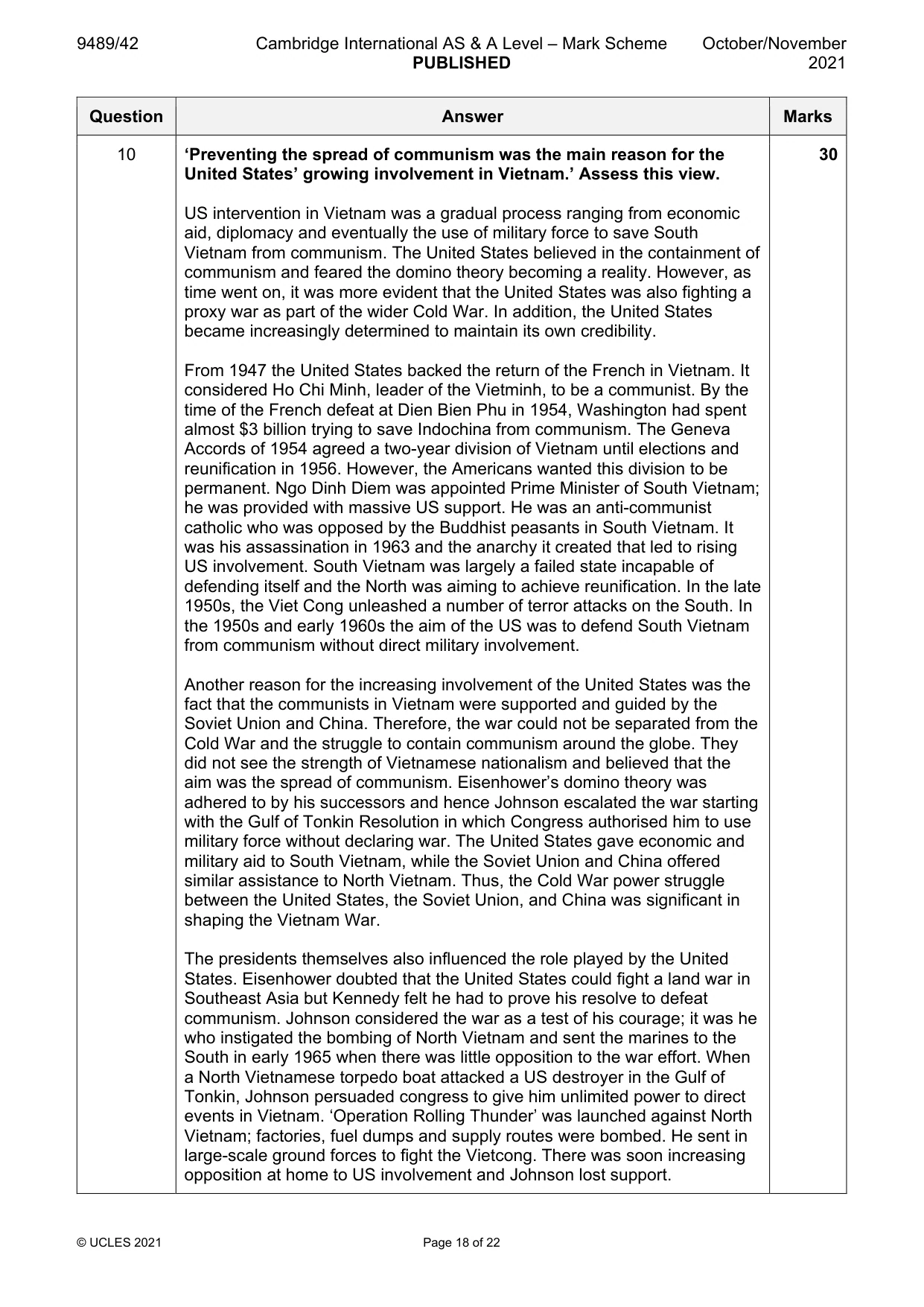
Mark scheme: 10 ‘Preventing the spread of communism was the main reason for the 30 United States’ growing involvement in Vietnam.’ Assess this view. US intervention in Vietnam was a gradual process ranging from economic aid, diplomacy and eventually the use of military force to save South Vietnam from communism. The United States believed in the containment of communism and feared the domino theory becoming a reality. However, as time went on, it was more evident that the United States was also fighting a proxy war as part of the wider Cold War. In addition, the United States became increasingly determined to maintain its own credibility. From 1947 the United States backed the return of the French in Vietnam. It considered Ho Chi Minh, leader of the Vietminh, to be a communist. By the time of the French defeat at Dien Bien Phu in 1954, Washington had spent almost $3 billion trying to save Indochina from communism. The Geneva Accords of 1954 agreed a two-year division of Vietnam until elections and reunification in 1956. However, the Americans wanted this division to be permanent. Ngo Dinh Diem was appointed Prime Minister of South Vietnam; he was provided with massive US support. He was an anti-communist catholic who was opposed by the Buddhist peasants in South Vietnam. It was his assassination in 1963 and the anarchy it created that led to rising US involvement. South Vietnam was largely a failed state incapable of defending itself and the North was aiming to achieve reunification. In the late 1950s, the Viet Cong unleashed a number of terror attacks on the South. In the 1950s and early 1960s the aim of the US was to defend South Vietnam from communism without direct military involvement. Another reason for the increasing involvement of the United States was the fact that the communists in Vietnam were supported and guided by the Soviet Union and China. Therefore, the war could not be separated from the Cold War and the struggle to contain communism around the globe. They did not see the strength of Vietnamese nationalism and believed that the aim was the spread of communism. Eisenhower’s domino theory was adhered to by his successors and hence Johnson escalated the war starting with the Gulf of Tonkin Resolution in which Congress authorised him to use military force without declaring war. The United States gave economic and military aid to South Vietnam, while the Soviet Union and China offered similar assistance to North Vietnam. Thus, the Cold War power struggle between the United States, the Soviet Union, and China was significant in shaping the Vietnam War. The presidents themselves also influenced the role played by the United States. Eisenhower doubted that the United States could fight a land war in Southeast Asia but Kennedy felt he had to prove his resolve to defeat communism. Johnson considered the war as a test of his courage; it was he who instigated the bombing of North Vietnam and sent the marines to the South in early 1965 when there was little opposition to the war effort. When a North Vietnamese torpedo boat attacked a US destroyer in the Gulf of Tonkin, Johnson persuaded congress to give him unlimited power to direct events in Vietnam. ‘Operation Rolling Thunder’ was launched against North Vietnam; factories, fuel dumps and supply routes were bombed. He sent in large-scale ground forces to fight the Vietcong. There was soon increasing opposition at home to US involvement and Johnson lost support.
More questions on How did the rise of extremism affect international relations?
Q11 · Analyse the impact that the rivalries between the Cold War superpowers had on the civil…
11 Analyse the impact that the rivalries between the Cold War superpowers had on the civil war in Angola. [30]
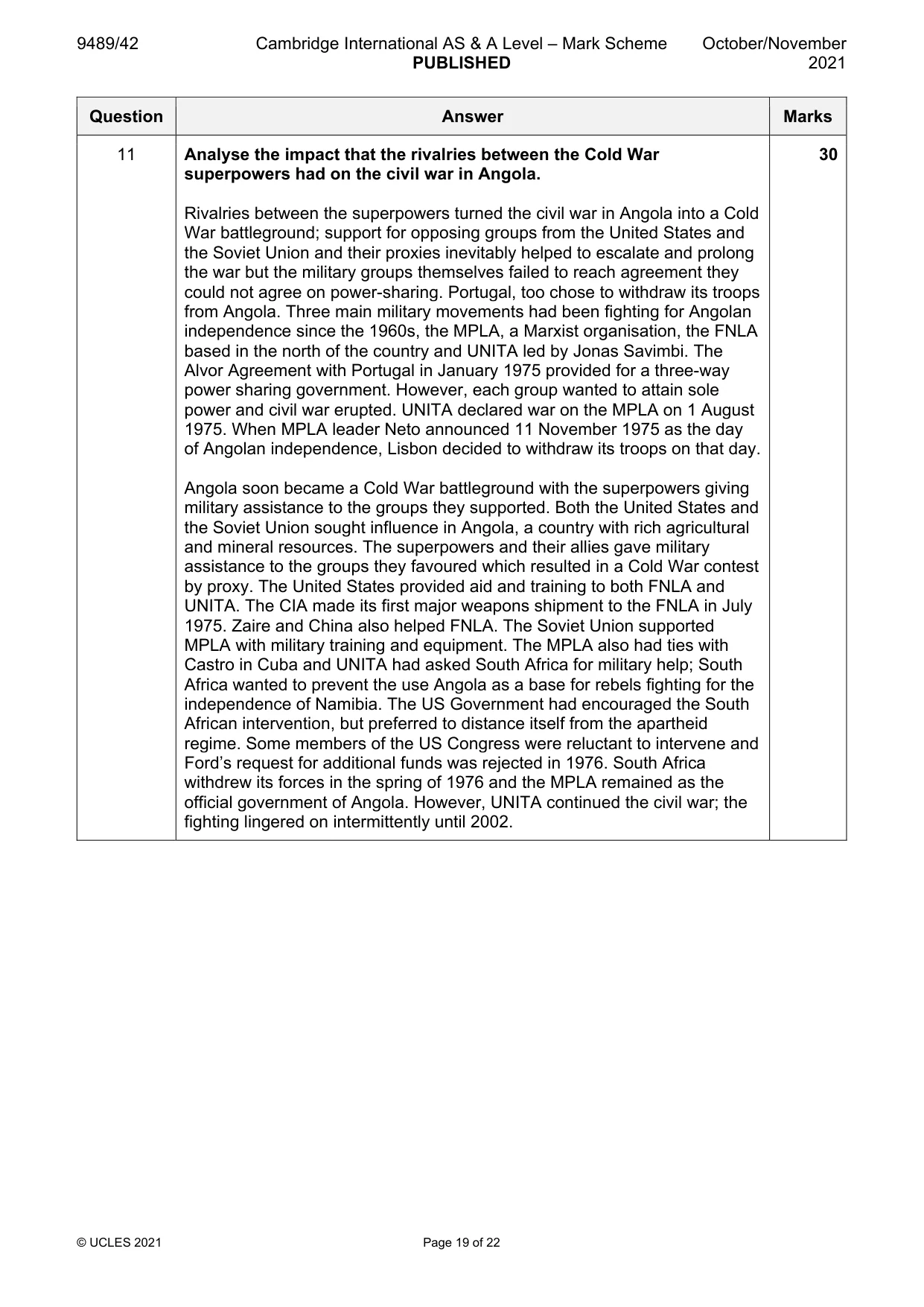
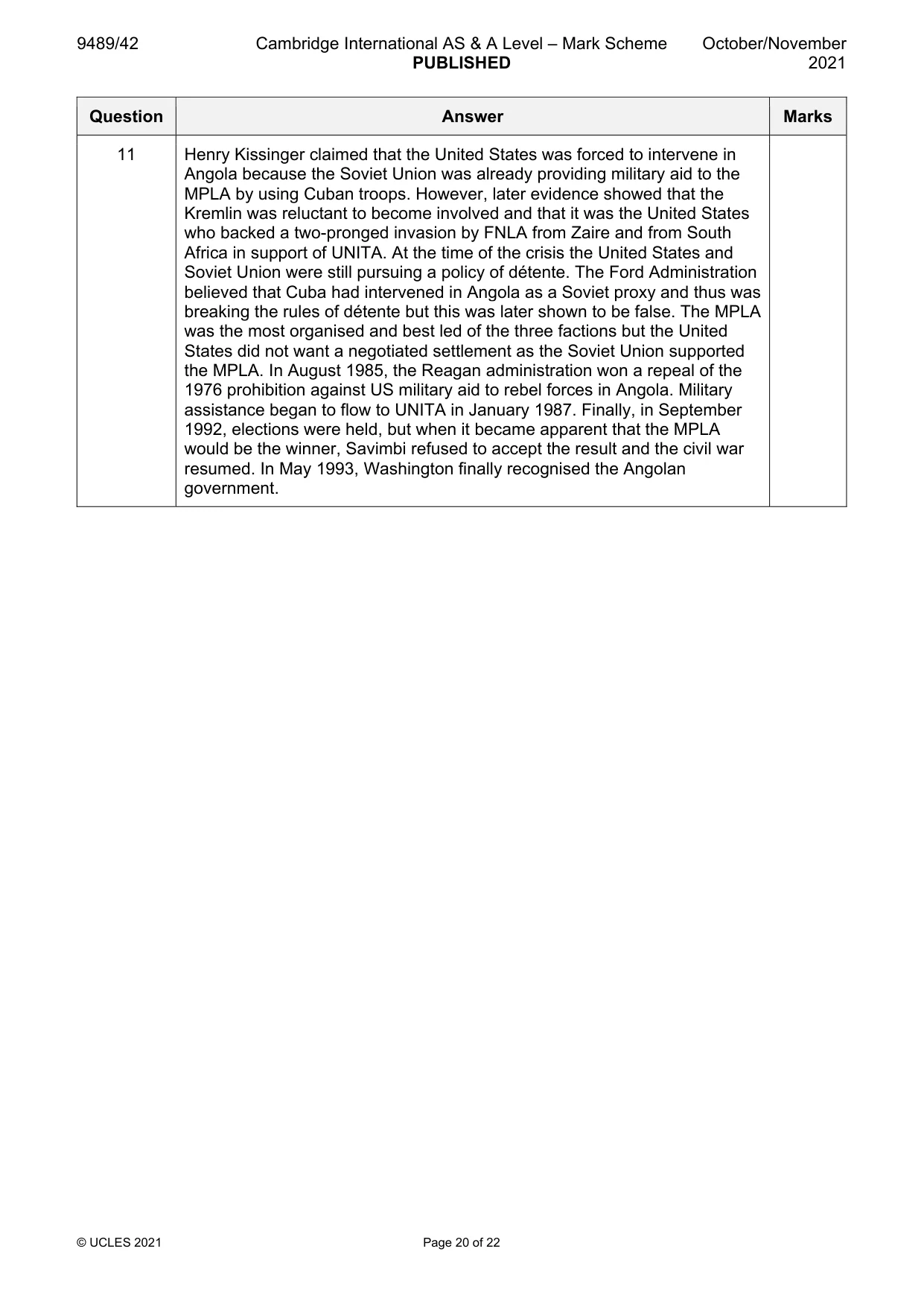
Mark scheme: 11 Analyse the impact that the rivalries between the Cold War 30 superpowers had on the civil war in Angola. Rivalries between the superpowers turned the civil war in Angola into a Cold War battleground; support for opposing groups from the United States and the Soviet Union and their proxies inevitably helped to escalate and prolong the war but the military groups themselves failed to reach agreement they could not agree on power-sharing. Portugal, too chose to withdraw its troops from Angola. Three main military movements had been fighting for Angolan independence since the 1960s, the MPLA, a Marxist organisation, the FNLA based in the north of the country and UNITA led by Jonas Savimbi. The Alvor Agreement with Portugal in January 1975 provided for a three-way power sharing government. However, each group wanted to attain sole power and civil war erupted. UNITA declared war on the MPLA on 1 August 1975. When MPLA leader Neto announced 11 November 1975 as the day of Angolan independence, Lisbon decided to withdraw its troops on that day. Angola soon became a Cold War battleground with the superpowers giving military assistance to the groups they supported. Both the United States and the Soviet Union sought influence in Angola, a country with rich agricultural and mineral resources. The superpowers and their allies gave military assistance to the groups they favoured which resulted in a Cold War contest by proxy. The United States provided aid and training to both FNLA and UNITA. The CIA made its first major weapons shipment to the FNLA in July 1975. Zaire and China also helped FNLA. The Soviet Union supported MPLA with military training and equipment. The MPLA also had ties with Castro in Cuba and UNITA had asked South Africa for military help; South Africa wanted to prevent the use Angola as a base for rebels fighting for the independence of Namibia. The US Government had encouraged the South African intervention, but preferred to distance itself from the apartheid regime. Some members of the US Congress were reluctant to intervene and Ford’s request for additional funds was rejected in 1976. South Africa withdrew its forces in the spring of 1976 and the MPLA remained as the official government of Angola. However, UNITA continued the civil war; the fighting lingered on intermittently until 2002. 11 Henry Kissinger claimed that the United States was forced to intervene in Angola because the Soviet Union was already providing military aid to the MPLA by using Cuban troops. However, later evidence showed that the Kremlin was reluctant to become involved and that it was the United States who backed a two-pronged invasion by FNLA from Zaire and from South Africa in support of UNITA. At the time of the crisis the United States and Soviet Union were still pursuing a policy of détente. The Ford Administration believed that Cuba had intervened in Angola as a Soviet proxy and thus was breaking the rules of détente but this was later shown to be false. The MPLA was the most organised and best led of the three factions but the United States did not want a negotiated settlement as the Soviet Union supported the MPLA. In August 1985, the Reagan administration won a repeal of the 1976 prohibition against US military aid to rebel forces in Angola. Military assistance began to flow to UNITA in January 1987. Finally, in September 1992, elections were held, but when it became apparent that the MPLA would be the winner, Savimbi refused to accept the result and the civil war resumed. In May 1993, Washington finally recognised the Angolan government.
More questions on How did the rise of extremism affect international relations?
What was in this paper
The subtopics covered by these 11 questions, and how many questions each got. Open one in a new tab to see every Cambridge question on it.
5What was the impact of the Great Crash and the Great Depression in the United States?2How successful was the Progressive Movement from 1890 to 1920?1How were the Bolsheviks able to consolidate their power up to 1924?1What were the causes of the Great Crash and the Great Depression?1Why did war break out in 1939?1What you needed in this session
Cambridge’s own grade thresholds for 2021 Oct/Nov, Paper 4 · Variant 2. A higher threshold means an easier paper — the bar moves with how the cohort did.