Cambridge A Level History 9489 — 2025 Oct/Nov Paper 4 · Variant 2
9489/42/O/N/25 · 11 questions · 60 marks · ≈68 min
The question paper and its mark scheme, free to read here and free to download. This is Cambridge’s own paper, exactly as it was sat.
Question paper4 pages
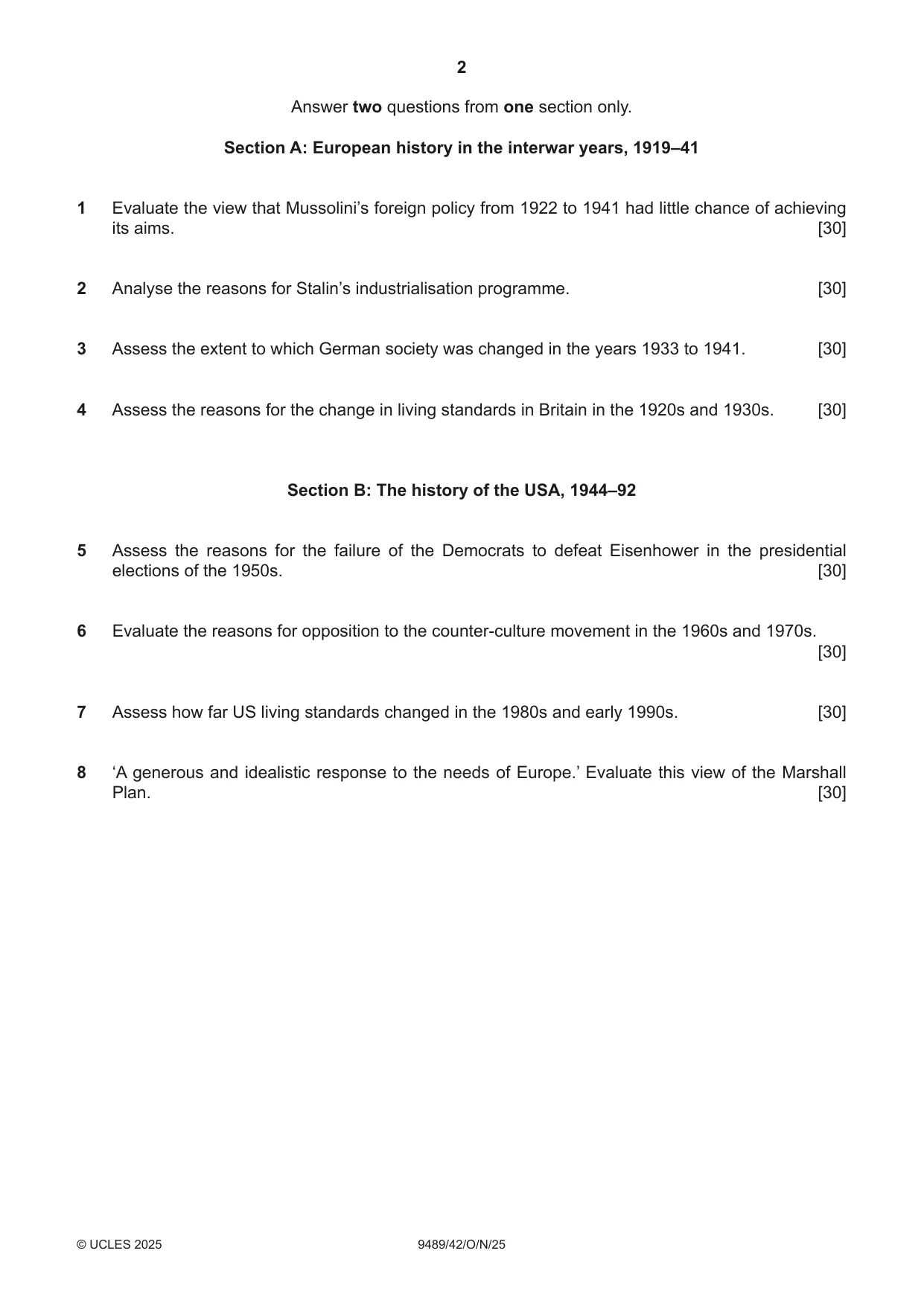
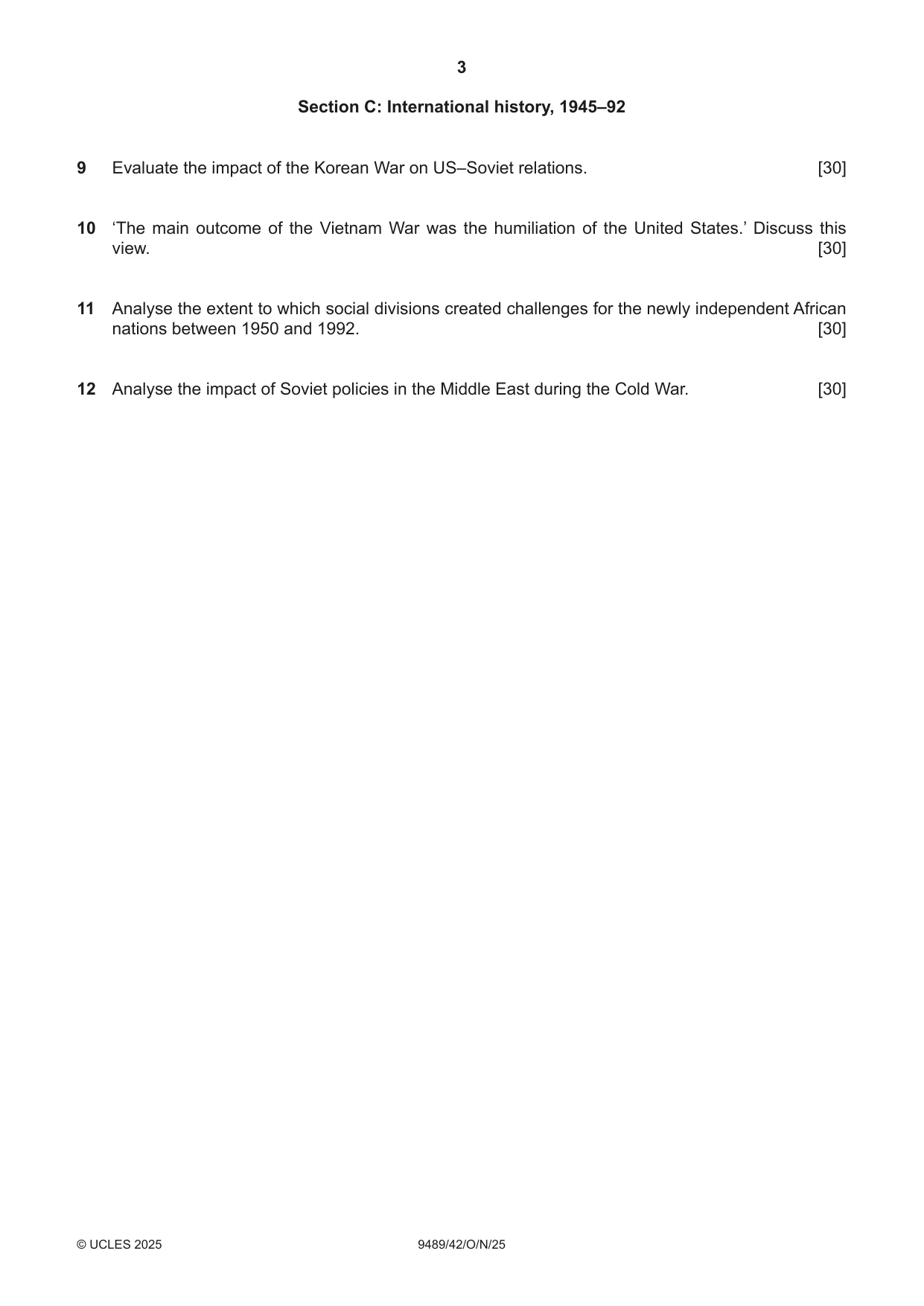
Mark scheme18 pages
Answers below. Sit the paper first if you are practising.


Questions as text
Q1 · Evaluate the view that Mussolini’s foreign policy from 1922 to 1941 had little chance of…
1 Evaluate the view that Mussolini’s foreign policy from 1922 to 1941 had little chance of achieving its aims. [30]
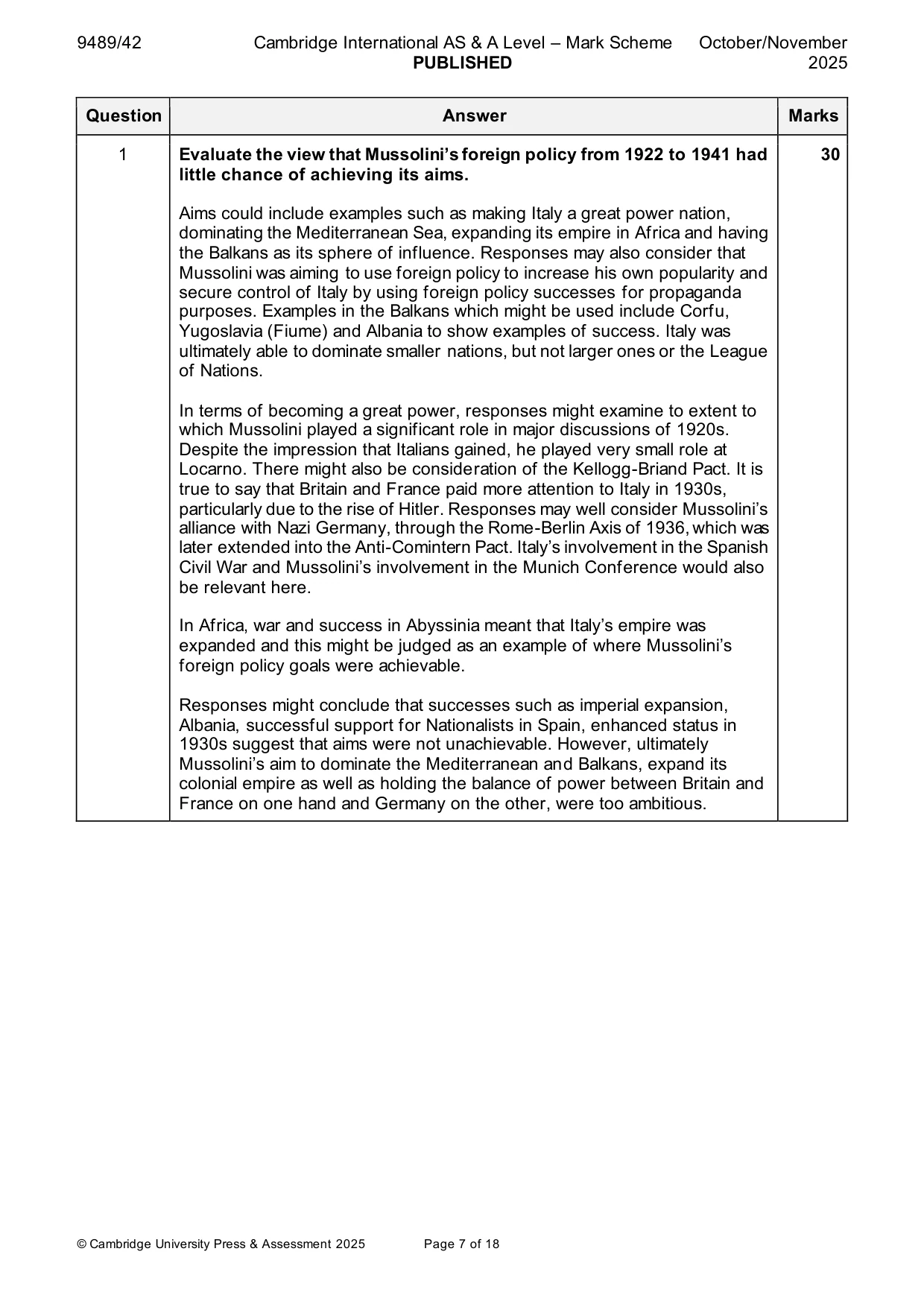
Mark scheme: Question Answer Marks 1 Evaluate the view that Mussolini’s foreign policy from 1922 to 1941 had 30 little chance of achieving its aims. Aims could include examples such as making Italy a great power nation, dominating the Mediterranean Sea, expanding its empire in Africa and having the Balkans as its sphere of influence. Responses may also consider that Mussolini was aiming to use foreign policy to increase his own popularity and secure control of Italy by using foreign policy successes for propaganda purposes. Examples in the Balkans which might be used include Corfu, Yugoslavia (Fiume) and Albania to show examples of success. Italy was ultimately able to dominate smaller nations, but not larger ones or the League of Nations. In terms of becoming a great power, responses might examine to extent to which Mussolini played a significant role in major discussions of 1920s. Despite the impression that Italians gained, he played very small role at Locarno. There might also be consideration of the Kellogg-Briand Pact. It is true to say that Britain and France paid more attention to Italy in 1930s, particularly due to the rise of Hitler. Responses may well consider Mussolini’s alliance with Nazi Germany, through the Rome-Berlin Axis of 1936, which was later extended into the Anti-Comintern Pact. Italy’s involvement in the Spanish Civil War and Mussolini’s involvement in the Munich Conference would also be relevant here. In Africa, war and success in Abyssinia meant that Italy’s empire was expanded and this might be judged as an example of where Mussolini’s foreign policy goals were achievable. Responses might conclude that successes such as imperial expansion, Albania, successful support for Nationalists in Spain, enhanced status in 1930s suggest that aims were not unachievable. However, ultimately Mussolini’s aim to dominate the Mediterranean and Balkans, expand its colonial empire as well as holding the balance of power between Britain and France on one hand and Germany on the other, were too ambitious.
More questions on How did the rise of extremism affect international relations?
Q2 · Analyse the reasons for Stalin’s industrialisation programme
2 Analyse the reasons for Stalin’s industrialisation programme. [30]
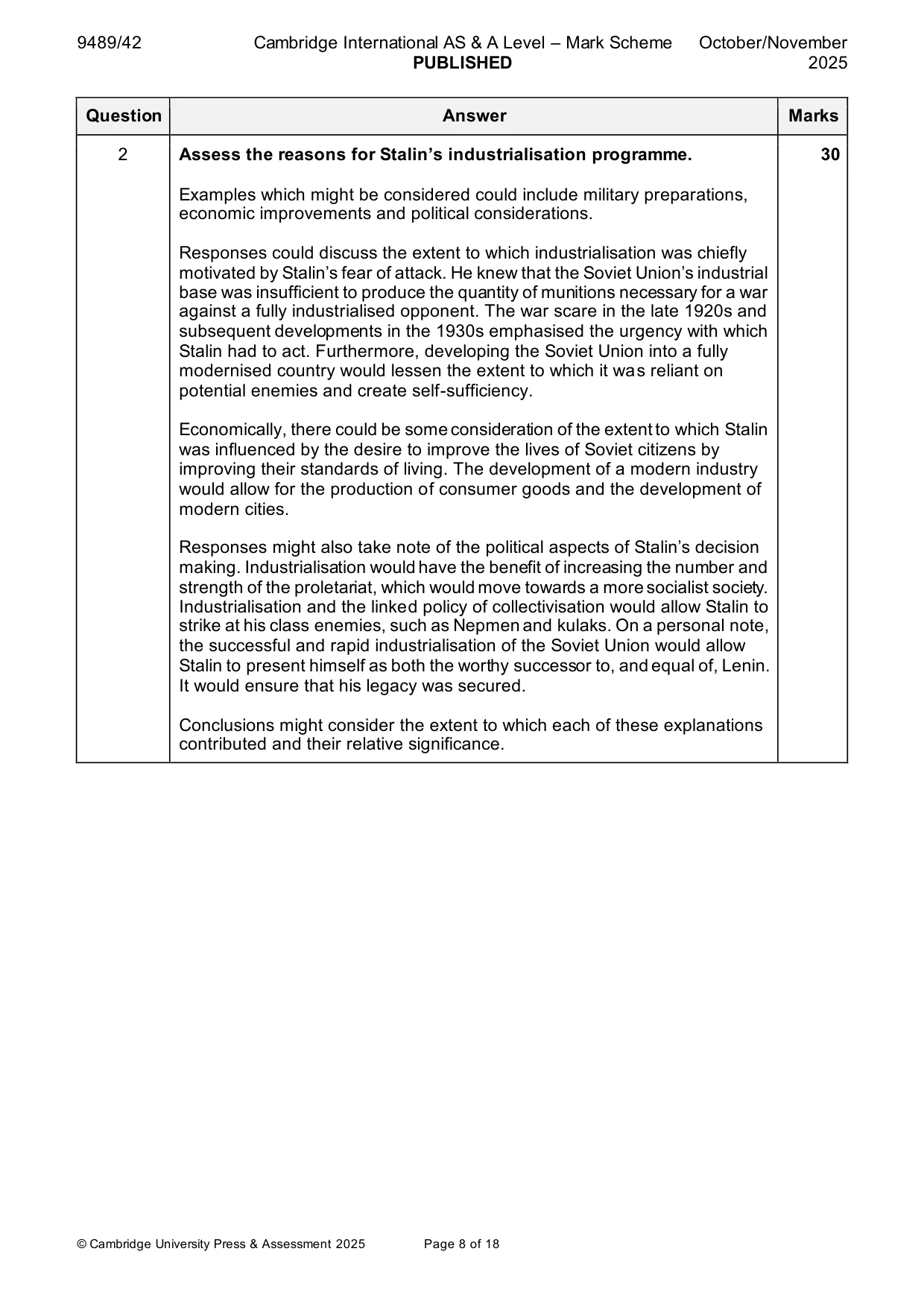
Mark scheme: 2 Assess the reasons for Stalin’s industrialisation programme. 30 Examples which might be considered could include military preparations, economic improvements and political considerations. Responses could discuss the extent to which industrialisation was chiefly motivated by Stalin’s fear of attack. He knew that the Soviet Union’s industrial base was insufficient to produce the quantity of munitions necessary for a war against a fully industrialised opponent. The war scare in the late 1920s and subsequent developments in the 1930s emphasised the urgency with which Stalin had to act. Furthermore, developing the Soviet Union into a fully modernised country would lessen the extent to which it was reliant on potential enemies and create self-sufficiency. Economically, there could be some consideration of the extent to which Stalin was influenced by the desire to improve the lives of Soviet citizens by improving their standards of living. The development of a modern industry would allow for the production of consumer goods and the development of modern cities. Responses might also take note of the political aspects of Stalin’s decision making. Industrialisation would have the benefit of increasing the number and strength of the proletariat, which would move towards a more socialist society. Industrialisation and the linked policy of collectivisation would allow Stalin to strike at his class enemies, such as Nepmen and kulaks. On a personal note, the successful and rapid industrialisation of the Soviet Union would allow Stalin to present himself as both the worthy successor to, and equal of, Lenin. It would ensure that his legacy was secured. Conclusions might consider the extent to which each of these explanations contributed and their relative significance.
More questions on How were the Bolsheviks able to consolidate their power up to 1924?
Q3 · Assess the extent to which German society was changed in the years 1933 to 1941
3 Assess the extent to which German society was changed in the years 1933 to 1941. [30]
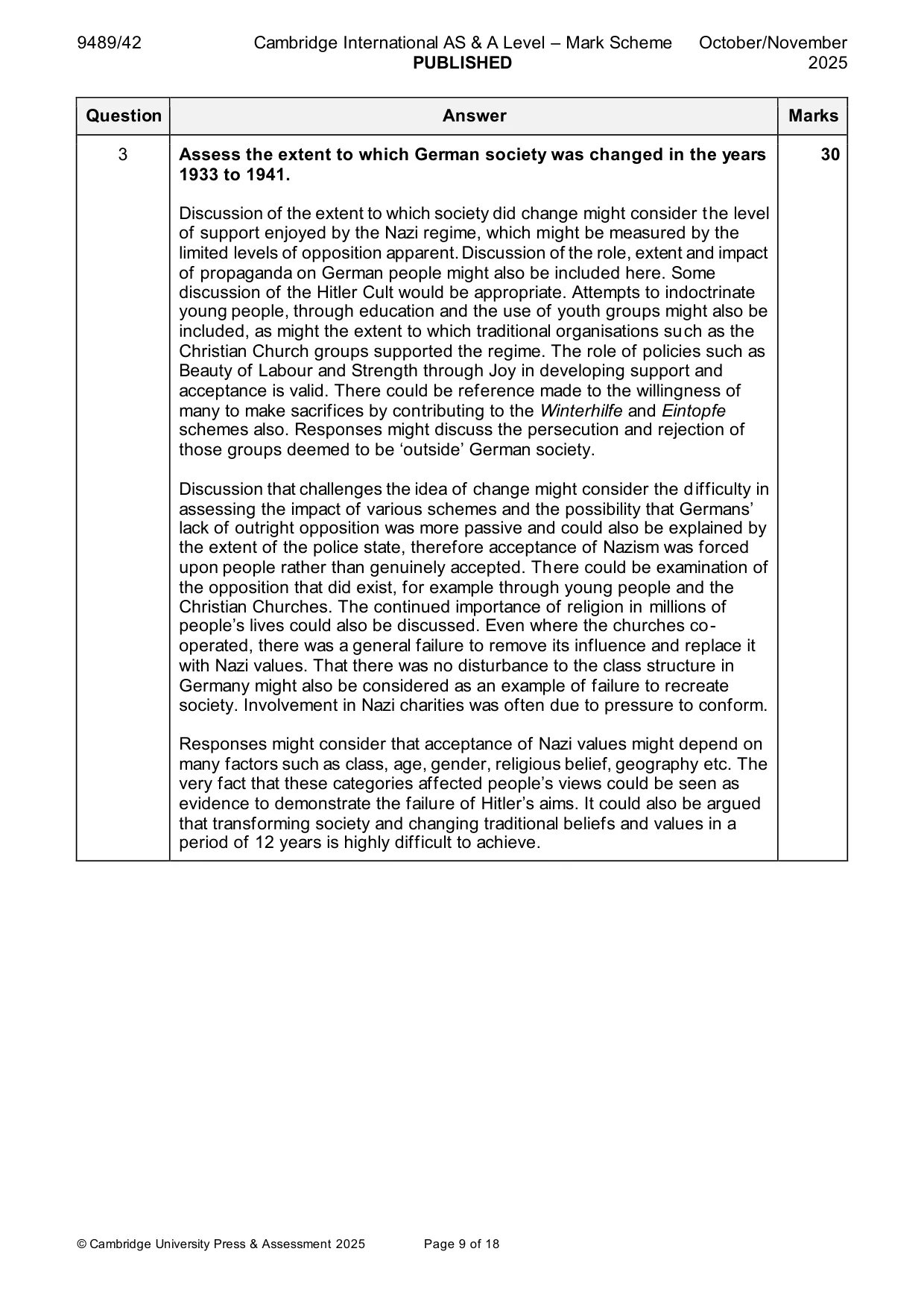
Mark scheme: 3 Assess the extent to which German society was changed in the years 30 1933 to 1941. Discussion of the extent to which society did change might consider the level of support enjoyed by the Nazi regime, which might be measured by the limited levels of opposition apparent. Discussion of the role, extent and impact of propaganda on German people might also be included here. Some discussion of the Hitler Cult would be appropriate. Attempts to indoctrinate young people, through education and the use of youth groups might also be included, as might the extent to which traditional organisations such as the Christian Church groups supported the regime. The role of policies such as Beauty of Labour and Strength through Joy in developing support and acceptance is valid. There could be reference made to the willingness of many to make sacrifices by contributing to the Winterhilfe and Eintopfe schemes also. Responses might discuss the persecution and rejection of those groups deemed to be ‘outside’ German society. Discussion that challenges the idea of change might consider the difficulty in assessing the impact of various schemes and the possibility that Germans’ lack of outright opposition was more passive and could also be explained by the extent of the police state, therefore acceptance of Nazism was forced upon people rather than genuinely accepted. There could be examination of the opposition that did exist, for example through young people and the Christian Churches. The continued importance of religion in millions of people’s lives could also be discussed. Even where the churches co- operated, there was a general failure to remove its influence and replace it with Nazi values. That there was no disturbance to the class structure in Germany might also be considered as an example of failure to recreate society. Involvement in Nazi charities was often due to pressure to conform. Responses might consider that acceptance of Nazi values might depend on many factors such as class, age, gender, religious belief, geography etc. The very fact that these categories affected people’s views could be seen as evidence to demonstrate the failure of Hitler’s aims. It could also be argued that transforming society and changing traditional beliefs and values in a period of 12 years is highly difficult to achieve.
More questions on How did the rise of extremism affect international relations?
Q4 · Assess the reasons for the change in living standards in Britain in the 1920s and 1930s
4 Assess the reasons for the change in living standards in Britain in the 1920s and 1930s. [30]
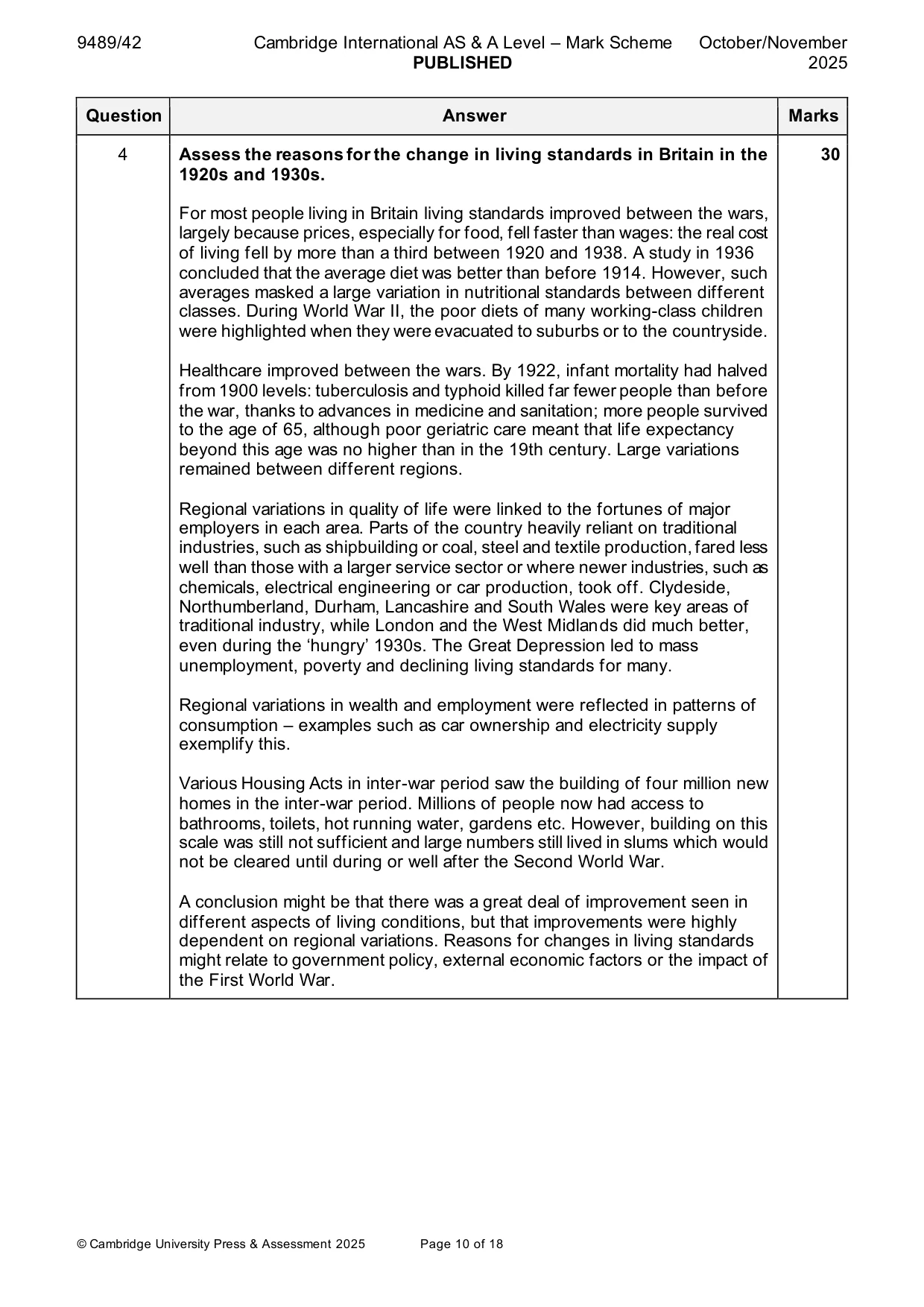
Mark scheme: 4 Assess the reasons for the change in living standards in Britain in the 30 1920s and 1930s. For most people living in Britain living standards improved between the wars, largely because prices, especially for food, fell faster than wages: the real cost of living fell by more than a third between 1920 and 1938. A study in 1936 concluded that the average diet was better than before 1914. However, such averages masked a large variation in nutritional standards between different classes. During World War II, the poor diets of many working-class children were highlighted when they were evacuated to suburbs or to the countryside. Healthcare improved between the wars. By 1922, infant mortality had halved from 1900 levels: tuberculosis and typhoid killed far fewer people than before the war, thanks to advances in medicine and sanitation; more people survived to the age of 65, although poor geriatric care meant that life expectancy beyond this age was no higher than in the 19th century. Large variations remained between different regions. Regional variations in quality of life were linked to the fortunes of major employers in each area. Parts of the country heavily reliant on traditional industries, such as shipbuilding or coal, steel and textile production, fared less well than those with a larger service sector or where newer industries, such as chemicals, electrical engineering or car production, took off. Clydeside, Northumberland, Durham, Lancashire and South Wales were key areas of traditional industry, while London and the West Midlands did much better, even during the ‘hungry’ 1930s. The Great Depression led to mass unemployment, poverty and declining living standards for many. Regional variations in wealth and employment were reflected in patterns of consumption – examples such as car ownership and electricity supply exemplify this. Various Housing Acts in inter-war period saw the building of four million new homes in the inter-war period. Millions of people now had access to bathrooms, toilets, hot running water, gardens etc. However, building on this scale was still not sufficient and large numbers still lived in slums which would not be cleared until during or well after the Second World War. A conclusion might be that there was a great deal of improvement seen in different aspects of living conditions, but that improvements were highly dependent on regional variations. Reasons for changes in living standards might relate to government policy, external economic factors or the impact of the First World War.
More questions on What were the consequences of the rapid economic growth after 1870?
Q5 · Assess the reasons for the failure of the Democrats to defeat Eisenhower in the…
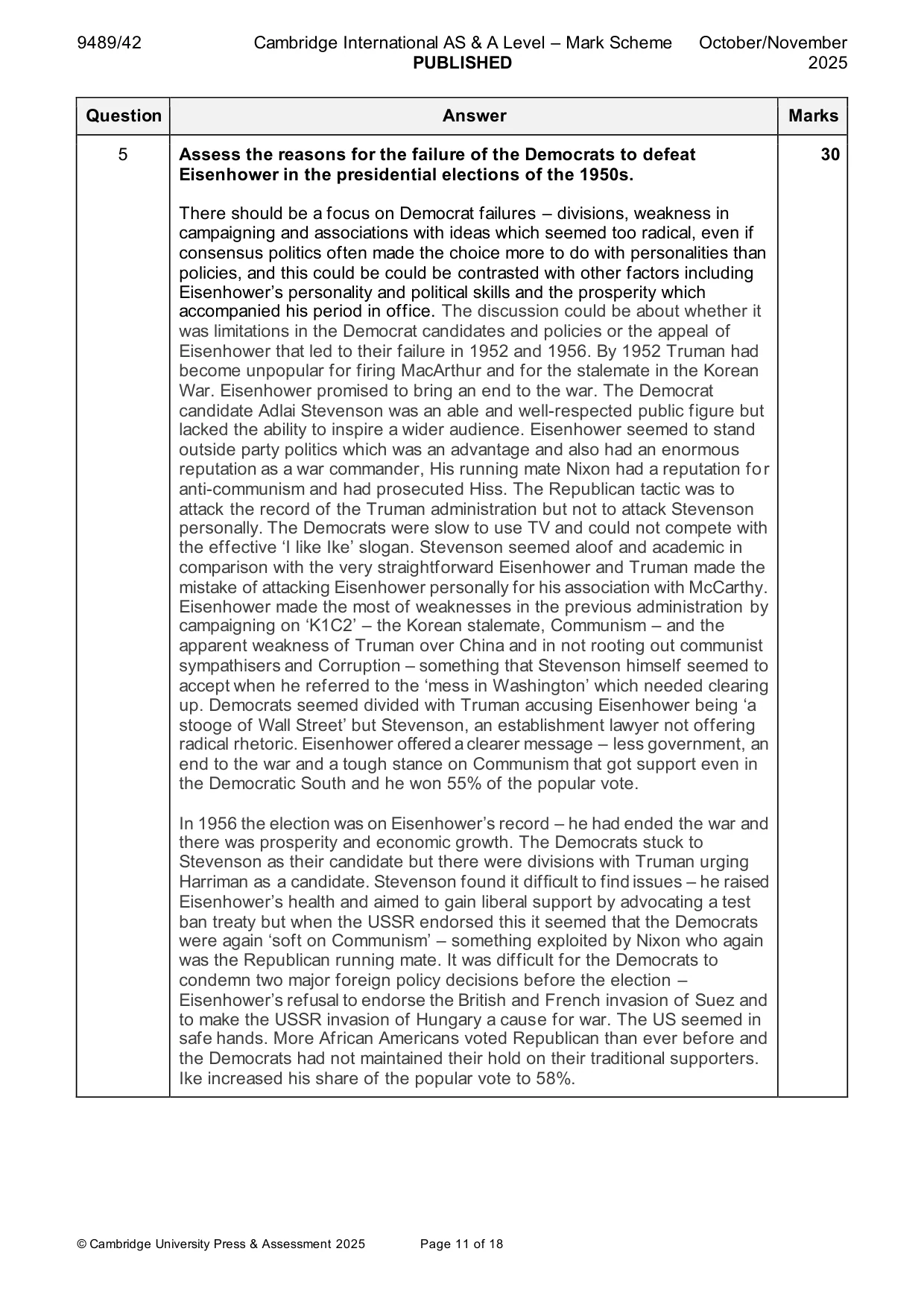
5 Assess the reasons for the failure of the Democrats to defeat Eisenhower in the presidential elections of the 1950s. [30]
Mark scheme: 5 Assess the reasons for the failure of the Democrats to defeat 30 Eisenhower in the presidential elections of the 1950s. There should be a focus on Democrat failures – divisions, weakness in campaigning and associations with ideas which seemed too radical, even if consensus politics often made the choice more to do with personalities than policies, and this could be could be contrasted with other factors including Eisenhower’s personality and political skills and the prosperity which accompanied his period in office. The discussion could be about whether it was limitations in the Democrat candidates and policies or the appeal of Eisenhower that led to their failure in 1952 and 1956. By 1952 Truman had become unpopular for firing MacArthur and for the stalemate in the Korean War. Eisenhower promised to bring an end to the war. The Democrat candidate Adlai Stevenson was an able and well-respected public figure but lacked the ability to inspire a wider audience. Eisenhower seemed to stand outside party politics which was an advantage and also had an enormous reputation as a war commander, His running mate Nixon had a reputation for anti-communism and had prosecuted Hiss. The Republican tactic was to attack the record of the Truman administration but not to attack Stevenson personally. The Democrats were slow to use TV and could not compete with the effective ‘I like Ike’ slogan. Stevenson seemed aloof and academic in comparison with the very straightforward Eisenhower and Truman made the mistake of attacking Eisenhower personally for his association with McCarthy. Eisenhower made the most of weaknesses in the previous administration by campaigning on ‘K1C2’ – the Korean stalemate, Communism – and the apparent weakness of Truman over China and in not rooting out communist sympathisers and Corruption – something that Stevenson himself seemed to accept when he referred to the ‘mess in Washington’ which needed clearing up. Democrats seemed divided with Truman accusing Eisenhower being ‘a stooge of Wall Street’ but Stevenson, an establishment lawyer not offering radical rhetoric. Eisenhower offered a clearer message – less government, an end to the war and a tough stance on Communism that got support even in the Democratic South and he won 55% of the popular vote. In 1956 the election was on Eisenhower’s record – he had ended the war and there was prosperity and economic growth. The Democrats stuck to Stevenson as their candidate but there were divisions with Truman urging Harriman as a candidate. Stevenson found it difficult to find issues – he raised Eisenhower’s health and aimed to gain liberal support by advocating a test ban treaty but when the USSR endorsed this it seemed that the Democrats were again ‘soft on Communism’ – something exploited by Nixon who again was the Republican running mate. It was difficult for the Democrats to condemn two major foreign policy decisions before the election – Eisenhower’s refusal to endorse the British and French invasion of Suez and to make the USSR invasion of Hungary a cause for war. The US seemed in safe hands. More African Americans voted Republican than ever before and the Democrats had not maintained their hold on their traditional supporters. Ike increased his share of the popular vote to 58%.
More questions on Why was there a second New Deal and how successful was it?
Q6 · Evaluate the reasons for opposition to the counter-culture movement in the 1960s and 1970s
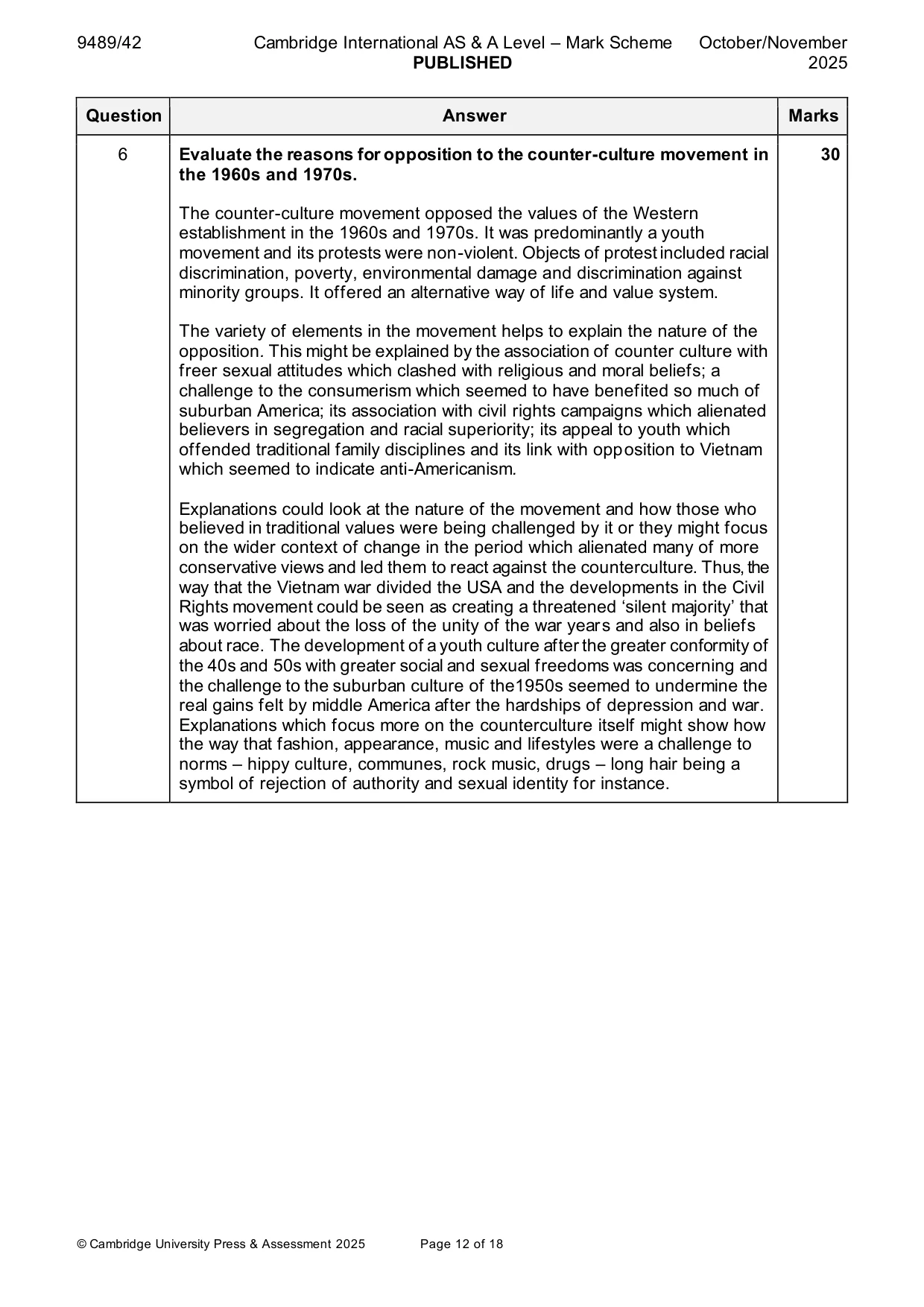
6 Evaluate the reasons for opposition to the counter-culture movement in the 1960s and 1970s. [30]
Mark scheme: 6 Evaluate the reasons for opposition to the counter-culture movement in 30 the 1960s and 1970s. The counter-culture movement opposed the values of the Western establishment in the 1960s and 1970s. It was predominantly a youth movement and its protests were non-violent. Objects of protest included racial discrimination, poverty, environmental damage and discrimination against minority groups. It offered an alternative way of life and value system. The variety of elements in the movement helps to explain the nature of the opposition. This might be explained by the association of counter culture with freer sexual attitudes which clashed with religious and moral beliefs; a challenge to the consumerism which seemed to have benefited so much of suburban America; its association with civil rights campaigns which alienated believers in segregation and racial superiority; its appeal to youth which offended traditional family disciplines and its link with opposition to Vietnam which seemed to indicate anti-Americanism. Explanations could look at the nature of the movement and how those who believed in traditional values were being challenged by it or they might focus on the wider context of change in the period which alienated many of more conservative views and led them to react against the counterculture. Thus, the way that the Vietnam war divided the USA and the developments in the Civil Rights movement could be seen as creating a threatened ‘silent majority’ that was worried about the loss of the unity of the war years and also in beliefs about race. The development of a youth culture after the greater conformity of the 40s and 50s with greater social and sexual freedoms was concerning and the challenge to the suburban culture of the1950s seemed to undermine the real gains felt by middle America after the hardships of depression and war. Explanations which focus more on the counterculture itself might show how the way that fashion, appearance, music and lifestyles were a challenge to norms – hippy culture, communes, rock music, drugs – long hair being a symbol of rejection of authority and sexual identity for instance.
More questions on How successful was the Progressive Movement from 1890 to 1920?
Q7 · Assess how far US living standards changed in the 1980s and early 1990s
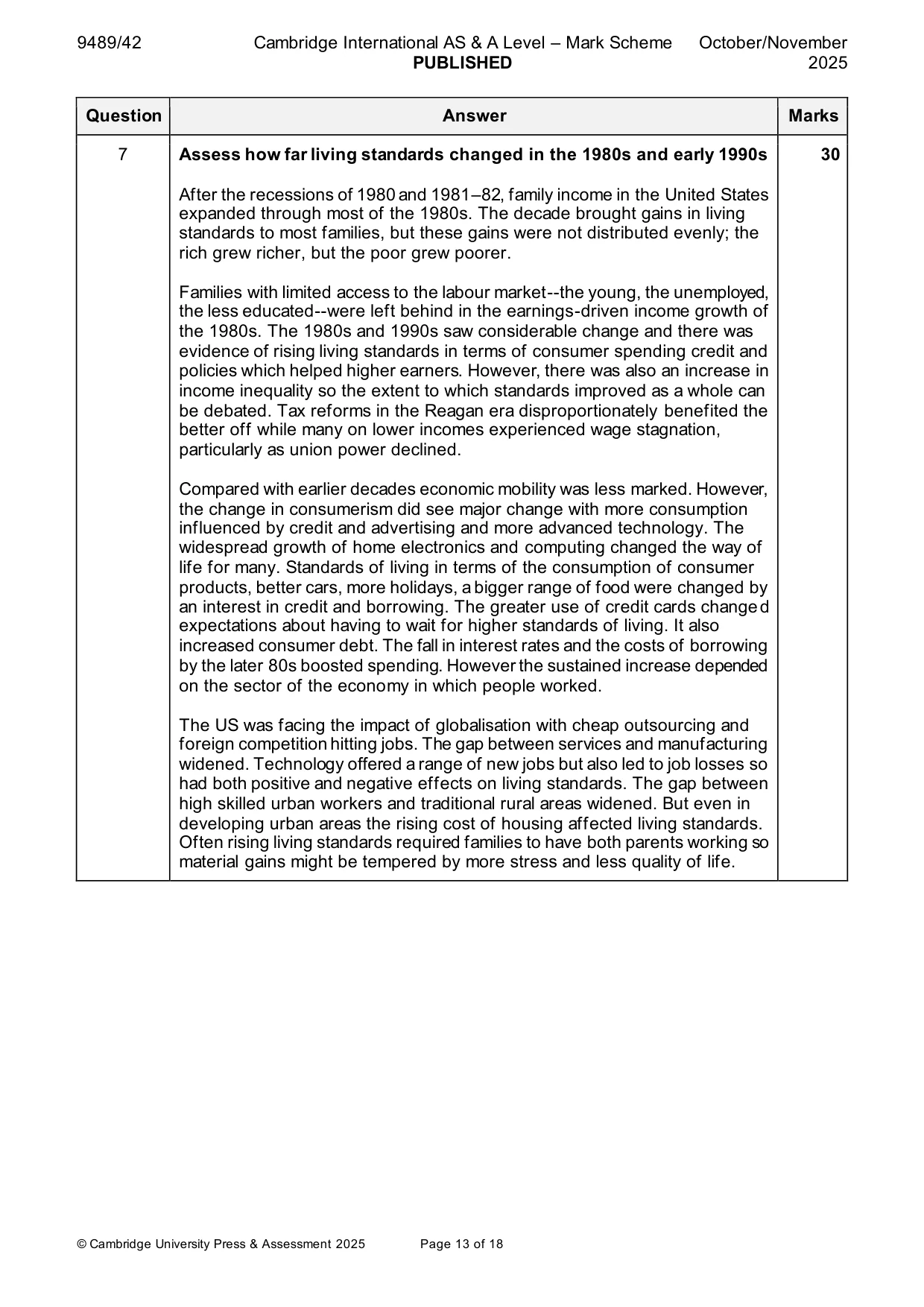
7 Assess how far US living standards changed in the 1980s and early 1990s. [30]
Mark scheme: 7 Assess how far living standards changed in the 1980s and early 1990s 30 After the recessions of 1980 and 1981–82, family income in the United States expanded through most of the 1980s. The decade brought gains in living standards to most families, but these gains were not distributed evenly; the rich grew richer, but the poor grew poorer. Families with limited access to the labour market--the young, the unemployed, the less educated--were left behind in the earnings-driven income growth of the 1980s. The 1980s and 1990s saw considerable change and there was evidence of rising living standards in terms of consumer spending credit and policies which helped higher earners. However, there was also an increase in income inequality so the extent to which standards improved as a whole can be debated. Tax reforms in the Reagan era disproportionately benefited the better off while many on lower incomes experienced wage stagnation, particularly as union power declined. Compared with earlier decades economic mobility was less marked. However, the change in consumerism did see major change with more consumption influenced by credit and advertising and more advanced technology. The widespread growth of home electronics and computing changed the way of life for many. Standards of living in terms of the consumption of consumer products, better cars, more holidays, a bigger range of food were changed by an interest in credit and borrowing. The greater use of credit cards changed expectations about having to wait for higher standards of living. It also increased consumer debt. The fall in interest rates and the costs of borrowing by the later 80s boosted spending. However the sustained increase depended on the sector of the economy in which people worked. The US was facing the impact of globalisation with cheap outsourcing and foreign competition hitting jobs. The gap between services and manufacturing widened. Technology offered a range of new jobs but also led to job losses so had both positive and negative effects on living standards. The gap between high skilled urban workers and traditional rural areas widened. But even in developing urban areas the rising cost of housing affected living standards. Often rising living standards required families to have both parents working so material gains might be tempered by more stress and less quality of life.
More questions on What were the consequences of the rapid economic growth after 1870?
Q8 · Section C: International history, 1945–92
Section C: International history, 1945–92
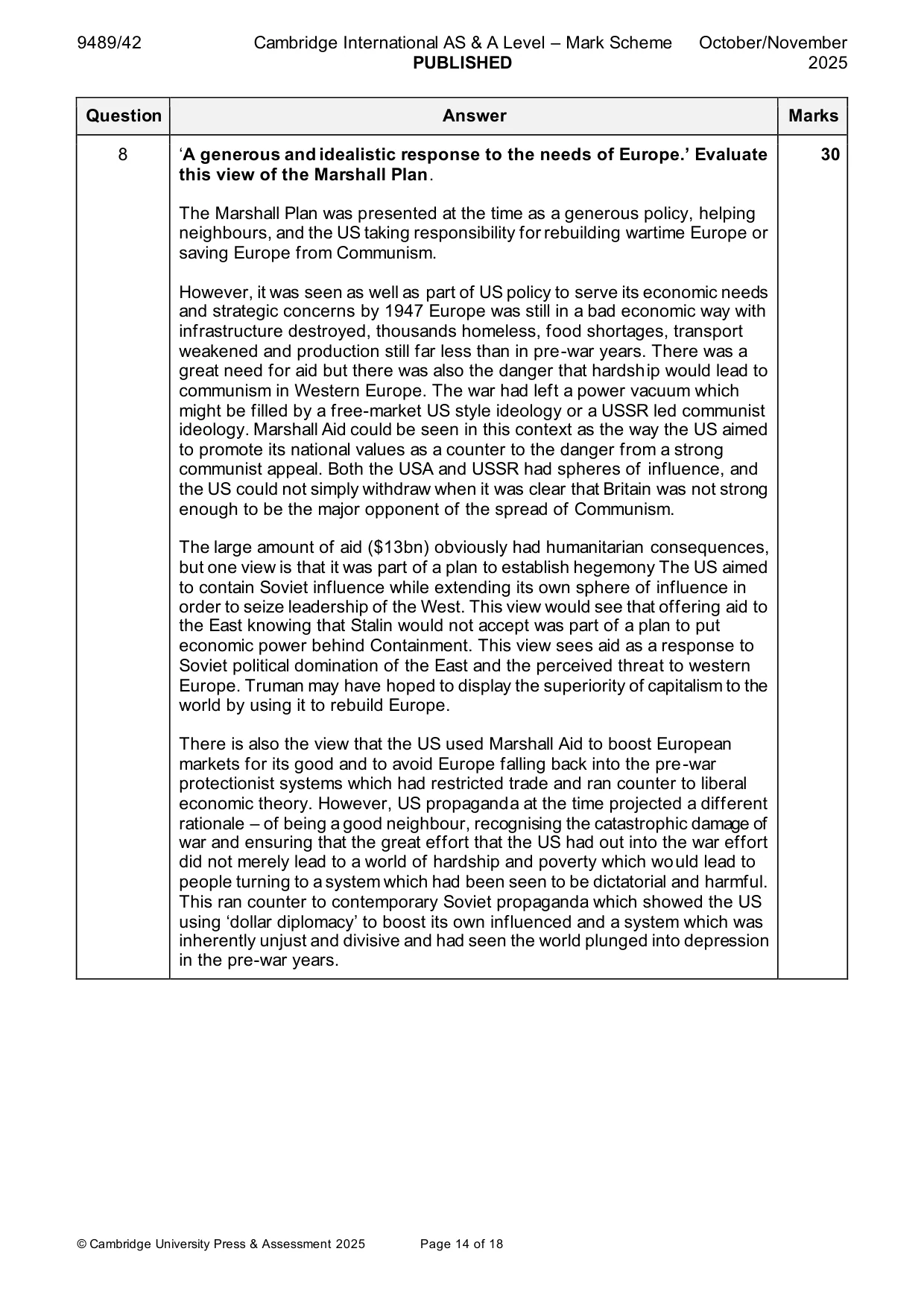
Mark scheme: 8 ‘A generous and idealistic response to the needs of Europe.’ Evaluate 30 this view of the Marshall Plan. The Marshall Plan was presented at the time as a generous policy, helping neighbours, and the US taking responsibility for rebuilding wartime Europe or saving Europe from Communism. However, it was seen as well as part of US policy to serve its economic needs and strategic concerns by 1947 Europe was still in a bad economic way with infrastructure destroyed, thousands homeless, food shortages, transport weakened and production still far less than in pre-war years. There was a great need for aid but there was also the danger that hardship would lead to communism in Western Europe. The war had left a power vacuum which might be filled by a free-market US style ideology or a USSR led communist ideology. Marshall Aid could be seen in this context as the way the US aimed to promote its national values as a counter to the danger from a strong communist appeal. Both the USA and USSR had spheres of influence, and the US could not simply withdraw when it was clear that Britain was not strong enough to be the major opponent of the spread of Communism. The large amount of aid ($13bn) obviously had humanitarian consequences, but one view is that it was part of a plan to establish hegemony The US aimed to contain Soviet influence while extending its own sphere of influence in order to seize leadership of the West. This view would see that offering aid to the East knowing that Stalin would not accept was part of a plan to put economic power behind Containment. This view sees aid as a response to Soviet political domination of the East and the perceived threat to western Europe. Truman may have hoped to display the superiority of capitalism to the world by using it to rebuild Europe. There is also the view that the US used Marshall Aid to boost European markets for its good and to avoid Europe falling back into the pre-war protectionist systems which had restricted trade and ran counter to liberal economic theory. However, US propaganda at the time projected a different rationale – of being a good neighbour, recognising the catastrophic damage of war and ensuring that the great effort that the US had out into the war effort did not merely lead to a world of hardship and poverty which would lead to people turning to a system which had been seen to be dictatorial and harmful. This ran counter to contemporary Soviet propaganda which showed the US using ‘dollar diplomacy’ to boost its own influenced and a system which was inherently unjust and divisive and had seen the world plunged into depression in the pre-war years.
Q9 · Evaluate the impact of the Korean War on US–Soviet relations
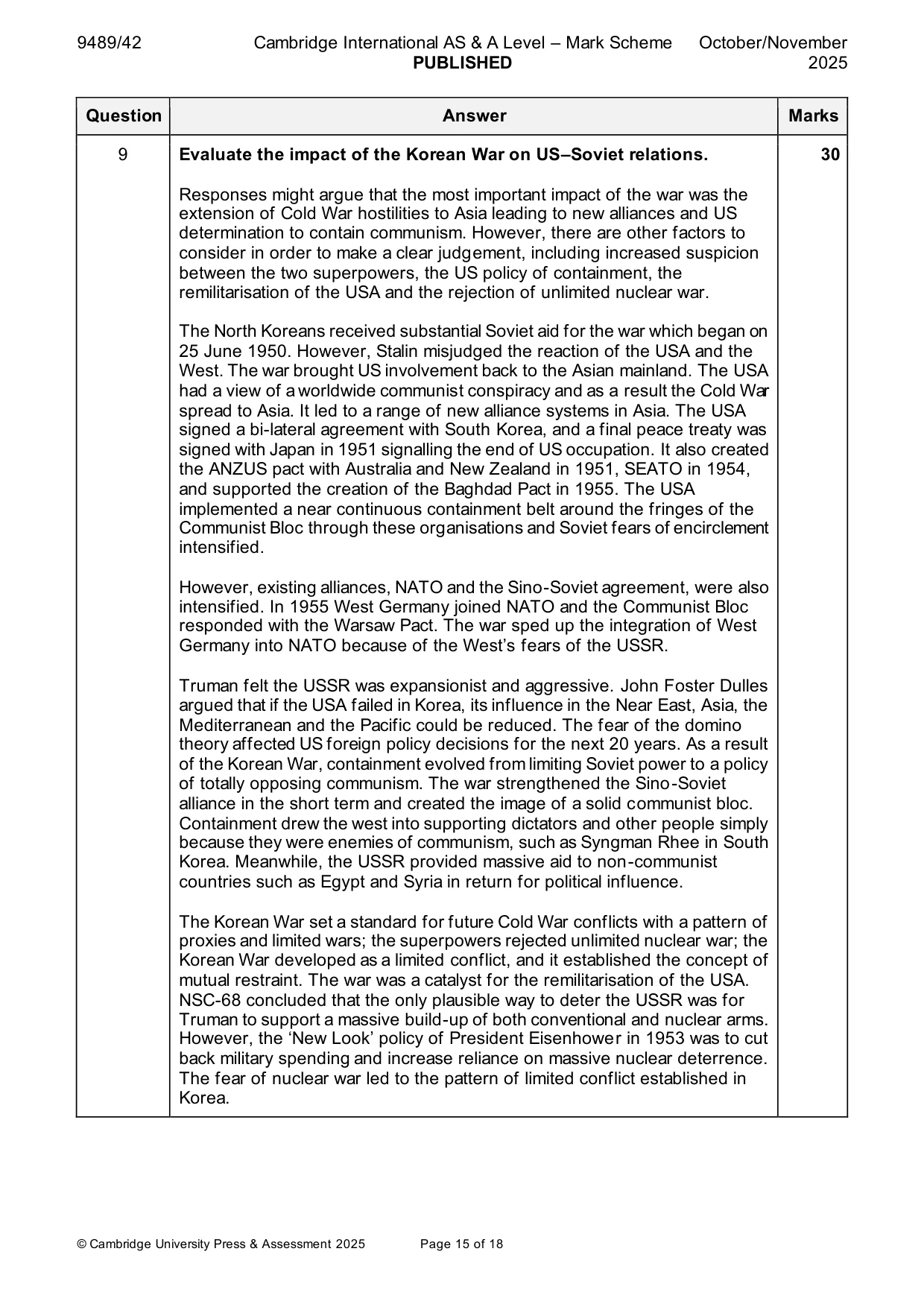
9 Evaluate the impact of the Korean War on US–Soviet relations. [30]
Mark scheme: 9 Evaluate the impact of the Korean War on US–Soviet relations. 30 Responses might argue that the most important impact of the war was the extension of Cold War hostilities to Asia leading to new alliances and US determination to contain communism. However, there are other factors to consider in order to make a clear judgement, including increased suspicion between the two superpowers, the US policy of containment, the remilitarisation of the USA and the rejection of unlimited nuclear war. The North Koreans received substantial Soviet aid for the war which began on 25 June 1950. However, Stalin misjudged the reaction of the USA and the West. The war brought US involvement back to the Asian mainland. The USA had a view of a worldwide communist conspiracy and as a result the Cold War spread to Asia. It led to a range of new alliance systems in Asia. The USA signed a bi-lateral agreement with South Korea, and a final peace treaty was signed with Japan in 1951 signalling the end of US occupation. It also created the ANZUS pact with Australia and New Zealand in 1951, SEATO in 1954, and supported the creation of the Baghdad Pact in 1955. The USA implemented a near continuous containment belt around the fringes of the Communist Bloc through these organisations and Soviet fears of encirclement intensified. However, existing alliances, NATO and the Sino-Soviet agreement, were also intensified. In 1955 West Germany joined NATO and the Communist Bloc responded with the Warsaw Pact. The war sped up the integration of West Germany into NATO because of the West’s fears of the USSR. Truman felt the USSR was expansionist and aggressive. John Foster Dulles argued that if the USA failed in Korea, its influence in the Near East, Asia, the Mediterranean and the Pacific could be reduced. The fear of the domino theory affected US foreign policy decisions for the next 20 years. As a result of the Korean War, containment evolved from limiting Soviet power to a policy of totally opposing communism. The war strengthened the Sino-Soviet alliance in the short term and created the image of a solid communist bloc. Containment drew the west into supporting dictators and other people simply because they were enemies of communism, such as Syngman Rhee in South Korea. Meanwhile, the USSR provided massive aid to non-communist countries such as Egypt and Syria in return for political influence. The Korean War set a standard for future Cold War conflicts with a pattern of proxies and limited wars; the superpowers rejected unlimited nuclear war; the Korean War developed as a limited conflict, and it established the concept of mutual restraint. The war was a catalyst for the remilitarisation of the USA. NSC-68 concluded that the only plausible way to deter the USSR was for Truman to support a massive build-up of both conventional and nuclear arms. However, the ‘New Look’ policy of President Eisenhower in 1953 was to cut back military spending and increase reliance on massive nuclear deterrence. The fear of nuclear war led to the pattern of limited conflict established in Korea.
More questions on How did the rise of extremism affect international relations?
Q10 · ‘The main outcome of the Vietnam War was the humiliation of the United States.’ Discuss…
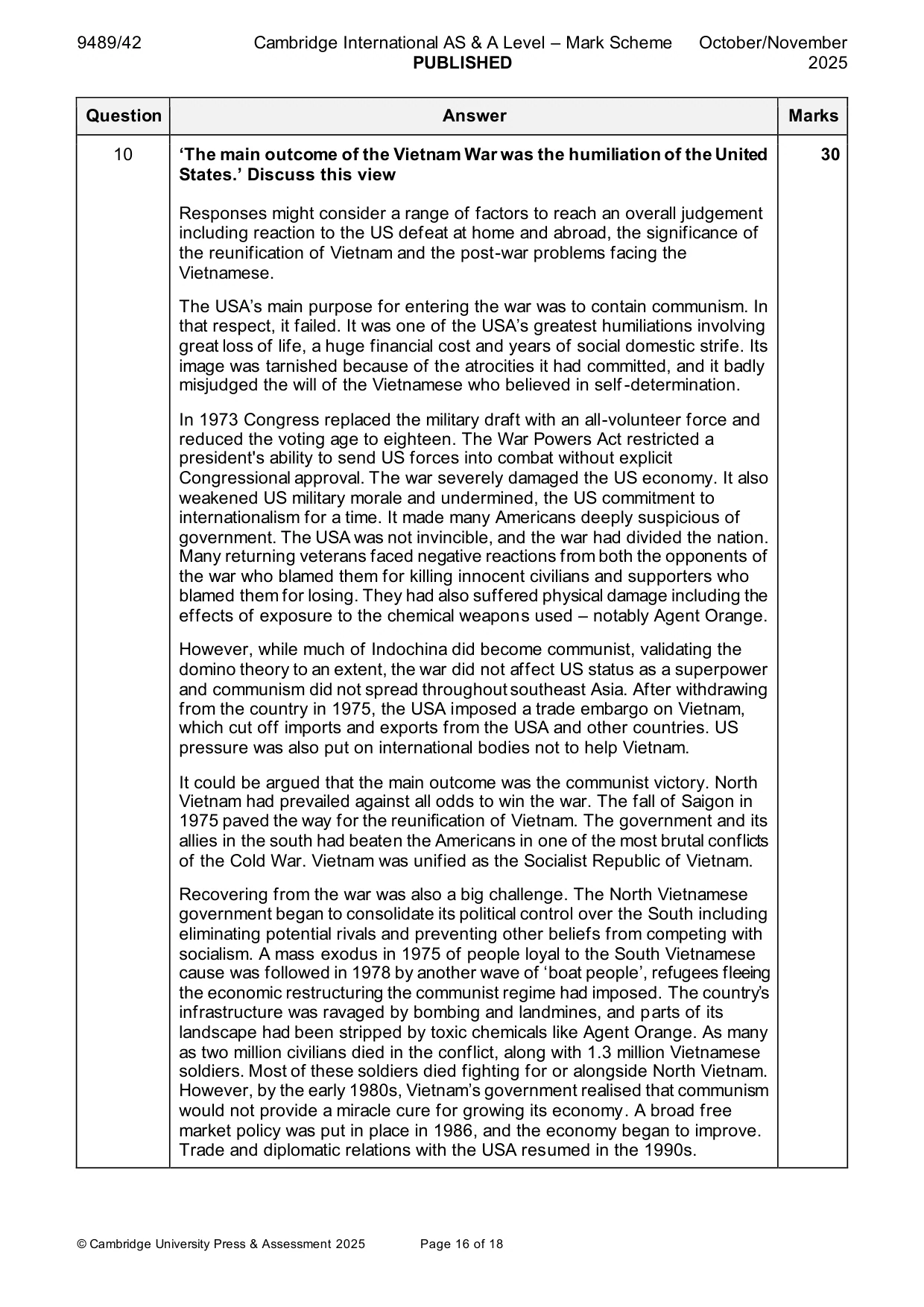
10 ‘The main outcome of the Vietnam War was the humiliation of the United States.’ Discuss this view. [30]
Mark scheme: 10 ‘The main outcome of the Vietnam War was the humiliation of the United 30 States.’ Discuss this view Responses might consider a range of factors to reach an overall judgement including reaction to the US defeat at home and abroad, the significance of the reunification of Vietnam and the post-war problems facing the Vietnamese. The USA’s main purpose for entering the war was to contain communism. In that respect, it failed. It was one of the USA’s greatest humiliations involving great loss of life, a huge financial cost and years of social domestic strife. Its image was tarnished because of the atrocities it had committed, and it badly misjudged the will of the Vietnamese who believed in self -determination. In 1973 Congress replaced the military draft with an all-volunteer force and reduced the voting age to eighteen. The War Powers Act restricted a president's ability to send US forces into combat without explicit Congressional approval. The war severely damaged the US economy. It also weakened US military morale and undermined, the US commitment to internationalism for a time. It made many Americans deeply suspicious of government. The USA was not invincible, and the war had divided the nation. Many returning veterans faced negative reactions from both the opponents of the war who blamed them for killing innocent civilians and supporters who blamed them for losing. They had also suffered physical damage including the effects of exposure to the chemical weapons used – notably Agent Orange. However, while much of Indochina did become communist, validating the domino theory to an extent, the war did not affect US status as a superpower and communism did not spread throughout southeast Asia. After withdrawing from the country in 1975, the USA imposed a trade embargo on Vietnam, which cut off imports and exports from the USA and other countries. US pressure was also put on international bodies not to help Vietnam. It could be argued that the main outcome was the communist victory. North Vietnam had prevailed against all odds to win the war. The fall of Saigon in 1975 paved the way for the reunification of Vietnam. The government and its allies in the south had beaten the Americans in one of the most brutal conflicts of the Cold War. Vietnam was unified as the Socialist Republic of Vietnam. Recovering from the war was also a big challenge. The North Vietnamese government began to consolidate its political control over the South including eliminating potential rivals and preventing other beliefs from competing with socialism. A mass exodus in 1975 of people loyal to the South Vietnamese cause was followed in 1978 by another wave of ‘boat people’, refugees fleeing the economic restructuring the communist regime had imposed. The country’s infrastructure was ravaged by bombing and landmines, and parts of its landscape had been stripped by toxic chemicals like Agent Orange. As many as two million civilians died in the conflict, along with 1.3 million Vietnamese soldiers. Most of these soldiers died fighting for or alongside North Vietnam. However, by the early 1980s, Vietnam’s government realised that communism would not provide a miracle cure for growing its economy. A broad free market policy was put in place in 1986, and the economy began to improve. Trade and diplomatic relations with the USA resumed in the 1990s.
More questions on Why did the League of Nations fail to keep the peace in the 1930s?
Q11 · Analyse the extent to which social divisions created challenges for the newly independent…
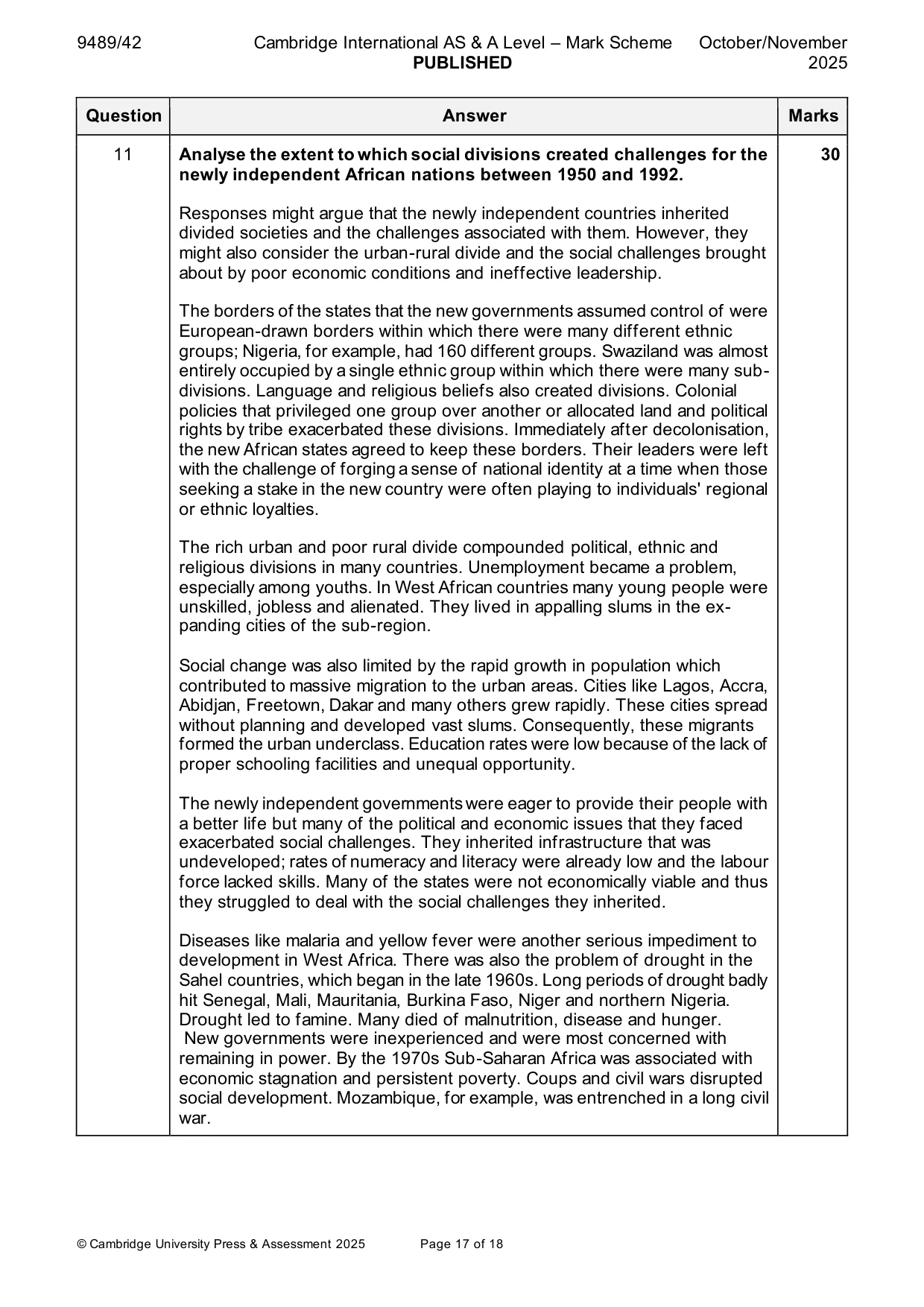
11 Analyse the extent to which social divisions created challenges for the newly independent African nations between 1950 and 1992. [30]
Mark scheme: 11 Analyse the extent to which social divisions created challenges for the 30 newly independent African nations between 1950 and 1992. Responses might argue that the newly independent countries inherited divided societies and the challenges associated with them. However, they might also consider the urban-rural divide and the social challenges brought about by poor economic conditions and ineffective leadership. The borders of the states that the new governments assumed control of were European-drawn borders within which there were many different ethnic groups; Nigeria, for example, had 160 different groups. Swaziland was almost entirely occupied by a single ethnic group within which there were many sub- divisions. Language and religious beliefs also created divisions. Colonial policies that privileged one group over another or allocated land and political rights by tribe exacerbated these divisions. Immediately after decolonisation, the new African states agreed to keep these borders. Their leaders were left with the challenge of forging a sense of national identity at a time when those seeking a stake in the new country were often playing to individuals' regional or ethnic loyalties. The rich urban and poor rural divide compounded political, ethnic and religious divisions in many countries. Unemployment became a problem, especially among youths. In West African countries many young people were unskilled, jobless and alienated. They lived in appalling slums in the ex- panding cities of the sub-region. Social change was also limited by the rapid growth in population which contributed to massive migration to the urban areas. Cities like Lagos, Accra, Abidjan, Freetown, Dakar and many others grew rapidly. These cities spread without planning and developed vast slums. Consequently, these migrants formed the urban underclass. Education rates were low because of the lack of proper schooling facilities and unequal opportunity. The newly independent governments were eager to provide their people with a better life but many of the political and economic issues that they faced exacerbated social challenges. They inherited infrastructure that was undeveloped; rates of numeracy and literacy were already low and the labour force lacked skills. Many of the states were not economically viable and thus they struggled to deal with the social challenges they inherited. Diseases like malaria and yellow fever were another serious impediment to development in West Africa. There was also the problem of drought in the Sahel countries, which began in the late 1960s. Long periods of drought badly hit Senegal, Mali, Mauritania, Burkina Faso, Niger and northern Nigeria. Drought led to famine. Many died of malnutrition, disease and hunger. New governments were inexperienced and were most concerned with remaining in power. By the 1970s Sub-Saharan Africa was associated with economic stagnation and persistent poverty. Coups and civil wars disrupted social development. Mozambique, for example, was entrenched in a long civil war.
More questions on Why was imperialism a significant force in Africa from 1870?
What was in this paper
The subtopics covered by these 11 questions, and how many questions each got. Open one in a new tab to see every Cambridge question on it.
3What were the consequences of the rapid economic growth after 1870?2How successful was the Progressive Movement from 1890 to 1920?1How were the Bolsheviks able to consolidate their power up to 1924?1Why did the League of Nations fail to keep the peace in the 1930s?1Why did war break out in 1939?1Why was imperialism a significant force in Africa from 1870?1Why was there a second New Deal and how successful was it?1What you needed in this session
Cambridge’s own grade thresholds for 2025 Oct/Nov, Paper 4 · Variant 2. A higher threshold means an easier paper — the bar moves with how the cohort did.