Cambridge A Level History 9489 — 2023 Feb/March Paper 4 · Variant 2
9489/42/F/M/23 · 12 questions · 60 marks · ≈68 min
The question paper and its mark scheme, free to read here and free to download. This is Cambridge’s own paper, exactly as it was sat.
Question paper4 pages
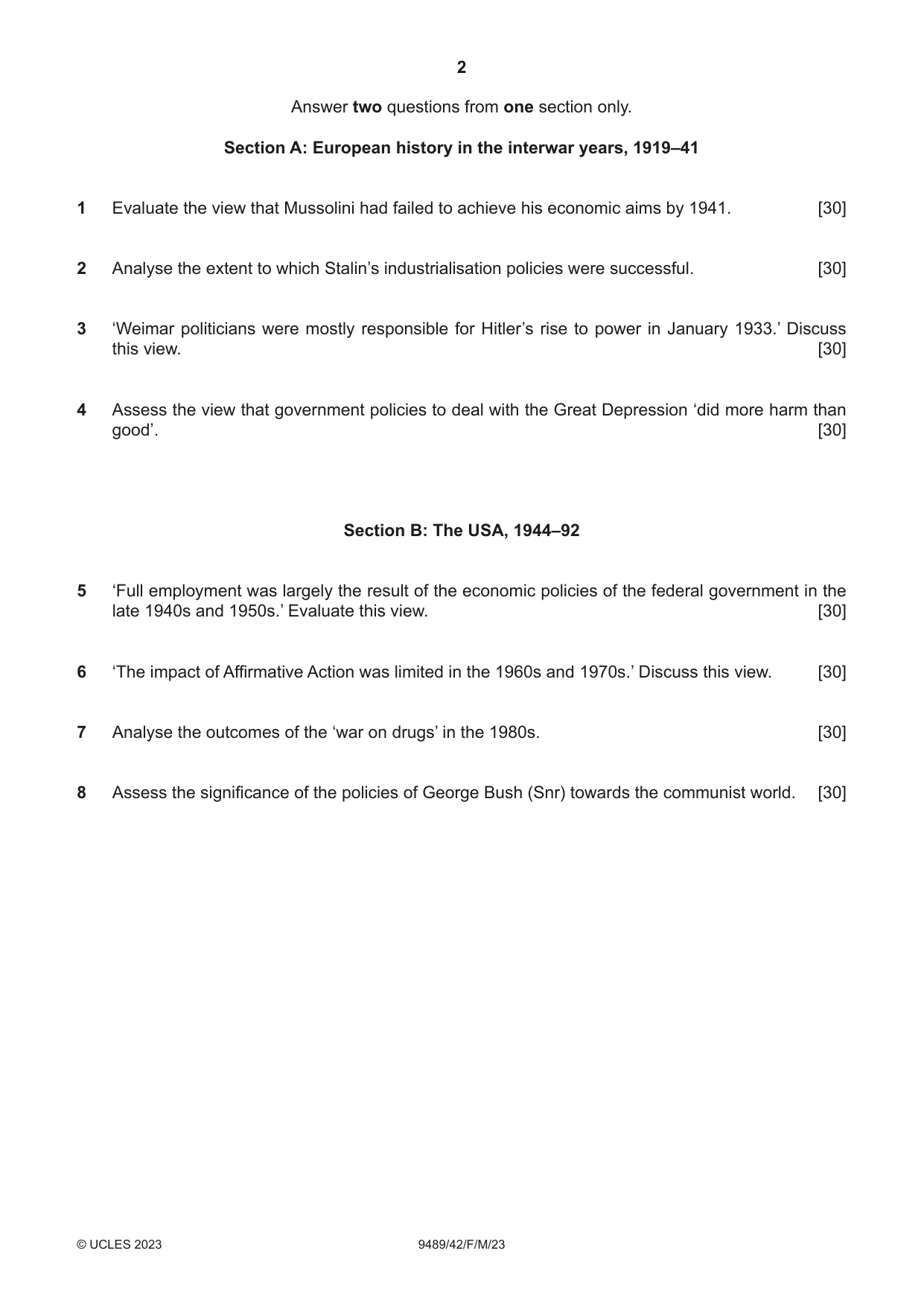
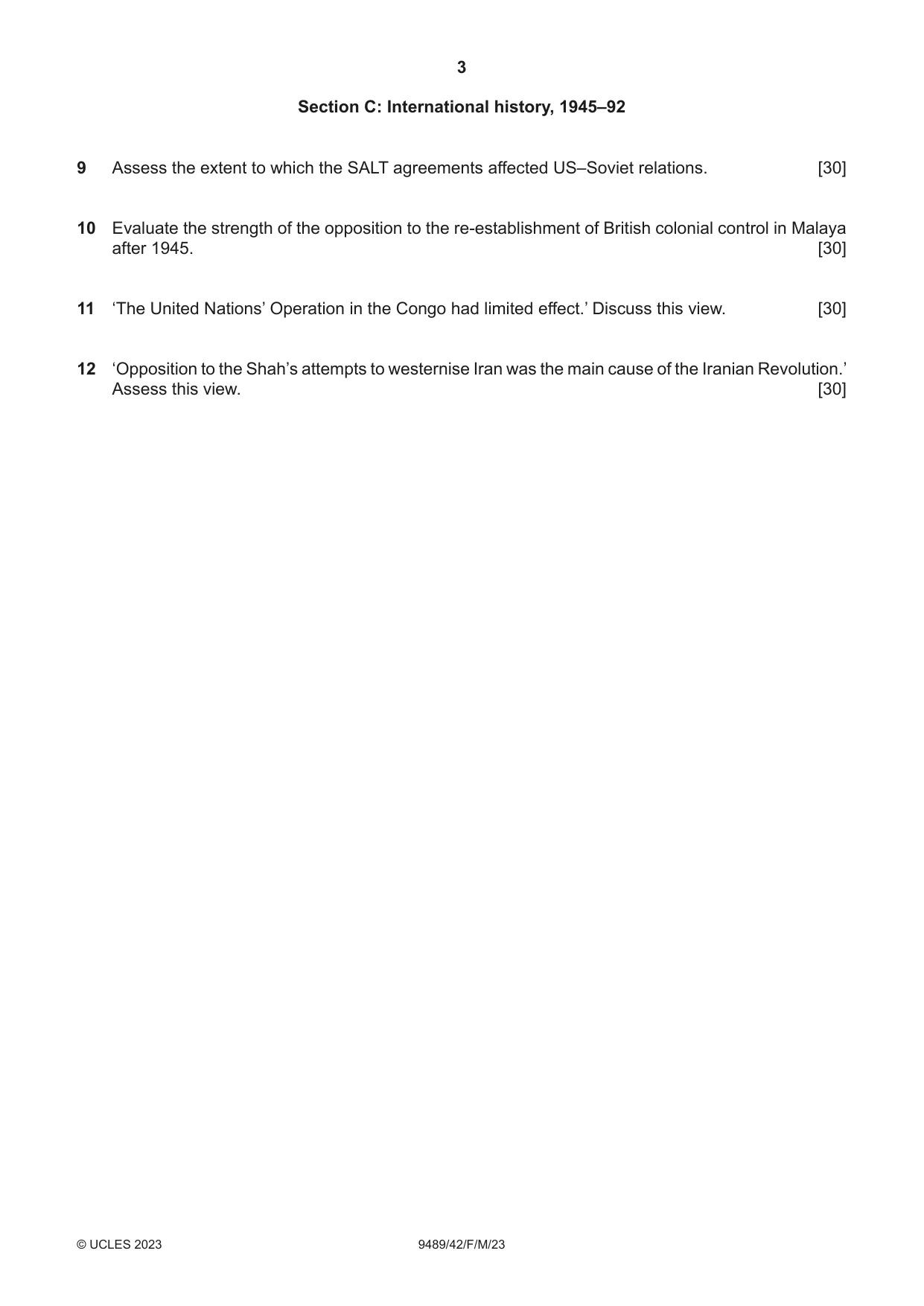
Mark scheme19 pages
Answers below. Sit the paper first if you are practising.

Questions as text
Q1 · Evaluate the view that Mussolini had failed to achieve his economic aims by 1941
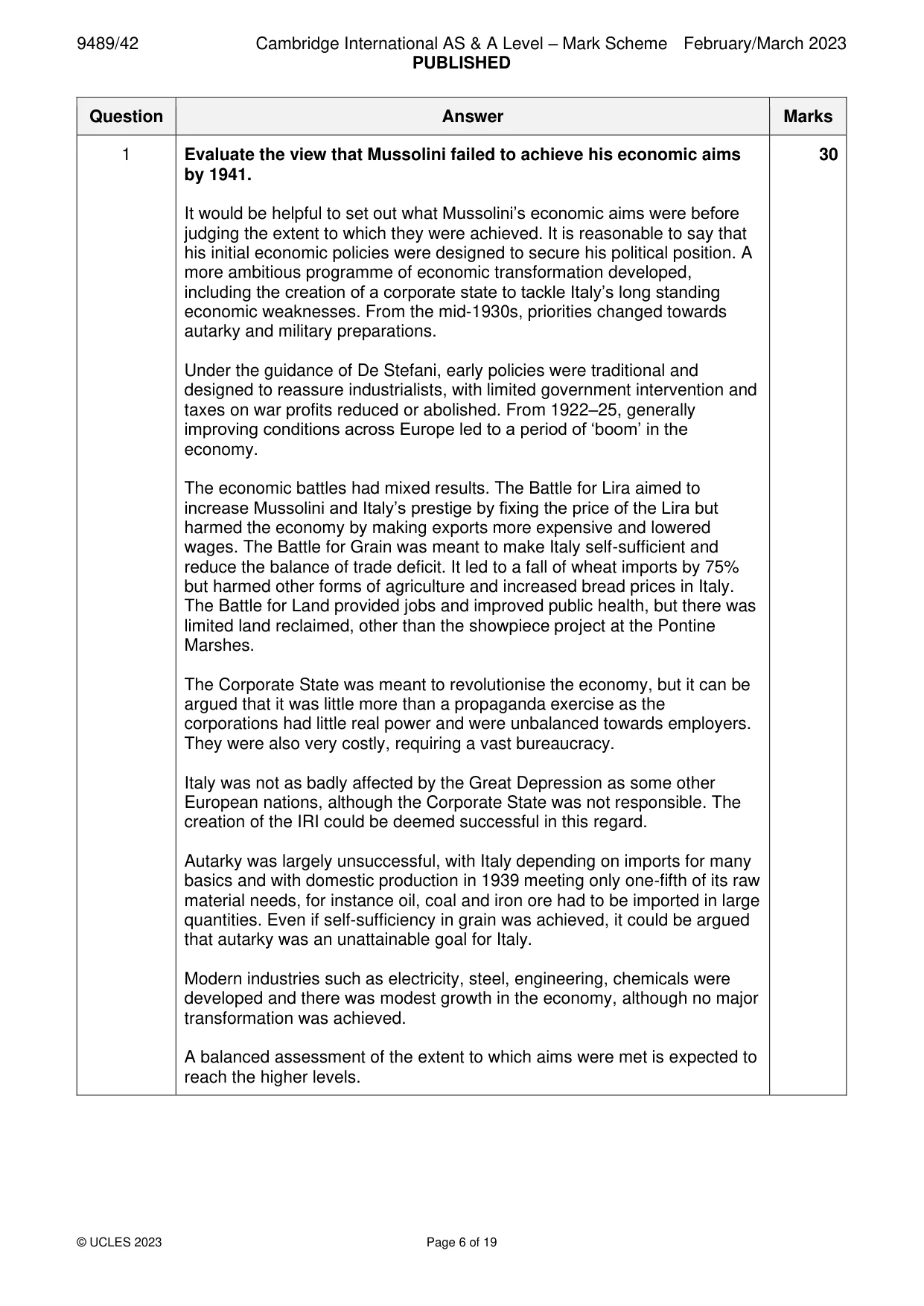
1 Evaluate the view that Mussolini had failed to achieve his economic aims by 1941. [30]
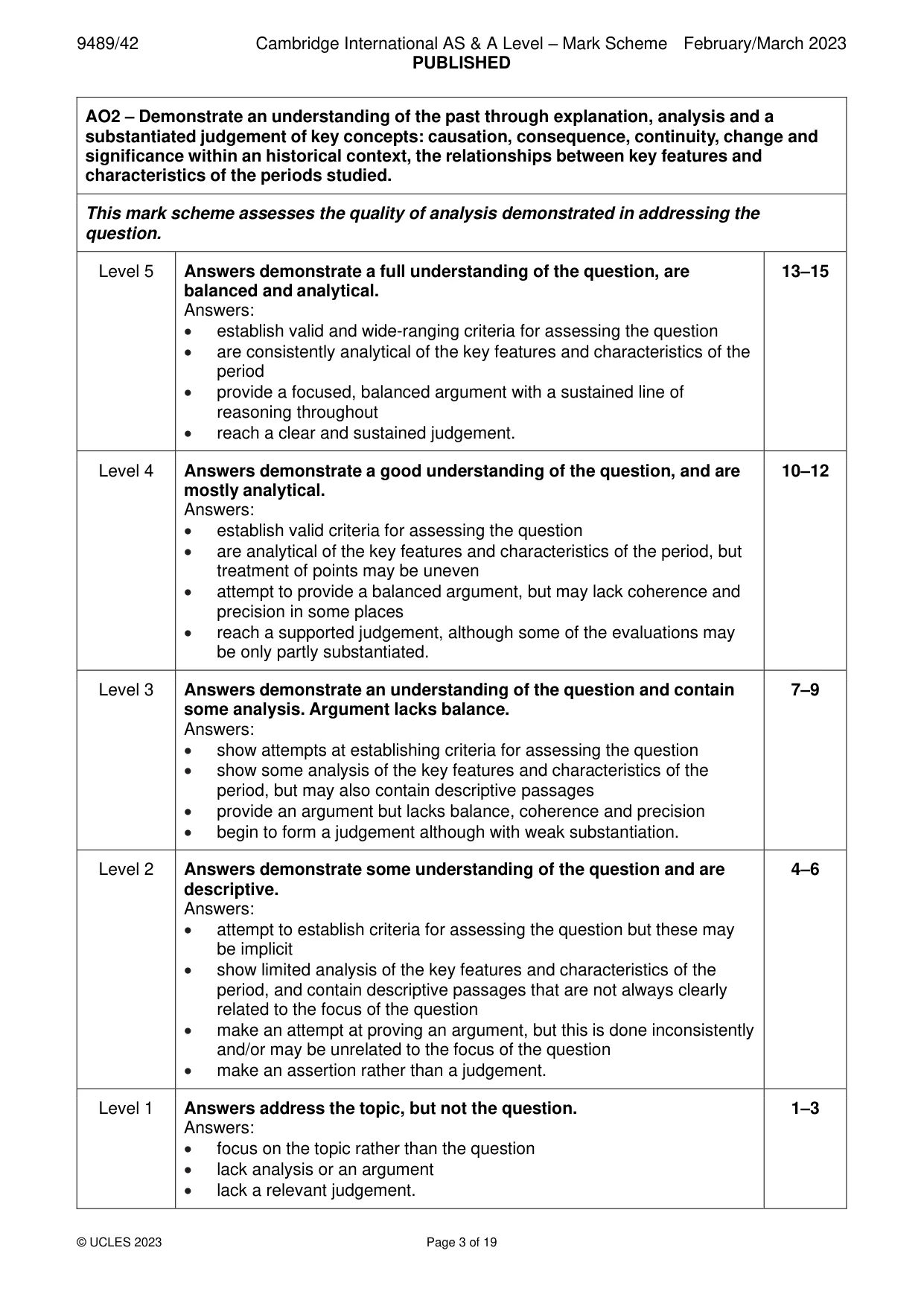
Mark scheme: Question Answer Marks 1 Evaluate the view that Mussolini failed to achieve his economic aims 30 by 1941. It would be helpful to set out what Mussolini’s economic aims were before judging the extent to which they were achieved. It is reasonable to say that his initial economic policies were designed to secure his political position. A more ambitious programme of economic transformation developed, including the creation of a corporate state to tackle Italy’s long standing economic weaknesses. From the mid-1930s, priorities changed towards autarky and military preparations. Under the guidance of De Stefani, early policies were traditional and designed to reassure industrialists, with limited government intervention and taxes on war profits reduced or abolished. From 1922–25, generally improving conditions across Europe led to a period of ‘boom’ in the economy. The economic battles had mixed results. The Battle for Lira aimed to increase Mussolini and Italy’s prestige by fixing the price of the Lira but harmed the economy by making exports more expensive and lowered wages. The Battle for Grain was meant to make Italy self-sufficient and reduce the balance of trade deficit. It led to a fall of wheat imports by 75% but harmed other forms of agriculture and increased bread prices in Italy. The Battle for Land provided jobs and improved public health, but there was limited land reclaimed, other than the showpiece project at the Pontine Marshes. The Corporate State was meant to revolutionise the economy, but it can be argued that it was little more than a propaganda exercise as the corporations had little real power and were unbalanced towards employers. They were also very costly, requiring a vast bureaucracy. Italy was not as badly affected by the Great Depression as some other European nations, although the Corporate State was not responsible. The creation of the IRI could be deemed successful in this regard. Autarky was largely unsuccessful, with Italy depending on imports for many basics and with domestic production in 1939 meeting only one-fifth of its raw material needs, for instance oil, coal and iron ore had to be imported in large quantities. Even if self-sufficiency in grain was achieved, it could be argued that autarky was an unattainable goal for Italy. Modern industries such as electricity, steel, engineering, chemicals were developed and there was modest growth in the economy, although no major transformation was achieved. A balanced assessment of the extent to which aims were met is expected to reach the higher levels.
More questions on How did the rise of extremism affect international relations?
Q2 · Analyse the extent to which Stalin’s industrialisation policies were successful
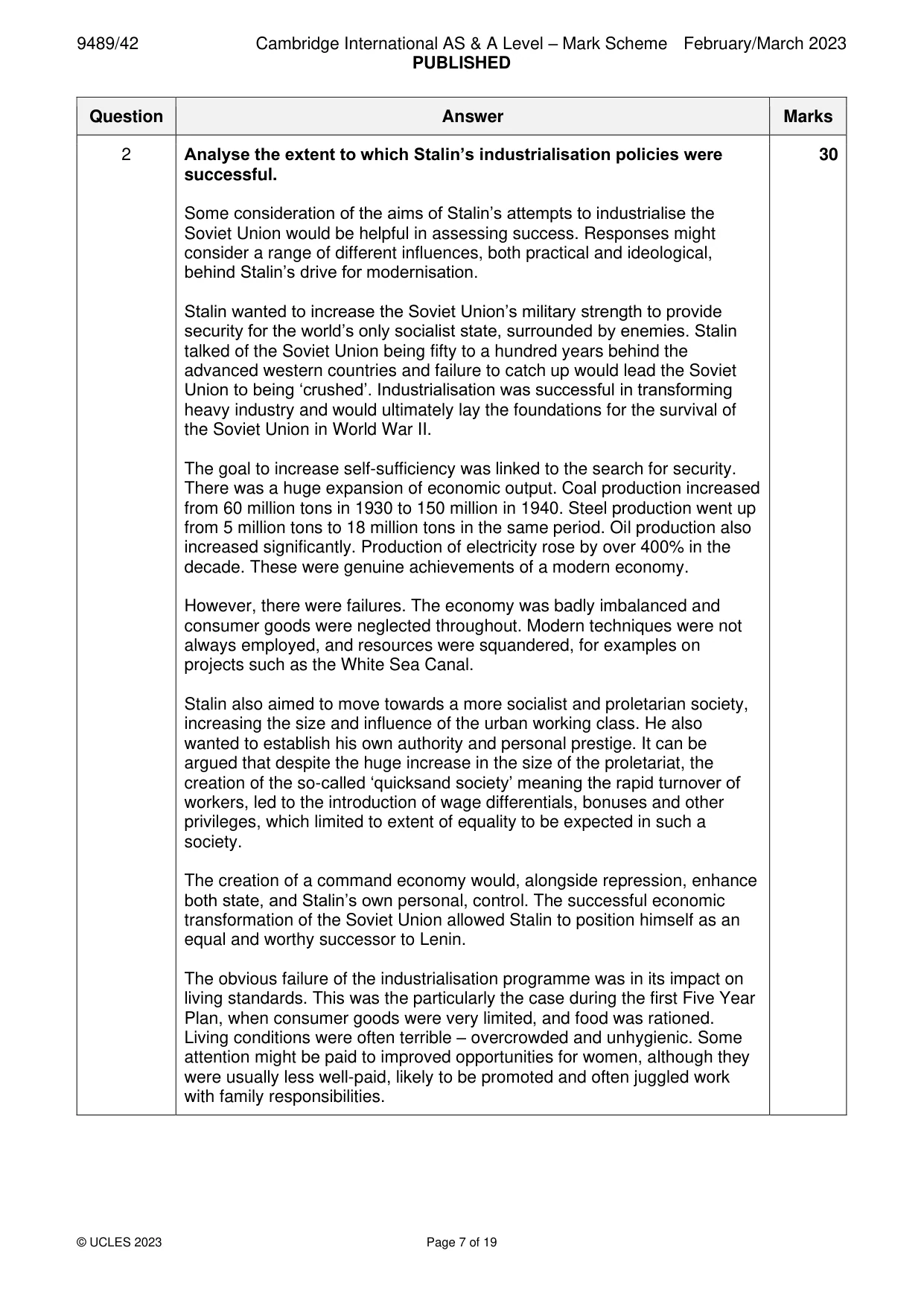
2 Analyse the extent to which Stalin’s industrialisation policies were successful. [30]
Mark scheme: 2 Analyse the extent to which Stalin’s industrialisation policies were 30 successful. Some consideration of the aims of Stalin’s attempts to industrialise the Soviet Union would be helpful in assessing success. Responses might consider a range of different influences, both practical and ideological, behind Stalin’s drive for modernisation. Stalin wanted to increase the Soviet Union’s military strength to provide security for the world’s only socialist state, surrounded by enemies. Stalin talked of the Soviet Union being fifty to a hundred years behind the advanced western countries and failure to catch up would lead the Soviet Union to being ‘crushed’. Industrialisation was successful in transforming heavy industry and would ultimately lay the foundations for the survival of the Soviet Union in World War II. The goal to increase self-sufficiency was linked to the search for security. There was a huge expansion of economic output. Coal production increased from 60 million tons in 1930 to 150 million in 1940. Steel production went up from 5 million tons to 18 million tons in the same period. Oil production also increased significantly. Production of electricity rose by over 400% in the decade. These were genuine achievements of a modern economy. However, there were failures. The economy was badly imbalanced and consumer goods were neglected throughout. Modern techniques were not always employed, and resources were squandered, for examples on projects such as the White Sea Canal. Stalin also aimed to move towards a more socialist and proletarian society, increasing the size and influence of the urban working class. He also wanted to establish his own authority and personal prestige. It can be argued that despite the huge increase in the size of the proletariat, the creation of the so-called ‘quicksand society’ meaning the rapid turnover of workers, led to the introduction of wage differentials, bonuses and other privileges, which limited to extent of equality to be expected in such a society. The creation of a command economy would, alongside repression, enhance both state, and Stalin’s own personal, control. The successful economic transformation of the Soviet Union allowed Stalin to position himself as an equal and worthy successor to Lenin. The obvious failure of the industrialisation programme was in its impact on living standards. This was the particularly the case during the first Five Year Plan, when consumer goods were very limited, and food was rationed. Living conditions were often terrible – overcrowded and unhygienic. Some attention might be paid to improved opportunities for women, although they were usually less well-paid, likely to be promoted and often juggled work with family responsibilities.
More questions on How were the Bolsheviks able to consolidate their power up to 1924?
Q3 · ‘Weimar politicians were mostly responsible for Hitler’s rise to power in January 1933.’…
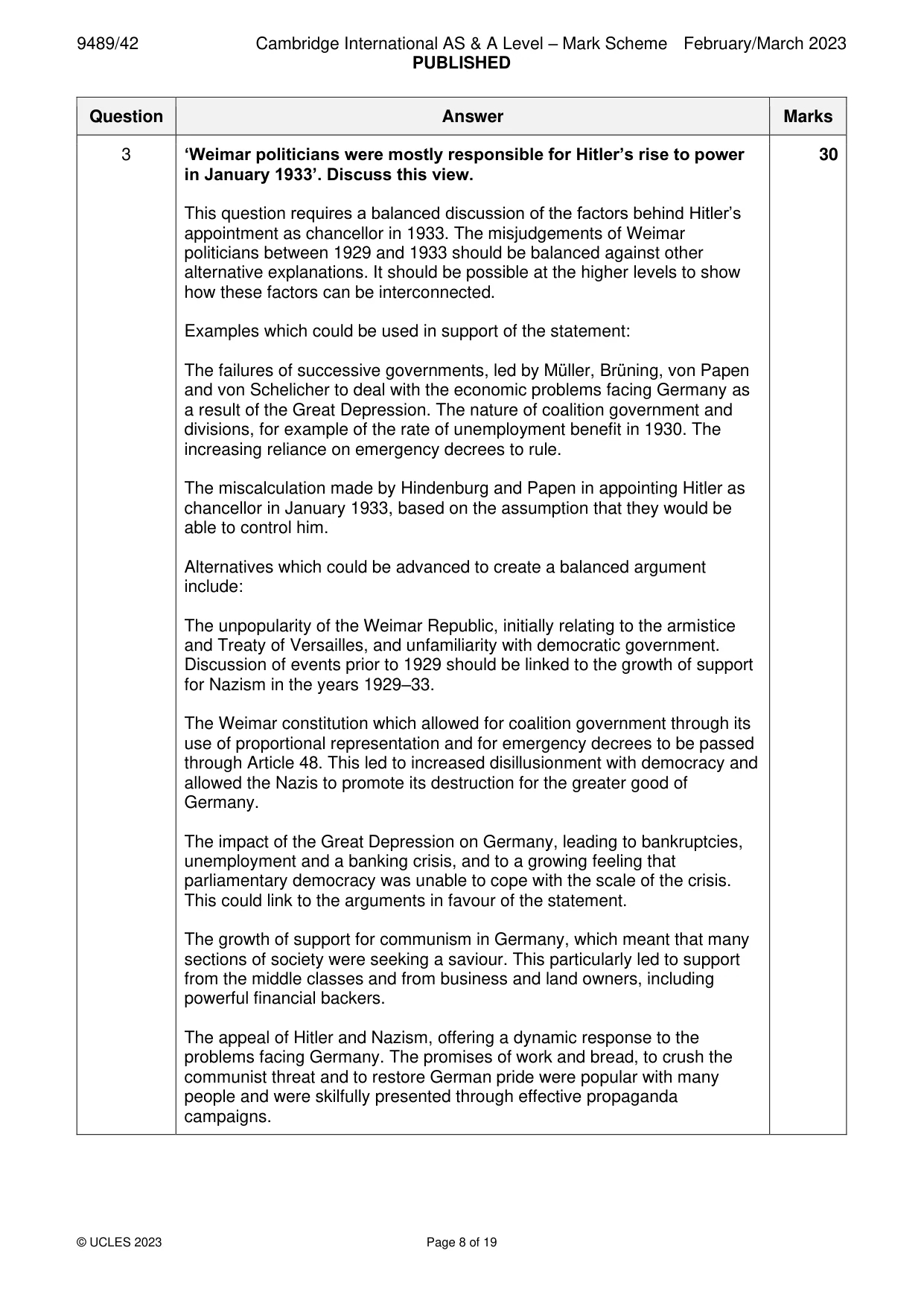
3 ‘Weimar politicians were mostly responsible for Hitler’s rise to power in January 1933.’ Discuss this view. [30]
Mark scheme: 3 ‘Weimar politicians were mostly responsible for Hitler’s rise to power 30 in January 1933’. Discuss this view. This question requires a balanced discussion of the factors behind Hitler’s appointment as chancellor in 1933. The misjudgements of Weimar politicians between 1929 and 1933 should be balanced against other alternative explanations. It should be possible at the higher levels to show how these factors can be interconnected. Examples which could be used in support of the statement: The failures of successive governments, led by Müller, Brüning, von Papen and von Schelicher to deal with the economic problems facing Germany as a result of the Great Depression. The nature of coalition government and divisions, for example of the rate of unemployment benefit in 1930. The increasing reliance on emergency decrees to rule. The miscalculation made by Hindenburg and Papen in appointing Hitler as chancellor in January 1933, based on the assumption that they would be able to control him. Alternatives which could be advanced to create a balanced argument include: The unpopularity of the Weimar Republic, initially relating to the armistice and Treaty of Versailles, and unfamiliarity with democratic government. Discussion of events prior to 1929 should be linked to the growth of support for Nazism in the years 1929–33. The Weimar constitution which allowed for coalition government through its use of proportional representation and for emergency decrees to be passed through Article 48. This led to increased disillusionment with democracy and allowed the Nazis to promote its destruction for the greater good of Germany. The impact of the Great Depression on Germany, leading to bankruptcies, unemployment and a banking crisis, and to a growing feeling that parliamentary democracy was unable to cope with the scale of the crisis. This could link to the arguments in favour of the statement. The growth of support for communism in Germany, which meant that many sections of society were seeking a saviour. This particularly led to support from the middle classes and from business and land owners, including powerful financial backers. The appeal of Hitler and Nazism, offering a dynamic response to the problems facing Germany. The promises of work and bread, to crush the communist threat and to restore German pride were popular with many people and were skilfully presented through effective propaganda campaigns.
More questions on How did the rise of extremism affect international relations?
Q4 · Assess the view that government policies to deal with the Great Depression ‘did more harm…
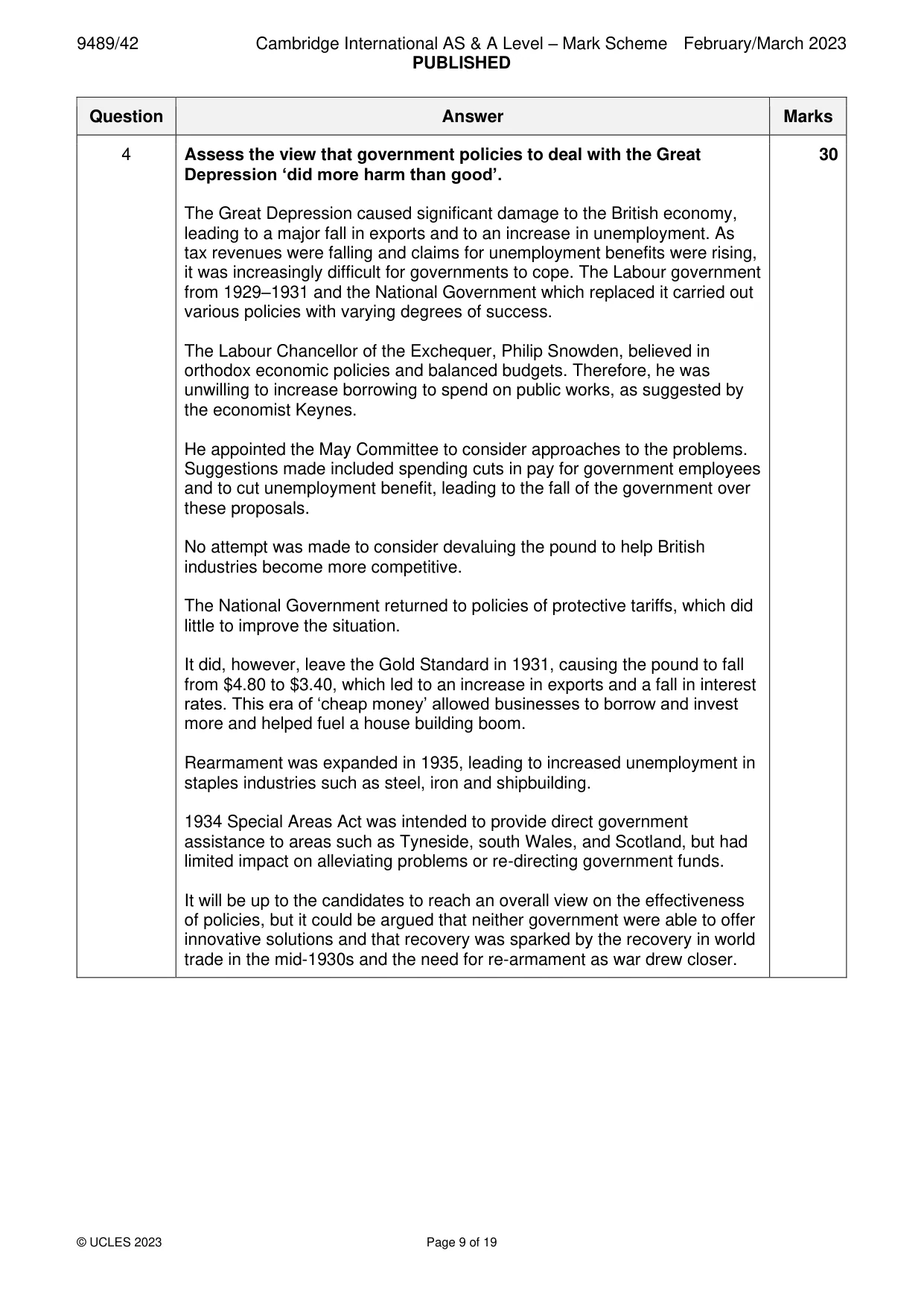
4 Assess the view that government policies to deal with the Great Depression ‘did more harm than good’. [30]
Mark scheme: 4 Assess the view that government policies to deal with the Great 30 Depression ‘did more harm than good’. The Great Depression caused significant damage to the British economy, leading to a major fall in exports and to an increase in unemployment. As tax revenues were falling and claims for unemployment benefits were rising, it was increasingly difficult for governments to cope. The Labour government from 1929–1931 and the National Government which replaced it carried out various policies with varying degrees of success. The Labour Chancellor of the Exchequer, Philip Snowden, believed in orthodox economic policies and balanced budgets. Therefore, he was unwilling to increase borrowing to spend on public works, as suggested by the economist Keynes. He appointed the May Committee to consider approaches to the problems. Suggestions made included spending cuts in pay for government employees and to cut unemployment benefit, leading to the fall of the government over these proposals. No attempt was made to consider devaluing the pound to help British industries become more competitive. The National Government returned to policies of protective tariffs, which did little to improve the situation. It did, however, leave the Gold Standard in 1931, causing the pound to fall from $4.80 to $3.40, which led to an increase in exports and a fall in interest rates. This era of ‘cheap money’ allowed businesses to borrow and invest more and helped fuel a house building boom. Rearmament was expanded in 1935, leading to increased unemployment in staples industries such as steel, iron and shipbuilding. 1934 Special Areas Act was intended to provide direct government assistance to areas such as Tyneside, south Wales, and Scotland, but had limited impact on alleviating problems or re-directing government funds. It will be up to the candidates to reach an overall view on the effectiveness of policies, but it could be argued that neither government were able to offer innovative solutions and that recovery was sparked by the recovery in world trade in the mid-1930s and the need for re-armament as war drew closer.
More questions on How successful was Roosevelt’s first New Deal?
Q5 · ‘Full employment was largely the result of the economic policies of the federal…
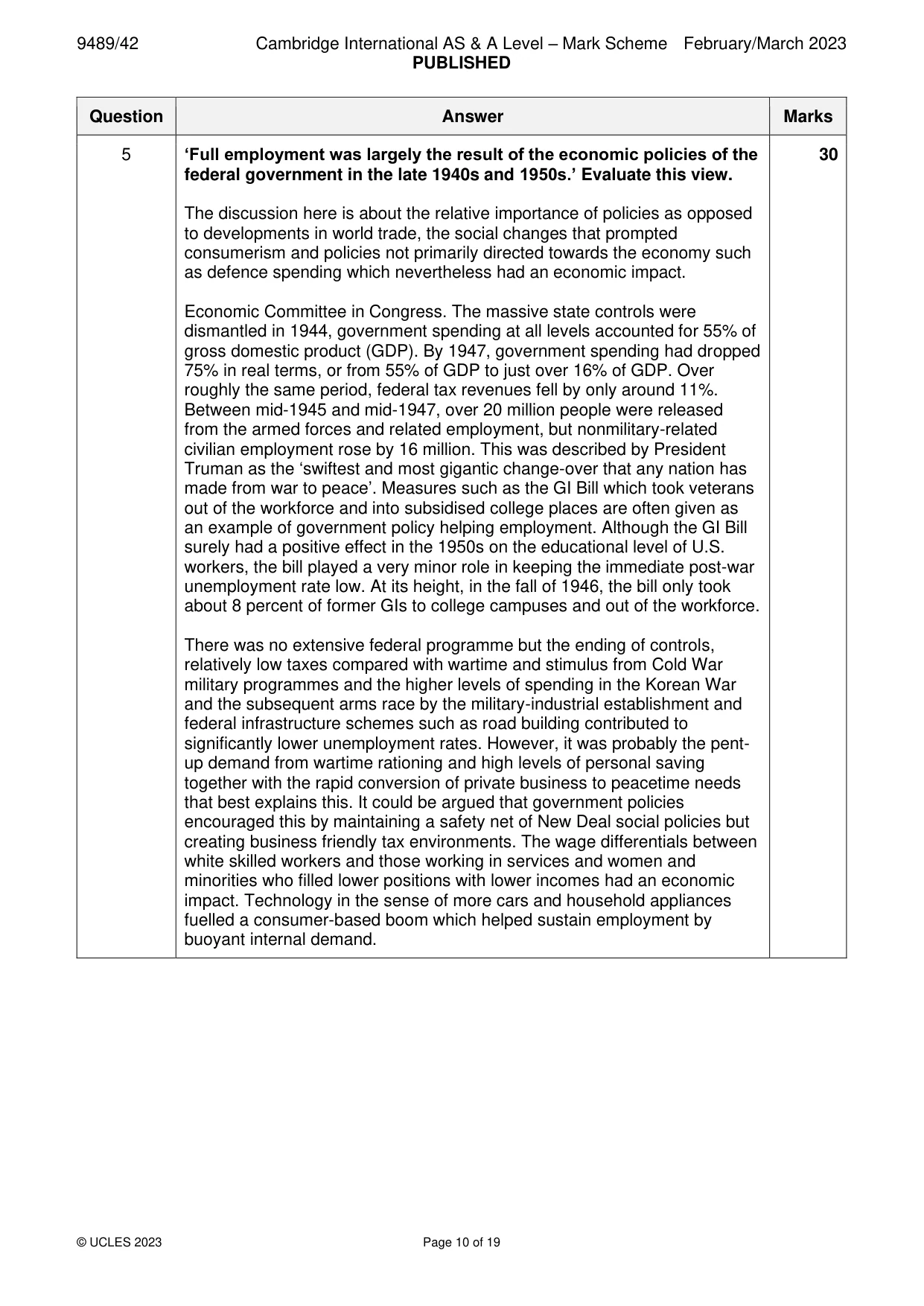
5 ‘Full employment was largely the result of the economic policies of the federal government in the late 1940s and 1950s.’ Evaluate this view. [30]
Mark scheme: 5 ‘Full employment was largely the result of the economic policies of the 30 federal government in the late 1940s and 1950s.’ Evaluate this view. The discussion here is about the relative importance of policies as opposed to developments in world trade, the social changes that prompted consumerism and policies not primarily directed towards the economy such as defence spending which nevertheless had an economic impact. Economic Committee in Congress. The massive state controls were dismantled in 1944, government spending at all levels accounted for 55% of gross domestic product (GDP). By 1947, government spending had dropped 75% in real terms, or from 55% of GDP to just over 16% of GDP. Over roughly the same period, federal tax revenues fell by only around 11%. Between mid-1945 and mid-1947, over 20 million people were released from the armed forces and related employment, but nonmilitary-related civilian employment rose by 16 million. This was described by President Truman as the ‘swiftest and most gigantic change-over that any nation has made from war to peace’. Measures such as the GI Bill which took veterans out of the workforce and into subsidised college places are often given as an example of government policy helping employment. Although the GI Bill surely had a positive effect in the 1950s on the educational level of U.S. workers, the bill played a very minor role in keeping the immediate post-war unemployment rate low. At its height, in the fall of 1946, the bill only took about 8 percent of former GIs to college campuses and out of the workforce. There was no extensive federal programme but the ending of controls, relatively low taxes compared with wartime and stimulus from Cold War military programmes and the higher levels of spending in the Korean War and the subsequent arms race by the military-industrial establishment and federal infrastructure schemes such as road building contributed to significantly lower unemployment rates. However, it was probably the pent- up demand from wartime rationing and high levels of personal saving together with the rapid conversion of private business to peacetime needs that best explains this. It could be argued that government policies encouraged this by maintaining a safety net of New Deal social policies but creating business friendly tax environments. The wage differentials between white skilled workers and those working in services and women and minorities who filled lower positions with lower incomes had an economic impact. Technology in the sense of more cars and household appliances fuelled a consumer-based boom which helped sustain employment by buoyant internal demand.
More questions on What were the consequences of the rapid economic growth after 1870?
Q6 · ‘The impact of Affirmative Action was limited in the 1960s and 1970s.’ Discuss this view
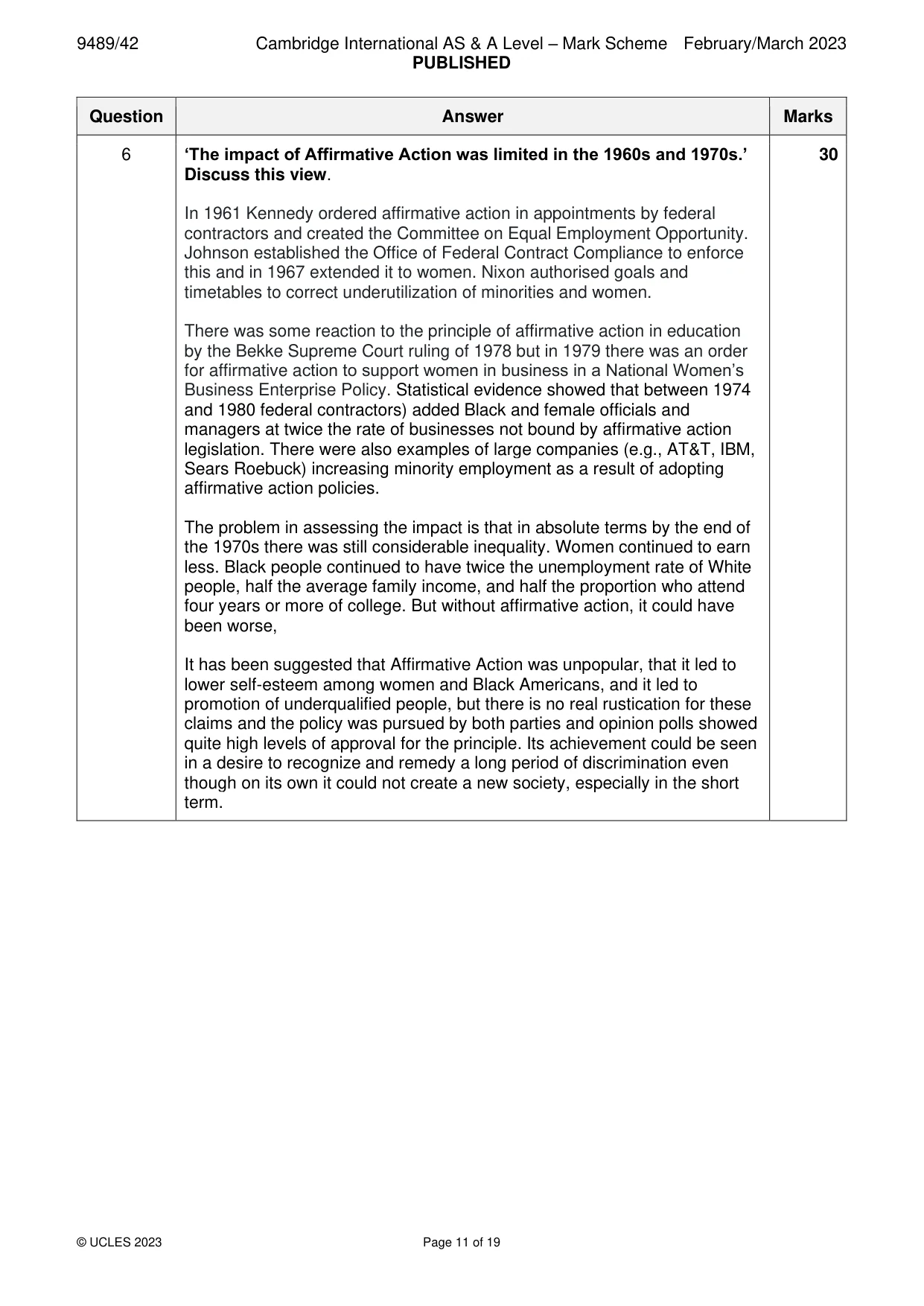
6 ‘The impact of Affirmative Action was limited in the 1960s and 1970s.’ Discuss this view. [30]
Mark scheme: 6 ‘The impact of Affirmative Action was limited in the 1960s and 1970s.’ 30 Discuss this view. In 1961 Kennedy ordered affirmative action in appointments by federal contractors and created the Committee on Equal Employment Opportunity. Johnson established the Office of Federal Contract Compliance to enforce this and in 1967 extended it to women. Nixon authorised goals and timetables to correct underutilization of minorities and women. There was some reaction to the principle of affirmative action in education by the Bekke Supreme Court ruling of 1978 but in 1979 there was an order for affirmative action to support women in business in a National Women’s Business Enterprise Policy. Statistical evidence showed that between 1974 and 1980 federal contractors) added Black and female officials and managers at twice the rate of businesses not bound by affirmative action legislation. There were also examples of large companies (e.g., AT&T, IBM, Sears Roebuck) increasing minority employment as a result of adopting affirmative action policies. The problem in assessing the impact is that in absolute terms by the end of the 1970s there was still considerable inequality. Women continued to earn less. Black people continued to have twice the unemployment rate of White people, half the average family income, and half the proportion who attend four years or more of college. But without affirmative action, it could have been worse, It has been suggested that Affirmative Action was unpopular, that it led to lower self-esteem among women and Black Americans, and it led to promotion of underqualified people, but there is no real rustication for these claims and the policy was pursued by both parties and opinion polls showed quite high levels of approval for the principle. Its achievement could be seen in a desire to recognize and remedy a long period of discrimination even though on its own it could not create a new society, especially in the short term.
More questions on How successful was the Progressive Movement from 1890 to 1920?
Q7 · Analyse the outcomes of the ‘war on drugs’ in the 1980s
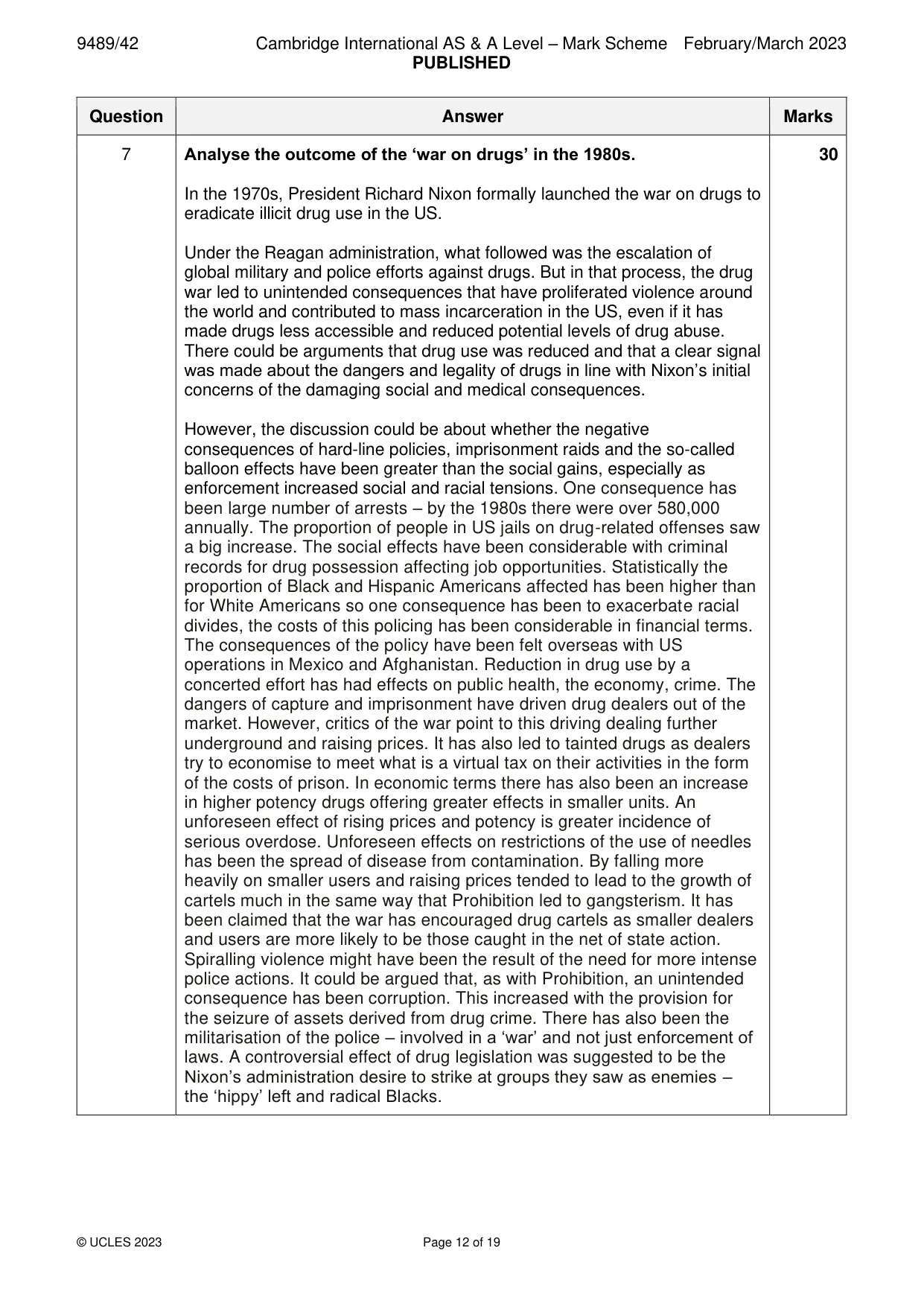
7 Analyse the outcomes of the ‘war on drugs’ in the 1980s. [30]
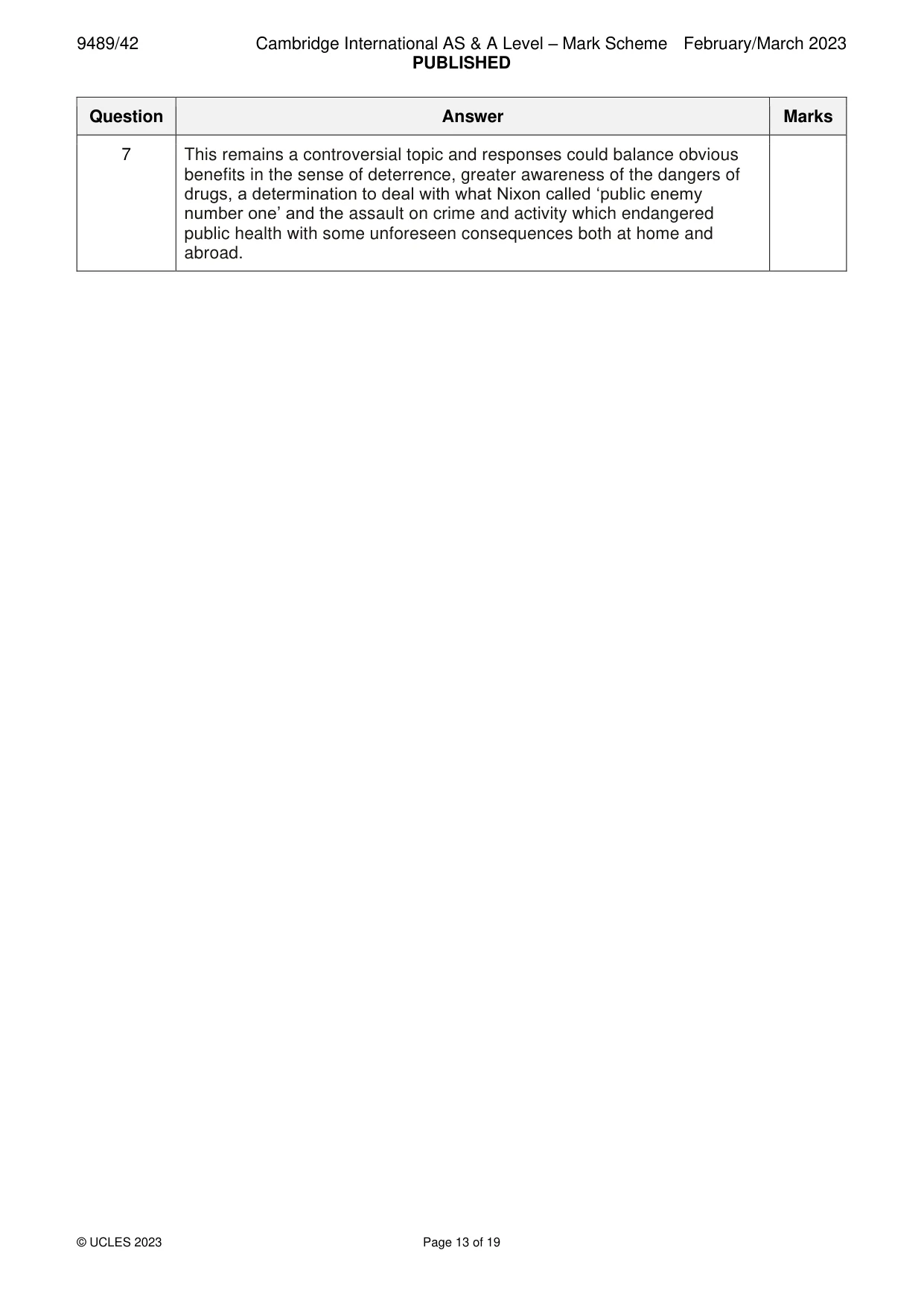
Mark scheme: 7 Analyse the outcome of the ‘war on drugs’ in the 1980s. 30 In the 1970s, President Richard Nixon formally launched the war on drugs to eradicate illicit drug use in the US. Under the Reagan administration, what followed was the escalation of global military and police efforts against drugs. But in that process, the drug war led to unintended consequences that have proliferated violence around the world and contributed to mass incarceration in the US, even if it has made drugs less accessible and reduced potential levels of drug abuse. There could be arguments that drug use was reduced and that a clear signal was made about the dangers and legality of drugs in line with Nixon’s initial concerns of the damaging social and medical consequences. However, the discussion could be about whether the negative consequences of hard-line policies, imprisonment raids and the so-called balloon effects have been greater than the social gains, especially as enforcement increased social and racial tensions. One consequence has been large number of arrests – by the 1980s there were over 580,000 annually. The proportion of people in US jails on drug-related offenses saw a big increase. The social effects have been considerable with criminal records for drug possession affecting job opportunities. Statistically the proportion of Black and Hispanic Americans affected has been higher than for White Americans so one consequence has been to exacerbate racial divides, the costs of this policing has been considerable in financial terms. The consequences of the policy have been felt overseas with US operations in Mexico and Afghanistan. Reduction in drug use by a concerted effort has had effects on public health, the economy, crime. The dangers of capture and imprisonment have driven drug dealers out of the market. However, critics of the war point to this driving dealing further underground and raising prices. It has also led to tainted drugs as dealers try to economise to meet what is a virtual tax on their activities in the form of the costs of prison. In economic terms there has also been an increase in higher potency drugs offering greater effects in smaller units. An unforeseen effect of rising prices and potency is greater incidence of serious overdose. Unforeseen effects on restrictions of the use of needles has been the spread of disease from contamination. By falling more heavily on smaller users and raising prices tended to lead to the growth of cartels much in the same way that Prohibition led to gangsterism. It has been claimed that the war has encouraged drug cartels as smaller dealers and users are more likely to be those caught in the net of state action. Spiralling violence might have been the result of the need for more intense police actions. It could be argued that, as with Prohibition, an unintended consequence has been corruption. This increased with the provision for the seizure of assets derived from drug crime. There has also been the militarisation of the police – involved in a ‘war’ and not just enforcement of laws. A controversial effect of drug legislation was suggested to be the Nixon’s administration desire to strike at groups they saw as enemies – the ‘hippy’ left and radical Blacks. 7 This remains a controversial topic and responses could balance obvious benefits in the sense of deterrence, greater awareness of the dangers of drugs, a determination to deal with what Nixon called ‘public enemy number one’ and the assault on crime and activity which endangered public health with some unforeseen consequences both at home and abroad.
Q8 · Section C: International history, 1945–92
Section C: International history, 1945–92
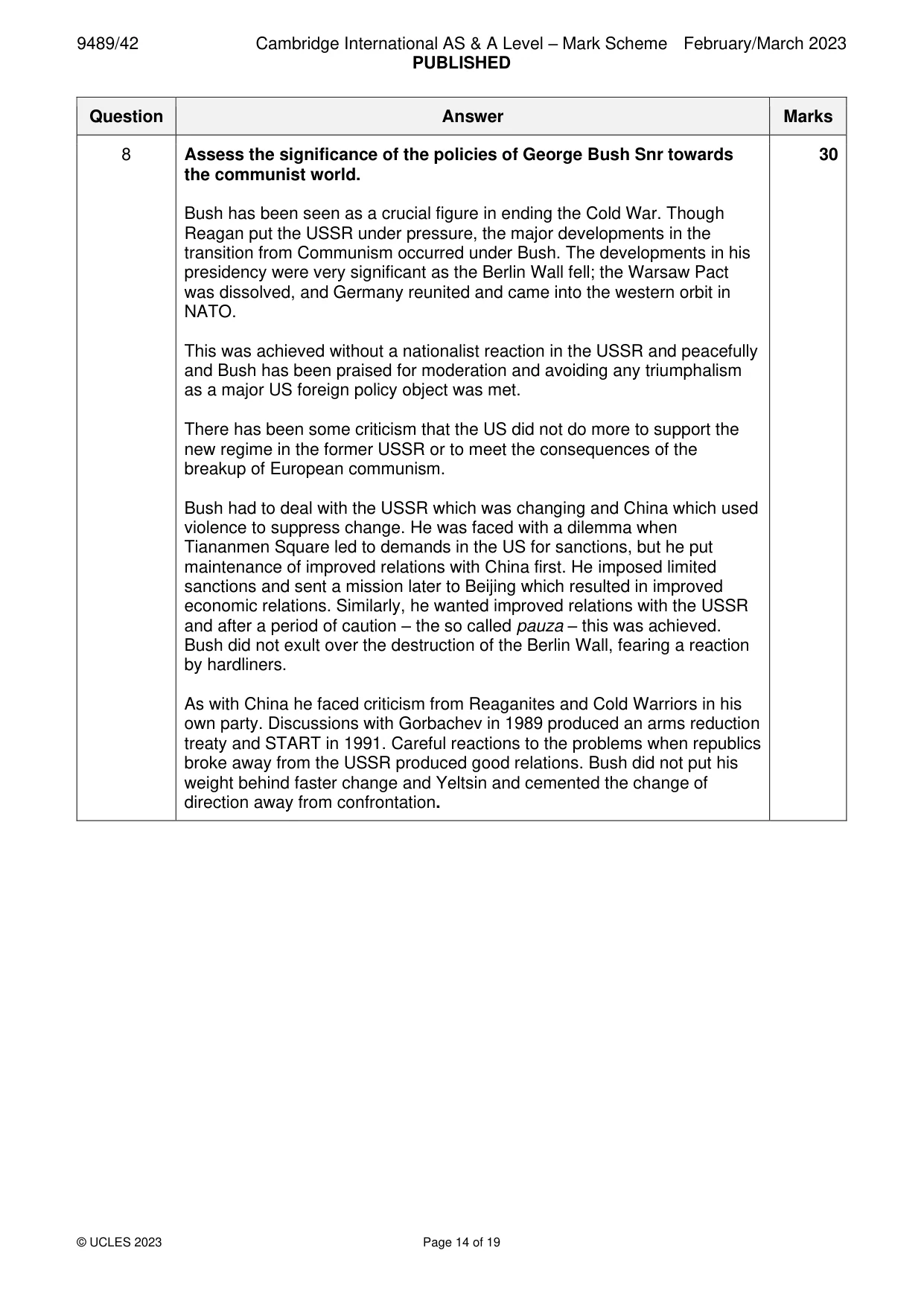
Mark scheme: 8 Assess the significance of the policies of George Bush Snr towards 30 the communist world. Bush has been seen as a crucial figure in ending the Cold War. Though Reagan put the USSR under pressure, the major developments in the transition from Communism occurred under Bush. The developments in his presidency were very significant as the Berlin Wall fell; the Warsaw Pact was dissolved, and Germany reunited and came into the western orbit in NATO. This was achieved without a nationalist reaction in the USSR and peacefully and Bush has been praised for moderation and avoiding any triumphalism as a major US foreign policy object was met. There has been some criticism that the US did not do more to support the new regime in the former USSR or to meet the consequences of the breakup of European communism. Bush had to deal with the USSR which was changing and China which used violence to suppress change. He was faced with a dilemma when Tiananmen Square led to demands in the US for sanctions, but he put maintenance of improved relations with China first. He imposed limited sanctions and sent a mission later to Beijing which resulted in improved economic relations. Similarly, he wanted improved relations with the USSR and after a period of caution – the so called pauza – this was achieved. Bush did not exult over the destruction of the Berlin Wall, fearing a reaction by hardliners. As with China he faced criticism from Reaganites and Cold Warriors in his own party. Discussions with Gorbachev in 1989 produced an arms reduction treaty and START in 1991. Careful reactions to the problems when republics broke away from the USSR produced good relations. Bush did not put his weight behind faster change and Yeltsin and cemented the change of direction away from confrontation.
Q9 · Assess the extent to which the SALT agreements affected US–Soviet relations
9 Assess the extent to which the SALT agreements affected US–Soviet relations. [30]
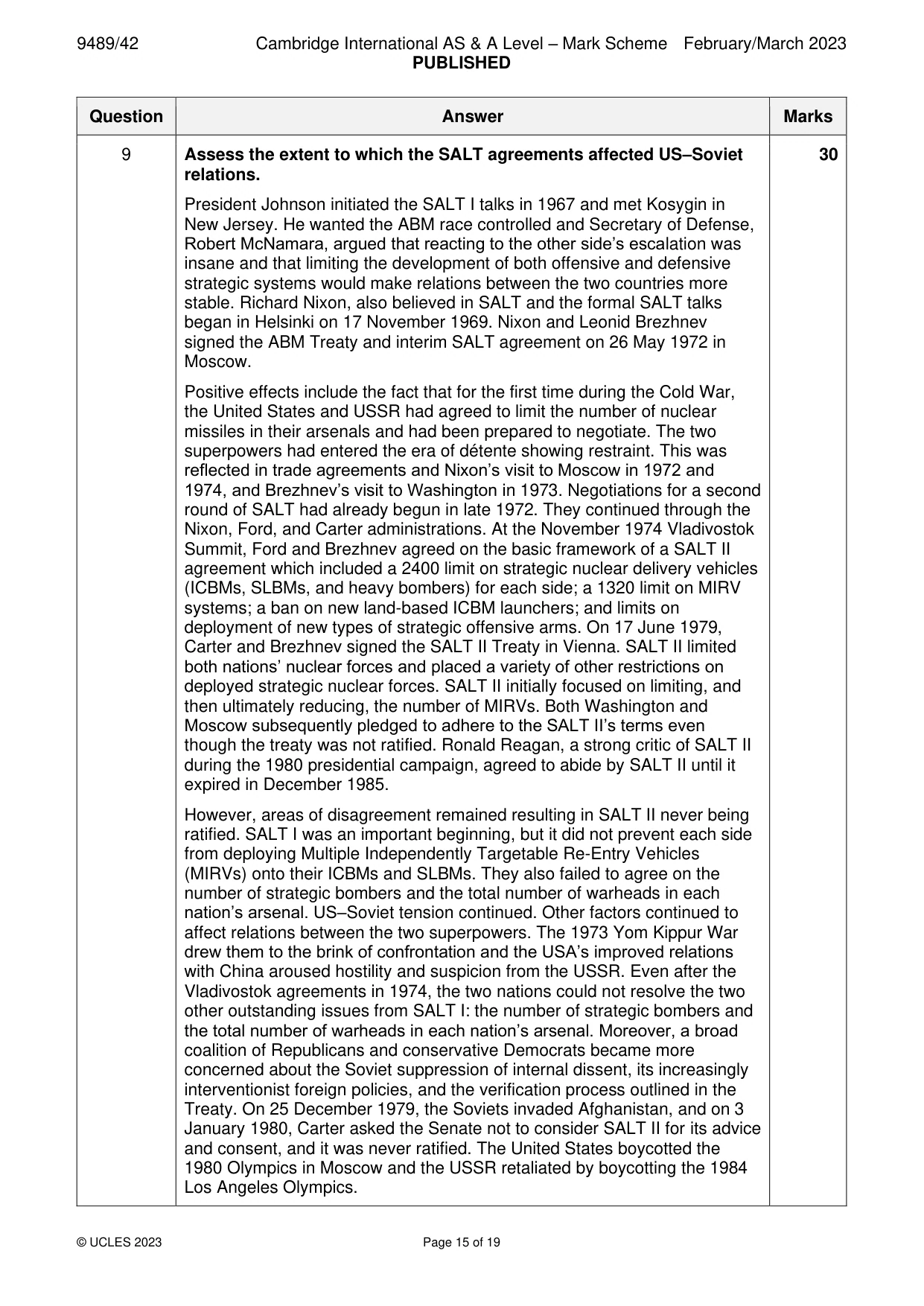
Mark scheme: 9 Assess the extent to which the SALT agreements affected US–Soviet 30 relations. President Johnson initiated the SALT I talks in 1967 and met Kosygin in New Jersey. He wanted the ABM race controlled and Secretary of Defense, Robert McNamara, argued that reacting to the other side’s escalation was insane and that limiting the development of both offensive and defensive strategic systems would make relations between the two countries more stable. Richard Nixon, also believed in SALT and the formal SALT talks began in Helsinki on 17 November 1969. Nixon and Leonid Brezhnev signed the ABM Treaty and interim SALT agreement on 26 May 1972 in Moscow. Positive effects include the fact that for the first time during the Cold War, the United States and USSR had agreed to limit the number of nuclear missiles in their arsenals and had been prepared to negotiate. The two superpowers had entered the era of détente showing restraint. This was reflected in trade agreements and Nixon’s visit to Moscow in 1972 and 1974, and Brezhnev’s visit to Washington in 1973. Negotiations for a second round of SALT had already begun in late 1972. They continued through the Nixon, Ford, and Carter administrations. At the November 1974 Vladivostok Summit, Ford and Brezhnev agreed on the basic framework of a SALT II agreement which included a 2400 limit on strategic nuclear delivery vehicles (ICBMs, SLBMs, and heavy bombers) for each side; a 1320 limit on MIRV systems; a ban on new land-based ICBM launchers; and limits on deployment of new types of strategic offensive arms. On 17 June 1979, Carter and Brezhnev signed the SALT II Treaty in Vienna. SALT II limited both nations’ nuclear forces and placed a variety of other restrictions on deployed strategic nuclear forces. SALT II initially focused on limiting, and then ultimately reducing, the number of MIRVs. Both Washington and Moscow subsequently pledged to adhere to the SALT II’s terms even though the treaty was not ratified. Ronald Reagan, a strong critic of SALT II during the 1980 presidential campaign, agreed to abide by SALT II until it expired in December 1985. However, areas of disagreement remained resulting in SALT II never being ratified. SALT I was an important beginning, but it did not prevent each side from deploying Multiple Independently Targetable Re-Entry Vehicles (MIRVs) onto their ICBMs and SLBMs. They also failed to agree on the number of strategic bombers and the total number of warheads in each nation’s arsenal. US–Soviet tension continued. Other factors continued to affect relations between the two superpowers. The 1973 Yom Kippur War drew them to the brink of confrontation and the USA’s improved relations with China aroused hostility and suspicion from the USSR. Even after the Vladivostok agreements in 1974, the two nations could not resolve the two other outstanding issues from SALT I: the number of strategic bombers and the total number of warheads in each nation’s arsenal. Moreover, a broad coalition of Republicans and conservative Democrats became more concerned about the Soviet suppression of internal dissent, its increasingly interventionist foreign policies, and the verification process outlined in the Treaty. On 25 December 1979, the Soviets invaded Afghanistan, and on 3 January 1980, Carter asked the Senate not to consider SALT II for its advice and consent, and it was never ratified. The United States boycotted the 1980 Olympics in Moscow and the USSR retaliated by boycotting the 1984 Los Angeles Olympics.
More questions on How and why did international relations improve, 1924–29?
Q10 · Evaluate the strength of the opposition to the re-establishment of British colonial…
10 Evaluate the strength of the opposition to the re-establishment of British colonial control in Malaya after 1945. [30]
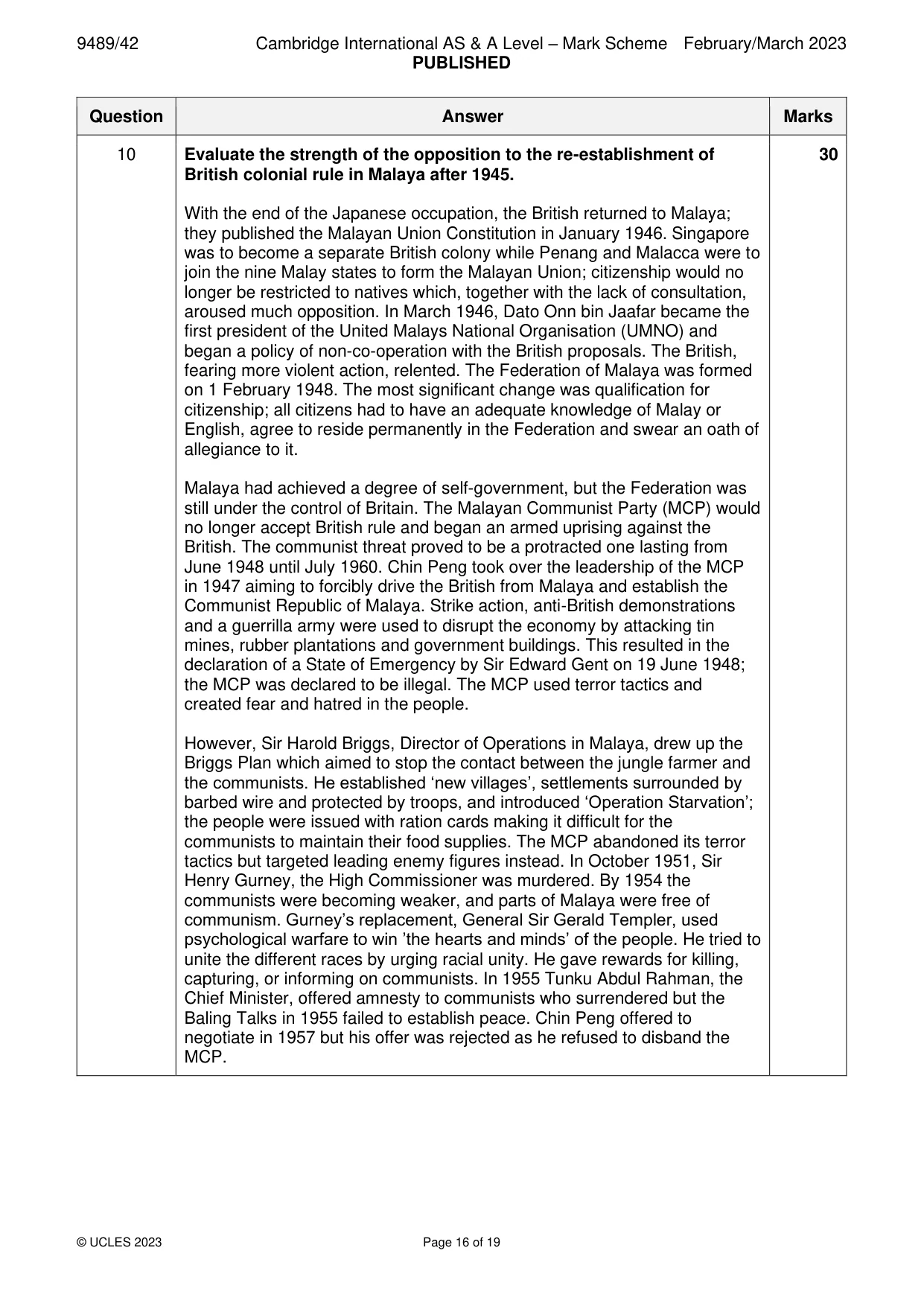
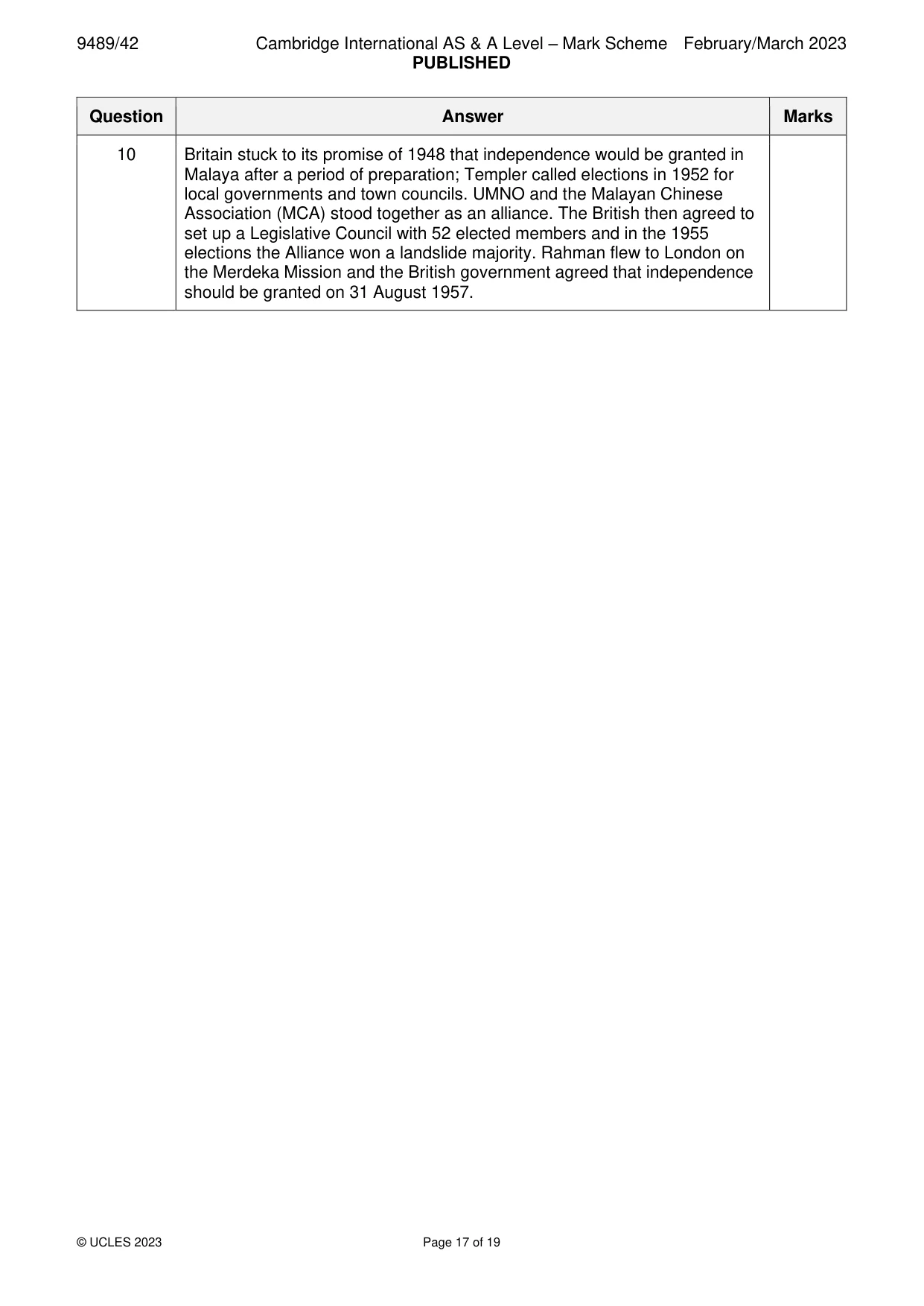
Mark scheme: 10 Evaluate the strength of the opposition to the re-establishment of 30 British colonial rule in Malaya after 1945. With the end of the Japanese occupation, the British returned to Malaya; they published the Malayan Union Constitution in January 1946. Singapore was to become a separate British colony while Penang and Malacca were to join the nine Malay states to form the Malayan Union; citizenship would no longer be restricted to natives which, together with the lack of consultation, aroused much opposition. In March 1946, Dato Onn bin Jaafar became the first president of the United Malays National Organisation (UMNO) and began a policy of non-co-operation with the British proposals. The British, fearing more violent action, relented. The Federation of Malaya was formed on 1 February 1948. The most significant change was qualification for citizenship; all citizens had to have an adequate knowledge of Malay or English, agree to reside permanently in the Federation and swear an oath of allegiance to it. Malaya had achieved a degree of self-government, but the Federation was still under the control of Britain. The Malayan Communist Party (MCP) would no longer accept British rule and began an armed uprising against the British. The communist threat proved to be a protracted one lasting from June 1948 until July 1960. Chin Peng took over the leadership of the MCP in 1947 aiming to forcibly drive the British from Malaya and establish the Communist Republic of Malaya. Strike action, anti-British demonstrations and a guerrilla army were used to disrupt the economy by attacking tin mines, rubber plantations and government buildings. This resulted in the declaration of a State of Emergency by Sir Edward Gent on 19 June 1948; the MCP was declared to be illegal. The MCP used terror tactics and created fear and hatred in the people. However, Sir Harold Briggs, Director of Operations in Malaya, drew up the Briggs Plan which aimed to stop the contact between the jungle farmer and the communists. He established ‘new villages’, settlements surrounded by barbed wire and protected by troops, and introduced ‘Operation Starvation’; the people were issued with ration cards making it difficult for the communists to maintain their food supplies. The MCP abandoned its terror tactics but targeted leading enemy figures instead. In October 1951, Sir Henry Gurney, the High Commissioner was murdered. By 1954 the communists were becoming weaker, and parts of Malaya were free of communism. Gurney’s replacement, General Sir Gerald Templer, used psychological warfare to win ’the hearts and minds’ of the people. He tried to unite the different races by urging racial unity. He gave rewards for killing, capturing, or informing on communists. In 1955 Tunku Abdul Rahman, the Chief Minister, offered amnesty to communists who surrendered but the Baling Talks in 1955 failed to establish peace. Chin Peng offered to negotiate in 1957 but his offer was rejected as he refused to disband the MCP. 10 Britain stuck to its promise of 1948 that independence would be granted in Malaya after a period of preparation; Templer called elections in 1952 for local governments and town councils. UMNO and the Malayan Chinese Association (MCA) stood together as an alliance. The British then agreed to set up a Legislative Council with 52 elected members and in the 1955 elections the Alliance won a landslide majority. Rahman flew to London on the Merdeka Mission and the British government agreed that independence should be granted on 31 August 1957.
More questions on Why was imperialism a significant force in Africa from 1870?
Q11 · ‘The United Nations’ Operation in the Congo had limited effect.’ Discuss this view
11 ‘The United Nations’ Operation in the Congo had limited effect.’ Discuss this view. [30]
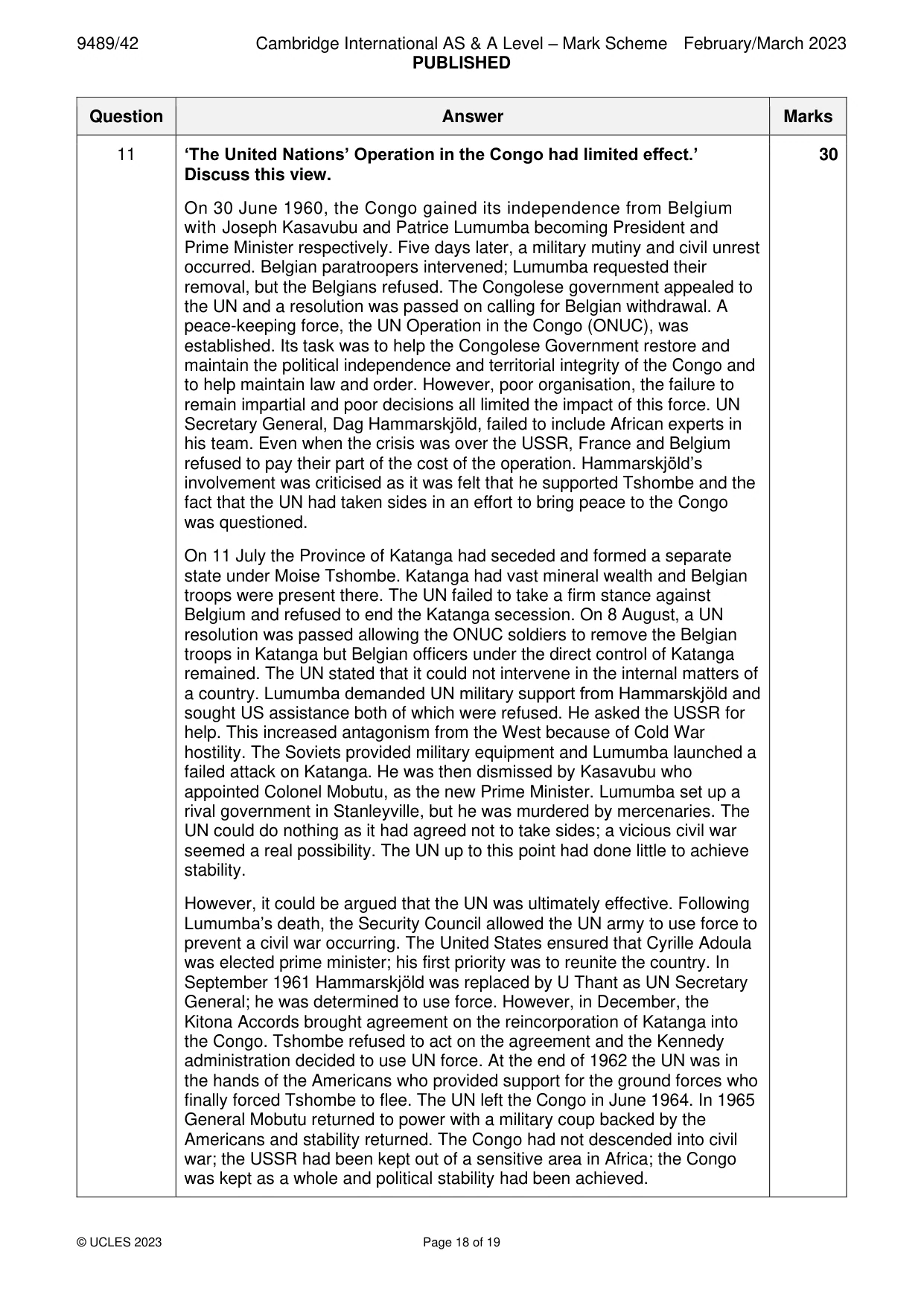
Mark scheme: 11 ‘The United Nations’ Operation in the Congo had limited effect.’ 30 Discuss this view. On 30 June 1960, the Congo gained its independence from Belgium with Joseph Kasavubu and Patrice Lumumba becoming President and Prime Minister respectively. Five days later, a military mutiny and civil unrest occurred. Belgian paratroopers intervened; Lumumba requested their removal, but the Belgians refused. The Congolese government appealed to the UN and a resolution was passed on calling for Belgian withdrawal. A peace-keeping force, the UN Operation in the Congo (ONUC), was established. Its task was to help the Congolese Government restore and maintain the political independence and territorial integrity of the Congo and to help maintain law and order. However, poor organisation, the failure to remain impartial and poor decisions all limited the impact of this force. UN Secretary General, Dag Hammarskjöld, failed to include African experts in his team. Even when the crisis was over the USSR, France and Belgium refused to pay their part of the cost of the operation. Hammarskjöld’s involvement was criticised as it was felt that he supported Tshombe and the fact that the UN had taken sides in an effort to bring peace to the Congo was questioned. On 11 July the Province of Katanga had seceded and formed a separate state under Moise Tshombe. Katanga had vast mineral wealth and Belgian troops were present there. The UN failed to take a firm stance against Belgium and refused to end the Katanga secession. On 8 August, a UN resolution was passed allowing the ONUC soldiers to remove the Belgian troops in Katanga but Belgian officers under the direct control of Katanga remained. The UN stated that it could not intervene in the internal matters of a country. Lumumba demanded UN military support from Hammarskjӧld and sought US assistance both of which were refused. He asked the USSR for help. This increased antagonism from the West because of Cold War hostility. The Soviets provided military equipment and Lumumba launched a failed attack on Katanga. He was then dismissed by Kasavubu who appointed Colonel Mobutu, as the new Prime Minister. Lumumba set up a rival government in Stanleyville, but he was murdered by mercenaries. The UN could do nothing as it had agreed not to take sides; a vicious civil war seemed a real possibility. The UN up to this point had done little to achieve stability. However, it could be argued that the UN was ultimately effective. Following Lumumba’s death, the Security Council allowed the UN army to use force to prevent a civil war occurring. The United States ensured that Cyrille Adoula was elected prime minister; his first priority was to reunite the country. In September 1961 Hammarskjӧld was replaced by U Thant as UN Secretary General; he was determined to use force. However, in December, the Kitona Accords brought agreement on the reincorporation of Katanga into the Congo. Tshombe refused to act on the agreement and the Kennedy administration decided to use UN force. At the end of 1962 the UN was in the hands of the Americans who provided support for the ground forces who finally forced Tshombe to flee. The UN left the Congo in June 1964. In 1965 General Mobutu returned to power with a military coup backed by the Americans and stability returned. The Congo had not descended into civil war; the USSR had been kept out of a sensitive area in Africa; the Congo was kept as a whole and political stability had been achieved.
More questions on Why did the League of Nations fail to keep the peace in the 1930s?
Q12 · ‘Opposition to the Shah’s attempts to westernise Iran was the main cause of the Iranian…
12 ‘Opposition to the Shah’s attempts to westernise Iran was the main cause of the Iranian Revolution.’ Assess this view. [30]
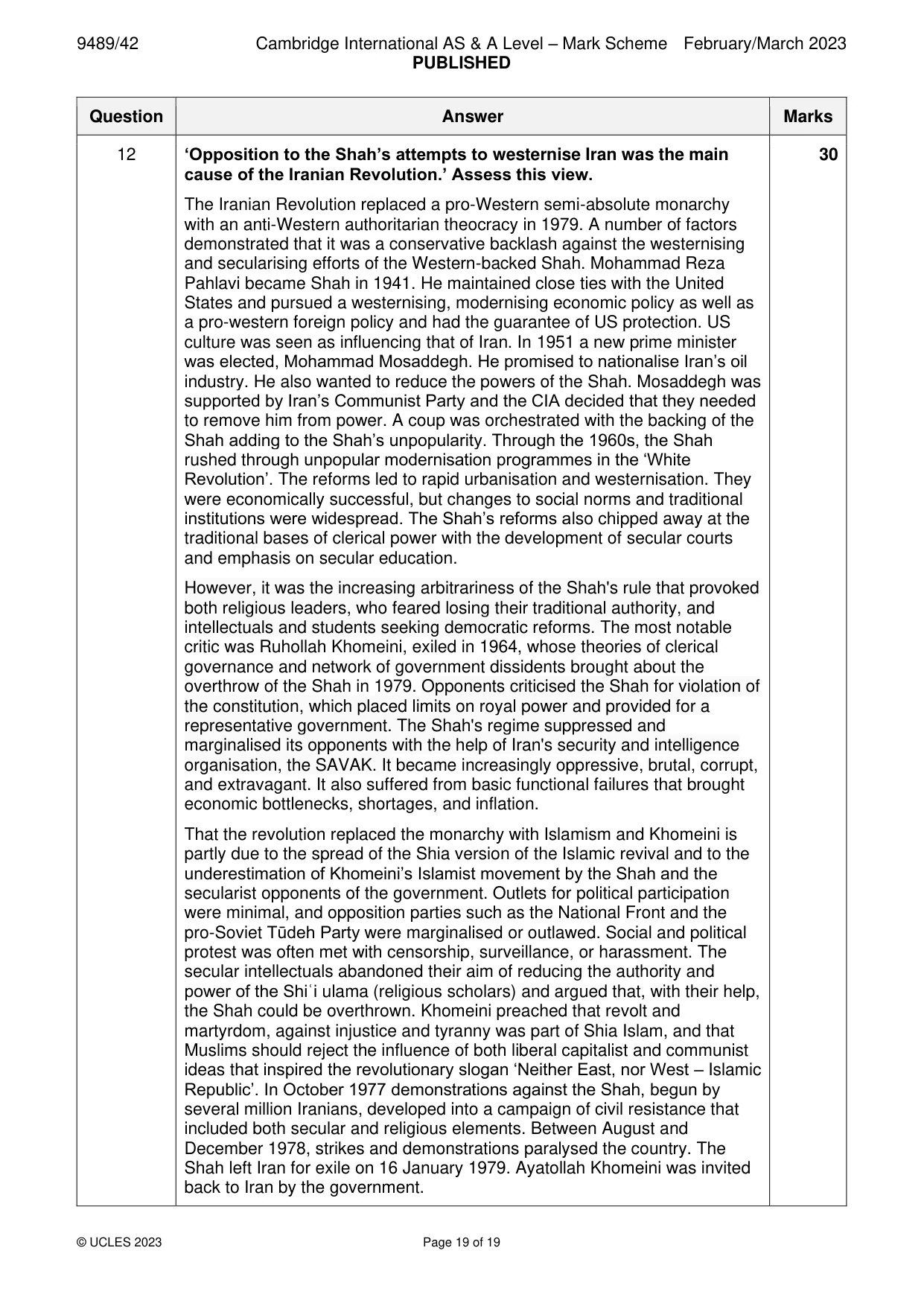
Mark scheme: 12 ‘Opposition to the Shah’s attempts to westernise Iran was the main 30 cause of the Iranian Revolution.’ Assess this view. The Iranian Revolution replaced a pro-Western semi-absolute monarchy with an anti-Western authoritarian theocracy in 1979. A number of factors demonstrated that it was a conservative backlash against the westernising and secularising efforts of the Western-backed Shah. Mohammad Reza Pahlavi became Shah in 1941. He maintained close ties with the United States and pursued a westernising, modernising economic policy as well as a pro-western foreign policy and had the guarantee of US protection. US culture was seen as influencing that of Iran. In 1951 a new prime minister was elected, Mohammad Mosaddegh. He promised to nationalise Iran’s oil industry. He also wanted to reduce the powers of the Shah. Mosaddegh was supported by Iran’s Communist Party and the CIA decided that they needed to remove him from power. A coup was orchestrated with the backing of the Shah adding to the Shah’s unpopularity. Through the 1960s, the Shah rushed through unpopular modernisation programmes in the ‘White Revolution’. The reforms led to rapid urbanisation and westernisation. They were economically successful, but changes to social norms and traditional institutions were widespread. The Shah’s reforms also chipped away at the traditional bases of clerical power with the development of secular courts and emphasis on secular education. However, it was the increasing arbitrariness of the Shah's rule that provoked both religious leaders, who feared losing their traditional authority, and intellectuals and students seeking democratic reforms. The most notable critic was Ruhollah Khomeini, exiled in 1964, whose theories of clerical governance and network of government dissidents brought about the overthrow of the Shah in 1979. Opponents criticised the Shah for violation of the constitution, which placed limits on royal power and provided for a representative government. The Shah's regime suppressed and marginalised its opponents with the help of Iran's security and intelligence organisation, the SAVAK. It became increasingly oppressive, brutal, corrupt, and extravagant. It also suffered from basic functional failures that brought economic bottlenecks, shortages, and inflation. That the revolution replaced the monarchy with Islamism and Khomeini is partly due to the spread of the Shia version of the Islamic revival and to the underestimation of Khomeini’s Islamist movement by the Shah and the secularist opponents of the government. Outlets for political participation were minimal, and opposition parties such as the National Front and the pro-Soviet Tūdeh Party were marginalised or outlawed. Social and political protest was often met with censorship, surveillance, or harassment. The secular intellectuals abandoned their aim of reducing the authority and power of the Shiʿi ulama (religious scholars) and argued that, with their help, the Shah could be overthrown. Khomeini preached that revolt and martyrdom, against injustice and tyranny was part of Shia Islam, and that Muslims should reject the influence of both liberal capitalist and communist ideas that inspired the revolutionary slogan ‘Neither East, nor West – Islamic Republic’. In October 1977 demonstrations against the Shah, begun by several million Iranians, developed into a campaign of civil resistance that included both secular and religious elements. Between August and December 1978, strikes and demonstrations paralysed the country. The Shah left Iran for exile on 16 January 1979. Ayatollah Khomeini was invited back to Iran by the government.
More questions on How did the rise of extremism affect international relations?
What was in this paper
The subtopics covered by these 12 questions, and how many questions each got. Open one in a new tab to see every Cambridge question on it.
3How and why did international relations improve, 1924–29?1How successful was Roosevelt’s first New Deal?1How successful was the Progressive Movement from 1890 to 1920?1How were the Bolsheviks able to consolidate their power up to 1924?1What was the impact of the Great Crash and the Great Depression in the United States?1What were the consequences of the rapid economic growth after 1870?1Why did the League of Nations fail to keep the peace in the 1930s?1Why did war break out in 1939?1Why was imperialism a significant force in Africa from 1870?1What you needed in this session
Cambridge’s own grade thresholds for 2023 Feb/March, Paper 4 · Variant 2. A higher threshold means an easier paper — the bar moves with how the cohort did.