Cambridge A Level History 9489 — 2021 Feb/March Paper 4 · Variant 2
9489/42/F/M/21 · 11 questions · 60 marks · ≈68 min
The question paper and its mark scheme, free to read here and free to download. This is Cambridge’s own paper, exactly as it was sat.
Question paper4 pages
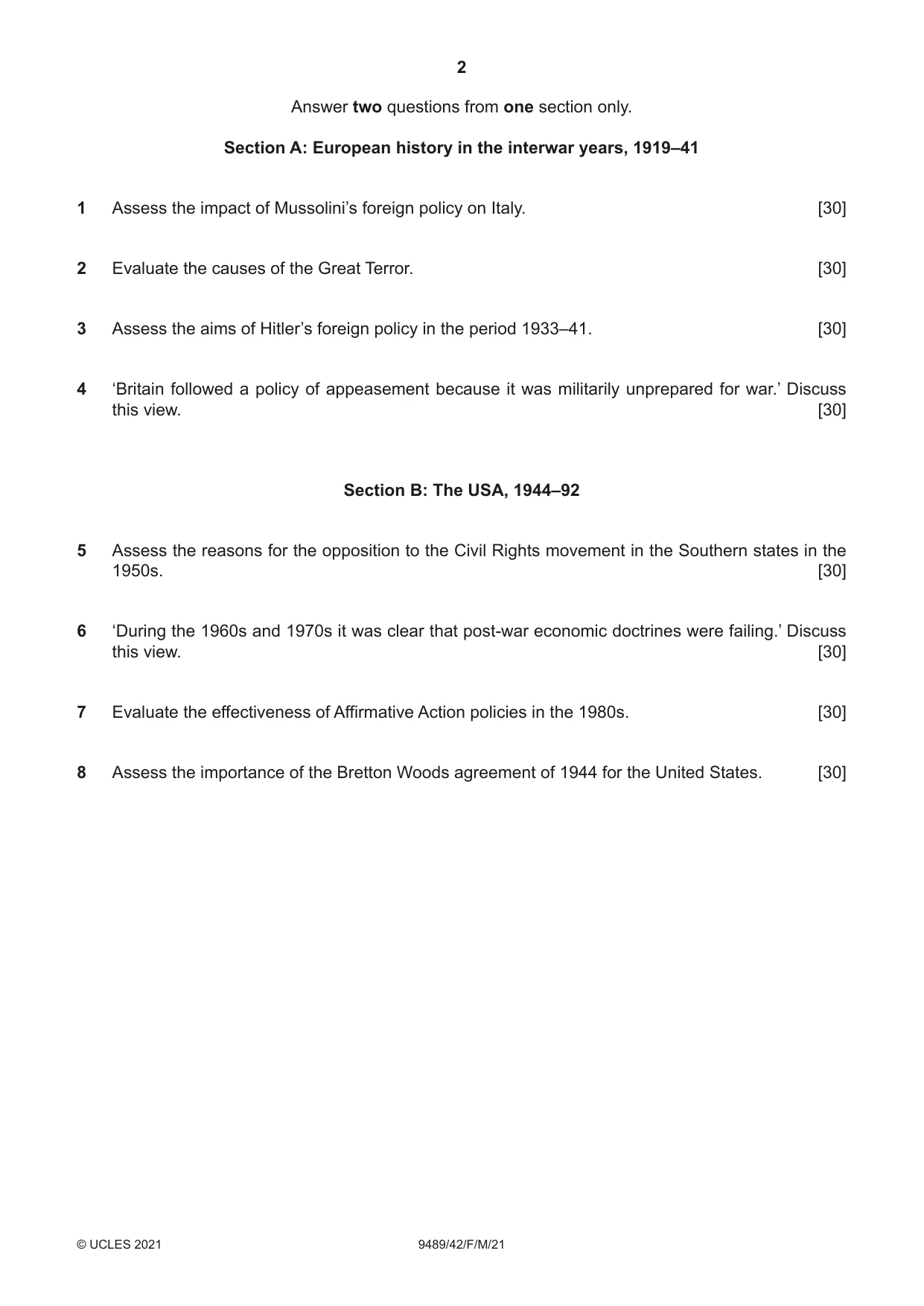
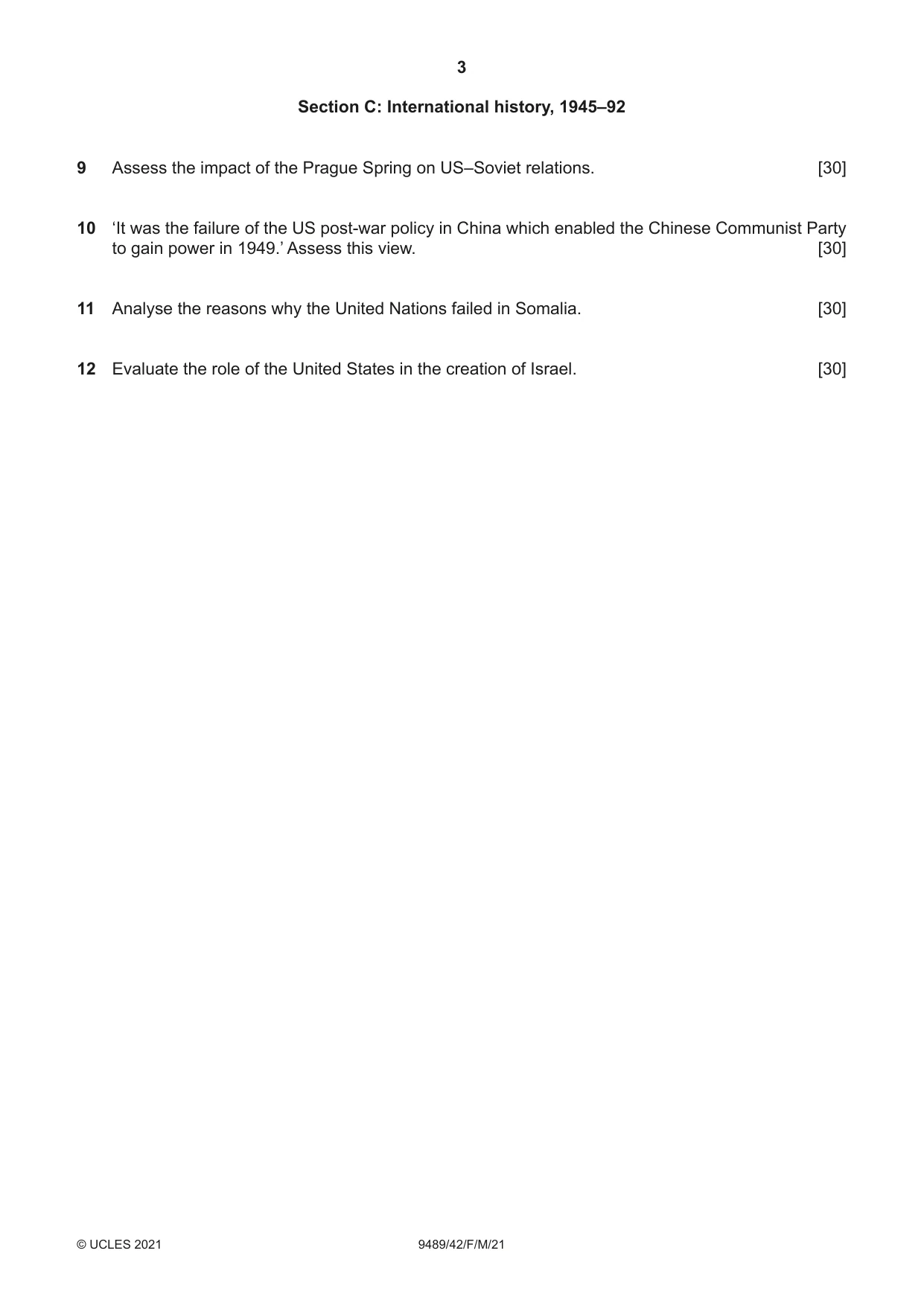
Mark scheme17 pages
Answers below. Sit the paper first if you are practising.

Questions as text
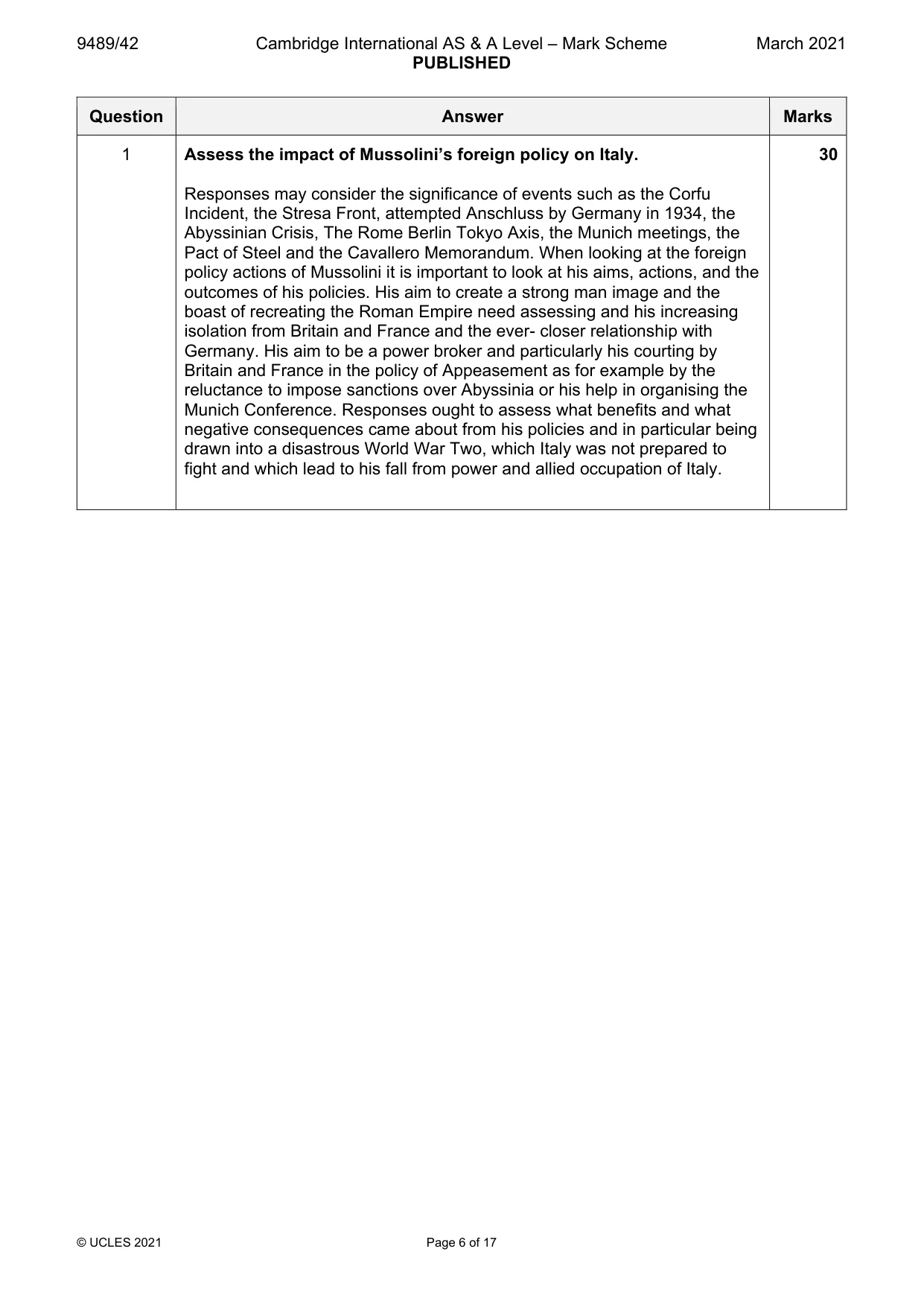
Q1 · Assess the impact of Mussolini’s foreign policy on Italy
1 Assess the impact of Mussolini’s foreign policy on Italy. [30]
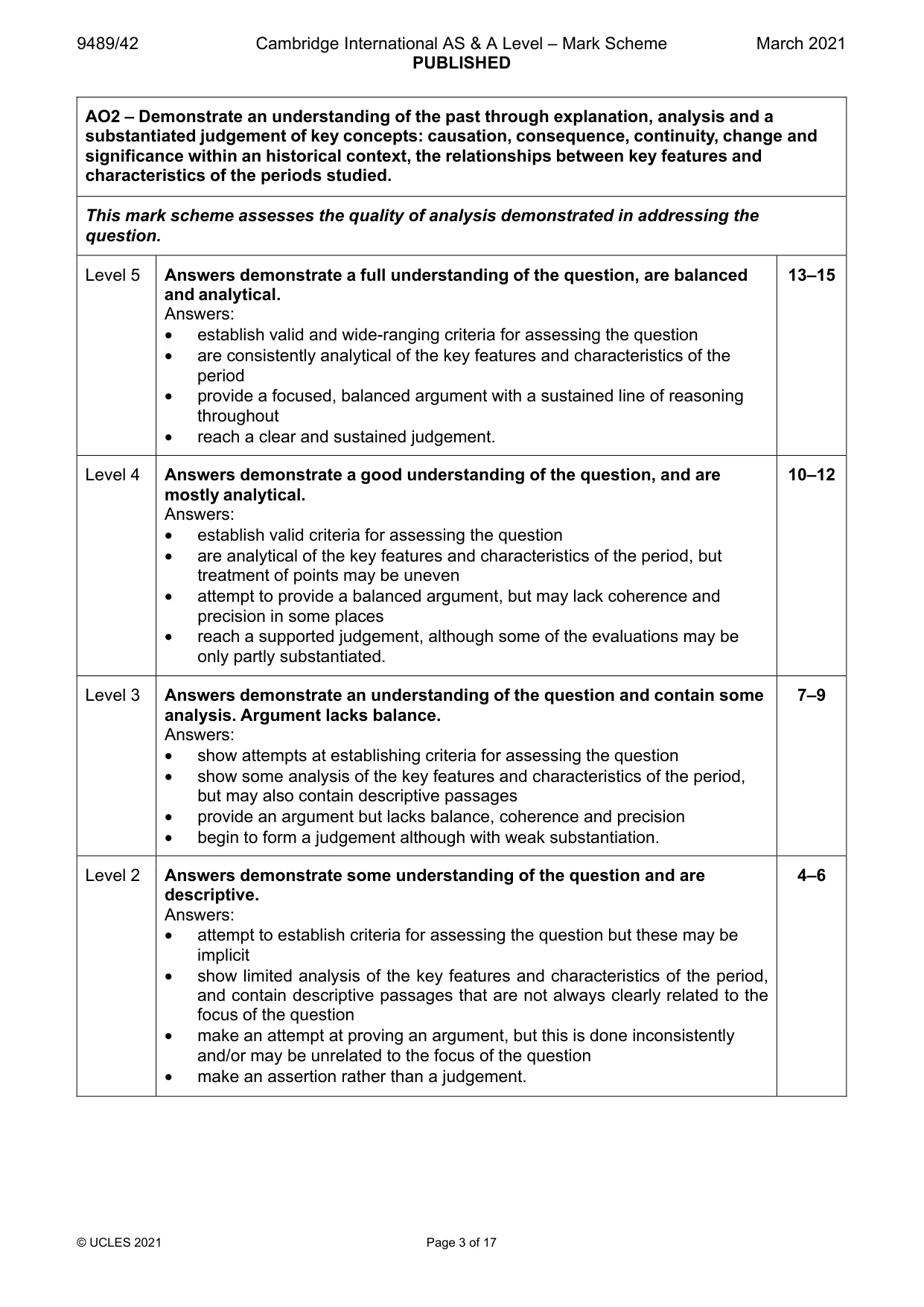
Mark scheme: Question Answer Marks 1 Assess the impact of Mussolini’s foreign policy on Italy. 30 Responses may consider the significance of events such as the Corfu Incident, the Stresa Front, attempted Anschluss by Germany in 1934, the Abyssinian Crisis, The Rome Berlin Tokyo Axis, the Munich meetings, the Pact of Steel and the Cavallero Memorandum. When looking at the foreign policy actions of Mussolini it is important to look at his aims, actions, and the outcomes of his policies. His aim to create a strong man image and the boast of recreating the Roman Empire need assessing and his increasing isolation from Britain and France and the ever- closer relationship with Germany. His aim to be a power broker and particularly his courting by Britain and France in the policy of Appeasement as for example by the reluctance to impose sanctions over Abyssinia or his help in organising the Munich Conference. Responses ought to assess what benefits and what negative consequences came about from his policies and in particular being drawn into a disastrous World War Two, which Italy was not prepared to fight and which lead to his fall from power and allied occupation of Italy.
More questions on How did the rise of extremism affect international relations?
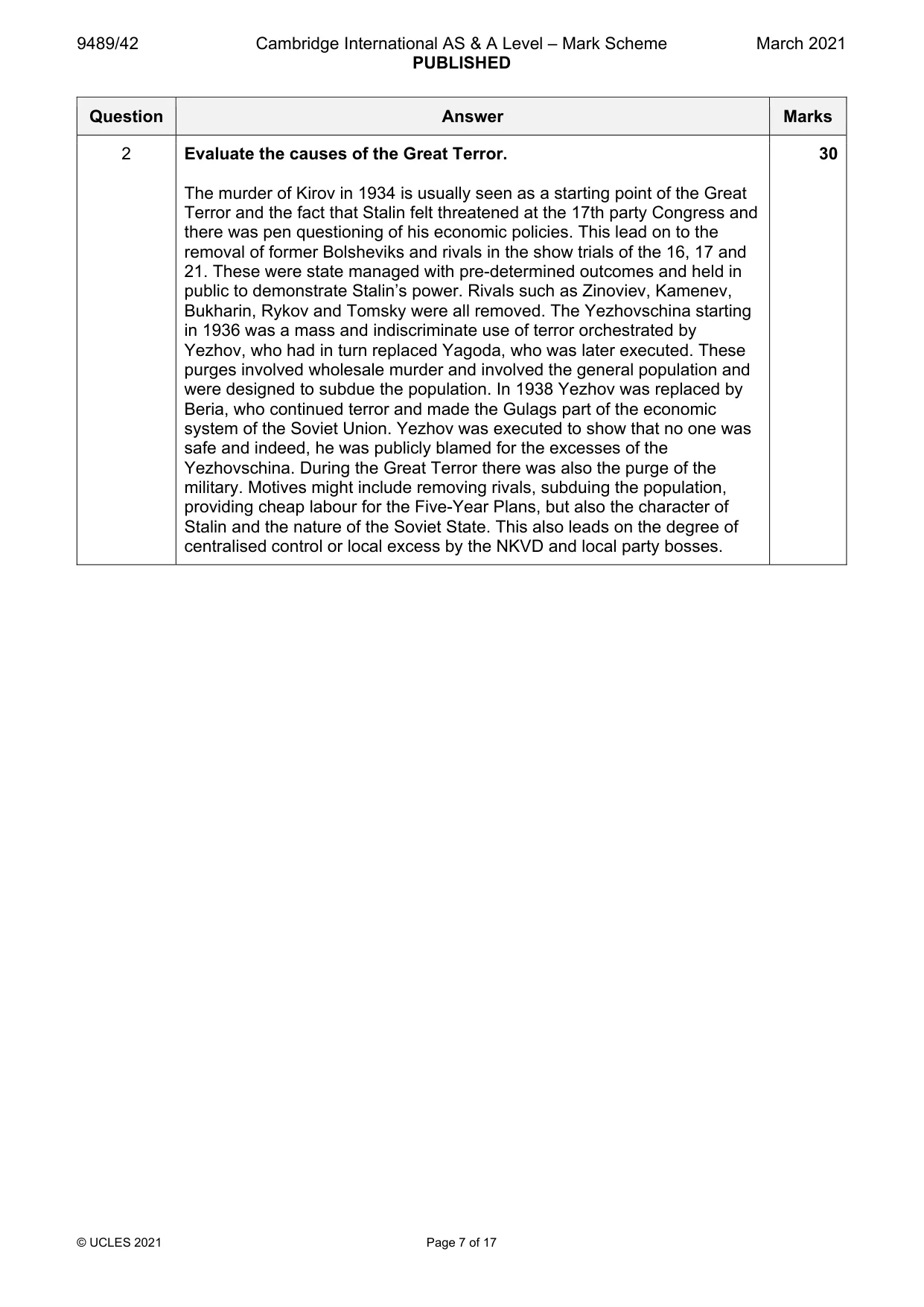
Q2 · Evaluate the causes of the Great Terror
2 Evaluate the causes of the Great Terror. [30]
Mark scheme: 2 Evaluate the causes of the Great Terror. 30 The murder of Kirov in 1934 is usually seen as a starting point of the Great Terror and the fact that Stalin felt threatened at the 17th party Congress and there was pen questioning of his economic policies. This lead on to the removal of former Bolsheviks and rivals in the show trials of the 16, 17 and 21. These were state managed with pre-determined outcomes and held in public to demonstrate Stalin’s power. Rivals such as Zinoviev, Kamenev, Bukharin, Rykov and Tomsky were all removed. The Yezhovschina starting in 1936 was a mass and indiscriminate use of terror orchestrated by Yezhov, who had in turn replaced Yagoda, who was later executed. These purges involved wholesale murder and involved the general population and were designed to subdue the population. In 1938 Yezhov was replaced by Beria, who continued terror and made the Gulags part of the economic system of the Soviet Union. Yezhov was executed to show that no one was safe and indeed, he was publicly blamed for the excesses of the Yezhovschina. During the Great Terror there was also the purge of the military. Motives might include removing rivals, subduing the population, providing cheap labour for the Five-Year Plans, but also the character of Stalin and the nature of the Soviet State. This also leads on the degree of centralised control or local excess by the NKVD and local party bosses.
More questions on How were the Bolsheviks able to consolidate their power up to 1924?
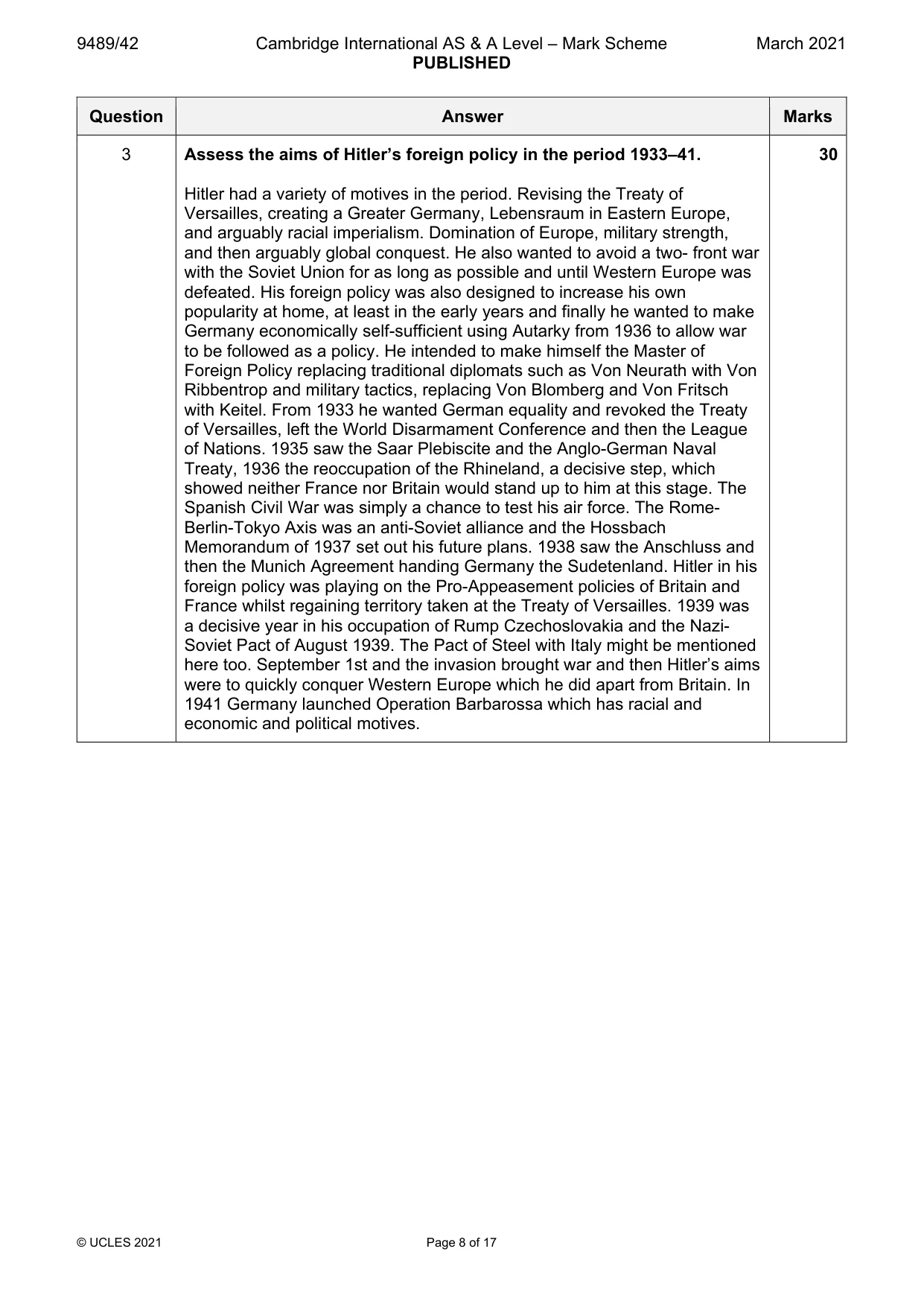
Q3 · Assess the aims of Hitler’s foreign policy in the period 1933–41
3 Assess the aims of Hitler’s foreign policy in the period 1933–41. [30]
Mark scheme: 3 Assess the aims of Hitler’s foreign policy in the period 1933–41. 30 Hitler had a variety of motives in the period. Revising the Treaty of Versailles, creating a Greater Germany, Lebensraum in Eastern Europe, and arguably racial imperialism. Domination of Europe, military strength, and then arguably global conquest. He also wanted to avoid a two- front war with the Soviet Union for as long as possible and until Western Europe was defeated. His foreign policy was also designed to increase his own popularity at home, at least in the early years and finally he wanted to make Germany economically self-sufficient using Autarky from 1936 to allow war to be followed as a policy. He intended to make himself the Master of Foreign Policy replacing traditional diplomats such as Von Neurath with Von Ribbentrop and military tactics, replacing Von Blomberg and Von Fritsch with Keitel. From 1933 he wanted German equality and revoked the Treaty of Versailles, left the World Disarmament Conference and then the League of Nations. 1935 saw the Saar Plebiscite and the Anglo-German Naval Treaty, 1936 the reoccupation of the Rhineland, a decisive step, which showed neither France nor Britain would stand up to him at this stage. The Spanish Civil War was simply a chance to test his air force. The Rome- Berlin-Tokyo Axis was an anti-Soviet alliance and the Hossbach Memorandum of 1937 set out his future plans. 1938 saw the Anschluss and then the Munich Agreement handing Germany the Sudetenland. Hitler in his foreign policy was playing on the Pro-Appeasement policies of Britain and France whilst regaining territory taken at the Treaty of Versailles. 1939 was a decisive year in his occupation of Rump Czechoslovakia and the Nazi- Soviet Pact of August 1939. The Pact of Steel with Italy might be mentioned here too. September 1st and the invasion brought war and then Hitler’s aims were to quickly conquer Western Europe which he did apart from Britain. In 1941 Germany launched Operation Barbarossa which has racial and economic and political motives.
More questions on How did the rise of extremism affect international relations?
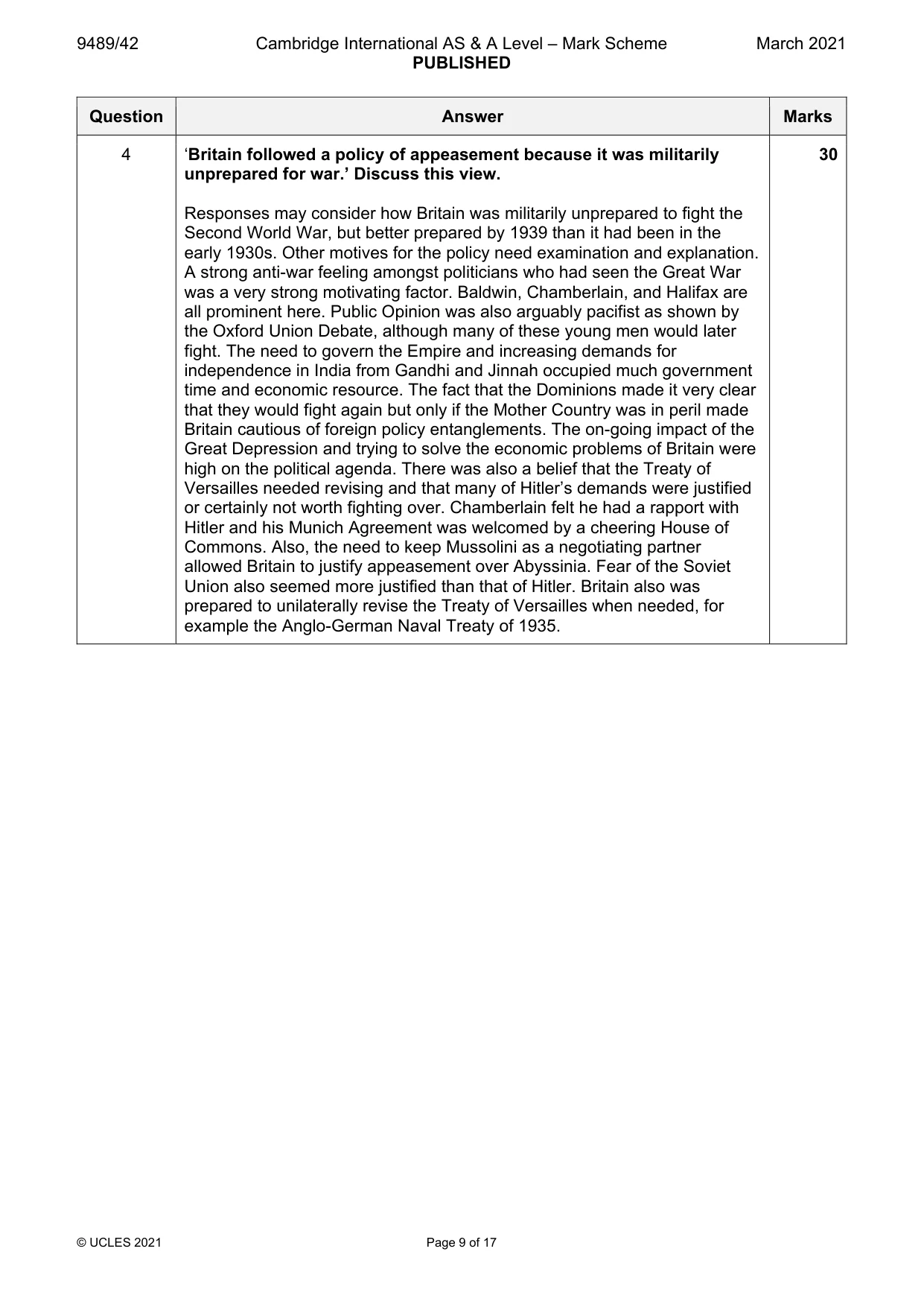
Q4 · ‘Britain followed a policy of appeasement because it was militarily unprepared for war.’…
4 ‘Britain followed a policy of appeasement because it was militarily unprepared for war.’ Discuss this view. [30]
Mark scheme: 4 ‘Britain followed a policy of appeasement because it was militarily 30 unprepared for war.’ Discuss this view. Responses may consider how Britain was militarily unprepared to fight the Second World War, but better prepared by 1939 than it had been in the early 1930s. Other motives for the policy need examination and explanation. A strong anti-war feeling amongst politicians who had seen the Great War was a very strong motivating factor. Baldwin, Chamberlain, and Halifax are all prominent here. Public Opinion was also arguably pacifist as shown by the Oxford Union Debate, although many of these young men would later fight. The need to govern the Empire and increasing demands for independence in India from Gandhi and Jinnah occupied much government time and economic resource. The fact that the Dominions made it very clear that they would fight again but only if the Mother Country was in peril made Britain cautious of foreign policy entanglements. The on-going impact of the Great Depression and trying to solve the economic problems of Britain were high on the political agenda. There was also a belief that the Treaty of Versailles needed revising and that many of Hitler’s demands were justified or certainly not worth fighting over. Chamberlain felt he had a rapport with Hitler and his Munich Agreement was welcomed by a cheering House of Commons. Also, the need to keep Mussolini as a negotiating partner allowed Britain to justify appeasement over Abyssinia. Fear of the Soviet Union also seemed more justified than that of Hitler. Britain also was prepared to unilaterally revise the Treaty of Versailles when needed, for example the Anglo-German Naval Treaty of 1935.
More questions on Why, and with what effects, did Britain and France pursue a policy of appeasement?
Q5 · Assess the reasons for the opposition to the Civil Rights movement in the Southern states…
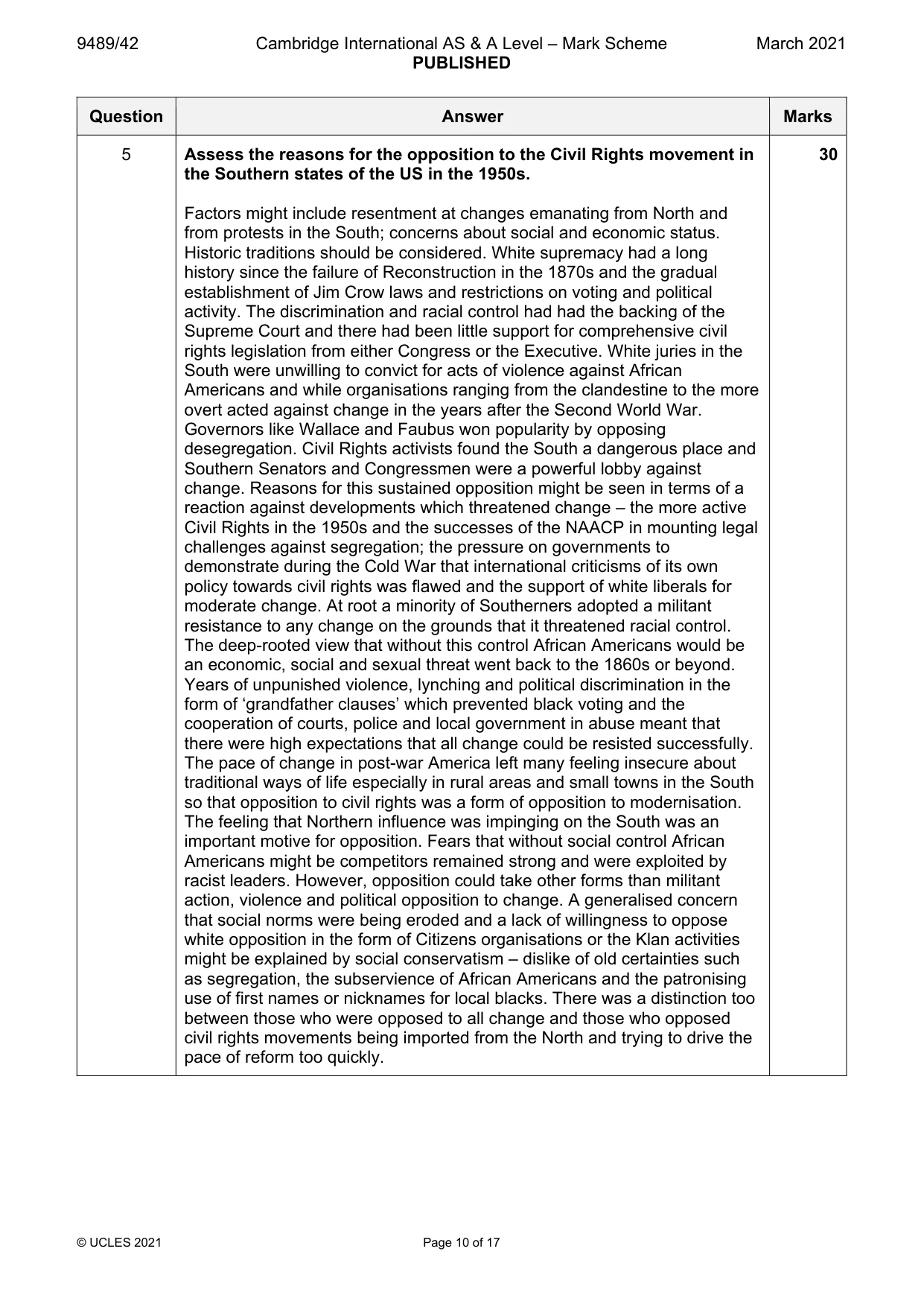
5 Assess the reasons for the opposition to the Civil Rights movement in the Southern states in the 1950s. [30]
Mark scheme: 5 Assess the reasons for the opposition to the Civil Rights movement in 30 the Southern states of the US in the 1950s. Factors might include resentment at changes emanating from North and from protests in the South; concerns about social and economic status. Historic traditions should be considered. White supremacy had a long history since the failure of Reconstruction in the 1870s and the gradual establishment of Jim Crow laws and restrictions on voting and political activity. The discrimination and racial control had had the backing of the Supreme Court and there had been little support for comprehensive civil rights legislation from either Congress or the Executive. White juries in the South were unwilling to convict for acts of violence against African Americans and while organisations ranging from the clandestine to the more overt acted against change in the years after the Second World War. Governors like Wallace and Faubus won popularity by opposing desegregation. Civil Rights activists found the South a dangerous place and Southern Senators and Congressmen were a powerful lobby against change. Reasons for this sustained opposition might be seen in terms of a reaction against developments which threatened change – the more active Civil Rights in the 1950s and the successes of the NAACP in mounting legal challenges against segregation; the pressure on governments to demonstrate during the Cold War that international criticisms of its own policy towards civil rights was flawed and the support of white liberals for moderate change. At root a minority of Southerners adopted a militant resistance to any change on the grounds that it threatened racial control. The deep-rooted view that without this control African Americans would be an economic, social and sexual threat went back to the 1860s or beyond. Years of unpunished violence, lynching and political discrimination in the form of ‘grandfather clauses’ which prevented black voting and the cooperation of courts, police and local government in abuse meant that there were high expectations that all change could be resisted successfully. The pace of change in post-war America left many feeling insecure about traditional ways of life especially in rural areas and small towns in the South so that opposition to civil rights was a form of opposition to modernisation. The feeling that Northern influence was impinging on the South was an important motive for opposition. Fears that without social control African Americans might be competitors remained strong and were exploited by racist leaders. However, opposition could take other forms than militant action, violence and political opposition to change. A generalised concern that social norms were being eroded and a lack of willingness to oppose white opposition in the form of Citizens organisations or the Klan activities might be explained by social conservatism – dislike of old certainties such as segregation, the subservience of African Americans and the patronising use of first names or nicknames for local blacks. There was a distinction too between those who were opposed to all change and those who opposed civil rights movements being imported from the North and trying to drive the pace of reform too quickly.
More questions on How successful was the Progressive Movement from 1890 to 1920?
Q6 · ‘During the 1960s and 1970s it was clear that post-war economic doctrines were failing.’…
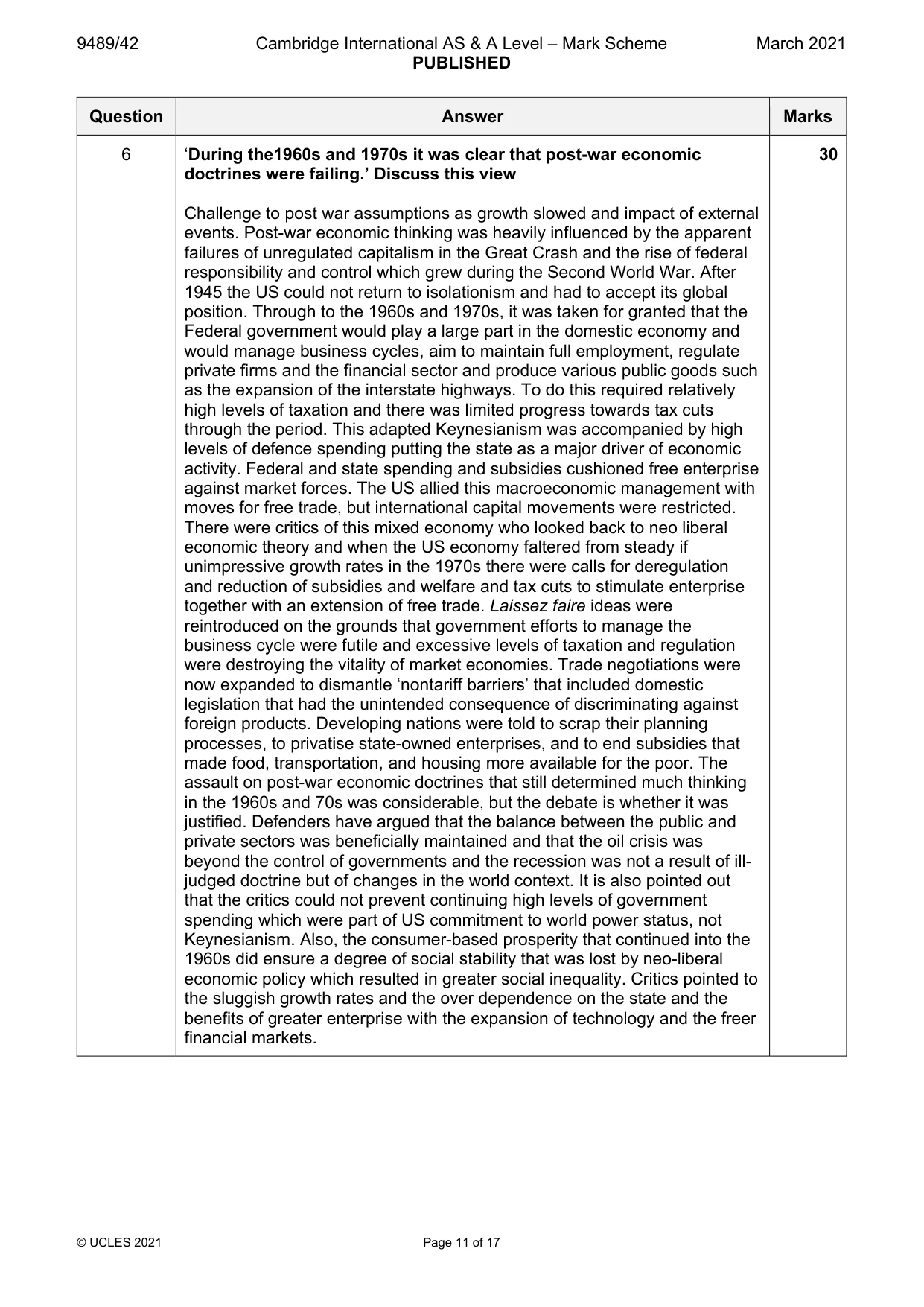
6 ‘During the 1960s and 1970s it was clear that post-war economic doctrines were failing.’ Discuss this view. [30]
Mark scheme: 6 ‘During the1960s and 1970s it was clear that post-war economic 30 doctrines were failing.’ Discuss this view Challenge to post war assumptions as growth slowed and impact of external events. Post-war economic thinking was heavily influenced by the apparent failures of unregulated capitalism in the Great Crash and the rise of federal responsibility and control which grew during the Second World War. After 1945 the US could not return to isolationism and had to accept its global position. Through to the 1960s and 1970s, it was taken for granted that the Federal government would play a large part in the domestic economy and would manage business cycles, aim to maintain full employment, regulate private firms and the financial sector and produce various public goods such as the expansion of the interstate highways. To do this required relatively high levels of taxation and there was limited progress towards tax cuts through the period. This adapted Keynesianism was accompanied by high levels of defence spending putting the state as a major driver of economic activity. Federal and state spending and subsidies cushioned free enterprise against market forces. The US allied this macroeconomic management with moves for free trade, but international capital movements were restricted. There were critics of this mixed economy who looked back to neo liberal economic theory and when the US economy faltered from steady if unimpressive growth rates in the 1970s there were calls for deregulation and reduction of subsidies and welfare and tax cuts to stimulate enterprise together with an extension of free trade. Laissez faire ideas were reintroduced on the grounds that government efforts to manage the business cycle were futile and excessive levels of taxation and regulation were destroying the vitality of market economies. Trade negotiations were now expanded to dismantle ‘nontariff barriers’ that included domestic legislation that had the unintended consequence of discriminating against foreign products. Developing nations were told to scrap their planning processes, to privatise state-owned enterprises, and to end subsidies that made food, transportation, and housing more available for the poor. The assault on post-war economic doctrines that still determined much thinking in the 1960s and 70s was considerable, but the debate is whether it was justified. Defenders have argued that the balance between the public and private sectors was beneficially maintained and that the oil crisis was beyond the control of governments and the recession was not a result of ill- judged doctrine but of changes in the world context. It is also pointed out that the critics could not prevent continuing high levels of government spending which were part of US commitment to world power status, not Keynesianism. Also, the consumer-based prosperity that continued into the 1960s did ensure a degree of social stability that was lost by neo-liberal economic policy which resulted in greater social inequality. Critics pointed to the sluggish growth rates and the over dependence on the state and the benefits of greater enterprise with the expansion of technology and the freer financial markets.
More questions on What were the consequences of the rapid economic growth after 1870?
Q7 · Evaluate the effectiveness of Affirmative Action policies in the 1980s
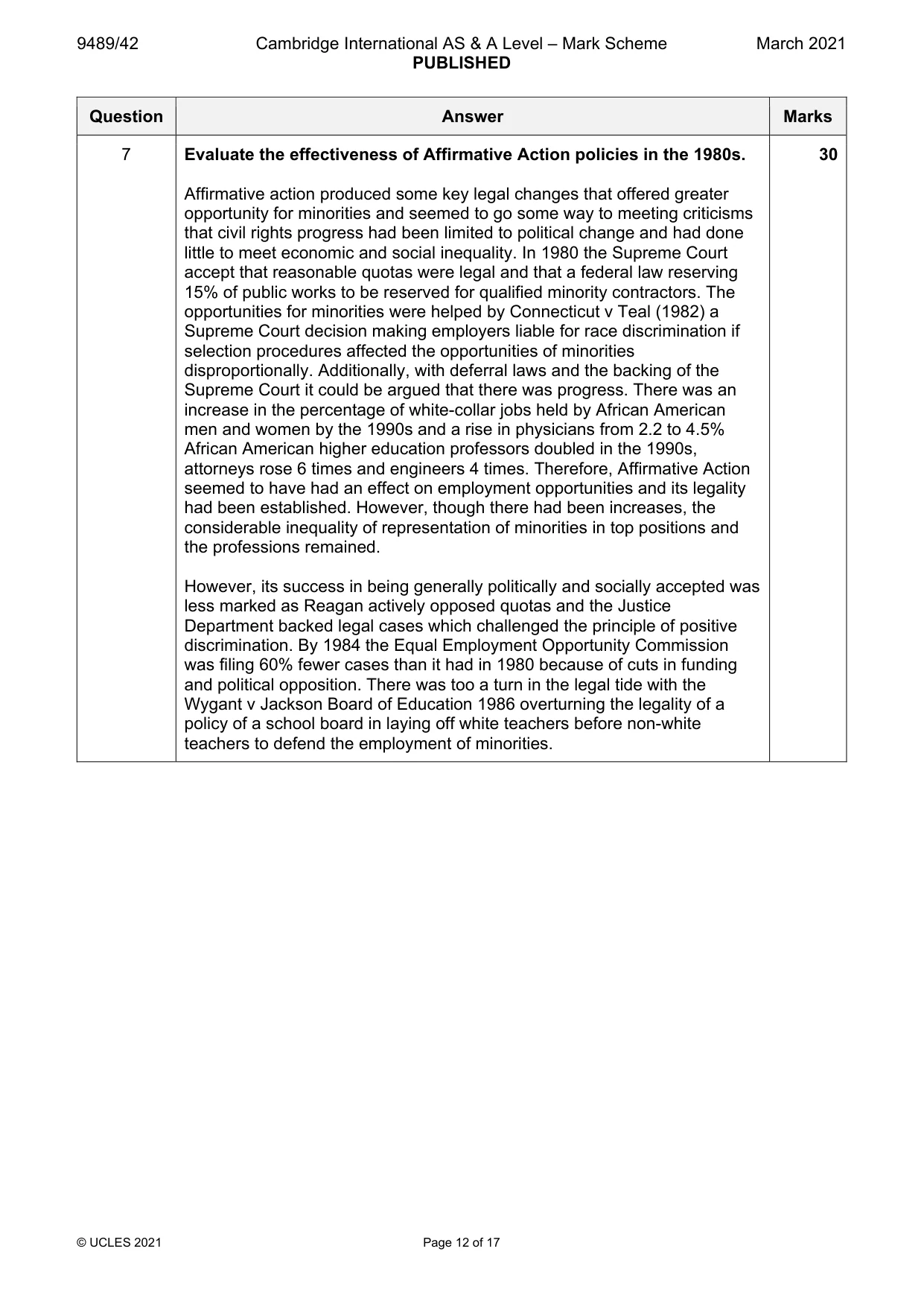
7 Evaluate the effectiveness of Affirmative Action policies in the 1980s. [30]
Mark scheme: 7 Evaluate the effectiveness of Affirmative Action policies in the 1980s. 30 Affirmative action produced some key legal changes that offered greater opportunity for minorities and seemed to go some way to meeting criticisms that civil rights progress had been limited to political change and had done little to meet economic and social inequality. In 1980 the Supreme Court accept that reasonable quotas were legal and that a federal law reserving 15% of public works to be reserved for qualified minority contractors. The opportunities for minorities were helped by Connecticut v Teal (1982) a Supreme Court decision making employers liable for race discrimination if selection procedures affected the opportunities of minorities disproportionally. Additionally, with deferral laws and the backing of the Supreme Court it could be argued that there was progress. There was an increase in the percentage of white-collar jobs held by African American men and women by the 1990s and a rise in physicians from 2.2 to 4.5% African American higher education professors doubled in the 1990s, attorneys rose 6 times and engineers 4 times. Therefore, Affirmative Action seemed to have had an effect on employment opportunities and its legality had been established. However, though there had been increases, the considerable inequality of representation of minorities in top positions and the professions remained. However, its success in being generally politically and socially accepted was less marked as Reagan actively opposed quotas and the Justice Department backed legal cases which challenged the principle of positive discrimination. By 1984 the Equal Employment Opportunity Commission was filing 60% fewer cases than it had in 1980 because of cuts in funding and political opposition. There was too a turn in the legal tide with the Wygant v Jackson Board of Education 1986 overturning the legality of a policy of a school board in laying off white teachers before non-white teachers to defend the employment of minorities.
More questions on How successful was the Progressive Movement from 1890 to 1920?
Q8 · Section C: International history, 1945–92
Section C: International history, 1945–92
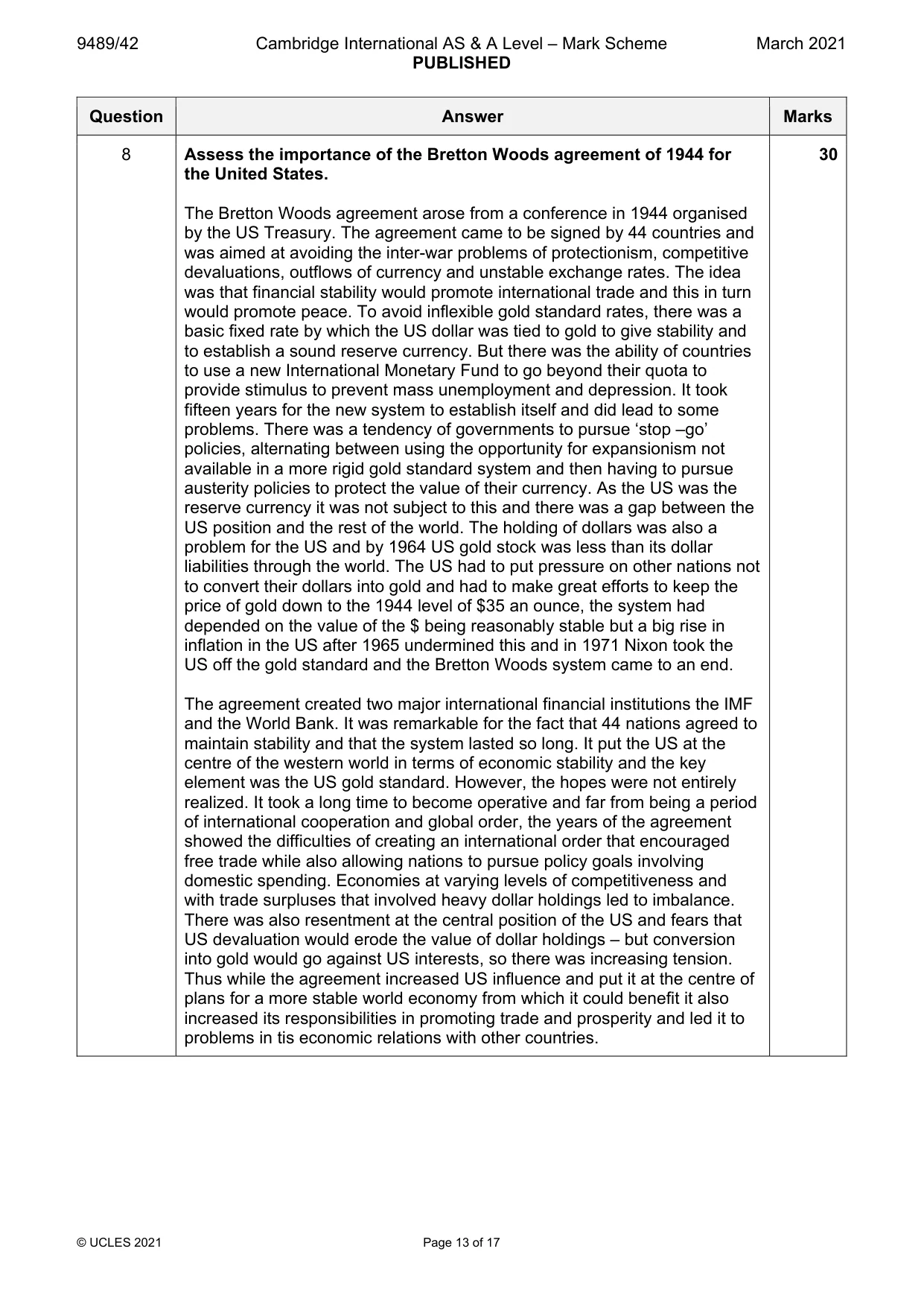
Mark scheme: 8 Assess the importance of the Bretton Woods agreement of 1944 for 30 the United States. The Bretton Woods agreement arose from a conference in 1944 organised by the US Treasury. The agreement came to be signed by 44 countries and was aimed at avoiding the inter-war problems of protectionism, competitive devaluations, outflows of currency and unstable exchange rates. The idea was that financial stability would promote international trade and this in turn would promote peace. To avoid inflexible gold standard rates, there was a basic fixed rate by which the US dollar was tied to gold to give stability and to establish a sound reserve currency. But there was the ability of countries to use a new International Monetary Fund to go beyond their quota to provide stimulus to prevent mass unemployment and depression. It took fifteen years for the new system to establish itself and did lead to some problems. There was a tendency of governments to pursue ‘stop –go’ policies, alternating between using the opportunity for expansionism not available in a more rigid gold standard system and then having to pursue austerity policies to protect the value of their currency. As the US was the reserve currency it was not subject to this and there was a gap between the US position and the rest of the world. The holding of dollars was also a problem for the US and by 1964 US gold stock was less than its dollar liabilities through the world. The US had to put pressure on other nations not to convert their dollars into gold and had to make great efforts to keep the price of gold down to the 1944 level of $35 an ounce, the system had depended on the value of the $ being reasonably stable but a big rise in inflation in the US after 1965 undermined this and in 1971 Nixon took the US off the gold standard and the Bretton Woods system came to an end. The agreement created two major international financial institutions the IMF and the World Bank. It was remarkable for the fact that 44 nations agreed to maintain stability and that the system lasted so long. It put the US at the centre of the western world in terms of economic stability and the key element was the US gold standard. However, the hopes were not entirely realized. It took a long time to become operative and far from being a period of international cooperation and global order, the years of the agreement showed the difficulties of creating an international order that encouraged free trade while also allowing nations to pursue policy goals involving domestic spending. Economies at varying levels of competitiveness and with trade surpluses that involved heavy dollar holdings led to imbalance. There was also resentment at the central position of the US and fears that US devaluation would erode the value of dollar holdings – but conversion into gold would go against US interests, so there was increasing tension. Thus while the agreement increased US influence and put it at the centre of plans for a more stable world economy from which it could benefit it also increased its responsibilities in promoting trade and prosperity and led it to problems in tis economic relations with other countries.
Q9 · Assess the impact of the Prague Spring on US–Soviet relations
9 Assess the impact of the Prague Spring on US–Soviet relations. [30]
Mark scheme: 9 Assess the impact of the Prague Spring on US‒Soviet relations. 30 Pursuing détente with the Soviet Union was very important to President Lyndon B Johnson; it was an opportunity to end his presidency on a positive note. However, the Soviet invasion to crack down on political reform in Czechoslovakia put the negotiations on hold and it destroyed Johnson’s last chance to leave a legacy he could be proud of. He did not want to upset the Soviets and in the process pursued a policy of no resistance and demonstrated that the United States was not prepared to defend democracy if it was not in its interests. Nevertheless, it soured the relationship between the two superpowers. Johnson was under so much pressure at home with his attempts to create the ‘great society’ and resistance to American involvement in Vietnam. The assassinations of civil rights leader, Martin Luther King, and presidential candidate, Robert Kennedy, also reduced people’s faith in the political system. Success with détente would help to raise his standing and give the Americans a chance to establish an exit strategy for Vietnam. On 20 August 1968 Johnson was making his final preparations for a nuclear arms limitation summit meeting with the Soviet leaders on the following day. The Soviet invasion coincided with the planned meeting This forced him to postpone his plans and his hopes of being recognised as a great peacemaker; it was left to Richard Nixon to receive that honour. Johnson made every effort to protect his personal and political goals by his minimal reaction to the invasion. However, the United States did protest about the invasion in the UN Security Council. It also gave a diplomatic warning to the Soviet Union that it would be more forceful if there were similar action in Romania. Romania had been pursuing a more independent foreign policy and the United States hoped that Romania might become a neutral state in the Cold War. It also resulted in fresh commitments across the NATO alliance, with the United States confirming that it would continue to station its troops in West Germany. Czechoslovakia returned to full Soviet control and the successful invasion saved the shattering of communism in Eastern Europe. Johnson’s fixation on détente enabled the Soviets to escape any direct intervention from the United States. Events clearly demonstrated that both Brezhnev and Johnson were prepared to put their own interests first. Brezhnev prioritised maintaining Soviet control of the satellites against pursuing détente. For him détente was just delayed by a few years; for Johnson it had a permanent effect on his legacy. It also led to the Brezhnev Doctrine whereby the Soviet Union maintained its right to intervene in any country where communism had been threatened. While the Prague Spring played a pivotal role in delaying détente, it also increased Soviet confidence that it could deal with its satellite unimpeded by the United States. On the other hand, it was also a wake-up call to the United States that Johnson had given the impression that in his determination to attain the co-operation of the Soviets he would allow the Warsaw Pact to do as it pleased.
More questions on How did the rise of extremism affect international relations?
Q10 · ‘It was the failure of the US post-war policy in China which enabled the Chinese…
10 ‘It was the failure of the US post-war policy in China which enabled the Chinese Communist Party to gain power in 1949.’ Assess this view. [30]
Mark scheme: 10 ‘It was the failure of the US post-war policy in China which enabled the 30 Chinese Communist Party to gain power in 1949.’ Assess this view. After the surrender of Japan on 10 August 1945, Chiang Kai-shek’s Nationalist China was admitted to the UN as a permanent member of the Security Council. The United States still hoped to maintain Nationalist China as an ally to stop the advance of communism. Truman wished to avoid a renewal of the Chinese civil war. However, US forces were over-stretched in Europe and Asia and heavy military commitment in China was unrealistic. General George Marshall was sent to persuade Mao and Chiang to form a government of national unity. Marshall arrived in China on 20 December 1945. His goal was to unify the Nationalists and Communists hoping that a strong, non-Communist China, would prevent the intervention of the Soviet Union. Even though Marshall conducted negotiations with both sides, no significant agreements were reached and in January 1947 Marshall left China. Although the United States were aware of the corruption of Chiang’s administration, they wished to contain communism They therefore increased their aid to the Nationalists, supplying aircraft and sending teams to Taiwan to train their troops. American public opinion was firmly against fighting a war in China. The United States supported the losing side and they limited their commitment in the area. Responses may also consider other factors that influenced the communist victory, such as how it was the Nationalists themselves that helped the Communists secure victory. Chiang’s troops often turned and fled rather than face the enemy. His army also had a reputation for arrogance and cowardice and was accused of looting and stealing. He lost support in the cities because of heavy taxes, inflation, unemployment and food shortages. Economic discontent led to strikes and there were protests demanding an end to the civil war and the creation of a government that included the Communists. The Nationalists responded with repression including censorship, mass arrests and assassinations. The Nationalists supported business and the landlords; they ignored the suffering of the peasants. Giving more US funds to the corrupt Nationalists would have been a huge waste of money. The Nationalists played a large part in their own defeat. However, the Communists themselves played a huge part in their victory. The People’s Liberation Army was unified under a tightly controlled central command. In 1945 the CCP’s liberated zone contained 19 base areas which included about a quarter of the country’s territory. The Soviet Union turned over all of its captured Japanese weapons to the CCP who also received Manchuria from the Soviets. Mao appointed loyal generals including Lin Biao and Zhu De whose tactics contributed greatly to the Communist success. The ordinary soldiers in the army were treated with respect and, in contrast, thousands of Nationalists deserted. Large numbers of well-trained KMT deserted and joined the communists and they were able to take full advantage of their skills. In June 1947 the Communists successfully defeated the KMT New First Army; they now had tanks and heavy artillery at their disposal. In 1948 they launched an attack south of the Great Wall that cut off Nationalist troops from their supply bases in Xi’an. They then secured the South East Central section of China and by the end of January 1949 most of China was in the hands of the Communists.
More questions on Why did the USA emerge as a world power and what was the impact on international
Q11 · Analyse the reasons why the United Nations failed in Somalia
11 Analyse the reasons why the United Nations failed in Somalia. [30]
Mark scheme: 11 Analyse the reasons why the United Nations failed in Somalia. 30 President Siyad Barre fell from power in January 1991; he had ruled through his own support network and played off clans against each other causing factional power struggles. The economy of the country began to decline and by 1988 violent opposition to his rule had turned into a civil war. In November 1991, there was intense fighting in Mogadishu between the factions, one supporting Interim President, Ali Mahdi Mohamed and the other supporting the Chairman of the United Somali Congress, Mohamed Farah Aidid. In March 1992 a ceasefire had been agreed but it was ignored by the fighters on both sides. The first United Nations Operation in Somalia (UNOSOM I) was authorised by Security Council Resolution 751 of 24 April 1992. UNOSOM 1 was dispatched to monitor the cease-fire and to protect the personnel involved in the humanitarian work. The collapse of the Somali central government meant that the UN was unable to obtain consent to deploy troops and as a result their mandate was limited; local warlords prevented them from moving much beyond the airport in Mogadishu. Lawlessness and lack of security prevented aid from being distributed. There was looting of supplies by armed gangs and attacks on ships and on airports. However, blame for the failure of UNISOM 1 can also be attributed to the UN itself. Troops often refused to accept orders from UN commanders before checking with their own governments causing delays; the international response to Somalia's problems was also inadequate. Although three separate Security Council resolutions were passed in the first half of 1992, UN humanitarian agencies failed to implement the relief programme. It was also reported in ‘The New York Times’ in December 1991 that the United States held back UN efforts with the State Department because of safety concerns over the peacekeeping force. It was not until January 1992 when Boutros Boutros-Ghali became UN Secretary General that the UN became more heavily involved with humanitarian aid. Public pressure was put on governments internationally as the media drew attention to the catastrophe and the effects of widespread famine. There were also arguments between the UN and other humanitarian workers in Somalia and the UN reported that the failure of relief operations was due to the bureaucracy involved. Resolution 751 called for the establishment of a peacekeeping force to provide security for humanitarian activities in Mogadishu which included the deployment of 50 unarmed military observers to monitor the ceasefire agreement in the city and agreed in principle to the idea of a UN force to escort the delivery of humanitarian aid. By late October 1992, it was clear that the new plan was not working as intended; the small UN peacekeeping contingent could not ensure that humanitarian aid was delivered throughout the country. Following the ineffective UNOSOM I mission, Boutros-Ghali launched the United Nations Task Force (UNITAF) in December 1992. This was an American-led force of 30,000 troops from 23 countries authorised by Security Council Resolution to provide security for relief operations. The widespread famine and continued civil war in Somalia were seen as a threat to international peace and provided the reason for allowing the forces. The UNITAF forces were largely successful in supplying humanitarian aid but in March 1993 they handed over to UNOSOM II This put military and security objectives before political, economic and social ones and turned into a peace enforcement mission.
More questions on Why did the League of Nations fail to keep the peace in the 1930s?
What was in this paper
The subtopics covered by these 11 questions, and how many questions each got. Open one in a new tab to see every Cambridge question on it.
3How successful was the Progressive Movement from 1890 to 1920?2How were the Bolsheviks able to consolidate their power up to 1924?1What were the consequences of the rapid economic growth after 1870?1Why did the League of Nations fail to keep the peace in the 1930s?1Why did the USA emerge as a world power and what was the impact on international1Why did war break out in 1939?1Why, and with what effects, did Britain and France pursue a policy of appeasement?1What you needed in this session
Cambridge’s own grade thresholds for 2021 Feb/March, Paper 4 · Variant 2. A higher threshold means an easier paper — the bar moves with how the cohort did.