Cambridge A Level History 9489 — 2023 Oct/Nov Paper 4 · Variant 3
9489/43/O/N/23 · 12 questions · 60 marks · ≈68 min
The question paper and its mark scheme, free to read here and free to download. This is Cambridge’s own paper, exactly as it was sat.
Question paper4 pages
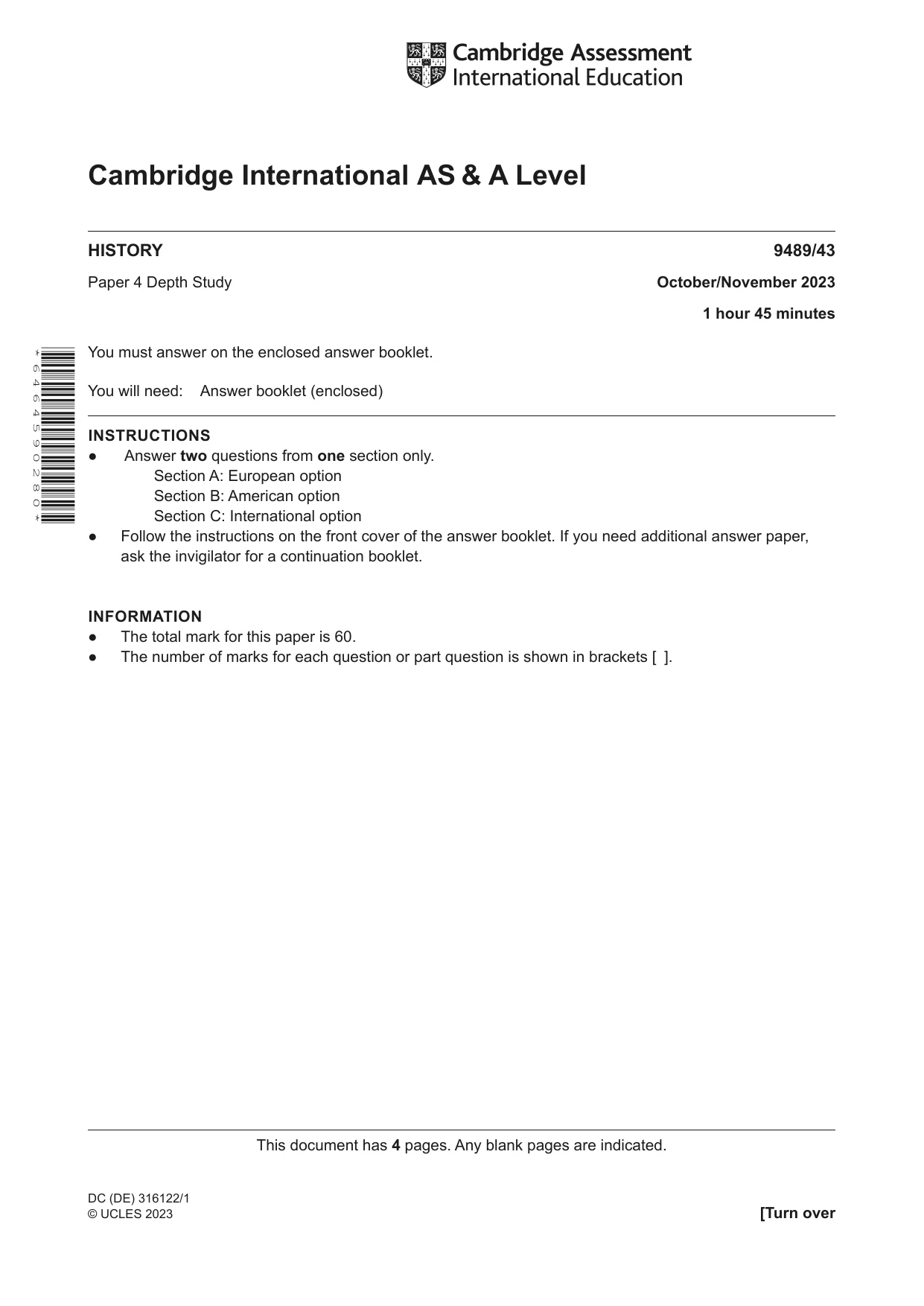
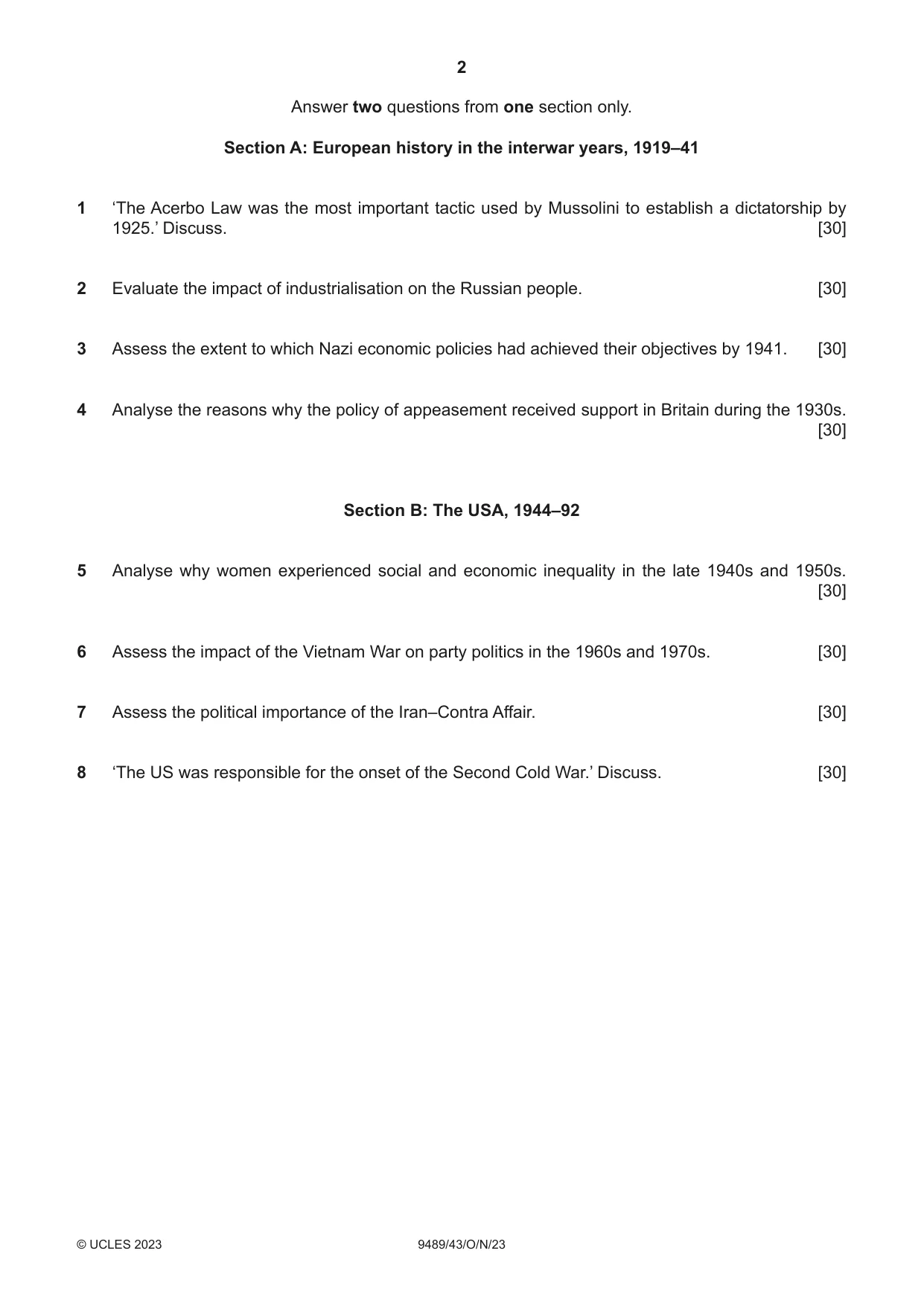
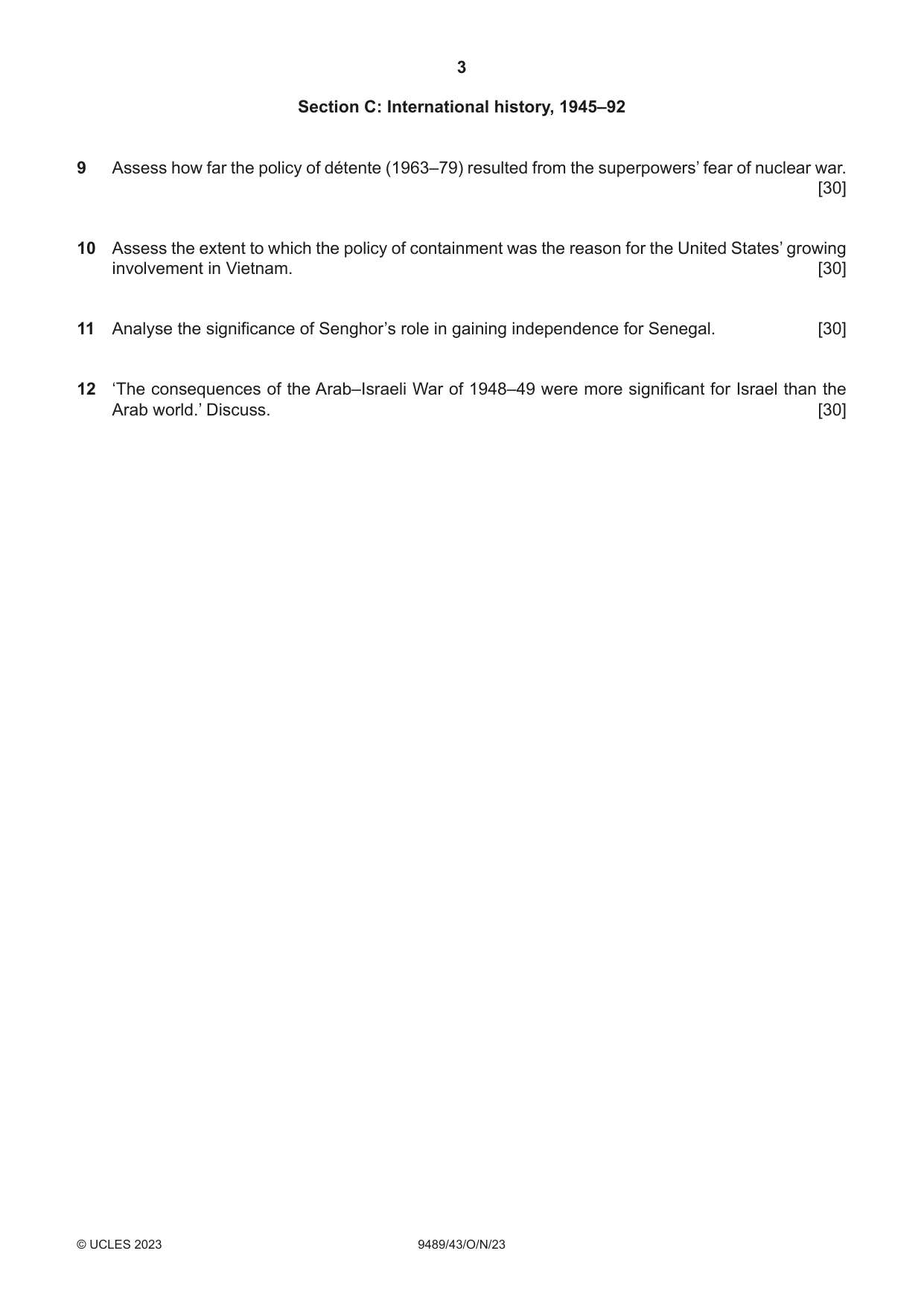
Mark scheme18 pages
Answers below. Sit the paper first if you are practising.

Questions as text
Q1 · ‘The Acerbo Law was the most important tactic used by Mussolini to establish a…
1 ‘The Acerbo Law was the most important tactic used by Mussolini to establish a dictatorship by 1925.’ Discuss. [30]
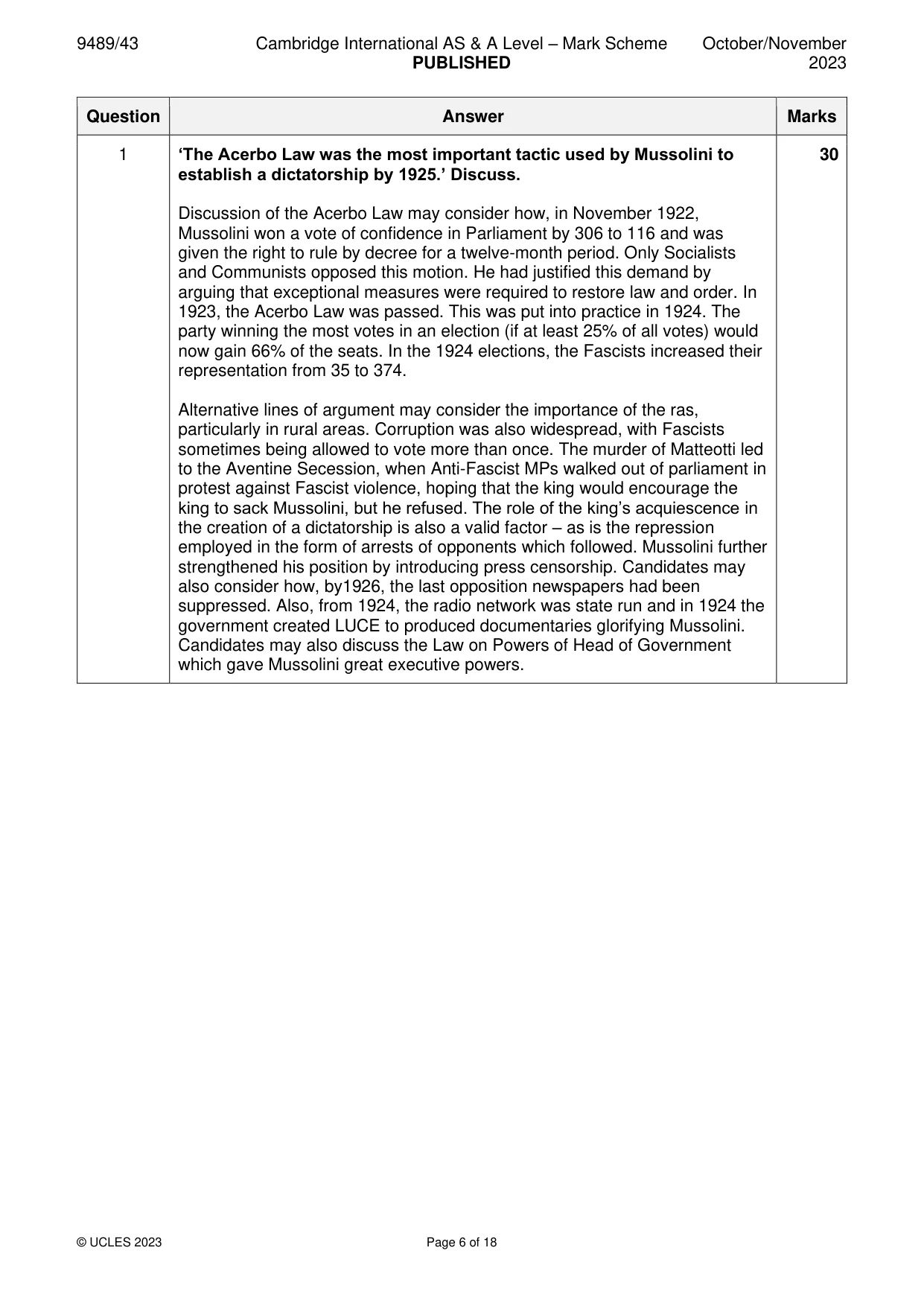
Mark scheme: Question Answer Marks 1 ‘The Acerbo Law was the most important tactic used by Mussolini to 30 establish a dictatorship by 1925.’ Discuss. Discussion of the Acerbo Law may consider how, in November 1922, Mussolini won a vote of confidence in Parliament by 306 to 116 and was given the right to rule by decree for a twelve-month period. Only Socialists and Communists opposed this motion. He had justified this demand by arguing that exceptional measures were required to restore law and order. In 1923, the Acerbo Law was passed. This was put into practice in 1924. The party winning the most votes in an election (if at least 25% of all votes) would now gain 66% of the seats. In the 1924 elections, the Fascists increased their representation from 35 to 374. Alternative lines of argument may consider the importance of the ras, particularly in rural areas. Corruption was also widespread, with Fascists sometimes being allowed to vote more than once. The murder of Matteotti led to the Aventine Secession, when Anti-Fascist MPs walked out of parliament in protest against Fascist violence, hoping that the king would encourage the king to sack Mussolini, but he refused. The role of the king’s acquiescence in the creation of a dictatorship is also a valid factor – as is the repression employed in the form of arrests of opponents which followed. Mussolini further strengthened his position by introducing press censorship. Candidates may also consider how, by1926, the last opposition newspapers had been suppressed. Also, from 1924, the radio network was state run and in 1924 the government created LUCE to produced documentaries glorifying Mussolini. Candidates may also discuss the Law on Powers of Head of Government which gave Mussolini great executive powers.
More questions on How did the rise of extremism affect international relations?
Q2 · Evaluate the impact of industrialisation on the Russian people
2 Evaluate the impact of industrialisation on the Russian people. [30]
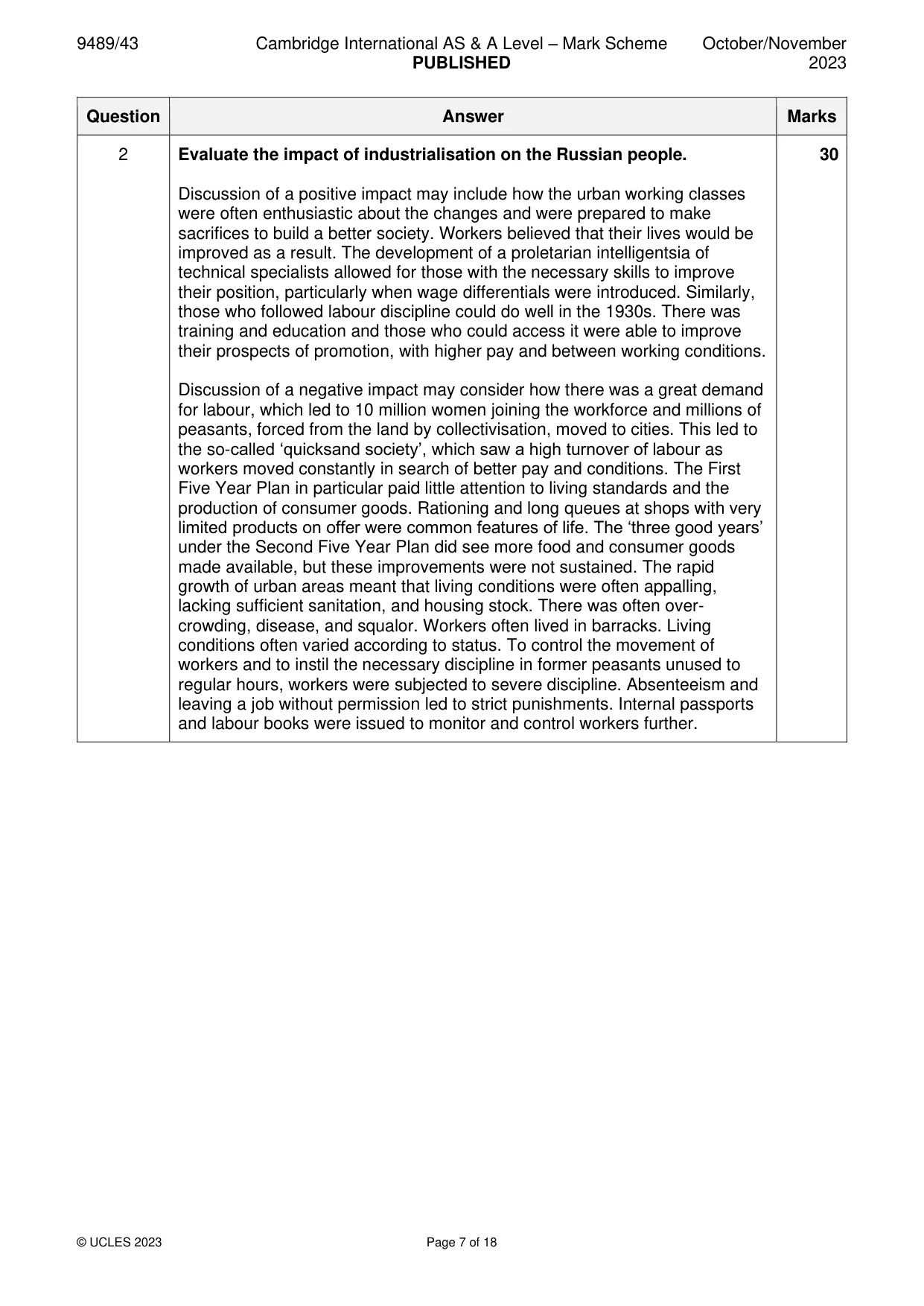
Mark scheme: 2 Evaluate the impact of industrialisation on the Russian people. 30 Discussion of a positive impact may include how the urban working classes were often enthusiastic about the changes and were prepared to make sacrifices to build a better society. Workers believed that their lives would be improved as a result. The development of a proletarian intelligentsia of technical specialists allowed for those with the necessary skills to improve their position, particularly when wage differentials were introduced. Similarly, those who followed labour discipline could do well in the 1930s. There was training and education and those who could access it were able to improve their prospects of promotion, with higher pay and between working conditions. Discussion of a negative impact may consider how there was a great demand for labour, which led to 10 million women joining the workforce and millions of peasants, forced from the land by collectivisation, moved to cities. This led to the so-called ‘quicksand society’, which saw a high turnover of labour as workers moved constantly in search of better pay and conditions. The First Five Year Plan in particular paid little attention to living standards and the production of consumer goods. Rationing and long queues at shops with very limited products on offer were common features of life. The ‘three good years’ under the Second Five Year Plan did see more food and consumer goods made available, but these improvements were not sustained. The rapid growth of urban areas meant that living conditions were often appalling, lacking sufficient sanitation, and housing stock. There was often over- crowding, disease, and squalor. Workers often lived in barracks. Living conditions often varied according to status. To control the movement of workers and to instil the necessary discipline in former peasants unused to regular hours, workers were subjected to severe discipline. Absenteeism and leaving a job without permission led to strict punishments. Internal passports and labour books were issued to monitor and control workers further.
More questions on What challenges faced the Tsarist regime in the years 1881–94?
Q3 · Assess the extent to which Nazi economic policies had achieved their objectives by 1941
3 Assess the extent to which Nazi economic policies had achieved their objectives by 1941. [30]
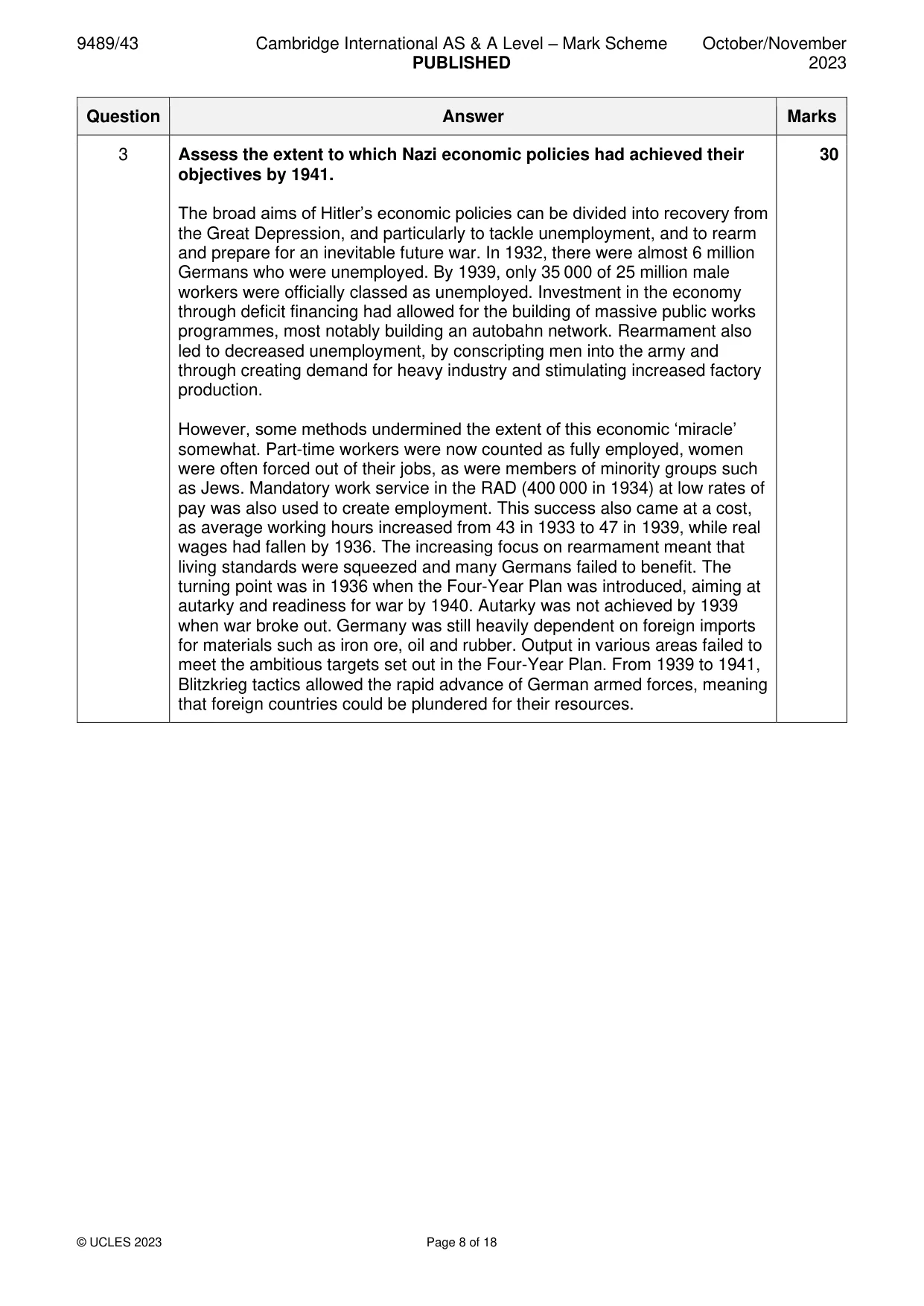
Mark scheme: 3 Assess the extent to which Nazi economic policies had achieved their 30 objectives by 1941. The broad aims of Hitler’s economic policies can be divided into recovery from the Great Depression, and particularly to tackle unemployment, and to rearm and prepare for an inevitable future war. In 1932, there were almost 6 million Germans who were unemployed. By 1939, only 35 000 of 25 million male workers were officially classed as unemployed. Investment in the economy through deficit financing had allowed for the building of massive public works programmes, most notably building an autobahn network. Rearmament also led to decreased unemployment, by conscripting men into the army and through creating demand for heavy industry and stimulating increased factory production. However, some methods undermined the extent of this economic ‘miracle’ somewhat. Part-time workers were now counted as fully employed, women were often forced out of their jobs, as were members of minority groups such as Jews. Mandatory work service in the RAD (400 000 in 1934) at low rates of pay was also used to create employment. This success also came at a cost, as average working hours increased from 43 in 1933 to 47 in 1939, while real wages had fallen by 1936. The increasing focus on rearmament meant that living standards were squeezed and many Germans failed to benefit. The turning point was in 1936 when the Four-Year Plan was introduced, aiming at autarky and readiness for war by 1940. Autarky was not achieved by 1939 when war broke out. Germany was still heavily dependent on foreign imports for materials such as iron ore, oil and rubber. Output in various areas failed to meet the ambitious targets set out in the Four-Year Plan. From 1939 to 1941, Blitzkrieg tactics allowed the rapid advance of German armed forces, meaning that foreign countries could be plundered for their resources.
More questions on How did the rise of extremism affect international relations?
Q4 · Analyse the reasons why the policy of appeasement received support in Britain during the…
4 Analyse the reasons why the policy of appeasement received support in Britain during the 1930s. [30]
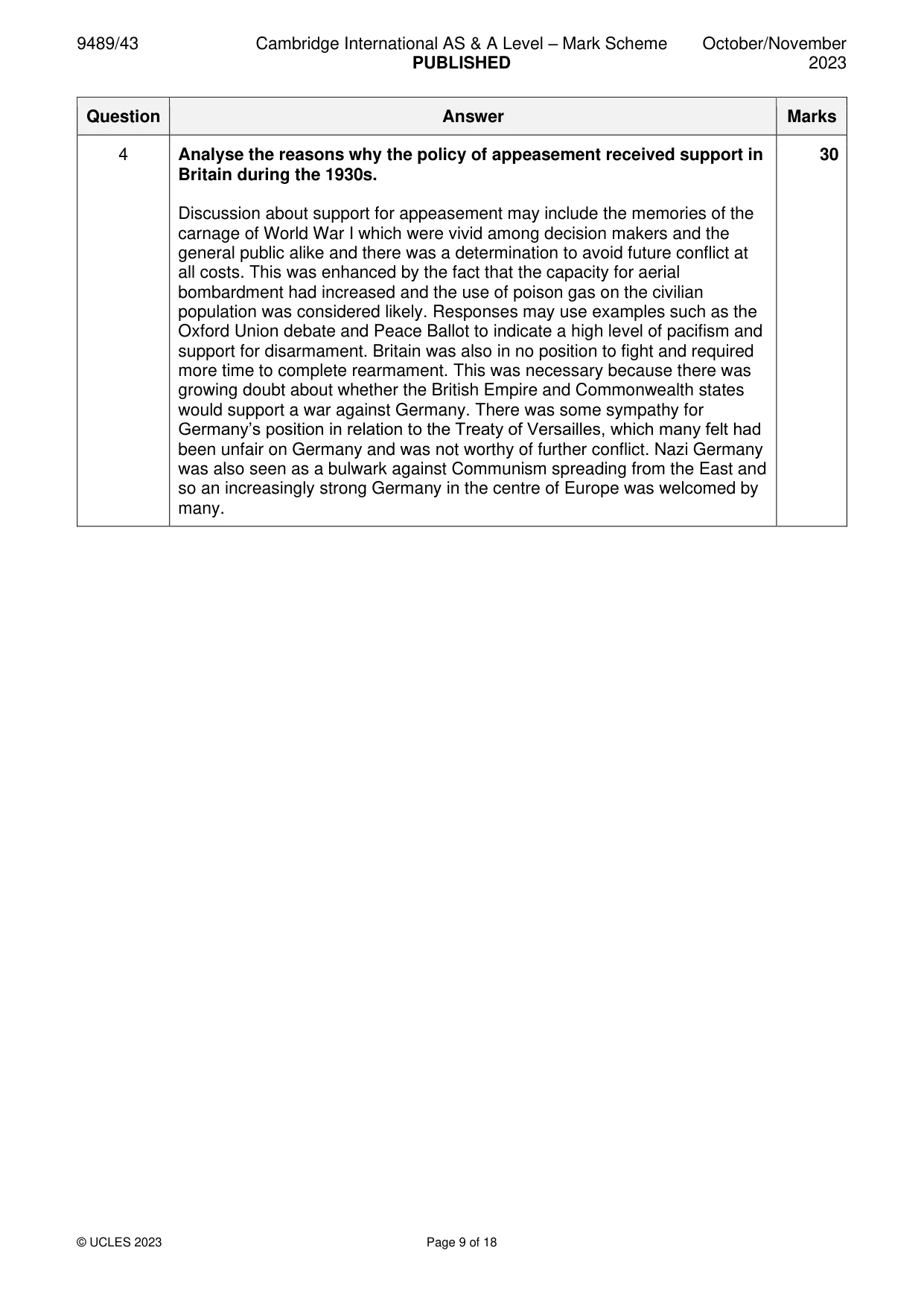
Mark scheme: 4 Analyse the reasons why the policy of appeasement received support in 30 Britain during the 1930s. Discussion about support for appeasement may include the memories of the carnage of World War I which were vivid among decision makers and the general public alike and there was a determination to avoid future conflict at all costs. This was enhanced by the fact that the capacity for aerial bombardment had increased and the use of poison gas on the civilian population was considered likely. Responses may use examples such as the Oxford Union debate and Peace Ballot to indicate a high level of pacifism and support for disarmament. Britain was also in no position to fight and required more time to complete rearmament. This was necessary because there was growing doubt about whether the British Empire and Commonwealth states would support a war against Germany. There was some sympathy for Germany’s position in relation to the Treaty of Versailles, which many felt had been unfair on Germany and was not worthy of further conflict. Nazi Germany was also seen as a bulwark against Communism spreading from the East and so an increasingly strong Germany in the centre of Europe was welcomed by many.
More questions on Why, and with what effects, did Britain and France pursue a policy of appeasement?
Q5 · Analyse why women experienced social and economic inequality in the late 1940s and 1950s
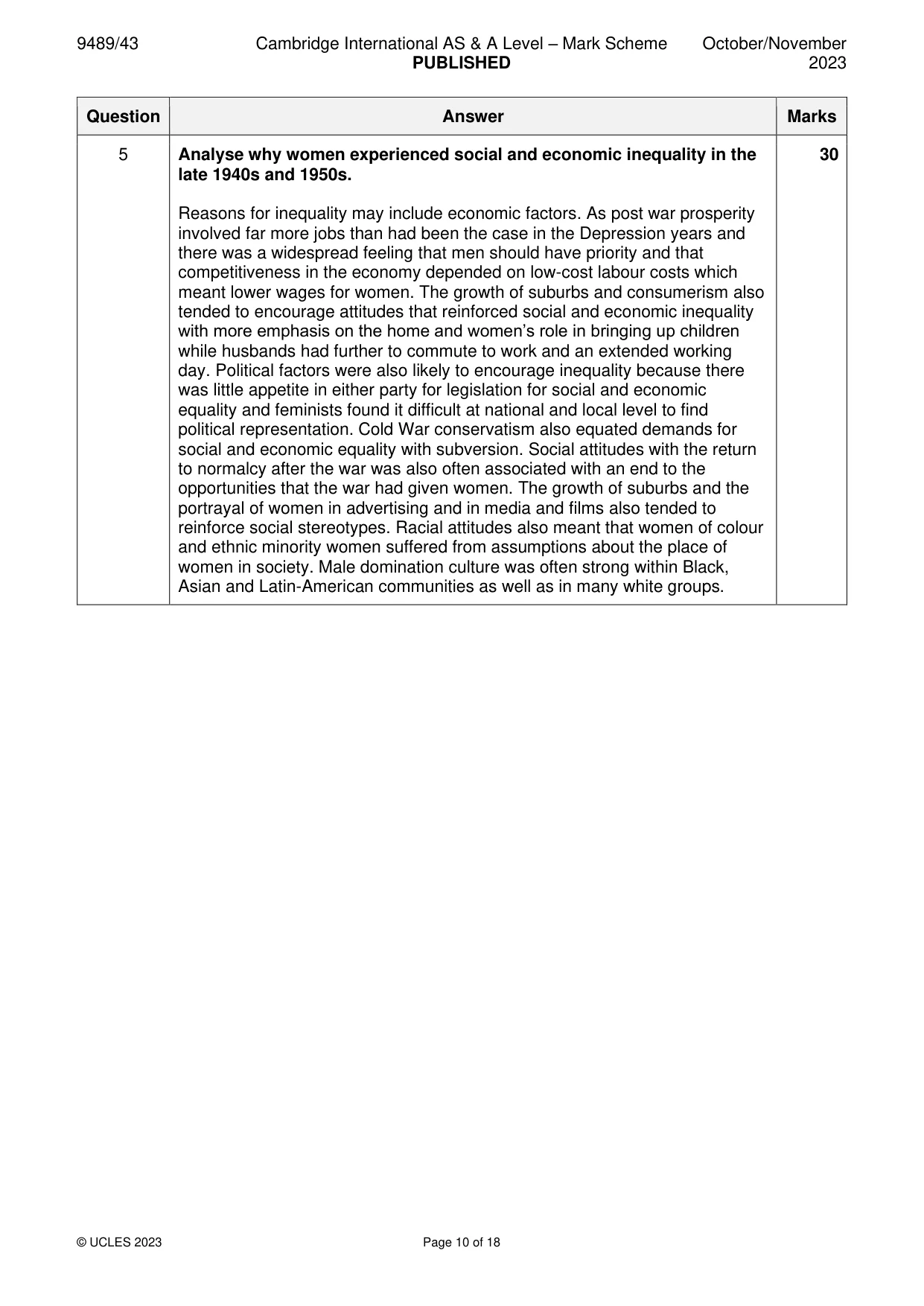
5 Analyse why women experienced social and economic inequality in the late 1940s and 1950s. [30]
Mark scheme: 5 Analyse why women experienced social and economic inequality in the 30 late 1940s and 1950s. Reasons for inequality may include economic factors. As post war prosperity involved far more jobs than had been the case in the Depression years and there was a widespread feeling that men should have priority and that competitiveness in the economy depended on low-cost labour costs which meant lower wages for women. The growth of suburbs and consumerism also tended to encourage attitudes that reinforced social and economic inequality with more emphasis on the home and women’s role in bringing up children while husbands had further to commute to work and an extended working day. Political factors were also likely to encourage inequality because there was little appetite in either party for legislation for social and economic equality and feminists found it difficult at national and local level to find political representation. Cold War conservatism also equated demands for social and economic equality with subversion. Social attitudes with the return to normalcy after the war was also often associated with an end to the opportunities that the war had given women. The growth of suburbs and the portrayal of women in advertising and in media and films also tended to reinforce social stereotypes. Racial attitudes also meant that women of colour and ethnic minority women suffered from assumptions about the place of women in society. Male domination culture was often strong within Black, Asian and Latin-American communities as well as in many white groups.
More questions on What were the consequences of the rapid economic growth after 1870?
Q6 · Assess the impact of the Vietnam War on party politics in the 1960s and 1970s
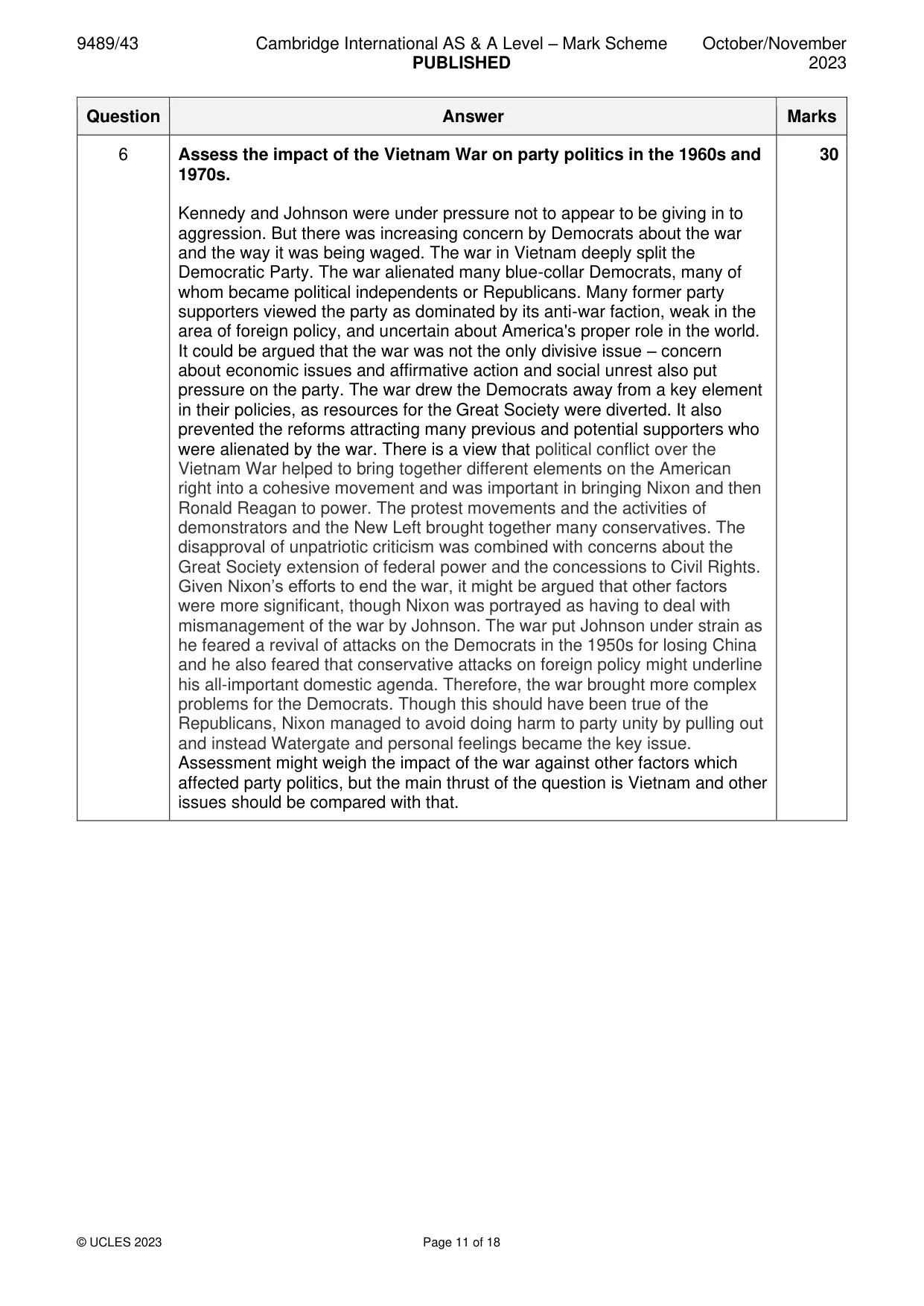
6 Assess the impact of the Vietnam War on party politics in the 1960s and 1970s. [30]
Mark scheme: 6 Assess the impact of the Vietnam War on party politics in the 1960s and 30 1970s. Kennedy and Johnson were under pressure not to appear to be giving in to aggression. But there was increasing concern by Democrats about the war and the way it was being waged. The war in Vietnam deeply split the Democratic Party. The war alienated many blue-collar Democrats, many of whom became political independents or Republicans. Many former party supporters viewed the party as dominated by its anti-war faction, weak in the area of foreign policy, and uncertain about America's proper role in the world. It could be argued that the war was not the only divisive issue – concern about economic issues and affirmative action and social unrest also put pressure on the party. The war drew the Democrats away from a key element in their policies, as resources for the Great Society were diverted. It also prevented the reforms attracting many previous and potential supporters who were alienated by the war. There is a view that political conflict over the Vietnam War helped to bring together different elements on the American right into a cohesive movement and was important in bringing Nixon and then Ronald Reagan to power. The protest movements and the activities of demonstrators and the New Left brought together many conservatives. The disapproval of unpatriotic criticism was combined with concerns about the Great Society extension of federal power and the concessions to Civil Rights. Given Nixon’s efforts to end the war, it might be argued that other factors were more significant, though Nixon was portrayed as having to deal with mismanagement of the war by Johnson. The war put Johnson under strain as he feared a revival of attacks on the Democrats in the 1950s for losing China and he also feared that conservative attacks on foreign policy might underline his all-important domestic agenda. Therefore, the war brought more complex problems for the Democrats. Though this should have been true of the Republicans, Nixon managed to avoid doing harm to party unity by pulling out and instead Watergate and personal feelings became the key issue. Assessment might weigh the impact of the war against other factors which affected party politics, but the main thrust of the question is Vietnam and other issues should be compared with that.
More questions on Why did the USA emerge as a world power and what was the impact on international
Q7 · Assess the political importance of the Iran–Contra Affair
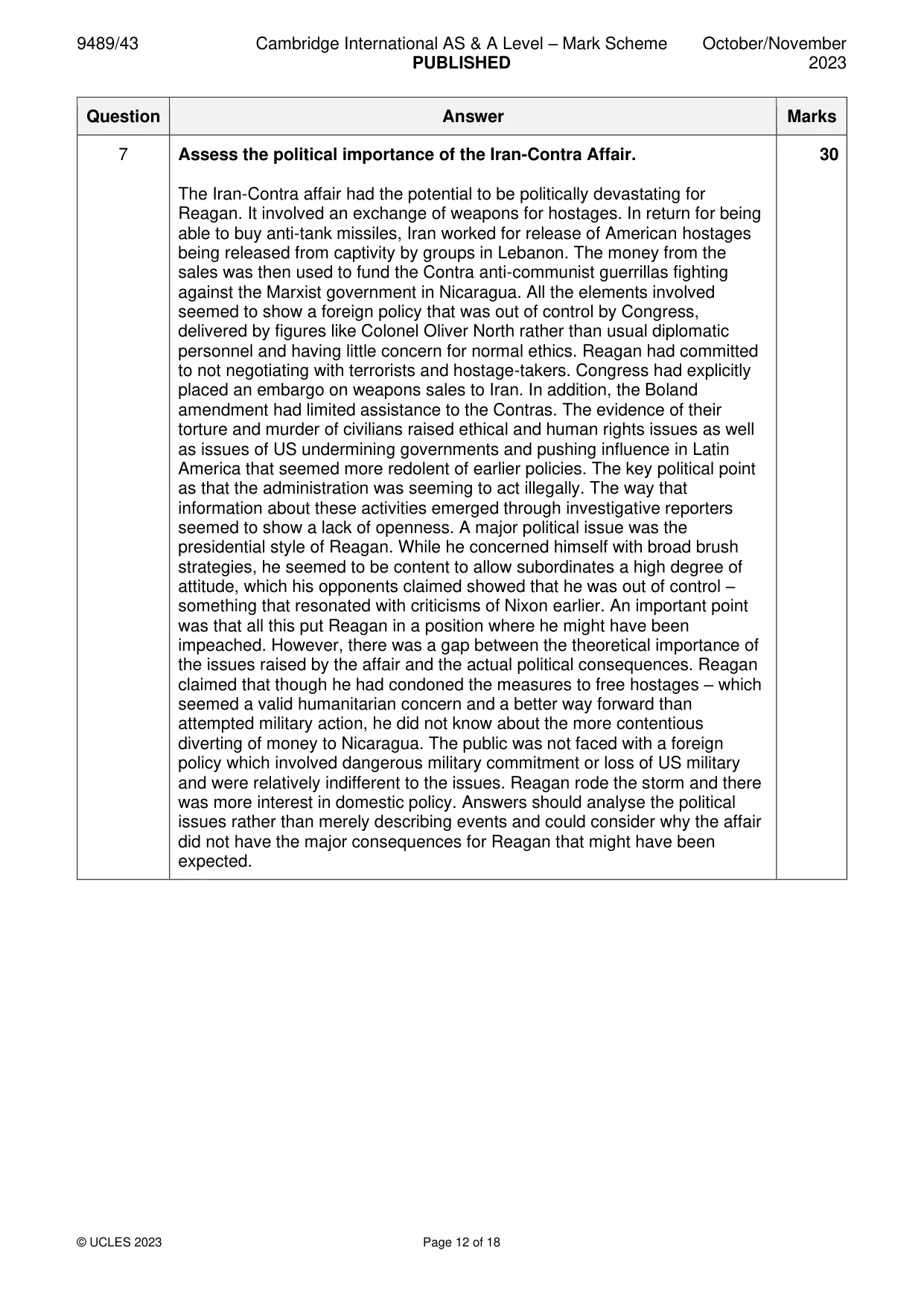
7 Assess the political importance of the Iran–Contra Affair. [30]
Mark scheme: 7 Assess the political importance of the Iran-Contra Affair. 30 The Iran-Contra affair had the potential to be politically devastating for Reagan. It involved an exchange of weapons for hostages. In return for being able to buy anti-tank missiles, Iran worked for release of American hostages being released from captivity by groups in Lebanon. The money from the sales was then used to fund the Contra anti-communist guerrillas fighting against the Marxist government in Nicaragua. All the elements involved seemed to show a foreign policy that was out of control by Congress, delivered by figures like Colonel Oliver North rather than usual diplomatic personnel and having little concern for normal ethics. Reagan had committed to not negotiating with terrorists and hostage-takers. Congress had explicitly placed an embargo on weapons sales to Iran. In addition, the Boland amendment had limited assistance to the Contras. The evidence of their torture and murder of civilians raised ethical and human rights issues as well as issues of US undermining governments and pushing influence in Latin America that seemed more redolent of earlier policies. The key political point as that the administration was seeming to act illegally. The way that information about these activities emerged through investigative reporters seemed to show a lack of openness. A major political issue was the presidential style of Reagan. While he concerned himself with broad brush strategies, he seemed to be content to allow subordinates a high degree of attitude, which his opponents claimed showed that he was out of control – something that resonated with criticisms of Nixon earlier. An important point was that all this put Reagan in a position where he might have been impeached. However, there was a gap between the theoretical importance of the issues raised by the affair and the actual political consequences. Reagan claimed that though he had condoned the measures to free hostages – which seemed a valid humanitarian concern and a better way forward than attempted military action, he did not know about the more contentious diverting of money to Nicaragua. The public was not faced with a foreign policy which involved dangerous military commitment or loss of US military and were relatively indifferent to the issues. Reagan rode the storm and there was more interest in domestic policy. Answers should analyse the political issues rather than merely describing events and could consider why the affair did not have the major consequences for Reagan that might have been expected.
More questions on Why did the USA emerge as a world power and what was the impact on international
Q8 · Section C: International history, 1945–92
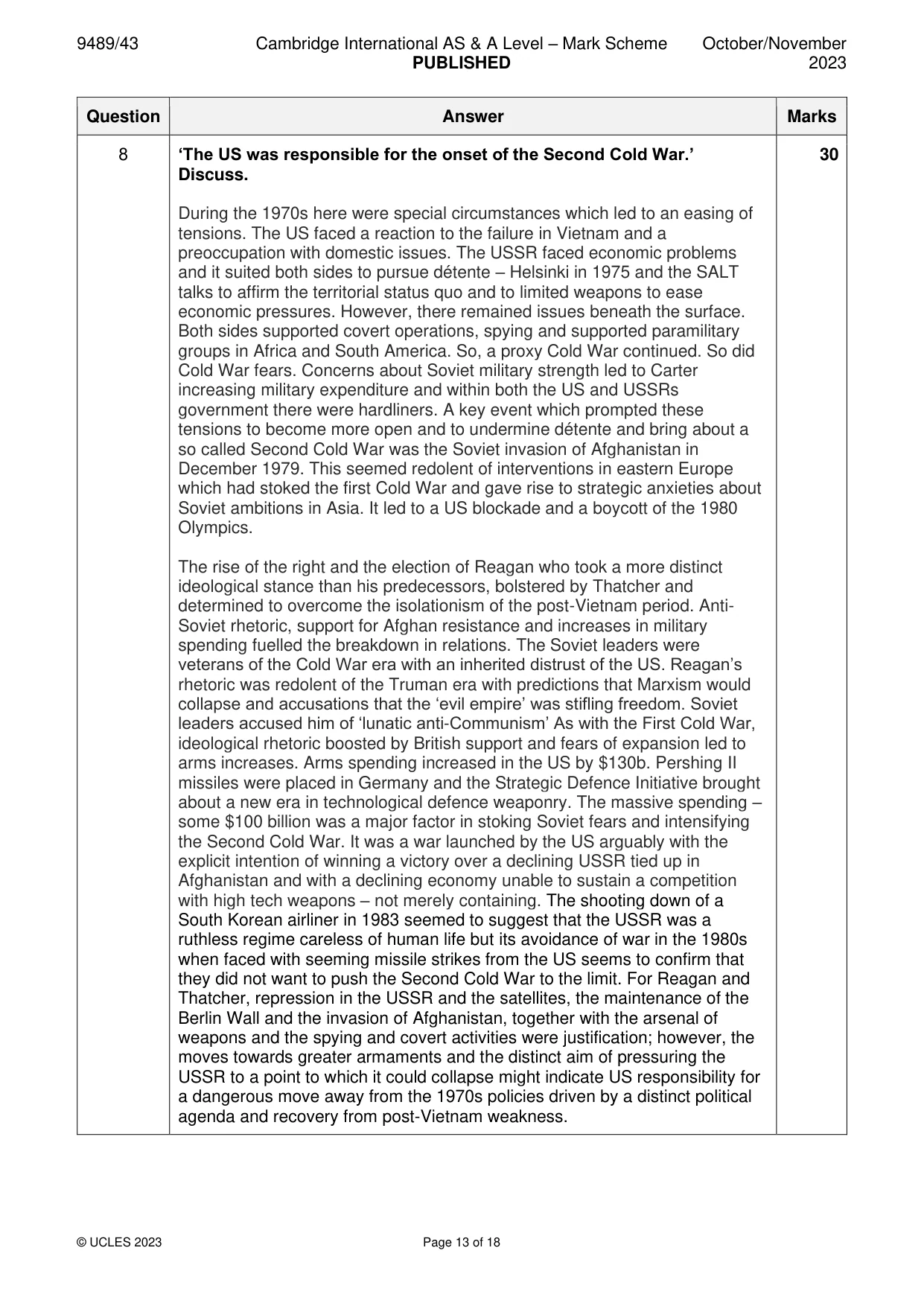
Section C: International history, 1945–92
Mark scheme: 8 ‘The US was responsible for the onset of the Second Cold War.’ 30 Discuss. During the 1970s here were special circumstances which led to an easing of tensions. The US faced a reaction to the failure in Vietnam and a preoccupation with domestic issues. The USSR faced economic problems and it suited both sides to pursue détente – Helsinki in 1975 and the SALT talks to affirm the territorial status quo and to limited weapons to ease economic pressures. However, there remained issues beneath the surface. Both sides supported covert operations, spying and supported paramilitary groups in Africa and South America. So, a proxy Cold War continued. So did Cold War fears. Concerns about Soviet military strength led to Carter increasing military expenditure and within both the US and USSRs government there were hardliners. A key event which prompted these tensions to become more open and to undermine détente and bring about a so called Second Cold War was the Soviet invasion of Afghanistan in December 1979. This seemed redolent of interventions in eastern Europe which had stoked the first Cold War and gave rise to strategic anxieties about Soviet ambitions in Asia. It led to a US blockade and a boycott of the 1980 Olympics. The rise of the right and the election of Reagan who took a more distinct ideological stance than his predecessors, bolstered by Thatcher and determined to overcome the isolationism of the post-Vietnam period. Anti- Soviet rhetoric, support for Afghan resistance and increases in military spending fuelled the breakdown in relations. The Soviet leaders were veterans of the Cold War era with an inherited distrust of the US. Reagan’s rhetoric was redolent of the Truman era with predictions that Marxism would collapse and accusations that the ‘evil empire’ was stifling freedom. Soviet leaders accused him of ‘lunatic anti-Communism’ As with the First Cold War, ideological rhetoric boosted by British support and fears of expansion led to arms increases. Arms spending increased in the US by $130b. Pershing II missiles were placed in Germany and the Strategic Defence Initiative brought about a new era in technological defence weaponry. The massive spending – some $100 billion was a major factor in stoking Soviet fears and intensifying the Second Cold War. It was a war launched by the US arguably with the explicit intention of winning a victory over a declining USSR tied up in Afghanistan and with a declining economy unable to sustain a competition with high tech weapons – not merely containing. The shooting down of a South Korean airliner in 1983 seemed to suggest that the USSR was a ruthless regime careless of human life but its avoidance of war in the 1980s when faced with seeming missile strikes from the US seems to confirm that they did not want to push the Second Cold War to the limit. For Reagan and Thatcher, repression in the USSR and the satellites, the maintenance of the Berlin Wall and the invasion of Afghanistan, together with the arsenal of weapons and the spying and covert activities were justification; however, the moves towards greater armaments and the distinct aim of pressuring the USSR to a point to which it could collapse might indicate US responsibility for a dangerous move away from the 1970s policies driven by a distinct political agenda and recovery from post-Vietnam weakness.
Q9 · Assess how far the policy of détente (1963–79) resulted from the superpowers’ fear of…
9 Assess how far the policy of détente (1963–79) resulted from the superpowers’ fear of nuclear war. [30]
Mark scheme: 9 Assess how far the policy of détente (1963–79) resulted from the 30 superpowers’ fear of nuclear war. The Cuban Missile Crisis of 1962 had increased public fear of nuclear war. The issue of Mutually Assured Destruction was also a factor as each side had believed that the other would not launch a first strike and now they were not sure. Towards the end of the 1960s there was a clear easing of US-Soviet tension as both acknowledged the need for negotiation and compromise. However, to the Soviets, détente did not mean an end to competition with the United States but an agreement not to escalate the competition to dangerous levels. Their goal was still global socialism but they wanted to avoid direct confrontation which may result in nuclear war. Improved communication did lead to arms reduction summits, the signing of anti-nuclear proliferation agreements and a reduction in nuclear arms stockpiles. Pressure groups like the Campaign for Nuclear Disarmament and Greenpeace lobbied nuclear powers against the further production and proliferation of nuclear weapons. In July 1968, the United States, USSR and Britain signed the Non-Proliferation Treaty, an international agreement to limit the spread of nuclear weapons and work towards nuclear disarmament. In August 1975, the United States, USSR and 33 other nations signed the Helsinki Accords aimed at enhancing relations between communist nations and the West. Both sides agreed to recognise the current borders of European countries, to respect human rights and freedoms in their countries and to help each other economically and technologically. The SALT talks in 1972 and 1979 outlawed the production of biological weapons and limited the numbers of ballistic missiles. The Space Race also ended with the launching of the joint American-Soviet space mission, the Apollo-Soyuz project in 1975. However, a change of leadership in the late 1960s and early 1970s, Richard Nixon in the United States and Leonid Brezhnev in the USSR, brought more pragmatic politicians to power; they had domestic issues to contend with and the arms race was expensive. The United States was spending billions of dollars on the Vietnam War which faced great opposition from the American people. The OPEC oil embargo of 1973 also hit its economy badly. The Watergate Scandal, resulting in Nixon’s resignation, also distracted the United States from foreign affairs. The USSR was preoccupied with economic problems, such as falling crop yields, internal opposition and problems within the Soviet bloc. Economic changes and conditions made arms spending and direct confrontation costly, dangerous and unpopular and resulted in the United States and USSR choosing negotiation rather than confrontation. The USSR also wanted to increase its trade with the West and was concerned about US improved relations with China. By 1967, Moscow and Beijing were barely communicating. In 1969, border clashes between Russian and Chinese soldiers threatened to plunge the two nuclear powers into a full-scale war. The United States saw advantages in perpetuating the Sino-Soviet split and in 1972 Nixon visited the PRC and met Mao Zedong leading to the restoration of diplomatic relations between Beijing and Washington. The USSR feared a US-China alliance. In May 1972, Nixon visited Moscow, met with Brezhnev and signed trade agreements and two treaties to reduce arms manufacture. However, the United States reacted strongly to the Soviet invasion of Afghanistan in December 1979 and Carter asked the Senate to postpone action on the SALT II nuclear weapons treaty.
More questions on How did the rise of extremism affect international relations?
Q10 · Assess the extent to which the policy of containment was the reason for the United…
10 Assess the extent to which the policy of containment was the reason for the United States’ growing involvement in Vietnam. [30]
Mark scheme: 10 Assess the extent to which the policy of containment was the reason for 30 the United States’ growing involvement in Vietnam. After the Viet Minh won a decisive victory at Dien Bien Phu in May 1954, France surrendered, and the Geneva Accords called for dividing Vietnam in half at the seventeenth parallel. Elections were never held, and the country remained divided with North Vietnam becoming a communist republic led by Ho Chi Minh while South Vietnam was a capitalist republic led by Ngo Dinh Diem. President Eisenhower referred to the Domino Theory in April 1954 believing it would be a disaster if IndoChina fell to communism. From 1958 the South came under increasing attack from communists based in South Vietnam who in 1960 formed the National Liberation Front and had the backing of North Vietnam. Kennedy believed that the United States had an obligation to help build strong non-communist native governments and to help governments and political movements that were trying to resist communist insurgencies. There was also a great fear of communism domestically. Johnson supported the domino theory, and he believed that South Vietnam was the victim of communist aggression from and directed by North Vietnam. If the United States failed to help South Vietnam, it would send a message to the rest of Southeast Asia and the world that the United States was not truly committed to containing communism. However, US involvement must also be set in the context of the Cold War. Cold war rivalries shaped US decision-making. The United States gave economic and military aid to South Vietnam, while the USSR and China offered assistance to North Vietnam. The Cold War power struggle between the United States, the USSR, and China was key in shaping the Vietnam War. In the context of the Cold War power struggle, Americans had to prove that their pronouncements about containing communism and aiding democracy building were credible. Kennedy argued that if the United States did not act aggressively to protect the region, China would come in and dominate it. The United States had a moral responsibility to help resist communist insurgencies. The region was important because in communist hands, it would pose a most serious threat to the security of the United States. Vietnam was the United States’ test case to prove that it could meet the global challenge of communist wars of liberation. Johnson’s anxieties about US credibility, combined with political instability in Saigon, China’s resistance to negotiations, and Hanoi’s refusal to remove troops from South Vietnam and stop aiding the NLF led him to escalate the US military presence in Vietnam from 1964 to 1967. In 1964 American naval forces in the Gulf of Tonkin reported being fired upon by North Vietnamese gunboats. The Gulf of Tonkin Resolution was passed by both houses of Congress within days of the naval confrontation. It gave the President broad authority to defend US troops in the region. In March 1965, President Johnson ordered US Marine battalions to defend the American airbase at Da Nang, the first-time combat troops were involved in the war. Operation Rolling Thunder began. The escalation continued throughout 1965 and by the end of 1967 the number of troops had risen from 184 000 to 490 000. However, the Tet Offensive in 1968 turned Americans against the war. From 1969 Nixon reduced the levels of combat troops but there was still considerable support for the war with the belief that Vietnam would be in vain if America simply withdrew from the war but without the combat support Saigon fell in 1975.
More questions on How did the rise of extremism affect international relations?
Q11 · Analyse the significance of Senghor’s role in gaining independence for Senegal
11 Analyse the significance of Senghor’s role in gaining independence for Senegal. [30]
Mark scheme: 11 Analyse the significance of Senghor’s role in gaining independence for 30 Senegal. Léopold Sédar Senghor was a philosophical leader who led Senegal to independence and laid the foundations for a stable state. Senghor and Mamadou Dia formed the Bloc Démocratique Sénégalais (BDS) which came to power in 1948. His formation of the party resulted partly from a protest against what he considered France’s lack of consideration for the interests of Africa. Senghor’s friends in Senegal helped gather support for the new party. The BDS principles were to ‘ensure equitable, democratic participation by all major regional, ethnic, and economic interests’. In 1951, it won both Senegalese seats in the French National Assembly and, in 1952, 43 of the 50 seats in Senegal's Territorial Assembly. Senghor and Mamadou Dia secured overwhelming majorities at the parliamentary elections in 1956 and launched a campaign to unite all Senegalese parties. In April 1958 the Union Progressiste Sénégalaise (UPS) was formed. The UPS won all 80 seats in the elections to the Senegal legislature in 1959. African socialism, was the political doctrine that would become the platform for Senghor’s UPS party. Senghor and Mamadou Dia, emphasised the creation of a socialist society grounded on a combination of modern economic planning and traditional African communitarian values. They wanted to preserve the economic and technical advantages of colonial rule and reject the colonial system’s flaws. Senghor’s African socialism for Senegal differed from conventional Marxism; it encouraged spiritual freedom and rejected implicit Marxist atheism which were more acceptable to the country’s Muslim religious leaders than Marxist ideology. However, independence as a nation state was not Senghor’s first choice. As problems with France’s African colonies escalated with the revolt in Algeria in 1955, Senghor was appointed by the French government to investigate the problems of overseas territories. He urged France to allow African states to form in loose confederations. France granted internal autonomy to its African territories under the provisions of the Loi-cadre of 1956 which was seen by the French government as an alternative to political independence. But the collapse of the Fourth Republic shortly afterwards put in jeopardy France’s plans to keep its black African colonies under French control. When Charles De Gaulle offered Senghor the opportunity to take immediate independence in the 1958 referendum that established the Fifth Republic, he, together with all the other leaders of French Africa apart from Touré in Guinea, refused. Instead, he campaigned successfully to persuade the Senegalese to vote against immediate independence, arguing that this was the best way of retaining French development funds. Less than two years later, when the international tide against colonialism and the political and economic costs to France of maintaining colonial rule convinced De Gaulle to move rapidly to grant independence to black Africa, Senghor chose to retain close political, military, and cultural links with France and supported efforts to create a West African Federation consisting of Senegal, the French Sudan, Upper Volta, and Dahomey, called the Mali Federation. 11 The latter two countries soon withdrew after the first constitution was drafted and a second constitution for the Mali Federation, including only Senegal and Sudan, was drafted in June 1959. The Federation gained independence a year later. The new federal constitution altered the balance of power to fit the two-state system, creating a dual executive at Senegal’s insistence. However, disagreements led to Senegal’s withdrawal. Senegal then drafted its own constitution, and Senghor was elected its first president in 1960.
More questions on Why was imperialism a significant force in Africa from 1870?
Q12 · ‘The consequences of the Arab–Israeli War of 1948–49 were more significant for Israel…
12 ‘The consequences of the Arab–Israeli War of 1948–49 were more significant for Israel than the Arab world.’ Discuss. [30]
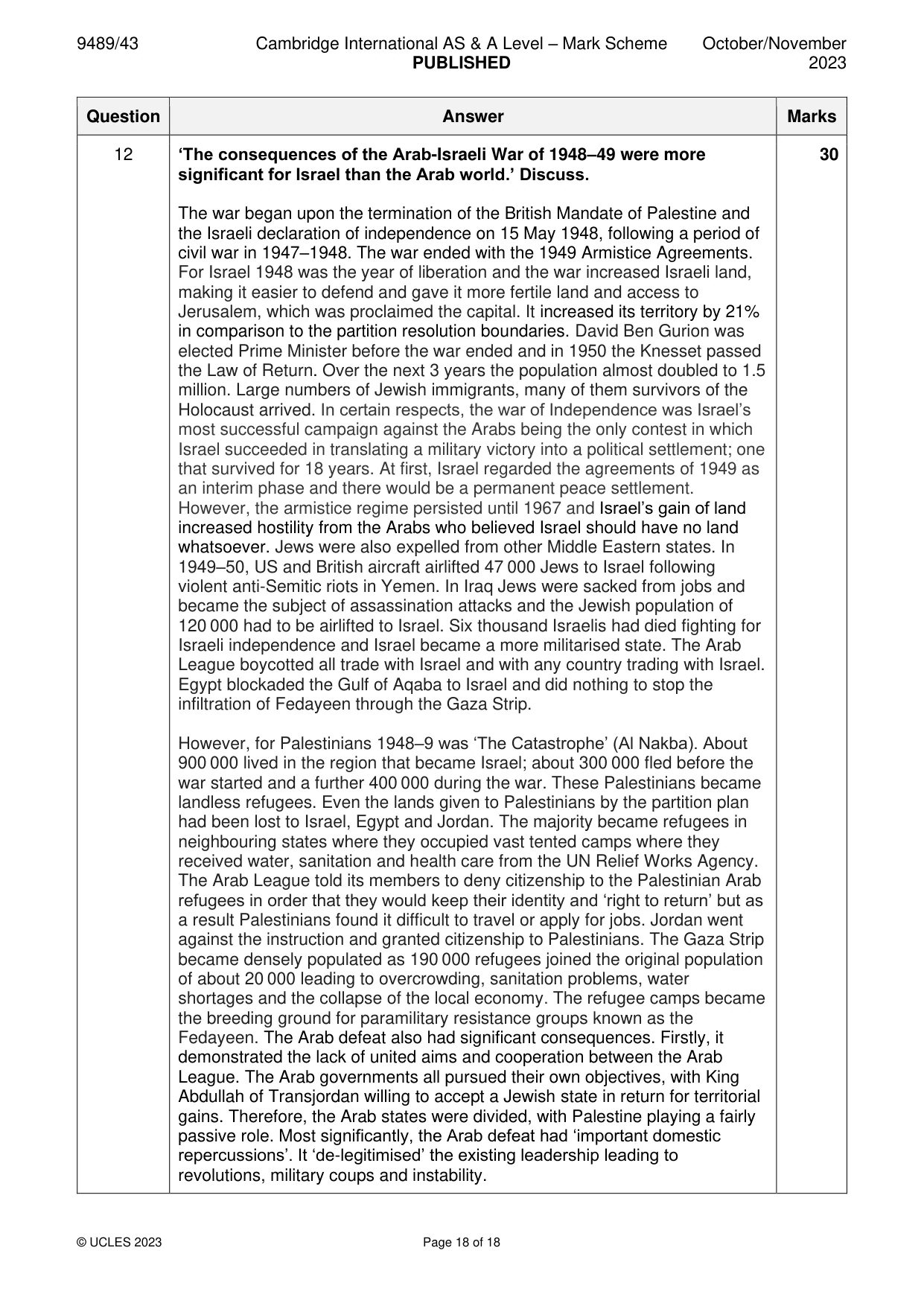
Mark scheme: 12 ‘The consequences of the Arab-Israeli War of 1948–49 were more 30 significant for Israel than the Arab world.’ Discuss. The war began upon the termination of the British Mandate of Palestine and the Israeli declaration of independence on 15 May 1948, following a period of civil war in 1947–1948. The war ended with the 1949 Armistice Agreements. For Israel 1948 was the year of liberation and the war increased Israeli land, making it easier to defend and gave it more fertile land and access to Jerusalem, which was proclaimed the capital. It increased its territory by 21% in comparison to the partition resolution boundaries. David Ben Gurion was elected Prime Minister before the war ended and in 1950 the Knesset passed the Law of Return. Over the next 3 years the population almost doubled to 1.5 million. Large numbers of Jewish immigrants, many of them survivors of the Holocaust arrived. In certain respects, the war of Independence was Israel’s most successful campaign against the Arabs being the only contest in which Israel succeeded in translating a military victory into a political settlement; one that survived for 18 years. At first, Israel regarded the agreements of 1949 as an interim phase and there would be a permanent peace settlement. However, the armistice regime persisted until 1967 and Israel’s gain of land increased hostility from the Arabs who believed Israel should have no land whatsoever. Jews were also expelled from other Middle Eastern states. In 1949–50, US and British aircraft airlifted 47 000 Jews to Israel following violent anti-Semitic riots in Yemen. In Iraq Jews were sacked from jobs and became the subject of assassination attacks and the Jewish population of 120 000 had to be airlifted to Israel. Six thousand Israelis had died fighting for Israeli independence and Israel became a more militarised state. The Arab League boycotted all trade with Israel and with any country trading with Israel. Egypt blockaded the Gulf of Aqaba to Israel and did nothing to stop the infiltration of Fedayeen through the Gaza Strip. However, for Palestinians 1948–9 was ‘The Catastrophe’ (Al Nakba). About 900 000 lived in the region that became Israel; about 300 000 fled before the war started and a further 400 000 during the war. These Palestinians became landless refugees. Even the lands given to Palestinians by the partition plan had been lost to Israel, Egypt and Jordan. The majority became refugees in neighbouring states where they occupied vast tented camps where they received water, sanitation and health care from the UN Relief Works Agency. The Arab League told its members to deny citizenship to the Palestinian Arab refugees in order that they would keep their identity and ‘right to return’ but as a result Palestinians found it difficult to travel or apply for jobs. Jordan went against the instruction and granted citizenship to Palestinians. The Gaza Strip became densely populated as 190 000 refugees joined the original population of about 20 000 leading to overcrowding, sanitation problems, water shortages and the collapse of the local economy. The refugee camps became the breeding ground for paramilitary resistance groups known as the Fedayeen. The Arab defeat also had significant consequences. Firstly, it demonstrated the lack of united aims and cooperation between the Arab League. The Arab governments all pursued their own objectives, with King Abdullah of Transjordan willing to accept a Jewish state in return for territorial gains. Therefore, the Arab states were divided, with Palestine playing a fairly passive role. Most significantly, the Arab defeat had ‘important domestic repercussions’. It ‘de-legitimised’ the existing leadership leading to revolutions, military coups and instability.
More questions on Why did the League of Nations fail to keep the peace in the 1930s?
What was in this paper
The subtopics covered by these 12 questions, and how many questions each got. Open one in a new tab to see every Cambridge question on it.
4Why did the USA emerge as a world power and what was the impact on international2What challenges faced the Tsarist regime in the years 1881–94?1What were the consequences of the rapid economic growth after 1870?1Why did the League of Nations fail to keep the peace in the 1930s?1Why did war break out in 1939?1Why was imperialism a significant force in Africa from 1870?1Why, and with what effects, did Britain and France pursue a policy of appeasement?1What you needed in this session
Cambridge’s own grade thresholds for 2023 Oct/Nov, Paper 4 · Variant 3. A higher threshold means an easier paper — the bar moves with how the cohort did.