Cambridge A Level History 9489 — 2022 May/June Paper 4 · Variant 1
9489/41/M/J/22 · 11 questions · 60 marks · ≈68 min
The question paper and its mark scheme, free to read here and free to download. This is Cambridge’s own paper, exactly as it was sat.
Question paper4 pages
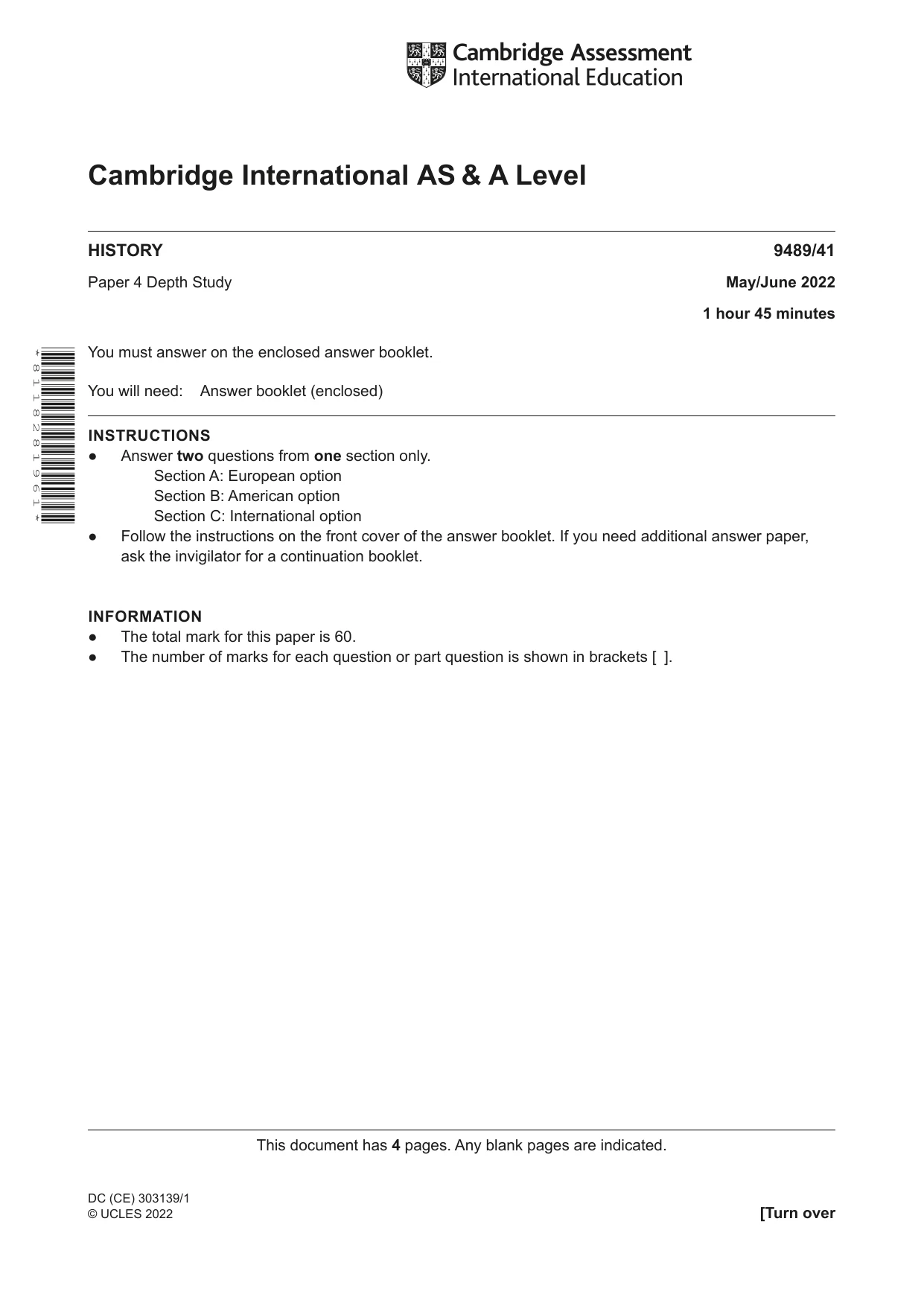
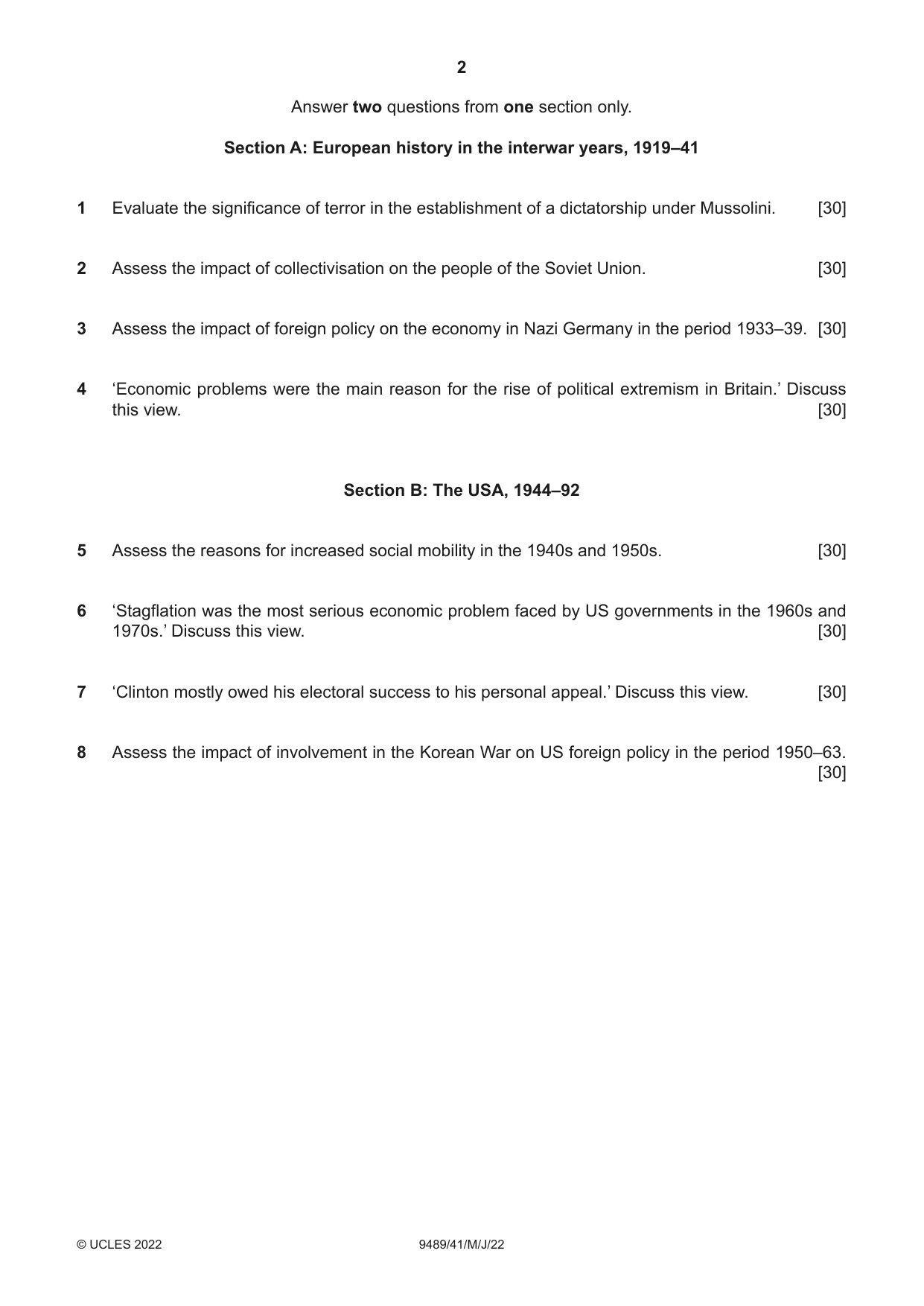
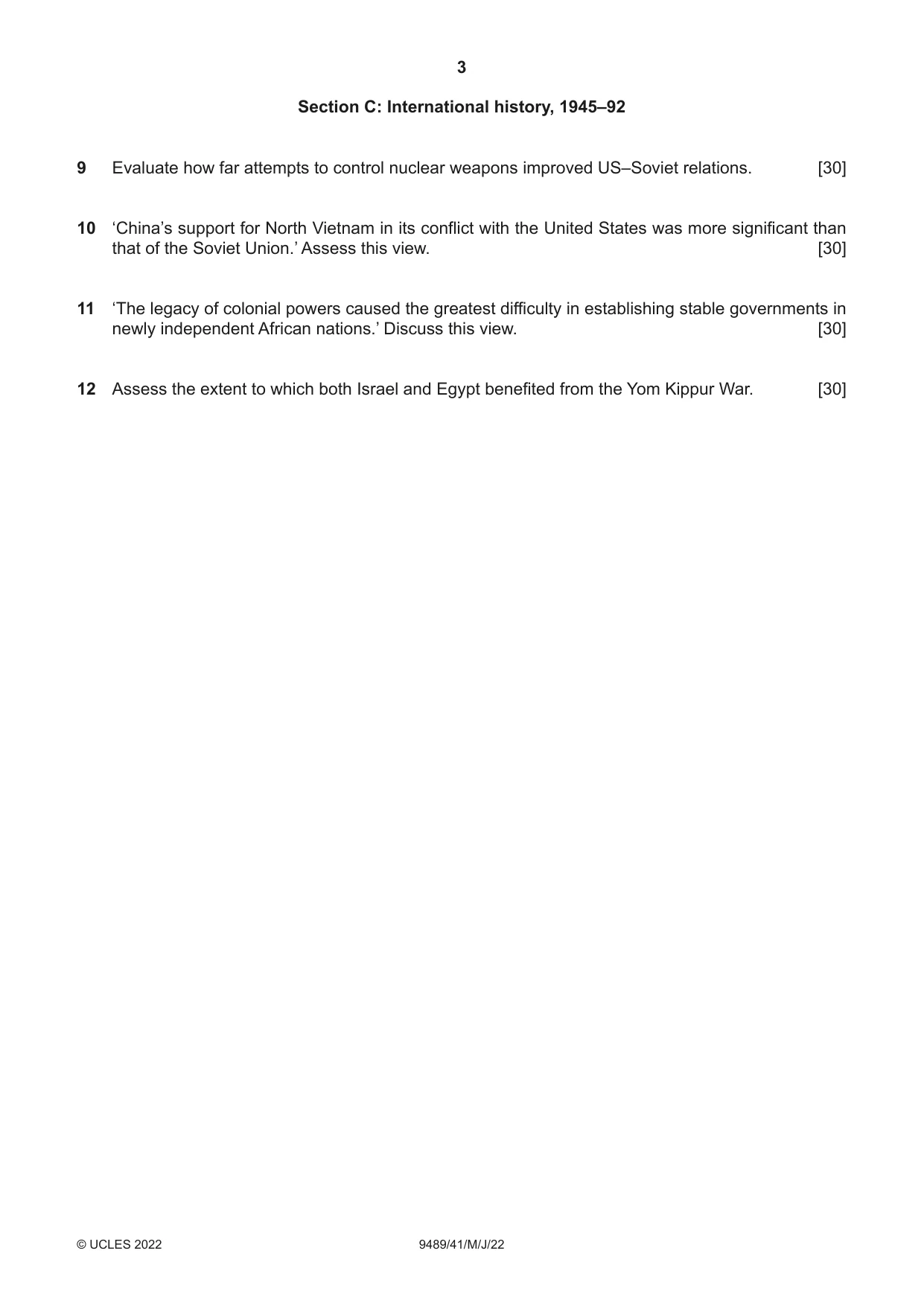
Mark scheme20 pages
Answers below. Sit the paper first if you are practising.
Questions as text
Q1 · Evaluate the significance of terror in the establishment of a dictatorship under Mussolini
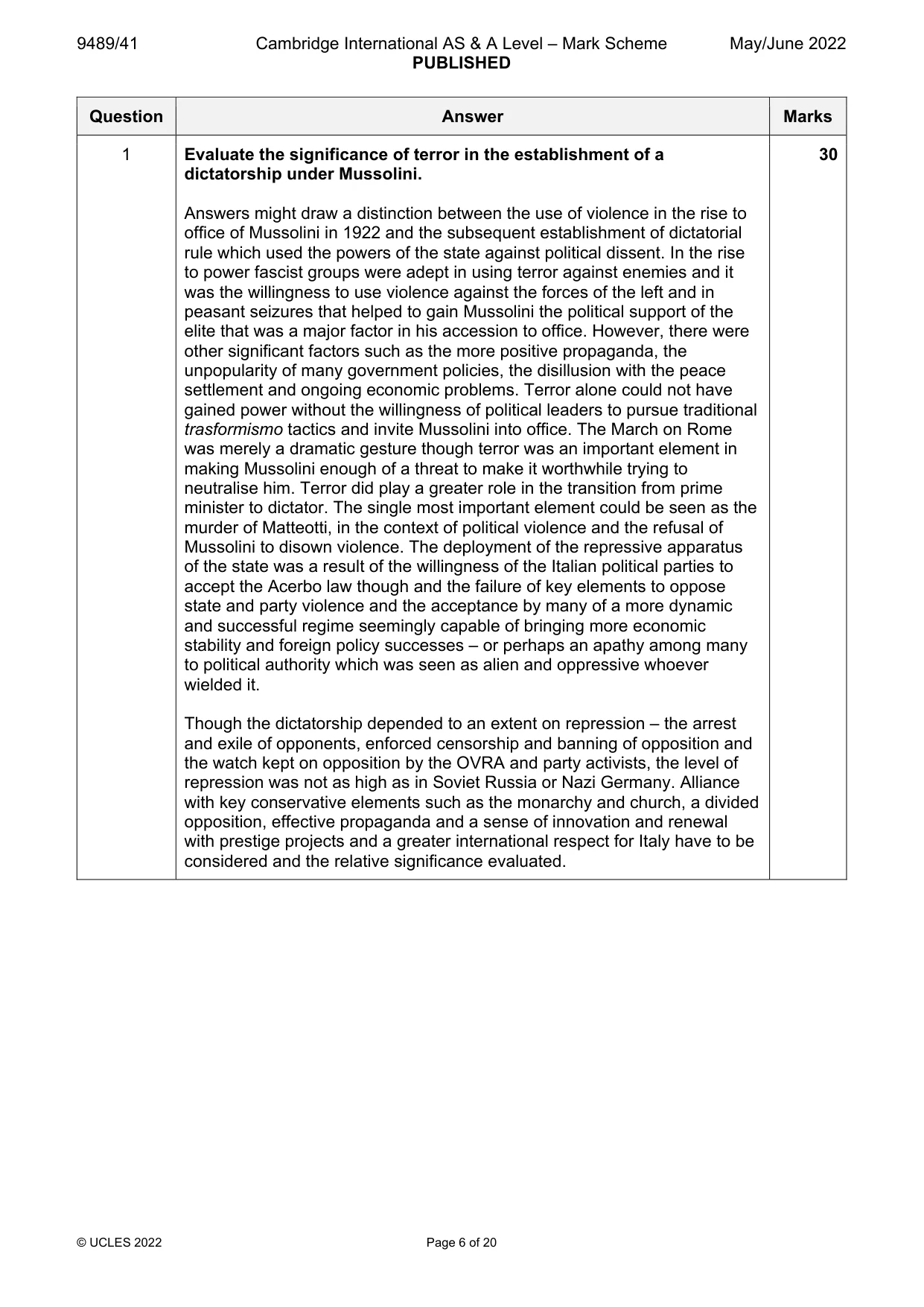
1 Evaluate the significance of terror in the establishment of a dictatorship under Mussolini. [30]
Mark scheme: Question Answer Marks 1 Evaluate the significance of terror in the establishment of a 30 dictatorship under Mussolini. Answers might draw a distinction between the use of violence in the rise to office of Mussolini in 1922 and the subsequent establishment of dictatorial rule which used the powers of the state against political dissent. In the rise to power fascist groups were adept in using terror against enemies and it was the willingness to use violence against the forces of the left and in peasant seizures that helped to gain Mussolini the political support of the elite that was a major factor in his accession to office. However, there were other significant factors such as the more positive propaganda, the unpopularity of many government policies, the disillusion with the peace settlement and ongoing economic problems. Terror alone could not have gained power without the willingness of political leaders to pursue traditional trasformismo tactics and invite Mussolini into office. The March on Rome was merely a dramatic gesture though terror was an important element in making Mussolini enough of a threat to make it worthwhile trying to neutralise him. Terror did play a greater role in the transition from prime minister to dictator. The single most important element could be seen as the murder of Matteotti, in the context of political violence and the refusal of Mussolini to disown violence. The deployment of the repressive apparatus of the state was a result of the willingness of the Italian political parties to accept the Acerbo law though and the failure of key elements to oppose state and party violence and the acceptance by many of a more dynamic and successful regime seemingly capable of bringing more economic stability and foreign policy successes – or perhaps an apathy among many to political authority which was seen as alien and oppressive whoever wielded it. Though the dictatorship depended to an extent on repression – the arrest and exile of opponents, enforced censorship and banning of opposition and the watch kept on opposition by the OVRA and party activists, the level of repression was not as high as in Soviet Russia or Nazi Germany. Alliance with key conservative elements such as the monarchy and church, a divided opposition, effective propaganda and a sense of innovation and renewal with prestige projects and a greater international respect for Italy have to be considered and the relative significance evaluated.
More questions on How did the rise of extremism affect international relations?
Q2 · Assess the impact of collectivisation on the people of the Soviet Union
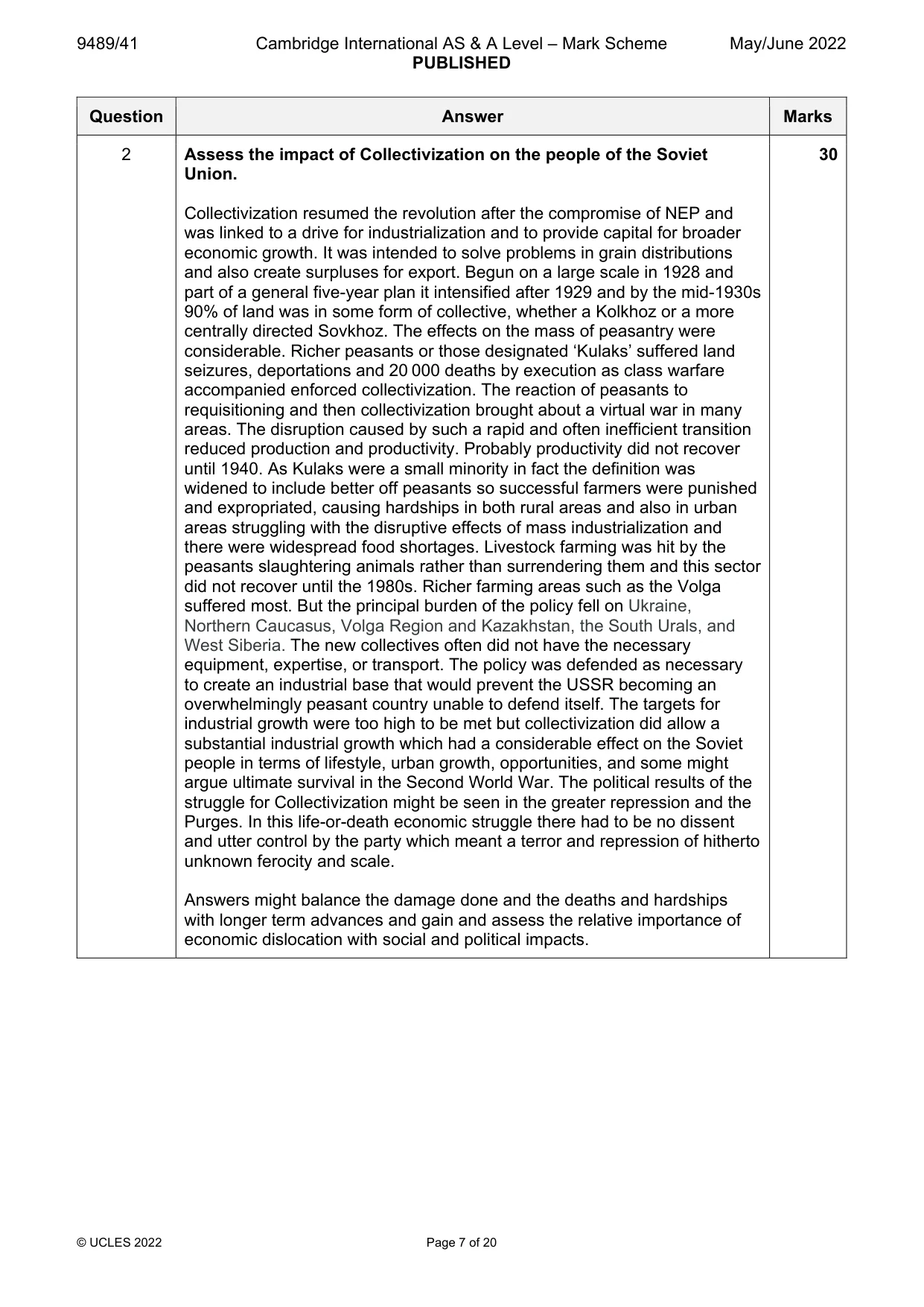
2 Assess the impact of collectivisation on the people of the Soviet Union. [30]
Mark scheme: 2 Assess the impact of Collectivization on the people of the Soviet 30 Union. Collectivization resumed the revolution after the compromise of NEP and was linked to a drive for industrialization and to provide capital for broader economic growth. It was intended to solve problems in grain distributions and also create surpluses for export. Begun on a large scale in 1928 and part of a general five-year plan it intensified after 1929 and by the mid-1930s 90% of land was in some form of collective, whether a Kolkhoz or a more centrally directed Sovkhoz. The effects on the mass of peasantry were considerable. Richer peasants or those designated ‘Kulaks’ suffered land seizures, deportations and 20 000 deaths by execution as class warfare accompanied enforced collectivization. The reaction of peasants to requisitioning and then collectivization brought about a virtual war in many areas. The disruption caused by such a rapid and often inefficient transition reduced production and productivity. Probably productivity did not recover until 1940. As Kulaks were a small minority in fact the definition was widened to include better off peasants so successful farmers were punished and expropriated, causing hardships in both rural areas and also in urban areas struggling with the disruptive effects of mass industrialization and there were widespread food shortages. Livestock farming was hit by the peasants slaughtering animals rather than surrendering them and this sector did not recover until the 1980s. Richer farming areas such as the Volga suffered most. But the principal burden of the policy fell on Ukraine, Northern Caucasus, Volga Region and Kazakhstan, the South Urals, and West Siberia. The new collectives often did not have the necessary equipment, expertise, or transport. The policy was defended as necessary to create an industrial base that would prevent the USSR becoming an overwhelmingly peasant country unable to defend itself. The targets for industrial growth were too high to be met but collectivization did allow a substantial industrial growth which had a considerable effect on the Soviet people in terms of lifestyle, urban growth, opportunities, and some might argue ultimate survival in the Second World War. The political results of the struggle for Collectivization might be seen in the greater repression and the Purges. In this life-or-death economic struggle there had to be no dissent and utter control by the party which meant a terror and repression of hitherto unknown ferocity and scale. Answers might balance the damage done and the deaths and hardships with longer term advances and gain and assess the relative importance of economic dislocation with social and political impacts.
More questions on How were the Bolsheviks able to consolidate their power up to 1924?
Q3 · Assess the impact of foreign policy on the economy in Nazi Germany in the period 1933–39
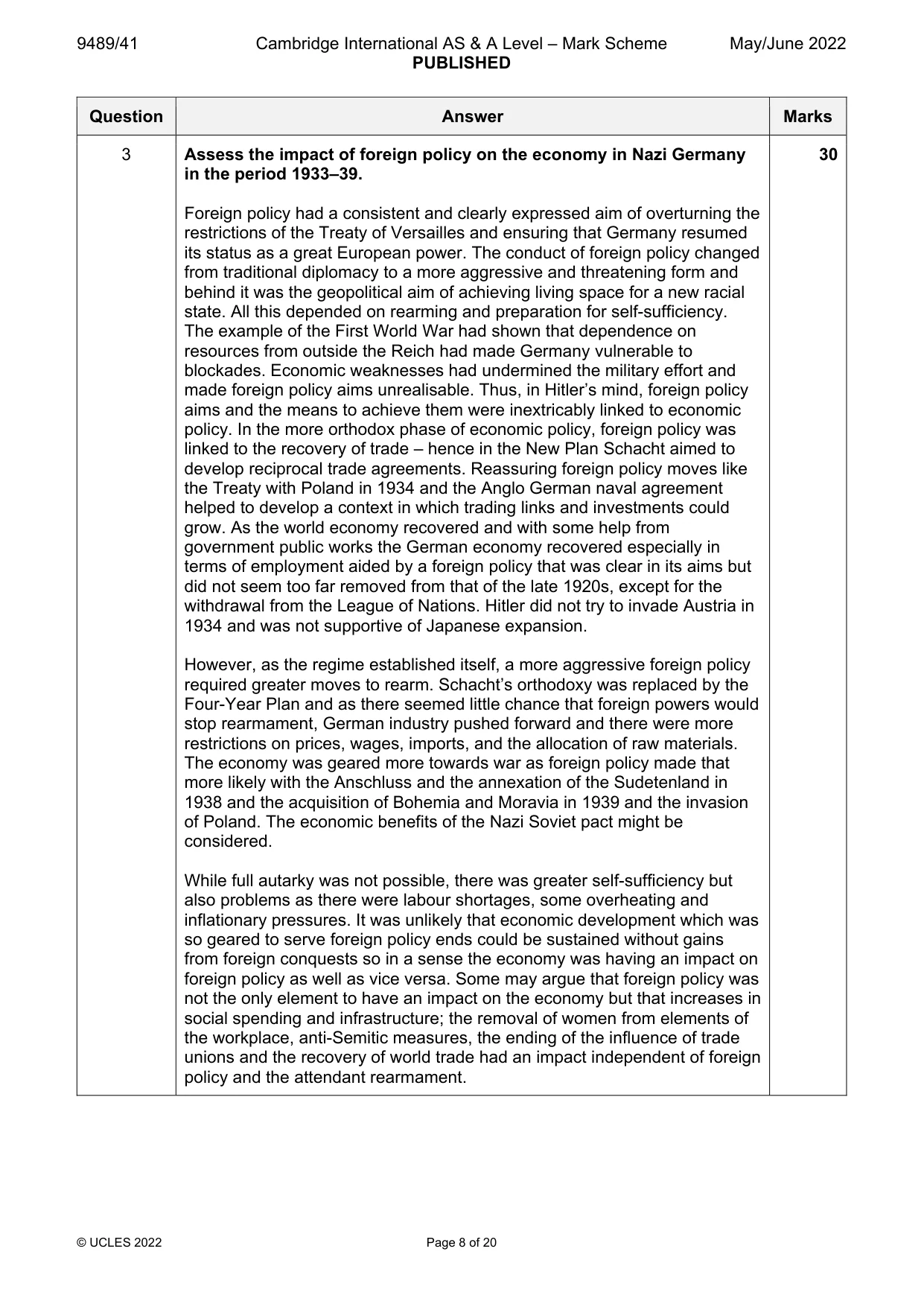
3 Assess the impact of foreign policy on the economy in Nazi Germany in the period 1933–39. [30]
Mark scheme: 3 Assess the impact of foreign policy on the economy in Nazi Germany 30 in the period 1933–39. Foreign policy had a consistent and clearly expressed aim of overturning the restrictions of the Treaty of Versailles and ensuring that Germany resumed its status as a great European power. The conduct of foreign policy changed from traditional diplomacy to a more aggressive and threatening form and behind it was the geopolitical aim of achieving living space for a new racial state. All this depended on rearming and preparation for self-sufficiency. The example of the First World War had shown that dependence on resources from outside the Reich had made Germany vulnerable to blockades. Economic weaknesses had undermined the military effort and made foreign policy aims unrealisable. Thus, in Hitler’s mind, foreign policy aims and the means to achieve them were inextricably linked to economic policy. In the more orthodox phase of economic policy, foreign policy was linked to the recovery of trade – hence in the New Plan Schacht aimed to develop reciprocal trade agreements. Reassuring foreign policy moves like the Treaty with Poland in 1934 and the Anglo German naval agreement helped to develop a context in which trading links and investments could grow. As the world economy recovered and with some help from government public works the German economy recovered especially in terms of employment aided by a foreign policy that was clear in its aims but did not seem too far removed from that of the late 1920s, except for the withdrawal from the League of Nations. Hitler did not try to invade Austria in 1934 and was not supportive of Japanese expansion. However, as the regime established itself, a more aggressive foreign policy required greater moves to rearm. Schacht’s orthodoxy was replaced by the Four-Year Plan and as there seemed little chance that foreign powers would stop rearmament, German industry pushed forward and there were more restrictions on prices, wages, imports, and the allocation of raw materials. The economy was geared more towards war as foreign policy made that more likely with the Anschluss and the annexation of the Sudetenland in 1938 and the acquisition of Bohemia and Moravia in 1939 and the invasion of Poland. The economic benefits of the Nazi Soviet pact might be considered. While full autarky was not possible, there was greater self-sufficiency but also problems as there were labour shortages, some overheating and inflationary pressures. It was unlikely that economic development which was so geared to serve foreign policy ends could be sustained without gains from foreign conquests so in a sense the economy was having an impact on foreign policy as well as vice versa. Some may argue that foreign policy was not the only element to have an impact on the economy but that increases in social spending and infrastructure; the removal of women from elements of the workplace, anti-Semitic measures, the ending of the influence of trade unions and the recovery of world trade had an impact independent of foreign policy and the attendant rearmament.
More questions on How did the rise of extremism affect international relations?
Q4 · ‘Economic problems were the main reason for the rise of political extremism in Britain.’…
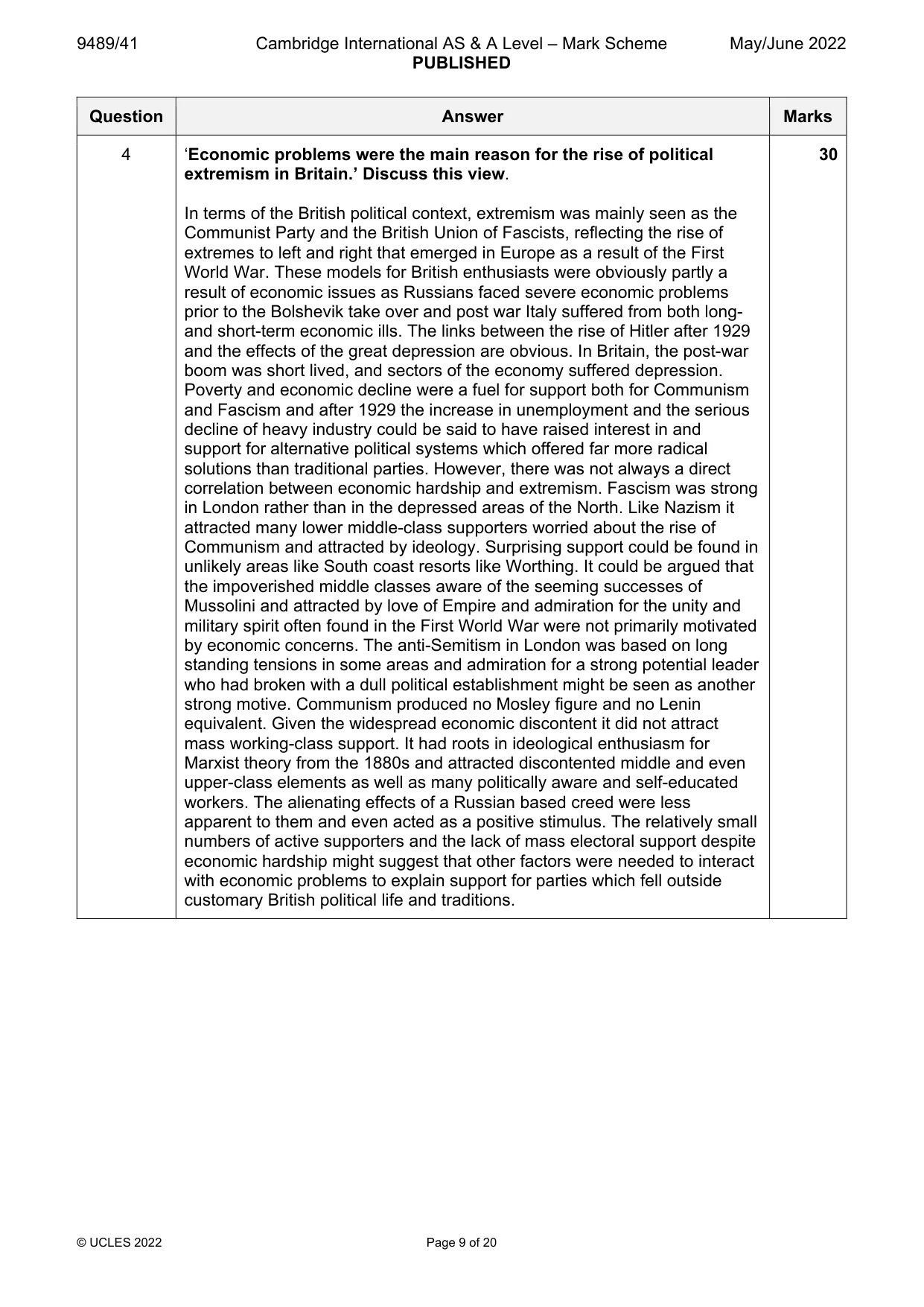
4 ‘Economic problems were the main reason for the rise of political extremism in Britain.’ Discuss this view. [30]
Mark scheme: 4 ‘Economic problems were the main reason for the rise of political 30 extremism in Britain.’ Discuss this view. In terms of the British political context, extremism was mainly seen as the Communist Party and the British Union of Fascists, reflecting the rise of extremes to left and right that emerged in Europe as a result of the First World War. These models for British enthusiasts were obviously partly a result of economic issues as Russians faced severe economic problems prior to the Bolshevik take over and post war Italy suffered from both long- and short-term economic ills. The links between the rise of Hitler after 1929 and the effects of the great depression are obvious. In Britain, the post-war boom was short lived, and sectors of the economy suffered depression. Poverty and economic decline were a fuel for support both for Communism and Fascism and after 1929 the increase in unemployment and the serious decline of heavy industry could be said to have raised interest in and support for alternative political systems which offered far more radical solutions than traditional parties. However, there was not always a direct correlation between economic hardship and extremism. Fascism was strong in London rather than in the depressed areas of the North. Like Nazism it attracted many lower middle-class supporters worried about the rise of Communism and attracted by ideology. Surprising support could be found in unlikely areas like South coast resorts like Worthing. It could be argued that the impoverished middle classes aware of the seeming successes of Mussolini and attracted by love of Empire and admiration for the unity and military spirit often found in the First World War were not primarily motivated by economic concerns. The anti-Semitism in London was based on long standing tensions in some areas and admiration for a strong potential leader who had broken with a dull political establishment might be seen as another strong motive. Communism produced no Mosley figure and no Lenin equivalent. Given the widespread economic discontent it did not attract mass working-class support. It had roots in ideological enthusiasm for Marxist theory from the 1880s and attracted discontented middle and even upper-class elements as well as many politically aware and self-educated workers. The alienating effects of a Russian based creed were less apparent to them and even acted as a positive stimulus. The relatively small numbers of active supporters and the lack of mass electoral support despite economic hardship might suggest that other factors were needed to interact with economic problems to explain support for parties which fell outside customary British political life and traditions.
More questions on How did the rise of extremism affect international relations?
Q5 · Assess the reasons for increased social mobility in the 1940s and 1950s
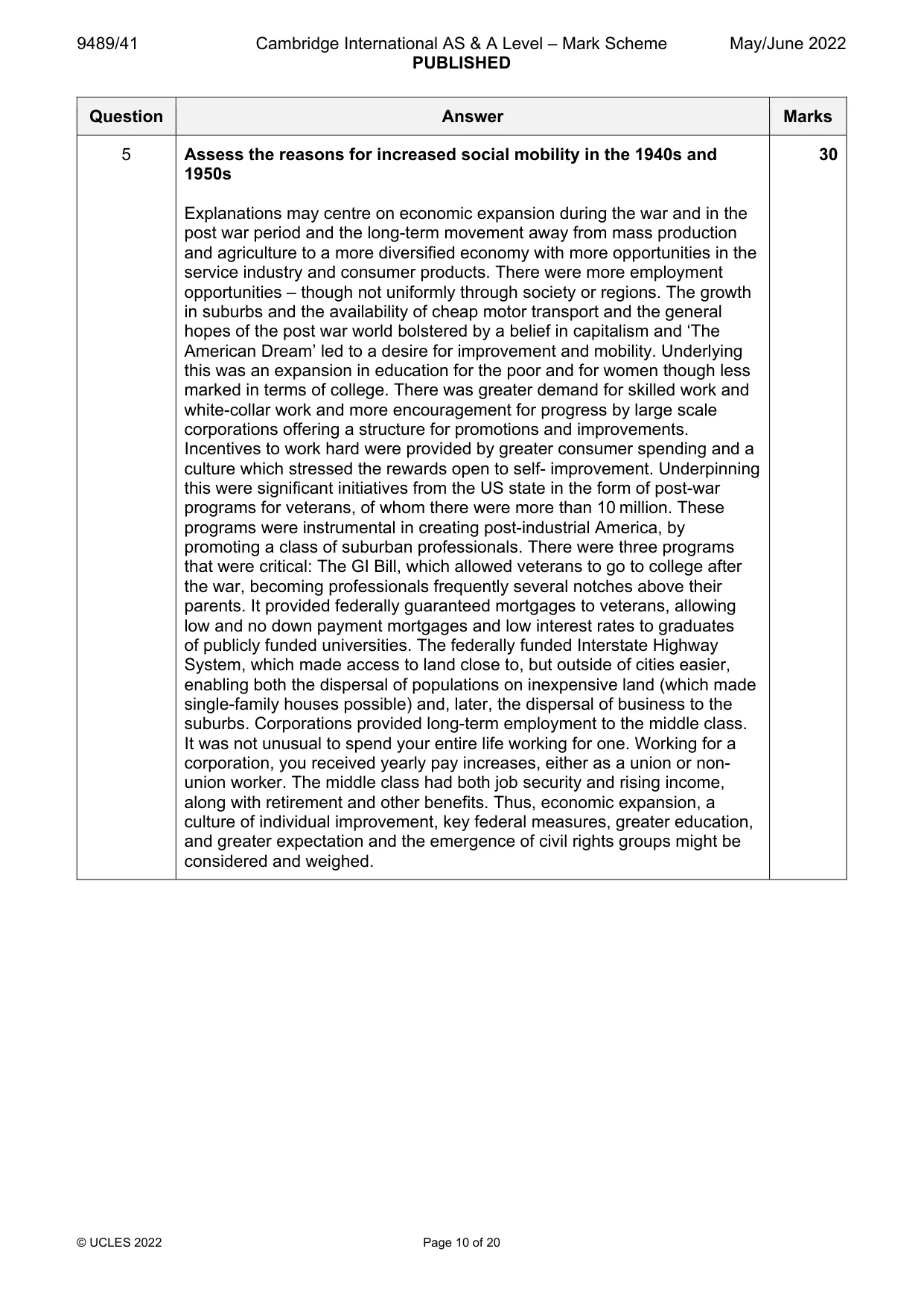
5 Assess the reasons for increased social mobility in the 1940s and 1950s. [30]
Mark scheme: 5 Assess the reasons for increased social mobility in the 1940s and 30 1950s Explanations may centre on economic expansion during the war and in the post war period and the long-term movement away from mass production and agriculture to a more diversified economy with more opportunities in the service industry and consumer products. There were more employment opportunities – though not uniformly through society or regions. The growth in suburbs and the availability of cheap motor transport and the general hopes of the post war world bolstered by a belief in capitalism and ‘The American Dream’ led to a desire for improvement and mobility. Underlying this was an expansion in education for the poor and for women though less marked in terms of college. There was greater demand for skilled work and white-collar work and more encouragement for progress by large scale corporations offering a structure for promotions and improvements. Incentives to work hard were provided by greater consumer spending and a culture which stressed the rewards open to self- improvement. Underpinning this were significant initiatives from the US state in the form of post-war programs for veterans, of whom there were more than 10 million. These programs were instrumental in creating post-industrial America, by promoting a class of suburban professionals. There were three programs that were critical: The GI Bill, which allowed veterans to go to college after the war, becoming professionals frequently several notches above their parents. It provided federally guaranteed mortgages to veterans, allowing low and no down payment mortgages and low interest rates to graduates of publicly funded universities. The federally funded Interstate Highway System, which made access to land close to, but outside of cities easier, enabling both the dispersal of populations on inexpensive land (which made single-family houses possible) and, later, the dispersal of business to the suburbs. Corporations provided long-term employment to the middle class. It was not unusual to spend your entire life working for one. Working for a corporation, you received yearly pay increases, either as a union or non- union worker. The middle class had both job security and rising income, along with retirement and other benefits. Thus, economic expansion, a culture of individual improvement, key federal measures, greater education, and greater expectation and the emergence of civil rights groups might be considered and weighed.
More questions on What were the consequences of the rapid economic growth after 1870?
Q6 · ‘Stagflation was the most serious economic problem faced by US governments in the 1960s…
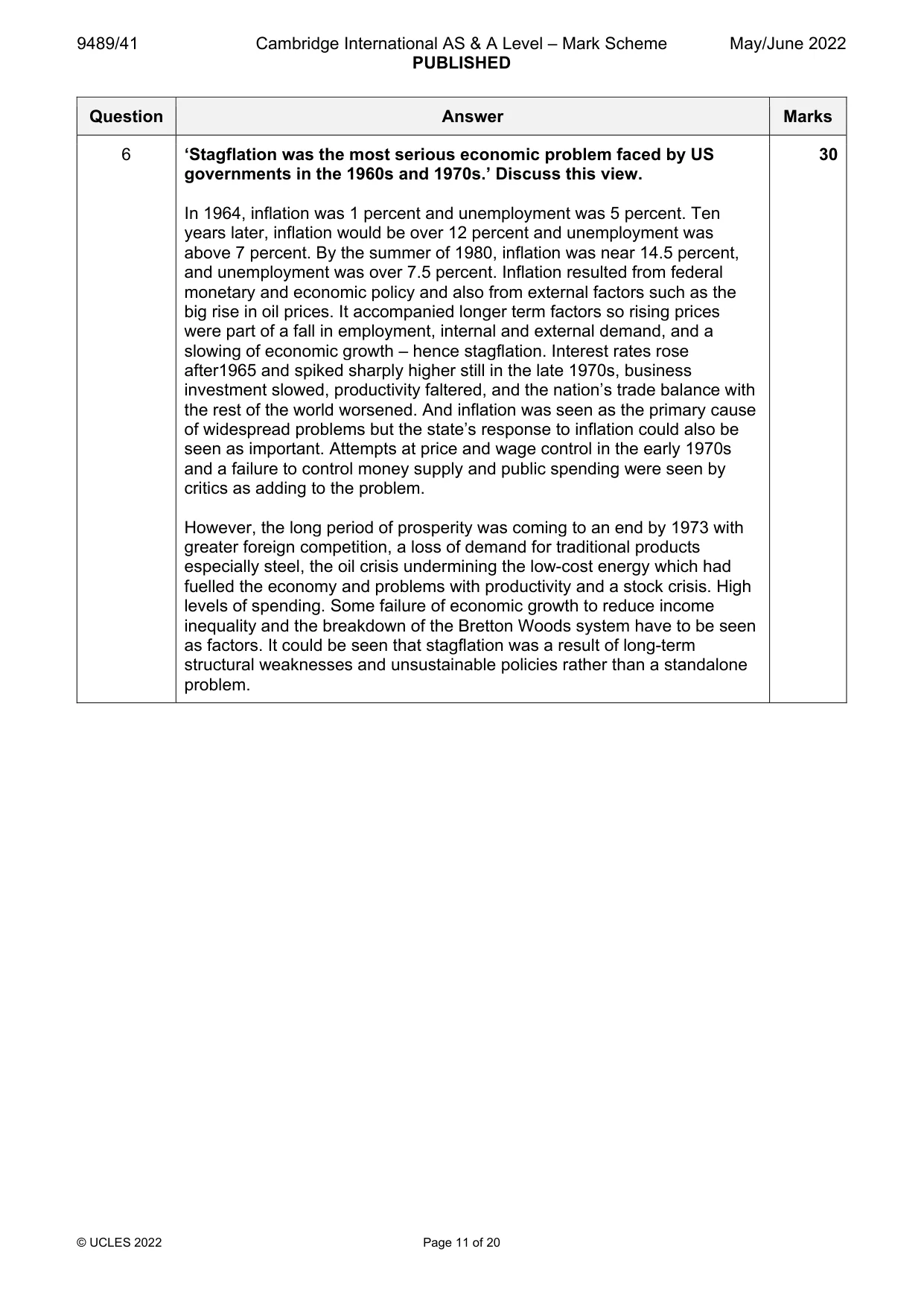
6 ‘Stagflation was the most serious economic problem faced by US governments in the 1960s and 1970s.’ Discuss this view. [30]
Mark scheme: 6 ‘Stagflation was the most serious economic problem faced by US 30 governments in the 1960s and 1970s.’ Discuss this view. In 1964, inflation was 1 percent and unemployment was 5 percent. Ten years later, inflation would be over 12 percent and unemployment was above 7 percent. By the summer of 1980, inflation was near 14.5 percent, and unemployment was over 7.5 percent. Inflation resulted from federal monetary and economic policy and also from external factors such as the big rise in oil prices. It accompanied longer term factors so rising prices were part of a fall in employment, internal and external demand, and a slowing of economic growth – hence stagflation. Interest rates rose after1965 and spiked sharply higher still in the late 1970s, business investment slowed, productivity faltered, and the nation’s trade balance with the rest of the world worsened. And inflation was seen as the primary cause of widespread problems but the state’s response to inflation could also be seen as important. Attempts at price and wage control in the early 1970s and a failure to control money supply and public spending were seen by critics as adding to the problem. However, the long period of prosperity was coming to an end by 1973 with greater foreign competition, a loss of demand for traditional products especially steel, the oil crisis undermining the low-cost energy which had fuelled the economy and problems with productivity and a stock crisis. High levels of spending. Some failure of economic growth to reduce income inequality and the breakdown of the Bretton Woods system have to be seen as factors. It could be seen that stagflation was a result of long-term structural weaknesses and unsustainable policies rather than a standalone problem.
More questions on What were the consequences of the rapid economic growth after 1870?
Q7 · ‘Clinton mostly owed his electoral success to his personal appeal.’ Discuss this view
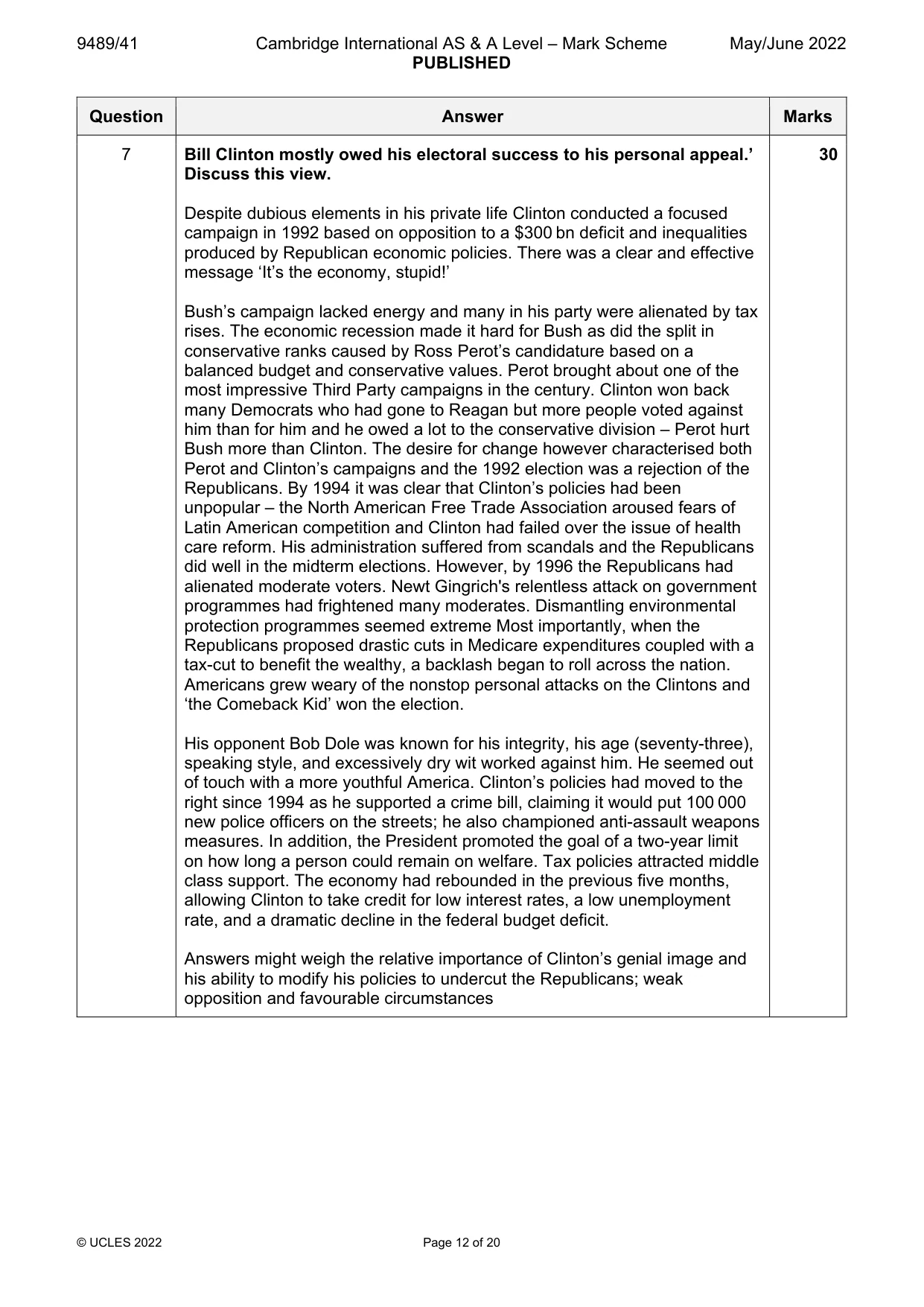
7 ‘Clinton mostly owed his electoral success to his personal appeal.’ Discuss this view. [30]
Mark scheme: 7 Bill Clinton mostly owed his electoral success to his personal appeal.’ 30 Discuss this view. Despite dubious elements in his private life Clinton conducted a focused campaign in 1992 based on opposition to a $300 bn deficit and inequalities produced by Republican economic policies. There was a clear and effective message ‘It’s the economy, stupid!’ Bush’s campaign lacked energy and many in his party were alienated by tax rises. The economic recession made it hard for Bush as did the split in conservative ranks caused by Ross Perot’s candidature based on a balanced budget and conservative values. Perot brought about one of the most impressive Third Party campaigns in the century. Clinton won back many Democrats who had gone to Reagan but more people voted against him than for him and he owed a lot to the conservative division – Perot hurt Bush more than Clinton. The desire for change however characterised both Perot and Clinton’s campaigns and the 1992 election was a rejection of the Republicans. By 1994 it was clear that Clinton’s policies had been unpopular – the North American Free Trade Association aroused fears of Latin American competition and Clinton had failed over the issue of health care reform. His administration suffered from scandals and the Republicans did well in the midterm elections. However, by 1996 the Republicans had alienated moderate voters. Newt Gingrich's relentless attack on government programmes had frightened many moderates. Dismantling environmental protection programmes seemed extreme Most importantly, when the Republicans proposed drastic cuts in Medicare expenditures coupled with a tax-cut to benefit the wealthy, a backlash began to roll across the nation. Americans grew weary of the nonstop personal attacks on the Clintons and ‘the Comeback Kid’ won the election. His opponent Bob Dole was known for his integrity, his age (seventy-three), speaking style, and excessively dry wit worked against him. He seemed out of touch with a more youthful America. Clinton’s policies had moved to the right since 1994 as he supported a crime bill, claiming it would put 100 000 new police officers on the streets; he also championed anti-assault weapons measures. In addition, the President promoted the goal of a two-year limit on how long a person could remain on welfare. Tax policies attracted middle class support. The economy had rebounded in the previous five months, allowing Clinton to take credit for low interest rates, a low unemployment rate, and a dramatic decline in the federal budget deficit. Answers might weigh the relative importance of Clinton’s genial image and his ability to modify his policies to undercut the Republicans; weak opposition and favourable circumstances
More questions on Why was there a second New Deal and how successful was it?
Q8 · Assess the impact of involvement in the Korean War on US foreign policy in the period…
8 Assess the impact of involvement in the Korean War on US foreign policy in the period 1950–63. [30] Section C: International history, 1945–92
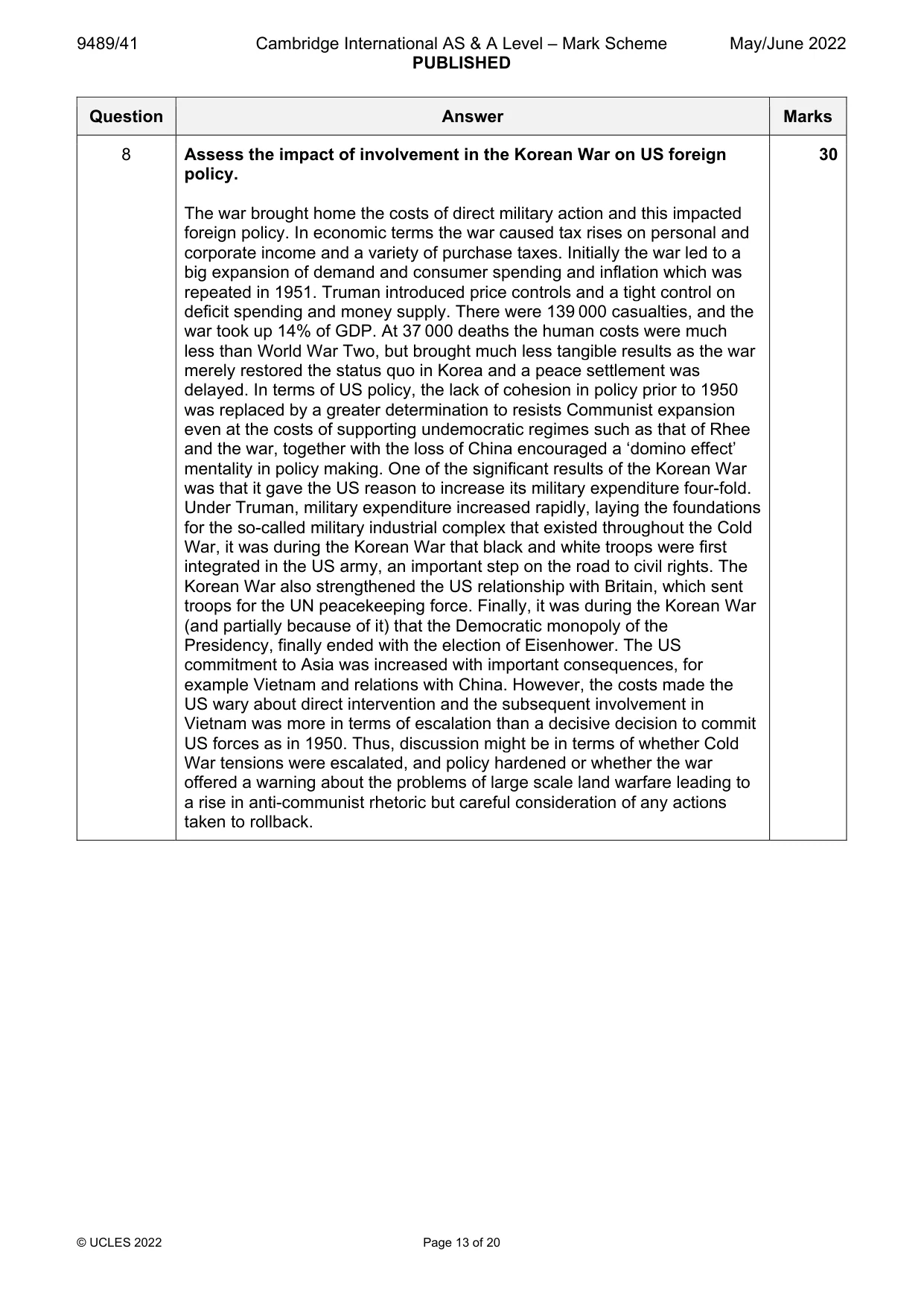
Mark scheme: 8 Assess the impact of involvement in the Korean War on US foreign 30 policy. The war brought home the costs of direct military action and this impacted foreign policy. In economic terms the war caused tax rises on personal and corporate income and a variety of purchase taxes. Initially the war led to a big expansion of demand and consumer spending and inflation which was repeated in 1951. Truman introduced price controls and a tight control on deficit spending and money supply. There were 139 000 casualties, and the war took up 14% of GDP. At 37 000 deaths the human costs were much less than World War Two, but brought much less tangible results as the war merely restored the status quo in Korea and a peace settlement was delayed. In terms of US policy, the lack of cohesion in policy prior to 1950 was replaced by a greater determination to resists Communist expansion even at the costs of supporting undemocratic regimes such as that of Rhee and the war, together with the loss of China encouraged a ‘domino effect’ mentality in policy making. One of the significant results of the Korean War was that it gave the US reason to increase its military expenditure four-fold. Under Truman, military expenditure increased rapidly, laying the foundations for the so-called military industrial complex that existed throughout the Cold War, it was during the Korean War that black and white troops were first integrated in the US army, an important step on the road to civil rights. The Korean War also strengthened the US relationship with Britain, which sent troops for the UN peacekeeping force. Finally, it was during the Korean War (and partially because of it) that the Democratic monopoly of the Presidency, finally ended with the election of Eisenhower. The US commitment to Asia was increased with important consequences, for example Vietnam and relations with China. However, the costs made the US wary about direct intervention and the subsequent involvement in Vietnam was more in terms of escalation than a decisive decision to commit US forces as in 1950. Thus, discussion might be in terms of whether Cold War tensions were escalated, and policy hardened or whether the war offered a warning about the problems of large scale land warfare leading to a rise in anti-communist rhetoric but careful consideration of any actions taken to rollback.
More questions on Why did the USA emerge as a world power and what was the impact on international
Q9 · Evaluate how far attempts to control nuclear weapons improved US–Soviet relations
9 Evaluate how far attempts to control nuclear weapons improved US–Soviet relations. [30]
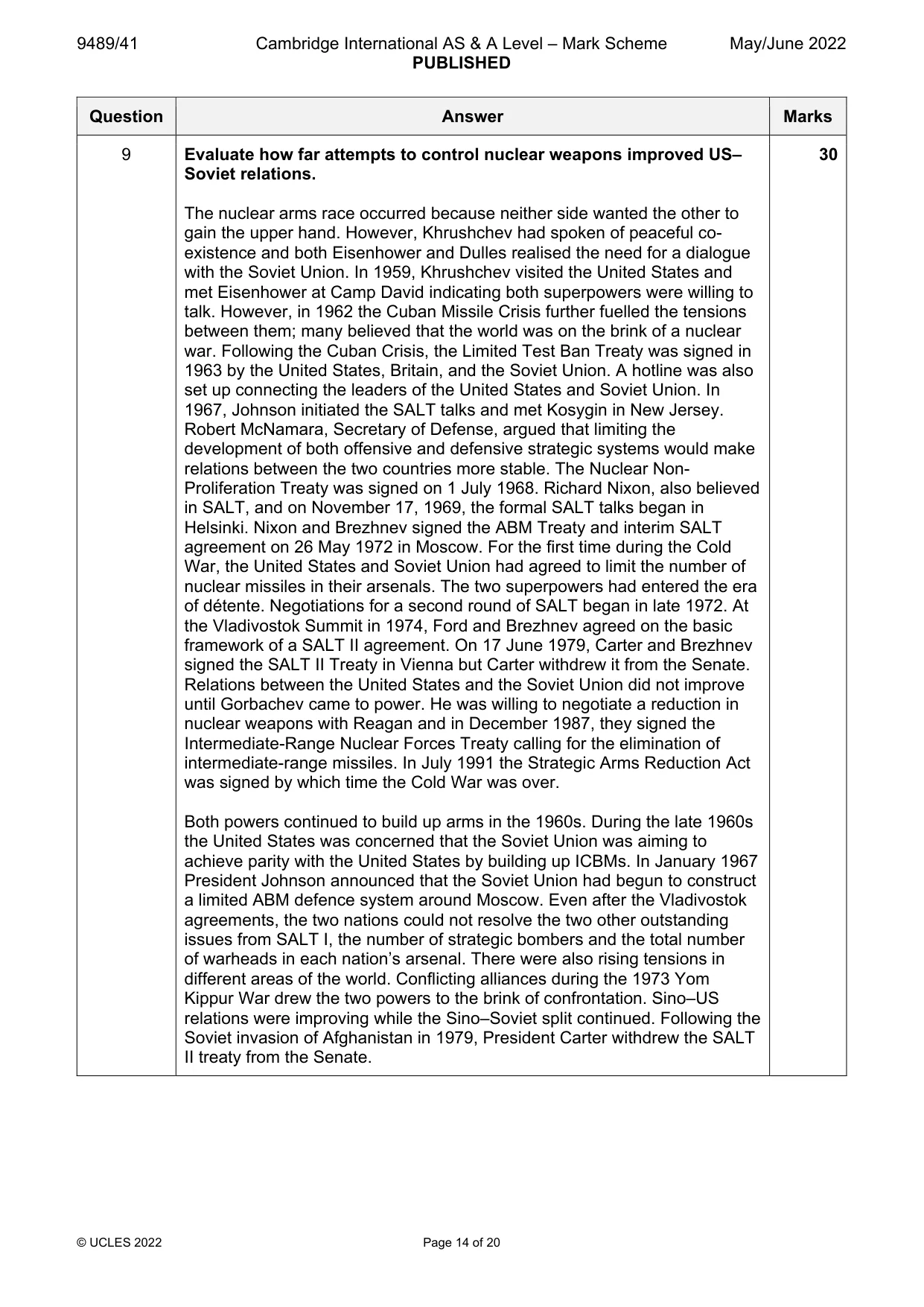
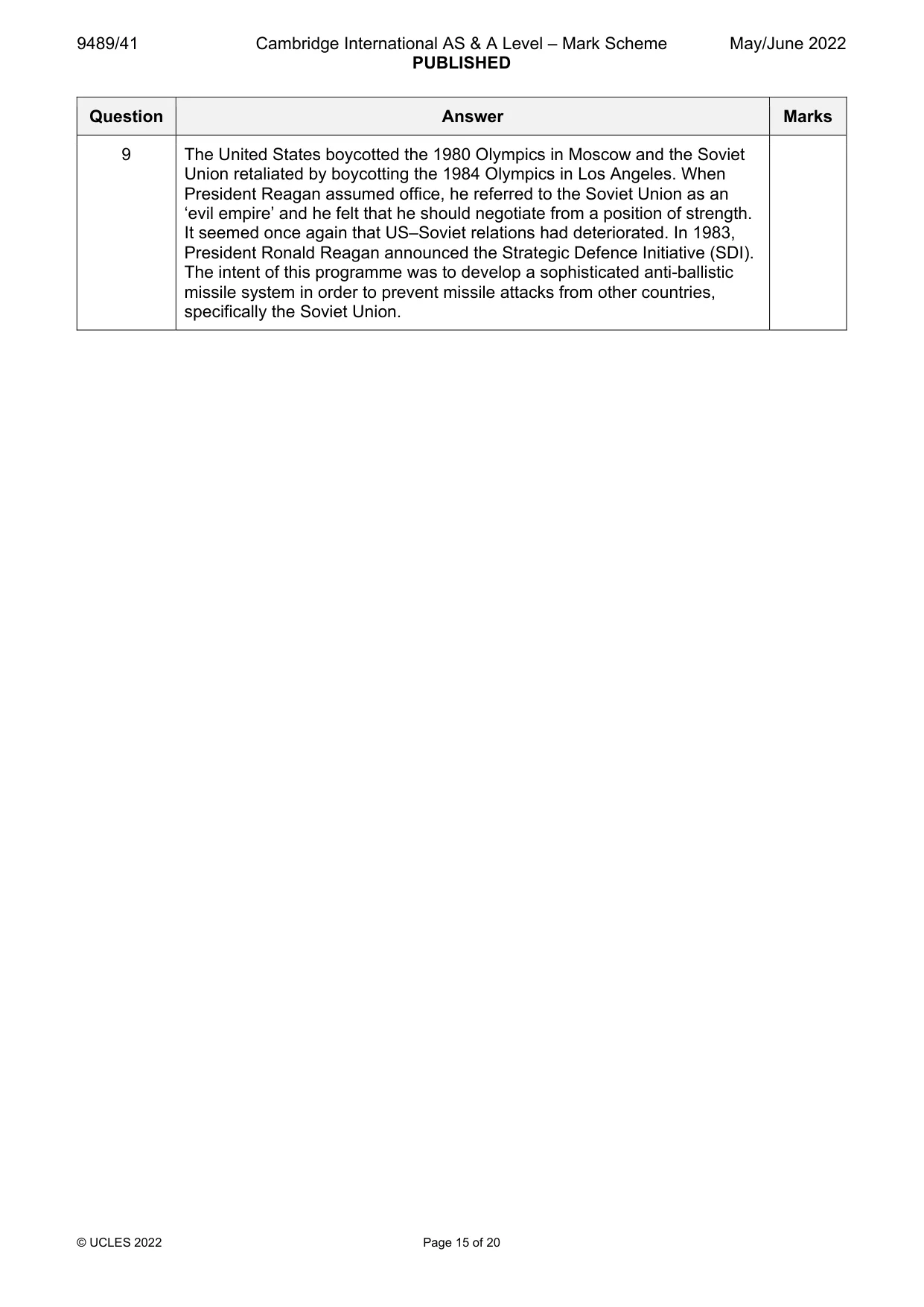
Mark scheme: 9 Evaluate how far attempts to control nuclear weapons improved US– 30 Soviet relations. The nuclear arms race occurred because neither side wanted the other to gain the upper hand. However, Khrushchev had spoken of peaceful co- existence and both Eisenhower and Dulles realised the need for a dialogue with the Soviet Union. In 1959, Khrushchev visited the United States and met Eisenhower at Camp David indicating both superpowers were willing to talk. However, in 1962 the Cuban Missile Crisis further fuelled the tensions between them; many believed that the world was on the brink of a nuclear war. Following the Cuban Crisis, the Limited Test Ban Treaty was signed in 1963 by the United States, Britain, and the Soviet Union. A hotline was also set up connecting the leaders of the United States and Soviet Union. In 1967, Johnson initiated the SALT talks and met Kosygin in New Jersey. Robert McNamara, Secretary of Defense, argued that limiting the development of both offensive and defensive strategic systems would make relations between the two countries more stable. The Nuclear Non- Proliferation Treaty was signed on 1 July 1968. Richard Nixon, also believed in SALT, and on November 17, 1969, the formal SALT talks began in Helsinki. Nixon and Brezhnev signed the ABM Treaty and interim SALT agreement on 26 May 1972 in Moscow. For the first time during the Cold War, the United States and Soviet Union had agreed to limit the number of nuclear missiles in their arsenals. The two superpowers had entered the era of détente. Negotiations for a second round of SALT began in late 1972. At the Vladivostok Summit in 1974, Ford and Brezhnev agreed on the basic framework of a SALT II agreement. On 17 June 1979, Carter and Brezhnev signed the SALT II Treaty in Vienna but Carter withdrew it from the Senate. Relations between the United States and the Soviet Union did not improve until Gorbachev came to power. He was willing to negotiate a reduction in nuclear weapons with Reagan and in December 1987, they signed the Intermediate-Range Nuclear Forces Treaty calling for the elimination of intermediate-range missiles. In July 1991 the Strategic Arms Reduction Act was signed by which time the Cold War was over. Both powers continued to build up arms in the 1960s. During the late 1960s the United States was concerned that the Soviet Union was aiming to achieve parity with the United States by building up ICBMs. In January 1967 President Johnson announced that the Soviet Union had begun to construct a limited ABM defence system around Moscow. Even after the Vladivostok agreements, the two nations could not resolve the two other outstanding issues from SALT I, the number of strategic bombers and the total number of warheads in each nation’s arsenal. There were also rising tensions in different areas of the world. Conflicting alliances during the 1973 Yom Kippur War drew the two powers to the brink of confrontation. Sino–US relations were improving while the Sino–Soviet split continued. Following the Soviet invasion of Afghanistan in 1979, President Carter withdrew the SALT II treaty from the Senate. 9 The United States boycotted the 1980 Olympics in Moscow and the Soviet Union retaliated by boycotting the 1984 Olympics in Los Angeles. When President Reagan assumed office, he referred to the Soviet Union as an ‘evil empire’ and he felt that he should negotiate from a position of strength. It seemed once again that US–Soviet relations had deteriorated. In 1983, President Ronald Reagan announced the Strategic Defence Initiative (SDI). The intent of this programme was to develop a sophisticated anti-ballistic missile system in order to prevent missile attacks from other countries, specifically the Soviet Union.
More questions on How did the rise of extremism affect international relations?
Q10 · ‘China’s support for North Vietnam in its conflict with the United States was more…
10 ‘China’s support for North Vietnam in its conflict with the United States was more significant than that of the Soviet Union.’ Assess this view. [30]
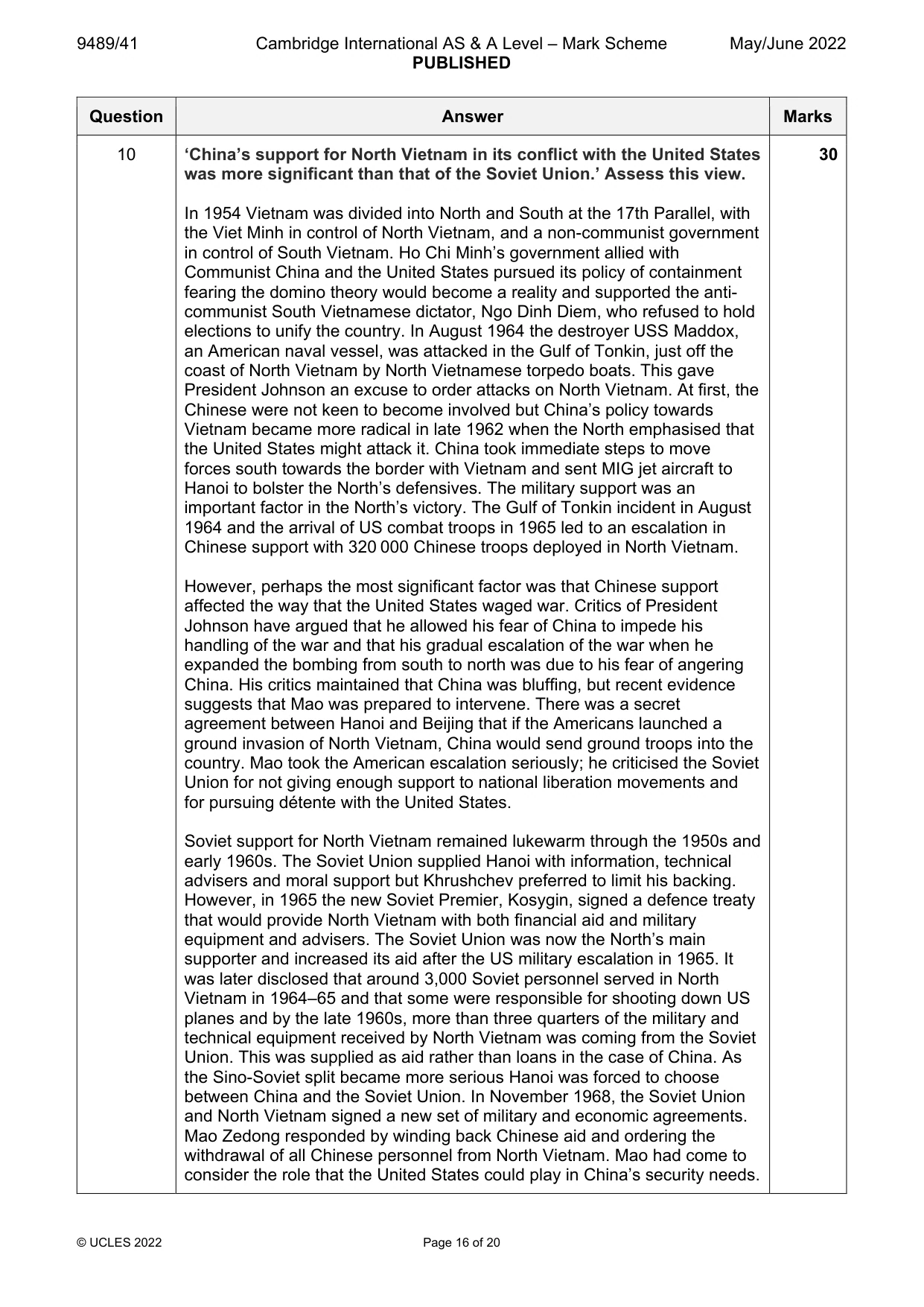
Mark scheme: 10 ‘China’s support for North Vietnam in its conflict with the United States 30 was more significant than that of the Soviet Union.’ Assess this view. In 1954 Vietnam was divided into North and South at the 17th Parallel, with the Viet Minh in control of North Vietnam, and a non-communist government in control of South Vietnam. Ho Chi Minh’s government allied with Communist China and the United States pursued its policy of containment fearing the domino theory would become a reality and supported the anti- communist South Vietnamese dictator, Ngo Dinh Diem, who refused to hold elections to unify the country. In August 1964 the destroyer USS Maddox, an American naval vessel, was attacked in the Gulf of Tonkin, just off the coast of North Vietnam by North Vietnamese torpedo boats. This gave President Johnson an excuse to order attacks on North Vietnam. At first, the Chinese were not keen to become involved but China’s policy towards Vietnam became more radical in late 1962 when the North emphasised that the United States might attack it. China took immediate steps to move forces south towards the border with Vietnam and sent MIG jet aircraft to Hanoi to bolster the North’s defensives. The military support was an important factor in the North’s victory. The Gulf of Tonkin incident in August 1964 and the arrival of US combat troops in 1965 led to an escalation in Chinese support with 320 000 Chinese troops deployed in North Vietnam. However, perhaps the most significant factor was that Chinese support affected the way that the United States waged war. Critics of President Johnson have argued that he allowed his fear of China to impede his handling of the war and that his gradual escalation of the war when he expanded the bombing from south to north was due to his fear of angering China. His critics maintained that China was bluffing, but recent evidence suggests that Mao was prepared to intervene. There was a secret agreement between Hanoi and Beijing that if the Americans launched a ground invasion of North Vietnam, China would send ground troops into the country. Mao took the American escalation seriously; he criticised the Soviet Union for not giving enough support to national liberation movements and for pursuing détente with the United States. Soviet support for North Vietnam remained lukewarm through the 1950s and early 1960s. The Soviet Union supplied Hanoi with information, technical advisers and moral support but Khrushchev preferred to limit his backing. However, in 1965 the new Soviet Premier, Kosygin, signed a defence treaty that would provide North Vietnam with both financial aid and military equipment and advisers. The Soviet Union was now the North’s main supporter and increased its aid after the US military escalation in 1965. It was later disclosed that around 3,000 Soviet personnel served in North Vietnam in 1964–65 and that some were responsible for shooting down US planes and by the late 1960s, more than three quarters of the military and technical equipment received by North Vietnam was coming from the Soviet Union. This was supplied as aid rather than loans in the case of China. As the Sino-Soviet split became more serious Hanoi was forced to choose between China and the Soviet Union. In November 1968, the Soviet Union and North Vietnam signed a new set of military and economic agreements. Mao Zedong responded by winding back Chinese aid and ordering the withdrawal of all Chinese personnel from North Vietnam. Mao had come to consider the role that the United States could play in China’s security needs.
Q11 · ‘The legacy of colonial powers caused the greatest difficulty in establishing stable…
11 ‘The legacy of colonial powers caused the greatest difficulty in establishing stable governments in newly independent African nations.’ Discuss this view. [30]
Mark scheme: 11 ‘The legacy of colonial powers caused the greatest difficulty in 30 establishing stable governments in newly independent African nations.’ Discuss this view. The European powers had created colonies made up of different religious and ethnic groups in which many different languages were spoken and had adopted the practice of divide and rule. Thus, every new state contained many conflicting interests including competing power bases and ethnic groups. However, for the newly independent states to be successful, they needed a government that could create national unity. A major concern following independence was that these countries would face the problem of disintegration and they wanted to ensure the sovereignty and security of their new nation-state. Countries inherited a weak political system, and the governments did not have the capacity to rule effectively; the colonial powers left behind constitutions with multi-party democracies based on their own particular systems but countries were often ill-prepared to sustain this democracy which provided the opportunity for a one-party state to emerge or for military take-overs. Nearly all of the African countries that gained their independence in the 1960s started out with multi-party systems but by 1970 half of them had military governments. Some counties were deeply divided. Nigeria, for example had a three-way divide with the Muslim north, Ibo east and Yoruba south. In 1967 civil war erupted with Biafra being declared an independent state. The forces of President Gowan took three years to defeat the Biafran forces. New nationalist governments had come to power promising to bring about improvements in the areas of education, health care, housing, and employment prospects but the under-developed economic systems they inherited made it difficult to keep these promises leading to political unrest. The new nations were aware of the need to share power, but this was not a sufficient basis for building a democracy. Many leaders were most concerned with maintaining their own power; this was often done through extensive patronage which led to inefficiency. Corruption became widespread in some countries as government officials used their position to benefit themselves and their family. The political parties themselves often did not represent the interests of the new nations as a whole. Many leaders became intolerant of other parties and resorted to autocratic rule. Governments frequently used limited resources on specific groups of people in an attempt to gain support of that group often favouring the ethnic or language group of the political elite leading to increasing ethnic tensions. In Ghana in 1963 Kwame Nkrumah pushed through a constitutional amendment that made Ghana a one-party state making himself president for life. Rather than promote inclusive politics, one-party rule fostered the politics of exclusion leading to the marginalisation of whole groups and regions. In February 1966, Nkrumah’ government was overthrown in a violent coup d'état led by the national military and police forces. 11 Political repression including the arbitrary use of power, ethnic conflicts, economic mismanagement, and corruption have sometimes been cited by the army for their intervention. The 1966 coup in Upper Volta is one example. There were also many factors beyond their control that made it difficult for African leaders to establish stable governments. Social and economic problems created much tension and unrest with inevitable political consequences. Falling commodity prices on the world markets, for example for agricultural and mineral products; mounting debts from borrowing money; weak currencies; drought and famine in east and southern Africa all had political consequences.
More questions on Why was imperialism a significant force in Africa from 1870?
What was in this paper
The subtopics covered by these 11 questions, and how many questions each got. Open one in a new tab to see every Cambridge question on it.
4What were the consequences of the rapid economic growth after 1870?2How were the Bolsheviks able to consolidate their power up to 1924?1Why did the USA emerge as a world power and what was the impact on international1Why did war break out in 1939?1Why was imperialism a significant force in Africa from 1870?1Why was there a second New Deal and how successful was it?1What you needed in this session
Cambridge’s own grade thresholds for 2022 May/June, Paper 4 · Variant 1. A higher threshold means an easier paper — the bar moves with how the cohort did.