Questions as text
Q1 · A list of metals is shown below 0654/32 May/June 2017
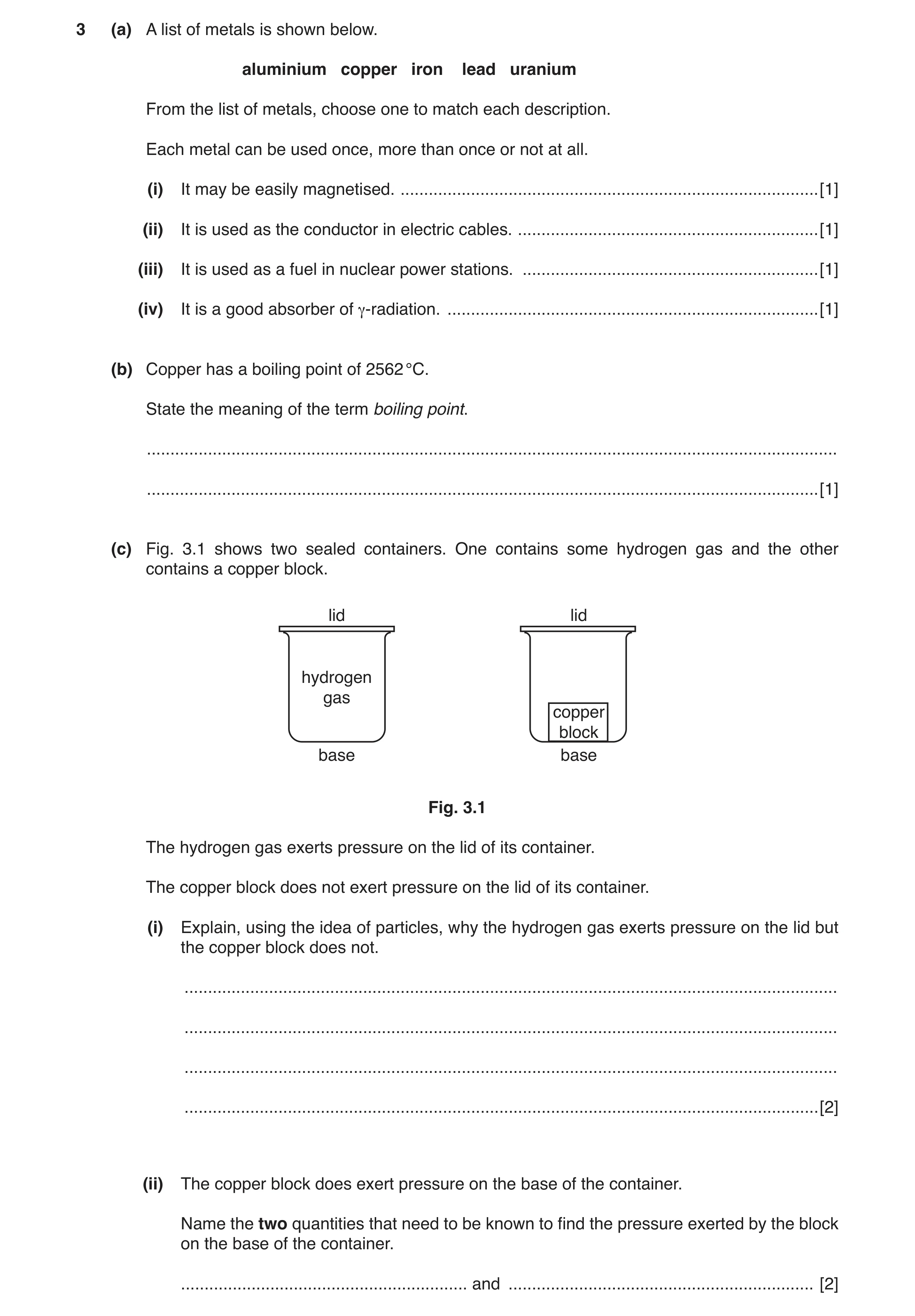
3 (a) A list of metals is shown below. aluminium copper iron lead uranium From the list of metals, choose one to match each description. Each metal can be used once, more than once or not at all. (i) It may be easily magnetised. … [1] (ii) It is used as the conductor in electric cables. … [1] (iii) It is used as a fuel in nuclear power stations. … [1] (iv) It is a good absorber of γ-radiation. … [1] (b) Copper has a boiling point of 2562 °C. State the meaning of the term boiling point. … … [1] (c) Fig. 3.1 shows two sealed containers. One contains some hydrogen gas and the other contains a copper block. lid lid hydrogen gas copper block base base Fig. 3.1 The hydrogen gas exerts pressure on the lid of its container. The copper block does not exert pressure on the lid of its container. (i) Explain, using the idea of particles, why the hydrogen gas exerts pressure on the lid but the copper block does not. … … … … [2] (ii) The copper block does exert pressure on the base of the container. Name the two quantities that need to be known to find the pressure exerted by the block on the base of the container. … and … [2]
9 marks
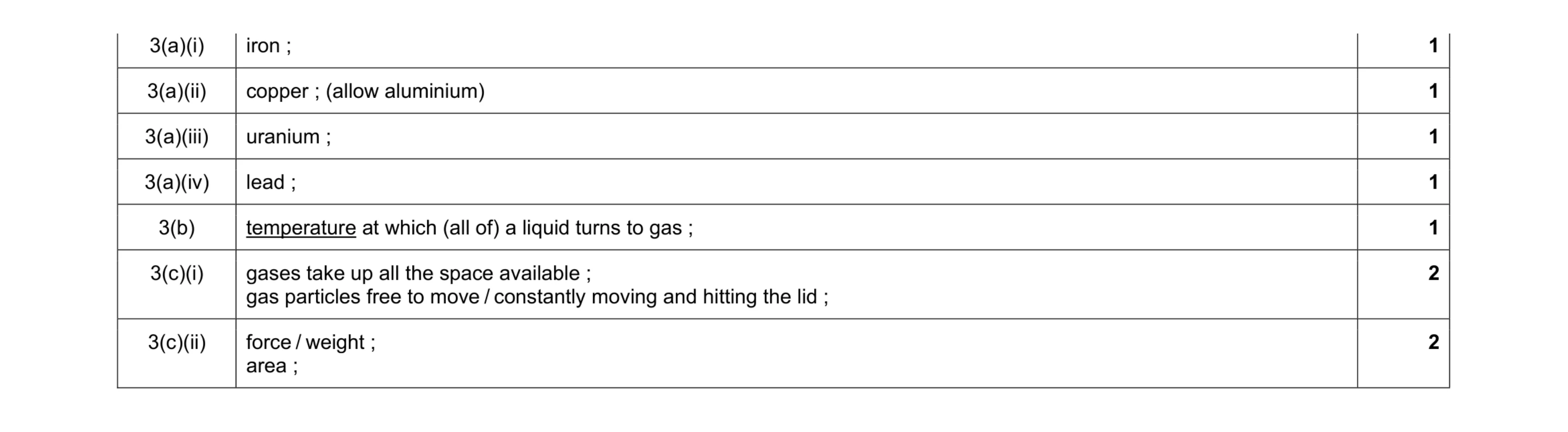
Mark scheme: 3(a)(i) iron ; 1 3(a)(ii) copper ; (allow aluminium) 1 3(a)(iii) uranium ; 1 3(a)(iv) lead ; 1 3(b) temperature at which (all of) a liquid turns to gas ; 1 3(c)(i) gases take up all the space available ; gas particles free to move / constantly moving and hitting the lid ; 2 3(c)(ii) force / weight ; area ; 2
This question in 0654/32 May/June 2017
Q2 · A car on a horizontal road 0654/31 Oct/Nov 2018
12 (a) Fig. 12.1 shows a car on a horizontal road. Two forces acting on the car are shown. 1500 N 2000 N Fig. 12.1 Determine the magnitude and direction of the resultant force on the car. magnitude … N direction … [2] (b) The fuel used in the car is a liquid. Exhaust gases from the car engine leave the car engine through an exhaust pipe made from solid steel. Complete the sentences about solids, liquids and gases. Use only the words solid, liquid or gas. Each word may be used once, more than once or not at all. In a … the particles are closest together. The forces of attraction are weakest in a … . In a … the particles can only vibrate but not move around. [2] (c) A car engine transforms the chemical energy in gasoline (petrol) into thermal energy and sound energy. State two other forms of energy gained by a car when it accelerates up a hill. 1 … energy 2 … energy [2] (d) The red reflectors found on cars use total internal reflection to allow car drivers to see the back of another vehicle. They reflect the light from car headlamps. The reflectors are made of many tiny prisms. Fig. 12.2 shows part of the path of a ray of light in a prism in the reflector. ray of light 45° prism Fig. 12.2 On Fig. 12.2, complete the path of the ray of light to show how the ray emerges from the prism. [2]
8 marks
Mark scheme: 12(a) magnitude = 500 (N) ; direction to right ; 2 12(b) solid gas solid 1 or 2 correct ; 3 correct ; 2 12(c) kinetic energy ; gravitational (potential) energy ; 2 12(d) ray reflects from other surface ; emerges parallel to incident ray ; 2
This question in 0654/31 Oct/Nov 2018
Q3 · A presenter talking into a microphone at a radio station, and a man listening to the… 0654/32 May/June 2019
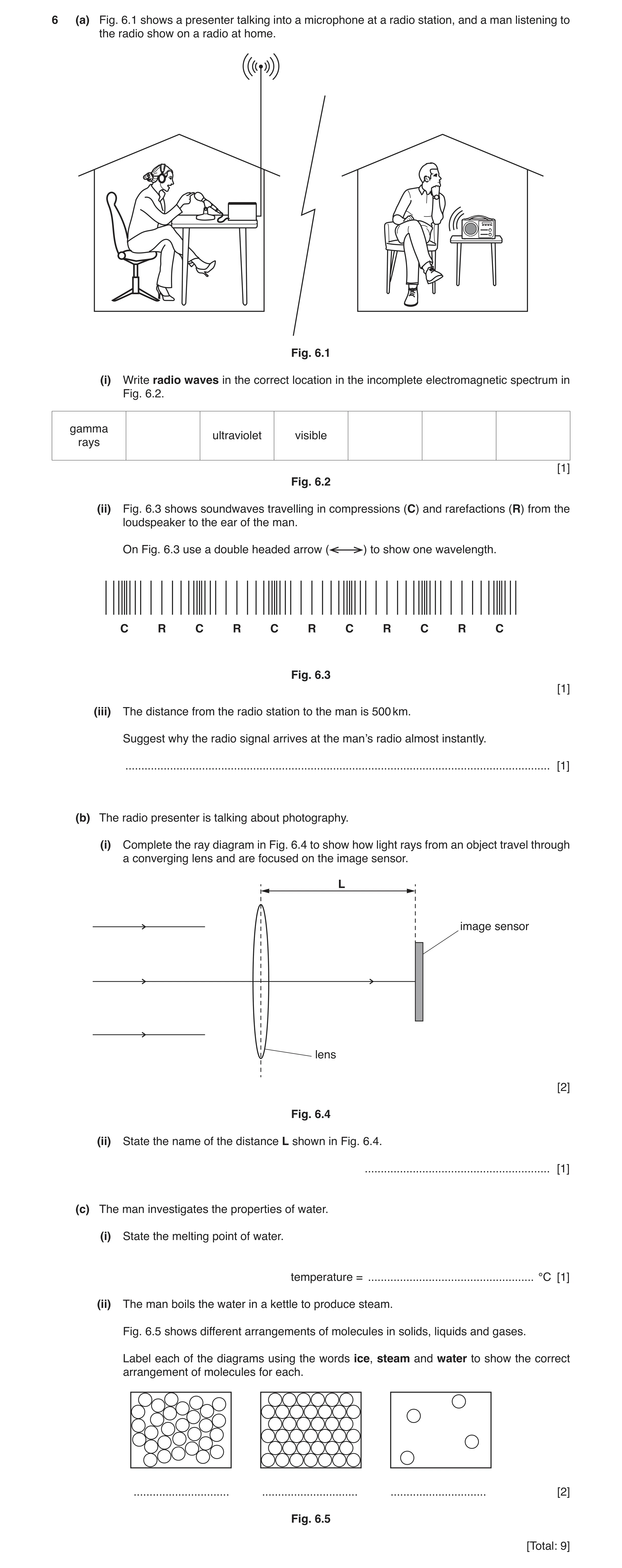
6 (a) Fig. 6.1 shows a presenter talking into a microphone at a radio station, and a man listening to the radio show on a radio at home. Fig. 6.1 (i) Write radio waves in the correct location in the incomplete electromagnetic spectrum in Fig. 6.2. gamma ultraviolet visible rays [1] Fig. 6.2 (ii) Fig. 6.3 shows soundwaves travelling in compressions (C) and rarefactions (R) from the loudspeaker to the ear of the man. On Fig. 6.3 use a double headed arrow ( ) to show one wavelength. C R C R C R C R C R C Fig. 6.3 [1] (iii) The distance from the radio station to the man is 500 km. Suggest why the radio signal arrives at the man’s radio almost instantly. … [1] (b) The radio presenter is talking about photography. (i) Complete the ray diagram in Fig. 6.4 to show how light rays from an object travel through a converging lens and are focused on the image sensor. L image sensor lens [2] Fig. 6.4 (ii) State the name of the distance L shown in Fig. 6.4. … [1] (c) The man investigates the properties of water. (i) State the melting point of water. temperature = … °C [1] (ii) The man boils the water in a kettle to produce steam. Fig. 6.5 shows different arrangements of molecules in solids, liquids and gases. Label each of the diagrams using the words ice, steam and water to show the correct arrangement of molecules for each. … … … [2] Fig. 6.5 [Total: 9]
9 marks
Mark scheme: 6(a)(i) right hand box ; 1 6(a)(ii) from centre of compression to next centre of compression or rarefaction to rarefaction or corresponding points on successive compressions ; 1 6(a)(iii) electromagnetic waves travel at the speed of light / electromagnetic or radio waves travel at high speed ; 1 6(b)(i) top and bottom rays parallel to middle ray ; top and bottom rays from lens to focal point on camera sensor ; 2 6(b)(ii) focal length ; 1 6(c)(i) 0 (oC) ; 1 6(c)(ii) correct label on 1 diagram ; correct label on all 3 diagrams ; 2
This question in 0654/32 May/June 2019
Q4 · A presenter talking into a microphone at a radio station, and a man listening to the… 0654/33 May/June 2019
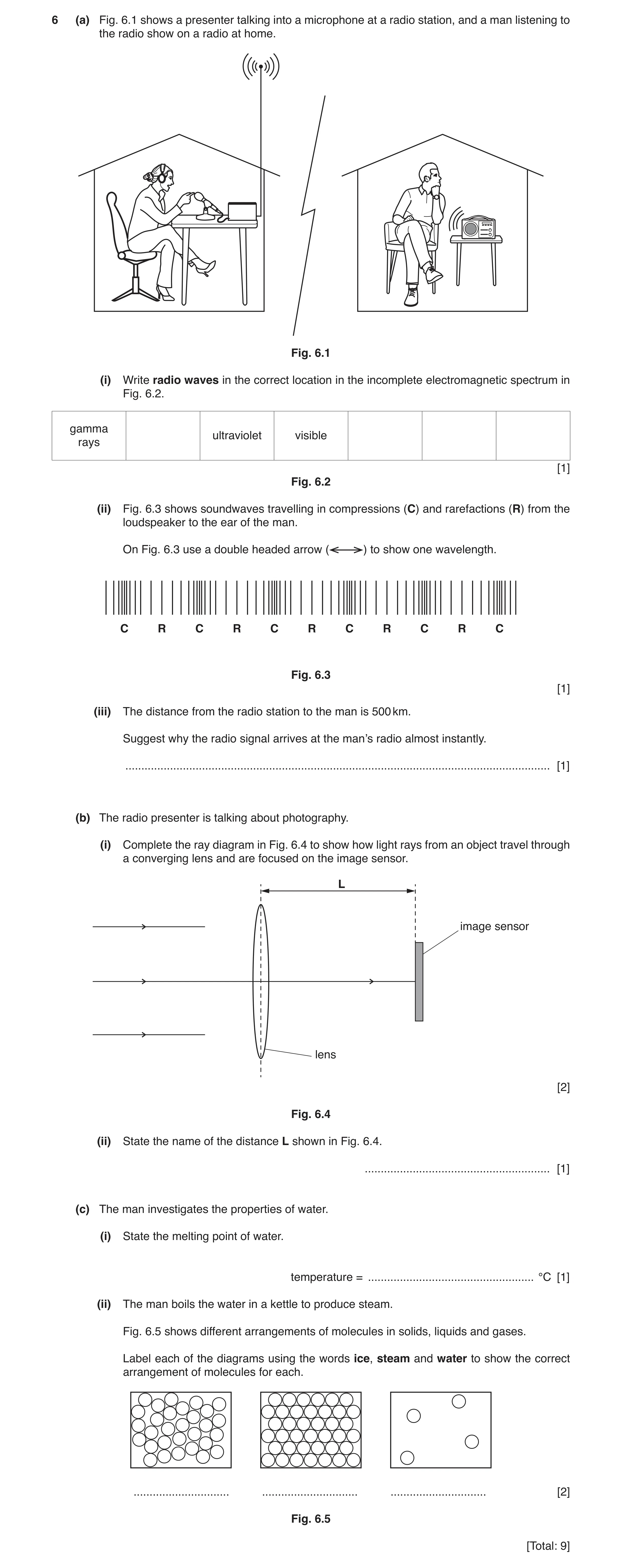
6 (a) Fig. 6.1 shows a presenter talking into a microphone at a radio station, and a man listening to the radio show on a radio at home. Fig. 6.1 (i) Write radio waves in the correct location in the incomplete electromagnetic spectrum in Fig. 6.2. gamma ultraviolet visible rays [1] Fig. 6.2 (ii) Fig. 6.3 shows soundwaves travelling in compressions (C) and rarefactions (R) from the loudspeaker to the ear of the man. On Fig. 6.3 use a double headed arrow ( ) to show one wavelength. C R C R C R C R C R C Fig. 6.3 [1] (iii) The distance from the radio station to the man is 500 km. Suggest why the radio signal arrives at the man’s radio almost instantly. … [1] (b) The radio presenter is talking about photography. (i) Complete the ray diagram in Fig. 6.4 to show how light rays from an object travel through a converging lens and are focused on the image sensor. L image sensor lens [2] Fig. 6.4 (ii) State the name of the distance L shown in Fig. 6.4. … [1] (c) The man investigates the properties of water. (i) State the melting point of water. temperature = … °C [1] (ii) The man boils the water in a kettle to produce steam. Fig. 6.5 shows different arrangements of molecules in solids, liquids and gases. Label each of the diagrams using the words ice, steam and water to show the correct arrangement of molecules for each. … … … [2] Fig. 6.5 [Total: 9]
9 marks
Mark scheme: 6(a)(i) right hand box ; 1 6(a)(ii) from centre of compression to next centre of compression or rarefaction to rarefaction or corresponding points on successive compressions ; 1 6(a)(iii) electromagnetic waves travel at the speed of light / electromagnetic or radio waves travel at high speed ; 1 6(b)(i) top and bottom rays parallel to middle ray ; top and bottom rays from lens to focal point on camera sensor ; 2 6(b)(ii) focal length ; 1 6(c)(i) 0 (oC) ; 1 6(c)(ii) correct label on 1 diagram ; correct label on all 3 diagrams ; 2
This question in 0654/33 May/June 2019
Q5 · A battery from a mobile phone (cell phone) is analysed to see what it contains 0654/32 Oct/Nov 2019
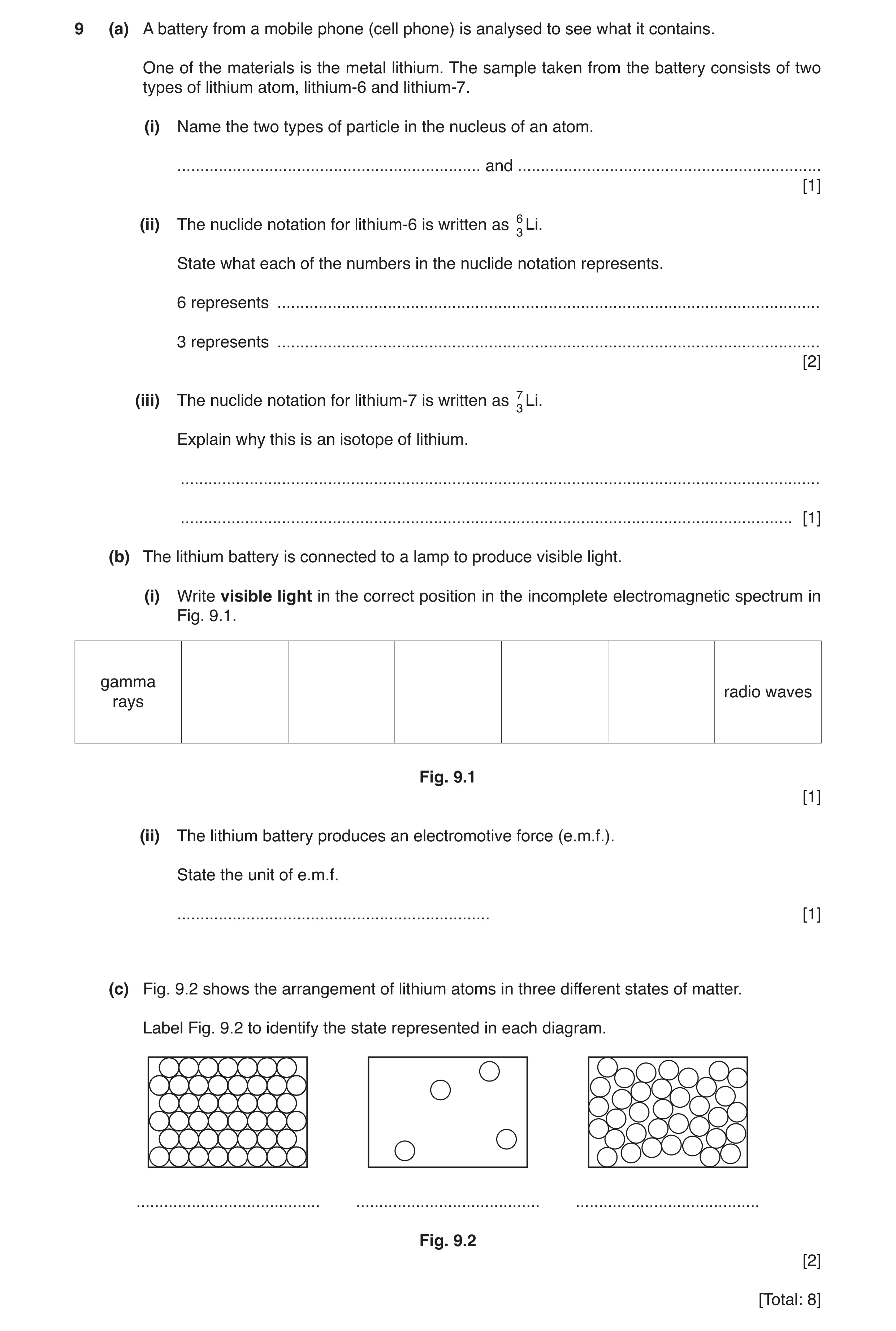
9 (a) A battery from a mobile phone (cell phone) is analysed to see what it contains. One of the materials is the metal lithium. The sample taken from the battery consists of two types of lithium atom, lithium-6 and lithium-7. (i) Name the two types of particle in the nucleus of an atom. … and … [1] (ii) The nuclide notation for lithium-6 is written as 63 Li. State what each of the numbers in the nuclide notation represents. 6 represents … 3 represents … [2] (iii) The nuclide notation for lithium-7 is written as 73 Li. Explain why this is an isotope of lithium. … … [1] (b) The lithium battery is connected to a lamp to produce visible light. (i) Write visible light in the correct position in the incomplete electromagnetic spectrum in Fig. 9.1. gamma radio waves rays Fig. 9.1 [1] (ii) The lithium battery produces an electromotive force (e.m.f.). State the unit of e.m.f. … [1] (c) Fig. 9.2 shows the arrangement of lithium atoms in three different states of matter. Label Fig. 9.2 to identify the state represented in each diagram. … … … Fig. 9.2 [2] [Total: 8]
8 marks
Mark scheme: 9(a)(i) proton and neutron ; 1 9(a)(ii) nucleon number / mass number ; atomic number / proton number ; 2 9(a)(iii) atomic number / proton number is the same ; 1 9(b)(i) visible light in the centre box ; 1 9(b)(ii) Volts, V ; 1 9(c) solid then gas then liquid 1 mark for 1 correct ; 2 marks for all 3 correct ; 2
This question in 0654/32 Oct/Nov 2019
Q6 · Solids, liquids and gases have different properties 0654/32 May/June 2020
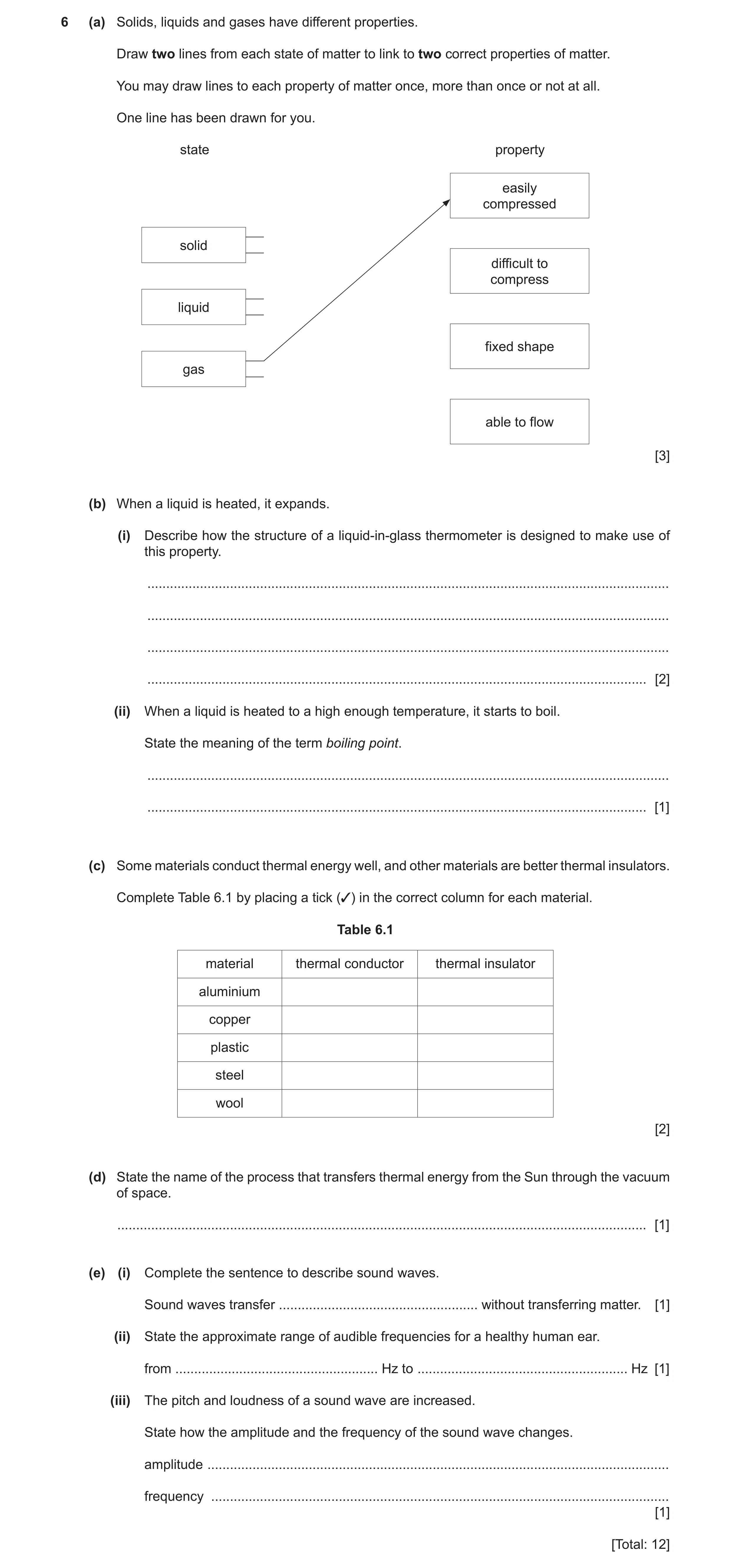
6 (a) Solids, liquids and gases have different properties. Draw two lines from each state of matter to link to two correct properties of matter. You may draw lines to each property of matter once, more than once or not at all. One line has been drawn for you. state property easily compressed solid difficult to compress liquid fixed shape gas able to flow [3] (b) When a liquid is heated, it expands. (i) Describe how the structure of a liquid-in-glass thermometer is designed to make use of this property. … … … … [2] (ii) When a liquid is heated to a high enough temperature, it starts to boil. State the meaning of the term boiling point. … … [1] (c) Some materials conduct thermal energy well, and other materials are better thermal insulators. Complete Table 6.1 by placing a tick (3) in the correct column for each material. Table 6.1 material thermal conductor thermal insulator aluminium copper plastic steel wool [2] (d) State the name of the process that transfers thermal energy from the Sun through the vacuum of space. … [1] (e) (i) Complete the sentence to describe sound waves. Sound waves transfer … without transferring matter. [1] (ii) State the approximate range of audible frequencies for a healthy human ear. from … Hz to … Hz [1] (iii) The pitch and loudness of a sound wave are increased. State how the amplitude and the frequency of the sound wave changes. amplitude … frequency … [1] [Total: 12]
12 marks
Mark scheme: 6(a) solid: difficult to compress and fixed shape; liquid: difficult to compress and able to flow; gas: easily compressed and able to flow 3 6(b)(i) liquid can be held in a tube; as it is heated or cools it rises up or falls down the tube; 2 6(b)(ii) the temperature at which a liquid turns to a gas; 1 6(c) material thermal conductor thermal insulator aluminium √ copper √ plastic √ steel √ wool √ ;; 3 correct for 1 mark all correct for 2 marks 2 6(d) radiation; 1 Question Answer Marks 6(e)(i) energy; 1 6(e)(ii) 20 to 20 000; 1 6(e)(iii) amplitude increases and frequency increases; 1
This question in 0654/32 May/June 2020
Q7 · Solids, liquids and gases have different properties 0654/33 May/June 2020
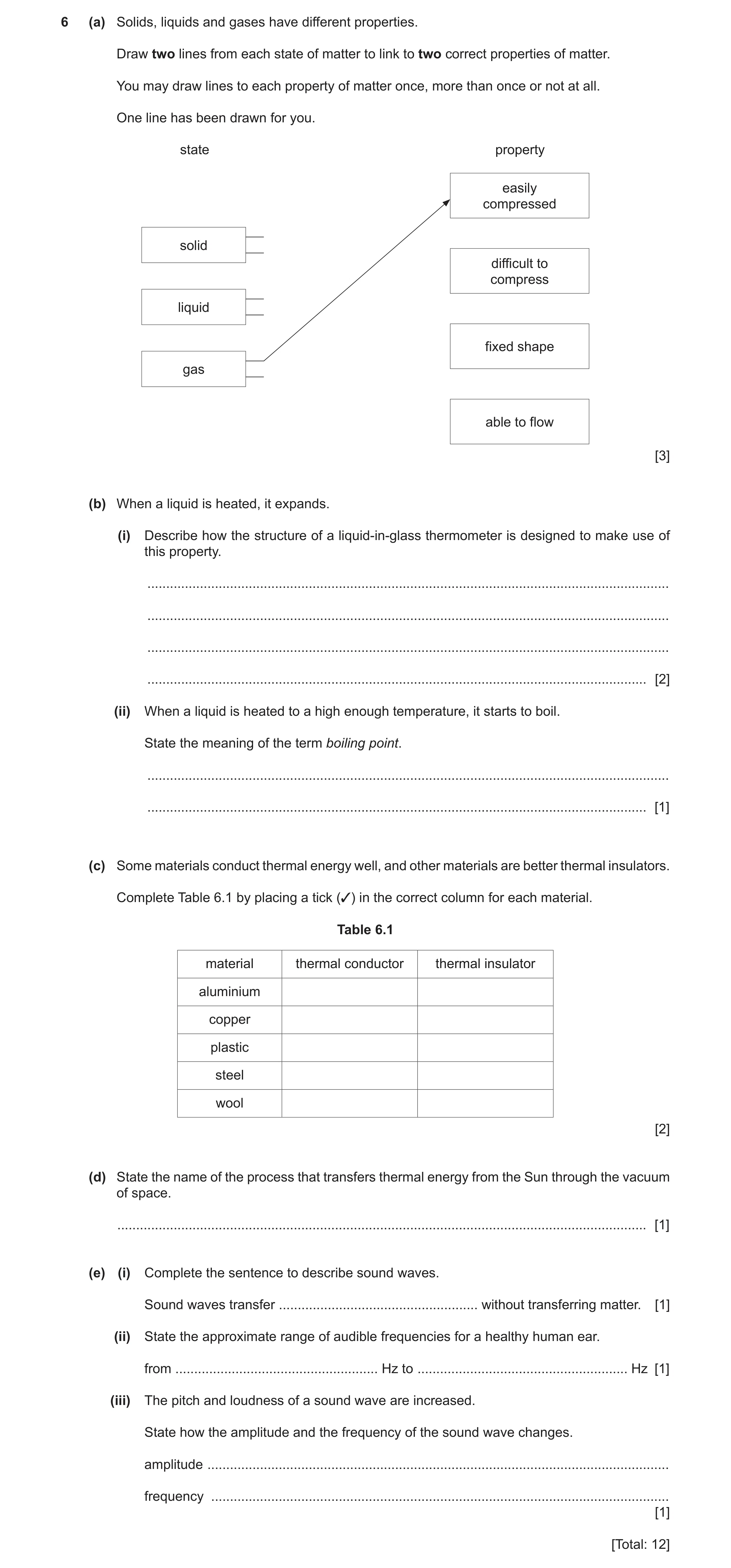
6 (a) Solids, liquids and gases have different properties. Draw two lines from each state of matter to link to two correct properties of matter. You may draw lines to each property of matter once, more than once or not at all. One line has been drawn for you. state property easily compressed solid difficult to compress liquid fixed shape gas able to flow [3] (b) When a liquid is heated, it expands. (i) Describe how the structure of a liquid-in-glass thermometer is designed to make use of this property. … … … … [2] (ii) When a liquid is heated to a high enough temperature, it starts to boil. State the meaning of the term boiling point. … … [1] (c) Some materials conduct thermal energy well, and other materials are better thermal insulators. Complete Table 6.1 by placing a tick (3) in the correct column for each material. Table 6.1 material thermal conductor thermal insulator aluminium copper plastic steel wool [2] (d) State the name of the process that transfers thermal energy from the Sun through the vacuum of space. … [1] (e) (i) Complete the sentence to describe sound waves. Sound waves transfer … without transferring matter. [1] (ii) State the approximate range of audible frequencies for a healthy human ear. from … Hz to … Hz [1] (iii) The pitch and loudness of a sound wave are increased. State how the amplitude and the frequency of the sound wave changes. amplitude … frequency … [1] [Total: 12]
12 marks
Mark scheme: 6(a) solid: difficult to compress and fixed shape; liquid: difficult to compress and able to flow; gas: easily compressed and able to flow 3 6(b)(i) liquid can be held in a tube; as it is heated or cools it rises up or falls down the tube; 2 6(b)(ii) the temperature at which a liquid turns to a gas; 1 6(c) material thermal conductor thermal insulator aluminium √ copper √ plastic √ steel √ wool √ ;; 3 correct for 1 mark all correct for 2 marks 2 6(d) radiation; 1 Question Answer Marks 6(e)(i) energy; 1 6(e)(ii) 20 to 20 000; 1 6(e)(iii) amplitude increases and frequency increases; 1
This question in 0654/33 May/June 2020
Q8 · An information booklet about an electric oven states that the weight of the oven is 50 kg 0654/32 Feb/March 2021
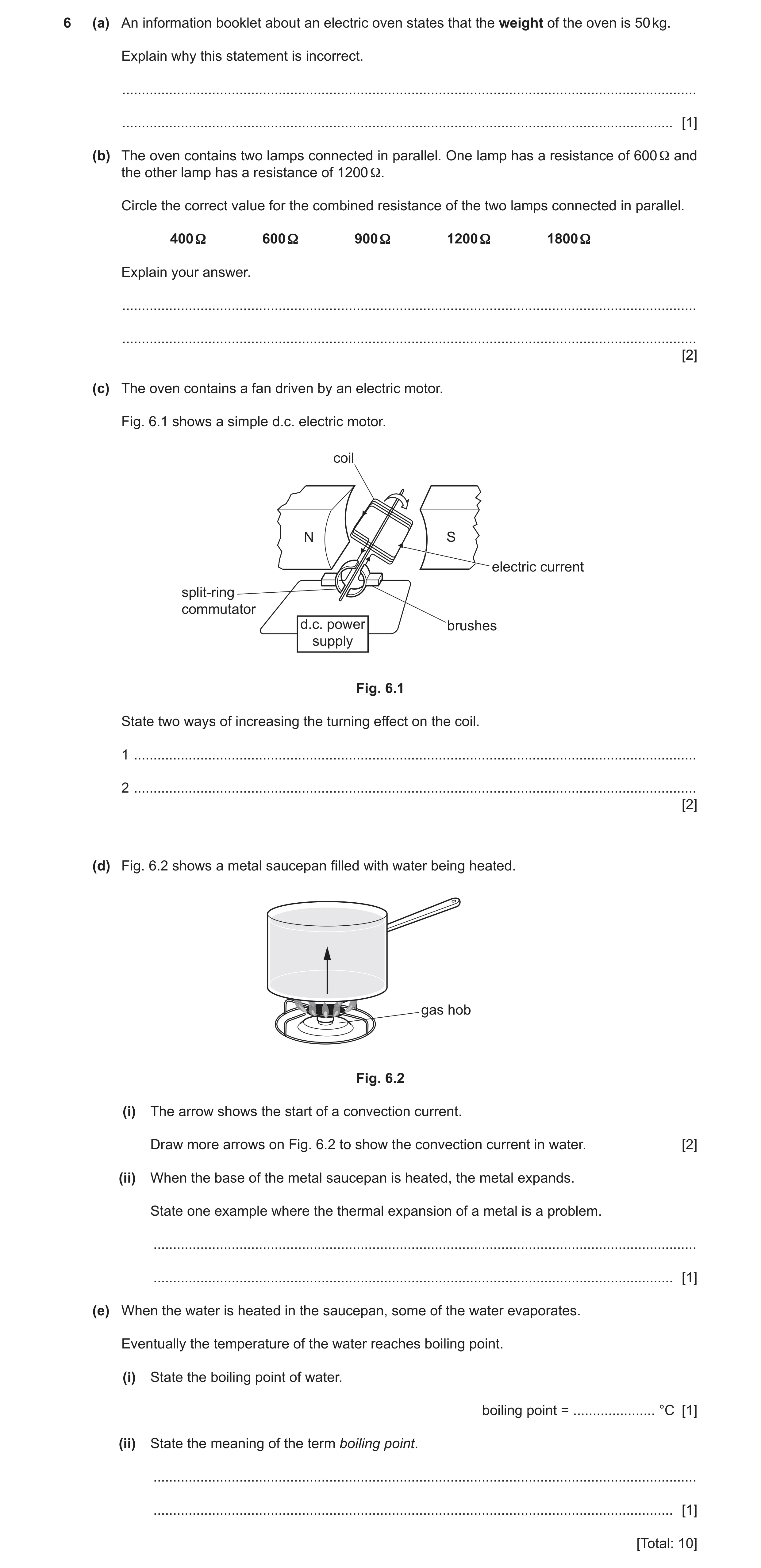
6 (a) An information booklet about an electric oven states that the weight of the oven is 50 kg. Explain why this statement is incorrect. … … [1] (b) The oven contains two lamps connected in parallel. One lamp has a resistance of 600 Ω and the other lamp has a resistance of 1200 Ω. Circle the correct value for the combined resistance of the two lamps connected in parallel. 400 Ω 600 Ω 900 Ω 1200 Ω 1800 Ω Explain your answer. … … [2] (c) The oven contains a fan driven by an electric motor. Fig. 6.1 shows a simple d.c. electric motor. coil N S electric current split-ring commutator d.c. power brushes supply Fig. 6.1 State two ways of increasing the turning effect on the coil. 1 … 2 … [2] (d) Fig. 6.2 shows a metal saucepan filled with water being heated. gas hob Fig. 6.2 (i) The arrow shows the start of a convection current. Draw more arrows on Fig. 6.2 to show the convection current in water. [2] (ii) When the base of the metal saucepan is heated, the metal expands. State one example where the thermal expansion of a metal is a problem. … … [1] (e) When the water is heated in the saucepan, some of the water evaporates. Eventually the temperature of the water reaches boiling point. (i) State the boiling point of water. boiling point = … °C [1] (ii) State the meaning of the term boiling point. … … [1] [Total: 10]
10 marks
Mark scheme: 6(a) mass is measured in kg / weight is measured in Newtons ; 1 6(b) 400 Ω; combined resistances of two resistors in parallel is less than the resistance of either of them; 2 6(c) larger current through coil; greater magnetic field; more turns; max 2 2 6(d)(i) arrow(s) to the right and or left; arrow(s) moving downwards ; 2 6(d)(ii) railway tracks / bridges; 1 6(e)(i) 100 (°C) ; 1 6(e)(ii) the temperature at which a liquid changes into a gas ; 1
This question in 0654/32 Feb/March 2021
Question 9 0654/31 May/June 2021
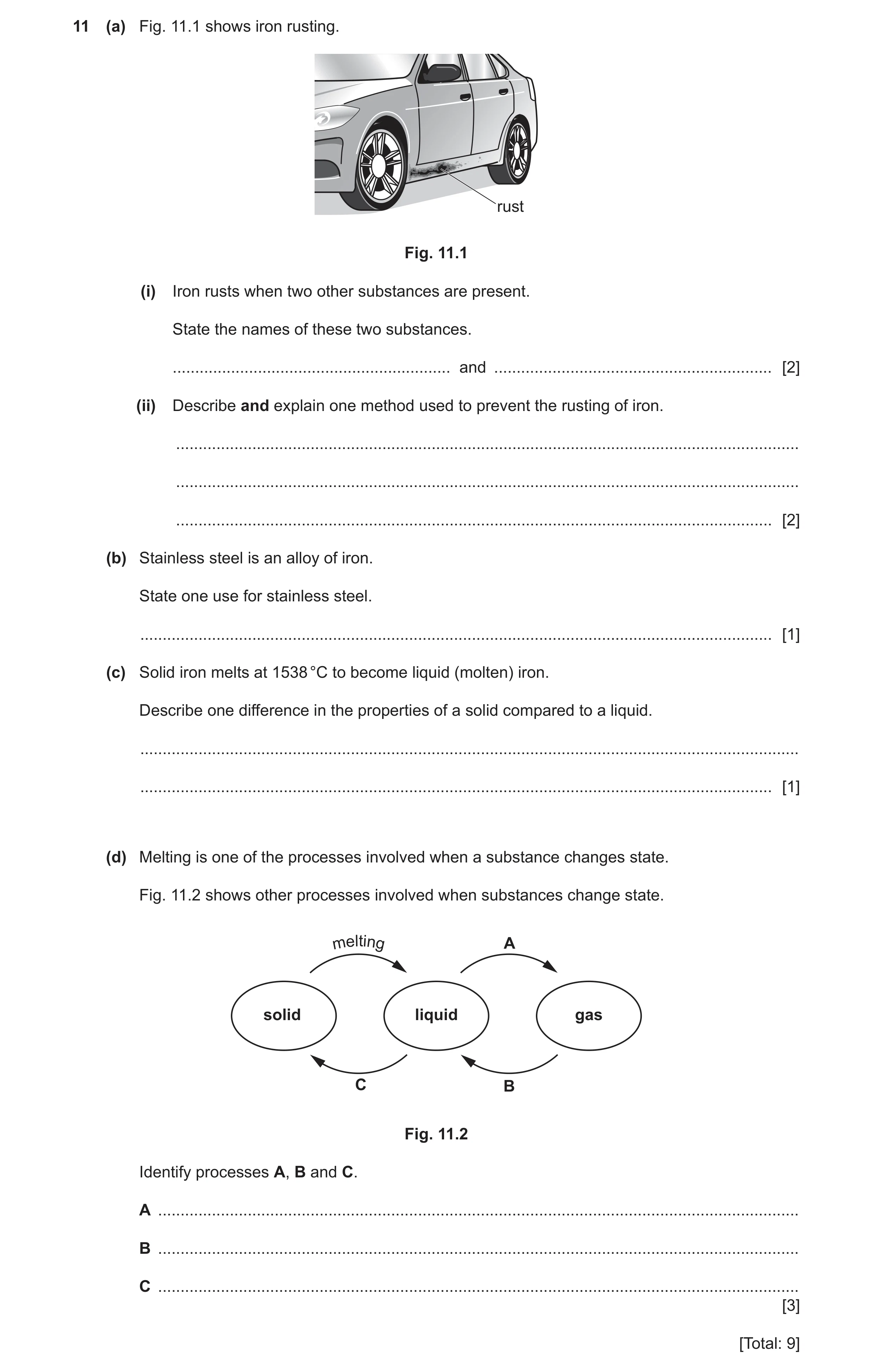
11 (a) Fig. 11.1 shows iron rusting. rust Fig. 11.1 (i) Iron rusts when two other substances are present. State the names of these two substances. … and … [2] (ii) Describe and explain one method used to prevent the rusting of iron. … … … [2] (b) Stainless steel is an alloy of iron. State one use for stainless steel. … [1] (c) Solid iron melts at 1538 °C to become liquid (molten) iron. Describe one difference in the properties of a solid compared to a liquid. … … [1] (d) Melting is one of the processes involved when a substance changes state. Fig. 11.2 shows other processes involved when substances change state. melting A solid liquid gas C B Fig. 11.2 Identify processes A, B and C. A … B … C … [3] [Total: 9]
9 marks
Mark scheme: 11(a)(i) oxygen ; water ; 2 11(a)(ii) painting / greasing / electroplating ; provides a barrier etc ; 2 11(b) cutlery ; 1 11(c) solid has a definite shape / liquid takes up shape of container ; 1 11(d) A boiling ; B condensing ; C freezing ; 3
This question in 0654/31 May/June 2021
Q10 · The thermal decomposition of calcium carbonate makes calcium oxide and carbon dioxide 0654/31 Oct/Nov 2021
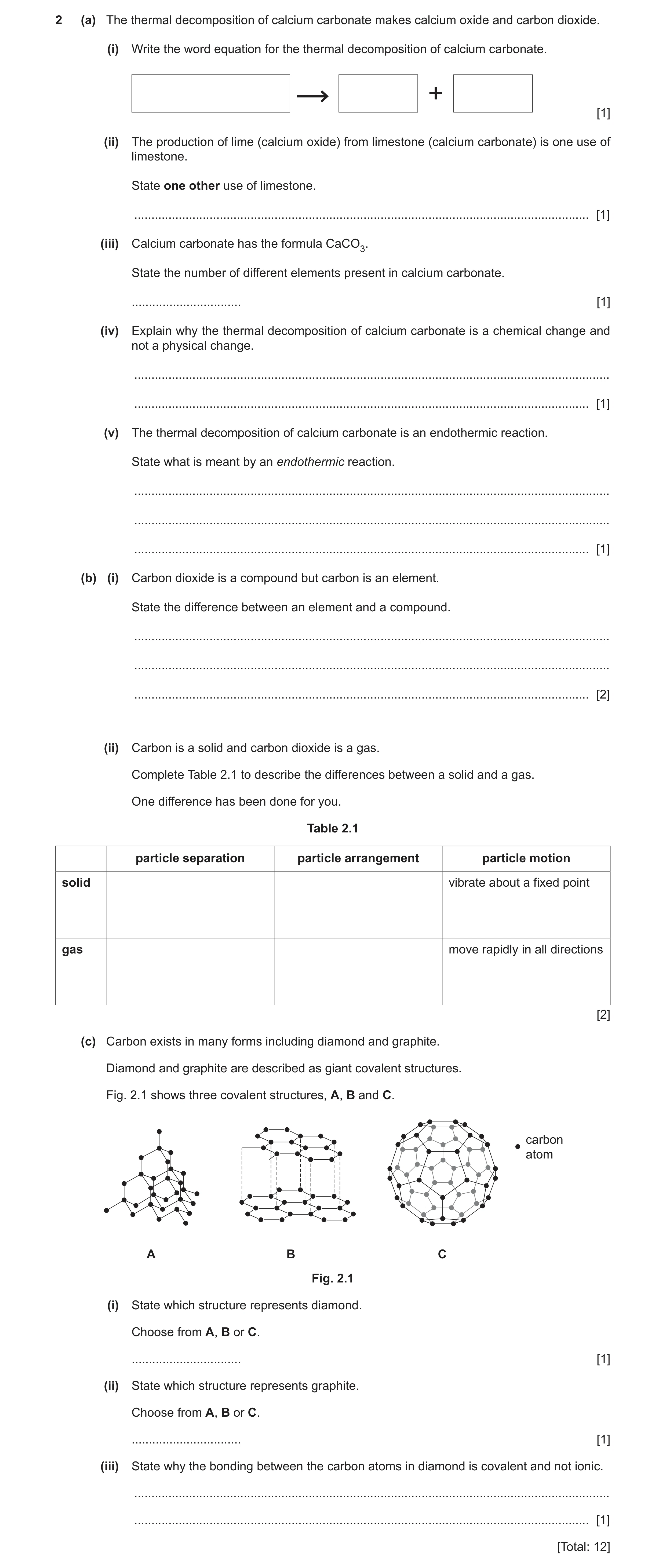
2 (a) The thermal decomposition of calcium carbonate makes calcium oxide and carbon dioxide. (i) Write the word equation for the thermal decomposition of calcium carbonate. + [1] (ii) The production of lime (calcium oxide) from limestone (calcium carbonate) is one use of limestone. State one other use of limestone. … [1] (iii) Calcium carbonate has the formula CaCO3. State the number of different elements present in calcium carbonate. … [1] (iv) Explain why the thermal decomposition of calcium carbonate is a chemical change and not a physical change. … … [1] (v) The thermal decomposition of calcium carbonate is an endothermic reaction. State what is meant by an endothermic reaction. … … … [1] (b) (i) Carbon dioxide is a compound but carbon is an element. State the difference between an element and a compound. … … … [2] (ii) Carbon is a solid and carbon dioxide is a gas. Complete Table 2.1 to describe the differences between a solid and a gas. One difference has been done for you. Table 2.1 particle separation particle arrangement particle motion solid vibrate about a fixed point gas move rapidly in all directions [2] (c) Carbon exists in many forms including diamond and graphite. Diamond and graphite are described as giant covalent structures. Fig. 2.1 shows three covalent structures, A, B and C. carbon atom A B C Fig. 2.1 (i) State which structure represents diamond. Choose from A, B or C. … [1] (ii) State which structure represents graphite. Choose from A, B or C. … [1] (iii) State why the bonding between the carbon atoms in diamond is covalent and not ionic. … … [1] [Total: 12]
12 marks
Mark scheme: 2(a)(i) calcium carbonate → calcium oxide + carbon dioxide ; 1 2(a)(ii) neutralizing acidic soil / building material / cement ; 1 2(a)(iii) 3 ; 1 2(a)(iv) new substances produced ; 1 2(a)(v) (thermal) energy taken in ; 1 2(b)(i) an element contains only one type of atom ; a compound contains two or more elements chemically combined ; 2 2(b)(ii) particles separation particle arrangement particle motion solid close together regular vibrate about a fixed point gas far apart random move rapidly in all directions particle separation column ; particle arrangement column ; 2 2(c)(i) A ; 1 2(c)(ii) B ; 1 2(c)(iii) 2 non-metal atoms bonding / electrons are shared ; 1
This question in 0654/31 Oct/Nov 2021
Q11 · Describe two advantages of generating electricity using nuclear fission compared to… 0654/33 Oct/Nov 2021
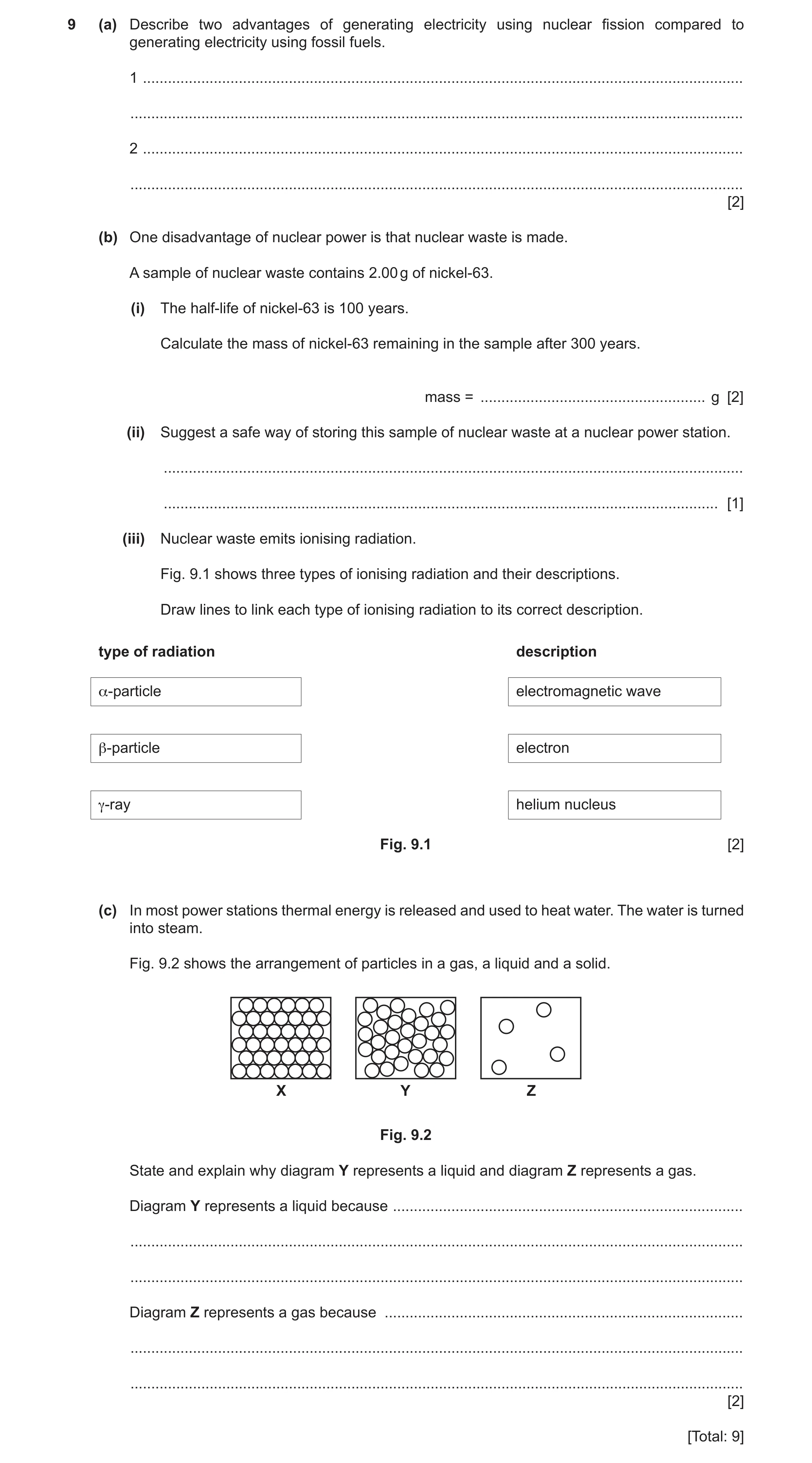
9 (a) Describe two advantages of generating electricity using nuclear fission compared to generating electricity using fossil fuels. 1 … … 2 … … [2] (b) One disadvantage of nuclear power is that nuclear waste is made. A sample of nuclear waste contains 2.00 g of nickel-63. (i) The half-life of nickel-63 is 100 years. Calculate the mass of nickel-63 remaining in the sample after 300 years. mass = … g [2] (ii) Suggest a safe way of storing this sample of nuclear waste at a nuclear power station. … … [1] (iii) Nuclear waste emits ionising radiation. Fig. 9.1 shows three types of ionising radiation and their descriptions. Draw lines to link each type of ionising radiation to its correct description. type of radiation description α-particle electromagnetic wave β-particle electron γ-ray helium nucleus Fig. 9.1 [2] (c) In most power stations thermal energy is released and used to heat water. The water is turned into steam. Fig. 9.2 shows the arrangement of particles in a gas, a liquid and a solid. X Y Z Fig. 9.2 State and explain why diagram Y represents a liquid and diagram Z represents a gas. Diagram Y represents a liquid because … … … Diagram Z represents a gas because … … … [2] [Total: 9]
9 marks
Mark scheme: 9(a) no CO2 emissions ; etc. fossil fuels conserved for other purposes ; 2 9(b)(i) 3 half lives ; 0.25 g remain ; 2 9(b)(ii) underground / in lead lined container ; 1 9(b)(iii) α – helium nucleus β – electron γ – electromagnetic wave ; ; 2 9(c) Y represents a liquid because particles are randomly arranged and (most are) touching ; Z represents a gas because particles are widely spaced (and randomly arranged) ; 2
This question in 0654/33 Oct/Nov 2021
Q12 · A large snow tractor used in Antarctica 0654/31 May/June 2022
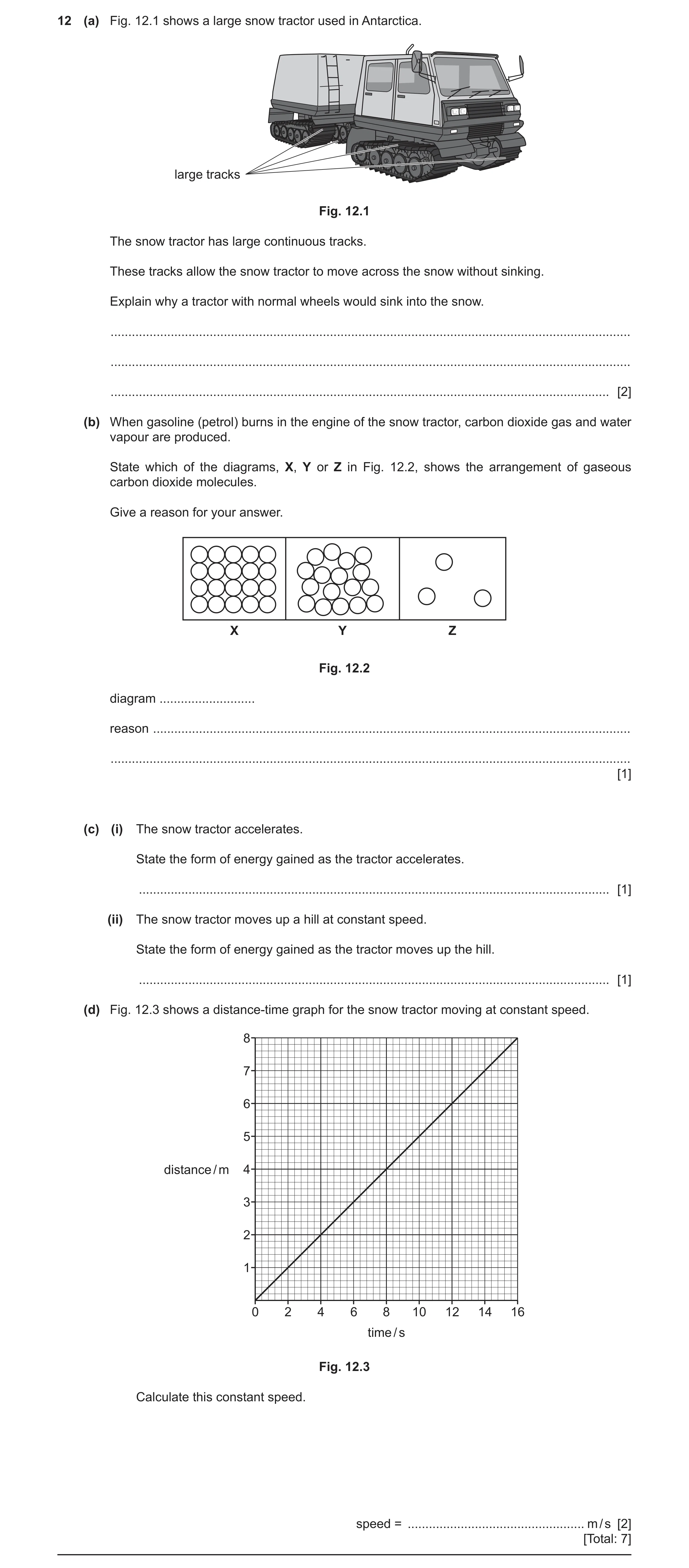
12 (a) Fig. 12.1 shows a large snow tractor used in Antarctica. large tracks Fig. 12.1 The snow tractor has large continuous tracks. These tracks allow the snow tractor to move across the snow without sinking. Explain why a tractor with normal wheels would sink into the snow. … … … [2] (b) When gasoline (petrol) burns in the engine of the snow tractor, carbon dioxide gas and water vapour are produced. State which of the diagrams, X, Y or Z in Fig. 12.2, shows the arrangement of gaseous carbon dioxide molecules. Give a reason for your answer. X Y Z Fig. 12.2 diagram … reason … … [1] (c) (i) The snow tractor accelerates. State the form of energy gained as the tractor accelerates. … [1] (ii) The snow tractor moves up a hill at constant speed. State the form of energy gained as the tractor moves up the hill. … [1] (d) Fig. 12.3 shows a distance-time graph for the snow tractor moving at constant speed. 8 7 6 5 distance / m 4 3 2 1 0 2 4 6 8 10 12 14 16 time / s Fig. 12.3 Calculate this constant speed. speed = … m / s [2] [Total: 7]
7 marks
Mark scheme: 12(a) area is less ; so pressure is greater; 2 12(b) Z (no mark) molecules are separated; 1 12(c)(i) kinetic; 1 12(c)(ii) gravitational potential; 1 12(d) speed = distance / time or correct numbers from graph; 0.5 (m / s); 2
This question in 0654/31 May/June 2022
Q13 · Table 9.1 contains descriptions of a solid, a liquid and a gas 0654/32 May/June 2022
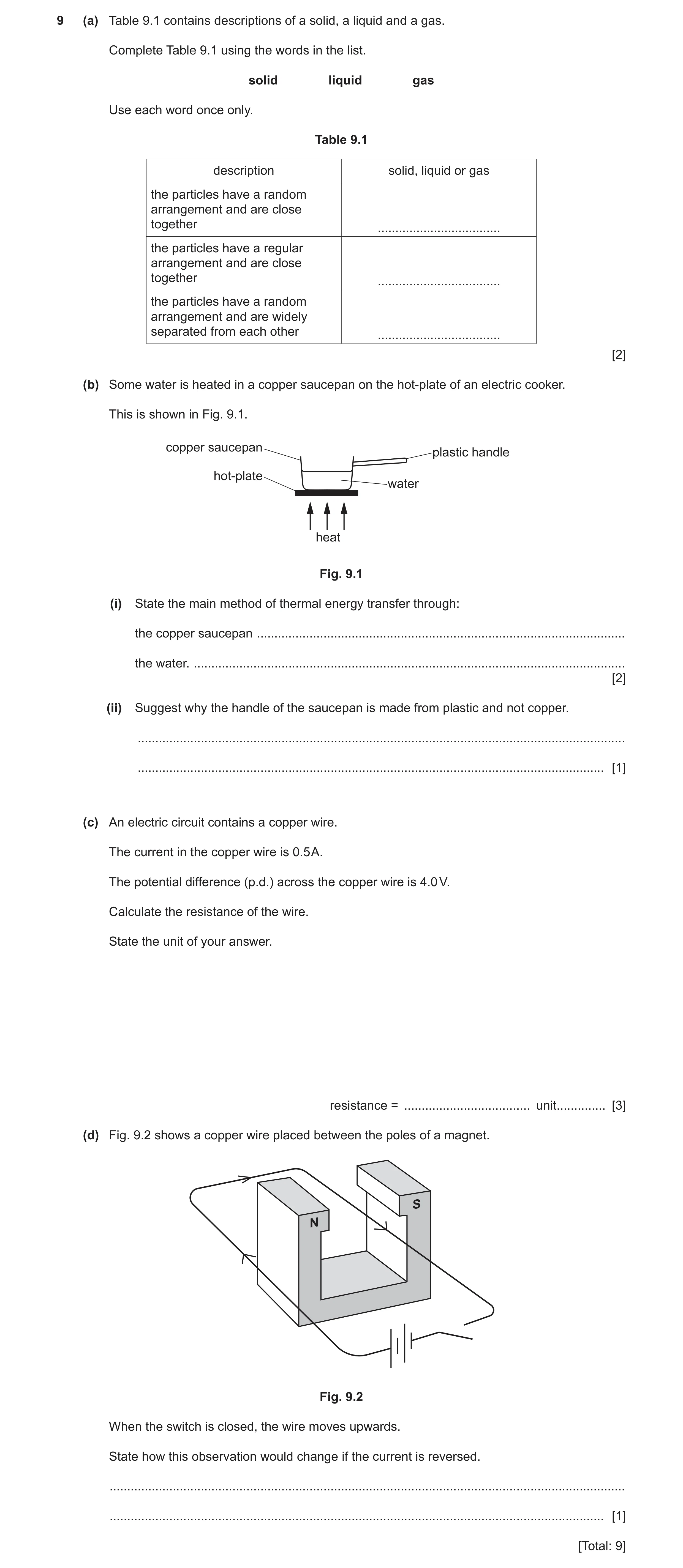
9 (a) Table 9.1 contains descriptions of a solid, a liquid and a gas. Complete Table 9.1 using the words in the list. solid liquid gas Use each word once only. Table 9.1 description solid, liquid or gas the particles have a random arrangement and are close together … the particles have a regular arrangement and are close together … the particles have a random arrangement and are widely separated from each other … [2] (b) Some water is heated in a copper saucepan on the hot-plate of an electric cooker. This is shown in Fig. 9.1. copper saucepan plastic handle hot-plate water heat Fig. 9.1 (i) State the main method of thermal energy transfer through: the copper saucepan … the water. … [2] (ii) Suggest why the handle of the saucepan is made from plastic and not copper. … … [1] (c) An electric circuit contains a copper wire. The current in the copper wire is 0.5 A. The potential difference (p.d.) across the copper wire is 4.0 V. Calculate the resistance of the wire. State the unit of your answer. resistance = … unit … [3] (d) Fig. 9.2 shows a copper wire placed between the poles of a magnet. S N Fig. 9.2 When the switch is closed, the wire moves upwards. State how this observation would change if the current is reversed. … … [1] [Total: 9]
9 marks
Mark scheme: 9(a) the particles have a random arrangement and are close together = liquid the particles have a regular arrangement and are close together = solid the particles are widely separated from each other = gas 2 9(b)(i) conduction; convection; 2 9(b)(ii) plastic is an insulator (so you don’t burn your hand); 1 Question Answer Marks 9(c) R = V / I (in any form) or 4.0 / 0.5; resistance = 8; ; 3 9(d) wire moves down / opposite way; 1
This question in 0654/32 May/June 2022
Q14 · Table 9.1 contains descriptions of a solid, a liquid and a gas 0654/33 May/June 2022
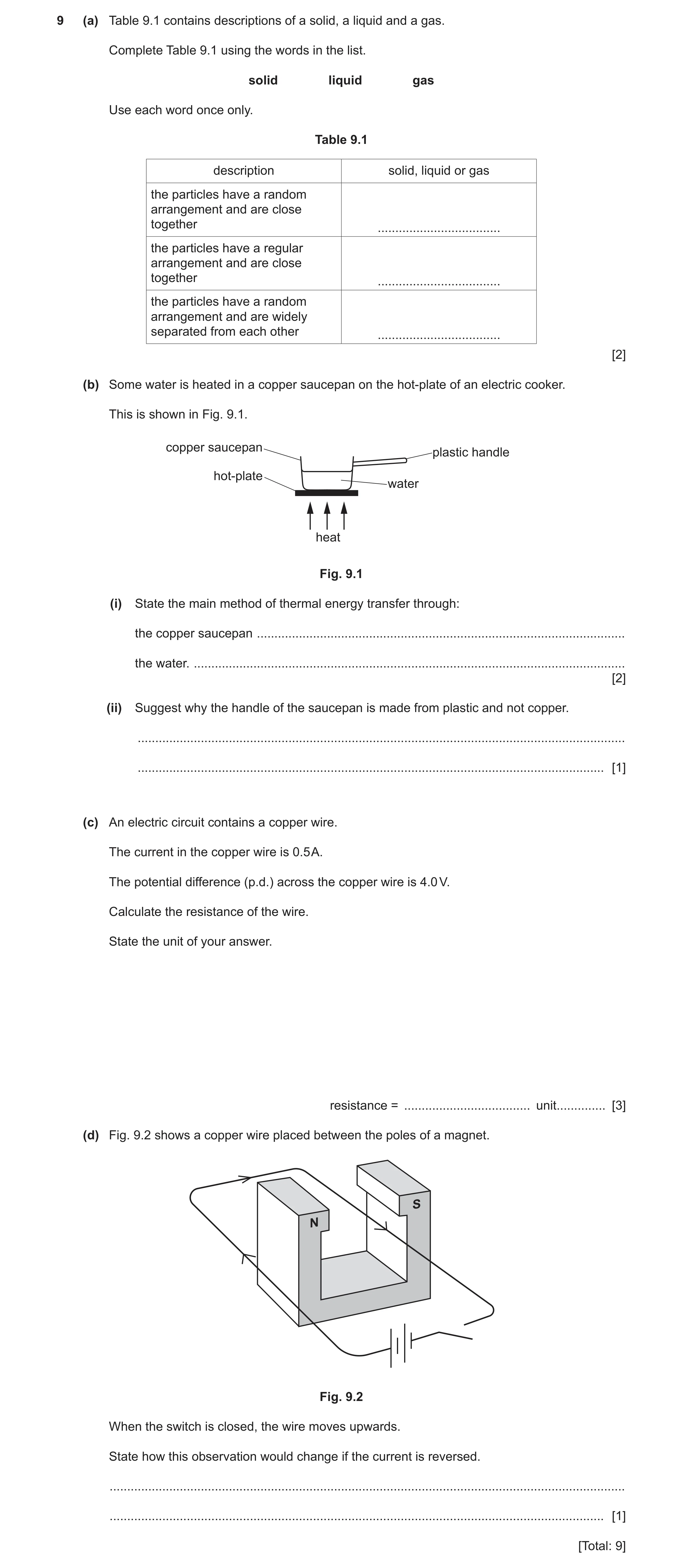
9 (a) Table 9.1 contains descriptions of a solid, a liquid and a gas. Complete Table 9.1 using the words in the list. solid liquid gas Use each word once only. Table 9.1 description solid, liquid or gas the particles have a random arrangement and are close together … the particles have a regular arrangement and are close together … the particles have a random arrangement and are widely separated from each other … [2] (b) Some water is heated in a copper saucepan on the hot-plate of an electric cooker. This is shown in Fig. 9.1. copper saucepan plastic handle hot-plate water heat Fig. 9.1 (i) State the main method of thermal energy transfer through: the copper saucepan … the water. … [2] (ii) Suggest why the handle of the saucepan is made from plastic and not copper. … … [1] (c) An electric circuit contains a copper wire. The current in the copper wire is 0.5 A. The potential difference (p.d.) across the copper wire is 4.0 V. Calculate the resistance of the wire. State the unit of your answer. resistance = … unit … [3] (d) Fig. 9.2 shows a copper wire placed between the poles of a magnet. S N Fig. 9.2 When the switch is closed, the wire moves upwards. State how this observation would change if the current is reversed. … … [1] [Total: 9]
9 marks
Mark scheme: 9(a) the particles have a random arrangement and are close together = liquid the particles have a regular arrangement and are close together = solid the particles are widely separated from each other = gas 2 9(b)(i) conduction; convection; 2 9(b)(ii) plastic is an insulator (so you don’t burn your hand); 1 Question Answer Marks 9(c) R = V / I (in any form) or 4.0 / 0.5; resistance = 8; ; 3 9(d) wire moves down / opposite way; 1
This question in 0654/33 May/June 2022
Q15 · Water vapour in the air over the sea comes from liquid water in the sea 0654/31 Oct/Nov 2022
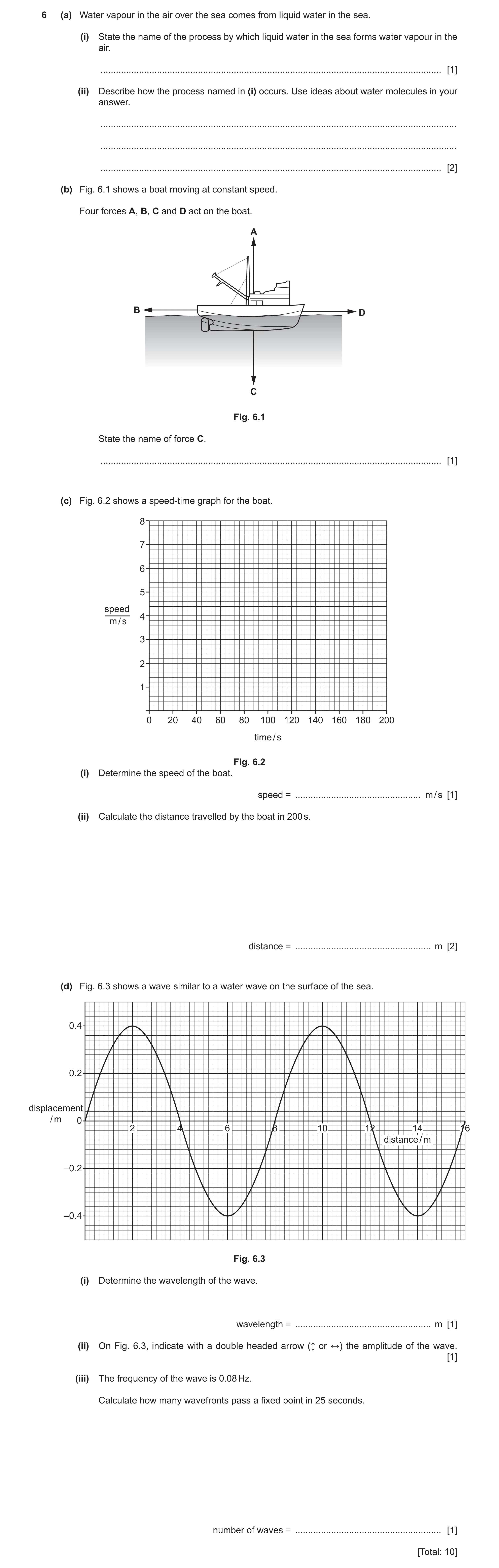
6 (a) Water vapour in the air over the sea comes from liquid water in the sea. (i) State the name of the process by which liquid water in the sea forms water vapour in the air. … [1] (ii) Describe how the process named in (i) occurs. Use ideas about water molecules in your answer. … … … [2] (b) Fig. 6.1 shows a boat moving at constant speed. Four forces A, B, C and D act on the boat. A B D C Fig. 6.1 State the name of force C. … [1] (c) Fig. 6.2 shows a speed-time graph for the boat. 8 7 6 5 speed 4 m / s 3 2 1 0 20 40 60 80 100 120 140 160 180 200 time / s Fig. 6.2 (i) Determine the speed of the boat. speed = … m / s [1] (ii) Calculate the distance travelled by the boat in 200 s. distance = … m [2] (d) Fig. 6.3 shows a wave similar to a water wave on the surface of the sea. 0.4 0.2 displacement / m 0 2 4 6 8 10 12 14 16 distance / m –0.2 –0.4 Fig. 6.3 (i) Determine the wavelength of the wave. wavelength = … m [1] (ii) On Fig. 6.3, indicate with a double headed arrow (↕ or ↔) the amplitude of the wave. [1] (iii) The frequency of the wave is 0.08 Hz. Calculate how many wavefronts pass a fixed point in 25 seconds. number of waves = … [1] [Total: 10]
10 marks
Mark scheme: 6(a)(i) evaporation 1 6(a)(ii) fastest moving / most energetic molecules / particles ; 2 escape from surface ; 6(b) Weight ; 1 6(c)(i) 4.4 (m / s) ; 1 6(c)(ii) distance = speed time (in any form symbols or words) or 4.4 200 or area under graph ; 2 880 (m) ; 6(d)(i) 8 (m) ; 1 6(d)(ii) amplitude correctly indicated ; 1 6(d)(iii) 2.0 ; 1
This question in 0654/31 Oct/Nov 2022
Q16 · Statements about molecules in solids and gases 0654/31 Oct/Nov 2023
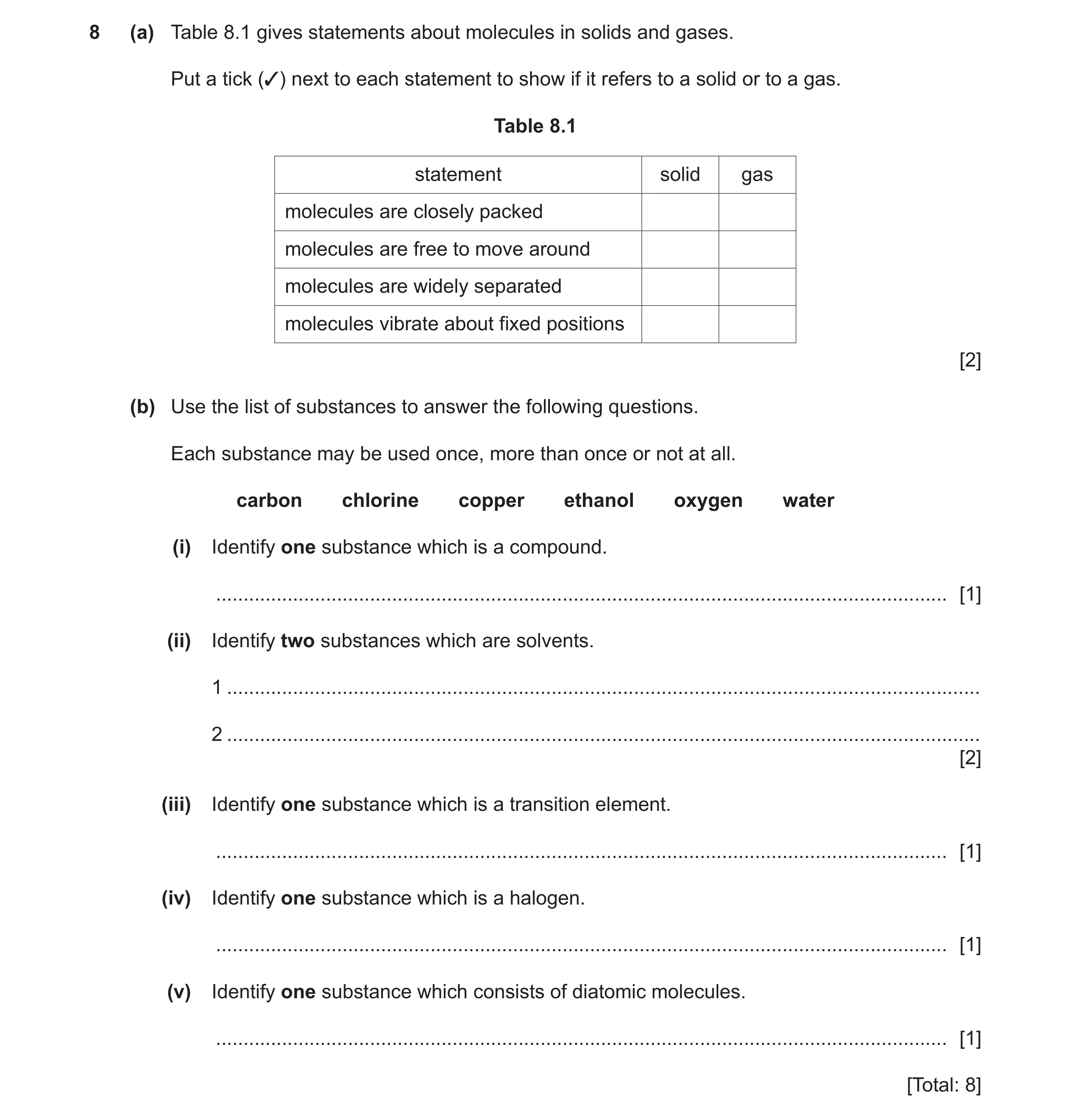
8 (a) Table 8.1 gives statements about molecules in solids and gases. Put a tick (✓) next to each statement to show if it refers to a solid or to a gas. Table 8.1 statement solid gas molecules are closely packed molecules are free to move around molecules are widely separated molecules vibrate about fixed positions [2] (b) Use the list of substances to answer the following questions. Each substance may be used once, more than once or not at all. carbon chlorine copper ethanol oxygen water (i) Identify one substance which is a compound. … [1] (ii) Identify two substances which are solvents. 1 … 2 … [2] (iii) Identify one substance which is a transition element. … [1] (iv) Identify one substance which is a halogen. … [1] (v) Identify one substance which consists of diatomic molecules. … [1] [Total: 8]
8 marks
Mark scheme: 8(a) 2 statement solid gas molecules are closely packed ✓ molecules are free to move around ✓ molecules are widely separated ✓ molecules vibrate about a fixed position ✓ 2 or 3 correct ; 4 correct ; 8(b)(i) ethanol / water ; 1 8(b)(ii) ethanol ; 2 water ; 8(b)(iii) copper ; 1 8(b)(iv) chlorine ; 1 8(b)(v) chlorine / oxygen ; 1
This question in 0654/31 Oct/Nov 2023
Q17 · A cyclist is riding a bicycle around a circular track 0654/31 Oct/Nov 2023
12 (a) A cyclist is riding a bicycle around a circular track. The length of the track is 400 m. The cyclist completes five laps of the track. The time taken for each lap is measured and recorded in Table 12.1. Table 12.1 lap time / s 1 35.3 2 34.7 3 37.2 4 35.0 5 34.3 (i) Calculate the average time for one lap. average time for one lap = … s [1] (ii) The air in the tyres of the bicycle warms up during the ride. Describe how the motion of the molecules of the gas in the tyres changes during the ride. … … [1] (iii) Select the correct word from the list to complete each sentence. solids liquids gases … have no definite shape or volume. … have a definite volume but take the shape of the container. [1] (b) Fig. 12.1 shows a cyclist near a road junction. A car driver at the junction can see the reflection of the cyclist in a plane mirror. The ray of light shown allows the car driver to see the cyclist approaching the junction. normal line plane mirror cyclist ray of light car driver tall building Fig. 12.1 (i) On Fig. 12.1, draw an arrow on the ray of light to show the direction of travel of the ray of light. [1] (ii) On Fig. 12.1, label the angle of incidence with the letter i. [1] (c) The bicycle is left outside on a sunny day. Energy from the Sun heats the metal frame of the bicycle. (i) State the method of energy transfer between the Sun and the Earth. … [1] (ii) State the method of energy transfer through the frame of the bicycle. … [1] (iii) Describe a simple way of testing whether the frame of the bicycle is made from steel or from aluminium. … … [2] [Total: 9]
9 marks
Mark scheme: 12(a)(i) 35.3 (s) ; 1 12(a)(ii) molecules move faster ; 1 12(a)(iii) gases and 1 liquids both correct – 1 mark ; 12(b)(i) arrow drawn going away from cyclist / towards driver ; 1 12(b)(ii) angle of incidence correctly labelled ; 1 12(c)(i) radiation ; 1 12(c)(ii) conduction ; 1 12(c)(iii) use a magnet ; 2 steel will be attracted (to magnet) ; ORA
This question in 0654/31 Oct/Nov 2023
Q18 · Sodium forms a basic oxide 0654/33 Oct/Nov 2023
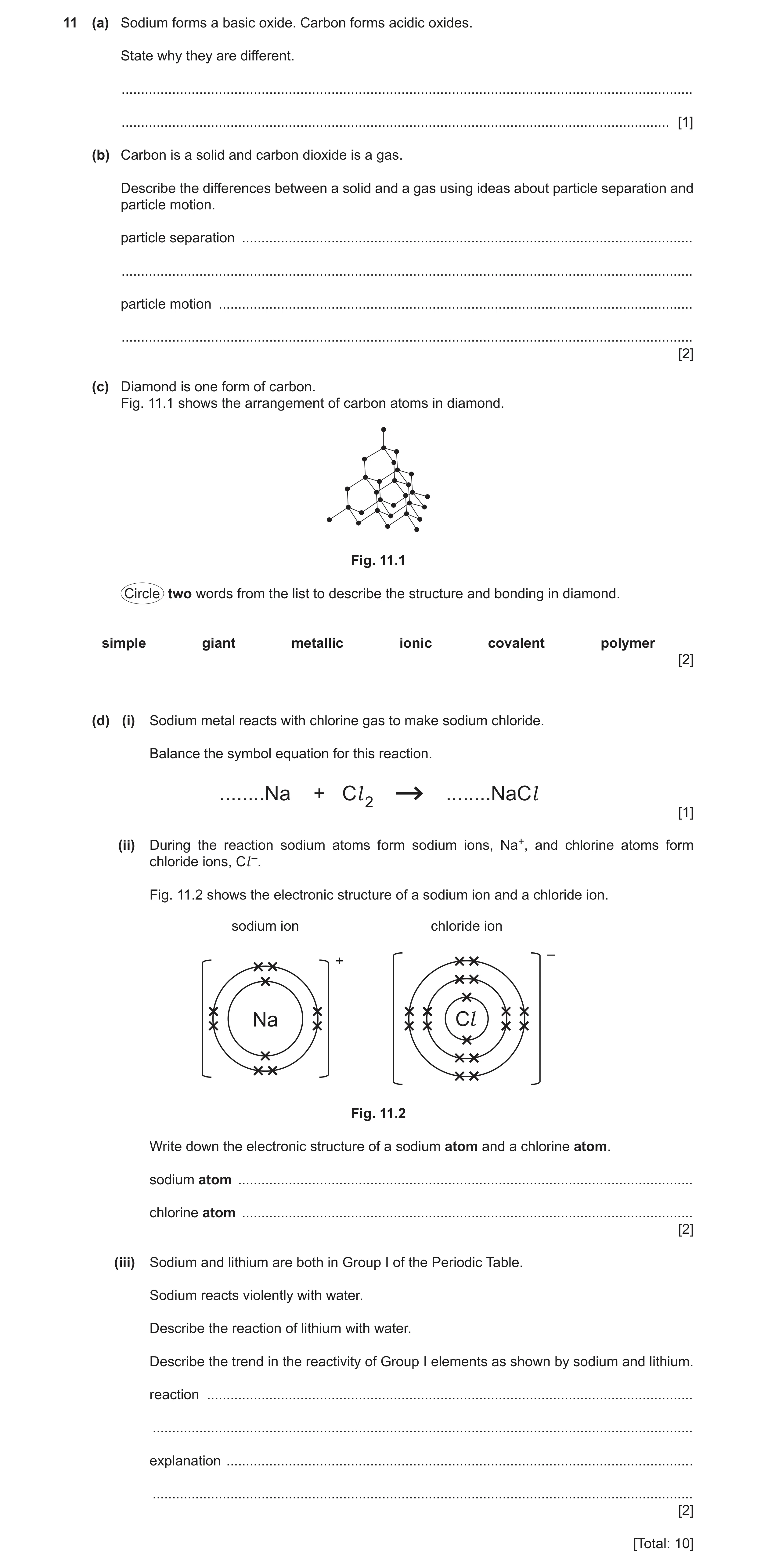
11 (a) Sodium forms a basic oxide. Carbon forms acidic oxides. State why they are different. … … [1] (b) Carbon is a solid and carbon dioxide is a gas. Describe the differences between a solid and a gas using ideas about particle separation and particle motion. particle separation … … particle motion … … [2] (c) Diamond is one form of carbon. Fig. 11.1 shows the arrangement of carbon atoms in diamond. Fig. 11.1 Circle two words from the list to describe the structure and bonding in diamond. simple giant metallic ionic covalent polymer [2] (d) (i) Sodium metal reacts with chlorine gas to make sodium chloride. Balance the symbol equation for this reaction. … Na + Cl … NaCl 2 [1] (ii) During the reaction sodium atoms form sodium ions, Na+, and chlorine atoms form chloride ions, Cl –. Fig. 11.2 shows the electronic structure of a sodium ion and a chloride ion. sodium ion chloride ion – + Na Cl Fig. 11.2 Write down the electronic structure of a sodium atom and a chlorine atom. sodium atom … chlorine atom … [2] (iii) Sodium and lithium are both in Group I of the Periodic Table. Sodium reacts violently with water. Describe the reaction of lithium with water. Describe the trend in the reactivity of Group I elements as shown by sodium and lithium. reaction … … explanation … … [2] [Total: 10]
10 marks
Mark scheme: 11(a) non-metals form acidic oxides and metals form basic oxides ; 1 11(b) (solid) closer together / (gas) further apart) ; 2 (solid) vibrating about a fixed point / (gas) free to move / faster ; 11(c) giant ; 2 covalent ; 11(d)(i) 2 Na and 2 NaCl ; 1 11(d)(ii) 2, 8, 1 ; 2 2, 8, 7 ; 11(d)(iii) lithium reacts less rapidly / quickly ; 2 (metal) reactivity increases down group ;
This question in 0654/33 Oct/Nov 2023
Q19 · Ice is a solid 0654/31 May/June 2024
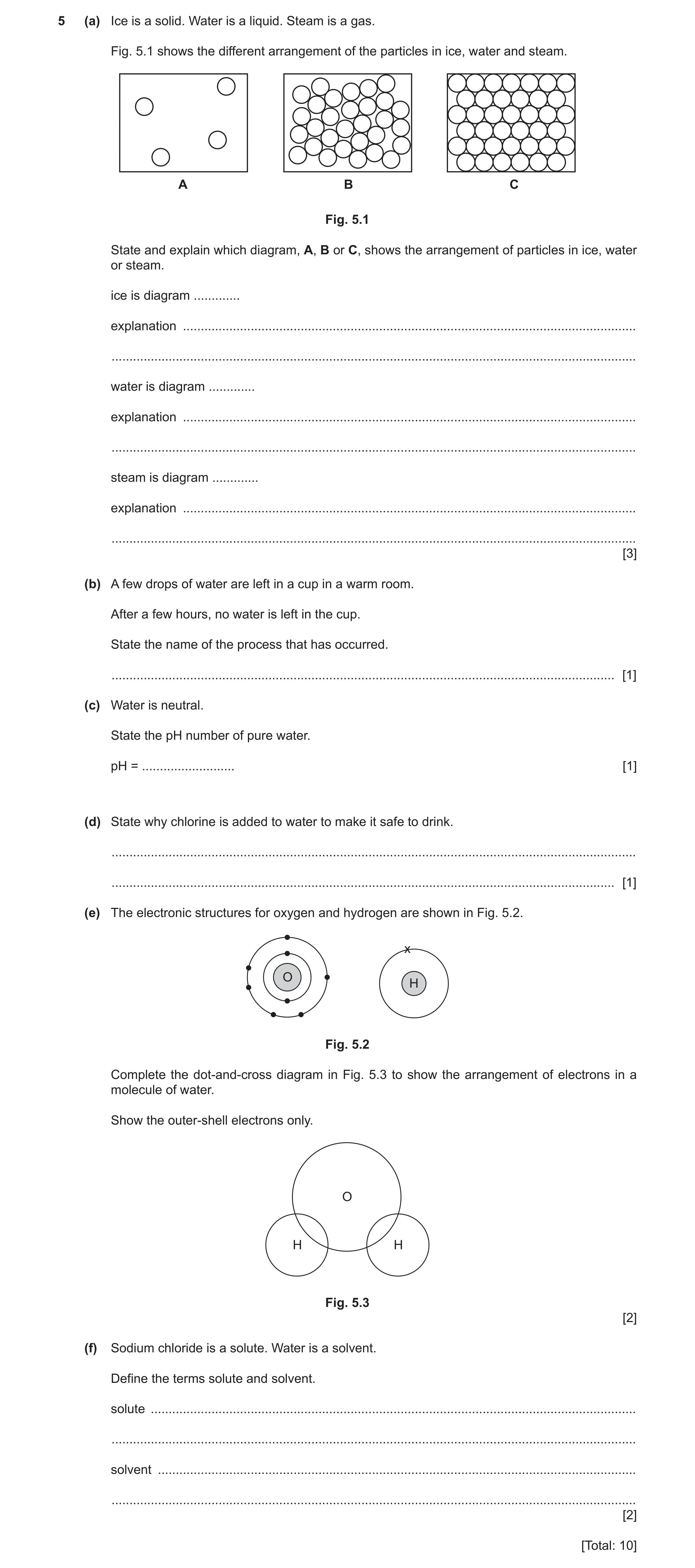
5 (a) Ice is a solid. Water is a liquid. Steam is a gas. Fig. 5.1 shows the different arrangement of the particles in ice, water and steam. A B C Fig. 5.1 State and explain which diagram, A, B or C, shows the arrangement of particles in ice, water or steam. ice is diagram … explanation … … water is diagram … explanation … … steam is diagram … explanation … … [3] (b) A few drops of water are left in a cup in a warm room. After a few hours, no water is left in the cup. State the name of the process that has occurred. … [1] (c) Water is neutral. State the pH number of pure water. pH = … [1] (d) State why chlorine is added to water to make it safe to drink. … … [1] (e) The electronic structures for oxygen and hydrogen are shown in Fig. 5.2. x O H Fig. 5.2 Complete the dot‑and‑cross diagram in Fig. 5.3 to show the arrangement of electrons in a molecule of water. Show the outer‑shell electrons only. O H H Fig. 5.3 [2] (f) Sodium chloride is a solute. Water is a solvent. Define the terms solute and solvent. solute … … solvent … … [2] [Total: 10]
10 marks
Mark scheme: 5(a) ice is C – particles are in regular arrangement water is B – particles are (mostly) touching and irregular arrangement steam is A – particles are widely spaced C B A ; one correct explanation ; three correct explanations ; 3 5(b) evaporation ; 1 5(c) 7 ; 1 5(d) kills bacteria ; 1 Question Answer Marks 5(e) 1 pair of bonding electrons ; all else correct ; 2 5(f) a solute – a substance that is dissolved in a solvent ; a solvent – a substance / liquid that dissolves a solute ; 2
This question in 0654/31 May/June 2024
Q20 · Ethanol has the formula C2H5OH 0654/32 May/June 2024
5 (a) Ethanol has the formula C2H5OH. Complete Fig. 5.1 to show the structure of an ethanol molecule. C C Fig. 5.1 [2] (b) Ethanol is used as a fuel. (i) State one other use for ethanol. … [1] (ii) Write the word equation for the complete combustion of ethanol. ……… … …...…… + ……… … …..…… ……… … …..…… + ….…… … …..…… [2] (iii) The combustion of ethanol is an exothermic reaction. State what is meant by an exothermic reaction. … … … [1] (c) Ethanol is made from ethene. Ethene reacts at high temperatures with substance X in the presence of a catalyst. (i) State the name of substance X. … [1] (ii) Describe the effect of a catalyst on chemical reactions. … … [1] (iii) State one other method of making ethanol. … [1] (d) Ethanol is a liquid at room temperature. Describe the motion and separation of the particles in ethanol. motion … separation … [2] [Total: 11]
11 marks
Mark scheme: 5(a) C–O–H correct ; all else correct ; 2 5(b)(i) solvent ; 1 5(b)(ii) ethanol + oxygen → carbon dioxide + water ethanol and oxygen ; carbon dioxide and water ; 2 5(b)(iii) thermal energy released ; 1 5(c)(i) steam / water ; 1 5(c)(ii) increase rate of reaction ; 1 5(c)(iii) fermentation ; 1 Question Answer Marks 5(d) random (motion) ; touching ; 2
This question in 0654/32 May/June 2024
Q21 · Ethanol has the formula C2H5OH 0654/33 May/June 2024
5 (a) Ethanol has the formula C2H5OH. Complete Fig. 5.1 to show the structure of an ethanol molecule. C C Fig. 5.1 [2] (b) Ethanol is used as a fuel. (i) State one other use for ethanol. … [1] (ii) Write the word equation for the complete combustion of ethanol. ……… … …...…… + ……… … …..…… ……… … …..…… + ….…… … …..…… [2] (iii) The combustion of ethanol is an exothermic reaction. State what is meant by an exothermic reaction. … … … [1] (c) Ethanol is made from ethene. Ethene reacts at high temperatures with substance X in the presence of a catalyst. (i) State the name of substance X. … [1] (ii) Describe the effect of a catalyst on chemical reactions. … … [1] (iii) State one other method of making ethanol. … [1] (d) Ethanol is a liquid at room temperature. Describe the motion and separation of the particles in ethanol. motion … separation … [2] [Total: 11]
11 marks
Mark scheme: 5(a) C–O–H correct ; all else correct ; 2 5(b)(i) solvent ; 1 5(b)(ii) ethanol + oxygen → carbon dioxide + water ethanol and oxygen ; carbon dioxide and water ; 2 5(b)(iii) thermal energy released ; 1 5(c)(i) steam / water ; 1 5(c)(ii) increase rate of reaction ; 1 5(c)(iii) fermentation ; 1 Question Answer Marks 5(d) random (motion) ; touching ; 2
This question in 0654/33 May/June 2024
Q22 · The changes of state of water 0654/31 Oct/Nov 2024
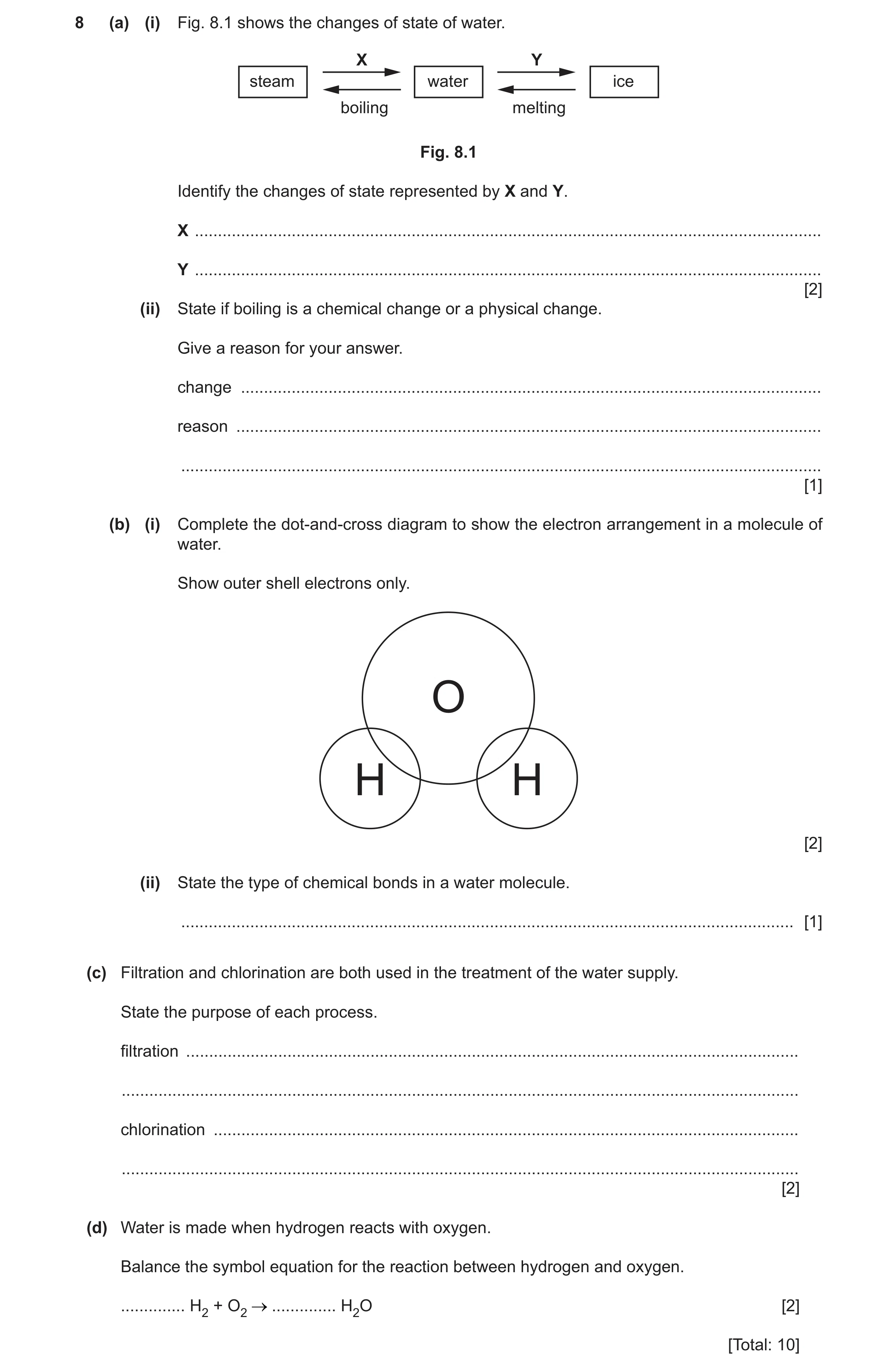
8 (a) (i) Fig. 8.1 shows the changes of state of water. X Y steam water ice boiling melting Fig. 8.1 Identify the changes of state represented by X and Y. X … Y … [2] (ii) State if boiling is a chemical change or a physical change. Give a reason for your answer. change … reason … … [1] (b) (i) Complete the dot-and-cross diagram to show the electron arrangement in a molecule of water. Show outer shell electrons only. O H H [2] (ii) State the type of chemical bonds in a water molecule. … [1] (c) Filtration and chlorination are both used in the treatment of the water supply. State the purpose of each process. filtration … … chlorination … … [2] (d) Water is made when hydrogen reacts with oxygen. Balance the symbol equation for the reaction between hydrogen and oxygen. … H2 + O2 … H2O [2] [Total: 10]
10 marks
Mark scheme: 8(a)(i) X = condensation ; 2 Y = solidification or freezing ; 8(a)(ii) physical (no mark) ; 1 no new substance formed / can be reversed ; 8(b)(i) 2 one pair of bonding electrons ; all else correct ; 8(b)(ii) covalent ; 1 8(c) filtration – remove solid matter OWTTE ; 2 chlorination – kill bacteria / microorganisms ; 8(d) 2 H2 + O2 → 2 H2O 2 2 H2 ; 2 H2O ;
This question in 0654/31 Oct/Nov 2024
Q23 · Copper is a metal in high demand that is now often recycled 0654/33 Oct/Nov 2024
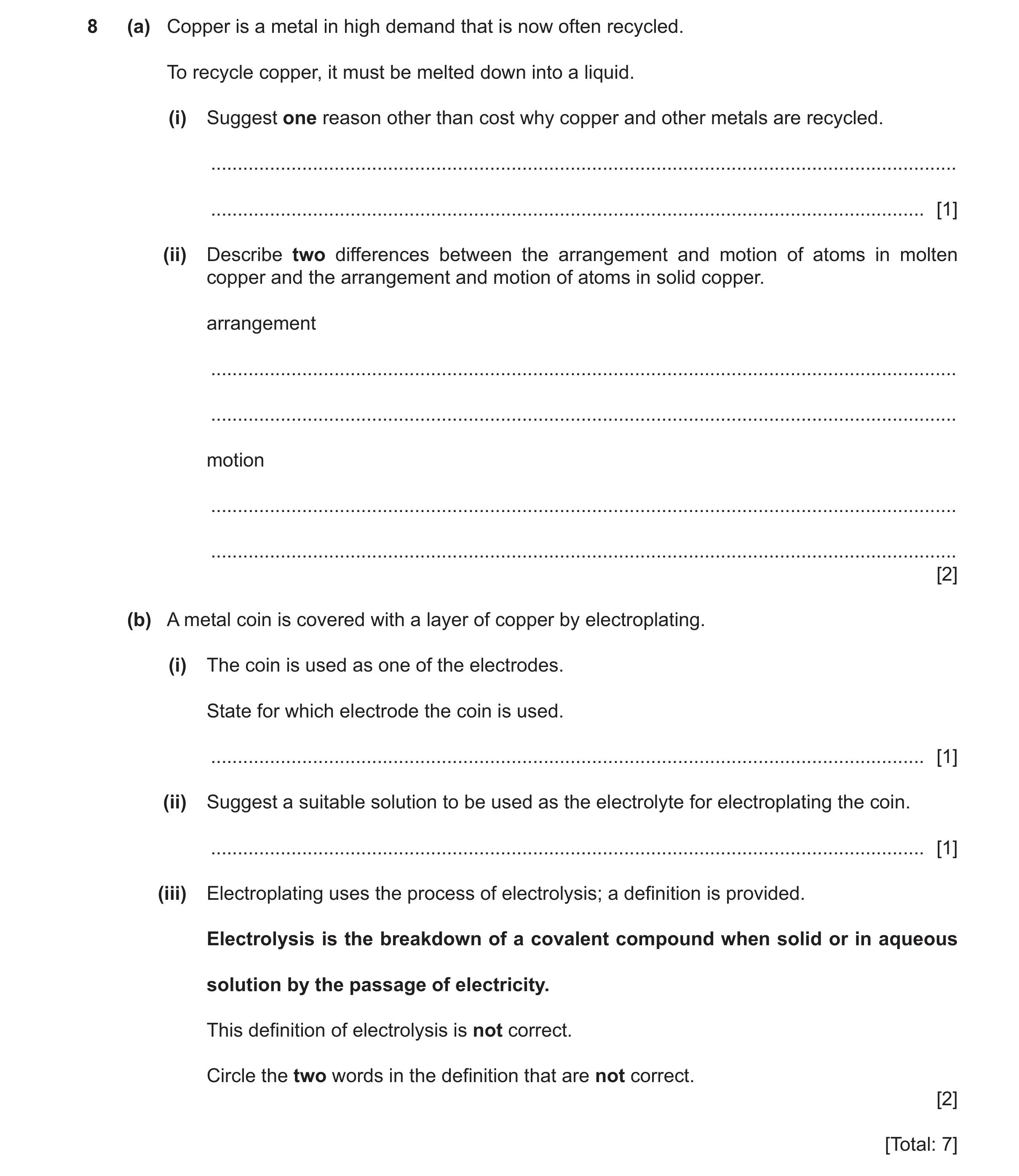
8 (a) Copper is a metal in high demand that is now often recycled. To recycle copper, it must be melted down into a liquid. (i) Suggest one reason other than cost why copper and other metals are recycled. … … [1] (ii) Describe two differences between the arrangement and motion of atoms in molten copper and the arrangement and motion of atoms in solid copper. arrangement … … motion … … [2] (b) A metal coin is covered with a layer of copper by electroplating. (i) The coin is used as one of the electrodes. State for which electrode the coin is used. … [1] (ii) Suggest a suitable solution to be used as the electrolyte for electroplating the coin. … [1] (iii) Electroplating uses the process of electrolysis; a definition is provided. Electrolysis is the breakdown of a covalent compound when solid or in aqueous solution by the passage of electricity. This definition of electrolysis is not correct. Circle the two words in the definition that are not correct. [2] [Total: 7]
7 marks
Mark scheme: 8(a)(i) copper (ore) is a finite resource ; 1 8(a)(ii) arrangement – solid regular and liquid irregular ; 2 motion – solid vibrate (about fixed point) only / do not move AND liquid are able to move about ; 8(b)(i) cathode ; 1 8(b)(ii) copper sulfate / copper chloride ; 1 8(b)(iii) covalent ; 2 solid ;
This question in 0654/33 Oct/Nov 2024
Q24 · Gasoline / petrol reacts with oxygen in car engines making exhaust gases 0654/32 Feb/March 2025
7 (a) Gasoline / petrol reacts with oxygen in car engines making exhaust gases. This is an example of oxidation. (i) State the meaning of oxidation. … … [1] (ii) Table 7.1 shows the composition of clean dry air and of exhaust gases. Table 7.1 percentage by percentage by gases volume in clean volume in exhaust dry air / % gases / % carbon dioxide and 1 13 other gases nitrogen 67 … oxygen 9 … water 0 11 Complete Table 7.1. [2] (iii) Use Table 7.1 to state the two products of the oxidation of gasoline / petrol. 1 … 2 … [2] (iv) Describe a chemical test for the presence of water in a sample of exhaust gases and state the observations for a positive result. test … … positive result … … [2] (b) Neon is another gas found in clean dry air. Fig. 7.1 shows the electronic configuration of an atom of neon. Fig. 7.1 (i) Use Fig. 7.1 to explain why neon is found in Group VIII and Period 2 of the Periodic Table. Group VIII … … … Period 2 … … [2] (ii) Use Fig. 7.1 to explain why neon is unreactive. … … [1] (c) Water at room temperature is a liquid. Water vapour in the air is a gas. Name the change of state that occurs when: liquid water changes into water vapour … water vapour changes into liquid water. … [2] [Total: 12]
12 marks
Mark scheme: 7(a)(i) gain of oxygen ; 1 7(a)(ii) (nitrogen) 78% ; 2 (oxygen) 21% ; 7(a)(iii) carbon dioxide ; 2 water ; 7(a)(iv) (anhydrous) copper(II) sulfate ; 2 white to blue ; or (anhydrous) cobalt(II) chloride ; blue to pink ; 7(b)(i) Group VIII – 8 electrons in outer shell ; 2 Period 2 – electrons in 2 shells ; 7(b)(ii) full outer shell ; 1 7(c) Evaporation ; 2 Condensation ;
This question in 0654/32 Feb/March 2025
Q25 · Table 5.1 contains information about 6 atoms or ions A, B, C, D, E and F 0654/31 May/June 2025
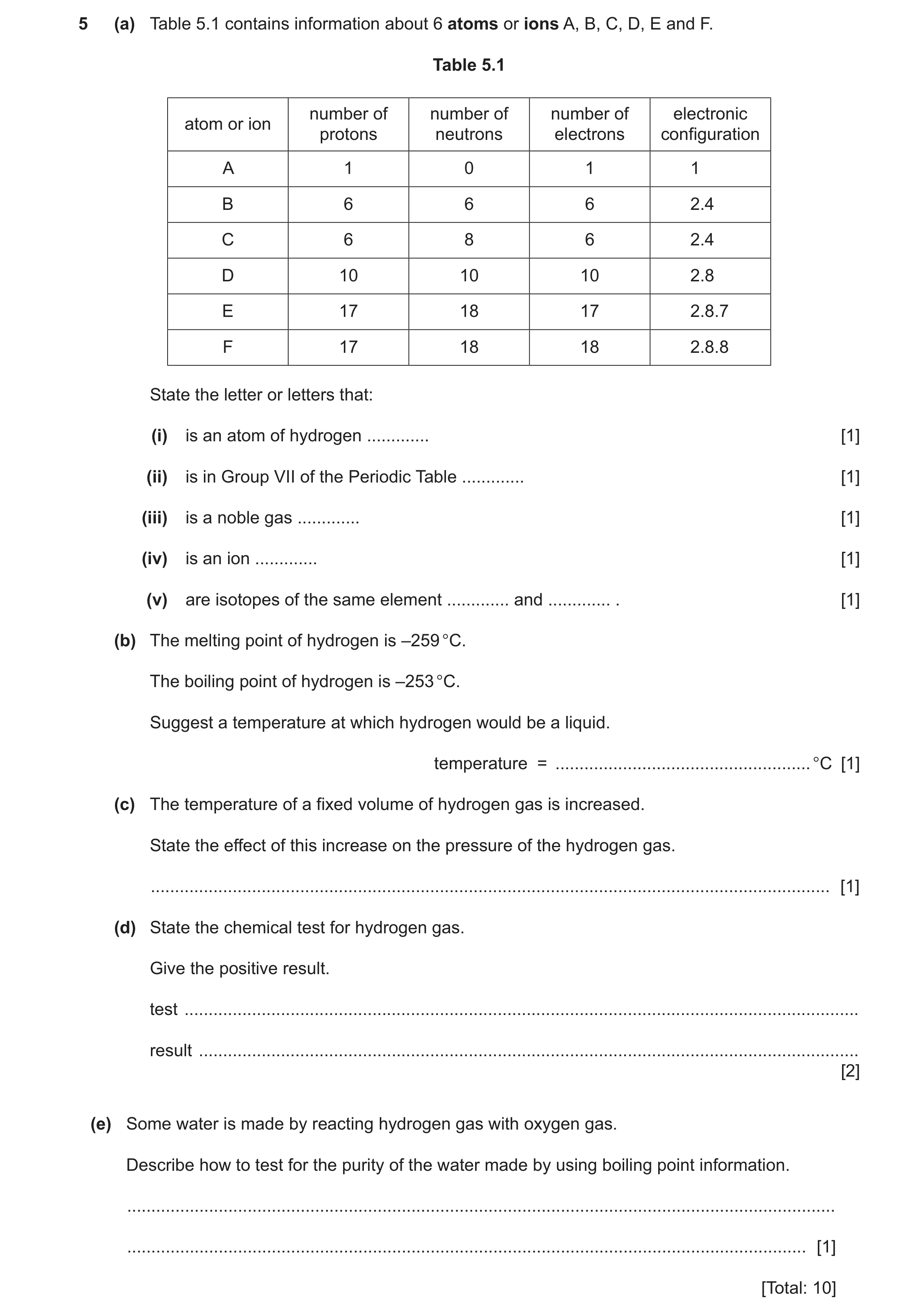
5 (a) Table 5.1 contains information about 6 atoms or ions A, B, C, D, E and F. Table 5.1 number of number of number of electronic atom or ion protons neutrons electrons configuration A 1 0 1 1 B 6 6 6 2.4 C 6 8 6 2.4 D 10 10 10 2.8 E 17 18 17 2.8.7 F 17 18 18 2.8.8 State the letter or letters that: (i) is an atom of hydrogen … [1] (ii) is in Group VII of the Periodic Table … [1] (iii) is a noble gas … [1] (iv) is an ion … [1] (v) are isotopes of the same element … and … . [1] (b) The melting point of hydrogen is –259 °C. The boiling point of hydrogen is –253 °C. Suggest a temperature at which hydrogen would be a liquid. temperature = … °C [1] (c) The temperature of a fixed volume of hydrogen gas is increased. State the effect of this increase on the pressure of the hydrogen gas. … [1] (d) State the chemical test for hydrogen gas. Give the positive result. test … result … [2] (e) Some water is made by reacting hydrogen gas with oxygen gas. Describe how to test for the purity of the water made by using boiling point information. … … [1] [Total: 10]
10 marks
Mark scheme: 5(a)(i) A ; 1 5(a)(ii) E ; 1 5(a)(iii) D ; 1 5(a)(iv) F ; 1 5(a)(v) B and C ; 1 5(b) between – 254 and – 258 °C ; 1 5(c) (pressure) increases ; 1 5(d) lighted splint ; 2 goes pop ; 5(e) pure water will boil at 100°C / ora ; 1
This question in 0654/31 May/June 2025
 1 / 39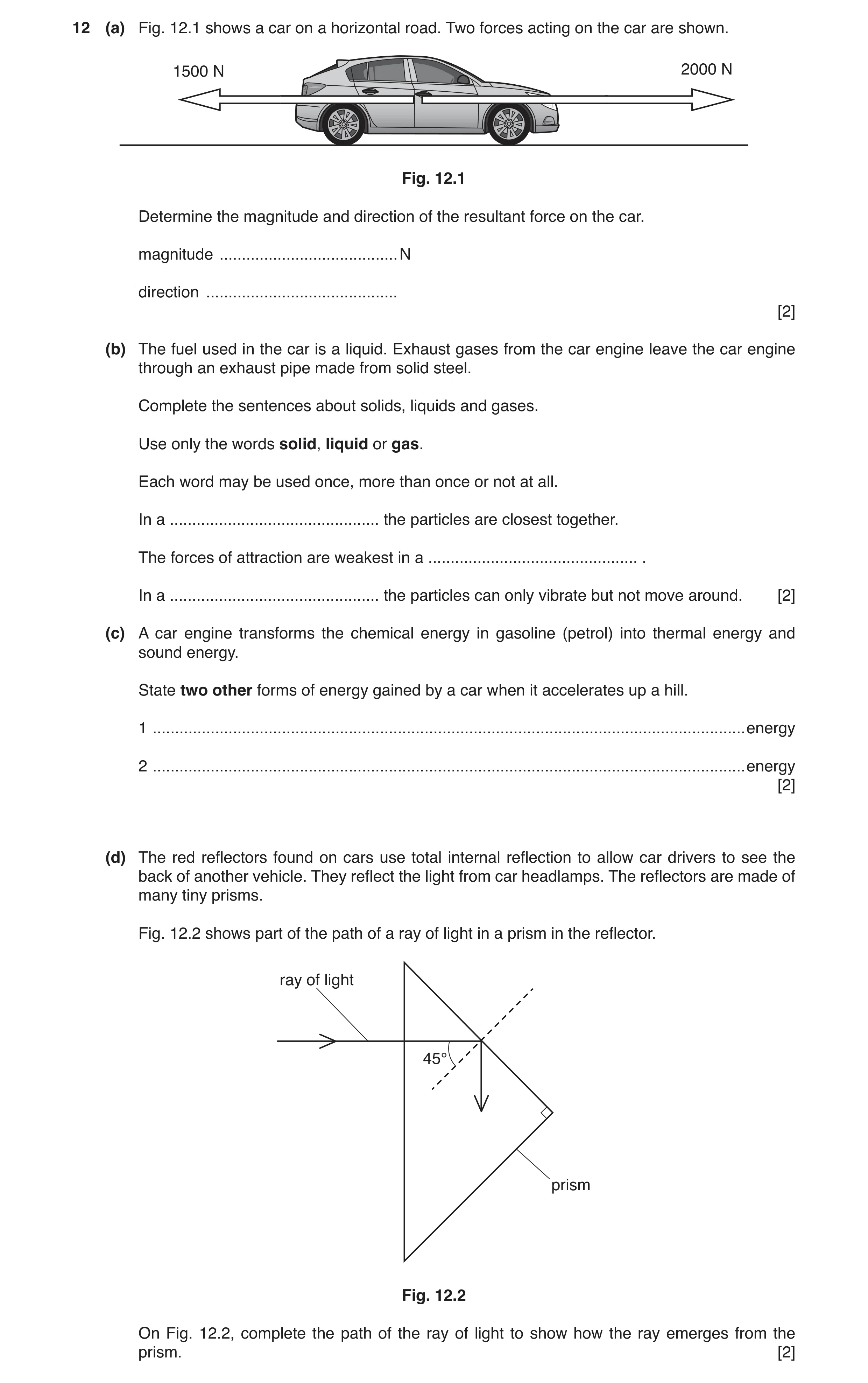
 26 / 39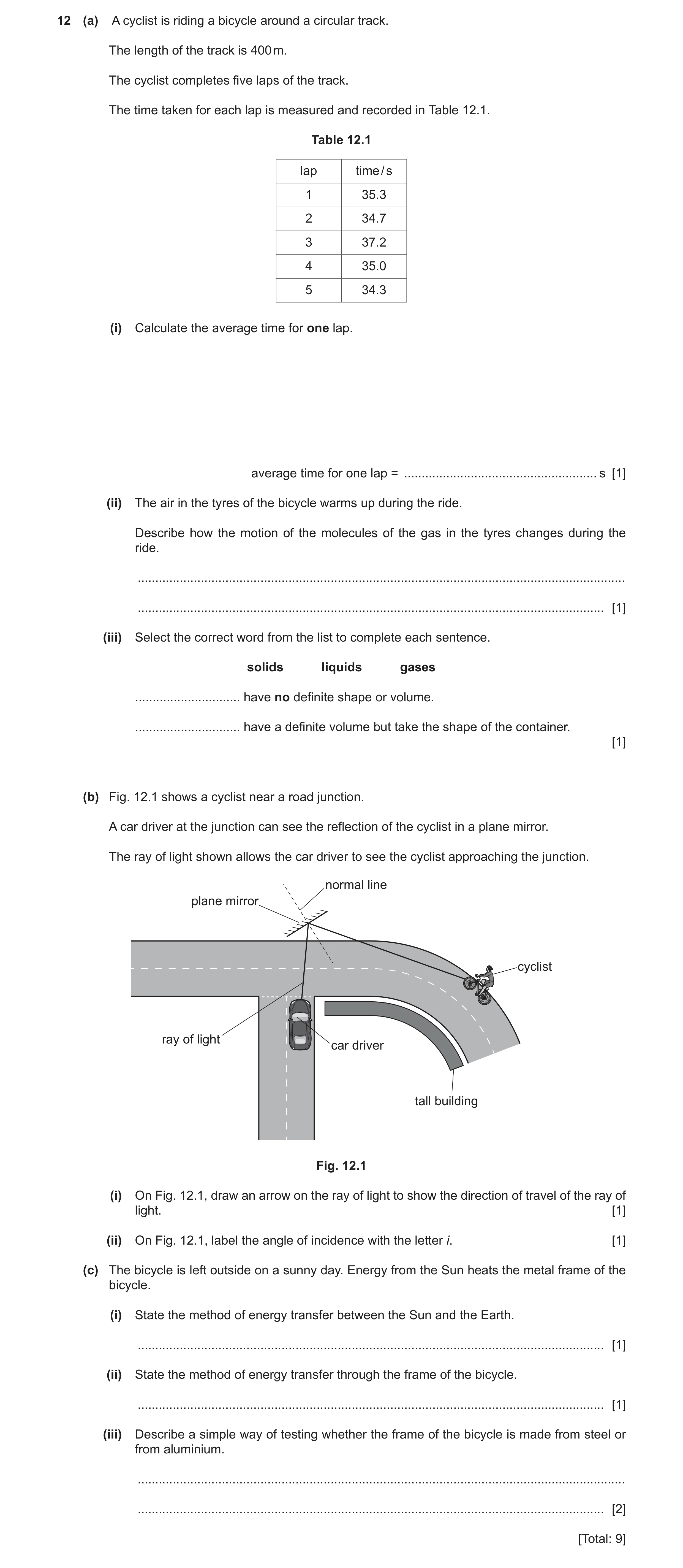
![Question 20: (a) Ethanol has the formula C2H5OH. Complete Fig. 5.1 to show the structure of an ethanol molecule. C C Fig. 5.1 [2] (b) Ethanol is used as…](https://img.pastlit.com/crops/c53110da-1116-4e3e-b812-18734b00e283/q5.webp)
![Question 21: (a) Ethanol has the formula C2H5OH. Complete Fig. 5.1 to show the structure of an ethanol molecule. C C Fig. 5.1 [2] (b) Ethanol is used as…](https://img.pastlit.com/crops/de51c13e-9126-4c74-a539-c9c7f3c4aee4/q5.webp)
 36 / 39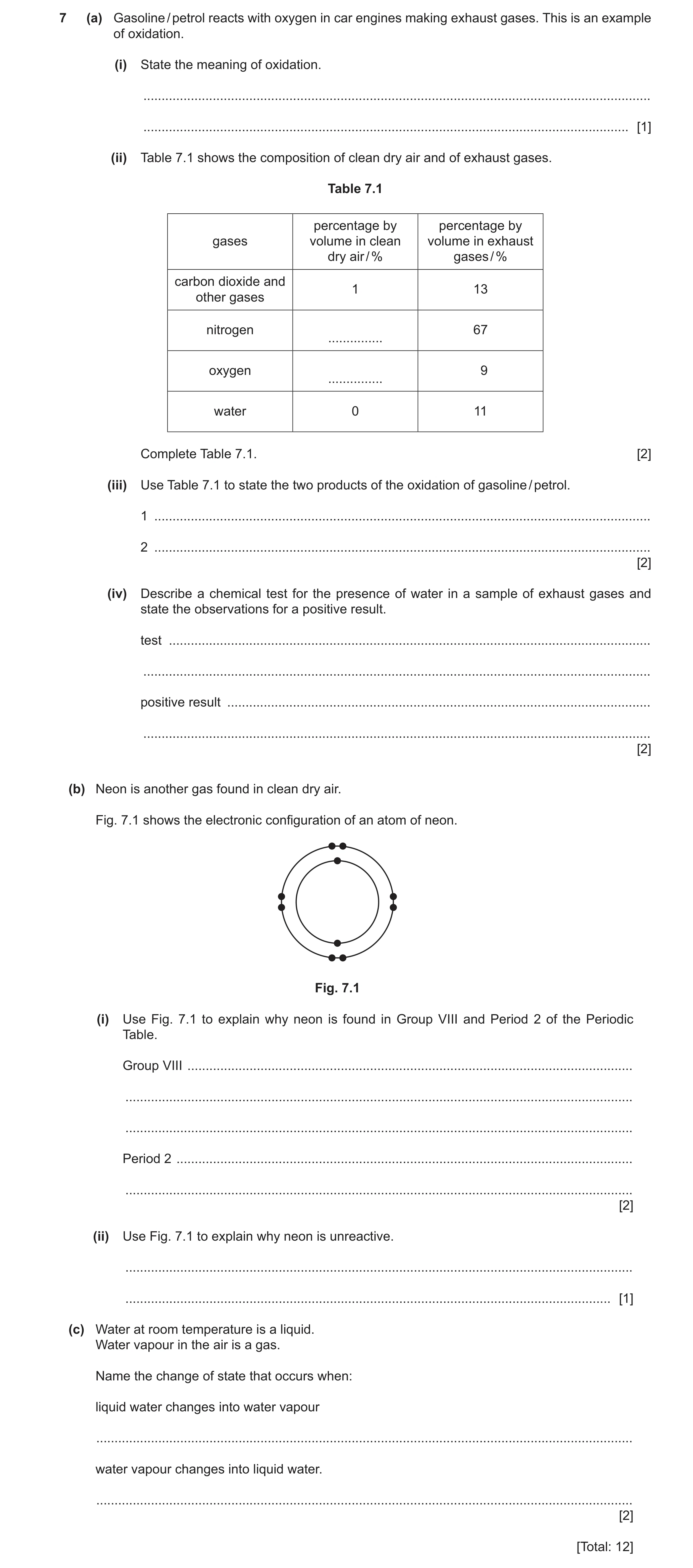
 39 / 39
 9
9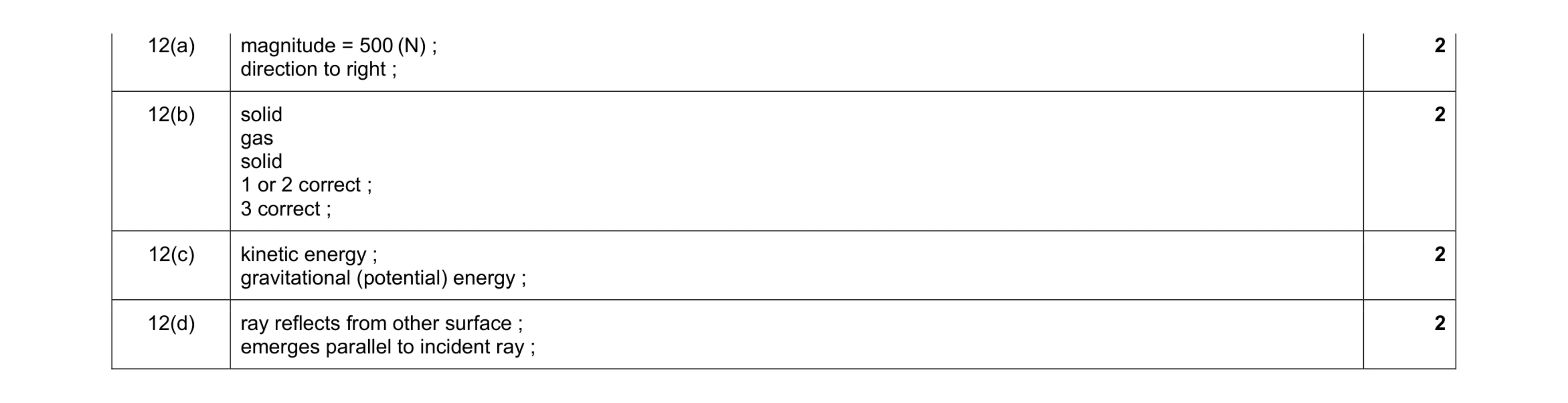 8
8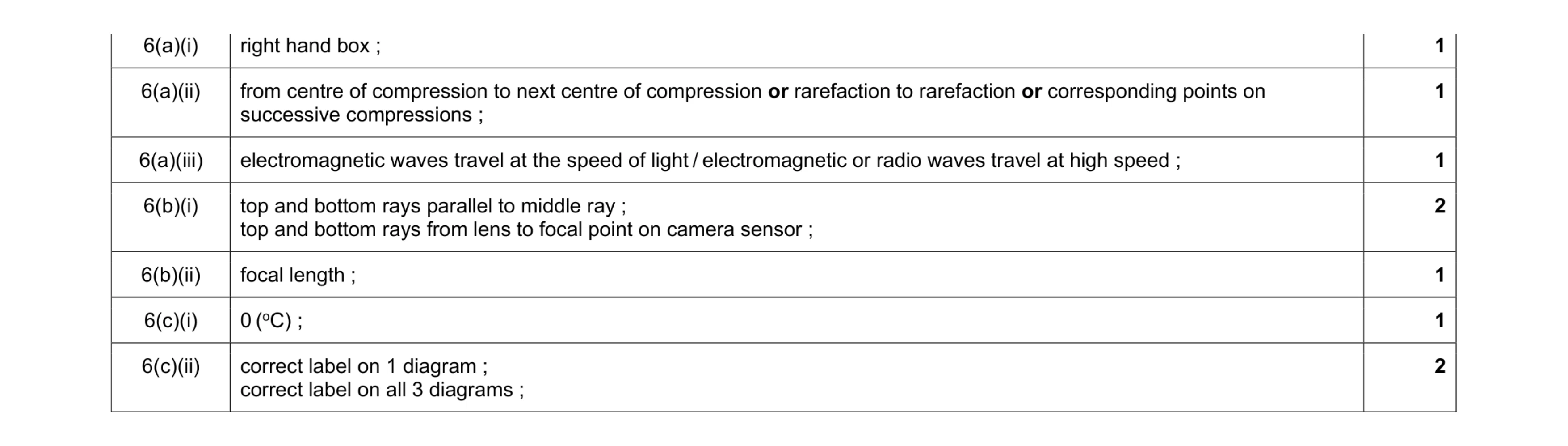 9
9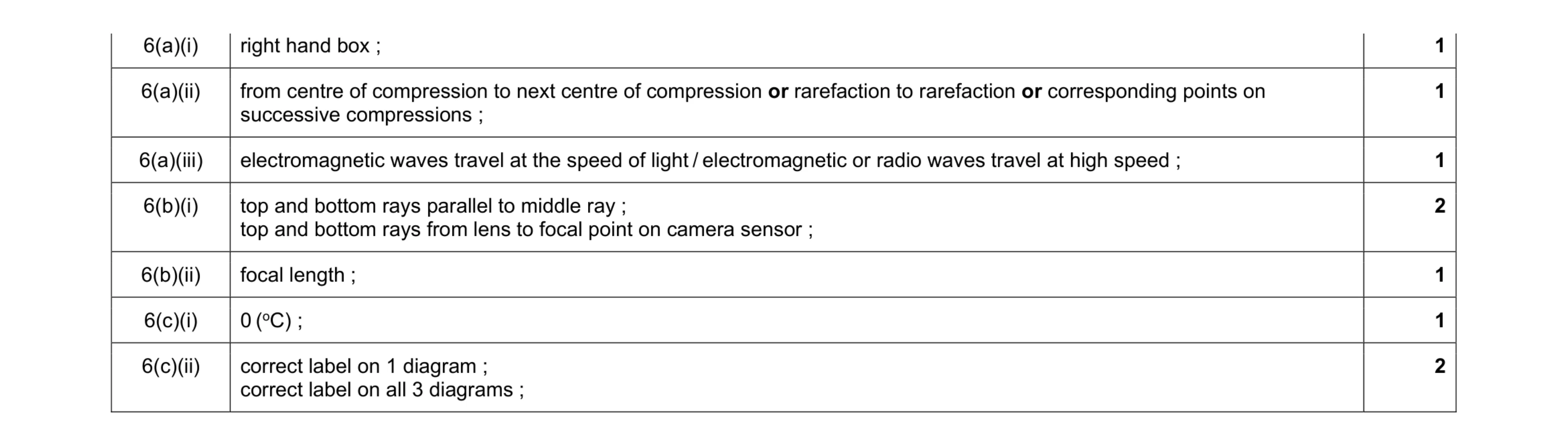 9
9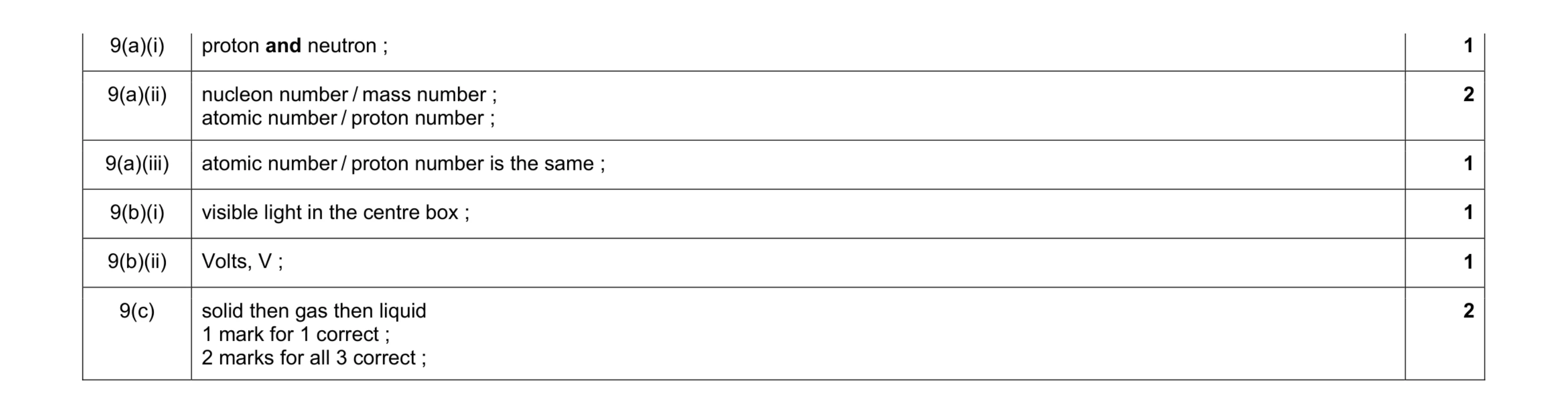 8
8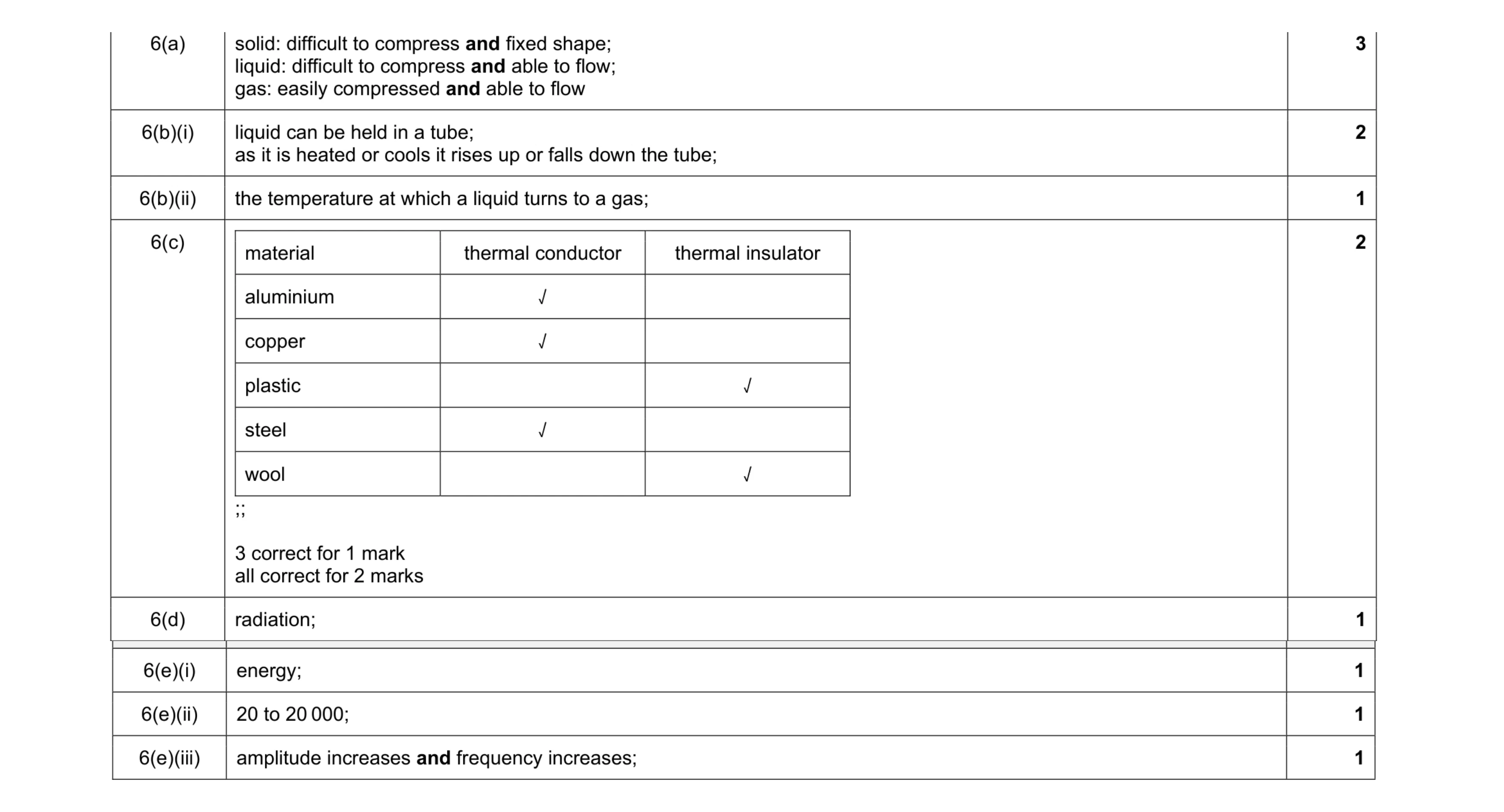 12
12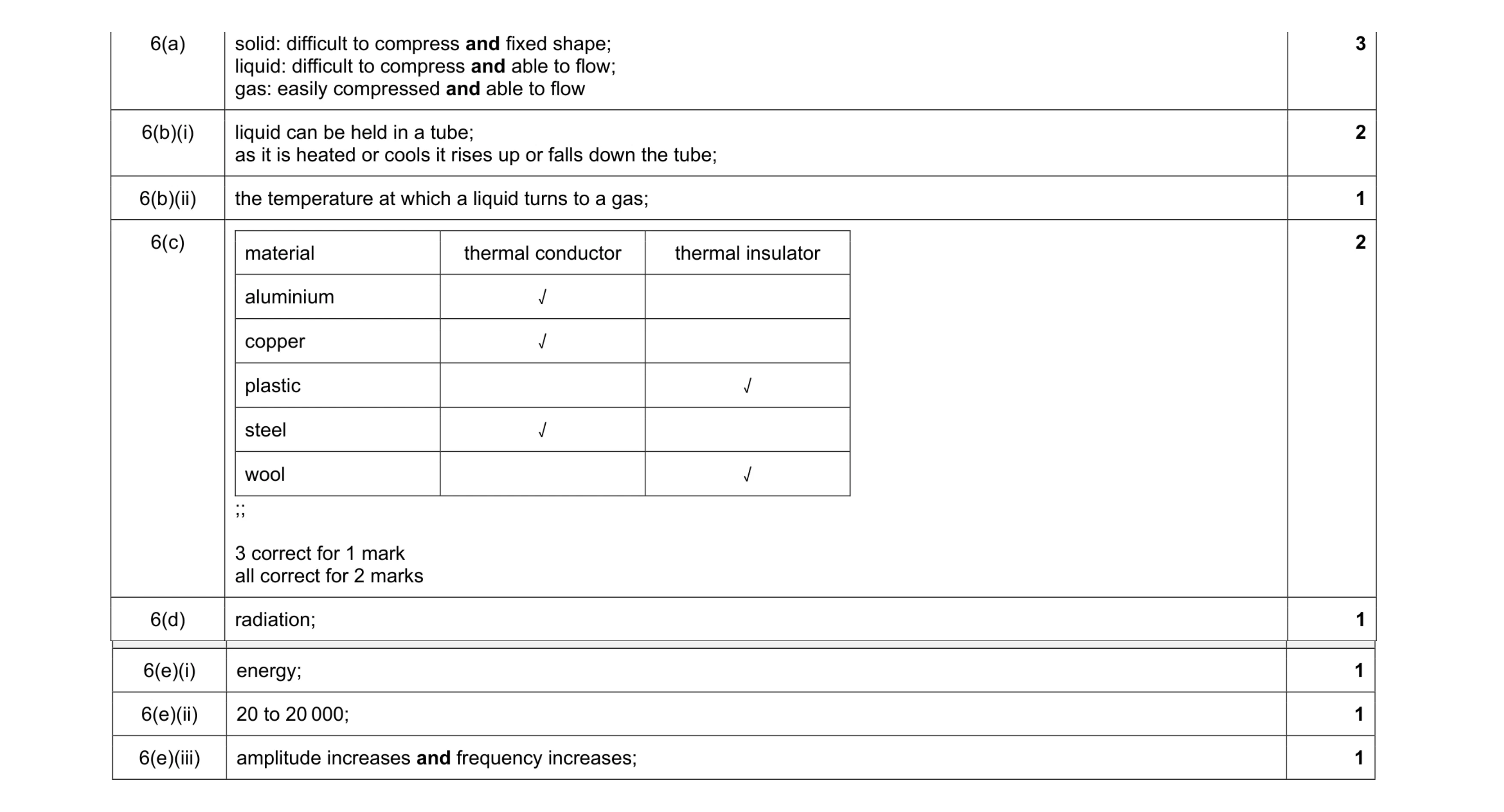 12
12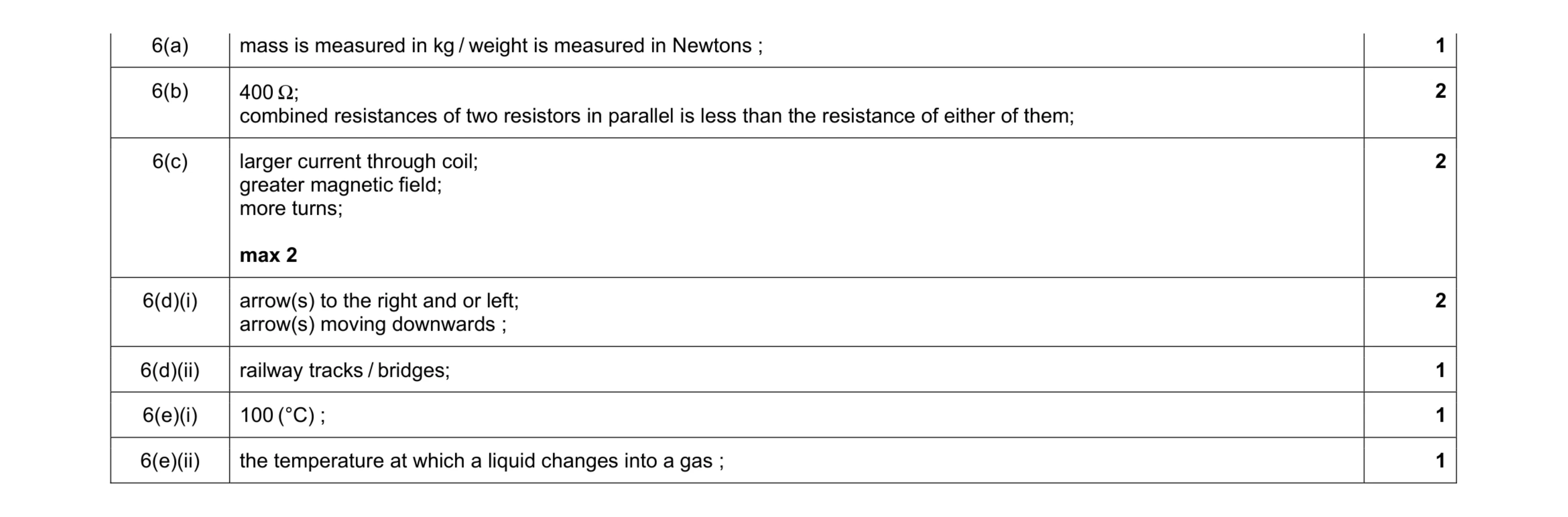 10
10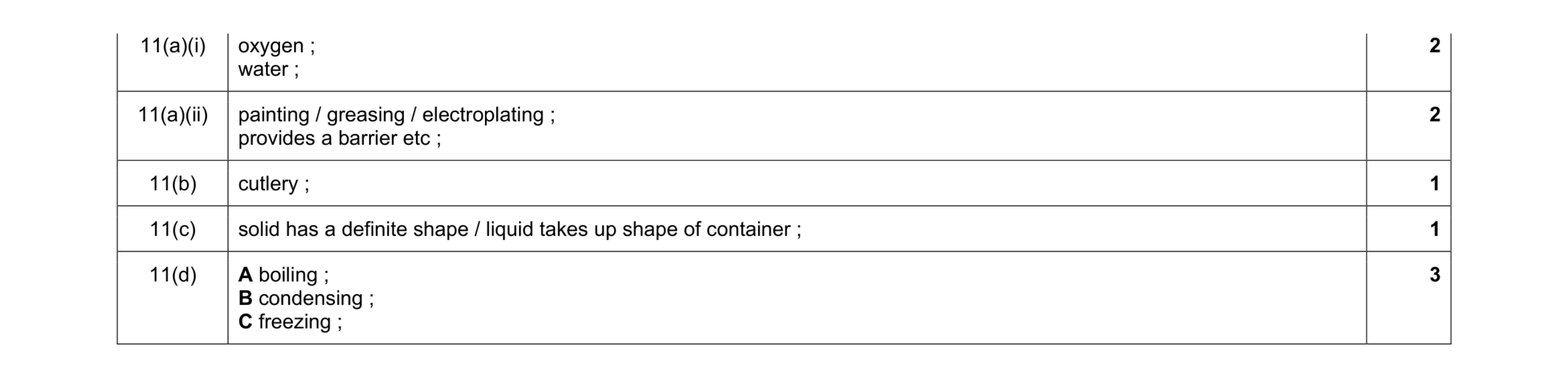 9
9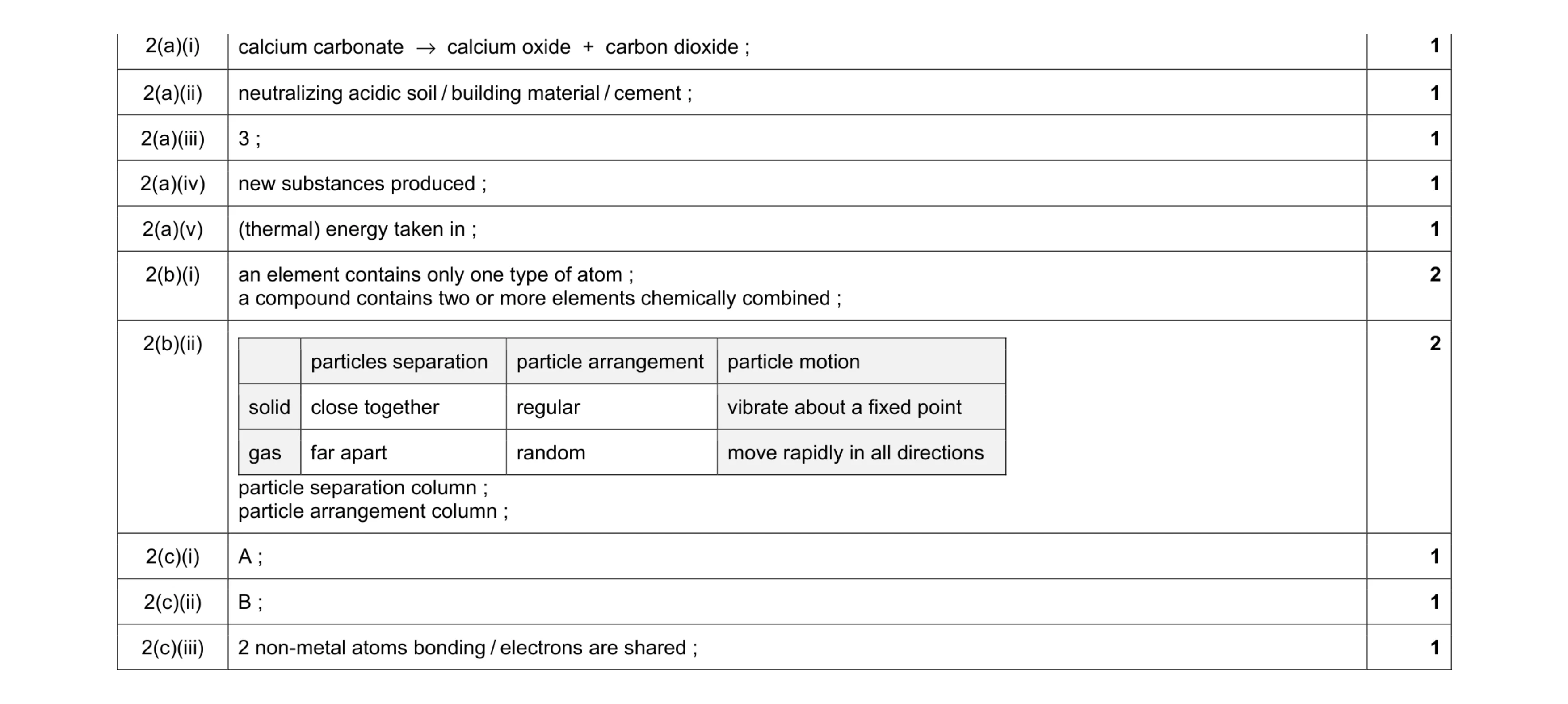 12
12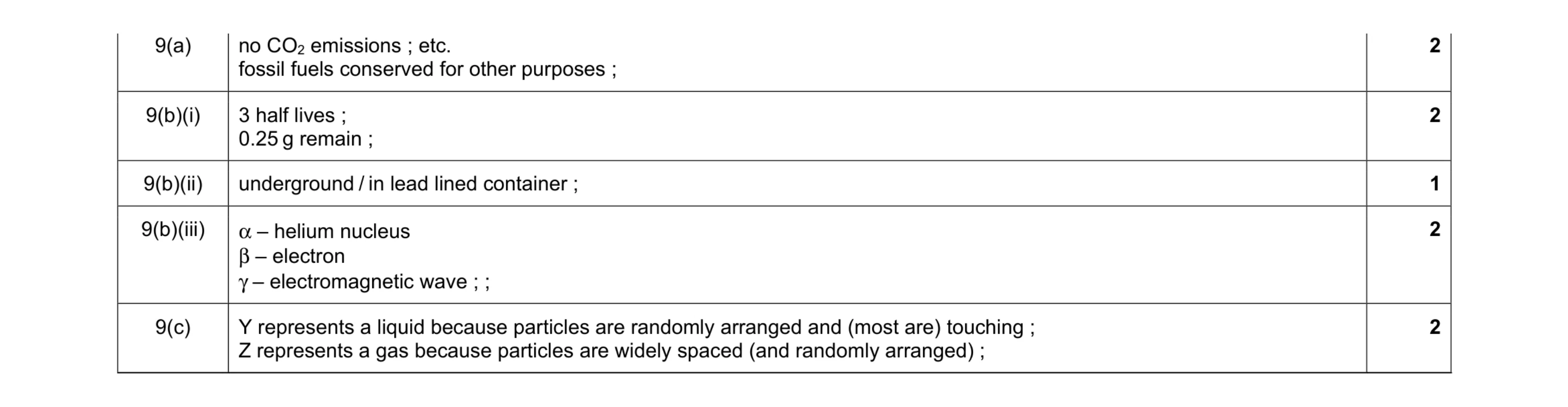 9
9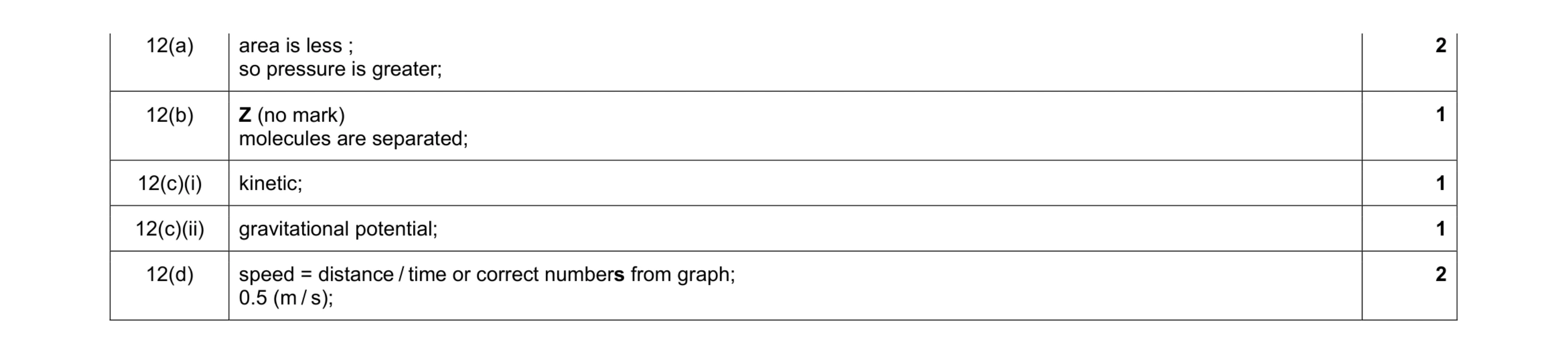 7
7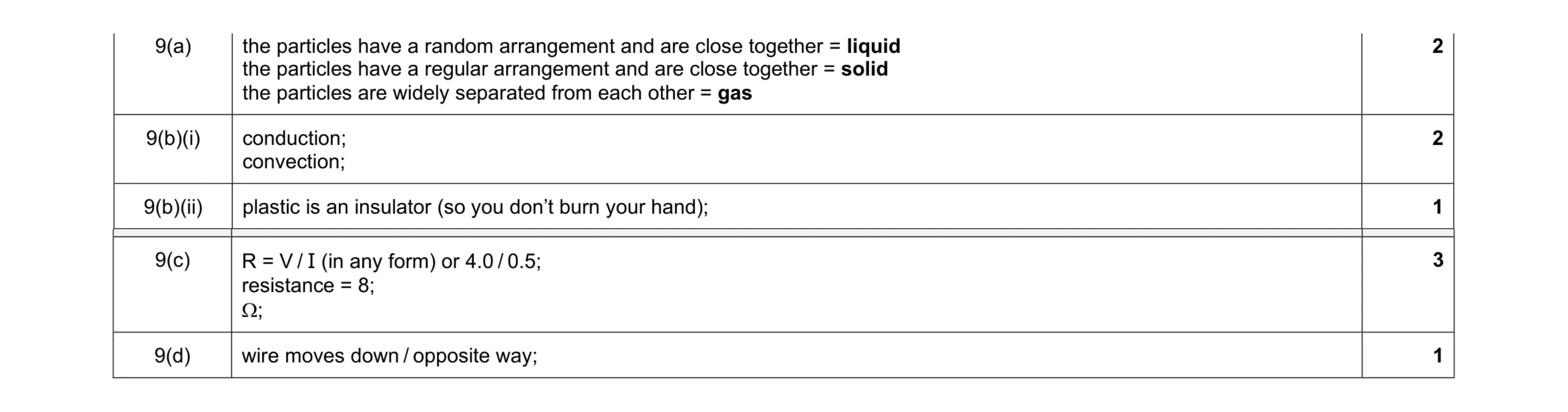 9
9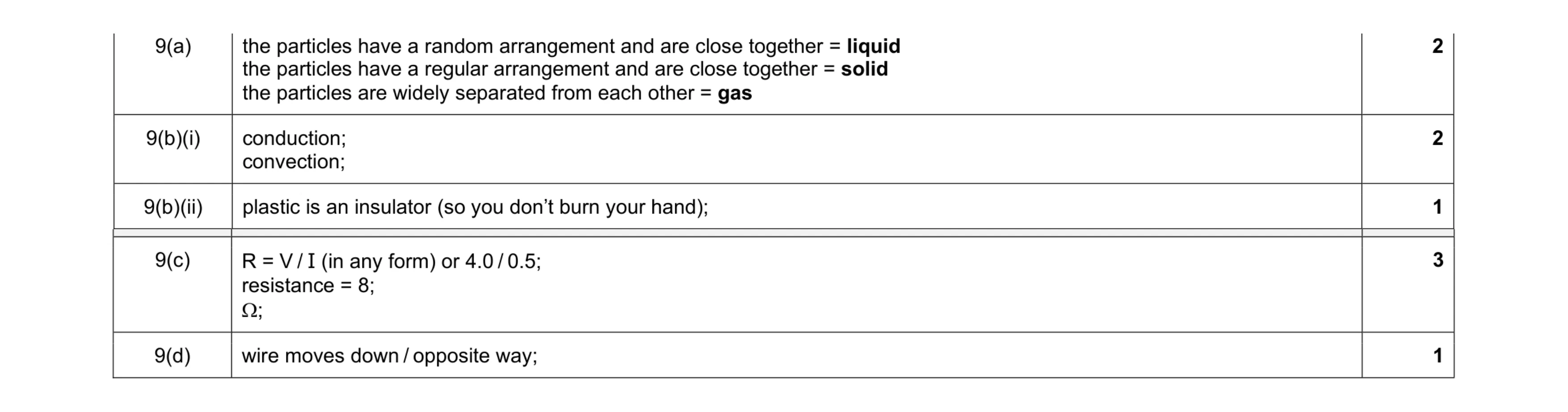 9
9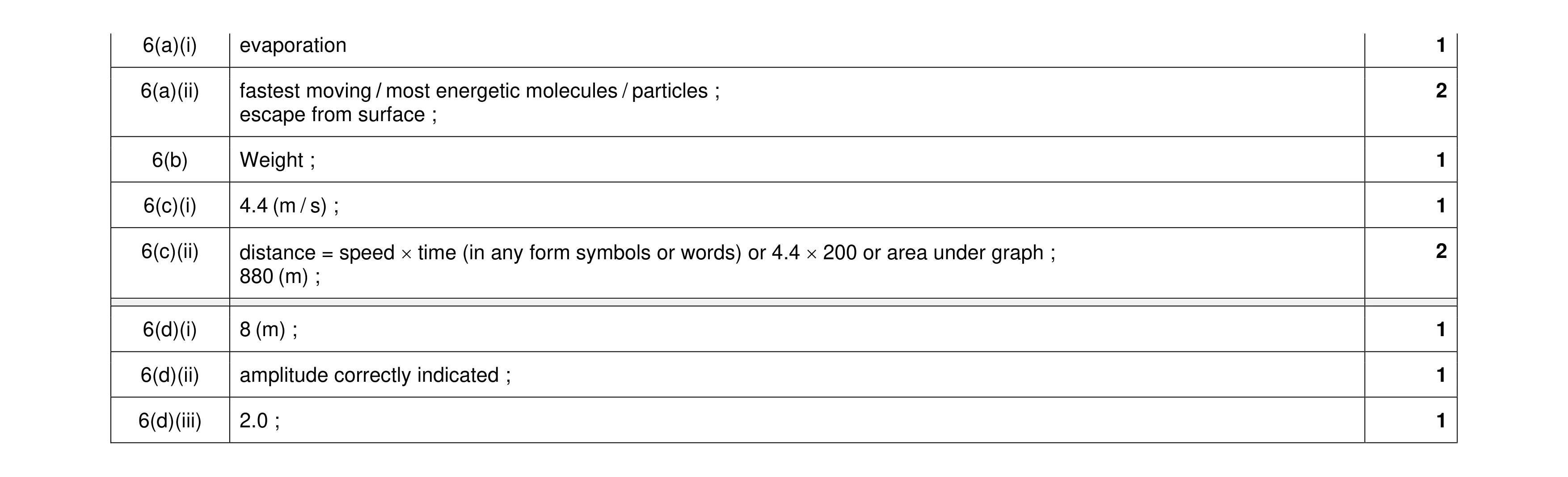 10
10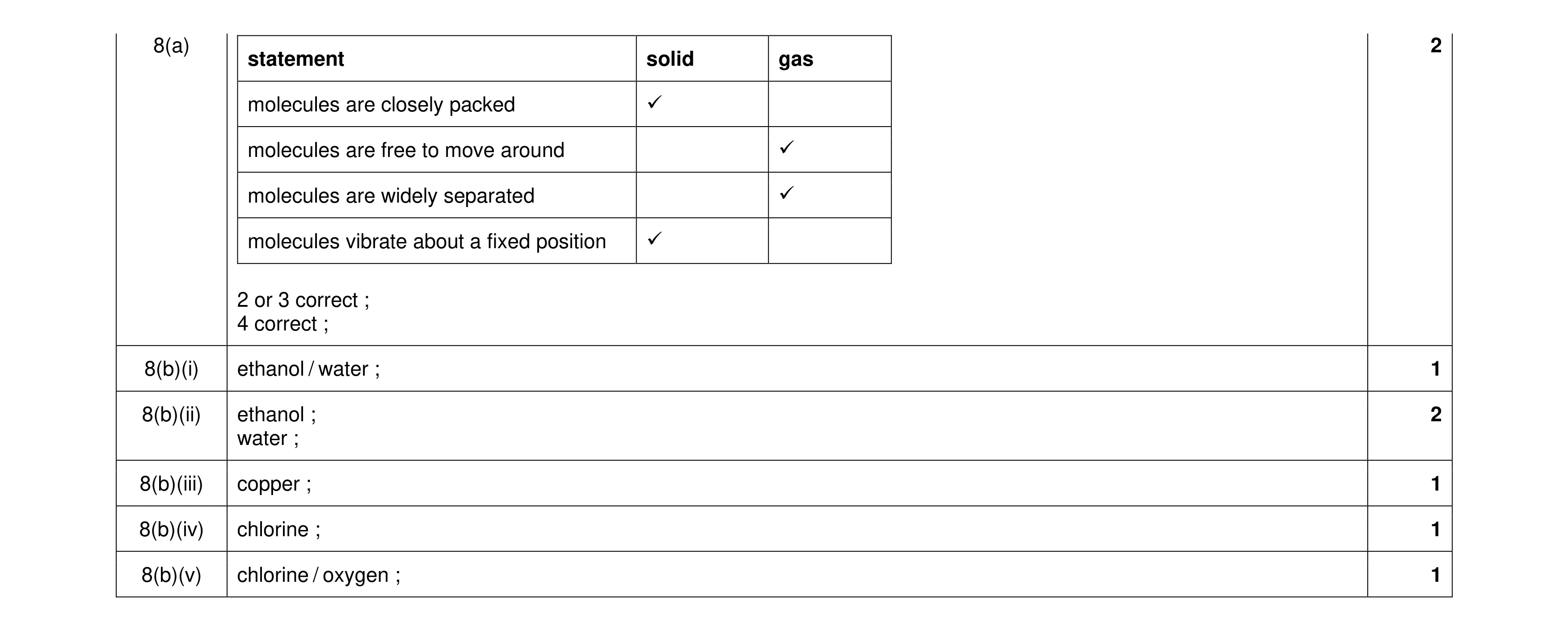 8
8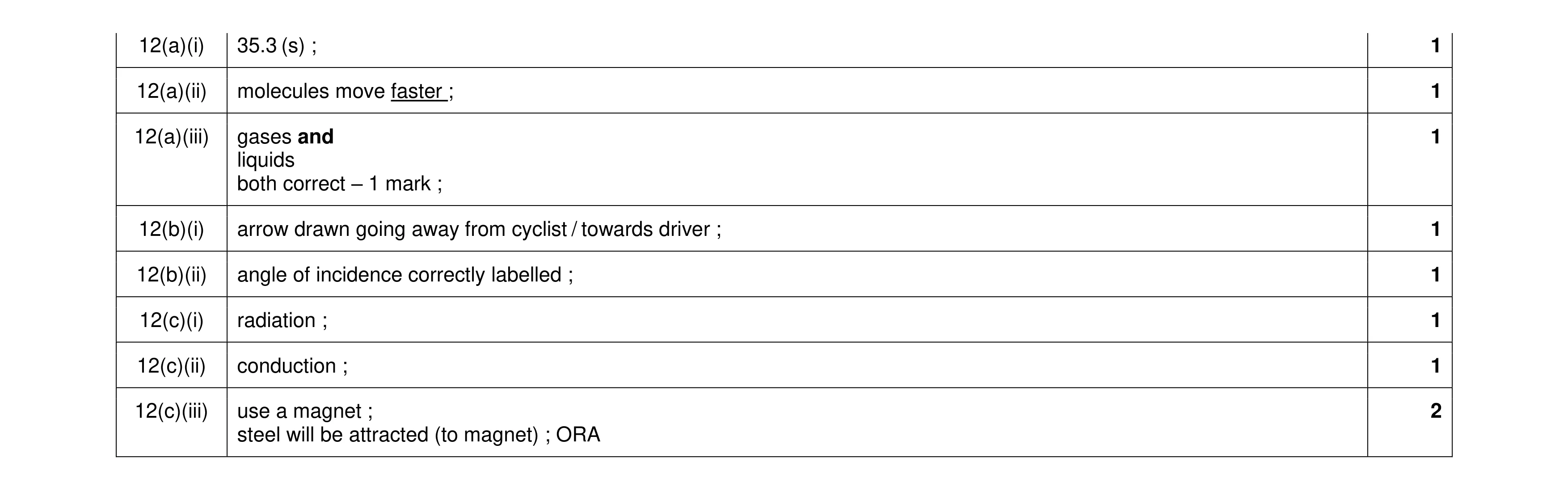 9
9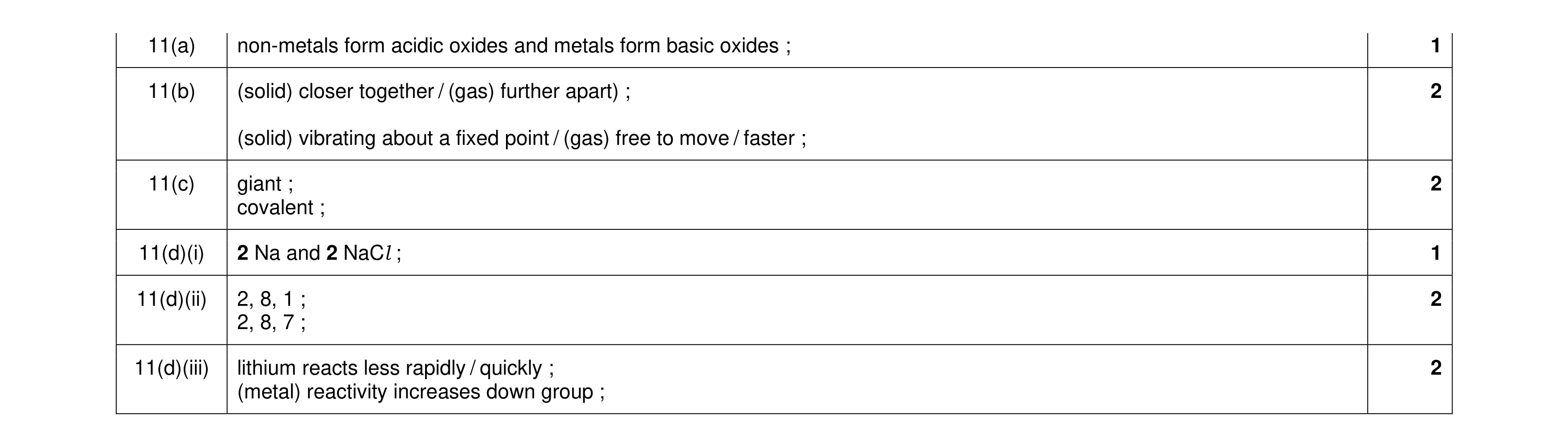 10
10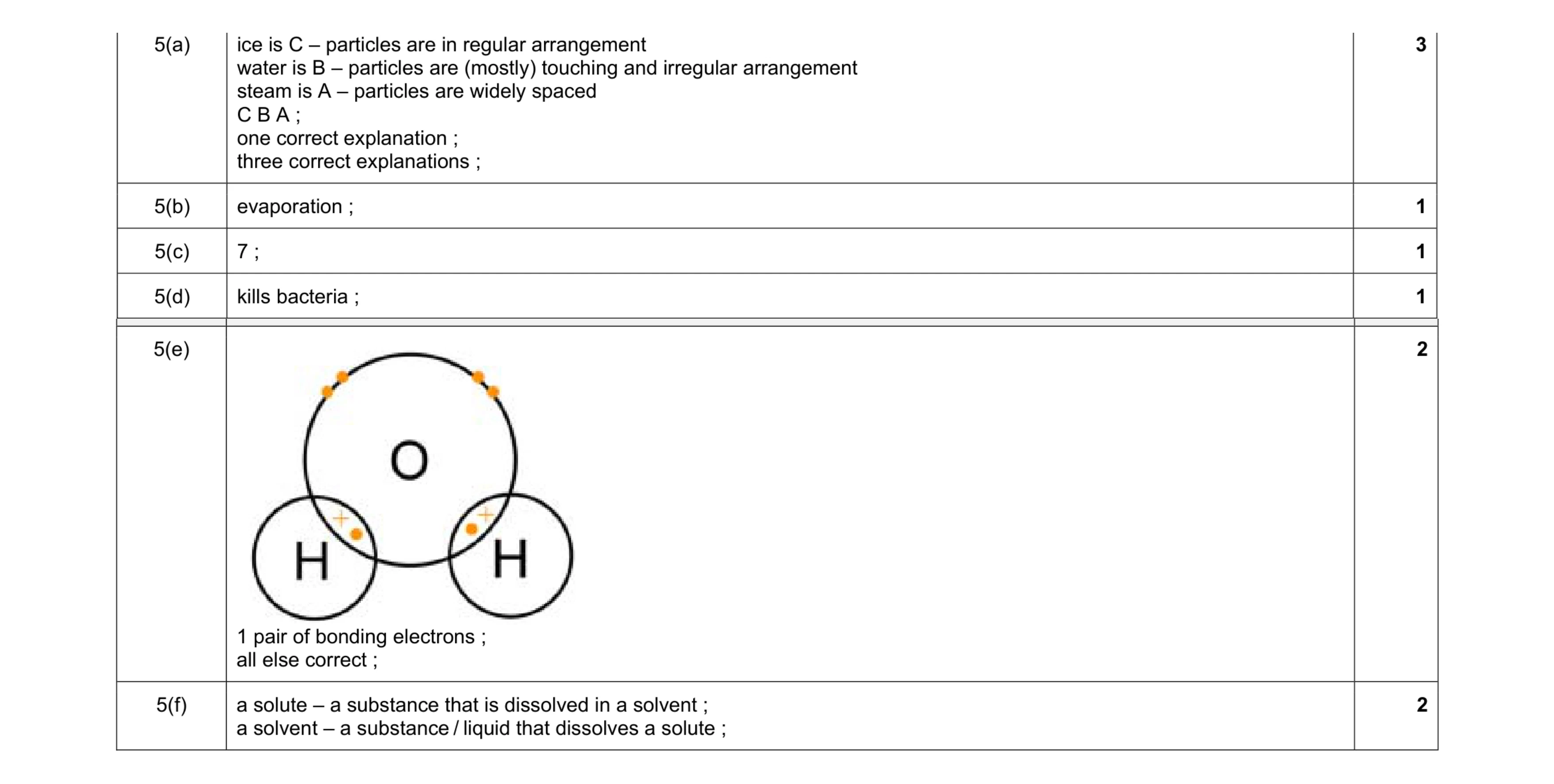 10
10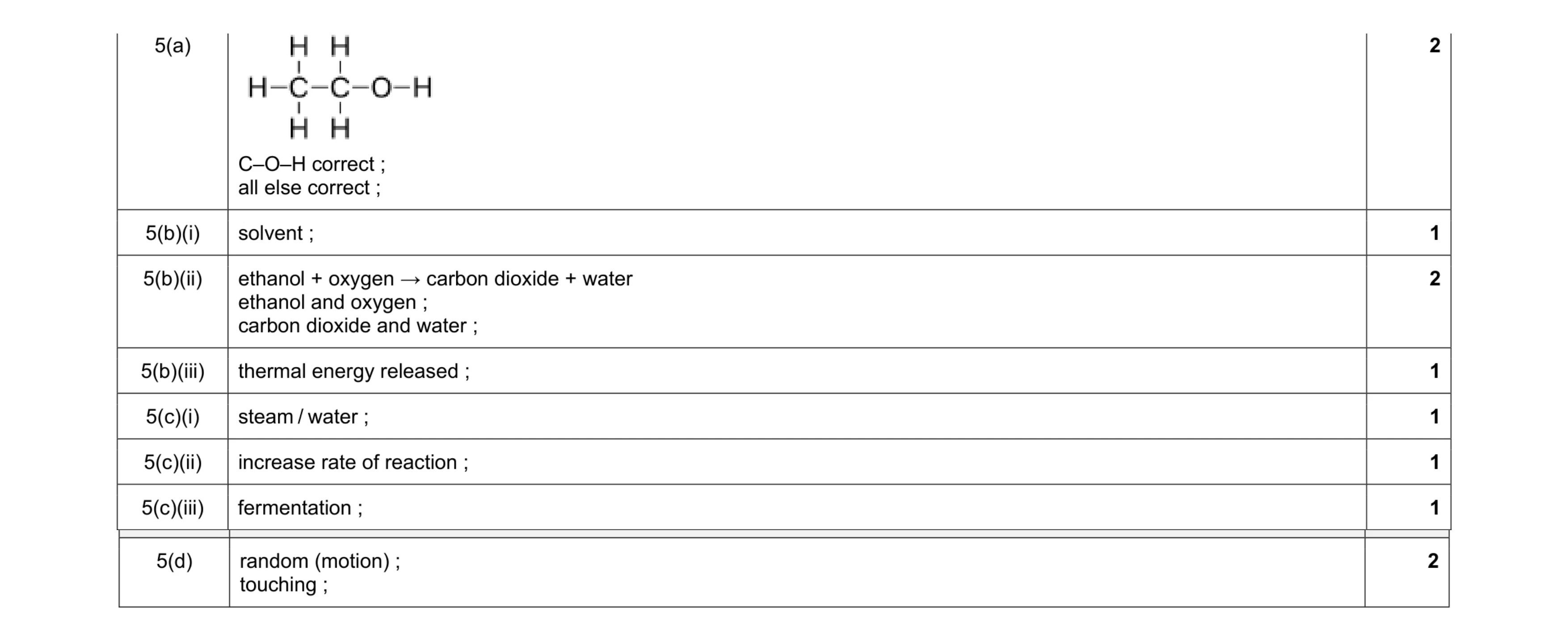 11
11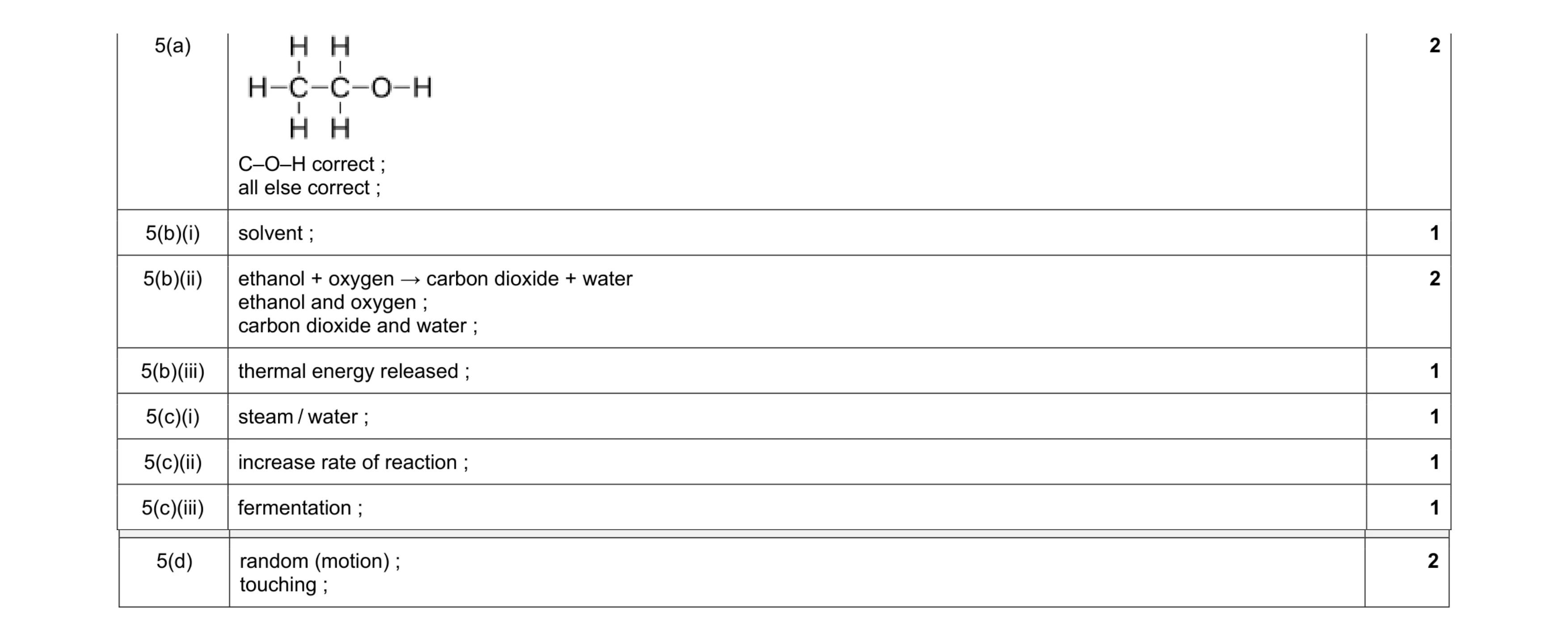 11
11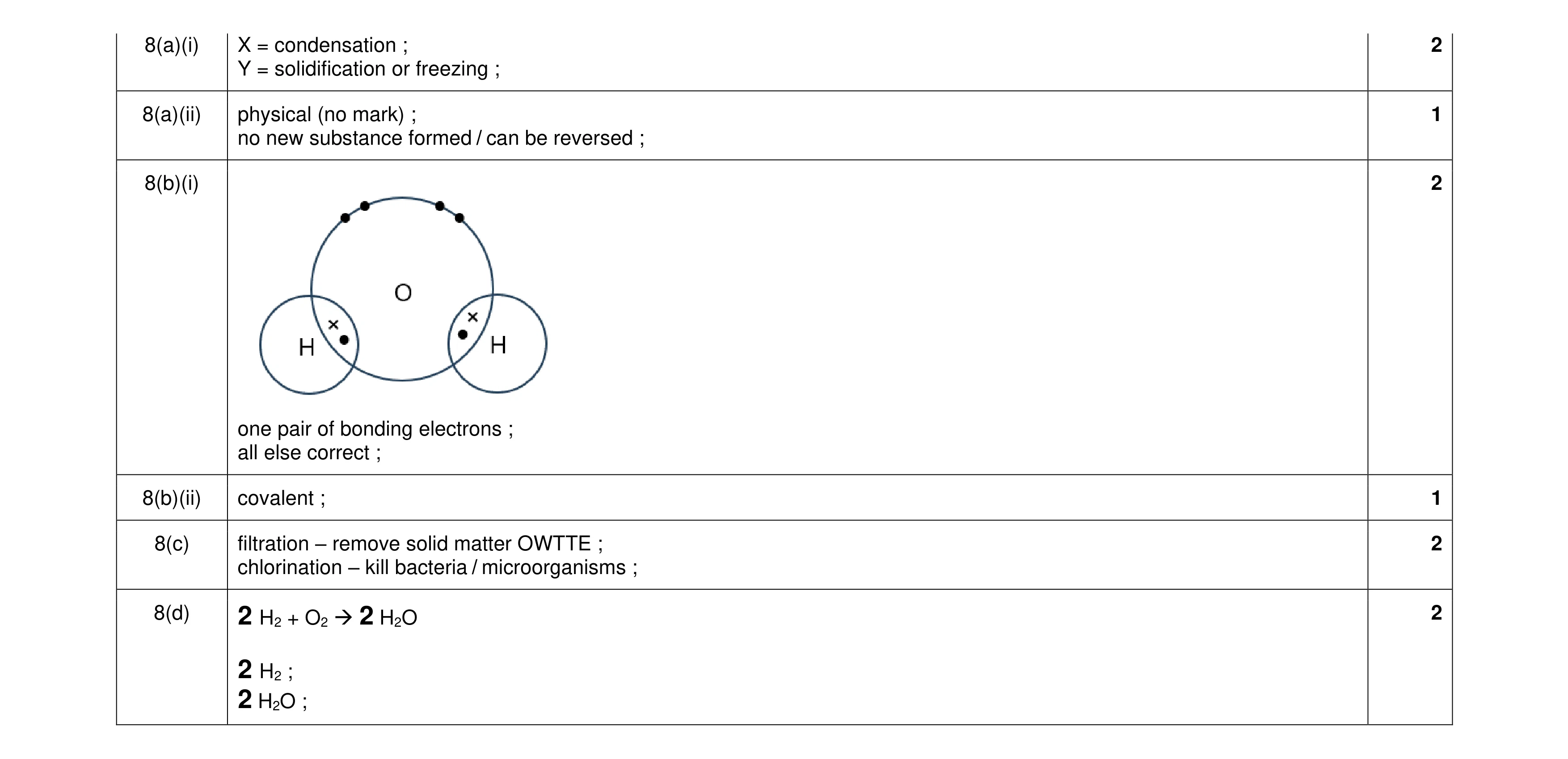 10
10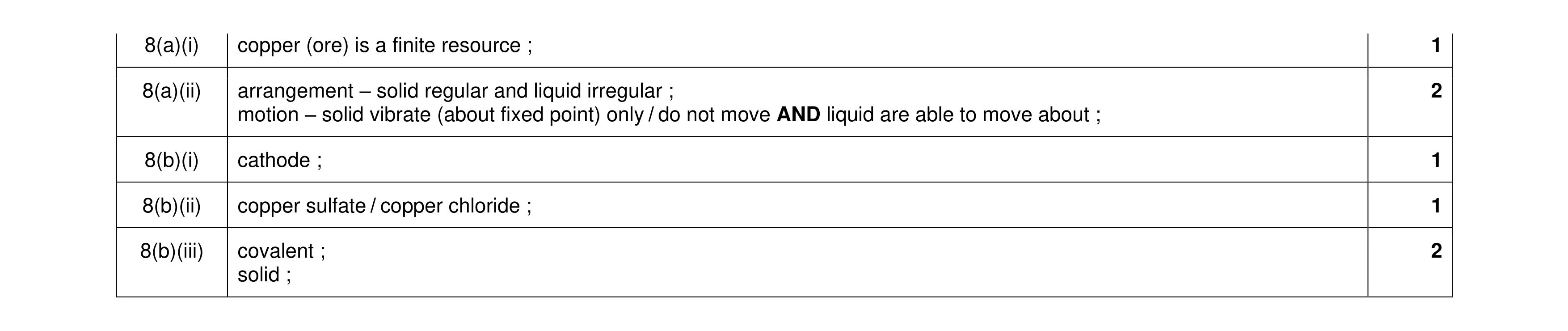 7
7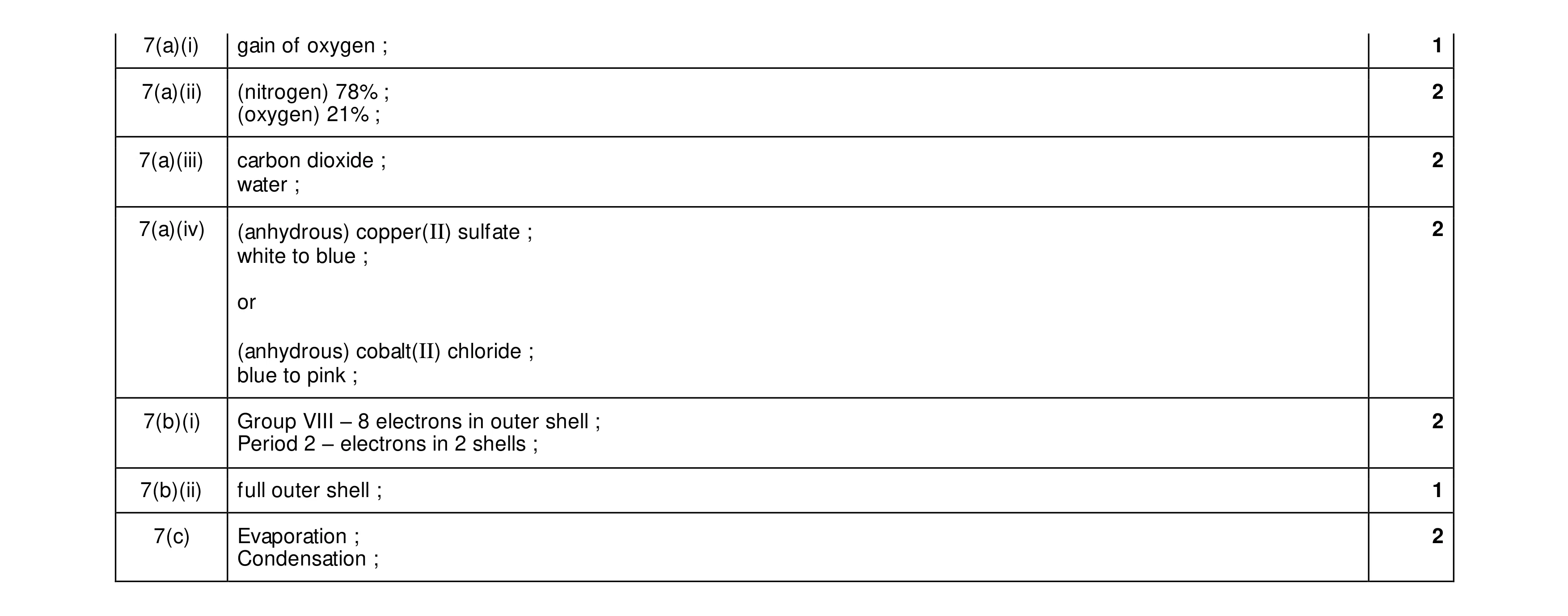 12
12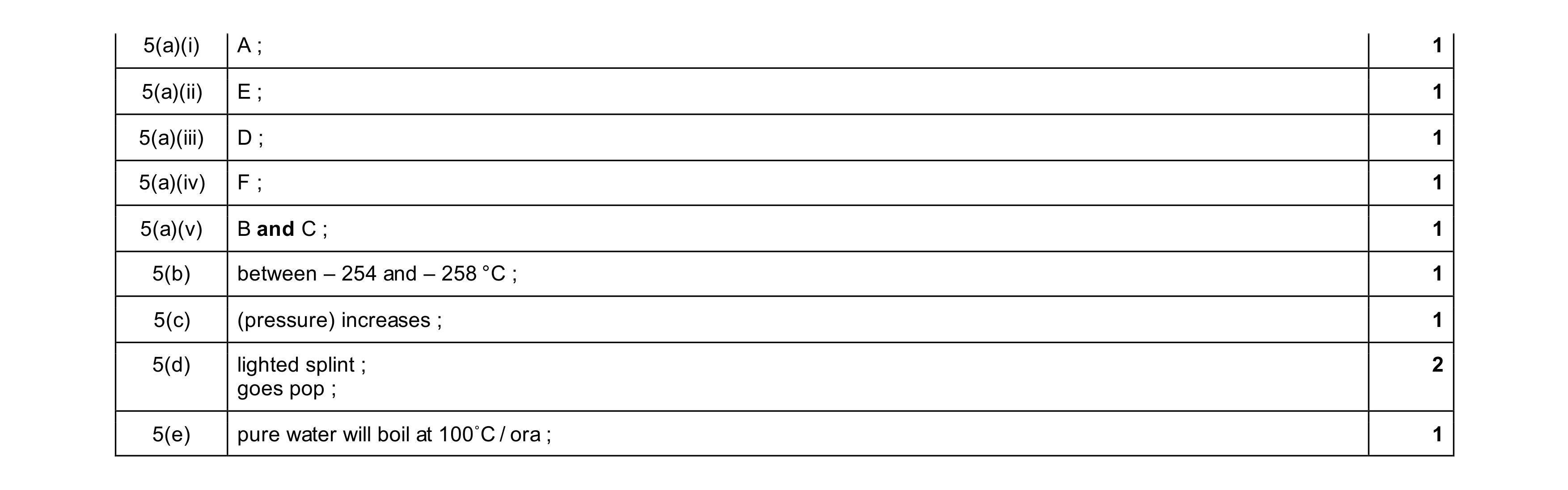 10
10