Questions as text
Q1 · Ice is made by freezing some water in the freezing compartment of a refrigerator 0654/41 Oct/Nov 2018
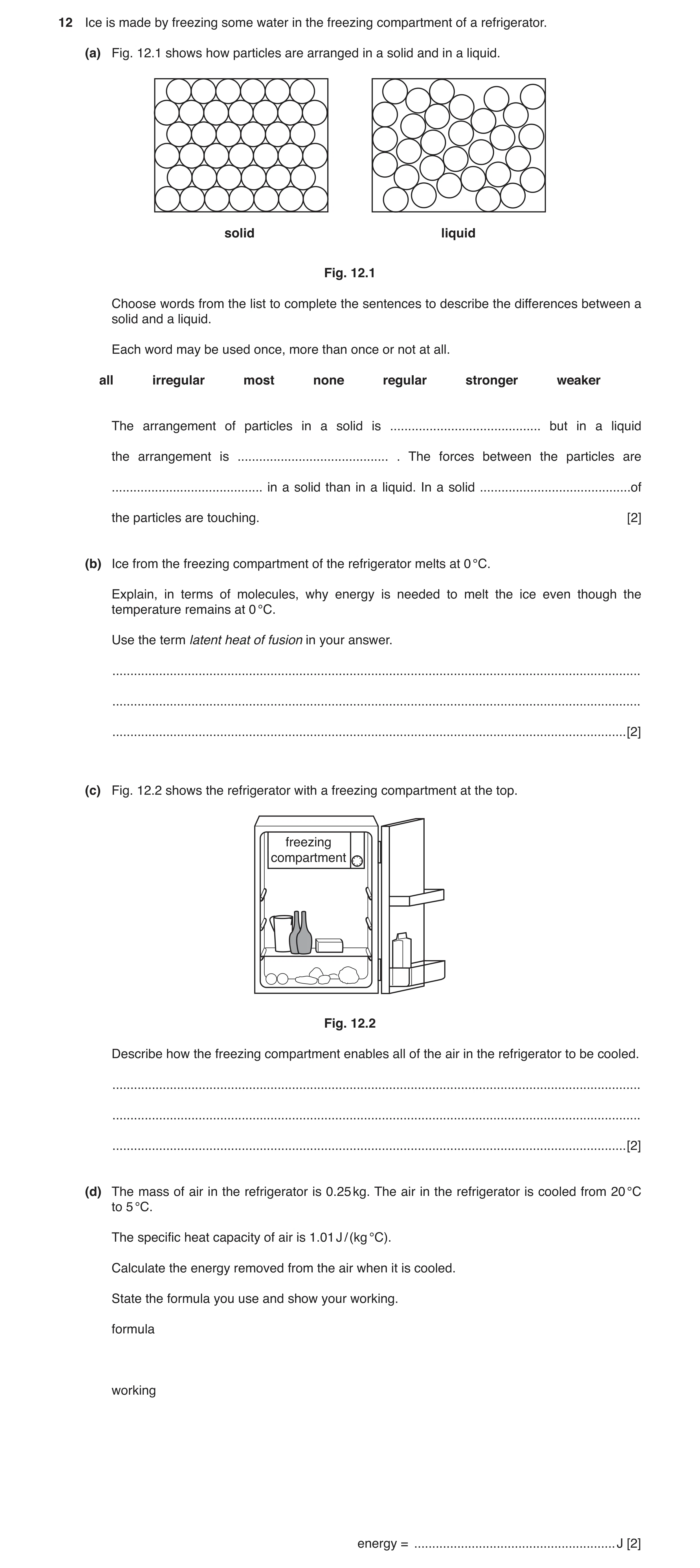
12 Ice is made by freezing some water in the freezing compartment of a refrigerator. (a) Fig. 12.1 shows how particles are arranged in a solid and in a liquid. solid liquid Fig. 12.1 Choose words from the list to complete the sentences to describe the differences between a solid and a liquid. Each word may be used once, more than once or not at all. all irregular most none regular stronger weaker The arrangement of particles in a solid is … but in a liquid the arrangement is … . The forces between the particles are … in a solid than in a liquid. In a solid … of the particles are touching. [2] (b) Ice from the freezing compartment of the refrigerator melts at 0 °C. Explain, in terms of molecules, why energy is needed to melt the ice even though the temperature remains at 0 °C. Use the term latent heat of fusion in your answer. … … … [2] (c) Fig. 12.2 shows the refrigerator with a freezing compartment at the top. freezing compartment Fig. 12.2 Describe how the freezing compartment enables all of the air in the refrigerator to be cooled. … … … [2] (d) The mass of air in the refrigerator is 0.25 kg. The air in the refrigerator is cooled from 20 °C to 5 °C. The specific heat capacity of air is 1.01 J / (kg °C). Calculate the energy removed from the air when it is cooled. State the formula you use and show your working. formula working energy = … J [2]
8 marks
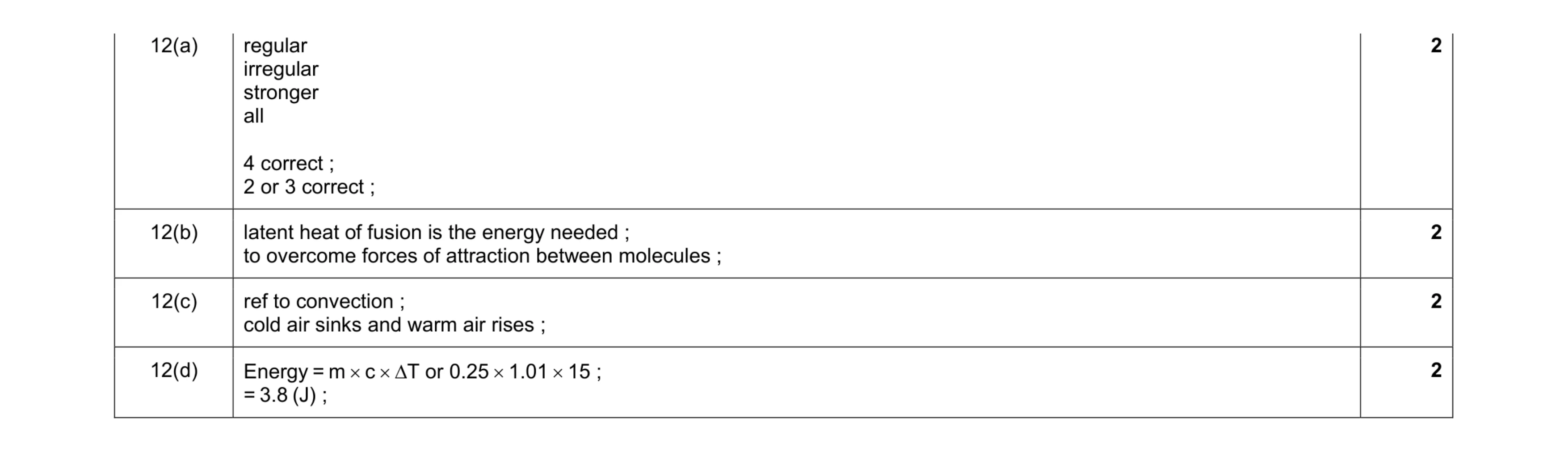
Mark scheme: 12(a) regular irregular stronger all 4 correct ; 2 or 3 correct ; 2 12(b) latent heat of fusion is the energy needed ; to overcome forces of attraction between molecules ; 2 12(c) ref to convection ; cold air sinks and warm air rises ; 2 12(d) Energy = m × c × ∆T or 0.25 × 1.01 × 15 ; = 3.8 (J) ; 2
This question in 0654/41 Oct/Nov 2018
Q2 · The three states of matter 0654/42 May/June 2020
2 (a) (i) Fig. 2.1 shows the three states of matter. Complete the labels on Fig. 2.1. [2] … boiling solid freezing liquid … gas Fig. 2.1 (ii) Describe what happens to the total kinetic energy of the particles as the gas changes to a liquid and then to a solid. … [1] (b) A scientist analyses an unknown ink sample and four dyes, A, B, C and D. solvent front pencil line ink dye dye dye dye sample A B C D Fig. 2.2 Fig. 2.2 shows the chromatogram produced. (i) Calculate the Rf value for dye A. Rf value = … [2] (ii) State which dye cannot be in the ink sample. Explain your answer. dye … explanation … … … [2] (iii) A solvent is used during chromatography. Define the term solvent. … … [1] (c) Table 2.1 shows the melting point of two substances, X and Y. Table 2.1 substance melting point / °C X 84 Y 78–82 State which substance is pure. Explain your answer. pure substance … explanation … … [1] [Total: 9]
9 marks
Mark scheme: 2(a)(i) solid to liquid = melting ; gas to liquid = condensing ; 2 2(a)(ii) (kinetic energy) decreases / owtte 1 2(b)(i) (Rf =) distance travelled by substance ÷ distance travelled by solvent or 2.3 ÷ 5.8 ; = 0.4 ; 2 2(b)(ii) dye B ; idea that the colours (in dye B) moved different distances up the paper from the colours in the ink sample ; 2 2(b)(iii) a substance that can dissolve a solute (to form a solution) 1 Question Answer Marks 2(c) (pure substance is X) no mark idea that pure substances have a specific melting point / ORA / idea that pure substances do not melt over a range (of temperatures) / ORA ; 1
This question in 0654/42 May/June 2020
Q3 · Solid, liquid and gas are three states of matter 0654/42 May/June 2021
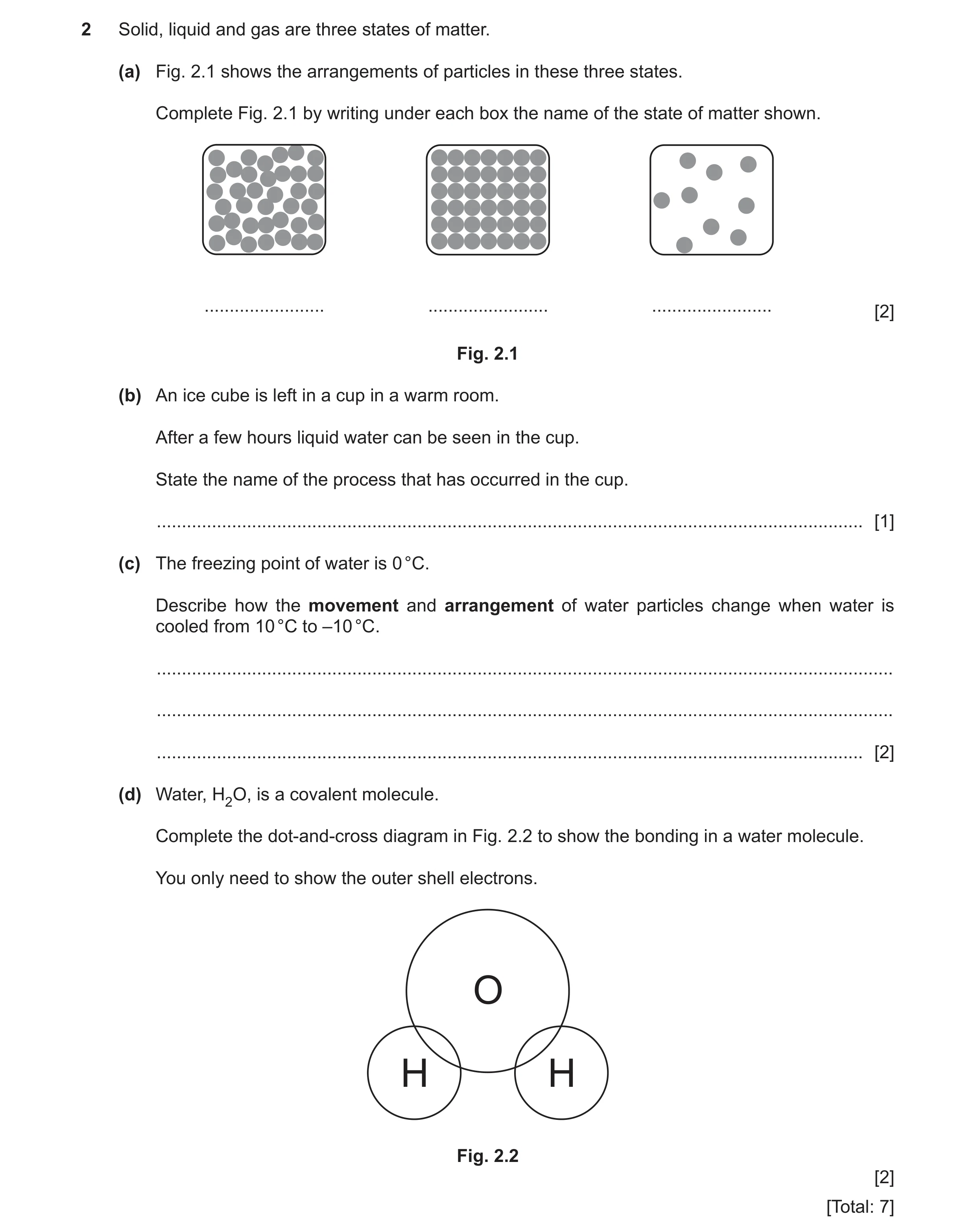
2 Solid, liquid and gas are three states of matter. (a) Fig. 2.1 shows the arrangements of particles in these three states. Complete Fig. 2.1 by writing under each box the name of the state of matter shown. … … … [2] Fig. 2.1 (b) An ice cube is left in a cup in a warm room. After a few hours liquid water can be seen in the cup. State the name of the process that has occurred in the cup. … [1] (c) The freezing point of water is 0 °C. Describe how the movement and arrangement of water particles change when water is cooled from 10 °C to –10 °C. … … … [2] (d) Water, H2O, is a covalent molecule. Complete the dot-and-cross diagram in Fig. 2.2 to show the bonding in a water molecule. You only need to show the outer shell electrons. O H H Fig. 2.2 [2] [Total: 7]
7 marks
Mark scheme: 2(a) liquid solid gas ;; 2 2(b) melting ; 1 Question Answer Marks 2(c) movement: idea that particles change, from moving around each other to vibrating about fixed positions ; arrangement: idea that arrangement of particles changes from random to regular ; 2 2(d) ;; 2
This question in 0654/42 May/June 2021
Q4 · The arrangement of molecules in samples of a solid, a liquid and a gas 0654/43 May/June 2021
12 Fig. 12.1 shows the arrangement of molecules in samples of a solid, a liquid and a gas. solid liquid gas Fig. 12.1 (a) Some statements about the structure and properties of matter are given. Place a tick (3) next to all of the statements that describe the structure or properties of a solid. There are no forces between molecules. Forces between molecules are strong. It has a fixed volume. It can be compressed. Molecules can only vibrate. Molecules are free to move. [3] (b) Fig. 12.2 shows a syringe filled with a gas similar to the sample shown in Fig. 12.1. The syringe is attached to a pressure gauge which measures the pressure of the gas. syringe 5 10 15 20 pressure gauge cm3 Fig. 12.2 Describe what causes the pressure in the sample of gas in terms of molecular motion. … … … … [2] (c) A student conducts an investigation into how the pressure of the gas changes with volume. The temperature of the gas remains constant. Fig. 12.3 shows the results of the student’s investigation. 1000 pressure / kPa 800 600 400 200 00 5 10 15 20 volume / cm3 Fig. 12.3 (i) Use Fig. 12.3 to determine the volume of the sample of gas when the pressure is 500 kPa. volume = … cm3 [1] (ii) The mass of the sample of gas is 2.45 g. Calculate the density of the sample of gas when the pressure is 500 kPa. density = … g / cm3 [2] (d) Explain why increasing the temperature of a sample of gas, while keeping the volume constant, causes an increase in pressure. … … … … [2] [Total: 10]
10 marks
Mark scheme: 12(a) forces between molecules are strong ; it has a fixed volume ; molecules can only vibrate; 3 12(b) collisions of molecules with walls ; produces a force ; 2 12(c)(i) 5 (cm3) ; 1 12(c)(ii) (density =) m / V or 2.45 / 5 ; 0.5 (g / cm3) ; 2 12(d) molecules move faster / have more energy ; molecules collide, more often / more frequently, with walls / with a larger force exerted on walls ; 2
This question in 0654/43 May/June 2021
Q5 · The arrangement of ions in magnesium metal at 25°C 0654/43 May/June 2022
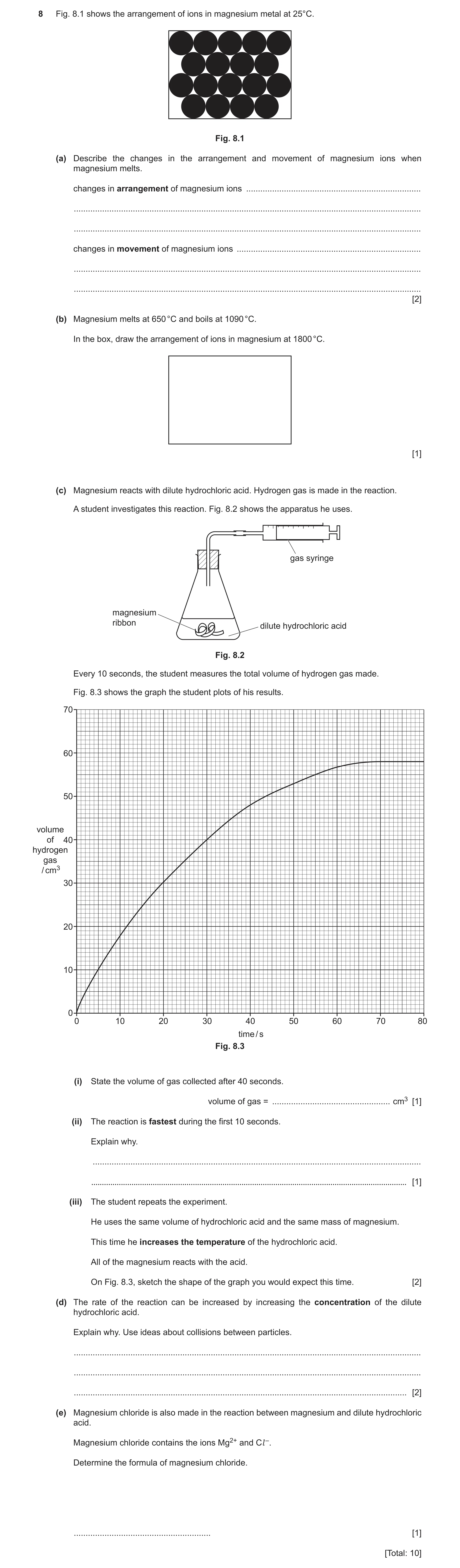
8 Fig. 8.1 shows the arrangement of ions in magnesium metal at 25°C. Fig. 8.1 (a) Describe the changes in the arrangement and movement of magnesium ions when magnesium melts. changes in arrangement of magnesium ions … … … changes in movement of magnesium ions … … … [2] (b) Magnesium melts at 650 °C and boils at 1090 °C. In the box, draw the arrangement of ions in magnesium at 1800 °C. [1] (c) Magnesium reacts with dilute hydrochloric acid. Hydrogen gas is made in the reaction. A student investigates this reaction. Fig. 8.2 shows the apparatus he uses. gas syringe magnesium ribbon dilute hydrochloric acid Fig. 8.2 Every 10 seconds, the student measures the total volume of hydrogen gas made. Fig. 8.3 shows the graph the student plots of his results. 70 60 50 volume of 40 hydrogen gas / cm3 30 20 10 0 0 10 20 30 40 50 60 70 80 time / s Fig. 8.3 (i) State the volume of gas collected after 40 seconds. volume of gas = … cm3 [1] (ii) The reaction is fastest during the first 10 seconds. Explain why. … … [1] (iii) The student repeats the experiment. He uses the same volume of hydrochloric acid and the same mass of magnesium. This time he increases the temperature of the hydrochloric acid. All of the magnesium reacts with the acid. On Fig. 8.3, sketch the shape of the graph you would expect this time. [2] (d) The rate of the reaction can be increased by increasing the concentration of the dilute hydrochloric acid. Explain why. Use ideas about collisions between particles. … … … [2] (e) Magnesium chloride is also made in the reaction between magnesium and dilute hydrochloric acid. Magnesium chloride contains the ions Mg2+ and Cl –. Determine the formula of magnesium chloride. … [1] [Total: 10]
10 marks
Mark scheme: 8(a) Changes in arrangement: idea that arrangement of particles becomes more random / becomes irregular ; Changes in movement: (idea that particles change from vibrating about fixed positions and start) moving around each other ; 8(b) randomly arranged particles not touching each other ; 1 8(c)(i) 48 (cm³) ; 1 8(c)(ii) acid is more concentrated at the start / the magnesium has a greater surface area at the start ; 1 8(c)(iii) graph steeper initially ; levels off at 58 cm³ ; 2 Question Answer Marks 8(d) more particles per unit volume / less space between particles ; increased rate of (successful) collisions ; 2 8(e) MgCl2 ; 1
This question in 0654/43 May/June 2022
Q6 · The arrangement of particles in a liquid 0654/41 Oct/Nov 2022
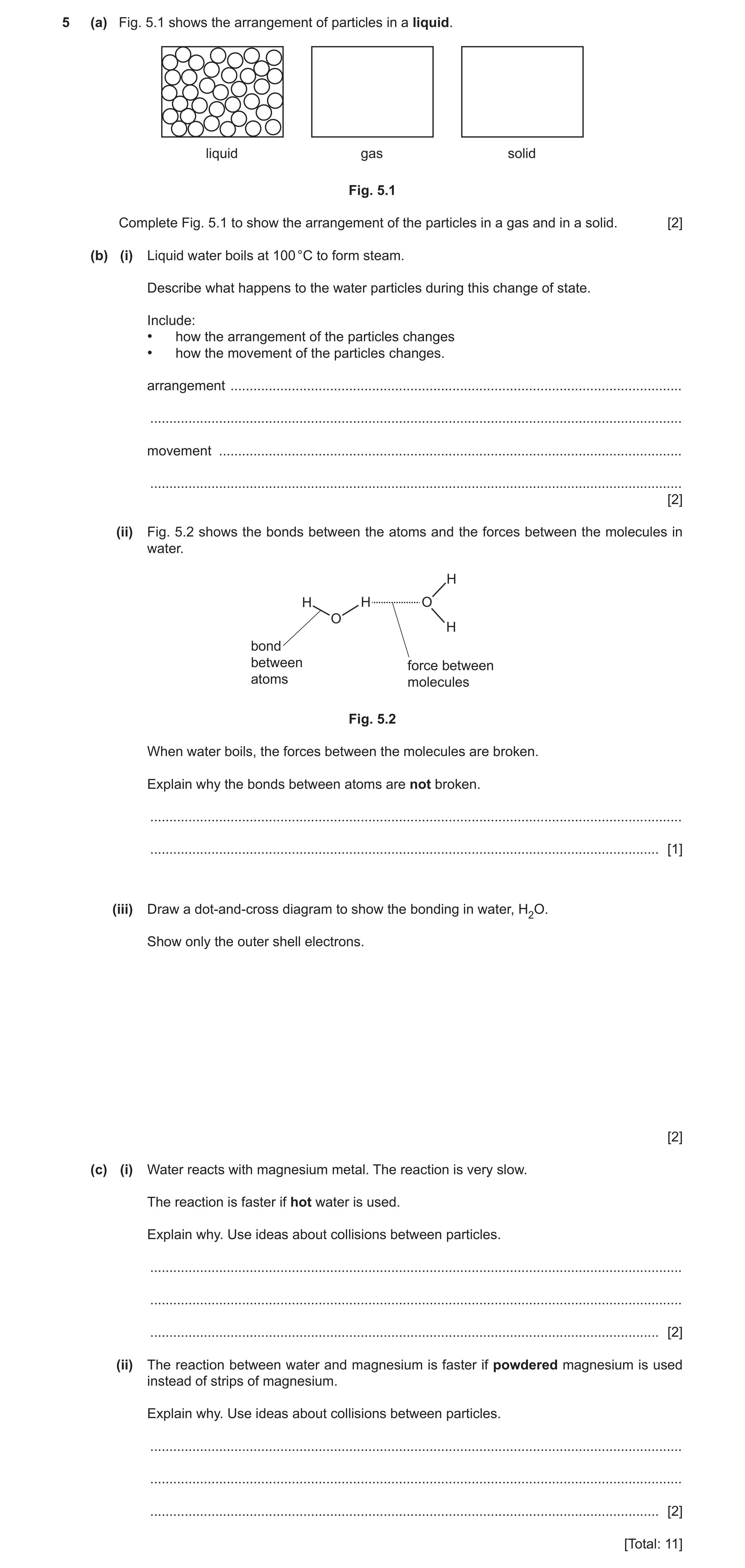
5 (a) Fig. 5.1 shows the arrangement of particles in a liquid. liquid gas solid Fig. 5.1 Complete Fig. 5.1 to show the arrangement of the particles in a gas and in a solid. [2] (b) (i) Liquid water boils at 100 °C to form steam. Describe what happens to the water particles during this change of state. Include: • how the arrangement of the particles changes • how the movement of the particles changes. arrangement … … movement … … [2] (ii) Fig. 5.2 shows the bonds between the atoms and the forces between the molecules in water. H H H O O H bond between force between atoms molecules Fig. 5.2 When water boils, the forces between the molecules are broken. Explain why the bonds between atoms are not broken. … … [1] (iii) Draw a dot-and-cross diagram to show the bonding in water, H2O. Show only the outer shell electrons. [2] (c) (i) Water reacts with magnesium metal. The reaction is very slow. The reaction is faster if hot water is used. Explain why. Use ideas about collisions between particles. … … … [2] (ii) The reaction between water and magnesium is faster if powdered magnesium is used instead of strips of magnesium. Explain why. Use ideas about collisions between particles. … … … [2] [Total: 11]
11 marks
Mark scheme: 5(a) 2 gas ; solid ; 5(b)(i) move further apart ; 2 continue to move randomly / move more freely / collide with each other less often ; 5(b)(ii) bonds (between atoms) are strong / need a lot of energy to break / are covalent ; 1 5(b)(iii) 2 2 shared pairs ; all else correct ; 5(c)(i) particles move faster / have more energy ; 2 more particles possess the minimum energy to react / activation energy ; 5(c)(ii) more surface area ; 2 more frequent collisions / more collisions per second / owtte ;
This question in 0654/41 Oct/Nov 2022
Q7 · The three states of matter 0654/41 May/June 2023
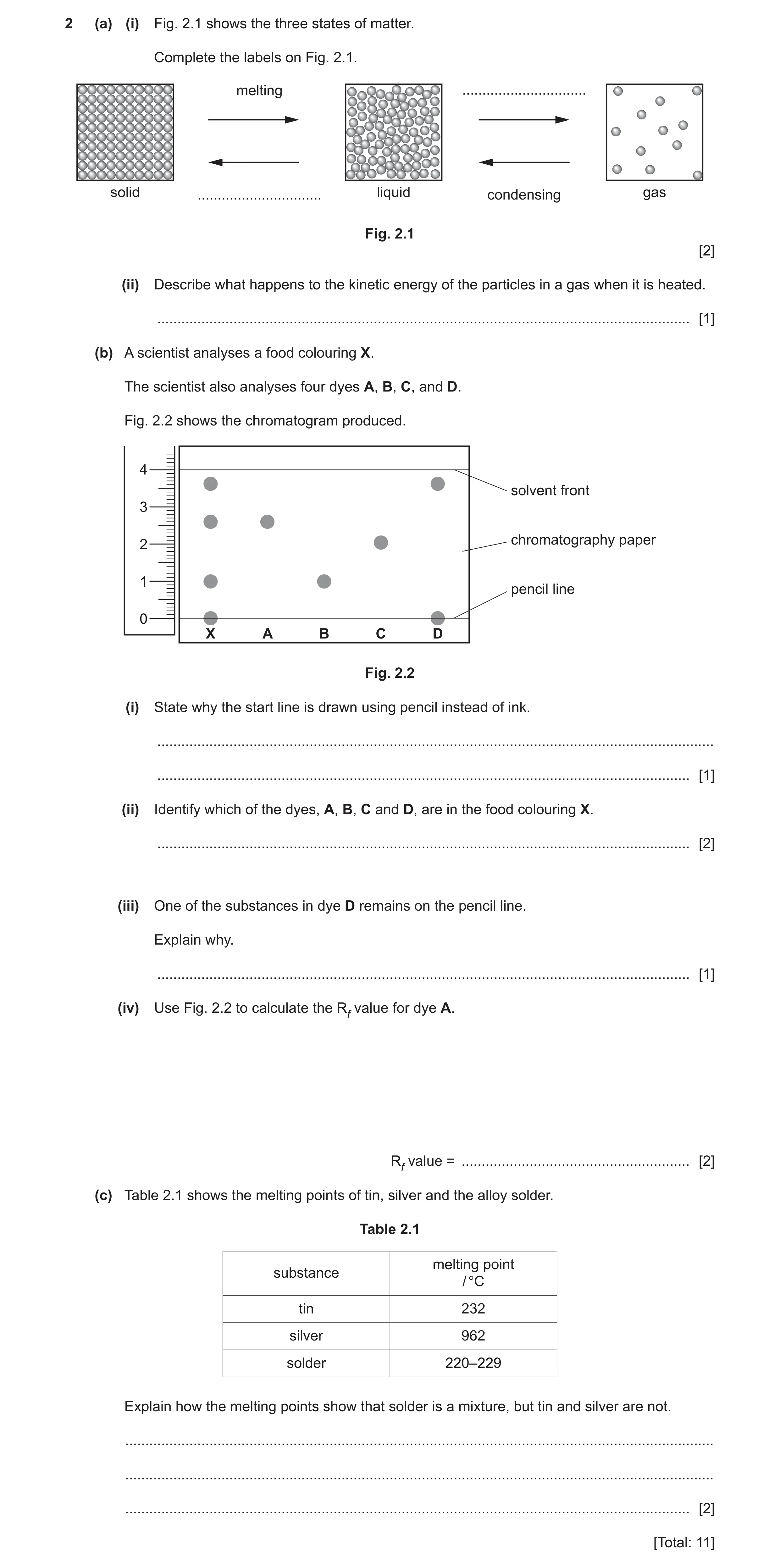
2 (a) (i) Fig. 2.1 shows the three states of matter. Complete the labels on Fig. 2.1. melting … solid … liquid condensing gas Fig. 2.1 [2] (ii) Describe what happens to the kinetic energy of the particles in a gas when it is heated. … [1] (b) A scientist analyses a food colouring X. The scientist also analyses four dyes A, B, C, and D. Fig. 2.2 shows the chromatogram produced. 4 solvent front 3 chromatography paper 2 1 pencil line 0 X A B C D Fig. 2.2 (i) State why the start line is drawn using pencil instead of ink. … … [1] (ii) Identify which of the dyes, A, B, C and D, are in the food colouring X. … [2] (iii) One of the substances in dye D remains on the pencil line. Explain why. … [1] (iv) Use Fig. 2.2 to calculate the Rf value for dye A. Rf value = … [2] (c) Table 2.1 shows the melting points of tin, silver and the alloy solder. Table 2.1 melting point substance / °C tin 232 silver 962 solder 220–229 Explain how the melting points show that solder is a mixture, but tin and silver are not. … … … [2] [Total: 11]
11 marks
Mark scheme: 2(a)(i) liquid to gas = evaporation / boiling ; liquid to solid = freezing / solidification ; 2 2(a)(ii) (kinetic energy) increases / owtte ; 1 2(b)(i) pencil is insoluble/does not dissolve in water / owtte ; OR ink is soluble/dissolves in water / owtte ; 1 2(b)(ii) A, B and D ;; 2 Question Answer Marks 2(b)(iii) idea that the substance is insoluble (in the solvent) ; 1 2(b)(iv) (Rf = ) 2.6 4.0 ; 0.65 ; 2 2(c) idea that pure substances have a specific or sharp melting point ; (but) mixtures melt over a range of temperatures ; 2
This question in 0654/41 May/June 2023
Q8 · A student heats three substances X, Y and Z in a water‑bath 0654/42 May/June 2024
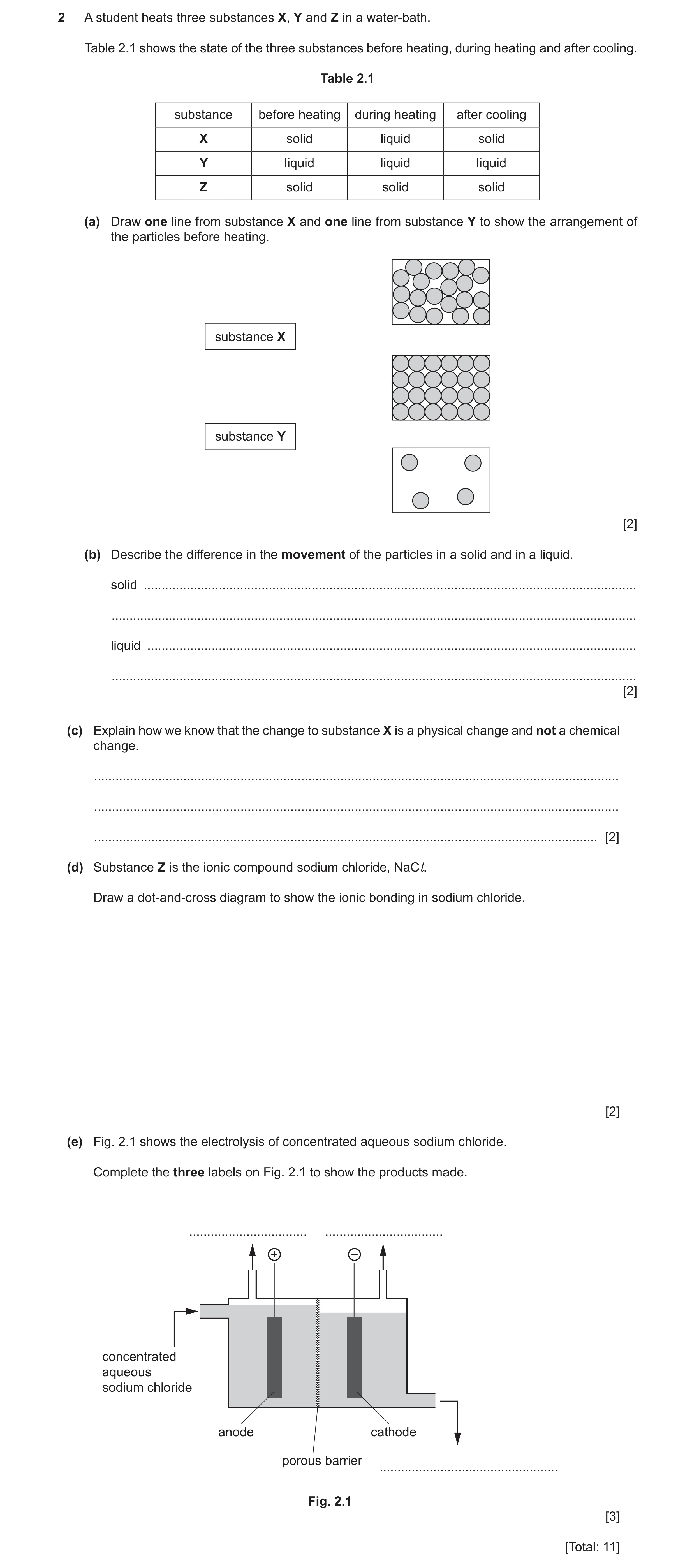
2 A student heats three substances X, Y and Z in a water‑bath. Table 2.1 shows the state of the three substances before heating, during heating and after cooling. Table 2.1 substance before heating during heating after cooling X solid liquid solid Y liquid liquid liquid Z solid solid solid (a) Draw one line from substance X and one line from substance Y to show the arrangement of the particles before heating. substance X substance Y [2] (b) Describe the difference in the movement of the particles in a solid and in a liquid. solid … … liquid … … [2] (c) Explain how we know that the change to substance X is a physical change and not a chemical change. … … … [2] (d) Substance Z is the ionic compound sodium chloride, NaCl. Draw a dot‑and‑cross diagram to show the ionic bonding in sodium chloride. [2] (e) Fig. 2.1 shows the electrolysis of concentrated aqueous sodium chloride. Complete the three labels on Fig. 2.1 to show the products made. … … + – concentrated aqueous sodium chloride anode cathode porous barrier … Fig. 2.1 [3] [Total: 11]
11 marks
Mark scheme: 2(a) ; ; 2(b) (solid) idea that particles are vibrating about fixed positions ; (liquid) particles, move around / slide over, each other ; 2 2(c) it is reversible / a chemical change is irreversible ; no new substance is formed / a chemical change produces a new substance ; 2 2(d) ;; 2 Question Answer Marks 2(e) 3
This question in 0654/42 May/June 2024
Q9 · The arrangement and movement of particles in solids, liquids and gases are different 0654/41 Oct/Nov 2024
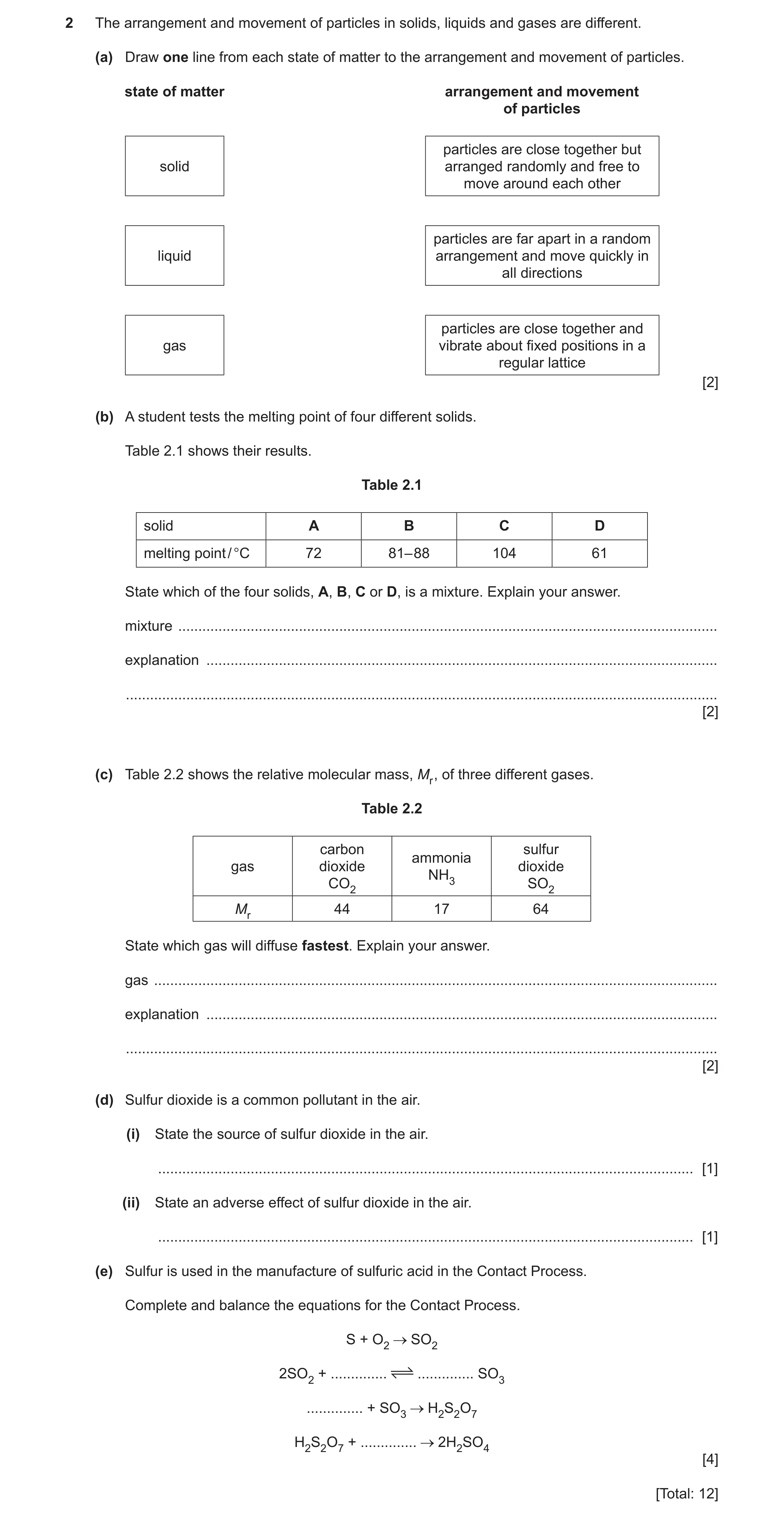
2 The arrangement and movement of particles in solids, liquids and gases are different. (a) Draw one line from each state of matter to the arrangement and movement of particles. state of matter arrangement and movement of particles particles are close together but solid arranged randomly and free to move around each other particles are far apart in a random liquid arrangement and move quickly in all directions particles are close together and gas vibrate about fixed positions in a regular lattice [2] (b) A student tests the melting point of four different solids. Table 2.1 shows their results. Table 2.1 solid A B C D melting point / °C 72 81– 88 104 61 State which of the four solids, A, B, C or D, is a mixture. Explain your answer. mixture … explanation … … [2] (c) Table 2.2 shows the relative molecular mass, Mr , of three different gases. Table 2.2 carbon sulfur ammonia gas dioxide dioxide NH3 CO2 SO2 Mr 44 17 64 State which gas will diffuse fastest. Explain your answer. gas … explanation … … [2] (d) Sulfur dioxide is a common pollutant in the air. (i) State the source of sulfur dioxide in the air. … [1] (ii) State an adverse effect of sulfur dioxide in the air. … [1] (e) Sulfur is used in the manufacture of sulfuric acid in the Contact Process. Complete and balance the equations for the Contact Process. S + O2 SO2 2SO2 + … … SO3 … + SO3 H2S2O7 H2S2O7 + … 2H2SO4 [4] [Total: 12]
12 marks
Mark scheme: 2(a) 2 one or two correct for 1 mark three correct for 2 marks ;; 2(b) (mixture) B ; 2 (mixtures) melt over a range (of temperatures) / not a fixed / certain / sharp / single (melting) point / more than one (melting) point ; 2(c) (gas) ammonia / NH3 ; 2 (ammonia) has the lowest Mr / is the lightest gas ; 2(d)(i) combustion of fossil fuels (containing sulfur compounds) ; 1 2(d)(ii) any one from: 1 causes acid rain ; causes breathing difficulties (asthma) ; 2(e) 2SO2 + O2 ⇌ 2 SO3 ;; 4 H2SO4 + SO3 → H2S2O7 ; H2S2O7 + H2O → 2H2SO4 ;
This question in 0654/41 Oct/Nov 2024
Q10 · Water exists in the solid, liquid or gas state 0654/41 May/June 2025
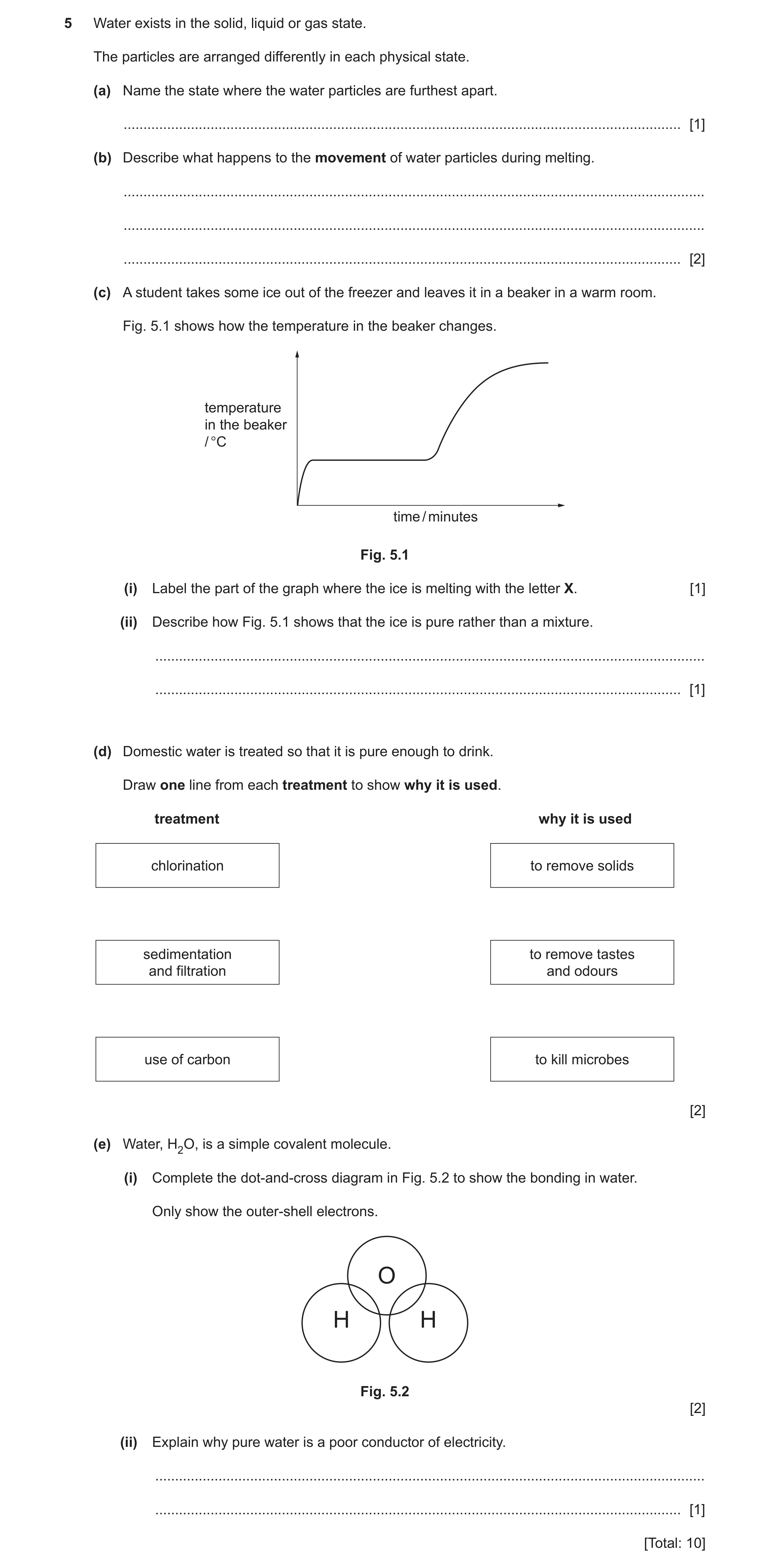
5 Water exists in the solid, liquid or gas state. The particles are arranged differently in each physical state. (a) Name the state where the water particles are furthest apart. … [1] (b) Describe what happens to the movement of water particles during melting. … … … [2] (c) A student takes some ice out of the freezer and leaves it in a beaker in a warm room. Fig. 5.1 shows how the temperature in the beaker changes. temperature in the beaker / °C time / minutes Fig. 5.1 (i) Label the part of the graph where the ice is melting with the letter X. [1] (ii) Describe how Fig. 5.1 shows that the ice is pure rather than a mixture. … … [1] (d) Domestic water is treated so that it is pure enough to drink. Draw one line from each treatment to show why it is used. treatment why it is used chlorination to remove solids sedimentation to remove tastes and filtration and odours use of carbon to kill microbes [2] (e) Water, H2O, is a simple covalent molecule. (i) Complete the dot-and-cross diagram in Fig. 5.2 to show the bonding in water. Only show the outer-shell electrons. O H H Fig. 5.2 [2] (ii) Explain why pure water is a poor conductor of electricity. … … [1] [Total: 10]
10 marks
Mark scheme: 5(a) gas ; 1 5(b) any two from : 2 idea that the movement changes from vibrating about fixed positions ; to moving around each other ; particles move faster ; 5(c)(i) 1 X ; 5(c)(ii) any one from : 1 idea that there is a horizontal part to the graph ; (pure substance) melting occurs at one temperature / a mixture melts at more than one temperature ; 5(d) 2 ;; 5(e)(i) 2 ;; 5(e)(ii) idea that pure water does not contain any free (moving) electrons / ions ; 1
This question in 0654/41 May/June 2025
Q11 · Describe one similarity and two differences between boiling and evaporation 0654/41 May/June 2025
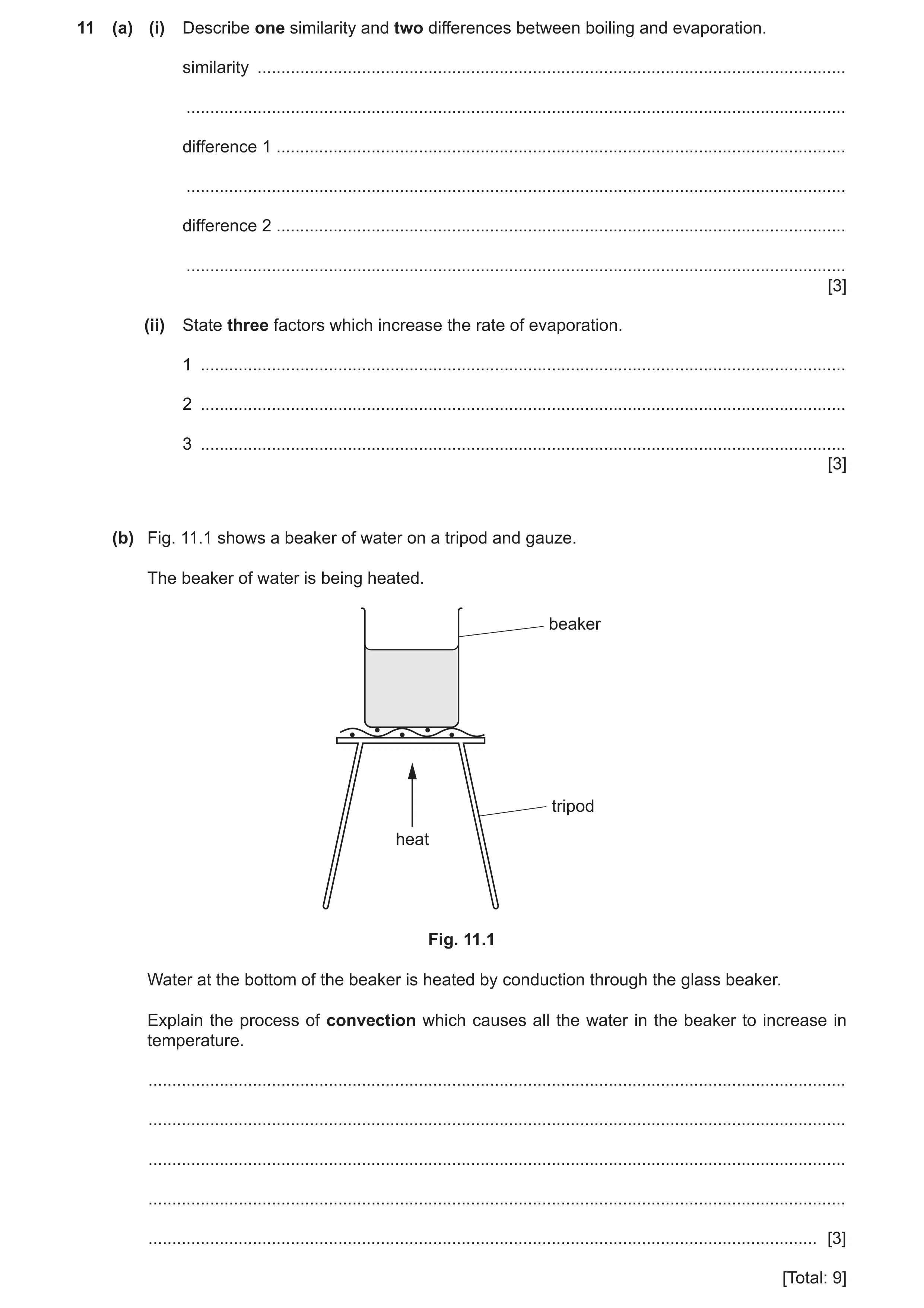
11 (a) (i) Describe one similarity and two differences between boiling and evaporation. similarity … … difference 1 … … difference 2 … … [3] (ii) State three factors which increase the rate of evaporation. 1 … 2 … 3 … [3] (b) Fig. 11.1 shows a beaker of water on a tripod and gauze. The beaker of water is being heated. beaker tripod heat Fig. 11.1 Water at the bottom of the beaker is heated by conduction through the glass beaker. Explain the process of convection which causes all the water in the beaker to increase in temperature. … … … … … [3] [Total: 9]
9 marks
Mark scheme: 11(a)(i) similarity 3 both are liquid to gas ; any two from: differences boiling occurs at the boiling point and evaporation occurs below the boiling point ; boiling occurs within the liquid and evaporation occurs at the surface of the liquid ; boiling is a fast(er) process and evaporation is a slow(er) process ; boiling forms bubbles and evaporation does not form bubbles ; 11(a)(ii) increased temperature ; 3 increased surface area ; increased air movement (over liquid surface) ; 11(b) heated water becomes less dense ; 3 and rises ; cold / more dense water sinks;
This question in 0654/41 May/June 2025
Q12 · A student investigates black ink using paper chromatography 0654/43 May/June 2025
5 A student investigates black ink using paper chromatography. Fig. 5.1 shows: • the chromatogram the student obtains • the measurements the student may make. measurements solvent front spot Y spot X A B C D start line black ink Fig. 5.1 (a) State if black ink is a pure or impure substance. Use Fig. 5.1 to explain your answer. statement … explanation … … [1] (b) State which two measurements on Fig. 5.1 are needed to calculate the Rf value of spot X. … and … [1] (c) The student calculates the Rf value of spot Y to be 0.80. The distance travelled by spot Y is 2.8 cm. Calculate the distance travelled by the solvent. distance travelled by solvent = … cm [2] (d) Paper chromatography has a stationary phase and a mobile phase. The stationary phase is a solid. The mobile phase is a liquid. Describe what happens to the separation and motion of the particles when a solid changes to a liquid. separation … … motion … … [2] (e) Different substances have different structures. Draw one line from each statement to the structure. statement structure The substance is a gas. +– +– –++ –+ –+ +– – + – + – +– – +– +– + –+ ––+– +– The substance is an + – + + + – + ionic solid. – + – – + + – + + – – + – + – – ++ – + – – + + – + + The substance is a solid metal. The substance is a giant covalent solid. [4] [Total: 10]
10 marks
Mark scheme: 5(a) (impure because) 1 idea that there is more than one spot; 5(b) A and B; 1 5(c) Rf = distance travelled by substance / 2 distance travelled by solvent 0.80 = 2.8 ÷ distance travelled by solvent / distance travelled by the solvent = 2.8 ÷ 0.80; 3.5 (cm); 5(d) separation 2 idea that particles in a liquid are slightly further apart than in a solid (but still touching) / ORA; motion idea that particles in a liquid move faster (than in a solid) / ORA / idea that particles move randomly in a liquid but vibrate (about a fixed position in a solid); 5(e) 4 ;;;;
This question in 0654/43 May/June 2025
![Question 2: (a) (i) Fig. 2.1 shows the three states of matter. Complete the labels on Fig. 2.1. [2] .......................... boiling solid freezing l…](https://img.pastlit.com/crops/19c0ab04-423f-4640-911e-42ca27a14cc1/q2.webp)
 5 / 21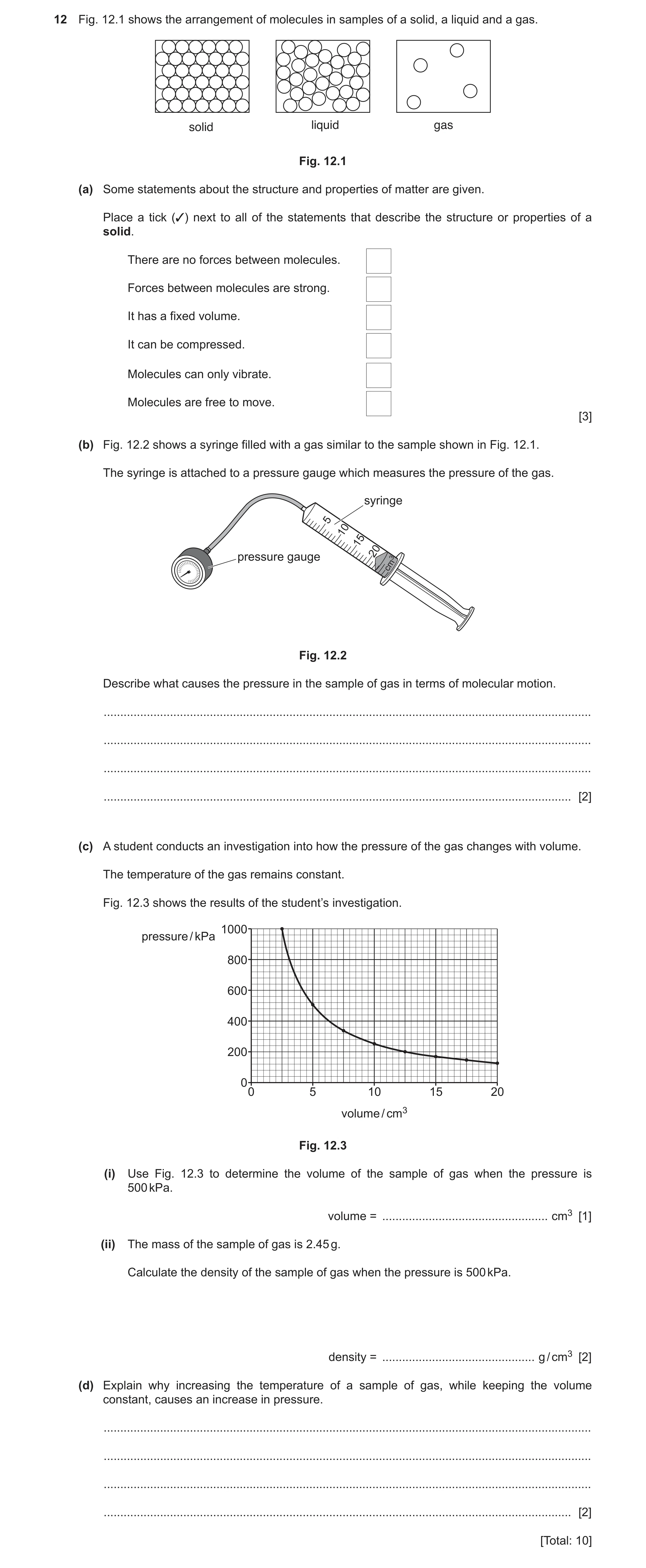
 19 / 21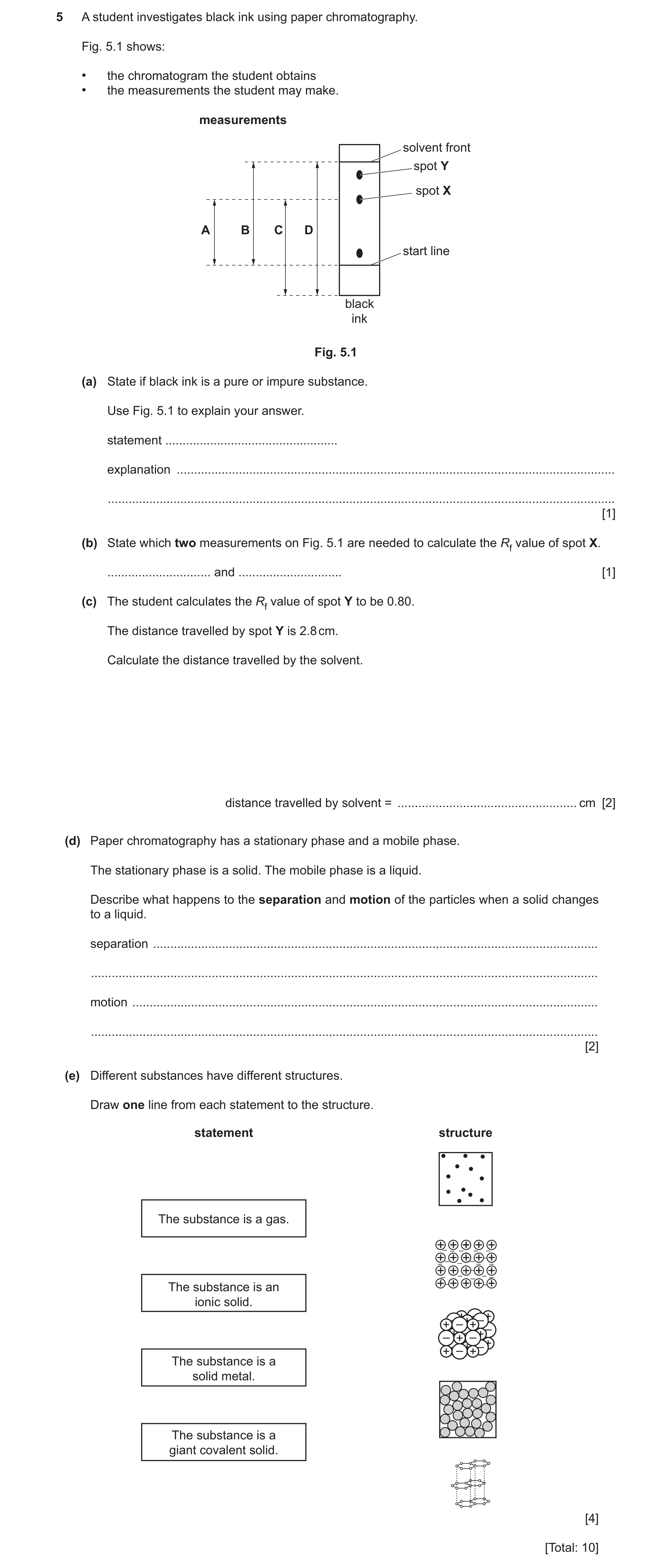
 8
8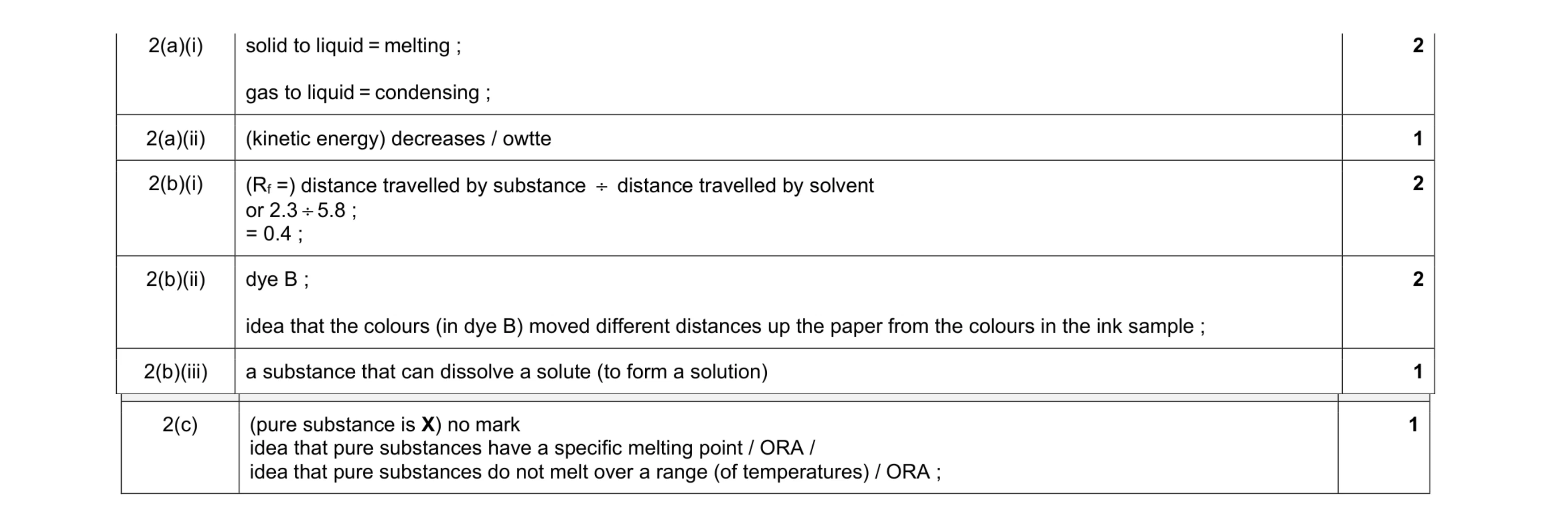 9
9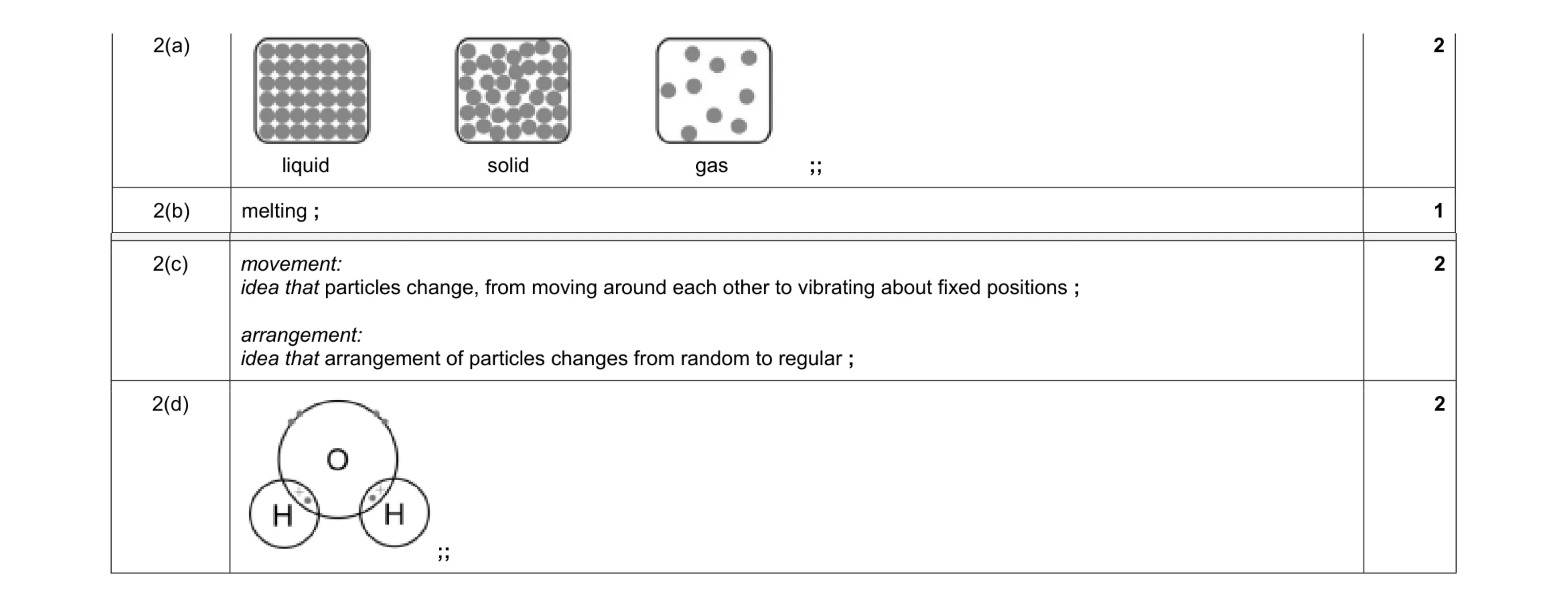 7
7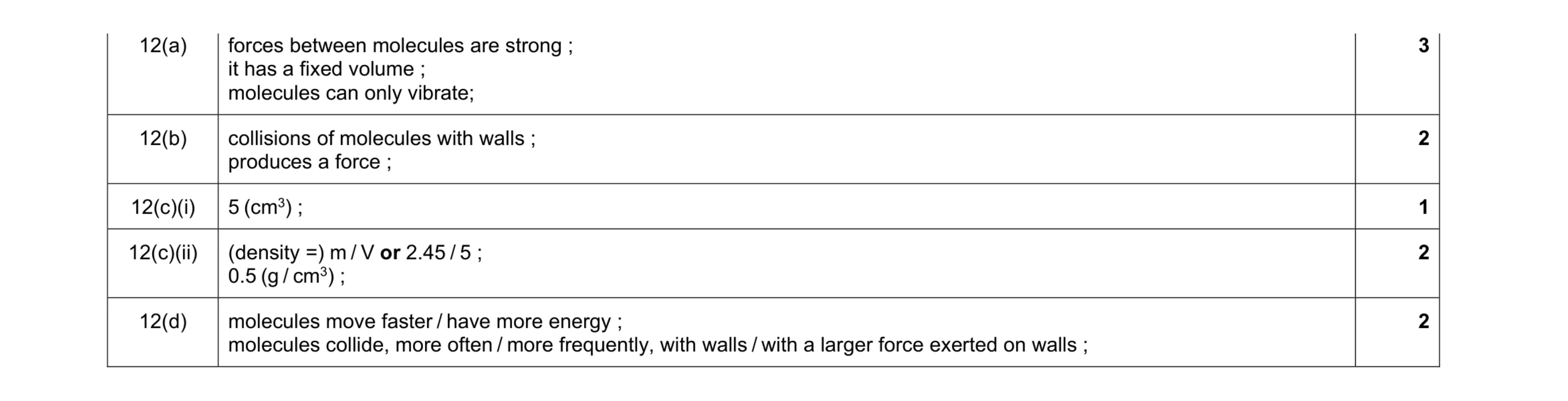 10
10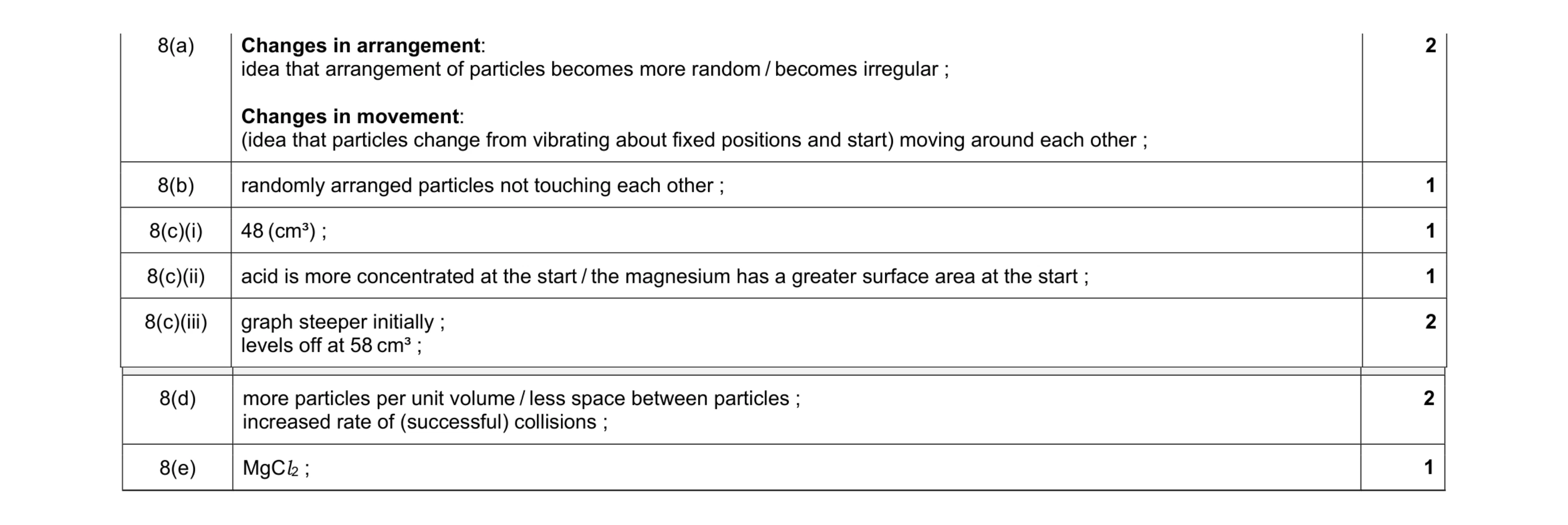 10
10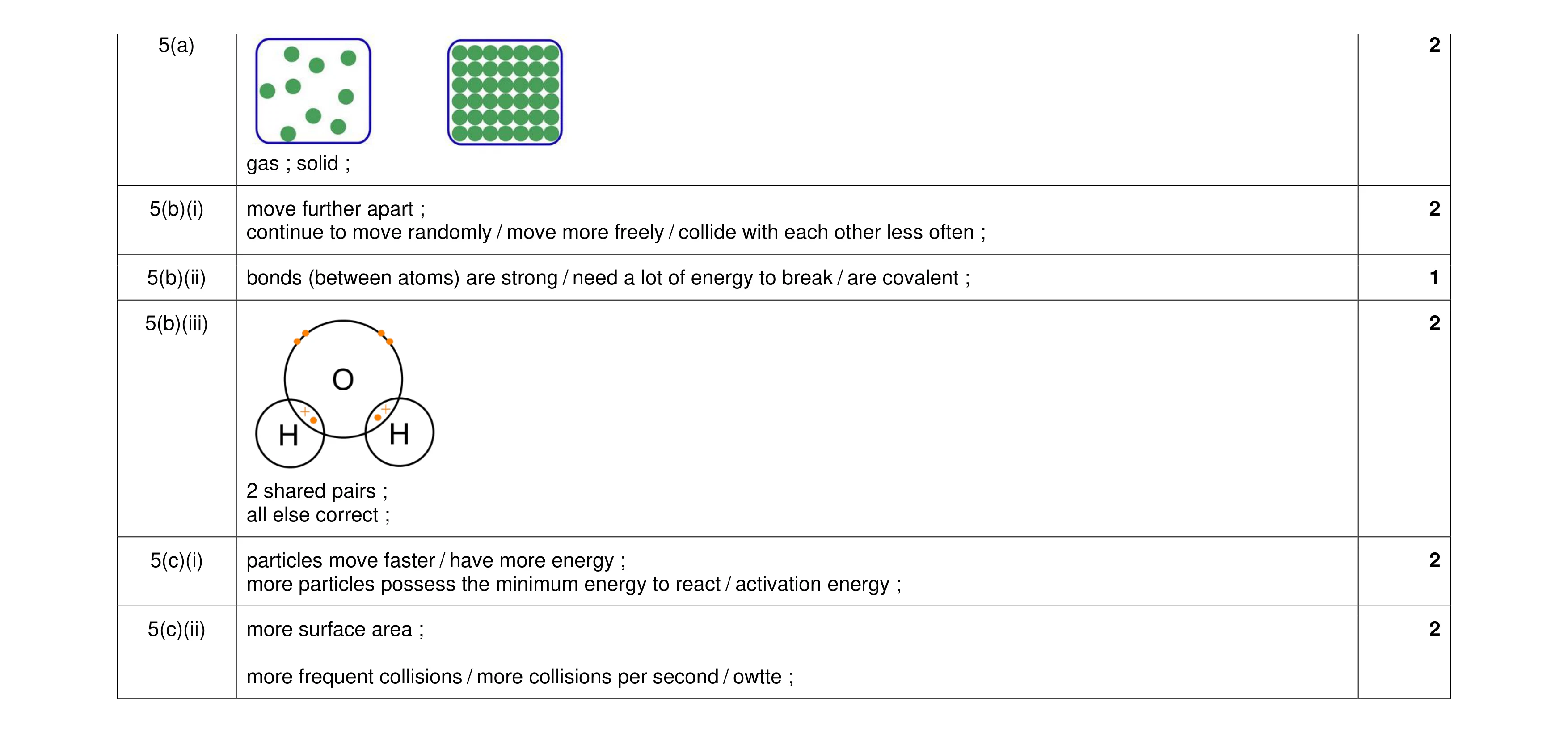 11
11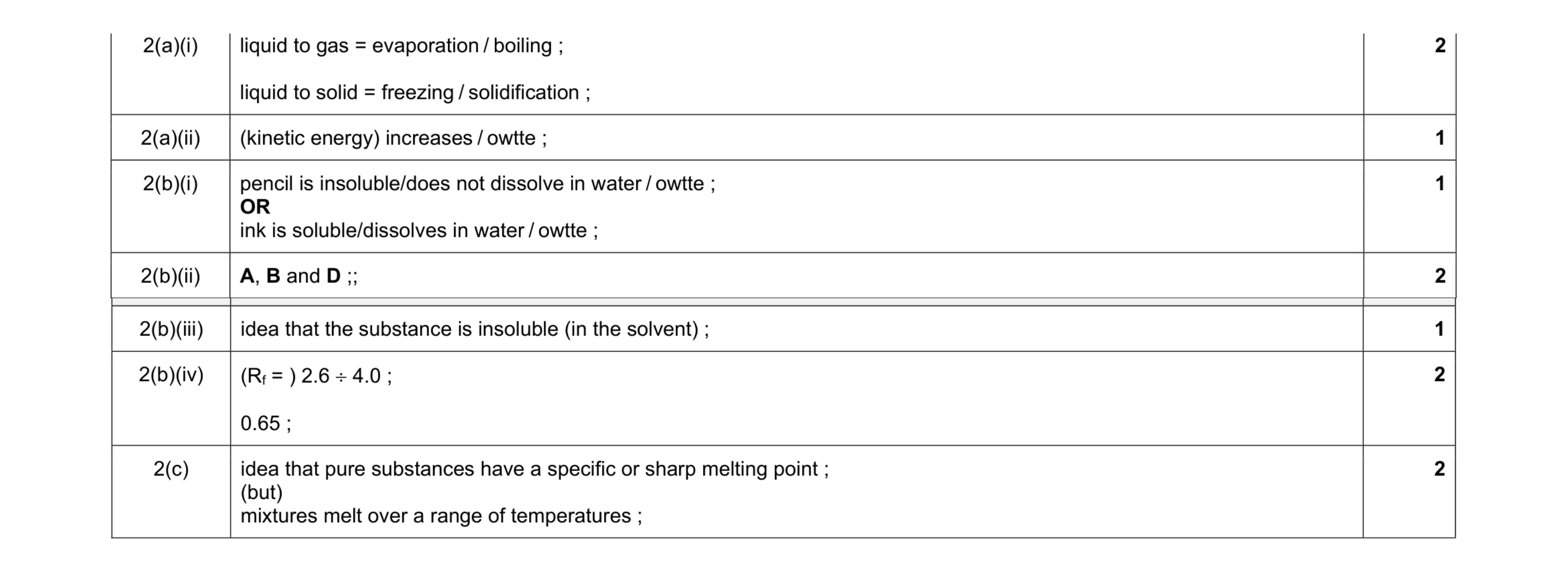 11
11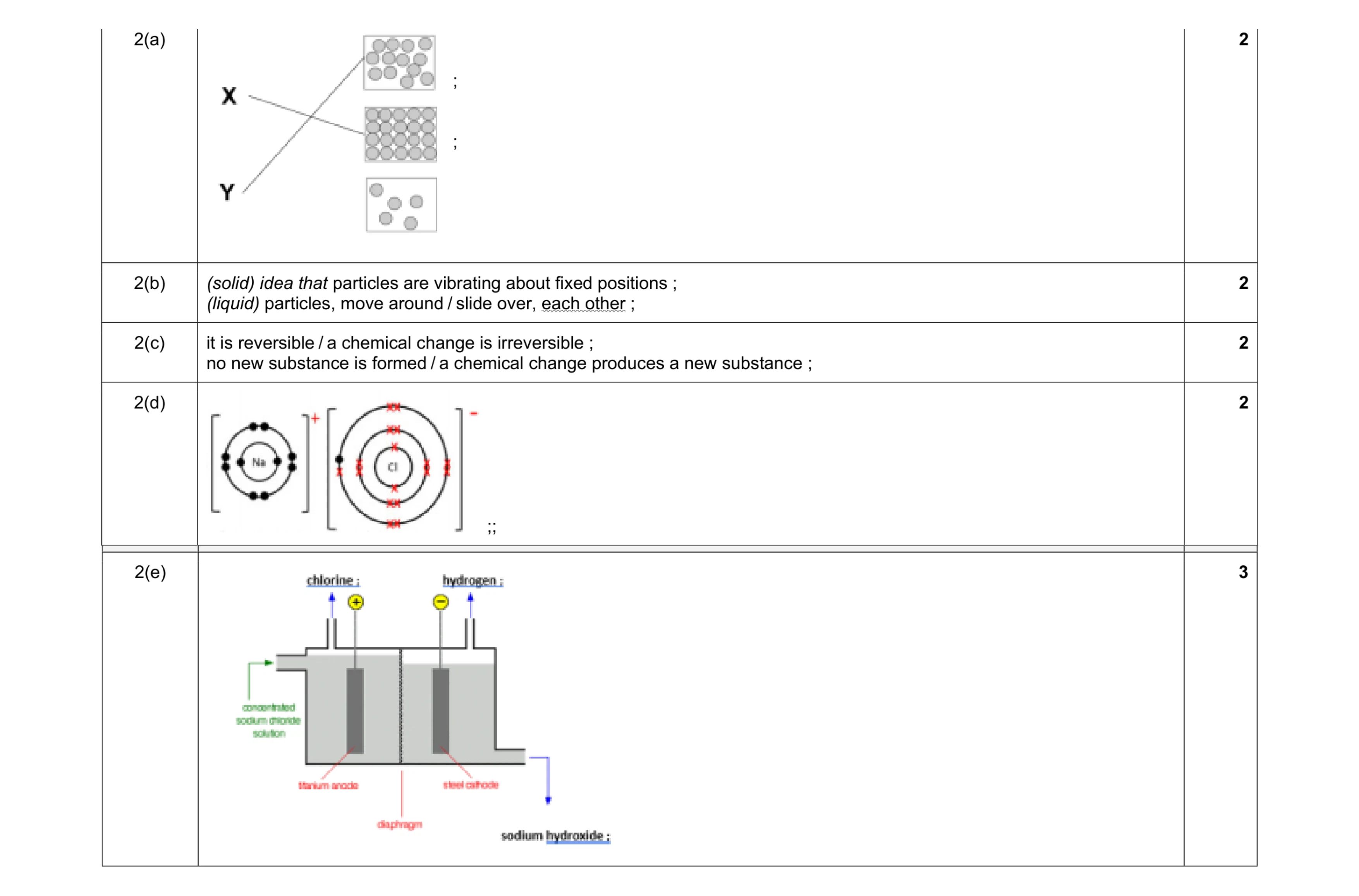 11
11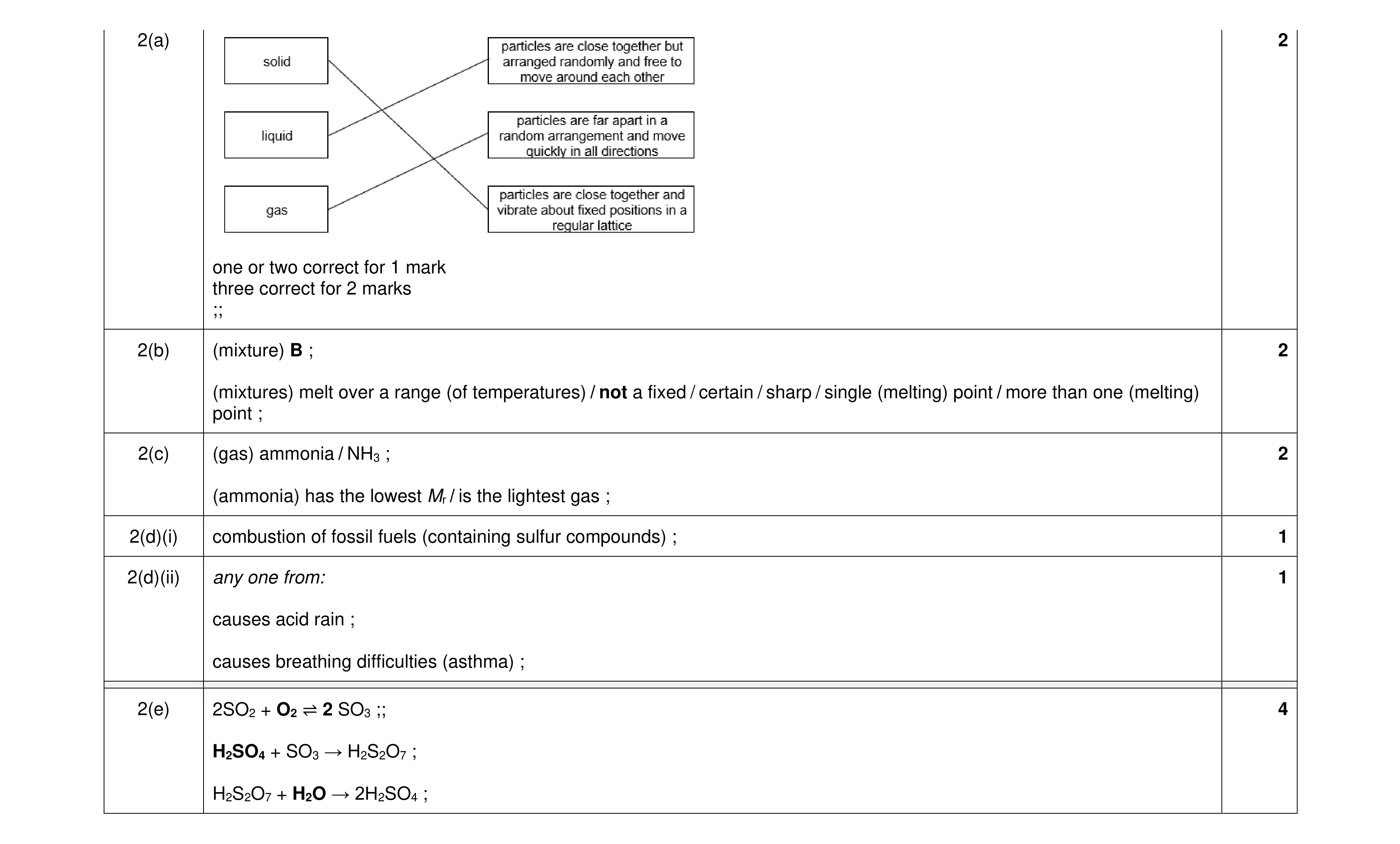 12
12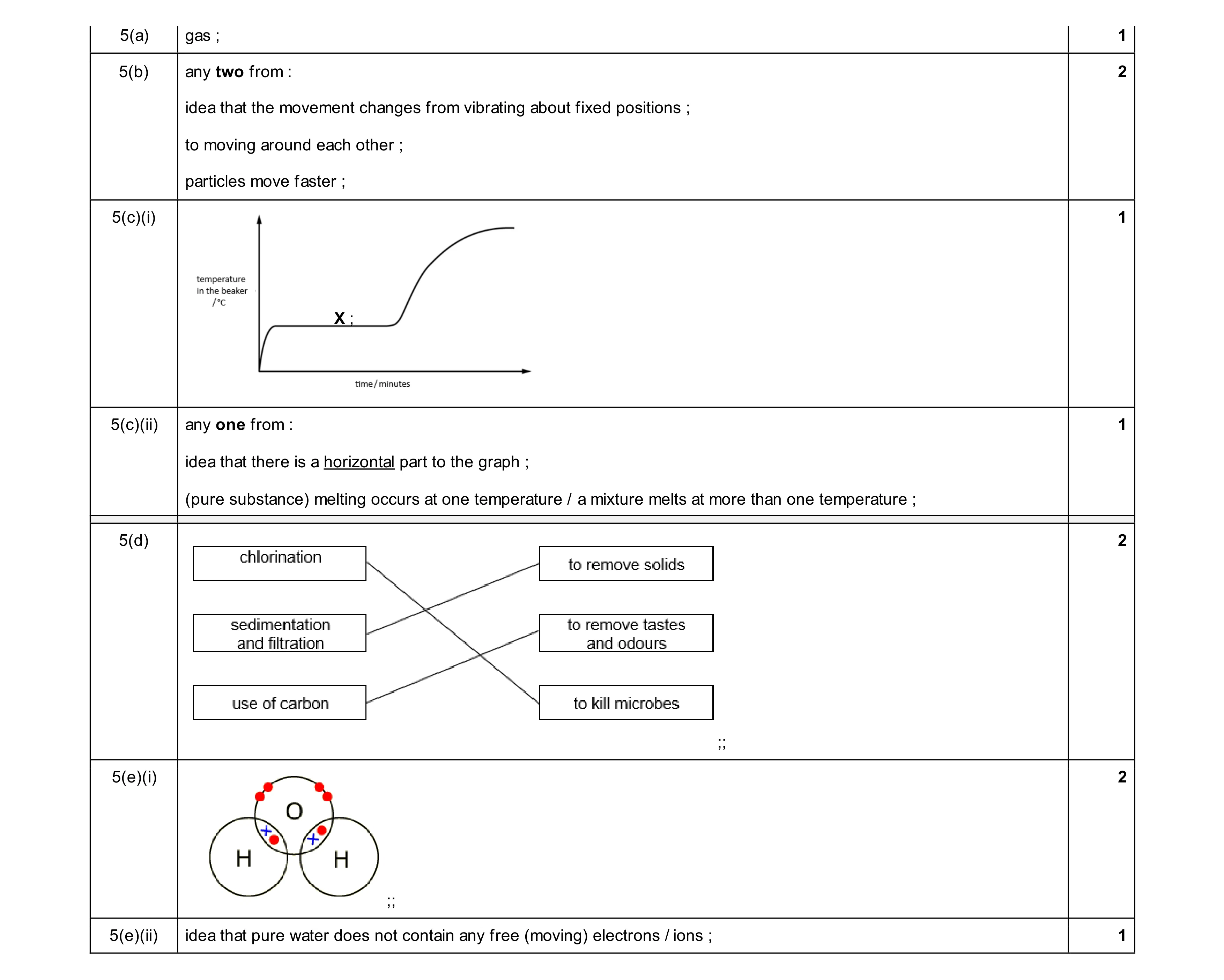 10
10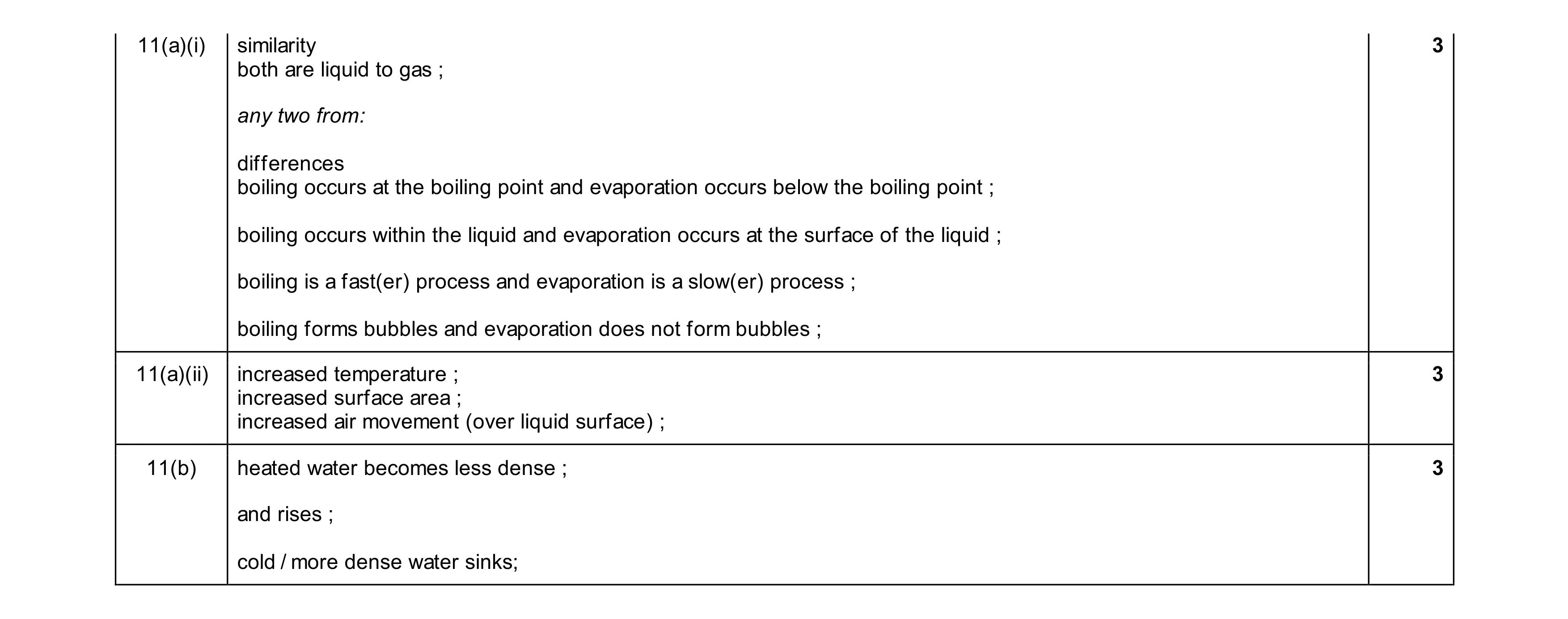 9
9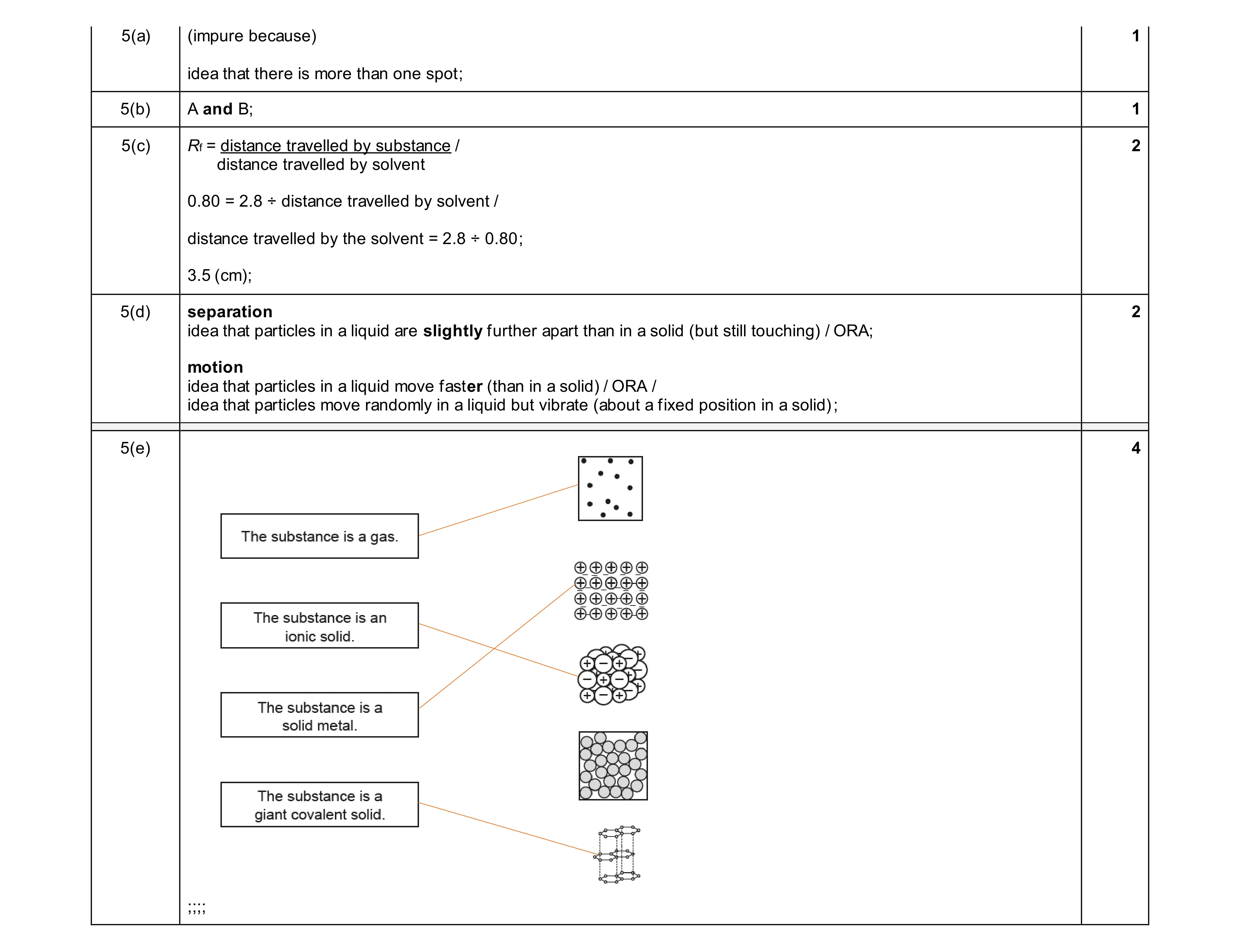 10
10