Questions as text
Q1 · A medicine contains two liquids that do not normally mix 0654/11 Oct/Nov 2006
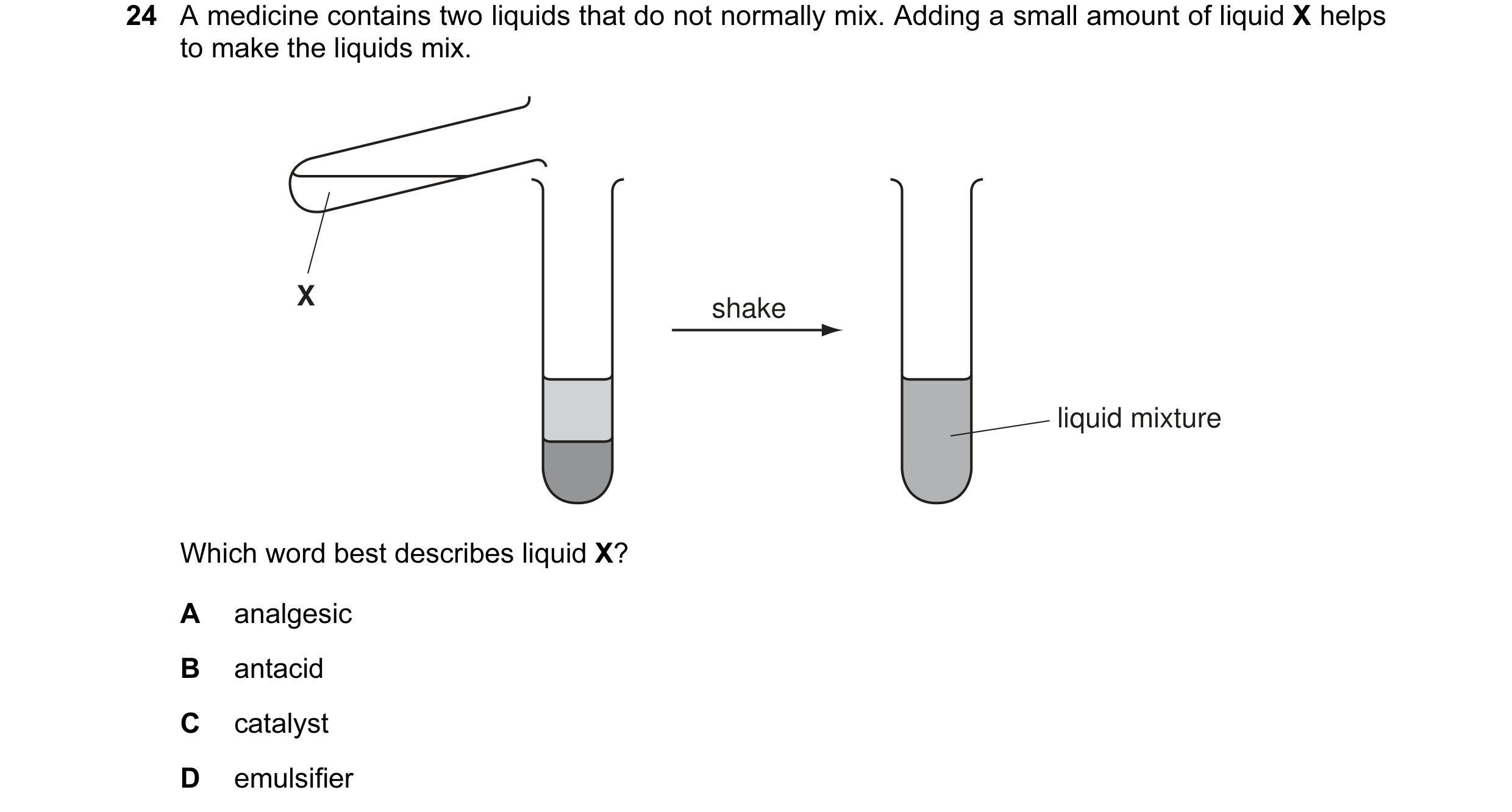
24 A medicine contains two liquids that do not normally mix. Adding a small amount of liquid X helps to make the liquids mix. X shake liquid mixture Which word best describes liquid X? A analgesic B antacid C catalyst D emulsifier
1 marks
Answer: D
This question in 0654/11 Oct/Nov 2006
Q2 · When water is heated to 100 °C, it changes to steam 0654/11 May/June 2007
14 When water is heated to 100 °C, it changes to steam. The steam has a larger volume than the water. Which change on heating explains this increase in volume? A The bonds between hydrogen and oxygen break. B The molecules become lighter. C The spacing between the molecules increases. D The water molecules expand.
1 marks
Answer: C
This question in 0654/11 May/June 2007
Q3 · An experiment using olive oil and water is shown 0654/11 Oct/Nov 2009
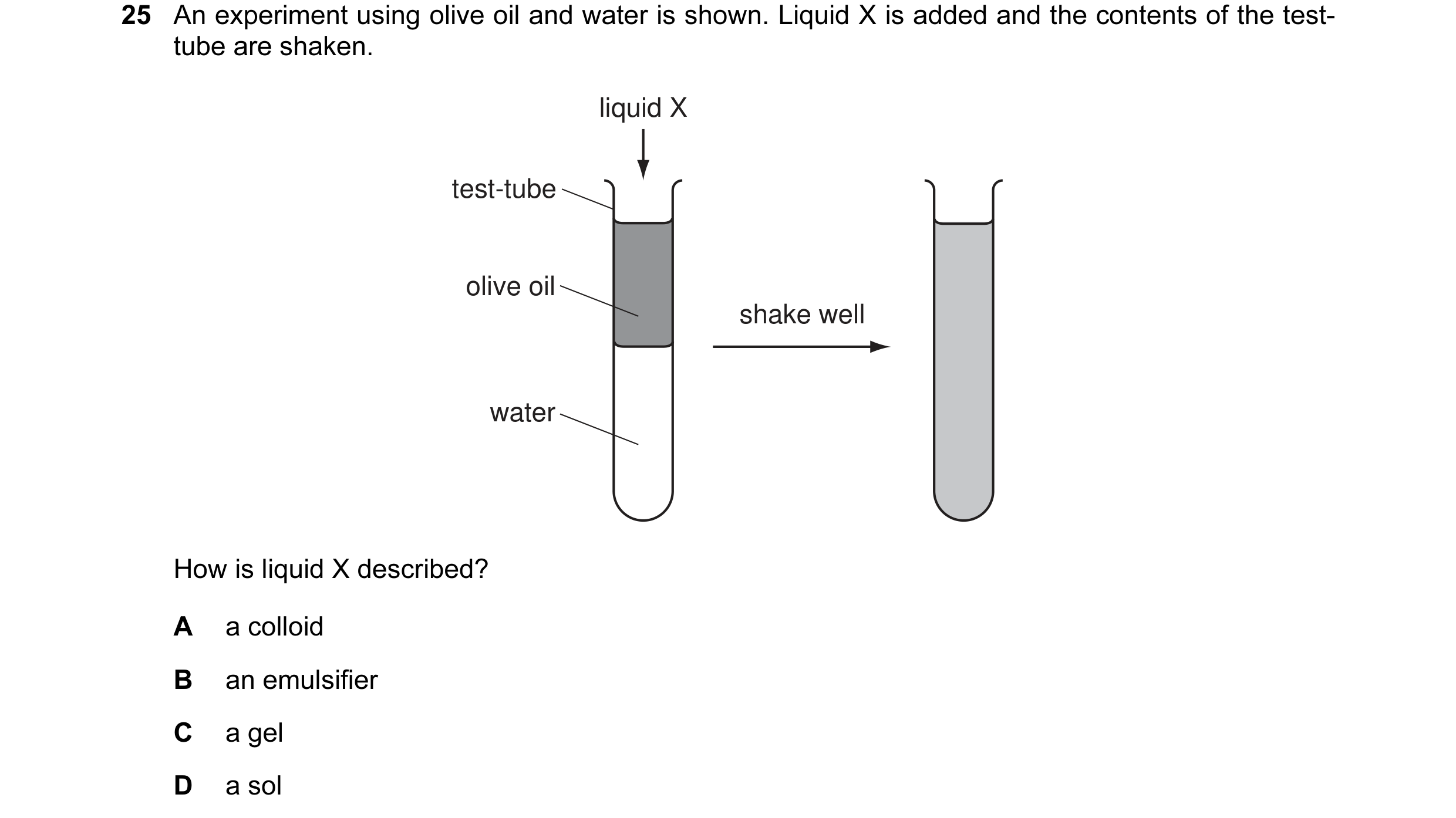
25 An experiment using olive oil and water is shown. Liquid X is added and the contents of the test- tube are shaken. liquid X test-tube olive oil shake well water How is liquid X described? A a colloid B an emulsifier C a gel D a sol
1 marks
Answer: B
This question in 0654/11 Oct/Nov 2009
Q4 · The graph shows the changes in temperature when a substance is cooled 0654/11 May/June 2010
14 The graph shows the changes in temperature when a substance is cooled. X temperature / °C Y 00 time Which row in the table describes X and Y? X Y A boiling freezing B boiling melting C condensing freezing D condensing melting
1 marks
Answer: C
This question in 0654/11 May/June 2010
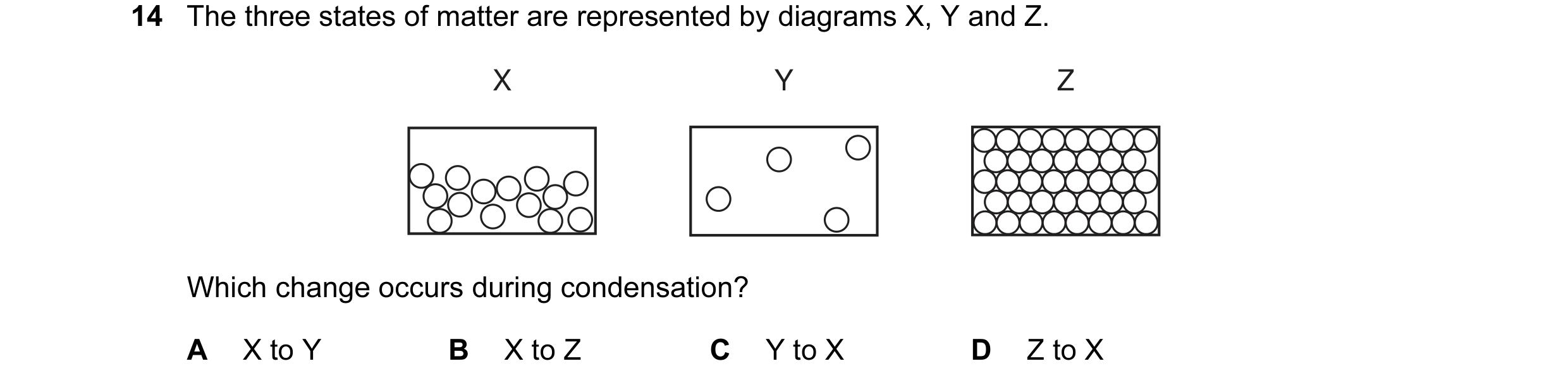
Q5 · The three states of matter are represented by diagrams X, Y and Z 0654/11 Oct/Nov 2010
14 The three states of matter are represented by diagrams X, Y and Z. X Y Z Which change occurs during condensation? A X to Y B X to Z C Y to X D Z to X
1 marks
Answer: C
This question in 0654/11 Oct/Nov 2010
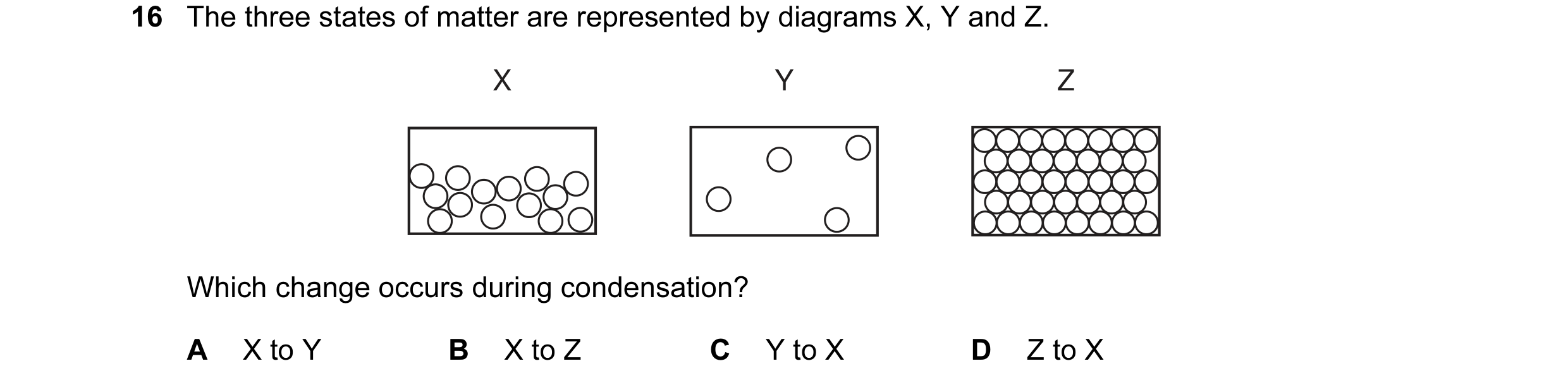
Q6 · The three states of matter are represented by diagrams X, Y and Z 0654/13 Oct/Nov 2010
16 The three states of matter are represented by diagrams X, Y and Z. X Y Z Which change occurs during condensation? A X to Y B X to Z C Y to X D Z to X
1 marks
Answer: C
This question in 0654/13 Oct/Nov 2010
Q7 · Which is not a colloid? 0654/11 May/June 2011
25 Which is not a colloid? A cellulose B milk C paint D smoke
1 marks
Answer: A
This question in 0654/11 May/June 2011
Q8 · The graph shows the changes in temperature when a substance is cooled 0654/12 May/June 2011
16 The graph shows the changes in temperature when a substance is cooled. X temperature / °C Y 0 0 time Which describes the processes occurring at X and Y? X Y A boiling melting B condensing freezing C freezing condensing D melting boiling
1 marks
Answer: B
This question in 0654/12 May/June 2011
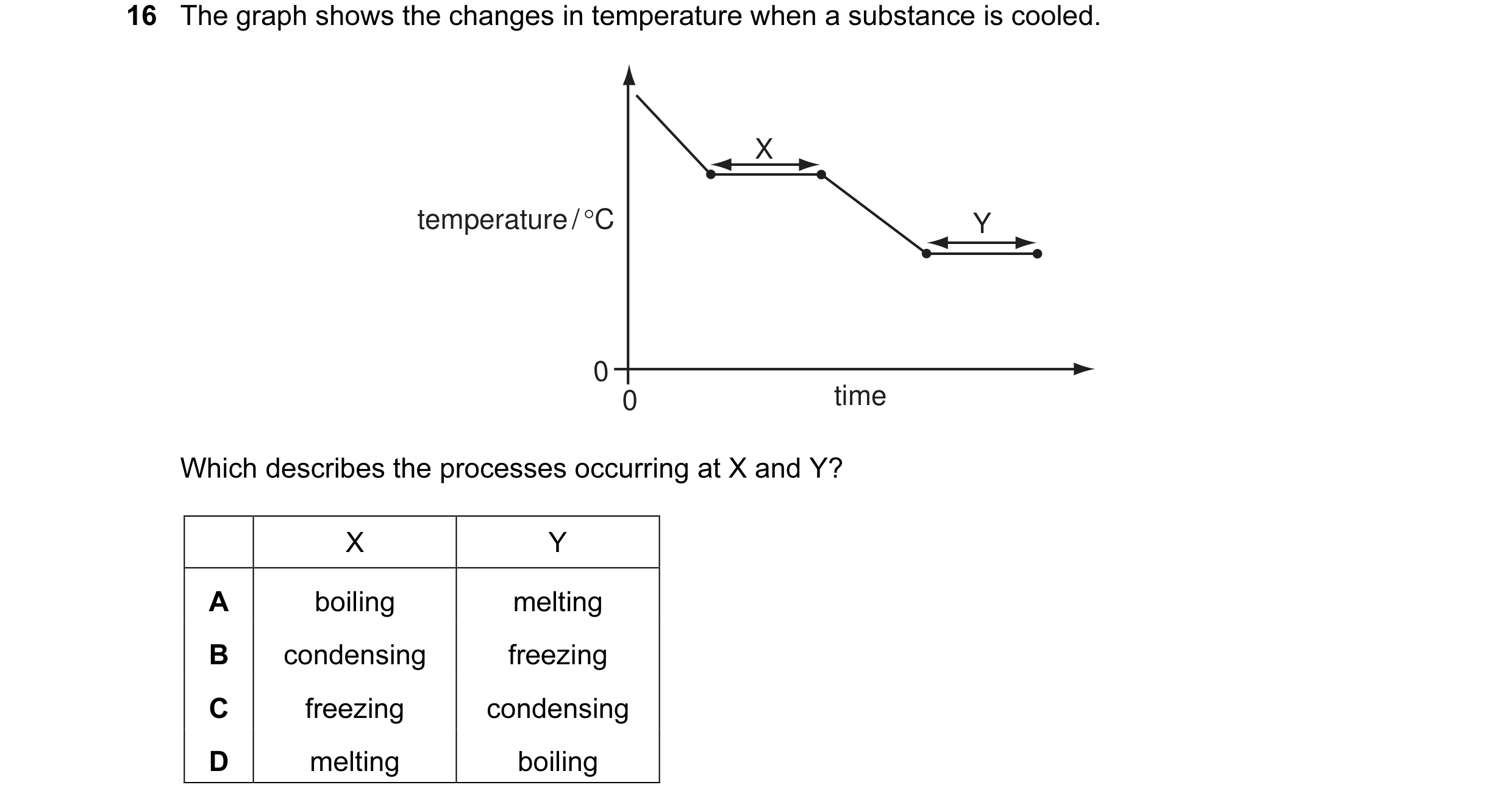
Q9 · The graph shows the changes in temperature when a substance is cooled 0654/13 May/June 2011
16 The graph shows the changes in temperature when a substance is cooled. X temperature / °C Y 0 0 time Which describes the processes occurring at X and Y? X Y A boiling melting B condensing freezing C freezing condensing D melting boiling
1 marks
Answer: B
This question in 0654/13 May/June 2011
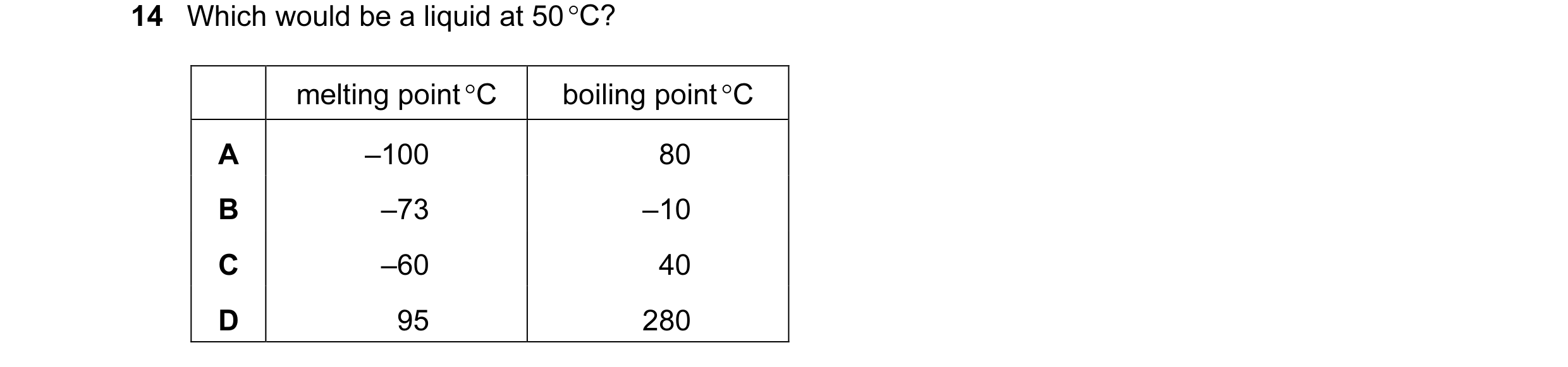
Q10 · Which would be a liquid at 50 °C? 0654/11 Oct/Nov 2011
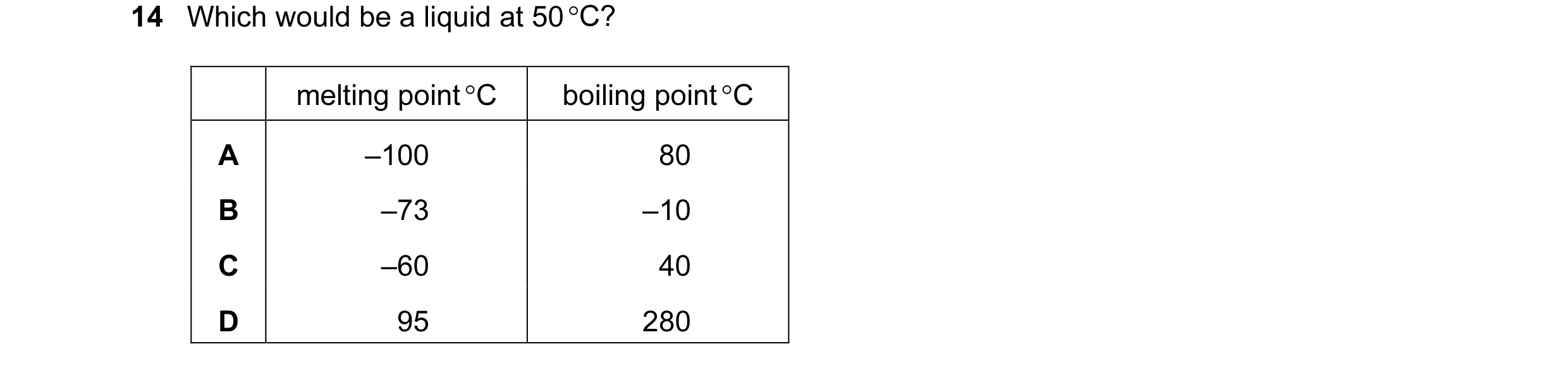
14 Which would be a liquid at 50 °C? melting point °C boiling point °C A –100 80 B –73 –10 C –60 40 D 95 280
1 marks
Answer: A
This question in 0654/11 Oct/Nov 2011
Q11 · Salad dressing contains oil dispersed in water 0654/11 Oct/Nov 2011
25 Salad dressing contains oil dispersed in water. What is the name of this type of colloidal system? A emulsion B gel C sol D solution
1 marks
Answer: A
This question in 0654/11 Oct/Nov 2011
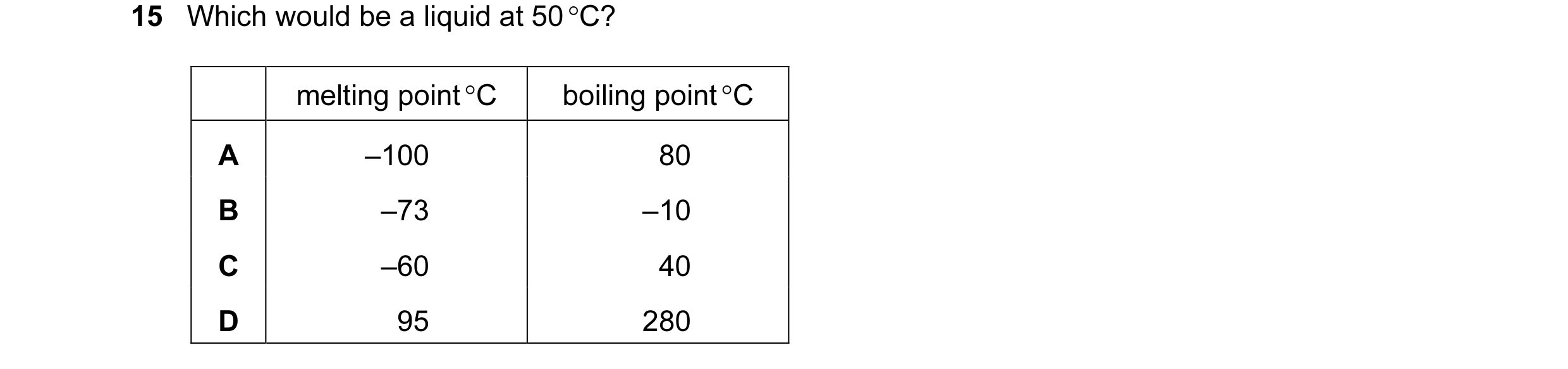
Q12 · Which would be a liquid at 50 °C? 0654/12 Oct/Nov 2011
15 Which would be a liquid at 50 °C? melting point °C boiling point °C A –100 80 B –73 –10 C –60 40 D 95 280
1 marks
Answer: A
This question in 0654/12 Oct/Nov 2011
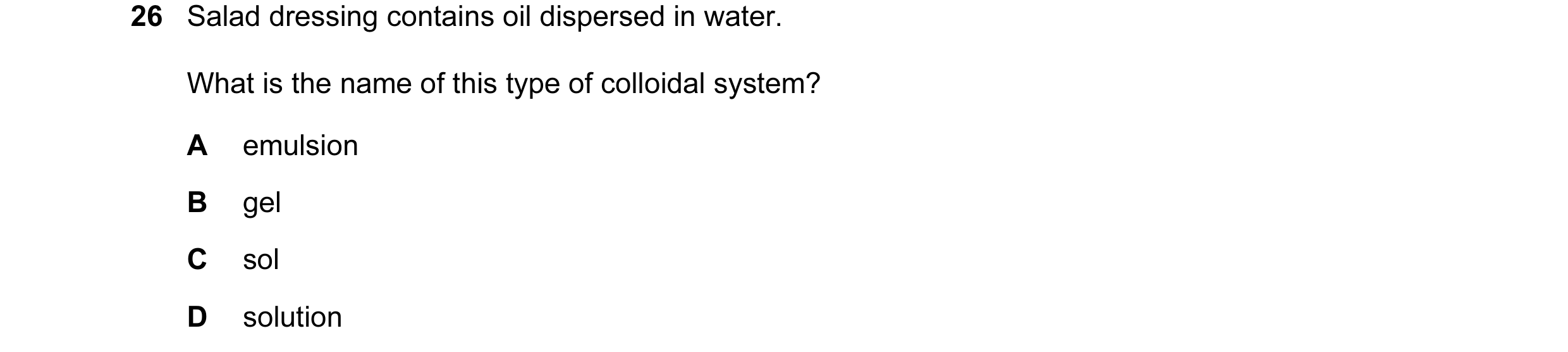
Q13 · Salad dressing contains oil dispersed in water 0654/12 Oct/Nov 2011
26 Salad dressing contains oil dispersed in water. What is the name of this type of colloidal system? A emulsion B gel C sol D solution
1 marks
Answer: A
This question in 0654/12 Oct/Nov 2011
Q14 · Which would be a liquid at 50 °C? 0654/13 Oct/Nov 2011
14 Which would be a liquid at 50 °C? melting point °C boiling point °C A –100 80 B –73 –10 C –60 40 D 95 280
1 marks
Answer: A
This question in 0654/13 Oct/Nov 2011
Q15 · Which statement describes the particles in a gas? 0654/12 Oct/Nov 2014
18 Which statement describes the particles in a gas? A As the particles move quicker the pressure of the gas decreases. B The movement of the particles is unaffected by temperature. C The particles are in random motion. D The particles are ordered.
1 marks
Answer: C
This question in 0654/12 Oct/Nov 2014
Q16 · Which process occurs when the arrangement of particles in a substance changes from… 0654/12 May/June 2019
14 Which process occurs when the arrangement of particles in a substance changes from regular to random? A boiling B condensing C freezing D melting
1 marks
Answer: D
This question in 0654/12 May/June 2019
Q17 · Which process occurs when the arrangement of particles in a substance changes from… 0654/13 May/June 2019
14 Which process occurs when the arrangement of particles in a substance changes from regular to random? A boiling B condensing C freezing D melting
1 marks
Answer: D
This question in 0654/13 May/June 2019
Q18 · Which statement describes the arrangement of particles in a solid? 0654/11 Oct/Nov 2019
14 Which statement describes the arrangement of particles in a solid? A The particles are close together and move randomly. B The particles are close together and vibrate about a fixed point. C The particles are far apart and move randomly. D The particles are far apart and vibrate about a fixed point.
1 marks
Answer: B
This question in 0654/11 Oct/Nov 2019
Q19 · Which properties are used to distinguish between solids and gases? 0654/11 Oct/Nov 2022
14 Which properties are used to distinguish between solids and gases? 1 compressibility 2 melting point 3 flammability A 1 and 2 only B 1 and 3 only C 2 and 3 only D 1, 2 and 3
1 marks
Answer: A
This question in 0654/11 Oct/Nov 2022
Q20 · Which change is represented by the diagram? 0654/12 Oct/Nov 2022
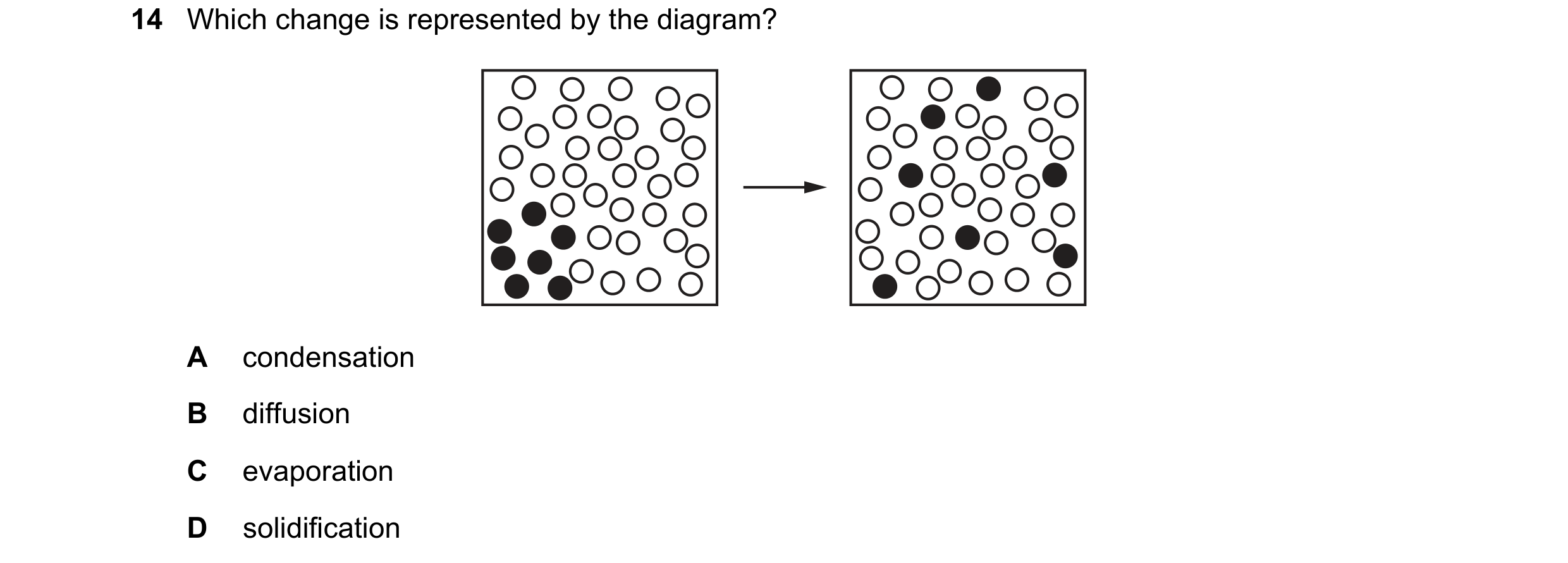
14 Which change is represented by the diagram? A condensation B diffusion C evaporation D solidification
1 marks
Answer: B
This question in 0654/12 Oct/Nov 2022
Q21 · In which substance are the particles closest together at room temperature? 0654/13 Oct/Nov 2022
14 In which substance are the particles closest together at room temperature? A CO2 B Ne C N2 D Zn
1 marks
Answer: D
This question in 0654/13 Oct/Nov 2022
Q22 · Cyclopentane is a hydrocarbon 0654/11 May/June 2024
14 Cyclopentane is a hydrocarbon. The melting point of cyclopentane is –94 C and its boiling point is 49 C. In process 1, the temperature of cyclopentane changes from 55 C to 45 C. In process 2, the temperature of cyclopentane changes from –100 C to –90 C. Which row identifies the changes in processes 1 and 2? 1 2 A boiling freezing B boiling melting C condensation freezing D condensation melting
1 marks
Answer: D
This question in 0654/11 May/June 2024
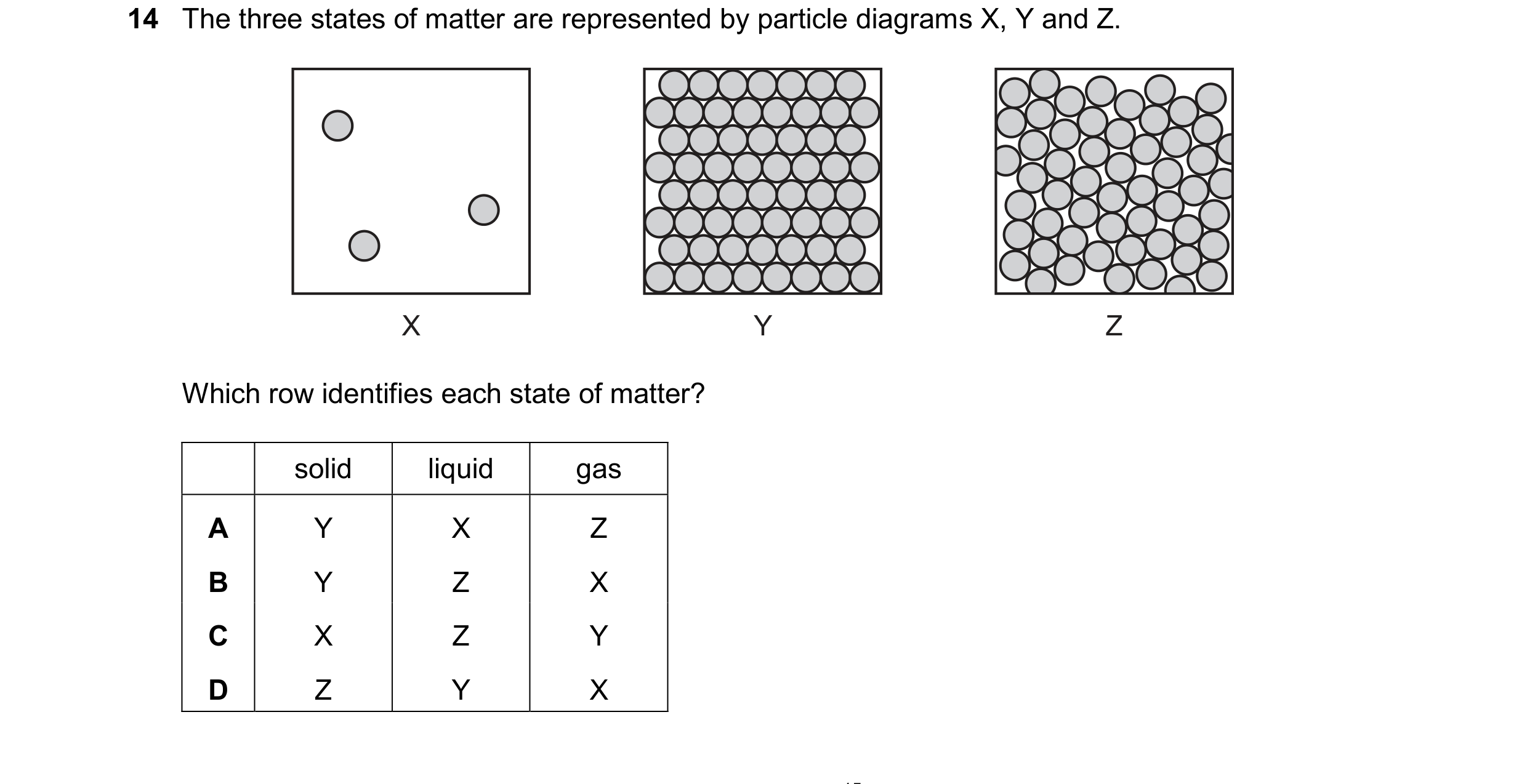
Q23 · The three states of matter are represented by particle diagrams X, Y and Z 0654/12 Feb/March 2025
14 The three states of matter are represented by particle diagrams X, Y and Z. X Y Z Which row identifies each state of matter? solid liquid gas A Y X Z B Y Z X C X Z Y D Z Y X
1 marks
Answer: B
This question in 0654/12 Feb/March 2025
Q24 · Which change of state results in the greatest increase in the separation of particles? 0654/11 May/June 2025
14 Which change of state results in the greatest increase in the separation of particles? A gas to liquid B liquid to gas C liquid to solid D solid to liquid
1 marks
Answer: B
This question in 0654/11 May/June 2025
 1 / 6
1 / 6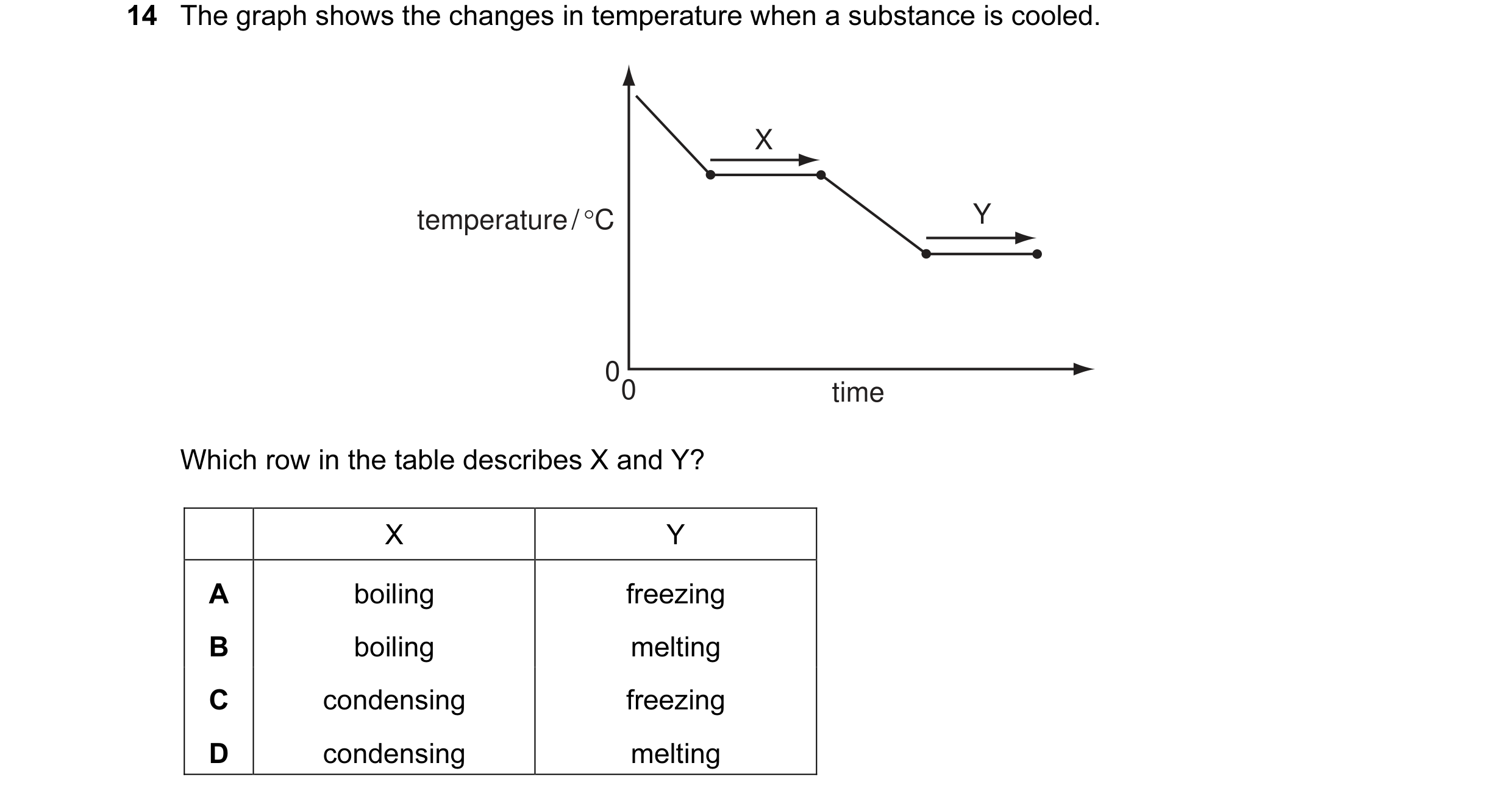
 2 / 6
2 / 6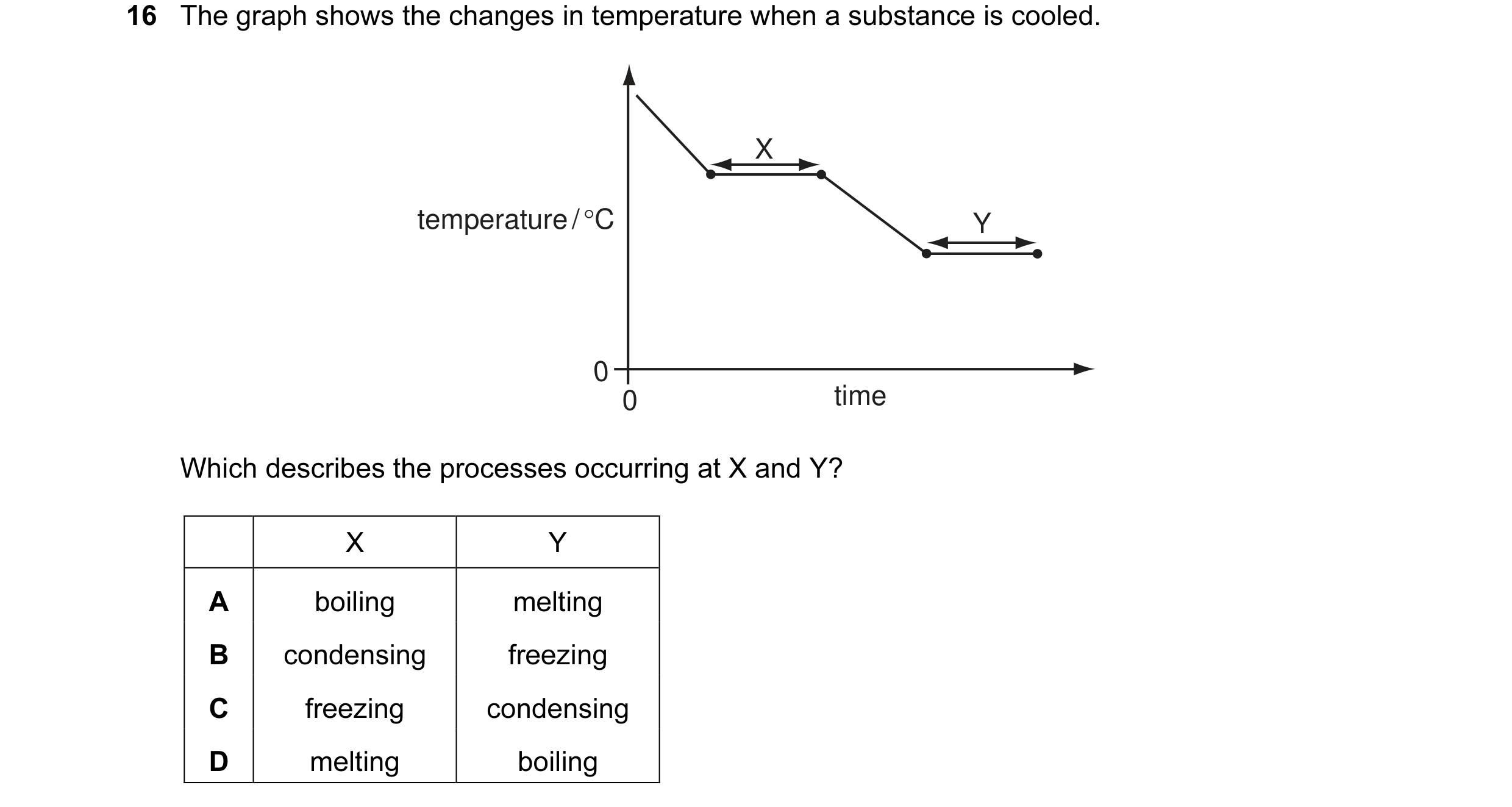
 3 / 6
3 / 6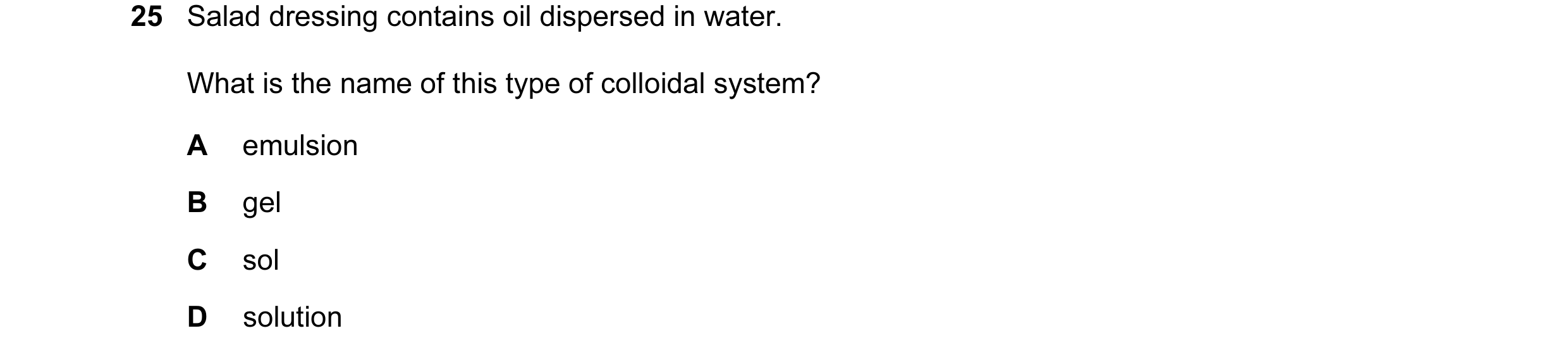
 4 / 6
4 / 6


 5 / 6
5 / 6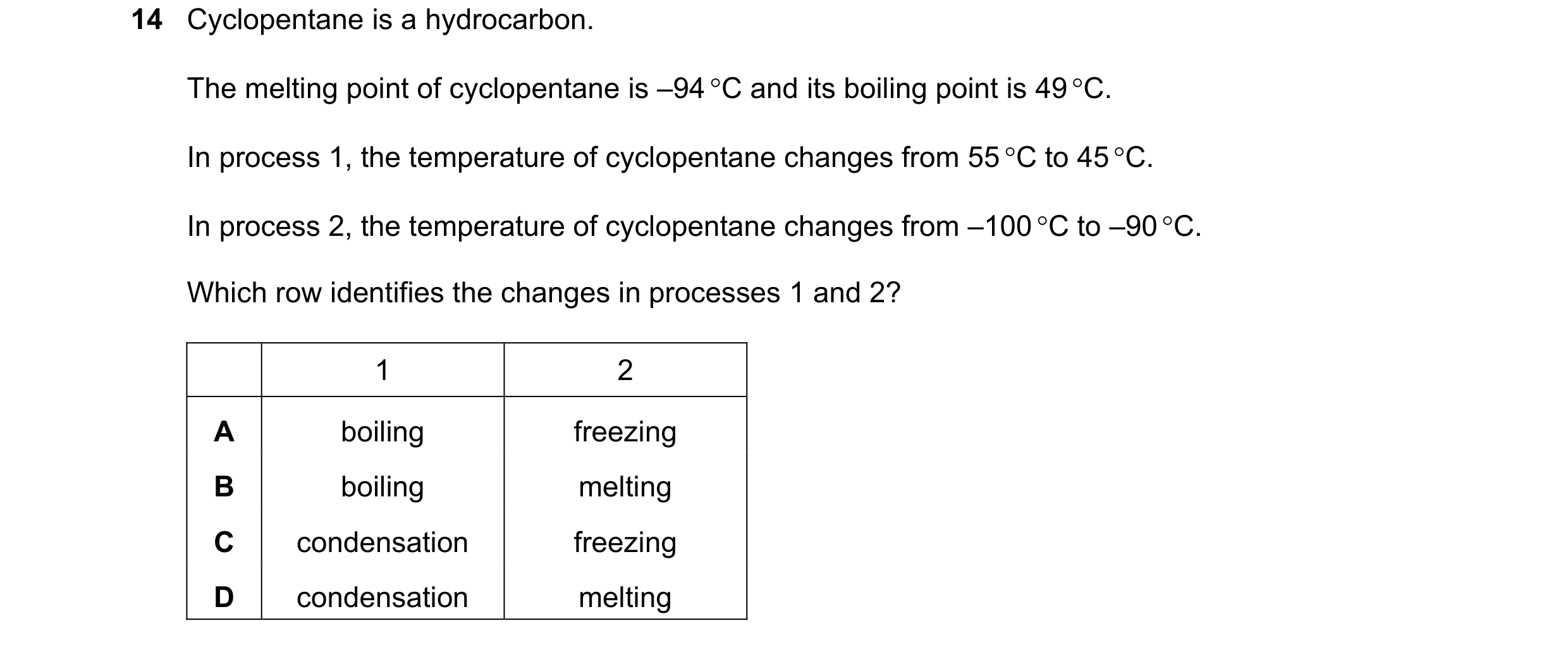
 6 / 6
6 / 6