Questions as text
Q1 · What is an ecosystem? 0654/21 May/June 2017
7 What is an ecosystem? A a chart showing the flow of energy from one organism to another B a diagram giving the energy level of an organism in its environment C a network of interconnected organisms D a unit containing all of the organisms and their environment
1 marks
Answer: D
This question in 0654/21 May/June 2017
Q2 · Why do food chains usually have fewer than five trophic levels? 0654/23 May/June 2017
5 Why do food chains usually have fewer than five trophic levels? A Decomposers are not usually included in the chain. B Energy is lost between each trophic level. C There is only one level of carnivores. D There is only one level of herbivores.
1 marks
Answer: B
This question in 0654/23 May/June 2017
Q3 · Why do food chains usually have fewer than five trophic levels? 0654/21 Oct/Nov 2017
10 Why do food chains usually have fewer than five trophic levels? A All the carnivores consume herbivores. B The energy passed on reduces from one trophic level to the next. C There is less protein in each individual higher up the chain. D There is only one producer in each chain.
1 marks
Answer: B
This question in 0654/21 Oct/Nov 2017
Q4 · In a food chain, what do all living organisms get from their food? 0654/21 May/June 2019
12 In a food chain, what do all living organisms get from their food? A a supply of water B oxygen for respiration C protection from disease D the energy they need
1 marks
Answer: D
This question in 0654/21 May/June 2019
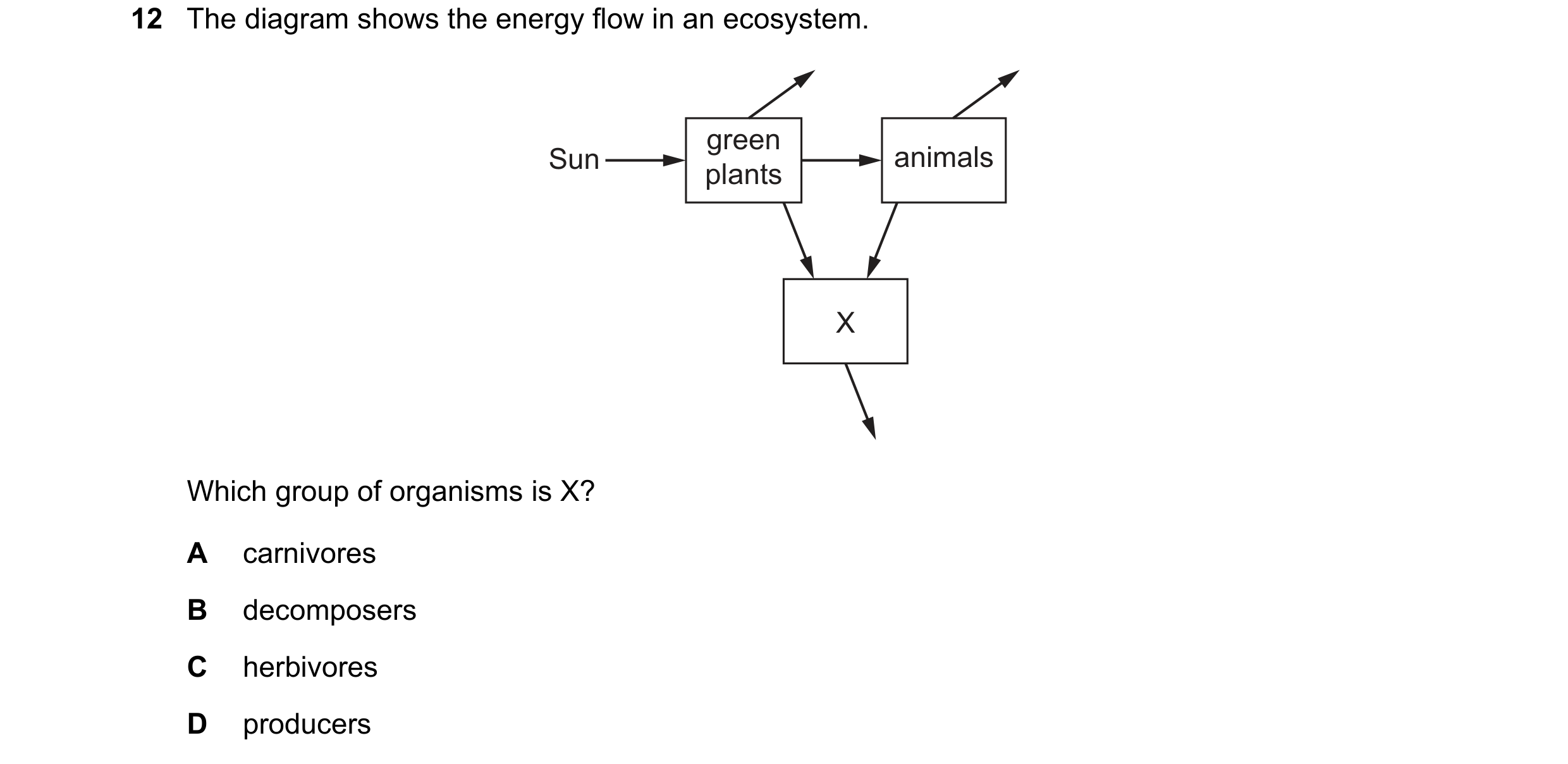
Q5 · The diagram shows the energy flow in an ecosystem 0654/23 May/June 2019
12 The diagram shows the energy flow in an ecosystem. green Sun animals plants X Which group of organisms is X? A carnivores B decomposers C herbivores D producers
1 marks
Answer: B
This question in 0654/23 May/June 2019
Q6 · Which statement about how organisms get their energy is not correct? 0654/22 Oct/Nov 2019
12 Which statement about how organisms get their energy is not correct? organism source of energy A carnivores animals B decomposers dead plants C green plants minerals D herbivores plants
1 marks
Answer: C
This question in 0654/22 Oct/Nov 2019
Q7 · In the food chain shown, 10% of the energy is transferred between each trophic level 0654/23 Oct/Nov 2019
12 In the food chain shown, 10% of the energy is transferred between each trophic level. grass → grasshopper → frog → snake → buzzard For every 100 kJ of energy in the herbivore, how much energy will be transferred to the tertiary consumer? A 0.1 kJ B 1 kJ C 10 kJ D 100 kJ
1 marks
Answer: B
This question in 0654/23 Oct/Nov 2019
Q8 · Where does the principle source of energy for an ecosystem come from? 0654/23 May/June 2020
12 Where does the principle source of energy for an ecosystem come from? A decay B the soil C the Sun D water
1 marks
Answer: C
This question in 0654/23 May/June 2020
Q9 · What is the name given to a unit containing all of the organisms and their environment… 0654/23 Oct/Nov 2020
12 What is the name given to a unit containing all of the organisms and their environment interacting together in a given area? A ecosystem B food chain C food web D trophic level
1 marks
Answer: D
This question in 0654/23 Oct/Nov 2020
Q10 · Why do food chains usually have fewer than five trophic levels? 0654/21 May/June 2021
12 Why do food chains usually have fewer than five trophic levels? A All the carnivores consume herbivores. B The energy passed on reduces from one trophic level to the next. C There is less protein in each individual higher up the chain. D There is only one producer in each chain.
1 marks
Answer: B
This question in 0654/21 May/June 2021
Q11 · Why do food chains usually have fewer than five trophic levels? 0654/22 May/June 2021
12 Why do food chains usually have fewer than five trophic levels? A All the carnivores consume herbivores. B The energy passed on reduces from one trophic level to the next. C There is less protein in each individual higher up the chain. D There is only one producer in each chain.
1 marks
Answer: B
This question in 0654/22 May/June 2021
Q12 · Why do food chains usually have fewer than five trophic levels? 0654/23 May/June 2021
12 Why do food chains usually have fewer than five trophic levels? A All the carnivores consume herbivores. B The energy passed on reduces from one trophic level to the next. C There is less protein in each individual higher up the chain. D There is only one producer in each chain.
1 marks
Answer: B
This question in 0654/23 May/June 2021
Q13 · What is an ecosystem? 0654/21 Oct/Nov 2021
12 What is an ecosystem? A a chart showing the flow of energy from one organism to another B a diagram giving the energy level of an organism in its environment C a network of interconnected organisms D a unit containing all of the organisms and their environment
1 marks
Answer: D
This question in 0654/21 Oct/Nov 2021
Q14 · What is an ecosystem? 0654/22 Oct/Nov 2021
12 What is an ecosystem? A a chart showing the flow of energy from one organism to another B a diagram giving the energy level of an organism in its environment C a network of interconnected organisms D a unit containing all of the organisms and their environment
1 marks
Answer: D
This question in 0654/22 Oct/Nov 2021
Q15 · What is an ecosystem? 0654/23 Oct/Nov 2021
12 What is an ecosystem? A a chart showing the flow of energy from one organism to another B a diagram giving the energy level of an organism in its environment C a network of interconnected organisms D a unit containing all of the organisms and their environment
1 marks
Answer: D
This question in 0654/23 Oct/Nov 2021
Q16 · What is the main factor which determines the number of trophic levels in food chains? 0654/22 Feb/March 2022
12 What is the main factor which determines the number of trophic levels in food chains? A competition between organisms B efficiency of energy transfer between trophic levels C removal of a member of a food chain D unstable ecosystem due to changing environment
1 marks
Answer: B
This question in 0654/22 Feb/March 2022
Q17 · The diagram shows the energy flow in part of an ecosystem 0654/22 Feb/March 2023
12 The diagram shows the energy flow in part of an ecosystem. green Sun animals plants X Which group of organisms is X? A carnivores B decomposers C herbivores D producers
1 marks
Answer: B
This question in 0654/22 Feb/March 2023
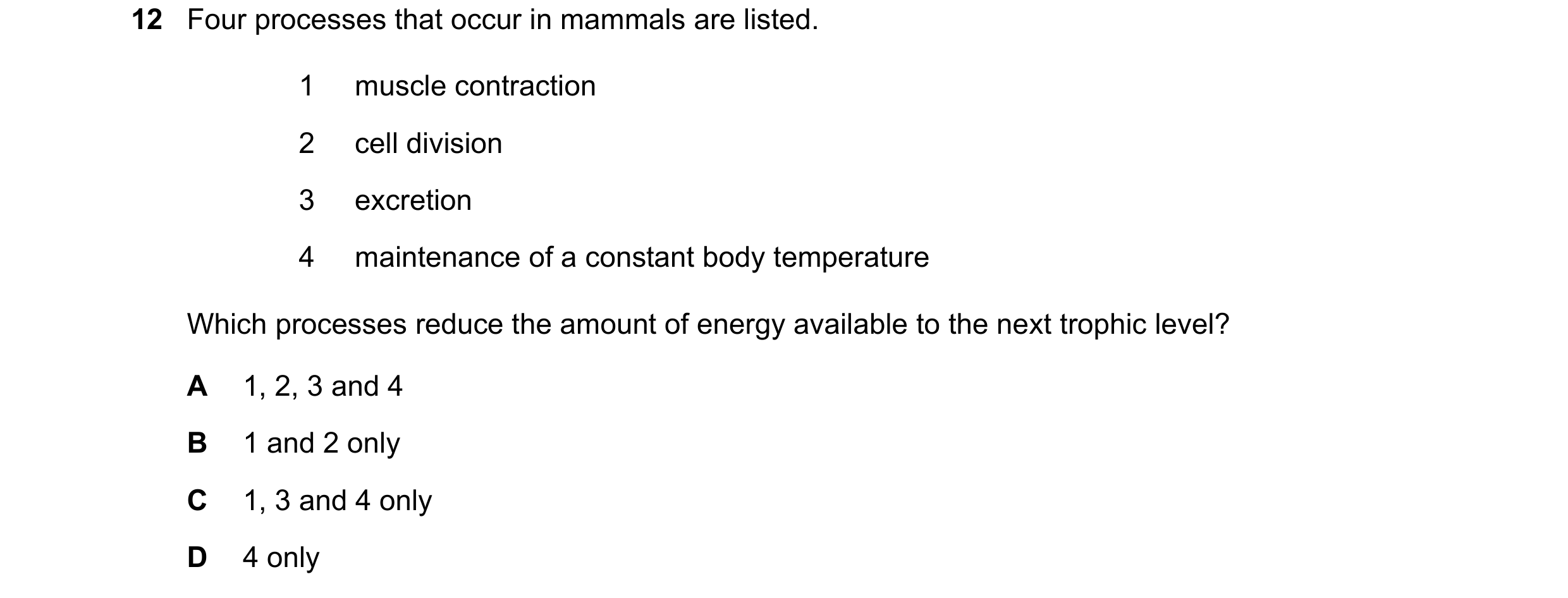
Q18 · Four processes that occur in mammals are listed 0654/21 Oct/Nov 2023
12 Four processes that occur in mammals are listed. 1 muscle contraction 2 cell division 3 excretion 4 maintenance of a constant body temperature Which processes reduce the amount of energy available to the next trophic level? A 1, 2, 3 and 4 B 1 and 2 only C 1, 3 and 4 only D 4 only
1 marks
Answer: A
This question in 0654/21 Oct/Nov 2023
Q19 · What is an ecosystem? 0654/23 Oct/Nov 2023
12 What is an ecosystem? A a network of interconnected food chains in a given area B all the members of one species in a given habitat C all the organisms and their environment interacting together in a given area D all the transfer of energy in a given habitat
1 marks
Answer: C
This question in 0654/23 Oct/Nov 2023
Q20 · How does an organism in the first trophic level gain energy? 0654/21 May/June 2024
12 How does an organism in the first trophic level gain energy? A by absorbing energy from sunlight B by breaking down dead or waste organic matter C by eating organisms in the second trophic level D by eating plants
1 marks
Answer: A
This question in 0654/21 May/June 2024
Q21 · What is an ecosystem? 0654/22 May/June 2024
12 What is an ecosystem? A a chart showing the flow of energy from one organism to another B a diagram giving the energy level of an organism in its environment C a network of interconnected food chains D a unit containing all of the organisms and their environment
1 marks
Answer: D
This question in 0654/22 May/June 2024
Q22 · What is an example of an ecosystem? 0654/21 Oct/Nov 2024
12 What is an example of an ecosystem? A a decomposing log and the organisms in it B a food chain C the network of burrows in which some rabbits live D the oak trees in a forest
1 marks
Answer: A
This question in 0654/21 Oct/Nov 2024
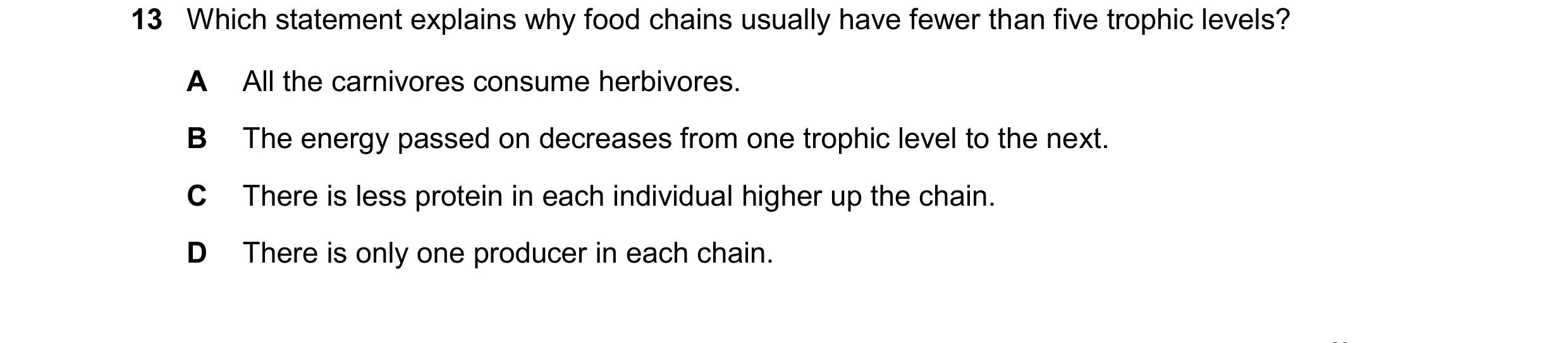
Q23 · Which statement explains why food chains usually have fewer than five trophic levels? 0654/21 Oct/Nov 2025
13 Which statement explains why food chains usually have fewer than five trophic levels? A All the carnivores consume herbivores. B The energy passed on decreases from one trophic level to the next. C There is less protein in each individual higher up the chain. D There is only one producer in each chain.
1 marks
Answer: B
This question in 0654/21 Oct/Nov 2025
Q24 · What is the most energy efficient resource for humans to eat? 0654/23 Oct/Nov 2025
13 What is the most energy efficient resource for humans to eat? A herbivores B primary consumers C producers D secondary consumers
1 marks
Answer: C
This question in 0654/23 Oct/Nov 2025




 1 / 5
1 / 5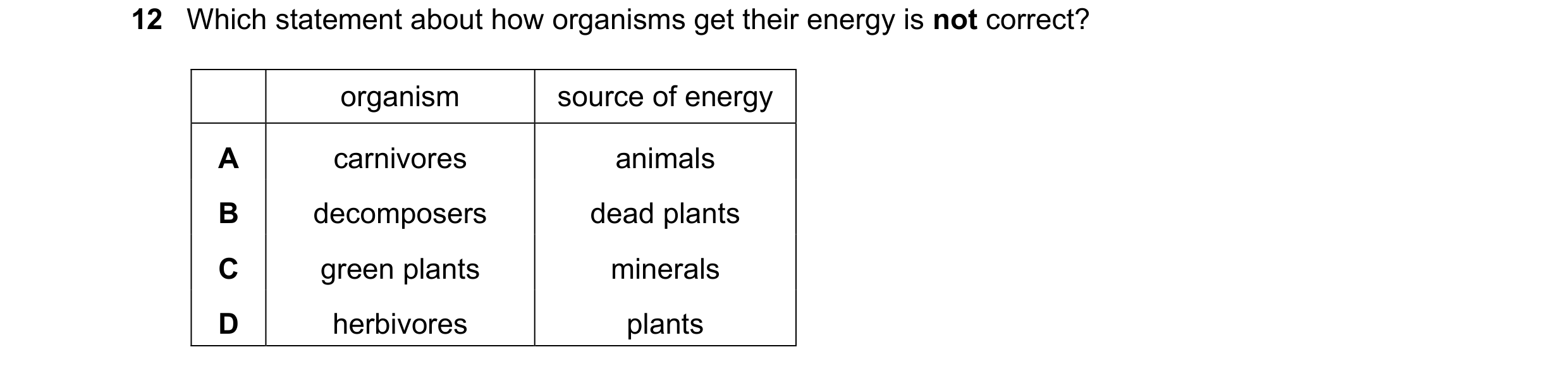



 2 / 5
2 / 5



 3 / 5
3 / 5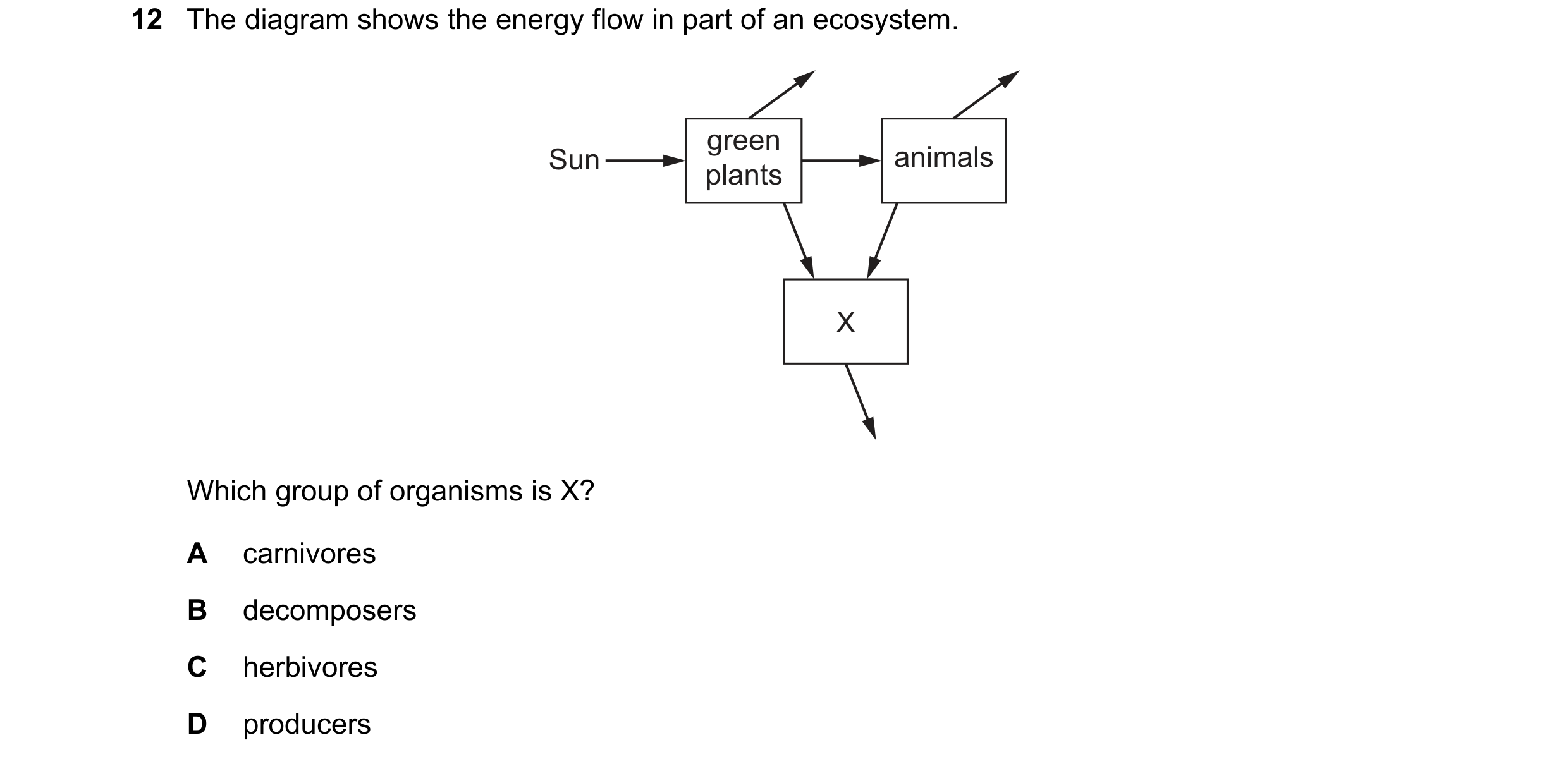

 4 / 5
4 / 5

 5 / 5
5 / 5