Questions as text
Q1 · Use lines to connect the box on the left to different boxes on the right to make correct… 0653/43 May/June 2017
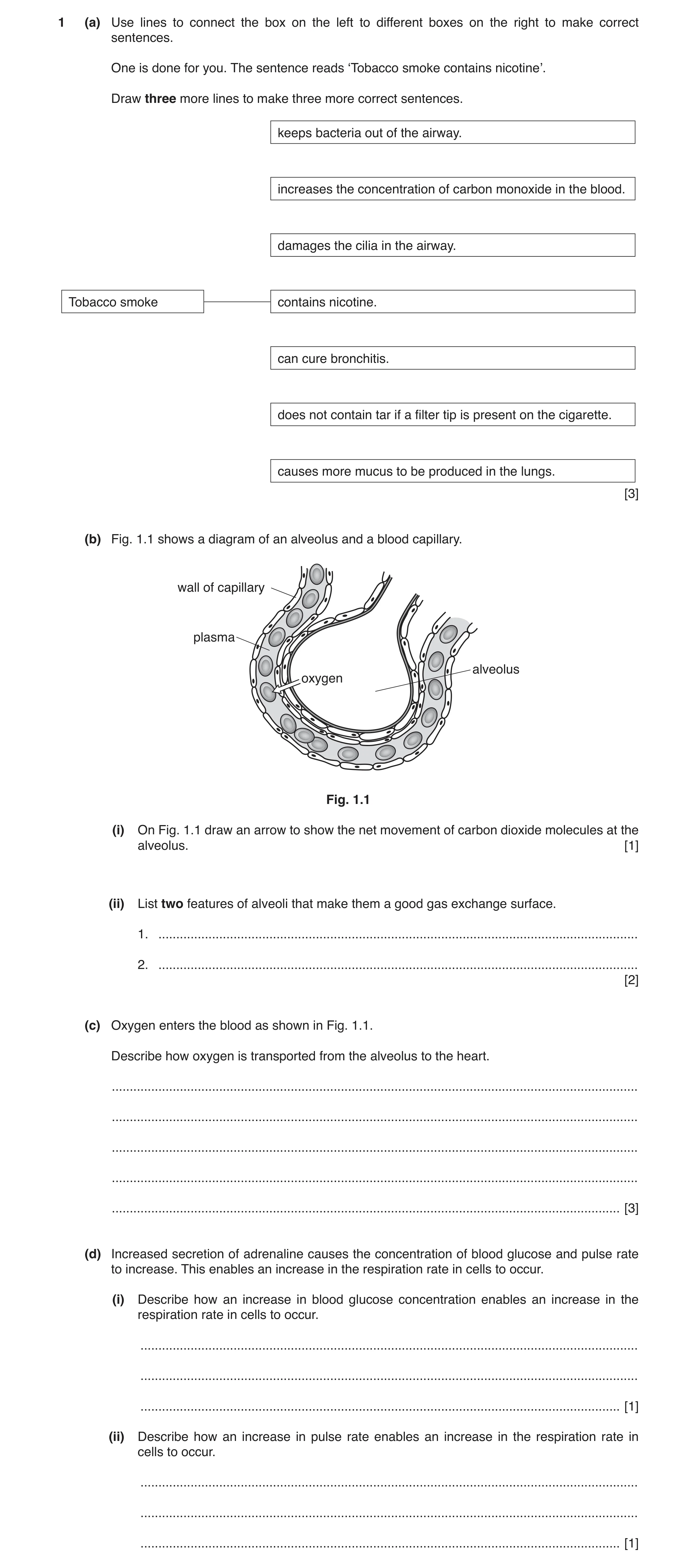
1 (a) Use lines to connect the box on the left to different boxes on the right to make correct sentences. One is done for you. The sentence reads ‘Tobacco smoke contains nicotine’. Draw three more lines to make three more correct sentences. keeps bacteria out of the airway. increases the concentration of carbon monoxide in the blood. damages the cilia in the airway. Tobacco smoke contains nicotine. can cure bronchitis. does not contain tar if a filter tip is present on the cigarette. causes more mucus to be produced in the lungs. [3] (b) Fig. 1.1 shows a diagram of an alveolus and a blood capillary. wall of capillary plasma alveolus oxygen Fig. 1.1 (i) On Fig. 1.1 draw an arrow to show the net movement of carbon dioxide molecules at the alveolus. [1] (ii) List two features of alveoli that make them a good gas exchange surface. 1. … 2. … [2] (c) Oxygen enters the blood as shown in Fig. 1.1. Describe how oxygen is transported from the alveolus to the heart. … … … … … [3] (d) Increased secretion of adrenaline causes the concentration of blood glucose and pulse rate to increase. This enables an increase in the respiration rate in cells to occur. (i) Describe how an increase in blood glucose concentration enables an increase in the respiration rate in cells to occur. … … … [1] (ii) Describe how an increase in pulse rate enables an increase in the respiration rate in cells to occur. … … … [1]
11 marks
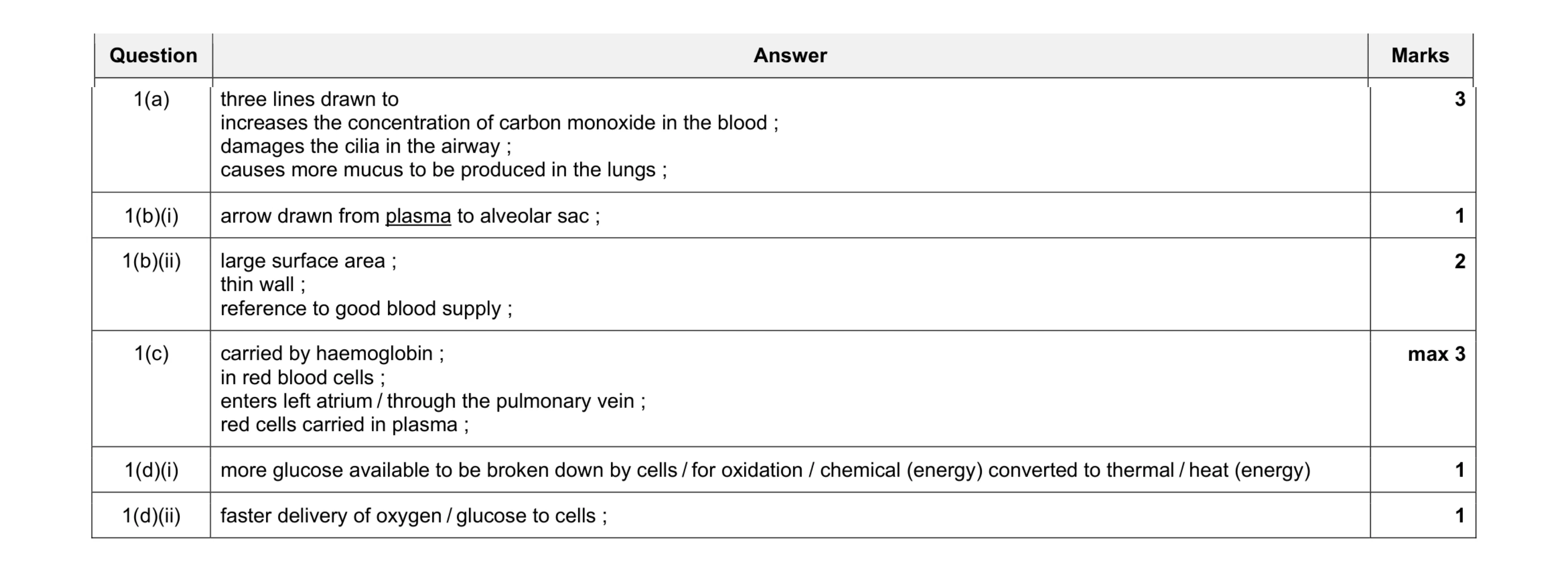
Mark scheme: 1(a) three lines drawn to increases the concentration of carbon monoxide in the blood ; damages the cilia in the airway ; causes more mucus to be produced in the lungs ; 3 1(b)(i) arrow drawn from plasma to alveolar sac ; 1 1(b)(ii) large surface area ; thin wall ; reference to good blood supply ; 2 1(c) carried by haemoglobin ; in red blood cells ; enters left atrium / through the pulmonary vein ; red cells carried in plasma ; max 3 1(d)(i) more glucose available to be broken down by cells / for oxidation / chemical (energy) converted to thermal / heat (energy) 1 1(d)(ii) faster delivery of oxygen / glucose to cells ; 1
This question in 0653/43 May/June 2017
Q2 · Use the following words or phrases to complete the flow chart about the transport of… 0653/41 Oct/Nov 2017
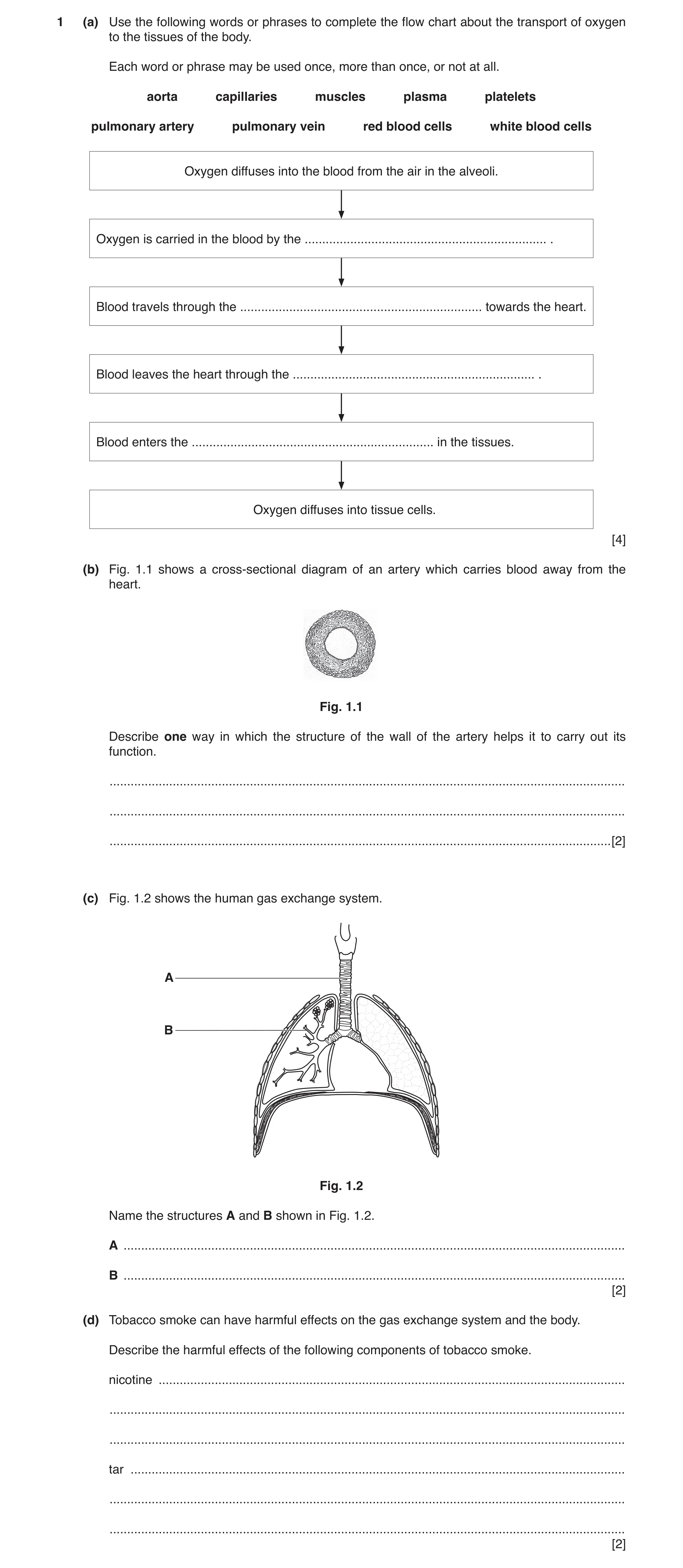
1 (a) Use the following words or phrases to complete the flow chart about the transport of oxygen to the tissues of the body. Each word or phrase may be used once, more than once, or not at all. aorta capillaries muscles plasma platelets pulmonary artery pulmonary vein red blood cells white blood cells Oxygen diffuses into the blood from the air in the alveoli. Oxygen is carried in the blood by the … . Blood travels through the … towards the heart. Blood leaves the heart through the … . Blood enters the … in the tissues. Oxygen diffuses into tissue cells. [4] (b) Fig. 1.1 shows a cross-sectional diagram of an artery which carries blood away from the heart. Fig. 1.1 Describe one way in which the structure of the wall of the artery helps it to carry out its function. … … … [2] (c) Fig. 1.2 shows the human gas exchange system. A B Fig. 1.2 Name the structures A and B shown in Fig. 1.2. A … B … [2] (d) Tobacco smoke can have harmful effects on the gas exchange system and the body. Describe the harmful effects of the following components of tobacco smoke. nicotine … … … tar … … … [2]
10 marks
Mark scheme: 1(a) red blood cells ; pulmonary vein ; aorta ; capillaries ; 4 1(b) thick (wall) ; to resist bursting / withstand high blood pressure ; 2 1(c) A trachea ; B bronchiole ; 2 1(d) (nicotine) causes addiction / increases blood pressure / leads to heart disease ; (tar) increases mucus / (tar) builds up in lungs / paralyses / destroys cilia / can cause cancer / avp ; 2
This question in 0653/41 Oct/Nov 2017
Q3 · Use the following words or phrases to complete the flow chart about the structures the… 0653/43 Oct/Nov 2017
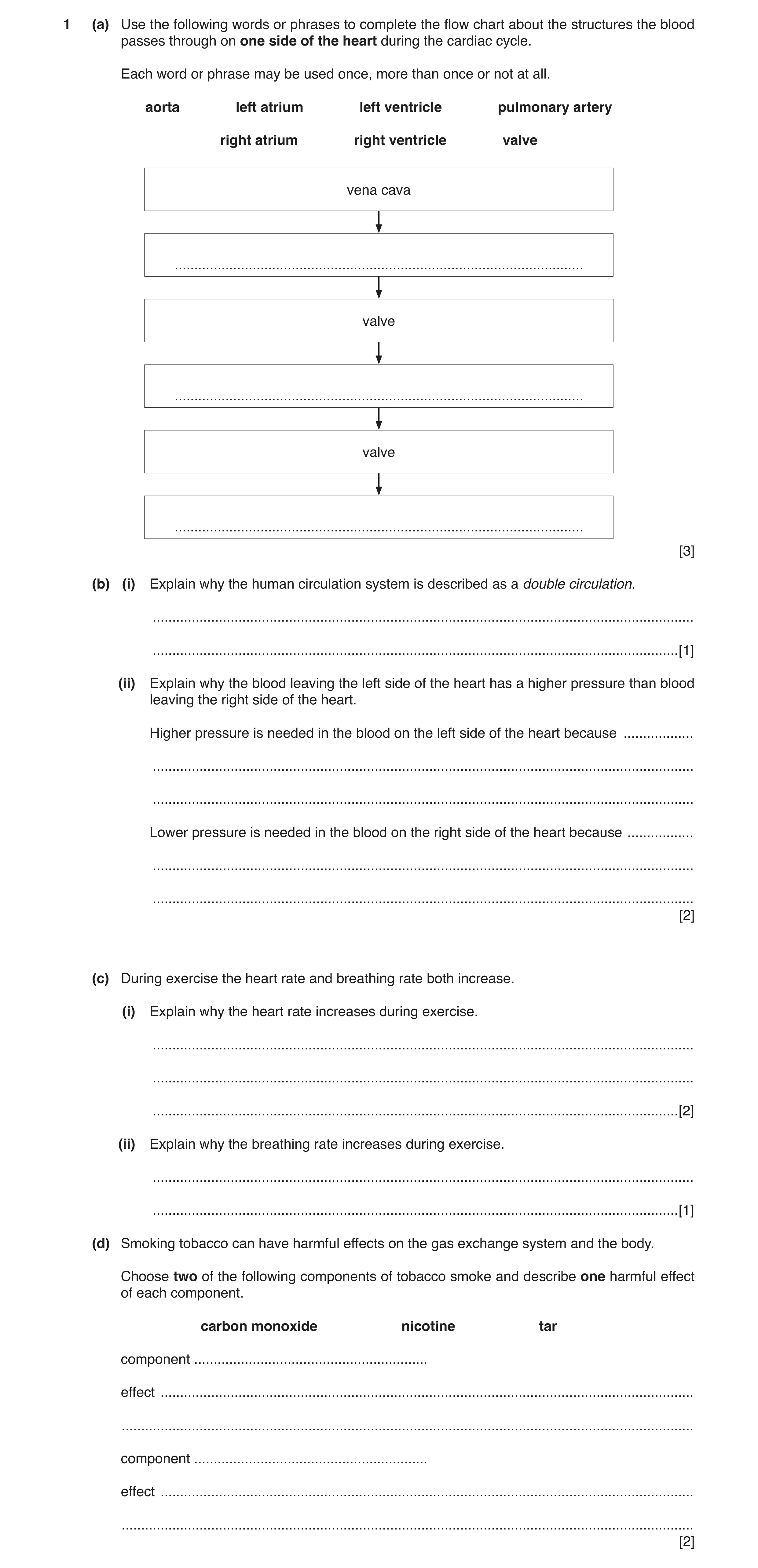
1 (a) Use the following words or phrases to complete the flow chart about the structures the blood passes through on one side of the heart during the cardiac cycle. Each word or phrase may be used once, more than once or not at all. aorta left atrium left ventricle pulmonary artery right atrium right ventricle valve vena cava … valve … valve … [3] (b) (i) Explain why the human circulation system is described as a double circulation. … … [1] (ii) Explain why the blood leaving the left side of the heart has a higher pressure than blood leaving the right side of the heart. Higher pressure is needed in the blood on the left side of the heart because … … … Lower pressure is needed in the blood on the right side of the heart because … … … [2] (c) During exercise the heart rate and breathing rate both increase. (i) Explain why the heart rate increases during exercise. … … … [2] (ii) Explain why the breathing rate increases during exercise. … … [1] (d) Smoking tobacco can have harmful effects on the gas exchange system and the body. Choose two of the following components of tobacco smoke and describe one harmful effect of each component. carbon monoxide nicotine tar component … effect … … component … effect … … [2]
11 marks
Mark scheme: 1(a) right atrium ; right ventricle ; pulmonary artery ; 3 1(b)(i) blood passes through heart twice, in each cycle / blood has two circulation paths (to the lungs and to the body) ; 1 1(b)(ii) (higher pressure on left side) needed for blood going all round the body / blood travels further ; (lower pressure on right side) needed for blood going to the lungs / shorter distance / so the blood capillaries are not damaged ; 2 1(c)(i) to take oxygen / glucose to the cells / muscles more quickly / to take more oxygen / more glucose to cells / muscles remove carbon dioxide from cells / muscles more quickly / remove more carbon dioxide from cells / muscles ; correct reference to respiration ; max 2 1(c)(ii) to take more oxygen (into blood) / remove carbon dioxide (from blood) more quickly ; 1 1(d) any two from tar increases mucus / tar builds up in lungs / paralyses / destroys cilia / causes cancer ; or nicotine causes addiction / increases blood pressure / leads to heart disease ; or carbon monoxide reduces the concentration of oxygen carried by the blood / makes carboxyhaemoglobin ; 2
This question in 0653/43 Oct/Nov 2017
Q4 · During inspiration air passes through different parts of the airway to reach the alveoli 0653/42 May/June 2018
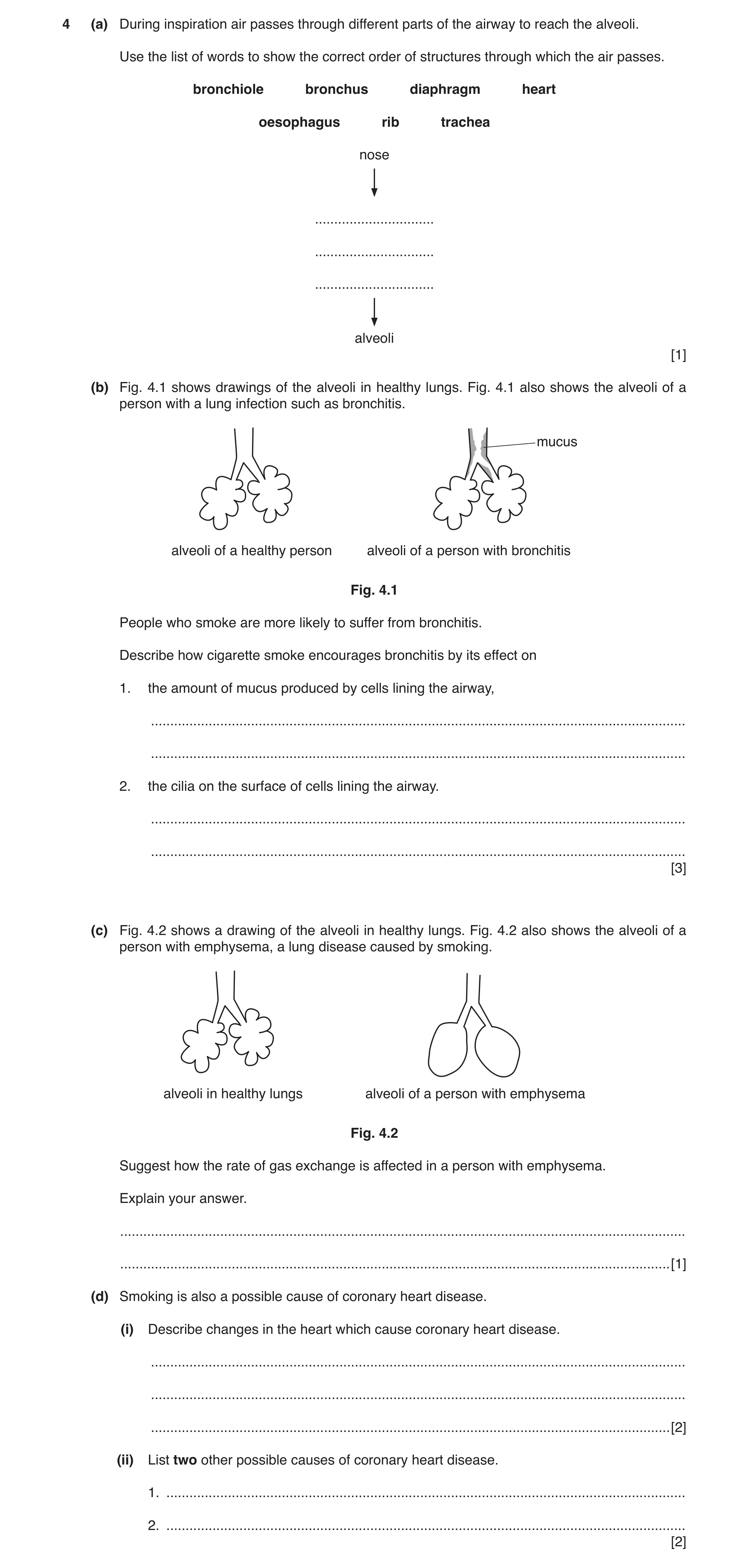
4 (a) During inspiration air passes through different parts of the airway to reach the alveoli. Use the list of words to show the correct order of structures through which the air passes. bronchiole bronchus diaphragm heart oesophagus rib trachea nose … … … alveoli [1] (b) Fig. 4.1 shows drawings of the alveoli in healthy lungs. Fig. 4.1 also shows the alveoli of a person with a lung infection such as bronchitis. mucus alveoli of a healthy person alveoli of a person with bronchitis Fig. 4.1 People who smoke are more likely to suffer from bronchitis. Describe how cigarette smoke encourages bronchitis by its effect on 1. the amount of mucus produced by cells lining the airway, … … 2. the cilia on the surface of cells lining the airway. … … [3] (c) Fig. 4.2 shows a drawing of the alveoli in healthy lungs. Fig. 4.2 also shows the alveoli of a person with emphysema, a lung disease caused by smoking. alveoli in healthy lungs alveoli of a person with emphysema Fig. 4.2 Suggest how the rate of gas exchange is affected in a person with emphysema. Explain your answer. … … [1] (d) Smoking is also a possible cause of coronary heart disease. (i) Describe changes in the heart which cause coronary heart disease. … … … [2] (ii) List two other possible causes of coronary heart disease. 1. … 2. … [2]
9 marks
Mark scheme: 4(a) trachea, bronchus, bronchiole ; 1 4(b) effect on mucus mucus production increases ; effect on cilia cilia become paralysed / damaged ; cannot remove mucus from airway / away from lungs ; 3 4(c) (rate of gas exchange reduced) reduced area (for gas exchange in alveoli) ; 1 4(d)(i) narrowing / blockage of coronary arteries ; due to fatty deposits / plaque ; 2 4(d)(ii) high fat diet ; stress ; 2
This question in 0653/42 May/June 2018
Q5 · A diagram of an alveolus 0653/41 Oct/Nov 2018
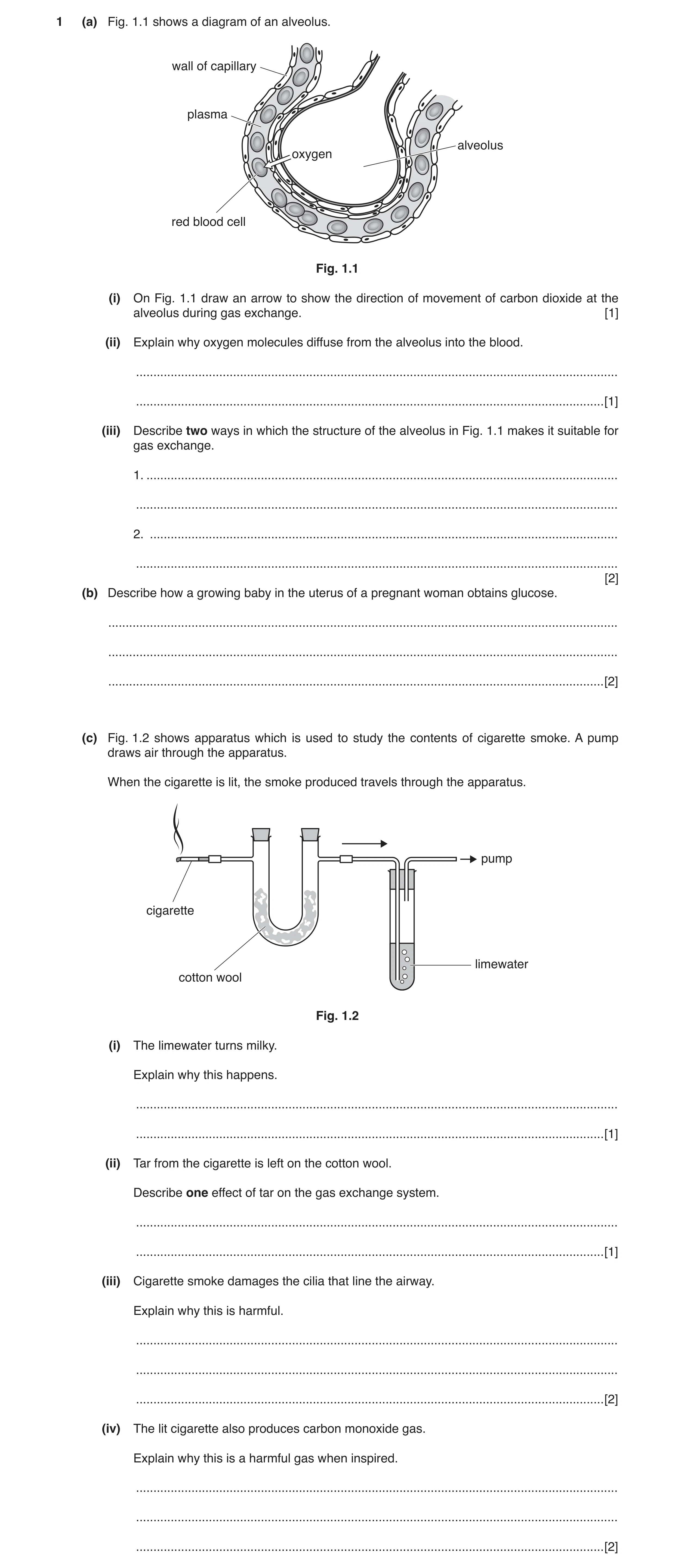
1 (a) Fig. 1.1 shows a diagram of an alveolus. wall of capillary plasma alveolus oxygen red blood cell Fig. 1.1 (i) On Fig. 1.1 draw an arrow to show the direction of movement of carbon dioxide at the alveolus during gas exchange. [1] (ii) Explain why oxygen molecules diffuse from the alveolus into the blood. … … [1] (iii) Describe two ways in which the structure of the alveolus in Fig. 1.1 makes it suitable for gas exchange. 1. … … 2. … … [2] (b) Describe how a growing baby in the uterus of a pregnant woman obtains glucose. … … … [2] (c) Fig. 1.2 shows apparatus which is used to study the contents of cigarette smoke. A pump draws air through the apparatus. When the cigarette is lit, the smoke produced travels through the apparatus. pump cigarette limewater cotton wool Fig. 1.2 (i) The limewater turns milky. Explain why this happens. … … [1] (ii) Tar from the cigarette is left on the cotton wool. Describe one effect of tar on the gas exchange system. … … [1] (iii) Cigarette smoke damages the cilia that line the airway. Explain why this is harmful. … … … [2] (iv) The lit cigarette also produces carbon monoxide gas. Explain why this is a harmful gas when inspired. … … … [2]
12 marks
Mark scheme: 1(a)(i) arrow drawn from the plasma of the blood to the air sac of alveolus ; 1 1(a)(ii) there is a concentration / diffusion gradient / greater oxygen concentration in alveolus than the blood ; 1 1(a)(iii) thin wall / flattened cells ; large surface area ; good blood supply ; Max 2 2 1(b) through placenta ; and then one of by diffusion ; via (umbilical) cord ; Max 2 2 1(c)(i) carbon dioxide / CO2 / produced / present (in smoke) ; 1 1(c)(ii) causes cancer ; stimulates mucus production ; Max 1 1 1(c)(iii) mucus cannot be swept out of the lungs ; pathogens / particles (in mucus) more likely to enter lungs ; 2 1(c)(iv) combines with the haemoglobin / red blood cells ; CO replaces oxygen (on haemoglobin) ; reduces the transport of oxygen by blood / less oxygen available ( for cells) ; Max 2 2
This question in 0653/41 Oct/Nov 2018
Q6 · A bar chart which shows some differences in the composition of inspired air and expired… 0653/43 May/June 2019
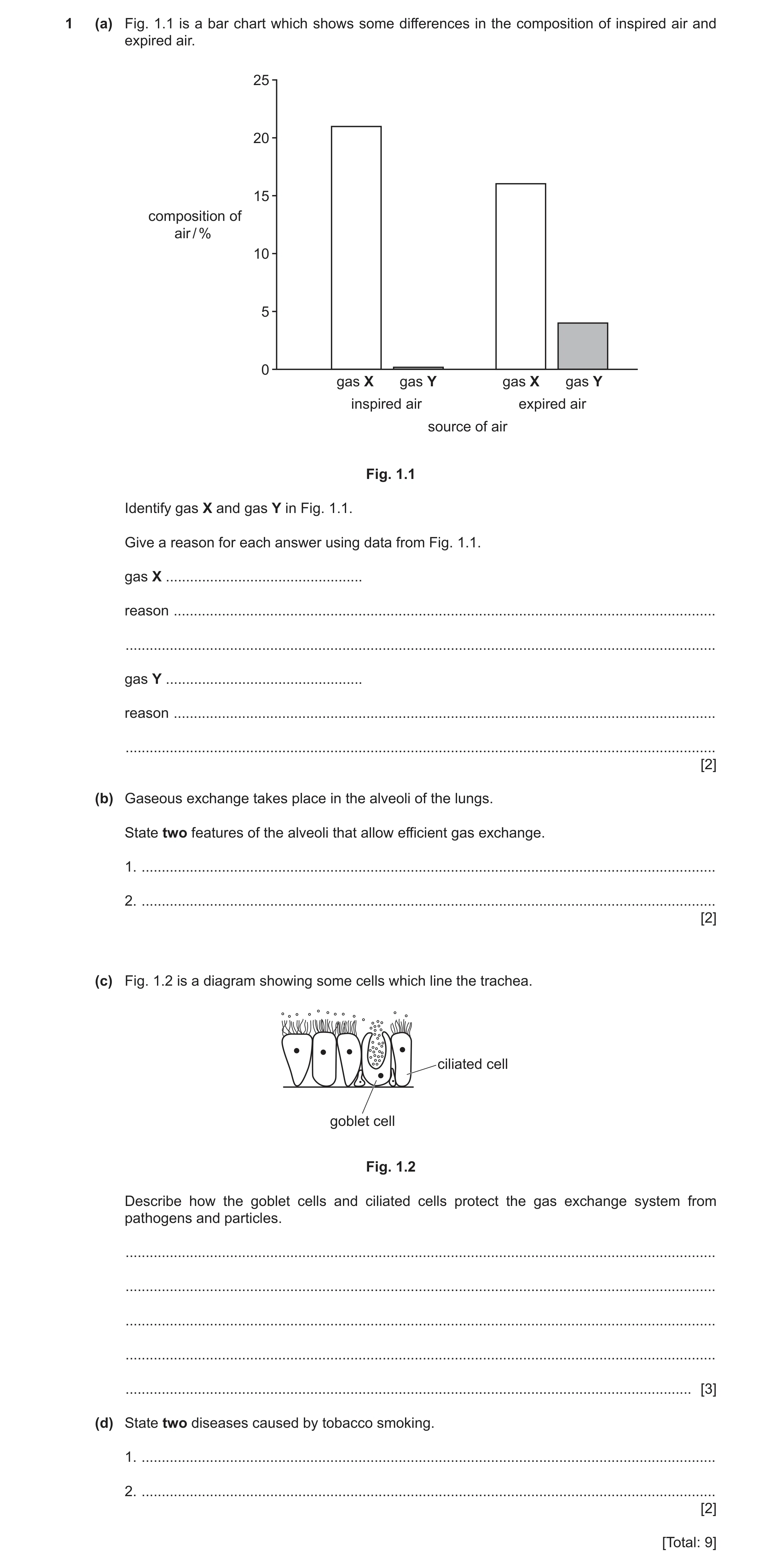
1 (a) Fig. 1.1 is a bar chart which shows some differences in the composition of inspired air and expired air. 25 20 15 composition of air / % 10 5 0 gas X gas Y gas X gas Y inspired air expired air source of air Fig. 1.1 Identify gas X and gas Y in Fig. 1.1. Give a reason for each answer using data from Fig. 1.1. gas X … reason … … gas Y … reason … … [2] (b) Gaseous exchange takes place in the alveoli of the lungs. State two features of the alveoli that allow efficient gas exchange. 1. … 2. … [2] (c) Fig. 1.2 is a diagram showing some cells which line the trachea. ciliated cell goblet cell Fig. 1.2 Describe how the goblet cells and ciliated cells protect the gas exchange system from pathogens and particles. … … … … … [3] (d) State two diseases caused by tobacco smoking. 1. … 2. … [2] [Total: 9]
9 marks
Mark scheme: 1(a) gas X oxygen (no mark) reduces in expired air (so oxygen used in respiration) ; gas Y carbon dioxide (no mark) increases in expired air (so carbon dioxide released in respiration) ; 2 1(b) any two of large surface area ; thin walls ; good blood supply ; good ventilation with air ; max 2 1(c) goblet cells secrete mucus ; mucus traps pathogens and particles ; cilia sweep mucus out of the trachea ; 3 1(d) chronic obstructive pulmonary disease / COPD ; lung cancer ; coronary heart disease ; max 2
This question in 0653/43 May/June 2019
Q7 · A student investigates the volumes of air breathed in and out of their lungs before and… 0653/42 Oct/Nov 2019
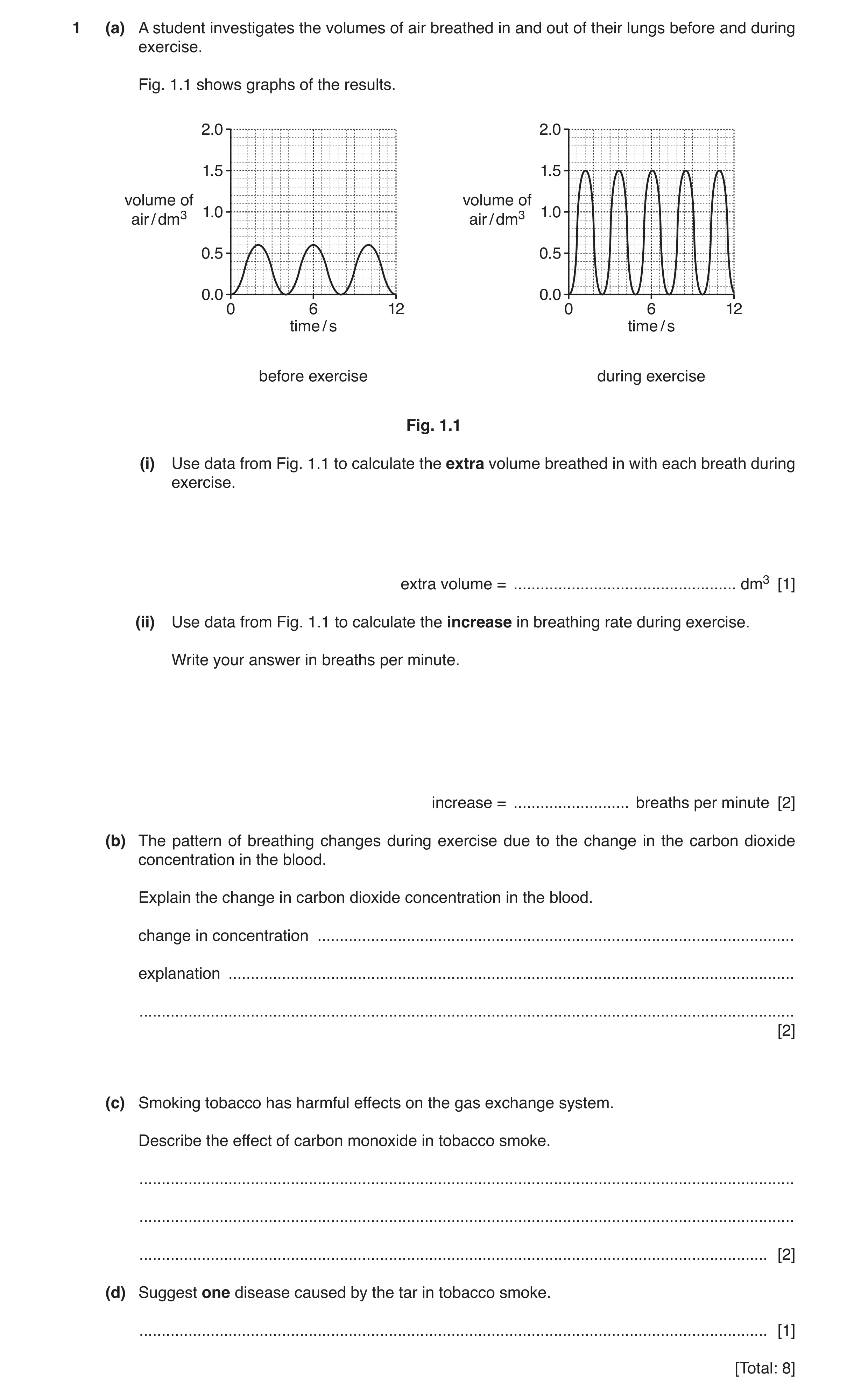
1 (a) A student investigates the volumes of air breathed in and out of their lungs before and during exercise. Fig. 1.1 shows graphs of the results. 2.0 2.0 1.5 1.5 volume of volume of 1.0 1.0 air / dm3 air / dm3 0.5 0.5 0.0 0.0 0 6 12 0 6 12 time / s time / s before exercise during exercise Fig. 1.1 (i) Use data from Fig. 1.1 to calculate the extra volume breathed in with each breath during exercise. extra volume = … dm3 [1] (ii) Use data from Fig. 1.1 to calculate the increase in breathing rate during exercise. Write your answer in breaths per minute. increase = … breaths per minute [2] (b) The pattern of breathing changes during exercise due to the change in the carbon dioxide concentration in the blood. Explain the change in carbon dioxide concentration in the blood. change in concentration … explanation … … [2] (c) Smoking tobacco has harmful effects on the gas exchange system. Describe the effect of carbon monoxide in tobacco smoke. … … … [2] (d) Suggest one disease caused by the tar in tobacco smoke. … [1] [Total: 8]
8 marks
Mark scheme: 1(a)(i) (1.5 – 0.6 =) 0.9 (dm3) ; 1 1(a)(ii) (increase in breaths) = 2 breaths (over 12 seconds) ; × 60 / 12 = 10 ; 2 1(b) increase ; (aerobic) respiration increases during exercise ; 2 1(c) combines with haemoglobin / reduces the amount of oxygen able to combine with haemoglobin ; reduces amount of oxygen being transported (by blood / red cells) ; 2 1(d) lung cancer / COPD / emphysema / bronchitis ; 1
This question in 0653/42 Oct/Nov 2019
Q8 · Red blood cells and white blood cells 0653/43 Oct/Nov 2020
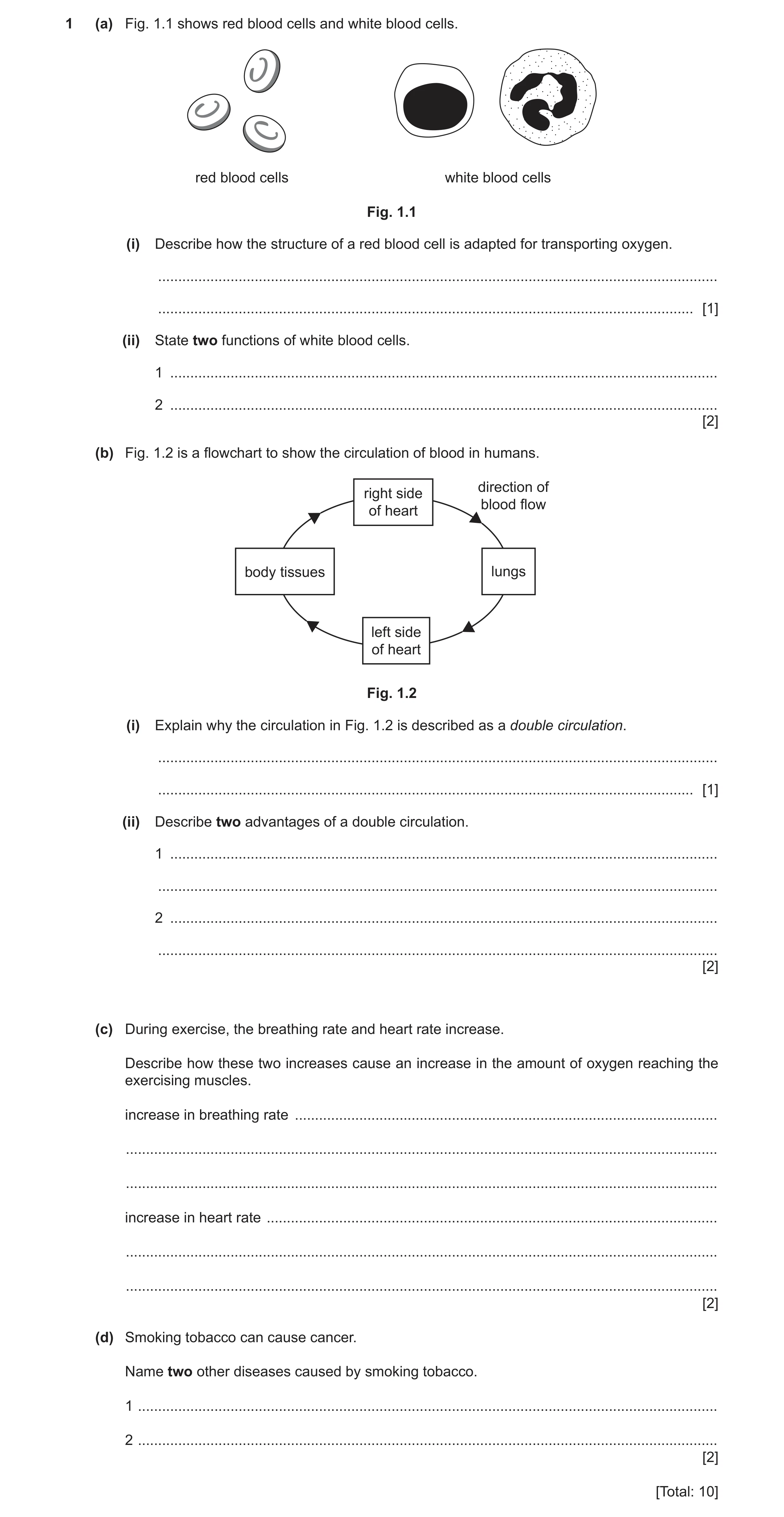
1 (a) Fig. 1.1 shows red blood cells and white blood cells. red blood cells white blood cells Fig. 1.1 (i) Describe how the structure of a red blood cell is adapted for transporting oxygen. … … [1] (ii) State two functions of white blood cells. 1 … 2 … [2] (b) Fig. 1.2 is a flowchart to show the circulation of blood in humans. direction of right side blood flow of heart body tissues lungs left side of heart Fig. 1.2 (i) Explain why the circulation in Fig. 1.2 is described as a double circulation. … … [1] (ii) Describe two advantages of a double circulation. 1 … … 2 … … [2] (c) During exercise, the breathing rate and heart rate increase. Describe how these two increases cause an increase in the amount of oxygen reaching the exercising muscles. increase in breathing rate … … … increase in heart rate … … … [2] (d) Smoking tobacco can cause cancer. Name two other diseases caused by smoking tobacco. 1 … 2 … [2] [Total: 10]
10 marks
Mark scheme: 1(a)(i) any one from: biconcave disc / large surface area (to volume ratio) for maximum oxygen absorption ; no nucleus so more space for oxygen transport ; contains haemoglobin ; 1 1(a)(ii) produce antibodies ; phagocytosis ; 2 1(b)(i) there is a circulation to the lungs and a circulation to the body (tissues) ; 1 1(b)(ii) any two from: enables blood to go to the body tissues at high pressure ; enables blood to go the lungs at low pressure ; keeps oxygenated blood separate from deoxygenated blood ; enables faster blood flow ; 2 1(c) (increase in breathing rate) enables more oxygen to, diffuse into / enter, the blood (at the lungs) ; (increase in heart rate) transports oxygenated blood faster ; 2 1(d) coronary heart disease (CHD) ; COPD ; 2
This question in 0653/43 Oct/Nov 2020
Q9 · A study investigates the number of people with lung cancer in different age ranges 0653/42 Feb/March 2022
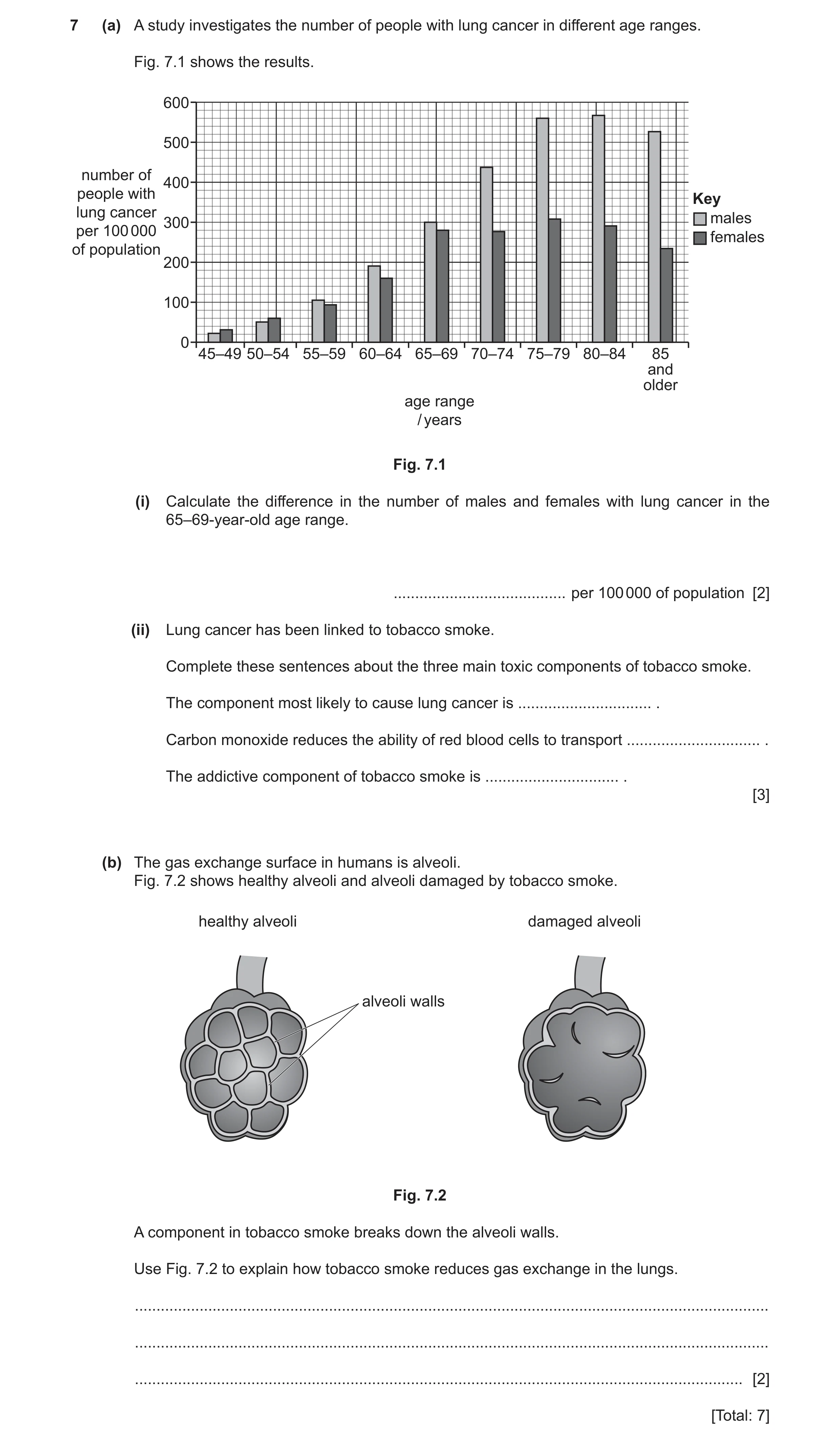
7 (a) A study investigates the number of people with lung cancer in different age ranges. Fig. 7.1 shows the results. 600 500 number of 400 people with Key lung cancer males 300 per 100 000 females of population 200 100 0 45–49 50–54 55–59 60–64 65–69 70–74 75–79 80–84 85 and older age range / years Fig. 7.1 (i) Calculate the difference in the number of males and females with lung cancer in the 65–69-year-old age range. … per 100 000 of population [2] (ii) Lung cancer has been linked to tobacco smoke. Complete these sentences about the three main toxic components of tobacco smoke. The component most likely to cause lung cancer is … . Carbon monoxide reduces the ability of red blood cells to transport … . The addictive component of tobacco smoke is … . [3] (b) The gas exchange surface in humans is alveoli. Fig. 7.2 shows healthy alveoli and alveoli damaged by tobacco smoke. healthy alveoli damaged alveoli alveoli walls Fig. 7.2 A component in tobacco smoke breaks down the alveoli walls. Use Fig. 7.2 to explain how tobacco smoke reduces gas exchange in the lungs. … … … [2] [Total: 7]
7 marks
Mark scheme: 7(a)(i) 300 – 280 ; 20 ; 2 7(a)(ii) tar ; oxygen ; nicotine ; 3 7(b) (damaged alveoli) less surface (area) ; so less diffusion / lower rate of diffusion (of gases) ; 2
This question in 0653/42 Feb/March 2022
Q10 · A diagram of the gas exchange system in humans 0653/43 May/June 2022
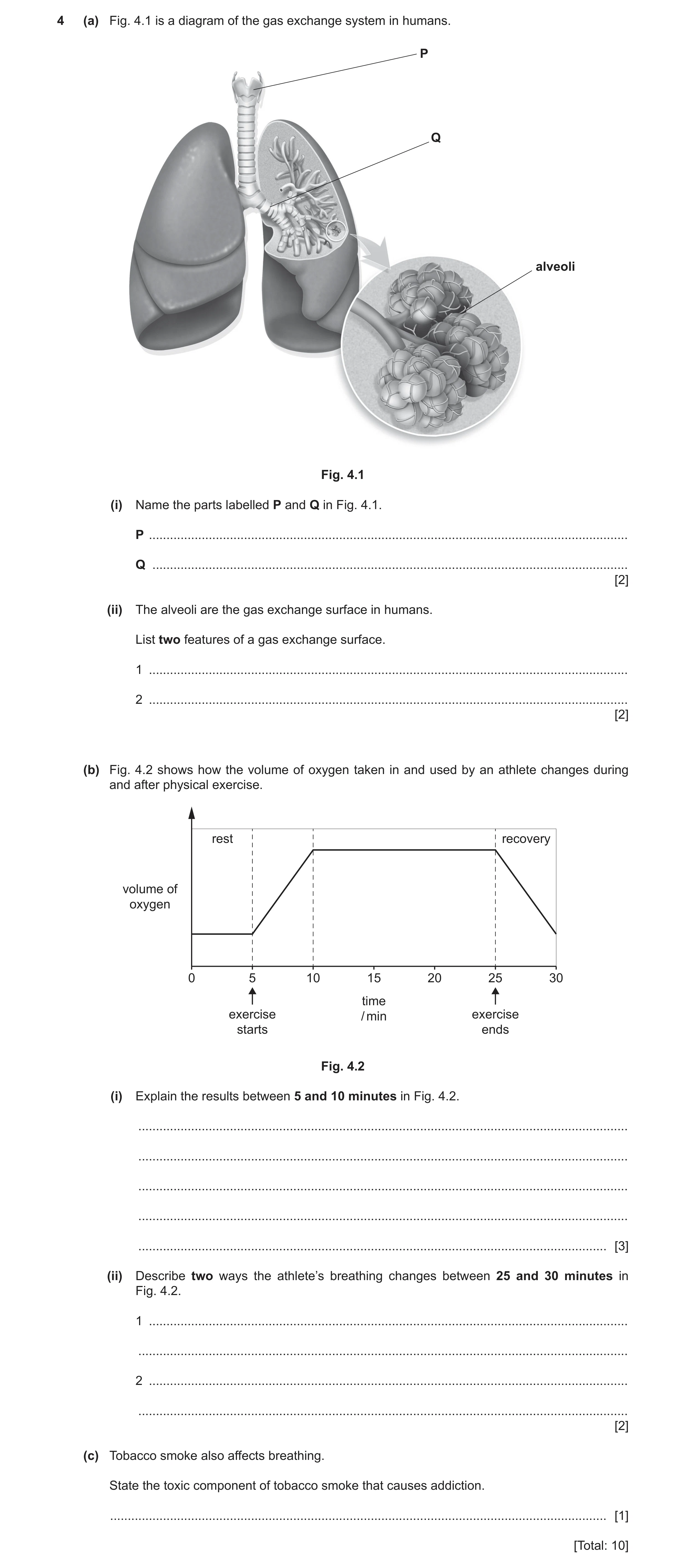
4 (a) Fig. 4.1 is a diagram of the gas exchange system in humans. P Q alveoli Fig. 4.1 (i) Name the parts labelled P and Q in Fig. 4.1. P … Q … [2] (ii) The alveoli are the gas exchange surface in humans. List two features of a gas exchange surface. 1 … 2 … [2] (b) Fig. 4.2 shows how the volume of oxygen taken in and used by an athlete changes during and after physical exercise. rest recovery volume of oxygen 0 5 10 15 20 25 30 time exercise / min exercise starts ends Fig. 4.2 (i) Explain the results between 5 and 10 minutes in Fig. 4.2. … … … … … [3] (ii) Describe two ways the athlete’s breathing changes between 25 and 30 minutes in Fig. 4.2. 1 … … 2 … … [2] (c) Tobacco smoke also affects breathing. State the toxic component of tobacco smoke that causes addiction. … [1] [Total: 10]
10 marks
Mark scheme: 4(a)(i) P – larynx ; Q – bronchus ; 2 4(a)(ii) any two from: large surface area ; thin surface ; good blood supply ; good ventilation ; 2 4(b)(i) any three from: (volume of oxygen taken in increases because,) more energy required ; increased contraction of muscles ; muscles require more oxygen ; (oxygen required ) for respiration / respiration (rate) increases ; 3 4(b)(ii) decrease in rate (of breathing) ; decrease in depth (of breathing) ; 2 4(c) nicotine ; 1
This question in 0653/43 May/June 2022
Q11 · A diagram showing a fetus developing inside the female reproductive system 0653/41 Oct/Nov 2022
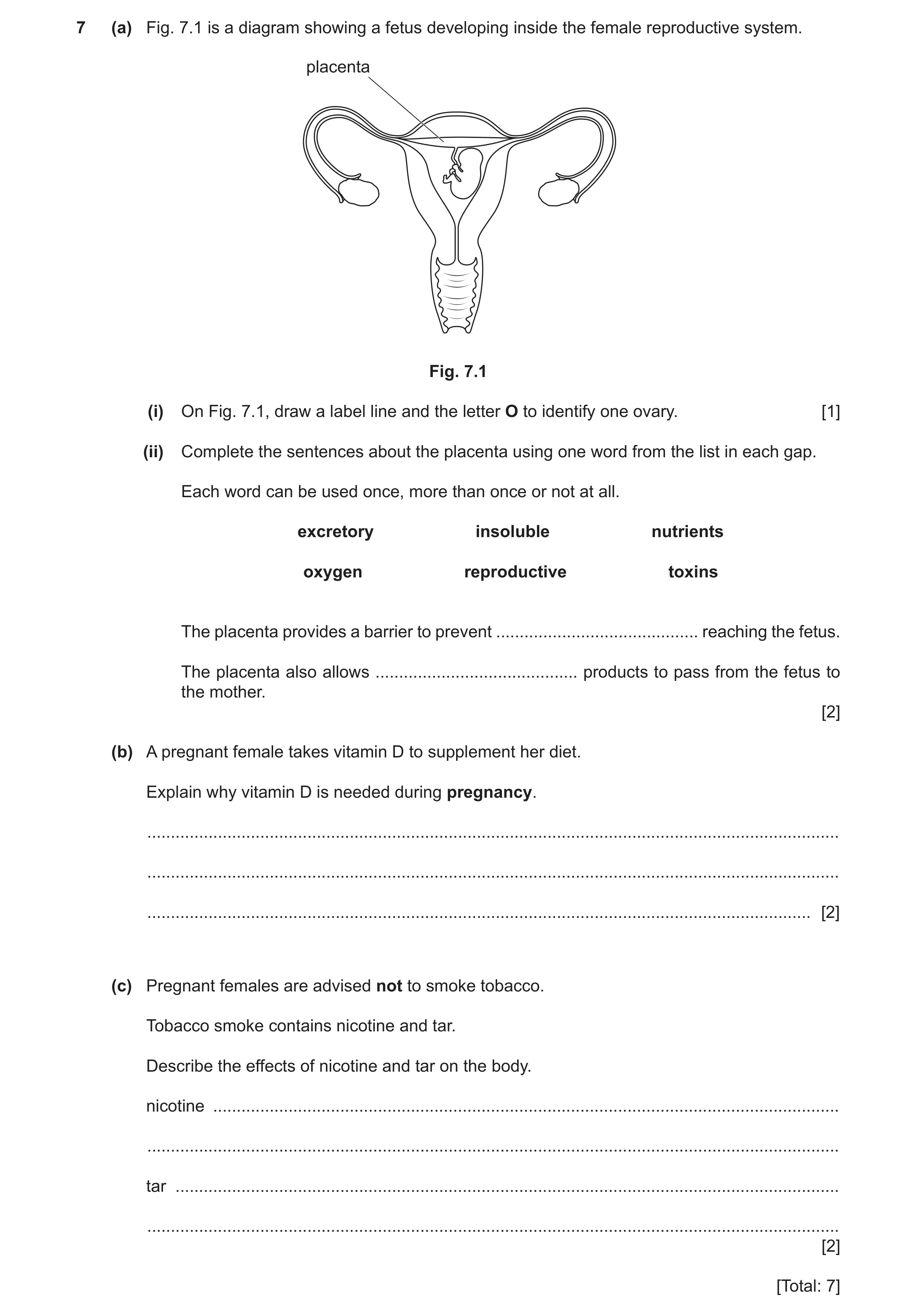
7 (a) Fig. 7.1 is a diagram showing a fetus developing inside the female reproductive system. placenta Fig. 7.1 (i) On Fig. 7.1, draw a label line and the letter O to identify one ovary. [1] (ii) Complete the sentences about the placenta using one word from the list in each gap. Each word can be used once, more than once or not at all. excretory insoluble nutrients oxygen reproductive toxins The placenta provides a barrier to prevent … reaching the fetus. The placenta also allows … products to pass from the fetus to the mother. [2] (b) A pregnant female takes vitamin D to supplement her diet. Explain why vitamin D is needed during pregnancy. … … … [2] (c) Pregnant females are advised not to smoke tobacco. Tobacco smoke contains nicotine and tar. Describe the effects of nicotine and tar on the body. nicotine … … tar … … [2] [Total: 7]
7 marks
Mark scheme: 7(a)(i) either ovary labelled ; 1 7(a)(ii) toxins ; 2 excretory ; 7(b) idea that, fetus needs (some of the) vitamin D ; 2 vitamin D needed, for bone (development) / to prevent rickets ; 7(c) nicotine addictive ; 2 tar prevents cilia working / causes (lung) cancer ;
This question in 0653/41 Oct/Nov 2022
Q12 · Cells that line the gas exchange system of humans 0653/43 Oct/Nov 2022
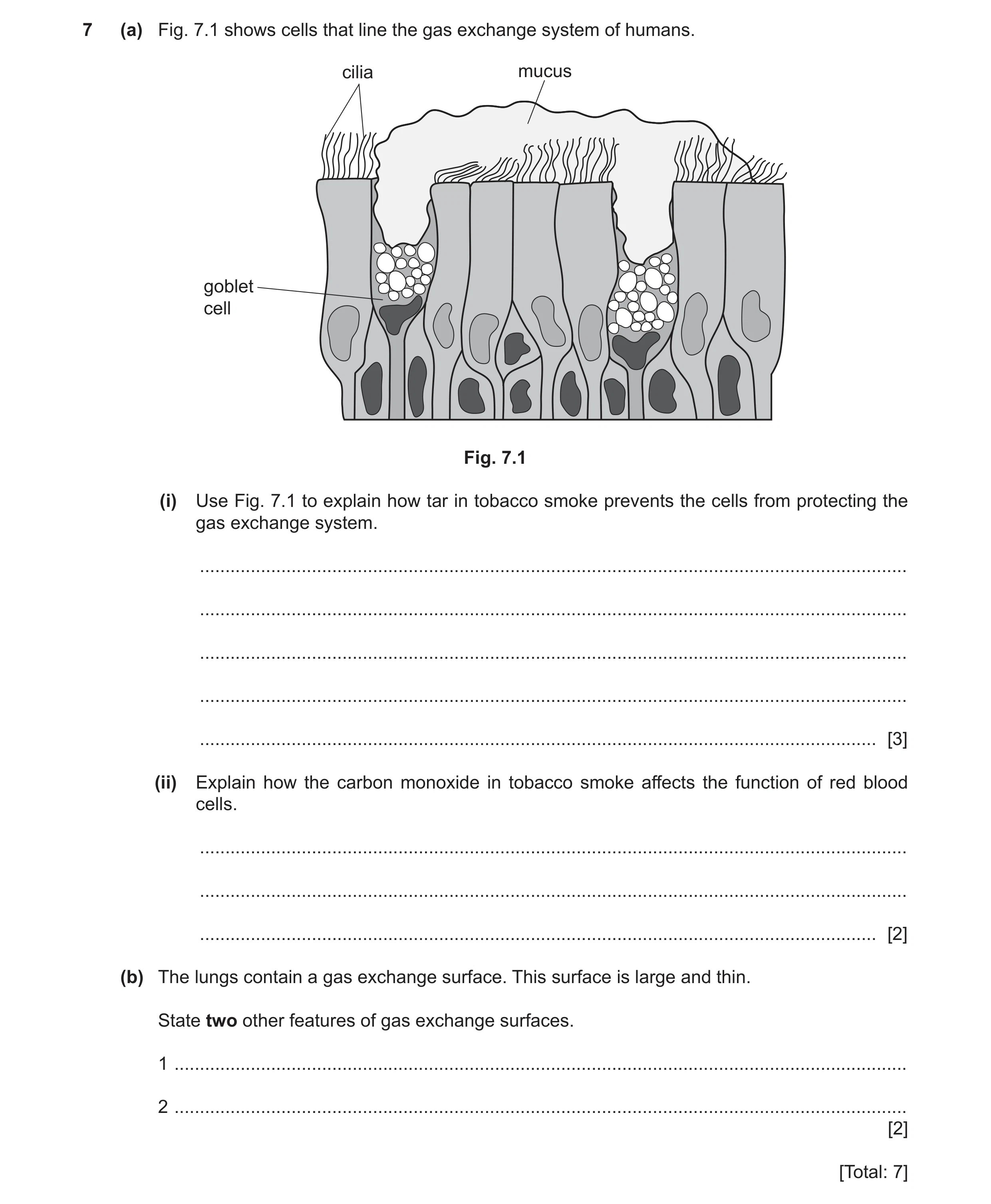
7 (a) Fig. 7.1 shows cells that line the gas exchange system of humans. cilia mucus goblet cell Fig. 7.1 (i) Use Fig. 7.1 to explain how tar in tobacco smoke prevents the cells from protecting the gas exchange system. … … … … … [3] (ii) Explain how the carbon monoxide in tobacco smoke affects the function of red blood cells. … … … [2] (b) The lungs contain a gas exchange surface. This surface is large and thin. State two other features of gas exchange surfaces. 1 … 2 … [2] [Total: 7]
7 marks
Mark scheme: 7(a)(i) any three from: 3 (tar causes an) increased production of mucus by goblet cells ; mucus blocks airways ; (tar) damages cilia ; (cilia) cannot (re)move, particles / pathogens ; 7(a)(ii) (carbon monoxide) combines with haemoglobin ; 2 idea of, reduced ability to transport oxygen ; 7(b) good blood supply ; 2 good ventilation (with air) ;
This question in 0653/43 Oct/Nov 2022
Q13 · Part of the breathing system in humans 0653/41 Oct/Nov 2023
4 (a) Fig. 4.1 shows part of the breathing system in humans. X rib Fig. 4.1 State the name of the part labelled X in Fig. 4.1. … [1] (b) Alveoli are the gas exchange surface in humans. State one feature of the gas exchange surface in humans. … [1] (c) Complete the sentences about the differences in composition between expired and inspired air. Expired air contains more carbon dioxide than inspired air. This is because carbon dioxide is made in cells by the process of … . Expired air also contains more … than inspired air. [2] (d) Fig. 4.2 shows cells that line the bronchi. Y Fig. 4.2 Describe how cell Y is adapted to its function. … … … [2] (e) Tobacco smoking affects the body. The boxes on the left show different components of tobacco smoke. The boxes on the right show the effects of these components on the body. Draw one straight line from each component to its effect. component effect carbon monoxide addiction nicotine lung cancer tar reduced oxygen transport by red blood cells [1] [Total: 7]
7 marks
Mark scheme: 4(a) intercostal muscle ; 1 4(b) any one from: 1 large (surface) area ; thin (surface) ; good blood supply ; good ventilation (with air) ; AVP ; 4(c) (aerobic) respiration ; 2 water (vapour) ; 4(d) ciliated / has cilia ; 2 to move mucus (away from lungs) ; 4(e) 1 carbon monoxide addiction nicotine lung cancer tar reduced oxygen transport by red blood cells only three lines and all correct ;
This question in 0653/41 Oct/Nov 2023
Q14 · Egg cells and sperm cells are the gametes in human reproduction 0653/42 Feb/March 2024
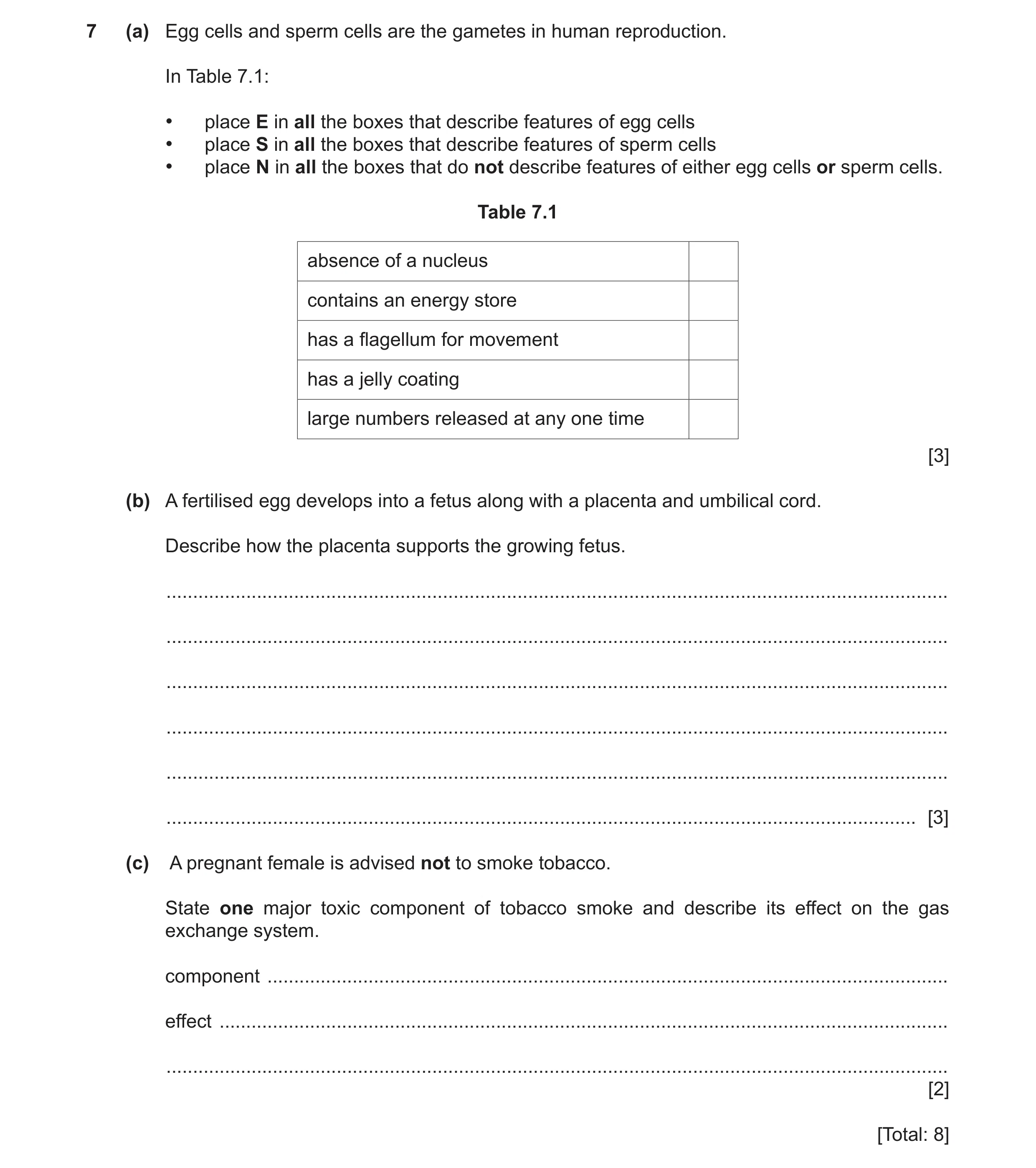
7 (a) Egg cells and sperm cells are the gametes in human reproduction. In Table 7.1: • place E in all the boxes that describe features of egg cells • place S in all the boxes that describe features of sperm cells • place N in all the boxes that do not describe features of either egg cells or sperm cells. Table 7.1 absence of a nucleus contains an energy store has a flagellum for movement has a jelly coating large numbers released at any one time [3] (b) A fertilised egg develops into a fetus along with a placenta and umbilical cord. Describe how the placenta supports the growing fetus. … … … … … … [3] (c) A pregnant female is advised not to smoke tobacco. State one major toxic component of tobacco smoke and describe its effect on the gas exchange system. component … effect … … [2] [Total: 8]
8 marks
Mark scheme: 7(a) 3 absence of a nucleus N contains an energy store E has a flagellum for movement S has a jelly coating E large numbers released at any one time S ;;; 5 correct = [3] 3–4 correct = [2] 1–2 correct = [1] 7(b) (dissolved) nutrients / oxygen, pass (from the mother’s blood across placenta) to fetus ; 3 waste products pass from fetus (to mother across placenta) ; placenta provides a barrier to toxins ; 7(c) carbon monoxide ; 2 reduces oxygen uptake (into blood / cells / body) / binds to haemoglobin ; OR tar ; causes, lung cancer / bronchitis / emphysema ;
This question in 0653/42 Feb/March 2024
Q15 · A diagram showing a cross‑section of a bacterial cell 0653/41 May/June 2025
3 (a) Fig. 3.1 is a diagram showing a cross‑section of a bacterial cell. Fig. 3.1 (i) Draw a label line and the letter P to identify a plasmid in Fig. 3.1. [1] (ii) Plasmids are one structure found in bacterial cells that are not found in plant cells. Identify two structures visible in Fig. 3.1 that are also found in plant cells. 1 … 2 … [2] (b) Some bacteria are pathogens that infect the human body. (i) Bacterial infections are treated with antibiotics. Explain why antibiotics should only be used when essential. … … … [2] (ii) The body can develop active immunity after infection by some bacteria. Describe what is meant by active immunity. … … … [1] (c) Some bacteria gain energy from waste organic material in sewage. (i) Name the type of organism that gains energy from waste organic material. … [1] (ii) Sewage treatment is one way to control the spread of disease. State one other way to control the spread of disease. … … [1] [Total: 8]
8 marks
Mark scheme: 3(a)(i) plasmid labelled ; 1 3(a)(ii) any two from: 2 cell wall ; ribosomes ; cell membrane ; cytoplasm ; 3(b)(i) idea that it helps prevent antibiotic resistance in bacteria ; 2 idea that antibiotic becomes less effective (due to over use) / owtte ; 3(b)(ii) (defence against a pathogen by) production of antibodies ; 1 3(c)(i) decomposer ; 1 3(c)(ii) any one from: 1 hygienic food preparation ; personal hygiene / good hygiene ; clean water supply ; waste disposal ; AVP, e.g. vaccination ;
This question in 0653/41 May/June 2025
Q16 · The structure of a virus and a bacterial cell 0653/43 Oct/Nov 2025
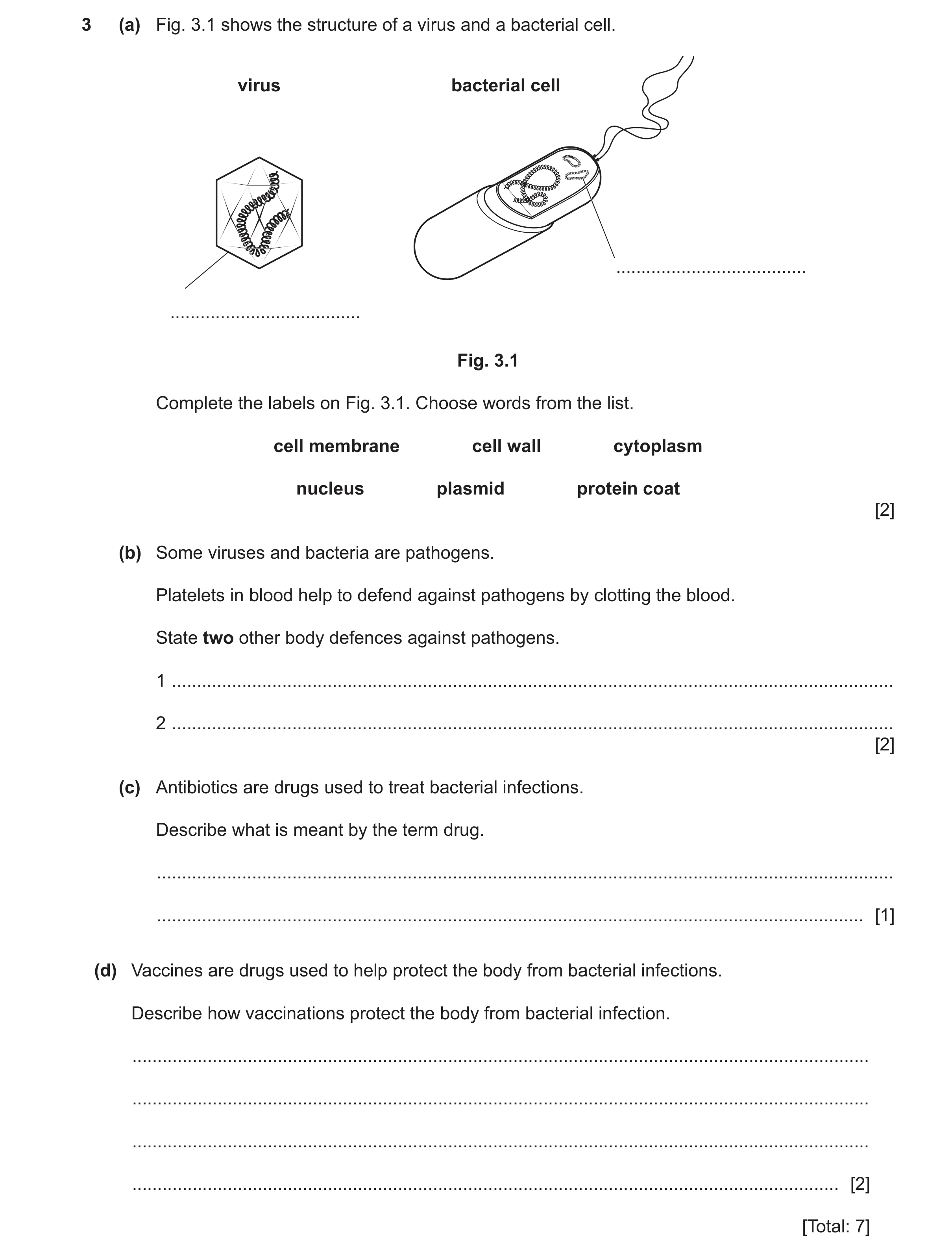
3 (a) Fig. 3.1 shows the structure of a virus and a bacterial cell. virus bacterial cell … … Fig. 3.1 Complete the labels on Fig. 3.1. Choose words from the list. cell membrane cell wall cytoplasm nucleus plasmid protein coat [2] (b) Some viruses and bacteria are pathogens. Platelets in blood help to defend against pathogens by clotting the blood. State two other body defences against pathogens. 1 … 2 … [2] (c) Antibiotics are drugs used to treat bacterial infections. Describe what is meant by the term drug. … … [1] (d) Vaccines are drugs used to help protect the body from bacterial infections. Describe how vaccinations protect the body from bacterial infection. … … … … [2] [Total: 7]
7 marks
Mark scheme: 3(a) as (virus) protein coat ; 2 (bacterial cell) plasmid ; 3(b) any two from: 2 skin ; hairs in the nose ; mucus ; stomach acid ; white blood cells / antibodies ; AVP ; 3(c) substance (taken into the body) that modifies/affects (chemical) reactions in the body ; 1 3(d) cause the body to make antibodies ; 2 provide active immunity ;
This question in 0653/43 Oct/Nov 2025
 18 / 25
 19 / 25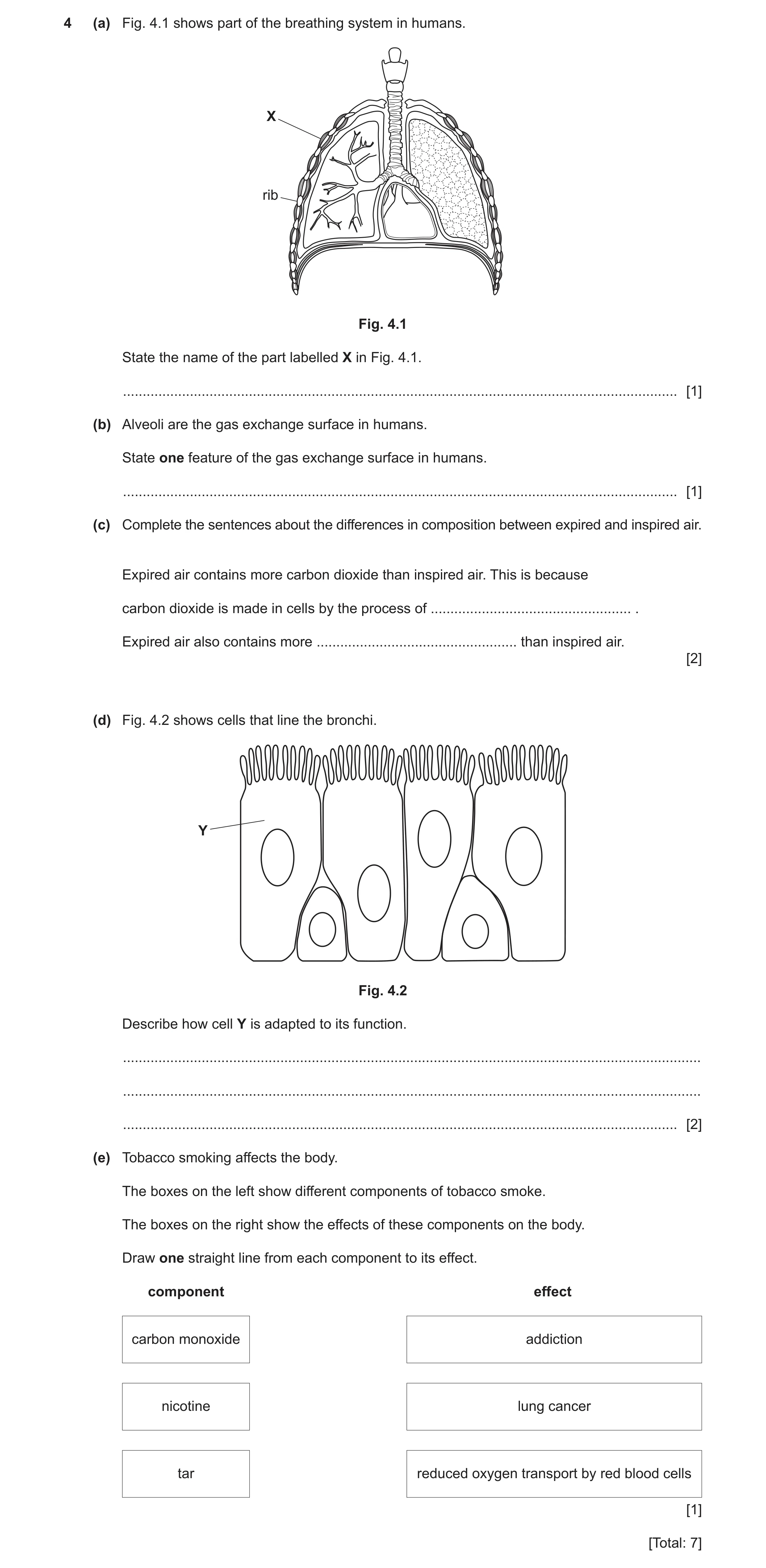
 22 / 25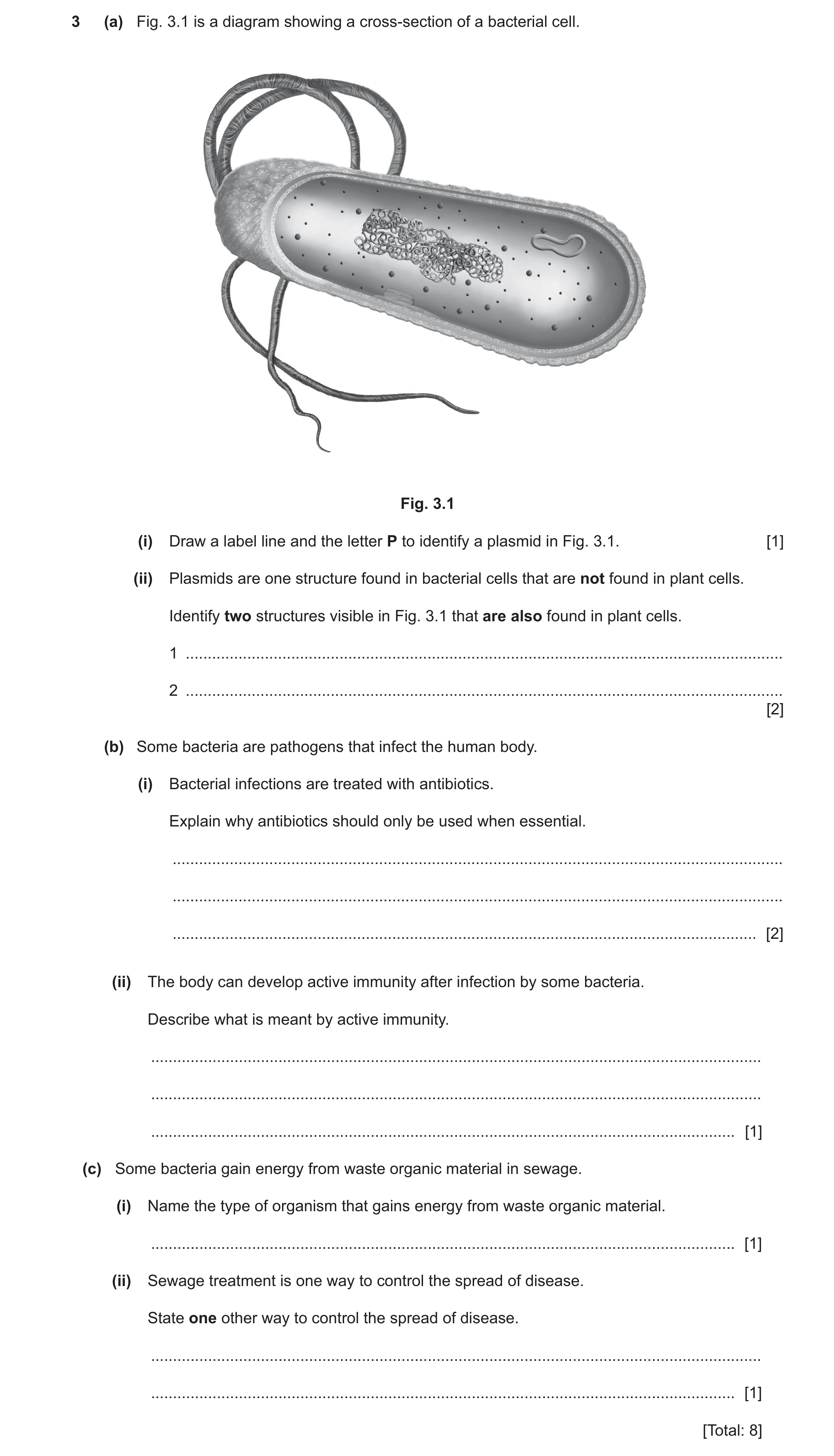
 25 / 25
 11
11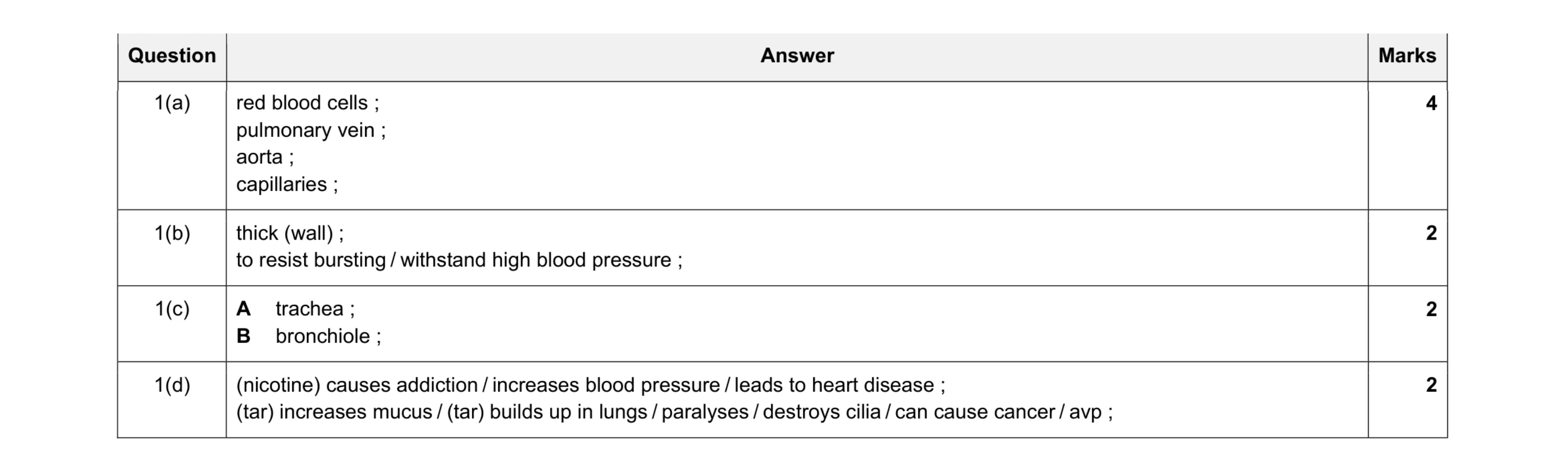 10
10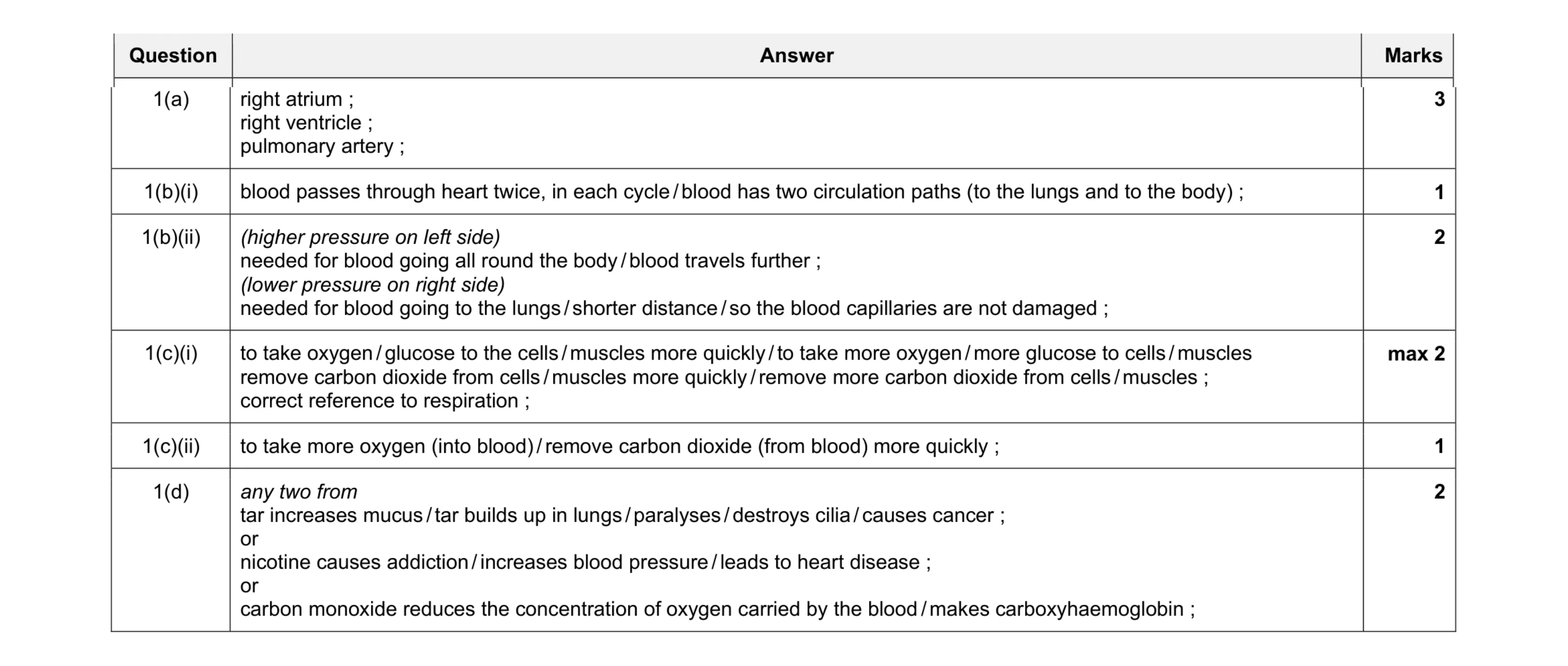 11
11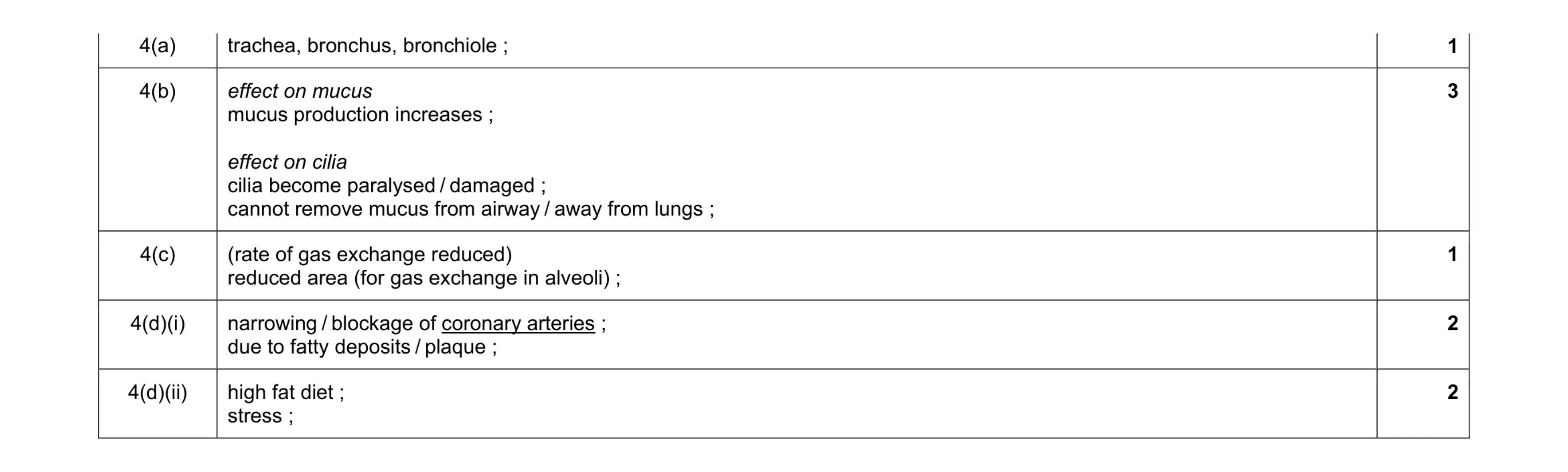 9
9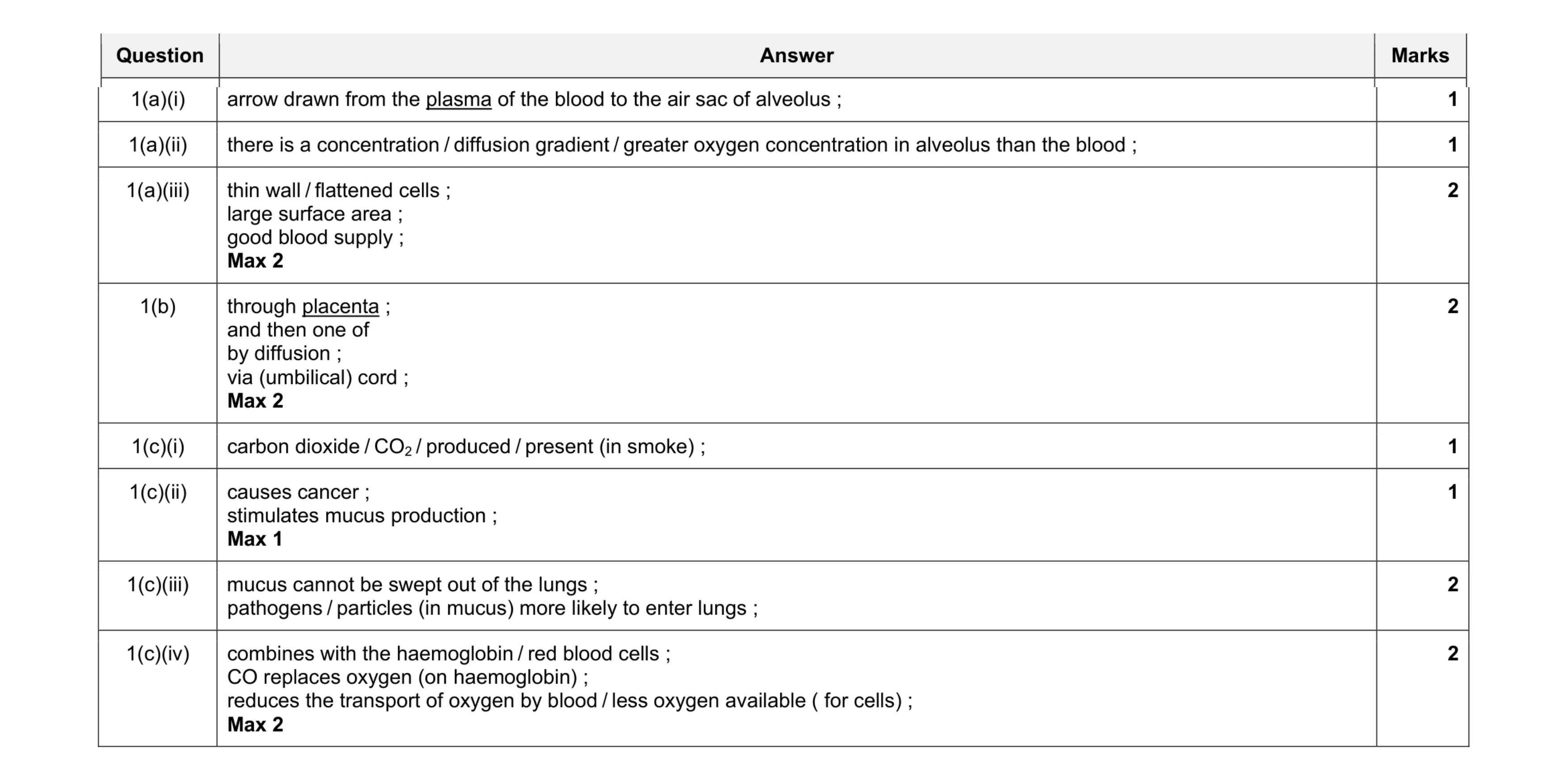 12
12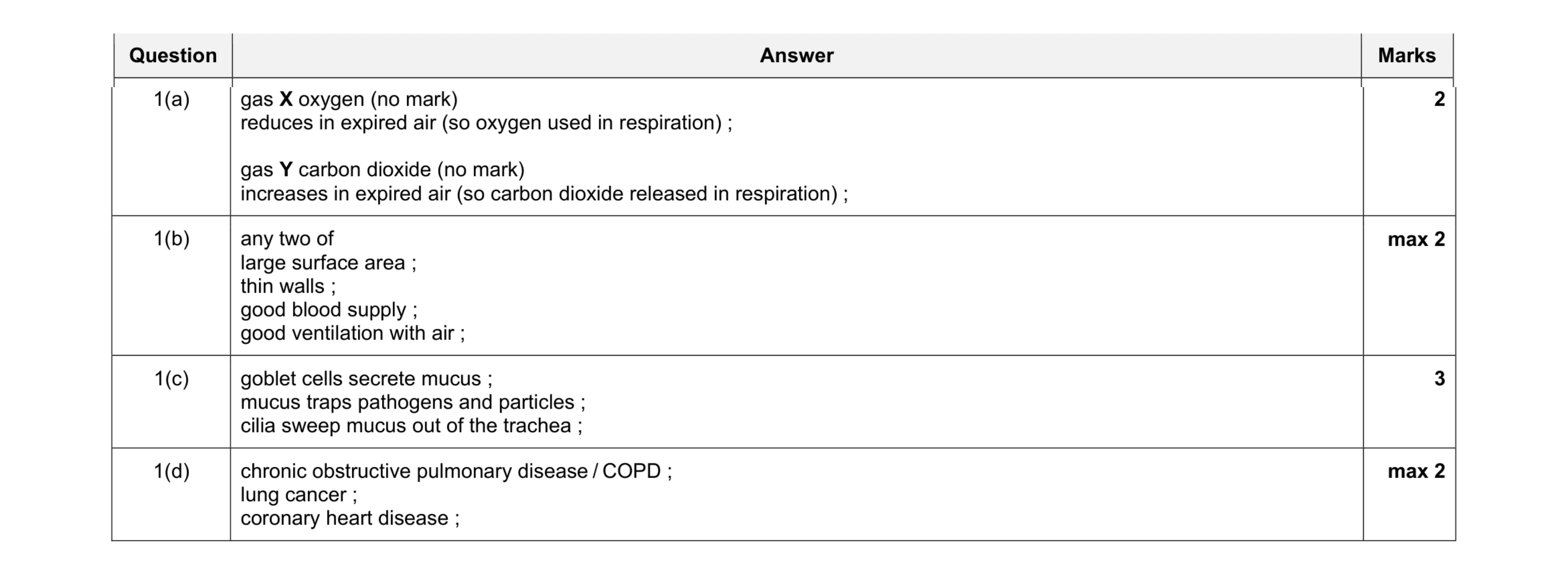 9
9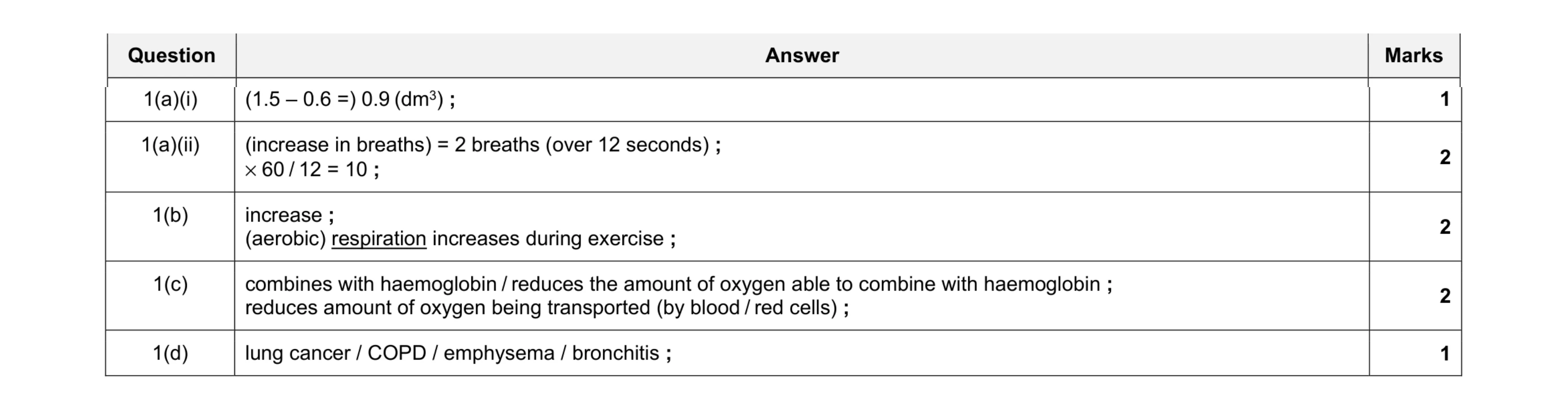 8
8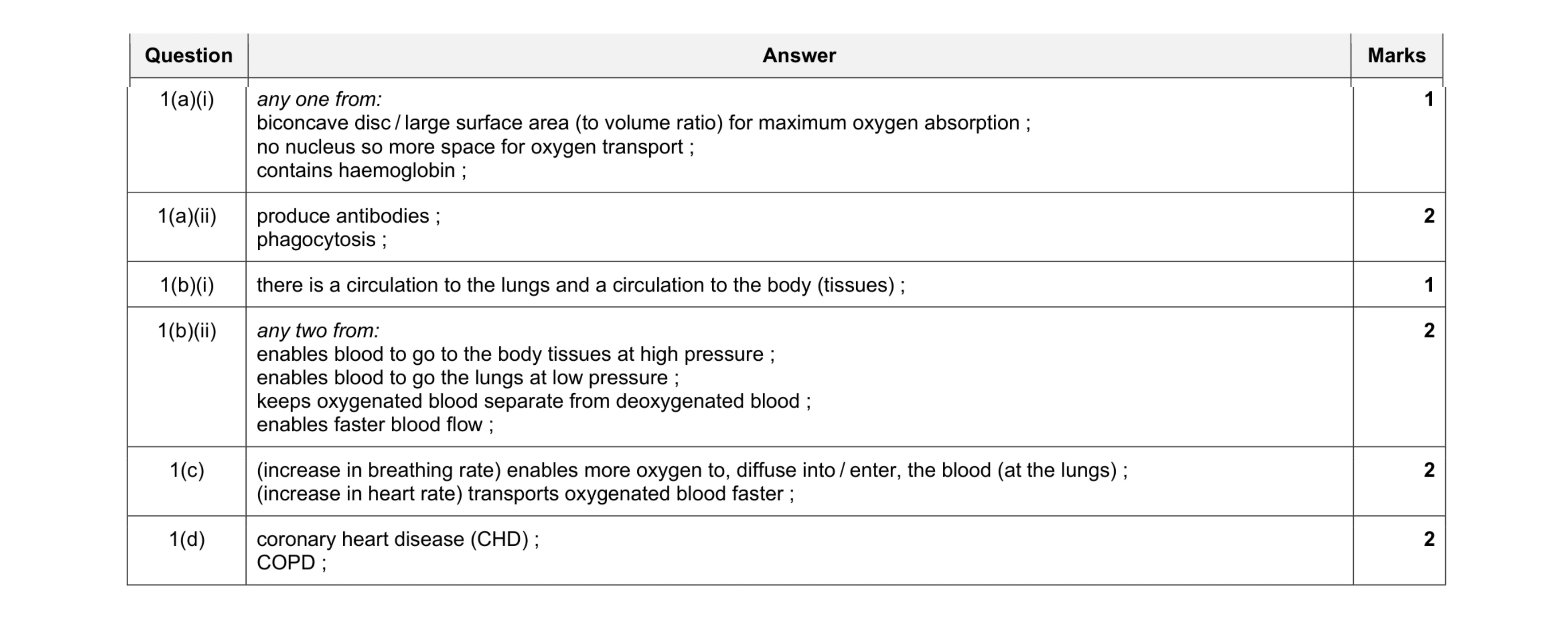 10
10 7
7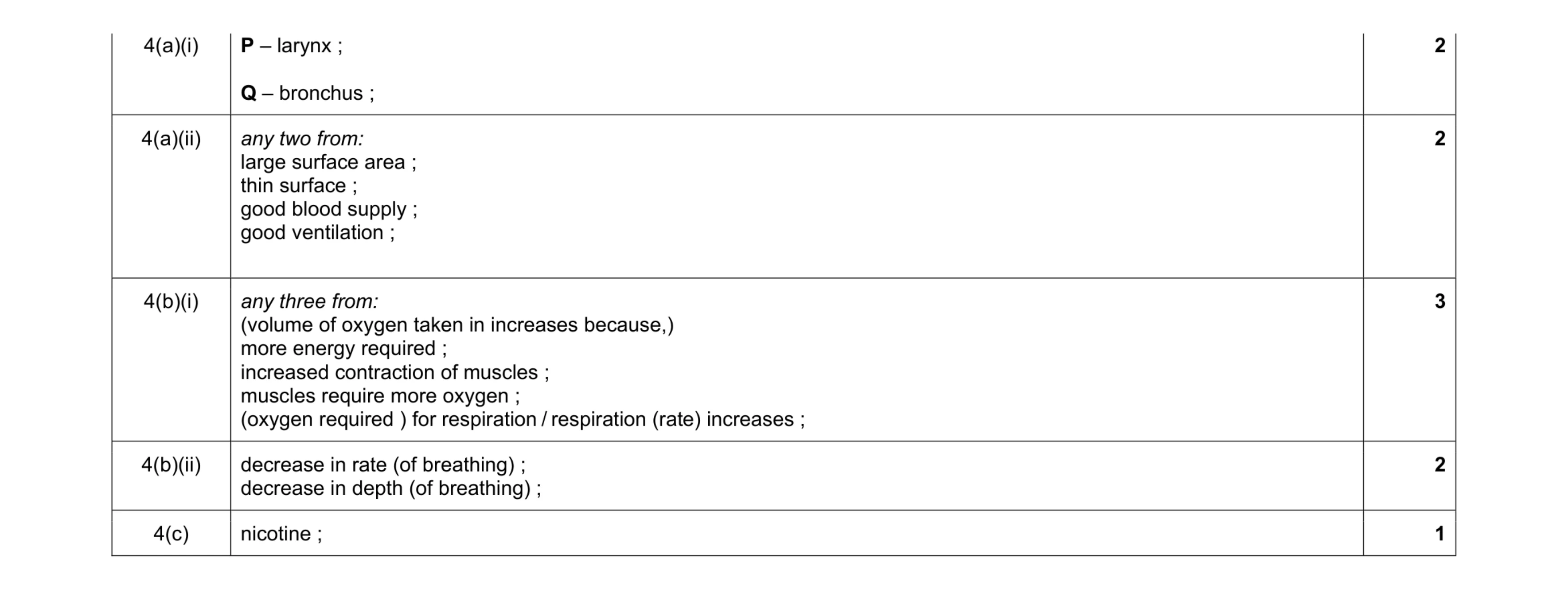 10
10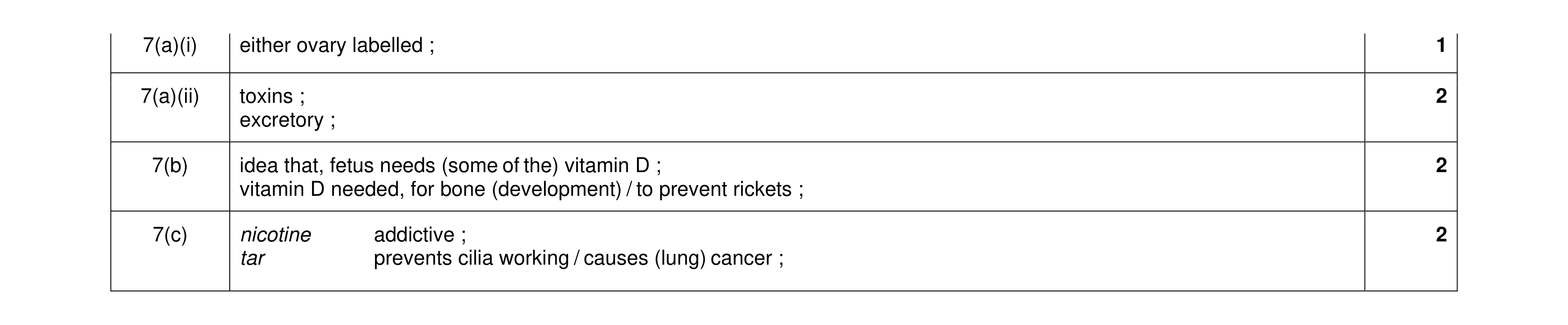 7
7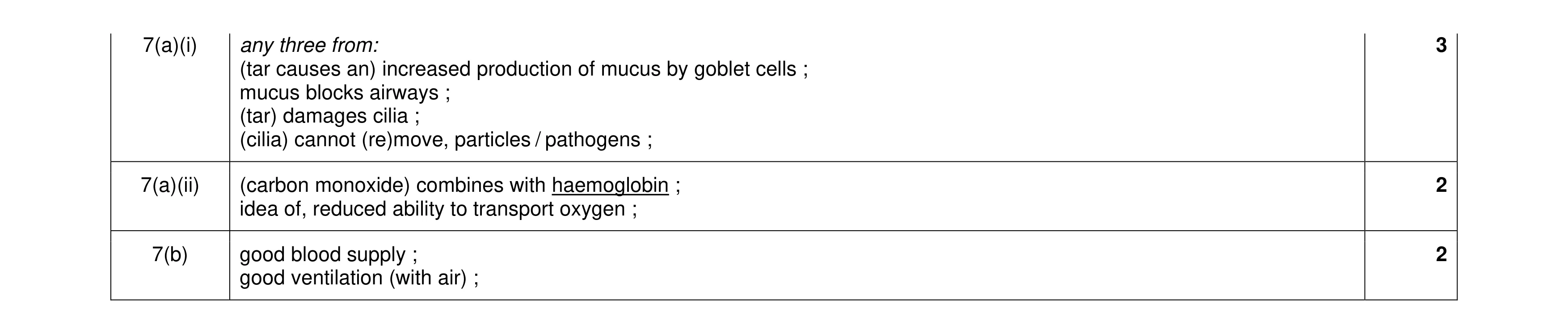 7
7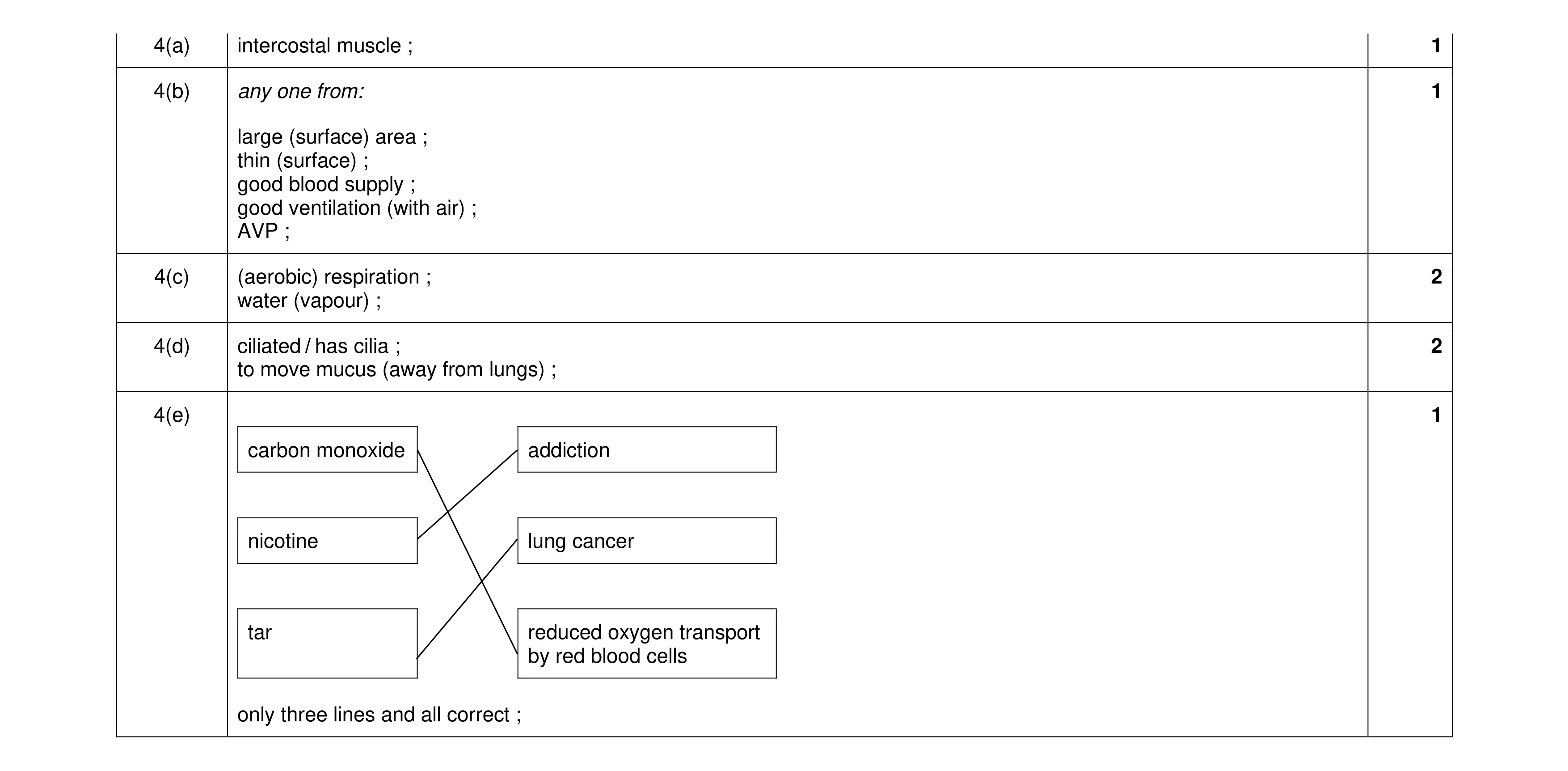 7
7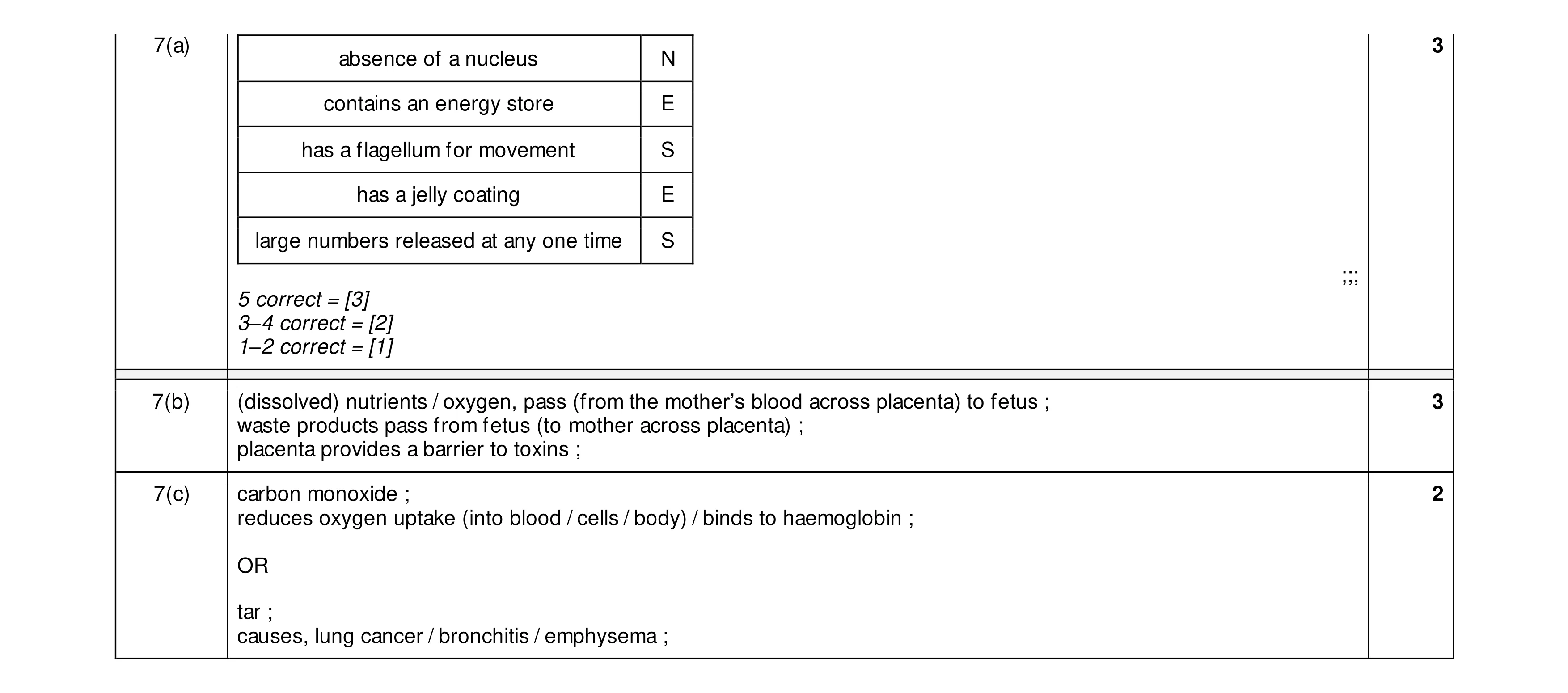 8
8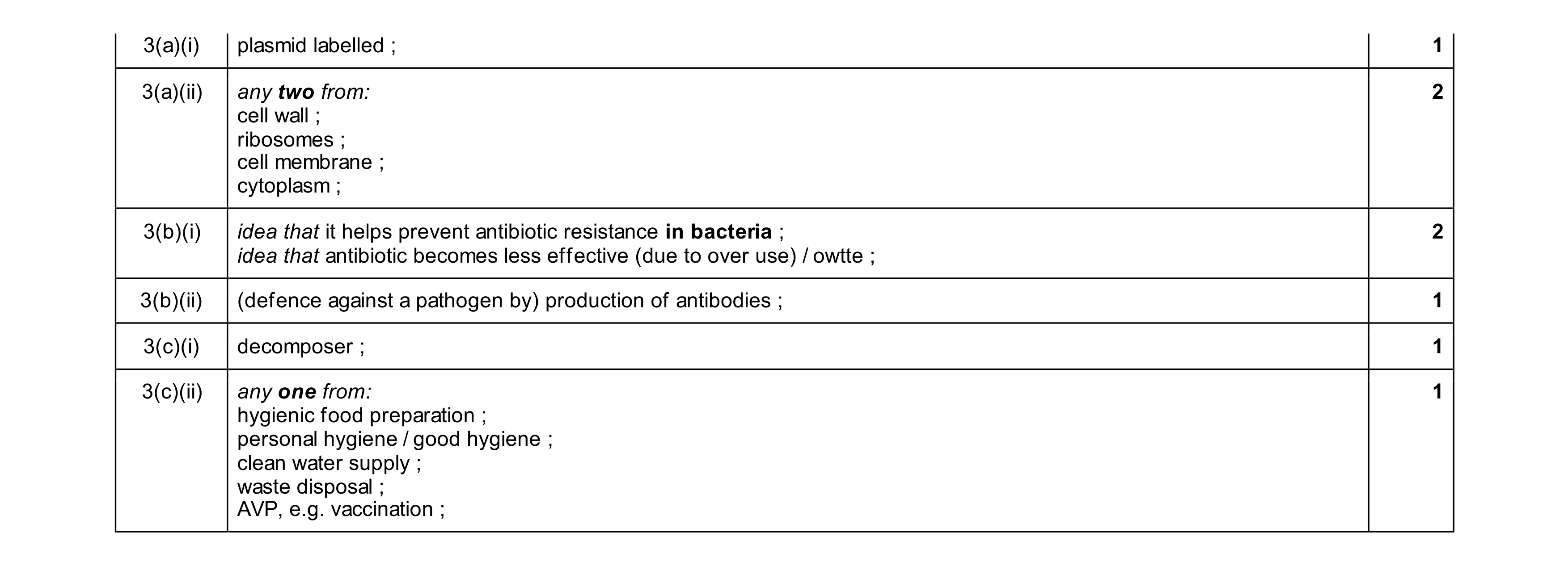 8
8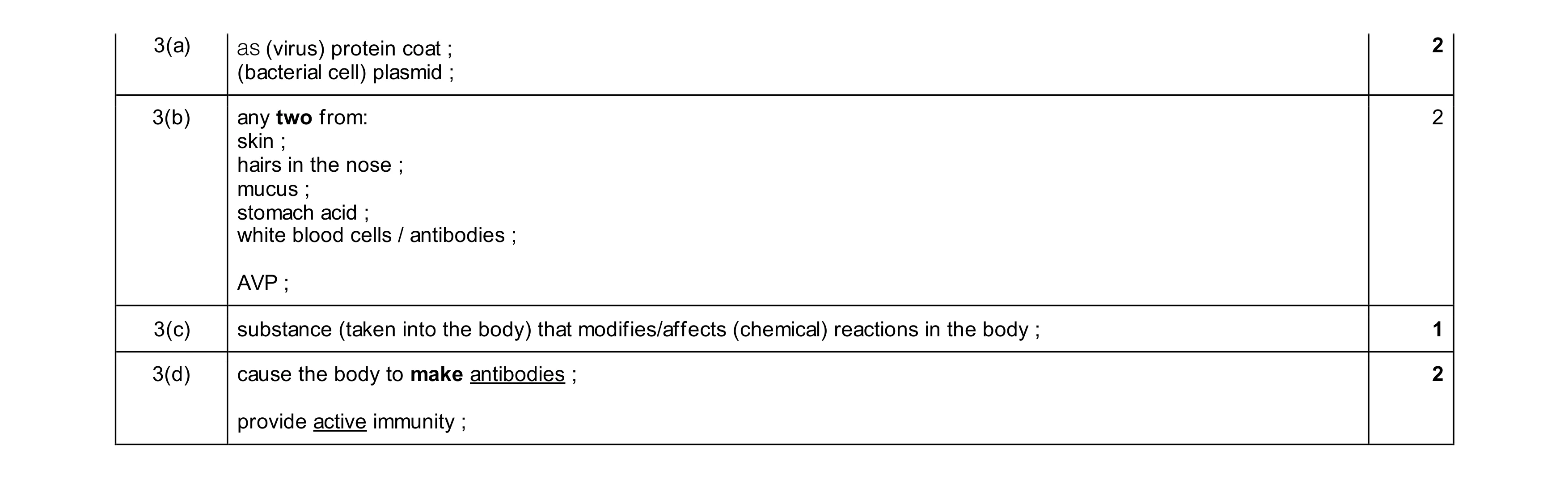 7
7