Questions as text
Q1 · Y 5 x –3 0 4 –5 x f (x) = 2 (x - x - 2) (a) On the diagram, sketch the graph of y = f (x)… 0607/42 Oct/Nov 2017
4 y 5 x –3 0 4 –5 x f (x) = 2 (x - x - 2) (a) On the diagram, sketch the graph of y = f (x) for values of x from –3 to 4. [3] (b) Find the two values of x for which f(x) does not exist. … , … [2] (c) When k ! 0 , write down the number of solutions to the equation f (x) = k . … [1] (d) g (x) = 2 -x + 1 (i) On the diagram, sketch the graph of y = g (x) for - 2 G x G 4 . [2] (ii) Write down the equation of the asymptote to the graph of y = g (x) . … [1] (e) Solve the equation f (x) = g (x) . x = … or x = … [2]
11 marks
Mark scheme: 4(a) Correct sketch 3 B1 for correct middle branch B1 for correct left hand branch 4444 B1 for correct right hand branch 2222 3333 -2-2-2-2 -1-1-1-1 0000 0000 1111 2222 3333 4444 -2-2-2-2 -4-4-4-4 4(b) – 1 2 B1 for each 2 4(c) 2 1 4(d)(i) Correct sketch 2 Must intersect y-axis and be above x-axis 4444 B1 for decreasing exponential graph 2222 3333 -2-2-2-2 -1-1-1-1 0000 0000 1111 2222 3333 4444 -2-2-2-2 -4-4-4-4 4(d)(ii) y = 1 oe 1 4(e) – 0.892 or – 0.8919 to – 0.892[0] 2 B1 for each 2.62 or 2.622 to 2.623
This question in 0607/42 Oct/Nov 2017
Q2 · Y 5 x −5 0 5 −5 x f (x) = 1 - 2 (x - 9 ) (a) On the diagram, sketch the graph of y = f (… 0607/42 May/June 2018
2 y 5 x −5 0 5 −5 x f (x) = 1 - 2 (x - 9 ) (a) On the diagram, sketch the graph of y = f ( x) , for values of x between -5 and 5. [3] (b) Write down the equations of the three asymptotes. … , … , … [3] x (c) The line y = x intersects the curve y = 1 - 2 three times. (x - 9 ) Find the values of the x co-ordinates of the points of intersection. x = … or x = … or x = … [3]
9 marks
Mark scheme: 2(a) Correct sketch 3 B1 for each branch 2(b) y = 1, x = 3, x = − 3 3 B1 for each 2(c) –2.87 or –2.874 to –2.873 3 B1 for each 1.15 or 1.149 to 1.150 If 0 scored SC1 for –2.9, 1.1 and 2.7 2.72 or 2.723 to 2.724
This question in 0607/42 May/June 2018
Q3 · Y 10 x –6 0 6 –10 2x 2 - x + 5 f(x) = ^ 2 h x + x - 6 ^ h (a) On the diagram, sketch the… 0607/43 May/June 2018
5 y 10 x –6 0 6 –10 2x 2 - x + 5 f(x) = ^ 2 h x + x - 6 ^ h (a) On the diagram, sketch the graph of y = f(x) for values of x between -6 and 6. [3] (b) Find the co-ordinates of the local maximum. ( … , … ) [2] (c) Find the equations of the three asymptotes to the graph of y = f(x) . … , … , … [3] (d) The equation f(x) = k has no solutions. Find the range of values of k. … [2] (e) g(x) = x + 1 (i) Solve f(x) = g(x). x = … or x = … [2] (ii) Solve the inequality f(x) 2 g(x). … [2]
14 marks
Mark scheme: 5(a) Correct sketch 3 10 y f(x)=(2x^2 - x + 5)/((x-2)(x+3)) 5 B1 for each branch x -6 -4 -2 2 4 6 -5 -10 5(b) (0.0295, – 0.833) 2 or (0.02948 to 0.02949, –0.8329...) B1 for each 5(c) x = –3, x = 2, y = 2 3 B1 for each 5(d) –0.833 < k ⩽ 2 2 FT their (b) B1 for each inequality 5(e)(i) –5.13, 2.81 2 –5.131..., 2.812 to 2.813 B1 for each 5(e)(ii) –5.13 < x < –3, 2 –5.131..., 2.812 to 2.813 2 < x < 2.81 B1 for each FT their (c) and (e)(i)
This question in 0607/43 May/June 2018
Q4 · Y 15 x –6 0 6 –10 (2x - 3) f (x) = (x + 2) (a) On the diagram, sketch the graph of y =… 0607/42 Oct/Nov 2018
12 y 15 x –6 0 6 –10 (2x - 3) f (x) = (x + 2) (a) On the diagram, sketch the graph of y = f(x) for values of x between -6 and 6. [3] (b) Write down the equations of the asymptotes of y = f(x). … … [2] (c) g(x) = 5 - 2x (i) Solve f(x) = g(x). x = … or x = … [2] (ii) Find g(f(x)). Give your answer as a single fraction in its simplest form. … [3]
10 marks
Mark scheme: 12(a) Correct sketch 3 B1 for correct left hand branch without 15 y f(x)=(2x-3)/(x+2) serious curl back 10 5 B2 for correct right-hand branch x or B1 for correct shape right-hand branch but -6 6 with clear intercepts but serious overlap or -5 curl back -10 12(b) x = –2 oe 2 B1 for each y = 2 oe 12(c)(i) –2.81 or –2.812 to –2.811 2 B1 for each or for 2 x 2 + x − 13 = 0 2.31 or 2.311 to 2.312 12(c)(ii) x + 16 3 5( x + 2) − 2(2 x − 3) M2 for x + 2 x + 2 2 x − 3 or M1 for 5 −2 oe x + 2
This question in 0607/42 Oct/Nov 2018
Q5 · Y 6 –2 0 7 x –6 (x + 2) f (x) = (x - 1)(x - 4) (a) On the diagram, sketch the graph of y… 0607/41 May/June 2019
11 y 6 –2 0 7 x –6 (x + 2) f (x) = (x - 1)(x - 4) (a) On the diagram, sketch the graph of y = f ( x) for values of x between -2 and 7. [3] (b) Write down the co-ordinates of the local maximum. ( … , … ) [2] (c) Write down the equation of each of the three asymptotes. … , … , … [3] (d) g ()x = x - 5 (i) Solve the equation f (x) = g (x) . x = … or x = … or x = … [3] (ii) Solve the inequality f (x) 2 g (x) . … [3]
14 marks
Mark scheme: 11(a) Correct sketch 3 B1 for each branch y f(x)=(x+2)/((x-1)(x-4)) 6 4 2 x -2 2 4 6 -2 -4 -6 11(b) (2.24, –1.94) 2 or (2.242 to 2.243, –1.943 to –1.942) B1 for each co-ordinate 11(c) x = 1, x = 4, y = 0 3 B1 for each 11(d)(i) 1.34 or 1.344 to 1.345 3 B1 for each 2.79 or 2.789... 5.87 or 5.866... If 0 scored, SC1 for 1.3, 2.8 and 5.9 11(d)(ii) x < 1 3 B1 for each 1.34 < x < 2.79 FT dep on two solutions to (i) between 1 and 4 < x < 5.87 4. FT dep on solution to (i) > 4
This question in 0607/41 May/June 2019
Q6 · Y 3 0 x 5 x + 1 (a) On the diagram, sketch the graph of y = log for 0 1 x G 5 0607/42 May/June 2019
2 y 3 0 x 5 x + 1 (a) On the diagram, sketch the graph of y = log for 0 1 x G 5 . [2] b x l x + 1 (b) Write down the equations of the asymptotes to the graph of y = log b x l. … … [2] x + 1 (c) Solve the equation log = 0. 5 . b x l x = … [1] x (d) On the same diagram, sketch the graph of y = for 0 1 x G 5 . [1] 2 x + 1 x (e) Solve the equation log = . b x l 2 x = … [1] x x + 1 (f) On your diagram, shade the region where y G 0.5 , y H and y H log [1] 2 b x l.
8 marks
Mark scheme: 2(a) Correct sketch 2 Must not cross axes 1111 0.80.80.80.8 0.60.60.60.6 0.40.40.40.4 B1 for correct shape 0.20.20.20.2 1111 0000 0000 1111 2222 3333 4444 5555 2(b) y = 0, x = 0 2 B1 for each If 0 scored, SC1 for answers x-axis and y-axis 2(c) 0.462 or 0.4624 to 0.4625 1 2(d) Correct sketch 1 3333 2.52.52.52.5 2222 1.51.51.51.5 1111 0.50.50.50.5 0000 0000 1111 2222 3333 4444 5555 2(e) 0.742 or 0.7415 to 0.7416 1 2(f) Region that is below y = 0.5 and 1 above other two graphs.
This question in 0607/42 May/June 2019
Q7 · Y 4 x –3 0 3 –4 (a) On the diagram, sketch the graph of y = f ( x), where 1 f (x) = for… 0607/42 Oct/Nov 2019
12 y 4 x –3 0 3 –4 (a) On the diagram, sketch the graph of y = f ( x), where 1 f (x) = for values of x between - 3 and 3. x (x - 1)(x + 1) [4] (b) Write down the equations of the asymptotes. … , … , … , … [3] (c) Write down the co-ordinates of the local maximum. ( … , … ) [2] (d) The line y = 2x + 1 intersects the curve y = f (x) twice. Find the value of the x co-ordinate of each point of intersection. x = … or x = … [2]
11 marks
Mark scheme: 12(a) Correct sketch 4 B1 for each branch 12(b) x = 0 3 B2 for three correct x = 1 or B1 for one correct x = –1 y = 0 12(c) (0.577, –2.6[0]) 2 B1 for each or (0.5773 to 0.5774, –2.598…) 12(d) [x = ] –1.24 or –1.242 to –1.241 2 B1 for each [x =] 1.13 or 1.127 to 1.128
This question in 0607/42 Oct/Nov 2019
Q8 · Y 8 x –8 0 8 –8 3x + 2 f (x) = (x + 2)(x - 3) (a) On the diagram, sketch the graph of y =… 0607/43 Oct/Nov 2019
12 y 8 x –8 0 8 –8 3x + 2 f (x) = (x + 2)(x - 3) (a) On the diagram, sketch the graph of y = f ( x) for values of x between - 8 and 8. [3] (b) Write down the equations of the asymptotes. … , … , … [3] (c) g ()x = x - 2 (i) On the diagram, sketch the graph of y = g (x) for - 6 G x G 8. [1] (ii) Solve f (x) = g (x). x = … or x = … or x = … [3] (iii) Solve f (x) 2 g (x). … [3] Question 13 is printed on the next page.
13 marks
Mark scheme: 12(a) Correct Graph 3 B1 for each branch 8 y f(x)=(3x+2)/((x+2)(x-3)) f(x)=x - 2 x -8 8 -8 12(b) x = –2 3 B1 for each x = 3 y = 0 12(c)(i) Correct line , See (a) 1 12(c)(ii) –2.21 or –2.211... 3 B1 for each 1.1[0] or 1.100... 4.11 or 4.111... 12(c)(iii) x < –2.21 3 FT from (ii) if graphs are correct –2 < x < 1.1[0] B1 for each 3 < x < 4.11
This question in 0607/43 Oct/Nov 2019
Q9 · Y 5 – 1.5 0 1.5 x – 5 3 1 f ( )x = x - x (a) On the diagram, sketch the graph of y = f (… 0607/41 Oct/Nov 2020
7 y 5 – 1.5 0 1.5 x – 5 3 1 f ( )x = x - x (a) On the diagram, sketch the graph of y = f ( x) , for values of x between - .15 and 1.5 . [3] (b) Write down the equation of the asymptote of the graph. … [1] (c) Solve the equation f ( )x = 2 for values of x between - .15 and 0. x = … or x = … [2] (d) Solve the inequality f ( )x + x 2 G 2 for values of x between - .15 and 1.5 . … [3]
9 marks
Mark scheme: 7(a) Correct sketch 3 B1 for modulus graph B1 for correct for x > 1, or –1 < x < 0 4444 B1 for x = –1 and 1 when y = 0 plotted 2222 correctly. .5.5.5.5 -1-1-1-1 -0.5-0.5-0.5-0.5 0000 0000 0.50.50.50.5 1111 1.51.51.51.5 Maximum 2 marks if sketch not fully -2-2-2-2 correct -4-4-4-4 7(b) x = 0 1 7(c) –1.4[0] or –1.395… 2 B1 for each –0.475 or –0.4746… 7(d) –1.15 ⩽ x ⩽ –0.536 3 B2 for one fully correct inequality or ––1.154 to –1.153...⩽ x ⩽ –0.5357 or B1 for –1.15 ⩽ x ⩽ – k to –0.5356 – k ⩽ x ⩽ –0.536 or 0.536 ⩽ x ⩽ k AND k ⩽ x ⩽ 1.15 0.536 ⩽ x ⩽ 1.15 or M1 for suitable sketch, or 0.5356 to 0.5357 ⩽ x ⩽ 1.153 to e.g. f(x) + x2 ⩽ 2 1.154 or B1 for 4 correct solutions seen
This question in 0607/41 Oct/Nov 2020
Q10 · Y 13 – 4 0 3 x – 3 1 g ( )x = , x ! 0607/42 Feb/March 2021
7 y 13 – 4 0 3 x – 3 1 g ( )x = , x ! 2 x - 2 (a) On the diagram, sketch the graph of y = g(x) for values of x between - 4 and 3. [3] (b) Write down the equations of the asymptotes of the graph of y = g(x). … … [2] (c) h ( x) = ( x + 1) 2 - 3 Solve the inequality g ( x) 2 h ( x) . … [4]
9 marks
Mark scheme: 7(a) Correct sketch 3 B2 for correct branches but joined or for ‘correct’ but with excessive overlap or ‘curl back’ B1 for one correct branch 7(b) y = 0 B2 B1 for each x = 2 7(c) –2.67 < x < 0.524 B2 B1 for x > −2.67 or x < 0.524 or –2.7 < x < 0.52 2 < x < 2.15 B2 B1 for either x > 2 or x < 2.145… If B0, B0 scored, then SC1 for 2 of the boundaries –2.67, 0.524, 2.15 seen
This question in 0607/42 Feb/March 2021
Q11 · Y 5 – 5 0 5 x – 5 x 2 + 3 f ( x) = ( 1 - x)( x + 3) (a) On the diagram, sketch the graph… 0607/42 May/June 2021
13 y 5 – 5 0 5 x – 5 x 2 + 3 f ( x) = ( 1 - x)( x + 3) (a) On the diagram, sketch the graph of y = f(x) for values of x between -5 and 5. [3] (b) Find the equations of the asymptotes parallel to the y-axis. … [2] (c) Solve f(x) = 2x + 3. … [3]
8 marks
Mark scheme: 13(a) Correct sketch 3 B1 for each branch 13(b) x = 1, 2 B1 for each x = –3 13(c) –3.79 or –3.791... 3 B1 for each –1 0.791 or 0.7912 to 0.7913 If 0 scored SC1 for y = 2x + 3 sketched and cutting both axes
This question in 0607/42 May/June 2021
Q12 · Y 5 – 3 0 1 x – 5 1 f ( x) = 2 x + 4 - 2 x (a) On the diagram, sketch the graph of y = f… 0607/41 May/June 2022
3 y 5 – 3 0 1 x – 5 1 f ( x) = 2 x + 4 - 2 x (a) On the diagram, sketch the graph of y = f ( x) for values of x between - 3 and 1. [3] (b) Write down the equation of the asymptote of the graph. … [1] (c) Find the coordinates of the local maximum. ( … , … ) [1] (d) g( )x = x 3 - 5x for - 3 G x G 1. Solve f ( x) G g( x) . … [4]
9 marks
Mark scheme: 3(a) correct sketch 3 B2 for correct branches but joined or touching y-axis B1 for one correct branch 3(b) x = 0 1 3(c) (−1, 1) 1 3(d) −2.31 ⩽ x < 0 and 0 < x ⩽ 0.388 4 B3 for −2.3 ⩽ x ⩽ 0.388 or −2.31 ⩽ x ⩽ 0.39 or B2 for –2.3 ⩽ x ⩽ 0.39 or –2.31 ⩽ x or x ⩽ 0.388 or B1 for – 2.31 or 0.388 seen or for correct sketch
This question in 0607/41 May/June 2022
Q13 · Y 4 x 0 –1 5 – 4 (a) On the diagram, sketch the graph of y = f ( x) , where 1 f ( x) =… 0607/41 Oct/Nov 2022
5 y 4 x 0 –1 5 – 4 (a) On the diagram, sketch the graph of y = f ( x) , where 1 f ( x) = for values of x between - 1 and 5. [3] ( x - 1)( x - 2)( x - 3) (b) Write down the y‑coordinate of the point where the curve meets the y‑axis. y = … [1] (c) Write down the equations of all the asymptotes to the graph of y = f ( x) . … [3] (d) On the diagram, sketch the graph of y = g ( x) , where g ( x) = x - 1 , for values of x between - 1 and 5 . [1] (e) Find the x‑coordinate of each point of intersection of the two graphs. x = … or x = … [2] (f) Solve the inequality f ( x) 2 g ( x) . … [3]
13 marks
Mark scheme: 5(a) Correct sketch f(x)=1/((x-1)(x-2)(x-3)) 3 B1 for graph in 4 sections B1 for rectangular hyperbola type on outside 2 sections not crossing x-axis B1 for 2 quadratic type sections (one inverted) Max 2 marks if not fully correct 5(b) 1 1 –0.167 or –0.1667 to –0.1666 or − 6 5(c) x = 1, x = 2, x = 3, y = 0 3 B2 for 3 correct or B1 for 1 correct If 0 scored, SC1 for all four with 5(d) 1 Can be good freehand, cutting negative y-axis and positive x-axis 5(e) x = 0.487 or 0.4871… 2 B1 for each x = 3.18 or 3.178 to 3.179 5(f) [–1 < ] x < 0.487 3 B1 FT their(e) for each 1 < x < 2 3 < x < 3.18
This question in 0607/41 Oct/Nov 2022
Q14 · Y 8 – 5 0 5 x – 9 5 f ( x) = x + ( x - 2)( x + 3) (a) Sketch the graph of y = f ( x) for… 0607/42 Oct/Nov 2022
11 y 8 – 5 0 5 x – 9 5 f ( x) = x + ( x - 2)( x + 3) (a) Sketch the graph of y = f ( x) for values of x between - 5 and 5. [4] (b) Write down the equations of the asymptotes parallel to the y-axis. … [2] (c) (i) Find the coordinates of the local maximum. ( … , … ) [2] (ii) Find the coordinates of the local minimum. ( … , … ) [2] (iii) Write down the range of values of k for which f ( x) = k has exactly one solution. … [2] (d) g ( x) =- 4 - x (i) Solve the equation f ( x) = g ( x) . … [3] (ii) Find the solutions to the inequality f ( x) 2 g ( x) . … [3] Question 12 is printed on the next page.
18 marks
Mark scheme: 11(a) Correct sketch 4 B1 for each outside branch B2 for middle branch with offset maximum or B1 if not offset or if offset crosses x- axis 11(b) x = 2, x = –3 2 B1 for each 11(c)(i) (1.03, –0.249) 2 1.029... –0.2491 to –0.2490 B1 for each coordinate 11(c)(ii) (2.99, 3.83) 2 2.986... 3.833... B1 for each coordinate 11(c)(iii) –0.249 < k < 3.83 2 B1FT for each 11(d)(i) –3.35 or –3.347..., –1.52 or –1.520... 3 B1 for each 1.87 or 1.867... If 0 scored, SC1 for y = –4 – x sketched on diagram or for –3.3, –1.5, and 1.9 or if y-coordinates also given 11(d)(ii) –3.35 < x < –3, 3 B1FT for each –1.52 < x < 1.87, x > 2
This question in 0607/42 Oct/Nov 2022
Q15 · Y 1 – 5 0 5 x – 3 1 1 f ( x) = - 2 x x (a) On the diagram, sketch the graph of y = f ( x)… 0607/43 Oct/Nov 2022
2 y 1 – 5 0 5 x – 3 1 1 f ( x) = - 2 x x (a) On the diagram, sketch the graph of y = f ( x) for values of x between - 5 and 5. [2] (b) Find f ( - 2) . … [1] (c) Solve the equation f ( x) = 0 . x = … [1] (d) Find the maximum value of f(x). … [1] (e) Write down the equation of each asymptote. … [2] (f) (i) Solve the equation. 1 1 2 - = x - 2 2 x x … [3] 1 1 2 4 2 (ii) The equation - 2 = x - 2 can be rearranged to the form x + ax + bx + c = 0 . x x Find the values of a, b and c. a = … b = … c = … [2]
12 marks
Mark scheme: 2(a) Correct sketch 2 No intersections with y-axis B1 for each branch with no large curl back or feathering. Right hand branch with a maximum or level. 2(b) –[0].75 oe 1 2(c) 1 1 2(d) 0.25 oe 1 Not coordinates 2(e) x = 0 2 B1 for each y = 0 2(f)(i) 0.525 or 0.5248 to 0.5249 3 B2 for one correct or M1 for sketch of y = x2 – 2 added 1.49 or 1.490... to diagram 2(f)(ii) [a =] –2 2 B1 for x −=1 x 4 − 2 x 2 oe [b =] –1 [c =] 1
This question in 0607/43 Oct/Nov 2022
Q16 · Y 5 – 5 0 5 x – 5 x 2 f ( )x = 2 - 2 x - x - 2 (a) On the diagram, sketch the graph of y… 0607/42 Feb/March 2023
6 y 5 – 5 0 5 x – 5 x 2 f ( )x = 2 - 2 x - x - 2 (a) On the diagram, sketch the graph of y = f ( x) for values of x between -5 and 5. [4] (b) Write down the equations of the two vertical asymptotes. … , … [2] (c) Write down the coordinates of the local minimum point. ( … , … ) [1] (d) On the diagram, sketch the graph of y = g ( x) , where g ( )x = 3 - x for - 2 G x G 5 . [1] (e) (i) Solve the equation f ( x) = g ( x) . … [2] (ii) Solve the inequality f ( x) 2 g ( x) . … [3]
13 marks
Mark scheme: 6(a) 4 B4 for fully correct curve or B3 for ‘correct’ curve with overlaps. or B2 for 2 sections correct or B1 for 1 section correct 6(b) x = –1, x = 2 2 B1 for each 6(c) (0, 2) 1 6(d) 1 Must intersect curve 3 times 6(e)(i) x = –0.861 or –0.8608… 2 B1 for one correct x = 0.746 or 0.7458… x = 3.11 or 3.114 to 3.115 If 0 scored SC1 for –0.86, 0.75, 3.1 6(e)(ii) –1 < x < –0.861 3 FT their (i) 0.746 < x < 2 B1 for each x > 3.11
This question in 0607/42 Feb/March 2023
Q17 · Y 9 x – 6 0 6 – 9 x 2 + 3 x f ( x) = ( x - 2)( x + 1) (a) On the diagram sketch the graph… 0607/42 May/June 2023
6 y 9 x – 6 0 6 – 9 x 2 + 3 x f ( x) = ( x - 2)( x + 1) (a) On the diagram sketch the graph of y = f ( x) for values of x between - 6 and 6. [3] (b) Write down the equations of the asymptotes parallel to the y‑axis. … [2] (c) Find the zeros of the graph of y = f ( x) . … [2] (d) g ( x) = x - 3 (i) On the diagram sketch the graph of y = g ( x) for - 6 G x G 6 . [1] (ii) Use your graphs to solve f ( x) = g ( x) . … [3] (iii) Solve g ( x) 2 f ( x) . … [3]
14 marks
Mark scheme: 6(a) Correct Sketch 3 B1 for each branch correct 6(b) x = 2, x = –1 2 B1 for each 6(c) –3, 0 2 B1 for each 6(d)(i) Correct Sketch 1 6(d)(ii) –1.16 or –1.162... 3 B1 for each 1 5.16 or 5.162... 6(d)(iii) –1.16 < x < –1 3 B1FT from their (d)(ii) and their (b) for each. 1< x < 2 FT dep on answers to (d)(ii) that lead to three x > 5.16 equivalent inequalities Same accuracy as (d)(ii)
This question in 0607/42 May/June 2023
Q18 · Y 10 0 x 360 -10 1 f ( x) = for 0 G x G 360 sin x° (a) On the diagram, sketch the graph… 0607/41 Oct/Nov 2023
2 y 10 0 x 360 -10 1 f ( x) = for 0 G x G 360 sin x° (a) On the diagram, sketch the graph of y = f ( x) . [3] (b) Find the coordinates of the local minimum point. ( … , … ) [1] (c) Write down the equations of the three asymptotes of the graph of y = f ( x) . … , … , … [2] (d) The equation f ( x) = k has no solutions. Write down the range of values of k. … [2] 1 x ° (e) By sketching another graph on the diagram, solve the equation = 5 sin for 0 G x G 360 . sin x° b 2 l … [3]
11 marks
Mark scheme: 2(a) 10 Correct sketch 3 Two branches with small gap at approx x = 180 5 B2 for two correct shaped branches but with large gap or too much overlap 0 0 50 100 150 200 250 300 350 or B1 for one correct branch -5 -10 2(b) (90, 1) 1 2(c) x = 180 2 B1 x = 0 and x = 360 B1 If 0 scored, SC1 for all 3 values seen 2(d) –1 < k < 1 2 B1 for each If 0 scored, SC1 for –1 ⩽ k ⩽ 1 2(e) 38[.0] or 37.95... AND 3 B1 for either solution correct 168 or 168.4... or B1 for both solutions expressed in coordinate form 10101010 AND 5555 0000 0000 50505050 100100100100 150150150150 200200200200 250250250250 300300300300 350350350350 B1 Correct sine curve through (0, 0), (360, 0) and with amplitude -5-5-5-5 approximately 5 -10-10-10-10
This question in 0607/41 Oct/Nov 2023
Q19 · Y 4 x 0 -2 4 - 4 1 f ( x) = ( 2x - 3)( 2x + 1) (a) On the diagram, sketch the graph of y… 0607/41 Oct/Nov 2024
9 y 4 x 0 -2 4 - 4 1 f ( x) = ( 2x - 3)( 2x + 1) (a) On the diagram, sketch the graph of y = f ( x) for values of x between - 2 and 4. [3] (b) Write down the equations of the asymptotes parallel to the y-axis. … [2] (c) Write down the coordinates of the local maximum. ( … , … ) [2] (d) The line y = x - 2 intersects the curve y = f ( x) three times. Find the x-coordinate of each point of intersection. x = … or x = … or x = … [3] (e) Solve the inequality f ( )x H x - 2 . … [3]
13 marks
Mark scheme: 9(a) Correct sketch 3 B1 for correct shape with 3 branches B1 for the local maximum in correct position, not above x-axis B1 for graph with no excessive overlaps, gaps or curl backs, the upper branches not crossing the x-axis 9(b) x = –0.5 x = 1.5 2 B1 for each 9(c) (0.5, –0.25) 2 B1 for each 9(d) –0.448 1.3[0] 2.15 3 B1 for each If 0 scored, SC1 for –0.45, 1.3 and 2.1 9(e) [ −2 ] x −0.5 3 B1 for each, strict inequality on the asymptote −0.448 x 1.30 values – only penalised once 1.5 x 2.15
This question in 0607/41 Oct/Nov 2024
Q20 · Y 17 0 x -3 3 -13 3 3 2 f ( )x = x - 4x + 2 g ( )x = + x x (a) On the diagram, sketch the… 0607/43 Oct/Nov 2024
4 y 17 0 x -3 3 -13 3 3 2 f ( )x = x - 4x + 2 g ( )x = + x x (a) On the diagram, sketch the graph of y = f ( x) for values of x between -3 and 3. [2] (b) Find the solutions of f ( )x = 0 . x = … , x = … , x = … [3] (c) On the diagram, sketch the graph of y = g ( x) for values of x between -3 and 3. [3] (d) Write down the equation of the asymptote of the graph of y = g ( x) . … [1] (e) Solve f ( x) G g ( x) . … [4]
13 marks
Mark scheme: 4(a) correct sketch 2 M1 for positive cubic shape 4(b) –2.21 0.539 1.68 3 B1 for each correct or –2.214… 0.5391… 1.675… penalise 1 mark if y co-ordinates included if 0 scored SC1 for –2.2, 0.54 and 1.7 4(c) correct sketch 3 For full marks there must be exactly one intersection in the first quadrant B2 for both branches but joined or touching the y axis or B1 for one correct branch on either side of y axis 4(d) x = 0 1 4(e) [ −3] ⩽ x ⩽ –1.96 or –1.959…. 4 B2 for x ⩽ –1.96 0 < x ⩽ 2.48 or 2.482…to 2.483 or B1 for –1.96 seen B2 for 0 < x ⩽ 2.48 or B1 for 2.48 seen
This question in 0607/43 Oct/Nov 2024
Q21 · Y 20 x – 10 0 10 – 20 x 3 f ( x) = ( x + 2)( x - 3) (a) Sketch the graph of y = f ( x)… 0607/41 May/June 2025
11 y 20 x – 10 0 10 – 20 x 3 f ( x) = ( x + 2)( x - 3) (a) Sketch the graph of y = f ( x) for values of x between -10 and 10. [3] (b) Find the coordinates of the local minimum. ( … , … ) [2] (c) Write down the equations of the asymptotes to the graph of y = f ( x) that are parallel to the y-axis. … [2] (d) Solve f ( )x 2 x + 7 . … [4]
11 marks
Mark scheme: 11(a) Correct sketch 3 No gaps or overlaps B1 for either LH branch or RH branch correct shape (Ignore any joining with middle section for this mark) B1 for middle section correct - must pass through origin with no obvious max or min (ignore any joining with outer branches) 11(b) (5.36, 8.87) 2 B1 for each If 0 scored SC1 for 5.35 and 8.86 11(c) x = –2 2 B1 for each x = 3 11(d) –2 < x < –1.78 4 B1 for –1.78 seen 3 < x < 3.94 B1 for 3.94 seen B1 for each inequality If 0 scored SC1 for straight line with positive gradient, with positive y-intercept and cutting curve twice
This question in 0607/41 May/June 2025
Q22 · Y 10 – 3 0 3 x – 10 4x - 3 f ( )x = 2x + 1 (a) (i) Sketch the graph of y = f ( )x for… 0607/42 May/June 2025
11 y 10 – 3 0 3 x – 10 4x - 3 f ( )x = 2x + 1 (a) (i) Sketch the graph of y = f ( )x for values of x between -3 and 3. [3] (ii) Write down the equations of the 2 asymptotes of the graph of y = f ( )x . … , … [2] (iii) Write down the coordinates of the points where the graph crosses the axes. ( … , … ) ( … , … ) [2] (b) Solve the inequality. 4 x - 3 2 2 - x 2 x + 1 … [4]
11 marks
Mark scheme: 11(a)(i) Correct sketch 3 Both branches correct; without branches joined, 10101010 excessive feathering, curl backs, overlaps or gaps. RH branch cutting axes correctly B1 for LH branch correct shape 5555 B1 for RH branch correct shape 0000 3333 -2-2-2-2 -1-1-1-1 0000 1111 2222 3333 -5-5-5-5 -10-10-10-10 11(a)(ii) y = 2 2 B1 for each x = –0.5 oe 11(a)(iii) (0, –3) 2 B1 for each (0.75, 0) oe 11(b) −1.85 x −0.5 4 B1 for –1.85 x 1.35 B1 for 1.35 B1 for their −1.85 x −0.5 B1 for x their1.35 If 0 scored, SC1 for ruled line with positive y- intercept, negative gradient and intersecting both branches OR SC1 for 2 x 2 + x − 5 oe
This question in 0607/42 May/June 2025
Q23 · Y 10 x -3 0 3 -10 3 2 f ( )x = - x x (a) On the diagram, sketch the graph of y = f ( x)… 0607/43 May/June 2025
8 y 10 x -3 0 3 -10 3 2 f ( )x = - x x (a) On the diagram, sketch the graph of y = f ( x) for values of x between -3 and 3. [3] (b) Find the zero of f ( )x . … [1] (c) Find the equation of the asymptote to the graph. … [1] (d) Find the coordinates of the local maximum point. ( … , … ) [2] (e) The equation f ( )x = k has one solution. Find the range of values of k. … [1]
8 marks
Mark scheme: 8(a) Correct sketch 10101010 3 Both branches correct, without excessive gaps, curl backs, overlaps or feathering. 5555 Max point in 3rd quadrant and intersection with x-axis between 1 and 2. 3333 -2-2-2-2 -1-1-1-1 0000 0000 1111 2222 3333 B1 each branch correct shape (if joined B1 B1) -5-5-5-5 8(b) 1.44 or 1.442... 1 8(c) x = 0 1 8(d) (–1.14, –3.93) 2 B1 for each or for (–1.1, –3.9) 8(e) k > –3.93 1 FT their y-coordinate in part (d)
This question in 0607/43 May/June 2025
![Question 1: y 5 x –3 0 4 –5 x f (x) = 2 (x - x - 2) (a) On the diagram, sketch the graph of y = f (x) for values of x from –3 to 4. [3] (b) Find the tw…](https://img.pastlit.com/crops/1f52b08e-a417-40e9-ab91-e7929d723d57/q4.webp) 1 / 24
1 / 24![Question 2: y 5 x −5 0 5 −5 x f (x) = 1 - 2 (x - 9 ) (a) On the diagram, sketch the graph of y = f ( x) , for values of x between -5 and 5. [3] (b) Wri…](https://img.pastlit.com/crops/4a4d3c77-ddfd-47e3-a979-04ab09eb9e28/q2.webp) 2 / 24
2 / 24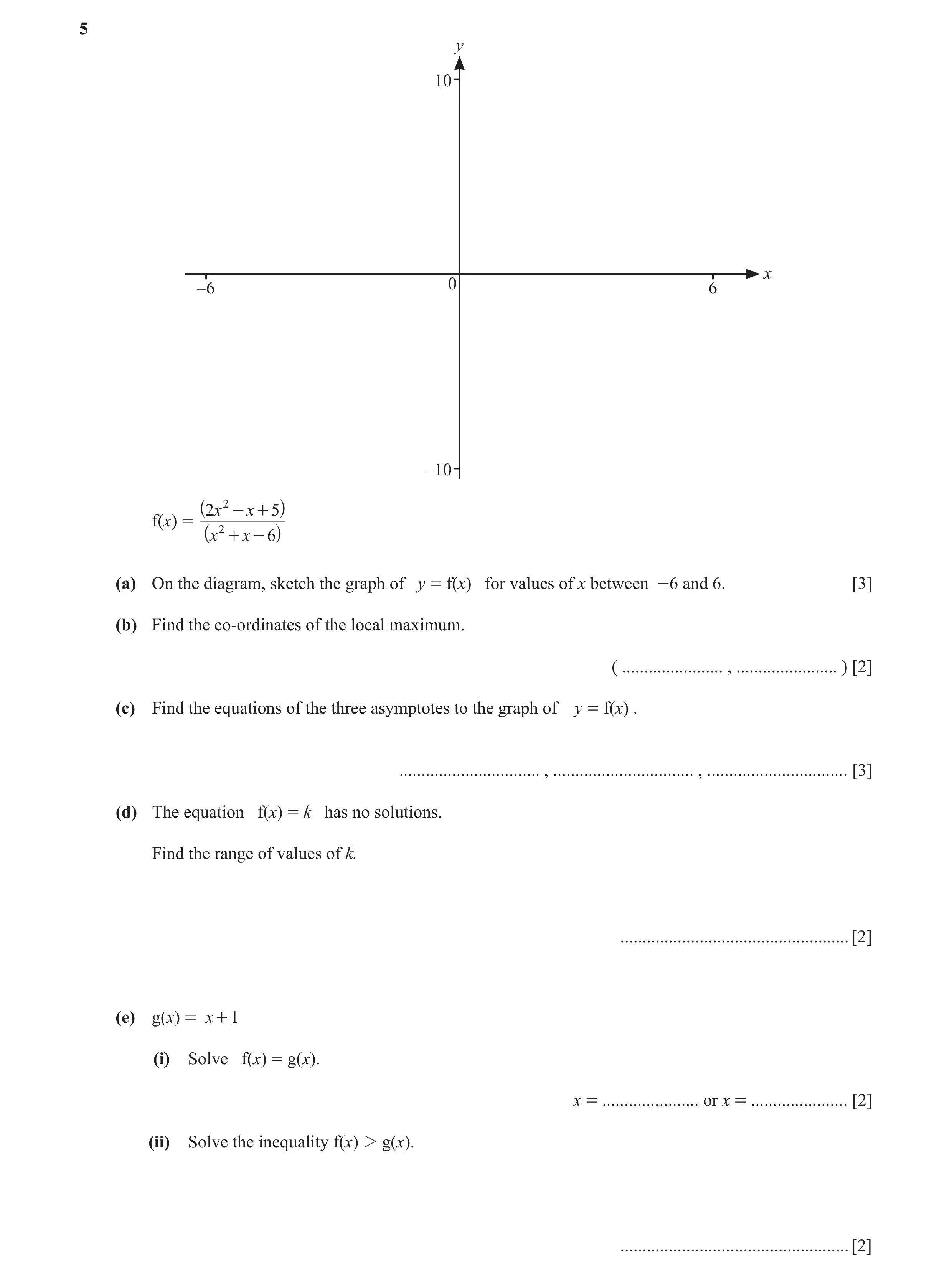 3 / 24
![Question 4: y 15 x –6 0 6 –10 (2x - 3) f (x) = (x + 2) (a) On the diagram, sketch the graph of y = f(x) for values of x between -6 and 6. [3] (b) Write…](https://img.pastlit.com/crops/f087cf99-e494-4936-a76c-139454080cf6/q12.webp) 4 / 24
4 / 24![Question 5: y 6 –2 0 7 x –6 (x + 2) f (x) = (x - 1)(x - 4) (a) On the diagram, sketch the graph of y = f ( x) for values of x between -2 and 7. [3] (b)…](https://img.pastlit.com/crops/73ce2179-1507-4170-9646-3503f51b9597/q11.webp) 5 / 24
5 / 24![Question 6: y 3 0 x 5 x + 1 (a) On the diagram, sketch the graph of y = log for 0 1 x G 5 . [2] b x l x + 1 (b) Write down the equations of the asympto…](https://img.pastlit.com/crops/ed013b83-cad4-487f-b363-27664282279b/q2.webp) 6 / 24
6 / 24![Question 7: y 4 x –3 0 3 –4 (a) On the diagram, sketch the graph of y = f ( x), where 1 f (x) = for values of x between - 3 and 3. x (x - 1)(x + 1) [4]…](https://img.pastlit.com/crops/4753797a-683d-4d64-9050-854c4b4a6bf7/q12.webp) 7 / 24
7 / 24![Question 8: y 8 x –8 0 8 –8 3x + 2 f (x) = (x + 2)(x - 3) (a) On the diagram, sketch the graph of y = f ( x) for values of x between - 8 and 8. [3] (b)…](https://img.pastlit.com/crops/89141344-e270-4675-8984-1bad38442a79/q12.webp) 8 / 24
8 / 24![Question 9: y 5 – 1.5 0 1.5 x – 5 3 1 f ( )x = x - x (a) On the diagram, sketch the graph of y = f ( x) , for values of x between - .15 and 1.5 . [3] (…](https://img.pastlit.com/crops/e81a60cd-c2ce-4efd-b2f5-64632c266bcc/q7.webp) 9 / 24
9 / 24![Question 10: y 13 – 4 0 3 x – 3 1 g ( )x = , x ! 2 x - 2 (a) On the diagram, sketch the graph of y = g(x) for values of x between - 4 and 3. [3] (b) Wri…](https://img.pastlit.com/crops/96f86af9-b117-4d29-a973-9cdd9773b93a/q7.webp) 10 / 24
10 / 24![Question 11: y 5 – 5 0 5 x – 5 x 2 + 3 f ( x) = ( 1 - x)( x + 3) (a) On the diagram, sketch the graph of y = f(x) for values of x between -5 and 5. [3] …](https://img.pastlit.com/crops/694f5ff6-d7ee-42a5-b05a-9e23dd2b52bf/q13.webp) 11 / 24
11 / 24![Question 12: y 5 – 3 0 1 x – 5 1 f ( x) = 2 x + 4 - 2 x (a) On the diagram, sketch the graph of y = f ( x) for values of x between - 3 and 1. [3] (b) Wr…](https://img.pastlit.com/crops/96b06246-de38-4446-9003-fdaf39ad4eaa/q3.webp) 12 / 24
12 / 24![Question 13: y 4 x 0 –1 5 – 4 (a) On the diagram, sketch the graph of y = f ( x) , where 1 f ( x) = for values of x between - 1 and 5. [3] ( x - 1)( x -…](https://img.pastlit.com/crops/ddd11990-a76b-48a6-b616-6e702751ea62/q5.webp) 13 / 24
13 / 24![Question 14: y 8 – 5 0 5 x – 9 5 f ( x) = x + ( x - 2)( x + 3) (a) Sketch the graph of y = f ( x) for values of x between - 5 and 5. [4] (b) Write down …](https://img.pastlit.com/crops/b12f2f85-7b1b-4ede-ac89-d2fc695d452b/q11.webp)
![Question 15: y 1 – 5 0 5 x – 3 1 1 f ( x) = - 2 x x (a) On the diagram, sketch the graph of y = f ( x) for values of x between - 5 and 5. [2] (b) Find f…](https://img.pastlit.com/crops/b1c6253c-bcbe-4c33-9614-2f00e9d25aa9/q2.webp)
![Question 16: y 5 – 5 0 5 x – 5 x 2 f ( )x = 2 - 2 x - x - 2 (a) On the diagram, sketch the graph of y = f ( x) for values of x between -5 and 5. [4] (b)…](https://img.pastlit.com/crops/450d362e-2f74-40e0-b252-9d6d341f7fcc/q6.webp) 17 / 24
17 / 24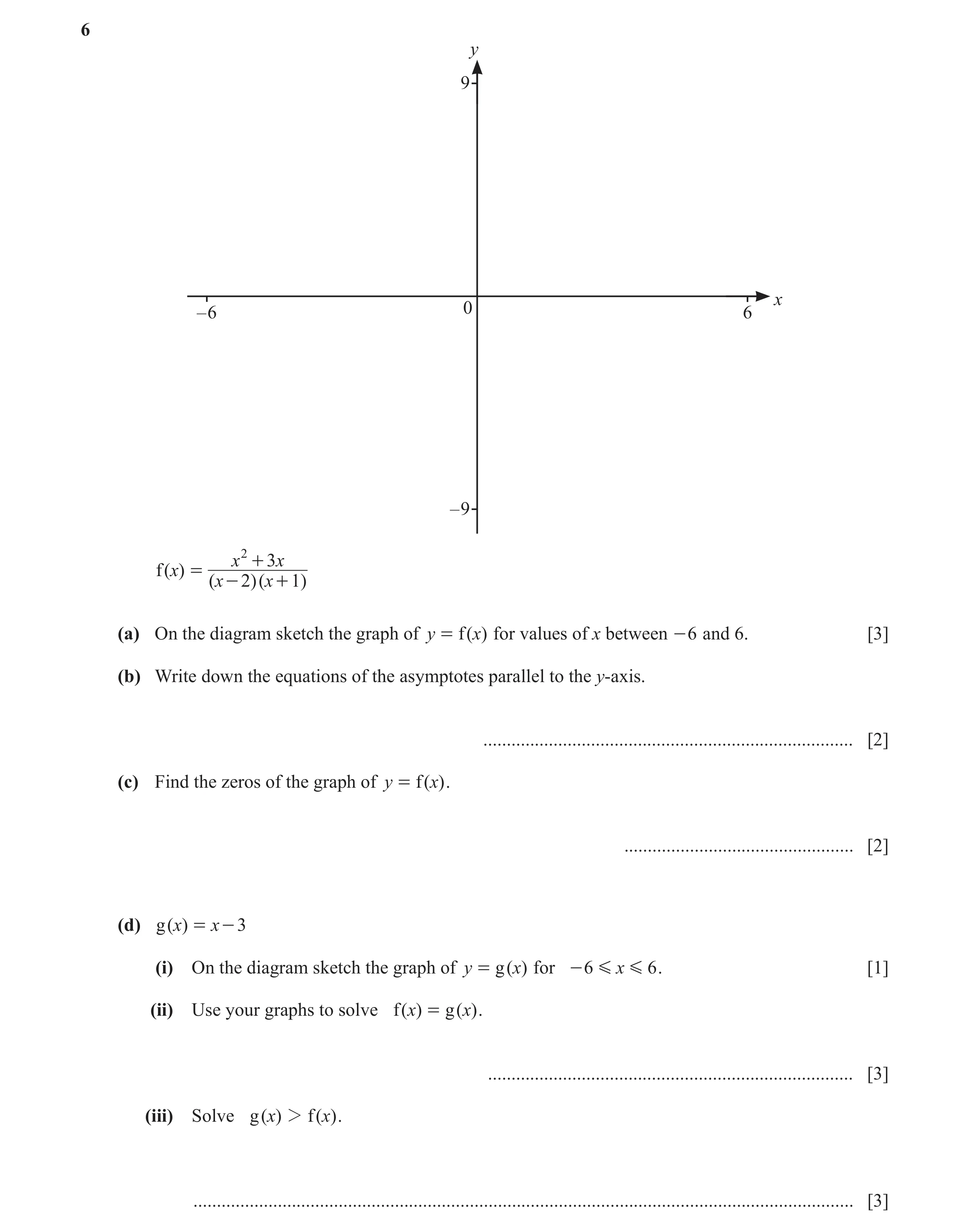 18 / 24
![Question 18: y 10 0 x 360 -10 1 f ( x) = for 0 G x G 360 sin x° (a) On the diagram, sketch the graph of y = f ( x) . [3] (b) Find the coordinates of the…](https://img.pastlit.com/crops/c7b494a4-3782-4062-b32e-b64c6d434597/q2.webp) 19 / 24
19 / 24![Question 19: y 4 x 0 -2 4 - 4 1 f ( x) = ( 2x - 3)( 2x + 1) (a) On the diagram, sketch the graph of y = f ( x) for values of x between - 2 and 4. [3] (b…](https://img.pastlit.com/crops/92343082-f18c-4d64-9a67-1b579b228ff2/q9.webp) 20 / 24
20 / 24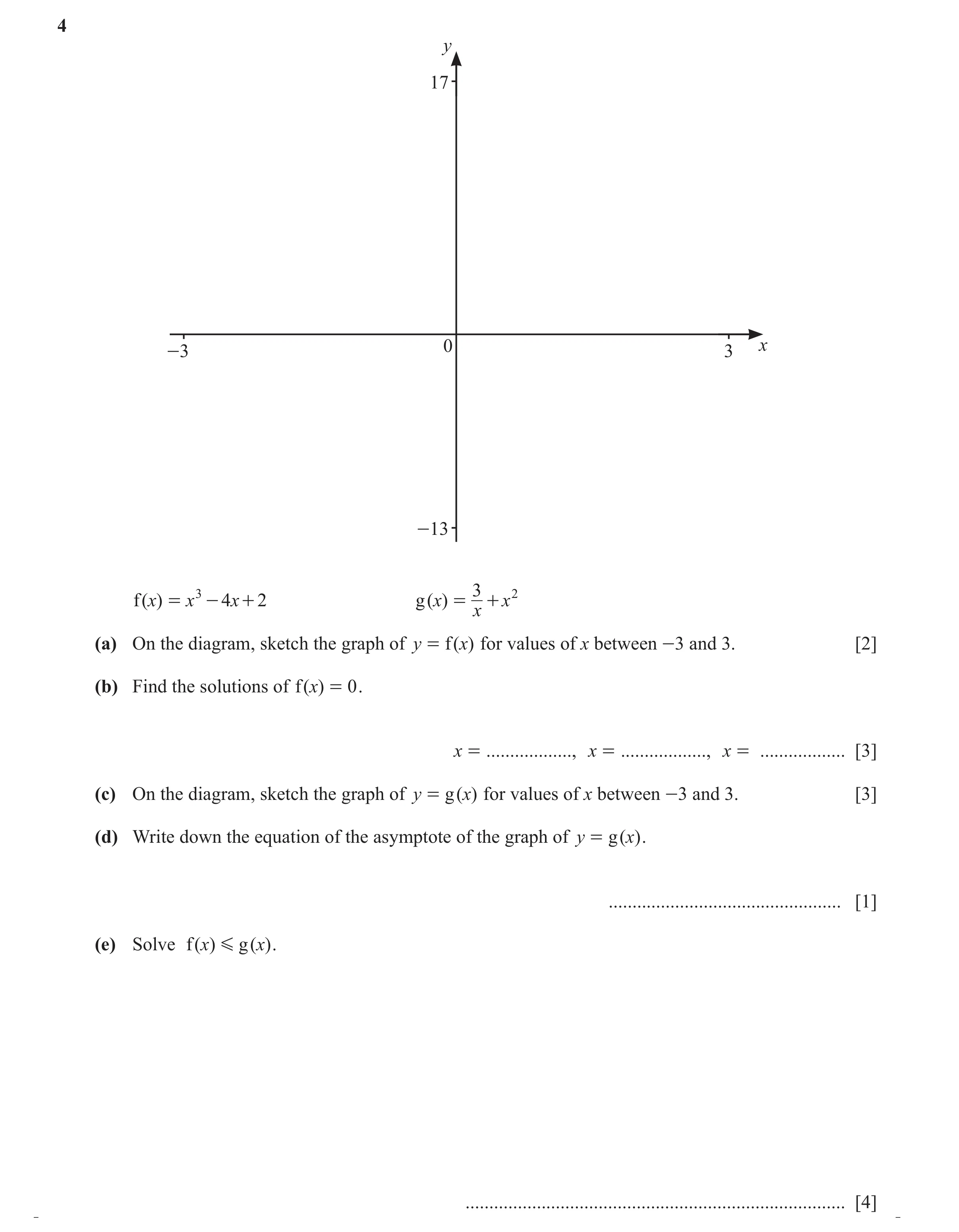 21 / 24
![Question 21: y 20 x – 10 0 10 – 20 x 3 f ( x) = ( x + 2)( x - 3) (a) Sketch the graph of y = f ( x) for values of x between -10 and 10. [3] (b) Find the…](https://img.pastlit.com/crops/77e7fd2f-200b-42e4-ace4-dee1f30059d5/q11.webp) 22 / 24
22 / 24![Question 22: y 10 – 3 0 3 x – 10 4x - 3 f ( )x = 2x + 1 (a) (i) Sketch the graph of y = f ( )x for values of x between -3 and 3. [3] (ii) Write down the…](https://img.pastlit.com/crops/7b7eea01-d789-4369-94f6-f31fa8ba3f11/q11.webp) 23 / 24
23 / 24![Question 23: y 10 x -3 0 3 -10 3 2 f ( )x = - x x (a) On the diagram, sketch the graph of y = f ( x) for values of x between -3 and 3. [3] (b) Find the …](https://img.pastlit.com/crops/765bf273-787a-48ec-b90a-815bb45442af/q8.webp) 24 / 24
24 / 24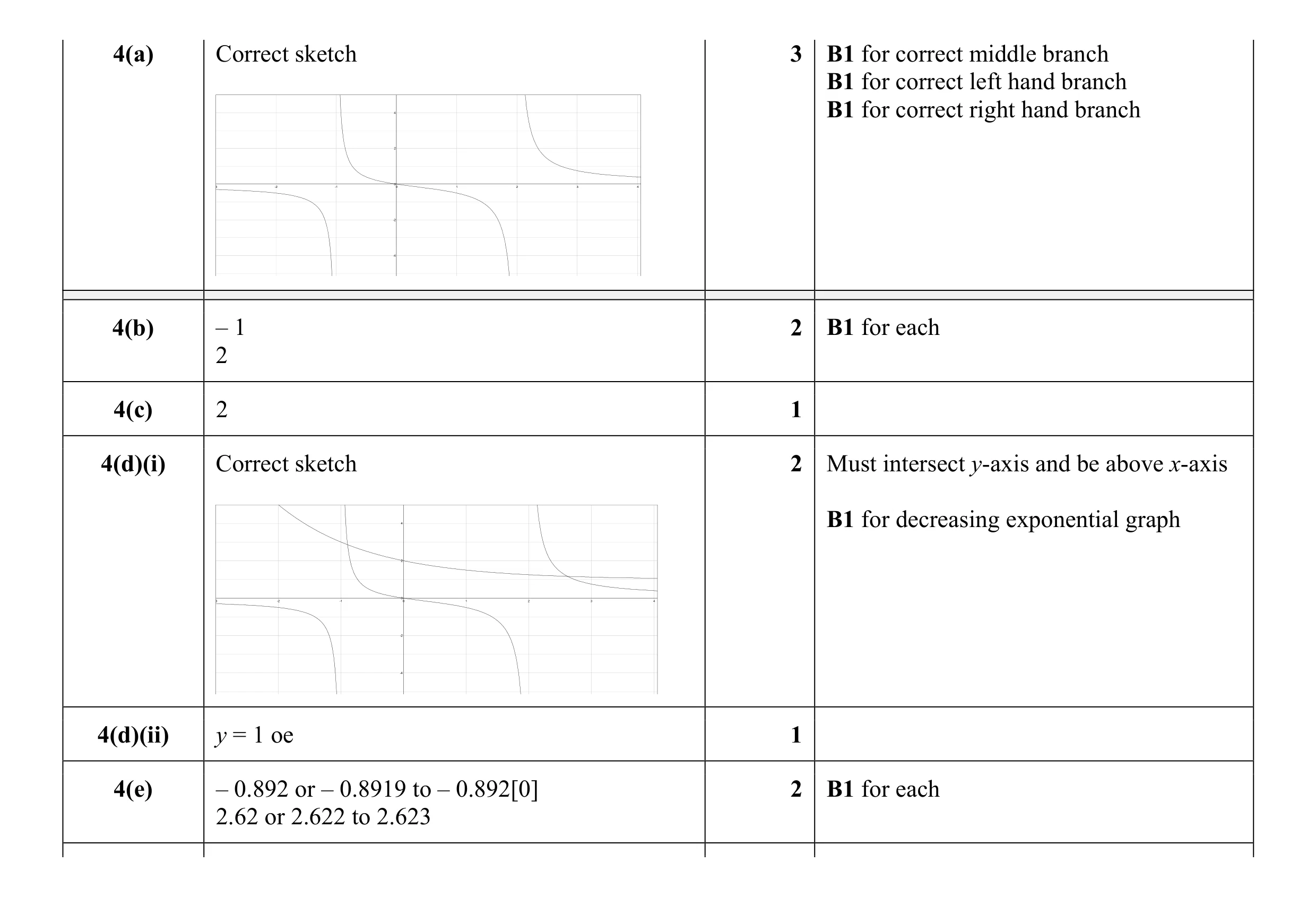 11
11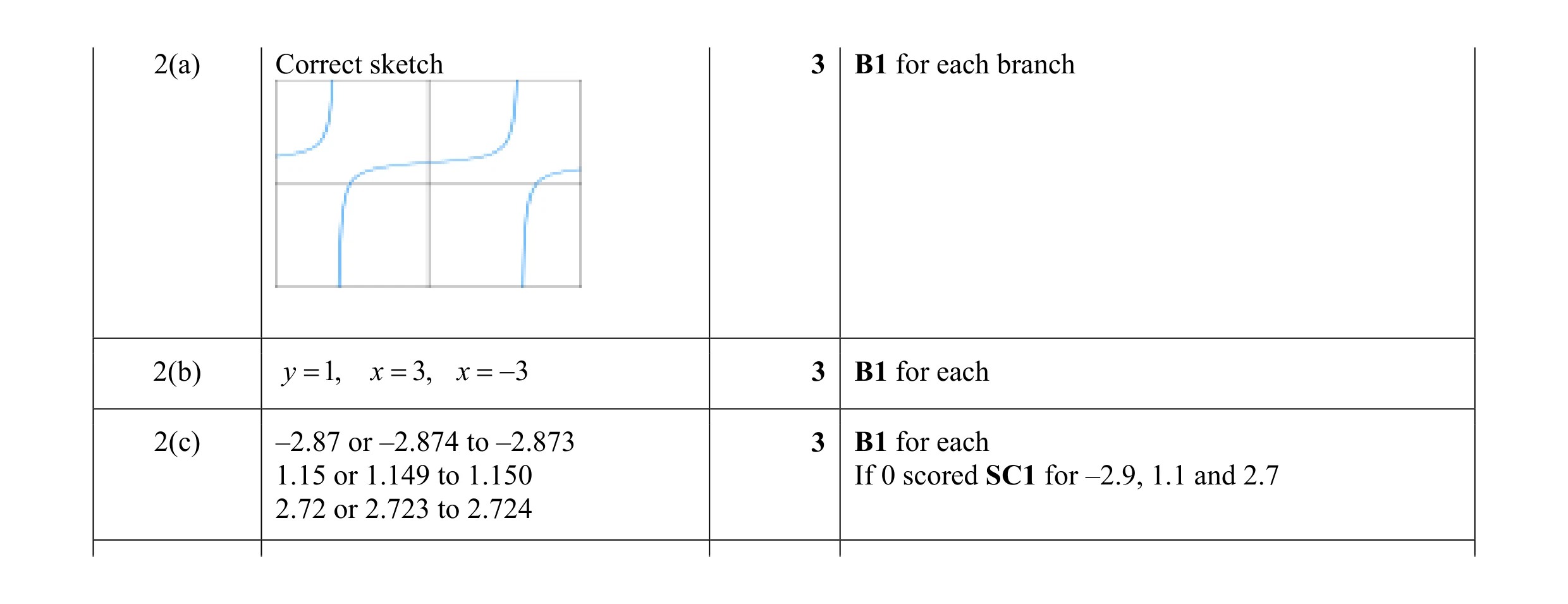 9
9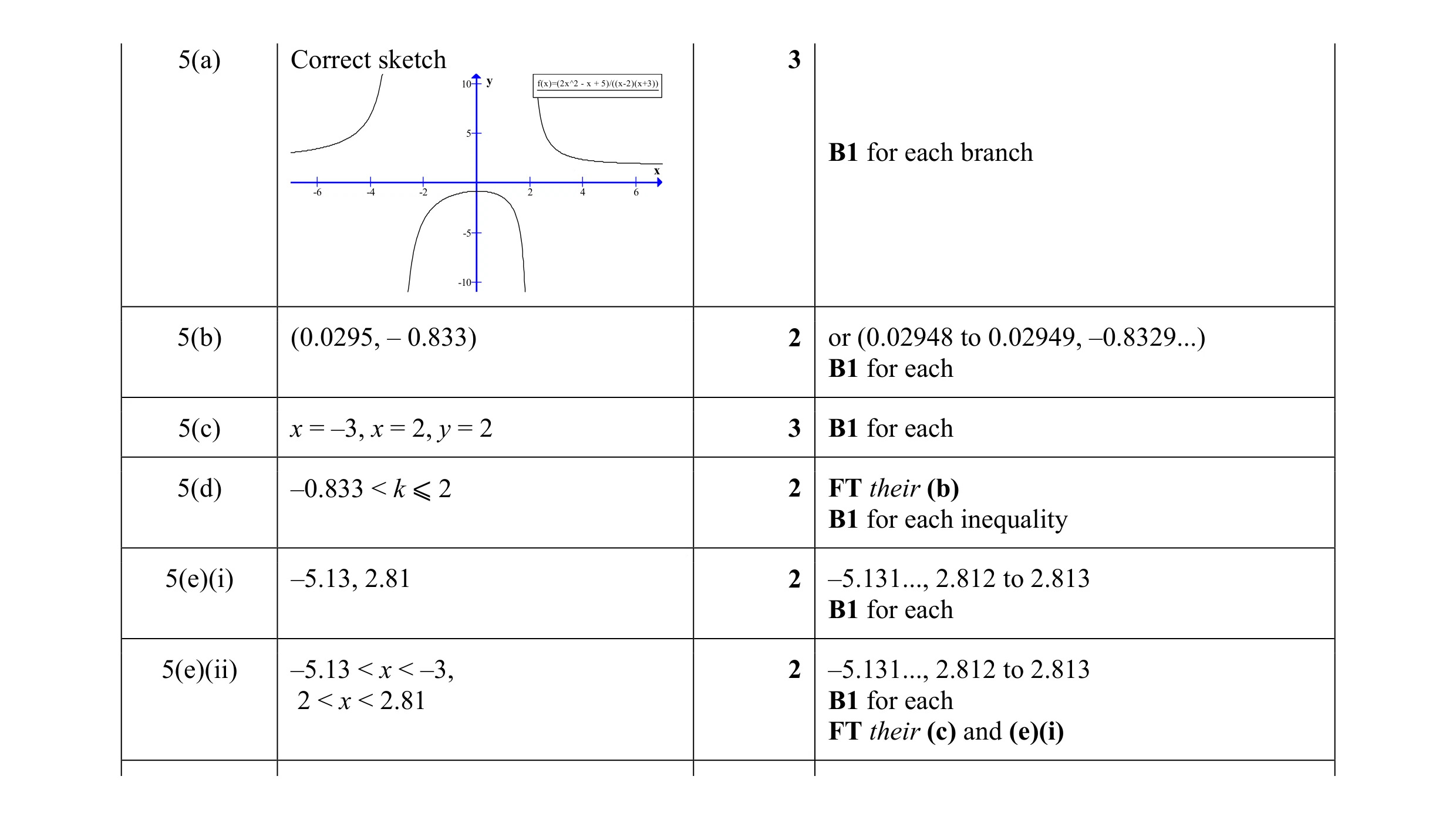 14
14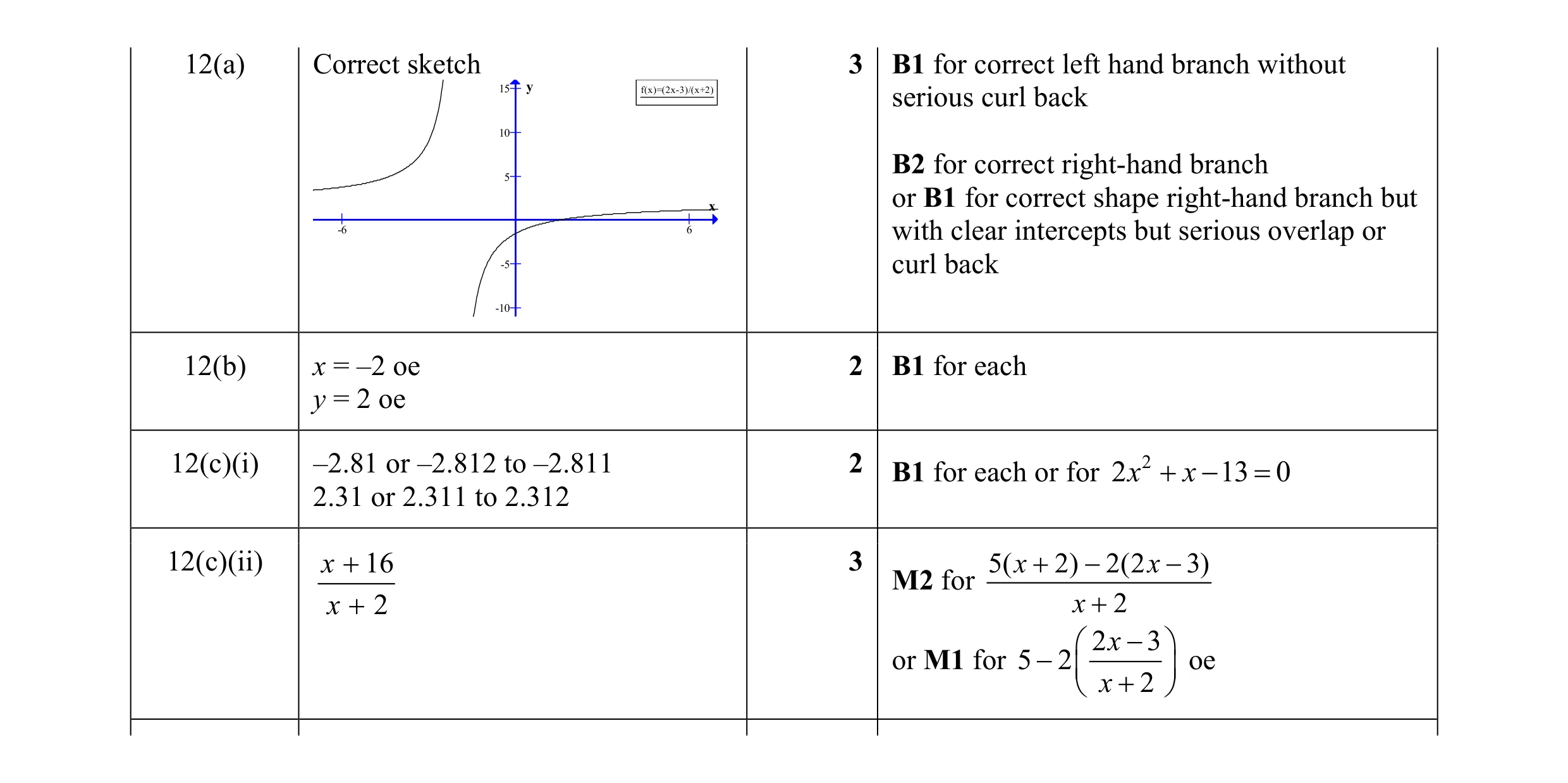 10
10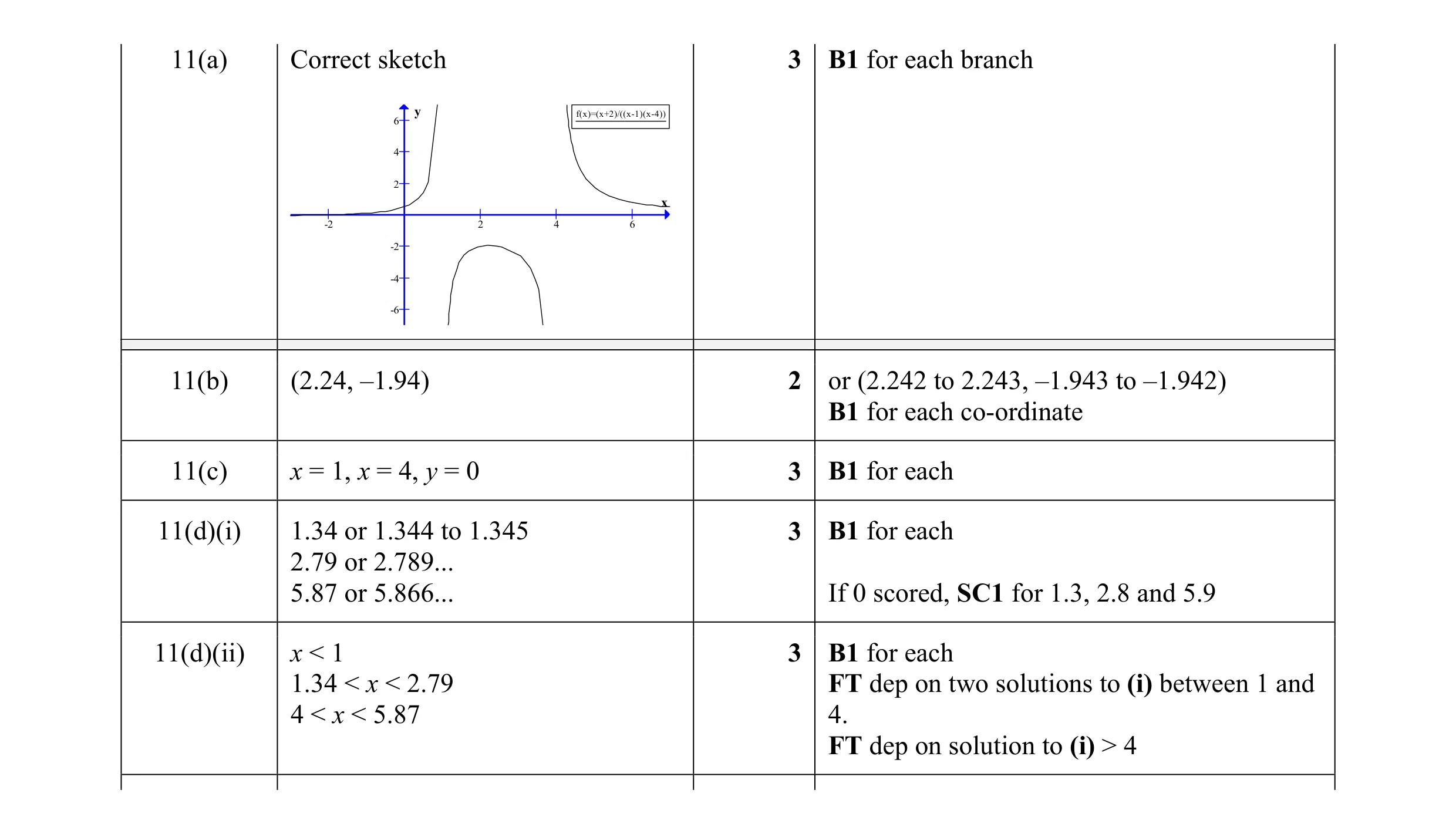 14
14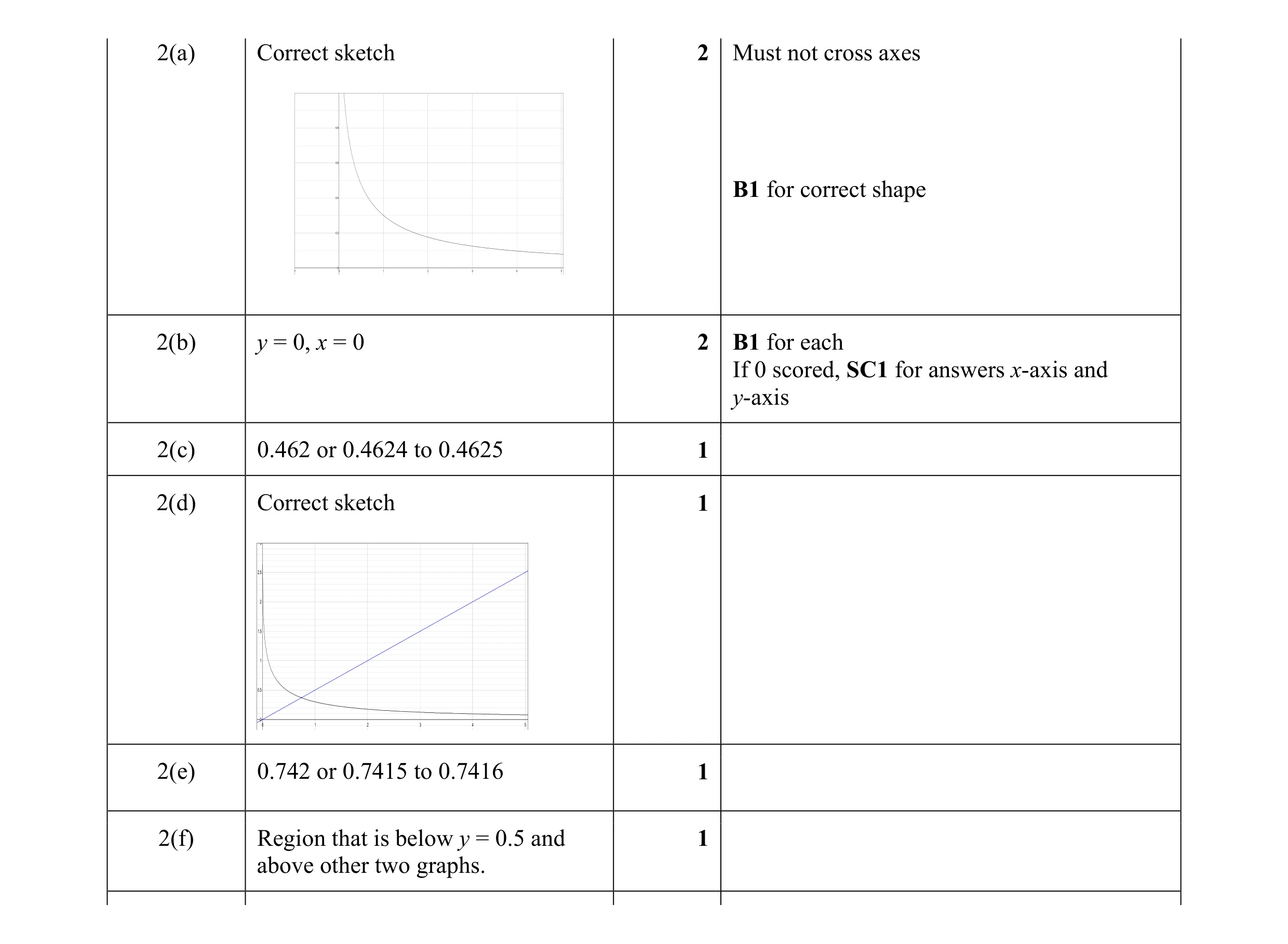 8
8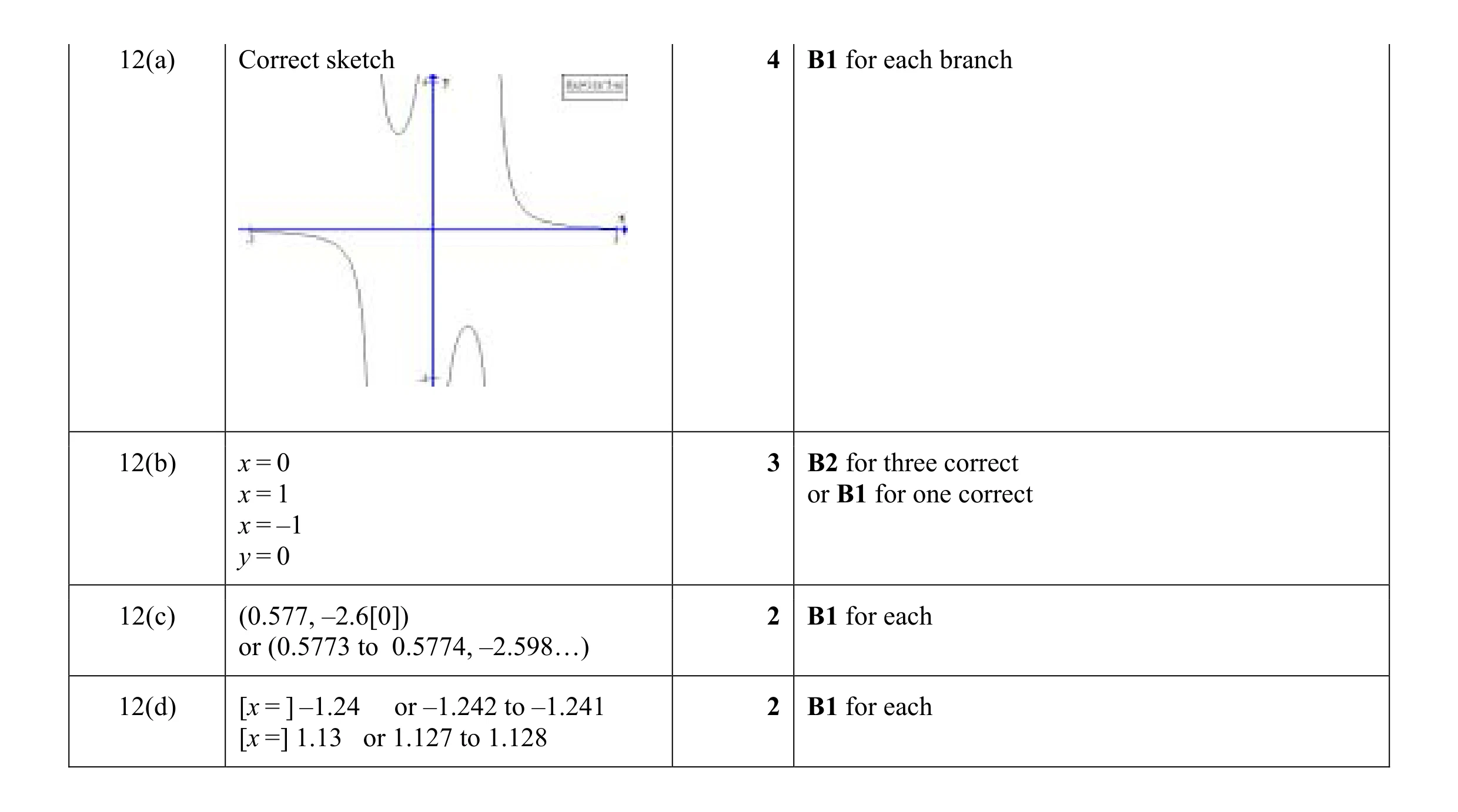 11
11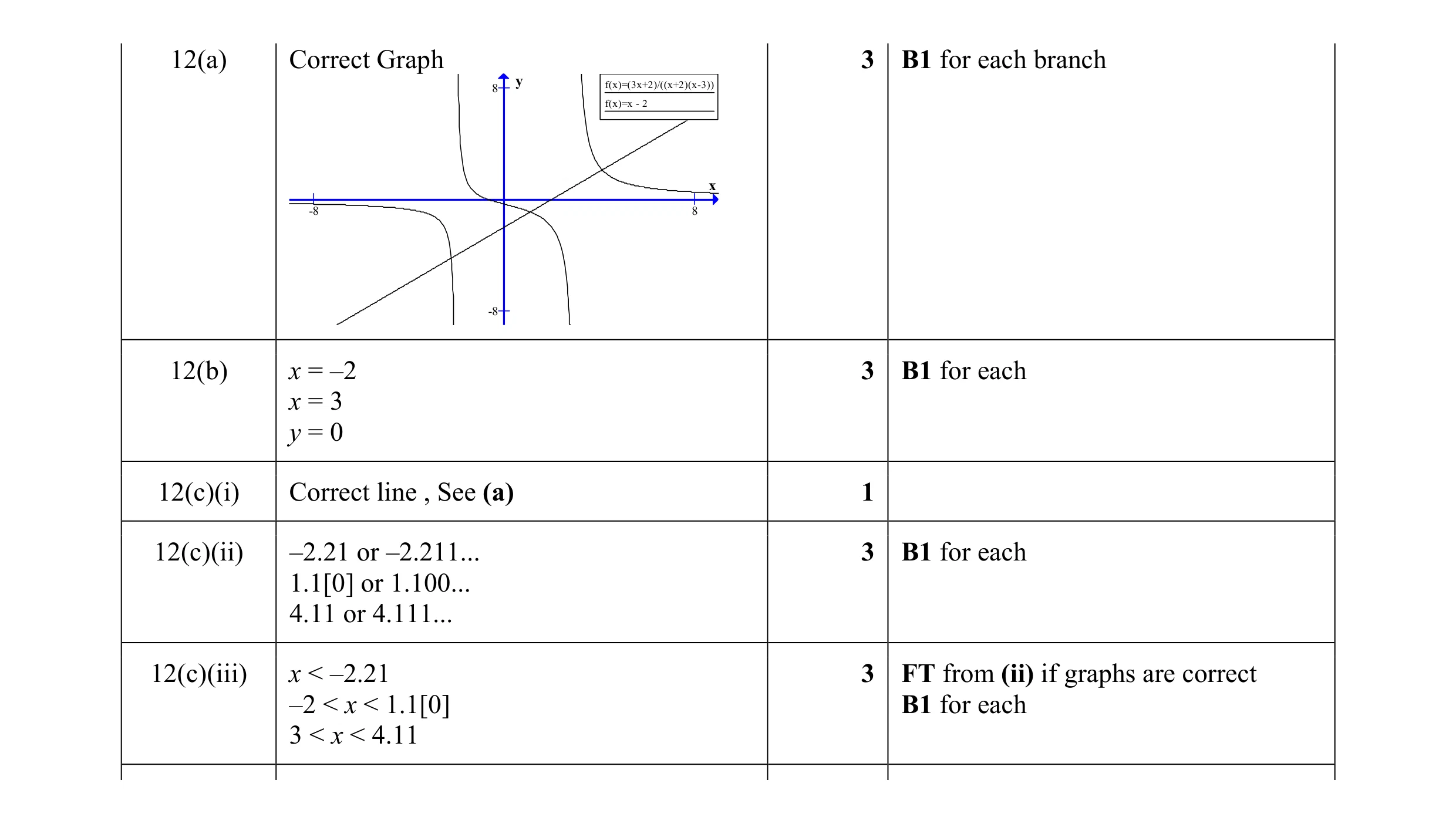 13
13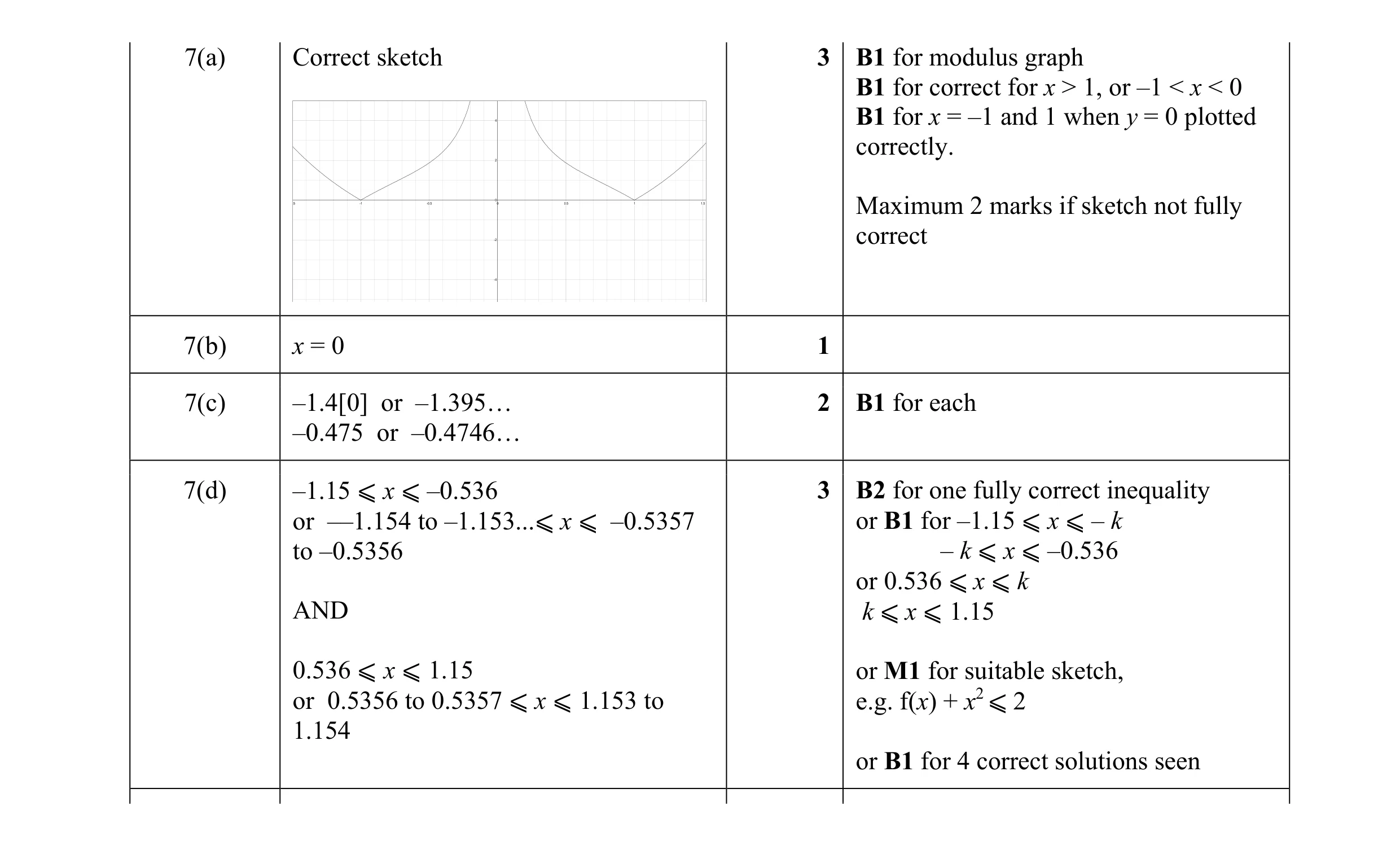 9
9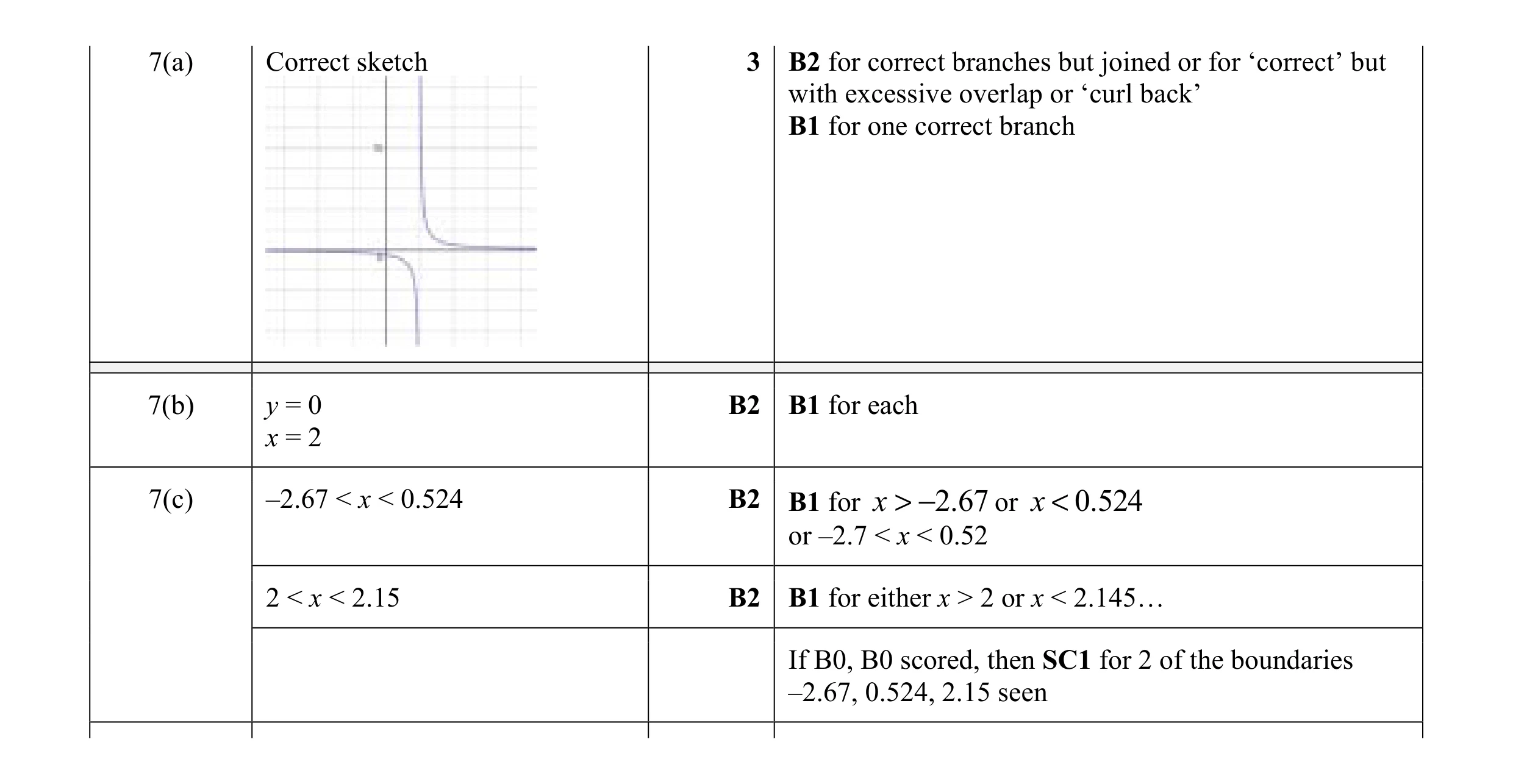 9
9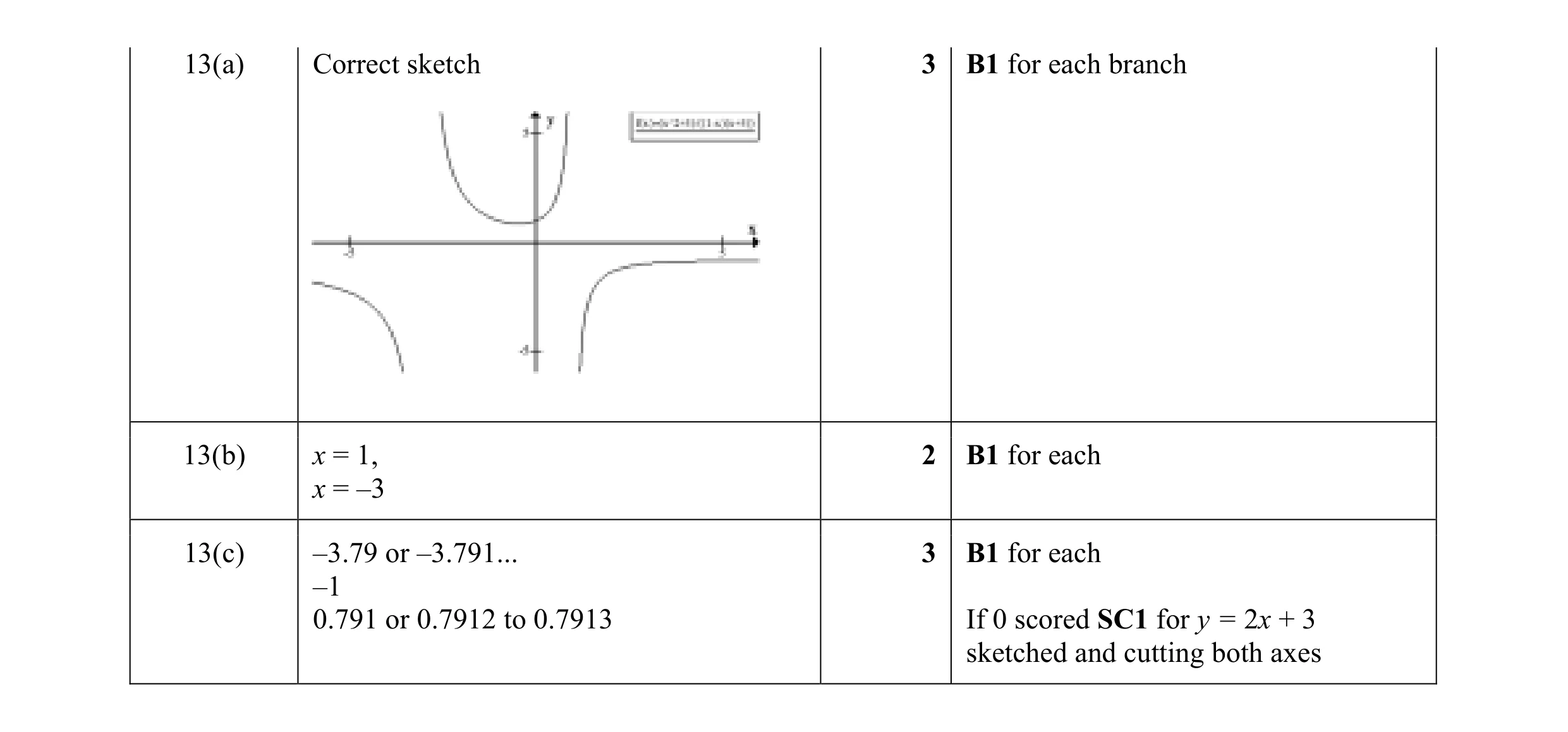 8
8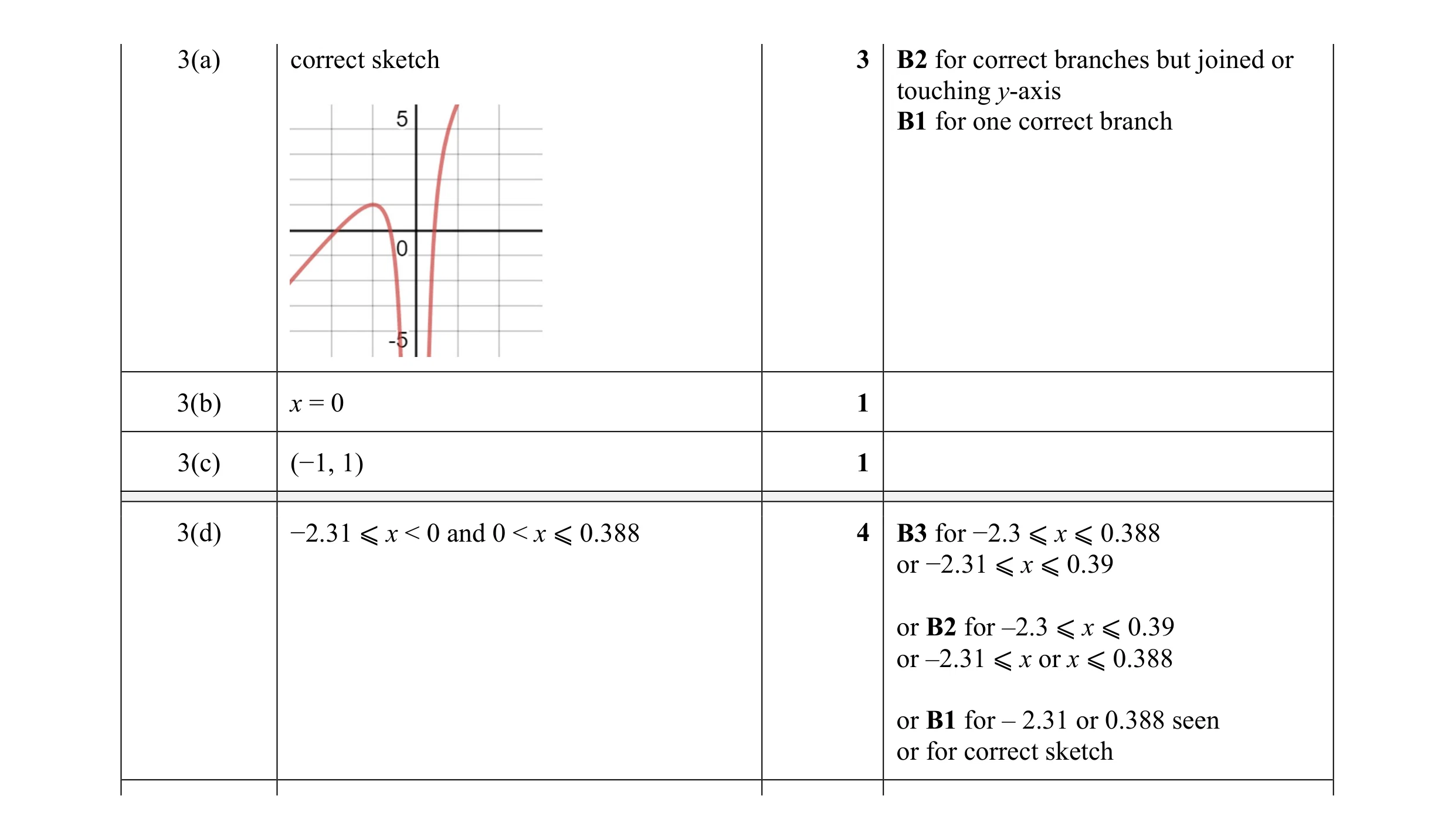 9
9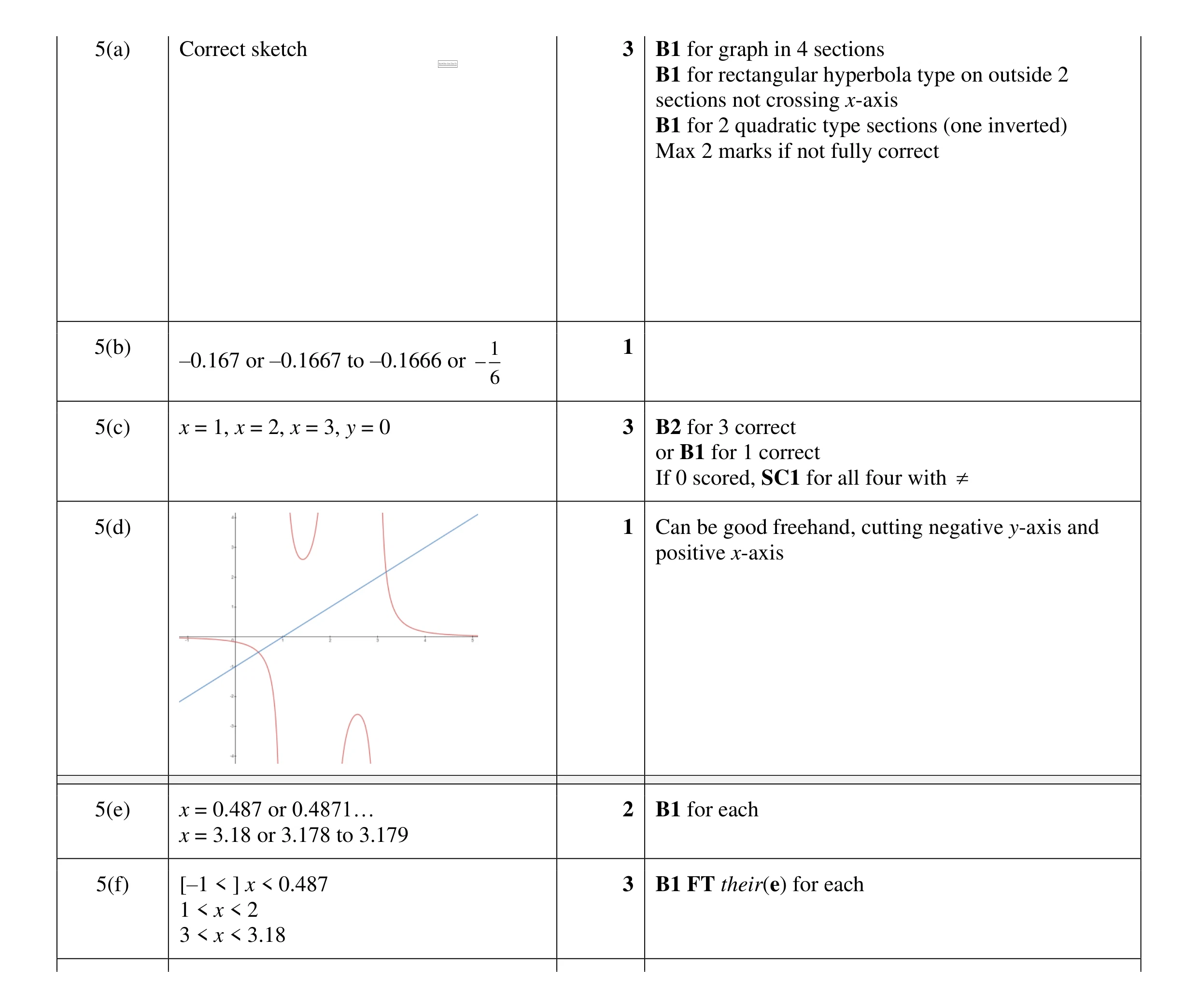 13
13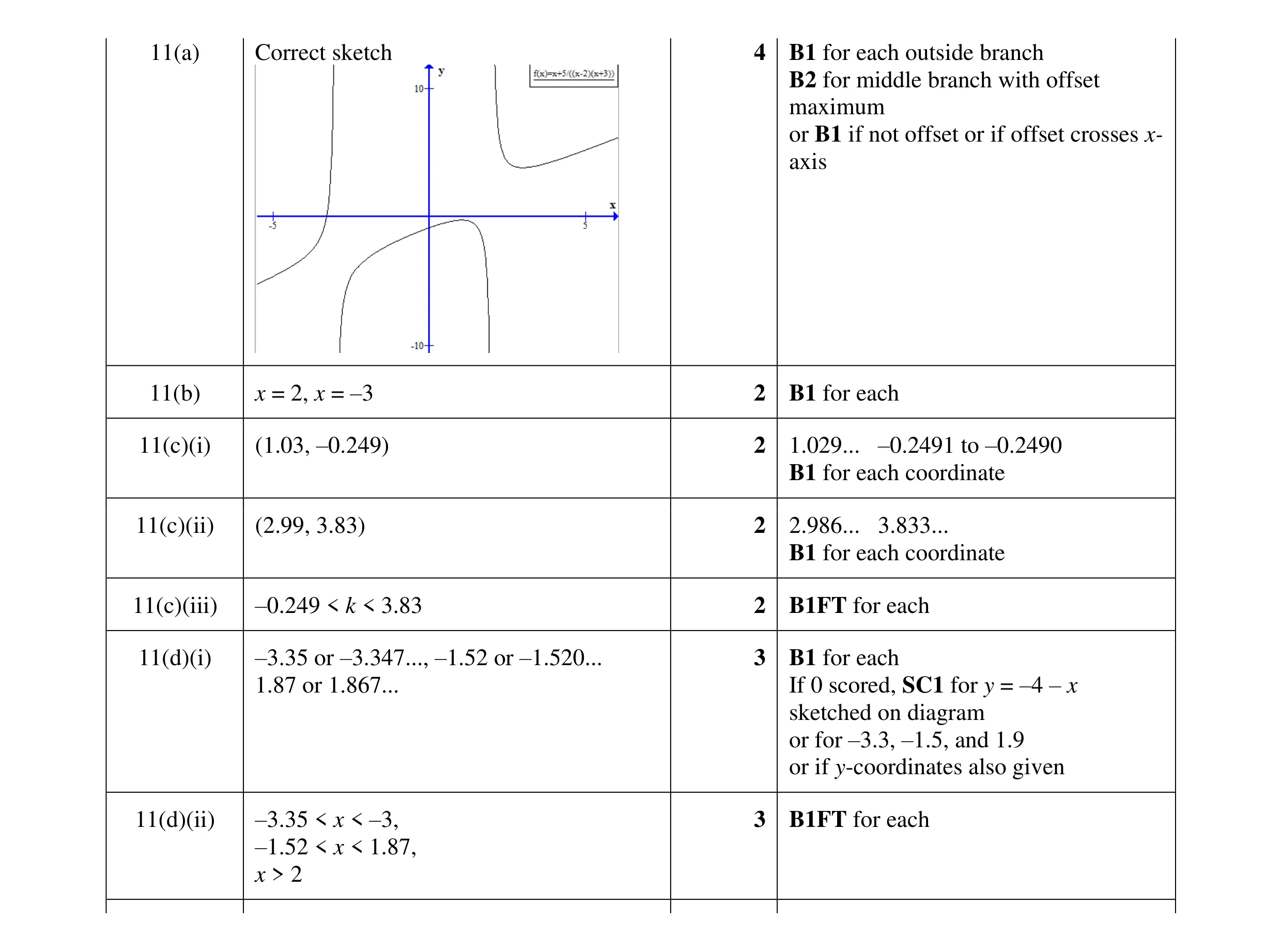 18
18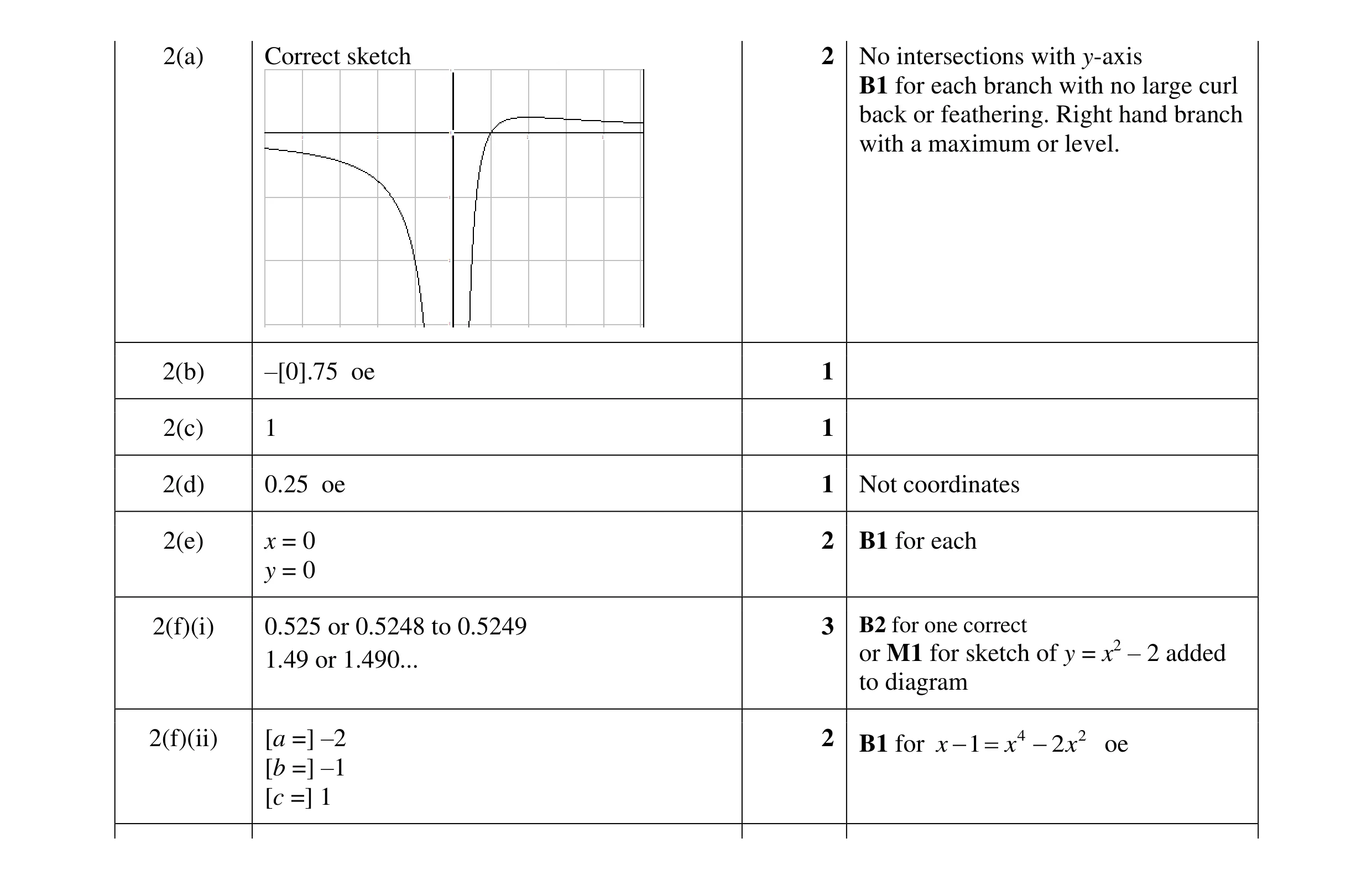 12
12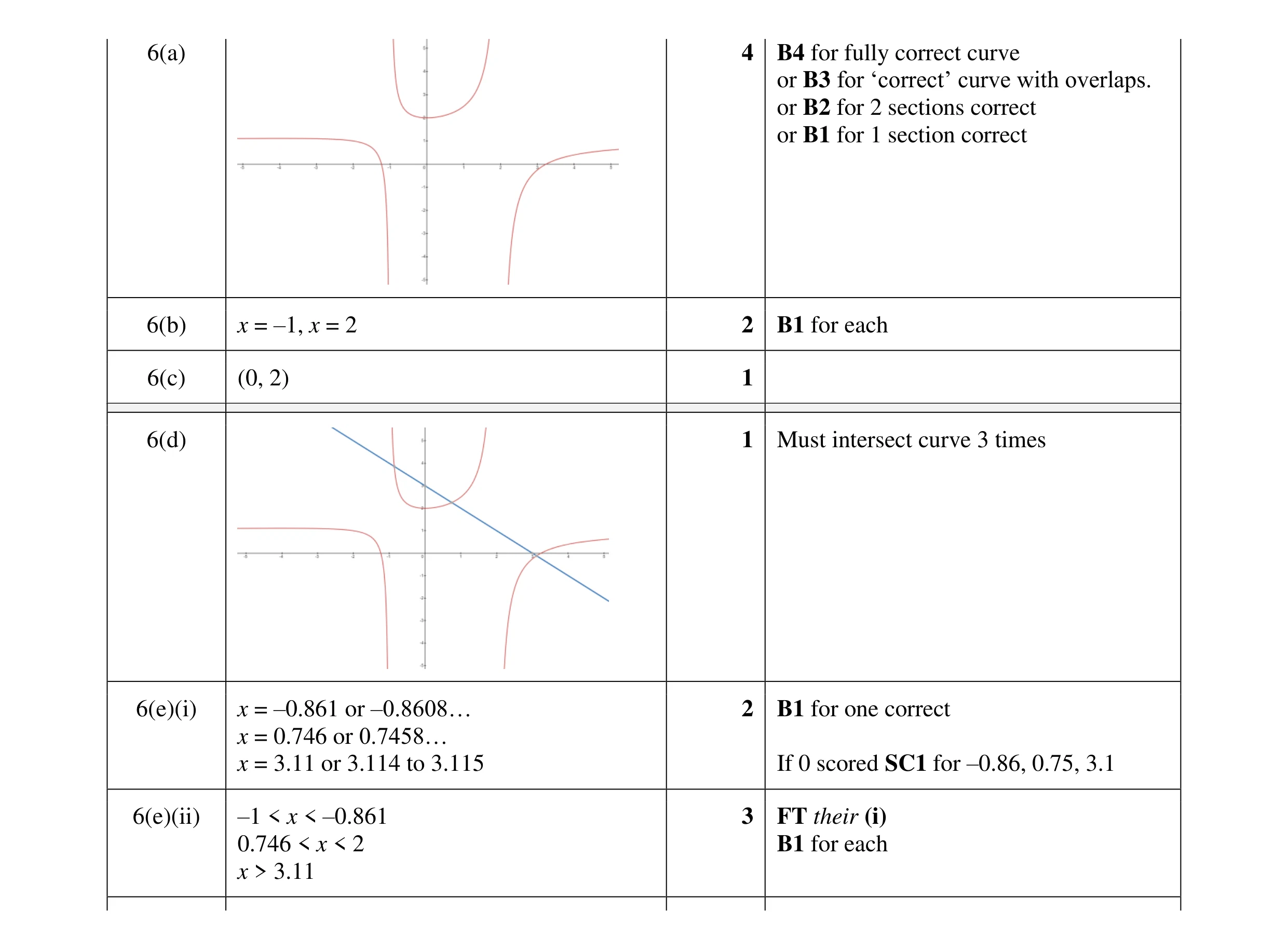 13
13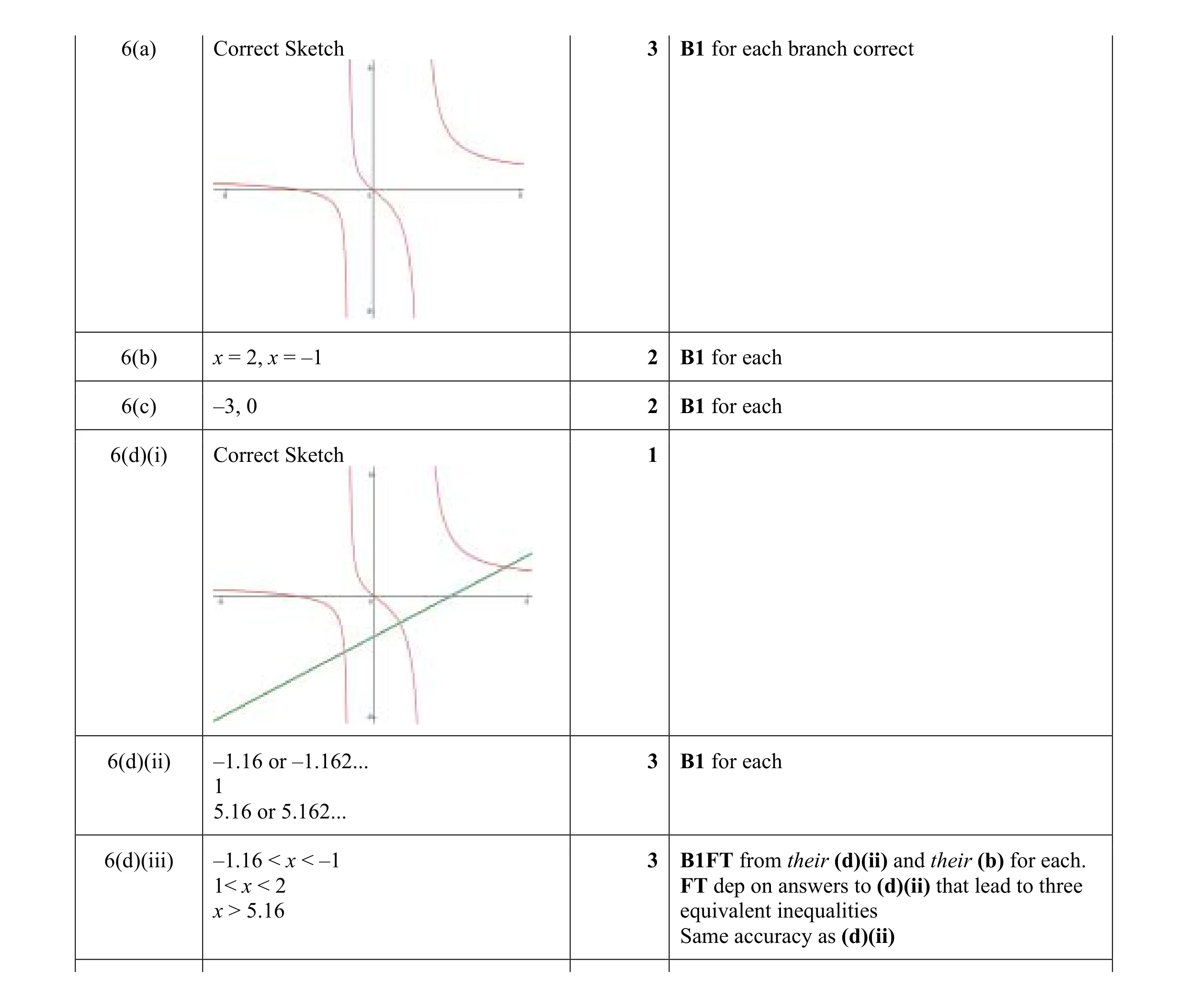 14
14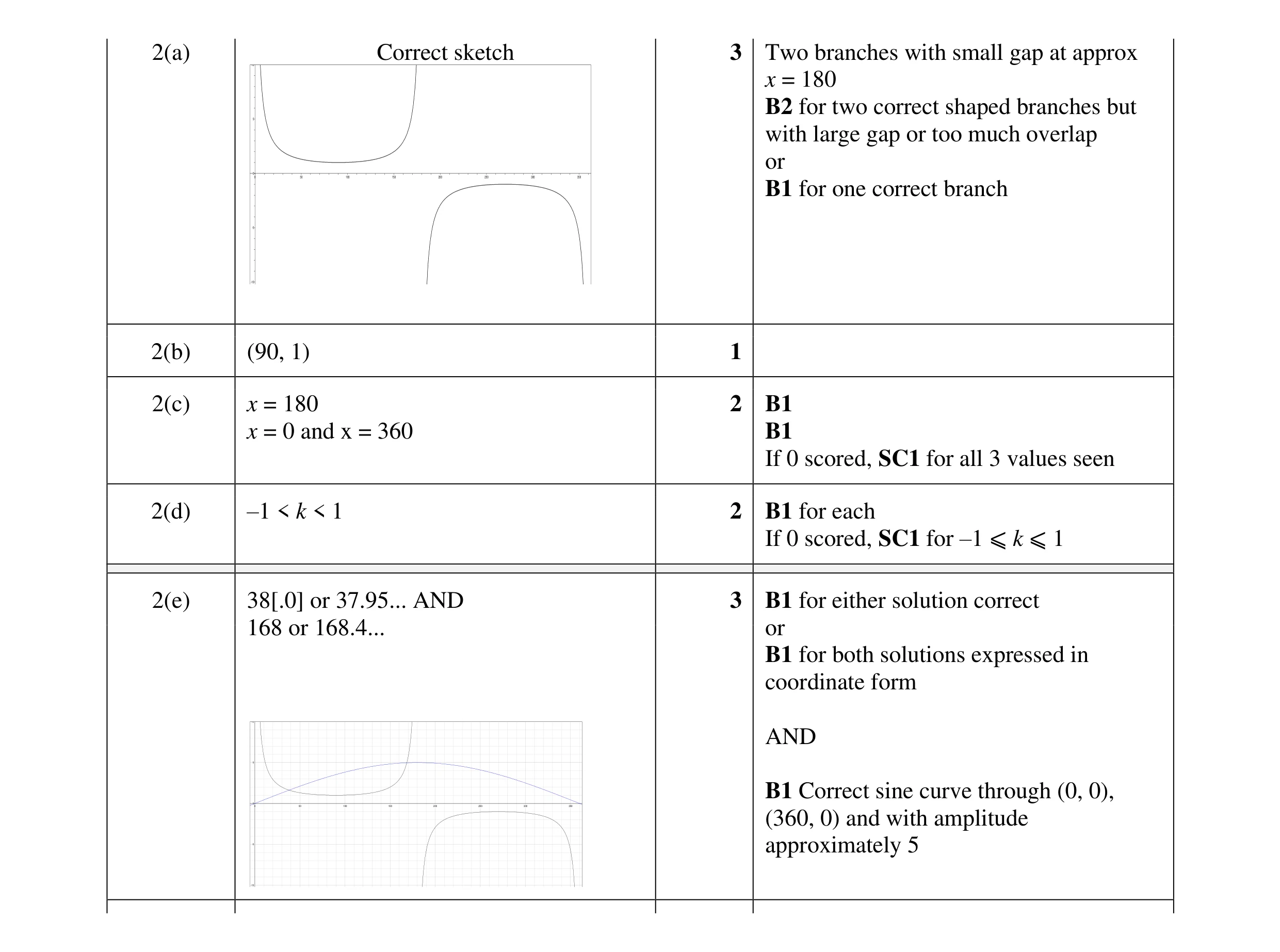 11
11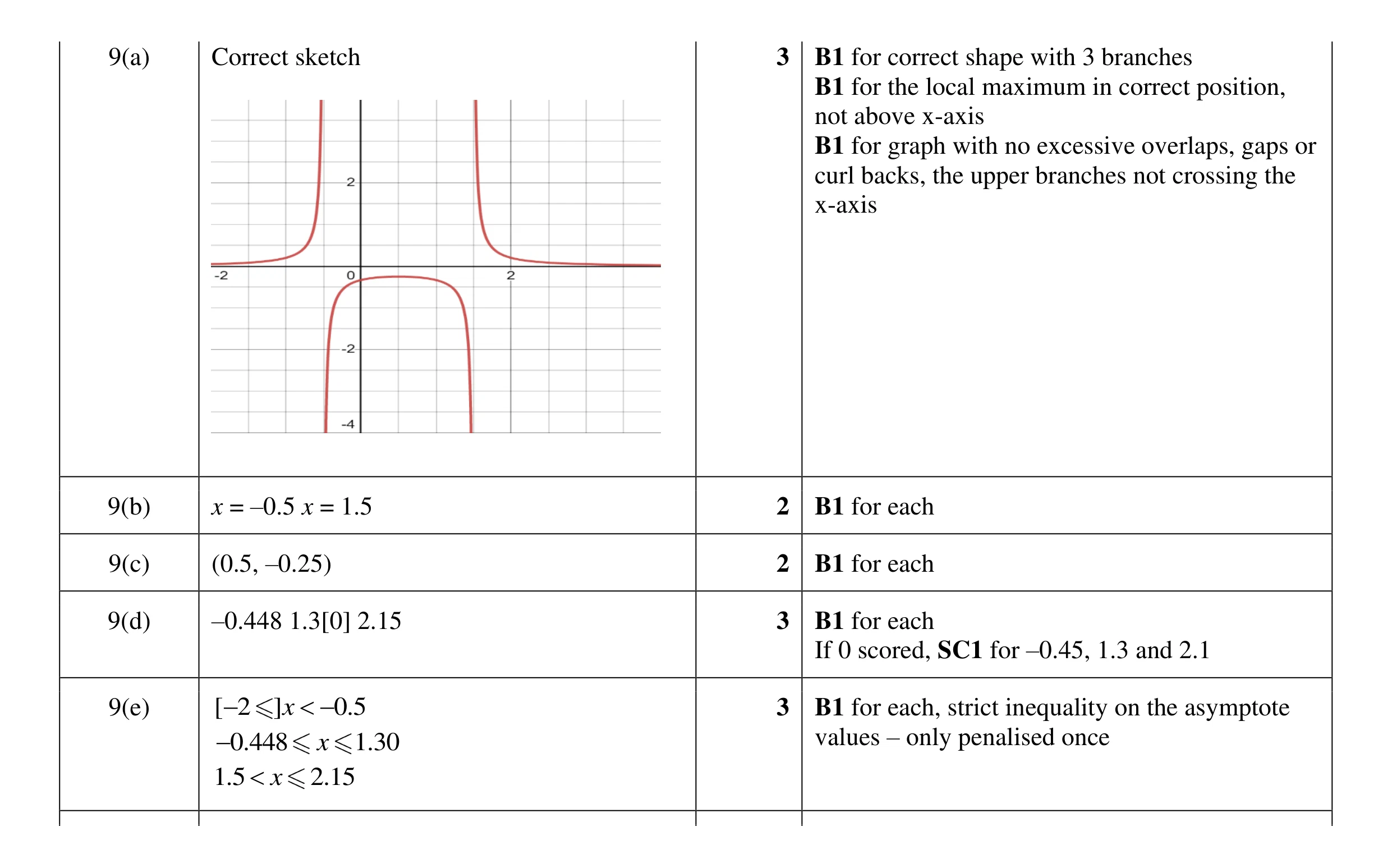 13
13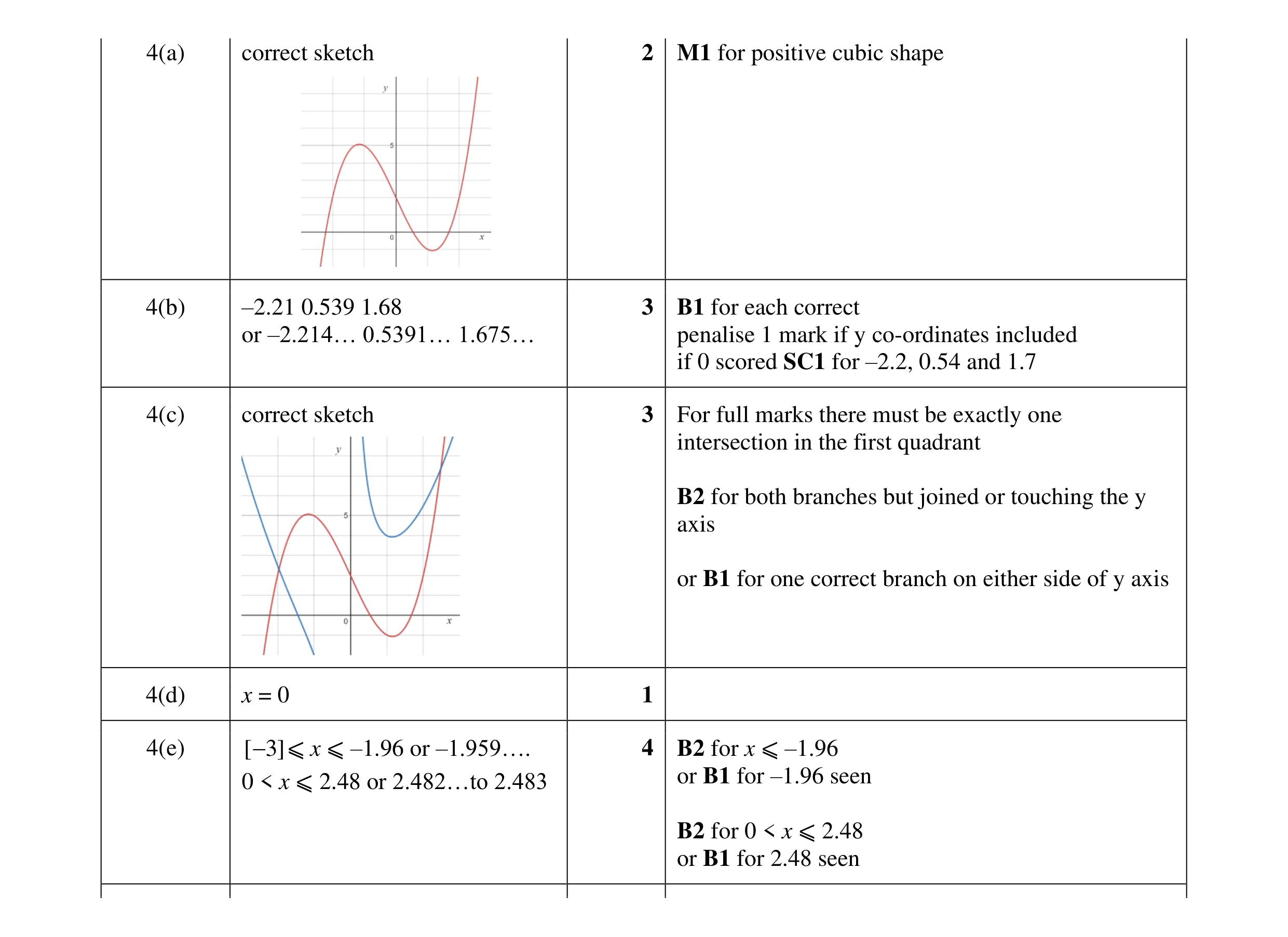 13
13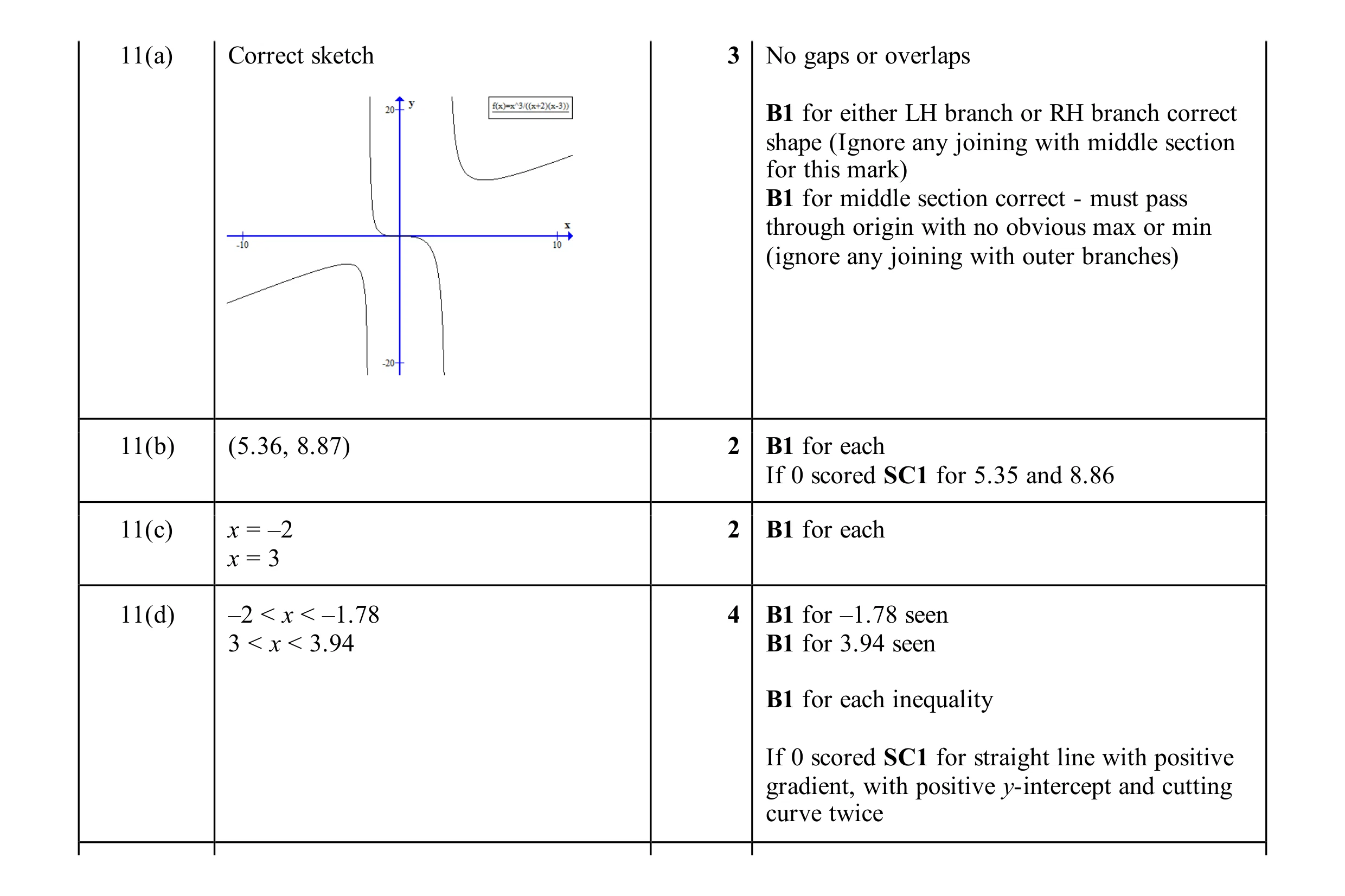 11
11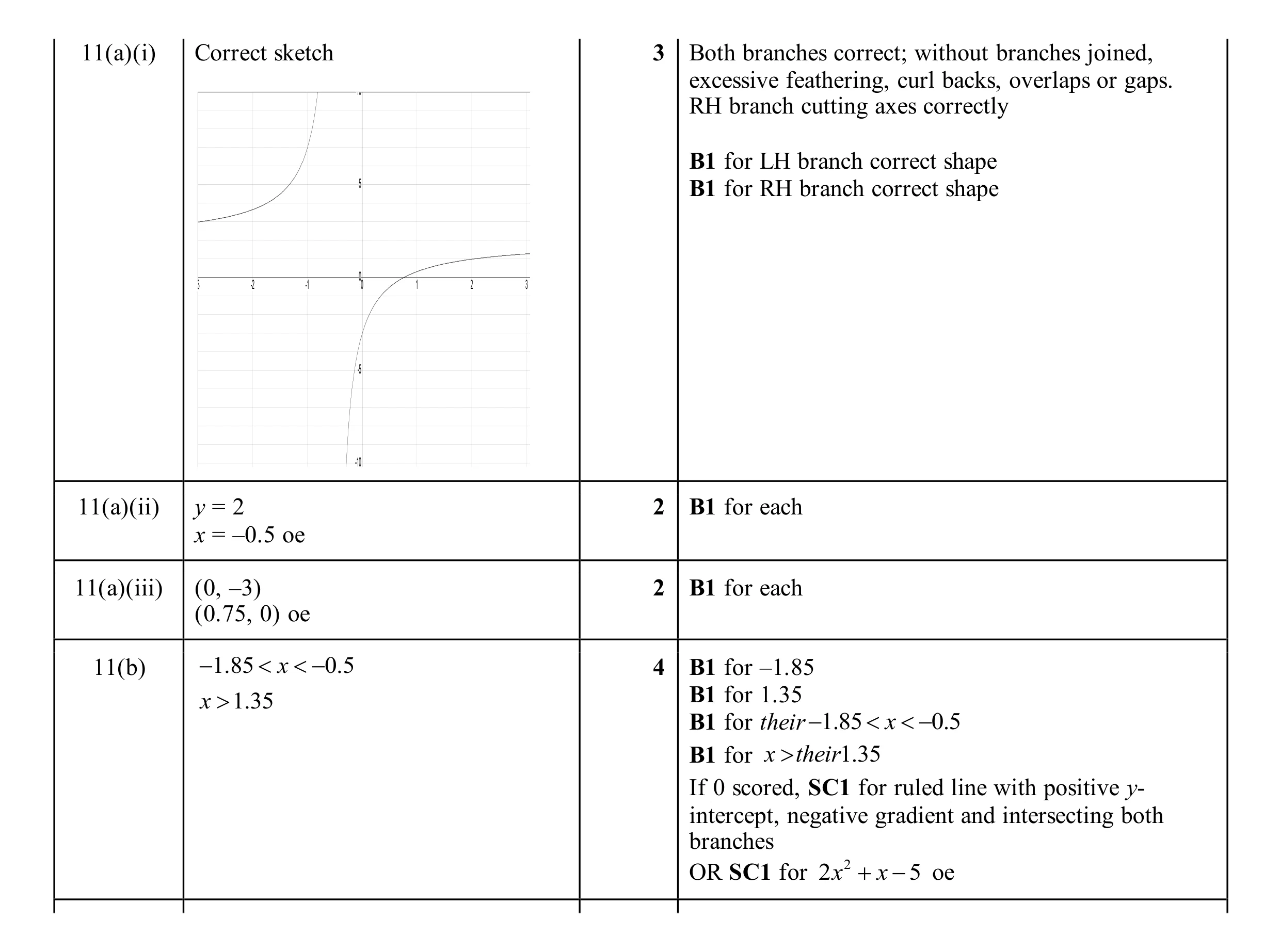 11
11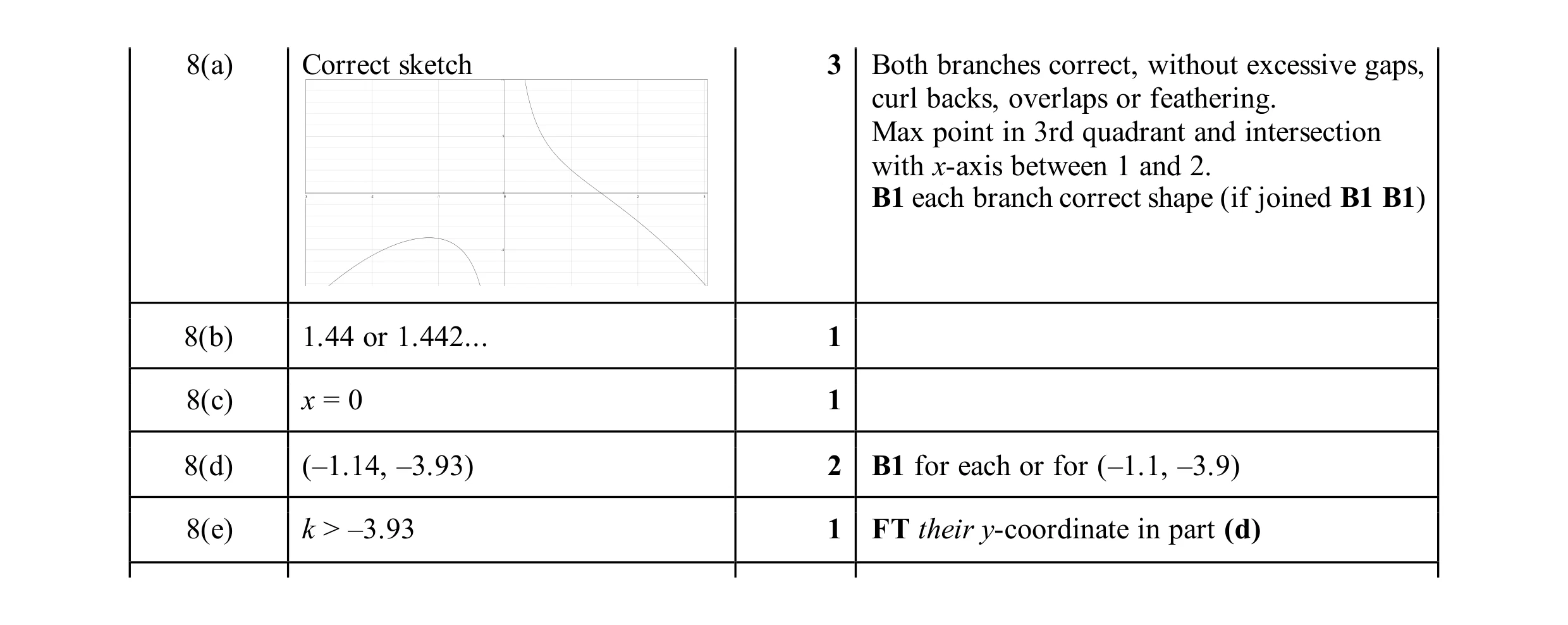 8
8