Cambridge IGCSE Mathematics - International 0607 — 2018 May/June Paper 4 · Variant 3
0607/43/M/J/18 · 12 questions · 120 marks · ≈135 min
The question paper and its mark scheme, free to read here and free to download. This is Cambridge’s own paper, exactly as it was sat.
Question paper20 pages
Mark scheme8 pages
Answers below. Sit the paper first if you are practising.
Questions as text
Question 1
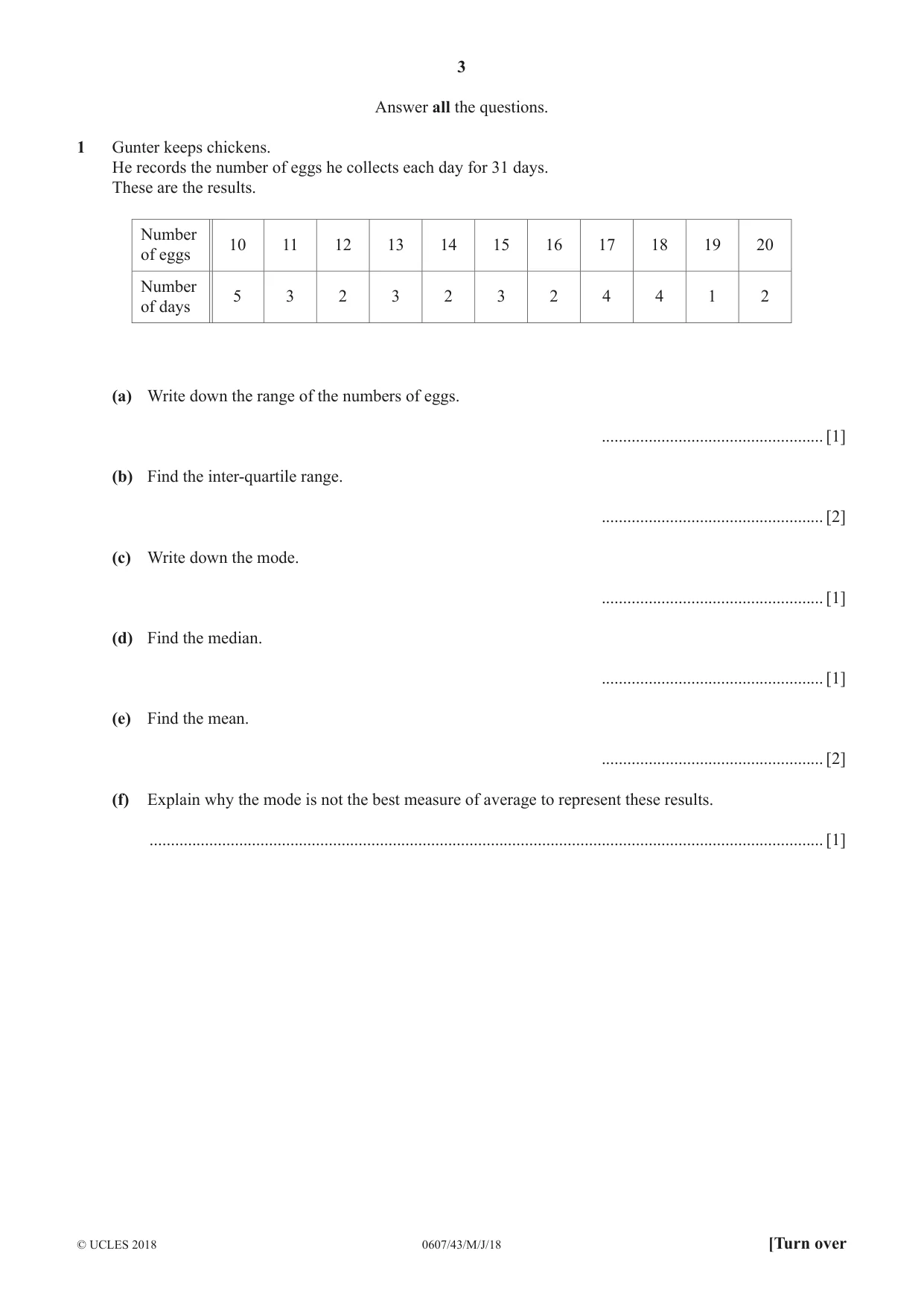
1 Gunter keeps chickens. He records the number of eggs he collects each day for 31 days. These are the results. Number 10 11 12 13 14 15 16 17 18 19 20 of eggs Number 5 3 2 3 2 3 2 4 4 1 2 of days (a) Write down the range of the numbers of eggs. .................................................... [1] (b) Find the inter-quartile range. .................................................... [2] (c) Write down the mode. .................................................... [1] (d) Find the median. .................................................... [1] (e) Find the mean. .................................................... [2] (f) Explain why the mode is not the best measure of average to represent these results. .............................................................................................................................................................. [1]
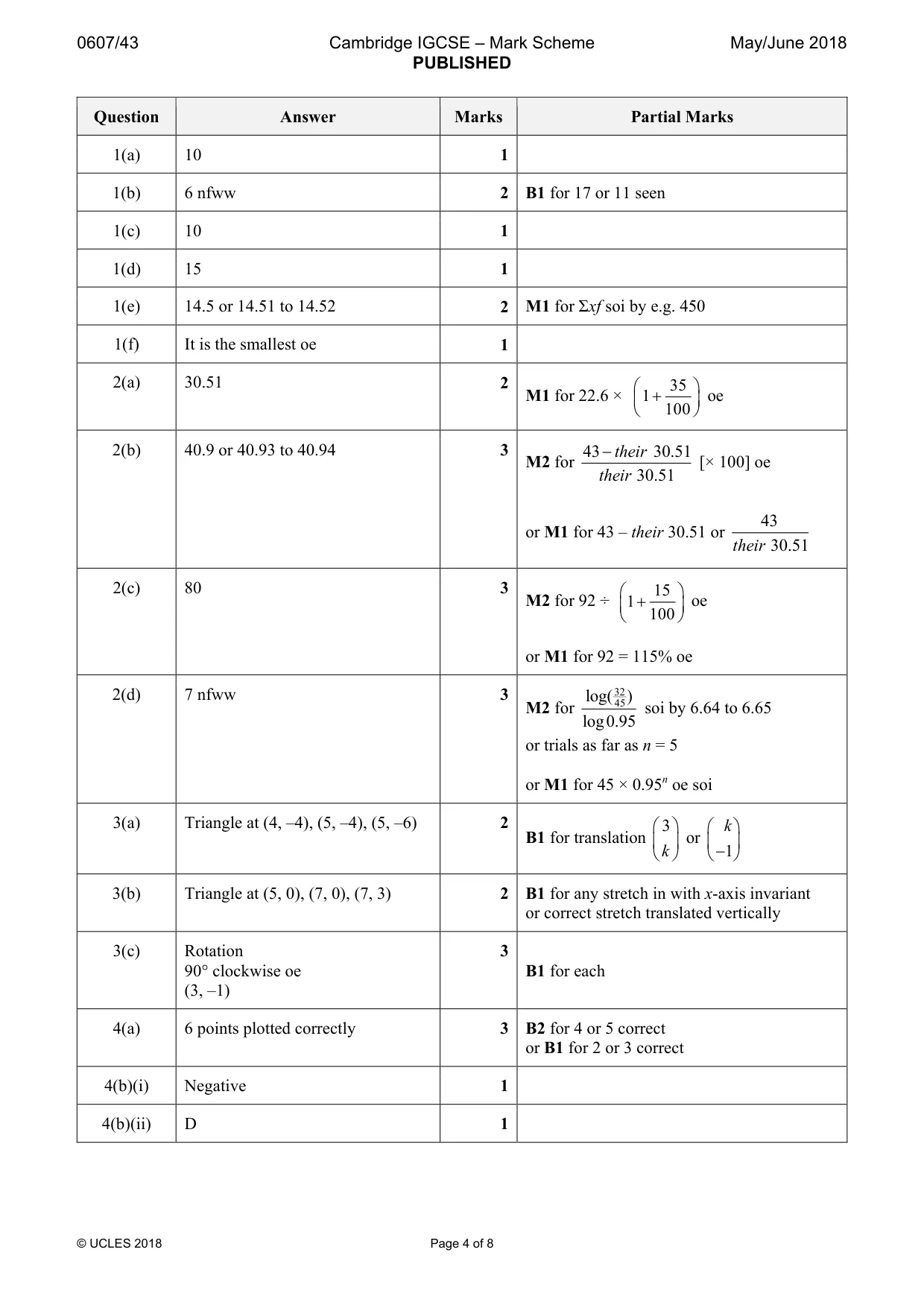
Mark scheme: Question Answer Marks Partial Marks 1(a) 10 1 1(b) 6 nfww 2 B1 for 17 or 11 seen 1(c) 10 1 1(d) 15 1 1(e) 14.5 or 14.51 to 14.52 2 M1 for Σxf soi by e.g. 450 1(f) It is the smallest oe 1
Q2 · Flavia makes china cats
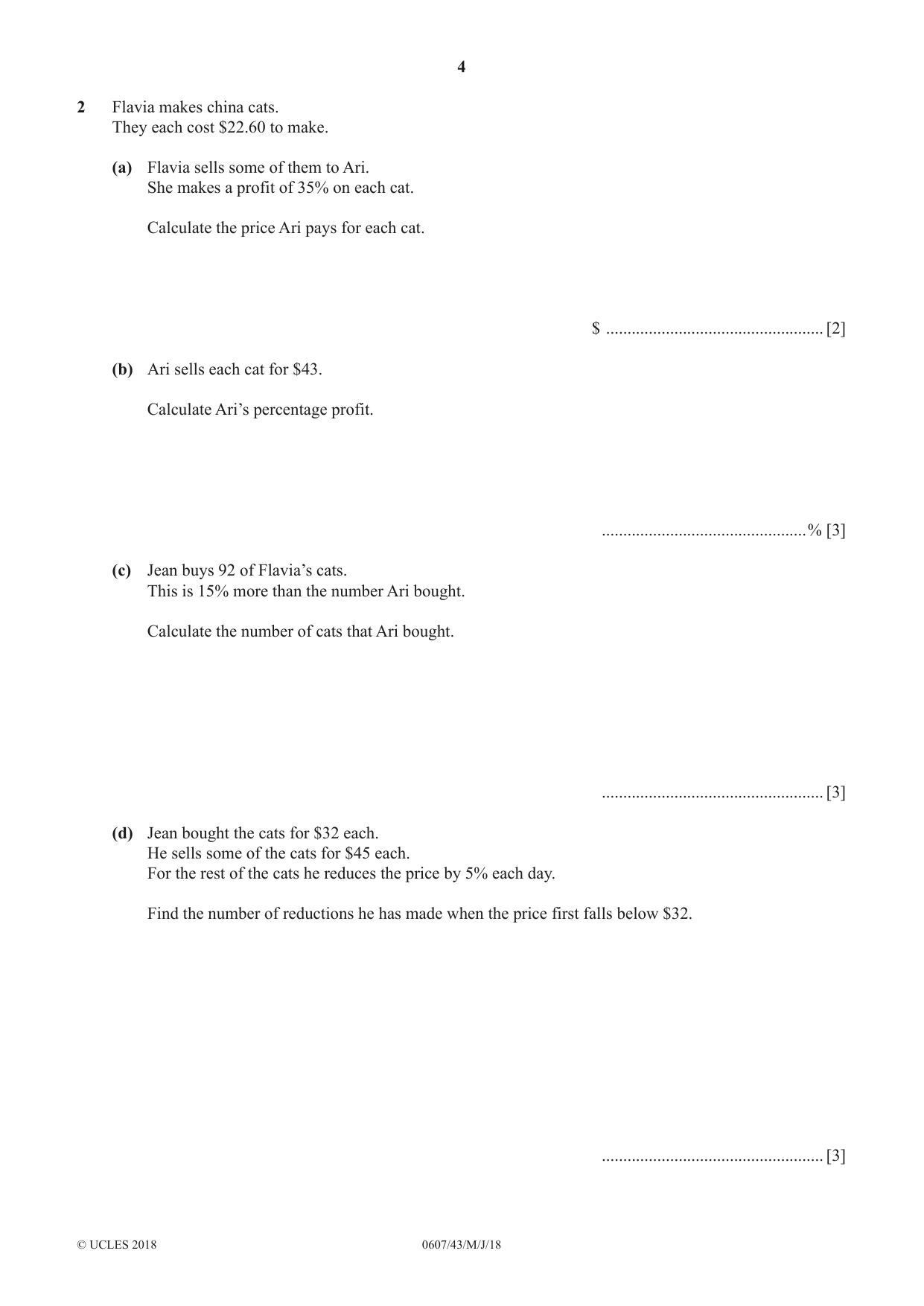
2 Flavia makes china cats. They each cost $22.60 to make. (a) Flavia sells some of them to Ari. She makes a profit of 35% on each cat. Calculate the price Ari pays for each cat. $ ................................................... [2] (b) Ari sells each cat for $43. Calculate Ari’s percentage profit. ................................................% [3] (c) Jean buys 92 of Flavia’s cats. This is 15% more than the number Ari bought. Calculate the number of cats that Ari bought. .................................................... [3] (d) Jean bought the cats for $32 each. He sells some of the cats for $45 each. For the rest of the cats he reduces the price by 5% each day. Find the number of reductions he has made when the price first falls below $32. .................................................... [3]
Mark scheme: 2(a) 30.51 2 35 M1 for 22.6 × 1 + oe 100 2(b) 40.9 or 40.93 to 40.94 3 43 − their 30.51 M2 for [× 100] oe their 30.51 43 or M1 for 43 – their 30.51 or their 30.51 2(c) 80 3 15 M2 for 92 ÷ 1 + oe 100 or M1 for 92 = 115% oe 2(d) 7 nfww 3 log( 3245 ) M2 for soi by 6.64 to 6.65 log0.95 or trials as far as n = 5 or M1 for 45 × 0.95n oe soi
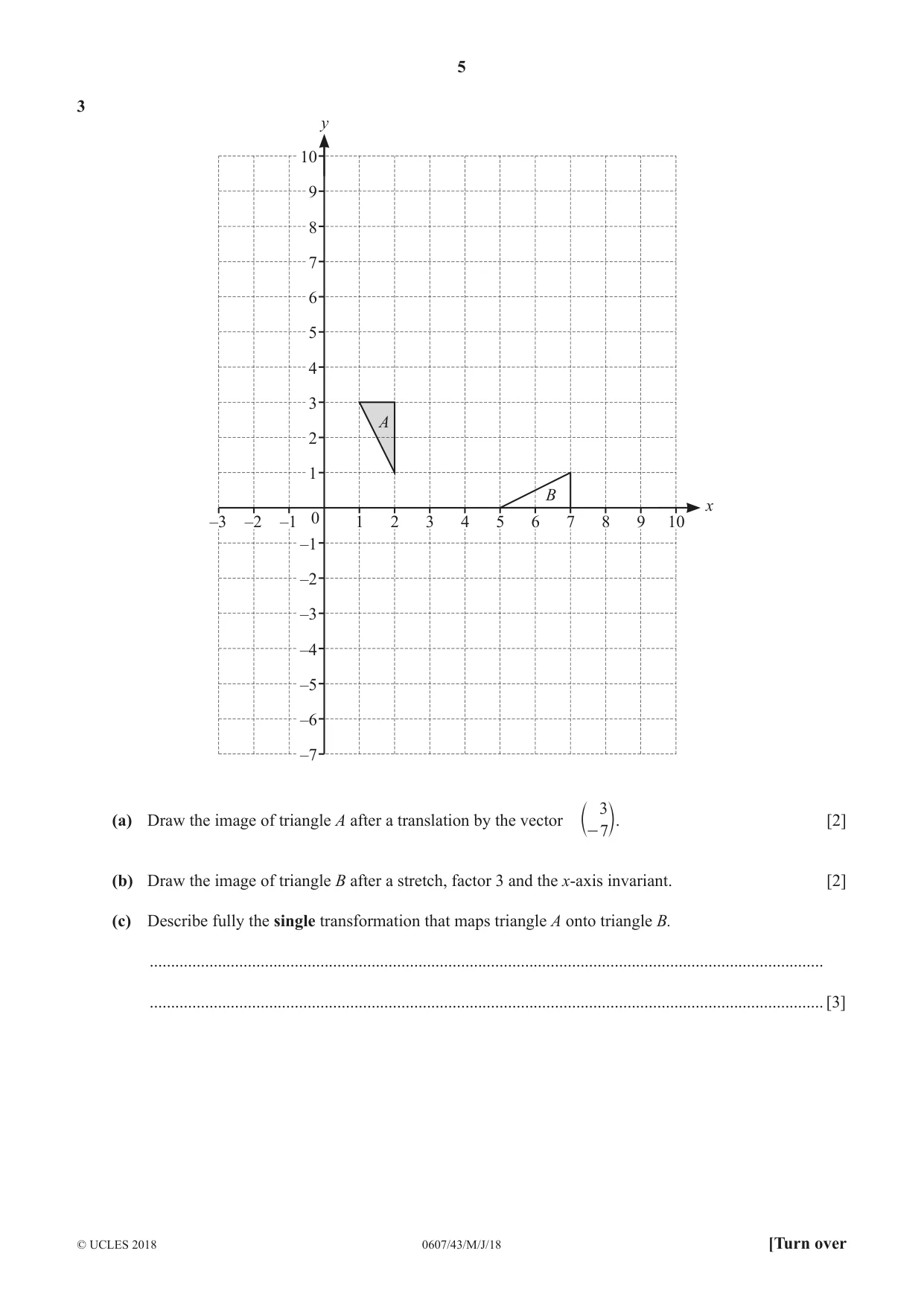
Q3 · Y 10 9 8 7 6 5 4 3 A 2 1 B x –3 –2 –1 0 1 2 3 4 5 6 7 8 9 10 –1 –2 –3 –4 –5 –6 –7 3 (a)…
3 y 10 9 8 7 6 5 4 3 A 2 1 B x –3 –2 –1 0 1 2 3 4 5 6 7 8 9 10 –1 –2 –3 –4 –5 –6 –7 3 (a) Draw the image of triangle A after a translation by the vector [2] c- 7m. (b) Draw the image of triangle B after a stretch, factor 3 and the x-axis invariant. [2] (c) Describe fully the single transformation that maps triangle A onto triangle B. .............................................................................................................................................................. .............................................................................................................................................................. [3]
Mark scheme: 3(a) Triangle at (4, –4), (5, –4), (5, –6) 2 3 k B1 for translation or k −1 3(b) Triangle at (5, 0), (7, 0), (7, 3) 2 B1 for any stretch in with x-axis invariant or correct stretch translated vertically 3(c) Rotation 3 90° clockwise oe B1 for each (3, –1)
Q4 · Hamid records the population density, p persons/km2, in ten regions of the city in which…
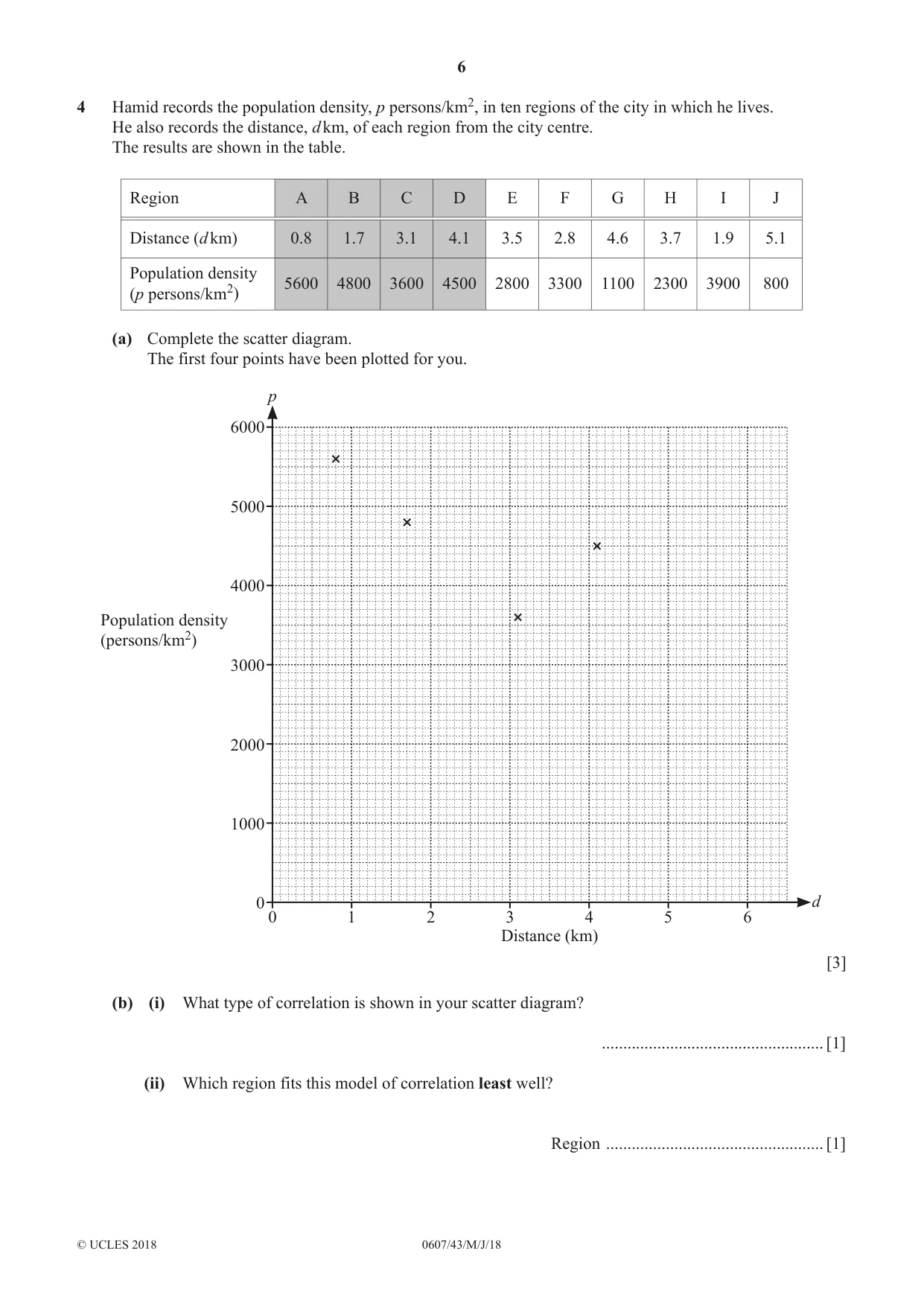
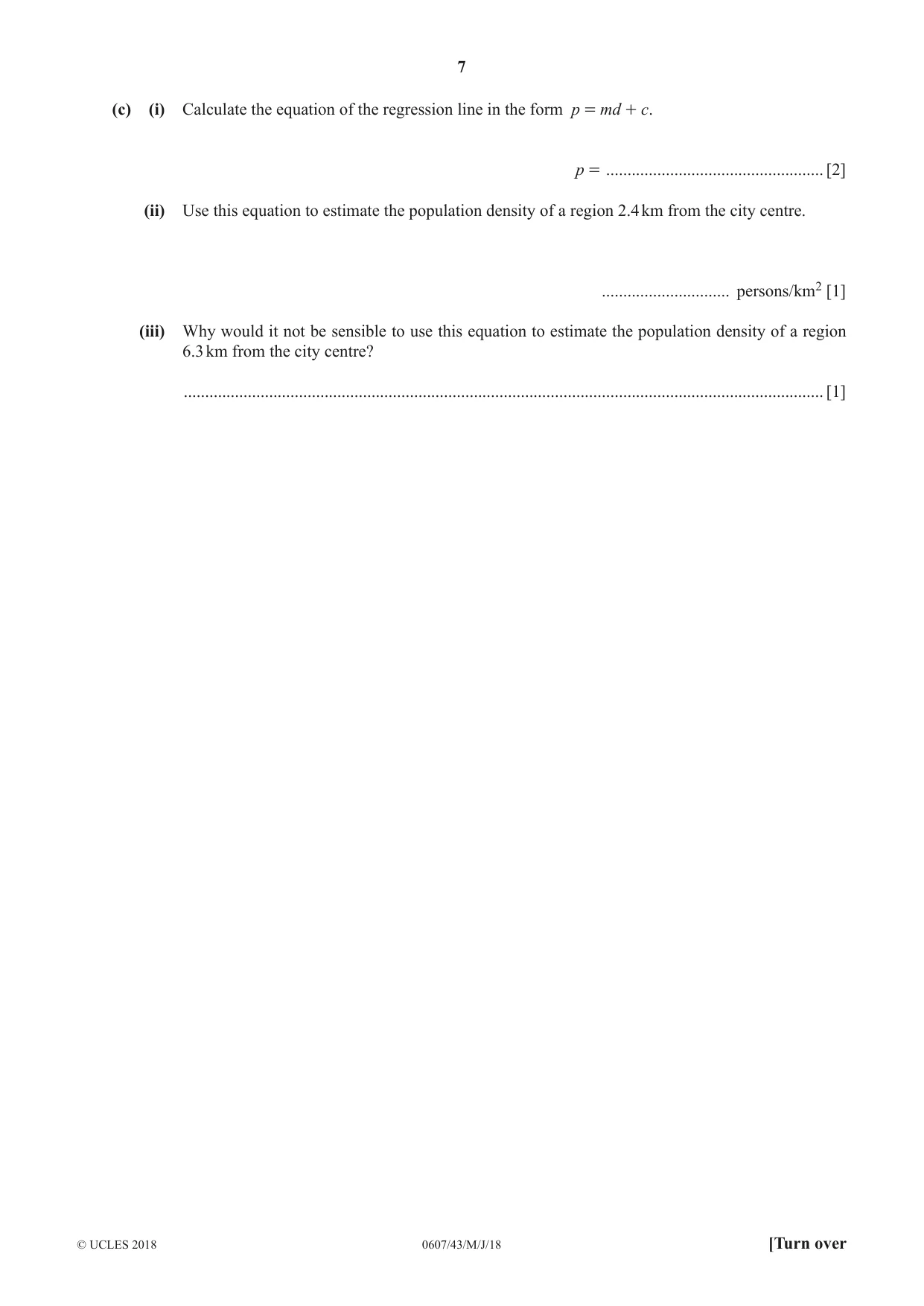
4 Hamid records the population density, p persons/km2, in ten regions of the city in which he lives. He also records the distance, d km, of each region from the city centre. The results are shown in the table. Region A B C D E F G H I J Distance (d km) 0.8 1.7 3.1 4.1 3.5 2.8 4.6 3.7 1.9 5.1 Population density 5600 4800 3600 4500 2800 3300 1100 2300 3900 800 (p persons/km2) (a) Complete the scatter diagram. The first four points have been plotted for you. p 6000 5000 4000 Population density (persons/km2) 3000 2000 1000 0 d 0 1 2 3 4 5 6 Distance (km) [3] (b) (i) What type of correlation is shown in your scatter diagram? .................................................... [1] (ii) Which region fits this model of correlation least well? Region ................................................... [1] (c) (i) Calculate the equation of the regression line in the form p = md + c. p = ................................................... [2] (ii) Use this equation to estimate the population density of a region 2.4 km from the city centre. .............................. persons/km2 [1] (iii) Why would it not be sensible to use this equation to estimate the population density of a region 6.3 km from the city centre? ...................................................................................................................................................... [1]
Mark scheme: 4(a) 6 points plotted correctly 3 B2 for 4 or 5 correct or B1 for 2 or 3 correct 4(b)(i) Negative 1 4(b)(ii) D 1 4(c)(i) p = –967d + 6300 2 or (–967.4 to –967.3)d + 6297 to 6298 or B1 for –967d + k or kd + 6300 4(c)(ii) 3980 or 4000 or 3975 to 3980 1 FT 4(c)(iii) [Too] far outside range of data oe 1
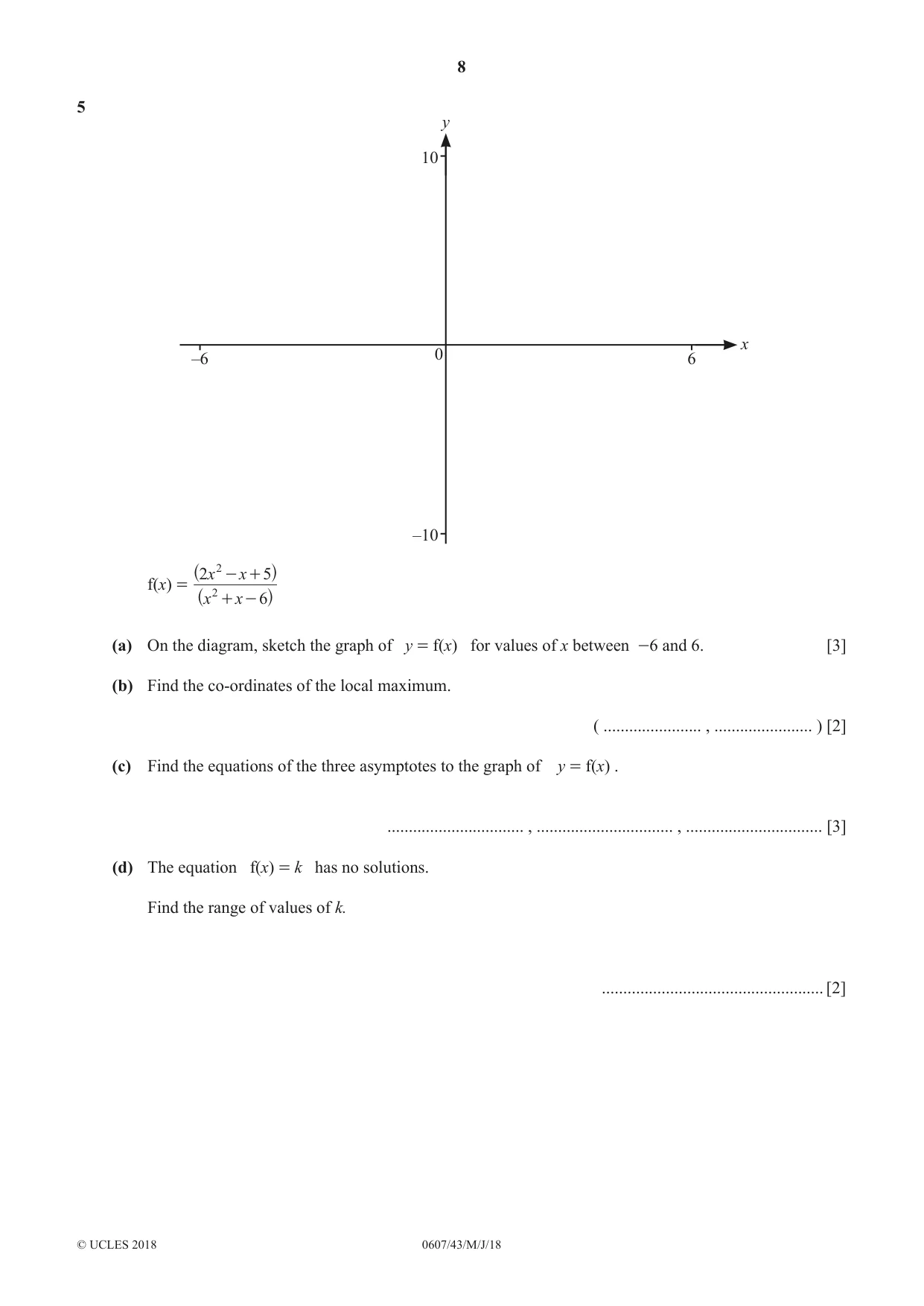
Q5 · Y 10 x –6 0 6 –10 2x 2 - x + 5 f(x) = ^ 2 h x + x - 6 ^ h (a) On the diagram, sketch the…
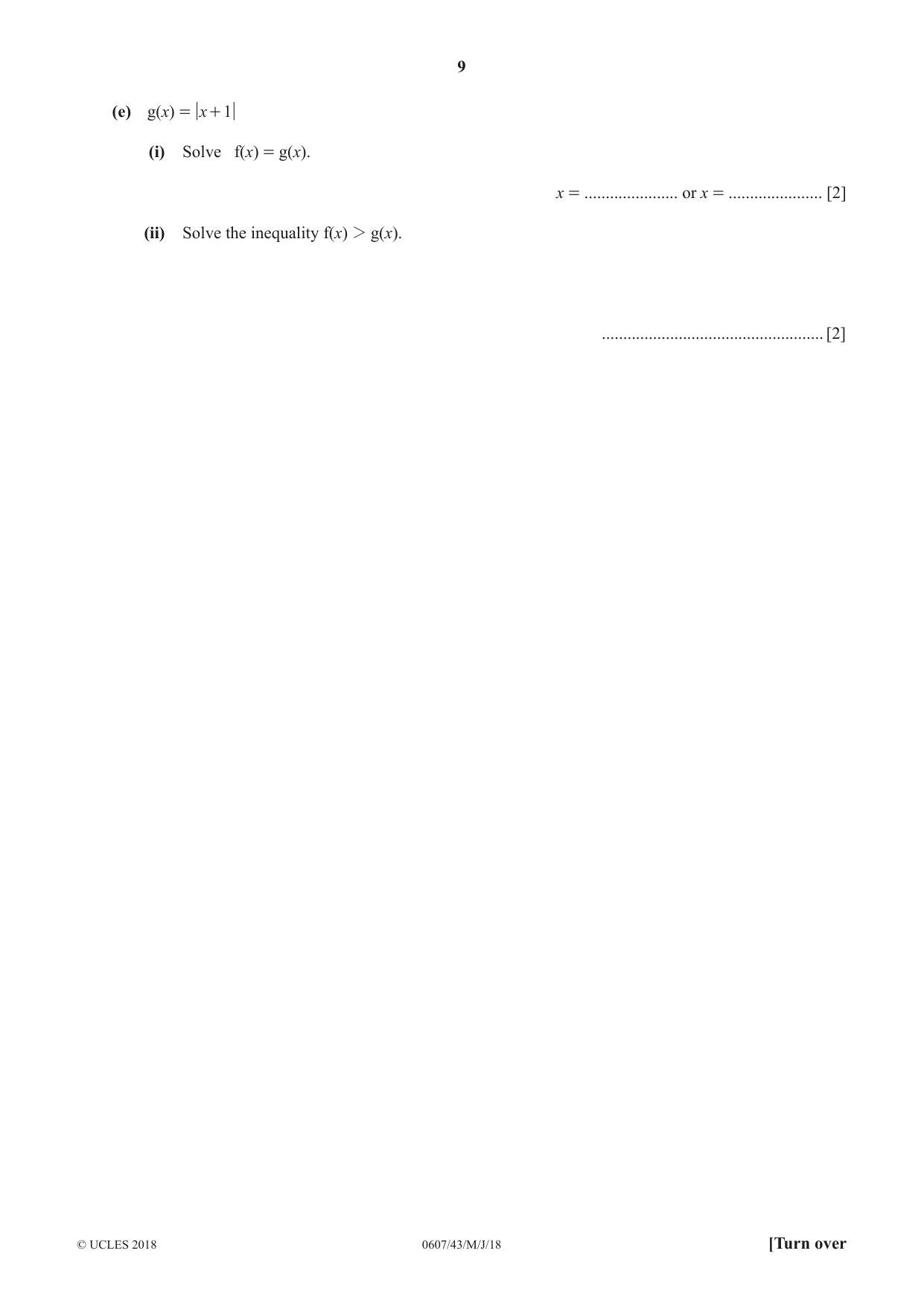
5 y 10 x –6 0 6 –10 2x 2 - x + 5 f(x) = ^ 2 h x + x - 6 ^ h (a) On the diagram, sketch the graph of y = f(x) for values of x between -6 and 6. [3] (b) Find the co-ordinates of the local maximum. ( ....................... , ....................... ) [2] (c) Find the equations of the three asymptotes to the graph of y = f(x) . ................................ , ................................ , ................................ [3] (d) The equation f(x) = k has no solutions. Find the range of values of k. .................................................... [2] (e) g(x) = x + 1 (i) Solve f(x) = g(x). x = ...................... or x = ...................... [2] (ii) Solve the inequality f(x) 2 g(x). .................................................... [2]
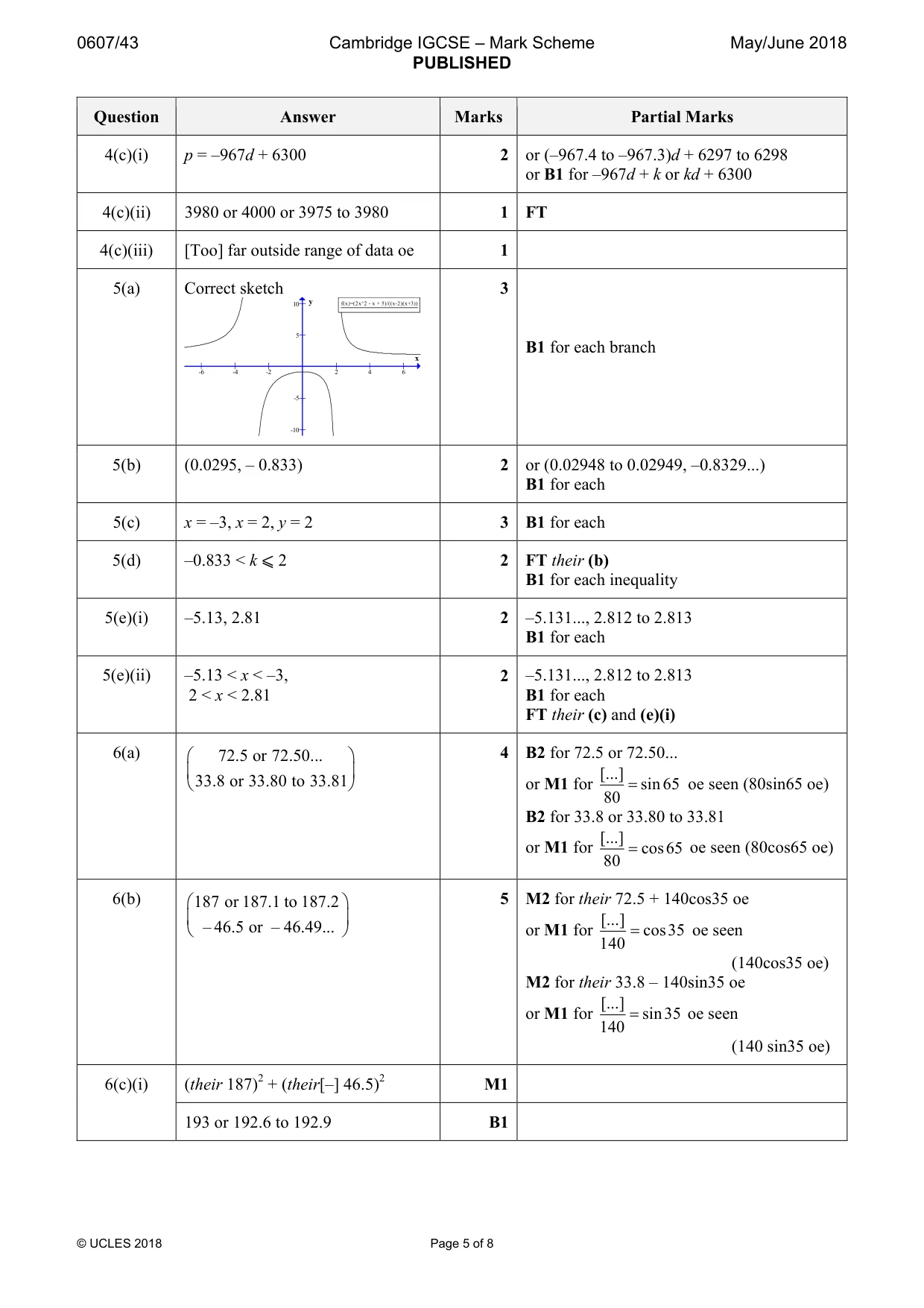
Mark scheme: 5(a) Correct sketch 3 10 y f(x)=(2x^2 - x + 5)/((x-2)(x+3)) 5 B1 for each branch x -6 -4 -2 2 4 6 -5 -10 5(b) (0.0295, – 0.833) 2 or (0.02948 to 0.02949, –0.8329...) B1 for each 5(c) x = –3, x = 2, y = 2 3 B1 for each 5(d) –0.833 < k ⩽ 2 2 FT their (b) B1 for each inequality 5(e)(i) –5.13, 2.81 2 –5.131..., 2.812 to 2.813 B1 for each 5(e)(ii) –5.13 < x < –3, 2 –5.131..., 2.812 to 2.813 2 < x < 2.81 B1 for each FT their (c) and (e)(i)
Q6 · Y North North NOT TO SCALE 125° B 80 km 65° 140 km A C x O A ship sails 80 km on a…
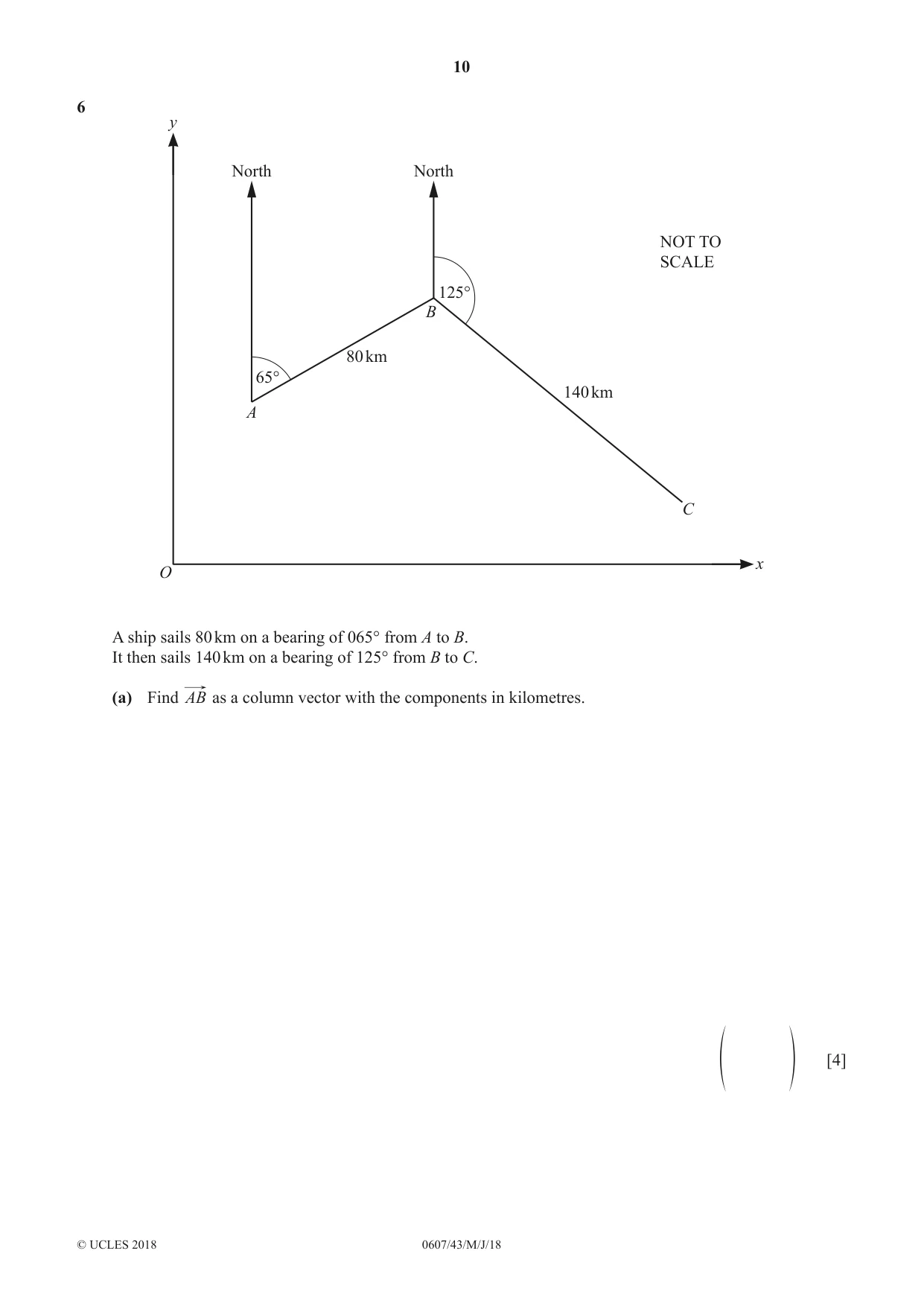
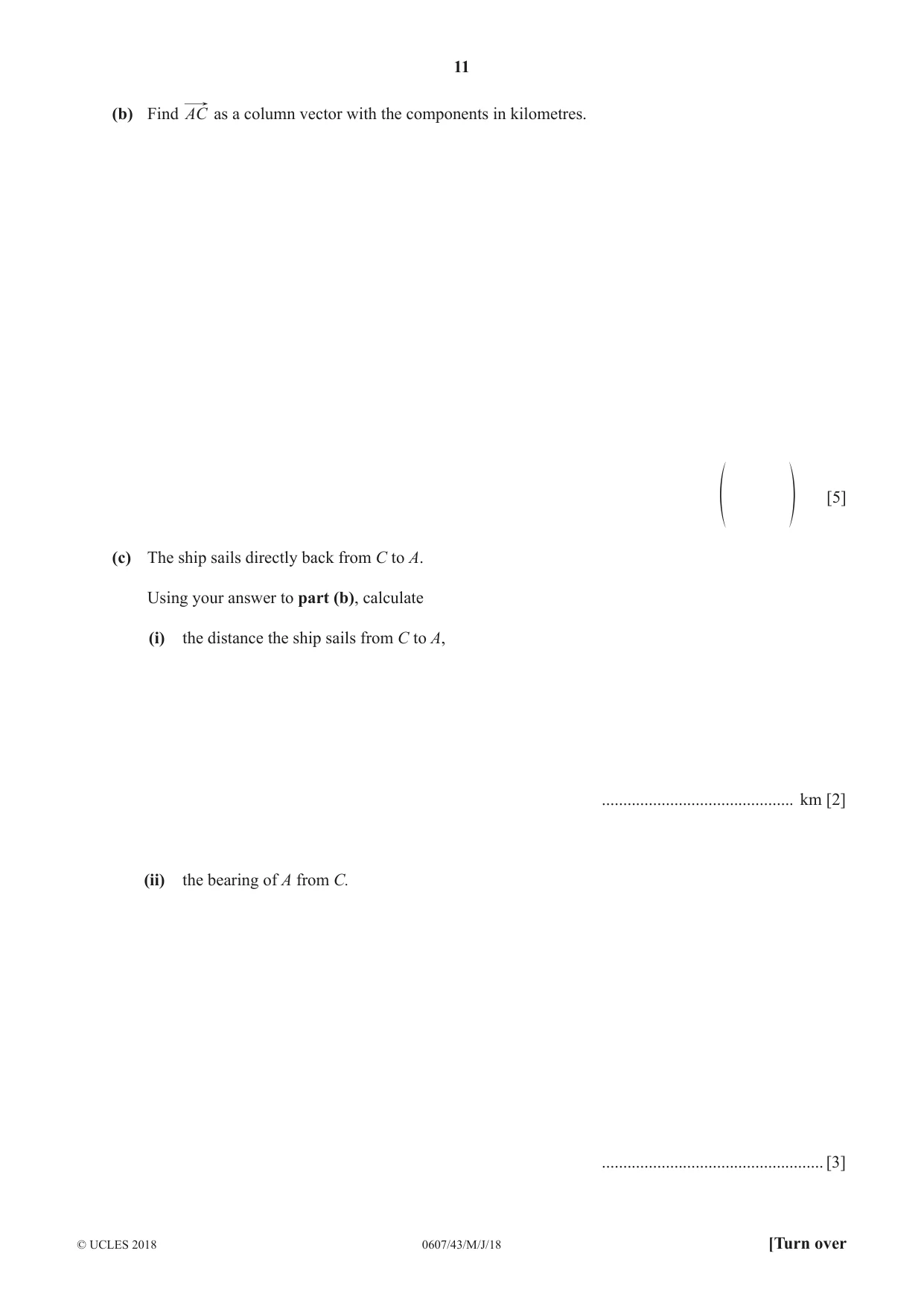
6 y North North NOT TO SCALE 125° B 80 km 65° 140 km A C x O A ship sails 80 km on a bearing of 065° from A to B. It then sails 140 km on a bearing of 125° from B to C. (a) Find AB as a column vector with the components in kilometres. [4] f p (b) Find AC as a column vector with the components in kilometres. [5] f p (c) The ship sails directly back from C to A. Using your answer to part (b), calculate (i) the distance the ship sails from C to A, ............................................. km [2] (ii) the bearing of A from C. .................................................... [3]
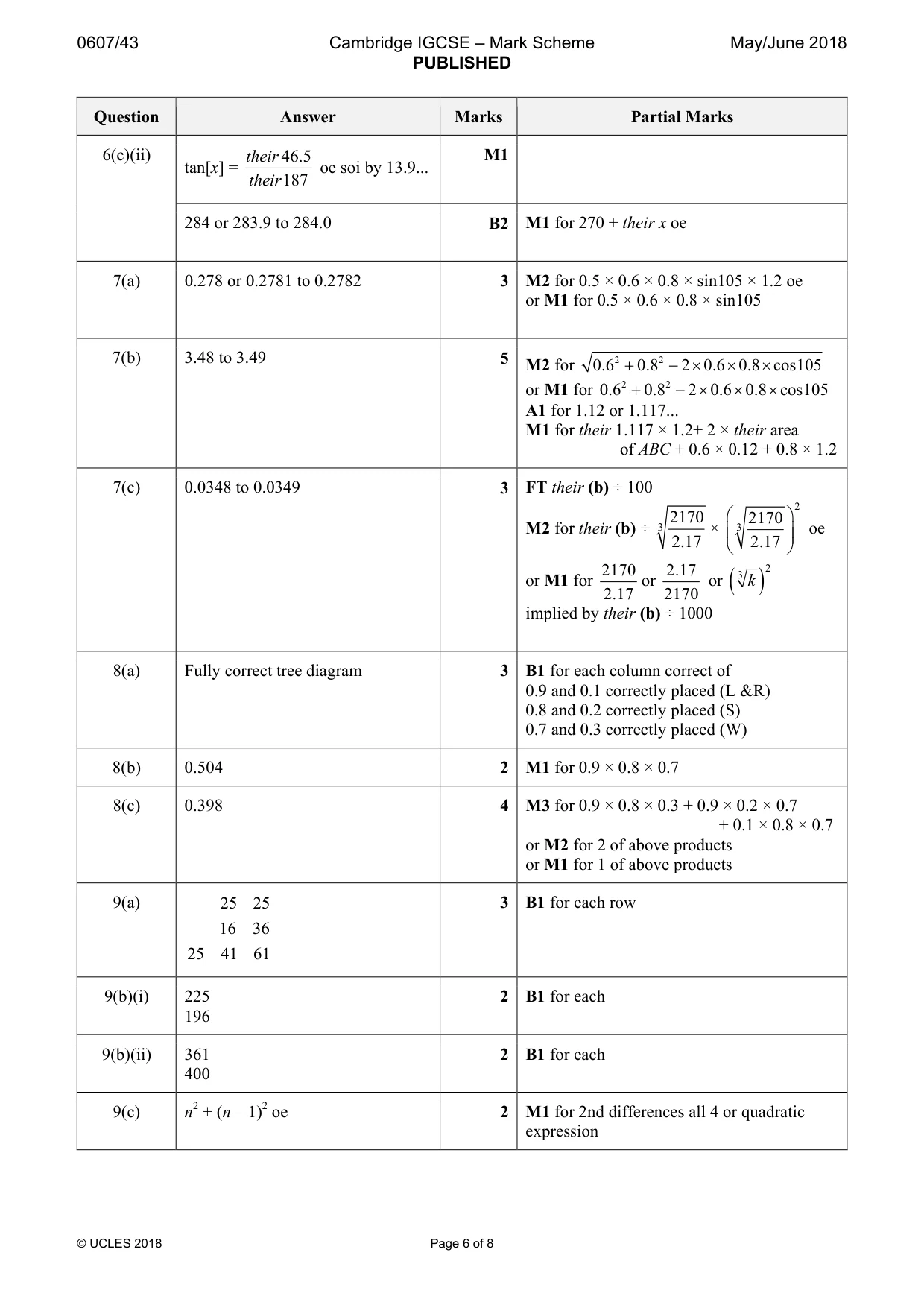
Mark scheme: 6(a) 72.5 or 72.50... 4 B2 for 72.5 or 72.50... [...] 33.8 or 33.80 to 33.81 or M1 for = sin65 oe seen (80sin65 oe) 80 B2 for 33.8 or 33.80 to 33.81 [...] or M1 for = cos65 oe seen (80cos65 oe) 80 6(b) 187 or 187.1 to 187.2 5 M2 for their 72.5 + 140cos35 oe [...] – 46.5 or – 46.49... or M1 for = cos35 oe seen 140 (140cos35 oe) M2 for their 33.8 – 140sin35 oe [...] or M1 for = sin35 oe seen 140 (140 sin35 oe) 6(c)(i) (their 187)2 + (their[–] 46.5)2 M1 193 or 192.6 to 192.9 B1 6(c)(ii) their 46.5 M1 tan[x] = oe soi by 13.9... their 187 284 or 283.9 to 284.0 B2 M1 for 270 + their x oe
Q7 · D NOT TO SCALE A 105° E F 0.6 m 0.8 m 1.2 m B C ABCDEF is a solid triangular prism
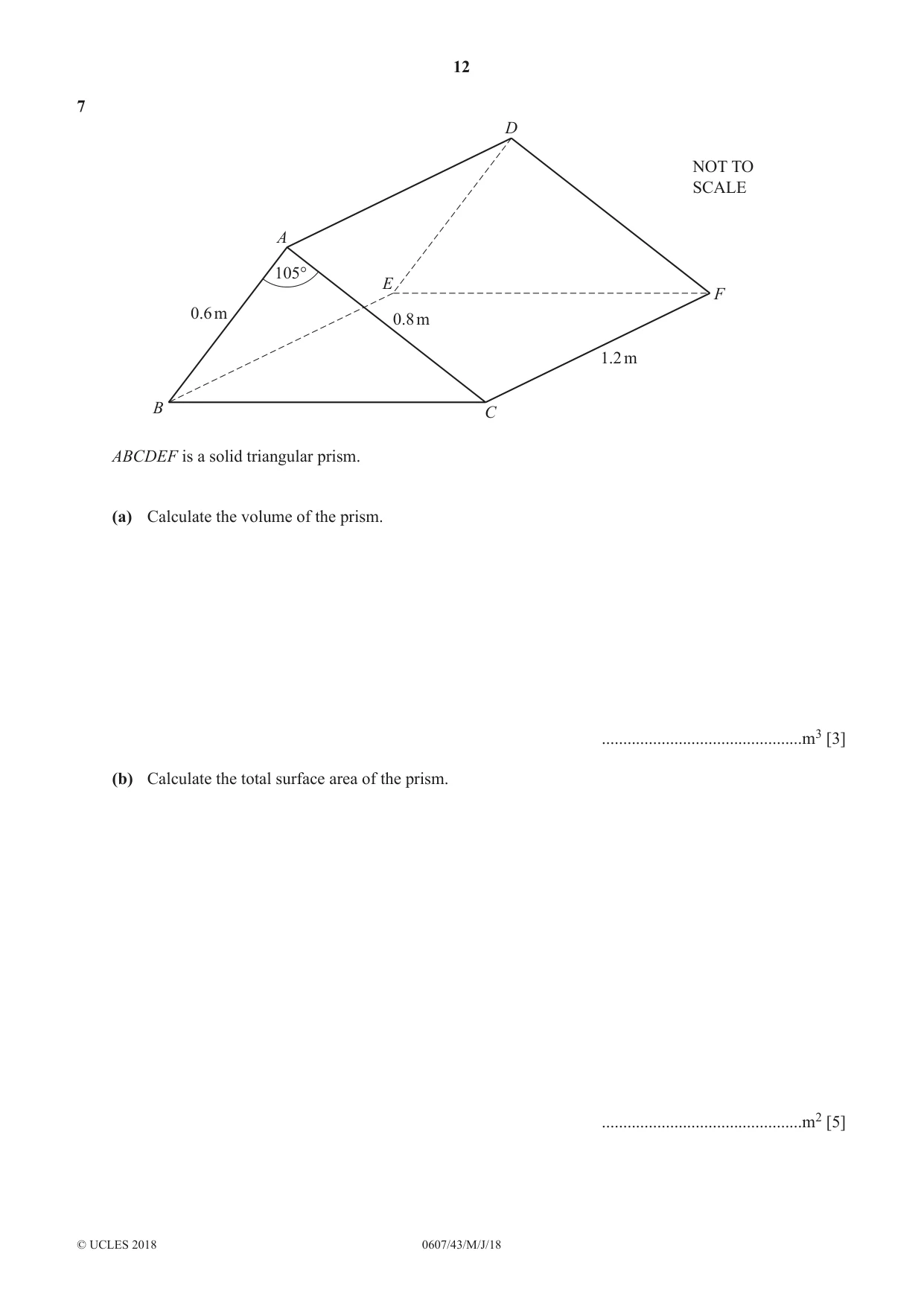
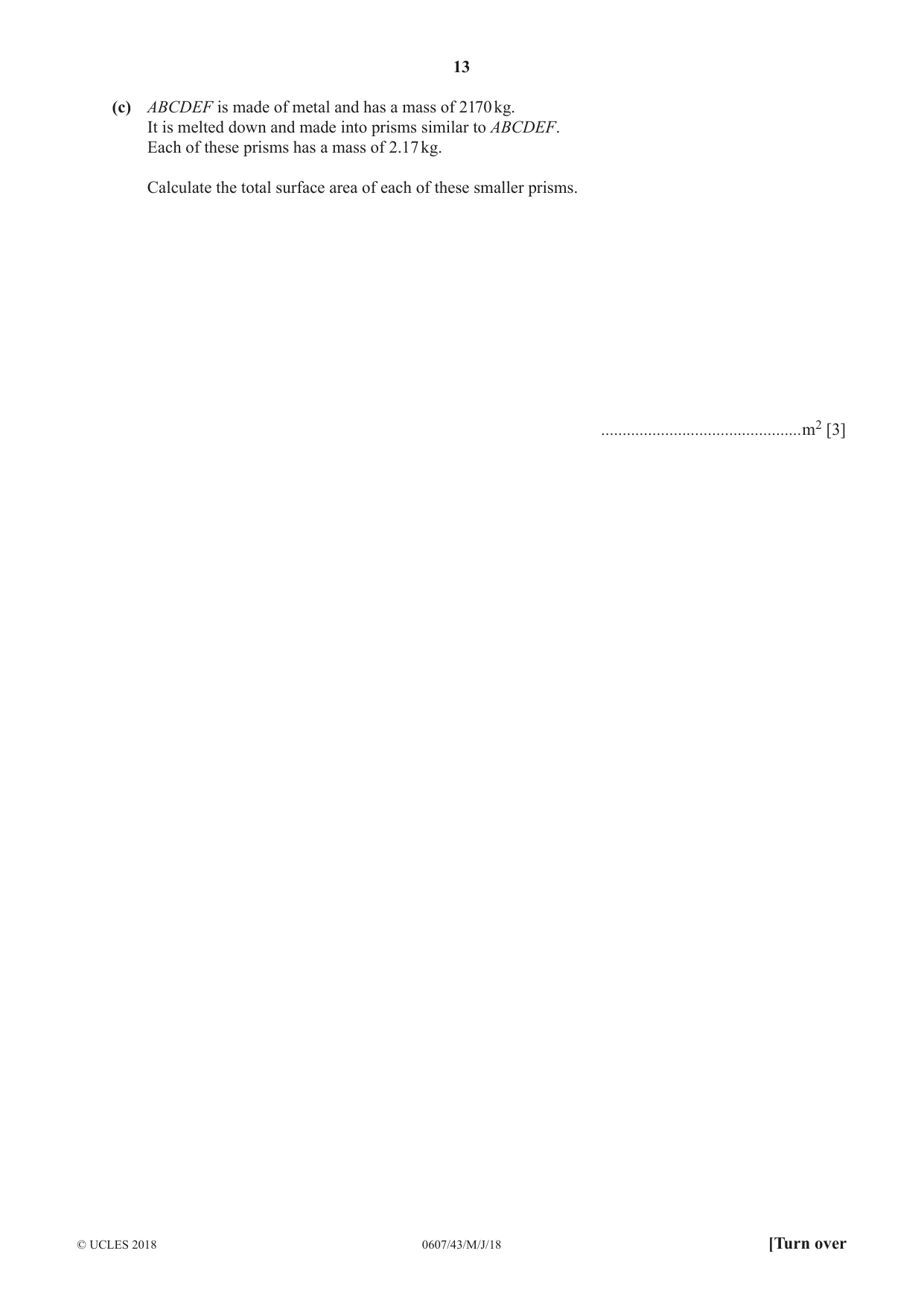
7 D NOT TO SCALE A 105° E F 0.6 m 0.8 m 1.2 m B C ABCDEF is a solid triangular prism. (a) Calculate the volume of the prism. ...............................................m3 [3] (b) Calculate the total surface area of the prism. ...............................................m2 [5] (c) ABCDEF is made of metal and has a mass of 2170 kg. It is melted down and made into prisms similar to ABCDEF. Each of these prisms has a mass of 2.17 kg. Calculate the total surface area of each of these smaller prisms. ...............................................m2 [3]
Mark scheme: 7(a) 0.278 or 0.2781 to 0.2782 3 M2 for 0.5 × 0.6 × 0.8 × sin105 × 1.2 oe or M1 for 0.5 × 0.6 × 0.8 × sin105 7(b) 3.48 to 3.49 5 2 2 M2 for 0.6 + 0.8 − 2 × 0.6 × 0.8 × cos105 or M1 for 0.6 2 + 0.8 2 − 2 × 0.6 × 0.8 × cos105 A1 for 1.12 or 1.117... M1 for their 1.117 × 1.2+ 2 × their area of ABC + 0.6 × 0.12 + 0.8 × 1.2 7(c) 0.0348 to 0.0349 3 FT their (b) ÷ 100 2170 2170 2 M2 for their (b) ÷ 3 × 3 oe 2.17 2.17 2170 2.17 3 2 or M1 for or or k ( ) 2.17 2170 implied by their (b) ÷ 1000
Q8 · Rashid takes a language examination that has three tests
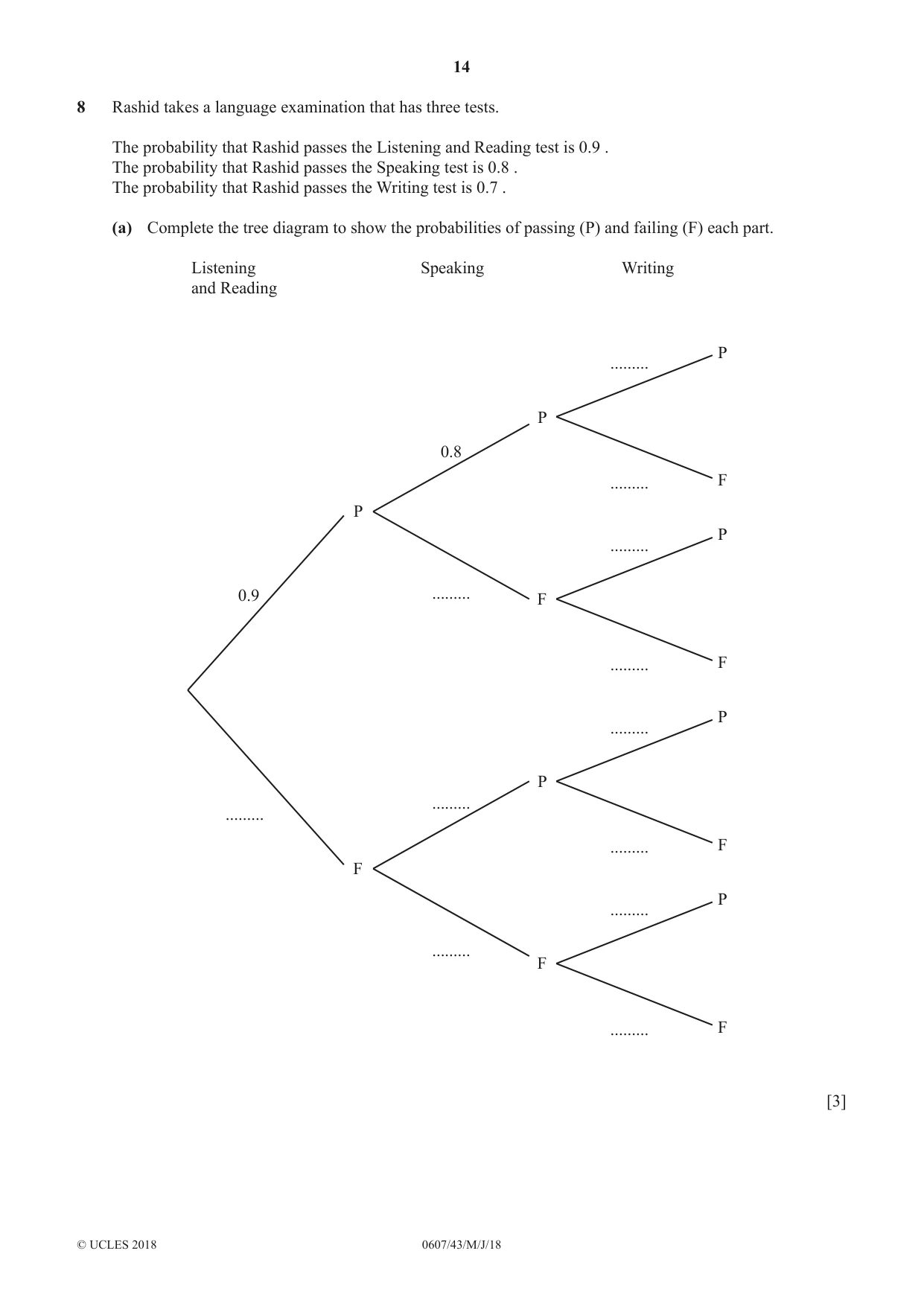
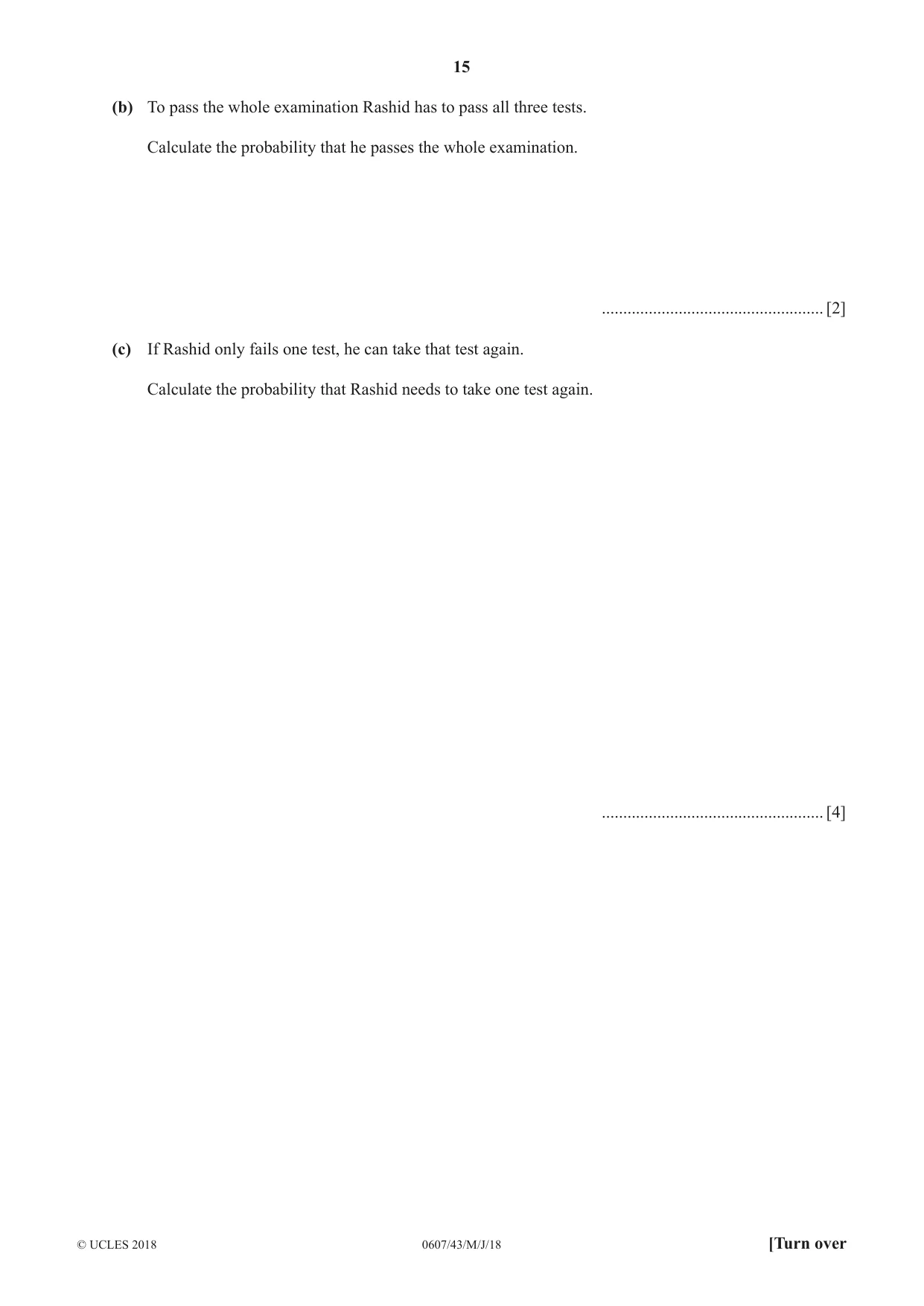
8 Rashid takes a language examination that has three tests. The probability that Rashid passes the Listening and Reading test is 0.9 . The probability that Rashid passes the Speaking test is 0.8 . The probability that Rashid passes the Writing test is 0.7 . (a) Complete the tree diagram to show the probabilities of passing (P) and failing (F) each part. Listening Speaking Writing and Reading P ......... P 0.8 ......... F P P ......... 0.9 ......... F ......... F P ......... P ......... ......... ......... F F P ......... ......... F ......... F [3] (b) To pass the whole examination Rashid has to pass all three tests. Calculate the probability that he passes the whole examination. .................................................... [2] (c) If Rashid only fails one test, he can take that test again. Calculate the probability that Rashid needs to take one test again. .................................................... [4]
Mark scheme: 8(a) Fully correct tree diagram 3 B1 for each column correct of 0.9 and 0.1 correctly placed (L &R) 0.8 and 0.2 correctly placed (S) 0.7 and 0.3 correctly placed (W) 8(b) 0.504 2 M1 for 0.9 × 0.8 × 0.7 8(c) 0.398 4 M3 for 0.9 × 0.8 × 0.3 + 0.9 × 0.2 × 0.7 + 0.1 × 0.8 × 0.7 or M2 for 2 of above products or M1 for 1 of above products
Q9 · Pattern 1 Pattern 2 Pattern 3 Pattern 4 (a) Complete the table for the sequence of…
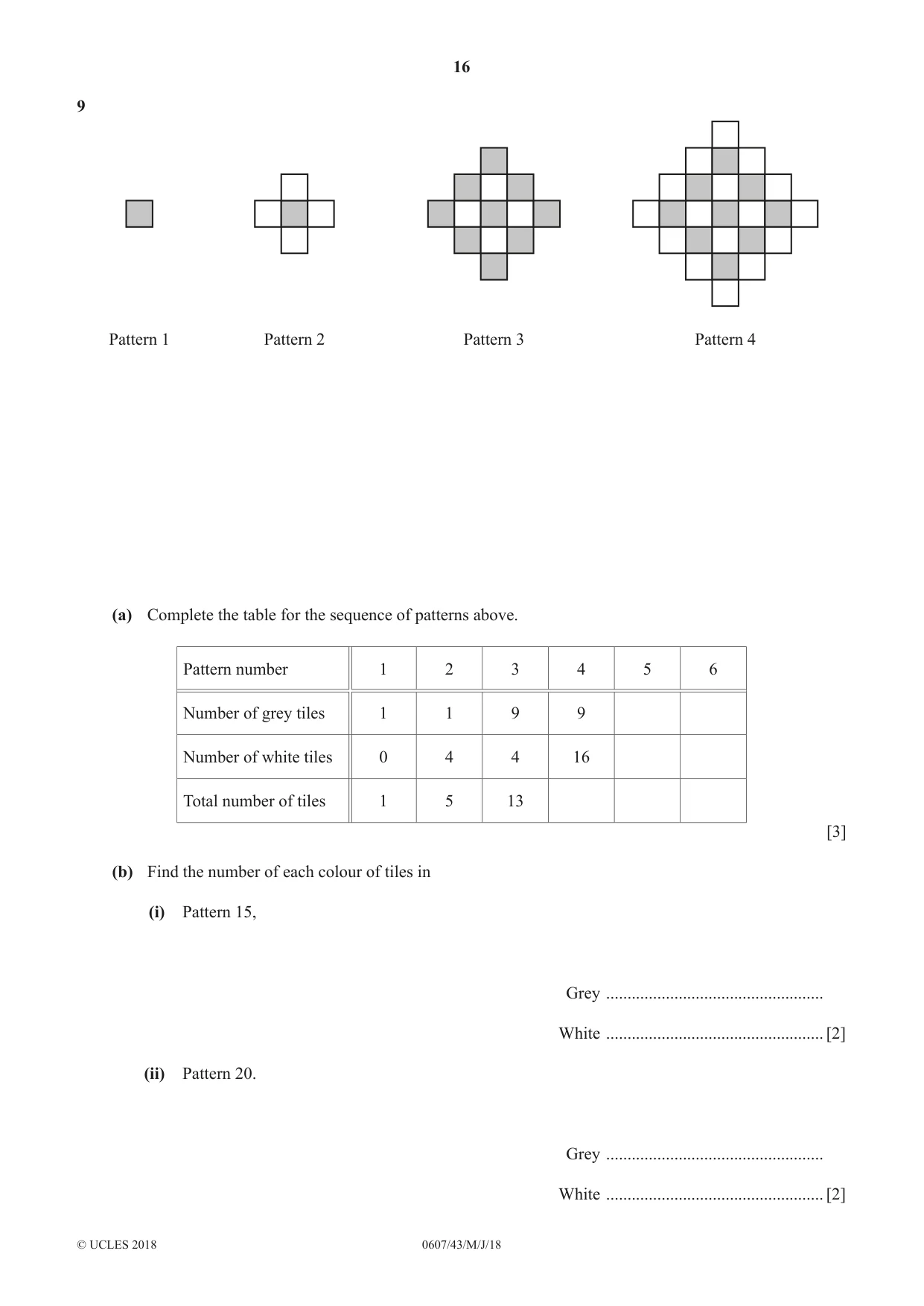
9 Pattern 1 Pattern 2 Pattern 3 Pattern 4 (a) Complete the table for the sequence of patterns above. Pattern number 1 2 3 4 5 6 Number of grey tiles 1 1 9 9 Number of white tiles 0 4 4 16 Total number of tiles 1 5 13 [3] (b) Find the number of each colour of tiles in (i) Pattern 15, Grey ................................................... White ................................................... [2] (ii) Pattern 20. Grey ................................................... White ................................................... [2] (c) Find an expression, in terms of n, for the total number of tiles in Pattern n. .................................................... [2]
Mark scheme: 9(a) 25 25 3 B1 for each row 16 36 25 41 61 9(b)(i) 225 2 B1 for each 196 9(b)(ii) 361 2 B1 for each 400 9(c) n2 + (n – 1)2 oe 2 M1 for 2nd differences all 4 or quadratic expression
Q10 · Isabel drives from Geneva to Rome, a distance of 930 km
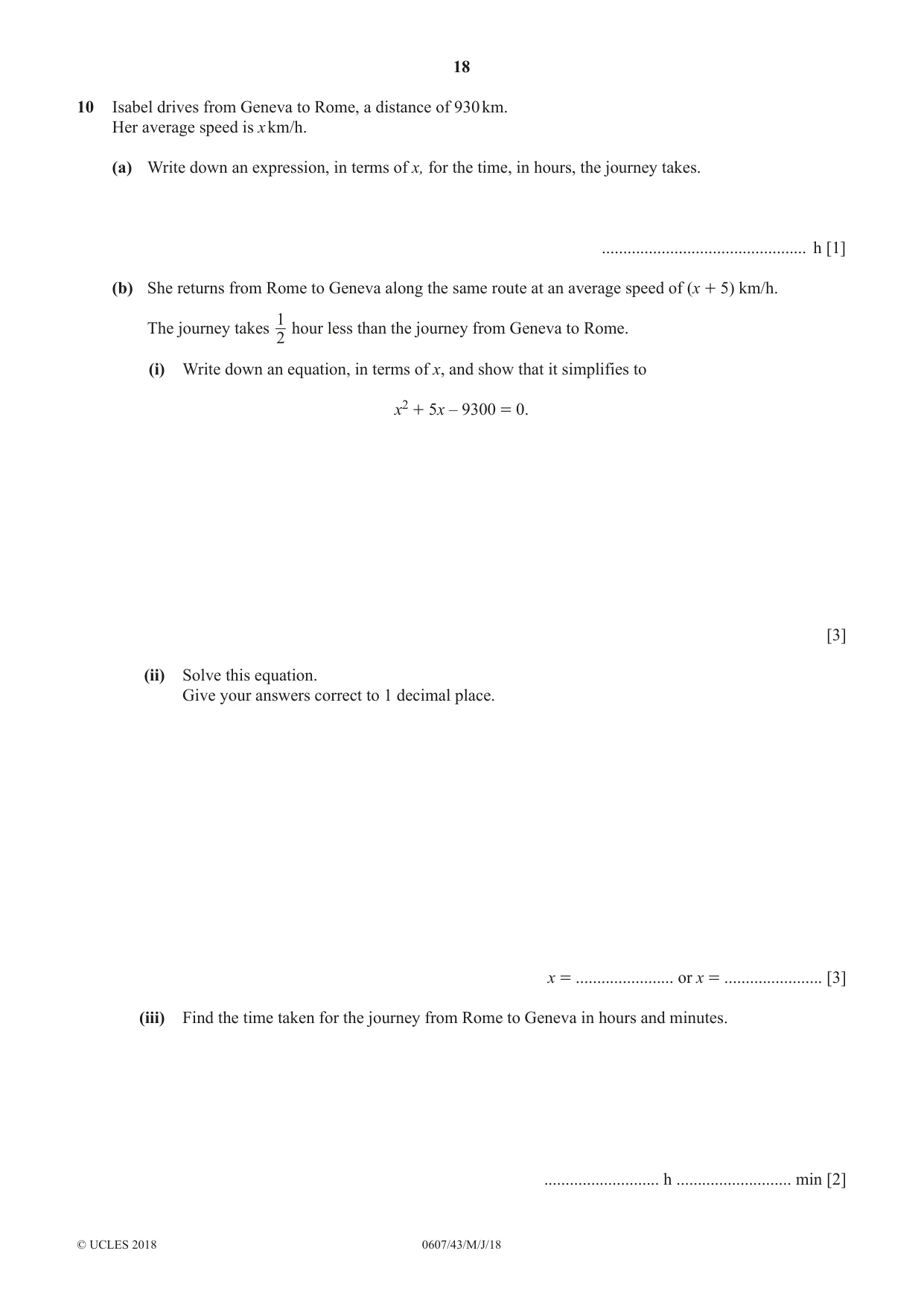
10 Isabel drives from Geneva to Rome, a distance of 930 km. Her average speed is x km/h. (a) Write down an expression, in terms of x, for the time, in hours, the journey takes. ................................................ h [1] (b) She returns from Rome to Geneva along the same route at an average speed of (x + 5) km/h. 1 The journey takes hour less than the journey from Geneva to Rome. 2 (i) Write down an equation, in terms of x, and show that it simplifies to x2 + 5x – 9300 = 0. [3] (ii) Solve this equation. Give your answers correct to 1 decimal place. x = ....................... or x = ....................... [3] (iii) Find the time taken for the journey from Rome to Geneva in hours and minutes. ........................... h ........................... min [2]
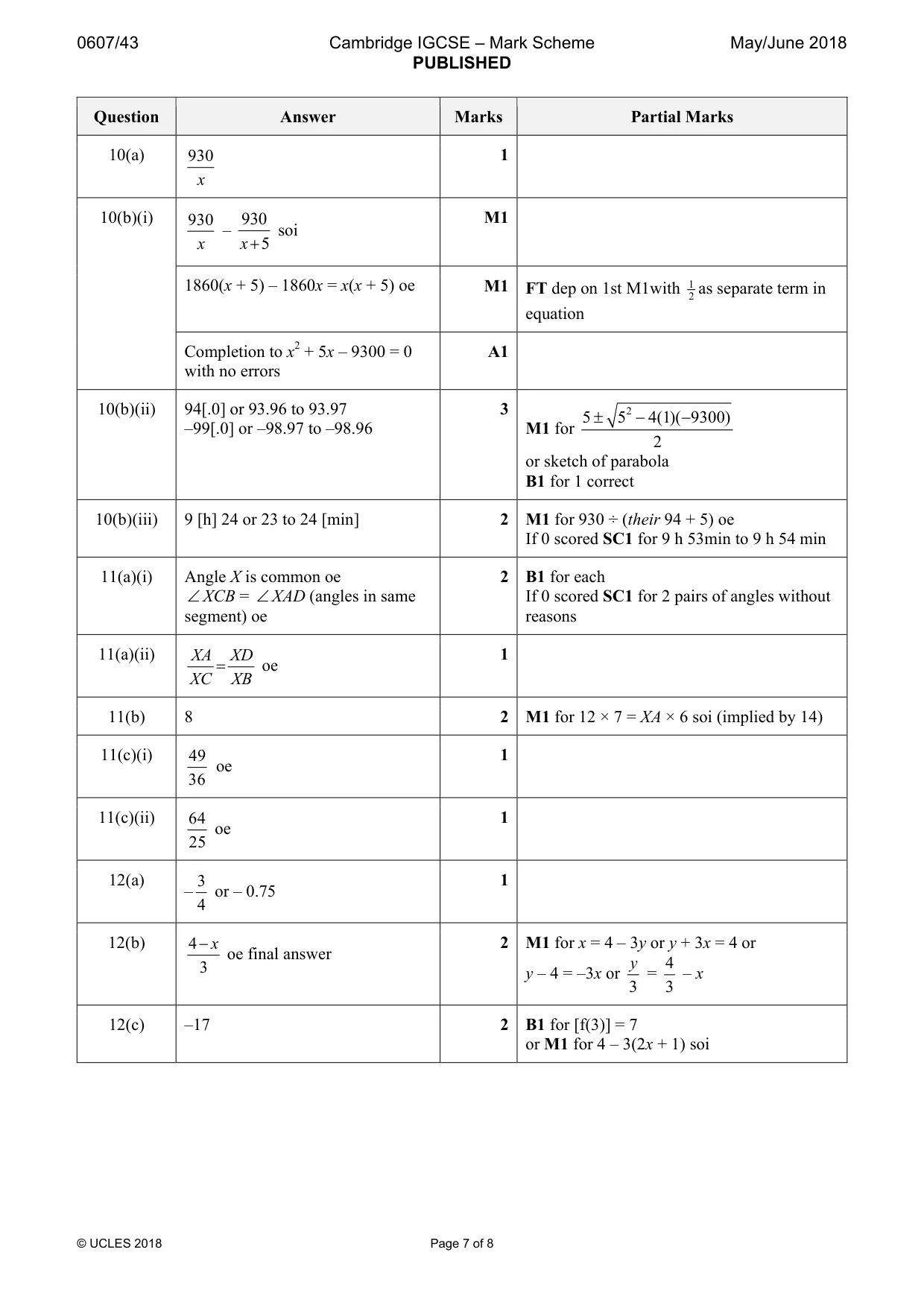
Mark scheme: 10(a) 930 1 x 10(b)(i) 930 930 M1 – soi x x+ 5 1860(x + 5) – 1860x = x(x + 5) oe M1 FT dep on 1st M1with 12 as separate term in equation Completion to x2 + 5x – 9300 = 0 A1 with no errors 10(b)(ii) 94[.0] or 93.96 to 93.97 3 2 5 ± 5 − 4(1)( − 9300) –99[.0] or –98.97 to –98.96 M1 for 2 or sketch of parabola B1 for 1 correct 10(b)(iii) 9 [h] 24 or 23 to 24 [min] 2 M1 for 930 ÷ (their 94 + 5) oe If 0 scored SC1 for 9 h 53min to 9 h 54 min
Q11 · NOT TO A B SCALE X Y D C A, B, C and D are points on the circle
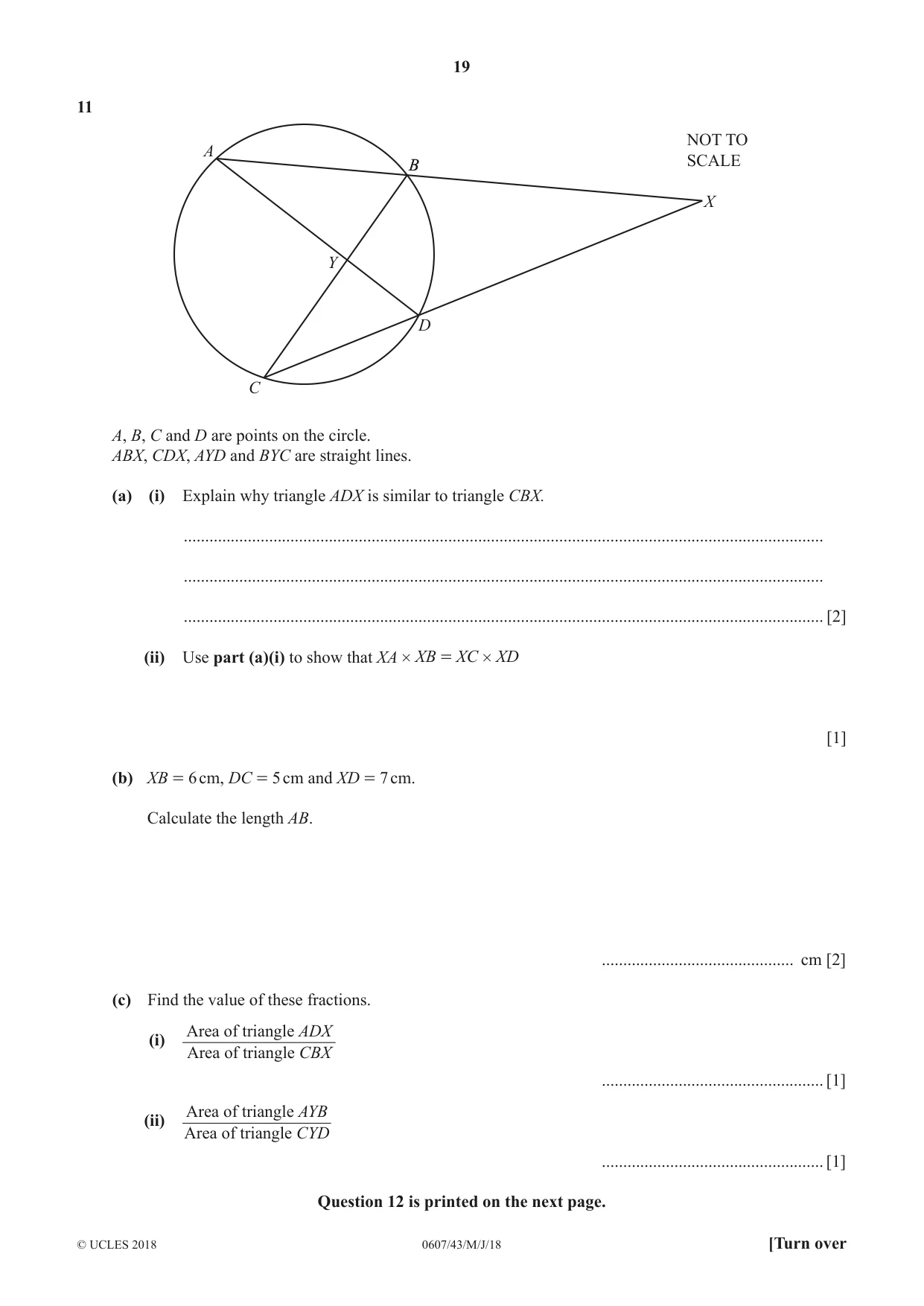
11 NOT TO A B SCALE X Y D C A, B, C and D are points on the circle. ABX, CDX, AYD and BYC are straight lines. (a) (i) Explain why triangle ADX is similar to triangle CBX. ...................................................................................................................................................... ...................................................................................................................................................... ...................................................................................................................................................... [2] (ii) Use part (a)(i) to show that XA # XB = XC # XD [1] (b) XB = 6 cm, DC = 5 cm and XD = 7 cm. Calculate the length AB. ............................................. cm [2] (c) Find the value of these fractions. Area of triangle ADX (i) Area of triangle CBX .................................................... [1] Area of triangle AYB (ii) Area of triangle CYD .................................................... [1] Question 12 is printed on the next page.
Mark scheme: 11(a)(i) Angle X is common oe 2 B1 for each ∠XCB = ∠XAD (angles in same If 0 scored SC1 for 2 pairs of angles without segment) oe reasons 11(a)(ii) XA XD 1 = oe XC XB 11(b) 8 2 M1 for 12 × 7 = XA × 6 soi (implied by 14) 11(c)(i) 49 1 oe 36 11(c)(ii) 64 1 oe 25
Q12 · F(x) = 2x + 1 g(x) = 4 – 3x h(x) = 2x – 1 (a) Find h(-2)
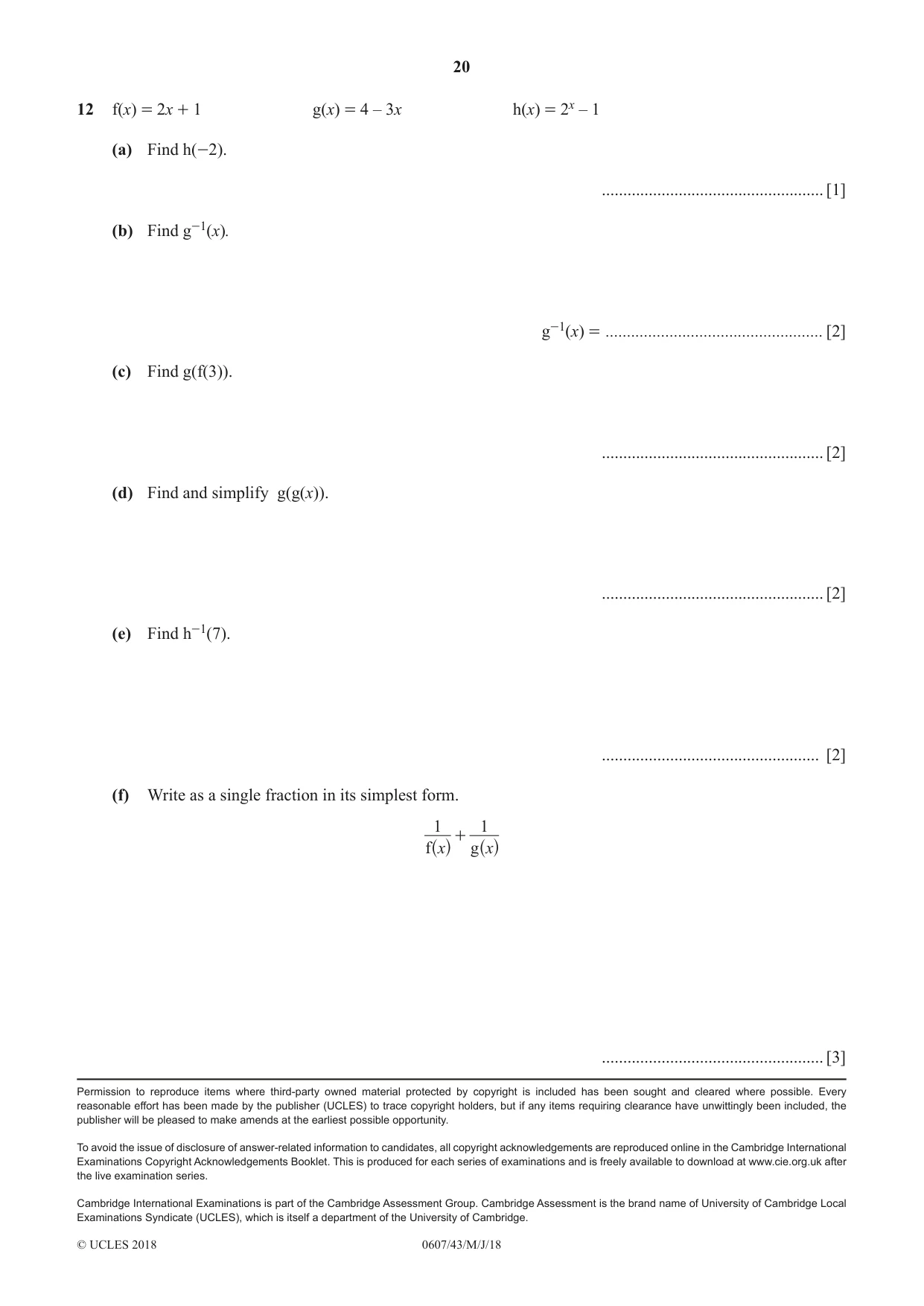
12 f(x) = 2x + 1 g(x) = 4 – 3x h(x) = 2x – 1 (a) Find h(-2). .................................................... [1] (b) Find g-1(x). g-1(x) = ................................................... [2] (c) Find g(f(3)). .................................................... [2] (d) Find and simplify g(g(x)). .................................................... [2] (e) Find h-1(7). ................................................... [2] (f) Write as a single fraction in its simplest form. 1 1 + f x g x ^ h ^ h .................................................... [3]
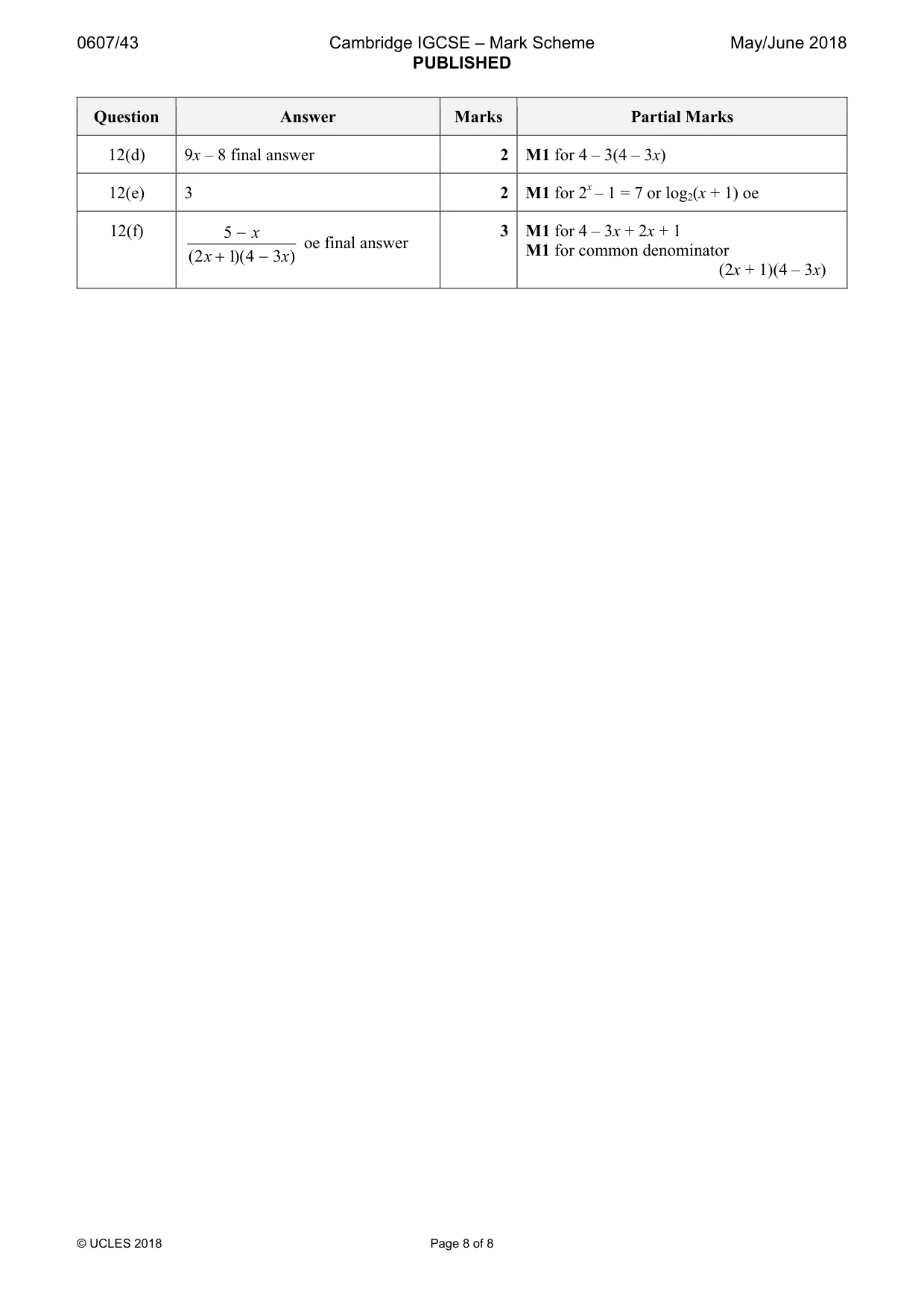
Mark scheme: 12(a) 3 1 – or – 0.75 4 12(b) 4 − x 2 M1 for x = 4 – 3y or y + 3x = 4 or oe final answer 3 y 4 y – 4 = –3x or = – x 3 3 12(c) –17 2 B1 for [f(3)] = 7 or M1 for 4 – 3(2x + 1) soi 12(d) 9x – 8 final answer 2 M1 for 4 – 3(4 – 3x) 12(e) 3 2 M1 for 2x – 1 = 7 or log2(x + 1) oe 12(f) 5 − x 3 M1 for 4 – 3x + 2x + 1 oe final answer M1 for common denominator (2 x + 1)(4 − 3x ) (2x + 1)(4 – 3x)
What was in this paper
The subtopics covered by these 12 questions, and how many questions each got. Open one in a new tab to see every Cambridge question on it.
What you needed in this session
Cambridge’s own grade thresholds for 2018 May/June, Paper 4 · Variant 3. A higher threshold means an easier paper — the bar moves with how the cohort did.