Cambridge IGCSE Mathematics - International 0607 — 2020 Oct/Nov Paper 4 · Variant 1
0607/41/O/N/20 · 12 questions · 120 marks · ≈135 min
The question paper and its mark scheme, free to read here and free to download. This is Cambridge’s own paper, exactly as it was sat.
Question paper20 pages
Mark scheme9 pages
Answers below. Sit the paper first if you are practising.
Questions as text
Q1 · Ten students at a school each study chemistry and physics
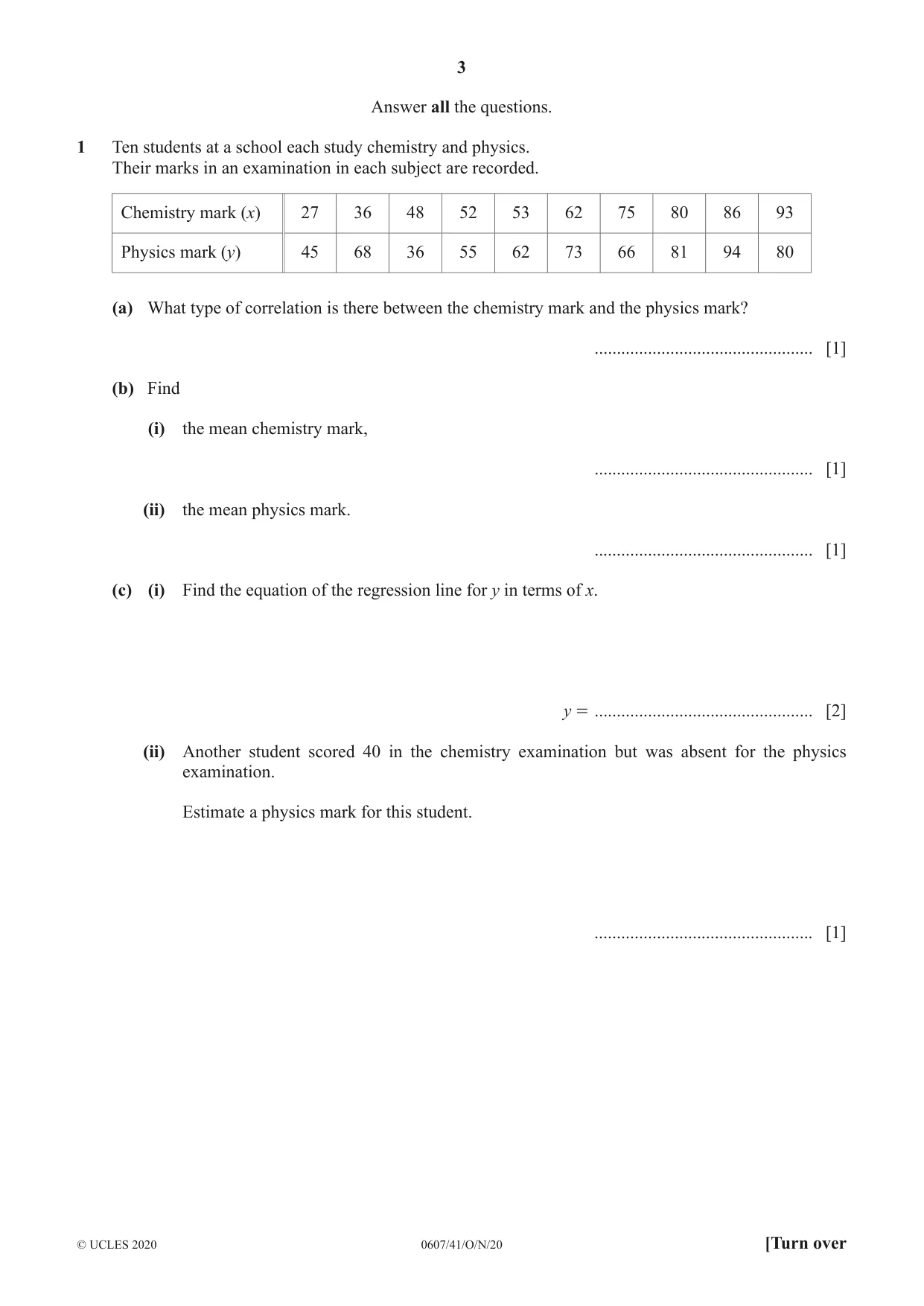
1 Ten students at a school each study chemistry and physics. Their marks in an examination in each subject are recorded. Chemistry mark (x) 27 36 48 52 53 62 75 80 86 93 Physics mark (y) 45 68 36 55 62 73 66 81 94 80 (a) What type of correlation is there between the chemistry mark and the physics mark? ................................................. [1] (b) Find (i) the mean chemistry mark, ................................................. [1] (ii) the mean physics mark. ................................................. [1] (c) (i) Find the equation of the regression line for y in terms of x. y = ................................................. [2] (ii) Another student scored 40 in the chemistry examination but was absent for the physics examination. Estimate a physics mark for this student. ................................................. [1]
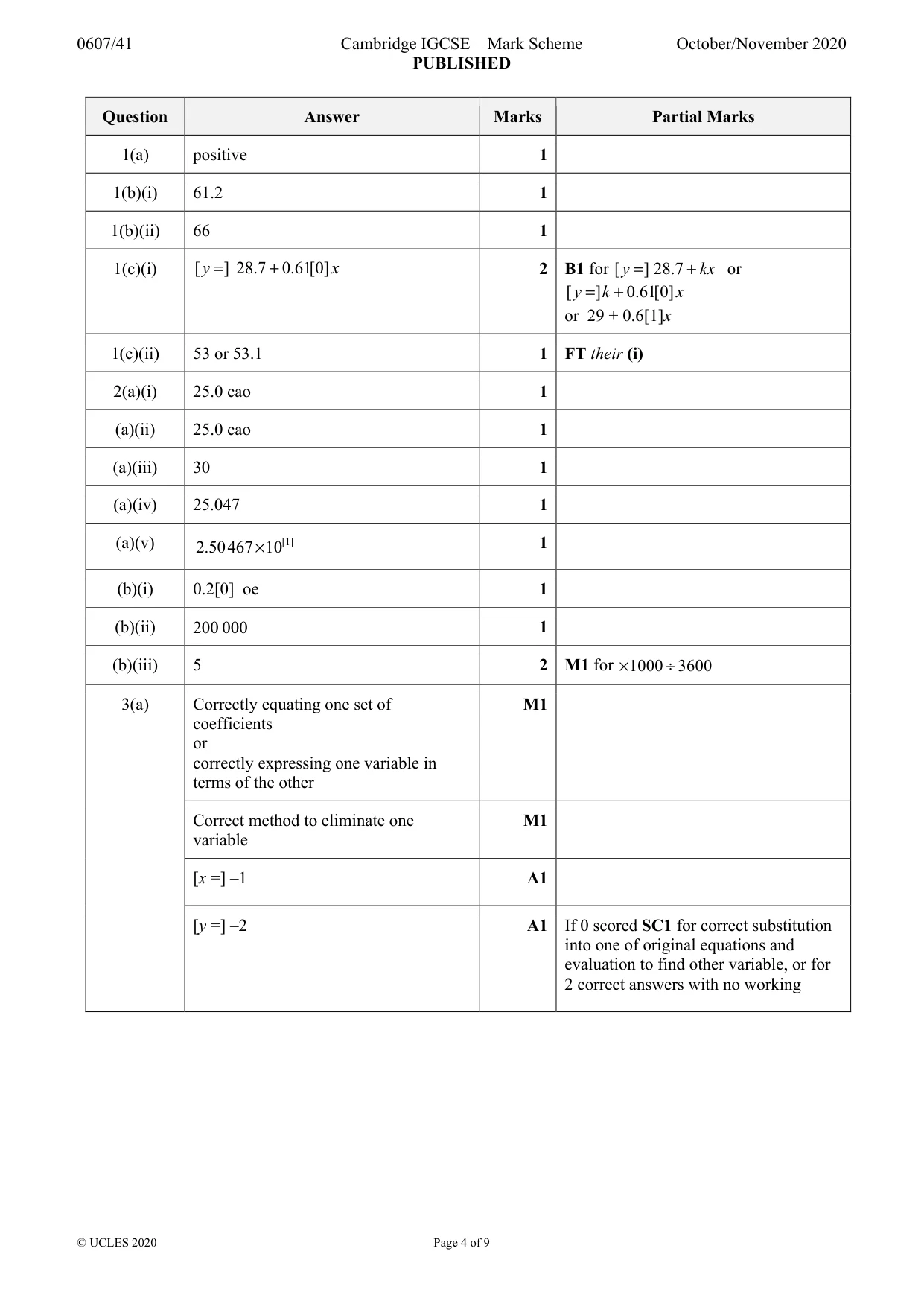
Mark scheme: Question Answer Marks Partial Marks 1(a) positive 1 1(b)(i) 61.2 1 1(b)(ii) 66 1 1(c)(i) [ y = ] 28.7 + 0.61[0] x 2 B1 for [ y = ] 28.7 + kx or [ y = ] k + 0.61[0] x or 29 + 0.6[1]x 1(c)(ii) 53 or 53.1 1 FT their (i)
Q2 · Write the number 25.0467 (i) correct to 1 decimal place…
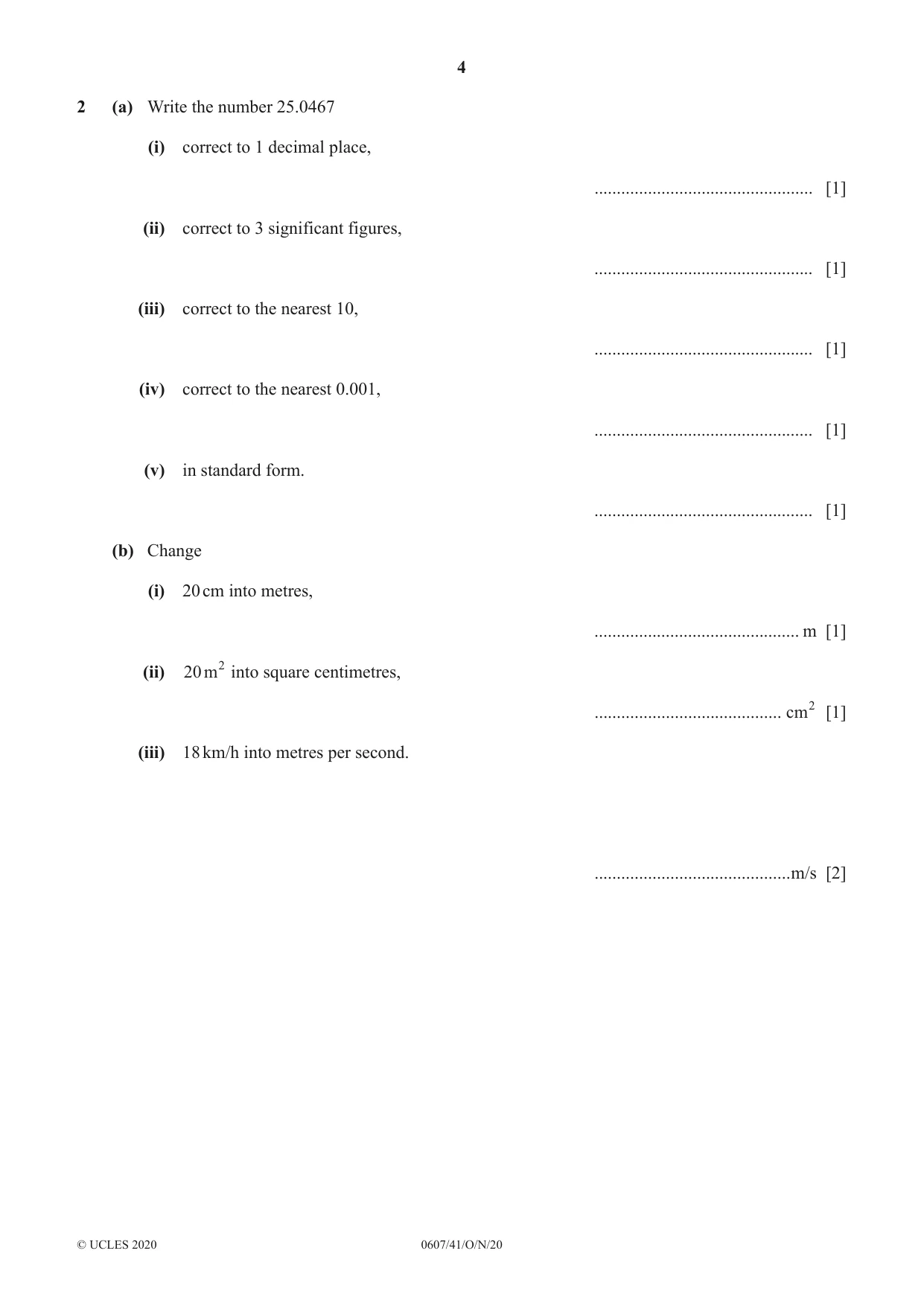
2 (a) Write the number 25.0467 (i) correct to 1 decimal place, ................................................. [1] (ii) correct to 3 significant figures, ................................................. [1] (iii) correct to the nearest 10, ................................................. [1] (iv) correct to the nearest 0.001, ................................................. [1] (v) in standard form. ................................................. [1] (b) Change (i) 20 cm into metres, .............................................. m [1] (ii) 20m2 into square centimetres, .......................................... cm2 [1] (iii) 18 km/h into metres per second. ............................................m/s [2]
Mark scheme: 2(a)(i) 25.0 cao 1 (a)(ii) 25.0 cao 1 (a)(iii) 30 1 (a)(iv) 25.047 1 (a)(v) 2.50467 × 10[1] 1 (b)(i) 0.2[0] oe 1 (b)(ii) 200 000 1 (b)(iii) 5 2 M1 for × 1000 ÷ 3600
Q3 · Solve the simultaneous equations
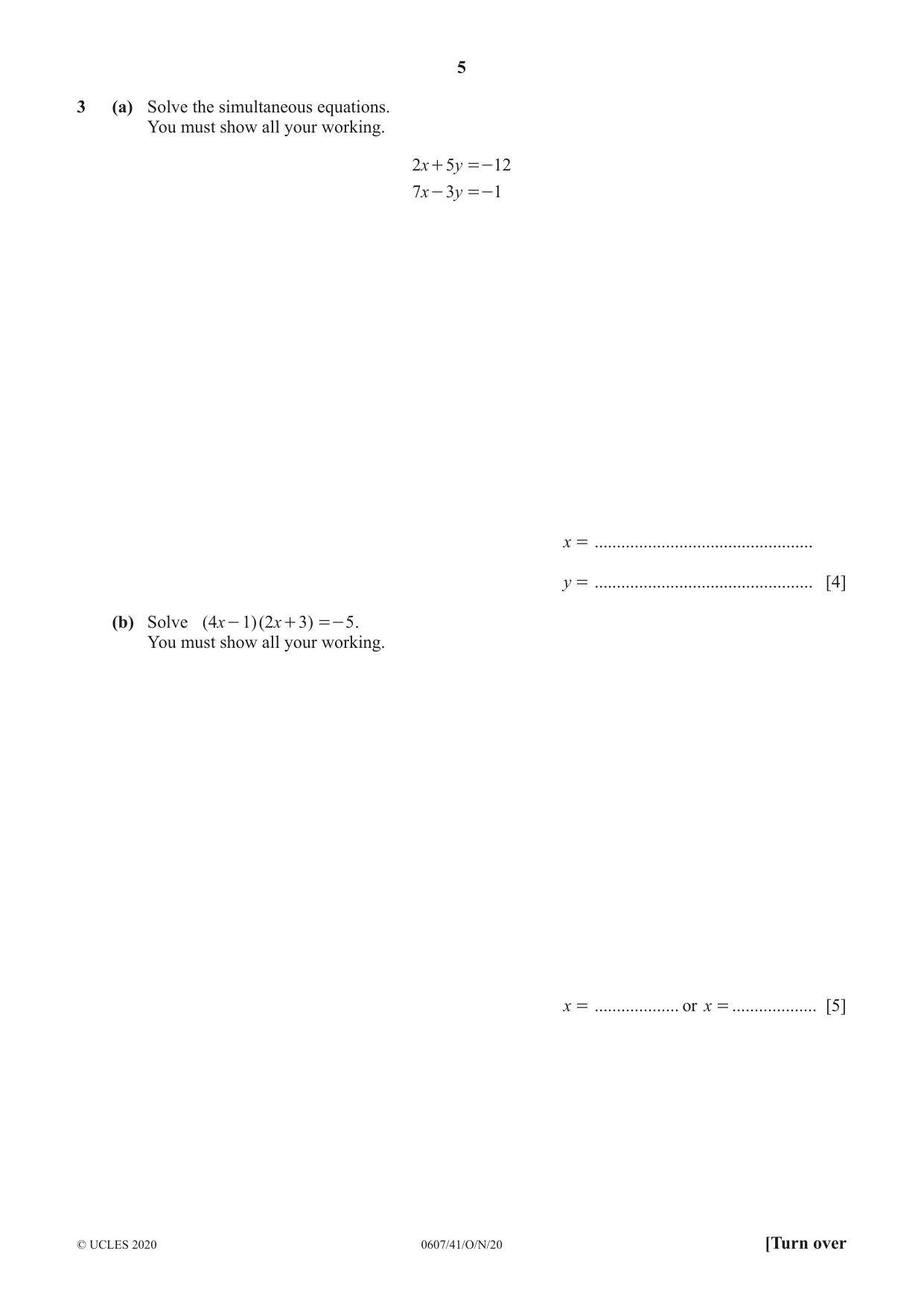
3 (a) Solve the simultaneous equations. You must show all your working. 2x + 5y =- 12 7x - 3y =- 1 x = ................................................. y = ................................................. [4] (b) Solve ( 4x - 1)( 2x + 3) =- 5 . You must show all your working. x = ................... or x = ................... [5]
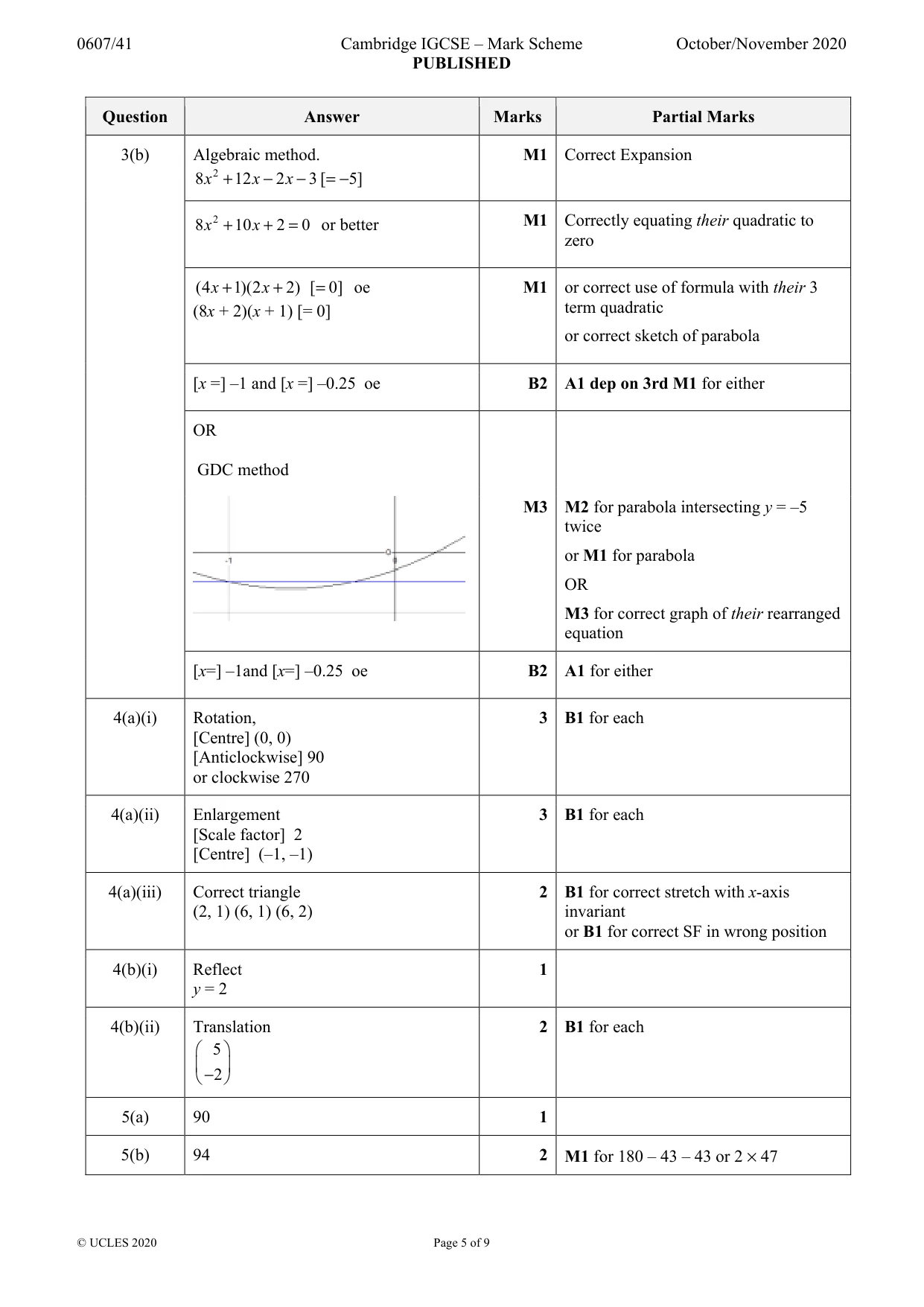
Mark scheme: 3(a) Correctly equating one set of M1 coefficients or correctly expressing one variable in terms of the other Correct method to eliminate one M1 variable [x =] –1 A1 [y =] –2 A1 If 0 scored SC1 for correct substitution into one of original equations and evaluation to find other variable, or for 2 correct answers with no working 3(b) Algebraic method. M1 Correct Expansion 8 x 2 + 12 x − 2 x − 3 [ = −5] 8 x 2 + 10 x + 2 = 0 or better M1 Correctly equating their quadratic to zero (4 x + 1)(2 x + 2) [ = 0] oe M1 or correct use of formula with their 3 (8x + 2)(x + 1) [= 0] term quadratic or correct sketch of parabola [x =] –1 and [x =] –0.25 oe B2 A1 dep on 3rd M1 for either OR GDC method M3 M2 for parabola intersecting y = –5 twice or M1 for parabola OR M3 for correct graph of their rearranged equation [x=] –1and [x=] –0.25 oe B2 A1 for either
Q4 · Y 8 7 6 5 4 C 3 B 2 A 1 – 8 – 7 – 6 – 5 – 4 – 3 – 2 – 1 0 1 2 3 4 5 6 7 8 x – 1 – 2 – 3…
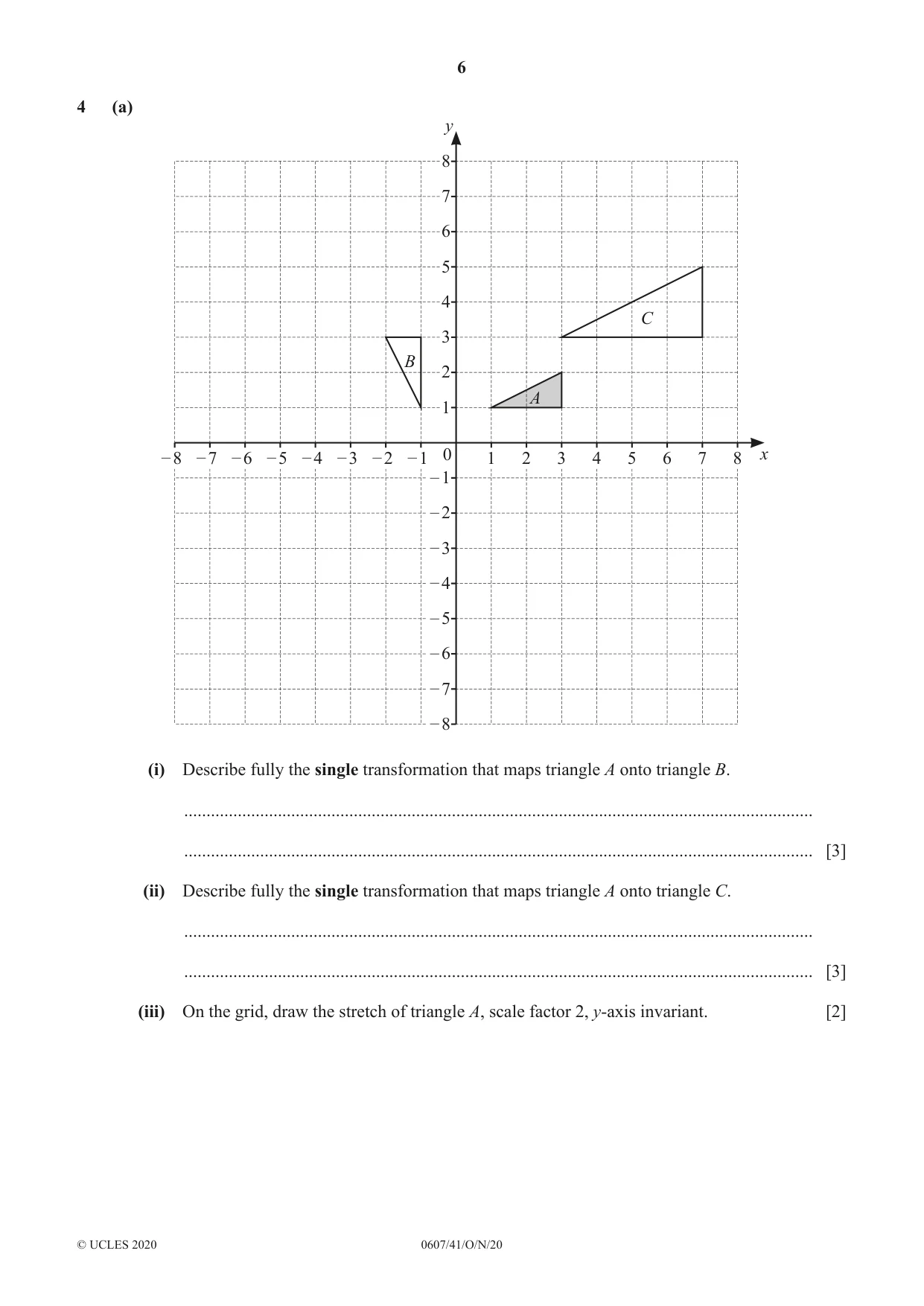
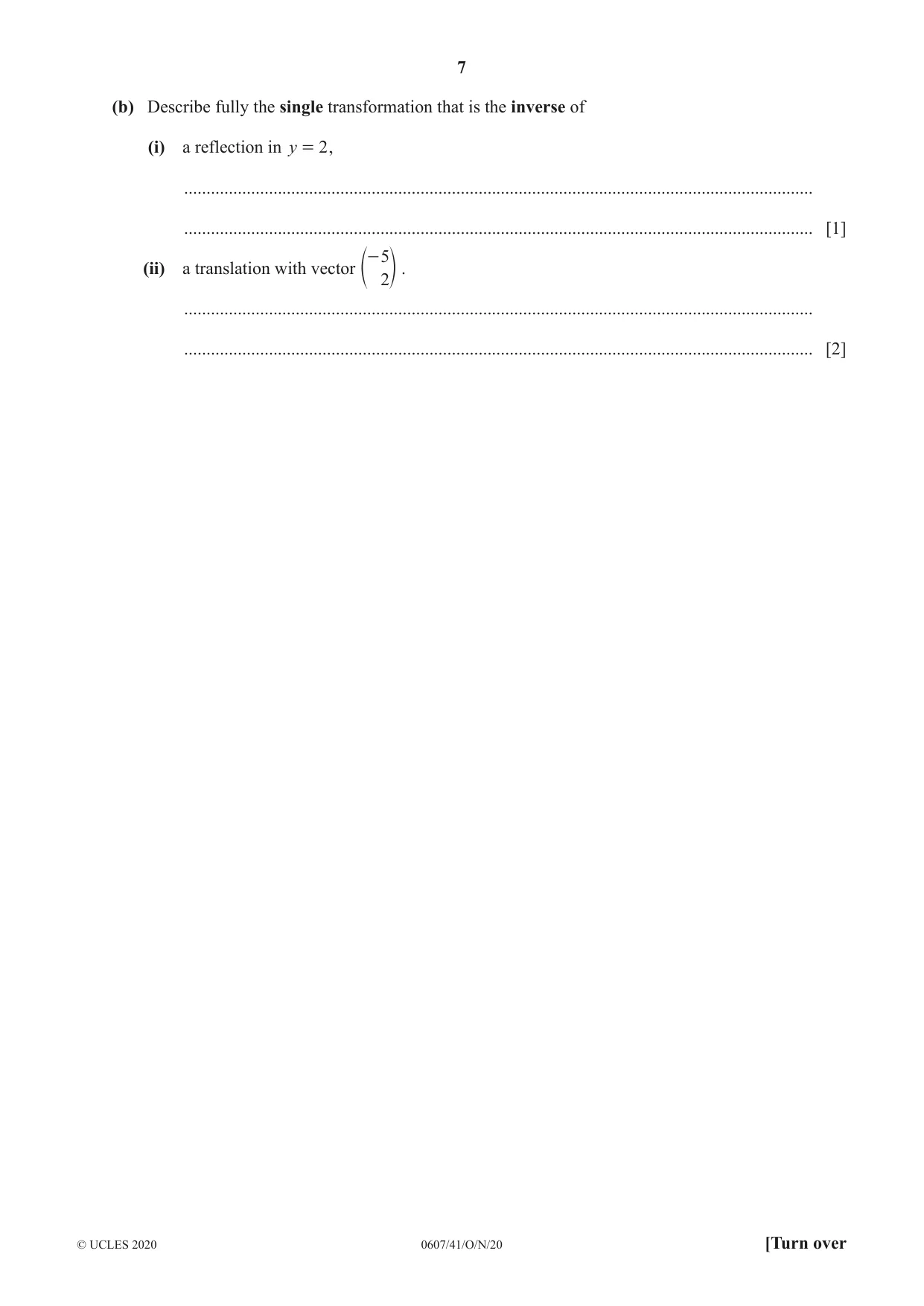
4 (a) y 8 7 6 5 4 C 3 B 2 A 1 – 8 – 7 – 6 – 5 – 4 – 3 – 2 – 1 0 1 2 3 4 5 6 7 8 x – 1 – 2 – 3 – 4 – 5 – 6 – 7 – 8 (i) Describe fully the single transformation that maps triangle A onto triangle B. ............................................................................................................................................. ............................................................................................................................................. [3] (ii) Describe fully the single transformation that maps triangle A onto triangle C. ............................................................................................................................................. ............................................................................................................................................. [3] (iii) On the grid, draw the stretch of triangle A, scale factor 2, y-axis invariant. [2] (b) Describe fully the single transformation that is the inverse of (i) a reflection in y = 2 , ............................................................................................................................................. ............................................................................................................................................. [1] - 5 (ii) a translation with vector . e 2o ............................................................................................................................................. ............................................................................................................................................. [2]
Mark scheme: 4(a)(i) Rotation, 3 B1 for each [Centre] (0, 0) [Anticlockwise] 90 or clockwise 270 4(a)(ii) Enlargement 3 B1 for each [Scale factor] 2 [Centre] (–1, –1) 4(a)(iii) Correct triangle 2 B1 for correct stretch with x-axis (2, 1) (6, 1) (6, 2) invariant or B1 for correct SF in wrong position 4(b)(i) Reflect 1 y = 2 4(b)(ii) Translation 2 B1 for each 5 − 2
Q5 · X B T 47° 65° NOT TO O SCALE A C D A, B, C and D lie on a circle, centre O
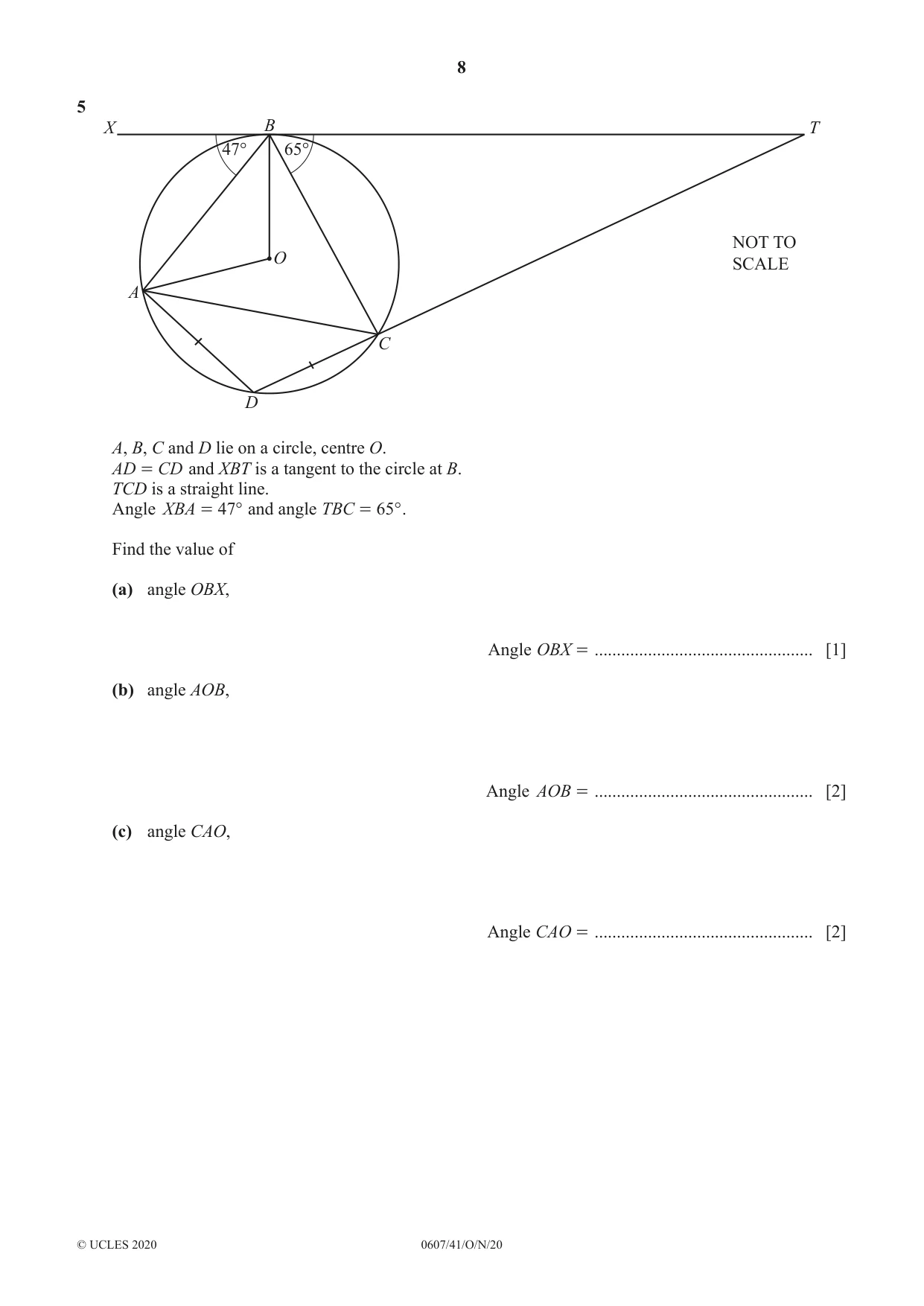
5 X B T 47° 65° NOT TO O SCALE A C D A, B, C and D lie on a circle, centre O. AD = CD and XBT is a tangent to the circle at B. TCD is a straight line. Angle XBA = 47° and angle TBC = 65° . Find the value of (a) angle OBX, Angle OBX = ................................................. [1] (b) angle AOB, Angle AOB = ................................................. [2] (c) angle CAO, Angle CAO = ................................................. [2] (d) angle CDA, Angle CDA = ................................................. [2] (e) angle DAC, Angle DAC = ................................................. [2] (f) angle CTB. Angle CTB = ................................................. [2]
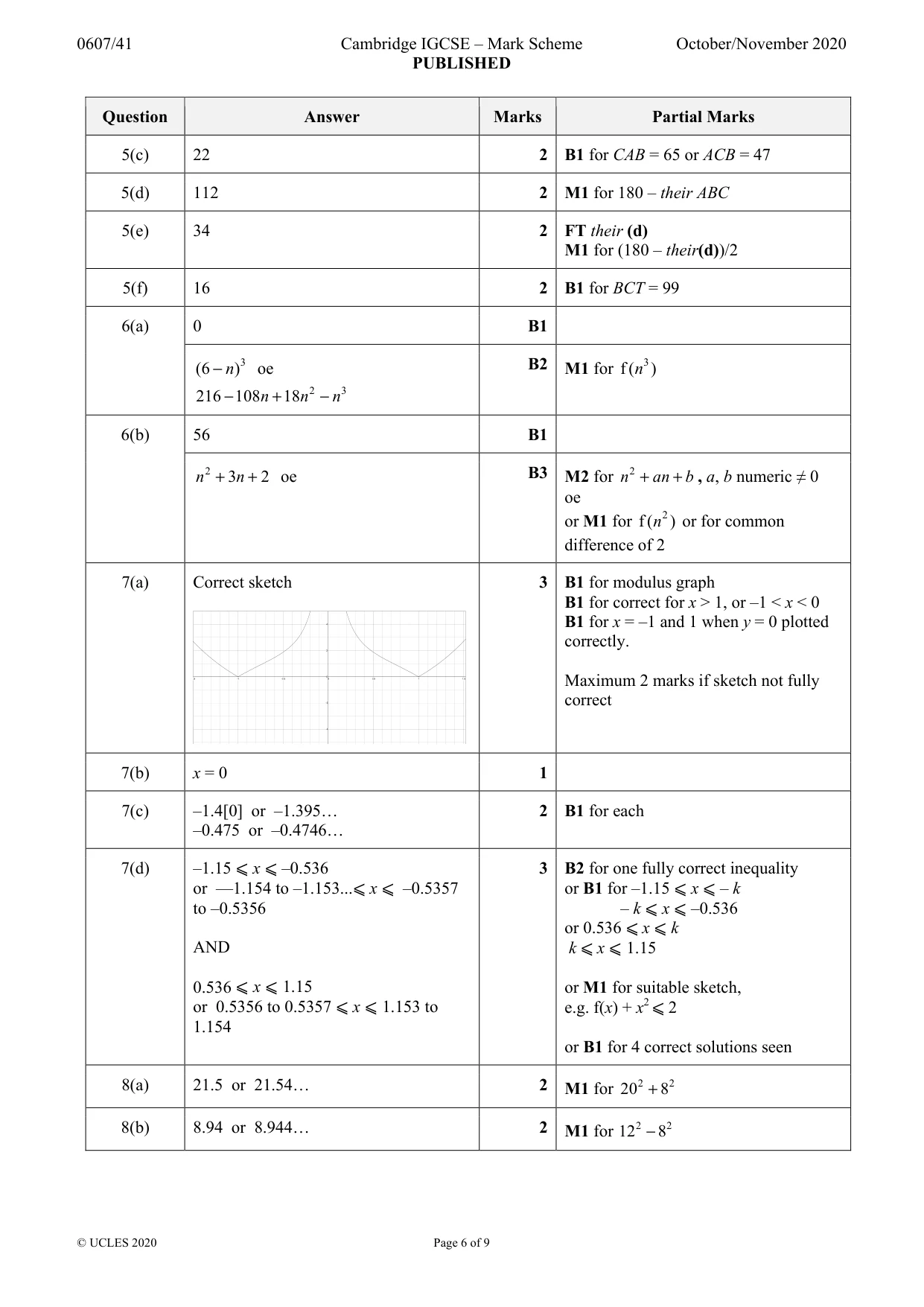
Mark scheme: 5(a) 90 1 5(b) 94 2 M1 for 180 – 43 – 43 or 2 × 47 5(c) 22 2 B1 for CAB = 65 or ACB = 47 5(d) 112 2 M1 for 180 – their ABC 5(e) 34 2 FT their (d) M1 for (180 – their(d))/2 5(f) 16 2 B1 for BCT = 99
Q6 · Find the next term and the nth term in each of these sequences
6 Find the next term and the nth term in each of these sequences. (a) 125, 64, 27, 8, 1, … Next term ................................................. nth term ................................................. [3] (b) 6, 12, 20, 30, 42, … Next term ................................................. nth term ................................................. [4]
Mark scheme: 6(a) 0 B1 (6 −n ) 3 oe B2 M1 for f ( n 3 ) 216 − 108 n + 18 n 2 − n 3 6(b) 56 B1 n 2 + 3n + 2 oe B3 M2 for n 2 + an + b , a, b numeric ≠ 0 oe or M1 for f ( n 2 ) or for common difference of 2
Q7 · Y 5 – 1.5 0 1.5 x – 5 3 1 f ( )x = x - x (a) On the diagram, sketch the graph of y = f (…
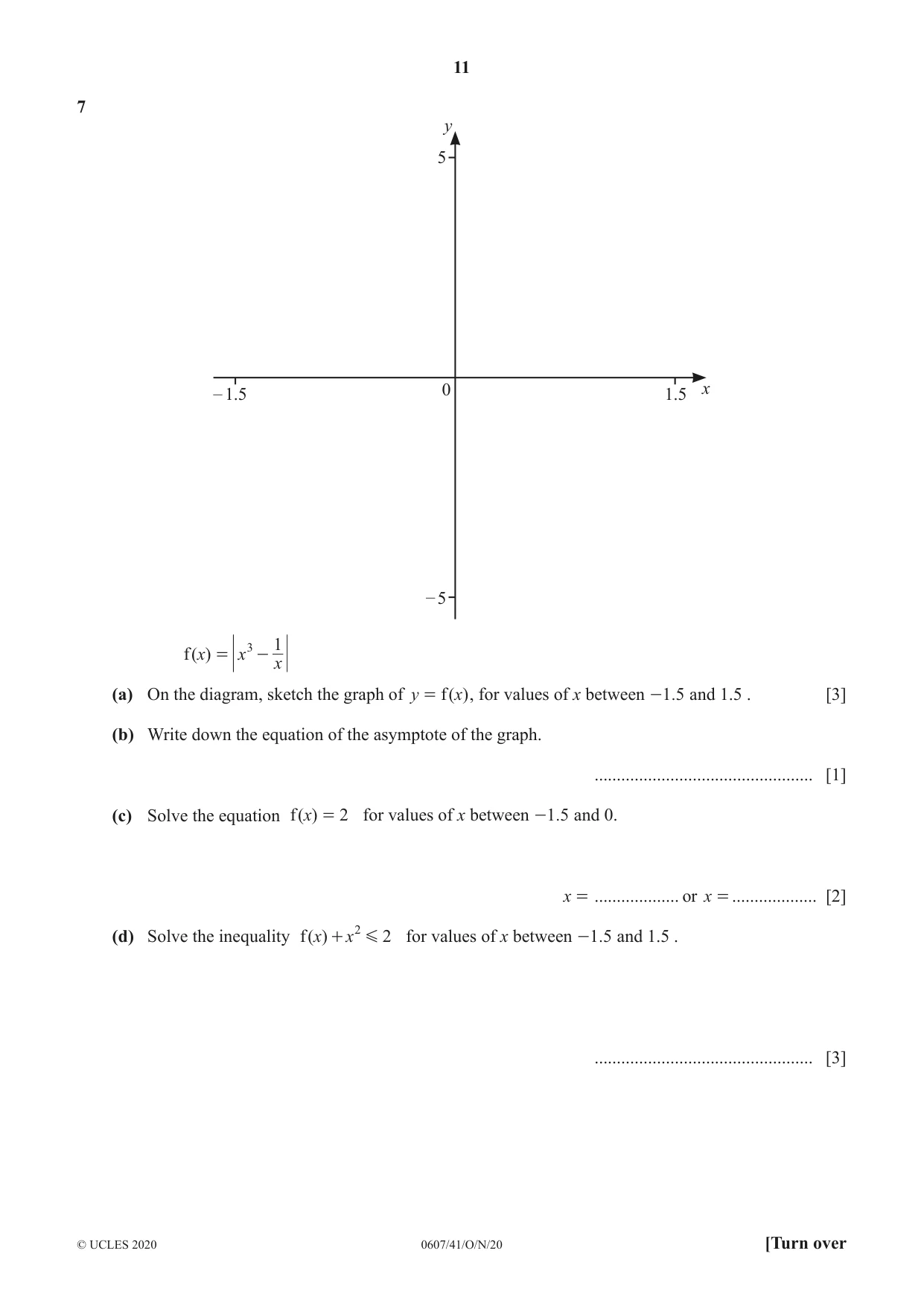
7 y 5 – 1.5 0 1.5 x – 5 3 1 f ( )x = x - x (a) On the diagram, sketch the graph of y = f ( x) , for values of x between - .15 and 1.5 . [3] (b) Write down the equation of the asymptote of the graph. ................................................. [1] (c) Solve the equation f ( )x = 2 for values of x between - .15 and 0. x = ................... or x = ................... [2] (d) Solve the inequality f ( )x + x 2 G 2 for values of x between - .15 and 1.5 . ................................................. [3]
Mark scheme: 7(a) Correct sketch 3 B1 for modulus graph B1 for correct for x > 1, or –1 < x < 0 4444 B1 for x = –1 and 1 when y = 0 plotted 2222 correctly. .5.5.5.5 -1-1-1-1 -0.5-0.5-0.5-0.5 0000 0000 0.50.50.50.5 1111 1.51.51.51.5 Maximum 2 marks if sketch not fully -2-2-2-2 correct -4-4-4-4 7(b) x = 0 1 7(c) –1.4[0] or –1.395… 2 B1 for each –0.475 or –0.4746… 7(d) –1.15 ⩽ x ⩽ –0.536 3 B2 for one fully correct inequality or ––1.154 to –1.153...⩽ x ⩽ –0.5357 or B1 for –1.15 ⩽ x ⩽ – k to –0.5356 – k ⩽ x ⩽ –0.536 or 0.536 ⩽ x ⩽ k AND k ⩽ x ⩽ 1.15 0.536 ⩽ x ⩽ 1.15 or M1 for suitable sketch, or 0.5356 to 0.5357 ⩽ x ⩽ 1.153 to e.g. f(x) + x2 ⩽ 2 1.154 or B1 for 4 correct solutions seen
Q8 · E F NOT TO SCALE 12 cm B A 8 cm D C 20 cm ABCDEF is a triangular prism
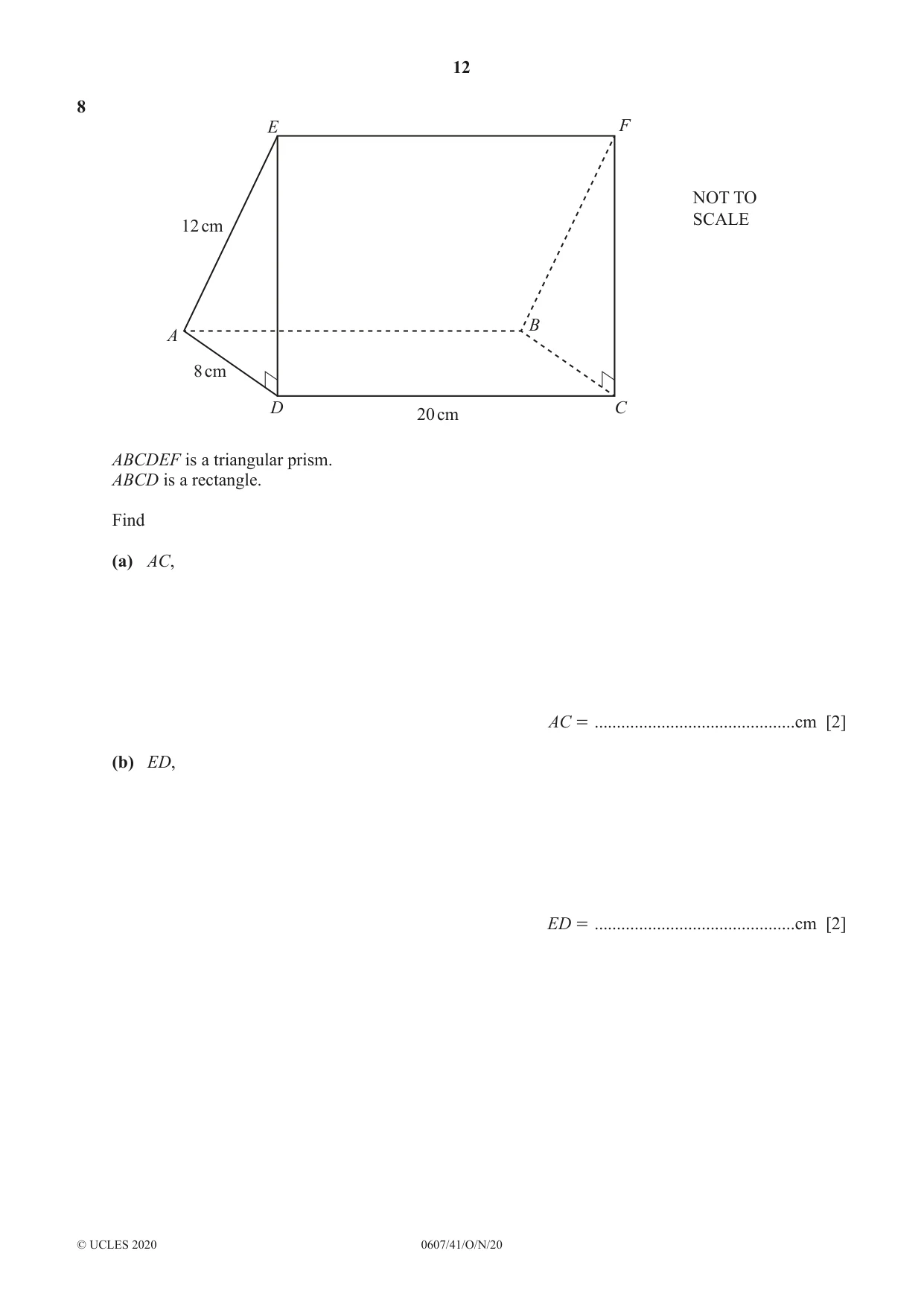
8 E F NOT TO SCALE 12 cm B A 8 cm D C 20 cm ABCDEF is a triangular prism. ABCD is a rectangle. Find (a) AC, AC = .............................................cm [2] (b) ED, ED = .............................................cm [2] (c) angle EAD, Angle EAD = ................................................. [2] (d) angle FAC. Angle FAC = ................................................. [2]
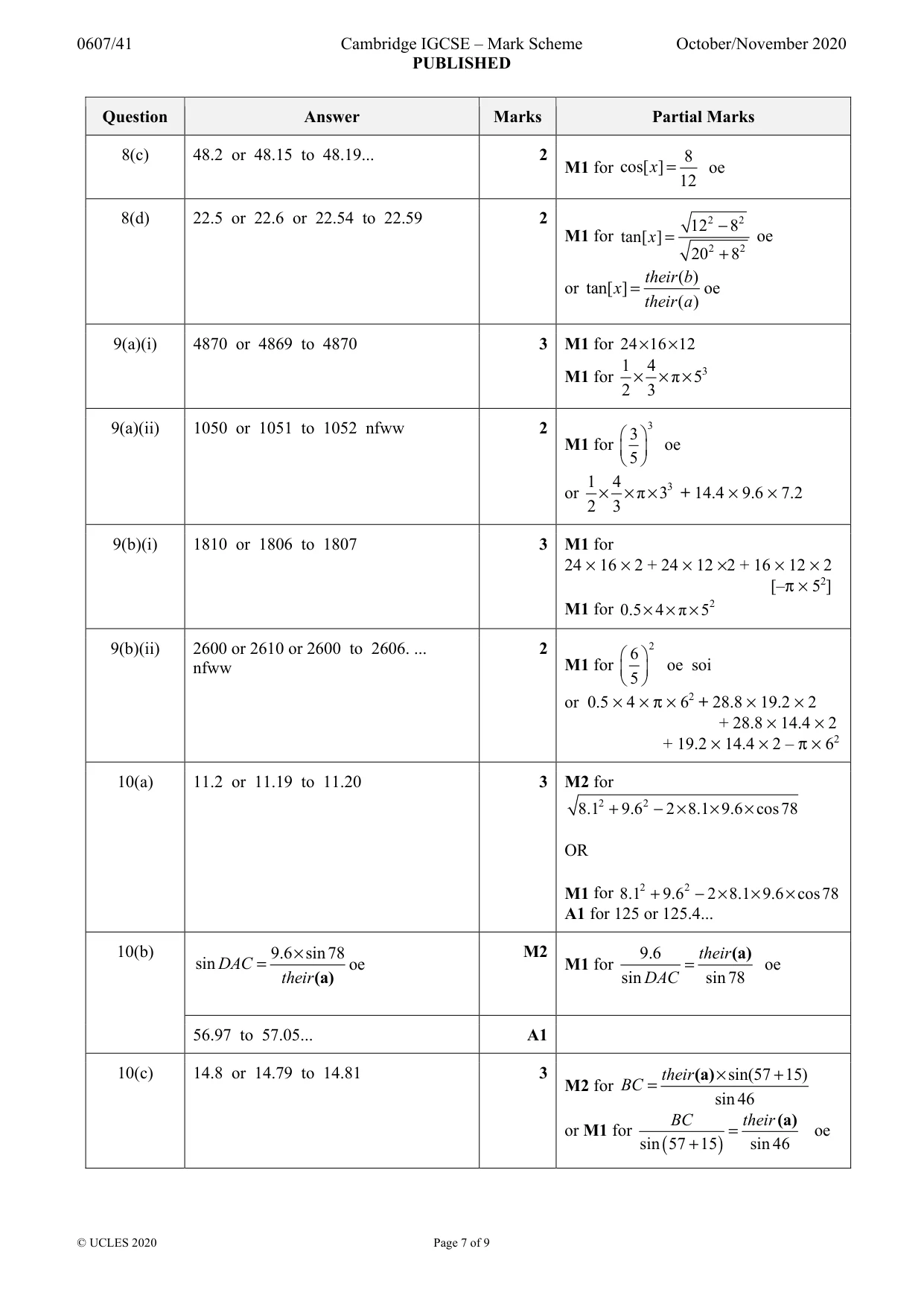
Mark scheme: 8(a) 21.5 or 21.54… 2 M1 for 20 2 + 8 2 8(b) 8.94 or 8.944… 2 M1 for 12 2 − 8 2 8(c) 48.2 or 48.15 to 48.19... 2 8 M1 for cos[ x ] = oe 12 8(d) 22.5 or 22.6 or 22.54 to 22.59 2 2 2 12 − 8 M1 for tan[ x ] = oe 20 2 + 8 2 their (b ) or tan[ x ] = oe their ( a )
Q9 · 5 cm NOT TO SCALE 24 cm 12 cm 16 cm The diagram shows a solid made from a cuboid and a…
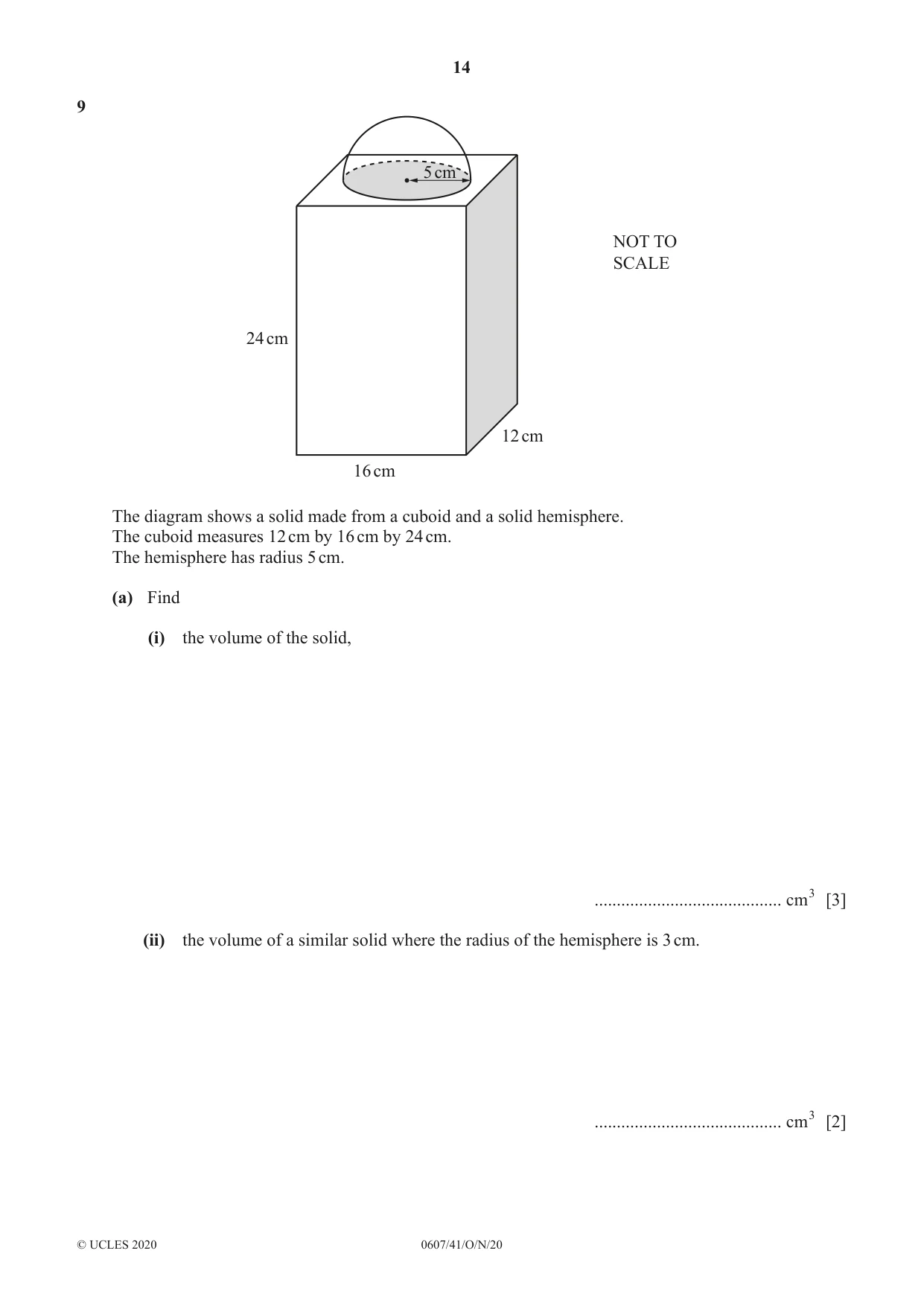
9 5 cm NOT TO SCALE 24 cm 12 cm 16 cm The diagram shows a solid made from a cuboid and a solid hemisphere. The cuboid measures 12 cm by 16 cm by 24 cm. The hemisphere has radius 5 cm. (a) Find (i) the volume of the solid, .......................................... cm3 [3] (ii) the volume of a similar solid where the radius of the hemisphere is 3 cm. .......................................... cm3 [2] (b) Find (i) the total surface area of the original solid, .......................................... cm2 [3] (ii) the total surface area of a similar solid where the radius of the hemisphere is 6 cm. .......................................... cm2 [2]
Mark scheme: 9(a)(i) 4870 or 4869 to 4870 3 M1 for 24 × 16 × 12 1 4 3 M1 for × × π × 5 2 3 9(a)(ii) 1050 or 1051 to 1052 nfww 2 3 3 M1 for oe 5 1 4 3 or × × π × 3 + 14.4 × 9.6 × 7.2 2 3 9(b)(i) 1810 or 1806 to 1807 3 M1 for 24 × 16 × 2 + 24 × 12 ×2 + 16 × 12 × 2 [–π × 52] M1 for 0.5 × 4 × π × 5 2 9(b)(ii) 2600 or 2610 or 2600 to 2606. ... 2 2 6 nfww M1 for oe soi 5 or 0.5 × 4 × π × 62 + 28.8 × 19.2 × 2 + 28.8 × 14.4 × 2 + 19.2 × 14.4 × 2 – π × 62
Q10 · B 46° NOT TO SCALE D 78° 15° 8.1 cm 9.6 cm A C ABC and ADC are triangles
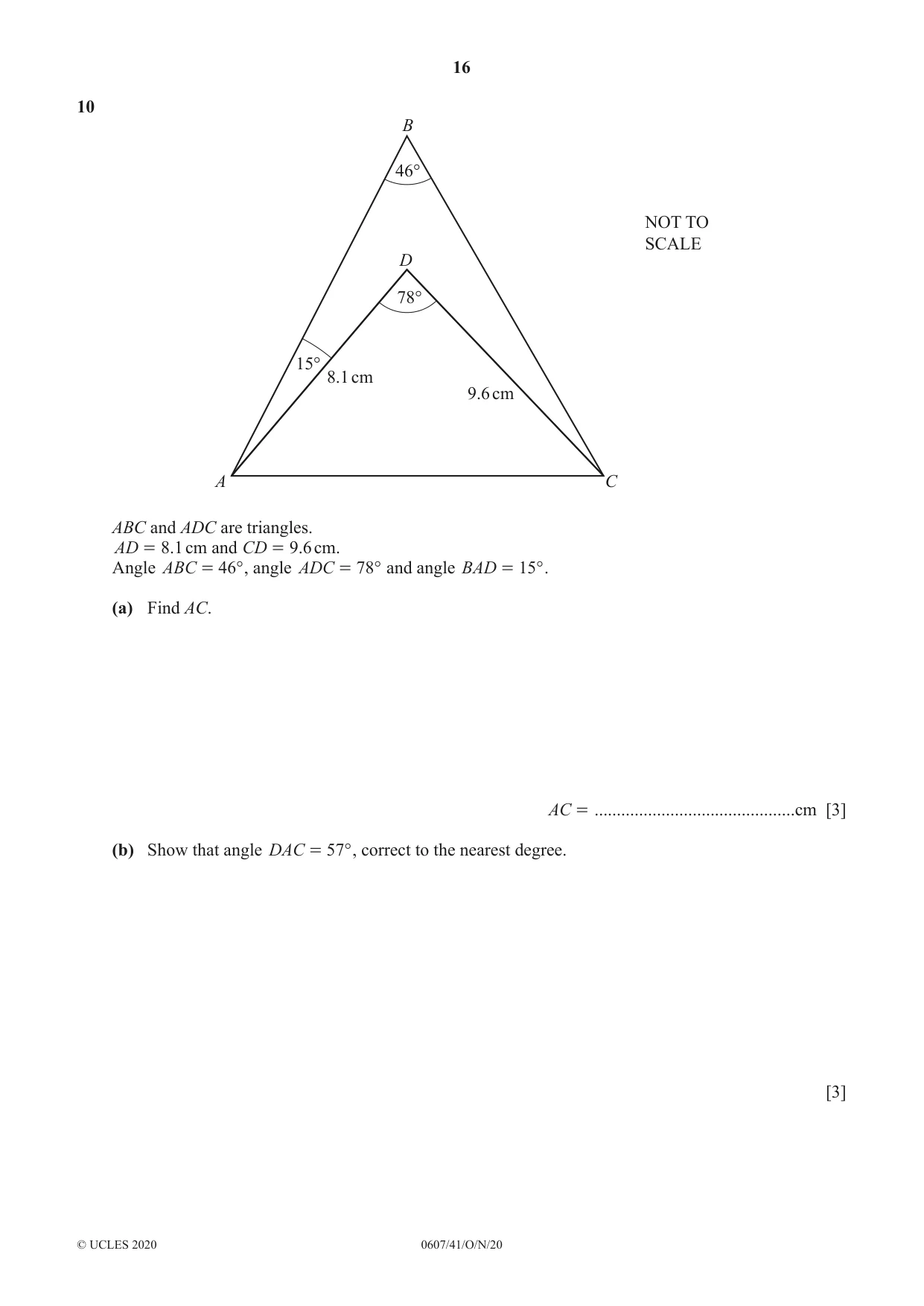
10 B 46° NOT TO SCALE D 78° 15° 8.1 cm 9.6 cm A C ABC and ADC are triangles. AD = 8.1 cm and CD = 9.6 cm. Angle ABC = 46° , angle ADC = 78° and angle BAD = 15° . (a) Find AC. AC = .............................................cm [3] (b) Show that angle DAC = 57° , correct to the nearest degree. [3] (c) Find BC. BC = .............................................cm [3] (d) Find the area of quadrilateral ABCD. .......................................... cm2 [4]
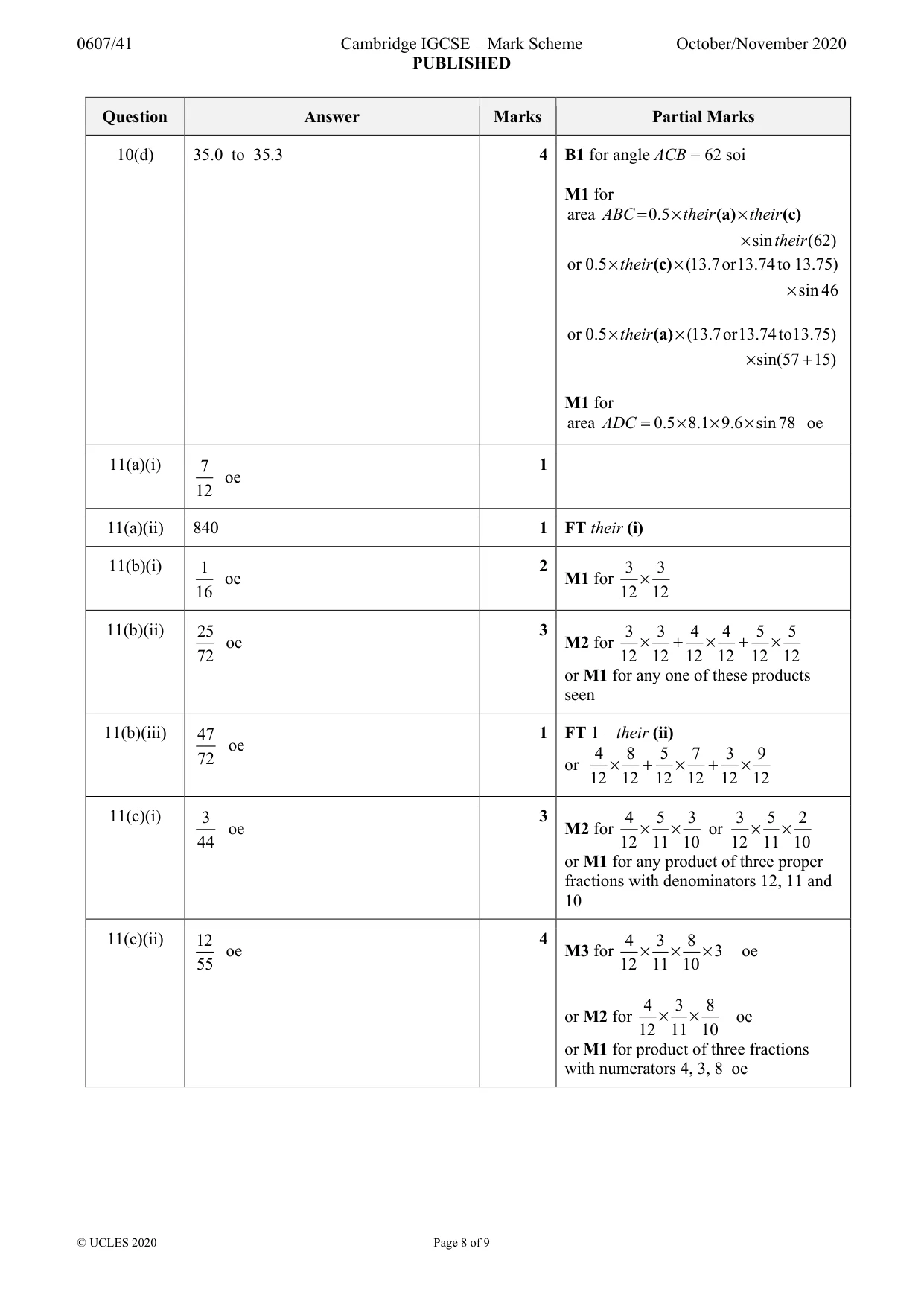
Mark scheme: 10(a) 11.2 or 11.19 to 11.20 3 M2 for 8.12 + 9.6 2 − 2 × 8.1 × 9.6 × cos78 OR M1 for 8.12 + 9.6 2 − 2 × 8.1 × 9.6 × cos78 A1 for 125 or 125.4... 10(b) 9.6 × sin78 M2 9.6 their (a) sin DAC = oe M1 for = oe their (a) sin DAC sin78 56.97 to 57.05... A1 10(c) 14.8 or 14.79 to 14.81 3 their (a) × sin(57 + 15) M2 for BC = sin46 BC their (a) or M1 for = oe sin ( 57 + 15 ) sin 46 10(d) 35.0 to 35.3 4 B1 for angle ACB = 62 soi M1 for area ABC = 0.5 × their (a) × their (c) × sin their (62) or 0.5 × their (c) × (13.7or13.74to 13.75) × sin 46 or 0.5 × their (a) × (13.7or13.74to13.75) × sin(57 + 15) M1 for area ADC = 0.5 × 8.1 × 9.6 × sin78 oe
Q11 · A bag contains 4 red balls, 5 black balls and 3 white balls only
11 A bag contains 4 red balls, 5 black balls and 3 white balls only. (a) In an experiment, one ball is chosen at random. (i) Find the probability that the ball chosen is not black. ................................................. [1] (ii) This experiment is carried out 1440 times. Find the expected number of times the ball chosen is not black. ................................................. [1] (b) In a different experiment, one ball is chosen at random, the colour is noted, and the ball is replaced in the bag. Another ball is then chosen at random and the colour is noted. Find the probability that the balls chosen are (i) both white, ................................................. [2] (ii) both the same colour, ................................................. [3] (iii) different colours. ................................................. [1] (c) In another experiment, three balls are chosen at random without replacement. (i) Find the probability that the first ball is not black, the second ball is black and the third ball is white. ................................................. [3] (ii) Find the probability that exactly two of the balls are red. ................................................. [4] Question 12 is printed on the next page.
Mark scheme: 11(a)(i) 7 1 oe 12 11(a)(ii) 840 1 FT their (i) 11(b)(i) 1 2 3 3 oe M1 for × 16 12 12 11(b)(ii) 25 3 3 3 4 4 5 5 oe M2 for × + × + × 72 12 12 12 12 12 12 or M1 for any one of these products seen 11(b)(iii) 47 1 FT 1 – their (ii) oe 4 8 5 7 3 9 72 or × + × + × 12 12 12 12 12 12 11(c)(i) 3 3 4 5 3 3 5 2 oe M2 for × × or × × 44 12 11 10 12 11 10 or M1 for any product of three proper fractions with denominators 12, 11 and 10 11(c)(ii) 12 4 4 3 8 oe M3 for × × × 3 oe 55 12 11 10 4 3 8 or M2 for × × oe 12 11 10 or M1 for product of three fractions with numerators 4, 3, 8 oe
Question 12
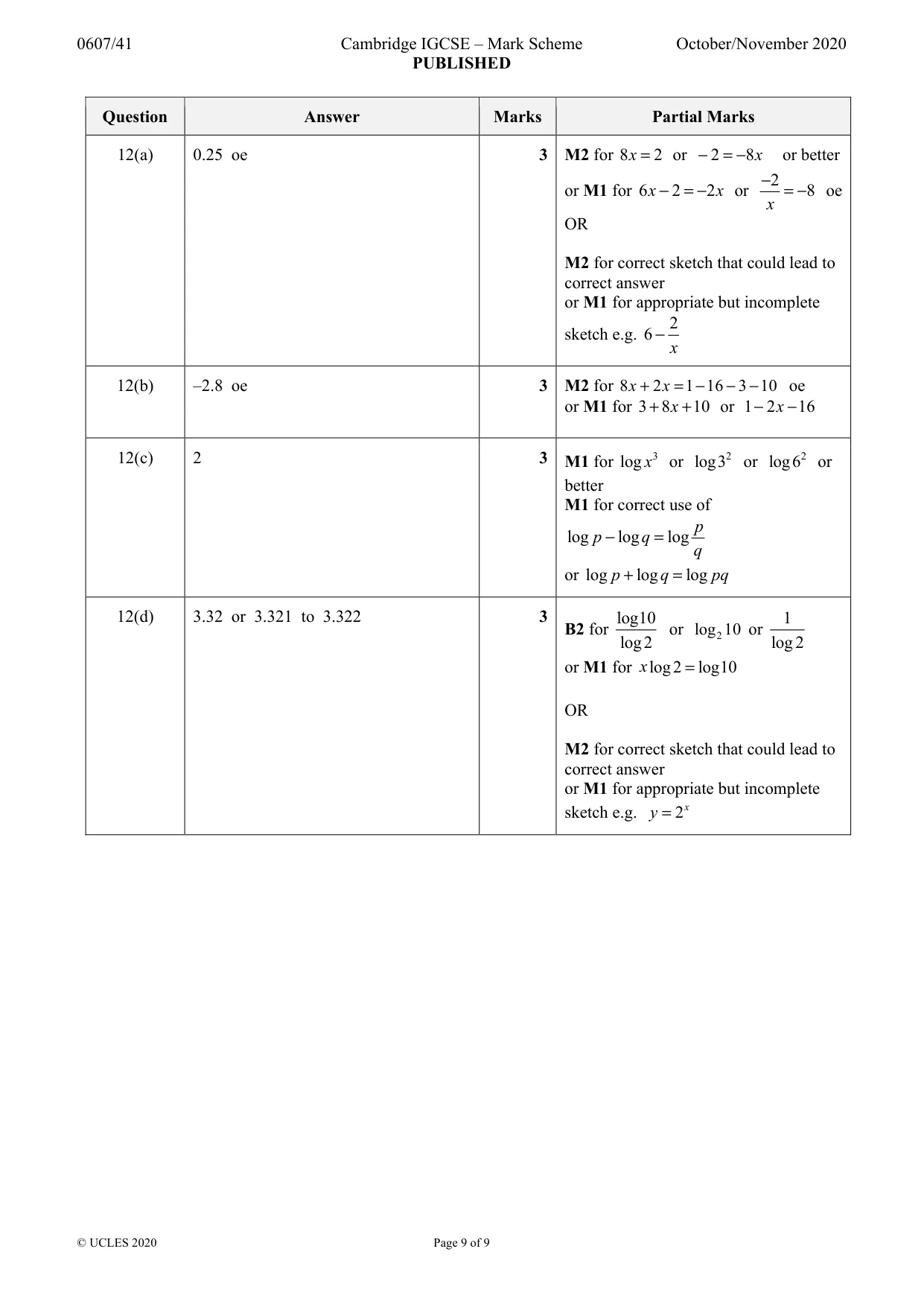
12 Solve the equations. 2 (a) 6 - =- 2 x x = ................................................. [3] (b) 3 + 2 ( 4x + 5) = 1 - 2 ( x + 8) x = ................................................. [3] (c) 3 log x + 2 log 3 = 2 log 6 + log 2 x = ................................................. [3] (d) 2 x = 10 x = ................................................. [3]
Mark scheme: 12(a) 0.25 oe 3 M2 for 8 x = 2 or − 2 = −8 x or better −2 or M1 for 6 x − 2 = −2 x or = −8 oe x OR M2 for correct sketch that could lead to correct answer or M1 for appropriate but incomplete 2 sketch e.g. 6 −x 12(b) –2.8 oe 3 M2 for 8 x + 2 x = 1 − 16 − 3 − 10 oe or M1 for 3 + 8 x + 10 or 1 − 2 x − 16 12(c) 2 3 M1 for log x 3 or log32 or log6 2 or better M1 for correct use of p log p − log q = log q or log p + log q = log pq 12(d) 3.32 or 3.321 to 3.322 3 log10 1 B2 for or log 2 10 or log2 log2 or M1 for x log2 = log10 OR M2 for correct sketch that could lead to correct answer or M1 for appropriate but incomplete sketch e.g. y = 2 x
What was in this paper
The subtopics covered by these 12 questions, and how many questions each got. Open one in a new tab to see every Cambridge question on it.
What you needed in this session
Cambridge’s own grade thresholds for 2020 Oct/Nov, Paper 4 · Variant 1. A higher threshold means an easier paper — the bar moves with how the cohort did.