Cambridge IGCSE Mathematics - International 0607 — 2024 Oct/Nov Paper 4 · Variant 1
0607/41/O/N/24 · 11 questions · 120 marks · ≈135 min
The question paper and its mark scheme, free to read here and free to download. This is Cambridge’s own paper, exactly as it was sat.
Question paper20 pages
Mark scheme9 pages
Answers below. Sit the paper first if you are practising.
Questions as text
Question 1
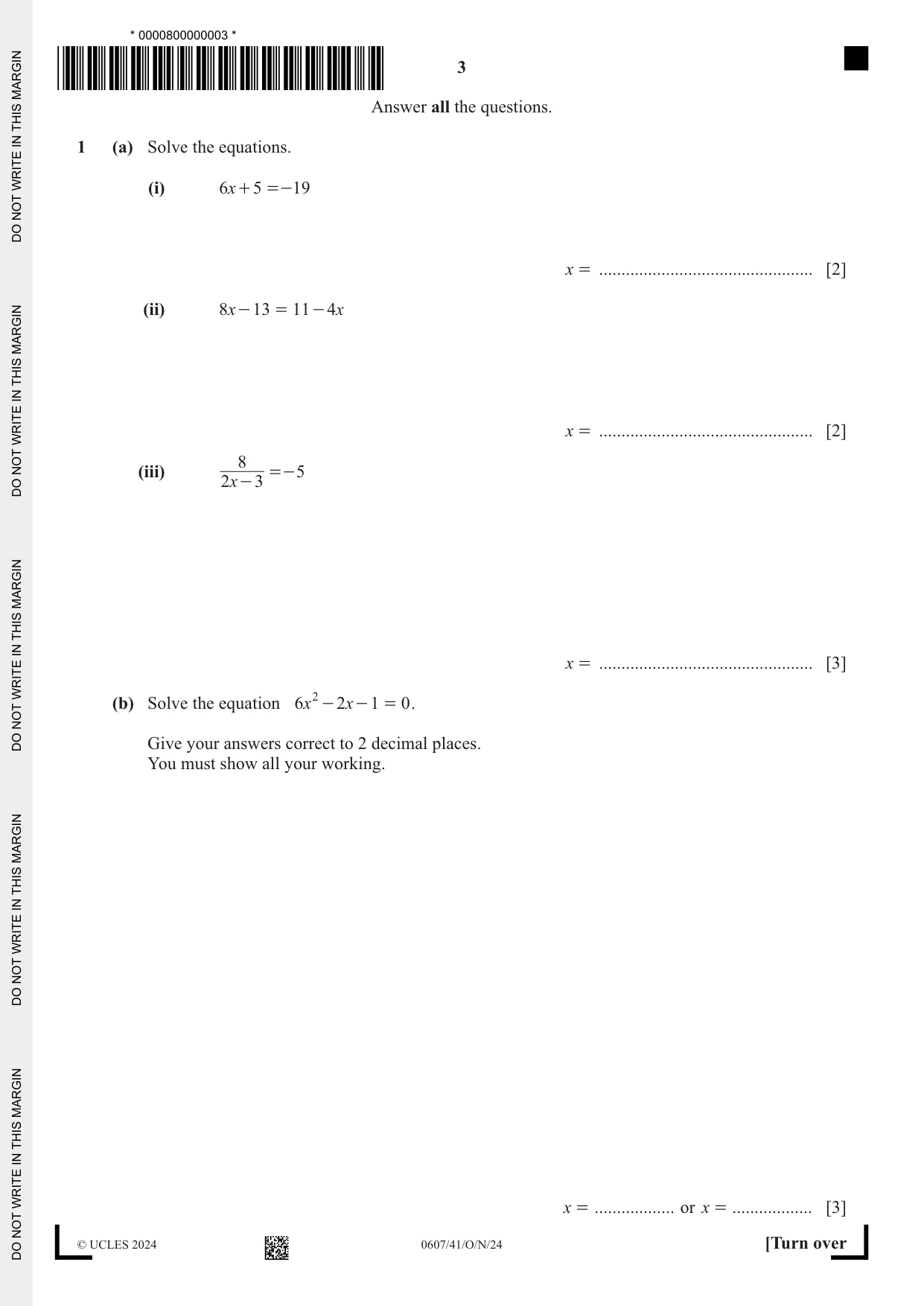
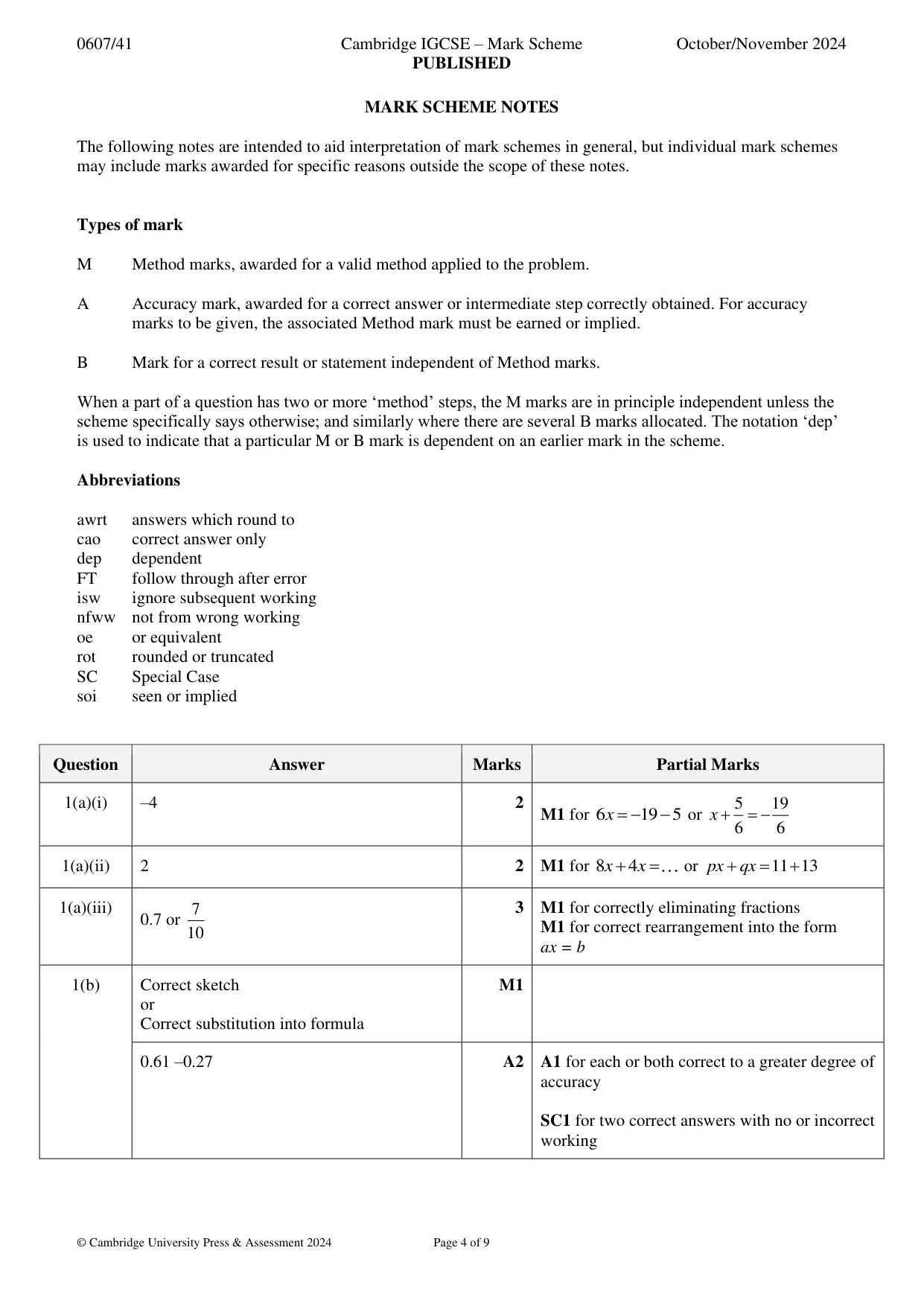
1 (a) Solve the equations. (i) 6x + 5 =-19 x = ................................................ [2] (ii) 8x - 13 = 11 - 4x x = ................................................ [2] 8 (iii) =- 5 2x - 3 x = ................................................ [3] (b) Solve the equation 6x 2 - 2 x - 1 = 0 . Give your answers correct to 2 decimal places. You must show all your working. x = .................. or x = .................. [3]
Mark scheme: Question Answer Marks Partial Marks 1(a)(i) –4 2 5 19 M1 for 6 x = −19 − 5 or x + = − 6 6 1(a)(ii) 2 2 M1 for 8x + 4 x = or px + qx = 11 + 13 1(a)(iii) 7 3 M1 for correctly eliminating fractions 0.7 or M1 for correct rearrangement into the form 10 ax = b 1(b) Correct sketch M1 or Correct substitution into formula 0.61 –0.27 A2 A1 for each or both correct to a greater degree of accuracy SC1 for two correct answers with no or incorrect working
Q2 · Younous wants to calculate +
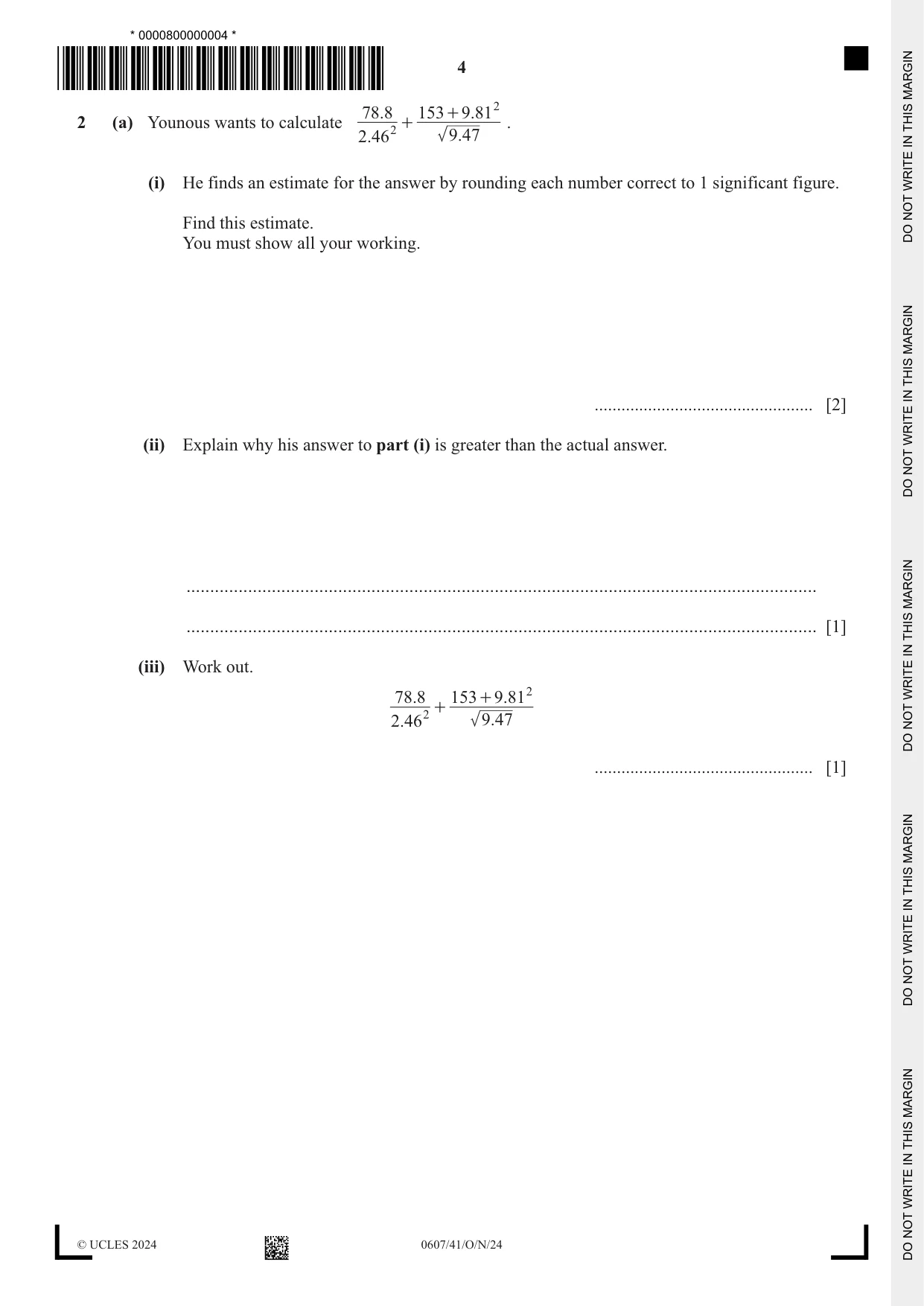
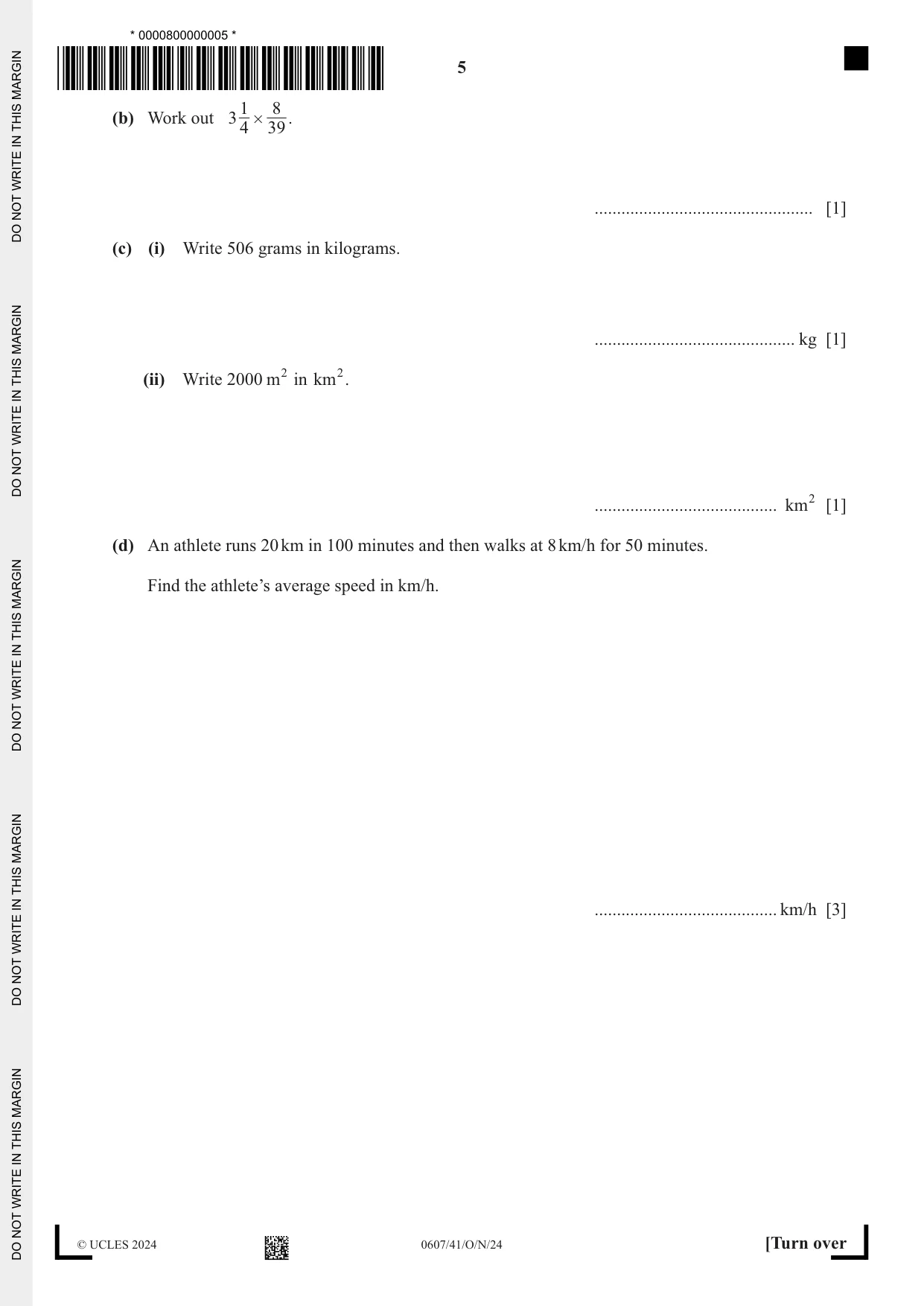
2 (a) Younous wants to calculate + . 2.46 2 9.47 (i) He finds an estimate for the answer by rounding each number correct to 1 significant figure. Find this estimate. You must show all your working. ................................................. [2] (ii) Explain why his answer to part (i) is greater than the actual answer. ..................................................................................................................................... ..................................................................................................................................... [1] (iii) Work out. 78.8 153 + 9 .81 2 + 2.46 2 9.47 ................................................. [1] 1 8 (b) Work out 3 # . 4 39 ................................................. [1] (c) (i) Write 506 grams in kilograms. ............................................. kg [1] (ii) Write 2000 m2 in km2. ......................................... km2 [1] (d) An athlete runs 20 km in 100 minutes and then walks at 8 km/h for 50 minutes. Find the athlete’s average speed in km/h. ......................................... km/h [3]
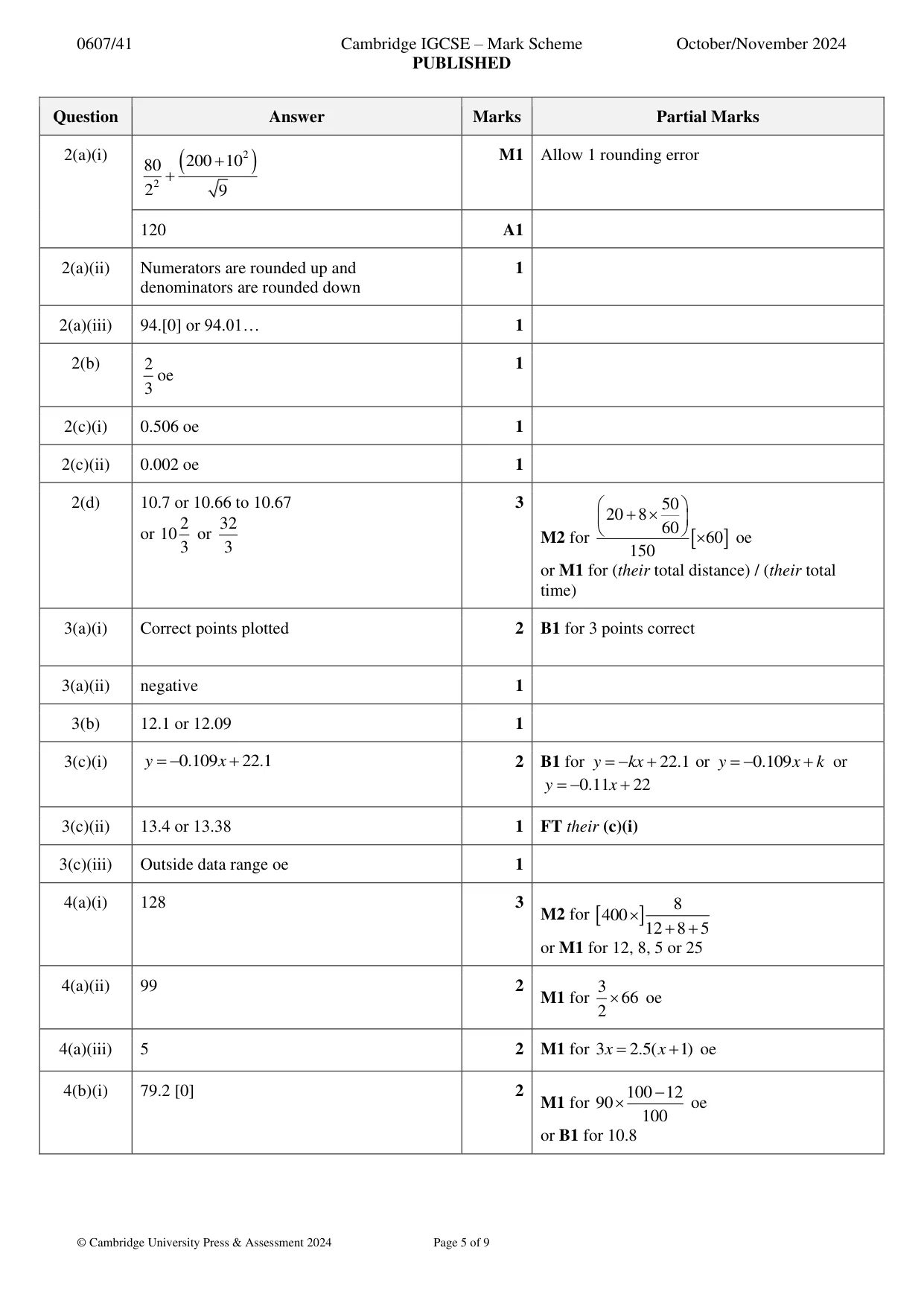
Mark scheme: 2(a)(i) 2 M1 Allow 1 rounding error 200 + 10 80 ( ) + 2 2 9 120 A1 2(a)(ii) Numerators are rounded up and 1 denominators are rounded down 2(a)(iii) 94.[0] or 94.01… 1 2(b) 2 1 oe 3 2(c)(i) 0.506 oe 1 2(c)(ii) 0.002 oe 1 2(d) 10.7 or 10.66 to 10.67 3 50 20 + 8 2 32 60 or or 10 M2 for 60 oe 3 3 150 or M1 for (their total distance) / (their total time)
Q3 · Paulo compares the fuel consumption of his car and the average speed of his car for ten…
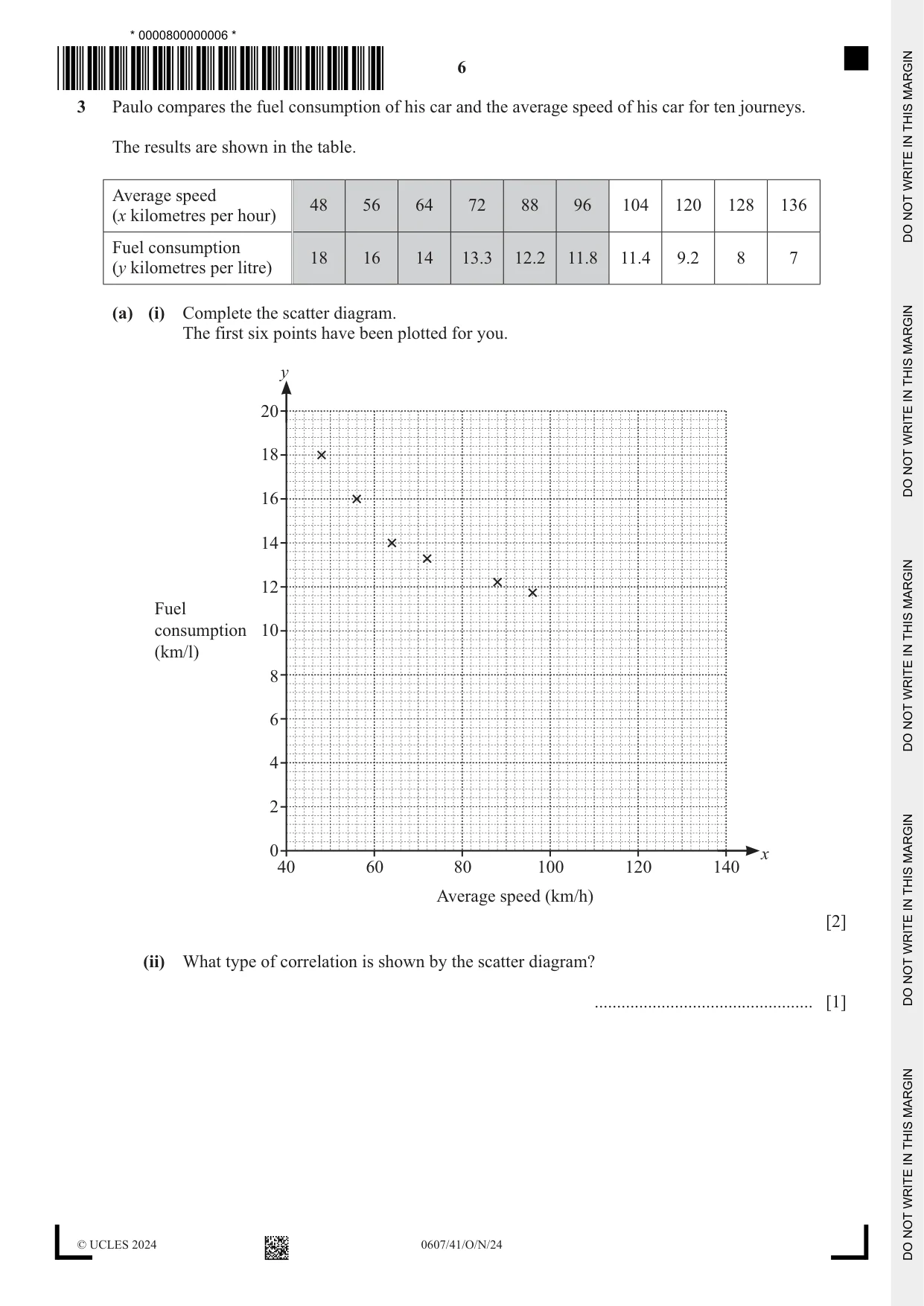
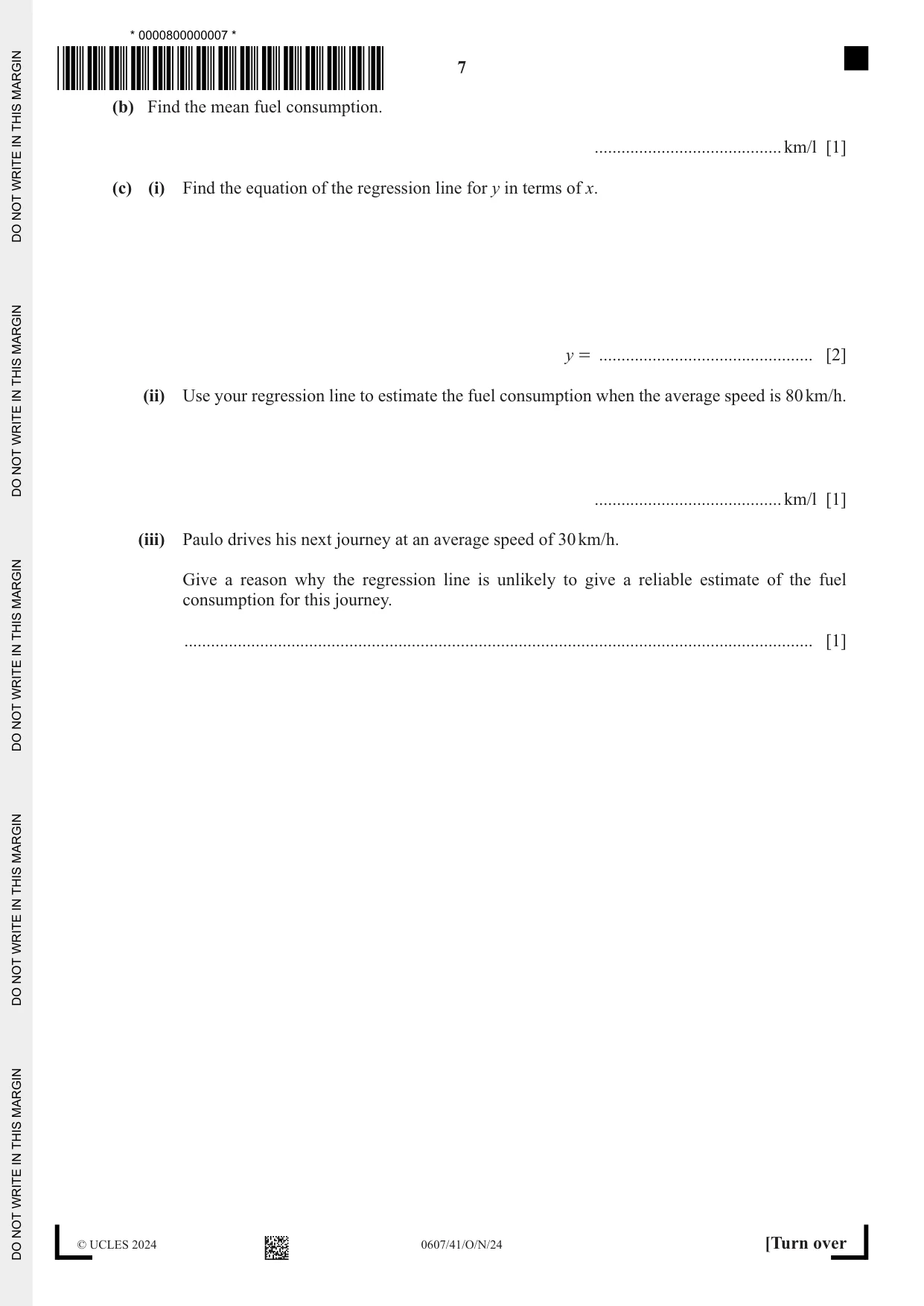
3 Paulo compares the fuel consumption of his car and the average speed of his car for ten journeys. The results are shown in the table. Average speed 48 56 64 72 88 96 104 120 128 136 (x kilometres per hour) Fuel consumption 18 16 14 13.3 12.2 11.8 11.4 9.2 8 7 (y kilometres per litre) (a) (i) Complete the scatter diagram. The first six points have been plotted for you. y 20 18 16 14 12 Fuel consumption 10 (km/l) 8 6 4 2 0 x 40 60 80 100 120 140 Average speed (km/h) [2] (ii) What type of correlation is shown by the scatter diagram? ................................................. [1] (b) Find the mean fuel consumption. .......................................... km/l [1] (c) (i) Find the equation of the regression line for y in terms of x. y = ................................................ [2] (ii) Use your regression line to estimate the fuel consumption when the average speed is 80 km/h. .......................................... km/l [1] (iii) Paulo drives his next journey at an average speed of 30 km/h. Give a reason why the regression line is unlikely to give a reliable estimate of the fuel consumption for this journey. ............................................................................................................................................. [1]
Mark scheme: 3(a)(i) Correct points plotted 2 B1 for 3 points correct 3(a)(ii) negative 1 3(b) 12.1 or 12.09 1 3(c)(i) y = −0.109 x + 22.1 2 B1 for y = − kx + 22.1 or y = −0.109 x + k or y = −0.11x + 22 3(c)(ii) 13.4 or 13.38 1 FT their (c)(i) 3(c)(iii) Outside data range oe 1
Q4 · Alan, Beth and Imran share an amount of money in the ratio 3x : 2x : ( x + 1) where x is…
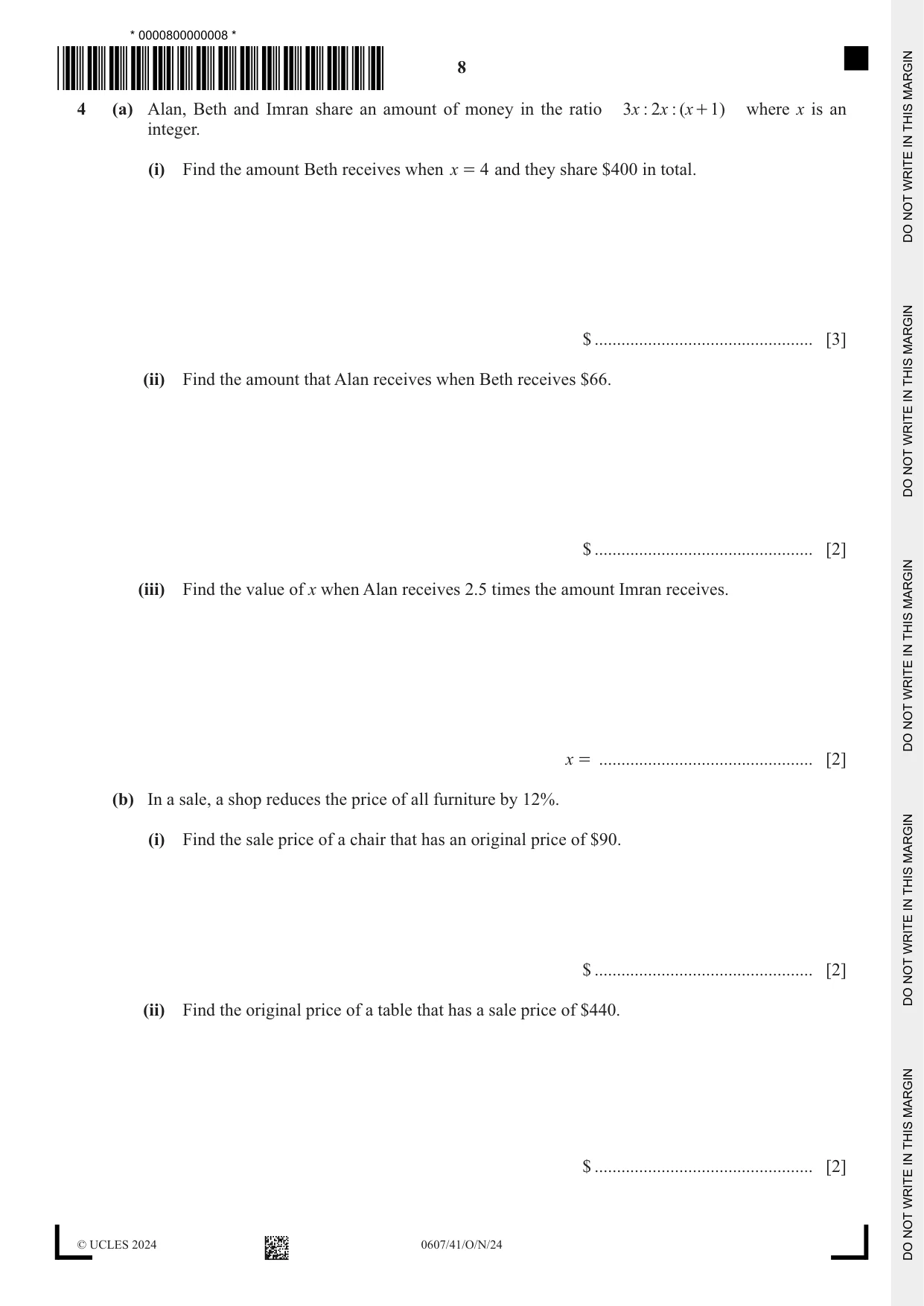
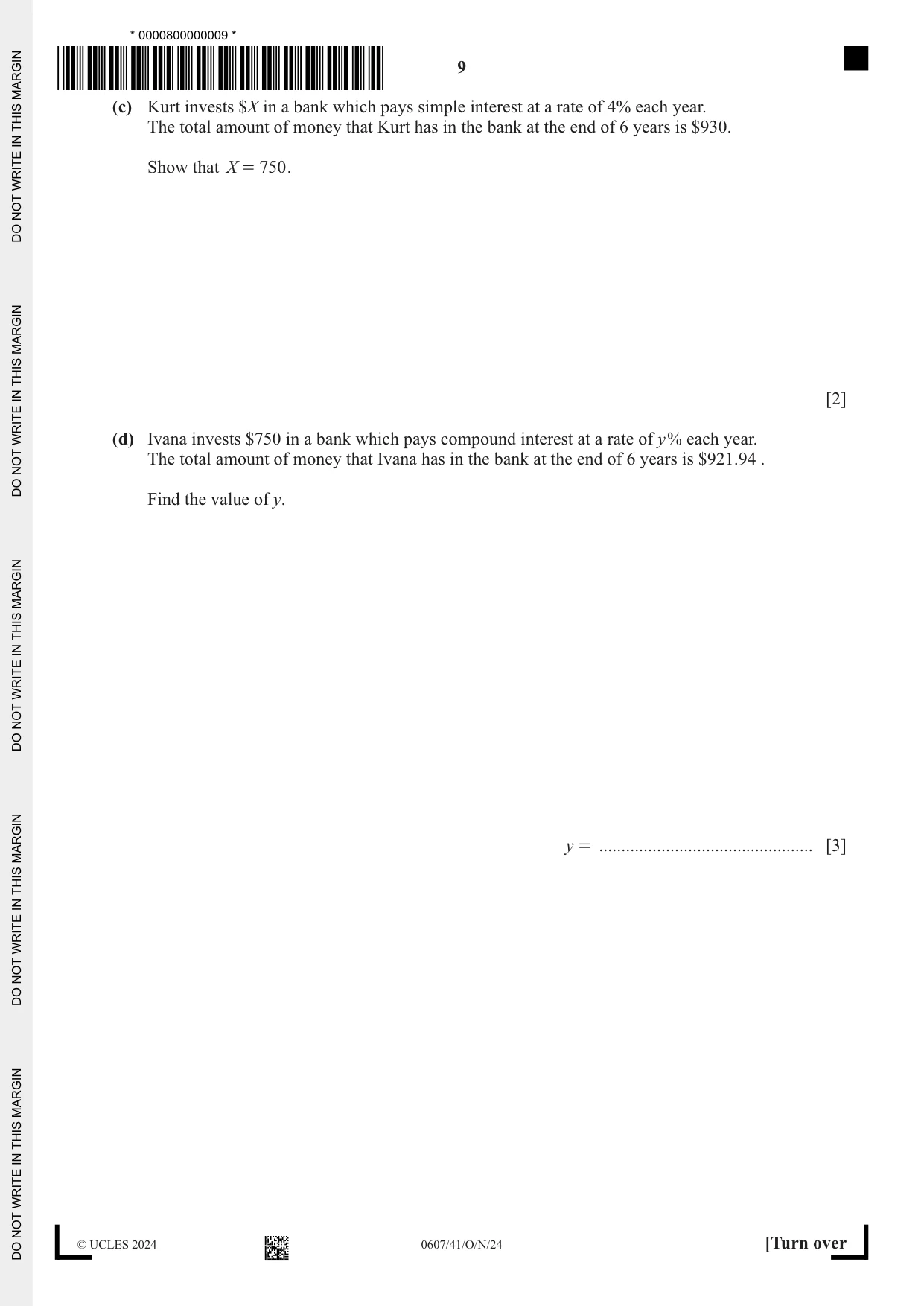
4 (a) Alan, Beth and Imran share an amount of money in the ratio 3x : 2x : ( x + 1) where x is an integer. (i) Find the amount Beth receives when x = 4 and they share $400 in total. $ ................................................. [3] (ii) Find the amount that Alan receives when Beth receives $66. $ ................................................. [2] (iii) Find the value of x when Alan receives 2.5 times the amount Imran receives. x = ................................................ [2] (b) In a sale, a shop reduces the price of all furniture by 12%. (i) Find the sale price of a chair that has an original price of $90. $ ................................................. [2] (ii) Find the original price of a table that has a sale price of $440. $ ................................................. [2] (c) Kurt invests $X in a bank which pays simple interest at a rate of 4% each year. The total amount of money that Kurt has in the bank at the end of 6 years is $930. Show that X = 750 . [2] (d) Ivana invests $750 in a bank which pays compound interest at a rate of y % each year. The total amount of money that Ivana has in the bank at the end of 6 years is $921.94 . Find the value of y. y = ................................................ [3]
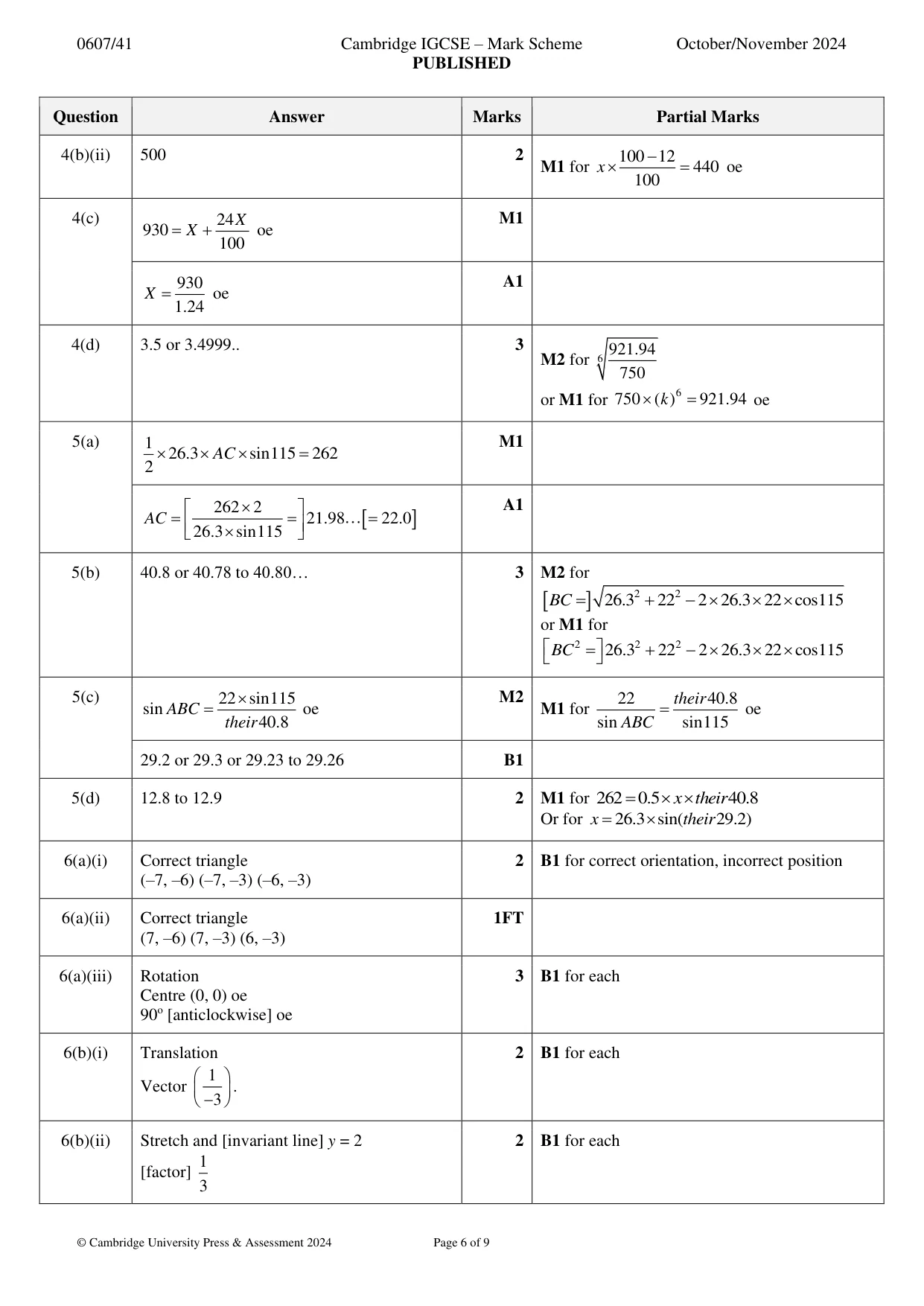
Mark scheme: 4(a)(i) 128 3 8 M2 for 400 12 + 8 + 5 or M1 for 12, 8, 5 or 25 4(a)(ii) 99 2 3 M1 for 66 oe 2 4(a)(iii) 5 2 M1 for 3 x = 2.5( x + 1) oe 4(b)(i) 79.2 [0] 2 100 − 12 M1 for 90 oe 100 or B1 for 10.8 4(b)(ii) 500 2 100 − 12 M1 for x = 440 oe 100 4(c) 24 X M1 930 = X + oe 100 930 A1 X = oe 1.24 4(d) 3.5 or 3.4999.. 3 921.94 M2 for 6 750 or M1 for 750 ( k ) 6 = 921.94 oe
Q5 · B NOT TO 26.3 cm SCALE 115° A C The area of triangle ABC is 262 cm 2
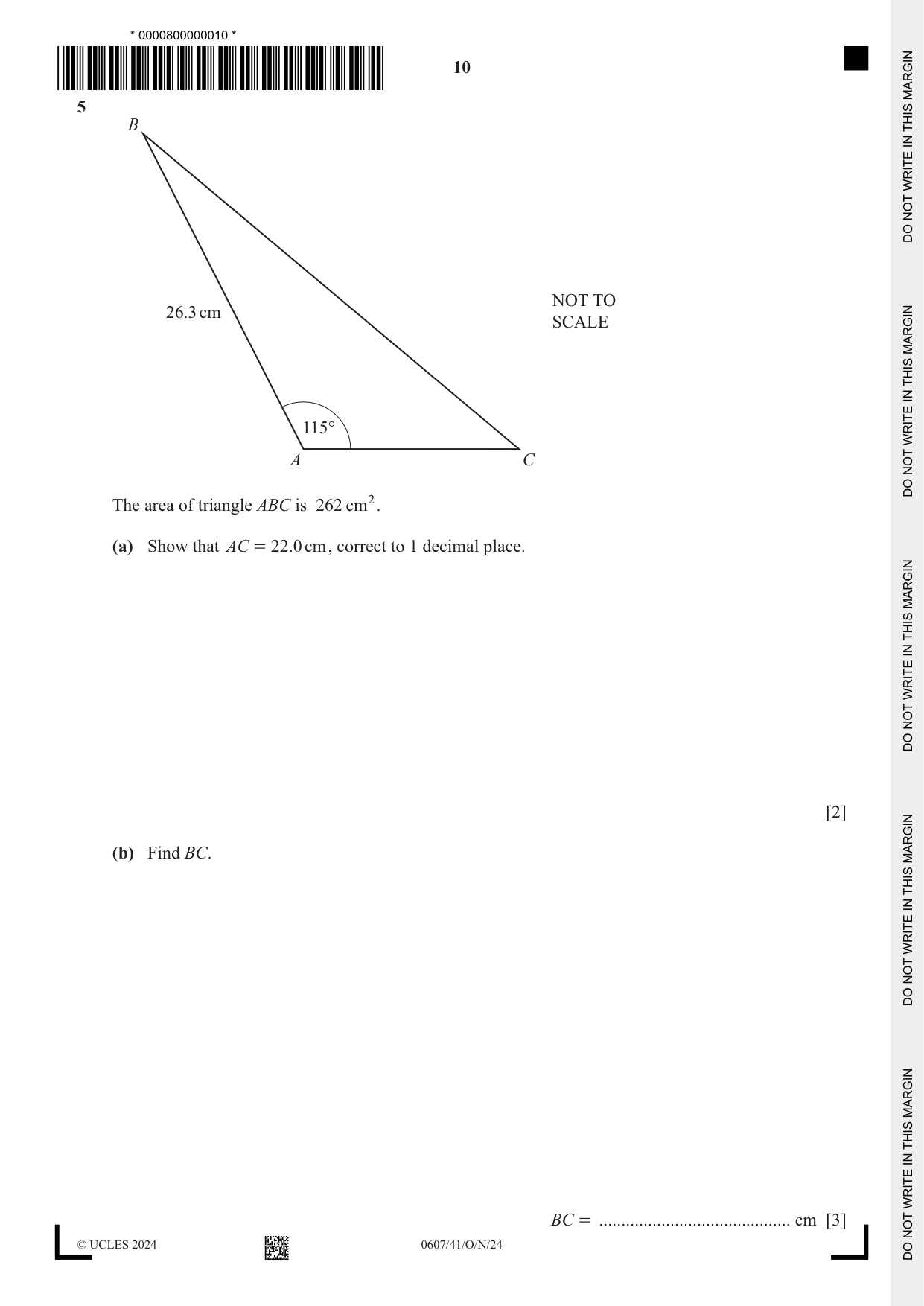
5 B NOT TO 26.3 cm SCALE 115° A C The area of triangle ABC is 262 cm 2. (a) Show that AC = 22.0 cm , correct to 1 decimal place. [2] (b) Find BC. BC = ........................................... cm [3] (c) Use the sine rule to find angle ABC. Angle ABC = ................................................ [3] (d) Find the length of the perpendicular line from A to the line BC. ............................................ cm [2]
Mark scheme: 5(a) 1 M1 26.3 AC sin115 = 262 2 262 2 A1 AC = = 21.98 = 22.0 26.3 sin115 5(b) 40.8 or 40.78 to 40.80… 3 M2 for BC = 26.32 + 222 −2 26.3 22 cos115 or M1 for BC 2 = 26.32 + 22 2 −2 26.3 22 cos115 5(c) 22 sin115 M2 22 their 40.8 sin ABC = oe M1 for = oe their 40.8 sin ABC sin115 29.2 or 29.3 or 29.23 to 29.26 B1 5(d) 12.8 to 12.9 2 M1 for 262 = 0.5 x their 40.8 Or for x = 26.3 sin(their 29.2)
Q6 · Y 9 8 7 A 6 5 4 3 2 1 x – 9 – 8 – 7 – 6 – 5 – 4 – 3 – 2 – 1 0 1 2 3 4 5 6 7 8 9 – 1 – 2…
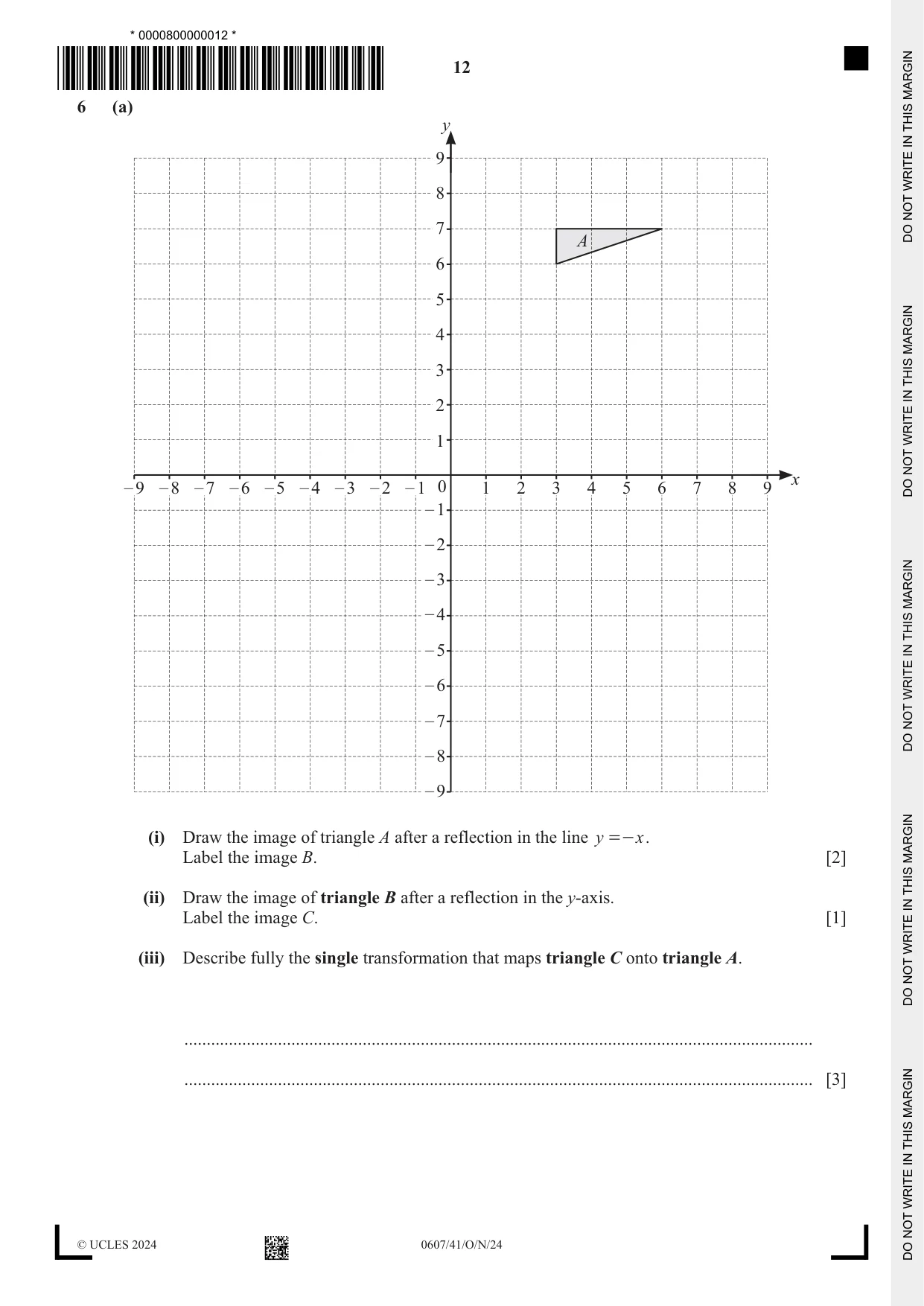
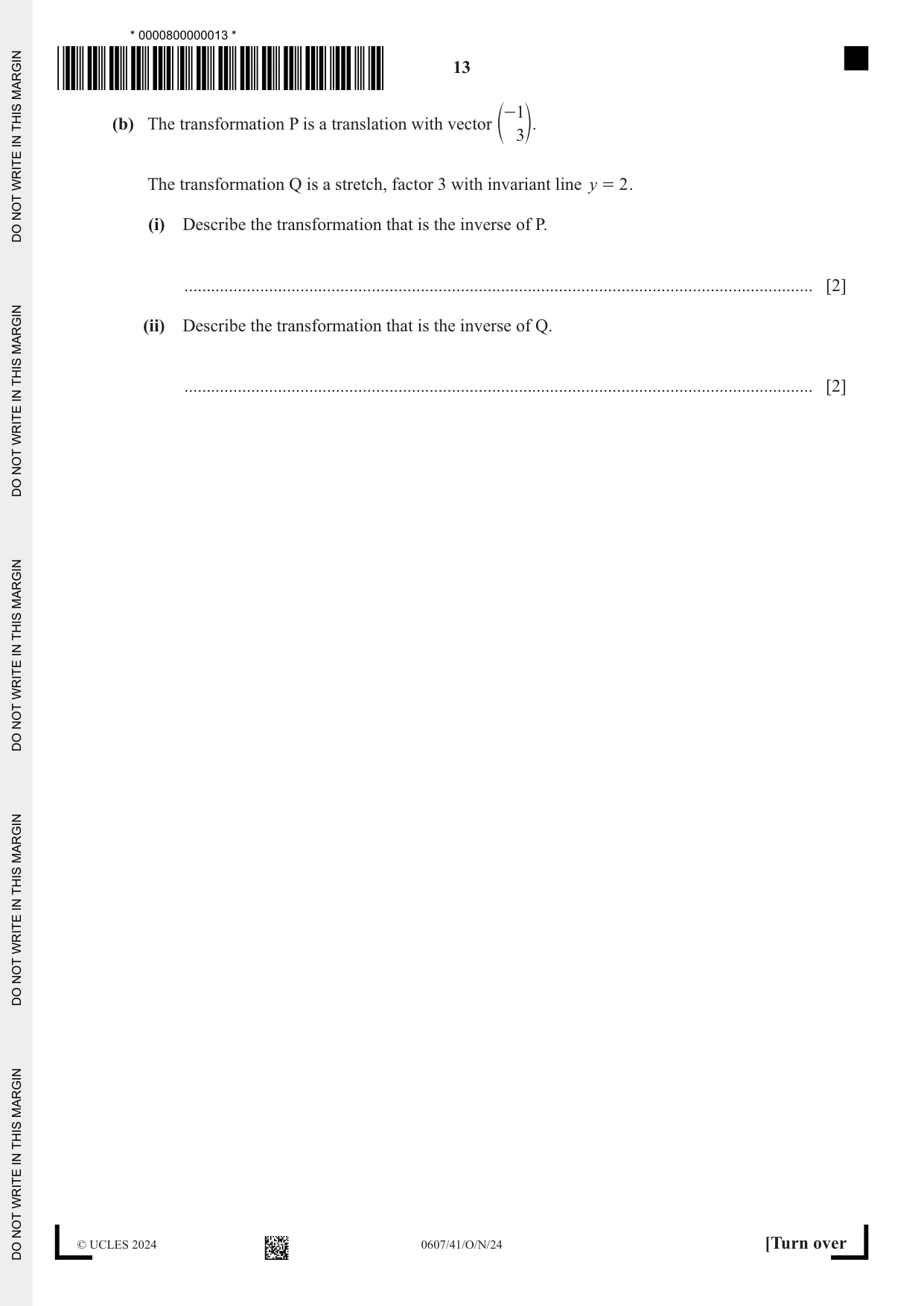
6 (a) y 9 8 7 A 6 5 4 3 2 1 x – 9 – 8 – 7 – 6 – 5 – 4 – 3 – 2 – 1 0 1 2 3 4 5 6 7 8 9 – 1 – 2 – 3 – 4 – 5 – 6 – 7 – 8 – 9 (i) Draw the image of triangle A after a reflection in the line y =- x . Label the image B. [2] (ii) Draw the image of triangle B after a reflection in the y-axis. Label the image C. [1] (iii) Describe fully the single transformation that maps triangle C onto triangle A. ............................................................................................................................................. ............................................................................................................................................. [3] -1 (b) The transformation P is a translation with vector e o. 3 The transformation Q is a stretch, factor 3 with invariant line y = 2 . (i) Describe the transformation that is the inverse of P. ............................................................................................................................................. [2] (ii) Describe the transformation that is the inverse of Q. ............................................................................................................................................. [2]
Mark scheme: 6(a)(i) Correct triangle 2 B1 for correct orientation, incorrect position (–7, –6) (–7, –3) (–6, –3) 6(a)(ii) Correct triangle 1FT (7, –6) (7, –3) (6, –3) 6(a)(iii) Rotation 3 B1 for each Centre (0, 0) oe 90o [anticlockwise] oe 6(b)(i) Translation 2 B1 for each 1 Vector . − 3 6(b)(ii) Stretch and [invariant line] y = 2 2 B1 for each 1 [factor] 3
Q7 · There are 49 students in a year group
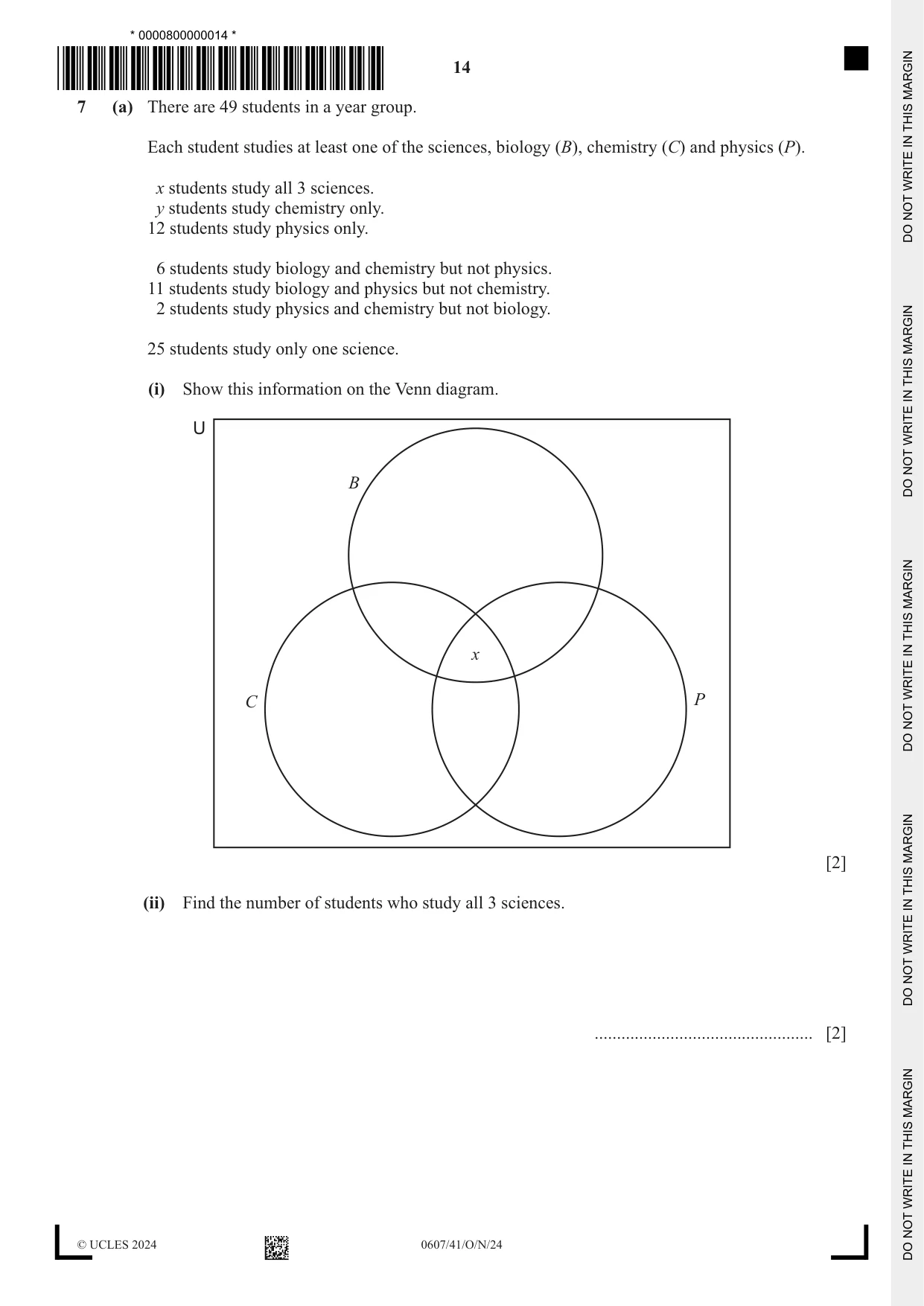
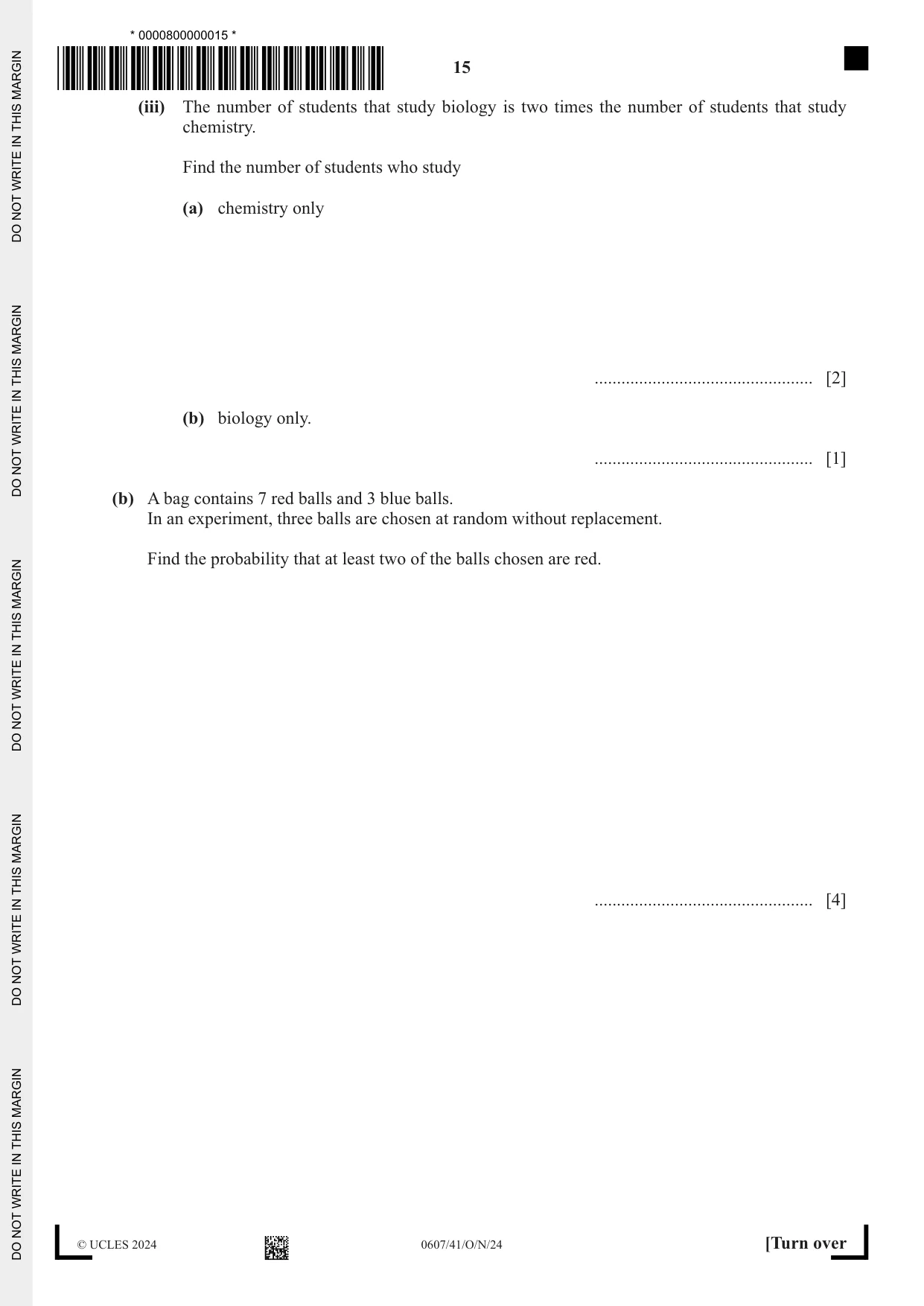
7 (a) There are 49 students in a year group. Each student studies at least one of the sciences, biology (B), chemistry (C) and physics (P). x students study all 3 sciences. y students study chemistry only. 12 students study physics only. 6 students study biology and chemistry but not physics. 11 students study biology and physics but not chemistry. 2 students study physics and chemistry but not biology. 25 students study only one science. (i) Show this information on the Venn diagram. U B x C P [2] (ii) Find the number of students who study all 3 sciences. ................................................. [2] (iii) The number of students that study biology is two times the number of students that study chemistry. Find the number of students who study (a) chemistry only ................................................. [2] (b) biology only. ................................................. [1] (b) A bag contains 7 red balls and 3 blue balls. In an experiment, three balls are chosen at random without replacement. Find the probability that at least two of the balls chosen are red. ................................................. [4]
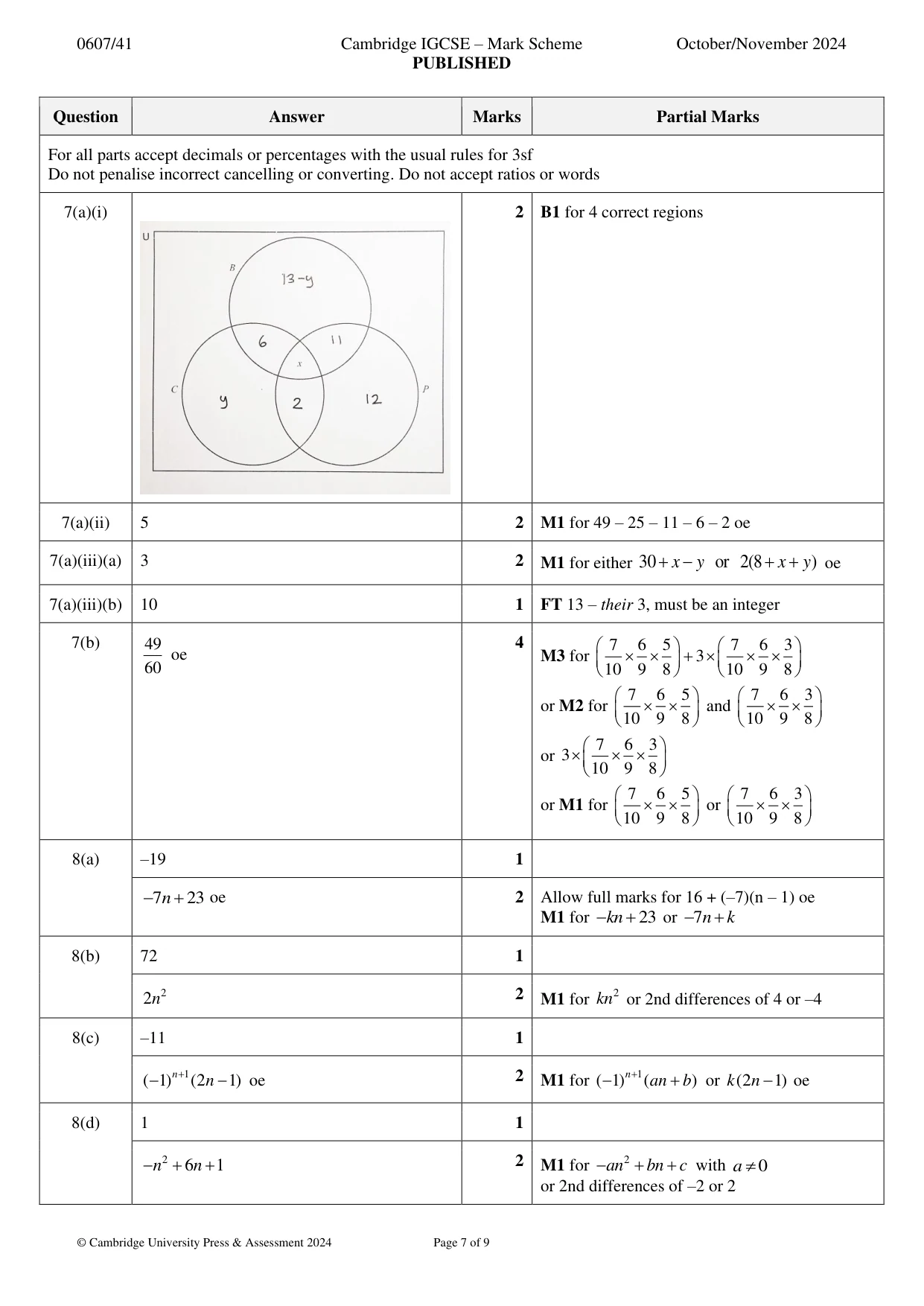
Mark scheme: 7(a)(i) 2 B1 for 4 correct regions 7(a)(ii) 5 2 M1 for 49 – 25 – 11 – 6 – 2 oe 7(a)(iii)(a) 3 2 M1 for either 30 + x − y or 2(8 + x + y ) oe 7(a)(iii)(b) 10 1 FT 13 – their 3, must be an integer 7(b) 49 4 7 6 5 7 6 3 oe M3 for + 3 60 10 9 8 10 9 8 7 6 5 7 6 3 or M2 for and 10 9 8 10 9 8 7 6 3 or 3 10 9 8 7 6 5 7 6 3 or M1 for or 10 9 8 10 9 8
Q8 · Find the next term and the nth term in each of the following sequences
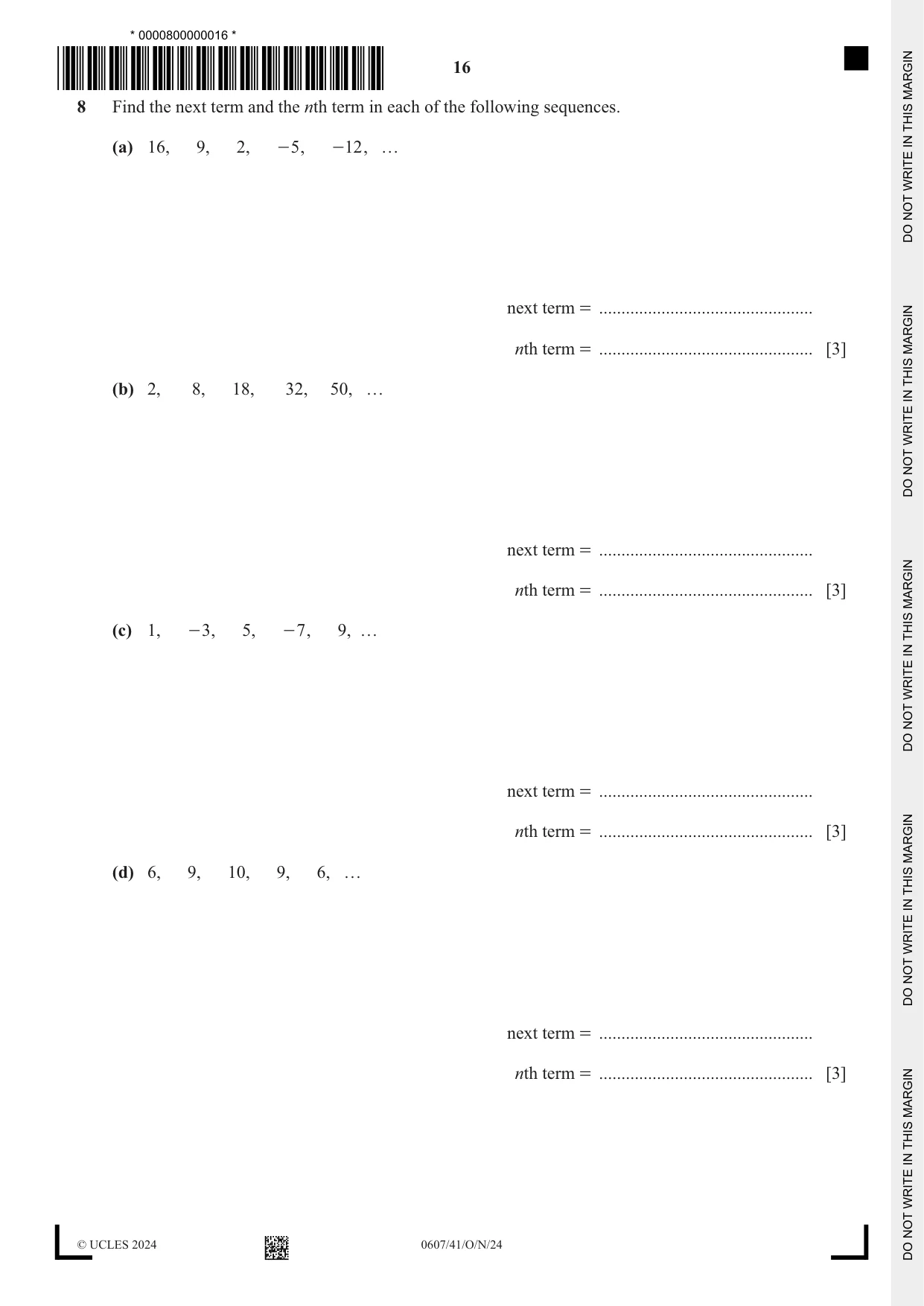
8 Find the next term and the nth term in each of the following sequences. (a) 16, 9, 2, - 5 , -12 , … next term = ................................................ nth term = ................................................ [3] (b) 2, 8, 18, 32, 50, … next term = ................................................ nth term = ................................................ [3] (c) 1, - 3 , 5, - 7 , 9, … next term = ................................................ nth term = ................................................ [3] (d) 6, 9, 10, 9, 6, … next term = ................................................ nth term = ................................................ [3]
Mark scheme: 8(a) –19 1 −7 n + 23 oe 2 Allow full marks for 16 + (–7)(n – 1) oe M1 for −kn + 23 or −7n + k 8(b) 72 1 2n 2 2 M1 for kn 2 or 2nd differences of 4 or –4 8(c) –11 1 ( −1) n +1 (2 n − 1) oe 2 M1 for ( −1) n +1 ( an + b ) or k (2 n − 1) oe 8(d) 1 1 − n 2 + 6n + 1 2 M1 for − an 2 + bn + c with a 0 or 2nd differences of –2 or 2
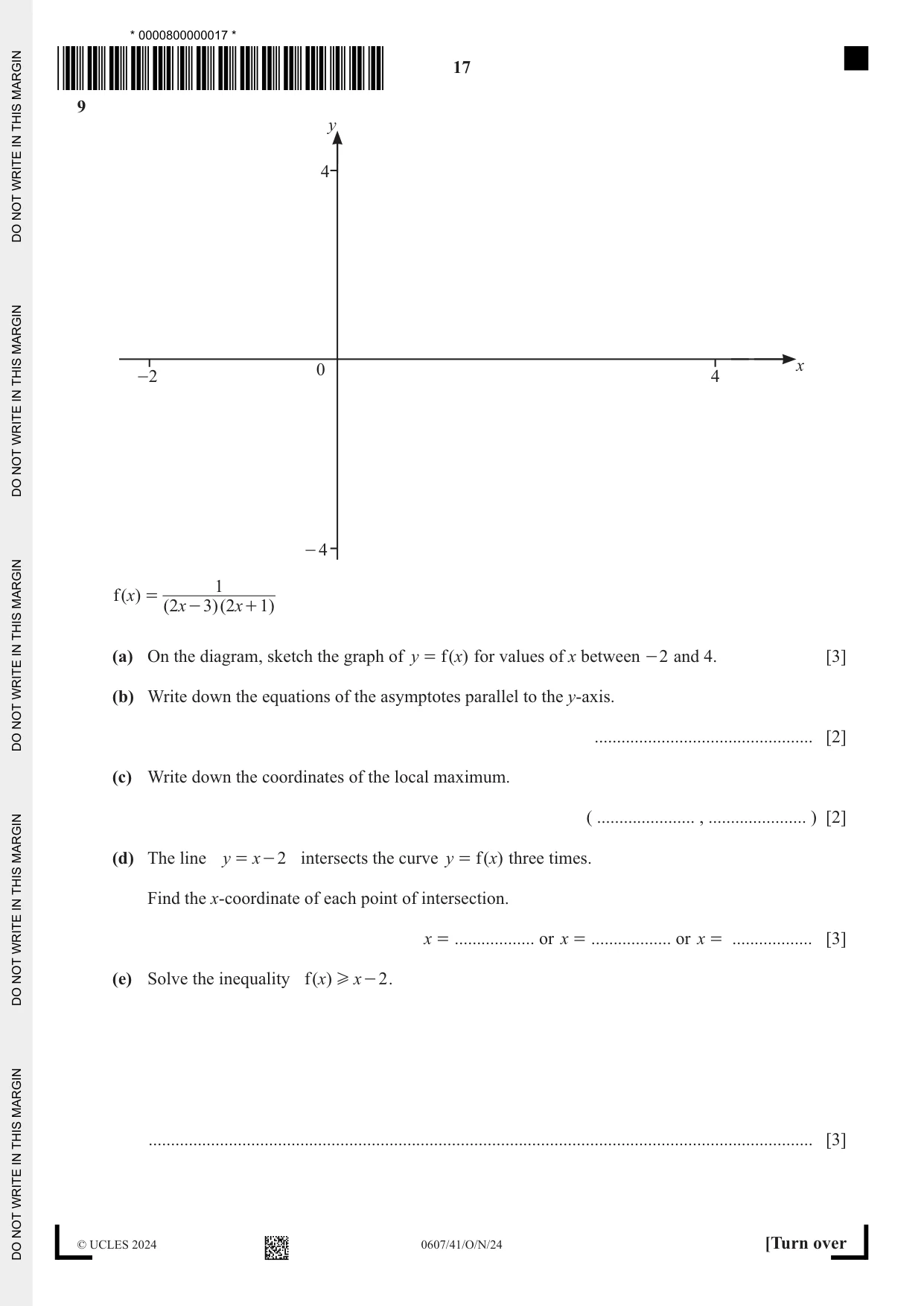
Q9 · Y 4 x 0 -2 4 - 4 1 f ( x) = ( 2x - 3)( 2x + 1) (a) On the diagram, sketch the graph of y…
9 y 4 x 0 -2 4 - 4 1 f ( x) = ( 2x - 3)( 2x + 1) (a) On the diagram, sketch the graph of y = f ( x) for values of x between - 2 and 4. [3] (b) Write down the equations of the asymptotes parallel to the y-axis. ................................................. [2] (c) Write down the coordinates of the local maximum. ( ...................... , ...................... ) [2] (d) The line y = x - 2 intersects the curve y = f ( x) three times. Find the x-coordinate of each point of intersection. x = .................. or x = .................. or x = .................. [3] (e) Solve the inequality f ( )x H x - 2 . ..................................................................................................................................................... [3]
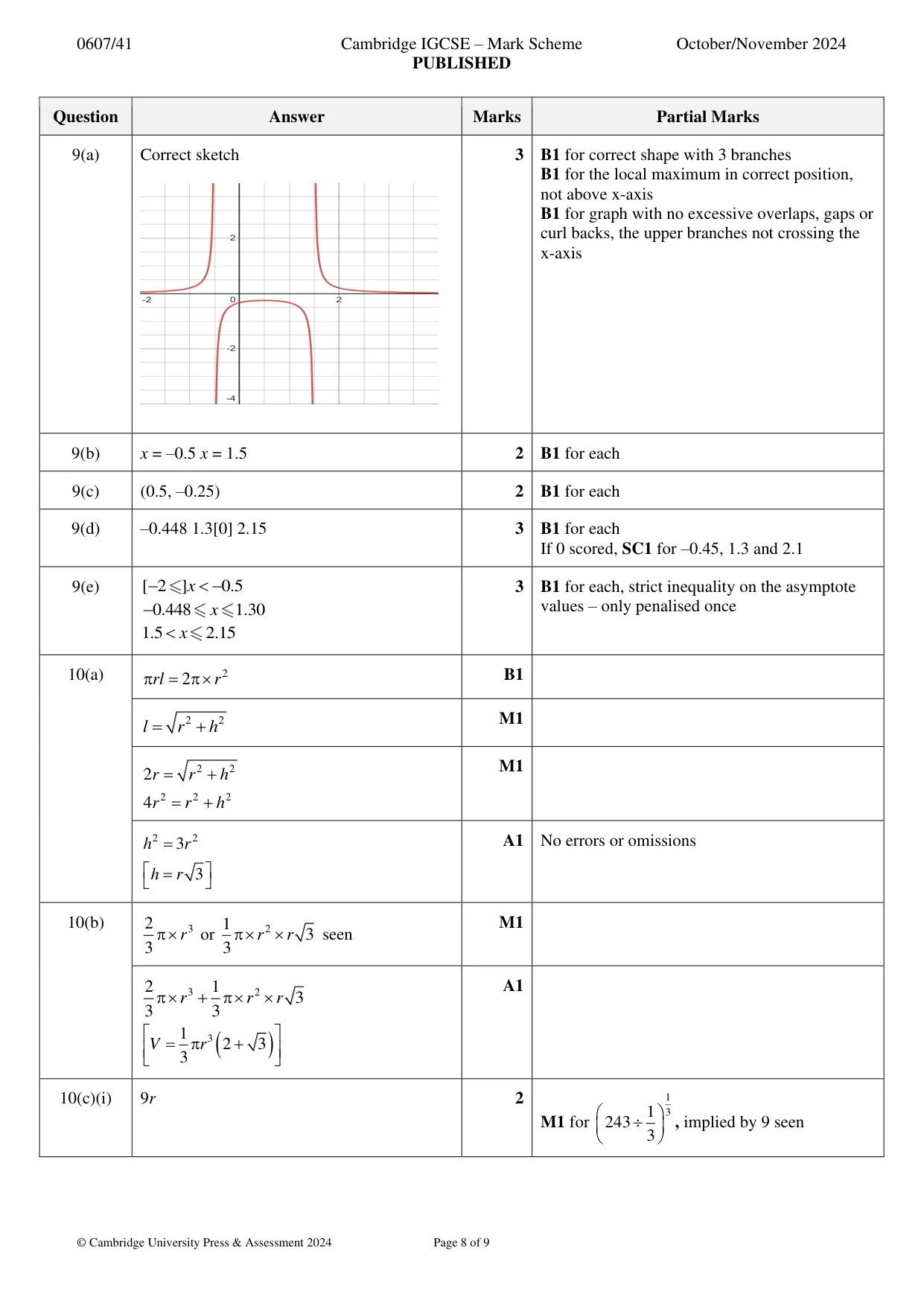
Mark scheme: 9(a) Correct sketch 3 B1 for correct shape with 3 branches B1 for the local maximum in correct position, not above x-axis B1 for graph with no excessive overlaps, gaps or curl backs, the upper branches not crossing the x-axis 9(b) x = –0.5 x = 1.5 2 B1 for each 9(c) (0.5, –0.25) 2 B1 for each 9(d) –0.448 1.3[0] 2.15 3 B1 for each If 0 scored, SC1 for –0.45, 1.3 and 2.1 9(e) [ −2 ] x −0.5 3 B1 for each, strict inequality on the asymptote −0.448 x 1.30 values – only penalised once 1.5 x 2.15
Q10 · In this question all lengths are in centimetres
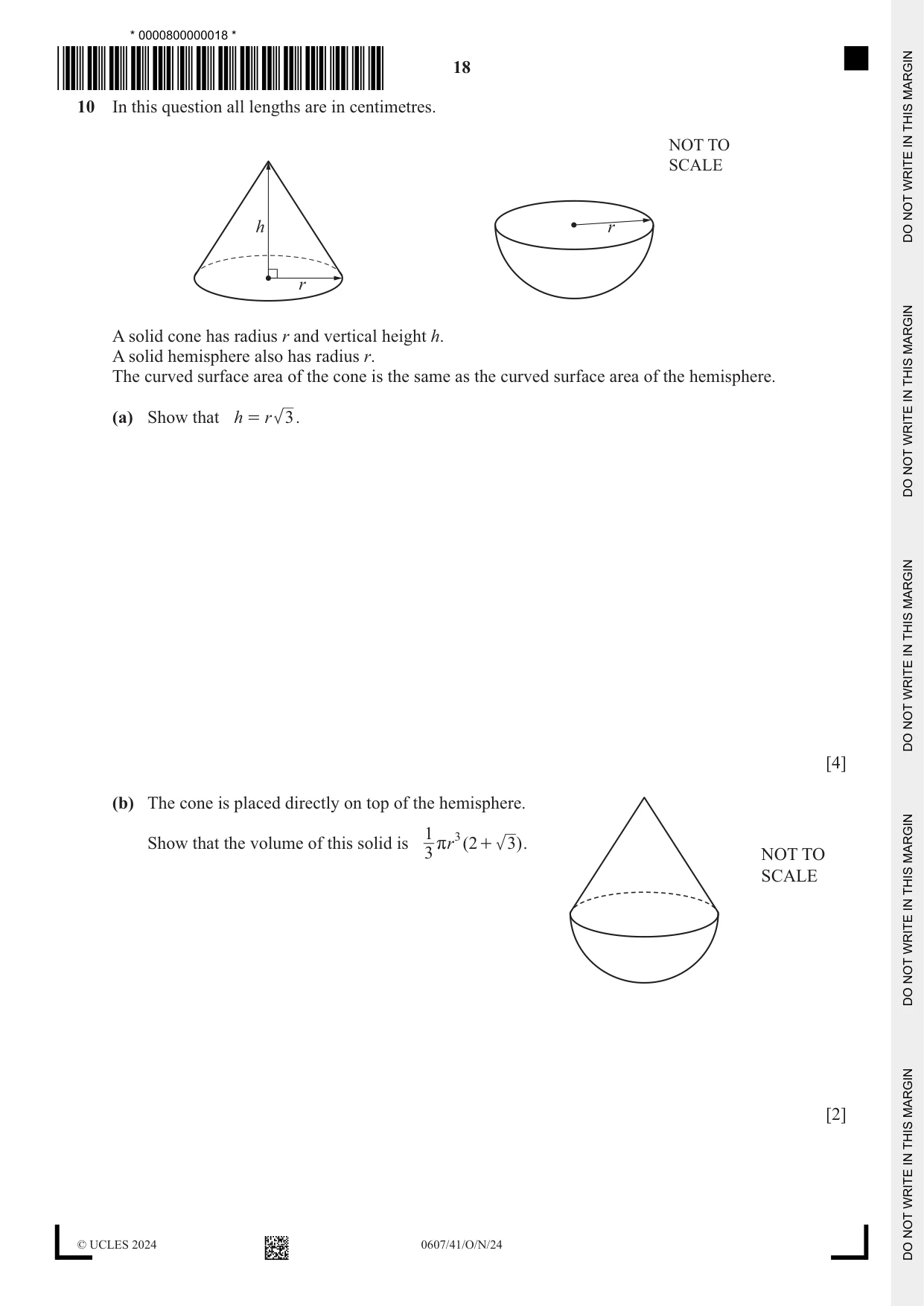
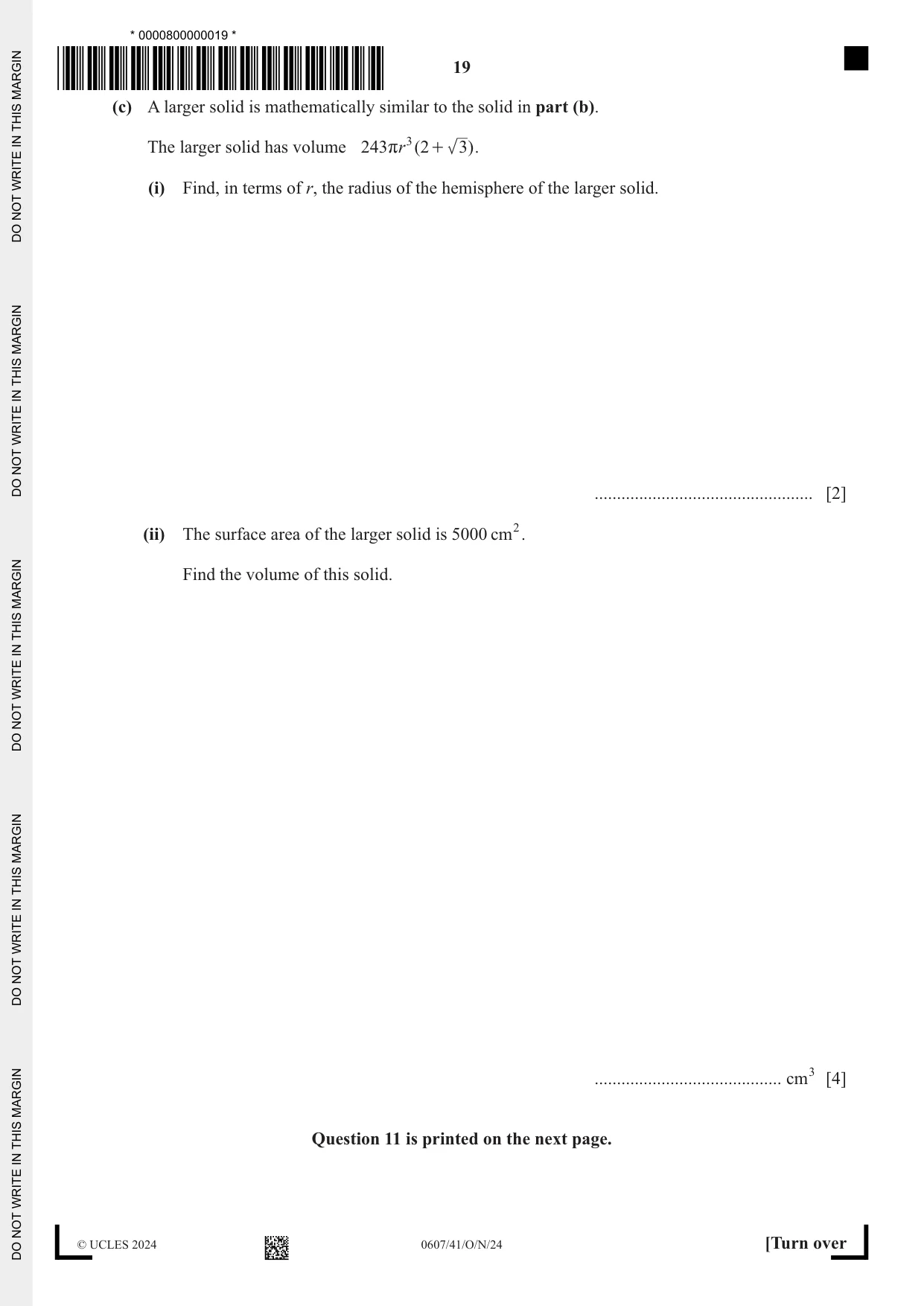
10 In this question all lengths are in centimetres. NOT TO SCALE h r r A solid cone has radius r and vertical height h. A solid hemisphere also has radius r. The curved surface area of the cone is the same as the curved surface area of the hemisphere. (a) Show that h = r 3 . [4] (b) The cone is placed directly on top of the hemisphere. 1 3 Show that the volume of this solid is rr ( 2 + 3 ) . 3 NOT TO SCALE [2] (c) A larger solid is mathematically similar to the solid in part (b). The larger solid has volume 243r r 3 ( 2 + 3) . (i) Find, in terms of r, the radius of the hemisphere of the larger solid. ................................................. [2] (ii) The surface area of the larger solid is 5000 cm 2. Find the volume of this solid. .......................................... cm3 [4] Question 11 is printed on the next page.
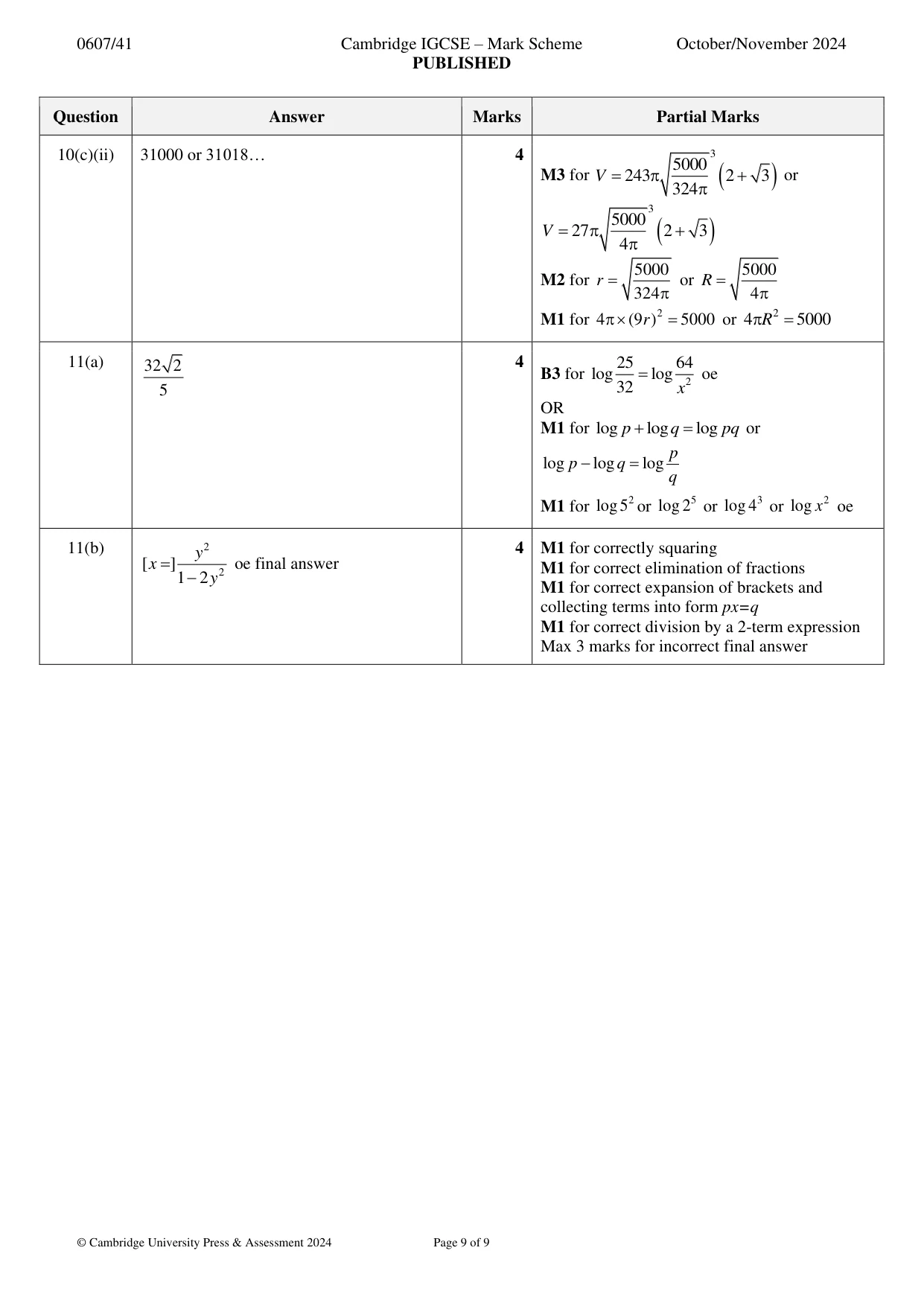
Mark scheme: 10(a) rl = 2 r 2 B1 2 2 M1 l = r + h 2 2 M1 2 r = r + h 4 r 2 = r 2 + h 2 h 2 = 3r 2 A1 No errors or omissions h = r 3 10(b) 2 3 1 2 M1 r or r r 3 seen 3 3 2 3 1 2 A1 r + r r 3 3 3 1 3 V = r 2 + 3 ( ) 3 10(c)(i) 9r 2 1 1 3 M1 for 243 , implied by 9 seen 3 10(c)(ii) 31000 or 31018… 4 3 5000 M3 for V = 243 2 + 3 or ( ) 324 3 5000 V = 27 2 + 3 ( ) 4 5000 5000 M2 for r = or R = 324 4 M1 for 4 (9 r ) 2 = 5000 or 4 R 2 = 5000
Question 11
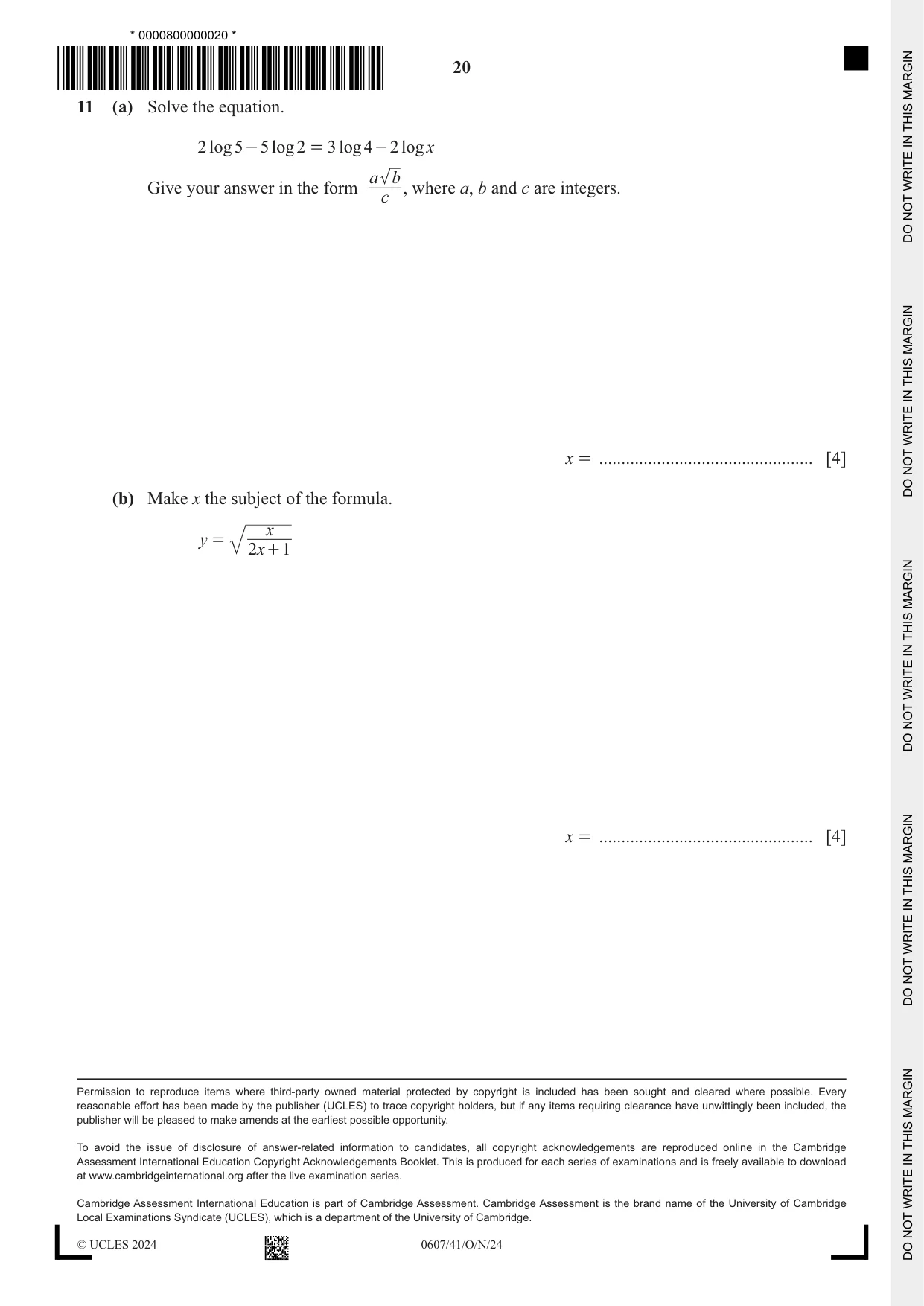
11 (a) Solve the equation. 2 log 5 - 5 log 2 = 3 log 4 - 2 logx a Give your answer in the form b, where a, b and c are integers. c x = ................................................ [4] (b) Make x the subject of the formula. x y = 2x + 1 x = ................................................ [4]
Mark scheme: 11(a) 32 2 4 25 64 B3 for log = log oe 5 32 x 2 OR M1 for log p + log q = log pq or p log p − log q = log q M1 for log5 2 or log 2 5 or log 4 3 or log x 2 oe 11(b) y 2 4 M1 for correctly squaring [ x =] oe final answer M1 for correct elimination of fractions 2 1 − 2 y M1 for correct expansion of brackets and collecting terms into form px=q M1 for correct division by a 2-term expression Max 3 marks for incorrect final answer
What was in this paper
The subtopics covered by these 11 questions, and how many questions each got. Open one in a new tab to see every Cambridge question on it.
What you needed in this session
Cambridge’s own grade thresholds for 2024 Oct/Nov, Paper 4 · Variant 1. A higher threshold means an easier paper — the bar moves with how the cohort did.