Cambridge IGCSE Mathematics - International 0607 — 2019 Oct/Nov Paper 4 · Variant 2
0607/42/O/N/19 · 12 questions · 120 marks · ≈135 min
The question paper and its mark scheme, free to read here and free to download. This is Cambridge’s own paper, exactly as it was sat.
Question paper20 pages
Mark scheme8 pages
Answers below. Sit the paper first if you are practising.
Questions as text
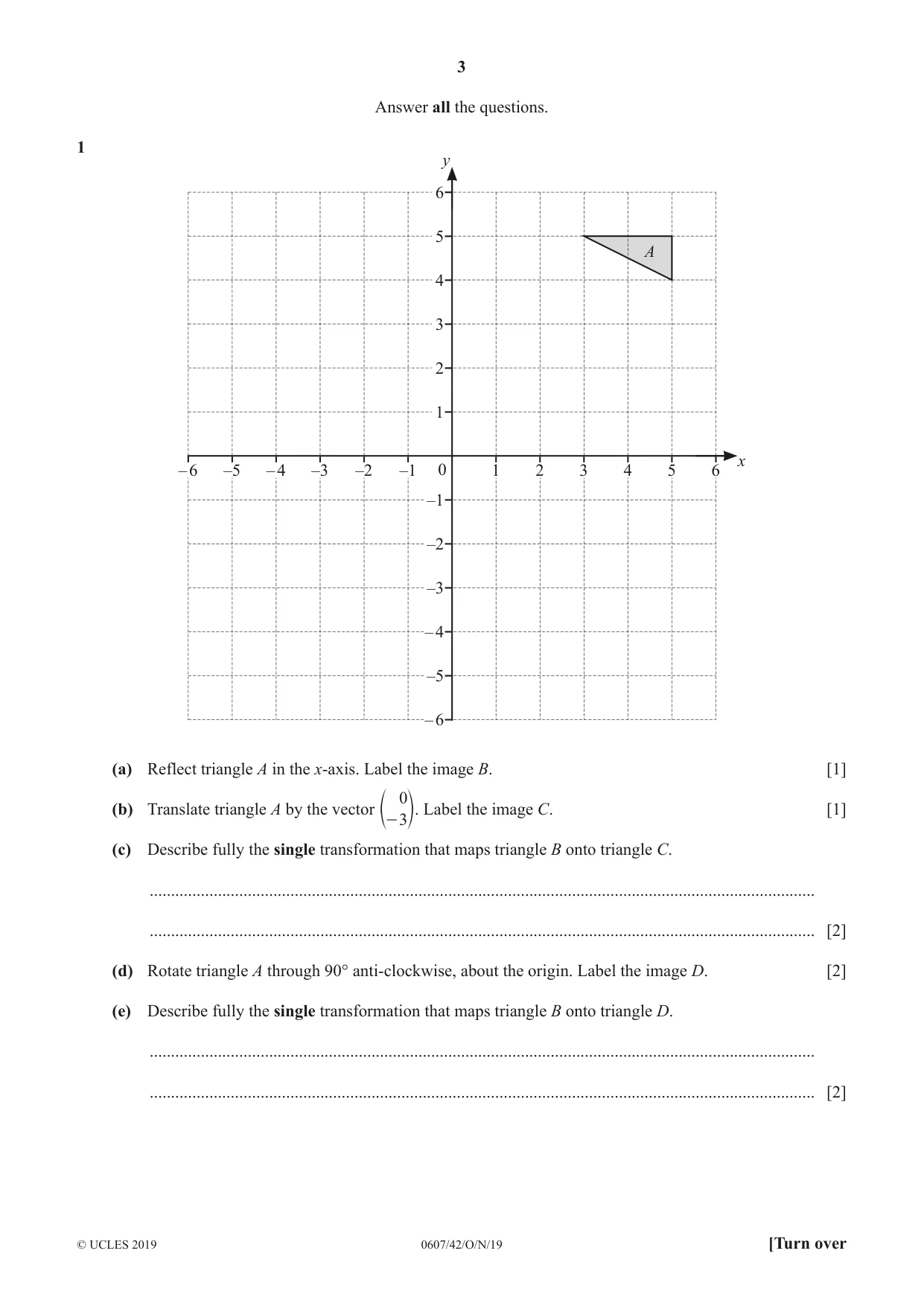
Q1 · Y 6 5 A 4 3 2 1 x – 6 –5 – 4 –3 –2 –1 0 1 2 3 4 5 6 –1 –2 –3 – 4 –5 – 6 (a) Reflect…
1 y 6 5 A 4 3 2 1 x – 6 –5 – 4 –3 –2 –1 0 1 2 3 4 5 6 –1 –2 –3 – 4 –5 – 6 (a) Reflect triangle A in the x-axis. Label the image B. [1] 0 (b) Translate triangle A by the vector Label the image C. [1] e- 3o. (c) Describe fully the single transformation that maps triangle B onto triangle C. ............................................................................................................................................................ ............................................................................................................................................................ [2] (d) Rotate triangle A through 90° anti-clockwise, about the origin. Label the image D. [2] (e) Describe fully the single transformation that maps triangle B onto triangle D. ............................................................................................................................................................ ............................................................................................................................................................ [2]
Mark scheme: Question Answer Marks Partial Marks 1(a) Correct triangle with vertices 1 (3, –5), (5, –5), (5, –4) 1(b) Correct triangle with vertices 1 (3, 2), (5, 2), (5, 1) 1(c) Reflection 2 B1 for each y = –1.5 oe 1(d) Correct triangle with vertices 2 B1 for correct rotation with incorrect centre of (–5, 3), (–5, 5), (–4, 5) rotation. or B1 for clockwise rotation with correct centre of rotation. 1(e) Reflection 2 B1 for each y = x oe
Q2 · F ()x = , x !
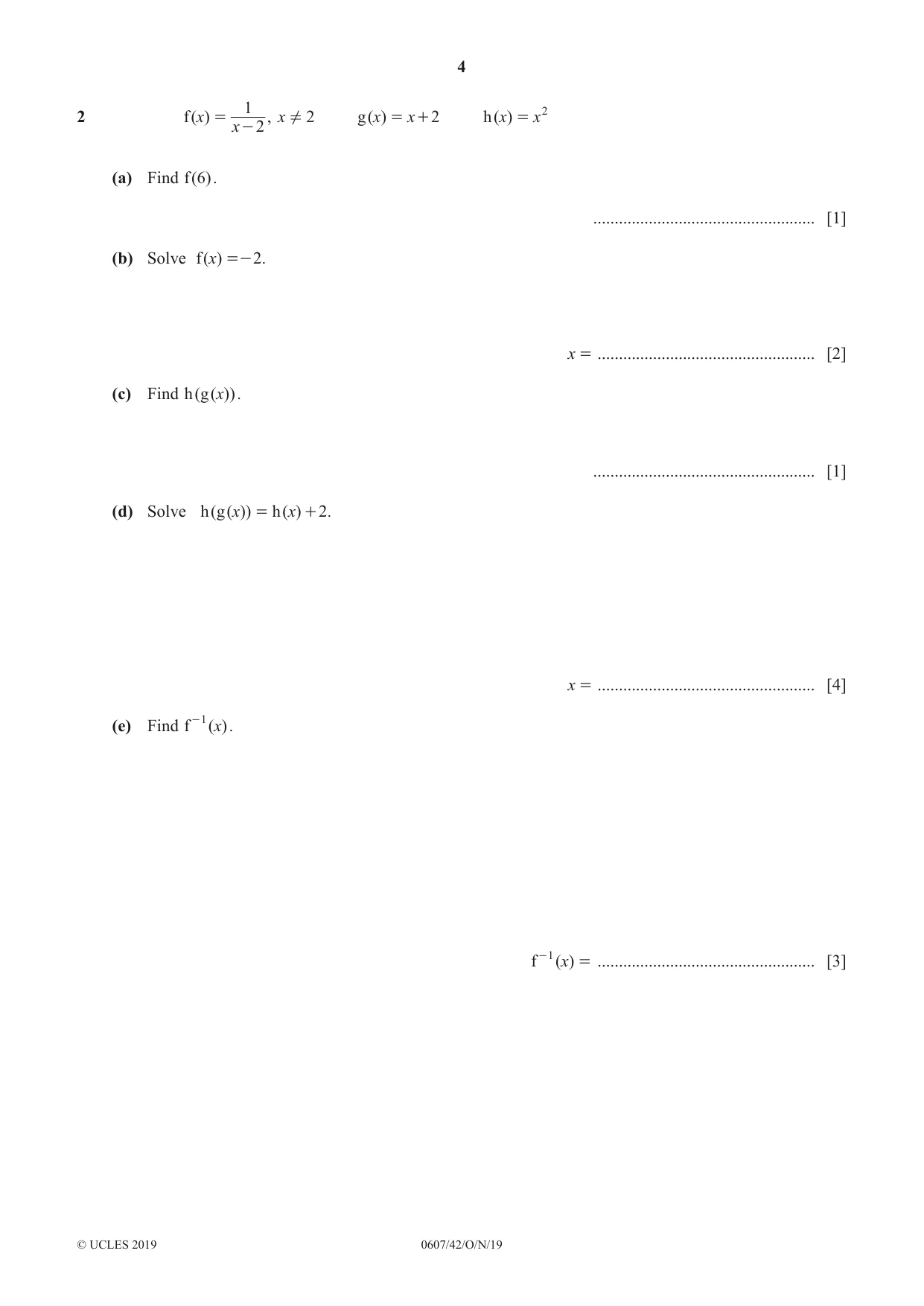
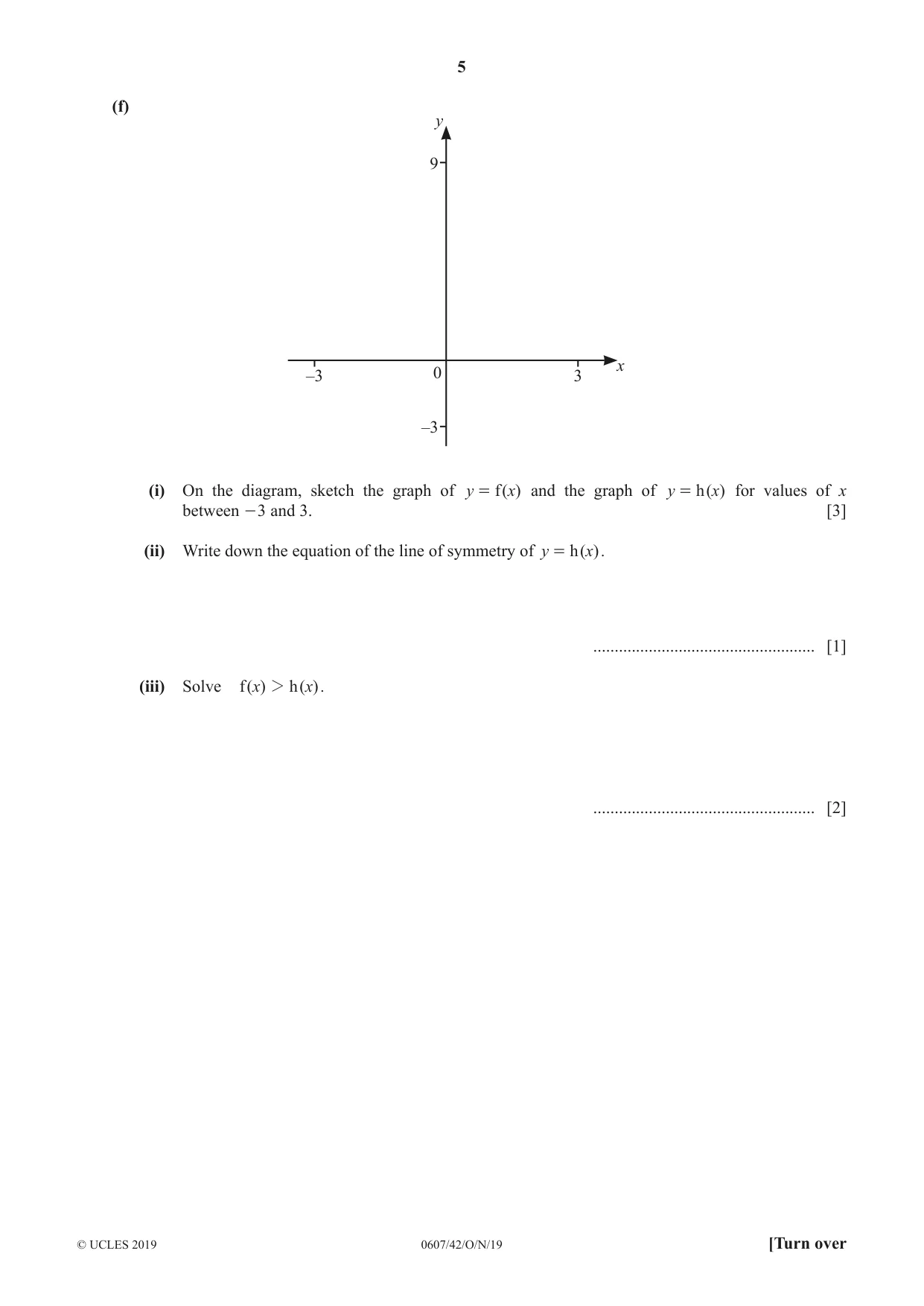
2 f ()x = , x ! 2 g ()x = x + 2 h ()x = x 2 x - 2 (a) Find f (6 ). .................................................... [1] (b) Solve f (x) =- 2. x = ................................................... [2] (c) Find h (g (x)). .................................................... [1] (d) Solve h (g (x)) = h (x) + 2. x = ................................................... [4] (e) Find f - 1 (x). f - 1 ()x = ................................................... [3] (f) y 9 x –3 0 3 –3 (i) On the diagram, sketch the graph of y = f (x) and the graph of y = h (x) for values of x between - 3 and 3. [3] (ii) Write down the equation of the line of symmetry of y = h (x). .................................................... [1] (iii) Solve f (x) 2 h (x). .................................................... [2]
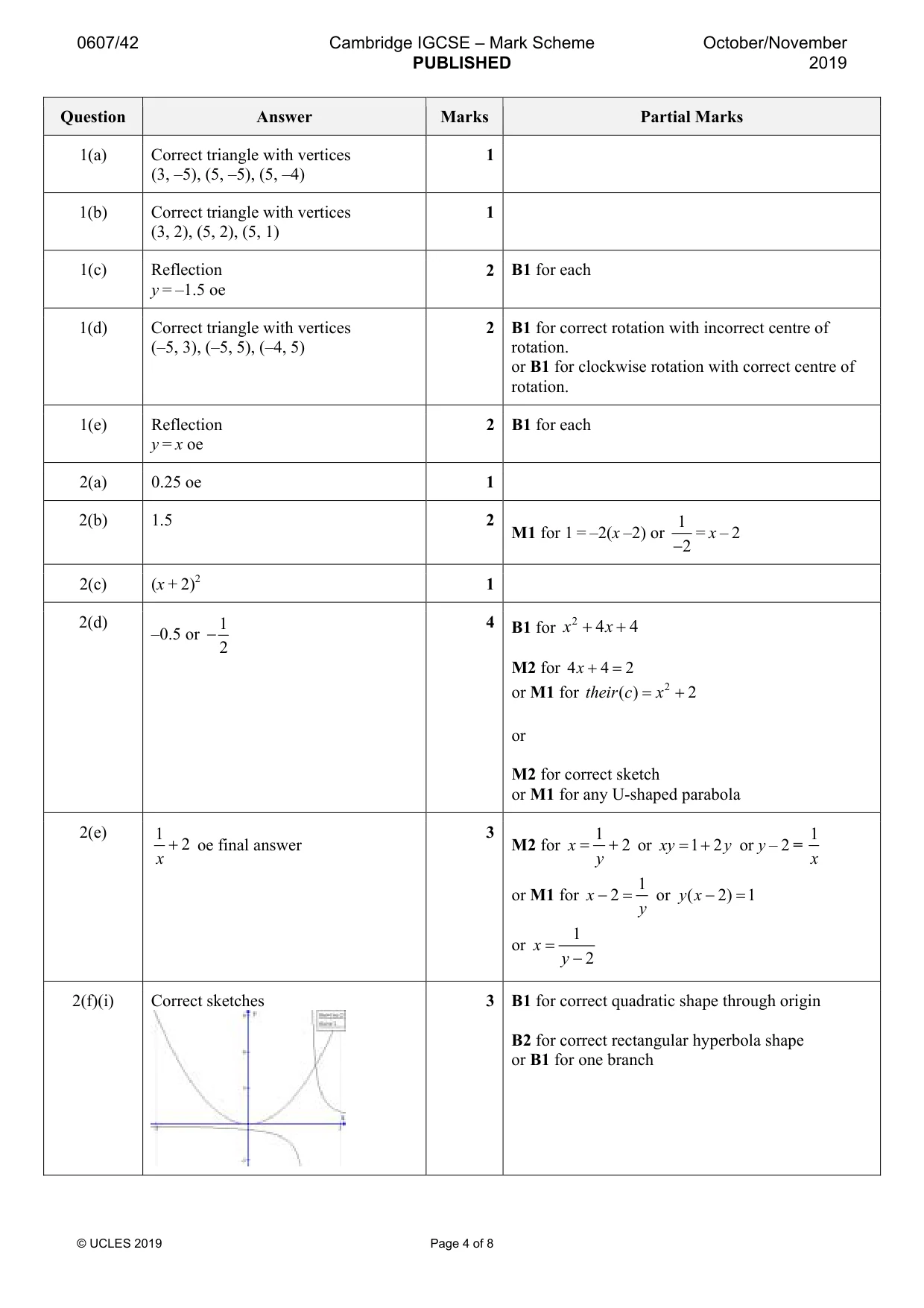
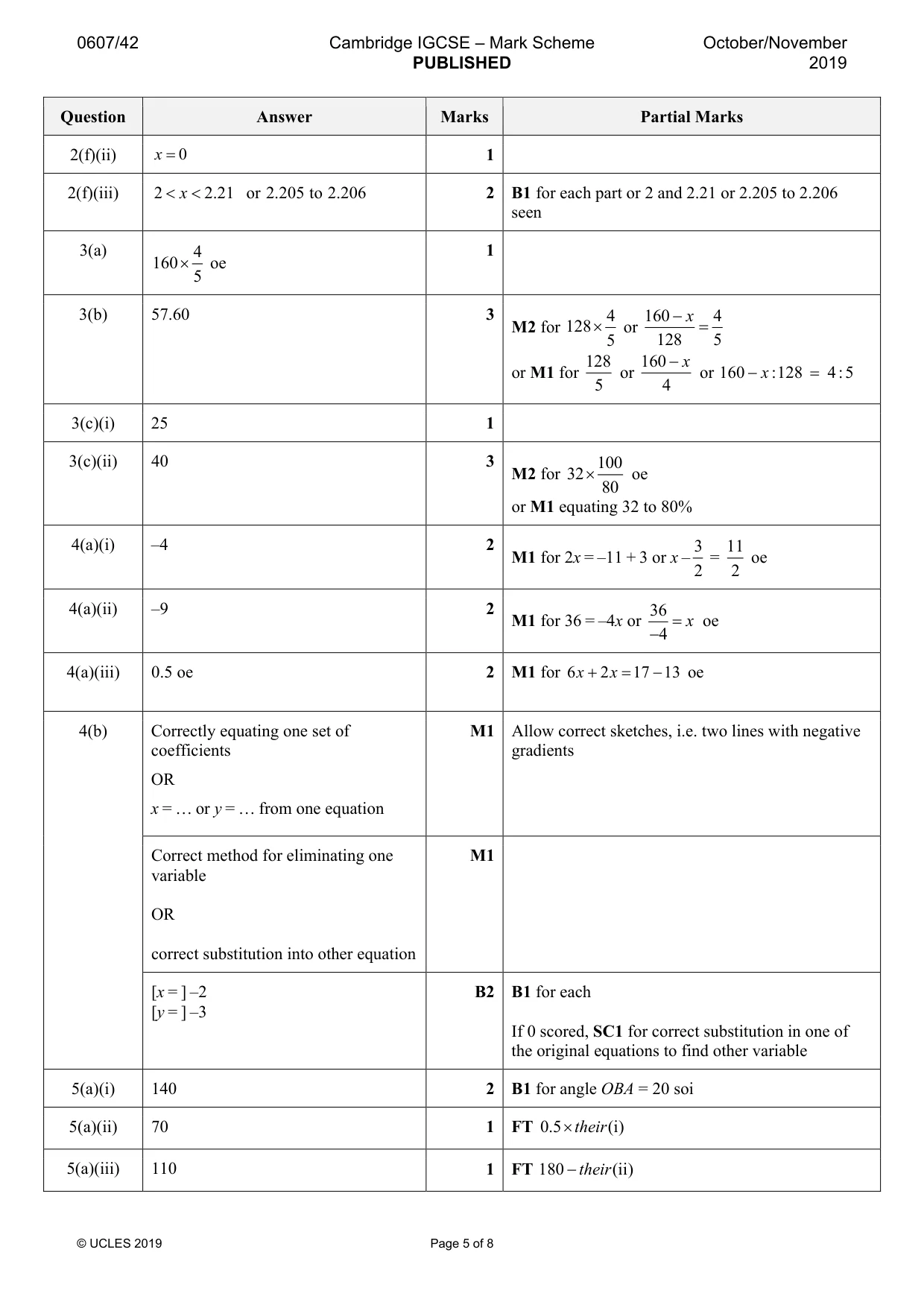
Mark scheme: 2(a) 0.25 oe 1 2(b) 1.5 2 1 M1 for 1 = –2(x –2) or −= x – 22 2(c) (x + 2)2 1 2(d) 1 4 B1 for x 2 + 4 x + 4 –0.5 or − 2 M2 for 4 x + 4 = 2 or M1 for their ( c ) = x 2 + 2 or M2 for correct sketch or M1 for any U-shaped parabola 2(e) 1 3 1 1 + 2 oe final answer M2 for x = + 2 or xy = 1 + 2 y or y – 2 = x y x 1 or M1 for x − 2 = or y ( x − 2) = 1 y 1 or x = y − 2 2(f)(i) Correct sketches 3 B1 for correct quadratic shape through origin B2 for correct rectangular hyperbola shape or B1 for one branch 2(f)(ii) x = 0 1 2(f)(iii) 2 < x < 2.21 or 2.205 to 2.206 2 B1 for each part or 2 and 2.21 or 2.205 to 2.206 seen
Q3 · Alana and Bill share some money in the ratio 5 : 4
3 Alana and Bill share some money in the ratio 5 : 4. Alana’s share is $160. (a) Show that Bill’s share is $128. [1] (b) Alana spends $x. The ratio of Alana’s money : Bill’s money is now 4 : 5. Find the value of x. x = ................................................... [3] (c) A shop has a sale. Bill buys a jacket in the sale for $32. (i) Write $32 as a percentage of $128. .................................................% [1] (ii) The original price of the jacket was reduced by 20% to $32. Work out the original price. $ .................................................... [3]
Mark scheme: 3(a) 4 1 160 × oe 5 3(b) 57.60 3 4 160 − x 4 M2 for 128 × or = 5 128 5 128 160 − x or M1 for or or 160 − x :128 = 4:5 5 4 3(c)(i) 25 1 3(c)(ii) 40 3 100 M2 for 32 × oe 80 or M1 equating 32 to 80%
Q4 · Solve the following equations
4 (a) Solve the following equations. (i) 2x - 3 =- 11 x = ................................................... [2] 36 (ii) =- 4 x x = ................................................... [2] (iii) 6x + 13 = 17 - 2x x = ................................................... [2] (b) Solve the simultaneous equations. You must show all your working. 5x + 3y =- 19 3x + 5y =- 21 x = ................................................... y = ................................................... [4]
Mark scheme: 4(a)(i) –4 2 3 11 M1 for 2x = –11 + 3 or x – = oe 2 2 4(a)(ii) –9 2 36 M1 for 36 = –4x or = x oe −4 4(a)(iii) 0.5 oe 2 M1 for 6 x + 2 x = 17 − 13 oe 4(b) Correctly equating one set of M1 Allow correct sketches, i.e. two lines with negative coefficients gradients OR x = … or y = … from one equation Correct method for eliminating one M1 variable OR correct substitution into other equation [x = ] –2 B2 B1 for each [y = ] –3 If 0 scored, SC1 for correct substitution in one of the original equations to find other variable
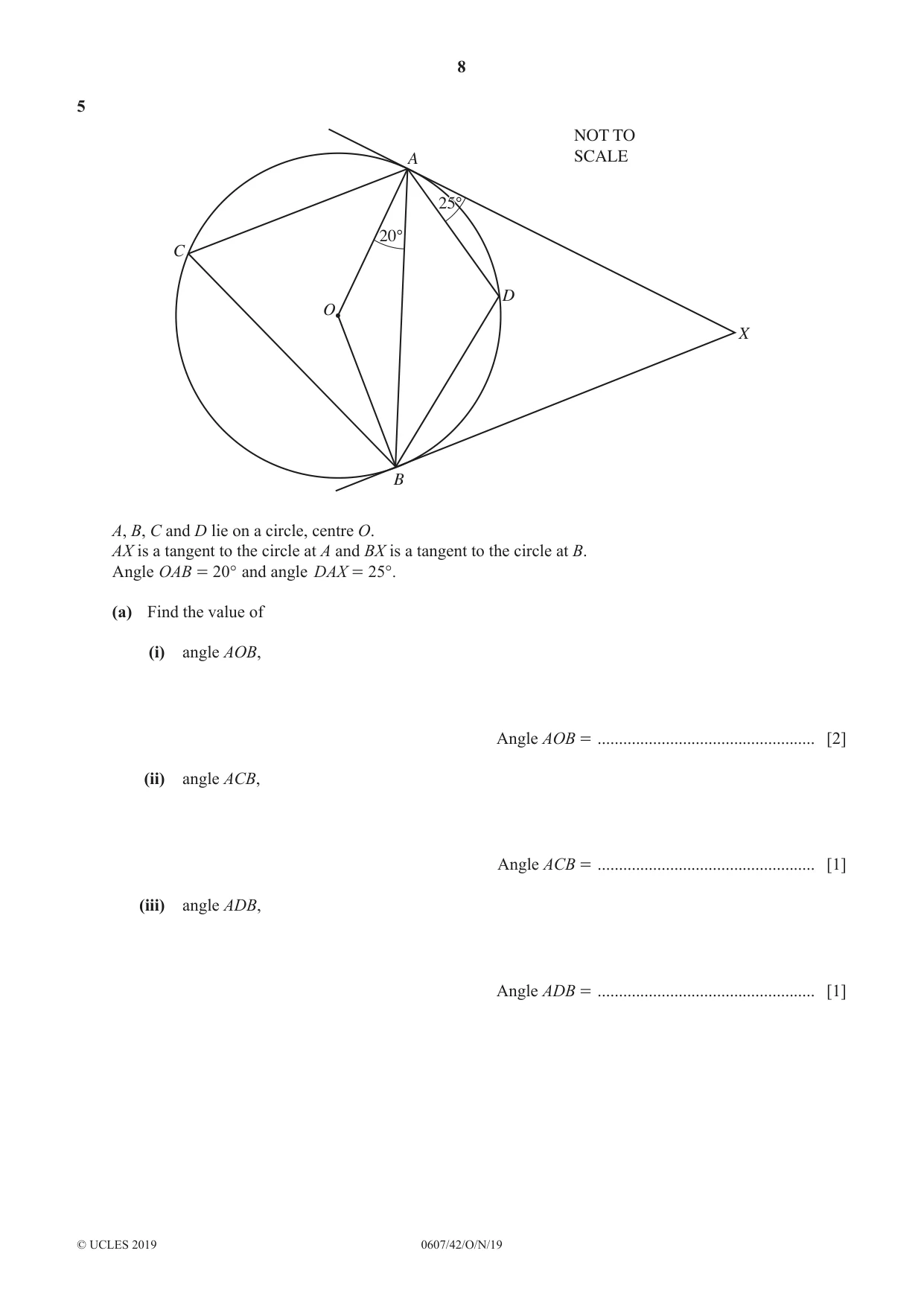
Q5 · NOT TO A SCALE 25°25° 20° C D O X B A, B, C and D lie on a circle, centre O
5 NOT TO A SCALE 25°25° 20° C D O X B A, B, C and D lie on a circle, centre O. AX is a tangent to the circle at A and BX is a tangent to the circle at B. Angle OAB = 20 ° and angle DAX = 25 °. (a) Find the value of (i) angle AOB, Angle AOB = ................................................... [2] (ii) angle ACB, Angle ACB = ................................................... [1] (iii) angle ADB, Angle ADB = ................................................... [1] (iv) angle BAD, Angle BAD = ................................................... [1] (v) angle DBA, Angle DBA = ................................................... [1] (vi) angle AXB. Angle AXB = ................................................... [1] (b) What type of quadrilateral is ACBD? .................................................... [1]
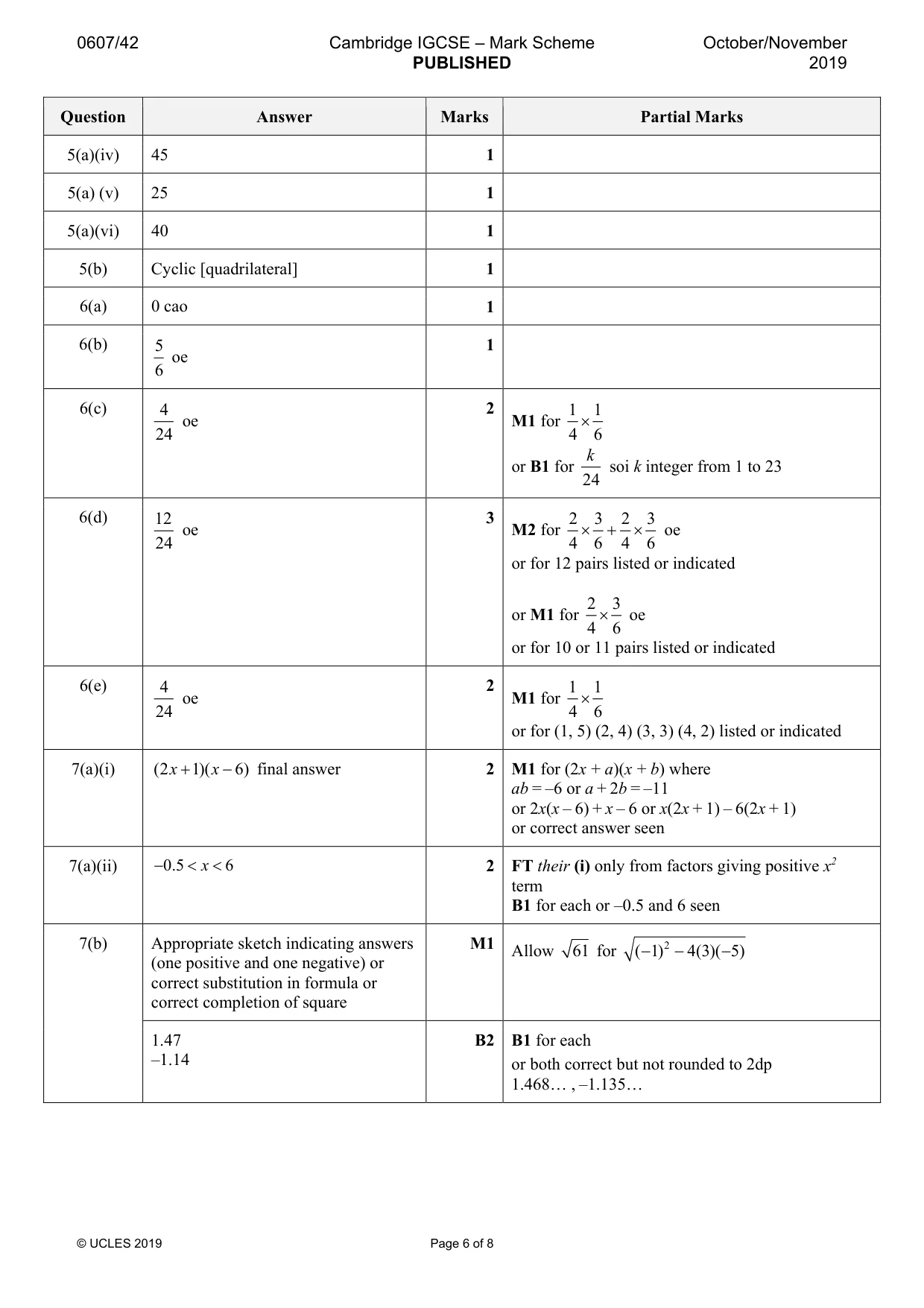
Mark scheme: 5(a)(i) 140 2 B1 for angle OBA = 20 soi 5(a)(ii) 70 1 FT 0.5 × their (i) 5(a)(iii) 110 1 FT 180 − their (ii) 5(a)(iv) 45 1 5(a) (v) 25 1 5(a)(vi) 40 1 5(b) Cyclic [quadrilateral] 1
Q6 · Spinner A is numbered 1, 2, 3, 4
6 Spinner A is numbered 1, 2, 3, 4. Spinner B is numbered 1, 2, 3, 4, 5, 6. Each spinner is equally likely to land on any of its numbers. The two spinners are each spun once and the number that each spinner lands on is recorded. Find the probability that (a) the number on spinner A is greater than 4, .................................................... [1] (b) the number on spinner B is not a 3, .................................................... [1] (c) the number on spinner A is the same as the number on spinner B, .................................................... [2] (d) one number is odd and one number is even, .................................................... [3] (e) the sum of the numbers is 6. .................................................... [2]
Mark scheme: 6(a) 0 cao 1 6(b) 5 1 oe 6 6(c) 4 2 1 1 oe M1 for × 24 4 6 k or B1 for soi k integer from 1 to 23 24 6(d) 12 3 2 3 2 3 oe M2 for × + × oe 24 4 6 4 6 or for 12 pairs listed or indicated 2 3 or M1 for × oe 4 6 or for 10 or 11 pairs listed or indicated 6(e) 4 2 1 1 oe M1 for × 24 4 6 or for (1, 5) (2, 4) (3, 3) (4, 2) listed or indicated
Q7 · Factorise 2x 2 - 11x - 6
7 (a) (i) Factorise 2x 2 - 11x - 6 . .................................................... [2] (ii) Using your answer to part (i), solve 2x 2 - 11x - 6 1 0. .................................................... [2] (b) Solve the equation 3x 2 - x - 5 = 0. Give your answers correct to 2 decimal places. You must show all your working. x = ................ or x = ................ [3]
Mark scheme: 7(a)(i) (2 x + 1)( x − 6) final answer 2 M1 for (2x + a)(x + b) where ab = –6 or a + 2b = –11 or 2x(x – 6) + x – 6 or x(2x + 1) – 6(2x + 1) or correct answer seen 7(a)(ii) − 0.5 < x < 6 2 FT their (i) only from factors giving positive x2 term B1 for each or –0.5 and 6 seen 7(b) Appropriate sketch indicating answers M1 2 Allow 61 for ( −1) − 4(3)( −5) (one positive and one negative) or correct substitution in formula or correct completion of square 1.47 B2 B1 for each –1.14 or both correct but not rounded to 2dp 1.468… , –1.135…
Q8 · There are 100 students in a year group
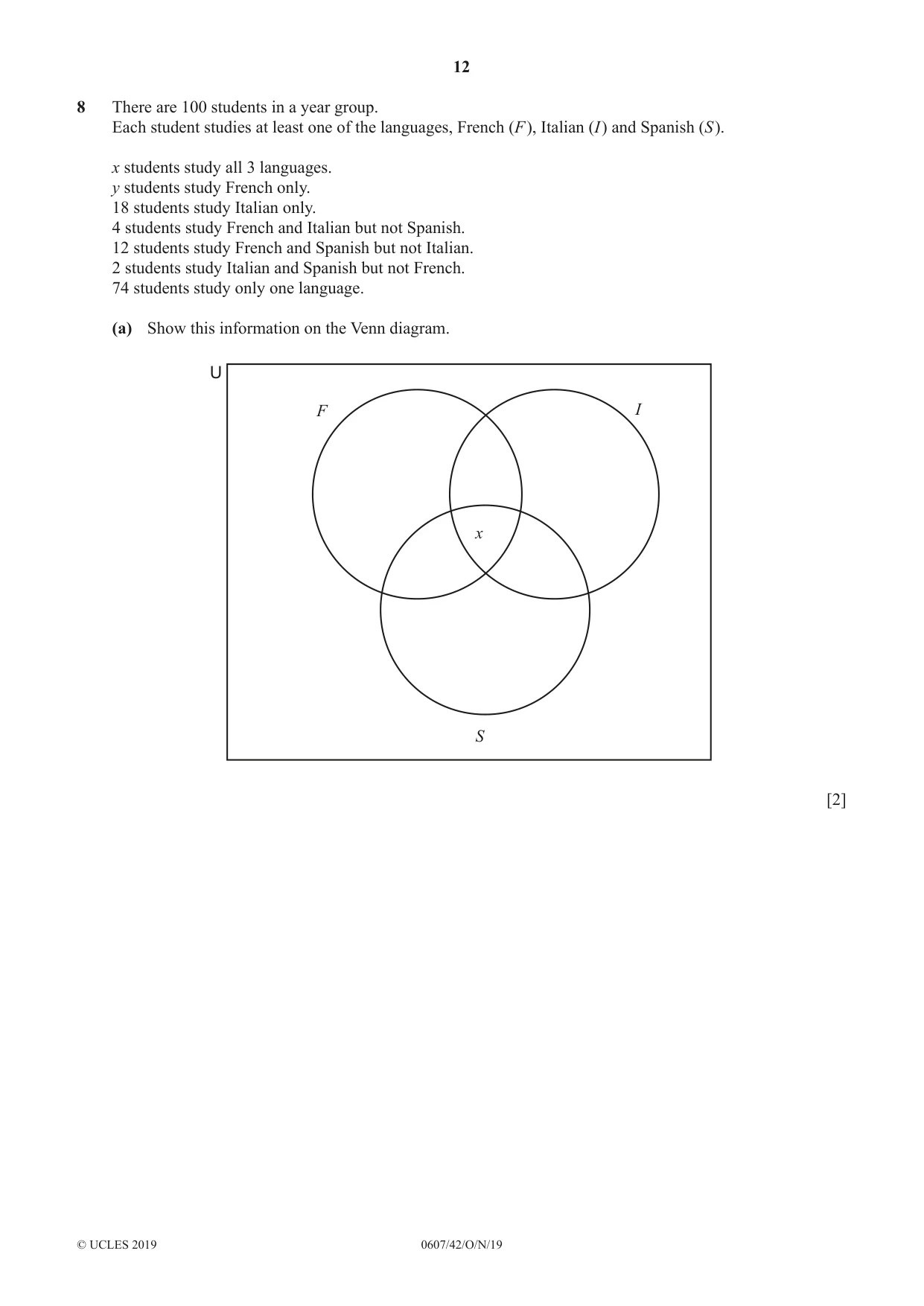
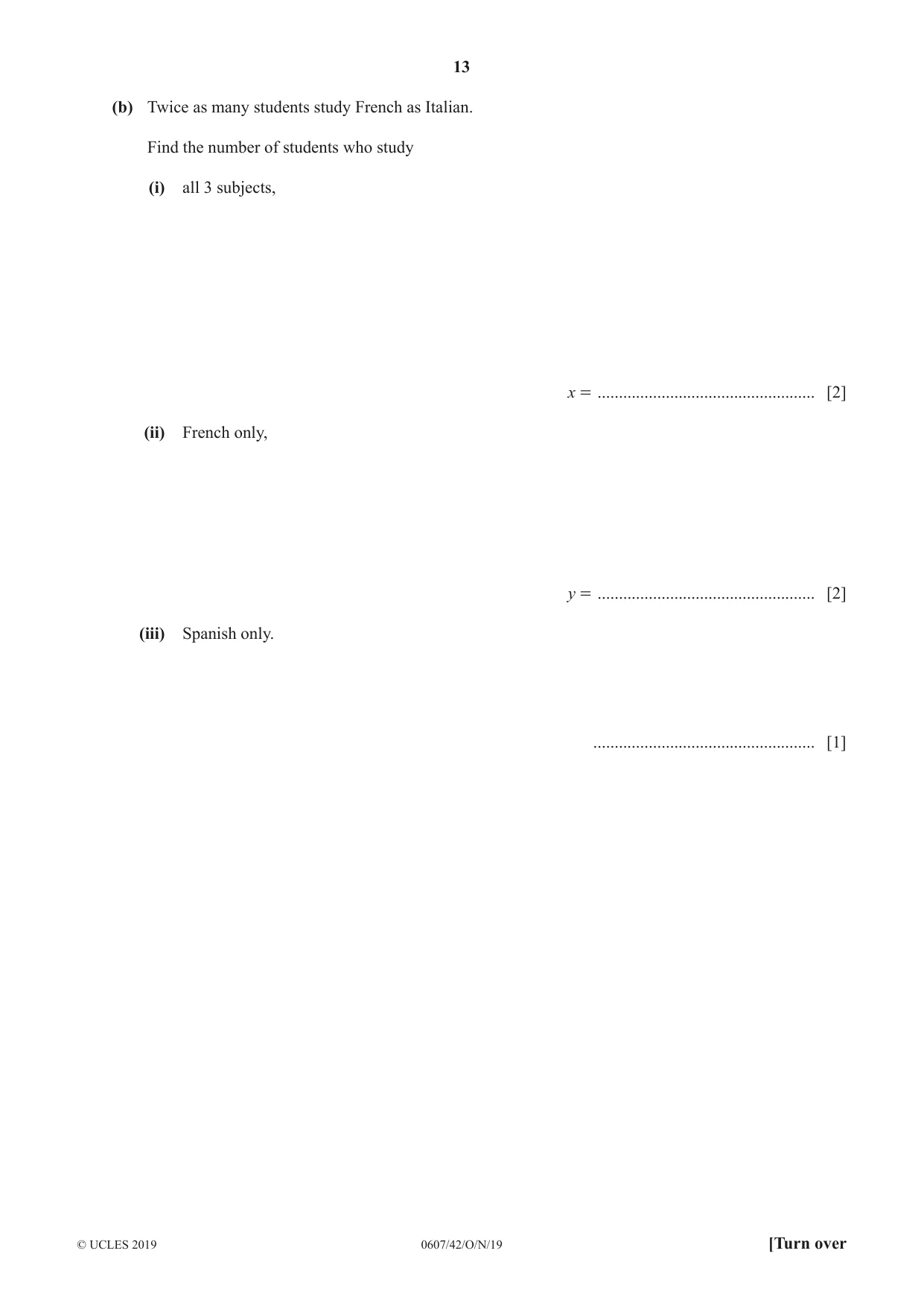
8 There are 100 students in a year group. Each student studies at least one of the languages, French (F), Italian (I) and Spanish (S). x students study all 3 languages. y students study French only. 18 students study Italian only. 4 students study French and Italian but not Spanish. 12 students study French and Spanish but not Italian. 2 students study Italian and Spanish but not French. 74 students study only one language. (a) Show this information on the Venn diagram. U F I x S [2] (b) Twice as many students study French as Italian. Find the number of students who study (i) all 3 subjects, x = ................................................... [2] (ii) French only, y = ................................................... [2] (iii) Spanish only. .................................................... [1]
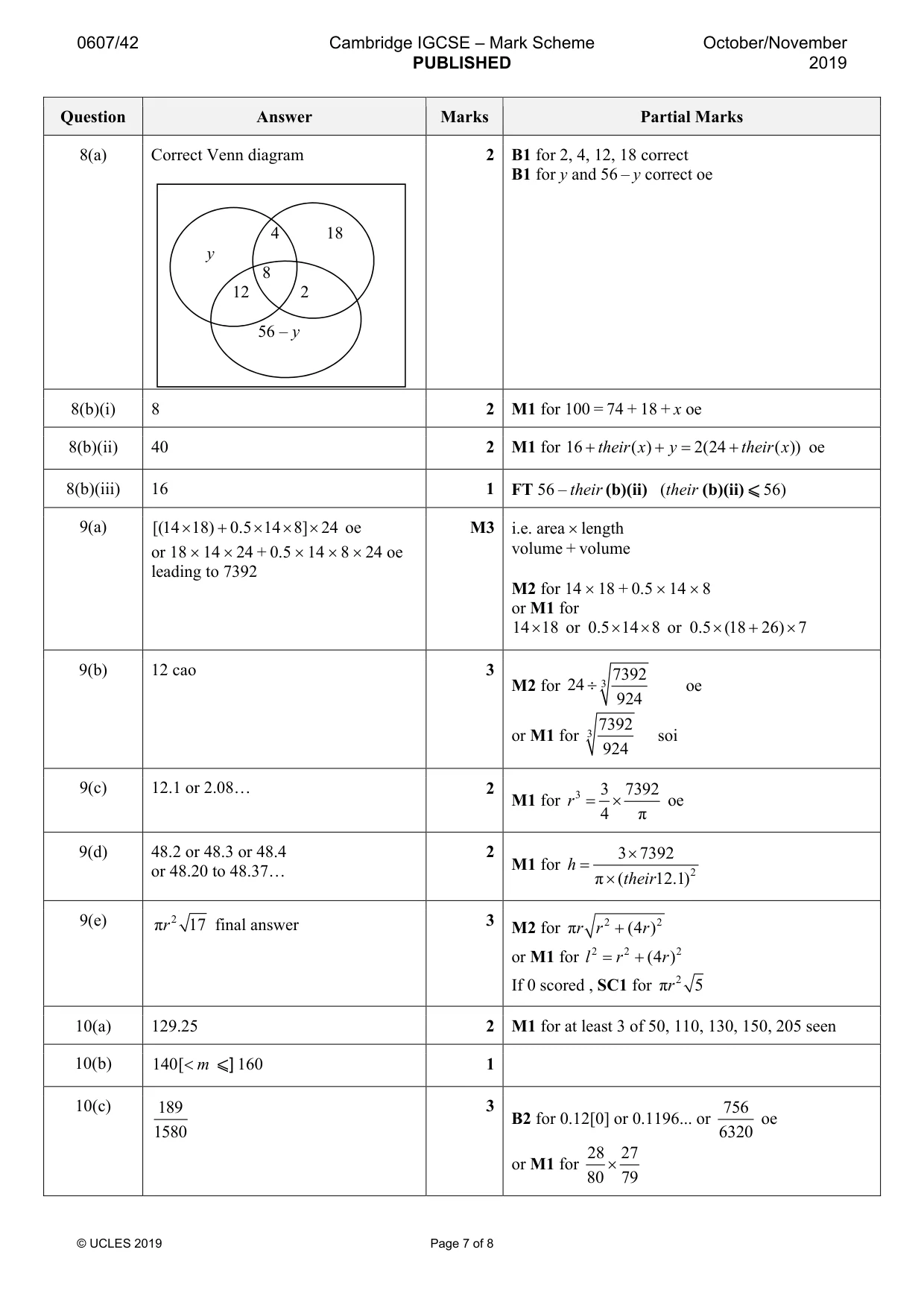
Mark scheme: 8(a) Correct Venn diagram 2 B1 for 2, 4, 12, 18 correct B1 for y and 56 – y correct oe 4 18 y 8 12 2 56 – y 8(b)(i) 8 2 M1 for 100 = 74 + 18 + x oe 8(b)(ii) 40 2 M1 for 16 + their ( x ) + y = 2(24 + their ( x )) oe 8(b)(iii) 16 1 FT 56 – their (b)(ii) (their (b)(ii) ⩽ 56)
Q9 · NOT TO SCALE h cm r cm 18 cm 26 cm 24 cm r cm 14 cm The diagram shows three solids, a…
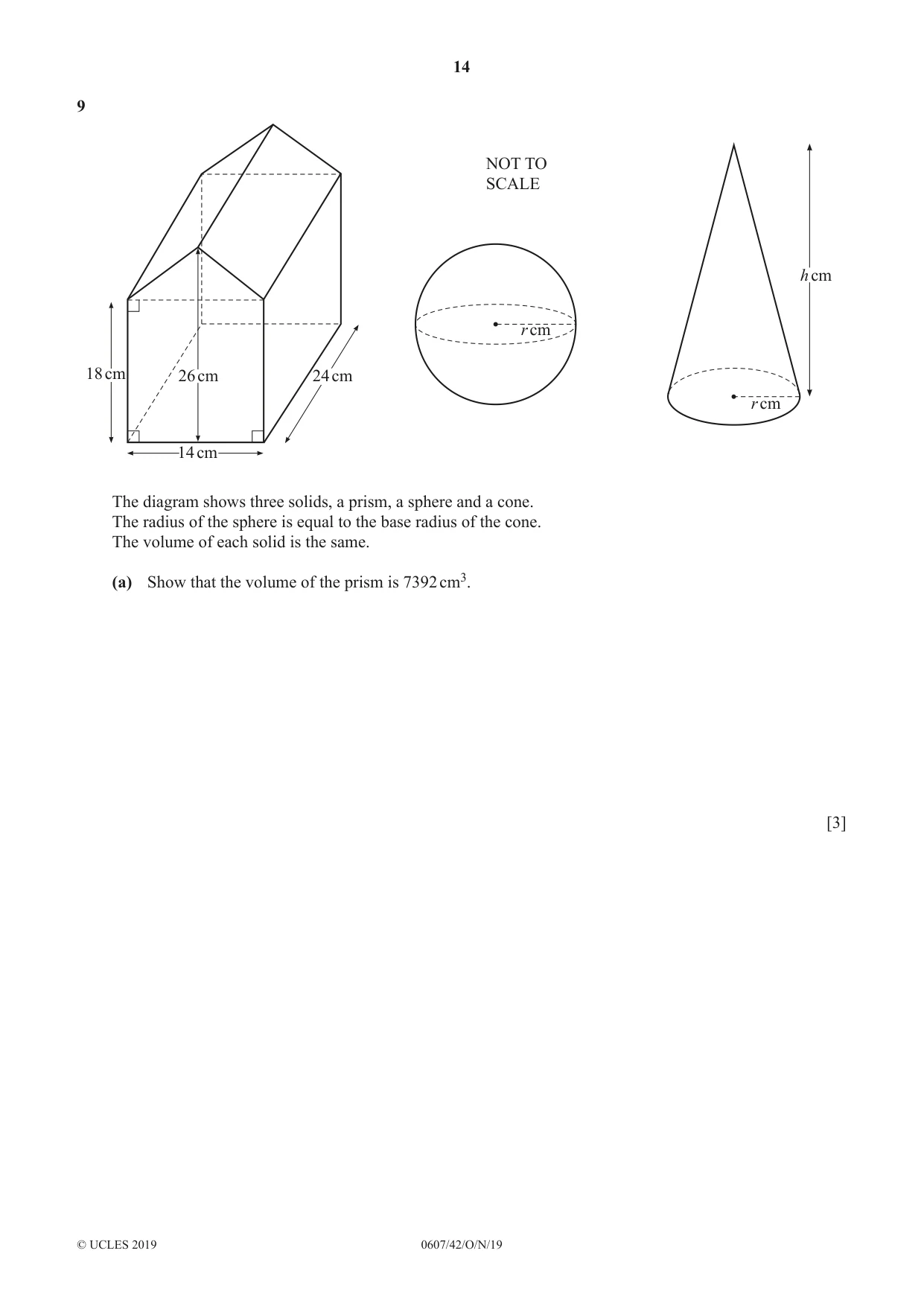
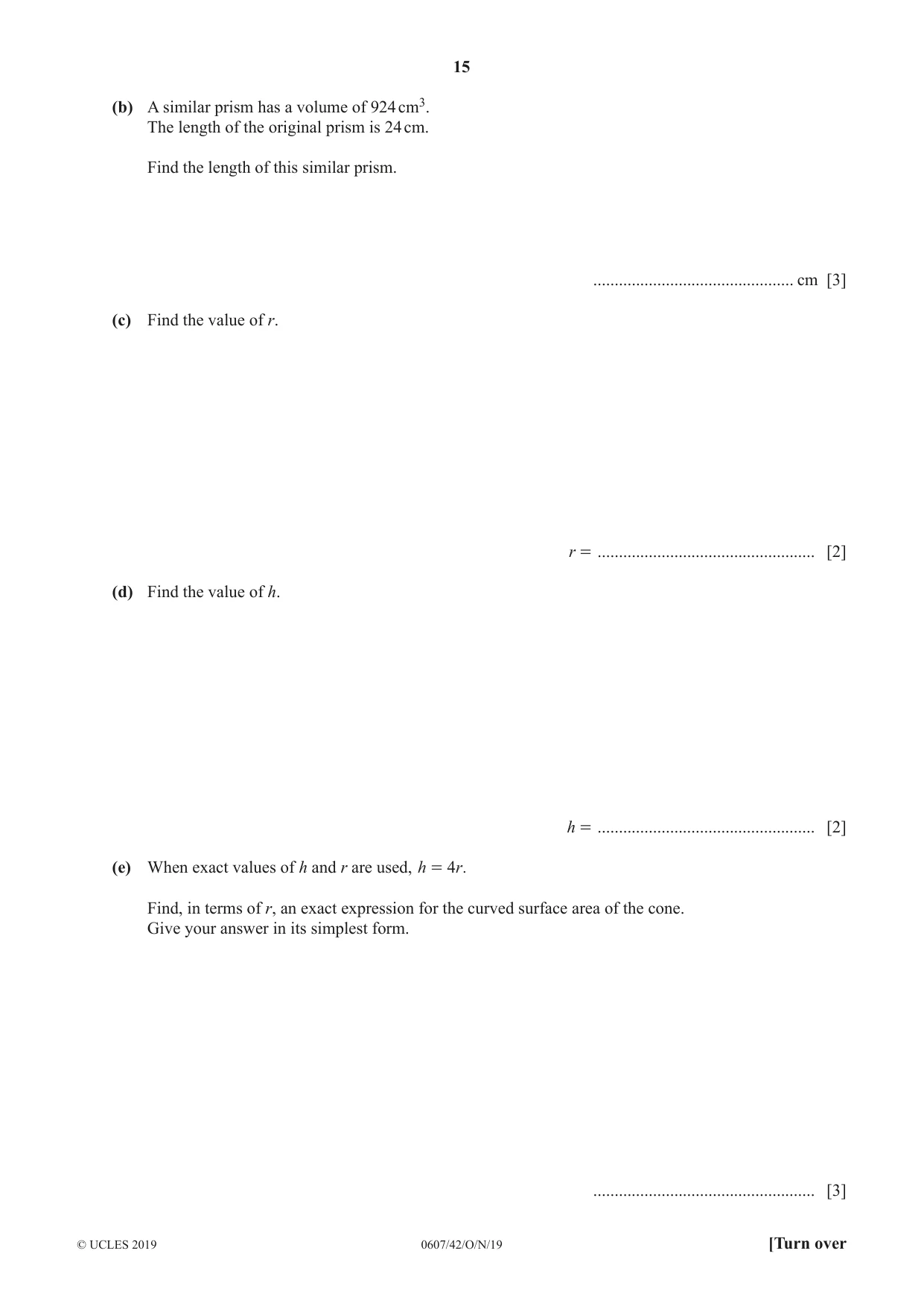
9 NOT TO SCALE h cm r cm 18 cm 26 cm 24 cm r cm 14 cm The diagram shows three solids, a prism, a sphere and a cone. The radius of the sphere is equal to the base radius of the cone. The volume of each solid is the same. (a) Show that the volume of the prism is 7392 cm3. [3] (b) A similar prism has a volume of 924 cm3. The length of the original prism is 24 cm. Find the length of this similar prism. ............................................... cm [3] (c) Find the value of r. r = ................................................... [2] (d) Find the value of h. h = ................................................... [2] (e) When exact values of h and r are used, h = 4 r. Find, in terms of r, an exact expression for the curved surface area of the cone. Give your answer in its simplest form. .................................................... [3]
Mark scheme: 9(a) [(14 × 18) + 0.5 × 14 × 8] × 24 oe M3 i.e. area × length or 18 × 14 × 24 + 0.5 × 14 × 8 × 24 oe volume + volume leading to 7392 M2 for 14 × 18 + 0.5 × 14 × 8 or M1 for 14 × 18 or 0.5 × 14 × 8 or 0.5 × (18 + 26) × 7 9(b) 12 cao 3 7392 M2 for 24 ÷ 3 oe 924 7392 or M1 for 3 soi 924 9(c) 12.1 or 2.08… 2 3 3 7392 M1 for r = × oe 4 π 9(d) 48.2 or 48.3 or 48.4 2 3 × 7392 M1 for h = or 48.20 to 48.37… 2 π × (their12.1) 9(e) πr 2 17 final answer 3 M2 for πr r 2 + (4 r ) 2 or M1 for l 2 = r 2 + (4 r ) 2 If 0 scored , SC1 for πr 2 5
Q10 · The mass of each of 80 apples is shown in the table
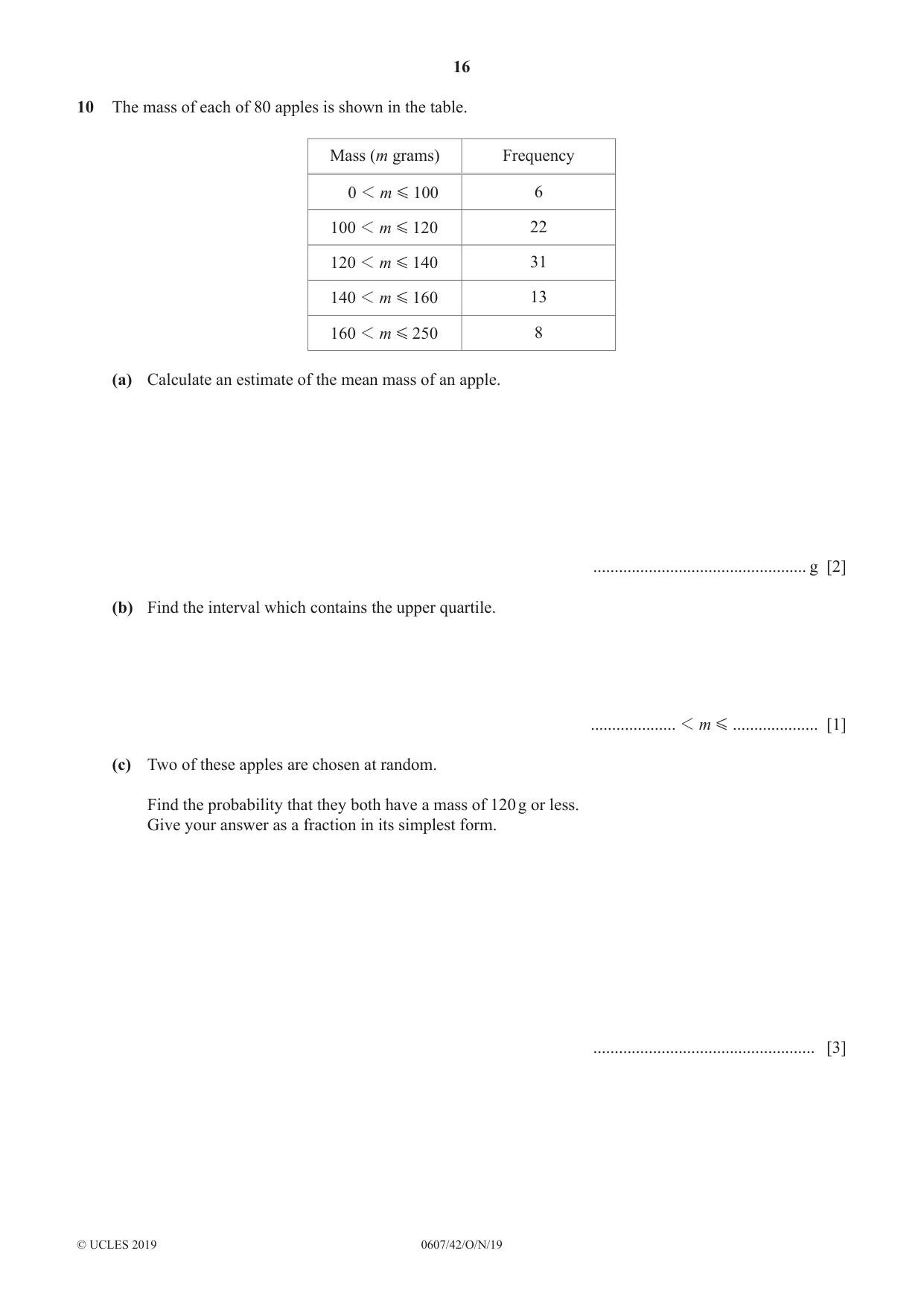
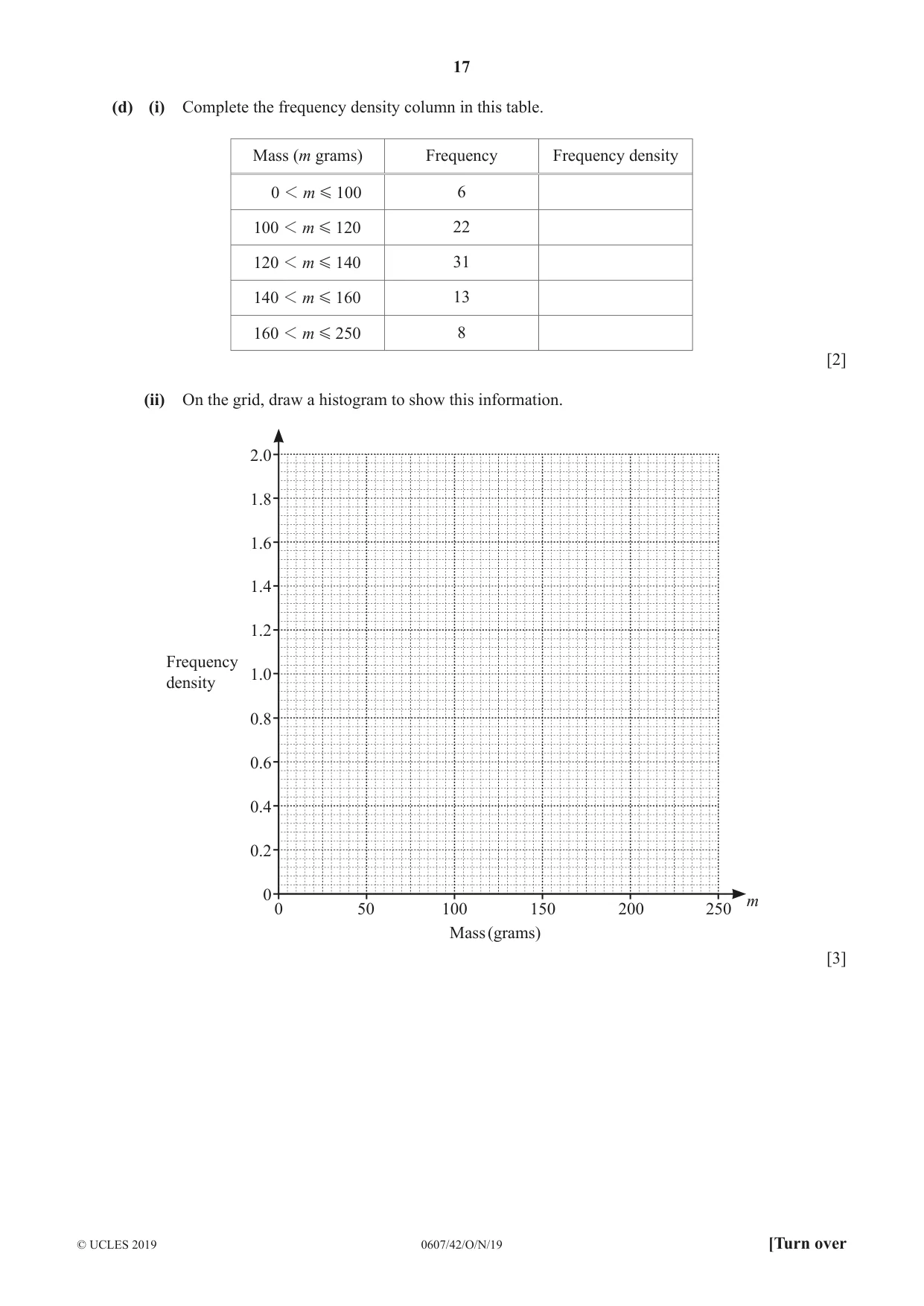
10 The mass of each of 80 apples is shown in the table. Mass (m grams) Frequency 0 1 m G 100 6 100 1 m G 120 22 120 1 m G 140 31 140 1 m G 160 13 160 1 m G 250 8 (a) Calculate an estimate of the mean mass of an apple. .................................................. g [2] (b) Find the interval which contains the upper quartile. .................... 1 m G .................... [1] (c) Two of these apples are chosen at random. Find the probability that they both have a mass of 120 g or less. Give your answer as a fraction in its simplest form. .................................................... [3] (d) (i) Complete the frequency density column in this table. Mass (m grams) Frequency Frequency density 0 1 m G 100 6 100 1 m G 120 22 120 1 m G 140 31 140 1 m G 160 13 160 1 m G 250 8 [2] (ii) On the grid, draw a histogram to show this information. 2.0 1.8 1.6 1.4 1.2 Frequency 1.0 density 0.8 0.6 0.4 0.2 0 m 0 50 100 150 200 250 Mass (grams) [3]
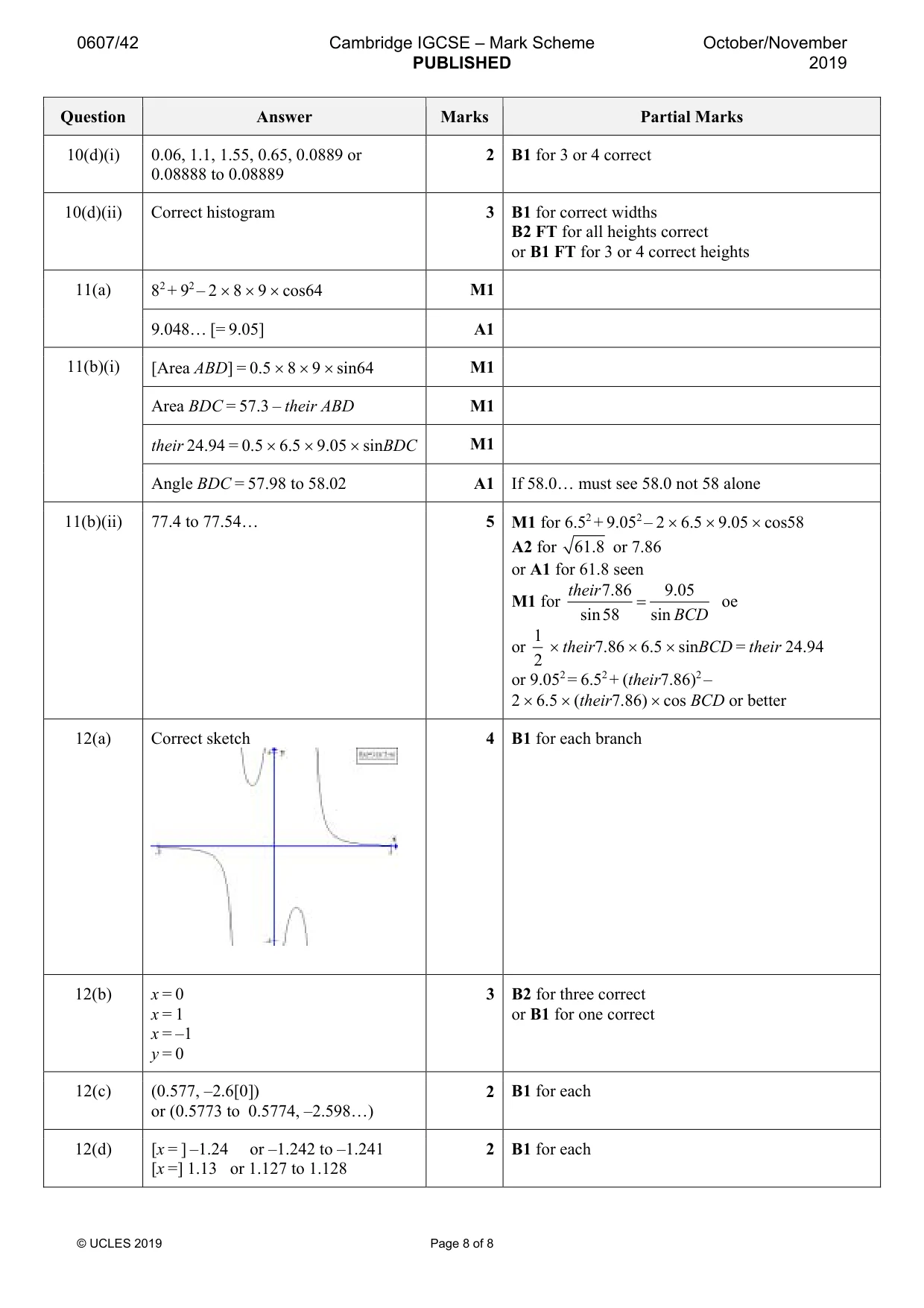
Mark scheme: 10(a) 129.25 2 M1 for at least 3 of 50, 110, 130, 150, 205 seen 10(b) 140[ < m ⩽] 160 1 10(c) 189 3 756 B2 for 0.12[0] or 0.1196... or oe 1580 6320 28 27 or M1 for × 80 79 10(d)(i) 0.06, 1.1, 1.55, 0.65, 0.0889 or 2 B1 for 3 or 4 correct 0.08888 to 0.08889 10(d)(ii) Correct histogram 3 B1 for correct widths B2 FT for all heights correct or B1 FT for 3 or 4 correct heights
Q11 · B NOT TO SCALE 8 cm C 6.5 cm 64 ° A 9 cm D The diagram shows a quadrilateral ABCD
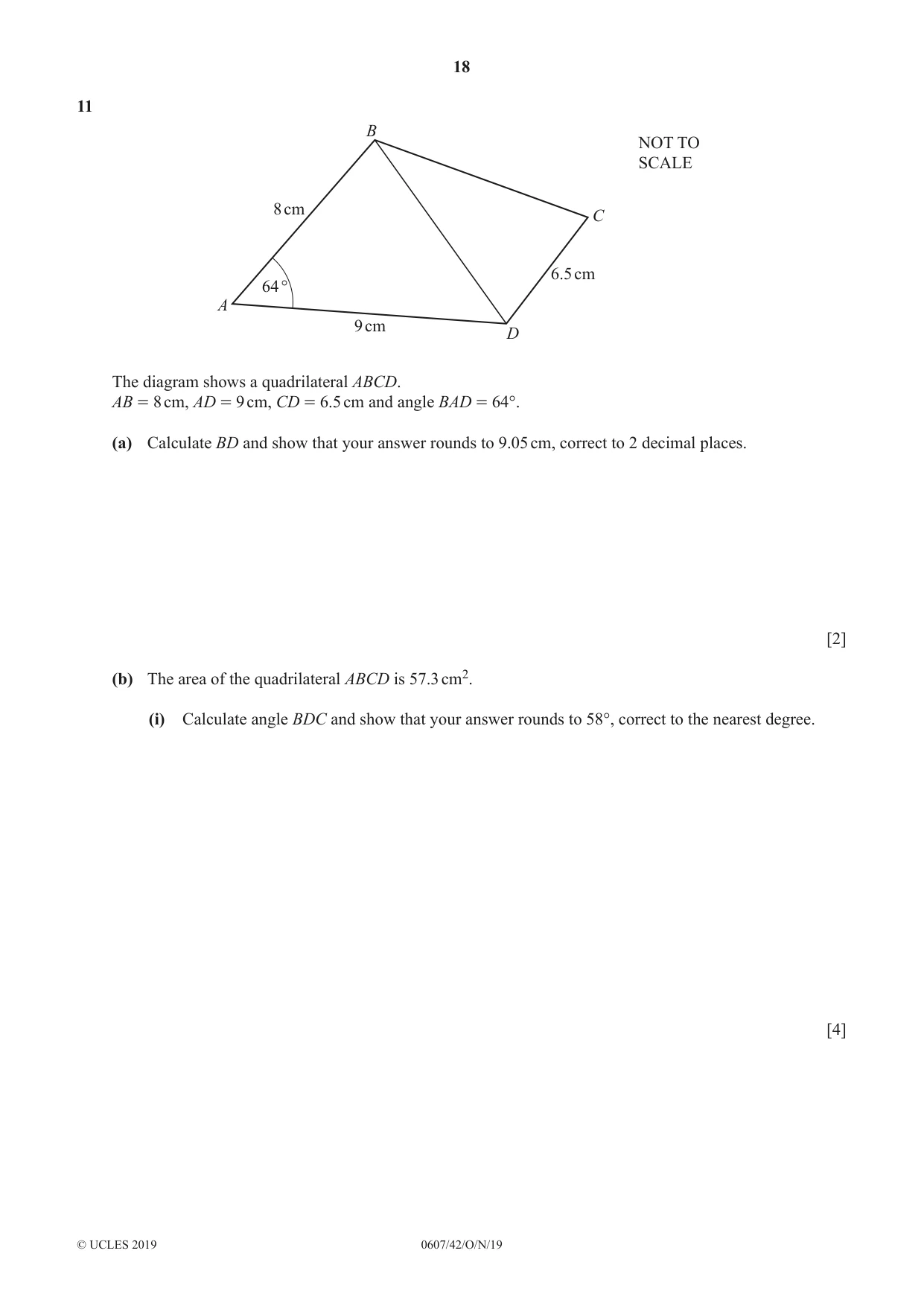
11 B NOT TO SCALE 8 cm C 6.5 cm 64 ° A 9 cm D The diagram shows a quadrilateral ABCD. AB = 8 cm, AD = 9 cm, CD = 6.5 cm and angle BAD = 64°. (a) Calculate BD and show that your answer rounds to 9.05 cm, correct to 2 decimal places. [2] (b) The area of the quadrilateral ABCD is 57.3 cm2. (i) Calculate angle BDC and show that your answer rounds to 58°, correct to the nearest degree. [4] (ii) Calculate angle BCD. angle BCD = ................................................... [5] Question 12 is printed on the next page.
Mark scheme: 11(a) 82 + 92 – 2 × 8 × 9 × cos64 M1 9.048… [= 9.05] A1 11(b)(i) [Area ABD] = 0.5 × 8 × 9 × sin64 M1 Area BDC = 57.3 – their ABD M1 their 24.94 = 0.5 × 6.5 × 9.05 × sinBDC M1 Angle BDC = 57.98 to 58.02 A1 If 58.0… must see 58.0 not 58 alone 11(b)(ii) 77.4 to 77.54… 5 M1 for 6.52 + 9.052 – 2 × 6.5 × 9.05 × cos58 A2 for 61.8 or 7.86 or A1 for 61.8 seen their 7.86 9.05 M1 for = oe sin58 sin BCD 1 or × their7.86 × 6.5 × sinBCD = their 24.94 2 or 9.052 = 6.52 + (their7.86)2 – 2 × 6.5 × (their7.86) × cos BCD or better
Q12 · Y 4 x –3 0 3 –4 (a) On the diagram, sketch the graph of y = f ( x), where 1 f (x) = for…
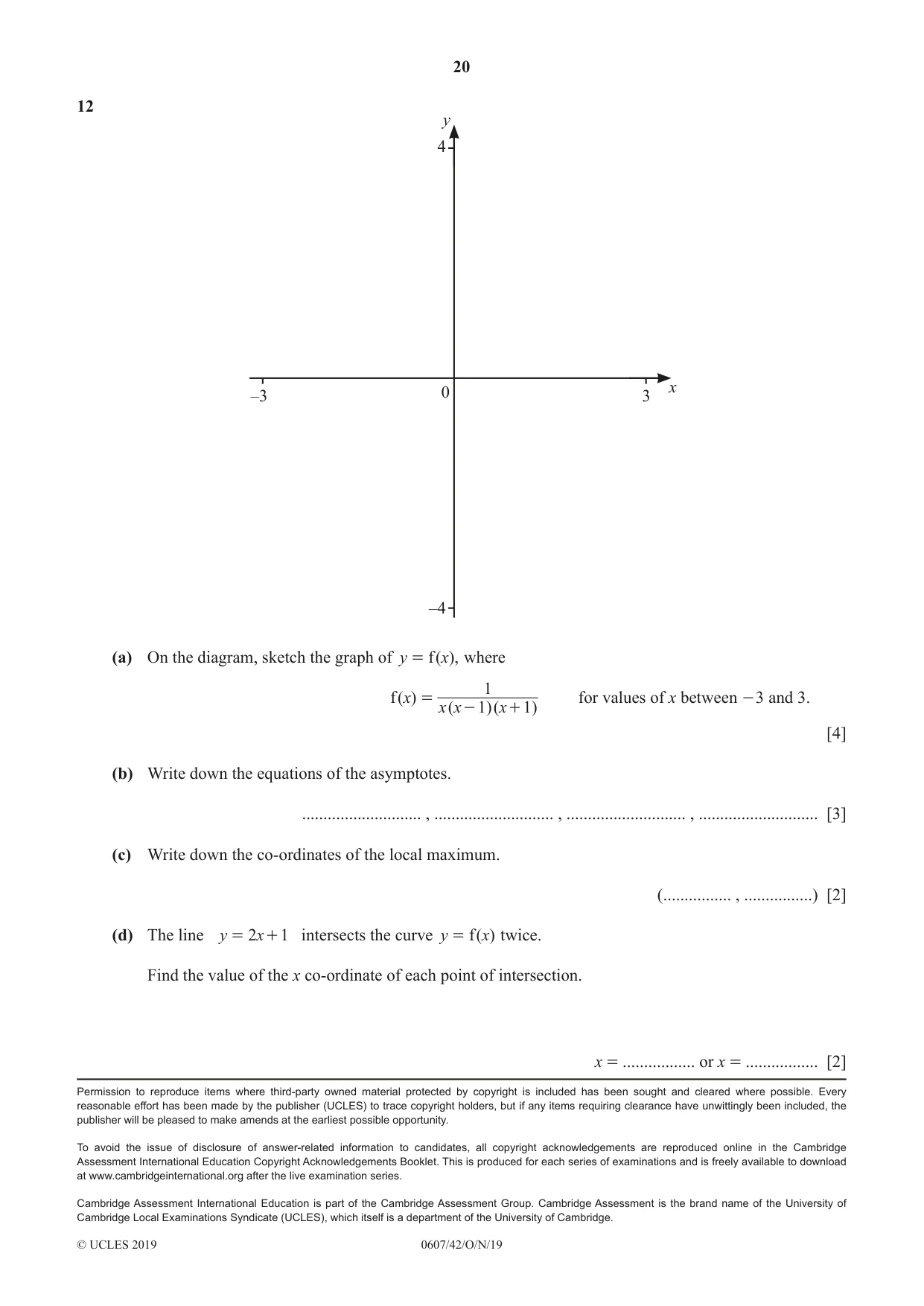
12 y 4 x –3 0 3 –4 (a) On the diagram, sketch the graph of y = f ( x), where 1 f (x) = for values of x between - 3 and 3. x (x - 1)(x + 1) [4] (b) Write down the equations of the asymptotes. ............................ , ............................ , ............................ , ............................ [3] (c) Write down the co-ordinates of the local maximum. (................ , ................) [2] (d) The line y = 2x + 1 intersects the curve y = f (x) twice. Find the value of the x co-ordinate of each point of intersection. x = ................. or x = ................. [2]
Mark scheme: 12(a) Correct sketch 4 B1 for each branch 12(b) x = 0 3 B2 for three correct x = 1 or B1 for one correct x = –1 y = 0 12(c) (0.577, –2.6[0]) 2 B1 for each or (0.5773 to 0.5774, –2.598…) 12(d) [x = ] –1.24 or –1.242 to –1.241 2 B1 for each [x =] 1.13 or 1.127 to 1.128
What was in this paper
The subtopics covered by these 12 questions, and how many questions each got. Open one in a new tab to see every Cambridge question on it.
What you needed in this session
Cambridge’s own grade thresholds for 2019 Oct/Nov, Paper 4 · Variant 2. A higher threshold means an easier paper — the bar moves with how the cohort did.