Cambridge IGCSE Mathematics - International 0607 — 2019 May/June Paper 4 · Variant 2
0607/42/M/J/19 · 12 questions · 120 marks · ≈135 min
The question paper and its mark scheme, free to read here and free to download. This is Cambridge’s own paper, exactly as it was sat.
Question paper20 pages
Mark scheme8 pages
Answers below. Sit the paper first if you are practising.
Questions as text
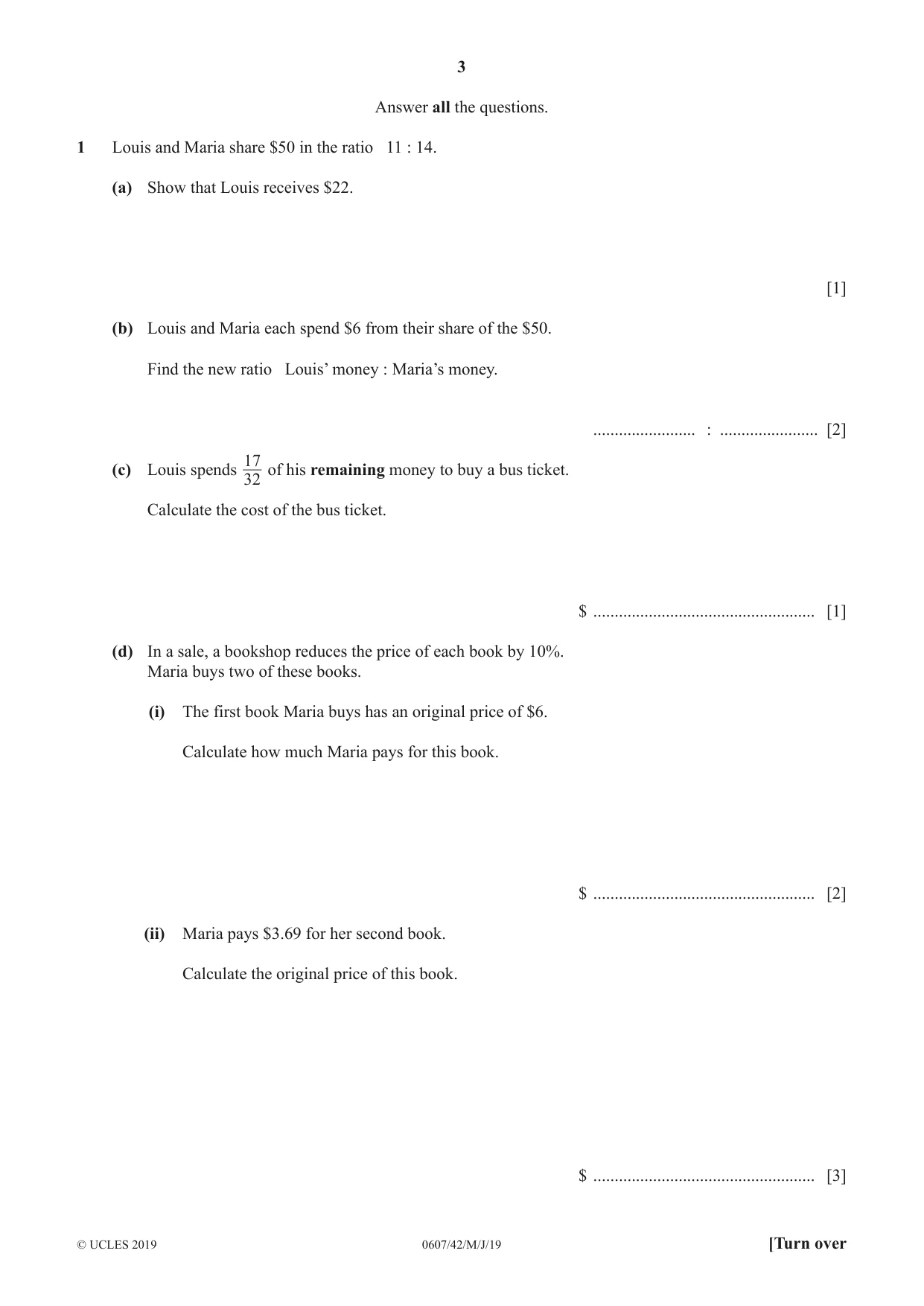
Q1 · Louis and Maria share $50 in the ratio 11 : 14
1 Louis and Maria share $50 in the ratio 11 : 14. (a) Show that Louis receives $22. [1] (b) Louis and Maria each spend $6 from their share of the $50. Find the new ratio Louis’ money : Maria’s money. ........................ : ....................... [2] 17 (c) Louis spends of his remaining money to buy a bus ticket. 32 Calculate the cost of the bus ticket. $ .................................................... [1] (d) In a sale, a bookshop reduces the price of each book by 10%. Maria buys two of these books. (i) The first book Maria buys has an original price of $6. Calculate how much Maria pays for this book. $ .................................................... [2] (ii) Maria pays $3.69 for her second book. Calculate the original price of this book. $ .................................................... [3]
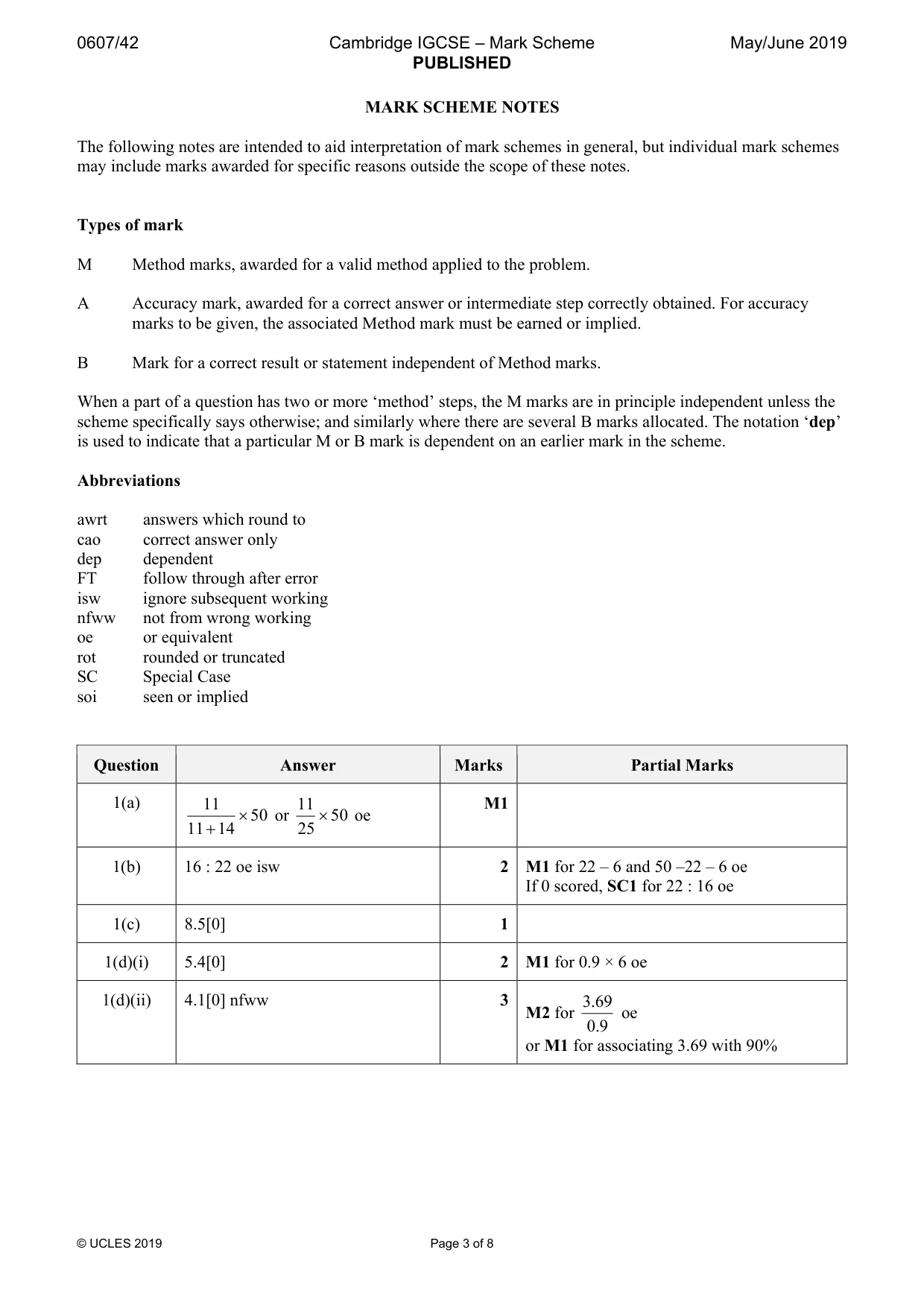
Mark scheme: Question Answer Marks Partial Marks 1(a) 11 11 M1 × 50 or × 50 oe 11 + 14 25 1(b) 16 : 22 oe isw 2 M1 for 22 – 6 and 50 –22 – 6 oe If 0 scored, SC1 for 22 : 16 oe 1(c) 8.5[0] 1 1(d)(i) 5.4[0] 2 M1 for 0.9 × 6 oe 1(d)(ii) 4.1[0] nfww 3 .369 M2 for oe 9.0 or M1 for associating 3.69 with 90%
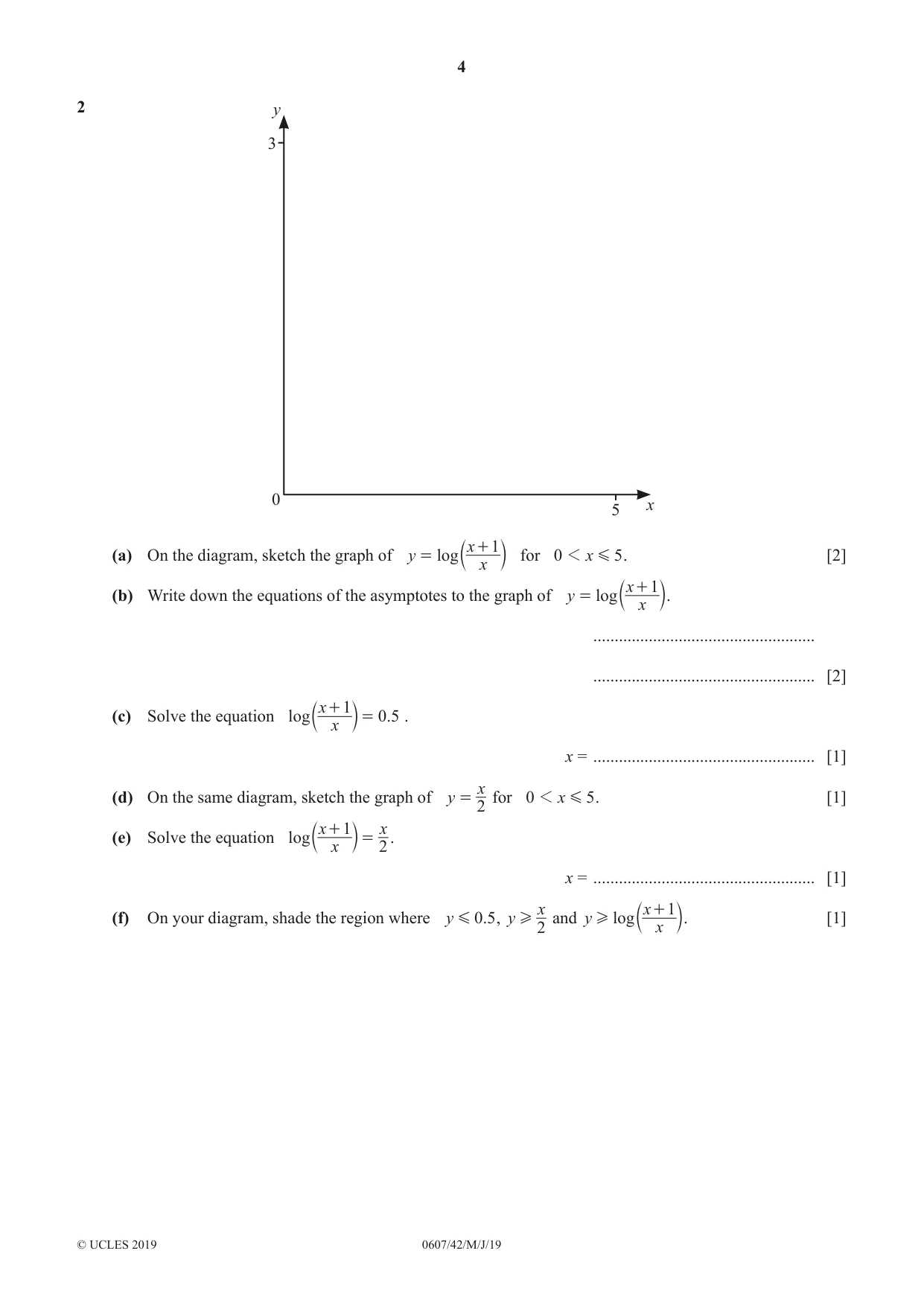
Q2 · Y 3 0 x 5 x + 1 (a) On the diagram, sketch the graph of y = log for 0 1 x G 5
2 y 3 0 x 5 x + 1 (a) On the diagram, sketch the graph of y = log for 0 1 x G 5 . [2] b x l x + 1 (b) Write down the equations of the asymptotes to the graph of y = log b x l. .................................................... .................................................... [2] x + 1 (c) Solve the equation log = 0. 5 . b x l x = .................................................... [1] x (d) On the same diagram, sketch the graph of y = for 0 1 x G 5 . [1] 2 x + 1 x (e) Solve the equation log = . b x l 2 x = .................................................... [1] x x + 1 (f) On your diagram, shade the region where y G 0.5 , y H and y H log [1] 2 b x l.
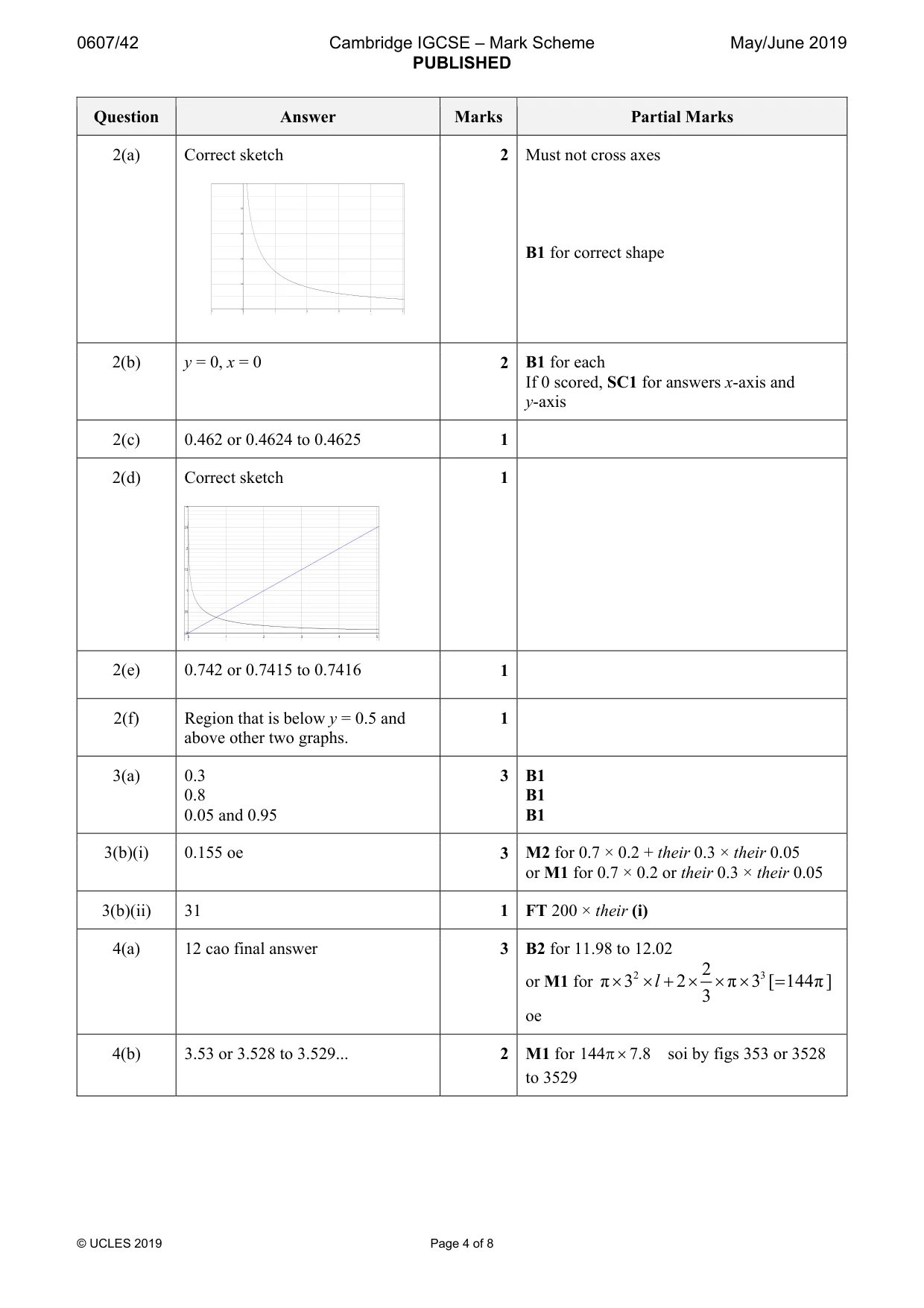
Mark scheme: 2(a) Correct sketch 2 Must not cross axes 1111 0.80.80.80.8 0.60.60.60.6 0.40.40.40.4 B1 for correct shape 0.20.20.20.2 1111 0000 0000 1111 2222 3333 4444 5555 2(b) y = 0, x = 0 2 B1 for each If 0 scored, SC1 for answers x-axis and y-axis 2(c) 0.462 or 0.4624 to 0.4625 1 2(d) Correct sketch 1 3333 2.52.52.52.5 2222 1.51.51.51.5 1111 0.50.50.50.5 0000 0000 1111 2222 3333 4444 5555 2(e) 0.742 or 0.7415 to 0.7416 1 2(f) Region that is below y = 0.5 and 1 above other two graphs.
Q3 · Jono walks to school when the weather is fine
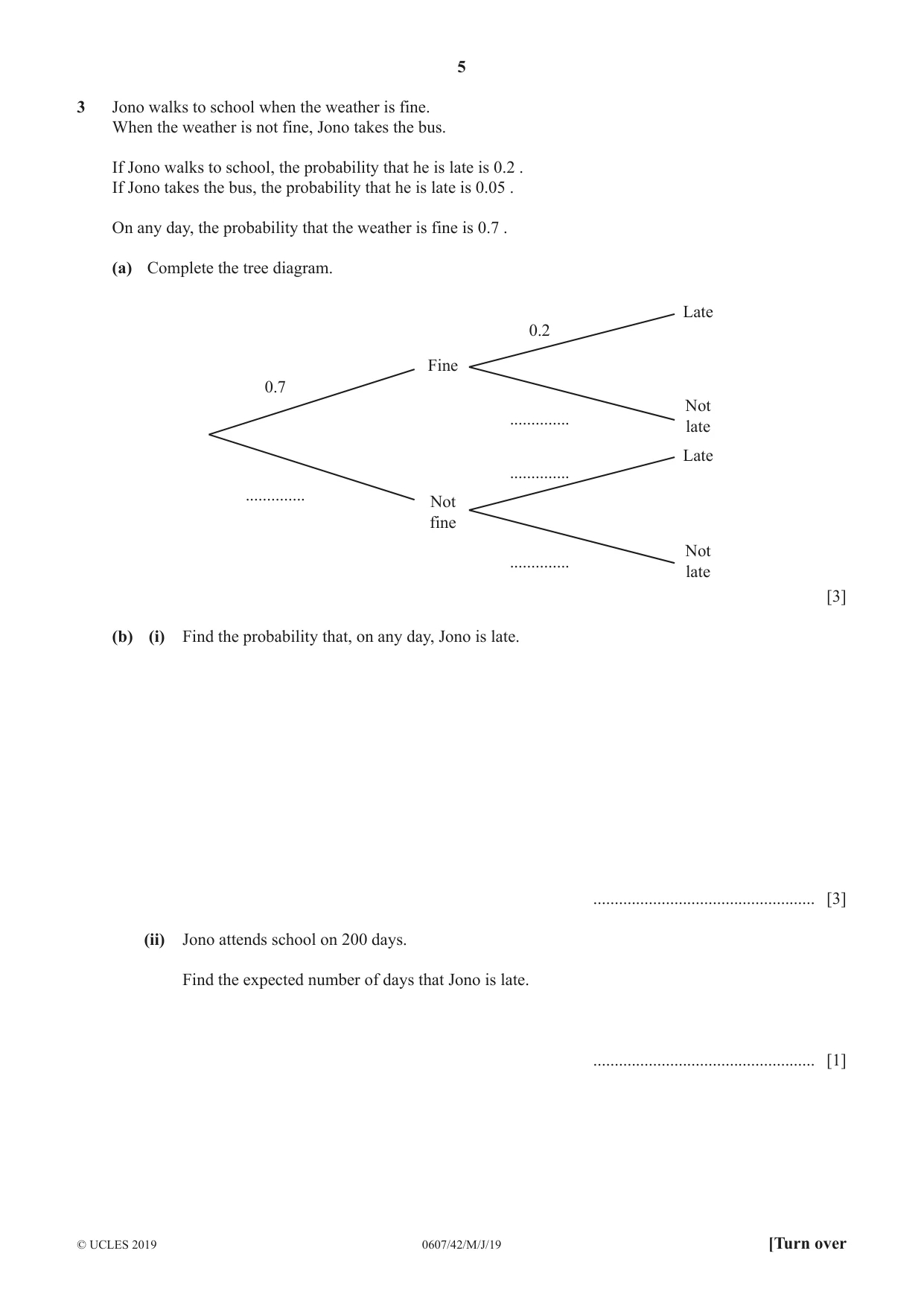
3 Jono walks to school when the weather is fine. When the weather is not fine, Jono takes the bus. If Jono walks to school, the probability that he is late is 0.2 . If Jono takes the bus, the probability that he is late is 0.05 . On any day, the probability that the weather is fine is 0.7 . (a) Complete the tree diagram. Late 0.2 Fine 0.7 Not .............. late Late .............. .............. Not fine Not .............. late [3] (b) (i) Find the probability that, on any day, Jono is late. .................................................... [3] (ii) Jono attends school on 200 days. Find the expected number of days that Jono is late. .................................................... [1]
Mark scheme: 3(a) 0.3 3 B1 0.8 B1 0.05 and 0.95 B1 3(b)(i) 0.155 oe 3 M2 for 0.7 × 0.2 + their 0.3 × their 0.05 or M1 for 0.7 × 0.2 or their 0.3 × their 0.05 3(b)(ii) 31 1 FT 200 × their (i)
Q4 · NOT TO SCALE 3 cm l cm The diagram shows a solid made from a cylinder and two hemispheres
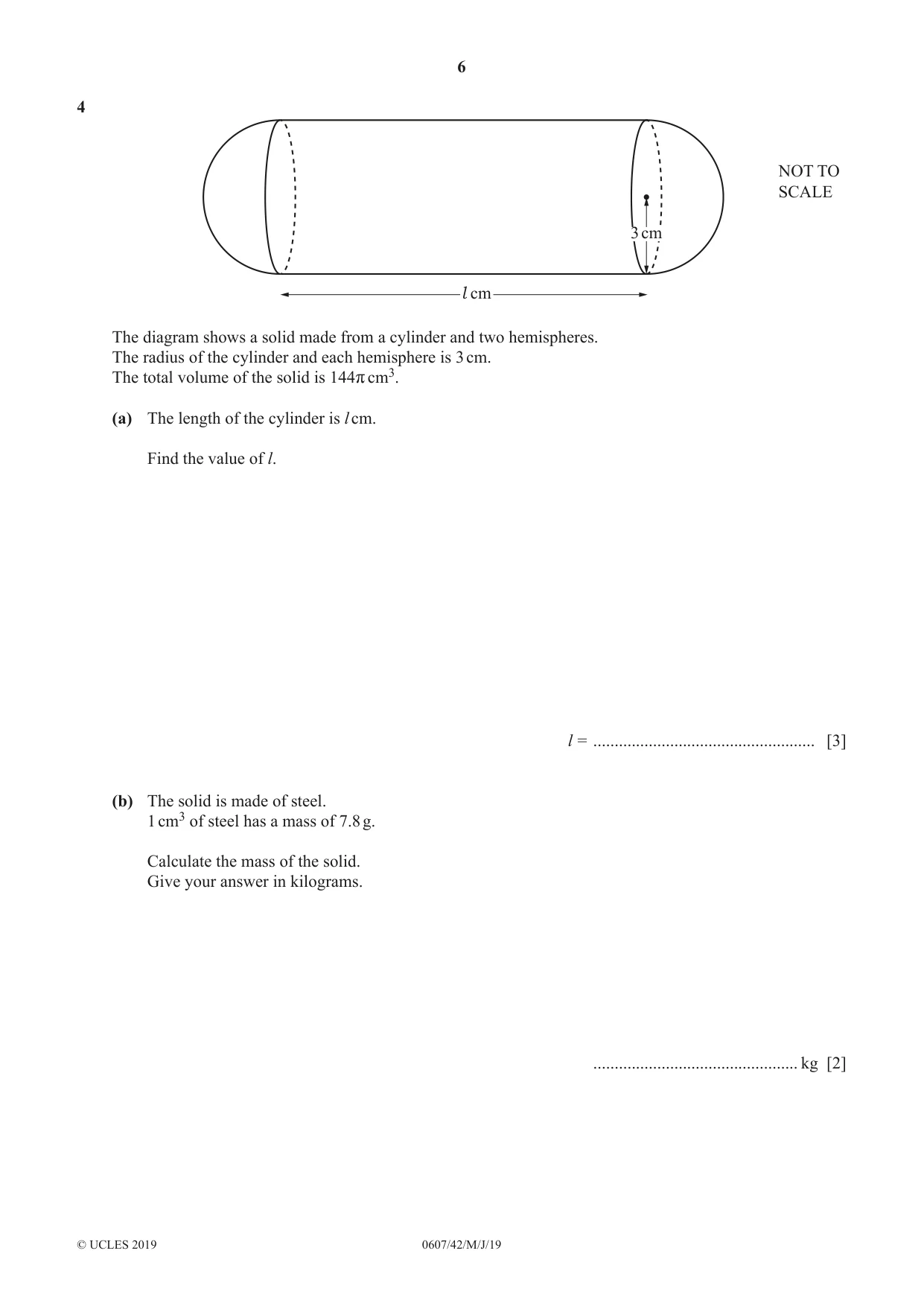
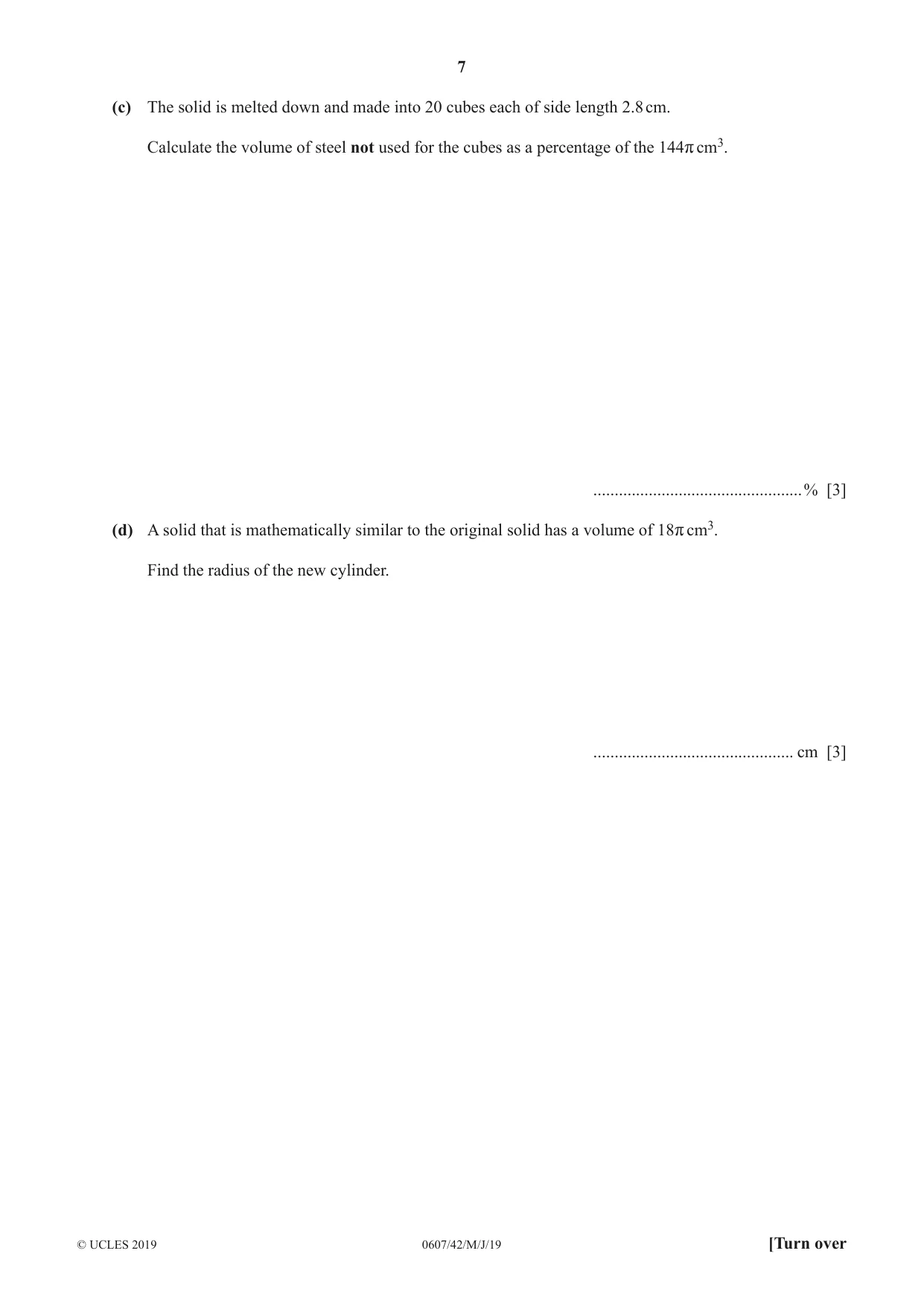
4 NOT TO SCALE 3 cm l cm The diagram shows a solid made from a cylinder and two hemispheres. The radius of the cylinder and each hemisphere is 3 cm. The total volume of the solid is 144r cm3. (a) The length of the cylinder is l cm. Find the value of l. l = .................................................... [3] (b) The solid is made of steel. 1 cm3 of steel has a mass of 7.8 g. Calculate the mass of the solid. Give your answer in kilograms. ................................................ kg [2] (c) The solid is melted down and made into 20 cubes each of side length 2.8 cm. Calculate the volume of steel not used for the cubes as a percentage of the 144r cm3. .................................................% [3] (d) A solid that is mathematically similar to the original solid has a volume of 18r cm3. Find the radius of the new cylinder. ............................................... cm [3]
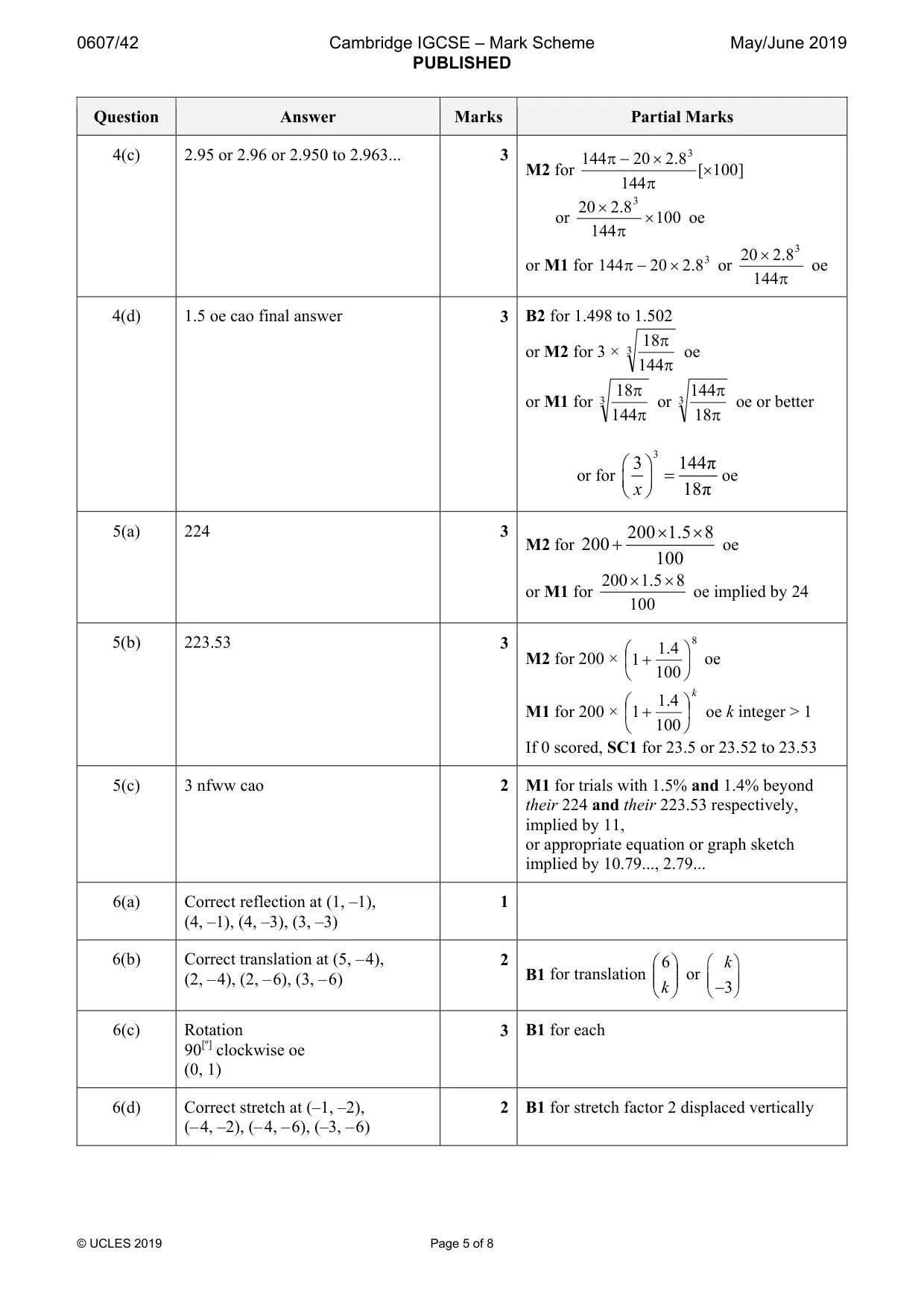
Mark scheme: 4(a) 12 cao final answer 3 B2 for 11.98 to 12.02 2 2 3 or M1 for π × 3 × l + 2 × × π × 3 [ = 144π] 3 oe 4(b) 3.53 or 3.528 to 3.529... 2 M1 for 144 π × 8.7 soi by figs 353 or 3528 to 3529 4(c) 2.95 or 2.96 or 2.950 to 2.963... 3 144 π − 20 × 8.2 3 M2 for [× 100 ] 144 π 20 × 8.2 3 or × 100 oe 144 π 3 20 × 8.2 3 or M1 for 144 π − 20 × 8.2 or oe 144 π 4(d) 1.5 oe cao final answer 3 B2 for 1.498 to 1.502 18π or M2 for 3 × 3 oe 144 π 18π 144 π or M1 for 3 or 3 oe or better 144 π 18π 3 3 144π or for = oe x 18π
Q5 · Karl invests $200 at a rate of 1.5% per year simple interest
5 (a) Karl invests $200 at a rate of 1.5% per year simple interest. Calculate the value of Karl’s investment at the end of 8 years. $ .................................................... [3] (b) Lena invests $200 at a rate of 1.4% per year compound interest. Calculate the value of Lena’s investment at the end of 8 years. $ .................................................... [3] (c) The rates of interest remain the same as in part (a) and part (b). Find how many more complete years it will take for the value of Lena’s investment to be greater than the value of Karl’s investment. .................................................... [2]
Mark scheme: 5(a) 224 3 200 × 1.5 × 8 M2 for 200 + oe 100 200 × 5.1 × 8 or M1 for oe implied by 24 100 5(b) 223.53 3 8 4.1 M2 for 200 × + 1 oe 100 4.1 k M1 for 200 × + 1 oe k integer > 1 100 If 0 scored, SC1 for 23.5 or 23.52 to 23.53 5(c) 3 nfww cao 2 M1 for trials with 1.5% and 1.4% beyond their 224 and their 223.53 respectively, implied by 11, or appropriate equation or graph sketch implied by 10.79..., 2.79...
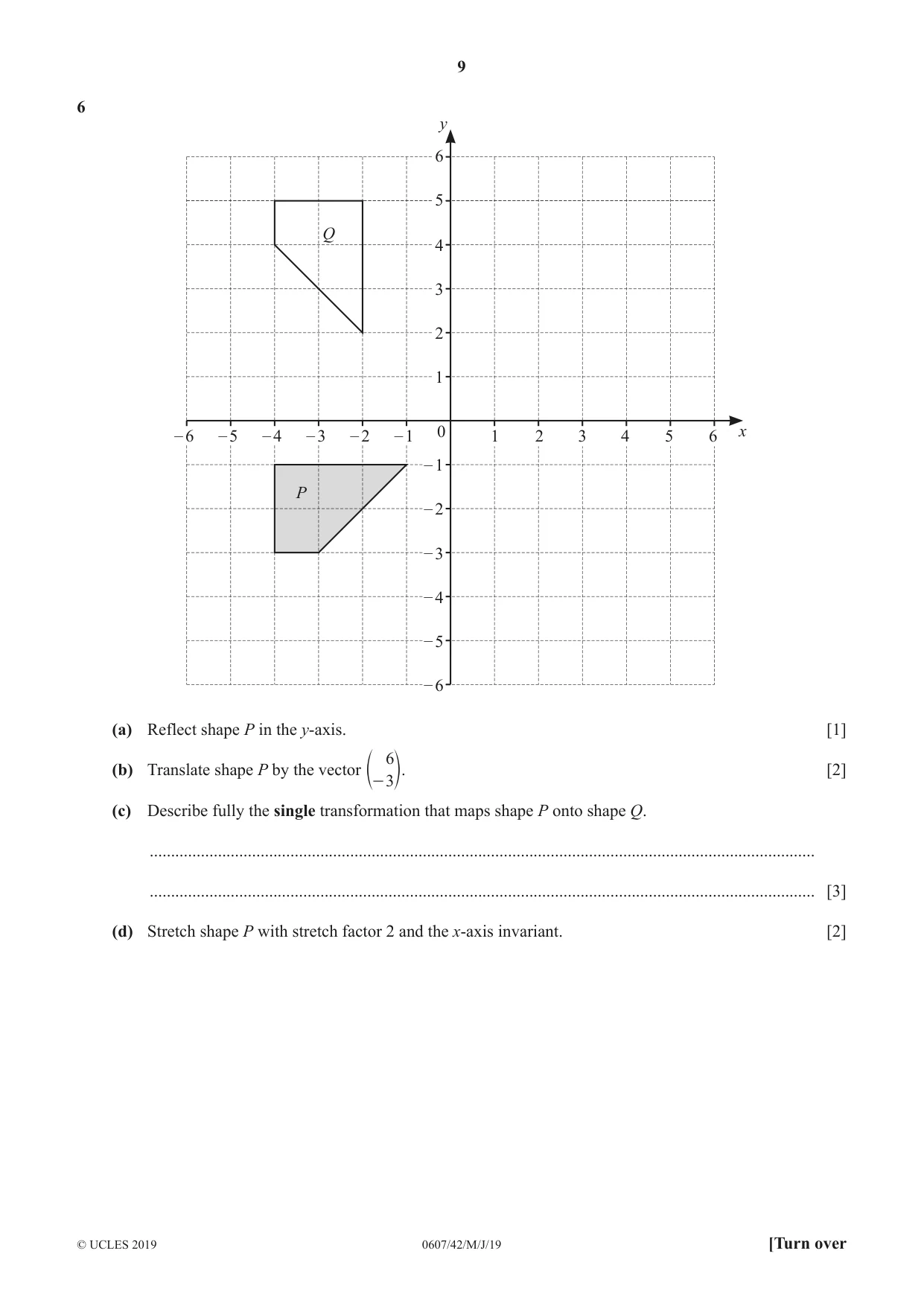
Q6 · Y 6 5 Q 4 3 2 1 – 6 – 5 – 4 – 3 – 2 – 1 0 1 2 3 4 5 6 x – 1 P – 2 – 3 – 4 – 5 – 6 (a)…
6 y 6 5 Q 4 3 2 1 – 6 – 5 – 4 – 3 – 2 – 1 0 1 2 3 4 5 6 x – 1 P – 2 – 3 – 4 – 5 – 6 (a) Reflect shape P in the y-axis. [1] 6 (b) Translate shape P by the vector [2] e- 3o. (c) Describe fully the single transformation that maps shape P onto shape Q. ............................................................................................................................................................ ............................................................................................................................................................ [3] (d) Stretch shape P with stretch factor 2 and the x-axis invariant. [2]
Mark scheme: 6(a) Correct reflection at (1, –1), 1 (4, –1), (4, –3), (3, –3) 6(b) Correct translation at (5, – 4), 2 6 k (2, – 4), (2, – 6), (3, – 6) B1 for translation or k −3 6(c) Rotation 3 B1 for each 90[º] clockwise oe (0, 1) 6(d) Correct stretch at (–1, –2), 2 B1 for stretch factor 2 displaced vertically (– 4, –2), (– 4, – 6), (–3, – 6)
Q7 · A stone is thrown vertically upwards from ground level
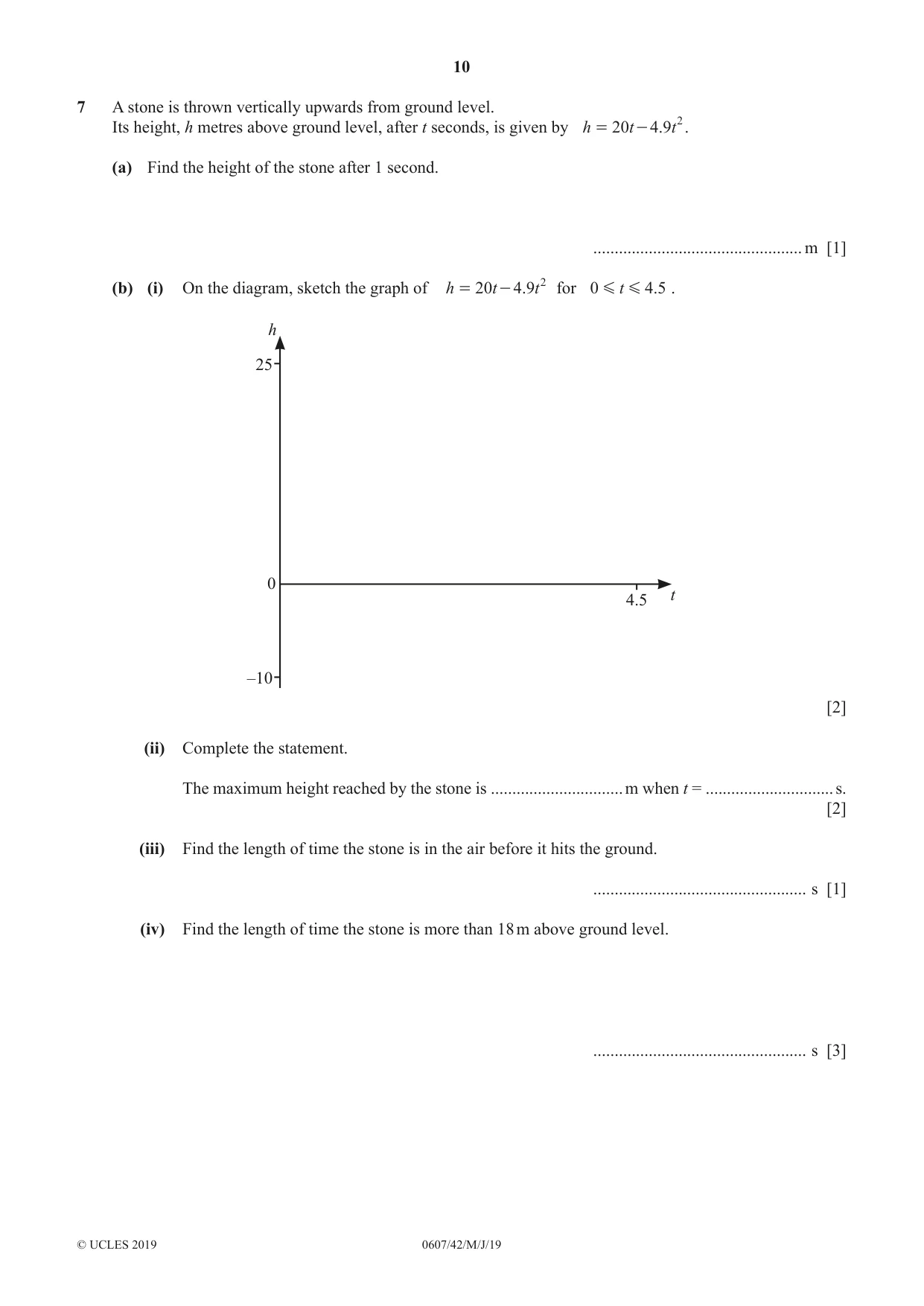
7 A stone is thrown vertically upwards from ground level. Its height, h metres above ground level, after t seconds, is given by h = 20t - 4.9t 2 . (a) Find the height of the stone after 1 second. ................................................. m [1] (b) (i) On the diagram, sketch the graph of h = 20 t - 4.9t 2 for 0 G t G 4.5 . h 25 0 t 4.5 –10 [2] (ii) Complete the statement. The maximum height reached by the stone is ............................... m when t = .............................. s. [2] (iii) Find the length of time the stone is in the air before it hits the ground. .................................................. s [1] (iv) Find the length of time the stone is more than 18 m above ground level. .................................................. s [3]
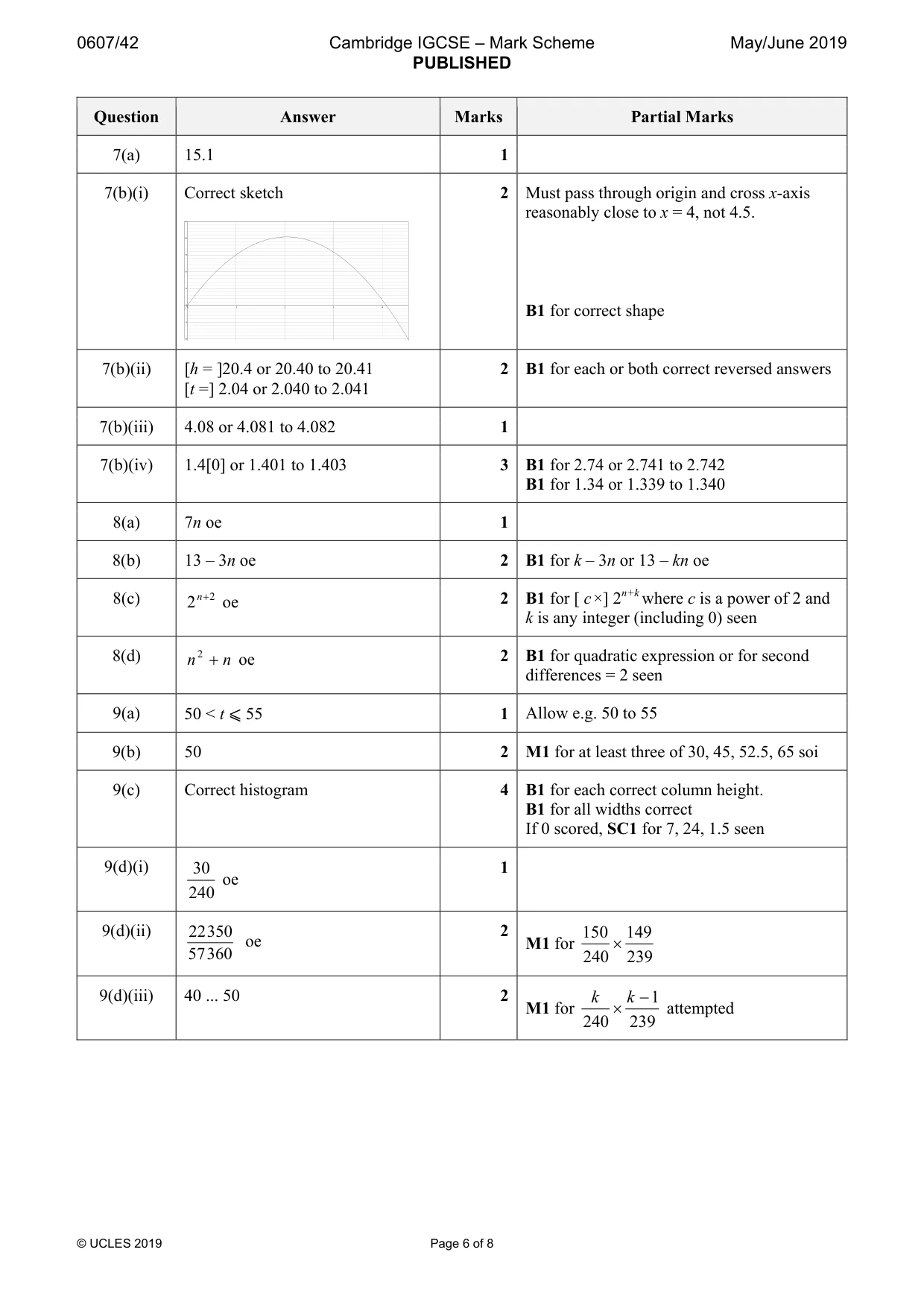
Mark scheme: 7(a) 15.1 1 7(b)(i) Correct sketch 2 Must pass through origin and cross x-axis 25252525 reasonably close to x = 4, not 4.5. 20202020 15151515 10101010 5555 0000 0000 1111 2222 3333 4444 B1 for correct shape -5-5-5-5 -10-10-10-10 7(b)(ii) [h = ]20.4 or 20.40 to 20.41 2 B1 for each or both correct reversed answers [t =] 2.04 or 2.040 to 2.041 7(b)(iii) 4.08 or 4.081 to 4.082 1 7(b)(iv) 1.4[0] or 1.401 to 1.403 3 B1 for 2.74 or 2.741 to 2.742 B1 for 1.34 or 1.339 to 1.340
Q8 · Find the nth term of each sequence
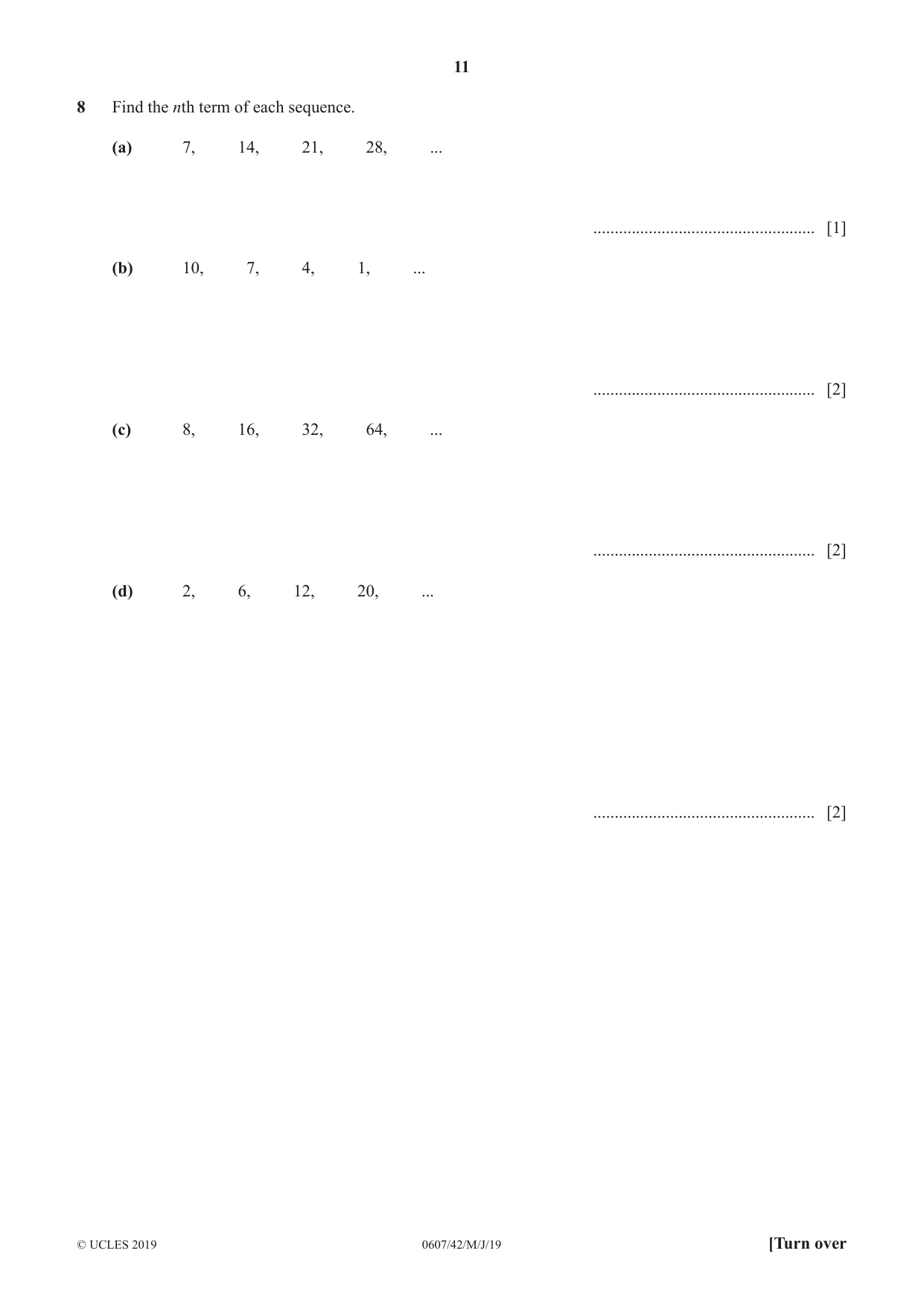
8 Find the nth term of each sequence. (a) 7, 14, 21, 28, ... .................................................... [1] (b) 10, 7, 4, 1, ... .................................................... [2] (c) 8, 16, 32, 64, ... .................................................... [2] (d) 2, 6, 12, 20, ... .................................................... [2]
Mark scheme: 8(a) 7n oe 1 8(b) 13 – 3n oe 2 B1 for k – 3n or 13 – kn oe 8(c) 2 n + 2 oe 2 B1 for [ c×] 2n+k where c is a power of 2 and k is any integer (including 0) seen 8(d) n 2 + n oe 2 B1 for quadratic expression or for second differences = 2 seen
Q9 · 240 students take part in a charity run
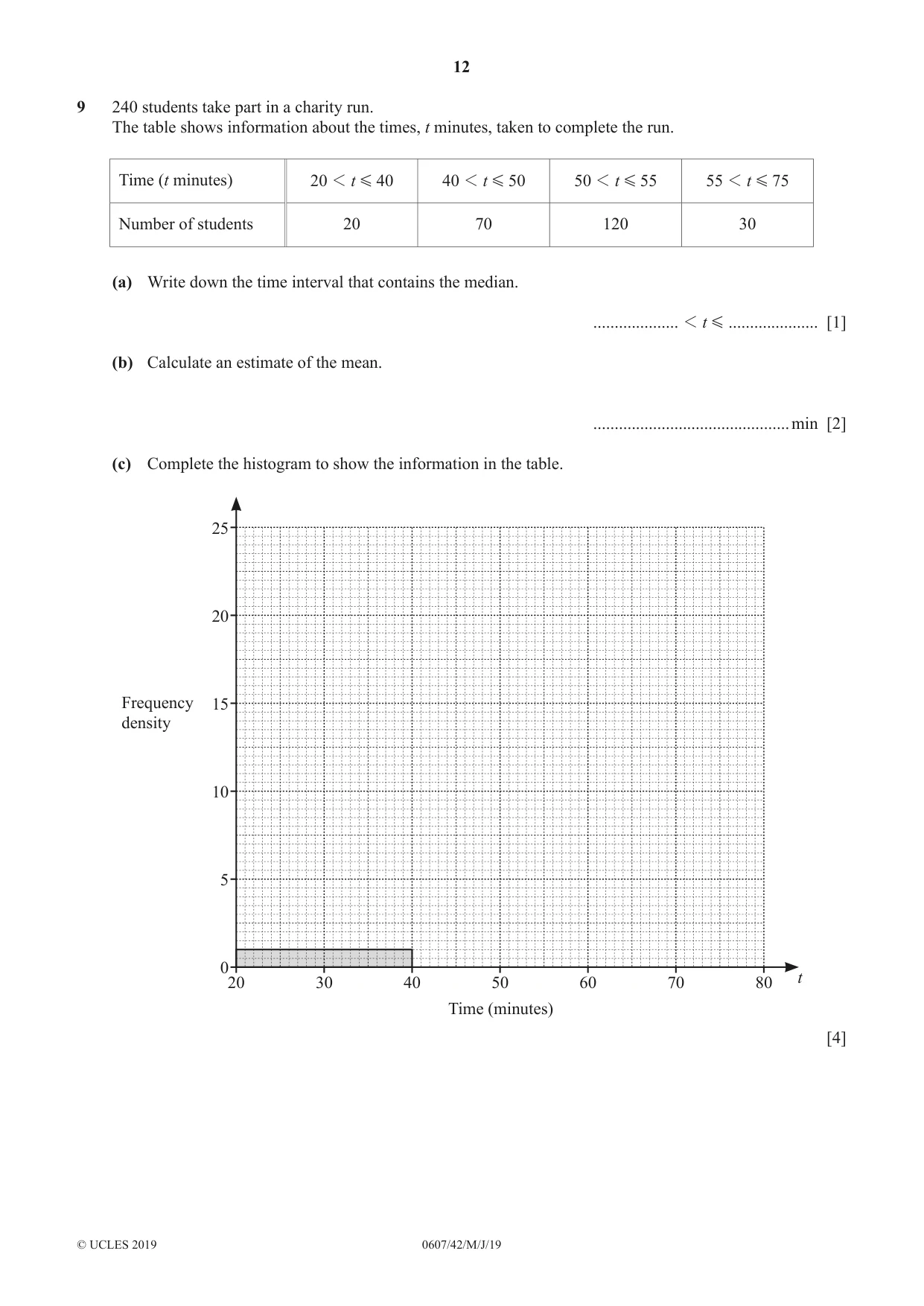
9 240 students take part in a charity run. The table shows information about the times, t minutes, taken to complete the run. Time (t minutes) 20 1 t G 40 40 1 t G 50 50 1 t G 55 55 1 t G 75 Number of students 20 70 120 30 (a) Write down the time interval that contains the median. .................... 1 t G ..................... [1] (b) Calculate an estimate of the mean. .............................................. min [2] (c) Complete the histogram to show the information in the table. 25 20 Frequency 15 density 10 5 0 t 20 30 40 50 60 70 80 Time (minutes) [4] (d) (i) One of the 240 students is chosen at random. Find the probability that this student took more than 55 minutes to complete the run. .................................................... [1] (ii) Two students are chosen at random from the 240 students. Calculate the probability that they both took more than 50 minutes. .................................................... [2] (iii) Two students are chosen at random from the 240 students. Complete the statement. 161 The probability that they both had times in the interval .................. 1 t G .................. is . 1912 [2]
Mark scheme: 9(a) 50 < t ⩽ 55 1 Allow e.g. 50 to 55 9(b) 50 2 M1 for at least three of 30, 45, 52.5, 65 soi 9(c) Correct histogram 4 B1 for each correct column height. B1 for all widths correct If 0 scored, SC1 for 7, 24, 1.5 seen 9(d)(i) 30 1 oe 240 9(d)(ii) 22350 2 150 149 oe M1 for × 57360 240 239 9(d)(iii) 40 ... 50 2 k k − 1 M1 for × attempted 240 239
Q10 · Amy buys 3 pencils and 1 ruler and pays 67 cents
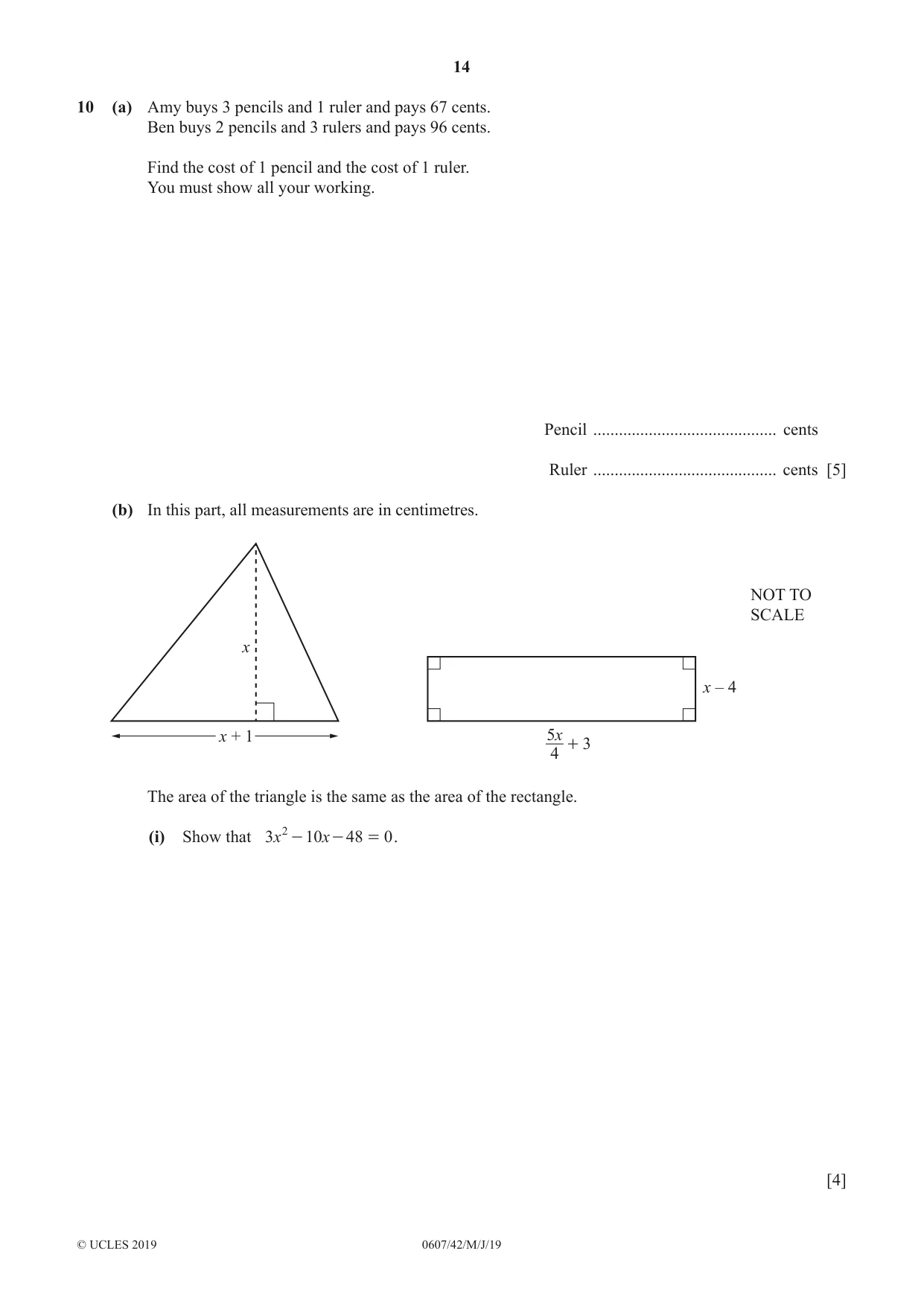
10 (a) Amy buys 3 pencils and 1 ruler and pays 67 cents. Ben buys 2 pencils and 3 rulers and pays 96 cents. Find the cost of 1 pencil and the cost of 1 ruler. You must show all your working. Pencil ........................................... cents Ruler ........................................... cents [5] (b) In this part, all measurements are in centimetres. NOT TO SCALE x x – 4 x + 1 5x + 3 4 The area of the triangle is the same as the area of the rectangle. (i) Show that 3x 2 - 10x - 48 = 0 . [4] (ii) Factorise 3x 2 - 10x - 48 . .................................................... [2] (iii) Find the area of the triangle. ............................................. cm2 [2]
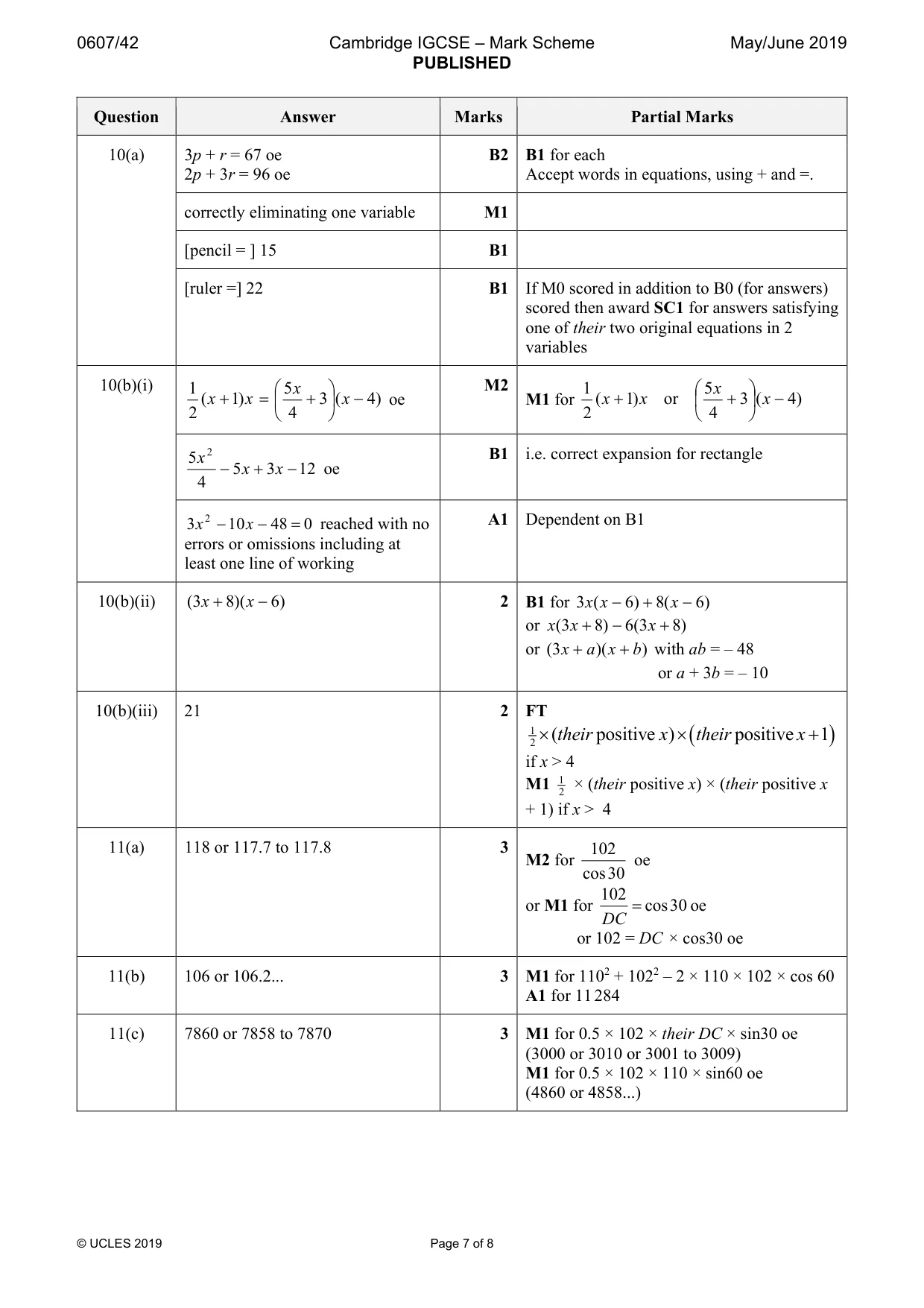
Mark scheme: 10(a) 3p + r = 67 oe B2 B1 for each 2p + 3r = 96 oe Accept words in equations, using + and =. correctly eliminating one variable M1 [pencil = ] 15 B1 [ruler =] 22 B1 If M0 scored in addition to B0 (for answers) scored then award SC1 for answers satisfying one of their two original equations in 2 variables 10(b)(i) 1 5 x M2 1 5 x ( x + )1 x = + 3 ( x − 4) oe M1 for ( x + )1 x or + 3 ( x − 4) 2 4 2 4 5 x 2 B1 i.e. correct expansion for rectangle − 5 x + 3 x − 12 oe 4 3 x 2 − 10 x − 48 = 0 reached with no A1 Dependent on B1 errors or omissions including at least one line of working 10(b)(ii) (3 x + 8)( x − 6 ) 2 B1 for 3 x ( x − 6 ) + 8( x − 6 ) or x (3 x + 8) − 6(3 x + 8) or (3 x + a )( x + b ) with ab = – 48 or a + 3b = – 10 10(b)(iii) 21 2 FT 1 2 × (their positive x ) × ( their positive x + 1) if x > 4 M1 12 × (their positive x) × (their positive x + 1) if x > 4
Q11 · North D C 30° 60° NOT TO 102 m SCALE 110 m B A The diagram shows two fields on horizontal…
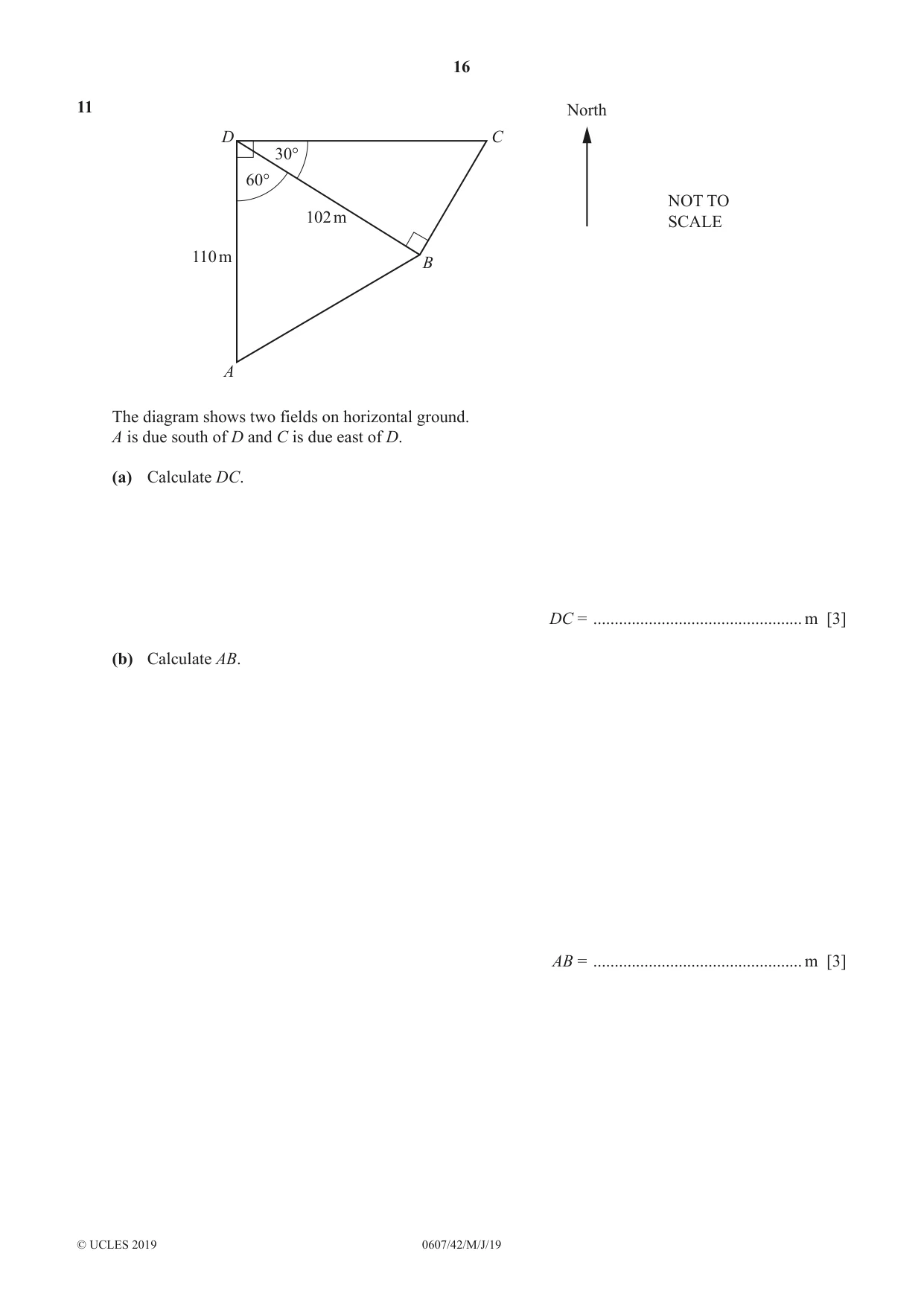
11 North D C 30° 60° NOT TO 102 m SCALE 110 m B A The diagram shows two fields on horizontal ground. A is due south of D and C is due east of D. (a) Calculate DC. DC = ................................................. m [3] (b) Calculate AB. AB = ................................................. m [3] (c) Calculate the total area of the fields. ............................................... m2 [3] (d) Calculate the bearing of A from B. .................................................... [4]
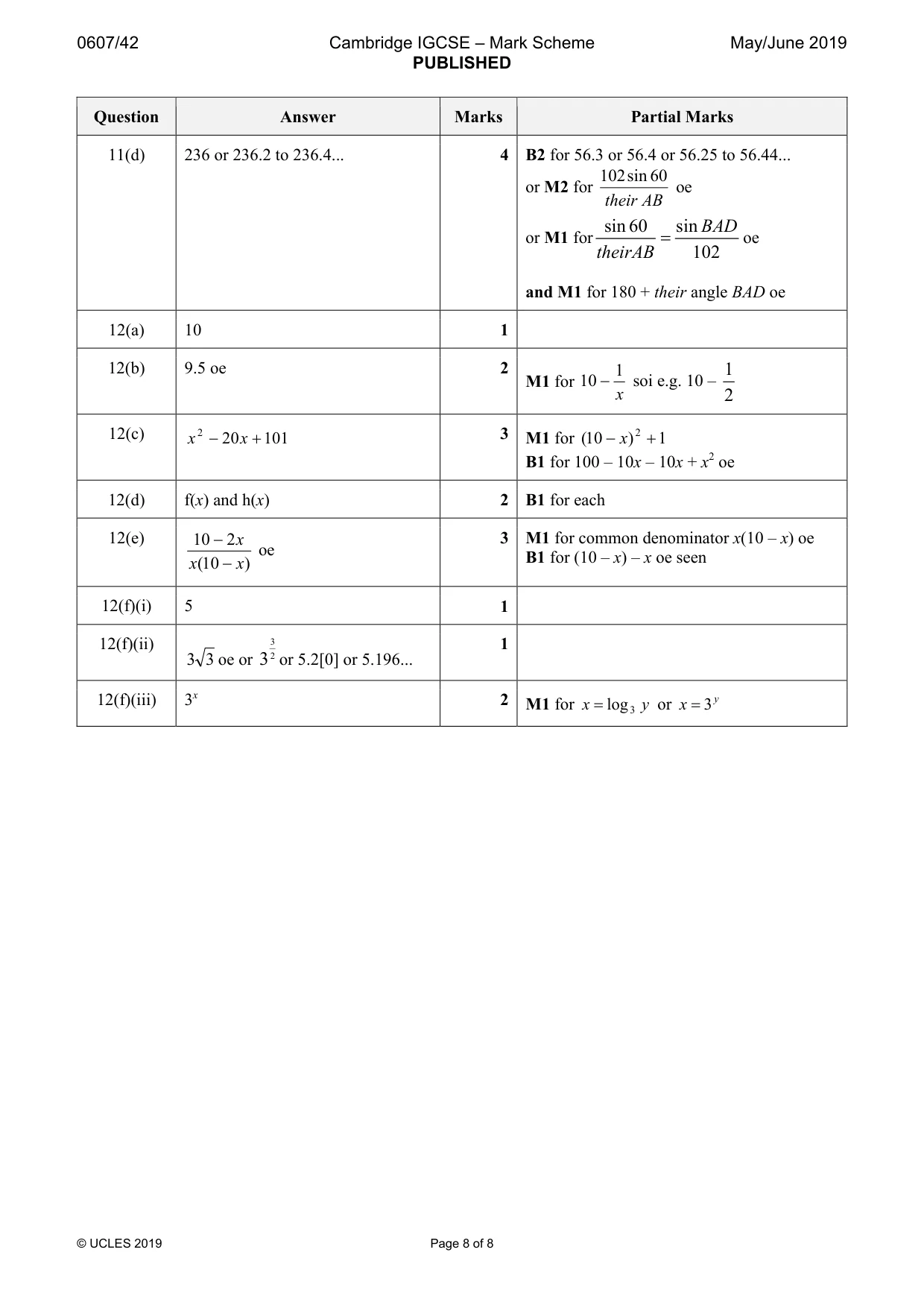
Mark scheme: 11(a) 118 or 117.7 to 117.8 3 102 M2 for oe cos 30 102 or M1 for = cos 30 oe DC or 102 = DC × cos30 oe 11(b) 106 or 106.2... 3 M1 for 1102 + 1022 – 2 × 110 × 102 × cos 60 A1 for 11 284 11(c) 7860 or 7858 to 7870 3 M1 for 0.5 × 10² × their DC × sin30 oe (3000 or 3010 or 3001 to 3009) M1 for 0.5 × 102 × 110 × sin60 oe (4860 or 4858...) 11(d) 236 or 236.2 to 236.4... 4 B2 for 56.3 or 56.4 or 56.25 to 56.44... 102 sin 60 or M2 for oe their AB sin 60 sin BAD or M1 for = oe theirAB 102 and M1 for 180 + their angle BAD oe
Q12 · F x = 10 - x g x = x 2 + 1 h x = j x = log 3 x x (a) Find g(3)
12 f x = 10 - x g x = x 2 + 1 h x = j x = log 3 x x (a) Find g(3). .................................................... [1] (b) Find f(h(2)). .................................................... [2] (c) Find g(f(x)) in the form ax 2 + bx + c . .................................................... [3] (d) For some functions, p-1(x) = p(x). Write down which two functions, f(x), g(x), h(x) or j(x), have this property. ...................... and ...................... [2] 1 (e) Write h x - as a single fraction in its simplest form. ` j f x ` j .................................................... [3] (f) (i) Find j(243). .................................................... [1] (ii) Find x when j(x) = 1.5 . x = .................................................... [1] (iii) Find j-1(x). j – 1(x) = .................................................... [2]
Mark scheme: 12(a) 10 1 12(b) 9.5 oe 2 1 1 M1 for 10 − soi e.g. 10 – x 2 12(c) x 2 − 20 x + 101 3 M1 for (10 −x ) 2 + 1 B1 for 100 – 10x – 10x + x2 oe 12(d) f(x) and h(x) 2 B1 for each 12(e) 10 − 2 x 3 M1 for common denominator x(10 – x) oe oe B1 for (10 – x) – x oe seen x (10 − x ) 12(f)(i) 5 1 12(f)(ii) 3 1 3 3 oe or 3 2 or 5.2[0] or 5.196... 12(f)(iii) 3x 2 M1 for x = log 3 y or x = 3 y
What was in this paper
The subtopics covered by these 12 questions, and how many questions each got. Open one in a new tab to see every Cambridge question on it.
What you needed in this session
Cambridge’s own grade thresholds for 2019 May/June, Paper 4 · Variant 2. A higher threshold means an easier paper — the bar moves with how the cohort did.