Cambridge IGCSE Mathematics - International 0607 — 2019 Oct/Nov Paper 4 · Variant 3
0607/43/O/N/19 · 13 questions · 120 marks · ≈135 min
The question paper and its mark scheme, free to read here and free to download. This is Cambridge’s own paper, exactly as it was sat.
Question paper20 pages
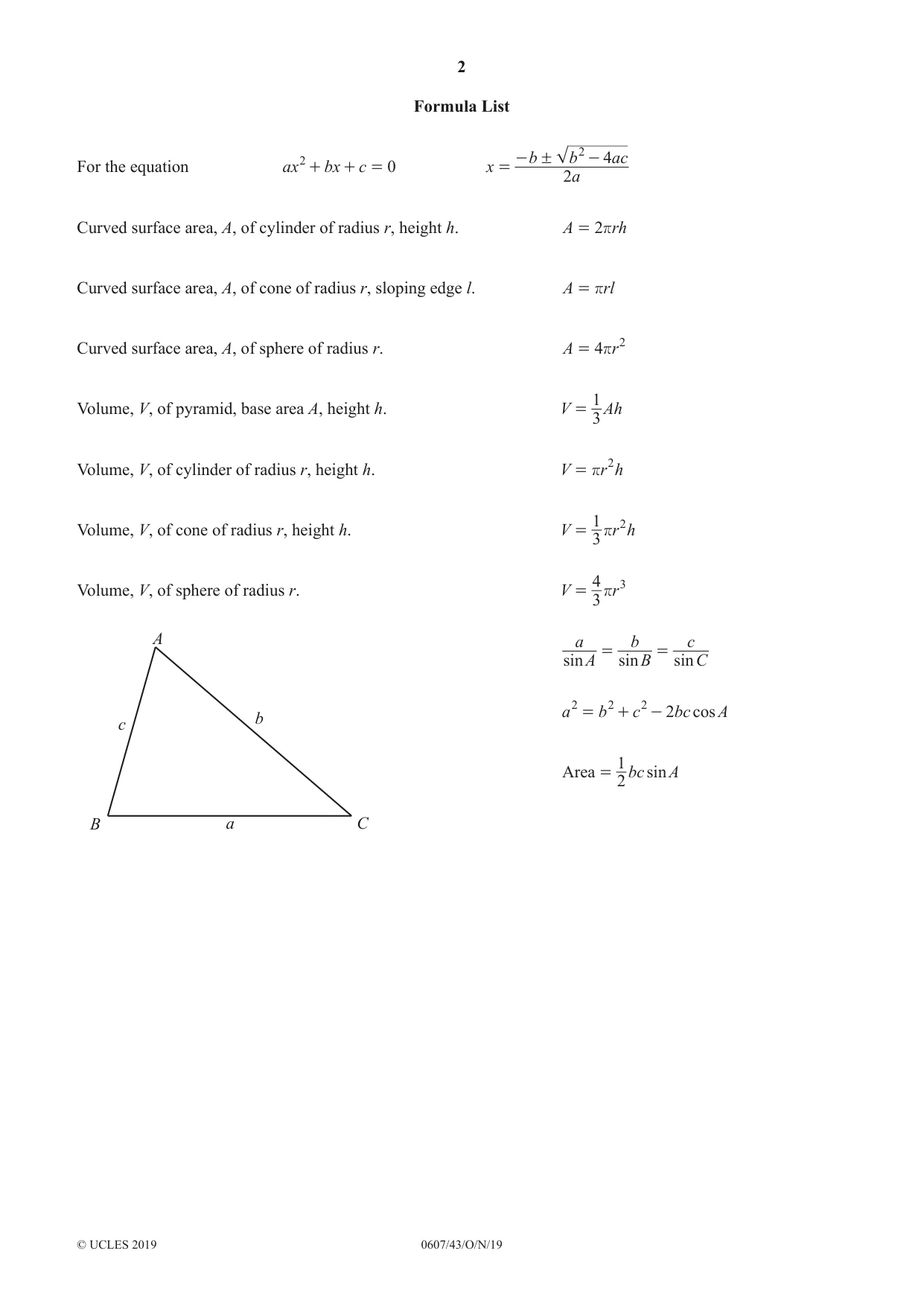
Mark scheme8 pages
Answers below. Sit the paper first if you are practising.
Questions as text
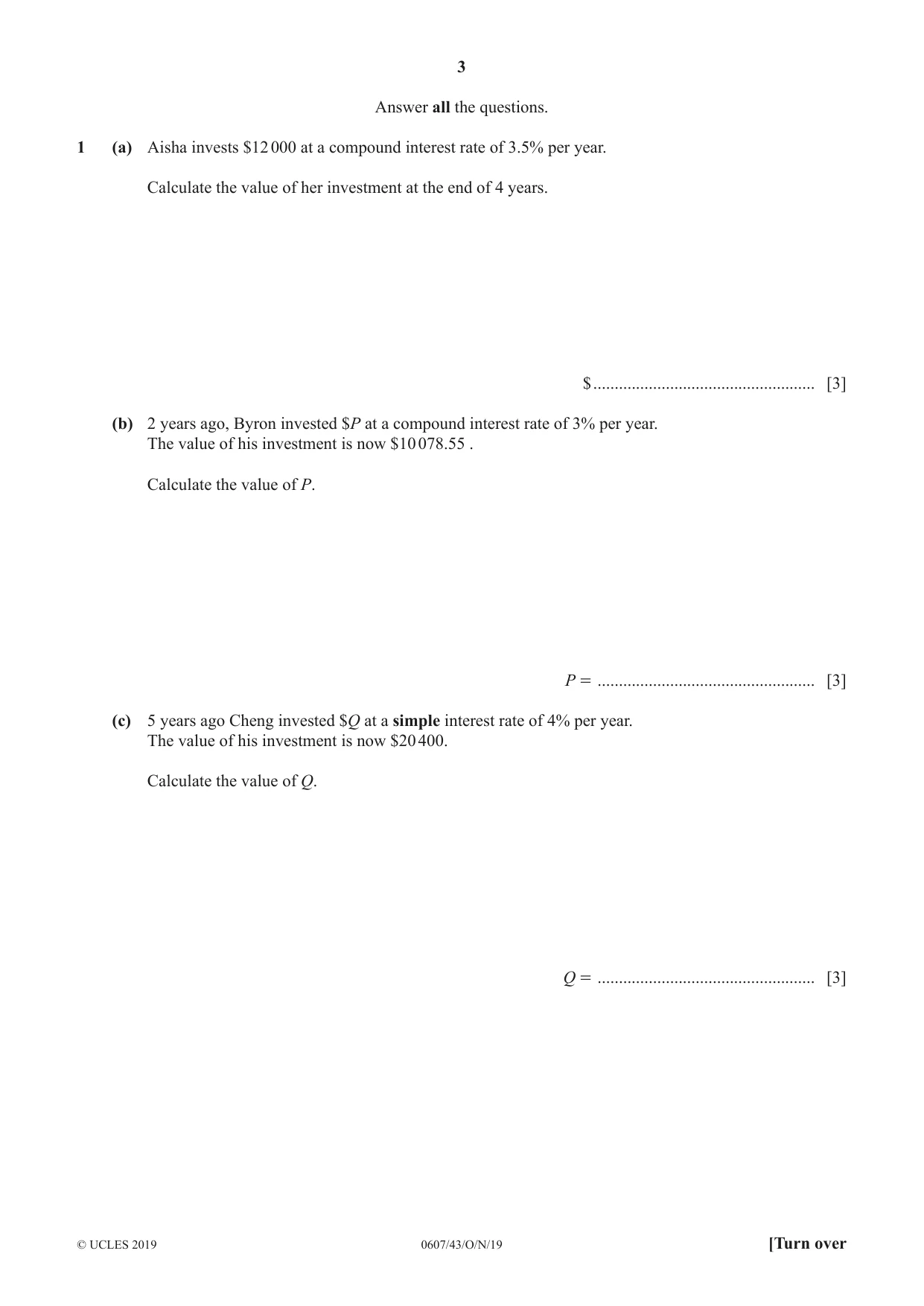
Q1 · Aisha invests $12 000 at a compound interest rate of 3.5% per year
1 (a) Aisha invests $12 000 at a compound interest rate of 3.5% per year. Calculate the value of her investment at the end of 4 years. $ .................................................... [3] (b) 2 years ago, Byron invested $P at a compound interest rate of 3% per year. The value of his investment is now $10 078.55 . Calculate the value of P. P = ................................................... [3] (c) 5 years ago Cheng invested $Q at a simple interest rate of 4% per year. The value of his investment is now $20 400. Calculate the value of Q. Q = ................................................... [3]
Mark scheme: Question Answer Marks Partial Marks 1(a) 13 770.28 3 4 3.5 M2 for 12 000 × 1 + oe 100 3.5 k or M1 for 12 000 × 1 + , k > 1 100 oe 1(b) 9500 3 2 3 M2 for 10 078.55 ÷ 1 + oe 100 3 n or M1 for 10 078.55 ÷ 1 + oe 100 1(c) 17 000 3 Q× 4 × 5 M2 for Q + = 20 400 oe 100 Q× 4 × 5 or M1 for oe soi by 100 e.g. 0.2Q If 0 scored, SC1 for 16 800 or 16 760 to 16 770
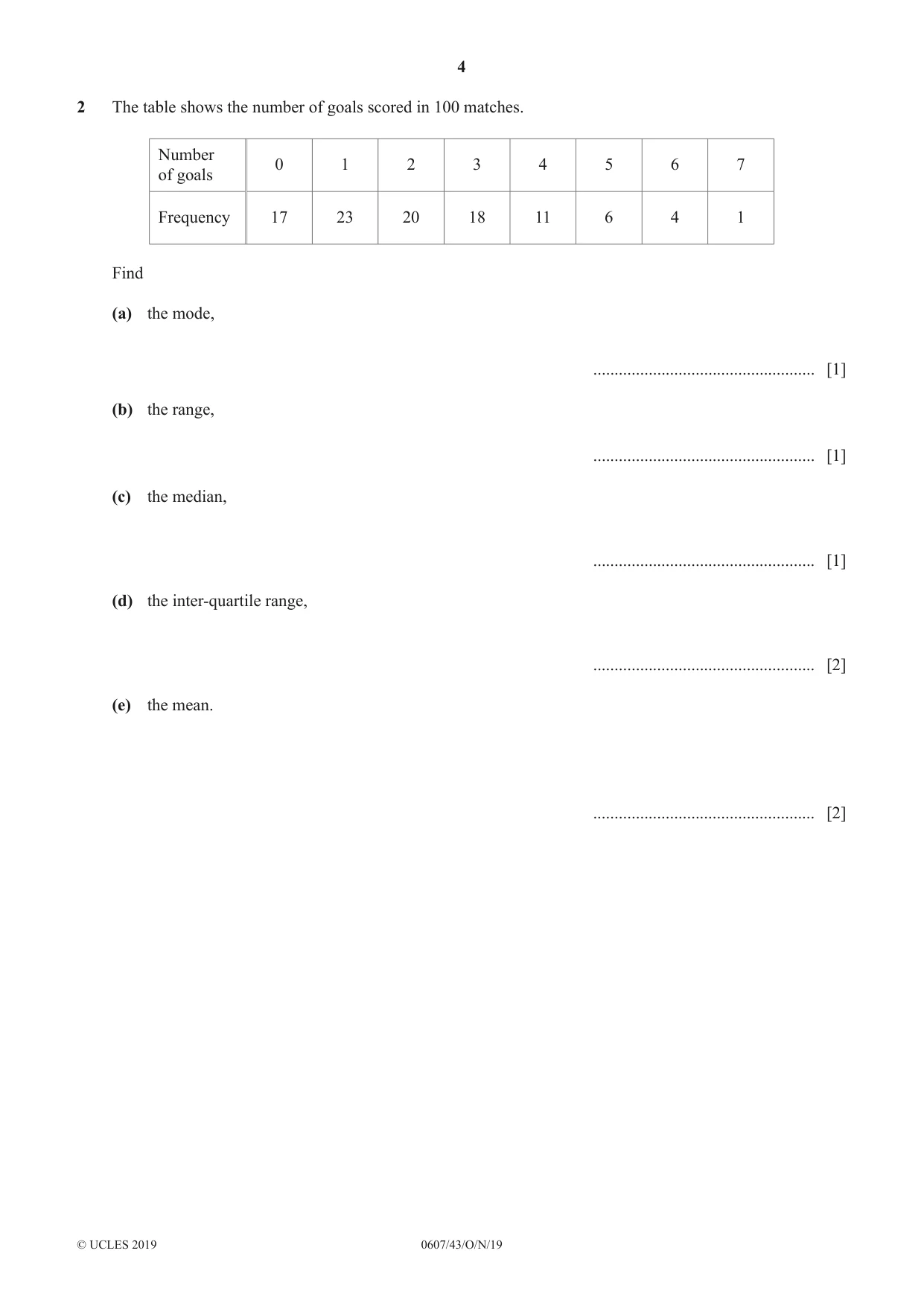
Q2 · The table shows the number of goals scored in 100 matches
2 The table shows the number of goals scored in 100 matches. Number 0 1 2 3 4 5 6 7 of goals Frequency 17 23 20 18 11 6 4 1 Find (a) the mode, .................................................... [1] (b) the range, .................................................... [1] (c) the median, .................................................... [1] (d) the inter-quartile range, .................................................... [2] (e) the mean. .................................................... [2]
Mark scheme: 2(a) 1 1 2(b) 7 1 2(c) 2 1 2(d) 2 2 B1 for 1 or 3 seen but not final answer 2(e) 2.22 2 M1 for (0 × 17 + 1 × 23 + 2 × 20 + ...) ÷ 100
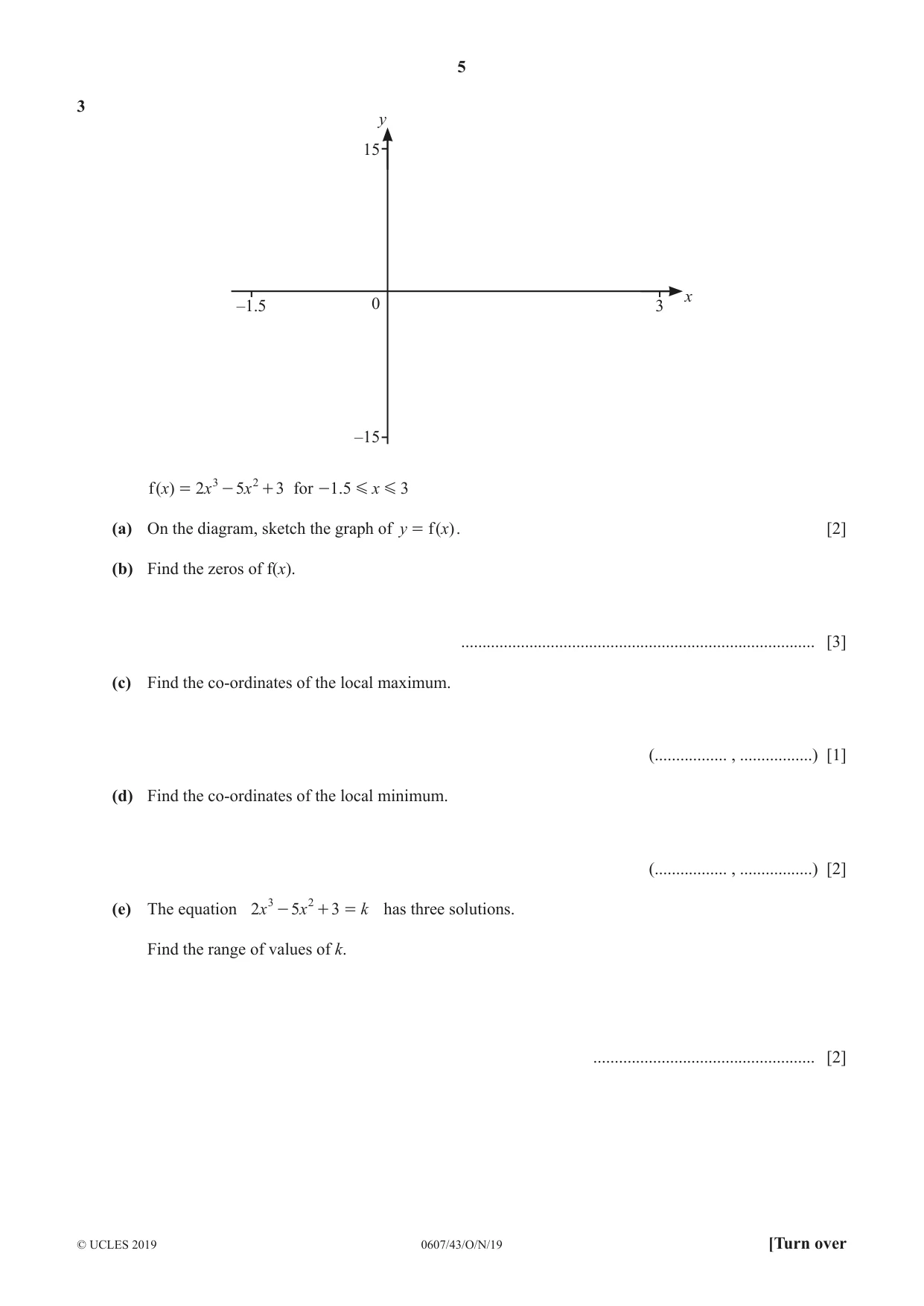
Q3 · Y 15 x –1.5 0 3 –15 f ()x = 2x 3 - 5x 2 + 3 for - 1.5 G x G 3 (a) On the diagram, sketch…
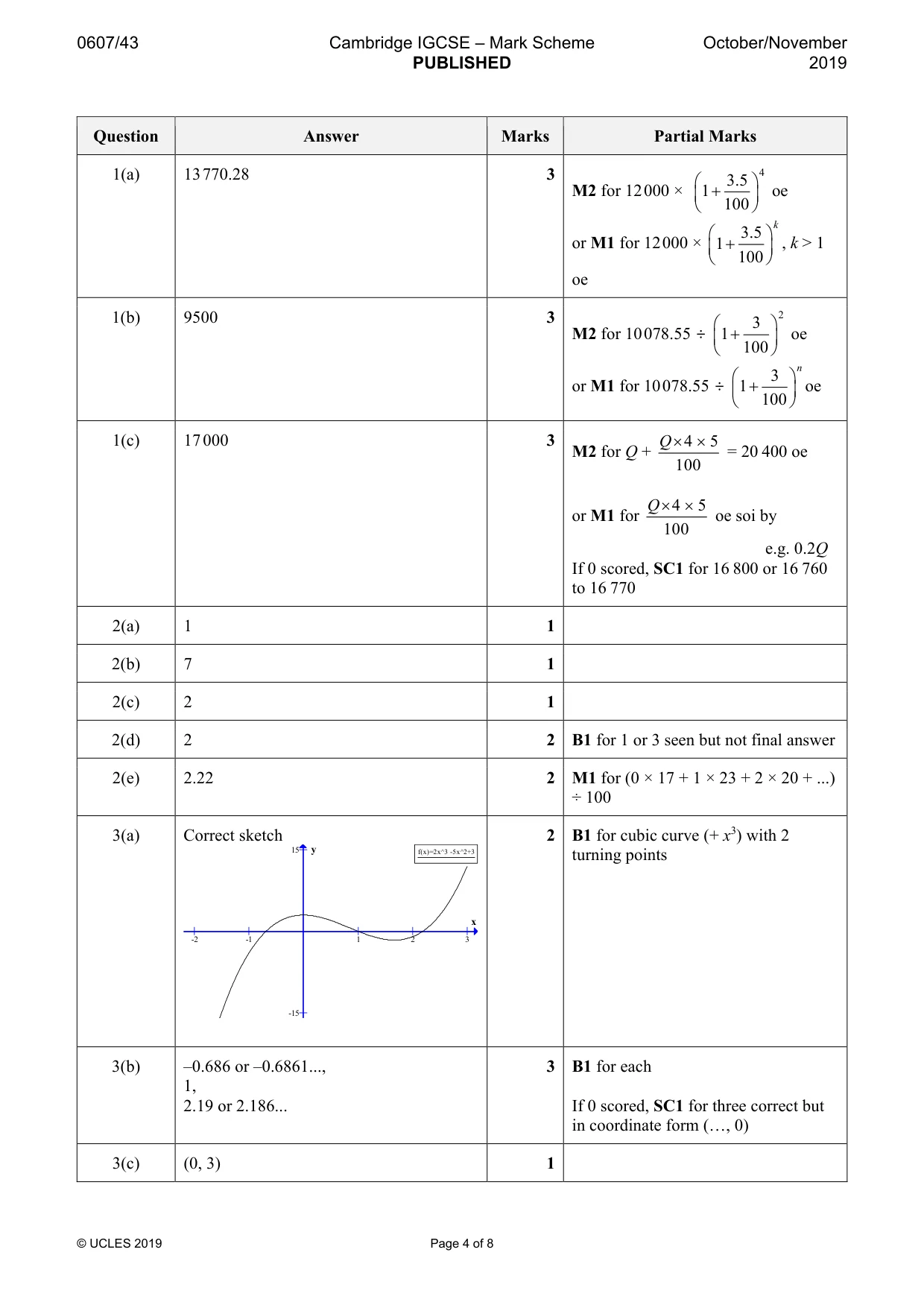
3 y 15 x –1.5 0 3 –15 f ()x = 2x 3 - 5x 2 + 3 for - 1.5 G x G 3 (a) On the diagram, sketch the graph of y = f (x). [2] (b) Find the zeros of f(x). ................................................................................... [3] (c) Find the co-ordinates of the local maximum. (................. , .................) [1] (d) Find the co-ordinates of the local minimum. (................. , .................) [2] (e) The equation 2x 3 - 5x 2 + 3 = k has three solutions. Find the range of values of k. .................................................... [2]
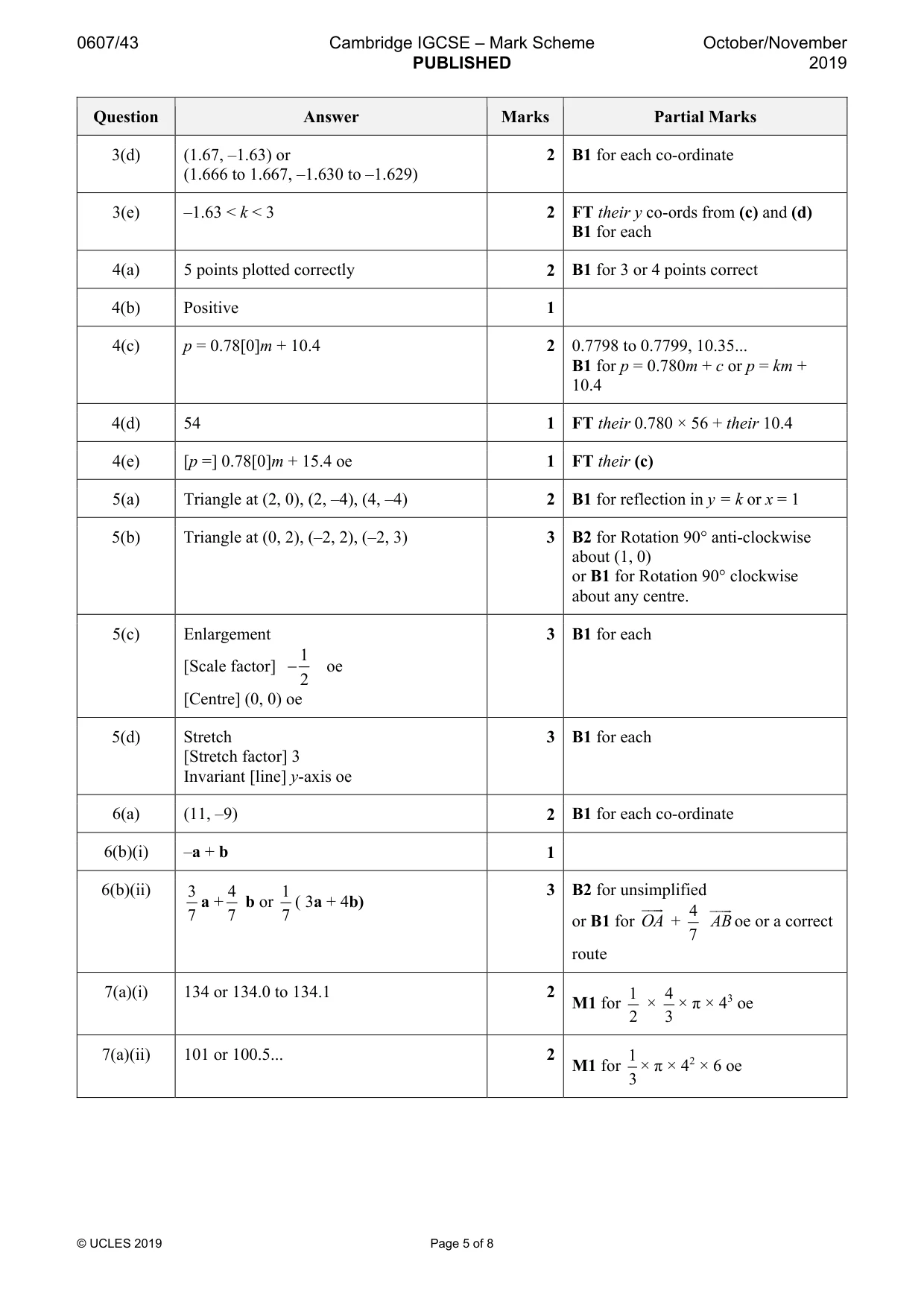
Mark scheme: 3(a) Correct sketch 2 B1 for cubic curve (+ x3) with 2 15 y f(x)=2x^3 -5x^2+3 turning points x -2 -1 1 2 3 -15 3(b) –0.686 or –0.6861..., 3 B1 for each 1, 2.19 or 2.186... If 0 scored, SC1 for three correct but in coordinate form (…, 0) 3(c) (0, 3) 1 3(d) (1.67, –1.63) or 2 B1 for each co-ordinate (1.666 to 1.667, –1.630 to –1.629) 3(e) –1.63 < k < 3 2 FT their y co-ords from (c) and (d) B1 for each
Q4 · The table shows the mathematics mark and the physics mark for each of 10 students in an…
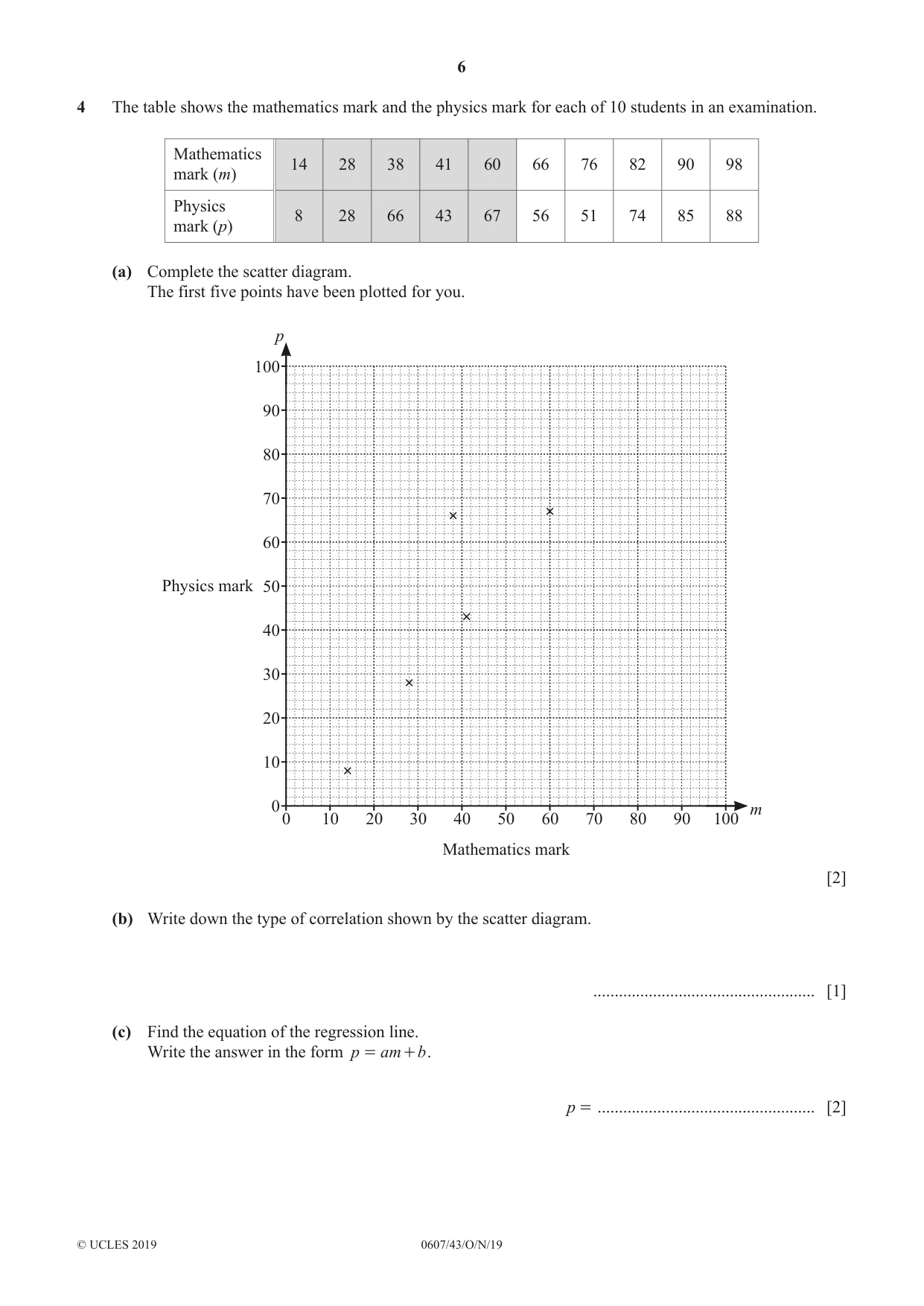
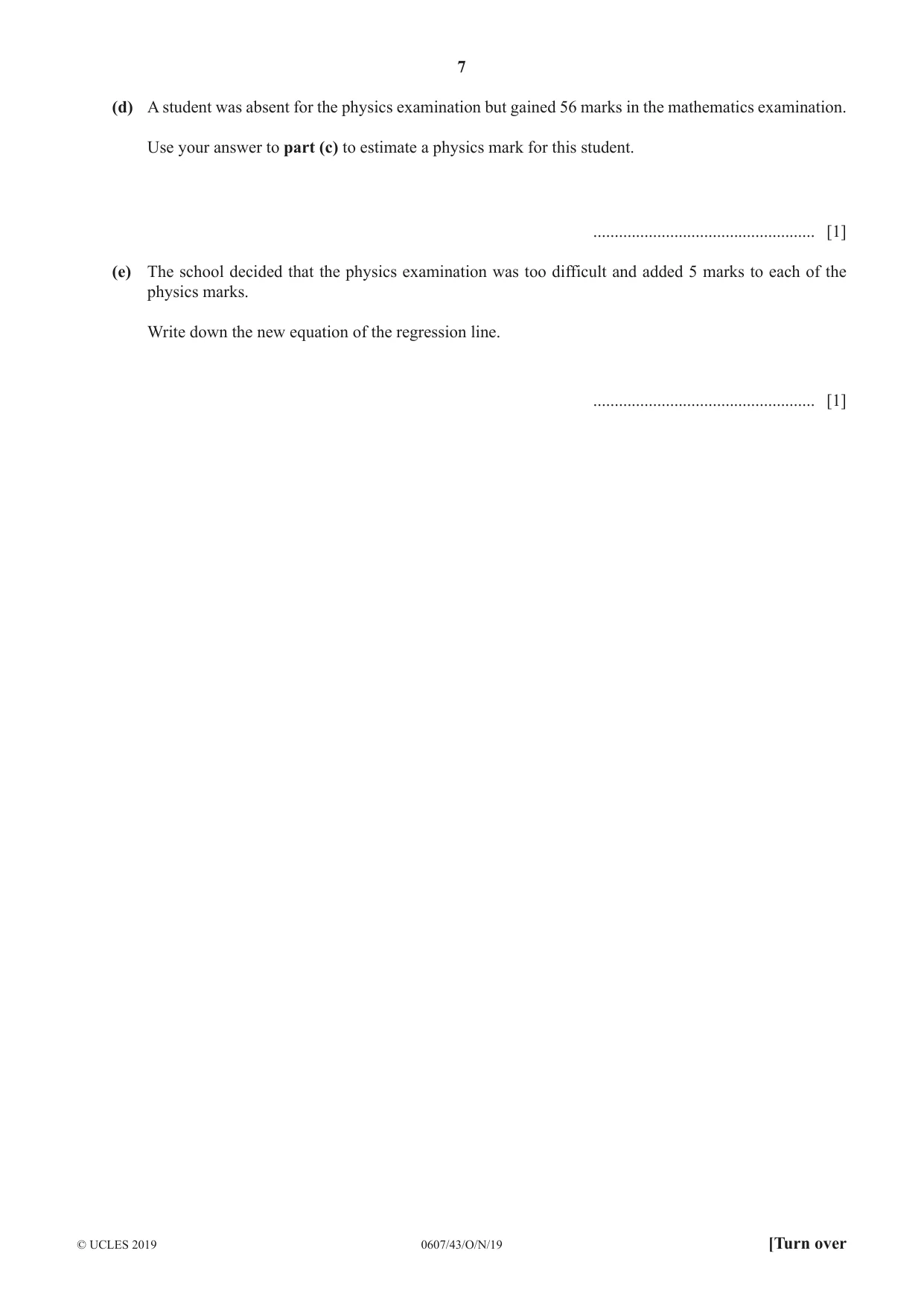
4 The table shows the mathematics mark and the physics mark for each of 10 students in an examination. Mathematics 14 28 38 41 60 66 76 82 90 98 mark (m) Physics 8 28 66 43 67 56 51 74 85 88 mark (p) (a) Complete the scatter diagram. The first five points have been plotted for you. p 100 90 80 70 60 Physics mark 50 40 30 20 10 0 m 0 10 20 30 40 50 60 70 80 90 100 Mathematics mark [2] (b) Write down the type of correlation shown by the scatter diagram. .................................................... [1] (c) Find the equation of the regression line. Write the answer in the form p = am + b . p = ................................................... [2] (d) A student was absent for the physics examination but gained 56 marks in the mathematics examination. Use your answer to part (c) to estimate a physics mark for this student. .................................................... [1] (e) The school decided that the physics examination was too difficult and added 5 marks to each of the physics marks. Write down the new equation of the regression line. .................................................... [1]
Mark scheme: 4(a) 5 points plotted correctly 2 B1 for 3 or 4 points correct 4(b) Positive 1 4(c) p = 0.78[0]m + 10.4 2 0.7798 to 0.7799, 10.35... B1 for p = 0.780m + c or p = km + 10.4 4(d) 54 1 FT their 0.780 × 56 + their 10.4 4(e) [p =] 0.78[0]m + 15.4 oe 1 FT their (c)
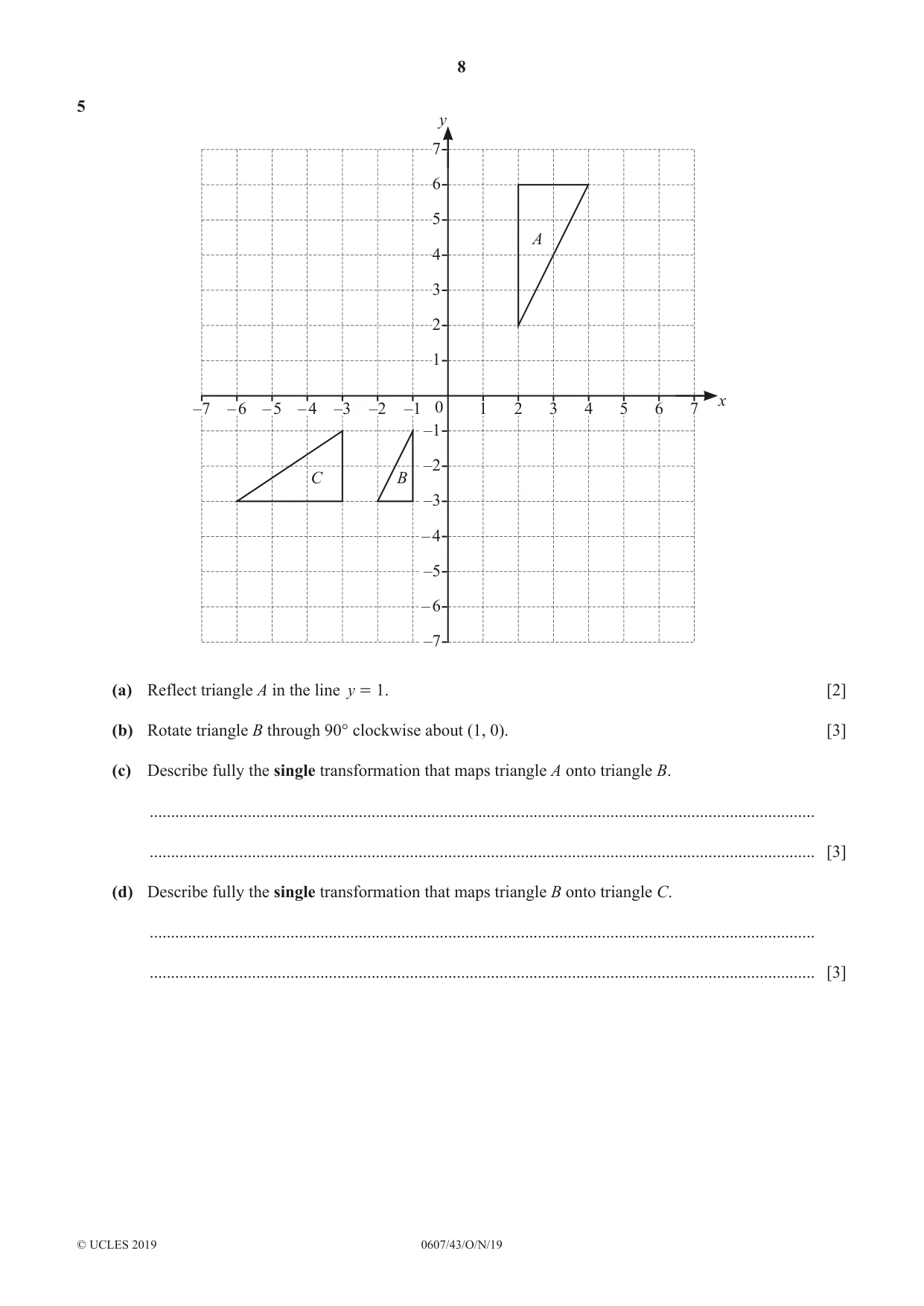
Q5 · Y 7 6 5 A 4 3 2 1 x –7 – 6 – 5 – 4 –3 –2 –1 0 1 2 3 4 5 6 7 –1 –2 C B –3 – 4 –5 – 6 –7…
5 y 7 6 5 A 4 3 2 1 x –7 – 6 – 5 – 4 –3 –2 –1 0 1 2 3 4 5 6 7 –1 –2 C B –3 – 4 –5 – 6 –7 (a) Reflect triangle A in the line y = 1. [2] (b) Rotate triangle B through 90° clockwise about (1, 0). [3] (c) Describe fully the single transformation that maps triangle A onto triangle B. ............................................................................................................................................................ ............................................................................................................................................................ [3] (d) Describe fully the single transformation that maps triangle B onto triangle C. ............................................................................................................................................................ ............................................................................................................................................................ [3]
Mark scheme: 5(a) Triangle at (2, 0), (2, –4), (4, –4) 2 B1 for reflection in y = k or x = 1 5(b) Triangle at (0, 2), (–2, 2), (–2, 3) 3 B2 for Rotation 90° anti-clockwise about (1, 0) or B1 for Rotation 90° clockwise about any centre. 5(c) Enlargement 3 B1 for each 1 [Scale factor] − oe 2 [Centre] (0, 0) oe 5(d) Stretch 3 B1 for each [Stretch factor] 3 Invariant [line] y-axis oe
Q6 · P is the point (3, 5) and Q is the point (7, - 2)
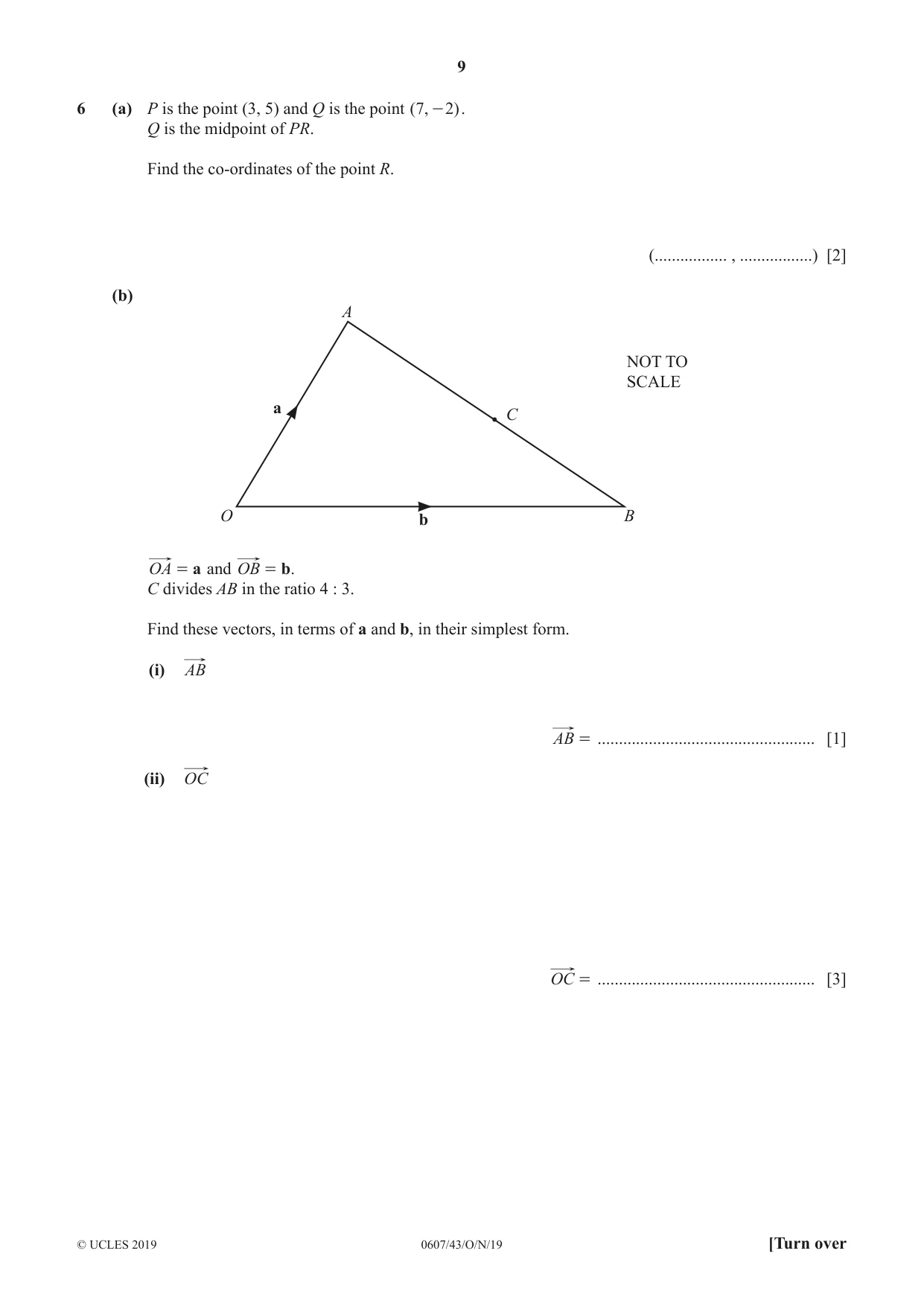
6 (a) P is the point (3, 5) and Q is the point (7, - 2). Q is the midpoint of PR. Find the co-ordinates of the point R. (................. , .................) [2] (b) A NOT TO SCALE a C O b B OA = a and OB = b . C divides AB in the ratio 4 : 3. Find these vectors, in terms of a and b, in their simplest form. (i) AB AB = ................................................... [1] (ii) OC OC = ................................................... [3]
Mark scheme: 6(a) (11, –9) 2 B1 for each co-ordinate 6(b)(i) –a + b 1 6(b)(ii) 3 4 1 3 B2 for unsimplified a + b or ( 3a + 4b) JJJG JJJG 7 7 7 4 or B1 for OA + AB oe or a correct 7 route
Q7 · NOT TO SCALE 6 cm 4 cm The diagram shows a child’s toy made of a cone joined to a…
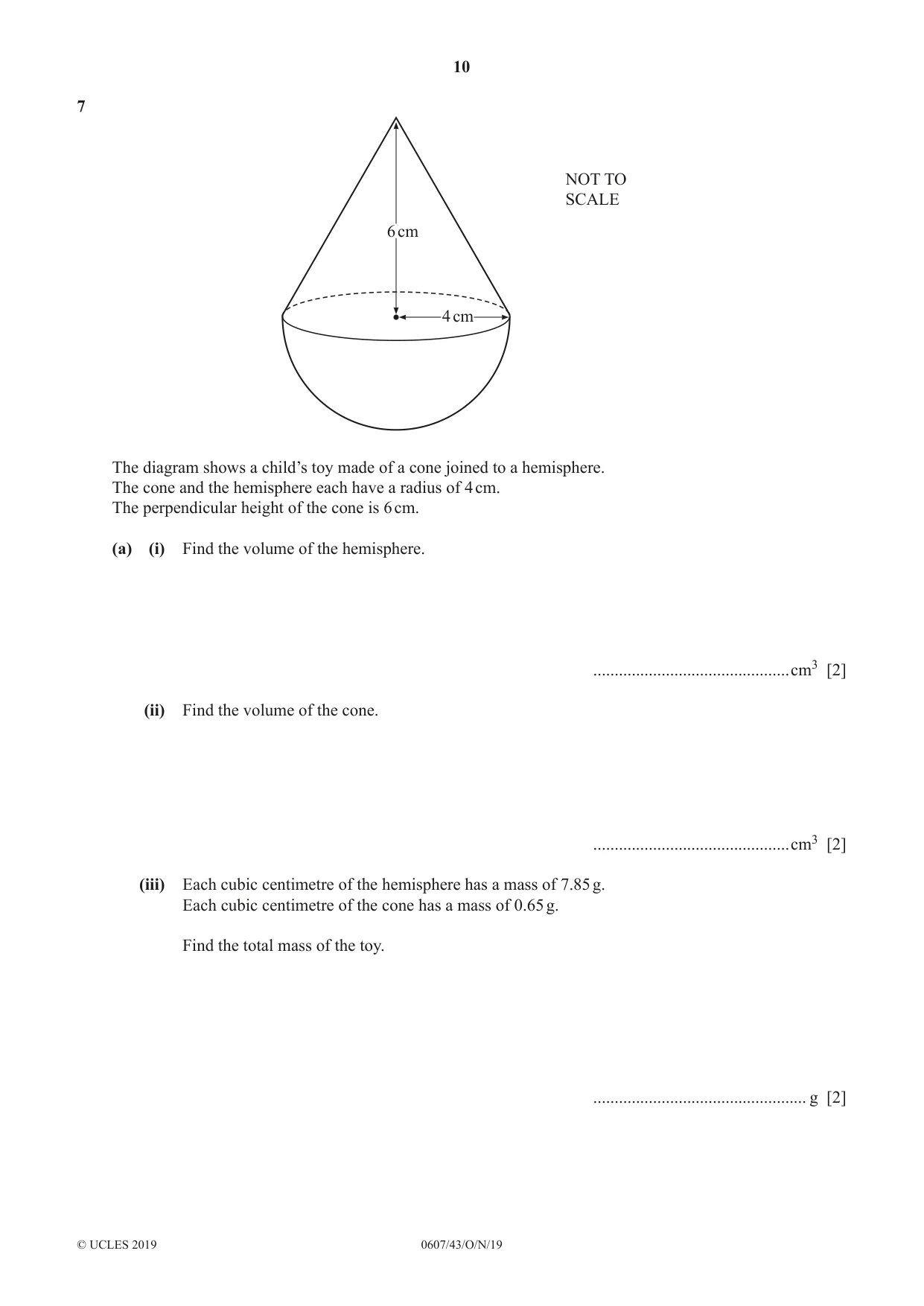
7 NOT TO SCALE 6 cm 4 cm The diagram shows a child’s toy made of a cone joined to a hemisphere. The cone and the hemisphere each have a radius of 4 cm. The perpendicular height of the cone is 6 cm. (a) (i) Find the volume of the hemisphere. ..............................................cm3 [2] (ii) Find the volume of the cone. ..............................................cm3 [2] (iii) Each cubic centimetre of the hemisphere has a mass of 7.85 g. Each cubic centimetre of the cone has a mass of 0.65 g. Find the total mass of the toy. .................................................. g [2] (b) Find the total surface area of the toy. ..............................................cm2 [5] (c) The height of the cone on a similar toy is 9 cm. Find the total surface area of this toy. ..............................................cm2 [2]
Mark scheme: 7(a)(i) 134 or 134.0 to 134.1 2 1 4 M1 for × × π × 43 oe 2 3 7(a)(ii) 101 or 100.5... 2 1 M1 for × π × 42 × 6 oe 3 7(a)(iii) 1120 or 1117 to 1118 2 2 M1 for × π × 43 × 7.85 soi or 3 their (i) × 7.85 1 or for × π × 42 × 6 × 0.65 soi or 3 their (ii) × 0.65 7(b) 191 or 191.1 to 191.2 5 M1 for 62 + 42 A1 for 7.21 or 7.211... or 52 M1 for π × 4 × their 7.21 M1 for 2 × π × 42 7(c) 430 or 429.7 to 430.2 2 FT their (b) 9 2 M1 for their (b) × oe 6
Q8 · A dance club has 90 members
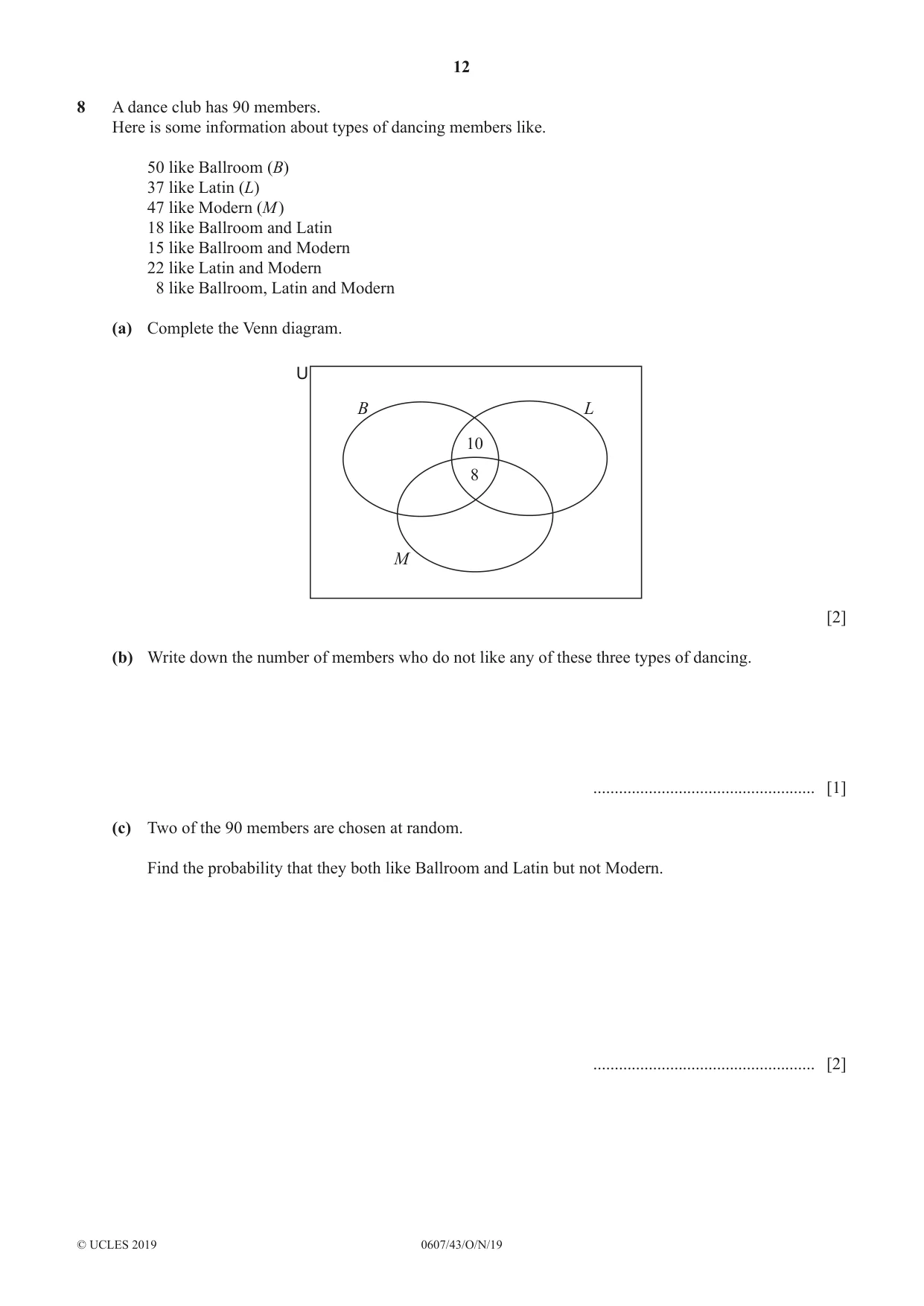
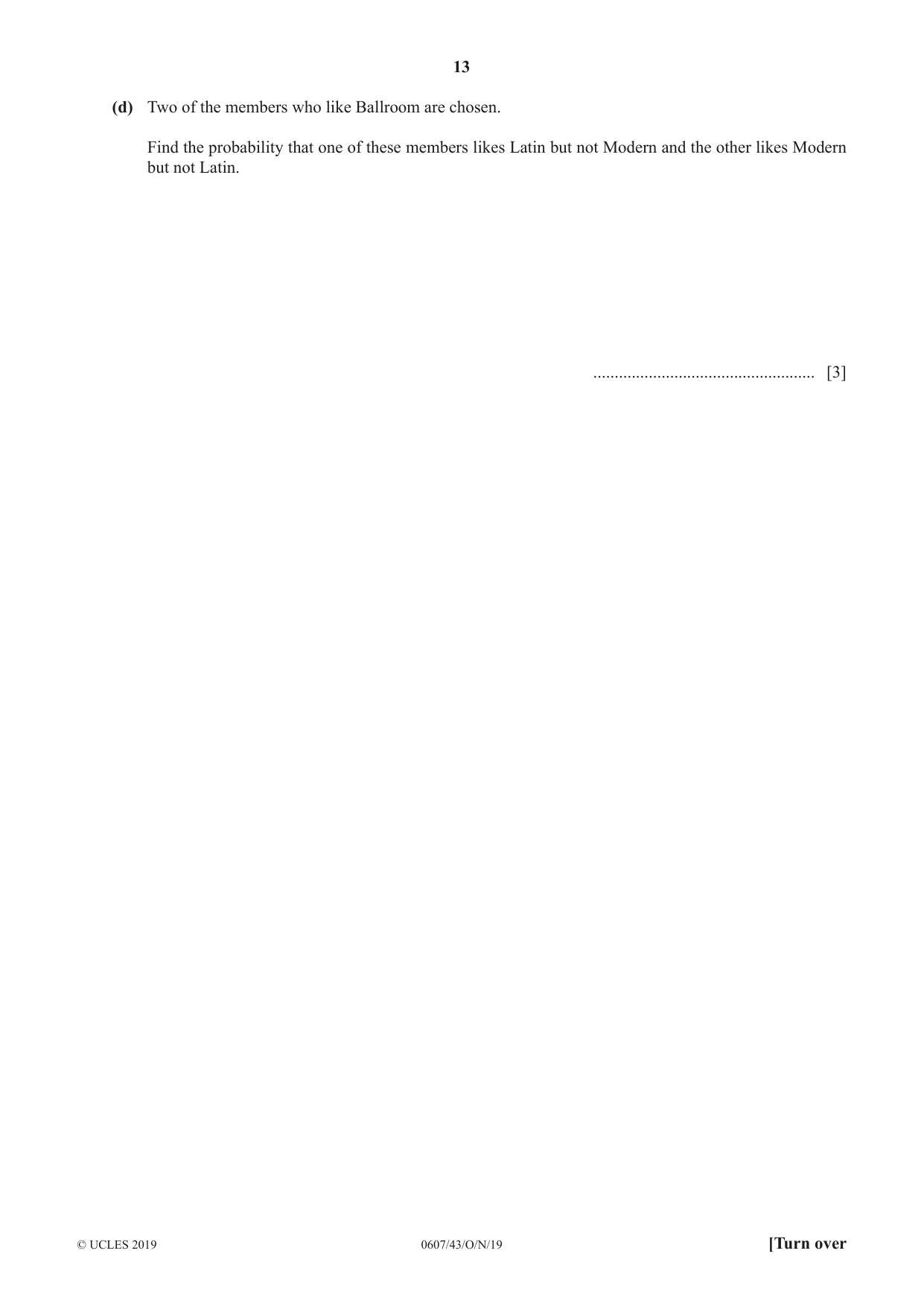
8 A dance club has 90 members. Here is some information about types of dancing members like. 50 like Ballroom (B) 37 like Latin (L) 47 like Modern (M) 18 like Ballroom and Latin 15 like Ballroom and Modern 22 like Latin and Modern 8 like Ballroom, Latin and Modern (a) Complete the Venn diagram. U B L 10 8 M [2] (b) Write down the number of members who do not like any of these three types of dancing. .................................................... [1] (c) Two of the 90 members are chosen at random. Find the probability that they both like Ballroom and Latin but not Modern. .................................................... [2] (d) Two of the members who like Ballroom are chosen. Find the probability that one of these members likes Latin but not Modern and the other likes Modern but not Latin. .................................................... [3]
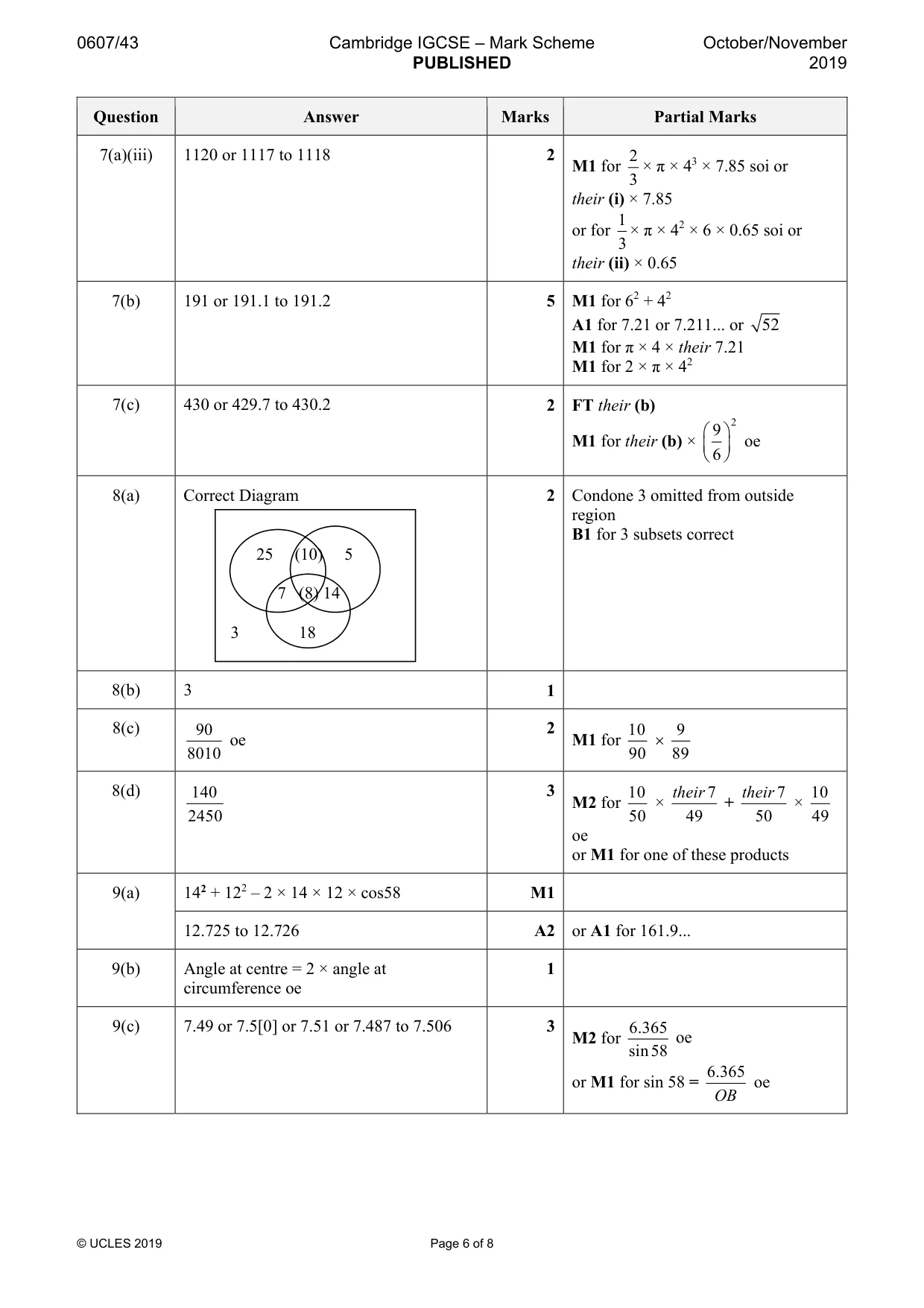
Mark scheme: 8(a) Correct Diagram 2 Condone 3 omitted from outside region B1 for 3 subsets correct 25 (10) 5 7 (8) 14 3 18 8(b) 3 1 8(c) 90 2 10 9 oe M1 for × 8010 90 89 8(d) 140 3 10 their 7 their 7 10 M2 for × + × 2450 50 49 50 49 oe or M1 for one of these products
Q9 · A 58° NOT TO SCALE 14 cm 12 cm O B N C A, B and C are points on the circle, centre O
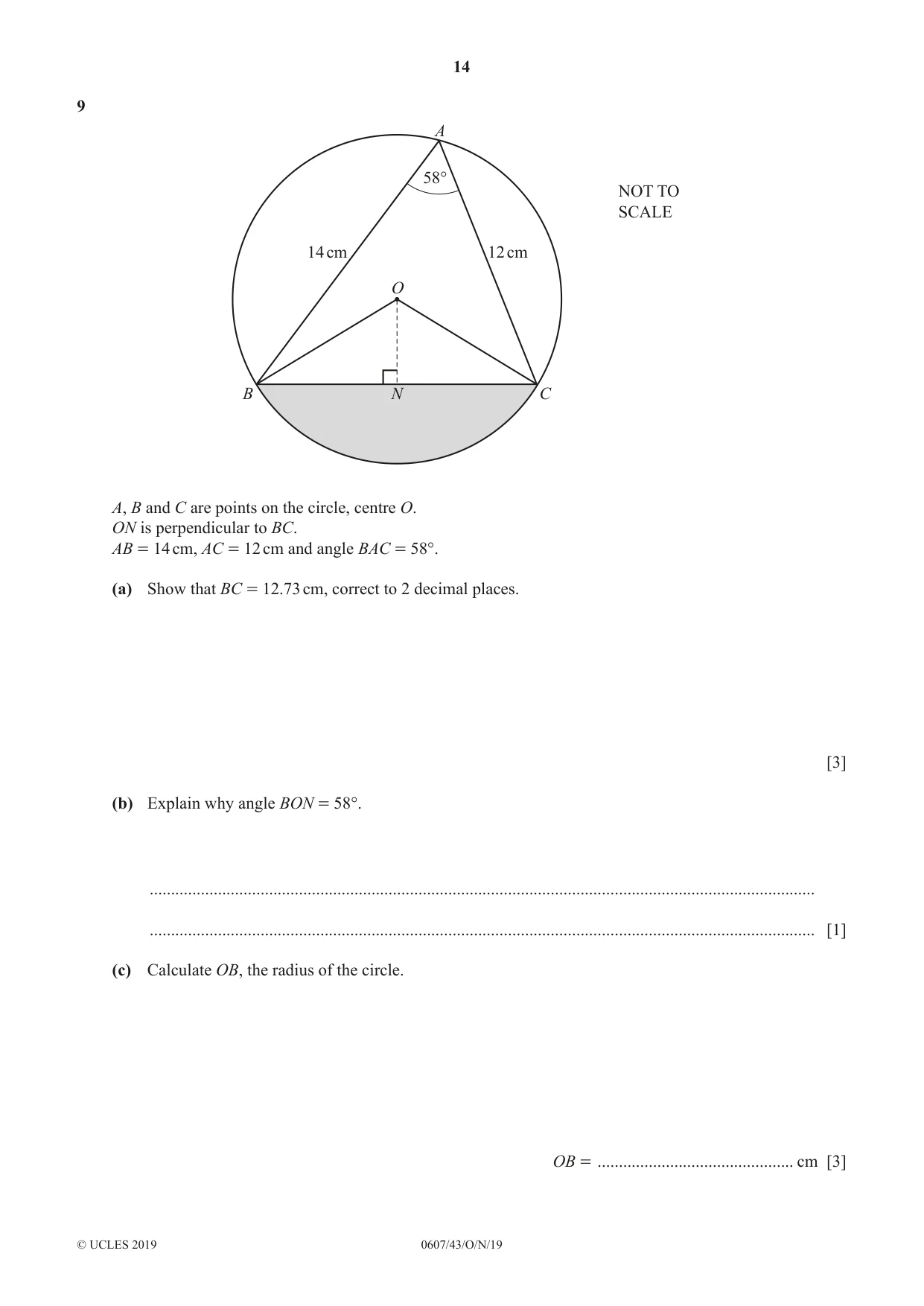
9 A 58° NOT TO SCALE 14 cm 12 cm O B N C A, B and C are points on the circle, centre O. ON is perpendicular to BC. AB = 14 cm, AC = 12 cm and angle BAC = 58°. (a) Show that BC = 12.73 cm, correct to 2 decimal places. [3] (b) Explain why angle BON = 58°. ............................................................................................................................................................ ............................................................................................................................................................ [1] (c) Calculate OB, the radius of the circle. OB = .............................................. cm [3] (d) Calculate the area of the shaded segment. ..............................................cm2 [3]
Mark scheme: 9(a) 142 + 122 – 2 × 14 × 12 × cos58 M1 12.725 to 12.726 A2 or A1 for 161.9... 9(b) Angle at centre = 2 × angle at 1 circumference oe 9(c) 7.49 or 7.5[0] or 7.51 or 7.487 to 7.506 3 6.365 M2 for oe sin58 6.365 or M1 for sin 58 = oe OB 9(d) 31.3 to 31.9 nfww 3 116 M2 for × π × (their (c))2 360 1 − × (their (c))2 × sin116 oe 2 116 or M1 for × π × (their (c))2 oe 360 1 or × (their (c))2 × sin116 oe 2
Q10 · All lengths in this question are in metres and all areas are in square metres
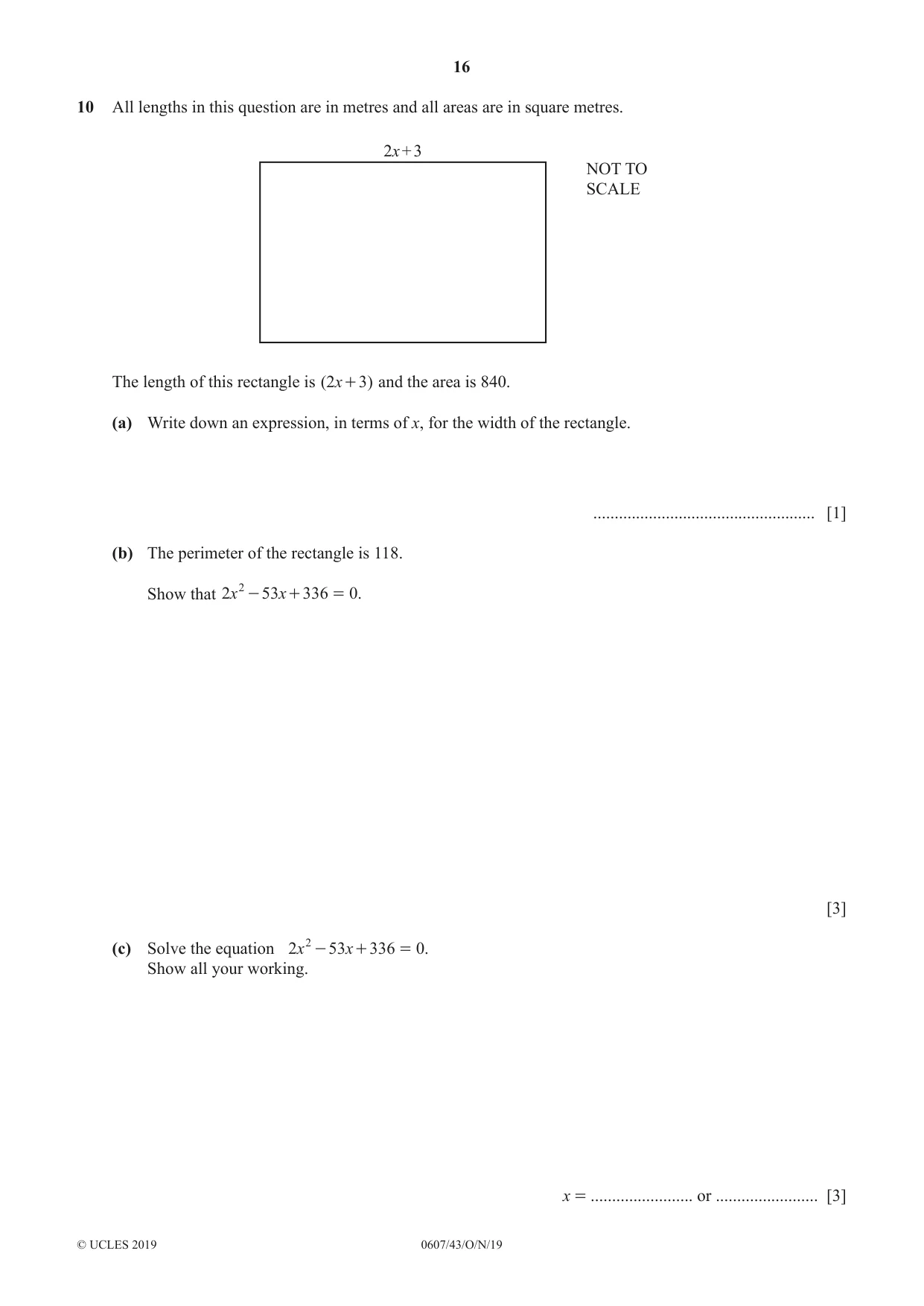
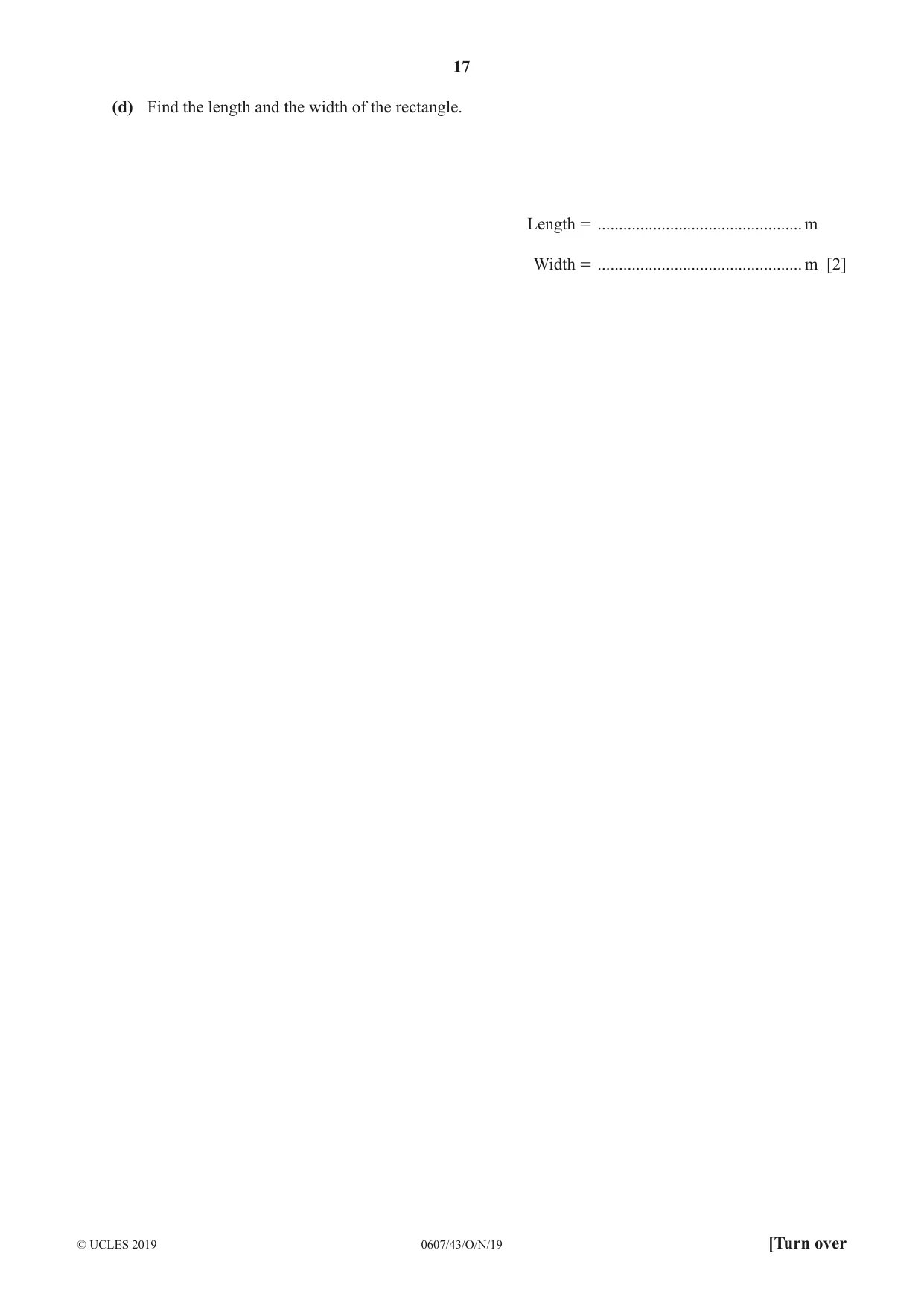
10 All lengths in this question are in metres and all areas are in square metres. 2x + 3 NOT TO SCALE The length of this rectangle is (2x + 3) and the area is 840. (a) Write down an expression, in terms of x, for the width of the rectangle. .................................................... [1] (b) The perimeter of the rectangle is 118. Show that 2x 2 - 53x + 336 = 0. [3] (c) Solve the equation 2x 2 - 53x + 336 = 0. Show all your working. x = ........................ or ........................ [3] (d) Find the length and the width of the rectangle. Length = ................................................m Width = ................................................ m [2]
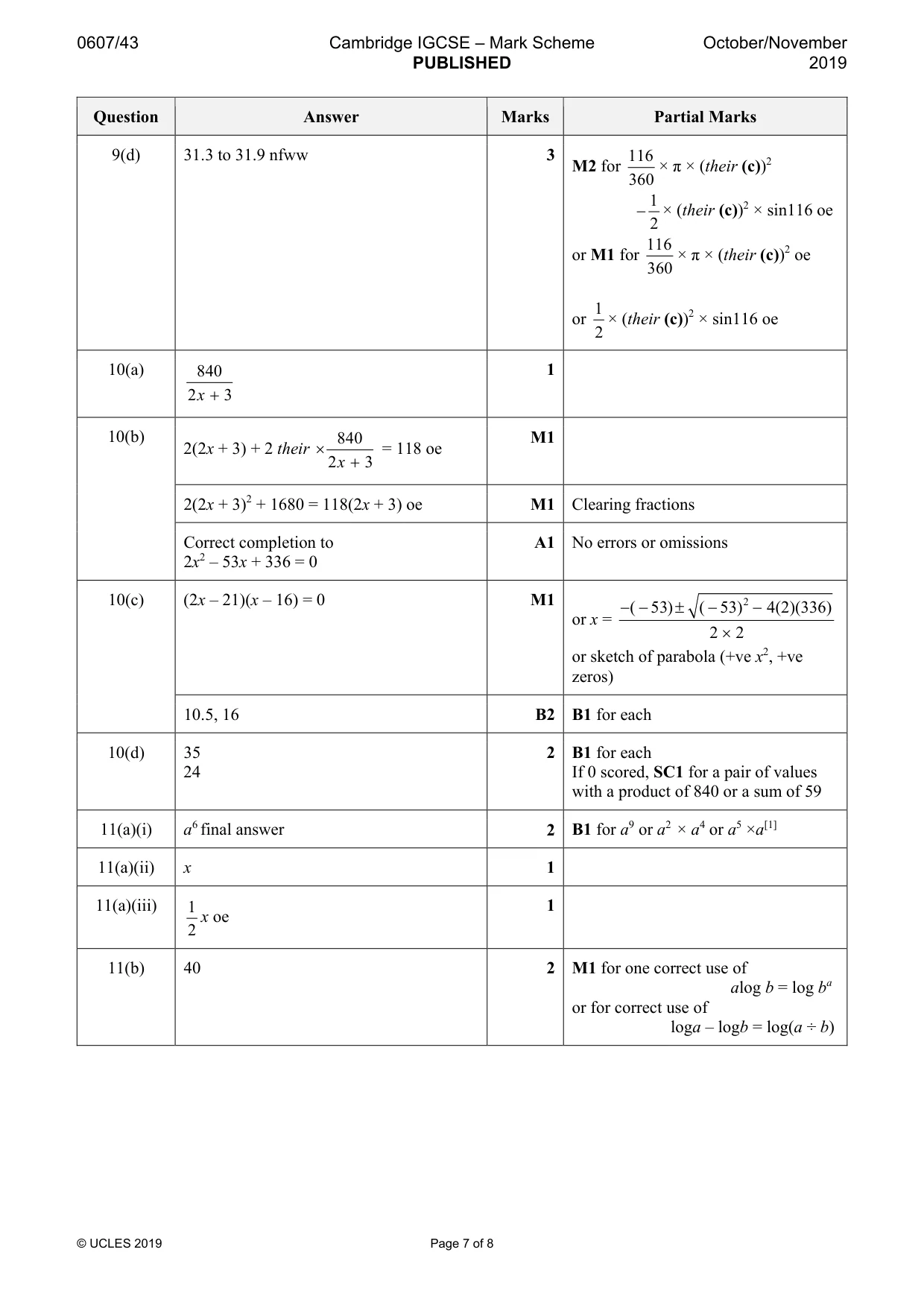
Mark scheme: 10(a) 840 1 2 x + 3 10(b) 840 M1 2(2x + 3) + 2 their × = 118 oe 2 x + 3 2(2x + 3)2 + 1680 = 118(2x + 3) oe M1 Clearing fractions Correct completion to A1 No errors or omissions 2x2 – 53x + 336 = 0 10(c) (2x – 21)(x – 16) = 0 M1 2 −−( 53) ± ( − 53) − 4(2)(336) or x = 2 × 2 or sketch of parabola (+ve x2, +ve zeros) 10.5, 16 B2 B1 for each 10(d) 35 2 B1 for each 24 If 0 scored, SC1 for a pair of values with a product of 840 or a sum of 59
Question 11
11 (a) Simplify. a 5 # a 4 (i) 3 a .................................................... [2] (ii) log 5 (5x ) .................................................... [1] (iii) log 9 (3x ) .................................................... [1] (b) Solve. 3 log 10 - 2 log 5 = logx x = ................................................... [2]
Mark scheme: 11(a)(i) a6 final answer 2 B1 for a9 or a2 × a4 or a5 ×a[1] 11(a)(ii) x 1 11(a)(iii) 1 1 x oe 2 11(b) 40 2 M1 for one correct use of alog b = log ba or for correct use of loga – logb = log(a ÷ b)
Q12 · Y 8 x –8 0 8 –8 3x + 2 f (x) = (x + 2)(x - 3) (a) On the diagram, sketch the graph of y =…
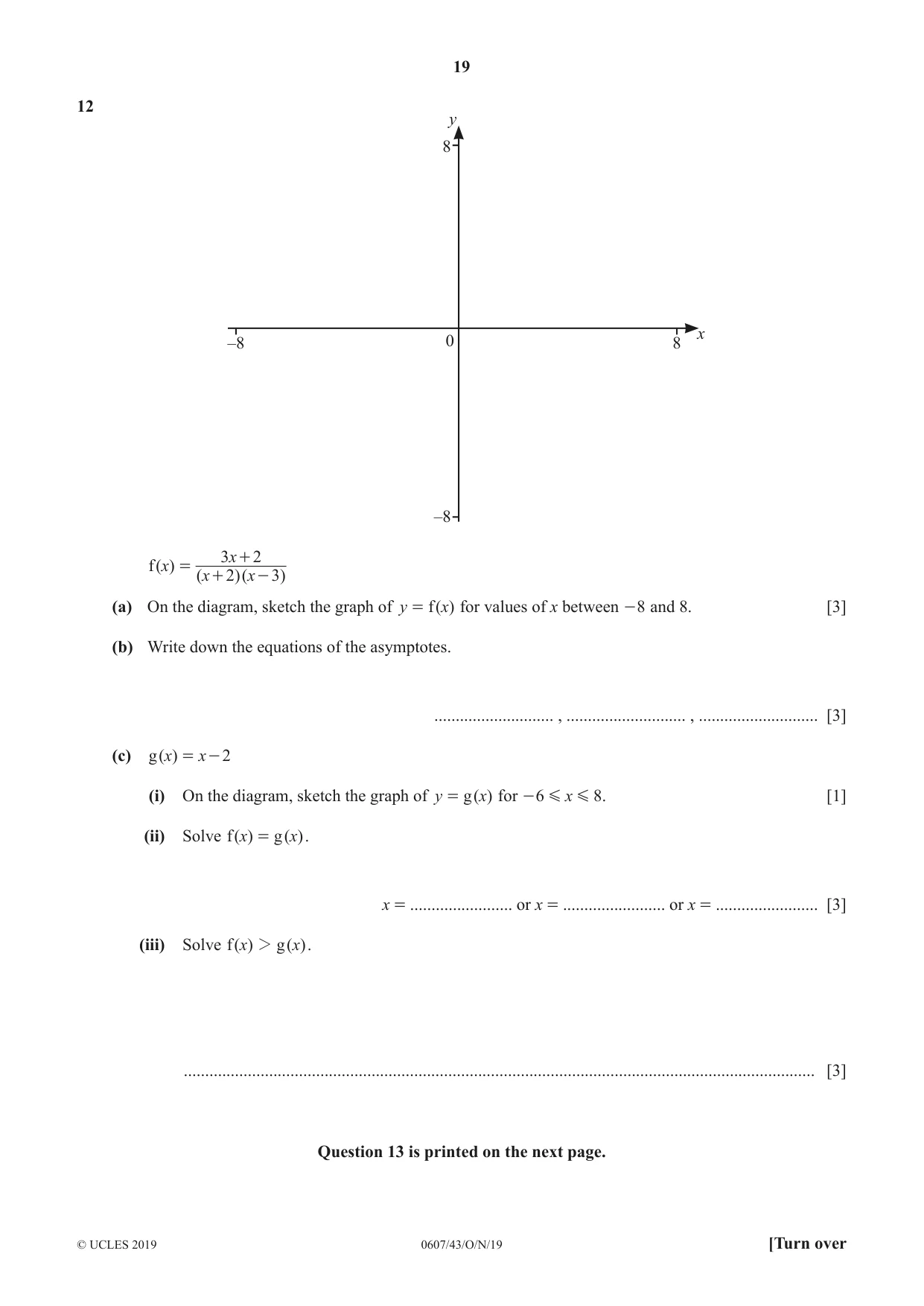
12 y 8 x –8 0 8 –8 3x + 2 f (x) = (x + 2)(x - 3) (a) On the diagram, sketch the graph of y = f ( x) for values of x between - 8 and 8. [3] (b) Write down the equations of the asymptotes. ............................ , ............................ , ............................ [3] (c) g ()x = x - 2 (i) On the diagram, sketch the graph of y = g (x) for - 6 G x G 8. [1] (ii) Solve f (x) = g (x). x = ........................ or x = ........................ or x = ........................ [3] (iii) Solve f (x) 2 g (x). .................................................................................................................................................... [3] Question 13 is printed on the next page.
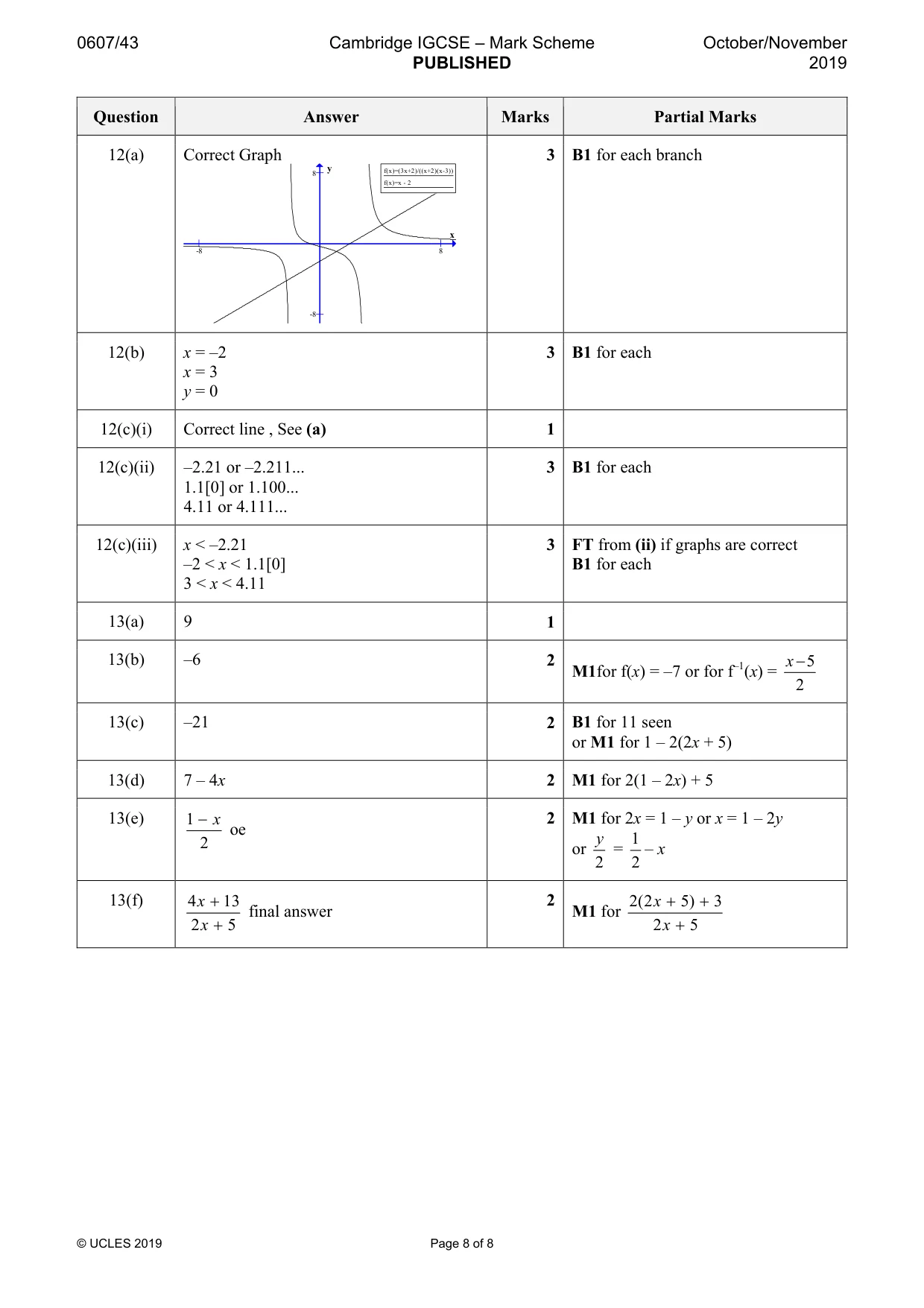
Mark scheme: 12(a) Correct Graph 3 B1 for each branch 8 y f(x)=(3x+2)/((x+2)(x-3)) f(x)=x - 2 x -8 8 -8 12(b) x = –2 3 B1 for each x = 3 y = 0 12(c)(i) Correct line , See (a) 1 12(c)(ii) –2.21 or –2.211... 3 B1 for each 1.1[0] or 1.100... 4.11 or 4.111... 12(c)(iii) x < –2.21 3 FT from (ii) if graphs are correct –2 < x < 1.1[0] B1 for each 3 < x < 4.11
Q13 · F ()x = 2x + 5 g ()x = 1 - 2x (a) Find g (- 4)
13 f ()x = 2x + 5 g ()x = 1 - 2x (a) Find g (- 4) . .................................................... [1] (b) Find f - 1 (- 7) . .................................................... [2] (c) Find g (f (3)) . .................................................... [2] (d) Find and simplify f (g (x)) . .................................................... [2] (e) Find and simplify g -1 ()x . g -1 ()x = ................................................... [2] (f) Write as a single fraction, simplifying your answer. 3 2 + f ()x .................................................... [2]
Mark scheme: 13(a) 9 1 13(b) –6 2 x− 5 M1for f(x) = –7 or for f–1(x) = 2 13(c) –21 2 B1 for 11 seen or M1 for 1 – 2(2x + 5) 13(d) 7 – 4x 2 M1 for 2(1 – 2x) + 5 13(e) 1 − x 2 M1 for 2x = 1 – y or x = 1 – 2y oe 2 y 1 or = – x 2 2 13(f) 4 x + 13 2 2(2 x + 5) + 3 final answer M1 for 2 x + 5 2 x + 5
What was in this paper
The subtopics covered by these 13 questions, and how many questions each got. Open one in a new tab to see every Cambridge question on it.
What you needed in this session
Cambridge’s own grade thresholds for 2019 Oct/Nov, Paper 4 · Variant 3. A higher threshold means an easier paper — the bar moves with how the cohort did.