Cambridge IGCSE Mathematics - International 0607 — 2022 Oct/Nov Paper 4 · Variant 1
0607/41/O/N/22 · 12 questions · 120 marks · ≈135 min
The question paper and its mark scheme, free to read here and free to download. This is Cambridge’s own paper, exactly as it was sat.
Question paper20 pages
Mark scheme9 pages
Answers below. Sit the paper first if you are practising.
Questions as text
Q1 · Y 10 9 8 7 6 B 5 A 4 3 2 1 0 x –10 –9 –8 –7 –6 –5 –4 –3 –2 –1 1 2 3 4 5 6 7 8 9 10 –1 –2…
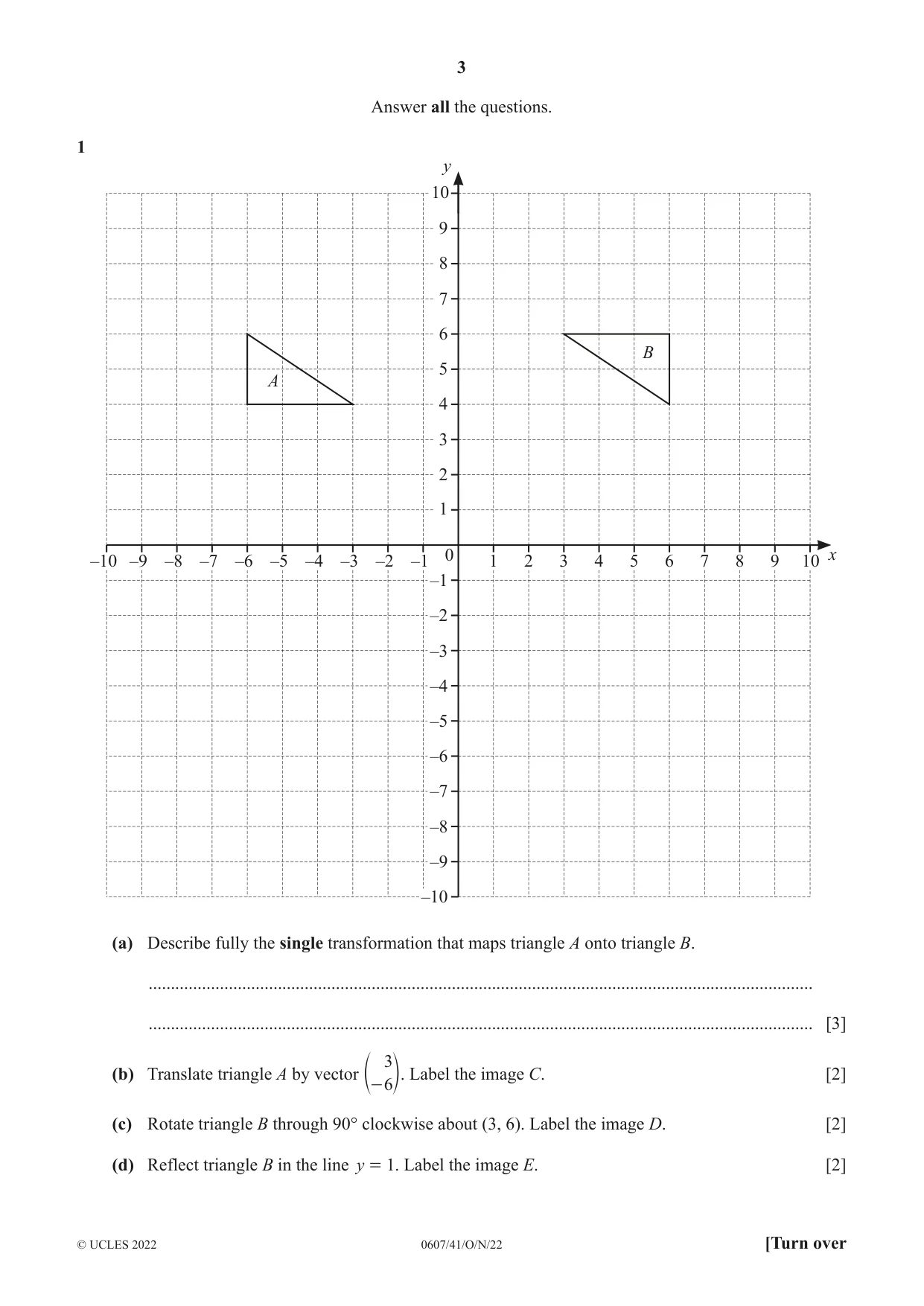
1 y 10 9 8 7 6 B 5 A 4 3 2 1 0 x –10 –9 –8 –7 –6 –5 –4 –3 –2 –1 1 2 3 4 5 6 7 8 9 10 –1 –2 –3 –4 –5 –6 –7 –8 –9 –10 (a) Describe fully the single transformation that maps triangle A onto triangle B. ..................................................................................................................................................... ..................................................................................................................................................... [3] 3 (b) Translate triangle A by vector Label the image C. [2] e- 6o. (c) Rotate triangle B through 90° clockwise about (3, 6). Label the image D. [2] (d) Reflect triangle B in the line y = 1. Label the image E. [2]
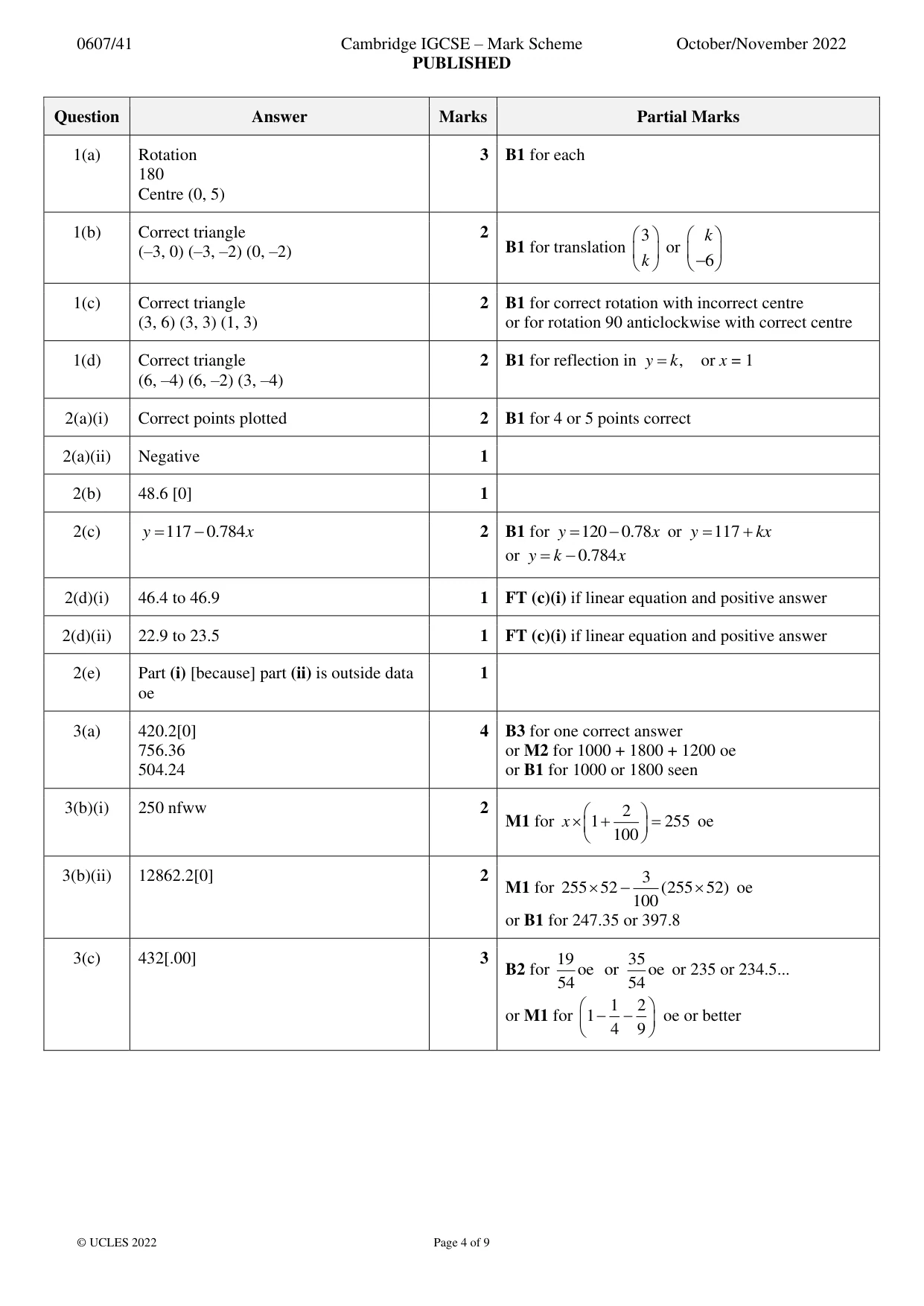
Mark scheme: Question Answer Marks Partial Marks 1(a) Rotation 3 B1 for each 180 Centre (0, 5) 1(b) Correct triangle 2 3 k (–3, 0) (–3, –2) (0, –2) B1 for translation or k −6 1(c) Correct triangle 2 B1 for correct rotation with incorrect centre (3, 6) (3, 3) (1, 3) or for rotation 90 anticlockwise with correct centre 1(d) Correct triangle 2 B1 for reflection in y = k , or x = 1 (6, –4) (6, –2) (3, –4)
Q2 · The number of barrels of oil produced and the price of one barrel of oil on ten…
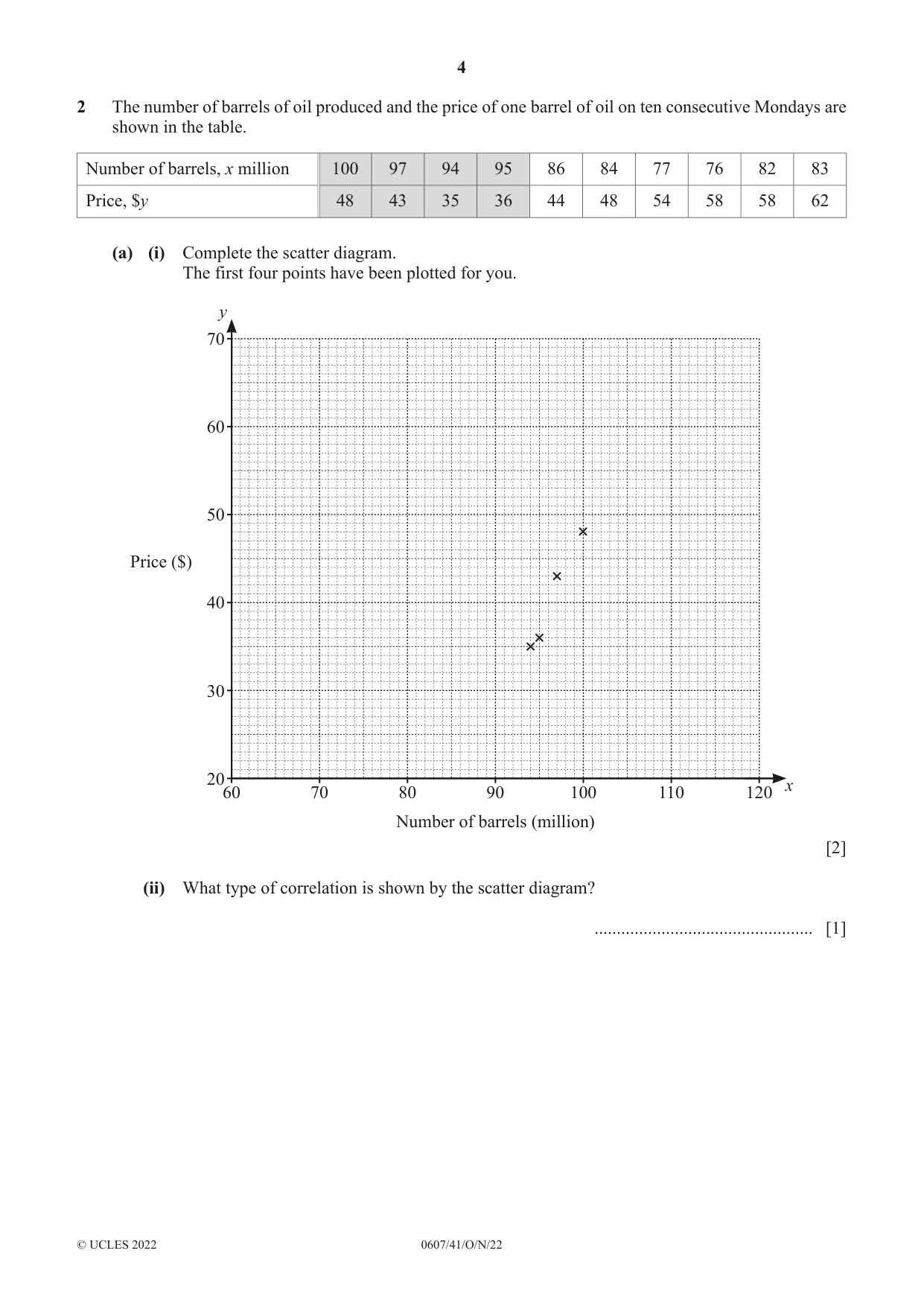
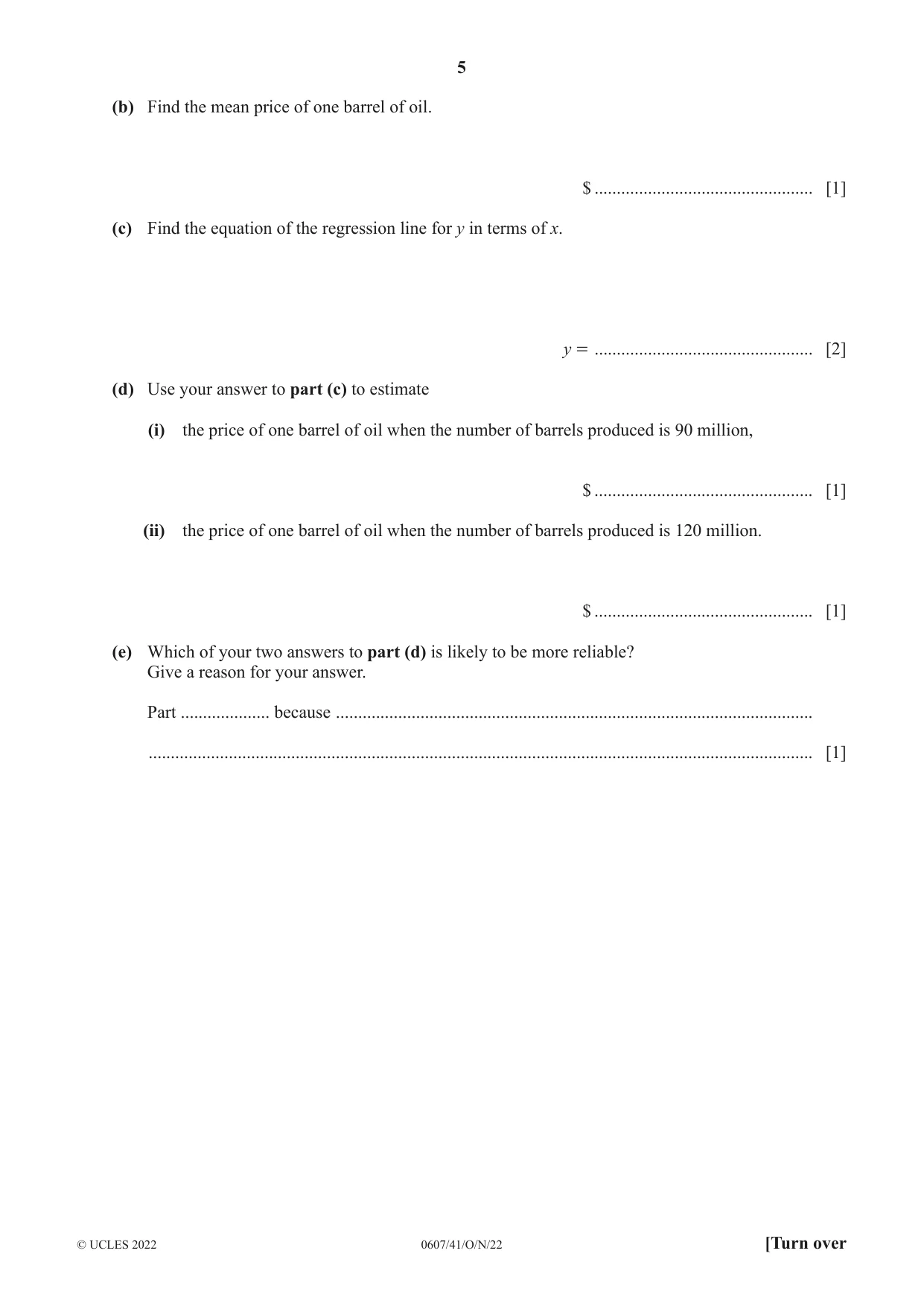
2 The number of barrels of oil produced and the price of one barrel of oil on ten consecutive Mondays are shown in the table. Number of barrels, x million 100 97 94 95 86 84 77 76 82 83 Price, $y 48 43 35 36 44 48 54 58 58 62 (a) (i) Complete the scatter diagram. The first four points have been plotted for you. y 70 60 50 Price ($) 40 30 20 x 60 70 80 90 100 110 120 Number of barrels (million) [2] (ii) What type of correlation is shown by the scatter diagram? ................................................. [1] (b) Find the mean price of one barrel of oil. $ ................................................. [1] (c) Find the equation of the regression line for y in terms of x. y = ................................................. [2] (d) Use your answer to part (c) to estimate (i) the price of one barrel of oil when the number of barrels produced is 90 million, $ ................................................. [1] (ii) the price of one barrel of oil when the number of barrels produced is 120 million. $ ................................................. [1] (e) Which of your two answers to part (d) is likely to be more reliable? Give a reason for your answer. Part .................... because ........................................................................................................... ..................................................................................................................................................... [1]
Mark scheme: 2(a)(i) Correct points plotted 2 B1 for 4 or 5 points correct 2(a)(ii) Negative 1 2(b) 48.6 [0] 1 2(c) y = 117 − 0.784 x 2 B1 for y = 120 − 0.78 x or y = 117 + kx or y = k − 0.784 x 2(d)(i) 46.4 to 46.9 1 FT (c)(i) if linear equation and positive answer 2(d)(ii) 22.9 to 23.5 1 FT (c)(i) if linear equation and positive answer 2(e) Part (i) [because] part (ii) is outside data 1 oe
Q3 · Alana, Bev and Cara work as decorators
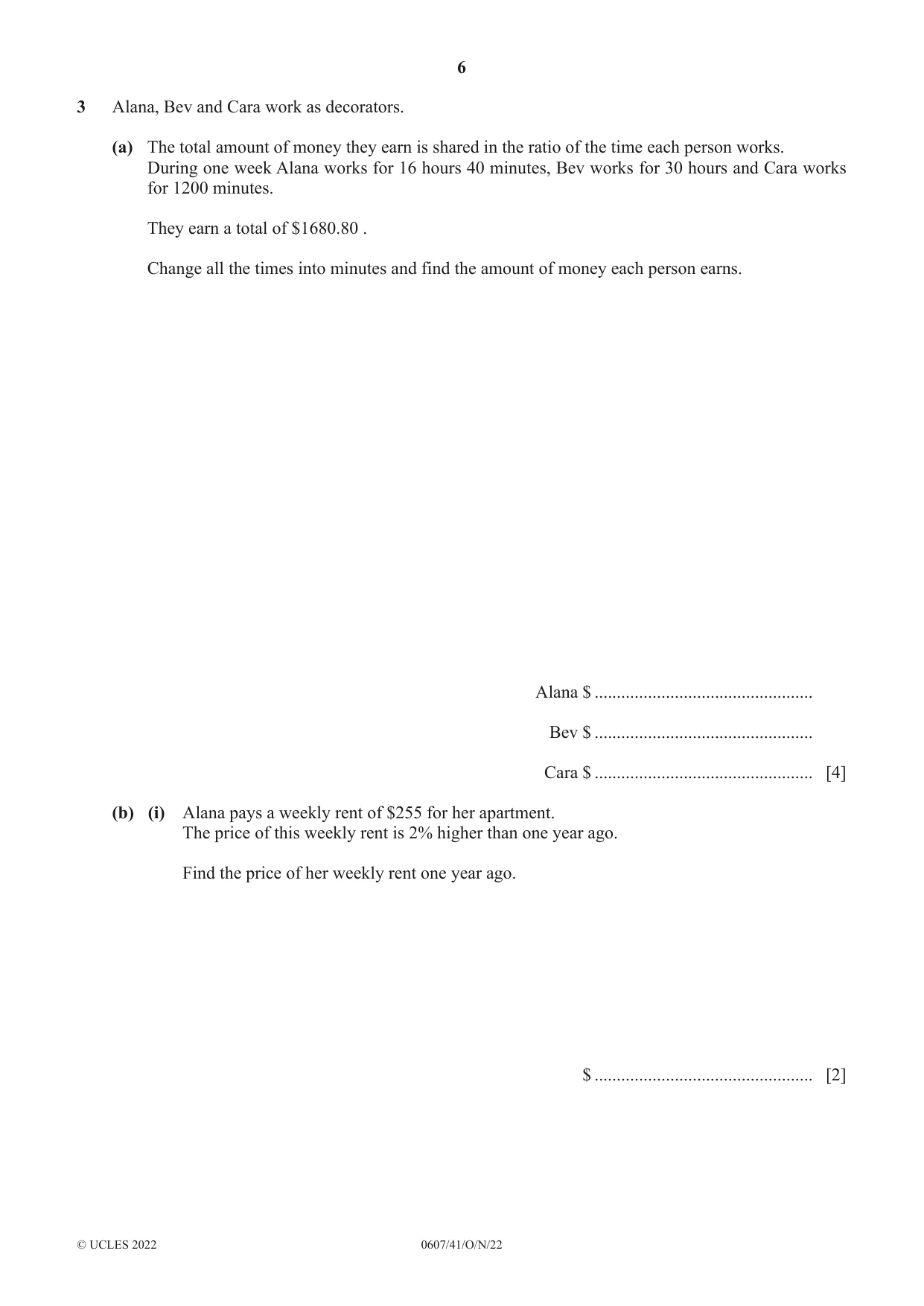
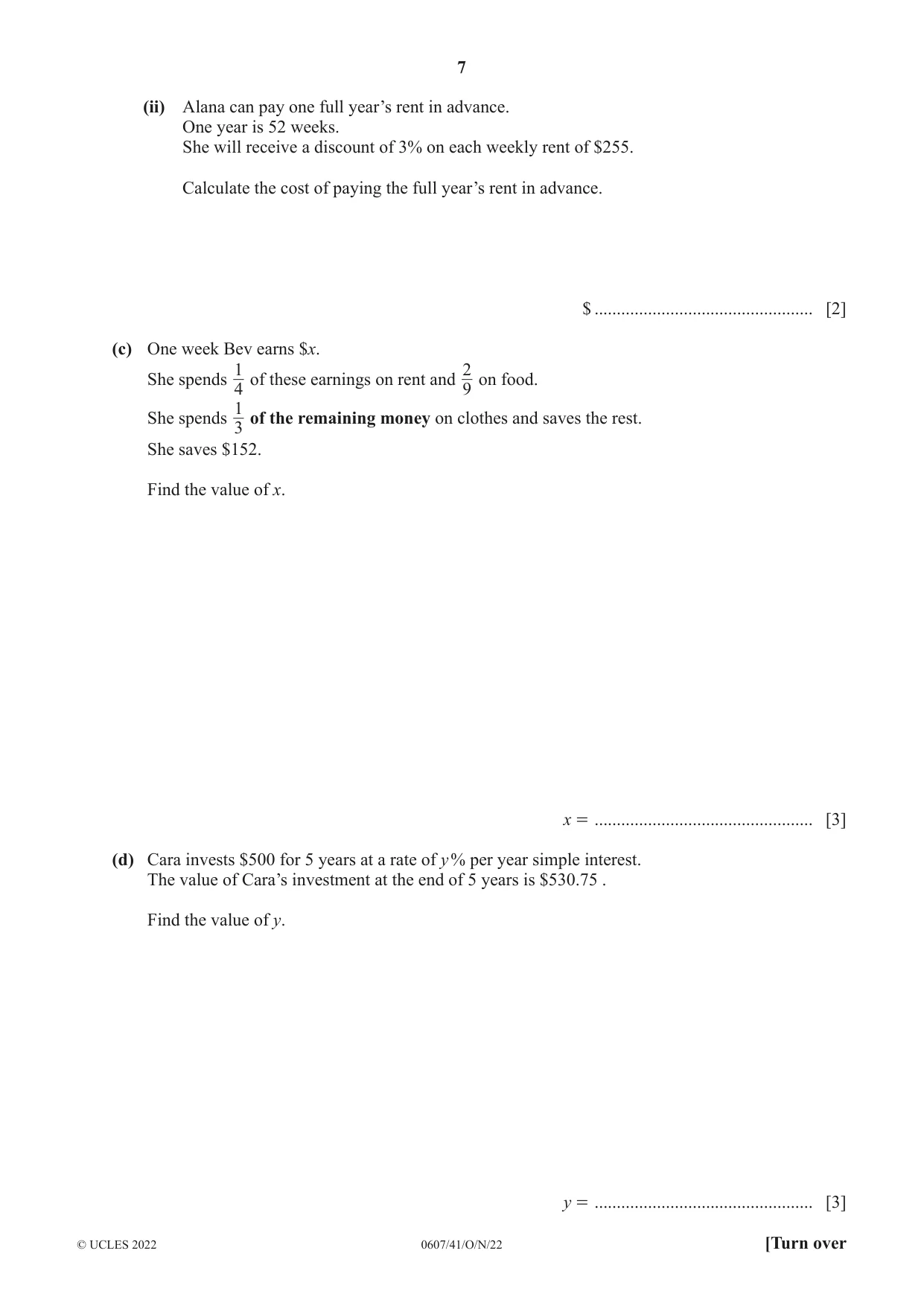
3 Alana, Bev and Cara work as decorators. (a) The total amount of money they earn is shared in the ratio of the time each person works. During one week Alana works for 16 hours 40 minutes, Bev works for 30 hours and Cara works for 1200 minutes. They earn a total of $1680.80 . Change all the times into minutes and find the amount of money each person earns. Alana $ ................................................. Bev $ ................................................. Cara $ ................................................. [4] (b) (i) Alana pays a weekly rent of $255 for her apartment. The price of this weekly rent is 2% higher than one year ago. Find the price of her weekly rent one year ago. $ ................................................. [2] (ii) Alana can pay one full year’s rent in advance. One year is 52 weeks. She will receive a discount of 3% on each weekly rent of $255. Calculate the cost of paying the full year’s rent in advance. $ ................................................. [2] (c) One week Bev earns $x. 1 2 She spends of these earnings on rent and on food. 4 9 1 She spends of the remaining money on clothes and saves the rest. 3 She saves $152. Find the value of x. x = ................................................. [3] (d) Cara invests $500 for 5 years at a rate of y % per year simple interest. The value of Cara’s investment at the end of 5 years is $530.75 . Find the value of y. y = ................................................. [3]
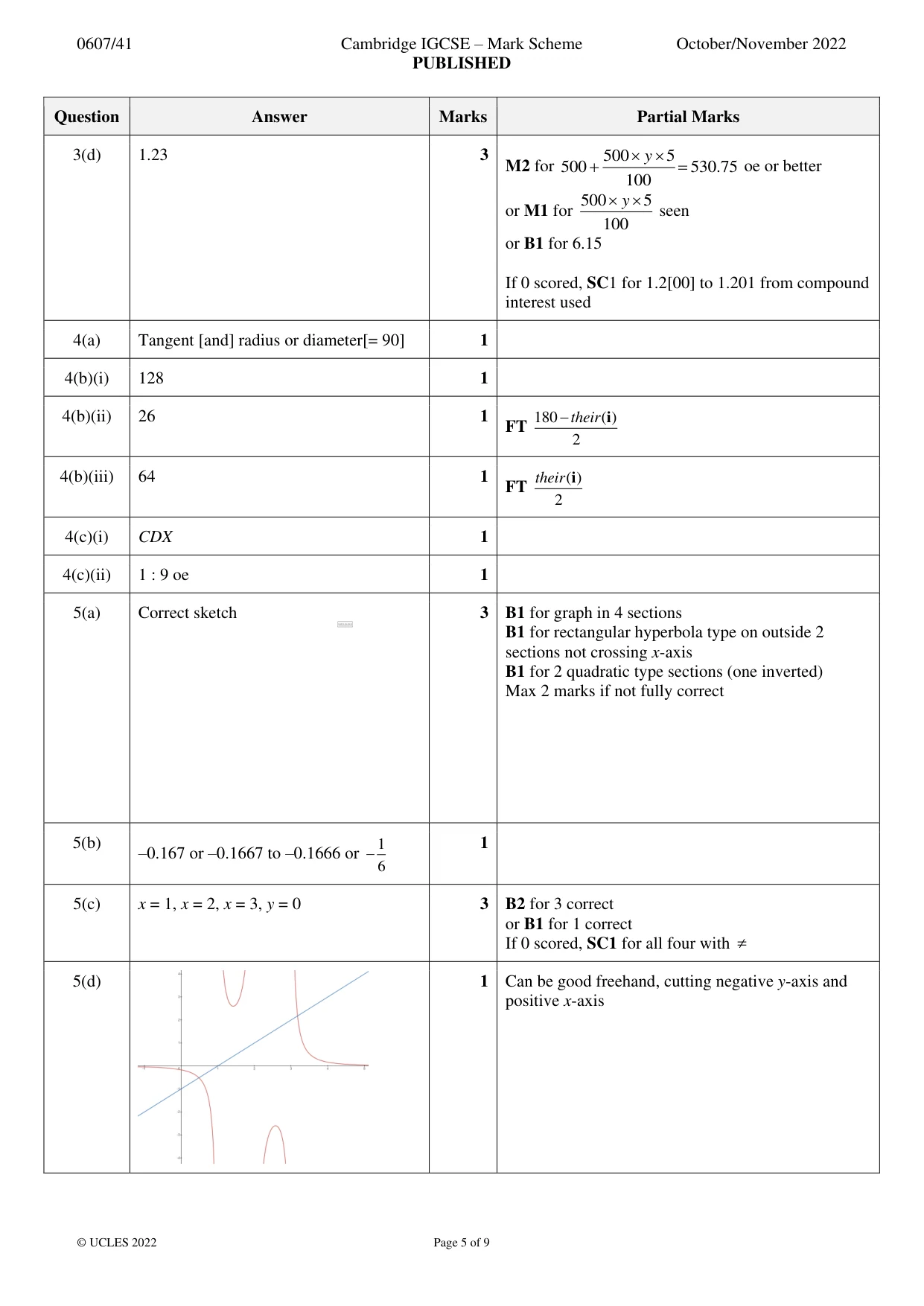
Mark scheme: 3(a) 420.2[0] 4 B3 for one correct answer 756.36 or M2 for 1000 + 1800 + 1200 oe 504.24 or B1 for 1000 or 1800 seen 3(b)(i) 250 nfww 2 2 M1 for x 1 + = 255 oe 100 3(b)(ii) 12862.2[0] 2 3 M1 for 255 52 − (255 52) oe 100 or B1 for 247.35 or 397.8 3(c) 432[.00] 3 19 35 B2 for oe or oe or 235 or 234.5... 54 54 1 2 or M1 for 1 − − oe or better 4 9 3(d) 1.23 3 500 y 5 M2 for 500 + = 530.75 oe or better 100 500 y 5 or M1 for seen 100 or B1 for 6.15 If 0 scored, SC1 for 1.2[00] to 1.201 from compound interest used
Q4 · A NOT TO SCALE D X O 52° P C B A, B, C and D lie on a circle, centre O
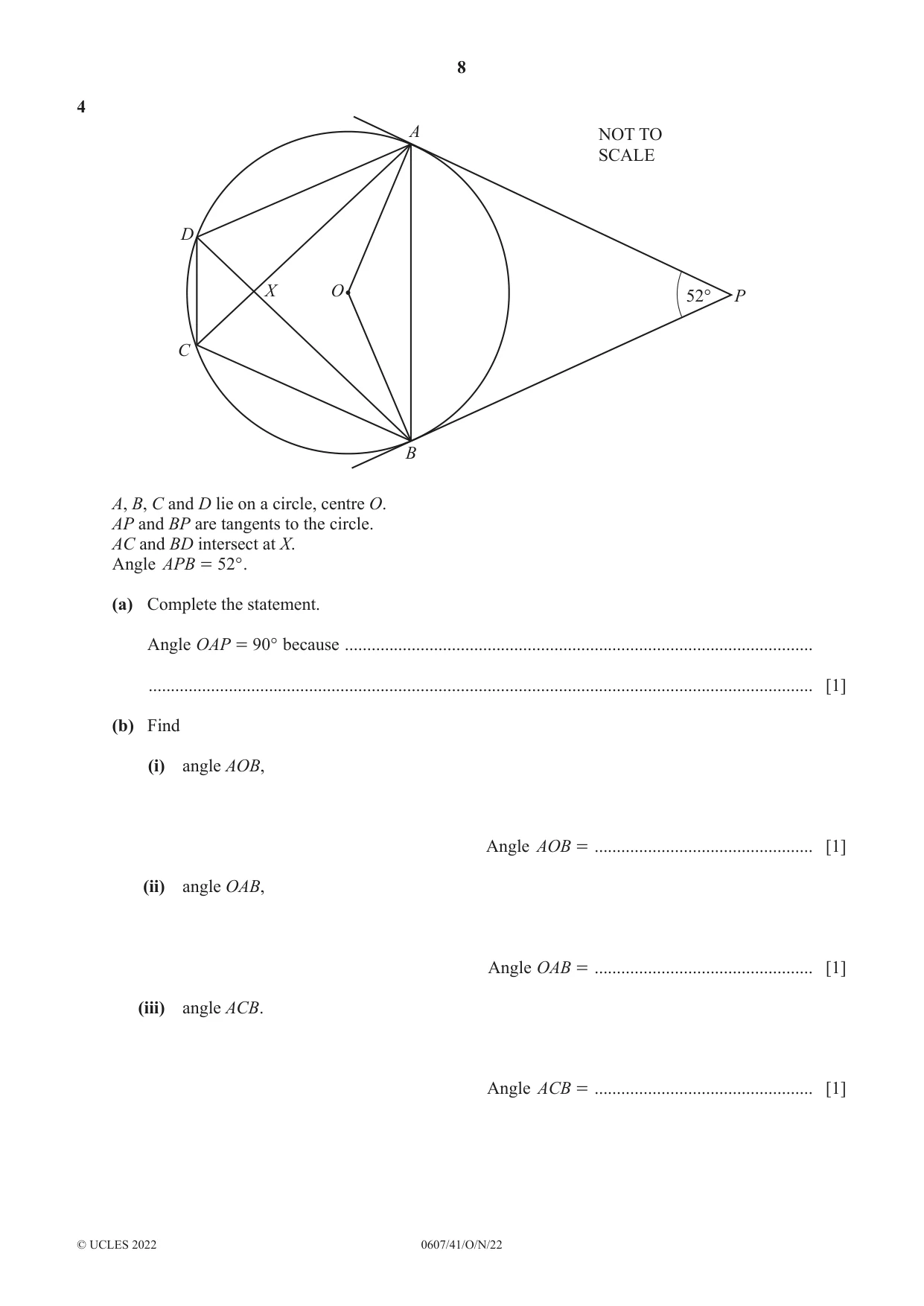
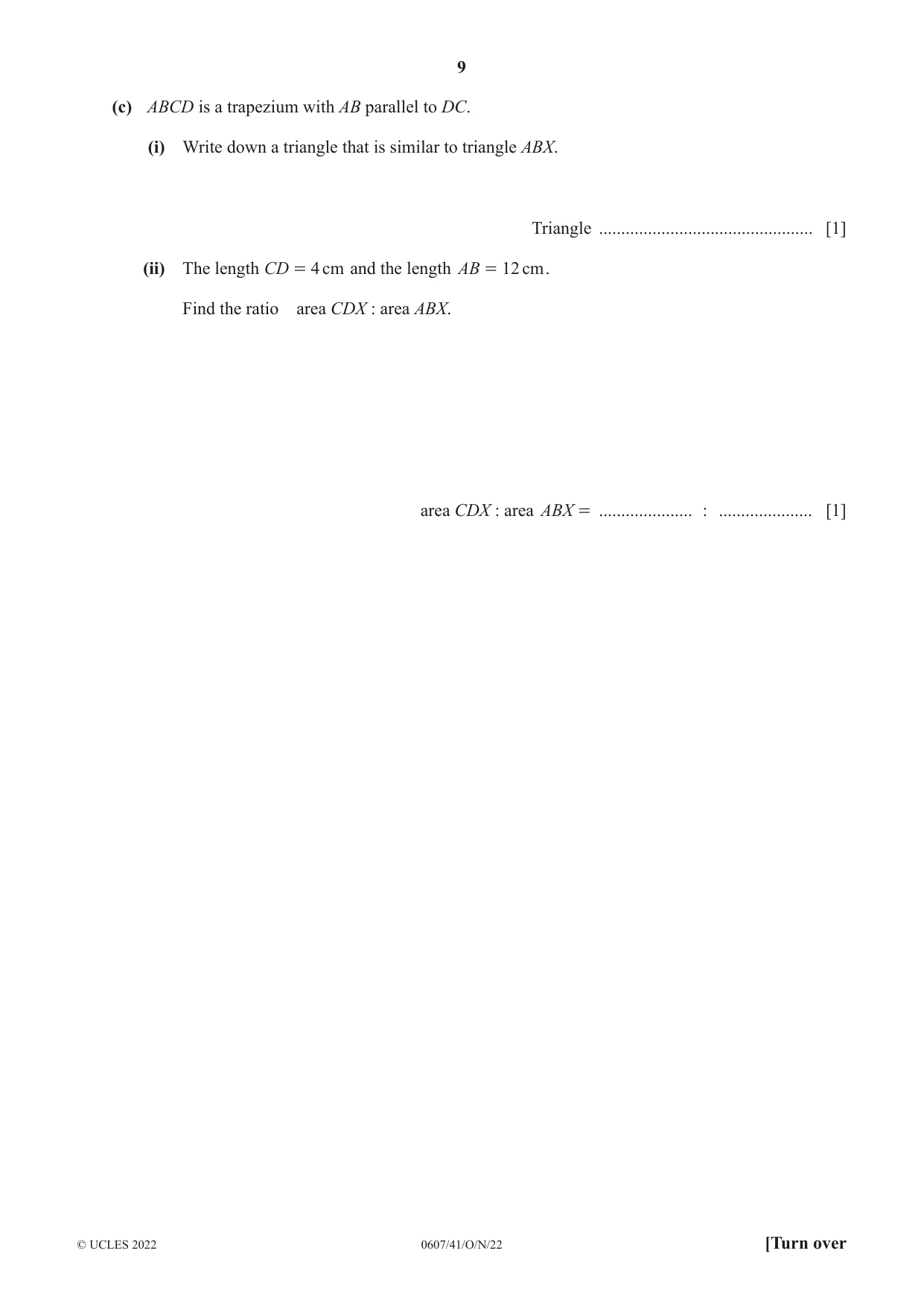
4 A NOT TO SCALE D X O 52° P C B A, B, C and D lie on a circle, centre O. AP and BP are tangents to the circle. AC and BD intersect at X. Angle APB = 52° . (a) Complete the statement. Angle OAP = 90° because ......................................................................................................... ..................................................................................................................................................... [1] (b) Find (i) angle AOB, Angle AOB = ................................................. [1] (ii) angle OAB, Angle OAB = ................................................. [1] (iii) angle ACB. Angle ACB = ................................................. [1] (c) ABCD is a trapezium with AB parallel to DC. (i) Write down a triangle that is similar to triangle ABX. Triangle ................................................ [1] (ii) The length CD = 4 cm and the length AB = 12 cm . Find the ratio area CDX : area ABX. area CDX : area ABX = ..................... : ..................... [1]
Mark scheme: 4(a) Tangent [and] radius or diameter[= 90] 1 4(b)(i) 128 1 4(b)(ii) 26 1 180 − their ( i ) FT 2 4(b)(iii) 64 1 their ( i ) FT 2 4(c)(i) CDX 1 4(c)(ii) 1 : 9 oe 1
Q5 · Y 4 x 0 –1 5 – 4 (a) On the diagram, sketch the graph of y = f ( x) , where 1 f ( x) =…
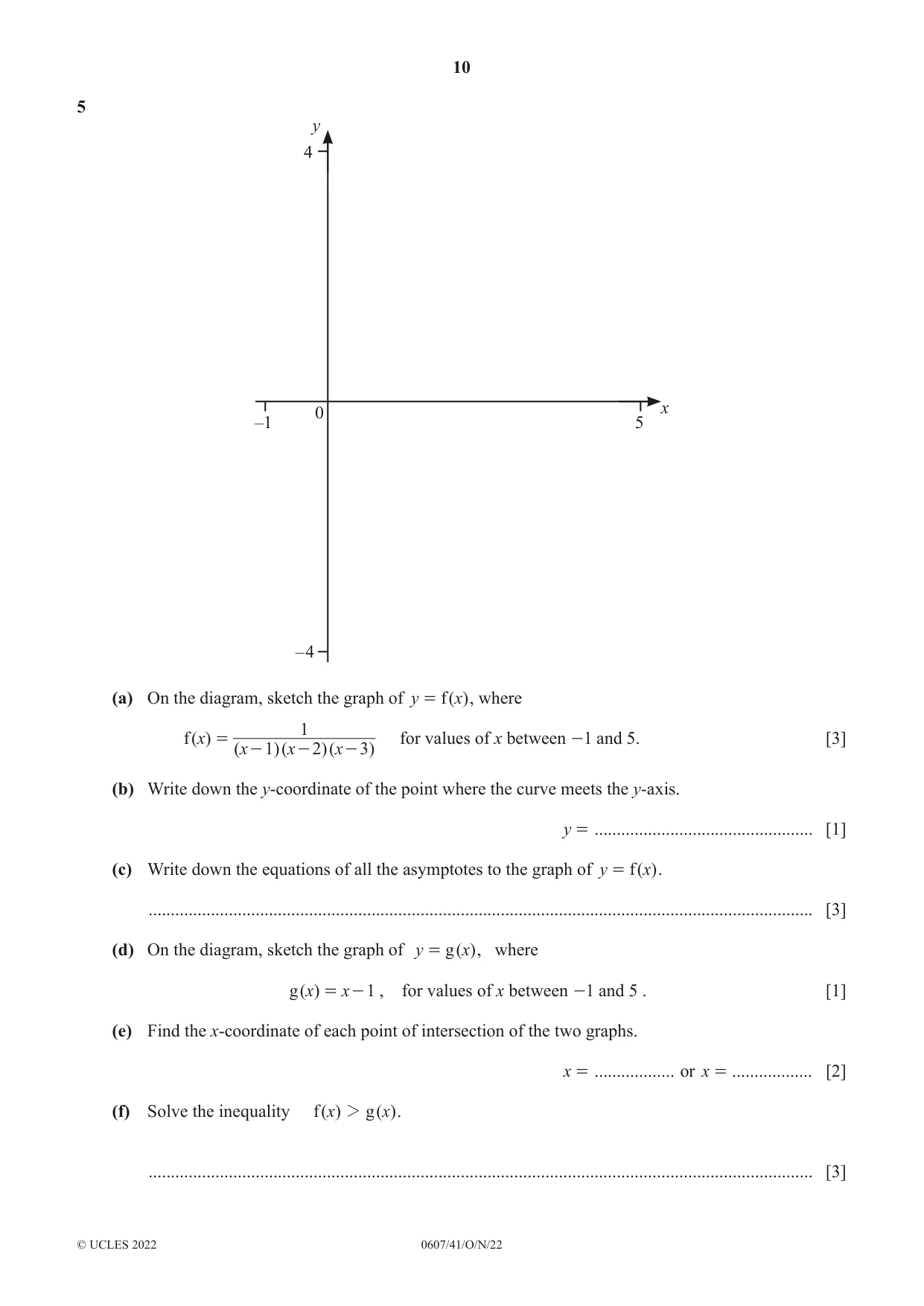
5 y 4 x 0 –1 5 – 4 (a) On the diagram, sketch the graph of y = f ( x) , where 1 f ( x) = for values of x between - 1 and 5. [3] ( x - 1)( x - 2)( x - 3) (b) Write down the y‑coordinate of the point where the curve meets the y‑axis. y = ................................................. [1] (c) Write down the equations of all the asymptotes to the graph of y = f ( x) . ..................................................................................................................................................... [3] (d) On the diagram, sketch the graph of y = g ( x) , where g ( x) = x - 1 , for values of x between - 1 and 5 . [1] (e) Find the x‑coordinate of each point of intersection of the two graphs. x = .................. or x = .................. [2] (f) Solve the inequality f ( x) 2 g ( x) . ..................................................................................................................................................... [3]
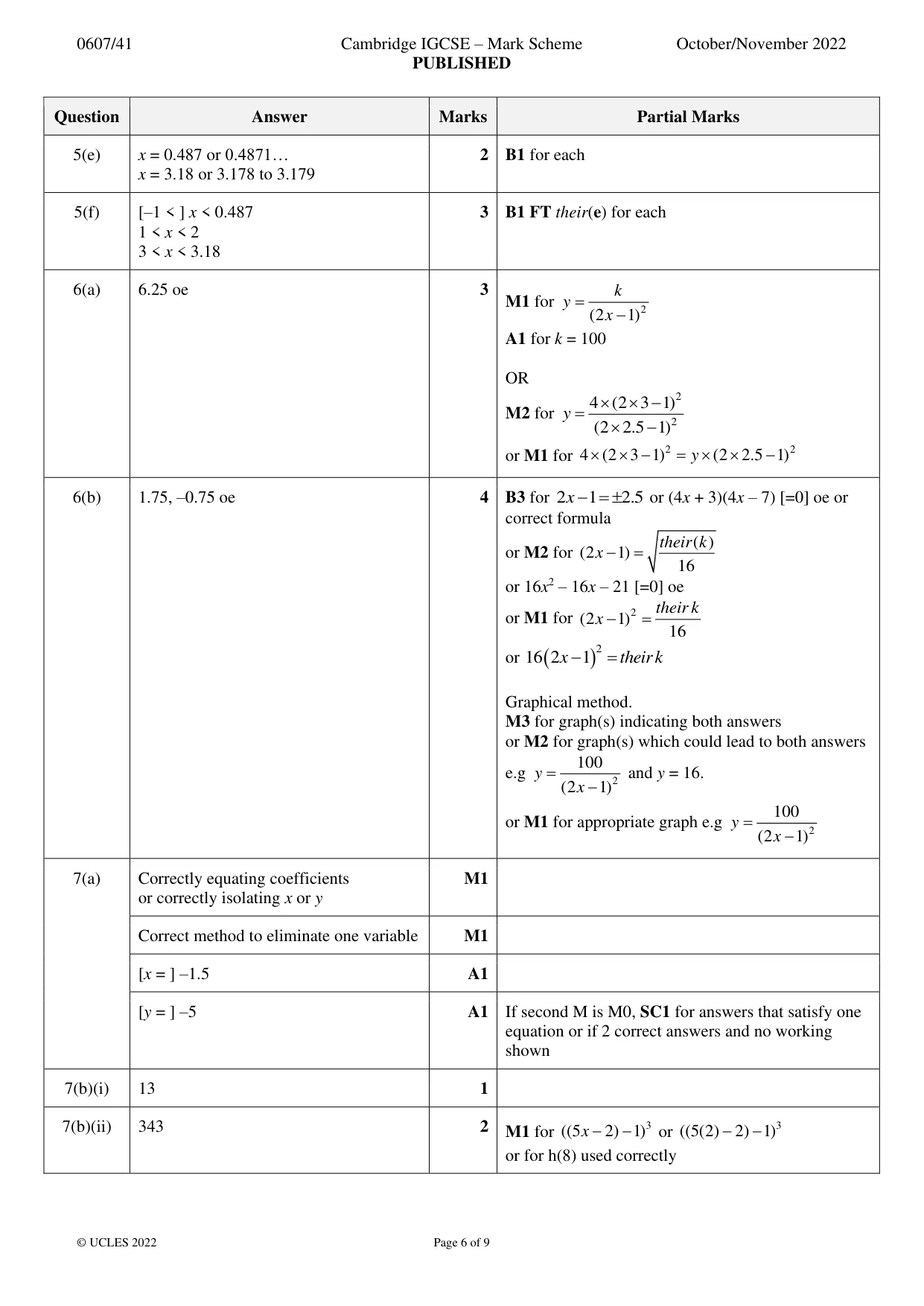
Mark scheme: 5(a) Correct sketch f(x)=1/((x-1)(x-2)(x-3)) 3 B1 for graph in 4 sections B1 for rectangular hyperbola type on outside 2 sections not crossing x-axis B1 for 2 quadratic type sections (one inverted) Max 2 marks if not fully correct 5(b) 1 1 –0.167 or –0.1667 to –0.1666 or − 6 5(c) x = 1, x = 2, x = 3, y = 0 3 B2 for 3 correct or B1 for 1 correct If 0 scored, SC1 for all four with 5(d) 1 Can be good freehand, cutting negative y-axis and positive x-axis 5(e) x = 0.487 or 0.4871… 2 B1 for each x = 3.18 or 3.178 to 3.179 5(f) [–1 < ] x < 0.487 3 B1 FT their(e) for each 1 < x < 2 3 < x < 3.18
Q6 · Y varies inversely as ( 2x - 1) 2
6 y varies inversely as ( 2x - 1) 2 . y = 4 when x = 3 . (a) Find the value of y when x = 2.5 . y = ................................................. [3] (b) Find the values of x when y = 16 . x = .................. or x = .................. [4]
Mark scheme: 6(a) 6.25 oe 3 k M1 for y = (2 x − 1) 2 A1 for k = 100 OR 4 (2 −3 1) 2 M2 for y = (2 2.5 − 1) 2 or M1 for 4 (2 −3 1) 2 = y (2 2.5 − 1) 2 6(b) 1.75, –0.75 oe 4 B3 for 2 x −=1 2.5 or (4x + 3)(4x – 7) [=0] oe or correct formula their ( k ) or M2 for (2 x − 1) = 16 or 16x2 – 16x – 21 [=0] oe 2 their k or M1 for (2 x − 1) = 16 2 or 16 ( 2 x − 1) = theirk Graphical method. M3 for graph(s) indicating both answers or M2 for graph(s) which could lead to both answers 100 e.g y = and y = 16. (2 x − 1) 2 100 or M1 for appropriate graph e.g y = (2 x − 1) 2
Q7 · Solve the simultaneous equations
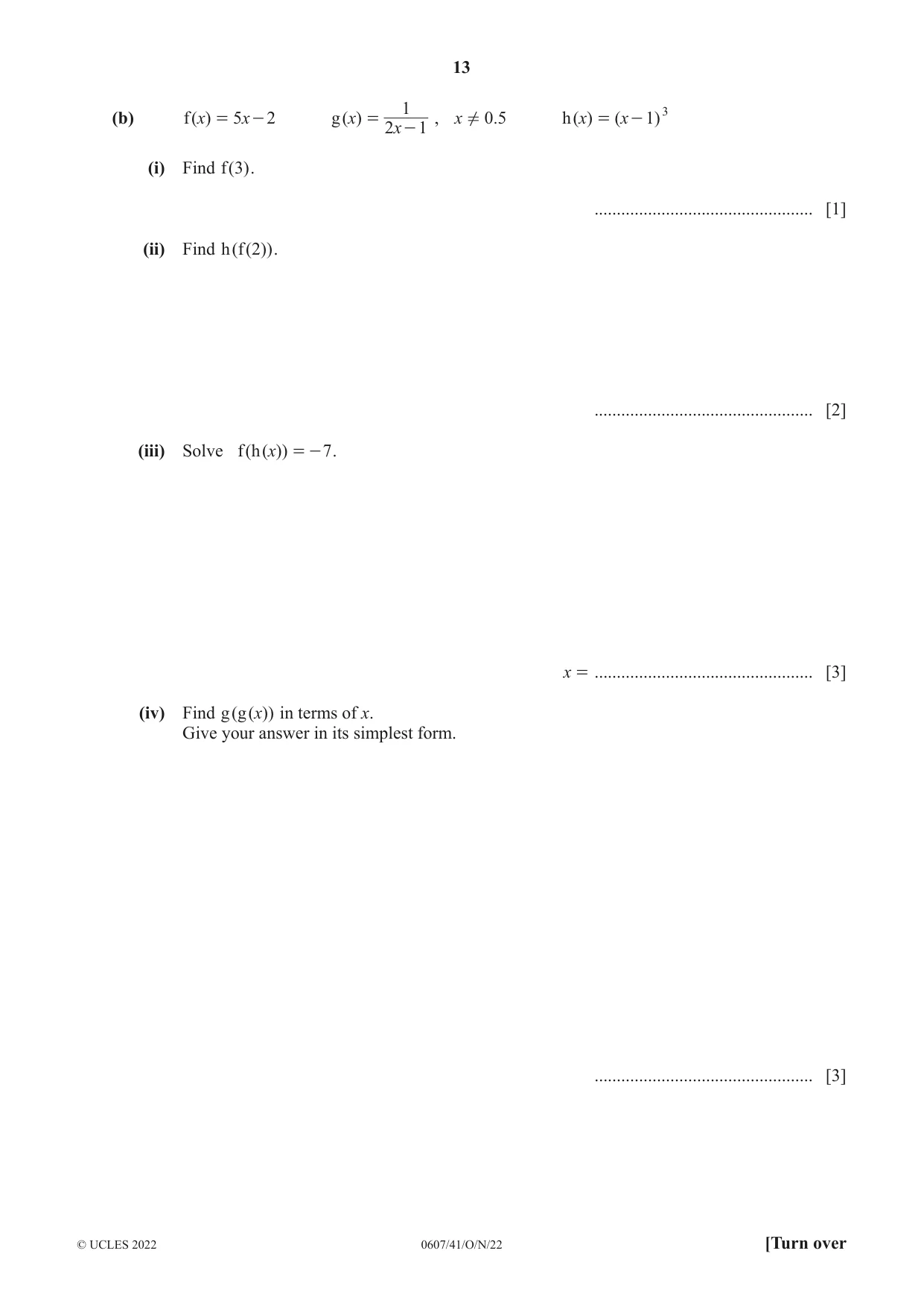
7 (a) Solve the simultaneous equations. You must show all your working. 4x + 3y = - 21 6x - 2y = 1 x = ................................................. y = ................................................. [4] 1 3(b) f ( x) = 5 x - 2 g ( x) = , x ! 0.5 h ( x) = ( x - 1 ) 2x - 1 (i) Find f ( 3) . ................................................. [1] (ii) Find h ( f ( 2)) . ................................................. [2] (iii) Solve f ( h ( x)) = - 7 . x = ................................................. [3] (iv) Find g ( g ( x)) in terms of x. Give your answer in its simplest form. ................................................. [3]
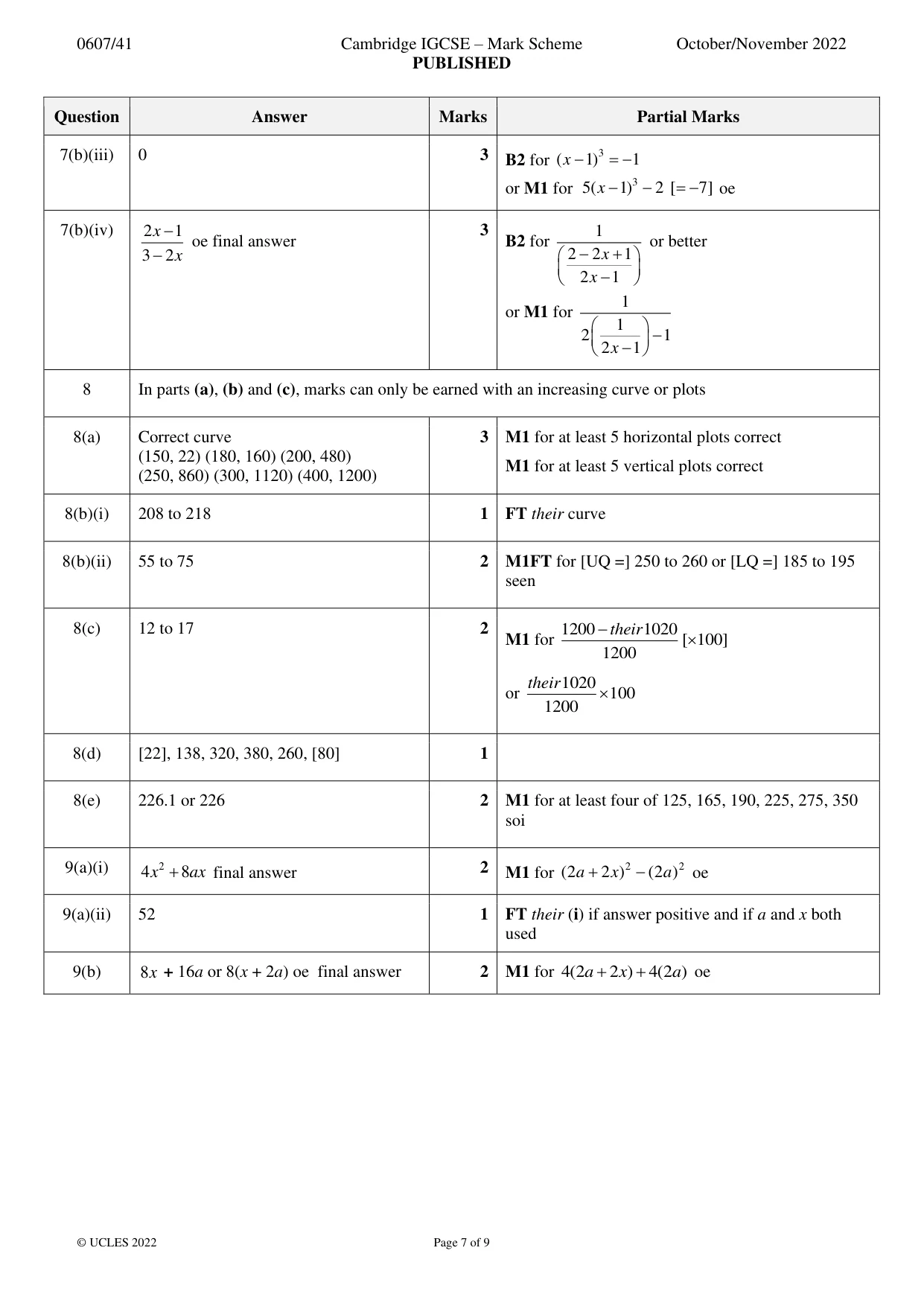
Mark scheme: 7(a) Correctly equating coefficients M1 or correctly isolating x or y Correct method to eliminate one variable M1 [x = ] –1.5 A1 [y = ] –5 A1 If second M is M0, SC1 for answers that satisfy one equation or if 2 correct answers and no working shown 7(b)(i) 13 1 7(b)(ii) 343 2 M1 for ((5 x − 2) − 1) 3 or ((5(2) − 2) − 1) 3 or for h(8) used correctly 7(b)(iii) 0 3 B2 for ( x − 1) 3 = − 1 or M1 for 5( x − 1) 3 − 2 [ = − 7] oe 7(b)(iv) 2 x − 1 3 1 oe final answer B2 for or better 3 − 2 x 2 − 2 x + 1 2 x − 1 1 or M1 for 1 2 − 1 2 x − 1 8 In parts (a), (b) and (c), marks can only be earned with an increasing curve or plots
Q8 · The cumulative frequency table shows the masses, in grams, of 1200 potatoes
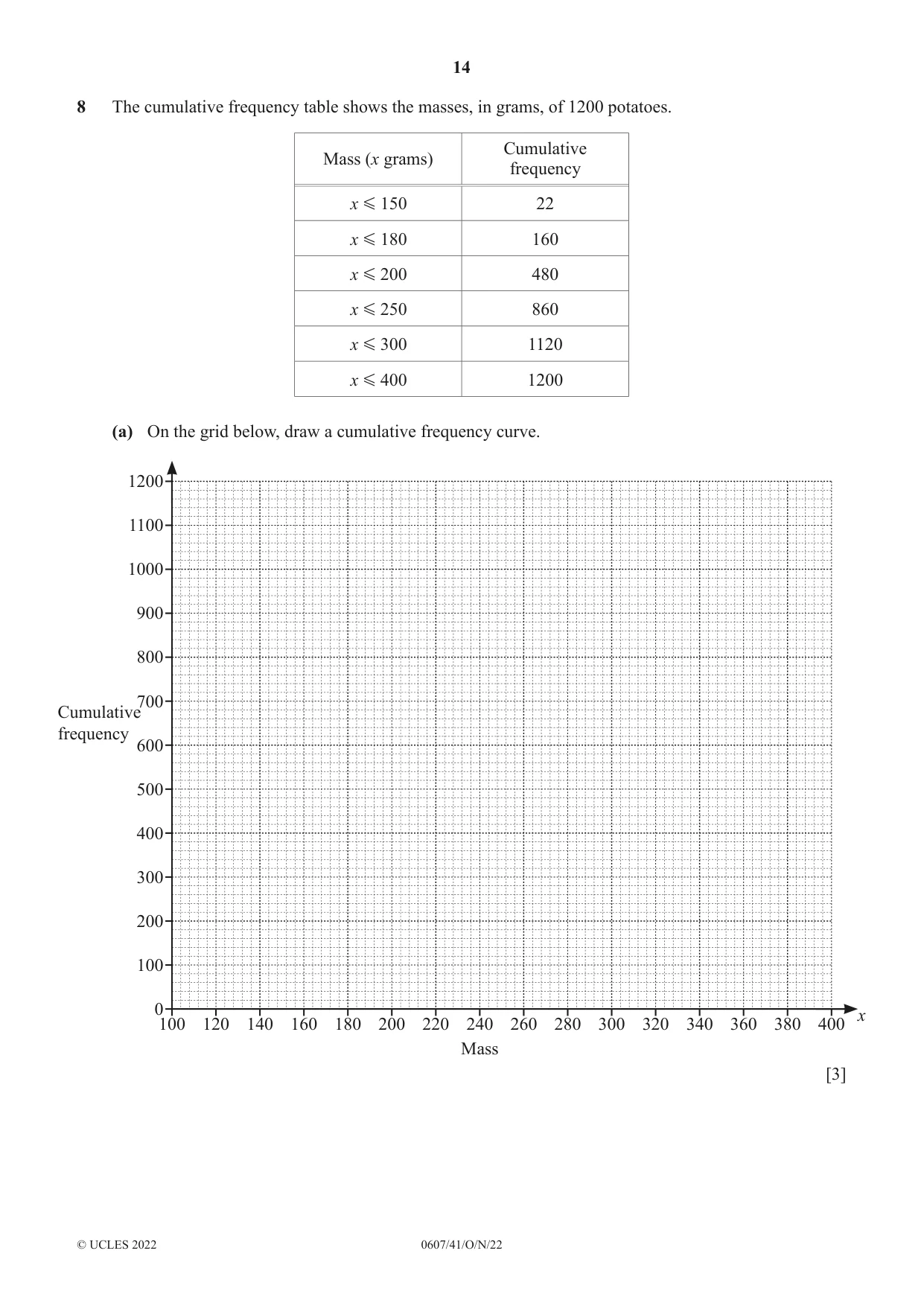
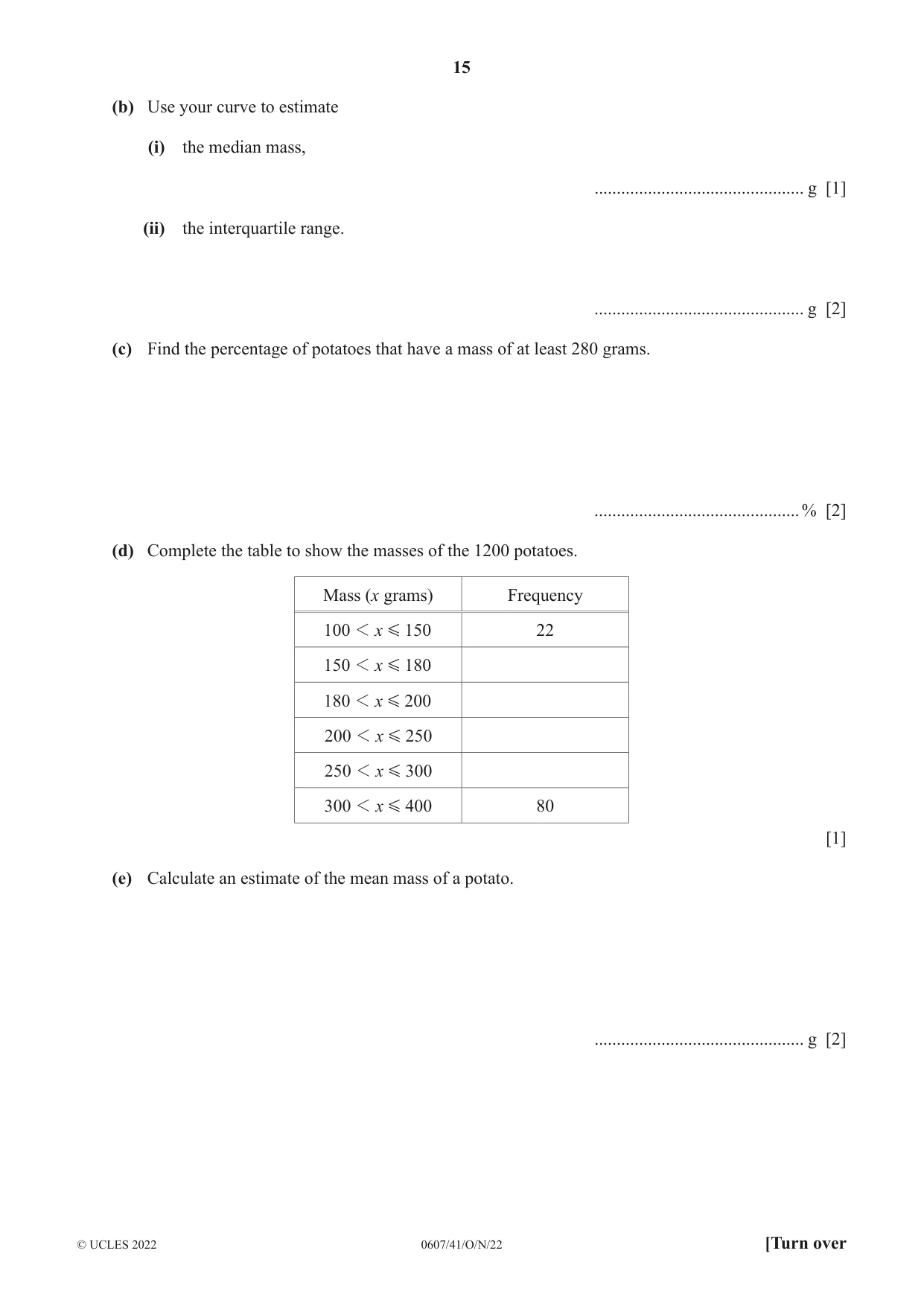
8 The cumulative frequency table shows the masses, in grams, of 1200 potatoes. Cumulative Mass (x grams) frequency x G 150 22 x G 180 160 x G 200 480 x G 250 860 x G 300 1120 x G 400 1200 (a) On the grid below, draw a cumulative frequency curve. 1200 1100 1000 900 800 700Cumulative frequency 600 500 400 300 200 100 0 x 100 120 140 160 180 200 220 240 260 280 300 320 340 360 380 400 Mass [3] (b) Use your curve to estimate (i) the median mass, ............................................... g [1] (ii) the interquartile range. ............................................... g [2] (c) Find the percentage of potatoes that have a mass of at least 280 grams. ..............................................% [2] (d) Complete the table to show the masses of the 1200 potatoes. Mass (x grams) Frequency 100 1 x G 150 22 150 1 x G 180 180 1 x G 200 200 1 x G 250 250 1 x G 300 300 1 x G 400 80 [1] (e) Calculate an estimate of the mean mass of a potato. ............................................... g [2]
Mark scheme: 8(a) Correct curve 3 M1 for at least 5 horizontal plots correct (150, 22) (180, 160) (200, 480) M1 for at least 5 vertical plots correct (250, 860) (300, 1120) (400, 1200) 8(b)(i) 208 to 218 1 FT their curve 8(b)(ii) 55 to 75 2 M1FT for [UQ =] 250 to 260 or [LQ =] 185 to 195 seen 8(c) 12 to 17 2 1200 − their 1020 M1 for [100] 1200 their 1020 or 100 1200 8(d) [22], 138, 320, 380, 260, [80] 1 8(e) 226.1 or 226 2 M1 for at least four of 125, 165, 190, 225, 275, 350 soi
Q9 · NOT TO SCALE The diagram shows a square of side 2a cm inside a square of side ( 2a + 2x)cm
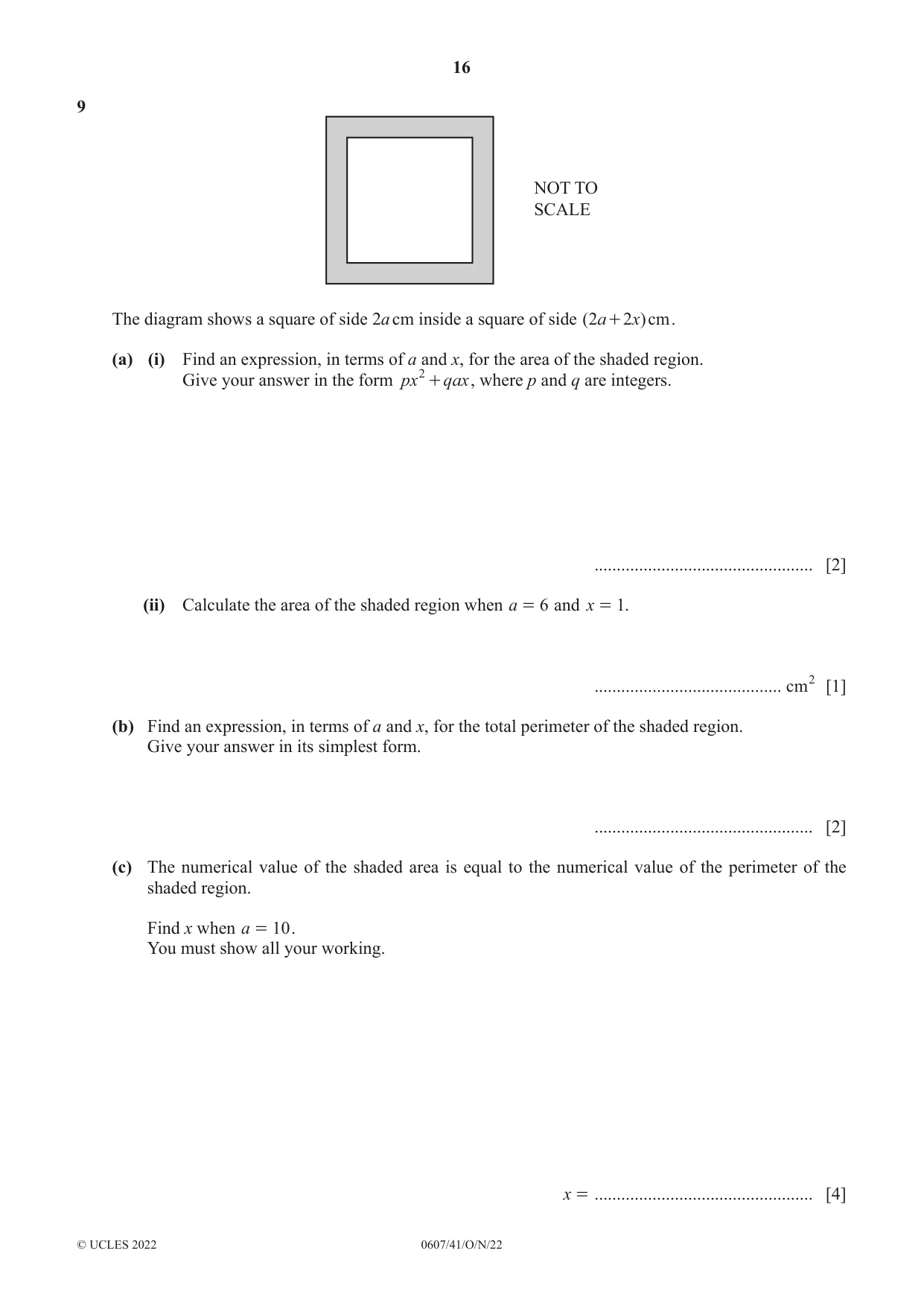
9 NOT TO SCALE The diagram shows a square of side 2a cm inside a square of side ( 2a + 2x)cm . (a) (i) Find an expression, in terms of a and x, for the area of the shaded region. Give your answer in the form px 2 + qax , where p and q are integers. ................................................. [2] (ii) Calculate the area of the shaded region when a = 6 and x = 1. .......................................... cm2 [1] (b) Find an expression, in terms of a and x, for the total perimeter of the shaded region. Give your answer in its simplest form. ................................................. [2] (c) The numerical value of the shaded area is equal to the numerical value of the perimeter of the shaded region. Find x when a = 10 . You must show all your working. x = ................................................. [4]
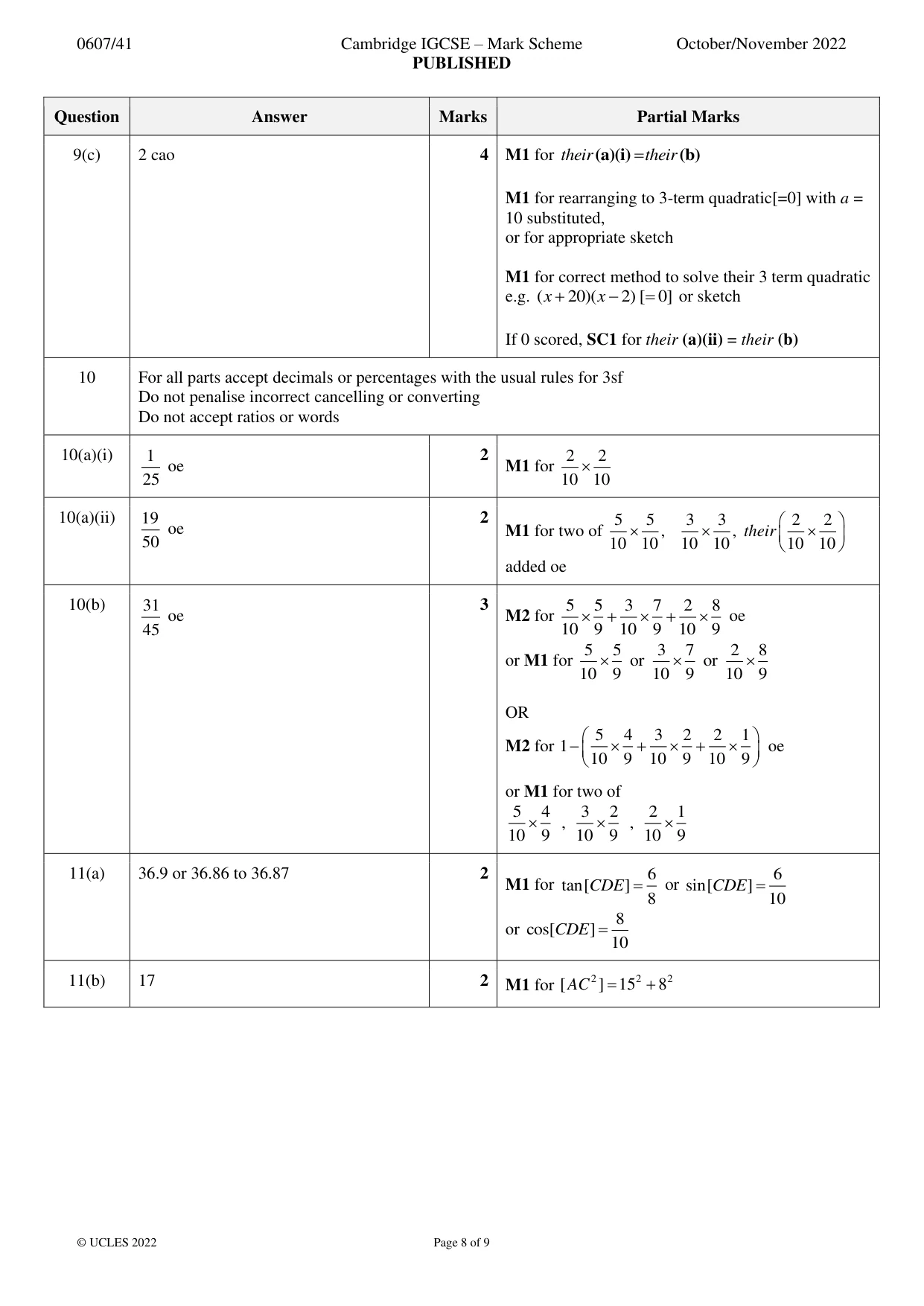
Mark scheme: 9(a)(i) 4 x 2 + 8ax final answer 2 M1 for (2 a + 2 x ) 2 − (2 a ) 2 oe 9(a)(ii) 52 1 FT their (i) if answer positive and if a and x both used 9(b) 8x + 16a or 8(x + 2a) oe final answer 2 M1 for 4(2a + 2 x) + 4(2a ) oe 9(c) 2 cao 4 M1 for their (a)(i) = their (b) M1 for rearranging to 3-term quadratic[=0] with a = 10 substituted, or for appropriate sketch M1 for correct method to solve their 3 term quadratic e.g. ( x + 20)( x − 2) [ = 0] or sketch If 0 scored, SC1 for their (a)(ii) = their (b) 10 For all parts accept decimals or percentages with the usual rules for 3sf Do not penalise incorrect cancelling or converting Do not accept ratios or words
Q10 · A bag contains 5 red balls, 3 blue balls and 2 green balls
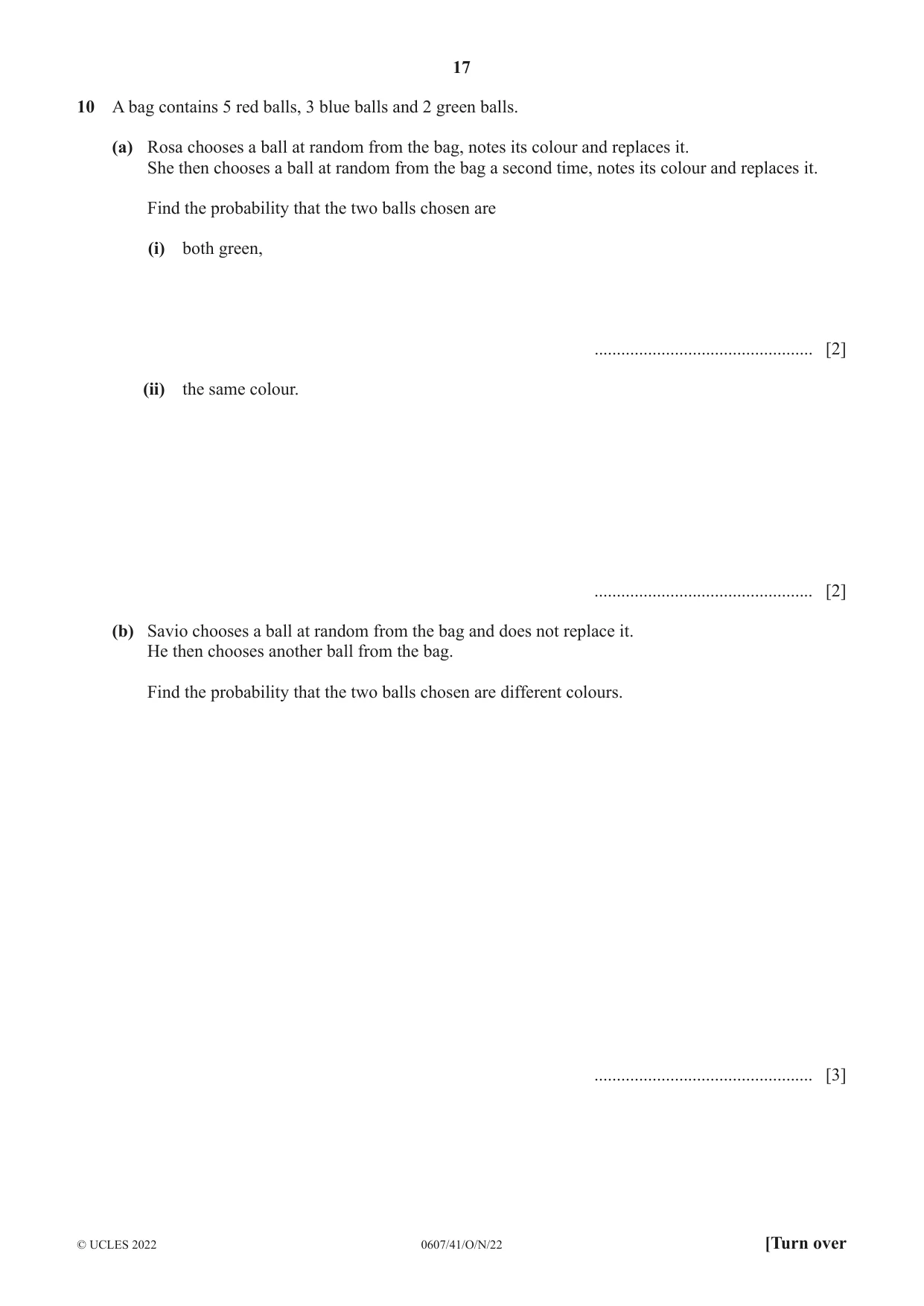
10 A bag contains 5 red balls, 3 blue balls and 2 green balls. (a) Rosa chooses a ball at random from the bag, notes its colour and replaces it. She then chooses a ball at random from the bag a second time, notes its colour and replaces it. Find the probability that the two balls chosen are (i) both green, ................................................. [2] (ii) the same colour. ................................................. [2] (b) Savio chooses a ball at random from the bag and does not replace it. He then chooses another ball from the bag. Find the probability that the two balls chosen are different colours. ................................................. [3]
Mark scheme: 10(a)(i) 1 2 2 2 oe M1 for 25 10 10 10(a)(ii) 19 2 5 5 3 3 2 2 oe M1 for two of , , their 50 10 10 10 10 10 10 added oe 10(b) 31 3 5 5 3 7 2 8 oe M2 for + + oe 45 10 9 10 9 10 9 5 5 3 7 2 8 or M1 for or or 10 9 10 9 10 9 OR 5 4 3 2 2 1 M2 for 1 − + + oe 10 9 10 9 10 9 or M1 for two of 5 4 3 2 2 1 , , 10 9 10 9 10 9
Q11 · F X E NOT TO SCALE B A C D The diagram shows a triangular prism ABCDEF
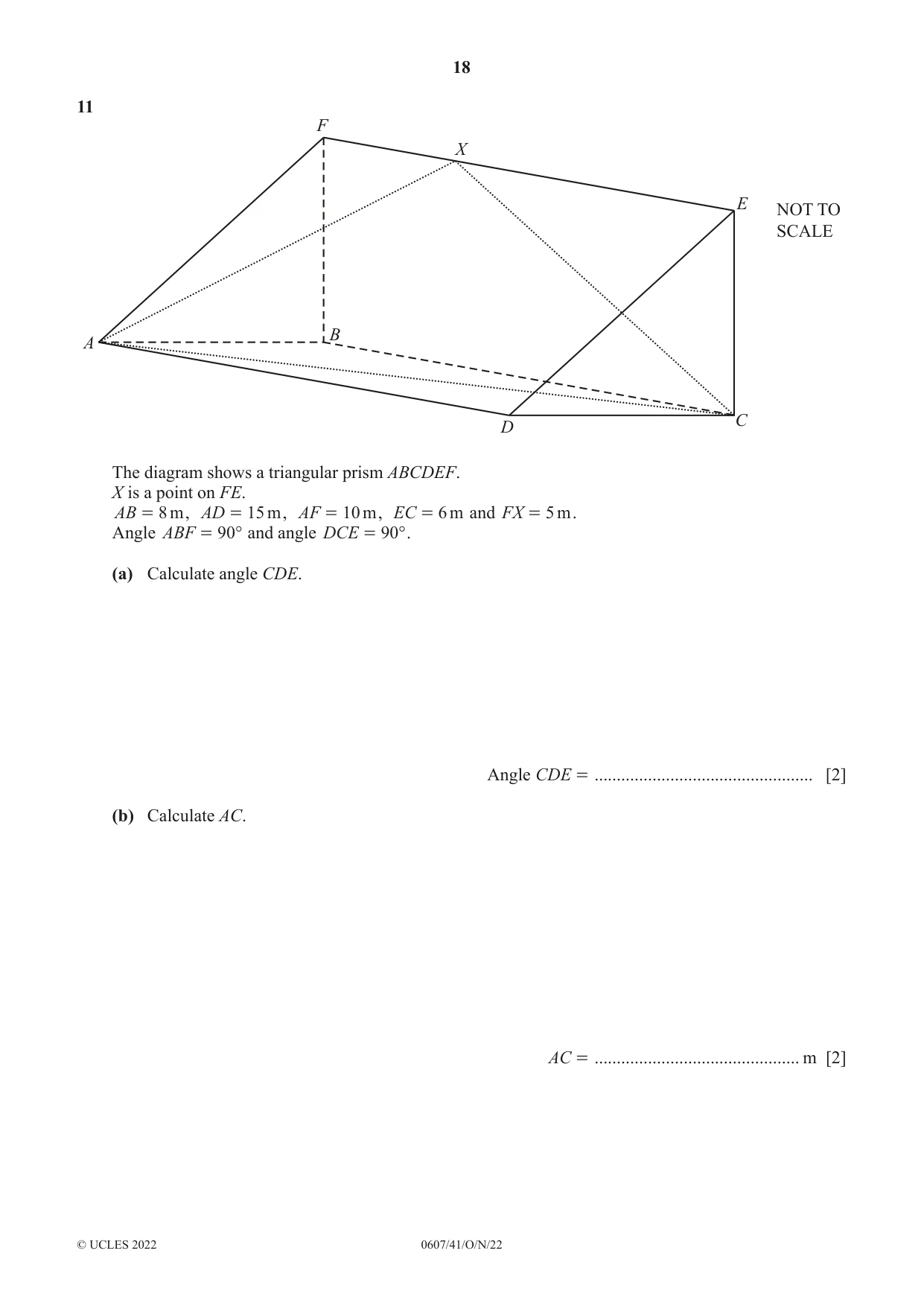
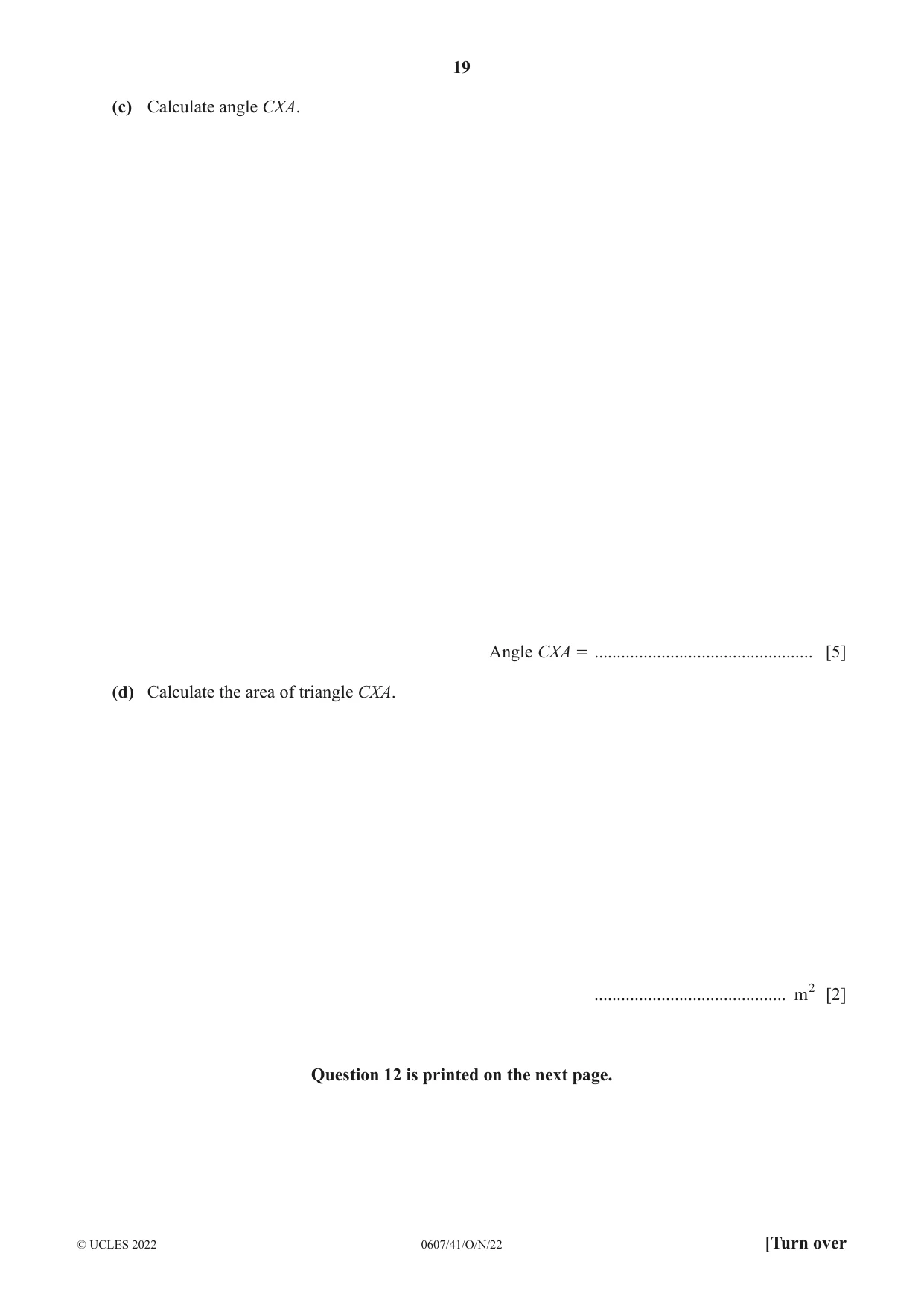
11 F X E NOT TO SCALE B A C D The diagram shows a triangular prism ABCDEF. X is a point on FE. AB = 8 m , AD = 15 m , AF = 10 m , EC = 6 m and FX = 5 m . Angle ABF = 90° and angle DCE = 90° . (a) Calculate angle CDE. Angle CDE = ................................................. [2] (b) Calculate AC. AC = .............................................. m [2] (c) Calculate angle CXA. Angle CXA = ................................................. [5] (d) Calculate the area of triangle CXA. ........................................... m2 [2] Question 12 is printed on the next page.
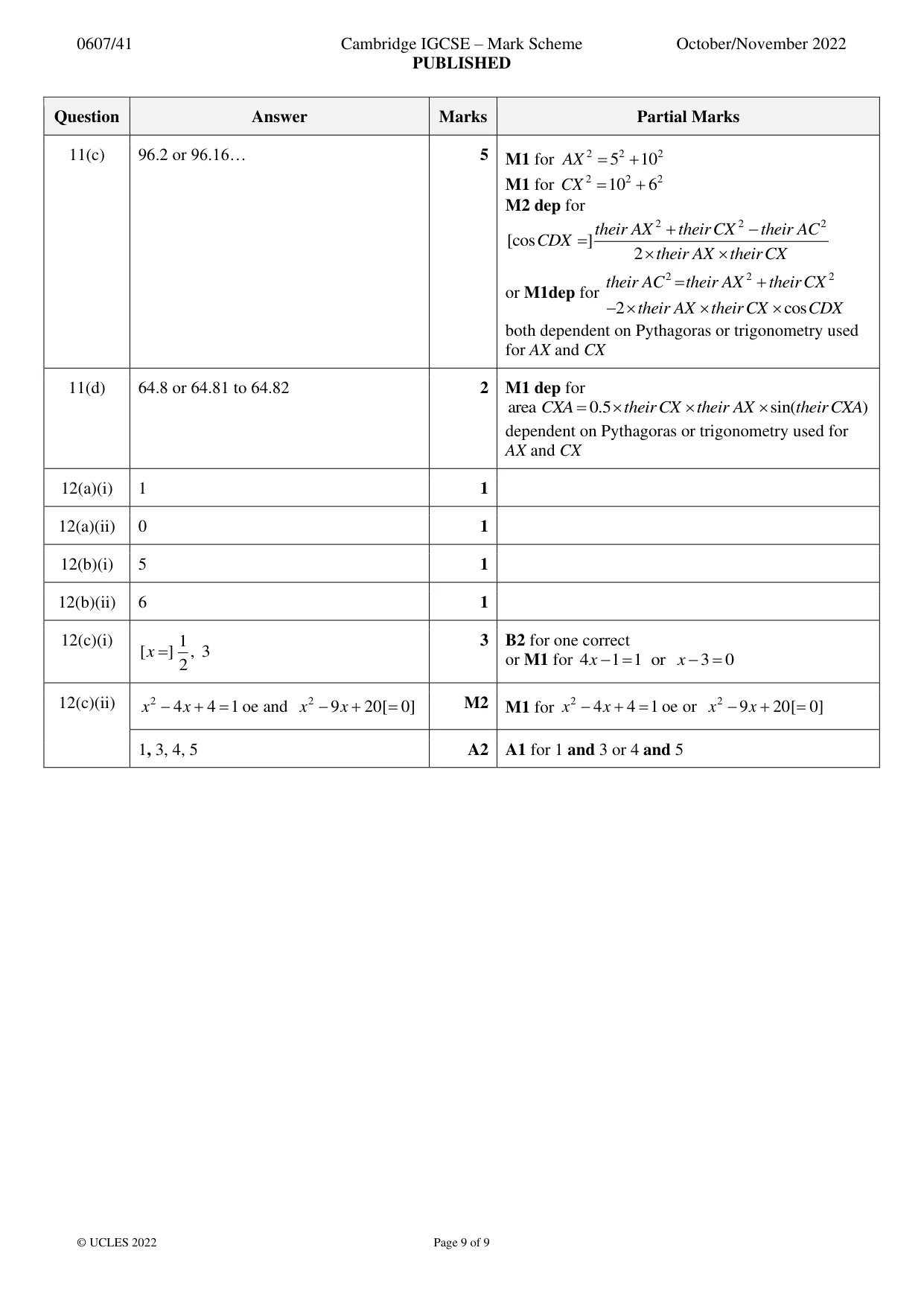
Mark scheme: 11(a) 36.9 or 36.86 to 36.87 2 6 6 M1 for tan[CDE ] = or sin[CDE ] = 8 10 8 or cos[CDE ] = 10 11(b) 17 2 M1 for [ AC 2 ] = 15 2 + 8 2 11(c) 96.2 or 96.16… 5 M1 for AX 2 = 52 + 10 2 M1 for CX 2 = 10 2 + 6 2 M2 dep for their AX 2 + theirCX 2 − their AC 2 [cos CDX =] 2 their AX theirCX their AC 2 = their AX 2 + theirCX 2 or M1dep for −2 their AX theirCX cos CDX both dependent on Pythagoras or trigonometry used for AX and CX 11(d) 64.8 or 64.81 to 64.82 2 M1 dep for area CXA = 0.5 theirCX their AX sin(theirCXA) dependent on Pythagoras or trigonometry used for AX and CX
Q12 · A b = 1 where a 2 0 (i) When b = 13 , write down the value of a
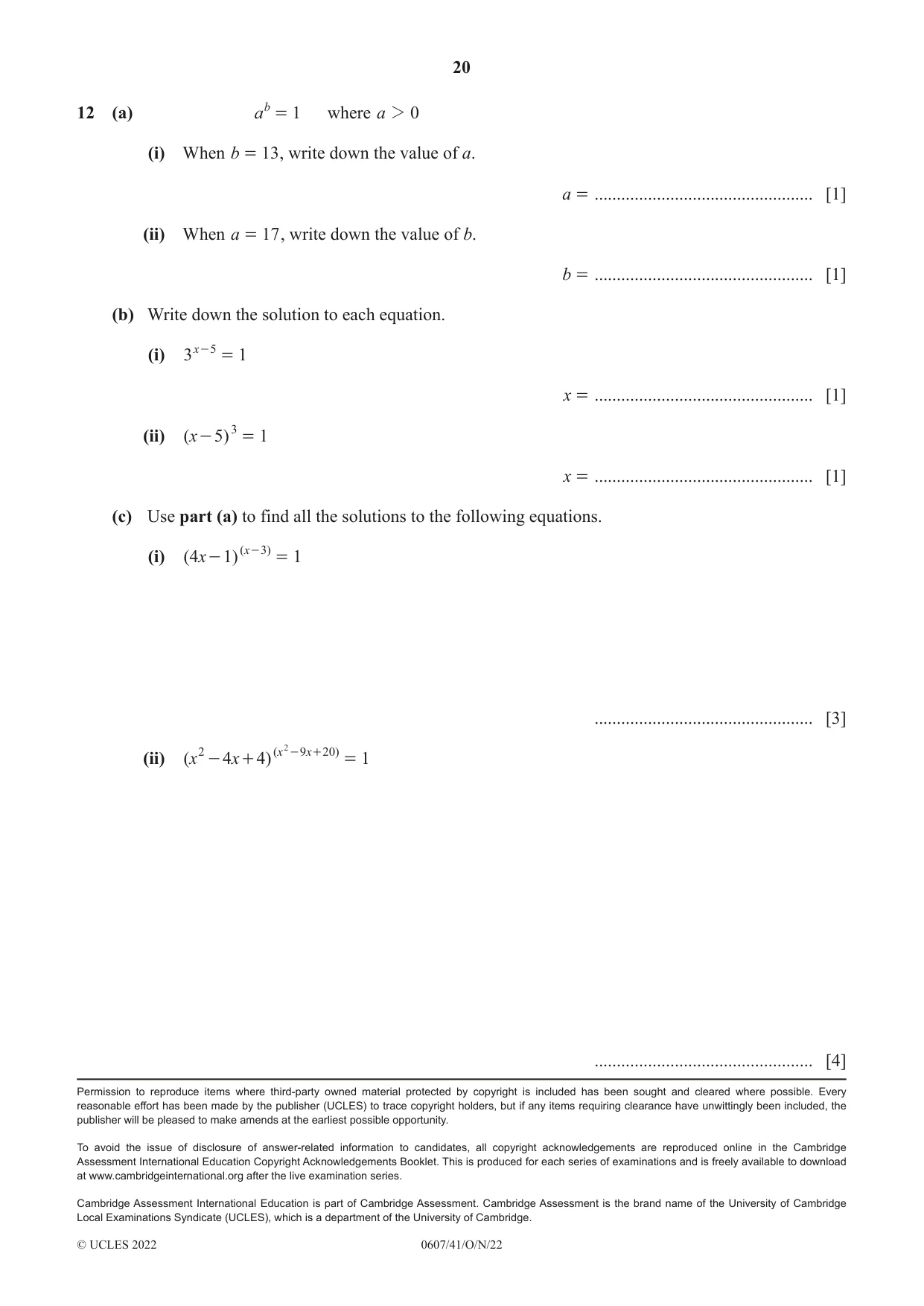
12 (a) a b = 1 where a 2 0 (i) When b = 13 , write down the value of a. a = ................................................. [1] (ii) When a = 17 , write down the value of b. b = ................................................. [1] (b) Write down the solution to each equation. (i) 3 x - 5 = 1 x = ................................................. [1] (ii) ( x - 5) 3 = 1 x = ................................................. [1] (c) Use part (a) to find all the solutions to the following equations. (i) ( 4x - 1) ( x - 3 ) = 1 ................................................. [3] (ii) ( x 2 - 4x + 4) ( x 2 - 9 x + 20 ) = 1 ................................................. [4]
Mark scheme: 12(a)(i) 1 1 12(a)(ii) 0 1 12(b)(i) 5 1 12(b)(ii) 6 1 12(c)(i) 1 3 B2 for one correct [ x =] , 3 or M1 for 4 x −=1 1 or x −=3 0 2 12(c)(ii) x 2 − 4 x + 4 = 1 oe and x 2 − 9 x + 20[ = 0] M2 M1 for x 2 − 4 x + 4 = 1 oe or x 2 − 9 x + 20[ = 0] 1, 3, 4, 5 A2 A1 for 1 and 3 or 4 and 5
What was in this paper
The subtopics covered by these 12 questions, and how many questions each got. Open one in a new tab to see every Cambridge question on it.
What you needed in this session
Cambridge’s own grade thresholds for 2022 Oct/Nov, Paper 4 · Variant 1. A higher threshold means an easier paper — the bar moves with how the cohort did.