Cambridge IGCSE Mathematics - International 0607 — 2024 Oct/Nov Paper 4 · Variant 3
0607/43/O/N/24 · 11 questions · 120 marks · ≈135 min
The question paper and its mark scheme, free to read here and free to download. This is Cambridge’s own paper, exactly as it was sat.
Question paper20 pages
Mark scheme9 pages
Answers below. Sit the paper first if you are practising.
Questions as text
Q1 · The table shows the heights of 100 sunflower plants
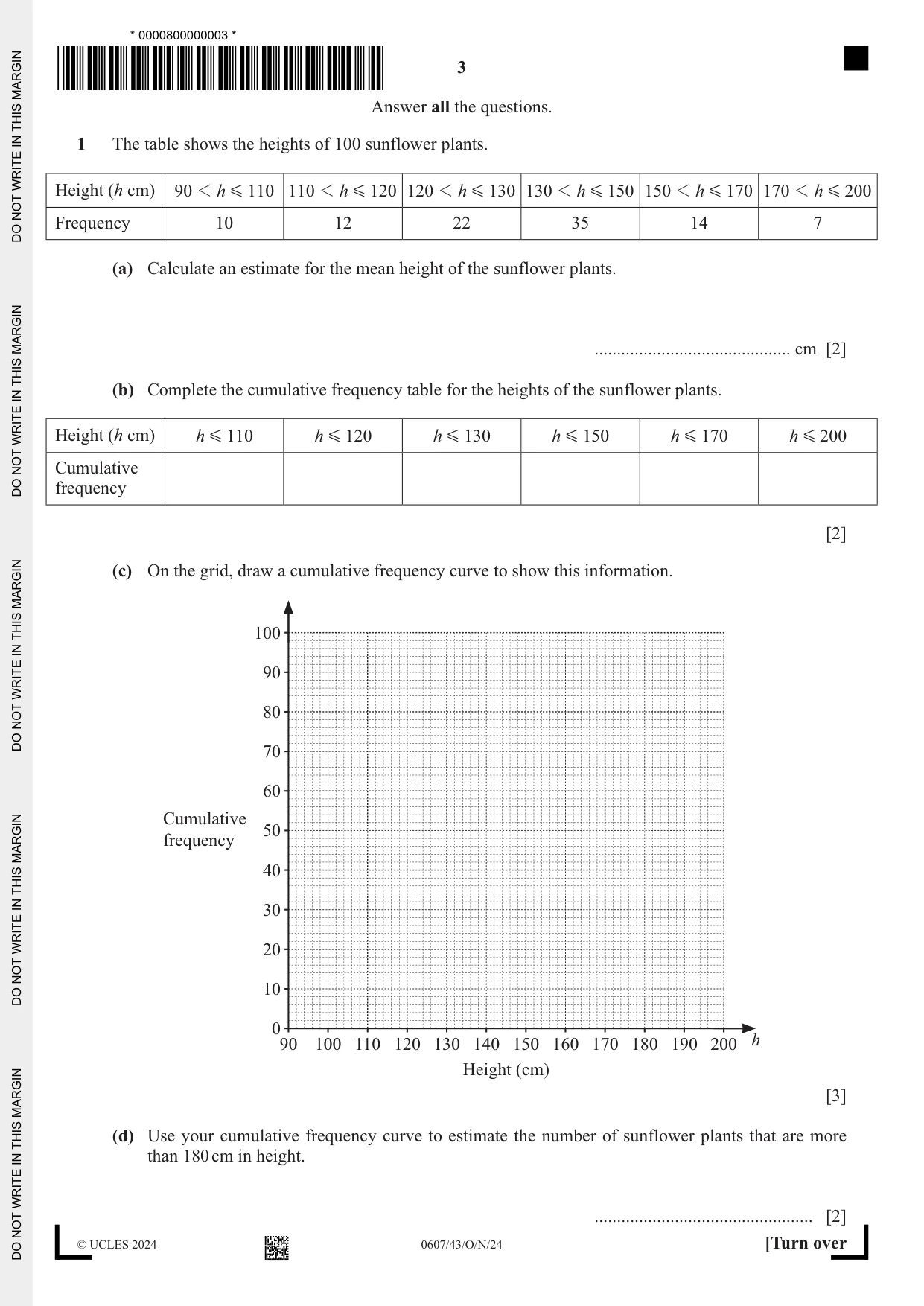
1 The table shows the heights of 100 sunflower plants. Height (h cm) 90 1 h G 11 0 110 1 h G 120 12 0 1 h G 130 130 1 h G 150 150 1 h G 170 170 1 h G 200 Frequency 10 12 22 35 14 7 (a) Calculate an estimate for the mean height of the sunflower plants. ............................................ cm [2] (b) Complete the cumulative frequency table for the heights of the sunflower plants. Height (h cm) h G 110 h G 120 h G 130 h G 150 h G 170 h G 200 Cumulative frequency [2] (c) On the grid, draw a cumulative frequency curve to show this information. 100 90 80 70 60 Cumulative 50 frequency 40 30 20 10 0 90 100 110 120 130 140 150 160 170 180 190 200 h Height (cm) [3] (d) Use your cumulative frequency curve to estimate the number of sunflower plants that are more than 180 cm in height. ................................................. [2]
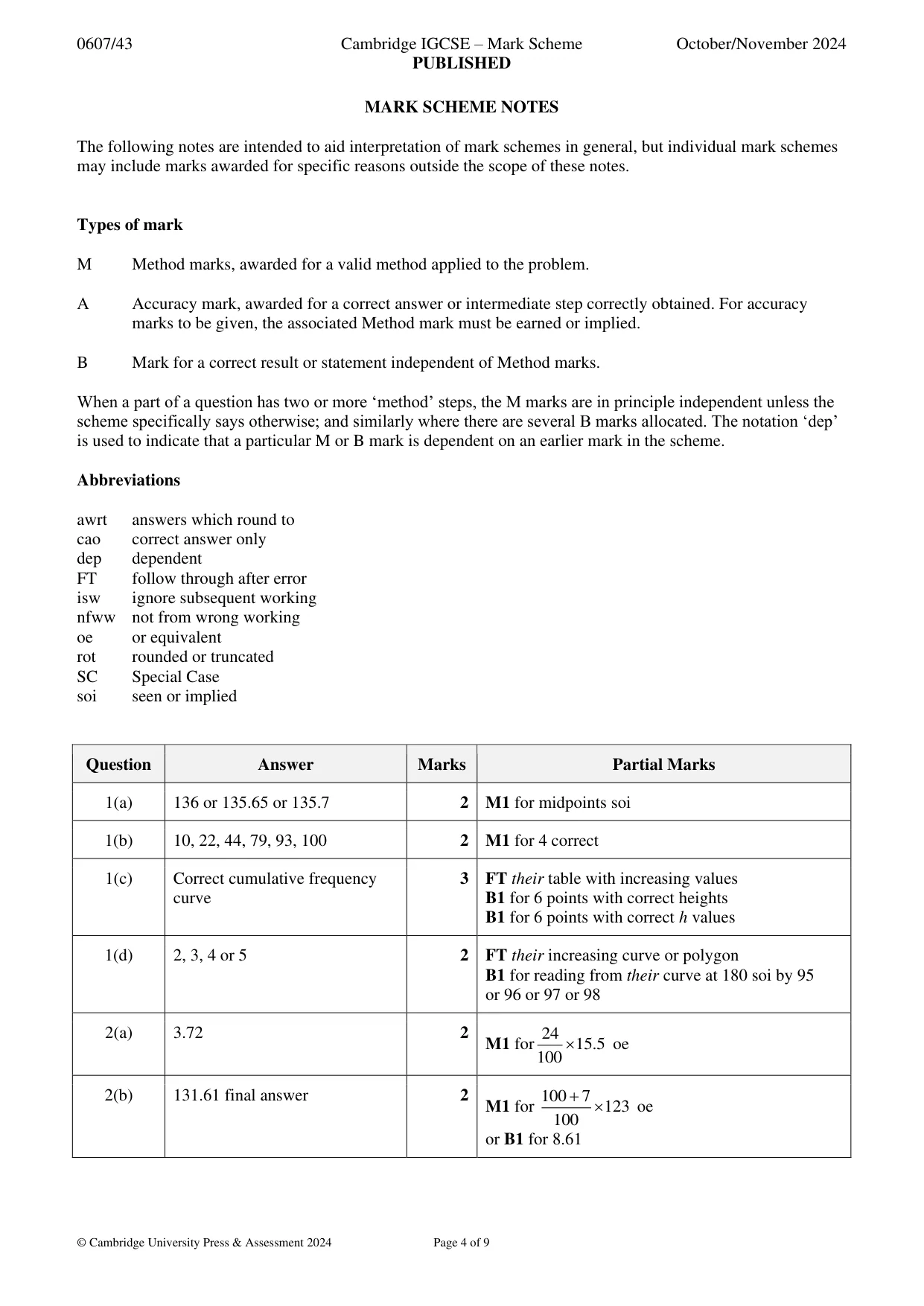
Mark scheme: Question Answer Marks Partial Marks 1(a) 136 or 135.65 or 135.7 2 M1 for midpoints soi 1(b) 10, 22, 44, 79, 93, 100 2 M1 for 4 correct 1(c) Correct cumulative frequency 3 FT their table with increasing values curve B1 for 6 points with correct heights B1 for 6 points with correct h values 1(d) 2, 3, 4 or 5 2 FT their increasing curve or polygon B1 for reading from their curve at 180 soi by 95 or 96 or 97 or 98
Q2 · Work out 24% of $15.50
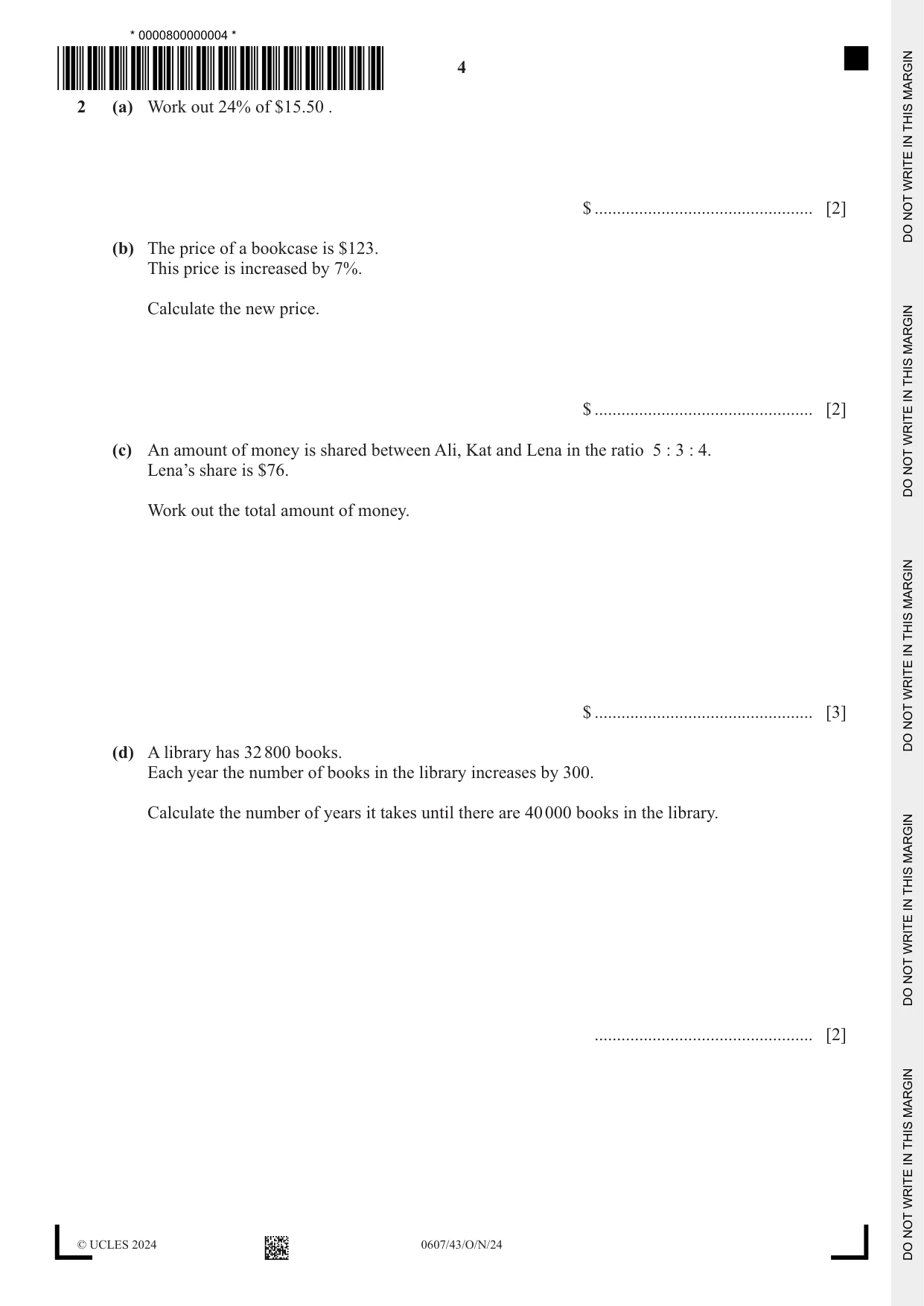
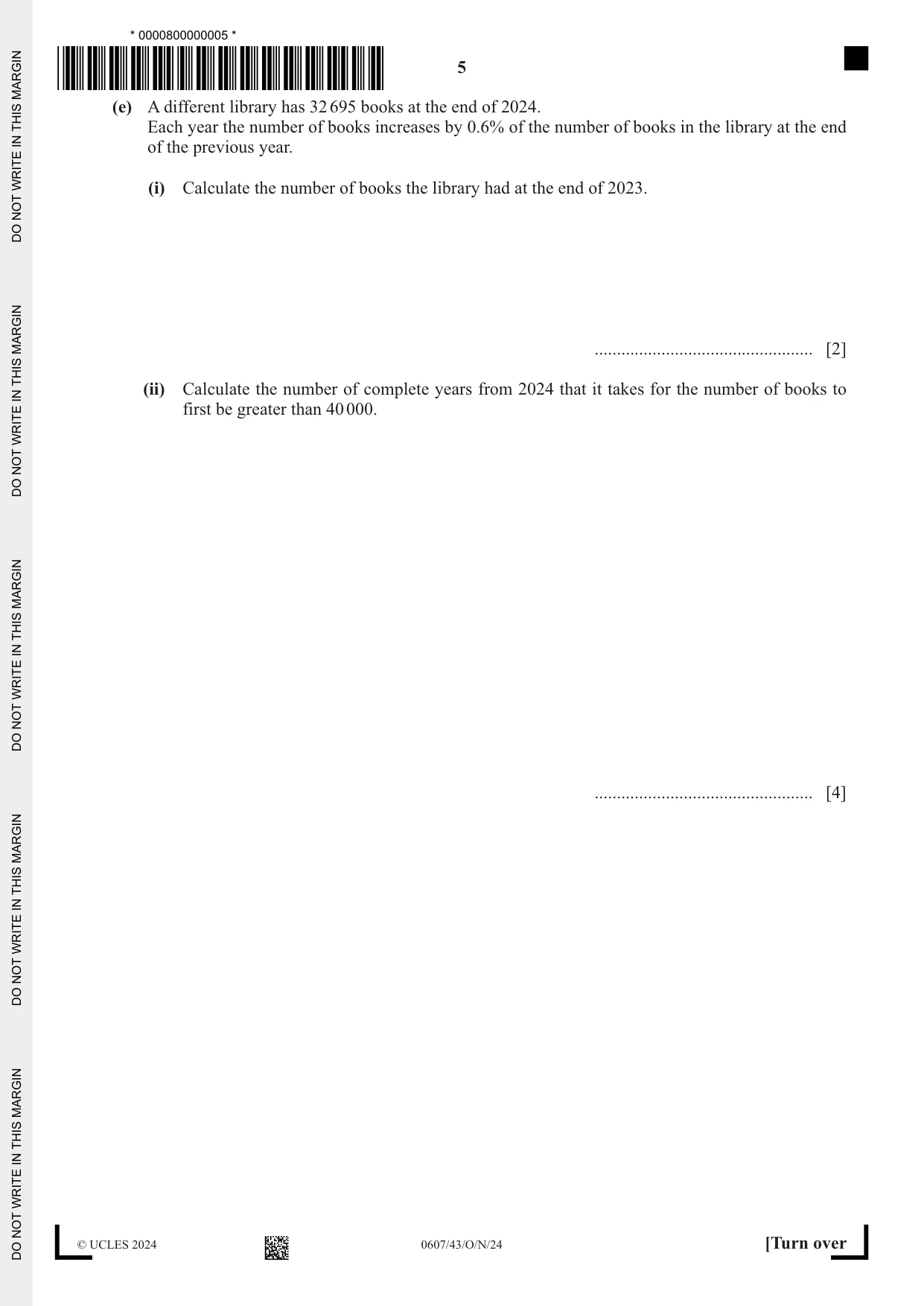
2 (a) Work out 24% of $15.50 . $ ................................................. [2] (b) The price of a bookcase is $123. This price is increased by 7%. Calculate the new price. $ ................................................. [2] (c) An amount of money is shared between Ali, Kat and Lena in the ratio 5 : 3 : 4. Lena’s share is $76. Work out the total amount of money. $ ................................................. [3] (d) A library has 32 800 books. Each year the number of books in the library increases by 300. Calculate the number of years it takes until there are 40 000 books in the library. ................................................. [2] (e) A different library has 32 695 books at the end of 2024. Each year the number of books increases by 0.6% of the number of books in the library at the end of the previous year. (i) Calculate the number of books the library had at the end of 2023. ................................................. [2] (ii) Calculate the number of complete years from 2024 that it takes for the number of books to first be greater than 40 000. ................................................. [4]
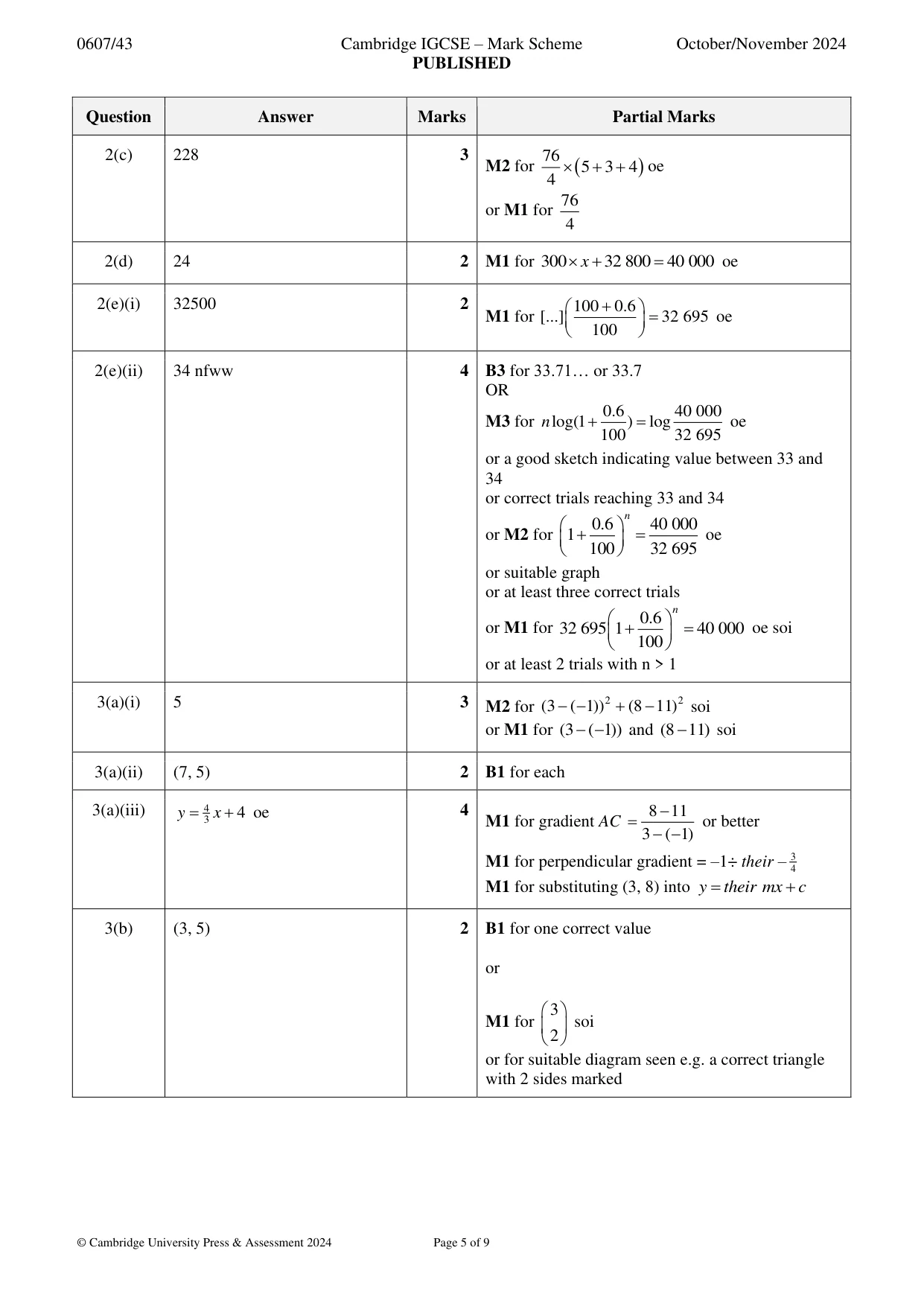
Mark scheme: 2(a) 3.72 2 24 M1 for 15.5 oe 100 2(b) 131.61 final answer 2 100 + 7 M1 for 123 oe 100 or B1 for 8.61 2(c) 228 3 76 M2 for ( 5 + 3 + 4 ) oe 4 76 or M1 for 4 2(d) 24 2 M1 for 300 +x 32 800 = 40 000 oe 2(e)(i) 32500 2 100 + 0.6 M1 for [...] = 32 695 oe 100 2(e)(ii) 34 nfww 4 B3 for 33.71… or 33.7 OR 0.6 40 000 M3 for n log(1 + ) = log oe 100 32 695 or a good sketch indicating value between 33 and 34 or correct trials reaching 33 and 34 0.6 n 40 000 or M2 for 1 + = oe 100 32 695 or suitable graph or at least three correct trials 0.6 n or M1 for 32 695 1 + = 40 000 oe soi 100 or at least 2 trials with n > 1
Q3 · AC is a straight line
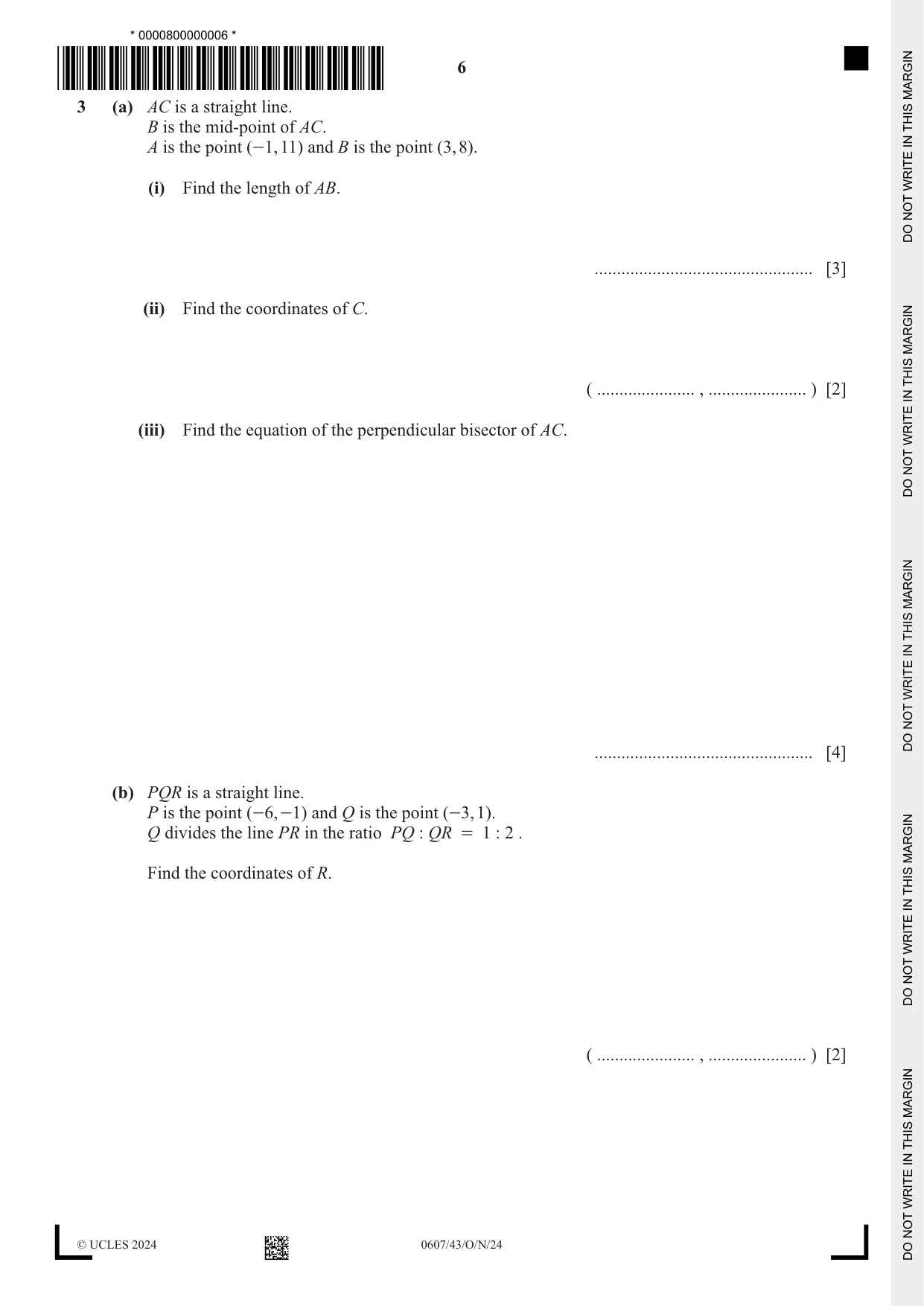
3 (a) AC is a straight line. B is the mid-point of AC. A is the point (-1, 11) and B is the point (3, 8). (i) Find the length of AB. ................................................. [3] (ii) Find the coordinates of C. ( ...................... , ...................... ) [2] (iii) Find the equation of the perpendicular bisector of AC. ................................................. [4] (b) PQR is a straight line. P is the point (-6, -1) and Q is the point (-3, 1). Q divides the line PR in the ratio PQ : QR = 1 : 2 . Find the coordinates of R. ( ...................... , ...................... ) [2]
Mark scheme: 3(a)(i) 5 3 M2 for (3 −−( 1)) 2 + (8 − 11) 2 soi or M1 for (3 −−( 1)) and (8 − 11) soi 3(a)(ii) (7, 5) 2 B1 for each 3(a)(iii) y = 43 x + 4 oe 4 M1 for gradient AC = 8 − 11 or better 3 −−( 1) M1 for perpendicular gradient = –1÷ their – 34 M1 for substituting (3, 8) into y = their mx + c 3(b) (3, 5) 2 B1 for one correct value or 3 M1 for soi 2 or for suitable diagram seen e.g. a correct triangle with 2 sides marked
Q4 · Y 17 0 x -3 3 -13 3 3 2 f ( )x = x - 4x + 2 g ( )x = + x x (a) On the diagram, sketch the…
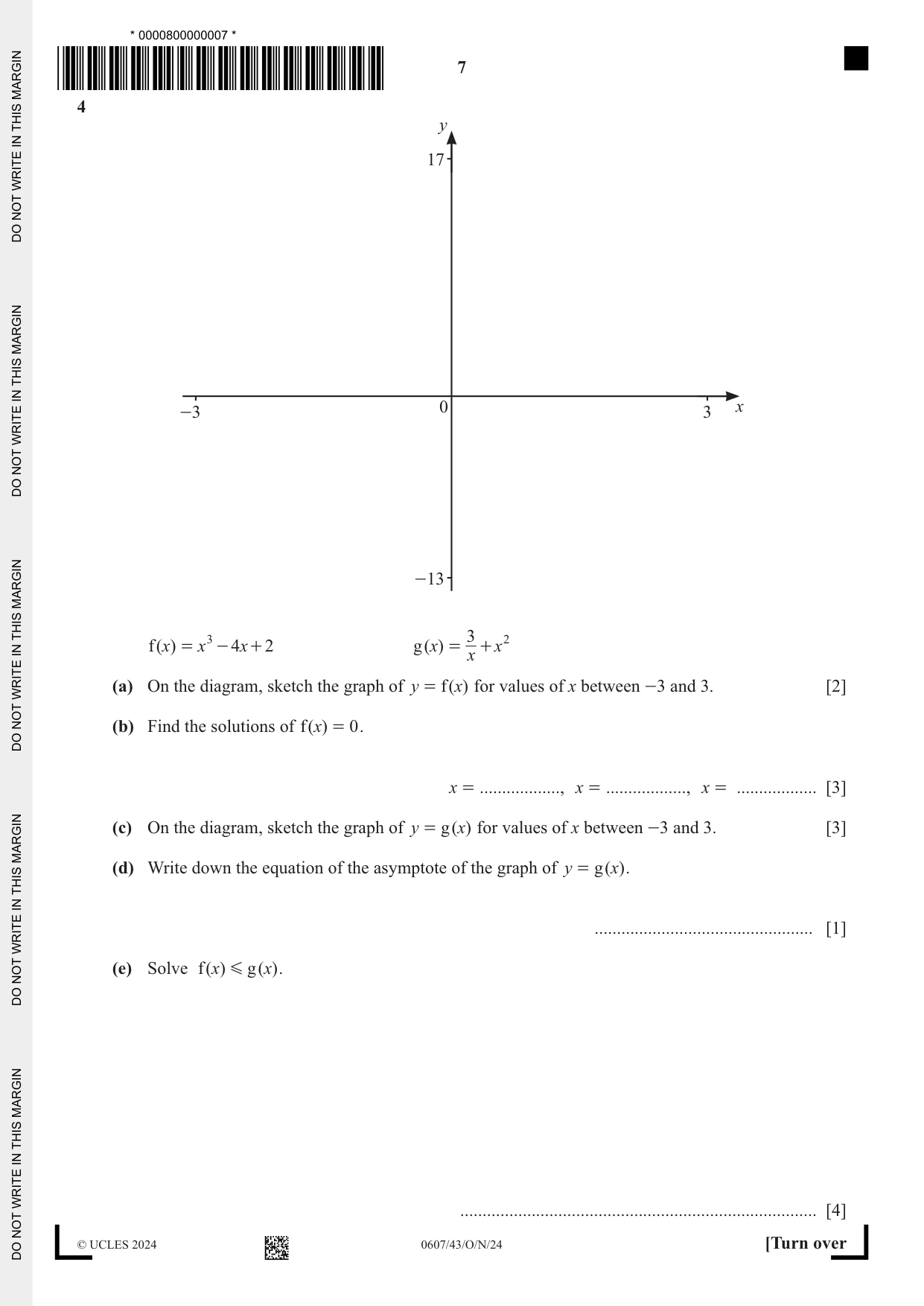
4 y 17 0 x -3 3 -13 3 3 2 f ( )x = x - 4x + 2 g ( )x = + x x (a) On the diagram, sketch the graph of y = f ( x) for values of x between -3 and 3. [2] (b) Find the solutions of f ( )x = 0 . x = .................., x = .................., x = .................. [3] (c) On the diagram, sketch the graph of y = g ( x) for values of x between -3 and 3. [3] (d) Write down the equation of the asymptote of the graph of y = g ( x) . ................................................. [1] (e) Solve f ( x) G g ( x) . ................................................................................ [4]
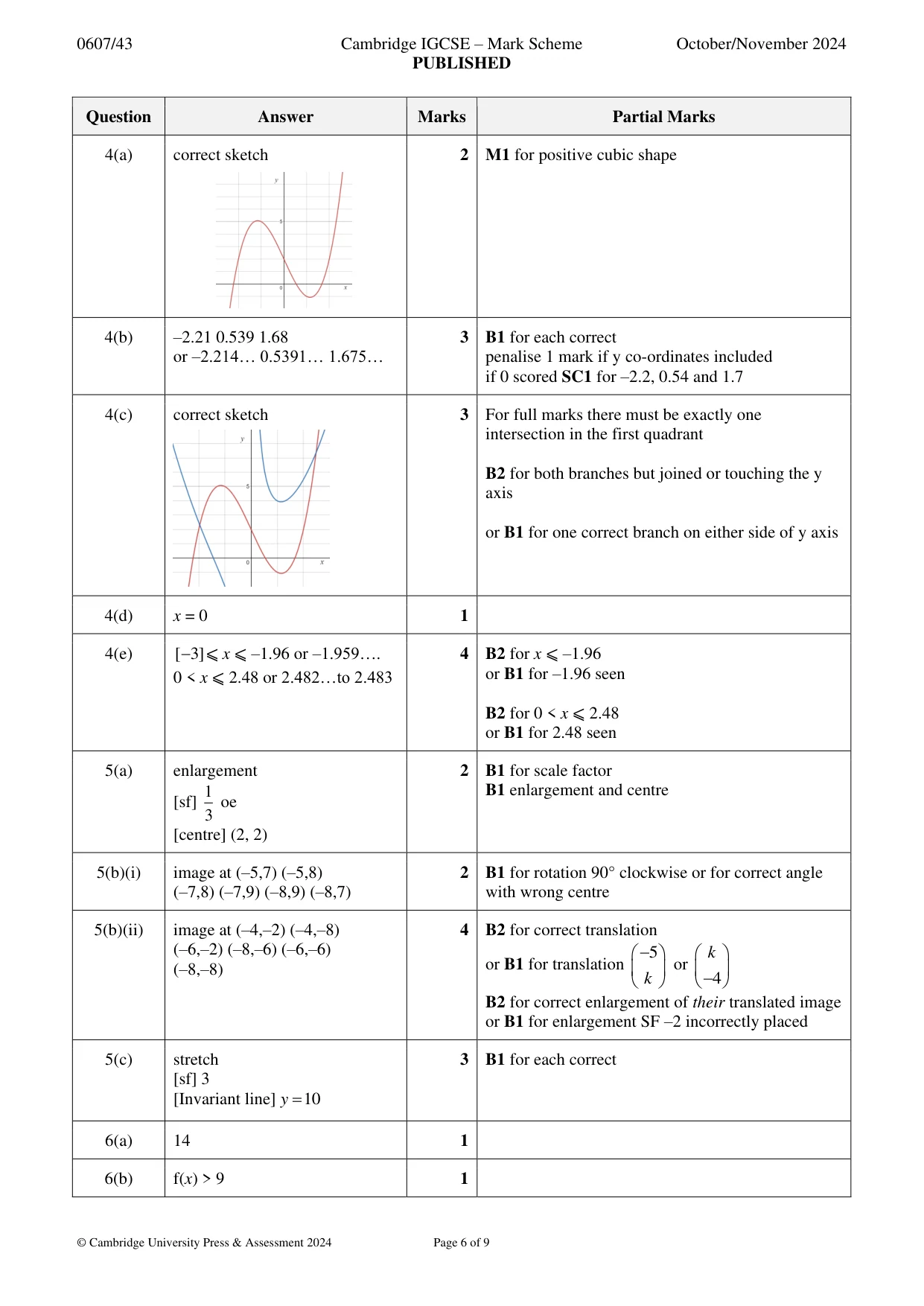
Mark scheme: 4(a) correct sketch 2 M1 for positive cubic shape 4(b) –2.21 0.539 1.68 3 B1 for each correct or –2.214… 0.5391… 1.675… penalise 1 mark if y co-ordinates included if 0 scored SC1 for –2.2, 0.54 and 1.7 4(c) correct sketch 3 For full marks there must be exactly one intersection in the first quadrant B2 for both branches but joined or touching the y axis or B1 for one correct branch on either side of y axis 4(d) x = 0 1 4(e) [ −3] ⩽ x ⩽ –1.96 or –1.959…. 4 B2 for x ⩽ –1.96 0 < x ⩽ 2.48 or 2.482…to 2.483 or B1 for –1.96 seen B2 for 0 < x ⩽ 2.48 or B1 for 2.48 seen
Q5 · Describe fully the single transformation that is the inverse of an enlargement with scale…
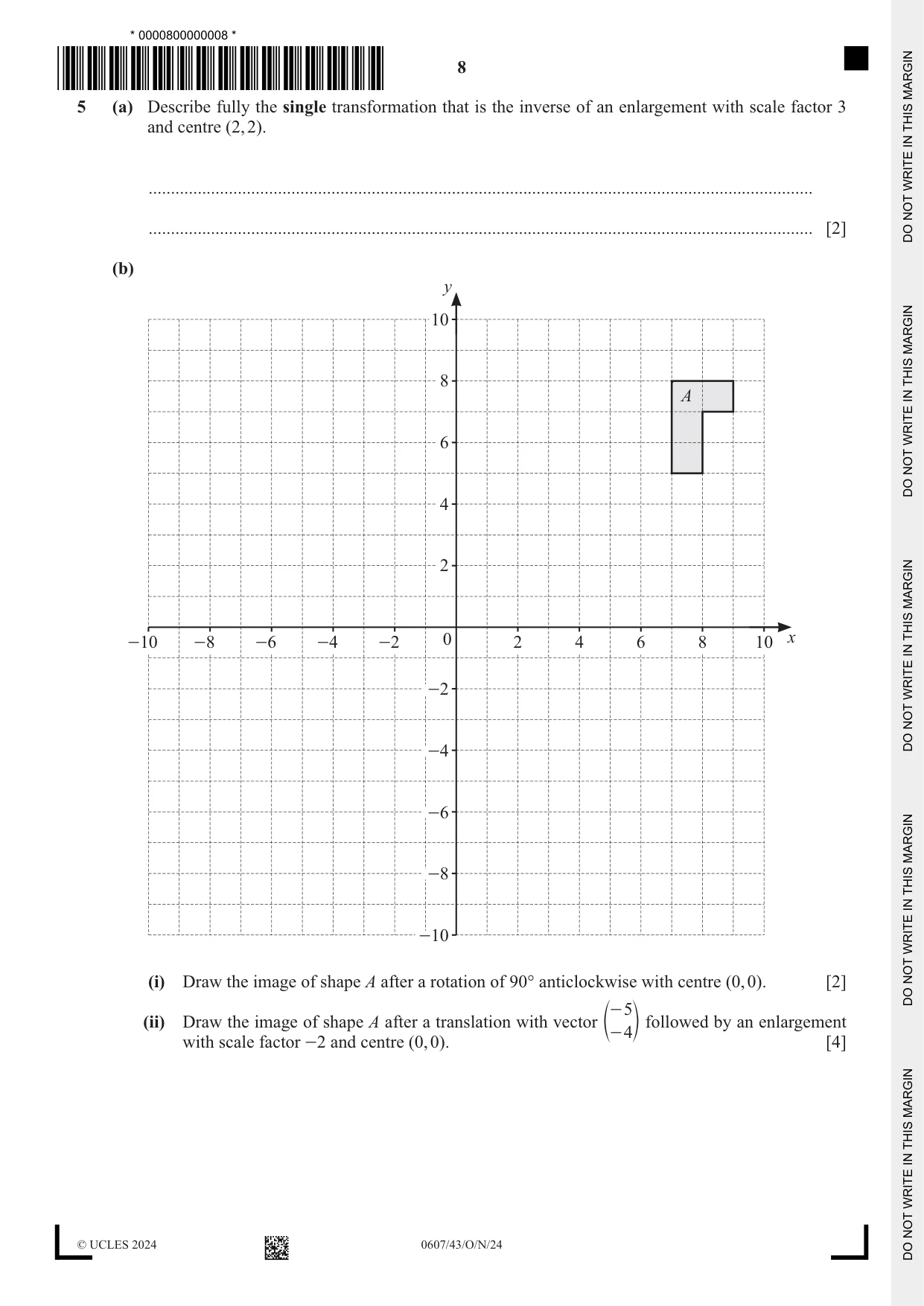
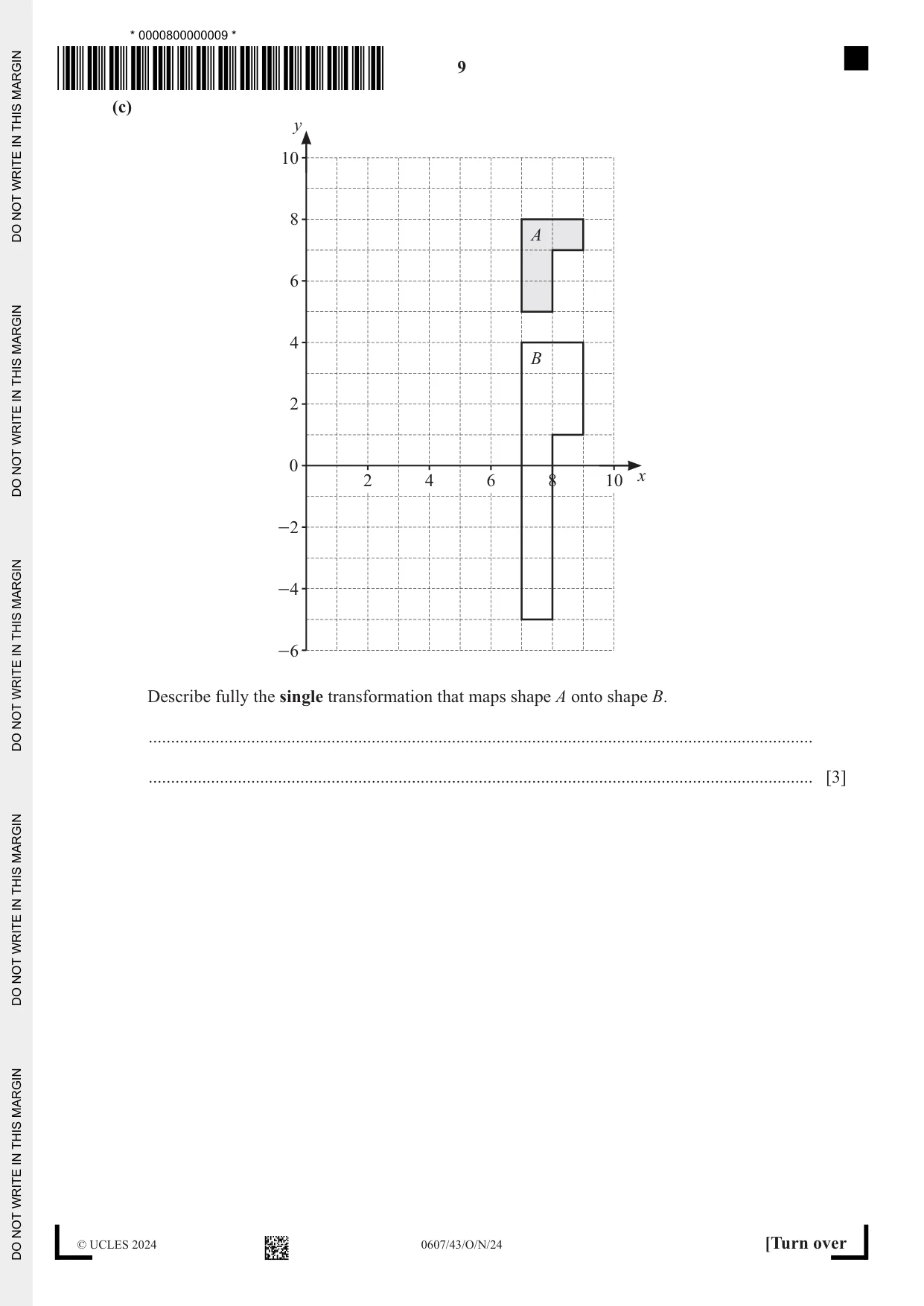
5 (a) Describe fully the single transformation that is the inverse of an enlargement with scale factor 3 and centre (2, 2). ..................................................................................................................................................... ..................................................................................................................................................... [2] (b) y 10 8 A 6 4 2 -10 -8 -6 -4 -2 0 2 4 6 8 10 x -2 -4 -6 -8 -10 (i) Draw the image of shape A after a rotation of 90° anticlockwise with centre (0, 0). [2] - 5 (ii) Draw the image of shape A after a translation with vector e o followed by an enlargement - 4 with scale factor -2 and centre (0, 0). [4] (c) y 10 8 A 6 4 B 2 0 x 2 4 6 8 10 -2 -4 -6 Describe fully the single transformation that maps shape A onto shape B. ..................................................................................................................................................... ..................................................................................................................................................... [3]
Mark scheme: 5(a) enlargement 2 B1 for scale factor 1 B1 enlargement and centre [sf] oe 3 [centre] (2, 2) 5(b)(i) image at (–5,7) (–5,8) 2 B1 for rotation 90° clockwise or for correct angle (–7,8) (–7,9) (–8,9) (–8,7) with wrong centre 5(b)(ii) image at (–4,–2) (–4,–8) 4 B2 for correct translation (–6,–2) (–8,–6) (–6,–6) −5 k or B1 for translation or (–8,–8) k −4 B2 for correct enlargement of their translated image or B1 for enlargement SF –2 incorrectly placed 5(c) stretch 3 B1 for each correct [sf] 3 [Invariant line] y = 10
Q6 · F ( )x = 5x - 1 g ( )x = x 2 + x h ( x) = ( x - 1) 3 The domain for all three functions…
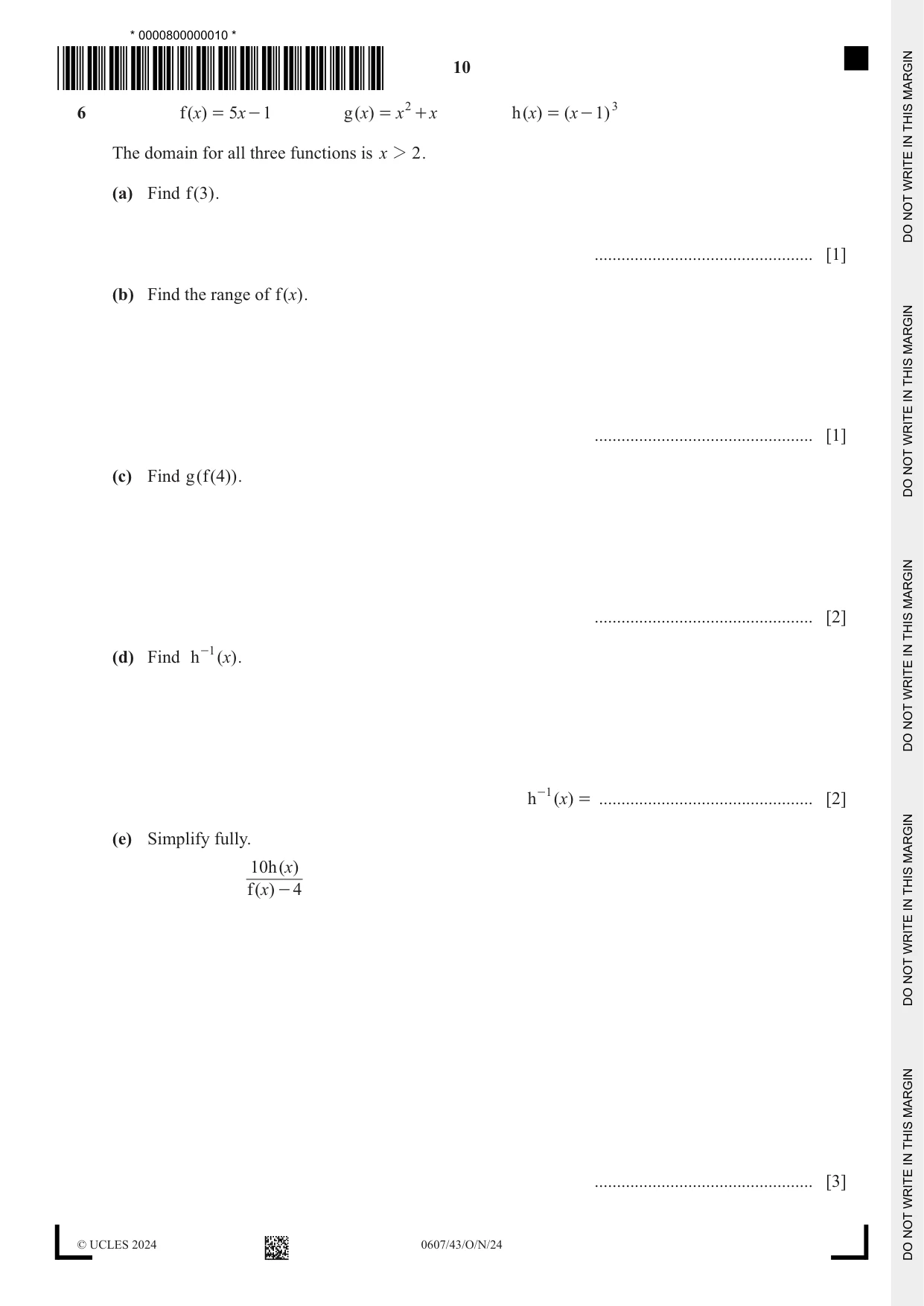
6 f ( )x = 5x - 1 g ( )x = x 2 + x h ( x) = ( x - 1) 3 The domain for all three functions is x 2 2 . (a) Find f ( 3 ) . ................................................. [1] (b) Find the range of f ( )x . ................................................. [1] (c) Find g ( f ( 4)) . ................................................. [2] (d) Find h -1 ( )x . h -1 ( )x = ................................................ [2] (e) Simplify fully. 10h ( x) f ( x) - 4 ................................................. [3]
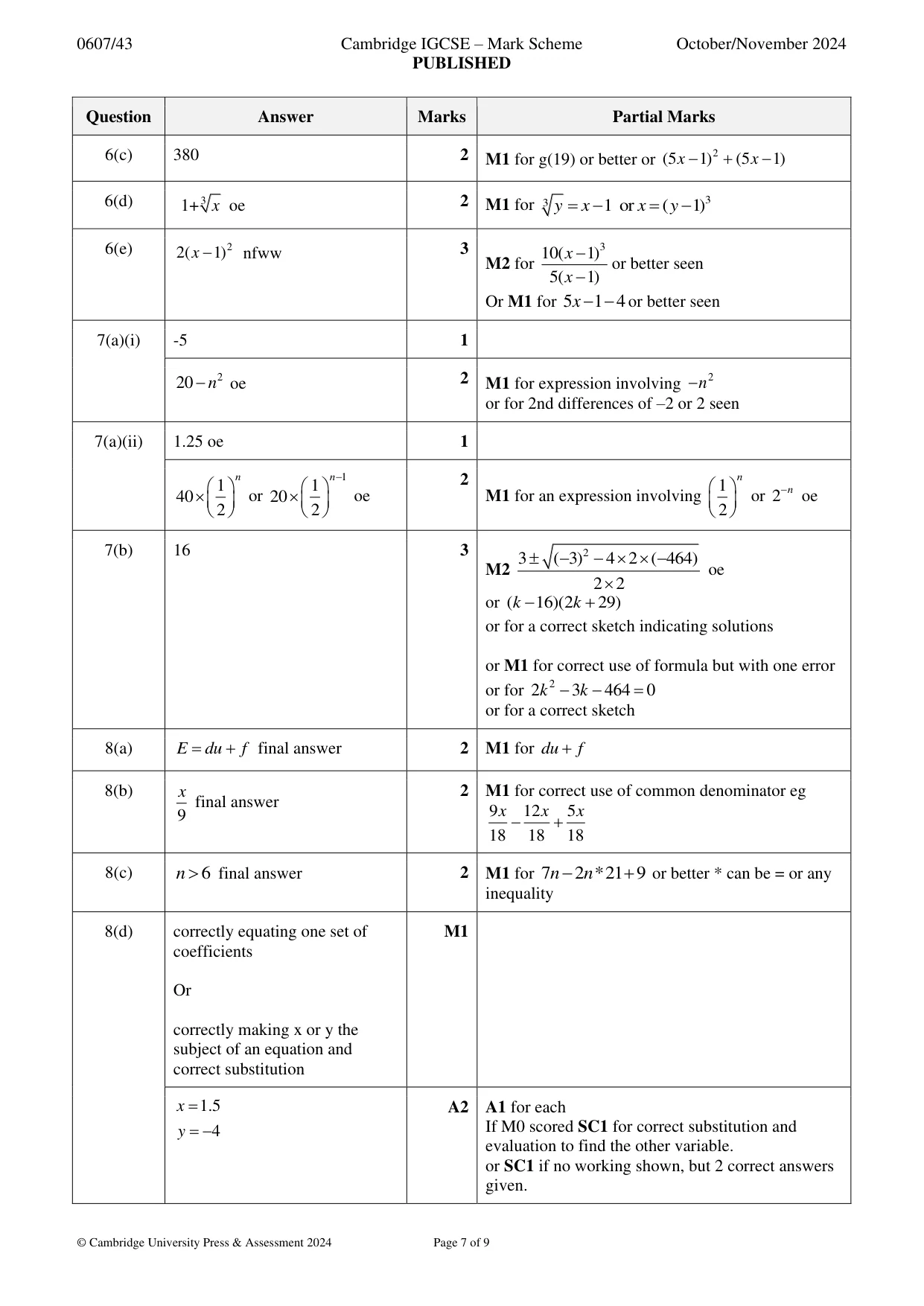
Mark scheme: 6(a) 14 1 6(b) f(x) > 9 1 6(c) 380 2 M1 for g(19) or better or (5 x − 1) 2 + (5 x − 1) 3 y = x − 1 or x = ( y − 1)36(d) 1+ 3 x oe 2 M1 for 6(e) 2( x − 1) 2 nfww 3 10( x − 1) 3 M2 for or better seen 5( x − 1) Or M1 for 5 x −−1 4 or better seen
Q7 · Find the next term and the nth term for each of these sequences
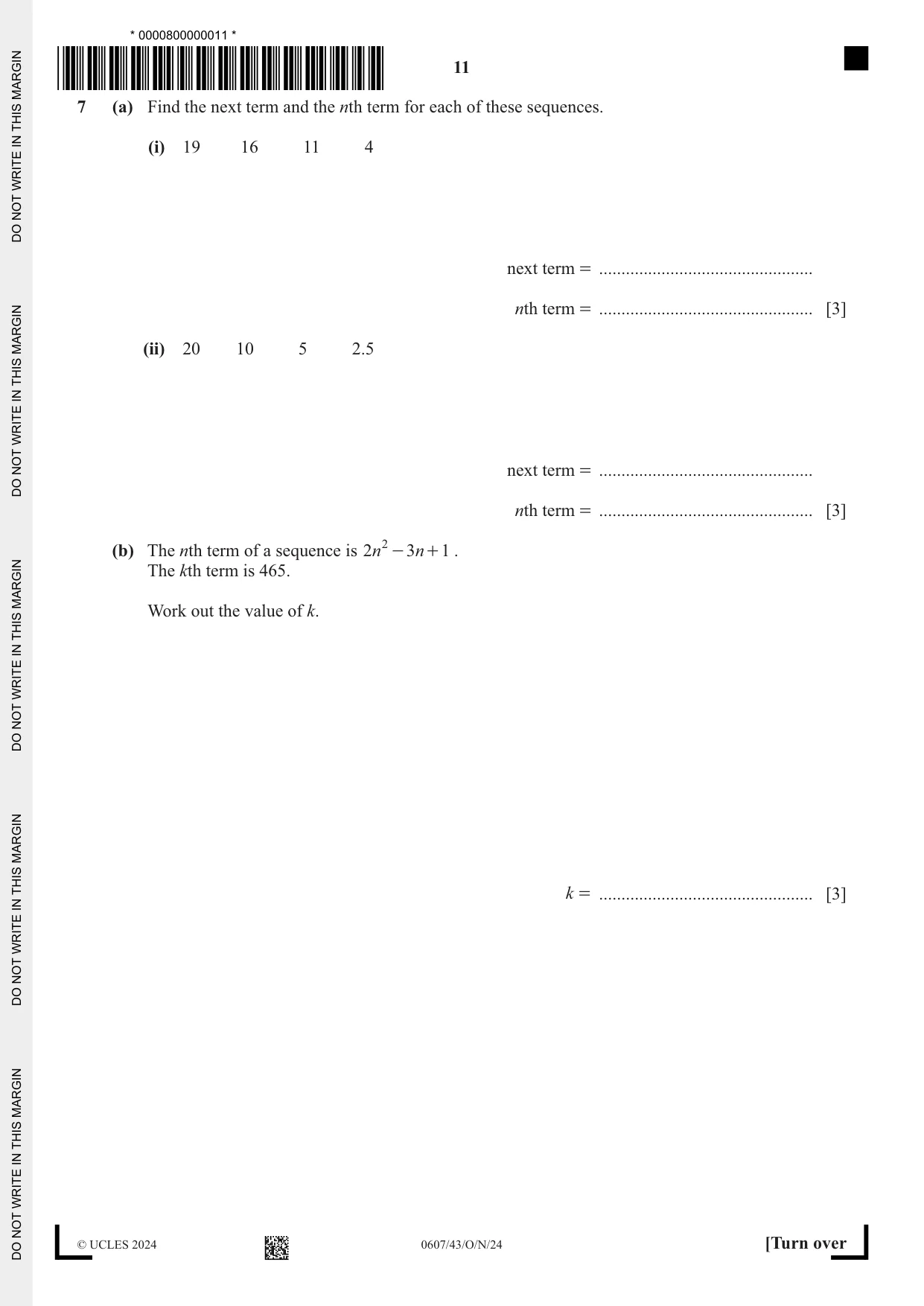
7 (a) Find the next term and the nth term for each of these sequences. (i) 19 16 11 4 next term = ................................................ nth term = ................................................ [3] (ii) 20 10 5 2.5 next term = ................................................ nth term = ................................................ [3] (b) The nth term of a sequence is 2n 2 - 3n + 1 . The kth term is 465. Work out the value of k. k = ................................................ [3]
Mark scheme: 7(a)(i) -5 1 20 −n 2 oe 2 M1 for expression involving −n 2 or for 2nd differences of –2 or 2 seen 7(a)(ii) 1.25 oe 1 n n −1 2 n 1 1 1 40 or 20 oe M1 for an expression involving or 2−n oe 2 2 2 7(b) 16 3 2 3 ( −3) −−4 2 ( 464) M2 oe 2 2 or ( k − 16)(2k + 29) or for a correct sketch indicating solutions or M1 for correct use of formula but with one error or for 2 k 2 − 3k − 464 = 0 or for a correct sketch
Q8 · The amount charged for electricity in one month is $E
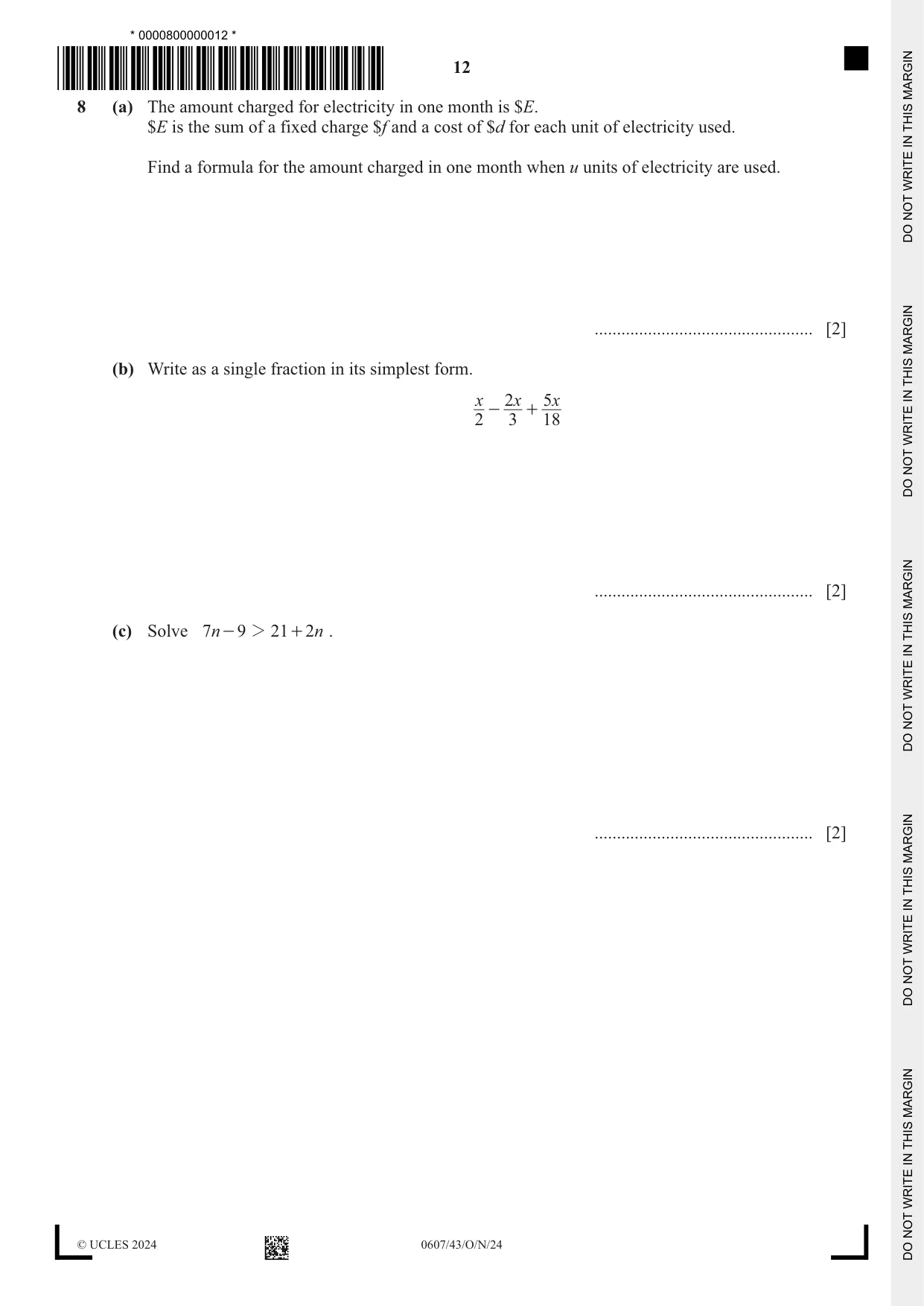
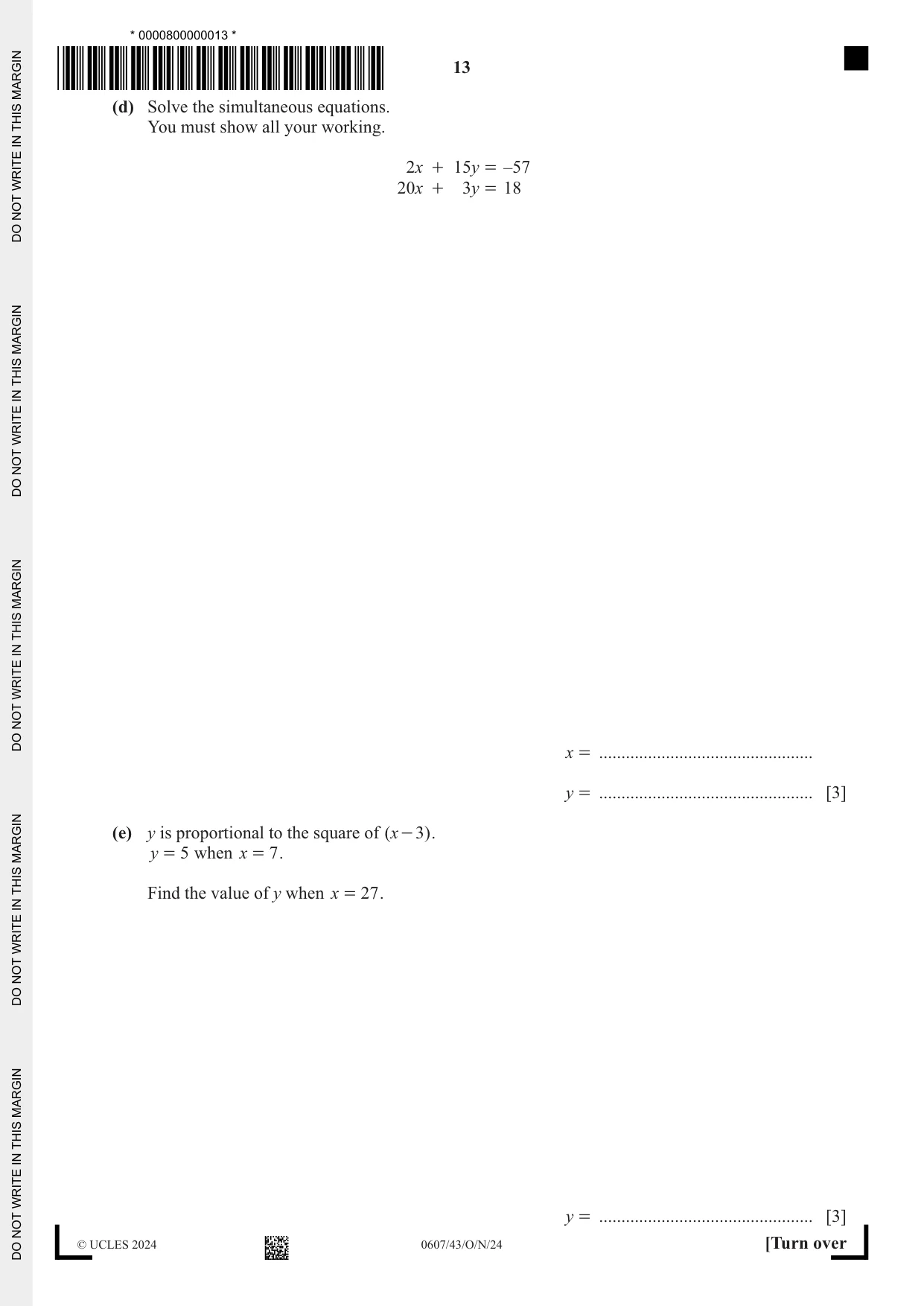
8 (a) The amount charged for electricity in one month is $E. $E is the sum of a fixed charge $f and a cost of $d for each unit of electricity used. Find a formula for the amount charged in one month when u units of electricity are used. ................................................. [2] (b) Write as a single fraction in its simplest form. x 2 x 5x - + 2 3 18 ................................................. [2] (c) Solve 7n - 9 2 21 + 2 n . ................................................. [2] (d) Solve the simultaneous equations. You must show all your working. 2x + 15y = –57 20x + 3y = 18 x = ................................................ y = ................................................ [3] (e) y is proportional to the square of ( x - 3) . y = 5 when x = 7 . Find the value of y when x = 27 . y = ................................................ [3]
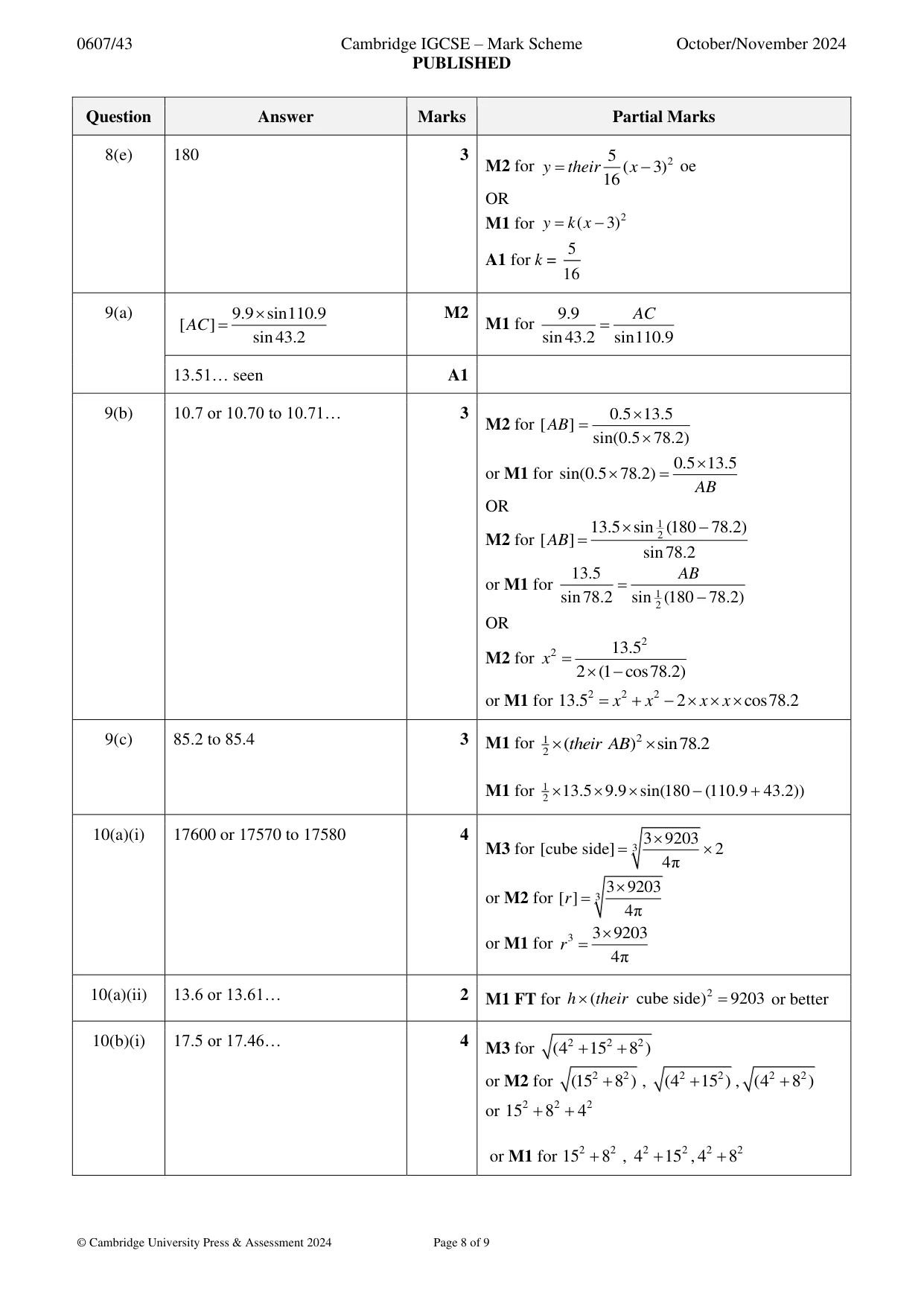
Mark scheme: 8(a) E = du + f final answer 2 M1 for du + f 8(b) x 2 M1 for correct use of common denominator eg final answer 9 9 x 12 x 5 x − + 18 18 18 8(c) n 6 final answer 2 M1 for 7n − 2n *21 + 9 or better * can be = or any inequality 8(d) correctly equating one set of M1 coefficients Or correctly making x or y the subject of an equation and correct substitution x = 1.5 A2 A1 for each y = −4 If M0 scored SC1 for correct substitution and evaluation to find the other variable. or SC1 if no working shown, but 2 correct answers given. 8(e) 180 3 5 2 M2 for y = their ( x − 3) oe 16 OR M1 for y = k ( x − 3) 2 5 A1 for k = 16
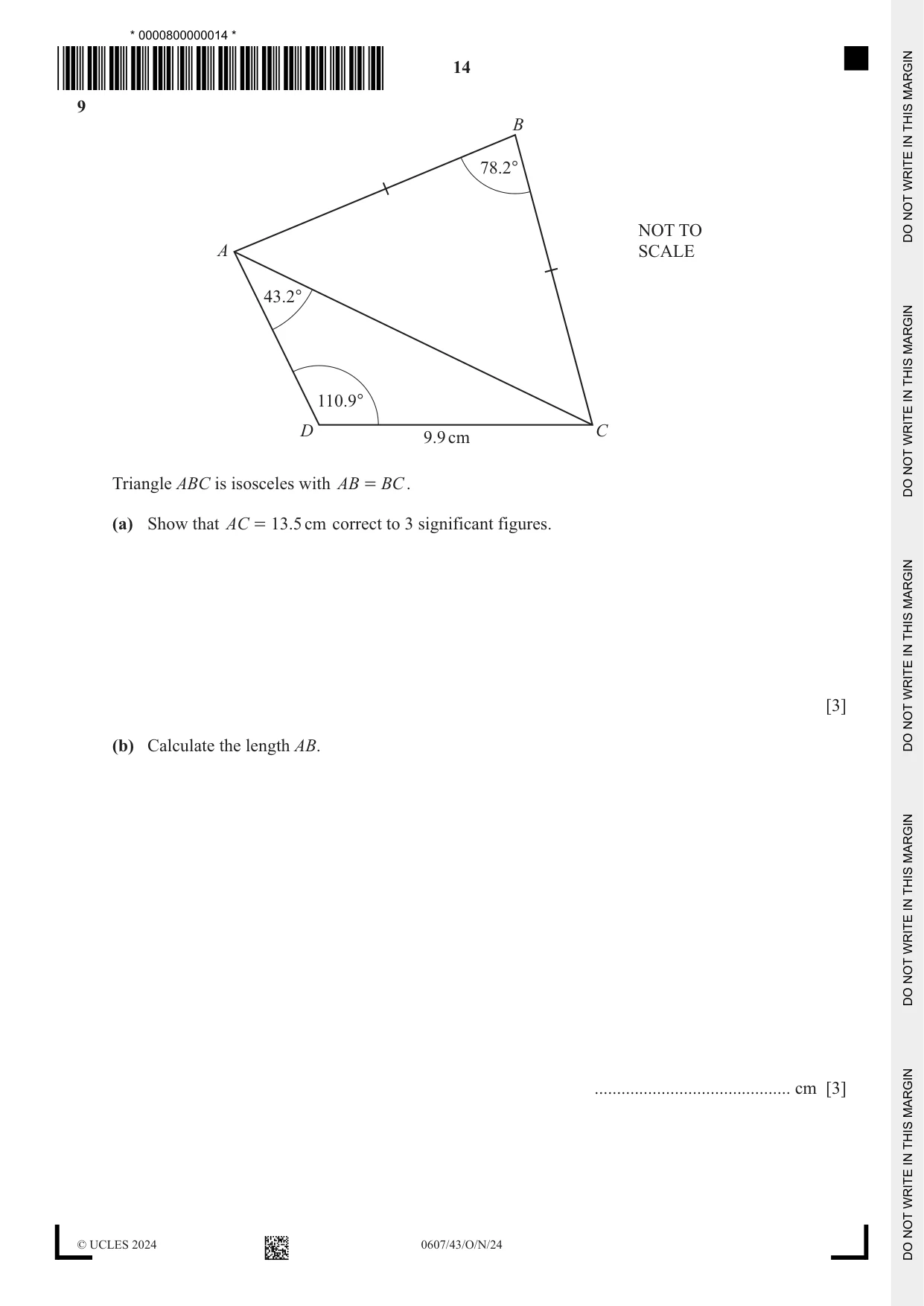
Q9 · B 78.2° NOT TO A SCALE 43.2° 110.9° D C 9.9 cm Triangle ABC is isosceles with AB = BC
9 B 78.2° NOT TO A SCALE 43.2° 110.9° D C 9.9 cm Triangle ABC is isosceles with AB = BC . (a) Show that AC = 13.5 cm correct to 3 significant figures. [3] (b) Calculate the length AB. ............................................ cm [3] (c) Find the area of ABCD. .......................................... cm2 [3]
Mark scheme: 9(a) 9.9 sin110.9 M2 9.9 AC [ AC ] = M1 for = sin43.2 sin43.2 sin110.9 13.51… seen A1 9(b) 10.7 or 10.70 to 10.71… 3 0.5 13.5 M2 for [ AB ] = sin(0.5 78.2) 0.5 13.5 or M1 for sin(0.5 78.2) = AB OR 13.5 sin 12 (180 − 78.2) M2 for [ AB ] = sin78.2 13.5 AB or M1 for = sin78.2 sin 12 (180 − 78.2) OR 2 13.52 M2 for x = 2 (1 − cos78.2) or M1 for 13.52 = x 2 + x 2 −2 x x cos78.2 9(c) 85.2 to 85.4 3 M1 for 1 2 (their AB) 2 sin78.2 M1 for 12 13.5 9.9 sin(180 − (110.9 + 43.2))
Q10 · NOT TO SCALE A metal sphere has a volume of 9203 cm3
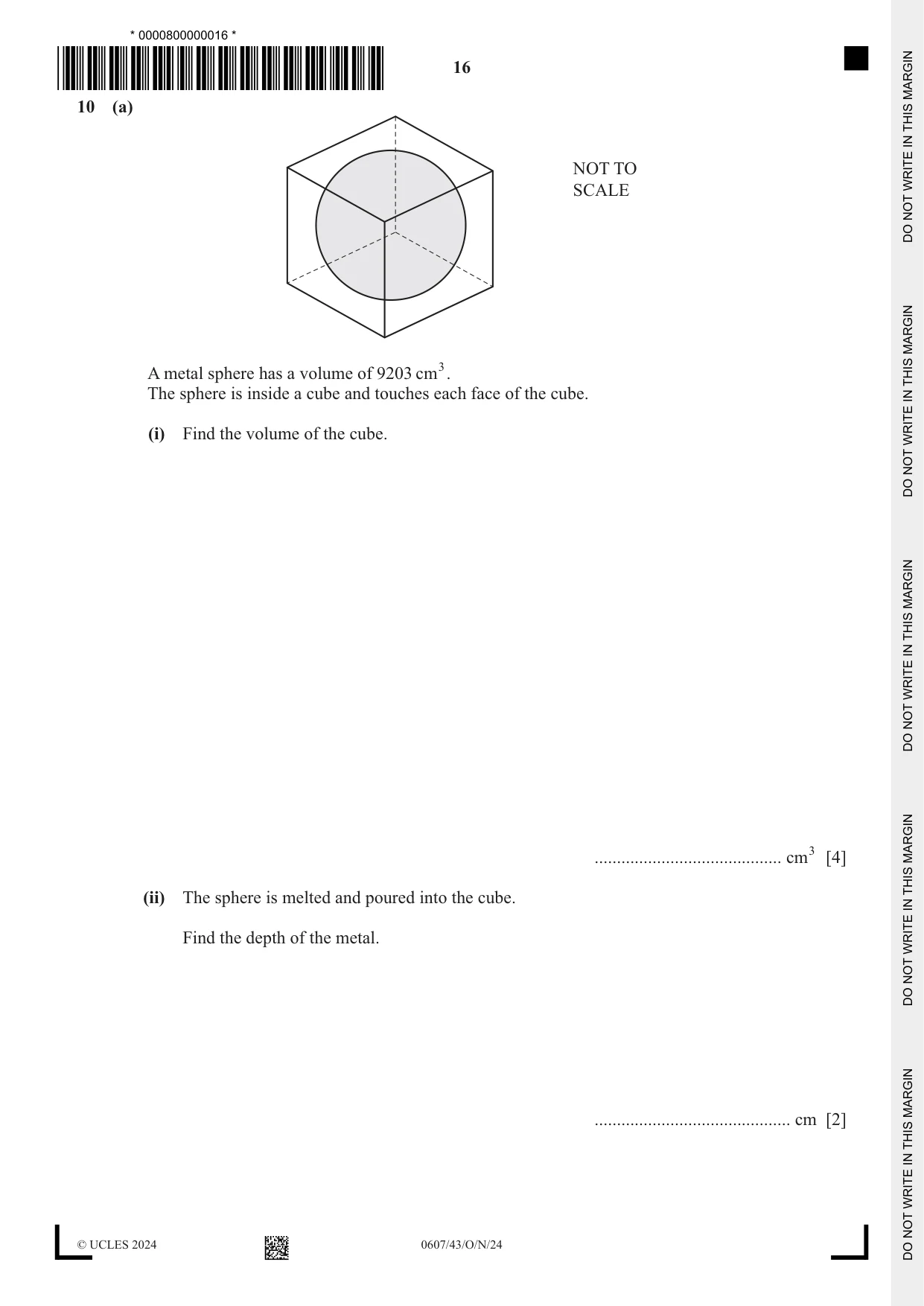
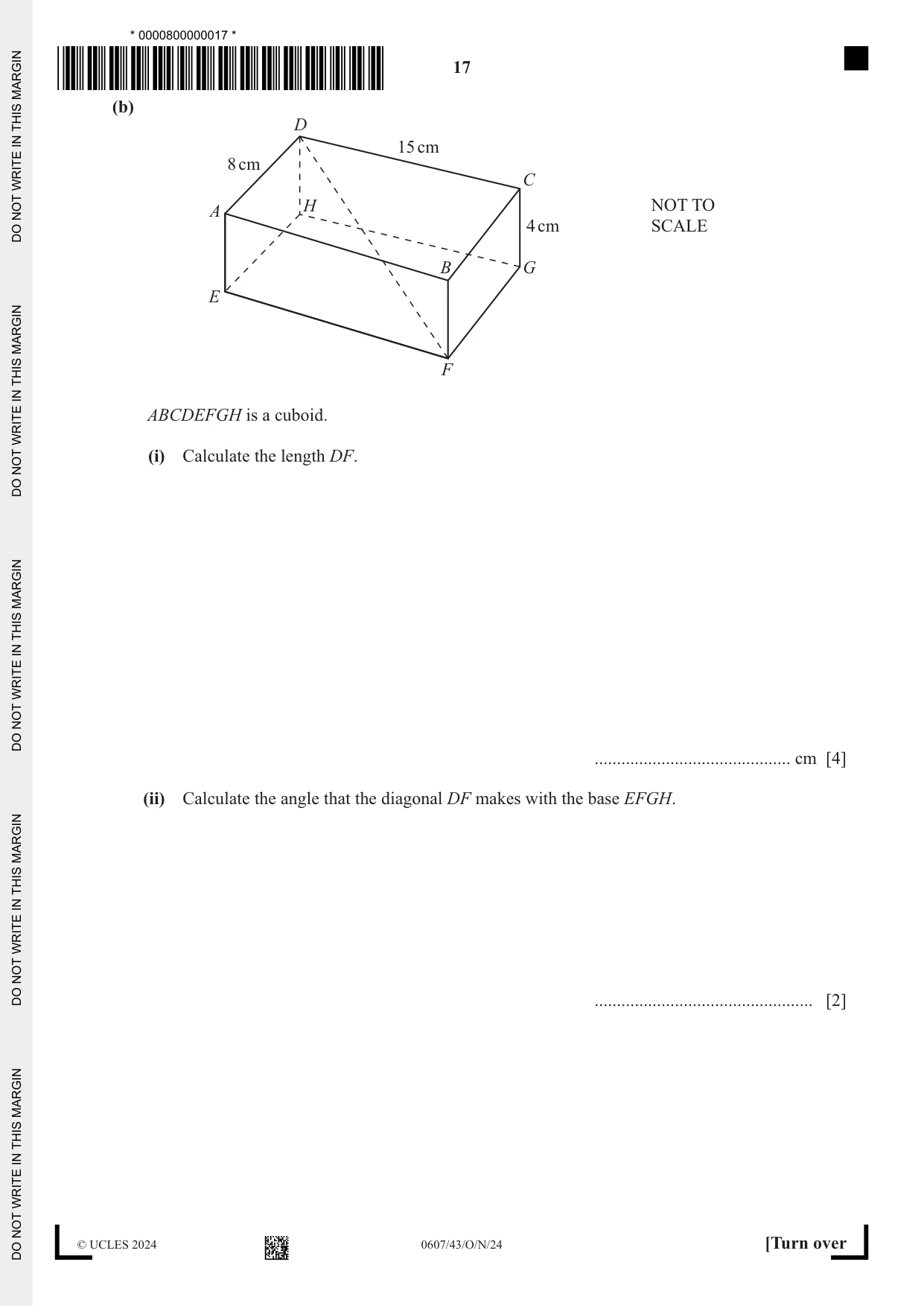
10 (a) NOT TO SCALE A metal sphere has a volume of 9203 cm3. The sphere is inside a cube and touches each face of the cube. (i) Find the volume of the cube. .......................................... cm3 [4] (ii) The sphere is melted and poured into the cube. Find the depth of the metal. ............................................ cm [2] (b) D 15 cm 8 cm C H NOT TO A 4 cm SCALE B G E F ABCDEFGH is a cuboid. (i) Calculate the length DF. ............................................ cm [4] (ii) Calculate the angle that the diagonal DF makes with the base EFGH. ................................................. [2]
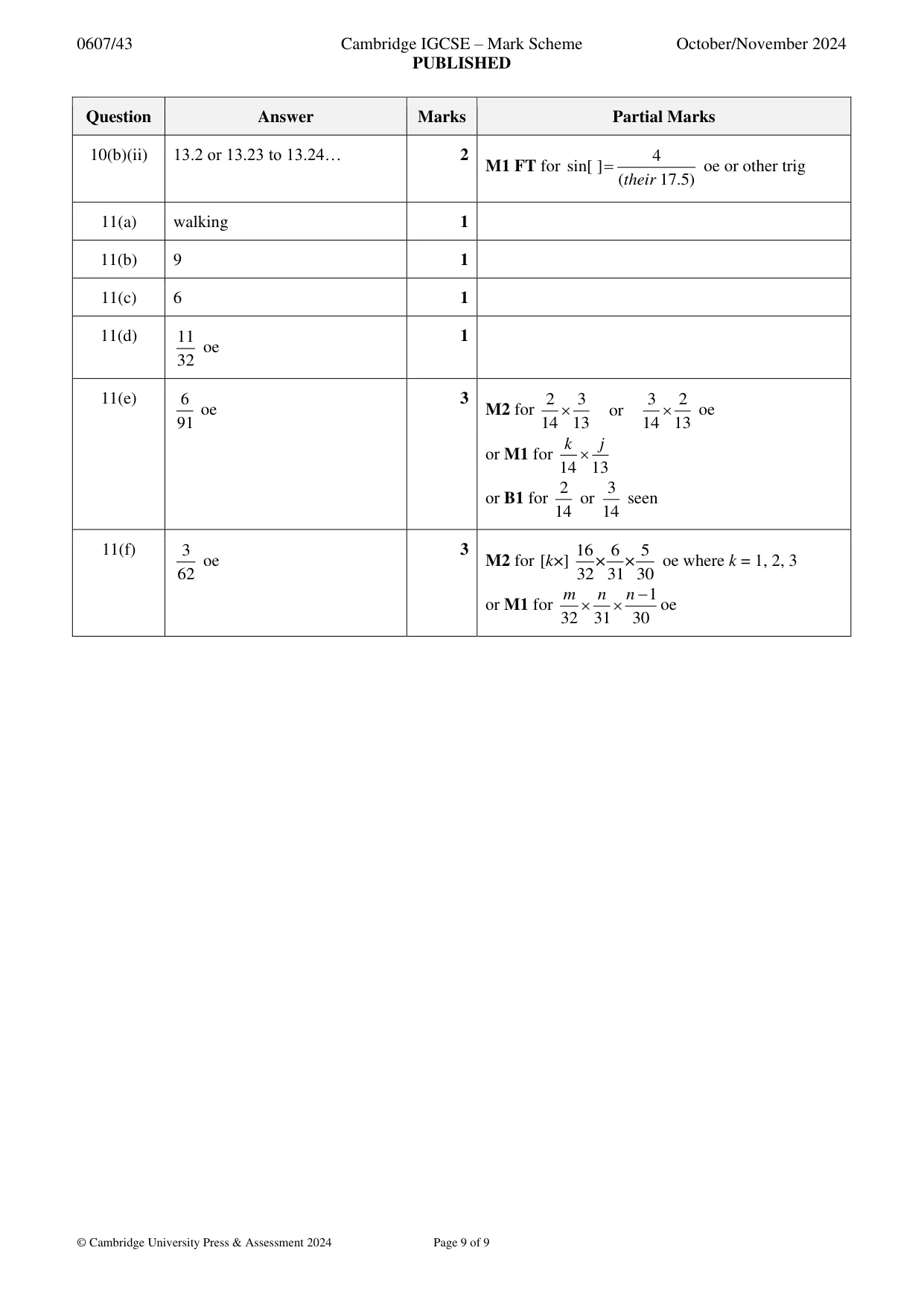
Mark scheme: 10(a)(i) 17600 or 17570 to 17580 4 3 9203 M3 for [cube side] = 3 2 4π 3 9203 or M2 for [ r ] = 3 4π 3 3 9203 or M1 for r = 4π 10(a)(ii) 13.6 or 13.61… 2 M1 FT for h (their cube side) 2 = 9203 or better 10(b)(i) 17.5 or 17.46… 4 2 2 2 M3 for (4 + 15 + 8 ) or M2 for (152 + 82 ) , (42 + 152 ) , (4 2 + 82 ) or 15 2 + 8 2 + 4 2 or M1 for 15 2 + 8 2 , 4 2 + 15 2 , 4 2 + 82 10(b)(ii) 13.2 or 13.23 to 13.24… 2 4 M1 FT for sin[ ] = oe or other trig (their 17.5)
Q11 · 32 students in a class are asked which of three activities they like
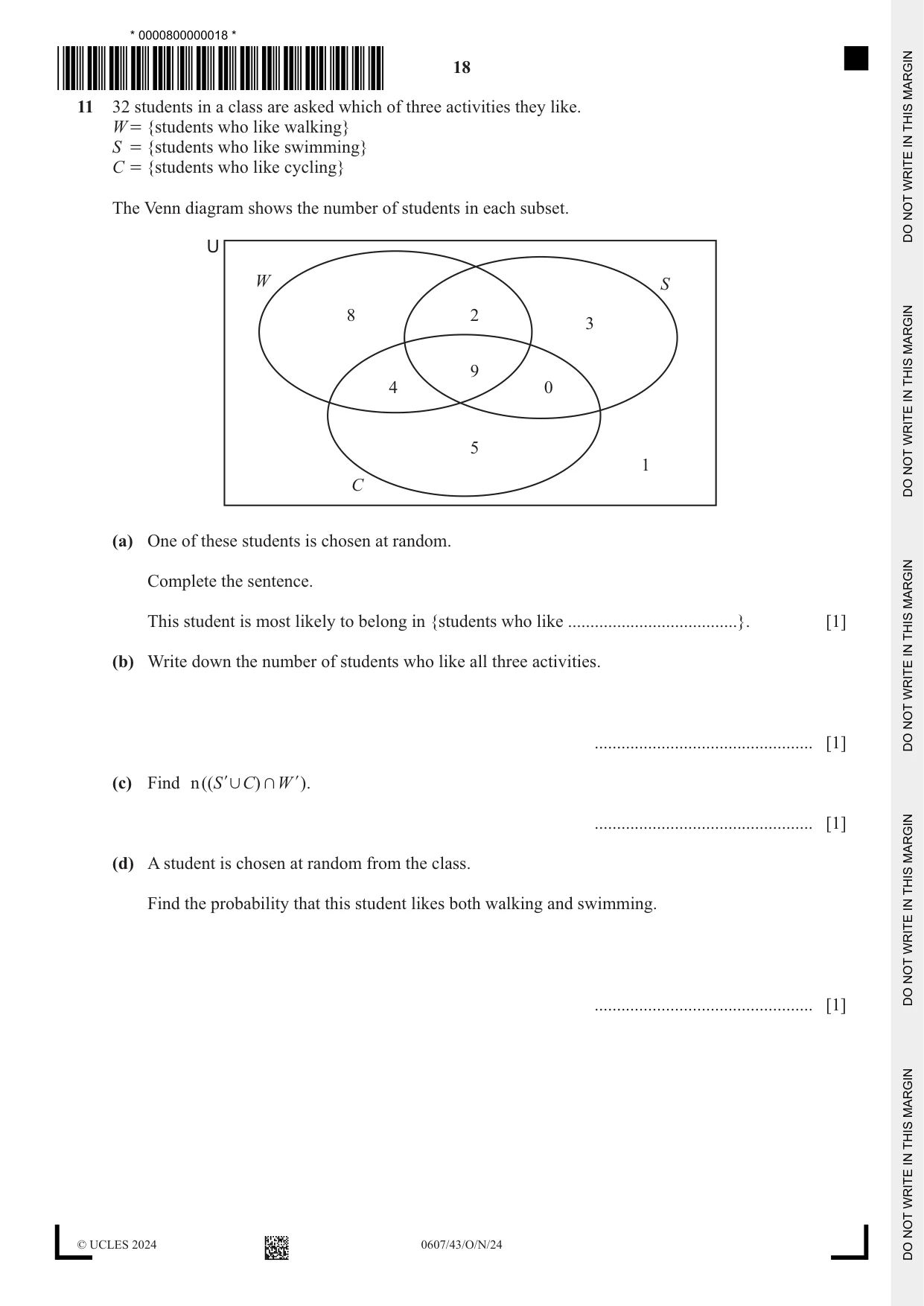
11 32 students in a class are asked which of three activities they like. W = {students who like walking} S = {students who like swimming} C = {students who like cycling} The Venn diagram shows the number of students in each subset. U W S 8 2 3 9 4 0 5 1 C (a) One of these students is chosen at random. Complete the sentence. This student is most likely to belong in {students who like ......................................}. [1] (b) Write down the number of students who like all three activities. ................................................. [1] (c) Find n (( S l , C) + W l ). ................................................. [1] (d) A student is chosen at random from the class. Find the probability that this student likes both walking and swimming. ................................................. [1] (e) Two of the students who like swimming are chosen at random. Find the probability that one of these students likes walking but not cycling and the other student only likes swimming. ................................................. [3] (f) Three of the 32 students are chosen at random. Find the probability that one student likes exactly one of the activities and the other two students like exactly two of the activities. ................................................. [3]
Mark scheme: 11(a) walking 1 11(b) 9 1 11(c) 6 1 11(d) 11 1 oe 32 11(e) 6 3 2 3 3 2 oe M2 for or oe 91 14 13 14 13 k j or M1 for 14 13 2 3 or B1 for or seen 14 14 11(f) 3 3 16 6 5 oe M2 for [k ×] × × oe where k = 1, 2, 3 62 32 31 30 m n n − 1 or M1 for oe 32 31 30
What was in this paper
The subtopics covered by these 11 questions, and how many questions each got. Open one in a new tab to see every Cambridge question on it.
What you needed in this session
Cambridge’s own grade thresholds for 2024 Oct/Nov, Paper 4 · Variant 3. A higher threshold means an easier paper — the bar moves with how the cohort did.