Cambridge IGCSE Mathematics - International 0607 — 2023 May/June Paper 4 · Variant 2
0607/42/M/J/23 · 11 questions · 120 marks · ≈135 min
The question paper and its mark scheme, free to read here and free to download. This is Cambridge’s own paper, exactly as it was sat.
Question paper20 pages
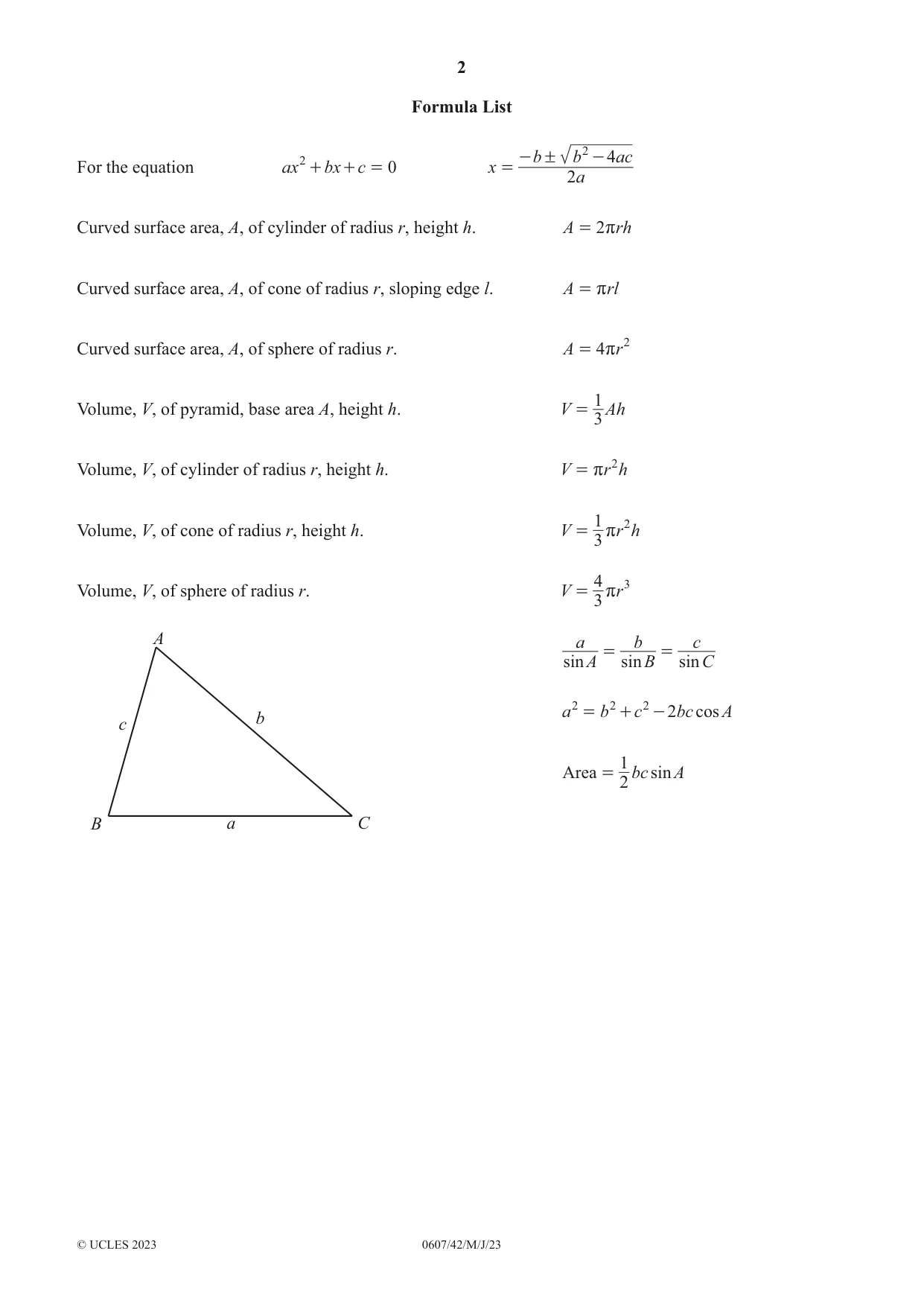
Mark scheme9 pages
Answers below. Sit the paper first if you are practising.
Questions as text
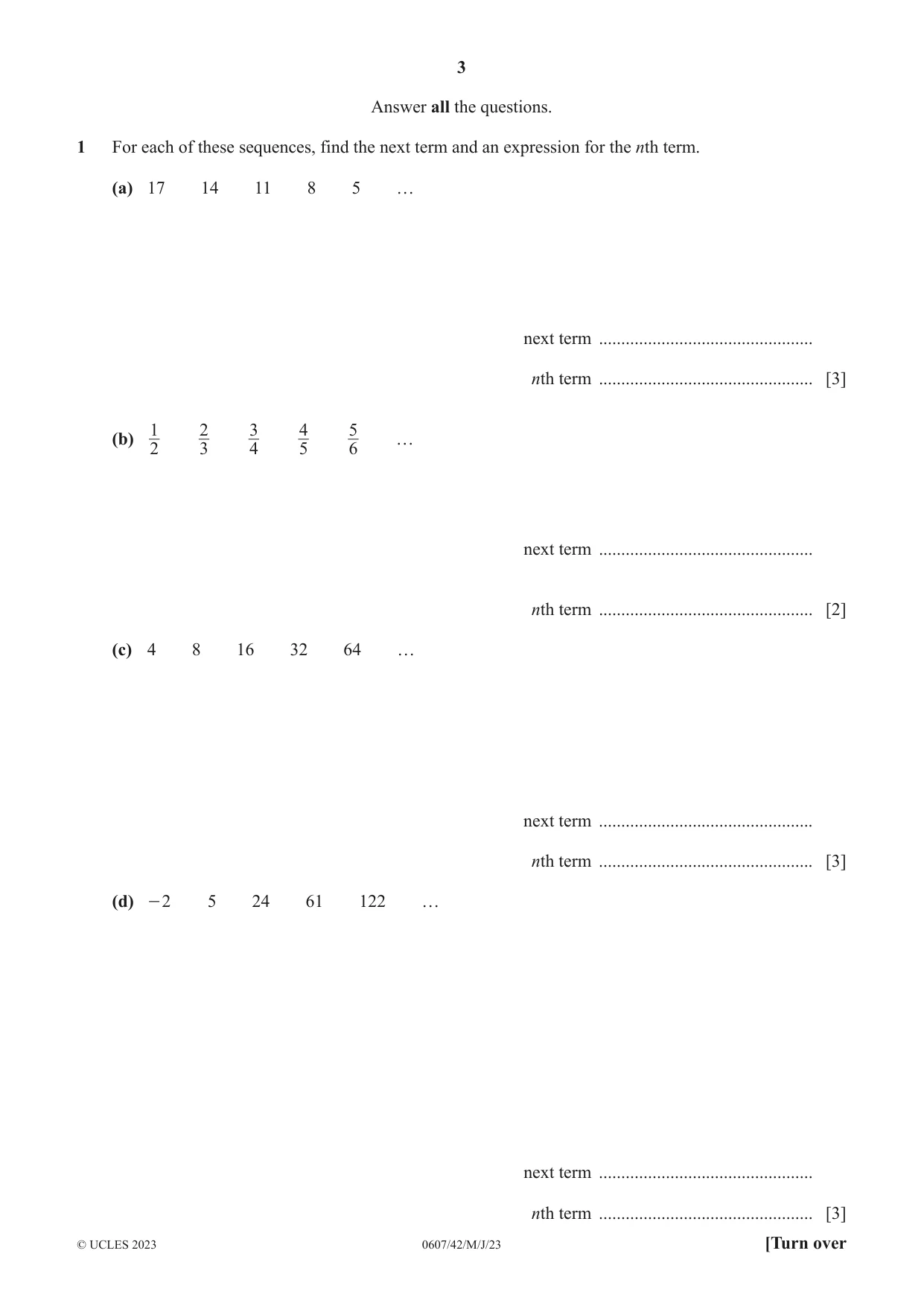
Q1 · For each of these sequences, find the next term and an expression for the nth term
1 For each of these sequences, find the next term and an expression for the nth term. (a) 17 14 11 8 5 … next term ................................................ nth term ................................................ [3] 1 2 3 4 5 (b) … 2 3 4 5 6 next term ................................................ nth term ................................................ [2] (c) 4 8 16 32 64 … next term ................................................ nth term ................................................ [3] (d) - 2 5 24 61 122 … next term ................................................ nth term ................................................ [3]
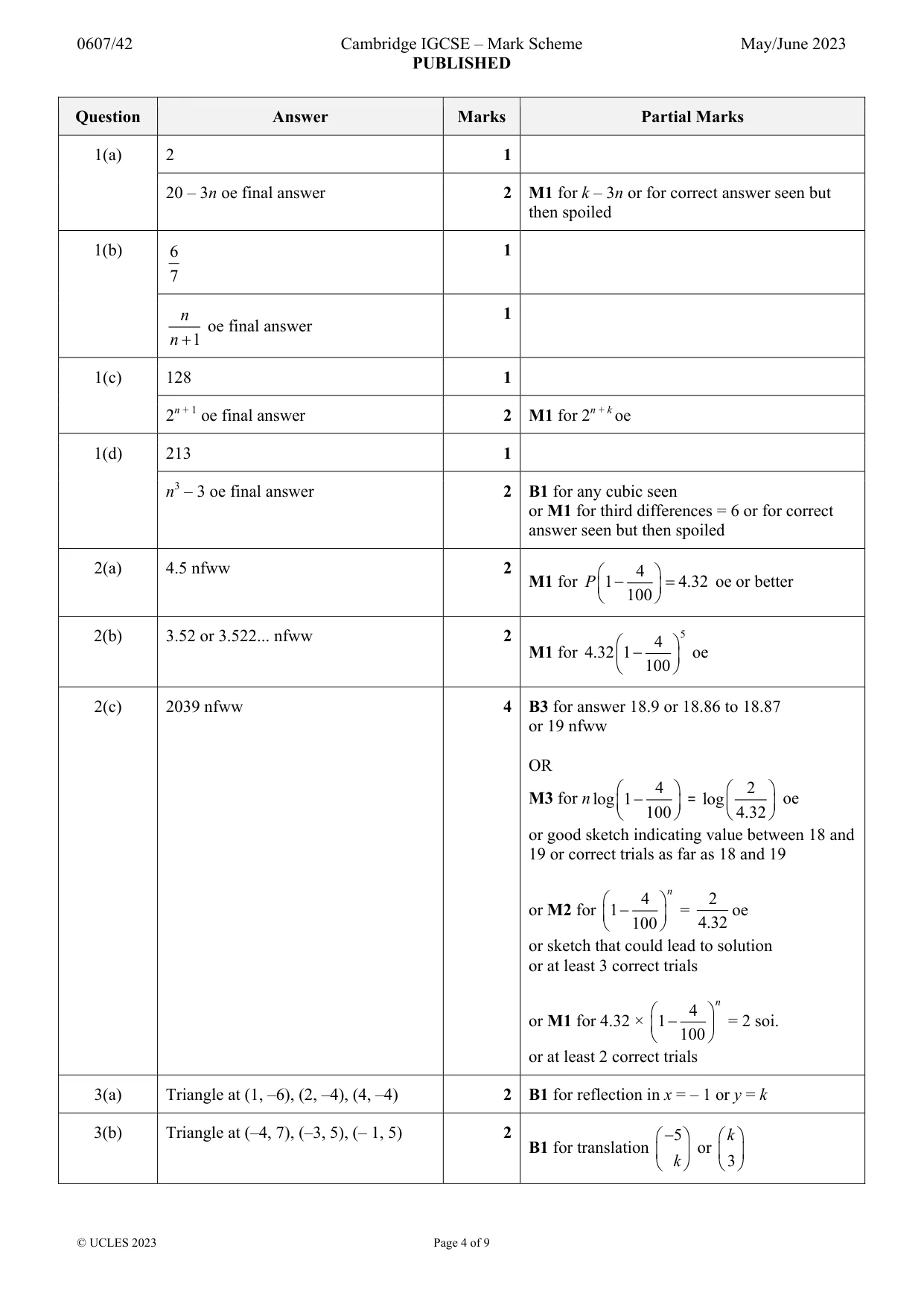
Mark scheme: Question Answer Marks Partial Marks 1(a) 2 1 20 – 3n oe final answer 2 M1 for k – 3n or for correct answer seen but then spoiled 1(b) 6 1 7 n 1 oe final answer n 1 1(c) 128 1 2n + 1 oe final answer 2 M1 for 2n + k oe 1(d) 213 1 n3 – 3 oe final answer 2 B1 for any cubic seen or M1 for third differences = 6 or for correct answer seen but then spoiled
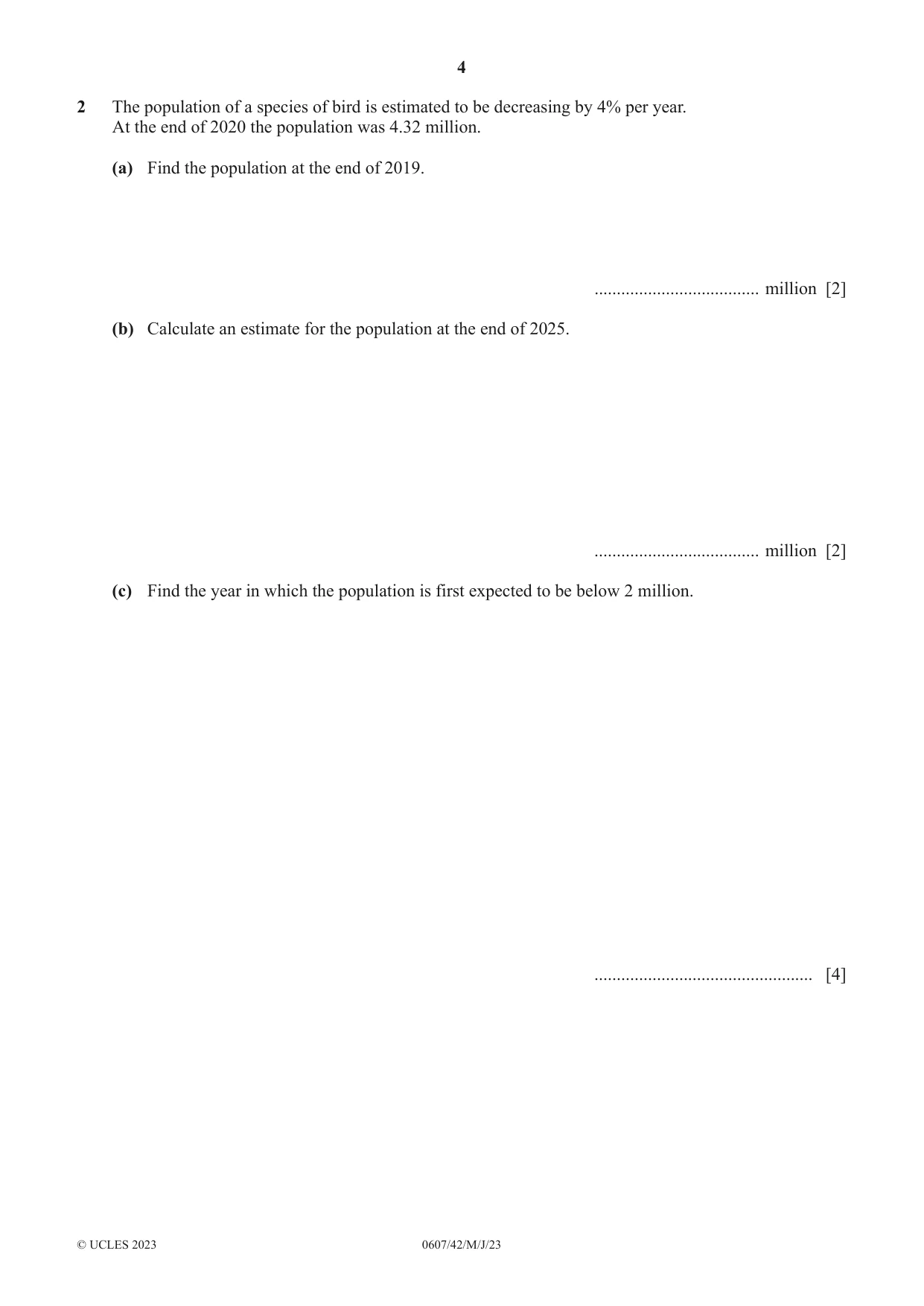
Q2 · The population of a species of bird is estimated to be decreasing by 4% per year
2 The population of a species of bird is estimated to be decreasing by 4% per year. At the end of 2020 the population was 4.32 million. (a) Find the population at the end of 2019. ..................................... million [2] (b) Calculate an estimate for the population at the end of 2025. ..................................... million [2] (c) Find the year in which the population is first expected to be below 2 million. ................................................. [4]
Mark scheme: 2(a) 4.5 nfww 2 4 M1 for P 1 4.32 oe or better 100 2(b) 3.52 or 3.522... nfww 2 5 4 M1 for 4.32 1 oe 100 2(c) 2039 nfww 4 B3 for answer 18.9 or 18.86 to 18.87 or 19 nfww OR 4 2 M3 for n log 1 = log oe 100 4.32 or good sketch indicating value between 18 and 19 or correct trials as far as 18 and 19 4 n 2 or M2 for 1 = oe 100 4.32 or sketch that could lead to solution or at least 3 correct trials 4 n or M1 for 4.32 × 1 = 2 soi. 100 or at least 2 correct trials
Q3 · Y 9 8 7 6 5 C 4 3 B A 2 1 x 0 – 6 – 5 – 4 – 3 – 2 – 1 1 2 3 4 5 6 – 1 – 2 – 3 – 4 – 5 – 6…
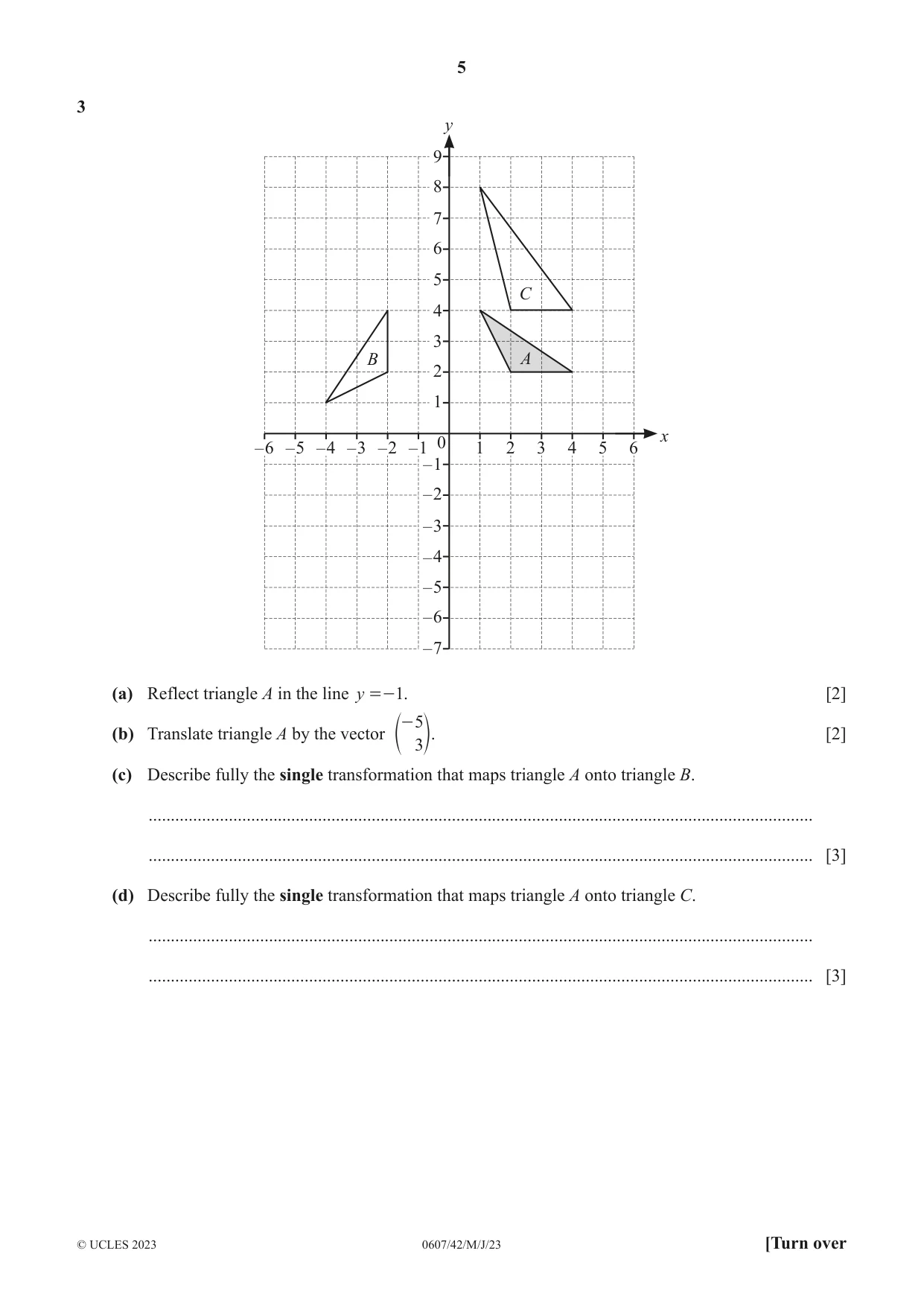
3 y 9 8 7 6 5 C 4 3 B A 2 1 x 0 – 6 – 5 – 4 – 3 – 2 – 1 1 2 3 4 5 6 – 1 – 2 – 3 – 4 – 5 – 6 – 7 (a) Reflect triangle A in the line y =- 1. [2] - 5 (b) Translate triangle A by the vector [2] e 3o. (c) Describe fully the single transformation that maps triangle A onto triangle B. ..................................................................................................................................................... ..................................................................................................................................................... [3] (d) Describe fully the single transformation that maps triangle A onto triangle C. ..................................................................................................................................................... ..................................................................................................................................................... [3]
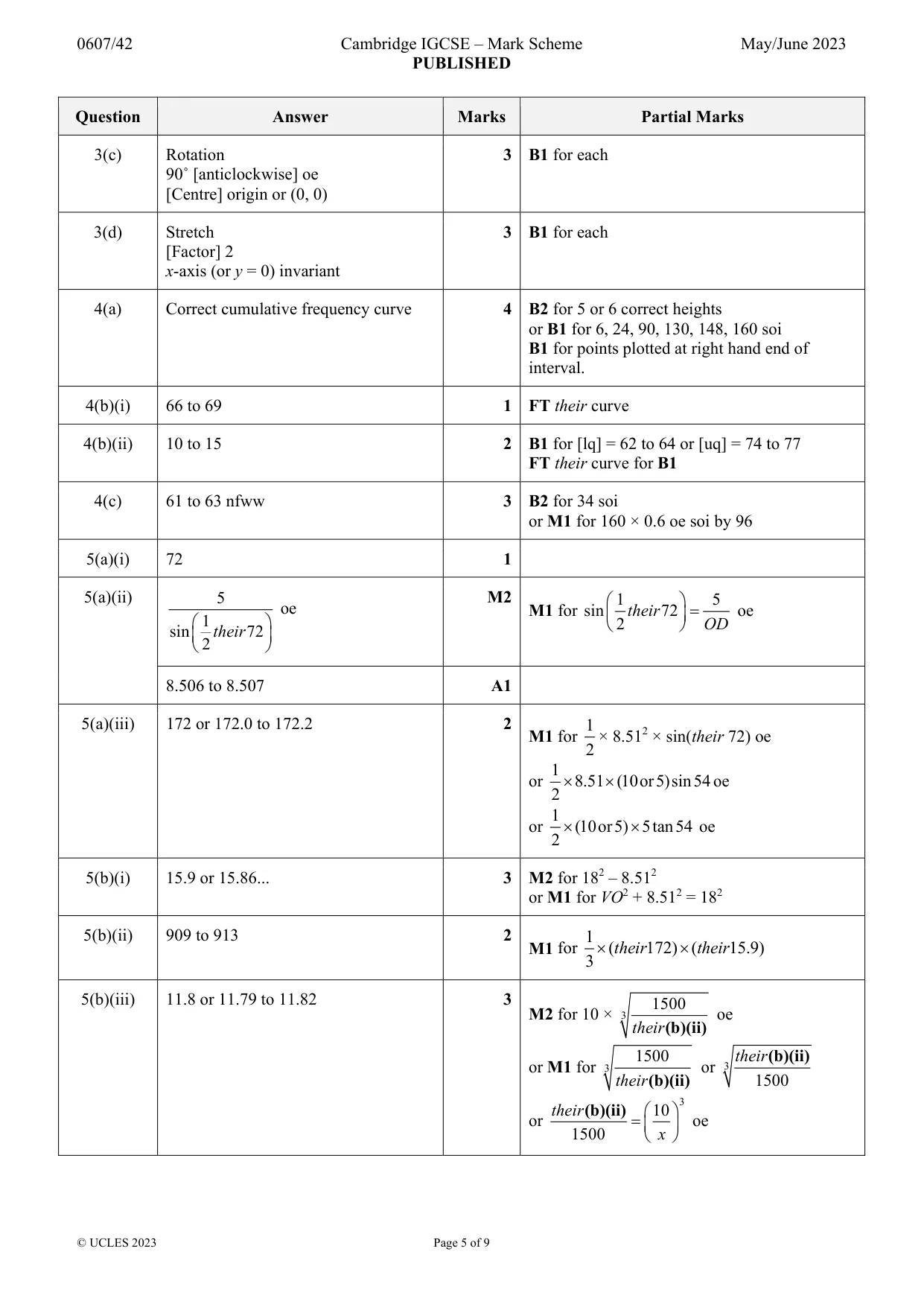
Mark scheme: 3(a) Triangle at (1, –6), (2, –4), (4, –4) 2 B1 for reflection in x = – 1 or y = k 3(b) Triangle at (–4, 7), (–3, 5), (– 1, 5) 2 5 k B1 for translation or k 3 3(c) Rotation 3 B1 for each 90˚ [anticlockwise] oe [Centre] origin or (0, 0) 3(d) Stretch 3 B1 for each [Factor] 2 x-axis (or y = 0) invariant
Q4 · The masses, m kg, of 160 students are recorded in the table
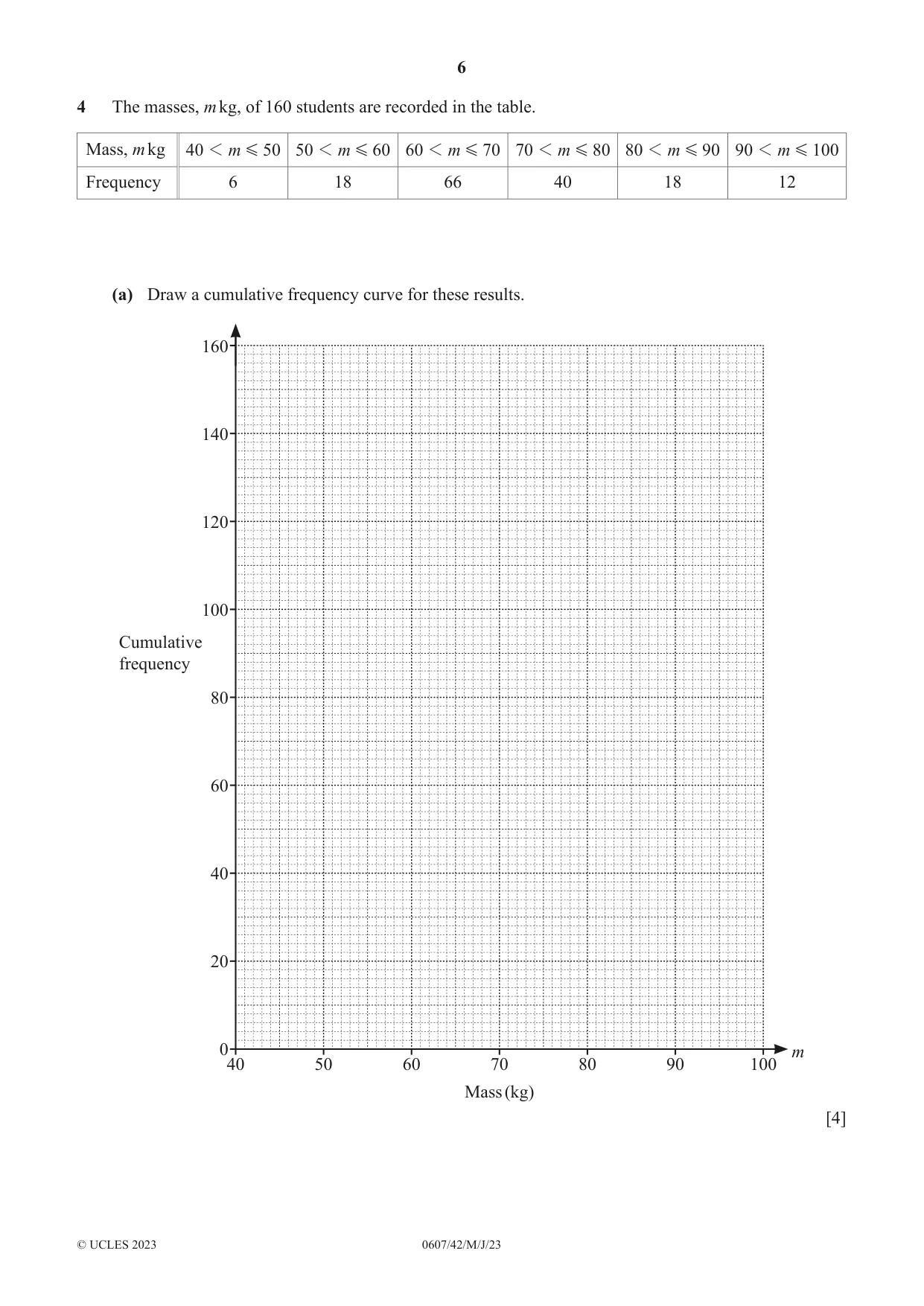
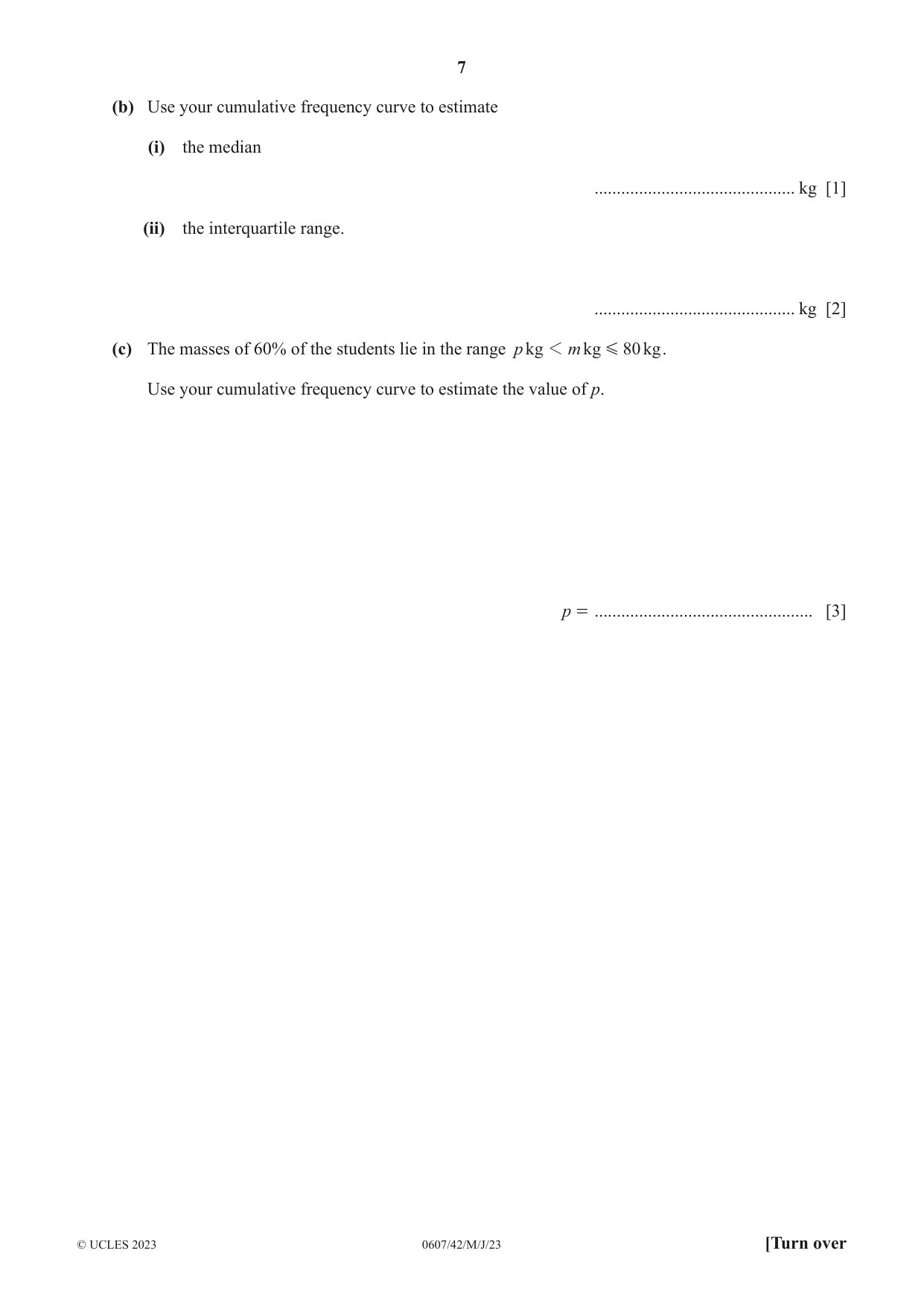
4 The masses, m kg, of 160 students are recorded in the table. Mass, m kg 40 1 m G 50 50 1 m G 60 60 1 m G 70 70 1 m G 80 80 1 m G 90 90 1 m G 100 Frequency 6 18 66 40 18 12 (a) Draw a cumulative frequency curve for these results. 160 140 120 100 Cumulative frequency 80 60 40 20 0 m 40 50 60 70 80 90 100 Mass (kg) [4] (b) Use your cumulative frequency curve to estimate (i) the median ............................................. kg [1] (ii) the interquartile range. ............................................. kg [2] (c) The masses of 60% of the students lie in the range p kg 1 m kg G 80 kg . Use your cumulative frequency curve to estimate the value of p. p = ................................................. [3]
Mark scheme: 4(a) Correct cumulative frequency curve 4 B2 for 5 or 6 correct heights or B1 for 6, 24, 90, 130, 148, 160 soi B1 for points plotted at right hand end of interval. 4(b)(i) 66 to 69 1 FT their curve 4(b)(ii) 10 to 15 2 B1 for [lq] = 62 to 64 or [uq] = 74 to 77 FT their curve for B1 4(c) 61 to 63 nfww 3 B2 for 34 soi or M1 for 160 × 0.6 oe soi by 96
Q5 · The diagram shows a regular pentagon with sides of 10 cm and centre O
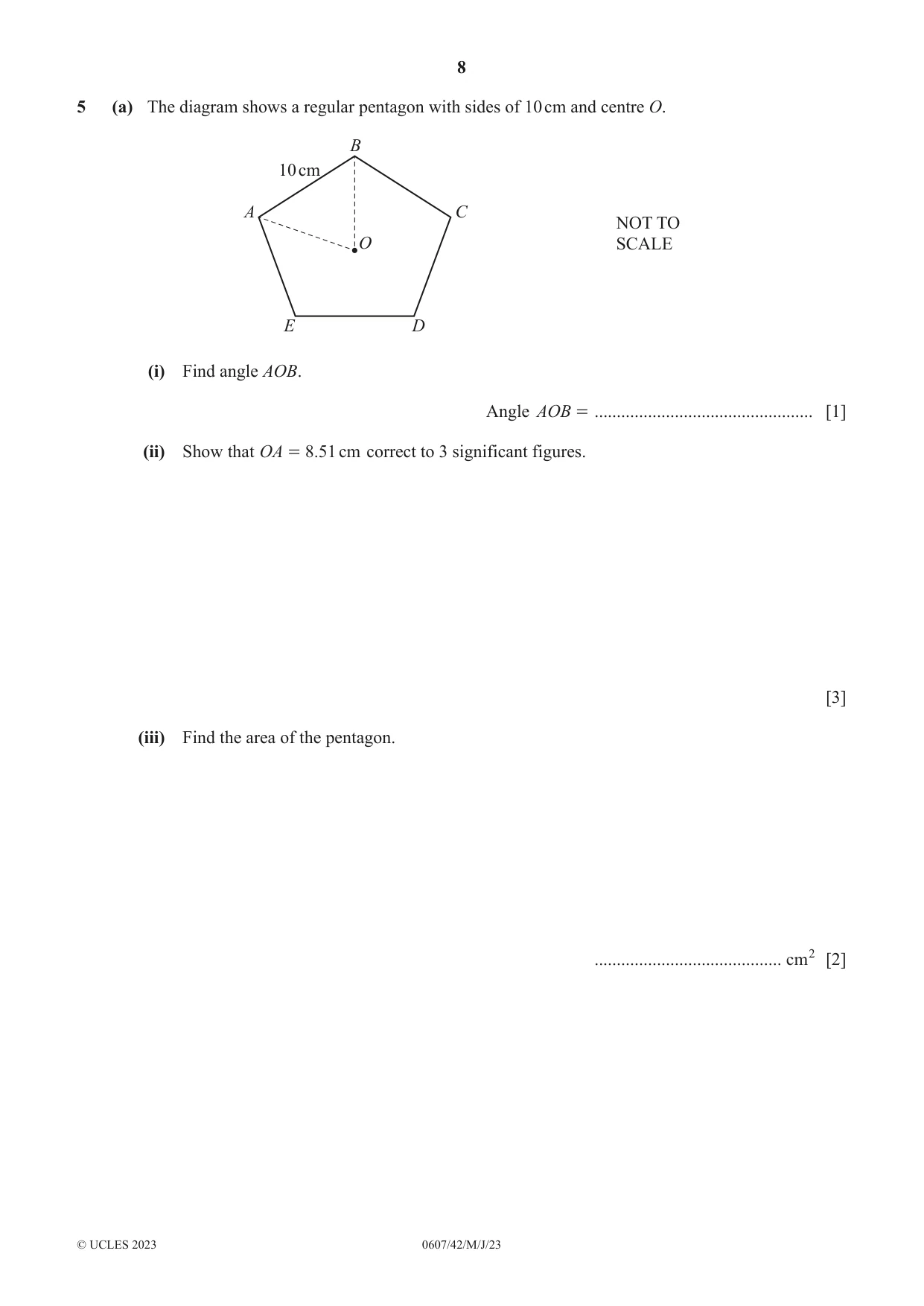
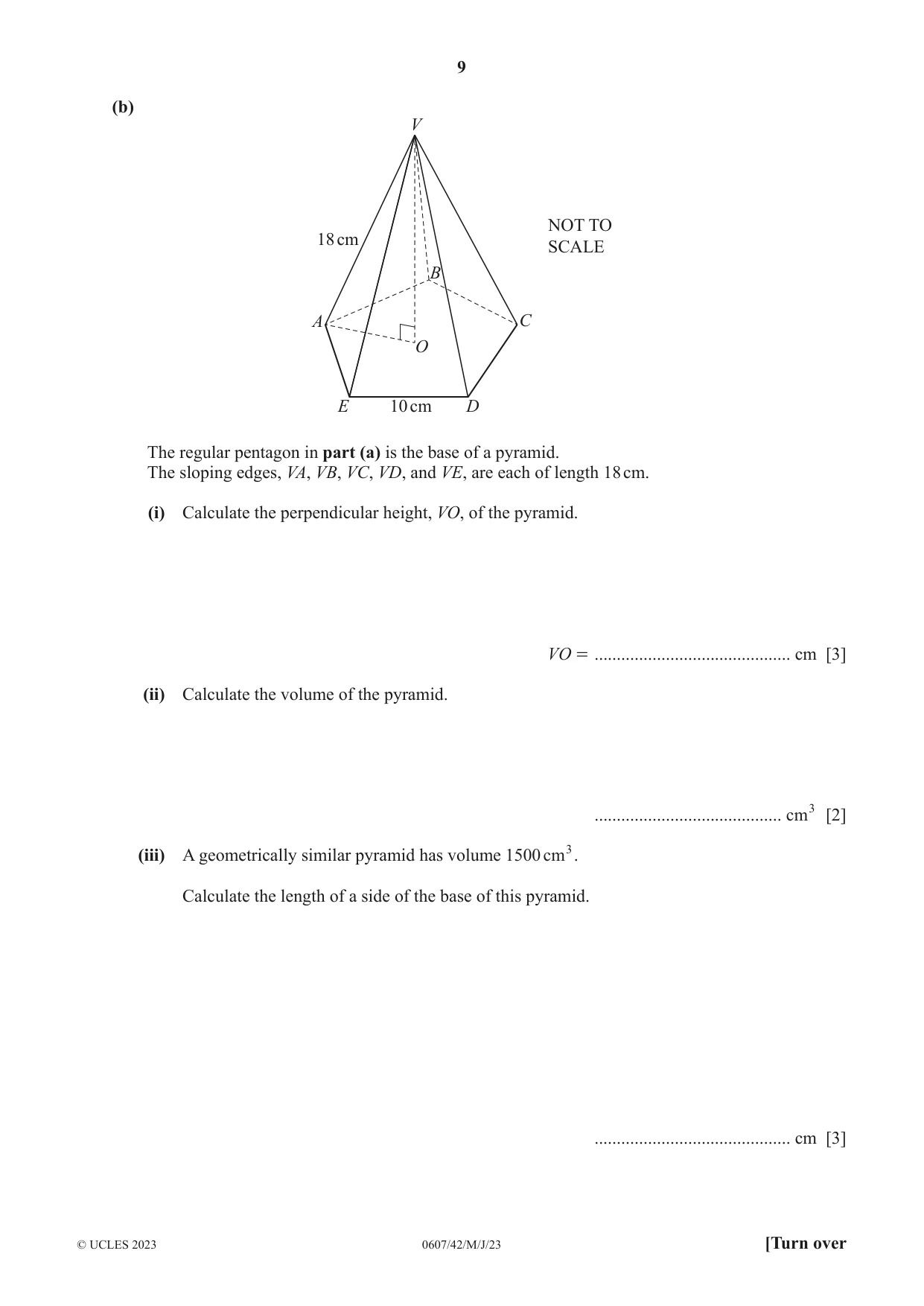
5 (a) The diagram shows a regular pentagon with sides of 10 cm and centre O. B 10 cm A C NOT TO O SCALE E D (i) Find angle AOB. Angle AOB = ................................................. [1] (ii) Show that OA = 8. 51 cm correct to 3 significant figures. [3] (iii) Find the area of the pentagon. .......................................... cm2 [2] (b) V NOT TO 18 cm SCALE B A C O E 10 cm D The regular pentagon in part (a) is the base of a pyramid. The sloping edges, VA, VB, VC, VD, and VE, are each of length 18 cm. (i) Calculate the perpendicular height, VO, of the pyramid. VO = ............................................ cm [3] (ii) Calculate the volume of the pyramid. .......................................... cm3 [2] (iii) A geometrically similar pyramid has volume 1500 cm 3. Calculate the length of a side of the base of this pyramid. ............................................ cm [3]
Mark scheme: 5(a)(i) 72 1 5(a)(ii) 5 M2 1 5 oe oe M1 for sin their 72 1 2 OD sin their 72 2 8.506 to 8.507 A1 5(a)(iii) 172 or 172.0 to 172.2 2 1 M1 for × 8.512 × sin(their 72) oe 2 1 or 8.51 (10or5)sin54 oe 2 1 or (10or5) 5tan54 oe 2 5(b)(i) 15.9 or 15.86... 3 M2 for 182 – 8.512 or M1 for VO2 + 8.512 = 182 5(b)(ii) 909 to 913 2 1 M1 for (their172) (their15.9) 3 5(b)(iii) 11.8 or 11.79 to 11.82 3 1500 M2 for 10 × 3 oe their(b)(ii) 1500 their(b)(ii) or M1 for 3 or 3 their(b)(ii) 1500 their (b)(ii) 10 3 or oe 1500 x
Q6 · Y 9 x – 6 0 6 – 9 x 2 + 3 x f ( x) = ( x - 2)( x + 1) (a) On the diagram sketch the graph…
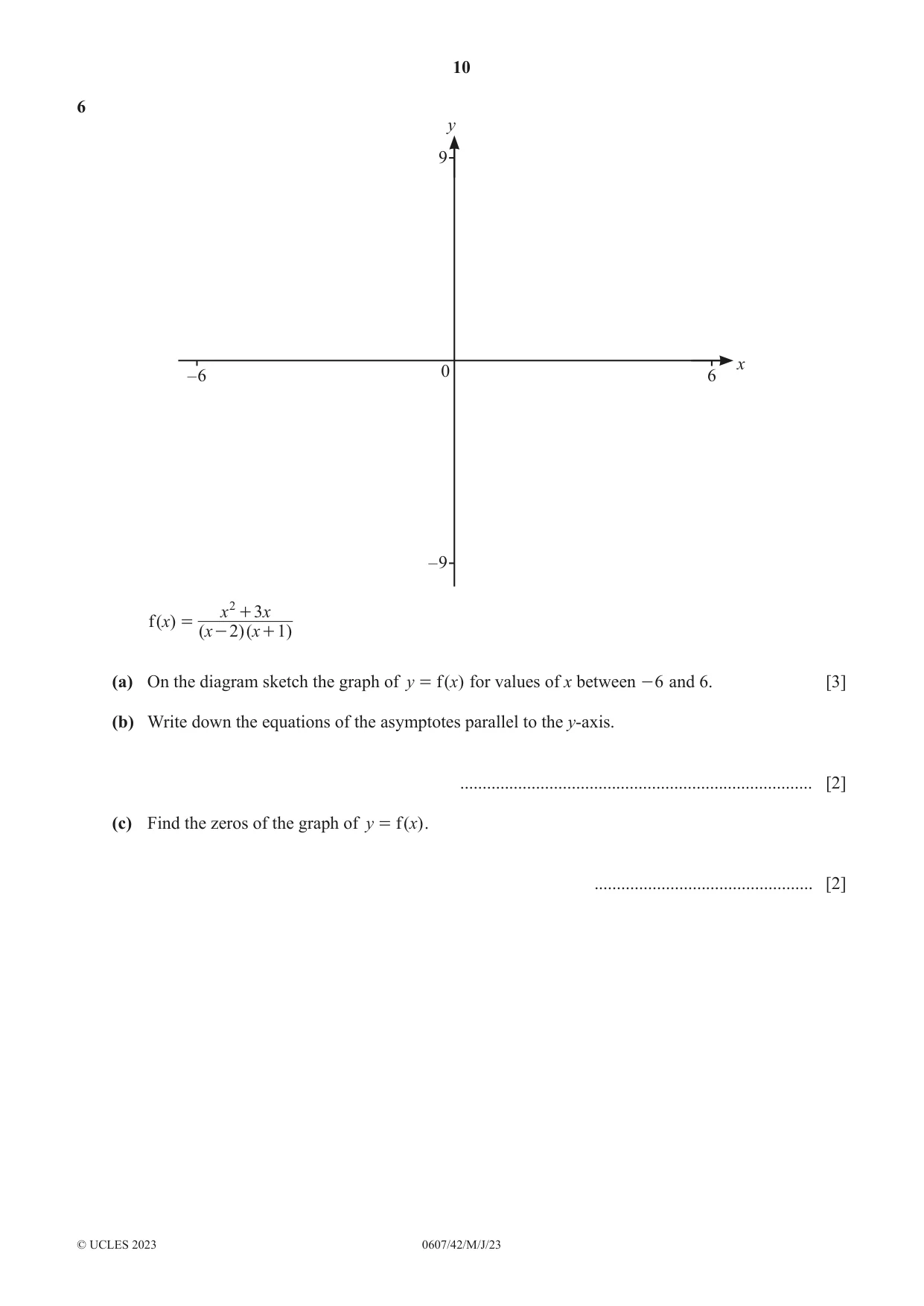
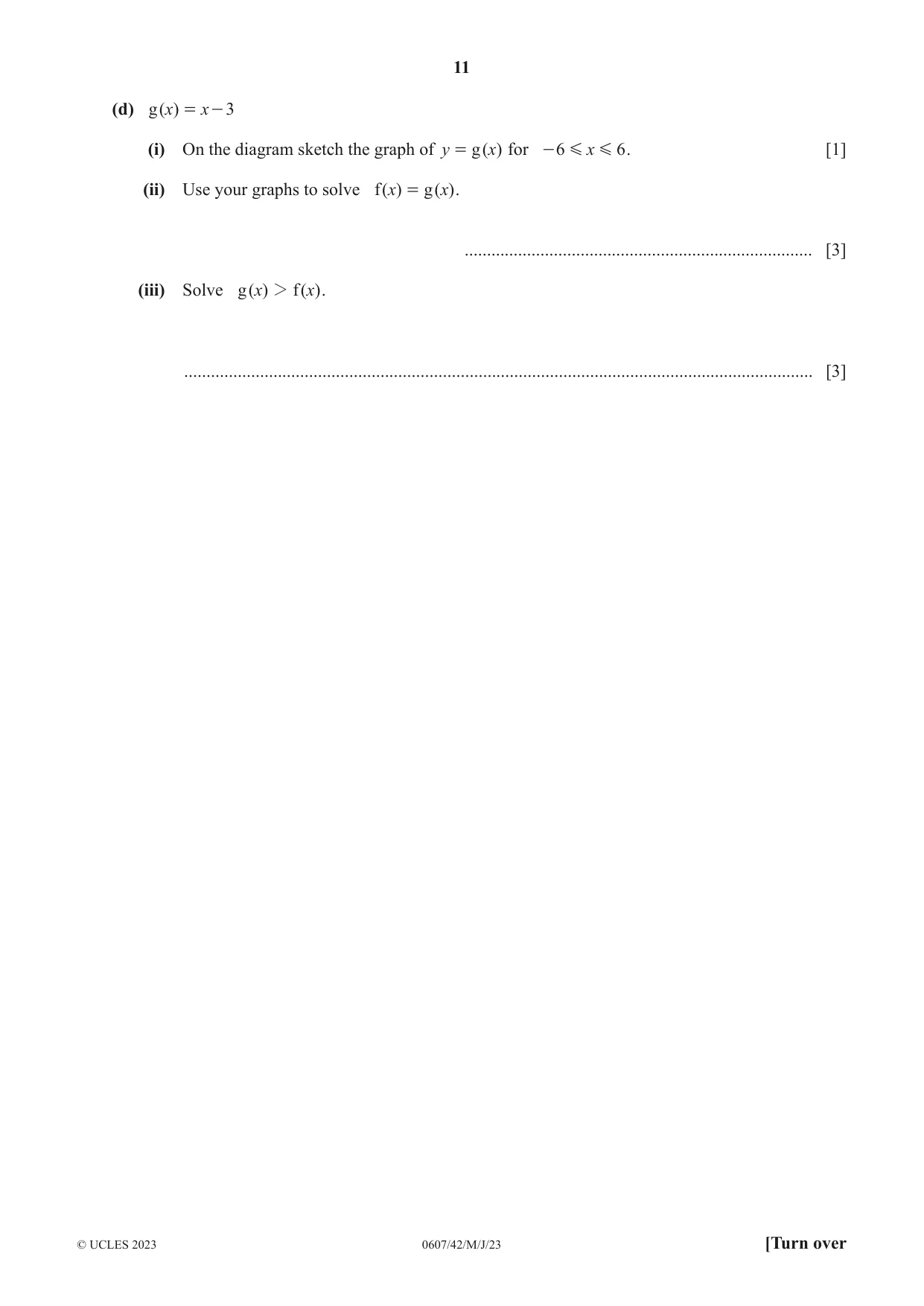
6 y 9 x – 6 0 6 – 9 x 2 + 3 x f ( x) = ( x - 2)( x + 1) (a) On the diagram sketch the graph of y = f ( x) for values of x between - 6 and 6. [3] (b) Write down the equations of the asymptotes parallel to the y‑axis. ............................................................................... [2] (c) Find the zeros of the graph of y = f ( x) . ................................................. [2] (d) g ( x) = x - 3 (i) On the diagram sketch the graph of y = g ( x) for - 6 G x G 6 . [1] (ii) Use your graphs to solve f ( x) = g ( x) . .............................................................................. [3] (iii) Solve g ( x) 2 f ( x) . ............................................................................................................................................. [3]
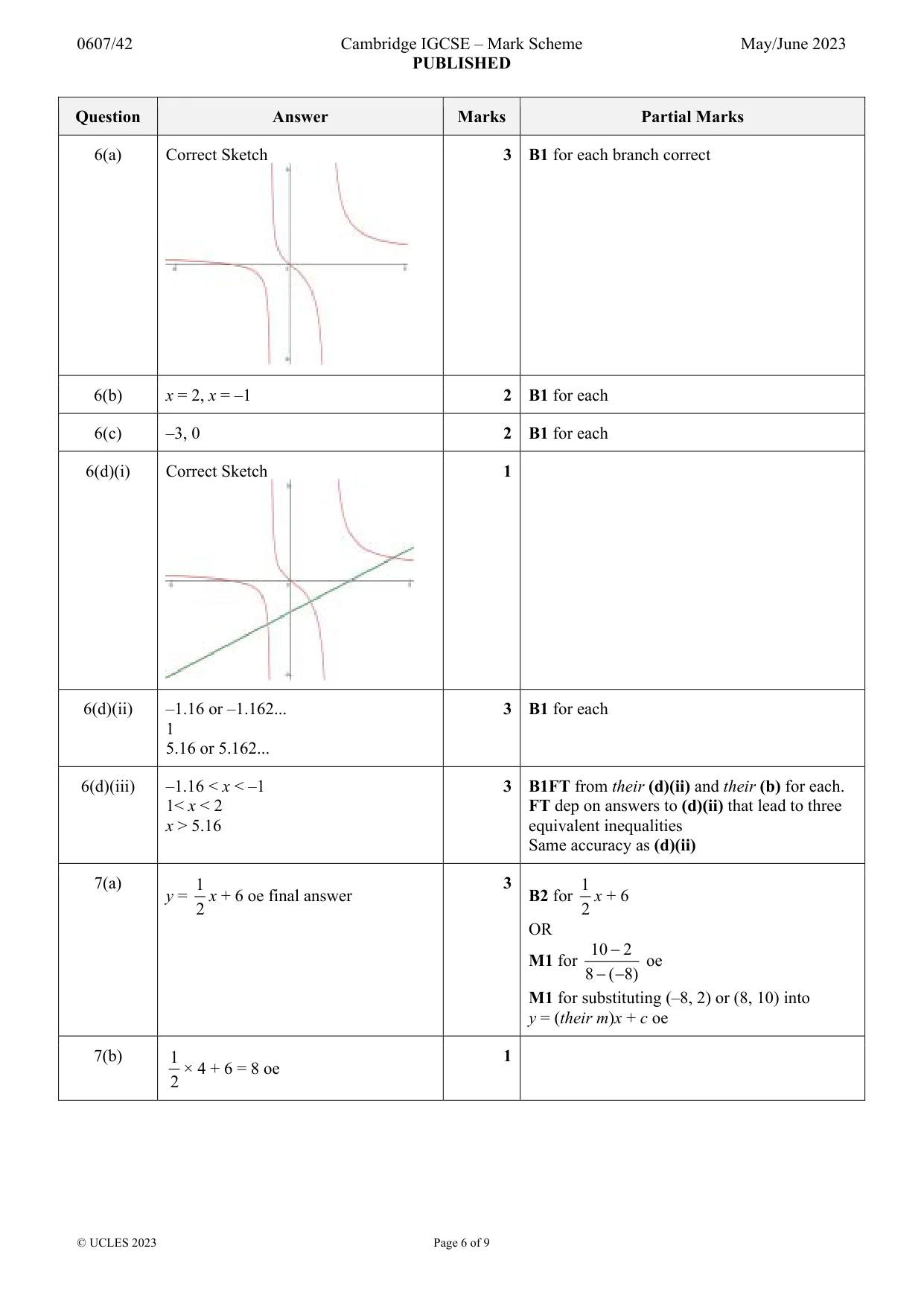
Mark scheme: 6(a) Correct Sketch 3 B1 for each branch correct 6(b) x = 2, x = –1 2 B1 for each 6(c) –3, 0 2 B1 for each 6(d)(i) Correct Sketch 1 6(d)(ii) –1.16 or –1.162... 3 B1 for each 1 5.16 or 5.162... 6(d)(iii) –1.16 < x < –1 3 B1FT from their (d)(ii) and their (b) for each. 1< x < 2 FT dep on answers to (d)(ii) that lead to three x > 5.16 equivalent inequalities Same accuracy as (d)(ii)
Q7 · A is the point ( - 8 , 2) and C is the point (8, 10)
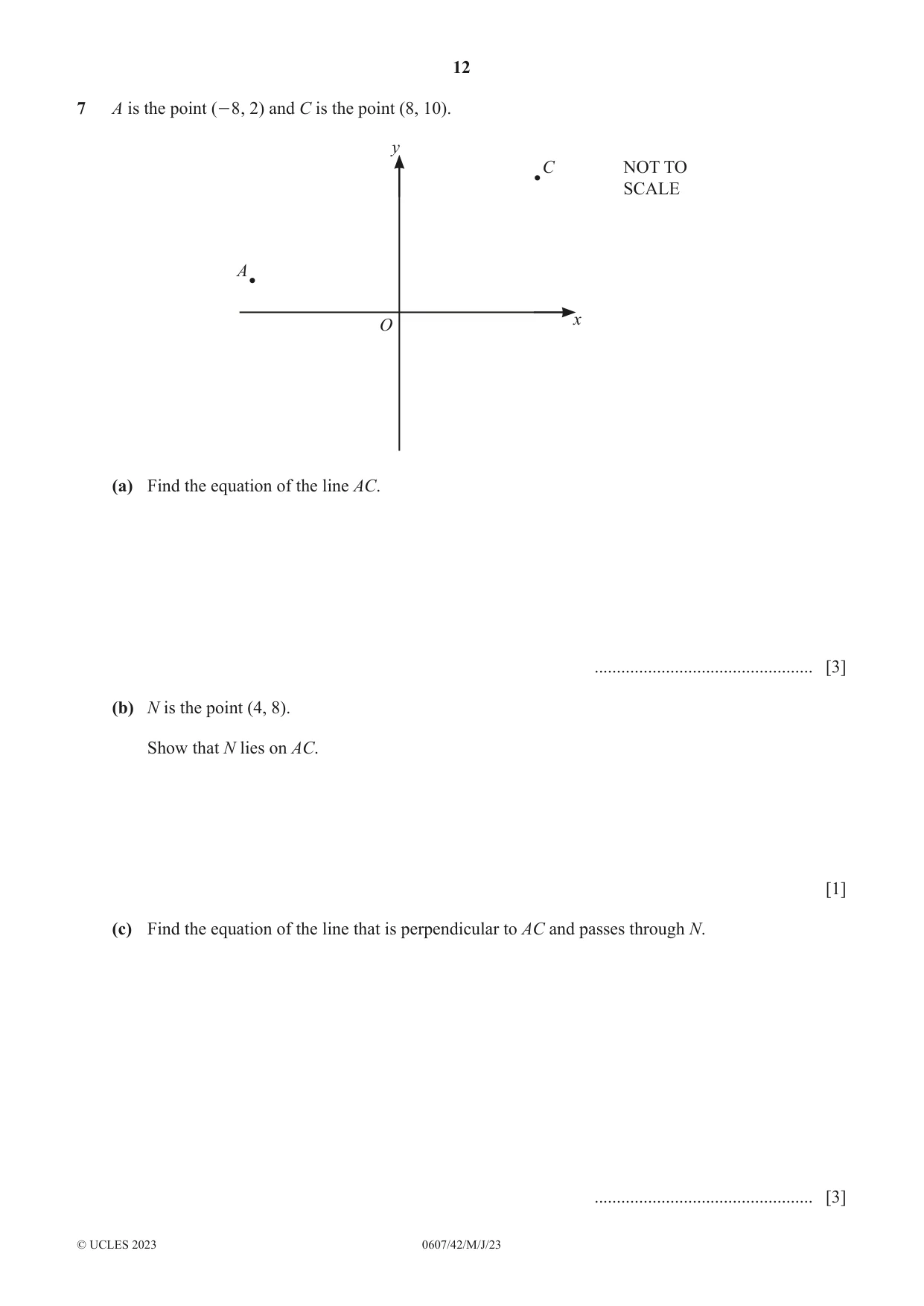
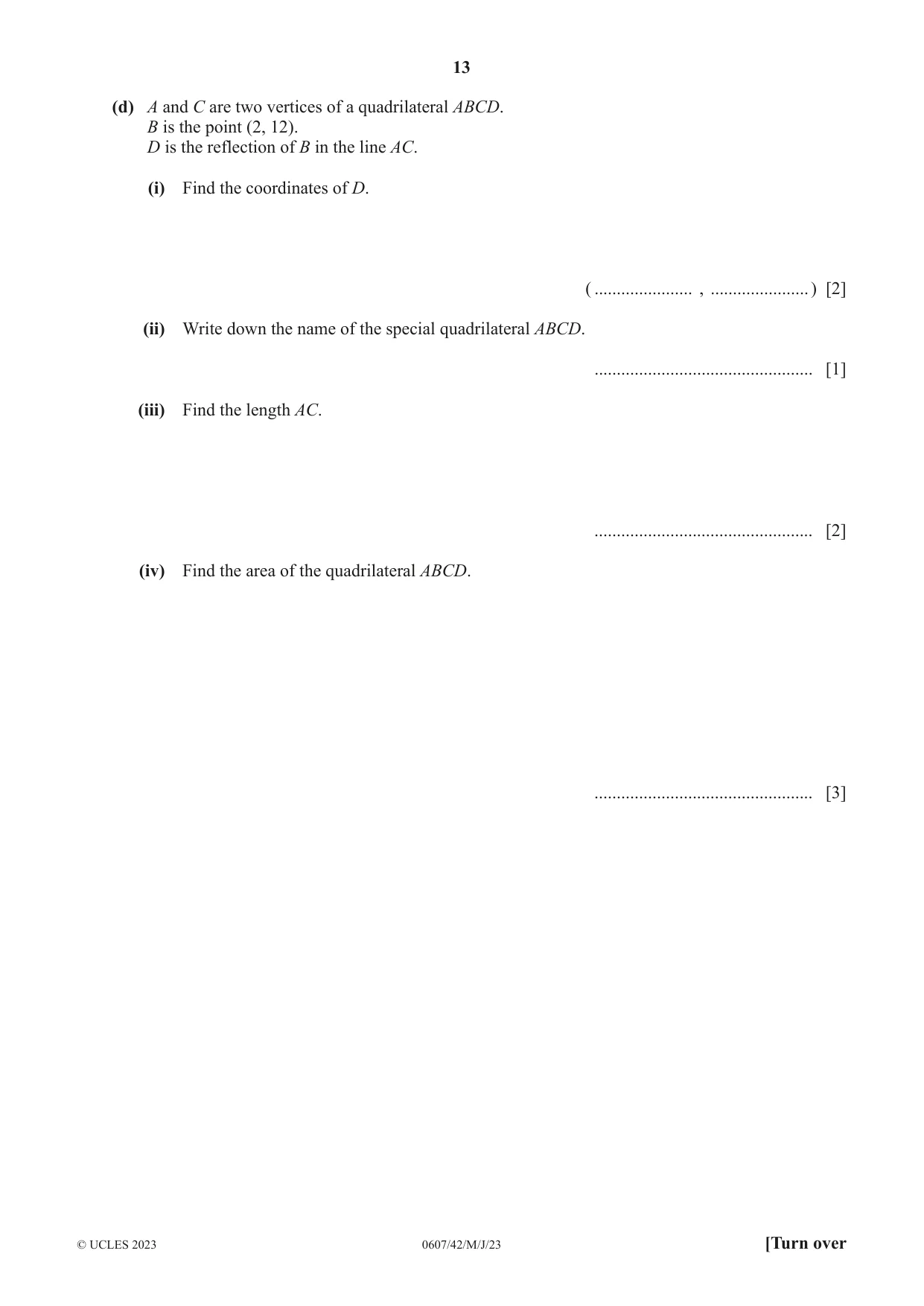
7 A is the point ( - 8 , 2) and C is the point (8, 10). y C NOT TO SCALE A x O (a) Find the equation of the line AC. ................................................. [3] (b) N is the point (4, 8). Show that N lies on AC. [1] (c) Find the equation of the line that is perpendicular to AC and passes through N. ................................................. [3] (d) A and C are two vertices of a quadrilateral ABCD. B is the point (2, 12). D is the reflection of B in the line AC. (i) Find the coordinates of D. ( ...................... , ...................... ) [2] (ii) Write down the name of the special quadrilateral ABCD. ................................................. [1] (iii) Find the length AC. ................................................. [2] (iv) Find the area of the quadrilateral ABCD. ................................................. [3]
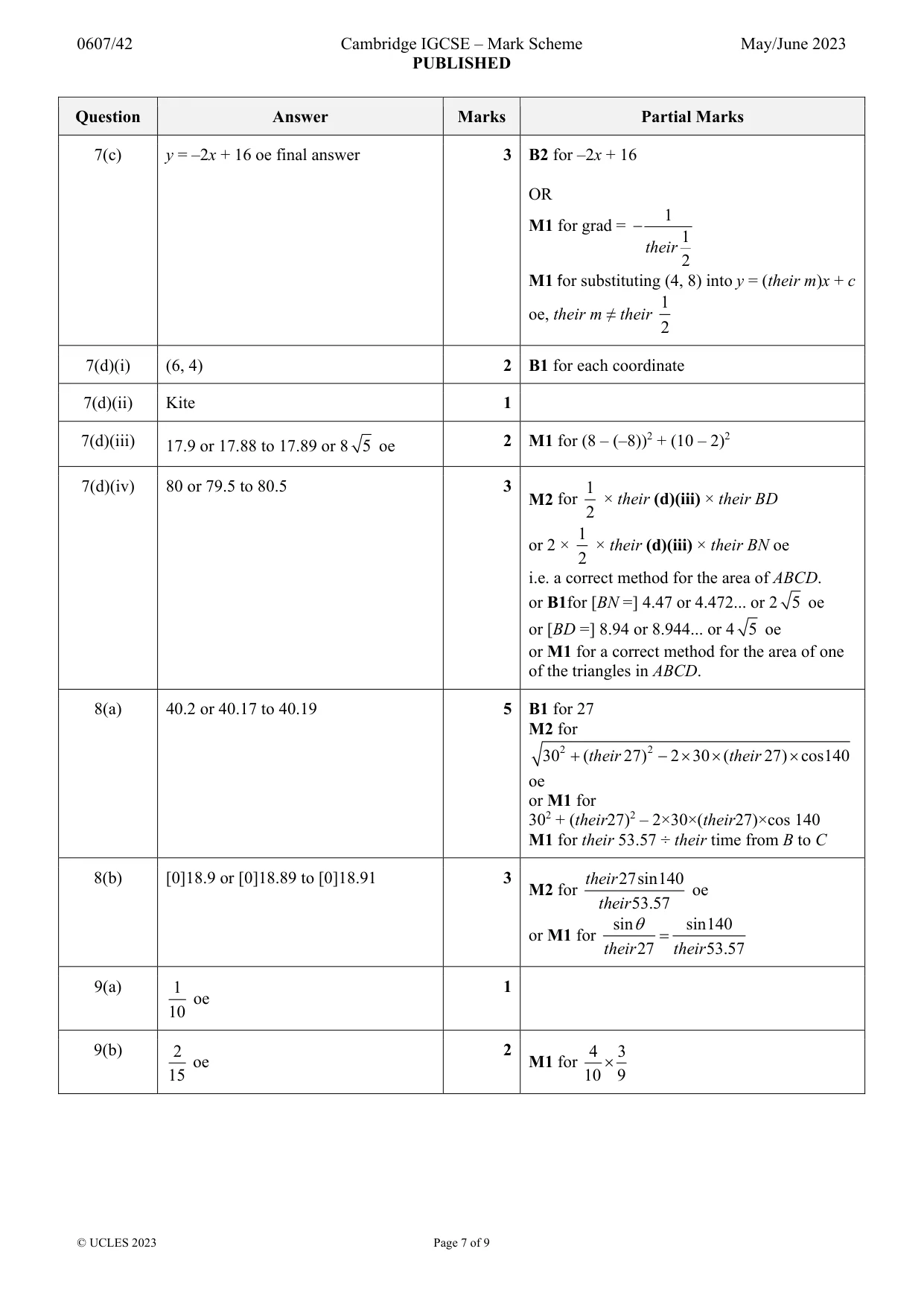
Mark scheme: 7(a) 1 3 1 y = x + 6 oe final answer B2 for x + 6 2 2 OR 10 2 M1 for oe 8 ( 8) M1 for substituting (–8, 2) or (8, 10) into y = (their m)x + c oe 7(b) 1 1 × 4 + 6 = 8 oe 2 7(c) y = –2x + 16 oe final answer 3 B2 for –2x + 16 OR 1 M1 for grad = 1 their 2 M1 for substituting (4, 8) into y = (their m)x + c 1 oe, their m ≠ their 2 7(d)(i) (6, 4) 2 B1 for each coordinate 7(d)(ii) Kite 1 7(d)(iii) 2 M1 for (8 – (–8))2 + (10 – 2)2 17.9 or 17.88 to 17.89 or 8 5 oe 7(d)(iv) 80 or 79.5 to 80.5 3 1 M2 for × their (d)(iii) × their BD 2 1 or 2 × × their (d)(iii) × their BN oe 2 i.e. a correct method for the area of ABCD. or B1for [BN =] 4.47 or 4.472... or 2 5 oe or [BD =] 8.94 or 8.944... or 4 5 oe or M1 for a correct method for the area of one of the triangles in ABCD.
Q8 · A ship sails from port A at a constant speed of 18 km/h on a bearing of 040°
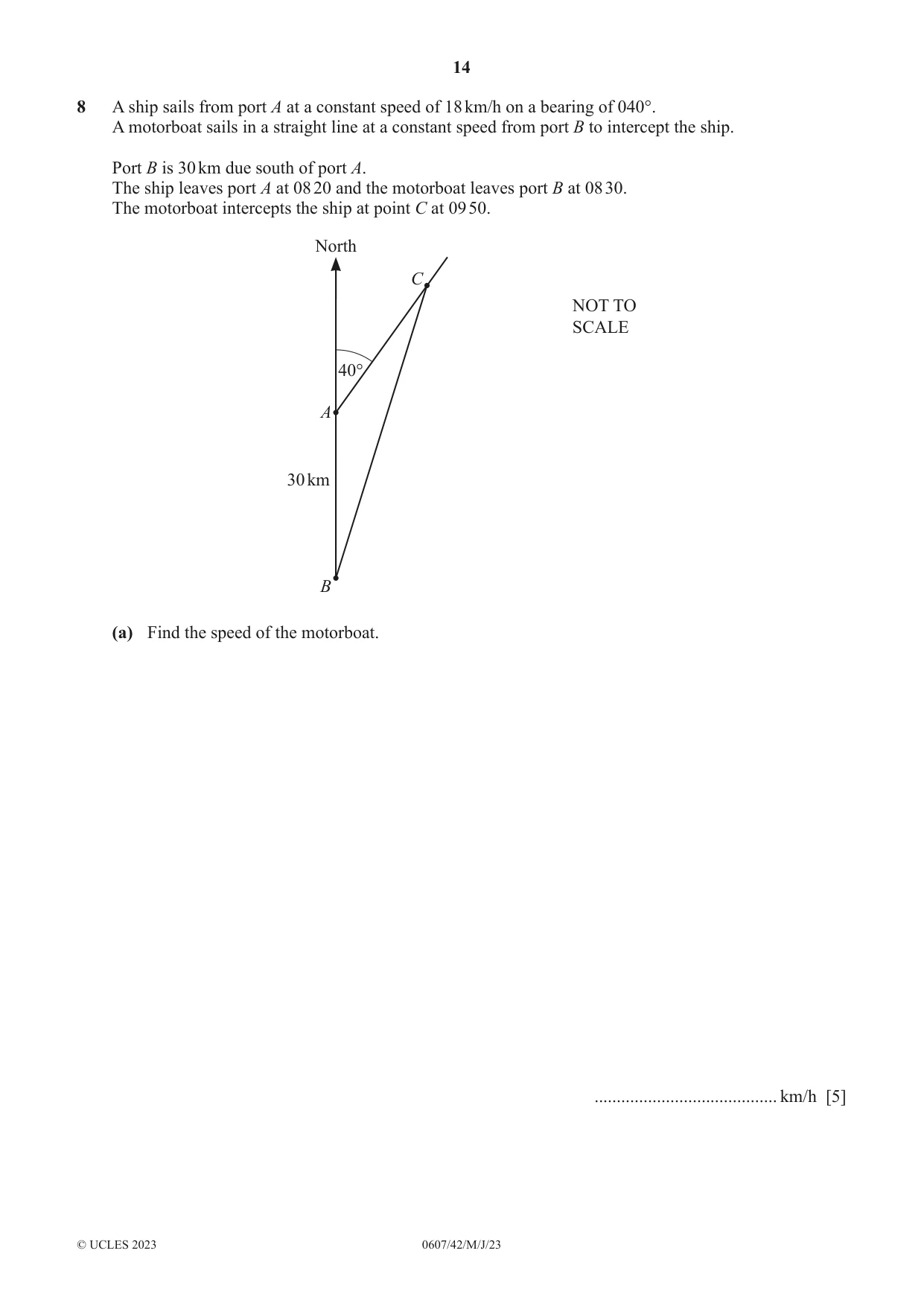
8 A ship sails from port A at a constant speed of 18 km/h on a bearing of 040°. A motorboat sails in a straight line at a constant speed from port B to intercept the ship. Port B is 30 km due south of port A. The ship leaves port A at 08 20 and the motorboat leaves port B at 08 30. The motorboat intercepts the ship at point C at 09 50. North C NOT TO SCALE 40° A 30 km B (a) Find the speed of the motorboat. ......................................... km/h [5] (b) Find the bearing on which the motorboat sails. ................................................. [3]
Mark scheme: 8(a) 40.2 or 40.17 to 40.19 5 B1 for 27 M2 for 30 2 (their 27) 2 2 30 ( their 27) cos140 oe or M1 for 302 + (their27)2 – 2×30×(their27)×cos 140 M1 for their 53.57 ÷ their time from B to C 8(b) [0]18.9 or [0]18.89 to [0]18.91 3 their 27sin140 M2 for oe their 53.57 sin sin140 or M1 for their 27 their 53.57
Q9 · P E R C E N T I L E Asa and Bernice have these 10 letter cards
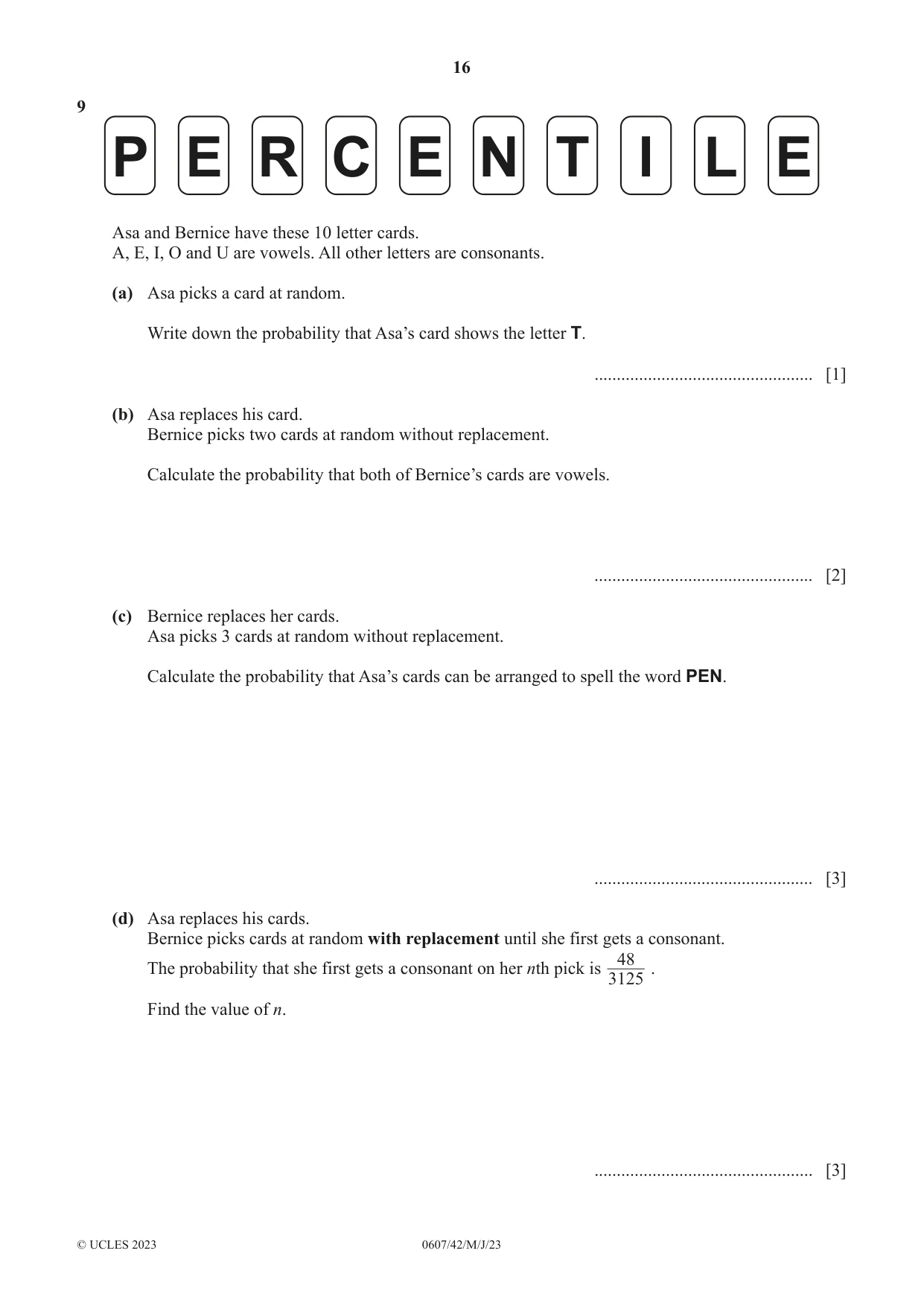
9 P E R C E N T I L E Asa and Bernice have these 10 letter cards. A, E, I, O and U are vowels. All other letters are consonants. (a) Asa picks a card at random. Write down the probability that Asa’s card shows the letter T. ................................................. [1] (b) Asa replaces his card. Bernice picks two cards at random without replacement. Calculate the probability that both of Bernice’s cards are vowels. ................................................. [2] (c) Bernice replaces her cards. Asa picks 3 cards at random without replacement. Calculate the probability that Asa’s cards can be arranged to spell the word PEN. ................................................. [3] (d) Asa replaces his cards. Bernice picks cards at random with replacement until she first gets a consonant. 48 The probability that she first gets a consonant on her nth pick is . 3125 Find the value of n. ................................................. [3]
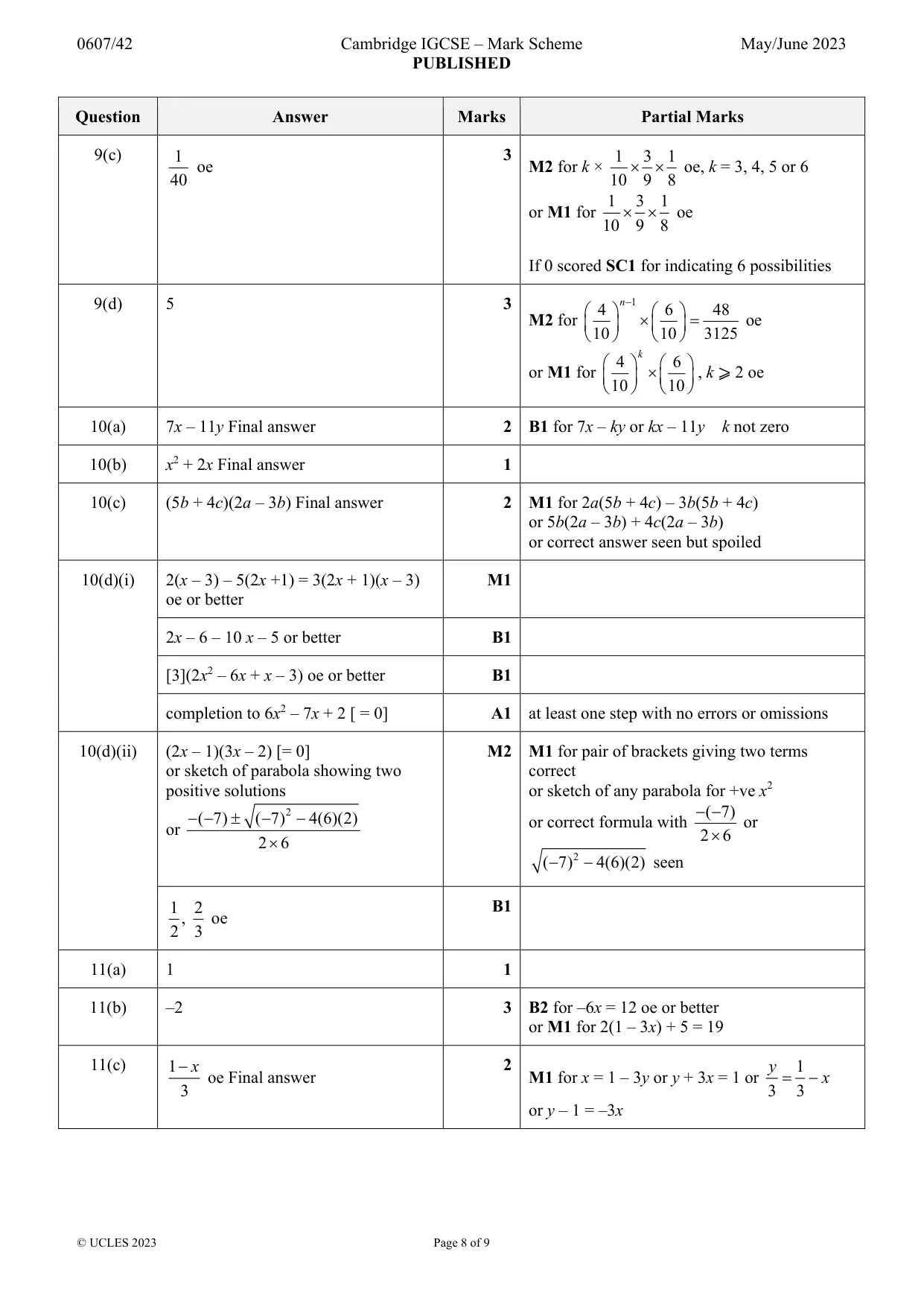
Mark scheme: 9(a) 1 1 oe 10 9(b) 2 2 4 3 oe M1 for 15 10 9 9(c) 1 3 1 3 1 oe M2 for k × oe, k = 3, 4, 5 or 6 40 10 9 8 1 3 1 or M1 for oe 10 9 8 If 0 scored SC1 for indicating 6 possibilities 9(d) 5 3 n1 4 6 48 M2 for oe 10 10 3125 4 k 6 or M1 for , k ⩾ 2 oe 10 10
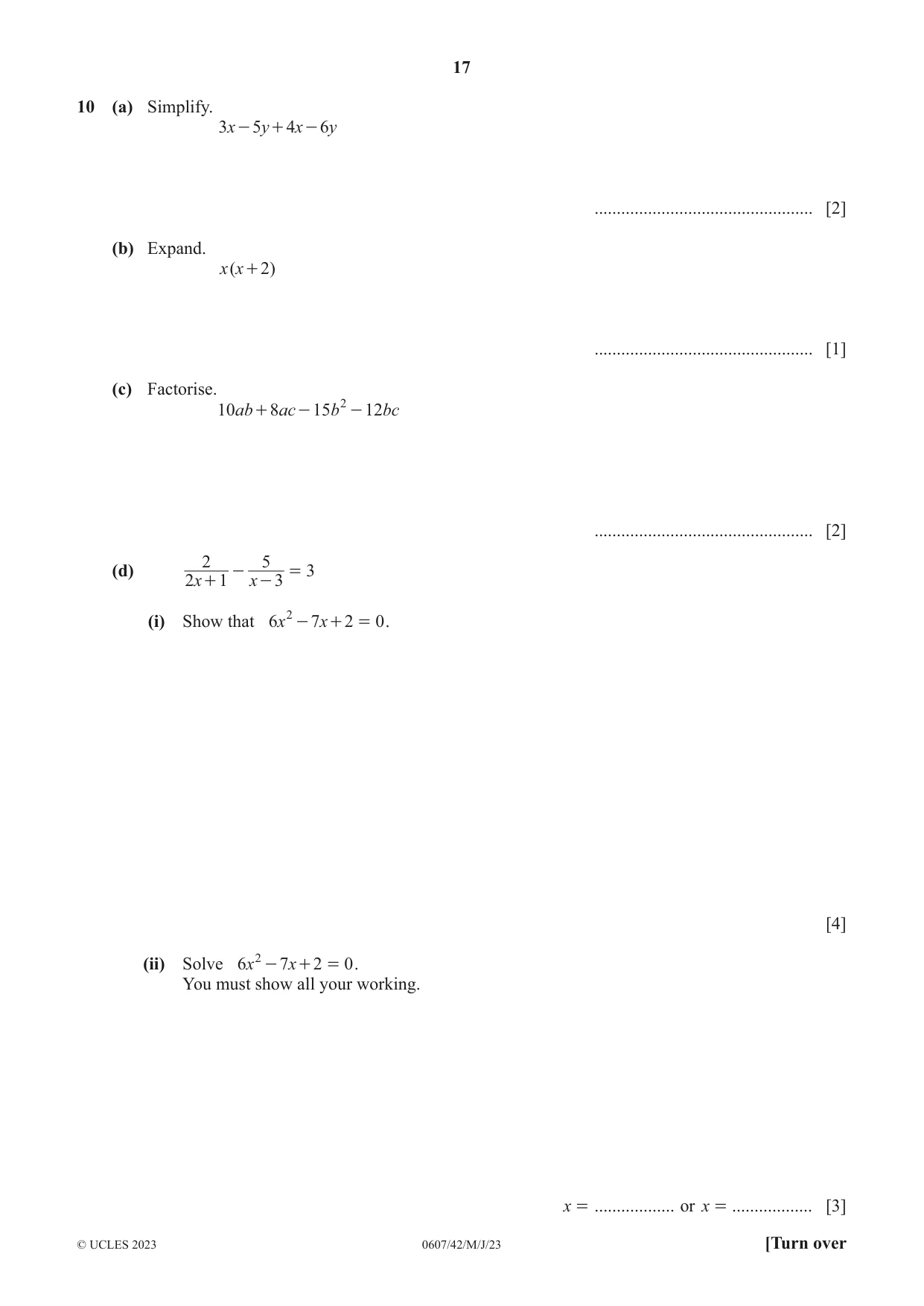
Question 10
10 (a) Simplify. 3x - 5y + 4x - 6y ................................................. [2] (b) Expand. x ( x + 2) ................................................. [1] (c) Factorise. 10ab + 8ac - 15b 2 - 12bc ................................................. [2] 2 5 (d) - = 3 2x + 1 x - 3 (i) Show that 6x 2 - 7x + 2 = 0 . [4] (ii) Solve 6x 2 - 7x + 2 = 0 . You must show all your working. x = .................. or x = .................. [3]
Mark scheme: 10(a) 7x – 11y Final answer 2 B1 for 7x – ky or kx – 11y k not zero 10(b) x2 + 2x Final answer 1 10(c) (5b + 4c)(2a – 3b) Final answer 2 M1 for 2a(5b + 4c) – 3b(5b + 4c) or 5b(2a – 3b) + 4c(2a – 3b) or correct answer seen but spoiled 10(d)(i) 2(x – 3) – 5(2x +1) = 3(2x + 1)(x – 3) M1 oe or better 2x – 6 – 10 x – 5 or better B1 [3](2x2 – 6x + x – 3) oe or better B1 completion to 6x2 – 7x + 2 [ = 0] A1 at least one step with no errors or omissions 10(d)(ii) (2x – 1)(3x – 2) [= 0] M2 M1 for pair of brackets giving two terms or sketch of parabola showing two correct positive solutions or sketch of any parabola for +ve x2 2 ( 7) ( 7) ( 7) 4(6)(2) or correct formula with or or 2 6 2 6 ( 7) 2 4(6)(2) seen 1 2 B1 , oe 2 3
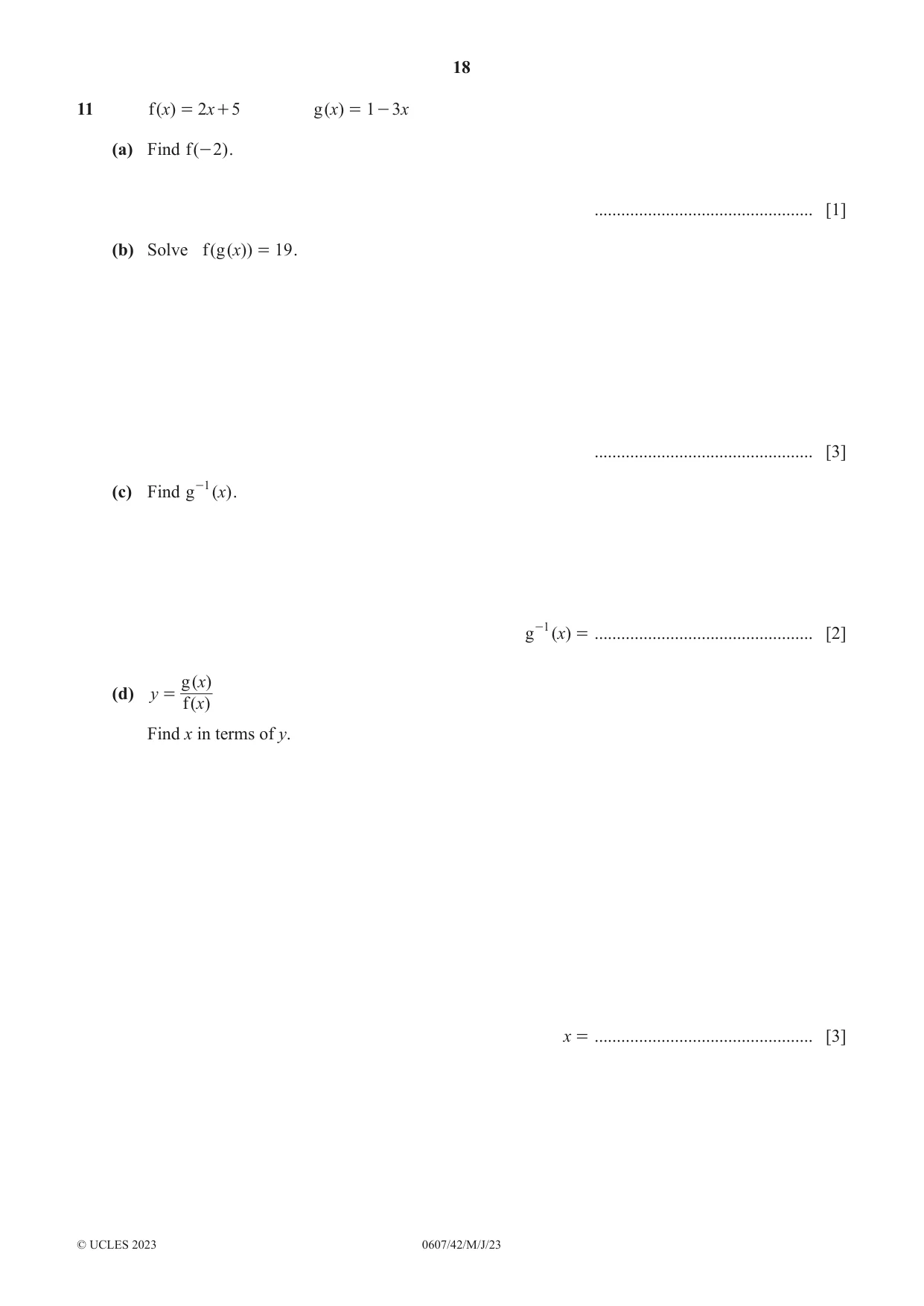
Q11 · F ( x) = 2 x + 5 g ( x) = 1 - 3 x (a) Find f ( - 2)
11 f ( x) = 2 x + 5 g ( x) = 1 - 3 x (a) Find f ( - 2) . ................................................. [1] (b) Solve f ( g ( x)) = 19 . ................................................. [3] (c) Find g -1 ( x) . g -1 ( x) = ................................................. [2] g ( x) (d) y = f ( x) Find x in terms of y. x = ................................................. [3]
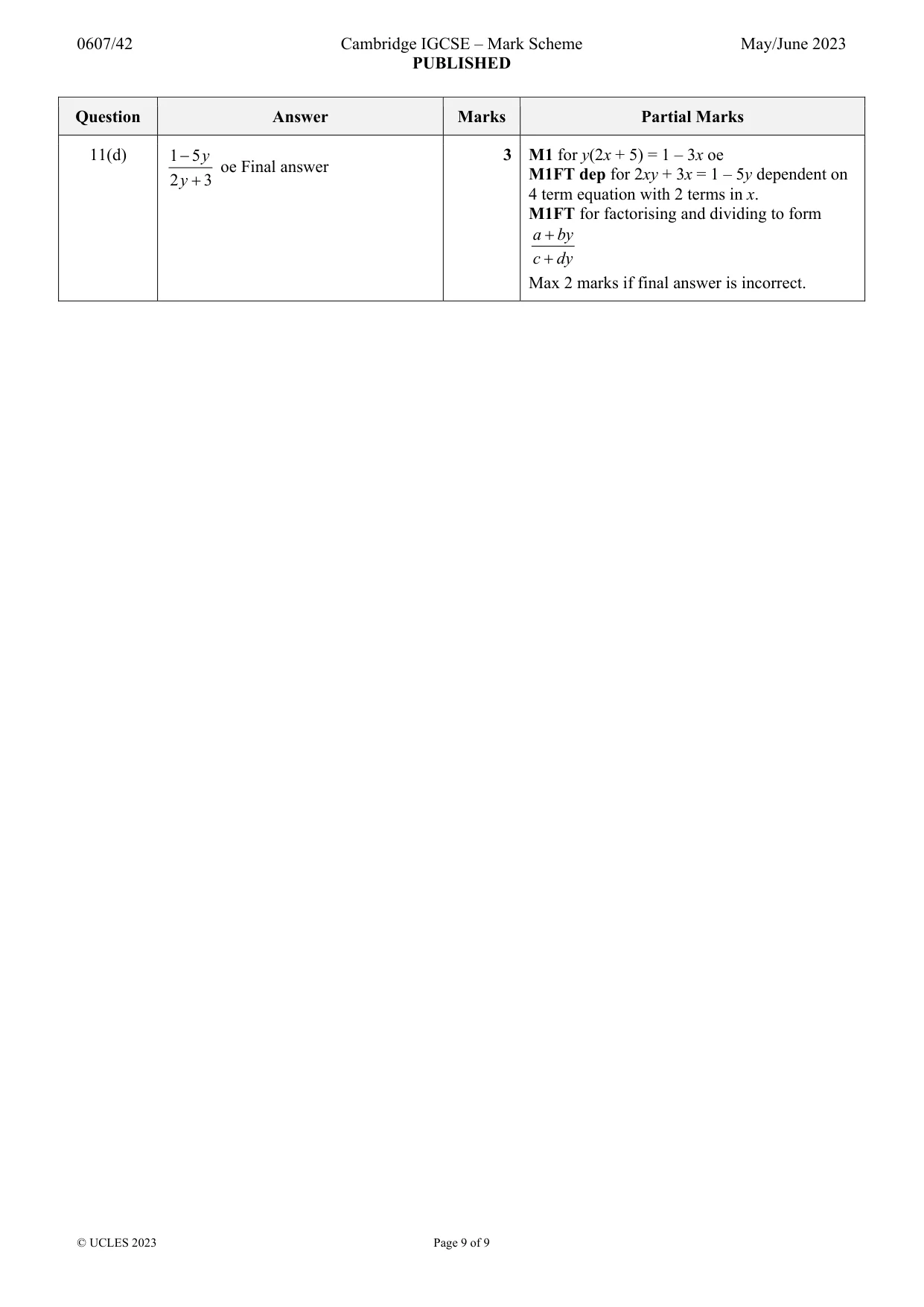
Mark scheme: 11(a) 1 1 11(b) –2 3 B2 for –6x = 12 oe or better or M1 for 2(1 – 3x) + 5 = 19 11(c) 1 x 2 y 1 oe Final answer M1 for x = 1 – 3y or y + 3x = 1 or x 3 3 3 or y – 1 = –3x 11(d) 1 5 y 3 M1 for y(2x + 5) = 1 – 3x oe oe Final answer M1FT dep for 2xy + 3x = 1 – 5y dependent on 2 y 3 4 term equation with 2 terms in x. M1FT for factorising and dividing to form a by c dy Max 2 marks if final answer is incorrect.
What was in this paper
The subtopics covered by these 11 questions, and how many questions each got. Open one in a new tab to see every Cambridge question on it.
What you needed in this session
Cambridge’s own grade thresholds for 2023 May/June, Paper 4 · Variant 2. A higher threshold means an easier paper — the bar moves with how the cohort did.