Cambridge IGCSE Mathematics - International 0607 — 2018 May/June Paper 4 · Variant 2
0607/42/M/J/18 · 11 questions · 120 marks · ≈135 min
The question paper and its mark scheme, free to read here and free to download. This is Cambridge’s own paper, exactly as it was sat.
Question paper20 pages
Mark scheme8 pages
Answers below. Sit the paper first if you are practising.
Questions as text
Question 1
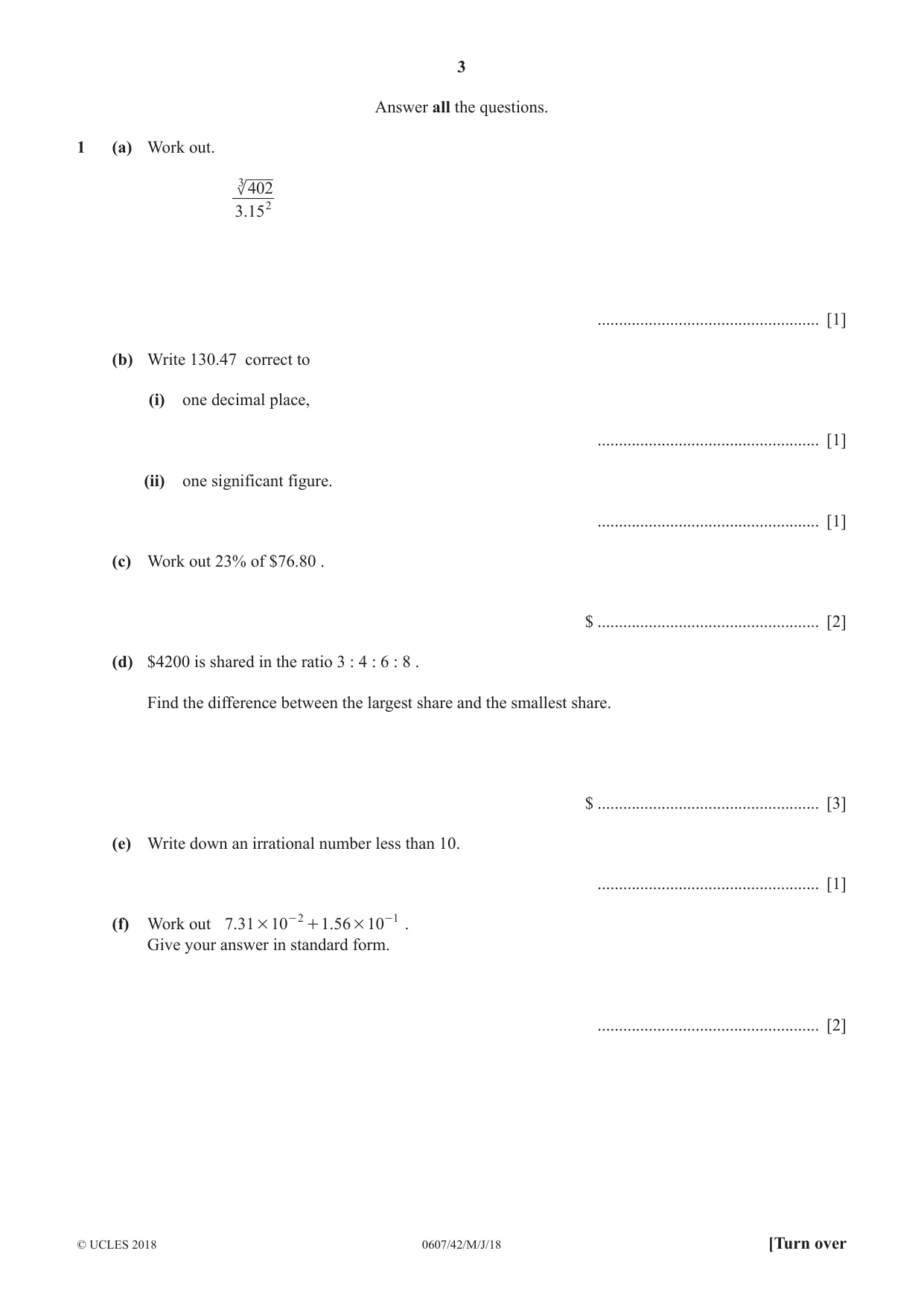
1 (a) Work out. 3 402 .315 2 .................................................... [1] (b) Write 130.47 correct to (i) one decimal place, .................................................... [1] (ii) one significant figure. .................................................... [1] (c) Work out 23% of $76.80 . $ .................................................... [2] (d) $4200 is shared in the ratio 3 : 4 : 6 : 8 . Find the difference between the largest share and the smallest share. $ .................................................... [3] (e) Write down an irrational number less than 10. .................................................... [1] (f) Work out 7.31 # 10 - 2 + 1.56 # 10 - 1 . Give your answer in standard form. .................................................... [2]
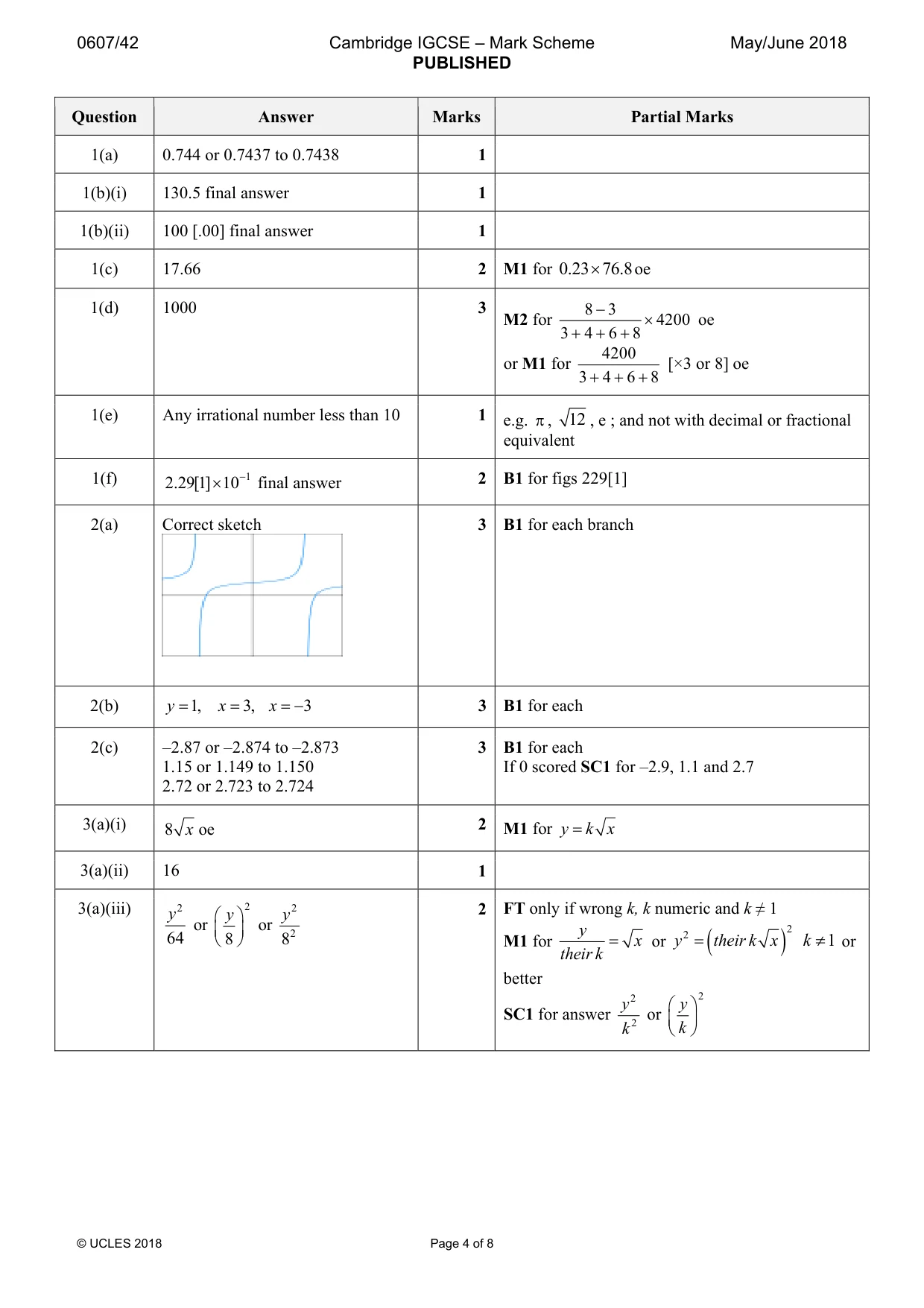
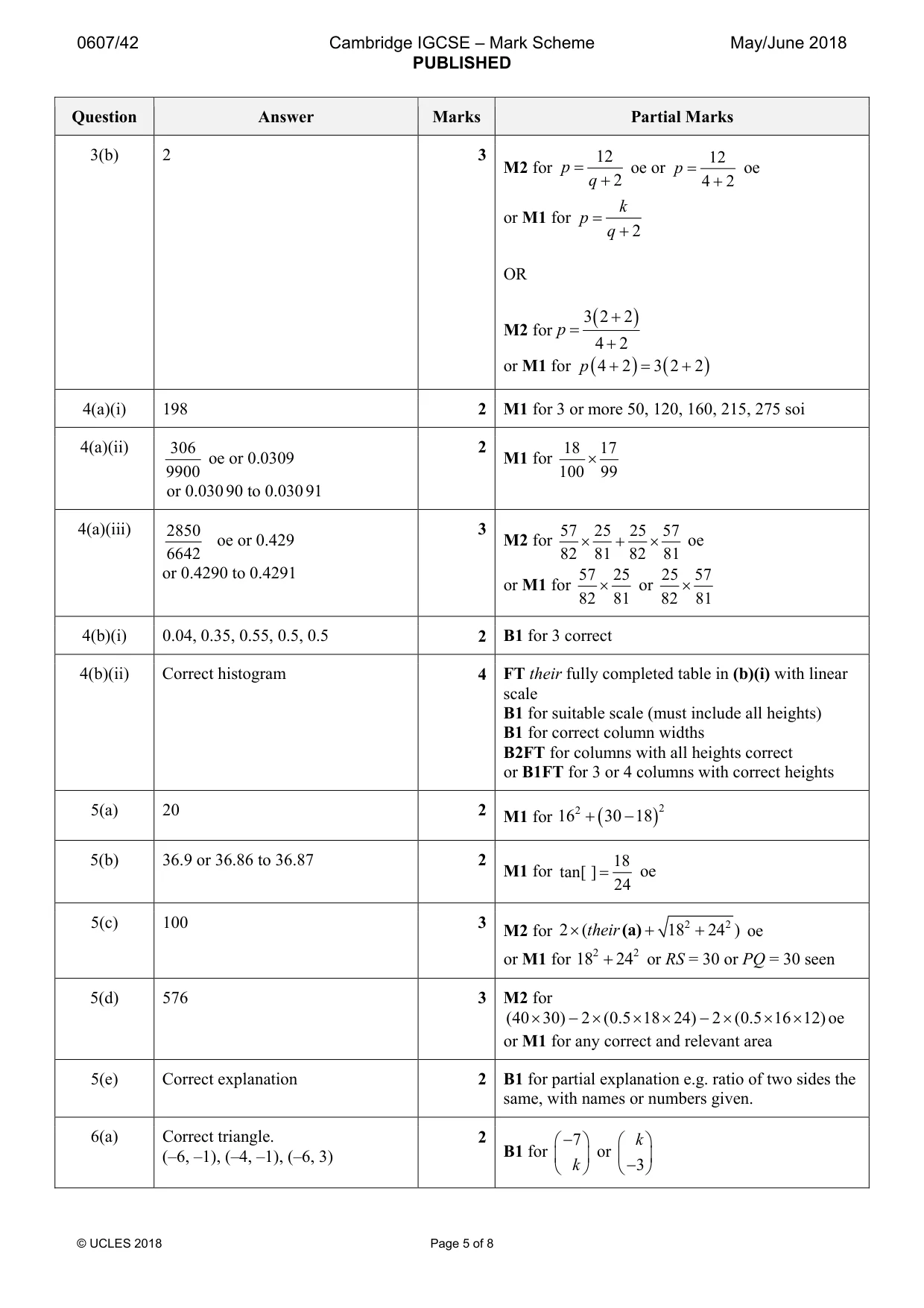
Mark scheme: Question Answer Marks Partial Marks 1(a) 0.744 or 0.7437 to 0.7438 1 1(b)(i) 130.5 final answer 1 1(b)(ii) 100 [.00] final answer 1 1(c) 17.66 2 M1 for 0.23 × 76.8 oe 1(d) 1000 3 8 − 3 M2 for × 4200 oe 3 + 4 + 6 + 8 4200 or M1 for [×3 or 8] oe 3 + 4 + 6 + 8 1(e) Any irrational number less than 10 1 e.g. π , 12 , e ; and not with decimal or fractional equivalent 1(f) 2.29[1] × 10−1 final answer 2 B1 for figs 229[1]
Q2 · Y 5 x −5 0 5 −5 x f (x) = 1 - 2 (x - 9 ) (a) On the diagram, sketch the graph of y = f (…
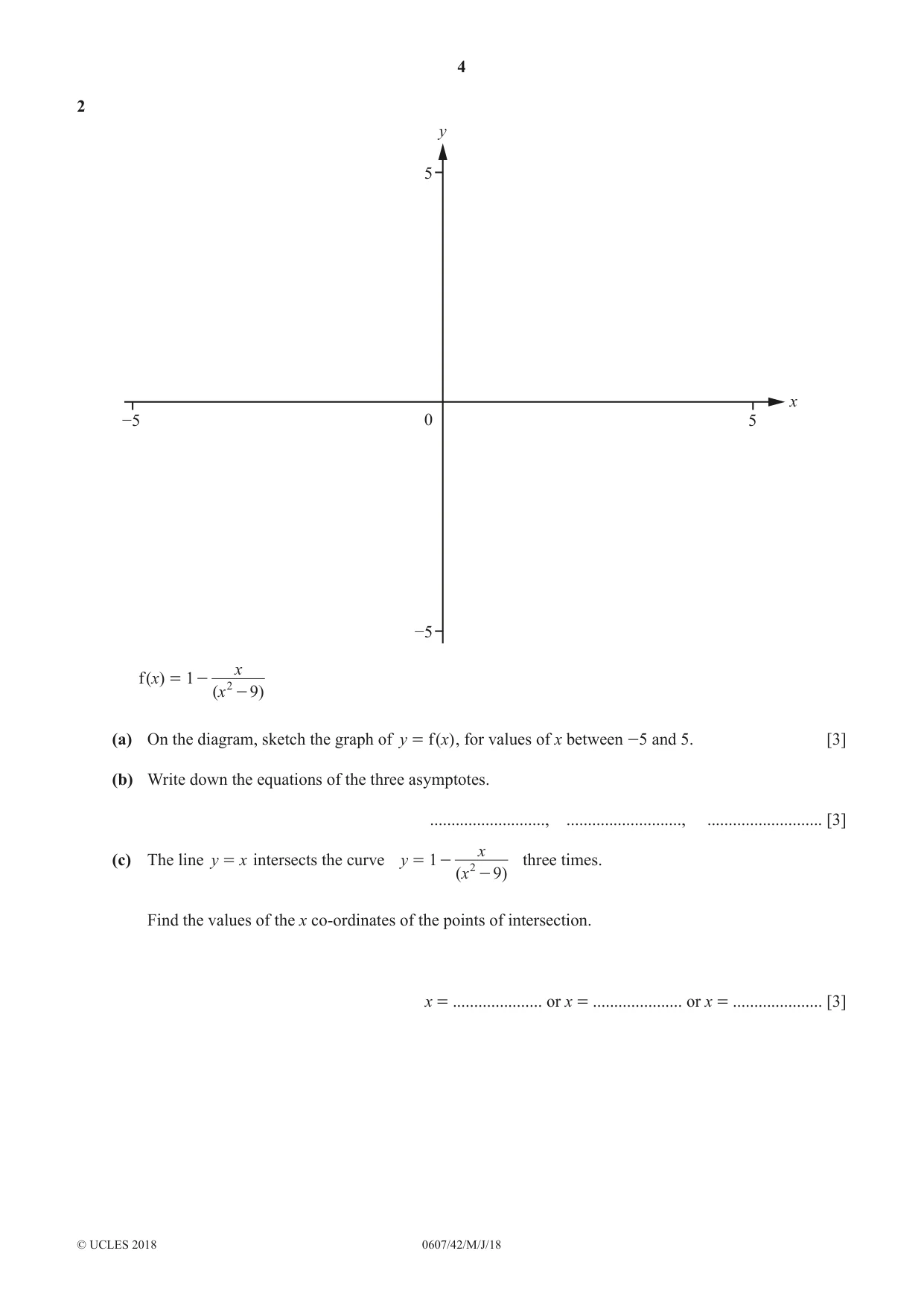
2 y 5 x −5 0 5 −5 x f (x) = 1 - 2 (x - 9 ) (a) On the diagram, sketch the graph of y = f ( x) , for values of x between -5 and 5. [3] (b) Write down the equations of the three asymptotes. ..........................., ..........................., ........................... [3] x (c) The line y = x intersects the curve y = 1 - 2 three times. (x - 9 ) Find the values of the x co-ordinates of the points of intersection. x = ..................... or x = ..................... or x = ..................... [3]
Mark scheme: 2(a) Correct sketch 3 B1 for each branch 2(b) y = 1, x = 3, x = − 3 3 B1 for each 2(c) –2.87 or –2.874 to –2.873 3 B1 for each 1.15 or 1.149 to 1.150 If 0 scored SC1 for –2.9, 1.1 and 2.7 2.72 or 2.723 to 2.724
Q3 · Y varies directly as the square root of x
3 (a) y varies directly as the square root of x. y = 32 when x = 16. (i) Find y in terms of x. y = .................................................... [2] (ii) Find the value of y when x = 4. y = .................................................... [1] (iii) Find x in terms of y. x = .................................................... [2] (b) p varies inversely as q + 2 . p = 3 when q = 2. Find the value of p when q = 4. p = .................................................... [3]
Mark scheme: 3(a)(i) 8 x oe 2 M1 for y = k x 3(a)(ii) 16 1 3(a)(iii) 2 2 2 2 FT only if wrong k, k numeric and k ≠ 1 y y y 2 or or 2 y 2 64 8 8 M1 for = x or y = their k x k ≠ 1 or ( ) their k better y 2 y 2 SC1 for answer or 2 k k 3(b) 2 3 12 12 M2 for p = oe or p = oe q + 2 4 + 2 k or M1 for p = q + 2 OR 3 ( 2 + 2 ) M2 for p = 4 + 2 or M1 for p ( 4 + 2 ) = 3 ( 2 + 2 )
Q4 · The mass, x grams, of each of 100 oranges is found
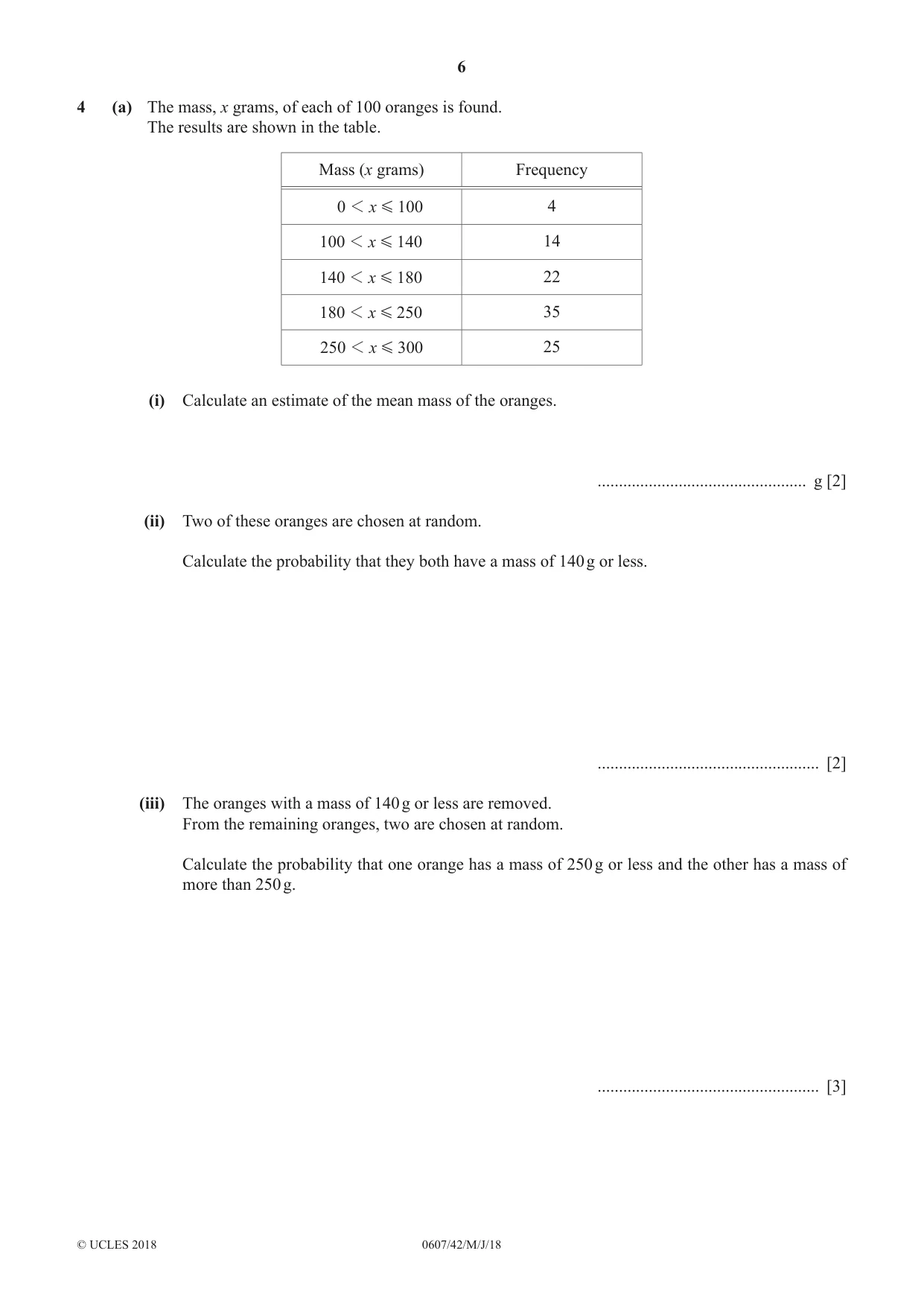
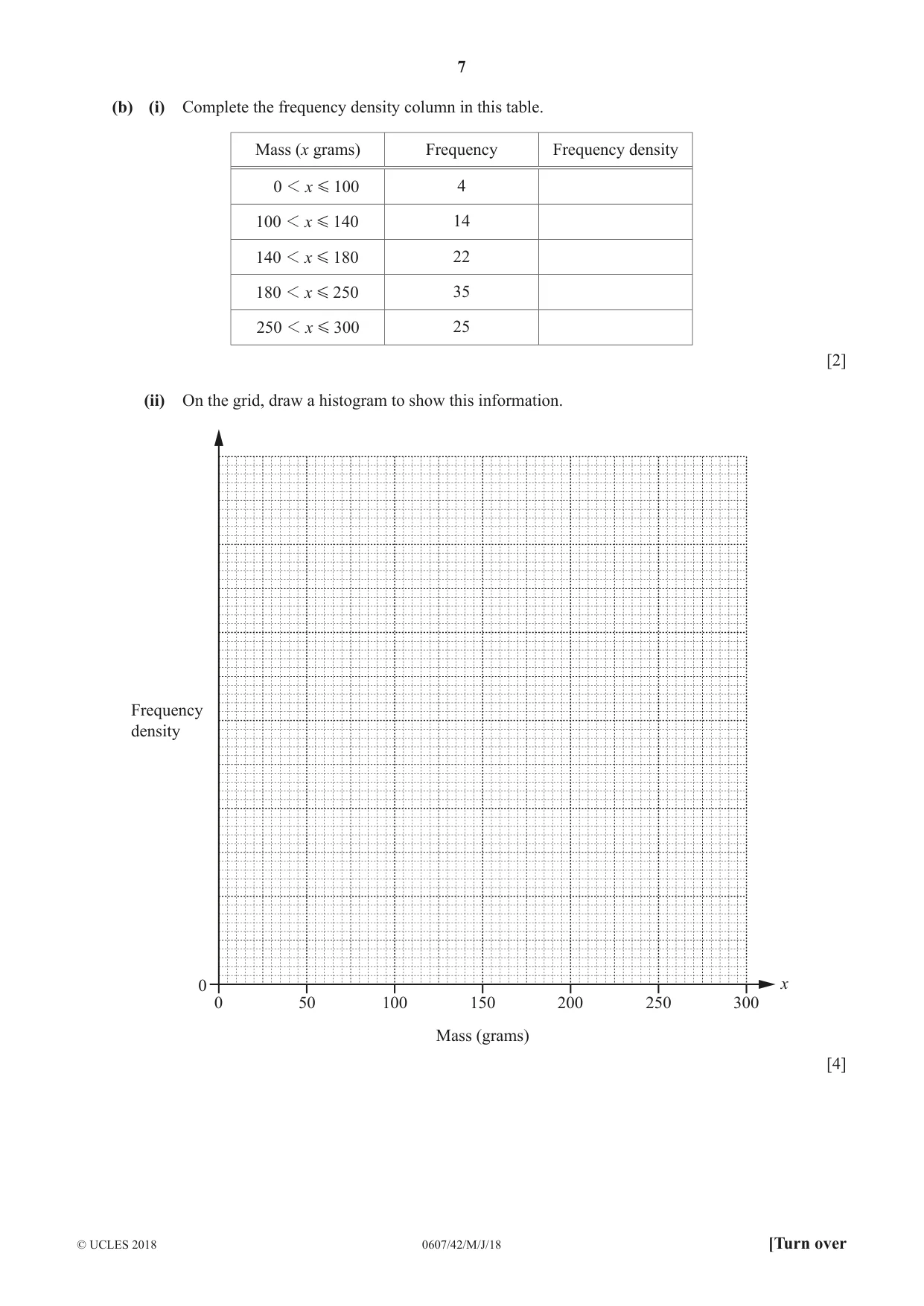
4 (a) The mass, x grams, of each of 100 oranges is found. The results are shown in the table. Mass (x grams) Frequency 0 1 x G 100 4 100 1 x G 140 14 140 1 x G 180 22 180 1 x G 250 35 250 1 x G 300 25 (i) Calculate an estimate of the mean mass of the oranges. ................................................. g [2] (ii) Two of these oranges are chosen at random. Calculate the probability that they both have a mass of 140 g or less. .................................................... [2] (iii) The oranges with a mass of 140 g or less are removed. From the remaining oranges, two are chosen at random. Calculate the probability that one orange has a mass of 250 g or less and the other has a mass of more than 250 g. .................................................... [3] (b) (i) Complete the frequency density column in this table. Mass (x grams) Frequency Frequency density 0 1 x G 100 4 100 1 x G 140 14 140 1 x G 180 22 180 1 x G 250 35 250 1 x G 300 25 [2] (ii) On the grid, draw a histogram to show this information. Frequency density 0 x 0 50 100 150 200 250 300 Mass (grams) [4]
Mark scheme: 4(a)(i) 198 2 M1 for 3 or more 50, 120, 160, 215, 275 soi 4(a)(ii) 306 2 18 17 oe or 0.0309 M1 for × 9900 100 99 or 0.030 90 to 0.030 91 4(a)(iii) 2850 3 57 25 25 57 oe or 0.429 M2 for × + × oe 6642 82 81 82 81 or 0.4290 to 0.4291 57 25 25 57 or M1 for × or × 82 81 82 81 4(b)(i) 0.04, 0.35, 0.55, 0.5, 0.5 2 B1 for 3 correct 4(b)(ii) Correct histogram 4 FT their fully completed table in (b)(i) with linear scale B1 for suitable scale (must include all heights) B1 for correct column widths B2FT for columns with all heights correct or B1FT for 3 or 4 columns with correct heights
Q5 · 16 m A P D NOT TO SCALE 30 m S Q 18 m 12 m B R C 24 m 40 m In the diagram, ABCD is a…
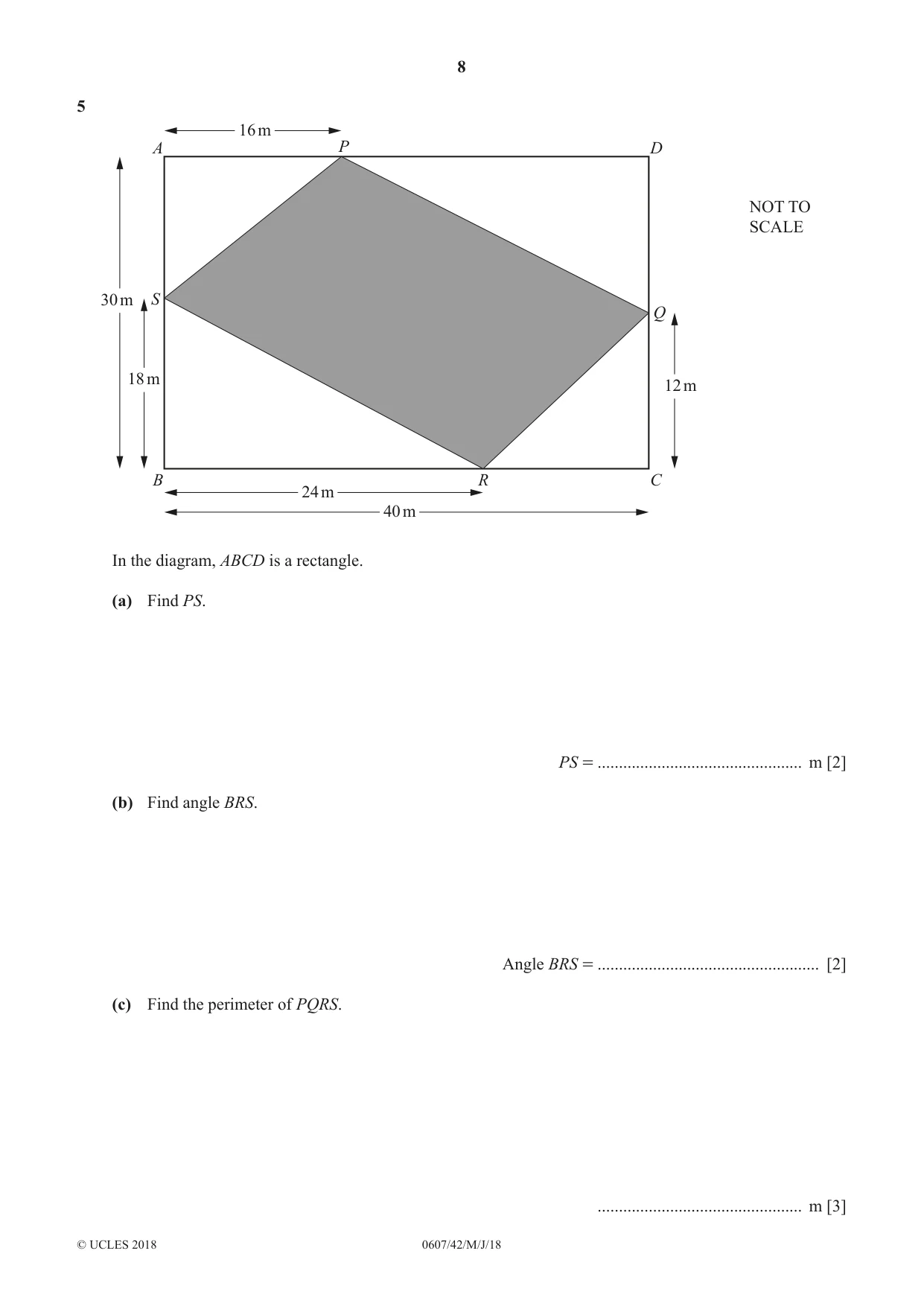
5 16 m A P D NOT TO SCALE 30 m S Q 18 m 12 m B R C 24 m 40 m In the diagram, ABCD is a rectangle. (a) Find PS. PS = ................................................ m [2] (b) Find angle BRS. Angle BRS = .................................................... [2] (c) Find the perimeter of PQRS. ................................................ m [3] (d) Find the shaded area. ............................................... m2 [3] (e) Explain why triangle ASP is similar to triangle BSR. ............................................................................................................................................................. ............................................................................................................................................................. [2]
Mark scheme: 5(a) 20 2 2 2 M1 for 16 + ( 30 − 18 ) 5(b) 36.9 or 36.86 to 36.87 2 18 M1 for tan[ ] = oe 24 5(c) 100 3 2 2 M2 for 2 × (their (a) + 18 + 24 ) oe or M1 for 182 + 24 2 or RS = 30 or PQ = 30 seen 5(d) 576 3 M2 for (40 × 30) − 2 × (0.5 × 18 × 24) − 2 × (0.5 × 16 × 12) oe or M1 for any correct and relevant area 5(e) Correct explanation 2 B1 for partial explanation e.g. ratio of two sides the same, with names or numbers given.
Q6 · Y 10 8 6 4 A 2 x −8 −6 −4 −2 0 2 4 6 8 −2 −4 −6 −8 −10 - 7 (a) Translate triangle A with…
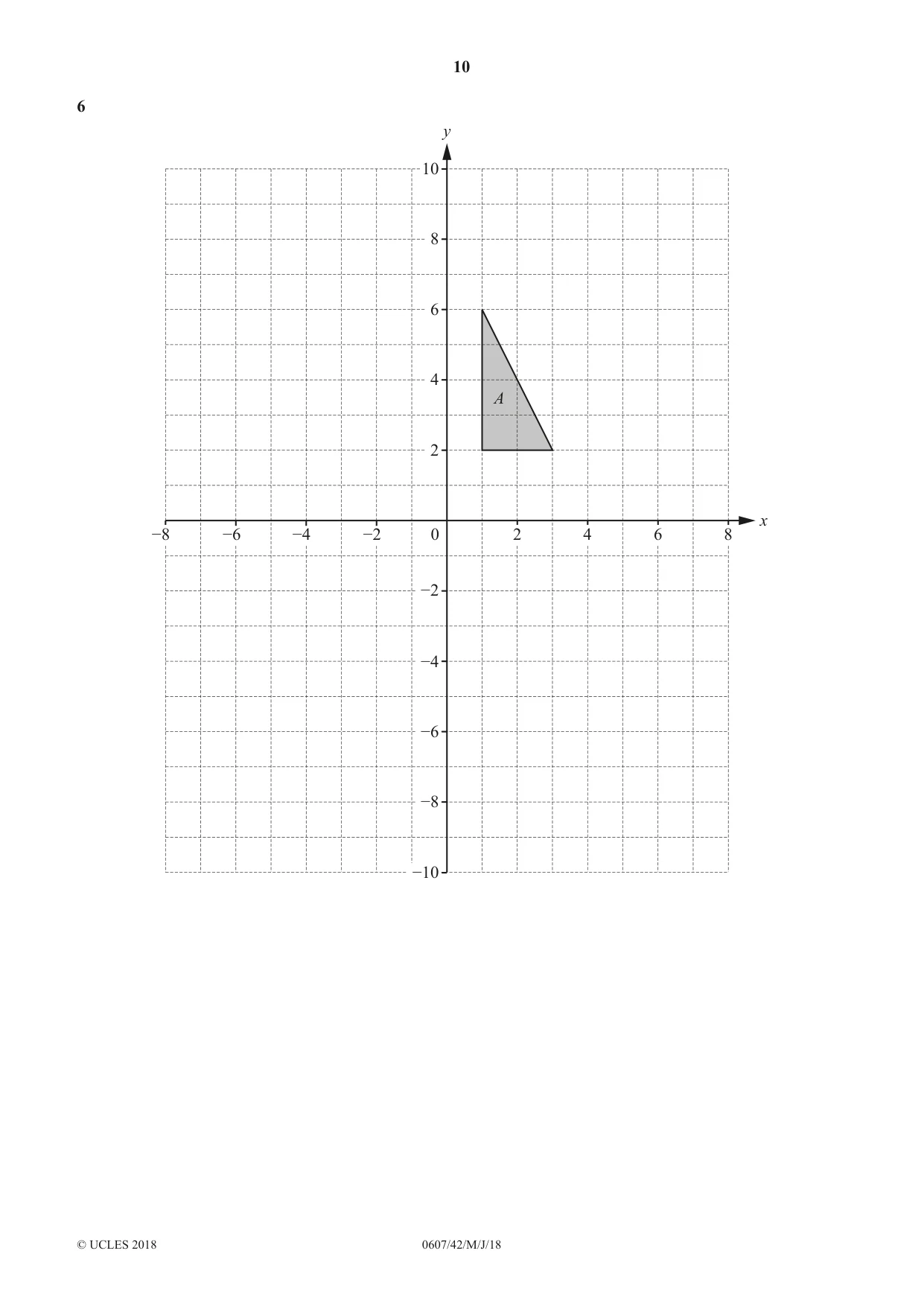
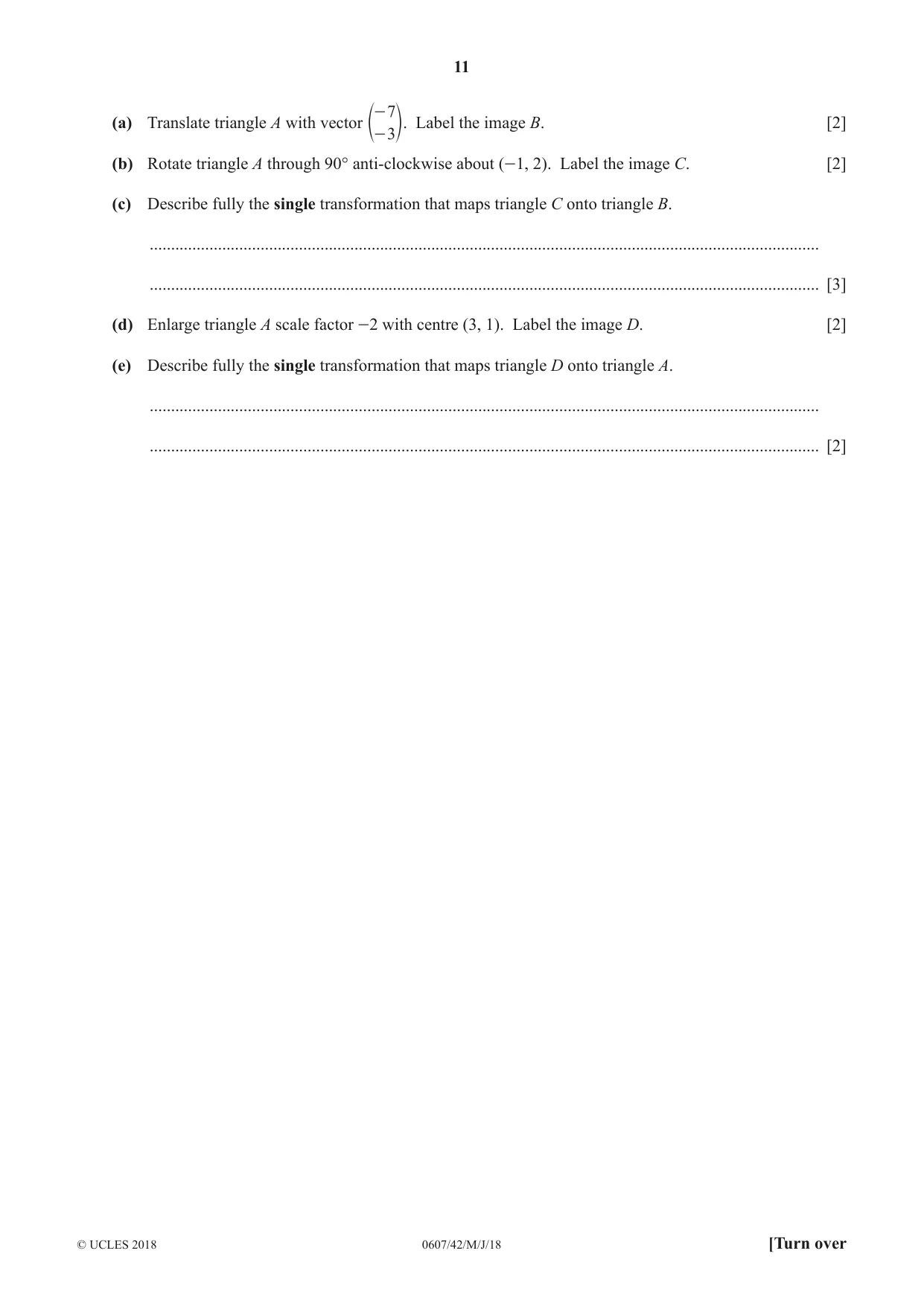
6 y 10 8 6 4 A 2 x −8 −6 −4 −2 0 2 4 6 8 −2 −4 −6 −8 −10 - 7 (a) Translate triangle A with vector Label the image B. [2] e- 3o. (b) Rotate triangle A through 90° anti-clockwise about (-1, 2). Label the image C. [2] (c) Describe fully the single transformation that maps triangle C onto triangle B. ............................................................................................................................................................. ............................................................................................................................................................. [3] (d) Enlarge triangle A scale factor -2 with centre (3, 1). Label the image D. [2] (e) Describe fully the single transformation that maps triangle D onto triangle A. ............................................................................................................................................................. ............................................................................................................................................................. [2]
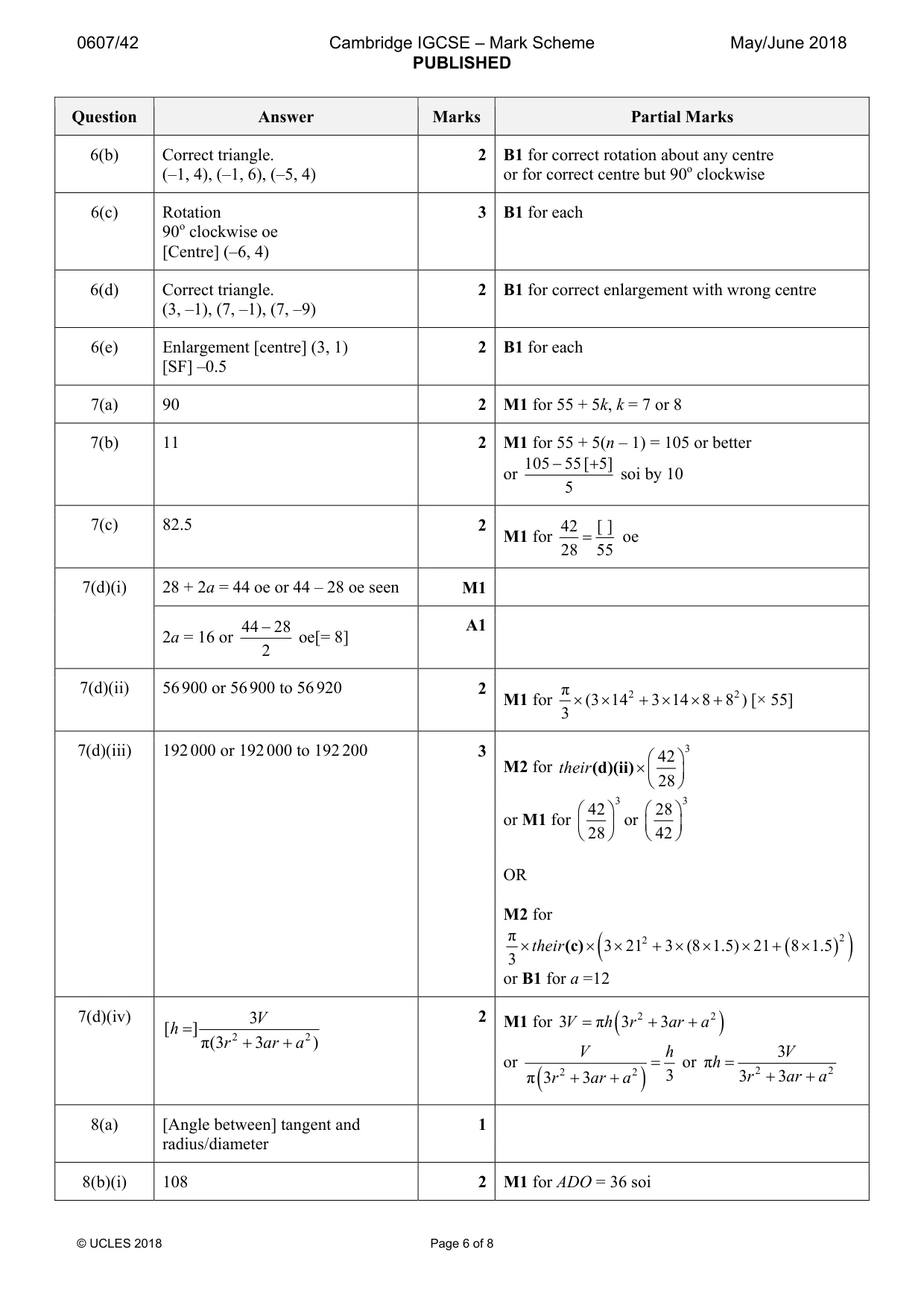
Mark scheme: 6(a) Correct triangle. 2 − 7 k (–6, –1), (–4, –1), (–6, 3) B1 for or k − 3 6(b) Correct triangle. 2 B1 for correct rotation about any centre (–1, 4), (–1, 6), (–5, 4) or for correct centre but 90o clockwise 6(c) Rotation 3 B1 for each 90o clockwise oe [Centre] (–6, 4) 6(d) Correct triangle. 2 B1 for correct enlargement with wrong centre (3, –1), (7, –1), (7, –9) 6(e) Enlargement [centre] (3, 1) 2 B1 for each [SF] –0.5
Q7 · In this question, all lengths are measured in millimetres
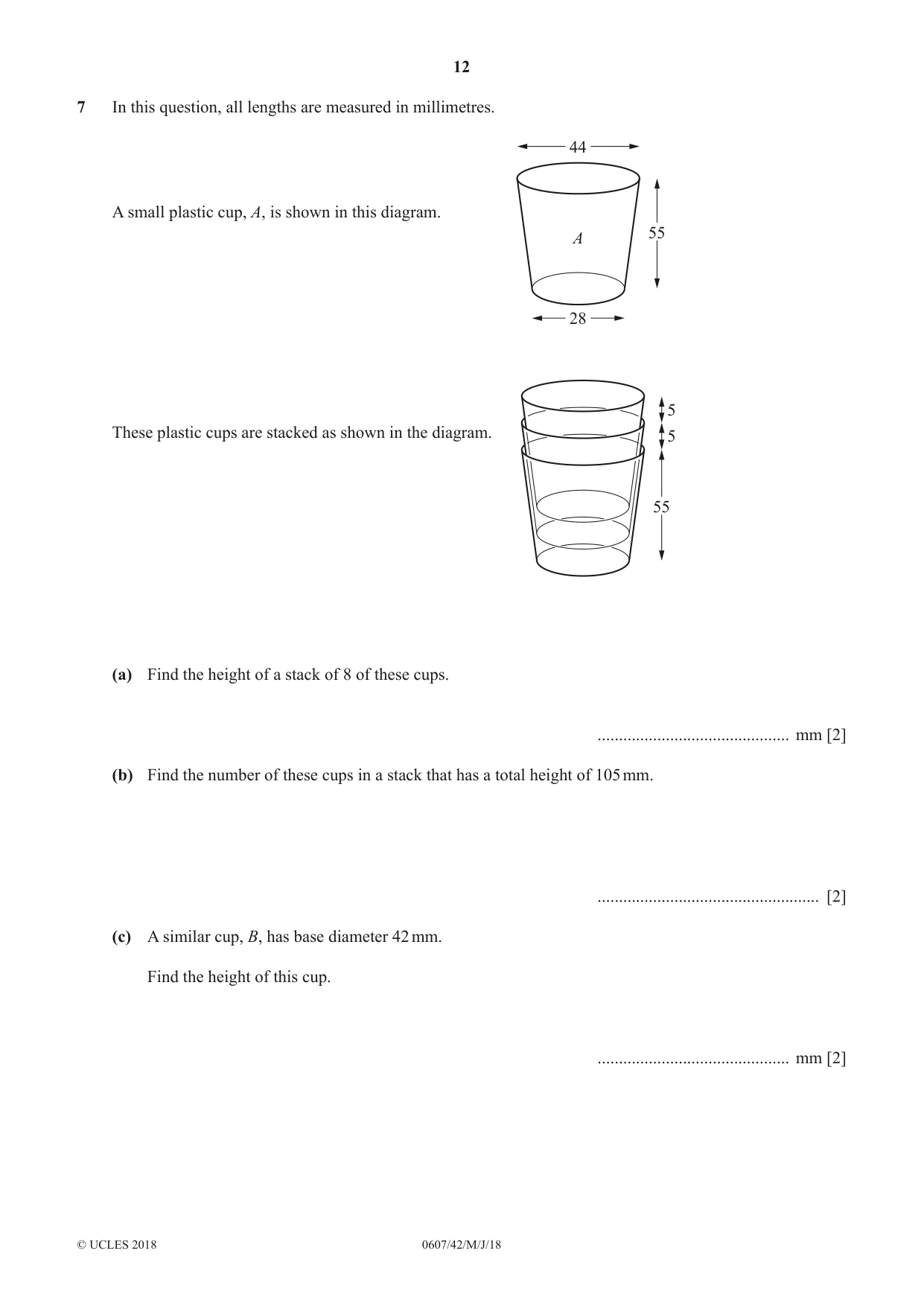
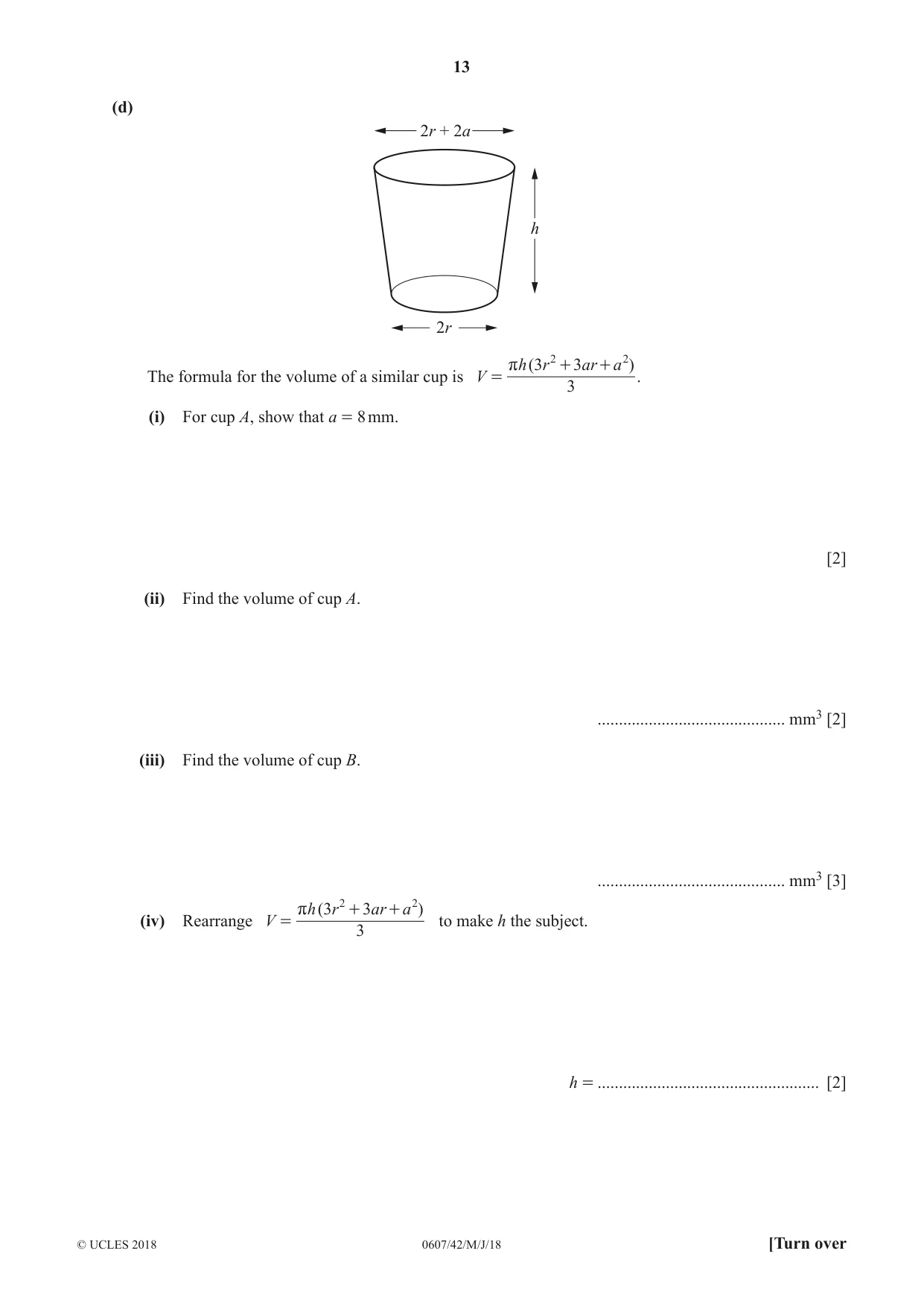
7 In this question, all lengths are measured in millimetres. 44 A small plastic cup, A, is shown in this diagram. 55 A 28 5 These plastic cups are stacked as shown in the diagram. 5 55 (a) Find the height of a stack of 8 of these cups. ............................................. mm [2] (b) Find the number of these cups in a stack that has a total height of 105 mm. .................................................... [2] (c) A similar cup, B, has base diameter 42 mm. Find the height of this cup. ............................................. mm [2] (d) 2r + 2a h 2r 2 2 r h (3r + 3ar + a ) The formula for the volume of a similar cup is V = . 3 (i) For cup A, show that a = 8 mm. [2] (ii) Find the volume of cup A. ............................................ mm3 [2] (iii) Find the volume of cup B. ............................................ mm3 [3] 2 2 r h (3r + 3ar + a ) (iv) Rearrange V = to make h the subject. 3 h = .................................................... [2]
Mark scheme: 7(a) 90 2 M1 for 55 + 5k, k = 7 or 8 7(b) 11 2 M1 for 55 + 5(n – 1) = 105 or better 105 − 55[ + 5] or soi by 10 5 7(c) 82.5 2 42 [ ] M1 for = oe 28 55 7(d)(i) 28 + 2a = 44 oe or 44 – 28 oe seen M1 44 − 28 A1 2a = 16 or oe[= 8] 2 7(d)(ii) 56 900 or 56 900 to 56 920 2 π 2 2 M1 for × (3 × 14 + 3 × 14 × 8 + 8 ) [× 55] 3 7(d)(iii) 192 000 or 192 000 to 192 200 3 3 42 M2 for their (d)(ii) × 28 42 3 28 3 or M1 for or 28 42 OR M2 for π 2 2 × their (c) × 3 × 21 + 3 × (8 × 1.5) × 21 + ( 8 × 1.5 ) ( ) 3 or B1 for a =12 7(d)(iv) 3V 2 M1 for 3V = π h 3r 2 + 3ar + a 2 [ h = ] ( ) π(3r 2 + 3ar + a 2 ) V h 3V or = or πh = π 3r 2 + 3ar + a 2 3 3r 2 + 3ar + a 2 ( )
Q8 · B NOT TO A SCALE 36° O C 120° D E F A, B, C and D lie on a circle, centre O
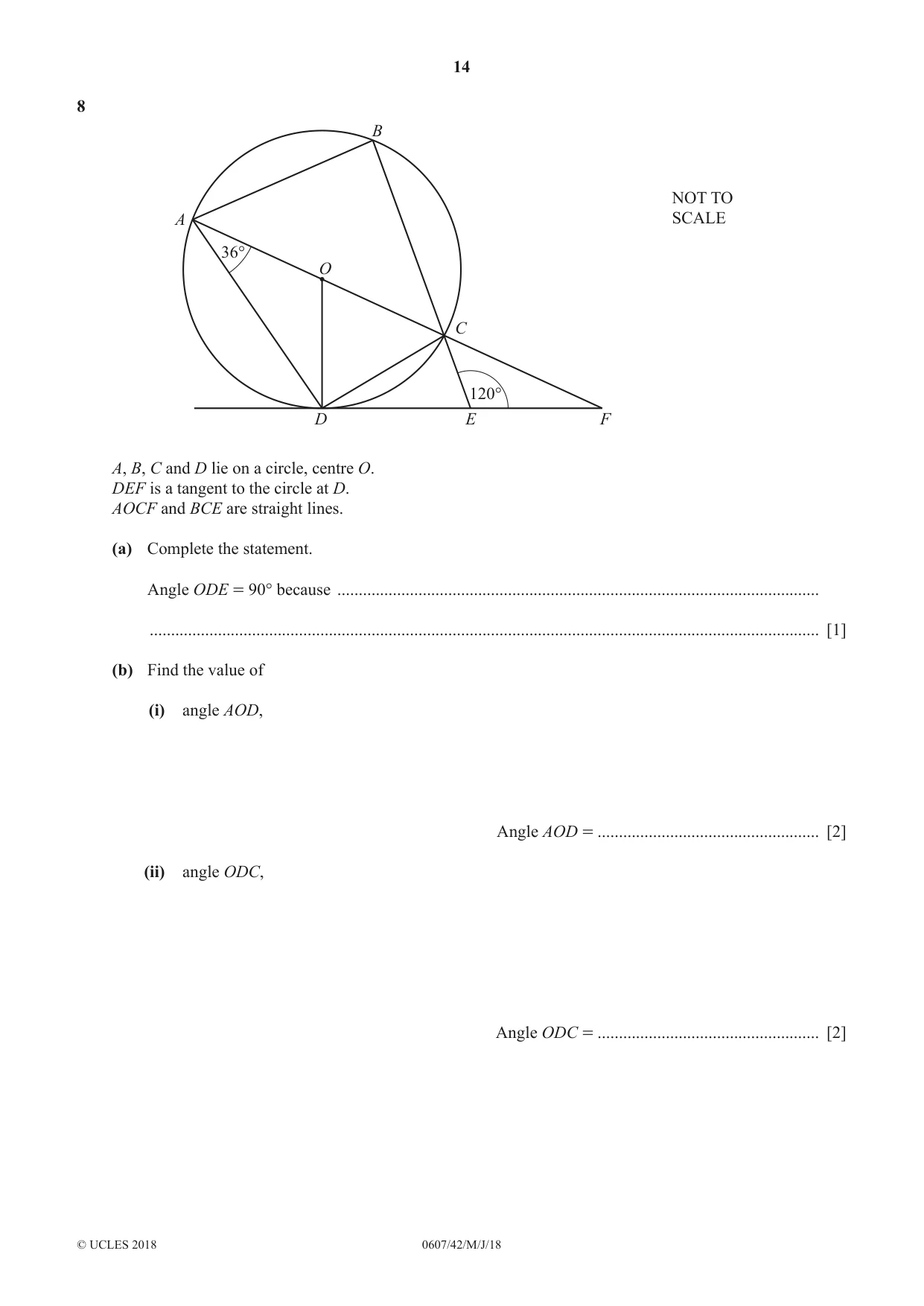
8 B NOT TO A SCALE 36° O C 120° D E F A, B, C and D lie on a circle, centre O. DEF is a tangent to the circle at D. AOCF and BCE are straight lines. (a) Complete the statement. Angle ODE = 90° because ................................................................................................................. ............................................................................................................................................................. [1] (b) Find the value of (i) angle AOD, Angle AOD = .................................................... [2] (ii) angle ODC, Angle ODC = .................................................... [2] (iii) angle ABC, Angle ABC = .................................................... [1] (iv) angle CFD, Angle CFD = .................................................... [1] (v) angle CAB. Angle CAB = .................................................... [1]
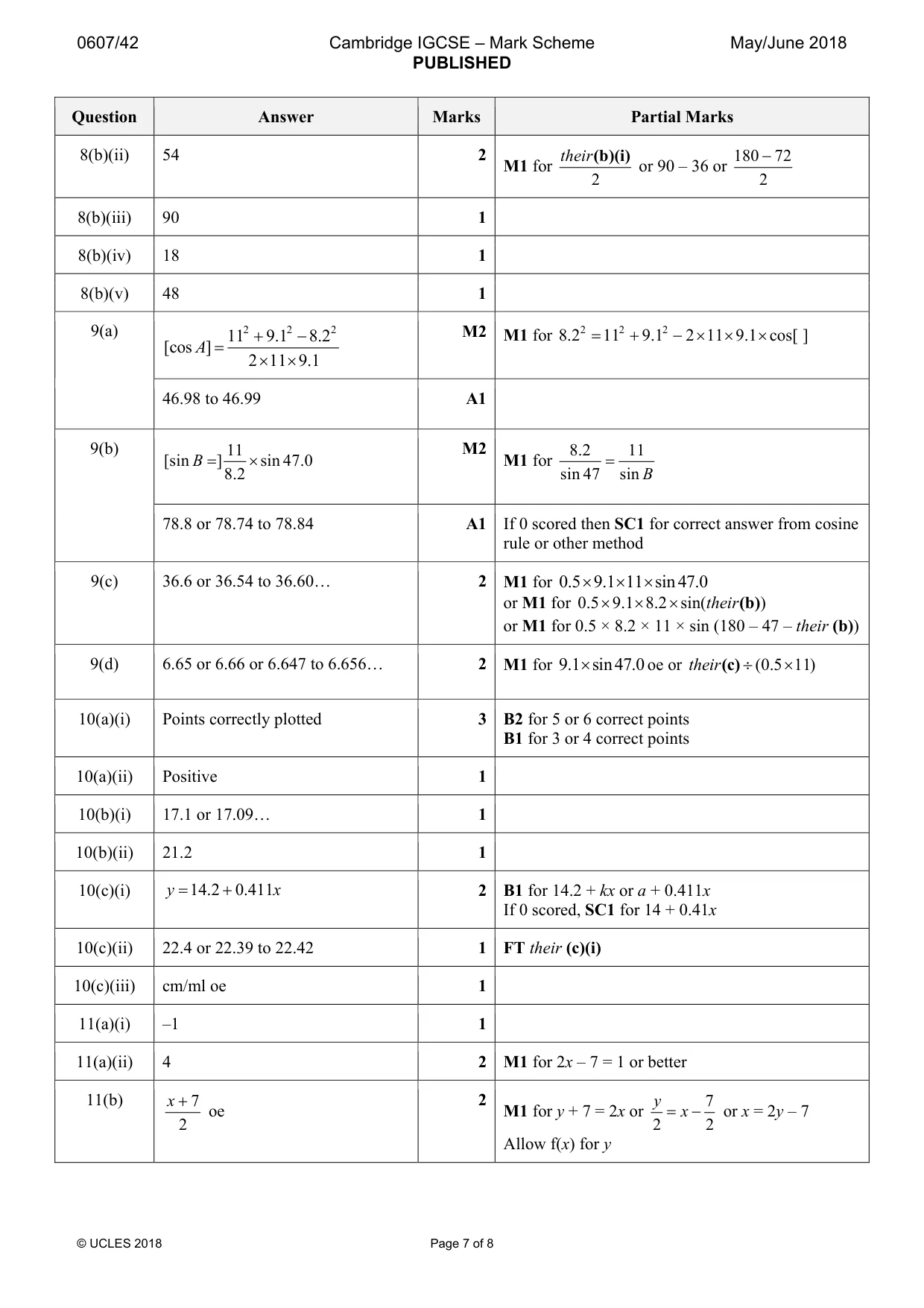
Mark scheme: 8(a) [Angle between] tangent and 1 radius/diameter 8(b)(i) 108 2 M1 for ADO = 36 soi 8(b)(ii) 54 2 their(b)(i) 180 − 72 M1 for or 90 – 36 or 2 2 8(b)(iii) 90 1 8(b)(iv) 18 1 8(b)(v) 48 1
Q9 · B 9.1 cm NOT TO SCALE 8.2 cm A 11 cm C (a) Show that angle BAC = 47.0° , correct to 1…
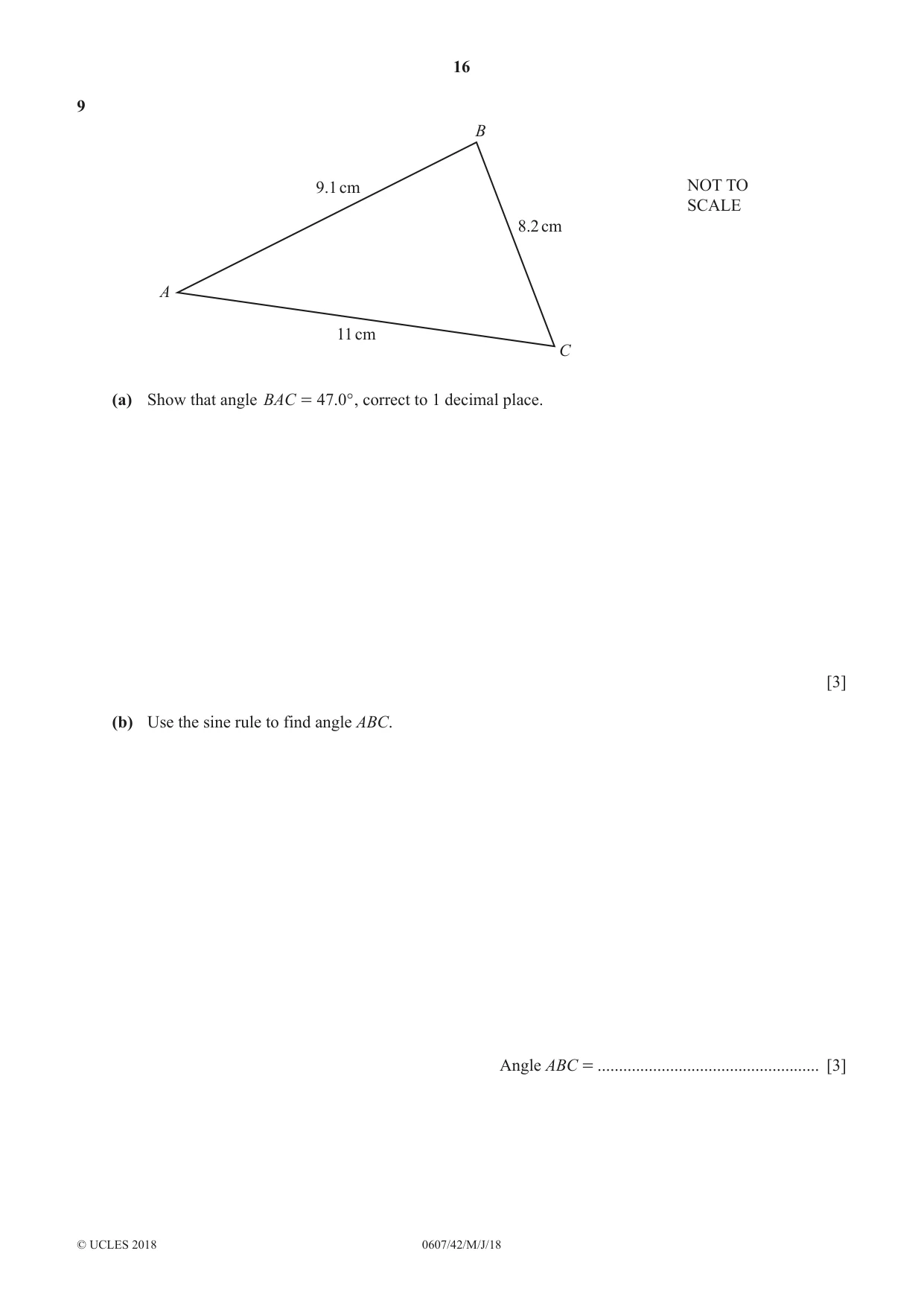
9 B 9.1 cm NOT TO SCALE 8.2 cm A 11 cm C (a) Show that angle BAC = 47.0° , correct to 1 decimal place. [3] (b) Use the sine rule to find angle ABC. Angle ABC = .................................................... [3] (c) Find the area of triangle ABC. ............................................. cm2 [2] (d) Find the length of the perpendicular from B to AC. .............................................. cm [2]
Mark scheme: 9(a) 112 + 9.12 − 8.2 2 M2 M1 for 8.2 2 = 112 + 9.12 − 2 × 11 × 9.1 × cos[ ] [cos A] = 2 × 11 × 9.1 46.98 to 46.99 A1 9(b) 11 M2 8.2 11 [sin B = ] × sin 47.0 M1 for = 8.2 sin 47 sin B 78.8 or 78.74 to 78.84 A1 If 0 scored then SC1 for correct answer from cosine rule or other method 9(c) 36.6 or 36.54 to 36.60… 2 M1 for 0.5 × 9.1 × 11 × sin47.0 or M1 for 0.5 × 9.1 × 8.2 × sin( their (b)) or M1 for 0.5 × 8.2 × 11 × sin (180 – 47 – their (b)) 9(d) 6.65 or 6.66 or 6.647 to 6.656… 2 M1 for 9.1 × sin47.0 oe or their (c) ÷ (0.5 × 11)
Q10 · Wasim sprays different amounts of fertiliser on some seedlings
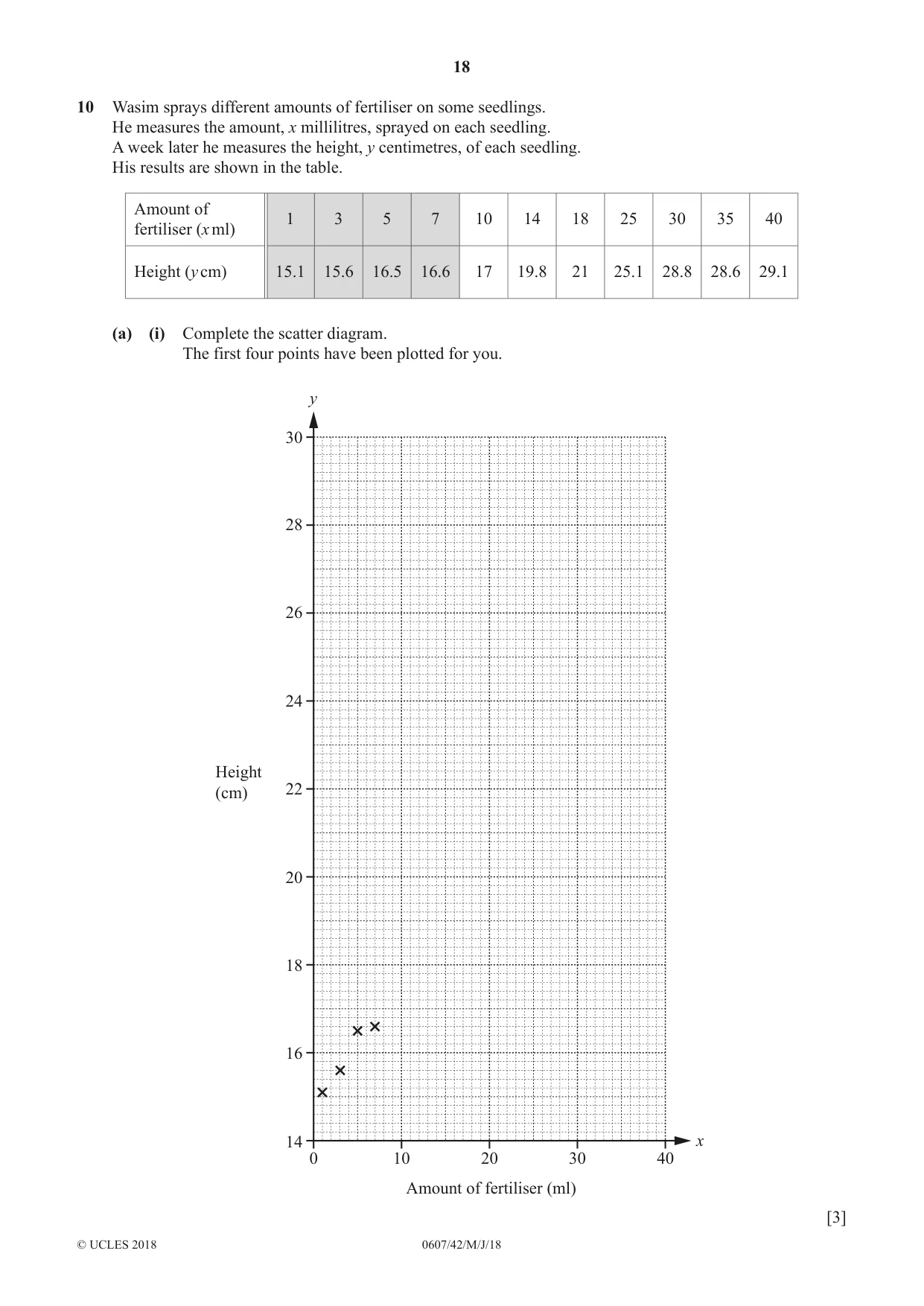
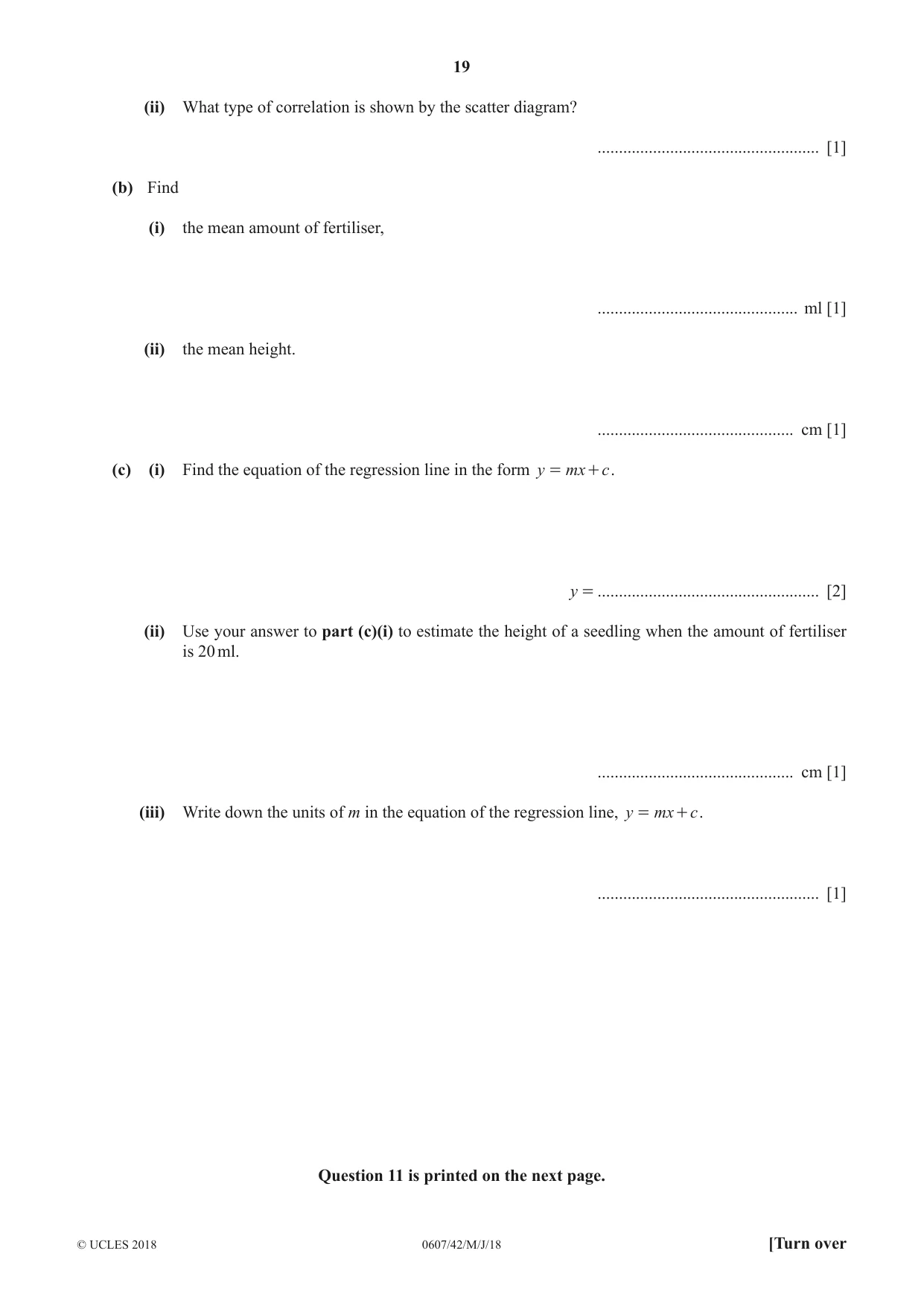
10 Wasim sprays different amounts of fertiliser on some seedlings. He measures the amount, x millilitres, sprayed on each seedling. A week later he measures the height, y centimetres, of each seedling. His results are shown in the table. Amount of 1 3 5 7 10 14 18 25 30 35 40 fertiliser (x ml) Height (y cm) 15.1 15.6 16.5 16.6 17 19.8 21 25.1 28.8 28.6 29.1 (a) (i) Complete the scatter diagram. The first four points have been plotted for you. y 30 28 26 24 Height (cm) 22 20 18 16 14 x 0 10 20 30 40 Amount of fertiliser (ml) [3] (ii) What type of correlation is shown by the scatter diagram? .................................................... [1] (b) Find (i) the mean amount of fertiliser, ............................................... ml [1] (ii) the mean height. .............................................. cm [1] (c) (i) Find the equation of the regression line in the form y = mx + c . y = .................................................... [2] (ii) Use your answer to part (c)(i) to estimate the height of a seedling when the amount of fertiliser is 20 ml. .............................................. cm [1] (iii) Write down the units of m in the equation of the regression line, y = mx + c . .................................................... [1] Question 11 is printed on the next page.
Mark scheme: 10(a)(i) Points correctly plotted 3 B2 for 5 or 6 correct points B1 for 3 or 4 correct points 10(a)(ii) Positive 1 10(b)(i) 17.1 or 17.09… 1 10(b)(ii) 21.2 1 10(c)(i) y = 14.2 + 0.411x 2 B1 for 14.2 + kx or a + 0.411x If 0 scored, SC1 for 14 + 0.41x 10(c)(ii) 22.4 or 22.39 to 22.42 1 FT their (c)(i) 10(c)(iii) cm/ml oe 1
Q11 · F ()x = 2x - 7 g ()x = x h ()x = , x =Y 0 x (a) (i) Find f (3)
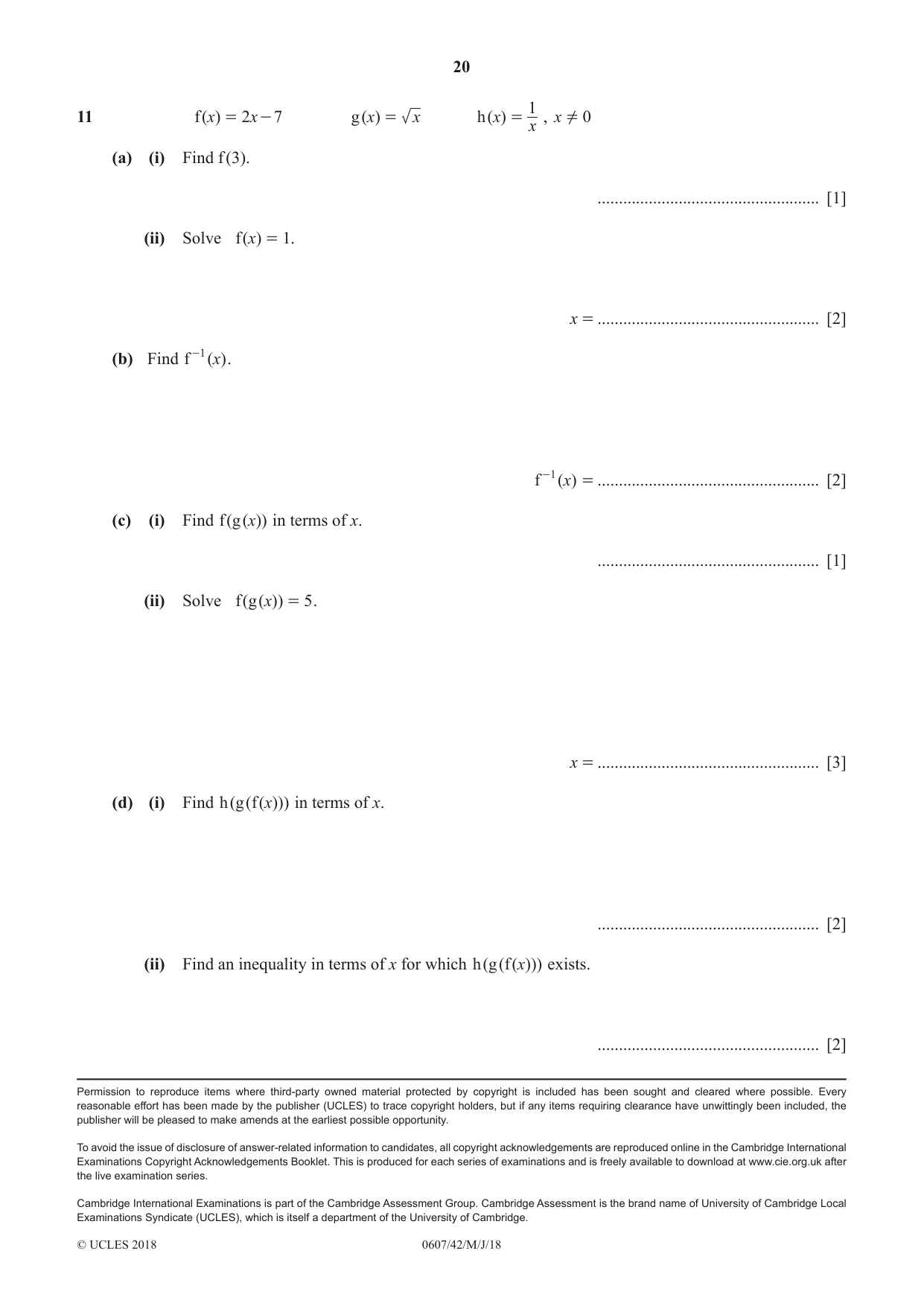
11 f ()x = 2x - 7 g ()x = x h ()x = , x =Y 0 x (a) (i) Find f (3). .................................................... [1] (ii) Solve f ()x = 1. x = .................................................... [2] (b) Find f - 1 ()x . f - 1 ()x = .................................................... [2] (c) (i) Find f (g (x)) in terms of x. .................................................... [1] (ii) Solve f (g (x)) = 5 . x = .................................................... [3] (d) (i) Find h (g (f (x))) in terms of x. .................................................... [2] (ii) Find an inequality in terms of x for which h (g (f (x))) exists. .................................................... [2]
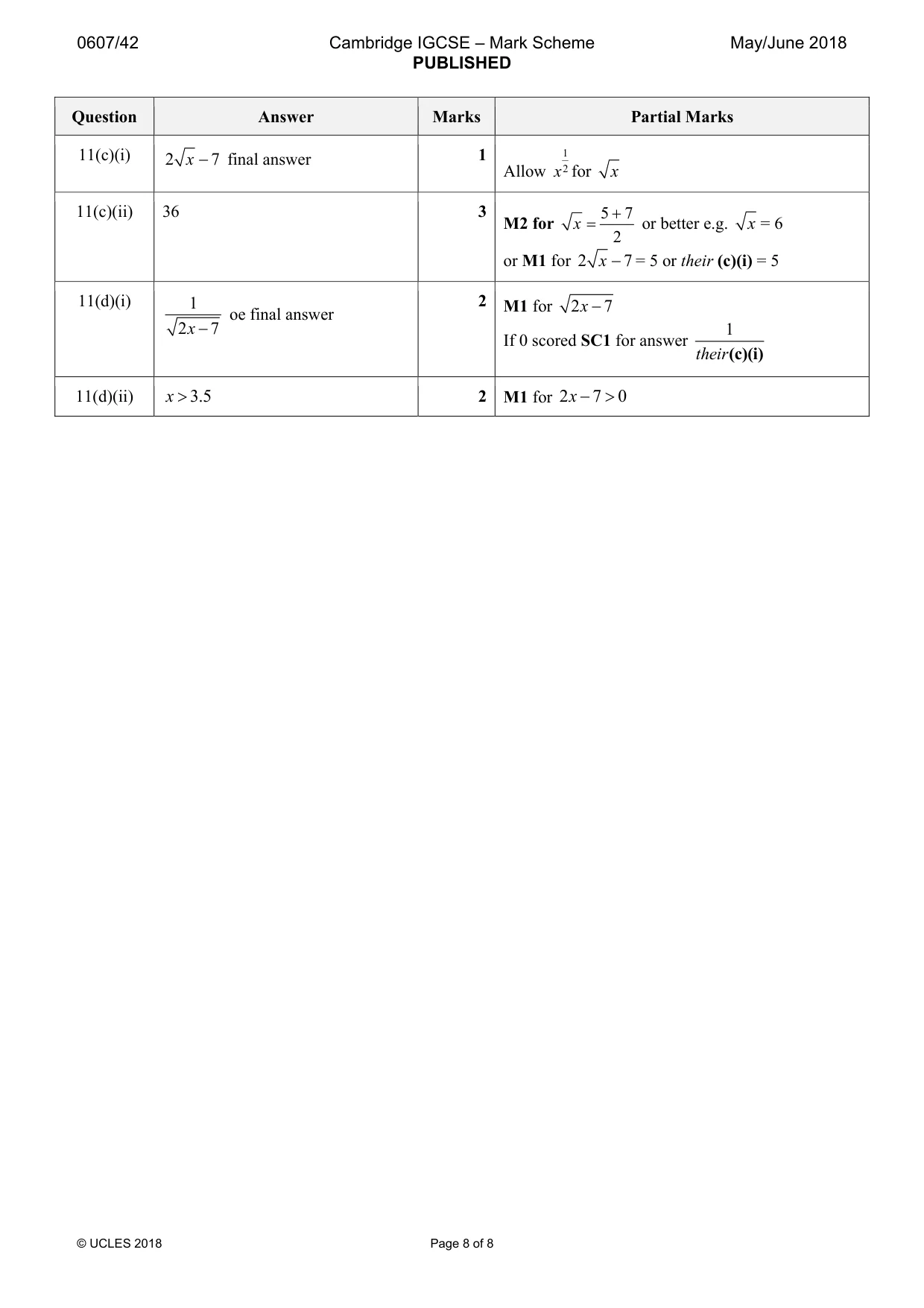
Mark scheme: 11(a)(i) –1 1 11(a)(ii) 4 2 M1 for 2x – 7 = 1 or better 11(b) x + 7 2 y 7 oe M1 for y + 7 = 2x or = x − or x = 2y – 7 2 2 2 Allow f(x) for y 11(c)(i) 2 x − 7 final answer 1 1 Allow x 2 for x 11(c)(ii) 36 3 5 + 7 M2 for x = or better e.g. x = 6 2 or M1 for 2 x − 7 = 5 or their (c)(i) = 5 11(d)(i) 1 2 M1 for 2 x − 7 oe final answer 2 x − 7 1 If 0 scored SC1 for answer their(c)(i) 11(d)(ii) x > 3.5 2 M1 for 2 x − 7 > 0
What was in this paper
The subtopics covered by these 11 questions, and how many questions each got. Open one in a new tab to see every Cambridge question on it.
What you needed in this session
Cambridge’s own grade thresholds for 2018 May/June, Paper 4 · Variant 2. A higher threshold means an easier paper — the bar moves with how the cohort did.