Cambridge IGCSE Mathematics - International 0607 — 2019 May/June Paper 4 · Variant 1
0607/41/M/J/19 · 12 questions · 120 marks · ≈135 min
The question paper and its mark scheme, free to read here and free to download. This is Cambridge’s own paper, exactly as it was sat.
Question paper20 pages
Mark scheme8 pages
Answers below. Sit the paper first if you are practising.
Questions as text
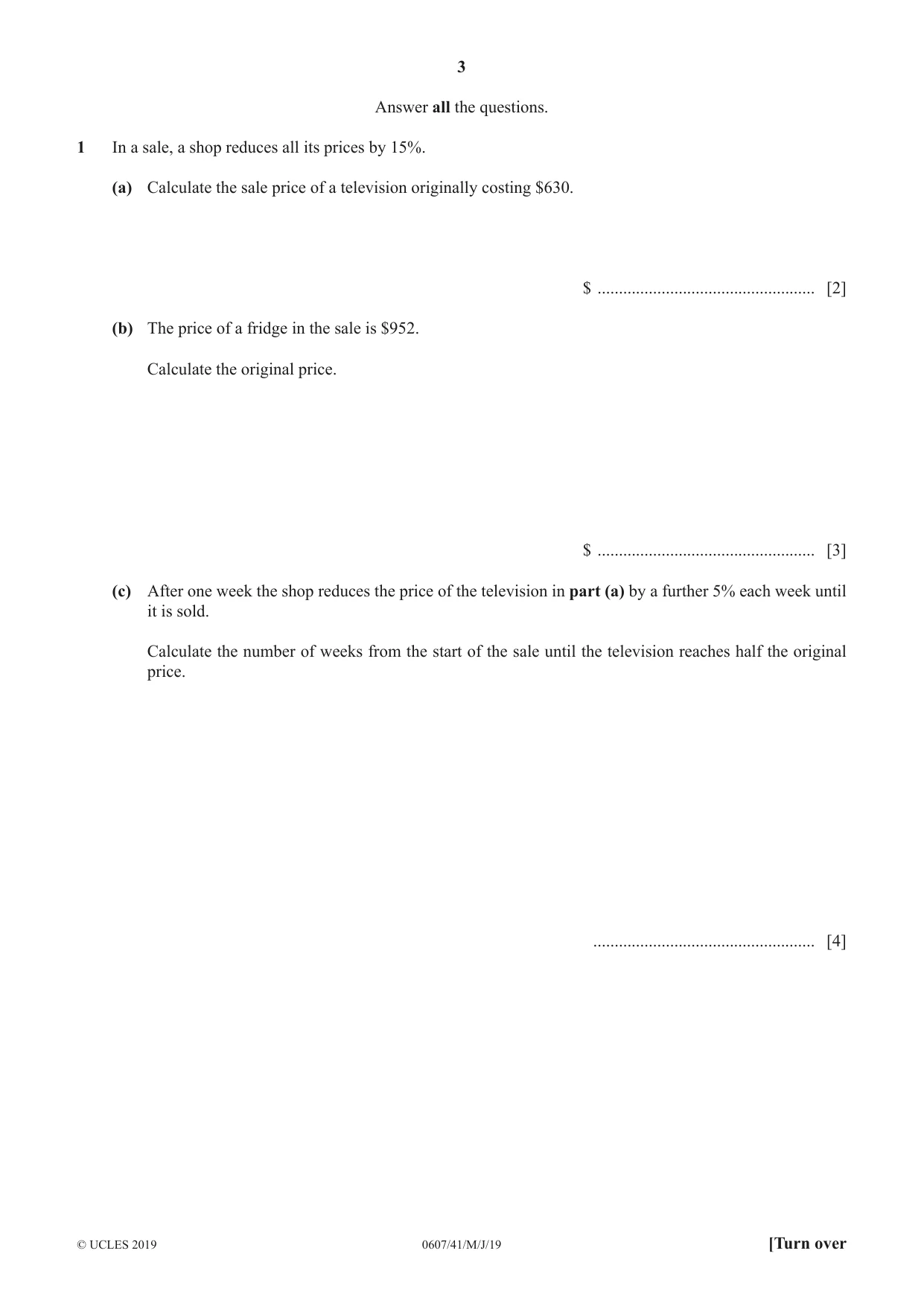
Q1 · In a sale, a shop reduces all its prices by 15%
1 In a sale, a shop reduces all its prices by 15%. (a) Calculate the sale price of a television originally costing $630. $ ................................................... [2] (b) The price of a fridge in the sale is $952. Calculate the original price. $ ................................................... [3] (c) After one week the shop reduces the price of the television in part (a) by a further 5% each week until it is sold. Calculate the number of weeks from the start of the sale until the television reaches half the original price. .................................................... [4]
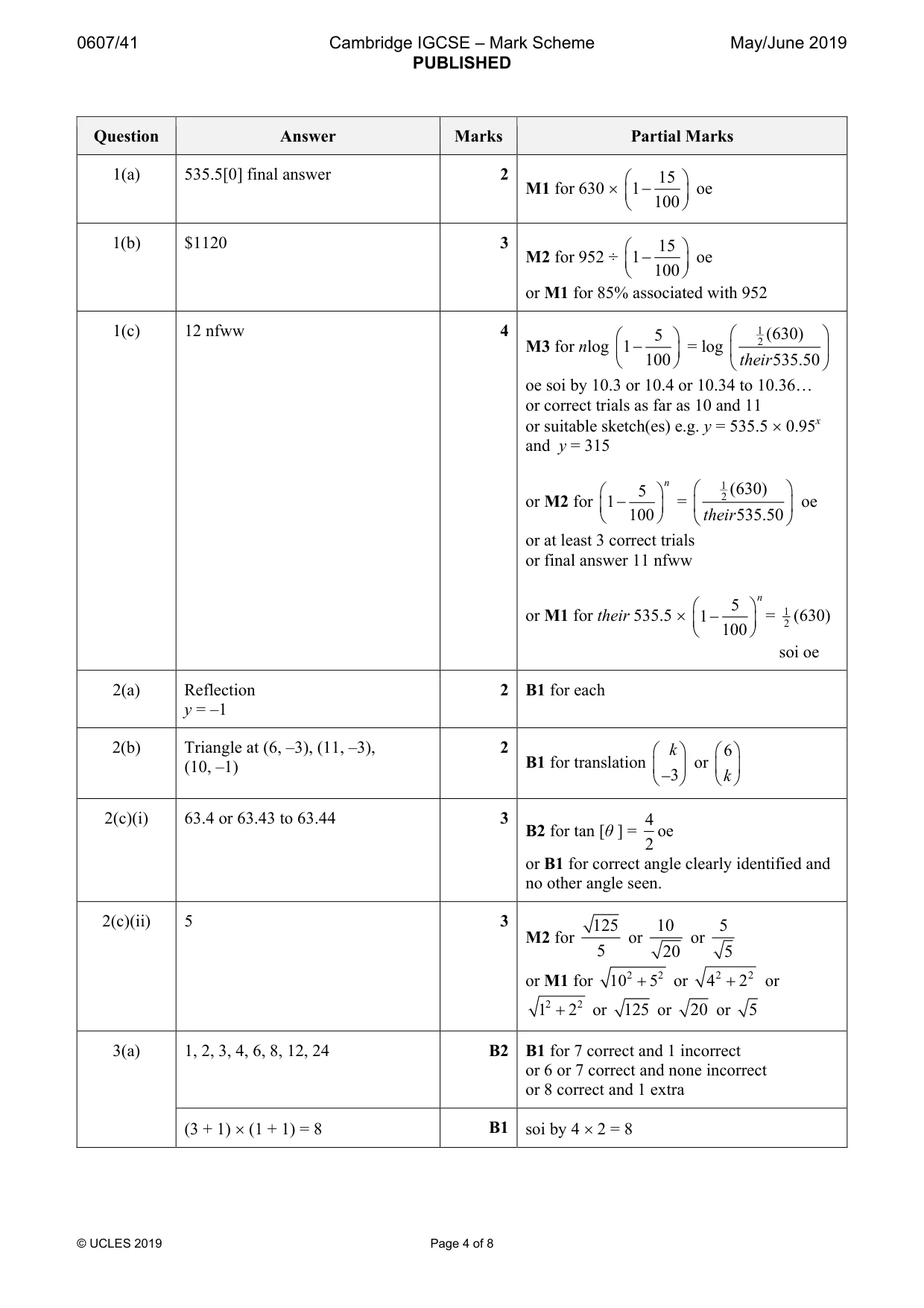
Mark scheme: Question Answer Marks Partial Marks 1(a) 535.5[0] final answer 2 15 M1 for 630 × 1 − oe 100 1(b) $1120 3 15 M2 for 952 ÷ 1 − oe 100 or M1 for 85% associated with 952 1(c) 12 nfww 4 5 12 (630) M3 for nlog 1 − = log 100 their 535.50 oe soi by 10.3 or 10.4 or 10.34 to 10.36… or correct trials as far as 10 and 11 or suitable sketch(es) e.g. y = 535.5 × 0.95x and y = 315 5 n 12 (630) or M2 for 1 − = oe 100 their 535.50 or at least 3 correct trials or final answer 11 nfww 5 n 1 or M1 for their 535.5 × 1 − = 2 (630) 100 soi oe
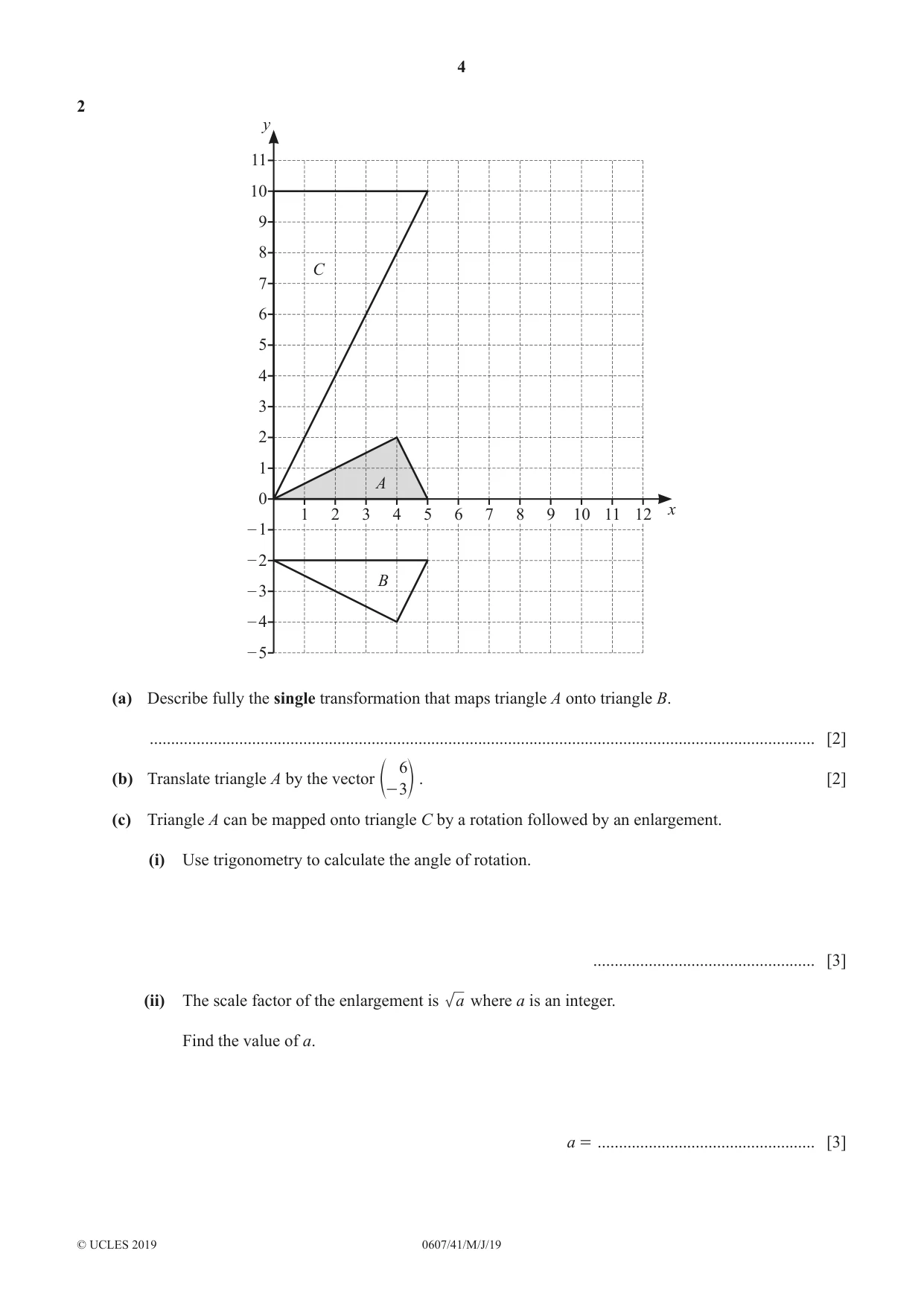
Q2 · Y 11 10 9 8 C 7 6 5 4 3 2 1 A 0 x 1 2 3 4 5 6 7 8 9 10 11 12 – 1 – 2 B – 3 – 4 – 5 (a)…
2 y 11 10 9 8 C 7 6 5 4 3 2 1 A 0 x 1 2 3 4 5 6 7 8 9 10 11 12 – 1 – 2 B – 3 – 4 – 5 (a) Describe fully the single transformation that maps triangle A onto triangle B. ............................................................................................................................................................ [2] 6 (b) Translate triangle A by the vector . [2] e- 3o (c) Triangle A can be mapped onto triangle C by a rotation followed by an enlargement. (i) Use trigonometry to calculate the angle of rotation. .................................................... [3] (ii) The scale factor of the enlargement is a where a is an integer. Find the value of a. a = ................................................... [3]
Mark scheme: 2(a) Reflection 2 B1 for each y = –1 2(b) Triangle at (6, –3), (11, –3), 2 k 6 B1 for translation or (10, –1) −3 k 2(c)(i) 63.4 or 63.43 to 63.44 3 4 B2 for tan [θ ] = oe 2 or B1 for correct angle clearly identified and no other angle seen. 2(c)(ii) 5 3 125 10 5 M2 for or or 5 20 5 or M1 for 10 2 + 5 2 or 4 2 + 2 2 or 12 + 2 2 or 125 or 20 or 5
Q3 · 1 3 5 9 15 45 The list shows the six factors of 45
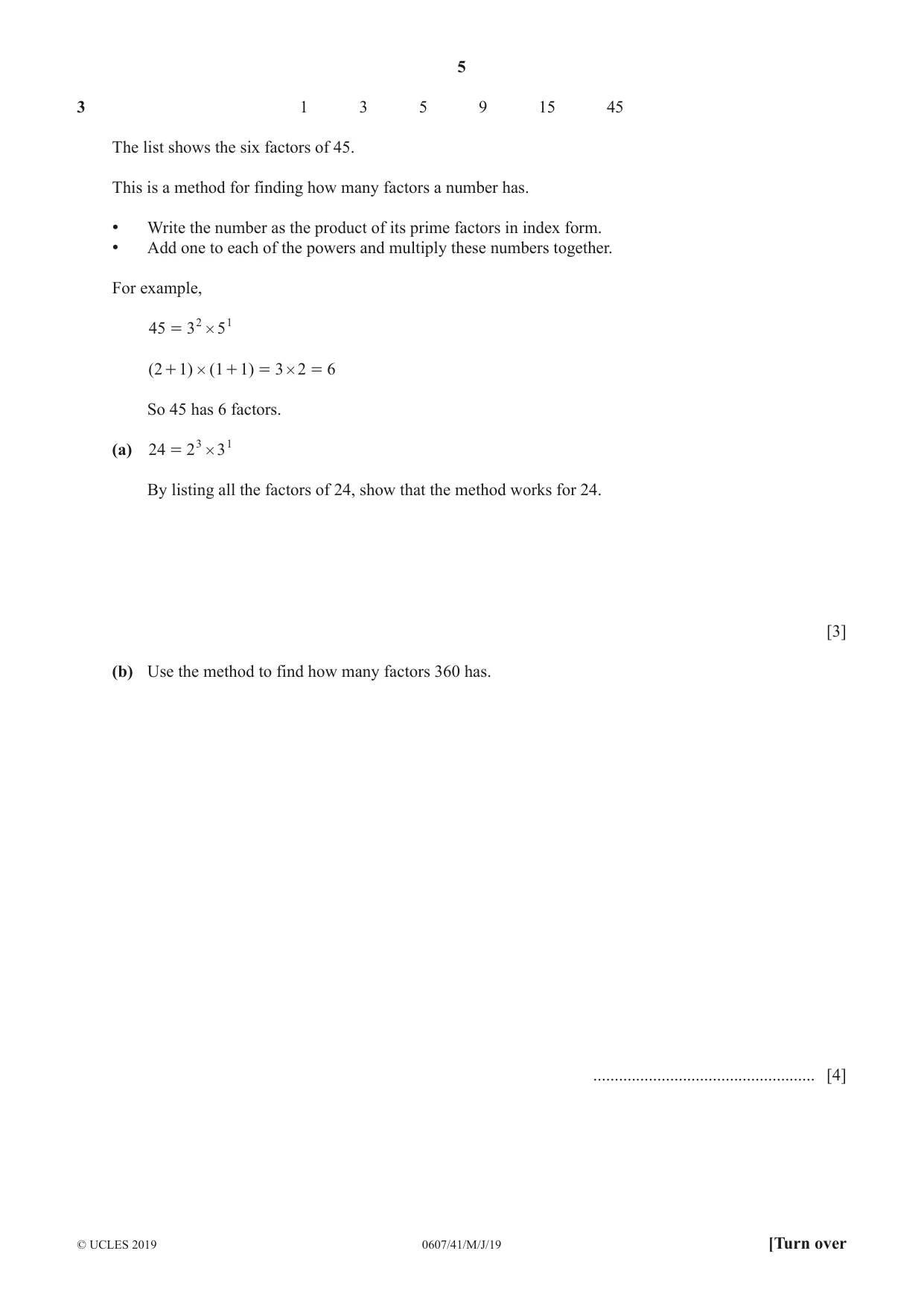
3 1 3 5 9 15 45 The list shows the six factors of 45. This is a method for finding how many factors a number has. • Write the number as the product of its prime factors in index form. • Add one to each of the powers and multiply these numbers together. For example, 45 = 3 2 # 5 1 (2 + 1) # (1 + 1) = 3 # 2 = 6 So 45 has 6 factors. (a) 24 = 2 3 # 3 1 By listing all the factors of 24, show that the method works for 24. [3] (b) Use the method to find how many factors 360 has. .................................................... [4]
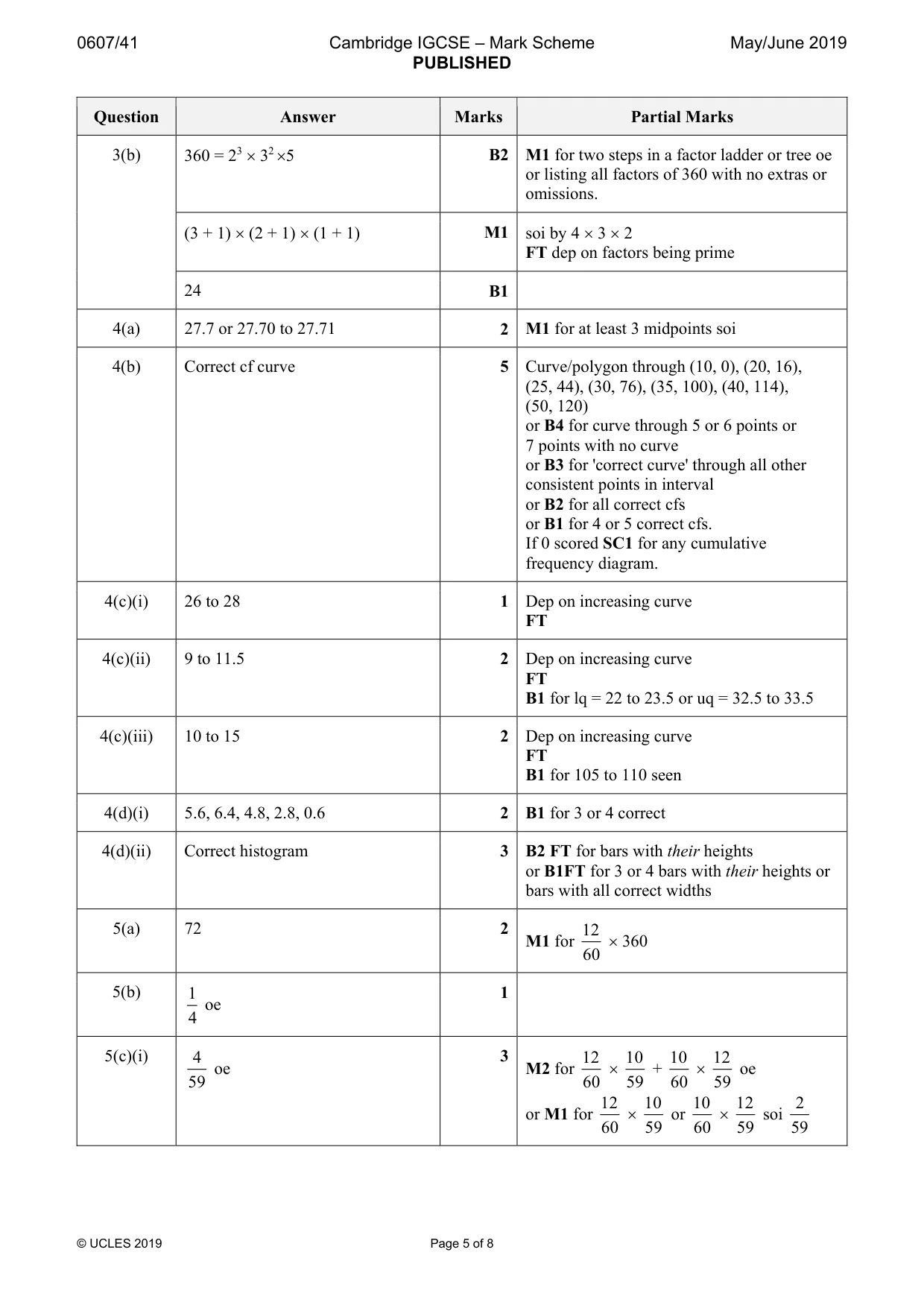
Mark scheme: 3(a) 1, 2, 3, 4, 6, 8, 12, 24 B2 B1 for 7 correct and 1 incorrect or 6 or 7 correct and none incorrect or 8 correct and 1 extra (3 + 1) × (1 + 1) = 8 B1 soi by 4 × 2 = 8 3(b) 360 = 23 × 32 ×5 B2 M1 for two steps in a factor ladder or tree oe or listing all factors of 360 with no extras or omissions. (3 + 1) × (2 + 1) × (1 + 1) M1 soi by 4 × 3 × 2 FT dep on factors being prime 24 B1
Q4 · Rani planted some seeds in her garden
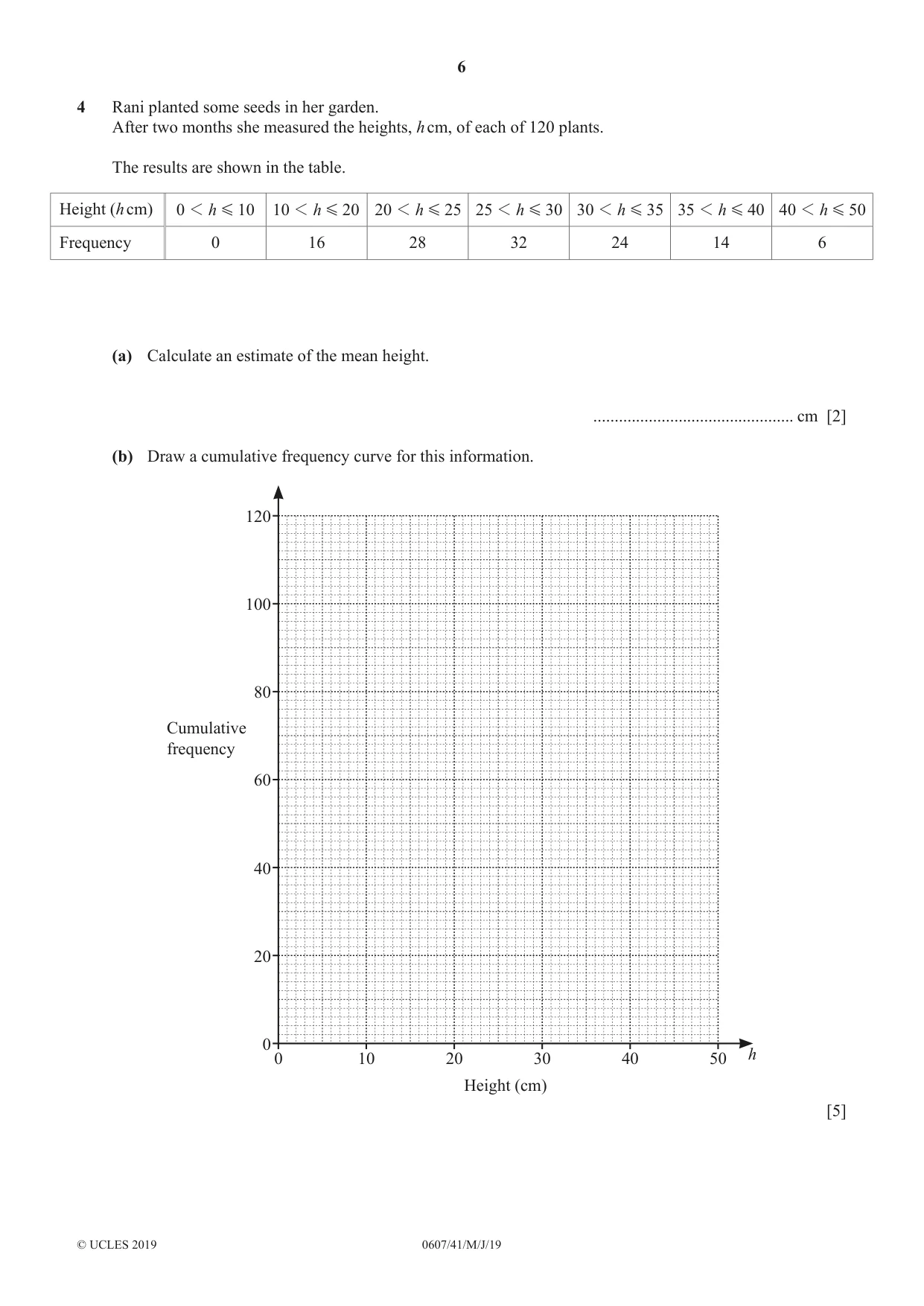
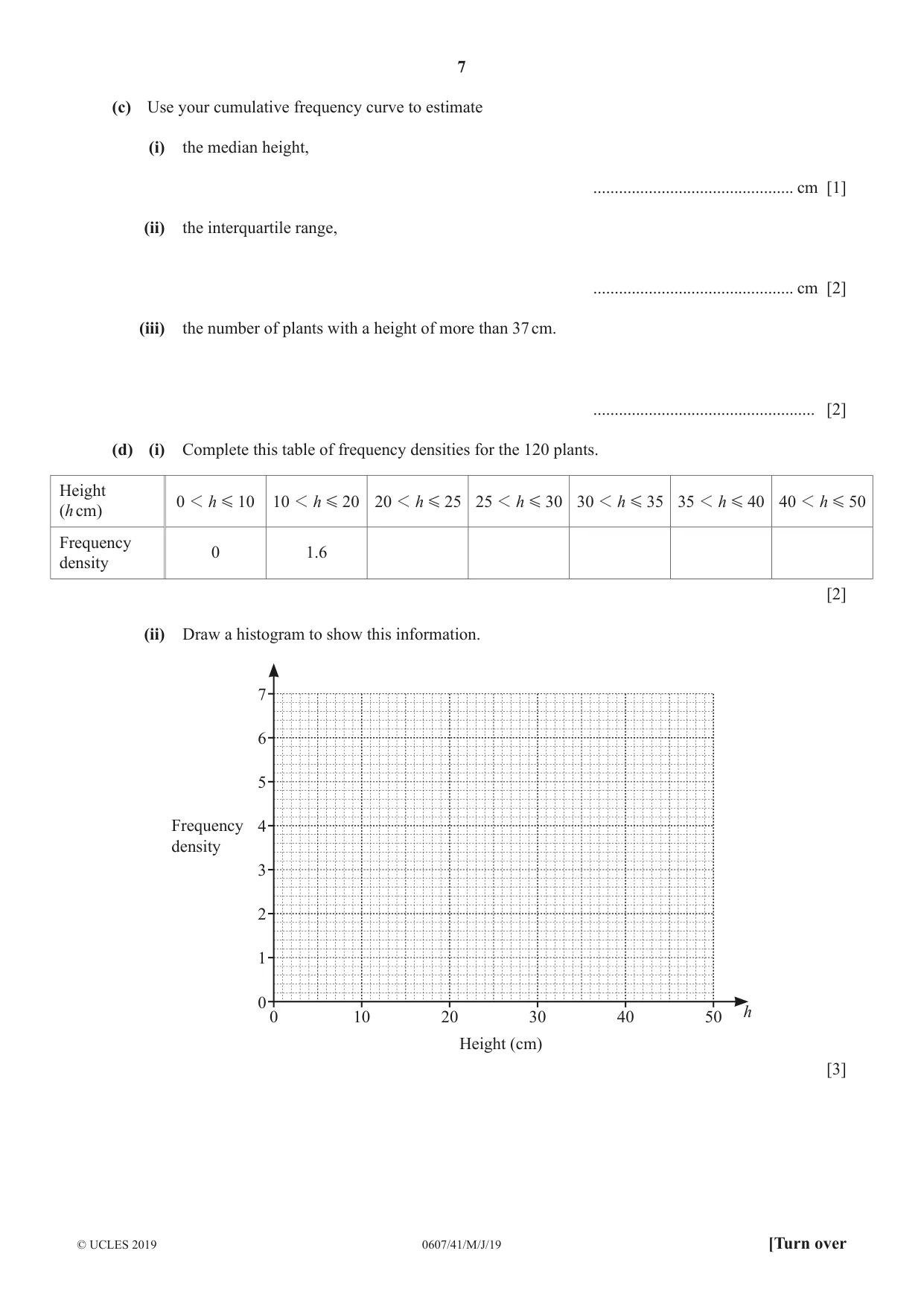
4 Rani planted some seeds in her garden. After two months she measured the heights, h cm, of each of 120 plants. The results are shown in the table. Height (h cm) 0 1 h G 10 10 1 h G 20 20 1 h G 25 25 1 h G 30 30 1 h G 35 35 1 h G 40 40 1 h G 50 Frequency 0 16 28 32 24 14 6 (a) Calculate an estimate of the mean height. ............................................... cm [2] (b) Draw a cumulative frequency curve for this information. 120 100 80 Cumulative frequency 60 40 20 0 h 0 10 20 30 40 50 Height (cm) [5] (c) Use your cumulative frequency curve to estimate (i) the median height, ............................................... cm [1] (ii) the interquartile range, ............................................... cm [2] (iii) the number of plants with a height of more than 37 cm. .................................................... [2] (d) (i) Complete this table of frequency densities for the 120 plants. Height 0 1 h G 10 10 1 h G 20 20 1 h G 25 25 1 h G 30 30 1 h G 35 35 1 h G 40 40 1 h G 50(h cm) Frequency 0 1.6density [2] (ii) Draw a histogram to show this information. 7 6 5 Frequency 4 density 3 2 1 0 h 0 10 20 30 40 50 Height (cm) [3]
Mark scheme: 4(a) 27.7 or 27.70 to 27.71 2 M1 for at least 3 midpoints soi 4(b) Correct cf curve 5 Curve/polygon through (10, 0), (20, 16), (25, 44), (30, 76), (35, 100), (40, 114), (50, 120) or B4 for curve through 5 or 6 points or 7 points with no curve or B3 for 'correct curve' through all other consistent points in interval or B2 for all correct cfs or B1 for 4 or 5 correct cfs. If 0 scored SC1 for any cumulative frequency diagram. 4(c)(i) 26 to 28 1 Dep on increasing curve FT 4(c)(ii) 9 to 11.5 2 Dep on increasing curve FT B1 for lq = 22 to 23.5 or uq = 32.5 to 33.5 4(c)(iii) 10 to 15 2 Dep on increasing curve FT B1 for 105 to 110 seen 4(d)(i) 5.6, 6.4, 4.8, 2.8, 0.6 2 B1 for 3 or 4 correct 4(d)(ii) Correct histogram 3 B2 FT for bars with their heights or B1FT for 3 or 4 bars with their heights or bars with all correct widths
Q5 · Jian asks 60 people what their favourite type of television programme is
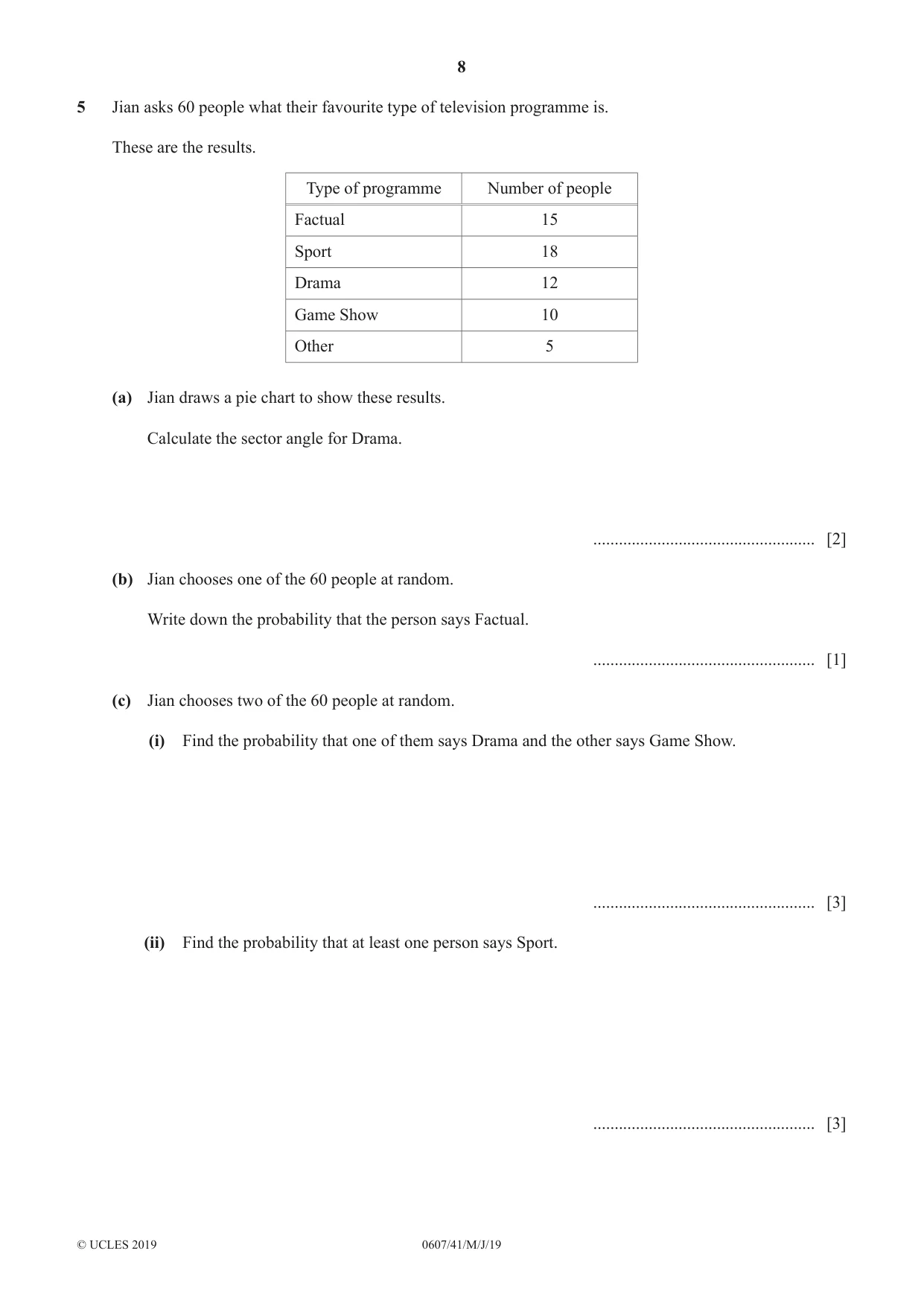
5 Jian asks 60 people what their favourite type of television programme is. These are the results. Type of programme Number of people Factual 15 Sport 18 Drama 12 Game Show 10 Other 5 (a) Jian draws a pie chart to show these results. Calculate the sector angle for Drama. .................................................... [2] (b) Jian chooses one of the 60 people at random. Write down the probability that the person says Factual. .................................................... [1] (c) Jian chooses two of the 60 people at random. (i) Find the probability that one of them says Drama and the other says Game Show. .................................................... [3] (ii) Find the probability that at least one person says Sport. .................................................... [3]
Mark scheme: 5(a) 72 2 12 M1 for × 360 60 5(b) 1 1 oe 4 5(c)(i) 4 3 12 10 10 12 oe M2 for × + × oe 59 60 59 60 59 12 10 10 12 2 or M1 for × or × soi 60 59 60 59 59 5(c)(ii) 303 3 42 41 oe M2 for 1 – × oe 590 60 59 18 42 42 18 18 17 or × + × + × 60 59 60 59 60 59 18 42 42 18 18 17 or M1 for × or × or × 60 59 60 59 60 59 42 41 or × 60 59
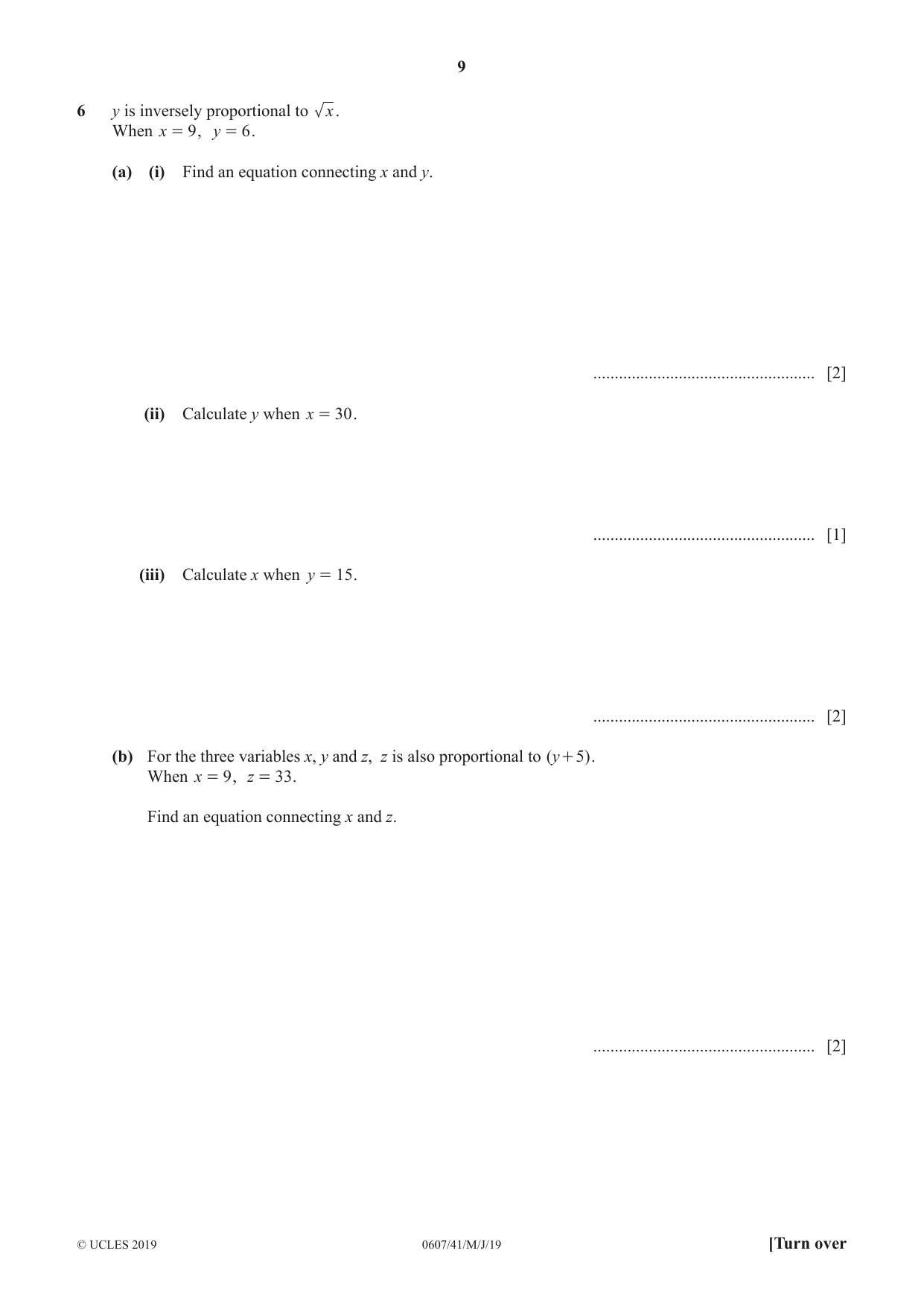
Q6 · Y is inversely proportional to x
6 y is inversely proportional to x. When x = 9 , y = 6 . (a) (i) Find an equation connecting x and y. .................................................... [2] (ii) Calculate y when x = 30 . .................................................... [1] (iii) Calculate x when y = 15 . .................................................... [2] (b) For the three variables x, y and z, z is also proportional to (y + 5) . When x = 9 , z = 33 . Find an equation connecting x and z. .................................................... [2]
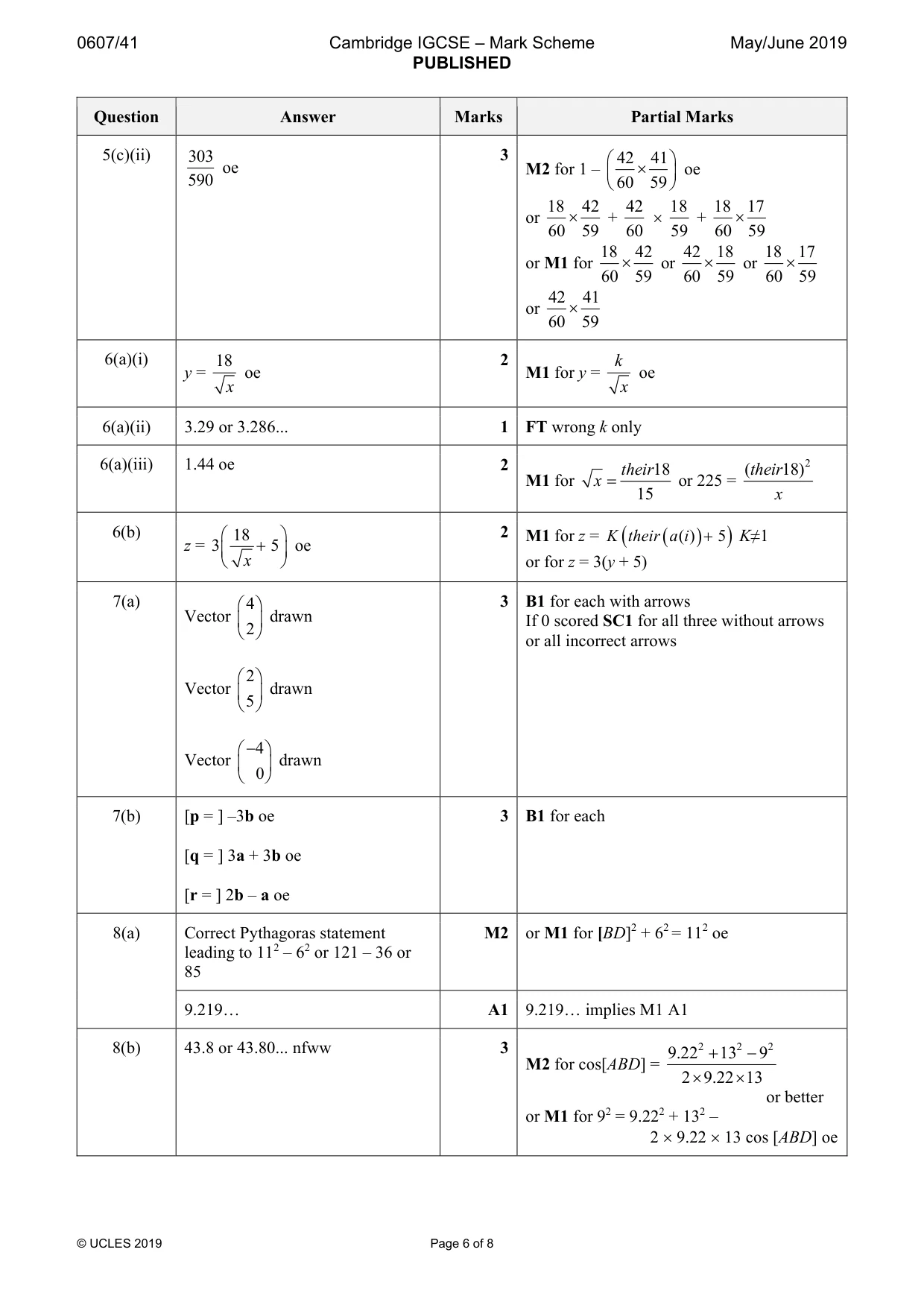
Mark scheme: 6(a)(i) 18 2 k y = oe M1 for y = oe x x 6(a)(ii) 3.29 or 3.286... 1 FT wrong k only 6(a)(iii) 1.44 oe 2 their18 (their18) 2 M1 for x = or 225 = 15 x 6(b) 18 2 M1 for z = K ( their ( a ( i ) ) + 5 ) K≠1 z = 3 + 5 oe x or for z = 3(y + 5)
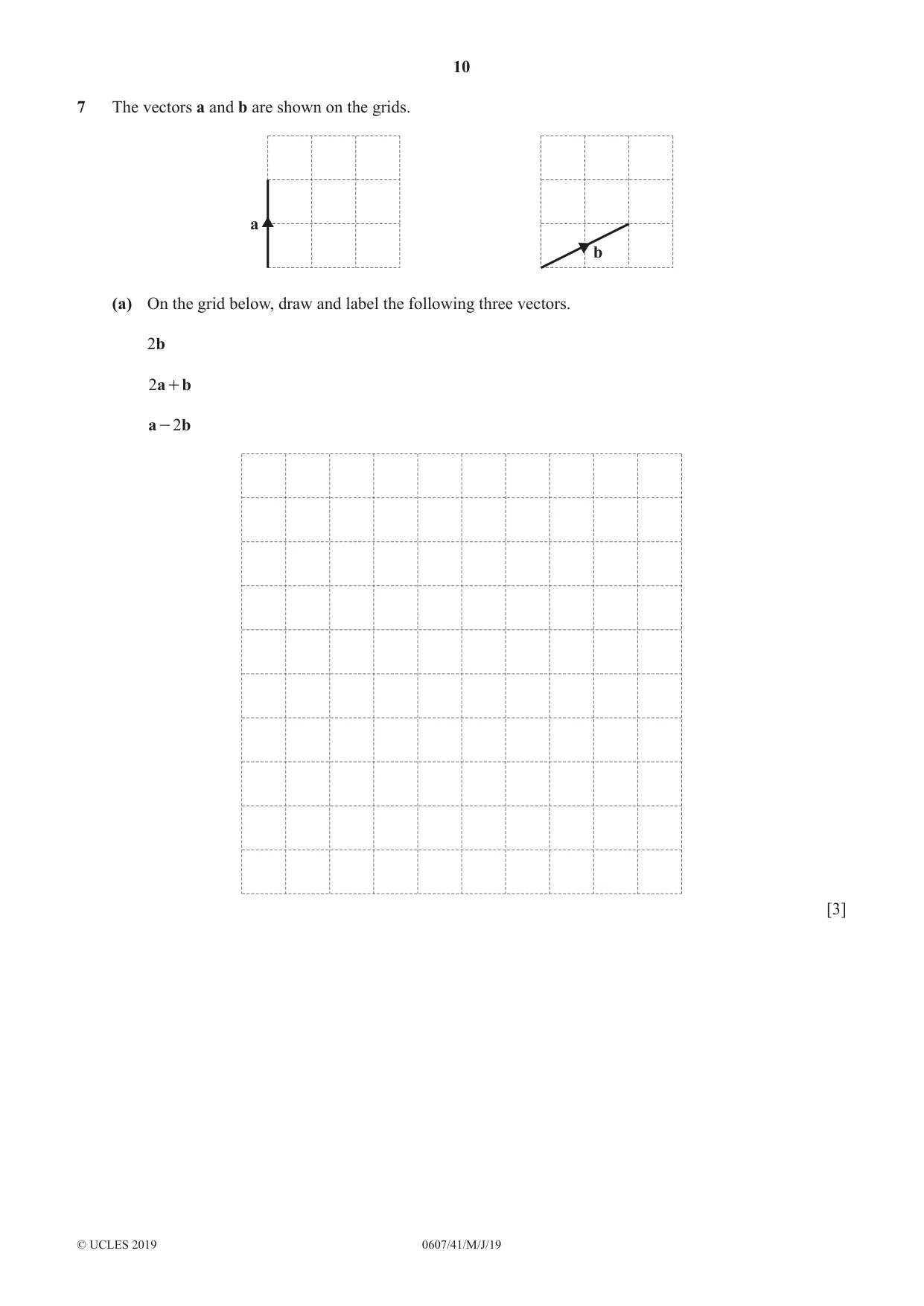
Q7 · The vectors a and b are shown on the grids
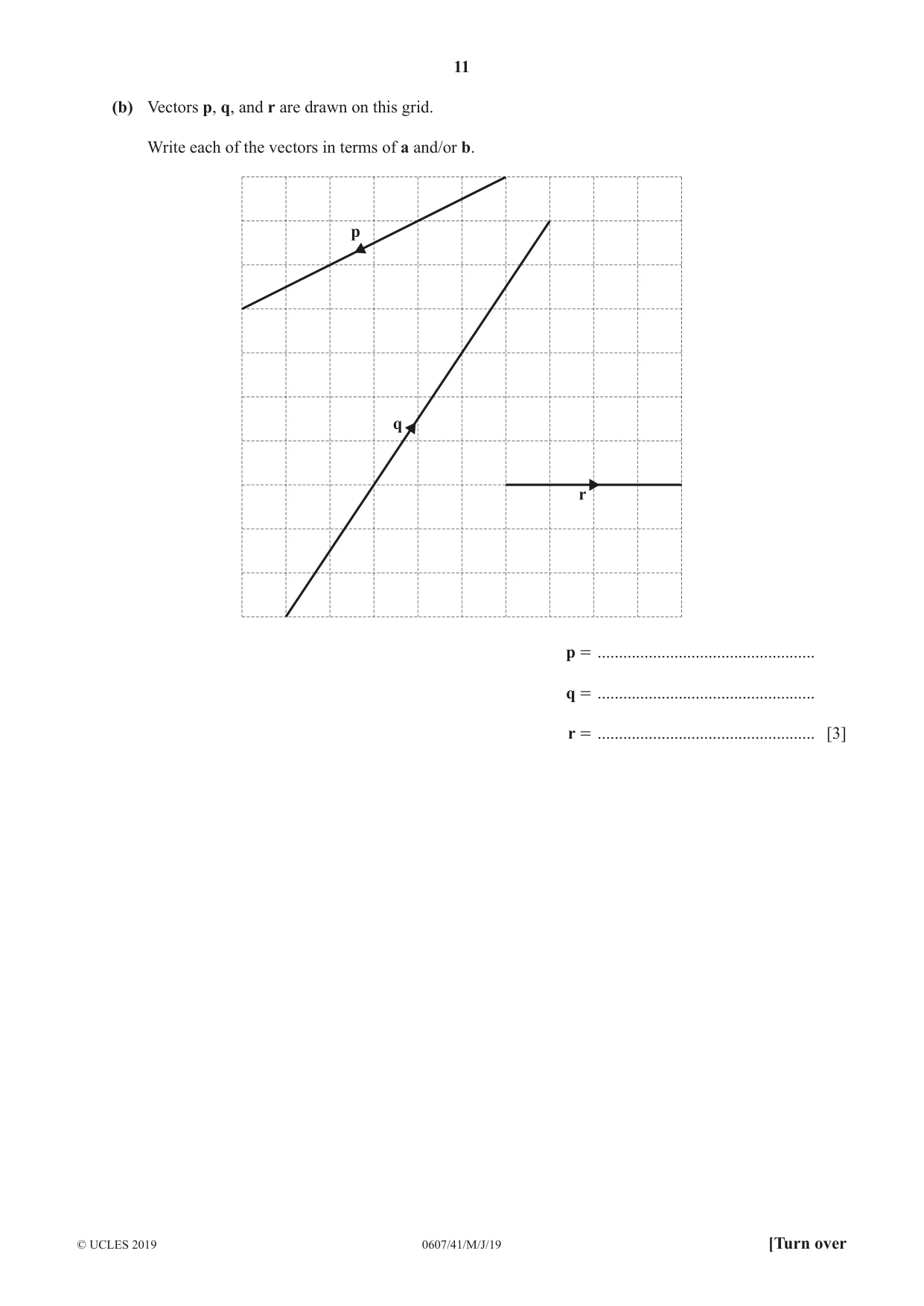
7 The vectors a and b are shown on the grids. a b (a) On the grid below, draw and label the following three vectors. 2b 2a + b a - 2b [3] (b) Vectors p, q, and r are drawn on this grid. Write each of the vectors in terms of a and/or b. p q r p = ................................................... q = ................................................... r = ................................................... [3]
Mark scheme: 7(a) 4 3 B1 for each with arrows Vector drawn If 0 scored SC1 for all three without arrows 2 or all incorrect arrows 2 Vector drawn 5 −4 Vector drawn 0 7(b) [p = ] –3b oe 3 B1 for each [q = ] 3a + 3b oe [r = ] 2b – a oe
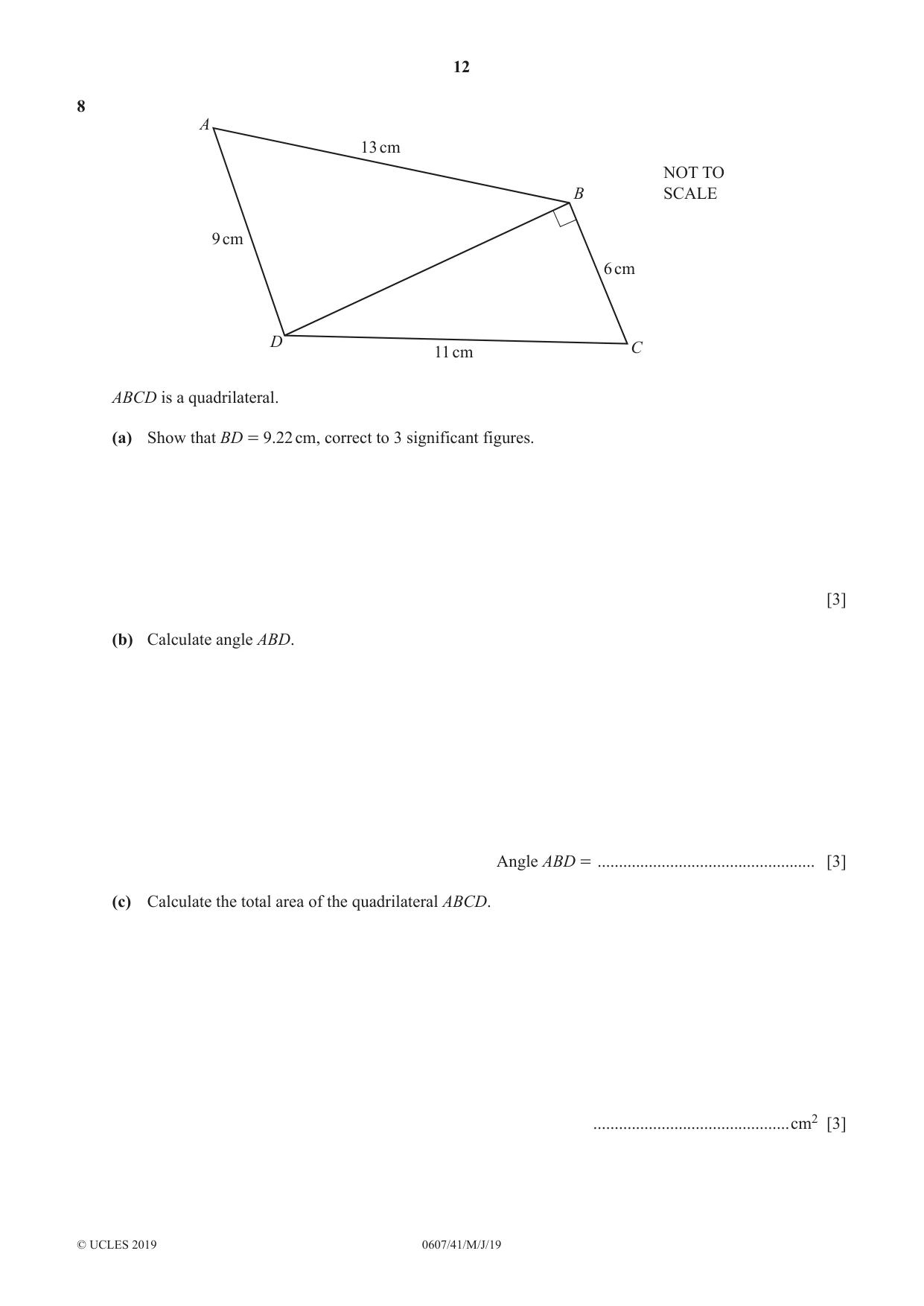
Q8 · A 13 cm NOT TO B SCALE 9 cm 6 cm D 11 cm C ABCD is a quadrilateral
8 A 13 cm NOT TO B SCALE 9 cm 6 cm D 11 cm C ABCD is a quadrilateral. (a) Show that BD = 9.22 cm, correct to 3 significant figures. [3] (b) Calculate angle ABD. Angle ABD = ................................................... [3] (c) Calculate the total area of the quadrilateral ABCD. ..............................................cm2 [3] (d) Calculate the length of the diagonal AC. AC = .............................................. cm [3]
Mark scheme: 8(a) Correct Pythagoras statement M2 or M1 for [BD]2 + 62 = 112 oe leading to 112 – 62 or 121 – 36 or 85 9.219… A1 9.219… implies M1 A1 8(b) 43.8 or 43.80... nfww 3 9.22 2 + 132 − 9 2 M2 for cos[ABD] = 2 × 9.22 × 13 or better or M1 for 92 = 9.222 + 132 – 2 × 9.22 × 13 cos [ABD] oe 8(c) 69.1 or 69.13 to 69.14... nfww 3 M1 for 0.5 × 9.22 × 6 oe M1 for 0.5 × 9.22 × 13 × sin (their 43.8) oe 8(d) 17.7 or 17.69... 3 M1 for 62 + 132 – 2 × 6 × 13 cos (90 + their 43.8) A1 for 313 or 312.9 to 313.0
Q9 · In this question all lengths are in centimetres
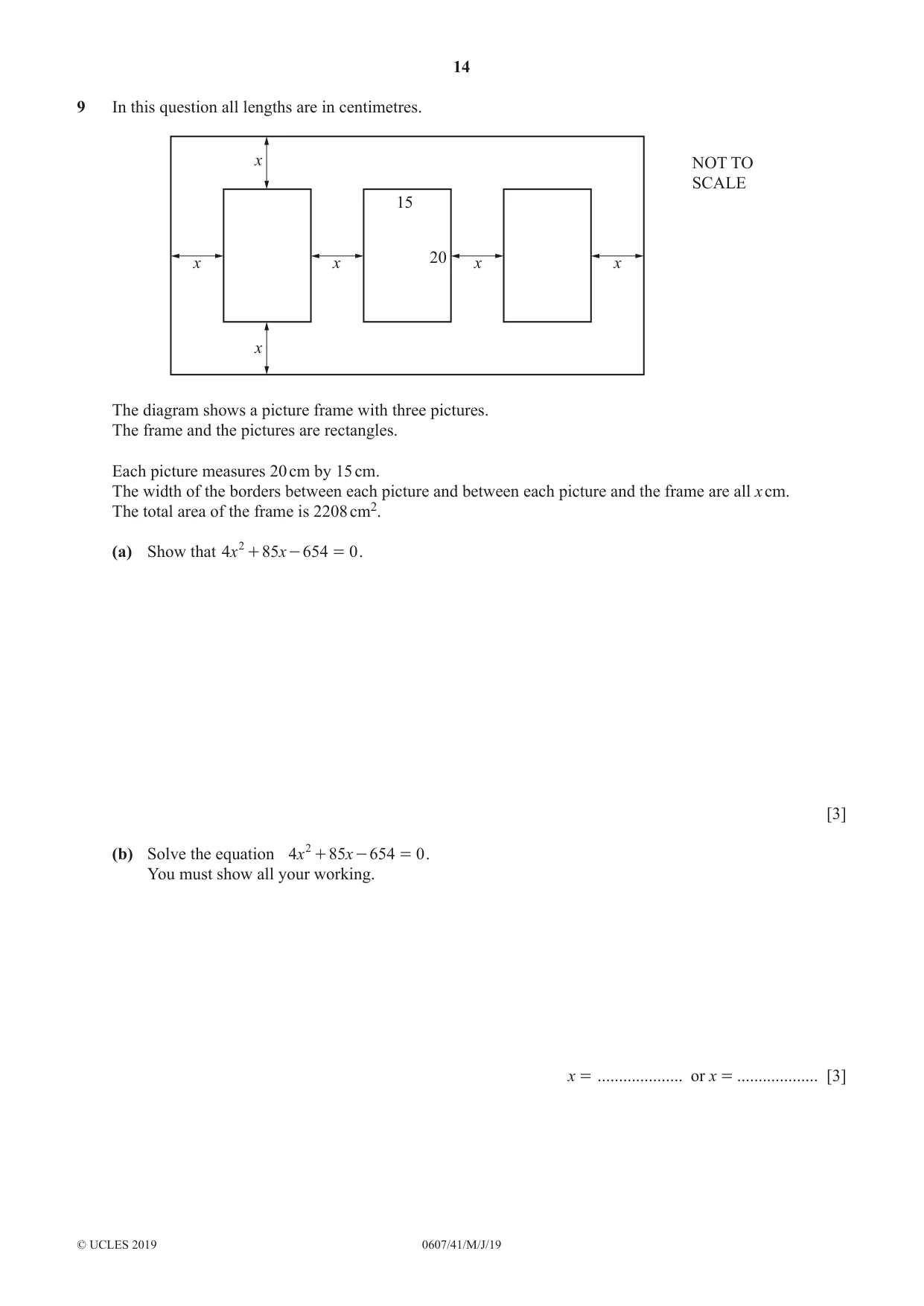
9 In this question all lengths are in centimetres. x NOT TO SCALE 15 20 x x x x x The diagram shows a picture frame with three pictures. The frame and the pictures are rectangles. Each picture measures 20 cm by 15 cm. The width of the borders between each picture and between each picture and the frame are all x cm. The total area of the frame is 2208 cm2. (a) Show that 4x 2 + 85x - 654 = 0 . [3] (b) Solve the equation 4x 2 + 85x - 654 = 0 . You must show all your working. x = .................... or x = ................... [3] (c) Find the dimensions of the picture frame. Length .............................................. cm Height .............................................. cm [2]
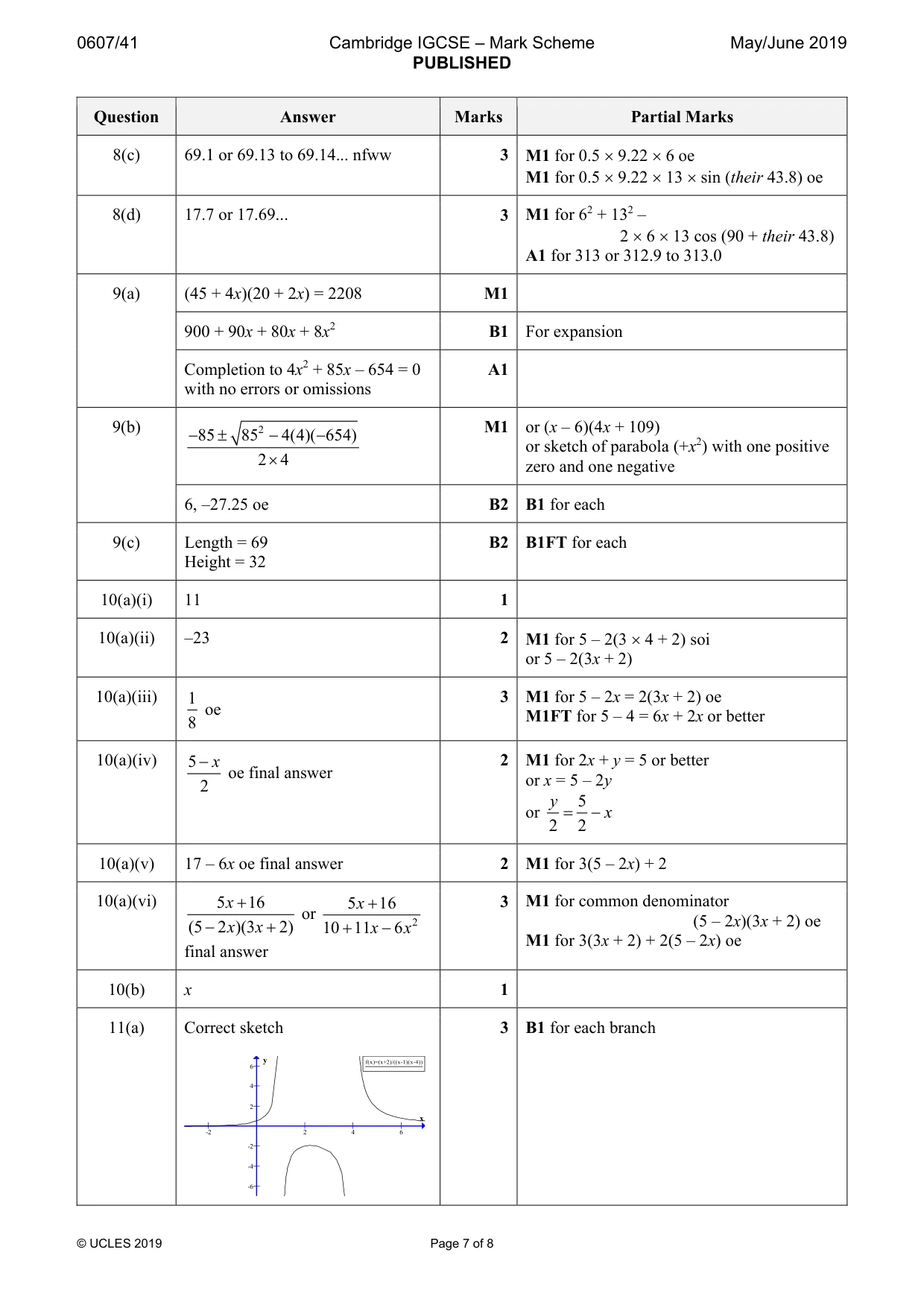
Mark scheme: 9(a) (45 + 4x)(20 + 2x) = 2208 M1 900 + 90x + 80x + 8x2 B1 For expansion Completion to 4x2 + 85x – 654 = 0 A1 with no errors or omissions 9(b) 2 M1 or (x – 6)(4x + 109) − 85 ± 85 − 4(4)( − 654) or sketch of parabola (+x2) with one positive 2 × 4 zero and one negative 6, –27.25 oe B2 B1 for each 9(c) Length = 69 B2 B1FT for each Height = 32
Q10 · F ()x = 5 - 2x g ()x = 3x + 2 (i) Find f (- 3 )
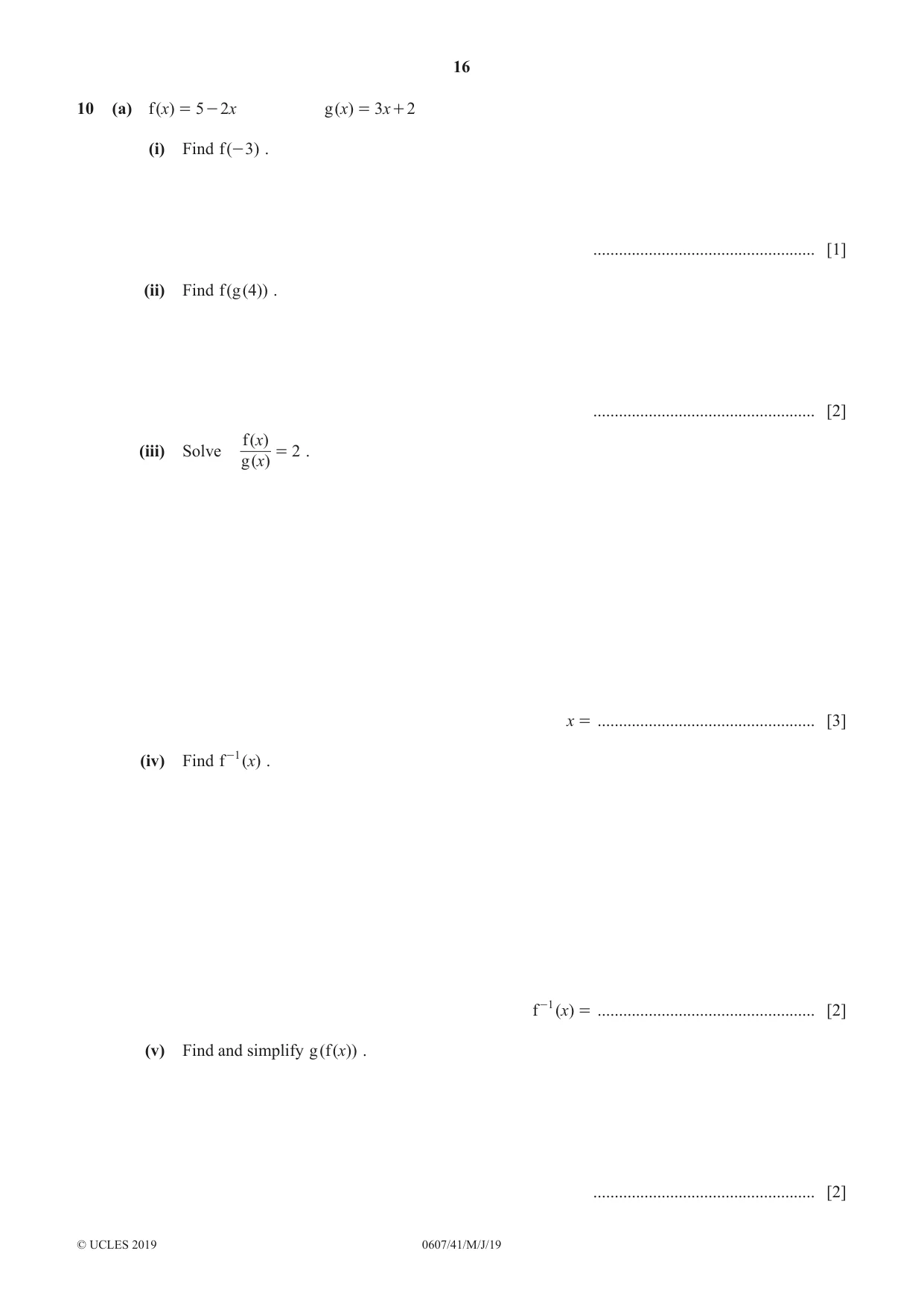
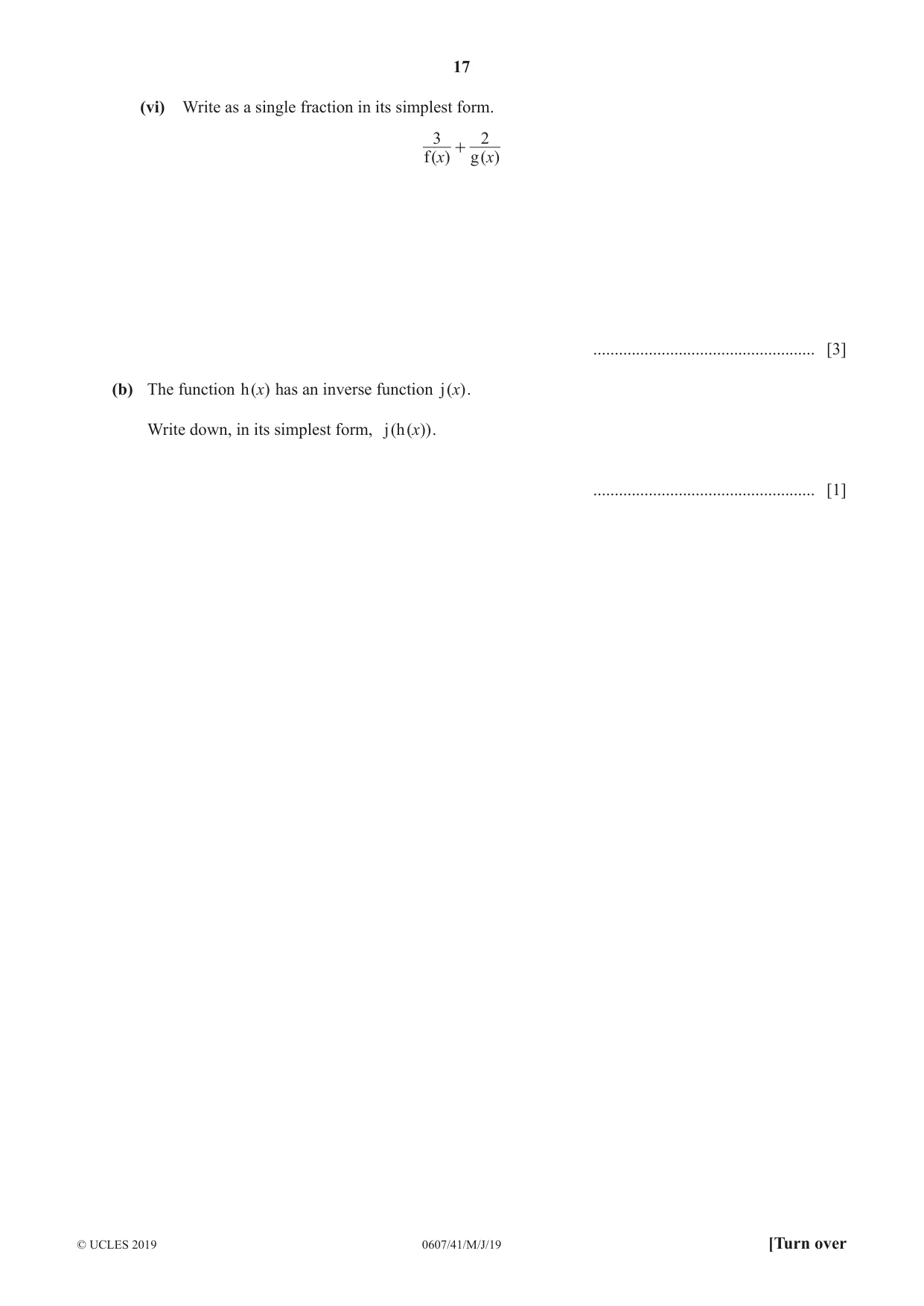
10 (a) f ()x = 5 - 2x g ()x = 3x + 2 (i) Find f (- 3 ) . .................................................... [1] (ii) Find f (g (4)) . .................................................... [2] f (x) (iii) Solve = 2 . g (x) x = ................................................... [3] (iv) Find f - 1 ()x . f - 1 ()x = ................................................... [2] (v) Find and simplify g (f (x)) . .................................................... [2] (vi) Write as a single fraction in its simplest form. 3 2 + f (x) g ( x) .................................................... [3] (b) The function h ()x has an inverse function j ()x . Write down, in its simplest form, j (h (x)) . .................................................... [1]
Mark scheme: 10(a)(i) 11 1 10(a)(ii) –23 2 M1 for 5 – 2(3 × 4 + 2) soi or 5 – 2(3x + 2) 10(a)(iii) 1 3 M1 for 5 – 2x = 2(3x + 2) oe oe M1FT for 5 – 4 = 6x + 2x or better 8 10(a)(iv) 5 −x 2 M1 for 2x + y = 5 or better oe final answer or x = 5 – 2y 2 y 5 or = − x 2 2 10(a)(v) 17 – 6x oe final answer 2 M1 for 3(5 – 2x) + 2 10(a)(vi) 5 x + 16 5 x + 16 3 M1 for common denominator or 2 (5 – 2x)(3x + 2) oe (5 − 2 x )(3 x + 2) 10 + 11x − 6 x M1 for 3(3x + 2) + 2(5 – 2x) oe final answer 10(b) x 1
Q11 · Y 6 –2 0 7 x –6 (x + 2) f (x) = (x - 1)(x - 4) (a) On the diagram, sketch the graph of y…
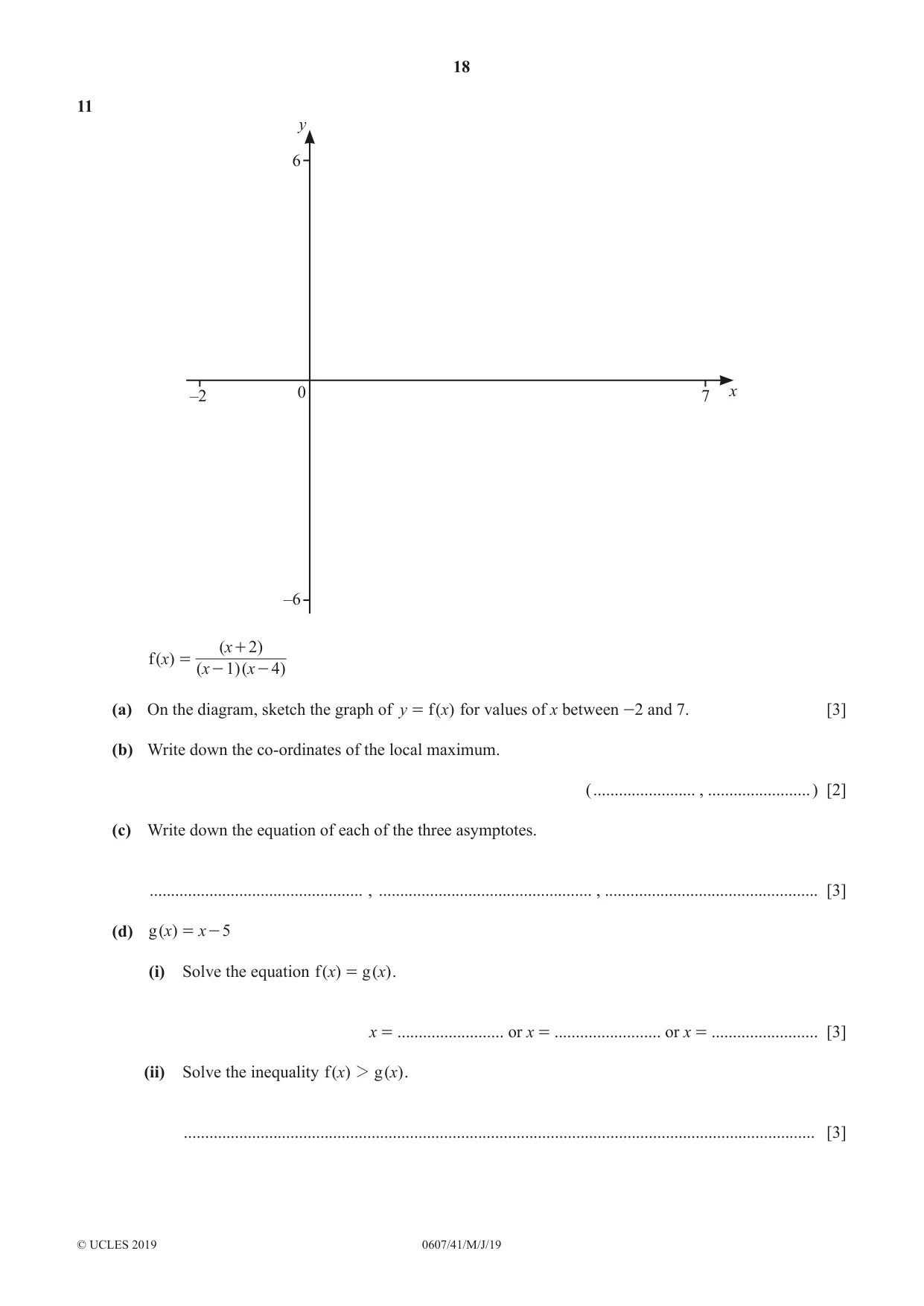
11 y 6 –2 0 7 x –6 (x + 2) f (x) = (x - 1)(x - 4) (a) On the diagram, sketch the graph of y = f ( x) for values of x between -2 and 7. [3] (b) Write down the co-ordinates of the local maximum. ( ........................ , ........................ ) [2] (c) Write down the equation of each of the three asymptotes. .................................................. , .................................................. , .................................................. [3] (d) g ()x = x - 5 (i) Solve the equation f (x) = g (x) . x = ......................... or x = ......................... or x = ......................... [3] (ii) Solve the inequality f (x) 2 g (x) . .................................................................................................................................................... [3]
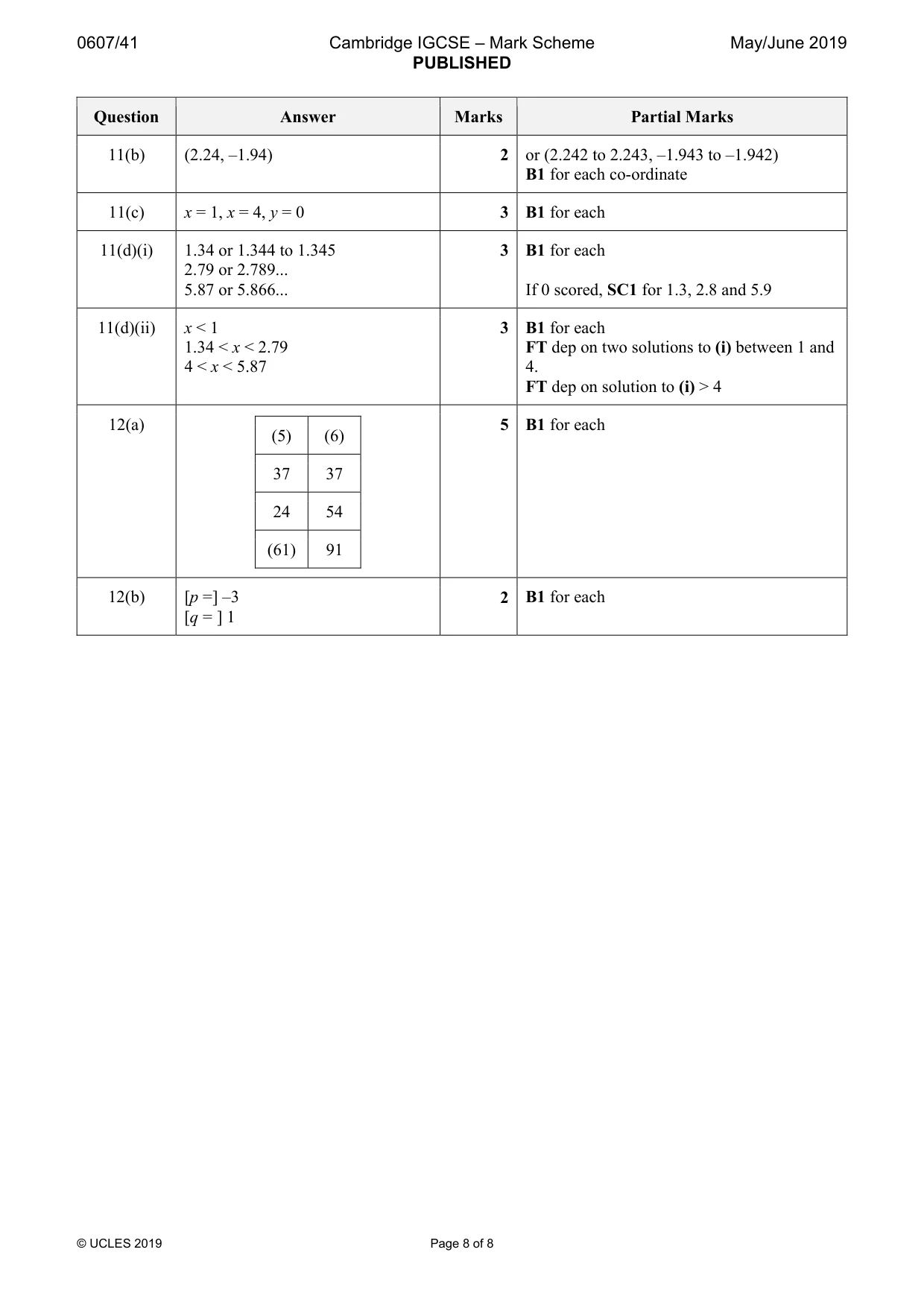
Mark scheme: 11(a) Correct sketch 3 B1 for each branch y f(x)=(x+2)/((x-1)(x-4)) 6 4 2 x -2 2 4 6 -2 -4 -6 11(b) (2.24, –1.94) 2 or (2.242 to 2.243, –1.943 to –1.942) B1 for each co-ordinate 11(c) x = 1, x = 4, y = 0 3 B1 for each 11(d)(i) 1.34 or 1.344 to 1.345 3 B1 for each 2.79 or 2.789... 5.87 or 5.866... If 0 scored, SC1 for 1.3, 2.8 and 5.9 11(d)(ii) x < 1 3 B1 for each 1.34 < x < 2.79 FT dep on two solutions to (i) between 1 and 4 < x < 5.87 4. FT dep on solution to (i) > 4
Q12 · Here is a sequence of patterns made using identical regular hexagons
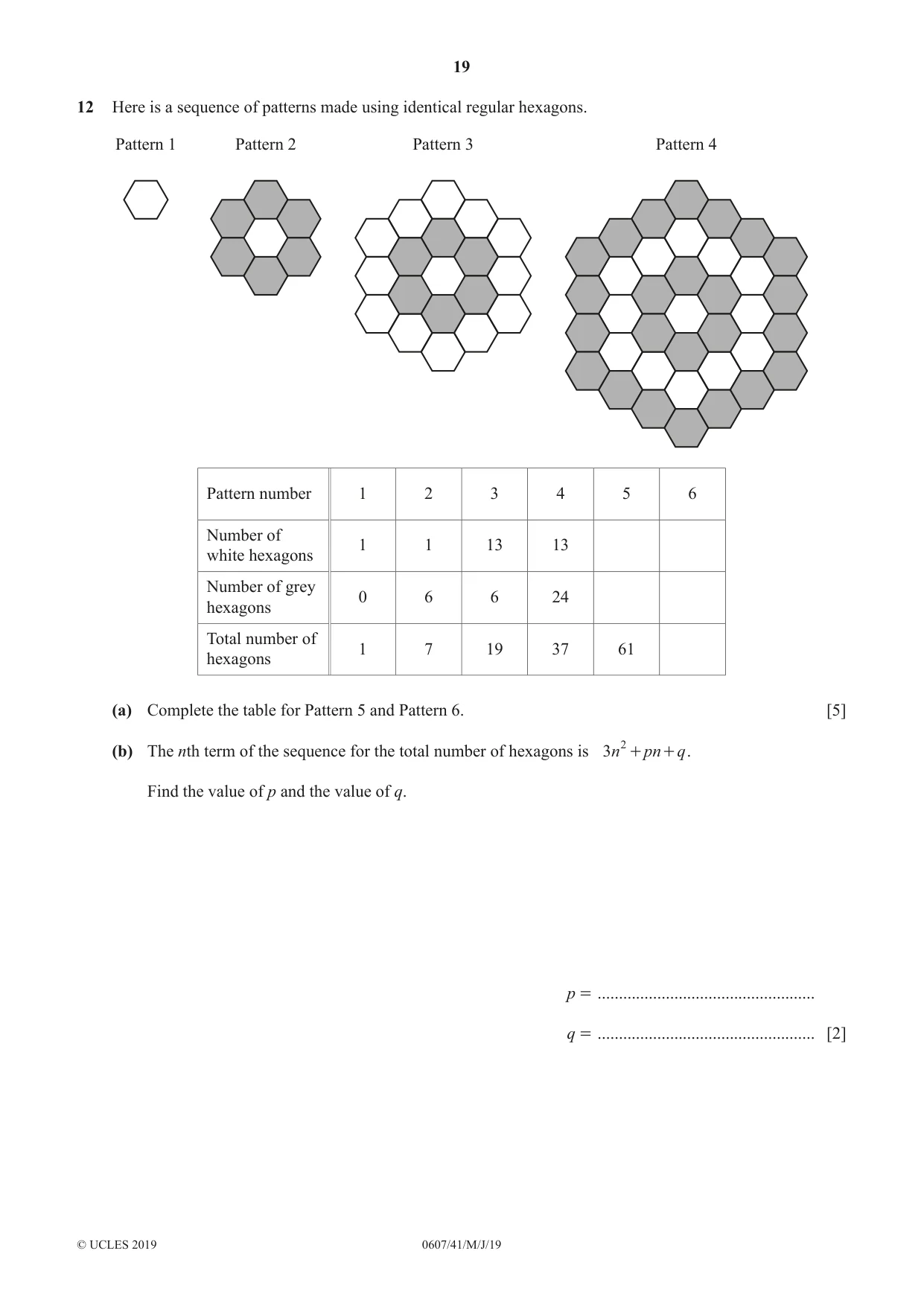
12 Here is a sequence of patterns made using identical regular hexagons. Pattern 1 Pattern 2 Pattern 3 Pattern 4 Pattern number 1 2 3 4 5 6 Number of 1 1 13 13 white hexagons Number of grey 0 6 6 24 hexagons Total number of 1 7 19 37 61 hexagons (a) Complete the table for Pattern 5 and Pattern 6. [5] (b) The nth term of the sequence for the total number of hexagons is 3n 2 + pn + q . Find the value of p and the value of q. p = ................................................... q = ................................................... [2]
Mark scheme: 12(a) 5 B1 for each (5) (6) 37 37 24 54 (61) 91 12(b) [p =] –3 2 B1 for each [q = ] 1
What was in this paper
The subtopics covered by these 12 questions, and how many questions each got. Open one in a new tab to see every Cambridge question on it.
What you needed in this session
Cambridge’s own grade thresholds for 2019 May/June, Paper 4 · Variant 1. A higher threshold means an easier paper — the bar moves with how the cohort did.