Cambridge IGCSE Mathematics - International 0607 — 2023 Feb/March Paper 4 · Variant 2
0607/42/F/M/23 · 12 questions · 120 marks · ≈135 min
The question paper and its mark scheme, free to read here and free to download. This is Cambridge’s own paper, exactly as it was sat.
Question paper20 pages
Mark scheme10 pages
Answers below. Sit the paper first if you are practising.
Questions as text
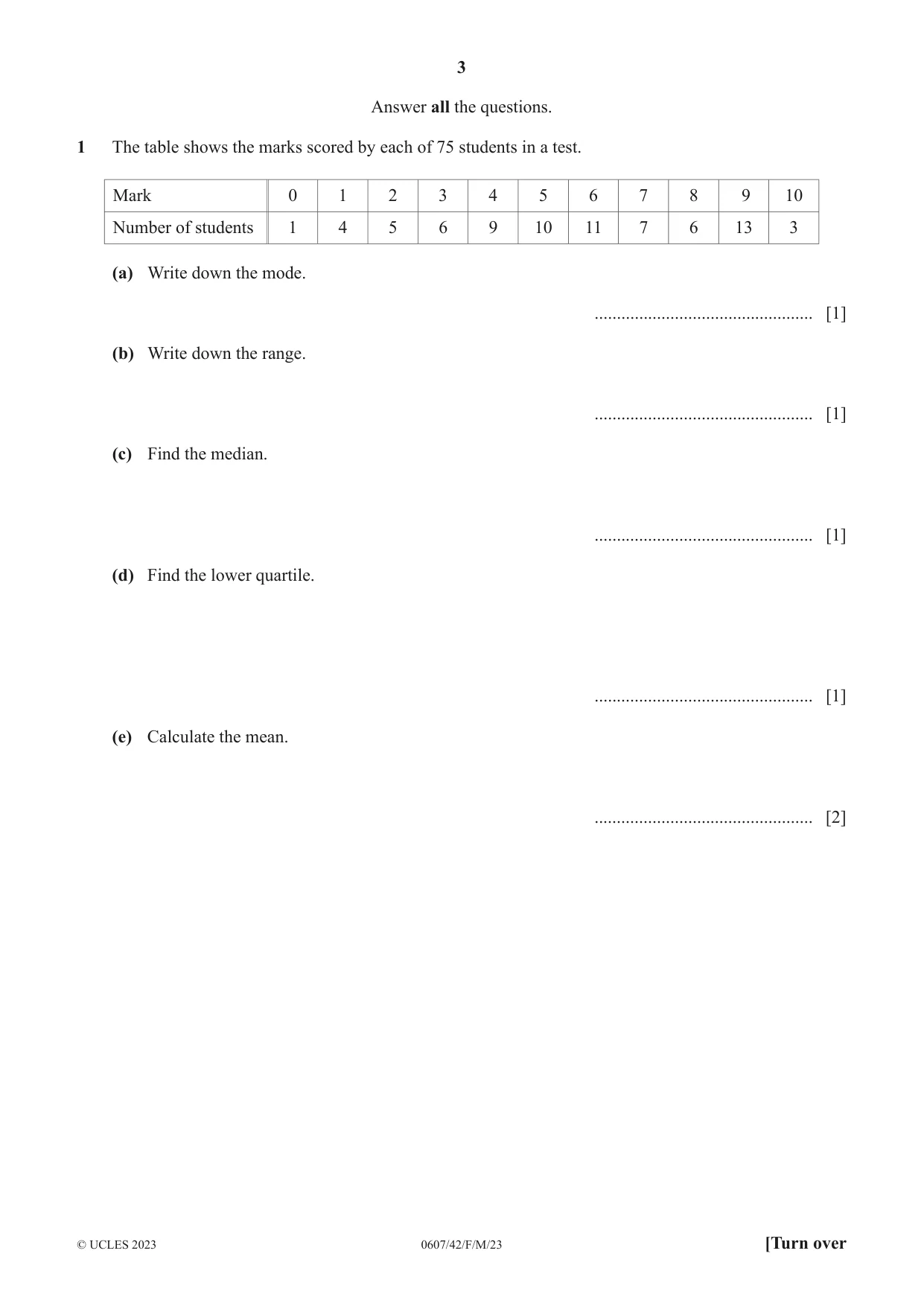
Q1 · The table shows the marks scored by each of 75 students in a test
1 The table shows the marks scored by each of 75 students in a test. Mark 0 1 2 3 4 5 6 7 8 9 10 Number of students 1 4 5 6 9 10 11 7 6 13 3 (a) Write down the mode. ................................................. [1] (b) Write down the range. ................................................. [1] (c) Find the median. ................................................. [1] (d) Find the lower quartile. ................................................. [1] (e) Calculate the mean. ................................................. [2]
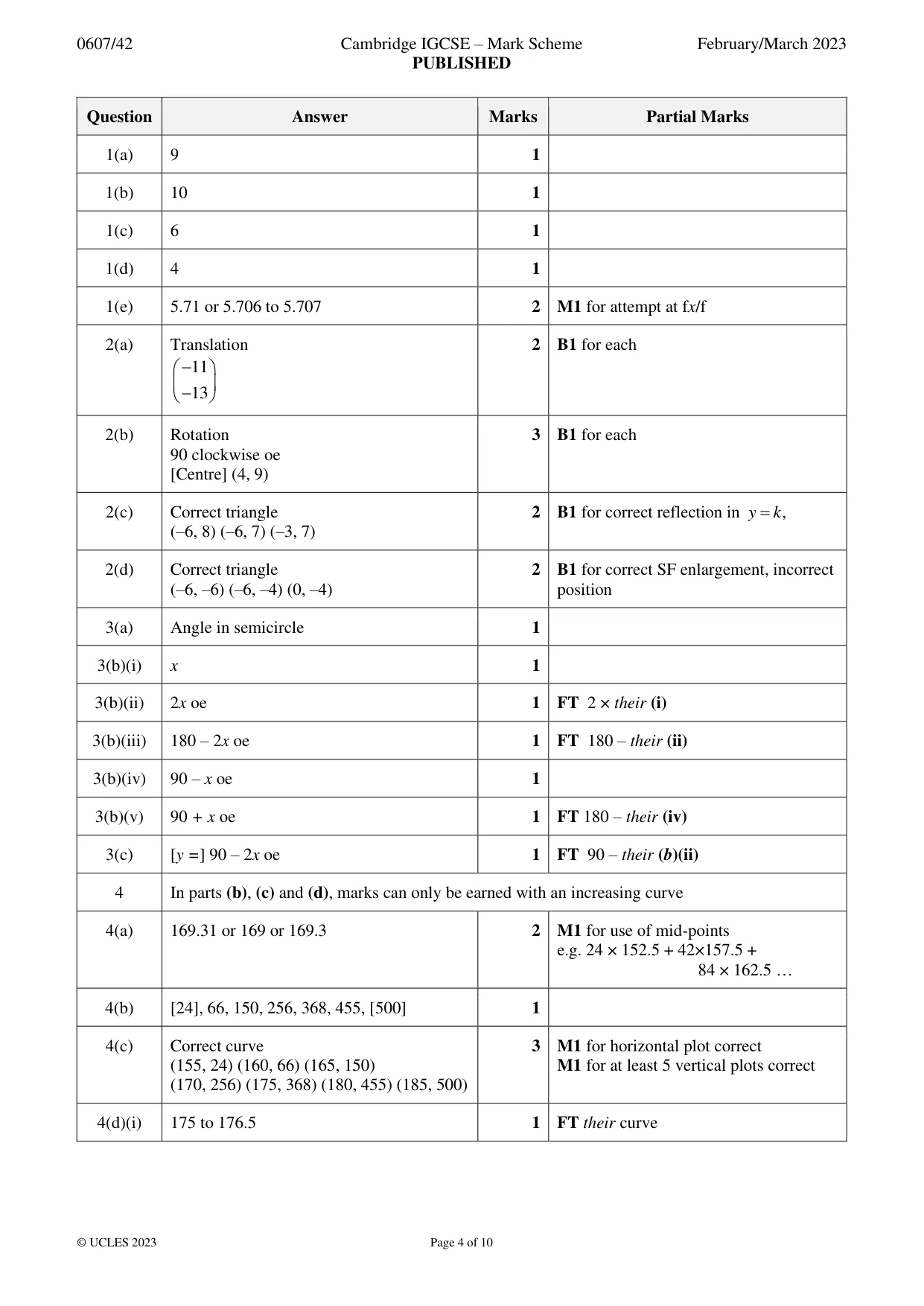
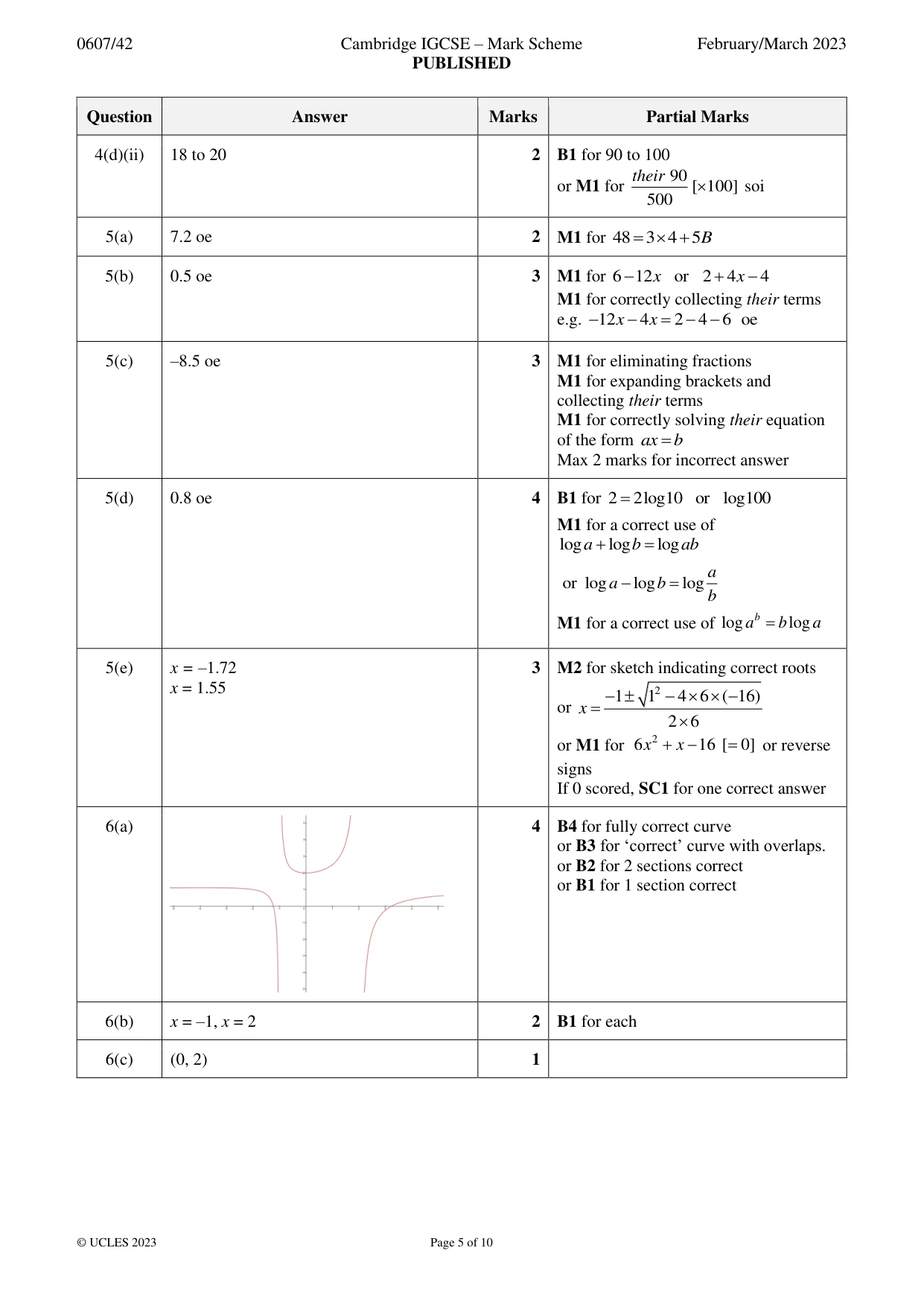
Mark scheme: Question Answer Marks Partial Marks 1(a) 9 1 1(b) 10 1 1(c) 6 1 1(d) 4 1 1(e) 5.71 or 5.706 to 5.707 2 M1 for attempt at fx/f
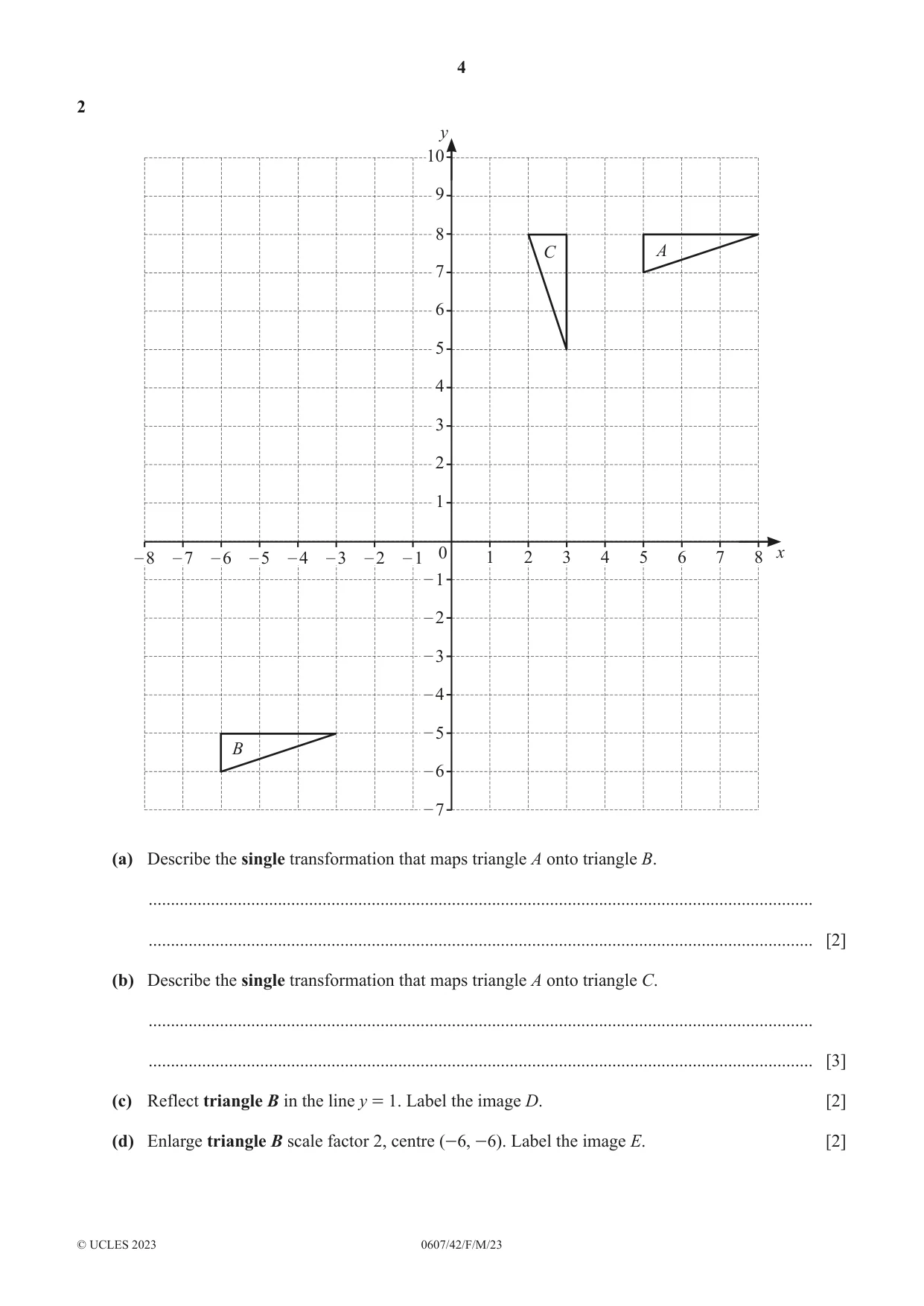
Q2 · Y 10 9 8 C A 7 6 5 4 3 2 1 – 8 – 7 – 6 – 5 – 4 – 3 – 2 – 1 0 1 2 3 4 5 6 7 8 x – 1 – 2…
2 y 10 9 8 C A 7 6 5 4 3 2 1 – 8 – 7 – 6 – 5 – 4 – 3 – 2 – 1 0 1 2 3 4 5 6 7 8 x – 1 – 2 – 3 – 4 – 5 B – 6 – 7 (a) Describe the single transformation that maps triangle A onto triangle B. ..................................................................................................................................................... ..................................................................................................................................................... [2] (b) Describe the single transformation that maps triangle A onto triangle C. ..................................................................................................................................................... ..................................................................................................................................................... [3] (c) Reflect triangle B in the line y = 1. Label the image D. [2] (d) Enlarge triangle B scale factor 2, centre (-6, -6). Label the image E. [2]
Mark scheme: 2(a) Translation 2 B1 for each −11 −13 2(b) Rotation 3 B1 for each 90 clockwise oe [Centre] (4, 9) 2(c) Correct triangle 2 B1 for correct reflection in y = k , (–6, 8) (–6, 7) (–3, 7) 2(d) Correct triangle 2 B1 for correct SF enlargement, incorrect (–6, –6) (–6, –4) (0, –4) position
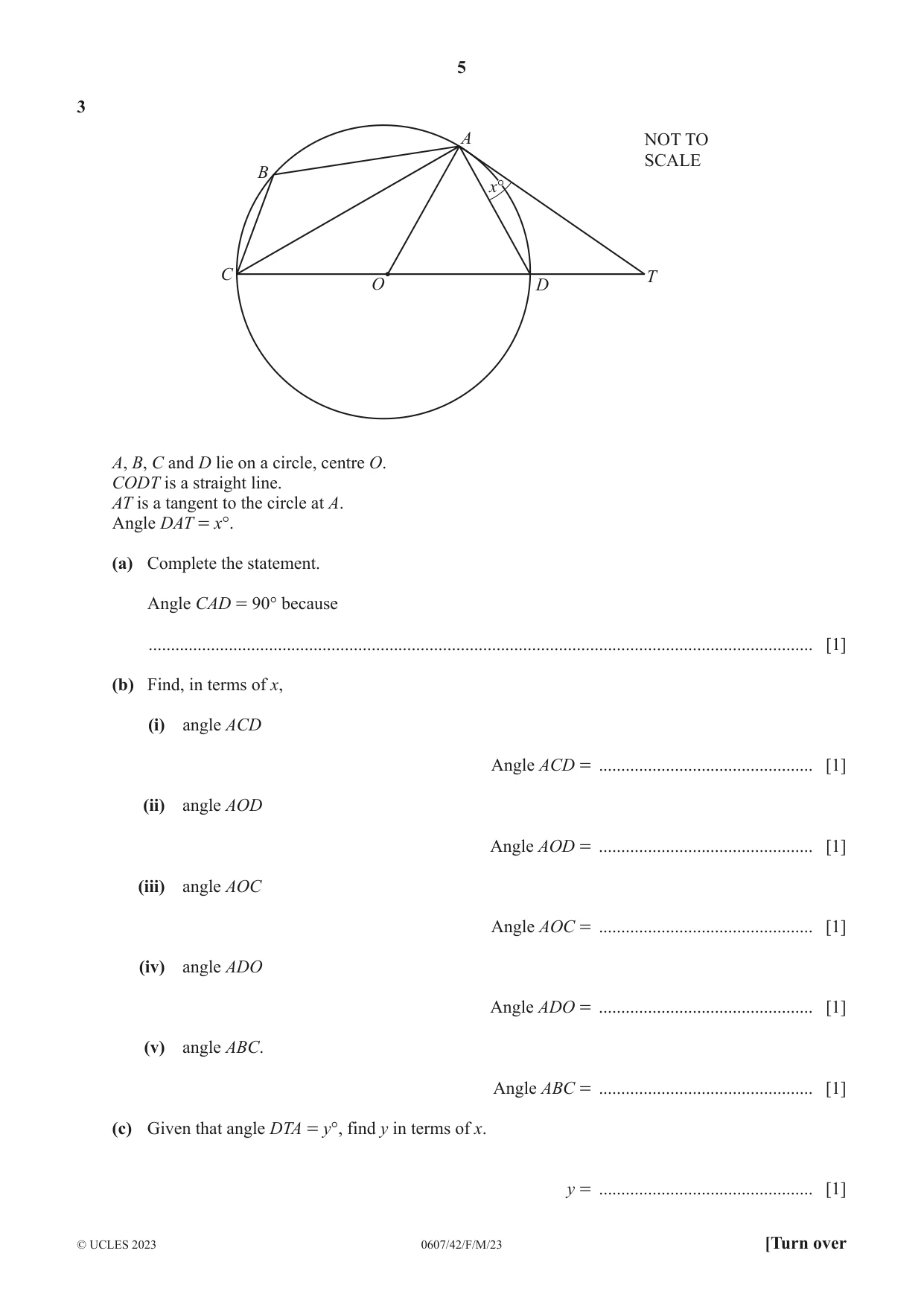
Q3 · A NOT TO SCALE B x°x° C T O D A, B, C and D lie on a circle, centre O
3 A NOT TO SCALE B x°x° C T O D A, B, C and D lie on a circle, centre O. CODT is a straight line. AT is a tangent to the circle at A. Angle DAT = x°. (a) Complete the statement. Angle CAD = 90° because ..................................................................................................................................................... [1] (b) Find, in terms of x, (i) angle ACD Angle ACD = ................................................ [1] (ii) angle AOD Angle AOD = ................................................ [1] (iii) angle AOC Angle AOC = ................................................ [1] (iv) angle ADO Angle ADO = ................................................ [1] (v) angle ABC. Angle ABC = ................................................ [1] (c) Given that angle DTA = y°, find y in terms of x. y = ................................................ [1]
Mark scheme: 3(a) Angle in semicircle 1 3(b)(i) x 1 3(b)(ii) 2x oe 1 FT 2 × their (i) 3(b)(iii) 180 – 2x oe 1 FT 180 – their (ii) 3(b)(iv) 90 – x oe 1 3(b)(v) 90 + x oe 1 FT 180 – their (iv) 3(c) [y =] 90 – 2x oe 1 FT 90 – their (b)(ii) 4 In parts (b), (c) and (d), marks can only be earned with an increasing curve
Q4 · The heights, x cm, of 500 students in a school are shown in the table
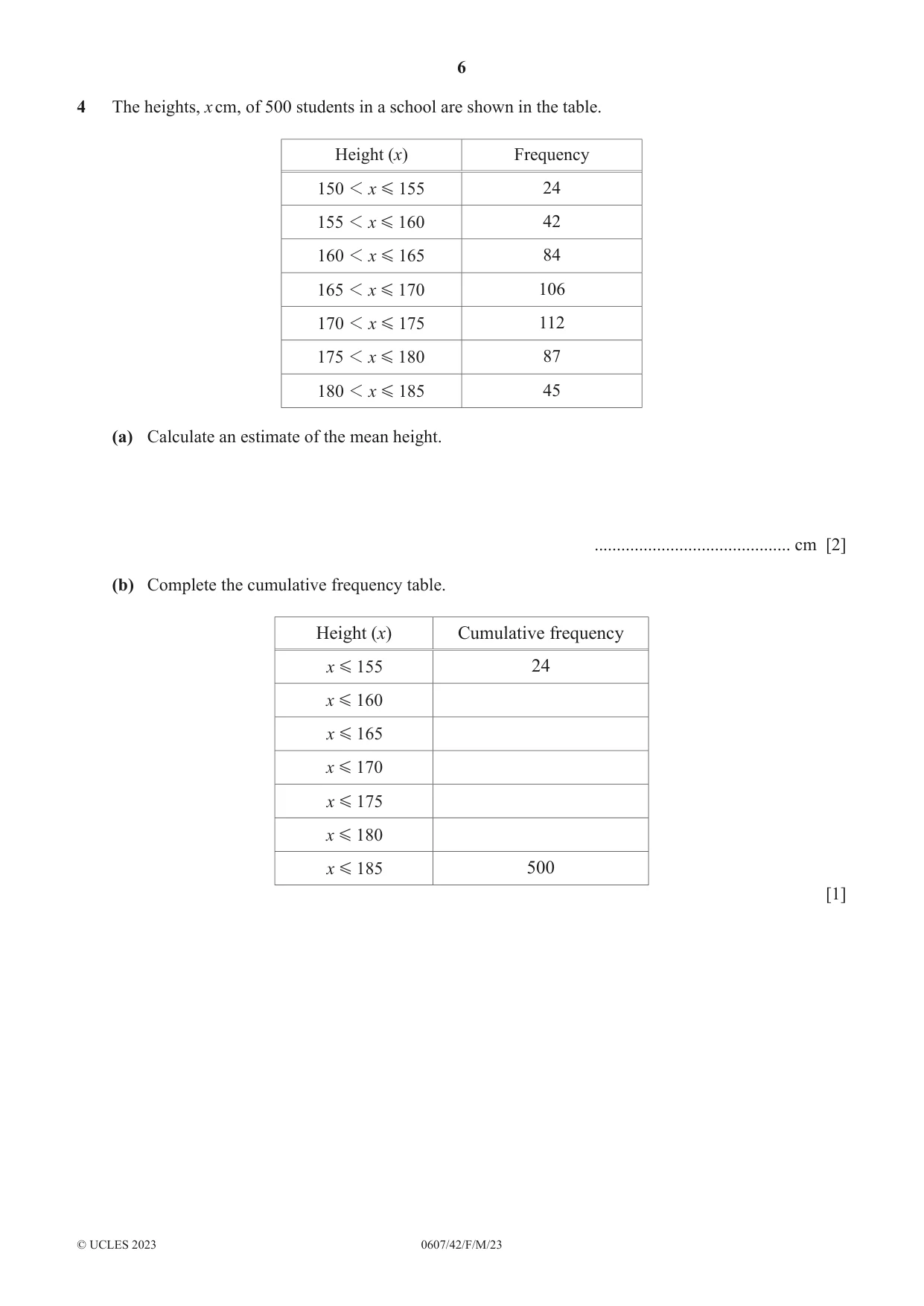
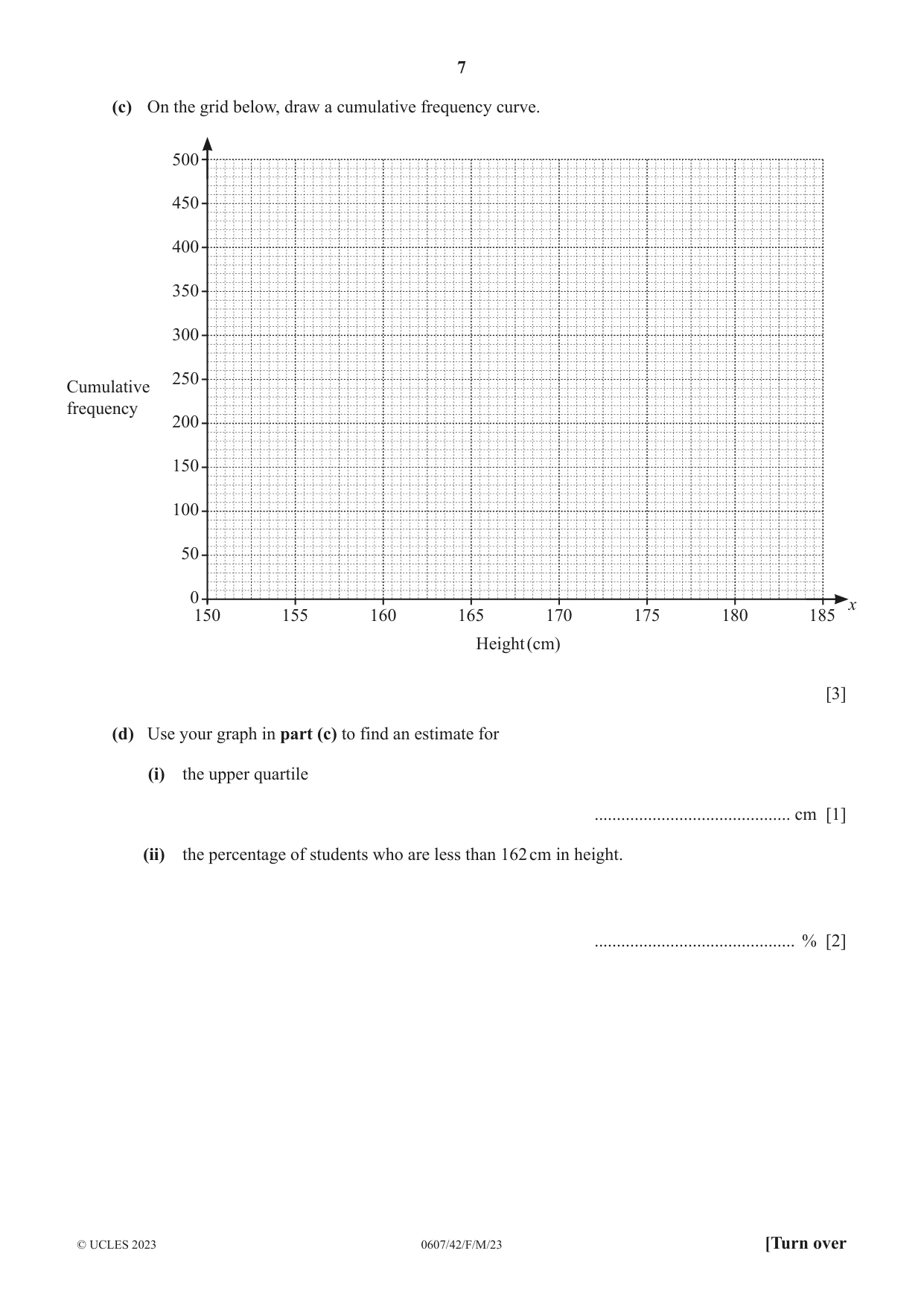
4 The heights, x cm, of 500 students in a school are shown in the table. Height (x) Frequency 150 1 x G 155 24 155 1 x G 160 42 160 1 x G 165 84 165 1 x G 170 106 170 1 x G 1 75 112 175 1 x G 180 87 180 1 x G 185 45 (a) Calculate an estimate of the mean height. ............................................ cm [2] (b) Complete the cumulative frequency table. Height (x) Cumulative frequency x G 155 24 x G 160 x G 165 x G 170 x G 175 x G 180 x G 185 500 [1] (c) On the grid below, draw a cumulative frequency curve. 500 450 400 350 300 250Cumulative frequency 200 150 100 50 0 x 150 155 160 165 170 175 180 185 Height (cm) [3] (d) Use your graph in part (c) to find an estimate for (i) the upper quartile ............................................ cm [1] (ii) the percentage of students who are less than 162 cm in height. ............................................. % [2]
Mark scheme: 4(a) 169.31 or 169 or 169.3 2 M1 for use of mid-points e.g. 24 × 152.5 + 42×157.5 + 84 × 162.5 … 4(b) [24], 66, 150, 256, 368, 455, [500] 1 4(c) Correct curve 3 M1 for horizontal plot correct (155, 24) (160, 66) (165, 150) M1 for at least 5 vertical plots correct (170, 256) (175, 368) (180, 455) (185, 500) 4(d)(i) 175 to 176.5 1 FT their curve 4(d)(ii) 18 to 20 2 B1 for 90 to 100 their 90 or M1 for [ 100] soi 500
Q5 · X = 3A + 5B Work out the value of B when X = 48 and A = 4
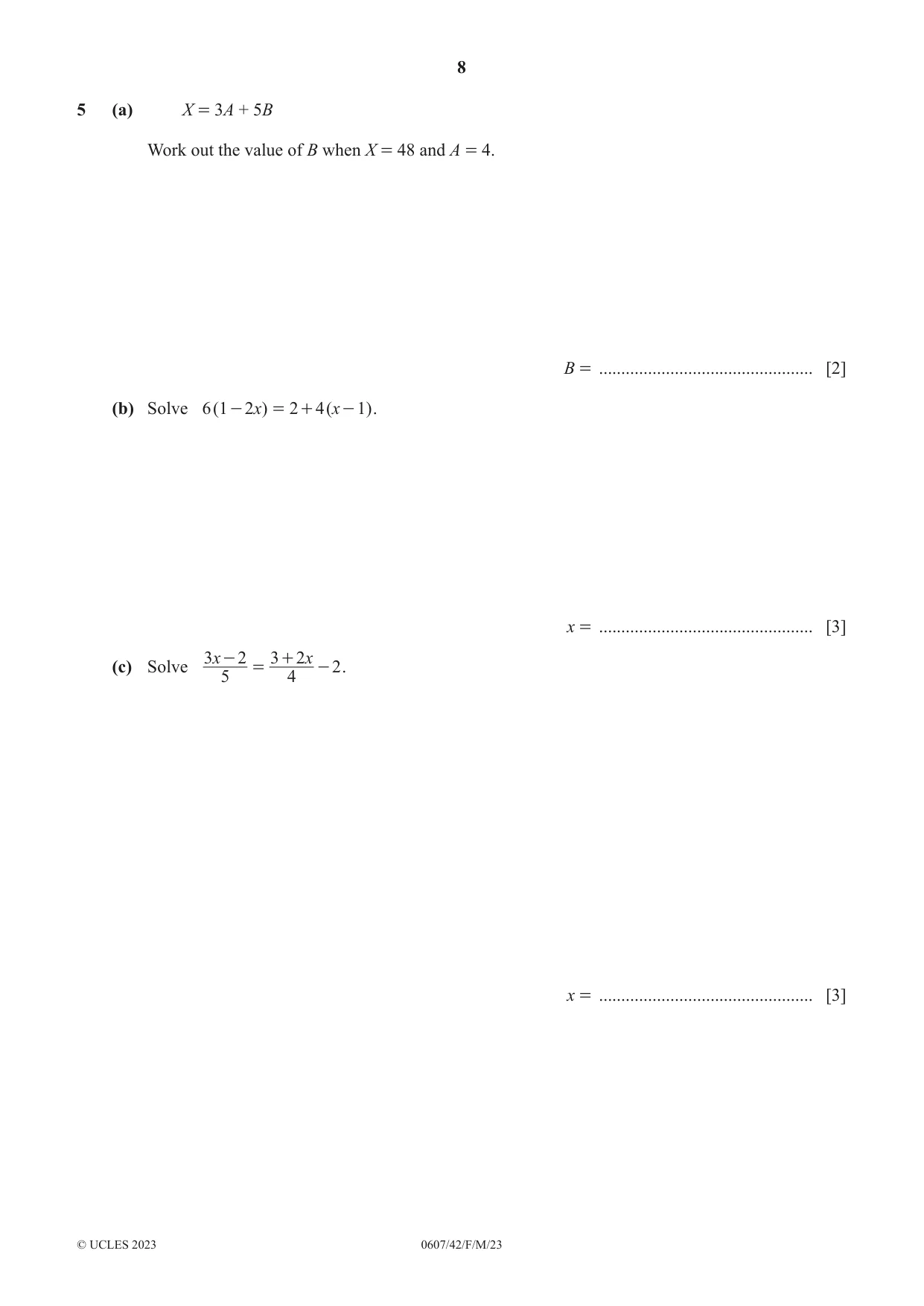
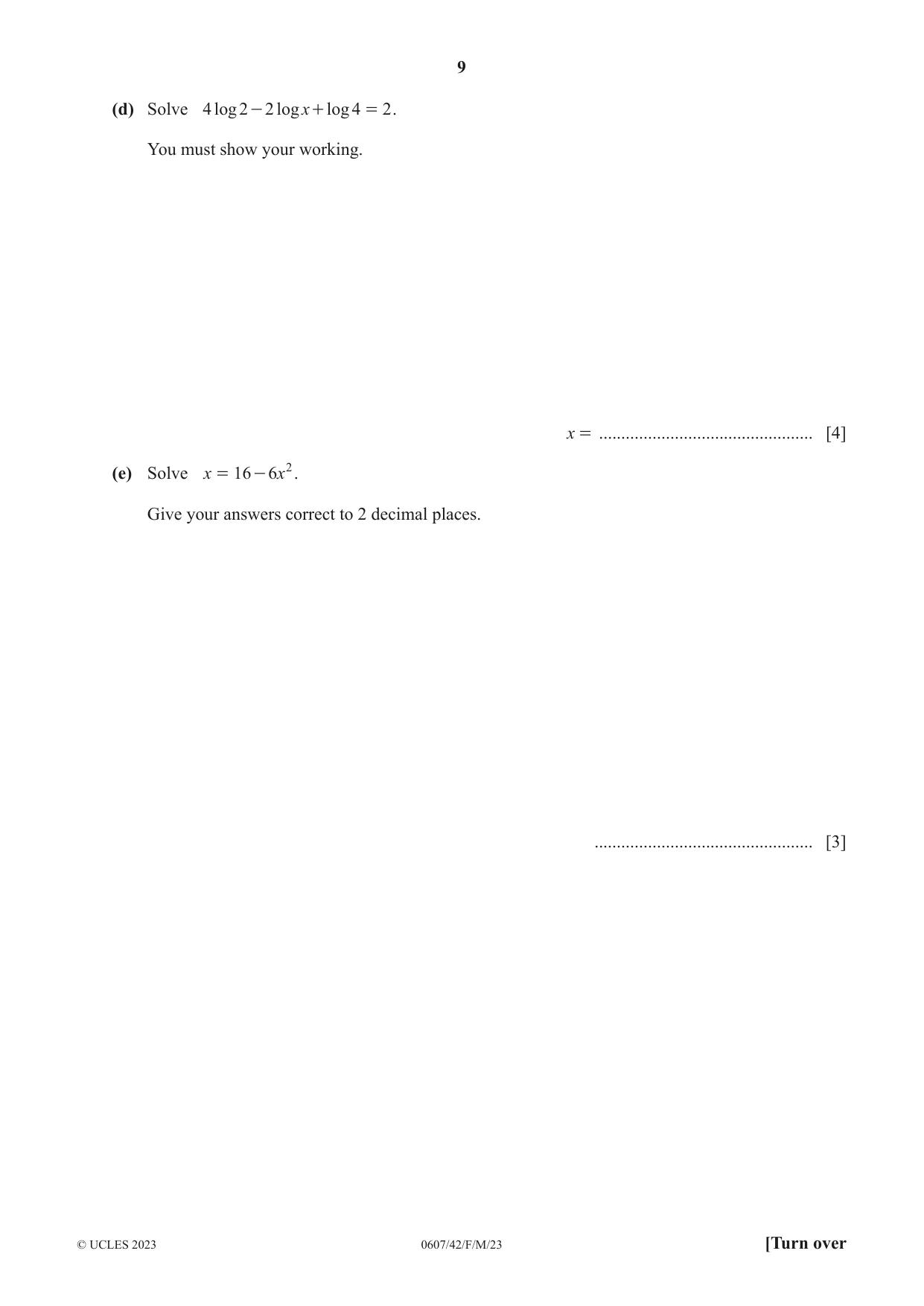
5 (a) X = 3A + 5B Work out the value of B when X = 48 and A = 4. B = ................................................ [2] (b) Solve 6 ( 1 - 2x) = 2 + 4 ( x - 1) . x = ................................................ [3] 3x - 2 3 + 2x (c) Solve = - 2 . 5 4 x = ................................................ [3] (d) Solve 4 log 2 - 2 log x + log 4 = 2 . You must show your working. x = ................................................ [4] (e) Solve x = 16 - 6x 2 . Give your answers correct to 2 decimal places. ................................................. [3]
Mark scheme: 5(a) 7.2 oe 2 M1 for 48 = 3 +4 5B 5(b) 0.5 oe 3 M1 for 6 − 12 x or 2 + 4 x − 4 M1 for correctly collecting their terms e.g. −12 x − 4 x = 2 − 4 − 6 oe 5(c) –8.5 oe 3 M1 for eliminating fractions M1 for expanding brackets and collecting their terms M1 for correctly solving their equation of the form ax = b Max 2 marks for incorrect answer 5(d) 0.8 oe 4 B1 for 2 = 2log10 or log100 M1 for a correct use of log a + log b = log ab a or log a − log b = log b M1 for a correct use of log a b = b log a 5(e) x = –1.72 3 M2 for sketch indicating correct roots x = 1.55 2 −1 1 −−4 6 ( 16) or x = 2 6 or M1 for 6 x 2 + x − 16 [ = 0] or reverse signs If 0 scored, SC1 for one correct answer
Q6 · Y 5 – 5 0 5 x – 5 x 2 f ( )x = 2 - 2 x - x - 2 (a) On the diagram, sketch the graph of y…
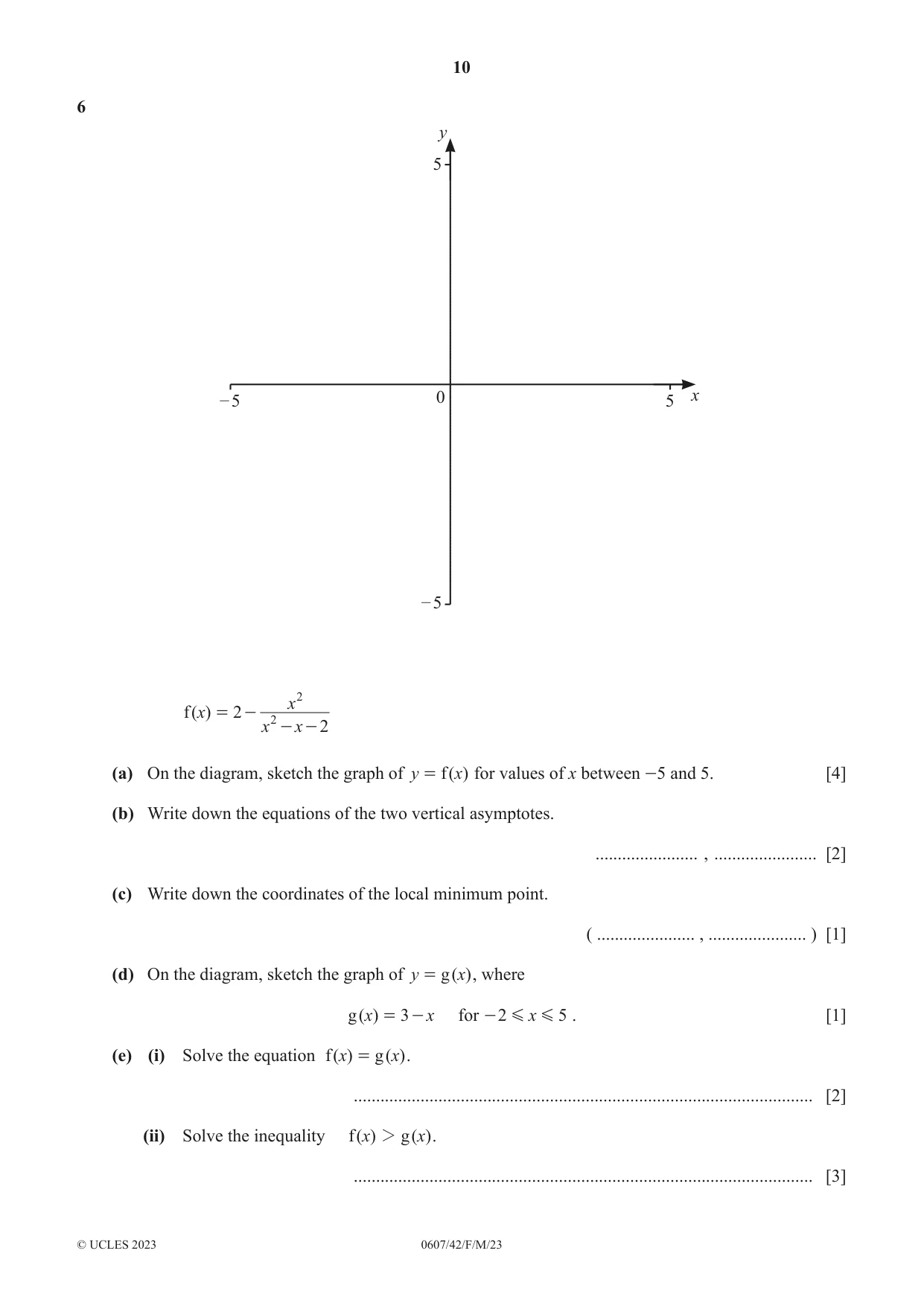
6 y 5 – 5 0 5 x – 5 x 2 f ( )x = 2 - 2 x - x - 2 (a) On the diagram, sketch the graph of y = f ( x) for values of x between -5 and 5. [4] (b) Write down the equations of the two vertical asymptotes. ....................... , ....................... [2] (c) Write down the coordinates of the local minimum point. ( ...................... , ...................... ) [1] (d) On the diagram, sketch the graph of y = g ( x) , where g ( )x = 3 - x for - 2 G x G 5 . [1] (e) (i) Solve the equation f ( x) = g ( x) . ....................................................................................................... [2] (ii) Solve the inequality f ( x) 2 g ( x) . ....................................................................................................... [3]
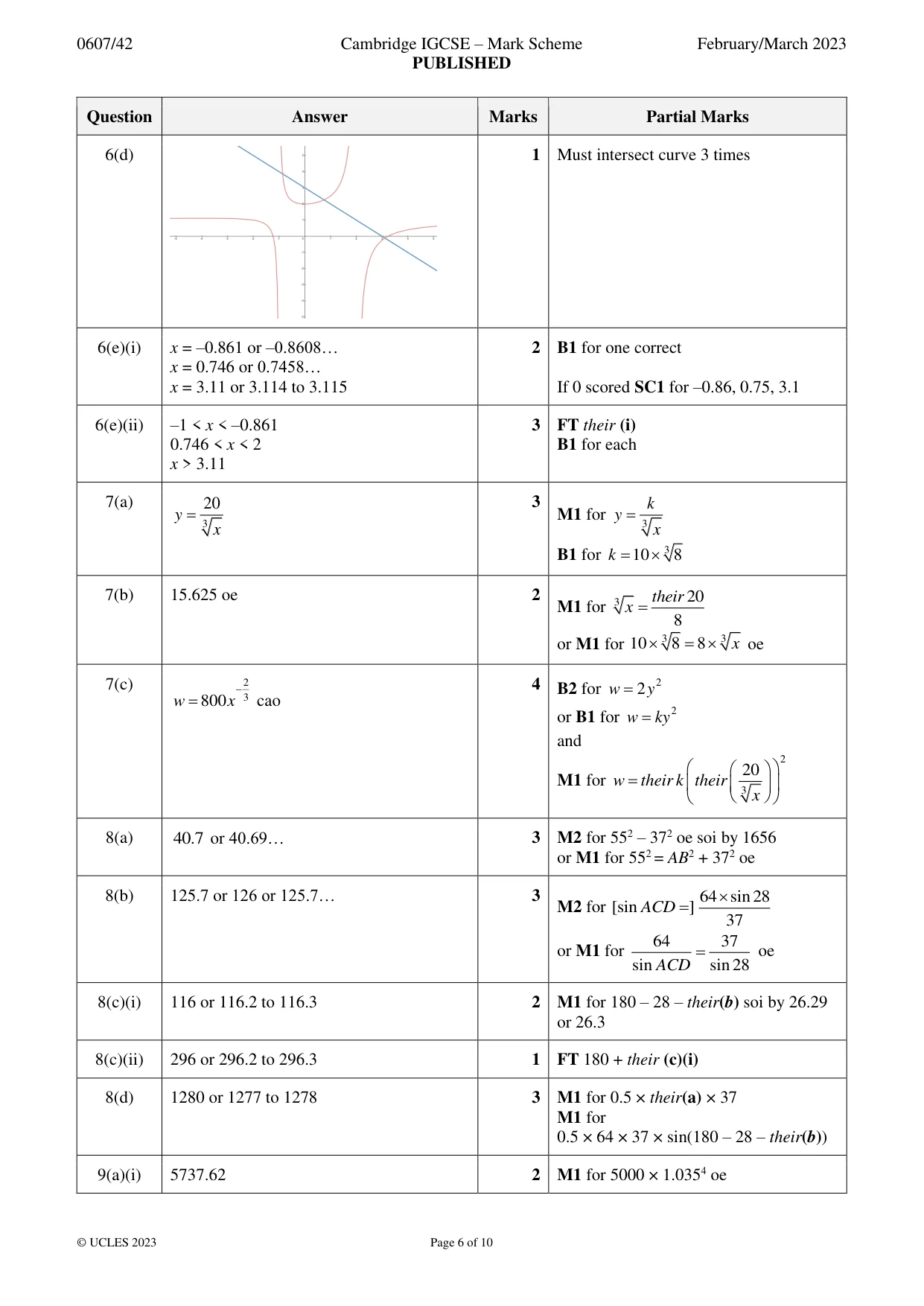
Mark scheme: 6(a) 4 B4 for fully correct curve or B3 for ‘correct’ curve with overlaps. or B2 for 2 sections correct or B1 for 1 section correct 6(b) x = –1, x = 2 2 B1 for each 6(c) (0, 2) 1 6(d) 1 Must intersect curve 3 times 6(e)(i) x = –0.861 or –0.8608… 2 B1 for one correct x = 0.746 or 0.7458… x = 3.11 or 3.114 to 3.115 If 0 scored SC1 for –0.86, 0.75, 3.1 6(e)(ii) –1 < x < –0.861 3 FT their (i) 0.746 < x < 2 B1 for each x > 3.11
Q7 · Y varies inversely as the cube root of x
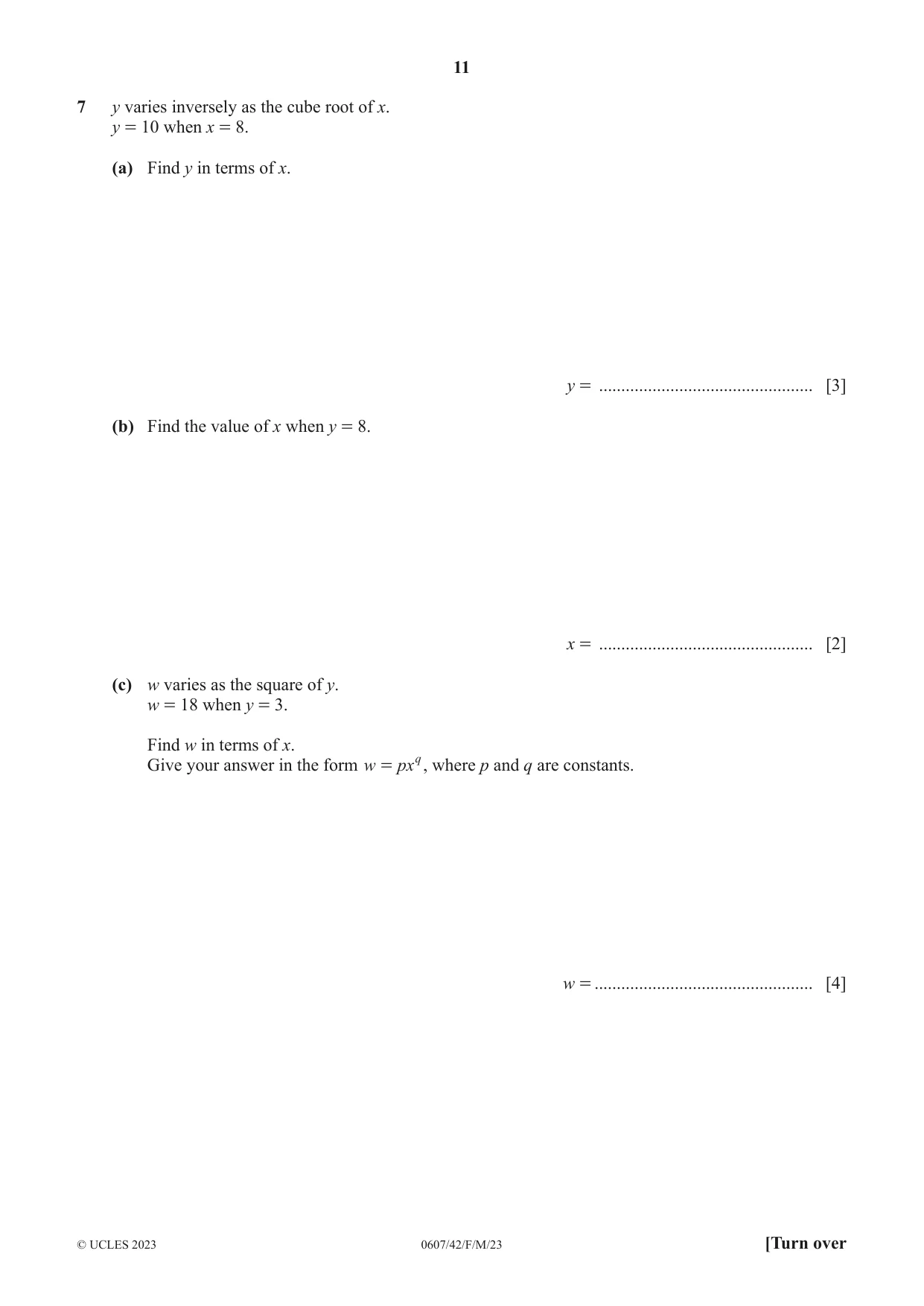
7 y varies inversely as the cube root of x. y = 10 when x = 8. (a) Find y in terms of x. y = ................................................ [3] (b) Find the value of x when y = 8. x = ................................................ [2] (c) w varies as the square of y. w = 18 when y = 3. Find w in terms of x. Give your answer in the form w = pxq , where p and q are constants. w = ................................................. [4]
Mark scheme: 7(a) 20 3 k y = M1 for y = 3 x 3 x B1 for k = 10 3 8 7(b) 15.625 oe 2 3 their 20 M1 for x = 8 or M1 for 10 3 8 = 8 3 x oe 7(c) − 2 4 B2 for w = 2 y 2 w = 800 x 3 cao or B1 for w = ky 2 and 20 2 M1 for w = their k their 3 x
Q8 · North B NOT TO 55 km SCALE A C 37 km 64 km 28° D The diagram shows four points A, B, C…
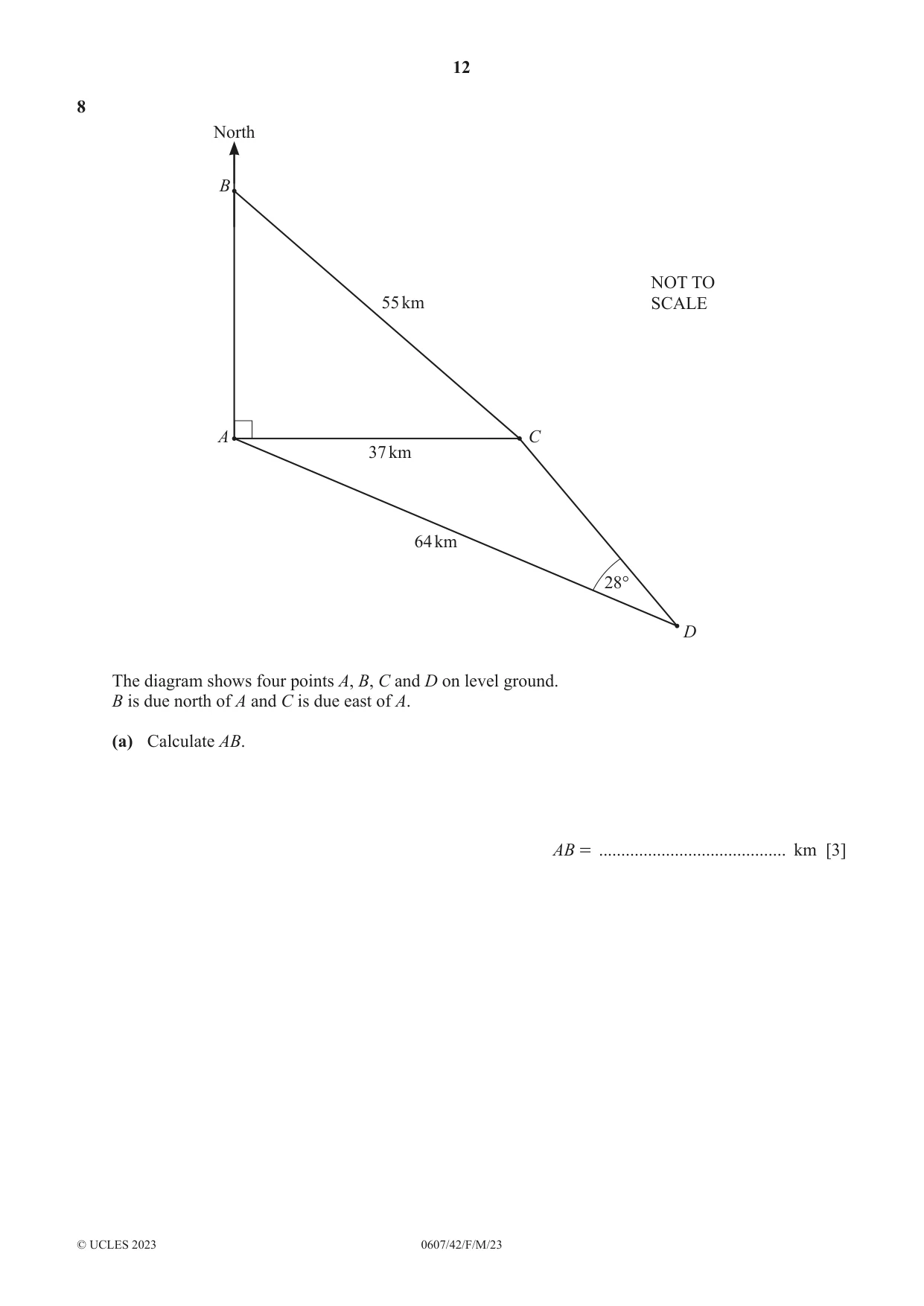
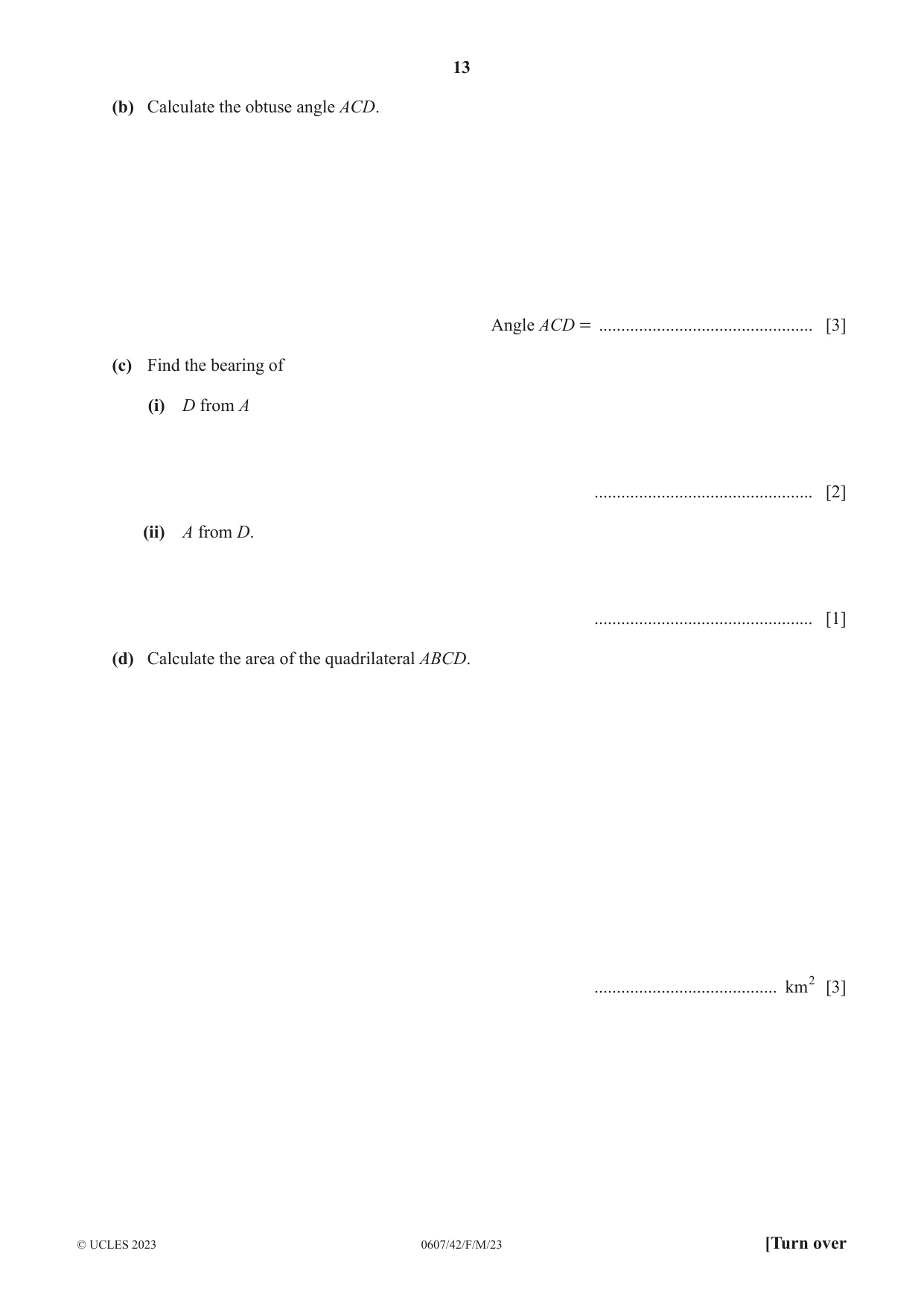
8 North B NOT TO 55 km SCALE A C 37 km 64 km 28° D The diagram shows four points A, B, C and D on level ground. B is due north of A and C is due east of A. (a) Calculate AB. AB = .......................................... km [3] (b) Calculate the obtuse angle ACD. Angle ACD = ................................................ [3] (c) Find the bearing of (i) D from A ................................................. [2] (ii) A from D. ................................................. [1] (d) Calculate the area of the quadrilateral ABCD. ......................................... km2 [3]
Mark scheme: 8(a) 40.7 or 40.69… 3 M2 for 552 – 372 oe soi by 1656 or M1 for 552 = AB2 + 372 oe 8(b) 125.7 or 126 or 125.7… 3 64 sin28 M2 for [sin ACD =] 37 64 37 or M1 for = oe sin ACD sin28 8(c)(i) 116 or 116.2 to 116.3 2 M1 for 180 – 28 – their(b) soi by 26.29 or 26.3 8(c)(ii) 296 or 296.2 to 296.3 1 FT 180 + their (c)(i) 8(d) 1280 or 1277 to 1278 3 M1 for 0.5 × their(a) × 37 M1 for 0.5 × 64 × 37 × sin(180 – 28 – their(b))
Q9 · Henryk invests $5000 in Bank A and $5000 in Bank B
9 Henryk invests $5000 in Bank A and $5000 in Bank B. (a) Bank A pays compound interest at a rate of 3.5% each year. (i) Find the total amount Henryk has in Bank A at the end of 4 years. $ ................................................ [2] (ii) Calculate the number of complete years it takes for the value of Henryk’s investment of $5000 in Bank A to be first greater than $8000. ................................................. [4] (b) Bank B pays simple interest at a rate of 4% each year. (i) Find the total amount Henryk has in Bank B at the end of 4 years. $ ................................................ [3] (ii) Calculate the number of complete years it takes for the value of Henryk’s investment of $5000 in Bank B to be $8000. ................................................. [2] (c) At the end of x complete years, the total amount that Henryk has in Bank A is greater than the total amount he has in Bank B. Given that 5 1 x 1 10 , use a graphical method to find the value of x. x = ................................................ [4]
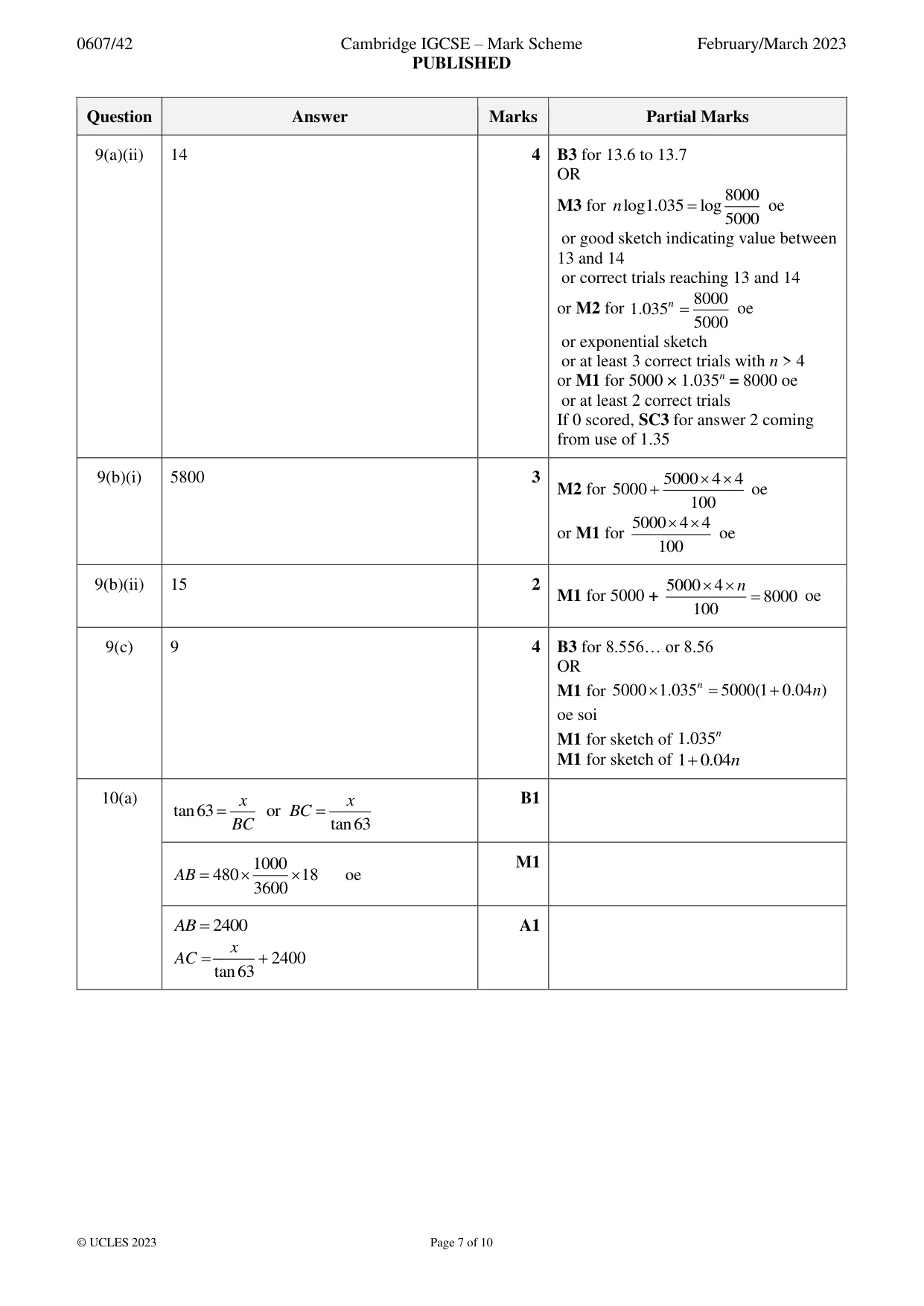
Mark scheme: 9(a)(i) 5737.62 2 M1 for 5000 × 1.0354 oe 9(a)(ii) 14 4 B3 for 13.6 to 13.7 OR 8000 M3 for n log1.035 = log oe 5000 or good sketch indicating value between 13 and 14 or correct trials reaching 13 and 14 n 8000 or M2 for 1.035 = oe 5000 or exponential sketch or at least 3 correct trials with n > 4 or M1 for 5000 × 1.035n = 8000 oe or at least 2 correct trials If 0 scored, SC3 for answer 2 coming from use of 1.35 9(b)(i) 5800 3 5000 4 4 M2 for 5000 + oe 100 5000 4 4 or M1 for oe 100 9(b)(ii) 15 2 5000 4 n M1 for 5000 + = 8000 oe 100 9(c) 9 4 B3 for 8.556… or 8.56 OR M1 for 5000 1.035 n = 5000(1 + 0.04 n ) oe soi M1 for sketch of 1.035n M1 for sketch of 1 + 0.04n
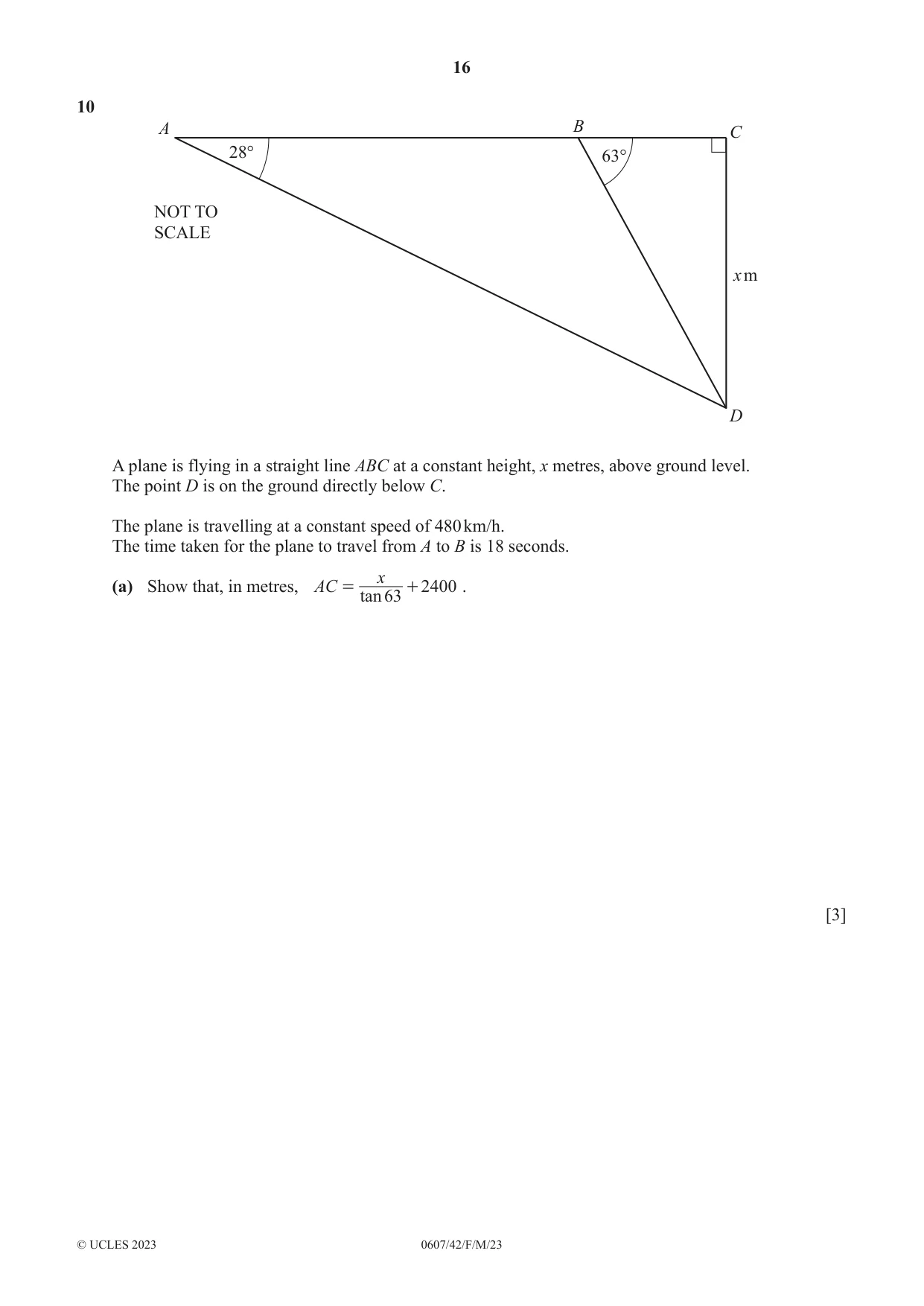
Q10 · A B C 28° 63° NOT TO SCALE x m D A plane is flying in a straight line ABC at a constant…
10 A B C 28° 63° NOT TO SCALE x m D A plane is flying in a straight line ABC at a constant height, x metres, above ground level. The point D is on the ground directly below C. The plane is travelling at a constant speed of 480 km/h. The time taken for the plane to travel from A to B is 18 seconds. x (a) Show that, in metres, AC = + 2400 . tan 63 [3] (b) Find the value of x. x = ................................................ [5]
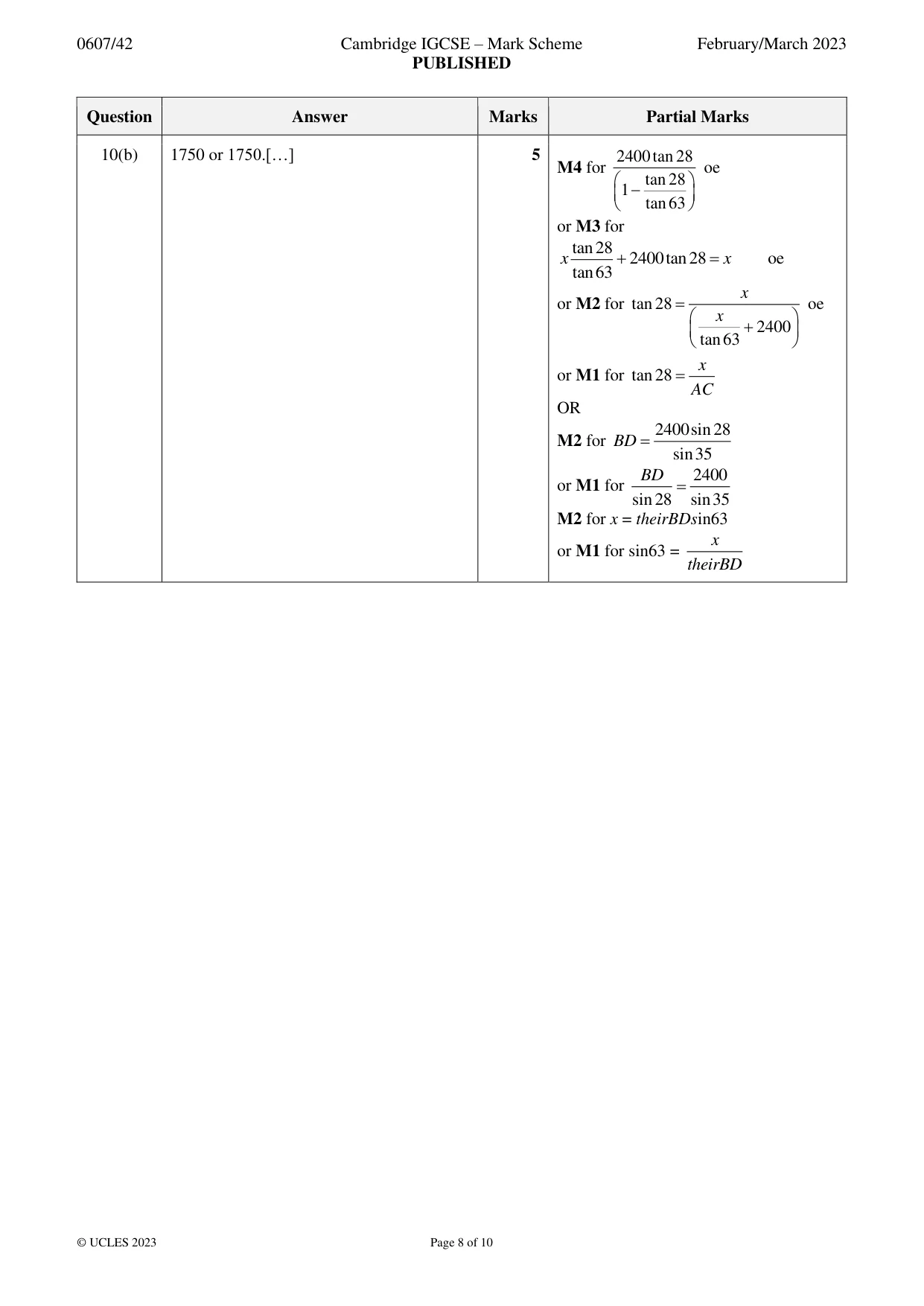
Mark scheme: 10(a) x x B1 tan63 = or BC = BC tan63 1000 M1 AB = 480 18 oe 3600 AB = 2400 A1 x AC = + 2400 tan63 10(b) 1750 or 1750.[…] 5 2400tan 28 M4 for oe tan 28 1 − tan63 or M3 for tan28 x + 2400tan28 = x oe tan63 x or M2 for tan 28 = oe x + 2400 tan63 x or M1 for tan28 = AC OR 2400sin28 M2 for BD = sin35 BD 2400 or M1 for = sin28 sin35 M2 for x = theirBDsin63 x or M1 for sin63 = theirBD
Q11 · A NOT TO SCALE O r cm B C The diagram shows an equilateral triangle ABC touching a…
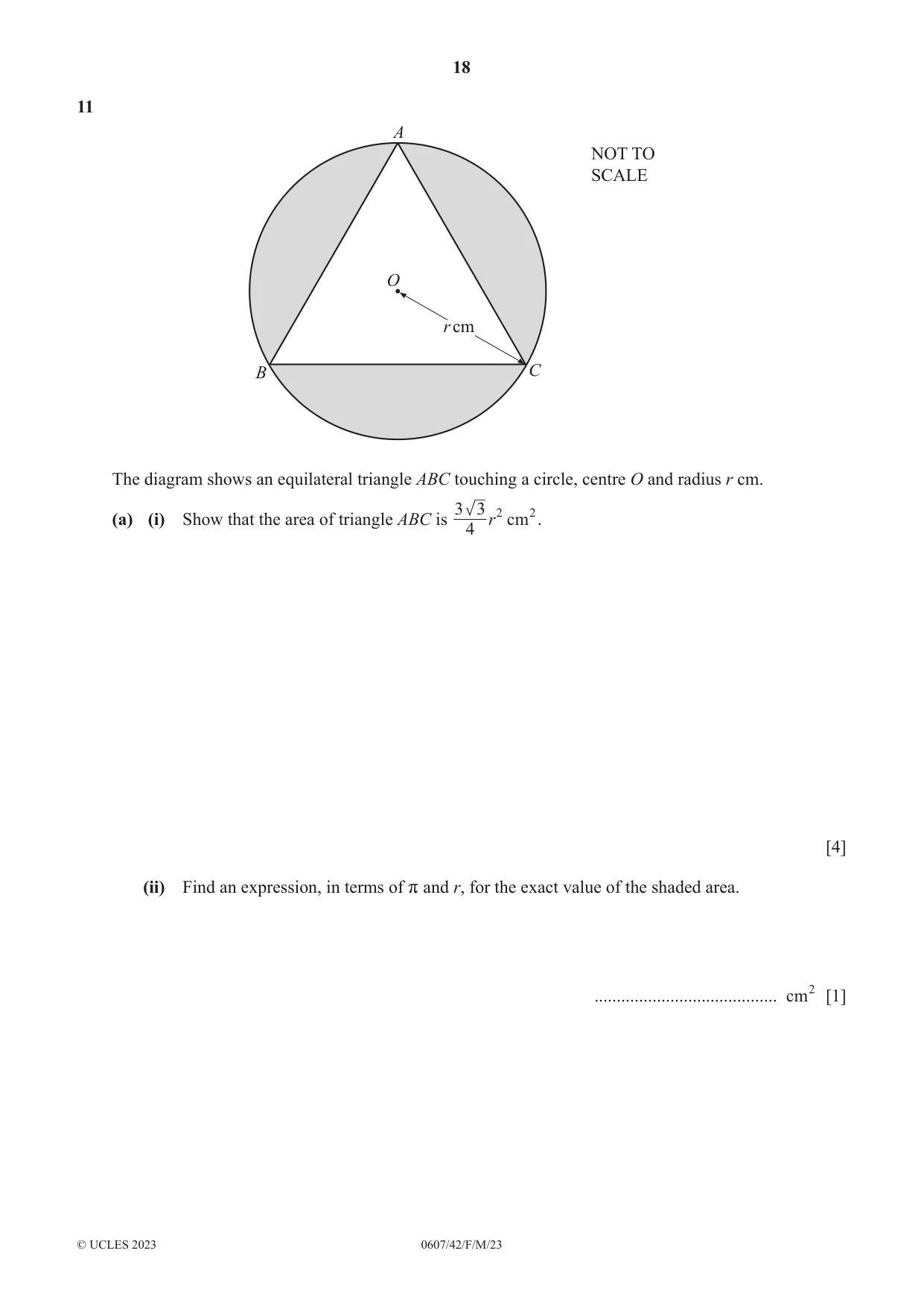
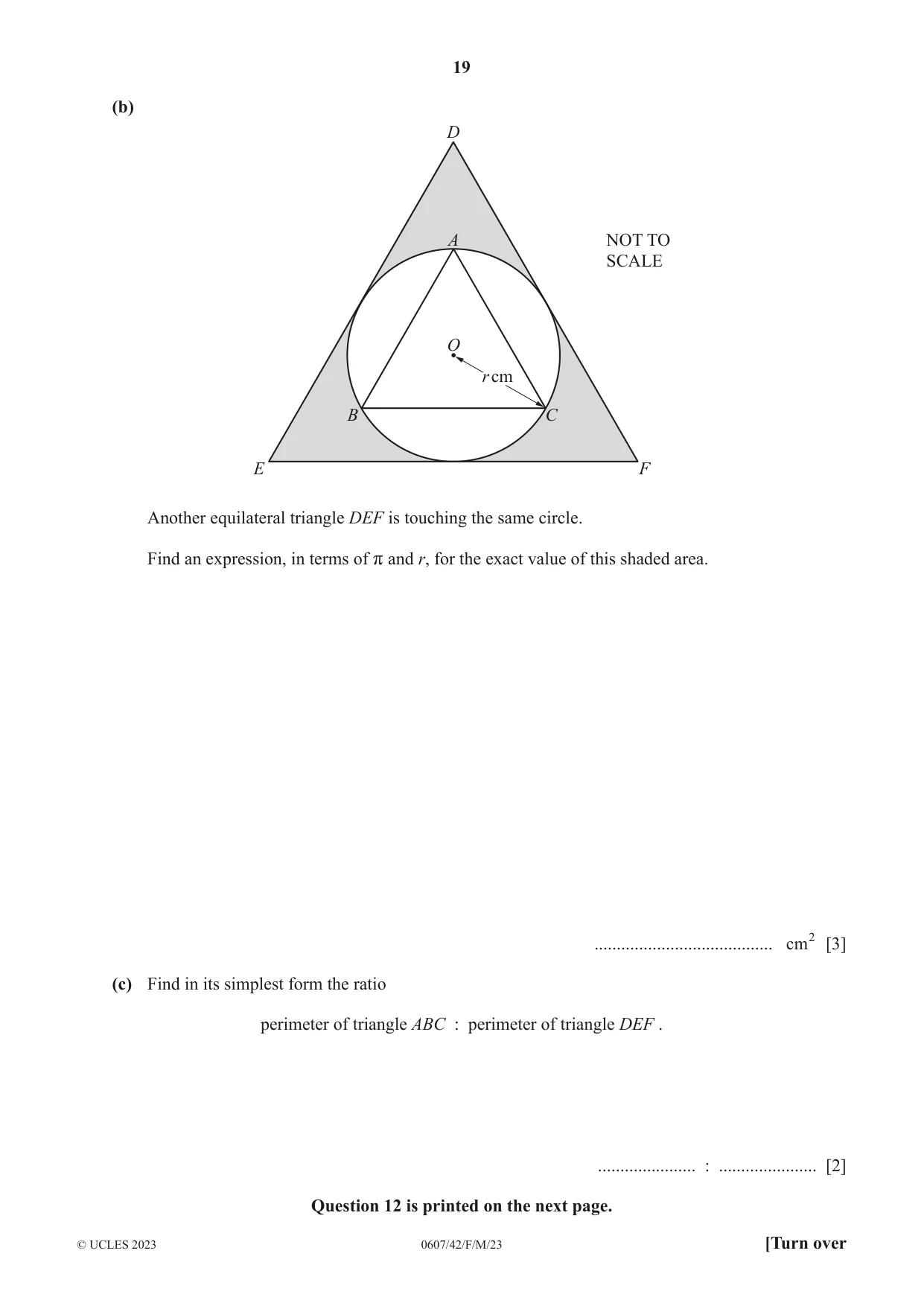
11 A NOT TO SCALE O r cm B C The diagram shows an equilateral triangle ABC touching a circle, centre O and radius r cm. 3 3 2 (a) (i) Show that the area of triangle ABC is r cm 2. 4 [4] (ii) Find an expression, in terms of r and r, for the exact value of the shaded area. ......................................... cm2 [1] (b) D A NOT TO SCALE O r cm B C E F Another equilateral triangle DEF is touching the same circle. Find an expression, in terms of r and r, for the exact value of this shaded area. ........................................ cm2 [3] (c) Find in its simplest form the ratio perimeter of triangle ABC : perimeter of triangle DEF . ...................... : ...................... [2] Question 12 is printed on the next page.
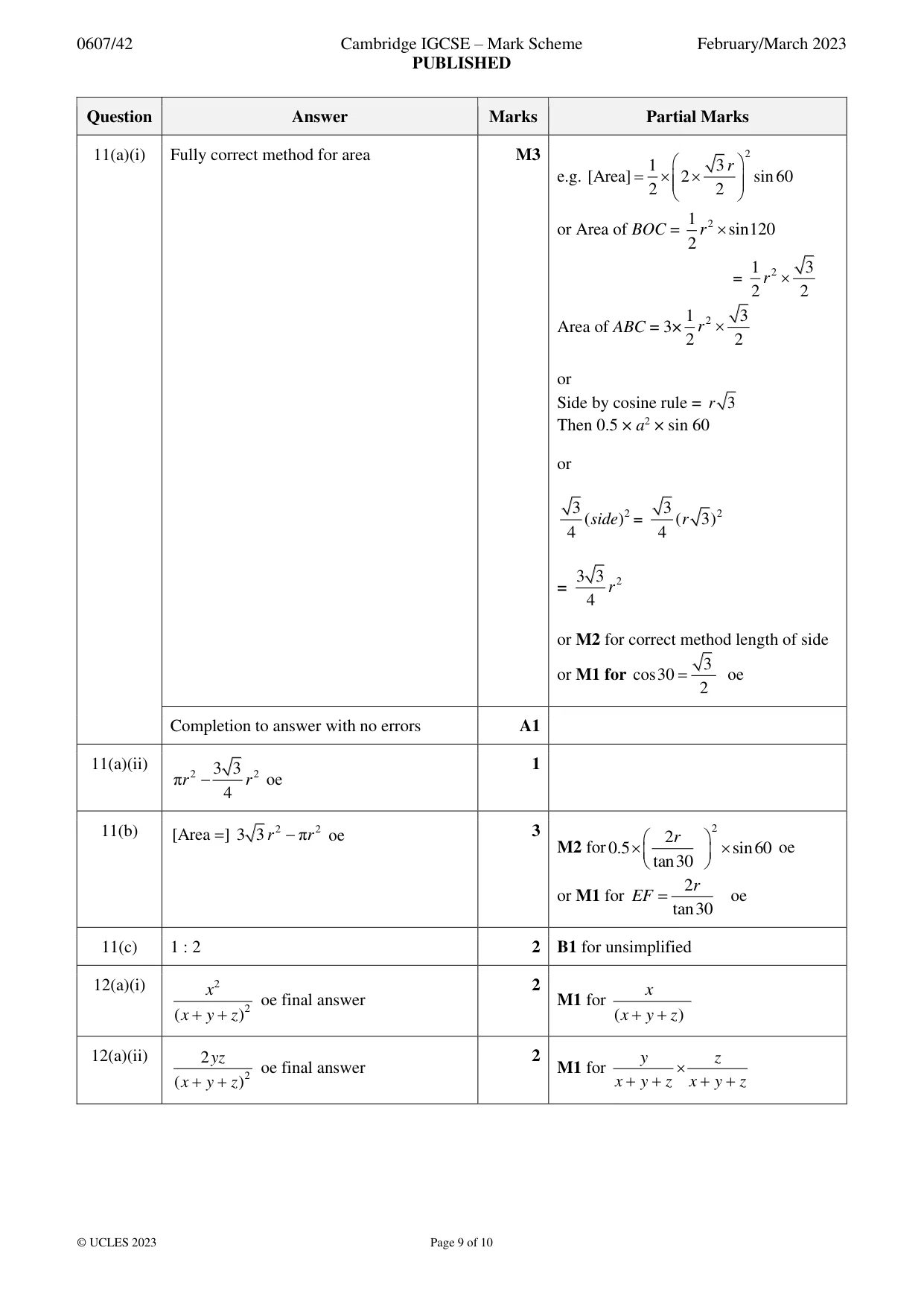
Mark scheme: 11(a)(i) Fully correct method for area M3 2 1 3 r e.g. [Area] = 2 sin60 2 2 1 2 or Area of BOC = r sin120 2 1 2 3 = r 2 2 1 2 3 Area of ABC = 3× r 2 2 or Side by cosine rule = r 3 Then 0.5 × a2 × sin 60 or 3 2 3 2 ( side ) = ( r 3) 4 4 3 3 2 = r 4 or M2 for correct method length of side 3 or M1 for cos30 = oe 2 Completion to answer with no errors A1 11(a)(ii) 2 3 3 2 1 πr − r oe 4 11(b) [Area = ] 3 3 r 2 − πr 2 oe 3 2r 2 M2 for 0.5 sin60 oe tan30 2r or M1 for EF = oe tan30 11(c) 1 : 2 2 B1 for unsimplified
Q12 · A bag contains x red balls, y blue balls and z green balls
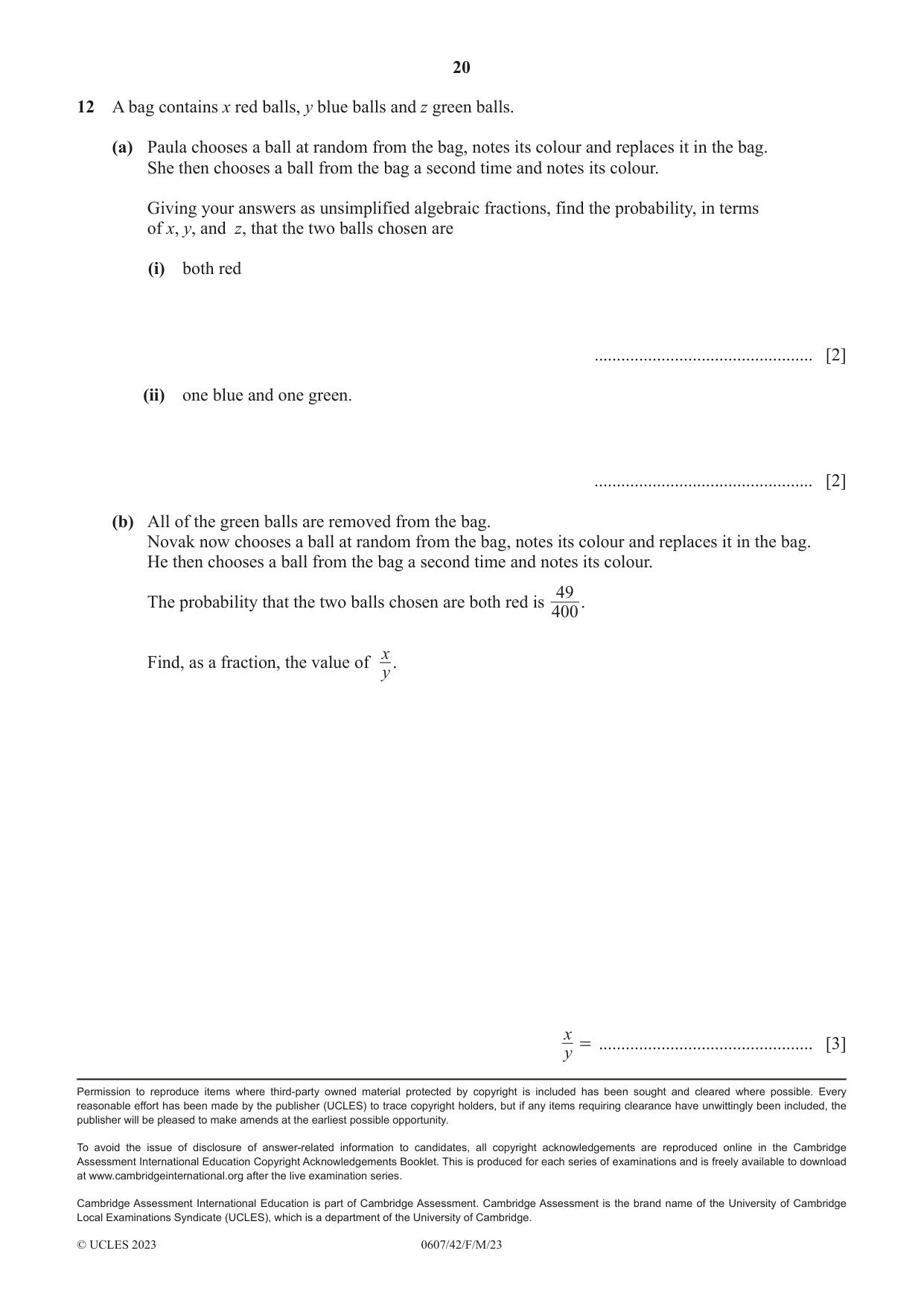
12 A bag contains x red balls, y blue balls and z green balls. (a) Paula chooses a ball at random from the bag, notes its colour and replaces it in the bag. She then chooses a ball from the bag a second time and notes its colour. Giving your answers as unsimplified algebraic fractions, find the probability, in terms of x, y, and z, that the two balls chosen are (i) both red ................................................. [2] (ii) one blue and one green. ................................................. [2] (b) All of the green balls are removed from the bag. Novak now chooses a ball at random from the bag, notes its colour and replaces it in the bag. He then chooses a ball from the bag a second time and notes its colour. 49 The probability that the two balls chosen are both red is . 400 x Find, as a fraction, the value of . y x = ................................................ [3] y
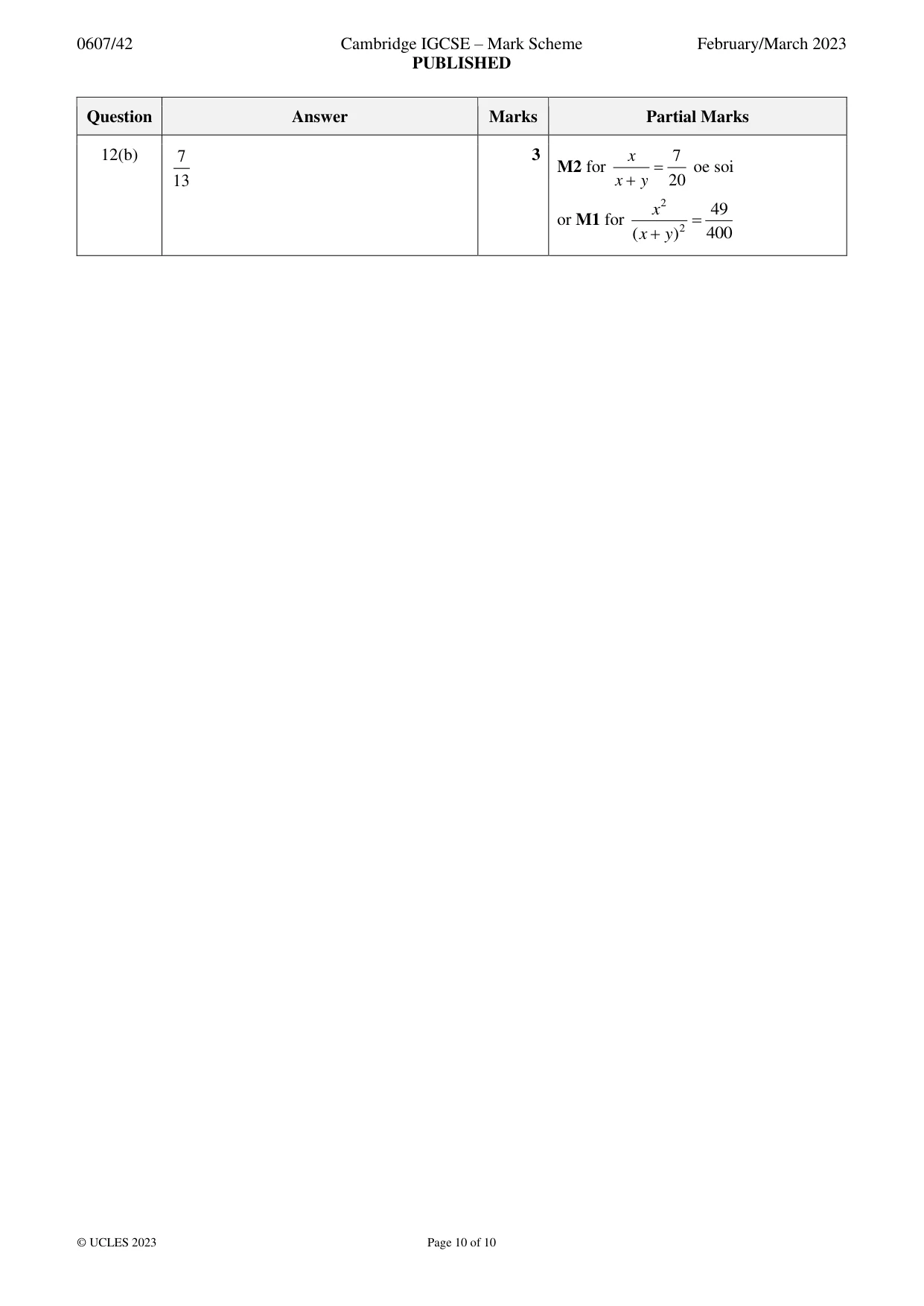
Mark scheme: 12(a)(i) x 2 2 x oe final answer M1 for ( x + y + z ) 2 ( x + y + z ) 12(a)(ii) 2 yz 2 y z oe final answer M1 for ( x + y + z ) 2 x + y + z x + y + z 12(b) 7 3 x 7 M2 for = oe soi 13 x + y 20 x 2 49 or M1 for = ( x + y ) 2 400
What was in this paper
The subtopics covered by these 12 questions, and how many questions each got. Open one in a new tab to see every Cambridge question on it.
What you needed in this session
Cambridge’s own grade thresholds for 2023 Feb/March, Paper 4 · Variant 2. A higher threshold means an easier paper — the bar moves with how the cohort did.