Cambridge IGCSE Mathematics - International 0607 — 2017 Oct/Nov Paper 4 · Variant 2
0607/42/O/N/17 · 11 questions · 120 marks · ≈135 min
The question paper and its mark scheme, free to read here and free to download. This is Cambridge’s own paper, exactly as it was sat.
Question paper16 pages
Mark scheme7 pages
Answers below. Sit the paper first if you are practising.
Questions as text
Q1 · These are the first four terms of a sequence
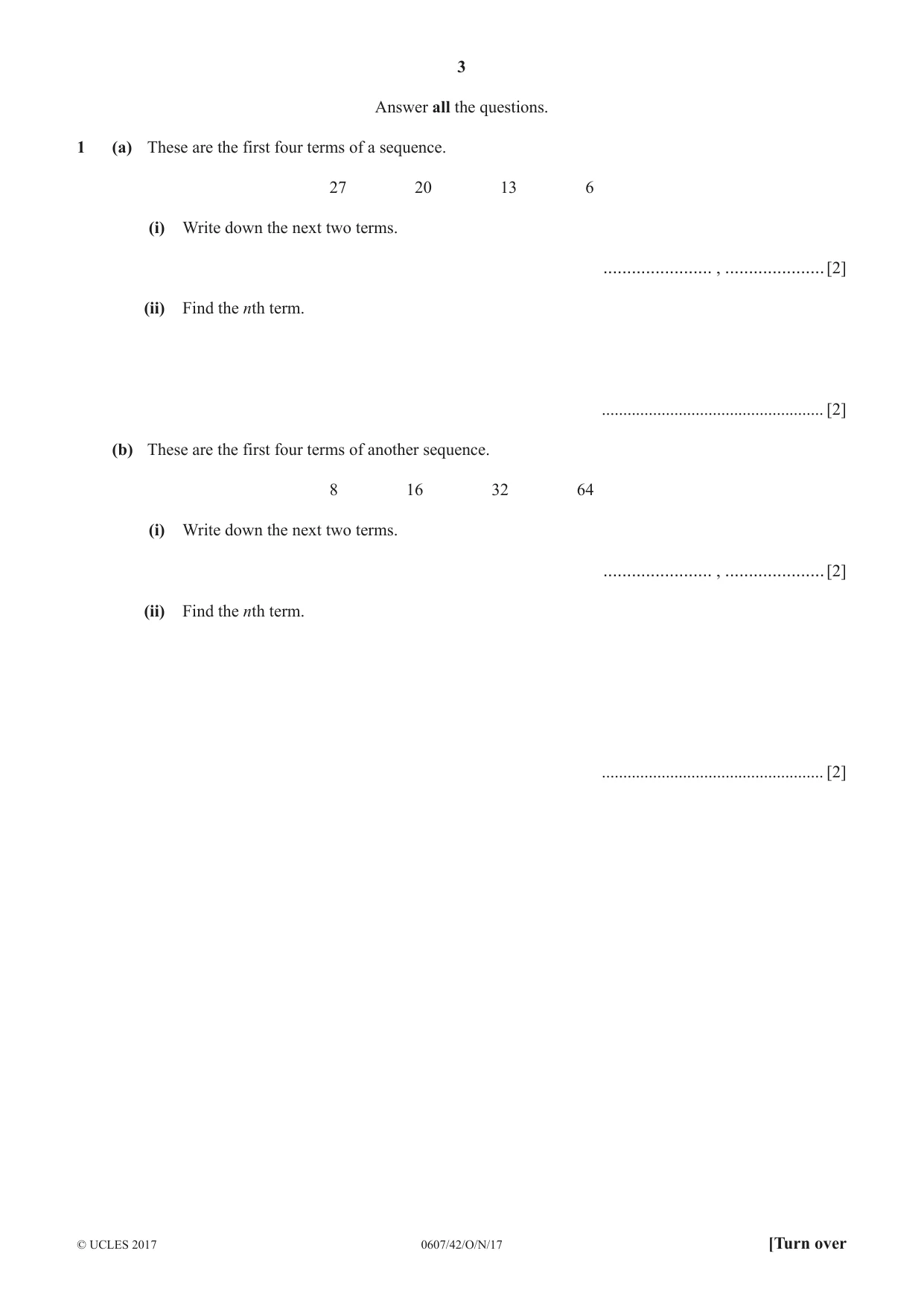
1 (a) These are the first four terms of a sequence. 27 20 13 6 (i) Write down the next two terms. ....................... , ..................... [2] (ii) Find the nth term. .................................................... [2] (b) These are the first four terms of another sequence. 8 16 32 64 (i) Write down the next two terms. ....................... , ..................... [2] (ii) Find the nth term. .................................................... [2]
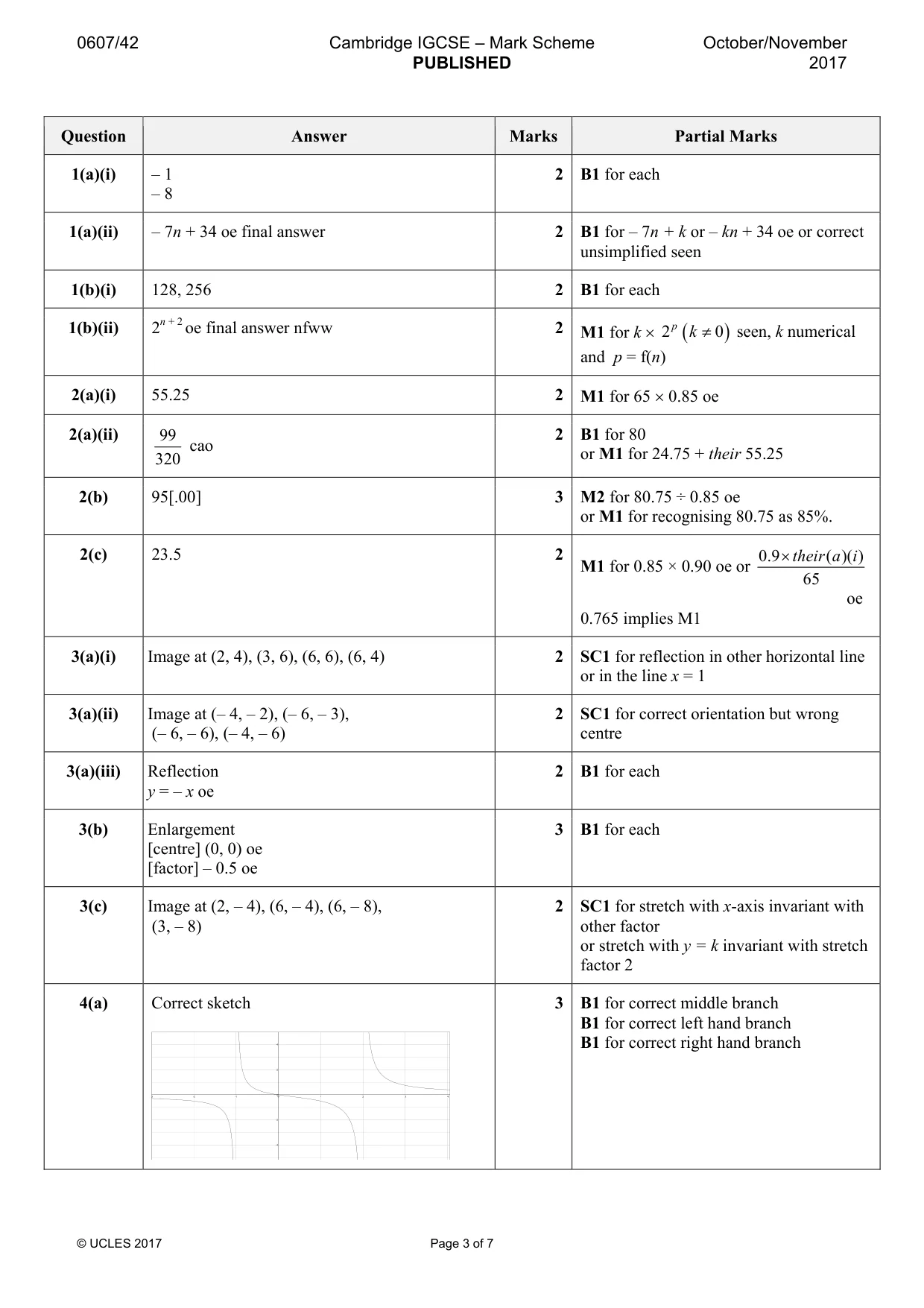
Mark scheme: Question Answer Marks Partial Marks 1(a)(i) – 1 2 B1 for each – 8 1(a)(ii) – 7n + 34 oe final answer 2 B1 for – 7n + k or – kn + 34 oe or correct unsimplified seen 1(b)(i) 128, 256 2 B1 for each 1(b)(ii) 2n + 2 oe final answer nfww 2 M1 for k × 2p ( k ≠ 0 ) seen, k numerical and p = f(n)
Q2 · In a sale, a shop reduces all of its prices by 15%
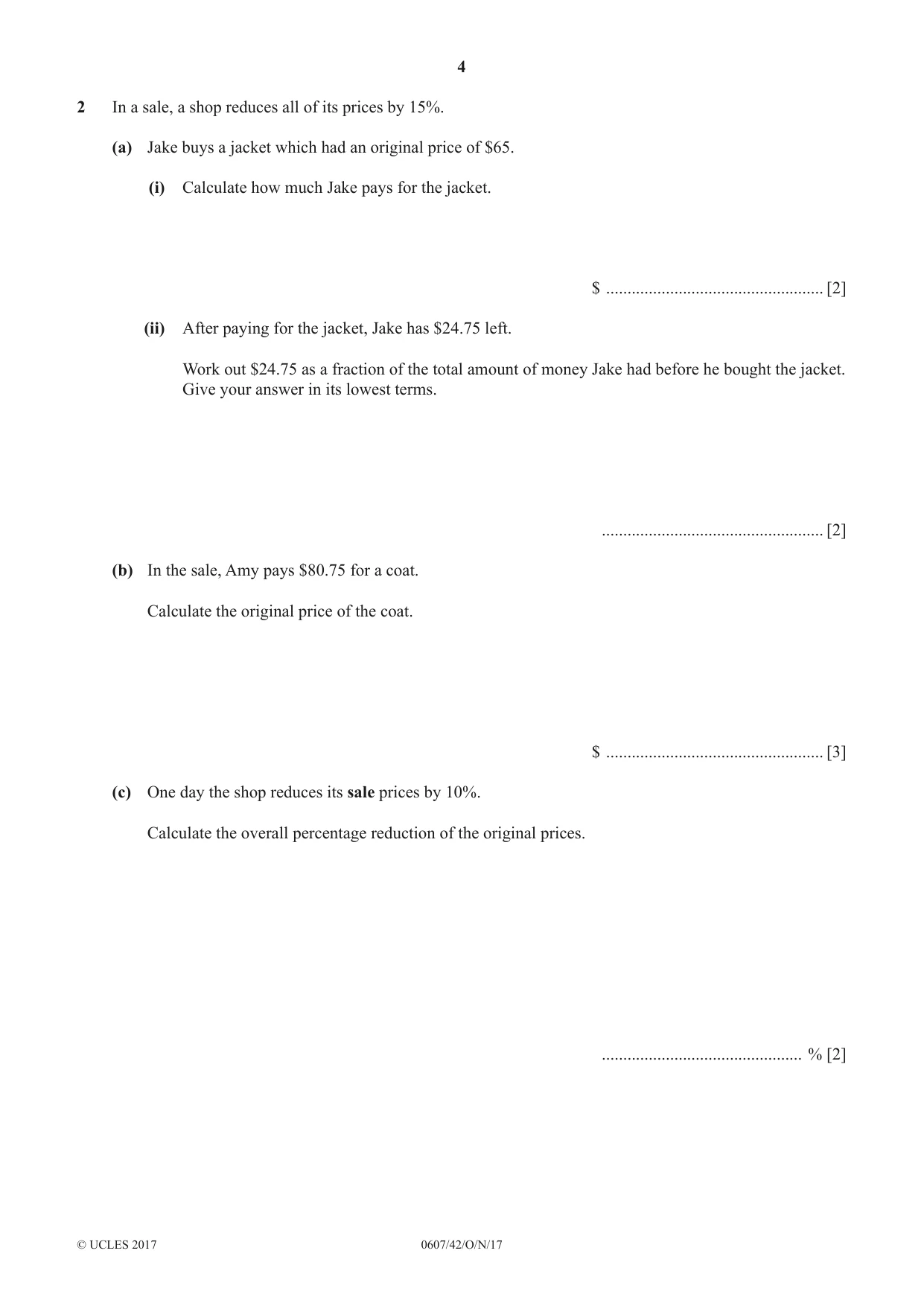
2 In a sale, a shop reduces all of its prices by 15%. (a) Jake buys a jacket which had an original price of $65. (i) Calculate how much Jake pays for the jacket. $ ................................................... [2] (ii) After paying for the jacket, Jake has $24.75 left. Work out $24.75 as a fraction of the total amount of money Jake had before he bought the jacket. Give your answer in its lowest terms. .................................................... [2] (b) In the sale, Amy pays $80.75 for a coat. Calculate the original price of the coat. $ ................................................... [3] (c) One day the shop reduces its sale prices by 10%. Calculate the overall percentage reduction of the original prices. ............................................... % [2]
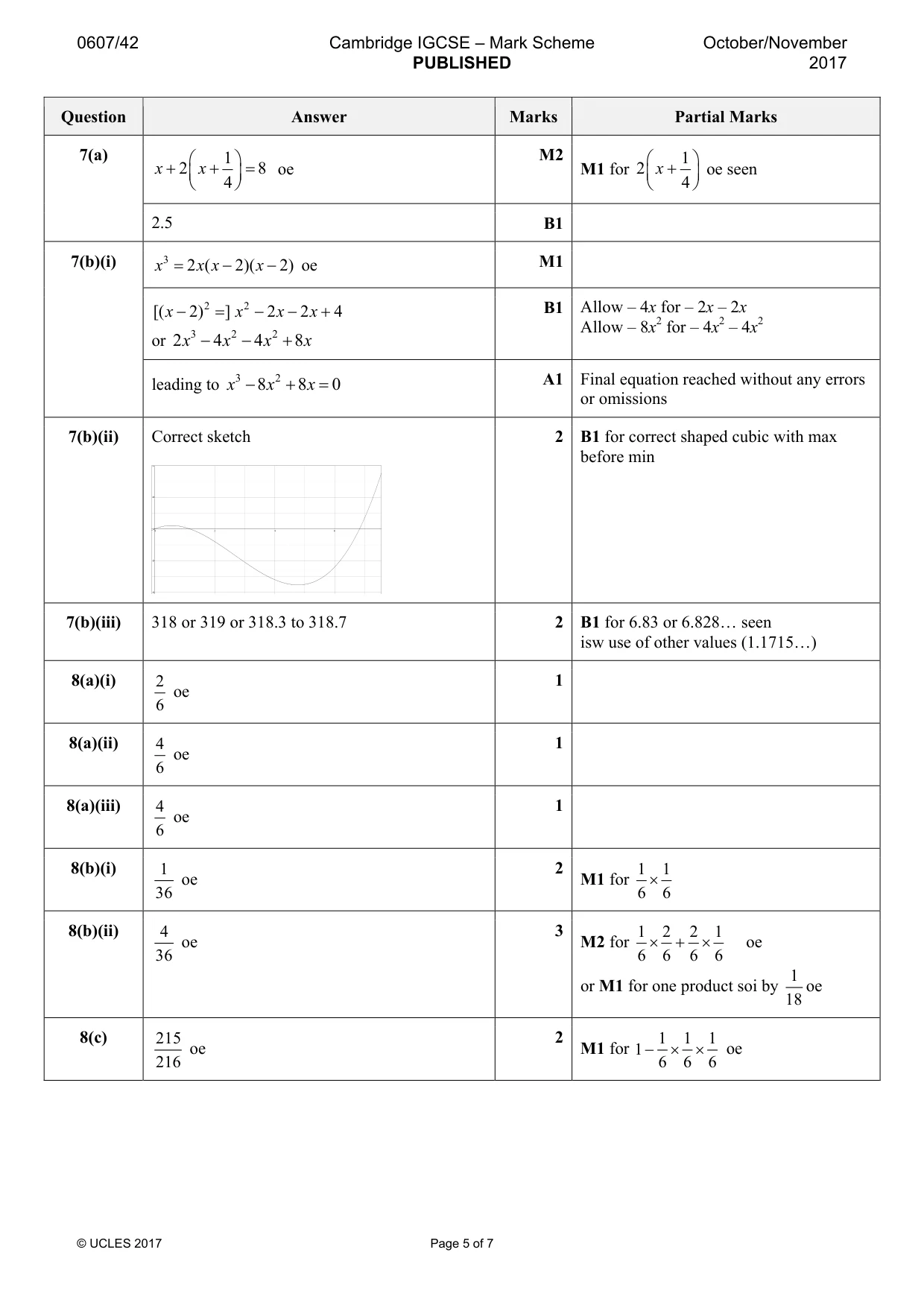
Mark scheme: 2(a)(i) 55.25 2 M1 for 65 × 0.85 oe 2(a)(ii) 99 2 B1 for 80 cao or M1 for 24.75 + their 55.25 320 2(b) 95[.00] 3 M2 for 80.75 ÷ 0.85 oe or M1 for recognising 80.75 as 85%. 2(c) 23.5 2 0.9 × their ( a )( i ) M1 for 0.85 × 0.90 oe or 65 oe 0.765 implies M1
Q3 · Y 6 5 4 3 2 Q 1 x –8 –7 –6 –5 –4 –3 –2 –1 0 1 2 3 4 5 6 –1 –2 P –3 –4 –5 –6 –7 –8 (a) (i)…
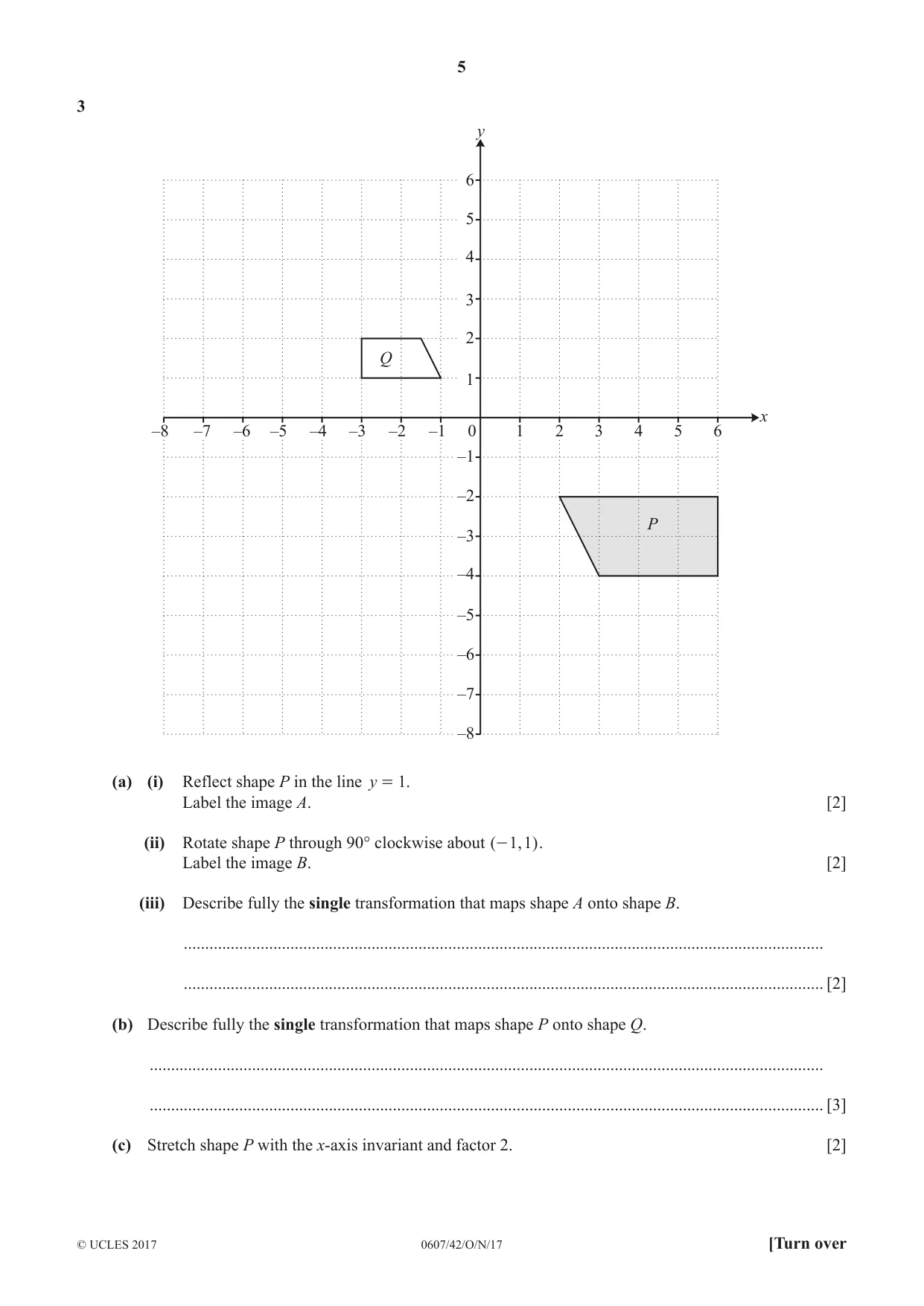
3 y 6 5 4 3 2 Q 1 x –8 –7 –6 –5 –4 –3 –2 –1 0 1 2 3 4 5 6 –1 –2 P –3 –4 –5 –6 –7 –8 (a) (i) Reflect shape P in the line y = 1. Label the image A. [2] (ii) Rotate shape P through 90° clockwise about (- 1, 1) . Label the image B. [2] (iii) Describe fully the single transformation that maps shape A onto shape B. ...................................................................................................................................................... ...................................................................................................................................................... [2] (b) Describe fully the single transformation that maps shape P onto shape Q. .............................................................................................................................................................. .............................................................................................................................................................. [3] (c) Stretch shape P with the x-axis invariant and factor 2. [2]
Mark scheme: 3(a)(i) Image at (2, 4), (3, 6), (6, 6), (6, 4) 2 SC1 for reflection in other horizontal line or in the line x = 1 3(a)(ii) Image at (– 4, – 2), (– 6, – 3), 2 SC1 for correct orientation but wrong (– 6, – 6), (– 4, – 6) centre 3(a)(iii) Reflection 2 B1 for each y = – x oe 3(b) Enlargement 3 B1 for each [centre] (0, 0) oe [factor] – 0.5 oe 3(c) Image at (2, – 4), (6, – 4), (6, – 8), 2 SC1 for stretch with x-axis invariant with (3, – 8) other factor or stretch with y = k invariant with stretch factor 2
Q4 · Y 5 x –3 0 4 –5 x f (x) = 2 (x - x - 2) (a) On the diagram, sketch the graph of y = f (x)…
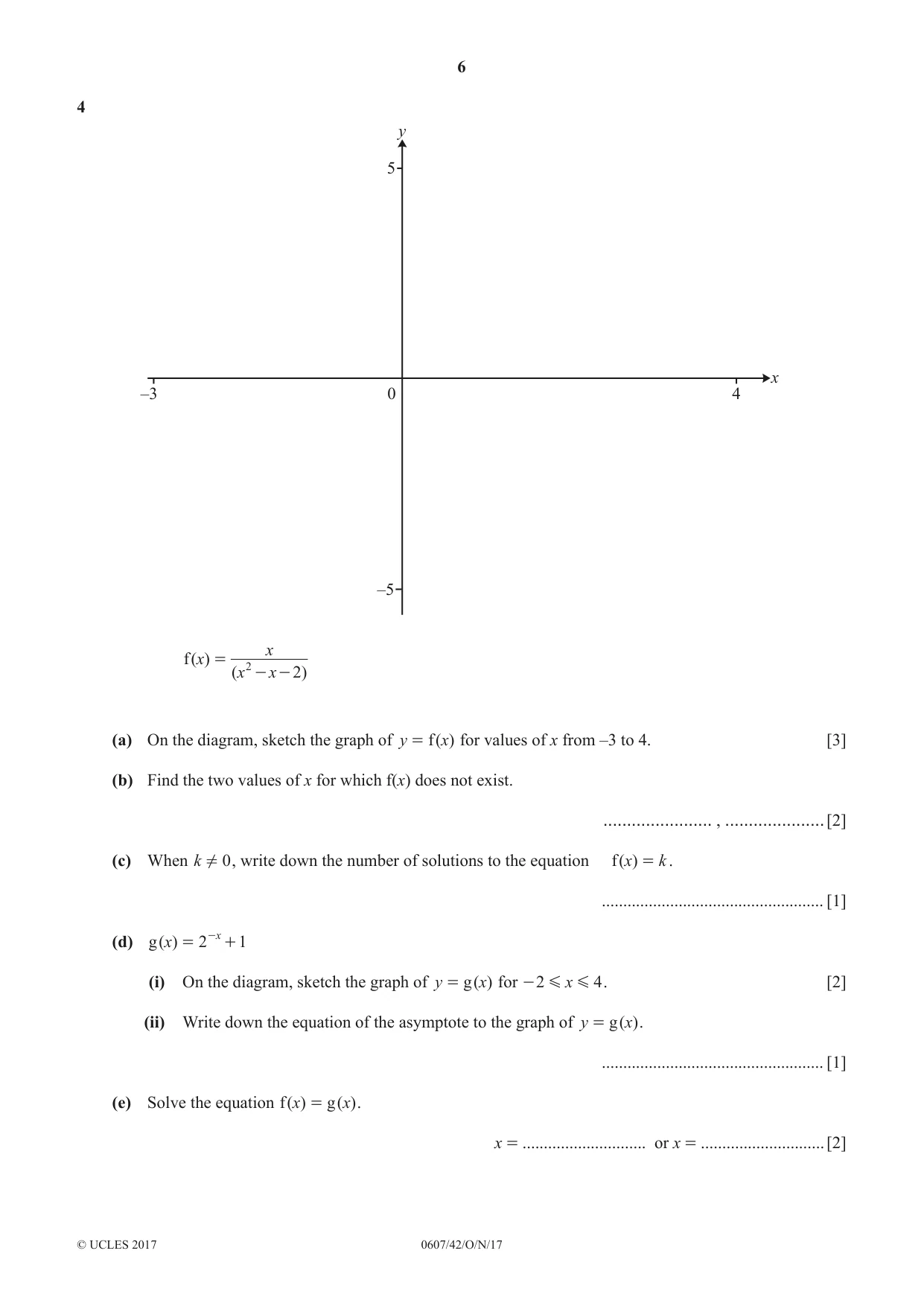
4 y 5 x –3 0 4 –5 x f (x) = 2 (x - x - 2) (a) On the diagram, sketch the graph of y = f (x) for values of x from –3 to 4. [3] (b) Find the two values of x for which f(x) does not exist. ....................... , ..................... [2] (c) When k ! 0 , write down the number of solutions to the equation f (x) = k . .................................................... [1] (d) g (x) = 2 -x + 1 (i) On the diagram, sketch the graph of y = g (x) for - 2 G x G 4 . [2] (ii) Write down the equation of the asymptote to the graph of y = g (x) . .................................................... [1] (e) Solve the equation f (x) = g (x) . x = ............................. or x = ............................. [2]
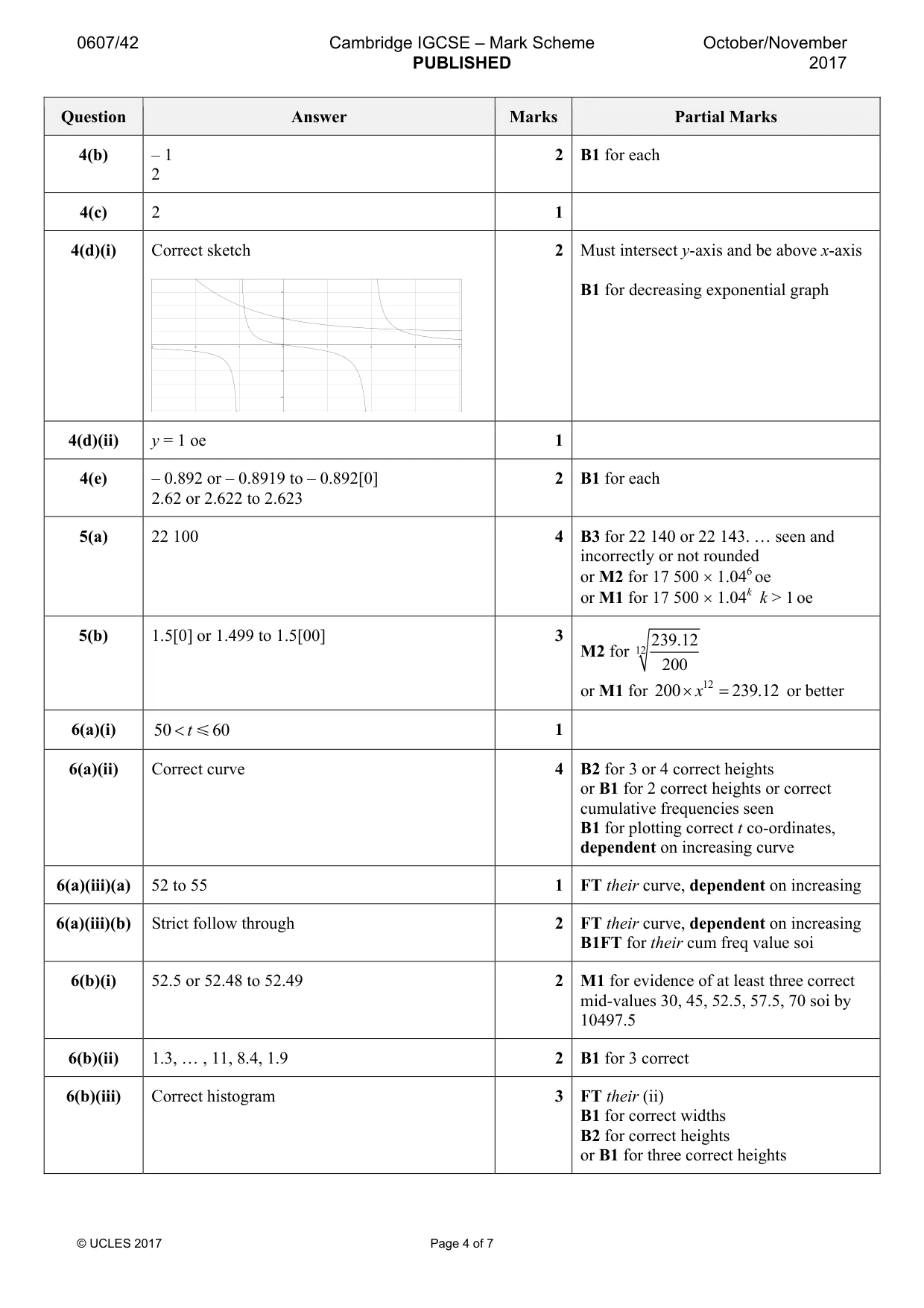
Mark scheme: 4(a) Correct sketch 3 B1 for correct middle branch B1 for correct left hand branch 4444 B1 for correct right hand branch 2222 3333 -2-2-2-2 -1-1-1-1 0000 0000 1111 2222 3333 4444 -2-2-2-2 -4-4-4-4 4(b) – 1 2 B1 for each 2 4(c) 2 1 4(d)(i) Correct sketch 2 Must intersect y-axis and be above x-axis 4444 B1 for decreasing exponential graph 2222 3333 -2-2-2-2 -1-1-1-1 0000 0000 1111 2222 3333 4444 -2-2-2-2 -4-4-4-4 4(d)(ii) y = 1 oe 1 4(e) – 0.892 or – 0.8919 to – 0.892[0] 2 B1 for each 2.62 or 2.622 to 2.623
Q5 · Carlos owns a vintage car
5 (a) Carlos owns a vintage car. Each year the value of the car increases by 4% of its value at the start of the year. At the start of 2012 the value of the car was $17 500. Calculate the value of the car at the start of 2018. Give your answer correct to the nearest $100. $ ................................................... [4] (b) Alex invests $200 at a rate of r % per year compound interest. After 12 years, Alex has a total amount of $239.12 . Find the value of r. r = ................................................... [3]
Mark scheme: 5(a) 22 100 4 B3 for 22 140 or 22 143. … seen and incorrectly or not rounded or M2 for 17 500 × 1.046 oe or M1 for 17 500 × 1.04k k > 1 oe 5(b) 1.5[0] or 1.499 to 1.5[00] 3 239.12 M2 for 12 200 or M1 for 200 × x12 = 239.12 or better
Q6 · A factory tests the lifetime, t hours, of each of 200 batteries
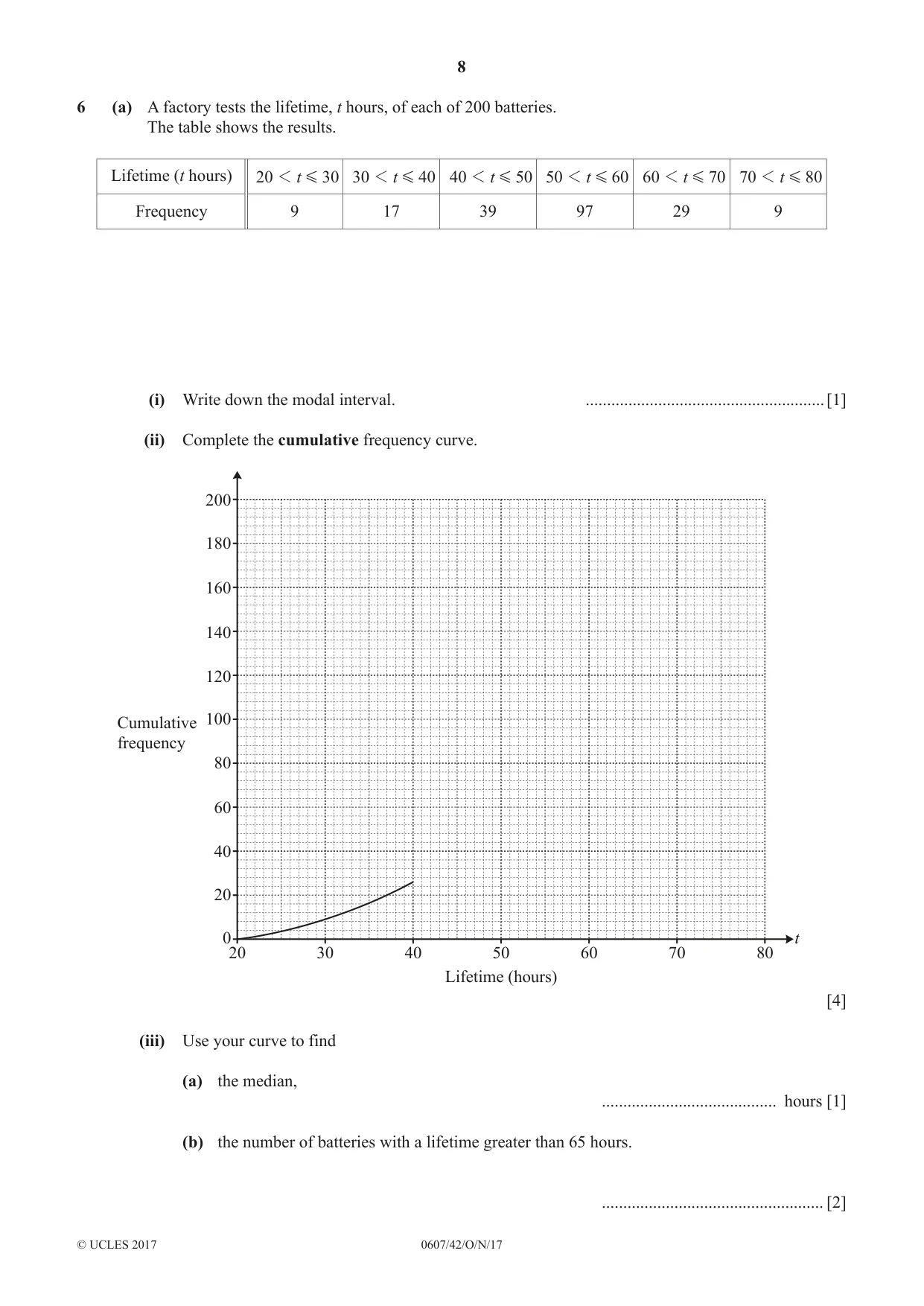
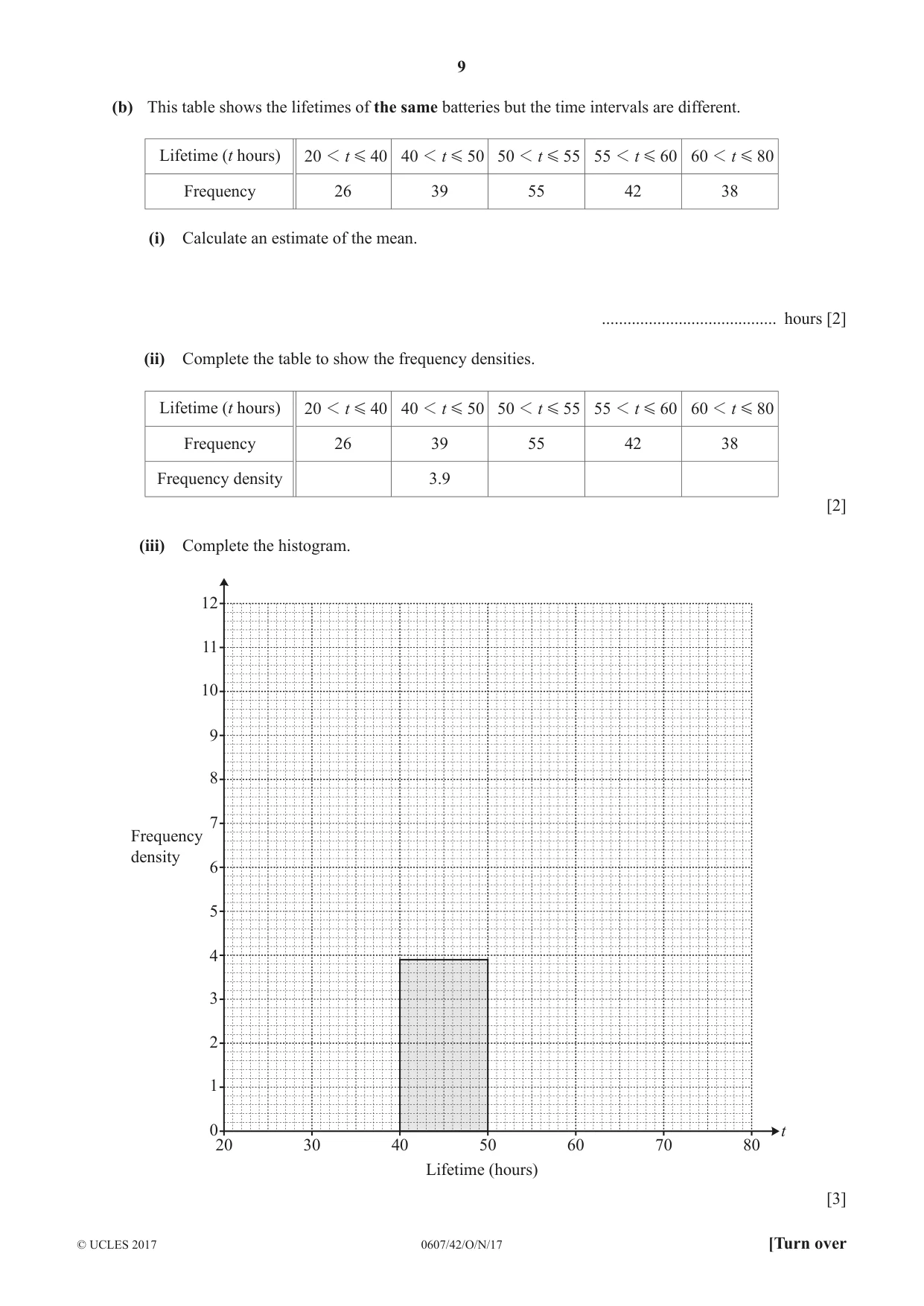
6 (a) A factory tests the lifetime, t hours, of each of 200 batteries. The table shows the results. Lifetime (t hours) 20 1 t G 30 30 1 t G 40 40 1 t G 50 50 1 t G 60 60 1 t G 70 70 1 t G 80 Frequency 9 17 39 97 29 9 (i) Write down the modal interval. ........................................................ [1] (ii) Complete the cumulative frequency curve. 200 180 160 140 120 Cumulative 100 frequency 80 60 40 20 0 t 20 30 40 50 60 70 80 Lifetime (hours) [4] (iii) Use your curve to find (a) the median, ......................................... hours [1] (b) the number of batteries with a lifetime greater than 65 hours. .................................................... [2] (b) This table shows the lifetimes of the same batteries but the time intervals are different. Lifetime (t hours) 20 1 t G 40 40 1 t G 50 50 1 t G 55 55 1 t G 60 60 1 t G 80 Frequency 26 39 55 42 38 (i) Calculate an estimate of the mean. ......................................... hours [2] (ii) Complete the table to show the frequency densities. Lifetime (t hours) 20 1 t G 40 40 1 t G 50 50 1 t G 55 55 1 t G 60 60 1 t G 80 Frequency 26 39 55 42 38 Frequency density 3.9 [2] (iii) Complete the histogram. 12 11 10 9 8 7 Frequency density 6 5 4 3 2 1 0 t 20 30 40 50 60 70 80 Lifetime (hours) [3]
Mark scheme: 6(a)(i) 50 < t ≤ 60 1 6(a)(ii) Correct curve 4 B2 for 3 or 4 correct heights or B1 for 2 correct heights or correct cumulative frequencies seen B1 for plotting correct t co-ordinates, dependent on increasing curve 6(a)(iii)(a) 52 to 55 1 FT their curve, dependent on increasing 6(a)(iii)(b) Strict follow through 2 FT their curve, dependent on increasing B1FT for their cum freq value soi 6(b)(i) 52.5 or 52.48 to 52.49 2 M1 for evidence of at least three correct mid-values 30, 45, 52.5, 57.5, 70 soi by 10497.5 6(b)(ii) 1.3, … , 11, 8.4, 1.9 2 B1 for 3 correct 6(b)(iii) Correct histogram 3 FT their (ii) B1 for correct widths B2 for correct heights or B1 for three correct heights
Q7 · Ali walks for 1 hour at x km/h and then for 2 hours at x + km/h
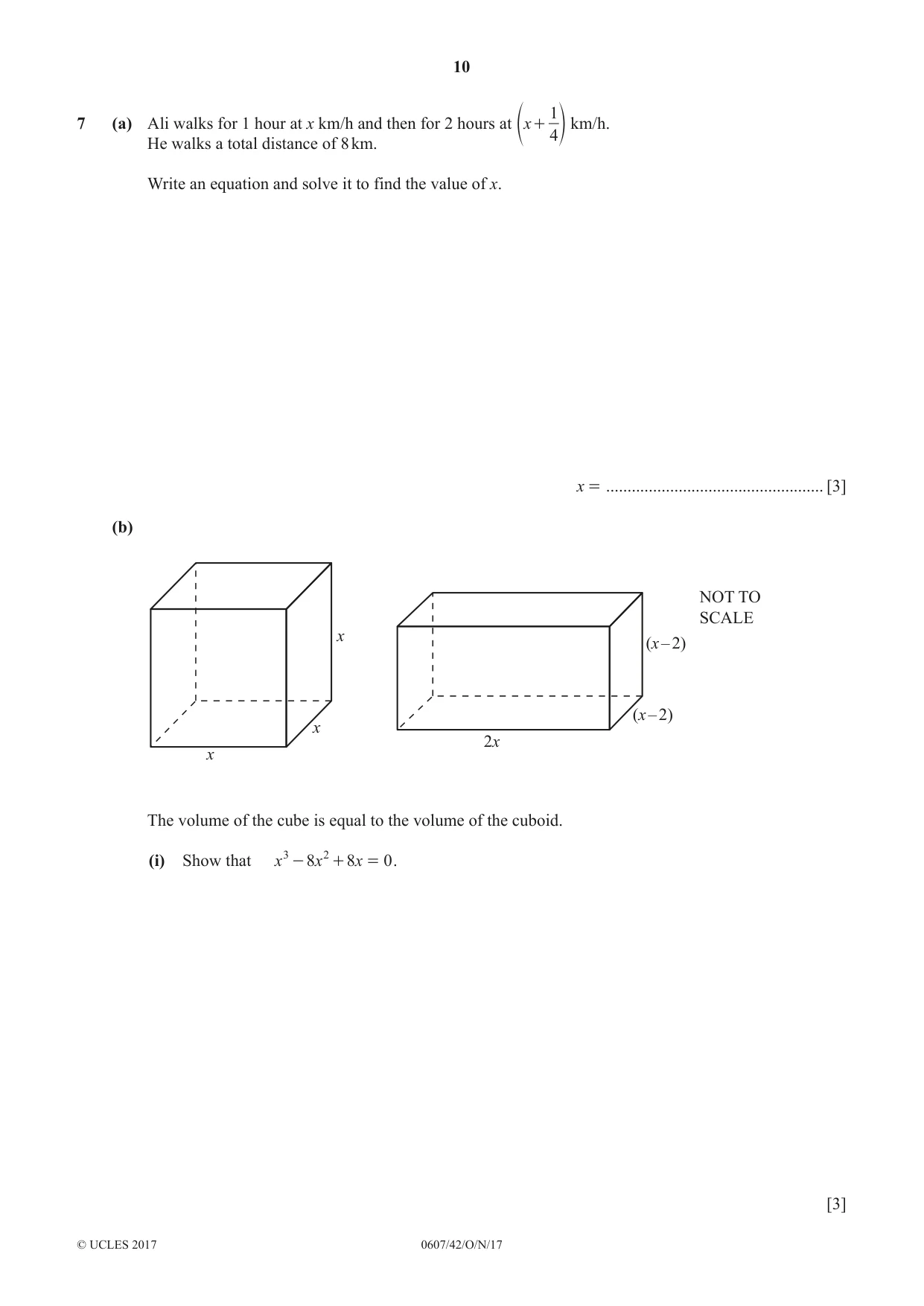
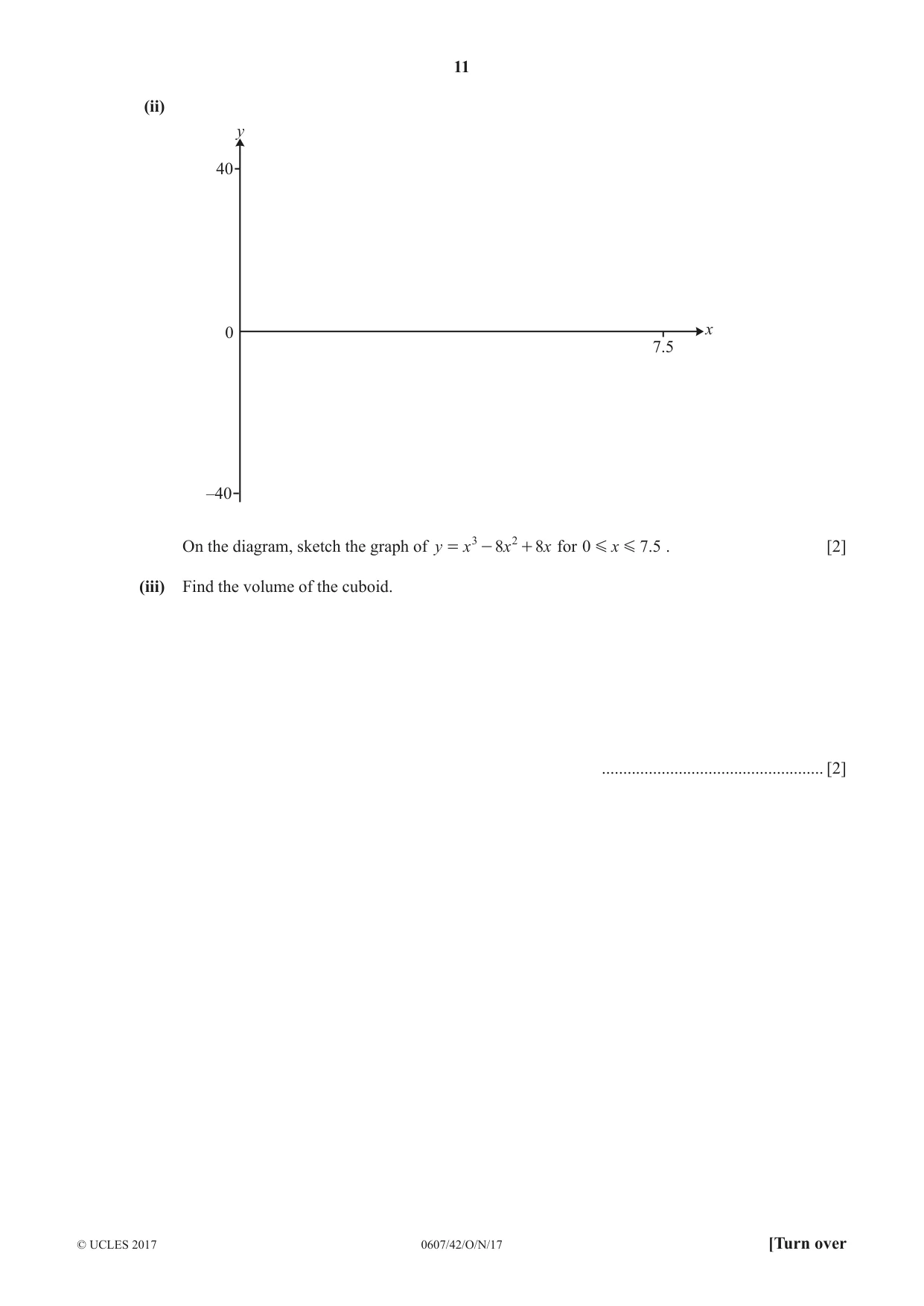
7 (a) Ali walks for 1 hour at x km/h and then for 2 hours at x + km/h. 4 He walks a total distance of 8 km. Write an equation and solve it to find the value of x. x = ................................................... [3] (b) NOT TO SCALE x (x – 2) (x – 2) x 2x x The volume of the cube is equal to the volume of the cuboid. (i) Show that x 3 - 8x 2 + 8x = 0 . [3] (ii) y 40 0 x 7.5 –40 On the diagram, sketch the graph of y = x 3 - 8x 2 + 8x for 0 G x G 7.5 . [2] (iii) Find the volume of the cuboid. .................................................... [2]
Mark scheme: 7(a) 1 M2 1 x + 2 x + = 8 oe M1 for 2 x + oe seen 4 4 2.5 B1 7(b)(i) x 3 = 2 x ( x − 2)( x − 2) oe M1 [( x − 2) 2 = ] x 2 − 2 x − 2 x + 4 B1 Allow – 4x for – 2x – 2x 3 2 2 Allow – 8x2 for – 4x2 – 4x2 or 2 x − 4 x − 4 x + 8 x leading to x 3 − 8 x 2 + 8 x = 0 A1 Final equation reached without any errors or omissions 7(b)(ii) Correct sketch 2 B1 for correct shaped cubic with max 40404040 before min 20202020 0000 0000 2222 4444 6666 -20-20-20-20 -40-40-40-40 7(b)(iii) 318 or 319 or 318.3 to 318.7 2 B1 for 6.83 or 6.828… seen isw use of other values (1.1715…)
Q8 · A fair 6-sided die is numbered 0, 1, 1, 2, 3, 3
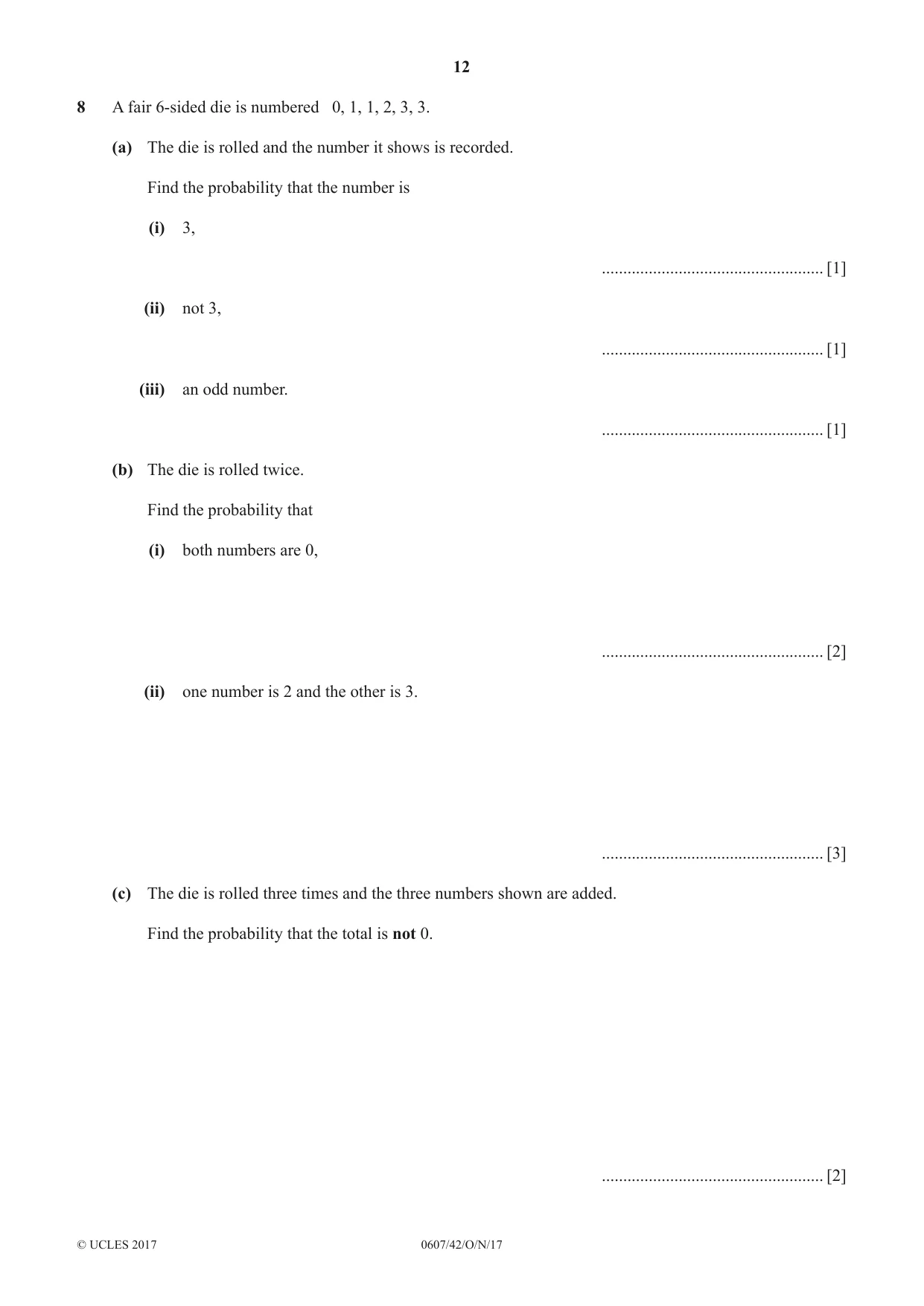
8 A fair 6-sided die is numbered 0, 1, 1, 2, 3, 3. (a) The die is rolled and the number it shows is recorded. Find the probability that the number is (i) 3, .................................................... [1] (ii) not 3, .................................................... [1] (iii) an odd number. .................................................... [1] (b) The die is rolled twice. Find the probability that (i) both numbers are 0, .................................................... [2] (ii) one number is 2 and the other is 3. .................................................... [3] (c) The die is rolled three times and the three numbers shown are added. Find the probability that the total is not 0. .................................................... [2]
Mark scheme: 8(a)(i) 2 1 oe 6 8(a)(ii) 4 1 oe 6 8(a)(iii) 4 1 oe 6 8(b)(i) 1 2 1 1 oe M1 for × 36 6 6 8(b)(ii) 4 3 1 2 2 1 oe M2 for × + × oe 36 6 6 6 6 1 or M1 for one product soi by oe 18 8(c) 215 2 1 1 1 oe M1 for 1 − × × oe 216 6 6 6
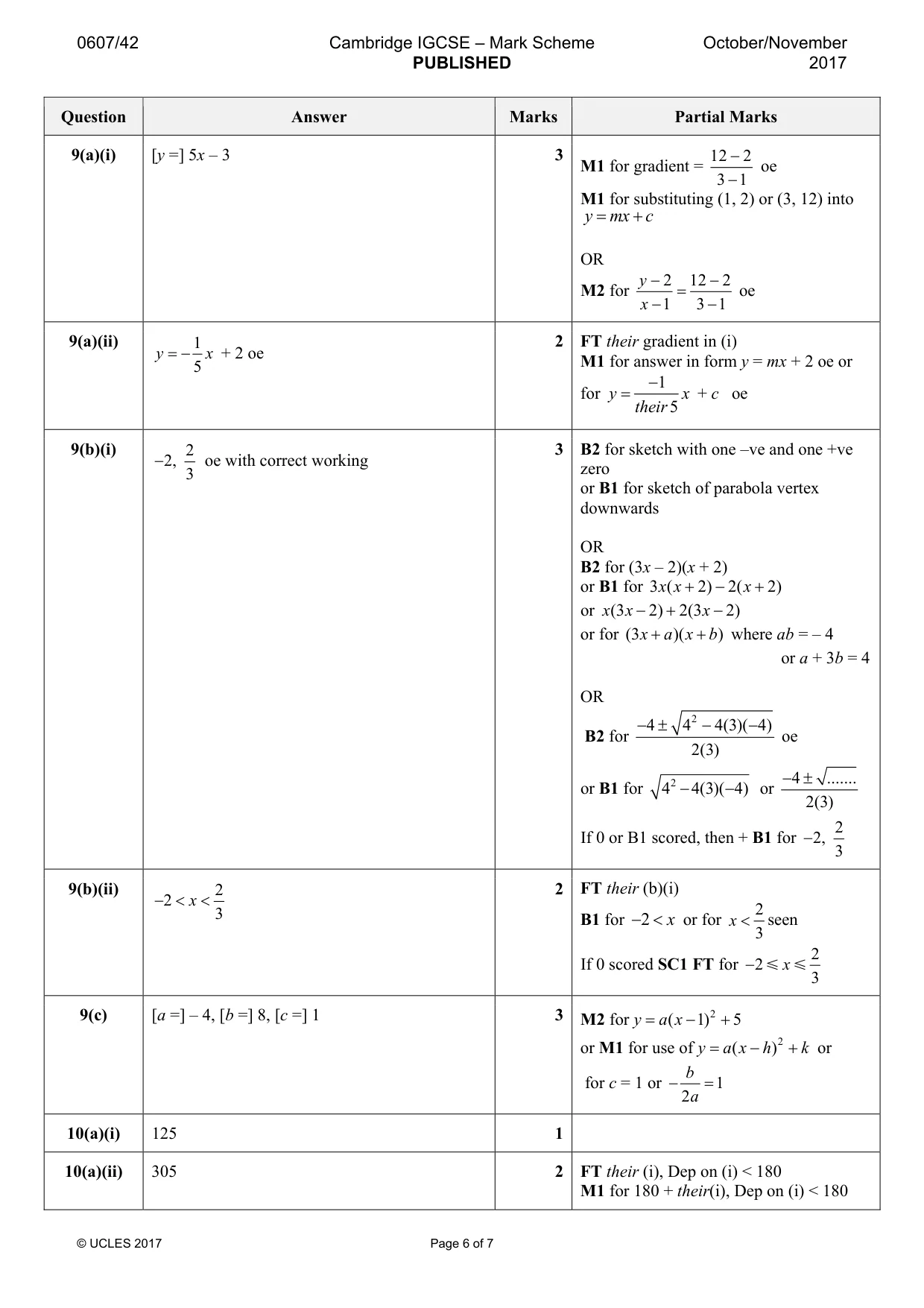
Q9 · Find the equation of the line that passes through the points (1, 2) and (3, 12)
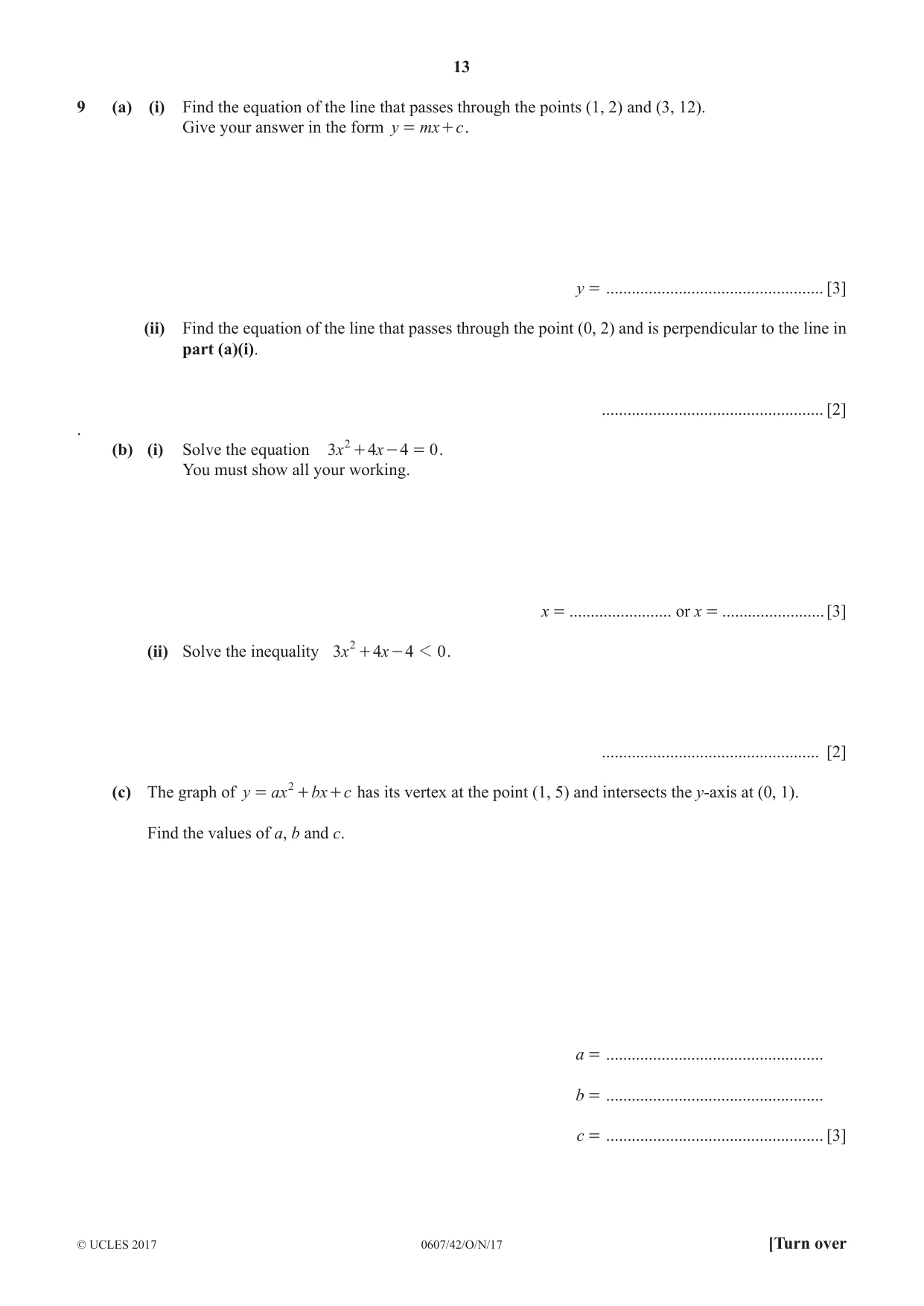
9 (a) (i) Find the equation of the line that passes through the points (1, 2) and (3, 12). Give your answer in the form y = mx + c . y = ................................................... [3] (ii) Find the equation of the line that passes through the point (0, 2) and is perpendicular to the line in part (a)(i). .................................................... [2] . (b) (i) Solve the equation 3x 2 + 4x - 4 = 0 . You must show all your working. x = ........................ or x = ........................ [3] (ii) Solve the inequality 3x 2 + 4x - 4 1 0 . ................................................... [2] (c) The graph of y = ax 2 + bx + c has its vertex at the point (1, 5) and intersects the y-axis at (0, 1). Find the values of a, b and c. a = ................................................... b = ................................................... c = ................................................... [3]
Mark scheme: 9(a)(i) [y =] 5x – 3 3 12 − 2 M1 for gradient = oe 3 − 1 M1 for substituting (1, 2) or (3, 12) into y = mx + c OR y − 2 12 − 2 M2 for = oe x − 1 3 − 1 9(a)(ii) 1 2 FT their gradient in (i) y = − x + 2 oe M1 for answer in form y = mx + 2 oe or 5 −1 for y = x + c oe their 5 9(b)(i) 2 3 B2 for sketch with one –ve and one +ve − 2, oe with correct working zero 3 or B1 for sketch of parabola vertex downwards OR B2 for (3x – 2)(x + 2) or B1 for 3 x ( x + 2) − 2( x + 2) or x (3 x − 2) + 2(3 x − 2) or for (3 x + a )( x + b ) where ab = – 4 or a + 3b = 4 OR −±4 4 2 − 4(3)( − 4) B2 for oe 2(3) 2 −±4 ....... or B1 for 4 − 4(3)( −4) or 2(3) 2 If 0 or B1 scored, then + B1 for − 2, 3 9(b)(ii) 2 2 FT their (b)(i) −<2 x < 3 2 B1 for −<2 x or for x < seen 3 2 If 0 scored SC1 FT for −≤2 x ≤ 3 9(c) [a =] – 4, [b =] 8, [c =] 1 3 M2 for y = a ( x − 1) 2 + 5 or M1 for use of y = a ( x − h ) 2 + k or b for c = 1 or − = 1 2 a
Q10 · North 90 m D A 35° NOT TO SCALE 120 m C 115 m 65° B The diagram shows a school playing…
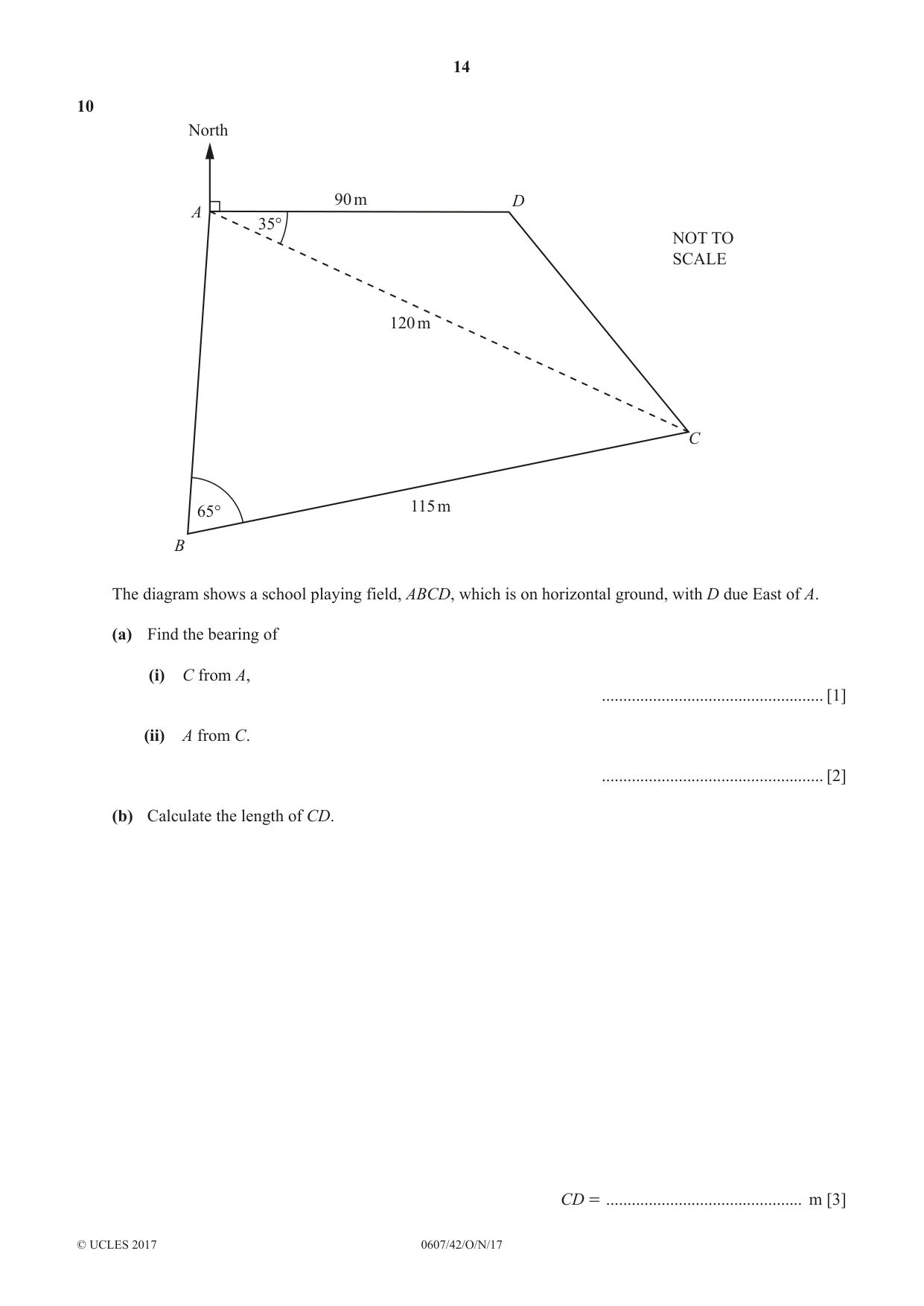
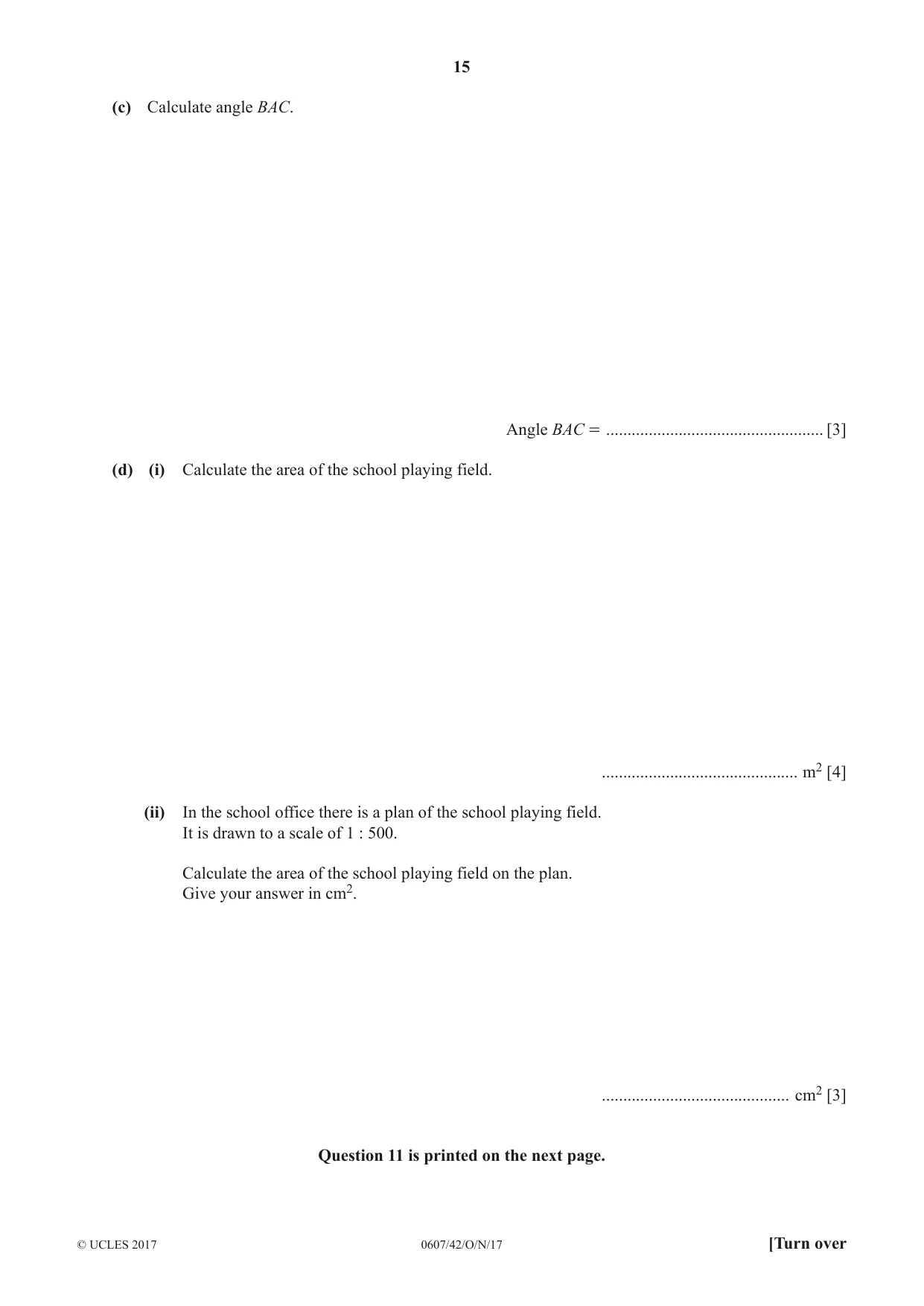
10 North 90 m D A 35° NOT TO SCALE 120 m C 115 m 65° B The diagram shows a school playing field, ABCD, which is on horizontal ground, with D due East of A. (a) Find the bearing of (i) C from A, .................................................... [1] (ii) A from C. .................................................... [2] (b) Calculate the length of CD. CD = .............................................. m [3] (c) Calculate angle BAC. Angle BAC = ................................................... [3] (d) (i) Calculate the area of the school playing field. .............................................. m2 [4] (ii) In the school office there is a plan of the school playing field. It is drawn to a scale of 1 : 500. Calculate the area of the school playing field on the plan. Give your answer in cm2. ............................................ cm2 [3] Question 11 is printed on the next page.
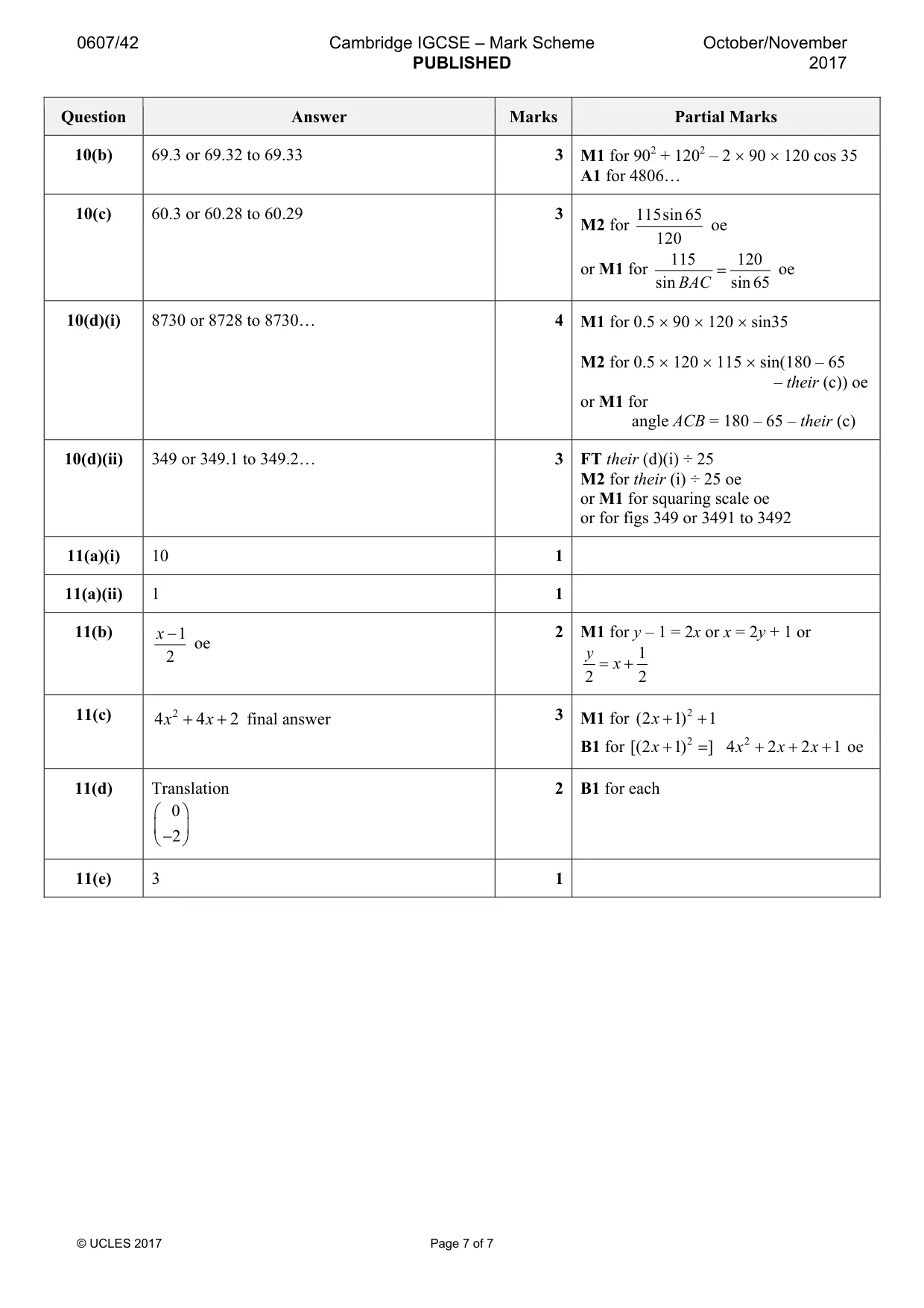
Mark scheme: 10(a)(i) 125 1 10(a)(ii) 305 2 FT their (i), Dep on (i) < 180 M1 for 180 + their(i), Dep on (i) < 180 10(b) 69.3 or 69.32 to 69.33 3 M1 for 902 + 1202 – 2 × 90 × 120 cos 35 A1 for 4806… 10(c) 60.3 or 60.28 to 60.29 3 115sin 65 M2 for oe 120 115 120 or M1 for = oe sin BAC sin65 10(d)(i) 8730 or 8728 to 8730… 4 M1 for 0.5 × 90 × 120 × sin35 M2 for 0.5 × 120 × 115 × sin(180 – 65 – their (c)) oe or M1 for angle ACB = 180 – 65 – their (c) 10(d)(ii) 349 or 349.1 to 349.2… 3 FT their (d)(i) ÷ 25 M2 for their (i) ÷ 25 oe or M1 for squaring scale oe or for figs 349 or 3491 to 3492
Q11 · F (x) = 2 x + 1 g ( x) = x 2 + 1 h (x) = log x (a) (i) Find the value of f(4.5)
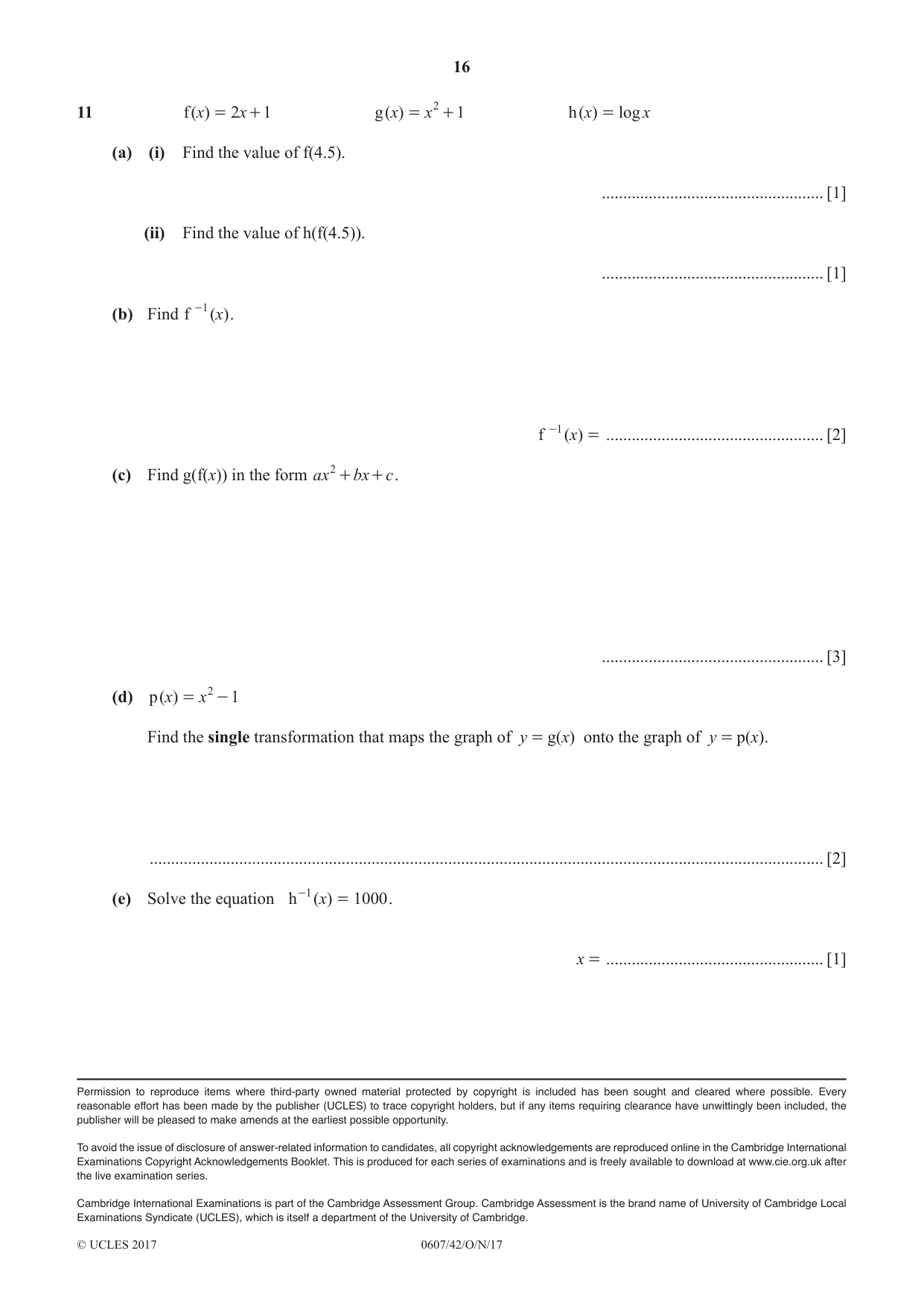
11 f (x) = 2 x + 1 g ( x) = x 2 + 1 h (x) = log x (a) (i) Find the value of f(4.5). .................................................... [1] (ii) Find the value of h(f(4.5)). .................................................... [1] (b) Find f -1 (x) . f -1 (x ) = ................................................... [2] (c) Find g(f(x)) in the form ax 2 + bx + c . .................................................... [3] (d) p (x) = x 2 - 1 Find the single transformation that maps the graph of y = g(x) onto the graph of y = p(x). .............................................................................................................................................................. [2] (e) Solve the equation h -1 (x) = 1000 . x = ................................................... [1]
Mark scheme: 11(a)(i) 10 1 11(a)(ii) 1 1 11(b) x − 1 2 M1 for y – 1 = 2x or x = 2y + 1 or oe 2 y 1 = x + 2 2 11(c) 4 x 2 + 4 x + 2 final answer 3 M1 for (2 x + 1) 2 + 1 B1 for [(2 x + 1) 2 = ] 4 x 2 + 2 x + 2 x + 1 oe 11(d) Translation 2 B1 for each 0 − 2 11(e) 3 1
What was in this paper
The subtopics covered by these 11 questions, and how many questions each got. Open one in a new tab to see every Cambridge question on it.
What you needed in this session
Cambridge’s own grade thresholds for 2017 Oct/Nov, Paper 4 · Variant 2. A higher threshold means an easier paper — the bar moves with how the cohort did.