Cambridge IGCSE Mathematics - International 0607 — 2023 Oct/Nov Paper 4 · Variant 1
0607/41/O/N/23 · 11 questions · 120 marks · ≈135 min
The question paper and its mark scheme, free to read here and free to download. This is Cambridge’s own paper, exactly as it was sat.
Question paper20 pages
Mark scheme9 pages
Answers below. Sit the paper first if you are practising.
Questions as text
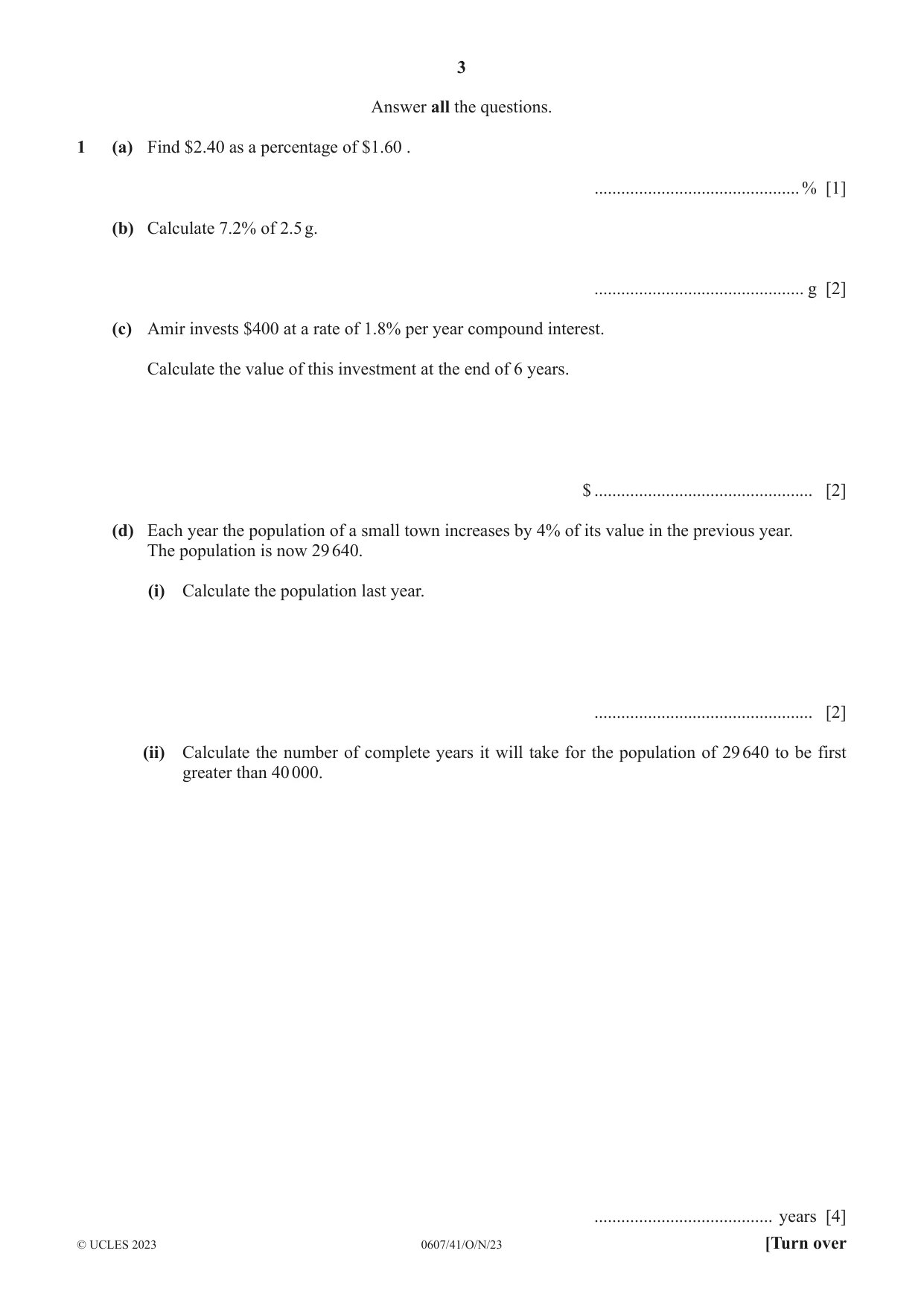
Q1 · Find $2.40 as a percentage of $1.60
1 (a) Find $2.40 as a percentage of $1.60 . ..............................................% [1] (b) Calculate 7.2% of 2.5 g. ............................................... g [2] (c) Amir invests $400 at a rate of 1.8% per year compound interest. Calculate the value of this investment at the end of 6 years. $ ................................................. [2] (d) Each year the population of a small town increases by 4% of its value in the previous year. The population is now 29 640. (i) Calculate the population last year. ................................................. [2] (ii) Calculate the number of complete years it will take for the population of 29 640 to be first greater than 40 000. ........................................ years [4]
Mark scheme: Question Answer Marks Partial Marks 1(a) 150 1 1(b) [0].18 2 7.2 M1 for 2.5 oe 100 1(c) 445.19 or 445 or 445.19... 2 6 100 + 1.8 M1 for 400 oe 100 1(d)(i) 28 500 2 100 + 4 M1 for [...] = 29640 oe 100 1(d)(ii) 8 nfww 4 B3 for 7.64 or 7.642 to 7.643 or 4 40000 M3 n log 1 + = log oe 100 29640 or for good sketch indicating value between 7 and 8 or for correct trials reaching 7 and 8 or 4 n 40000 M2 for 1 + = oe 100 29640 or suitable graph with n > 1 or at least 3 correct trials or 4 n M1 for 29640 1 + = 40000 oe 100 soi by at least 2 trials with n > 1
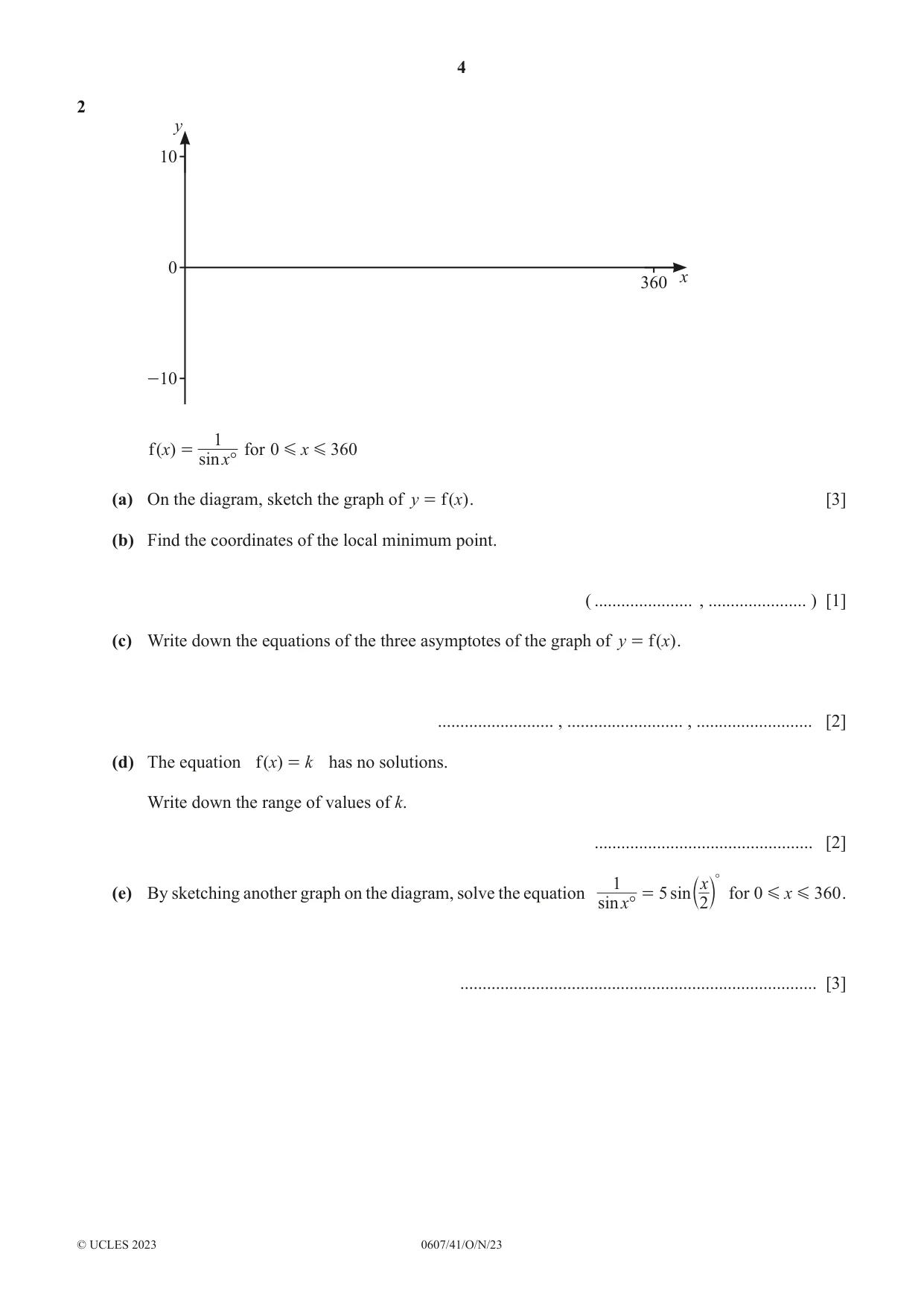
Q2 · Y 10 0 x 360 -10 1 f ( x) = for 0 G x G 360 sin x° (a) On the diagram, sketch the graph…
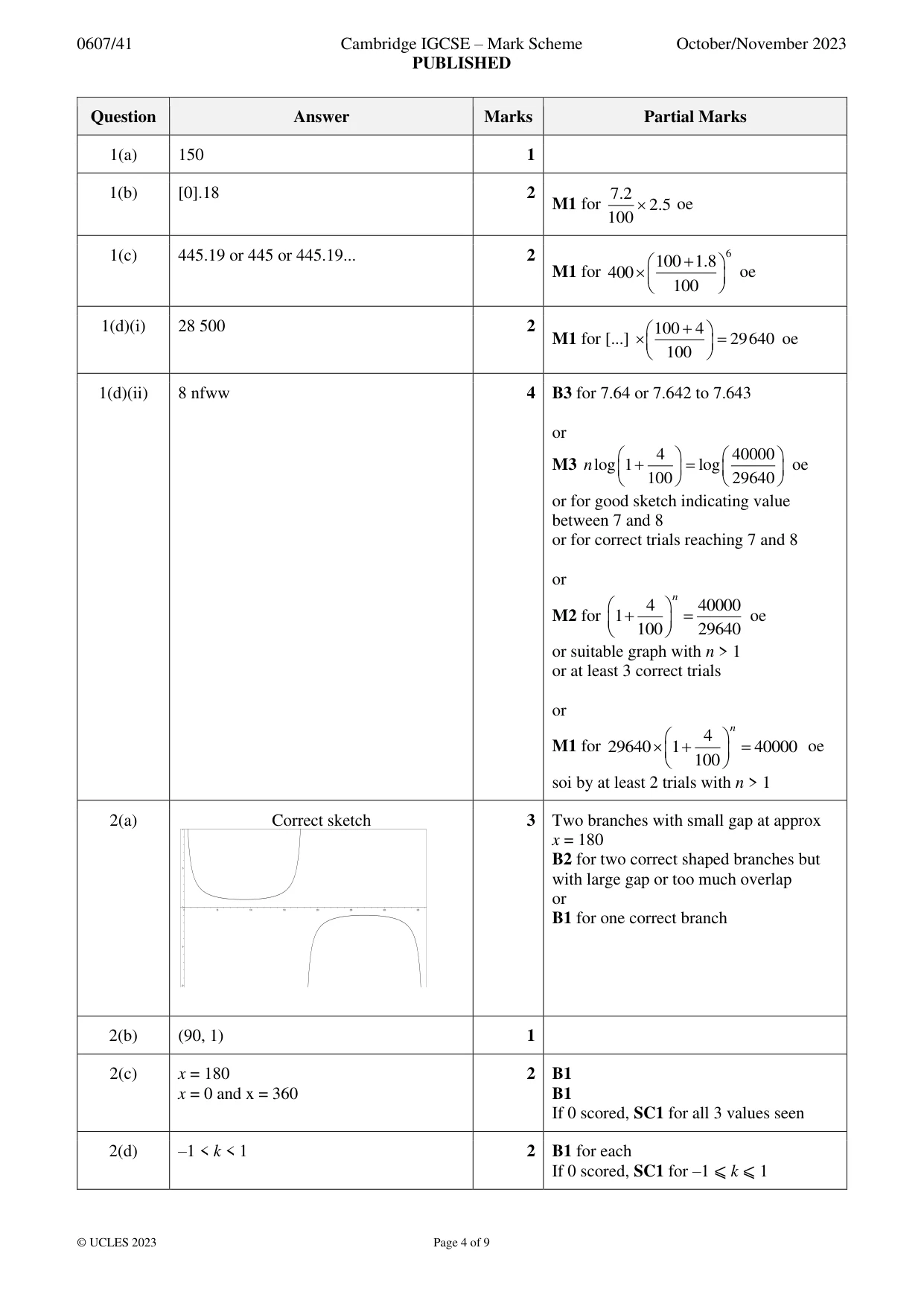
2 y 10 0 x 360 -10 1 f ( x) = for 0 G x G 360 sin x° (a) On the diagram, sketch the graph of y = f ( x) . [3] (b) Find the coordinates of the local minimum point. ( ...................... , ...................... ) [1] (c) Write down the equations of the three asymptotes of the graph of y = f ( x) . .......................... , .......................... , .......................... [2] (d) The equation f ( x) = k has no solutions. Write down the range of values of k. ................................................. [2] 1 x ° (e) By sketching another graph on the diagram, solve the equation = 5 sin for 0 G x G 360 . sin x° b 2 l ................................................................................ [3]
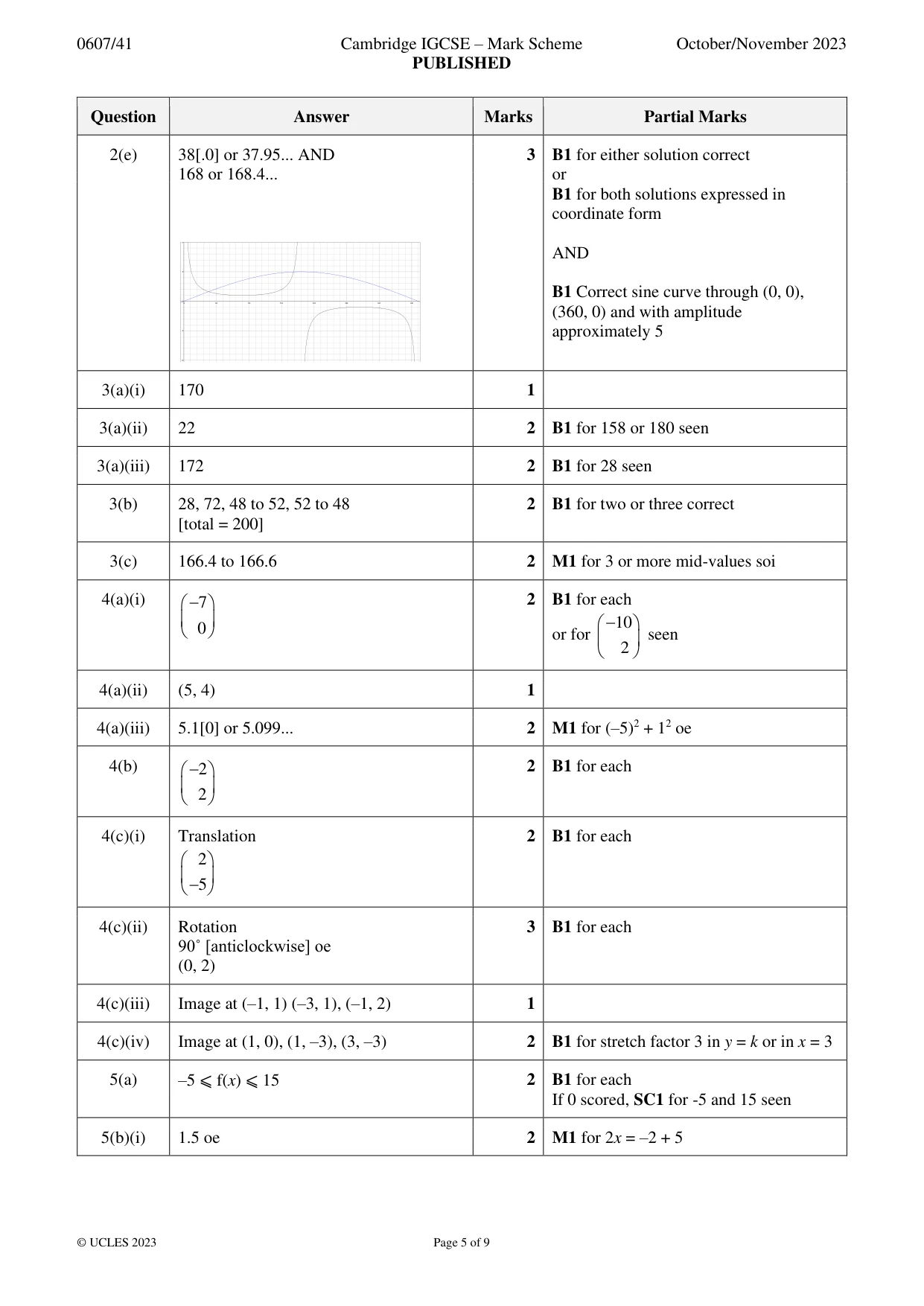
Mark scheme: 2(a) 10 Correct sketch 3 Two branches with small gap at approx x = 180 5 B2 for two correct shaped branches but with large gap or too much overlap 0 0 50 100 150 200 250 300 350 or B1 for one correct branch -5 -10 2(b) (90, 1) 1 2(c) x = 180 2 B1 x = 0 and x = 360 B1 If 0 scored, SC1 for all 3 values seen 2(d) –1 < k < 1 2 B1 for each If 0 scored, SC1 for –1 ⩽ k ⩽ 1 2(e) 38[.0] or 37.95... AND 3 B1 for either solution correct 168 or 168.4... or B1 for both solutions expressed in coordinate form 10101010 AND 5555 0000 0000 50505050 100100100100 150150150150 200200200200 250250250250 300300300300 350350350350 B1 Correct sine curve through (0, 0), (360, 0) and with amplitude -5-5-5-5 approximately 5 -10-10-10-10
Q3 · Each of 200 students records their height, h cm
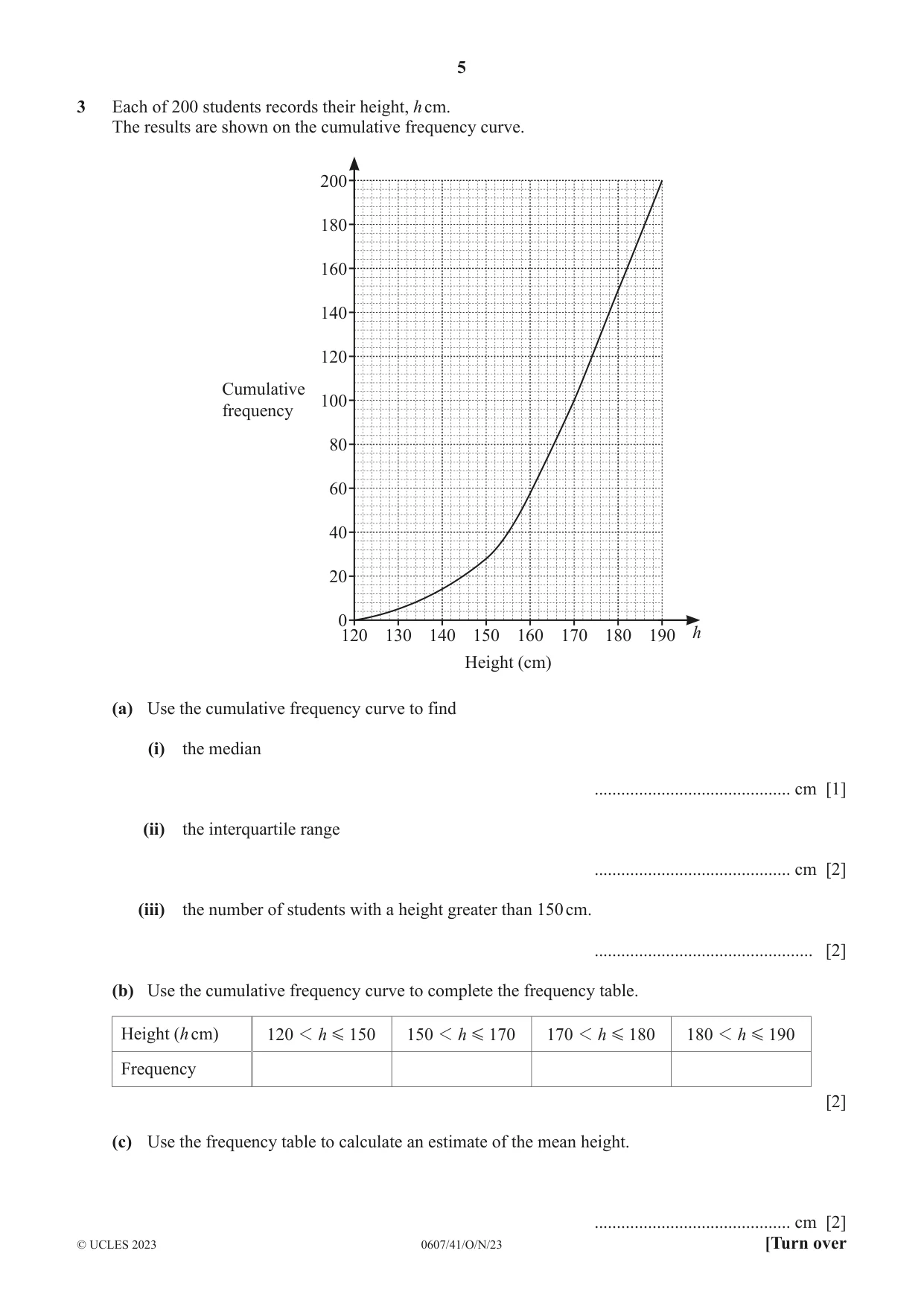
3 Each of 200 students records their height, h cm. The results are shown on the cumulative frequency curve. 200 180 160 140 120 Cumulative 100 frequency 80 60 40 20 0 120 130 140 150 160 170 180 190 h Height (cm) (a) Use the cumulative frequency curve to find (i) the median ............................................ cm [1] (ii) the interquartile range ............................................ cm [2] (iii) the number of students with a height greater than 150 cm. ................................................. [2] (b) Use the cumulative frequency curve to complete the frequency table. Height (h cm) 120 1 h G 150 150 1 h G 170 170 1 h G 180 180 1 h G 190 Frequency [2] (c) Use the frequency table to calculate an estimate of the mean height.
Mark scheme: 3(a)(i) 170 1 3(a)(ii) 22 2 B1 for 158 or 180 seen 3(a)(iii) 172 2 B1 for 28 seen 3(b) 28, 72, 48 to 52, 52 to 48 2 B1 for two or three correct [total = 200] 3(c) 166.4 to 166.6 2 M1 for 3 or more mid-values soi
Q4 · P = q = - 2 1 (i) Work out p + 2q
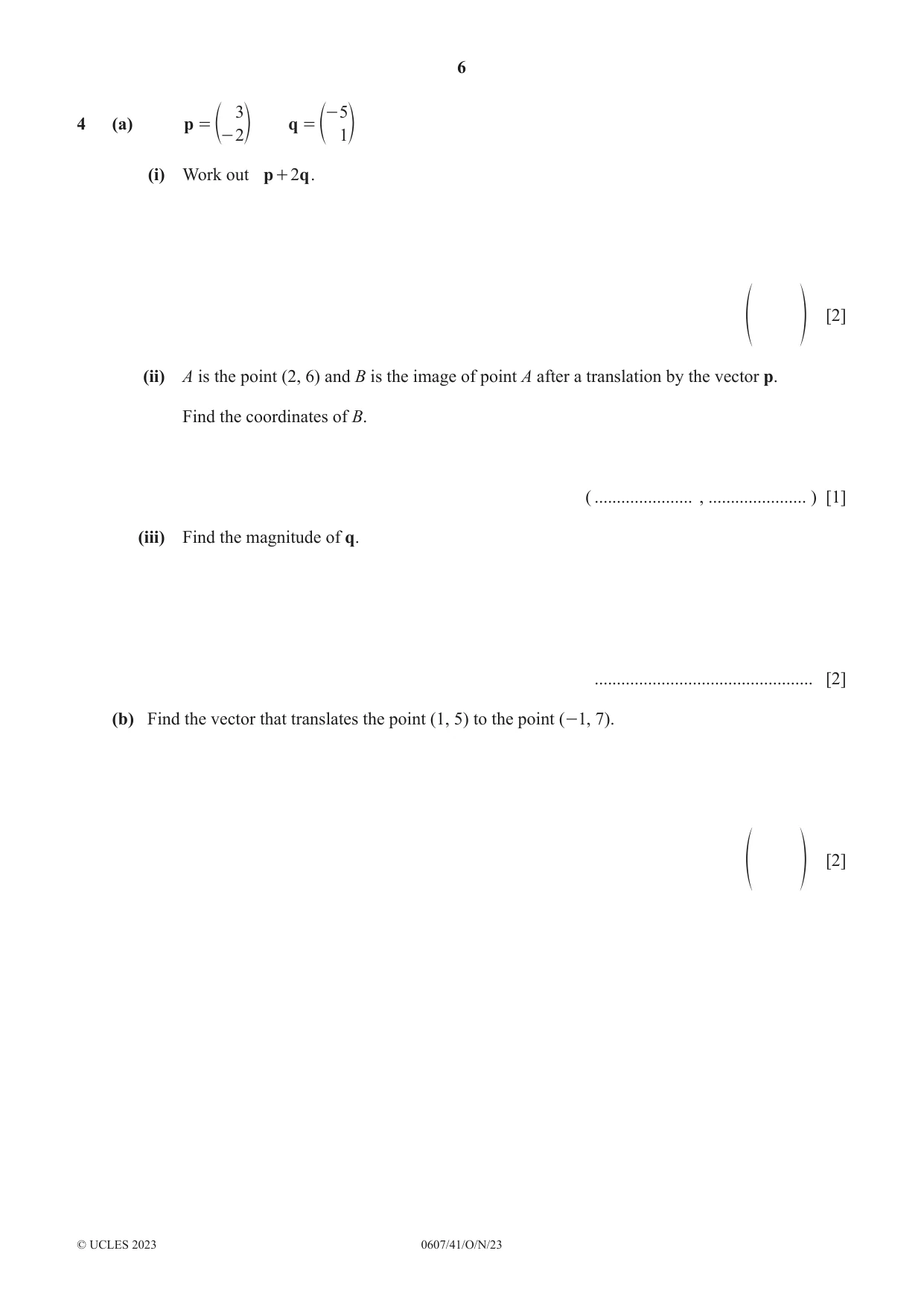
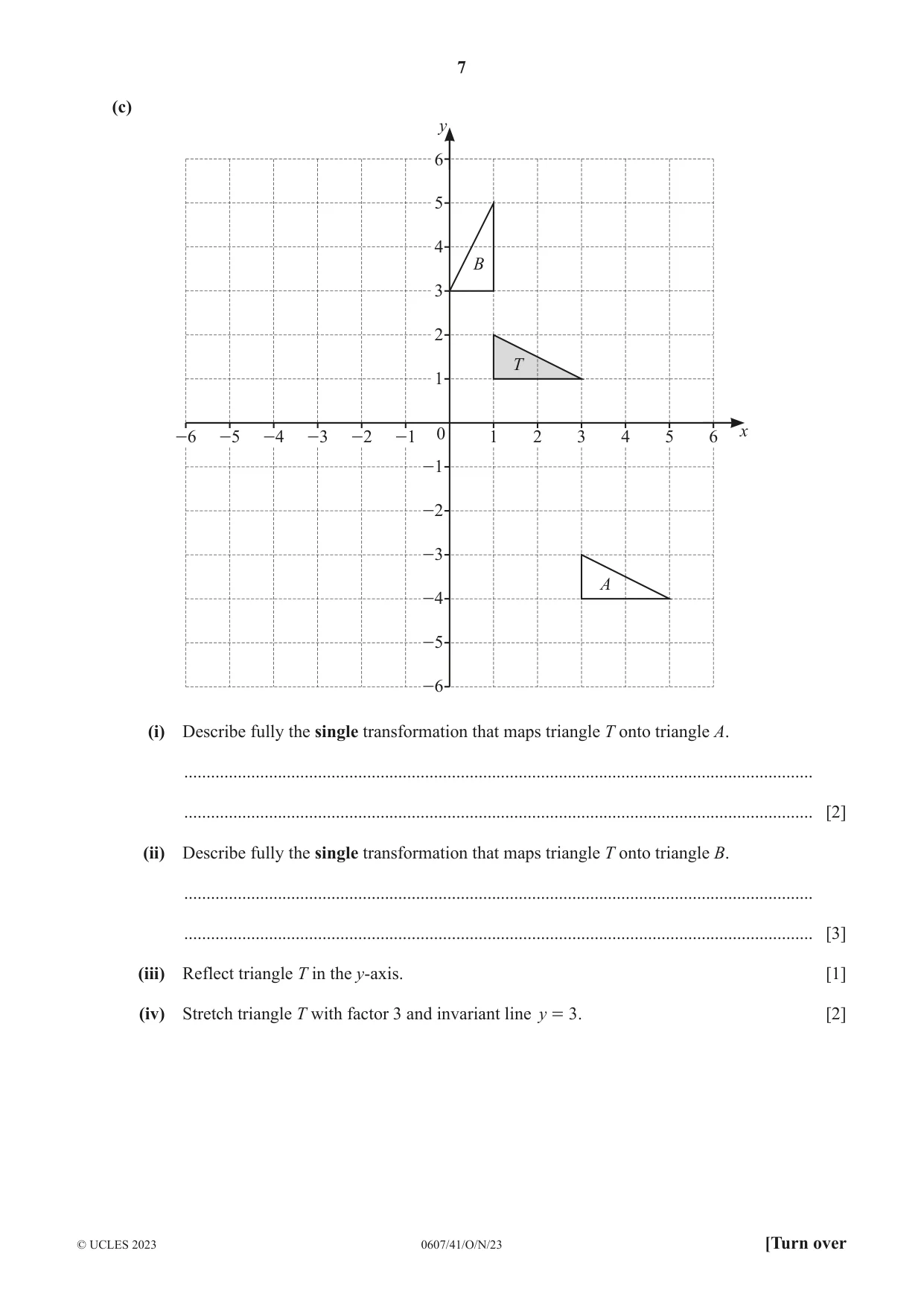
4 (a) p = q = - 2 1 (i) Work out p + 2q . [2] f p (ii) A is the point (2, 6) and B is the image of point A after a translation by the vector p. Find the coordinates of B. ( ...................... , ...................... ) [1] (iii) Find the magnitude of q. ................................................. [2] (b) Find the vector that translates the point (1, 5) to the point ( - 1, 7). [2] f p (c) y 6 5 4 B 3 2 T 1 -6 -5 -4 -3 -2 -1 0 1 2 3 4 5 6 x -1 -2 -3 A -4 -5 -6 (i) Describe fully the single transformation that maps triangle T onto triangle A. ............................................................................................................................................. ............................................................................................................................................. [2] (ii) Describe fully the single transformation that maps triangle T onto triangle B. ............................................................................................................................................. ............................................................................................................................................. [3] (iii) Reflect triangle T in the y-axis. [1] (iv) Stretch triangle T with factor 3 and invariant line y = 3 . [2]
Mark scheme: 4(a)(i) −7 2 B1 for each −10 0 or for seen 2 4(a)(ii) (5, 4) 1 4(a)(iii) 5.1[0] or 5.099... 2 M1 for (–5)2 + 12 oe 4(b) −2 2 B1 for each 2 4(c)(i) Translation 2 B1 for each 2 −5 4(c)(ii) Rotation 3 B1 for each 90˚ [anticlockwise] oe (0, 2) 4(c)(iii) Image at (–1, 1) (–3, 1), (–1, 2) 1 4(c)(iv) Image at (1, 0), (1, –3), (3, –3) 2 B1 for stretch factor 3 in y = k or in x = 3
Q5 · F ( x) = 2 x - 5 g ( x) = x 2 + x + 3 h ( x) = x3 j ( x) = 3x (a) The domain of f ( x) is…
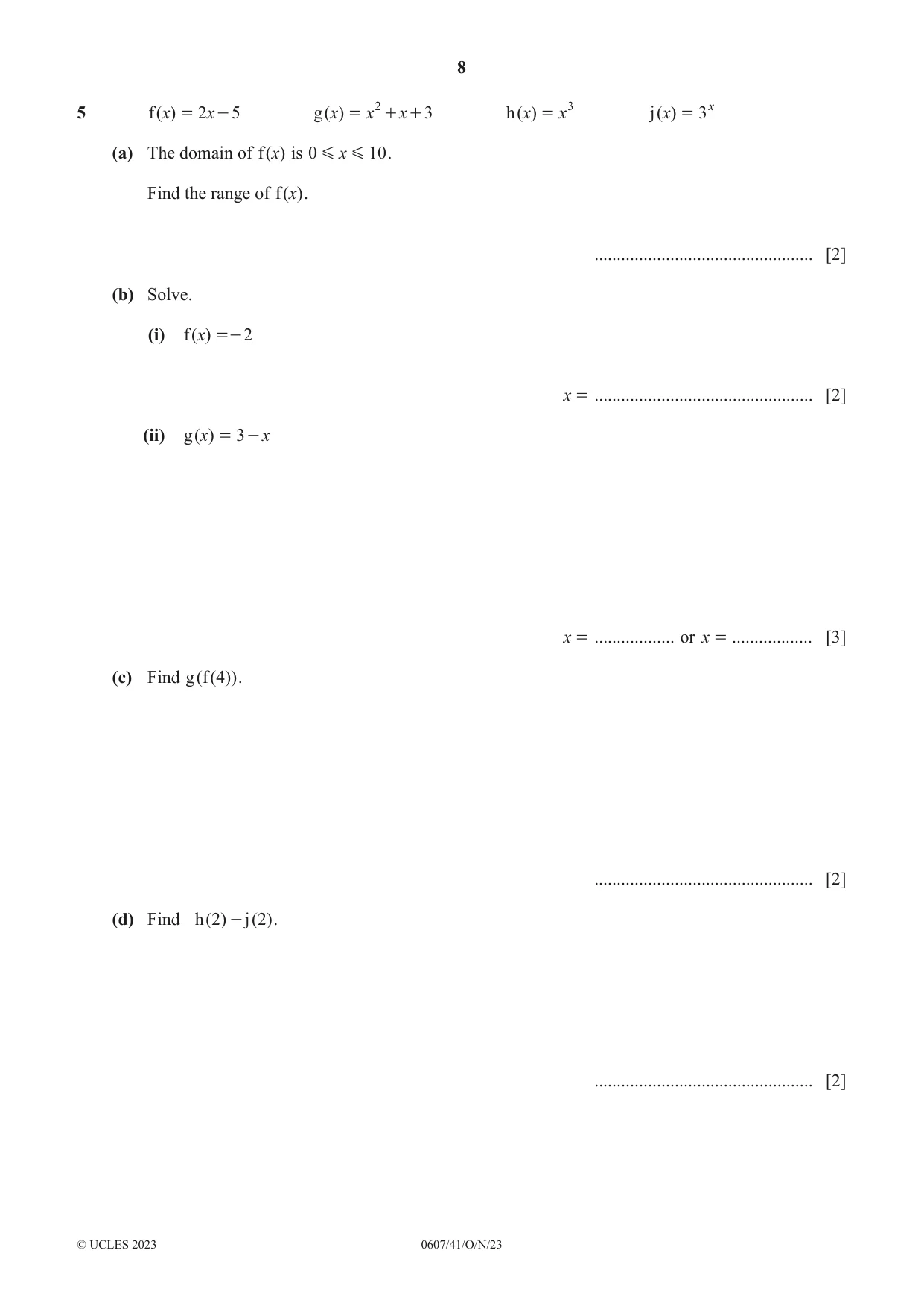
5 f ( x) = 2 x - 5 g ( x) = x 2 + x + 3 h ( x) = x3 j ( x) = 3x (a) The domain of f ( x) is 0 G x G 10 . Find the range of f ( x) . ................................................. [2] (b) Solve. (i) f ( x) =- 2 x = ................................................. [2] (ii) g ( x) = 3 - x x = .................. or x = .................. [3] (c) Find g ( f ( 4)) . ................................................. [2] (d) Find h ( 2) - j ( 2) . ................................................. [2] (e) Find h -1 ( x) . h -1 ( x) = ................................................. [1] (f) Find j -1 ( x) . j -1 ( x) = ................................................. [2]
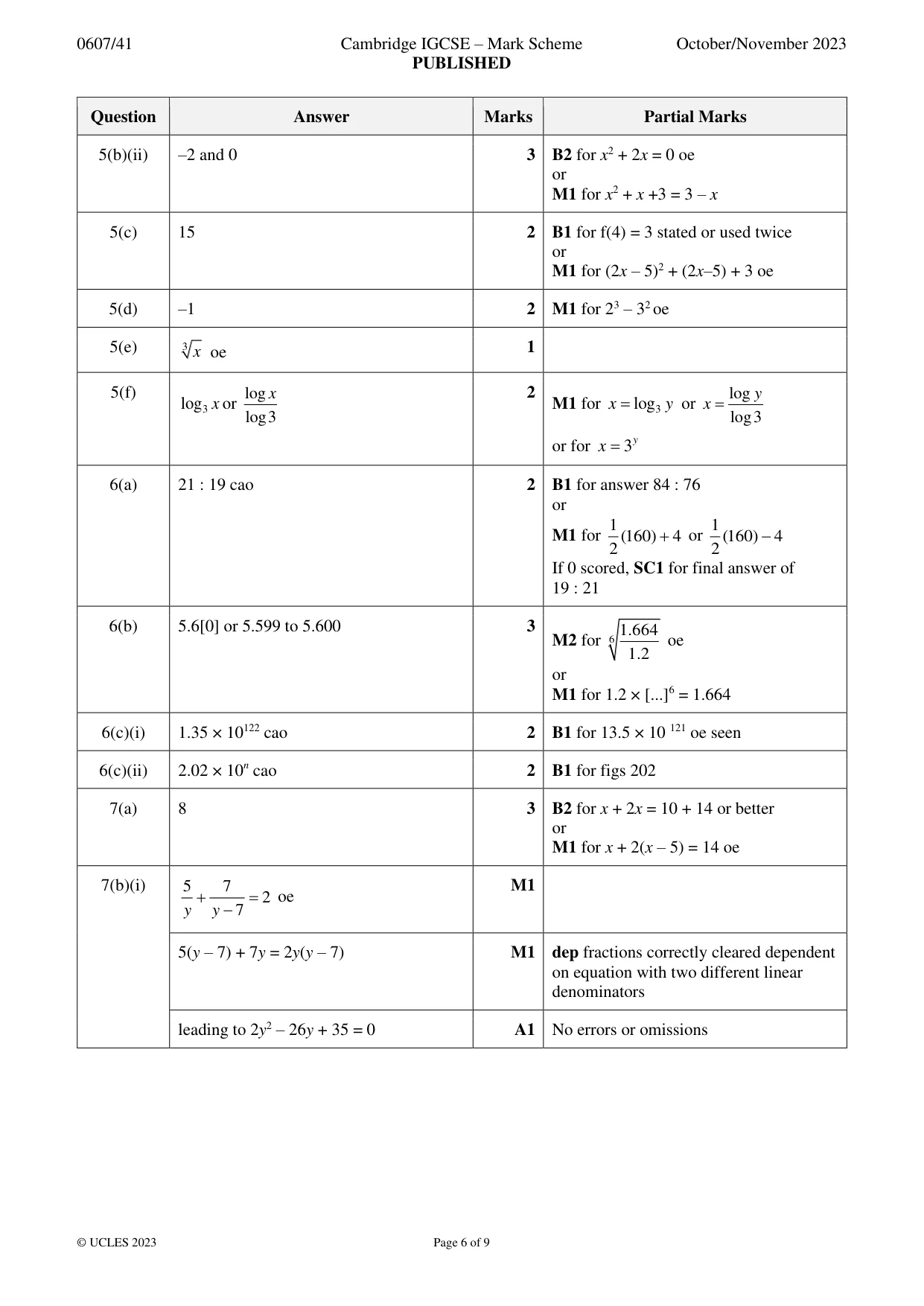
Mark scheme: 5(a) –5 ⩽ f(x) ⩽ 15 2 B1 for each If 0 scored, SC1 for -5 and 15 seen 5(b)(i) 1.5 oe 2 M1 for 2x = –2 + 5 5(b)(ii) –2 and 0 3 B2 for x2 + 2x = 0 oe or M1 for x2 + x +3 = 3 – x 5(c) 15 2 B1 for f(4) = 3 stated or used twice or M1 for (2x – 5)2 + (2x–5) + 3 oe 5(d) –1 2 M1 for 23 – 32 oe 5(e) 3 x oe 1 5(f) log x 2 log y log 3 x or M1 for x = log 3 y or x = log3 log3 or for x = 3y
Q6 · Jade and Kim share $160
6 (a) Jade and Kim share $160. Jade receives $8 more than Kim. Find the ratio Jade’s money : Kim’s money. Give your answer in its simplest form. ...................... : ...................... [2] (b) Each year the height of a bush increases by x% of its height at the start of the year. It takes 6 years for the bush to grow from 1.2 m to 1.664 m. Find the value of x. x = ................................................. [3] (c) Work out, giving each answer in standard form. (i) ( 4. 5 # 10 85 ) # ( 3 # 10 36 ) ................................................. [2] (ii) ( 2 # 10 n ) + ( 2 # 10 n - 2 ) ................................................. [2]
Mark scheme: 6(a) 21 : 19 cao 2 B1 for answer 84 : 76 or 1 1 M1 for (160) + 4 or (160) − 4 2 2 If 0 scored, SC1 for final answer of 19 : 21 6(b) 5.6[0] or 5.599 to 5.600 3 1.664 M2 for 6 oe 1.2 or M1 for 1.2 × [...]6 = 1.664 6(c)(i) 1.35 × 10122 cao 2 B1 for 13.5 × 10 121 oe seen 6(c)(ii) 2.02 × 10n cao 2 B1 for figs 202
Q7 · Marcus runs for 1 hour at x km/h and then walks for 2 hours at ( x - 5)km/h
7 (a) Marcus runs for 1 hour at x km/h and then walks for 2 hours at ( x - 5)km/h . He travels a total distance of 14 km. Find his running speed. ......................................... km/h [3] (b) Nina runs 5 km at y km/h and then walks 7 km at ( y - 7)km/h . She takes a total of 2 hours. (i) Show that 2y 2 - 26 y + 35 = 0 . [3] (ii) Solve 2y 2 - 26 y + 35 = 0 . y = .................. or y = .................. [3] (iii) Find Nina’s walking speed. ......................................... km/h [1]
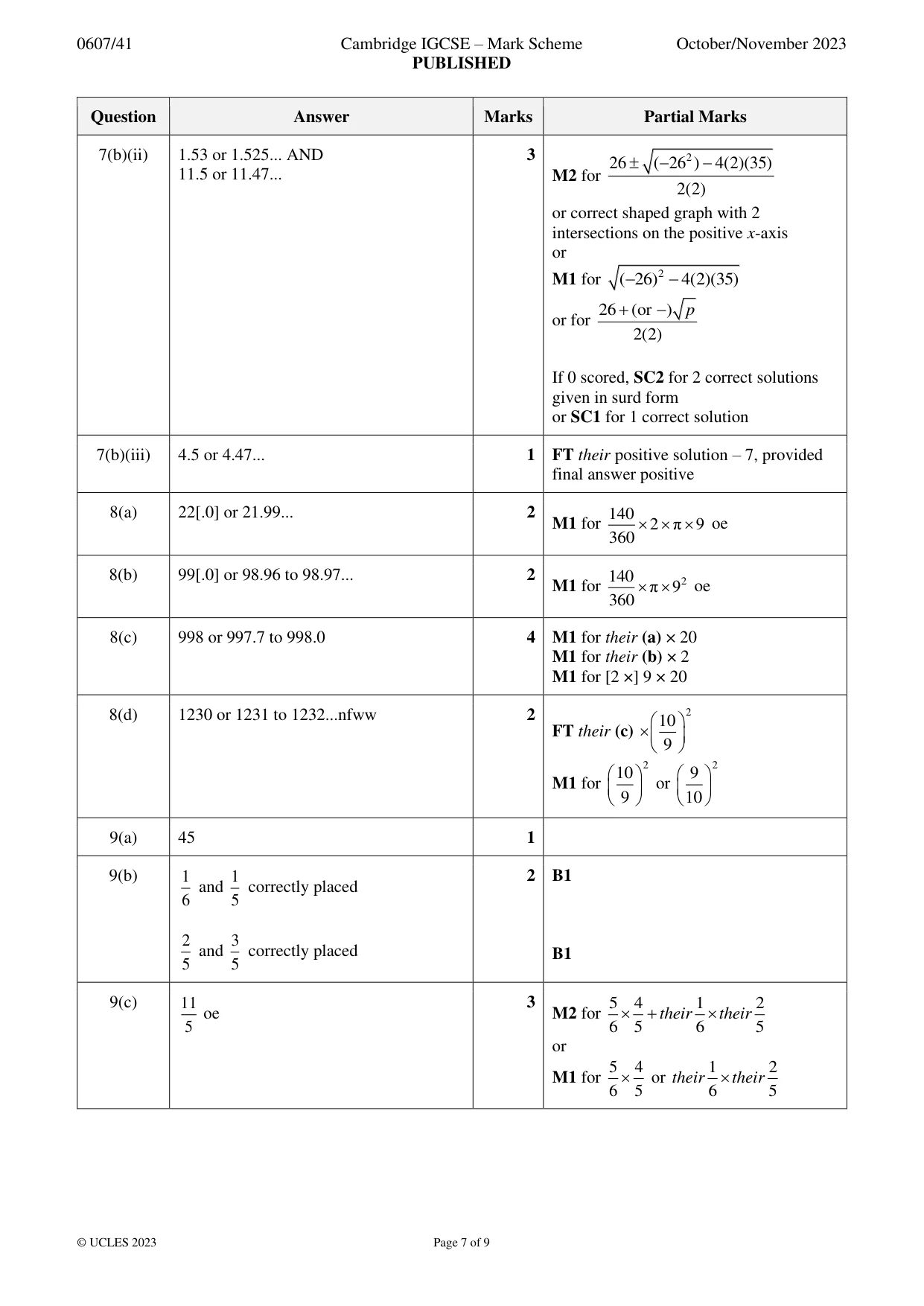
Mark scheme: 7(a) 8 3 B2 for x + 2x = 10 + 14 or better or M1 for x + 2(x – 5) = 14 oe 7(b)(i) 5 7 M1 + = 2 oe y y − 7 5(y – 7) + 7y = 2y(y – 7) M1 dep fractions correctly cleared dependent on equation with two different linear denominators leading to 2y2 – 26y + 35 = 0 A1 No errors or omissions 7(b)(ii) 1.53 or 1.525... AND 3 2 26 ( −26 ) − 4(2)(35) 11.5 or 11.47... M2 for 2(2) or correct shaped graph with 2 intersections on the positive x-axis or M1 for ( −26) 2 − 4(2)(35) 26 + (or −) p or for 2(2) If 0 scored, SC2 for 2 correct solutions given in surd form or SC1 for 1 correct solution 7(b)(iii) 4.5 or 4.47... 1 FT their positive solution – 7, provided final answer positive
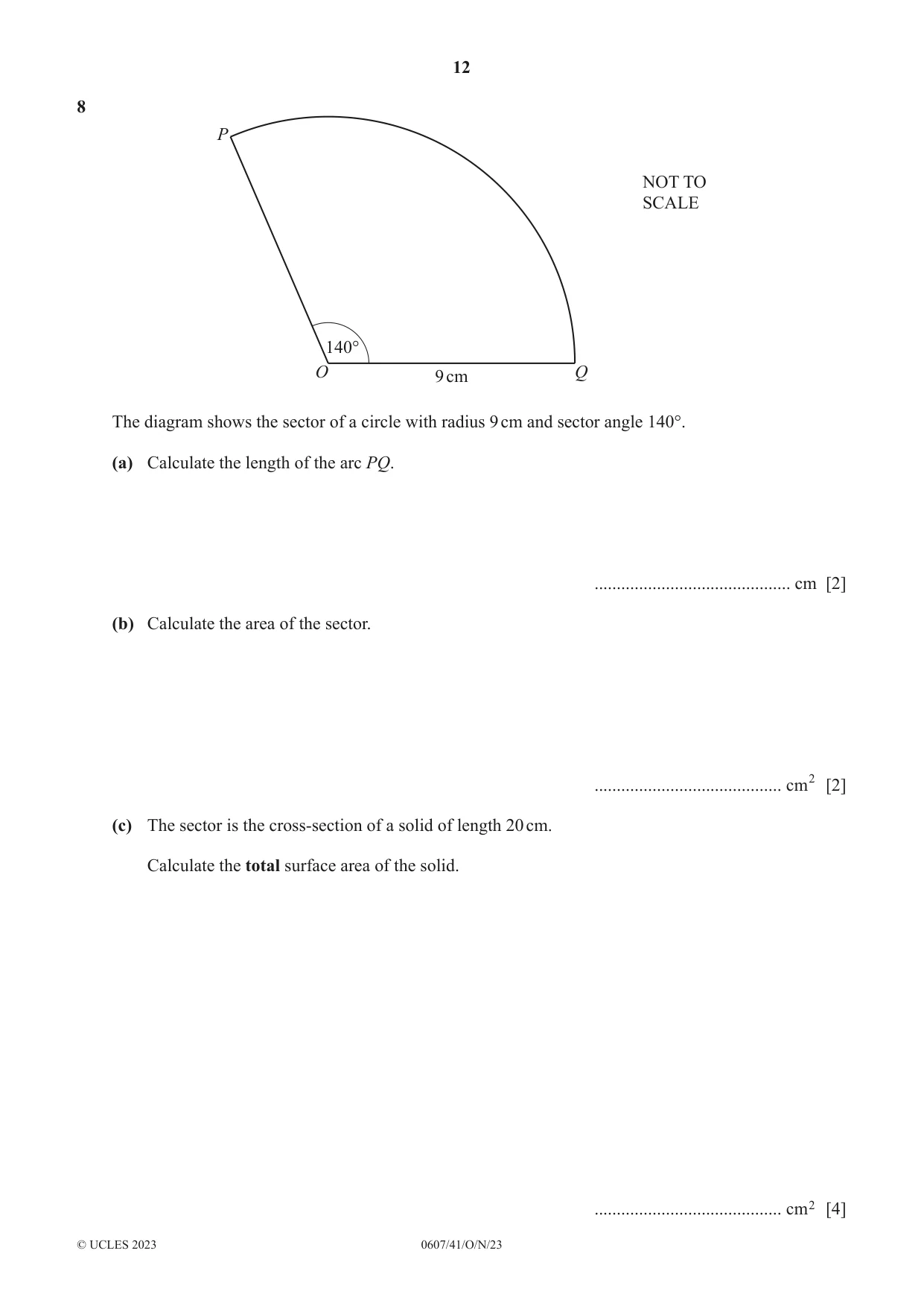
Q8 · P NOT TO SCALE 140° O 9 cm Q The diagram shows the sector of a circle with radius 9 cm…
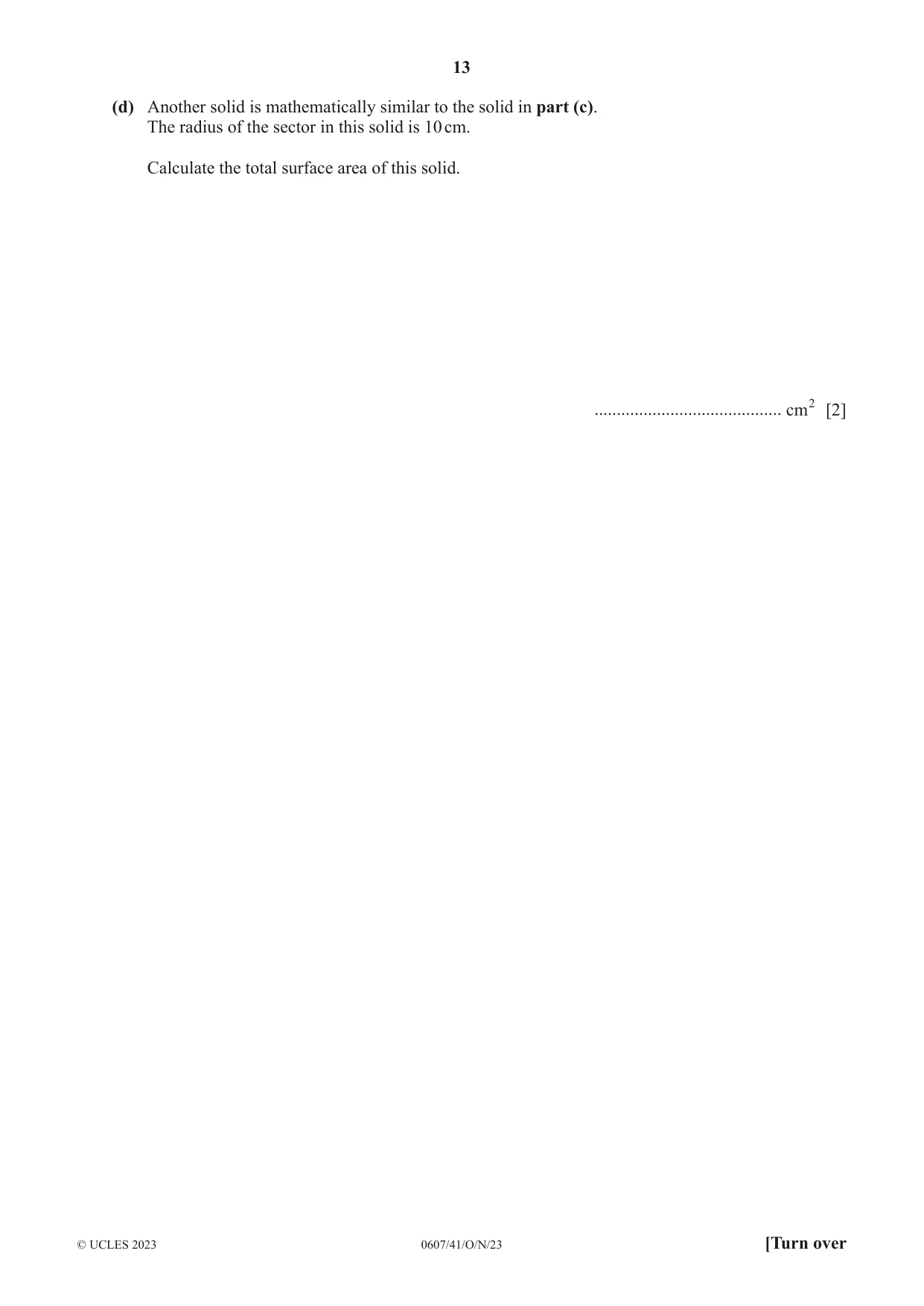
8 P NOT TO SCALE 140° O 9 cm Q The diagram shows the sector of a circle with radius 9 cm and sector angle 140°. (a) Calculate the length of the arc PQ. ............................................ cm [2] (b) Calculate the area of the sector. .......................................... cm2 [2] (c) The sector is the cross-section of a solid of length 20 cm. Calculate the total surface area of the solid. .......................................... cm2 [4] (d) Another solid is mathematically similar to the solid in part (c). The radius of the sector in this solid is 10 cm. Calculate the total surface area of this solid. .......................................... cm2 [2]
Mark scheme: 8(a) 22[.0] or 21.99... 2 140 M1 for 2 π 9 oe 360 8(b) 99[.0] or 98.96 to 98.97... 2 140 2 M1 for π 9 oe 360 8(c) 998 or 997.7 to 998.0 4 M1 for their (a) × 20 M1 for their (b) × 2 M1 for [2 ×] 9 × 20 8(d) 1230 or 1231 to 1232...nfww 2 2 10 FT their (c) 9 10 2 9 2 M1 for or 9 10
Q9 · On any day the probability that Samira cycles to school is 6
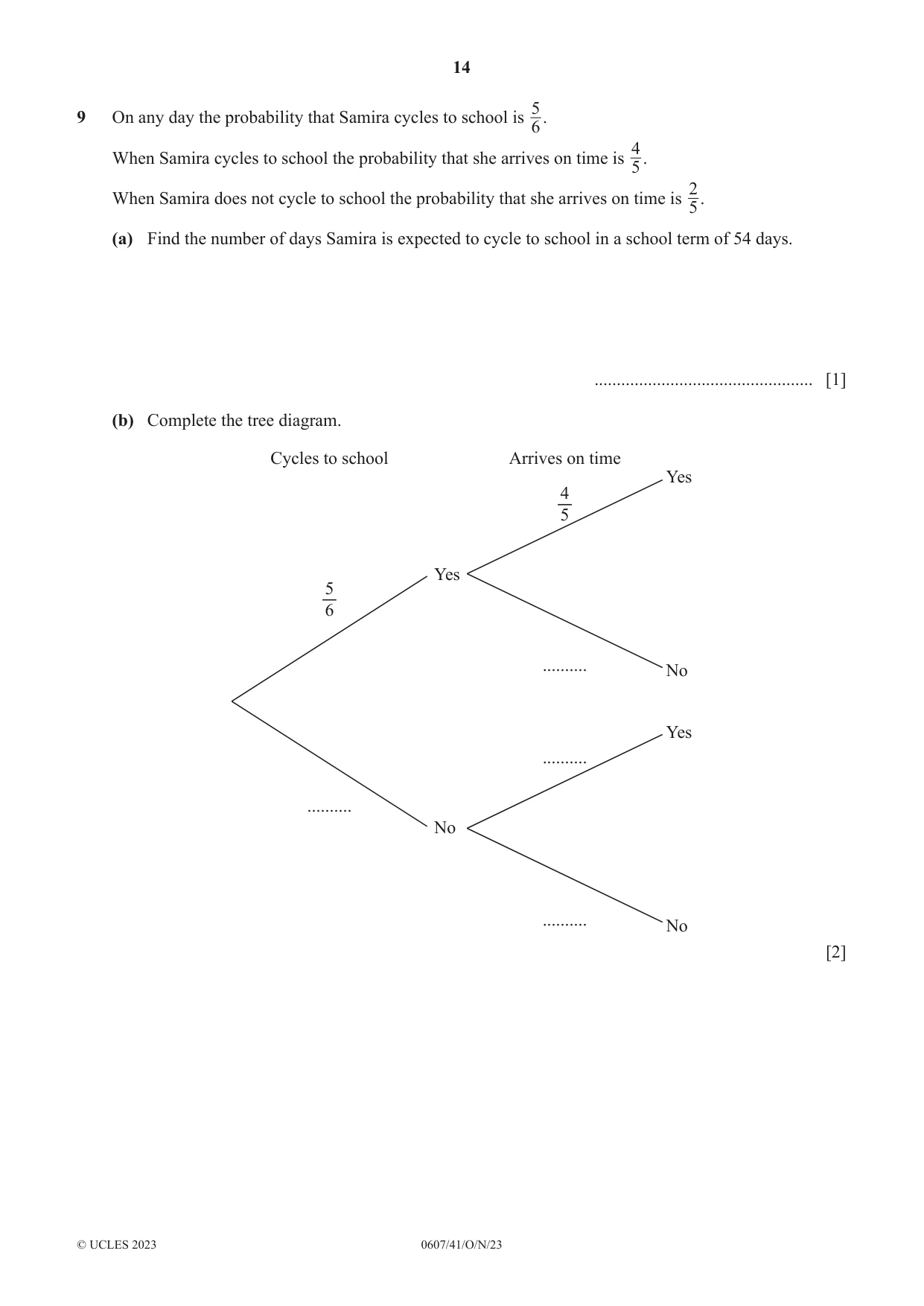
9 On any day the probability that Samira cycles to school is 6. When Samira cycles to school the probability that she arrives on time is 4. 5 When Samira does not cycle to school the probability that she arrives on time is 2. 5 (a) Find the number of days Samira is expected to cycle to school in a school term of 54 days. ................................................. [1] (b) Complete the tree diagram. Cycles to school Arrives on time Yes 4 5 Yes 5 6 .......... No Yes .......... .......... No .......... No [2] (c) Calculate the probability that on any day Samira arrives at school on time. ................................................. [3] (d) In a school week of 5 days, find the probability that Samira cycles to school on exactly 1 day. ................................................. [3]
Mark scheme: 9(a) 45 1 9(b) 1 1 2 B1 and correctly placed 6 5 2 3 and correctly placed B1 5 5 9(c) 11 3 5 4 1 2 oe M2 for + their their 5 6 5 6 5 or 5 4 1 2 M1 for or their their 6 5 6 5 9(d) 25 3 4 oe 5 1 oe M2 for their [ 5] 7776 6 6 or 5 1 k M1 for their , k > 1 6 6
Question 10
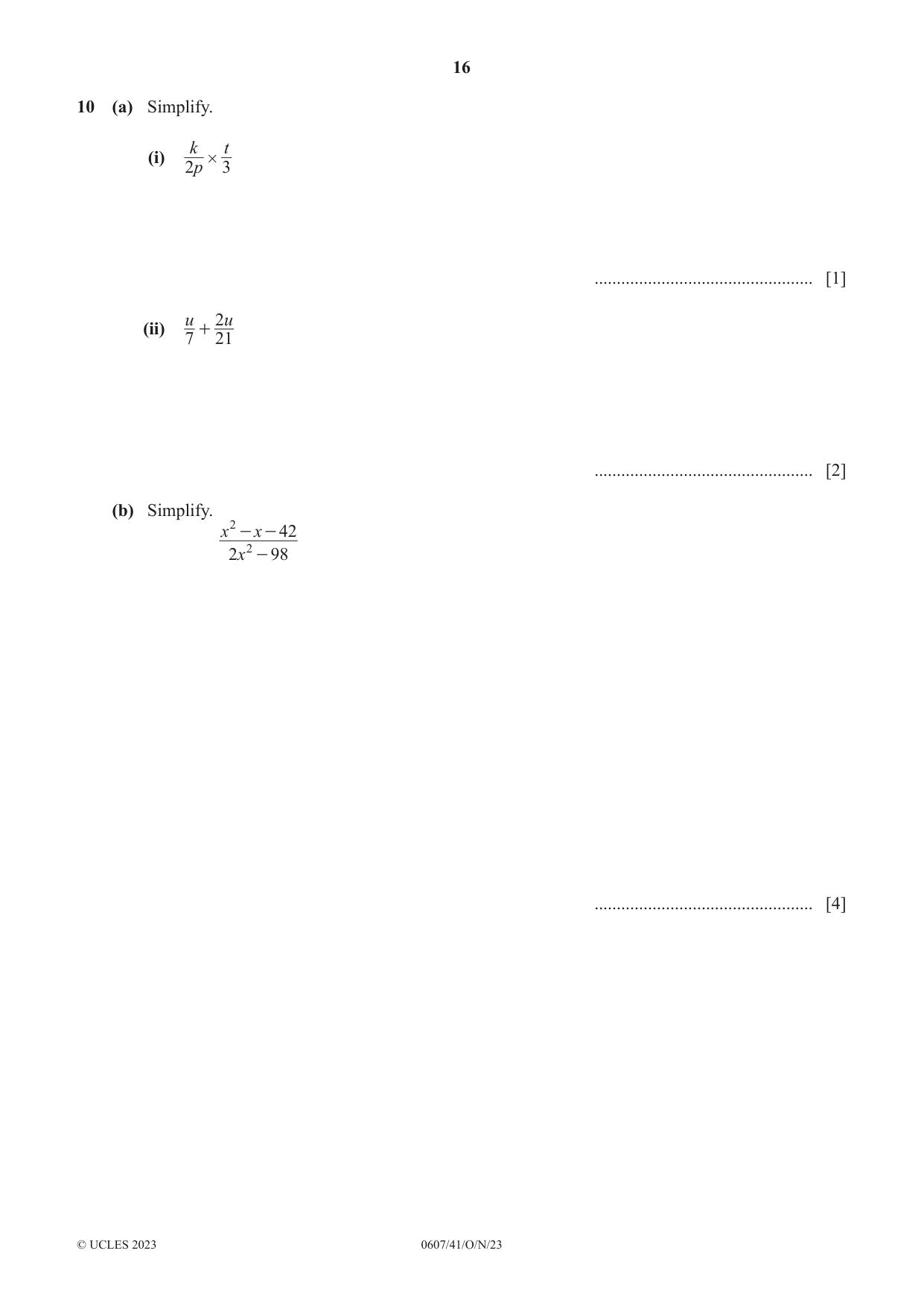
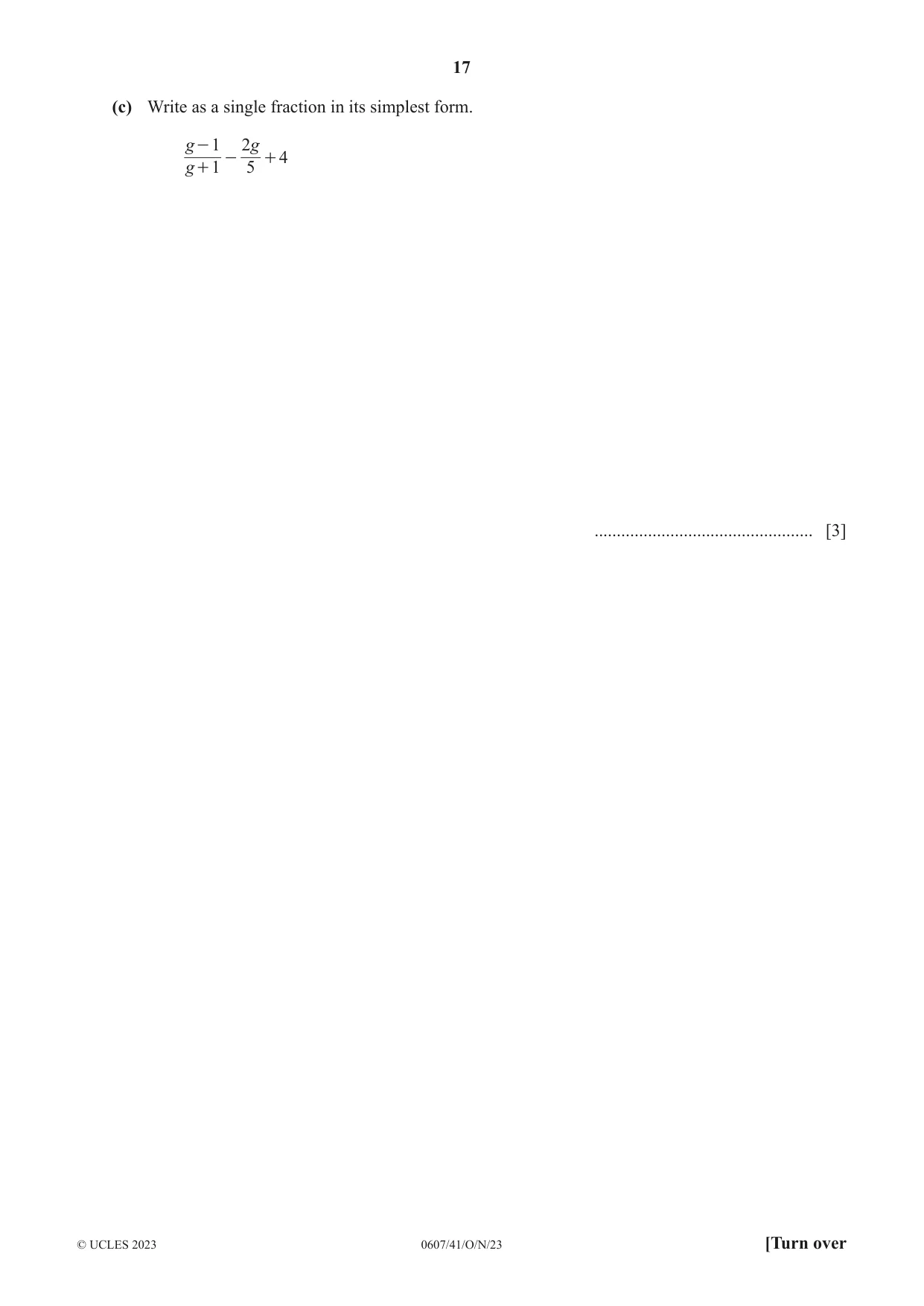
10 (a) Simplify. k t (i) # 2p 3 ................................................. [1] u 2u (ii) + 7 21 ................................................. [2] (b) Simplify. x 2 - x - 42 2x 2 - 98 ................................................. [4] (c) Write as a single fraction in its simplest form. g - 1 2g - + 4 g + 1 5 ................................................. [3]
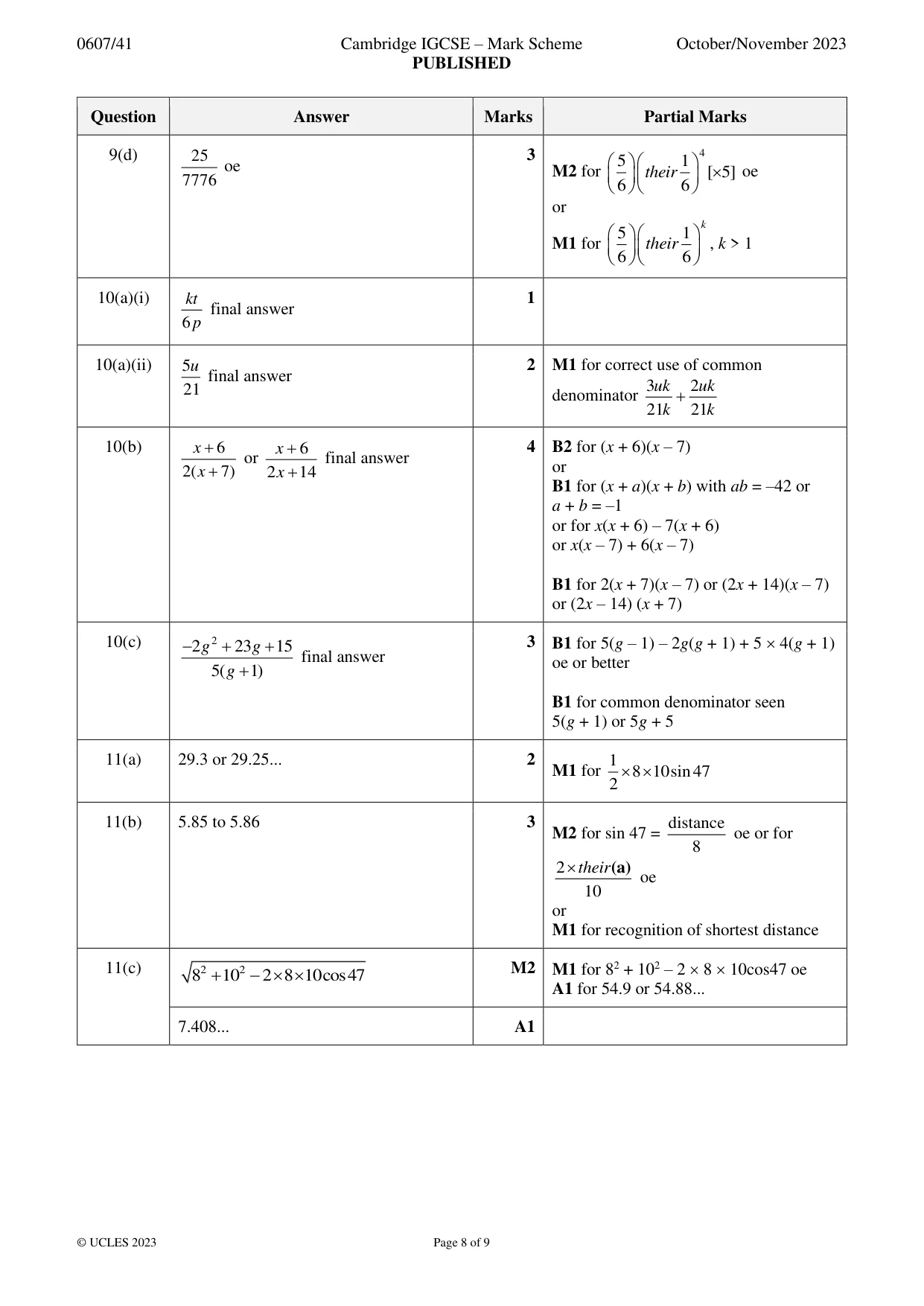
Mark scheme: 10(a)(i) kt 1 final answer 6 p 10(a)(ii) 5u 2 M1 for correct use of common final answer 21 3uk 2uk denominator + 21k 21k 10(b) x + 6 x + 6 4 B2 for (x + 6)(x – 7) or final answer or 2( x + 7) 2 x + 14 B1 for (x + a)(x + b) with ab = –42 or a + b = –1 or for x(x + 6) – 7(x + 6) or x(x – 7) + 6(x – 7) B1 for 2(x + 7)(x – 7) or (2x + 14)(x – 7) or (2x – 14) (x + 7) 10(c) −2 g 2 + 23 g + 15 3 B1 for 5(g – 1) – 2g(g + 1) + 5 4(g + 1) final answer oe or better 5( g + 1) B1 for common denominator seen 5(g + 1) or 5g + 5
Q11 · C NOT TO SCALE 8 cm 47° A B 10 cm (a) Calculate the area of triangle ABC
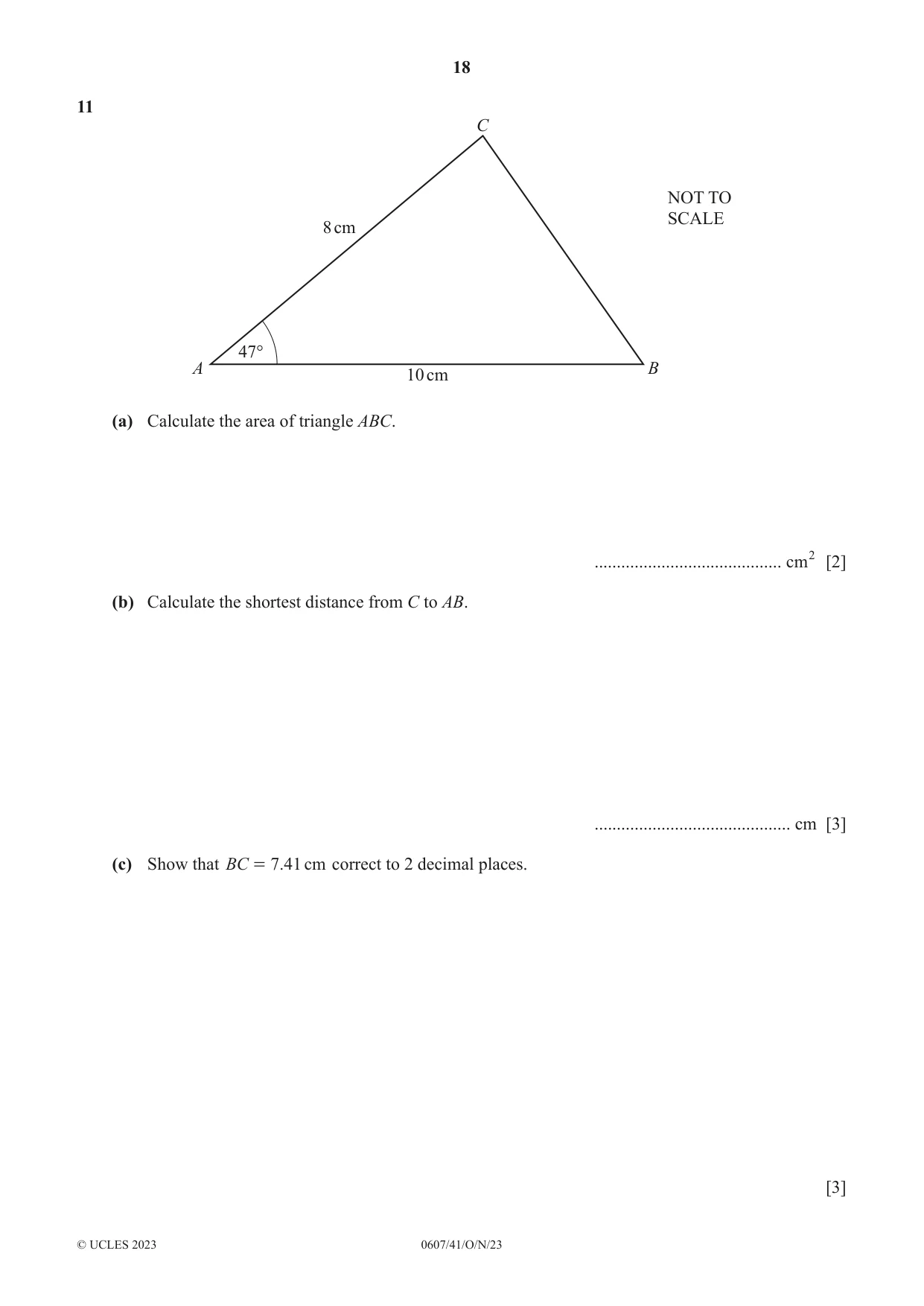
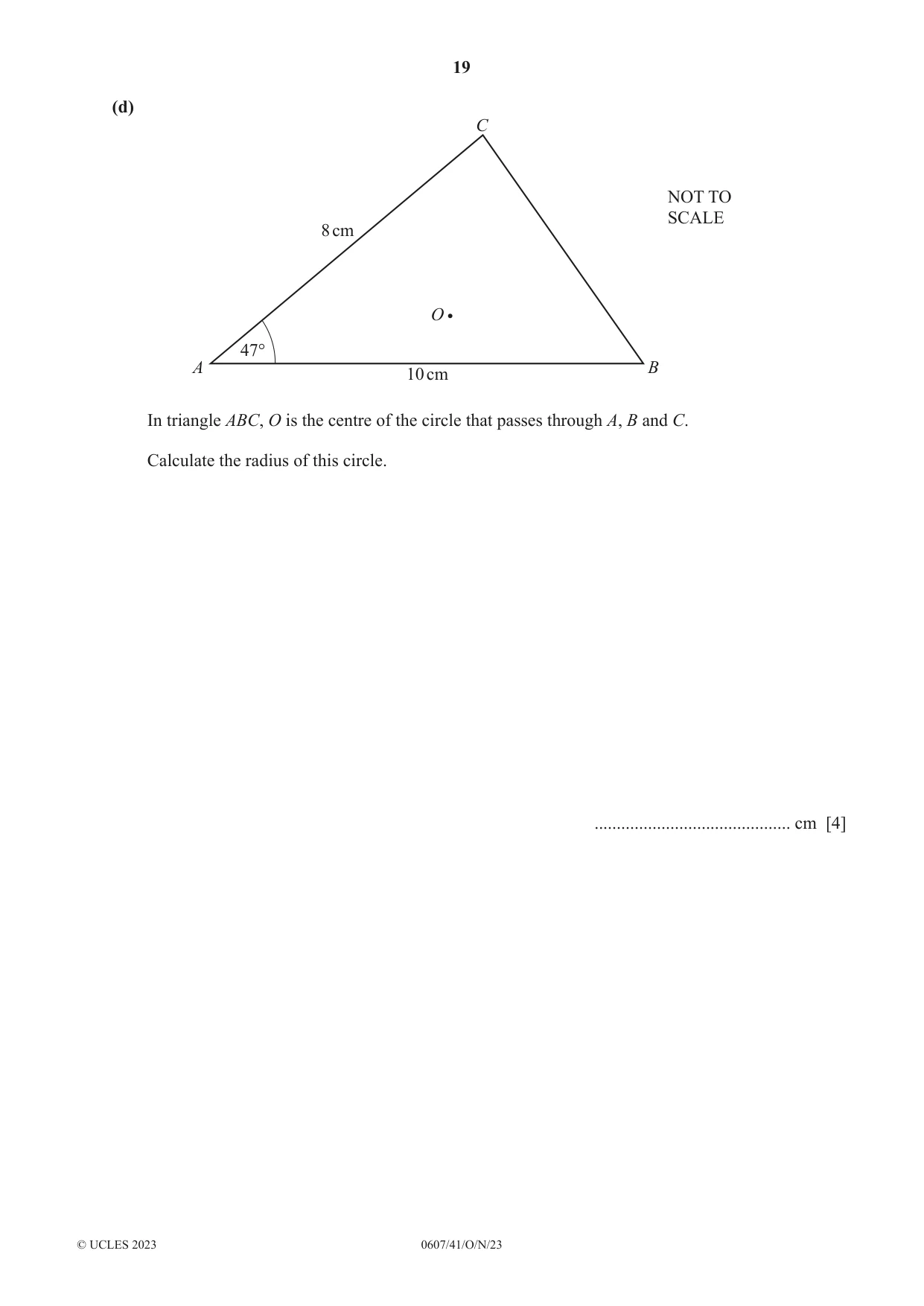
11 C NOT TO SCALE 8 cm 47° A B 10 cm (a) Calculate the area of triangle ABC. .......................................... cm2 [2] (b) Calculate the shortest distance from C to AB. ............................................ cm [3] (c) Show that BC = 7.41 cm correct to 2 decimal places. [3] (d) C NOT TO SCALE 8 cm O 47° A B 10 cm In triangle ABC, O is the centre of the circle that passes through A, B and C. Calculate the radius of this circle. ............................................ cm [4]
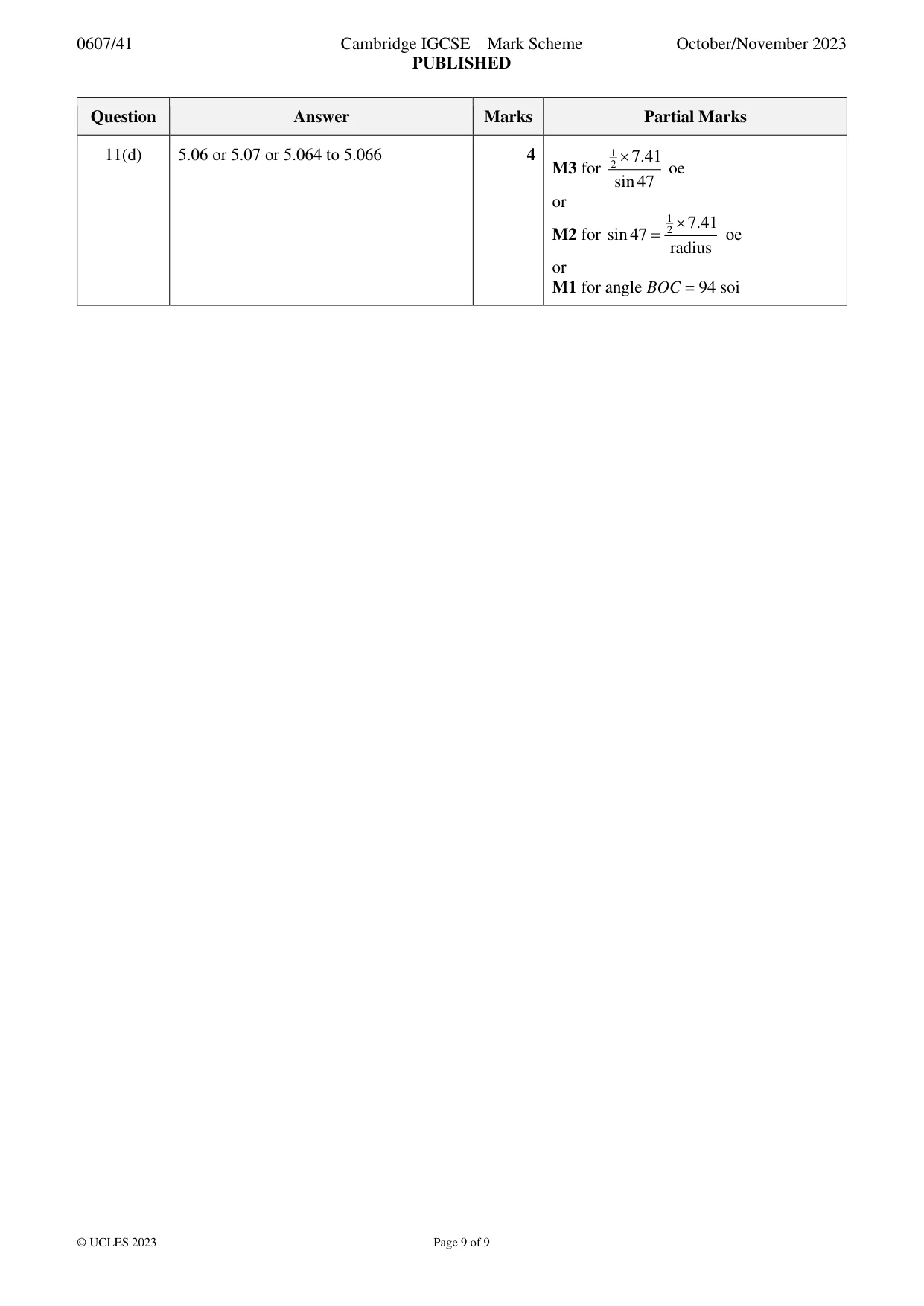
Mark scheme: 11(a) 29.3 or 29.25... 2 1 M1 for 8 10sin47 2 11(b) 5.85 to 5.86 3 distance M2 for sin 47 = oe or for 8 2 their(a) oe 10 or M1 for recognition of shortest distance 11(c) 2 2 M2 M1 for 82 + 102 – 2 8 10cos47 oe 8 + 10 −2 8 10cos47 A1 for 54.9 or 54.88... 7.408... A1 11(d) 5.06 or 5.07 or 5.064 to 5.066 4 1 2 7.41 M3 for oe sin 47 or 1 2 7.41 M2 for sin47 = oe radius or M1 for angle BOC = 94 soi
What was in this paper
The subtopics covered by these 11 questions, and how many questions each got. Open one in a new tab to see every Cambridge question on it.
What you needed in this session
Cambridge’s own grade thresholds for 2023 Oct/Nov, Paper 4 · Variant 1. A higher threshold means an easier paper — the bar moves with how the cohort did.