Cambridge IGCSE Mathematics - International 0607 — 2021 Feb/March Paper 4 · Variant 2
0607/42/F/M/21 · 11 questions · 120 marks · ≈135 min
The question paper and its mark scheme, free to read here and free to download. This is Cambridge’s own paper, exactly as it was sat.
Question paper20 pages
Mark scheme9 pages
Answers below. Sit the paper first if you are practising.
Questions as text
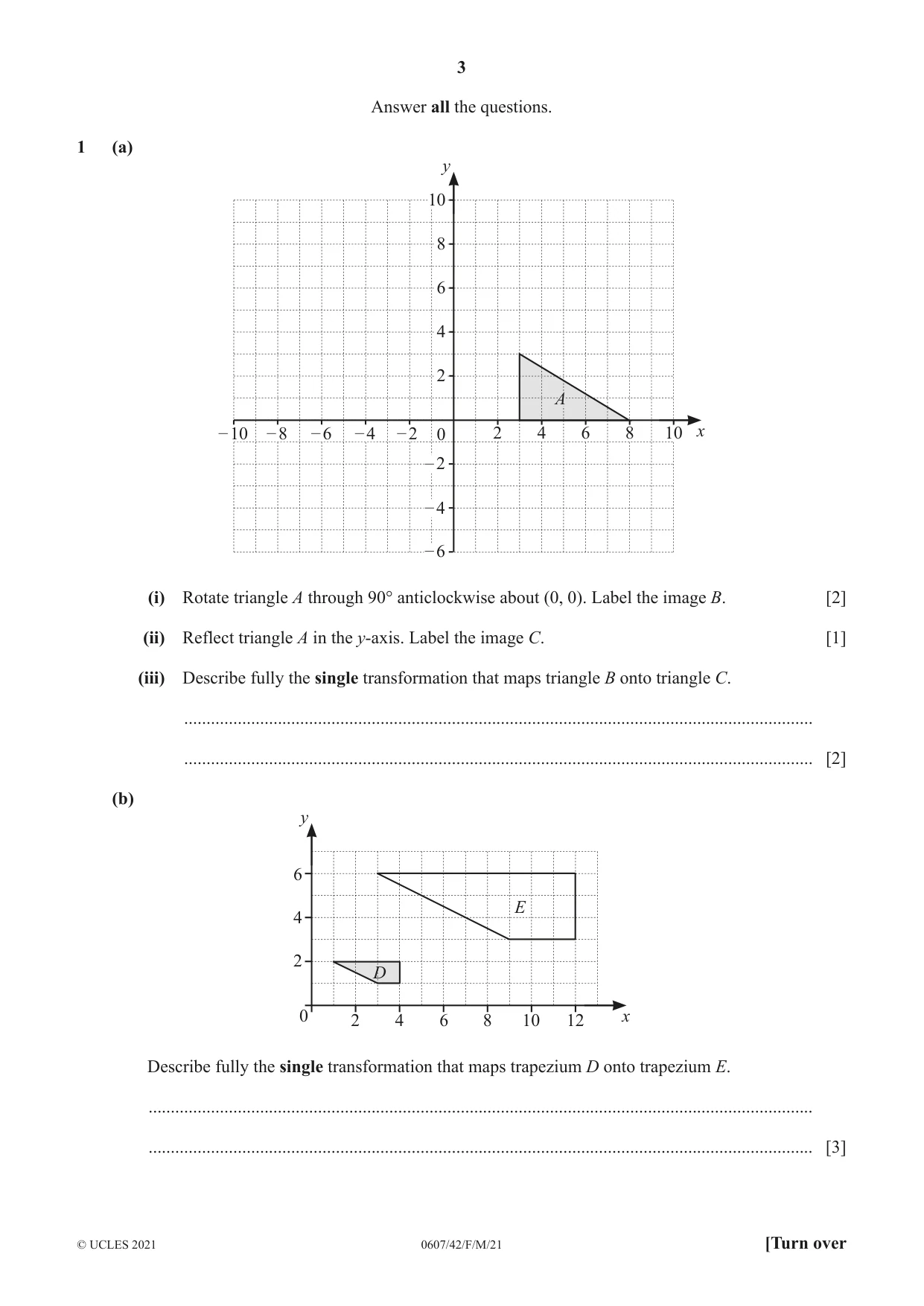
Q1 · Y 10 8 6 4 2 A – 10 – 8 – 6 – 4 – 2 0 2 4 6 8 10 x – 2 – 4 – 6 (i) Rotate triangle A…
1 (a) y 10 8 6 4 2 A – 10 – 8 – 6 – 4 – 2 0 2 4 6 8 10 x – 2 – 4 – 6 (i) Rotate triangle A through 90° anticlockwise about (0, 0). Label the image B. [2] (ii) Reflect triangle A in the y-axis. Label the image C. [1] (iii) Describe fully the single transformation that maps triangle B onto triangle C. ............................................................................................................................................. ............................................................................................................................................. [2] (b) y 6 E E 4 2 DD 0 2 4 6 8 10 12 x Describe fully the single transformation that maps trapezium D onto trapezium E. ..................................................................................................................................................... ..................................................................................................................................................... [3]
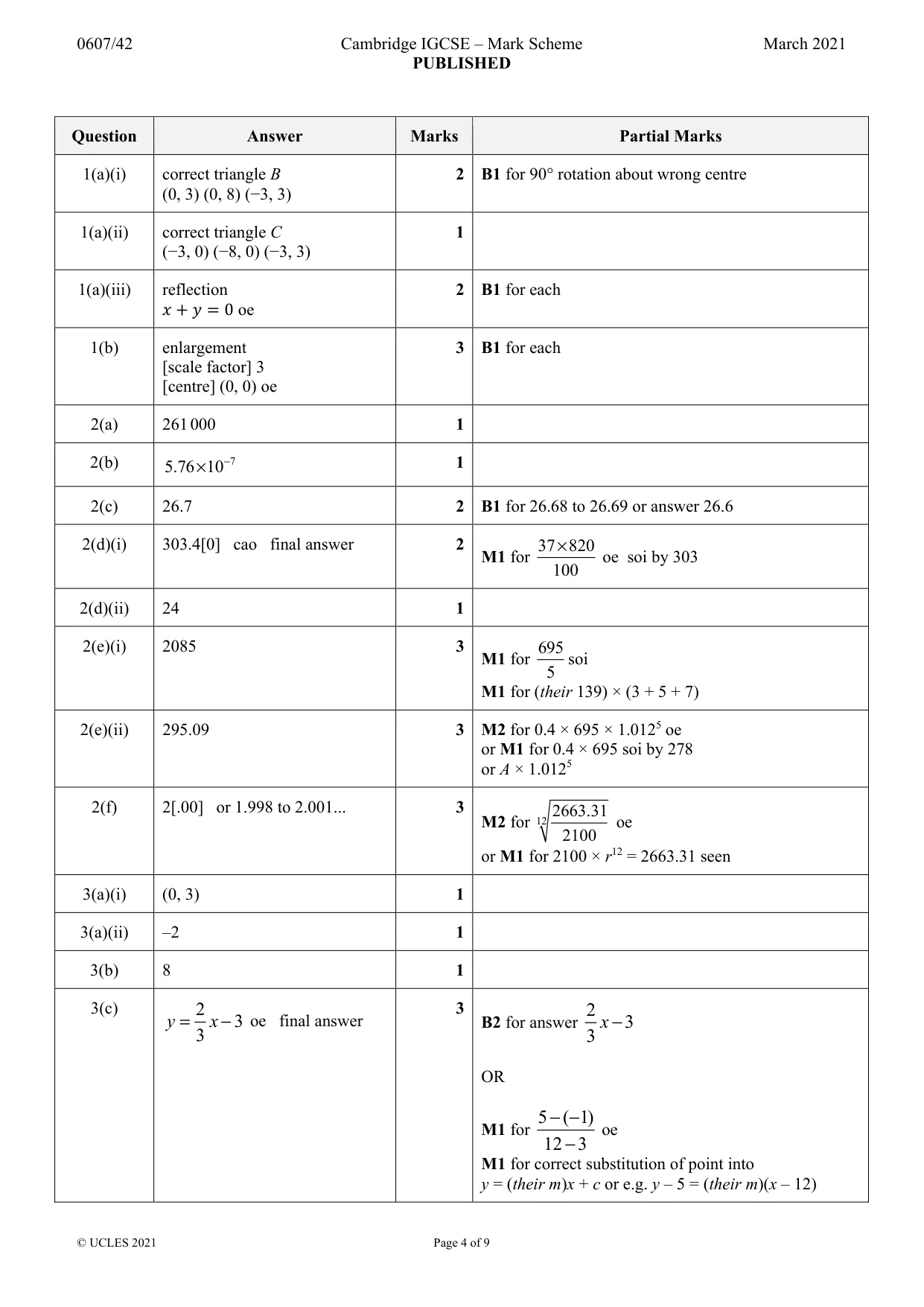
Mark scheme: Question Answer Marks Partial Marks 1(a)(i) correct triangle B 2 B1 for 90° rotation about wrong centre (0, 3) (0, 8) (−3, 3) 1(a)(ii) correct triangle C 1 (−3, 0) (−8, 0) (−3, 3) 1(a)(iii) reflection 2 B1 for each 𝑥+ 𝑦= 0 oe 1(b) enlargement 3 B1 for each [scale factor] 3 [centre] (0, 0) oe
Q2 · Write 260 512 correct to 3 significant figures
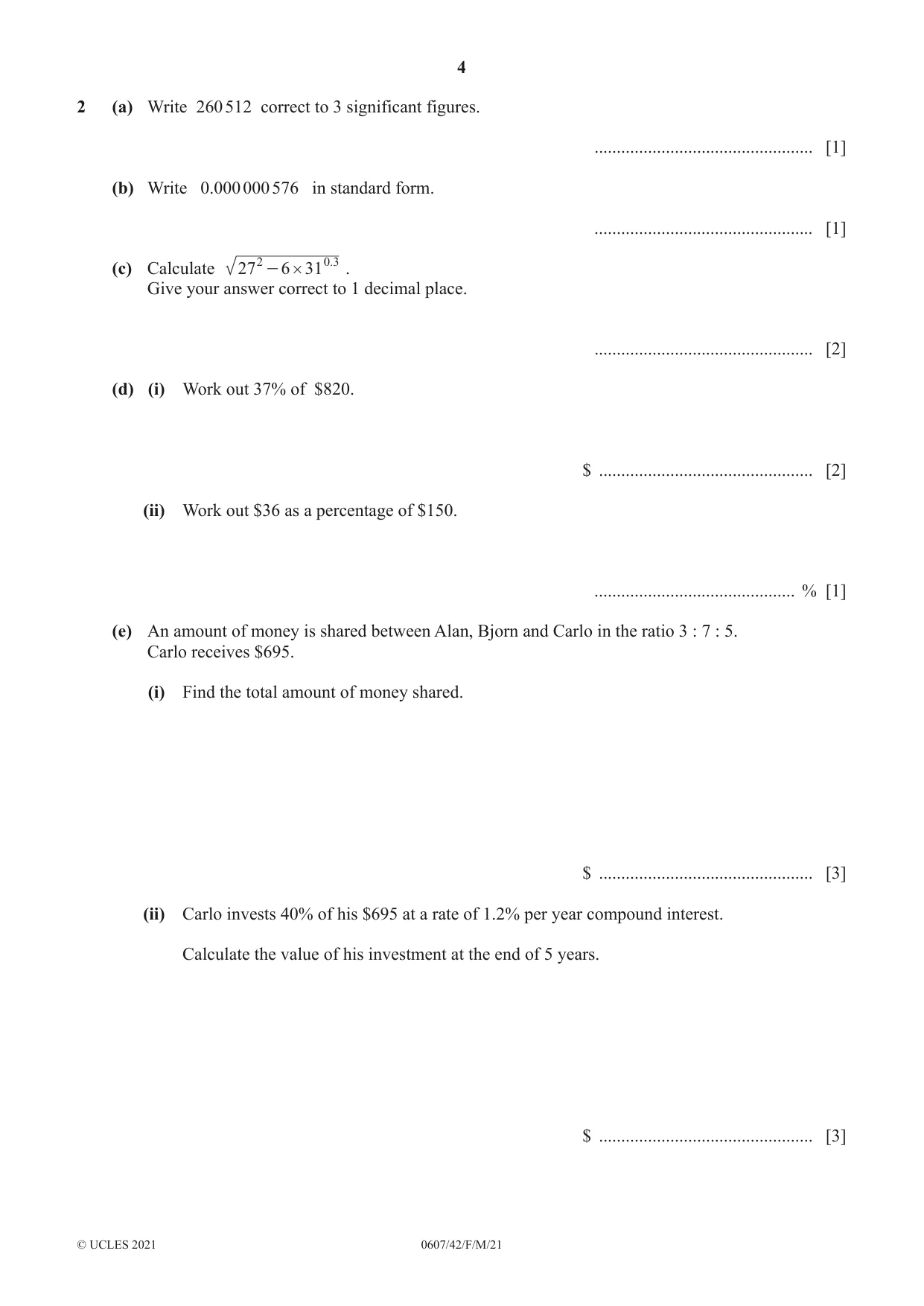
2 (a) Write 260 512 correct to 3 significant figures. ................................................. [1] (b) Write 0.000 000 576 in standard form. ................................................. [1] (c) Calculate 27 2 - 6 # 31 0 .3 . Give your answer correct to 1 decimal place. ................................................. [2] (d) (i) Work out 37% of $820. $ ................................................ [2] (ii) Work out $36 as a percentage of $150. ............................................. % [1] (e) An amount of money is shared between Alan, Bjorn and Carlo in the ratio 3 : 7 : 5. Carlo receives $695. (i) Find the total amount of money shared. $ ................................................ [3] (ii) Carlo invests 40% of his $695 at a rate of 1.2% per year compound interest. Calculate the value of his investment at the end of 5 years. $ ................................................ [3] (f) Dana invests $2100 for 12 years at a rate of x% per year compound interest. At the end of the 12 years, the value of her investment is $2663.31 . Calculate the value of x. x = ................................................ [3]
Mark scheme: 2(a) 261 000 1 2(b) 5.76 × 10⁻⁷ 1 2(c) 26.7 2 B1 for 26.68 to 26.69 or answer 26.6 2(d)(i) 303.4[0] cao final answer 2 37 × 820 M1 for oe soi by 303 100 2(d)(ii) 24 1 2(e)(i) 2085 3 695 M1 for soi 5 M1 for (their 139) × (3 + 5 + 7) 2(e)(ii) 295.09 3 M2 for 0.4 × 695 × 1.0125 oe or M1 for 0.4 × 695 soi by 278 or A × 1.0125 2(f) 2[.00] or 1.998 to 2.001... 3 2663.31 M2 for 12 oe 2100 or M1 for 2100 × r12 = 2663.31 seen
Q3 · Write down the coordinates of the point where the line y =- 2x + 3 crosses the y-axis
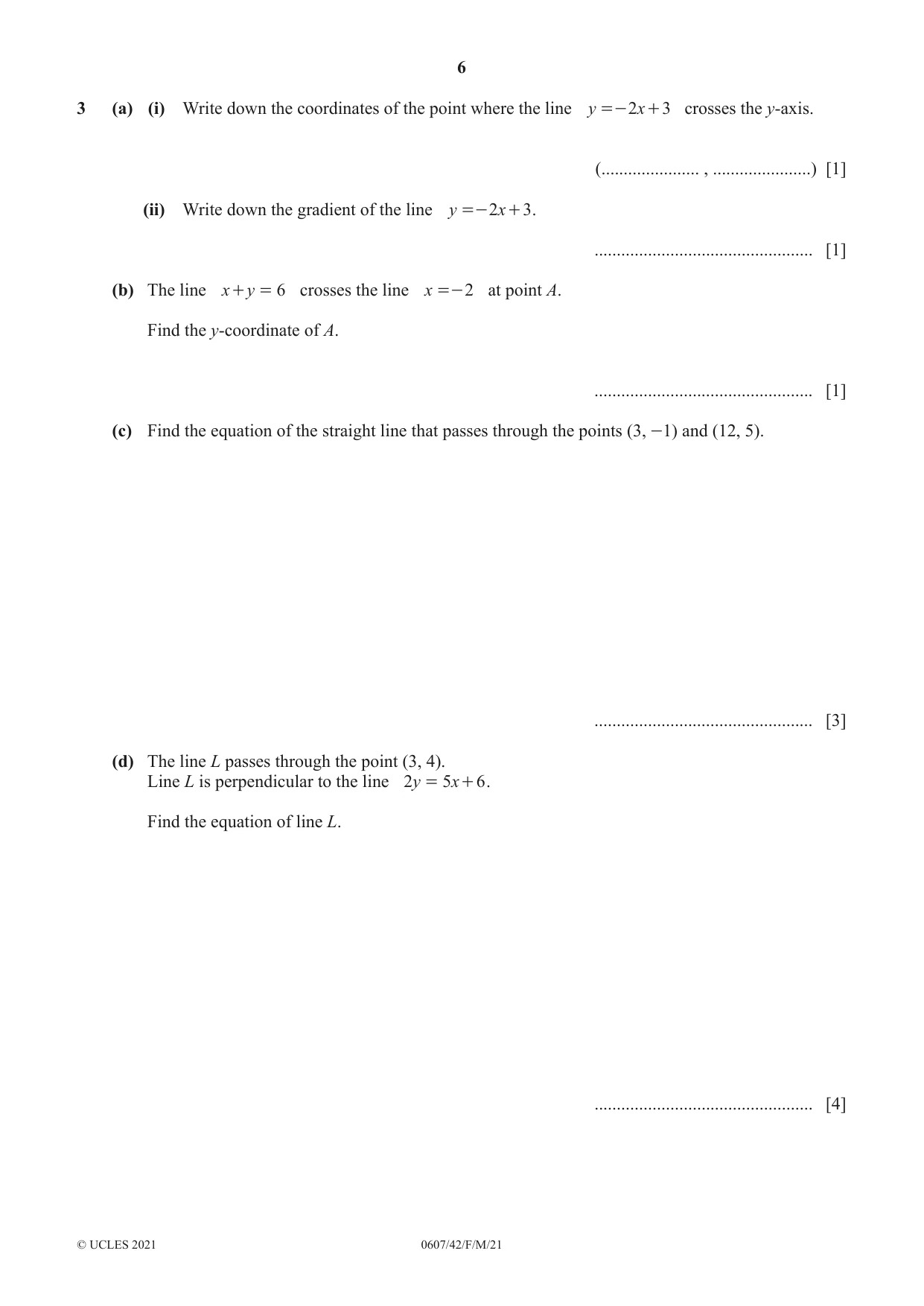
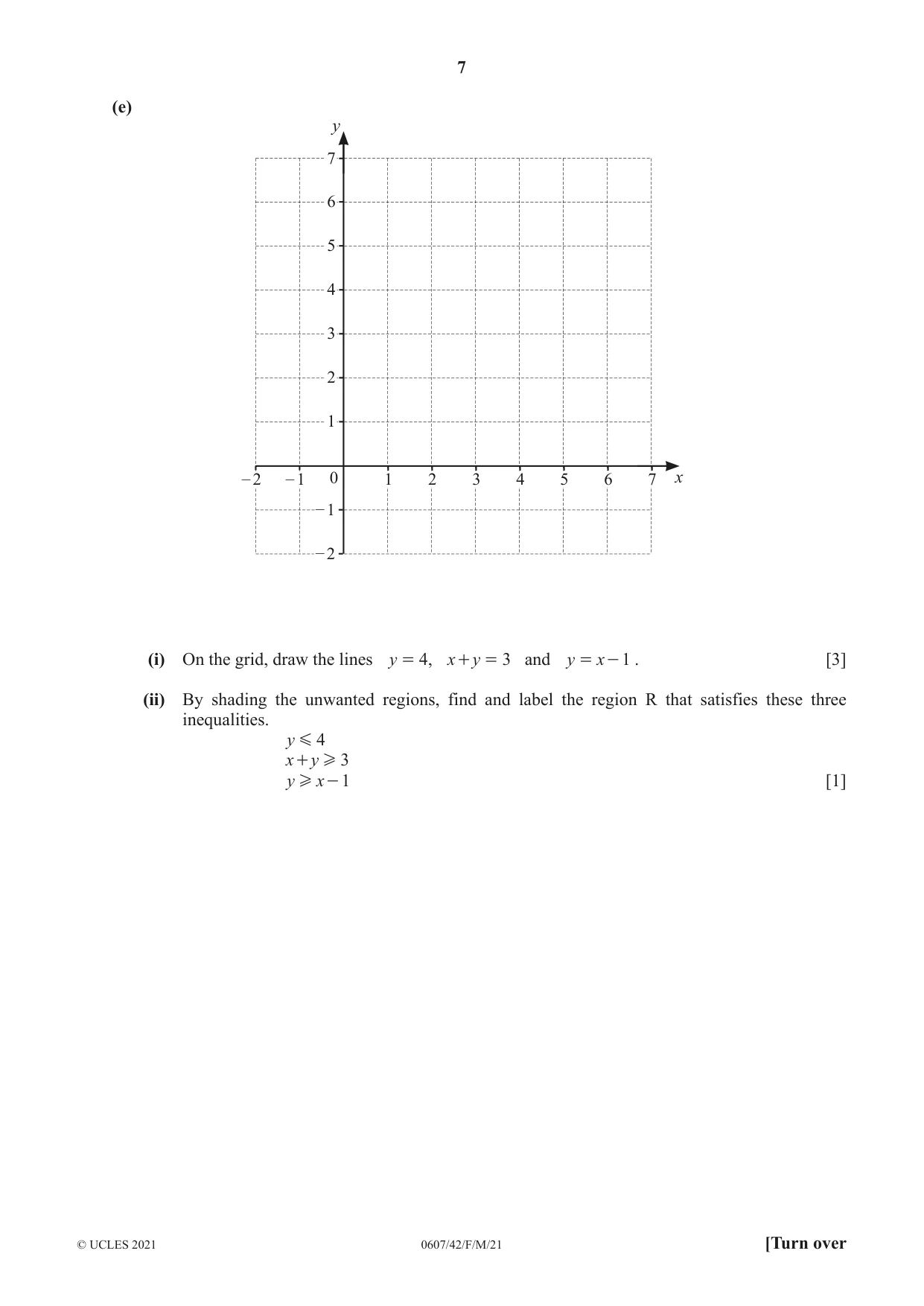
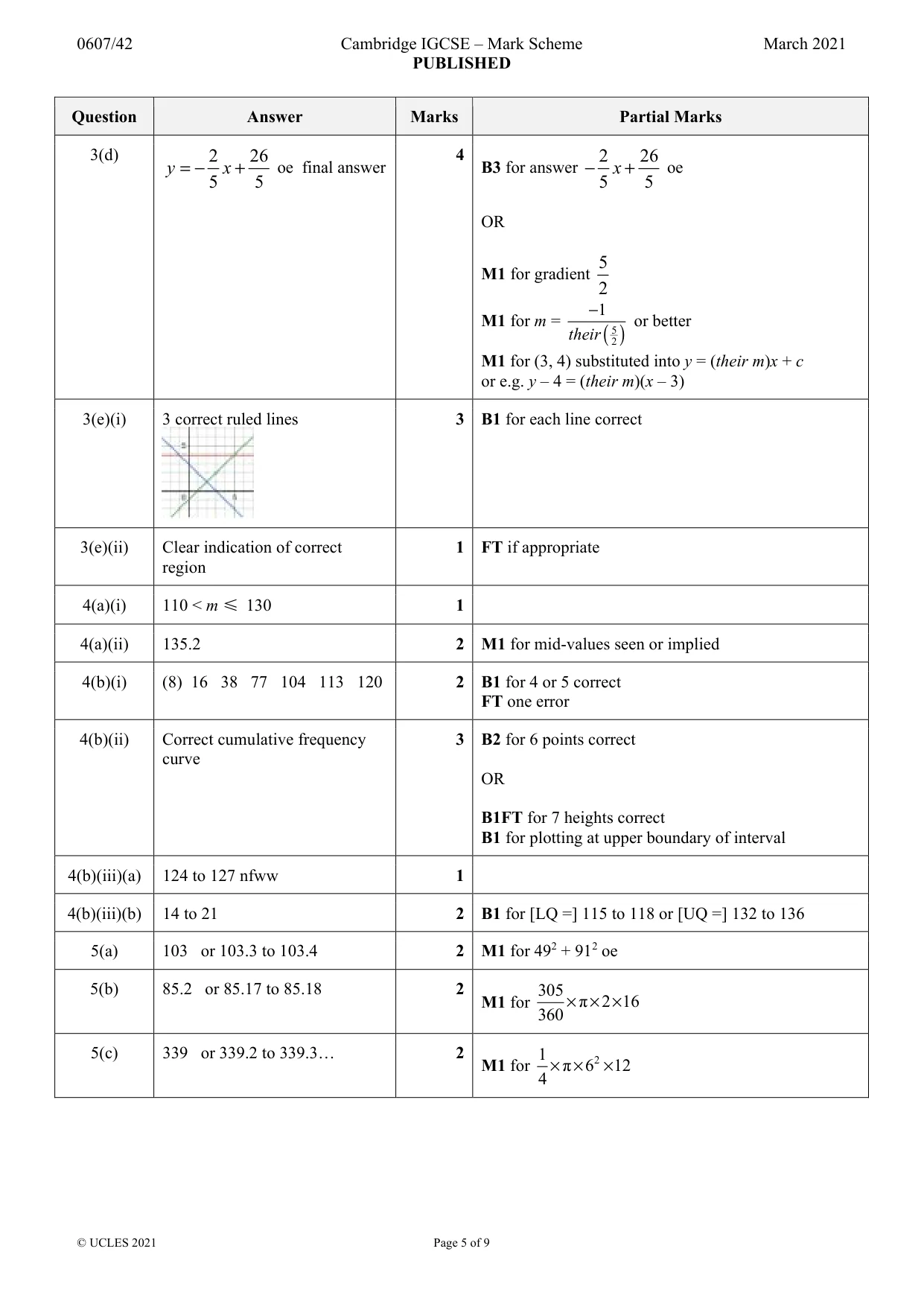
3 (a) (i) Write down the coordinates of the point where the line y =- 2x + 3 crosses the y-axis. (...................... , ......................) [1] (ii) Write down the gradient of the line y =- 2x + 3 . ................................................. [1] (b) The line x + y = 6 crosses the line x =- 2 at point A. Find the y-coordinate of A. ................................................. [1] (c) Find the equation of the straight line that passes through the points (3, -1) and (12, 5). ................................................. [3] (d) The line L passes through the point (3, 4). Line L is perpendicular to the line 2y = 5x + 6 . Find the equation of line L. ................................................. [4] (e) y 7 6 5 4 3 2 1 – 2 – 1 0 1 2 3 4 5 6 7 x – 1 – 2 (i) On the grid, draw the lines y = 4, x + y = 3 and y = x - 1 . [3] (ii) By shading the unwanted regions, find and label the region R that satisfies these three inequalities. y G 4 x + y H 3 y H x - 1 [1]
Mark scheme: 3(a)(i) (0, 3) 1 3(a)(ii) –2 1 3(b) 8 1 3(c) 2 3 2 y = x − 3 oe final answer B2 for answer x − 3 3 3 OR 5 −−( 1) M1 for oe 12 − 3 M1 for correct substitution of point into y = (their m)x + c or e.g. y – 5 = (their m)(x – 12) 3(d) 2 26 4 2 26 y = − x + oe final answer B3 for answer − x + oe 5 5 5 5 OR 5 M1 for gradient 2 −1 M1 for m = or better their ( 52 ) M1 for (3, 4) substituted into y = (their m)x + c or e.g. y – 4 = (their m)(x – 3) 3(e)(i) 3 correct ruled lines 3 B1 for each line correct 3(e)(ii) Clear indication of correct 1 FT if appropriate region
Q4 · The mass, m grams, of each of 50 apples is found
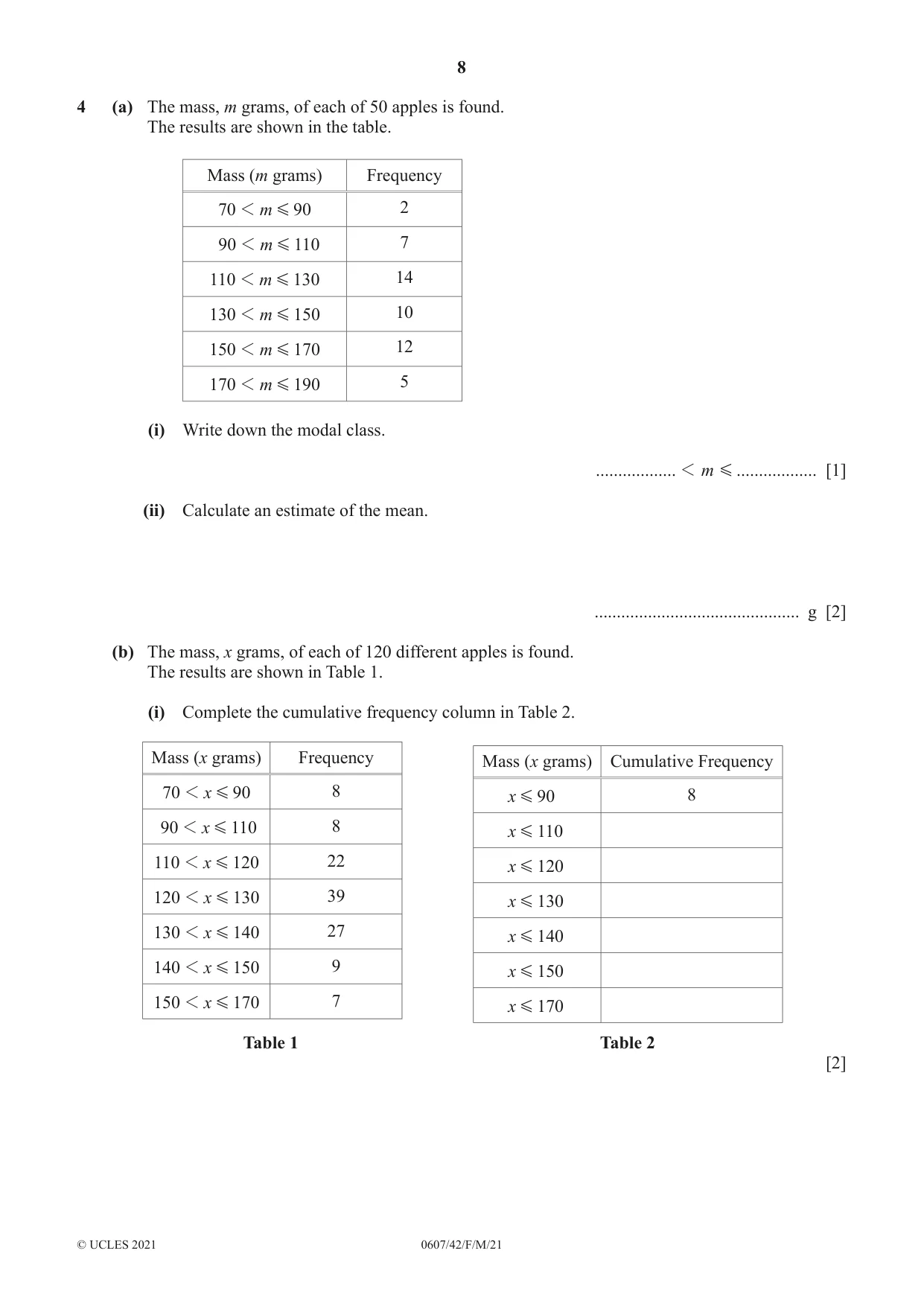
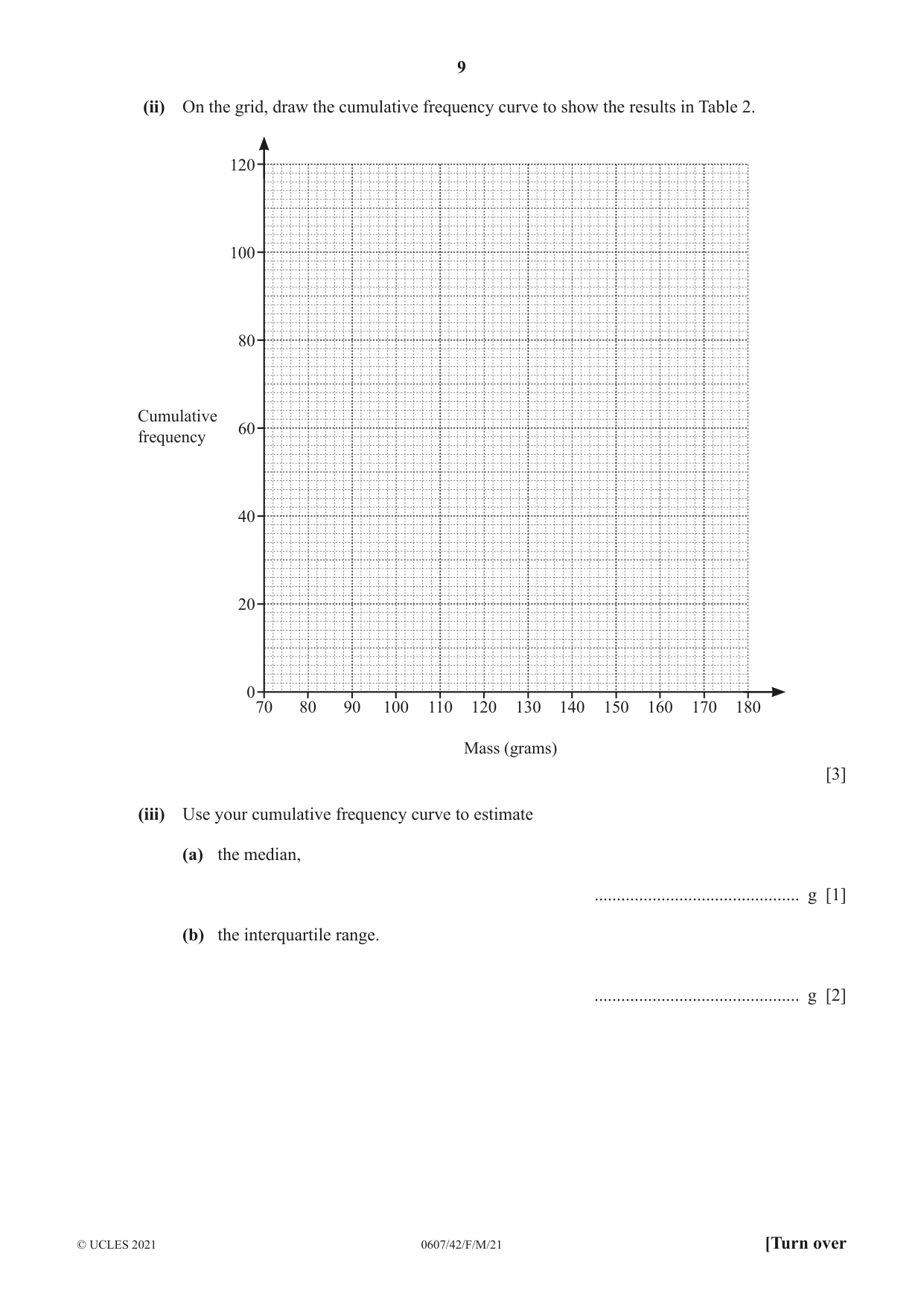
4 (a) The mass, m grams, of each of 50 apples is found. The results are shown in the table. Mass (m grams) Frequency 70 1 m G 90 2 90 1 m G 110 7 110 1 m G 130 14 130 1 m G 150 10 150 1 m G 170 12 170 1 m G 190 5 (i) Write down the modal class. .................. 1 m G .................. [1] (ii) Calculate an estimate of the mean. .............................................. g [2] (b) The mass, x grams, of each of 120 different apples is found. The results are shown in Table 1. (i) Complete the cumulative frequency column in Table 2. Mass (x grams) Frequency Mass (x grams) Cumulative Frequency 70 1 x G 90 8 x G 90 8 90 1 x G 110 8 x G 110 110 1 x G 120 22 x G 120 120 1 x G 130 39 x G 130 130 1 x G 140 27 x G 140 140 1 x G 150 9 x G 150 150 1 x G 170 7 x G 170 Table 1 Table 2 [2] (ii) On the grid, draw the cumulative frequency curve to show the results in Table 2. 120 100 80 Cumulative 60frequency 40 20 0 70 80 90 100 110 120 130 140 150 160 170 180 Mass (grams) [3] (iii) Use your cumulative frequency curve to estimate (a) the median, .............................................. g [1] (b) the interquartile range. .............................................. g [2]
Mark scheme: 4(a)(i) 110 < m ≤ 130 1 4(a)(ii) 135.2 2 M1 for mid-values seen or implied 4(b)(i) (8) 16 38 77 104 113 120 2 B1 for 4 or 5 correct FT one error 4(b)(ii) Correct cumulative frequency 3 B2 for 6 points correct curve OR B1FT for 7 heights correct B1 for plotting at upper boundary of interval 4(b)(iii)(a) 124 to 127 nfww 1 4(b)(iii)(b) 14 to 21 2 B1 for [LQ =] 115 to 118 or [UQ =] 132 to 136
Q5 · B 49 mm NOT TO 91 mm SCALE A C Calculate the length of AC
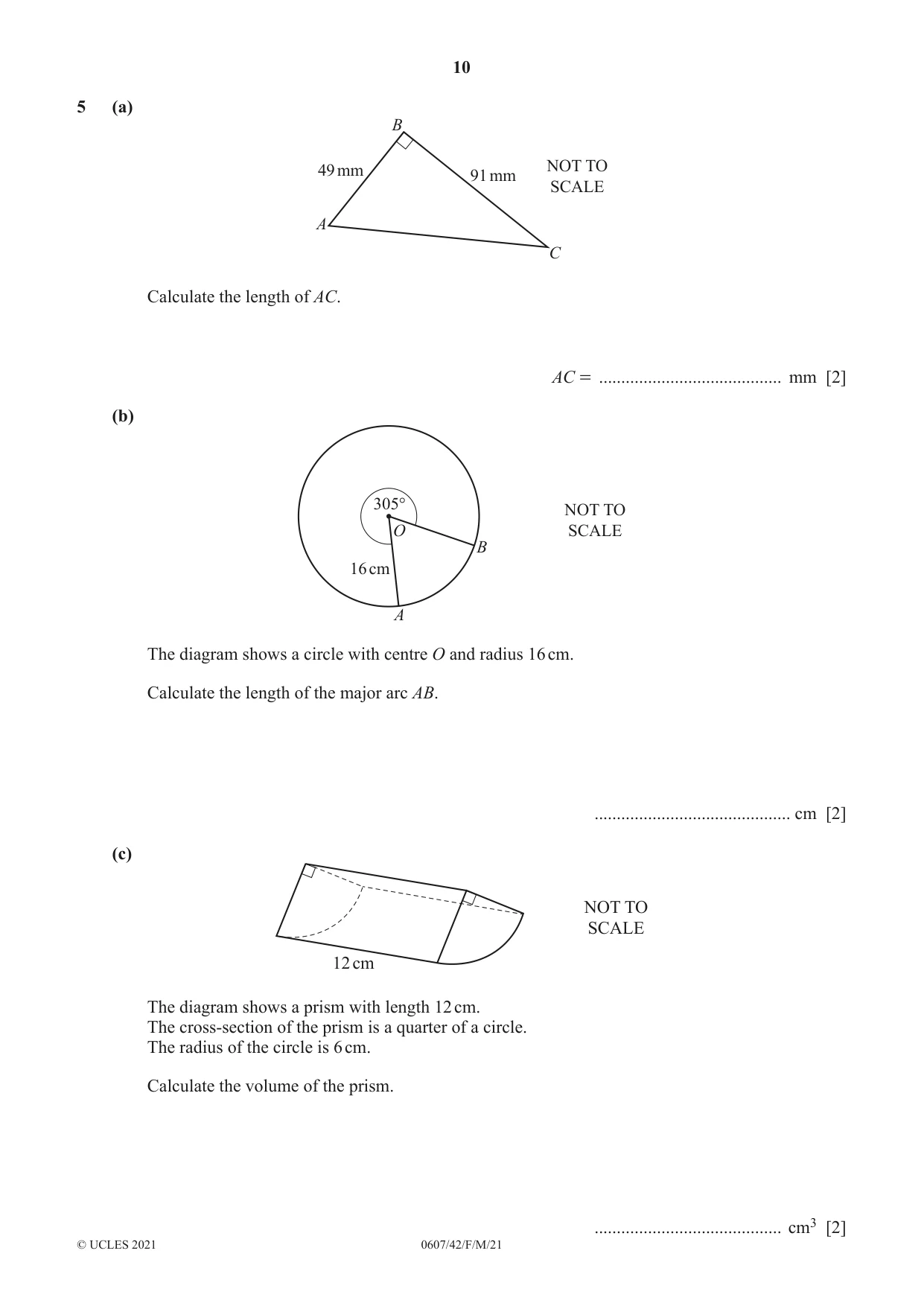
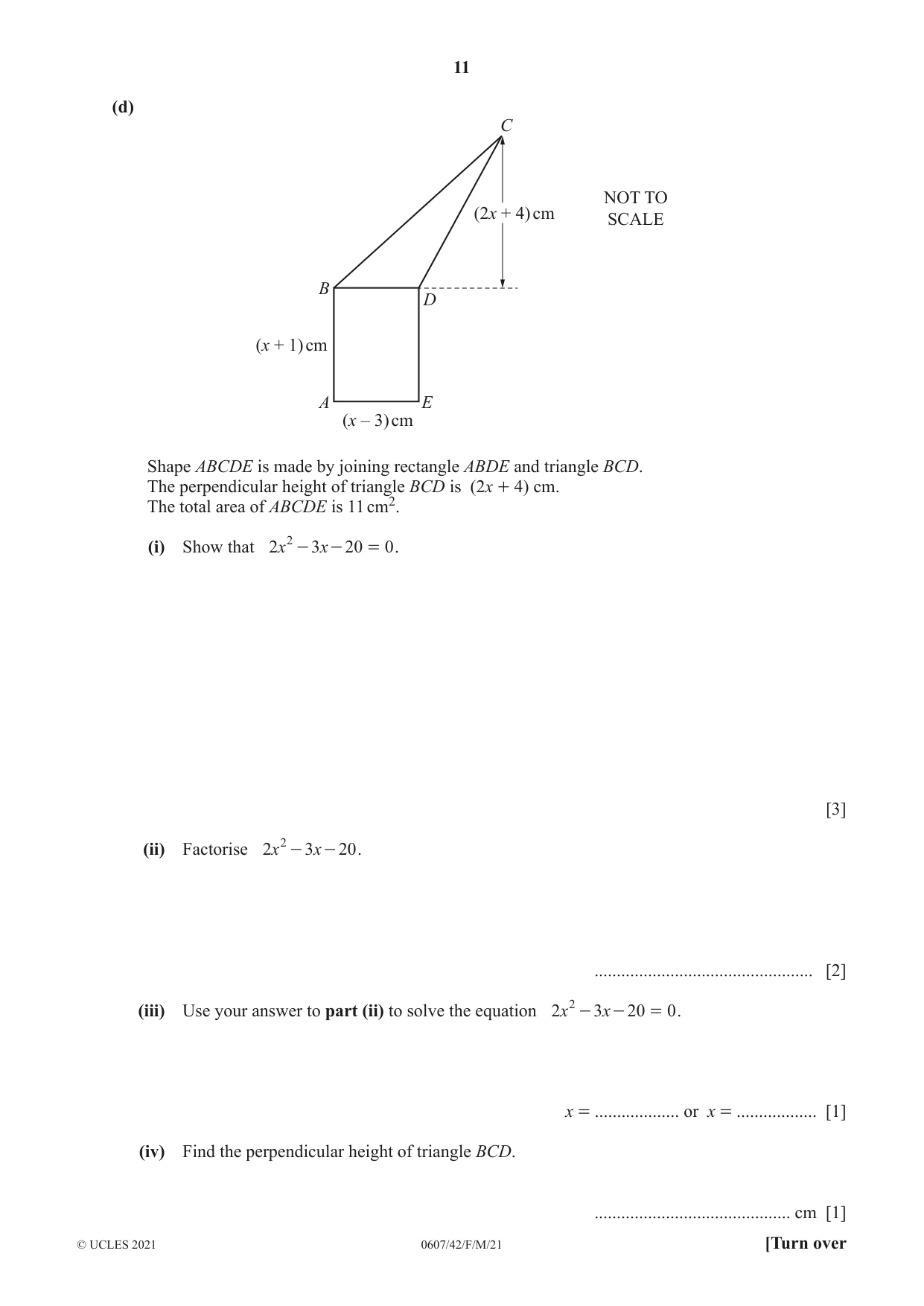
5 (a) B 49 mm NOT TO 91 mm SCALE A C Calculate the length of AC. AC = ......................................... mm [2] (b) 305° NOT TO O SCALE B 16 cm A The diagram shows a circle with centre O and radius 16 cm. Calculate the length of the major arc AB. ............................................ cm [2] (c) NOT TO SCALE 12 cm The diagram shows a prism with length 12 cm. The cross-section of the prism is a quarter of a circle. The radius of the circle is 6 cm. Calculate the volume of the prism. .......................................... cm3 [2] (d) C NOT TO (2x + 4) cm SCALE B D (x + 1) cm A E (x – 3) cm Shape ABCDE is made by joining rectangle ABDE and triangle BCD. The perpendicular height of triangle BCD is (2x + 4) cm. The total area of ABCDE is 11 cm2. (i) Show that 2x 2 - 3x - 20 = 0 . [3] (ii) Factorise 2x 2 - 3x - 20 . ................................................. [2] (iii) Use your answer to part (ii) to solve the equation 2x 2 - 3x - 20 = 0 . x = ................... or x = .................. [1] (iv) Find the perpendicular height of triangle BCD. ............................................ cm [1]
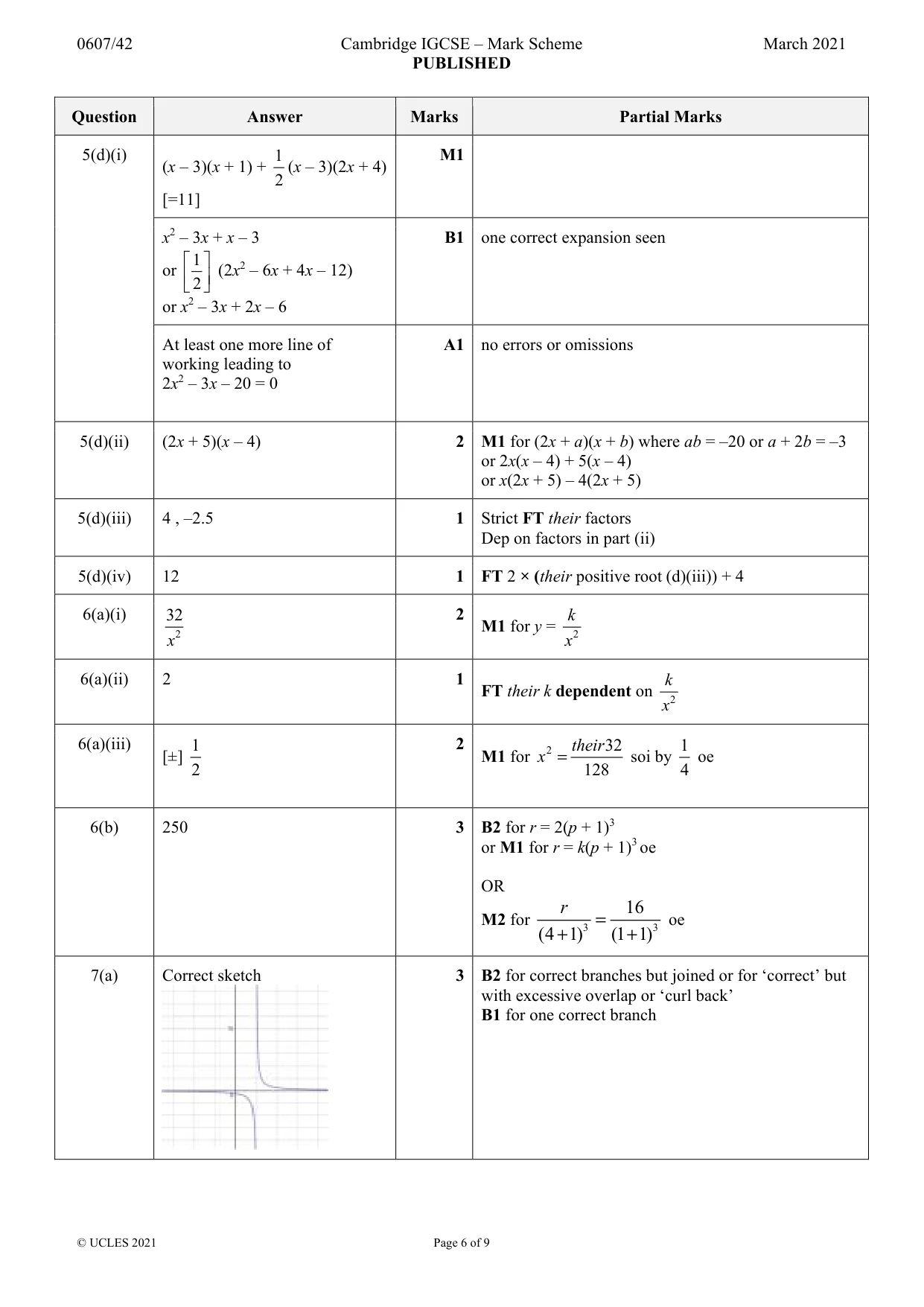
Mark scheme: 5(a) 103 or 103.3 to 103.4 2 M1 for 492 + 912 oe 5(b) 85.2 or 85.17 to 85.18 2 305 M1 for × π × 2 × 16 360 5(c) 339 or 339.2 to 339.3… 2 1 2 M1 for × π × 6 × 12 4 5(d)(i) 1 M1 (x – 3)(x + 1) + (x – 3)(2x + 4) 2 [=11] x2 – 3x + x – 3 B1 one correct expansion seen 1 or (2x2 – 6x + 4x – 12) 2 or x2 – 3x + 2x – 6 At least one more line of A1 no errors or omissions working leading to 2x2 – 3x – 20 = 0 5(d)(ii) (2x + 5)(x – 4) 2 M1 for (2x + a)(x + b) where ab = –20 or a + 2b = –3 or 2x(x – 4) + 5(x – 4) or x(2x + 5) – 4(2x + 5) 5(d)(iii) 4 , –2.5 1 Strict FT their factors Dep on factors in part (ii) 5(d)(iv) 12 1 FT 2 × (their positive root (d)(iii)) + 4
Q6 · Y is inversely proportional to the square of x
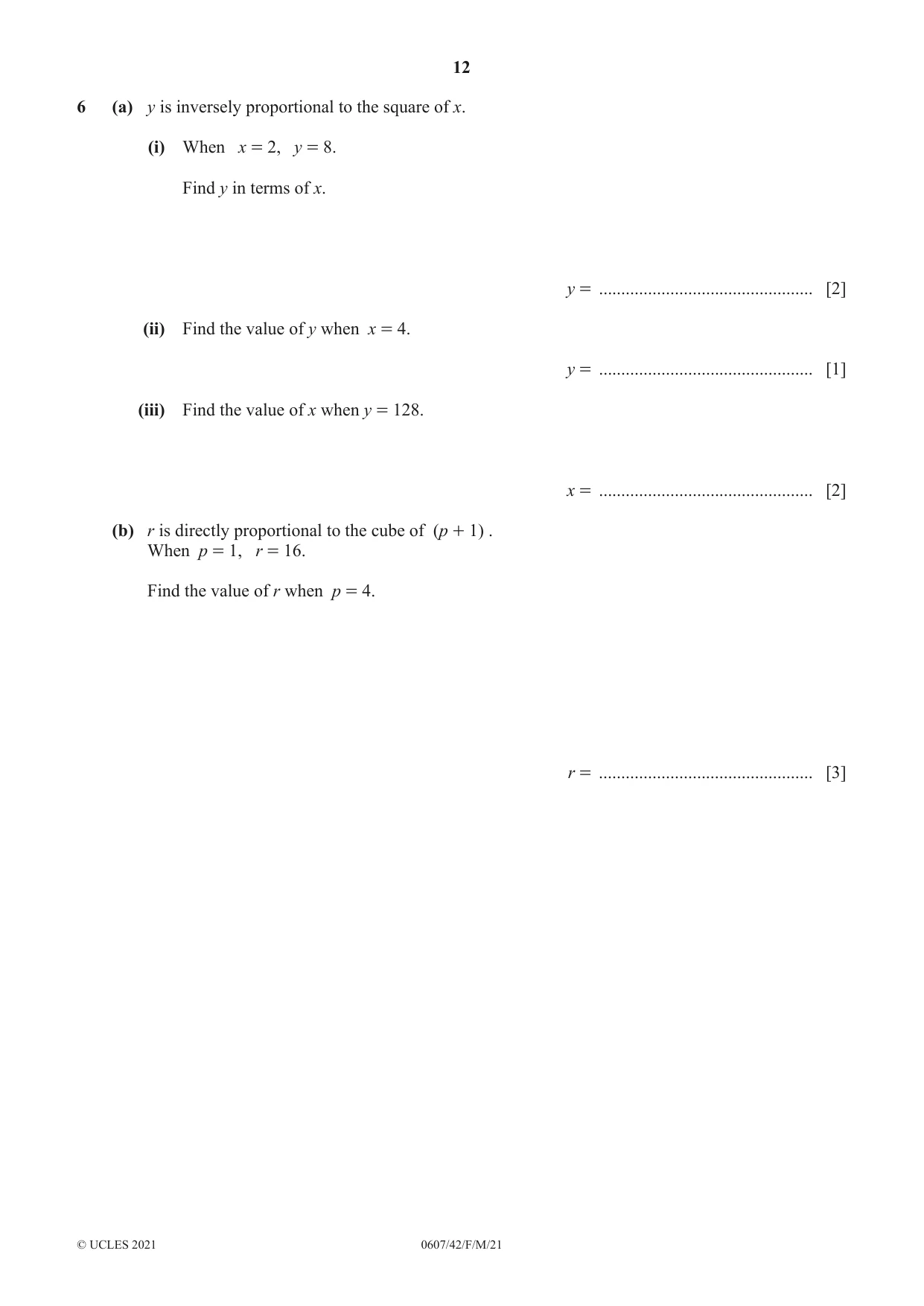
6 (a) y is inversely proportional to the square of x. (i) When x = 2, y = 8. Find y in terms of x. y = ................................................ [2] (ii) Find the value of y when x = 4. y = ................................................ [1] (iii) Find the value of x when y = 128. x = ................................................ [2] (b) r is directly proportional to the cube of (p + 1) . When p = 1, r = 16. Find the value of r when p = 4. r = ................................................ [3]
Mark scheme: 6(a)(i) 32 2 k M1 for y = x 2 x 2 6(a)(ii) 2 1 k FT their k dependent on x 2 6(a)(iii) 1 2 2 their 32 1 [±] M1 for x = soi by oe 2 128 4 6(b) 250 3 B2 for r = 2(p + 1)3 or M1 for r = k(p + 1)3 oe OR r 16 M2 for = oe (4 + 1) 3 (1 + 1) 3
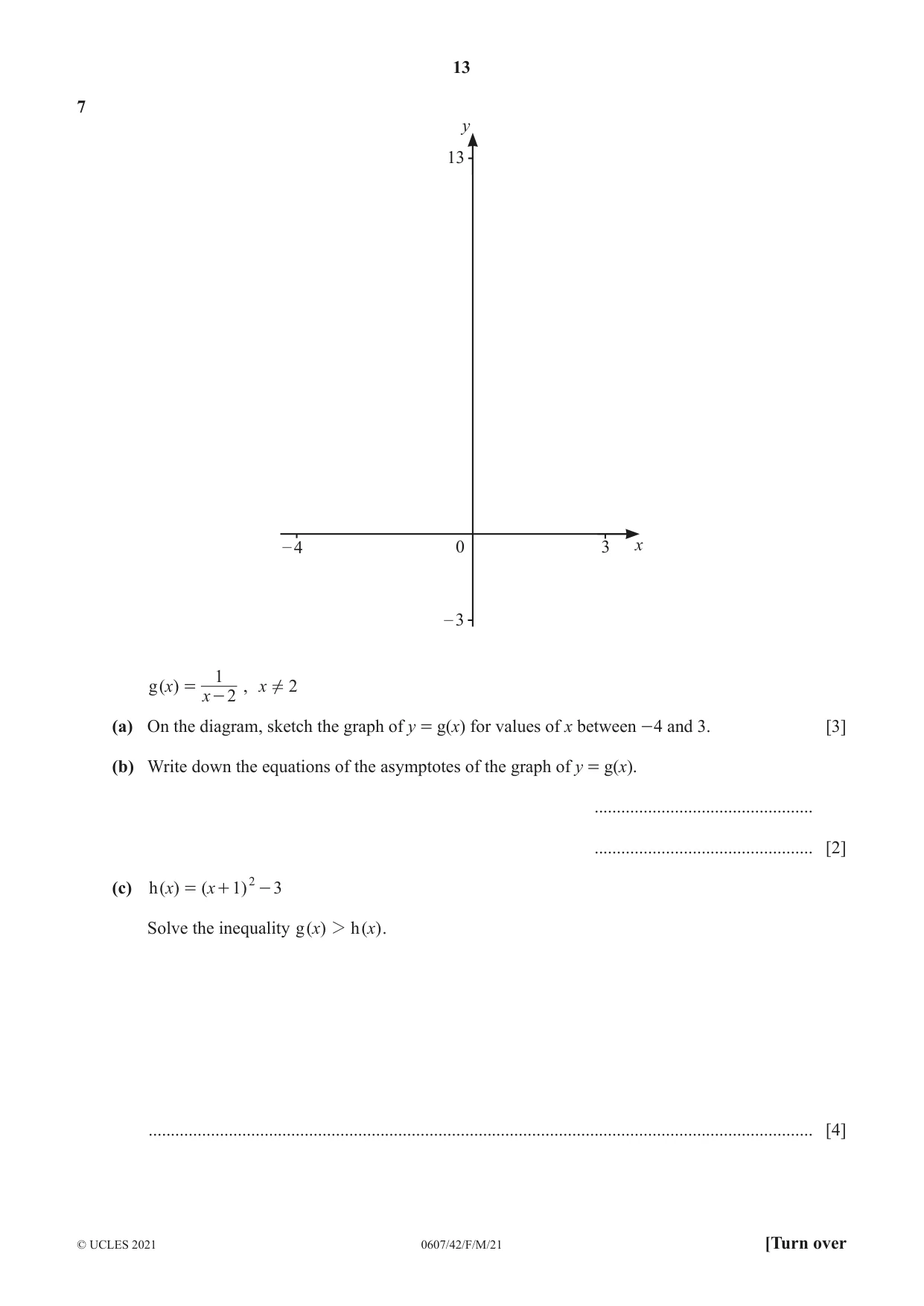
Q7 · Y 13 – 4 0 3 x – 3 1 g ( )x = , x !
7 y 13 – 4 0 3 x – 3 1 g ( )x = , x ! 2 x - 2 (a) On the diagram, sketch the graph of y = g(x) for values of x between - 4 and 3. [3] (b) Write down the equations of the asymptotes of the graph of y = g(x). ................................................. ................................................. [2] (c) h ( x) = ( x + 1) 2 - 3 Solve the inequality g ( x) 2 h ( x) . ..................................................................................................................................................... [4]
Mark scheme: 7(a) Correct sketch 3 B2 for correct branches but joined or for ‘correct’ but with excessive overlap or ‘curl back’ B1 for one correct branch 7(b) y = 0 B2 B1 for each x = 2 7(c) –2.67 < x < 0.524 B2 B1 for x > −2.67 or x < 0.524 or –2.7 < x < 0.52 2 < x < 2.15 B2 B1 for either x > 2 or x < 2.145… If B0, B0 scored, then SC1 for 2 of the boundaries –2.67, 0.524, 2.15 seen
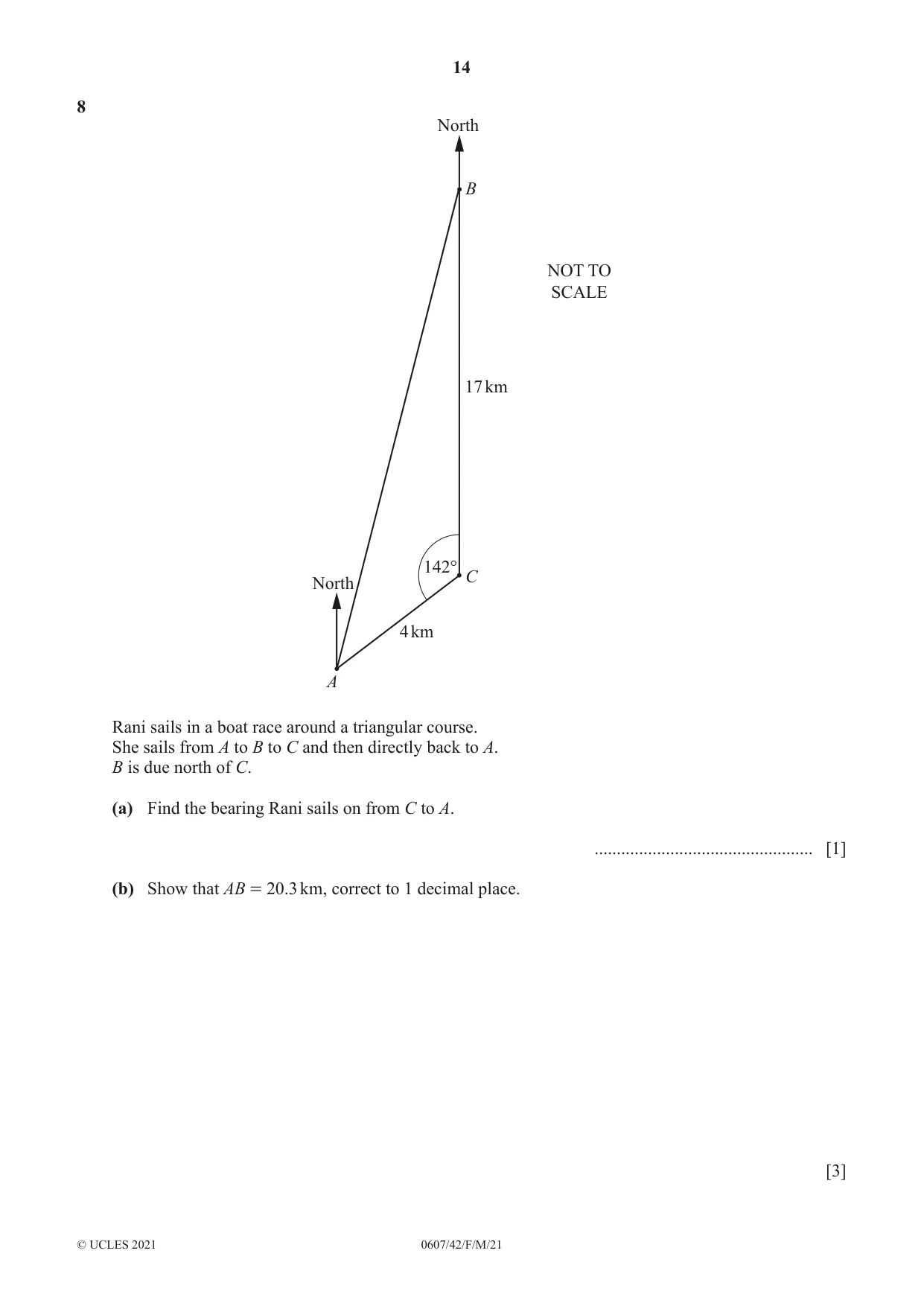
Q8 · North B NOT TO SCALE 17 km 142° C North 4 km A Rani sails in a boat race around a…
8 North B NOT TO SCALE 17 km 142° C North 4 km A Rani sails in a boat race around a triangular course. She sails from A to B to C and then directly back to A. B is due north of C. (a) Find the bearing Rani sails on from C to A. ................................................. [1] (b) Show that AB = 20.3 km, correct to 1 decimal place. [3] (c) Calculate the bearing of B from A. ................................................. [3] (d) Rani starts the race at 08 57 and returns to A at 12 33. Calculate the average speed of her boat in km/h. ........................................ km/h [3]
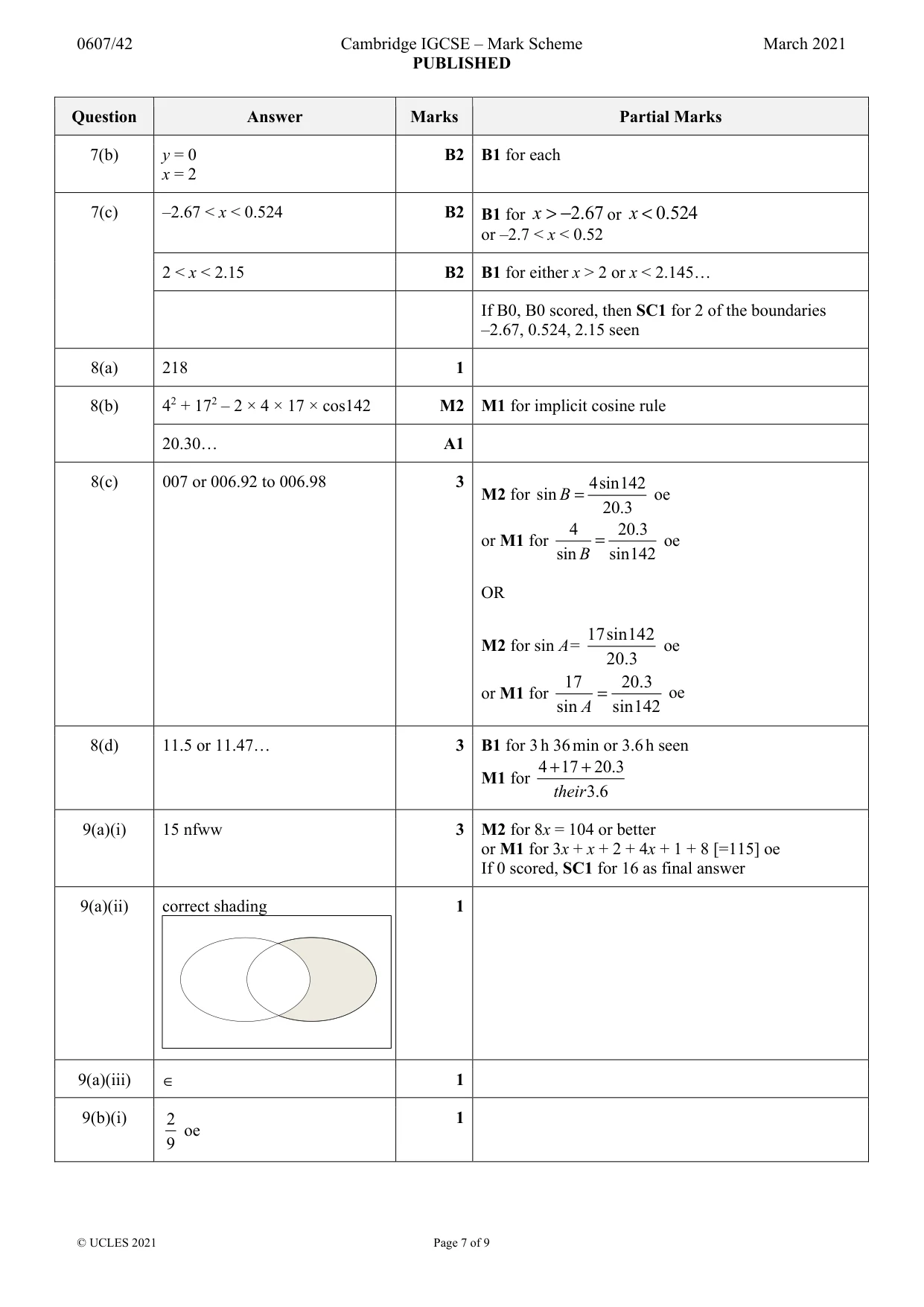
Mark scheme: 8(a) 218 1 8(b) 42 + 172 – 2 × 4 × 17 × cos142 M2 M1 for implicit cosine rule 20.30… A1 8(c) 007 or 006.92 to 006.98 3 4sin142 M2 for sin B = oe 20.3 4 20.3 or M1 for = oe sin B sin142 OR 17sin142 M2 for sin A= oe 20.3 17 20.3 or M1 for = oe sin A sin142 8(d) 11.5 or 11.47… 3 B1 for 3 h 36 min or 3.6 h seen 4 + 17 + 20.3 M1 for their 3.6
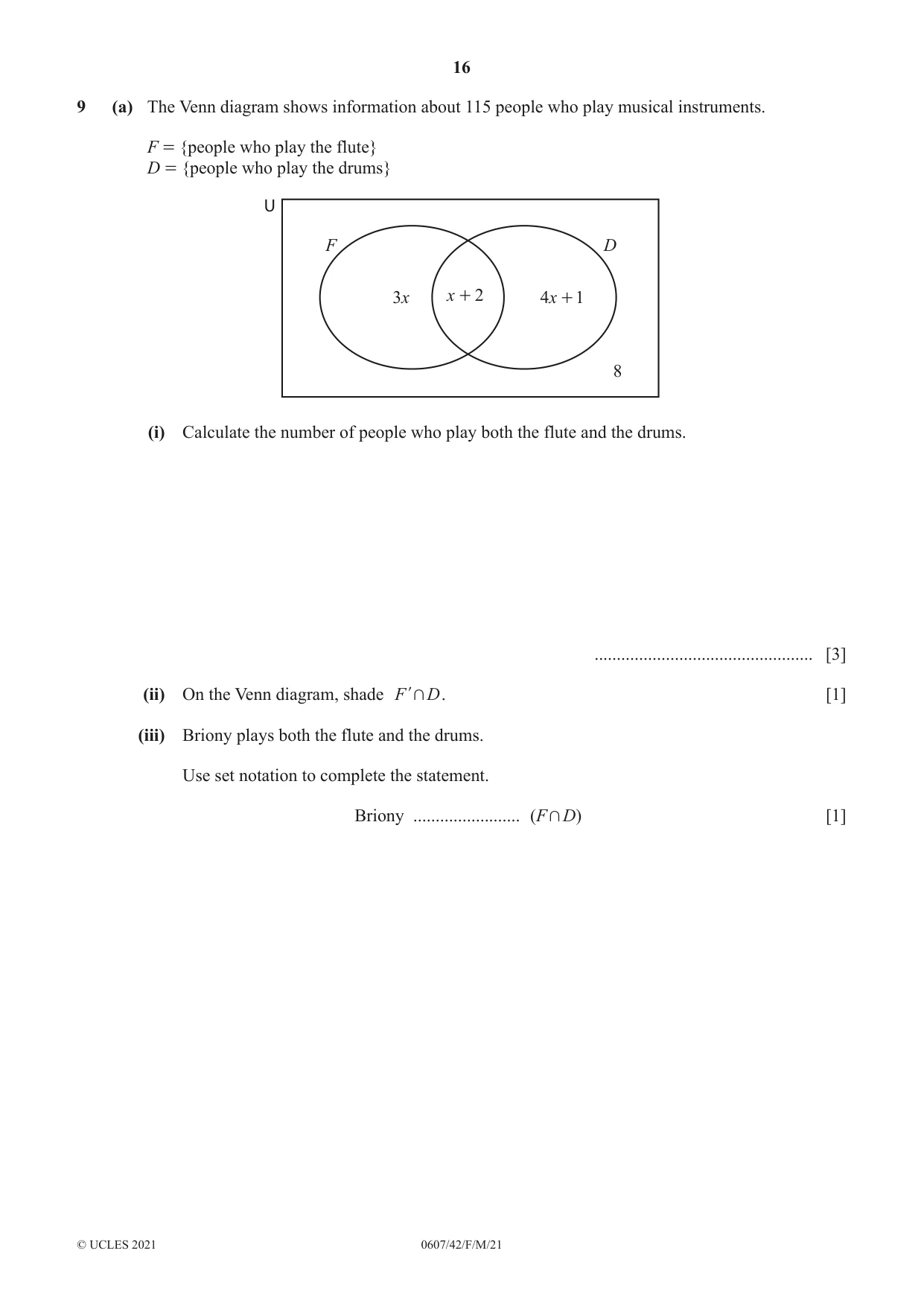
Q9 · The Venn diagram shows information about 115 people who play musical instruments
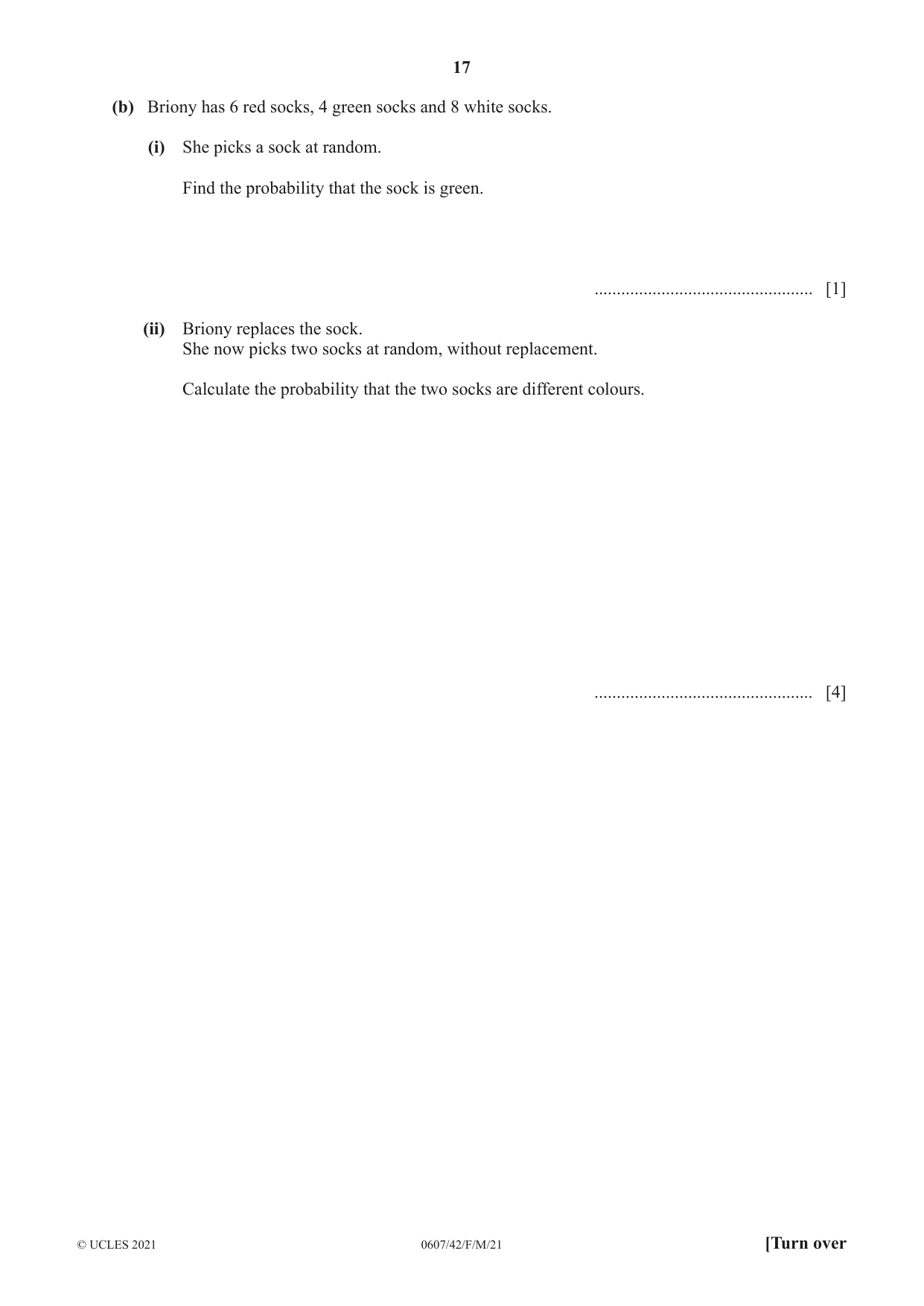
9 (a) The Venn diagram shows information about 115 people who play musical instruments. F = {people who play the flute} D = {people who play the drums} U F D 3x x + 2 4x + 1 8 (i) Calculate the number of people who play both the flute and the drums. ................................................. [3] (ii) On the Venn diagram, shade F l + D . [1] (iii) Briony plays both the flute and the drums. Use set notation to complete the statement. Briony ........................ ( F + D ) [1] (b) Briony has 6 red socks, 4 green socks and 8 white socks. (i) She picks a sock at random. Find the probability that the sock is green. ................................................. [1] (ii) Briony replaces the sock. She now picks two socks at random, without replacement. Calculate the probability that the two socks are different colours. ................................................. [4]
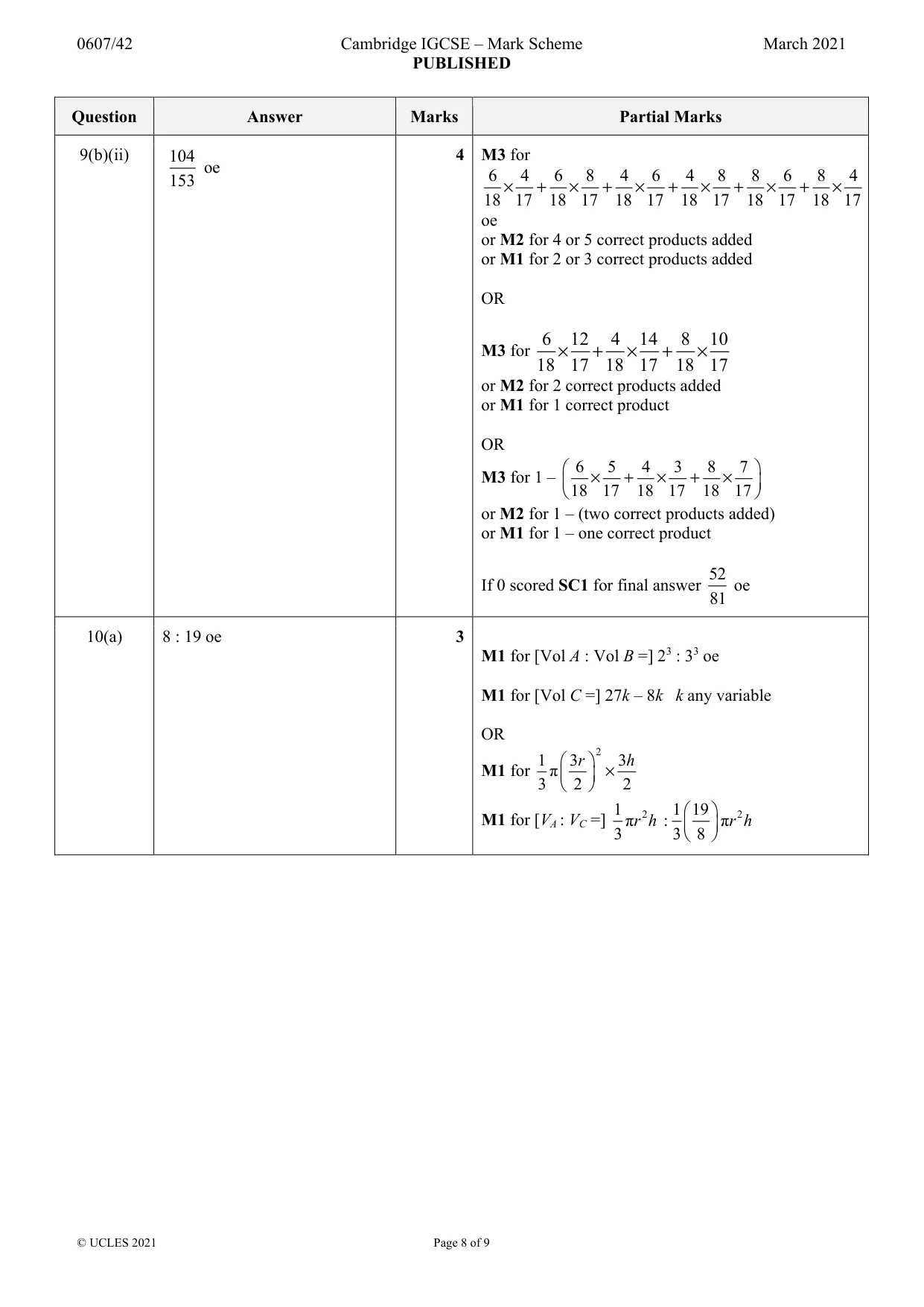
Mark scheme: 9(a)(i) 15 nfww 3 M2 for 8x = 104 or better or M1 for 3x + x + 2 + 4x + 1 + 8 [=115] oe If 0 scored, SC1 for 16 as final answer 9(a)(ii) correct shading 1 9(a)(iii) ∈ 1 9(b)(i) 2 1 oe 9 9(b)(ii) 104 4 M3 for oe 6 4 6 8 4 6 4 8 8 6 8 4 153 × + × + × + × + × + × 18 17 18 17 18 17 18 17 18 17 18 17 oe or M2 for 4 or 5 correct products added or M1 for 2 or 3 correct products added OR 6 12 4 14 8 10 M3 for × + × + × 18 17 18 17 18 17 or M2 for 2 correct products added or M1 for 1 correct product OR 6 5 4 3 8 7 M3 for 1 – × + × + × 18 17 18 17 18 17 or M2 for 1 – (two correct products added) or M1 for 1 – one correct product 52 If 0 scored SC1 for final answer oe 81
Q10 · B C NOT TO A SCALE h r Cone A has radius r and perpendicular height h
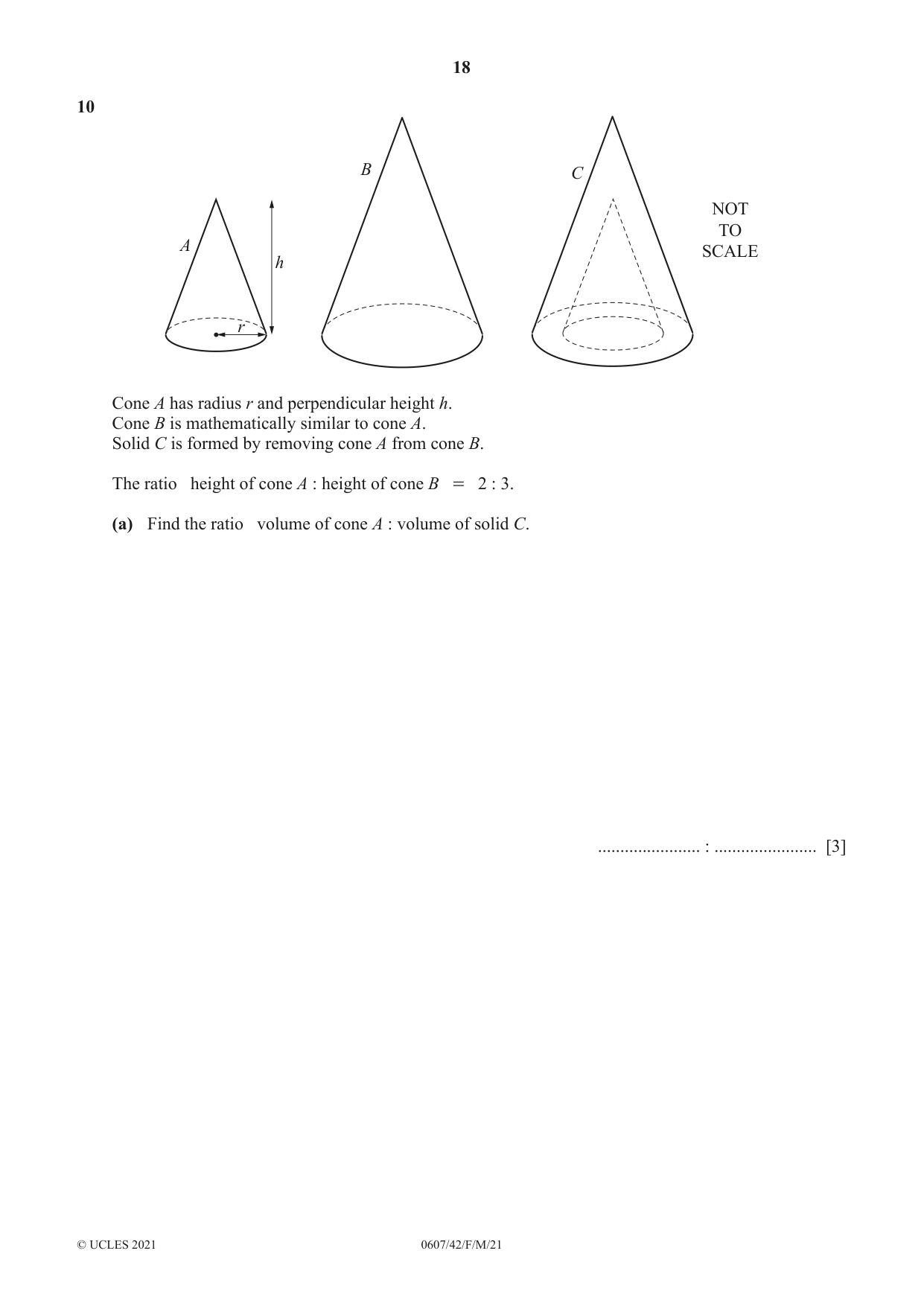
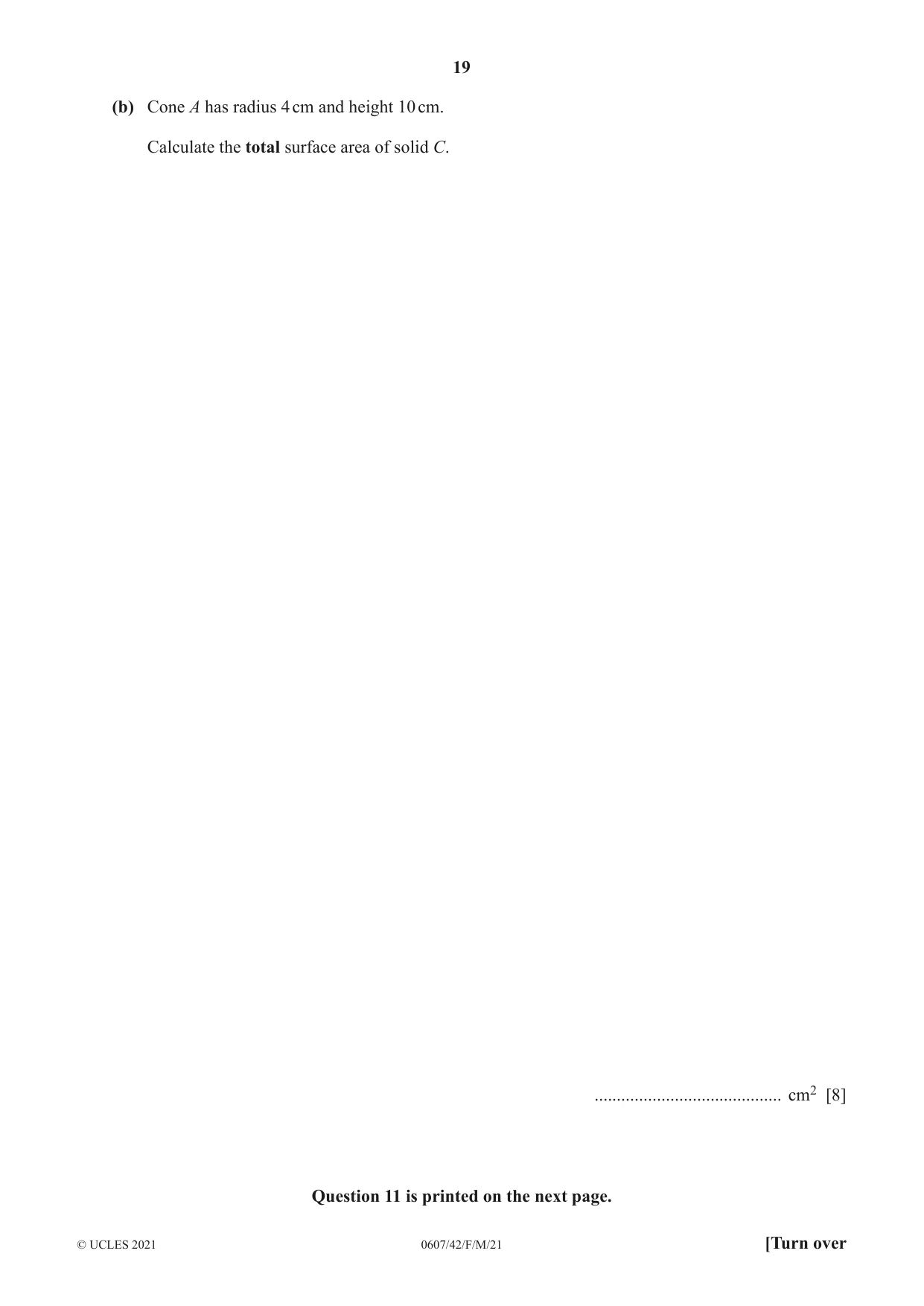
10 B C NOT TO A SCALE h r Cone A has radius r and perpendicular height h. Cone B is mathematically similar to cone A. Solid C is formed by removing cone A from cone B. The ratio height of cone A : height of cone B = 2 : 3. (a) Find the ratio volume of cone A : volume of solid C. ....................... : ....................... [3] (b) Cone A has radius 4 cm and height 10 cm. Calculate the total surface area of solid C. .......................................... cm2 [8] Question 11 is printed on the next page.
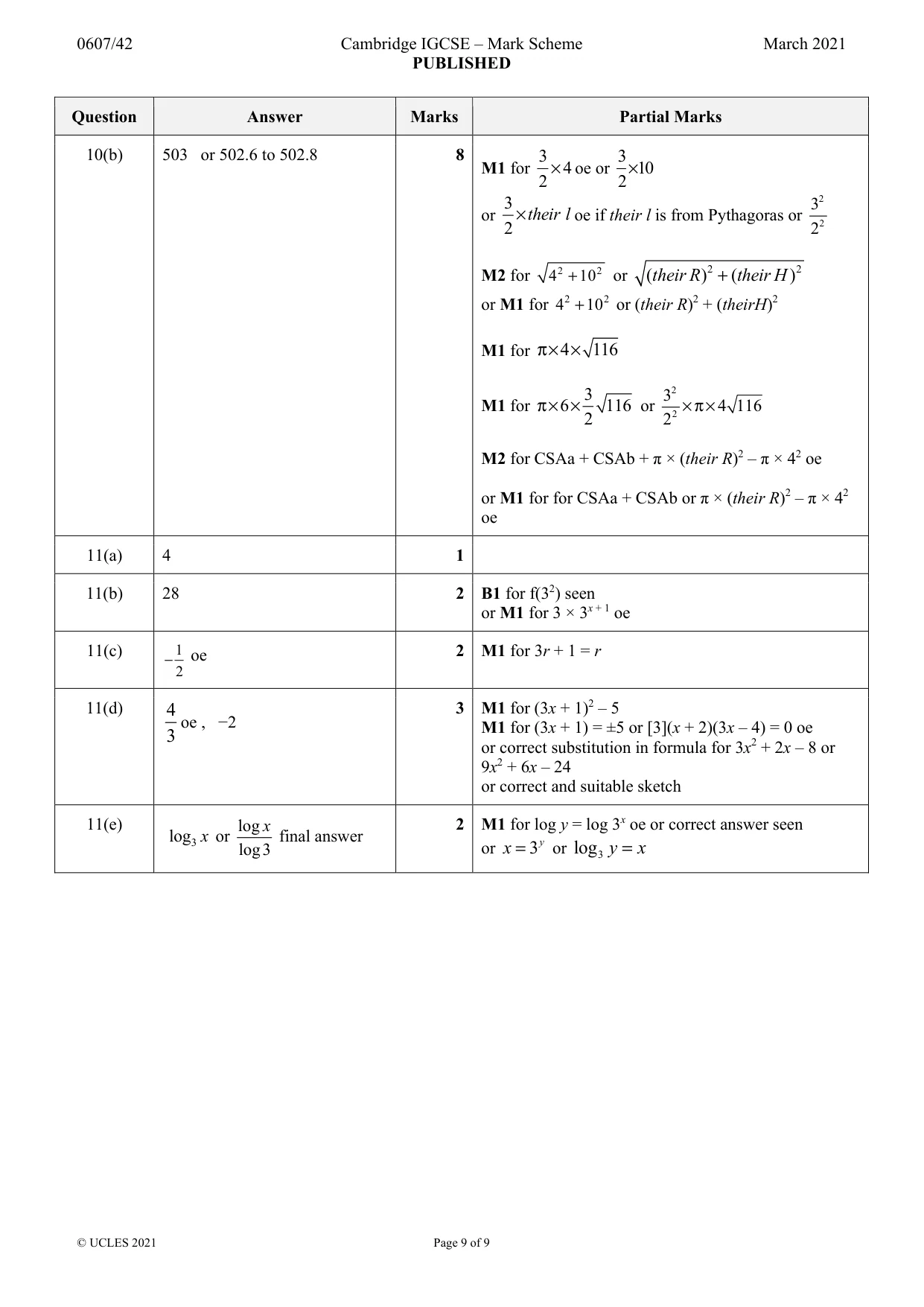
Mark scheme: 10(a) 8 : 19 oe 3 M1 for [Vol A : Vol B =] 23 : 33 oe M1 for [Vol C =] 27k – 8k k any variable OR 1 3r ×2 3h M1 for π 3 2 2 1 2 1 19 2 M1 for [VA : VC =] πr h : πr h 3 3 8 10(b) 503 or 502.6 to 502.8 8 3 3 M1 for × 4 oe or 10 2 2× 3 32 or × their l oe if their l is from Pythagoras or 2 2 2 M2 for 4 2 + 10 2 or (their R ) 2 + (their H ) 2 or M1 for 4 2 + 10 2 or (their R)2 + (theirH)2 M1 for π× 4 × 116 3 32 M1 for π× 6 × 116 or 2 × π× 4 116 2 2 M2 for CSAa + CSAb + π × (their R)2 – π × 42 oe or M1 for for CSAa + CSAb or π × (their R)2 – π × 42 oe
Q11 · F ( )x = 3 x + 1 g ( )x = x 2 - 5 h ( )x = 3 x (a) Find g(3)
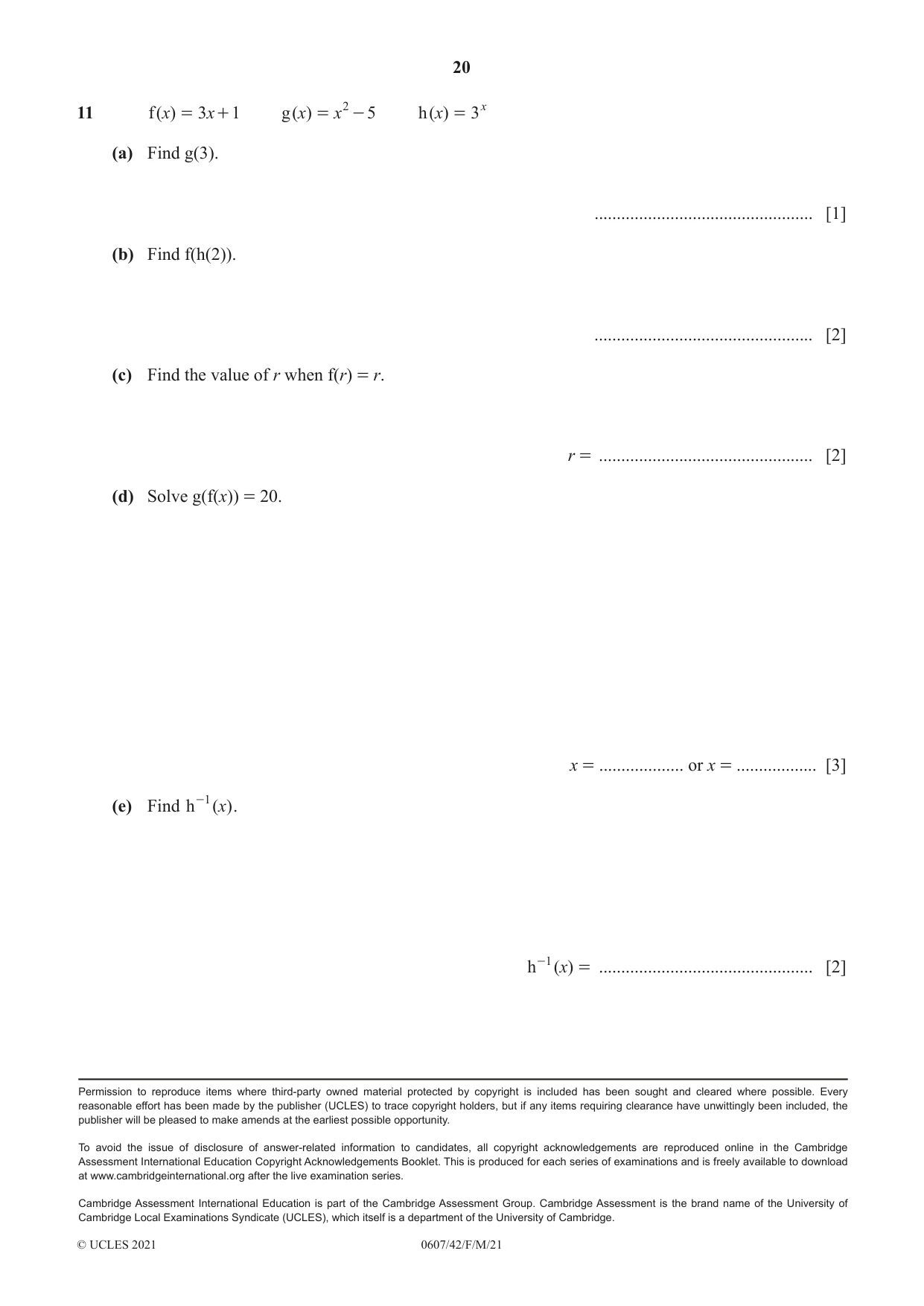
11 f ( )x = 3 x + 1 g ( )x = x 2 - 5 h ( )x = 3 x (a) Find g(3). ................................................. [1] (b) Find f(h(2)). ................................................. [2] (c) Find the value of r when f(r) = r. r = ................................................ [2] (d) Solve g(f(x)) = 20. x = ................... or x = .................. [3] (e) Find h -1 ( )x . h -1 ( )x = ................................................ [2]
Mark scheme: 11(a) 4 1 11(b) 28 2 B1 for f(32) seen or M1 for 3 × 3x + 1 oe 11(c) 1 oe 2 M1 for 3r + 1 = r − 2 11(d) 4 3 M1 for (3x + 1)2 – 5 oe , −2 M1 for (3x + 1) = ±5 or [3](x + 2)(3x – 4) = 0 oe 3 or correct substitution in formula for 3x2 + 2x – 8 or 9x2 + 6x – 24 or correct and suitable sketch 11(e) log x 2 M1 for log y = log 3x oe or correct answer seen log 3 x or final answer log3 or x = 3y or log 3 y = x
What was in this paper
The subtopics covered by these 11 questions, and how many questions each got. Open one in a new tab to see every Cambridge question on it.
What you needed in this session
Cambridge’s own grade thresholds for 2021 Feb/March, Paper 4 · Variant 2. A higher threshold means an easier paper — the bar moves with how the cohort did.