Cambridge IGCSE Mathematics - International 0607 — 2018 Oct/Nov Paper 4 · Variant 2
0607/42/O/N/18 · 14 questions · 120 marks · ≈135 min
The question paper and its mark scheme, free to read here and free to download. This is Cambridge’s own paper, exactly as it was sat.
Question paper20 pages

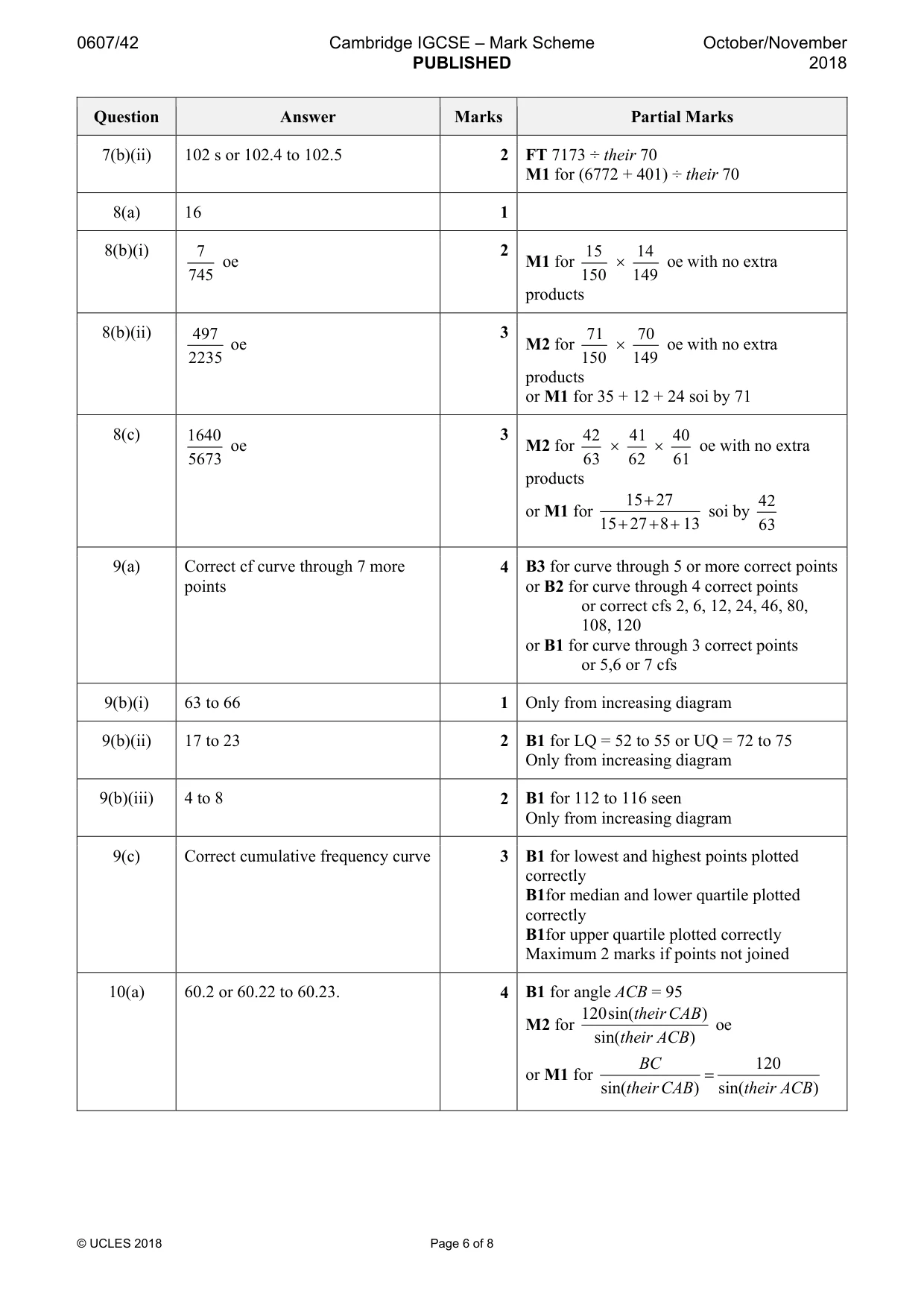
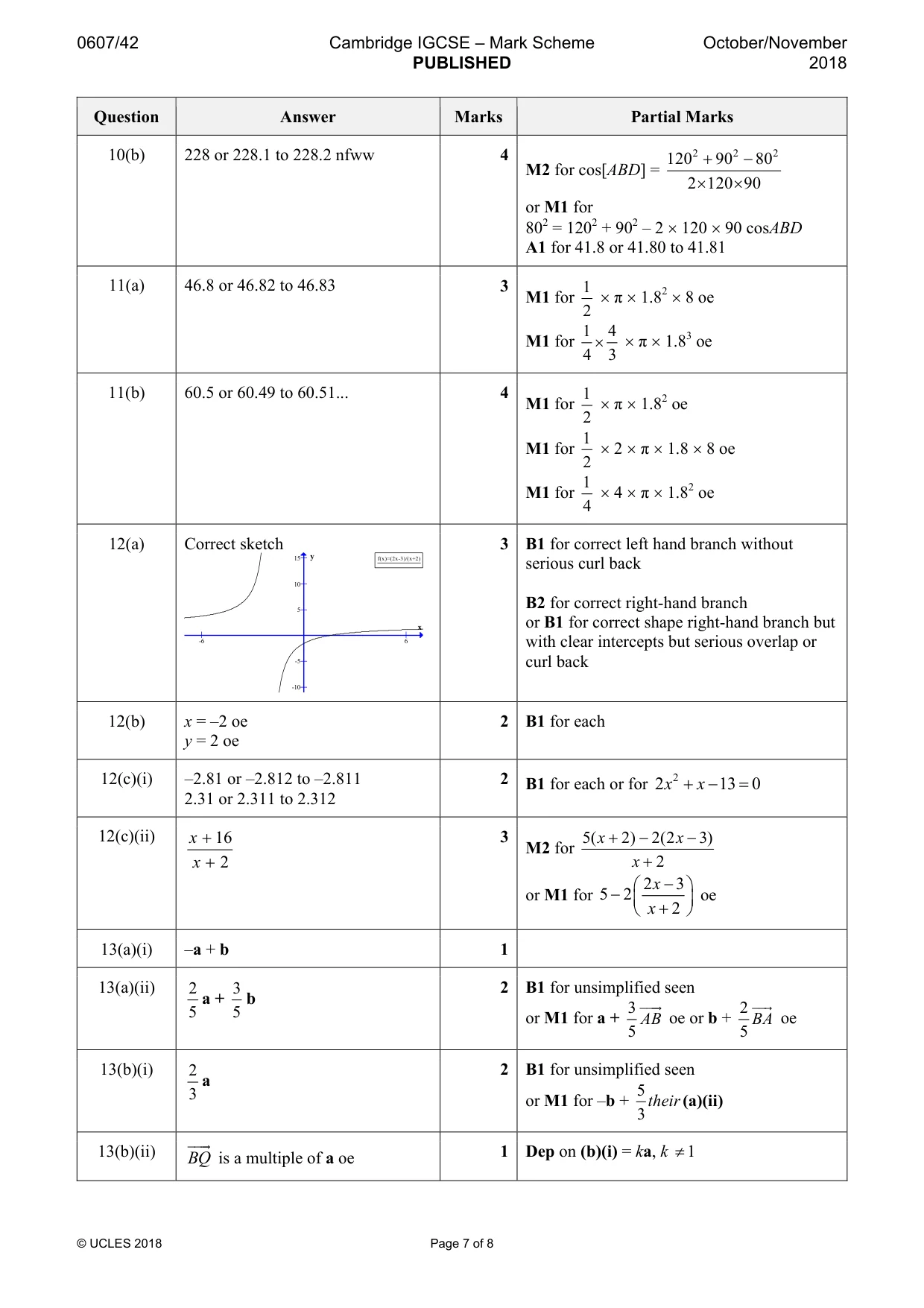
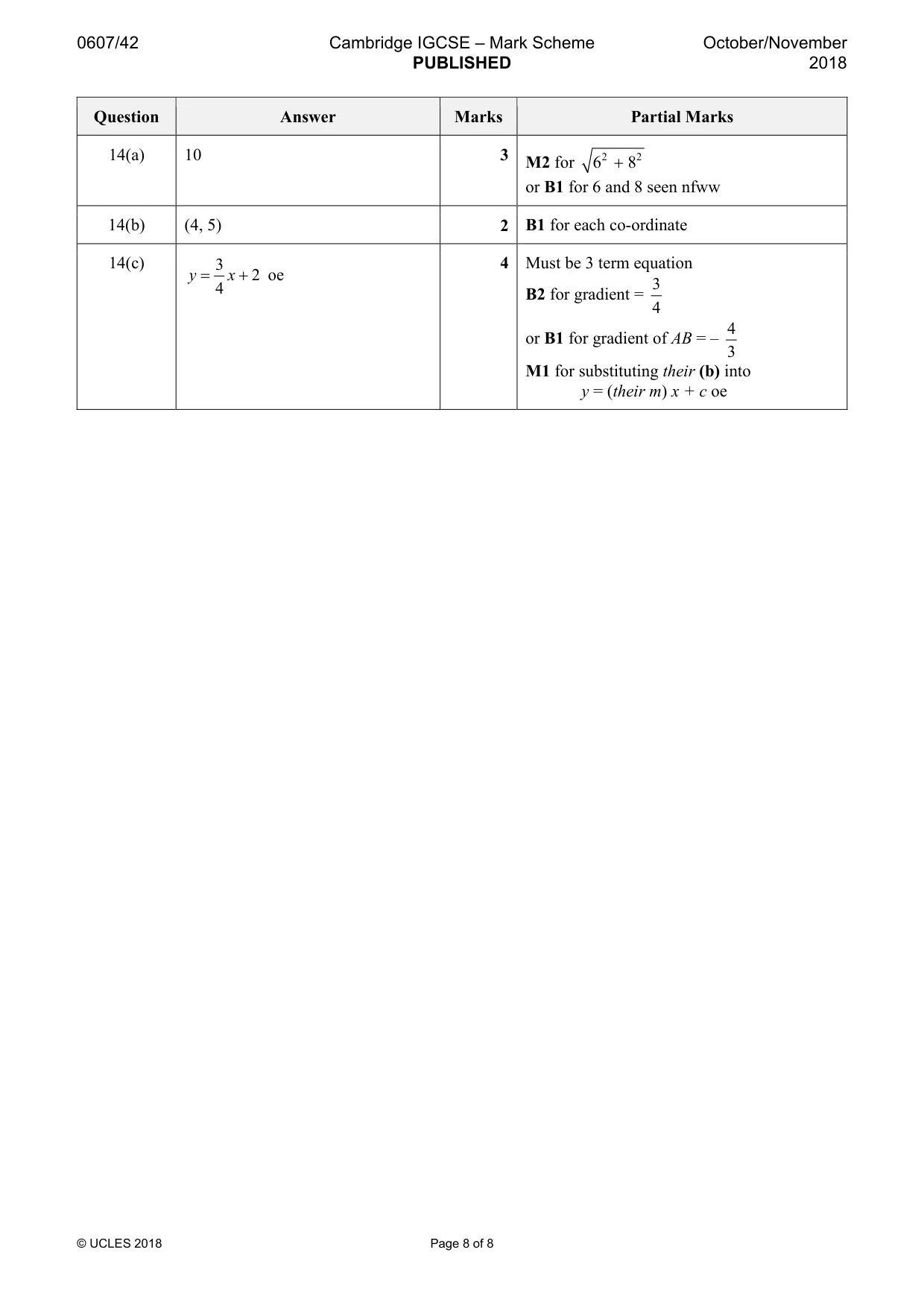
Mark scheme8 pages
Answers below. Sit the paper first if you are practising.
Questions as text
Q1 · Adila has $10 000
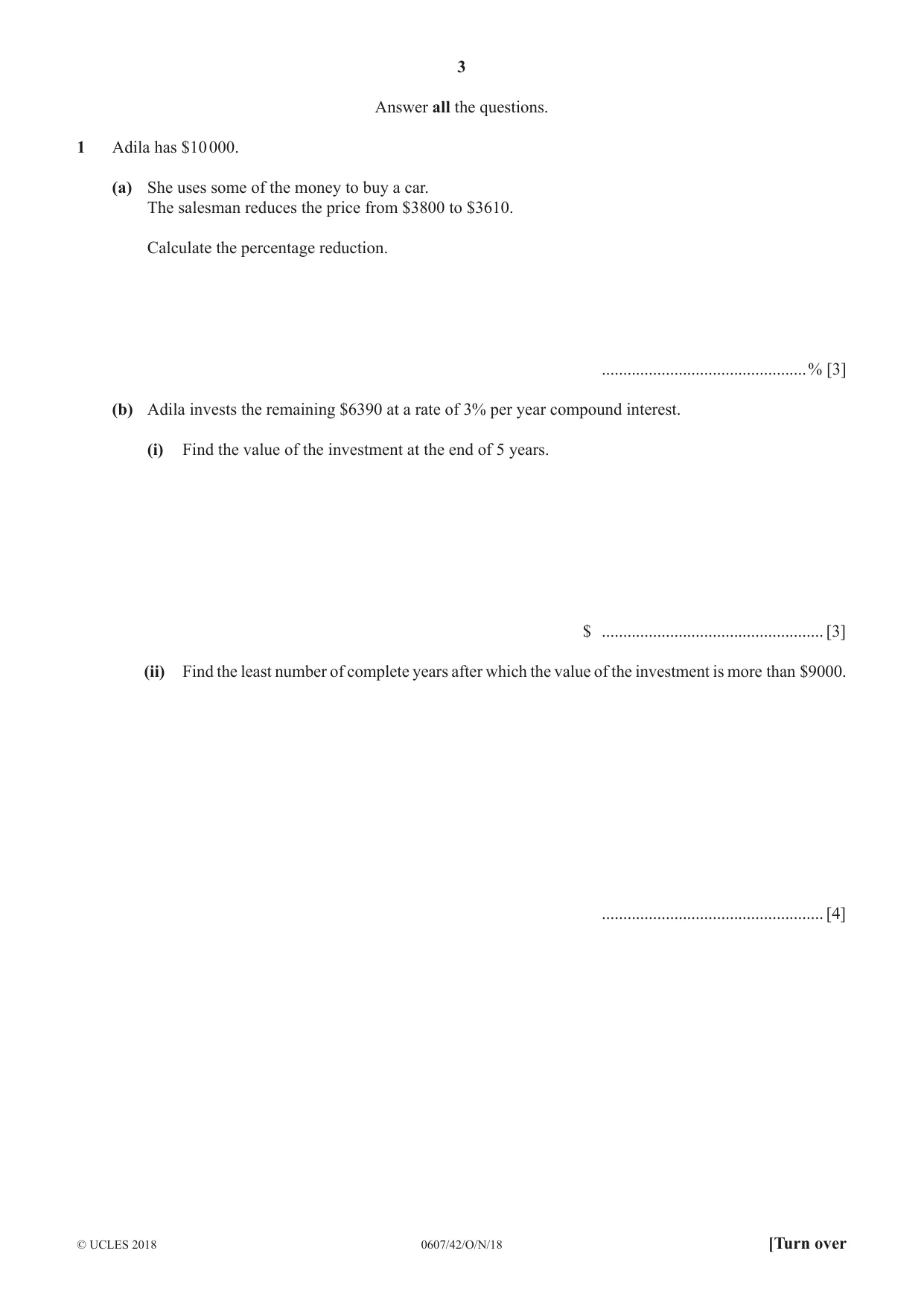
1 Adila has $10 000. (a) She uses some of the money to buy a car. The salesman reduces the price from $3800 to $3610. Calculate the percentage reduction. ................................................% [3] (b) Adila invests the remaining $6390 at a rate of 3% per year compound interest. (i) Find the value of the investment at the end of 5 years. $ .................................................... [3] (ii) Find the least number of complete years after which the value of the investment is more than $9000. .................................................... [4]
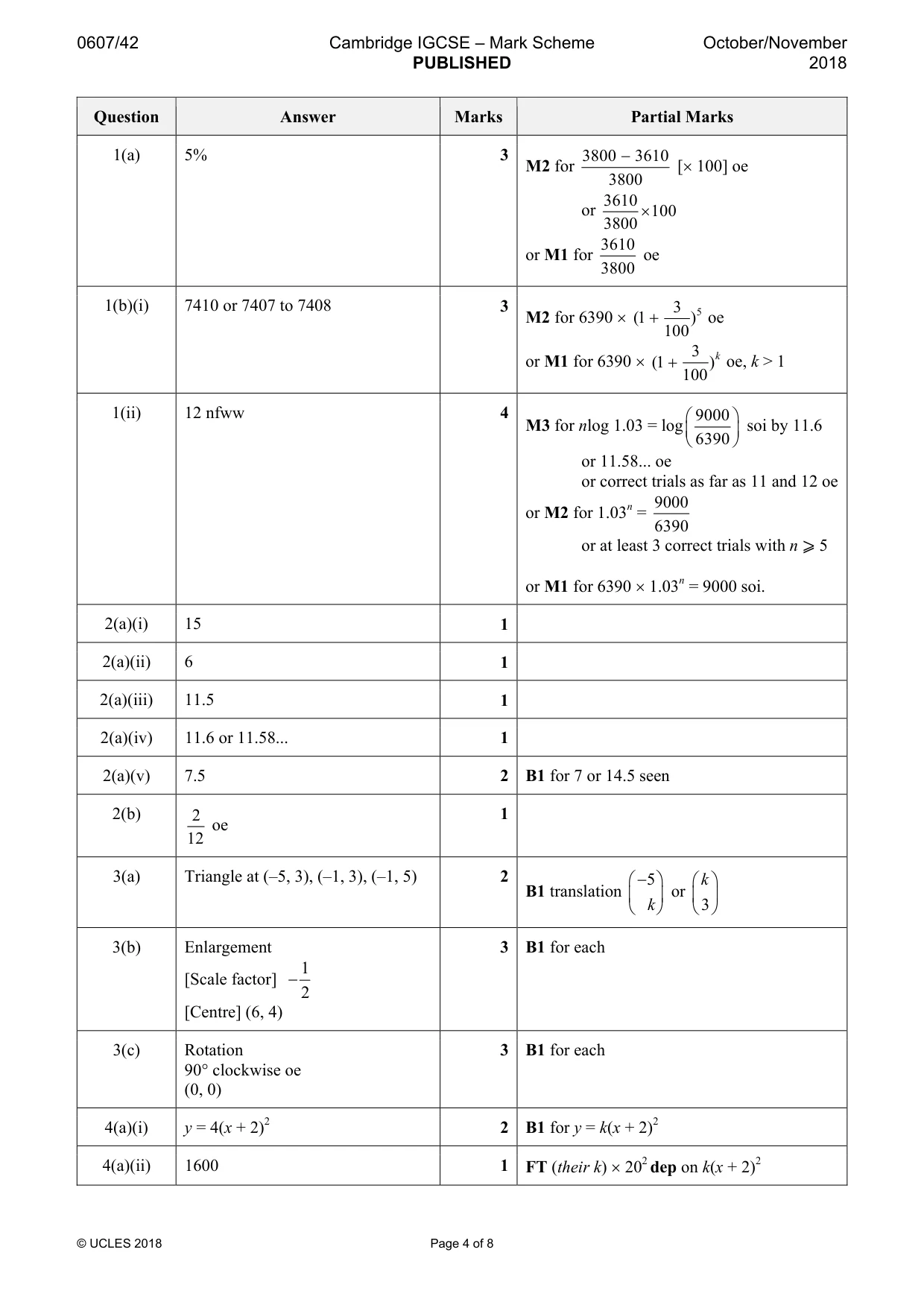
Mark scheme: Question Answer Marks Partial Marks 1(a) 5% 3 3800 − 3610 M2 for [× 100] oe 3800 3610 or × 100 3800 3610 or M1 for oe 3800 1(b)(i) 7410 or 7407 to 7408 3 3 5 M2 for 6390 × (1 + ) oe 100 3 k or M1 for 6390 × (1 + ) oe, k > 1 100 1(ii) 12 nfww 4 9000 M3 for nlog 1.03 = log soi by 11.6 6390 or 11.58... oe or correct trials as far as 11 and 12 oe 9000 or M2 for 1.03n = 6390 or at least 3 correct trials with n ⩾ 5 or M1 for 6390 × 1.03n = 9000 soi.
Q2 · Here are 12 numbers
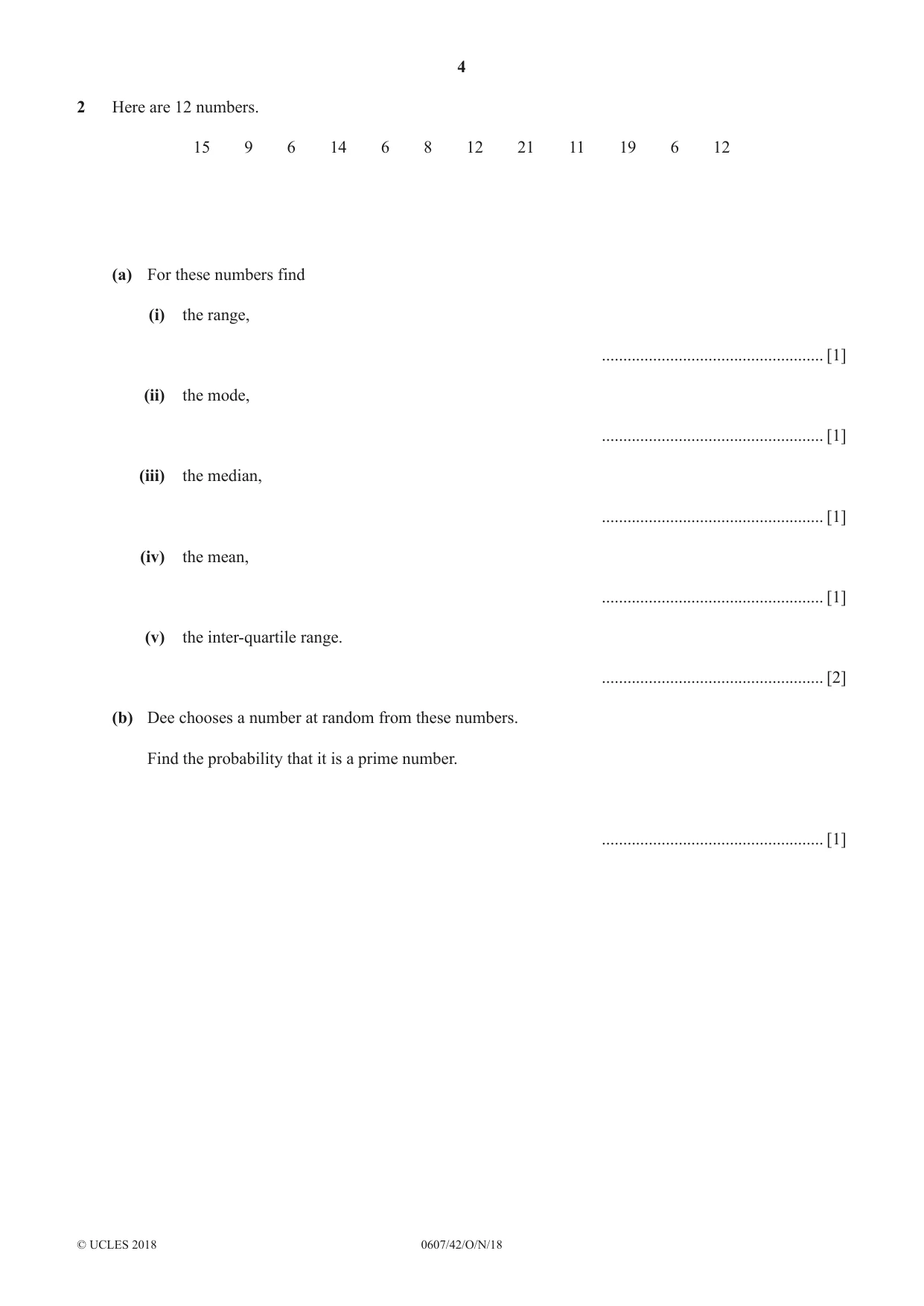
2 Here are 12 numbers. 15 9 6 14 6 8 12 21 11 19 6 12 (a) For these numbers find (i) the range, .................................................... [1] (ii) the mode, .................................................... [1] (iii) the median, .................................................... [1] (iv) the mean, .................................................... [1] (v) the inter-quartile range. .................................................... [2] (b) Dee chooses a number at random from these numbers. Find the probability that it is a prime number. .................................................... [1]
Mark scheme: 2(a)(i) 15 1 2(a)(ii) 6 1 2(a)(iii) 11.5 1 2(a)(iv) 11.6 or 11.58... 1 2(a)(v) 7.5 2 B1 for 7 or 14.5 seen 2(b) 2 1 oe 12
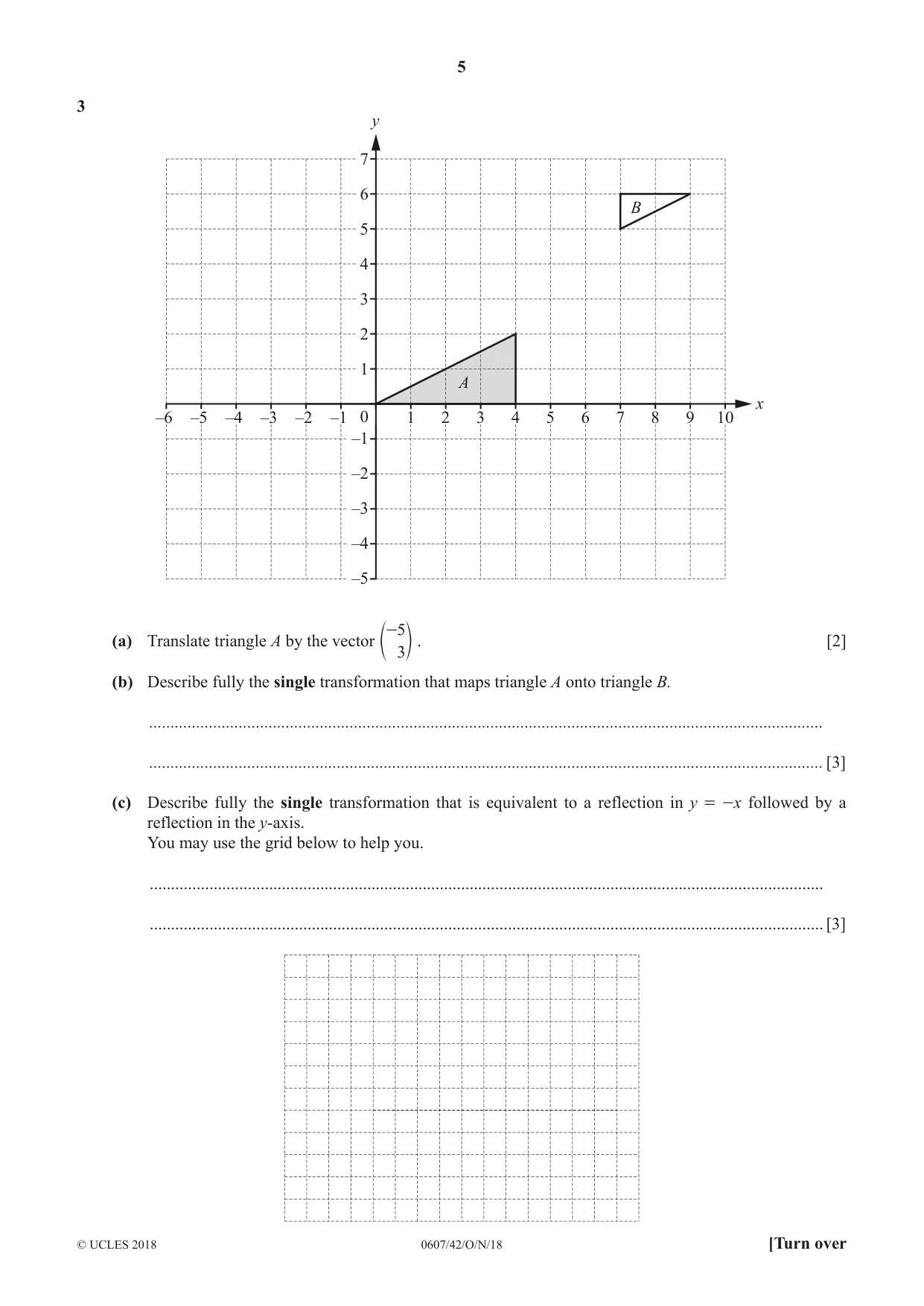
Q3 · Y 7 6 B 5 4 3 2 1 A x –6 –5 –4 –3 –2 –1 0 1 2 3 4 5 6 7 8 9 10 –1 –2 –3 –4 –5 -5 (a)…
3 y 7 6 B 5 4 3 2 1 A x –6 –5 –4 –3 –2 –1 0 1 2 3 4 5 6 7 8 9 10 –1 –2 –3 –4 –5 -5 (a) Translate triangle A by the vector . [2] e 3o (b) Describe fully the single transformation that maps triangle A onto triangle B. .............................................................................................................................................................. .............................................................................................................................................................. [3] (c) Describe fully the single transformation that is equivalent to a reflection in y = -x followed by a reflection in the y-axis. You may use the grid below to help you. .............................................................................................................................................................. .............................................................................................................................................................. [3]
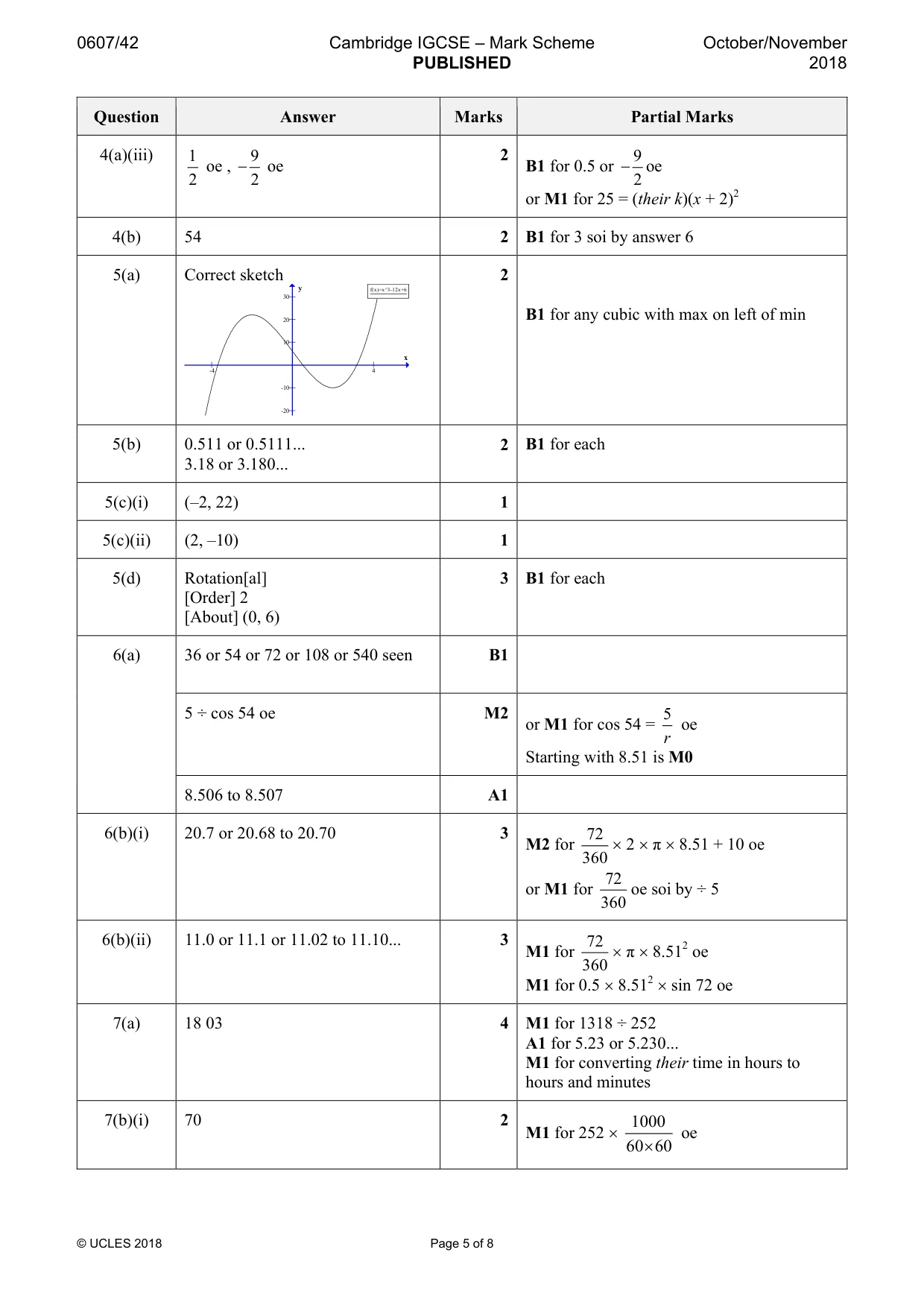
Mark scheme: 3(a) Triangle at (–5, 3), (–1, 3), (–1, 5) 2 − 5 k B1 translation or k 3 3(b) Enlargement 3 B1 for each 1 [Scale factor] − 2 [Centre] (6, 4) 3(c) Rotation 3 B1 for each 90° clockwise oe (0, 0)
Q4 · Y varies directly as the square of (x + 2)
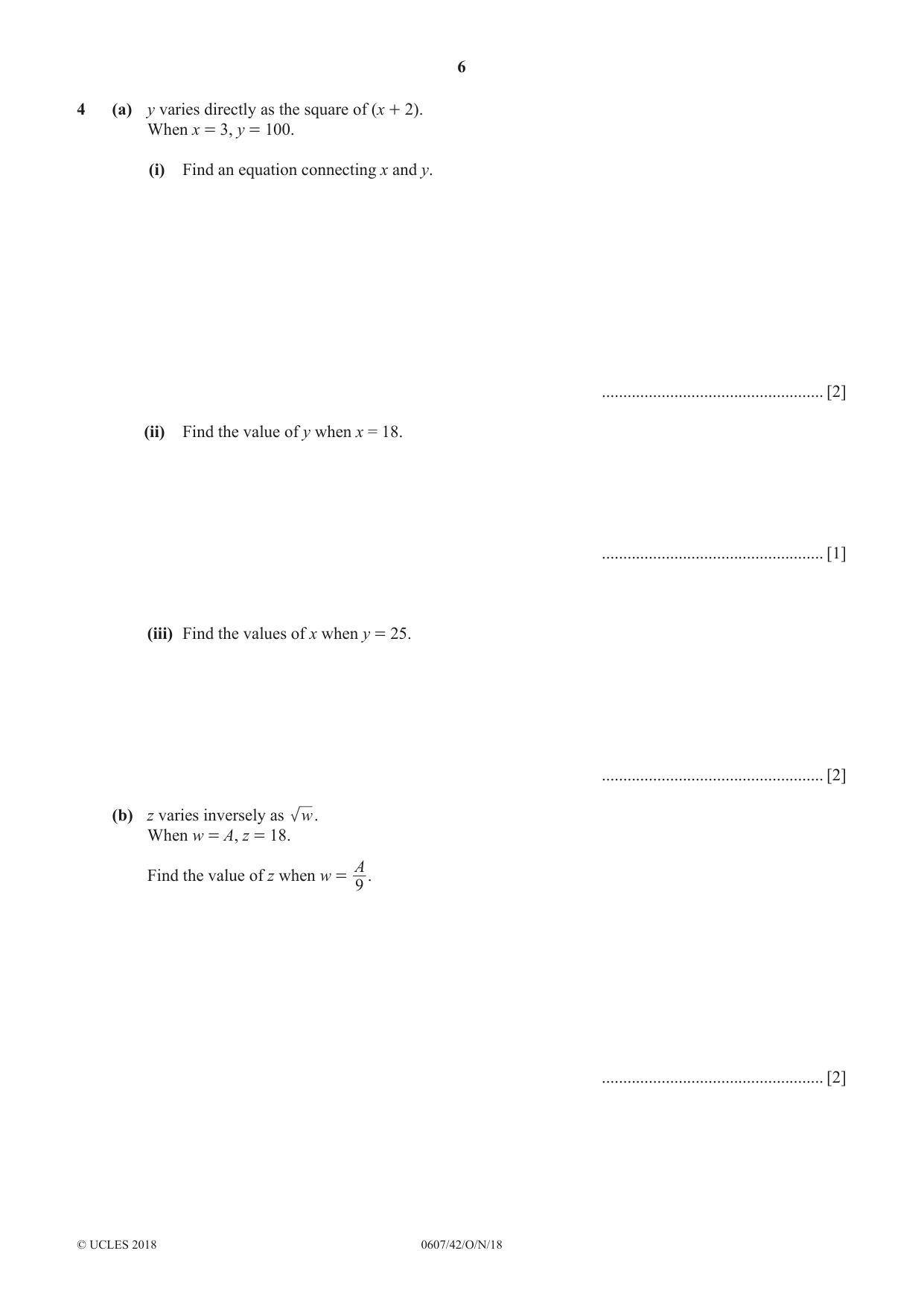
4 (a) y varies directly as the square of (x + 2). When x = 3, y = 100. (i) Find an equation connecting x and y. .................................................... [2] (ii) Find the value of y when x = 18. .................................................... [1] (iii) Find the values of x when y = 25. .................................................... [2] (b) z varies inversely as w. When w = A, z = 18. A Find the value of z when w = . 9 .................................................... [2]
Mark scheme: 4(a)(i) y = 4(x + 2)2 2 B1 for y = k(x + 2)2 4(a)(ii) 1600 1 FT (their k) × 202 dep on k(x + 2)2 4(a)(iii) 1 9 2 9 oe , − oe B1 for 0.5 or − oe 2 2 2 or M1 for 25 = (their k)(x + 2)2 4(b) 54 2 B1 for 3 soi by answer 6
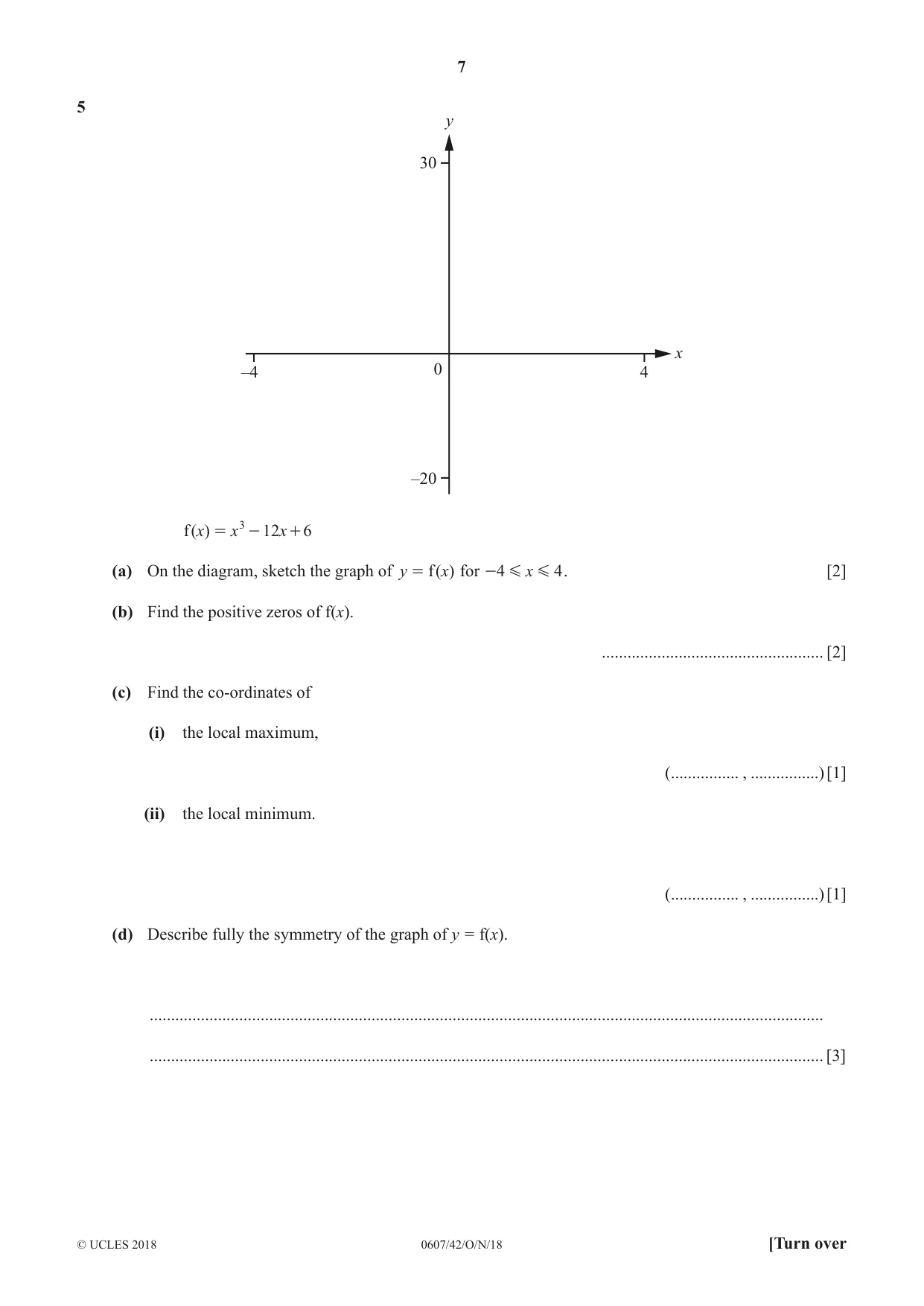
Q5 · Y 30 x –4 0 4 –20 f ()x = x 3 - 12x + 6 (a) On the diagram, sketch the graph of y = f (…
5 y 30 x –4 0 4 –20 f ()x = x 3 - 12x + 6 (a) On the diagram, sketch the graph of y = f ( x) for -4 G x G 4 . [2] (b) Find the positive zeros of f(x). .................................................... [2] (c) Find the co-ordinates of (i) the local maximum, (................ , ................) [1] (ii) the local minimum. (................ , ................) [1] (d) Describe fully the symmetry of the graph of y = f(x). .............................................................................................................................................................. .............................................................................................................................................................. [3]
Mark scheme: 5(a) Correct sketch 2 y f(x)=x^3-12x+6 30 20 B1 for any cubic with max on left of min 10 x -4 4 -10 -20 5(b) 0.511 or 0.5111... 2 B1 for each 3.18 or 3.180... 5(c)(i) (–2, 22) 1 5(c)(ii) (2, –10) 1 5(d) Rotation[al] 3 B1 for each [Order] 2 [About] (0, 6)
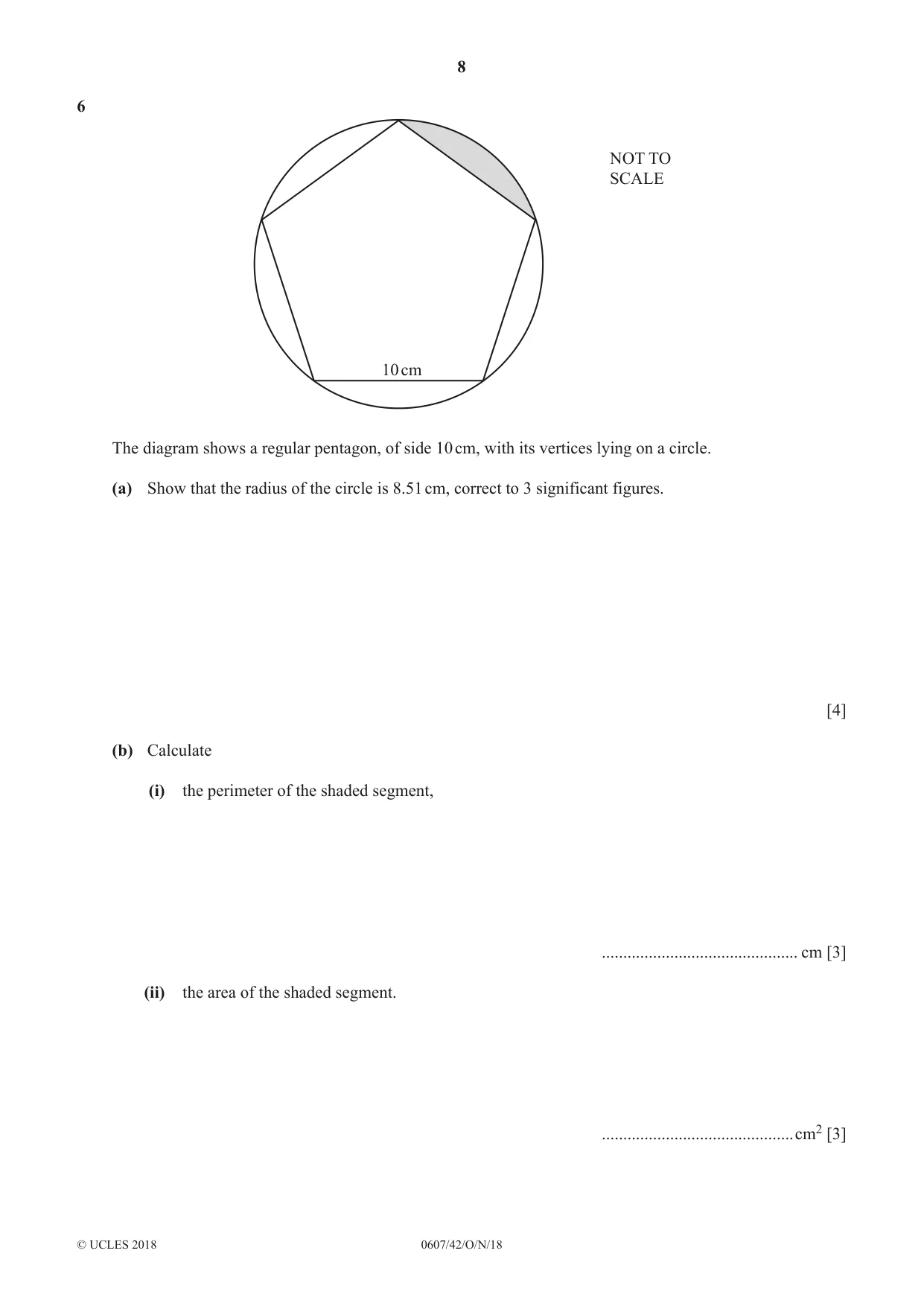
Q6 · NOT TO SCALE 10 cm The diagram shows a regular pentagon, of side 10 cm, with its vertices…
6 NOT TO SCALE 10 cm The diagram shows a regular pentagon, of side 10 cm, with its vertices lying on a circle. (a) Show that the radius of the circle is 8.51 cm, correct to 3 significant figures. [4] (b) Calculate (i) the perimeter of the shaded segment, .............................................. cm [3] (ii) the area of the shaded segment. .............................................cm2 [3]
Mark scheme: 6(a) 36 or 54 or 72 or 108 or 540 seen B1 5 ÷ cos 54 oe M2 5 or M1 for cos 54 = oe r Starting with 8.51 is M0 8.506 to 8.507 A1 6(b)(i) 20.7 or 20.68 to 20.70 3 72 M2 for × 2 × π × 8.51 + 10 oe 360 72 or M1 for oe soi by ÷ 5 360 6(b)(ii) 11.0 or 11.1 or 11.02 to 11.10... 3 72 M1 for × π × 8.512 oe 360 M1 for 0.5 × 8.512 × sin 72 oe
Q7 · The length of the Jinghu high speed railway from Beijing to Shanghai is 1318 km
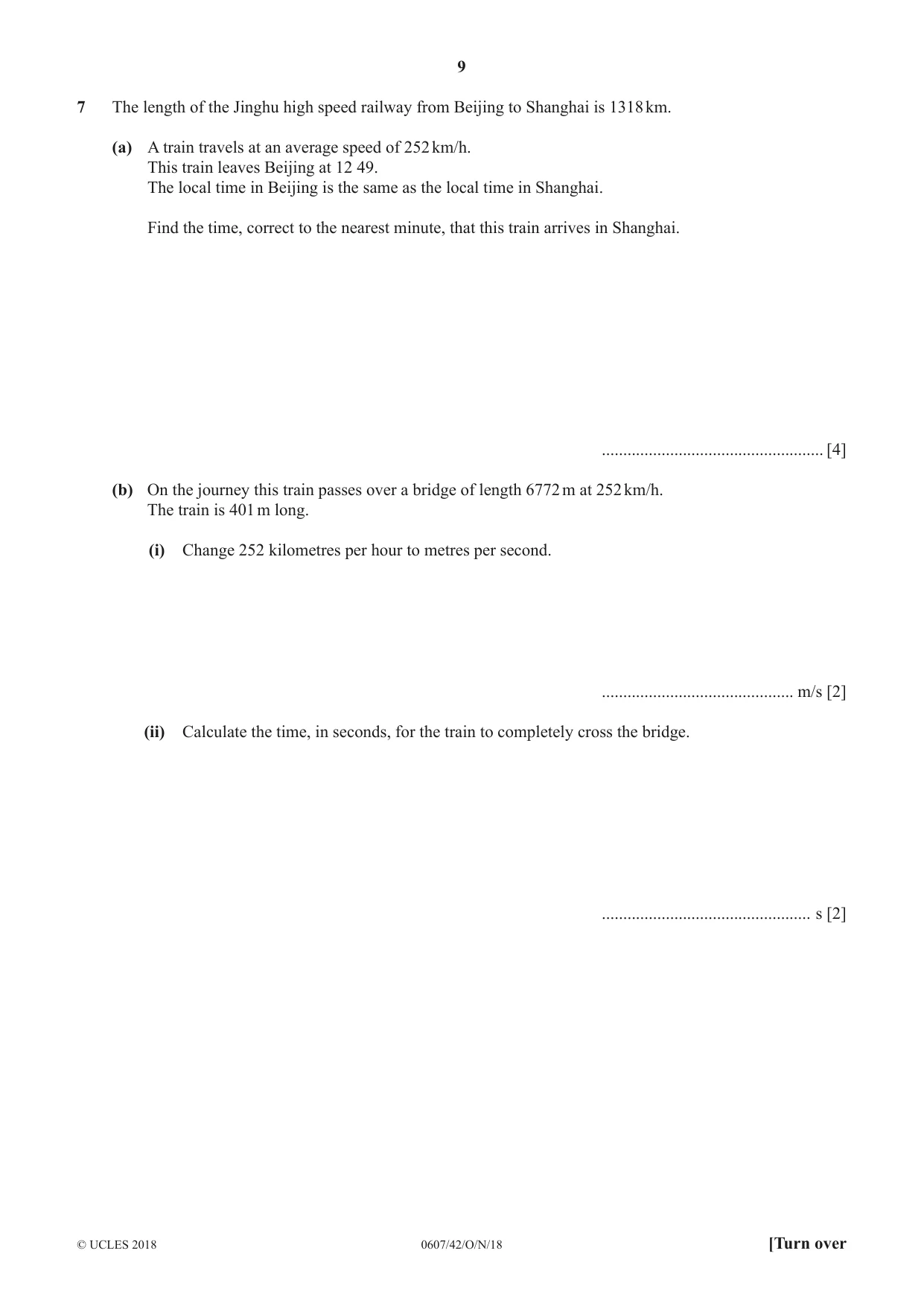
7 The length of the Jinghu high speed railway from Beijing to Shanghai is 1318 km. (a) A train travels at an average speed of 252 km/h. This train leaves Beijing at 12 49. The local time in Beijing is the same as the local time in Shanghai. Find the time, correct to the nearest minute, that this train arrives in Shanghai. .................................................... [4] (b) On the journey this train passes over a bridge of length 6772 m at 252 km/h. The train is 401 m long. (i) Change 252 kilometres per hour to metres per second. ............................................. m/s [2] (ii) Calculate the time, in seconds, for the train to completely cross the bridge. ................................................. s [2]
Mark scheme: 7(a) 18 03 4 M1 for 1318 ÷ 252 A1 for 5.23 or 5.230... M1 for converting their time in hours to hours and minutes 7(b)(i) 70 2 1000 M1 for 252 × oe 60 × 60 7(b)(ii) 102 s or 102.4 to 102.5 2 FT 7173 ÷ their 70 M1 for (6772 + 401) ÷ their 70
Q8 · The 150 members of a sports club were asked if they played cricket (C), hockey (H) or…
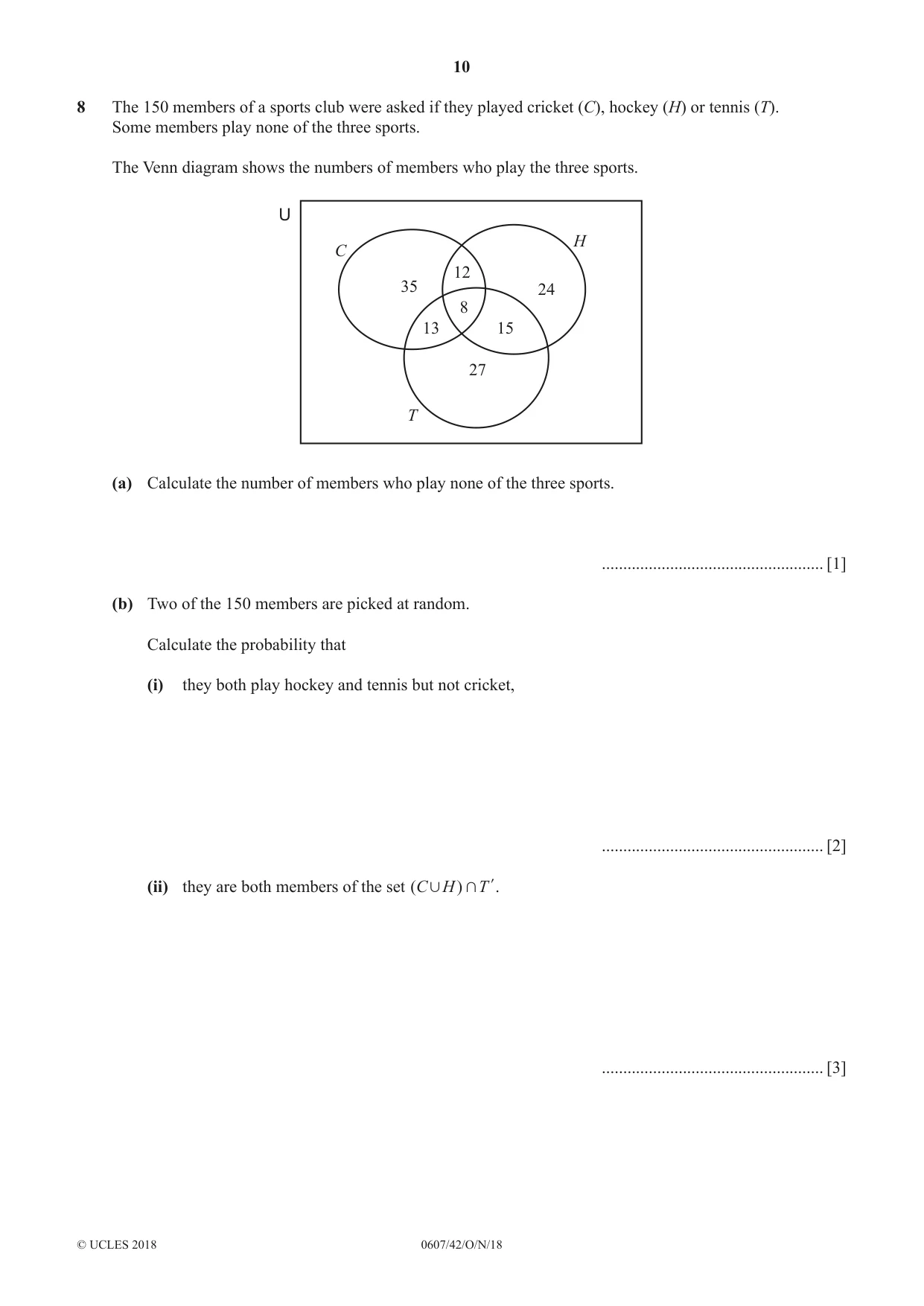
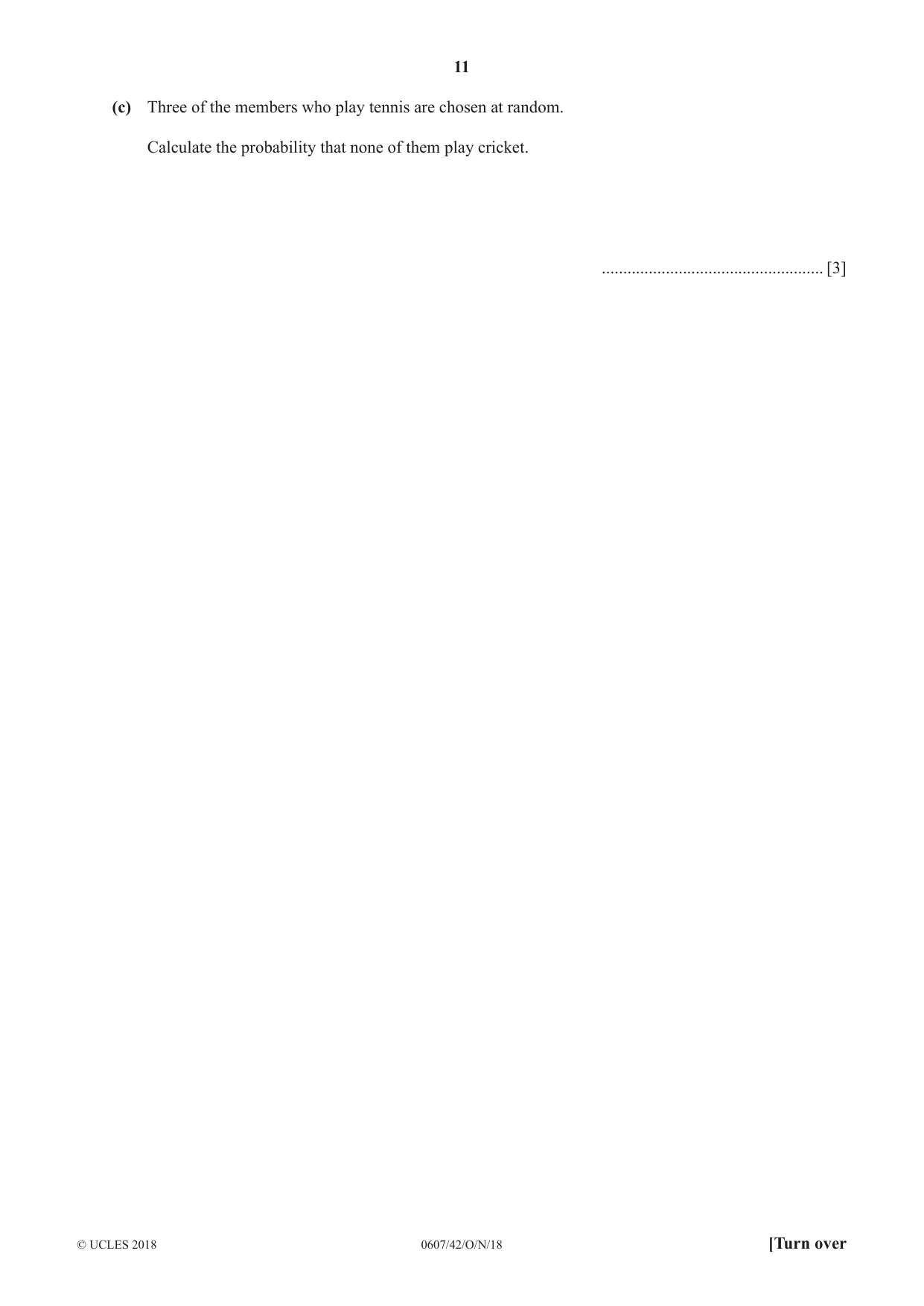
8 The 150 members of a sports club were asked if they played cricket (C), hockey (H) or tennis (T). Some members play none of the three sports. The Venn diagram shows the numbers of members who play the three sports. U H C 12 35 24 8 13 15 27 T (a) Calculate the number of members who play none of the three sports. .................................................... [1] (b) Two of the 150 members are picked at random. Calculate the probability that (i) they both play hockey and tennis but not cricket, .................................................... [2] (ii) they are both members of the set (C , H ) + T l. .................................................... [3] (c) Three of the members who play tennis are chosen at random. Calculate the probability that none of them play cricket. .................................................... [3]
Mark scheme: 8(a) 16 1 8(b)(i) 7 2 15 14 oe M1 for × oe with no extra 745 150 149 products 8(b)(ii) 497 3 71 70 oe M2 for × oe with no extra 2235 150 149 products or M1 for 35 + 12 + 24 soi by 71 8(c) 1640 3 42 41 40 oe M2 for × × oe with no extra 5673 63 62 61 products 15 + 27 42 or M1 for soi by 15 + 27 + 8 + 13 63
Q9 · 120 students each took two mathematics examinations, Paper 1 and Paper 2
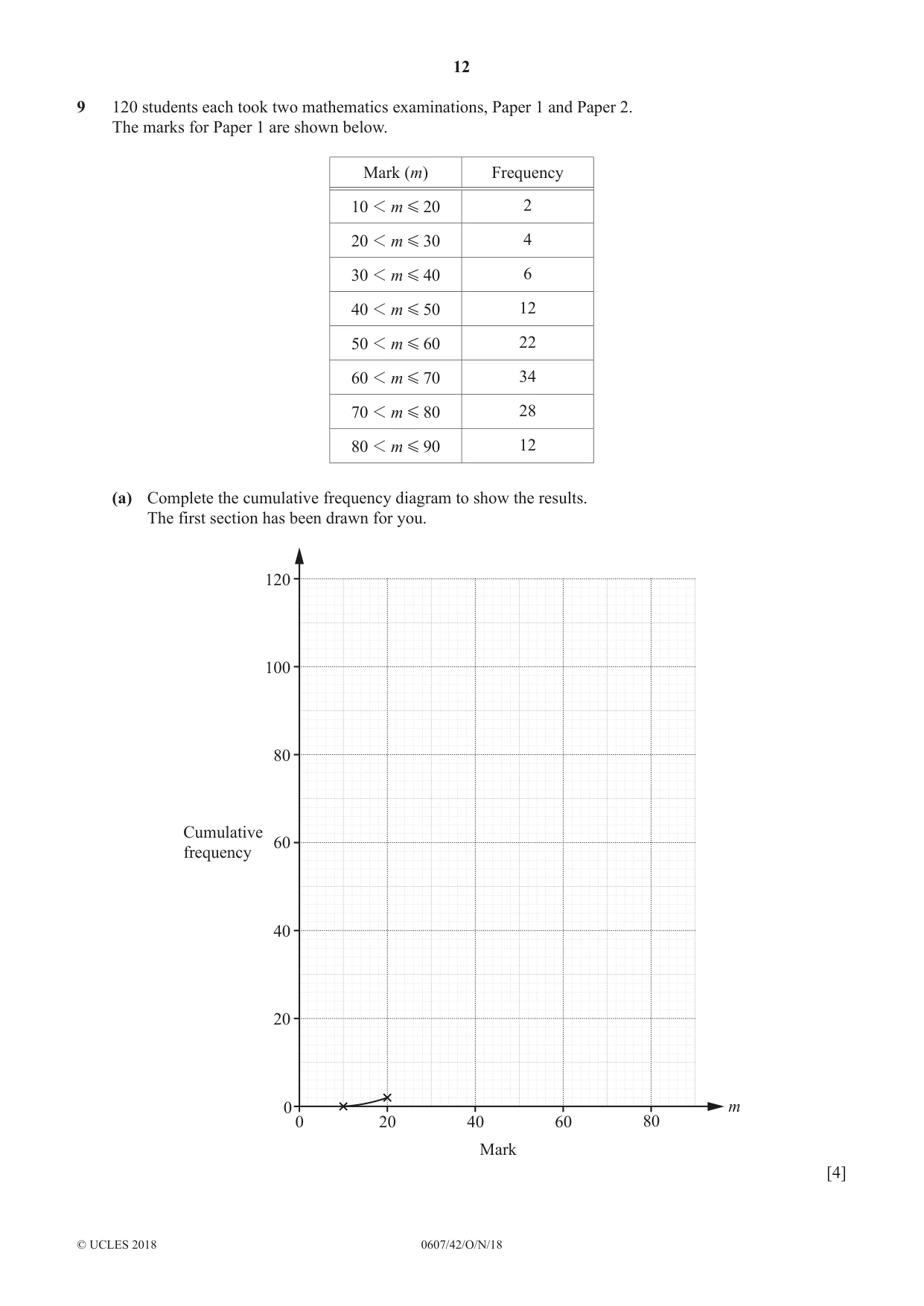
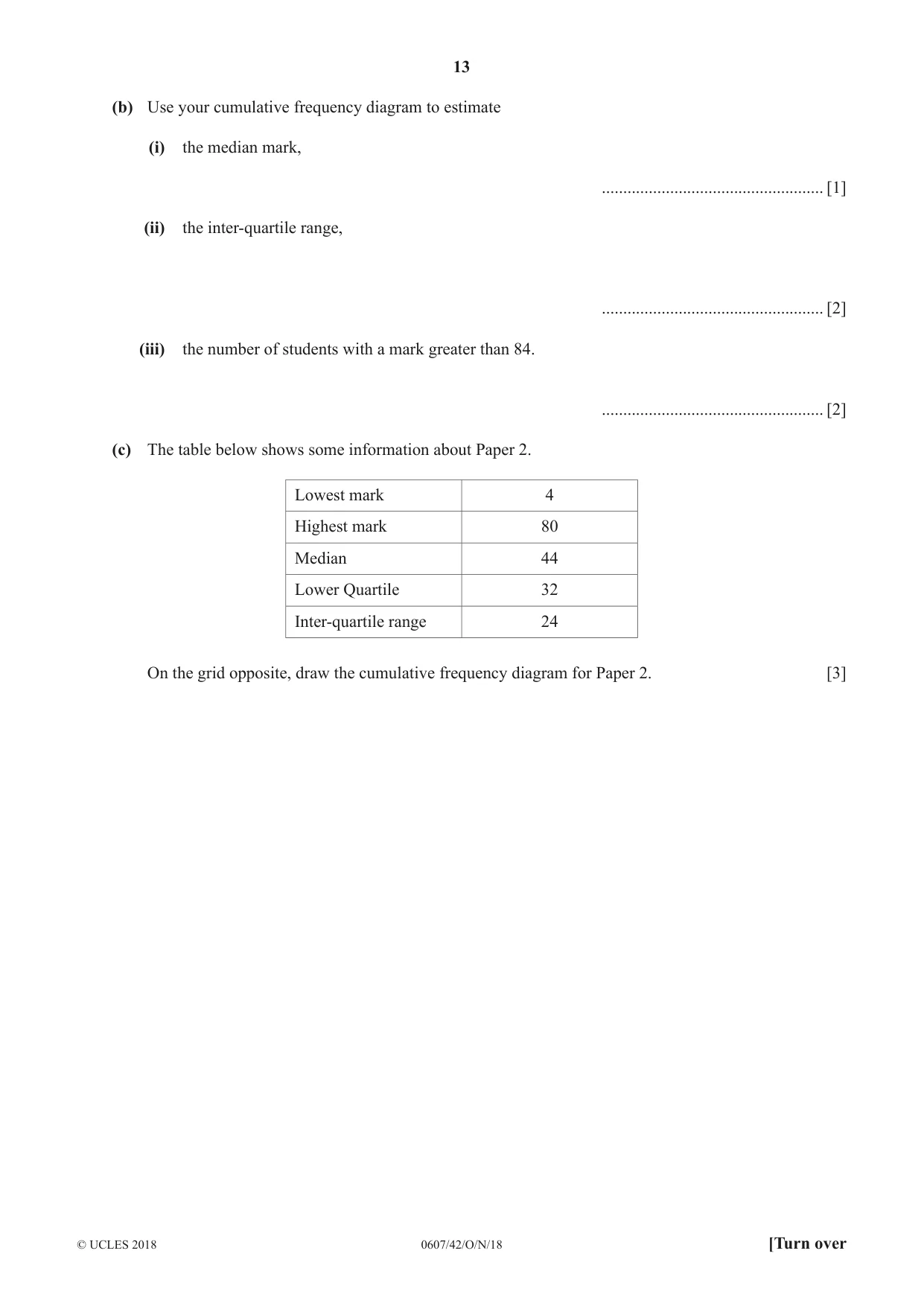
9 120 students each took two mathematics examinations, Paper 1 and Paper 2. The marks for Paper 1 are shown below. Mark (m) Frequency 10 1 m G 20 2 20 1 m G 30 4 30 1 m G 40 6 40 1 m G 50 12 50 1 m G 60 22 60 1 m G 70 34 70 1 m G 80 28 80 1 m G 90 12 (a) Complete the cumulative frequency diagram to show the results. The first section has been drawn for you. 120 100 80 Cumulative 60 frequency 40 20 0 m 0 20 40 60 80 Mark [4] (b) Use your cumulative frequency diagram to estimate (i) the median mark, .................................................... [1] (ii) the inter-quartile range, .................................................... [2] (iii) the number of students with a mark greater than 84. .................................................... [2] (c) The table below shows some information about Paper 2. Lowest mark 4 Highest mark 80 Median 44 Lower Quartile 32 Inter-quartile range 24 On the grid opposite, draw the cumulative frequency diagram for Paper 2. [3]
Mark scheme: 9(a) Correct cf curve through 7 more 4 B3 for curve through 5 or more correct points points or B2 for curve through 4 correct points or correct cfs 2, 6, 12, 24, 46, 80, 108, 120 or B1 for curve through 3 correct points or 5,6 or 7 cfs 9(b)(i) 63 to 66 1 Only from increasing diagram 9(b)(ii) 17 to 23 2 B1 for LQ = 52 to 55 or UQ = 72 to 75 Only from increasing diagram 9(b)(iii) 4 to 8 2 B1 for 112 to 116 seen Only from increasing diagram 9(c) Correct cumulative frequency curve 3 B1 for lowest and highest points plotted correctly B1for median and lower quartile plotted correctly B1for upper quartile plotted correctly Maximum 2 marks if points not joined
Q10 · North North NOT TO SCALE A 120 m B In the diagram, point B is due east of point A
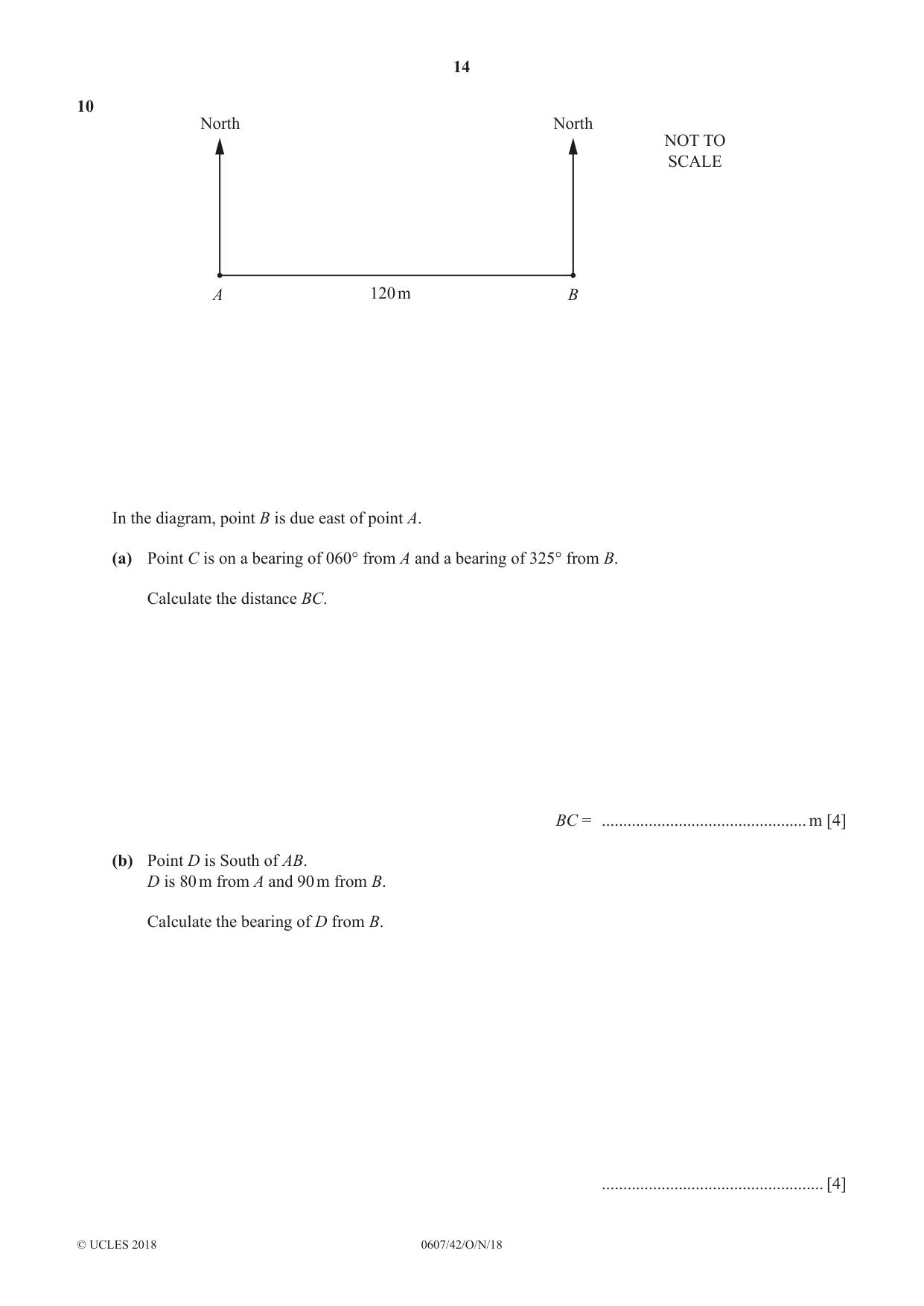
10 North North NOT TO SCALE A 120 m B In the diagram, point B is due east of point A. (a) Point C is on a bearing of 060° from A and a bearing of 325° from B. Calculate the distance BC. BC = ................................................ m [4] (b) Point D is South of AB. D is 80 m from A and 90 m from B. Calculate the bearing of D from B. .................................................... [4]
Mark scheme: 10(a) 60.2 or 60.22 to 60.23. 4 B1 for angle ACB = 95 120sin(theirCAB ) M2 for oe sin(their ACB ) BC 120 or M1 for = sin(theirCAB ) sin(their ACB ) 10(b) 228 or 228.1 to 228.2 nfww 4 120 2 + 90 2 − 80 2 M2 for cos[ABD] = 2 × 120 × 90 or M1 for 802 = 1202 + 902 – 2 × 120 × 90 cosABD A1 for 41.8 or 41.80 to 41.81
Q11 · NOT TO SCALE 8 m 1.8 m The diagram shows a polythene structure in which a farmer grows…
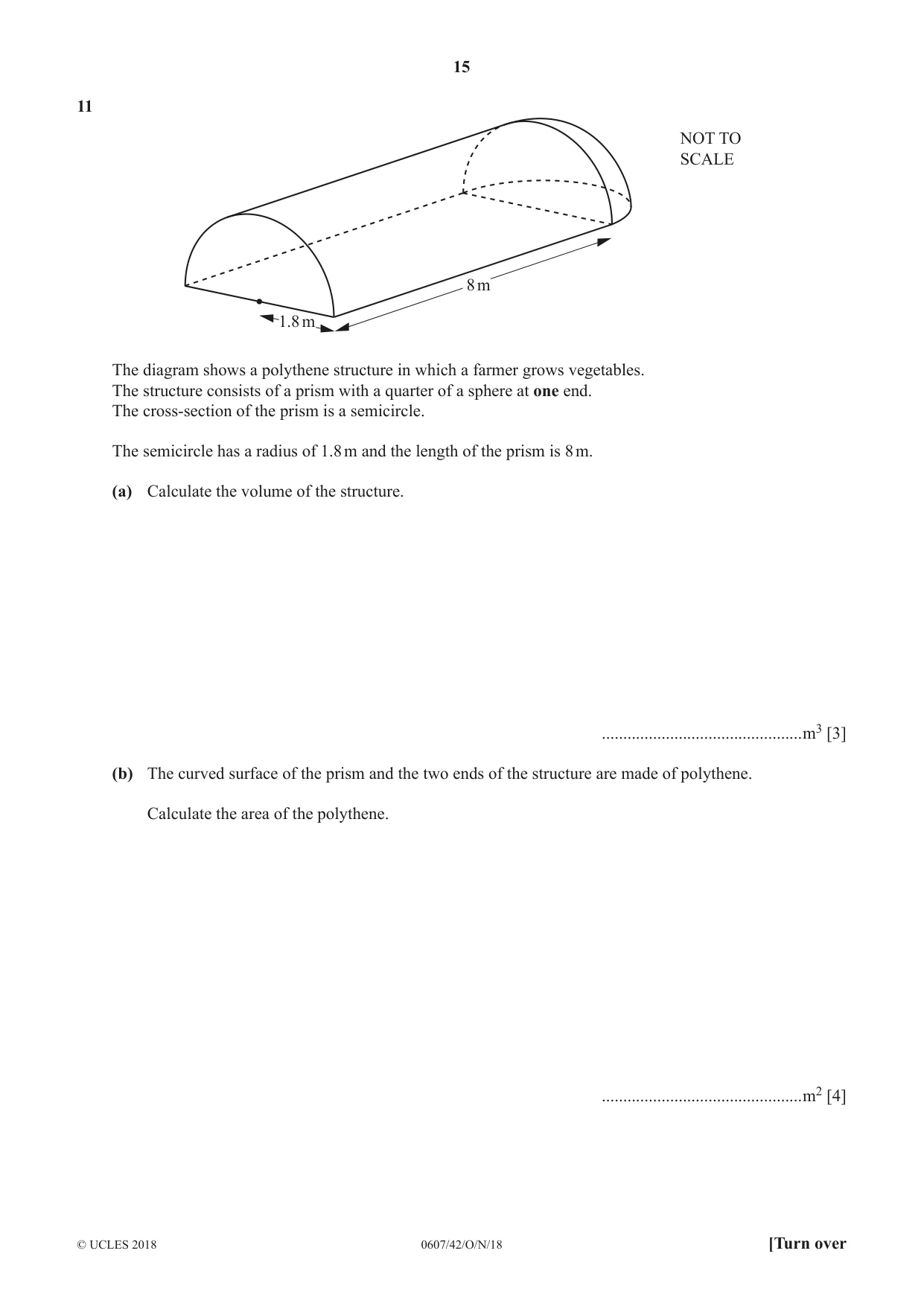
11 NOT TO SCALE 8 m 1.8 m The diagram shows a polythene structure in which a farmer grows vegetables. The structure consists of a prism with a quarter of a sphere at one end. The cross-section of the prism is a semicircle. The semicircle has a radius of 1.8 m and the length of the prism is 8 m. (a) Calculate the volume of the structure. ...............................................m3 [3] (b) The curved surface of the prism and the two ends of the structure are made of polythene. Calculate the area of the polythene. ...............................................m2 [4]
Mark scheme: 11(a) 46.8 or 46.82 to 46.83 3 1 M1 for × π × 1.82 × 8 oe 2 1 4 M1 for × × π × 1.83 oe 4 3 11(b) 60.5 or 60.49 to 60.51... 4 1 M1 for × π × 1.82 oe 2 1 M1 for × 2 × π × 1.8 × 8 oe 2 1 M1 for × 4 × π × 1.82 oe 4
Q12 · Y 15 x –6 0 6 –10 (2x - 3) f (x) = (x + 2) (a) On the diagram, sketch the graph of y =…
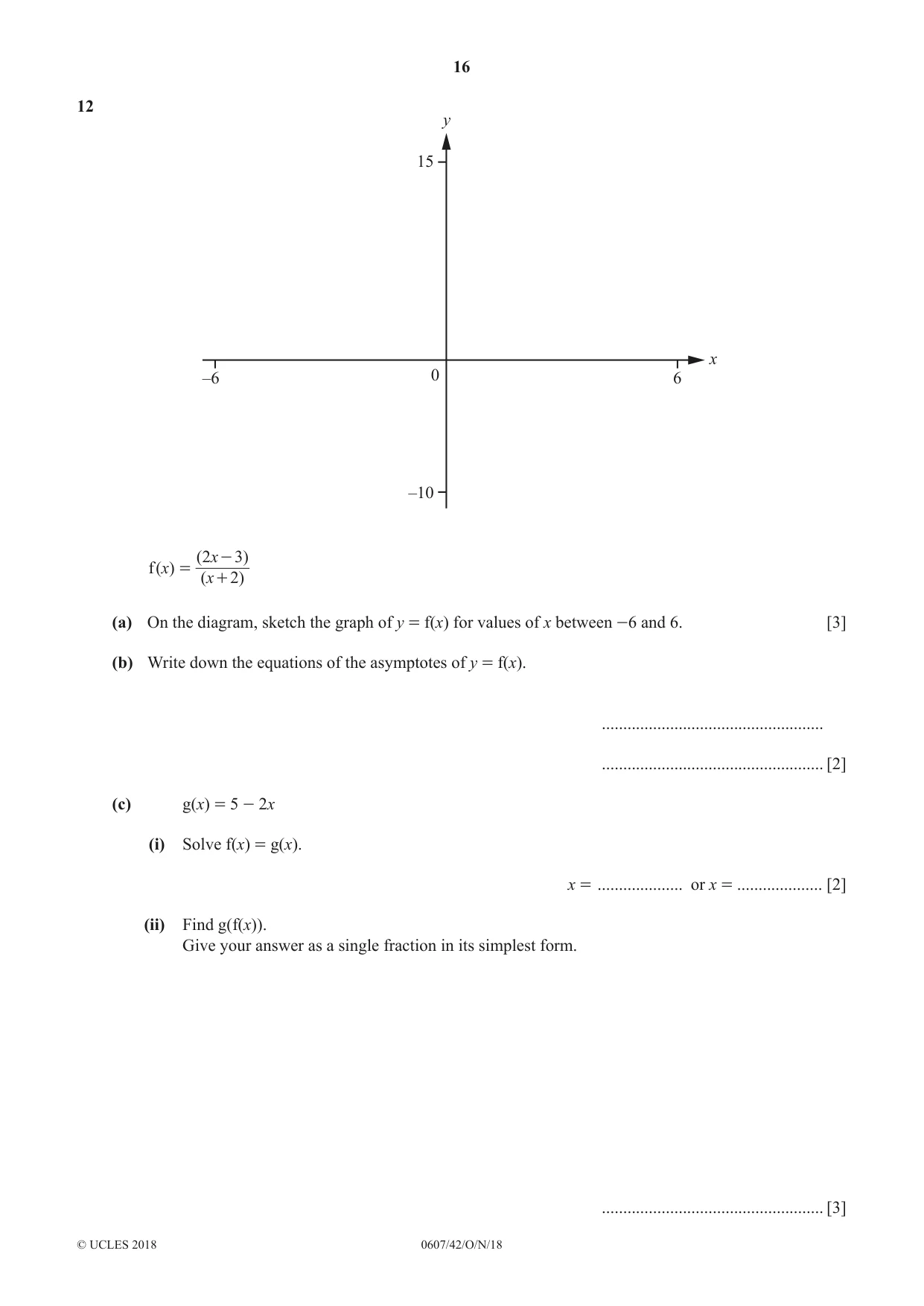
12 y 15 x –6 0 6 –10 (2x - 3) f (x) = (x + 2) (a) On the diagram, sketch the graph of y = f(x) for values of x between -6 and 6. [3] (b) Write down the equations of the asymptotes of y = f(x). .................................................... .................................................... [2] (c) g(x) = 5 - 2x (i) Solve f(x) = g(x). x = .................... or x = .................... [2] (ii) Find g(f(x)). Give your answer as a single fraction in its simplest form. .................................................... [3]
Mark scheme: 12(a) Correct sketch 3 B1 for correct left hand branch without 15 y f(x)=(2x-3)/(x+2) serious curl back 10 5 B2 for correct right-hand branch x or B1 for correct shape right-hand branch but -6 6 with clear intercepts but serious overlap or -5 curl back -10 12(b) x = –2 oe 2 B1 for each y = 2 oe 12(c)(i) –2.81 or –2.812 to –2.811 2 B1 for each or for 2 x 2 + x − 13 = 0 2.31 or 2.311 to 2.312 12(c)(ii) x + 16 3 5( x + 2) − 2(2 x − 3) M2 for x + 2 x + 2 2 x − 3 or M1 for 5 −2 oe x + 2
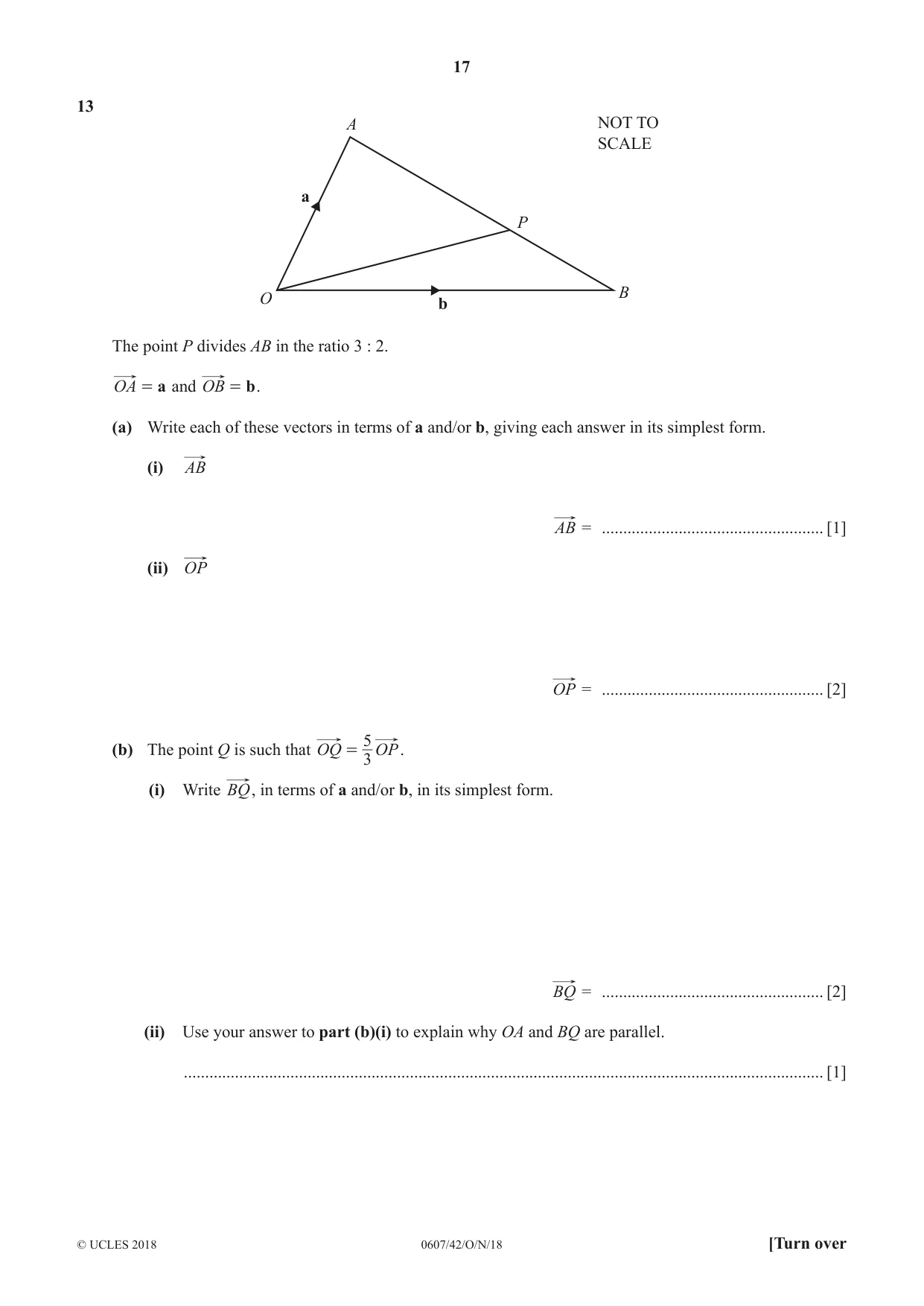
Q13 · A NOT TO SCALE a P B O b The point P divides AB in the ratio 3 : 2
13 A NOT TO SCALE a P B O b The point P divides AB in the ratio 3 : 2. OA = a and OB = b . (a) Write each of these vectors in terms of a and/or b, giving each answer in its simplest form. (i) AB AB = .................................................... [1] (ii) OP OP = .................................................... [2] 5 (b) The point Q is such that OQ = OP . 3 (i) Write BQ, in terms of a and/or b, in its simplest form. BQ = .................................................... [2] (ii) Use your answer to part (b)(i) to explain why OA and BQ are parallel. ...................................................................................................................................................... [1]
Mark scheme: 13(a)(i) –a + b 1 13(a)(ii) 2 3 2 B1 for unsimplified seen a + b JJJG JJG 5 5 3 2 or M1 for a + AB oe or b + BA oe 5 5 13(b)(i) 2 2 B1 for unsimplified seen a 3 5 or M1 for –b + 3their (a)(ii) JJJG13(b)(ii) 1 Dep on (b)(i) = ka, k ≠ 1 BQ is a multiple of a oe
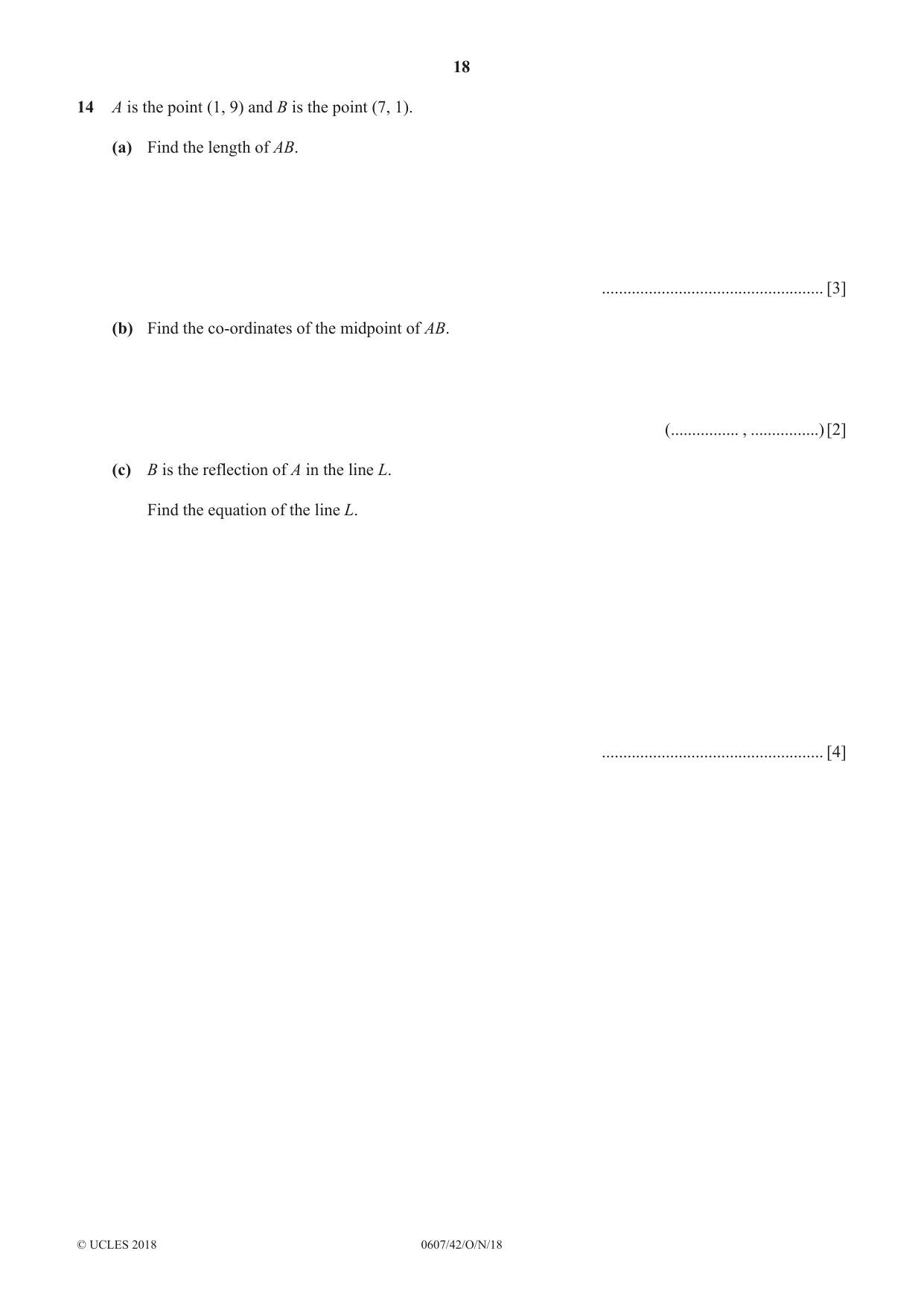
Q14 · A is the point (1, 9) and B is the point (7, 1)
14 A is the point (1, 9) and B is the point (7, 1). (a) Find the length of AB. .................................................... [3] (b) Find the co-ordinates of the midpoint of AB. (................ , ................) [2] (c) B is the reflection of A in the line L. Find the equation of the line L. .................................................... [4]
Mark scheme: 14(a) 10 3 2 2 M2 for 6 + 8 or B1 for 6 and 8 seen nfww 14(b) (4, 5) 2 B1 for each co-ordinate 14(c) 3 4 Must be 3 term equation y = x + 2 oe 4 3 B2 for gradient = 4 4 or B1 for gradient of AB = – 3 M1 for substituting their (b) into y = (their m) x + c oe
What was in this paper
The subtopics covered by these 14 questions, and how many questions each got. Open one in a new tab to see every Cambridge question on it.
1Circles, arcs and sectors1Cumulative frequency diagrams1Exponential growth and decay1Functions1Graphs of functions1Length and midpoint1Non-right-angled triangles1Probability of combined events1Proportion1Rates1Surface area and volume1Transformations1Vectors in two dimensions1What you needed in this session
Cambridge’s own grade thresholds for 2018 Oct/Nov, Paper 4 · Variant 2. A higher threshold means an easier paper — the bar moves with how the cohort did.