Cambridge IGCSE Mathematics - International 0607 — 2021 May/June Paper 4 · Variant 2
0607/42/M/J/21 · 13 questions · 120 marks · ≈135 min
The question paper and its mark scheme, free to read here and free to download. This is Cambridge’s own paper, exactly as it was sat.
Question paper24 pages

Mark scheme9 pages
Answers below. Sit the paper first if you are practising.
Questions as text
Question 1
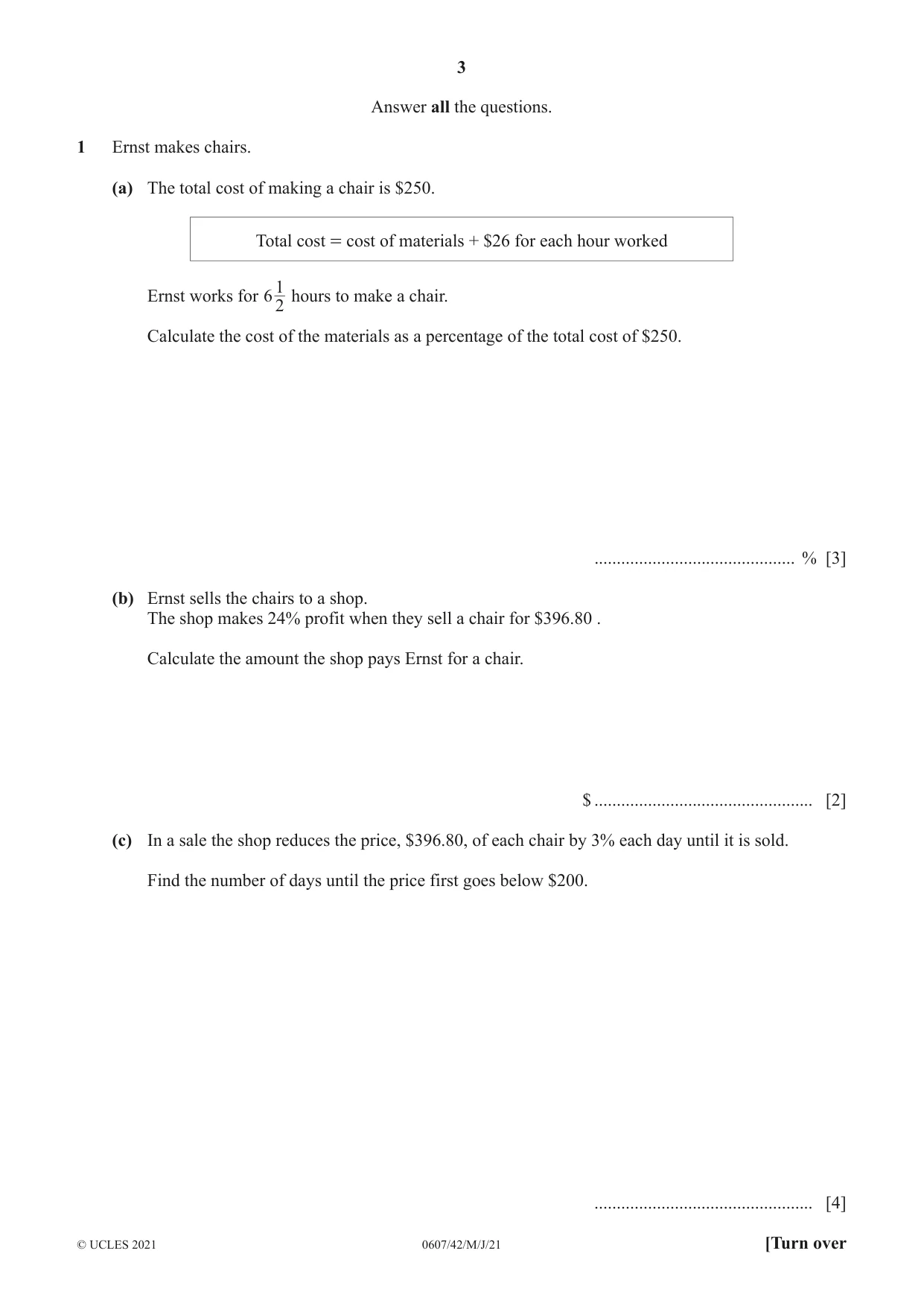
1 Ernst makes chairs. (a) The total cost of making a chair is $250. Total cost = cost of materials + $26 for each hour worked 1 Ernst works for 6 hours to make a chair. 2 Calculate the cost of the materials as a percentage of the total cost of $250. ............................................. % [3] (b) Ernst sells the chairs to a shop. The shop makes 24% profit when they sell a chair for $396.80 . Calculate the amount the shop pays Ernst for a chair. $ ................................................. [2] (c) In a sale the shop reduces the price, $396.80, of each chair by 3% each day until it is sold. Find the number of days until the price first goes below $200. ................................................. [4]
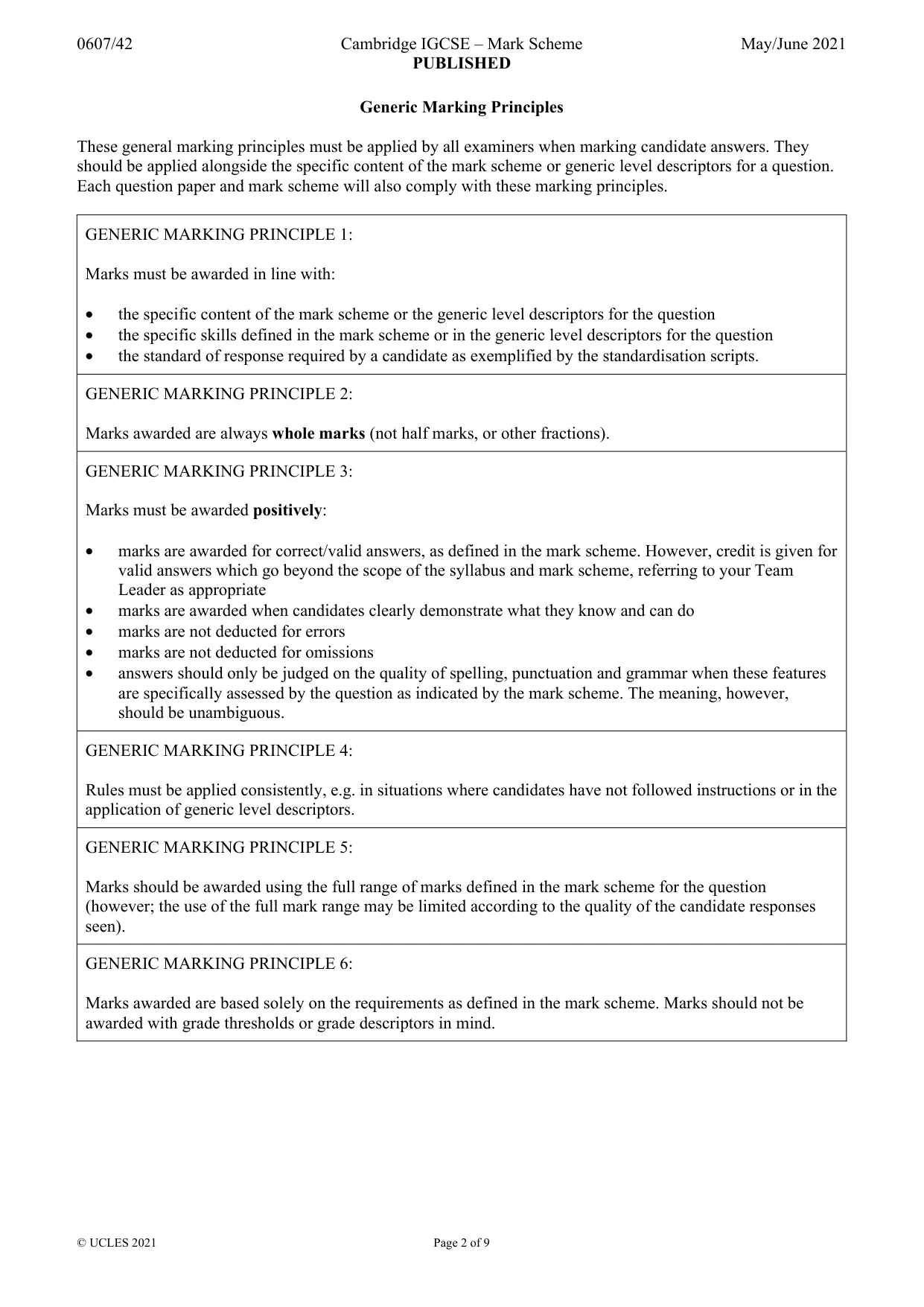
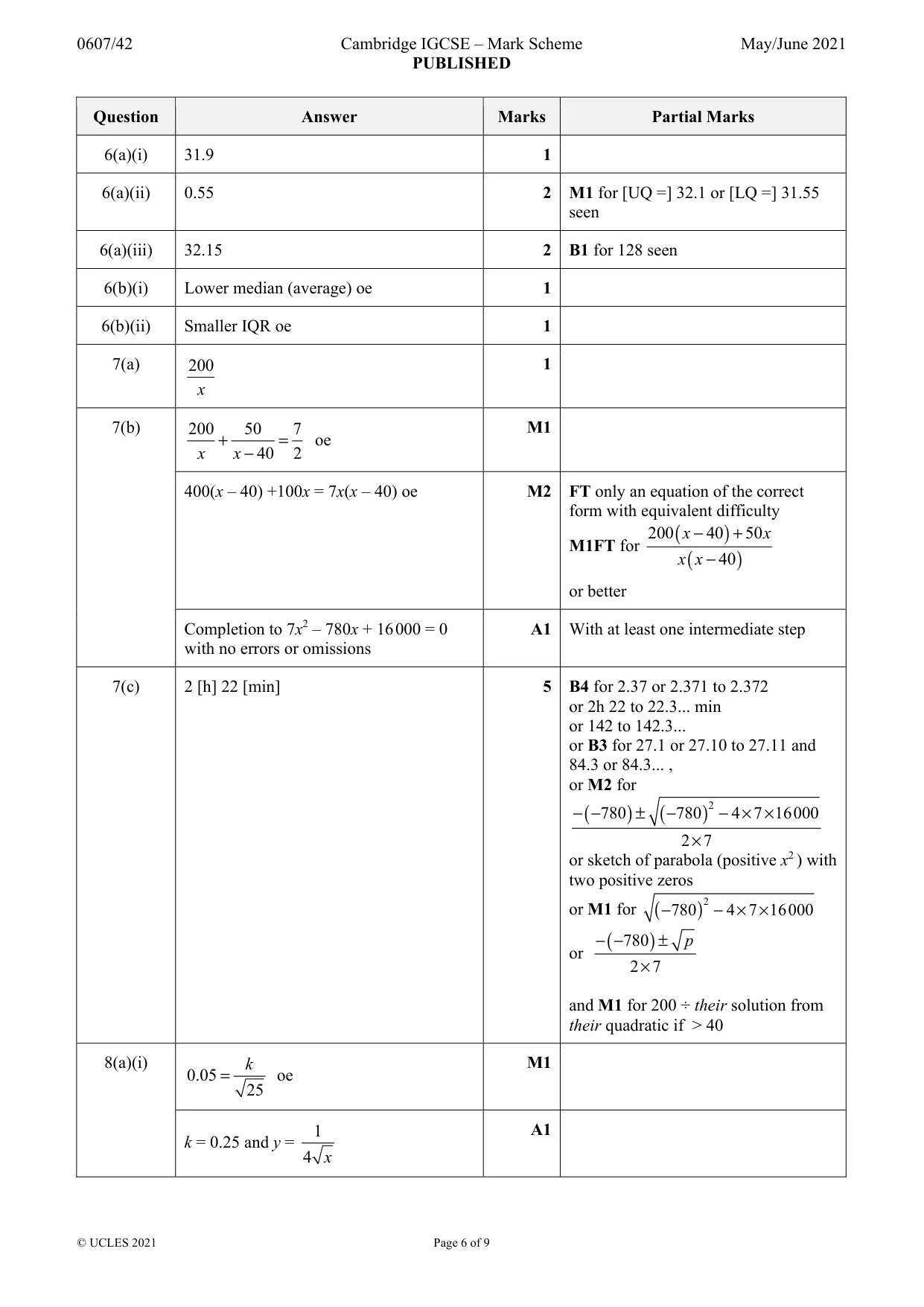
Mark scheme: Question Answer Marks Partial Marks 1(a) 32.4 3 250 − 6.5 × 26 M2 for [× 100 ] oe 250 6.5 × 26 or × 100 250 or M1 for 250 – 6.5 × 26 soi by 81 6.5 × 26 or 250 1(b) 320 2 24 M1 for ( ) × 1 + = 396.8 or 100 better 1(c) 23 4 B3 for 22.49… or 22.5 or 22 as answer or M3 for 3 200 n log 1 − = log oe 100 396.8 or correct trials as far as 22 and 23 or sketch indicating value between 22 and 23 3 n 200 or M2 for 1 − = oe 100 396.8 or at least 3 correct trials or a sketch that could lead to solution e.g. y = 0.97x and y = 200 3 n or M1 for 396.8 × 1 − = 200 100 soi. or at least 2 correct trials
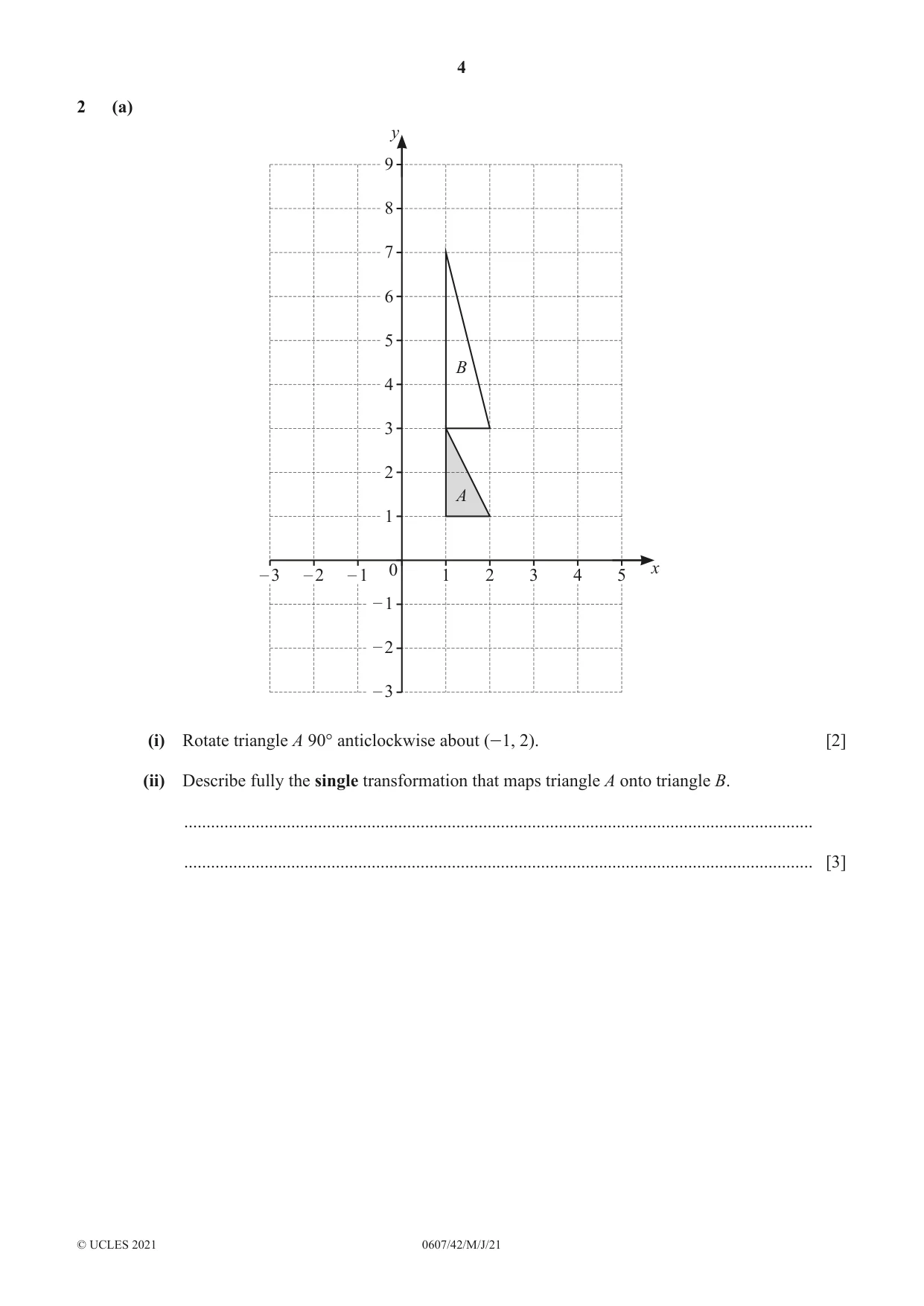
Q2 · Y 9 8 7 6 5 B 4 3 2 A 1 – 3 – 2 – 1 0 1 2 3 4 5 x – 1 – 2 – 3 (i) Rotate triangle A 90°…
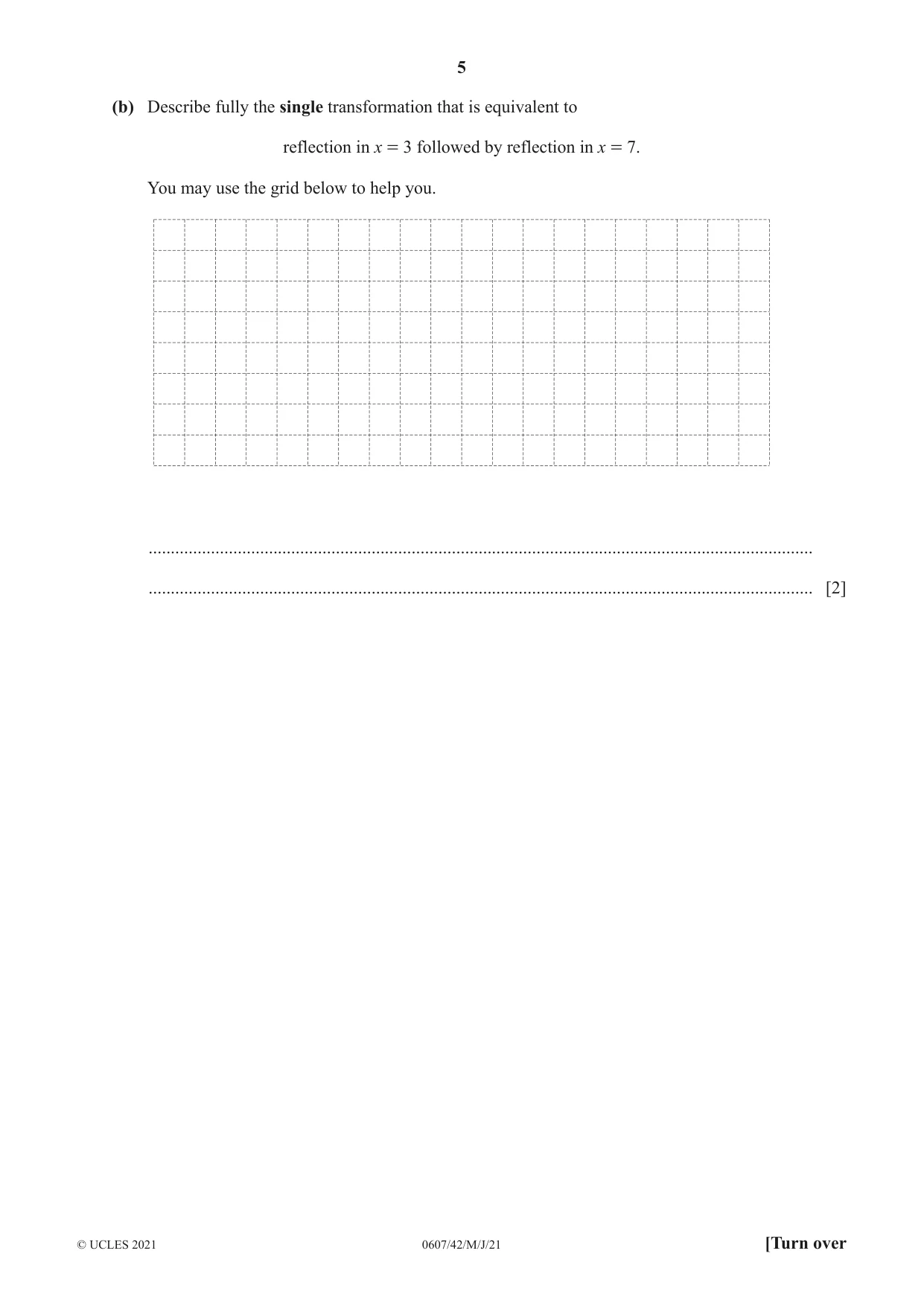
2 (a) y 9 8 7 6 5 B 4 3 2 A 1 – 3 – 2 – 1 0 1 2 3 4 5 x – 1 – 2 – 3 (i) Rotate triangle A 90° anticlockwise about (-1, 2). [2] (ii) Describe fully the single transformation that maps triangle A onto triangle B. ............................................................................................................................................. ............................................................................................................................................. [3] (b) Describe fully the single transformation that is equivalent to reflection in x = 3 followed by reflection in x = 7. You may use the grid below to help you. ..................................................................................................................................................... ..................................................................................................................................................... [2]
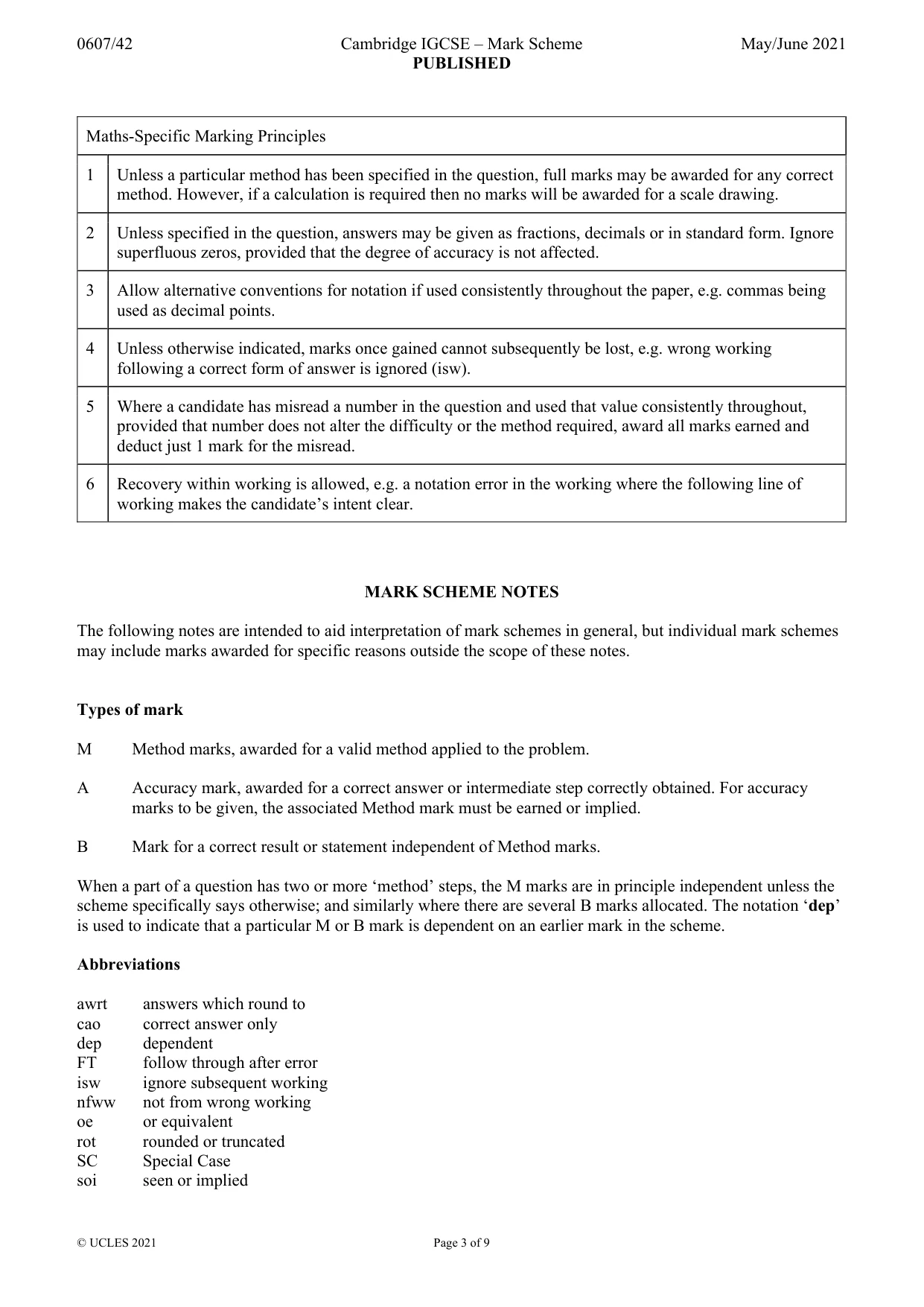
Mark scheme: 2(a)(i) Triangle at (–2, 4), (0, 4), (0, 5) 2 B1 for rotation 90° clockwise about (–1, 2) or rotation anticlockwise 90° about wrong centre 2(a)(ii) Stretch 3 B1 for each [Factor] 2 Invariant [line] y = –1 oe 2(b) Translation 2 B1 for each 8 0
Q3 · The table shows the masses of 30 sheep
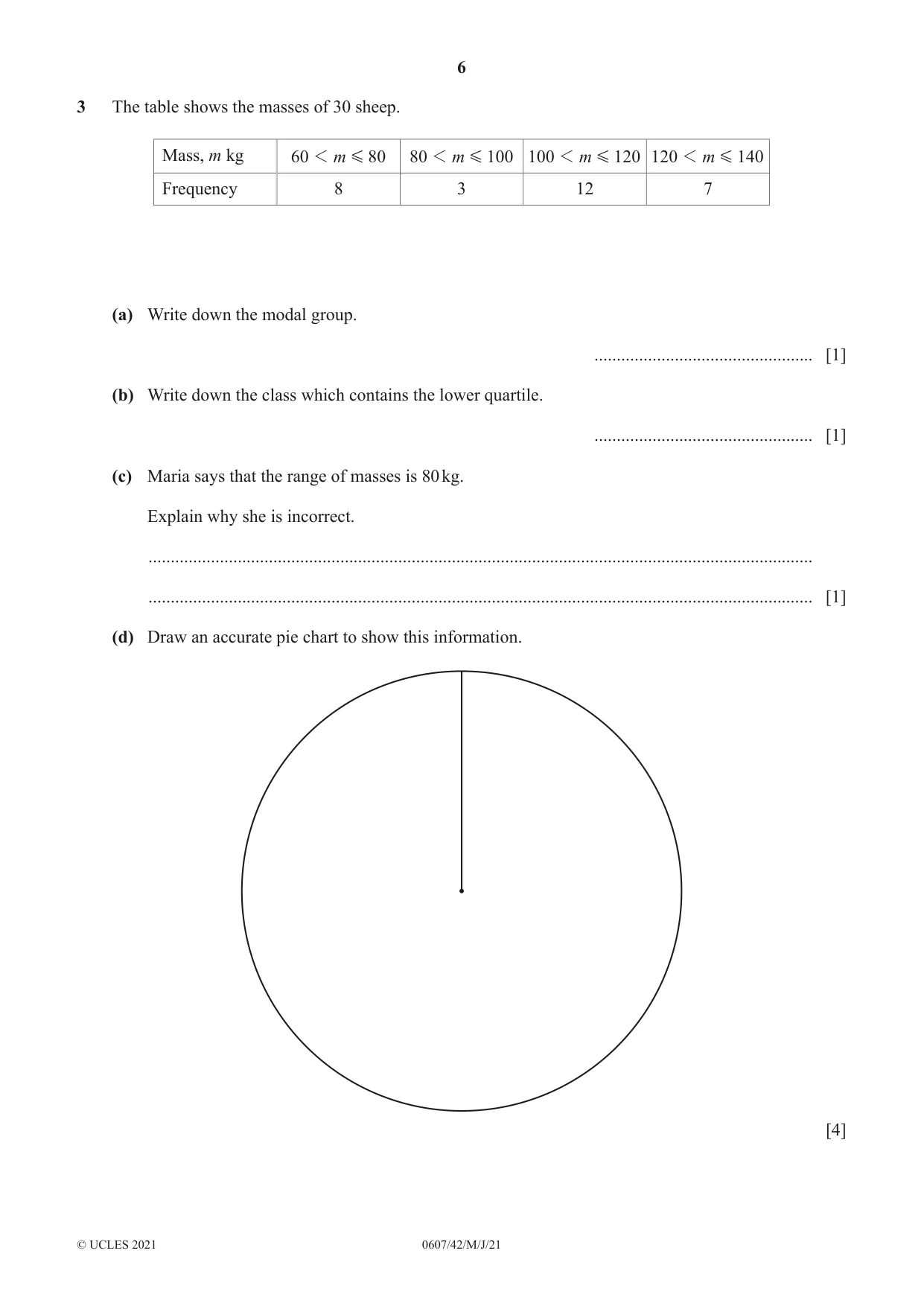
3 The table shows the masses of 30 sheep. Mass, m kg 60 1 m G 80 80 1 m G 100 100 1 m G 120 120 1 m G 140 Frequency 8 3 12 7 (a) Write down the modal group. ................................................. [1] (b) Write down the class which contains the lower quartile. ................................................. [1] (c) Maria says that the range of masses is 80 kg. Explain why she is incorrect. ..................................................................................................................................................... ..................................................................................................................................................... [1] (d) Draw an accurate pie chart to show this information. [4]
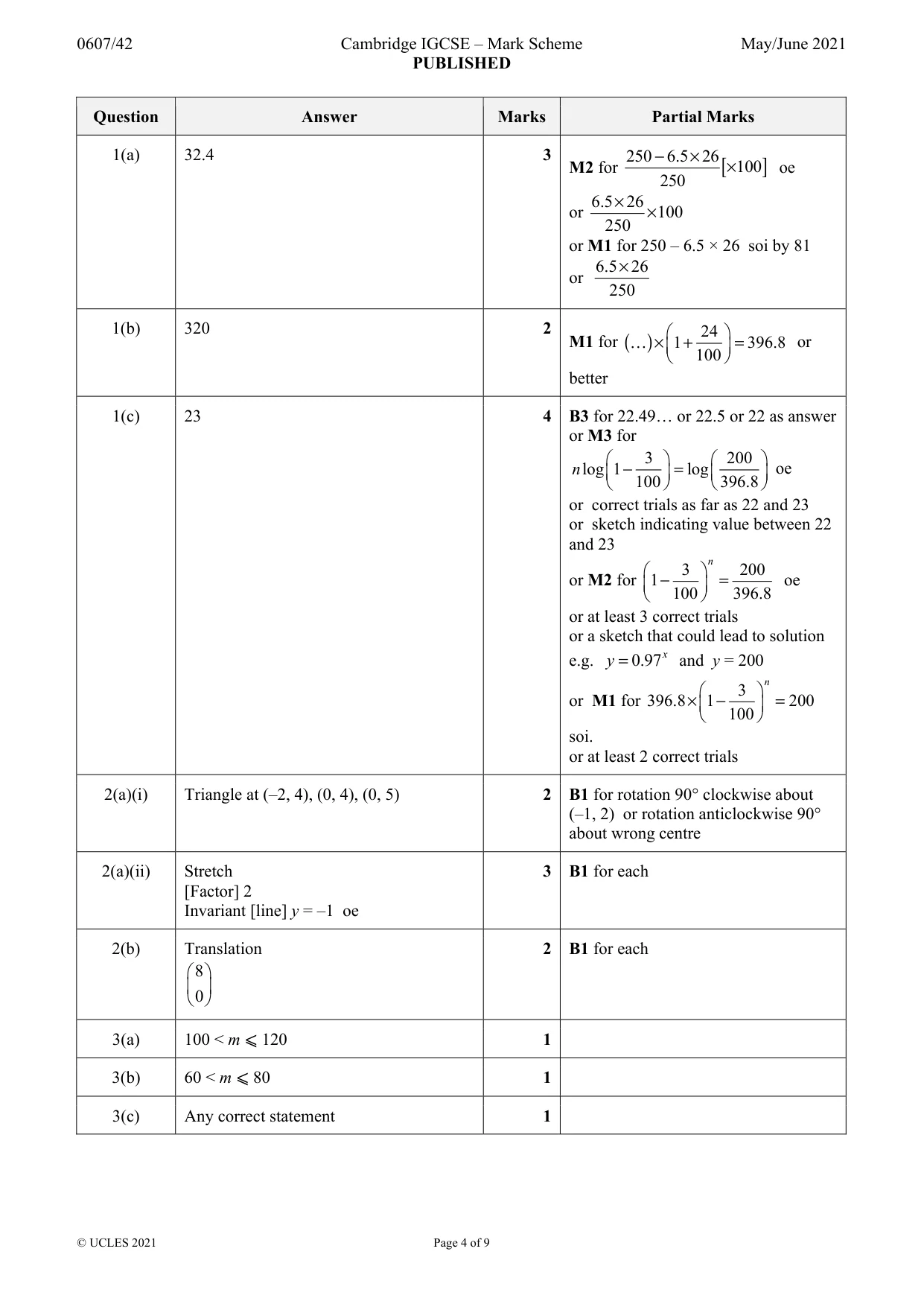
Mark scheme: 3(a) 100 < m ⩽ 120 1 3(b) 60 < m ⩽ 80 1 3(c) Any correct statement 1 3(d) Correct labelled pie chart (labels 4 B3 for pie chart with all angles correct indicating masses) or B2 for pie chart with two angles correct or B1 for 2 correct angles calculated B1 for correct labels on sectors.
Q4 · Y 15 – 5 0 5 x – 15 f ( )x = 10 - x 2 (a) On the diagram, sketch the graph of y = f(x)…
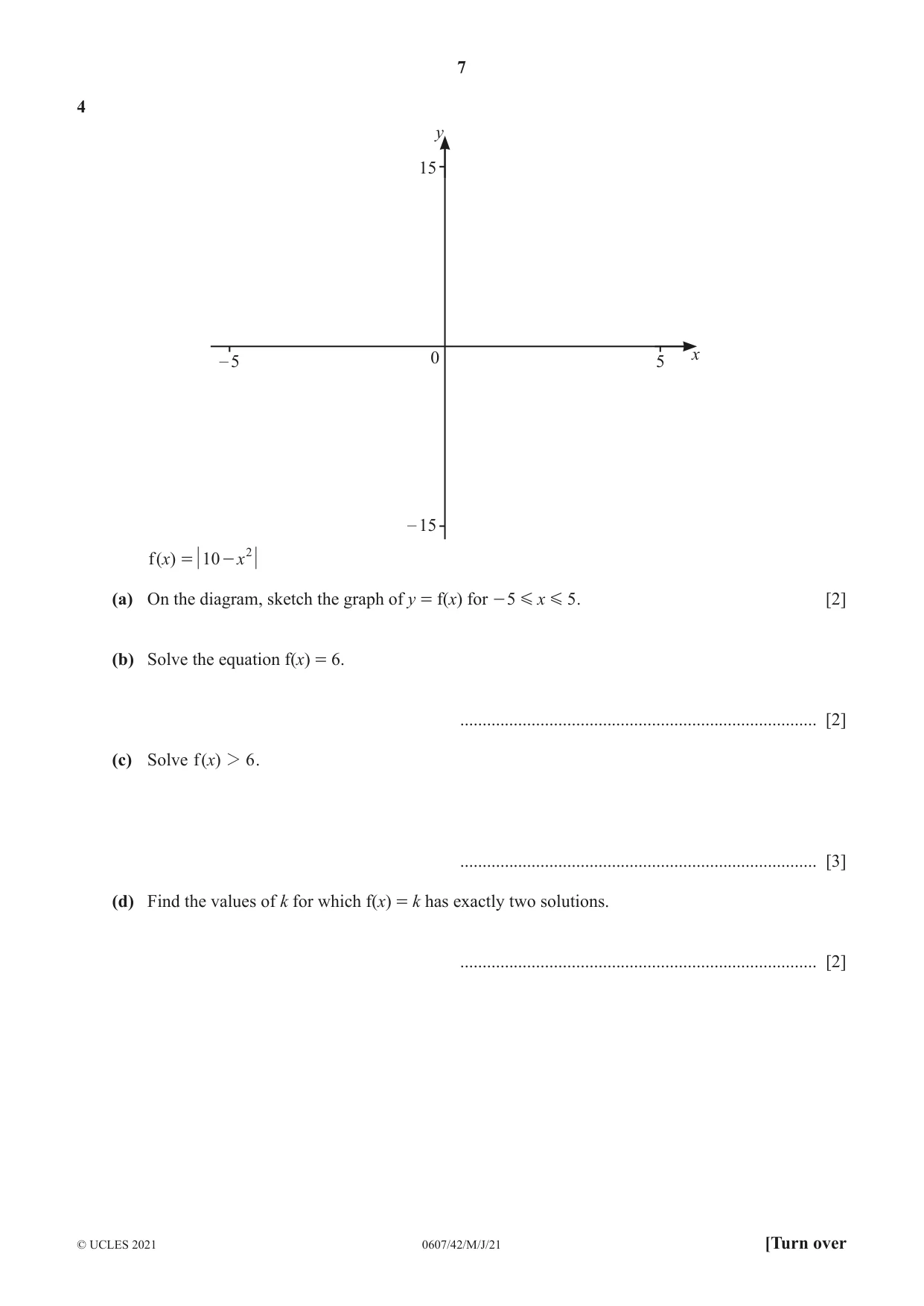
4 y 15 – 5 0 5 x – 15 f ( )x = 10 - x 2 (a) On the diagram, sketch the graph of y = f(x) for - 5 G x G 5 . [2] (b) Solve the equation f(x) = 6. ................................................................................ [2] (c) Solve f ( )x 2 6 . ................................................................................ [3] (d) Find the values of k for which f(x) = k has exactly two solutions. ................................................................................ [2]
Mark scheme: 4(a) Correct sketch 2 B1 for correct middle section 4(b) ± 4 2 B1 for 2 correct solutions ± 2 4(c) x < –4 3 B1 for each –2 < x < 2 x > 4 4(d) 0 2 B1 for each [k ] > 10
Q5 · P NOT TO SCALE 10 m 20 m C B 35° A A, B and C are points on horizontal ground
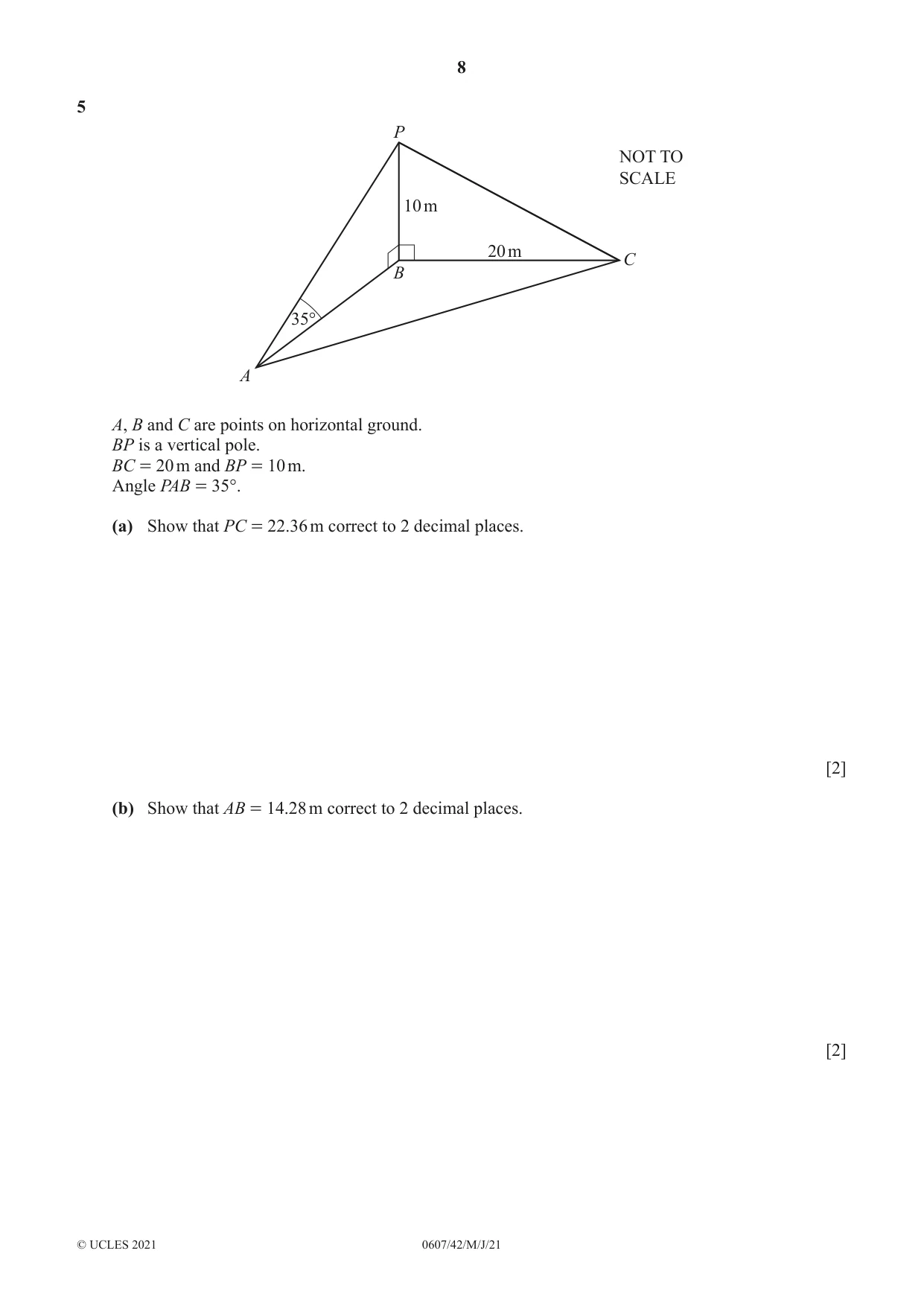
5 P NOT TO SCALE 10 m 20 m C B 35° A A, B and C are points on horizontal ground. BP is a vertical pole. BC = 20 m and BP = 10 m. Angle PAB = 35°. (a) Show that PC = 22.36 m correct to 2 decimal places. [2] (b) Show that AB = 14.28 m correct to 2 decimal places. [2] (c) Calculate AP. AP = ............................................ m [2] (d) Angle ABC = 125°. Calculate AC. AC = ............................................ m [3] (e) Calculate angle APC. Angle APC = ................................................ [3]
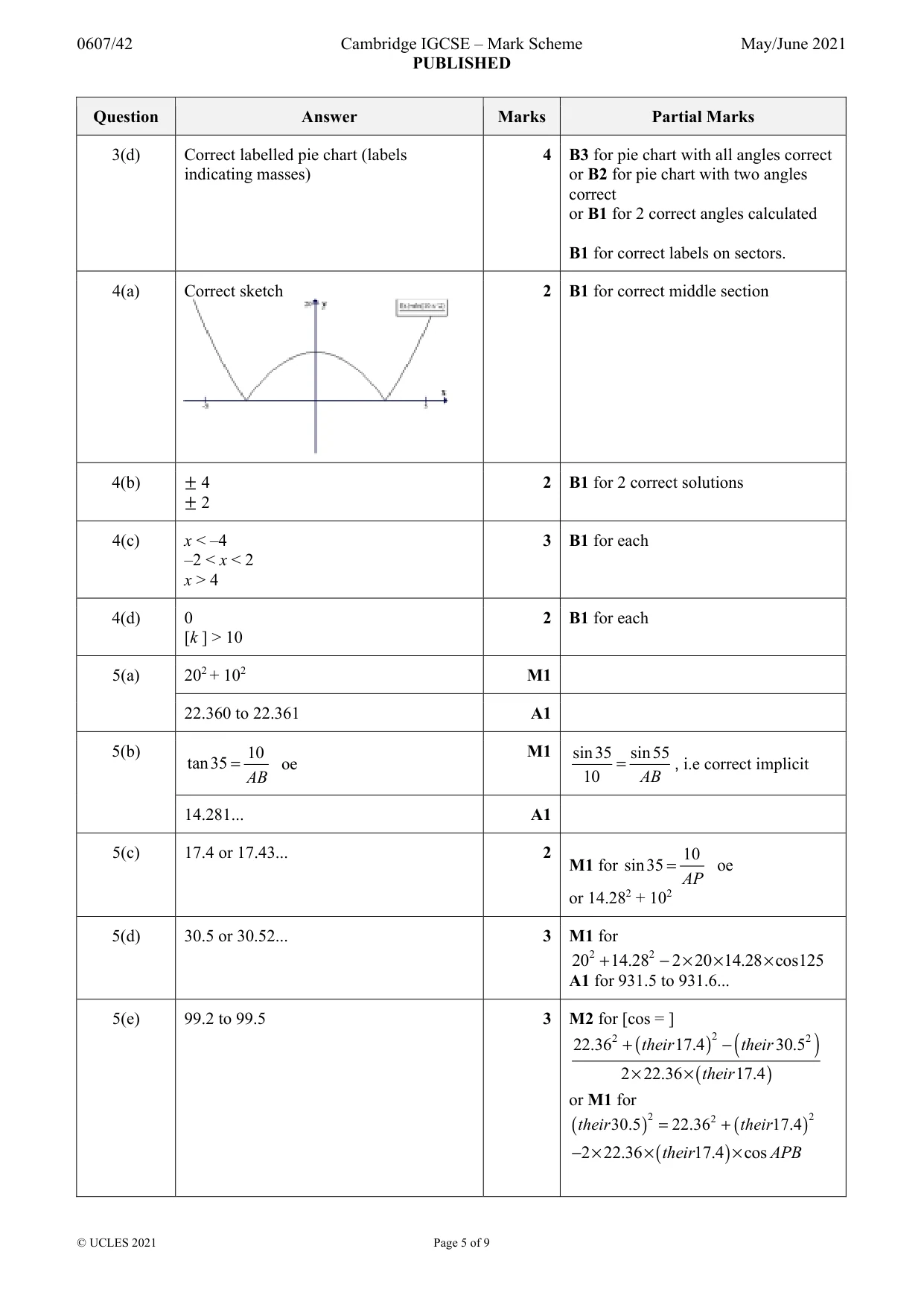
Mark scheme: 5(a) 202 + 102 M1 22.360 to 22.361 A1 5(b) 10 M1 sin35 sin55 tan35 = oe = , i.e correct implicit AB 10 AB 14.281... A1 5(c) 17.4 or 17.43... 2 10 M1 for sin35 = oe AP or 14.282 + 102 5(d) 30.5 or 30.52... 3 M1 for 20 2 + 14.282 −×2 20 × 14.28 × cos125 A1 for 931.5 to 931.6... 5(e) 99.2 to 99.5 3 M2 for [cos = ] their 30.5 22.36 2 + ( their 17.4 ) 2 − ( 2 ) 2 × 22.36 × ( their 17.4 ) or M1 for ( their 30.5 ) 2 = 22.36 2 + ( their17.4 ) 2 −×2 22.36 × ( their17.4 ) × cos APB
Q6 · The cumulative frequency curve shows the times, in minutes, for runner A in 160 races of…
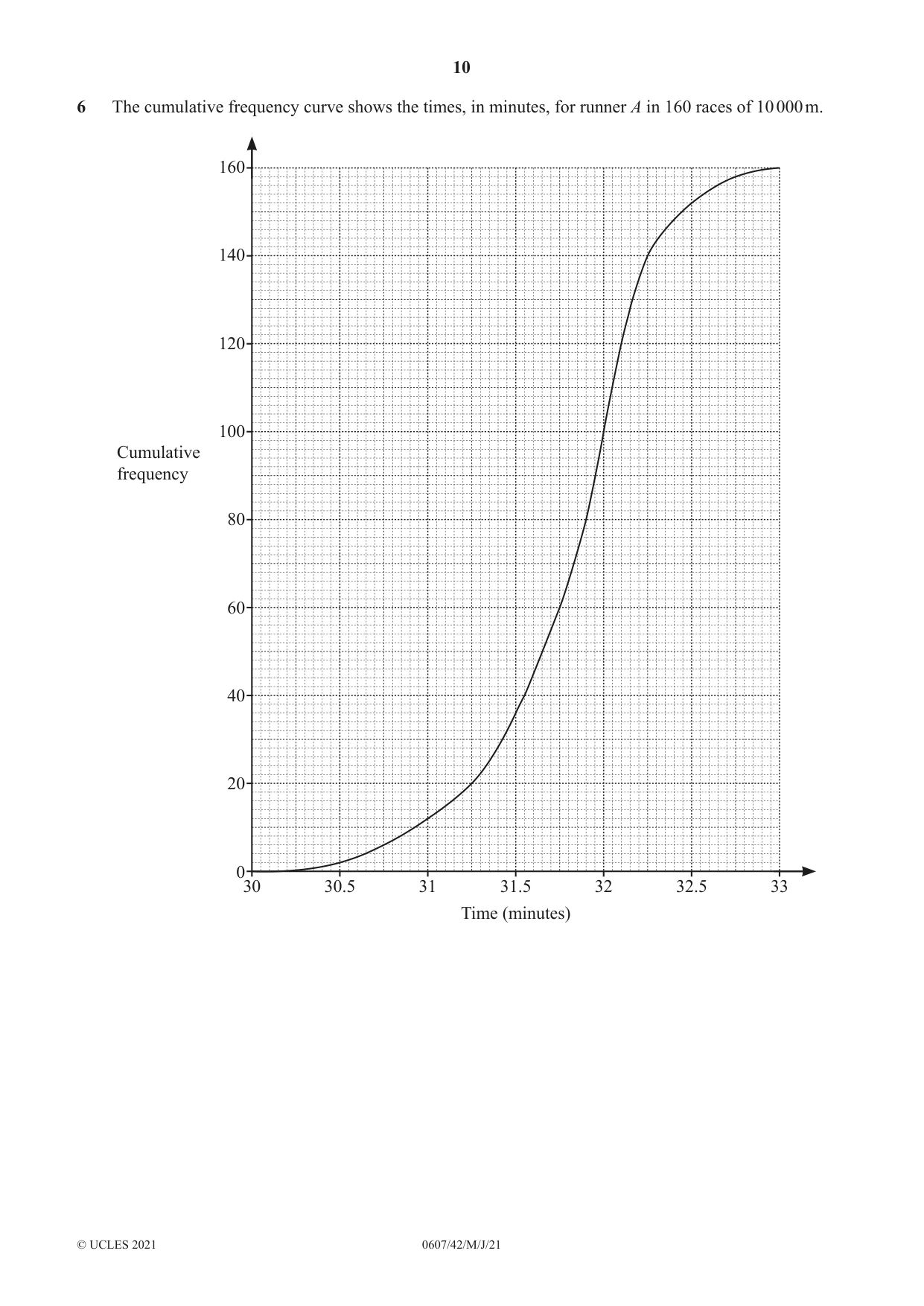
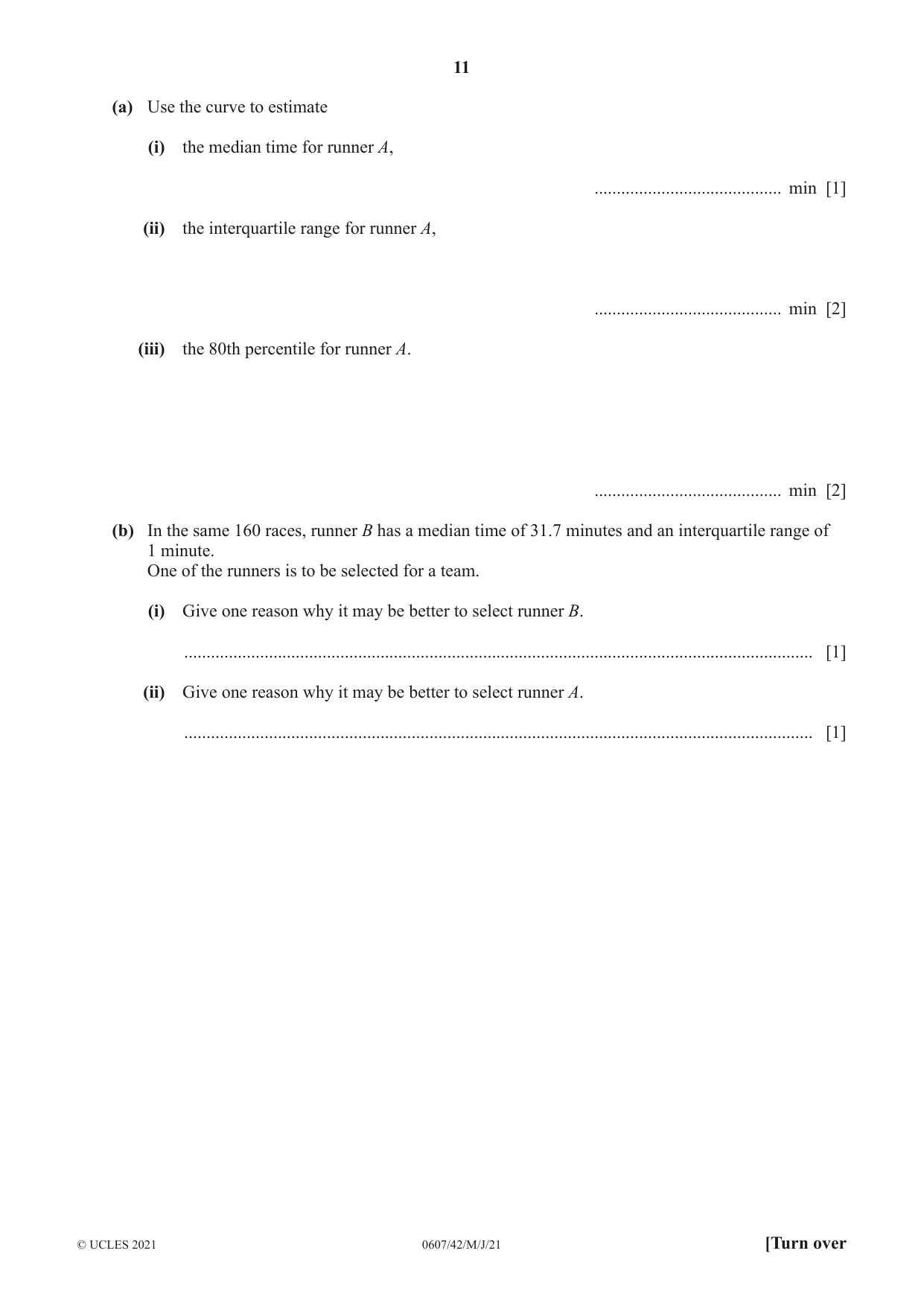
6 The cumulative frequency curve shows the times, in minutes, for runner A in 160 races of 10 000 m. 160 140 120 100 Cumulative frequency 80 60 40 20 0 30 30.5 31 31.5 32 32.5 33 Time (minutes) (a) Use the curve to estimate (i) the median time for runner A, .......................................... min [1] (ii) the interquartile range for runner A, .......................................... min [2] (iii) the 80th percentile for runner A. .......................................... min [2] (b) In the same 160 races, runner B has a median time of 31.7 minutes and an interquartile range of 1 minute. One of the runners is to be selected for a team. (i) Give one reason why it may be better to select runner B. ............................................................................................................................................. [1] (ii) Give one reason why it may be better to select runner A. ............................................................................................................................................. [1]
Mark scheme: 6(a)(i) 31.9 1 6(a)(ii) 0.55 2 M1 for [UQ =] 32.1 or [LQ =] 31.55 seen 6(a)(iii) 32.15 2 B1 for 128 seen 6(b)(i) Lower median (average) oe 1 6(b)(ii) Smaller IQR oe 1
Q7 · Roisin drives 250 km
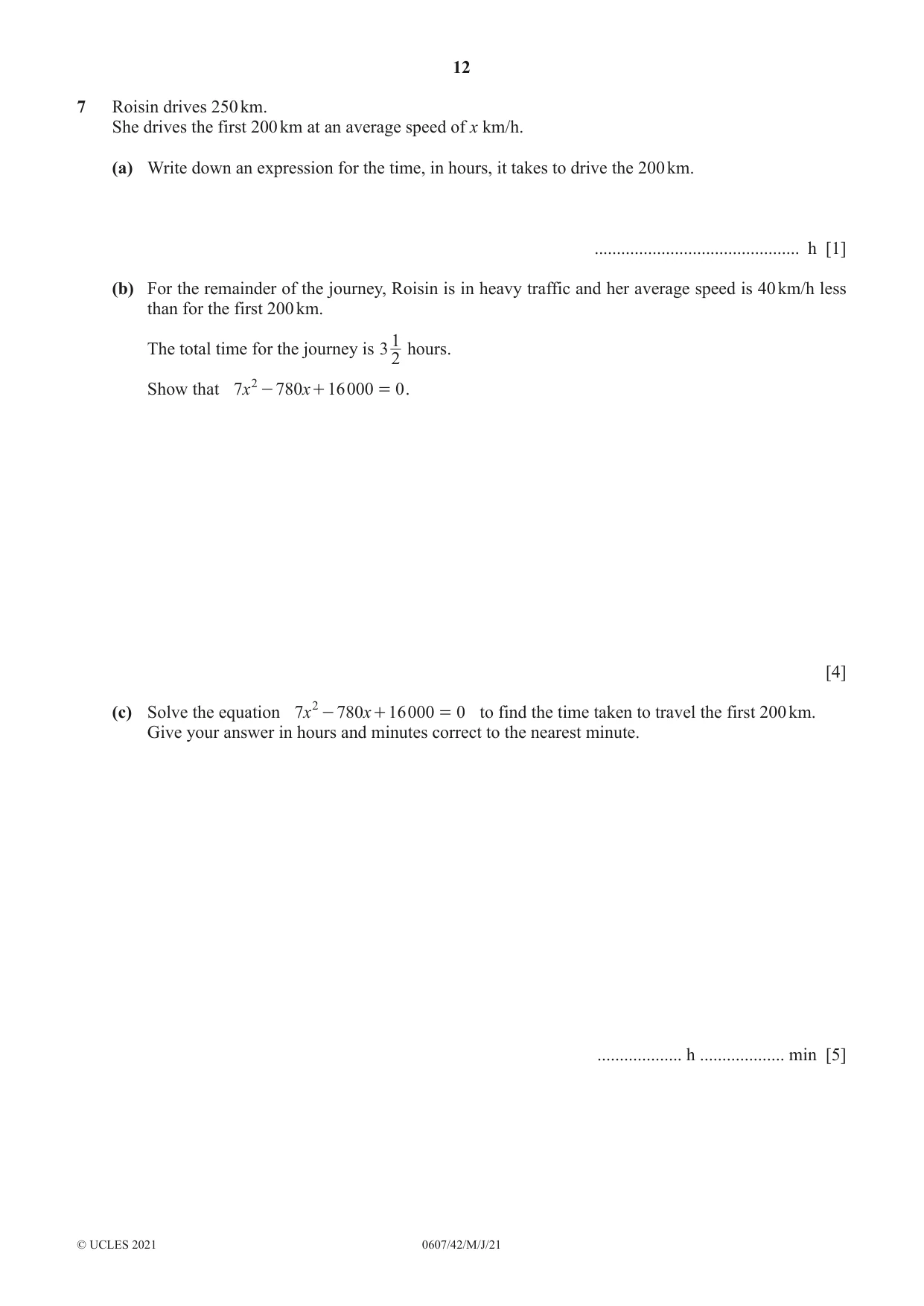
7 Roisin drives 250 km. She drives the first 200 km at an average speed of x km/h. (a) Write down an expression for the time, in hours, it takes to drive the 200 km. .............................................. h [1] (b) For the remainder of the journey, Roisin is in heavy traffic and her average speed is 40 km/h less than for the first 200 km. 1 The total time for the journey is 3 hours. 2 Show that 7x 2 - 780 x + 16000 = 0 . [4] (c) Solve the equation 7x 2 - 780x + 16000 = 0 to find the time taken to travel the first 200 km. Give your answer in hours and minutes correct to the nearest minute. ................... h ................... min [5]
Mark scheme: 7(a) 200 1 x 7(b) 200 50 7 M1 + = oe x x − 40 2 400(x – 40) +100x = 7x(x – 40) oe M2 FT only an equation of the correct form with equivalent difficulty 200 ( x − 40 ) + 50 x M1FT for x ( x − 40 ) or better Completion to 7x2 – 780x + 16 000 = 0 A1 With at least one intermediate step with no errors or omissions 7(c) 2 [h] 22 [min] 5 B4 for 2.37 or 2.371 to 2.372 or 2h 22 to 22.3... min or 142 to 142.3... or B3 for 27.1 or 27.10 to 27.11 and 84.3 or 84.3... , or M2 for 2 −−( 780 ) ± ( −780 ) − 4 × 7 × 16000 2 × 7 or sketch of parabola (positive x2 ) with two positive zeros or M1 for ( − 780 ) 2 − 4 × 7 × 16000 −−( 780 ) ± p or 2 × 7 and M1 for 200 ÷ their solution from their quadratic if > 40
Q8 · Y is inversely proportional to the square root of x
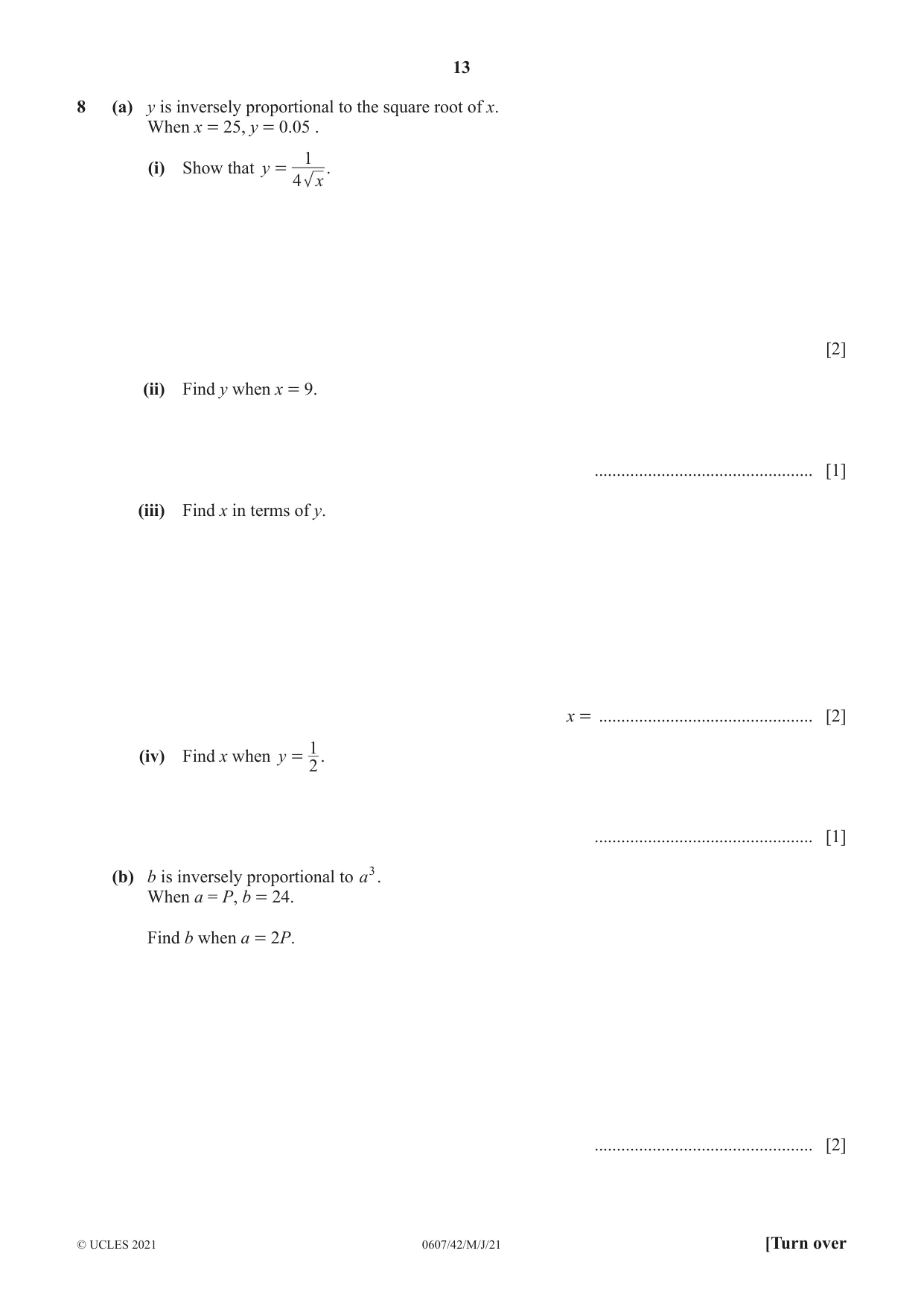
8 (a) y is inversely proportional to the square root of x. When x = 25, y = 0.05 . 1 (i) Show that y = . 4 x [2] (ii) Find y when x = 9. ................................................. [1] (iii) Find x in terms of y. x = ................................................ [2] 1 (iv) Find x when y = . 2 ................................................. [1] (b) b is inversely proportional to a3. When a = P, b = 24. Find b when a = 2P. ................................................. [2]
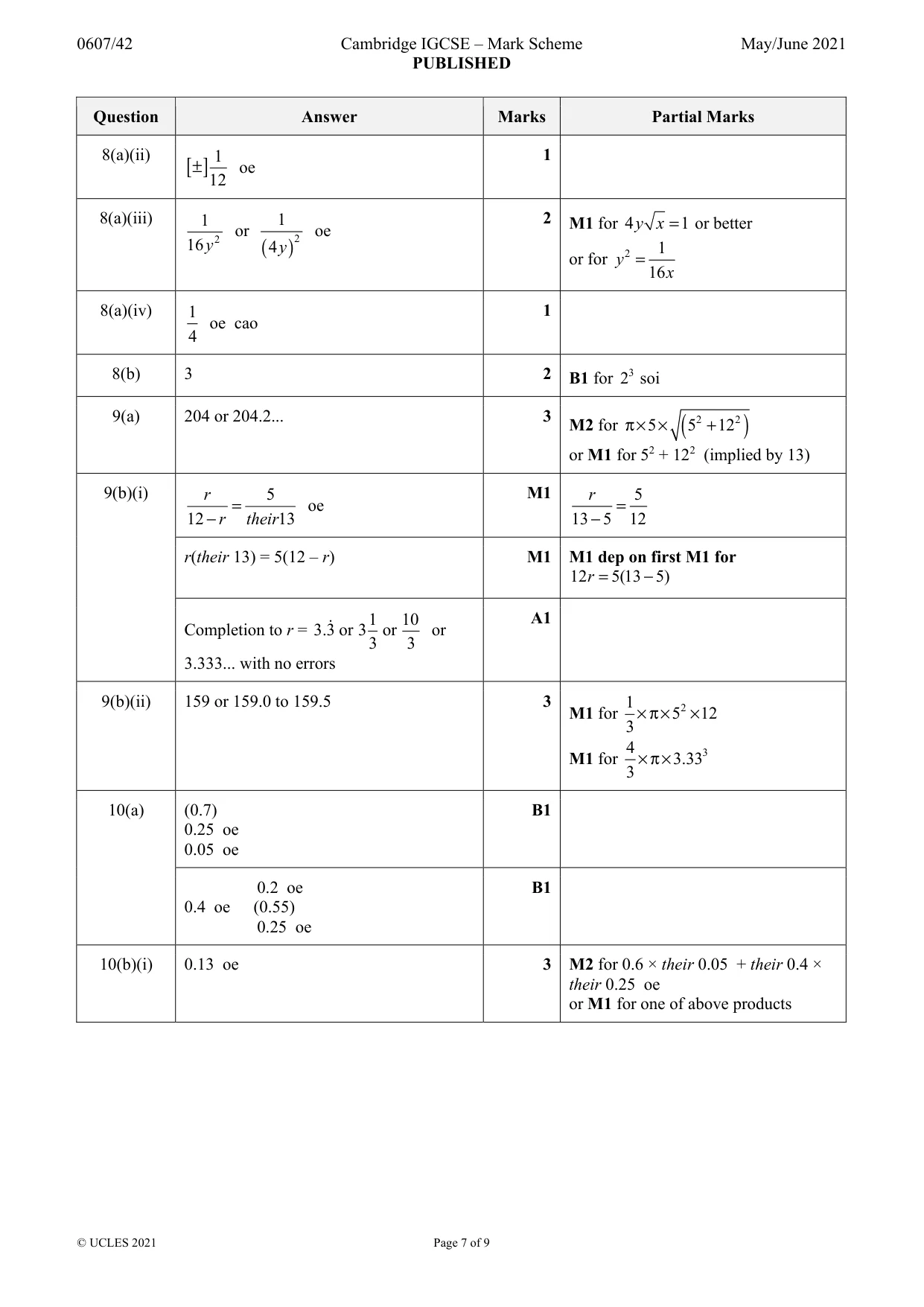
Mark scheme: 8(a)(i) k M1 0.05 = oe 25 1 A1 k = 0.25 and y = 4 x 8(a)(ii) 1 1 [ ± ] oe 12 8(a)(iii) 1 1 2 M1 for 4 y x = 1 or better or oe 16y 2 ( 4y ) 2 2 1 or for y = 16 x 8(a)(iv) 1 1 oe cao 4 8(b) 3 2 B1 for 23 soi
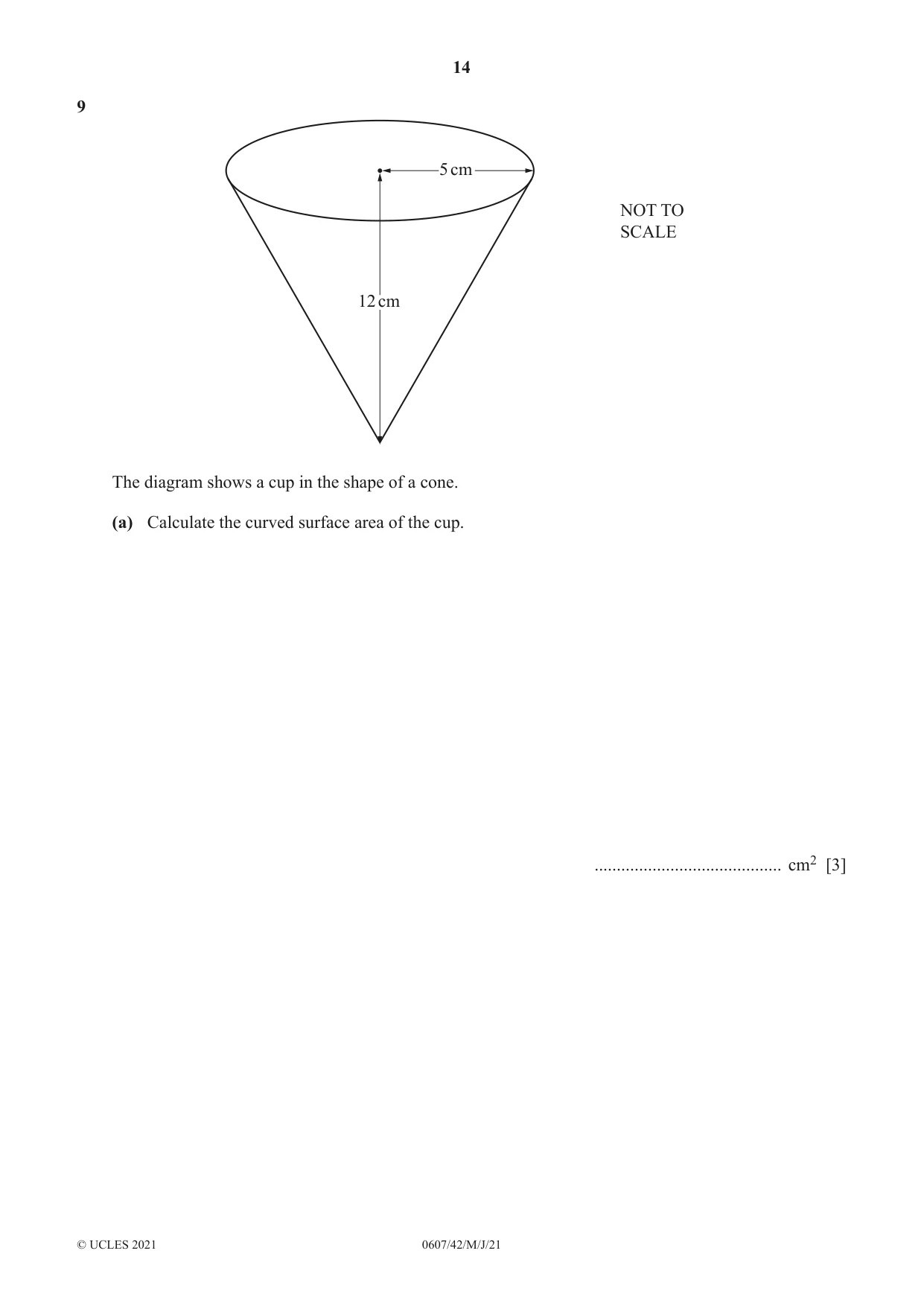
Q9 · 5 cm NOT TO SCALE 12 cm The diagram shows a cup in the shape of a cone
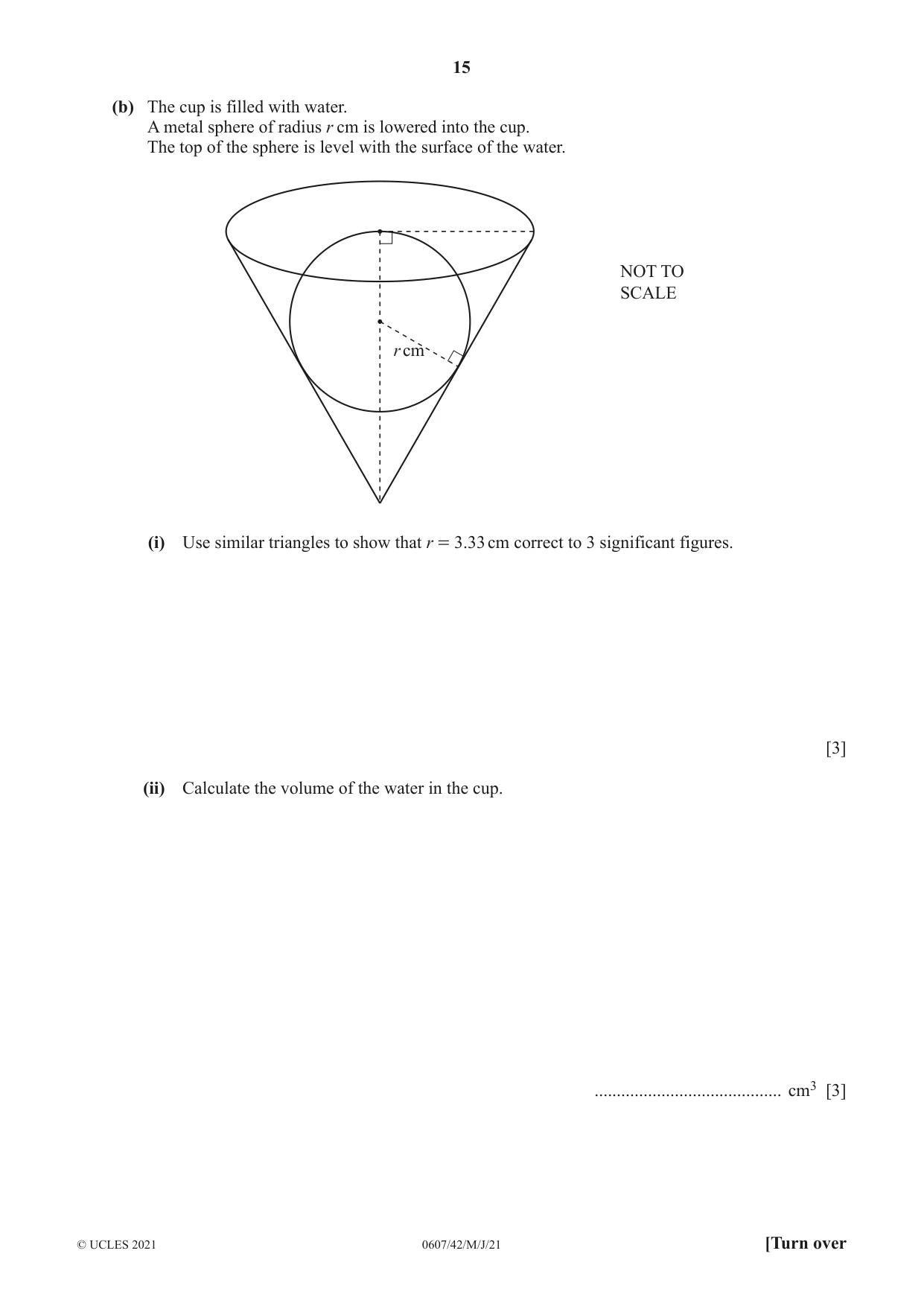
9 5 cm NOT TO SCALE 12 cm The diagram shows a cup in the shape of a cone. (a) Calculate the curved surface area of the cup. .......................................... cm2 [3] (b) The cup is filled with water. A metal sphere of radius r cm is lowered into the cup. The top of the sphere is level with the surface of the water. NOT TO SCALE r cm (i) Use similar triangles to show that r = 3.33 cm correct to 3 significant figures. [3] (ii) Calculate the volume of the water in the cup. .......................................... cm3 [3]
Mark scheme: 9(a) 204 or 204.2... 3 2 2 M2 for π× 5 × 5 + 12 ( ) or M1 for 52 + 122 (implied by 13) 9(b)(i) r 5 M1 r 5 = oe = 12 − r their13 13 − 5 12 r(their 13) = 5(12 – r) M1 M1 dep on first M1 for 12 r = 5(13 − 5) 1 10 A1 Completion to r = 3.3 or 3 or or 3 3 3.333... with no errors 9(b)(ii) 159 or 159.0 to 159.5 3 1 2 M1 for × π× 5 × 12 3 4 3 M1 for × π× 3.33 3
Q10 · Hua travels to school by bus or she cycles or she walks
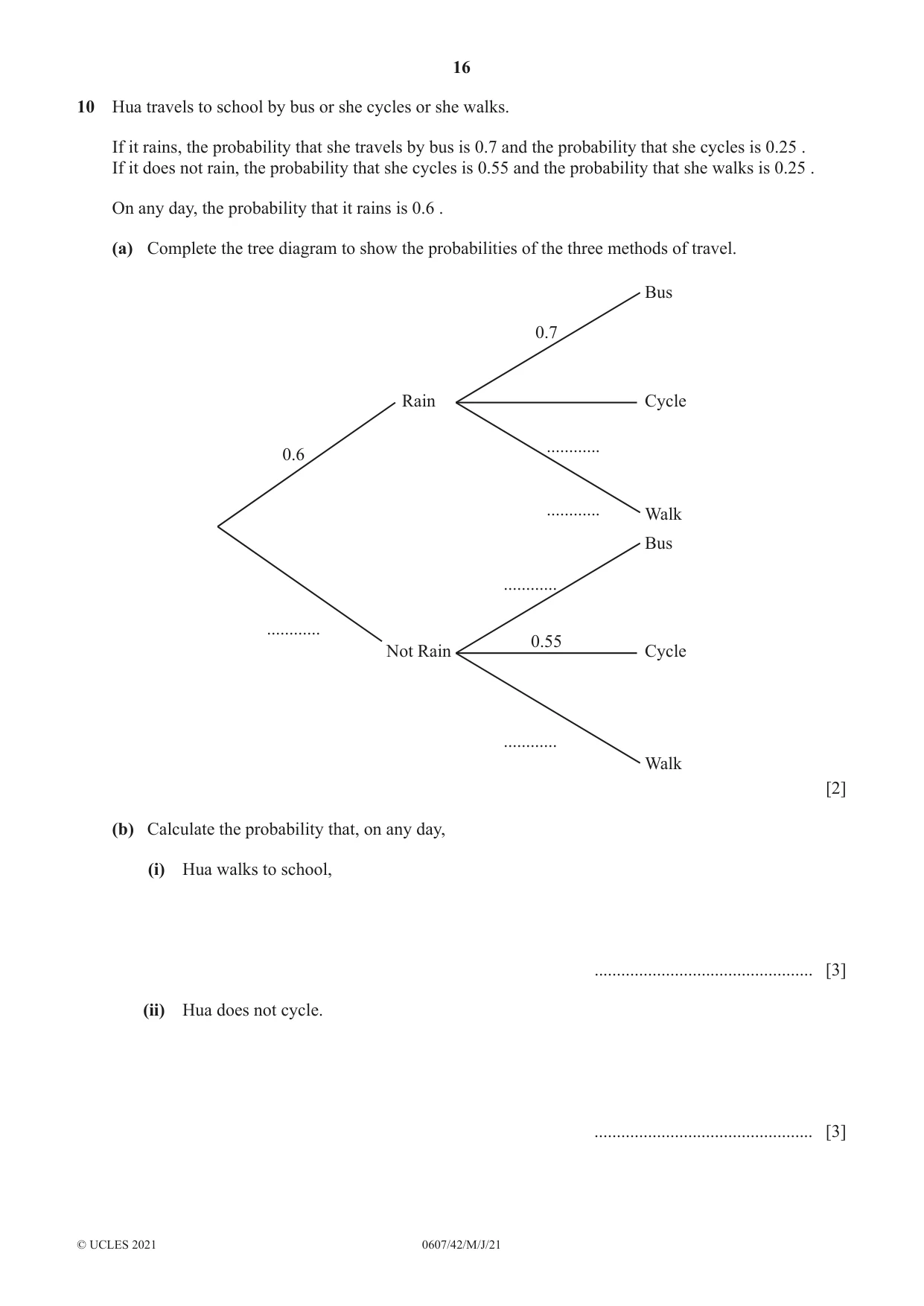
10 Hua travels to school by bus or she cycles or she walks. If it rains, the probability that she travels by bus is 0.7 and the probability that she cycles is 0.25 . If it does not rain, the probability that she cycles is 0.55 and the probability that she walks is 0.25 . On any day, the probability that it rains is 0.6 . (a) Complete the tree diagram to show the probabilities of the three methods of travel. Bus 0.7 Rain Cycle ............ 0.6 ............ Walk Bus ............ ............ 0.55 Not Rain Cycle ............ Walk [2] (b) Calculate the probability that, on any day, (i) Hua walks to school, ................................................. [3] (ii) Hua does not cycle. ................................................. [3] (c) Last week it rained every day of the 5 school days. Calculate the probability that Hua travelled by bus on exactly 4 of the 5 days. ................................................. [3]
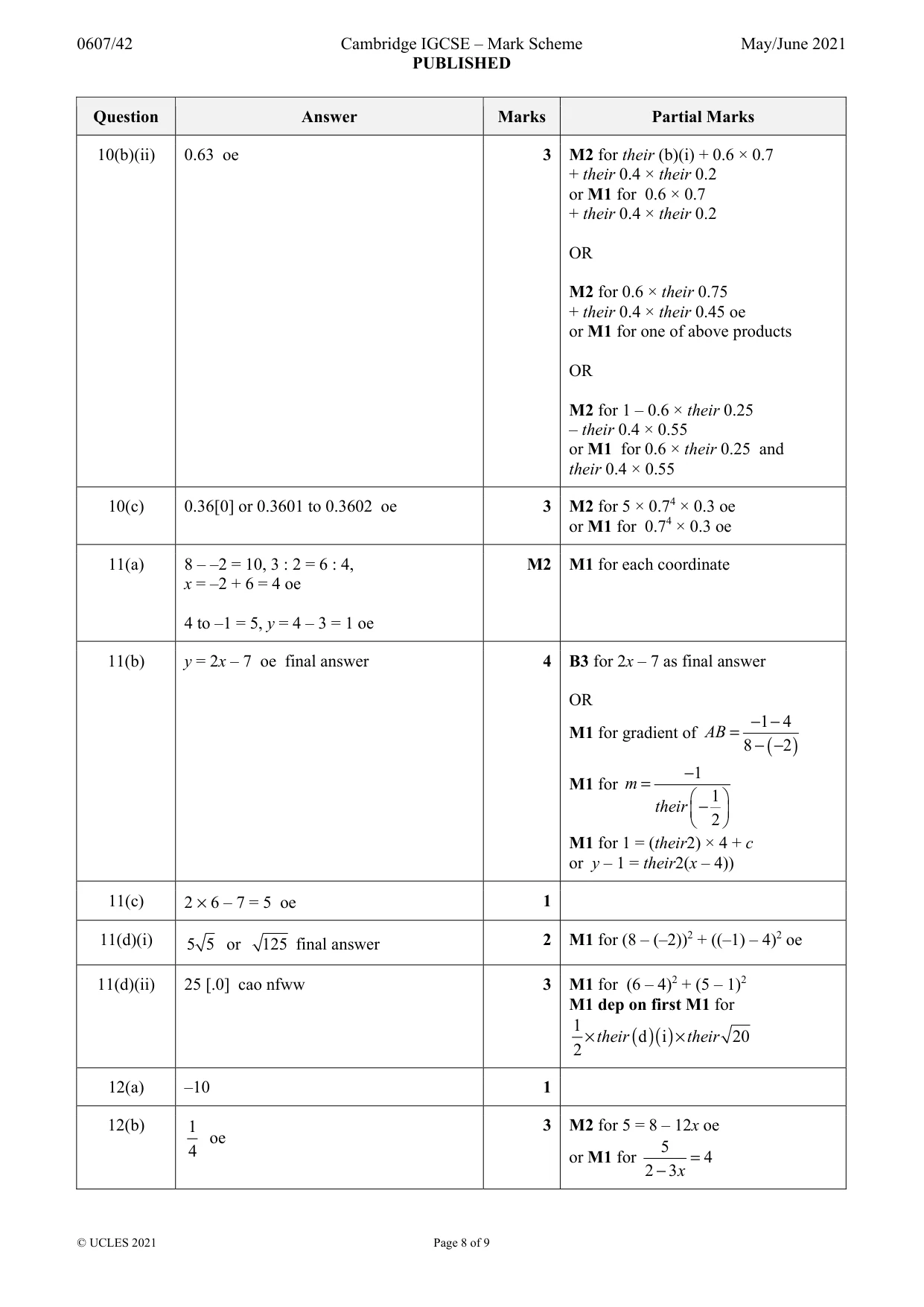
Mark scheme: 10(a) (0.7) B1 0.25 oe 0.05 oe 0.2 oe B1 0.4 oe (0.55) 0.25 oe 10(b)(i) 0.13 oe 3 M2 for 0.6 × their 0.05 + their 0.4 × their 0.25 oe or M1 for one of above products 10(b)(ii) 0.63 oe 3 M2 for their (b)(i) + 0.6 × 0.7 + their 0.4 × their 0.2 or M1 for 0.6 × 0.7 + their 0.4 × their 0.2 OR M2 for 0.6 × their 0.75 + their 0.4 × their 0.45 oe or M1 for one of above products OR M2 for 1 – 0.6 × their 0.25 – their 0.4 × 0.55 or M1 for 0.6 × their 0.25 and their 0.4 × 0.55 10(c) 0.36[0] or 0.3601 to 0.3602 oe 3 M2 for 5 × 0.74 × 0.3 oe or M1 for 0.74 × 0.3 oe
Q11 · Y A (– 2, 4) NOT TO SCALE P O x B (8, – 1) A is the point (-2, 4) and B is the point (8…
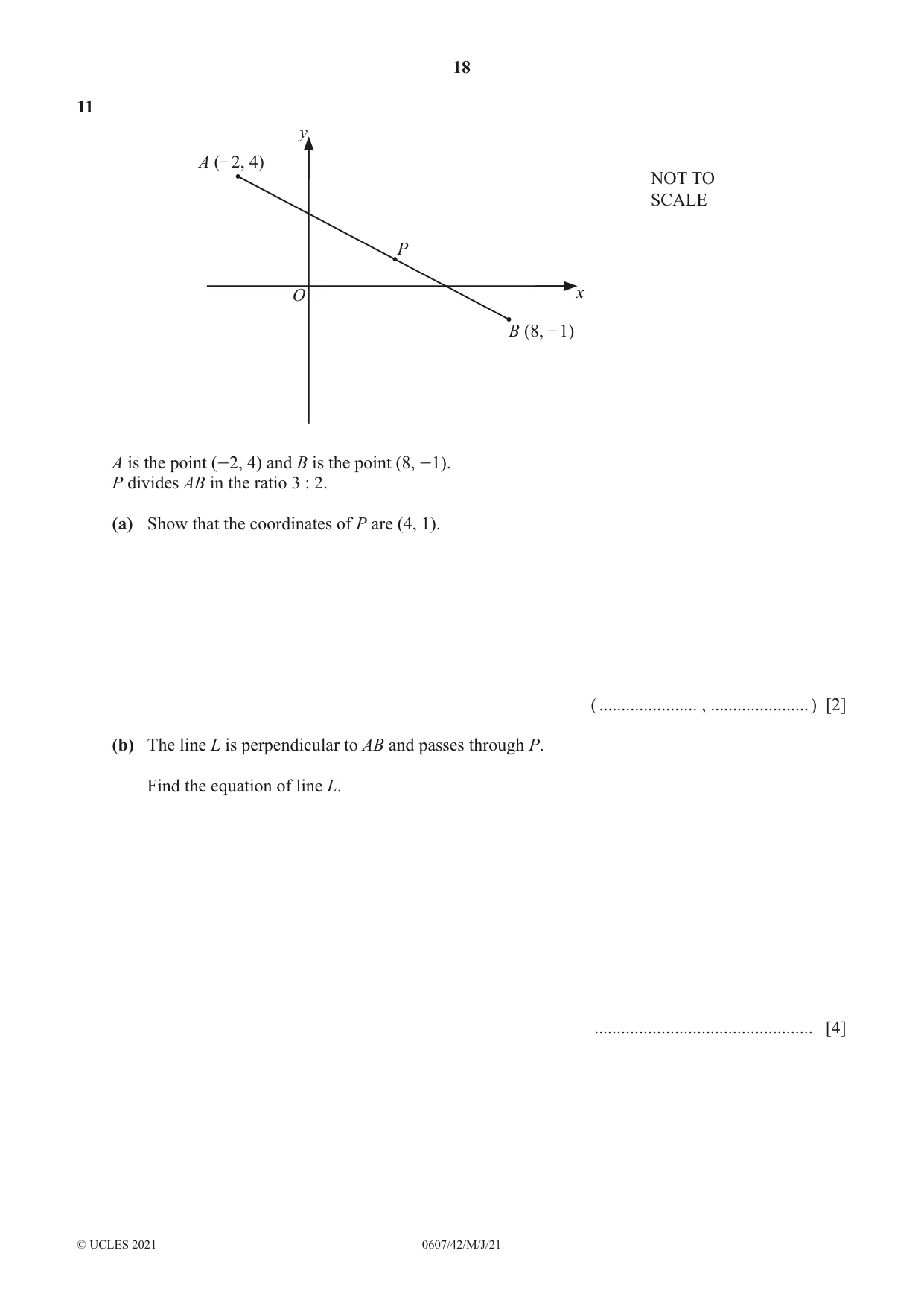
11 y A (– 2, 4) NOT TO SCALE P O x B (8, – 1) A is the point (-2, 4) and B is the point (8, -1). P divides AB in the ratio 3 : 2. (a) Show that the coordinates of P are (4, 1). ( ...................... , ...................... ) [2] (b) The line L is perpendicular to AB and passes through P. Find the equation of line L. ................................................. [4] (c) The point C has coordinates (6, 5). Show that point C lies on line L. [1] (d) (i) Find the distance AB. Give your answer in surd form. ................................................. [2] (ii) Calculate the area of triangle ABC. ................................................. [3]
Mark scheme: 11(a) 8 – –2 = 10, 3 : 2 = 6 : 4, M2 M1 for each coordinate x = –2 + 6 = 4 oe 4 to –1 = 5, y = 4 – 3 = 1 oe 11(b) y = 2x – 7 oe final answer 4 B3 for 2x – 7 as final answer OR −−1 4 M1 for gradient of AB = 8 −−( 2 ) −1 M1 for m = 1 their − 2 M1 for 1 = (their2) × 4 + c or y – 1 = their2(x – 4)) 11(c) 2 × 6 – 7 = 5 oe 1 11(d)(i) 5 5 or 125 final answer 2 M1 for (8 – (–2))2 + ((–1) – 4)2 oe 11(d)(ii) 25 [.0] cao nfww 3 M1 for (6 – 4)2 + (5 – 1)2 M1 dep on first M1 for 1 × their ( d )( i ) × their 20 2
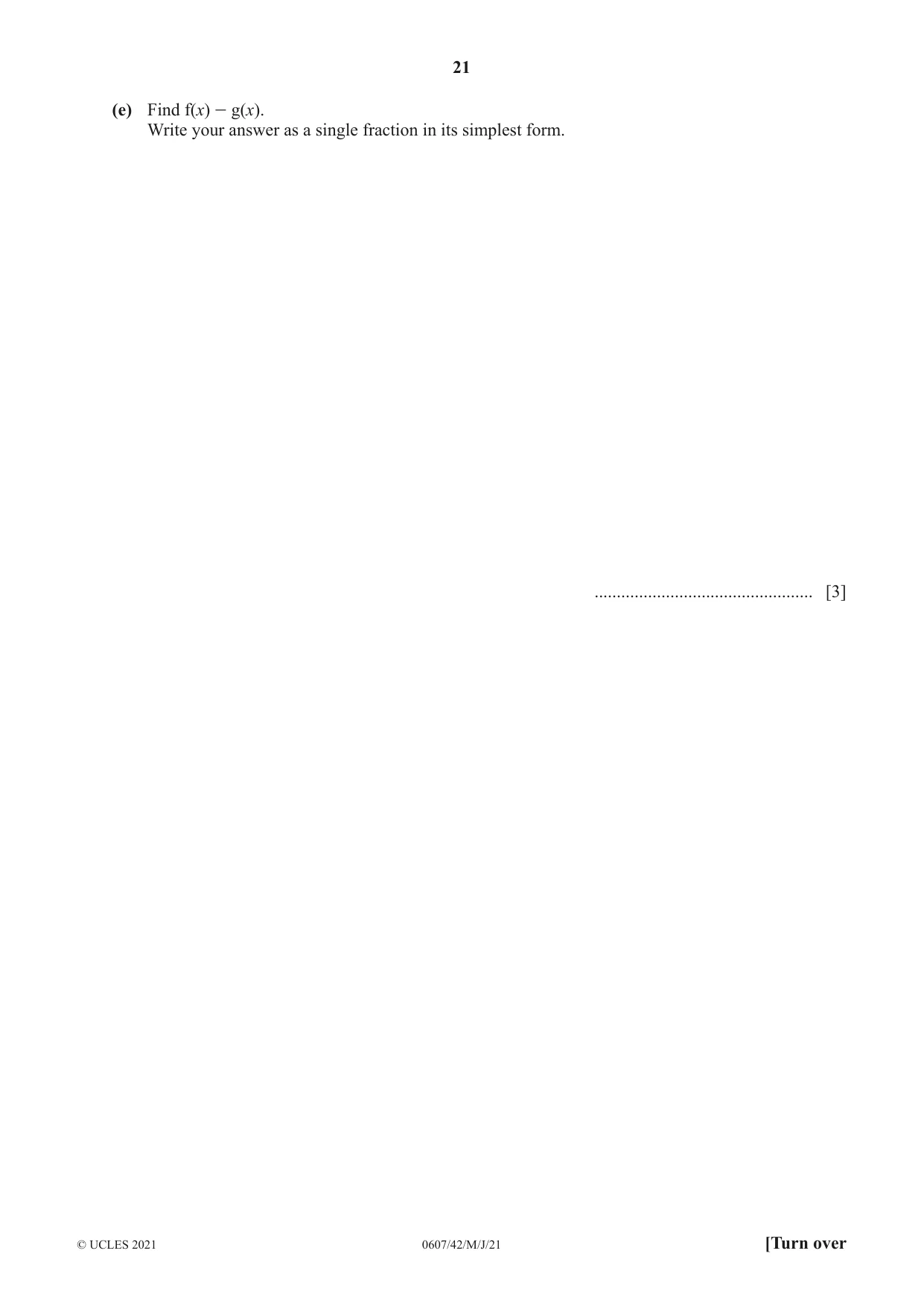
Q12 · F ( )x = 2 - 3 x g ( )x = 2 - 3x (a) Find f(4)
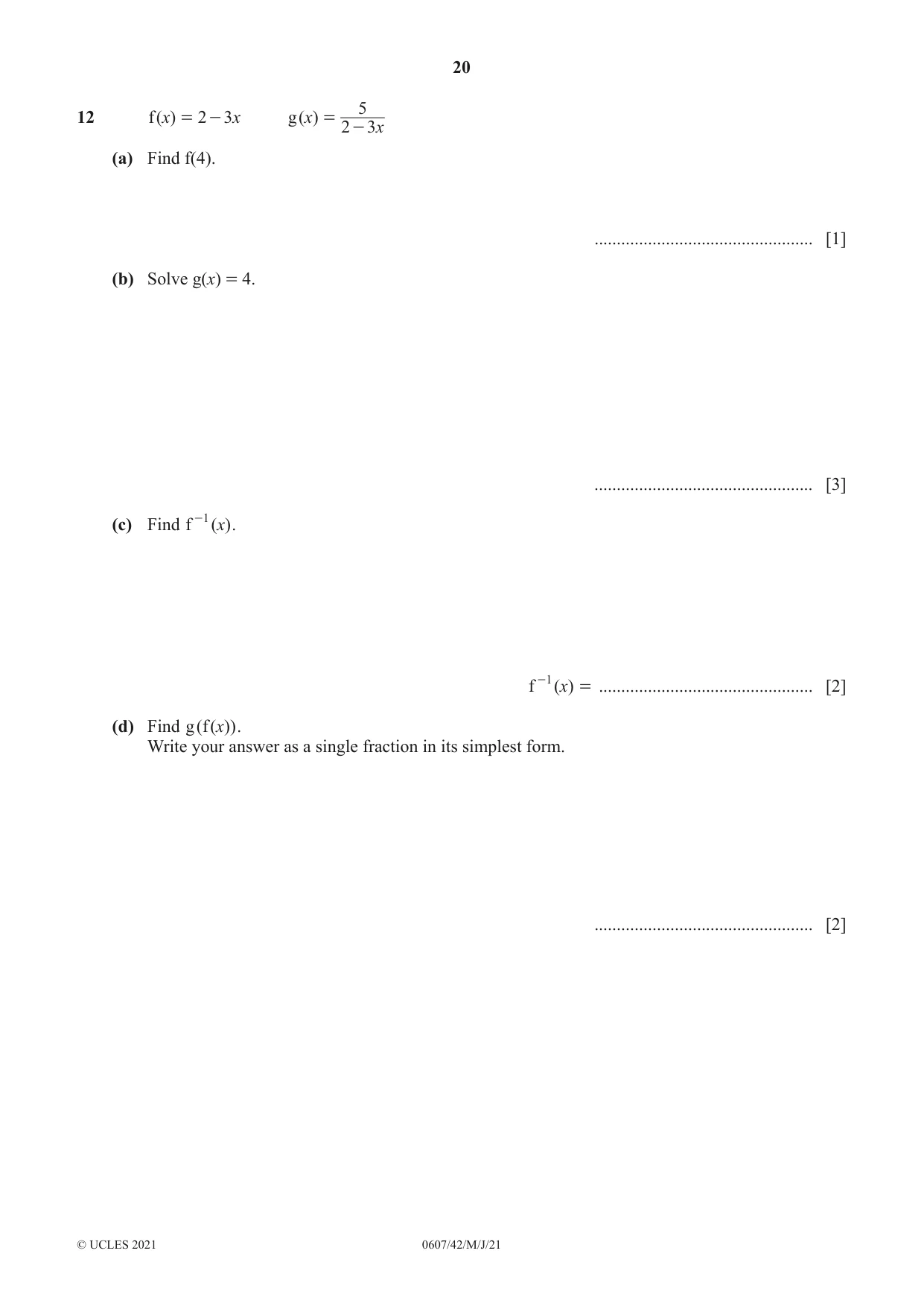
12 f ( )x = 2 - 3 x g ( )x = 2 - 3x (a) Find f(4). ................................................. [1] (b) Solve g(x) = 4. ................................................. [3] (c) Find f -1 ( )x . f -1 ( )x = ................................................ [2] (d) Find g ( f ( x)) . Write your answer as a single fraction in its simplest form. ................................................. [2] (e) Find f(x) - g(x). Write your answer as a single fraction in its simplest form. ................................................. [3]
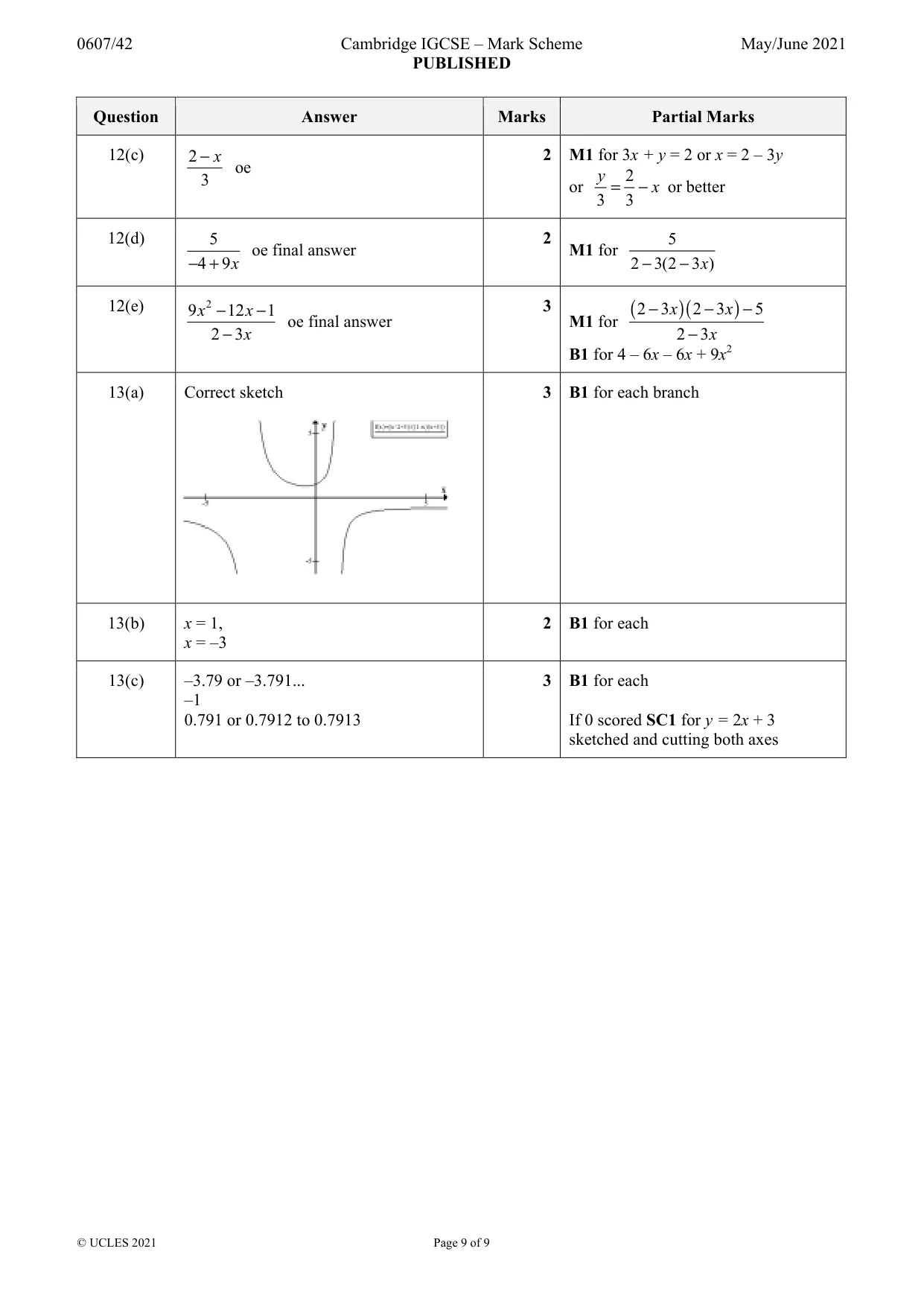
Mark scheme: 12(a) –10 1 12(b) 1 3 M2 for 5 = 8 – 12x oe oe 5 4 or M1 for = 4 2 − 3x 12(c) 2 − x 2 M1 for 3x + y = 2 or x = 2 – 3y oe y 2 3 or = − x or better 3 3 12(d) 5 2 5 oe final answer M1 for −+4 9x 2 − 3(2 − 3 )x 12(e) 9 x 2 − 12 x − 1 3 ( 2 − 3 x )( 2 − 3 x ) − 5 oe final answer M1 for 2 − 3 x 2 − 3 x B1 for 4 – 6x – 6x + 9x2
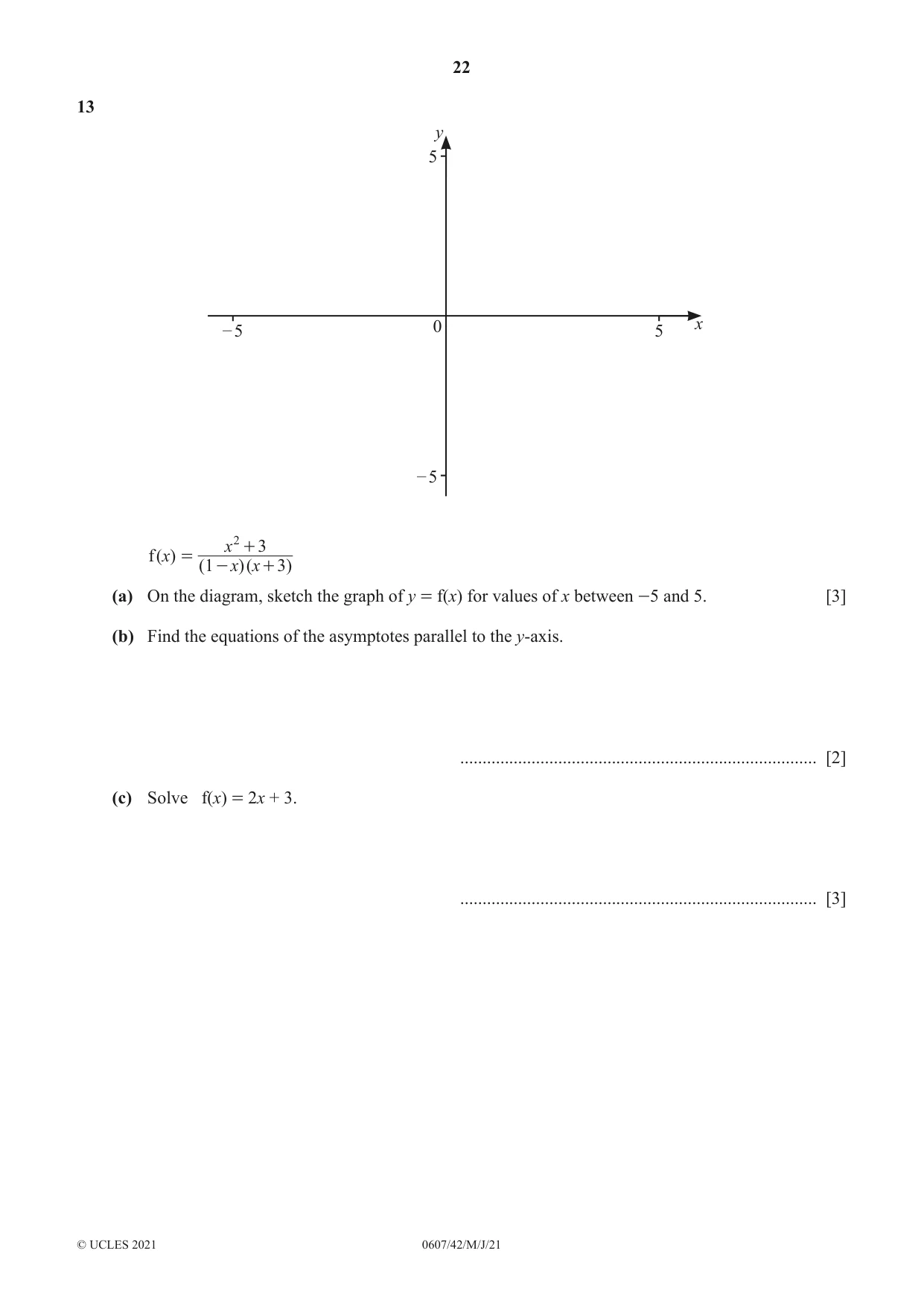
Q13 · Y 5 – 5 0 5 x – 5 x 2 + 3 f ( x) = ( 1 - x)( x + 3) (a) On the diagram, sketch the graph…
13 y 5 – 5 0 5 x – 5 x 2 + 3 f ( x) = ( 1 - x)( x + 3) (a) On the diagram, sketch the graph of y = f(x) for values of x between -5 and 5. [3] (b) Find the equations of the asymptotes parallel to the y-axis. ................................................................................ [2] (c) Solve f(x) = 2x + 3. ................................................................................ [3]
Mark scheme: 13(a) Correct sketch 3 B1 for each branch 13(b) x = 1, 2 B1 for each x = –3 13(c) –3.79 or –3.791... 3 B1 for each –1 0.791 or 0.7912 to 0.7913 If 0 scored SC1 for y = 2x + 3 sketched and cutting both axes
What was in this paper
The subtopics covered by these 13 questions, and how many questions each got. Open one in a new tab to see every Cambridge question on it.
What you needed in this session
Cambridge’s own grade thresholds for 2021 May/June, Paper 4 · Variant 2. A higher threshold means an easier paper — the bar moves with how the cohort did.