Questions as text
Q1 · ‘Groupthink always has negative consequences.’ To what extent do you agree with this… 9990/42 Feb/March 2018
12 ‘Groupthink always has negative consequences.’ To what extent do you agree with this statement? Use examples of research you have studied to support your answer. [12]
12 marks
Mark scheme: 12 ‘Groupthink always has negative consequences.’ 12 To what extent do you agree with this statement? Use examples of research you have studied to support your answer. Marks: use generic levels of response in table C. Syllabus: Decision-making: groupthink (Janis, 1971) and strategies to avoid groupthink. Most likely (any other appropriate responses should be credited): Positive: • Janis: ‘There is evidence that as the members of a group feel more accepted by the others, increased group cohesiveness, they display less overt conformity to group norms. Thus the more cohesive a group becomes, the less the members will feel constrained to censor what they say.’ Negative: • Janis ‘the groupthink type of conformity tends to increase as group cohesiveness increases. Groupthink involves nondeliberate suppression of critical thoughts as a result of internalisation of the group’s norms, which is quite different. The more cohesive the group, the greater the inner compulsion on the part of each member to avoid creating disunity, which inclines him to believe in the soundness of whatever proposals are promoted by the leader or by a majority of the group’s members.’ • ‘In a cohesive group, the danger is not so much that each individual will fail to reveal his objections to what the others propose but that he will think the proposal is a good one, without attempting to carry out a careful, critical scrutiny of the pros and cons of the alternatives.’ • ‘When groupthink becomes dominant, there also is considerable suppression of deviant thoughts, but it takes the form of each person’s deciding that his misgivings are not relevant and should be set aside, that the benefit of the doubt regarding any lingering uncertainties should be given to the group consensus.’
This question in 9990/42 Feb/March 2018
Q2 · Design a study to investigate whether the illusion of unanimity occurs when groupthink… 9990/42 May/June 2018
8 (a) Design a study to investigate whether the illusion of unanimity occurs when groupthink occurs. [10] (b) Explain the psychological and methodological evidence on which your study is based. [8] Section C You must answer one question from this section. Psychology and abnormality
18 marks
Mark scheme: 8(a) Design a study to investigate whether the illusion of unanimity occurs 10 when groupthink occurs. Marks: use generic levels of response Design a study question part (a). Additional: Candidates should design the study showing evidence of design features appropriate to the named method. The named method is: any appropriate method. Typical features: • Experiments: type, IV, DV, controls, experimental design. • Observations: type, setting, response categories, sampling frame, number of observers. • Questionnaires/Interviews: type, setting, example questions. Scoring/rating scale, analysis of responses. • Typical features of research methodology: sampling technique and sample, type of data, ethics, reliability, validity, data analysis. 8(b) Explain the psychological and methodological evidence on which your 8 study is based. Marks: use generic levels of response ‘Design a study’ question part (b). Note: If only methodological or psychological explanation is provided max 5 marks. Candidates are expected to explain the reasons for the suggested design in part (a). Explanation should be both psychological and methodological. Psychological to include appropriate theory or research. Additional: candidates are expected to justify their decisions or evidence presented regarding the design made in answer to question part (a). Syllabus: Decision-making: groupthink (Janis, 1971) and strategies to avoid groupthink. Psychological: According to Janis, the illusion of unanimity is when members of the group make the false assumption that any individual who remains silent during any part of the discussion is in full agreement with what the others are saying. Methodological: explanation of method using typical features as above.
This question in 9990/42 May/June 2018
Q3 · One cognitive limitation/error in group decision-making is a ‘sin of commission’ 9990/42 Feb/March 2019
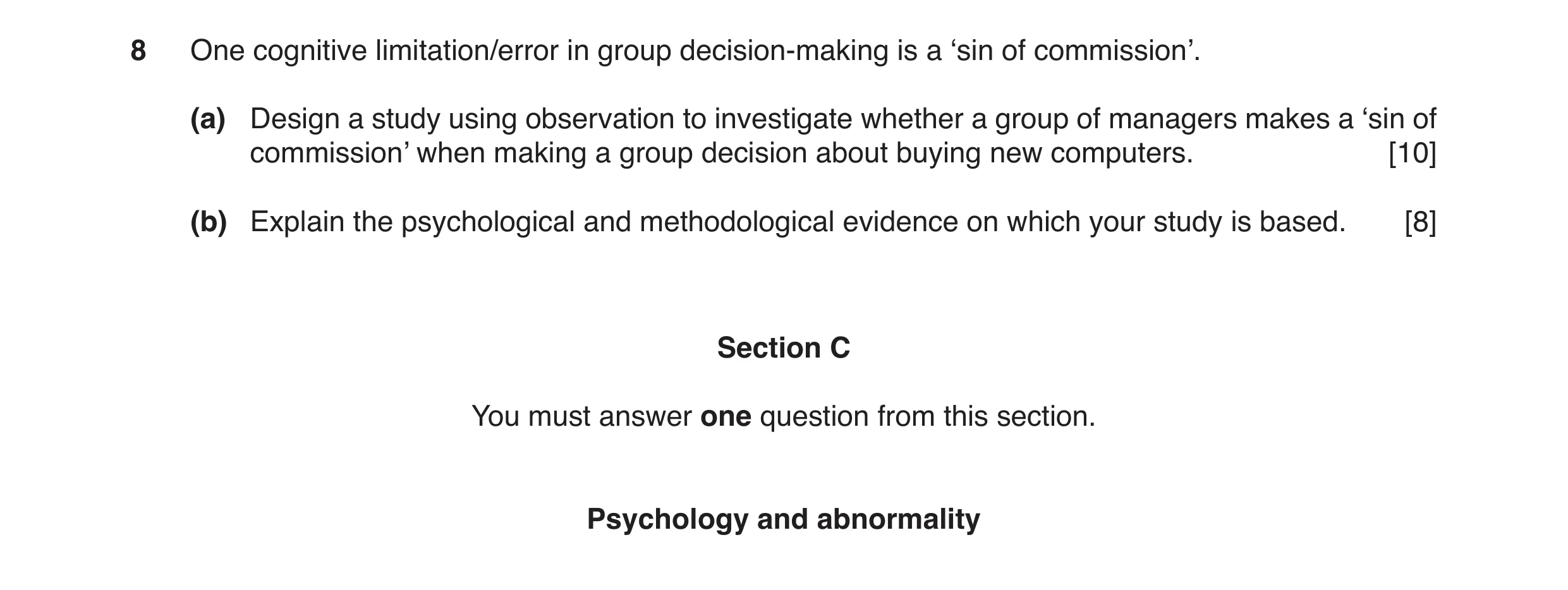
8 One cognitive limitation/error in group decision-making is a ‘sin of commission’. (a) Design a study using observation to investigate whether a group of managers makes a ‘sin of commission’ when making a group decision about buying new computers. [10] (b) Explain the psychological and methodological evidence on which your study is based. [8] Section C You must answer one question from this section. Psychology and abnormality
18 marks
Mark scheme: 8(a) One cognitive limitation/error in group decision-making is a ‘sin of 10 commission’. Design a study using observation to investigate whether a group of managers makes a ‘sin of commission’ when making a group decision about buying new computers. Marks: use generic levels of response Design a study question part (a). Additional: Candidates should design the study showing evidence of design features appropriate to the named method. The named method is: observation. Specific features: Observations: type, setting, response categories, sampling frame, number of observers. General features of research methodology: sampling technique and sample, type of data, ethics, reliability, validity, data analysis. 8(b) Explain the psychological and methodological evidence on which your 8 study is based. Marks: use generic levels of response ‘Design a study’ question part (b). Note: If only methodological or psychological explanation is provided max 5 marks Candidates are expected to explain the reasons for the suggested design in part (a). Explanation should be both psychological and methodological. Psychological to include appropriate theory or research. Additional: candidates are expected to justify their decisions or evidence presented regarding the design made in answer to question part (a). Syllabus: cognitive limitations and errors (Forsyth, 2006) Psychological: From study: Sins of commission include the misuse, abuse and/or inappropriate use of information. Belief perseverance A group utilises information in their decision-making that has already been deemed inaccurate. Sunk cost bias A group remains committed to a given plan primarily due to the investment already made in that plan, regardless of how inefficient and/or ineffective it may have become. Extra-evidentiary bias A group choosing to use some information despite having been told it should be ignored. Hindsight bias Group members falsely over-estimate the accuracy of and/or the relevance of their past knowledge of a given outcome. Methodological: explanation of method using general and specific features as above.
This question in 9990/42 Feb/March 2019
Q4 · ‘Belbin’s team role inventory is not a psychometric test.’ To what extent do you agree… 9990/42 Feb/March 2019
12 ‘Belbin’s team role inventory is not a psychometric test.’ To what extent do you agree with this statement? Use examples of research you have studied to support your answer. [12]
12 marks
Mark scheme: 12 ‘Belbin’s team role inventory is not a psychometric test.’ 12 To what extent do you agree with this statement? Use examples of research you have studied to support your answer. Marks: use generic levels of response in table C. Syllabus: measuring team roles: Belbin team inventory Most likely (any other appropriate responses should be credited): It is not: • Belbin himself says that it is not: the Belbin Inventory scores people on ‘A tendency to behave, contribute and interrelate with others in a particular way.’ • It analyses how people work together as a team. A psychometric test usually focuses on an individual person only. • Quote ‘Observer Assessments provide independent evidence about an individual’s Team Roles. A Self-Perception test is only as good as an individual’s sense of personal realism. Some people answer in terms of how they would like to contribute rather than how they really behave.’ It is: • It has many features of a psychometric test: reliability and validity for example. • Its origins were in a number of psychometric tests, so it is just an extension of a psychometric test. • Psychometric tests often classify people into different types. This is exactly what the Belbin test does.
This question in 9990/42 Feb/March 2019
Q5 · ‘There are no positive outcomes of group conflict.’ To what extent do you agree with this… 9990/41 May/June 2019
12 ‘There are no positive outcomes of group conflict.’ To what extent do you agree with this statement? Use examples of research you have studied to support your answer. [12]
12 marks
Mark scheme: 12 ‘There are no positive outcomes of group conflict.’ 12 To what extent do you agree with this statement? Use examples of research you have studied to support your answer. Marks: use generic levels of response in table C. Syllabus: positive and negative effects of conflict Most likely (any other appropriate responses should be credited): For: (all outcomes are negative) • Individuals may make less of a contribution • Individuals might begin to distrust others • Conflict might harm group cohesiveness. Against: (no, there are positive outcomes) • Conflict can energise a group: ‘wake it up’, stimulate it into action • It can reduce complacency perhaps avoiding groupthink • It can increase decision-making quality
This question in 9990/41 May/June 2019
Q6 · ‘Measuring sabotage using a questionnaire will never provide useful data.’ To what extent… 9990/42 May/June 2019
12 ‘Measuring sabotage using a questionnaire will never provide useful data.’ To what extent do you agree with this statement? Use examples of research you have studied to support your answer. [12]
12 marks
Mark scheme: 12 ‘Measuring sabotage using a questionnaire will never provide useful 12 data.’ To what extent do you agree with this statement? Use examples of research you have studied to support your answer. Marks: use generic levels of response in table C. Syllabus: attitudes to work a workplace sabotage (Giacalone and Rosenfeld, 1987) Most likely (any other appropriate responses should be credited): Not useful/agree: • questionnaires will always be designed by management (or someone employed by them) to find out about workers, so workers suspicious rather than honest • questionnaires may produce quantitative data rather than (perhaps more useful) qualitative data • workers will be dishonest or provide socially desirable answers Useful/disagree: • a questionnaire can be anonymous (unlike an interview) and so answers can be truthful. • a questionnaire may provide indications of why sabotage is happening in an organisation • a questionnaire with open-ended questions may reveal useful information – allow an individual person to express their views (a whistleblower)
This question in 9990/42 May/June 2019
Q7 · ‘There are no positive outcomes of group conflict.’ To what extent do you agree with this… 9990/43 May/June 2019
12 ‘There are no positive outcomes of group conflict.’ To what extent do you agree with this statement? Use examples of research you have studied to support your answer. [12]
12 marks
Mark scheme: 12 ‘There are no positive outcomes of group conflict.’ 12 To what extent do you agree with this statement? Use examples of research you have studied to support your answer. Marks: use generic levels of response in table C. Syllabus: positive and negative effects of conflict Most likely (any other appropriate responses should be credited): For: (all outcomes are negative) • Individuals may make less of a contribution • Individuals might begin to distrust others • Conflict might harm group cohesiveness. Against: (no, there are positive outcomes) • Conflict can energise a group: ‘wake it up’, stimulate it into action • It can reduce complacency perhaps avoiding groupthink • It can increase decision-making quality
This question in 9990/43 May/June 2019
Q8 · ‘Errors in group decision-making are always due to the cognitive limitations of an… 9990/41 May/June 2020
12 ‘Errors in group decision-making are always due to the cognitive limitations of an individual rather than to being part of a groupthink situation.’ To what extent do you agree with this statement? Use examples of research you have studied to support your answer. [12]
12 marks
Mark scheme: 12 ‘Errors in group decision-making are always due to the cognitive 12 limitations of an individual rather than to being part of a groupthink situation.’ To what extent do you agree with this statement? Use examples of research you have studied to support your answer. Marks: use generic levels of response in table C. Syllabus: Decision-making: cognitive limitations and errors (Forsyth, 2006); groupthink (Janis, 1971) and strategies to avoid groupthink. Most likely (any other appropriate responses should be credited): Individual: • People are sometimes limited in their understanding; they sometimes make ‘sins of commission’: belief perseverance, for example • People are sometimes poor in socially interacting in groups • People sometimes have a particular type of personality less cohesive to group dynamics • People will sometimes have ‘interpersonal conflict’ with other group members Situational • Groupthink itself is the result of situational/group rather than individual decision-making • Individuals may want to ‘impress the boss’ and so agree with group decisions rather than questioning them • Conflict created by raising questions might harm group cohesiveness.
This question in 9990/41 May/June 2020
Q9 · ‘Errors in group decision-making are always due to the cognitive limitations of an… 9990/43 May/June 2020
12 ‘Errors in group decision-making are always due to the cognitive limitations of an individual rather than to being part of a groupthink situation.’ To what extent do you agree with this statement? Use examples of research you have studied to support your answer. [12]
12 marks
Mark scheme: 12 ‘Errors in group decision-making are always due to the cognitive 12 limitations of an individual rather than to being part of a groupthink situation.’ To what extent do you agree with this statement? Use examples of research you have studied to support your answer. Marks: use generic levels of response in table C. Syllabus: Decision-making: cognitive limitations and errors (Forsyth, 2006); groupthink (Janis, 1971) and strategies to avoid groupthink. Most likely (any other appropriate responses should be credited): Individual: • People are sometimes limited in their understanding; they sometimes make ‘sins of commission’: belief perseverance, for example • People are sometimes poor in socially interacting in groups • People sometimes have a particular type of personality less cohesive to group dynamics • People will sometimes have ‘interpersonal conflict’ with other group members Situational • Groupthink itself is the result of situational/group rather than individual decision-making • Individuals may want to ‘impress the boss’ and so agree with group decisions rather than questioning them • Conflict created by raising questions might harm group cohesiveness.
This question in 9990/43 May/June 2020
Q10 · Design a study using observation to investigate whether a group follows the stages of… 9990/42 Feb/March 2021
8 (a) Design a study using observation to investigate whether a group follows the stages of development proposed by Tuckman (1965). [10] (b) Explain the psychological and methodological evidence on which your study is based. [8] Section C You must answer one question from this section. Psychology and abnormality
18 marks
Mark scheme: 8(a) Design a study using observation to investigate whether a group 10 follows the stages of development proposed by Tuckman (1965). Marks: use generic levels of response Design a study question part (a). Additional: Candidates should design the study showing evidence of design features appropriate to the named method. The named method: observation. Specific features: Observations: type, setting, response categories, sampling frame, number of observers. General features of research methodology: sampling technique & sample, type of data, ethics, reliability, validity, data analysis. 8(b) Explain the psychological and methodological evidence on which your 8 study is based. Marks: use generic levels of response ‘Design a study’ question part (b). Note: If only methodological or psychological explanation is provided max 5 marks Candidates are expected to explain the reasons for the suggested design in part (a). Explanation should be both psychological and methodological. Psychological to include appropriate theory or research. Additional: candidates are expected to justify their decisions or evidence presented regarding the design made in answer to question part (a). Syllabus: group development (Tuckman, 1965) Psychological: Tuckman (1965) outlined four stages of group development: • forming – where people come together • storming – where people will present ideas (brainstorm) • norming – when group members begin to agree • performing – when the group function as a coherent unit • adjourning – difficult to observe if the group is no longer meeting Methodological: explanation of method using general and specific features as above.
This question in 9990/42 Feb/March 2021
Q11 · In the 1920s, scientific management studies were conducted at the Hawthorne Plant of the… 9990/41 May/June 2021
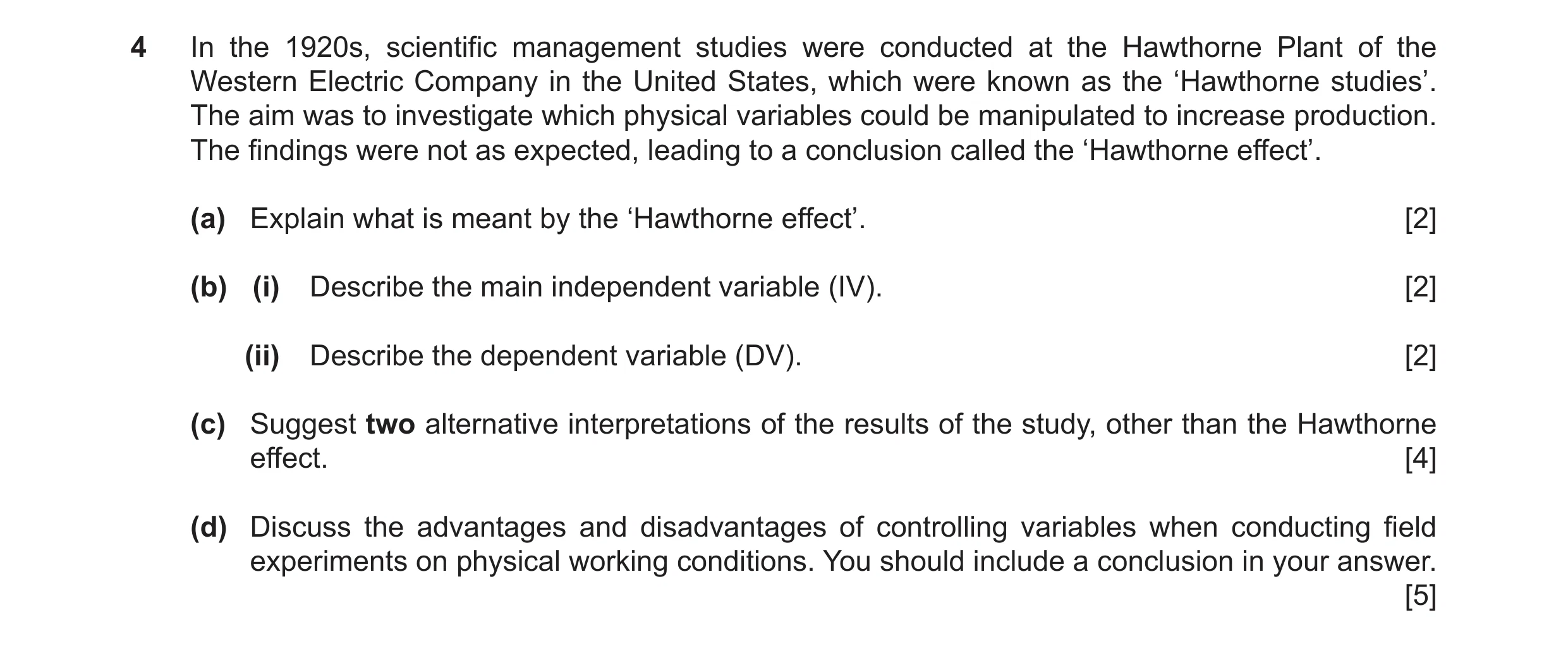
4 In the 1920s, scientific management studies were conducted at the Hawthorne Plant of the Western Electric Company in the United States, which were known as the ‘Hawthorne studies’. The aim was to investigate which physical variables could be manipulated to increase production. The findings were not as expected, leading to a conclusion called the ‘Hawthorne effect’. (a) Explain what is meant by the ‘Hawthorne effect’. [2] (b) (i) Describe the main independent variable (IV). [2] (ii) Describe the dependent variable (DV). [2] (c) Suggest two alternative interpretations of the results of the study, other than the Hawthorne effect. [4] (d) Discuss the advantages and disadvantages of controlling variables when conducting field experiments on physical working conditions. You should include a conclusion in your answer. [5]
15 marks
Mark scheme: 4 In the 1920s, scientific management studies were conducted at the Hawthorne Plant of the Western Electric Company in the United States, which were known as the ‘Hawthorne studies’. The aim was to investigate which physical variables could be manipulated to increase production. The findings were not as expected, leading to a conclusion called the ‘Hawthorne effect’. 4(a) Explain what is meant by the 'Hawthorne effect'. 2 Most likely answer (other appropriate responses to be credited): Quote from study ‘behavioral change due to an awareness of being observed, active compliance with the supposed wishes of researchers because of special attention received, or positive response to the stimulus being introduced.’ Alternatively ‘a marked increase in production related only to special social position and social treatment’. Alternatively it occurs when people behave differently (1 mark) because they know they are being watched (+1 mark) Marks: 1 mark basic answer 2 marks detailed answer/elaboration/ example. Note: 0 marks for demand characteristics. 4(b)(i) Describe the main independent variable (IV). 2 Most likely answer (other appropriate responses to be credited): Quote from study ‘In the initial phase of the studies, the effect of illumination on productivity was examined. • The illumination was decreased step by step for the experimental subjects, whilst the controls received constant illumination.’ Marks: 1 mark for identifying ‘illumination’, 2 marks for elaboration of experimental group (illumination decreased step by step) or’ illumination change versus constant illumination’, 0 marks for ‘physical variables’ (words are in the question). 4(b)(ii) Describe the dependent variable (DV). 2 Most likely answer (other appropriate responses to be credited): Quote from study: ‘Both sets of subjects slowly but steadily increased their performance of inspecting parts, assembling relays or winding coils’ Marks: 1 mark basic answer (performance/productivity), 2 marks detailed answer/elaboration/example (of inspecting parts, assembling relays or winding coils) 4(c) Suggest two alternative interpretations of the results of the study, 4 other than the Hawthorne effect. Most likely answer (other appropriate responses to be credited): Quote from study ‘Over the years several other interpretations of the results of the Hawthorne studies than those made by the original reporters have been presented. Accordingly, the observed increase in productivity may well have been brought about by one or more of the following list: • relief from harsh supervision, • receiving positive attention (special privileges; the test room observer was, however, mainly concerned with creating a friendly relationship that would insure the workers' cooperation), • learning new ways of interaction (the improved personal relations between workers and management), • possibilities to influence work procedures, • rest pauses (to allow for good control of the variables under study) • higher income (of an incentive pay system based upon the output of the group in the test room) • threat of losing one's job (the 1920s economic depression) • changes in lighting levels’ Marks: 1 mark identification of interpretation, 2 marks elaboration/example (see above). X2 4(d) Discuss the advantages and disadvantages of controlling variables 5 when conducting field experiments on physical working conditions. You should include a conclusion in your answer. Marks: 1 mark for each advantage/disadvantage (however basic/detailed) which is related/linked to the question (max 4 marks). 1 mark for conclusion. Conclusion: any appropriate conclusion drawn from the discussion that has been presented. 1 mark if appropriate. A conclusion is a ‘decision reached by reasoning’ and so a summary of points already made scores 0 marks. Most likely answer (other appropriate responses to be credited): Self-reports can include questionnaires and interviews. Advantages • More control over irrelevant/extraneous variables means that the DV is more likely to be due to the IV. • The use of experimental and control group means the control group is the baseline/benchmark of what is normal. Disadvantages • There may be uncontrolled variables which might confound the result of a field experiment on physical working conditions • Too many controls may make a situation artificial. • Controlling variables is reductionist because no behaviour might exist in isolation.
This question in 9990/41 May/June 2021
Q12 · ‘Group conflict can always be managed successfully.’ To what extent do you agree with… 9990/41 May/June 2021
12 ‘Group conflict can always be managed successfully.’ To what extent do you agree with this statement? Use examples of research you have studied to support your answer. [12]
12 marks
Mark scheme: 12 ‘Group conflict can always be managed successfully’. 12 To what extent do you agree with this statement? Use examples of research you have studied to support your answer. Marks: use generic levels of response in table C. Syllabus: managing group conflict (Thomas, 1976) Most likely (any other appropriate responses should be credited): It can: • Conflict can be successfully managed so it becomes a positive rather than a negative • Forsyth lists ways to manage conflict, such as through compromise of both sides • Conflict can be managed through radical solutions: moving a person to a different department, sacking/firing, for the benefit of the organisation and ‘efficiency’ It cannot: • People may say that the conflict is resolved, but still maintain their own view/grudge against a person. • People may work with others, be professional, yet still maintain their private dislike or distrust. • Some people never believe that they are wrong; some have strong principles; some would rather leave an organisation.
This question in 9990/41 May/June 2021
Q13 · In the 1920s, scientific management studies were conducted at the Hawthorne Plant of the… 9990/43 May/June 2021
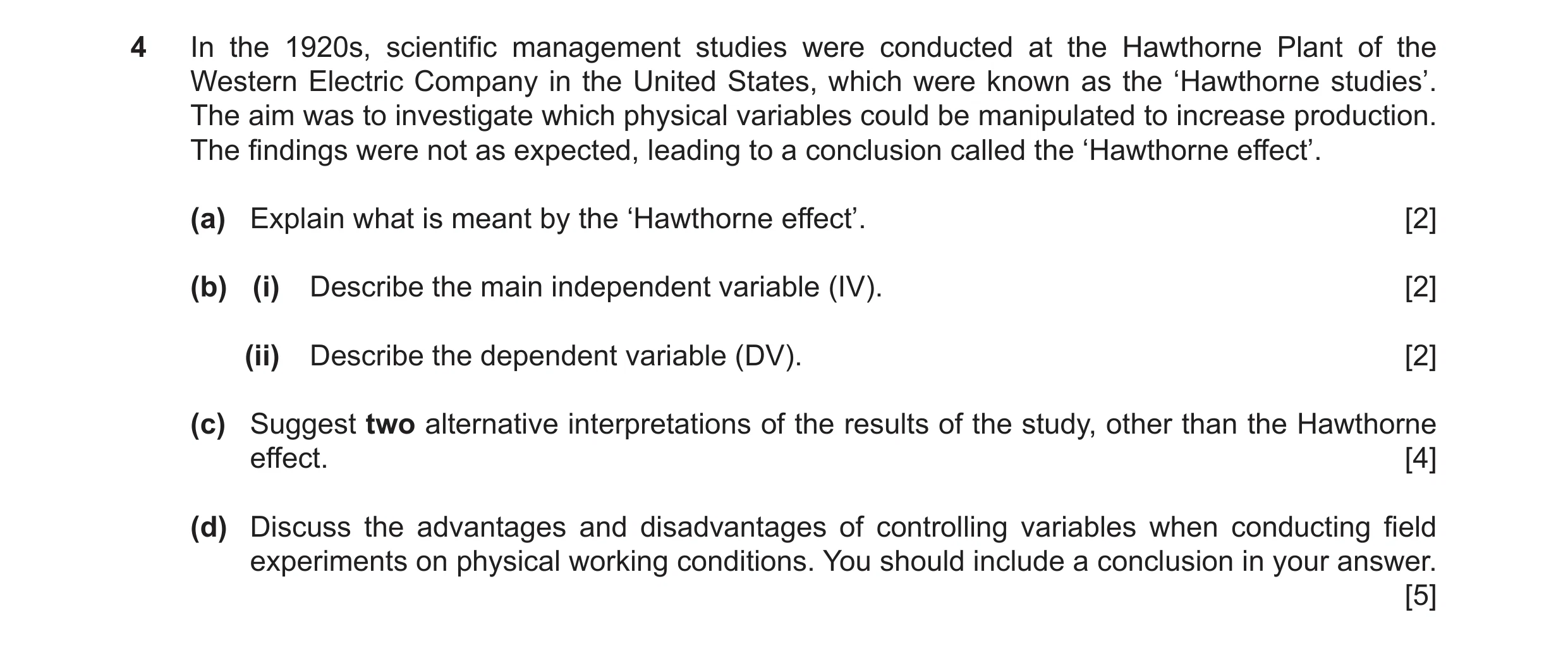
4 In the 1920s, scientific management studies were conducted at the Hawthorne Plant of the Western Electric Company in the United States, which were known as the ‘Hawthorne studies’. The aim was to investigate which physical variables could be manipulated to increase production. The findings were not as expected, leading to a conclusion called the ‘Hawthorne effect’. (a) Explain what is meant by the ‘Hawthorne effect’. [2] (b) (i) Describe the main independent variable (IV). [2] (ii) Describe the dependent variable (DV). [2] (c) Suggest two alternative interpretations of the results of the study, other than the Hawthorne effect. [4] (d) Discuss the advantages and disadvantages of controlling variables when conducting field experiments on physical working conditions. You should include a conclusion in your answer. [5]
15 marks
Mark scheme: 4 In the 1920s, scientific management studies were conducted at the Hawthorne Plant of the Western Electric Company in the United States, which were known as the ‘Hawthorne studies’. The aim was to investigate which physical variables could be manipulated to increase production. The findings were not as expected, leading to a conclusion called the ‘Hawthorne effect’. 4(a) Explain what is meant by the 'Hawthorne effect'. 2 Most likely answer (other appropriate responses to be credited): Quote from study ‘behavioral change due to an awareness of being observed, active compliance with the supposed wishes of researchers because of special attention received, or positive response to the stimulus being introduced.’ Alternatively ‘a marked increase in production related only to special social position and social treatment’. Alternatively it occurs when people behave differently (1 mark) because they know they are being watched (+1 mark) Marks: 1 mark basic answer 2 marks detailed answer/elaboration/ example. Note: 0 marks for demand characteristics. 4(b)(i) Describe the main independent variable (IV). 2 Most likely answer (other appropriate responses to be credited): Quote from study ‘In the initial phase of the studies, the effect of illumination on productivity was examined. • The illumination was decreased step by step for the experimental subjects, whilst the controls received constant illumination.’ Marks: 1 mark for identifying ‘illumination’, 2 marks for elaboration of experimental group (illumination decreased step by step) or’ illumination change versus constant illumination’, 0 marks for ‘physical variables’ (words are in the question). 4(b)(ii) Describe the dependent variable (DV). 2 Most likely answer (other appropriate responses to be credited): Quote from study: ‘Both sets of subjects slowly but steadily increased their performance of inspecting parts, assembling relays or winding coils’ Marks: 1 mark basic answer (performance/productivity), 2 marks detailed answer/elaboration/example (of inspecting parts, assembling relays or winding coils) 4(c) Suggest two alternative interpretations of the results of the study, 4 other than the Hawthorne effect. Most likely answer (other appropriate responses to be credited): Quote from study ‘Over the years several other interpretations of the results of the Hawthorne studies than those made by the original reporters have been presented. Accordingly, the observed increase in productivity may well have been brought about by one or more of the following list: • relief from harsh supervision, • receiving positive attention (special privileges; the test room observer was, however, mainly concerned with creating a friendly relationship that would insure the workers' cooperation), • learning new ways of interaction (the improved personal relations between workers and management), • possibilities to influence work procedures, • rest pauses (to allow for good control of the variables under study) • higher income (of an incentive pay system based upon the output of the group in the test room) • threat of losing one's job (the 1920s economic depression) • changes in lighting levels’ Marks: 1 mark identification of interpretation, 2 marks elaboration/example (see above). X2 4(d) Discuss the advantages and disadvantages of controlling variables 5 when conducting field experiments on physical working conditions. You should include a conclusion in your answer. Marks: 1 mark for each advantage/disadvantage (however basic/detailed) which is related/linked to the question (max 4 marks). 1 mark for conclusion. Conclusion: any appropriate conclusion drawn from the discussion that has been presented. 1 mark if appropriate. A conclusion is a ‘decision reached by reasoning’ and so a summary of points already made scores 0 marks. Most likely answer (other appropriate responses to be credited): Self-reports can include questionnaires and interviews. Advantages • More control over irrelevant/extraneous variables means that the DV is more likely to be due to the IV. • The use of experimental and control group means the control group is the baseline/benchmark of what is normal. Disadvantages • There may be uncontrolled variables which might confound the result of a field experiment on physical working conditions • Too many controls may make a situation artificial. • Controlling variables is reductionist because no behaviour might exist in isolation.
This question in 9990/43 May/June 2021
Q14 · ‘Group conflict can always be managed successfully.’ To what extent do you agree with… 9990/43 May/June 2021
12 ‘Group conflict can always be managed successfully.’ To what extent do you agree with this statement? Use examples of research you have studied to support your answer. [12]
12 marks
Mark scheme: 12 ‘Group conflict can always be managed successfully’. 12 To what extent do you agree with this statement? Use examples of research you have studied to support your answer. Marks: use generic levels of response in table C. Syllabus: managing group conflict (Thomas, 1976) Most likely (any other appropriate responses should be credited): It can: • Conflict can be successfully managed so it becomes a positive rather than a negative • Forsyth lists ways to manage conflict, such as through compromise of both sides • Conflict can be managed through radical solutions: moving a person to a different department, sacking/firing, for the benefit of the organisation and ‘efficiency’ It cannot: • People may say that the conflict is resolved, but still maintain their own view/grudge against a person. • People may work with others, be professional, yet still maintain their private dislike or distrust. • Some people never believe that they are wrong; some have strong principles; some would rather leave an organisation.
This question in 9990/43 May/June 2021
Q15 · Design a study to investigate absenteeism on different days of the week in a food… 9990/42 May/June 2022
8 (a) Design a study to investigate absenteeism on different days of the week in a food production factory. [10] (b) Explain the psychological and methodological evidence on which your study is based. [8] Section C You must answer one question from this section. Psychology and abnormality
18 marks
Mark scheme: 8(a) Design a study to investigate absenteeism on different days of the 10 week in a food production factory. Marks: use generic levels of response Design a study question part (a). Additional: Candidates should design the study showing evidence of design features appropriate to the named method. The named method is: any appropriate method. Specific features: Experiments: type, IV, DV, controls, experimental design. Observations: type, setting, response categories, sampling frame, number of observers. Questionnaires/Interviews: type, setting, example questions. Scoring/rating scale, analysis of responses. General features of research methodology: sampling technique and sample, type of data, ethics, reliability, validity, data analysis. 8(b) Explain the psychological and methodological evidence on which your 8 study is based. Marks: use generic levels of response ‘Design a study’ question part (b). Note: If only methodological or psychological explanation is provided max 5 marks Candidates are expected to explain the reasons for the suggested design in part (a). Explanation should be both psychological and methodological. Psychological to include appropriate theory or research. Additional: candidates are expected to justify their decisions or evidence presented regarding the design made in answer to question part (a). Syllabus: attitudes to work: absenteeism (Blau and Boal, 1987) Psychological: (Blau and Boal, 1987) have four types of absence: medical, career enhancing, normative (habitual response) and calculative use max permitted absences). Methodological: explanation of method using general and specific features as above.
This question in 9990/42 May/June 2022
Q16 · ‘Belbin’s team role types are the perfect way to categorise people into team roles.’ To… 9990/42 May/June 2022
12 ‘Belbin’s team role types are the perfect way to categorise people into team roles.’ To what extent do you agree with this statement? Use examples of research you have studied to support your answer. [12]
12 marks
Mark scheme: 12 ‘Belbin’s team role types are the perfect way to categorise people into 12 team roles.’ To what extent do you agree with this statement? Use examples of research you have studied to support your answer. Marks: use generic levels of response in table C. Syllabus: measuring team roles: Belbin team inventory Most likely (any other appropriate responses should be credited): It is: It has many features of a psychometric test: reliability and validity for example. Its origins were in a number of psychometric tests, so it is just an extension of a psychometric test. Psychometric tests often classify people into different types. This is exactly what the Belbin test does. Belbin has nine team roles: thought-related, people-related and action- related, each of these is divided into three (thought related into plant, monitor-evaluator and specialist). Note: descriptions of these are supporting evidence; question is not a description of these roles. It is not: Belbin himself says that it is not: the Belbin Inventory scores people on ‘A tendency to behave, contribute and interrelate with others in a particular way.’ It analyses how people work together as a team. A psychometric test usually focuses on an individual person only. Quote ‘Observer Assessments provide independent evidence about an individual’s Team Roles. A Self-Perception test is only as good as an individual’s sense of personal realism. Some people answer in terms of how they would like to contribute rather than how they really behave.’
This question in 9990/42 May/June 2022
Q17 · Tuckman outlined different stages of group development 9990/42 Oct/Nov 2022
8 Tuckman outlined different stages of group development. (a) Design a study using observation to identify whether a group in an organisation is ‘forming’ or ‘norming’. [10] (b) Explain the psychological and methodological evidence on which your study is based. [8] Section C You must answer one question from this section. Psychology and abnormality
18 marks
Mark scheme: 8(a) Tuckman outlined different stages of group development. 10 Design a study using observation to identify whether a group in an organisation is ‘forming’ or ‘norming’. Marks: use generic levels of response Design a study question part (a). Additional: Candidates should design the study showing evidence of design features appropriate to the named method. The named method is: observation. Specific features: Observations: type, setting, response categories, sampling frame, number of observers. General features of research methodology: sampling technique & sample, type of data, ethics, reliability, validity, data analysis. 8(b) Explain the psychological and methodological evidence on which your 8 study is based. Marks: use generic levels of response ‘Design a study’ question part (b). Note: If only methodological or psychological explanation is provided max 5 marks Candidates are expected to explain the reasons for the suggested design in part (a). Explanation should be both psychological and methodological. Psychological to include appropriate theory or research. Additional: candidates are expected to justify their decisions or evidence presented regarding the design made in answer to question part (a). Syllabus: group development (Tuckman, 1965) Psychological: Tuckman (1965) outlined four stages of group development: • Forming – where people come together • Storming – where people will present ideas (brainstorm) • Norming – when group members begin to agree • Performing – when the group function as a coherent unit • Adjourning – added by Tuckman (1977) The behaviour of people in these groups should be different – and observable. Methodological: explanation of method using general and specific features as above.
This question in 9990/42 Oct/Nov 2022
Q18 · Oldham and Brass (1979) investigated workers moving from a traditional to an open plan… 9990/42 Feb/March 2023
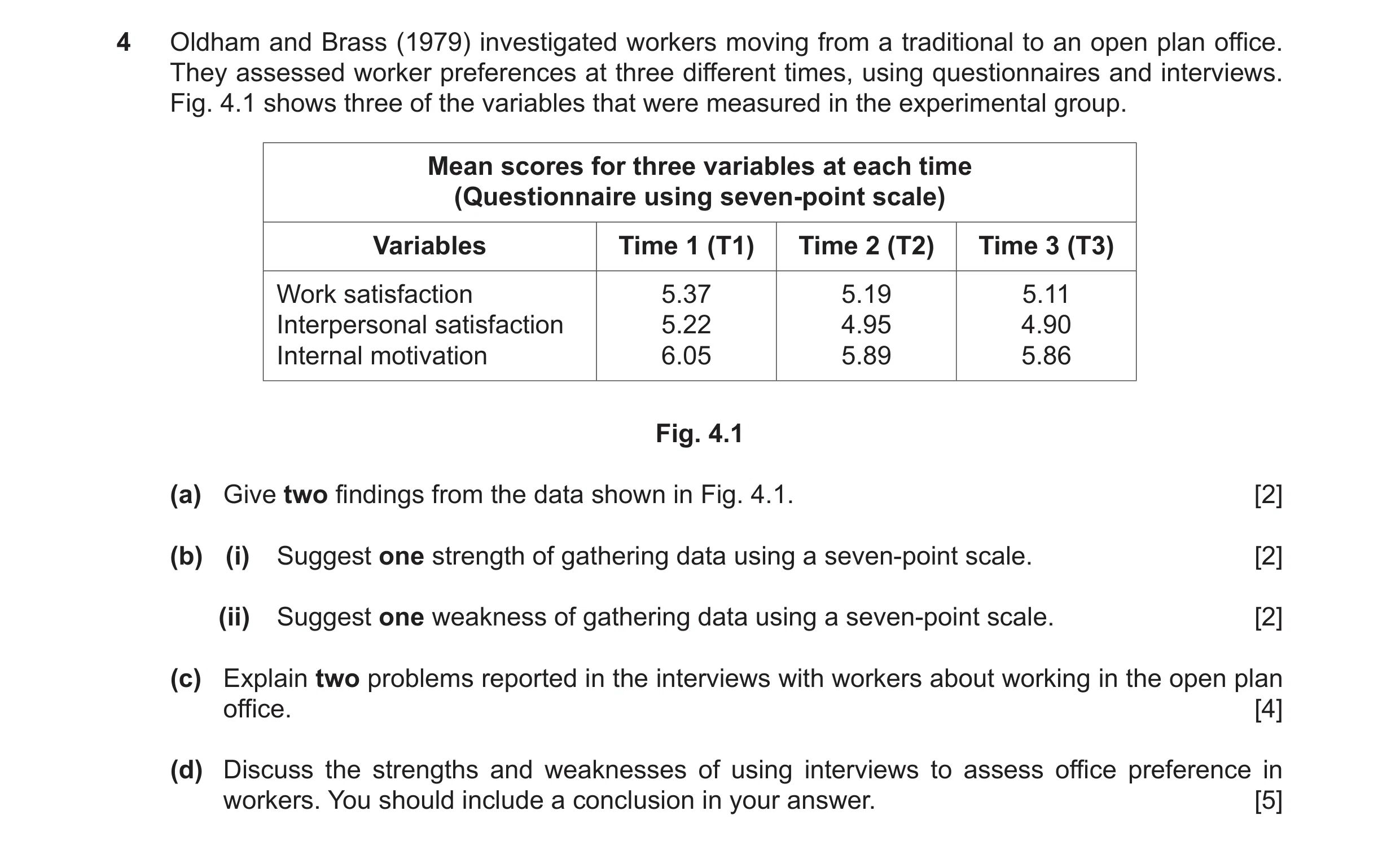
4 Oldham and Brass (1979) investigated workers moving from a traditional to an open plan office. They assessed worker preferences at three different times, using questionnaires and interviews. Fig. 4.1 shows three of the variables that were measured in the experimental group. Mean scores for three variables at each time (Questionnaire using seven‑point scale) Variables Time 1 (T1) Time 2 (T2) Time 3 (T3) Work satisfaction 5.37 5.19 5.11 Interpersonal satisfaction 5.22 4.95 4.90 Internal motivation 6.05 5.89 5.86 Fig. 4.1 (a) Give two findings from the data shown in Fig. 4.1. [2] (b) (i) Suggest one strength of gathering data using a seven‑point scale. [2] (ii) Suggest one weakness of gathering data using a seven‑point scale. [2] (c) Explain two problems reported in the interviews with workers about working in the open plan office. [4] (d) Discuss the strengths and weaknesses of using interviews to assess office preference in workers. You should include a conclusion in your answer. [5]
15 marks
Mark scheme: 4 Oldham and Brass (1979) investigated workers moving from a traditional to an open plan office. They assessed worker preferences at three different times, using questionnaires and interviews. Fig. 4.1 shows three of the variables that were measured in the experimental group. Mean scores for three variables at each time (Questionnaire using seven-point scale) Variables Time 1 (T1) Time 2 (T2) Time 3 (T3) Work satisfaction 5.37 5.19 5.11 Interpersonal satisfaction 5.22 4.95 4.90 Internal motivation 6.05 5.89 5.86 Fig. 4.1 4(a) Give two findings from the data shown in Fig. 4.1. 2 Most likely answer (other appropriate responses to be credited): • work satisfaction decreased from 5.37 to 5.19 to 5.11 (equivalent for other variables) • all variables decreased across the three time periods; none increased (inc. numbers) • interpersonal satisfaction decreased the most over time (6.05 to 5.86) • any appropriate finding to be credited Marks: 1 mark for each correct finding. 4(b)(i) Suggest one strength of gathering data using a seven-point scale. 2 Most likely answer (other appropriate responses to be credited): • responses from participants can be compared with responses from other participants on the same rating scale (1 mark) and so the effect of the open plan office can be measured (2 marks) • data can be analysed statistically (1 mark) adding weight to the findings about open plan offices (2 marks) • a 7-point scale allows a wide range of answers (1 mark) allowing the ratings of feelings about open plan offices to be assessed (2 marks) Marks: 1 mark basic answer, 2 marks detailed answer/elaboration (as above) 4(b)(ii) Suggest one weakness of gathering data using a seven-point scale. 2 Most likely answer (other appropriate responses to be credited): • a 7-point scale includes a mid-point (neutral response) which might be used as an opt-out (1 mark) and so the effect of the open plan office cannot be measured (2 marks) • neutral responses do not help researchers to draw conclusions. A forced six-point choice does not allow an opt out and a decision, even 51/49 one way or the other must be made (1 mark) if every worker chose the mid-point no useful data would be gathered about open plan offices. Forcing a choice would provide useful data about open plan offices (2 marks). 4(c) Explain two problems reported in the interviews with workers about 4 working in the open plan office. Most likely answer (other appropriate responses to be credited): • employees did not like the open nature of the open plan office (1 mark) they described the new office space as a ‘fishbowl,’ ‘cage,’ or ‘warehouse’ (2 marks) • an inability to concentrate (1 mark) e.g. because there is too much background noise; distractions from other workers (2 marks) • inability to develop close friendships (1 mark) e.g. because there is no privacy in an open plan office (2 marks) • inability to complete a job (1 mark) because there is too much background noise; distractions from other workers (2 marks) • it was impossible in the open office to engage in a private conversation either with co-workers or with supervisors (1 mark) e.g. because there is no privacy in an open plan office (2 marks) Marks: 1 mark for identifying problem +1 mark for explanation. X2 Note: answers must be from the study; this is not a suggestion question. 4(d) Discuss the strengths and weaknesses of using interviews to assess 5 office preference in workers. You should include a conclusion in your answer. Most likely answer (other appropriate responses to be credited): Strengths • using a structured interview allows the same questions to be asked to all participants • using a semi structured interview allows different questions to be asked • interviews can be done face-to-face or by telephone Weaknesses: • some participants may provide socially desirable responses; not give truthful answers; respond to demand characteristics • researchers have to be careful about use of leading questions; it could affect the validity of the data collected • detailed reasons can be provided by participants which may be difficult to record • detailed reasons might be misinterpreted when transcribing answers Conclusion: any appropriate conclusion drawn from the discussion that has been presented. 1 mark if appropriate. A conclusion is a ‘decision reached by reasoning’ and so a summary of points already made scores 0 marks. Marks: Question requires discussion; always plural of each argument, and always requires conclusion. 1 mark for each advantage/disadvantage (however detailed) and related to the question up to 4 max. 2 marks max for two strengths/weaknesses unrelated to the question. 1 mark for conclusion.
This question in 9990/42 Feb/March 2023
Q19 · ‘The methodology used in the Hawthorne studies is reductionist 9990/42 Feb/March 2023
12 ‘The methodology used in the Hawthorne studies is reductionist. This is the best way to study organisational working conditions.’ To what extent do you agree with this statement? Use examples of research you have studied to support your answer. [12]
12 marks
Mark scheme: 12 ‘The methodology used in the Hawthorne studies is reductionist. This 12 is the best way to study organisational working conditions.’ To what extent do you agree with this statement? Use examples of research you have studied to support your answer. Marks: use generic levels of response in table C. Syllabus: physical: The Hawthorne studies (Wikstrom and Bendix, 2000) Most likely (any other appropriate responses should be credited): Agree (reductionism good): • breaking down allows each factor to be studied in more detail (e.g. isolating IV and controlling other factors such as lighting) • different factors should be broken down and controlled because they are different. • reducing to one variable allows it to be studied more specifically to identify individual factors responsible before moving on to consider other variables. • reductionism is the way of science, identifying cause and effect. Disagree (reductionism not good) • it is assumed that when isolated variables are studied (such as lighting) they affect all people in the same way. They might not, there are individual differences. • being reductionist may exclude the role of other contributory factors; breaking down may not lead to a consideration of how each factor is inter-related with others • reductionism may involve ‘not seeing the wood for the trees’ and so how everything fits together (holism) may be missed.
This question in 9990/42 Feb/March 2023
Q20 · Blau and Boal (1987) proposed a model to explain how job involvement and organisational… 9990/42 May/June 2023
4 Blau and Boal (1987) proposed a model to explain how job involvement and organisational commitment could interact to affect turnover and absenteeism in workers. Each interaction of job involvement and organisational commitment produces different worker behaviours. Each interaction is represented by a letter (W, X, Y, Z) in Fig. 4.1. Job involvement High Low High W X Organisational commitment Low Y Z Fig. 4.1 (a) Explain what is meant by the term ‘job involvement’. [2] (b) (i) Explain what Blau and Boal’s model predicts about workers’ behaviour in ‘Z’. Do not refer to absenteeism in your answer. [2] (ii) Explain what Blau and Boal’s model predicts about workers’ behaviour in ‘X’. Do not refer to absenteeism in your answer. [2] (c) Outline two of the four categories of absence identified by Blau and Boal. [4] (d) Discuss the strengths and weaknesses of using absenteeism to measure organisational commitment. You should include a conclusion in your answer. [5]
15 marks
Mark scheme: 4 Blau and Boal (1987) proposed a model to explain how job involvement and organisational commitment could interact to affect turnover and absenteeism in workers. Each interaction of job involvement and organisational commitment produces different worker behaviours. Each interaction is represented by a letter (W, X, Y, Z) in Fig. 4.1. Job Involvement High Low High W X Organisational commitment Low Y Z 4(a) Explain what is meant by the term 'job involvement’. 2 Most likely answer (other appropriate responses to be credited): Blau (1985b) defines job involvement as the extent to which the individual identifies psychologically with their job. Also included in the Blau and Boal article: the degree of importance of one's job to one's self-image; the degree to which an individual is actively participating in their work the degree to which an individual's self-esteem or self-worth is affected by their perceived performance level Marks: 1 mark basic answer (simple description), 2 marks detailed answer/ elaboration. Note: ‘psychologically’ OWTTE must be included for 2 marks. 4(b)(i) Explain what Blau and Boal’s model predicts about workers’ behaviour 2 in ‘Z’. Do not refer to absenteeism in your answer. Definitive answer: Z = low job involvement and low organisational commitment (1 mark) Apathetic employees. Work is not important, so low effort. Do not care about the organisation or its aims (2 marks) Marks: 1 mark ‘low and low’, 2 marks detailed answer/elaboration i.e. ref to Blau and Boal (does not have to identify term for mark). Note: no marks for stars (high, high), lone wolves (high, low) or corporate citizens (low, high) 4(b)(ii) Explain what Blau and Boal’s model predicts about workers’ behaviour 2 in ‘X’. Do not refer to absenteeism in your answer. Definitive answer: X = low job involvement and high organisational commitment (1 mark) corporate citizens: for these workers work is not personally important to them, but they identify with the organisation and its goals (2 marks) Marks: 1 mark ’low and high’, 2 marks detailed answer/elaboration i.e. ref to Blau and Boal (does not have to identify term for mark). Note: no marks for stars (high, high), lone wolves (high, low) or apathetic employees (low, low) 4(c) Outline two of the four categories of absence identified by Blau and 4 Boal. Most likely answer (other appropriate responses to be credited): Medical (1 mark) (high JI and high OC): response to various infrequent and uncontrollable events such as illness, injury, funeral leave, and family demands (sick spouse or child). For the organisation this is sporadically occurring, excused absence. (2 marks) Career-enhancing (1 mark) (high JI and low OC): absence is depicted as a mechanism that allows the employee to further task- and career-related goals (2 marks) Normative (1 mark) (low JI and high OC): absence is viewed less as a motivated behaviour and more as a habitual response. Rather than absenteeism being random, as with the medical category, definite patterns will emerge and be predictable (2 marks) Calculative (1 mark) (low JI and low OC): absence would be (for the most apathetic worker) the maximum permitted amount of excused and unexcused absences by the organisation before sanctions (such as warnings or termination of employment) are applied (2 marks) Marks: 1 mark basic answer, 2 marks detailed answer/elaboration 2 Note: some texts use ‘voluntary and involuntary’ terms not used by Blau and Boal. Award 1 mark for identification of ‘voluntary’ or ‘involuntary’. Award 1 mark for identification of both these terms. Max 2 marks overall, so award +1 mark for correct elaboration (i.e. relates to one of Blau and Boal’s categories) of either term. Note: 0 marks for anecdotal answers e.g. ‘they are ill’ or has no category identified. 4(d) Discuss the strengths and weaknesses of using absenteeism to 5 measure organisational commitment. You should include a conclusion in your answer. Most likely answer (other appropriate responses to be credited): Strengths absenteeism is an objective measure, clearly and easily recorded management can keep records of absence over time the individual worker decides to be absent, it is not a subjective management opinion Weaknesses high absenteeism may not be a valid measure of OC absenteeism is just one measure; a range of measures are needed absenteeism is a behaviour which needs an explanation; OC is an attitude (extent to which an individual identifies with an organisation) Conclusion: any appropriate conclusion drawn from the discussion that has been presented. 1 mark if appropriate. A conclusion is a ‘decision reached by reasoning’ and so a summary of points already made scores 0 marks. Marks: Question requires discussion; always plural of each argument, and always requires conclusion. 1 mark for each advantage/disadvantage (however detailed) and related to the question up to 4 max. 2 marks max for two strengths/weaknesses unrelated to the question. 1 mark for conclusion.
This question in 9990/42 May/June 2023
Q21 · Groupthink is what happens when group cohesion causes a group, such as a management team… 9990/41 Oct/Nov 2023
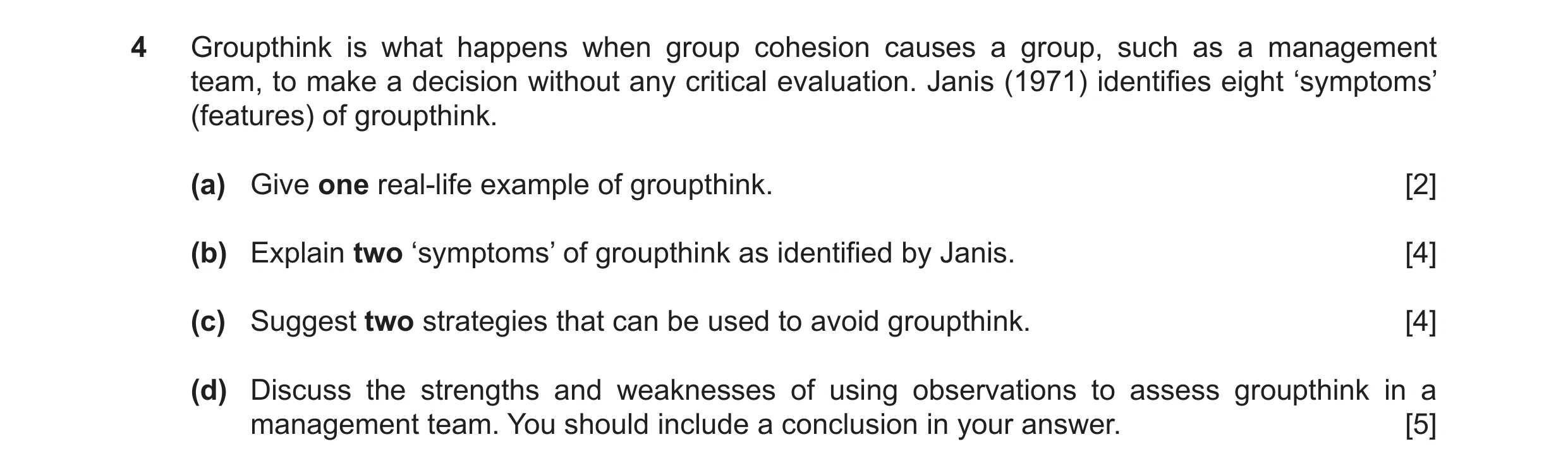
4 Groupthink is what happens when group cohesion causes a group, such as a management team, to make a decision without any critical evaluation. Janis (1971) identifies eight ‘symptoms’ (features) of groupthink. (a) Give one real-life example of groupthink. [2] (b) Explain two ‘symptoms’ of groupthink as identified by Janis. [4] (c) Suggest two strategies that can be used to avoid groupthink. [4] (d) Discuss the strengths and weaknesses of using observations to assess groupthink in a management team. You should include a conclusion in your answer. [5]
15 marks
Mark scheme: 4 Groupthink is what happens when group cohesion causes a group, such as a management team, to make a decision without any critical evaluation. Janis (1971) identifies eight ‘symptoms’ (features) of groupthink. 4(a) Give one real-life example of groupthink. 2 Most likely answer (other appropriate responses to be credited): • the Bay of Pigs fiasco (this example appears at the beginning of the Janis paper) • the attack on Pearl Harbour (also in the Janis paper) • Other ‘non-published’ examples are creditworthy if they are fully explained how they relate to groupthink. Marks: 1 mark basic answer (identification of event), 2 marks detailed answer/elaboration. 4(b) Explain two ‘symptoms’ of groupthink as identified by Janis. 4 Definitive answers 1 The illusion of invulnerability (1 mark) the belief that nothing can go wrong (2 marks) 2 Rationale: warning signs ignored and assume everything is fine. 3 Morality: assume group is moral and ignore ethical or moral consequences (NOTE: text calls this ‘unquestioning beliefs’) 4 Stereotypes: dissenters are in the out-group, where no-one wants to be 5 Pressure (to conform) pressure placed on dissenters 6 Self-censorship: less likely to listen to our doubt if all others are in agreement 7 The illusion of unanimity (1 mark) the belief that group members who respect each other will automatically agree (2 marks) 8 Mindguards: ‘self-appointed censors’ who hide problematic information from the group. Marks: 1 mark identification of term, 2 marks detailed answer/elaboration (as above) 4(c) Suggest two strategies that can be used to avoid groupthink. 4 Most likely answer (other appropriate responses to be credited): • encouraging individual evaluation • promoting open enquiry • breaking a full group into sub-groups • admitting shortcomings • holding second-chance meetings • not rushing to a quick solution • devil’s advocate Marks: 1 mark basic answer, 2 marks detailed answer/elaboration. 4(d) Discuss the strengths and weaknesses of using observations to assess 5 groupthink in a management team. You should include a conclusion in your answer. Most likely answer (other appropriate responses to be credited): Strengths: • a covert observation means the person is unaware they are being observed and so behaves naturally which can give accurate information about how people behave when part of a team • observation can be recorded on CCTV allowing observers to check/re-run • observations can have more than one observer so reliability of observations can be checked confirming how people behave when part of a team Weaknesses: • if an overt observation is conducted by a member of the team behaviours might be missed • if a participant observation is conducted by a member of the team behaviours might be missed • a structured observation may not account for new or unexpected behaviour and so some features of groupthink might be missed Conclusion: any appropriate conclusion drawn from the discussion that has been presented. 1 mark if appropriate. A conclusion is a ‘decision reached by reasoning’ and so a summary of points already made scores 0 marks. Marks: Question requires discussion; always plural of each argument, and always requires conclusion. 1 mark for each advantage/disadvantage (however detailed) and related to the question up to 4 max. 2 marks max. for two strengths/weaknesses unrelated to the question. 1 mark for conclusion.
This question in 9990/41 Oct/Nov 2023
Q22 · Groupthink is what happens when group cohesion causes a group, such as a management team… 9990/43 Oct/Nov 2023
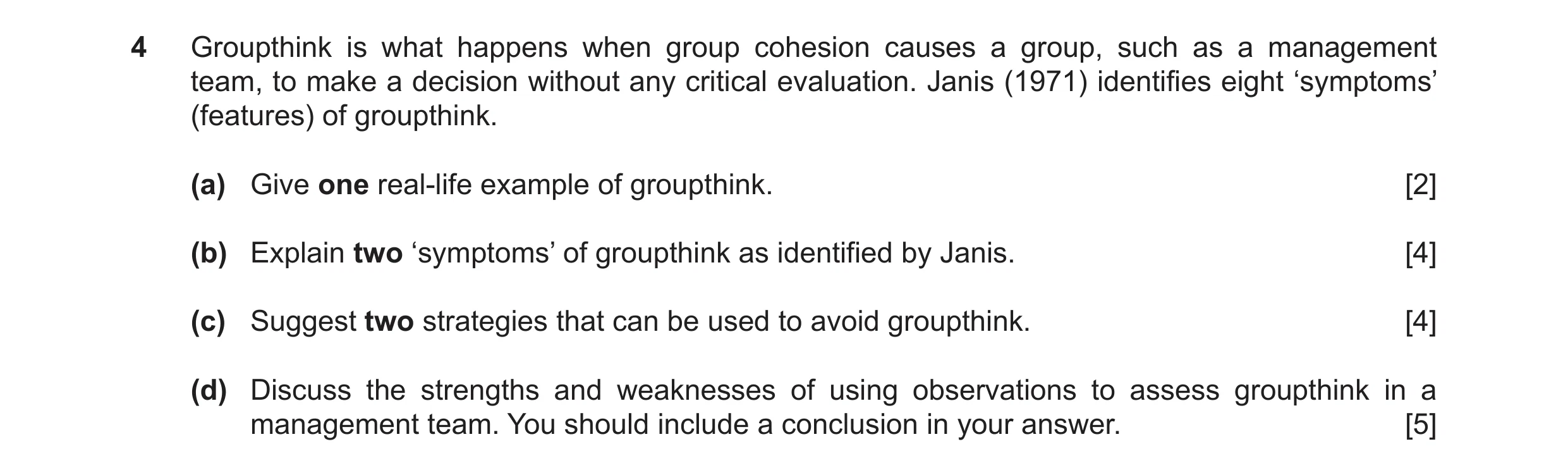
4 Groupthink is what happens when group cohesion causes a group, such as a management team, to make a decision without any critical evaluation. Janis (1971) identifies eight ‘symptoms’ (features) of groupthink. (a) Give one real-life example of groupthink. [2] (b) Explain two ‘symptoms’ of groupthink as identified by Janis. [4] (c) Suggest two strategies that can be used to avoid groupthink. [4] (d) Discuss the strengths and weaknesses of using observations to assess groupthink in a management team. You should include a conclusion in your answer. [5]
15 marks
Mark scheme: 4 Groupthink is what happens when group cohesion causes a group, such as a management team, to make a decision without any critical evaluation. Janis (1971) identifies eight ‘symptoms’ (features) of groupthink. 4(a) Give one real-life example of groupthink. 2 Most likely answer (other appropriate responses to be credited): • the Bay of Pigs fiasco (this example appears at the beginning of the Janis paper) • the attack on Pearl Harbour (also in the Janis paper) • Other ‘non-published’ examples are creditworthy if they are fully explained how they relate to groupthink. Marks: 1 mark basic answer (identification of event), 2 marks detailed answer/elaboration. 4(b) Explain two ‘symptoms’ of groupthink as identified by Janis. 4 Definitive answers 1 The illusion of invulnerability (1 mark) the belief that nothing can go wrong (2 marks) 2 Rationale: warning signs ignored and assume everything is fine. 3 Morality: assume group is moral and ignore ethical or moral consequences (NOTE: text calls this ‘unquestioning beliefs’) 4 Stereotypes: dissenters are in the out-group, where no-one wants to be 5 Pressure (to conform) pressure placed on dissenters 6 Self-censorship: less likely to listen to our doubt if all others are in agreement 7 The illusion of unanimity (1 mark) the belief that group members who respect each other will automatically agree (2 marks) 8 Mindguards: ‘self-appointed censors’ who hide problematic information from the group. Marks: 1 mark identification of term, 2 marks detailed answer/elaboration (as above) 4(c) Suggest two strategies that can be used to avoid groupthink. 4 Most likely answer (other appropriate responses to be credited): • encouraging individual evaluation • promoting open enquiry • breaking a full group into sub-groups • admitting shortcomings • holding second-chance meetings • not rushing to a quick solution • devil’s advocate Marks: 1 mark basic answer, 2 marks detailed answer/elaboration. 4(d) Discuss the strengths and weaknesses of using observations to assess 5 groupthink in a management team. You should include a conclusion in your answer. Most likely answer (other appropriate responses to be credited): Strengths: • a covert observation means the person is unaware they are being observed and so behaves naturally which can give accurate information about how people behave when part of a team • observation can be recorded on CCTV allowing observers to check/re-run • observations can have more than one observer so reliability of observations can be checked confirming how people behave when part of a team Weaknesses: • if an overt observation is conducted by a member of the team behaviours might be missed • if a participant observation is conducted by a member of the team behaviours might be missed • a structured observation may not account for new or unexpected behaviour and so some features of groupthink might be missed Conclusion: any appropriate conclusion drawn from the discussion that has been presented. 1 mark if appropriate. A conclusion is a ‘decision reached by reasoning’ and so a summary of points already made scores 0 marks. Marks: Question requires discussion; always plural of each argument, and always requires conclusion. 1 mark for each advantage/disadvantage (however detailed) and related to the question up to 4 max. 2 marks max. for two strengths/weaknesses unrelated to the question. 1 mark for conclusion.
This question in 9990/43 Oct/Nov 2023
Q23 · From the key study by Claypoole and Szalma (2019) on electronic performance monitoring… 9990/42 Feb/March 2024
7 From the key study by Claypoole and Szalma (2019) on electronic performance monitoring: (a) Describe how the two forms of electronic presence were used in this study. [4] (b) Suggest one way in which worker performance could be monitored, other than electronic presence. [2] (c) Explain one strength and one weakness of conducting a study on electronic performance monitoring, using students as participants. [4]
10 marks
Mark scheme: 7 From the key study by Claypoole and Szalma (2019) on electronic performance monitoring. 7(a) Describe how the two forms of electronic presence were used in this 4 study. Syllabus: 4.3.2 Key study looking at concentration levels when being monitored: Claypoole and Szalma (2019), focus on experiment 1, specifics of methodology for experiment 2 will not be needed. Marks: Award 2 marks for a detailed description. Award 1 mark for a partial description. Marks: Award up to 2 marks for details of ‘webcam’ and 2 marks for ‘video recorder’. Note: answers can be how it was set up or how it was used. Answers to include (quote from study): “In the Electronic Presence condition there were two forms of electronic presence, a webcam and a video recorder”. • the webcam was placed on top of the computer screen (1 mark) and was used to “monitor the participant's performance and engagement while they completed the task”, as explicitly stated to the participants (1 mark). • the video recorder was placed on a tripod, approximately 110 cm tall, one metre behind the participant at a 45-degree angle (1 mark) to record the participant's performance so that it could be evaluated later (1 marks). Note: award 1 mark if both forms are identified. Note: 0 marks for ‘CCTV’ which is too general. 7(b) Suggest one way in which worker performance could be monitored, 2 other than electronic presence. Marks: Award 2 marks for an appropriate suggestion and applied to study with detail / elaboration / example. Award 1 mark for an appropriate suggestion identified but not applied. Answers may include (other appropriate responses to be credited). • observation (covert or overt) could be used by hiding a video camera (1 mark) for example, so a recording is taken of natural worker behaviour (2 marks) • questionnaire e.g. closed where workers are asked closed questions about their performance (1 mark) so each worker could be compared for their work efficiency (2 marks). • also possible: time and motion study (Taylor); or by interview. 7(c) Explain one strength and one weakness of conducting a study on 4 electronic performance monitoring using students as participants. Marks: Up to 2 marks for each strength and up to 2 marks for each weakness. Award 2 marks for an appropriate strength/weakness stated and applied as required by the question with detail / elaboration / example. Award 1 mark for an appropriate strength/weakness stated but not applied. Answers may include (other appropriate responses to be credited): Strengths: • students may be readily available; sample is standardised as all participants are students (1 mark) so different variables/types of monitoring can be changed, trialled/repeated without affecting ‘real’ workers or organisations (2 marks) • conducting a study on students can be a pilot study to test for strengths/weaknesses (1 mark) before rolling it out so workers in different organisations can be monitored (2 marks) Weaknesses: • students may respond to demand characteristics because they know they are participating in a study (1 mark) about electronic performance measuring (2 marks). • students may have very little or no experience in ‘real’ work environments (1 mark) and so any results may not be generalised to ‘real’ workers in different organisations (2 marks)
This question in 9990/42 Feb/March 2024
Q24 · Studies have been conducted on open plan offices, e.g 9990/42 Oct/Nov 2024
8 Studies have been conducted on open plan offices, e.g. Oldham and Brass (1979). (a) Explain what is meant by an ‘open plan office’. [2] (b) Suggest why workers’ levels of concentration may be affected by an open plan office design. [2] (c) Explain two reasons why generalisations cannot be made about the effect on workers of open plan office design from a single study. [4]
8 marks
Mark scheme: 8 Studies have been conducted on open plan offices, e.g. Oldham and Brass (1979). 8(a) Explain what is meant by an ‘open plan office’. 2 Syllabus: 4.4.1 impact of the design of the work environment focusing on open plan offices, including a study, e.g. Oldham and Brass (1979). Marks: Award 1 marks each feature (max. 2 marks). Answers may include (other appropriate responses to be credited): • no interiors walls or full ceiling partitions • no use of small, enclosed rooms such as private offices • large, open spaces • desk or head height partitions • no private place 8(b) Suggest why workers’ levels of concentration may be affected by an 2 open plan office design. Marks: Award 2 marks for an appropriate suggestion stated and applied to study with detail / elaboration / example. Award 1 mark for an appropriate suggestion identified but not applied. Answers may include (other appropriate responses to be credited): • noise levels might be higher in an open-plan office (1 mark) meaning that background noise is much higher resulting in difficulties in concentration (2 marks) • a lack of partitions in an open plan office might lead to distractions from other workers, such as walking about (1 mark) leading to inability to concentrate (2 marks) NB: also credit two different things e.g. level of noise; lack of privacy. 8(c) Explain two reasons why generalisations cannot be made about the 4 effect on workers of open plan office design from a single study. Marks: up to 2 marks for each reason: Award 2 marks for an appropriate reason stated and applied as required by the question with detail / elaboration / example. Award 1 mark for an appropriate reason stated but not applied. Answers may include (other appropriate responses to be credited): Cannot generalise: • a single study probably uses only one type of worker which restricts generalisations (1 mark) e.g. Oldham and Brass only studied one type of worker (those in a newspaper organisation) and other types of workers might be different (2 marks) • within an open-plan office, workers can adapt to the environment (1 mark). Workers can add their own barrier to protect their territory, wear headphones, etc. to help them concentrate, for example (2 marks) • any one study will be conducted in a particular country which may not generalise to other countries (1 mark). Workers in some countries may have their concentration levels distupted but in others it might be welcomed (2 marks)
This question in 9990/42 Oct/Nov 2024
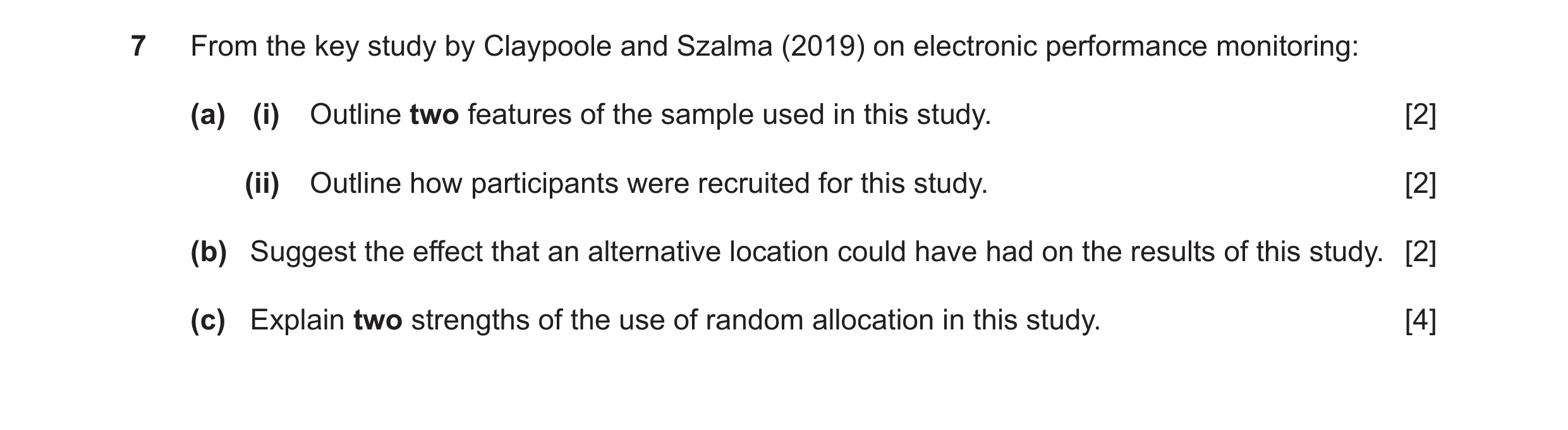
Q25 · From the key study by Claypoole and Szalma (2019) on electronic performance monitoring… 9990/42 May/June 2025
7 From the key study by Claypoole and Szalma (2019) on electronic performance monitoring: (a) (i) Outline two features of the sample used in this study. [2] (ii) Outline how participants were recruited for this study. [2] (b) Suggest the effect that an alternative location could have had on the results of this study. [2] (c) Explain two strengths of the use of random allocation in this study. [4]
10 marks
Mark scheme: 7(a)(i) Outline two features of the sample used in this study. 2 Syllabus: 4.3.2 Key study looking at concentration levels when being monitored: Claypoole and Szalma (2019) Marks: Award 1 mark for each correct feature (2 max) Definitive answers: • 106 participants • 65 female, 41 male • average age 20.57 years • all undergraduates/students • at a university in the United States 7(a)(ii) Outline how participants were recruited for this study. 2 Marks: Award 1 mark for each correct feature (2 max) Definitive answers: • recruited through a psychology experiment website (1 mark) • at a large university in the southeastern United States (+1 mark) • incentive of course credits for completing the study (+1 mark). Note: the sampling technique was voluntary, but 0 marks as question asks how recruited. Note: ‘replied to an advertisement’ alone =0 ‘course credits’ alone =0 7(b) Suggest the effect that an alternative location could have had on the 2 results of this study. Marks: Award 2 marks for an appropriate suggestion stated and applied to study with detail / elaboration / example. Award 1 mark for an appropriate suggestion identified but not applied. Answers may include (other appropriate responses to be credited). • increase (or decrease) in validity because of laboratory/organisation (1 mark) • increase (or decrease) in ecological validity because of laboratory/organisation (1 mark) • the study was conducted at a university, not in an organisation (1 mark) • the participants knew their behaviour being monitored and may behave differently in laboratory/organisation (+1 mark). • extraneous variables such as noise controlled or not affecting EPM (+1) 7(c) Explain two strengths of the use of random allocation in this study. 4 Marks: Up to 2 marks for each strength 2 Award 2 marks for an appropriate strength stated and applied as required by the question with detail / elaboration / example. Award 1 mark for an appropriate strength stated but not applied. Answers may include (other appropriate responses to be credited): Strengths • no participant bias: The participant does not choose which condition they are in and so they cannot bias the study (1 mark) the participant does not know whether they are in the electronic performance or control condition. (2 marks) • no experimenter bias: The experimenter cannot bias the study (1 mark) the experimenter does not know whether they are in the electronic performance or control condition (2 marks)
This question in 9990/42 May/June 2025
Q26 · Outline what is meant by the term ‘social loafing’, using an example from any organisation 9990/42 May/June 2025
8 (a) Outline what is meant by the term ‘social loafing’, using an example from any organisation. [2] (b) Suggest one way that social loafing can be reduced in a meeting in an organisation. [2] (c) Explain two strengths of studying social loafing in a work environment. [4]
8 marks
Mark scheme: 8(a) Outline what is meant by the term ‘social loafing’ using an example from 2 any organisation. Syllabus: 4.3.2 individual and group performance focusing on social facilitation and social loafing including definitions, drive theory and evaluation apprehension, social impact theory. Marks: Award 1 marks for outline. Award 1 mark for correct example. Answers may include: • social loafing refers to the "decrease in individual effort when performing in groups as compared to when they perform alone" (Latane, Williams, & Harkins, 1979, p. 822). • Examples: • during discussion sessions where only one or two people come up with all the ideas while the rest do nothing more than agree. • A Zoom/Teams meeting of 50 members makes it easy for individuals to turn off their cameras, mute their microphones, and do other activities. • Earley et al. (1993) when responsibility was shared by a group, highly individualistic people performed poorly in comparison to collectivists who performed better in situations with high shared responsibility. Note 0 marks for the Ringlemann study. He was prof at a school of agricultural engineering. Participants were agricultural workers BUT pulling on rope was not an agricultural task. 8(b) Suggest one way that social loafing can be reduced in a meeting in an 2 organisation. Marks: Award 2 marks for an appropriate suggestion applied to question with detail / elaboration / example. Award 1 mark for an appropriate suggestion identified but not applied. Answers may include (other appropriate responses to be credited): • managers should clearly outline all the tasks required of each individual (1 mark) and assign a task for each person making everyone accountable for their part in the project (+1 mark) • work with individuals; ask for their views, their comments, make them contribute (1 mark) with relevant example/elaboration (+1 mark) • recognise individual contributions and reward each member individually (1 mark) with relevant example/elaboration (+1 mark) • supervise individuals irregularly – no-one knows when they will be checked (1 mark) with relevant example/elaboration (+1 mark) 8(c) Explain two strengths of studying social loafing in a work environment. 4 Marks: Up to 2 marks for each strength 2: Award 2 marks for an appropriate strength stated and applied as required by the question with detail / elaboration / example. Award 1 mark for an appropriate strength stated but not applied. Answers may include (other appropriate responses to be credited): • studying social loafing can identify guilty individuals who can be re-trained to work at appropriate levels (1 mark) which results in a more productive and efficient work environment (2 marks) • if social loafing is eliminated, all members of a team can work happily with the confidence that every team member is ‘pulling their weight’ (1 mark) which might result in a more cohesive group of workers or increase group performance (2 marks) • if social loafing is eliminated then productivity can be at optimum levels or even increased (1 mark) which is positive for the management and healthy for the organisation (2 marks).
This question in 9990/42 May/June 2025

![Question 2: (a) Design a study to investigate whether the illusion of unanimity occurs when groupthink occurs. [10] (b) Explain the psychological and m…](https://img.pastlit.com/crops/46469efd-8343-405f-b485-14d7097772c6/q8.webp)


 1 / 6
1 / 6


![Question 10: (a) Design a study using observation to investigate whether a group follows the stages of development proposed by Tuckman (1965). [10] (b) …](https://img.pastlit.com/crops/5a026500-49e4-4e8b-bcd1-87b03e331585/q8.webp)
 2 / 6
2 / 6

![Question 15: (a) Design a study to investigate absenteeism on different days of the week in a food production factory. [10] (b) Explain the psychologica…](https://img.pastlit.com/crops/0bb7edd8-80f6-4c05-adee-9d2d8c593544/q8.webp)
 3 / 6
3 / 6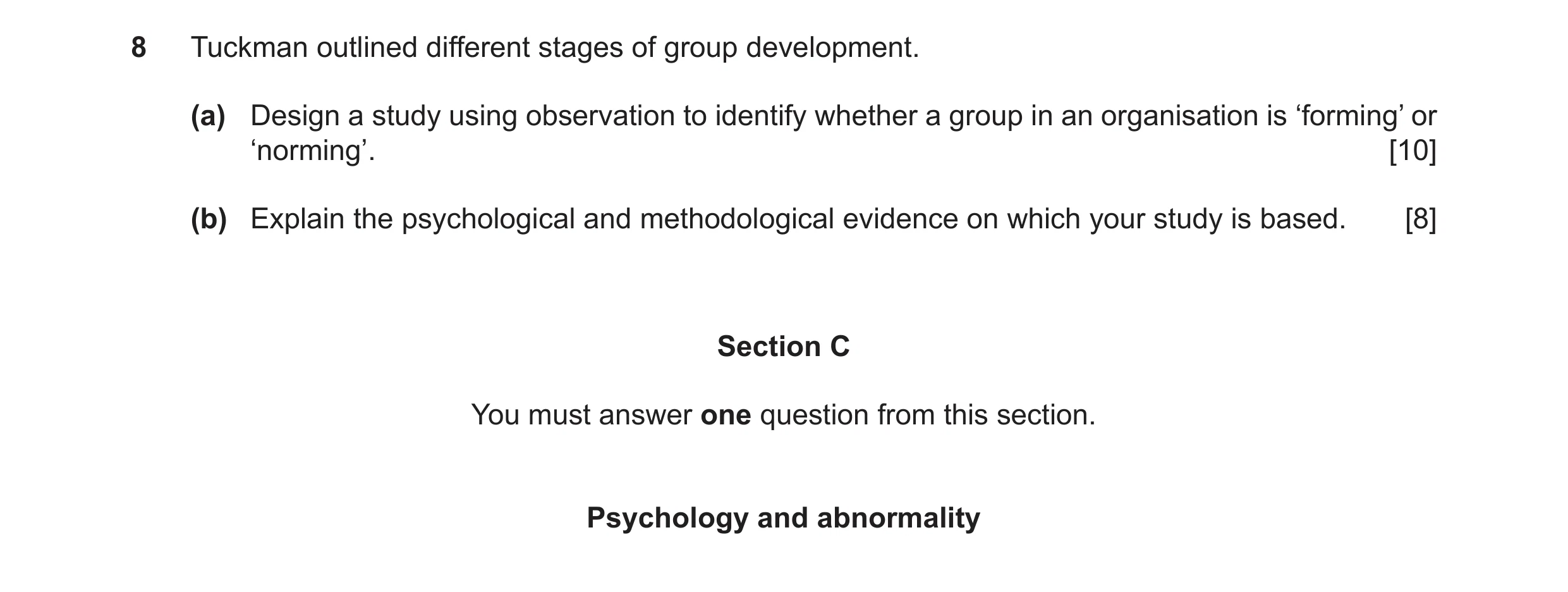
 4 / 6
4 / 6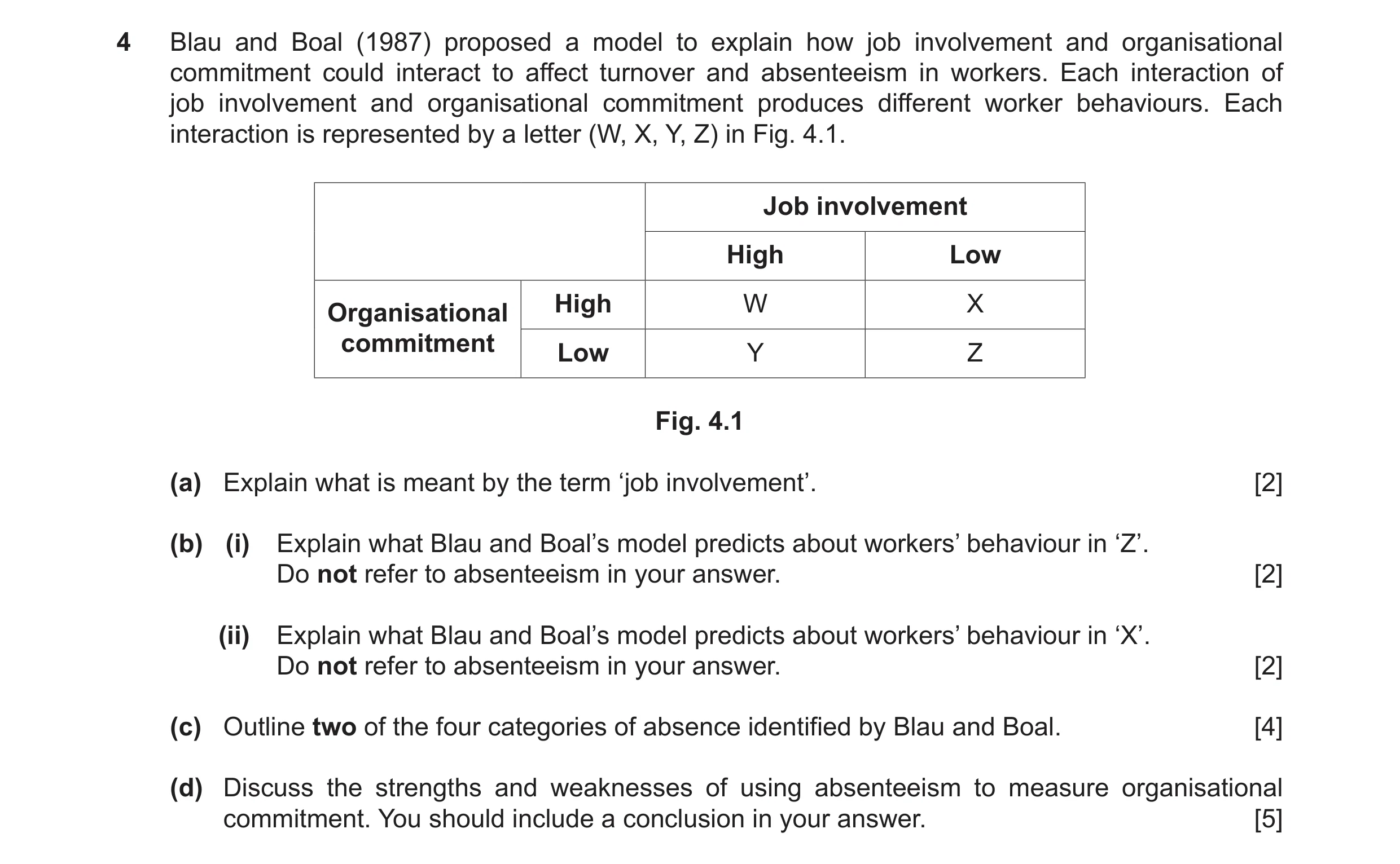
 5 / 6
5 / 6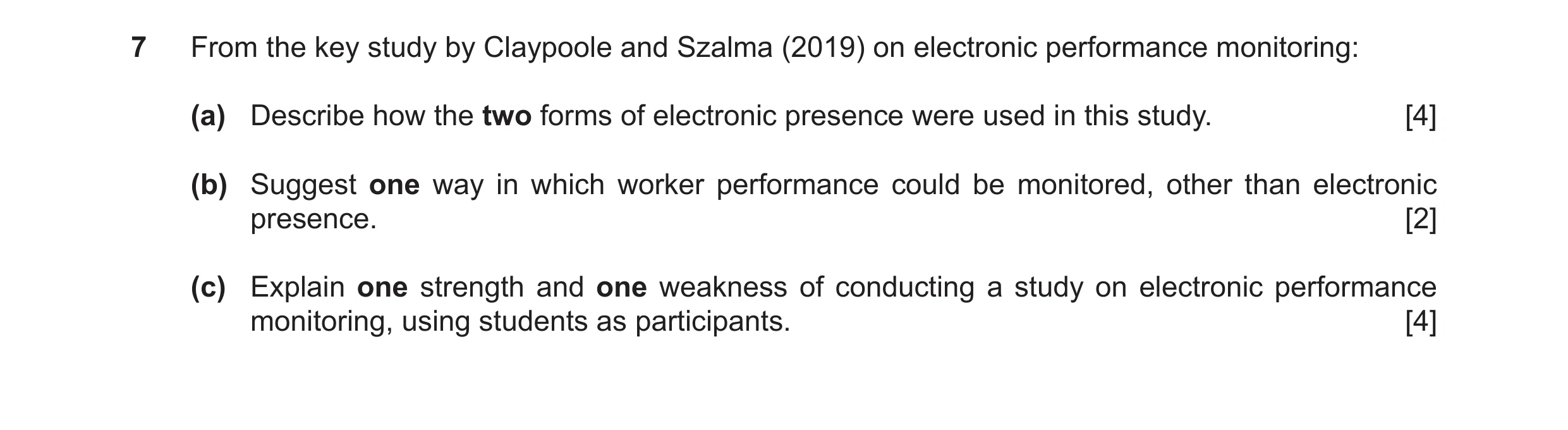
![Question 24: Studies have been conducted on open plan offices, e.g. Oldham and Brass (1979). (a) Explain what is meant by an ‘open plan office’. [2] (b)…](https://img.pastlit.com/crops/35352820-aa09-42f1-a101-bb35e03ec960/q8.webp)
![Question 26: (a) Outline what is meant by the term ‘social loafing’, using an example from any organisation. [2] (b) Suggest one way that social loafing…](https://img.pastlit.com/crops/f59b906e-bcf7-464d-b2e7-fc2d6a79428f/q8.webp) 6 / 6
6 / 6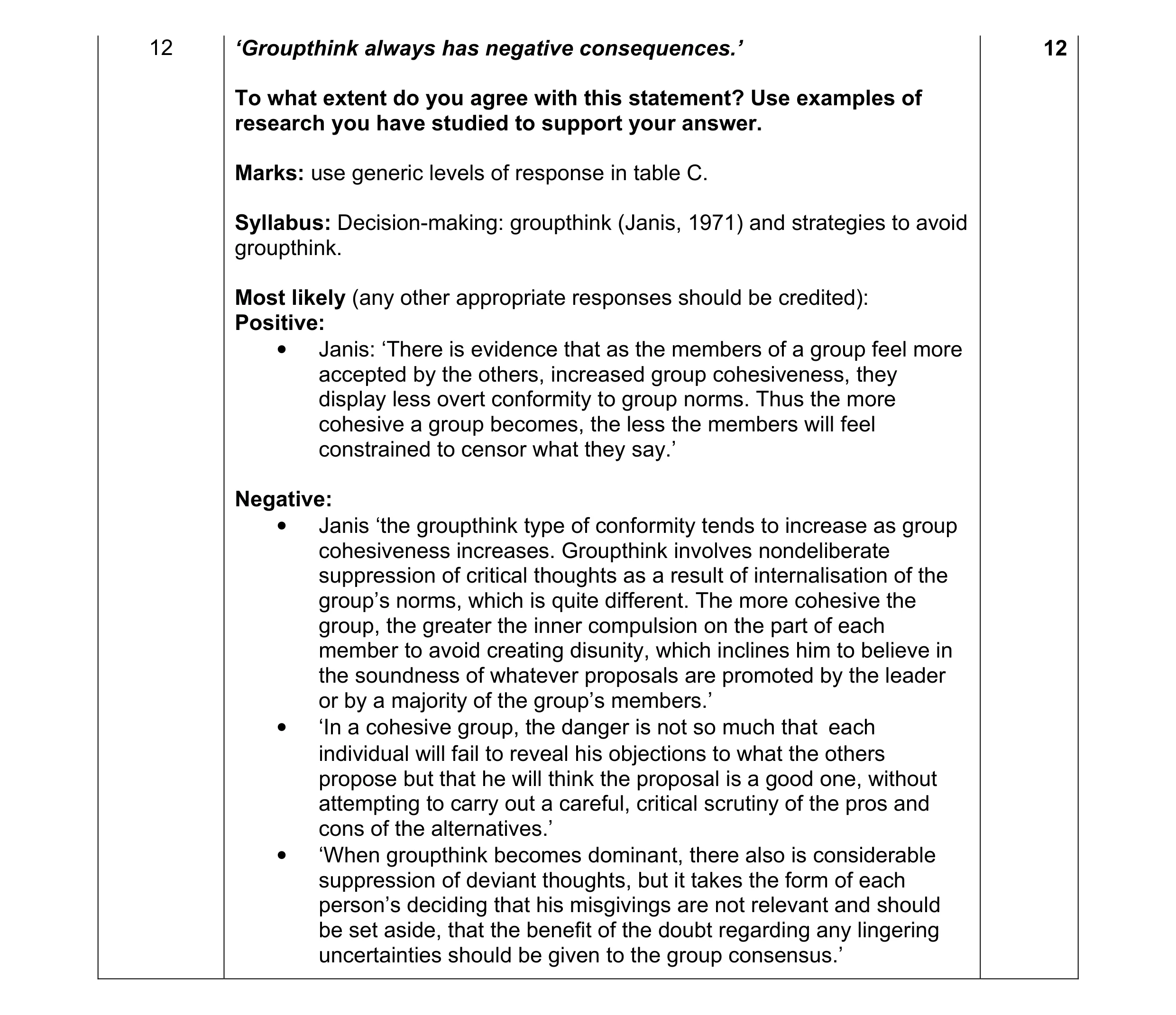 12
12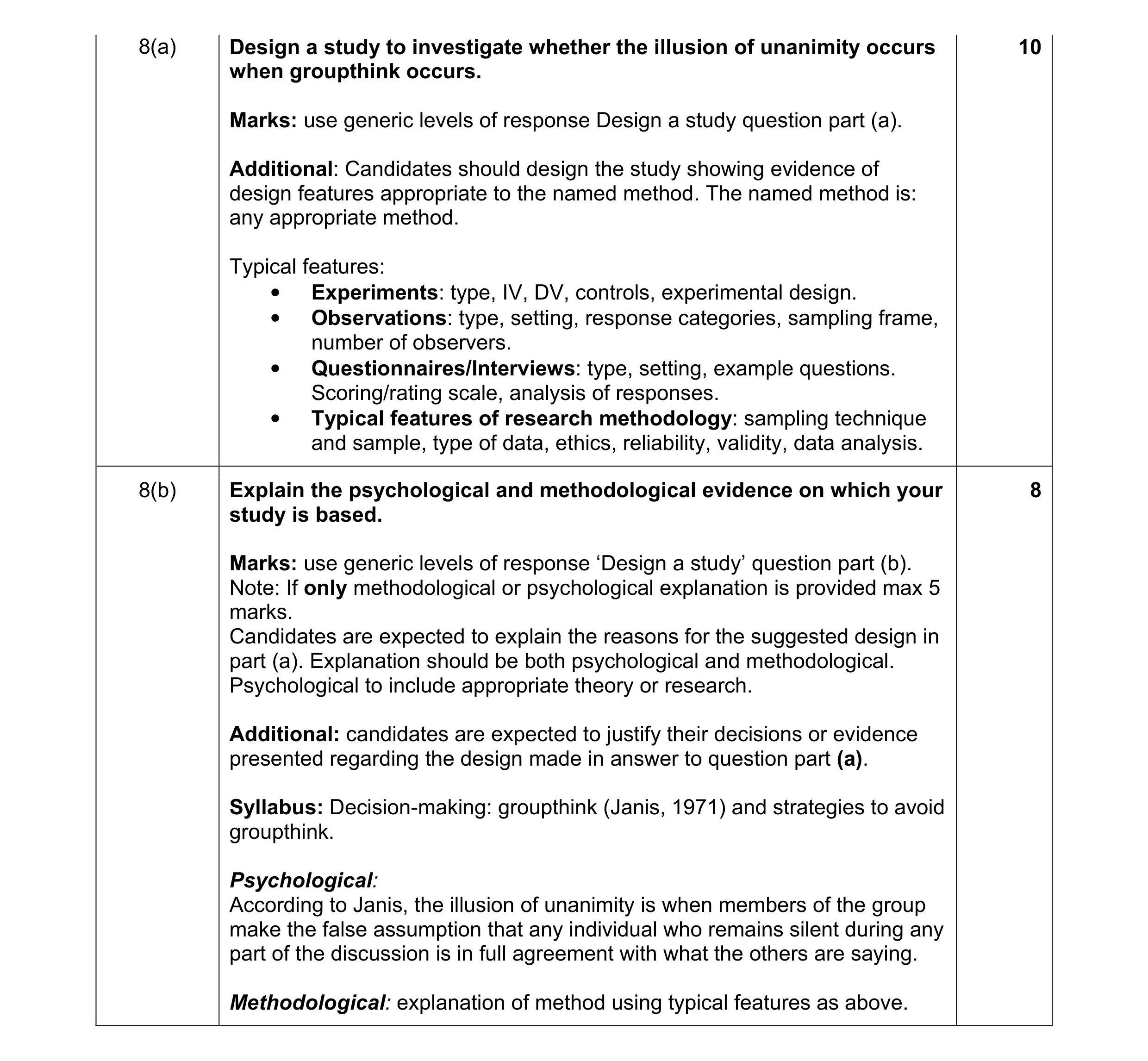 18
18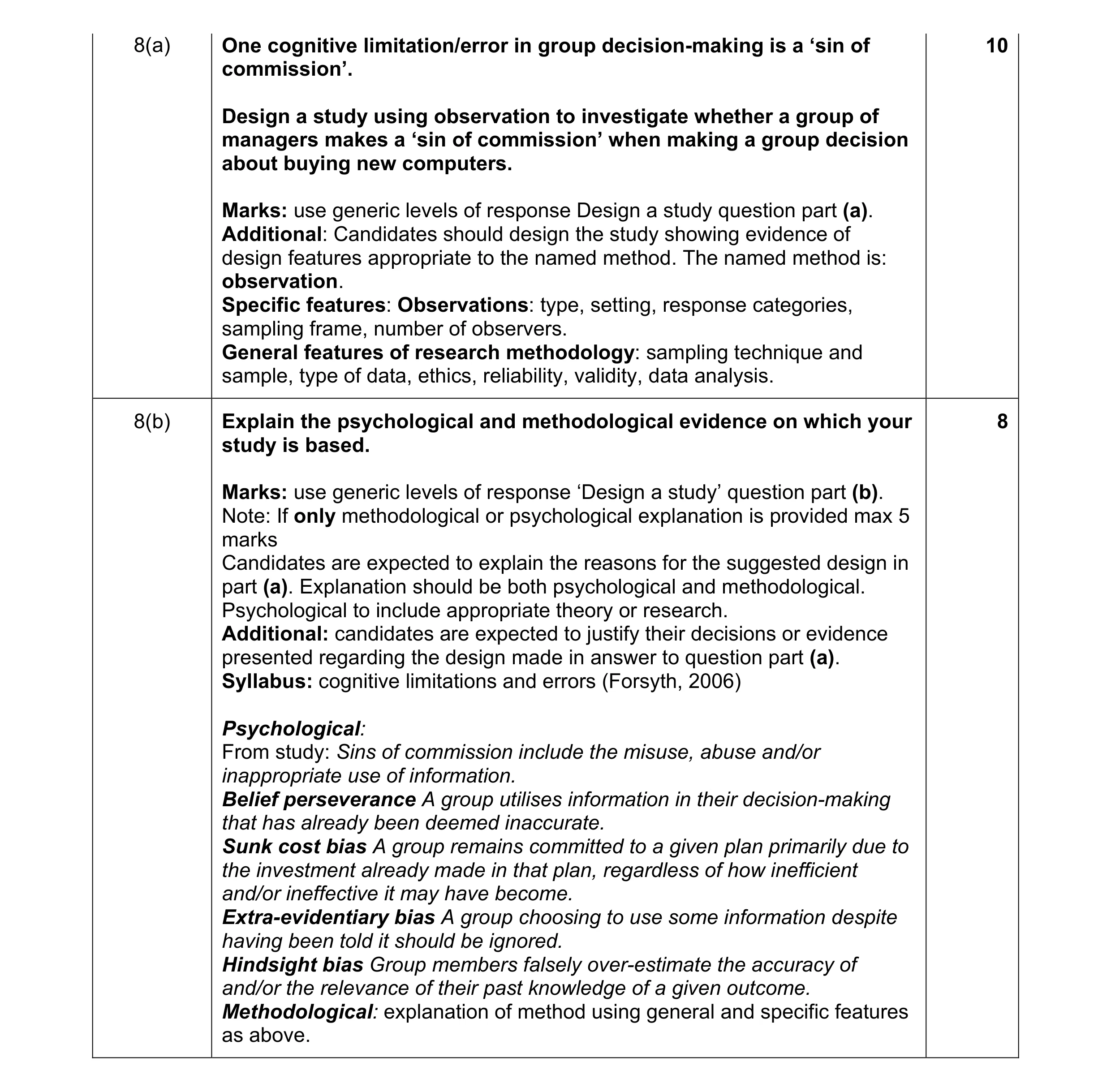 18
18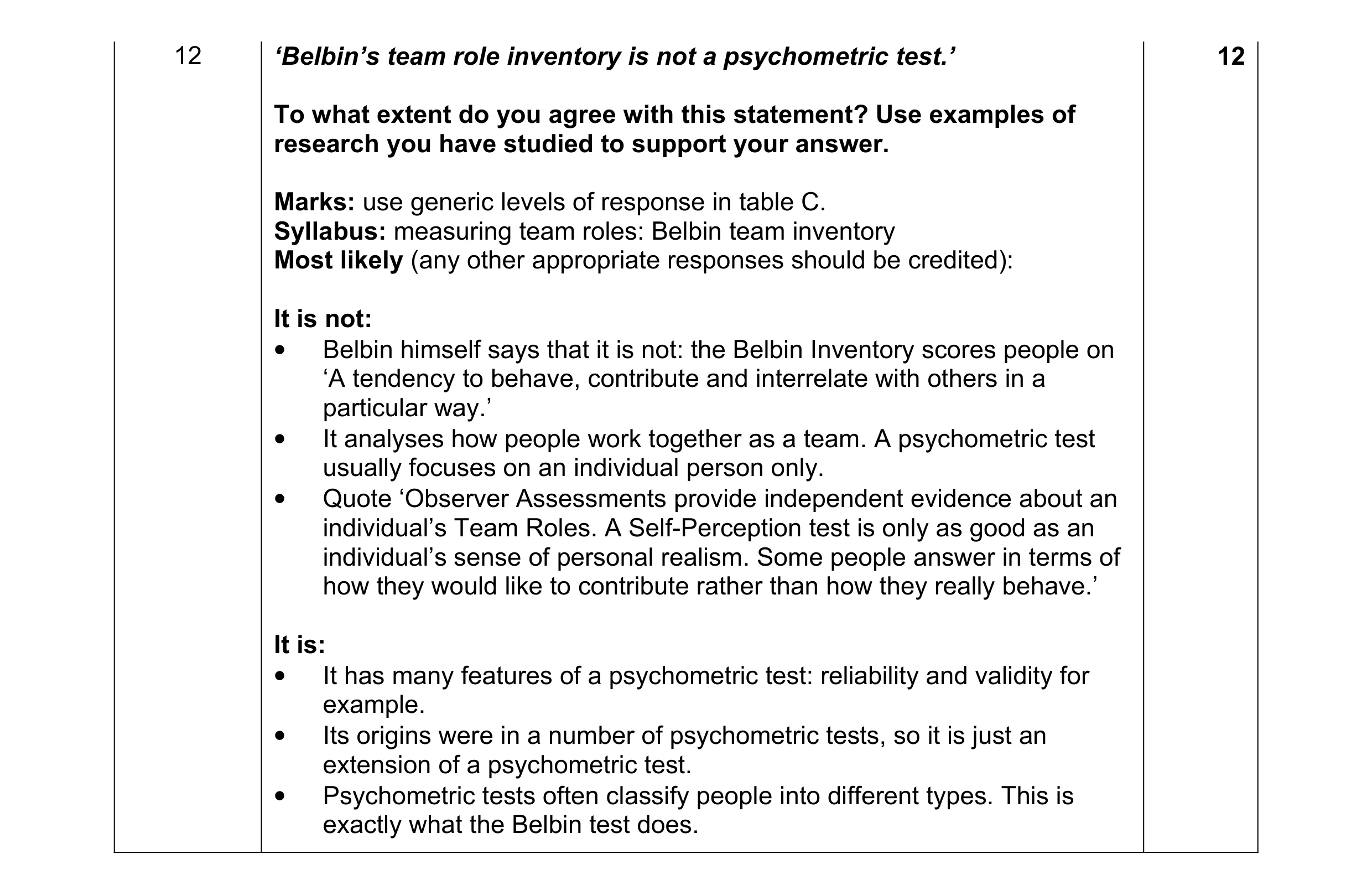 12
12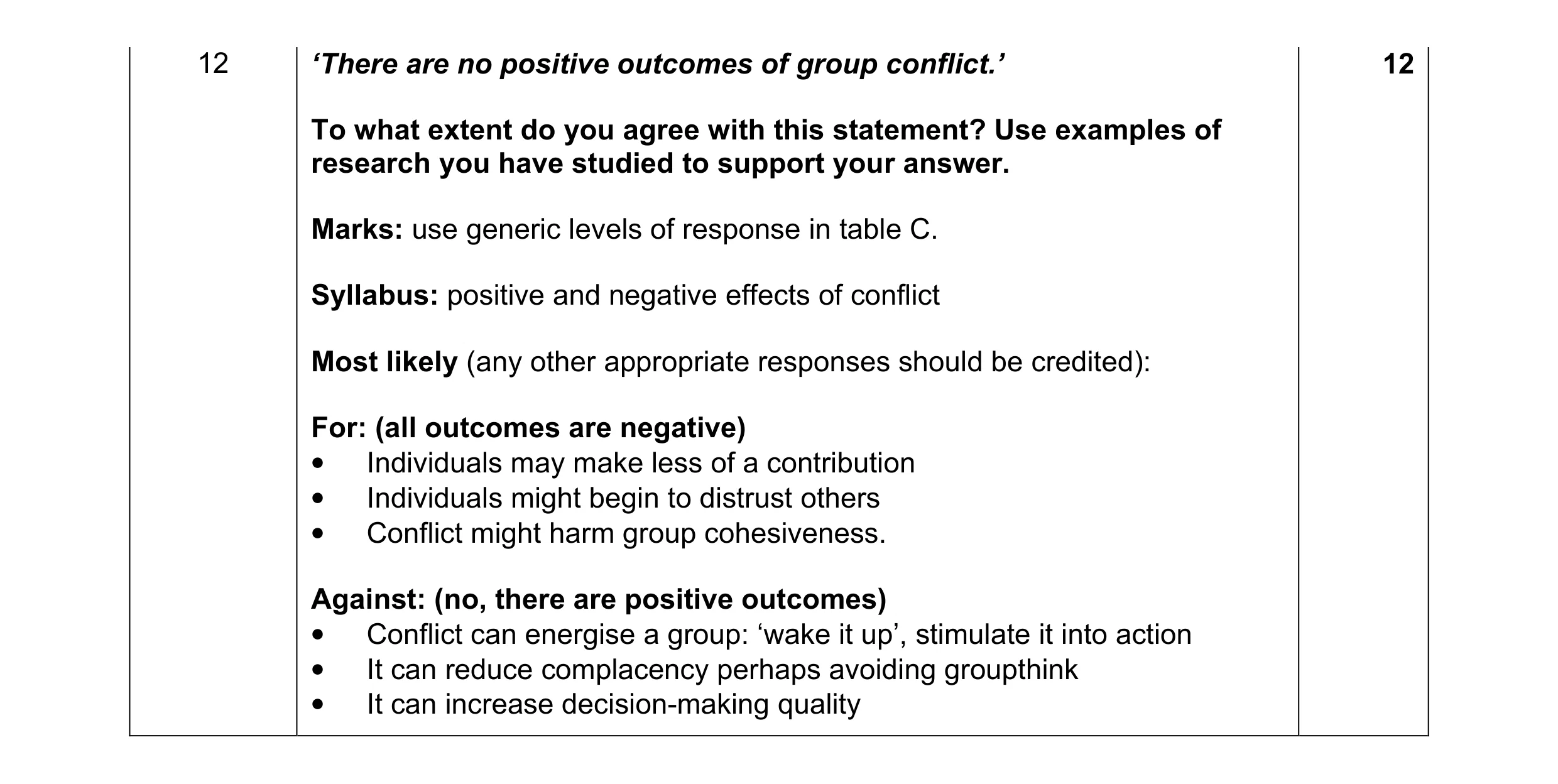 12
12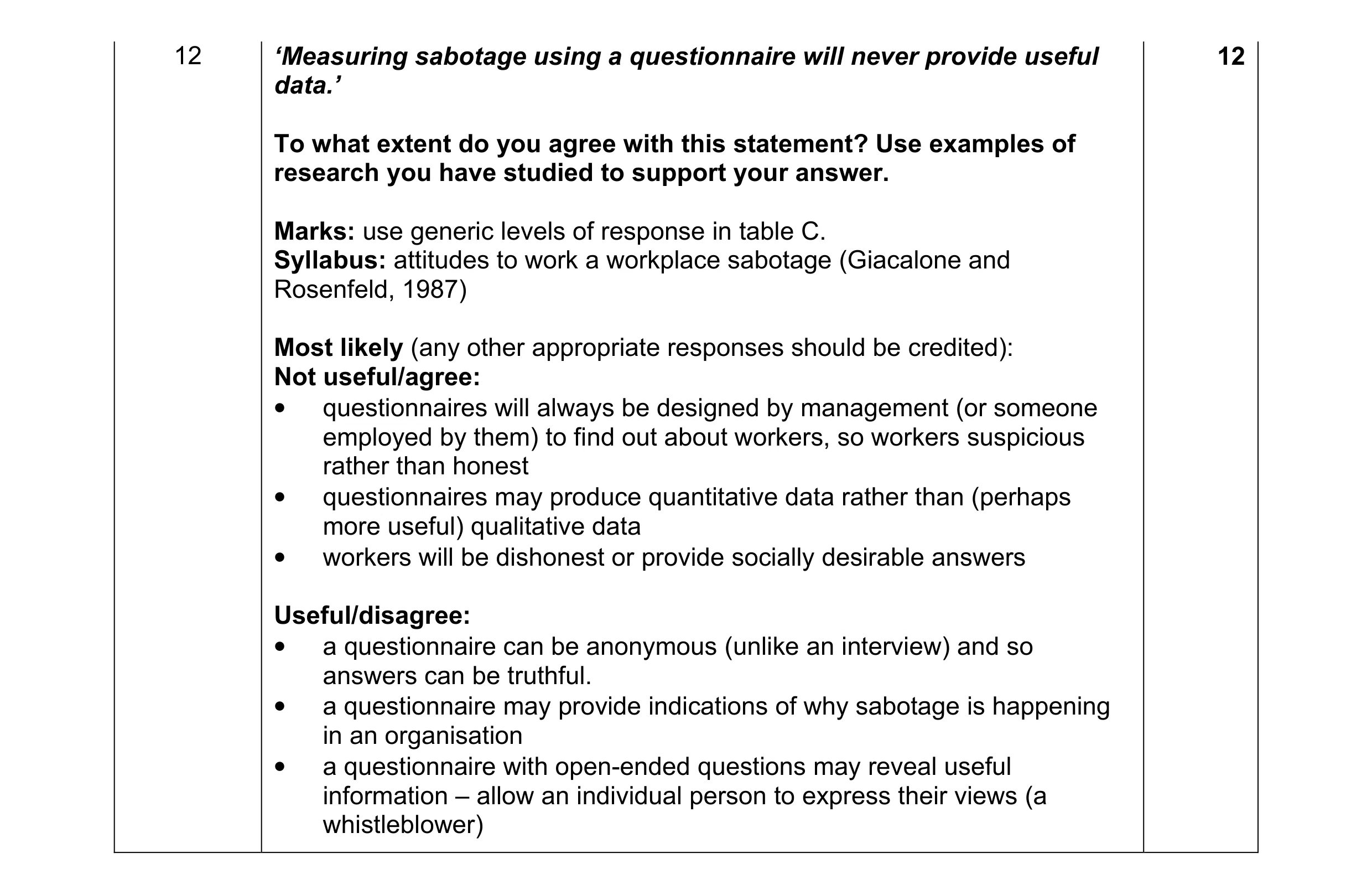 12
12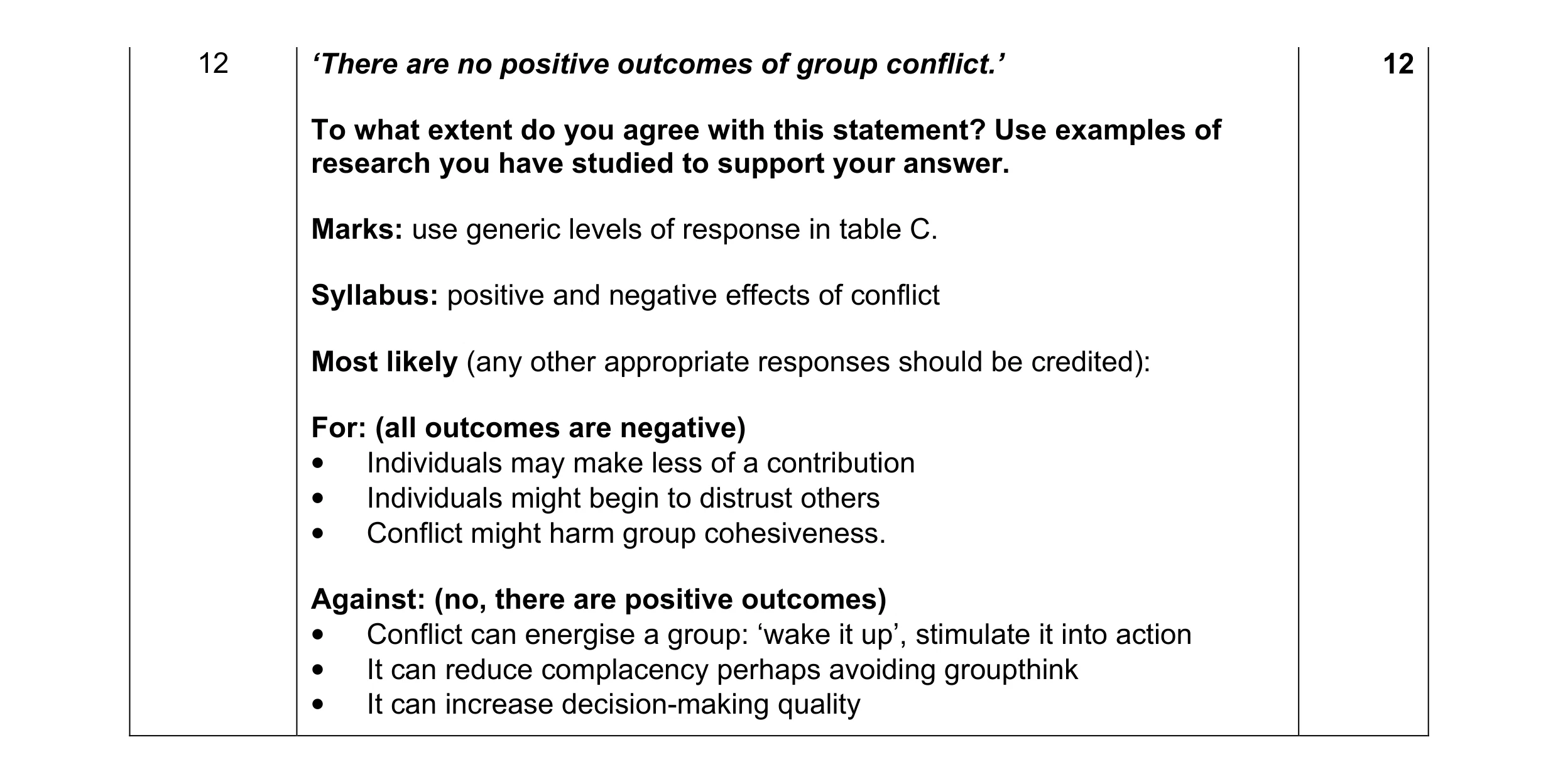 12
12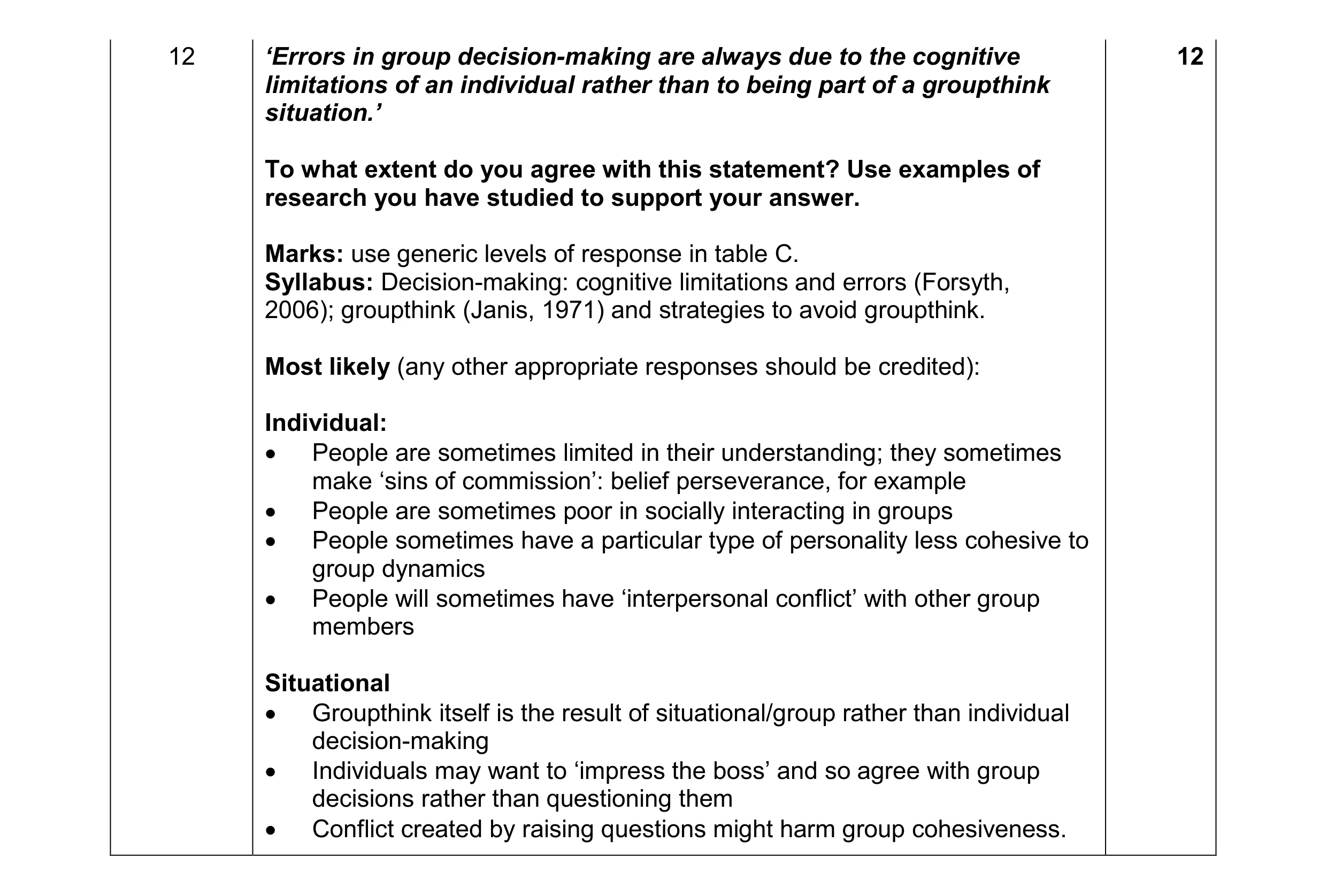 12
12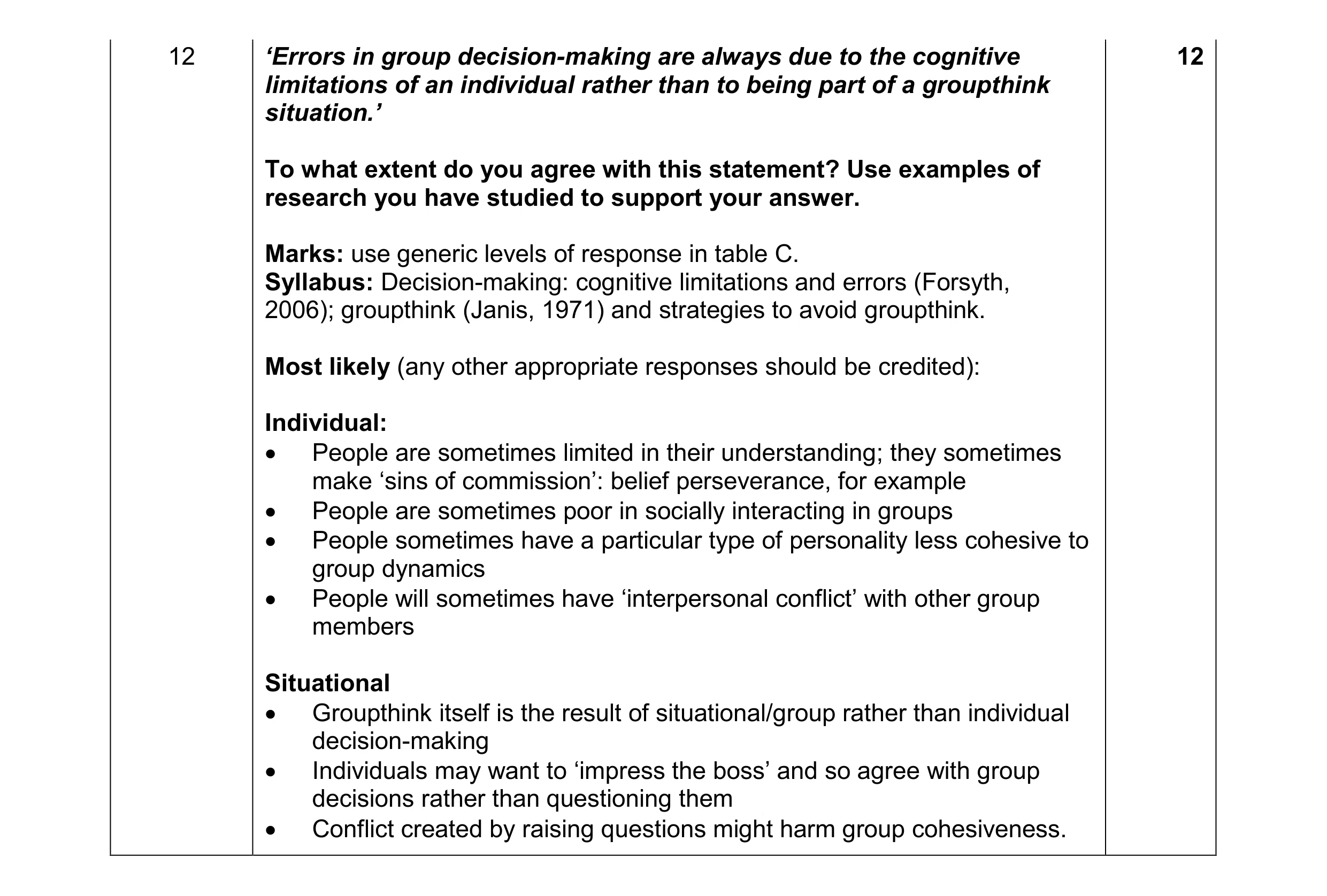 12
12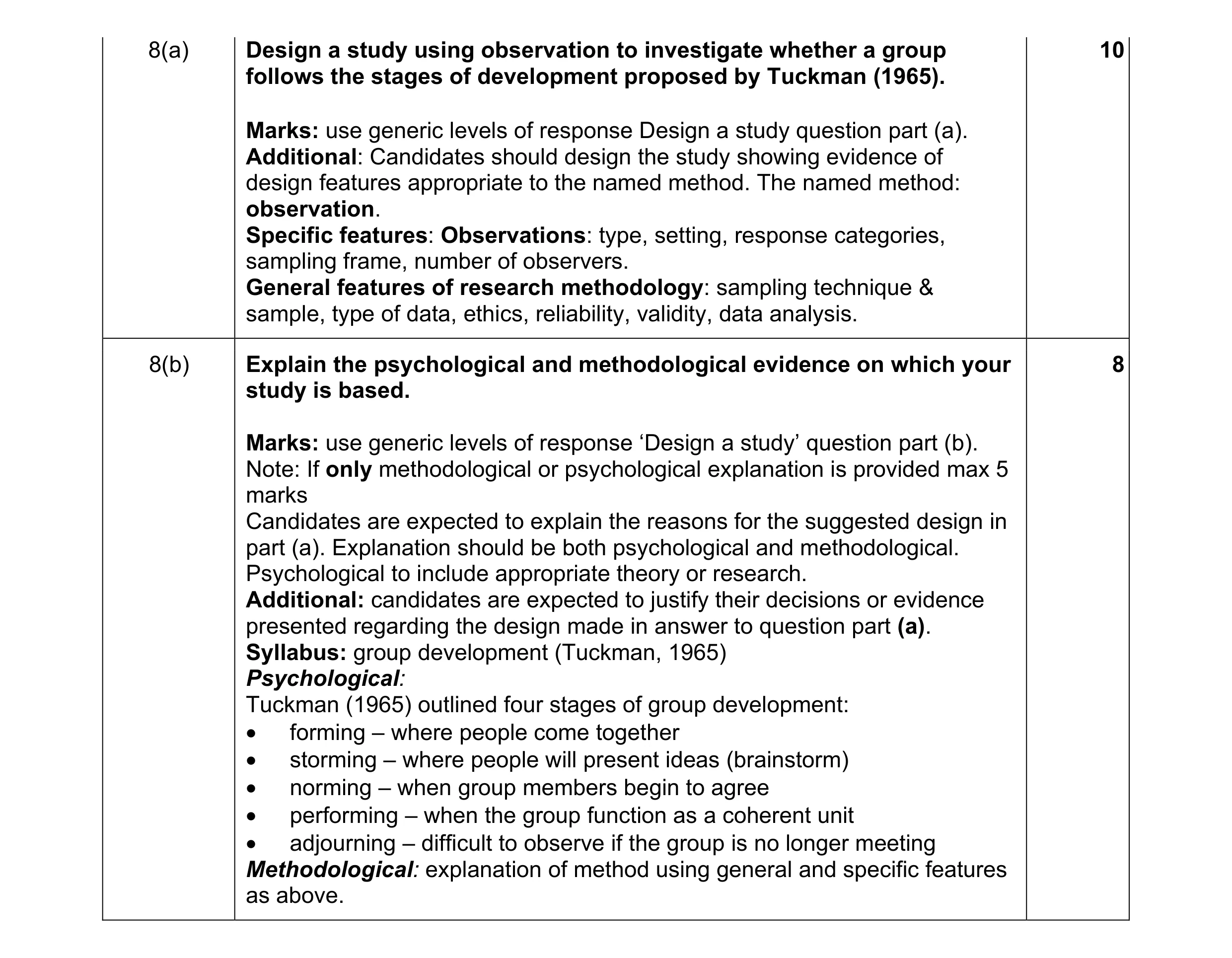 18
18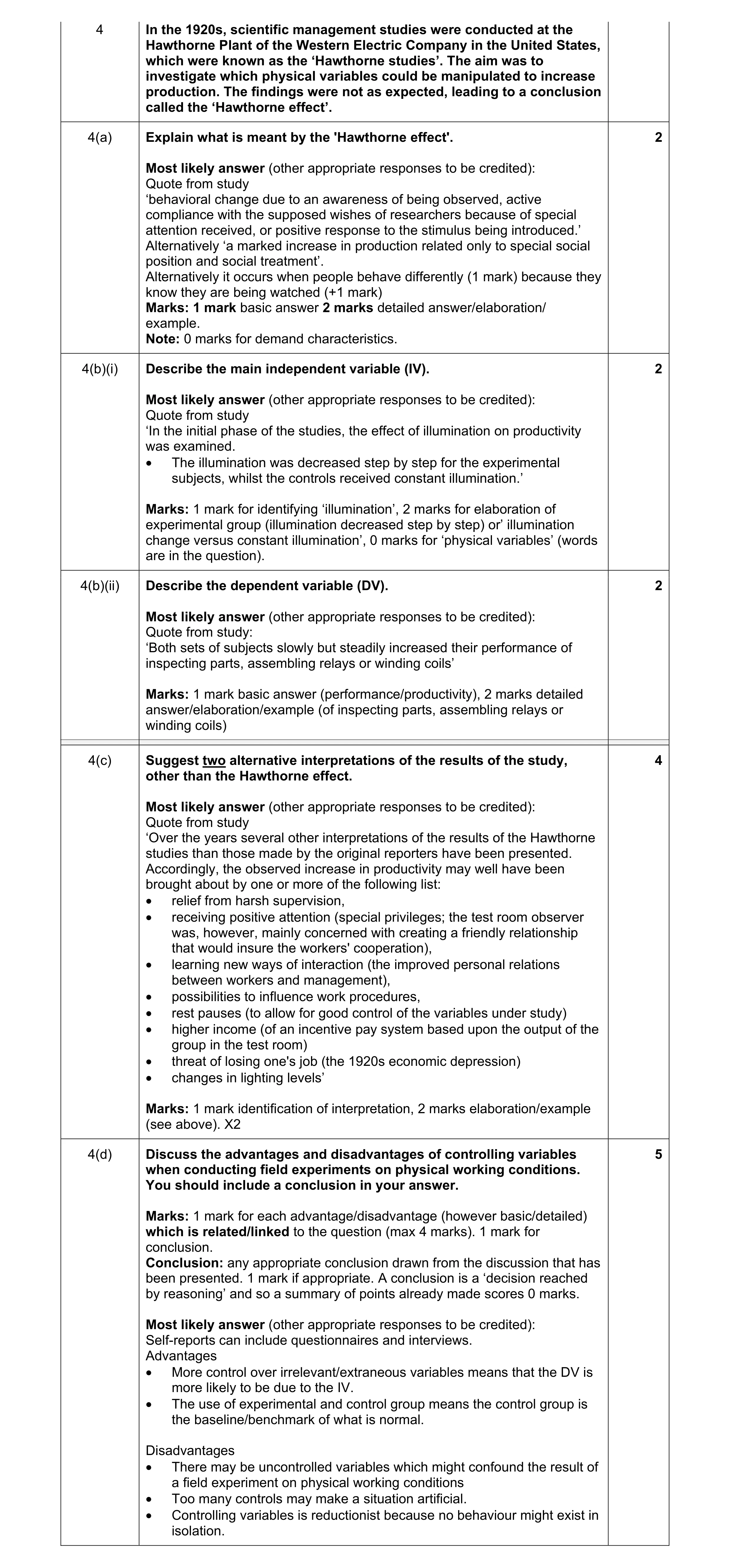 15
15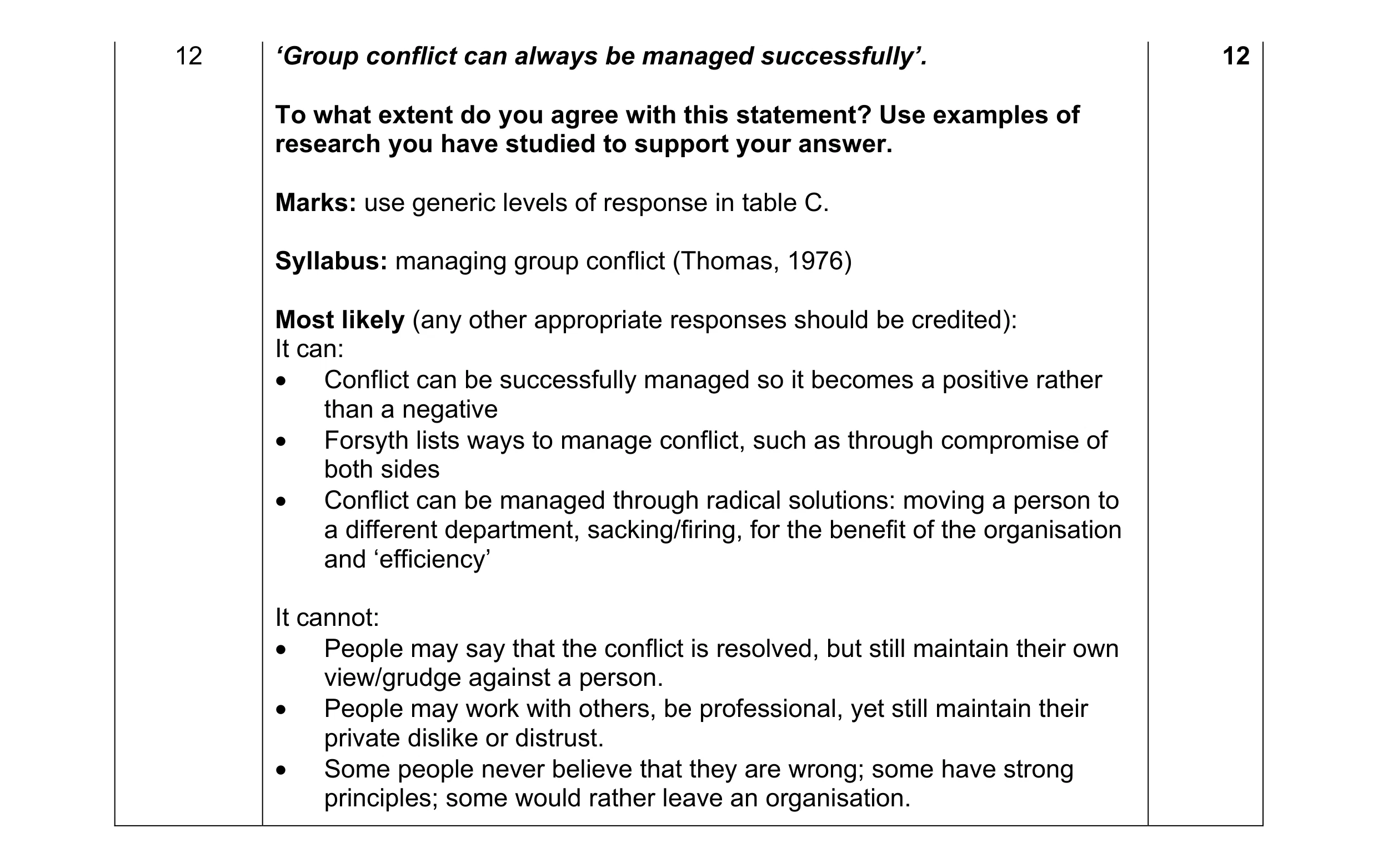 12
12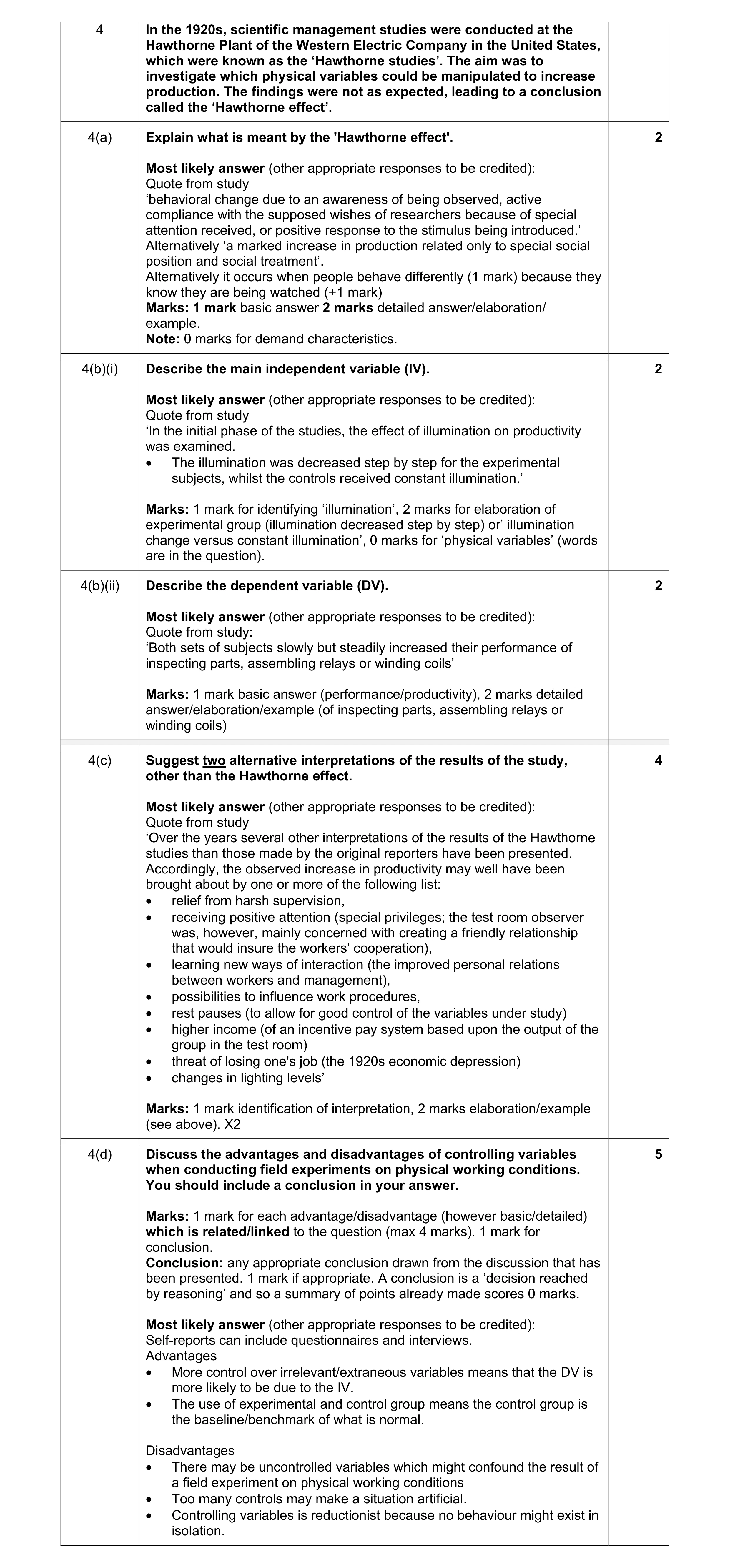 15
15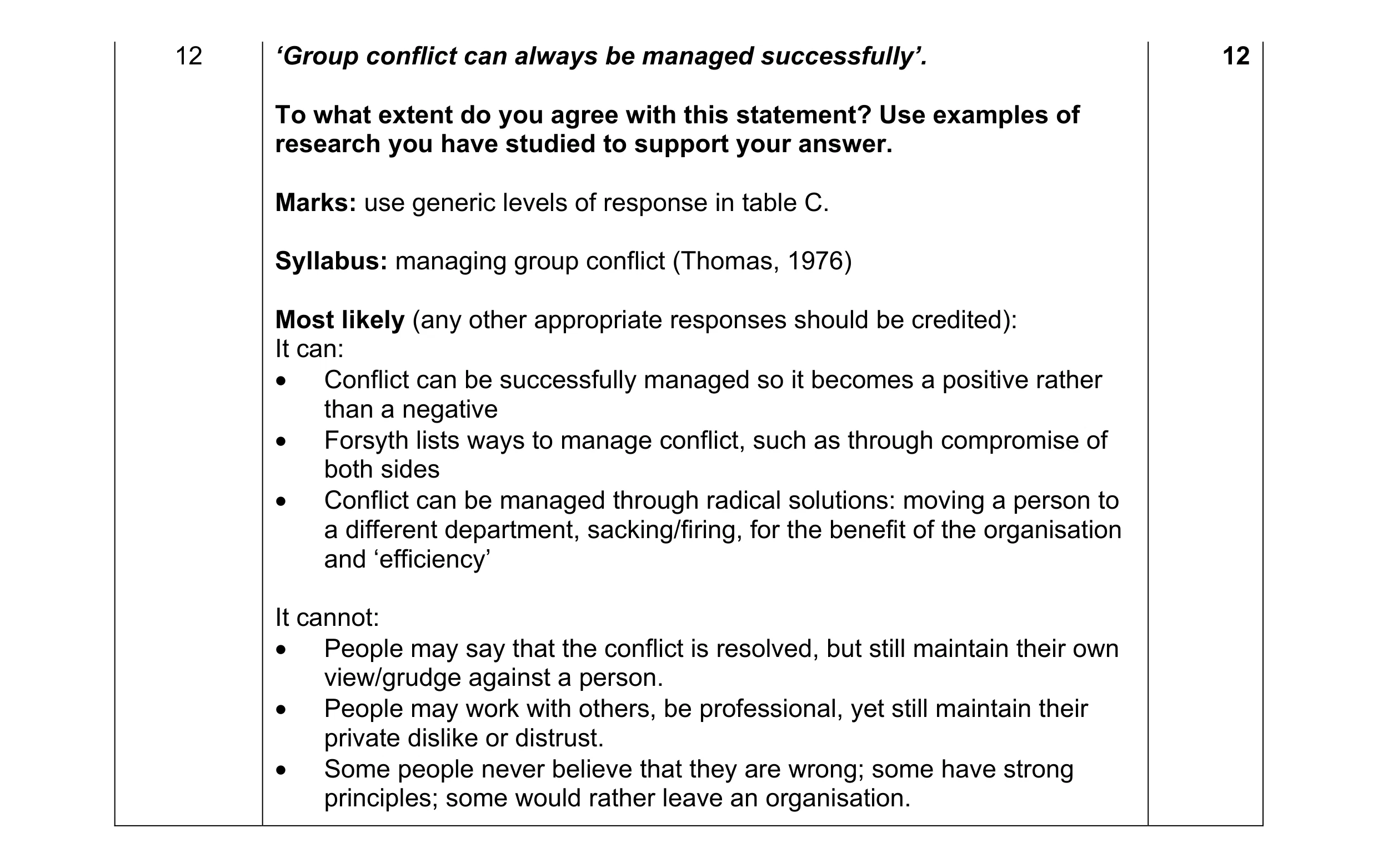 12
12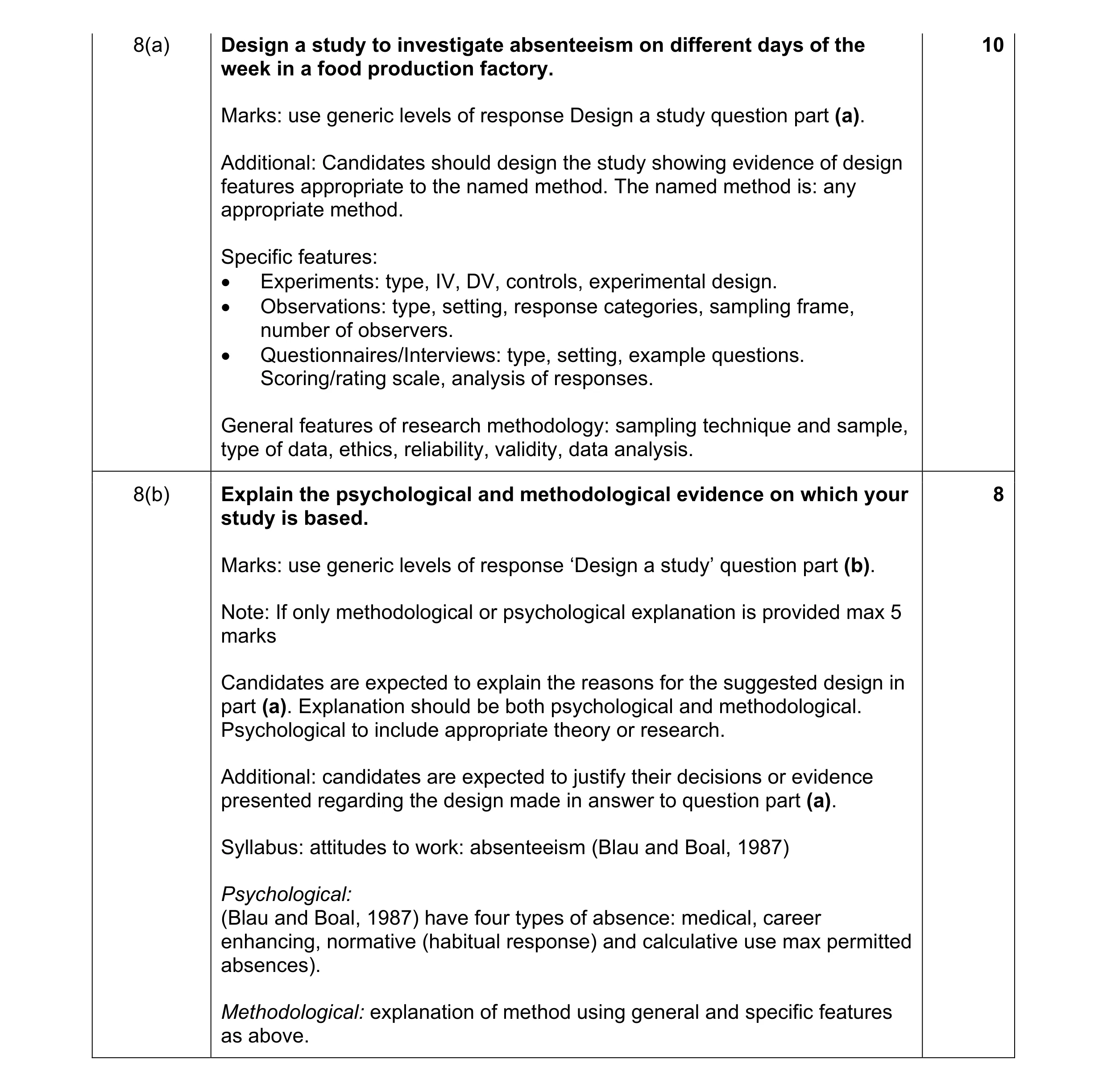 18
18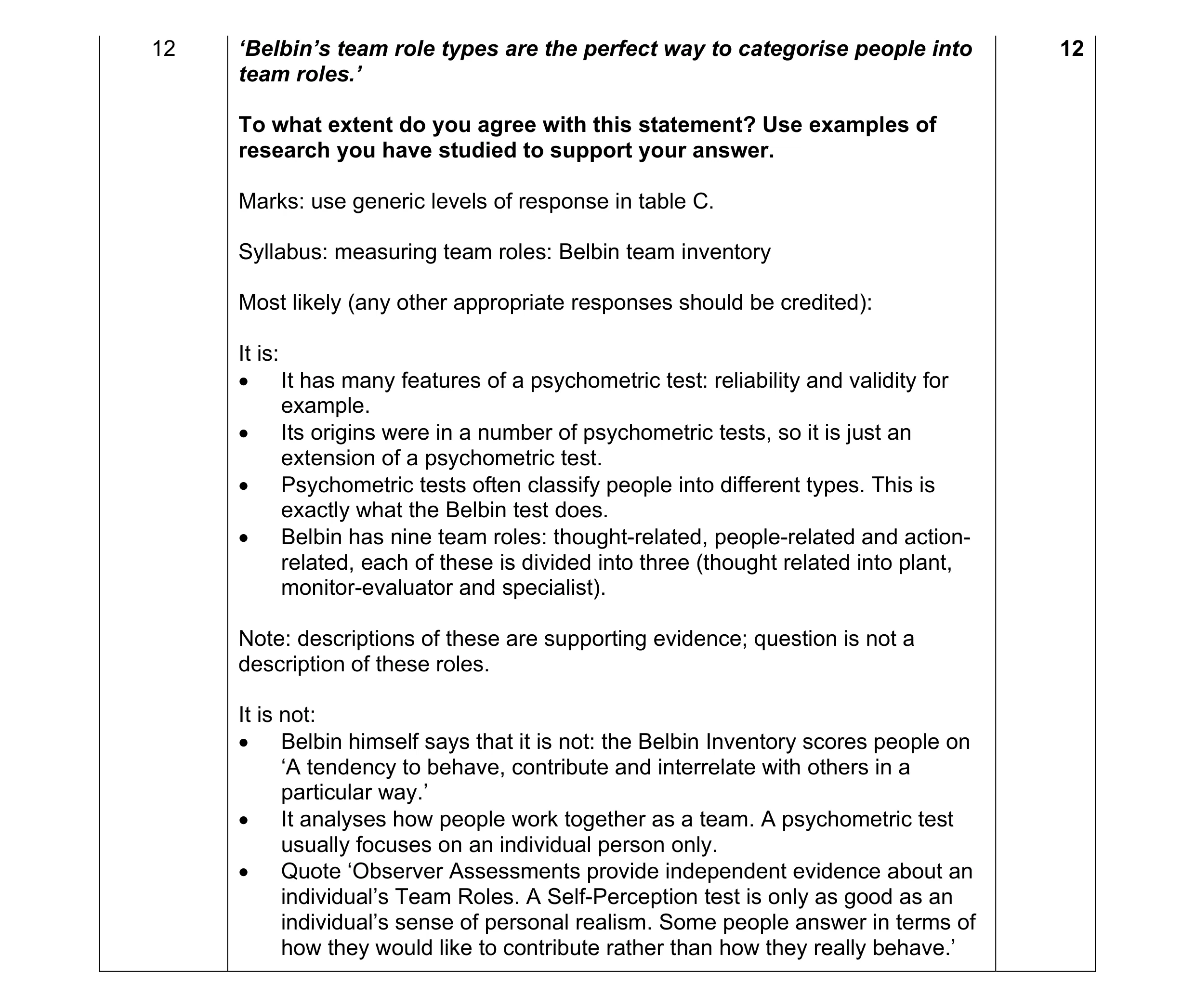 12
12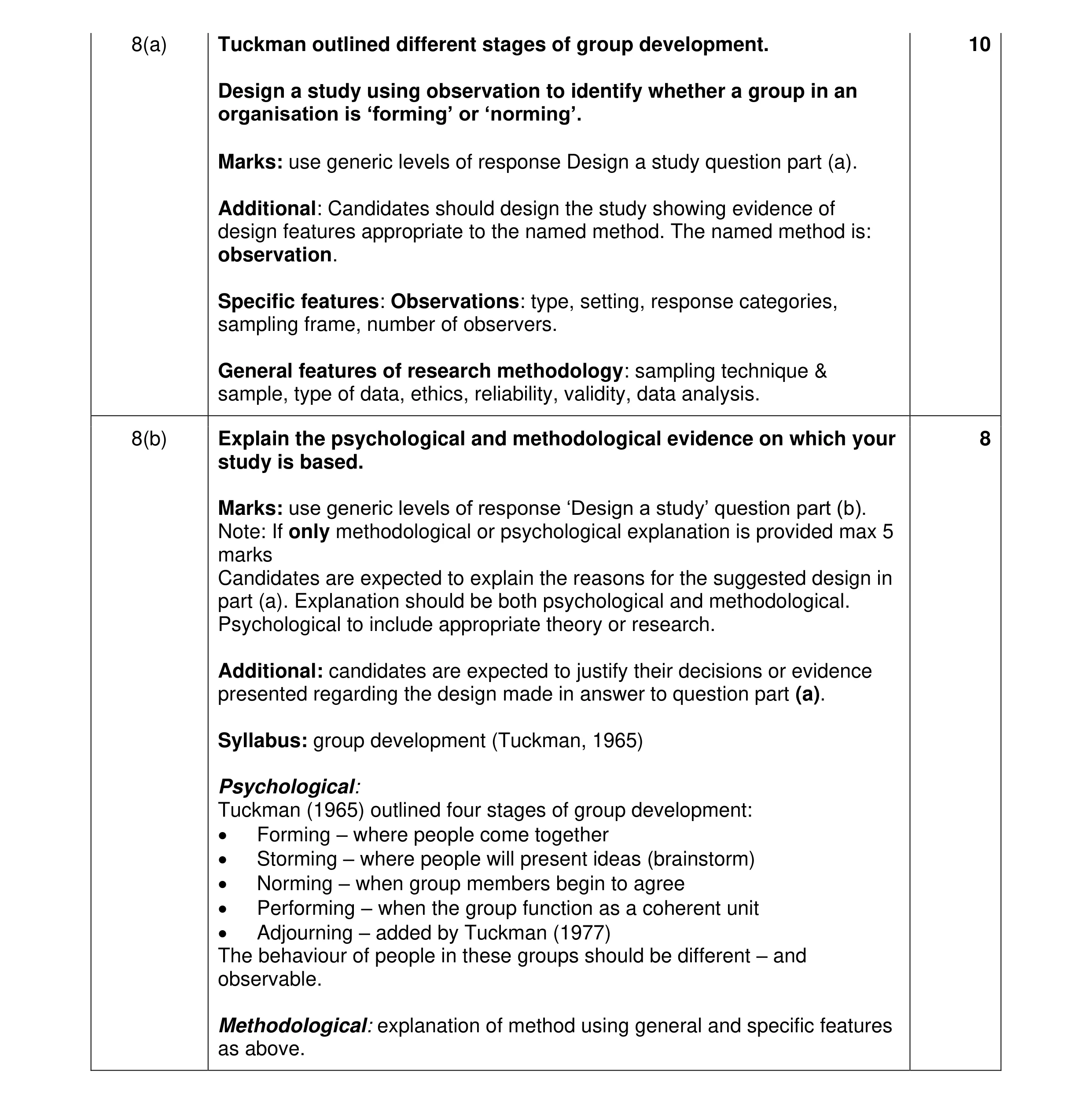 18
18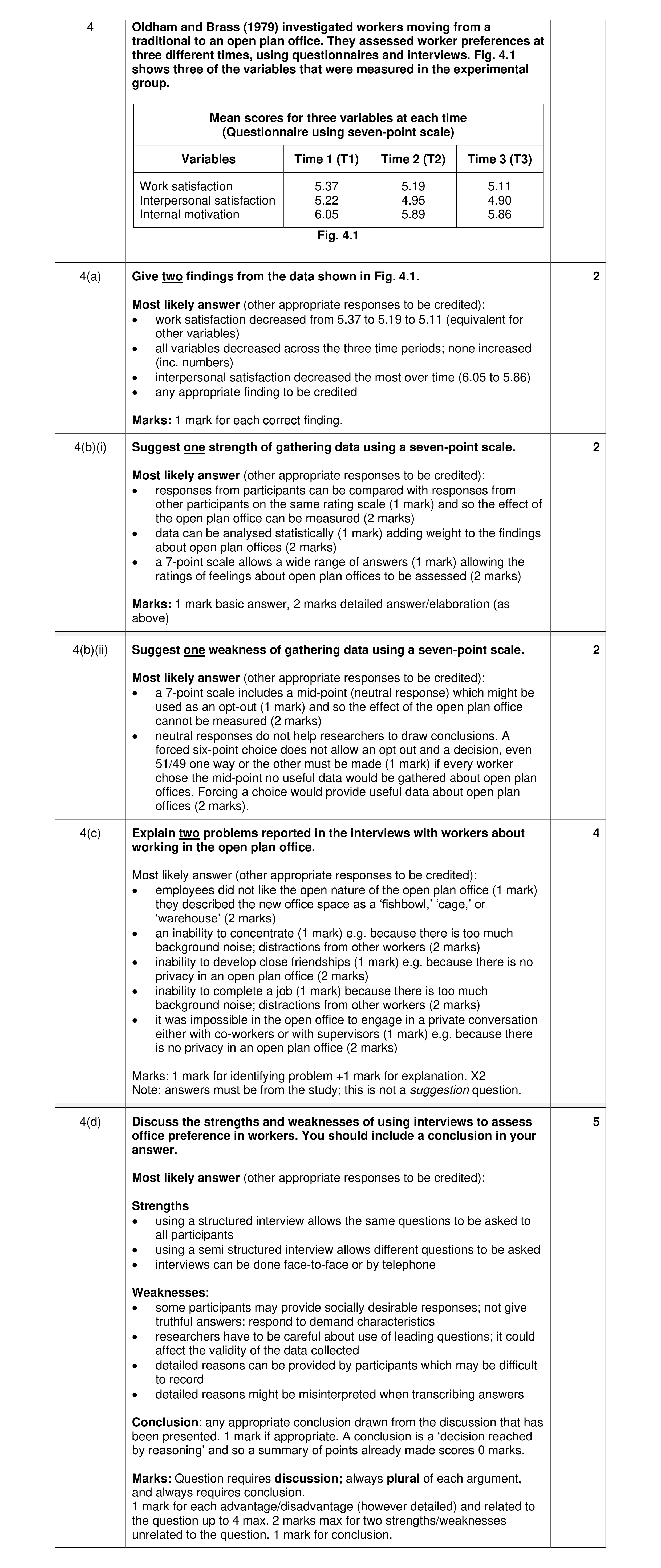 15
15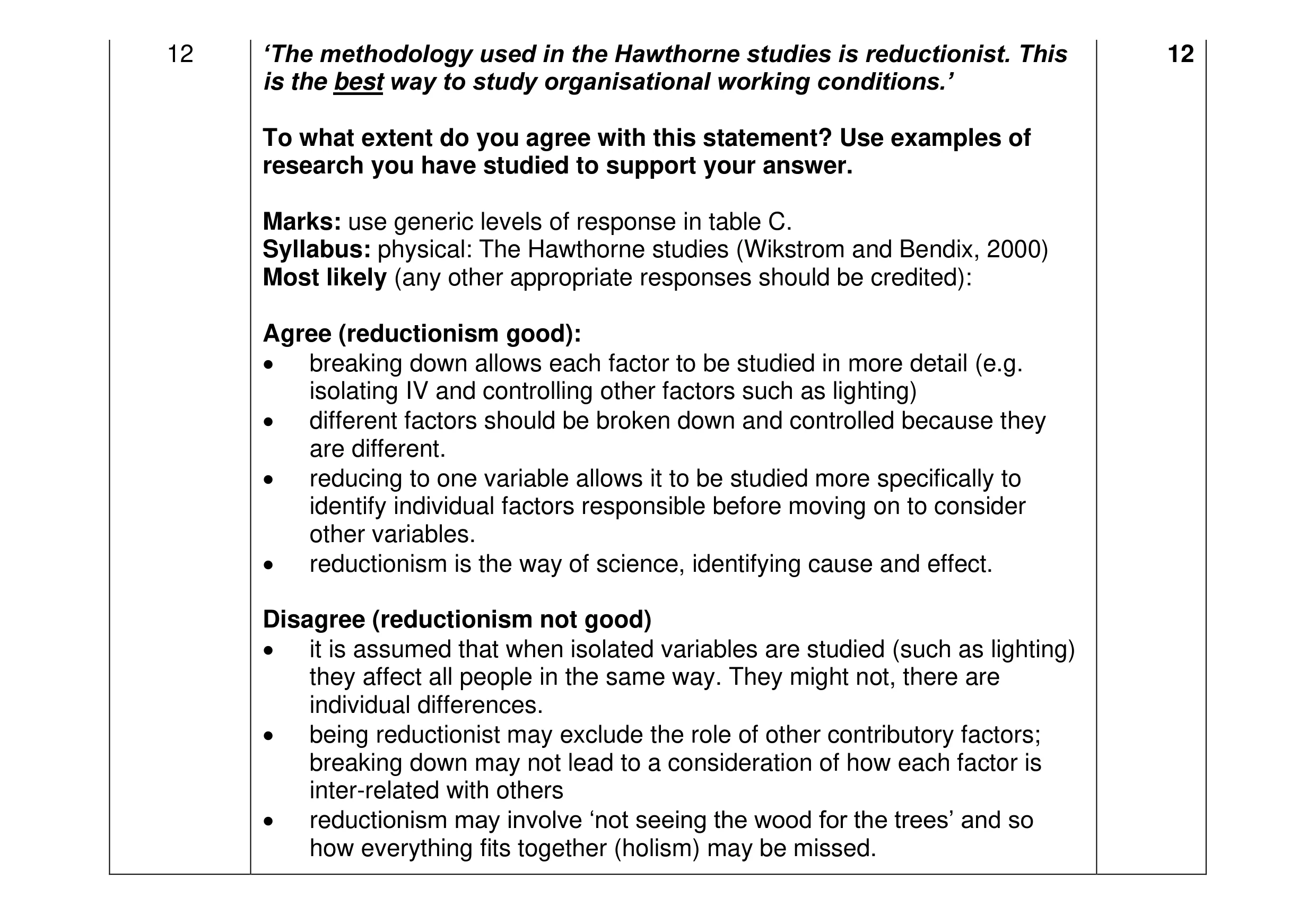 12
12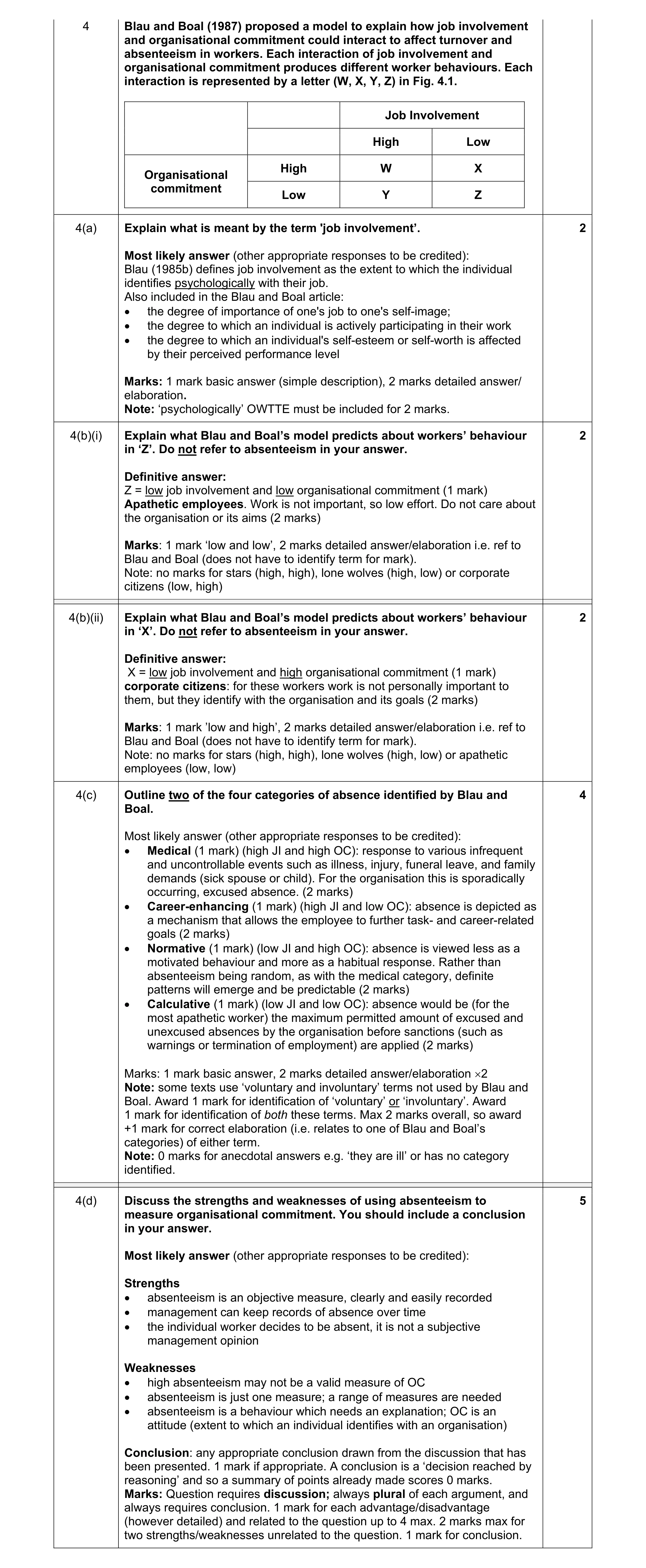 15
15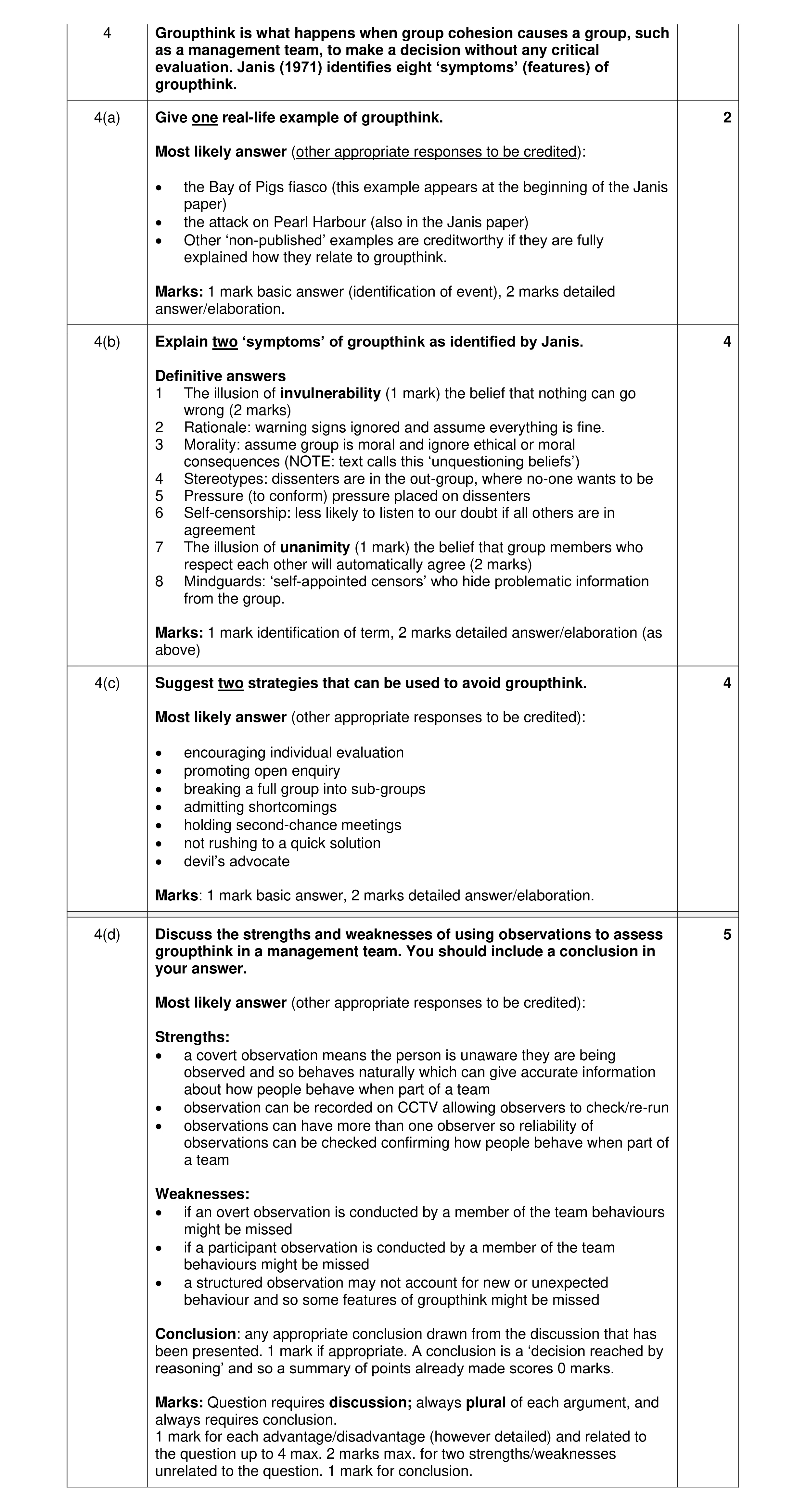 15
15 15
15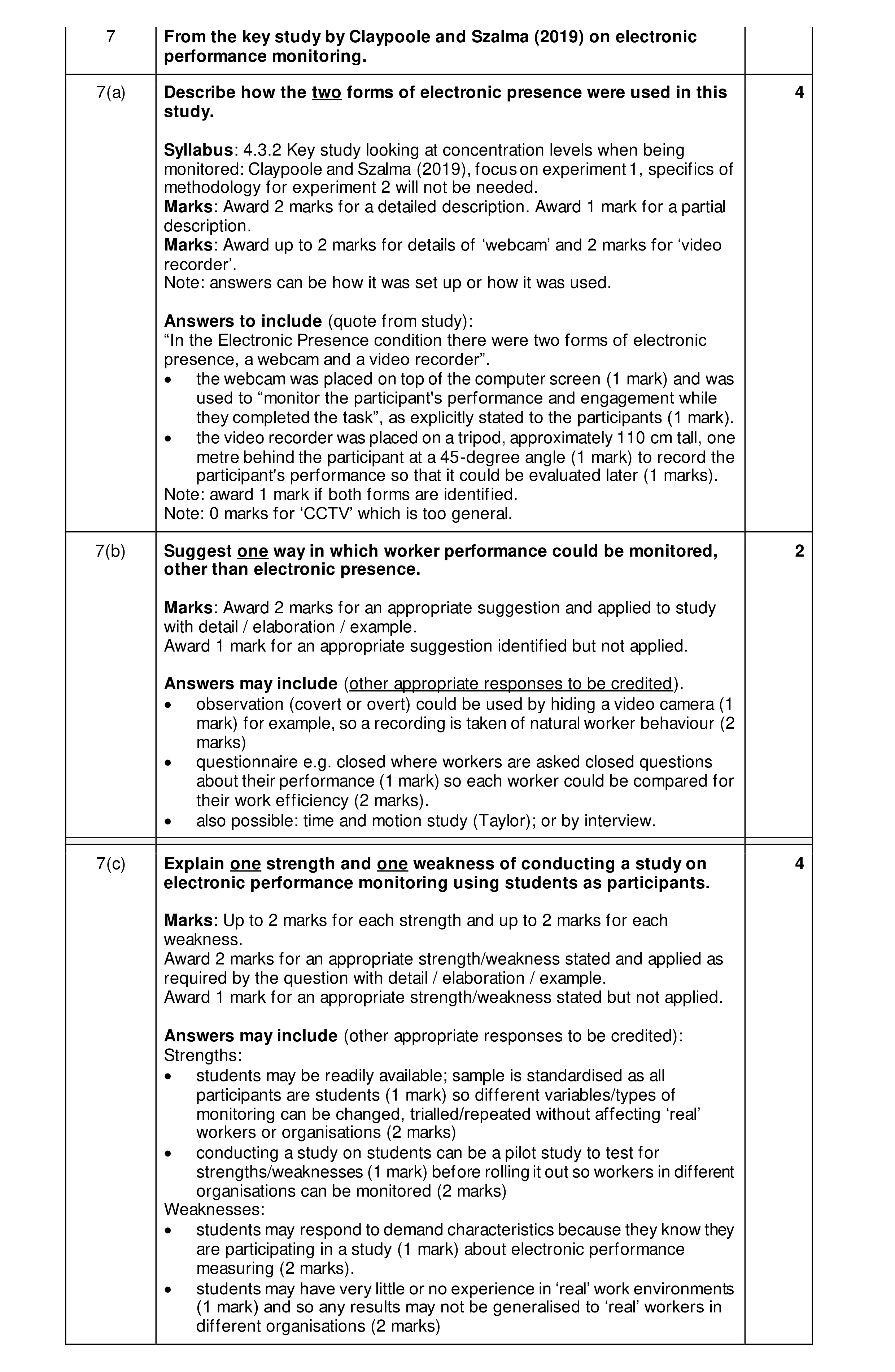 10
10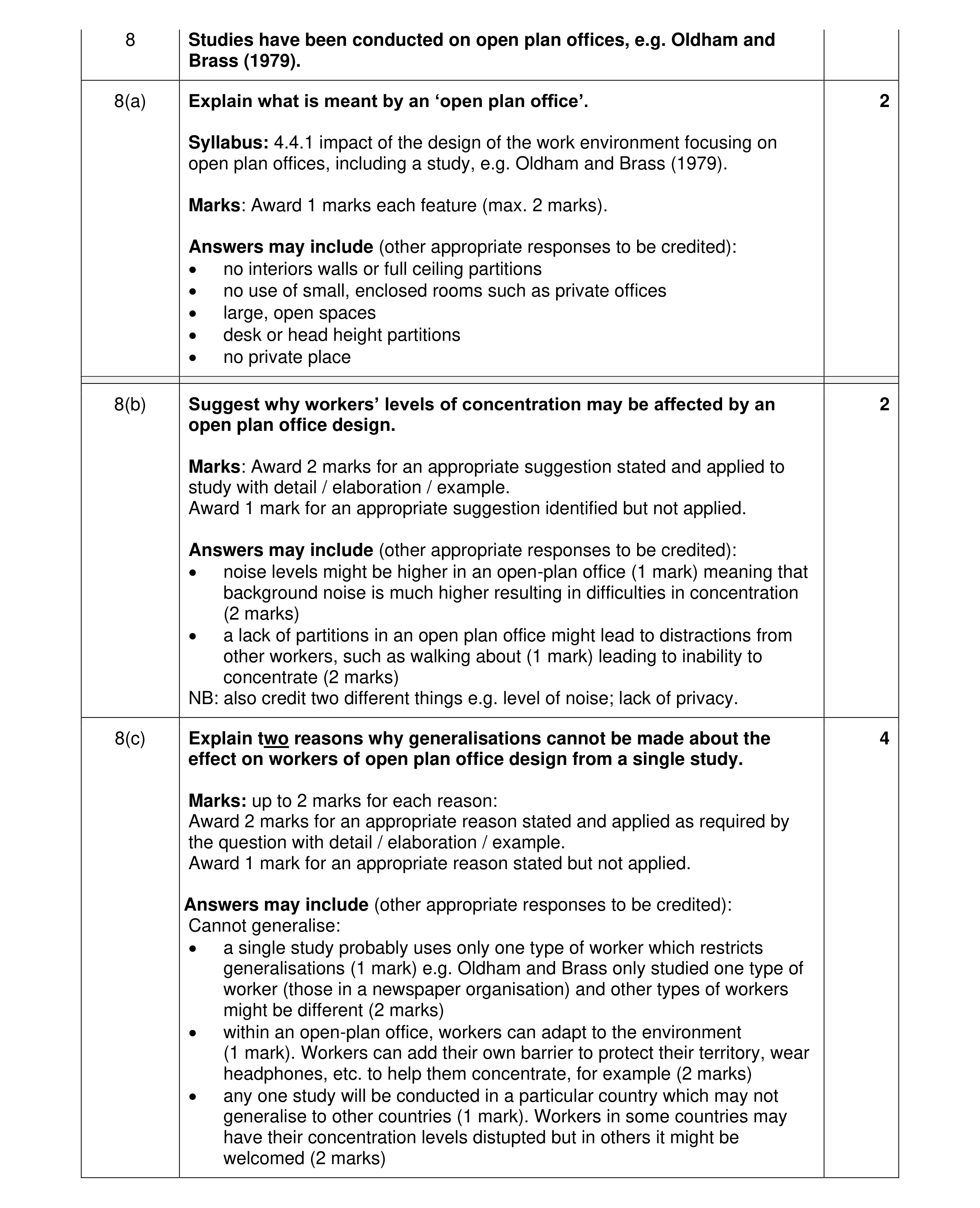 8
8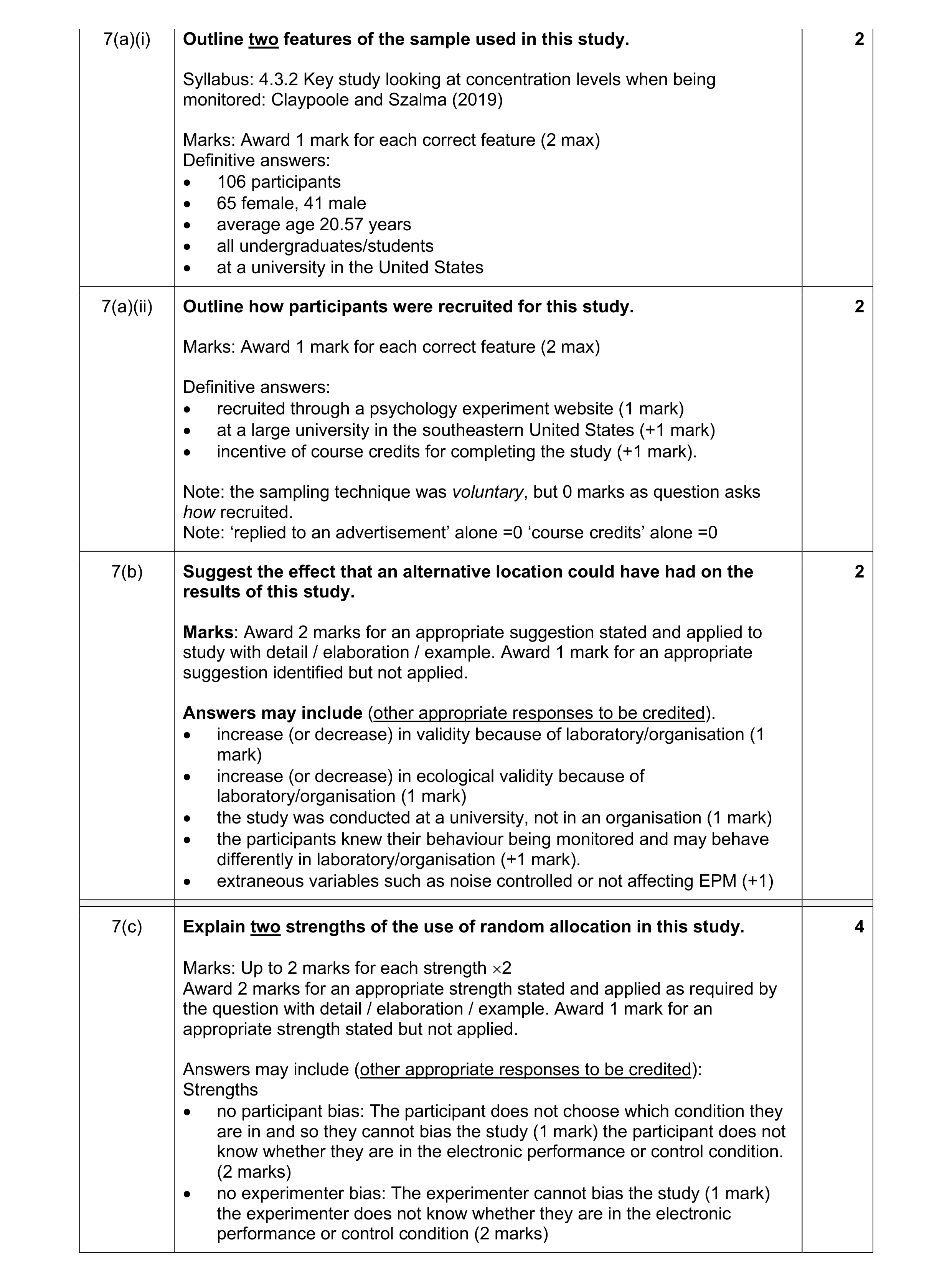 10
10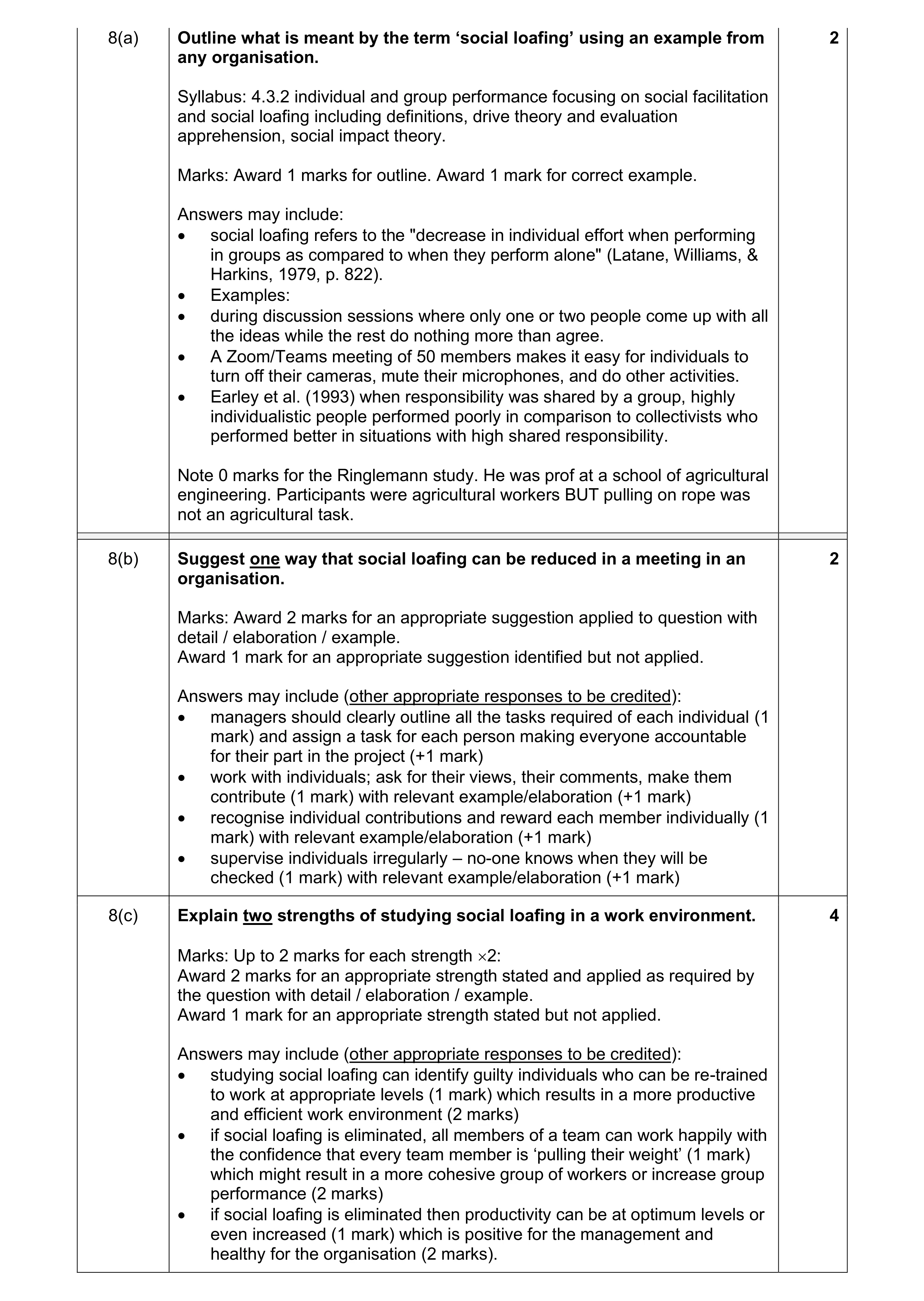 8
8