Cambridge A Level Psychology (from 2018) 9990 — 2020 May/June Paper 4 · Variant 3
9990/43/M/J/20 · 12 questions · 180 marks · ≈203 min
The question paper and its mark scheme, free to read here and free to download. This is Cambridge’s own paper, exactly as it was sat.
Question paper8 pages



Mark scheme22 pages
Answers below. Sit the paper first if you are practising.
Questions as text
Q1 · Newspaper headline: Treatment for schizophrenia is successful
1 Newspaper headline: Treatment for schizophrenia is successful. Sensky et al. (2000) conducted a longitudinal study and found that cognitive-behavioural therapy was effective. It treated both negative and positive symptoms in patients that were resistant to drug treatments for schizophrenia. (a) Explain what is meant by the term ‘baseline’ when gathering data. [2] (b) Suggest two weaknesses of the longitudinal method in the study by Sensky et al. (2000). [4] (c) A randomised controlled design was used by Sensky et al. (i) Identify the two therapies that this design compared. [2] (ii) Suggest why a randomised controlled design was used. [2] (d) Discuss the strengths and weaknesses of cognitive-behavioural therapy as an alternative to drug treatments for schizophrenia. You should include a conclusion in your answer. [5] Psychology and consumer behaviour
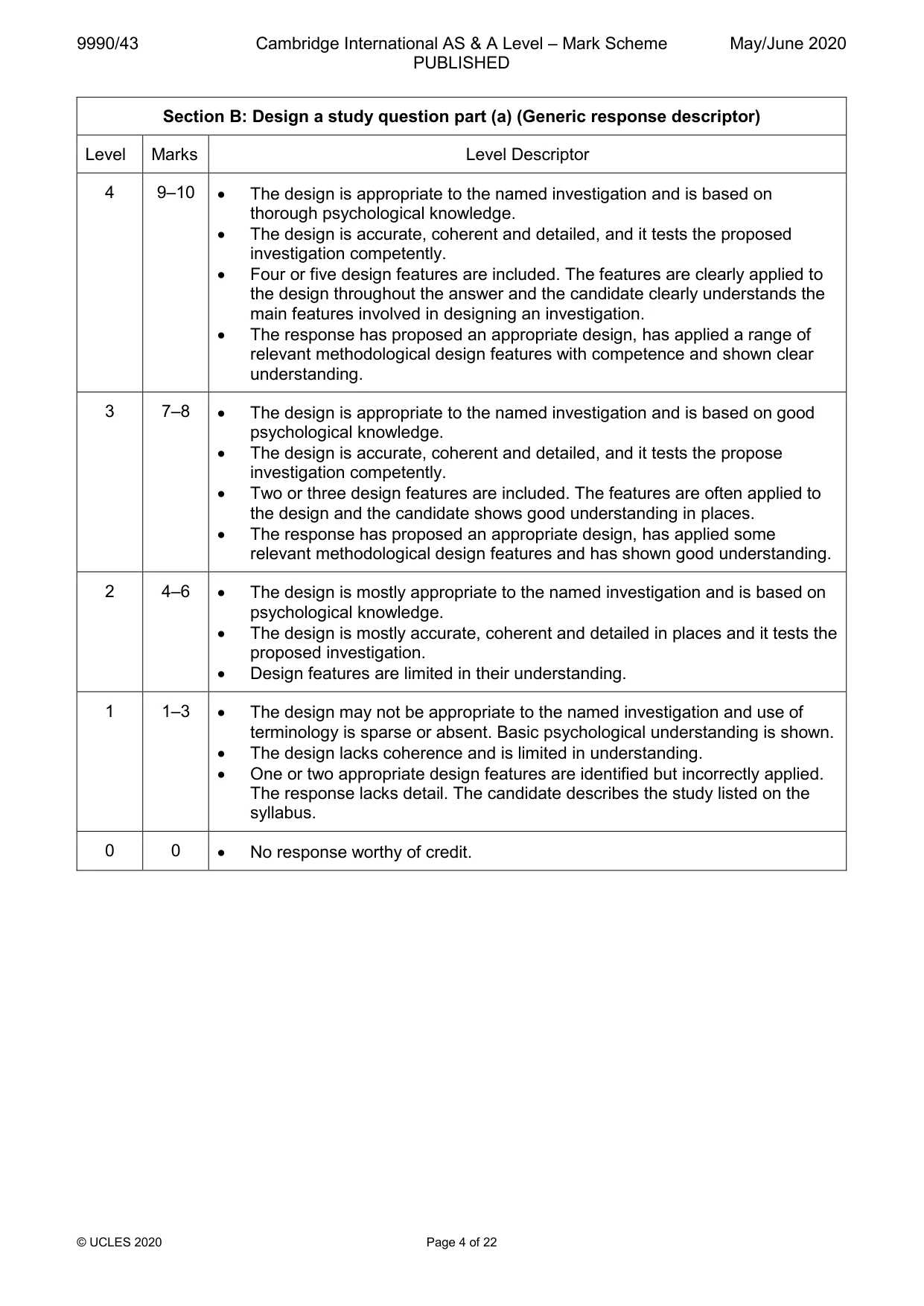
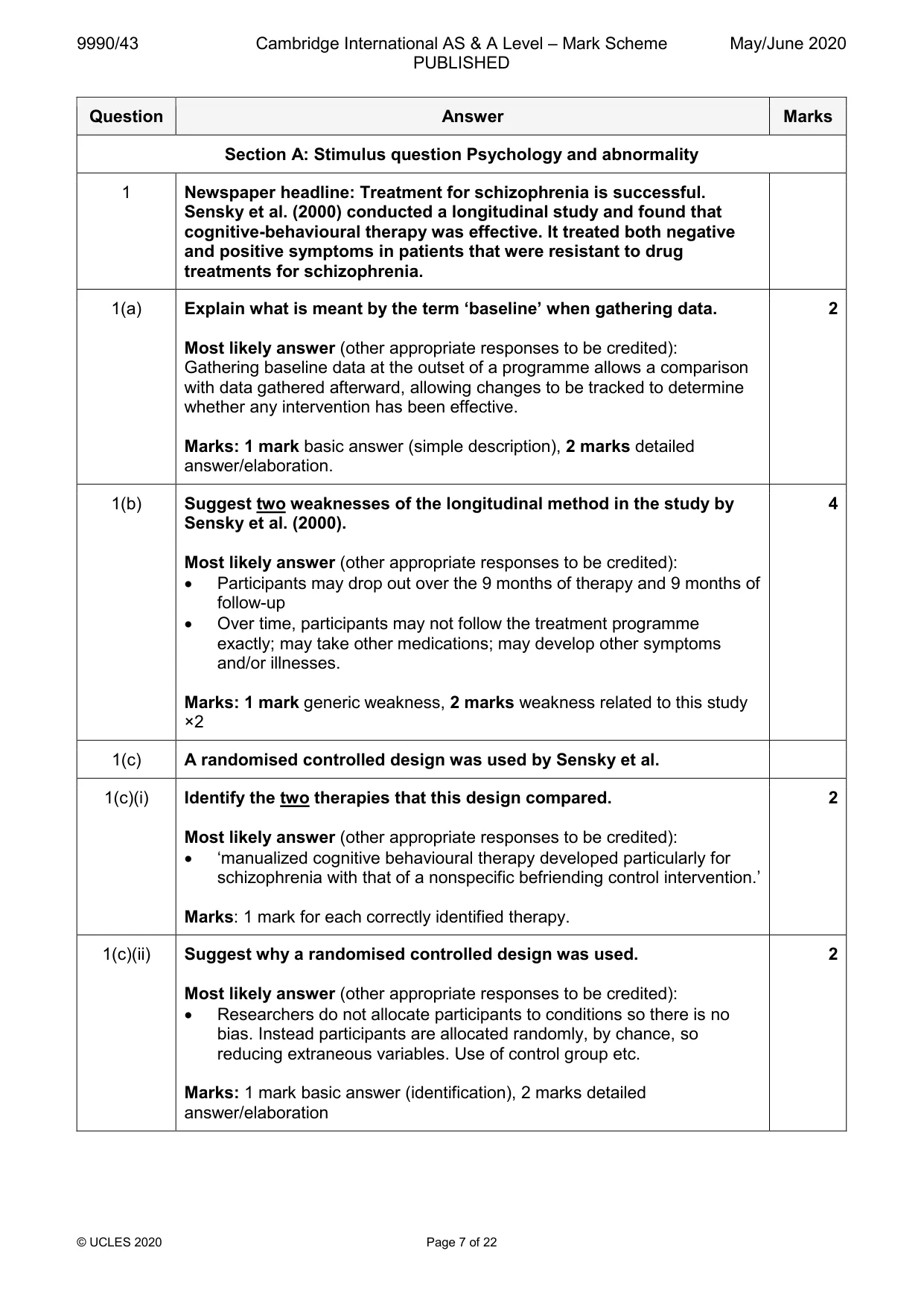
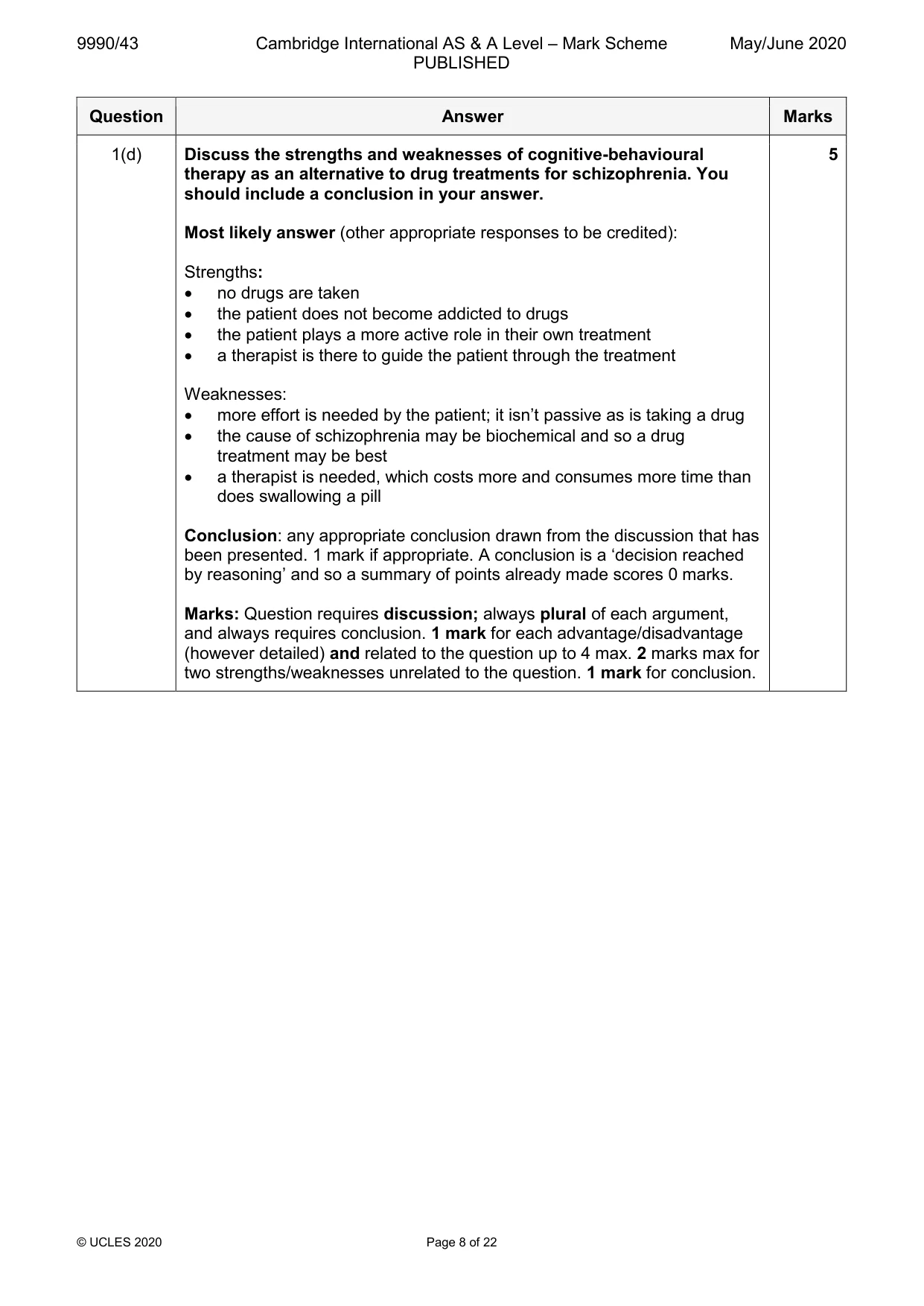
Mark scheme: Question Answer Marks Section A: Stimulus question Psychology and abnormality 1 Newspaper headline: Treatment for schizophrenia is successful. Sensky et al. (2000) conducted a longitudinal study and found that cognitive-behavioural therapy was effective. It treated both negative and positive symptoms in patients that were resistant to drug treatments for schizophrenia. 1(a) Explain what is meant by the term ‘baseline’ when gathering data. 2 Most likely answer (other appropriate responses to be credited): Gathering baseline data at the outset of a programme allows a comparison with data gathered afterward, allowing changes to be tracked to determine whether any intervention has been effective. Marks: 1 mark basic answer (simple description), 2 marks detailed answer/elaboration. 1(b) Suggest two weaknesses of the longitudinal method in the study by 4 Sensky et al. (2000). Most likely answer (other appropriate responses to be credited): • Participants may drop out over the 9 months of therapy and 9 months of follow-up • Over time, participants may not follow the treatment programme exactly; may take other medications; may develop other symptoms and/or illnesses. Marks: 1 mark generic weakness, 2 marks weakness related to this study ×2 1(c) A randomised controlled design was used by Sensky et al. 1(c)(i) Identify the two therapies that this design compared. 2 Most likely answer (other appropriate responses to be credited): • ‘manualized cognitive behavioural therapy developed particularly for schizophrenia with that of a nonspecific befriending control intervention.’ Marks: 1 mark for each correctly identified therapy. 1(c)(ii) Suggest why a randomised controlled design was used. 2 Most likely answer (other appropriate responses to be credited): • Researchers do not allocate participants to conditions so there is no bias. Instead participants are allocated randomly, by chance, so reducing extraneous variables. Use of control group etc. Marks: 1 mark basic answer (identification), 2 marks detailed answer/elaboration 1(d) Discuss the strengths and weaknesses of cognitive-behavioural 5 therapy as an alternative to drug treatments for schizophrenia. You should include a conclusion in your answer. Most likely answer (other appropriate responses to be credited): Strengths: • no drugs are taken • the patient does not become addicted to drugs • the patient plays a more active role in their own treatment • a therapist is there to guide the patient through the treatment Weaknesses: • more effort is needed by the patient; it isn’t passive as is taking a drug • the cause of schizophrenia may be biochemical and so a drug treatment may be best • a therapist is needed, which costs more and consumes more time than does swallowing a pill Conclusion: any appropriate conclusion drawn from the discussion that has been presented. 1 mark if appropriate. A conclusion is a ‘decision reached by reasoning’ and so a summary of points already made scores 0 marks. Marks: Question requires discussion; always plural of each argument, and always requires conclusion. 1 mark for each advantage/disadvantage (however detailed) and related to the question up to 4 max. 2 marks max for two strengths/weaknesses unrelated to the question. 1 mark for conclusion.
Q2 · ‘There has been little attempt to understand the influence on children of branded…
2 ‘There has been little attempt to understand the influence on children of branded products that appear in television programs and movies. A study exposed children of two different age groups (6–7 and 11–12) in classrooms to a brief film clip. They were then individually asked to demonstrate their witness skills by describing in as much detail as possible what they had seen.’ Extract from the abstract from Auty and Lewis (2004) (a) Explain what is meant by ‘brand recognition’. [2] (b) Give the two conclusions from the study by Auty and Lewis (2004). [4] (c) (i) Give two examples of what Auty and Lewis did to ensure that the ethical guideline of informed consent was followed. [2] (ii) Suggest one way in which this study could be considered to be unethical. [2] (d) Discuss the advantages and disadvantages of using interviews to investigate brand recognition in children. You should include a conclusion in your answer. [5] Psychology and health
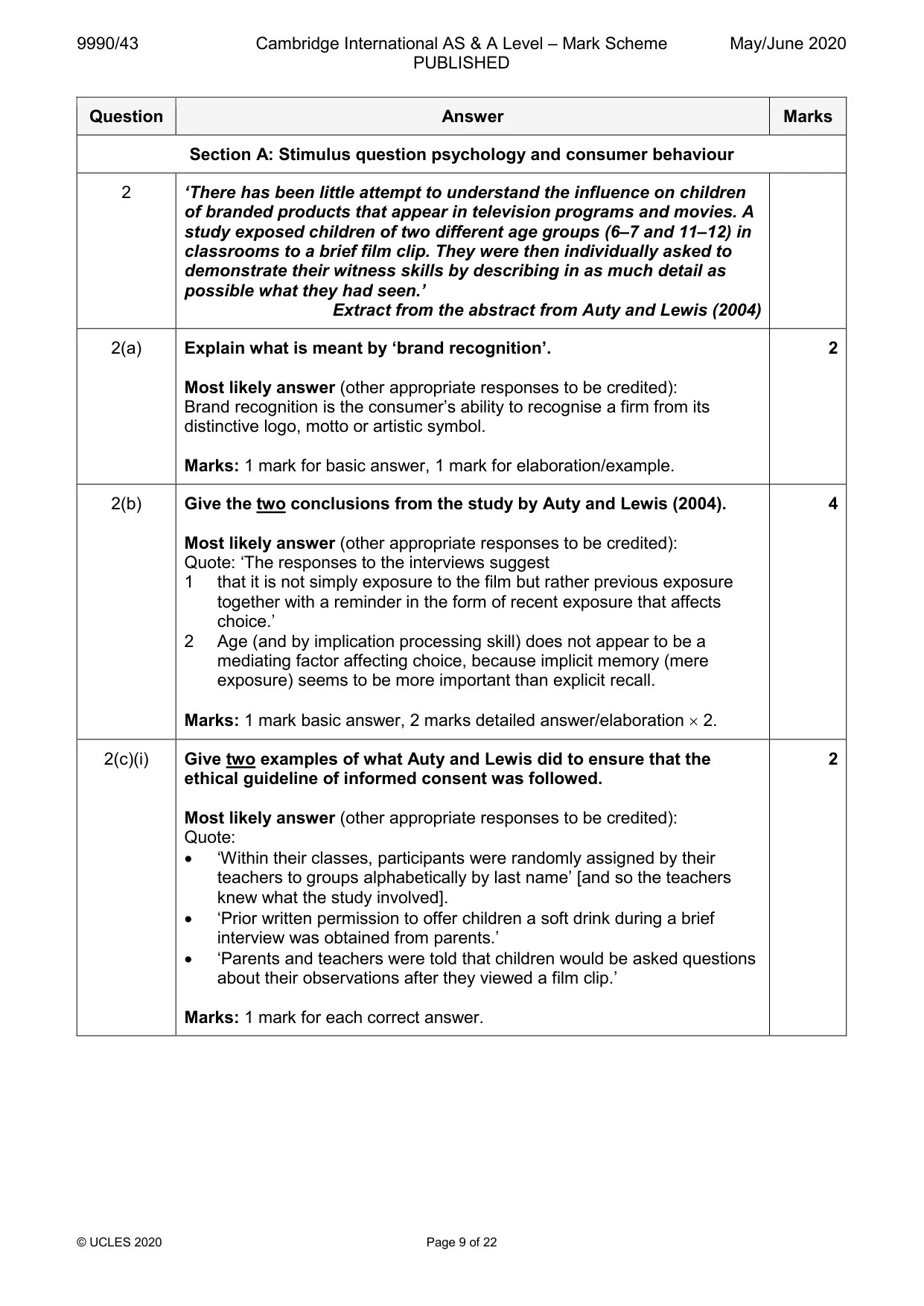
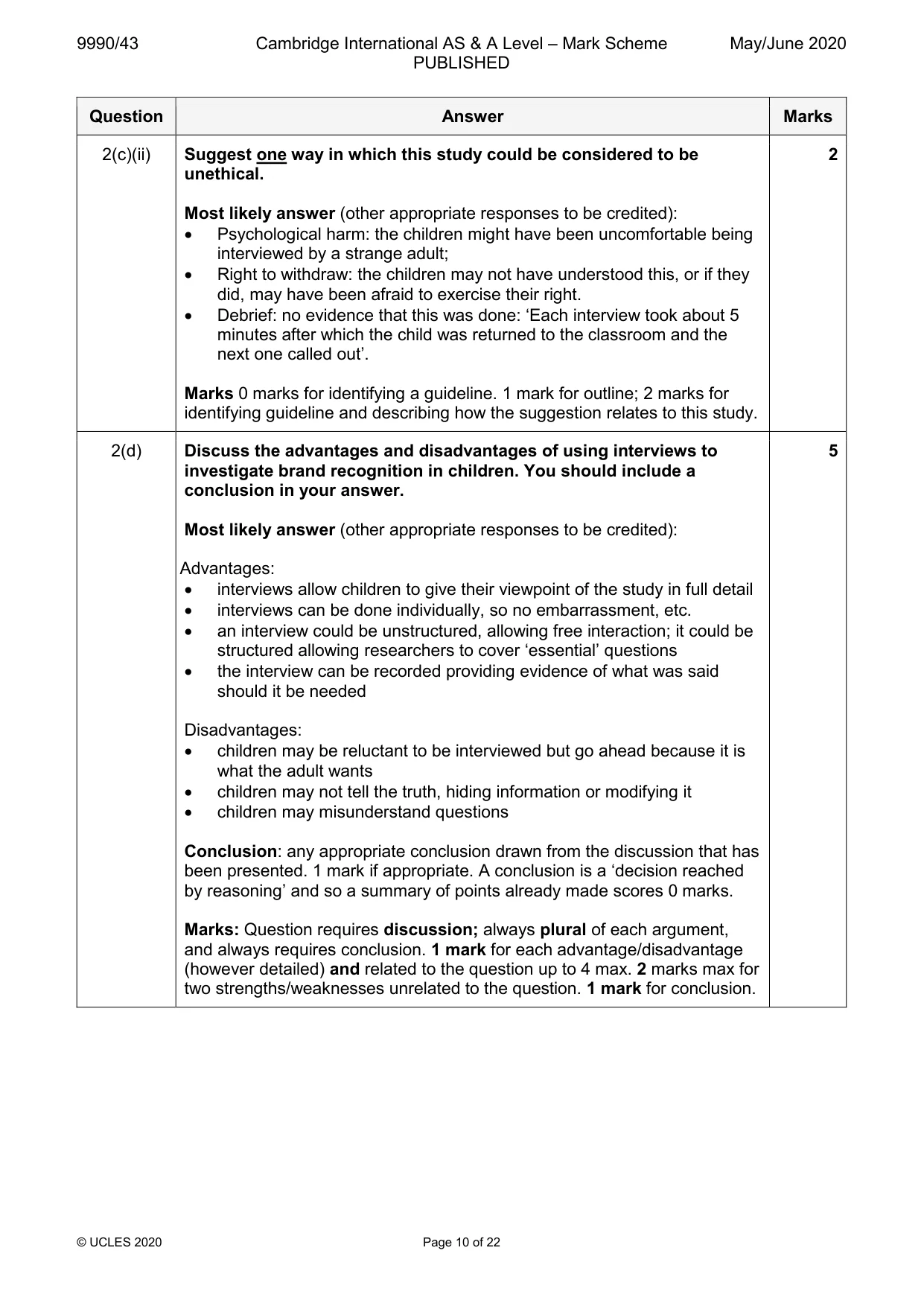
Mark scheme: 2 ‘There has been little attempt to understand the influence on children of branded products that appear in television programs and movies. A study exposed children of two different age groups (6–7 and 11–12) in classrooms to a brief film clip. They were then individually asked to demonstrate their witness skills by describing in as much detail as possible what they had seen.’ Extract from the abstract from Auty and Lewis (2004) 2(a) Explain what is meant by ‘brand recognition’. 2 Most likely answer (other appropriate responses to be credited): Brand recognition is the consumer’s ability to recognise a firm from its distinctive logo, motto or artistic symbol. Marks: 1 mark for basic answer, 1 mark for elaboration/example. 2(b) Give the two conclusions from the study by Auty and Lewis (2004). 4 Most likely answer (other appropriate responses to be credited): Quote: ‘The responses to the interviews suggest 1 that it is not simply exposure to the film but rather previous exposure together with a reminder in the form of recent exposure that affects choice.’ 2 Age (and by implication processing skill) does not appear to be a mediating factor affecting choice, because implicit memory (mere exposure) seems to be more important than explicit recall. Marks: 1 mark basic answer, 2 marks detailed answer/elaboration × 2. 2(c)(i) Give two examples of what Auty and Lewis did to ensure that the 2 ethical guideline of informed consent was followed. Most likely answer (other appropriate responses to be credited): Quote: • ‘Within their classes, participants were randomly assigned by their teachers to groups alphabetically by last name’ [and so the teachers knew what the study involved]. • ‘Prior written permission to offer children a soft drink during a brief interview was obtained from parents.’ • ‘Parents and teachers were told that children would be asked questions about their observations after they viewed a film clip.’ Marks: 1 mark for each correct answer. 2(c)(ii) Suggest one way in which this study could be considered to be 2 unethical. Most likely answer (other appropriate responses to be credited): • Psychological harm: the children might have been uncomfortable being interviewed by a strange adult; • Right to withdraw: the children may not have understood this, or if they did, may have been afraid to exercise their right. • Debrief: no evidence that this was done: ‘Each interview took about 5 minutes after which the child was returned to the classroom and the next one called out’. Marks 0 marks for identifying a guideline. 1 mark for outline; 2 marks for identifying guideline and describing how the suggestion relates to this study. 2(d) Discuss the advantages and disadvantages of using interviews to 5 investigate brand recognition in children. You should include a conclusion in your answer. Most likely answer (other appropriate responses to be credited): Advantages: • interviews allow children to give their viewpoint of the study in full detail • interviews can be done individually, so no embarrassment, etc. • an interview could be unstructured, allowing free interaction; it could be structured allowing researchers to cover ‘essential’ questions • the interview can be recorded providing evidence of what was said should it be needed Disadvantages: • children may be reluctant to be interviewed but go ahead because it is what the adult wants • children may not tell the truth, hiding information or modifying it • children may misunderstand questions Conclusion: any appropriate conclusion drawn from the discussion that has been presented. 1 mark if appropriate. A conclusion is a ‘decision reached by reasoning’ and so a summary of points already made scores 0 marks. Marks: Question requires discussion; always plural of each argument, and always requires conclusion. 1 mark for each advantage/disadvantage (however detailed) and related to the question up to 4 max. 2 marks max for two strengths/weaknesses unrelated to the question. 1 mark for conclusion.
Q3 · The Wong-Baker faces pain rating scale for children
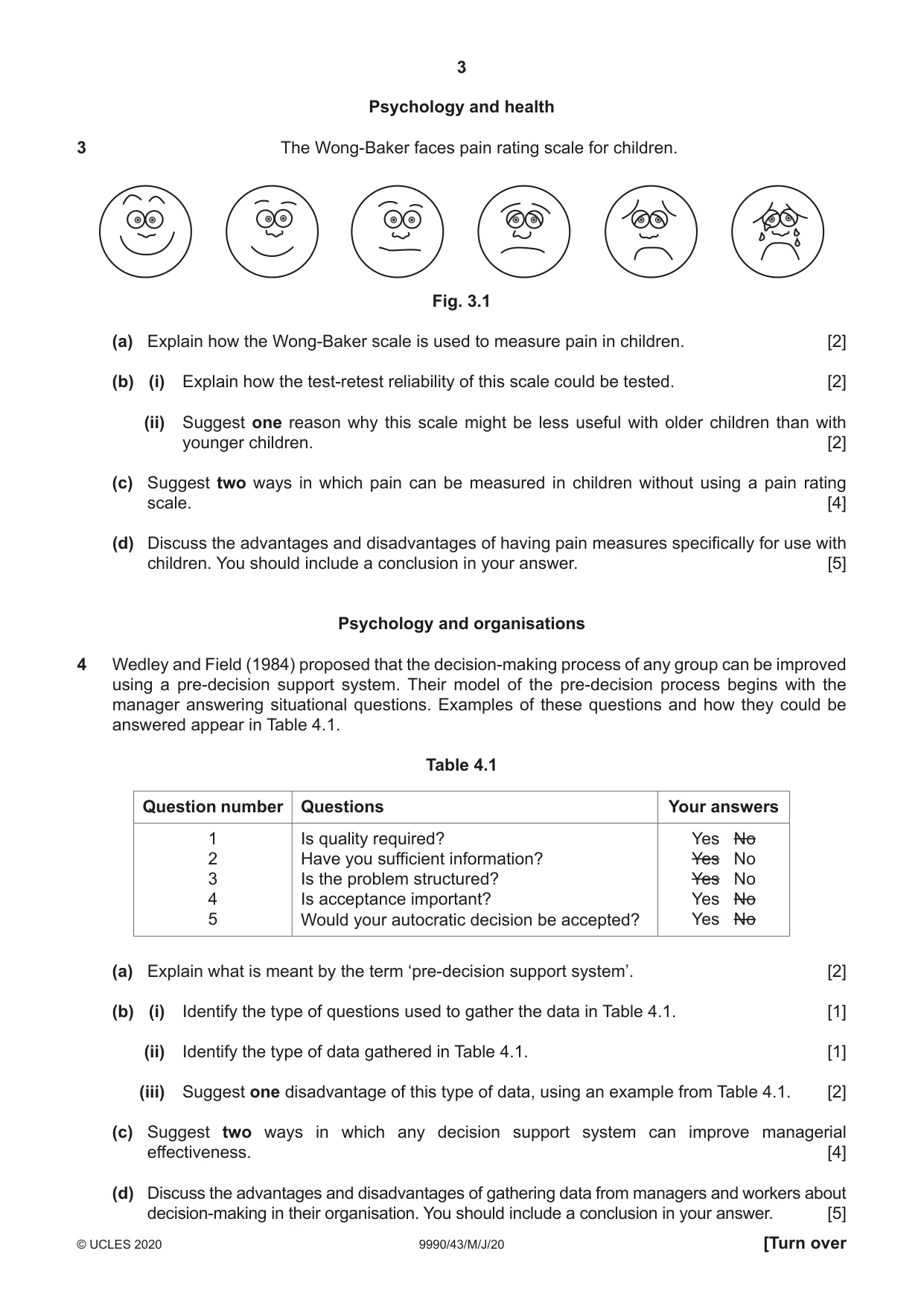
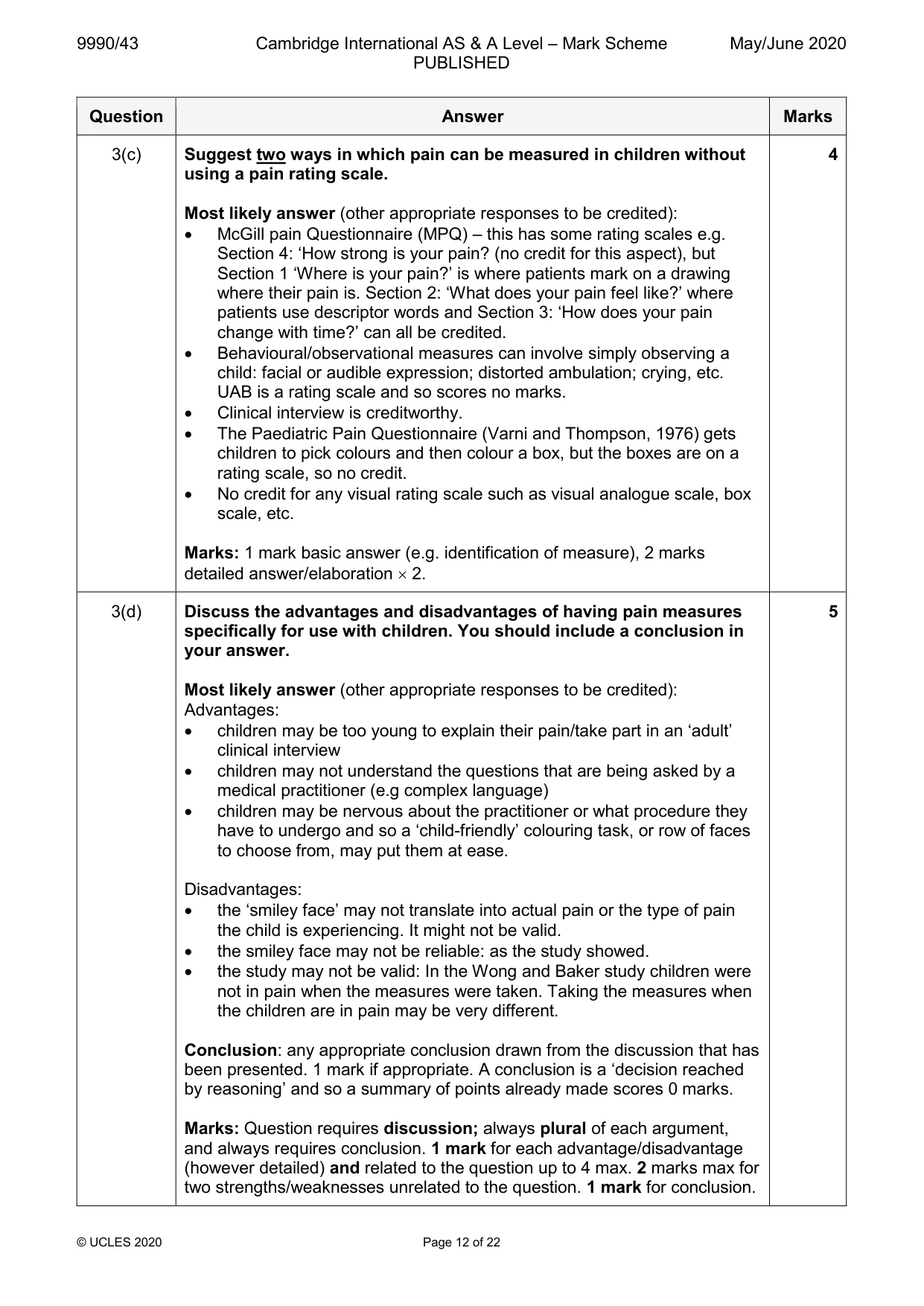
3 The Wong-Baker faces pain rating scale for children. Fig. 3.1 (a) Explain how the Wong-Baker scale is used to measure pain in children. [2] (b) (i) Explain how the test-retest reliability of this scale could be tested. [2] (ii) Suggest one reason why this scale might be less useful with older children than with younger children. [2] (c) Suggest two ways in which pain can be measured in children without using a pain rating scale. [4] (d) Discuss the advantages and disadvantages of having pain measures specifically for use with children. You should include a conclusion in your answer. [5] Psychology and organisations
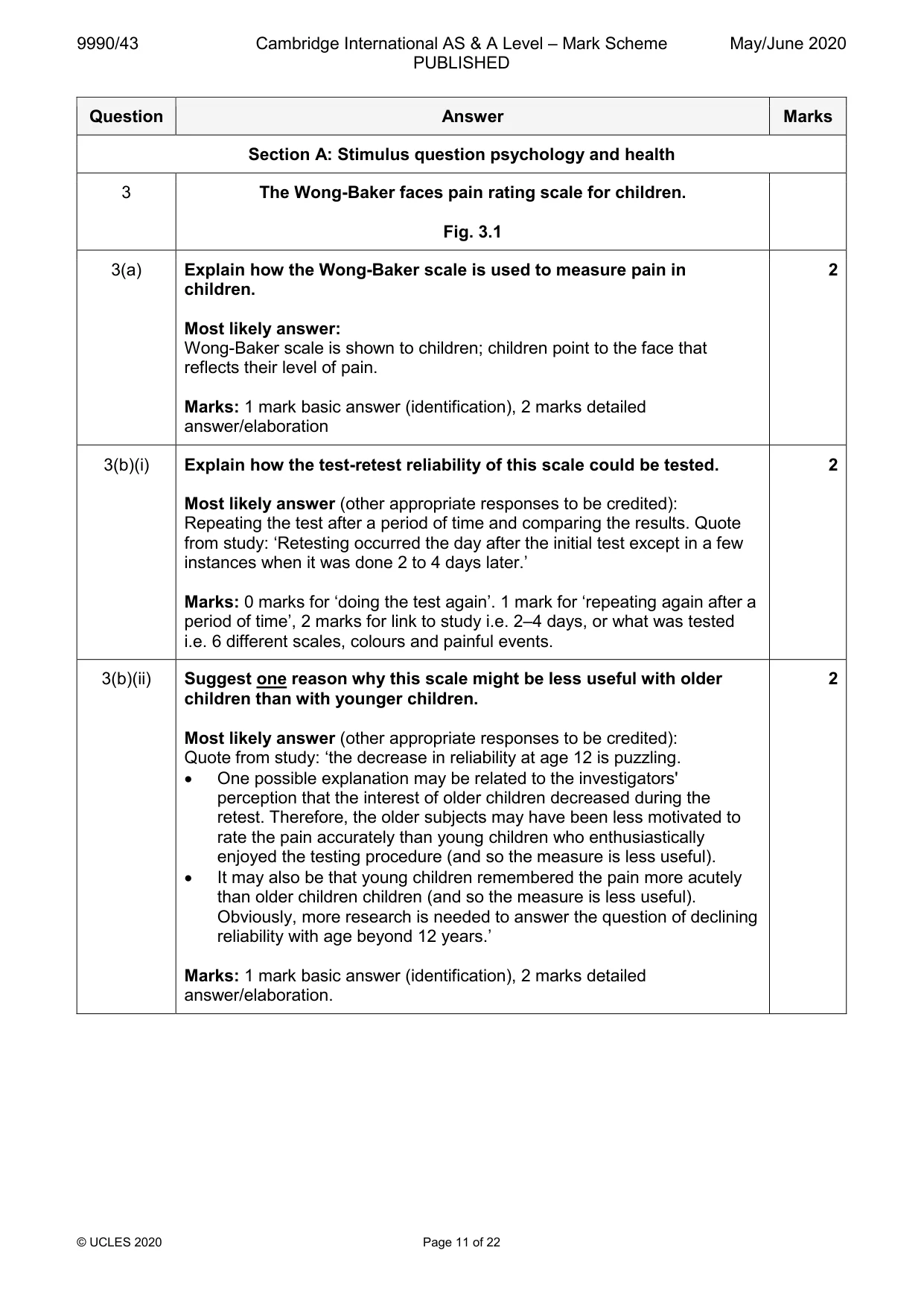
Mark scheme: 3 The Wong-Baker faces pain rating scale for children. Fig. 3.1 3(a) Explain how the Wong-Baker scale is used to measure pain in 2 children. Most likely answer: Wong-Baker scale is shown to children; children point to the face that reflects their level of pain. Marks: 1 mark basic answer (identification), 2 marks detailed answer/elaboration 3(b)(i) Explain how the test-retest reliability of this scale could be tested. 2 Most likely answer (other appropriate responses to be credited): Repeating the test after a period of time and comparing the results. Quote from study: ‘Retesting occurred the day after the initial test except in a few instances when it was done 2 to 4 days later.’ Marks: 0 marks for ‘doing the test again’. 1 mark for ‘repeating again after a period of time’, 2 marks for link to study i.e. 2–4 days, or what was tested i.e. 6 different scales, colours and painful events. 3(b)(ii) Suggest one reason why this scale might be less useful with older 2 children than with younger children. Most likely answer (other appropriate responses to be credited): Quote from study: ‘the decrease in reliability at age 12 is puzzling. • One possible explanation may be related to the investigators' perception that the interest of older children decreased during the retest. Therefore, the older subjects may have been less motivated to rate the pain accurately than young children who enthusiastically enjoyed the testing procedure (and so the measure is less useful). • It may also be that young children remembered the pain more acutely than older children children (and so the measure is less useful). Obviously, more research is needed to answer the question of declining reliability with age beyond 12 years.’ Marks: 1 mark basic answer (identification), 2 marks detailed answer/elaboration. 3(c) Suggest two ways in which pain can be measured in children without 4 using a pain rating scale. Most likely answer (other appropriate responses to be credited): • McGill pain Questionnaire (MPQ) – this has some rating scales e.g. Section 4: ‘How strong is your pain? (no credit for this aspect), but Section 1 ‘Where is your pain?’ is where patients mark on a drawing where their pain is. Section 2: ‘What does your pain feel like?’ where patients use descriptor words and Section 3: ‘How does your pain change with time?’ can all be credited. • Behavioural/observational measures can involve simply observing a child: facial or audible expression; distorted ambulation; crying, etc. UAB is a rating scale and so scores no marks. • Clinical interview is creditworthy. • The Paediatric Pain Questionnaire (Varni and Thompson, 1976) gets children to pick colours and then colour a box, but the boxes are on a rating scale, so no credit. • No credit for any visual rating scale such as visual analogue scale, box scale, etc. Marks: 1 mark basic answer (e.g. identification of measure), 2 marks detailed answer/elaboration × 2. 3(d) Discuss the advantages and disadvantages of having pain measures 5 specifically for use with children. You should include a conclusion in your answer. Most likely answer (other appropriate responses to be credited): Advantages: • children may be too young to explain their pain/take part in an ‘adult’ clinical interview • children may not understand the questions that are being asked by a medical practitioner (e.g complex language) • children may be nervous about the practitioner or what procedure they have to undergo and so a ‘child-friendly’ colouring task, or row of faces to choose from, may put them at ease. Disadvantages: • the ‘smiley face’ may not translate into actual pain or the type of pain the child is experiencing. It might not be valid. • the smiley face may not be reliable: as the study showed. • the study may not be valid: In the Wong and Baker study children were not in pain when the measures were taken. Taking the measures when the children are in pain may be very different. Conclusion: any appropriate conclusion drawn from the discussion that has been presented. 1 mark if appropriate. A conclusion is a ‘decision reached by reasoning’ and so a summary of points already made scores 0 marks. Marks: Question requires discussion; always plural of each argument, and always requires conclusion. 1 mark for each advantage/disadvantage (however detailed) and related to the question up to 4 max. 2 marks max for two strengths/weaknesses unrelated to the question. 1 mark for conclusion.
Q4 · Wedley and Field (1984) proposed that the decision-making process of any group can be…
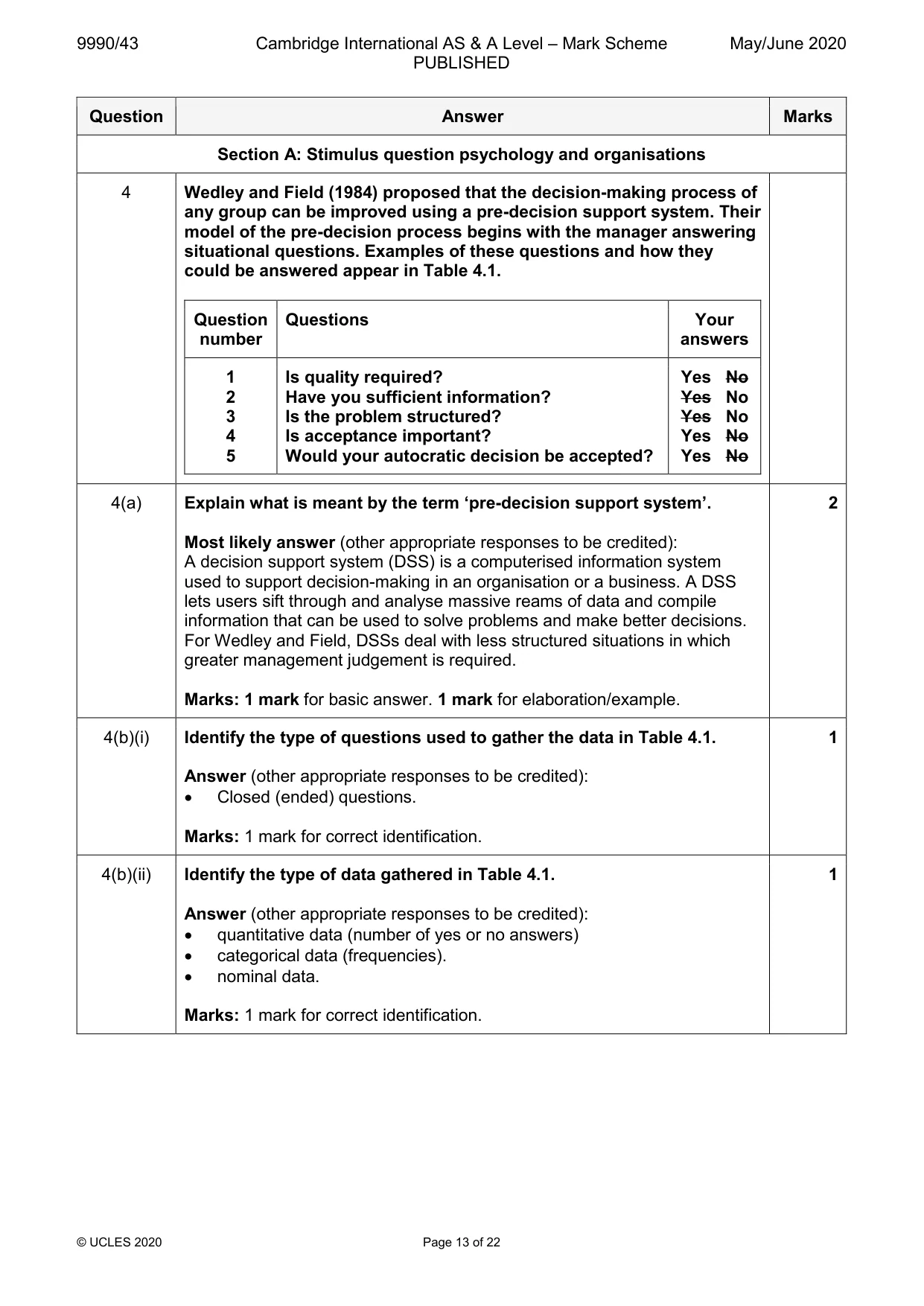
4 Wedley and Field (1984) proposed that the decision-making process of any group can be improved using a pre-decision support system. Their model of the pre-decision process begins with the manager answering situational questions. Examples of these questions and how they could be answered appear in Table 4.1. Table 4.1 Question number Questions Your answers 1 Is quality required? Yes No 2 Have you sufficient information? Yes No 3 Is the problem structured? Yes No 4 Is acceptance important? Yes No 5 Would your autocratic decision be accepted? Yes No (a) Explain what is meant by the term ‘pre-decision support system’. [2] (b) (i) Identify the type of questions used to gather the data in Table 4.1. [1] (ii) Identify the type of data gathered in Table 4.1. [1] (iii) Suggest one disadvantage of this type of data, using an example from Table 4.1. [2] (c) Suggest two ways in which any decision support system can improve managerial effectiveness. [4] (d) Discuss the advantages and disadvantages of gathering data from managers and workers about decision-making in their organisation. You should include a conclusion in your answer. [5]
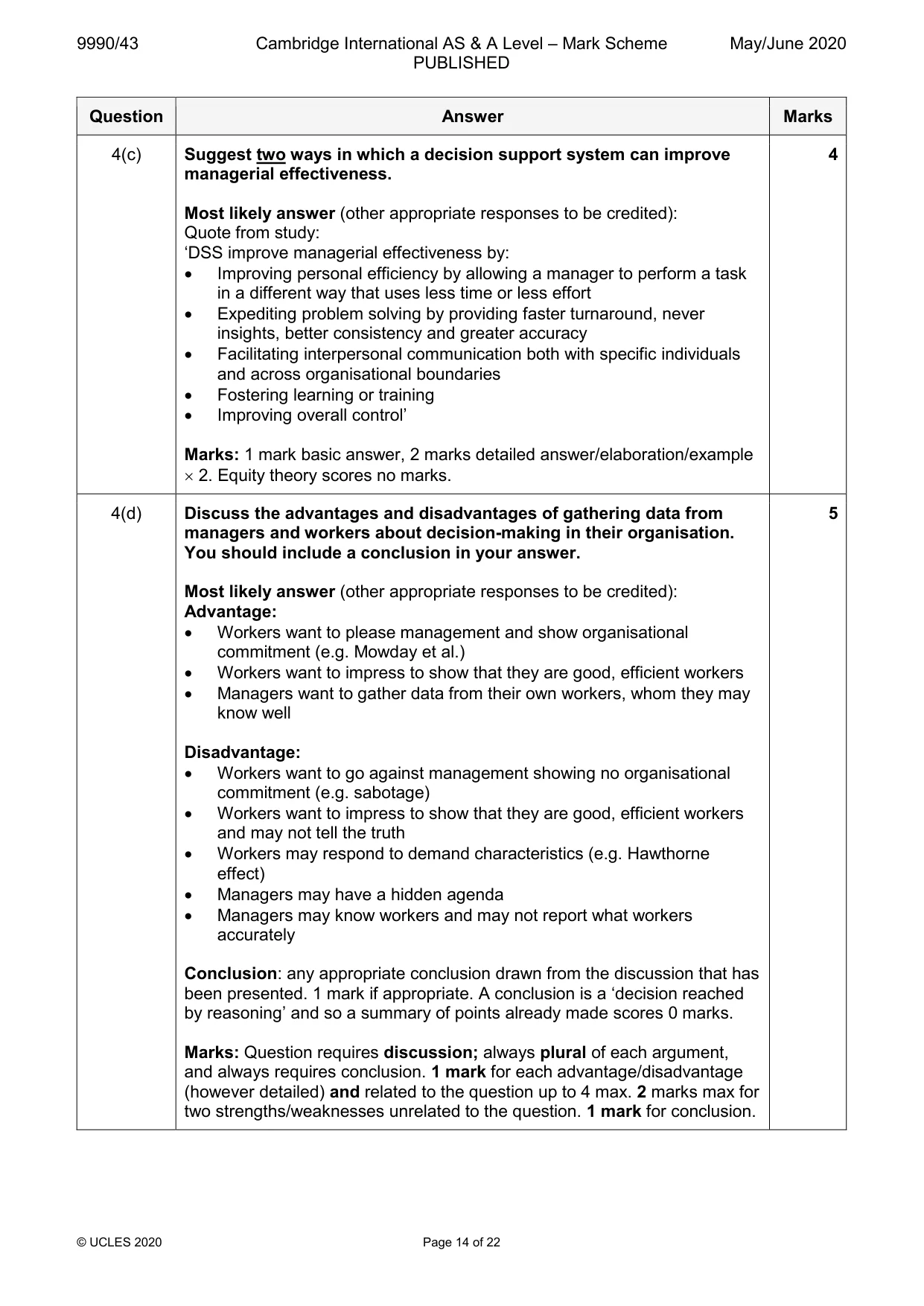
Mark scheme: 4 Wedley and Field (1984) proposed that the decision-making process of any group can be improved using a pre-decision support system. Their model of the pre-decision process begins with the manager answering situational questions. Examples of these questions and how they could be answered appear in Table 4.1. Question Questions Your number answers 1 Is quality required? Yes No 2 Have you sufficient information? Yes No 3 Is the problem structured? Yes No 4 Is acceptance important? Yes No 5 Would your autocratic decision be accepted? Yes No 4(a) Explain what is meant by the term ‘pre-decision support system’. 2 Most likely answer (other appropriate responses to be credited): A decision support system (DSS) is a computerised information system used to support decision-making in an organisation or a business. A DSS lets users sift through and analyse massive reams of data and compile information that can be used to solve problems and make better decisions. For Wedley and Field, DSSs deal with less structured situations in which greater management judgement is required. Marks: 1 mark for basic answer. 1 mark for elaboration/example. 4(b)(i) Identify the type of questions used to gather the data in Table 4.1. 1 Answer (other appropriate responses to be credited): • Closed (ended) questions. Marks: 1 mark for correct identification. 4(b)(ii) Identify the type of data gathered in Table 4.1. 1 Answer (other appropriate responses to be credited): • quantitative data (number of yes or no answers) • categorical data (frequencies). • nominal data. Marks: 1 mark for correct identification. 4(c) Suggest two ways in which a decision support system can improve 4 managerial effectiveness. Most likely answer (other appropriate responses to be credited): Quote from study: ‘DSS improve managerial effectiveness by: • Improving personal efficiency by allowing a manager to perform a task in a different way that uses less time or less effort • Expediting problem solving by providing faster turnaround, never insights, better consistency and greater accuracy • Facilitating interpersonal communication both with specific individuals and across organisational boundaries • Fostering learning or training • Improving overall control’ Marks: 1 mark basic answer, 2 marks detailed answer/elaboration/example × 2. Equity theory scores no marks. 4(d) Discuss the advantages and disadvantages of gathering data from 5 managers and workers about decision-making in their organisation. You should include a conclusion in your answer. Most likely answer (other appropriate responses to be credited): Advantage: • Workers want to please management and show organisational commitment (e.g. Mowday et al.) • Workers want to impress to show that they are good, efficient workers • Managers want to gather data from their own workers, whom they may know well Disadvantage: • Workers want to go against management showing no organisational commitment (e.g. sabotage) • Workers want to impress to show that they are good, efficient workers and may not tell the truth • Workers may respond to demand characteristics (e.g. Hawthorne effect) • Managers may have a hidden agenda • Managers may know workers and may not report what workers accurately Conclusion: any appropriate conclusion drawn from the discussion that has been presented. 1 mark if appropriate. A conclusion is a ‘decision reached by reasoning’ and so a summary of points already made scores 0 marks. Marks: Question requires discussion; always plural of each argument, and always requires conclusion. 1 mark for each advantage/disadvantage (however detailed) and related to the question up to 4 max. 2 marks max for two strengths/weaknesses unrelated to the question. 1 mark for conclusion.
Q5 · Design a study to investigate which type of phobia the general public think is the most…
5 (a) Design a study to investigate which type of phobia the general public think is the most common. [10] (b) Explain the psychological and methodological evidence on which your study is based. [8] Psychology and consumer behaviour
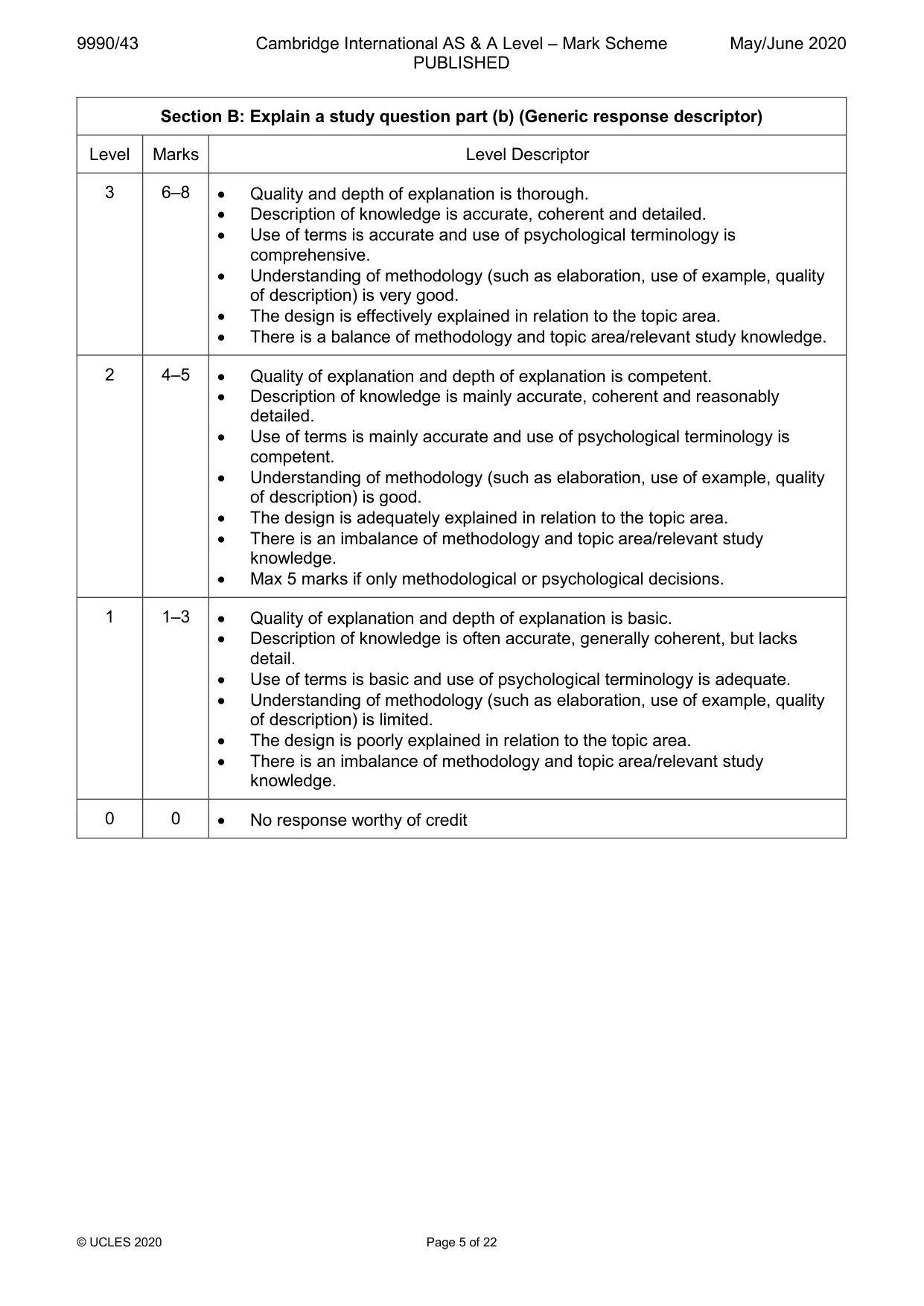
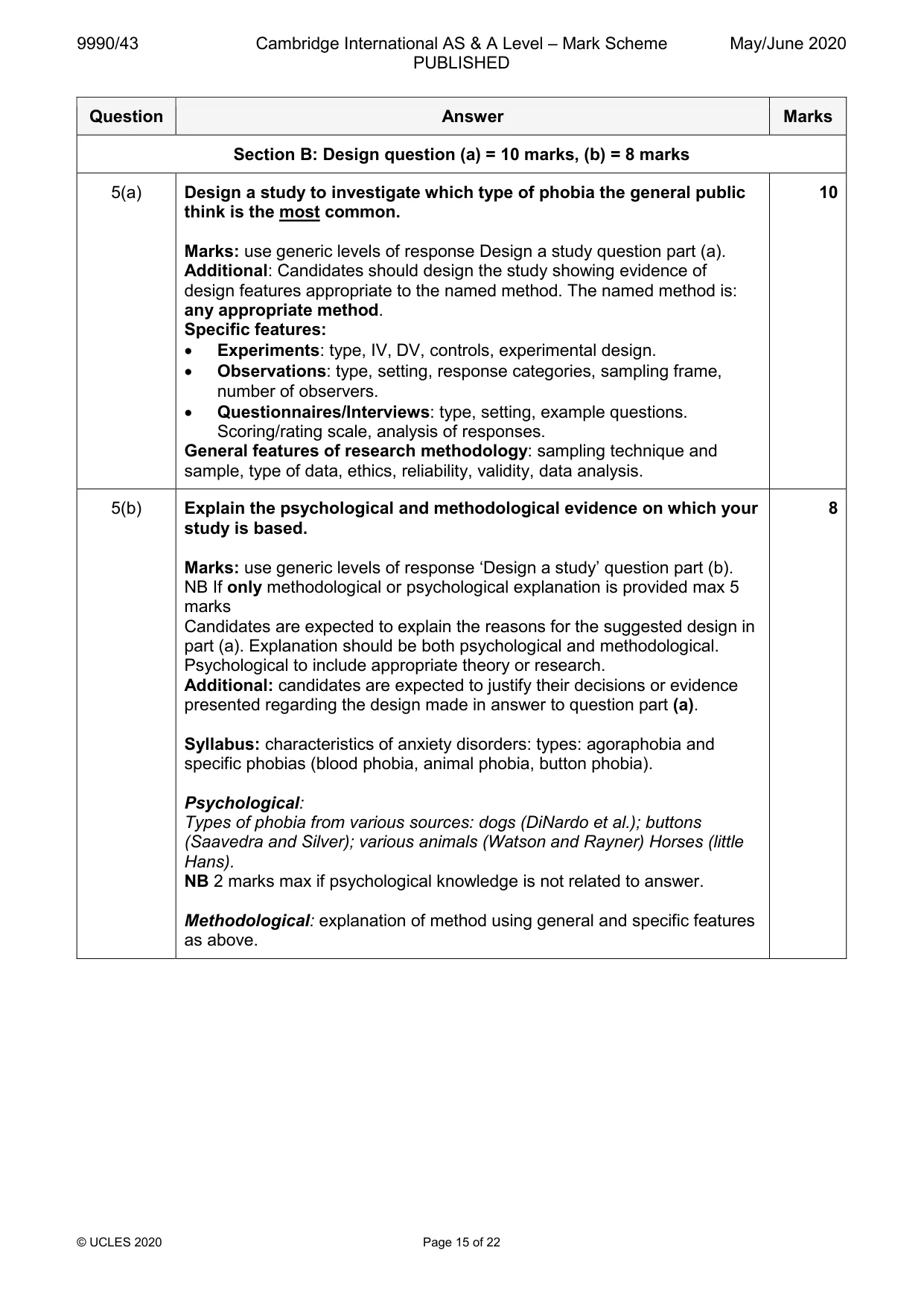
Mark scheme: 5(a) Design a study to investigate which type of phobia the general public 10 think is the most common. Marks: use generic levels of response Design a study question part (a). Additional: Candidates should design the study showing evidence of design features appropriate to the named method. The named method is: any appropriate method. Specific features: • Experiments: type, IV, DV, controls, experimental design. • Observations: type, setting, response categories, sampling frame, number of observers. • Questionnaires/Interviews: type, setting, example questions. Scoring/rating scale, analysis of responses. General features of research methodology: sampling technique and sample, type of data, ethics, reliability, validity, data analysis. 5(b) Explain the psychological and methodological evidence on which your 8 study is based. Marks: use generic levels of response ‘Design a study’ question part (b). NB If only methodological or psychological explanation is provided max 5 marks Candidates are expected to explain the reasons for the suggested design in part (a). Explanation should be both psychological and methodological. Psychological to include appropriate theory or research. Additional: candidates are expected to justify their decisions or evidence presented regarding the design made in answer to question part (a). Syllabus: characteristics of anxiety disorders: types: agoraphobia and specific phobias (blood phobia, animal phobia, button phobia). Psychological: Types of phobia from various sources: dogs (DiNardo et al.); buttons (Saavedra and Silver); various animals (Watson and Rayner) Horses (little Hans). NB 2 marks max if psychological knowledge is not related to answer. Methodological: explanation of method using general and specific features as above.
More questions on Anxiety disorders and fear-related disorders
Q6 · Design a study using a questionnaire to investigate whether people prefer a…
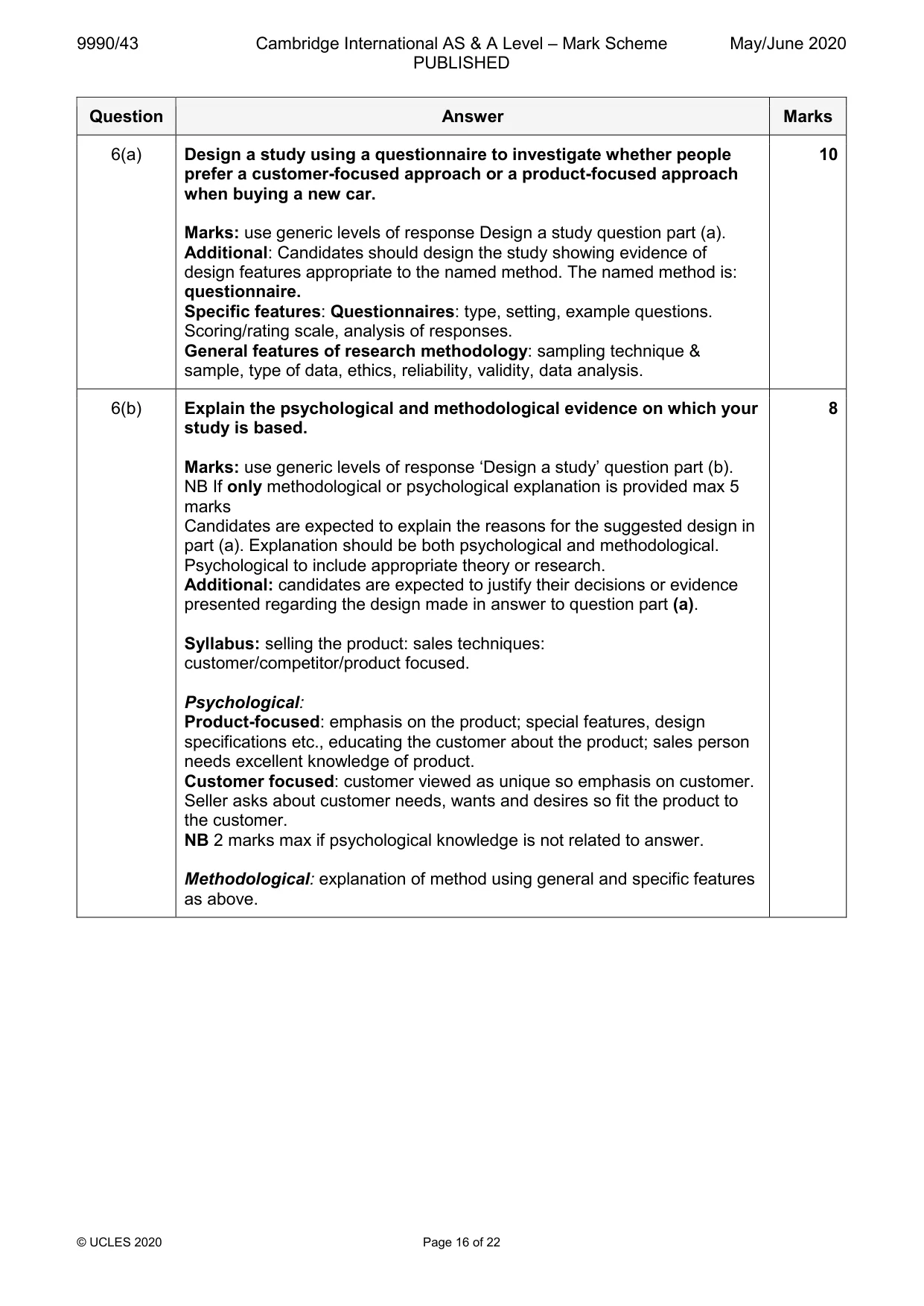
6 (a) Design a study using a questionnaire to investigate whether people prefer a customer-focused approach or a product-focused approach when buying a new car. [10] (b) Explain the psychological and methodological evidence on which your study is based. [8] Psychology and health
Mark scheme: 6(a) Design a study using a questionnaire to investigate whether people 10 prefer a customer-focused approach or a product-focused approach when buying a new car. Marks: use generic levels of response Design a study question part (a). Additional: Candidates should design the study showing evidence of design features appropriate to the named method. The named method is: questionnaire. Specific features: Questionnaires: type, setting, example questions. Scoring/rating scale, analysis of responses. General features of research methodology: sampling technique & sample, type of data, ethics, reliability, validity, data analysis. 6(b) Explain the psychological and methodological evidence on which your 8 study is based. Marks: use generic levels of response ‘Design a study’ question part (b). NB If only methodological or psychological explanation is provided max 5 marks Candidates are expected to explain the reasons for the suggested design in part (a). Explanation should be both psychological and methodological. Psychological to include appropriate theory or research. Additional: candidates are expected to justify their decisions or evidence presented regarding the design made in answer to question part (a). Syllabus: selling the product: sales techniques: customer/competitor/product focused. Psychological: Product-focused: emphasis on the product; special features, design specifications etc., educating the customer about the product; sales person needs excellent knowledge of product. Customer focused: customer viewed as unique so emphasis on customer. Seller asks about customer needs, wants and desires so fit the product to the customer. NB 2 marks max if psychological knowledge is not related to answer. Methodological: explanation of method using general and specific features as above.
Q7 · Design a study using an interview to investigate what the students in a school understand…
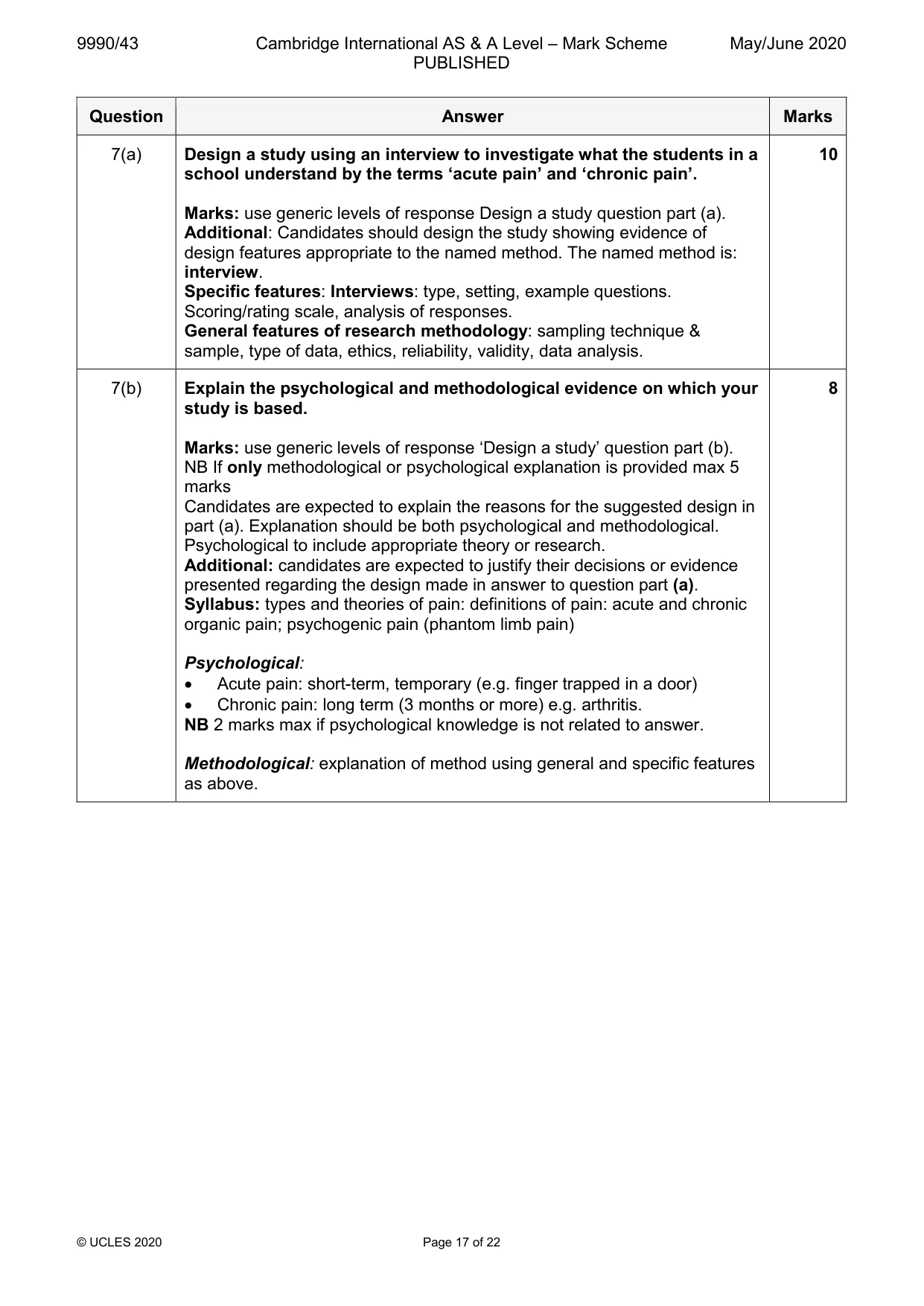
7 (a) Design a study using an interview to investigate what the students in a school understand by the terms ‘acute pain’ and ‘chronic pain’. [10] (b) Explain the psychological and methodological evidence on which your study is based. [8] Psychology and organisations
Mark scheme: 7(a) Design a study using an interview to investigate what the students in a 10 school understand by the terms ‘acute pain’ and ‘chronic pain’. Marks: use generic levels of response Design a study question part (a). Additional: Candidates should design the study showing evidence of design features appropriate to the named method. The named method is: interview. Specific features: Interviews: type, setting, example questions. Scoring/rating scale, analysis of responses. General features of research methodology: sampling technique & sample, type of data, ethics, reliability, validity, data analysis. 7(b) Explain the psychological and methodological evidence on which your 8 study is based. Marks: use generic levels of response ‘Design a study’ question part (b). NB If only methodological or psychological explanation is provided max 5 marks Candidates are expected to explain the reasons for the suggested design in part (a). Explanation should be both psychological and methodological. Psychological to include appropriate theory or research. Additional: candidates are expected to justify their decisions or evidence presented regarding the design made in answer to question part (a). Syllabus: types and theories of pain: definitions of pain: acute and chronic organic pain; psychogenic pain (phantom limb pain) Psychological: • Acute pain: short-term, temporary (e.g. finger trapped in a door) • Chronic pain: long term (3 months or more) e.g. arthritis. NB 2 marks max if psychological knowledge is not related to answer. Methodological: explanation of method using general and specific features as above.
Q8 · Design a study using observations to investigate which followership type is the most…
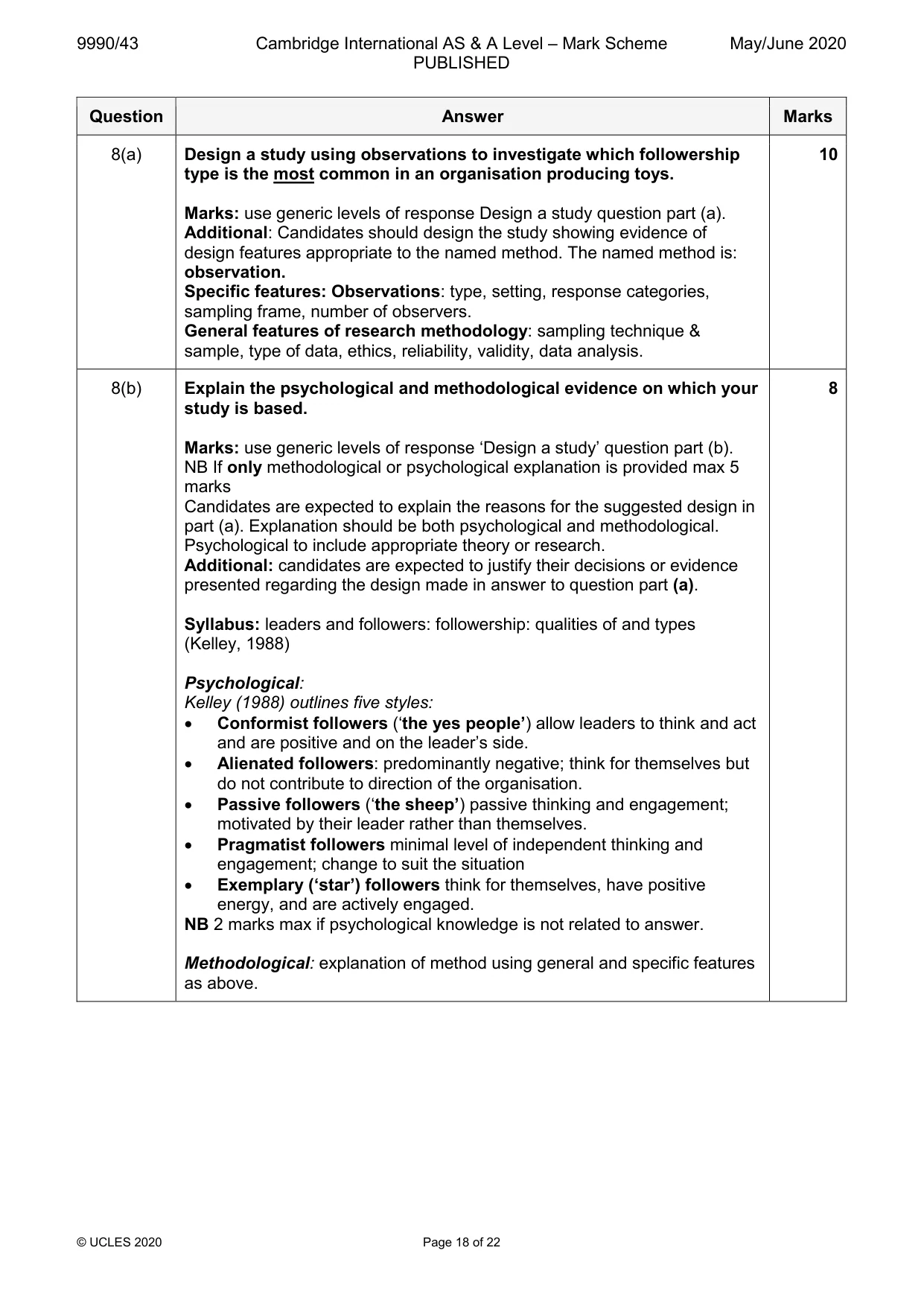
8 (a) Design a study using observations to investigate which followership type is the most common in an organisation producing toys. [10] (b) Explain the psychological and methodological evidence on which your study is based. [8] Section C You must answer one question from this section. Psychology and abnormality
Mark scheme: 8(a) Design a study using observations to investigate which followership 10 type is the most common in an organisation producing toys. Marks: use generic levels of response Design a study question part (a). Additional: Candidates should design the study showing evidence of design features appropriate to the named method. The named method is: observation. Specific features: Observations: type, setting, response categories, sampling frame, number of observers. General features of research methodology: sampling technique & sample, type of data, ethics, reliability, validity, data analysis. 8(b) Explain the psychological and methodological evidence on which your 8 study is based. Marks: use generic levels of response ‘Design a study’ question part (b). NB If only methodological or psychological explanation is provided max 5 marks Candidates are expected to explain the reasons for the suggested design in part (a). Explanation should be both psychological and methodological. Psychological to include appropriate theory or research. Additional: candidates are expected to justify their decisions or evidence presented regarding the design made in answer to question part (a). Syllabus: leaders and followers: followership: qualities of and types (Kelley, 1988) Psychological: Kelley (1988) outlines five styles: • Conformist followers (‘the yes people’) allow leaders to think and act and are positive and on the leader’s side. • Alienated followers: predominantly negative; think for themselves but do not contribute to direction of the organisation. • Passive followers (‘the sheep’) passive thinking and engagement; motivated by their leader rather than themselves. • Pragmatist followers minimal level of independent thinking and engagement; change to suit the situation • Exemplary (‘star’) followers think for themselves, have positive energy, and are actively engaged. NB 2 marks max if psychological knowledge is not related to answer. Methodological: explanation of method using general and specific features as above.
Q9 · ‘Symptom assessment of schizophrenia using virtual reality will one day remove the need…
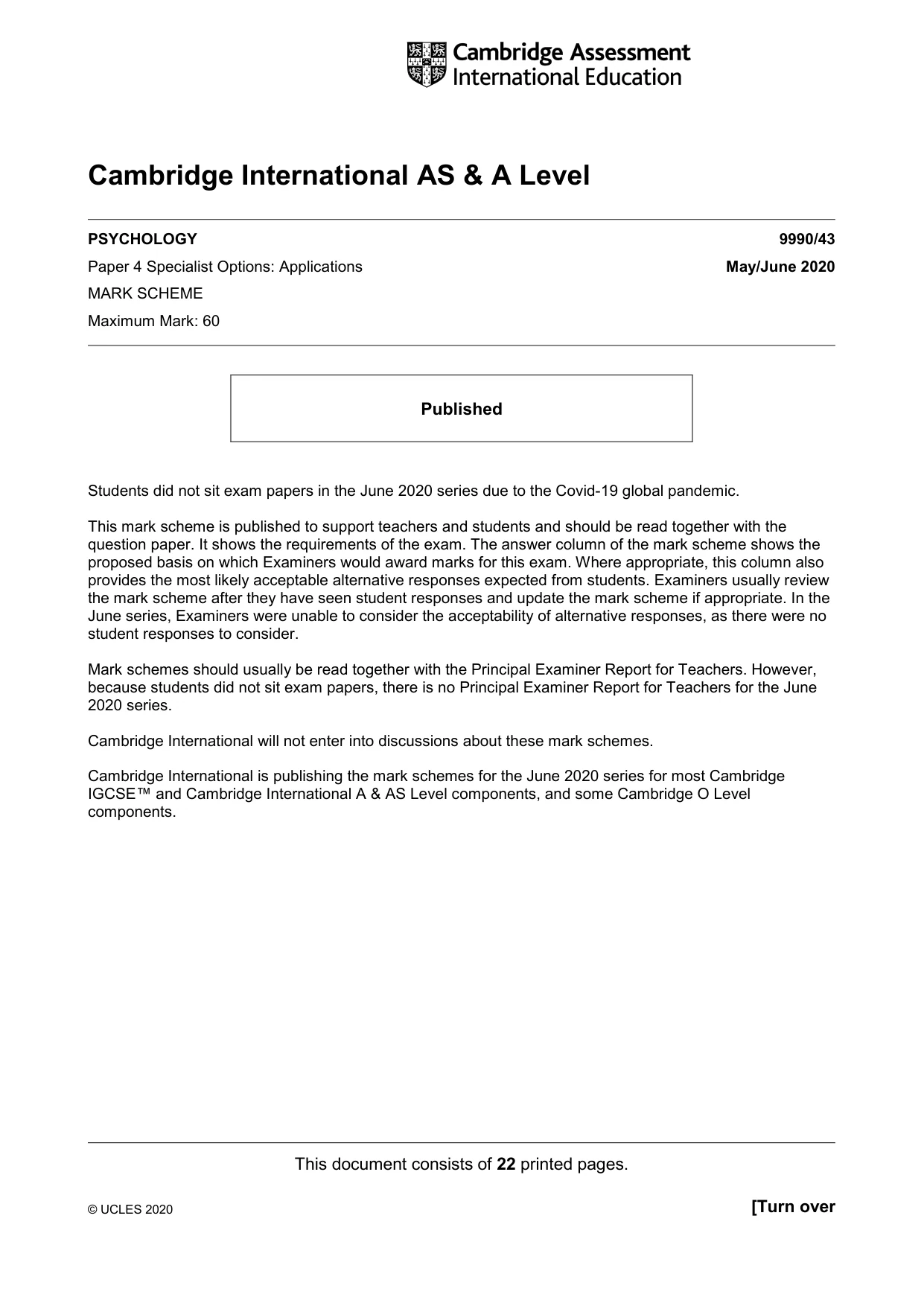
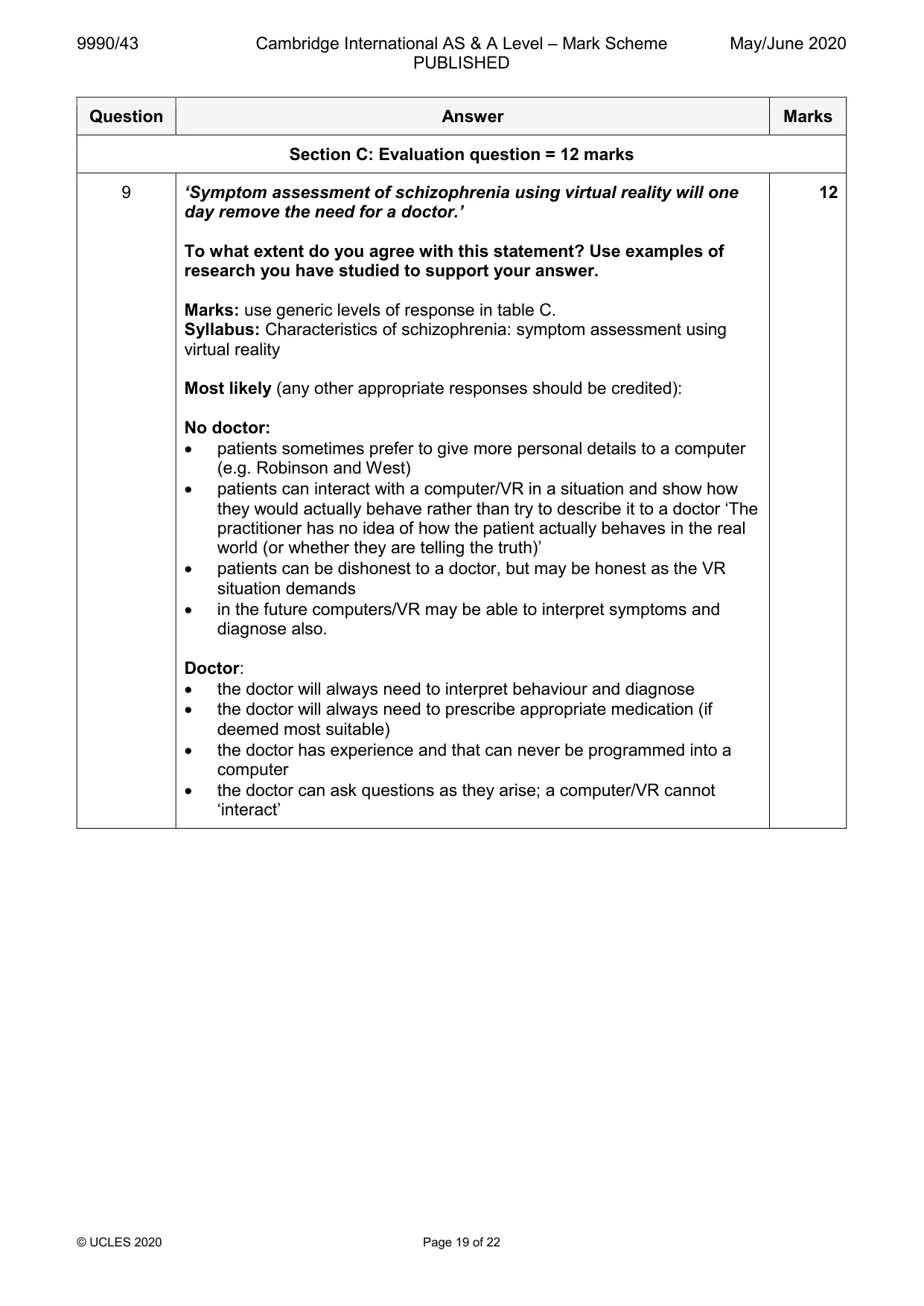
9 ‘Symptom assessment of schizophrenia using virtual reality will one day remove the need for a doctor.’ To what extent do you agree with this statement? Use examples of research you have studied to support your answer. [12] Psychology and consumer behaviour
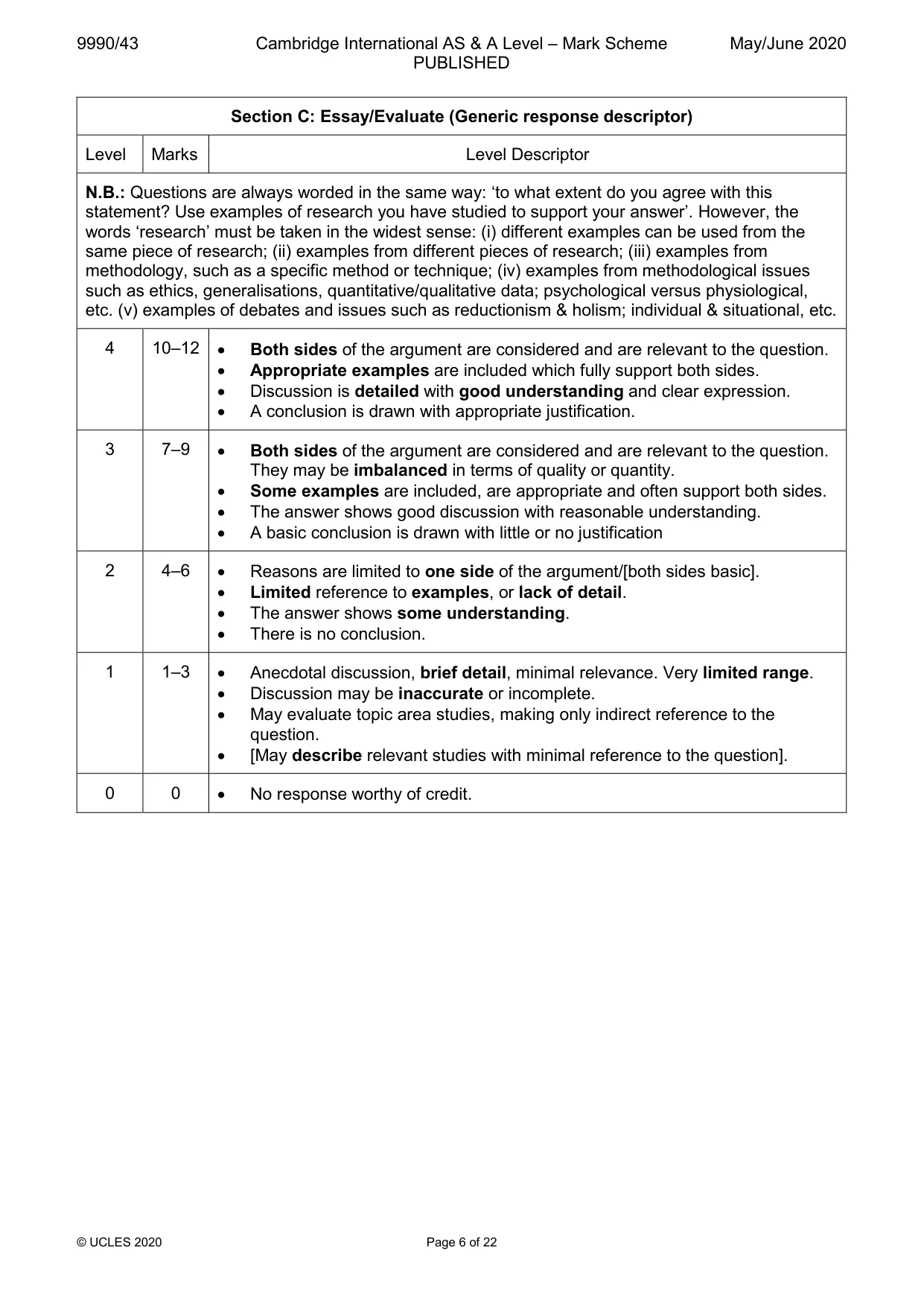
Mark scheme: 9 ‘Symptom assessment of schizophrenia using virtual reality will one 12 day remove the need for a doctor.’ To what extent do you agree with this statement? Use examples of research you have studied to support your answer. Marks: use generic levels of response in table C. Syllabus: Characteristics of schizophrenia: symptom assessment using virtual reality Most likely (any other appropriate responses should be credited): No doctor: • patients sometimes prefer to give more personal details to a computer (e.g. Robinson and West) • patients can interact with a computer/VR in a situation and show how they would actually behave rather than try to describe it to a doctor ‘The practitioner has no idea of how the patient actually behaves in the real world (or whether they are telling the truth)’ • patients can be dishonest to a doctor, but may be honest as the VR situation demands • in the future computers/VR may be able to interpret symptoms and diagnose also. Doctor: • the doctor will always need to interpret behaviour and diagnose • the doctor will always need to prescribe appropriate medication (if deemed most suitable) • the doctor has experience and that can never be programmed into a computer • the doctor can ask questions as they arise; a computer/VR cannot ‘interact’
Q10 · ‘The theory of planned behaviour: if you plan to buy and you intend to buy, you…
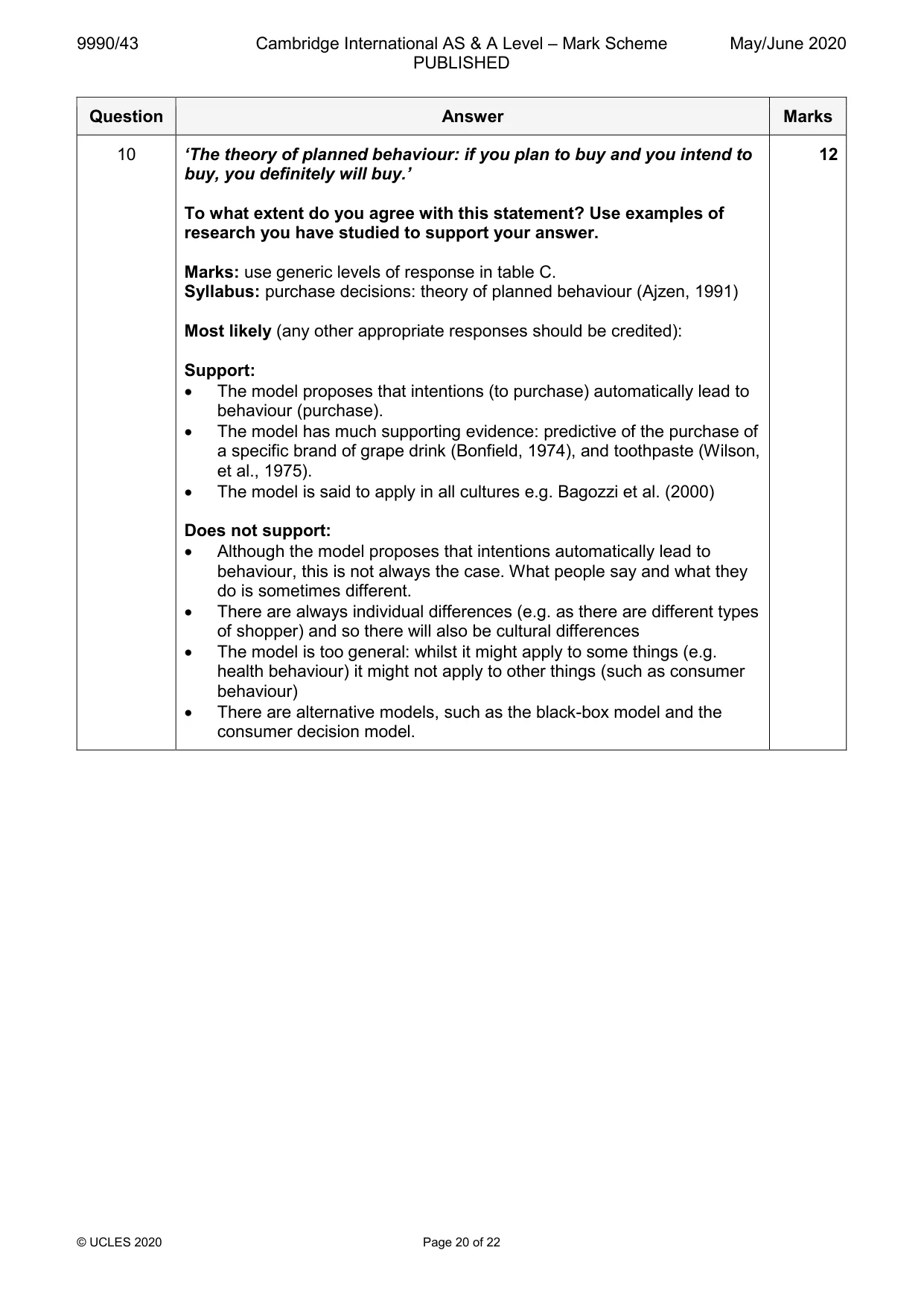
10 ‘The theory of planned behaviour: if you plan to buy and you intend to buy, you definitely will buy.’ To what extent do you agree with this statement? Use examples of research you have studied to support your answer. [12] Psychology and health
Mark scheme: 10 ‘The theory of planned behaviour: if you plan to buy and you intend to 12 buy, you definitely will buy.’ To what extent do you agree with this statement? Use examples of research you have studied to support your answer. Marks: use generic levels of response in table C. Syllabus: purchase decisions: theory of planned behaviour (Ajzen, 1991) Most likely (any other appropriate responses should be credited): Support: • The model proposes that intentions (to purchase) automatically lead to behaviour (purchase). • The model has much supporting evidence: predictive of the purchase of a specific brand of grape drink (Bonfield, 1974), and toothpaste (Wilson, et al., 1975). • The model is said to apply in all cultures e.g. Bagozzi et al. (2000) Does not support: • Although the model proposes that intentions automatically lead to behaviour, this is not always the case. What people say and what they do is sometimes different. • There are always individual differences (e.g. as there are different types of shopper) and so there will also be cultural differences • The model is too general: whilst it might apply to some things (e.g. health behaviour) it might not apply to other things (such as consumer behaviour) • There are alternative models, such as the black-box model and the consumer decision model.
Q11 · ‘Health promotion strategies developed in one country, such as those in the five-city…
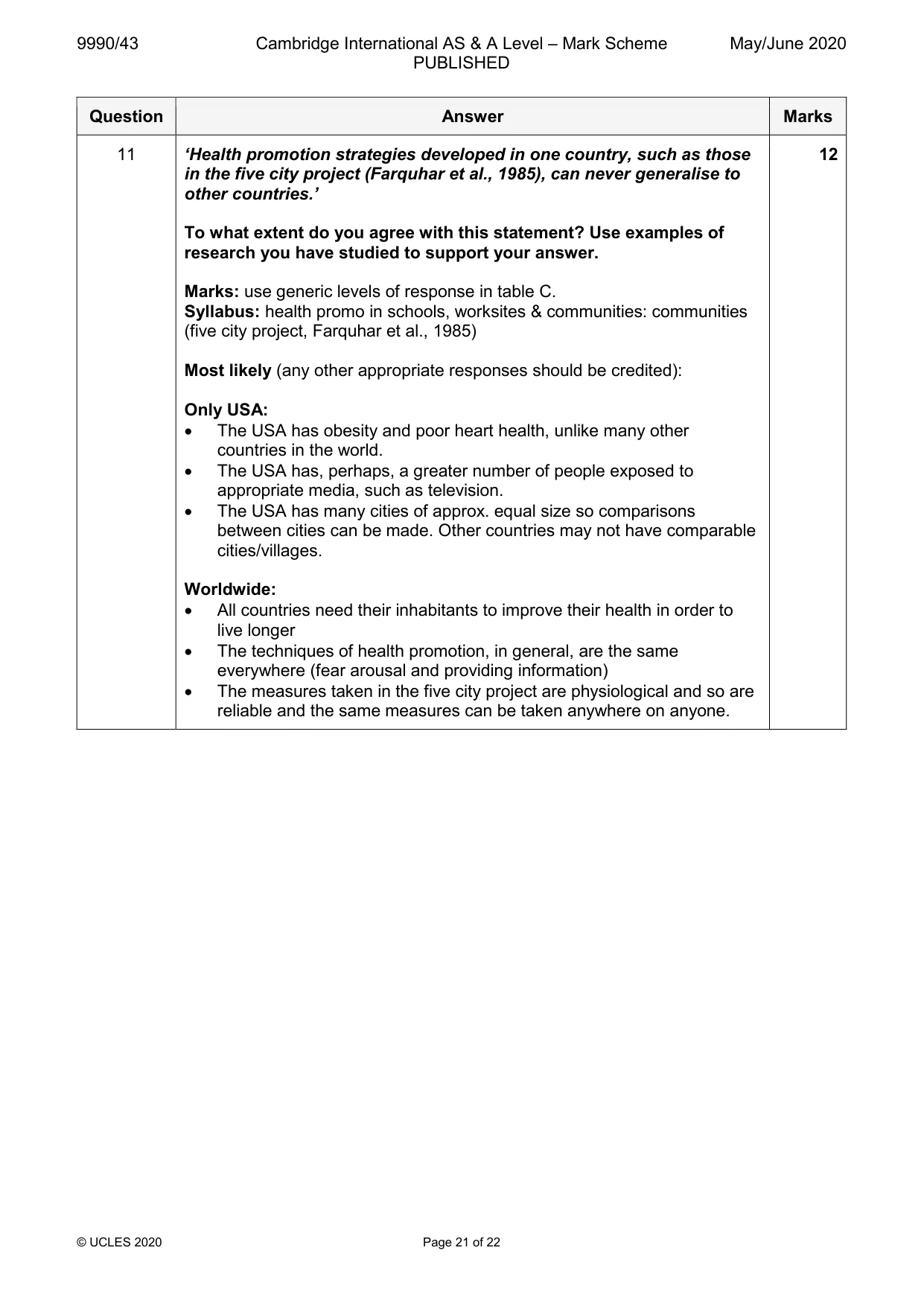
11 ‘Health promotion strategies developed in one country, such as those in the five-city project (Farquhar et al., 1985), can never generalise to other countries.’ To what extent do you agree with this statement? Use examples of research you have studied to support your answer. [12] Psychology and organisations
Mark scheme: 11 ‘Health promotion strategies developed in one country, such as those 12 in the five city project (Farquhar et al., 1985), can never generalise to other countries.’ To what extent do you agree with this statement? Use examples of research you have studied to support your answer. Marks: use generic levels of response in table C. Syllabus: health promo in schools, worksites & communities: communities (five city project, Farquhar et al., 1985) Most likely (any other appropriate responses should be credited): Only USA: • The USA has obesity and poor heart health, unlike many other countries in the world. • The USA has, perhaps, a greater number of people exposed to appropriate media, such as television. • The USA has many cities of approx. equal size so comparisons between cities can be made. Other countries may not have comparable cities/villages. Worldwide: • All countries need their inhabitants to improve their health in order to live longer • The techniques of health promotion, in general, are the same everywhere (fear arousal and providing information) • The measures taken in the five city project are physiological and so are reliable and the same measures can be taken anywhere on anyone.
More questions on 2 Health promotion in schools and worksites
Q12 · ‘Errors in group decision-making are always due to the cognitive limitations of an…
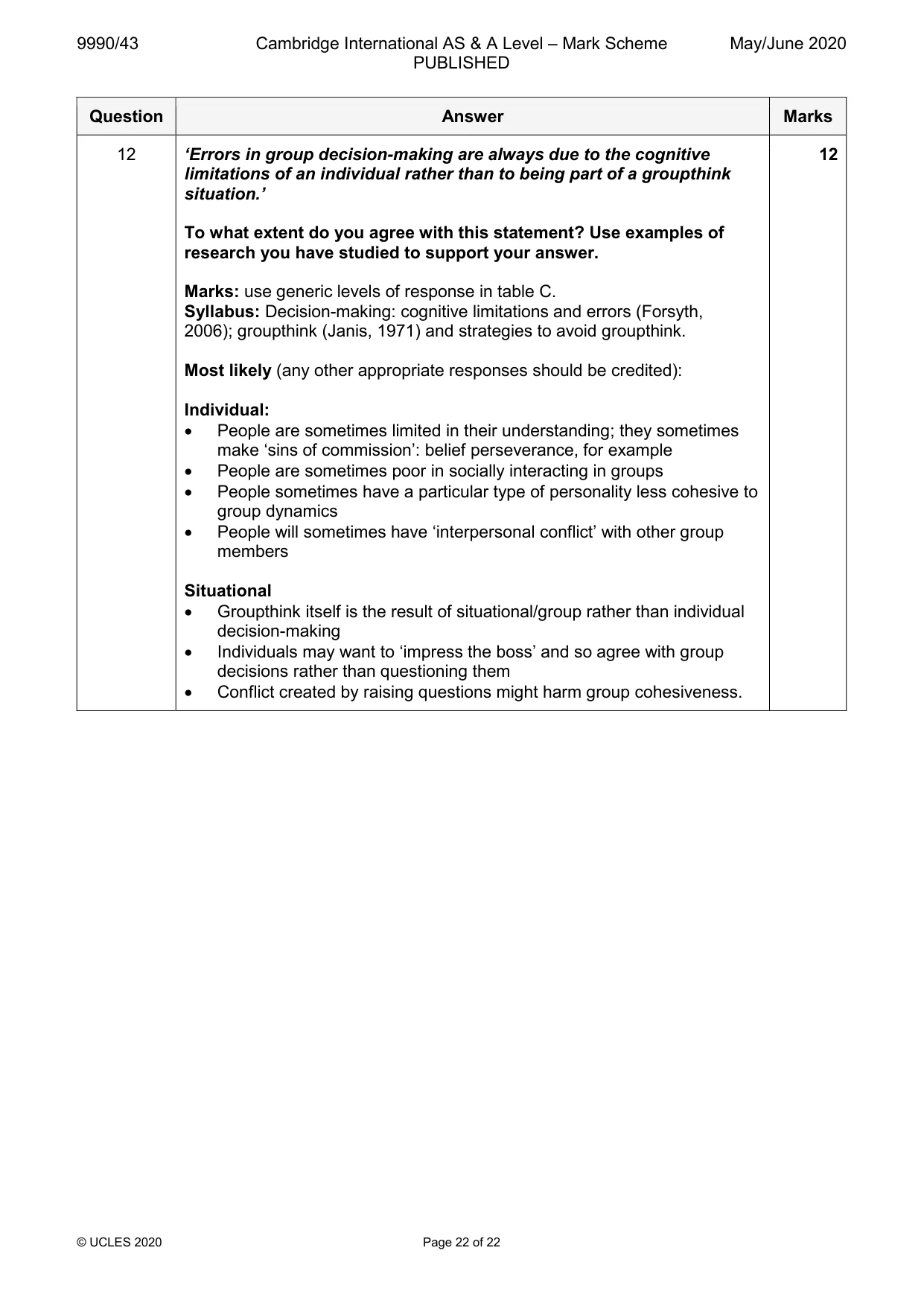
12 ‘Errors in group decision-making are always due to the cognitive limitations of an individual rather than to being part of a groupthink situation.’ To what extent do you agree with this statement? Use examples of research you have studied to support your answer. [12]
Mark scheme: 12 ‘Errors in group decision-making are always due to the cognitive 12 limitations of an individual rather than to being part of a groupthink situation.’ To what extent do you agree with this statement? Use examples of research you have studied to support your answer. Marks: use generic levels of response in table C. Syllabus: Decision-making: cognitive limitations and errors (Forsyth, 2006); groupthink (Janis, 1971) and strategies to avoid groupthink. Most likely (any other appropriate responses should be credited): Individual: • People are sometimes limited in their understanding; they sometimes make ‘sins of commission’: belief perseverance, for example • People are sometimes poor in socially interacting in groups • People sometimes have a particular type of personality less cohesive to group dynamics • People will sometimes have ‘interpersonal conflict’ with other group members Situational • Groupthink itself is the result of situational/group rather than individual decision-making • Individuals may want to ‘impress the boss’ and so agree with group decisions rather than questioning them • Conflict created by raising questions might harm group cohesiveness.
What was in this paper
The subtopics covered by these 12 questions, and how many questions each got. Open one in a new tab to see every Cambridge question on it.