Cambridge A Level Psychology (from 2018) 9990 — 2021 May/June Paper 4 · Variant 3
9990/43/M/J/21 · 12 questions · 60 marks · ≈68 min
The question paper and its mark scheme, free to read here and free to download. This is Cambridge’s own paper, exactly as it was sat.
Question paper8 pages




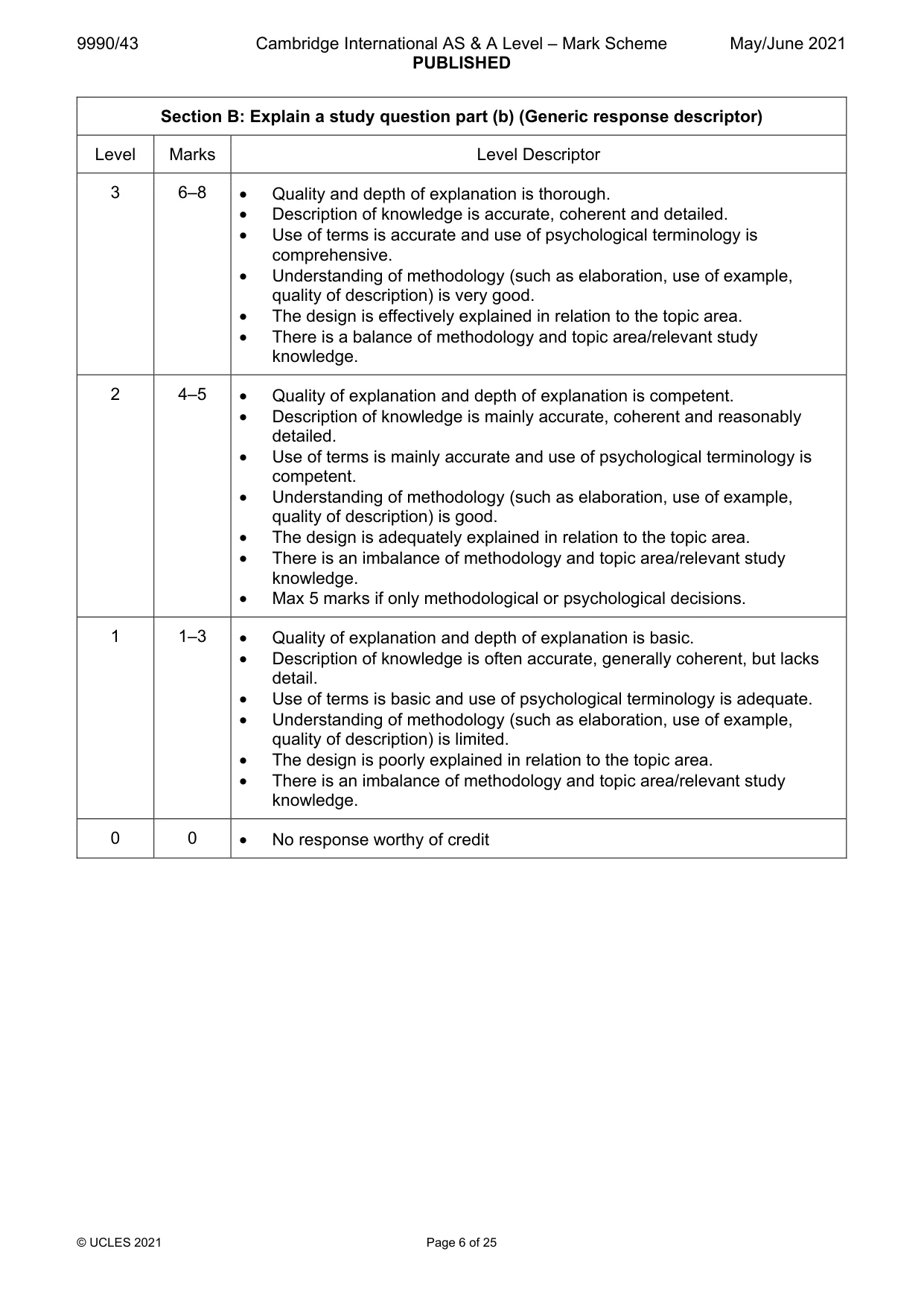
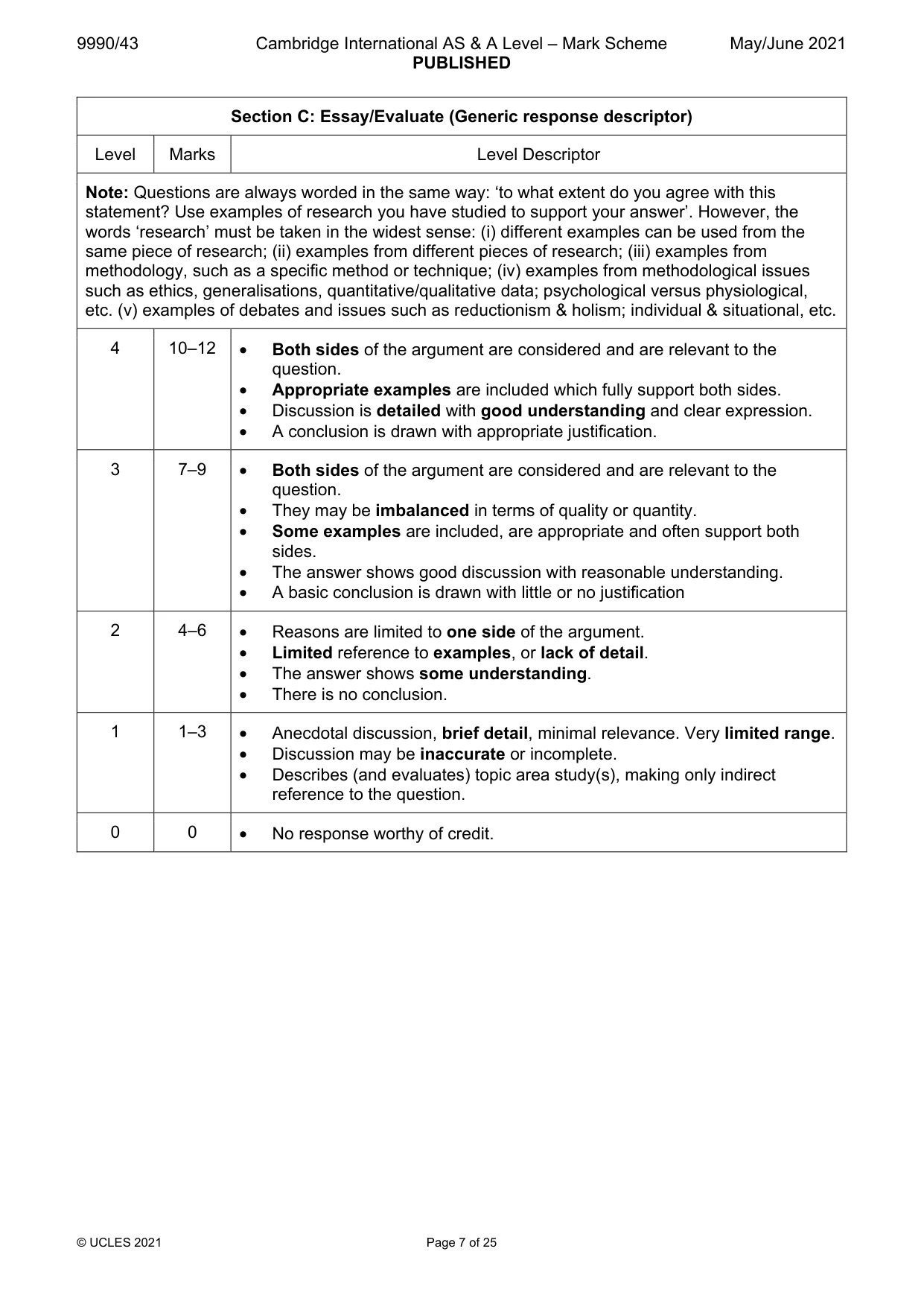
Mark scheme25 pages
Answers below. Sit the paper first if you are practising.

Questions as text
Q1 · Griffiths (2005) refers to a case of a person addicted to gambling who says: ‘If I wasn’t…
1 Griffiths (2005) refers to a case of a person addicted to gambling who says: ‘If I wasn’t actually gambling I was spending the rest of my time working out clever little schemes to obtain money to feed my habit. These two activities literally took up all my time.’ This quote is typical of gambling and many other types of addictive behaviours, including pyromania and kleptomania. (a) Explain what is meant by ‘pyromania’. [2] (b) Give two components of any addiction outlined by Griffiths (2005). [4] (c) Suggest two ways to measure a person’s addiction to gambling, other than using a questionnaire. [4] (d) Discuss the strengths and weaknesses of using questionnaires to measure kleptomania. You should include a conclusion in your answer. [5] Psychology and consumer behaviour
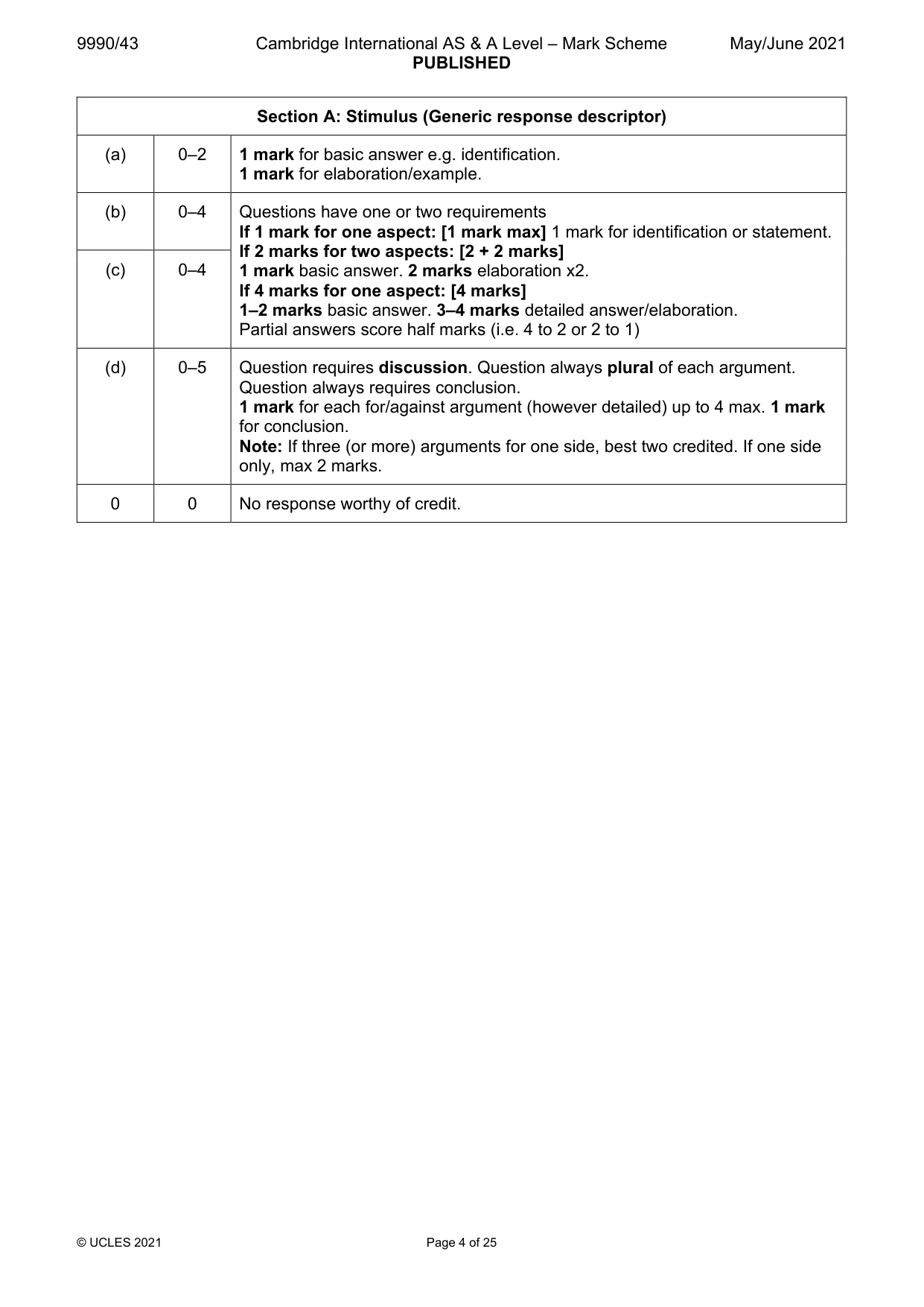
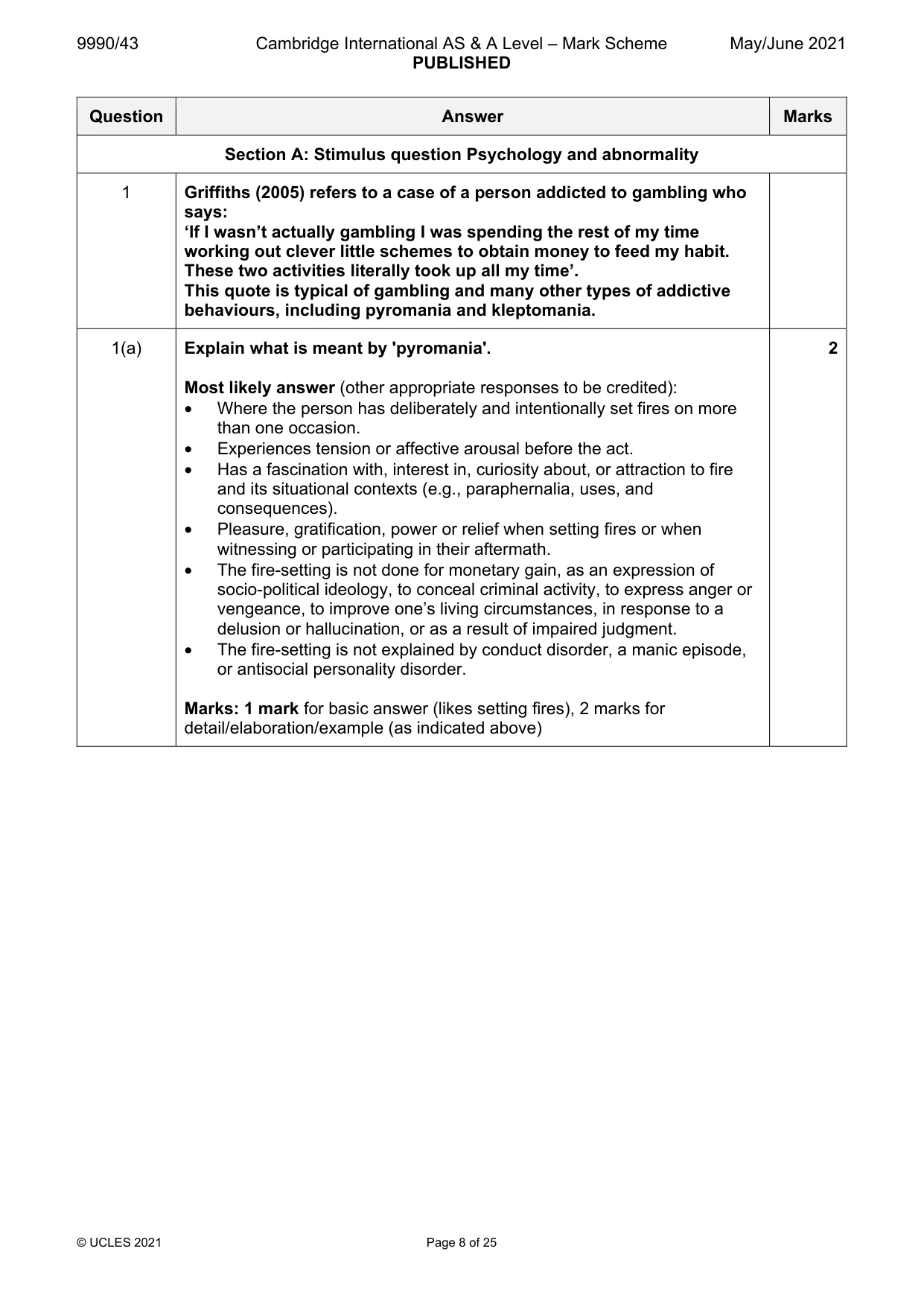
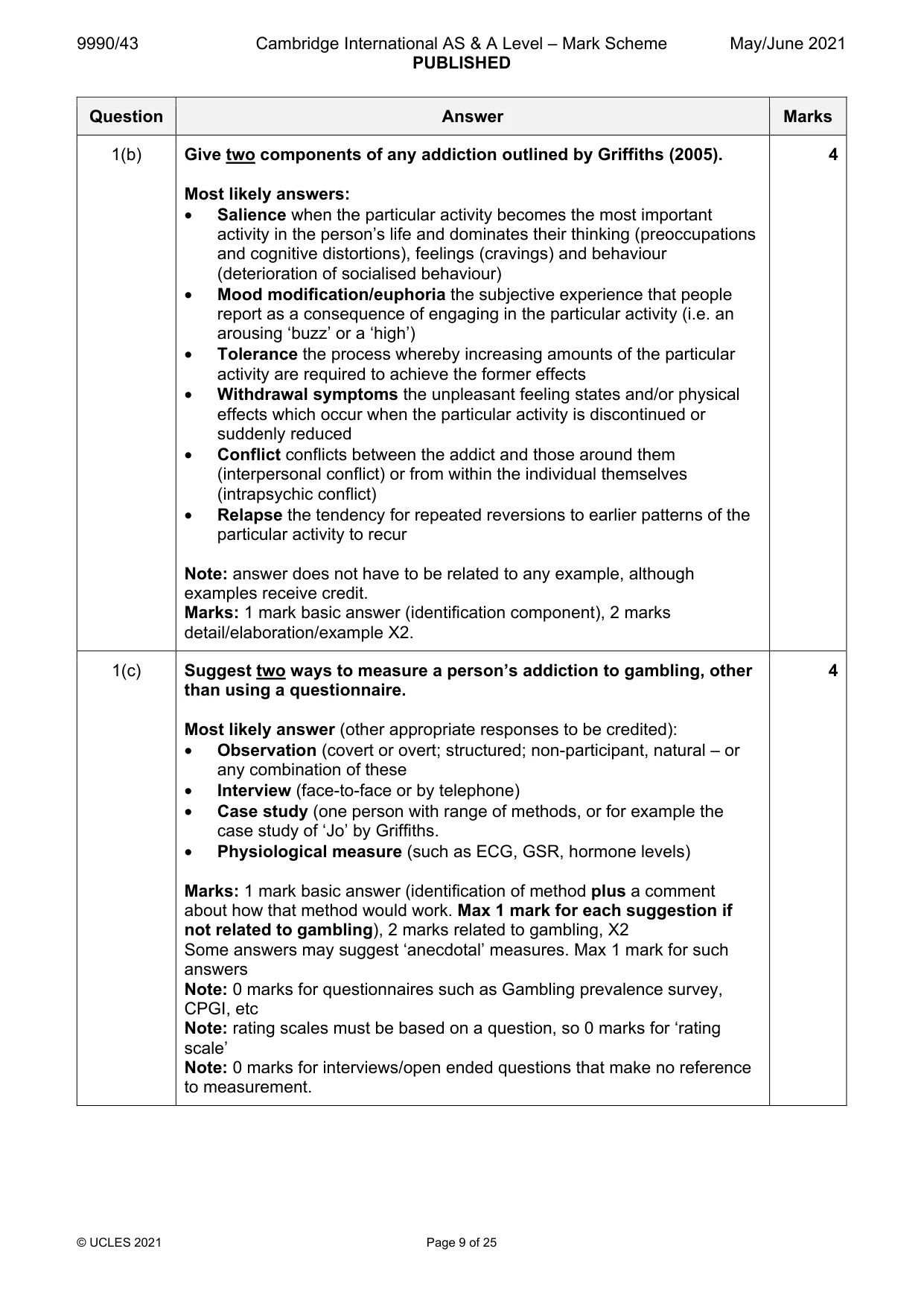
Mark scheme: Question Answer Marks Section A: Stimulus question Psychology and abnormality 1 Griffiths (2005) refers to a case of a person addicted to gambling who says: ‘If I wasn’t actually gambling I was spending the rest of my time working out clever little schemes to obtain money to feed my habit. These two activities literally took up all my time’. This quote is typical of gambling and many other types of addictive behaviours, including pyromania and kleptomania. 1(a) Explain what is meant by 'pyromania'. 2 Most likely answer (other appropriate responses to be credited): • Where the person has deliberately and intentionally set fires on more than one occasion. • Experiences tension or affective arousal before the act. • Has a fascination with, interest in, curiosity about, or attraction to fire and its situational contexts (e.g., paraphernalia, uses, and consequences). • Pleasure, gratification, power or relief when setting fires or when witnessing or participating in their aftermath. • The fire-setting is not done for monetary gain, as an expression of socio-political ideology, to conceal criminal activity, to express anger or vengeance, to improve one’s living circumstances, in response to a delusion or hallucination, or as a result of impaired judgment. • The fire-setting is not explained by conduct disorder, a manic episode, or antisocial personality disorder. Marks: 1 mark for basic answer (likes setting fires), 2 marks for detail/elaboration/example (as indicated above) 1(b) Give two components of any addiction outlined by Griffiths (2005). 4 Most likely answers: • Salience when the particular activity becomes the most important activity in the person’s life and dominates their thinking (preoccupations and cognitive distortions), feelings (cravings) and behaviour (deterioration of socialised behaviour) • Mood modification/euphoria the subjective experience that people report as a consequence of engaging in the particular activity (i.e. an arousing ‘buzz’ or a ‘high’) • Tolerance the process whereby increasing amounts of the particular activity are required to achieve the former effects • Withdrawal symptoms the unpleasant feeling states and/or physical effects which occur when the particular activity is discontinued or suddenly reduced • Conflict conflicts between the addict and those around them (interpersonal conflict) or from within the individual themselves (intrapsychic conflict) • Relapse the tendency for repeated reversions to earlier patterns of the particular activity to recur Note: answer does not have to be related to any example, although examples receive credit. Marks: 1 mark basic answer (identification component), 2 marks detail/elaboration/example X2. 1(c) Suggest two ways to measure a person’s addiction to gambling, other 4 than using a questionnaire. Most likely answer (other appropriate responses to be credited): • Observation (covert or overt; structured; non-participant, natural – or any combination of these • Interview (face-to-face or by telephone) • Case study (one person with range of methods, or for example the case study of ‘Jo’ by Griffiths. • Physiological measure (such as ECG, GSR, hormone levels) Marks: 1 mark basic answer (identification of method plus a comment about how that method would work. Max 1 mark for each suggestion if not related to gambling), 2 marks related to gambling, X2 Some answers may suggest ‘anecdotal’ measures. Max 1 mark for such answers Note: 0 marks for questionnaires such as Gambling prevalence survey, CPGI, etc Note: rating scales must be based on a question, so 0 marks for ‘rating scale’ Note: 0 marks for interviews/open ended questions that make no reference to measurement. 1(d) Discuss the strengths and weaknesses of using questionnaires to 5 measure kleptomania. You should include a conclusion in your answer. Marks: 1 mark for each strength/weakness (however basic/detailed) which is related/linked to the question (max 4 marks). 1 mark for conclusion. Conclusion: any appropriate conclusion drawn from the discussion that has been presented. 1 mark if appropriate. A conclusion is a ‘decision reached by reasoning’ and so a summary of points already made scores 0 marks. Most likely answer (other appropriate responses to be credited): Strengths: • Asking people directly, using a questionnaire, especially open-ended, means that participants are given the opportunity to express their feelings about stealing and explain their stealing behaviour rather than the researcher trying to work out reasons for this behaviour from other methods • Relatively large numbers of participants can be done relatively easily in comparison to say a face-to-face interview or experiment. Questionnaires are easy to replicate. • Data can be qualitative, but may also be quantitative depending on type of question Weaknesses: • Some participants may provide socially desirable responses; not give truthful answers about their stealing behaviour; respond to demand characteristics. • Closed/fixed-choice questions may force people into choosing answers that do not reflect their true opinion and therefore may lower the validity. • Researchers have to be careful about use of leading questions; it could affect the validity of the data collected.
Question 2
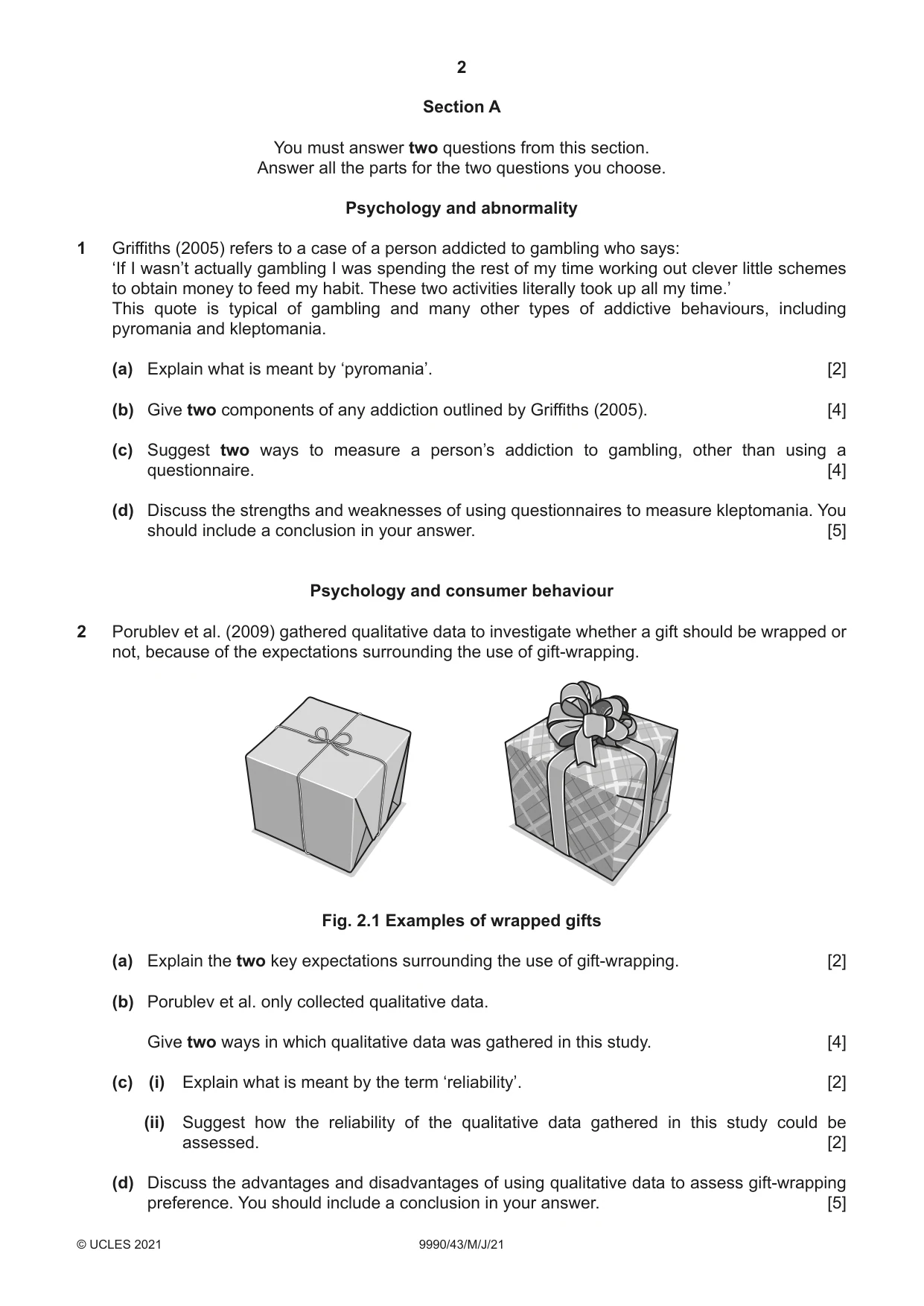
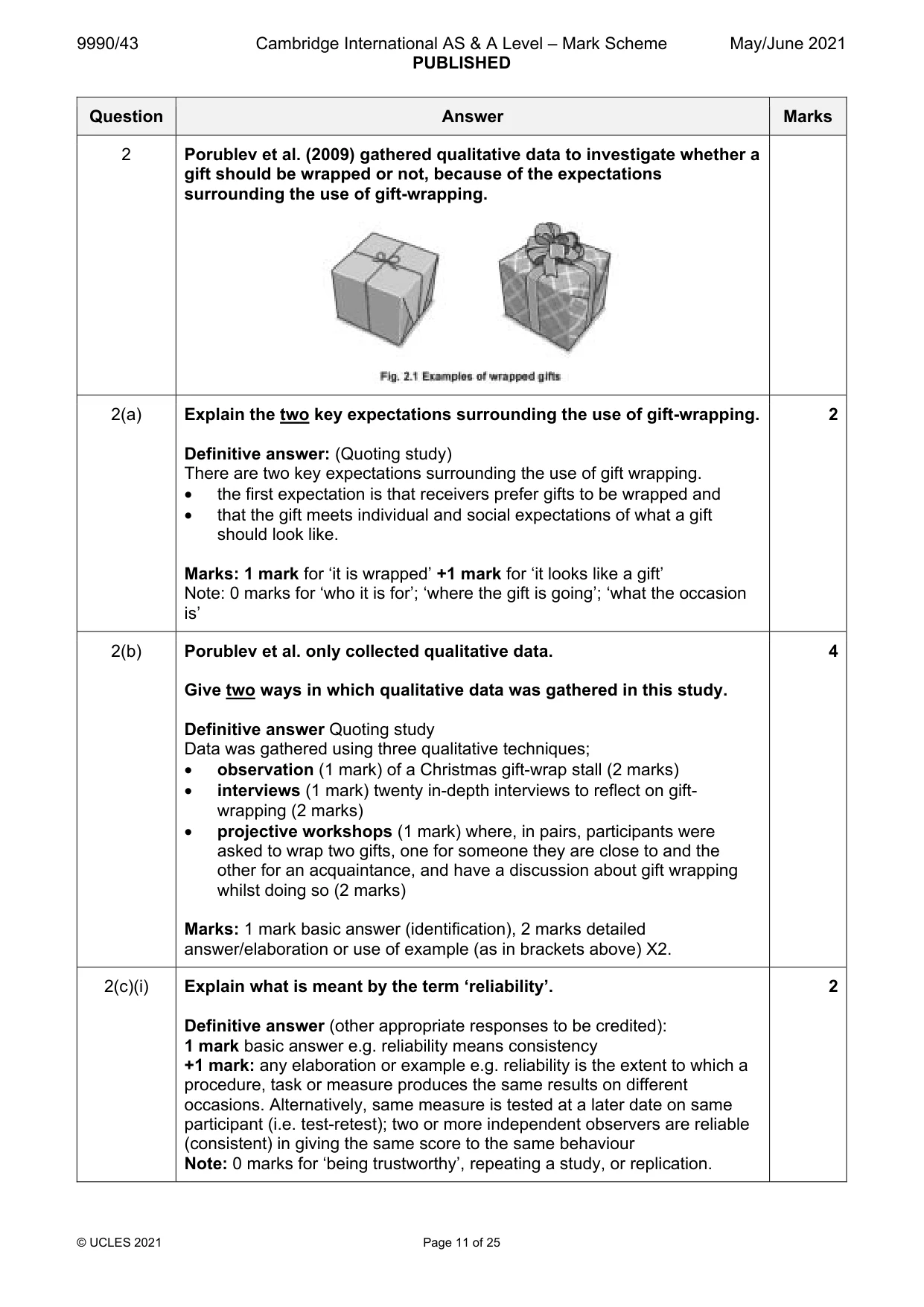
2 Porublev et al. (2009) gathered qualitative data to investigate whether a gift should be wrapped or not, because of the expectations surrounding the use of gift-wrapping. Fig. 2.1 Examples of wrapped gifts (a) Explain the two key expectations surrounding the use of gift-wrapping. [2] (b) Porublev et al. only collected qualitative data. Give two ways in which qualitative data was gathered in this study. [4] (c) (i) Explain what is meant by the term ‘reliability’. [2] (ii) Suggest how the reliability of the qualitative data gathered in this study could be assessed. [2] (d) Discuss the advantages and disadvantages of using qualitative data to assess gift-wrapping preference. You should include a conclusion in your answer. [5] Psychology and health
Mark scheme: 2 Porublev et al. (2009) gathered qualitative data to investigate whether a gift should be wrapped or not, because of the expectations surrounding the use of gift-wrapping. 2(a) Explain the two key expectations surrounding the use of gift-wrapping. 2 Definitive answer: (Quoting study) There are two key expectations surrounding the use of gift wrapping. • the first expectation is that receivers prefer gifts to be wrapped and • that the gift meets individual and social expectations of what a gift should look like. Marks: 1 mark for ‘it is wrapped’ +1 mark for ‘it looks like a gift’ Note: 0 marks for ‘who it is for’; ‘where the gift is going’; ‘what the occasion is’ 2(b) Porublev et al. only collected qualitative data. 4 Give two ways in which qualitative data was gathered in this study. Definitive answer Quoting study Data was gathered using three qualitative techniques; • observation (1 mark) of a Christmas gift-wrap stall (2 marks) • interviews (1 mark) twenty in-depth interviews to reflect on gift- wrapping (2 marks) • projective workshops (1 mark) where, in pairs, participants were asked to wrap two gifts, one for someone they are close to and the other for an acquaintance, and have a discussion about gift wrapping whilst doing so (2 marks) Marks: 1 mark basic answer (identification), 2 marks detailed answer/elaboration or use of example (as in brackets above) X2. 2(c)(i) Explain what is meant by the term ‘reliability’. 2 Definitive answer (other appropriate responses to be credited): 1 mark basic answer e.g. reliability means consistency +1 mark: any elaboration or example e.g. reliability is the extent to which a procedure, task or measure produces the same results on different occasions. Alternatively, same measure is tested at a later date on same participant (i.e. test-retest); two or more independent observers are reliable (consistent) in giving the same score to the same behaviour Note: 0 marks for ‘being trustworthy’, repeating a study, or replication. 2(c)(ii) Suggest how the reliability of the qualitative data gathered in this 2 study could be assessed. Most likely answer (other appropriate responses to be credited): • inter-rater reliability, where two or more independent judges or raters assess what is said in the interview, or what is observed, for example. This could be done with predefined response categories and the extent of agreement recorded. Note: no marks for test-retest. Marks: 1 mark basic answer, 2 marks example from ‘this study’ See Q2(b) for examples of what the qualitative data might be. 2(d) Discuss the advantages and disadvantages of using qualitative data to 5 assess gift-wrapping preference. You should include a conclusion in your answer. Marks: 1 mark for each advantage/disadvantage (however basic/detailed) which is related/linked to the question (max 4 marks). 1 mark for conclusion. Conclusion: any appropriate conclusion drawn from the discussion that has been presented. 1 mark if appropriate. A conclusion is a ‘decision reached by reasoning’ and so a summary of points already made scores 0 marks. Most likely answer (other appropriate responses to be credited, such as eye movement patterns): Advantages • Asking people directly means that participants are given the opportunity to express their feelings and explain their experiences rather than the researcher trying to work out reasons for their behaviour from other methods • People can give as much information as they wish about their gift- wrapping preferences, but they can also say little or nothing if they wish. • Data can be qualitative, but may also be quantitative depending on type of question Disadvantages • Some participants may provide socially desirable responses about their gift-wrapping preferences; not give truthful answers; respond to demand characteristics. • Qualitative data tends not to lead to the calculation of statistics to allow comparison. • Researchers have to be careful about use of leading questions; it could affect the validity of the data collected.
Q3 · Newspaper headline: Doctors with a directing style give more satisfaction
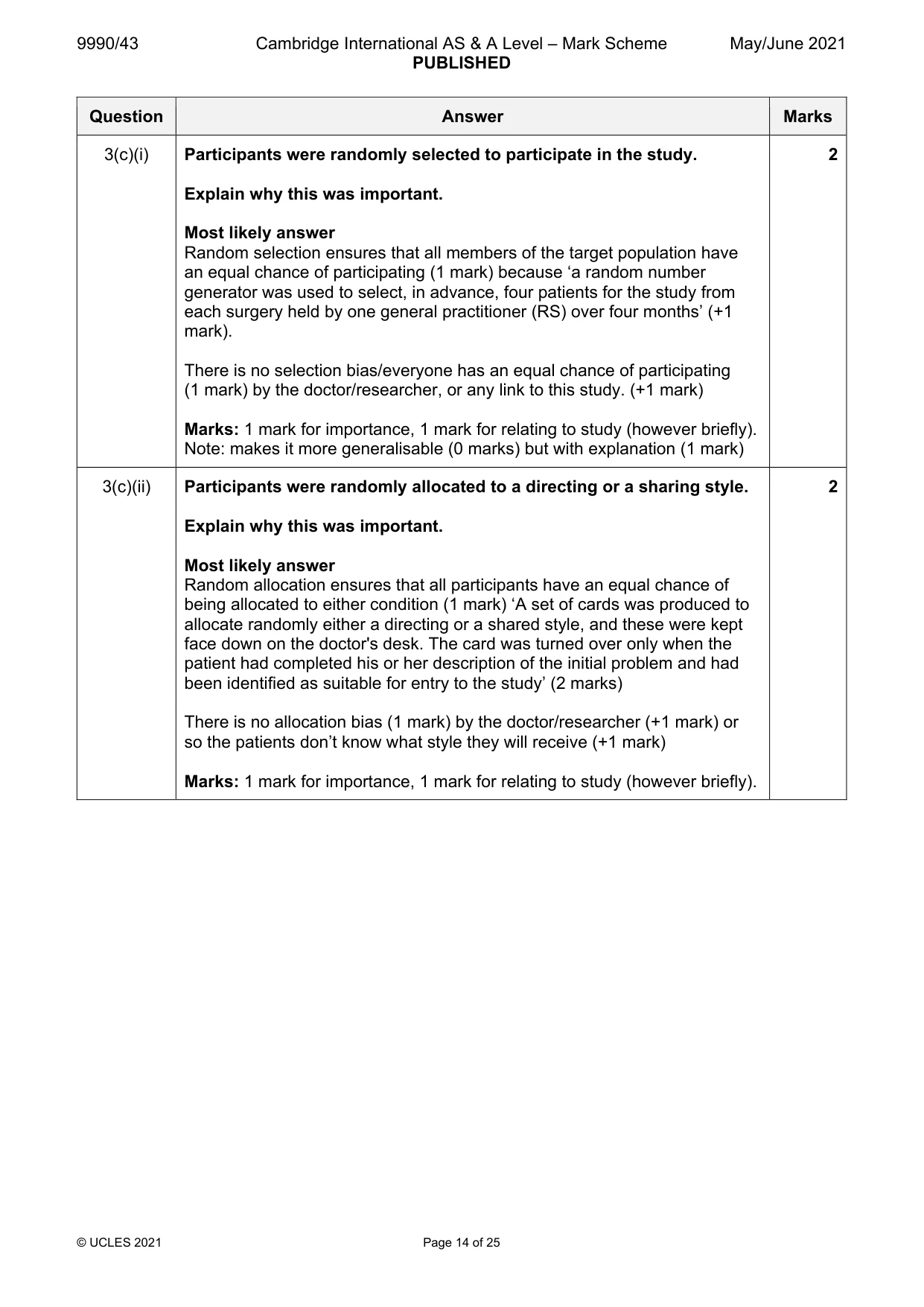
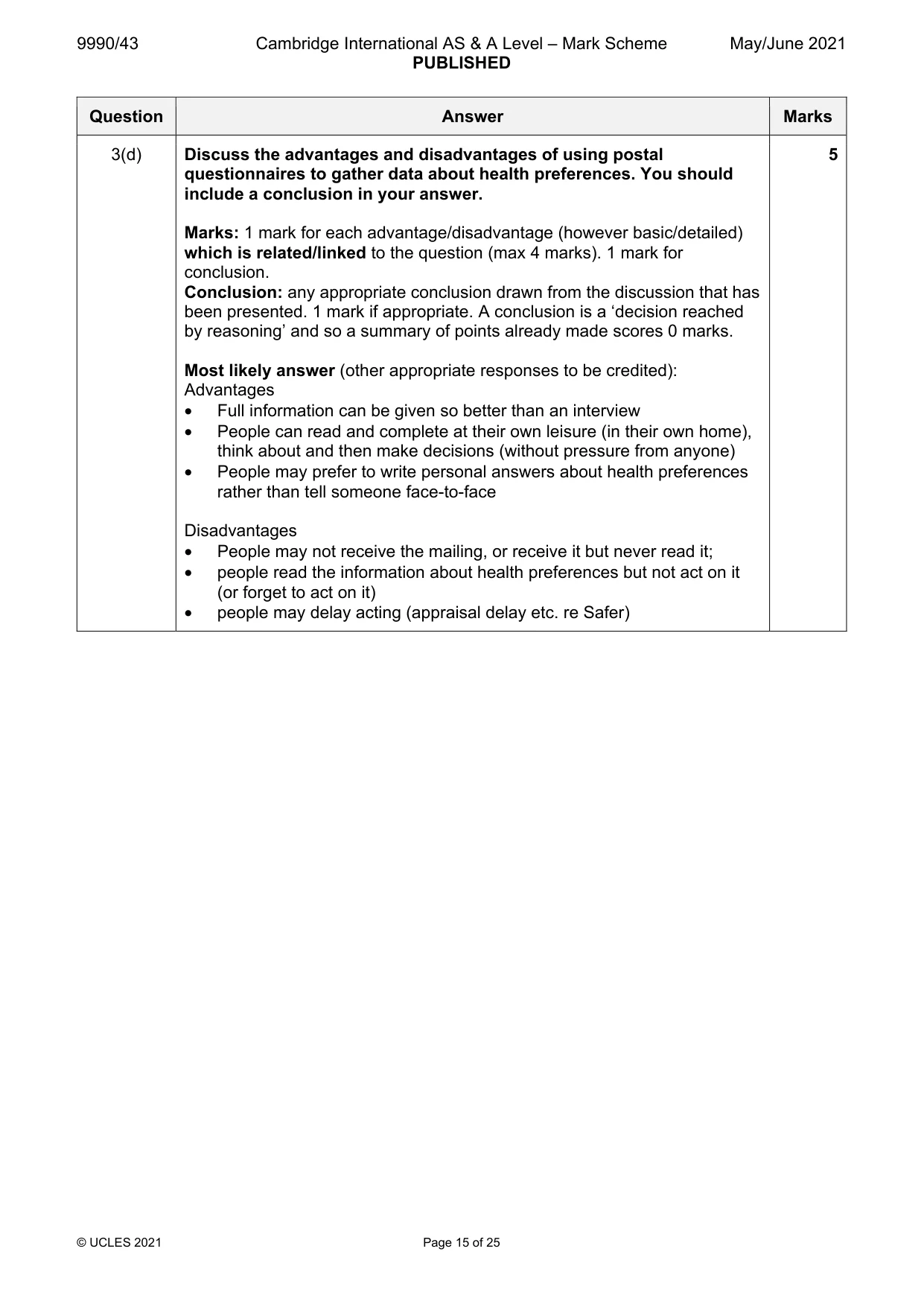
3 Newspaper headline: Doctors with a directing style give more satisfaction. Savage and Armstrong (1990) studied patient satisfaction with different consultation styles. Patients who received a directing style consultation reported significantly higher levels of satisfaction on almost all measures, compared with those who received a sharing style consultation. (a) Explain what method was used to assess patient satisfaction in the study by Savage and Armstrong (1990). [2] (b) Explain two reasons why the number of participants used in the analysis of results was lower than the original number of participants. [4] (c) (i) Participants were randomly selected to participate in the study. Explain why this was important. [2] (ii) Participants were randomly allocated to a directing or a sharing style. Explain why this was important. [2] (d) Discuss the advantages and disadvantages of using postal questionnaires to gather data about health preferences. You should include a conclusion in your answer. [5] Psychology and organisations
Mark scheme: 3 Newspaper headline: Doctors with a directing style give more satisfaction. Savage and Armstrong (1990) studied patient satisfaction with different consultation styles. Patients who received a directing style consultation reported significantly higher levels of satisfaction on almost all measures, compared with those who received a sharing style consultation. 3(a) Explain what method was used to assess patient satisfaction in the 2 study by Savage and Armstrong (1990). Most likely (quotes from study) • Patients’ satisfaction was measured by a questionnaire completed by the patients that asked about the quality of communication in the consultation and thoughts after the consultation was over. • The patient was asked to complete the questionnaire in the waiting room and give it to the receptionist before leaving the surgery. A second questionnaire with a stamped addressed envelope was then given to each patient with instructions to fill it in and post it after one week. Marks: 1 mark identification of questionnaire, 2 marks for elaboration/example (after the consultation was over/after one week) Note: 0 marks for interview or any other method. Do not credit ‘self-report’ as this is too vague. 3(b) Explain two reasons why the number of participants used in the 4 analysis of results was lower than the original number of participants. Most likely answer (other appropriate responses to be credited): Quoting from study Overall, 359 patients were invited to take part in the study. • 4 declined to participate (did not give consent or withdrew) • 5 were excluded (reasons included schizophrenia and manic depression) • 30 patients failed to complete the initial assessment (in the waiting room) • 120 failed to complete the assessment a week later (the postal questionnaire). Marks: 1 mark for: basic statement, 2 marks for elaboration/example Note: numbers not needed to score full marks; approximate numbers are acceptable when quoted. Note: withdrawal/consent are same point, so 1 mark if both identified. 3(c)(i) Participants were randomly selected to participate in the study. 2 Explain why this was important. Most likely answer Random selection ensures that all members of the target population have an equal chance of participating (1 mark) because ‘a random number generator was used to select, in advance, four patients for the study from each surgery held by one general practitioner (RS) over four months’ (+1 mark). There is no selection bias/everyone has an equal chance of participating (1 mark) by the doctor/researcher, or any link to this study. (+1 mark) Marks: 1 mark for importance, 1 mark for relating to study (however briefly). Note: makes it more generalisable (0 marks) but with explanation (1 mark) 3(c)(ii) Participants were randomly allocated to a directing or a sharing style. 2 Explain why this was important. Most likely answer Random allocation ensures that all participants have an equal chance of being allocated to either condition (1 mark) ‘A set of cards was produced to allocate randomly either a directing or a shared style, and these were kept face down on the doctor's desk. The card was turned over only when the patient had completed his or her description of the initial problem and had been identified as suitable for entry to the study’ (2 marks) There is no allocation bias (1 mark) by the doctor/researcher (+1 mark) or so the patients don’t know what style they will receive (+1 mark) Marks: 1 mark for importance, 1 mark for relating to study (however briefly). 3(d) Discuss the advantages and disadvantages of using postal 5 questionnaires to gather data about health preferences. You should include a conclusion in your answer. Marks: 1 mark for each advantage/disadvantage (however basic/detailed) which is related/linked to the question (max 4 marks). 1 mark for conclusion. Conclusion: any appropriate conclusion drawn from the discussion that has been presented. 1 mark if appropriate. A conclusion is a ‘decision reached by reasoning’ and so a summary of points already made scores 0 marks. Most likely answer (other appropriate responses to be credited): Advantages • Full information can be given so better than an interview • People can read and complete at their own leisure (in their own home), think about and then make decisions (without pressure from anyone) • People may prefer to write personal answers about health preferences rather than tell someone face-to-face Disadvantages • People may not receive the mailing, or receive it but never read it; • people read the information about health preferences but not act on it (or forget to act on it) • people may delay acting (appraisal delay etc. re Safer)
Q4 · In the 1920s, scientific management studies were conducted at the Hawthorne Plant of the…
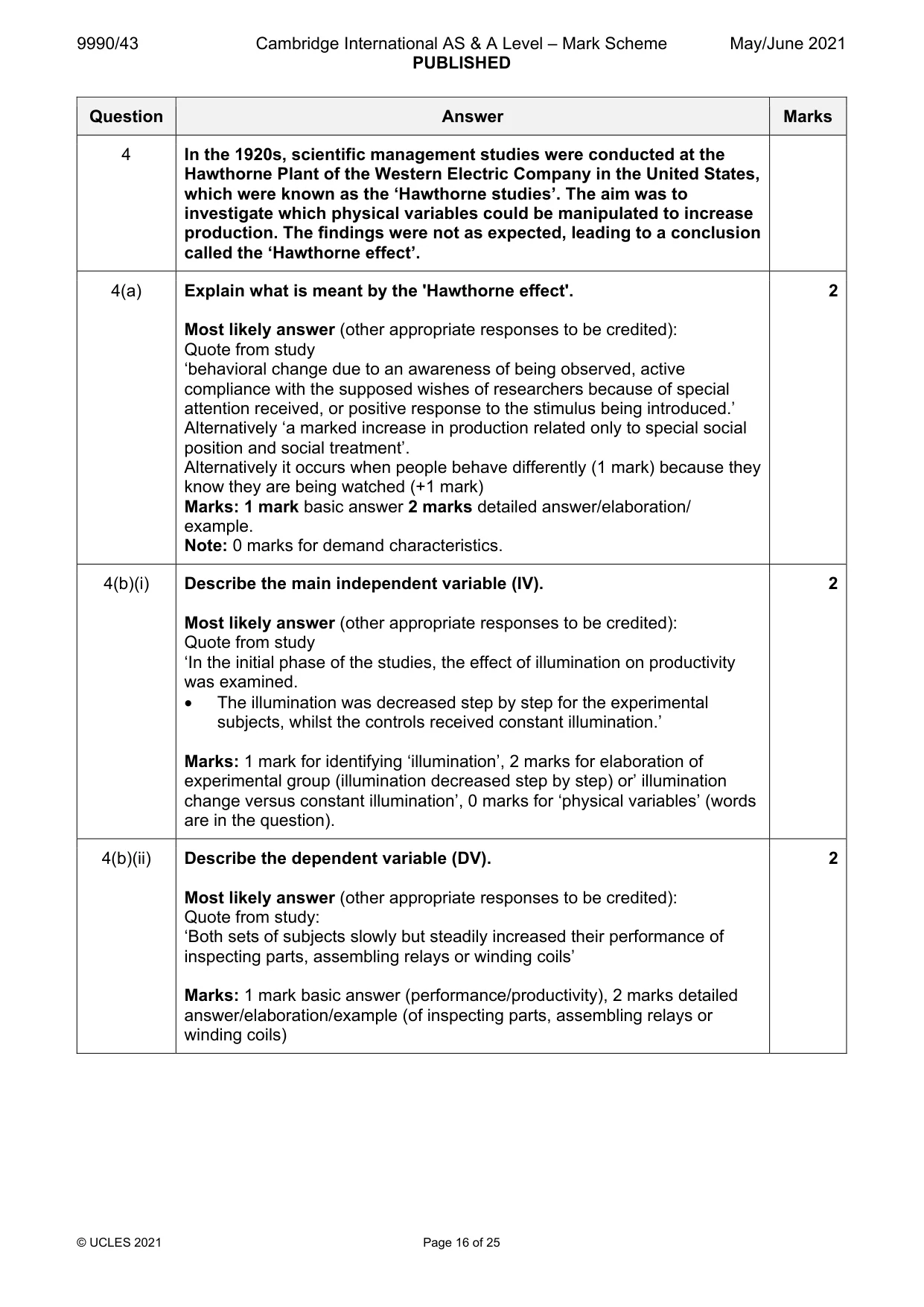
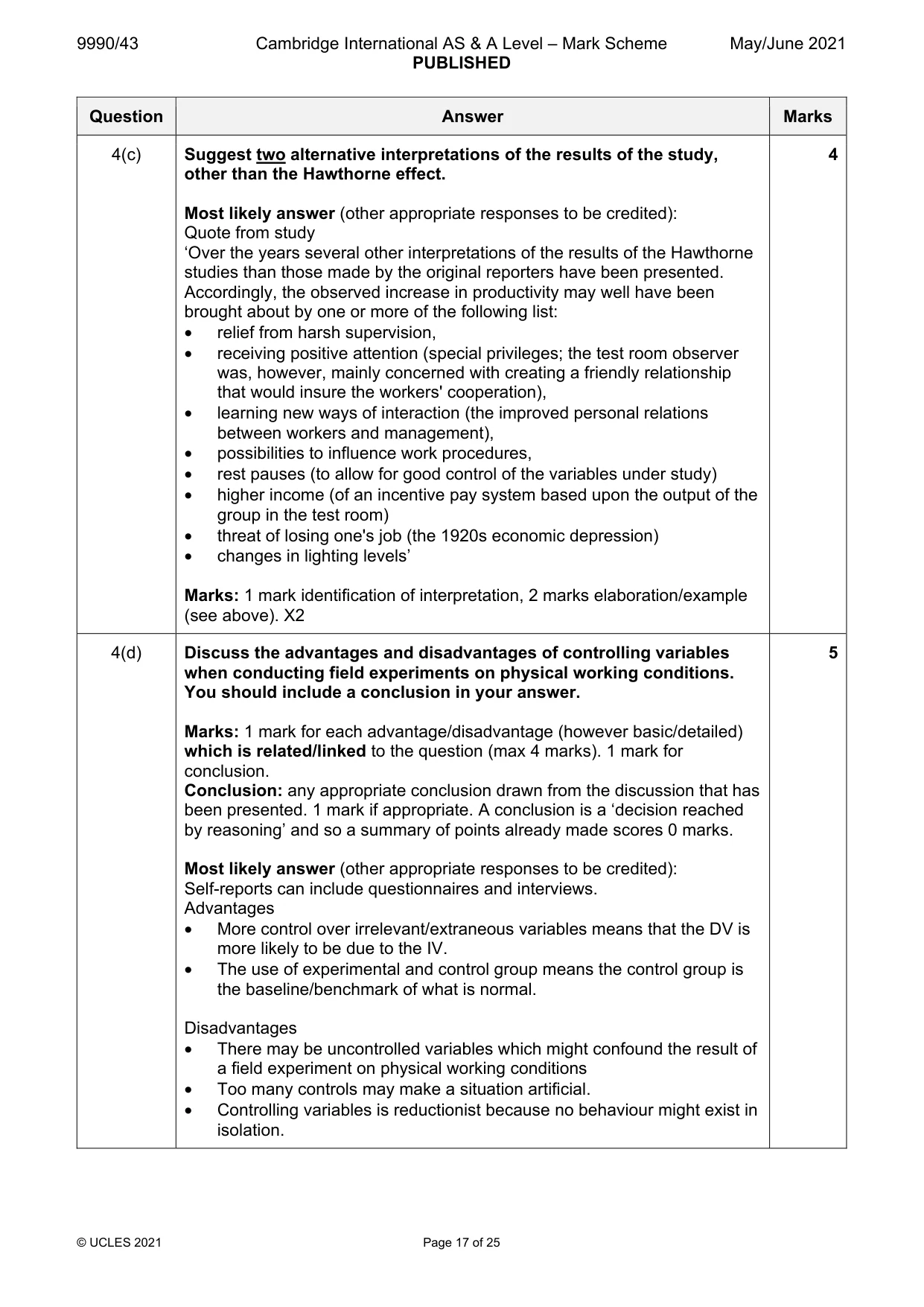
4 In the 1920s, scientific management studies were conducted at the Hawthorne Plant of the Western Electric Company in the United States, which were known as the ‘Hawthorne studies’. The aim was to investigate which physical variables could be manipulated to increase production. The findings were not as expected, leading to a conclusion called the ‘Hawthorne effect’. (a) Explain what is meant by the ‘Hawthorne effect’. [2] (b) (i) Describe the main independent variable (IV). [2] (ii) Describe the dependent variable (DV). [2] (c) Suggest two alternative interpretations of the results of the study, other than the Hawthorne effect. [4] (d) Discuss the advantages and disadvantages of controlling variables when conducting field experiments on physical working conditions. You should include a conclusion in your answer. [5]
Mark scheme: 4 In the 1920s, scientific management studies were conducted at the Hawthorne Plant of the Western Electric Company in the United States, which were known as the ‘Hawthorne studies’. The aim was to investigate which physical variables could be manipulated to increase production. The findings were not as expected, leading to a conclusion called the ‘Hawthorne effect’. 4(a) Explain what is meant by the 'Hawthorne effect'. 2 Most likely answer (other appropriate responses to be credited): Quote from study ‘behavioral change due to an awareness of being observed, active compliance with the supposed wishes of researchers because of special attention received, or positive response to the stimulus being introduced.’ Alternatively ‘a marked increase in production related only to special social position and social treatment’. Alternatively it occurs when people behave differently (1 mark) because they know they are being watched (+1 mark) Marks: 1 mark basic answer 2 marks detailed answer/elaboration/ example. Note: 0 marks for demand characteristics. 4(b)(i) Describe the main independent variable (IV). 2 Most likely answer (other appropriate responses to be credited): Quote from study ‘In the initial phase of the studies, the effect of illumination on productivity was examined. • The illumination was decreased step by step for the experimental subjects, whilst the controls received constant illumination.’ Marks: 1 mark for identifying ‘illumination’, 2 marks for elaboration of experimental group (illumination decreased step by step) or’ illumination change versus constant illumination’, 0 marks for ‘physical variables’ (words are in the question). 4(b)(ii) Describe the dependent variable (DV). 2 Most likely answer (other appropriate responses to be credited): Quote from study: ‘Both sets of subjects slowly but steadily increased their performance of inspecting parts, assembling relays or winding coils’ Marks: 1 mark basic answer (performance/productivity), 2 marks detailed answer/elaboration/example (of inspecting parts, assembling relays or winding coils) 4(c) Suggest two alternative interpretations of the results of the study, 4 other than the Hawthorne effect. Most likely answer (other appropriate responses to be credited): Quote from study ‘Over the years several other interpretations of the results of the Hawthorne studies than those made by the original reporters have been presented. Accordingly, the observed increase in productivity may well have been brought about by one or more of the following list: • relief from harsh supervision, • receiving positive attention (special privileges; the test room observer was, however, mainly concerned with creating a friendly relationship that would insure the workers' cooperation), • learning new ways of interaction (the improved personal relations between workers and management), • possibilities to influence work procedures, • rest pauses (to allow for good control of the variables under study) • higher income (of an incentive pay system based upon the output of the group in the test room) • threat of losing one's job (the 1920s economic depression) • changes in lighting levels’ Marks: 1 mark identification of interpretation, 2 marks elaboration/example (see above). X2 4(d) Discuss the advantages and disadvantages of controlling variables 5 when conducting field experiments on physical working conditions. You should include a conclusion in your answer. Marks: 1 mark for each advantage/disadvantage (however basic/detailed) which is related/linked to the question (max 4 marks). 1 mark for conclusion. Conclusion: any appropriate conclusion drawn from the discussion that has been presented. 1 mark if appropriate. A conclusion is a ‘decision reached by reasoning’ and so a summary of points already made scores 0 marks. Most likely answer (other appropriate responses to be credited): Self-reports can include questionnaires and interviews. Advantages • More control over irrelevant/extraneous variables means that the DV is more likely to be due to the IV. • The use of experimental and control group means the control group is the baseline/benchmark of what is normal. Disadvantages • There may be uncontrolled variables which might confound the result of a field experiment on physical working conditions • Too many controls may make a situation artificial. • Controlling variables is reductionist because no behaviour might exist in isolation.
Q5 · Design a longitudinal study to investigate whether cognitive-behavioural therapy (CBT)…
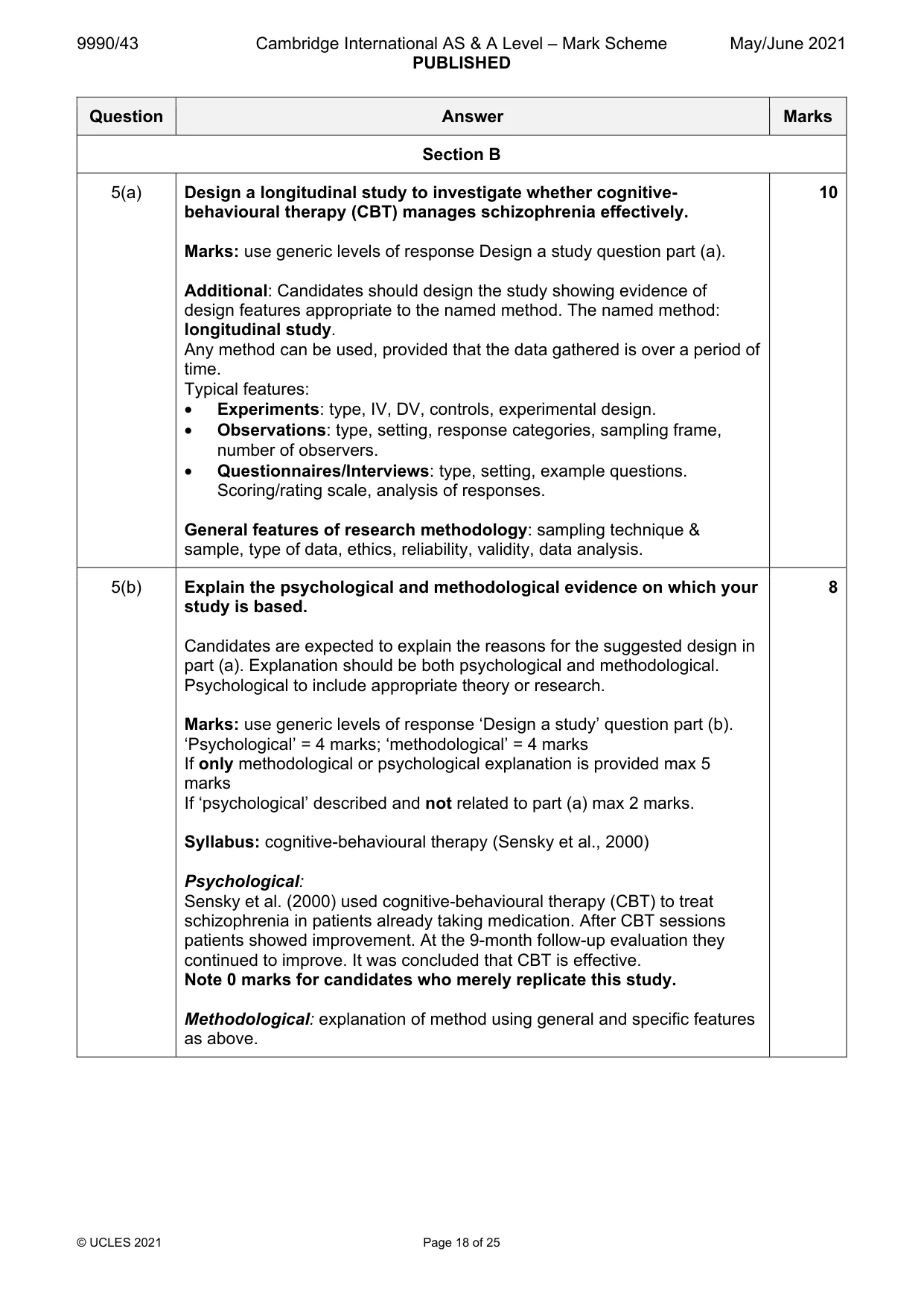
5 (a) Design a longitudinal study to investigate whether cognitive-behavioural therapy (CBT) manages schizophrenia effectively. [10] (b) Explain the psychological and methodological evidence on which your study is based. [8] Psychology and consumer behaviour
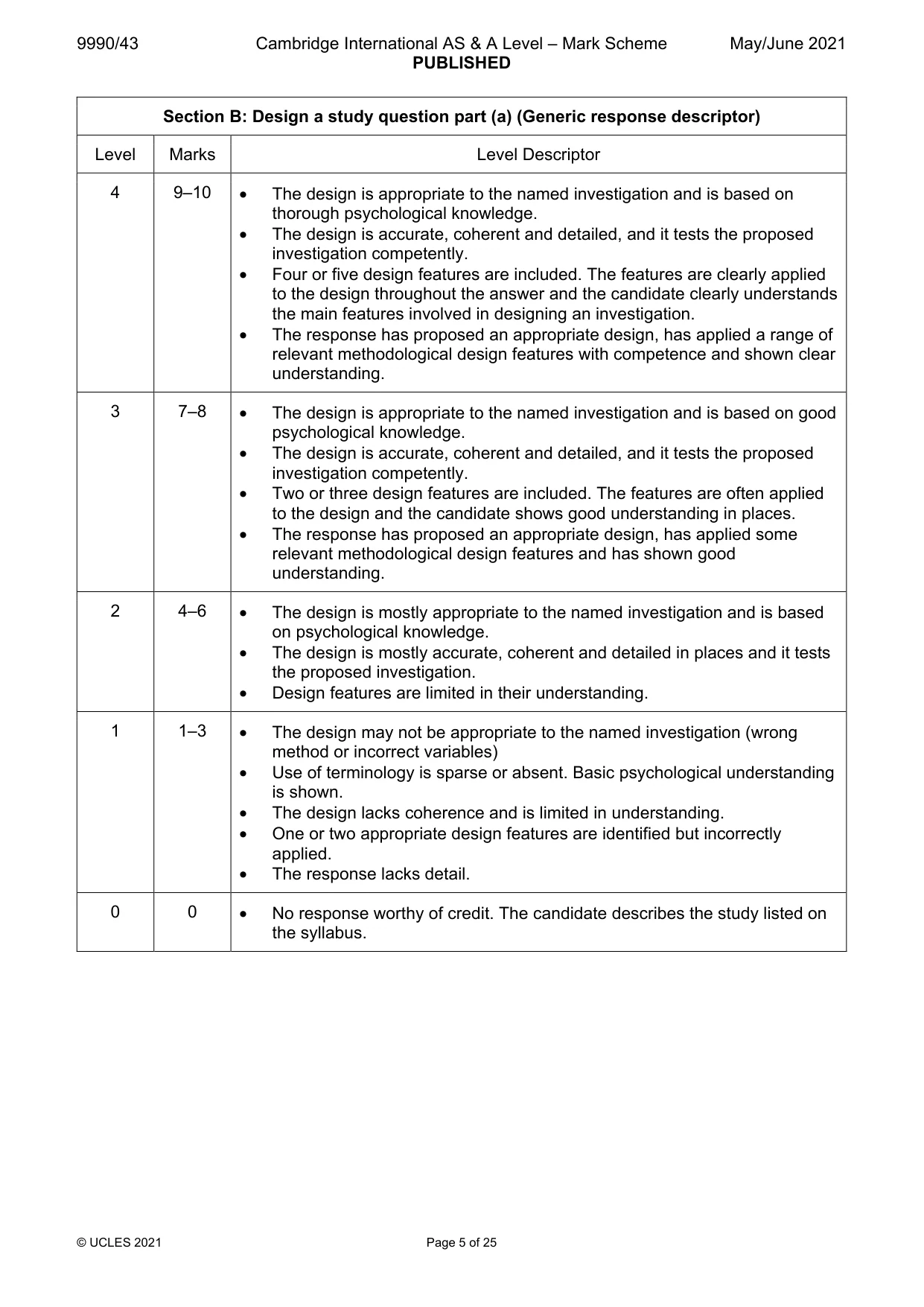
Mark scheme: 5(a) Design a longitudinal study to investigate whether cognitive- 10 behavioural therapy (CBT) manages schizophrenia effectively. Marks: use generic levels of response Design a study question part (a). Additional: Candidates should design the study showing evidence of design features appropriate to the named method. The named method: longitudinal study. Any method can be used, provided that the data gathered is over a period of time. Typical features: • Experiments: type, IV, DV, controls, experimental design. • Observations: type, setting, response categories, sampling frame, number of observers. • Questionnaires/Interviews: type, setting, example questions. Scoring/rating scale, analysis of responses. General features of research methodology: sampling technique & sample, type of data, ethics, reliability, validity, data analysis. 5(b) Explain the psychological and methodological evidence on which your 8 study is based. Candidates are expected to explain the reasons for the suggested design in part (a). Explanation should be both psychological and methodological. Psychological to include appropriate theory or research. Marks: use generic levels of response ‘Design a study’ question part (b). ‘Psychological’ = 4 marks; ‘methodological’ = 4 marks If only methodological or psychological explanation is provided max 5 marks If ‘psychological’ described and not related to part (a) max 2 marks. Syllabus: cognitive-behavioural therapy (Sensky et al., 2000) Psychological: Sensky et al. (2000) used cognitive-behavioural therapy (CBT) to treat schizophrenia in patients already taking medication. After CBT sessions patients showed improvement. At the 9-month follow-up evaluation they continued to improve. It was concluded that CBT is effective. Note 0 marks for candidates who merely replicate this study. Methodological: explanation of method using general and specific features as above.
Q6 · People often experience discomfort when their personal space is invaded
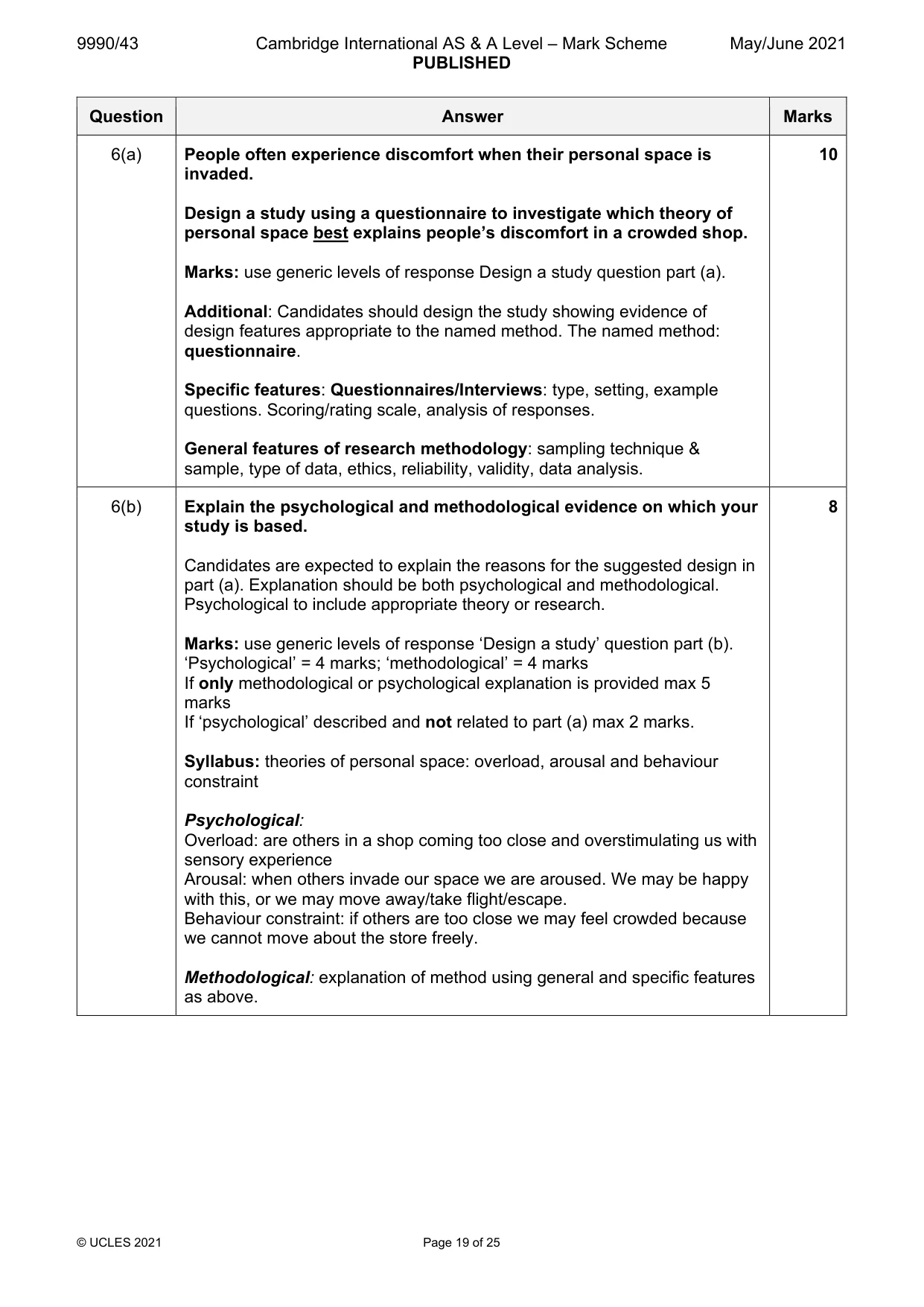
6 People often experience discomfort when their personal space is invaded. (a) Design a study using a questionnaire to investigate which theory of personal space best explains people’s discomfort in a crowded shop. [10] (b) Explain the psychological and methodological evidence on which your study is based. [8] Psychology and health
Mark scheme: 6(a) People often experience discomfort when their personal space is 10 invaded. Design a study using a questionnaire to investigate which theory of personal space best explains people’s discomfort in a crowded shop. Marks: use generic levels of response Design a study question part (a). Additional: Candidates should design the study showing evidence of design features appropriate to the named method. The named method: questionnaire. Specific features: Questionnaires/Interviews: type, setting, example questions. Scoring/rating scale, analysis of responses. General features of research methodology: sampling technique & sample, type of data, ethics, reliability, validity, data analysis. 6(b) Explain the psychological and methodological evidence on which your 8 study is based. Candidates are expected to explain the reasons for the suggested design in part (a). Explanation should be both psychological and methodological. Psychological to include appropriate theory or research. Marks: use generic levels of response ‘Design a study’ question part (b). ‘Psychological’ = 4 marks; ‘methodological’ = 4 marks If only methodological or psychological explanation is provided max 5 marks If ‘psychological’ described and not related to part (a) max 2 marks. Syllabus: theories of personal space: overload, arousal and behaviour constraint Psychological: Overload: are others in a shop coming too close and overstimulating us with sensory experience Arousal: when others invade our space we are aroused. We may be happy with this, or we may move away/take flight/escape. Behaviour constraint: if others are too close we may feel crowded because we cannot move about the store freely. Methodological: explanation of method using general and specific features as above.
Question 7
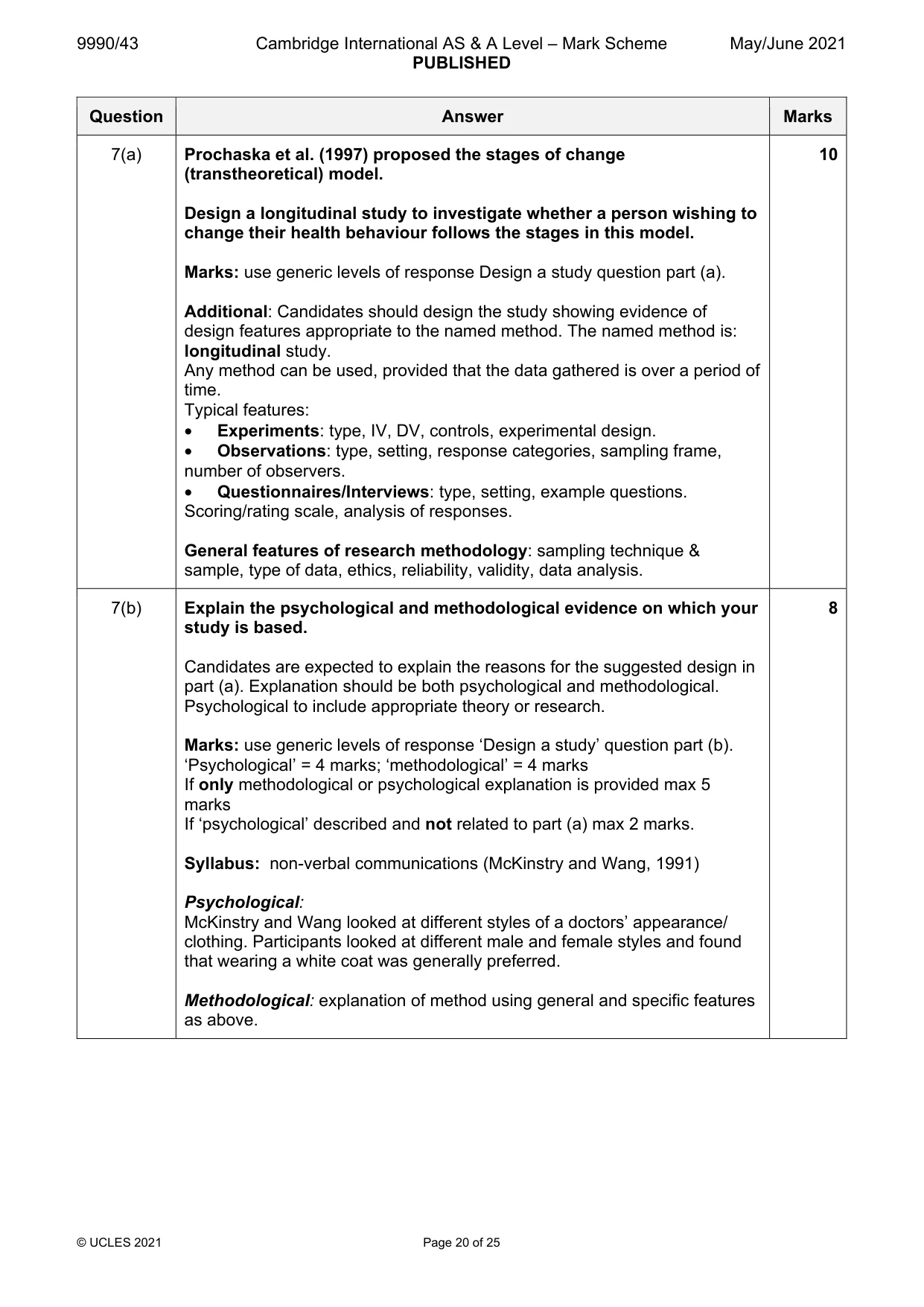
7 Prochaska et al. (1997) proposed the stages of change (transtheoretical) model. (a) Design a longitudinal study to investigate whether a person wishing to change their health behaviour follows the stages in this model. [10] (b) Explain the psychological and methodological evidence on which your study is based. [8] Psychology and organisations
Mark scheme: 7(a) Prochaska et al. (1997) proposed the stages of change 10 (transtheoretical) model. Design a longitudinal study to investigate whether a person wishing to change their health behaviour follows the stages in this model. Marks: use generic levels of response Design a study question part (a). Additional: Candidates should design the study showing evidence of design features appropriate to the named method. The named method is: longitudinal study. Any method can be used, provided that the data gathered is over a period of time. Typical features: • Experiments: type, IV, DV, controls, experimental design. • Observations: type, setting, response categories, sampling frame, number of observers. • Questionnaires/Interviews: type, setting, example questions. Scoring/rating scale, analysis of responses. General features of research methodology: sampling technique & sample, type of data, ethics, reliability, validity, data analysis. 7(b) Explain the psychological and methodological evidence on which your 8 study is based. Candidates are expected to explain the reasons for the suggested design in part (a). Explanation should be both psychological and methodological. Psychological to include appropriate theory or research. Marks: use generic levels of response ‘Design a study’ question part (b). ‘Psychological’ = 4 marks; ‘methodological’ = 4 marks If only methodological or psychological explanation is provided max 5 marks If ‘psychological’ described and not related to part (a) max 2 marks. Syllabus: non-verbal communications (McKinstry and Wang, 1991) Psychological: McKinstry and Wang looked at different styles of a doctors’ appearance/ clothing. Participants looked at different male and female styles and found that wearing a white coat was generally preferred. Methodological: explanation of method using general and specific features as above.
More questions on 2 Health promotion in schools and worksites
Q8 · Accidents at work may be caused by human errors or errors in operator-machine systems
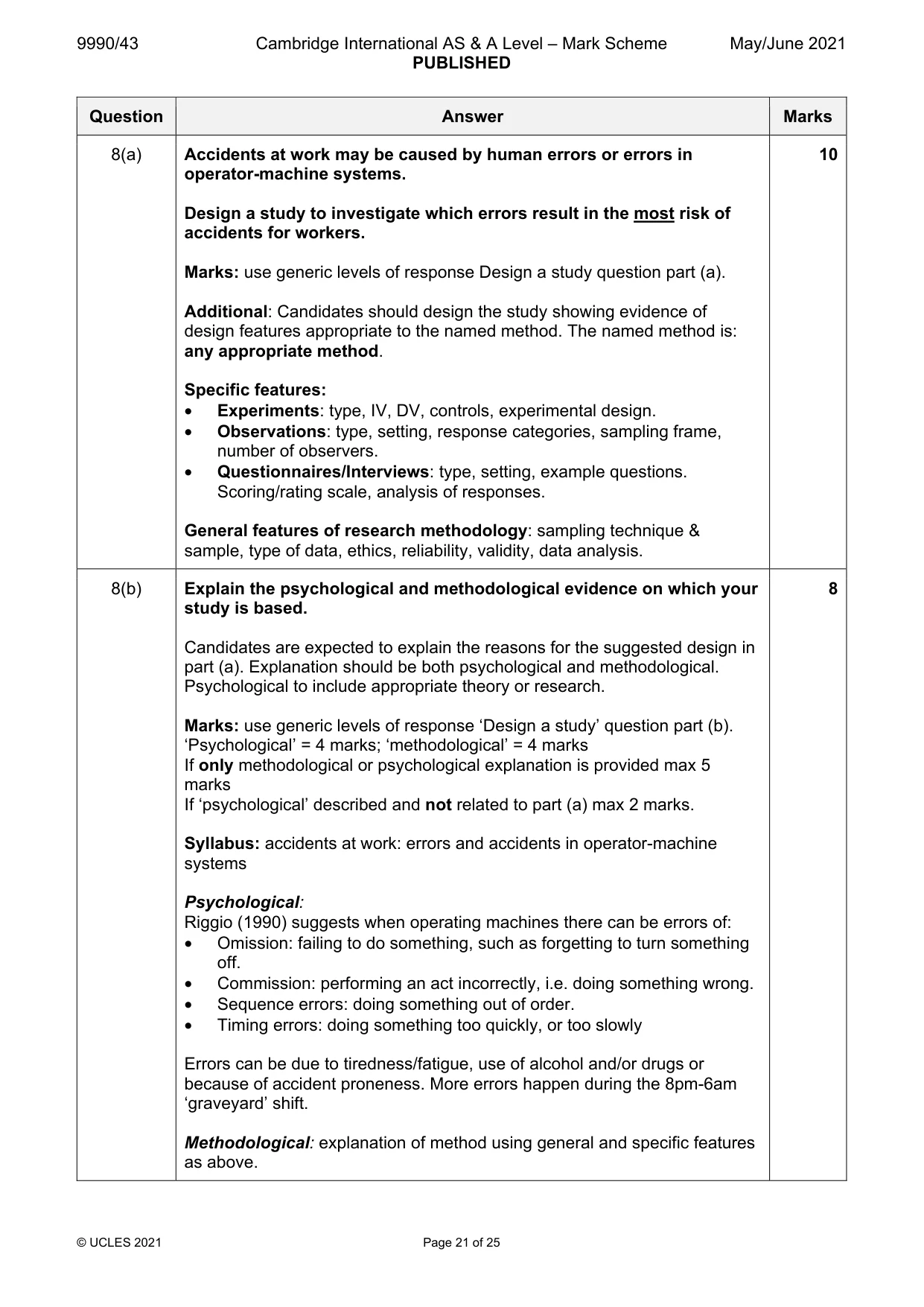
8 Accidents at work may be caused by human errors or errors in operator-machine systems. (a) Design a study to investigate which errors result in the most risk of accidents for workers. [10] (b) Explain the psychological and methodological evidence on which your study is based. [8] Section C You must answer one question from this section. Psychology and abnormality
Mark scheme: 8(a) Accidents at work may be caused by human errors or errors in 10 operator-machine systems. Design a study to investigate which errors result in the most risk of accidents for workers. Marks: use generic levels of response Design a study question part (a). Additional: Candidates should design the study showing evidence of design features appropriate to the named method. The named method is: any appropriate method. Specific features: • Experiments: type, IV, DV, controls, experimental design. • Observations: type, setting, response categories, sampling frame, number of observers. • Questionnaires/Interviews: type, setting, example questions. Scoring/rating scale, analysis of responses. General features of research methodology: sampling technique & sample, type of data, ethics, reliability, validity, data analysis. 8(b) Explain the psychological and methodological evidence on which your 8 study is based. Candidates are expected to explain the reasons for the suggested design in part (a). Explanation should be both psychological and methodological. Psychological to include appropriate theory or research. Marks: use generic levels of response ‘Design a study’ question part (b). ‘Psychological’ = 4 marks; ‘methodological’ = 4 marks If only methodological or psychological explanation is provided max 5 marks If ‘psychological’ described and not related to part (a) max 2 marks. Syllabus: accidents at work: errors and accidents in operator-machine systems Psychological: Riggio (1990) suggests when operating machines there can be errors of: • Omission: failing to do something, such as forgetting to turn something off. • Commission: performing an act incorrectly, i.e. doing something wrong. • Sequence errors: doing something out of order. • Timing errors: doing something too quickly, or too slowly Errors can be due to tiredness/fatigue, use of alcohol and/or drugs or because of accident proneness. More errors happen during the 8pm-6am ‘graveyard’ shift. Methodological: explanation of method using general and specific features as above.
Q9 · ‘Psychometric measures, such as the Kleptomania Symptom Assessment Scale (K-SAS), provide…
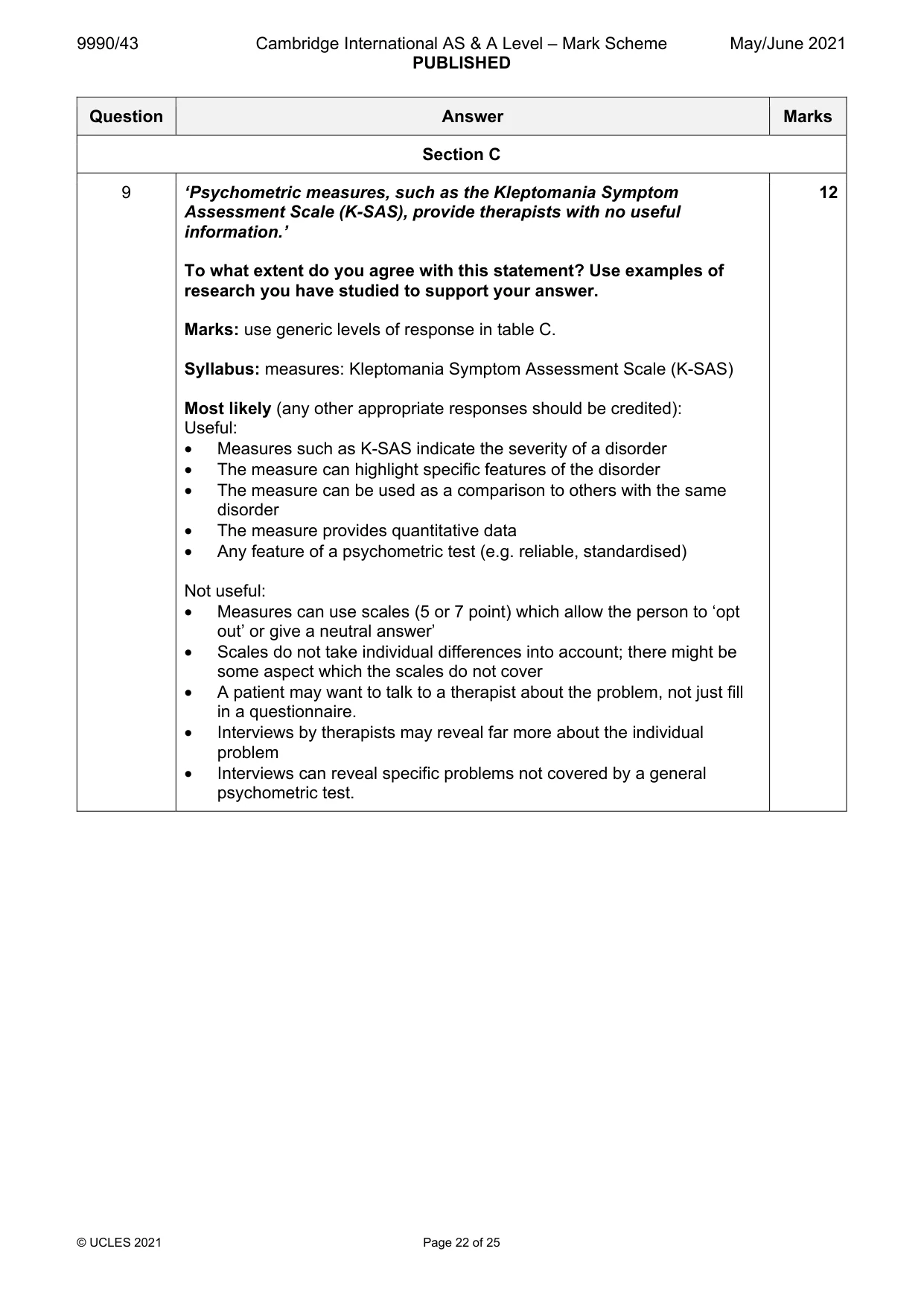
9 ‘Psychometric measures, such as the Kleptomania Symptom Assessment Scale (K-SAS), provide therapists with no useful information.’ To what extent do you agree with this statement? Use examples of research you have studied to support your answer. [12] Psychology and consumer behaviour
Mark scheme: 9 ‘Psychometric measures, such as the Kleptomania Symptom 12 Assessment Scale (K-SAS), provide therapists with no useful information.’ To what extent do you agree with this statement? Use examples of research you have studied to support your answer. Marks: use generic levels of response in table C. Syllabus: measures: Kleptomania Symptom Assessment Scale (K-SAS) Most likely (any other appropriate responses should be credited): Useful: • Measures such as K-SAS indicate the severity of a disorder • The measure can highlight specific features of the disorder • The measure can be used as a comparison to others with the same disorder • The measure provides quantitative data • Any feature of a psychometric test (e.g. reliable, standardised) Not useful: • Measures can use scales (5 or 7 point) which allow the person to ‘opt out’ or give a neutral answer’ • Scales do not take individual differences into account; there might be some aspect which the scales do not cover • A patient may want to talk to a therapist about the problem, not just fill in a questionnaire. • Interviews by therapists may reveal far more about the individual problem • Interviews can reveal specific problems not covered by a general psychometric test.
Q10 · ‘Studies like ‘defending a place in a queue’ (Milgram et al., 1986) should never be…
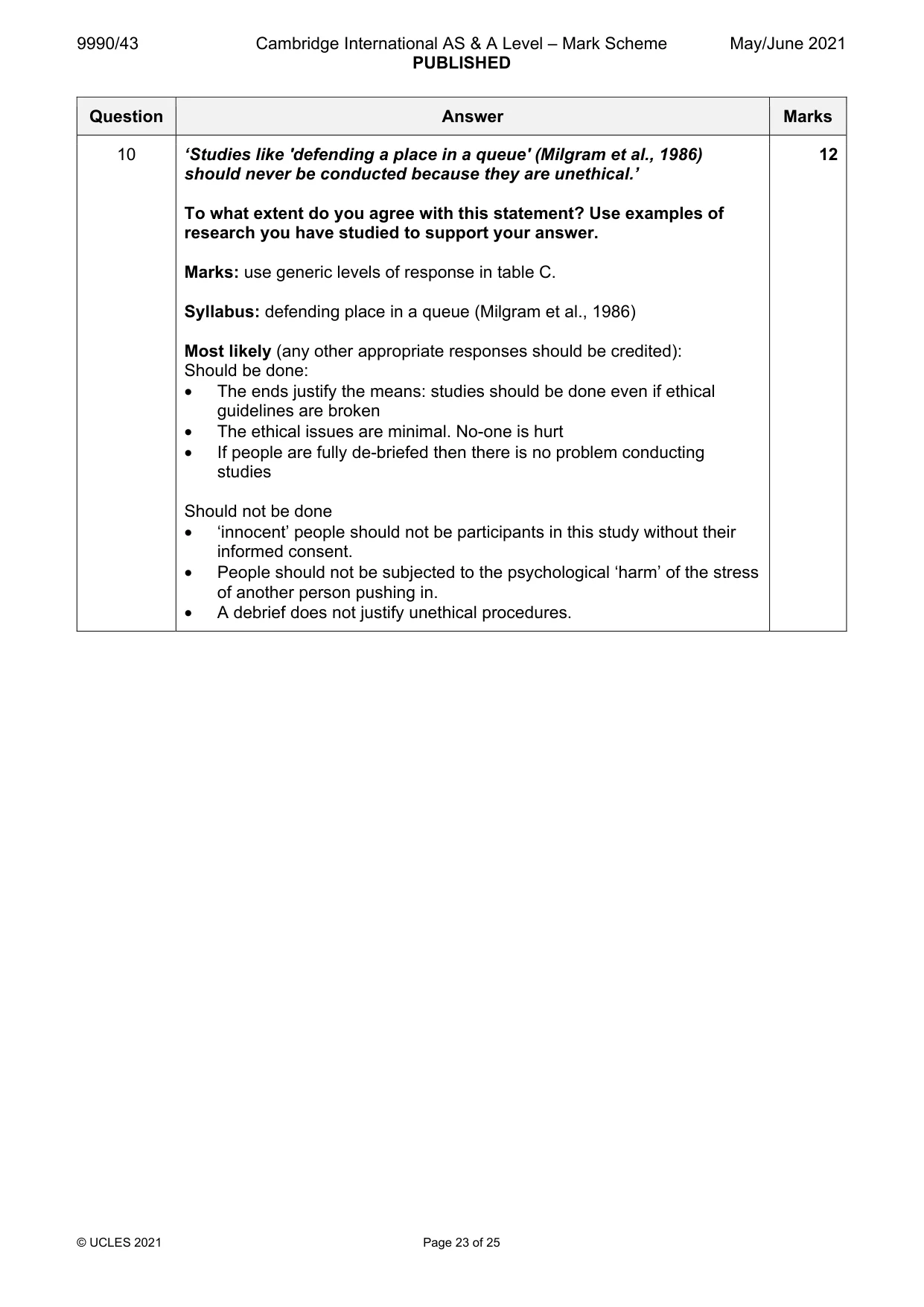
10 ‘Studies like ‘defending a place in a queue’ (Milgram et al., 1986) should never be conducted because they are unethical.’ To what extent do you agree with this statement? Use examples of research you have studied to support your answer. [12] Psychology and health
Mark scheme: 10 ‘Studies like 'defending a place in a queue' (Milgram et al., 1986) 12 should never be conducted because they are unethical.’ To what extent do you agree with this statement? Use examples of research you have studied to support your answer. Marks: use generic levels of response in table C. Syllabus: defending place in a queue (Milgram et al., 1986) Most likely (any other appropriate responses should be credited): Should be done: • The ends justify the means: studies should be done even if ethical guidelines are broken • The ethical issues are minimal. No-one is hurt • If people are fully de-briefed then there is no problem conducting studies Should not be done • ‘innocent’ people should not be participants in this study without their informed consent. • People should not be subjected to the psychological ‘harm’ of the stress of another person pushing in. • A debrief does not justify unethical procedures.
Q11 · ‘Promoting healthy eating to children in schools is irrelevant; it is more important to…
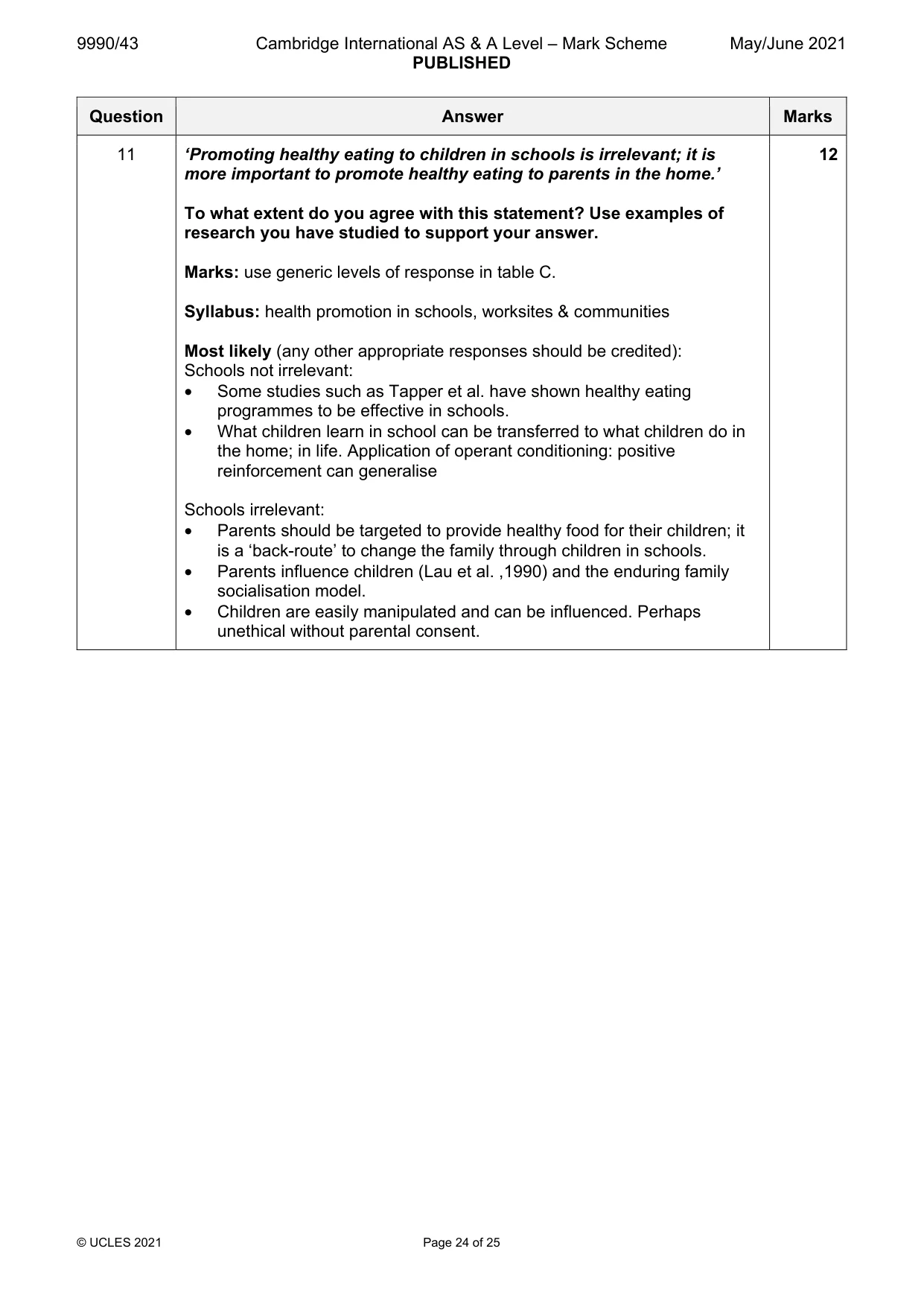
11 ‘Promoting healthy eating to children in schools is irrelevant; it is more important to promote healthy eating to parents in the home.’ To what extent do you agree with this statement? Use examples of research you have studied to support your answer. [12] Psychology and organisations
Mark scheme: 11 ‘Promoting healthy eating to children in schools is irrelevant; it is 12 more important to promote healthy eating to parents in the home.’ To what extent do you agree with this statement? Use examples of research you have studied to support your answer. Marks: use generic levels of response in table C. Syllabus: health promotion in schools, worksites & communities Most likely (any other appropriate responses should be credited): Schools not irrelevant: • Some studies such as Tapper et al. have shown healthy eating programmes to be effective in schools. • What children learn in school can be transferred to what children do in the home; in life. Application of operant conditioning: positive reinforcement can generalise Schools irrelevant: • Parents should be targeted to provide healthy food for their children; it is a ‘back-route’ to change the family through children in schools. • Parents influence children (Lau et al. ,1990) and the enduring family socialisation model. • Children are easily manipulated and can be influenced. Perhaps unethical without parental consent.
More questions on 2 Health promotion in schools and worksites
Q12 · ‘Group conflict can always be managed successfully.’ To what extent do you agree with…
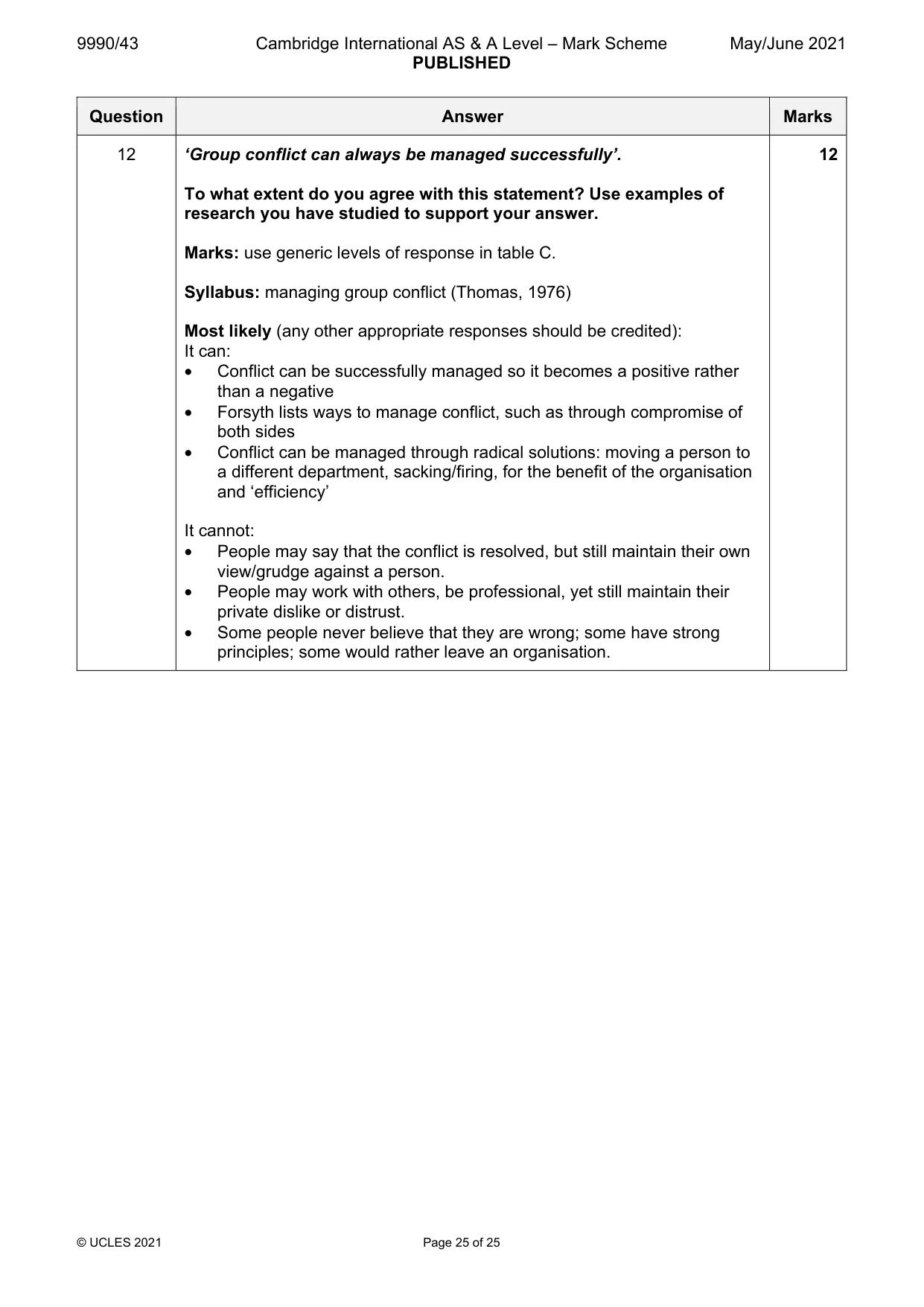
12 ‘Group conflict can always be managed successfully.’ To what extent do you agree with this statement? Use examples of research you have studied to support your answer. [12]
Mark scheme: 12 ‘Group conflict can always be managed successfully’. 12 To what extent do you agree with this statement? Use examples of research you have studied to support your answer. Marks: use generic levels of response in table C. Syllabus: managing group conflict (Thomas, 1976) Most likely (any other appropriate responses should be credited): It can: • Conflict can be successfully managed so it becomes a positive rather than a negative • Forsyth lists ways to manage conflict, such as through compromise of both sides • Conflict can be managed through radical solutions: moving a person to a different department, sacking/firing, for the benefit of the organisation and ‘efficiency’ It cannot: • People may say that the conflict is resolved, but still maintain their own view/grudge against a person. • People may work with others, be professional, yet still maintain their private dislike or distrust. • Some people never believe that they are wrong; some have strong principles; some would rather leave an organisation.
What was in this paper
The subtopics covered by these 12 questions, and how many questions each got. Open one in a new tab to see every Cambridge question on it.
What you needed in this session
Cambridge’s own grade thresholds for 2021 May/June, Paper 4 · Variant 3. A higher threshold means an easier paper — the bar moves with how the cohort did.