Cambridge A Level Psychology (from 2018) 9990 — 2022 Oct/Nov Paper 4 · Variant 2
9990/42/O/N/22 · 12 questions · 60 marks · ≈68 min
The question paper and its mark scheme, free to read here and free to download. This is Cambridge’s own paper, exactly as it was sat.
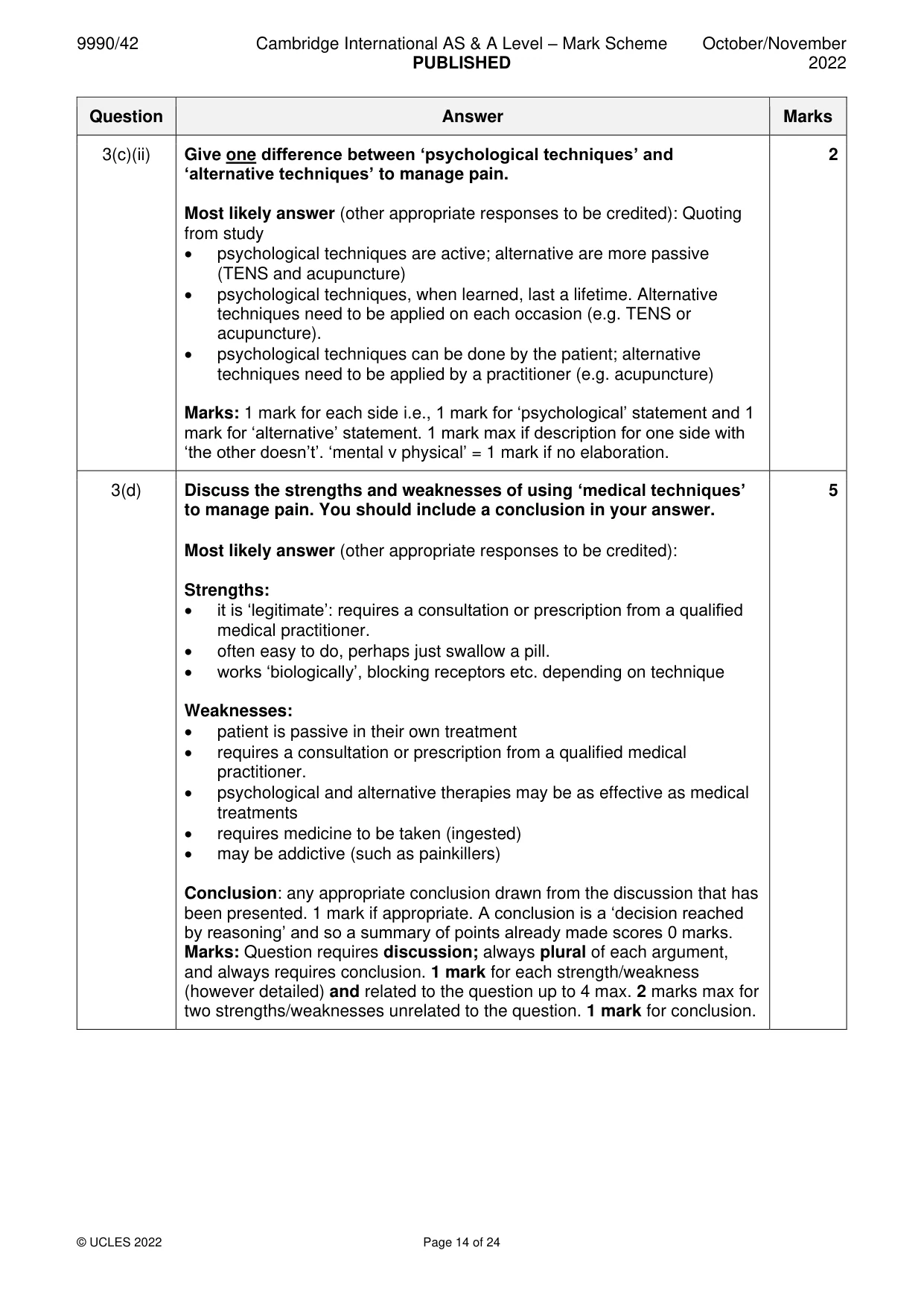
Question paper8 pages

Mark scheme24 pages
Answers below. Sit the paper first if you are practising.
Questions as text
Q1 · The Blood Injection Phobia Inventory (BIPI) is a questionnaire with items about phobic…
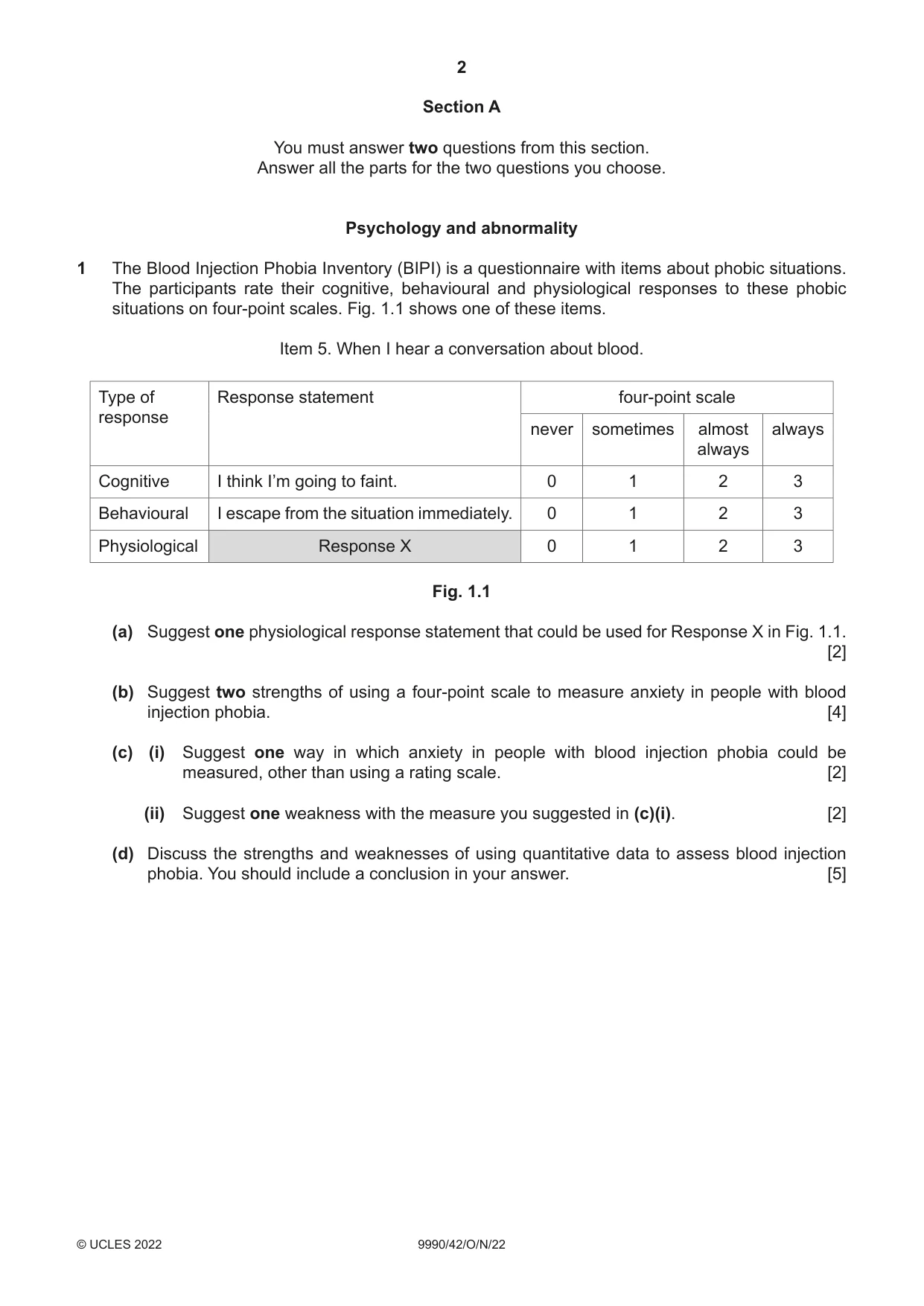
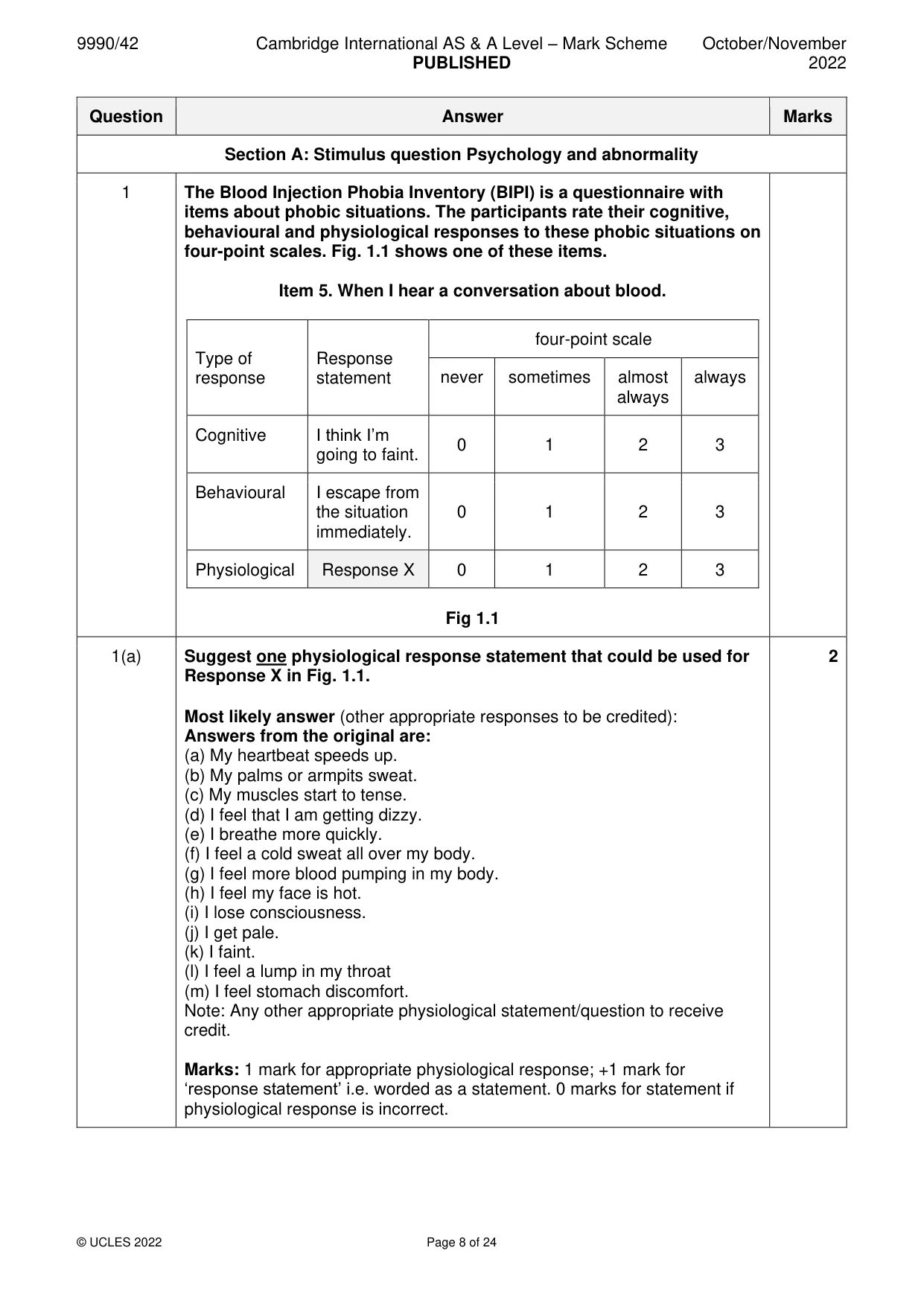
1 The Blood Injection Phobia Inventory (BIPI) is a questionnaire with items about phobic situations. The participants rate their cognitive, behavioural and physiological responses to these phobic situations on four-point scales. Fig. 1.1 shows one of these items. Item 5. When I hear a conversation about blood. Type of Response statement four-point scale response never sometimes almost always always Cognitive I think I’m going to faint. 0 1 2 3 Behavioural I escape from the situation immediately. 0 1 2 3 Physiological Response X 0 1 2 3 Fig. 1.1 (a) Suggest one physiological response statement that could be used for Response X in Fig. 1.1. [2] (b) Suggest two strengths of using a four-point scale to measure anxiety in people with blood injection phobia. [4] (c) (i) Suggest one way in which anxiety in people with blood injection phobia could be measured, other than using a rating scale. [2] (ii) Suggest one weakness with the measure you suggested in (c)(i). [2] (d) Discuss the strengths and weaknesses of using quantitative data to assess blood injection phobia. You should include a conclusion in your answer. [5] Psychology and consumer behaviour
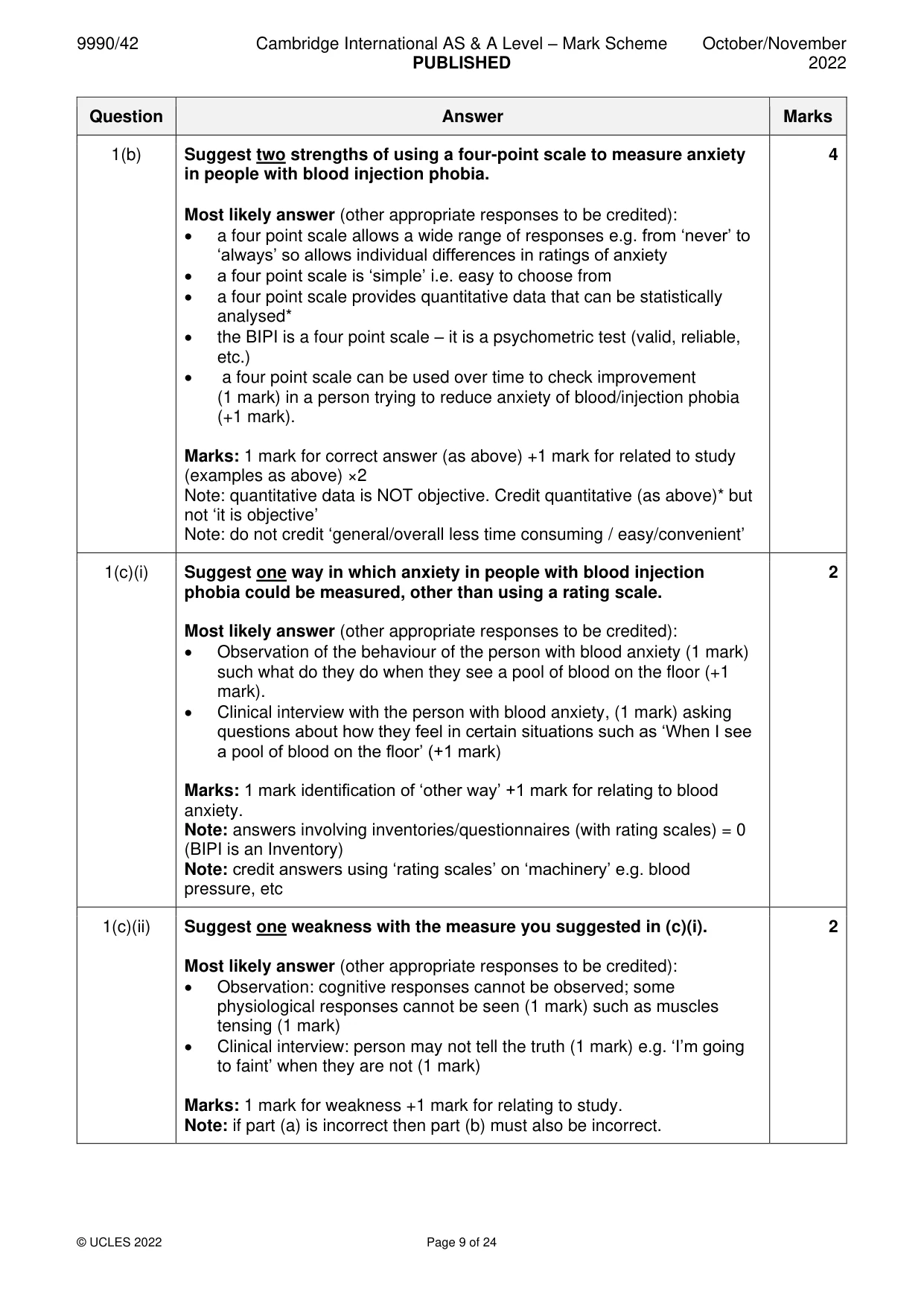
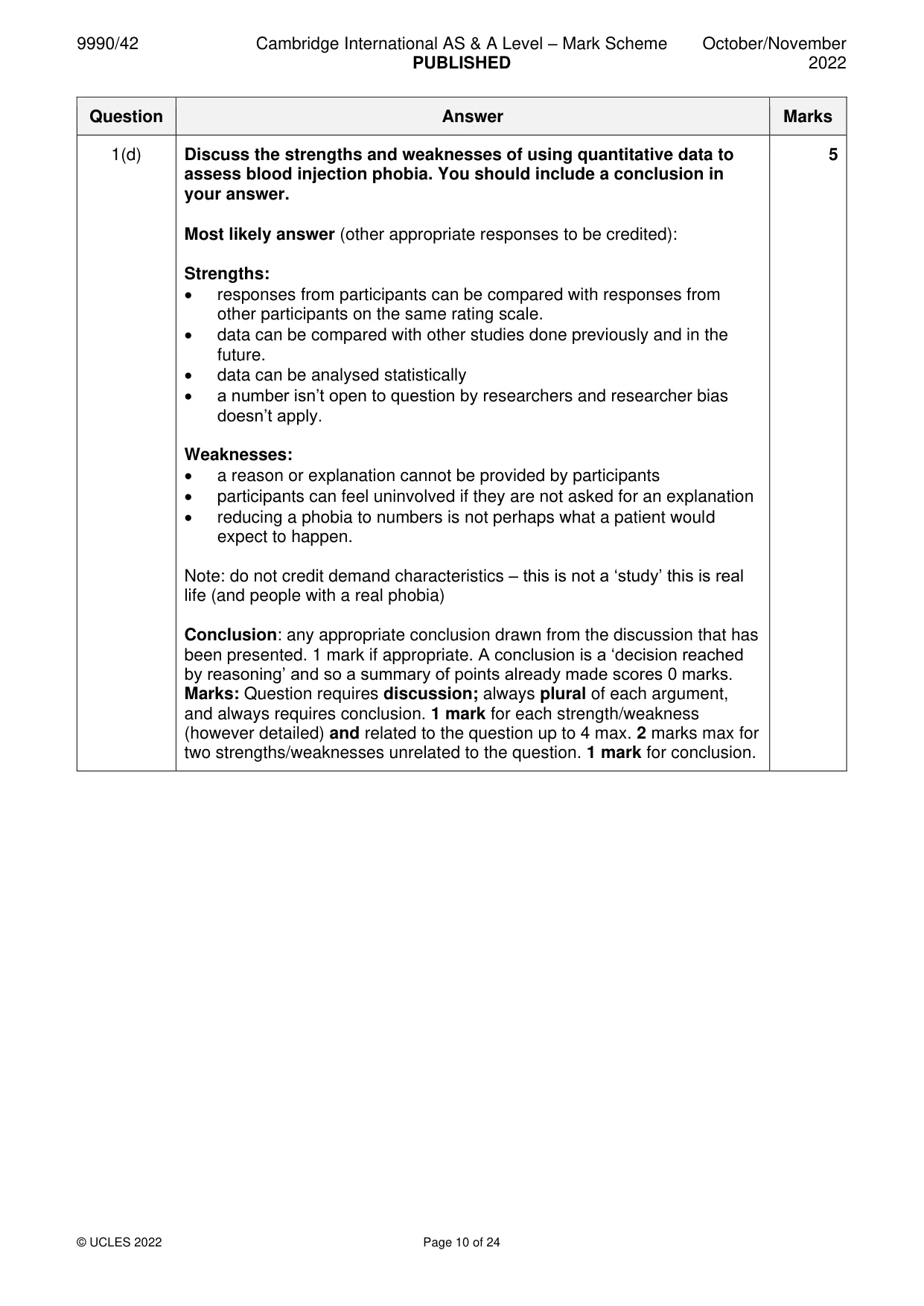
Mark scheme: Question Answer Marks Section A: Stimulus question Psychology and abnormality 1 The Blood Injection Phobia Inventory (BIPI) is a questionnaire with items about phobic situations. The participants rate their cognitive, behavioural and physiological responses to these phobic situations on four-point scales. Fig. 1.1 shows one of these items. Item 5. When I hear a conversation about blood. four-point scale Type of Response response statement never sometimes almost always always Cognitive I think I’m 0 1 2 3 going to faint. Behavioural I escape from the situation 0 1 2 3 immediately. Physiological Response X 0 1 2 3 Fig 1.1 1(a) Suggest one physiological response statement that could be used for 2 Response X in Fig. 1.1. Most likely answer (other appropriate responses to be credited): Answers from the original are: (a) My heartbeat speeds up. (b) My palms or armpits sweat. (c) My muscles start to tense. (d) I feel that I am getting dizzy. (e) I breathe more quickly. (f) I feel a cold sweat all over my body. (g) I feel more blood pumping in my body. (h) I feel my face is hot. (i) I lose consciousness. (j) I get pale. (k) I faint. (l) I feel a lump in my throat (m) I feel stomach discomfort. Note: Any other appropriate physiological statement/question to receive credit. Marks: 1 mark for appropriate physiological response; +1 mark for ‘response statement’ i.e. worded as a statement. 0 marks for statement if physiological response is incorrect. 1(b) Suggest two strengths of using a four-point scale to measure anxiety 4 in people with blood injection phobia. Most likely answer (other appropriate responses to be credited): • a four point scale allows a wide range of responses e.g. from ‘never’ to ‘always’ so allows individual differences in ratings of anxiety • a four point scale is ‘simple’ i.e. easy to choose from • a four point scale provides quantitative data that can be statistically analysed* • the BIPI is a four point scale – it is a psychometric test (valid, reliable, etc.) • a four point scale can be used over time to check improvement (1 mark) in a person trying to reduce anxiety of blood/injection phobia (+1 mark). Marks: 1 mark for correct answer (as above) +1 mark for related to study (examples as above) ×2 Note: quantitative data is NOT objective. Credit quantitative (as above)* but not ‘it is objective’ Note: do not credit ‘general/overall less time consuming / easy/convenient’ 1(c)(i) Suggest one way in which anxiety in people with blood injection 2 phobia could be measured, other than using a rating scale. Most likely answer (other appropriate responses to be credited): • Observation of the behaviour of the person with blood anxiety (1 mark) such what do they do when they see a pool of blood on the floor (+1 mark). • Clinical interview with the person with blood anxiety, (1 mark) asking questions about how they feel in certain situations such as ‘When I see a pool of blood on the floor’ (+1 mark) Marks: 1 mark identification of ‘other way’ +1 mark for relating to blood anxiety. Note: answers involving inventories/questionnaires (with rating scales) = 0 (BIPI is an Inventory) Note: credit answers using ‘rating scales’ on ‘machinery’ e.g. blood pressure, etc 1(c)(ii) Suggest one weakness with the measure you suggested in (c)(i). 2 Most likely answer (other appropriate responses to be credited): • Observation: cognitive responses cannot be observed; some physiological responses cannot be seen (1 mark) such as muscles tensing (1 mark) • Clinical interview: person may not tell the truth (1 mark) e.g. ‘I’m going to faint’ when they are not (1 mark) Marks: 1 mark for weakness +1 mark for relating to study. Note: if part (a) is incorrect then part (b) must also be incorrect. 1(d) Discuss the strengths and weaknesses of using quantitative data to 5 assess blood injection phobia. You should include a conclusion in your answer. Most likely answer (other appropriate responses to be credited): Strengths: • responses from participants can be compared with responses from other participants on the same rating scale. • data can be compared with other studies done previously and in the future. • data can be analysed statistically • a number isn’t open to question by researchers and researcher bias doesn’t apply. Weaknesses: • a reason or explanation cannot be provided by participants • participants can feel uninvolved if they are not asked for an explanation • reducing a phobia to numbers is not perhaps what a patient would expect to happen. Note: do not credit demand characteristics – this is not a ‘study’ this is real life (and people with a real phobia) Conclusion: any appropriate conclusion drawn from the discussion that has been presented. 1 mark if appropriate. A conclusion is a ‘decision reached by reasoning’ and so a summary of points already made scores 0 marks. Marks: Question requires discussion; always plural of each argument, and always requires conclusion. 1 mark for each strength/weakness (however detailed) and related to the question up to 4 max. 2 marks max for two strengths/weaknesses unrelated to the question. 1 mark for conclusion.
More questions on Anxiety disorders and fear-related disorders
Q2 · Results of Experiment 1 by Woods et al
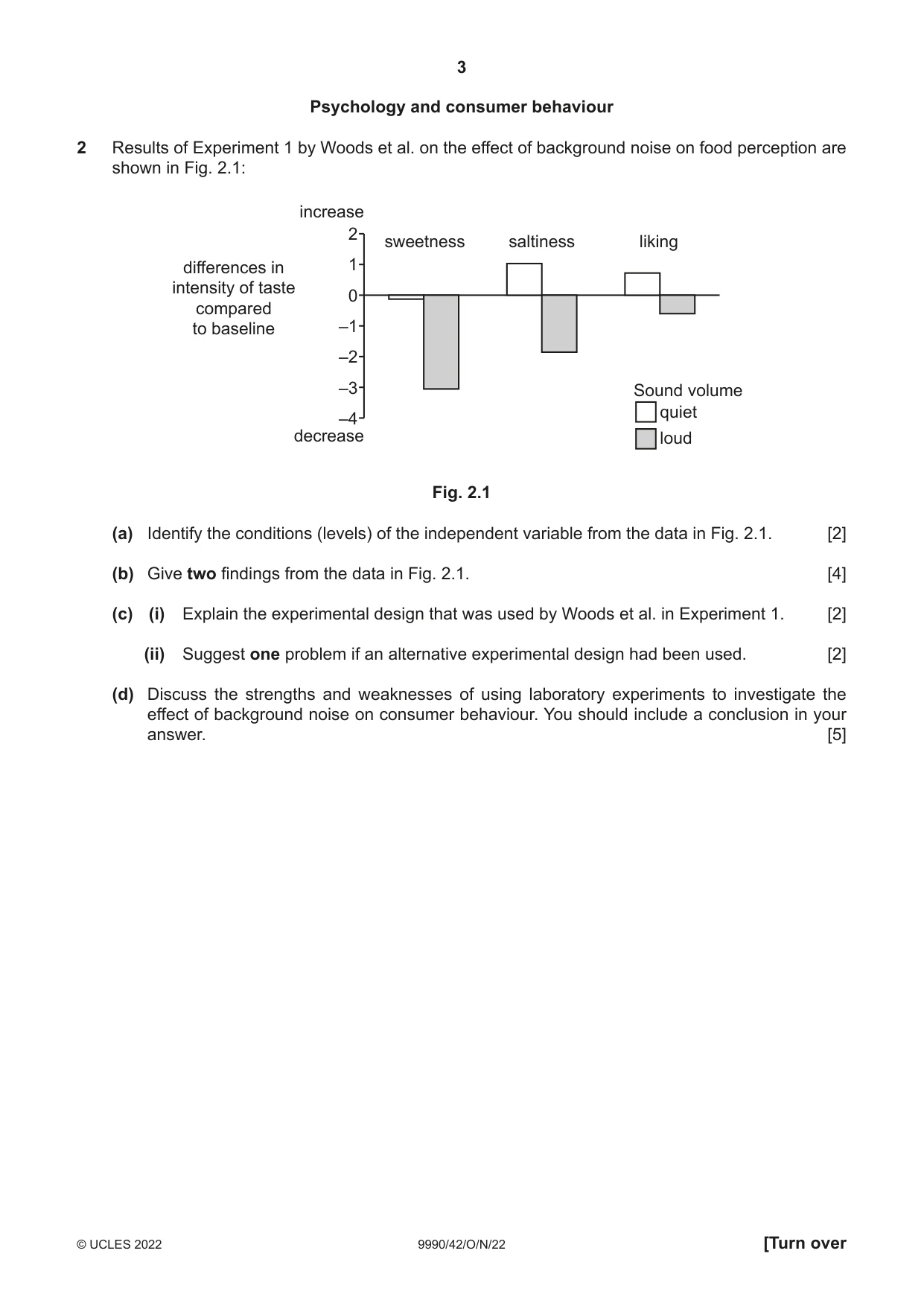
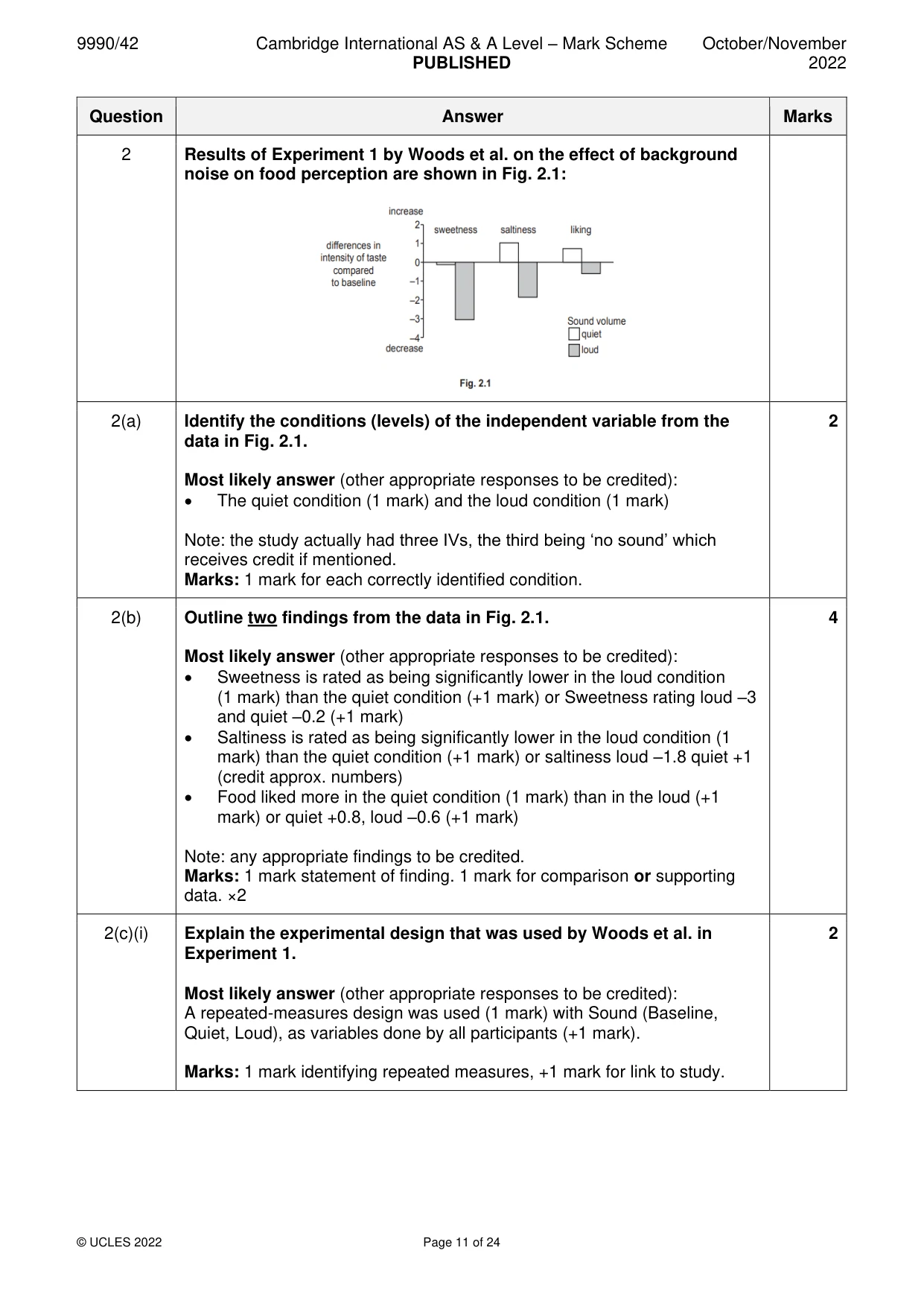
2 Results of Experiment 1 by Woods et al. on the effect of background noise on food perception are shown in Fig. 2.1: increase 2 sweetness saltiness liking differences in 1 intensity of taste 0 compared to baseline –1 –2 –3 Sound volume quiet –4 decrease loud Fig. 2.1 (a) Identify the conditions (levels) of the independent variable from the data in Fig. 2.1. [2] (b) Give two findings from the data in Fig. 2.1. [4] (c) (i) Explain the experimental design that was used by Woods et al. in Experiment 1. [2] (ii) Suggest one problem if an alternative experimental design had been used. [2] (d) Discuss the strengths and weaknesses of using laboratory experiments to investigate the effect of background noise on consumer behaviour. You should include a conclusion in your answer. [5] Psychology and health
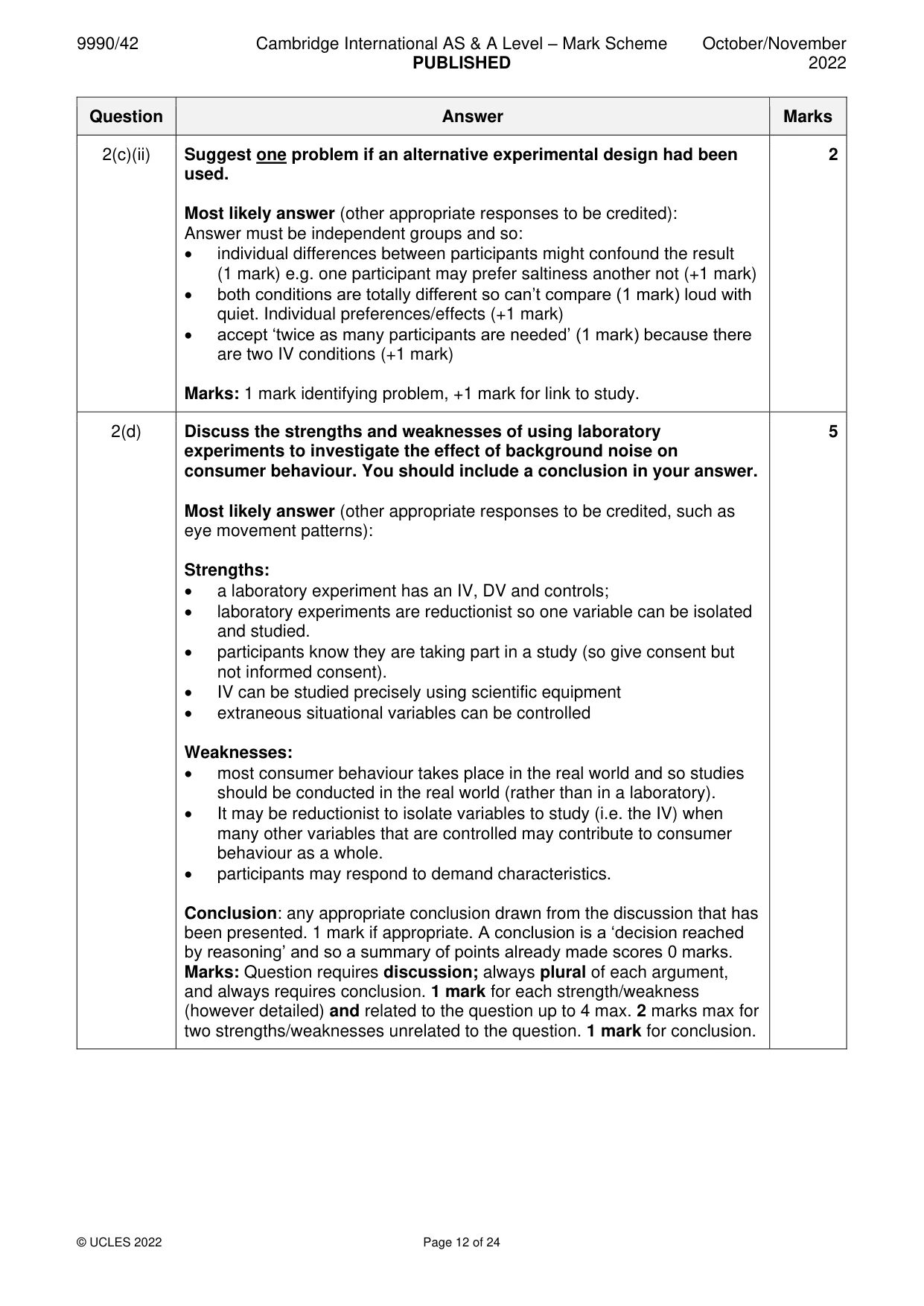
Mark scheme: 2 Results of Experiment 1 by Woods et al. on the effect of background noise on food perception are shown in Fig. 2.1: 2(a) Identify the conditions (levels) of the independent variable from the 2 data in Fig. 2.1. Most likely answer (other appropriate responses to be credited): • The quiet condition (1 mark) and the loud condition (1 mark) Note: the study actually had three IVs, the third being ‘no sound’ which receives credit if mentioned. Marks: 1 mark for each correctly identified condition. 2(b) Outline two findings from the data in Fig. 2.1. 4 Most likely answer (other appropriate responses to be credited): • Sweetness is rated as being significantly lower in the loud condition (1 mark) than the quiet condition (+1 mark) or Sweetness rating loud –3 and quiet –0.2 (+1 mark) • Saltiness is rated as being significantly lower in the loud condition (1 mark) than the quiet condition (+1 mark) or saltiness loud –1.8 quiet +1 (credit approx. numbers) • Food liked more in the quiet condition (1 mark) than in the loud (+1 mark) or quiet +0.8, loud –0.6 (+1 mark) Note: any appropriate findings to be credited. Marks: 1 mark statement of finding. 1 mark for comparison or supporting data. ×2 2(c)(i) Explain the experimental design that was used by Woods et al. in 2 Experiment 1. Most likely answer (other appropriate responses to be credited): A repeated-measures design was used (1 mark) with Sound (Baseline, Quiet, Loud), as variables done by all participants (+1 mark). Marks: 1 mark identifying repeated measures, +1 mark for link to study. 2(c)(ii) Suggest one problem if an alternative experimental design had been 2 used. Most likely answer (other appropriate responses to be credited): Answer must be independent groups and so: • individual differences between participants might confound the result (1 mark) e.g. one participant may prefer saltiness another not (+1 mark) • both conditions are totally different so can’t compare (1 mark) loud with quiet. Individual preferences/effects (+1 mark) • accept ‘twice as many participants are needed’ (1 mark) because there are two IV conditions (+1 mark) Marks: 1 mark identifying problem, +1 mark for link to study. 2(d) Discuss the strengths and weaknesses of using laboratory 5 experiments to investigate the effect of background noise on consumer behaviour. You should include a conclusion in your answer. Most likely answer (other appropriate responses to be credited, such as eye movement patterns): Strengths: • a laboratory experiment has an IV, DV and controls; • laboratory experiments are reductionist so one variable can be isolated and studied. • participants know they are taking part in a study (so give consent but not informed consent). • IV can be studied precisely using scientific equipment • extraneous situational variables can be controlled Weaknesses: • most consumer behaviour takes place in the real world and so studies should be conducted in the real world (rather than in a laboratory). • It may be reductionist to isolate variables to study (i.e. the IV) when many other variables that are controlled may contribute to consumer behaviour as a whole. • participants may respond to demand characteristics. Conclusion: any appropriate conclusion drawn from the discussion that has been presented. 1 mark if appropriate. A conclusion is a ‘decision reached by reasoning’ and so a summary of points already made scores 0 marks. Marks: Question requires discussion; always plural of each argument, and always requires conclusion. 1 mark for each strength/weakness (however detailed) and related to the question up to 4 max. 2 marks max for two strengths/weaknesses unrelated to the question. 1 mark for conclusion.
Q3 · Psychologists have developed their understanding of pain and how to manage it
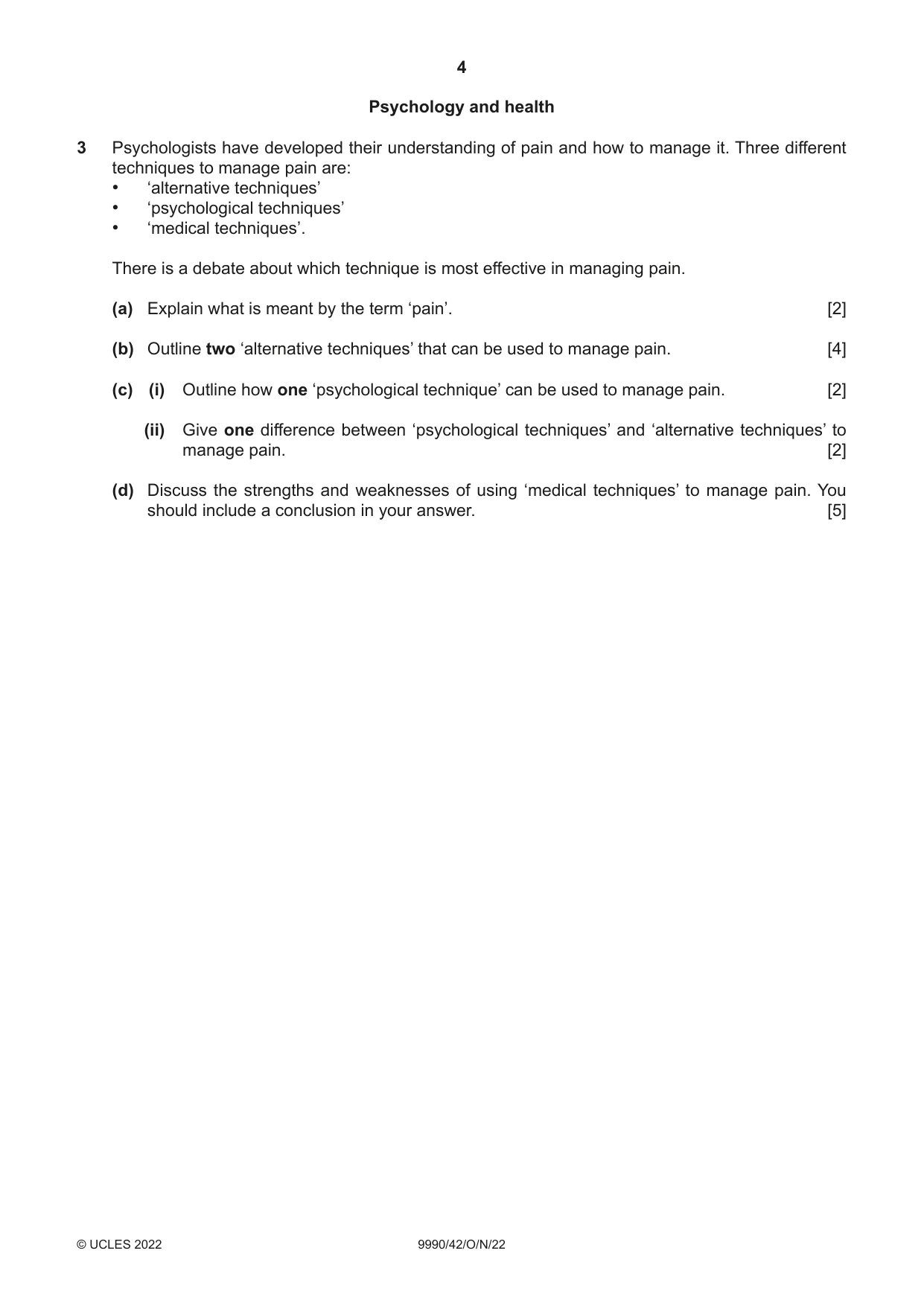
3 Psychologists have developed their understanding of pain and how to manage it. Three different techniques to manage pain are: • ‘alternative techniques’ • ‘psychological techniques’ • ‘medical techniques’. There is a debate about which technique is most effective in managing pain. (a) Explain what is meant by the term ‘pain’. [2] (b) Outline two ‘alternative techniques’ that can be used to manage pain. [4] (c) (i) Outline how one ‘psychological technique’ can be used to manage pain. [2] (ii) Give one difference between ‘psychological techniques’ and ‘alternative techniques’ to manage pain. [2] (d) Discuss the strengths and weaknesses of using ‘medical techniques’ to manage pain. You should include a conclusion in your answer. [5] Psychology and organisations
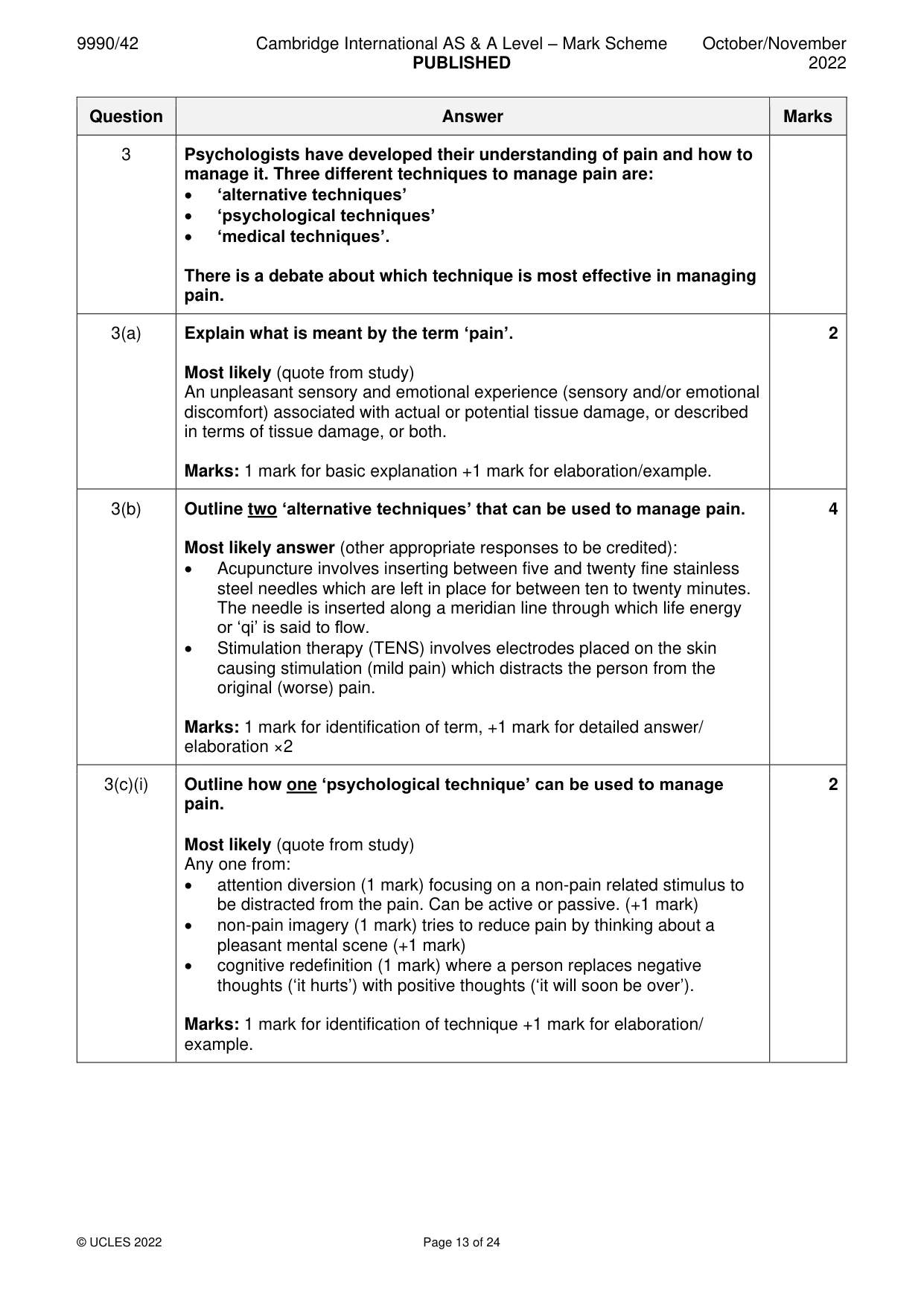
Mark scheme: 3 Psychologists have developed their understanding of pain and how to manage it. Three different techniques to manage pain are: • ‘alternative techniques’ • ‘psychological techniques’ • ‘medical techniques’. There is a debate about which technique is most effective in managing pain. 3(a) Explain what is meant by the term ‘pain’. 2 Most likely (quote from study) An unpleasant sensory and emotional experience (sensory and/or emotional discomfort) associated with actual or potential tissue damage, or described in terms of tissue damage, or both. Marks: 1 mark for basic explanation +1 mark for elaboration/example. 3(b) Outline two ‘alternative techniques’ that can be used to manage pain. 4 Most likely answer (other appropriate responses to be credited): • Acupuncture involves inserting between five and twenty fine stainless steel needles which are left in place for between ten to twenty minutes. The needle is inserted along a meridian line through which life energy or ‘qi’ is said to flow. • Stimulation therapy (TENS) involves electrodes placed on the skin causing stimulation (mild pain) which distracts the person from the original (worse) pain. Marks: 1 mark for identification of term, +1 mark for detailed answer/ elaboration ×2 3(c)(i) Outline how one ‘psychological technique’ can be used to manage 2 pain. Most likely (quote from study) Any one from: • attention diversion (1 mark) focusing on a non-pain related stimulus to be distracted from the pain. Can be active or passive. (+1 mark) • non-pain imagery (1 mark) tries to reduce pain by thinking about a pleasant mental scene (+1 mark) • cognitive redefinition (1 mark) where a person replaces negative thoughts (‘it hurts’) with positive thoughts (‘it will soon be over’). Marks: 1 mark for identification of technique +1 mark for elaboration/ example. 3(c)(ii) Give one difference between ‘psychological techniques’ and 2 ‘alternative techniques’ to manage pain. Most likely answer (other appropriate responses to be credited): Quoting from study • psychological techniques are active; alternative are more passive (TENS and acupuncture) • psychological techniques, when learned, last a lifetime. Alternative techniques need to be applied on each occasion (e.g. TENS or acupuncture). • psychological techniques can be done by the patient; alternative techniques need to be applied by a practitioner (e.g. acupuncture) Marks: 1 mark for each side i.e., 1 mark for ‘psychological’ statement and 1 mark for ‘alternative’ statement. 1 mark max if description for one side with ‘the other doesn’t’. ‘mental v physical’ = 1 mark if no elaboration. 3(d) Discuss the strengths and weaknesses of using ‘medical techniques’ 5 to manage pain. You should include a conclusion in your answer. Most likely answer (other appropriate responses to be credited): Strengths: • it is ‘legitimate’: requires a consultation or prescription from a qualified medical practitioner. • often easy to do, perhaps just swallow a pill. • works ‘biologically’, blocking receptors etc. depending on technique Weaknesses: • patient is passive in their own treatment • requires a consultation or prescription from a qualified medical practitioner. • psychological and alternative therapies may be as effective as medical treatments • requires medicine to be taken (ingested) • may be addictive (such as painkillers) Conclusion: any appropriate conclusion drawn from the discussion that has been presented. 1 mark if appropriate. A conclusion is a ‘decision reached by reasoning’ and so a summary of points already made scores 0 marks. Marks: Question requires discussion; always plural of each argument, and always requires conclusion. 1 mark for each strength/weakness (however detailed) and related to the question up to 4 max. 2 marks max for two strengths/weaknesses unrelated to the question. 1 mark for conclusion.
Q4 · The success of a leader could be due to how well followers can follow them
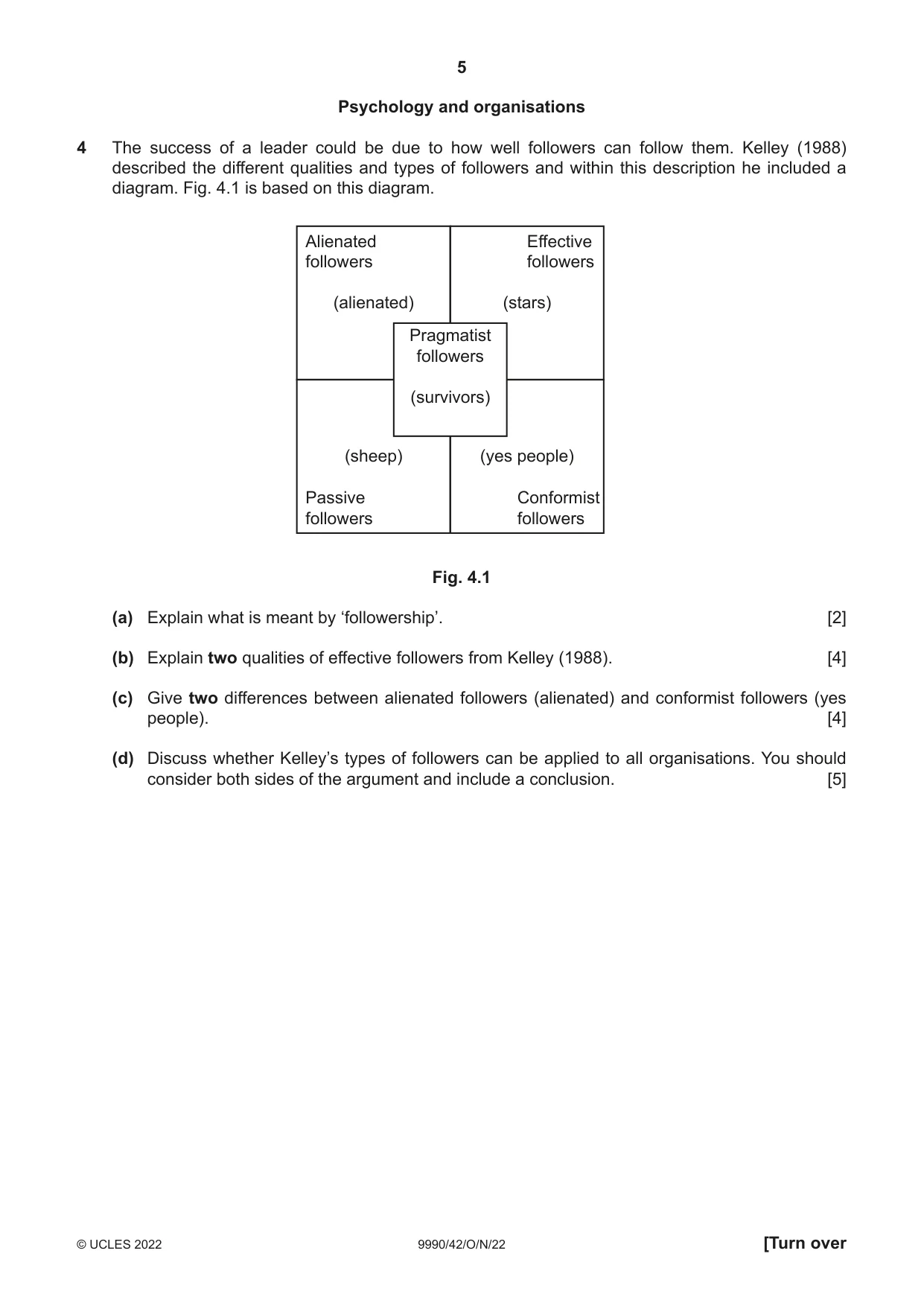
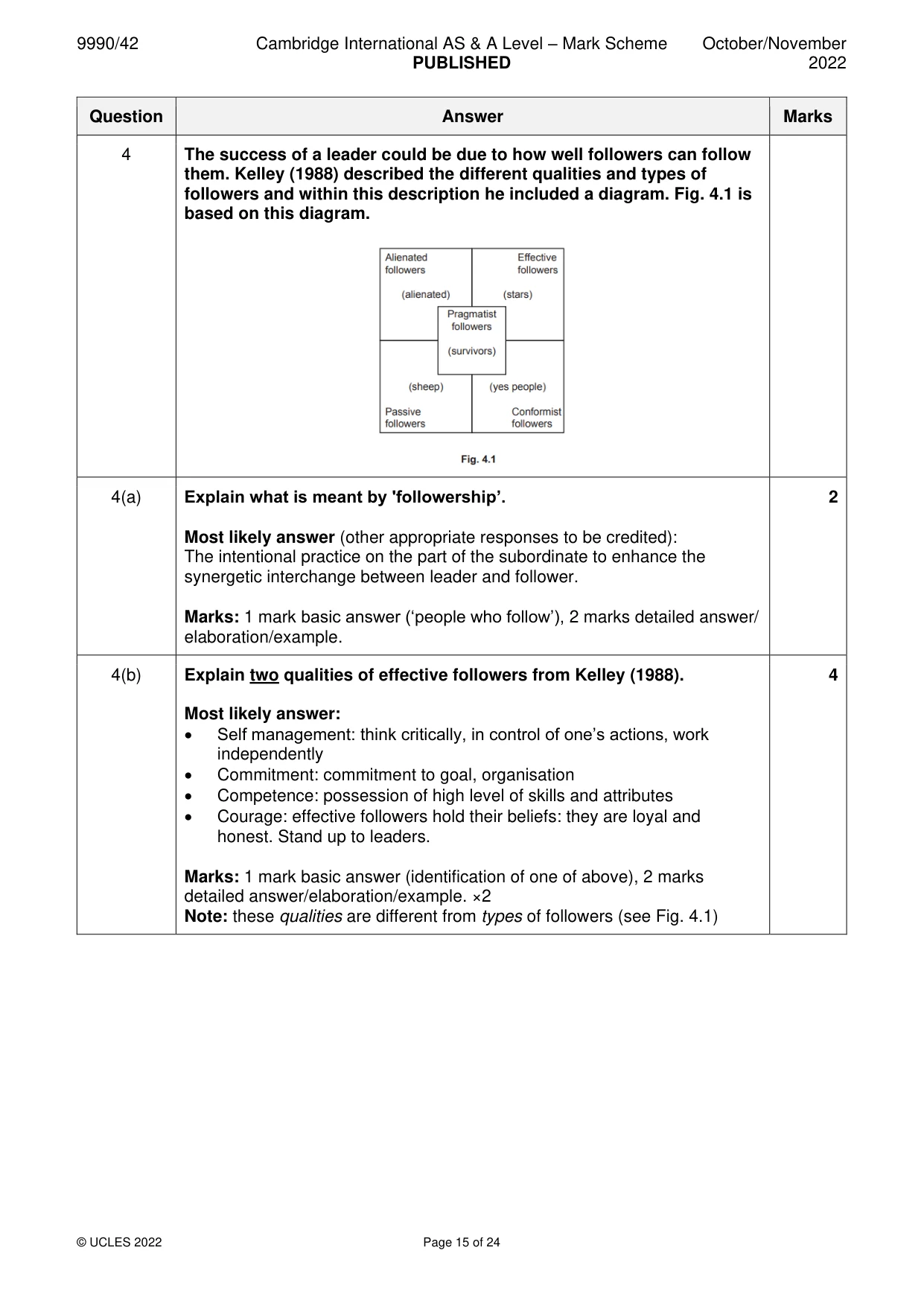
4 The success of a leader could be due to how well followers can follow them. Kelley (1988) described the different qualities and types of followers and within this description he included a diagram. Fig. 4.1 is based on this diagram. Alienated Effective followers followers (alienated) (stars) Pragmatist followers (survivors) (sheep) (yes people) Passive Conformist followers followers Fig. 4.1 (a) Explain what is meant by ‘followership’. [2] (b) Explain two qualities of effective followers from Kelley (1988). [4] (c) Give two differences between alienated followers (alienated) and conformist followers (yes people). [4] (d) Discuss whether Kelley’s types of followers can be applied to all organisations. You should consider both sides of the argument and include a conclusion. [5]
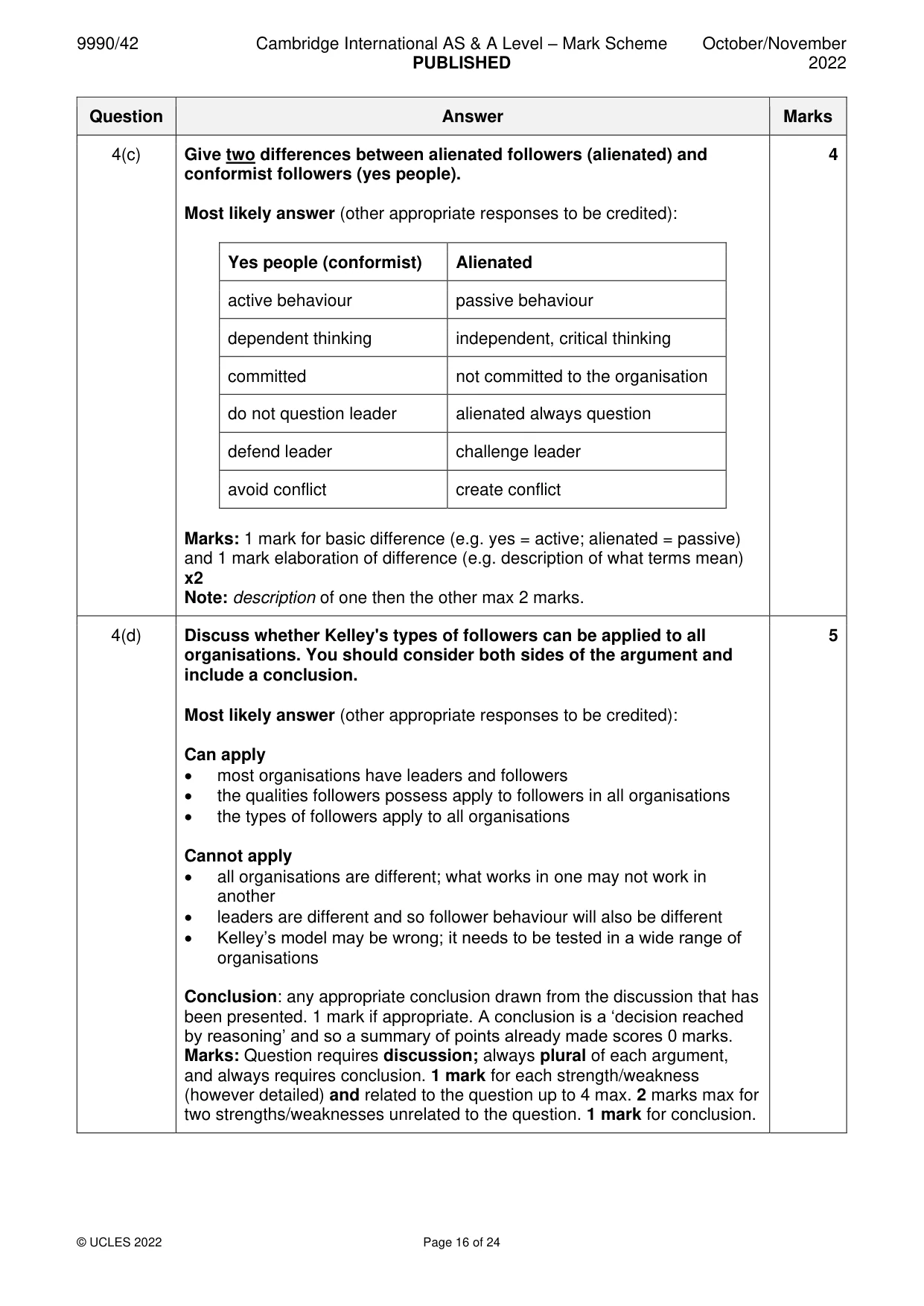
Mark scheme: 4 The success of a leader could be due to how well followers can follow them. Kelley (1988) described the different qualities and types of followers and within this description he included a diagram. Fig. 4.1 is based on this diagram. 4(a) Explain what is meant by 'followership’. 2 Most likely answer (other appropriate responses to be credited): The intentional practice on the part of the subordinate to enhance the synergetic interchange between leader and follower. Marks: 1 mark basic answer (‘people who follow’), 2 marks detailed answer/ elaboration/example. 4(b) Explain two qualities of effective followers from Kelley (1988). 4 Most likely answer: • Self management: think critically, in control of one’s actions, work independently • Commitment: commitment to goal, organisation • Competence: possession of high level of skills and attributes • Courage: effective followers hold their beliefs: they are loyal and honest. Stand up to leaders. Marks: 1 mark basic answer (identification of one of above), 2 marks detailed answer/elaboration/example. ×2 Note: these qualities are different from types of followers (see Fig. 4.1) 4(c) Give two differences between alienated followers (alienated) and 4 conformist followers (yes people). Most likely answer (other appropriate responses to be credited): Yes people (conformist) Alienated active behaviour passive behaviour dependent thinking independent, critical thinking committed not committed to the organisation do not question leader alienated always question defend leader challenge leader avoid conflict create conflict Marks: 1 mark for basic difference (e.g. yes = active; alienated = passive) and 1 mark elaboration of difference (e.g. description of what terms mean) x2 Note: description of one then the other max 2 marks. 4(d) Discuss whether Kelley's types of followers can be applied to all 5 organisations. You should consider both sides of the argument and include a conclusion. Most likely answer (other appropriate responses to be credited): Can apply • most organisations have leaders and followers • the qualities followers possess apply to followers in all organisations • the types of followers apply to all organisations Cannot apply • all organisations are different; what works in one may not work in another • leaders are different and so follower behaviour will also be different • Kelley’s model may be wrong; it needs to be tested in a wide range of organisations Conclusion: any appropriate conclusion drawn from the discussion that has been presented. 1 mark if appropriate. A conclusion is a ‘decision reached by reasoning’ and so a summary of points already made scores 0 marks. Marks: Question requires discussion; always plural of each argument, and always requires conclusion. 1 mark for each strength/weakness (however detailed) and related to the question up to 4 max. 2 marks max for two strengths/weaknesses unrelated to the question. 1 mark for conclusion.
Q5 · Design a study to investigate the effectiveness of a biomedical treatment (SSRIs) for…
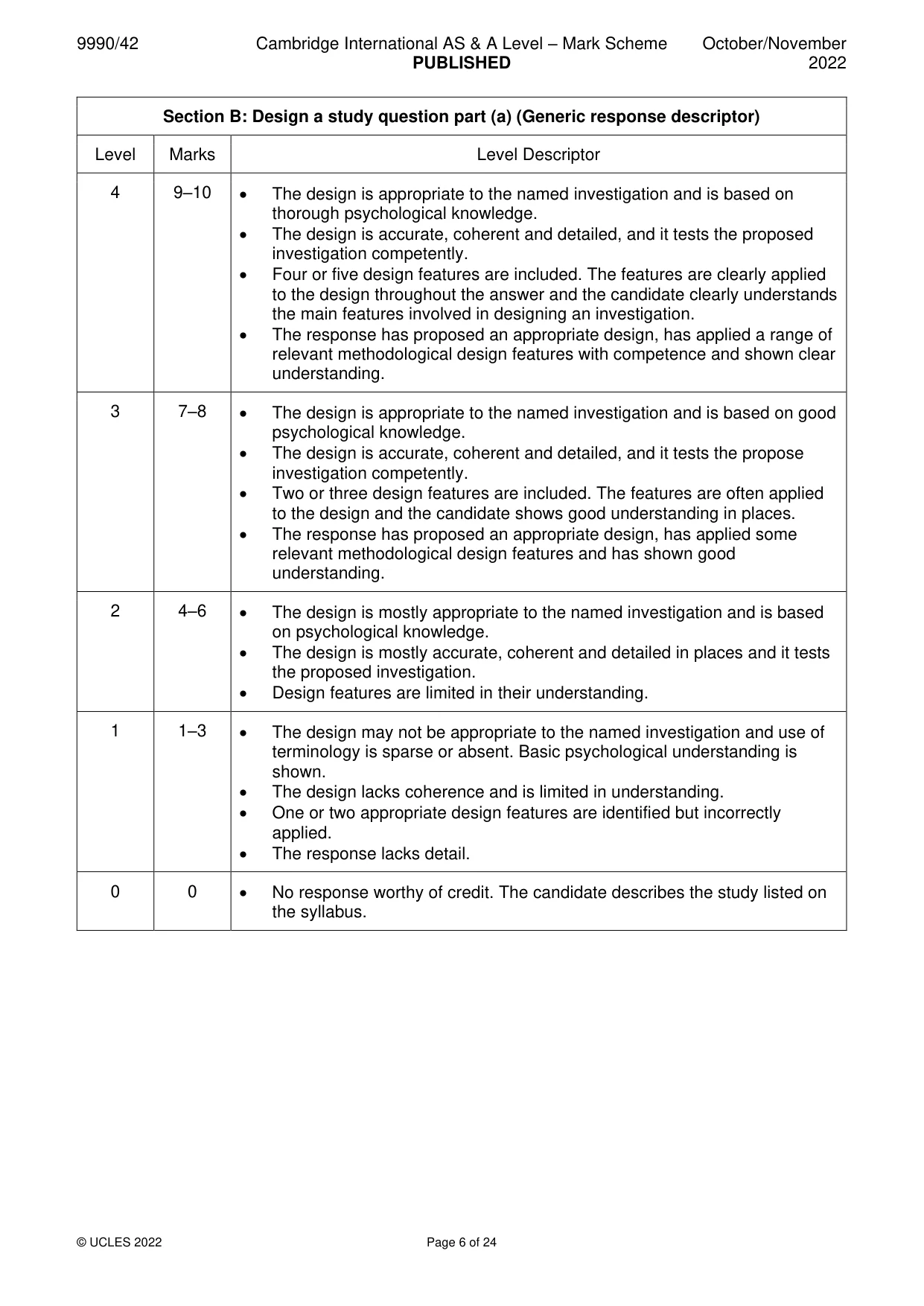
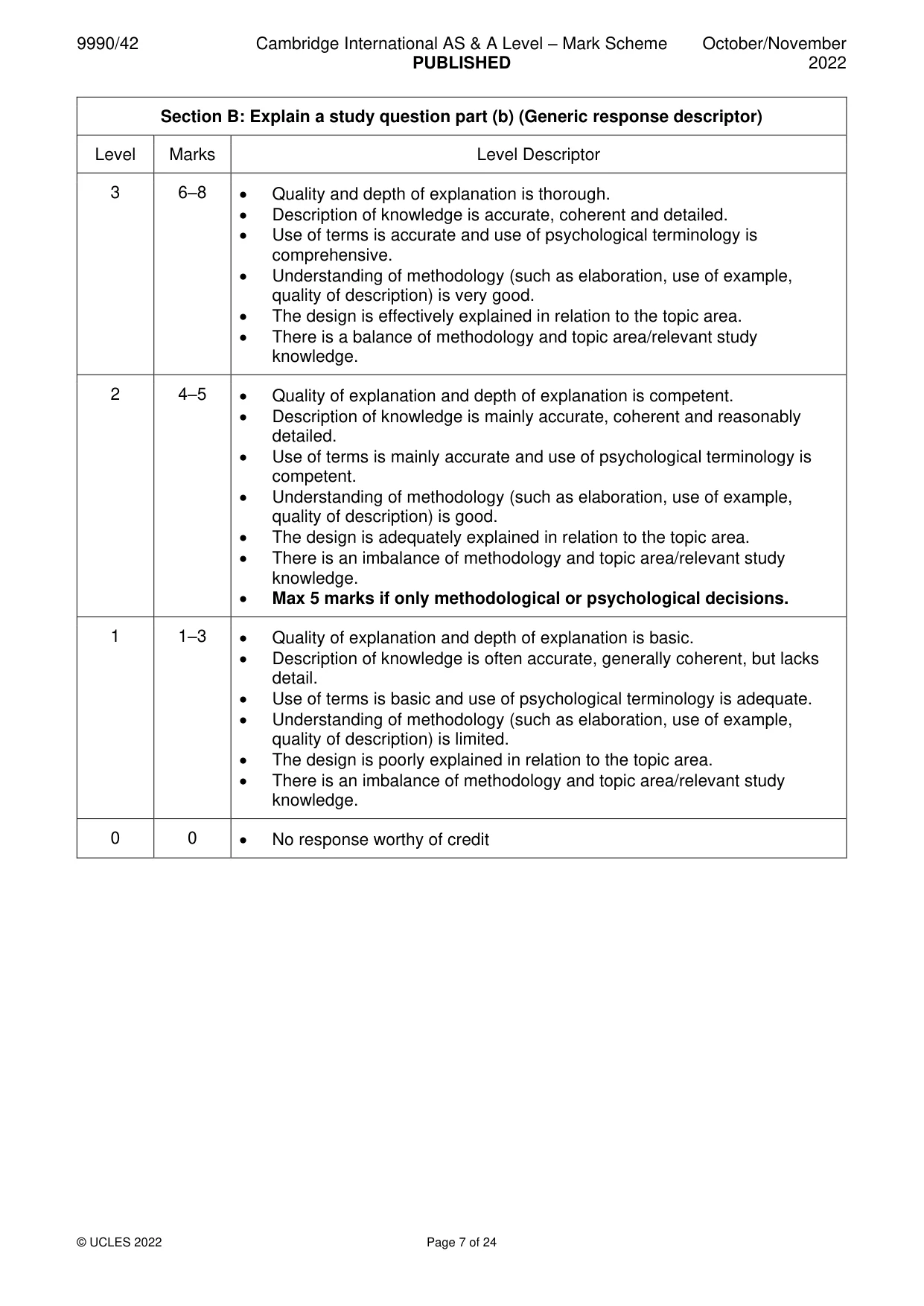
5 (a) Design a study to investigate the effectiveness of a biomedical treatment (SSRIs) for obsessive-compulsive disorder (OCD). [10] (b) Explain the psychological and methodological evidence on which your study is based. [8] Psychology and consumer behaviour
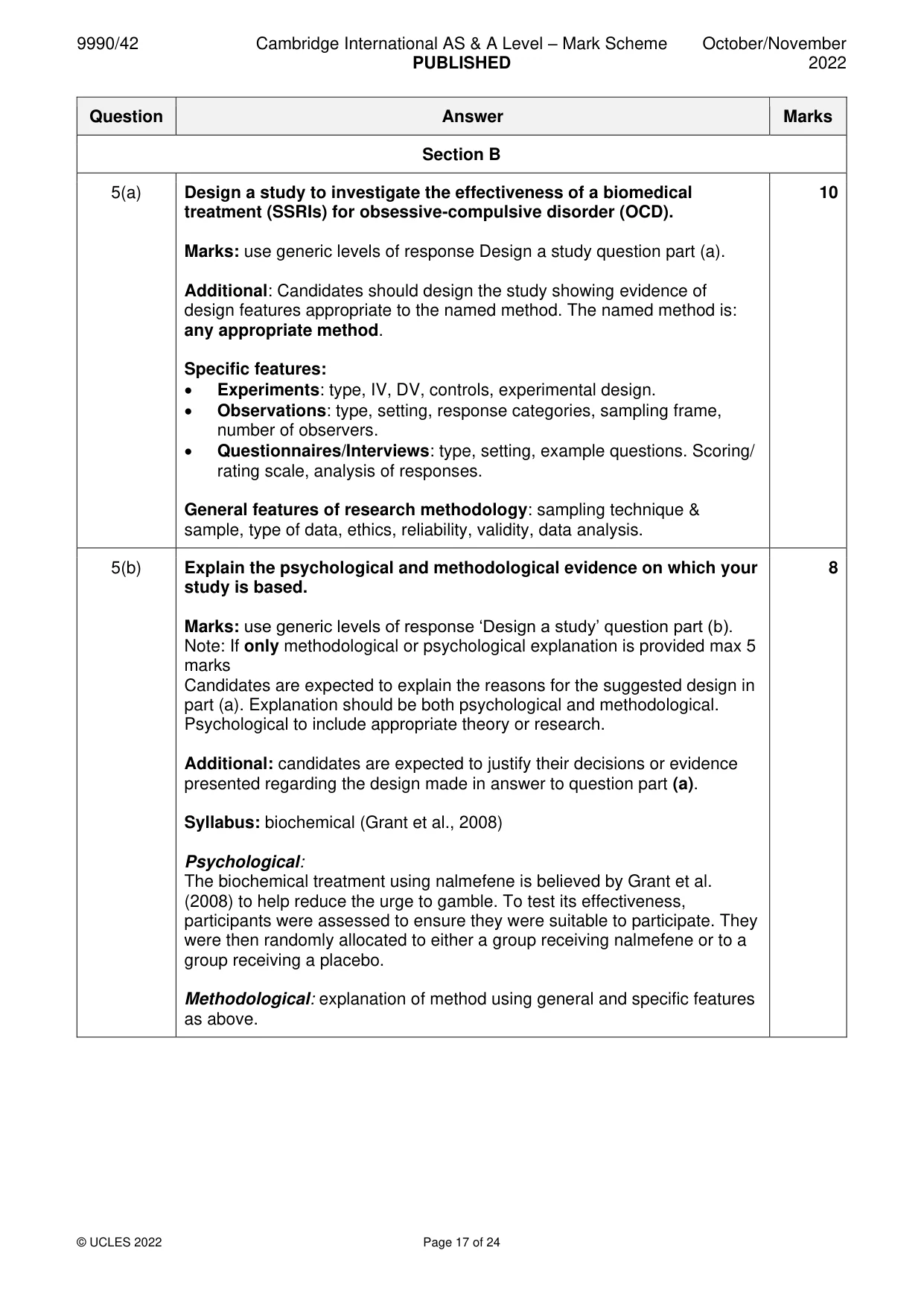
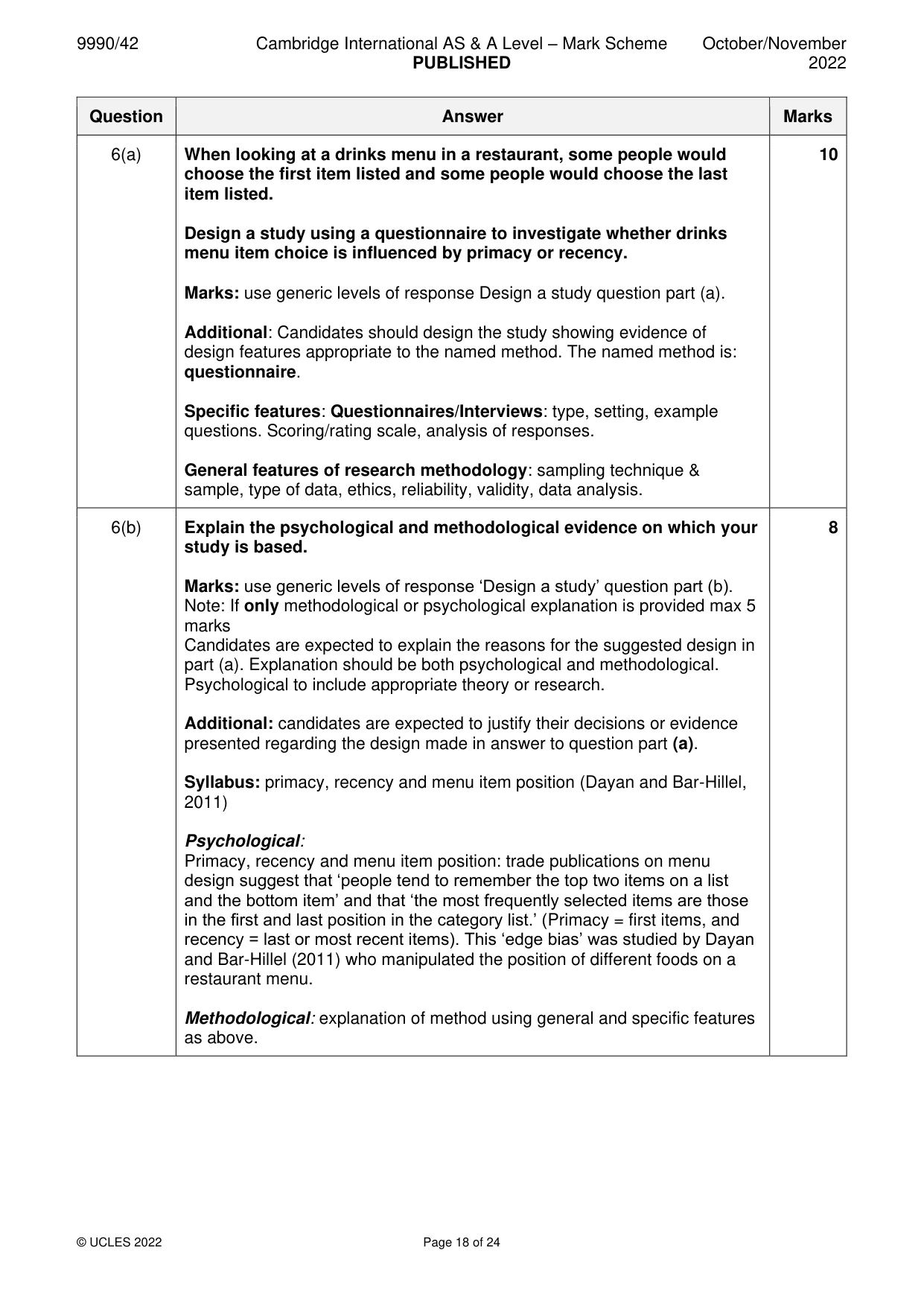
Mark scheme: 5(a) Design a study to investigate the effectiveness of a biomedical 10 treatment (SSRIs) for obsessive-compulsive disorder (OCD). Marks: use generic levels of response Design a study question part (a). Additional: Candidates should design the study showing evidence of design features appropriate to the named method. The named method is: any appropriate method. Specific features: • Experiments: type, IV, DV, controls, experimental design. • Observations: type, setting, response categories, sampling frame, number of observers. • Questionnaires/Interviews: type, setting, example questions. Scoring/ rating scale, analysis of responses. General features of research methodology: sampling technique & sample, type of data, ethics, reliability, validity, data analysis. 5(b) Explain the psychological and methodological evidence on which your 8 study is based. Marks: use generic levels of response ‘Design a study’ question part (b). Note: If only methodological or psychological explanation is provided max 5 marks Candidates are expected to explain the reasons for the suggested design in part (a). Explanation should be both psychological and methodological. Psychological to include appropriate theory or research. Additional: candidates are expected to justify their decisions or evidence presented regarding the design made in answer to question part (a). Syllabus: biochemical (Grant et al., 2008) Psychological: The biochemical treatment using nalmefene is believed by Grant et al. (2008) to help reduce the urge to gamble. To test its effectiveness, participants were assessed to ensure they were suitable to participate. They were then randomly allocated to either a group receiving nalmefene or to a group receiving a placebo. Methodological: explanation of method using general and specific features as above.
Q6 · When looking at a drinks menu in a restaurant, some people would choose the first item…
6 When looking at a drinks menu in a restaurant, some people would choose the first item listed and some people would choose the last item listed. (a) Design a study using a questionnaire to investigate whether drinks menu item choice is influenced by primacy or recency. [10] (b) Explain the psychological and methodological evidence on which your study is based. [8] Psychology and health
Mark scheme: 6(a) When looking at a drinks menu in a restaurant, some people would 10 choose the first item listed and some people would choose the last item listed. Design a study using a questionnaire to investigate whether drinks menu item choice is influenced by primacy or recency. Marks: use generic levels of response Design a study question part (a). Additional: Candidates should design the study showing evidence of design features appropriate to the named method. The named method is: questionnaire. Specific features: Questionnaires/Interviews: type, setting, example questions. Scoring/rating scale, analysis of responses. General features of research methodology: sampling technique & sample, type of data, ethics, reliability, validity, data analysis. 6(b) Explain the psychological and methodological evidence on which your 8 study is based. Marks: use generic levels of response ‘Design a study’ question part (b). Note: If only methodological or psychological explanation is provided max 5 marks Candidates are expected to explain the reasons for the suggested design in part (a). Explanation should be both psychological and methodological. Psychological to include appropriate theory or research. Additional: candidates are expected to justify their decisions or evidence presented regarding the design made in answer to question part (a). Syllabus: primacy, recency and menu item position (Dayan and Bar-Hillel, 2011) Psychological: Primacy, recency and menu item position: trade publications on menu design suggest that ‘people tend to remember the top two items on a list and the bottom item’ and that ‘the most frequently selected items are those in the first and last position in the category list.’ (Primacy = first items, and recency = last or most recent items). This ‘edge bias’ was studied by Dayan and Bar-Hillel (2011) who manipulated the position of different foods on a restaurant menu. Methodological: explanation of method using general and specific features as above.
Q7 · Design a case study to investigate whether providing information is an effective way to…
7 (a) Design a case study to investigate whether providing information is an effective way to promote good dental health. [10] (b) Explain the psychological and methodological evidence on which your study is based. [8] Psychology and organisations
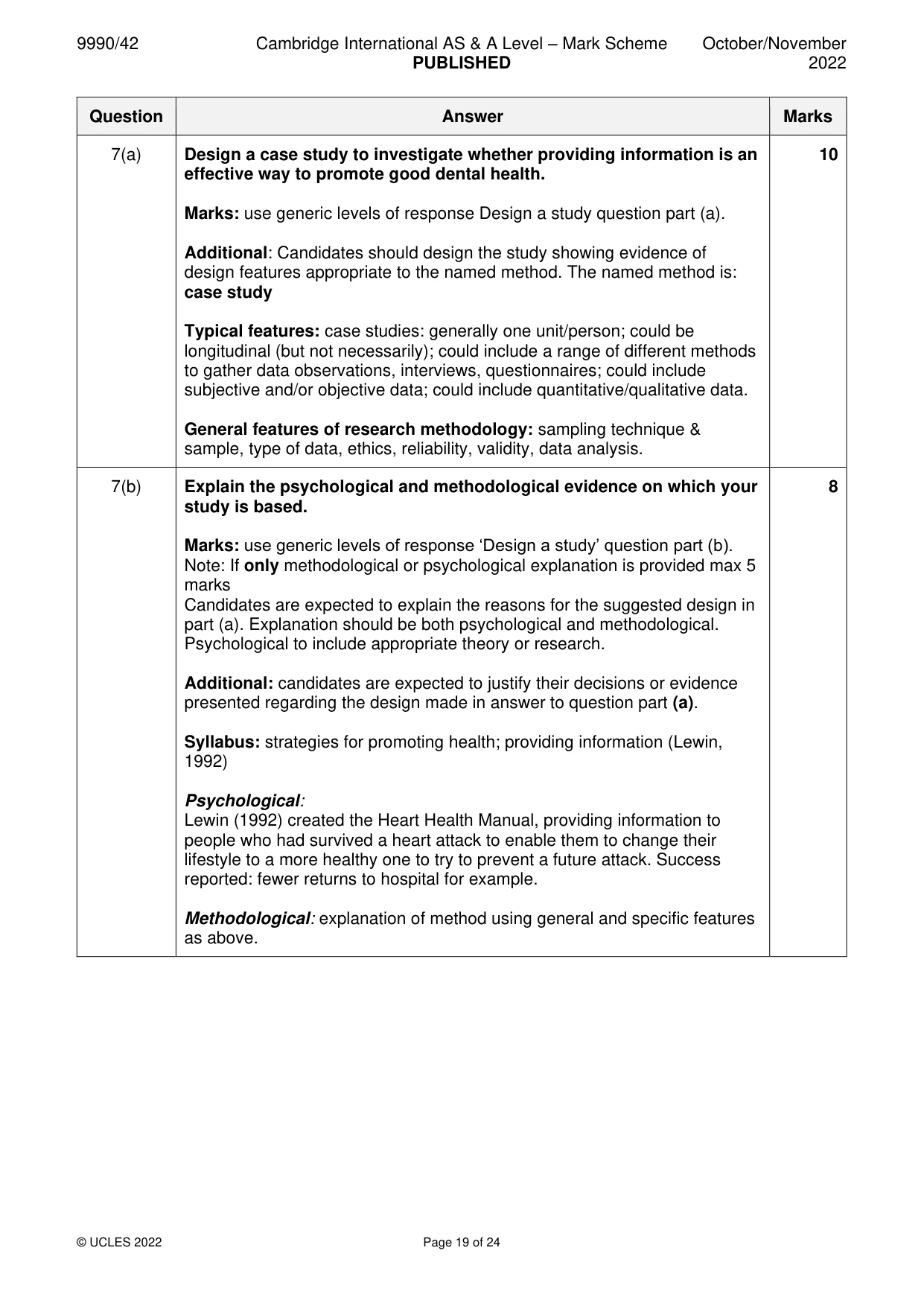
Mark scheme: 7(a) Design a case study to investigate whether providing information is an 10 effective way to promote good dental health. Marks: use generic levels of response Design a study question part (a). Additional: Candidates should design the study showing evidence of design features appropriate to the named method. The named method is: case study Typical features: case studies: generally one unit/person; could be longitudinal (but not necessarily); could include a range of different methods to gather data observations, interviews, questionnaires; could include subjective and/or objective data; could include quantitative/qualitative data. General features of research methodology: sampling technique & sample, type of data, ethics, reliability, validity, data analysis. 7(b) Explain the psychological and methodological evidence on which your 8 study is based. Marks: use generic levels of response ‘Design a study’ question part (b). Note: If only methodological or psychological explanation is provided max 5 marks Candidates are expected to explain the reasons for the suggested design in part (a). Explanation should be both psychological and methodological. Psychological to include appropriate theory or research. Additional: candidates are expected to justify their decisions or evidence presented regarding the design made in answer to question part (a). Syllabus: strategies for promoting health; providing information (Lewin, 1992) Psychological: Lewin (1992) created the Heart Health Manual, providing information to people who had survived a heart attack to enable them to change their lifestyle to a more healthy one to try to prevent a future attack. Success reported: fewer returns to hospital for example. Methodological: explanation of method using general and specific features as above.
More questions on 2 Health promotion in schools and worksites
Q8 · Tuckman outlined different stages of group development
8 Tuckman outlined different stages of group development. (a) Design a study using observation to identify whether a group in an organisation is ‘forming’ or ‘norming’. [10] (b) Explain the psychological and methodological evidence on which your study is based. [8] Section C You must answer one question from this section. Psychology and abnormality
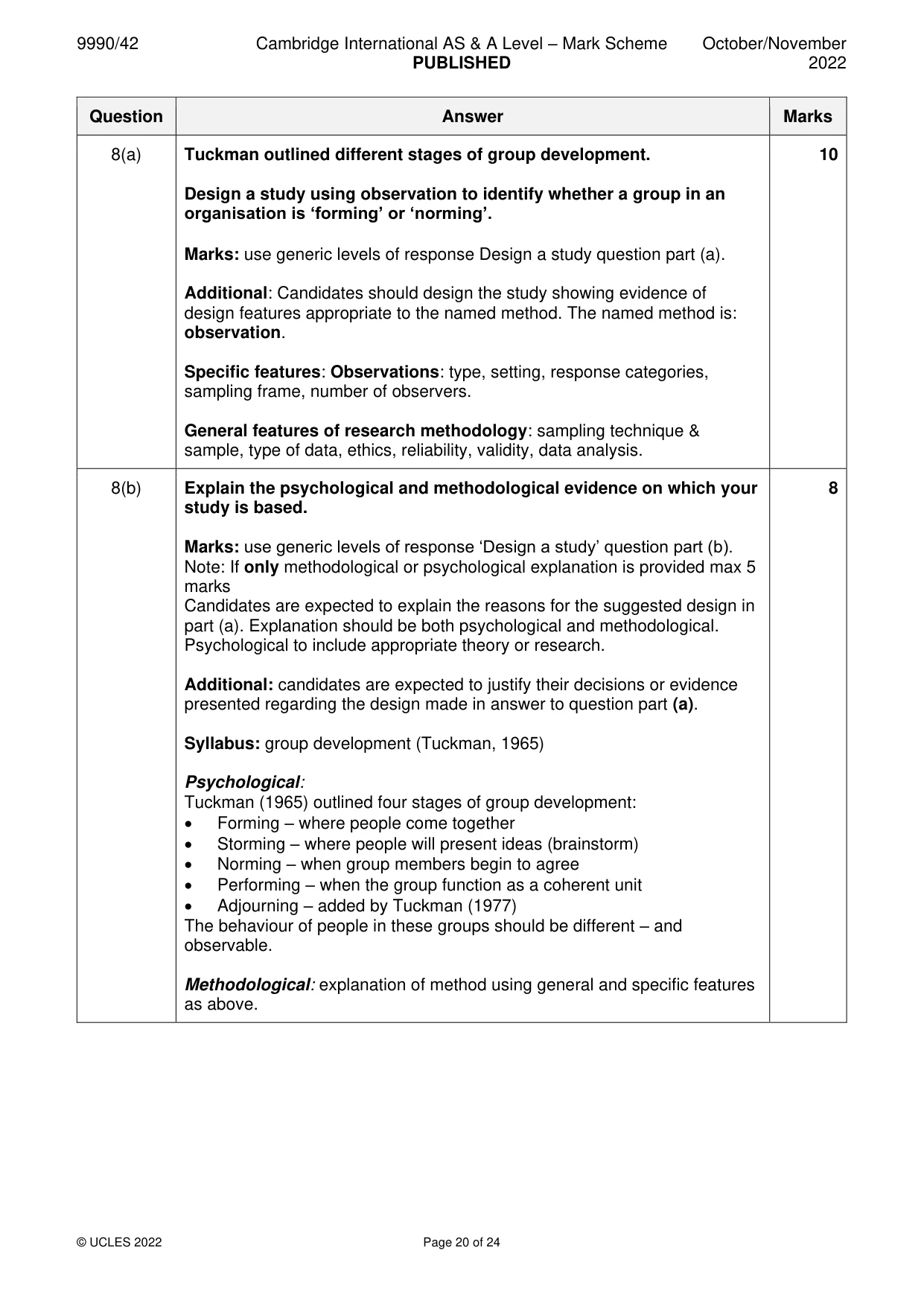
Mark scheme: 8(a) Tuckman outlined different stages of group development. 10 Design a study using observation to identify whether a group in an organisation is ‘forming’ or ‘norming’. Marks: use generic levels of response Design a study question part (a). Additional: Candidates should design the study showing evidence of design features appropriate to the named method. The named method is: observation. Specific features: Observations: type, setting, response categories, sampling frame, number of observers. General features of research methodology: sampling technique & sample, type of data, ethics, reliability, validity, data analysis. 8(b) Explain the psychological and methodological evidence on which your 8 study is based. Marks: use generic levels of response ‘Design a study’ question part (b). Note: If only methodological or psychological explanation is provided max 5 marks Candidates are expected to explain the reasons for the suggested design in part (a). Explanation should be both psychological and methodological. Psychological to include appropriate theory or research. Additional: candidates are expected to justify their decisions or evidence presented regarding the design made in answer to question part (a). Syllabus: group development (Tuckman, 1965) Psychological: Tuckman (1965) outlined four stages of group development: • Forming – where people come together • Storming – where people will present ideas (brainstorm) • Norming – when group members begin to agree • Performing – when the group function as a coherent unit • Adjourning – added by Tuckman (1977) The behaviour of people in these groups should be different – and observable. Methodological: explanation of method using general and specific features as above.
Q9 · ‘The cognitive explanation of phobias is better than all other explanations.’ To what…
9 ‘The cognitive explanation of phobias is better than all other explanations.’ To what extent do you agree with this statement? Use examples of research you have studied to support your answer. [12] Psychology and consumer behaviour
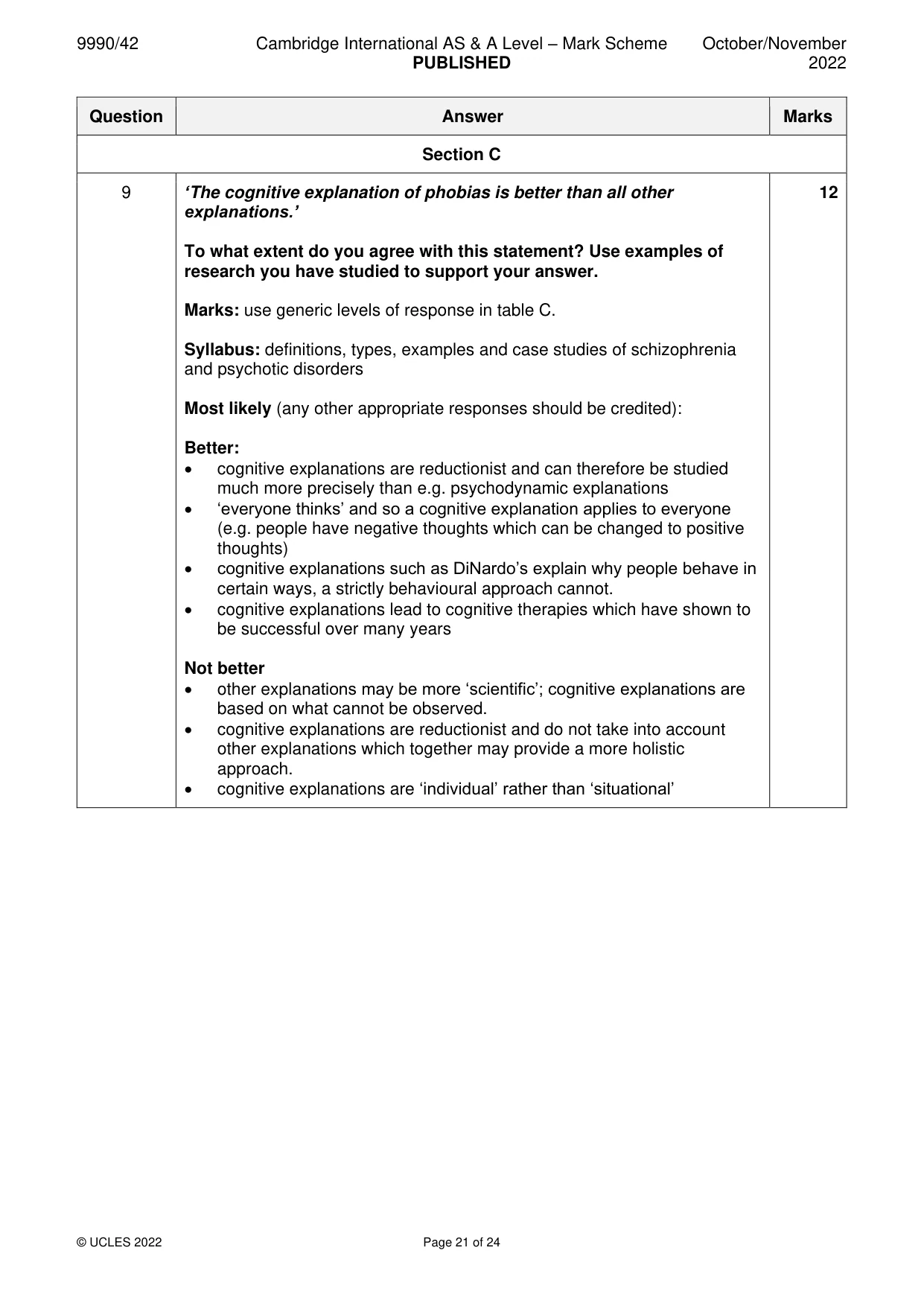
Mark scheme: 9 ‘The cognitive explanation of phobias is better than all other 12 explanations.’ To what extent do you agree with this statement? Use examples of research you have studied to support your answer. Marks: use generic levels of response in table C. Syllabus: definitions, types, examples and case studies of schizophrenia and psychotic disorders Most likely (any other appropriate responses should be credited): Better: • cognitive explanations are reductionist and can therefore be studied much more precisely than e.g. psychodynamic explanations • ‘everyone thinks’ and so a cognitive explanation applies to everyone (e.g. people have negative thoughts which can be changed to positive thoughts) • cognitive explanations such as DiNardo’s explain why people behave in certain ways, a strictly behavioural approach cannot. • cognitive explanations lead to cognitive therapies which have shown to be successful over many years Not better • other explanations may be more ‘scientific’; cognitive explanations are based on what cannot be observed. • cognitive explanations are reductionist and do not take into account other explanations which together may provide a more holistic approach. • cognitive explanations are ‘individual’ rather than ‘situational’
More questions on Anxiety disorders and fear-related disorders
Q10 · ‘Shopper movement patterns are of no use to understanding shopper behaviour.’ To what…
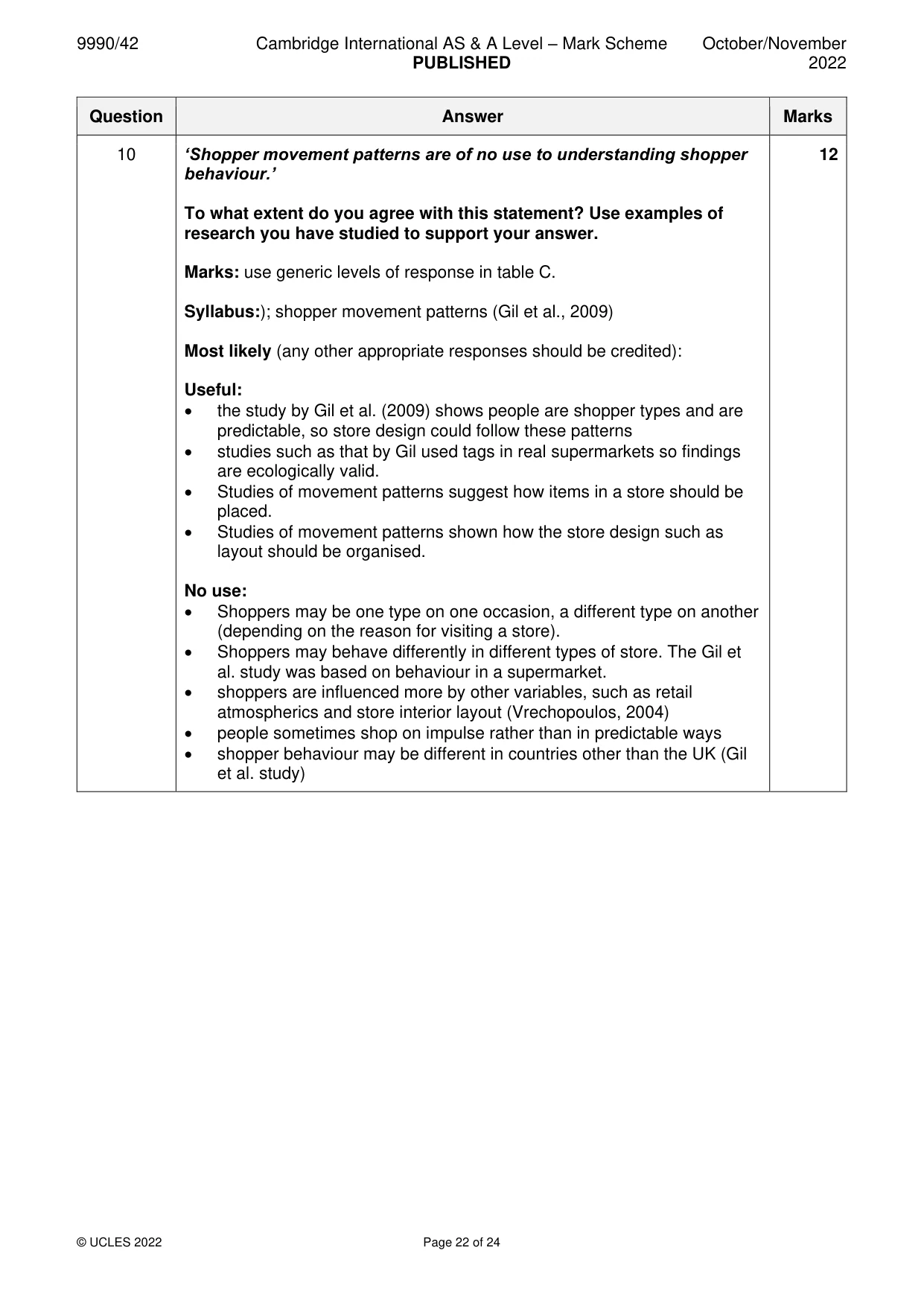
10 ‘Shopper movement patterns are of no use to understanding shopper behaviour.’ To what extent do you agree with this statement? Use examples of research you have studied to support your answer. [12] Psychology and health
Mark scheme: 10 ‘Shopper movement patterns are of no use to understanding shopper 12 behaviour.’ To what extent do you agree with this statement? Use examples of research you have studied to support your answer. Marks: use generic levels of response in table C. Syllabus:); shopper movement patterns (Gil et al., 2009) Most likely (any other appropriate responses should be credited): Useful: • the study by Gil et al. (2009) shows people are shopper types and are predictable, so store design could follow these patterns • studies such as that by Gil used tags in real supermarkets so findings are ecologically valid. • Studies of movement patterns suggest how items in a store should be placed. • Studies of movement patterns shown how the store design such as layout should be organised. No use: • Shoppers may be one type on one occasion, a different type on another (depending on the reason for visiting a store). • Shoppers may behave differently in different types of store. The Gil et al. study was based on behaviour in a supermarket. • shoppers are influenced more by other variables, such as retail atmospherics and store interior layout (Vrechopoulos, 2004) • people sometimes shop on impulse rather than in predictable ways • shopper behaviour may be different in countries other than the UK (Gil et al. study)
Q11 · ‘The strength of the Yale model of communication is its holism rather than its…
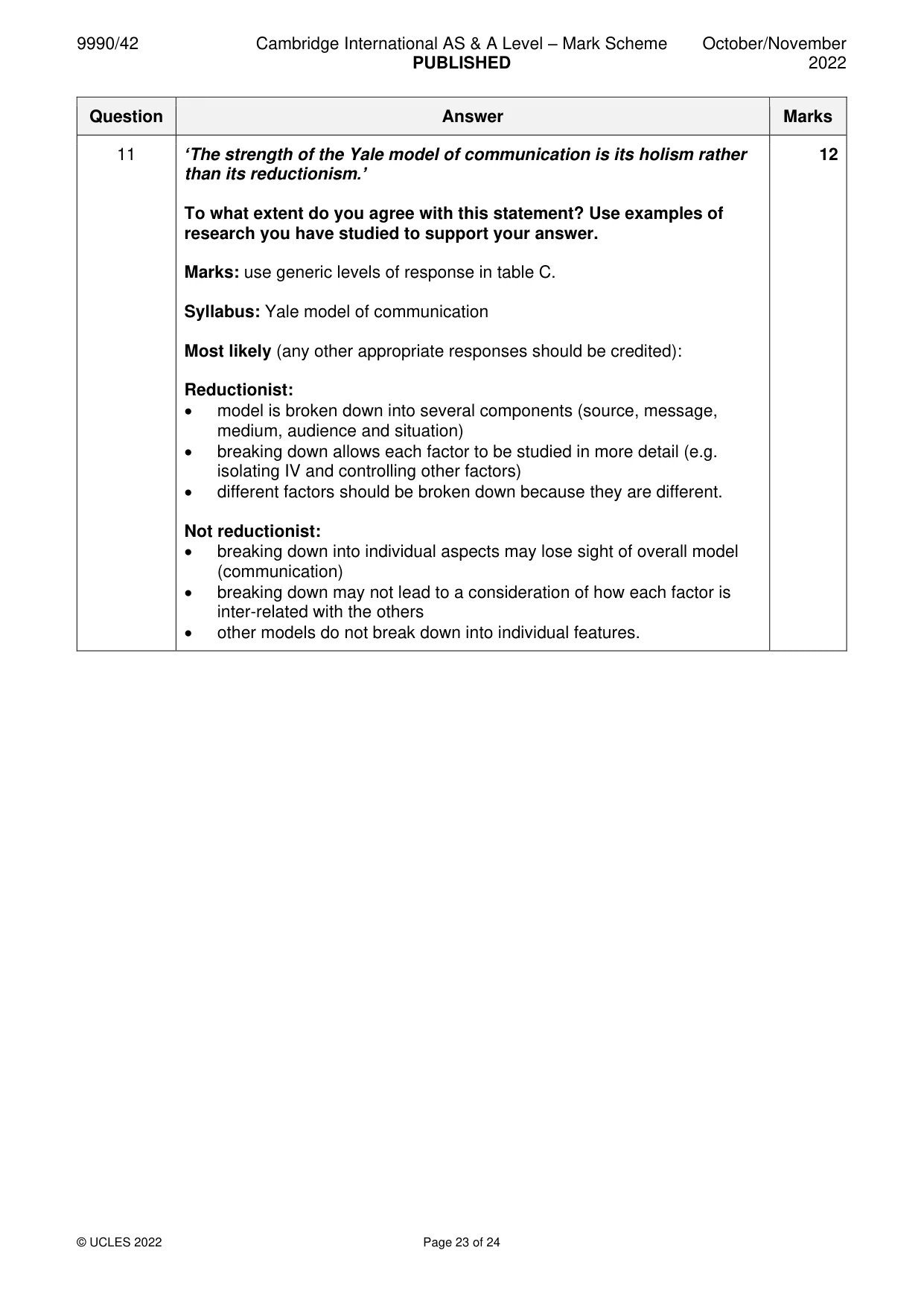
11 ‘The strength of the Yale model of communication is its holism rather than its reductionism.’ To what extent do you agree with this statement? Use examples of research you have studied to support your answer. [12] Psychology and organisations
Mark scheme: 11 ‘The strength of the Yale model of communication is its holism rather 12 than its reductionism.’ To what extent do you agree with this statement? Use examples of research you have studied to support your answer. Marks: use generic levels of response in table C. Syllabus: Yale model of communication Most likely (any other appropriate responses should be credited): Reductionist: • model is broken down into several components (source, message, medium, audience and situation) • breaking down allows each factor to be studied in more detail (e.g. isolating IV and controlling other factors) • different factors should be broken down because they are different. Not reductionist: • breaking down into individual aspects may lose sight of overall model (communication) • breaking down may not lead to a consideration of how each factor is inter-related with the others • other models do not break down into individual features.
Q12 · ‘Having both LPI-Self and LPI-Observer questionnaires in the Leadership Practices…
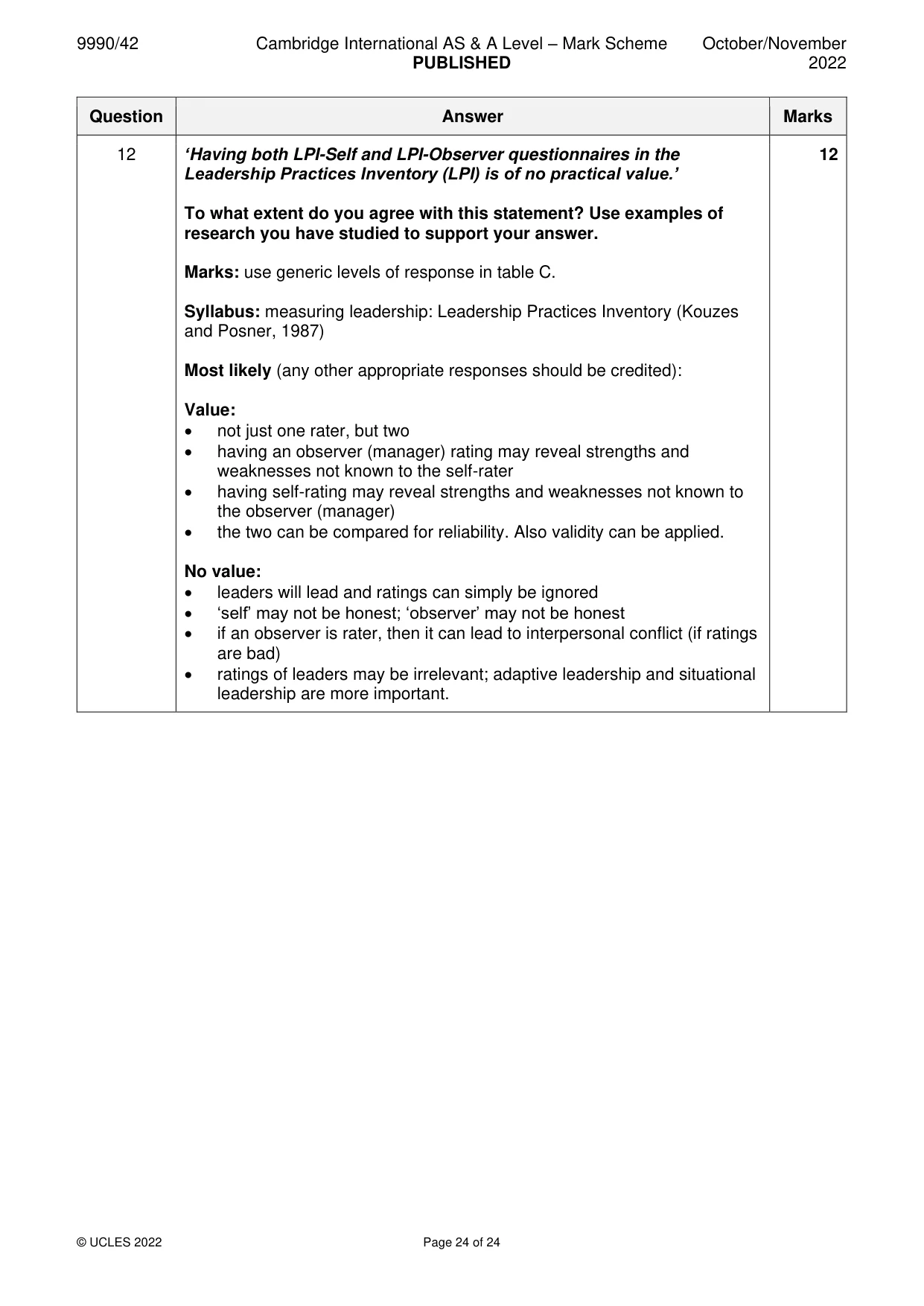
12 ‘Having both LPI-Self and LPI-Observer questionnaires in the Leadership Practices Inventory (LPI) is of no practical value.’ To what extent do you agree with this statement? Use examples of research you have studied to support your answer. [12]
Mark scheme: 12 ‘Having both LPI-Self and LPI-Observer questionnaires in the 12 Leadership Practices Inventory (LPI) is of no practical value.’ To what extent do you agree with this statement? Use examples of research you have studied to support your answer. Marks: use generic levels of response in table C. Syllabus: measuring leadership: Leadership Practices Inventory (Kouzes and Posner, 1987) Most likely (any other appropriate responses should be credited): Value: • not just one rater, but two • having an observer (manager) rating may reveal strengths and weaknesses not known to the self-rater • having self-rating may reveal strengths and weaknesses not known to the observer (manager) • the two can be compared for reliability. Also validity can be applied. No value: • leaders will lead and ratings can simply be ignored • ‘self’ may not be honest; ‘observer’ may not be honest • if an observer is rater, then it can lead to interpersonal conflict (if ratings are bad) • ratings of leaders may be irrelevant; adaptive leadership and situational leadership are more important.
What was in this paper
The subtopics covered by these 12 questions, and how many questions each got. Open one in a new tab to see every Cambridge question on it.
What you needed in this session
Cambridge’s own grade thresholds for 2022 Oct/Nov, Paper 4 · Variant 2. A higher threshold means an easier paper — the bar moves with how the cohort did.