Cambridge A Level Psychology (from 2018) 9990 — 2024 Oct/Nov Paper 4 · Variant 2
9990/42/O/N/24 · 12 questions · 60 marks · 90 min
The question paper and its mark scheme, free to read here and free to download. This is Cambridge’s own paper, exactly as it was sat.
Question paper8 pages
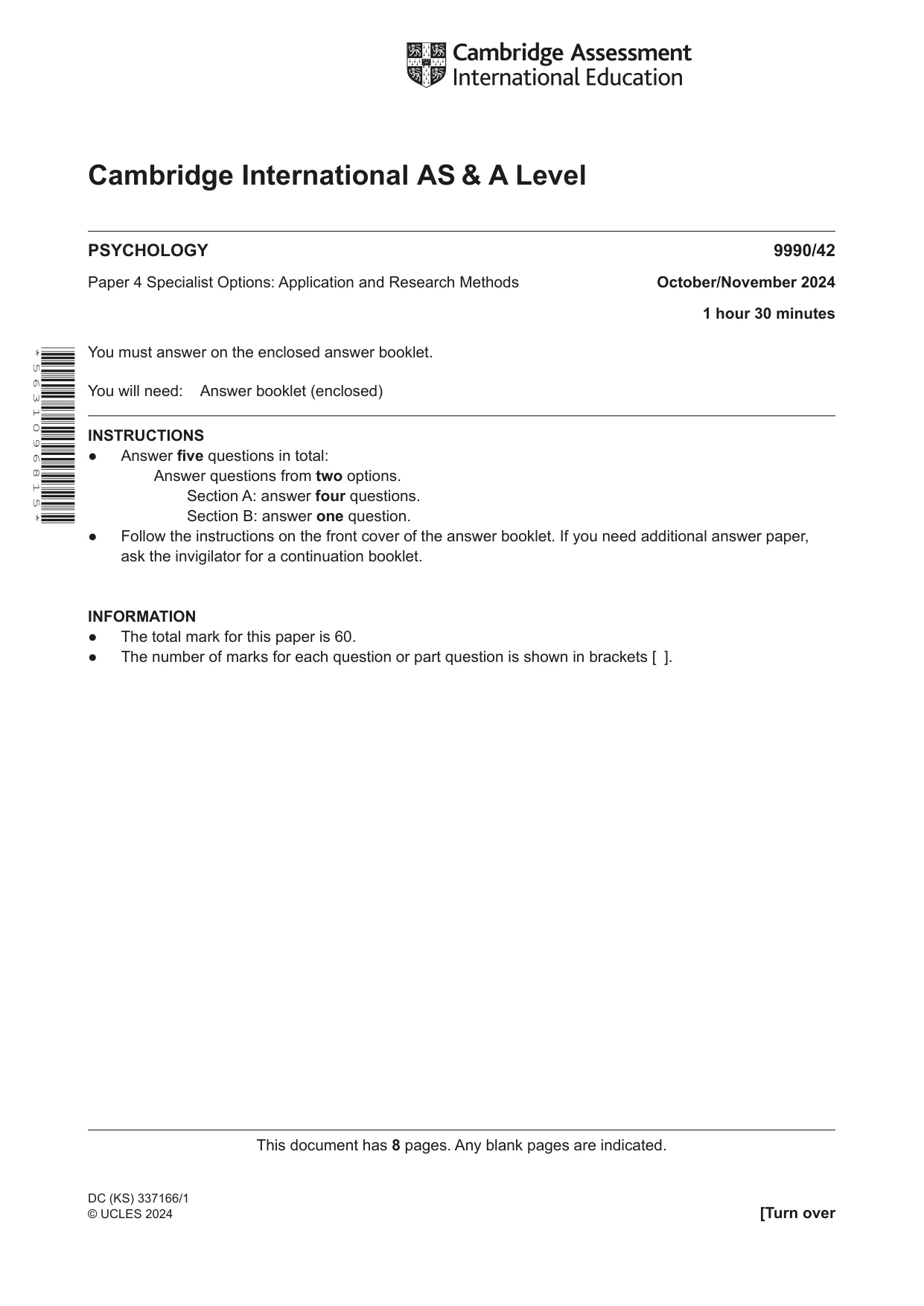



Mark scheme32 pages
Answers below. Sit the paper first if you are practising.
Questions as text
Q1 · The key study by Chapman and DeLapp (2013) treated an individual with a…
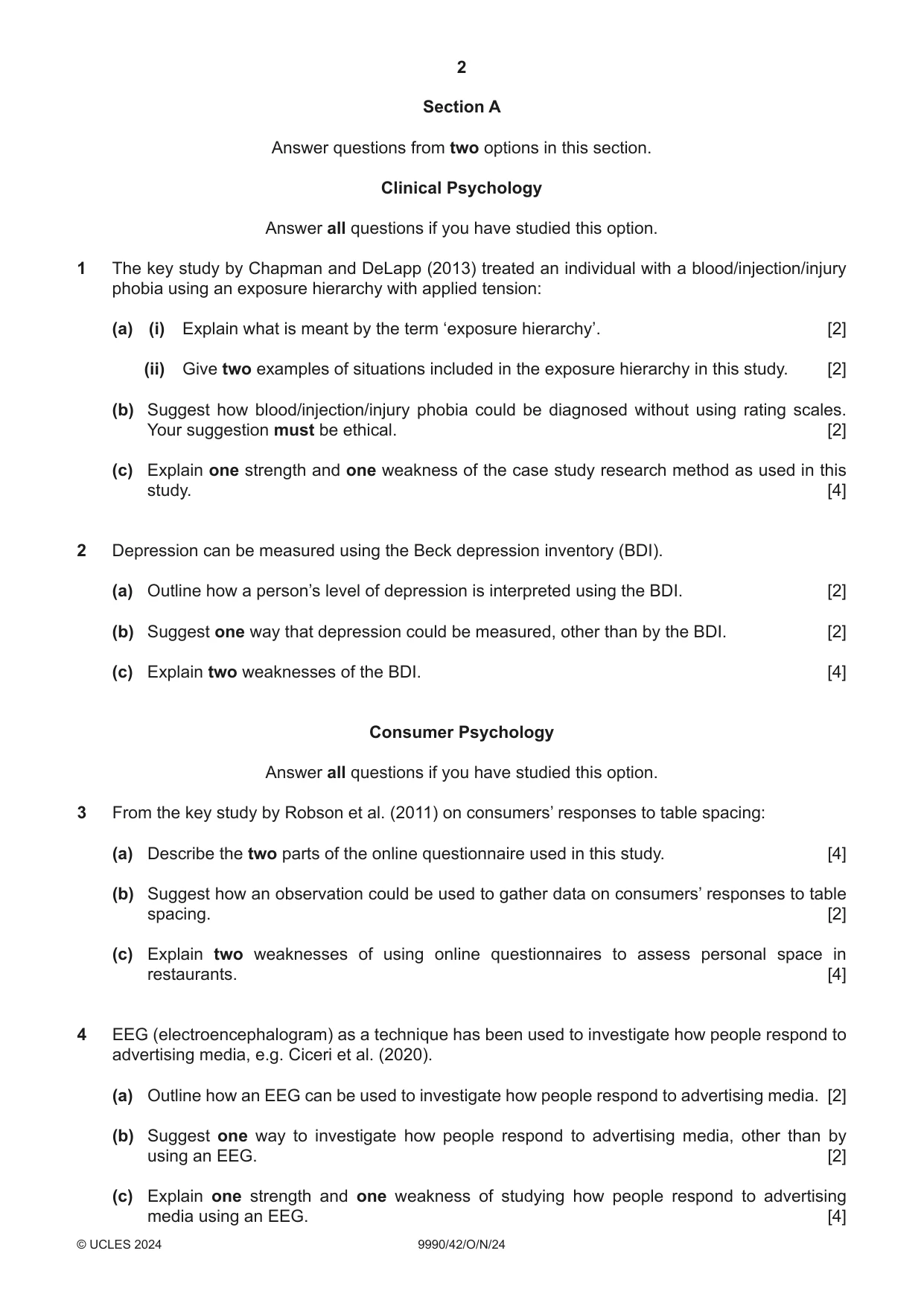
1 The key study by Chapman and DeLapp (2013) treated an individual with a blood/injection/injury phobia using an exposure hierarchy with applied tension: (a) (i) Explain what is meant by the term ‘exposure hierarchy’. [2] (ii) Give two examples of situations included in the exposure hierarchy in this study. [2] (b) Suggest how blood/injection/injury phobia could be diagnosed without using rating scales. Your suggestion must be ethical. [2] (c) Explain one strength and one weakness of the case study research method as used in this study. [4]
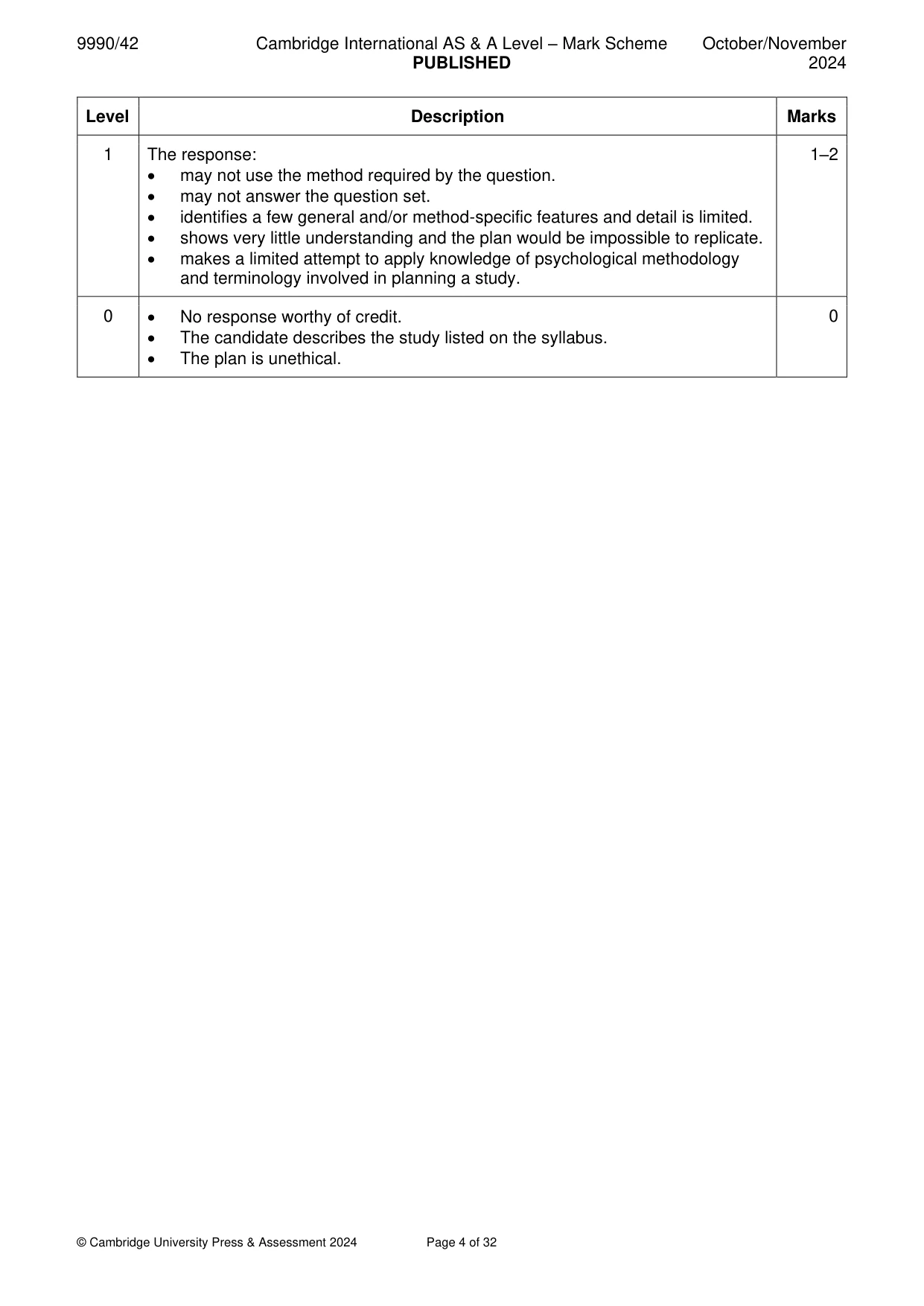
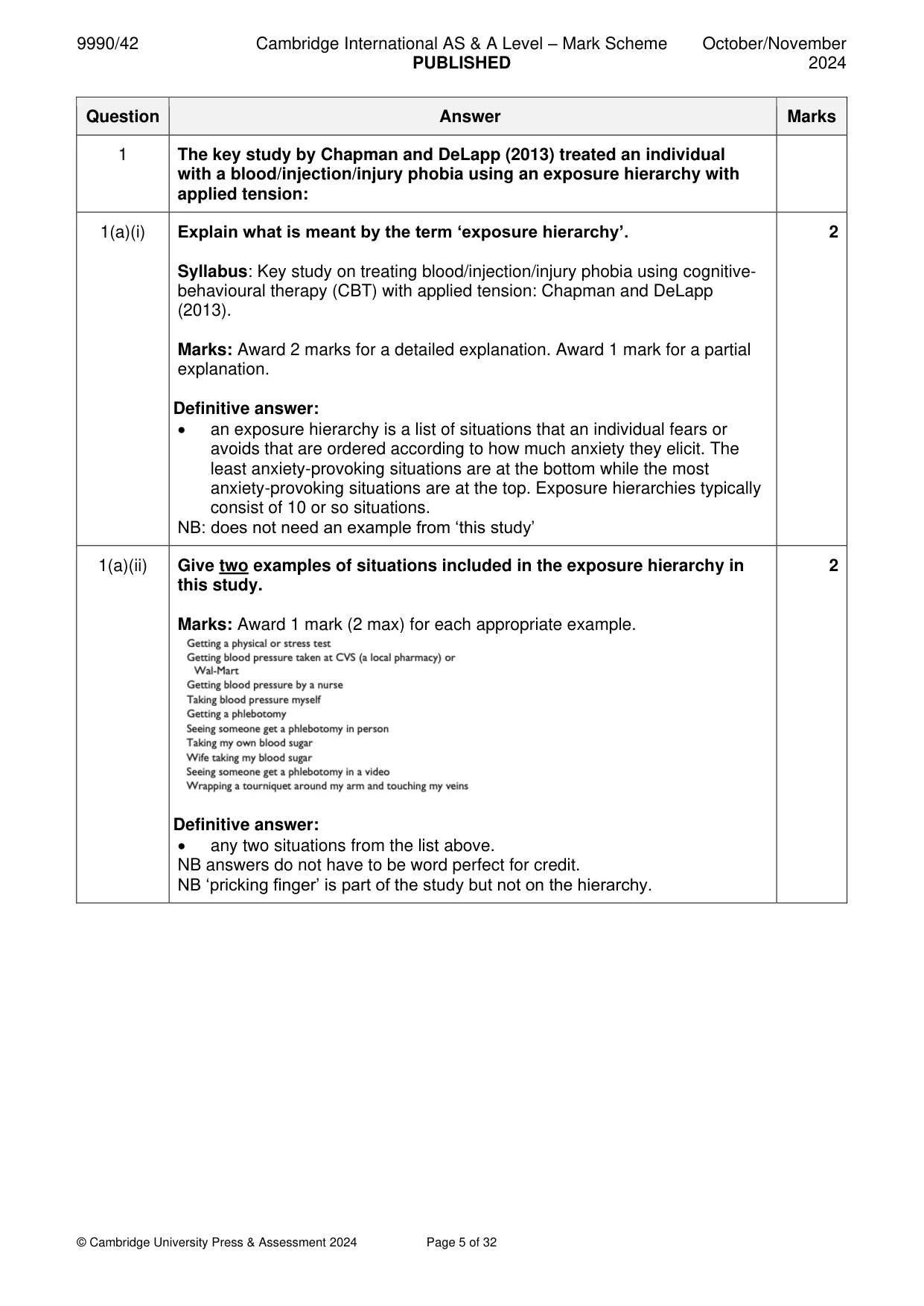
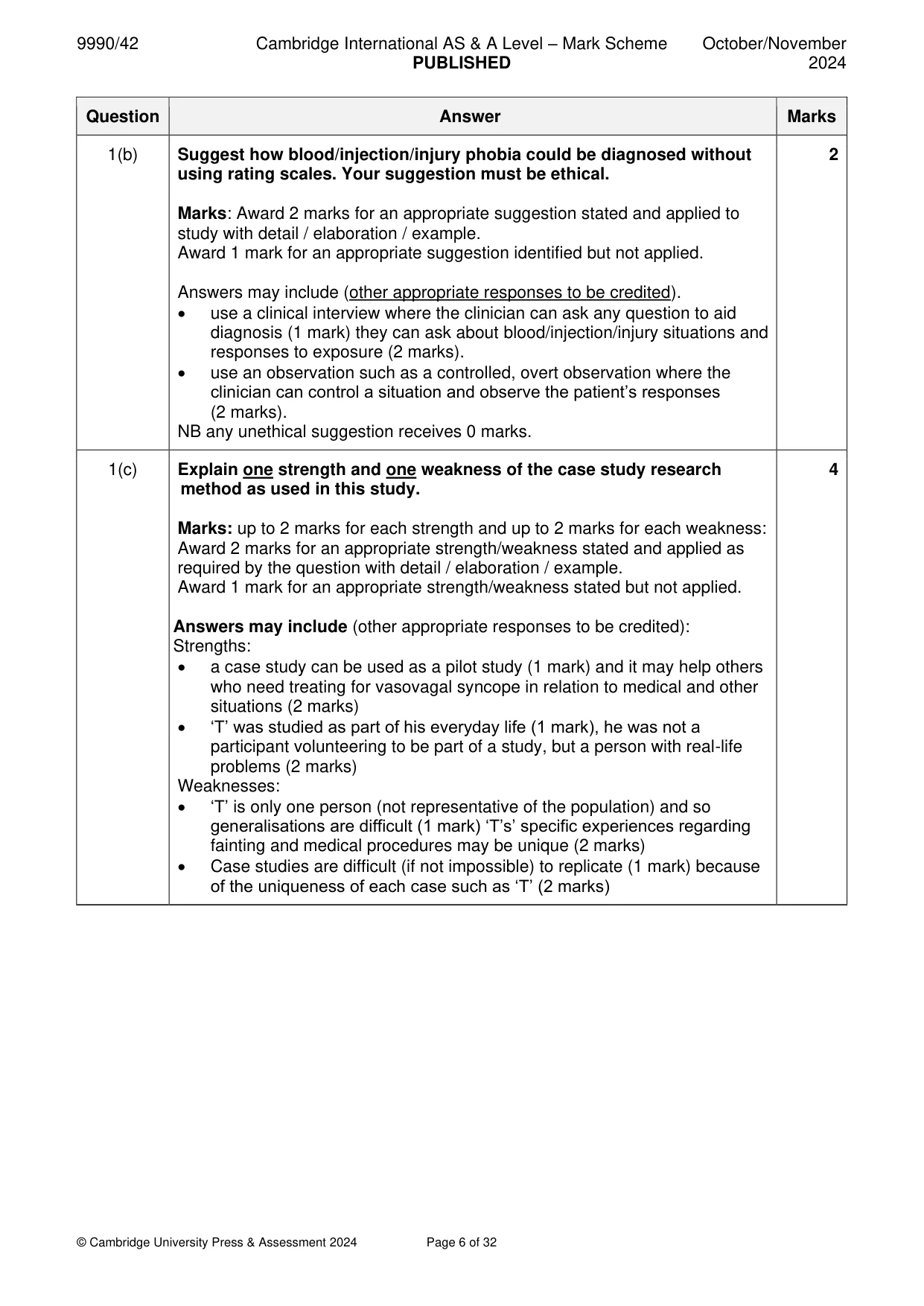
Mark scheme: Question Answer Marks 1 The key study by Chapman and DeLapp (2013) treated an individual with a blood/injection/injury phobia using an exposure hierarchy with applied tension: 1(a)(i) Explain what is meant by the term ‘exposure hierarchy’. 2 Syllabus: Key study on treating blood/injection/injury phobia using cognitive- behavioural therapy (CBT) with applied tension: Chapman and DeLapp (2013). Marks: Award 2 marks for a detailed explanation. Award 1 mark for a partial explanation. Definitive answer: • an exposure hierarchy is a list of situations that an individual fears or avoids that are ordered according to how much anxiety they elicit. The least anxiety-provoking situations are at the bottom while the most anxiety-provoking situations are at the top. Exposure hierarchies typically consist of 10 or so situations. NB: does not need an example from ‘this study’ 1(a)(ii) Give two examples of situations included in the exposure hierarchy in 2 this study. Marks: Award 1 mark (2 max) for each appropriate example. Definitive answer: • any two situations from the list above. NB answers do not have to be word perfect for credit. NB ‘pricking finger’ is part of the study but not on the hierarchy. 1(b) Suggest how blood/injection/injury phobia could be diagnosed without 2 using rating scales. Your suggestion must be ethical. Marks: Award 2 marks for an appropriate suggestion stated and applied to study with detail / elaboration / example. Award 1 mark for an appropriate suggestion identified but not applied. Answers may include (other appropriate responses to be credited). • use a clinical interview where the clinician can ask any question to aid diagnosis (1 mark) they can ask about blood/injection/injury situations and responses to exposure (2 marks). • use an observation such as a controlled, overt observation where the clinician can control a situation and observe the patient’s responses (2 marks). NB any unethical suggestion receives 0 marks. 1(c) Explain one strength and one weakness of the case study research 4 method as used in this study. Marks: up to 2 marks for each strength and up to 2 marks for each weakness: Award 2 marks for an appropriate strength/weakness stated and applied as required by the question with detail / elaboration / example. Award 1 mark for an appropriate strength/weakness stated but not applied. Answers may include (other appropriate responses to be credited): Strengths: • a case study can be used as a pilot study (1 mark) and it may help others who need treating for vasovagal syncope in relation to medical and other situations (2 marks) • ‘T’ was studied as part of his everyday life (1 mark), he was not a participant volunteering to be part of a study, but a person with real-life problems (2 marks) Weaknesses: • ‘T’ is only one person (not representative of the population) and so generalisations are difficult (1 mark) ‘T’s’ specific experiences regarding fainting and medical procedures may be unique (2 marks) • Case studies are difficult (if not impossible) to replicate (1 mark) because of the uniqueness of each case such as ‘T’ (2 marks)
More questions on Anxiety disorders and fear-related disorders
Q2 · Depression can be measured using the Beck depression inventory (BDI)
2 Depression can be measured using the Beck depression inventory (BDI). (a) Outline how a person’s level of depression is interpreted using the BDI. [2] (b) Suggest one way that depression could be measured, other than by the BDI. [2] (c) Explain two weaknesses of the BDI. [4] Consumer Psychology Answer all questions if you have studied this option.
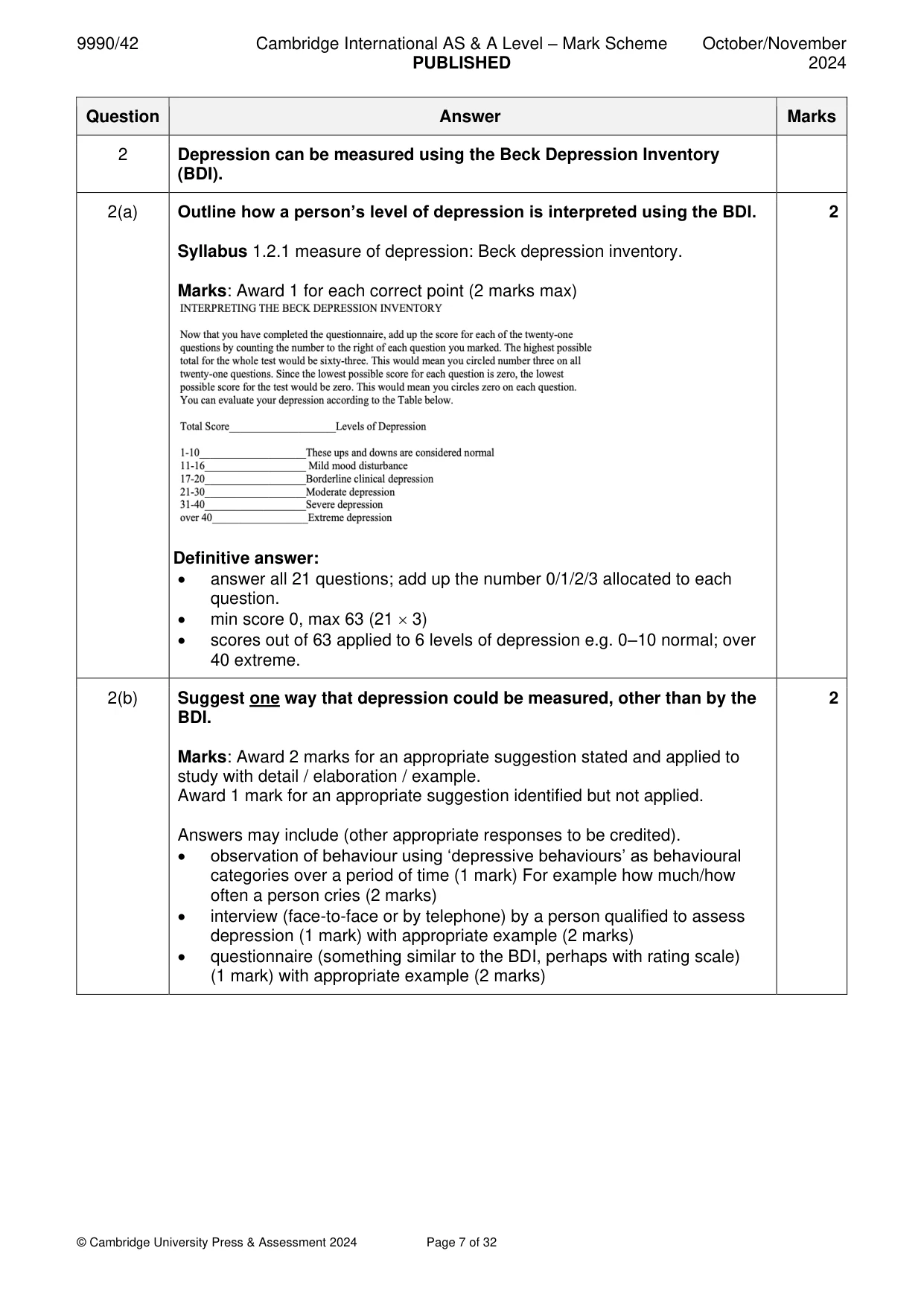
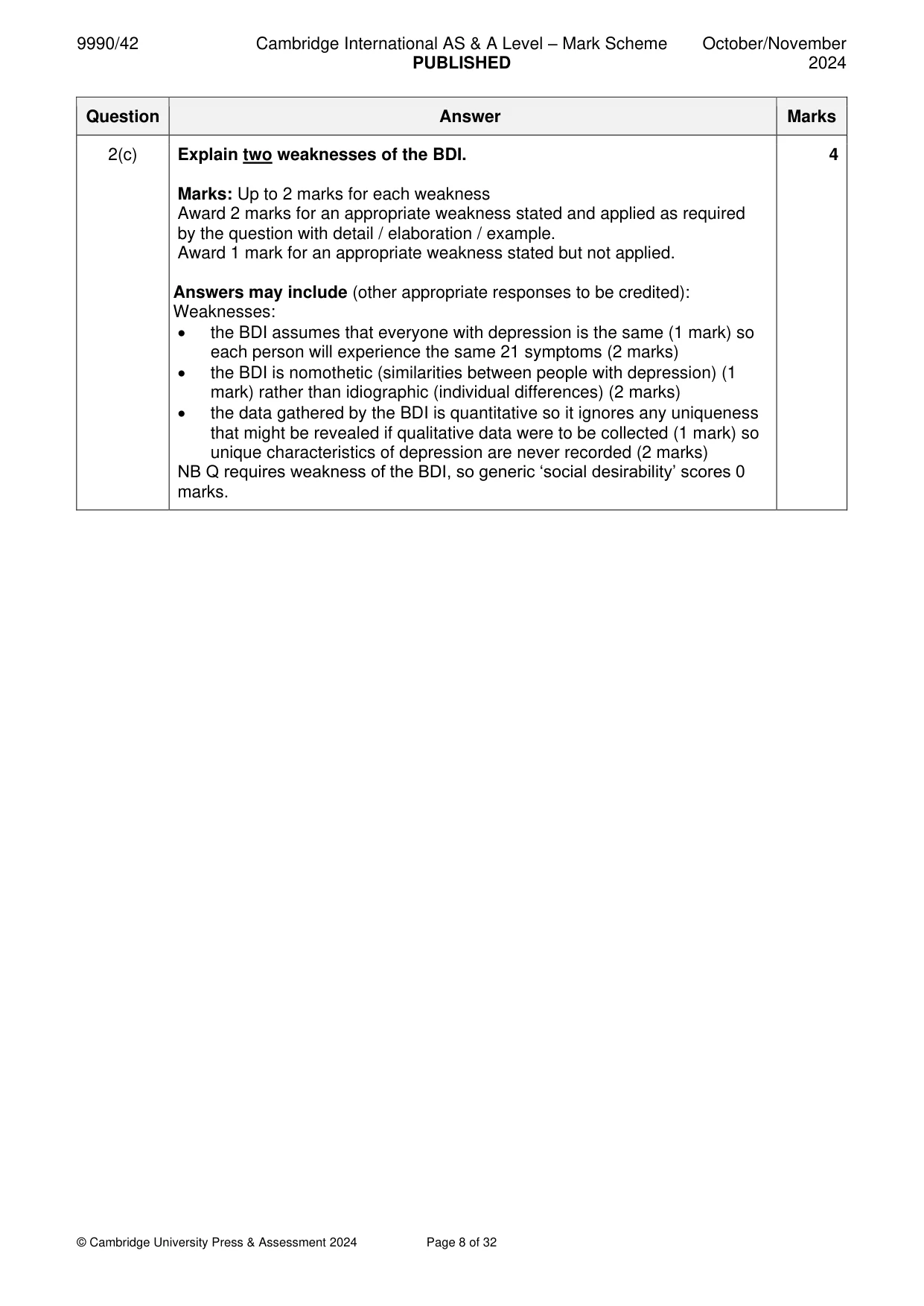
Mark scheme: 2 Depression can be measured using the Beck Depression Inventory (BDI). 2(a) Outline how a person’s level of depression is interpreted using the BDI. 2 Syllabus 1.2.1 measure of depression: Beck depression inventory. Marks: Award 1 for each correct point (2 marks max) Definitive answer: • answer all 21 questions; add up the number 0/1/2/3 allocated to each question. • min score 0, max 63 (21 3) • scores out of 63 applied to 6 levels of depression e.g. 0–10 normal; over 40 extreme. 2(b) Suggest one way that depression could be measured, other than by the 2 BDI. Marks: Award 2 marks for an appropriate suggestion stated and applied to study with detail / elaboration / example. Award 1 mark for an appropriate suggestion identified but not applied. Answers may include (other appropriate responses to be credited). • observation of behaviour using ‘depressive behaviours’ as behavioural categories over a period of time (1 mark) For example how much/how often a person cries (2 marks) • interview (face-to-face or by telephone) by a person qualified to assess depression (1 mark) with appropriate example (2 marks) • questionnaire (something similar to the BDI, perhaps with rating scale) (1 mark) with appropriate example (2 marks) 2(c) Explain two weaknesses of the BDI. 4 Marks: Up to 2 marks for each weakness Award 2 marks for an appropriate weakness stated and applied as required by the question with detail / elaboration / example. Award 1 mark for an appropriate weakness stated but not applied. Answers may include (other appropriate responses to be credited): Weaknesses: • the BDI assumes that everyone with depression is the same (1 mark) so each person will experience the same 21 symptoms (2 marks) • the BDI is nomothetic (similarities between people with depression) (1 mark) rather than idiographic (individual differences) (2 marks) • the data gathered by the BDI is quantitative so it ignores any uniqueness that might be revealed if qualitative data were to be collected (1 mark) so unique characteristics of depression are never recorded (2 marks) NB Q requires weakness of the BDI, so generic ‘social desirability’ scores 0 marks.
More questions on Mood (affective) disorders: depressive disorder (unipolar) and bipolar disorder
Q3 · From the key study by Robson et al
3 From the key study by Robson et al. (2011) on consumers’ responses to table spacing: (a) Describe the two parts of the online questionnaire used in this study. [4] (b) Suggest how an observation could be used to gather data on consumers’ responses to table spacing. [2] (c) Explain two weaknesses of using online questionnaires to assess personal space in restaurants. [4]
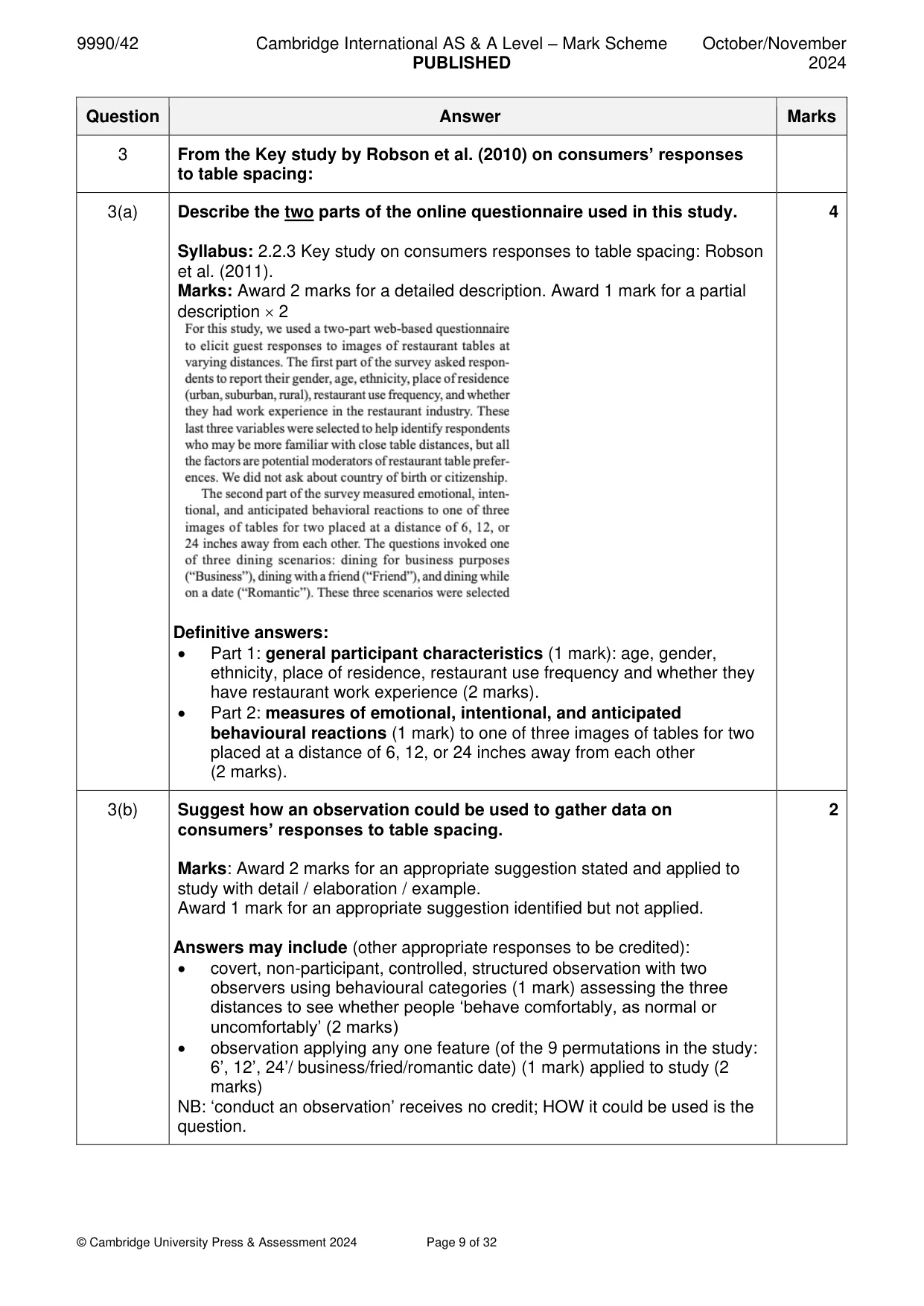
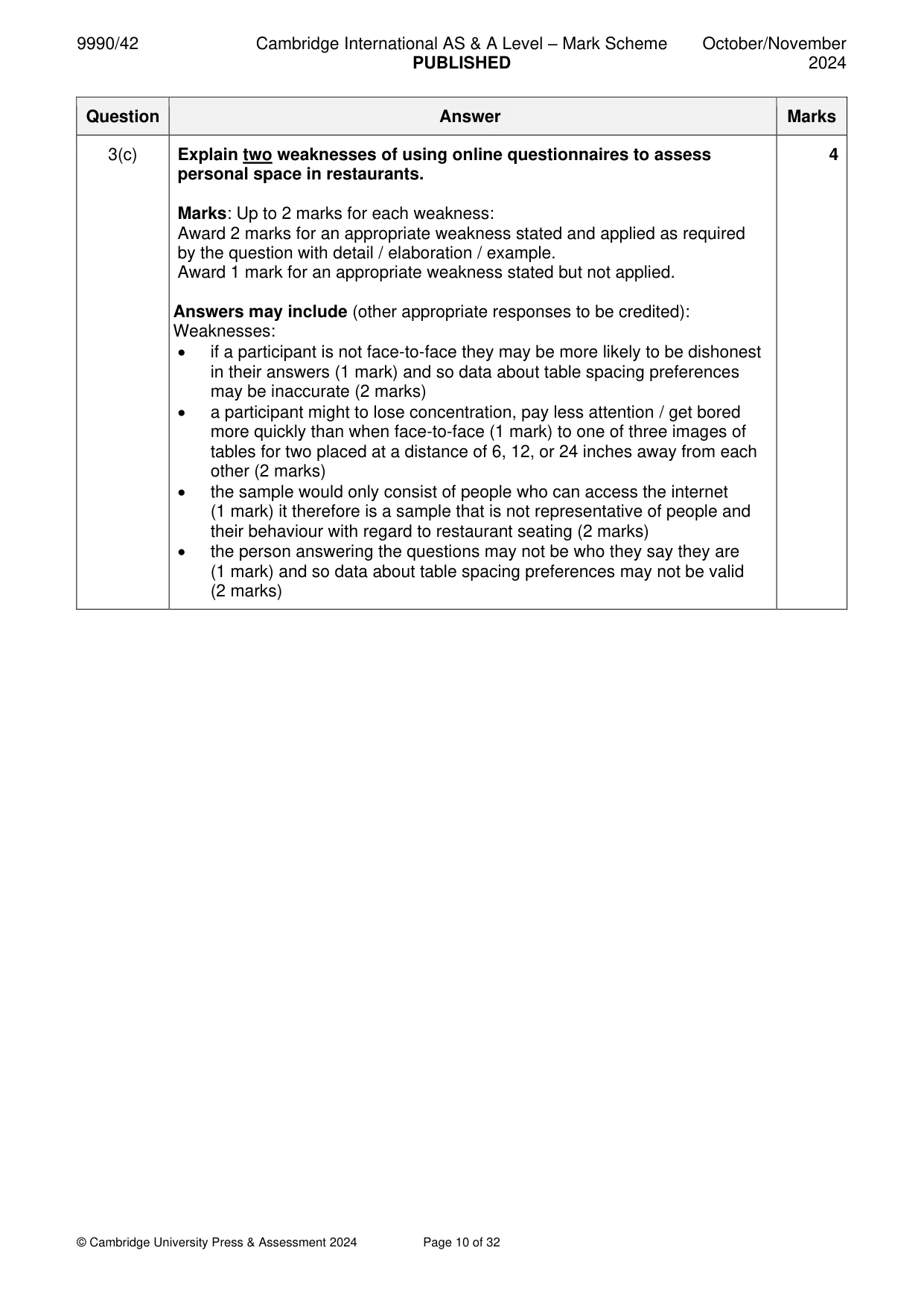
Mark scheme: 3 From the Key study by Robson et al. (2010) on consumers’ responses to table spacing: 3(a) Describe the two parts of the online questionnaire used in this study. 4 Syllabus: 2.2.3 Key study on consumers responses to table spacing: Robson et al. (2011). Marks: Award 2 marks for a detailed description. Award 1 mark for a partial description 2 Definitive answers: • Part 1: general participant characteristics (1 mark): age, gender, ethnicity, place of residence, restaurant use frequency and whether they have restaurant work experience (2 marks). • Part 2: measures of emotional, intentional, and anticipated behavioural reactions (1 mark) to one of three images of tables for two placed at a distance of 6, 12, or 24 inches away from each other (2 marks). 3(b) Suggest how an observation could be used to gather data on 2 consumers’ responses to table spacing. Marks: Award 2 marks for an appropriate suggestion stated and applied to study with detail / elaboration / example. Award 1 mark for an appropriate suggestion identified but not applied. Answers may include (other appropriate responses to be credited): • covert, non-participant, controlled, structured observation with two observers using behavioural categories (1 mark) assessing the three distances to see whether people ‘behave comfortably, as normal or uncomfortably’ (2 marks) • observation applying any one feature (of the 9 permutations in the study: 6’, 12’, 24’/ business/fried/romantic date) (1 mark) applied to study (2 marks) NB: ‘conduct an observation’ receives no credit; HOW it could be used is the question. 3(c) Explain two weaknesses of using online questionnaires to assess 4 personal space in restaurants. Marks: Up to 2 marks for each weakness: Award 2 marks for an appropriate weakness stated and applied as required by the question with detail / elaboration / example. Award 1 mark for an appropriate weakness stated but not applied. Answers may include (other appropriate responses to be credited): Weaknesses: • if a participant is not face-to-face they may be more likely to be dishonest in their answers (1 mark) and so data about table spacing preferences may be inaccurate (2 marks) • a participant might to lose concentration, pay less attention / get bored more quickly than when face-to-face (1 mark) to one of three images of tables for two placed at a distance of 6, 12, or 24 inches away from each other (2 marks) • the sample would only consist of people who can access the internet (1 mark) it therefore is a sample that is not representative of people and their behaviour with regard to restaurant seating (2 marks) • the person answering the questions may not be who they say they are (1 mark) and so data about table spacing preferences may not be valid (2 marks)
Q4 · EEG (electroencephalogram) as a technique has been used to investigate how people respond…
4 EEG (electroencephalogram) as a technique has been used to investigate how people respond to advertising media, e.g. Ciceri et al. (2020). (a) Outline how an EEG can be used to investigate how people respond to advertising media. [2] (b) Suggest one way to investigate how people respond to advertising media, other than by using an EEG. [2] (c) Explain one strength and one weakness of studying how people respond to advertising media using an EEG. [4] Health Psychology Answer all questions if you have studied this option.
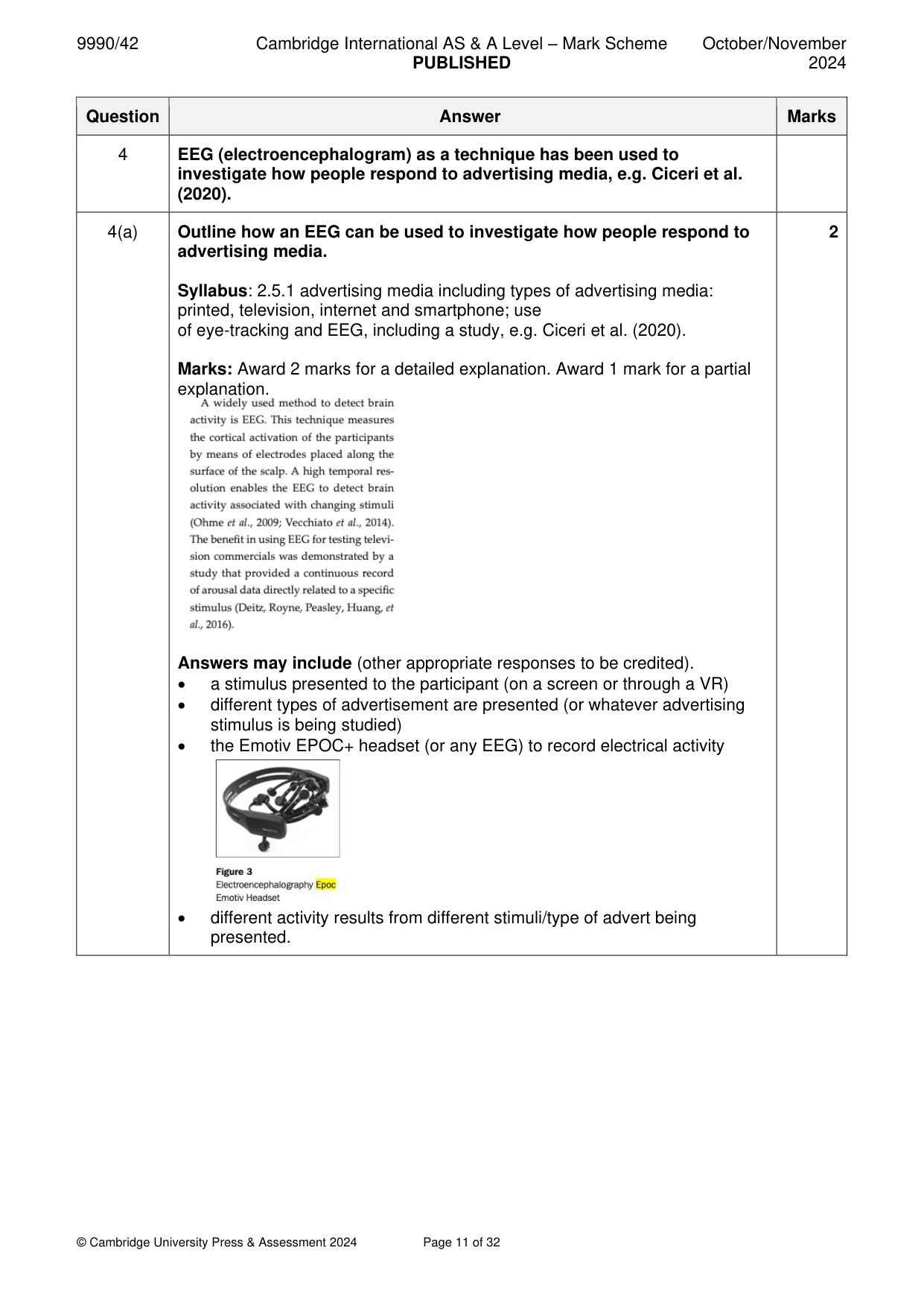
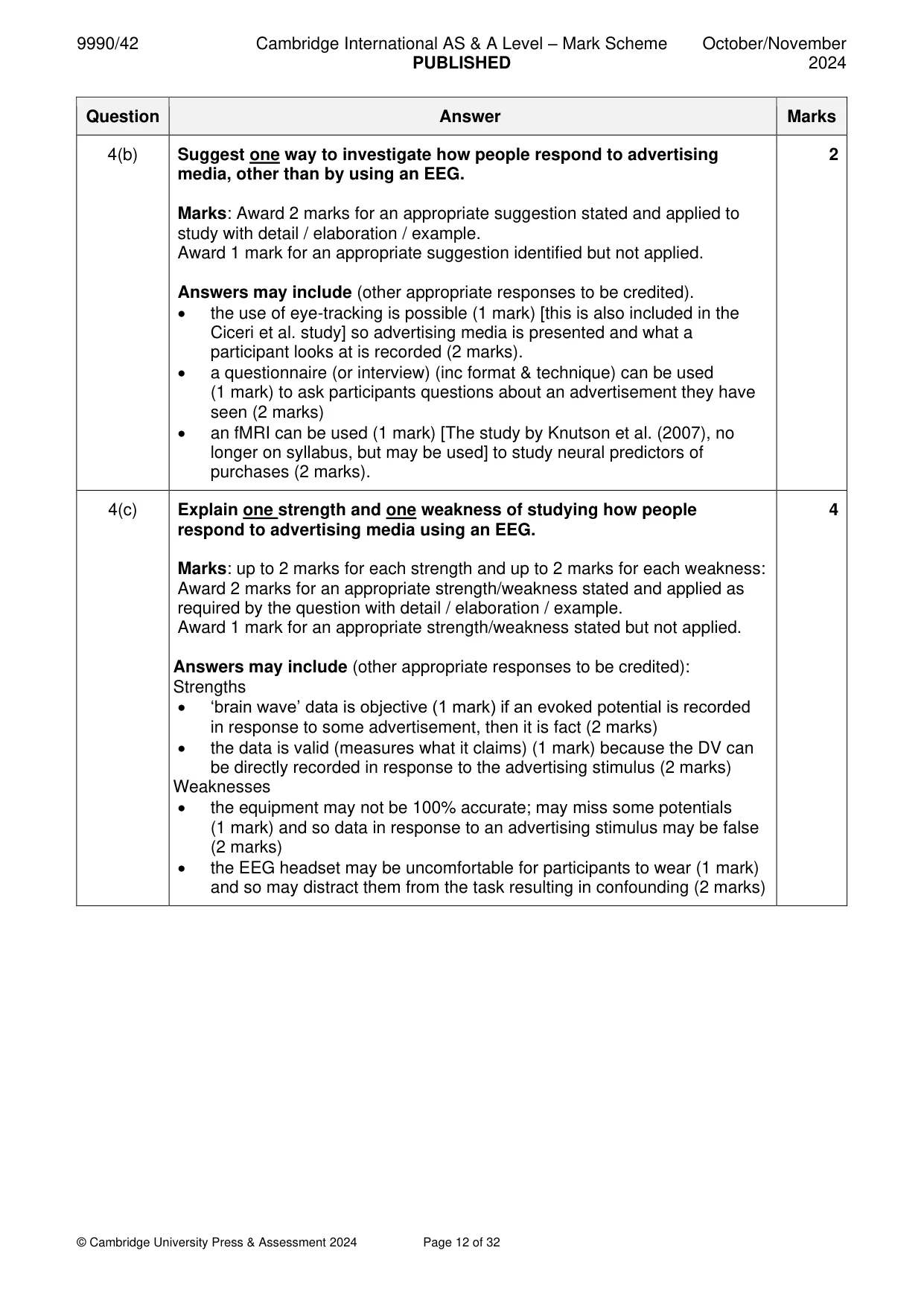
Mark scheme: 4 EEG (electroencephalogram) as a technique has been used to investigate how people respond to advertising media, e.g. Ciceri et al. (2020). 4(a) Outline how an EEG can be used to investigate how people respond to 2 advertising media. Syllabus: 2.5.1 advertising media including types of advertising media: printed, television, internet and smartphone; use of eye-tracking and EEG, including a study, e.g. Ciceri et al. (2020). Marks: Award 2 marks for a detailed explanation. Award 1 mark for a partial explanation. Answers may include (other appropriate responses to be credited). • a stimulus presented to the participant (on a screen or through a VR) • different types of advertisement are presented (or whatever advertising stimulus is being studied) • the Emotiv EPOC+ headset (or any EEG) to record electrical activity • different activity results from different stimuli/type of advert being presented. 4(b) Suggest one way to investigate how people respond to advertising 2 media, other than by using an EEG. Marks: Award 2 marks for an appropriate suggestion stated and applied to study with detail / elaboration / example. Award 1 mark for an appropriate suggestion identified but not applied. Answers may include (other appropriate responses to be credited). • the use of eye-tracking is possible (1 mark) [this is also included in the Ciceri et al. study] so advertising media is presented and what a participant looks at is recorded (2 marks). • a questionnaire (or interview) (inc format & technique) can be used (1 mark) to ask participants questions about an advertisement they have seen (2 marks) • an fMRI can be used (1 mark) [The study by Knutson et al. (2007), no longer on syllabus, but may be used] to study neural predictors of purchases (2 marks). 4(c) Explain one strength and one weakness of studying how people 4 respond to advertising media using an EEG. Marks: up to 2 marks for each strength and up to 2 marks for each weakness: Award 2 marks for an appropriate strength/weakness stated and applied as required by the question with detail / elaboration / example. Award 1 mark for an appropriate strength/weakness stated but not applied. Answers may include (other appropriate responses to be credited): Strengths • ‘brain wave’ data is objective (1 mark) if an evoked potential is recorded in response to some advertisement, then it is fact (2 marks) • the data is valid (measures what it claims) (1 mark) because the DV can be directly recorded in response to the advertising stimulus (2 marks) Weaknesses • the equipment may not be 100% accurate; may miss some potentials (1 mark) and so data in response to an advertising stimulus may be false (2 marks) • the EEG headset may be uncomfortable for participants to wear (1 mark) and so may distract them from the task resulting in confounding (2 marks)
Q5 · The key study by Shoshani and Steinmetz (2014) on using positive psychology in schools…
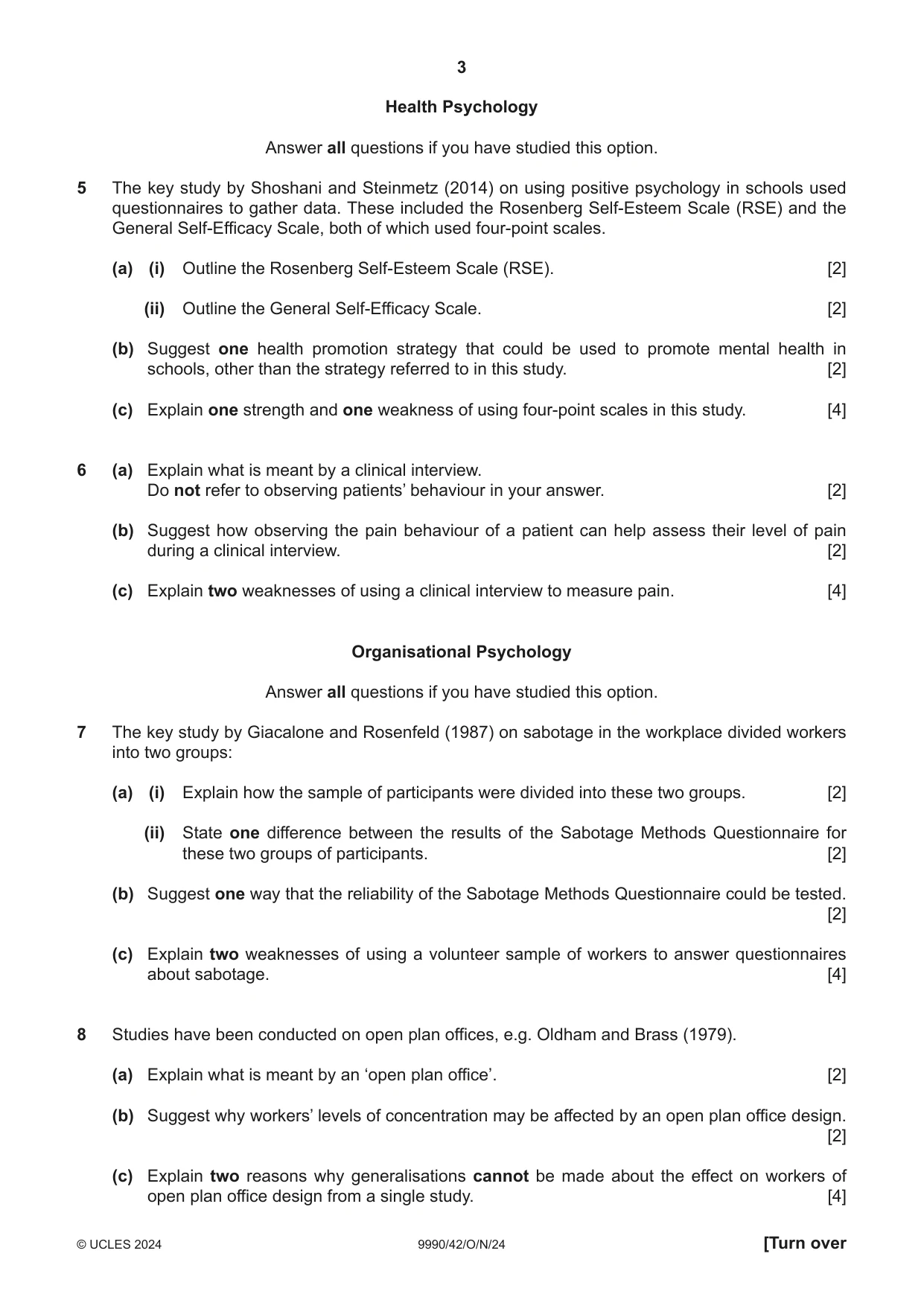
5 The key study by Shoshani and Steinmetz (2014) on using positive psychology in schools used questionnaires to gather data. These included the Rosenberg Self-Esteem Scale (RSE) and the General Self-Efficacy Scale, both of which used four-point scales. (a) (i) Outline the Rosenberg Self-Esteem Scale (RSE). [2] (ii) Outline the General Self-Efficacy Scale. [2] (b) Suggest one health promotion strategy that could be used to promote mental health in schools, other than the strategy referred to in this study. [2] (c) Explain one strength and one weakness of using four-point scales in this study. [4]
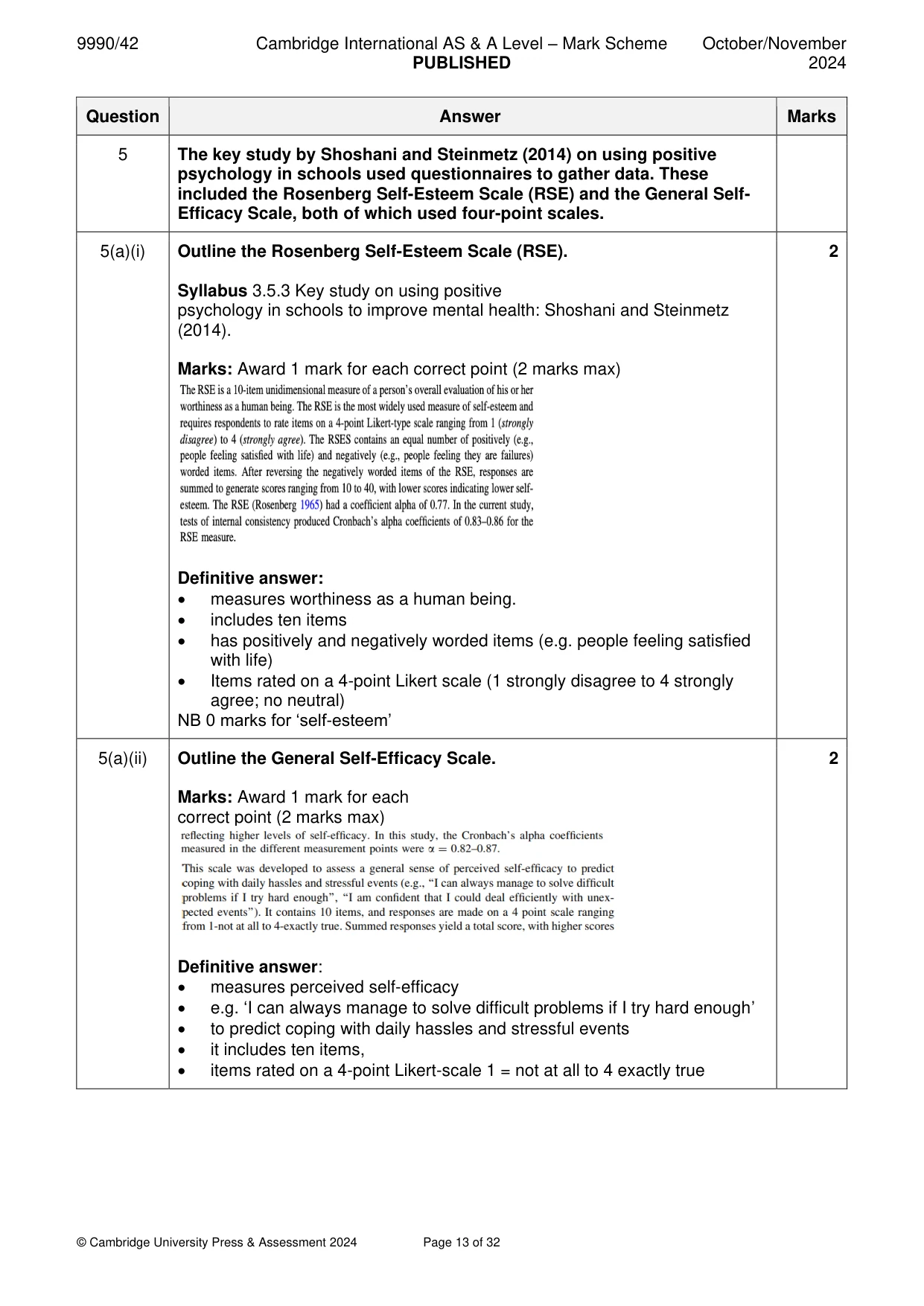
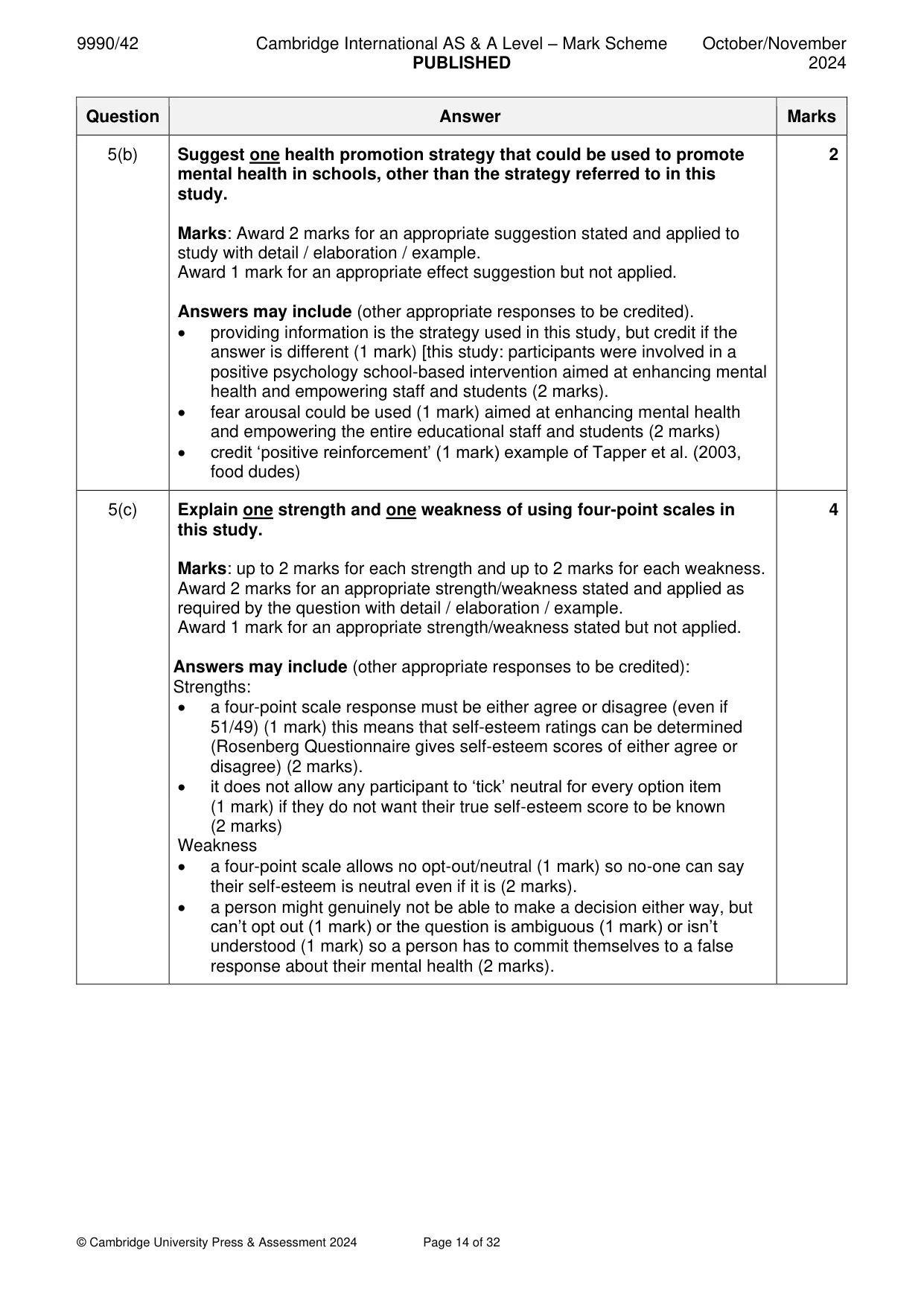
Mark scheme: 5 The key study by Shoshani and Steinmetz (2014) on using positive psychology in schools used questionnaires to gather data. These included the Rosenberg Self-Esteem Scale (RSE) and the General Self- Efficacy Scale, both of which used four-point scales. 5(a)(i) Outline the Rosenberg Self-Esteem Scale (RSE). 2 Syllabus 3.5.3 Key study on using positive psychology in schools to improve mental health: Shoshani and Steinmetz (2014). Marks: Award 1 mark for each correct point (2 marks max) Definitive answer: • measures worthiness as a human being. • includes ten items • has positively and negatively worded items (e.g. people feeling satisfied with life) • Items rated on a 4-point Likert scale (1 strongly disagree to 4 strongly agree; no neutral) NB 0 marks for ‘self-esteem’ 5(a)(ii) Outline the General Self-Efficacy Scale. 2 Marks: Award 1 mark for each correct point (2 marks max) Definitive answer: • measures perceived self-efficacy • e.g. ‘I can always manage to solve difficult problems if I try hard enough’ • to predict coping with daily hassles and stressful events • it includes ten items, • items rated on a 4-point Likert-scale 1 = not at all to 4 exactly true 5(b) Suggest one health promotion strategy that could be used to promote 2 mental health in schools, other than the strategy referred to in this study. Marks: Award 2 marks for an appropriate suggestion stated and applied to study with detail / elaboration / example. Award 1 mark for an appropriate effect suggestion but not applied. Answers may include (other appropriate responses to be credited). • providing information is the strategy used in this study, but credit if the answer is different (1 mark) [this study: participants were involved in a positive psychology school-based intervention aimed at enhancing mental health and empowering staff and students (2 marks). • fear arousal could be used (1 mark) aimed at enhancing mental health and empowering the entire educational staff and students (2 marks) • credit ‘positive reinforcement’ (1 mark) example of Tapper et al. (2003, food dudes) 5(c) Explain one strength and one weakness of using four-point scales in 4 this study. Marks: up to 2 marks for each strength and up to 2 marks for each weakness. Award 2 marks for an appropriate strength/weakness stated and applied as required by the question with detail / elaboration / example. Award 1 mark for an appropriate strength/weakness stated but not applied. Answers may include (other appropriate responses to be credited): Strengths: • a four-point scale response must be either agree or disagree (even if 51/49) (1 mark) this means that self-esteem ratings can be determined (Rosenberg Questionnaire gives self-esteem scores of either agree or disagree) (2 marks). • it does not allow any participant to ‘tick’ neutral for every option item (1 mark) if they do not want their true self-esteem score to be known (2 marks) Weakness • a four-point scale allows no opt-out/neutral (1 mark) so no-one can say their self-esteem is neutral even if it is (2 marks). • a person might genuinely not be able to make a decision either way, but can’t opt out (1 mark) or the question is ambiguous (1 mark) or isn’t understood (1 mark) so a person has to commit themselves to a false response about their mental health (2 marks).
More questions on 2 Health promotion in schools and worksites
Q6 · Explain what is meant by a clinical interview
6 (a) Explain what is meant by a clinical interview. Do not refer to observing patients’ behaviour in your answer. [2] (b) Suggest how observing the pain behaviour of a patient can help assess their level of pain during a clinical interview. [2] (c) Explain two weaknesses of using a clinical interview to measure pain. [4] Organisational Psychology Answer all questions if you have studied this option.
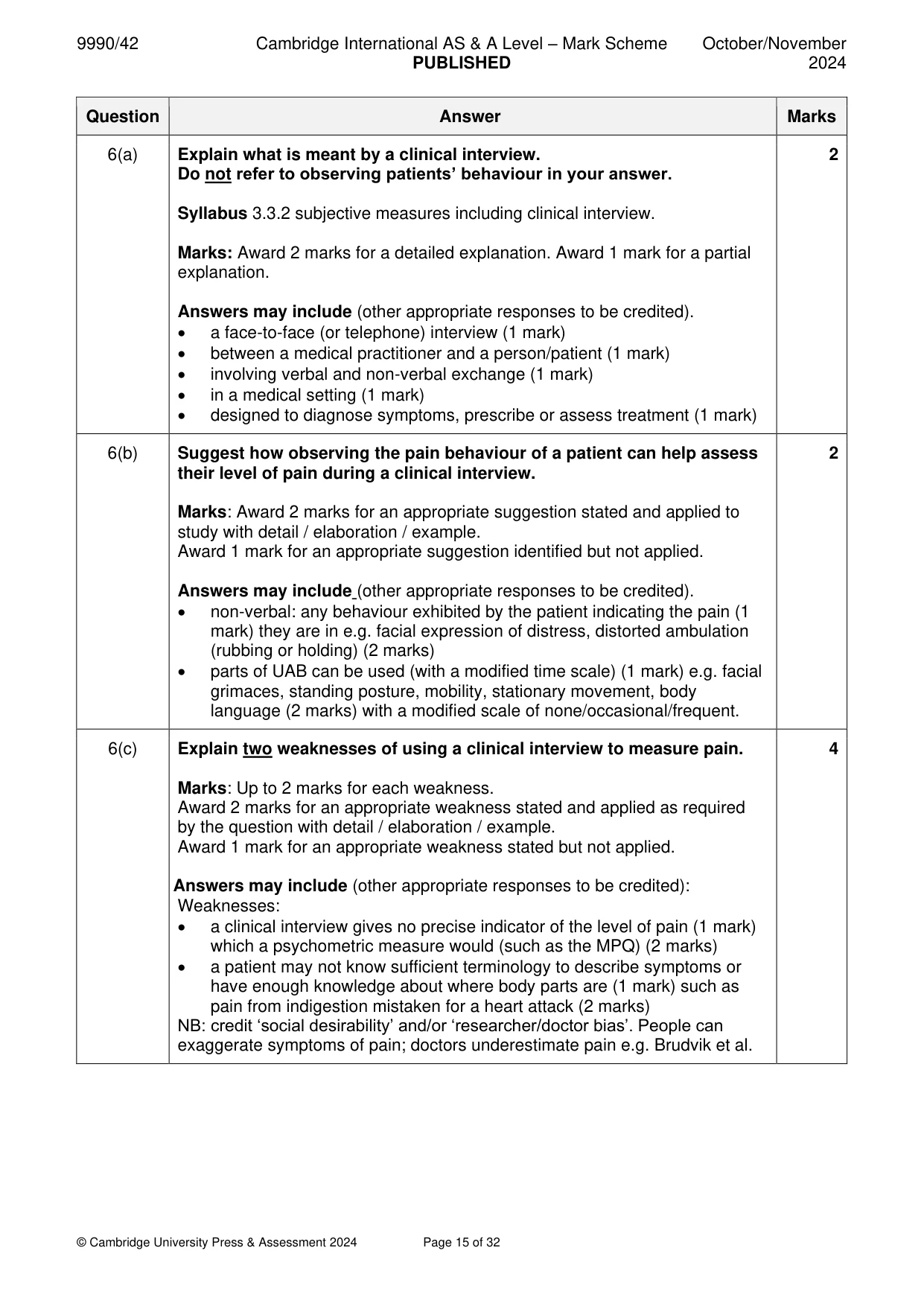
Mark scheme: 6(a) Explain what is meant by a clinical interview. 2 Do not refer to observing patients’ behaviour in your answer. Syllabus 3.3.2 subjective measures including clinical interview. Marks: Award 2 marks for a detailed explanation. Award 1 mark for a partial explanation. Answers may include (other appropriate responses to be credited). • a face-to-face (or telephone) interview (1 mark) • between a medical practitioner and a person/patient (1 mark) • involving verbal and non-verbal exchange (1 mark) • in a medical setting (1 mark) • designed to diagnose symptoms, prescribe or assess treatment (1 mark) 6(b) Suggest how observing the pain behaviour of a patient can help assess 2 their level of pain during a clinical interview. Marks: Award 2 marks for an appropriate suggestion stated and applied to study with detail / elaboration / example. Award 1 mark for an appropriate suggestion identified but not applied. Answers may include (other appropriate responses to be credited). • non-verbal: any behaviour exhibited by the patient indicating the pain (1 mark) they are in e.g. facial expression of distress, distorted ambulation (rubbing or holding) (2 marks) • parts of UAB can be used (with a modified time scale) (1 mark) e.g. facial grimaces, standing posture, mobility, stationary movement, body language (2 marks) with a modified scale of none/occasional/frequent. 6(c) Explain two weaknesses of using a clinical interview to measure pain. 4 Marks: Up to 2 marks for each weakness. Award 2 marks for an appropriate weakness stated and applied as required by the question with detail / elaboration / example. Award 1 mark for an appropriate weakness stated but not applied. Answers may include (other appropriate responses to be credited): Weaknesses: • a clinical interview gives no precise indicator of the level of pain (1 mark) which a psychometric measure would (such as the MPQ) (2 marks) • a patient may not know sufficient terminology to describe symptoms or have enough knowledge about where body parts are (1 mark) such as pain from indigestion mistaken for a heart attack (2 marks) NB: credit ‘social desirability’ and/or ‘researcher/doctor bias’. People can exaggerate symptoms of pain; doctors underestimate pain e.g. Brudvik et al.
Q7 · The key study by Giacalone and Rosenfeld (1987) on sabotage in the workplace divided…
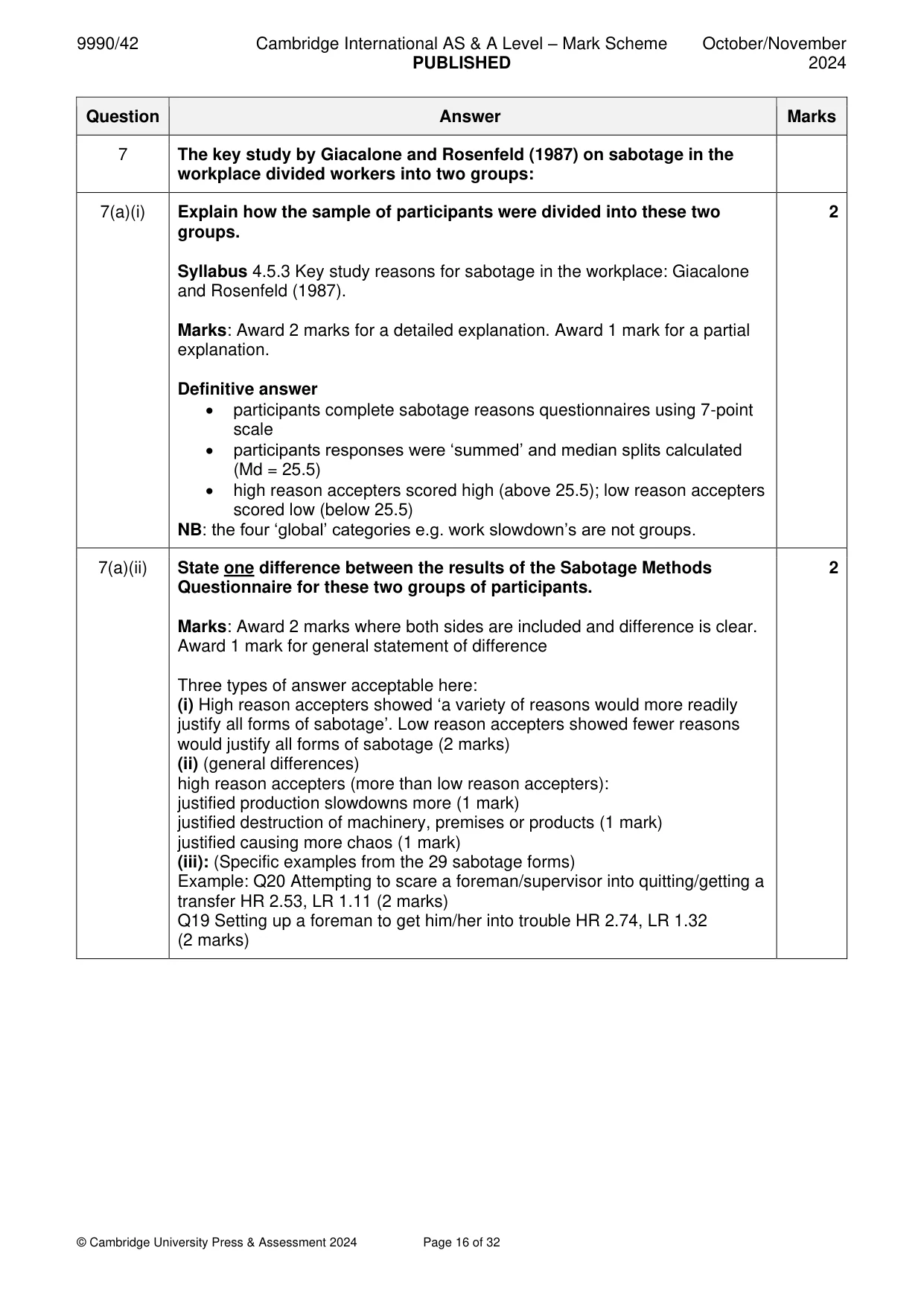
7 The key study by Giacalone and Rosenfeld (1987) on sabotage in the workplace divided workers into two groups: (a) (i) Explain how the sample of participants were divided into these two groups. [2] (ii) State one difference between the results of the Sabotage Methods Questionnaire for these two groups of participants. [2] (b) Suggest one way that the reliability of the Sabotage Methods Questionnaire could be tested. [2] (c) Explain two weaknesses of using a volunteer sample of workers to answer questionnaires about sabotage. [4]
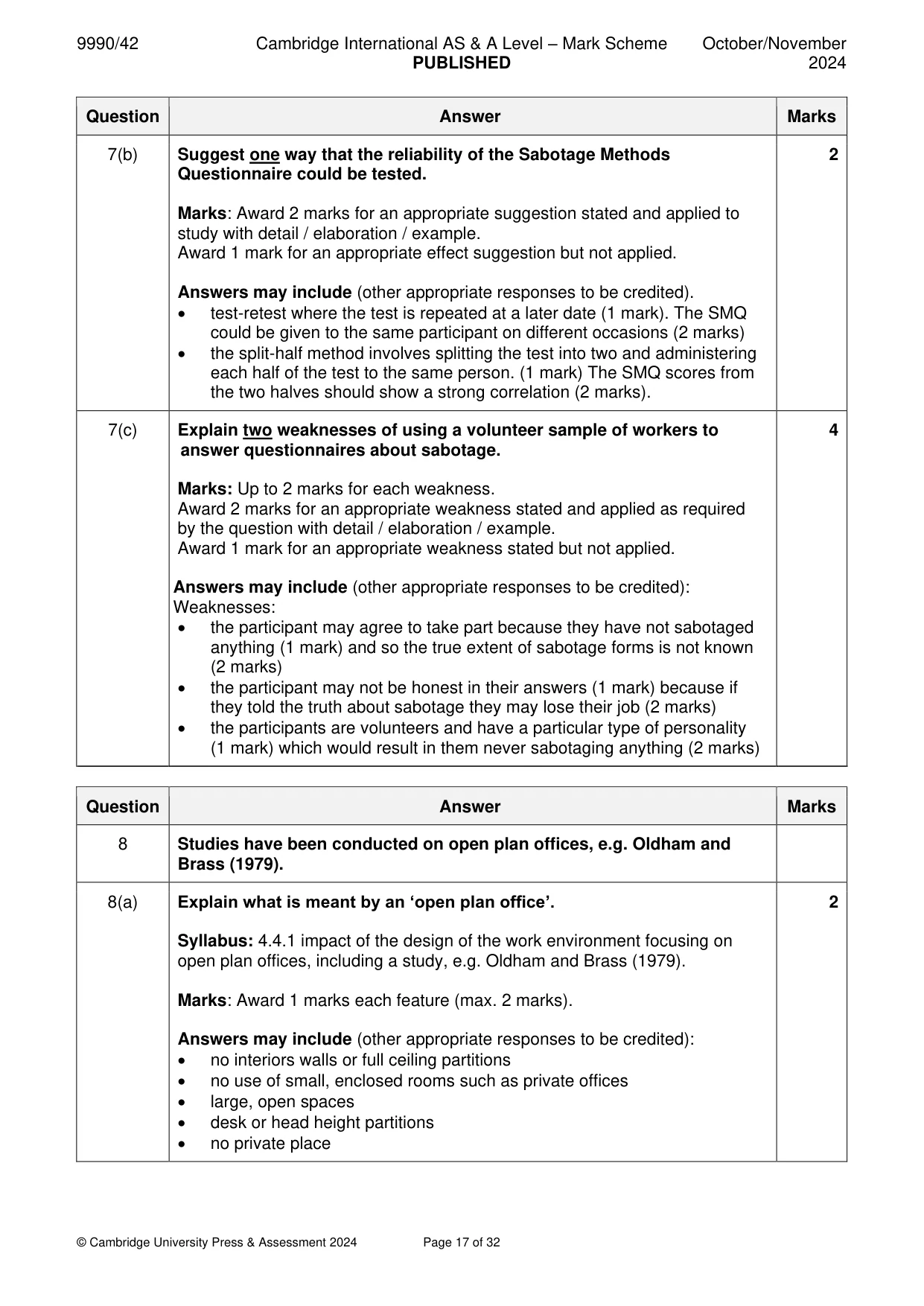
Mark scheme: 7 The key study by Giacalone and Rosenfeld (1987) on sabotage in the workplace divided workers into two groups: 7(a)(i) Explain how the sample of participants were divided into these two 2 groups. Syllabus 4.5.3 Key study reasons for sabotage in the workplace: Giacalone and Rosenfeld (1987). Marks: Award 2 marks for a detailed explanation. Award 1 mark for a partial explanation. Definitive answer • participants complete sabotage reasons questionnaires using 7-point scale • participants responses were ‘summed’ and median splits calculated (Md = 25.5) • high reason accepters scored high (above 25.5); low reason accepters scored low (below 25.5) NB: the four ‘global’ categories e.g. work slowdown’s are not groups. 7(a)(ii) State one difference between the results of the Sabotage Methods 2 Questionnaire for these two groups of participants. Marks: Award 2 marks where both sides are included and difference is clear. Award 1 mark for general statement of difference Three types of answer acceptable here: (i) High reason accepters showed ‘a variety of reasons would more readily justify all forms of sabotage’. Low reason accepters showed fewer reasons would justify all forms of sabotage (2 marks) (ii) (general differences) high reason accepters (more than low reason accepters): justified production slowdowns more (1 mark) justified destruction of machinery, premises or products (1 mark) justified causing more chaos (1 mark) (iii): (Specific examples from the 29 sabotage forms) Example: Q20 Attempting to scare a foreman/supervisor into quitting/getting a transfer HR 2.53, LR 1.11 (2 marks) Q19 Setting up a foreman to get him/her into trouble HR 2.74, LR 1.32 (2 marks) 7(b) Suggest one way that the reliability of the Sabotage Methods 2 Questionnaire could be tested. Marks: Award 2 marks for an appropriate suggestion stated and applied to study with detail / elaboration / example. Award 1 mark for an appropriate effect suggestion but not applied. Answers may include (other appropriate responses to be credited). • test-retest where the test is repeated at a later date (1 mark). The SMQ could be given to the same participant on different occasions (2 marks) • the split-half method involves splitting the test into two and administering each half of the test to the same person. (1 mark) The SMQ scores from the two halves should show a strong correlation (2 marks). 7(c) Explain two weaknesses of using a volunteer sample of workers to 4 answer questionnaires about sabotage. Marks: Up to 2 marks for each weakness. Award 2 marks for an appropriate weakness stated and applied as required by the question with detail / elaboration / example. Award 1 mark for an appropriate weakness stated but not applied. Answers may include (other appropriate responses to be credited): Weaknesses: • the participant may agree to take part because they have not sabotaged anything (1 mark) and so the true extent of sabotage forms is not known (2 marks) • the participant may not be honest in their answers (1 mark) because if they told the truth about sabotage they may lose their job (2 marks) • the participants are volunteers and have a particular type of personality (1 mark) which would result in them never sabotaging anything (2 marks)
Q8 · Studies have been conducted on open plan offices, e.g
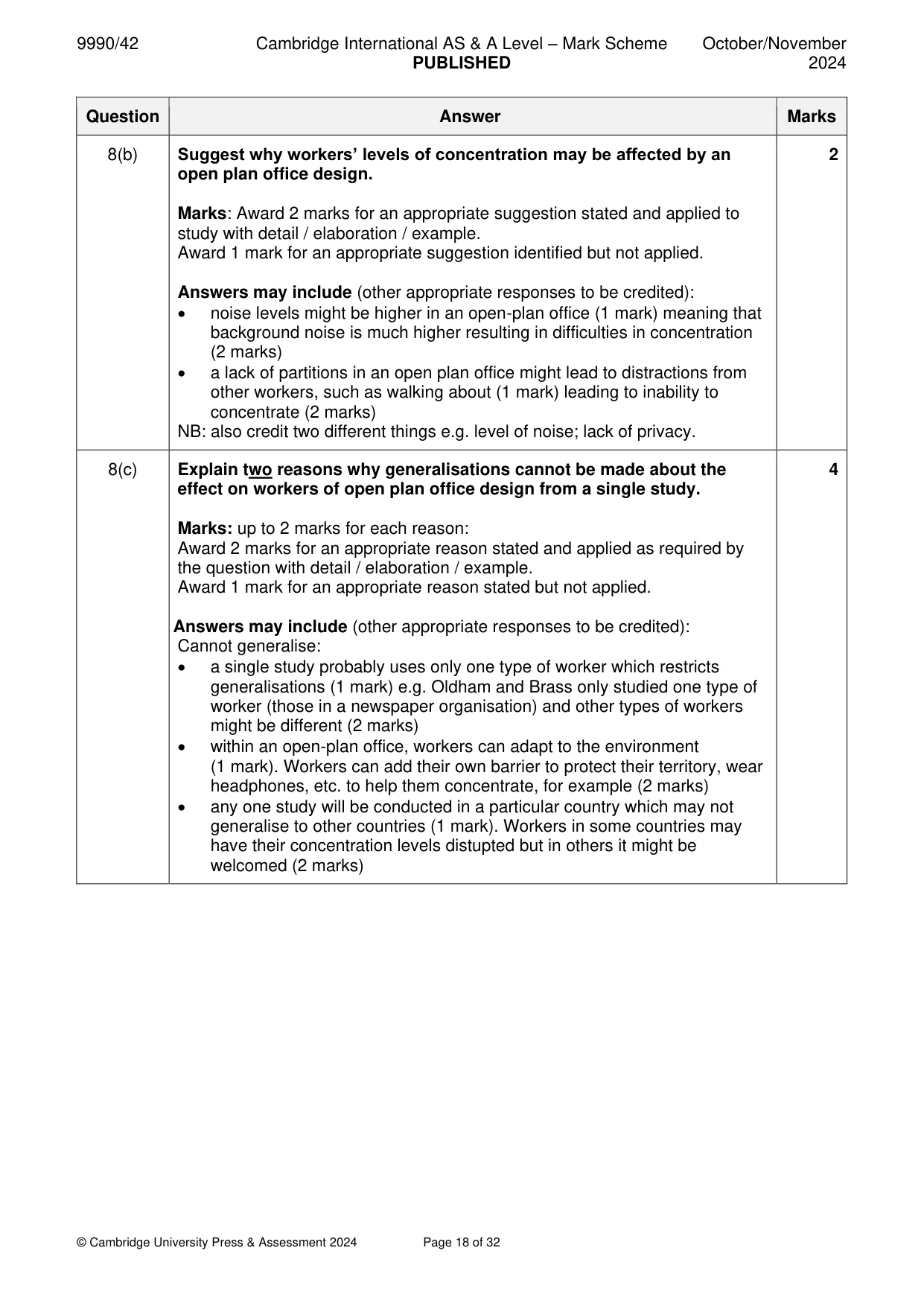
8 Studies have been conducted on open plan offices, e.g. Oldham and Brass (1979). (a) Explain what is meant by an ‘open plan office’. [2] (b) Suggest why workers’ levels of concentration may be affected by an open plan office design. [2] (c) Explain two reasons why generalisations cannot be made about the effect on workers of open plan office design from a single study. [4]
Mark scheme: 8 Studies have been conducted on open plan offices, e.g. Oldham and Brass (1979). 8(a) Explain what is meant by an ‘open plan office’. 2 Syllabus: 4.4.1 impact of the design of the work environment focusing on open plan offices, including a study, e.g. Oldham and Brass (1979). Marks: Award 1 marks each feature (max. 2 marks). Answers may include (other appropriate responses to be credited): • no interiors walls or full ceiling partitions • no use of small, enclosed rooms such as private offices • large, open spaces • desk or head height partitions • no private place 8(b) Suggest why workers’ levels of concentration may be affected by an 2 open plan office design. Marks: Award 2 marks for an appropriate suggestion stated and applied to study with detail / elaboration / example. Award 1 mark for an appropriate suggestion identified but not applied. Answers may include (other appropriate responses to be credited): • noise levels might be higher in an open-plan office (1 mark) meaning that background noise is much higher resulting in difficulties in concentration (2 marks) • a lack of partitions in an open plan office might lead to distractions from other workers, such as walking about (1 mark) leading to inability to concentrate (2 marks) NB: also credit two different things e.g. level of noise; lack of privacy. 8(c) Explain two reasons why generalisations cannot be made about the 4 effect on workers of open plan office design from a single study. Marks: up to 2 marks for each reason: Award 2 marks for an appropriate reason stated and applied as required by the question with detail / elaboration / example. Award 1 mark for an appropriate reason stated but not applied. Answers may include (other appropriate responses to be credited): Cannot generalise: • a single study probably uses only one type of worker which restricts generalisations (1 mark) e.g. Oldham and Brass only studied one type of worker (those in a newspaper organisation) and other types of workers might be different (2 marks) • within an open-plan office, workers can adapt to the environment (1 mark). Workers can add their own barrier to protect their territory, wear headphones, etc. to help them concentrate, for example (2 marks) • any one study will be conducted in a particular country which may not generalise to other countries (1 mark). Workers in some countries may have their concentration levels distupted but in others it might be welcomed (2 marks)
Q9 · Plan a study using a questionnaire with open questions to investigate generalised anxiety…
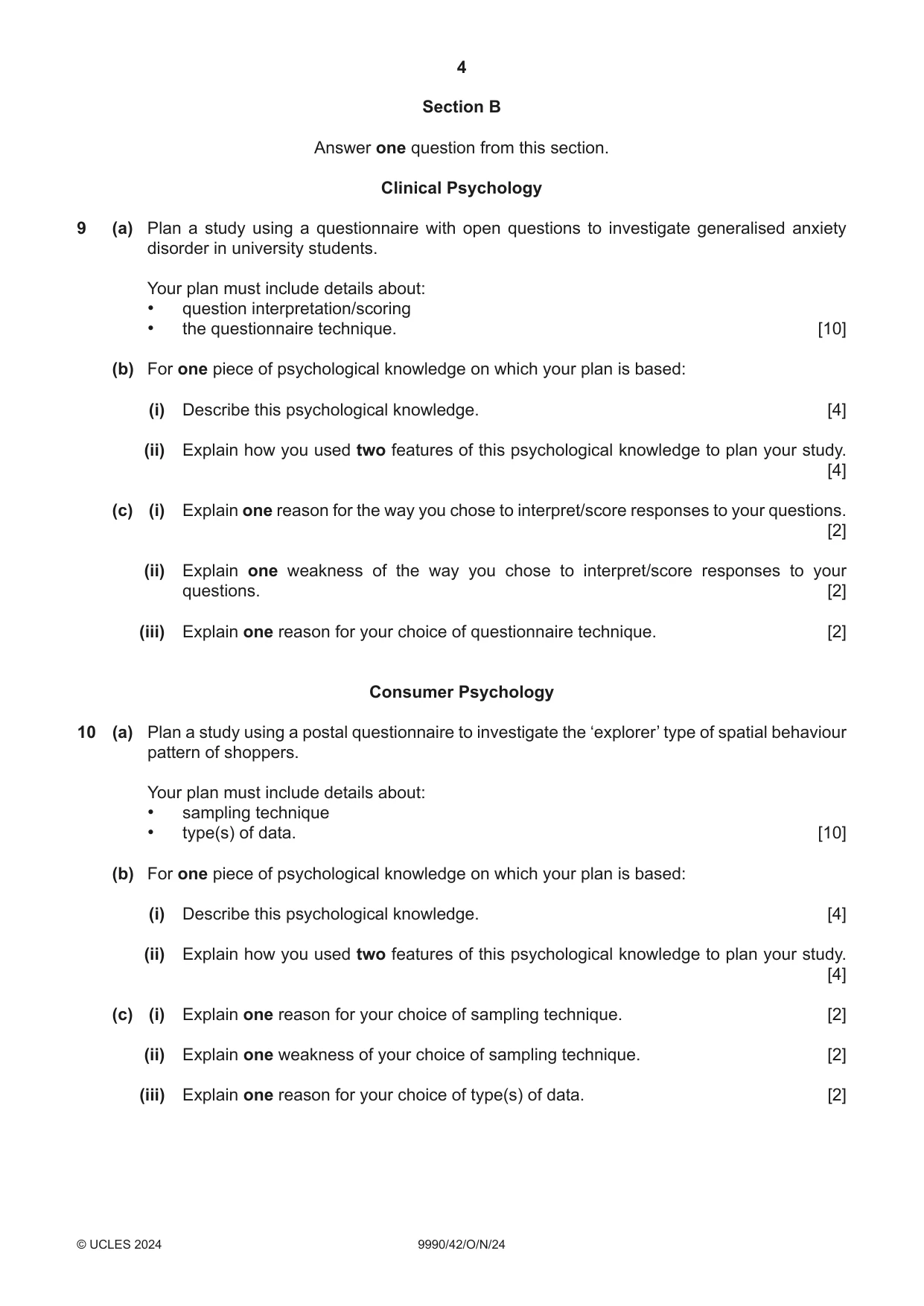
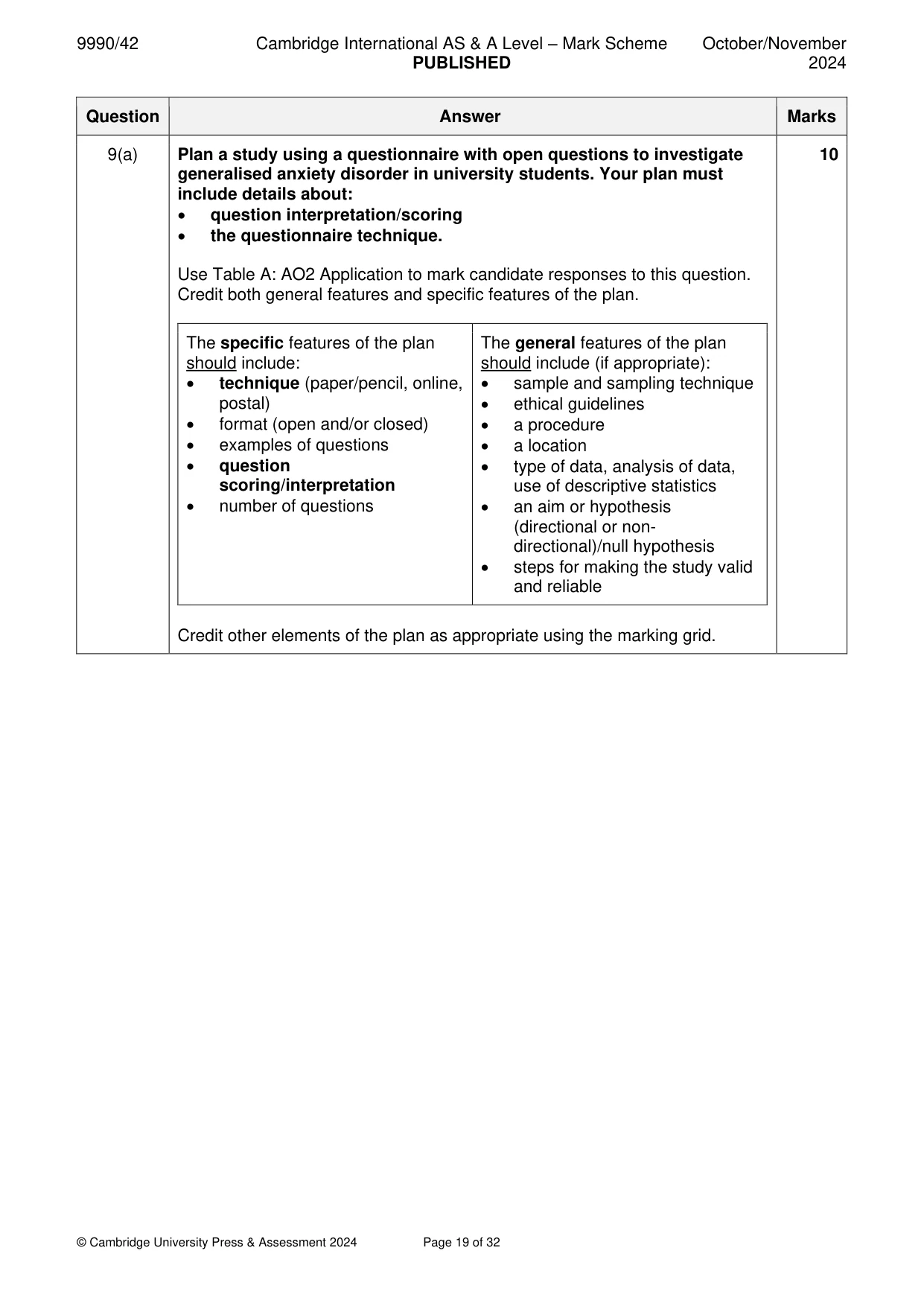
9 (a) Plan a study using a questionnaire with open questions to investigate generalised anxiety disorder in university students. Your plan must include details about: • question interpretation/scoring • the questionnaire technique. [10] (b) For one piece of psychological knowledge on which your plan is based: (i) Describe this psychological knowledge. [4] (ii) Explain how you used two features of this psychological knowledge to plan your study. [4] (c) (i) Explain one reason for the way you chose to interpret/score responses to your questions. [2] (ii) Explain one weakness of the way you chose to interpret/score responses to your questions. [2] (iii) Explain one reason for your choice of questionnaire technique. [2] Consumer Psychology
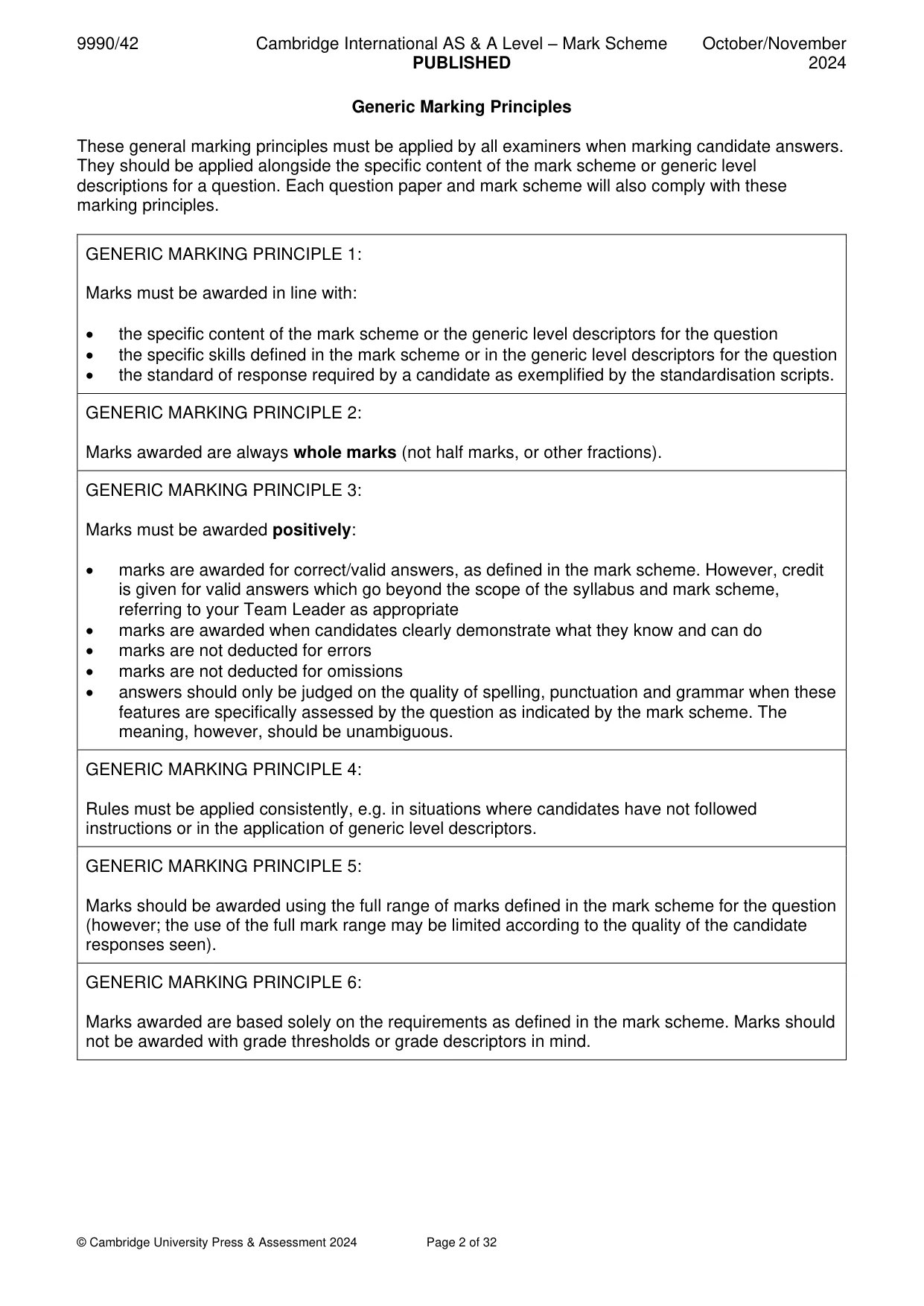
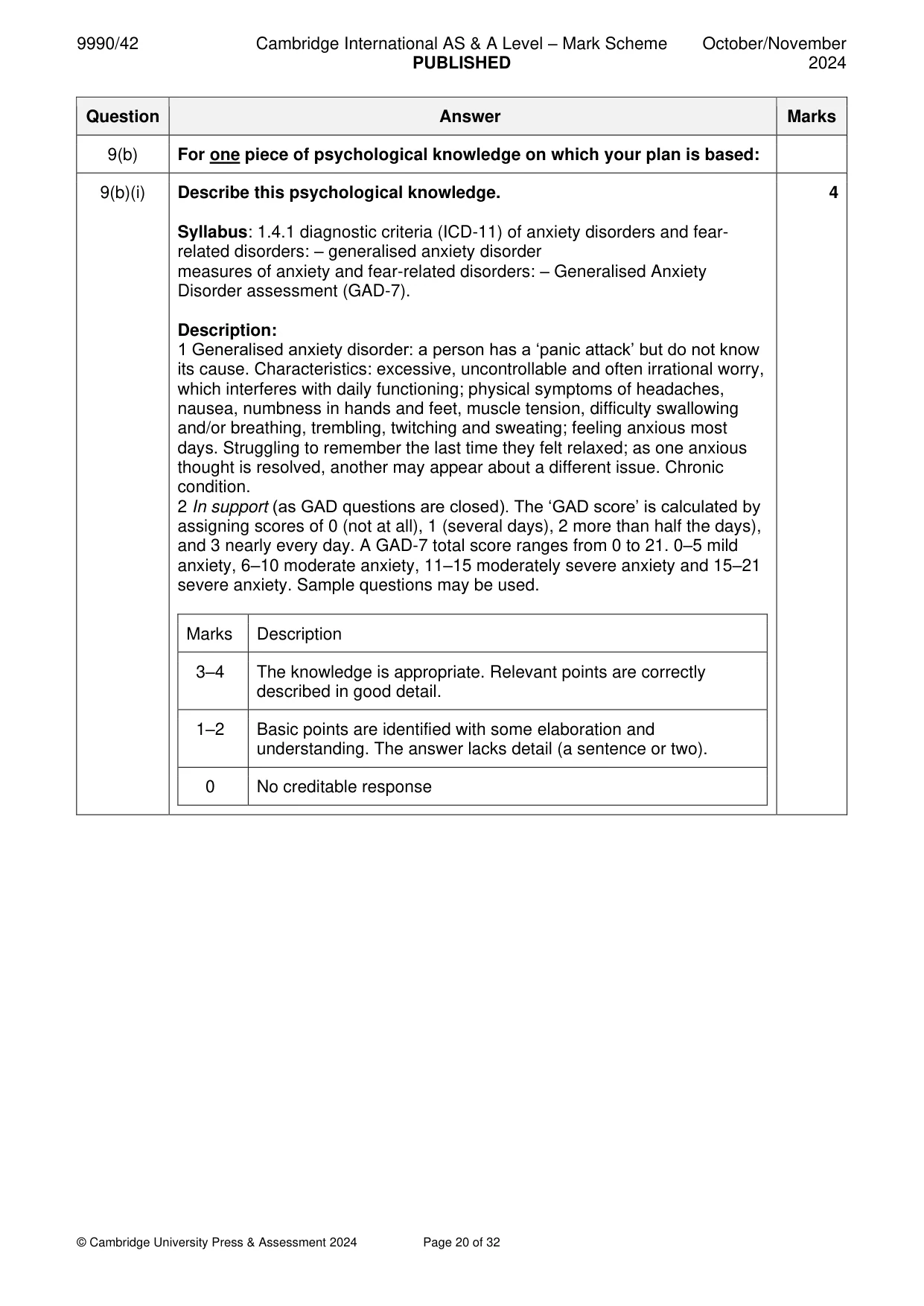
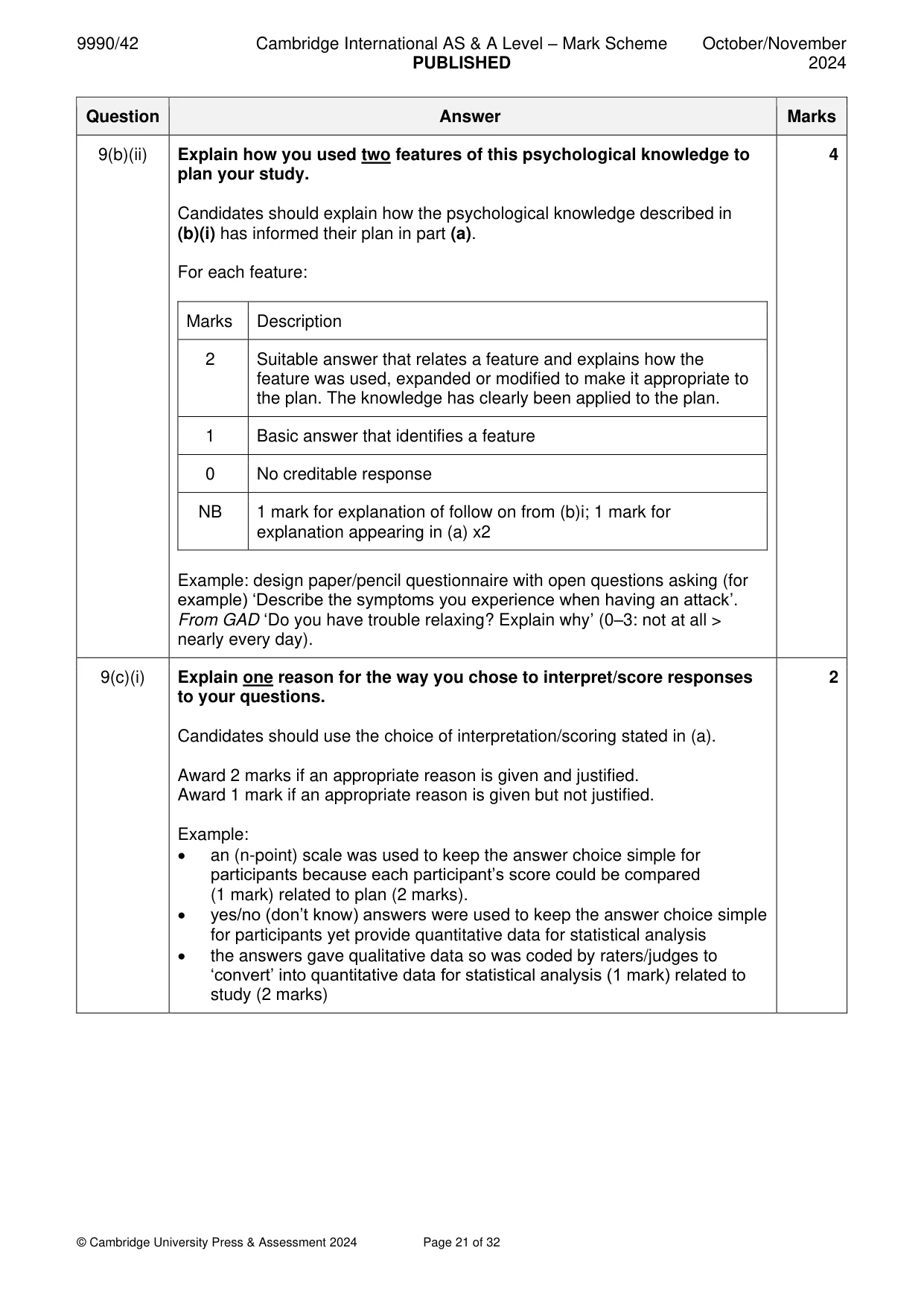
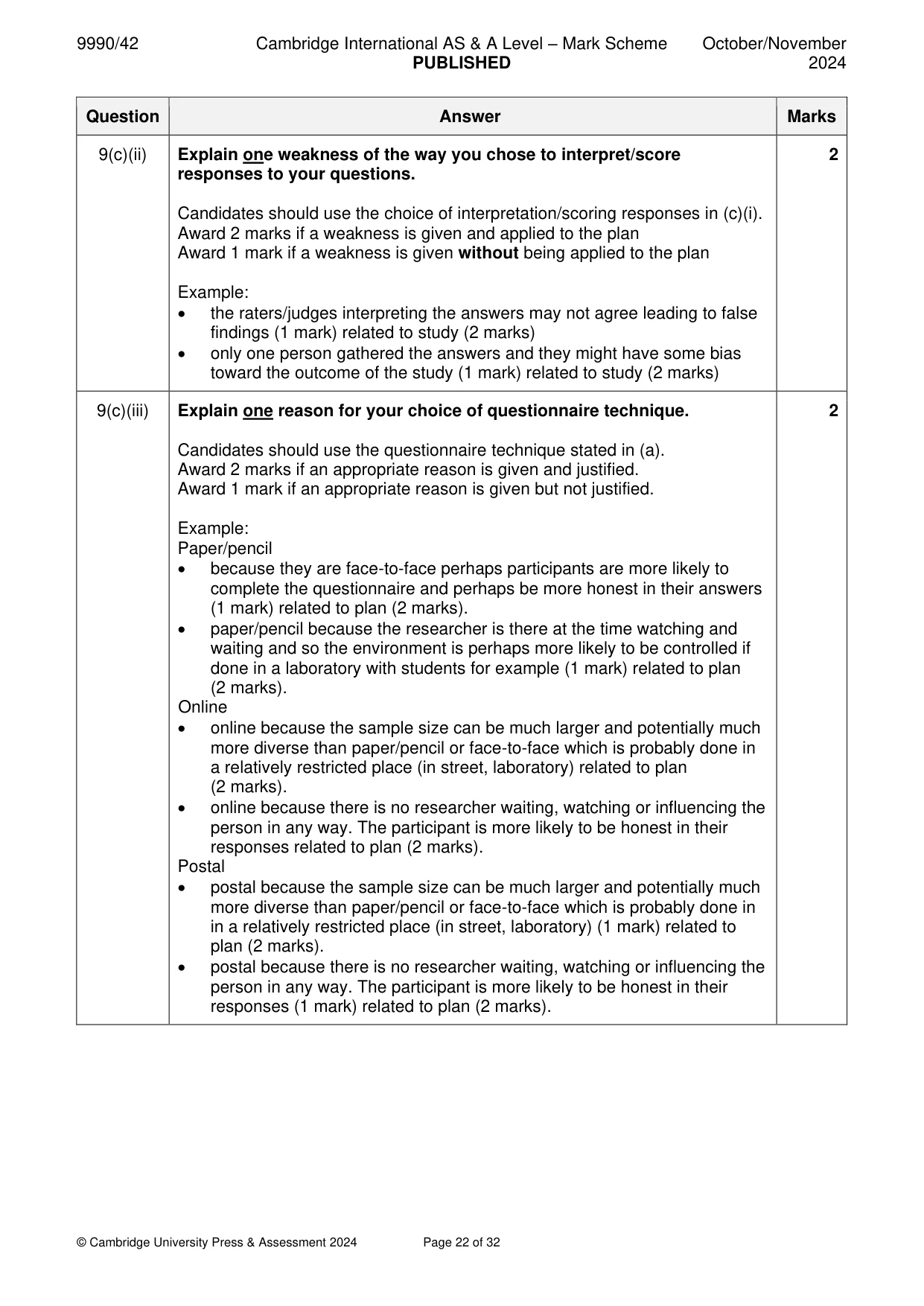
Mark scheme: 9(a) Plan a study using a questionnaire with open questions to investigate 10 generalised anxiety disorder in university students. Your plan must include details about: • question interpretation/scoring • the questionnaire technique. Use Table A: AO2 Application to mark candidate responses to this question. Credit both general features and specific features of the plan. The specific features of the plan The general features of the plan should include: should include (if appropriate): • technique (paper/pencil, online, • sample and sampling technique postal) • ethical guidelines • format (open and/or closed) • a procedure • examples of questions • a location • question • type of data, analysis of data, scoring/interpretation use of descriptive statistics • number of questions • an aim or hypothesis (directional or non- directional)/null hypothesis • steps for making the study valid and reliable Credit other elements of the plan as appropriate using the marking grid. 9(b) For one piece of psychological knowledge on which your plan is based: 9(b)(i) Describe this psychological knowledge. 4 Syllabus: 1.4.1 diagnostic criteria (ICD-11) of anxiety disorders and fear- related disorders: – generalised anxiety disorder measures of anxiety and fear-related disorders: – Generalised Anxiety Disorder assessment (GAD-7). Description: 1 Generalised anxiety disorder: a person has a ‘panic attack’ but do not know its cause. Characteristics: excessive, uncontrollable and often irrational worry, which interferes with daily functioning; physical symptoms of headaches, nausea, numbness in hands and feet, muscle tension, difficulty swallowing and/or breathing, trembling, twitching and sweating; feeling anxious most days. Struggling to remember the last time they felt relaxed; as one anxious thought is resolved, another may appear about a different issue. Chronic condition. 2 In support (as GAD questions are closed). The ‘GAD score’ is calculated by assigning scores of 0 (not at all), 1 (several days), 2 more than half the days), and 3 nearly every day. A GAD-7 total score ranges from 0 to 21. 0–5 mild anxiety, 6–10 moderate anxiety, 11–15 moderately severe anxiety and 15–21 severe anxiety. Sample questions may be used. Marks Description 3–4 The knowledge is appropriate. Relevant points are correctly described in good detail. 1–2 Basic points are identified with some elaboration and understanding. The answer lacks detail (a sentence or two). 0 No creditable response 9(b)(ii) Explain how you used two features of this psychological knowledge to 4 plan your study. Candidates should explain how the psychological knowledge described in (b)(i) has informed their plan in part (a). For each feature: Marks Description 2 Suitable answer that relates a feature and explains how the feature was used, expanded or modified to make it appropriate to the plan. The knowledge has clearly been applied to the plan. 1 Basic answer that identifies a feature 0 No creditable response NB 1 mark for explanation of follow on from (b)i; 1 mark for explanation appearing in (a) x2 Example: design paper/pencil questionnaire with open questions asking (for example) ‘Describe the symptoms you experience when having an attack’. From GAD ‘Do you have trouble relaxing? Explain why’ (0–3: not at all > nearly every day). 9(c)(i) Explain one reason for the way you chose to interpret/score responses 2 to your questions. Candidates should use the choice of interpretation/scoring stated in (a). Award 2 marks if an appropriate reason is given and justified. Award 1 mark if an appropriate reason is given but not justified. Example: • an (n-point) scale was used to keep the answer choice simple for participants because each participant’s score could be compared (1 mark) related to plan (2 marks). • yes/no (don’t know) answers were used to keep the answer choice simple for participants yet provide quantitative data for statistical analysis • the answers gave qualitative data so was coded by raters/judges to ‘convert’ into quantitative data for statistical analysis (1 mark) related to study (2 marks) 9(c)(ii) Explain one weakness of the way you chose to interpret/score 2 responses to your questions. Candidates should use the choice of interpretation/scoring responses in (c)(i). Award 2 marks if a weakness is given and applied to the plan Award 1 mark if a weakness is given without being applied to the plan Example: • the raters/judges interpreting the answers may not agree leading to false findings (1 mark) related to study (2 marks) • only one person gathered the answers and they might have some bias toward the outcome of the study (1 mark) related to study (2 marks) 9(c)(iii) Explain one reason for your choice of questionnaire technique. 2 Candidates should use the questionnaire technique stated in (a). Award 2 marks if an appropriate reason is given and justified. Award 1 mark if an appropriate reason is given but not justified. Example: Paper/pencil • because they are face-to-face perhaps participants are more likely to complete the questionnaire and perhaps be more honest in their answers (1 mark) related to plan (2 marks). • paper/pencil because the researcher is there at the time watching and waiting and so the environment is perhaps more likely to be controlled if done in a laboratory with students for example (1 mark) related to plan (2 marks). Online • online because the sample size can be much larger and potentially much more diverse than paper/pencil or face-to-face which is probably done in a relatively restricted place (in street, laboratory) related to plan (2 marks). • online because there is no researcher waiting, watching or influencing the person in any way. The participant is more likely to be honest in their responses related to plan (2 marks). Postal • postal because the sample size can be much larger and potentially much more diverse than paper/pencil or face-to-face which is probably done in in a relatively restricted place (in street, laboratory) (1 mark) related to plan (2 marks). • postal because there is no researcher waiting, watching or influencing the person in any way. The participant is more likely to be honest in their responses (1 mark) related to plan (2 marks).
More questions on Anxiety disorders and fear-related disorders
Q10 · Plan a study using a postal questionnaire to investigate the ‘explorer’ type of spatial…
10 (a) Plan a study using a postal questionnaire to investigate the ‘explorer’ type of spatial behaviour pattern of shoppers. Your plan must include details about: • sampling technique • type(s) of data. [10] (b) For one piece of psychological knowledge on which your plan is based: (i) Describe this psychological knowledge. [4] (ii) Explain how you used two features of this psychological knowledge to plan your study. [4] (c) (i) Explain one reason for your choice of sampling technique. [2] (ii) Explain one weakness of your choice of sampling technique. [2] (iii) Explain one reason for your choice of type(s) of data. [2] Health Psychology
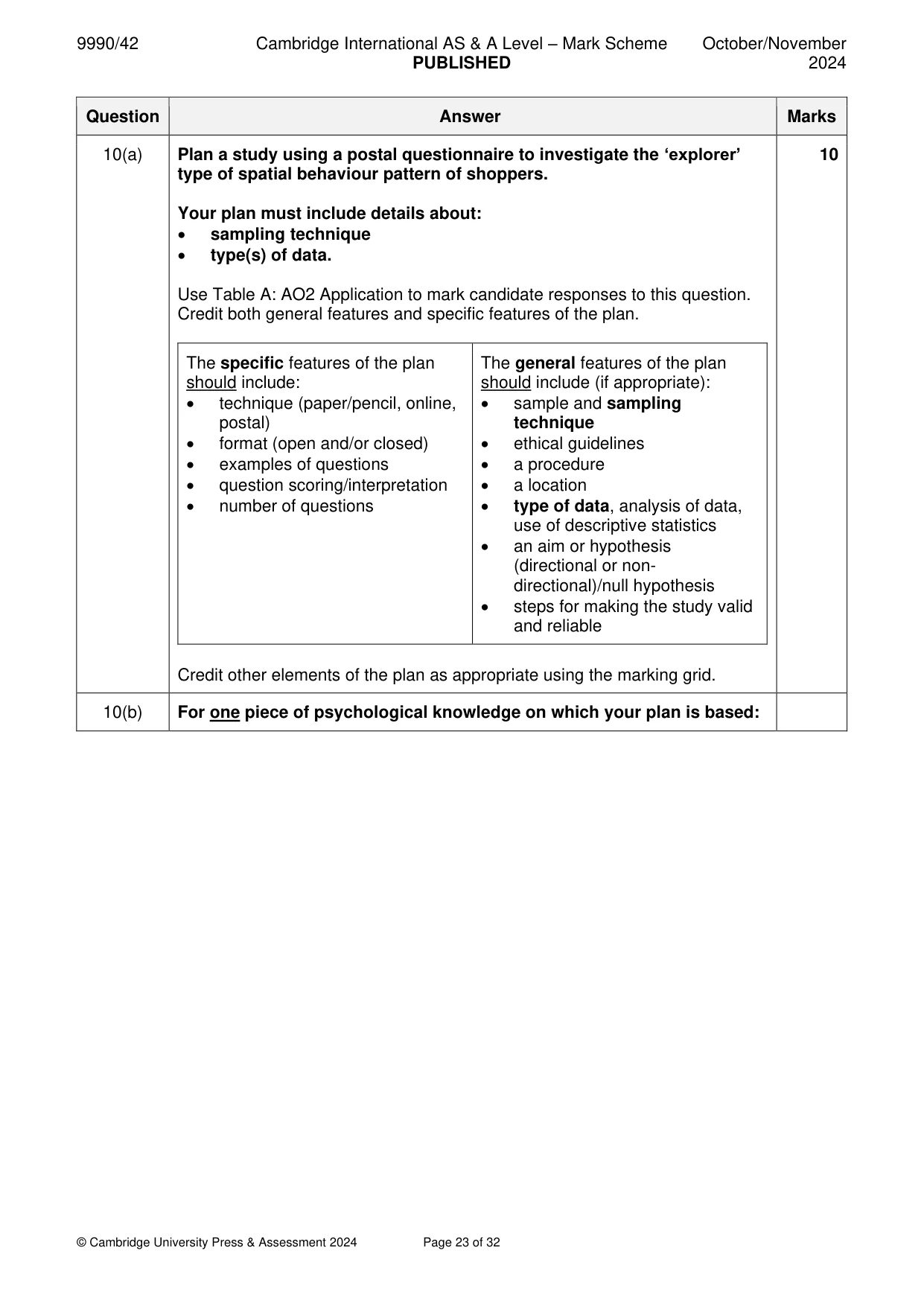
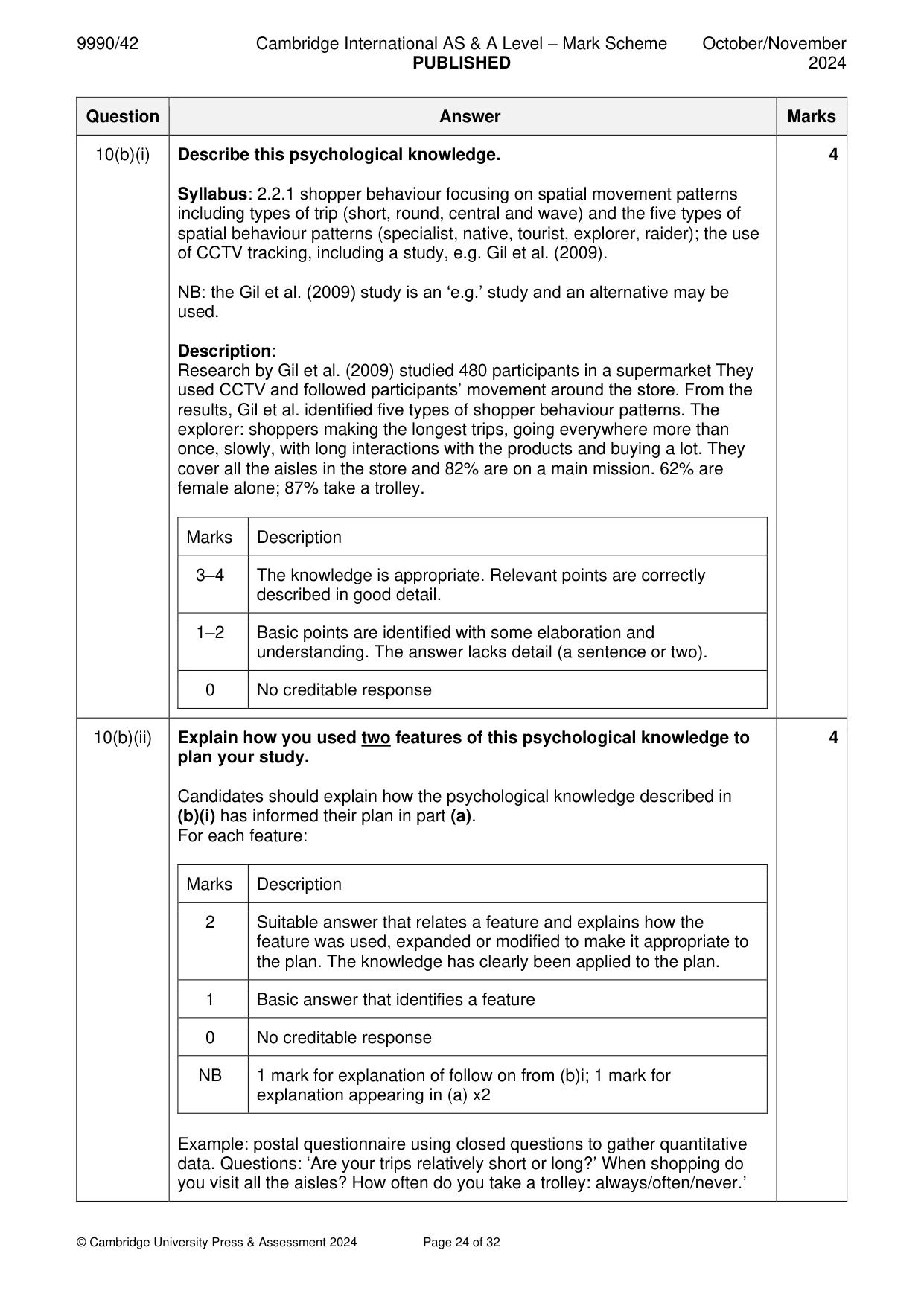
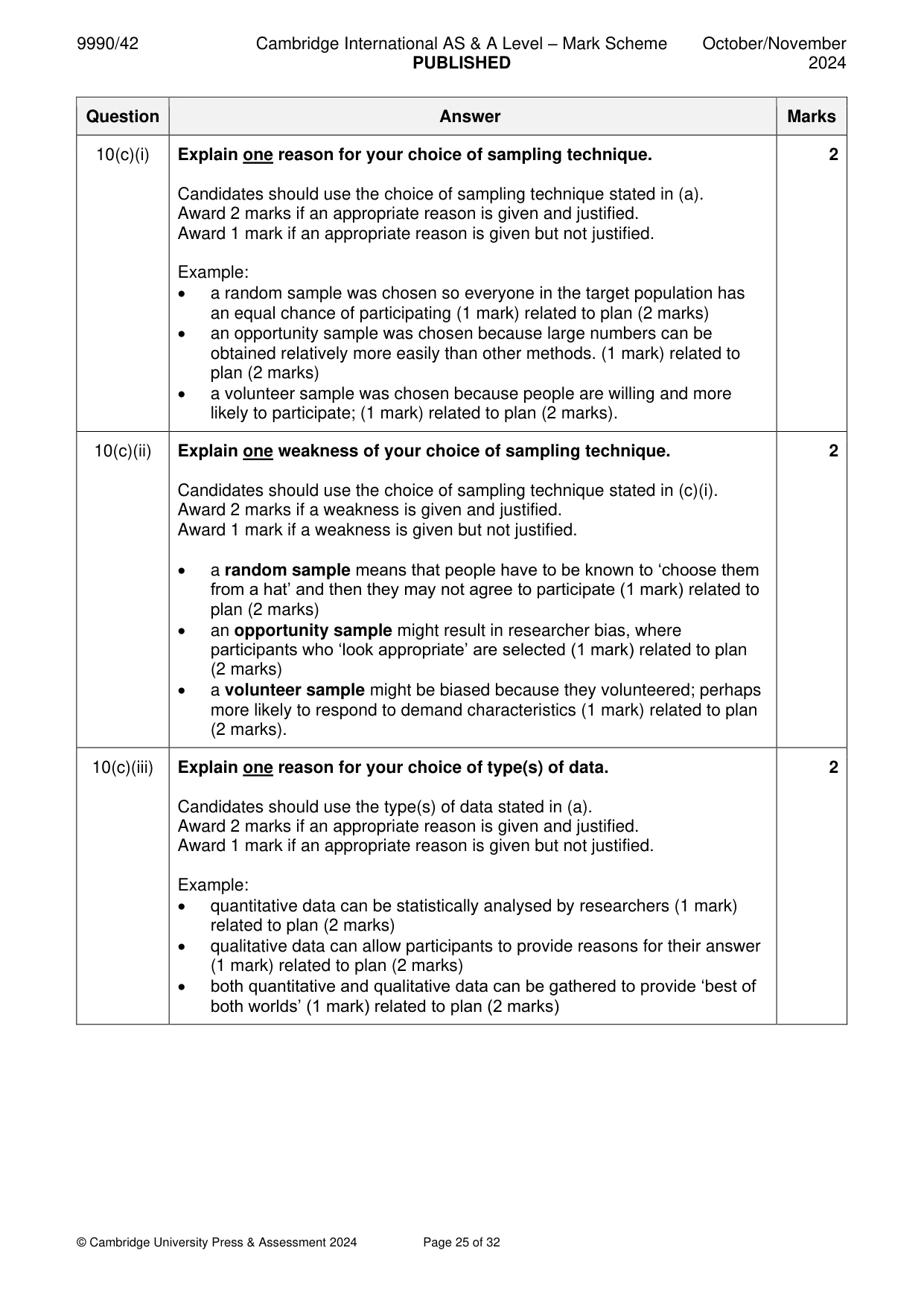
Mark scheme: 10(a) Plan a study using a postal questionnaire to investigate the ‘explorer’ 10 type of spatial behaviour pattern of shoppers. Your plan must include details about: • sampling technique • type(s) of data. Use Table A: AO2 Application to mark candidate responses to this question. Credit both general features and specific features of the plan. The specific features of the plan The general features of the plan should include: should include (if appropriate): • technique (paper/pencil, online, • sample and sampling postal) technique • format (open and/or closed) • ethical guidelines • examples of questions • a procedure • question scoring/interpretation • a location • number of questions • type of data, analysis of data, use of descriptive statistics • an aim or hypothesis (directional or non- directional)/null hypothesis • steps for making the study valid and reliable Credit other elements of the plan as appropriate using the marking grid. 10(b) For one piece of psychological knowledge on which your plan is based: 10(b)(i) Describe this psychological knowledge. 4 Syllabus: 2.2.1 shopper behaviour focusing on spatial movement patterns including types of trip (short, round, central and wave) and the five types of spatial behaviour patterns (specialist, native, tourist, explorer, raider); the use of CCTV tracking, including a study, e.g. Gil et al. (2009). NB: the Gil et al. (2009) study is an ‘e.g.’ study and an alternative may be used. Description: Research by Gil et al. (2009) studied 480 participants in a supermarket They used CCTV and followed participants’ movement around the store. From the results, Gil et al. identified five types of shopper behaviour patterns. The explorer: shoppers making the longest trips, going everywhere more than once, slowly, with long interactions with the products and buying a lot. They cover all the aisles in the store and 82% are on a main mission. 62% are female alone; 87% take a trolley. Marks Description 3–4 The knowledge is appropriate. Relevant points are correctly described in good detail. 1–2 Basic points are identified with some elaboration and understanding. The answer lacks detail (a sentence or two). 0 No creditable response 10(b)(ii) Explain how you used two features of this psychological knowledge to 4 plan your study. Candidates should explain how the psychological knowledge described in (b)(i) has informed their plan in part (a). For each feature: Marks Description 2 Suitable answer that relates a feature and explains how the feature was used, expanded or modified to make it appropriate to the plan. The knowledge has clearly been applied to the plan. 1 Basic answer that identifies a feature 0 No creditable response NB 1 mark for explanation of follow on from (b)i; 1 mark for explanation appearing in (a) x2 Example: postal questionnaire using closed questions to gather quantitative data. Questions: ‘Are your trips relatively short or long?’ When shopping do you visit all the aisles? How often do you take a trolley: always/often/never.’ 10(c)(i) Explain one reason for your choice of sampling technique. 2 Candidates should use the choice of sampling technique stated in (a). Award 2 marks if an appropriate reason is given and justified. Award 1 mark if an appropriate reason is given but not justified. Example: • a random sample was chosen so everyone in the target population has an equal chance of participating (1 mark) related to plan (2 marks) • an opportunity sample was chosen because large numbers can be obtained relatively more easily than other methods. (1 mark) related to plan (2 marks) • a volunteer sample was chosen because people are willing and more likely to participate; (1 mark) related to plan (2 marks). 10(c)(ii) Explain one weakness of your choice of sampling technique. 2 Candidates should use the choice of sampling technique stated in (c)(i). Award 2 marks if a weakness is given and justified. Award 1 mark if a weakness is given but not justified. • a random sample means that people have to be known to ‘choose them from a hat’ and then they may not agree to participate (1 mark) related to plan (2 marks) • an opportunity sample might result in researcher bias, where participants who ‘look appropriate’ are selected (1 mark) related to plan (2 marks) • a volunteer sample might be biased because they volunteered; perhaps more likely to respond to demand characteristics (1 mark) related to plan (2 marks). 10(c)(iii) Explain one reason for your choice of type(s) of data. 2 Candidates should use the type(s) of data stated in (a). Award 2 marks if an appropriate reason is given and justified. Award 1 mark if an appropriate reason is given but not justified. Example: • quantitative data can be statistically analysed by researchers (1 mark) related to plan (2 marks) • qualitative data can allow participants to provide reasons for their answer (1 mark) related to plan (2 marks) • both quantitative and qualitative data can be gathered to provide ‘best of both worlds’ (1 mark) related to plan (2 marks)
Q11 · Some children participated in a healthy eating programme when at school to encourage them…
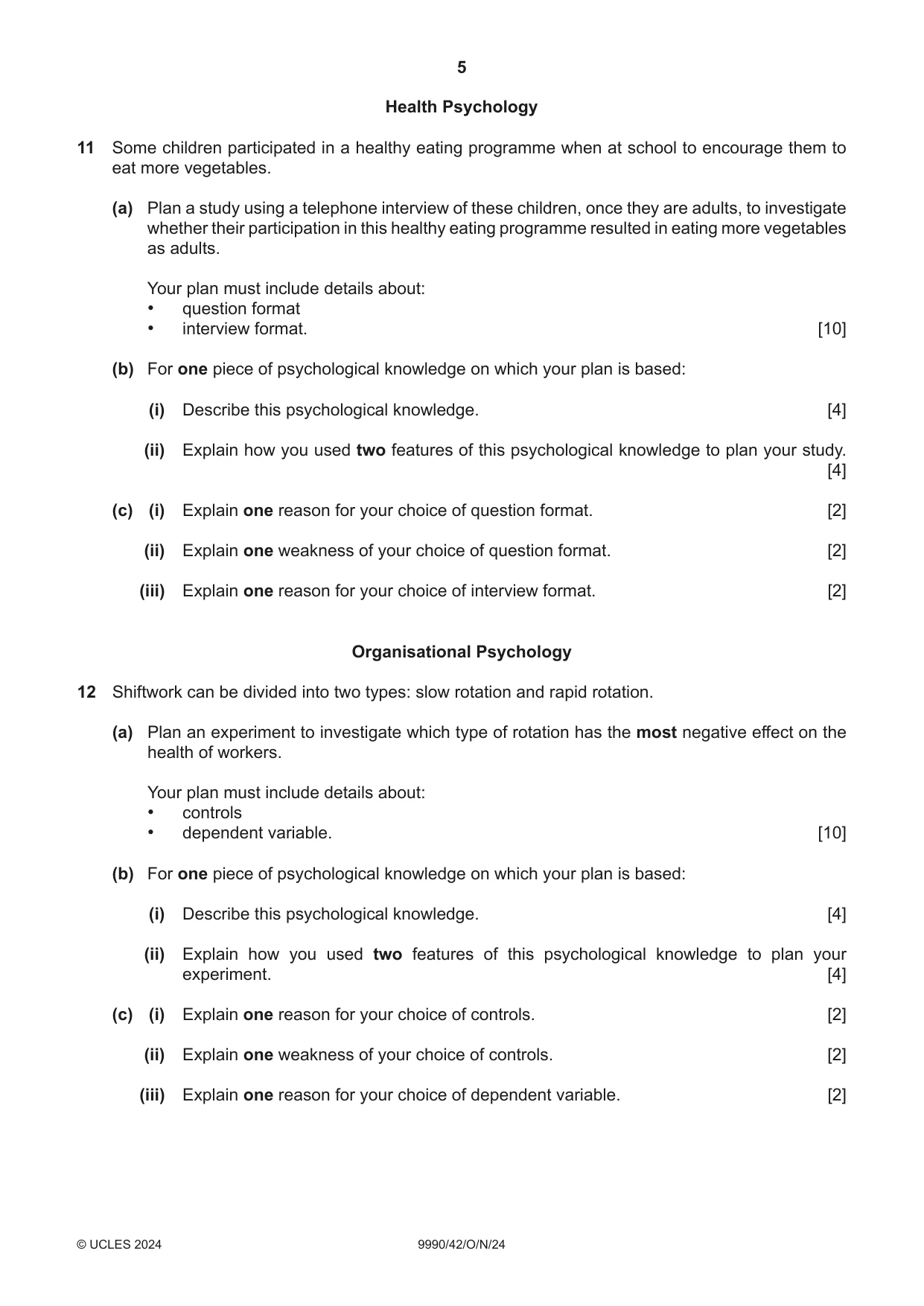
11 Some children participated in a healthy eating programme when at school to encourage them to eat more vegetables. (a) Plan a study using a telephone interview of these children, once they are adults, to investigate whether their participation in this healthy eating programme resulted in eating more vegetables as adults. Your plan must include details about: • question format • interview format. [10] (b) For one piece of psychological knowledge on which your plan is based: (i) Describe this psychological knowledge. [4] (ii) Explain how you used two features of this psychological knowledge to plan your study. [4] (c) (i) Explain one reason for your choice of question format. [2] (ii) Explain one weakness of your choice of question format. [2] (iii) Explain one reason for your choice of interview format. [2] Organisational Psychology
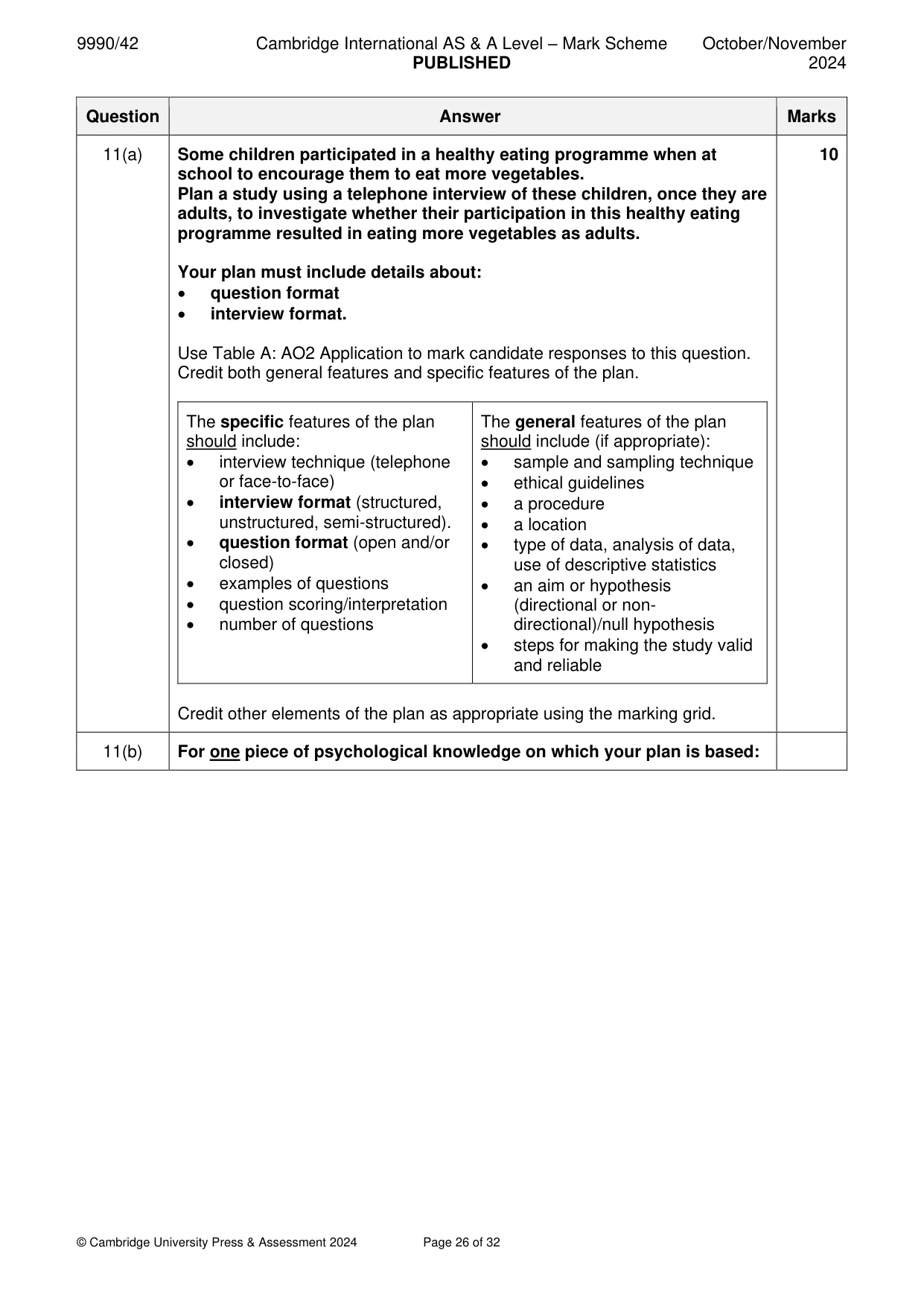
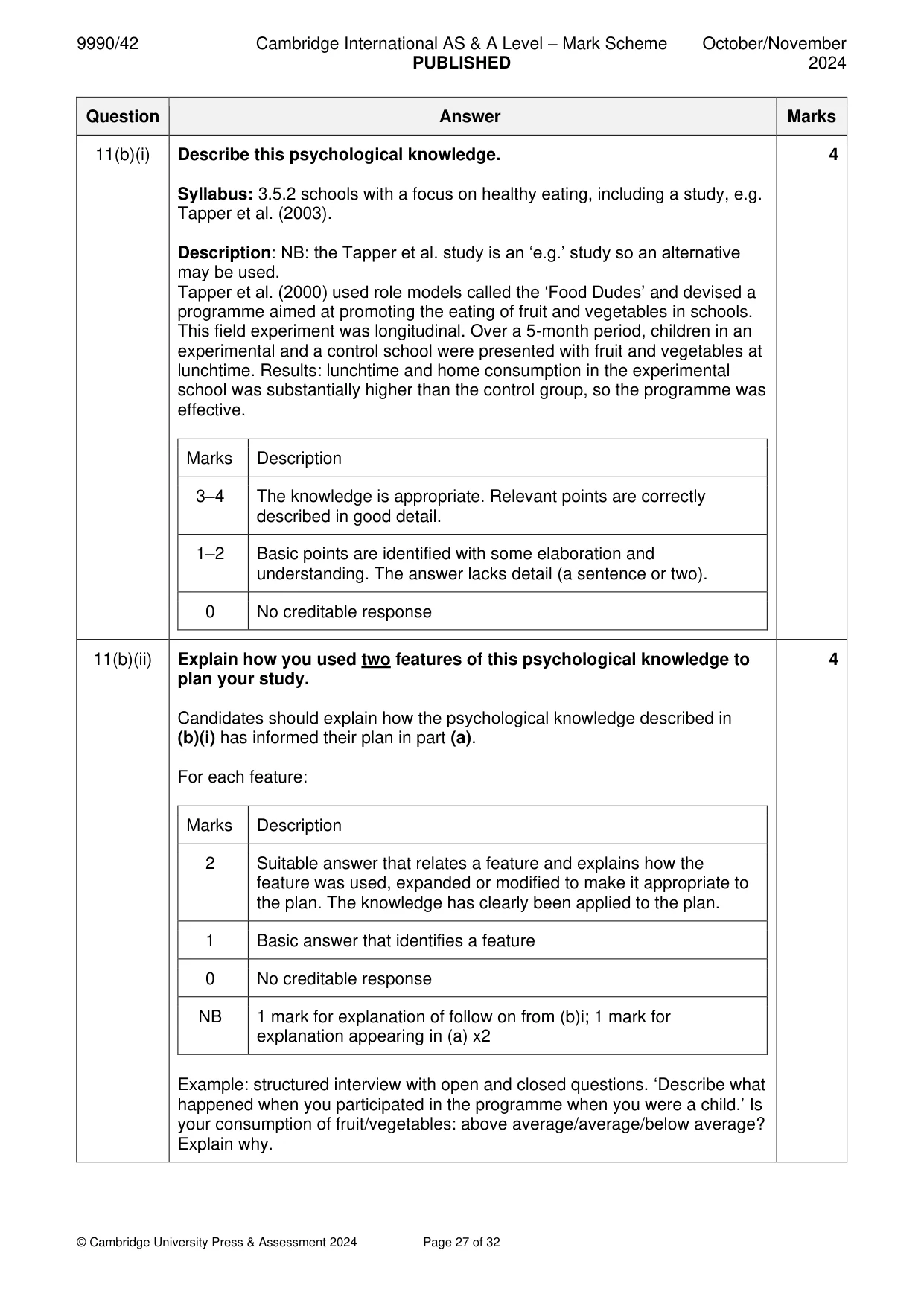
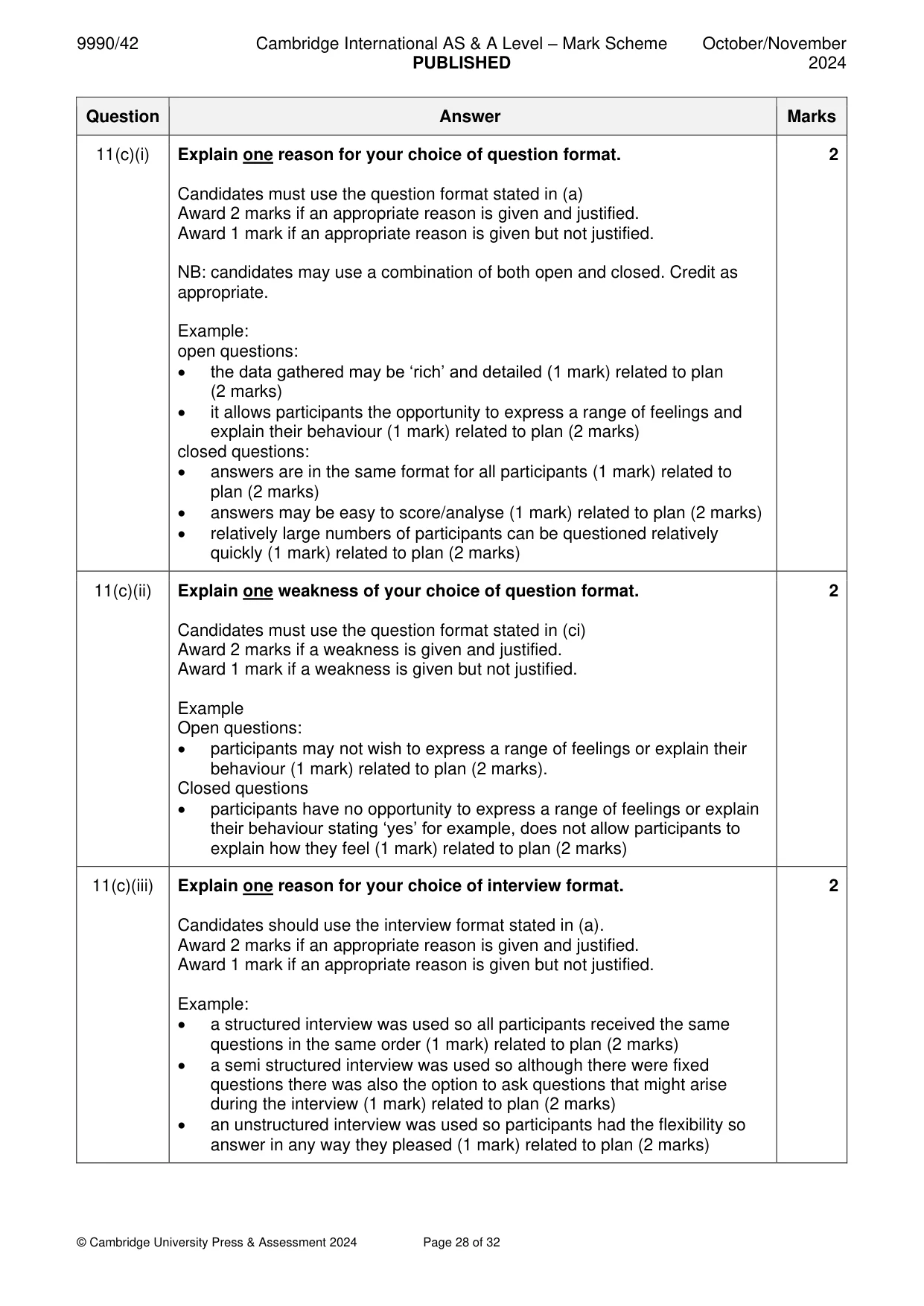
Mark scheme: 11(a) Some children participated in a healthy eating programme when at 10 school to encourage them to eat more vegetables. Plan a study using a telephone interview of these children, once they are adults, to investigate whether their participation in this healthy eating programme resulted in eating more vegetables as adults. Your plan must include details about: • question format • interview format. Use Table A: AO2 Application to mark candidate responses to this question. Credit both general features and specific features of the plan. The specific features of the plan The general features of the plan should include: should include (if appropriate): • interview technique (telephone • sample and sampling technique or face-to-face) • ethical guidelines • interview format (structured, • a procedure unstructured, semi-structured). • a location • question format (open and/or • type of data, analysis of data, closed) use of descriptive statistics • examples of questions • an aim or hypothesis • question scoring/interpretation (directional or non- • number of questions directional)/null hypothesis • steps for making the study valid and reliable Credit other elements of the plan as appropriate using the marking grid. 11(b) For one piece of psychological knowledge on which your plan is based: 11(b)(i) Describe this psychological knowledge. 4 Syllabus: 3.5.2 schools with a focus on healthy eating, including a study, e.g. Tapper et al. (2003). Description: NB: the Tapper et al. study is an ‘e.g.’ study so an alternative may be used. Tapper et al. (2000) used role models called the ‘Food Dudes’ and devised a programme aimed at promoting the eating of fruit and vegetables in schools. This field experiment was longitudinal. Over a 5-month period, children in an experimental and a control school were presented with fruit and vegetables at lunchtime. Results: lunchtime and home consumption in the experimental school was substantially higher than the control group, so the programme was effective. Marks Description 3–4 The knowledge is appropriate. Relevant points are correctly described in good detail. 1–2 Basic points are identified with some elaboration and understanding. The answer lacks detail (a sentence or two). 0 No creditable response 11(b)(ii) Explain how you used two features of this psychological knowledge to 4 plan your study. Candidates should explain how the psychological knowledge described in (b)(i) has informed their plan in part (a). For each feature: Marks Description 2 Suitable answer that relates a feature and explains how the feature was used, expanded or modified to make it appropriate to the plan. The knowledge has clearly been applied to the plan. 1 Basic answer that identifies a feature 0 No creditable response NB 1 mark for explanation of follow on from (b)i; 1 mark for explanation appearing in (a) x2 Example: structured interview with open and closed questions. ‘Describe what happened when you participated in the programme when you were a child.’ Is your consumption of fruit/vegetables: above average/average/below average? Explain why. 11(c)(i) Explain one reason for your choice of question format. 2 Candidates must use the question format stated in (a) Award 2 marks if an appropriate reason is given and justified. Award 1 mark if an appropriate reason is given but not justified. NB: candidates may use a combination of both open and closed. Credit as appropriate. Example: open questions: • the data gathered may be ‘rich’ and detailed (1 mark) related to plan (2 marks) • it allows participants the opportunity to express a range of feelings and explain their behaviour (1 mark) related to plan (2 marks) closed questions: • answers are in the same format for all participants (1 mark) related to plan (2 marks) • answers may be easy to score/analyse (1 mark) related to plan (2 marks) • relatively large numbers of participants can be questioned relatively quickly (1 mark) related to plan (2 marks) 11(c)(ii) Explain one weakness of your choice of question format. 2 Candidates must use the question format stated in (ci) Award 2 marks if a weakness is given and justified. Award 1 mark if a weakness is given but not justified. Example Open questions: • participants may not wish to express a range of feelings or explain their behaviour (1 mark) related to plan (2 marks). Closed questions • participants have no opportunity to express a range of feelings or explain their behaviour stating ‘yes’ for example, does not allow participants to explain how they feel (1 mark) related to plan (2 marks) 11(c)(iii) Explain one reason for your choice of interview format. 2 Candidates should use the interview format stated in (a). Award 2 marks if an appropriate reason is given and justified. Award 1 mark if an appropriate reason is given but not justified. Example: • a structured interview was used so all participants received the same questions in the same order (1 mark) related to plan (2 marks) • a semi structured interview was used so although there were fixed questions there was also the option to ask questions that might arise during the interview (1 mark) related to plan (2 marks) • an unstructured interview was used so participants had the flexibility so answer in any way they pleased (1 mark) related to plan (2 marks)
More questions on 2 Health promotion in schools and worksites
Q12 · Shiftwork can be divided into two types: slow rotation and rapid rotation
12 Shiftwork can be divided into two types: slow rotation and rapid rotation. (a) Plan an experiment to investigate which type of rotation has the most negative effect on the health of workers. Your plan must include details about: • controls • dependent variable. [10] (b) For one piece of psychological knowledge on which your plan is based: (i) Describe this psychological knowledge. [4] (ii) Explain how you used two features of this psychological knowledge to plan your experiment. [4] (c) (i) Explain one reason for your choice of controls. [2] (ii) Explain one weakness of your choice of controls. [2] (iii) Explain one reason for your choice of dependent variable. [2]
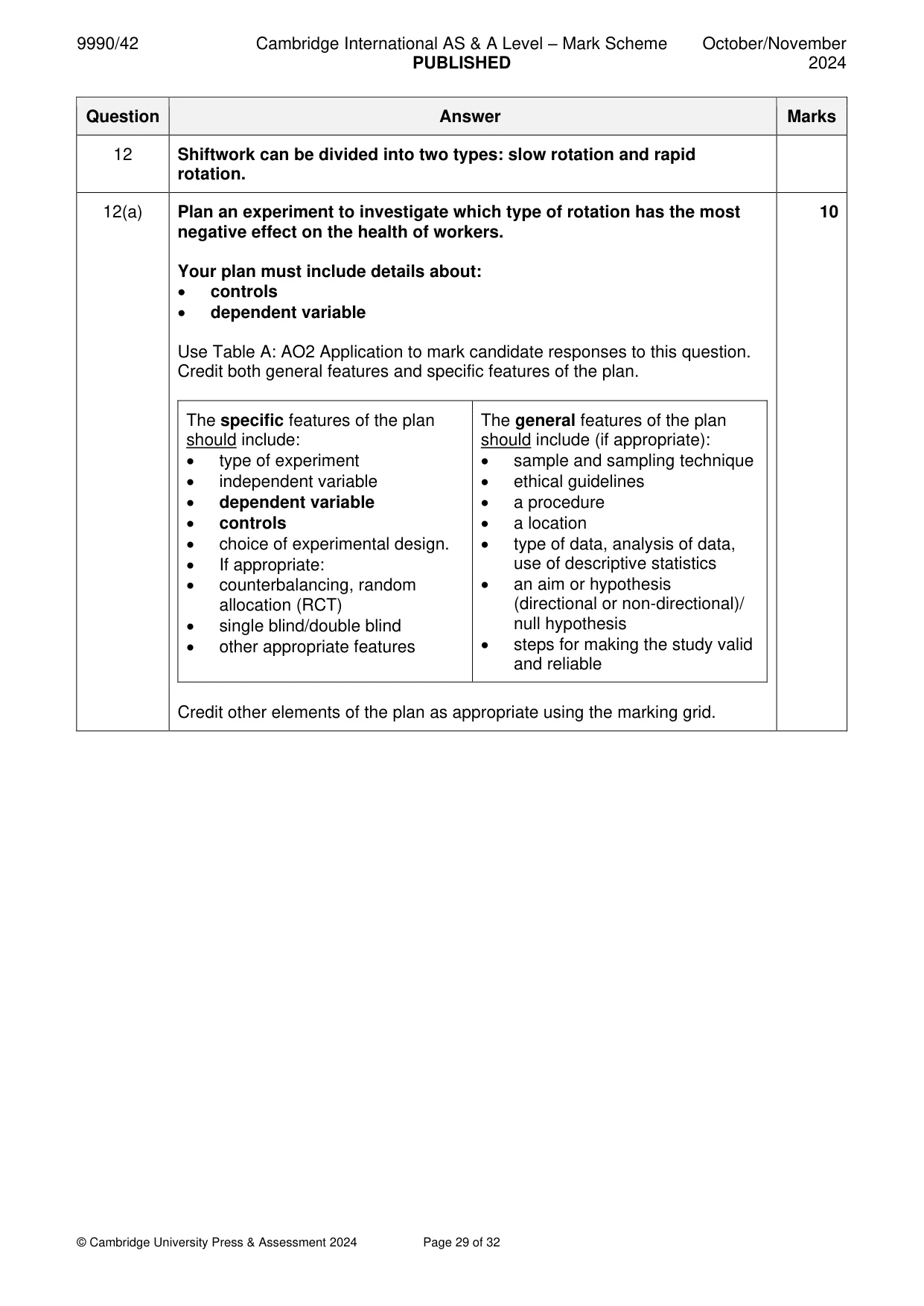
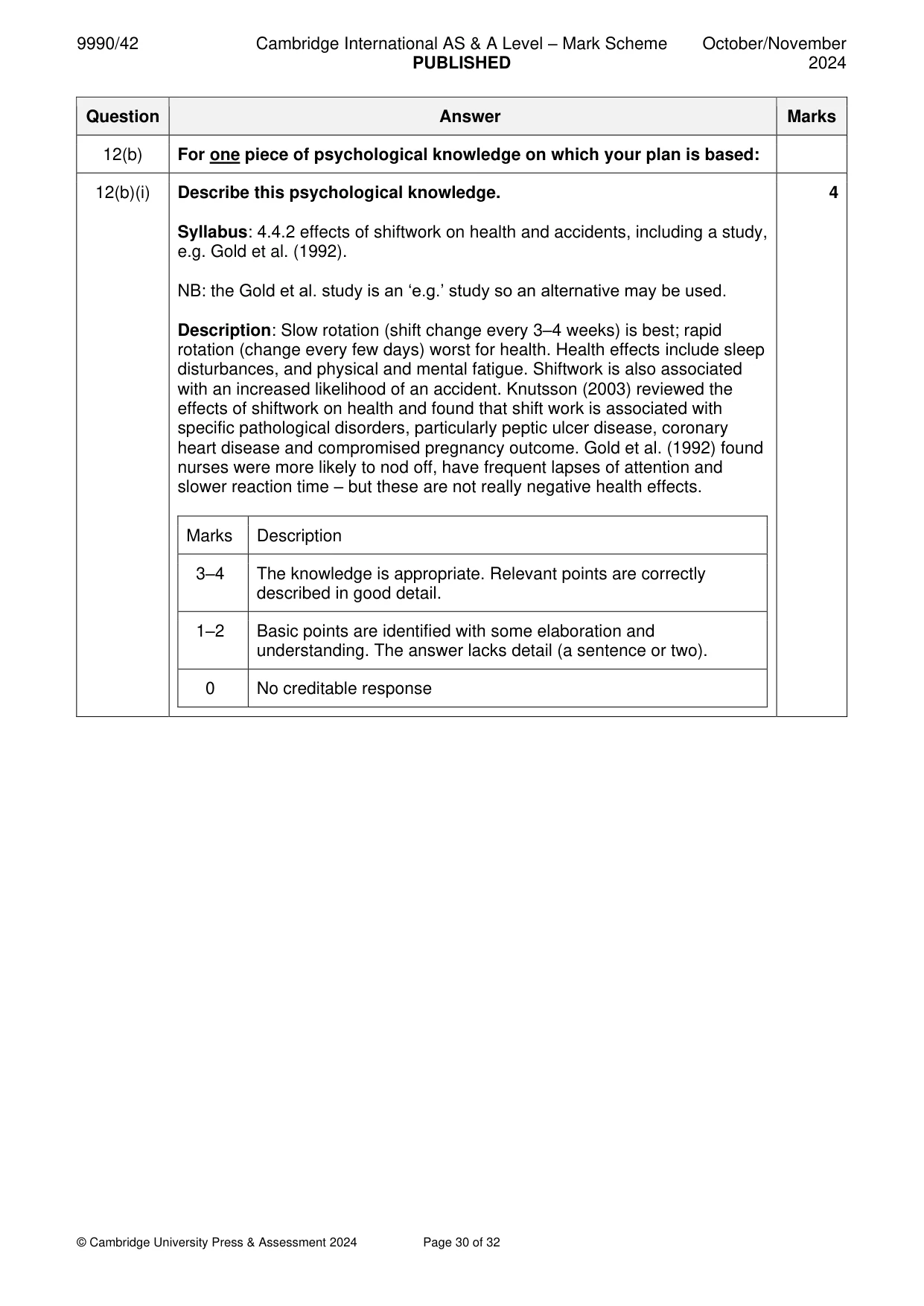
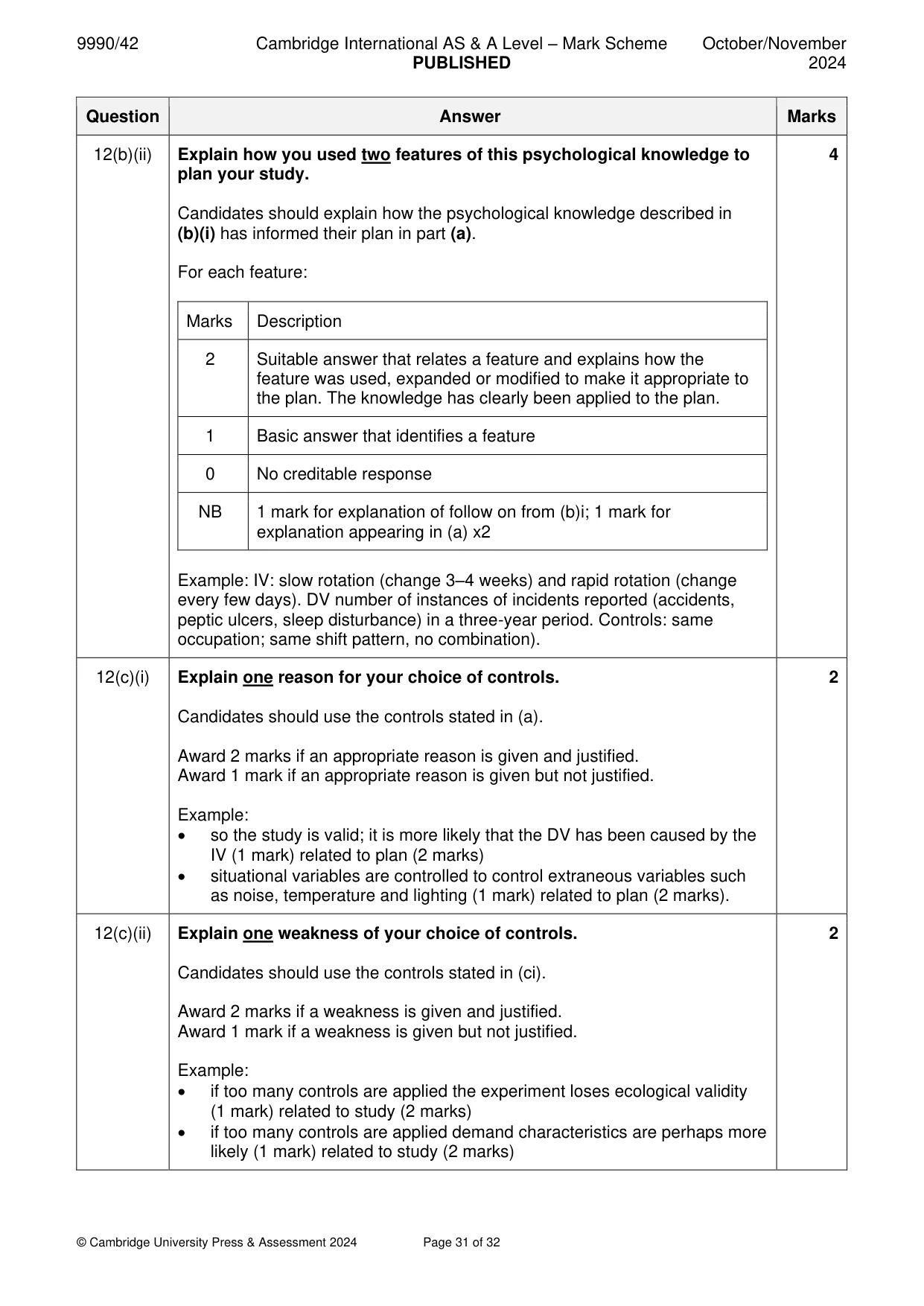
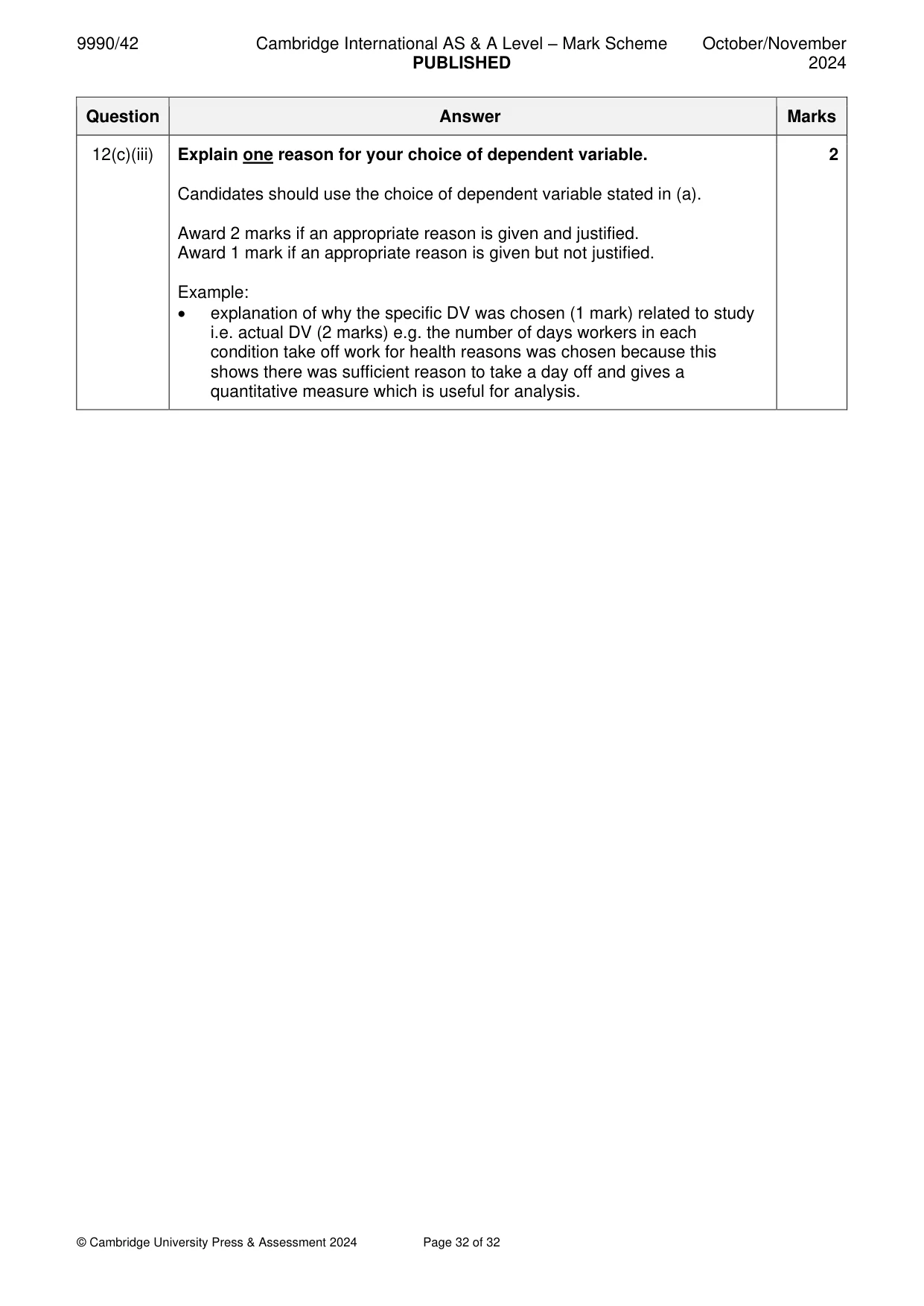
Mark scheme: 12 Shiftwork can be divided into two types: slow rotation and rapid rotation. 12(a) Plan an experiment to investigate which type of rotation has the most 10 negative effect on the health of workers. Your plan must include details about: • controls • dependent variable Use Table A: AO2 Application to mark candidate responses to this question. Credit both general features and specific features of the plan. The specific features of the plan The general features of the plan should include: should include (if appropriate): • type of experiment • sample and sampling technique • independent variable • ethical guidelines • dependent variable • a procedure • controls • a location • choice of experimental design. • type of data, analysis of data, • If appropriate: use of descriptive statistics • counterbalancing, random • an aim or hypothesis allocation (RCT) (directional or non-directional)/ • single blind/double blind null hypothesis • other appropriate features • steps for making the study valid and reliable Credit other elements of the plan as appropriate using the marking grid. 12(b) For one piece of psychological knowledge on which your plan is based: 12(b)(i) Describe this psychological knowledge. 4 Syllabus: 4.4.2 effects of shiftwork on health and accidents, including a study, e.g. Gold et al. (1992). NB: the Gold et al. study is an ‘e.g.’ study so an alternative may be used. Description: Slow rotation (shift change every 3–4 weeks) is best; rapid rotation (change every few days) worst for health. Health effects include sleep disturbances, and physical and mental fatigue. Shiftwork is also associated with an increased likelihood of an accident. Knutsson (2003) reviewed the effects of shiftwork on health and found that shift work is associated with specific pathological disorders, particularly peptic ulcer disease, coronary heart disease and compromised pregnancy outcome. Gold et al. (1992) found nurses were more likely to nod off, have frequent lapses of attention and slower reaction time – but these are not really negative health effects. Marks Description 3–4 The knowledge is appropriate. Relevant points are correctly described in good detail. 1–2 Basic points are identified with some elaboration and understanding. The answer lacks detail (a sentence or two). 0 No creditable response 12(b)(ii) Explain how you used two features of this psychological knowledge to 4 plan your study. Candidates should explain how the psychological knowledge described in (b)(i) has informed their plan in part (a). For each feature: Marks Description 2 Suitable answer that relates a feature and explains how the feature was used, expanded or modified to make it appropriate to the plan. The knowledge has clearly been applied to the plan. 1 Basic answer that identifies a feature 0 No creditable response NB 1 mark for explanation of follow on from (b)i; 1 mark for explanation appearing in (a) x2 Example: IV: slow rotation (change 3–4 weeks) and rapid rotation (change every few days). DV number of instances of incidents reported (accidents, peptic ulcers, sleep disturbance) in a three-year period. Controls: same occupation; same shift pattern, no combination). 12(c)(i) Explain one reason for your choice of controls. 2 Candidates should use the controls stated in (a). Award 2 marks if an appropriate reason is given and justified. Award 1 mark if an appropriate reason is given but not justified. Example: • so the study is valid; it is more likely that the DV has been caused by the IV (1 mark) related to plan (2 marks) • situational variables are controlled to control extraneous variables such as noise, temperature and lighting (1 mark) related to plan (2 marks). 12(c)(ii) Explain one weakness of your choice of controls. 2 Candidates should use the controls stated in (ci). Award 2 marks if a weakness is given and justified. Award 1 mark if a weakness is given but not justified. Example: • if too many controls are applied the experiment loses ecological validity (1 mark) related to study (2 marks) • if too many controls are applied demand characteristics are perhaps more likely (1 mark) related to study (2 marks) 12(c)(iii) Explain one reason for your choice of dependent variable. 2 Candidates should use the choice of dependent variable stated in (a). Award 2 marks if an appropriate reason is given and justified. Award 1 mark if an appropriate reason is given but not justified. Example: • explanation of why the specific DV was chosen (1 mark) related to study i.e. actual DV (2 marks) e.g. the number of days workers in each condition take off work for health reasons was chosen because this shows there was sufficient reason to take a day off and gives a quantitative measure which is useful for analysis.
What was in this paper
The subtopics covered by these 12 questions, and how many questions each got. Open one in a new tab to see every Cambridge question on it.
What you needed in this session
Cambridge’s own grade thresholds for 2024 Oct/Nov, Paper 4 · Variant 2. A higher threshold means an easier paper — the bar moves with how the cohort did.